EP3313099A1 - Apparatus and method for processing 3d audio signal based on hrtf, and highly realistic multimedia playing system using the same - Google Patents
Apparatus and method for processing 3d audio signal based on hrtf, and highly realistic multimedia playing system using the same Download PDFInfo
- Publication number
- EP3313099A1 EP3313099A1 EP17201558.8A EP17201558A EP3313099A1 EP 3313099 A1 EP3313099 A1 EP 3313099A1 EP 17201558 A EP17201558 A EP 17201558A EP 3313099 A1 EP3313099 A1 EP 3313099A1
- Authority
- EP
- European Patent Office
- Prior art keywords
- hrtf
- dimensional
- audio
- audio signals
- user
- Prior art date
- Legal status (The legal status is an assumption and is not a legal conclusion. Google has not performed a legal analysis and makes no representation as to the accuracy of the status listed.)
- Ceased
Links
Images



Classifications
-
- H—ELECTRICITY
- H04—ELECTRIC COMMUNICATION TECHNIQUE
- H04S—STEREOPHONIC SYSTEMS
- H04S5/00—Pseudo-stereo systems, e.g. in which additional channel signals are derived from monophonic signals by means of phase shifting, time delay or reverberation
-
- H—ELECTRICITY
- H04—ELECTRIC COMMUNICATION TECHNIQUE
- H04S—STEREOPHONIC SYSTEMS
- H04S1/00—Two-channel systems
- H04S1/002—Non-adaptive circuits, e.g. manually adjustable or static, for enhancing the sound image or the spatial distribution
- H04S1/005—For headphones
-
- H—ELECTRICITY
- H04—ELECTRIC COMMUNICATION TECHNIQUE
- H04S—STEREOPHONIC SYSTEMS
- H04S1/00—Two-channel systems
- H04S1/002—Non-adaptive circuits, e.g. manually adjustable or static, for enhancing the sound image or the spatial distribution
-
- H—ELECTRICITY
- H04—ELECTRIC COMMUNICATION TECHNIQUE
- H04S—STEREOPHONIC SYSTEMS
- H04S3/00—Systems employing more than two channels, e.g. quadraphonic
-
- G—PHYSICS
- G11—INFORMATION STORAGE
- G11B—INFORMATION STORAGE BASED ON RELATIVE MOVEMENT BETWEEN RECORD CARRIER AND TRANSDUCER
- G11B20/00—Signal processing not specific to the method of recording or reproducing; Circuits therefor
- G11B20/00992—Circuits for stereophonic or quadraphonic recording or reproducing
-
- G—PHYSICS
- G11—INFORMATION STORAGE
- G11B—INFORMATION STORAGE BASED ON RELATIVE MOVEMENT BETWEEN RECORD CARRIER AND TRANSDUCER
- G11B20/00—Signal processing not specific to the method of recording or reproducing; Circuits therefor
- G11B20/10—Digital recording or reproducing
-
- G—PHYSICS
- G11—INFORMATION STORAGE
- G11B—INFORMATION STORAGE BASED ON RELATIVE MOVEMENT BETWEEN RECORD CARRIER AND TRANSDUCER
- G11B20/00—Signal processing not specific to the method of recording or reproducing; Circuits therefor
- G11B20/10—Digital recording or reproducing
- G11B20/10527—Audio or video recording; Data buffering arrangements
-
- G—PHYSICS
- G11—INFORMATION STORAGE
- G11B—INFORMATION STORAGE BASED ON RELATIVE MOVEMENT BETWEEN RECORD CARRIER AND TRANSDUCER
- G11B20/00—Signal processing not specific to the method of recording or reproducing; Circuits therefor
- G11B20/10—Digital recording or reproducing
- G11B20/10527—Audio or video recording; Data buffering arrangements
- G11B2020/10537—Audio or video recording
- G11B2020/10546—Audio or video recording specifically adapted for audio data
-
- H—ELECTRICITY
- H04—ELECTRIC COMMUNICATION TECHNIQUE
- H04R—LOUDSPEAKERS, MICROPHONES, GRAMOPHONE PICK-UPS OR LIKE ACOUSTIC ELECTROMECHANICAL TRANSDUCERS; ELECTRIC HEARING AIDS; PUBLIC ADDRESS SYSTEMS
- H04R2499/00—Aspects covered by H04R or H04S not otherwise provided for in their subgroups
- H04R2499/10—General applications
- H04R2499/11—Transducers incorporated or for use in hand-held devices, e.g. mobile phones, PDA's, camera's
-
- H—ELECTRICITY
- H04—ELECTRIC COMMUNICATION TECHNIQUE
- H04R—LOUDSPEAKERS, MICROPHONES, GRAMOPHONE PICK-UPS OR LIKE ACOUSTIC ELECTROMECHANICAL TRANSDUCERS; ELECTRIC HEARING AIDS; PUBLIC ADDRESS SYSTEMS
- H04R5/00—Stereophonic arrangements
- H04R5/04—Circuit arrangements, e.g. for selective connection of amplifier inputs/outputs to loudspeakers, for loudspeaker detection, or for adaptation of settings to personal preferences or hearing impairments
-
- H—ELECTRICITY
- H04—ELECTRIC COMMUNICATION TECHNIQUE
- H04S—STEREOPHONIC SYSTEMS
- H04S2420/00—Techniques used stereophonic systems covered by H04S but not provided for in its groups
- H04S2420/01—Enhancing the perception of the sound image or of the spatial distribution using head related transfer functions [HRTF's] or equivalents thereof, e.g. interaural time difference [ITD] or interaural level difference [ILD]
Definitions
- the present invention relates to a realistic three-dimensional audio service and, more particularly, to a three-dimensional (3D) audio signal process apparatus and method for providing the most realistic three-dimensional audio signals by generating three-dimensional audio signals based on an Head Related Transfer Function (HRTF) modeled according to physical characteristics of an individual user and a highly realistic multimedia playing system using the same.
- HRTF Head Related Transfer Function
- FIG. 1 is a diagram of a typical multimedia playing system.
- a multimedia playing system 10 includes a demultiplexer 11, a video decoder 12, an audio decoder 13, and a three-dimensional (3D) audio signal processor 14.
- the video decoder 12 decodes the divided video data to restore thereinto original video signals.
- the audio decoder 13 decodes the divided audio data to restore thereinto original audio signals.
- the three-dimensional audio signal processor 14 gives three-dimensional stereophonic sound effect to the audio signals restored by the audio decoder 13 to generate three-dimensional audio signals.
- the three-dimensional stereophonic sound forms sound source at a certain place in a virtual space through a headphone or a speaker.
- the user feels senses of direction, distance, and space as if the sound actually comes from a location where the virtual sound source is.
- IHL Inside-the-Head Localization
- the IHL phenomenon can be a cause for reduced sense of space and reality.
- various methods have been developed for listeners to feel the three-dimensional effect, for instance, Sound Retrieval System (SRS), Digital Natural Sound Engine (DNSe), and Baseband Booster Effect (BBE).
- SRS Sound Retrieval System
- DNSe Digital Natural Sound Engine
- BBE Baseband Booster Effect
- the SRS recovers the reality of the sound damaged in typical stereo.
- the DNSe is an automatic adjustment method that amplifies low sound to make the listener feel as if he is at the concert hall just with a small MP3 player.
- a microphone is put inside the ears of a human being or a dummy, for instance, a torso. Then, the audio signals are recorded to acquire impulse response. When impulse signals are applied to the audio signals, the user can feel the location of the audio signals in the three-dimensional space.
- the HRTF indicates a transfer function generated between the sound source and the ears of the human being.
- the HRTF is different according to not only directions and height of the sound source but also physical characteristics such as shape and size of the head and the ears. That is, each listener has their own HRTF.
- the HRTF measured by various kinds of models for instance, a dummy head, which is non-individualized HRTF is used for the three-dimensional audio signal processing.
- a dummy head which is non-individualized HRTF is used for the three-dimensional audio signal processing.
- the typical multimedia playing system does not employ a module applying different HRTF according to the physical characteristics of each user, the three-dimensional audio signals optimized for the individual cannot be provided.
- the object of the present invention is to solve this problem.
- An embodiment of the present invention is directed to providing an apparatus.
- This invention provides to a three-dimensional audio signal process apparatus for providing the most realistic three-dimensional audio signals by generating three-dimensional audio signals using an HRTF modeled by physical characteristics of individual user and a high realistic multimedia playing system using it.
- a three-dimensional audio signal processing apparatus using a Head Related Transfer Function including an audio decoder for decoding audio data to restore original audio signals, and a three-dimensional audio generator for generating three-dimensional signals corresponding to the audio signals restored by using the HRTF modeled according to physical characteristics of an user, wherein the HRTF modeled according to physical characteristics of an user is an individualized HRTF.
- HRTF Head Related Transfer Function
- a method for processing three-dimensional audio signals by using an individualized HRTF including decoding audio data to restore original audio signals and generating three-dimensional audio signals corresponding to the restored audio signals by using the HRTF modeled according to physical characteristics of an user, wherein the HRTF modeled by physical characteristics of the user is an individualized HRTF.
- a highly realistic multimedia playing system including a demultiplexer for dividing multimedia data into video data and audio data, a video decoder for restoring the video data into original video signals, an audio decoder for decoding the audio data to restore the audio data into original audio signals, and a three-dimensional audio generator for generating three-dimensional audio signals corresponding to the restored audio signals by using the HRTF modeled according to physical characteristics of a user, wherein the HRTF modeled according to the physical characteristics of the user is an individualized HRTF.
- three dimensional audio signals are generated according to Head Related Transfer Function (HRTF) based on individual physical characteristics of user.
- HRTF Head Related Transfer Function
- a module receiving the individualized HRTF is added to the multimedia player.
- each user can play the high realistic three-dimensional audio optimized for themselves.
- Three-dimensional sound technology is for understanding a mechanism about detecting a location of sound source using only sense of hearing and technologically applying the mechanism.
- the three-dimensional location can be represented by three variables.
- three independent variables should be measured.
- Human or animal can accurately estimate not only directions (front, back, left, right, up, and down) of the sound source but also distance from the sound source through two signals measured by ears. Because spectrum of sound source reaching both ears changes according to directions of the sound source because of diffusion or rotation of the sound wave caused by a head, a trunk, and external ears. The changed spectrum of the sound wave is transferred to internal ears. Brain can estimate the accurate location of the sound source.
- listeners can listen virtual sound source (embodiment of the virtual sound field) can estimate the location of real sound source by reversely applying the mechanism, i.e., through signals measured by two or more microphones (estimation of the sound source location).
- This technology can add hearing virtual reality to a typical visual-focused virtual system to increase an immersion of the listener.
- 5.1 channel surround sound system effect can be achieved by two TV front speakers.
- a robot can estimate and deal with the location of an unseen person or a noise source. As a result, human feels intimateness about the robot.
- the HRTF is a transfer function between sound waves diffused from the sound source at a head-related certain location and sound waves reached both eardrums.
- the HRTF is different according to direction and height of the sound source.
- the HRTF is also changed according to shapes of head and external ears so that individuals have their own HRTF.
- the listener can hear the highly realistic three-dimensional audio signals.
- this invention generates the three-dimensional audio signals by using the HRTF corresponding to the physical characteristics of individuals to provide the high realistic three-dimensional audio signals optimized for the individuals.
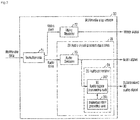
- FIG. 2 is a diagram showing a high realistic multimedia playing system using an individualized HRTF in accordance with an embodiment of the present invention.
- a high realistic multimedia playing system 20 includes a demultiplexer 21, a video decoder 22, an audio decoder 23, and a three-dimensional audio generator 24.
- the audio decoder 23 and the three-dimensional audio generator 24 are called a three-dimensional audio signal processor 25.
- the video decoder 22 restores the divided video data into original video data.
- the audio decoder 23 decodes the divided audio data and restores the divided audio data into original audio signal (stereo signals not added with three-dimensional effect).
- the three-dimensional audio generator 24 generates three-dimensional audio signals corresponding to the audio signals restored in the audio decoder 23 by using the HRTF optimized for an individual.
- the three-dimensional audio generator 24 includes an individual HRTF providing unit 241 and a three-dimensional audio signal processing unit 242.
- the individual HRTF providing unit 241 receives and stores an HRTF modeled by individual physical characteristics, for instance, size/shape of head, shape of ears, of users to provide it to the three dimensional audio signal processing unit 242.
- the individualized HRTF can be acquired by measuring the body of the user. That is, the HRTF can be estimated based on the physical characteristics to acquire the individualized HRTF.
- the individualized HRTF can be acquired by transforming the HRTF measured through the human model.
- the individualized HRTF can be acquired by using an ear microphone.
- the ear phone is equipped with a small microphone to measure the HRTF in real time to apply to the three-dimensional audio signal processing.
- the individual HRTF providing unit 241 stores different types of HRTF samples.
- the HRTF may be inputted by the user later and then stored.
- the selected HRTF may be provided to the three-dimensional audio signal processing unit 242.
- the three-dimensional audio signal processing unit 242 generates the three-dimensional audio signals (three-dimensional audio signal optimized for the individual user) corresponding to the audio signals restored in the audio decoder 23 by using the HRTF provided by the individual HRTF providing unit 241. For instance, the three-dimensional audio signal processing unit 242 convolutes the audio signals restored in the audio decoder 23 to generate the three dimensional audio signals.
- the multimedia playing system has the three-dimensional audio generator 24, i.e., an individualized three-dimensional audio signal processor, for increasing the three-dimensional effect by performing the audio signal process using the individualized HRTF.
- the user can listen more realistic three-dimensional audio.
- same product multimedia playing system
- FIG. 3 is a flowchart describing a method for processing signals in the high realistic multimedia playing system illustrated in FIG. 2 , particularly a method for processing the three-dimensional audio signals by using the individualized HRTF.
- the high realistic multimedia playing system in this invention demultiplexes the multimedia data into the video data and the audio data S300.
- the high realistic multimedia playing system decodes the video data to restore the original video data S302.
- the highly realistic multimedia playing system decodes the audio data to restore the original audio data S304. Then, the three-dimensional audio signals corresponding to the restored audio signals is generated using the HRTF optimized for the physical characteristics of the user, i.e., the individualized HRTF S306.
- the present application contains subject matter related to Korean Patent Application Nos. 2007-0133710 and 2008-0040072 in the Korean Intellectual Property Office on Dec. 18, 2007 and Apr. 29, 2008, the entire contents of which are incorporated herein by reference.
Landscapes
- Physics & Mathematics (AREA)
- Engineering & Computer Science (AREA)
- Acoustics & Sound (AREA)
- Signal Processing (AREA)
- Stereophonic System (AREA)
Abstract
Description
- The present invention relates to a realistic three-dimensional audio service and, more particularly, to a three-dimensional (3D) audio signal process apparatus and method for providing the most realistic three-dimensional audio signals by generating three-dimensional audio signals based on an Head Related Transfer Function (HRTF) modeled according to physical characteristics of an individual user and a highly realistic multimedia playing system using the same.
- This work was supported by the IT R&D program for MIC/IITA[2007-S-004-01, "Development of Glassless Single-
User 3D Broadcasting Technologies"]. - Recently, the number of people watching multimedia data through diverse multimedia playing systems such as a MP3 player, a Portable Multimedia Player (PMP), a cell phone, and a Digital Multimedia Broadcasting (DMB) player is increasing.
-
FIG. 1 is a diagram of a typical multimedia playing system. - Referring to
FIG. 1 , amultimedia playing system 10 includes a demultiplexer 11, avideo decoder 12, anaudio decoder 13, and a three-dimensional (3D)audio signal processor 14. - When the demultiplexer 11 divides the multimedia data into video data and audio data, the
video decoder 12 decodes the divided video data to restore thereinto original video signals. Theaudio decoder 13 decodes the divided audio data to restore thereinto original audio signals. - The three-dimensional
audio signal processor 14 gives three-dimensional stereophonic sound effect to the audio signals restored by theaudio decoder 13 to generate three-dimensional audio signals. Herein, the three-dimensional stereophonic sound forms sound source at a certain place in a virtual space through a headphone or a speaker. Thus, the user feels senses of direction, distance, and space as if the sound actually comes from a location where the virtual sound source is. - When users uses the multimedia playing system illustrated in
FIG. 1 , particularly a portable playing system (portable device), they usually listen to audio signals through a headphone or an earphone. At this time, an Inside-the-Head Localization (IHL) phenomenon occurs. That is, sound image is localized in head of the listener. - The IHL phenomenon can be a cause for reduced sense of space and reality. Thus, various methods have been developed for listeners to feel the three-dimensional effect, for instance, Sound Retrieval System (SRS), Digital Natural Sound Engine (DNSe), and Baseband Booster Effect (BBE). The SRS recovers the reality of the sound damaged in typical stereo. The DNSe is an automatic adjustment method that amplifies low sound to make the listener feel as if he is at the concert hall just with a small MP3 player.
- Researches on development of the three-dimensional audio technology have been conducted. It is reported that audio signal processing based on an individualized HRTF is the best way for playing the realistic audio.
- In the audio signal processor using a typical HRTF, a microphone is put inside the ears of a human being or a dummy, for instance, a torso. Then, the audio signals are recorded to acquire impulse response. When impulse signals are applied to the audio signals, the user can feel the location of the audio signals in the three-dimensional space.
- The HRTF indicates a transfer function generated between the sound source and the ears of the human being. The HRTF is different according to not only directions and height of the sound source but also physical characteristics such as shape and size of the head and the ears. That is, each listener has their own HRTF.
- However, up to now, the HRTF measured by various kinds of models, for instance, a dummy head, which is non-individualized HRTF is used for the three-dimensional audio signal processing. Thus, it is difficult to provide the same three-dimensional sound effect to listeners each having different physical characteristics.
- Furthermore, the typical multimedia playing system does not employ a module applying different HRTF according to the physical characteristics of each user, the three-dimensional audio signals optimized for the individual cannot be provided.
- When a typical multimedia playing system plays three-dimensional audio, physical characteristics, for instance, shape and size of head, and shape of ears, of a user is not considered. Thus, the user may feel insufficient reality of three-dimensional audio signals. Thus, the object of the present invention is to solve this problem.
- An embodiment of the present invention is directed to providing an apparatus.
- This invention provides to a three-dimensional audio signal process apparatus for providing the most realistic three-dimensional audio signals by generating three-dimensional audio signals using an HRTF modeled by physical characteristics of individual user and a high realistic multimedia playing system using it.
- The objects of the present invention are not limited to the above-mentioned ones. Other objects and advantages of the present invention can be understood by the following description, and become apparent with reference to the embodiments of the present invention. Also, it is obvious to those skilled in the art of the present invention that the objects and advantages of the present invention can be realized by the means as claimed and combinations thereof.
- In accordance with an aspect of the present invention, there is provided a three-dimensional audio signal processing apparatus using a Head Related Transfer Function (HRTF) including an audio decoder for decoding audio data to restore original audio signals, and a three-dimensional audio generator for generating three-dimensional signals corresponding to the audio signals restored by using the HRTF modeled according to physical characteristics of an user, wherein the HRTF modeled according to physical characteristics of an user is an individualized HRTF.
- In accordance with another aspect of the present invention, there is provided a method for processing three-dimensional audio signals by using an individualized HRTF, the method including decoding audio data to restore original audio signals and generating three-dimensional audio signals corresponding to the restored audio signals by using the HRTF modeled according to physical characteristics of an user, wherein the HRTF modeled by physical characteristics of the user is an individualized HRTF.
- In accordance with another aspect of the present invention, there is provided a highly realistic multimedia playing system including a demultiplexer for dividing multimedia data into video data and audio data, a video decoder for restoring the video data into original video signals, an audio decoder for decoding the audio data to restore the audio data into original audio signals, and a three-dimensional audio generator for generating three-dimensional audio signals corresponding to the restored audio signals by using the HRTF modeled according to physical characteristics of a user, wherein the HRTF modeled according to the physical characteristics of the user is an individualized HRTF.
- In the present invention, three dimensional audio signals are generated according to Head Related Transfer Function (HRTF) based on individual physical characteristics of user. Thus, the most realistic three-dimensional audio signals can be provided to each user.
- That is, in this invention, a module receiving the individualized HRTF is added to the multimedia player. When the users play audio data through their own multimedia player, each user can play the high realistic three-dimensional audio optimized for themselves.
-
-
FIG. 1 is a diagram of a typical multimedia playing system. -
FIG. 2 is a diagram showing a high realistic multimedia playing system using an individualized Head Related Transfer Function (HRTF) in accordance with an embodiment of the present invention. -
FIG. 3 is a flowchart showing a method for processing signals in the highly realistic multimedia playing system illustrated inFIG. 2 . - The advantages, features and aspects of the invention will become apparent from the following description of the embodiments with reference to the accompanying drawings, which is set forth hereinafter. Therefore, those skilled in the field of this art of the present invention can embody the technological concept and scope of the invention easily. In addition, if it is considered that detailed description on a related art may obscure the points of the present invention, the detailed description will not be provided herein. The preferred embodiments of the present invention will be described in detail hereinafter with reference to the attached drawings.
- Three-dimensional sound technology is for understanding a mechanism about detecting a location of sound source using only sense of hearing and technologically applying the mechanism. Generally, the three-dimensional location can be represented by three variables. To estimate the three variables, three independent variables should be measured.
- Human or animal, particularly an owl, can accurately estimate not only directions (front, back, left, right, up, and down) of the sound source but also distance from the sound source through two signals measured by ears. Because spectrum of sound source reaching both ears changes according to directions of the sound source because of diffusion or rotation of the sound wave caused by a head, a trunk, and external ears. The changed spectrum of the sound wave is transferred to internal ears. Brain can estimate the accurate location of the sound source.
- If the mechanism of detecting the location of the sound source can be accurately understood and reproduced, listeners can listen virtual sound source (embodiment of the virtual sound field) can estimate the location of real sound source by reversely applying the mechanism, i.e., through signals measured by two or more microphones (estimation of the sound source location). This technology can add hearing virtual reality to a typical visual-focused virtual system to increase an immersion of the listener. Also, 5.1 channel surround sound system effect can be achieved by two TV front speakers. Furthermore, a robot can estimate and deal with the location of an unseen person or a noise source. As a result, human feels intimateness about the robot.
- To accurately figure out the mechanism of detecting the location of the sound source, the Head Related Transfer Function (HRTF) should be understood. The HRTF is a transfer function between sound waves diffused from the sound source at a head-related certain location and sound waves reached both eardrums. The HRTF is different according to direction and height of the sound source. The HRTF is also changed according to shapes of head and external ears so that individuals have their own HRTF.
- When the HRTF optimized for the physical characteristics of the individuals (which is individualized HRTF) is multiplied by audio signals (original sound) in a convolution form and played, the listener can hear the highly realistic three-dimensional audio signals.
- Thus, this invention generates the three-dimensional audio signals by using the HRTF corresponding to the physical characteristics of individuals to provide the high realistic three-dimensional audio signals optimized for the individuals.
-
FIG. 2 is a diagram showing a high realistic multimedia playing system using an individualized HRTF in accordance with an embodiment of the present invention. - Referring to
FIG. 2 , a high realisticmultimedia playing system 20 includes ademultiplexer 21, avideo decoder 22, anaudio decoder 23, and a three-dimensional audio generator 24. Theaudio decoder 23 and the three-dimensional audio generator 24 are called a three-dimensionalaudio signal processor 25. - When the
multiplexer 21 divides data into video data and audio data, thevideo decoder 22 restores the divided video data into original video data. Theaudio decoder 23 decodes the divided audio data and restores the divided audio data into original audio signal (stereo signals not added with three-dimensional effect). - The three-
dimensional audio generator 24 generates three-dimensional audio signals corresponding to the audio signals restored in theaudio decoder 23 by using the HRTF optimized for an individual. Herein, the three-dimensional audio generator 24 includes an individualHRTF providing unit 241 and a three-dimensional audiosignal processing unit 242. - The individual
HRTF providing unit 241 receives and stores an HRTF modeled by individual physical characteristics, for instance, size/shape of head, shape of ears, of users to provide it to the three dimensional audiosignal processing unit 242. - Hereinafter, a method for acquiring the HRTF corresponding to physical characteristics of the user, that is, the individualized HRTF, will be described in detail.
- First, the individualized HRTF can be acquired by measuring the body of the user. That is, the HRTF can be estimated based on the physical characteristics to acquire the individualized HRTF.
- Second, the individualized HRTF can be acquired by transforming the HRTF measured through the human model.
- Third, the individualized HRTF can be acquired by using an ear microphone. The ear phone is equipped with a small microphone to measure the HRTF in real time to apply to the three-dimensional audio signal processing.
- In another embodiment, the individual
HRTF providing unit 241 stores different types of HRTF samples. The HRTF may be inputted by the user later and then stored. When the user selects a certain HRTF, the selected HRTF may be provided to the three-dimensional audiosignal processing unit 242. - The three-dimensional audio
signal processing unit 242 generates the three-dimensional audio signals (three-dimensional audio signal optimized for the individual user) corresponding to the audio signals restored in theaudio decoder 23 by using the HRTF provided by the individualHRTF providing unit 241. For instance, the three-dimensional audiosignal processing unit 242 convolutes the audio signals restored in theaudio decoder 23 to generate the three dimensional audio signals. - To sum up, in this invention, the multimedia playing system has the three-
dimensional audio generator 24, i.e., an individualized three-dimensional audio signal processor, for increasing the three-dimensional effect by performing the audio signal process using the individualized HRTF. Thus, the user can listen more realistic three-dimensional audio. Also, in this invention, since the user can input the HRTF optimized for his own physical characteristics into the multimedia playing system, same product (multimedia playing system) can process the signals corresponding to the physical characteristics of the user. -
FIG. 3 is a flowchart describing a method for processing signals in the high realistic multimedia playing system illustrated inFIG. 2 , particularly a method for processing the three-dimensional audio signals by using the individualized HRTF. - The high realistic multimedia playing system in this invention demultiplexes the multimedia data into the video data and the audio data S300.
- The high realistic multimedia playing system decodes the video data to restore the original video data S302.
- The highly realistic multimedia playing system decodes the audio data to restore the original audio data S304. Then, the three-dimensional audio signals corresponding to the restored audio signals is generated using the HRTF optimized for the physical characteristics of the user, i.e., the individualized HRTF S306.
- The present application contains subject matter related to Korean Patent Application Nos.
2007-0133710 2008-0040072 - While the present invention has been described with respect to certain preferred embodiments, it will be apparent to those skilled in the art that various changes and modifications may be made without departing from the scope of the invention as defined in the following claims.
- Embodiments of the invention are further disclosed in the following:
- [1] A three-dimensional audio signal processing apparatus using a Head Related Transfer Function (HRTF), comprising:
- an audio decoder for decoding audio data to restore original audio signals; and
- a three-dimensional audio generator for generating three-dimensional signals corresponding to the audio signals restored by using the HRTF modeled according to physical characteristics of an user, which will be referred to as "individualized HRTF".
- [2] The apparatus of embodiment 1, wherein the three-dimensional audio generator includes:
- an HRTF providing unit for receiving the individualized HRTF from external; and
- a three-dimensional audio signal processing unit for generating three-dimensional audio signals corresponding to the restored audio signals based on the individualized HRTF provided by the HRTF providing unit.
- [3] The apparatus of embodiment 1, wherein the three-dimensional audio generator includes:
- a three-dimensional audio providing unit for providing the HRTF selected among a plurality of HRTF samples as the individualized HRTF; and
- a three-dimensional audio signal processing unit for generating three-dimensional audio signals corresponding to the restored audio signals based on the individualized HRTF provided by the HRTF providing unit.
- [4] The apparatus of embodiment 2, wherein the three-dimensional audio signal processor convolutes the individualized HRTF provided by the HRTF providing unit and the restored audio signals to generate the three-dimensional audio signals.
- [5] The apparatus of embodiment 1, wherein the individualized HRTF is modeled according to size and shape of head, and shape of ears of the user.
- [6] A method for processing three-dimensional audio signals by using an individualized Head Related Transfer Function (HRTF), the method comprising:
- decoding audio data to restore original audio signals; and
- generating three-dimensional audio signals corresponding to the restored audio signals by using the HRTF modeled according to physical characteristics of a user, which will be referred to as "individualized HRTF".
- [7] The method of embodiment 6, wherein the individualized HRTF is an HRTF inputted from external after modeled according to the physical characteristics of the user.
- [8] The method of embodiment 6, wherein the individualized HRTF is an HRTF selected by the user among a plurality of HRTF samples.
- [9] The method of embodiment 6, wherein the three-dimensional audio signals are generated convoluting the individualized HRTF and the restored audio signals.
- [10] A highly realistic multimedia playing system, comprising:
- a demultiplexer for dividing multimedia data into video data and audio data;
- a video decoder for restoring the video data into original video signals;
- an audio decoder for decoding the audio data to restore the audio data into original audio signals; and
- a three-dimensional audio generator for generating three-dimensional audio signals corresponding to the restored audio signals by using a Head Related Transfer Function (HRTF) modeled according to physical characteristics of a user, which will be referred to as "individualized HRTF".
- [11] The system of
embodiment 10, wherein the three-dimensional audio generator includes: an HRTF providing unit for receiving the individualized HRTF from external;
and
a three-dimensional audio signal processing unit for generating three-dimensional audio signals corresponding to the restored audio signals by using the individualized HRTF provided by the HRTF providing unit. - [12] The system of
embodiment 10, wherein the three-dimensional audio generator includes: an HRTF providing unit for providing the HRTF selected by the user among a
plurality of HRTF samples as the individualized HRTF; and
a three-dimensional audio signal processing unit for generating three-dimensional audio signals corresponding to the restored audio signals based on the individualized HRTF provided by the HRTF providing unit.
Claims (6)
- A method for processing three-dimensional audio signal, comprising:decoding audio data; andgenerating three-dimensional signals corresponding to the audio signals to listen sound source in a virtual space for a listenercharacterized that:wherein the generating comprising:generating three-dimensional signals corresponding to the audio signals using a HRTF(Head Related Transfer Function) different according to direction and height of the sound source for providing an immersion of the listener.
- The method of claim 1, wherein the HRTF is provided from an external or is selected from among a plurality of HRTF by the listener.
- The method of claim 1 or claim 2, wherein the HRTF is modeled according to size and shape of head, or shape of ears of the listener.
- The method of any one of claims 1 to 3, wherein the HRTF is determined based on an impulse response for the location of the audio signal.
- The method of any one of claims 1 to 4, wherein the HRTF is modeled according to physical characteristics of a user, which will be referred to as "individualized HRTF".
- The method of claim 5, wherein the HRTF is transfer function generated between the sound source and the ears of the user.
Applications Claiming Priority (3)
| Application Number | Priority Date | Filing Date | Title |
|---|---|---|---|
| KR20070133710 | 2007-12-18 | ||
| KR1020080040072A KR100954385B1 (en) | 2007-12-18 | 2008-04-29 | 3D audio signal processing apparatus and method using personalized head transfer function, and high-reality multimedia playback system using the same |
| EP08862310.3A EP2243136B1 (en) | 2007-12-18 | 2008-09-26 | Mediaplayer with 3D audio rendering based on individualised HRTF measured in real time using earpiece microphones. |
Related Parent Applications (1)
| Application Number | Title | Priority Date | Filing Date |
|---|---|---|---|
| EP08862310.3A Division EP2243136B1 (en) | 2007-12-18 | 2008-09-26 | Mediaplayer with 3D audio rendering based on individualised HRTF measured in real time using earpiece microphones. |
Publications (1)
| Publication Number | Publication Date |
|---|---|
| EP3313099A1 true EP3313099A1 (en) | 2018-04-25 |
Family
ID=40994304
Family Applications (2)
| Application Number | Title | Priority Date | Filing Date |
|---|---|---|---|
| EP08862310.3A Not-in-force EP2243136B1 (en) | 2007-12-18 | 2008-09-26 | Mediaplayer with 3D audio rendering based on individualised HRTF measured in real time using earpiece microphones. |
| EP17201558.8A Ceased EP3313099A1 (en) | 2007-12-18 | 2008-09-26 | Apparatus and method for processing 3d audio signal based on hrtf, and highly realistic multimedia playing system using the same |
Family Applications Before (1)
| Application Number | Title | Priority Date | Filing Date |
|---|---|---|---|
| EP08862310.3A Not-in-force EP2243136B1 (en) | 2007-12-18 | 2008-09-26 | Mediaplayer with 3D audio rendering based on individualised HRTF measured in real time using earpiece microphones. |
Country Status (4)
| Country | Link |
|---|---|
| US (1) | US20110150098A1 (en) |
| EP (2) | EP2243136B1 (en) |
| KR (1) | KR100954385B1 (en) |
| WO (1) | WO2009078558A1 (en) |
Cited By (1)
| Publication number | Priority date | Publication date | Assignee | Title |
|---|---|---|---|---|
| CN110493701A (en) * | 2019-07-16 | 2019-11-22 | 西北工业大学 | HRTF Personalization Method Based on Sparse Principal Component Analysis |
Families Citing this family (9)
| Publication number | Priority date | Publication date | Assignee | Title |
|---|---|---|---|---|
| JP5477357B2 (en) * | 2010-11-09 | 2014-04-23 | 株式会社デンソー | Sound field visualization system |
| US9723287B2 (en) * | 2012-07-09 | 2017-08-01 | Lg Electronics Inc. | Enhanced 3D audio/video processing apparatus and method |
| KR102057684B1 (en) | 2017-09-22 | 2019-12-20 | 주식회사 디지소닉 | A stereo sound service device capable of providing three-dimensional stereo sound |
| WO2019059558A1 (en) * | 2017-09-22 | 2019-03-28 | (주)디지소닉 | Stereoscopic sound service apparatus, and drive method and computer-readable recording medium for said apparatus |
| CN107734428B (en) * | 2017-11-03 | 2019-10-01 | 中广热点云科技有限公司 | A kind of 3D audio-frequence player device |
| KR102483470B1 (en) | 2018-02-13 | 2023-01-02 | 한국전자통신연구원 | Apparatus and method for stereophonic sound generating using a multi-rendering method and stereophonic sound reproduction using a multi-rendering method |
| CN110460927A (en) * | 2019-08-01 | 2019-11-15 | 深圳市康宸电子科技有限公司 | A kind of 3D game bluetooth headset and processing method based on DSP |
| DE102021122597A1 (en) | 2021-09-01 | 2023-03-02 | Synotec Psychoinformatik Gmbh | Mobile immersive 3D audio space |
| KR102661374B1 (en) | 2023-06-01 | 2024-04-25 | 김형준 | Audio output system of 3D sound by selectively controlling sound source |
Citations (3)
| Publication number | Priority date | Publication date | Assignee | Title |
|---|---|---|---|---|
| US6996244B1 (en) * | 1998-08-06 | 2006-02-07 | Vulcan Patents Llc | Estimation of head-related transfer functions for spatial sound representative |
| WO2007096808A1 (en) * | 2006-02-21 | 2007-08-30 | Koninklijke Philips Electronics N.V. | Audio encoding and decoding |
| WO2007137232A2 (en) * | 2006-05-20 | 2007-11-29 | Personics Holdings Inc. | Method of modifying audio content |
Family Cites Families (21)
| Publication number | Priority date | Publication date | Assignee | Title |
|---|---|---|---|---|
| JP2939105B2 (en) * | 1993-12-27 | 1999-08-25 | シャープ株式会社 | Stereo headphone device for three-dimensional sound field control |
| US5729612A (en) * | 1994-08-05 | 1998-03-17 | Aureal Semiconductor Inc. | Method and apparatus for measuring head-related transfer functions |
| JPH09135499A (en) * | 1995-11-08 | 1997-05-20 | Victor Co Of Japan Ltd | Sound image localization control method |
| US6181800B1 (en) * | 1997-03-10 | 2001-01-30 | Advanced Micro Devices, Inc. | System and method for interactive approximation of a head transfer function |
| US7085393B1 (en) * | 1998-11-13 | 2006-08-01 | Agere Systems Inc. | Method and apparatus for regularizing measured HRTF for smooth 3D digital audio |
| AUPQ514000A0 (en) * | 2000-01-17 | 2000-02-10 | University Of Sydney, The | The generation of customised three dimensional sound effects for individuals |
| JP2002199500A (en) * | 2000-12-25 | 2002-07-12 | Sony Corp | Virtual sound image localization processing device, virtual sound image localization processing method, and recording medium |
| EP1500303A2 (en) * | 2002-04-10 | 2005-01-26 | Koninklijke Philips Electronics N.V. | Audio distribution |
| US20060245305A1 (en) * | 2003-04-11 | 2006-11-02 | Aarts Ronaldus M | System comprising sound reproduction means and ear microphones |
| US8054980B2 (en) * | 2003-09-05 | 2011-11-08 | Stmicroelectronics Asia Pacific Pte, Ltd. | Apparatus and method for rendering audio information to virtualize speakers in an audio system |
| WO2005025270A1 (en) * | 2003-09-08 | 2005-03-17 | Matsushita Electric Industrial Co., Ltd. | Audio image control device design tool and audio image control device |
| JP2005109914A (en) | 2003-09-30 | 2005-04-21 | Nippon Telegr & Teleph Corp <Ntt> | High realistic sound field reproduction method, head related transfer function database creation method, and high realistic sound field reproduction device |
| GB0419346D0 (en) * | 2004-09-01 | 2004-09-29 | Smyth Stephen M F | Method and apparatus for improved headphone virtualisation |
| KR100777221B1 (en) * | 2005-04-22 | 2007-11-19 | 한국정보통신대학교 산학협력단 | Lattice speaker system and sound processing method in the system |
| US8266195B2 (en) * | 2006-03-28 | 2012-09-11 | Telefonaktiebolaget L M Ericsson (Publ) | Filter adaptive frequency resolution |
| FR2899423A1 (en) * | 2006-03-28 | 2007-10-05 | France Telecom | Three-dimensional audio scene binauralization/transauralization method for e.g. audio headset, involves filtering sub band signal by applying gain and delay on signal to generate equalized and delayed component from each of encoded channels |
| US7756281B2 (en) * | 2006-05-20 | 2010-07-13 | Personics Holdings Inc. | Method of modifying audio content |
| FR2903562A1 (en) * | 2006-07-07 | 2008-01-11 | France Telecom | BINARY SPATIALIZATION OF SOUND DATA ENCODED IN COMPRESSION. |
| JP4946305B2 (en) * | 2006-09-22 | 2012-06-06 | ソニー株式会社 | Sound reproduction system, sound reproduction apparatus, and sound reproduction method |
| US8270616B2 (en) * | 2007-02-02 | 2012-09-18 | Logitech Europe S.A. | Virtual surround for headphones and earbuds headphone externalization system |
| US9031242B2 (en) * | 2007-11-06 | 2015-05-12 | Starkey Laboratories, Inc. | Simulated surround sound hearing aid fitting system |
-
2008
- 2008-04-29 KR KR1020080040072A patent/KR100954385B1/en not_active Expired - Fee Related
- 2008-09-26 WO PCT/KR2008/005710 patent/WO2009078558A1/en not_active Ceased
- 2008-09-26 US US12/809,458 patent/US20110150098A1/en not_active Abandoned
- 2008-09-26 EP EP08862310.3A patent/EP2243136B1/en not_active Not-in-force
- 2008-09-26 EP EP17201558.8A patent/EP3313099A1/en not_active Ceased
Patent Citations (4)
| Publication number | Priority date | Publication date | Assignee | Title |
|---|---|---|---|---|
| US6996244B1 (en) * | 1998-08-06 | 2006-02-07 | Vulcan Patents Llc | Estimation of head-related transfer functions for spatial sound representative |
| WO2007096808A1 (en) * | 2006-02-21 | 2007-08-30 | Koninklijke Philips Electronics N.V. | Audio encoding and decoding |
| WO2007137232A2 (en) * | 2006-05-20 | 2007-11-29 | Personics Holdings Inc. | Method of modifying audio content |
| US20100241256A1 (en) * | 2006-05-20 | 2010-09-23 | Personics Holdings Inc. | Method of modifying audio content |
Non-Patent Citations (2)
| Title |
|---|
| "The Perceived Performance of Spatial Audio for Teleconferencing", 1 September 1997, UNIVERSITY OF YORK, article MICHAEL JAMES EVANS: "The Perceived Performance of Spatial Audio for Teleconferencing", XP055600265, DOI: 10.6084/M9.FIGSHARE.1263856 * |
| KAI-UWE DOERR ET AL: "Evaluation of a Low-Cost 3D Sound System for Immersive Virtual Reality Training Systems", IEEE TRANSACTIONS ON VISUALIZATION AND COMPUTER GRAPHICS, IEEE SERVICE CENTER, LOS ALAMITOS, CA, US, vol. 12, no. 2, 1 March 2007 (2007-03-01), pages 204 - 212, XP011157906, ISSN: 1077-2626 * |
Cited By (1)
| Publication number | Priority date | Publication date | Assignee | Title |
|---|---|---|---|---|
| CN110493701A (en) * | 2019-07-16 | 2019-11-22 | 西北工业大学 | HRTF Personalization Method Based on Sparse Principal Component Analysis |
Also Published As
| Publication number | Publication date |
|---|---|
| KR20090066188A (en) | 2009-06-23 |
| EP2243136A4 (en) | 2012-04-04 |
| KR100954385B1 (en) | 2010-04-26 |
| EP2243136A1 (en) | 2010-10-27 |
| WO2009078558A1 (en) | 2009-06-25 |
| US20110150098A1 (en) | 2011-06-23 |
| EP2243136B1 (en) | 2017-11-15 |
Similar Documents
| Publication | Publication Date | Title |
|---|---|---|
| EP2243136B1 (en) | Mediaplayer with 3D audio rendering based on individualised HRTF measured in real time using earpiece microphones. | |
| Paul | Binaural recording technology: A historical review and possible future developments | |
| CN101263741B (en) | Method and apparatus for generating and processing parameters representing HRTF | |
| US11221820B2 (en) | System and method for processing audio between multiple audio spaces | |
| JP3435141B2 (en) | SOUND IMAGE LOCALIZATION DEVICE, CONFERENCE DEVICE USING SOUND IMAGE LOCALIZATION DEVICE, MOBILE PHONE, AUDIO REPRODUCTION DEVICE, AUDIO RECORDING DEVICE, INFORMATION TERMINAL DEVICE, GAME MACHINE, COMMUNICATION AND BROADCASTING SYSTEM | |
| EP3621318A1 (en) | Sound output device and sound output method | |
| Garí et al. | Flexible binaural resynthesis of room impulse responses for augmented reality research | |
| GB2458747A (en) | Head-related transfer function (HRTF) measurement method | |
| CN102256192A (en) | Individualization of sound signals | |
| WO2007031906A2 (en) | A method of and a device for generating 3d sound | |
| EP3837863B1 (en) | Methods for obtaining and reproducing a binaural recording | |
| EP3745745B1 (en) | Apparatus, method, computer program or system for use in rendering audio | |
| WO2013111038A1 (en) | Generation of a binaural signal | |
| KR100647338B1 (en) | Optimum listening area extension method and device | |
| Suzuki et al. | 3D spatial sound systems compatible with human's active listening to realize rich high-level kansei information | |
| KR100932791B1 (en) | Method of generating head transfer function for sound externalization, apparatus for processing 3D audio signal using same and method thereof | |
| KR19980031979A (en) | Method and device for 3D sound field reproduction in two channels using head transfer function | |
| JP6972858B2 (en) | Sound processing equipment, programs and methods | |
| Mickiewicz et al. | Creation of immersive experience for headphone listening using directional room impulse responses for BRIR synthesis | |
| Vorländer | Virtual acoustics: opportunities and limits of spatial sound reproduction | |
| CN120751331B (en) | Audio processing method, device and audio output system | |
| US20250016519A1 (en) | Audio device with head orientation-based filtering and related methods | |
| Tan | Binaural recording methods with analysis on inter-aural time, level, and phase differences | |
| Zotkin et al. | Efficient conversion of XY surround sound content to binaural head-tracked form for HRTF-enabled playback | |
| Pörschmann et al. | 3-D audio in mobile communication devices: effects of self-created and external sounds on presence in auditory virtual environments |
Legal Events
| Date | Code | Title | Description |
|---|---|---|---|
| PUAI | Public reference made under article 153(3) epc to a published international application that has entered the european phase |
Free format text: ORIGINAL CODE: 0009012 |
|
| STAA | Information on the status of an ep patent application or granted ep patent |
Free format text: STATUS: THE APPLICATION HAS BEEN PUBLISHED |
|
| AC | Divisional application: reference to earlier application |
Ref document number: 2243136 Country of ref document: EP Kind code of ref document: P |
|
| AK | Designated contracting states |
Kind code of ref document: A1 Designated state(s): AT BE BG CH CY CZ DE DK EE ES FI FR GB GR HR HU IE IS IT LI LT LU LV MC MT NL NO PL PT RO SE SI SK TR |
|
| STAA | Information on the status of an ep patent application or granted ep patent |
Free format text: STATUS: REQUEST FOR EXAMINATION WAS MADE |
|
| 17P | Request for examination filed |
Effective date: 20181025 |
|
| RBV | Designated contracting states (corrected) |
Designated state(s): AT BE BG CH CY CZ DE DK EE ES FI FR GB GR HR HU IE IS IT LI LT LU LV MC MT NL NO PL PT RO SE SI SK TR |
|
| STAA | Information on the status of an ep patent application or granted ep patent |
Free format text: STATUS: EXAMINATION IS IN PROGRESS |
|
| 17Q | First examination report despatched |
Effective date: 20190123 |
|
| RIC1 | Information provided on ipc code assigned before grant |
Ipc: H04S 5/00 20060101ALI20190605BHEP Ipc: H04R 5/04 20060101ALN20190605BHEP Ipc: G11B 20/10 20060101ALN20190605BHEP Ipc: H04S 1/00 20060101AFI20190605BHEP |
|
| STAA | Information on the status of an ep patent application or granted ep patent |
Free format text: STATUS: THE APPLICATION HAS BEEN REFUSED |
|
| 18R | Application refused |
Effective date: 20210102 |