EP3312775B1 - Control system, system, and program - Google Patents
Control system, system, and program Download PDFInfo
- Publication number
- EP3312775B1 EP3312775B1 EP16811439.5A EP16811439A EP3312775B1 EP 3312775 B1 EP3312775 B1 EP 3312775B1 EP 16811439 A EP16811439 A EP 16811439A EP 3312775 B1 EP3312775 B1 EP 3312775B1
- Authority
- EP
- European Patent Office
- Prior art keywords
- information
- emotion
- recording
- robot
- artificial
- Prior art date
- Legal status (The legal status is an assumption and is not a legal conclusion. Google has not performed a legal analysis and makes no representation as to the accuracy of the status listed.)
- Active
Links
Images






Classifications
-
- G—PHYSICS
- G06—COMPUTING OR CALCULATING; COUNTING
- G06N—COMPUTING ARRANGEMENTS BASED ON SPECIFIC COMPUTATIONAL MODELS
- G06N3/00—Computing arrangements based on biological models
- G06N3/02—Neural networks
- G06N3/04—Architecture, e.g. interconnection topology
- G06N3/049—Temporal neural networks, e.g. delay elements, oscillating neurons or pulsed inputs
-
- G—PHYSICS
- G06—COMPUTING OR CALCULATING; COUNTING
- G06N—COMPUTING ARRANGEMENTS BASED ON SPECIFIC COMPUTATIONAL MODELS
- G06N3/00—Computing arrangements based on biological models
- G06N3/02—Neural networks
-
- G—PHYSICS
- G06—COMPUTING OR CALCULATING; COUNTING
- G06N—COMPUTING ARRANGEMENTS BASED ON SPECIFIC COMPUTATIONAL MODELS
- G06N3/00—Computing arrangements based on biological models
- G06N3/004—Artificial life, i.e. computing arrangements simulating life
- G06N3/008—Artificial life, i.e. computing arrangements simulating life based on physical entities controlled by simulated intelligence so as to replicate intelligent life forms, e.g. based on robots replicating pets or humans in their appearance or behaviour
-
- G—PHYSICS
- G06—COMPUTING OR CALCULATING; COUNTING
- G06N—COMPUTING ARRANGEMENTS BASED ON SPECIFIC COMPUTATIONAL MODELS
- G06N3/00—Computing arrangements based on biological models
- G06N3/02—Neural networks
- G06N3/04—Architecture, e.g. interconnection topology
- G06N3/042—Knowledge-based neural networks; Logical representations of neural networks
-
- G—PHYSICS
- G06—COMPUTING OR CALCULATING; COUNTING
- G06N—COMPUTING ARRANGEMENTS BASED ON SPECIFIC COMPUTATIONAL MODELS
- G06N3/00—Computing arrangements based on biological models
- G06N3/02—Neural networks
- G06N3/06—Physical realisation, i.e. hardware implementation of neural networks, neurons or parts of neurons
- G06N3/063—Physical realisation, i.e. hardware implementation of neural networks, neurons or parts of neurons using electronic means
- G06N3/065—Analogue means
-
- G—PHYSICS
- G06—COMPUTING OR CALCULATING; COUNTING
- G06T—IMAGE DATA PROCESSING OR GENERATION, IN GENERAL
- G06T7/00—Image analysis
- G06T7/20—Analysis of motion
-
- G—PHYSICS
- G06—COMPUTING OR CALCULATING; COUNTING
- G06V—IMAGE OR VIDEO RECOGNITION OR UNDERSTANDING
- G06V40/00—Recognition of biometric, human-related or animal-related patterns in image or video data
- G06V40/10—Human or animal bodies, e.g. vehicle occupants or pedestrians; Body parts, e.g. hands
- G06V40/16—Human faces, e.g. facial parts, sketches or expressions
- G06V40/174—Facial expression recognition
-
- G—PHYSICS
- G10—MUSICAL INSTRUMENTS; ACOUSTICS
- G10L—SPEECH ANALYSIS TECHNIQUES OR SPEECH SYNTHESIS; SPEECH RECOGNITION; SPEECH OR VOICE PROCESSING TECHNIQUES; SPEECH OR AUDIO CODING OR DECODING
- G10L25/00—Speech or voice analysis techniques not restricted to a single one of groups G10L15/00 - G10L21/00
- G10L25/27—Speech or voice analysis techniques not restricted to a single one of groups G10L15/00 - G10L21/00 characterised by the analysis technique
- G10L25/30—Speech or voice analysis techniques not restricted to a single one of groups G10L15/00 - G10L21/00 characterised by the analysis technique using neural networks
-
- G—PHYSICS
- G10—MUSICAL INSTRUMENTS; ACOUSTICS
- G10L—SPEECH ANALYSIS TECHNIQUES OR SPEECH SYNTHESIS; SPEECH RECOGNITION; SPEECH OR VOICE PROCESSING TECHNIQUES; SPEECH OR AUDIO CODING OR DECODING
- G10L25/00—Speech or voice analysis techniques not restricted to a single one of groups G10L15/00 - G10L21/00
- G10L25/48—Speech or voice analysis techniques not restricted to a single one of groups G10L15/00 - G10L21/00 specially adapted for particular use
- G10L25/51—Speech or voice analysis techniques not restricted to a single one of groups G10L15/00 - G10L21/00 specially adapted for particular use for comparison or discrimination
- G10L25/63—Speech or voice analysis techniques not restricted to a single one of groups G10L15/00 - G10L21/00 specially adapted for particular use for comparison or discrimination for estimating an emotional state
-
- G—PHYSICS
- G06—COMPUTING OR CALCULATING; COUNTING
- G06N—COMPUTING ARRANGEMENTS BASED ON SPECIFIC COMPUTATIONAL MODELS
- G06N3/00—Computing arrangements based on biological models
Definitions
- the present invention relates to a control system, system and program.
- a terminal that studies conversations between a user and another person the user is talking to and accumulates, in a reply table, replies from the other person to questions from the user has been known (please see Patent Document 1, for example).
- an emotion generating apparatus including a neural net that receives an input of user information, equipment information and a current emotional state of a user him/herself to output a next emotional state has been known (please see Patent Document 2, for example).
- a technique to store spatiotemporal patterns in an associative memory including a plurality of electronic neurons having a layer neural net relation having directive artificial synapse connectivity has been known (please see Patent Document 3, for example).
- US 6 219 657 B1 shows a control system comprising:a recording information generating unit that processes at least part of information detected continuously by a sensor and generates one of information in a first recording format and information in a second recording format having a larger amount of information than that of the information in the first recording format; a recording control unit that causes information generated by the recording information generating unit to be recorded; an emotion determining unit that determines intensity of an emotion at the control system based on at least part of information detected by the sensor; and that the emotion determining unit determines the intensity of the emotion using a neural network based on at least part of information detected by the sensor, a plurality of artificial neurons constituting the neural network includes an emotion artificial neuron which is an artificial neuron for which a current emotion is defined, and the emotion determining unit determines intensity of an emotion in the control system based on an internal state of the emotion artificial neuron.
- a first aspect provides a control system including: a recording information generating unit that processes at least part of information detected continuously by a sensor and generates information in a first recording format or information in a second recording format having a larger amount of information than that of the information in the first recording format; a recording control unit that causes information generated by the recording information generating unit to be recorded; an emotion determining unit that determines intensity of an emotion at the control system based on at least part of information detected by the sensor; and a switching control unit that switches a recording format of information which the recording control unit causes to be recorded from the first recording format to the second recording format in response to increase in intensity of an emotion determined by the emotion determining unit if the recording information generating unit is being caused to generate the information in the first recording format.
- the emotion determining unit may determine the intensity of the emotion using a neural network based on at least part of information detected by the sensor.
- a plurality of artificial neurons constituting the neural network may include an emotion artificial neuron which is an artificial neuron for which a current emotion is defined, and the emotion determining unit may determine intensity of an emotion in the control system based on an internal state of the emotion artificial neuron.
- a plurality of artificial neurons constituting the neural network may include an endocrine artificial neuron which is an artificial neuron for which a state of generation of an endocrine substance is defined, and the emotion determining unit may determine intensity of an emotion in the control system based on an internal state of the endocrine artificial neuron.
- the sensor may include an image sensor that captures images of a photographic subject continuously
- the information in the first recording format may include shape data expressing a shape of an object an image of which is captured by the image sensor
- the information in the second recording format may include moving image data which has a larger amount of information than that of shape data and is based on an output of the image sensor.
- a second recording information acquiring unit that acquires the information in the second recording format recorded by the recording control unit and including the moving image data; and a video generating unit that generates a video to be presented to a user based on the moving image data included in the information in the second recording format acquired by the second recording information acquiring unit may be further included.
- the recording control unit may cause information generated by the recording information generating unit to be transmitted to an external server and cause the server to record the information.
- a second aspect provides a system including: the above-mentioned control system; and the server.
- a third aspect provides a program that causes a computer to function as the above-mentioned control system.
- FIG. 1 schematically shows one example of a system 20.
- the system 20 includes a server 200, and a robot 40a and a robot 40b.
- the robot 40a and robot 40b communicate with the server 200 through a communication network 90 to exchange information.
- a user 30a is a user of the robot 40a.
- a user 30b is a user of the robot 40b.
- the robot 40b has approximately identical functions as those of the robot 40a. Therefore, the system 20 is explained, referring to the robot 40a and the robot 40b collectively as a robot 40.
- the robot 40 performs various types of operation according to situations, including moving the head or limbs according to situations, having a conversation with a user 30, providing a video to a user 30, and so on.
- the robot 40 determines an operation in cooperation with the server 200.
- the robot 40 transmits, to the server 200, detection information such as a facial image of a user 30 acquired by means of a camera function, or sound or voice of a user 30 acquired by means of a microphone function.
- the server 200 analyzes the detection information received from the robot 40, determines an operation to be performed by the robot 40, and transmits, to the robot 40, operation information representing the determined operation.
- the robot 40 performs the operation according to the operation information received from the server 200.
- the robot 40 has emotion values representing emotions of itself.
- the robot 40 has emotion values representing intensities of respective emotions such as "pleased”, “fun”, “sad”, “scared” or "excited”.
- Emotion values of the robot 40 are determined by the server 200.
- the server 200 causes the robot 40 to perform an operation corresponding to a determined emotion. For example, if the robot 40 has a conversation with a user 30 when an emotion value of excitation is high, the server 200 causes the robot 40 to utter at a rapid pace. In this manner, the robot 40 can express its emotion through its actions or the like.
- the server 200 uses a neural network to update the current state of the robot 40.
- the state of the robot 40 includes emotions of the robot 40. Accordingly, the server 200 uses the neural network to determine the emotions of the robot 40.
- the robot 40 causes the server 200 to record video data of a user 30 acquired by means of a camera function, or the like.
- the robot 40 acquires the video data or the like from the server 200 and provides it to a user 30.
- the amount of information of video data that is generated by the robot 40 and that the robot 40 causes the server 200 to record increases as the intensity of an emotion becomes higher. For example, if recording information in a high compression format such as skeletal data, the robot 40 switches to recording of information in a low compression format such as HD moving images in response to an emotion value of excitation exceeding a threshold. According to the system 20, high definition video data generated if an emotion of the robot 40 becomes intensified can be kept as a record.
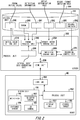
- FIG. 2 schematically shows block configurations of the server 200 and the robot 40.
- the robot 40b has a sensor unit 156, a processing unit 152, a control target 155, a communicating unit 158 and a display unit 157.
- the server 200 has a processing unit 202, a storing unit 280 and a communicating unit 208.
- the processing unit 202 includes an initial value setting unit 210, an external input data generating unit 230, a parameter processing unit 240, an operation determining unit 250, a switching control unit 260 and a recording control unit 270.
- the storing unit 280 stores an operation determination rule 282, definition information 284, parameter initial values 286, latest parameters 288, a recording format switching rule 290 and recording data 292.
- the sensor unit 156 has sensors such as a microphone 161, a 2D camera 163, a 3D depth sensor 162 or a distance sensor 164.
- the respective sensors provided to the sensor unit 156 detect information continuously.
- Sensor information detected by the sensor unit 156 is output to the processing unit 152.
- the 2D camera 163 is one example of an image sensor that captures images of objects continuously, and captures images using visible light and generates video information.
- the 3D depth sensor 162 emits infrared ray patterns continuously, and analyzes infrared ray patterns from infrared ray images captured by an infrared camera continuously, thereby detecting the outlines of objects.
- the sensor unit 156 may include various sensors such as a clock, a gyro sensor, a touch sensor, a sensor for motor feedback, a sensor to detect the remaining capacity of a battery.
- the processing unit 152 is formed of a processor such as a CPU.
- the processing unit 152 causes sensor information detected continuously by the respective sensors provided to the sensor unit 156 to be transmitted to the server 200 through the communicating unit 158. Also, the processing unit 152 processes at least part of sensor information detected continuously by the respective sensors provided to the sensor unit 156, and generates information for recording.
- the processing unit 152 generates first recording format information or second recording format information having an amount of information larger than that of the first recording format information.
- the first recording format information means, for example, information in a high compression format
- the second recording format information means, for example, information in a low compression format.
- the processing unit 152 For example, based on skeletal information detected continuously by the 3D depth sensor 162, the processing unit 152 generates, as first recording format information, shape data such as skeletal data of an object. Also, based on video information captured by the 2D camera 163 and audio information detected by the microphone 161, the processing unit 152 generates full HD video data and audio data. Full HD video data is one example of moving image data having more information than that of shape data of an object.
- the communicating unit 158 transmits, to the server 200, first recording format information or second recording format information generated by the processing unit 152.
- the recording control unit 270 stores, in the recording data 292, the first recording format information or second recording format information received by the communicating unit 208 from the robot 40.
- the recording control unit 270 stores, in the recording data 292, information received from each robot 40, in association with information discriminating each of the robots 40.
- the communicating unit 158 acquires, from the server 200, information stored in the recording data 292.
- the communicating unit 158 functions as a recording information receiving unit that acquires second recording format information including moving image data recorded by the recording control unit 270.
- the processing unit 152 Based on the moving image data included in the second recording format information received by the communicating unit 158, the processing unit 152 generates a video presented to a user 30.
- the processing unit 152 functions as a video generating unit that generates a video to be presented to a user 30.
- the communicating unit 158 receives operation information indicating an operation detail from the server 200.
- the processing unit 152 controls the control target 155 based on the operation detail received by the communicating unit 158.
- the control target 155 includes a speaker, motors that drive respective units of the robot 40 such as limbs, a light emitting device, and the like. If having received information indicating an utterance content from the server 200, the processing unit 152 causes a sound or voice to be output from a speaker according to the received utterance content. Also, the processing unit 152 can control some of actions of the robot 40 by controlling drive motors of limbs. Also, the processing unit 152 can express some of emotions of the robot 40 by controlling these motors.
- the communicating unit 208 outputs, to the processing unit 202, information received from the robot 40.
- the initial value setting unit 210 stores, in the parameter initial values 286 in the storing unit 280, an initial value of a parameter indicating an initial state of the neural network received at the communicating unit 208.
- the initial value of the parameter of the neural network may be specified in advance at the server 200 or may be able to be altered by a user 30 through the communication network 90.
- the external input data generating unit 230 processes at least part of sensor information received by the communicating unit 208, generates input information from the outside of the neural network, and outputs it to the parameter processing unit 240. Based on the input information, and the current parameter 288 of the neural network and the definition information 284 stored in the storing unit 280, the parameter processing unit 240 performs calculation about the neural network.
- Artificial neurons that the neural network has include: a plurality of artificial neurons for which situations of the robot 40 are defined; a plurality of emotion artificial neurons for which a plurality of emotions of the robot 40 itself are defined; and a plurality of endocrine artificial neurons for which states of generation of endocrine substances of the robot 40 itself are defined.
- the parameter processing unit 240 calculates a parameter representing the internal state of the plurality of artificial neurons in the neural network. For example, based on the input information generated by the external input data generating unit 230, the parameter processing unit 240 updates a parameter of the current internal state of the plurality of artificial neurons for which the situation of the robot 40 is defined or the like.
- the parameter processing unit 240 calculates a parameter of the internal state of other artificial neurons in the neural network. Thereby, for example, a parameter of the internal state of an emotion artificial neuron for which an emotion of being "pleased” is defined is calculated. This parameter of the internal state of the emotion artificial neuron is one example of an index representing the intensity of the emotion of being "pleased”. Accordingly, based on the internal state of an emotion artificial neuron, the parameter processing unit 240 can determine the intensity of an emotion in a control system. In this manner, the parameter processing unit 240 functions as an emotion determining unit that based on at least part of information detected by sensors provided to the sensor unit 156, determines the intensity of an emotion using the neural network.
- the parameter of the neural network calculated by the parameter processing unit 240 is supplied to the switching control unit 260 and the operation determining unit 250. Based on the parameter supplied from the parameter processing unit 240, the switching control unit 260 determines a recording format for information generated by the processing unit 152 of the robot 40. If it is necessary to switch the recording format for information generated by the processing unit 152, the switching control unit 260 causes an instruction to switch the recording format to be transmitted to the robot 40 through the communicating unit 208. At the robot 40, the processing unit 152 switches the recording format according to the instruction received from the server 200.
- the switching control unit 260 transmits, to the robot 40, an instruction to switch the recording format for information to be generated by the processing unit 152 from the first recording format to the second recording format, in response to increase in the intensity of an emotion determined by the parameter processing unit 240.
- the switching control unit 260 switches the recording format for information to be recorded by the recording control unit 270 from the first recording format to the second recording format in response to increase in the intensity of the emotion determined by the parameter processing unit 240.
- the processing unit 152 acquires moving image data in the second recording format acquired from the server 200, and generates a video to be presented to a user 30. Accordingly, the user 30 can enjoy information at the time when an emotion of the robot 40 intensified as a video.
- the switching control unit 260 transmits, to the robot 40, an instruction to switch the recording format for information to be generated by the processing unit 152 from the second recording format to the first recording format, in response to decrease in the intensity of an emotion determined by the parameter processing unit 240. In this manner, the switching control unit 260 switches the recording format for information to be recorded by the recording control unit 270 from the second recording format to the first recording format in response to decrease in the intensity of the emotion determined by the parameter processing unit 240.
- the operation determination rule 282 specifies an operation to be performed by the robot 40 in association with a state of the robot 40. For example, the operation determination rule 282 specifies an operation to be performed by the robot 40 in association with an internal state of an artificial neuron of the neural network. For example, the operation determination rule 282 specifies an operation to cause the robot 40 to utter a phrase representing pleasedness in association with a condition that an emotion artificial neuron for which an emotion being "pleased” is defined is high. Also, the operation determination rule 282 specifies an operation to be performed when the robot 40 gets sleepy in association with a condition that an internal state of an endocrine artificial neuron for which an endocrine substance corresponding to sleepiness is defined is high.
- an endocrine substance means a substance that conveys signals secreted in the body, such as neurotransmitter or hormones. Also, being “endocrine” means that endocrine substances are secreted in the body.
- an endocrine substance of the robot 40 itself is one form of information that influences operations of the robot 40, but does not mean that the robot 40 actually generates an endocrine substance.
- An emotion of the robot 40 itself is likewise one form of information that influences operations of the robot 40, but does not mean that the robot 40 is actually feeling an emotion.
- the operation determining unit 250 determines an operation of the robot 40 based on an operation specified in the operation determination rule 282 in association with the activation state or internal state of each artificial neuron determined by the parameter processing unit 240. Operation information indicating an operation determined by the operation determining unit 250 is transmitted from the communicating unit 208 to the robot 40.
- the processing unit 152 causes the control target 155 to perform the operation indicated by the information received from the server 200. Thereby, the robot 40 can perform an appropriate operation corresponding to the current emotion of the robot 40.
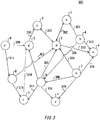
- FIG. 3 schematically shows a neural network 300.
- the neural network 300 is an exemplary neural network for explaining an operation of the parameter processing unit 240.
- the neural network 300 includes a plurality of artificial neurons including an artificial neuron 1, artificial neuron 2, artificial neuron 3, artificial neuron 4, artificial neuron 5, artificial neuron 6, artificial neuron 7, artificial neuron 8, artificial neuron 9, artificial neuron a, artificial neuron b and artificial neuron c.
- the neural network 300 includes a plurality of artificial synapses including an artificial synapse 301, artificial synapse 302, artificial synapse 303, artificial synapse 304, artificial synapse 305, artificial synapse 306, artificial synapse 307, artificial synapse 308, artificial synapse 309, artificial synapse 310, artificial synapse 311, artificial synapse 312, artificial synapse 313, artificial synapse 314, artificial synapse 315, artificial synapse 316, artificial synapse 317, artificial synapse 318 and artificial synapse 319.
- Artificial neurons correspond to neurons in a living form.
- Artificial synapses correspond to synapses in a living form.
- the artificial synapse 301 connects the artificial neuron 4 and the artificial neuron 1.
- the artificial synapse 301 is an artificial synapse connecting them unidirectionally, as indicated by the arrow of the artificial synapse 301.
- the artificial neuron 4 is an artificial neuron connected to an input of the artificial neuron 1.
- the artificial synapse 302 connects the artificial neuron 1 and the artificial neuron 2.
- the artificial synapse 302 is an artificial synapse connecting them bidirectionally, as indicated by the double arrow of the artificial synapse 302.
- the artificial neuron 1 is an artificial neuron connected to an input of the artificial neuron 2.
- the artificial neuron 2 is an artificial neuron connected to an input of the artificial neuron 1.
- an artificial neuron is represented by N, and an artificial synapse is represented by S, in some cases.
- each artificial neuron is discriminated using a superscript reference symbol as the discrimination character.
- a given artificial neuron is in some cases represented using i or j as a discrimination character.
- N i represents a given artificial neuron.
- an artificial synapse is in some cases discriminated using respective discrimination numbers i and j of two artificial neurons connected to the artificial synapse.
- S 41 represents an artificial synapse connecting N 1 and N 4 .
- S ij represents an artificial synapse that inputs an output of N i to N j .
- S ji represents an artificial synapse that inputs an output of N j to N i .
- a to J represent that the state of the robot 40 is defined.
- the state of the robot 40 includes emotions of the robot 40, the state of generation of an endocrine substance, a situation of the robot 40, and the like.
- N 4 , N 6 and N 7 are concept artificial neurons for which concepts representing the situation of the robot 40 are defined.
- N 4 is a concept artificial neuron to which a situation "a bell rang" is allocated.
- N 6 is a concept artificial neuron to which a situation "charging has started” is allocated.
- N 7 is a concept artificial neuron to which a situation "the power storage amount is equal to or lower than a threshold" is allocated.
- N b and N c are emotion artificial neurons for which emotions of the robot 40 are defined.
- N 1 is an emotion artificial neuron to which an emotion "pleased” is allocated.
- N 3 is an emotion artificial neuron to which an emotion "sad” is allocated.
- N b is an emotion artificial neuron to which an emotion of being “scared” is allocated.
- N c is an emotion artificial neuron to which an emotion of having "fun” is allocated.
- N 2 , N 5 and N a are endocrine artificial neurons for which endocrine states of the robot 40 are defined.
- N 5 is an endocrine artificial neuron to which a dopamine-generated state is allocated.
- Dopamine is one example of endocrine substances related to the reward system. That is, N 5 is one example of endocrine artificial neurons related to the reward system.
- N 2 is an endocrine artificial neuron to which a serotonin-generated state is allocated. Serotonin is one example of endocrine substances related to the sleep system. That is, N 2 is one example of endocrine artificial neurons related to the sleep system.
- N a is an endocrine artificial neuron to which the state of generation of noradrenaline is allocated.
- Noradrenaline is one example of an endocrine substance related to the sympathetic nervous system. That is, N a is an endocrine artificial neuron related to the sympathetic nervous system.
- the neural network 300 includes concept artificial neurons, emotion artificial neurons, and endocrine artificial neurons.
- the concept artificial neurons, emotion artificial neurons and endocrine artificial neurons are artificial neurons for which meanings such as concepts, emotions or endocrines are defined explicitly.
- N 8 and N 9 are artificial neurons for which states of the robot 40 are not defined.
- N 8 and N 9 are artificial neurons for which meanings such as concepts, emotions or endocrines are not defined explicitly.
- Parameters of the neural network 300 include I t i which is an input to each N i of the neural network, E t i which is an input from the outside of the neural network to N', parameters of N i and parameters of S'.
- the parameters of N i include S t i representing the status of N i , V i m t representing an internal state of the artificial neuron represented by N i , T't representing a threshold for firing of N i , t f representing a last firing clock time which is a clock time when N i fired last time, V i m tf representing an internal state of the artificial neuron N i at the last firing clock time, and a t i , b t i and h t i which are increase-decrease parameters of outputs.
- the increase-decrease parameters of outputs are one example of parameters specifying time evolution of outputs at the time of firing of an artificial neuron.
- a subscript t represents that the parameter provided with the subscript is a parameter that can be updated along with the lapse of clock time.
- V i m t is information corresponding to an membrane potential of an artificial neuron, and is one example of a parameter representing the internal state or output of the artificial neuron.
- the parameters of S ij include BS t ij representing a coefficient of connection of an artificial synapse of S ij , t cf representing a last simultaneous firing clock time which is a clock time when N i and N j connected by S ij fired simultaneously last time, BS ij tcf representing a coefficient of connection at the last simultaneous firing clock time, and a t ij , b t ij and h t ij which are increase-decrease parameters of the coefficients of connection.
- the increase-decrease parameters of the coefficients of connection are one example of parameters specifying time evolution of the coefficients of connection after two artificial neurons connected by an artificial synapse fired simultaneously last time.
- the parameter processing unit 240 updates the above-mentioned parameters based on an input from the external input data generating unit 230 and the neural network to determine the activation state of each artificial neuron.
- the operation determining unit 250 determines an operation of the robot 40 based on: internal states or activation states of at least some artificial neurons among a plurality of artificial neurons in the neural network specified by values of parameters of the at least some artificial neurons; and states defined for at least some artificial neurons by the definition information 284.
- an activation state may either be an activated state or an inactivated state. In the present example, to be activated is called “to fire” and being inactivated is called “unfiring", in some cases.
- the "firing" state is classified into a “rising phase” and a “falling phase” depending on whether or not an internal state is on the rise.
- "Unfiring”, and a “rising phase” and a “falling phase” are represented by a status S t i .
- FIG. 4 schematically shows parameters of a neural network in a table format.
- Each neuron N has, as parameters, a threshold T t , and increase-decrease parameters h t , a t and b t .
- each artificial synapse includes, as parameters, a coefficient of connection BS t , and increase-decrease parameters h t , a t and b t .
- FIG. 4 shows, in one row for each N i , respective parameters of all the artificial neurons directly connected to N i through artificial synapses, and respective parameters of the artificial synapses.
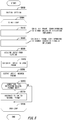
- FIG. 5 schematically shows an operation flow of the server 200 performed when the robot 40 is activated or reset.
- the parameter processing unit 240 upon reception of information indicating that the robot 40 is activated or reset, performs initial setting of parameters of the neural network. For example, the parameter processing unit 240 acquires initial values of parameters from the storing unit 280 to generate parameter data of the neural network in a predetermined data structure (S502). Also, it sets parameter values of the neural network at a clock time t 0 . Upon completion of the initial setting, at S504, it starts a loop about the clock time t.
- the parameter processing unit 240 calculates parameters corresponding to a change due to electrical influence of an artificial synapse at a temporal step t n+1 . Specifically, it calculates BS t ij of a given S ij .
- the parameter processing unit 240 calculates parameters corresponding to a change due to chemical influence caused by an endocrine substance at the temporal step t n+1 . Specifically, changes in parameters of N i and S ij that the endocrine artificial neuron has influence on are calculated. More specifically, it calculates an increase-decrease parameter or threshold of an internal state of the artificial neuron N i that the endocrine artificial neuron has influence on and an increase-decrease parameter of a coefficient of connection or the coefficient of connection of S ij that the endocrine artificial neuron has influence on at the temporal step t n+1 .
- the parameter processing unit 240 acquires an input from the outside of the neural network. Specifically, the parameter processing unit 240 acquires an output of the external input data generating unit 230.
- the parameter processing unit 240 calculates an internal state of N i at the temporal step t n+1 . Specifically, it calculates V i m tn+1 and a status S tt i . Then, at S550, it stores each parameter value at the clock time t n+1 in the parameters 288 of the storing unit 280. Also, it outputs the value of each parameter at the clock time t n+1 to the operation determining unit 250 and the switching control unit 260.
- the switching control unit 260 judges whether or not the parameter of N i at the temporal step t n+1 meets a condition for switching a format in which data to be stored in the recording data 292 is recorded. If the parameter of N i at the temporal step t n+1 meets the recording format switching condition, the switching control unit 260 instructs the robot 40 to switch the recording format (S570), and the process proceeds to S506. On the other hand, if at S 560, the parameter of N i at the temporal step t n+1 does not meet the recording format switching condition, the process proceeds to S506.
- the parameter processing unit 240 judges whether or not to terminate the loop. For example, if the clock time represented by temporal steps has reached a predetermined clock time or if sensor information from the robot 40 has not been received for a length of time specified in advance, it judges to terminate the loop. If the loop is not to be terminated, the process returns to S510, and calculation for a still next temporal step is performed. If the loop is to be terminated, this flow is terminated.
- FIG. 6 is a figure for schematically explaining calculation of a coefficient of connection of an artificial synapse.
- constants a ii and b ij are defined as initial values of increase-decrease parameters is explained.
- BS t ij increases by a t0 ij per unit time. Also, because they are not simultaneously firing at the clock time t1, BS t ij decreases by
- FIG. 7 schematically shows time evolution of a coefficient of connection in a case where a function h t ij is defined as an increase-decrease parameter of the coefficient of connection.
- h t ij is a function of at least ⁇ t, and gives real number values.
- a function 700 shown in FIG. 7 is one example of h t ij .
- the function 700 is a function of a coefficient of connection BS tcf ij at a clock time t cf and ⁇ t.
- the function 700 monotonically increases if ⁇ t is in a range lower than a predetermined value, and monotonically decreases and gradually decreases toward 0 if ⁇ t is larger than the predetermined value.
- FIG. 7 shows a coefficient of connection in a case where the function 700 is defined as an increase-decrease parameter of the coefficient of connection, and N i and N j at both ends simultaneously fired at the clock time t 0 .
- the parameter processing unit 240 calculates BS t ij of each clock time of the clock time t 1 to clock time t 6 based on the function 700 and ⁇ t. In a time range of the clock time t 1 to clock time t 6 , N i and N j are not simultaneous firing. Therefore, for example, at and after the clock time t 2 , the coefficient of connection monotonically decreases.
- FIG. 8 schematically shows time evolution of a coefficient of connection observed when N i and N j simultaneously fired further at a clock time t 2 .
- the coefficient of connection is, from the clock time t 0 to clock time t 2 , calculated in a similar manner to the manner explained in relation to FIG. 7 . If N i and N j simultaneously fire further at the clock time t 2 , the parameter processing unit 240 calculates the coefficient of connection at each clock time of the clock times t 3 to t 6 according to h t ij (t-t 2 , BS t2 ij ). In this manner, every time simultaneous firing is repeated, the coefficient of connection rises.
- FIG. 9 schematically shows influence definition information defining chemical influence on a parameter.
- This influence definition information is used in calculation of changes in parameters at S520 in FIG. 5 .
- the definition information includes conditions about an internal state of an endocrine artificial neuron, information identifying an artificial neuron or artificial synapse to be influenced, and equations specifying influence details.
- an endocrine artificial neuron N 2 is an endocrine artificial neuron to which an endocrine substance of sleepiness is allocated.
- the parameter processing unit 240 increases thresholds for the emotion artificial neurons N 1 and N 3 by 10% at the clock time t n+1 .
- the endocrine artificial neuron N 5 is an endocrine artificial neuron to which dopamine is allocated.
- the parameter processing unit 240 increases increase-decrease parameters of the artificial synapse S 49 and S 95 by 10% at the clock time t n+1 .
- connection between the concept artificial neurons N 4 and N 5 through the implicit artificial neuron N 9 can be strengthened. Thereby, it becomes easier for the endocrine artificial neuron N 5 of reward system to fire if "a bell rang".
- the parameter processing unit 240 lowers the increase-decrease parameter of the artificial neuron N 1 by 10% at the clock time t n+1 . Thereby, it becomes easier for an emotion "pleased” to fire if the endocrine artificial neuron N 5 of reward system fired.
- influence definition information is not limited to the example of FIG. 9 .
- a condition a condition that an internal state of an artificial neuron is equal to or lower than a threshold may be defined.
- a condition about the status of an artificial neuron for example, a condition about a rising phase, falling phase or unfiring, may be defined.
- another possible example of the definition of the range of influence may be "all the artificial synapses connected to a particular artificial neuron".
- a target is an artificial neuron
- an equation to add a constant to a threshold or multiply an increase-decrease parameter of an internal state by a constant may be defined.
- a target is an artificial synapse, other than an equation to multiply an increase-decrease parameter by a constant, an equation to multiply a coefficient of connection by a constant may be defined.
- the influence definition information is stored in the definition information 284 of the storing unit 280.
- the storing unit 280 stores the influence definition information specifying influence of at least one of an internal state and firing state of an endocrine artificial neuron on a parameter of at least one of an artificial synapse and another artificial neuron not directly connected to the endocrine artificial neuron by an artificial synapse.
- the parameter processing unit 240 updates parameters of the at least one of the artificial synapse and the other artificial neuron not directly connected to the endocrine artificial neuron by the artificial synapse based on the at least one of the internal state and firing state of the endocrine artificial neuron and the influence definition information.
- parameters of the other artificial neuron that the at least one of the internal state and firing state of the endocrine artificial neuron has influence on can include at least one of parameters specifying a threshold, firing state and time evolution of an output at the time of firing of the other artificial neuron.
- parameters of the artificial synapse that the at least one of the internal state and firing state of the endocrine artificial neuron has influence on can include at least one of parameters specifying a coefficient of connection of the artificial synapse, and time evolution of the coefficient of connection after two artificial neurons connected by the artificial synapse simultaneously fired last time.
- the influence definition information includes information specifying influence that the firing state of an endocrine artificial neuron related with reward system has on a threshold of an emotion artificial neuron, and the parameter processing unit 240 updates the threshold of the emotion artificial neuron according to the influence definition information if the endocrine artificial neuron fired.
- FIG. 10 shows a flowchart about calculation of V tn+1 i and S tn+1 i .
- the processes in this flowchart can be applied to some of the processes at S540 in FIG. 5 .
- the parameter processing unit 240 judges whether or not S tn i indicates unfiring.
- E tn i is an input at the clock time t n from the outside of the neural network.
- f(S) gives 0 if S is a value representing unfiring, and gives 1 if S is a value indicating a rising phase or falling phase.
- the parameter processing unit 240 judges whether or not I tn+1 i exceeds T tn+1 i . If I tn+1 i exceeds T tn+1 i , the parameter processing unit 240 calculates Vm tn+1 i based on an increase-decrease parameter, sets S tn+1 i to a value indicating a rising phase or falling phase according to Vm tn+1 i (S1114), and terminates this flow.
- the parameter processing unit 240 calculates Vm tn+1 i (S1120). Then, the parameter processing unit 240 sets S tn+1 i to a value of unfiring if Vm t i reached Vmin before t n+1 , sets S tn+1 i to a value of a rising phase or falling phase if Vm t i has not reached Vmin before t n+1 , and terminates this flow.
- the parameter processing unit 240 sets a value of a falling phase to S tn+1 i if Vm t i reached Vmax before t n+1 , and sets a value of a rising phase to S tn+1 i if Vm t i has not reached Vmax before t n+1 .
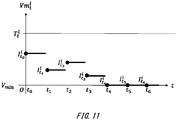
- FIG. 11 is a figure for schematically explaining an example about calculation of V t i in a case where N' does not fire.
- FIG. 12 is a figure for schematically explaining an example about calculation of V't in a case where N' fires.
- FIG. 12 shows an example about calculation in a case where constants a i and b' are defined.
- the parameter processing unit 240 increases V t i by a t ij per unit time until a clock time when V t i reaches Vmax. Also, the parameter processing unit 240 determines the status St' of N i in this time period as a rising phase.
- V t i Vmax
- V t i Vmin
- Vm t i is not dependent on I t i even if the calculated Vm t i falls below T t i . Even if Vm t i falls below T t i , the parameter processing unit 240 calculates Vm t i according to an increase-decrease parameter until Vm t i reaches Vmin.
- FIG. 13 schematically shows time evolution of a coefficient of connection in a case where a function h t i is defined as an increase-decrease parameter of N'.
- h t i is a function of at least ⁇ t.
- h t i gives real number values, and the value range of h t i is Vmin or higher and Vmax or lower.
- a function 1300 shown in FIG. 13 is one example of h t i .
- the function 1300 is a function of Vm tf i and ⁇ t at the clock time t f .
- the function 1300 monotonically increases if ⁇ t is in a range lower than a predetermined value, and monotonically decreases if ⁇ t is larger than the predetermined value.
- FIG. 13 shows an output in a case where the function 1400 is defined as an increase-decrease parameter of the internal state and N' fired at the clock time t 1 .
- FIG. 14 shows, in a table format, one example of a rule 1400 stored in a recording format switching rule 290.
- the rule 1400 an operation to "switch" information recording format "to a low compression format” if at least a first condition that Vm t i of any of N 1 , N 3 , N b and N c exceeded a threshold is met is specified.
- the switching control unit 260 judges to switch the information recording format to the low compression format.
- a value obtained by multiplying Vmax of respective N j with a constant 0.9 is shown as an example of the threshold.
- the threshold may be higher than T i t .
- the rule 1400 specifies an operation to "switch" data recording format "to a low compression format” if at least a second condition that the total value of Vm t i of N 5 and N a exceeded a threshold is met. Thereby, when there is a transition from a state where the second condition is not met to a state where the second condition is met if information is being recorded in a high compression format, the switching control unit 260 judges to switch the information recording format to the low compression format.
- a value obtained by multiplying the total value of Vmax of respective N j with a constant 0.9 is shown as an example of the threshold.
- the threshold may be higher than the total value of T't of respective N j .
- N 1 , N 3 , N b and N c are emotion artificial neurons for which emotions of "pleased”, “sad”, “scared” and “fun” are defined, respectively. Accordingly, at the parameter processing unit 240, the intensity of an emotion is determined based on an internal state of an emotion artificial neuron, and in response to the determined intensity of the emotion exceeding a threshold specified in advance, the recording format can be switched to a low compression format.
- N 5 and N a are endocrine artificial neurons for which endocrine substances "dopamine” and “noradrenaline” are defined, respectively.
- the total value of parameters of internal states of these endocrine artificial neurons is one example of an index representing the intensity of an emotion of being "excited”. Accordingly, at the parameter processing unit 240, the intensity of an emotion is determined based on an internal state of an endocrine artificial neuron, and in response to the determined intensity of the emotion exceeding a threshold specified in advance, the recording format can be switched to a low compression format.
- the rule 1400 specifies an operation to "switch" data recording format "to a high compression format” if a third condition that Vm t i of N 1 , N 3 , N b and N c are all equal to or lower than a first threshold and the total value of Vm t i of N 5 and N a is equal to or lower than a second threshold is met. Accordingly, when there is a transition from a state where the third condition is not met to a state where the third condition is met if information is being recorded in a low compression format, the switching control unit 260 judges to switch the information recording format to the high compression format. In this manner, in response to the intensity of an emotion becoming equal to or lower than a threshold specified in advance, the recording format can be switched to a high compression format.
- the first threshold of the third condition is a value obtained by multiplying Vmax of respective N j with a constant 0.8.
- the second threshold of the third condition is a value obtained by multiplying the total value of Vmax of respective N j with a constant 0.8.
- the first threshold may be equal to the threshold of the first condition
- the second threshold may be equal to the threshold of the second condition.
- the first threshold of the third condition may be higher than T i t of respective N j .
- the second threshold of the third condition may be higher than the total value of T i t of respective N j .
- various values can be applied to the thresholds of the respective conditions.
- the robot 40 transmits, to the server 200, continuously information in a high compression format such as skeletal data for a time period during which an emotion of the robot 40 is not significantly intense, and causes the server 200 to record the information.
- the consecutive information such as skeletal data recorded in the server 200 can be used when analyzing a memory of the robot 40.
- the robot 40 starts transmission of full HD video data and audio data if an emotion of the robot 40 intensifies significantly, and cause the server 200 to record information in a low compression format including full HD video data and audio data in addition to skeletal data for a time period during which the state where the emotion remains as intense as or is more intense than a certain value continues.
- the robot 40 requests the server 200 to transmit full HD video data and audio data, and provides the video data and audio data received from the server 200 to the user 30.
- high image quality video data of a scene in which the robot 40 felt a strong emotion can be accumulated in the server 200.
- summarized information such as skeletal data can be accumulated in the server 200.
- the robot 40 can keep a summarized memory of when it is not feeling a strong emotion while keeping a memory of when it felt a strong emotion vividly.
- the emotions explained are “pleased”, “sad”, “scared”, “fun” and “excited”, emotions that the system 20 handles are not limited to them.
- the endocrine substances explained are “dopamine”, “serotonin” and “noradrenaline”, endocrine substances that the system 20 handles are not limited to them.
- functions of the server 200 may be implemented by one or more computers. At least some functions of the server 200 may be implemented by a virtual machine. Also, at least some of functions of the server 200 may be implemented in a cloud. Also, among functions of the server 200, functions of components excluding the storing unit 280 can be realized by a CPU operating based on a program. For example, at least some of the processes explained as operations of the server 200 can be realized by a processor controlling each piece of hardware (for example, a hard disk, a memory and the like) provided to a computer according to a program.
- the program can cause a computer to function as each component of the server 200.
- functions of components excluding the control target 155 and the sensor unit 156 can be realized by a CPU operating based on a program. That is, the program can cause a computer to function as each component of the robot 40.
- the computer may read in a program to control execution of the above-mentioned processes, operate according to the program read in, and execute the processes.
- the computer can read in the program from a computer-readable recording medium having stored thereon the program.
- the program may be supplied to the computer through a communications line, and the computer may read in the program supplied through the communications line.
- the server 200 is in charge of processes of a neural network.
- the server 200 not the robot 40, stores information such as video data.
- the robot 40 itself may be in charge of functions of the server 200, such as processes of a neural network.
- the robot 40 itself may store information such as video data.
- the robot 40 is one example of equipment to be a target of control by the server 200.
- Equipment to be a control target is not limited to the robot 40, but various types of equipment such as home appliances, vehicles or toys may apply as control targets.
Landscapes
- Engineering & Computer Science (AREA)
- Physics & Mathematics (AREA)
- Theoretical Computer Science (AREA)
- Health & Medical Sciences (AREA)
- Computational Linguistics (AREA)
- General Physics & Mathematics (AREA)
- General Health & Medical Sciences (AREA)
- Artificial Intelligence (AREA)
- Evolutionary Computation (AREA)
- Life Sciences & Earth Sciences (AREA)
- Biomedical Technology (AREA)
- Biophysics (AREA)
- General Engineering & Computer Science (AREA)
- Computing Systems (AREA)
- Molecular Biology (AREA)
- Data Mining & Analysis (AREA)
- Mathematical Physics (AREA)
- Software Systems (AREA)
- Multimedia (AREA)
- Human Computer Interaction (AREA)
- Signal Processing (AREA)
- Audiology, Speech & Language Pathology (AREA)
- Acoustics & Sound (AREA)
- Robotics (AREA)
- Child & Adolescent Psychology (AREA)
- Hospice & Palliative Care (AREA)
- Psychiatry (AREA)
- Computer Vision & Pattern Recognition (AREA)
- Oral & Maxillofacial Surgery (AREA)
- Neurology (AREA)
- Manipulator (AREA)
Description
- The present invention relates to a control system, system and program.
- A terminal that studies conversations between a user and another person the user is talking to and accumulates, in a reply table, replies from the other person to questions from the user has been known (please see
Patent Document 1, for example). Also, an emotion generating apparatus including a neural net that receives an input of user information, equipment information and a current emotional state of a user him/herself to output a next emotional state has been known (please see Patent Document 2, for example). Also, a technique to store spatiotemporal patterns in an associative memory including a plurality of electronic neurons having a layer neural net relation having directive artificial synapse connectivity has been known (please see Patent Document 3, for example). -
- [Patent Document 1] Japanese Patent Application Publication No.
2011-253389 - [Patent Document 2] Japanese Patent Application Publication No.
H10-254592 - [Patent Document 3] Japanese Translation of
PCT International Patent Application No. 2013-535067 -
US 6 219 657 B1 (2001-04-17 ) shows a control system comprising:a recording information generating unit that processes at least part of information detected continuously by a sensor and generates one of information in a first recording format and information in a second recording format having a larger amount of information than that of the information in the first recording format;a recording control unit that causes information generated by the recording information generating unit to be recorded; an emotion determining unit that determines intensity of an emotion at the control system based on at least part of information detected by the sensor; and that the emotion determining unit determines the intensity of the emotion using a neural network based on at least part of information detected by the sensor, a plurality of artificial neurons constituting the neural network includes an emotion artificial neuron which is an artificial neuron for which a current emotion is defined, and the emotion determining unit determines intensity of an emotion in the control system based on an internal state of the emotion artificial neuron. - There has been a drawback that it is in some cases not possible to record data appropriately according to increase in the intensity of an emotion.
- The invention is defined by the features of the independent claims. Preferred embodiments are defined by the features of the dependent claims.
- A first aspect provides a control system including: a recording information generating unit that processes at least part of information detected continuously by a sensor and generates information in a first recording format or information in a second recording format having a larger amount of information than that of the information in the first recording format; a recording control unit that causes information generated by the recording information generating unit to be recorded; an emotion determining unit that determines intensity of an emotion at the control system based on at least part of information detected by the sensor; and a switching control unit that switches a recording format of information which the recording control unit causes to be recorded from the first recording format to the second recording format in response to increase in intensity of an emotion determined by the emotion determining unit if the recording information generating unit is being caused to generate the information in the first recording format.
- The emotion determining unit may determine the intensity of the emotion using a neural network based on at least part of information detected by the sensor.
- A plurality of artificial neurons constituting the neural network may include an emotion artificial neuron which is an artificial neuron for which a current emotion is defined, and the emotion determining unit may determine intensity of an emotion in the control system based on an internal state of the emotion artificial neuron.
- A plurality of artificial neurons constituting the neural network may include an endocrine artificial neuron which is an artificial neuron for which a state of generation of an endocrine substance is defined, and the emotion determining unit may determine intensity of an emotion in the control system based on an internal state of the endocrine artificial neuron.
- The sensor may include an image sensor that captures images of a photographic subject continuously, the information in the first recording format may include shape data expressing a shape of an object an image of which is captured by the image sensor, and the information in the second recording format may include moving image data which has a larger amount of information than that of shape data and is based on an output of the image sensor.
- A second recording information acquiring unit that acquires the information in the second recording format recorded by the recording control unit and including the moving image data; and a video generating unit that generates a video to be presented to a user based on the moving image data included in the information in the second recording format acquired by the second recording information acquiring unit may be further included.
- The recording control unit may cause information generated by the recording information generating unit to be transmitted to an external server and cause the server to record the information.
- A second aspect provides a system including: the above-mentioned control system; and the server.
- A third aspect provides a program that causes a computer to function as the above-mentioned control system.
- The summary clause does not necessarily describe all necessary features of the embodiments of the present invention.
-
-
FIG. 1 schematically shows one example of asystem 20. -
FIG. 2 schematically shows block configurations of aserver 200 and arobot 40. -
FIG. 3 schematically shows aneural network 300. -
FIG. 4 schematically shows parameters of a neural network in a table format. -
FIG. 5 schematically shows an operation flow of theserver 200 performed when therobot 40 is activated or reset. -
FIG. 6 is a figure for schematically explaining calculation of a coefficient of connection of an artificial synapse. -
FIG. 7 schematically shows time evolution of a coefficient of connection in a case where a function ht ij is defined as an increase-decrease parameter of the coefficient of connection. -
FIG. 8 schematically shows time evolution of a coefficient of connection observed when simultaneous firing occurs further at a clock time t2. -
FIG. 9 schematically shows influence definition information defining chemical influence on parameters. -
FIG. 10 shows a flowchart about calculation of an internal state and a status. -
FIG. 11 is a figure for schematically explaining an example about calculation of an internal state in a case where an artificial neuron does not fire. -
FIG. 12 is a figure for schematically explaining an example about calculation of an output in a case where an artificial neuron fires. -
FIG. 13 schematically shows time evolution of a coefficient of connection in a case where a function is defined as an increase-decrease parameter of an artificial neuron. -
FIG. 14 shows, in a table format, one example of arule 1400 stored in a recordingformat switching rule 290. - Hereinafter, (some) example(s) will be described.
-
FIG. 1 schematically shows one example of asystem 20. Thesystem 20 includes aserver 200, and arobot 40a and arobot 40b. Therobot 40a androbot 40b communicate with theserver 200 through acommunication network 90 to exchange information. - A
user 30a is a user of therobot 40a. Auser 30b is a user of therobot 40b. Therobot 40b has approximately identical functions as those of therobot 40a. Therefore, thesystem 20 is explained, referring to therobot 40a and therobot 40b collectively as arobot 40. - The
robot 40 performs various types of operation according to situations, including moving the head or limbs according to situations, having a conversation with a user 30, providing a video to a user 30, and so on. At this time, therobot 40 determines an operation in cooperation with theserver 200. For example, therobot 40 transmits, to theserver 200, detection information such as a facial image of a user 30 acquired by means of a camera function, or sound or voice of a user 30 acquired by means of a microphone function. Theserver 200 analyzes the detection information received from therobot 40, determines an operation to be performed by therobot 40, and transmits, to therobot 40, operation information representing the determined operation. Therobot 40 performs the operation according to the operation information received from theserver 200. - The
robot 40 has emotion values representing emotions of itself. For example, therobot 40 has emotion values representing intensities of respective emotions such as "pleased", "fun", "sad", "scared" or "excited". Emotion values of therobot 40 are determined by theserver 200. Theserver 200 causes therobot 40 to perform an operation corresponding to a determined emotion. For example, if therobot 40 has a conversation with a user 30 when an emotion value of excitation is high, theserver 200 causes therobot 40 to utter at a rapid pace. In this manner, therobot 40 can express its emotion through its actions or the like. - Based on detection information received from the
robot 40, theserver 200 uses a neural network to update the current state of therobot 40. The state of therobot 40 includes emotions of therobot 40. Accordingly, theserver 200 uses the neural network to determine the emotions of therobot 40. - Also, the
robot 40 causes theserver 200 to record video data of a user 30 acquired by means of a camera function, or the like. Therobot 40, as necessary, acquires the video data or the like from theserver 200 and provides it to a user 30. The amount of information of video data that is generated by therobot 40 and that therobot 40 causes theserver 200 to record increases as the intensity of an emotion becomes higher. For example, if recording information in a high compression format such as skeletal data, therobot 40 switches to recording of information in a low compression format such as HD moving images in response to an emotion value of excitation exceeding a threshold. According to thesystem 20, high definition video data generated if an emotion of therobot 40 becomes intensified can be kept as a record. -
FIG. 2 schematically shows block configurations of theserver 200 and therobot 40. Therobot 40b has asensor unit 156, aprocessing unit 152, acontrol target 155, a communicatingunit 158 and a display unit 157. Theserver 200 has aprocessing unit 202, astoring unit 280 and a communicatingunit 208. Theprocessing unit 202 includes an initialvalue setting unit 210, an external inputdata generating unit 230, aparameter processing unit 240, anoperation determining unit 250, a switchingcontrol unit 260 and arecording control unit 270. The storingunit 280 stores anoperation determination rule 282,definition information 284, parameter initial values 286,latest parameters 288, a recordingformat switching rule 290 andrecording data 292. - In the
robot 40, thesensor unit 156 has sensors such as amicrophone 161, a2D camera 163, a3D depth sensor 162 or adistance sensor 164. The respective sensors provided to thesensor unit 156 detect information continuously. Sensor information detected by thesensor unit 156 is output to theprocessing unit 152. The2D camera 163 is one example of an image sensor that captures images of objects continuously, and captures images using visible light and generates video information. The3D depth sensor 162 emits infrared ray patterns continuously, and analyzes infrared ray patterns from infrared ray images captured by an infrared camera continuously, thereby detecting the outlines of objects. Note that other than the above-mentioned ones, thesensor unit 156 may include various sensors such as a clock, a gyro sensor, a touch sensor, a sensor for motor feedback, a sensor to detect the remaining capacity of a battery. - The
processing unit 152 is formed of a processor such as a CPU. Theprocessing unit 152 causes sensor information detected continuously by the respective sensors provided to thesensor unit 156 to be transmitted to theserver 200 through the communicatingunit 158. Also, theprocessing unit 152 processes at least part of sensor information detected continuously by the respective sensors provided to thesensor unit 156, and generates information for recording. Theprocessing unit 152 generates first recording format information or second recording format information having an amount of information larger than that of the first recording format information. The first recording format information means, for example, information in a high compression format, and the second recording format information means, for example, information in a low compression format. For example, based on skeletal information detected continuously by the3D depth sensor 162, theprocessing unit 152 generates, as first recording format information, shape data such as skeletal data of an object. Also, based on video information captured by the2D camera 163 and audio information detected by themicrophone 161, theprocessing unit 152 generates full HD video data and audio data. Full HD video data is one example of moving image data having more information than that of shape data of an object. - The communicating
unit 158 transmits, to theserver 200, first recording format information or second recording format information generated by theprocessing unit 152. At theserver 200, therecording control unit 270 stores, in therecording data 292, the first recording format information or second recording format information received by the communicatingunit 208 from therobot 40. Therecording control unit 270 stores, in therecording data 292, information received from eachrobot 40, in association with information discriminating each of therobots 40. - Also, at the
robot 40, the communicatingunit 158 acquires, from theserver 200, information stored in therecording data 292. The communicatingunit 158 functions as a recording information receiving unit that acquires second recording format information including moving image data recorded by therecording control unit 270. Based on the moving image data included in the second recording format information received by the communicatingunit 158, theprocessing unit 152 generates a video presented to a user 30. Theprocessing unit 152 functions as a video generating unit that generates a video to be presented to a user 30. - Also, the communicating
unit 158 receives operation information indicating an operation detail from theserver 200. Theprocessing unit 152 controls thecontrol target 155 based on the operation detail received by the communicatingunit 158. Thecontrol target 155 includes a speaker, motors that drive respective units of therobot 40 such as limbs, a light emitting device, and the like. If having received information indicating an utterance content from theserver 200, theprocessing unit 152 causes a sound or voice to be output from a speaker according to the received utterance content. Also, theprocessing unit 152 can control some of actions of therobot 40 by controlling drive motors of limbs. Also, theprocessing unit 152 can express some of emotions of therobot 40 by controlling these motors. - At the
server 200, the communicatingunit 208 outputs, to theprocessing unit 202, information received from therobot 40. The initialvalue setting unit 210 stores, in the parameter initial values 286 in thestoring unit 280, an initial value of a parameter indicating an initial state of the neural network received at the communicatingunit 208. Note that the initial value of the parameter of the neural network may be specified in advance at theserver 200 or may be able to be altered by a user 30 through thecommunication network 90. - The external input
data generating unit 230 processes at least part of sensor information received by the communicatingunit 208, generates input information from the outside of the neural network, and outputs it to theparameter processing unit 240. Based on the input information, and thecurrent parameter 288 of the neural network and thedefinition information 284 stored in thestoring unit 280, theparameter processing unit 240 performs calculation about the neural network. - Artificial neurons that the neural network has include: a plurality of artificial neurons for which situations of the
robot 40 are defined; a plurality of emotion artificial neurons for which a plurality of emotions of therobot 40 itself are defined; and a plurality of endocrine artificial neurons for which states of generation of endocrine substances of therobot 40 itself are defined. Based on the input information generated by the external inputdata generating unit 230, theparameter processing unit 240 calculates a parameter representing the internal state of the plurality of artificial neurons in the neural network. For example, based on the input information generated by the external inputdata generating unit 230, theparameter processing unit 240 updates a parameter of the current internal state of the plurality of artificial neurons for which the situation of therobot 40 is defined or the like. Also, theparameter processing unit 240 calculates a parameter of the internal state of other artificial neurons in the neural network. Thereby, for example, a parameter of the internal state of an emotion artificial neuron for which an emotion of being "pleased" is defined is calculated. This parameter of the internal state of the emotion artificial neuron is one example of an index representing the intensity of the emotion of being "pleased". Accordingly, based on the internal state of an emotion artificial neuron, theparameter processing unit 240 can determine the intensity of an emotion in a control system. In this manner, theparameter processing unit 240 functions as an emotion determining unit that based on at least part of information detected by sensors provided to thesensor unit 156, determines the intensity of an emotion using the neural network. - The parameter of the neural network calculated by the
parameter processing unit 240 is supplied to the switchingcontrol unit 260 and theoperation determining unit 250. Based on the parameter supplied from theparameter processing unit 240, the switchingcontrol unit 260 determines a recording format for information generated by theprocessing unit 152 of therobot 40. If it is necessary to switch the recording format for information generated by theprocessing unit 152, the switchingcontrol unit 260 causes an instruction to switch the recording format to be transmitted to therobot 40 through the communicatingunit 208. At therobot 40, theprocessing unit 152 switches the recording format according to the instruction received from theserver 200. - For example, if the
processing unit 152 is being caused to generate first recording format information, the switchingcontrol unit 260 transmits, to therobot 40, an instruction to switch the recording format for information to be generated by theprocessing unit 152 from the first recording format to the second recording format, in response to increase in the intensity of an emotion determined by theparameter processing unit 240. In this manner, the switchingcontrol unit 260 switches the recording format for information to be recorded by therecording control unit 270 from the first recording format to the second recording format in response to increase in the intensity of the emotion determined by theparameter processing unit 240. Thereby, information at the time when an emotion of therobot 40 intensified can be kept as a record in detail. Also, at therobot 40, theprocessing unit 152 acquires moving image data in the second recording format acquired from theserver 200, and generates a video to be presented to a user 30. Accordingly, the user 30 can enjoy information at the time when an emotion of therobot 40 intensified as a video. - Note that if the
processing unit 152 is being caused to generate second recording format information, the switchingcontrol unit 260 transmits, to therobot 40, an instruction to switch the recording format for information to be generated by theprocessing unit 152 from the second recording format to the first recording format, in response to decrease in the intensity of an emotion determined by theparameter processing unit 240. In this manner, the switchingcontrol unit 260 switches the recording format for information to be recorded by therecording control unit 270 from the second recording format to the first recording format in response to decrease in the intensity of the emotion determined by theparameter processing unit 240. - The
operation determination rule 282 specifies an operation to be performed by therobot 40 in association with a state of therobot 40. For example, theoperation determination rule 282 specifies an operation to be performed by therobot 40 in association with an internal state of an artificial neuron of the neural network. For example, theoperation determination rule 282 specifies an operation to cause therobot 40 to utter a phrase representing pleasedness in association with a condition that an emotion artificial neuron for which an emotion being "pleased" is defined is high. Also, theoperation determination rule 282 specifies an operation to be performed when therobot 40 gets sleepy in association with a condition that an internal state of an endocrine artificial neuron for which an endocrine substance corresponding to sleepiness is defined is high. - Note that an endocrine substance means a substance that conveys signals secreted in the body, such as neurotransmitter or hormones. Also, being "endocrine" means that endocrine substances are secreted in the body. However, an endocrine substance of the
robot 40 itself is one form of information that influences operations of therobot 40, but does not mean that therobot 40 actually generates an endocrine substance. An emotion of therobot 40 itself is likewise one form of information that influences operations of therobot 40, but does not mean that therobot 40 is actually feeling an emotion. - The
operation determining unit 250 determines an operation of therobot 40 based on an operation specified in theoperation determination rule 282 in association with the activation state or internal state of each artificial neuron determined by theparameter processing unit 240. Operation information indicating an operation determined by theoperation determining unit 250 is transmitted from the communicatingunit 208 to therobot 40. At therobot 40, by controlling thecontrol target 155, theprocessing unit 152 causes thecontrol target 155 to perform the operation indicated by the information received from theserver 200. Thereby, therobot 40 can perform an appropriate operation corresponding to the current emotion of therobot 40. -
FIG. 3 schematically shows aneural network 300. Theneural network 300 is an exemplary neural network for explaining an operation of theparameter processing unit 240. Theneural network 300 includes a plurality of artificial neurons including anartificial neuron 1, artificial neuron 2, artificial neuron 3,artificial neuron 4,artificial neuron 5,artificial neuron 6, artificial neuron 7, artificial neuron 8, artificial neuron 9, artificial neuron a, artificial neuron b and artificial neuron c. Theneural network 300 includes a plurality of artificial synapses including anartificial synapse 301,artificial synapse 302,artificial synapse 303,artificial synapse 304,artificial synapse 305,artificial synapse 306,artificial synapse 307,artificial synapse 308,artificial synapse 309,artificial synapse 310,artificial synapse 311,artificial synapse 312,artificial synapse 313,artificial synapse 314,artificial synapse 315,artificial synapse 316,artificial synapse 317,artificial synapse 318 andartificial synapse 319. Artificial neurons correspond to neurons in a living form. Artificial synapses correspond to synapses in a living form. - The
artificial synapse 301 connects theartificial neuron 4 and theartificial neuron 1. Theartificial synapse 301 is an artificial synapse connecting them unidirectionally, as indicated by the arrow of theartificial synapse 301. Theartificial neuron 4 is an artificial neuron connected to an input of theartificial neuron 1. Theartificial synapse 302 connects theartificial neuron 1 and the artificial neuron 2. Theartificial synapse 302 is an artificial synapse connecting them bidirectionally, as indicated by the double arrow of theartificial synapse 302. Theartificial neuron 1 is an artificial neuron connected to an input of the artificial neuron 2. The artificial neuron 2 is an artificial neuron connected to an input of theartificial neuron 1. - Note that in the present embodiment, an artificial neuron is represented by N, and an artificial synapse is represented by S, in some cases. Also, each artificial neuron is discriminated using a superscript reference symbol as the discrimination character. Also, a given artificial neuron is in some cases represented using i or j as a discrimination character. For example, Ni represents a given artificial neuron.
- Also, an artificial synapse is in some cases discriminated using respective discrimination numbers i and j of two artificial neurons connected to the artificial synapse. For example, S41 represents an artificial synapse connecting N1 and N4. Generally, Sij represents an artificial synapse that inputs an output of Ni to Nj. Note that Sji represents an artificial synapse that inputs an output of Nj to Ni.
- In
FIG. 3 , A to J represent that the state of therobot 40 is defined. The state of therobot 40 includes emotions of therobot 40, the state of generation of an endocrine substance, a situation of therobot 40, and the like. As one example, N4, N6 and N7 are concept artificial neurons for which concepts representing the situation of therobot 40 are defined. For example, N4 is a concept artificial neuron to which a situation "a bell rang" is allocated. N6 is a concept artificial neuron to which a situation "charging has started" is allocated. N7 is a concept artificial neuron to which a situation "the power storage amount is equal to or lower than a threshold" is allocated. - N1, N3. Nb and Nc are emotion artificial neurons for which emotions of the
robot 40 are defined. N1 is an emotion artificial neuron to which an emotion "pleased" is allocated. N3 is an emotion artificial neuron to which an emotion "sad" is allocated. Nb is an emotion artificial neuron to which an emotion of being "scared" is allocated. Nc is an emotion artificial neuron to which an emotion of having "fun" is allocated. - N2, N5 and Na are endocrine artificial neurons for which endocrine states of the
robot 40 are defined. N5 is an endocrine artificial neuron to which a dopamine-generated state is allocated. Dopamine is one example of endocrine substances related to the reward system. That is, N5 is one example of endocrine artificial neurons related to the reward system. N2 is an endocrine artificial neuron to which a serotonin-generated state is allocated. Serotonin is one example of endocrine substances related to the sleep system. That is, N2 is one example of endocrine artificial neurons related to the sleep system. Na is an endocrine artificial neuron to which the state of generation of noradrenaline is allocated. Noradrenaline is one example of an endocrine substance related to the sympathetic nervous system. That is, Na is an endocrine artificial neuron related to the sympathetic nervous system. - Information defining the state of the
robot 40 like the ones mentioned above is stored in thedefinition information 284 in thestoring unit 280, for each artificial neuron of the plurality of artificial neurons constituting the neural network. In this manner, theneural network 300 includes concept artificial neurons, emotion artificial neurons, and endocrine artificial neurons. The concept artificial neurons, emotion artificial neurons and endocrine artificial neurons are artificial neurons for which meanings such as concepts, emotions or endocrines are defined explicitly. In contrast to this, N8 and N9 are artificial neurons for which states of therobot 40 are not defined. Also, N8 and N9 are artificial neurons for which meanings such as concepts, emotions or endocrines are not defined explicitly. - Parameters of the
neural network 300 include It i which is an input to each Ni of the neural network, Et i which is an input from the outside of the neural network to N', parameters of Ni and parameters of S'. - The parameters of Ni include St i representing the status of Ni, Vimt representing an internal state of the artificial neuron represented by Ni, T't representing a threshold for firing of Ni, tf representing a last firing clock time which is a clock time when Ni fired last time, Vimtf representing an internal state of the artificial neuron Ni at the last firing clock time, and at i, bt i and ht i which are increase-decrease parameters of outputs. The increase-decrease parameters of outputs are one example of parameters specifying time evolution of outputs at the time of firing of an artificial neuron. Note that in the present embodiment, a subscript t represents that the parameter provided with the subscript is a parameter that can be updated along with the lapse of clock time. Also, Vimt is information corresponding to an membrane potential of an artificial neuron, and is one example of a parameter representing the internal state or output of the artificial neuron.
- The parameters of Sij include BSt ij representing a coefficient of connection of an artificial synapse of Sij, tcf representing a last simultaneous firing clock time which is a clock time when Ni and Nj connected by Sij fired simultaneously last time, BSij tcf representing a coefficient of connection at the last simultaneous firing clock time, and at ij, bt ij and ht ij which are increase-decrease parameters of the coefficients of connection. The increase-decrease parameters of the coefficients of connection are one example of parameters specifying time evolution of the coefficients of connection after two artificial neurons connected by an artificial synapse fired simultaneously last time.
- The
parameter processing unit 240 updates the above-mentioned parameters based on an input from the external inputdata generating unit 230 and the neural network to determine the activation state of each artificial neuron. Theoperation determining unit 250 determines an operation of therobot 40 based on: internal states or activation states of at least some artificial neurons among a plurality of artificial neurons in the neural network specified by values of parameters of the at least some artificial neurons; and states defined for at least some artificial neurons by thedefinition information 284. Note that an activation state may either be an activated state or an inactivated state. In the present example, to be activated is called "to fire" and being inactivated is called "unfiring", in some cases. Note that, as mentioned below, the "firing" state is classified into a "rising phase" and a "falling phase" depending on whether or not an internal state is on the rise. "Unfiring", and a "rising phase" and a "falling phase" are represented by a status St i. -
FIG. 4 schematically shows parameters of a neural network in a table format. Each neuron N has, as parameters, a threshold Tt, and increase-decrease parameters ht, at and bt. Also, each artificial synapse includes, as parameters, a coefficient of connection BSt, and increase-decrease parameters ht, at and bt.FIG. 4 shows, in one row for each Ni, respective parameters of all the artificial neurons directly connected to Ni through artificial synapses, and respective parameters of the artificial synapses. -
FIG. 5 schematically shows an operation flow of theserver 200 performed when therobot 40 is activated or reset. In theserver 200, upon reception of information indicating that therobot 40 is activated or reset, theparameter processing unit 240 performs initial setting of parameters of the neural network. For example, theparameter processing unit 240 acquires initial values of parameters from the storingunit 280 to generate parameter data of the neural network in a predetermined data structure (S502). Also, it sets parameter values of the neural network at a clock time t0. Upon completion of the initial setting, at S504, it starts a loop about the clock time t. - At S510, the
parameter processing unit 240 calculates parameters corresponding to a change due to electrical influence of an artificial synapse at a temporal step tn+1. Specifically, it calculates BSt ij of a given Sij. - At S520, the
parameter processing unit 240 calculates parameters corresponding to a change due to chemical influence caused by an endocrine substance at the temporal step tn+1. Specifically, changes in parameters of Ni and Sij that the endocrine artificial neuron has influence on are calculated. More specifically, it calculates an increase-decrease parameter or threshold of an internal state of the artificial neuron Ni that the endocrine artificial neuron has influence on and an increase-decrease parameter of a coefficient of connection or the coefficient of connection of Sij that the endocrine artificial neuron has influence on at the temporal step tn+1. - At S530, the
parameter processing unit 240 acquires an input from the outside of the neural network. Specifically, theparameter processing unit 240 acquires an output of the external inputdata generating unit 230. - At S540, the
parameter processing unit 240 calculates an internal state of Ni at the temporal step tn+1. Specifically, it calculates Vimtn+1 and a status Stt i. Then, at S550, it stores each parameter value at the clock time tn+1 in theparameters 288 of thestoring unit 280. Also, it outputs the value of each parameter at the clock time tn+1 to theoperation determining unit 250 and the switchingcontrol unit 260. - At
S 560, the switchingcontrol unit 260 judges whether or not the parameter of Ni at the temporal step tn+1 meets a condition for switching a format in which data to be stored in therecording data 292 is recorded. If the parameter of Ni at the temporal step tn+1 meets the recording format switching condition, the switchingcontrol unit 260 instructs therobot 40 to switch the recording format (S570), and the process proceeds to S506. On the other hand, if atS 560, the parameter of Ni at the temporal step tn+1 does not meet the recording format switching condition, the process proceeds to S506. - At S506, the
parameter processing unit 240 judges whether or not to terminate the loop. For example, if the clock time represented by temporal steps has reached a predetermined clock time or if sensor information from therobot 40 has not been received for a length of time specified in advance, it judges to terminate the loop. If the loop is not to be terminated, the process returns to S510, and calculation for a still next temporal step is performed. If the loop is to be terminated, this flow is terminated. -
FIG. 6 is a figure for schematically explaining calculation of a coefficient of connection of an artificial synapse. Here, a case where constants aii and bij are defined as initial values of increase-decrease parameters is explained. - If both Ni and Nj at both ends of Sij are firing at a temporal step of a clock time tn, the
parameter processing unit 240 calculates BStn+1 ij at the clock time tn+1 according to BStn+1 ij=BStn ij+atn ij×(tn+1-tn). On the other hand, if both Si and Sj are not firing at the temporal step of the clock time tn, it calculates the coefficient of connection BStn+1 ij at the clock time tn+1 according to BStn+1 ij=BStn ij+btn ij×(tn+1-tn). Also, if BStn+1 ij becomes a negative value, BStn+1 ij is regarded as 0. Note that for Sij for which BSij is a positive value, at ij is a positive value and bt ij is a negative value. For Sij for which BSij is a negative value, at ij is a positive value and bt ij is a negative value. - Because as shown in
FIG. 6 , artificial neurons at both ends are simultaneously firing at the clock time t0, BSt ij increases by at0 ij per unit time. Also, because they are not simultaneously firing at the clock time t1, BSt ij decreases by |bt1 ij| per unit time. Also, due to simultaneous firing at a clock time t4, BSt ij increases by at4 ij per unit time. -
FIG. 7 schematically shows time evolution of a coefficient of connection in a case where a function ht ij is defined as an increase-decrease parameter of the coefficient of connection. ht ij is defined about time Δt elapsed after tcf (= t-tcf) ≥ 0. ht ij is a function of at least Δt, and gives real number values. - A
function 700 shown inFIG. 7 is one example of ht ij. Thefunction 700 is a function of a coefficient of connection BStcf ij at a clock time tcf and Δt. Thefunction 700 monotonically increases if Δt is in a range lower than a predetermined value, and monotonically decreases and gradually decreases toward 0 if Δt is larger than the predetermined value. Thefunction 700 gives a value BStcf ij at Δt=0. -
FIG. 7 shows a coefficient of connection in a case where thefunction 700 is defined as an increase-decrease parameter of the coefficient of connection, and Ni and Nj at both ends simultaneously fired at the clock time t0. Theparameter processing unit 240 calculates BSt ij of each clock time of the clock time t1 to clock time t6 based on thefunction 700 and Δt. In a time range of the clock time t1 to clock time t6, Ni and Nj are not simultaneous firing. Therefore, for example, at and after the clock time t2, the coefficient of connection monotonically decreases. -
FIG. 8 schematically shows time evolution of a coefficient of connection observed when Ni and Nj simultaneously fired further at a clock time t2. The coefficient of connection is, from the clock time t0 to clock time t2, calculated in a similar manner to the manner explained in relation toFIG. 7 . If Ni and Nj simultaneously fire further at the clock time t2, theparameter processing unit 240 calculates the coefficient of connection at each clock time of the clock times t3 to t6 according to ht ij (t-t2, BSt2 ij). In this manner, every time simultaneous firing is repeated, the coefficient of connection rises. Thereby, as in Hebbian theory in a living form, an effect of reinforcing artificial synaptic connection, and so on are attained. On the other hand, as shown inFIG. 6 andFIG. 7 , if time during which simultaneous firing does not occur prolongs, an effect of attenuating artificial synaptic connection is attained. -
FIG. 9 schematically shows influence definition information defining chemical influence on a parameter. This influence definition information is used in calculation of changes in parameters at S520 inFIG. 5 . The definition information includes conditions about an internal state of an endocrine artificial neuron, information identifying an artificial neuron or artificial synapse to be influenced, and equations specifying influence details. - In the example of
FIG. 9 , an endocrine artificial neuron N2 is an endocrine artificial neuron to which an endocrine substance of sleepiness is allocated. The definition information about the endocrine artificial neuron N2 specifies: the condition "Vmtn 2 > Ttn 2"; the "emotion artificial neurons N1 and N3" as artificial neurons that the endocrine artificial neuron N2 has influence on; and "Ttn+1 i=Ttn i×1.1" as an equation specifying influence details. Thereby, if Vmtn 2 exceeds Ttn 2, theparameter processing unit 240 increases thresholds for the emotion artificial neurons N1 and N3 by 10% at the clock time tn+1. Thereby, for example, it becomes possible to make it less likely for an emotion artificial neuron to fire if sleepiness occurs. For example, by specifying a neural network in which an output of the concept artificial neuron N7, for which "the power storage amount is equal to or lower than a threshold" is defined, is connected to an input of the endocrine artificial neuron N2, it becomes possible to embody a phenomenon in which it becomes less likely for an emotion to intensify if the power storage amount lowers. - Also, the endocrine artificial neuron N5 is an endocrine artificial neuron to which dopamine is allocated. First definition information about the endocrine artificial neuron N5 specifies: the condition "Vmtn 5>Ttn 5 and Vmtn 4>Ttn 4"; "S49 and S95" as artificial synapses that the endocrine artificial neuron N5 has influence on; and "atn+1 ij=atn ij×1.1" as an equation specifying influence details. Thereby, if Vmtn 5 exceeds Ttn 5 and additionally Vmtn 4 exceeds ttn 4, the
parameter processing unit 240 increases increase-decrease parameters of the artificial synapse S49 and S95 by 10% at the clock time tn+1. - Thereby, when the concept artificial neuron N4 for which a situation "a bell rang" is defined is firing if an endocrine artificial neuron of reward system fired, connection between the concept artificial neurons N4 and N5 through the implicit artificial neuron N9 can be strengthened. Thereby, it becomes easier for the endocrine artificial neuron N5 of reward system to fire if "a bell rang".
- Also, second definition information about the endocrine artificial neuron N5 specifies: the condition "Vmtn 5>Ttn 5"; "N1" as an artificial neuron that the endocrine artificial neuron N5 has influence on; and "Ttn+1 i=Ttn i×1.1" as an equation specifying influence details. Thereby, if Vmtn 5 exceeds Ttn 5, the
parameter processing unit 240 lowers the increase-decrease parameter of the artificial neuron N1 by 10% at the clock time tn+1. Thereby, it becomes easier for an emotion "pleased" to fire if the endocrine artificial neuron N5 of reward system fired. - According to such definitions specifying influence about an endocrine artificial neuron of reward system, an implementation becomes possible in which if an act of charging the
robot 40 while ringing a bell is repeated, simply ringing a bell causes therobot 40 to take an action representing pleasedness. - Note that the influence definition information is not limited to the example of
FIG. 9 . For example, as a condition, a condition that an internal state of an artificial neuron is equal to or lower than a threshold may be defined. Also, a condition about the status of an artificial neuron, for example, a condition about a rising phase, falling phase or unfiring, may be defined. Also, other than directly designating an artificial neuron or artificial synapse, another possible example of the definition of the range of influence may be "all the artificial synapses connected to a particular artificial neuron". Also, if a target is an artificial neuron, as the equation of influence, other than an equation to multiply a threshold by a constant, an equation to add a constant to a threshold or multiply an increase-decrease parameter of an internal state by a constant may be defined. Also, if a target is an artificial synapse, other than an equation to multiply an increase-decrease parameter by a constant, an equation to multiply a coefficient of connection by a constant may be defined. - The influence definition information is stored in the
definition information 284 of thestoring unit 280. In this manner, the storingunit 280 stores the influence definition information specifying influence of at least one of an internal state and firing state of an endocrine artificial neuron on a parameter of at least one of an artificial synapse and another artificial neuron not directly connected to the endocrine artificial neuron by an artificial synapse. Then, theparameter processing unit 240 updates parameters of the at least one of the artificial synapse and the other artificial neuron not directly connected to the endocrine artificial neuron by the artificial synapse based on the at least one of the internal state and firing state of the endocrine artificial neuron and the influence definition information. Also, parameters of the other artificial neuron that the at least one of the internal state and firing state of the endocrine artificial neuron has influence on can include at least one of parameters specifying a threshold, firing state and time evolution of an output at the time of firing of the other artificial neuron. Also, parameters of the artificial synapse that the at least one of the internal state and firing state of the endocrine artificial neuron has influence on can include at least one of parameters specifying a coefficient of connection of the artificial synapse, and time evolution of the coefficient of connection after two artificial neurons connected by the artificial synapse simultaneously fired last time. Also, the influence definition information includes information specifying influence that the firing state of an endocrine artificial neuron related with reward system has on a threshold of an emotion artificial neuron, and theparameter processing unit 240 updates the threshold of the emotion artificial neuron according to the influence definition information if the endocrine artificial neuron fired. -
FIG. 10 shows a flowchart about calculation of Vtn+1 i and Stn+1 i. The processes in this flowchart can be applied to some of the processes at S540 inFIG. 5 . At S1100, theparameter processing unit 240 judges whether or not Stn i indicates unfiring. - If Stn i indicates unfiring, the
parameter processing unit 240 calculates an input Itn+1 i to Ni (S1110). Specifically, if an input from the outside of the neural network is not connected to N', it is calculated according to Itn+1 i=∑jBStn+1 ji×Vmtn j×f(Stn j). If an input from the outside of the neural network is connected to N', it is calculated according to Itn+1 i=∑jBStn+1 ji×Vmtn j×f(Stn j)+Etn+1 i. Here, Etn i is an input at the clock time tn from the outside of the neural network. - Also, f(S) gives 0 if S is a value representing unfiring, and gives 1 if S is a value indicating a rising phase or falling phase. This model corresponds to a model in which a synapse conveys action potential only if a neuron fired. Note that it may give f(S)=1. This corresponds to a model in which membrane potential is conveyed regardless of the firing state of a neuron.
- At S1112, the
parameter processing unit 240 judges whether or not Itn+1 i exceeds Ttn+1 i. If Itn+1 i exceeds Ttn+1 i, theparameter processing unit 240 calculates Vmtn+1 i based on an increase-decrease parameter, sets Stn+1 i to a value indicating a rising phase or falling phase according to Vmtn+1 i (S1114), and terminates this flow. - At S1100, if Stn i is in a rising phase or falling phase, the
parameter processing unit 240 calculates Vmtn+1 i (S1120). Then, theparameter processing unit 240 sets Stn+1 i to a value of unfiring if Vmt i reached Vmin before tn+1, sets Stn+1 i to a value of a rising phase or falling phase if Vmt i has not reached Vmin before tn+1, and terminates this flow. Note that theparameter processing unit 240 sets a value of a falling phase to Stn+1 i if Vmt i reached Vmax before tn+1, and sets a value of a rising phase to Stn+1 i if Vmt i has not reached Vmax before tn+1. - In this manner, if Ni is firing, an output of Ni is not dependent on an input even if the output becomes equal to or lower than a threshold. Such a time period corresponds to an absolute refractory phase in a neuron of a living form.
-
FIG. 11 is a figure for schematically explaining an example about calculation of Vt i in a case where N' does not fire. - At the temporal step of the clock time t0, Ni is unfiring. If It1 i at the clock time t1 is equal to or lower than Tt1 i, the
parameter processing unit 240 calculates Vt1 i at the clock time t1 according to Vt1 i=It1 i, and calculates Vt i during a time period from the clock times t0 to t1 according to Vt i=It0 i. Also, likewise, theparameter processing unit 240 maintains the value of Vtn calculated at the clock time step tn until a next clock time step, and changes it to Itn+1 at Vtn+1. -
FIG. 12 is a figure for schematically explaining an example about calculation of V't in a case where N' fires.FIG. 12 shows an example about calculation in a case where constants ai and b' are defined. - At the temporal step of the clock time t0, Ni is unfiring. If It1 i at the clock time t1 exceeds Tt1 i, the
parameter processing unit 240 calculates Vt1 i at the clock time t1 according to Vt1 i=It1 i, and calculates Vt i during a time period from the clock times t0 to t1 according to Vt i=It0 i. Note that it is assumed here that It1 i at the clock time t1 is equal to or lower than Vmax. If It1 i at the clock time t1 exceeds Vmax, It1 i=Vmax. - As shown in
FIG. 12 , at and after the clock time t1, theparameter processing unit 240 increases Vt i by at ij per unit time until a clock time when Vt i reaches Vmax. Also, theparameter processing unit 240 determines the status St' of Ni in this time period as a rising phase. - Also, upon Vt i reaching Vmax, Vt i is decreased by |bt i| per unit time until Vt i reaches Vmin. Also, the
parameter processing unit 240 determines the status of Ni in this time period as a falling phase. Then, upon Vt i reaching Vmin, Vt6 i at a next clock time is calculated according to Vt6 i=It6 i. Also, the status after Vt i reached Vmin is determined as unfiring. - Note that if the status of Ni is a falling phase, Vmt i is not dependent on It i even if the calculated Vmt i falls below Tt i. Even if Vmt i falls below Tt i, the
parameter processing unit 240 calculates Vmt i according to an increase-decrease parameter until Vmt i reaches Vmin. -
FIG. 13 schematically shows time evolution of a coefficient of connection in a case where a function ht i is defined as an increase-decrease parameter of N'. Generally, ht i is defined about time Δt elapsed after the clock time of firing tf (= t-tf) ≥ 0. ht i is a function of at least Δt. ht i gives real number values, and the value range of ht i is Vmin or higher and Vmax or lower. - A
function 1300 shown inFIG. 13 is one example of ht i. Thefunction 1300 is a function of Vmtf i and Δt at the clock time tf. Thefunction 1300 monotonically increases if Δt is in a range lower than a predetermined value, and monotonically decreases if Δt is larger than the predetermined value. Thefunction 1300 gives a value Vmtf i at Δt=0. -
FIG. 13 shows an output in a case where thefunction 1400 is defined as an increase-decrease parameter of the internal state and N' fired at the clock time t1. Theparameter processing unit 240 calculates Vmt i of each clock time of the clock time t1 to clock time t5 based on thefunction 1400, Δt and Vmf i. Because Vmt i has reached Vmin at the clock time t5, Vmt i=It6 i at the clock time t6. -
FIG. 14 shows, in a table format, one example of arule 1400 stored in a recordingformat switching rule 290. In therule 1400, an operation to "switch" information recording format "to a low compression format" if at least a first condition that Vmt i of any of N1, N3, Nb and Nc exceeded a threshold is met is specified. Thereby, when there is a transition from a state where the first condition is not met to a state where the first condition is met if information is being recorded in a high compression format, the switchingcontrol unit 260 judges to switch the information recording format to the low compression format. Note that a value obtained by multiplying Vmax of respective Nj with a constant 0.9 is shown as an example of the threshold. The threshold may be higher than Ti t. - Also, the
rule 1400 specifies an operation to "switch" data recording format "to a low compression format" if at least a second condition that the total value of Vmt i of N5 and Na exceeded a threshold is met. Thereby, when there is a transition from a state where the second condition is not met to a state where the second condition is met if information is being recorded in a high compression format, the switchingcontrol unit 260 judges to switch the information recording format to the low compression format. Note that a value obtained by multiplying the total value of Vmax of respective Nj with a constant 0.9 is shown as an example of the threshold. The threshold may be higher than the total value of T't of respective Nj. - N1, N3, Nb and Nc are emotion artificial neurons for which emotions of "pleased", "sad", "scared" and "fun" are defined, respectively. Accordingly, at the
parameter processing unit 240, the intensity of an emotion is determined based on an internal state of an emotion artificial neuron, and in response to the determined intensity of the emotion exceeding a threshold specified in advance, the recording format can be switched to a low compression format. - N5 and Na are endocrine artificial neurons for which endocrine substances "dopamine" and "noradrenaline" are defined, respectively. The total value of parameters of internal states of these endocrine artificial neurons is one example of an index representing the intensity of an emotion of being "excited". Accordingly, at the
parameter processing unit 240, the intensity of an emotion is determined based on an internal state of an endocrine artificial neuron, and in response to the determined intensity of the emotion exceeding a threshold specified in advance, the recording format can be switched to a low compression format. - Also, the
rule 1400 specifies an operation to "switch" data recording format "to a high compression format" if a third condition that Vmt i of N1, N3, Nb and Nc are all equal to or lower than a first threshold and the total value of Vmt i of N5 and Na is equal to or lower than a second threshold is met. Accordingly, when there is a transition from a state where the third condition is not met to a state where the third condition is met if information is being recorded in a low compression format, the switchingcontrol unit 260 judges to switch the information recording format to the high compression format. In this manner, in response to the intensity of an emotion becoming equal to or lower than a threshold specified in advance, the recording format can be switched to a high compression format. - Note that the first threshold of the third condition is a value obtained by multiplying Vmax of respective Nj with a constant 0.8. Also, the second threshold of the third condition is a value obtained by multiplying the total value of Vmax of respective Nj with a constant 0.8. In this manner, a case where the first threshold of the third condition is lower than the threshold of the first condition, and the second threshold of the third condition is lower than the threshold of the second condition is shown as an example. However, the first threshold may be equal to the threshold of the first condition, and the second threshold may be equal to the threshold of the second condition. Also, the first threshold of the third condition may be higher than Ti t of respective Nj. Also, the second threshold of the third condition may be higher than the total value of Ti t of respective Nj. Also, not being limited to these examples, various values can be applied to the thresholds of the respective conditions.
- According to the
system 20, therobot 40 transmits, to theserver 200, continuously information in a high compression format such as skeletal data for a time period during which an emotion of therobot 40 is not significantly intense, and causes theserver 200 to record the information. The consecutive information such as skeletal data recorded in theserver 200 can be used when analyzing a memory of therobot 40. Then, therobot 40 starts transmission of full HD video data and audio data if an emotion of therobot 40 intensifies significantly, and cause theserver 200 to record information in a low compression format including full HD video data and audio data in addition to skeletal data for a time period during which the state where the emotion remains as intense as or is more intense than a certain value continues. Then, if for example therobot 40 is requested by a user 30 to provide a video of a memory of therobot 40, therobot 40 requests theserver 200 to transmit full HD video data and audio data, and provides the video data and audio data received from theserver 200 to the user 30. - In this manner, according to the
system 20, high image quality video data of a scene in which therobot 40 felt a strong emotion can be accumulated in theserver 200. On the other hand, if therobot 40 is not feeling a strong emotion, summarized information such as skeletal data can be accumulated in theserver 200. In this manner, like a human, therobot 40 can keep a summarized memory of when it is not feeling a strong emotion while keeping a memory of when it felt a strong emotion vividly. - Note that although in the present embodiment, the emotions explained are "pleased", "sad", "scared", "fun" and "excited", emotions that the
system 20 handles are not limited to them. Also, although in the present embodiment, the endocrine substances explained are "dopamine", "serotonin" and "noradrenaline", endocrine substances that thesystem 20 handles are not limited to them. - Also, functions of the
server 200 may be implemented by one or more computers. At least some functions of theserver 200 may be implemented by a virtual machine. Also, at least some of functions of theserver 200 may be implemented in a cloud. Also, among functions of theserver 200, functions of components excluding thestoring unit 280 can be realized by a CPU operating based on a program. For example, at least some of the processes explained as operations of theserver 200 can be realized by a processor controlling each piece of hardware (for example, a hard disk, a memory and the like) provided to a computer according to a program. In this manner, at least some of processes of theserver 200 can be realized by the respective pieces of hardware including a processor, a hard disk, a memory and the like and a program operating in cooperation with each other by the processor operating according to a program to control the respective pieces of hardware. That is, the program can cause a computer to function as each component of theserver 200. Likewise, among components of therobot 40, functions of components excluding thecontrol target 155 and thesensor unit 156 can be realized by a CPU operating based on a program. That is, the program can cause a computer to function as each component of therobot 40. Note that the computer may read in a program to control execution of the above-mentioned processes, operate according to the program read in, and execute the processes. The computer can read in the program from a computer-readable recording medium having stored thereon the program. Also, the program may be supplied to the computer through a communications line, and the computer may read in the program supplied through the communications line. - In the examples explained above, the
server 200, not therobot 40, is in charge of processes of a neural network. Also, theserver 200, not therobot 40, stores information such as video data. However, therobot 40 itself may be in charge of functions of theserver 200, such as processes of a neural network. Also, therobot 40 itself may store information such as video data. Also, therobot 40 is one example of equipment to be a target of control by theserver 200. Equipment to be a control target is not limited to therobot 40, but various types of equipment such as home appliances, vehicles or toys may apply as control targets. - It is apparent to persons skilled in the art that various alterations and improvements can be added to the above-described examples
-
- 1, 2, 3, 4, 5, 6, 7, 8, 9, a, b, c: artificial neuron;
- 20: system;
- 30: user;
- 40: robot;
- 90: communication network;
- 152: processing unit;
- 155: control target;
- 156: sensor unit;
- 158: communicating unit;
- 161: microphone;
- 162: 3D depth sensor;
- 163: 2D camera;
- 164: distance sensor;
- 200: server;
- 202: processing unit;
- 208: communicating unit;
- 210: initial value setting unit;
- 230: external input data generating unit;
- 240: parameter processing unit;
- 250: operation determining unit;
- 260: switching control unit;
- 270: recording control unit;
- 280: storing unit;
- 282: operation determination rule;
- 284: definition information;
- 286: parameter initial value;
- 288: parameter;
- 290: recording format switching rule;
- 292: recording data;
- 300: neural network;
- 301, 302, 303, 304, 305, 306, 307, 308, 309, 310, 311, 312, 313, 314, 315, 316, 317,
- 318, 319: artificial synapse;
- 700, 1300: function;
- 1400: rule
Claims (8)
- A control system (20) comprising:a recording information generating unit that processes at least part of information detected continuously by a sensor (161, 162, 163, 164) of a robot and generates information in a first recording format and information in a second recording format having a larger amount of information than that of the information in the first recording format;a recording control unit (270) that causes information generated by the recording information generating unit to be recorded;an emotion determining unit (240) that determines intensity of an emotion of the robot at the control system (20) based on at least part of information detected by the sensor (161, 162, 163, 164); anda switching control unit that switches a recording format of information which the recording control unit (270) causes to be recorded from the first recording format to the second recording format in response to increase in intensity of an emotion determined by the emotion determining unit (240) if the recording information generating unit is being caused to generate the information in the first recording format, whereinthe emotion determining unit (240) determines the intensity of the emotion using a neural network (300) based on at least part of information detected by the sensor (161, 162, 163, 164),a plurality of artificial neurons (1, 2, 3, 4, 5, 6, 7, 8, 9, a, b, c) constituting the neural network (300) includes emotion artificial neurons, which are artificial neurons for which a current emotion of the robot is defined, andthe emotion determining unit (240) determines intensity of an emotion in the control system (20) based on an internal state of the emotion artificial neuron.
- The control system (20) according to the previous claim, whereina plurality of artificial neurons (1, 2, 3, 4, 5, 6, 7, 8, 9, a, b, c) constituting the neural network (300) includes endocrine artificial neurons, which are artificial neurons for which a state of generation of endocrine substances of the robot is defined, andthe emotion determining unit (240) determines intensity of an emotion in the control system (20) based on an internal state of the endocrine artificial neuron.
- The control system (20) according to any one of the previous claims, whereinthe sensor (161, 162, 163, 164) includes an image sensor (161, 162, 163, 164) that captures images of a photographic subject continuously,the recording information generating unit generates shape data such that the information in the first recording format includes shape data expressing a shape of an object an image of which is captured by the image sensor (161, 162, 163, 164), andthe information in the second recording format includes moving image data which has a larger amount of information than that of shape data and is based on an output of the image sensor (161, 162, 163, 164).
- The control system (20) according to the previous claim, further comprising:a second recording information acquiring unit that acquires the information in the second recording format recorded by the recording control unit (270) and including the moving image data; anda video generating unit (152) that generates a video to be presented to a user (30) based on the moving image data included in the information in the second recording format acquired by the second recording information acquiring unit.
- The control system (20) according to any one of the previous claims, wherein the recording control unit (270) causes information generated by the recording information generating unit to be transmitted to an external server (200) and causes the server (200) to record the information.
- The control system (20) according to any one of the previous claims, wherein the first recording format is a high compression format and the second recording format is a low compression format.
- A system (20) comprising:the control system (20) according to claim 5; andthe server (200).
- A computer program comprising instructions which, when the program is executed by a computer, cause the computer to carry out the stepsprocessing at least part of information detected continuously by a sensor (161, 162, 163, 164) of a robot and generating information in a first recording format and information in a second recording format having a larger amount of information than that of the information in the first recording format by a recording information generating unit;causing information generated by the recording information generating unit to be recorded by a recording control unit (270);determining intensity of an emotion of the robot at the control system (20) based on at least part of information detected by the sensor (161, 162, 163, 164) by an emotion determining unit (240); andswitching a recording format of information which the recording control unit (270) causes to be recorded from the first recording format to the second recording format in response to increase in intensity of an emotion determined by the emotion determining unit (240) if the recording information generating unit is being caused to generate the information in the first recording format, whereinthe emotion determining unit (240) determines the intensity of the emotion using a neural network (300) based on at least part of information detected by the sensor (161, 162, 163, 164),a plurality of artificial neurons (1, 2, 3, 4, 5, 6, 7, 8, 9, a, b, c) constituting the neural network (300) includes emotion artificial neurons, which are artificial neurons for which a current emotion of the robot is defined, andthe emotion determining unit (240) determines intensity of an emotion in the control system (20) based on an internal state of the emotion artificial neuron.
Applications Claiming Priority (2)
| Application Number | Priority Date | Filing Date | Title |
|---|---|---|---|
| JP2015122406A JP6199927B2 (en) | 2015-06-17 | 2015-06-17 | Control system, system and program |
| PCT/JP2016/066311 WO2016203964A1 (en) | 2015-06-17 | 2016-06-01 | Control system, system, and program |
Publications (3)
| Publication Number | Publication Date |
|---|---|
| EP3312775A1 EP3312775A1 (en) | 2018-04-25 |
| EP3312775A4 EP3312775A4 (en) | 2018-06-27 |
| EP3312775B1 true EP3312775B1 (en) | 2020-12-16 |
Family
ID=57545642
Family Applications (1)
| Application Number | Title | Priority Date | Filing Date |
|---|---|---|---|
| EP16811439.5A Active EP3312775B1 (en) | 2015-06-17 | 2016-06-01 | Control system, system, and program |
Country Status (5)
| Country | Link |
|---|---|
| US (1) | US20180357528A1 (en) |
| EP (1) | EP3312775B1 (en) |
| JP (1) | JP6199927B2 (en) |
| CN (1) | CN107710235A (en) |
| WO (1) | WO2016203964A1 (en) |
Families Citing this family (5)
| Publication number | Priority date | Publication date | Assignee | Title |
|---|---|---|---|---|
| JP2021154393A (en) * | 2018-07-12 | 2021-10-07 | ソニーグループ株式会社 | Control apparatus, control method, and program |
| JP7305850B1 (en) | 2022-06-30 | 2023-07-10 | 菱洋エレクトロ株式会社 | System, terminal, server, method and program using machine learning |
| WO2024214750A1 (en) | 2023-04-11 | 2024-10-17 | ソフトバンクグループ株式会社 | Action control system, method for generating learning data, display control device, and program |
| EP4715668A1 (en) | 2023-05-19 | 2026-03-25 | SoftBank Group Corp. | Control system, system, and program |
| CN121511148A (en) | 2023-07-14 | 2026-02-10 | 软银集团股份有限公司 | control system |
Family Cites Families (6)
| Publication number | Priority date | Publication date | Assignee | Title |
|---|---|---|---|---|
| JP3159242B2 (en) * | 1997-03-13 | 2001-04-23 | 日本電気株式会社 | Emotion generating apparatus and method |
| US6604091B2 (en) * | 1999-09-10 | 2003-08-05 | Yamaha Hatsudoki Kabushiki Kaisha | Interactive artificial intelligence |
| JP4015424B2 (en) * | 2002-01-09 | 2007-11-28 | アルゼ株式会社 | Voice robot system |
| KR101006191B1 (en) * | 2002-08-06 | 2011-01-07 | 윤재민 | Emotion expression and action implementation of virtual personality |
| JP4546767B2 (en) * | 2004-06-09 | 2010-09-15 | 日本放送協会 | Emotion estimation apparatus and emotion estimation program |
| JP6053847B2 (en) * | 2014-06-05 | 2016-12-27 | Cocoro Sb株式会社 | Action control system, system and program |
-
2015
- 2015-06-17 JP JP2015122406A patent/JP6199927B2/en active Active
-
2016
- 2016-06-01 WO PCT/JP2016/066311 patent/WO2016203964A1/en not_active Ceased
- 2016-06-01 CN CN201680034833.7A patent/CN107710235A/en not_active Withdrawn
- 2016-06-01 EP EP16811439.5A patent/EP3312775B1/en active Active
-
2017
- 2017-12-13 US US15/841,172 patent/US20180357528A1/en not_active Abandoned
Non-Patent Citations (1)
| Title |
|---|
| None * |
Also Published As
| Publication number | Publication date |
|---|---|
| EP3312775A1 (en) | 2018-04-25 |
| CN107710235A (en) | 2018-02-16 |
| JP2017010132A (en) | 2017-01-12 |
| JP6199927B2 (en) | 2017-09-20 |
| US20180357528A1 (en) | 2018-12-13 |
| EP3312775A4 (en) | 2018-06-27 |
| WO2016203964A1 (en) | 2016-12-22 |
Similar Documents
| Publication | Publication Date | Title |
|---|---|---|
| EP3312775A1 (en) | Control system, system, and program | |
| JP6446126B2 (en) | Processing system and program | |
| KR101727592B1 (en) | Apparatus and method for personalized sensory media play based on the inferred relationship between sensory effects and user's emotional responses | |
| US12198470B2 (en) | Server device, terminal device, and display method for controlling facial expressions of a virtual character | |
| EP3312776A1 (en) | Emotion control system, system, and program | |
| EP3435293A1 (en) | Storage control system, system, and program | |
| CN106462255A (en) | Method, system and robot for generating interactive content of a robot | |
| WO2020251585A1 (en) | Headset signals to determine emotional states | |
| JP2024176472A (en) | Control system, control method, and control program | |
| JP2024176716A (en) | Control system, system and program | |
| US12375774B2 (en) | System and method for livestream smart assistance | |
| JP2024176842A (en) | Control system and program | |
| US20250008184A1 (en) | Systems and methods for generating control parameters to operate sexual stimulation device | |
| EP4715668A1 (en) | Control system, system, and program | |
| JP2024166917A (en) | Control system, system and program | |
| JP2024176783A (en) | Control system, system and program | |
| JP2024176711A (en) | Control system and program | |
| CN117205559A (en) | Training of key event determination model, key event determination method and device | |
| JP2024176781A (en) | Control system and program | |
| US20250387292A1 (en) | Systems and methods for generating control parameters to operate sexual stimulation device | |
| JP2026032685A (en) | Data Processing System | |
| JP2025052881A (en) | system | |
| JP2026039015A (en) | system | |
| JP2026032686A (en) | Data Processing System | |
| JP6758484B2 (en) | Information processing equipment, information processing methods, and programs |
Legal Events
| Date | Code | Title | Description |
|---|---|---|---|
| STAA | Information on the status of an ep patent application or granted ep patent |
Free format text: STATUS: THE INTERNATIONAL PUBLICATION HAS BEEN MADE |
|
| PUAI | Public reference made under article 153(3) epc to a published international application that has entered the european phase |
Free format text: ORIGINAL CODE: 0009012 |
|
| STAA | Information on the status of an ep patent application or granted ep patent |
Free format text: STATUS: REQUEST FOR EXAMINATION WAS MADE |
|
| 17P | Request for examination filed |
Effective date: 20180116 |
|
| AK | Designated contracting states |
Kind code of ref document: A1 Designated state(s): AL AT BE BG CH CY CZ DE DK EE ES FI FR GB GR HR HU IE IS IT LI LT LU LV MC MK MT NL NO PL PT RO RS SE SI SK SM TR |
|
| AX | Request for extension of the european patent |
Extension state: BA ME |
|
| A4 | Supplementary search report drawn up and despatched |
Effective date: 20180528 |
|
| RIC1 | Information provided on ipc code assigned before grant |
Ipc: G06N 3/02 20060101ALI20180522BHEP Ipc: G06N 3/00 20060101AFI20180522BHEP |
|
| DAV | Request for validation of the european patent (deleted) | ||
| DAX | Request for extension of the european patent (deleted) | ||
| STAA | Information on the status of an ep patent application or granted ep patent |
Free format text: STATUS: EXAMINATION IS IN PROGRESS |
|
| 17Q | First examination report despatched |
Effective date: 20190521 |
|
| RAP1 | Party data changed (applicant data changed or rights of an application transferred) |
Owner name: SOFTBANK ROBOTICS CORP. |
|
| GRAP | Despatch of communication of intention to grant a patent |
Free format text: ORIGINAL CODE: EPIDOSNIGR1 |
|
| STAA | Information on the status of an ep patent application or granted ep patent |
Free format text: STATUS: GRANT OF PATENT IS INTENDED |
|
| INTG | Intention to grant announced |
Effective date: 20200721 |
|
| GRAS | Grant fee paid |
Free format text: ORIGINAL CODE: EPIDOSNIGR3 |
|
| GRAA | (expected) grant |
Free format text: ORIGINAL CODE: 0009210 |
|
| STAA | Information on the status of an ep patent application or granted ep patent |
Free format text: STATUS: THE PATENT HAS BEEN GRANTED |
|
| AK | Designated contracting states |
Kind code of ref document: B1 Designated state(s): AL AT BE BG CH CY CZ DE DK EE ES FI FR GB GR HR HU IE IS IT LI LT LU LV MC MK MT NL NO PL PT RO RS SE SI SK SM TR |
|
| REG | Reference to a national code |
Ref country code: GB Ref legal event code: FG4D |
|
| REG | Reference to a national code |
Ref country code: IE Ref legal event code: FG4D |
|
| REG | Reference to a national code |
Ref country code: DE Ref legal event code: R096 Ref document number: 602016049970 Country of ref document: DE |
|
| REG | Reference to a national code |
Ref country code: AT Ref legal event code: REF Ref document number: 1346262 Country of ref document: AT Kind code of ref document: T Effective date: 20210115 |
|
| PG25 | Lapsed in a contracting state [announced via postgrant information from national office to epo] |
Ref country code: FI Free format text: LAPSE BECAUSE OF FAILURE TO SUBMIT A TRANSLATION OF THE DESCRIPTION OR TO PAY THE FEE WITHIN THE PRESCRIBED TIME-LIMIT Effective date: 20201216 Ref country code: GR Free format text: LAPSE BECAUSE OF FAILURE TO SUBMIT A TRANSLATION OF THE DESCRIPTION OR TO PAY THE FEE WITHIN THE PRESCRIBED TIME-LIMIT Effective date: 20210317 Ref country code: RS Free format text: LAPSE BECAUSE OF FAILURE TO SUBMIT A TRANSLATION OF THE DESCRIPTION OR TO PAY THE FEE WITHIN THE PRESCRIBED TIME-LIMIT Effective date: 20201216 Ref country code: NO Free format text: LAPSE BECAUSE OF FAILURE TO SUBMIT A TRANSLATION OF THE DESCRIPTION OR TO PAY THE FEE WITHIN THE PRESCRIBED TIME-LIMIT Effective date: 20210316 |
|
| RAP4 | Party data changed (patent owner data changed or rights of a patent transferred) |
Owner name: SOFTBANK ROBOTICS CORP. |
|
| REG | Reference to a national code |
Ref country code: AT Ref legal event code: MK05 Ref document number: 1346262 Country of ref document: AT Kind code of ref document: T Effective date: 20201216 |
|
| REG | Reference to a national code |
Ref country code: NL Ref legal event code: MP Effective date: 20201216 |
|
| PG25 | Lapsed in a contracting state [announced via postgrant information from national office to epo] |
Ref country code: BG Free format text: LAPSE BECAUSE OF FAILURE TO SUBMIT A TRANSLATION OF THE DESCRIPTION OR TO PAY THE FEE WITHIN THE PRESCRIBED TIME-LIMIT Effective date: 20210316 Ref country code: LV Free format text: LAPSE BECAUSE OF FAILURE TO SUBMIT A TRANSLATION OF THE DESCRIPTION OR TO PAY THE FEE WITHIN THE PRESCRIBED TIME-LIMIT Effective date: 20201216 Ref country code: SE Free format text: LAPSE BECAUSE OF FAILURE TO SUBMIT A TRANSLATION OF THE DESCRIPTION OR TO PAY THE FEE WITHIN THE PRESCRIBED TIME-LIMIT Effective date: 20201216 |
|
| PG25 | Lapsed in a contracting state [announced via postgrant information from national office to epo] |
Ref country code: NL Free format text: LAPSE BECAUSE OF FAILURE TO SUBMIT A TRANSLATION OF THE DESCRIPTION OR TO PAY THE FEE WITHIN THE PRESCRIBED TIME-LIMIT Effective date: 20201216 Ref country code: HR Free format text: LAPSE BECAUSE OF FAILURE TO SUBMIT A TRANSLATION OF THE DESCRIPTION OR TO PAY THE FEE WITHIN THE PRESCRIBED TIME-LIMIT Effective date: 20201216 |
|
| REG | Reference to a national code |
Ref country code: LT Ref legal event code: MG9D |
|
| PG25 | Lapsed in a contracting state [announced via postgrant information from national office to epo] |
Ref country code: SM Free format text: LAPSE BECAUSE OF FAILURE TO SUBMIT A TRANSLATION OF THE DESCRIPTION OR TO PAY THE FEE WITHIN THE PRESCRIBED TIME-LIMIT Effective date: 20201216 Ref country code: LT Free format text: LAPSE BECAUSE OF FAILURE TO SUBMIT A TRANSLATION OF THE DESCRIPTION OR TO PAY THE FEE WITHIN THE PRESCRIBED TIME-LIMIT Effective date: 20201216 Ref country code: EE Free format text: LAPSE BECAUSE OF FAILURE TO SUBMIT A TRANSLATION OF THE DESCRIPTION OR TO PAY THE FEE WITHIN THE PRESCRIBED TIME-LIMIT Effective date: 20201216 Ref country code: CZ Free format text: LAPSE BECAUSE OF FAILURE TO SUBMIT A TRANSLATION OF THE DESCRIPTION OR TO PAY THE FEE WITHIN THE PRESCRIBED TIME-LIMIT Effective date: 20201216 Ref country code: RO Free format text: LAPSE BECAUSE OF FAILURE TO SUBMIT A TRANSLATION OF THE DESCRIPTION OR TO PAY THE FEE WITHIN THE PRESCRIBED TIME-LIMIT Effective date: 20201216 Ref country code: PT Free format text: LAPSE BECAUSE OF FAILURE TO SUBMIT A TRANSLATION OF THE DESCRIPTION OR TO PAY THE FEE WITHIN THE PRESCRIBED TIME-LIMIT Effective date: 20210416 Ref country code: SK Free format text: LAPSE BECAUSE OF FAILURE TO SUBMIT A TRANSLATION OF THE DESCRIPTION OR TO PAY THE FEE WITHIN THE PRESCRIBED TIME-LIMIT Effective date: 20201216 |
|
| PG25 | Lapsed in a contracting state [announced via postgrant information from national office to epo] |
Ref country code: AT Free format text: LAPSE BECAUSE OF FAILURE TO SUBMIT A TRANSLATION OF THE DESCRIPTION OR TO PAY THE FEE WITHIN THE PRESCRIBED TIME-LIMIT Effective date: 20201216 Ref country code: PL Free format text: LAPSE BECAUSE OF FAILURE TO SUBMIT A TRANSLATION OF THE DESCRIPTION OR TO PAY THE FEE WITHIN THE PRESCRIBED TIME-LIMIT Effective date: 20201216 |
|
| REG | Reference to a national code |
Ref country code: DE Ref legal event code: R097 Ref document number: 602016049970 Country of ref document: DE |
|
| PG25 | Lapsed in a contracting state [announced via postgrant information from national office to epo] |
Ref country code: IS Free format text: LAPSE BECAUSE OF FAILURE TO SUBMIT A TRANSLATION OF THE DESCRIPTION OR TO PAY THE FEE WITHIN THE PRESCRIBED TIME-LIMIT Effective date: 20210416 |
|
| PLBE | No opposition filed within time limit |
Free format text: ORIGINAL CODE: 0009261 |
|
| STAA | Information on the status of an ep patent application or granted ep patent |
Free format text: STATUS: NO OPPOSITION FILED WITHIN TIME LIMIT |
|
| PG25 | Lapsed in a contracting state [announced via postgrant information from national office to epo] |
Ref country code: AL Free format text: LAPSE BECAUSE OF FAILURE TO SUBMIT A TRANSLATION OF THE DESCRIPTION OR TO PAY THE FEE WITHIN THE PRESCRIBED TIME-LIMIT Effective date: 20201216 Ref country code: IT Free format text: LAPSE BECAUSE OF FAILURE TO SUBMIT A TRANSLATION OF THE DESCRIPTION OR TO PAY THE FEE WITHIN THE PRESCRIBED TIME-LIMIT Effective date: 20201216 |
|
| 26N | No opposition filed |
Effective date: 20210917 |
|
| PG25 | Lapsed in a contracting state [announced via postgrant information from national office to epo] |
Ref country code: DK Free format text: LAPSE BECAUSE OF FAILURE TO SUBMIT A TRANSLATION OF THE DESCRIPTION OR TO PAY THE FEE WITHIN THE PRESCRIBED TIME-LIMIT Effective date: 20201216 |
|
| PG25 | Lapsed in a contracting state [announced via postgrant information from national office to epo] |
Ref country code: ES Free format text: LAPSE BECAUSE OF FAILURE TO SUBMIT A TRANSLATION OF THE DESCRIPTION OR TO PAY THE FEE WITHIN THE PRESCRIBED TIME-LIMIT Effective date: 20201216 Ref country code: MC Free format text: LAPSE BECAUSE OF FAILURE TO SUBMIT A TRANSLATION OF THE DESCRIPTION OR TO PAY THE FEE WITHIN THE PRESCRIBED TIME-LIMIT Effective date: 20201216 |
|
| REG | Reference to a national code |
Ref country code: CH Ref legal event code: PL |
|
| PG25 | Lapsed in a contracting state [announced via postgrant information from national office to epo] |
Ref country code: SI Free format text: LAPSE BECAUSE OF FAILURE TO SUBMIT A TRANSLATION OF THE DESCRIPTION OR TO PAY THE FEE WITHIN THE PRESCRIBED TIME-LIMIT Effective date: 20201216 |
|
| REG | Reference to a national code |
Ref country code: BE Ref legal event code: MM Effective date: 20210630 |
|
| PG25 | Lapsed in a contracting state [announced via postgrant information from national office to epo] |
Ref country code: LU Free format text: LAPSE BECAUSE OF NON-PAYMENT OF DUE FEES Effective date: 20210601 |
|
| PG25 | Lapsed in a contracting state [announced via postgrant information from national office to epo] |
Ref country code: LI Free format text: LAPSE BECAUSE OF NON-PAYMENT OF DUE FEES Effective date: 20210630 Ref country code: IE Free format text: LAPSE BECAUSE OF NON-PAYMENT OF DUE FEES Effective date: 20210601 Ref country code: CH Free format text: LAPSE BECAUSE OF NON-PAYMENT OF DUE FEES Effective date: 20210630 |
|
| PG25 | Lapsed in a contracting state [announced via postgrant information from national office to epo] |
Ref country code: IS Free format text: LAPSE BECAUSE OF FAILURE TO SUBMIT A TRANSLATION OF THE DESCRIPTION OR TO PAY THE FEE WITHIN THE PRESCRIBED TIME-LIMIT Effective date: 20210416 |
|
| PG25 | Lapsed in a contracting state [announced via postgrant information from national office to epo] |
Ref country code: BE Free format text: LAPSE BECAUSE OF NON-PAYMENT OF DUE FEES Effective date: 20210630 |
|
| PG25 | Lapsed in a contracting state [announced via postgrant information from national office to epo] |
Ref country code: CY Free format text: LAPSE BECAUSE OF FAILURE TO SUBMIT A TRANSLATION OF THE DESCRIPTION OR TO PAY THE FEE WITHIN THE PRESCRIBED TIME-LIMIT Effective date: 20201216 |
|
| PG25 | Lapsed in a contracting state [announced via postgrant information from national office to epo] |
Ref country code: HU Free format text: LAPSE BECAUSE OF FAILURE TO SUBMIT A TRANSLATION OF THE DESCRIPTION OR TO PAY THE FEE WITHIN THE PRESCRIBED TIME-LIMIT; INVALID AB INITIO Effective date: 20160601 |
|
| PG25 | Lapsed in a contracting state [announced via postgrant information from national office to epo] |
Ref country code: MK Free format text: LAPSE BECAUSE OF FAILURE TO SUBMIT A TRANSLATION OF THE DESCRIPTION OR TO PAY THE FEE WITHIN THE PRESCRIBED TIME-LIMIT Effective date: 20201216 |
|
| PG25 | Lapsed in a contracting state [announced via postgrant information from national office to epo] |
Ref country code: MT Free format text: LAPSE BECAUSE OF FAILURE TO SUBMIT A TRANSLATION OF THE DESCRIPTION OR TO PAY THE FEE WITHIN THE PRESCRIBED TIME-LIMIT Effective date: 20201216 |
|
| PGFP | Annual fee paid to national office [announced via postgrant information from national office to epo] |
Ref country code: DE Payment date: 20250429 Year of fee payment: 10 |
|
| PGFP | Annual fee paid to national office [announced via postgrant information from national office to epo] |
Ref country code: GB Payment date: 20250501 Year of fee payment: 10 |
|
| PGFP | Annual fee paid to national office [announced via postgrant information from national office to epo] |
Ref country code: FR Payment date: 20250508 Year of fee payment: 10 |
|
| PG25 | Lapsed in a contracting state [announced via postgrant information from national office to epo] |
Ref country code: TR Free format text: LAPSE BECAUSE OF FAILURE TO SUBMIT A TRANSLATION OF THE DESCRIPTION OR TO PAY THE FEE WITHIN THE PRESCRIBED TIME-LIMIT Effective date: 20201216 |
|
| REG | Reference to a national code |
Ref country code: DE Ref legal event code: R081 Ref document number: 602016049970 Country of ref document: DE Owner name: SOFTBANK GROUP CORP., JP Free format text: FORMER OWNER: SOFTBANK ROBOTICS CORP., TOKYO, JP |
|
| REG | Reference to a national code |
Ref country code: GB Ref legal event code: 732E Free format text: REGISTERED BETWEEN 20260409 AND 20260415 |