EP3312177B1 - Tricyclic derivative compound, method for preparing same, and pharmaceutical composition comprising same - Google Patents
Tricyclic derivative compound, method for preparing same, and pharmaceutical composition comprising same Download PDFInfo
- Publication number
- EP3312177B1 EP3312177B1 EP16807741.0A EP16807741A EP3312177B1 EP 3312177 B1 EP3312177 B1 EP 3312177B1 EP 16807741 A EP16807741 A EP 16807741A EP 3312177 B1 EP3312177 B1 EP 3312177B1
- Authority
- EP
- European Patent Office
- Prior art keywords
- methyl
- naphthyridin
- piperazin
- oxo
- hexahydrobenzo
- Prior art date
- Legal status (The legal status is an assumption and is not a legal conclusion. Google has not performed a legal analysis and makes no representation as to the accuracy of the status listed.)
- Active
Links
- 0 *c(cc(CO)cc1N2*)c1C(NCCC1)=C1C2=O Chemical compound *c(cc(CO)cc1N2*)c1C(NCCC1)=C1C2=O 0.000 description 20
- TYLKPOIPJICPNC-UHFFFAOYSA-N COc(cc1)ccc1N1CCN(Cc(cc2N3)ccc2C(NCCC2)=C2C3=O)CC1 Chemical compound COc(cc1)ccc1N1CCN(Cc(cc2N3)ccc2C(NCCC2)=C2C3=O)CC1 TYLKPOIPJICPNC-UHFFFAOYSA-N 0.000 description 2
- JPGFGEIDSKNLFW-GAGCMDECSA-N CC([C@H]1F)C(CN(CC2)CCN2c2ncc(C#N)[s]2)=CC(N2)=C1C(NCCC1)=C1C2=O Chemical compound CC([C@H]1F)C(CN(CC2)CCN2c2ncc(C#N)[s]2)=CC(N2)=C1C(NCCC1)=C1C2=O JPGFGEIDSKNLFW-GAGCMDECSA-N 0.000 description 1
- KENYLQFFLGUVAH-UHFFFAOYSA-N CC1(C=CC(CN(CC2)CCN2c(c(Br)c2)ccc2C(N(C)C)=O)=CC1N1)C(NCCC2)=C2C1=O Chemical compound CC1(C=CC(CN(CC2)CCN2c(c(Br)c2)ccc2C(N(C)C)=O)=CC1N1)C(NCCC2)=C2C1=O KENYLQFFLGUVAH-UHFFFAOYSA-N 0.000 description 1
- YTFZEBMHQNXSRD-UHFFFAOYSA-N CCCCC(C(Nc1cc(CCCC(CC2)CCN2c2nc(OCC3)c3cc2)ccc11)=O)=C1N Chemical compound CCCCC(C(Nc1cc(CCCC(CC2)CCN2c2nc(OCC3)c3cc2)ccc11)=O)=C1N YTFZEBMHQNXSRD-UHFFFAOYSA-N 0.000 description 1
- ICZGHHOIQJJLHI-UHFFFAOYSA-N CCOC(c(cc1N2)ccc1C(NCCC1)=C1C2=O)=O Chemical compound CCOC(c(cc1N2)ccc1C(NCCC1)=C1C2=O)=O ICZGHHOIQJJLHI-UHFFFAOYSA-N 0.000 description 1
- GQEMCJJIQXDBMU-UHFFFAOYSA-N CCOC(c(cc1N2COC)cc(F)c1-c1ncccc1C2=O)=O Chemical compound CCOC(c(cc1N2COC)cc(F)c1-c1ncccc1C2=O)=O GQEMCJJIQXDBMU-UHFFFAOYSA-N 0.000 description 1
- QXJNYOGWXHUAQW-UHFFFAOYSA-N CCOC(c(cc1N2COC)ccc1-c1ncccc1C2=O)=O Chemical compound CCOC(c(cc1N2COC)ccc1-c1ncccc1C2=O)=O QXJNYOGWXHUAQW-UHFFFAOYSA-N 0.000 description 1
- PANOWIMQYAXFEV-UHFFFAOYSA-N CCOC(c1cc(F)cc(N(COC)C(c2cccnc2Cl)=O)c1)=O Chemical compound CCOC(c1cc(F)cc(N(COC)C(c2cccnc2Cl)=O)c1)=O PANOWIMQYAXFEV-UHFFFAOYSA-N 0.000 description 1
- JNUNUGJENRLJQQ-UHFFFAOYSA-N CCOC(c1cc(N(COC)C(c(cccn2)c2Cl)=O)ccc1)=O Chemical compound CCOC(c1cc(N(COC)C(c(cccn2)c2Cl)=O)ccc1)=O JNUNUGJENRLJQQ-UHFFFAOYSA-N 0.000 description 1
- GPPONUIAWZHAEB-UHFFFAOYSA-N N#Cc(cc1)ncc1N1CCN(Cc(cc2N3)cc(F)c2C(N=CCC2)=C2C3=O)CC1 Chemical compound N#Cc(cc1)ncc1N1CCN(Cc(cc2N3)cc(F)c2C(N=CCC2)=C2C3=O)CC1 GPPONUIAWZHAEB-UHFFFAOYSA-N 0.000 description 1
- JPVCDXKRYOCZEJ-UHFFFAOYSA-N OC(c(cc1N2)ccc1C(NCCC1)=C1C2=O)=O Chemical compound OC(c(cc1N2)ccc1C(NCCC1)=C1C2=O)=O JPVCDXKRYOCZEJ-UHFFFAOYSA-N 0.000 description 1
Classifications
-
- C—CHEMISTRY; METALLURGY
- C07—ORGANIC CHEMISTRY
- C07D—HETEROCYCLIC COMPOUNDS
- C07D401/00—Heterocyclic compounds containing two or more hetero rings, having nitrogen atoms as the only ring hetero atoms, at least one ring being a six-membered ring with only one nitrogen atom
- C07D401/02—Heterocyclic compounds containing two or more hetero rings, having nitrogen atoms as the only ring hetero atoms, at least one ring being a six-membered ring with only one nitrogen atom containing two hetero rings
- C07D401/06—Heterocyclic compounds containing two or more hetero rings, having nitrogen atoms as the only ring hetero atoms, at least one ring being a six-membered ring with only one nitrogen atom containing two hetero rings linked by a carbon chain containing only aliphatic carbon atoms
-
- A—HUMAN NECESSITIES
- A61—MEDICAL OR VETERINARY SCIENCE; HYGIENE
- A61K—PREPARATIONS FOR MEDICAL, DENTAL OR TOILETRY PURPOSES
- A61K31/00—Medicinal preparations containing organic active ingredients
- A61K31/33—Heterocyclic compounds
- A61K31/395—Heterocyclic compounds having nitrogen as a ring hetero atom, e.g. guanethidine or rifamycins
- A61K31/435—Heterocyclic compounds having nitrogen as a ring hetero atom, e.g. guanethidine or rifamycins having six-membered rings with one nitrogen as the only ring hetero atom
- A61K31/4353—Heterocyclic compounds having nitrogen as a ring hetero atom, e.g. guanethidine or rifamycins having six-membered rings with one nitrogen as the only ring hetero atom ortho- or peri-condensed with heterocyclic ring systems
- A61K31/4375—Heterocyclic compounds having nitrogen as a ring hetero atom, e.g. guanethidine or rifamycins having six-membered rings with one nitrogen as the only ring hetero atom ortho- or peri-condensed with heterocyclic ring systems the heterocyclic ring system containing a six-membered ring having nitrogen as a ring heteroatom, e.g. quinolizines, naphthyridines, berberine, vincamine
-
- A—HUMAN NECESSITIES
- A61—MEDICAL OR VETERINARY SCIENCE; HYGIENE
- A61K—PREPARATIONS FOR MEDICAL, DENTAL OR TOILETRY PURPOSES
- A61K31/00—Medicinal preparations containing organic active ingredients
- A61K31/33—Heterocyclic compounds
- A61K31/395—Heterocyclic compounds having nitrogen as a ring hetero atom, e.g. guanethidine or rifamycins
- A61K31/495—Heterocyclic compounds having nitrogen as a ring hetero atom, e.g. guanethidine or rifamycins having six-membered rings with two or more nitrogen atoms as the only ring heteroatoms, e.g. piperazine or tetrazines
- A61K31/4965—Non-condensed pyrazines
- A61K31/497—Non-condensed pyrazines containing further heterocyclic rings
-
- A—HUMAN NECESSITIES
- A61—MEDICAL OR VETERINARY SCIENCE; HYGIENE
- A61P—SPECIFIC THERAPEUTIC ACTIVITY OF CHEMICAL COMPOUNDS OR MEDICINAL PREPARATIONS
- A61P25/00—Drugs for disorders of the nervous system
-
- C—CHEMISTRY; METALLURGY
- C07—ORGANIC CHEMISTRY
- C07D—HETEROCYCLIC COMPOUNDS
- C07D471/00—Heterocyclic compounds containing nitrogen atoms as the only ring hetero atoms in the condensed system, at least one ring being a six-membered ring with one nitrogen atom, not provided for by groups C07D451/00 - C07D463/00
- C07D471/02—Heterocyclic compounds containing nitrogen atoms as the only ring hetero atoms in the condensed system, at least one ring being a six-membered ring with one nitrogen atom, not provided for by groups C07D451/00 - C07D463/00 in which the condensed system contains two hetero rings
- C07D471/04—Ortho-condensed systems
Definitions
- the present invention relates to tricyclic derivative compounds having excellent inhibitory activity against poly(ADP-ribose)polymerase, and more particularly to tricyclic derivative compounds having excellent inhibitory activity against PARP-1, tankyrase-1 or tankyrase-2, preparation methods thereof, and pharmaceutical compositions comprising the same.
- PARP poly(ADP-ribose)polymerases
- PARP-1 and PARP-2 their major role is to facilitate DNA repair by ADP-ribosylation and therefore coordinate a number of DNA repair proteins.
- Activation of PARP is induced by DNA single strand breaks after exposure to radiation, oxygen free radicals, or nitric oxide (NO), etc.
- NO nitric oxide
- PARP inhibitors were reported to be useful for specific killing of tumors deficient in DNA double-strand repair factors such as BRCA-1 and BRCA-2, and thus have been developed as patient-specific anticancer agents against various types of cancers, including breast cancer, ovarian cancer, prostate cancer and the like, which have abnormalities in DNA double-strand damage repair factors [ Nature, 434, 913-916, 2005 ; Cancer Biology & Therapy, 4, 934-936, 2005 ].
- PARP inhibitors when administered in combination, are known to enhance the efficacy of anticancer drugs that are used in conventional anticancer therapies [ Pharmacological Research, 52, 25-33, 2005 ; Mol Cancer Ther, 2, 371-382, 2003 ; Clin Cancer Res, 6, 2860-2867, 2000 ].
- Anticancer drugs that enhance the efficacy of PARP inhibitors include platinum compounds (cisplatin and carboplatin), topoisomerase inhibitors (irinotecan and topotecan), and temozolomide, etc.
- PARP Inhibitors may be used for treatment of not only ischemic brain injury, but also various neurological diseases and cardiovascular diseases, including epilepsy, stroke, Alzheimer's disease, Parkinson's disease, amyotrophic lateral sclerosis (ALS), Huntington's disease, schizophrenia, chronic or acute pain, ischemic brain injury, neuronal loss after hypoxia, trauma, and nerve damage.
- various neurological diseases and cardiovascular diseases including epilepsy, stroke, Alzheimer's disease, Parkinson's disease, amyotrophic lateral sclerosis (ALS), Huntington's disease, schizophrenia, chronic or acute pain, ischemic brain injury, neuronal loss after hypoxia, trauma, and nerve damage.
- PARP inhibitors inhibit the production of inducible nitric oxide synthase (iNOS) in macrophages, P-selectin, and intercellular adhesion molecule -1 (ICAM-1) in endothelial cells. This activity becomes the basis of potent anti-inflammatory effects exhibited by PARP inhibitors.
- inhibition of PARP can reduce necrosis by preventing the translocation and penetration of neutrophils into damaged tissue. Therefore, PARP inhibitors are also useful for inflammatory symptoms.
- the therapeutic potential of PARP inhibitors for treatment of diabetic neuropathy has been suggested [ Diabetes. 54(12), 3435-3441, 2005 ].
- tankyrase-1 and tankyrase-2 also known as PARP-5, are known to be involved in Wnt/ ⁇ -catenin signaling pathways, DNA repair processes, and mitosis which is highly related to the cell cycle [ Biochimica et Biophysica Acta, 1846, 201-205, 2014 ].
- tankyrase-1 and tankyrase-2 act as a positive regulator of telomere length that ADP-ribosylates TRF-1 to allow telomerase-mediated telomere elongation.
- tankyrase-1 and tankyrase-2 can inhibit Wnt/ ⁇ -catenin signaling pathways, DNA repair processes and telomere elongation, thereby exhibiting anticancer effects through mechanisms different from those of PARP-1 [ Nature Reviews Drug Discovery, 11, 923-936, 2012 ].
- the present inventors have synthesized tricyclic derivative compounds as poly(ADP-ribose)polymerase (PARP)-1 inhibitors or tankyrase inhibitors, which may be used for treatment of various diseases caused by poly(ADP-ribose)polymerase (PARP) activity, and have found that the compounds exhibit excellent activity against PARP-1, tankyrase-1 or tankyrase-2, thereby completing the present invention.
- PARP poly(ADP-ribose)polymerase
- PARP poly(ADP-ribose)polymerase
- Another object of the present invention is to provide a pharmaceutical composition for prevention or treatment of various diseases caused by PARP-1, tankyrase-1 or tankyrase-2 activity, which contains the tricyclic derivative compound as an active ingredient.
- Still another object of the present invention is to provide the use of the tricyclic derivative compound for manufacture of a medicament for prevention or treatment of various diseases caused by PARP-1, tankyrase-1 or tankyrase-2 activity.
- Yet another object of the present invention is to enable the use of the tricyclic derivative compound, the optical isomer thereof, the racemate thereof or the pharmaceutically acceptable salt thereof in the preparation of a medicament for prevention or treatment of caused by PARP-1, tankyrase-1 or tankyrase-2 activity, which comprises administering the tricyclic derivative compound.
- tricyclic derivative compounds were synthesized, and it has been found that the derivative compounds inhibit PARP-1, tankyrase-1 or tankyrase-2 activity, and thus have significant effects on the treatment of various diseases caused by PARP-1, tankyrase-1 or tankyrase-2 activity, and are stable in vivo.
- the present invention provides tricyclic derivative compounds represented by the following formula 1, optical isomers thereof, racemates thereof, or pharmaceutically acceptable salts thereof: wherein
- the halogen atom is preferably selected from among F, Cl and Br, but is not limited thereto.
- R 1 is H, a halogen atom or C 1 -C 3 alkoxy;
- R 2 and R 3 are each independently H or C 1 -C 3 alkyl, or R 2 and R 3 are linked to each other to form a ring;
- ring A is the phenyl or the heteroaryl selected from the group consisting of pyridine, pyrazine, pyrimidine, pyridazine, thiophene, thiazole, thiadiazole, oxazole, oxadiazole, indole, indazole, cyclopentapyridine, dihydrocyclopentapyridine, furopyridine, dihydrofuropyridine, oxazolopyridine, benzoxazole, and benzoisoxazole, wherein one or more H atoms of the phenyl is substituted with a substituent selected from the group consisting
- R 1 is H, a halogen atom or C 1 -C 3 alkoxy;
- R 2 and R 3 are each independently H or C 1 -C 3 alkyl, or R 2 and R 3 are linked to each other to form a ring;
- ring A is the phenyl or the heteroaryl selected from the group consisting of pyridine, pyrazine, pyrimidine, pyridazine, thiophene, thiazole, thiadiazole, indole, indazole, cyclopentapyridine, dihydrocyclopentapyridine, dihydrofuropyridine, oxazolopyridine, benzoxazole, and benzoisoxazole, wherein one or more H atoms of the phenyl is substituted with a substituent selected from the group consisting of a halogen atom, -CN, -CF 3
- R 2 and R 3 may be each independently H or C 1 -C 3 alkyl.
- ring A is preferably substituted with at least one substituent.
- R 2 and R 3 may be linked to each other to form a ring.
- tricyclic derivative compounds of formula 1 are as follows:
- the pharmaceutically acceptable salt may be preferably an acid addition salt formed by a pharmaceutically acceptable free acid.
- the acid addition salt may be prepared using a conventional method.
- the acid addition salt may be prepared by dissolving the compound in an excess of an aqueous acid solution and precipitating the salt using a water-miscible organic solvent such as methanol, ethanol, acetone or acetonitrile.
- the acid addition salt may be prepared by heating an equimolar amount of the compound and acid or alcohol (e.g., glycol monomethylether) in water, and then drying the mixture by evaporation or filtering the precipitated salt by suction.
- Free acids that may be used in the present invention may include organic acids and inorganic acids.
- the inorganic acids may include, but are not limited to, hydrochloric acid, phosphoric acid, sulfuric acid, nitric acid and the like
- the organic acids may include, but are not limited to, methanesulfonic acid, p-toluenesulfonic acid, acetic acid, trifluoroacetic acid, maleic acid, succinic acid, oxalic acid, benzoic acid, tartaric acid, fumaric acid, mandelic acid, propionic acid, citric acid, lactic acid, glycolic acid, gluconic acid, galacturonic acid, glutamic acid, glutaric acid, glucuronic acid, aspartic acid, ascorbic acid, carbonic acid, vanillic acid, hydroiodic acid, and the like.
- a pharmaceutically acceptable metal salt may be prepared using a base.
- An alkali metal salt or an alkaline earth metal salt may be obtained, for example, by dissolving the compound in an excess of an alkali metal hydroxide or alkaline earth metal hydroxide solution, filtering the undissolved compound salt and evaporating and drying the filtrate.
- a sodium, potassium or calcium salt it is particularly preferable to prepare a sodium, potassium or calcium salt, but the scope of the present invention is not limited thereto.
- a silver salt corresponding thereto may be obtained by reacting an alkali metal or alkaline earth metal salt with a suitable silver salt (e.g., silver nitrate).
- pharmaceutically acceptable salts of the compounds of formula 1 include salts of acidic or basic groups which may be present in the compounds of formula 1.
- pharmaceutically acceptable salts include, but are not limited to, sodium, calcium and potassium salts, etc. of hydroxyl group
- other pharmaceutically acceptable salts of amino group include, but are not limited to, hydrobromide, sulfate salt, hydrogen sulfate salt, phosphate salt, hydrogen phosphate salt, dihydrogen phosphate salt, acetate salt, succinate salt, citrate salt, tartrate salt, lactate salt, mandelate salt, methanesulfonate (mesylate) salt and p-toluenesulfonate (tosylate) salt, etc.
- any salts suitable for the purpose of the present invention may also be used and such salts may be prepared by a conventional salt preparation method known in the art.
- the compounds of formula 1 may have asymmetric centers, and thus exist in different enantiomeric forms. All optical isomers and (R) and (S) stereoisomers of the compounds of formula 1, and mixtures thereof, also fall within the scope of the present invention.
- the present invention encompasses the use of racemates, one or more enantiomeric forms, one or more diastereomeric forms, or mixture thereof, and also encompasses an isomer separation method or preparation process.
- the present invention also provides methods for preparation of the tricyclic derivative compounds represented by formula 1, optical isomers thereof, racemates thereof, or pharmaceutically acceptable salts thereof.
- the compounds of formula 1 may be prepared by the methods shown in the reaction schemes below, but the scope of the present invention is not limited to such preparation methods. Particularly, any person skilled in the art will easily understand that the compounds of formula 1 can be prepared by various methods using conventional techniques well known in the art.
- reaction schemes below illustrate each step of methods for preparing representative compounds according to the present invention, and a number of compounds of the present invention may be prepared by alterations or modifications, including changing reagents, solvents and reaction sequence, which are used in the preparation processes shown in reaction schemes 1 to 3.
- the tricyclic derivatives of the present invention, optical isomers thereof, racemates thereof, or pharmaceutically acceptable salts thereof may be prepared by a method comprising the steps of:
- an acid chloride is prepared using a reagent (the reagent may convert a carboxylic acid such as thionyl chloride or oxalyl chloride to the acid chloride) that converts a commercially readily available nicotinic acid compound of formula 2 to the acid chloride.
- This reaction is performed without using any solvent or performed using a solvent such as dichloromethane, chloroform, toluene or the like, which does not adversely affect the reaction.
- the reaction temperature is not particularly limited, but may generally be room temperature to heated temperature, preferably heated temperature.
- the produced acid chloride is subjected to a general amidation reaction with a compound of formula 3 which is aniline to produce a compound of formula 4.
- reaction may be performed without using any base, it is generally performed using dichloromethane, chloroform, tetrahydrofuran, diethylether, toluene, N,N-dimethylformamide or the like, which does not adversely affect the reaction, in the presence of an organic amine such as pyridine, triethylamine or diethyl isopropylamine, etc., which is a base that may be used in amidation reactions.
- the reaction temperature is not particularly limited, but may generally be cold temperature to room temperature, preferably room temperature.
- 2-halonicotinic acid (formula 2) is subjected to a general amidation reaction with substituted aniline (formula 3) using a coupling reagent, thereby preparing a compound of formula 4.
- the coupling reagent used is (1-(3-dimethylaminopropyl)-3-ethylcarbodiimide (EDCI), 1,3-dicyclohexyl carboimide (DCC), 1,1-carbonyl diimidazole or the like, which is commercially readily available.
- reaction may be performed without using any base, it is generally performed using the solvent acetonitrile, dimethyl formamide, dichloromethane or the like, which does not adversely affect the reaction, in the presence of 4-dimethylaminopyridine, pyridine, triethylamine, diethylisopropylamine, N-methylmorpholine or dimethylphenylamine, etc., which is a base that may be used in amidation reactions.
- the reaction temperature is not particularly limited, but may be from cold temperature to heated temperature, preferably cold temperature or room temperature.
- step (2) a protection group is introduced into the compound of formula 4, prepared in step (1), thereby synthesizing a compound of formula 5, which is an N-protected amide intermediate product.
- the protection group introduced may be alkoxymethyl such as methoxymethyl (MOM) or benzyloxymethyl (BOM), etc. benzyl (Bn) or p-methoxybenzyl (PMB), etc.
- the base that is used in this reaction is sodium hydride, potassium t-butoxide, potassium carbonate, sodium hydroxide or the like, and the solvent used in this reaction is tetrahydrofuran, N,N-dimethylformamide, acetonitrile, toluene, dichloromethane, water, etc., or a mixture thereof, which does not adversely affect the reaction.
- the reaction temperature is not particularly limited, but may generally be cold temperature to heated temperature, preferably room temperature.
- step (3) the compound of formula 5, which is an N-protected amide intermediate product prepared in step (2), is subjected to a cyclization reaction in the presence of a metal catalyst, thereby preparing a compound of formula 6.
- the metal catalyst that is used in this reaction is typically palladium(0) or palladium(II).
- tetrakistriphenylphosphine palladium(0) (PPh 3 ) 4 Pd), palladium(II) acetate (Pd(OAc) 2 ), tris(dibenzylideneacetone)dipalladium(0) (Pd 2 dba 3 ) or bis(triphenylphosphine)palladium(II) chloride (PdCl 2 (PPh 3 ) 2 ), etc.
- PdCl 2 (PPh 3 ) 2 tetrakistriphenylphosphine palladium(0)
- Pd(OAc) 2 palladium(OAc) 2
- Pd 2 dba 3 tris(dibenzylideneacetone)dipalladium(0)
- PdCl 2 (PPh 3 ) 2 bis(triphenylphosphine)palladium(II) chloride
- this reaction may be performed without using any ligand, it is generally performed using triphenylphosphine (PPh 3 )4, tributylphosphine (Bu 3 P), 1,2-bis(diphenylphosphino)propane (DPPP) or (R)-2,2'-bis(diphenylphosphino)-1,1'-binaphthyl ((R)-BiNAP), etc., which is a ligand that is generally used in a cyclization reaction in the presence of a metal catalyst.
- triphenylphosphine PPh 3
- Bu 3 P tributylphosphine
- DPPP 1,2-bis(diphenylphosphino)propane
- R -2,2'-bis(diphenylphosphino)-1,1'-binaphthyl
- Bases that may be used in this reaction include potassium carbonate, sodium carbonate, silver carbonate, diethylisopropylamine, and the like, and the reaction is performed using a solvent such as N,N-dimethylformamide, benzene, xylene or acetonitrile, etc., which does not adversely affect the reaction.
- the reaction temperature is not particularly limited, but may generally be room temperature to heated temperature, preferably heated temperature.
- step (4) the compound of formula 6, prepared in step (3), is subjected to a ring-reducing reaction with hydrogen in the presence of a palladium (Pd) catalyst, thereby preparing a compound of formula 7.
- This reaction is performed using an organic solvent such as alcohol, chloroform, dichloromethane, ethyl acetate, etc., or a mixture thereof, which does not adversely affect the reaction.
- the reaction temperature is not particularly limited, but is generally room temperature.
- step (5) the compound of formula (7), prepared in step (4), is reduced with a reducing agent such as lithium aluminum hydride (LAH) or sodium borohydride (NaBH 4 ), thereby obtaining a compound of formula (8).
- the reducing agent used may generally be lithium aluminum hydride (LAH), sodium borohydride (NaBH 4 ), diisobutyl aluminum hydride (DIBAL-H) or the like, which is commercially readily available.
- this reaction is preferably performed in a solvent that does not adversely affect the reaction, and examples of solvents that may be used for this purpose include tetrahydrofuran, diethylether, alcohol and the like.
- the reaction temperature is not particularly limited, but may generally be cold temperature to heated temperature, preferably cold temperature or room temperature.
- step (6) the compound of formula 8, prepared in step (5), is halogenated and aminated with an amine compound to produce a compound of formula 9.
- conversion to the halogenated compound may generally be performed using tribromophosphine, tetrabromomethane, thionyl chloride or the like, which converts a hydroxyl group to a halogen, in a solvent such as chloroform, acetonitrile, dichloromethane or the like, which does not adversely affect the reaction.
- the reaction temperature is not particularly limited, but may generally be cold temperature to room temperature.
- the halogenated compound may be subjected to a general amination reaction to produce a compound of formula 9.
- This reaction is generally performed using alcohol such as methanol or ethanol, dichloromethane, chloroform, tetrahydrofuran, diethylether, toluene, N,N-dimethylformamide or the like, which does not adversely affect the reaction, in the presence of an organic amine such as pyridine, triethylamine or diethylisopropylamine, etc., or potassium carbonate, etc., which may be used as a base in amination reactions.
- the reaction temperature is not particularly limited, but may generally be cold temperature to heated temperature, preferably room temperature to heated temperature.
- step 7 the compound of formula 9, prepared in step (6), is deprotected according to a method known in general organic synthesis, thereby preparing a tricyclic derivative compound of formula 1a.
- the tricyclic derivative compounds of the present invention may be prepared by a method comprising the steps of:
- step (1) the compound of formula 8, prepared in step (5) of reaction scheme 1, is deprotected by a method known in general organic synthesis, thereby preparing a compound of formula 10.
- step (2) the compound of formula 10, prepared in step (1), is halogenated and aminated with an amine compound, thereby preparing a compound of formula 1a.
- conversion to the halogenated compound may be generally performed using tribromophosphine, tetrabromomethane, thionyl chloride or the like, which converts a hydroxyl group to a halogen, in a solvent such as chloroform, acetonitrile, dichloromethane or the like, which does not adversely affect the reaction.
- the reaction temperature is not particularly limited, but may be generally cold temperature to room temperature.
- the halogenated compound may be subjected to a general amination reaction to produce a compound of formula 9.
- This reaction is generally performed using alcohol such as methanol or ethanol, dichloromethane, chloroform, tetrahydrofuran, diethylether, toluene, N,N-dimethylformamide or the like, which does not adversely affect the reaction, in the presence of an organic amine such as pyridine, triethylamine or diethylisopropylamine, etc., or potassium carbonate, etc., which may be used as a base in amination reactions.
- the reaction temperature is not particularly limited, but may be generally cold temperature to heated temperature, preferably room temperature to heated temperature.
- the tricyclic derivative compounds of the present invention may be prepared by a method comprising the steps of:
- step (1) the compound of formula 7, prepared in step (4) of reaction scheme 1, is deprotected by a method known in general organic synthesis, thereby preparing a compound of formula 11.
- step (2) an aqueous solution of potassium hydroxide or sodium hydroxide is added slowly dropwise to the compound of formula 11, prepared in step (1), thereby preparing a compound of formula (12), which is a hydrolyzed carboxylic acid.
- This reaction is performed in an alcohol solvent such as methanol or ethanol, which does not adversely affect the reaction.
- the reaction temperature is not particularly limited, but may be generally performed at cold temperature to heated temperature, preferably room temperature. This reaction may be performed under general ester hydrolysis conditions.
- step (3) the compound of formula 12, prepared in step (2), is subjected to a general amidation reaction with an amine compound in the presence of a coupling reagent, thereby preparing a compound of formula 1b.
- a coupling reagent used is 1-ethyl-3-(3-dimethylaminopropyl)- carbodiimide (EDCI), 1,3-dicyclohexyl carboimide (DCC), 1,1-carbonyl diimidazole or the like, which is commercially readily available.
- reaction may be performed without using any base, it is generally performed using the solvent such as acetonitrile, dimethyl formamide, dichloromethane or the like, which does not adversely affect the reaction, in the presence of 4-dimethylaminopyridine, pyridine, triethylamine, diethylisopropylamine, N-methylmorpholine or dimethylphenylamine, which is a general base that may be used in amidation reactions.
- the reaction temperature is not particularly limited, but may be cold temperature to heated temperature, preferably cold temperature or room temperature.
- the desired products produced according to the reaction schemes as described above may be isolated and purified using conventional methods such as column chromatography, recrystallization or the like.
- the compounds of formula 1 according to the present invention may be prepared into pharmaceutically acceptable salts and solvates according to conventional methods known in the art.
- the present invention provides a pharmaceutical composition for prevention or treatment of diseases caused by PARP-1, tankyrase-1 or tankyrase-2 activity, the composition containing, as an active ingredient, a tricyclic derivative compound represented by the following formula 1, an optical isomer thereof, a racemate thereof, or a pharmaceutically acceptable salt thereof: wherein L, ring A, R 1 , R 2 and R 3 are as defined above.
- the diseases caused by PARP-1, tankyrase-1 or tankyrase-2 activity include neuropathic pain, epilepsy, stroke, Alzheimer's disease, Parkinson's disease, amyotrophic lateral sclerosis (ALS), Huntington's disease, schizophrenia, chronic or acute pain, ischemic brain injury, neuronal loss after hypoxia, trauma and nerve damage, neurodegenerative diseases, cardiovascular diseases such as atherosclerosis, hyperlipidemia, cardiovascular tissue damage, coronary artery disease, myocardial infarction, angina pectoris, cardiac shock and the like, diabetic neuropathy, osteoarthritis, osteoporosis, and cancer and the like.
- neuropathic pain include neuropathic pain, epilepsy, stroke, Alzheimer's disease, Parkinson's disease, amyotrophic lateral sclerosis (ALS), Huntington's disease, schizophrenia, chronic or acute pain, ischemic brain injury, neuronal loss after hypoxia, trauma and nerve damage, neurodegenerative diseases, cardiovascular diseases such as atherosclerosis, hyperlipidemia, cardiovascular tissue damage, coronar
- the tricyclic derivative compounds of the present invention or salts thereof can inhibit poly(ADP-ribose)polymerase activity, and thus can be effectively used for prevention or treatment of diseases caused by PARP-1, tankyrase-1 or tankyrase-2 activity, particularly neuropathic pain, neurodegenerative diseases, cardiovascular diseases, diabetic neuropathy, inflammatory diseases, osteoporosis, or cancer.
- the pharmaceutical composition of the present invention may be administered by various routes to mammals, including rats, mice, livestock and humans, etc.
- routes of administration of the pharmaceutical composition according to the present invention include, but are not limited to, oral, intravenous, intramuscular, intraarterial, intramedullary, intradural, intracardiac, transdermal, subcutaneous, intraperitoneal, intranasal, enteral, topical, sublingual or rectal routes.
- the pharmaceutical composition is preferably administered orally or parenterally.
- parenteral includes subcutaneous, intradermal, intravenous, intramuscular, intra-articular, intra-synovial, intrasternal, intradural, intralesional and intracranial injection or infusion techniques.
- the pharmaceutical composition according to the present invention may further contain one or more pharmaceutically acceptable carriers, one or more excipients and/or diluents.
- Non-limiting examples of pharmaceutically suitable carriers include solids and/or liquids such as ethanol, glycerol, water and the like.
- the amount of carrier in the treatment composition can range from about 5 to about 99 wt% based on the total weight of the treatment composition or therapeutic combination.
- suitable pharmaceutically acceptable excipients and diluents include non-toxic compatible fillers, binders, disintegrants, buffers, preservatives, wetting agents, extenders, antioxidants, lubricants, flavorings, thickeners, coloring agents, surfactant, emulsifiers, suspending agents and the like.
- excipients and diluents include, but are not limited to, lactose, dextrose, sucrose, sorbitol, mannitol, xylitol, erythritol, maltitol, starch, acacia rubber, alginate, gelatin, calcium phosphate, calcium silicate, cellulose, methylcellulose, microcrystalline cellulose, polyvinyl pyrrolidone, water, methylhydroxy benzoate, propylhydroxy benzoate, talc, magnesium stearate, and mineral oil, and it is obvious to those skilled in the art that other pharmaceutically acceptable all carriers, excipients and diluents may be used.
- composition containing the compound of the present invention or a salt thereof may be formulated as oral dosage forms such as tablets, powders, granules, pills, capsules, suspensions, emulsions, solutions for internal use, syrups or the like, formulations for external use, suppositories or sterile injectable solutions according to conventional methods.
- the pharmaceutical composition according to the present invention may be in the form of a sterile injectable preparation, for example, as a sterile injectable aqueous or oleaginous suspension.
- This suspension may be formulated according to techniques known in the art using suitable dispersing or wetting agents (e.g., Tween 80), and suspending agents.
- the sterile injectable formulation may be also a sterile injectable solution or suspension in a non-toxic parenterally-acceptable diluent or solvent, for example, a solution in 1,3- butanediol.
- Acceptable vehicles and solvents that can be employed are mannitol, water, Ringer's solution or isotonic sodium chloride solution, etc.
- sterile fixed oils are conventionally employed as a solvent or suspending medium.
- any bland fixed oil which has low irritation may be employed, including synthetic mono-or diglycerides.
- Fatty acids, such as oleic acid and its glyceride derivatives are useful in the preparation of injectable formulations as well as pharmaceutically acceptable natural oils (for example, olive oil or castor oil), especially their polyoxyethylated types.
- composition according to the present invention may be orally administered in any orally acceptable dose including, but not limited to, capsules, tablets, aqueous suspensions and solutions.
- compositions of the present invention may be also administered in the form of suppositories for rectal administration.
- These compositions can be prepared by mixing a compound of this invention with a suitable nonirritating excipient which is solid at room temperature but liquid at the rectal temperature.
- suitable nonirritating excipient include, but are not limited to, cocoa butter, beeswax and polyethylene glycols.
- Topical administration of the pharmaceutical composition according to the present invention is useful when the desired treatment involves areas or organs readily accessible by topical application.
- the pharmaceutical composition should be formulated with a suitable ointment containing the active component suspended or dissolved in a carrier.
- Carriers for topical administration of the compound of this invention include, but are not limited to, mineral oil, liquid paraffin, white petroleum, propylene glycol, polyoxyethylene, polyoxypropylene compound, emulsifying wax and water.
- the pharmaceutical composition may be formulated with a suitable lotion or cream containing the active compound suspended or dissolved in a carrier.
- Suitable carriers include, but are not limited to, mineral oil, sorbitan monostearate, polysorbate 60, cetyl esters wax, cetearyl alcohol, 2-octyldodecanol, benzyl alcohol and water.
- the pharmaceutical composition of the present invention may be also topically applied to the lower intestinal tract by rectal suppository formulation or in a suitable enema formulation. Topically-applied transdermal patches are also included in the present invention.
- compositions of the present invention may be administered by nasal aerosol or inhalation.
- Such compositions are prepared according to techniques well-known in the art of the pharmaceutical formulation and may be prepared as solutions in saline, employing benzyl alcohol or other suitable preservatives, absorption promoters to enhance bioavailability, fluorocarbons, and/or other solubilizing or dispersing agents known in the art.
- the novel compound described above is contained in the pharmaceutical composition of the present invention in a therapeutically effective amount or a prophylactically effective amount.
- the preferred dose of the compound according to the present invention varies depending on the patient's condition and weight, the severity of the disease, the type of drug, and the route and period of administration, it may be suitably selected by a person skilled in the art.
- the compound of formula 1 according to the present invention may be administered once or several times a day at a dose of 0.0001 to 1000 mg/kg, preferably 0.01 to 500 mg/kg.
- the composition of the present invention may contain the compound of formula 1 in an amount of 0.0001 to 50 wt% based on the total weight of the composition.
- the pharmaceutical composition of the present invention may further contain one or more active ingredients that exhibit the same or similar efficacy, in addition to the compound represented by formula 1, an optical isomer thereof, a racemate thereof, or a pharmaceutically acceptable salt thereof.
- the present invention also provides the use of the tricyclic derivative compound for preparation of a medicament for preventing or treating various diseases induced by PARP-1, tankyrase-1 or tankyrase-2 activity.
- the compound represented by formula 1 may be mixed with a pharmaceutically acceptable adjuvant, diluent, carrier or the like, and may also be combined with one or more other active ingredients to provide a combination formulation having synergistic effects.
- the present invention relates to the use of the tricyclic derivative compound, the optical isomer thereof, the racemate thereof or the pharmaceutically acceptable salt thereof, as described above, in the preparation of a medicament for the prevention or treatment of various diseases induced by PARP-1, tankyrase-1 or tankyrase-2 activity, wherein the disease is one or more selected from the group consisting of neurodegenerative disease, cardiovascular disease, diabetic neuropathy, osteoarthritis, osteoporosis, and cancer.
- the method comprises in particular administering an effective amount of the tricyclic derivative compound to mammals, including humans.
- the use of the tricyclic derivative compound, the optical isomer thereof, the racemate thereof or the pharmaceutically acceptable salt thereof in preparation of a medicament for the prevention or treatment according to the present invention includes inhibiting or averting symptom of the disease as well as addressing the disease itself, prior to the onset of symptoms by administering the compound represented by formula 1.
- a prophylactic or therapeutic dose of a particular active ingredient will vary with the nature and severity of the disease or condition, and may also vary according to the route by which the active ingredient is administered.
- the dose and the dose frequency will also vary according to the age, body weight, and response of the individual patient. Suitable dosing regimens may be readily selected by those skilled in the art with due consideration of such factors.
- the method of prevention or treatment according to the present invention may further comprise administering a therapeutically effective amount of an additional active agent helpful for the treatment of the disease together with the compound represented by formula 1, in which the additional active agent can exhibit a synergistic effect with the compound of formula 1 or an assistant effect.
- the tricyclic derivative compounds according to the present invention can inhibit PARP-1, tankyrase-1 or tankyrase-2 activity, and thus can be effectively used for prevention or treatment of neuropathic pain, neurodegenerative diseases, cardiovascular diseases, diabetic neuropathy, inflammatory diseases, osteoporosis, or cancer.
- Step 1 Synthesis of ethyl 3-(2-chloronicotinamido) benzoate
- the reaction was stopped by addition of water, and then the organic solvent layer was separated from the aqueous layer and washed with a saturated aqueous solution of sodium chloride. It was dried with anhydrous magnesium sulfate, and concentrated under reduced pressure to remove the solvent, and the obtained solid was washed with ethyl acetate and hexane, and dried under reduced pressure to give the title compound (1.584 kg, 86%, yellow solid).
- Step 2 Synthesis of ethyl 3-[2-chloro-N-(methoxymethyl)nicotinamido]benzoate
- step 1 The compound (527 g, 1.73 mol) prepared in step 1 was dissolved in dichloromethane (5.27 L) and cooled to 0°C, and then methoxymethyl chloride (278 g, 3.46 mol) was added thereto.
- methoxymethyl chloride (278 g, 3.46 mol) was added dropwise.
- sodium iodide 39 g, 0.15 mol
- tetrabutylammonium bromide (223 g, 0.69 mol) were added dropwise.
- a solution of sodium hydroxide dissolved in water (100 ml) was added for 30 minutes, followed by stirring at room temperature for 10 hours. The reaction was stopped to addition of water, and then the organic solvent layer was separated and concentrated under reduced pressure.
- Step 3 Synthesis of ethyl 6-(methoxymethyl)-5-oxo-5,6-dihydrobenzo[h] [1,6]naphthyridin-8-carboxylate
- step 2 The compound (774 g, 2.22 mol) prepared in step 2 was dissolved in N,N-dimethylformamide (4.5 L), and then tributylphosphine (247 g, 1.23 mol), palladium(II) acetate (137 g, 0.61 mol) and potassium carbonate (676 g, 4.89 mol) were added thereto, followed by reaction at 120°C for 1 hour. The temperature was lowered to 60°C, and then the reaction was stopped with ice water, followed by filtration to obtain a solid. Methanol was added dropwise to the obtained solid, followed by stirring for 1.5 hours, and then filtration to obtain the title compound (308g, 44%, white solid).
- Step 4 Synthesis of ethyl 6-(methoxymethyl)-5-oxo-1,2,3,4,5,6-hexahydrobenzo[h] [1,6]naphthyridin-8-carboxylate
- Step 5 Synthesis of 8-(hydroxymethyl)-6-(methoxymethyl)-1,2,3,4-tetrahydrobenzo[h] [1,6]naphthyridin-5-(6H)-one
- Step 6 Synthesis of 8-(chloromethyl)-6-(methoxymethyl)-1,2,3,4-tetrahydrobenzo[h] [1,6]naphthyridin-5(6H)-one
- Step 7 Synthesis of 6-(methoxymethyl)-8- ⁇ [4-(4-methoxyphenyl)piperazin-1-yl]methyl ⁇ -1,2,3,4-tetrahydrobenzo[h] [1,6]naphthyridin-5(6H)-one
- Step 8 Synthesis of 8- ⁇ [4-(4-methoxyphenyl)piperazin-1-yl]methyl ⁇ -1,2,3,4-tetrahydrobenzo[h] [1,6]naphthyridin-5(6H)- one
- Step 9 Synthesis of 8- ⁇ [4-(4-methoxyphenyl)piperazin-1-yl]methyl ⁇ -1,2,3,4-tetrahydrobenzo[h] [1,6]naphthyridin-5(6H)-one dihydrochloride
- step 8 The compound (68 mg, 0.17 mmol) prepared in step 8 was dissolved in methanol (2 ml), and then 1.25M hydrochloric acid methanol solution (2 ml) was added thereto, followed by stirring for 12 hours. After completion of the reaction, the reaction solution was concentrated under reduced pressure to remove the solvent. Then, the solid was produced with ethyl acetate and filtered to give the title compound (83 mg, yield: 100%, solid).
- Step 1 Synthesis of 8-(hydroxymethyl)-1,2,3,4-tetrahydrobenzo[h][1,6]naphthyridin-5-(6H)-one
- Step 2 Synthesis of 8-(chloromethyl)-1,2,3,4-tetrahydrobenzo[h][1,6]naphthyridin-5-(6H)-one
- step (1) To the compound (25 g, 110 mmol) prepared in step (1), dichloromethane (0.66 L) was added, and then thionyl chloride (14.5 ml, 199 mmol) was added slowly dropwise at room temperature. The mixture was stirred at room temperature for 12 hours, and then concentrated under reduced pressure to remove the solvent. Water (200 ml) was added at 0°C, followed by neutralization with 4N sodium hydroxide solution. The reaction mixture was stirred for 1 hour, and the produced solid was washed with ethanol, thereby obtaining the title compound (27 g, 99%, yellow solid).
- Step 3 Synthesis of 8-( ⁇ 4-[4-(trifluoromethyl)phenyl]piperazin-1-yl ⁇ methyl)-1,2,3,4-tetrahydrobenzo[h][1,2]naphthyridin-5(6H)-one
- Step 4 Synthesis of 8-( ⁇ 4-[4-(trifluoromethyl)phenyl]piperazin-1-yl ⁇ methyl)-1,2,3,4-tetrahydrobenzo[h][1,2]naphthyridin-5(6H)-one dihydrochloride
- 2-chloronicotinic acid (3 g, 18.68 mmol) was dissolved in dichloromethane and cooled to 0°C, and oxalyl chloride was added dropwise thereto. Next, a catalytic amount of N,N-dimethylformamide was added, and the mixture was stirred under reflux for 3 hours. After completion of the reaction, the solution was concentrated under reduced pressure. The obtained 2-chloropyridine-3-carbonyl chloride was dissolved in dichloromethane and cooled to 0°C, and the compound (2.63 g, 14.37 mmol) obtained in step 1 and trimethylamine were added thereto, followed by stirring at room temperature for 12 hours.
- Step 3 Synthesis of ethyl 3- ⁇ 2-chloro-N-(methoxymethyl)nicotinamido ⁇ -5-fluorobenzoate
- Step 4 Synthesis of ethyl 10-fluoro-6-(methoxymethyl)-5-oxo-5,6-dihydrobenzo[h] [1,6]naphthyridin-8-carboxylate
- the compound (2.05 g, 5.93 mmol) prepared in step 3 was dissolved in N,N-dimethylformamide, and then palladium(II) acetate (399.4 mg, 1.78 mmol), bis-diphenylphosphinopropane (733.8 mg, 1.78 mmol), tributylphosphine (1.46 ml, 5.93 mmol) and potassium carbonate (1639.2 mg, 11.86 mmol) were sequentially added to the solution which was then stirred under reflux for 5 hours. Water was added to the reaction solution to stop the reaction, and the reaction solution was extracted with dichloromethane. The organic solvent layer was dried with anhydrous magnesium sulfate and concentrated under reduced pressure.
- Step 5 Synthesis of ethyl 10-fluoro-6-(methoxymethyl)-5-oxo-1,2,3,4,5,6-hexahydrobenzo[h] [1,6]naphthyridin-8-carboxylate
- Step 6 Synthesis of 10-fluoro-8-(hydroxymethyl)-6-(methoxymethyl)-1,2,3,4-tetrahydrobenzo[h] [1,6]naphthyridin-5(6H)-one
- step 5 The compound (200 mg, 0.60 mmol) prepared in step 5 was dissolved in anhydrous tetrahydrofuran (10 ml), and then lithium aluminum hydride (34.1 mg, 0.90 mmol) was added slowly dropwise thereto at 0°C, followed by stirring at 0°C for 2 hours. After completion of the reaction, 0°C water (0.034 ml), 1.0N sodium hydroxide (0.034 ml) and 0°C water (0.068 ml) were sequentially added, followed by stirring for 1 hour. Then, the reaction solution was filtered through celite and concentrated under reduced pressure.
- Step 7 8-(chloromethyl)-10-fluoro-6-(methoxymethyl)-1,2, 3, 4-tetrahydrobenzo [h] [1,6]naphthyridin-5(6H)-one
- step 6 The compound (44.4 mg, 0.15 mmol) prepared in step 6 was added to anhydrous dichloromethane (7 ml), and then thionyl chloride (0.044 ml, 0.61 mmol) was added slowly dropwise thereto at 0°C. The mixture was stirred at room temperature for 4 hours. After completion of the reaction, dichloromethane and 0°C water was added, and the organic layer was dried with anhydrous magnesium sulfate and concentrated under reduced pressure to give the title compound (33.4 mg, yield: 72 %, white solid). The obtained compound was used without further purification in the next step.
- Step 8 Synthesis of 10-fluoro-8- ⁇ [4-(2-fluoro-4-nitrophenyl)piperazin-1-yl]methyl ⁇ -6-(methoxymethyl)-1,2,3,4-tetrahydrobenzo[h][1,6]naphthyridin-5(6H)-one
- step 7 Using the compound (43 mg, 0.14 mmol) prepared in step 7, the title compound (46 mg, yield: 66%, white solid) was obtained in the same manner as step 7 of Example 1.
- Step 9 Synthesis of 10-fluoro-8- ⁇ [4-(2-fluoro-4-nitrophenyl)piperazin-1-yl]methyl ⁇ -1,2,3,4-tetrahydrobenzo[h][1,6]naphthyridin-5(6H)-one
- step 8 Using the compound (46 mg, 0.9 mmol) prepared in step 8, the title compound (34 mg, 74%, yellow solid) was obtained in the same manner as step 8 of Example 1.
- Step 10 Synthesis of 10-fluoro-8- ⁇ [4-(2-fluoro-4-nitrophenyl)piperazin-1-yl]methyl ⁇ -1,2,3,4-tetrahydrobenzo[h][1,6]naphthyridin-5(6H)-one dihydrochloride
- step 9 Using the compound (34 mg, 0.07 mmol) prepared in step 9, the title compound (40 mg, 99%, white solid) was obtained in the same manner as step 9 of Example 1.
- Step 1 Synthesis of 8-(chloromethyl)-10-fluoro-1,2,3,4-tetrahydrobenzo[h][1,6]naphthyridin-5(6H)-one
- Step 2 Synthesis of 10-fluoro-8- ⁇ [4-(pyrazin-2-yl)piperazin-1-yl]methyl ⁇ -1,2,3,4-tetrahydrobenzo[h][1,6]naphthyridin-5(6H)-one
- step 1 Using the compound (33 mg, 0.12 mmol) prepared in step 1, the title compound (16 mg, yield: 33%, white solid) was obtained in the same manner as step 7 of Example 1.
- Step 3 Synthesis of 10-fluoro-8- ⁇ [4-(pyrazin-2-yl)piperazin-1-yl]methyl ⁇ -1,2,3,4-tetrahydrobenzo[h][1,6]naphthyridin-5(6H)-one dihydrochloride
- step 2 Using the compound (11 mg, 0.03 mmol) prepared in step 2, the title compound (5 mg, yield: 38%, white solid) was obtained in the same manner as step 9 of Example 1.
- Step 1 Synthesis of ethyl 5-oxo-1,2,3,4,5,6-hexahydrobenzo[h][1,6]naphthyridin-8-carboxylate
- Step 2 Synthesis of 5-oxo-1,2,3,4,5,6-hexahydrobenzo[h][1,6]naphthyridin-8-carboxylic acid
- step 1 The compound (150 mg, 0.55 mmol) prepared in step 1 was dissolved in methanol (6 ml), and then aqueous sodium hydroxide solution (200 mg sodium hydroxide in 3 ml water) was added thereto. The reaction solution was cooled under reflux for 24 hours, and then concentrated under reduced pressure to remove the solvent. Ethyl acetate was added to the concentrated residue, followed by neutralization with 2N hydrochloric acid. The produced solid was filtered and washed with ethyl acetate.
- Step 3 Synthesis of 5-[4-(5-oxo-1,2,3,4,5,6-hexahydrobenzo[h][1,6]naphthyridin-8-carbonyl)piperazin-1-yl]thiophene-2-carbonitrile
- the compound (30 mg, 0.12 mmol) prepared in step 2 was dissolved in dimethylformamide (3 ml), and then 1-ethyl-3-(3-dimethylaminopropyl)carbodiimide (35 mg, 0.18 mmol), hydroxybenzotriazole (25 mg, 0.18 mmol), 4-methylmorpholine (70 uL, 0.64 mmol), 5-(piperazin-1-yl)-thiophene-carbonitrile hydrochloride (38 mg, 0.17 mmol) were added thereto. The mixture was stirred for 1 hour at room temperature. After completion of the reaction, water was added, followed by the extraction three times with ethyl acetate.
- Step 4 Synthesis of 5-[4-(5-oxo-1,2,3,4,5,6-hexahydrobenzo[h][1,6]naphthyridin-8-carbonyl)piperazin-1-yl]thiophene-2-carbonitrile dihydrochloride
- step 3 Using the compound (25 mg, 0.06 mmol) prepared in step 3, the title compound (27 mg, yield: 91%, white solid) was obtained in the same manner as step 9 of Example 1.
- the PARP-1 enzyme inhibitory activities of the compounds of the present invention were assayed in the following manner by use of a kit (cat. 80551) purchased from BPS Bioscience.
- the 96-well plate provided in BPS Bioscience kit was coated with histone and incubated at 4°C for 16 hours. Then, the plate was washed four times with PBST (7.5 mM Na 2 HPO 4 , 2.5 mM NaH 2 PO 4 , 145 mM NaCl, 0.05% Tween 20, pH 7.4), and blocking buffer (provided in BPS Bioscience kit) was added thereto in order to block nonspecific reaction, and was then incubated at 25°C for 1 hour.
- PBST 7.5 mM Na 2 HPO 4 , 2.5 mM NaH 2 PO 4 , 145 mM NaCl, 0.05% Tween 20, pH 7.4
- the level of histone ribosylation formed by each enzyme was quantified using SynergyTM H4 Hybrid Multi-Mode Microplate Reader (BioTek Instruments, Inc., USA).
- the results obtained for various concentrations of the compounds of the present invention are average values obtained from two wells, and the results were analyzed by calculating the IC 50 values of the compounds using SigmaPlot 10 (Systat Software Inc., USA) (see Table 6).
- Example PARP-1 enzyme (nM) Example PARP-1 enzyme (nM)
- Example PARP-1 enzyme (nM) 1 4.99 66 5.51 128 4.50 2 13.70 67 6.59 129 6.28 3 29.57 68 4.74 130 17.35 69 3.04 131 7.59 5 17.97 70 7.90 132 3.60 6 27.98 71 6.87 133 8.29 7 20.15 72 10.54 134 12.23 9 24.63 73 9.73 135 3.66 10 115.13 74 7.11 136 10.31 12 128.56 75 7.27 137 7.43 13 33.75 76 10.87 138 17.61 15 16.04 77 7.11 139 85.82 16 42.99 78 6.64 140 3.06 17 15.36 79 14.40 141 8.83 18 18.31 80 22.34 142 4.60 19 17.98 81 9.58 143 39.79 20 22.78 82 22.11 144 107.73 21 53.20 83 26.44 145 25.41 22 89.96 84 11.91 146 302.93 23 38.
- tankyrase-1 or tankyrase-2 enzyme inhibitory activities of the compounds of the present invention were assayed in the following manner by use of a kit (cat. 80573 or 80578) purchased from BPS Bioscience.
- the 96-well plate provided in BPS Bioscience kit was coated with histone and incubated at 4°C for 16 hours. Then, the plate was washed four times with PBST (7.5 mM Na 2 HPO 4 , 2.5 mM NaH 2 PO 4 , 145 mM NaCl, 0.05% Tween 20, pH 7.4), and blocking buffer (provided in BPS Bioscience kit) was added thereto in order to block nonspecific reaction, and was then incubated at 25°C for 1 hour.
- PBST 7.5 mM Na 2 HPO 4 , 2.5 mM NaH 2 PO 4 , 145 mM NaCl, 0.05% Tween 20, pH 7.4
- the plate was washed four times with PBST, and then finally an HRP chemiluminescent substrate was added and allowed to react.
- the level of histone ribosylation formed by each enzyme was quantified using SynergyTM H4 Hybrid Multi-Mode Microplate Reader (BioTek Instruments, Inc., USA).
- the results obtained for various concentration of the compounds of the present invention are average values obtained from two wells, and the results were analyzed by calculating the IC 50 values of the compounds using SigmaPlot 10 (Systat Software Inc., USA) (see Tables 7 and 8).
- Example TNK-1 enzyme (nM) Example TNK-1 enzyme (nM)
- Example TNK-1 enzyme (nM) 1 59.58 84 8.46 134 4.15 85 11.76 135 4.04 7 34.03 89 5.07 137 3.36 39 35.18 90 30.98 139 10.57 48 89.07 91 35.20 140 18.53 50 34.95 92 12.87 141 5.82 51 31.35 93 3.59 142 4.42 52 56.42 94 42.44 143 21.45 53 20.10 95 11.45 145 6.29 54 16.75 96 6.77 149 14.26 56 4.96 97 8.81 150 18.05 57 26.52 98 36.72 151 56.67 59 1.37 99 5.59 152 16.97 60 12.11 100 18.92 158 17.33 61 13.68 101 25.16 160 10.65 62 26.18 102 28.81 161 32.04 63 15.02 103 12.46 166 36.28 64 16.17 104 50.71 167 97.20 65 13.87 107 11.40
- the amount of PAR produced in cells was measured.
- HCT-15 colorectal cancer cells were cultured in RPMI medium containing 10% fetal bovine serum (FBS).
- the cultured HCT-15 cells were seeded on a 96-well plate at a density of 2 x 10 4 cells/well, and then cultured under the conditions of 37°C and 5% CO 2 for 16 hours. After culture, the cells were treated with varying concentrations of each of the compounds of the Examples, and then cultured at 37°C for 30 minutes. Next, the cells were treated with 50 mM of the DNA damage material H 2 O 2 , and then reacted at 25°C for 5 minutes and fixed with methanol/acetone (7/3) at -20°C for 10 minutes.
- FBS fetal bovine serum
- the plate was washed three times with TBST, and then 5% non-fat dry milk was added thereto in order to prevent nonspecific reactions, followed by incubation at 25°C for 1 hour.
- anti-PAR antibody (1:1000 dilution) was added and allowed to react at 25°C for 1 hour, and the plate was washed three times with TBST.
- HRP-conjugated antimouse antibody (1:1000 dilution) was added and allowed to react at 25°C for 1 hour.
- the plate was washed three times with TBST, and then finally an HRP chemiluminescent substrate was added and allowed to react.
- the amount of PAR produced in the cells was quantified using SynergyTM H4 Hybrid Multi-Mode Microplate Reader (BioTek Instruments, Inc., USA).
- the results obtained for various concentration of the compounds of the present invention are average values obtained from three wells, and the results were analyzed by calculating the IC 50 values of the compounds using SigmaPlot 10 (Systat Software Inc., USA) (see Table 9).
- Example PARP-1 cell (nM) Example PARP-1 cell (nM)
- Example PARP-1 cell (nM) 1 3.56 80 58.77 132 20.05 81 18.32 133 4.42 7 10.65 82 38.42 134 14.12 20 31.12 84 12.49 135 9.15 39 8.17 85 13.35 137 42.59 48 2.01 86 2.03 140 2.25 50 4.06 89 0.84 141 16.38 51 3.97 90 2.06 142 1.11 52 9.48 91 3.08 149 9.74 53 2.56 92 9.72 150 10.06 54 5.96 93 6.60 151 10.99 56 8.48 94 14.38 152 20.61 57 2.30 95 148.15 158 30.12 59 0.43 96 31.00 160 45.66 60 1.95 97 105.25 161 8.39 61 3.32 98 4.80 166 4.85 62 19.50 101 1.89 167 7.29 63 5.17 102 8.52 168 4.84 64 17.65 103 4.71 169 12.23 65 20.33 104 13.45 1
- the compounds according to the present invention can inhibit PARP-1, tankyrase-1 or tankyrase-2 activity, and thus can be effectively used for prevention or treatment of neuropathic pain, neurodegenerative diseases, cardiovascular diseases, diabetic neuropathy, inflammatory diseases, osteoporosis, or cancer.
- the tricyclic derivative compounds according to the present invention can inhibit PARP-1, tankyrase-1 or tankyrase-2 activity, and thus can be effectively used for prevention or treatment of neuropathic pain, neurodegenerative diseases, cardiovascular diseases, diabetic neuropathy, inflammatory diseases, osteoporosis, or cancer.
Landscapes
- Health & Medical Sciences (AREA)
- Chemical & Material Sciences (AREA)
- Organic Chemistry (AREA)
- Veterinary Medicine (AREA)
- Medicinal Chemistry (AREA)
- Pharmacology & Pharmacy (AREA)
- Life Sciences & Earth Sciences (AREA)
- Animal Behavior & Ethology (AREA)
- General Health & Medical Sciences (AREA)
- Public Health (AREA)
- Epidemiology (AREA)
- Engineering & Computer Science (AREA)
- Bioinformatics & Cheminformatics (AREA)
- Biomedical Technology (AREA)
- Neurology (AREA)
- Neurosurgery (AREA)
- Chemical Kinetics & Catalysis (AREA)
- General Chemical & Material Sciences (AREA)
- Nuclear Medicine, Radiotherapy & Molecular Imaging (AREA)
- Pharmaceuticals Containing Other Organic And Inorganic Compounds (AREA)
- Nitrogen Condensed Heterocyclic Rings (AREA)
- Nitrogen And Oxygen Or Sulfur-Condensed Heterocyclic Ring Systems (AREA)
Description
- The present invention relates to tricyclic derivative compounds having excellent inhibitory activity against poly(ADP-ribose)polymerase, and more particularly to tricyclic derivative compounds having excellent inhibitory activity against PARP-1, tankyrase-1 or tankyrase-2, preparation methods thereof, and pharmaceutical compositions comprising the same.
- The family of poly(ADP-ribose)polymerases (PARP) is composed of about 17 proteins, including PARP-1, PARP-2, PARP-3, PARP-4 (vPARP), PARP-5 (tankyrase-1, tankyrase-2), PARP-7, PARP-10 and the like [Curr Pharm Des., 13(9), 933-962, 2007]. These proteins all show a certain level of homology in their catalytic domain but differ in their cellular functions [BioEssays., 26(8), 882-893, 2004].
- Among the many functions attributed to PARP-1 and PARP-2, its major role is to facilitate DNA repair by ADP-ribosylation and therefore coordinate a number of DNA repair proteins. Activation of PARP is induced by DNA single strand breaks after exposure to radiation, oxygen free radicals, or nitric oxide (NO), etc. DNA damage leads to PARP activation that repairs DNA single strand breaks, and thus PARP can contribute to resistance that may occur in various types in cancer therapy. Particularly, PARP inhibitors were reported to be useful for specific killing of tumors deficient in DNA double-strand repair factors such as BRCA-1 and BRCA-2, and thus have been developed as patient-specific anticancer agents against various types of cancers, including breast cancer, ovarian cancer, prostate cancer and the like, which have abnormalities in DNA double-strand damage repair factors [Nature, 434, 913-916, 2005; Cancer Biology & Therapy, 4, 934-936, 2005]. In addition, PARP inhibitors, when administered in combination, are known to enhance the efficacy of anticancer drugs that are used in conventional anticancer therapies [Pharmacological Research, 52, 25-33, 2005; Mol Cancer Ther, 2, 371-382, 2003; Clin Cancer Res, 6, 2860-2867, 2000]. Anticancer drugs that enhance the efficacy of PARP inhibitors include platinum compounds (cisplatin and carboplatin), topoisomerase inhibitors (irinotecan and topotecan), and temozolomide, etc.
- Furthermore, it is known that inhibition of PARP enhances resistance to brain injury. When cerebral infarction occurs and cerebral blood vessels become clogged, oxygen in the cerebral blood vessels becomes deficient, and at this time, a large amount of glutamate is released and excessively activates glutamate receptor to produce an excessive amount of reactive oxygen species that damage DNA. It is considered that PARP activation caused by DNA damage in cerebral infarction rapidly consumes an excessive amount of NAD+ to deplete energy in brain cells, causing ischemic brain injury [Cereb Blood Flow Metab., 17(11), 1143-1151, 1997]. PARP Inhibitors may be used for treatment of not only ischemic brain injury, but also various neurological diseases and cardiovascular diseases, including epilepsy, stroke, Alzheimer's disease, Parkinson's disease, amyotrophic lateral sclerosis (ALS), Huntington's disease, schizophrenia, chronic or acute pain, ischemic brain injury, neuronal loss after hypoxia, trauma, and nerve damage.
- The use of tricyclic derivatives as inhibitors of Poly(ADP-ribose)polymerase(PARP) for prevention or treatment of diseases derived from over-activation of PARP is described in Document
EP 2364983 A2 . DocumentWO 2009/053373 discusses several quinolinone derivatives and their use for the treatment of PARP-mediated disorders. Analogically, the PARP inhibiting activity of phenanthridione and tetrahydrophenanthridinone derivatives has been object of the DocumentWO 03/080581 - Furthermore, PARP inhibitors inhibit the production of inducible nitric oxide synthase (iNOS) in macrophages, P-selectin, and intercellular adhesion molecule -1 (ICAM-1) in endothelial cells. This activity becomes the basis of potent anti-inflammatory effects exhibited by PARP inhibitors. In addition, inhibition of PARP can reduce necrosis by preventing the translocation and penetration of neutrophils into damaged tissue. Therefore, PARP inhibitors are also useful for inflammatory symptoms. In recent years, the therapeutic potential of PARP inhibitors for treatment of diabetic neuropathy has been suggested [Diabetes. 54(12), 3435-3441, 2005].
- Meanwhile, tankyrase-1 and tankyrase-2, also known as PARP-5, are known to be involved in Wnt/β-catenin signaling pathways, DNA repair processes, and mitosis which is highly related to the cell cycle [Biochimica et Biophysica Acta, 1846, 201-205, 2014]. In addition, tankyrase-1 and tankyrase-2 act as a positive regulator of telomere length that ADP-ribosylates TRF-1 to allow telomerase-mediated telomere elongation. Therefore, inhibition of tankyrase-1 and tankyrase-2 can inhibit Wnt/β-catenin signaling pathways, DNA repair processes and telomere elongation, thereby exhibiting anticancer effects through mechanisms different from those of PARP-1 [Nature Reviews Drug Discovery, 11, 923-936, 2012].
- Accordingly, the present inventors have synthesized tricyclic derivative compounds as poly(ADP-ribose)polymerase (PARP)-1 inhibitors or tankyrase inhibitors, which may be used for treatment of various diseases caused by poly(ADP-ribose)polymerase (PARP) activity, and have found that the compounds exhibit excellent activity against PARP-1, tankyrase-1 or tankyrase-2, thereby completing the present invention.
- It is an object of the present invention to provide tricyclic derivative compounds having excellent inhibitory activity against PARP-1, tankyrase-1 or tankyrase-2, and preparation methods thereof.
- Another object of the present invention is to provide a pharmaceutical composition for prevention or treatment of various diseases caused by PARP-1, tankyrase-1 or tankyrase-2 activity, which contains the tricyclic derivative compound as an active ingredient.
- Still another object of the present invention is to provide the use of the tricyclic derivative compound for manufacture of a medicament for prevention or treatment of various diseases caused by PARP-1, tankyrase-1 or tankyrase-2 activity.
- Yet another object of the present invention is to enable the use of the tricyclic derivative compound, the optical isomer thereof, the racemate thereof or the pharmaceutically acceptable salt thereof in the preparation of a medicament for prevention or treatment of caused by PARP-1, tankyrase-1 or tankyrase-2 activity, which comprises administering the tricyclic derivative compound.
- In the present invention, tricyclic derivative compounds were synthesized, and it has been found that the derivative compounds inhibit PARP-1, tankyrase-1 or tankyrase-2 activity, and thus have significant effects on the treatment of various diseases caused by PARP-1, tankyrase-1 or tankyrase-2 activity, and are stable in vivo.
- The present invention provides tricyclic derivative compounds represented by the following formula 1, optical isomers thereof, racemates thereof, or pharmaceutically acceptable salts thereof:

- L is -CH2- or -C(=O)-;
- R1 is H, a halogen atom, or C1-C3 alkoxy;
- R2 and R3 are each independently H or C1-C3 alkyl, or R2 and R3 are linked to each other to form a ring;
ring A is phenyl or a heteroaryl selected from the group consisting of pyridine, pyrazine, pyrimidine, pyridazine, thiophene, thiazole, thiadiazole, oxazole, oxadiazole, indole, indazole, cyclopentapyridine, dihydrocyclopentapyridine, furopyridine, dihydrofuropyridine, oxazolopyridine, benzoxazole, and benzoisoxazole, - wherein the phenyl and the heteroaryl are each independently unsubstituted, or one or more H atoms thereof are each independently substituted with a substituent selected from the group consisting of a halogen atom, -CN, -CF3, -C1-C3 alkyl, -C1-C3 alkoxy, -CH2-OR4, -C(=O)-R4, -C(=O)-OR4, -S(=O)2-R4, -NH-C(=O)-R4, -NO2, -NR4R5 and -C (=O) -NR6R7;
- R4, R5 and R6 are each independently H or C1-C3 alkyl; and
- R7 is C1-C3 alkyl or C3-C7 cycloalkyl.
- In the present invention, the halogen atom is preferably selected from among F, Cl and Br, but is not limited thereto.
- In one embodiment of the present invention,
L is -CH2- or -C(=O)-;
R1 is H, a halogen atom or C1-C3 alkoxy;
R2 and R3 are each independently H or C1-C3 alkyl, or R2 and R3 are linked to each other to form a ring;
ring A is the phenyl or the heteroaryl selected from the group consisting of pyridine, pyrazine, pyrimidine, pyridazine, thiophene, thiazole, thiadiazole, oxazole, oxadiazole, indole, indazole, cyclopentapyridine, dihydrocyclopentapyridine, furopyridine, dihydrofuropyridine, oxazolopyridine, benzoxazole, and benzoisoxazole, wherein one or more H atoms of the phenyl is substituted with a substituent selected from the group consisting of a halogen atom, -CN, -CF3, -C1-C3 alkyl, -C1-C3 alkoxy, -C(=O)-R4, -C(=O)-OR4, -S(=O)2-R4, -NH-C(=O)-R4, -NO2, - NR4R5 and -C (=O) -NR6R7, and the heteroaryl is unsubstituted, or one or more H atoms of the heteroaryl is substituted with a substituent selected from the group consisting of a halogen atom, -CN, -CF3, -C1-C3 alkyl, -C1-C3 alkoxy, -CH2-OR4, -C(=O)-OR4, -S(=O)2-R4, -NO2, -NR4R5 and -C (=O) -NR6R7;
R4 is C1-C3 alkyl;
R5 is H or C1-C3 alkyl;
R6 is H or C1-C3 alkyl; and
R7 is C1-C3 alkyl or C3-C7 cycloalkyl. - In another embodiment of the present invention,
L is -CH2- or -C(=O)-;
R1 is H, a halogen atom or C1-C3 alkoxy;
R2 and R3 are each independently H or C1-C3 alkyl, or R2 and R3 are linked to each other to form a ring;
ring A is the phenyl or the heteroaryl selected from the group consisting of pyridine, pyrazine, pyrimidine, pyridazine, thiophene, thiazole, thiadiazole, indole, indazole, cyclopentapyridine, dihydrocyclopentapyridine, dihydrofuropyridine, oxazolopyridine, benzoxazole, and benzoisoxazole, wherein one or more H atoms of the phenyl is substituted with a substituent selected from the group consisting of a halogen atom, -CN, -CF3, -C1-C3 alkyl, -C1-C3 alkoxy, -C(=O)-R4, C(=O)-OR4, -NH-C(=O)-R4, -NO2, -NR4R5 and - C(=O)-NR6R7, and the heteroaryl is unsubstituted, or one or more H atoms of the heteroaryl is substituted with a substituent selected from the group consisting of a halogen atom, -CN, -CF3, -C1-C3 alkyl, -C1-C3 alkoxy, -CH2-OR4, -C(=O)-OR4, -S(=O)2-R4 and - C(=O)-NR6R7; - R4 is C1-C3 alkyl;
- R5 is H or C1-C3 alkyl;
- R6 is H or C1-C3 alkyl; and
- R7 is C1-C3 alkyl or C3-C7 cycloalkyl.
- In one embodiment of the present invention, R2 and R3 may be each independently H or C1-C3 alkyl. In this case, ring A is preferably substituted with at least one substituent.
- In another embodiment of the present invention, R2 and R3 may be linked to each other to form a ring.
- Among the tricyclic derivative compounds of formula 1 according to the present invention, preferred compounds are as follows:
- 1) 8-{[4-(4-methoxyphenyl)piperazin-1-yl]methyl}-1,2,3,4-tetrahydrobenzo[h] [1,6]naphthyridin-5(6H)-one;
- 2) 8-{[4-(4-fluorophenyl)piperazin-1-yl]methyl}-10-methoxy-1,2,3,4-tetrahydrobenzo[h] [1,6]naphthyridin-5(6H)-one;
- 3) 10-ethoxy-8-{[4-(4-fluorpphenyl)piperazin-1-yl]methyl}-1,2,3,4-tetrahydrobenzo[h] [1,6]naphthyridin-5(6H)-one;
- 4) 10-ethoxy-8-{[4-(pyrimidin-2-yl)piperazin-1-yl]methyl}-1,2,3,4-tetrahydrobenzo[h] [1,6]naphthyridin-5(6H)-one;
- 5) 10-ethoxy-8-{[4-(pyridin-2-yl)piperazin-1-yl]methyl}-1,2,3,4-tetrahydrobenzo[h][1,6]naphthyridin-5(6H)-one;
- 6) 10-ethoxy-8-{[4-(5-fluoropyrimidin-2-yl)piperazin-1-yl]methyl}-1,2,3,4-tetrahydrobenzo[h][1,6]naphthyridin-5(6H)-one;
- 7) 10-ethoxy-8-{[4-(5-fluoropyridin-2-yl)piperazin-1-yl]methyl}-1,2,3,4-tetrahydrobenzo[h][1,6]naphthyridin-5(6H)-one;
- 8) 10-ethoxy-8-{[4-(6-fluoropyridin-2-yl)piperazin-1-yl]methyl}-1,2,3,4-tetrahydrobenzo[h][1,6]naphthyridin-5(6H)-one;
- 9) 10-ethoxy-8-{[4-(3-fluoropyridin-2-yl)piperazin-1-yl]methyl}-1,2,3,4-tetrahydrobenzo[h][1,6]naphthyridin-5(6H)-one;
- 10) 8-{[4-(5-chloro-3-fluoropyridin-2-yl)piperazin-1-yl]methyl}-10-ethoxy-1,2,3,4-tetrahydrobenzo[h][1,6]naphthyridin-5(6H)-one;
- 11) 10-ethoxy-8-{[4-(6-(trifluoromethyl)pyridin-2-yl)piperazin-1-yl]methyl}-1,2,3,4-tetrahydrobenzo[h][1,6]naphthyridin-5(6H)-one;
- 12) 8-({4-[3-chloro-5-(trifluoromethyl)pyridin-2-yl]piperazin-1-yl}methyl)-10-ethoxy-1, 2,3,4-tretrahydrobenzo[h] [1,6]naphthyridin-5(6H)-one;
- 13) 8-{[4-(5-chloropyridin-2-yl)piperazin-1-yl]methyl}-10-ethoxy-1,2,3,4-tetrahydrobenzo[h][1,6]naphthyridin-5(6H)-one;
- 14) 8-{[4-(6-chloropyridin-2-yl)piperazin-1-yl]methyl}-10-ethoxy-1,2,3,4-tetrahydrobenzo[h][1,6]naphthyridin-5(6H)-one;
- 15) 8-{[4-(3-chloropyridin-2-yl)piperazin-1-yl]methyl}-10-ethoxy-1,2,3,4-tetrahydrobenzo[h][1,6]naphthyridin-5(6H)-one;
- 16) 8-{[4-(5-bromopyridin-2-yl)piperazin-1-yl]methyl}-10-ethoxy-1,2,3,4-tetrahydrobenzo[h][1,6]naphthyridin-5(6H)-one;
- 17) 10-ethoxy-8-{[4-(3-methylpyridin-2-yl)piperazin-1-yl]methyl}-1,2,3,4-tetrahydrobenzo[h][1,6]naphthyridin-5(6H)-one;
- 18) 6-{4-{(10-ethoxy-5-oxo-1,2,3,4,5,6-hexahydrobenzo[h][1,6]naphthyridin-8-yl)methyl]piperzin-1-yl}-N-methylnicotinamide;
- 19) 6-{4-{(10-ethoxy-5-oxo-1,2,3,4,5,6-hexahydrobenzo[h][1,6]naphthyridin-8-yl)methyl]piperazin-1-yl}-N-ethylnicotinamide;
- 20) N-cyclopropyl-6-{4-[(10-ethoxy-5-oxo-1,2,3,4,5,6-hexahydrobenzo[h][1,6]naphthyridin-8-yl)methyl]piperazin-1-yl}nicotinamide;
- 21) 8-{[4-(4-chlorophenyl)piperazin-1-yl]methyl}-10-ethoxy-1,2,3,4-tetrahydrobenzo[h][1,6]naphthyridin-5(6H)-one;
- 22) 8-{[4-(4-bromophenyl)piperazin-1-yl]methyl}-10-ethoxy-1,2,3,4-tetrahydrobenzo[h][1,6]naphthyridin-5(6H)-one;
- 23) 4-{4-[(10-ethoxy-5-oxo-1,2,3,4,5,6-hexahydrobenzo[h][1,6]naphthyridin-8-yl)methyl]piperazin-1-yl}benzonitrile;
- 24) 3-fluoro-4-{4-[(10-ethoxy-5-oxo-1,2,3,4,5,6-hexahydrobenzo[h][1,6]naphthyridin-8-yl)methyl]piperazin-1-yl}benzonitrile;
- 25) 3-chloro-4-{4-[(10-ethoxy-5-oxo-1,2,3,4,5,6-hexahydrobenzo[h][1,6]naphthyridin-8-yl)methyl]piperazin-1-yl}benzonitrile;
- 26) 4-{4-[(10-ethoxy-5-oxo-1,2,3,4,5,6-hexahydrobenzo[h][1,6]naphthyridin-8-yl)methyl]piperazin-1-yl}-3-methylbenzonitrile;
- 27) 10-ethoxy-8-{[4-(4-fluoro-2-methylphenyl)piperazin-1-yl]methyl}-1,2,3,4-tetrahydrobenzo[h][1,6]naphthyridin-5(6H)-one;
- 28) 4-{4-[(10-ethoxy-5-oxo-1,2,3,4,5,6-hexahydrobenzo[h][1,6]naphthyridin-8-yl)methyl]piperazin-1-yl}-3,5-difluorobenzonitrile;
- 29) 4-{4-[(10-ethoxy-5-oxo-1,2,3,4,5,6-hexahydrobenzo[h][1,6]naphthyridin-8-yl)methyl]piperazin-1-yl}-2-fluorobenzonitrile;
- 30) 4-{4-[(10-ethoxy-5-oxo-1,2,3,4,5,6-hexahydrobenzo[h][1,6]naphthyridin-8-yl)methyl]piperazin-1-yl}-N-ethylbenzamide;
- 31) 4-{4-[(10-ethoxy-5-oxo-1,2,3,4,5,6-hexahydrobenzo[h][1,6]naphthyridin-8-yl)methyl]piperazin-1-yl}-2-fluoro-N-methylbenzamide;
- 32) 4-{4-[(10-ethoxy-5-oxo-1,2,3,4,5,6-hexahydrobenzo[h][1,6]naphthyridin-8-yl)methyl]piperazin-1-yl}-N-ethyl-2-fluorobenzamide;
- 33) 3-chloro-4-{4-[(10-ethoxy-5-oxo-1,2,3,4,5,6-hexahydrobenzo[h][1,6]naphthyridin-8-yl)methyl]piperazin-1-yl}-N-ethylbenzamide;
- 34) 3-chloro-N-cyclopropyl-4-{4-[(10-ethoxy-5-oxo-1,2,3,4,5,6-hexahydrobenzo[h][1,6]naphthyridin-8-yl)methyl]piperazin-1-yl}benzamide;
- 35) 3-chloro-4-{4-[(10-ethoxy-5-oxo-1,2,3,4,5,6-hexahydrobenzo[h][1,6]naphthyridin-8-yl)methyl]piperazin-1-yl}-N-methylbenzamide;
- 36) 4-{4-[(10-ethoxy-5-oxo-1,2,3,4,5,6-hexahydrobenzo[h][1,6]naphthyridin-8-yl)methyl]piperazin-1-yl}-N,3-dimethylbenzamide;
- 37) 4-{4-[(10-ethoxy-5-oxo-1,2,3,4,5,6-hexahydrobenzo[h][1,6]naphthyridin-8-yl)methyl]piperazin-1-yl}-N-ethyl-3-methylbenzamide;
- 38) N-cyclopropyl-4-{4-[(10-ethoxy-5-oxo-1,2,3,4,5,6-hexahydrobenzo[h][1,6]naphthyridin-8-yl)methyl]piperazin-1-yl}-3-methylbenzamide;
- 39) 10-methoxy-8-{[4-(pyridin-2-yl)piperazin-1-yl]methyl}-1,2,3,4-tetrahydrobenzo[h][1,6]naphthyridin-5(6H)-one;
- 40) 10-methoxy-8-{[4-(3-methylpyridin-2-yl)piperazin-1-yl]methyl}-1,2,3,4-tetrahydrobenzo[h][1,6]naphthyridin-5(6H)-one;
- 41) 8-{[4-(5-fluoropyridin-2-yl)piperazin-1-yl]methyl}-10-methoxy-1,2,3,4-tetrahydrobenzo[h][1,6]naphthyridin-5(6H)-one;
- 42) 4-{4-[(10-methoxy-5-oxo-1,2,3,4,5,6-hexahydrobenzo[h][1,6]naphthyridin-8-yl)methyl]piperazin-1-yl}benzonitrile;
- 43) 8-{[4-(4-fluoro-2-methylphenyl)piperazin-1-yl]methyl}-10-methoxy-1,2,3,4-tetrahydrobenzo[h][1,6]naphthyridin-5(6H)-one;
- 44) 4-{4-[(10-methoxy-5-oxo-1,2,3,4,5,6-hexahydrobenzo[h][1,6]naphthyridin-8-yl)methyl]piperazin-1-yl}-3-methylbenzonitrile;
- 45) 3-fluoro-4-{4-[(10-methoxy-5-oxo-1,2,3,4,5,6-hexahydrobenzo[h][1,6]naphthyridin-8-yl)methyl]piperazin-1-yl}benzonitrile;
- 46) 3,5-difluoro-4-{4-[(10-methoxy-5-oxo-1,2,3,4,5,6-hexahydrobenzo[h][1,6]naphthyridin-8-yl)methyl]piperazin-1-yl}benzonitrile;
- 47) 2-fluoro-4-{4-[(10-methoxy-5-oxo-1,2,3,4,5,6-hexahydrobenzo[h][1,6]naphthyridin-8-yl)methyl]piperazin-1-yl}benzonitrile;
- 48) 8-{[4-(4-fluorophenyl)piperazin-1-yl]methyl}-1,2,3,4-tetrahydrobenzo[h][1,6]naphthyridin-5(6H)-one;
- 49) 8-{[4-(4-fluoro-2-methylphenyl)piperazin-1-yl]methyl}-1,2,3,4-tetrahydrobenzo[h][1,6]naphthyridin-5(6H)-one;
- 50) 3-fluoro-4-{4-[(5-oxo-1,2,3,4,5,6-hexahydrobenzo[h][1,6]naphthyridin-8-yl)methyl]piperazin-1-yl}benzonitrile;
- 51) 3-chloro-4-{4-[(5-oxo-1,2,3,4,5,6-hexahydrobenzo[h][1,6]naphthyridin-8-yl)methyl]piperazin-1-yl}benzonitrile;
- 52) 3-bromo-4-{4-[(5-oxo-1,2,3,4,5,6-hexahydrobenzo[h][1,6]naphthyridin-8-yl)methyl]piperazin-1-yl}benzonitrile;
- 53) 3-methyl-4-{4-[(5-oxo-1,2,3,4,5,6-hexahydrobenzo[h][1,6]naphthyridin-8-yl)methyl]piperazin-1-yl}benzonitrile;
- 54) 3-methoxy-4-{4-[(5-oxo-1,2,3,4,5,6-hexahydrobenzo[h][1,6]naphthyridin-8-yl)methyl]piperazin-1-yl}benzonitrile;
- 55) 8-({4-[4-(diethylamino)-2-fluorophenyl]piperazin-1-yl}methyl)-1,2,3,4-tetrahydrobenzo[h][1,6]naphthyridin-5-(6H)-one;
- 56) 3-acetyl-4-{4-[(5-oxo-1,2,3,4,5,6-hexahydrobenzo[h][1,6]naphthyridin-8-yl)methyl]piperazin-1-yl}benzonitrile;
- 57) 4-fluoro-2-{4-[(5-oxo-1,2,3,4,5,6-hexahydrobenzo[h][1,6]naphthyridin-8-yl)methyl]piperazin-1-yl}benzonitrile;
- 58) 3,5-difluoro-4-{4-[(5-oxo-1,2,3,4,5,6-hexahydrobenzo[h][1,6]naphthyridin-8-yl)methyl]piperazin-1-yl}benzonitrile;
- 59) 8-{[4-(2-fluoro-4-nitrophenyl)piperazin-1-yl]methyl}-1,2,3,4-tetrahydrobenzo[h][1,6]naphthyridin-5(6H)-one;
- 60) 2-fluoro-4-{4-[(5-oxo-1,2,3,4,5,6-hexahydrobenzo[h][1,6]naphthyridin-8-yl)methyl]piperazin-1-yl}benzonitrile;
- 61) 2-chloro-4-{4-[(5-oxo-1,2,3,4,5,6-hexahydrobenzo[h][1,6]naphthyridin-8-yl)methyl]piperazin-1-yl}benzonitrile;
- 62) 4-{4-[(5-oxo-1,2,3,4,5,6-hexahydrobenzo[h][1,6]naphthyridin-8-yl)methyl]piperazin-1-yl}-2-(trifluoromethyl)benzonitrile;
- 63) 2-methyl-4-{4-[(5-oxo-1,2,3,4,5,6-hexahydrobenzo[h][1,6]naphthyridin-8-yl)methyl]piperazin-1-yl}benzonitrile;
- 64) N-ethyl-3-methyl-4-{4-[(5-oxo-1,2,3,4,5,6-hexahydrobenzo[h][1,6]naphthyridin-8-yl)methyl]piperazin-1-yl}benzamide;
- 65) N-cyclopropyl-3-methyl-4-{4-[(5-oxo-1,2,3,4,5,6-hexahydrobenzo[h][1,6]naphthyridin-8-yl)methyl]piperazin-1-yl}benzamide;
- 66) 3-fluoro-N-methyl-4-{4-[(5-oxo-1,2,3,4,5,6-hexahydrobenzo[h][1,6]naphthyridin-8-yl)methyl]piperazin-1-yl}benzamide;
- 67) N-ethyl-3-fluoro-4-{4-[(5-oxo-1,2,3,4,5,6-hexahydrobenzo[h][1,6]naphthyridin-8-yl)methyl]piperazin-1-yl}benzamide;
- 68) N-(3-fluoro-4-{4-[(5-oxo-1,2,3,4,5,6-hexahydrobenzo[h][1,6]naphthyridin-8-yl)methyl]piperazin-1-yl}phenyl)propionamide;
- 69) N-cyclopropyl-3-fluoro-4-{4-[(5-oxo-1,2,3,4,5,6-hexahydrobenzo[h][1,6]naphthyridin-8-yl)methyl]piperazin-1-yl}benzamide;
- 70) 3-chloro-N-methyl-4-{4-[(5-oxo-1,2,3,4,5,6-hexahydrobenzo[h][1,6]naphthyridin-8-yl)methyl]piperazin-1-yl}benzamide;
- 71) 3-chloro-N-ethyl-4-{4-[(5-oxo-1,2,3,4,5,6-hexahydrobenzo[h][1,6]naphthyridin-8-yl)methyl]piperazin-1-yl}benzamide;
- 72) 3-chloro-N-cyclopropyl-4-{4-[(5-oxo-1,2,3,4,5,6-hexahydrobenzo[h][1,6]naphthyridin-8-yl)methyl]piperazin-1-yl}benzamide;
- 73) 3-bromo-N-methyl-4-{4-[(5-oxo-1,2,3,4,5,6-hexahydrobenzo[h][1,6]naphthyridin-8-yl)methyl]piperazin-1-yl}benzamide;
- 74) 3-bromo-N-ethyl-4-{4-[(5-oxo-1,2,3,4,5,6-hexahydrobenzo[h][1,6]naphthyridin-8-yl)mehyl]piperazin-1-yl}benzamide;
- 75) 3-bromo-N-cyclopropyl-4-{4-[(5-oxo-1,2,3,4,5,6-hexahydrobenzo[h][1,6]naphthyridin-8-yl)methyl]piperazin-1-yl}benzamide;
- 76) 2-fluoro-N-methyl-4-{4-[(5-oxo-1,2,3,4,5,6-hexahydrobenzo[h][1,6]naphthyridin-8-yl)methyl]piperazin-1-yl}benzamide;
- 77) N-ethyl-2-fluoro-4-{4-[(5-oxo-1,2,3,4,5,6-hexahydrobenzo[h][1,6]naphthyridin-8-yl)methyl]piperazin-1-yl}benzamide;
- 78) N-cyclopropyl-2-fluoro-4-{4-[(5-oxo-1,2,3,4,5,6-hexahydrobenzo[h][1,6]naphthyridin-8-yl)methyl]piperazin-1-yl}benzamide;
- 79) N-ethyl-2-fluoro-N-methyl-4-{4-[(5-oxo-1,2,3,4,5,6-hexahydrobenzo[h][1,6]naphthyridin-8-yl)methyl]piperazin-1-yl}benzamide;
- 80) 2-chloro-N-methyl-4-{4-[(5-oxo-1,2,3,4,5,6-hexahydrobenzo[h][1,6]naphthyridin-8-yl)methyl]piperazin-1-yl}benzamide;
- 81) 2-chloro-N-ethyl-4-{4-[(5-oxo-1,2,3,4,5,6-hexahydrobenzo[h][1,6]naphthyridin-8-yl)methyl]piperazin-1-yl}benzamide;
- 82) 2-chloro-N-cyclopropyl-4-{4-[(5-oxo-1,2,3,4,5,6-hexahydrobenzo[h][1,6]naphthyridin-8-yl)methyl]piperazin-1-yl}benzamide;
- 83) ethyl 2-chloro-5-{4-[(5-oxo-1,2,3,4,5,6-hexahydrobenzo[h][1,6]naphthyridin-8-yl)methyl]piperazin-1-yl}benzoate;
- 84) N-ethyl-3,5-difluoro-4-{4-[(5-oxo-1,2,3,4,5,6-hexahydrobenzo[h][1,6]naphthyridin-8-yl)methyl]piperazin-1-yl}benzamide;
- 85) N-cyclopropyl-3,5-difluoro-4-{4-[(5-oxo-1,2,3,4,5,6-hexahydrobenzo[h][1,6]naphthyridin-8-yl)methyl]piperazin-1-yl}benzamide;
- 86) 8-{[4-(pyridin-2-yl)piperazin-1-yl]methyl}-1,2,3,4-tetrahydrobenzo[h][1,6]naphthyridin-5(6H)-one;
- 87) 8-({4-[4-(trifluoromethyl)pyridin-2-yl]piperazin-1-yl}methyl)-1,2,3,4-tetrahydrobenzo[h][1,6]naphthyridin-5(6H)-one;
- 88) 8-({4-[3-(trifluoromethyl)pyridin-2-yl]piperazin-1-yl}methyl)-1,2,3,4-tetrahydrobenzo[h][1,6]naphthyridin-5(6H)-one;
- 89) 6-{4-[(5-oxo-1,2,3,4,5,6-hexahydrobenzo[h][1,6]naphthyridin-8-yl)methyl]piperazin-1-yl}nicotinonitrile;
- 90) 8-{[4-(3-methylpyridin-2-yl)piperazin-1-yl]methyl}-1,2,3,4-tetrahydrobenzo[h][1,6]naphthyridin-5(6H)-one;
- 91) 8-{[4-(5-fluoro-3-methylpyridin-2-yl)piperazin-1-yl]methyl}-1,2,3,4-tetrahydrobenzo[h][1,6]naphthyridin-5(6H)-one;
- 92) 8-{[4-(pyrazin-2-yl)piperazin-1-yl]methyl}-1,2,3,4-tetrahydrobenzo[h][1,6]naphthyridin-5(6H)-one;
- 93) 8-{[4-(6-chloropyridazin-3-yl)piperazin-1-yl]methyl}-1,2,3,4-tetrahydrobenzo[h][1,6]naphthyridin-5(6H)-one;
- 94) 8-{[4-(3,5-dichloropyridin-2-yl)piperazin-1-yl]methyl}-1,2,3,4-tetrahydrobenzo[h][1,6]naphthyridin-5(6H)-one;
- 95) N-methyl-6-{4-[(5-oxo-1,2,3,4,5,6-hexahydrobenzo[h][1,6]naphthyridin-8-yl)methyl]piperazin-1-yl}nicotinamide;
- 96) N-ethyl-6-{4-[(5-oxo-1,2,3,4,5,6-hexahydrobenzo[h][1,6]naphthyridin-8-yl)methyl]piperazin-1-yl}nicotinamide;
- 97) N-cyclopropyl-6-{4-[(5-oxo-1,2,3,4,5,6-hexahydrobenzo[h][1,6]naphthyridin-8-yl)methyl]piperazin-1-yl}nicotinamide;
- 98) 8-{[4-(thiazol-2-yl)piperazin-1-yl]methyl}-1,2,3,4-tetrahydrobenzo[h][1,6]naphthyridin-5(6H)-one;
- 99) ethyl 2-{4-[(5-oxo-1,2,3,4,5,6-hexahydrobenzo[h][1,6]naphthyridin-8-yl)methyl]piperazin-1-yl}thiazole-4-carboxylate;
- 100) N-ethyl 2-{4-[(5-oxo-1,2,3,4,5,6-hexahydrobenzo[h][1,6]naphthyridin-8-yl)methyl]piperazin-1-yl}thiazole-4-carboxamide;
- 101) 2-fluoro-4-{8-[(5-oxo-1,2,3,4,5,6-hexahydrobenzo[h][1,6]naphthyridin-8-yl)methyl]-3,8-diazabicyclo[3,2,1]octan-3-yl}benzonitrile;
- 102) 6-{8-[(5-oxo-1,2,3,4,5,6-hexahydrobenzo[h][1,6]naphthyridin-8-yl)methyl]-3,8-diazabicyclo[3,2,1]octan-3-yl}nicotinonitrile;
- 103) 2-fluoro-4-{(1S,4S)-5-[(5-oxo-1,2,3,4,5,6-hexahydrobenzo[h][1,6]naphthyridin-8-yl)methyl]-2,5-diazabicyclo[2.2.1]heptan-2-yl}benzonitrile;
- 104) 6-{(1S,4S)-5-[(oxo-1,2,3,4,5,6-hexahydrobenzo[h][1,6]naphthyridin-8-yl)methyl]-2,5-diazabicyclo[2.2.1]heptan-2-yl}nicotinonitrile;
- 105) 10-ethoxy-8-{[4-(5-fluoropyrimidin-2-yl)-2-methylpiperazin-1-yl]methyl}-1,2,3,4-tetrahydrobenzo[h] [1,6]naphthyridin-5(6H)-one;
- 106) 10-ethoxy-8-{[4-(5-fluoropyridin-2-yl)-2-methylpiperazin-1-yl]methyl}-1,2,3,4-tetrahydrobenzo[h] [1,6]naphthyridin-5(6H)-one;
- 107) 3-fluoro-4-{3-methyl-4-[(5-oxo-1,2,3,4,5,6-hexahydrobenzo[h] [1,6]naphthyridin-8-yl)methyl]piperazin-1-yl}benzonitrile;
- 108) (R)-3-fluoro-4-{3-methyl-4-[(5-oxo-1,2,3,4,5,6-hexahydrobenzo[h][1,6]naphthyridin-8-yl)methyl]piperazin-1-yl}benzonitrile;
- 109) (S)-3-fluoro-4-{3-methyl-4-[(5-oxo-1,2,3,4,5,6-hexahydrobenzo[h][1,6]naphthyridin-8-yl)methyl]piperazin-1-yl}benzonitrile;
- 110) (R)-3-fluoro-4-{2-methyl-4-[(5-oxo-1,2,3,4,5,6-hexahydrobenzo[h][1,6]naphthyridin-8-yl)methyl]piperazin-1-yl}benzonitrile;
- 111) 2-fluoro-4-{3-methyl-4-[(5-oxo-1,2,3,4,5,6-hexahydrobenzo[h][1,6]naphthyridin-8-yl)methyl]piperazin-1-yl}benzonitrile;
- 112) (R)-2-fluoro-4-{3-methyl-4-[(5-oxo-1,2,3,4,5,6-hexahydrobenzo[h][1,6]naphthyridin-8-yl)methyl]piperazin-1-yl}benzonitrile;
- 113) (S)-2-fluoro-4-{3-methyl-4-[(5-oxo-1,2,3,4,5,6-hexahydrobenzo[h][1,6]naphthyridin-8-yl)methyl]piperazin-1-yl}benzonitrile;
- 114) (R)-2-fluoro-4-{2-methyl-4-[(5-oxo-1,2,3,4,5,6-hexahydrobenzo[h][1,6]naphthyridin-8-yl)methyl]piperazin-1-yl}benzonitrile;
- 115) 8-({4-[4-(trifluoromethyl)phenyl]piperazin-1-yl}methyl)-1,2,3,4-tetrahydrobenzo[h][1,2]naphthyridin-5(6H)-one;
- 116) 6-{4-[(10-ethoxy-5-oxo-1,2,3,4,5,6-hexahydrobenzo[h][1,6]naphthyridin-8-yl)methyl]piperazin-1-yl}nicotinonitrile;
- 117) 8-({4-[2-chloro-4-(trifluoromethyl)phenyl]piperazin-1-yl}methyl)-1,2,3,4-tetrahydrobenzo[h][1,6]naphthyridin-5(6H)-one;
- 118) 8-({4-[3-chloro-4-(trifluoromethyl)phenyl]piperazin-1-yl}methyl)-1,2,3,4-tetrahydrobenzo[h][1,6]naphthyridin-5(6H)-one;
- 119) 8-{[4-(3-fluoro-4-nitrophenyl)piperazin-1-yl]methyl}-1,2,3,4-tetrahydrobenzo[h][1,6]naphthyridin-5(6H)-one;
- 120) 8-{[4-(5-chloropyridin-2-yl)piperazin-1-yl]methyl}-1,2,3,4-tetrahydrobenzo[h][1,6]naphthyridin-5(6H)-one;
- 121) 8-({4-[5-(trifluoromethyl)pyridin-2-yl]piperazin-1-yl}methyl)-1,2,3,4-tetrahydrobenzo[h][1,6]naphthyridin-5(6H)-one;
- 122) 8-({4-[5-(methylsulfonyl)pyridin-2-yl]piperazin-1-yl}methyl)-1,2,3,4-tetrahydrobenzo[h][1,6]naphthyridin-5(6H)-one;
- 123) 5-{4-[(5-oxo-1,2,3,4,5,6-hexahydrobenzo[h][1,6]naphthyridin-8-yl)methyl]piperazin-1-yl}picolinonitrile;
- 124) 2-{4-[(5-oxo-1,2,3,4,5,6-hexahydrobenzo[h][1,6]naphthyridin-8-yl)methyl]piperazin-1-yl}isonicotinonitrile;
- 125) 2-{4-[(5-oxo-1,2,3,4,5,6-hexahydrobenzo[h][1,6]naphthyridin-8-yl)methyl]piperazin-1-yl}nicotinonitrile;
- 126) 6-{4-[(5-oxo-1,2,3,4,5,6-hexahydrobenzo[h][1,6]naphthyridin-8-yl)methyl]piperazin-1-yl}picolinonitrile;
- 127) 8-{[4-(4-methoxypyridin-2-yl)piperazin-1-yl]methyl}-1,2,3,4-tetrahydrobenzo[h][1,6]naphthyridin-5(6H)-one;
- 128) 8-({4-[5-(methoxymethyl)-pyridin-2-yl]piperazin-1-yl}methyl)-1,2,3,4-tetrahydrobenzo[h][1,6]naphthyridin-5(6H)-one;
- 129) 5-{4-[(5-oxo-1,2,3,4,5,6-hexahydrobenzo[h][1,6]naphthyridin-8-yl)methyl]piperazin-1-yl}pyrazine-2-carbonitrile;
- 130) 8-{[4-(6-methylpyridazin-3-yl)piperazin-1-yl]methyl}-1,2,3,4-tetrahydrobenzo[h][1,6]naphthyridin-5(6H)-one;
- 131) 8-{[4-(6-methoxypyridazin-3-yl)piperazin-1-yl]methyl}-1,2,3,4-tetrahydrobenzo[h][1,6]naphthyridin-5(6H)-one;
- 132) 6-{4-[(5-oxo-1,2,3,4,5,6-hexahydrobenzo[h][1,6]naphthyridin-8-yl)methyl]piperazin-1-yl}pyridazine-3-carbonitrile;
- 133) 5-chloro-6-{4-[(5-oxo-1,2,3,4,5,6-hexahydrobenzo[h][1,6]naphthyridin-8-yl)methyl]piperazin-1-yl}nicotinonitrile;
- 134) 6-chloro-4-{4-[(5-oxo-1,2,3,4,5,6-hexahydrobenzo[h][1,6]naphthyridin-8-yl)methyl]piperazin-1-yl}nicotinonitrile;
- 135) 4-chloro-6-{4-[(5-oxo-1,2,3,4,5,6-hexahydrobenzo[h][1,6]naphthyridin-8-yl)methyl]piperazin-1-yl}nicotinonitrile;
- 136) 5-chloro-2-{4-[(5-oxo-1,2,3,4,5,6-hexahydrobenzo[h][1,6]naphthyridin-8-yl)methyl]piperazin-1-yl}isonicotinonitrile;
- 137) 4-methoxy-6-{4-[(5-oxo-1,2,3,4,5,6-hexahydrobenzo[h][1,6]naphthyridin-8-yl)methyl]piperazin-1-yl}nicotinonitrile;
- 138) 8-{[4-(5-bromo-4-methoxypyridin-2-yl)piperazin-1-yl]methyl}-1,2,3,4-tetrahydrobenzo[h][1,6]naphthyridin-5(6H)-one;
- 139) 2-{4-[(5-oxo-1,2,3,4,5,6-hexahydrobenzo[h][1,6]naphthyridin-8-yl)methyl]piperazin-1-yl}thiazole-4-carbonitrile;
- 140) 5-{4-[(5-oxo-1,2,3,4,5,6-hexahydrobenzo[h][1,6]naphthyridin-8-yl)methyl]piperazin-1-yl}thiophene-2-carbonitrile;
- 141) ethyl 2-{4-[((5-oxo-1,2,3,4,5,6-hexahydrobenzo[h][1,6]naphthyridin-8-yl)methyl]piperazin-1-yl}thiazole-5-carboxylate;
- 142) 2-{4-[(5-oxo-1,2,3,4,5,6-hexahydrobenzo[h][1,6]naphthyridin-8-yl)methyl]piperazin-1-yl}thiazole-5-carbonitrile;
- 143) 5-{4-[(5-oxo-1,2,3,4,5,6-hexahydrobenzo[h][1,6]naphthyridin-8-yl)methyl]piperazin-1-yl}-1,3,4-thiadiazole-2-carbonitrile;
- 144) 2-{4-[(5-oxo-1,2,3,4,5,6-hexahydrobenzo[h][1,6]naphthyridin-8-yl)methyl]piperazin-1-yl}oxazole-4-carbonitrile;
- 145) 5-{4-[(5-oxo-1,2,3,4,5,6-hexahydrobenzo[h][1,6]naphthyridin-8-yl)methyl]piperazin-1-yl}-1,2,4-thiadiazole-3-carbonitrile;
- 146) 5-{4-[(5-oxo-1,2,3,4,5,6-hexahydrobenzo[h][1,6]naphthyridin-8-yl)methyl]piperazin-1-yl}-1,3,4-oxadiazole-2-carbonitrile;
- 147) 8-{[4-(5-chlorobenzo[d]oxazol-2-yl)piperazin-1-yl]methyl}-1,2,3,4-tetrahydrobenzo[h][1,6]naphthyridin-5(6H)-one;
- 148) 8-{[4-(2-methylbenzo[d]oxazol-6-yl)piperazin-1-yl]methyl}-1,2,3,4-tetrahydrobenzo[h][1,6]naphthyridin-5(6H)-one;
- 149) 8-{[4-(3-methylbenzo[d]isoxazol-5-yl)piperazin-1-yl]methyl}-1,2,3,4-tetrahydrobenzo[h][1,6]naphthyridin-5(6H)-one;
- 150) 8-{[4-(1H-indol-6-yl)piperazin-1-yl]methyl}-1,2,3,4-tetrahydrobenzo[h][1,6]naphthyridin-5(6H)-one;
- 151) 8-{[4-(1H-indazol-5-yl)piperazin-1-yl]methyl}-1,2,3,4-tetrahydrobenzo[h][1,6]naphthyridin-5(6H)-one;
- 152) 8-{[4-(1H-indazol-6-yl)piperazin-1-yl]methyl}-1,2,3,4-tetrahydrobenzo[h][1,6]naphthyridin-5(6H)-one;
- 153) 8-{[4-(benzo[d]isoxazol-5-yl)piperazin-1-yl]methyl}-1,2,3,4-tetrahydrobenzo[h][1,6]naphthyridin-5(6H)-one;
- 154) 8-{[4-(oxazolo[4,5-b]pyridin-2-yl)piperazin-1-yl]methyl}-1,2,3,4-tetrahydrobenzo[h][1,6]naphthyridin-5(6H)-one;
- 155) 8-{[4-(oxazolo[5,4-b]pyridin-2-yl)piperazin-1-yl]methyl}-1,2,3,4-tetrahydrobenzo[h][1,6]naphthyridin-5(6H)-one;
- 156) 8-{[4-(2,3-dihydrofuro[2,3-b]pyridin-6-yl)piperazin-1-yl]methyl}-1,2,3,4-tetrahydrobenzo[h][1,6]naphthyridin-5(6H)-one;
- 157) 1-{4-[(5-oxo-1,2,3,4,5,6-hexahydrobenzo[h][1,6]naphthyridin-8-yl)methyl]piperazin-1-yl}-6,7-dihydro-5H-cyclopenta[c]pyridine-4-carbonitrile;
- 158) 8-{[3-(pyrazin-2-yl)-3,8-diazabicyclo[3.2.1]octan-8-yl]methyl}-1,2,3,4-tetrahydrobenzo[h][1,6]naphthyridin-5(6H)-one;
- 159) 6-{3-[(5-oxo-1,2,3,4,5,6-hexahydrobenzo[h][1,6]naphthyridin-8-yl)methyl]-3,8-diazabicyclo[3.2.1]octan-8-yl)nicotinonitrile;
- 160) 8-{[3-(6-chloropyridazin-3-yl)-3,8-diazabicyclo[3.2.1]octan-8-yl]methyl}-1,2,3,4-tetrahydrobenzo[h][1,6]naphthyridin-5(6H)-one;
- 161) 3-fluoro-4-{(1S,4S)-5-[(5-oxo-1,2,3,4,5,6-hexahydrobenzo[h][1,6]naphthyridin-8-yl)methyl]-2,5-diazabicyclo[2.2.1]heptan-2-yl}benzonitrile;
- 162) 8-{[(1S,4S)-5-(2-fluoro-4-nitrophenyl)-2,5-diazabicyclo[2.2.1]heptan-2-yl]methyl}-1,2,3,4-tetrahydrobenzo[h][1,6]naphthyridin-5(6H)-one;
- 163) 8-{[(1S,4S)-5-(6-chloropyridazin-3-yl)-2,5-diazabicyclo[2.2.1]heptan-2-yl]methyl}-10-fluoro-1,2,3,4-tetrahydrobenzo[h][1,6]naphthyridin-5(6H)-one;
- 164) 10-fluoro-8-{[(1S,4S)-5-(pyridazin-2-yl)-2,5-diazabicyclo[2.2.1]heptan-2-yl]methyl}-1,2,3,4-tetrahydrobenzo[h][1,6]naphthyridin-5(6H)-one;
- 165) (S)-2-fluoro-4-{2-methyl-4-[(5-oxo-1,2,3,4,5,6-hexahydrobenzo[h][1,6]naphthyridin-8-yl)methyl]piperazin-1-yl}benzonitrile;
- 166) 10-fluoro-8-{[4-(2-fluoro-4-nitrophenyl)piperazin-1-yl]methyl}-1,2,3,4-tetrahydrobenzo[h][1,6]naphthyridin-5(6H)-one;
- 167) 10-fluoro-8-{[4-(pyridin-2-yl)piperazin-1-yl]methyl}-1,2,3,4-tetrahydrobenzo[h][1,6]naphthyridin-5(6H)-one;
- 168) 10-fluoro-8-{[4-(3-methylpyridin-2-yl)piperazin-1-yl]methyl}-1,2,3,4-tetrahydrobenzo[h][1,6]naphthyridin-5(6H)-one;
- 169) 10-fluoro-8-{[4-(5-fluoropyridin-2-yl)piperazin-1-yl]methyl}-1,2,3,4-tetrahydrobenzo[h][1,6]naphthyridin-5(6H)-one;
- 170) 6-{4-[(10-fluoro-5-oxo-1,2,3,4,5,6-hexahydrobenzo[h][1,6]naphthyridin-8-yl]methyl}piperazin-1-yl)nicotinonitrile;
- 171) 2-{4-[(10-fluoro-5-oxo-1,2,3,4,5,6-hexahydrobenzo[h][1,6]naphthyridin-8-yl]methyl}piperazin-1-yl)thiazole-5-carbonitrile;
- 172) 10-fluoro-8-{[4-(4-fluorphenyl)piperazin-1-yl]methyl}-1,2,3,4-tetrahydrobenzo[h][1,6]naphthyridin-5(6H)-one;
- 173) 2-fluoro-4-{[4-(10-fluoro-5-oxo-1,2,3,4,5,6-hexahydrobenzo[h][1,6]naphthyridin-8-yl]methyl}piperazin-1-yl)benzonitrile;
- 174) 4-{[4-(10-fluoro-5-oxo-1,2,3,4,5,6-hexahydrobenzo[h][1,6]naphthyridin-8-yl]methyl}piperazin-1-yl)-2-(trifluoromethyl)benzonitrile;
- 175) 10-fluoro-8-{[4-(4-fluoro-2-methylphenyl)piperazin-1-yl]methyl}-1,2,3,4-tetrahydrobenzo[h][1,6]naphthyridin-5(6H)-one;
- 176) 3-fluoro-4-{4-[(10-fluoro-5-oxo-1,2,3,4,5,6-hexahydrobenzo[h][1,6]naphthyridin-8-yl]methyl}piperazin-1-yl)benzonitrile;
- 177) 6-{(1S,4S)-5-[(10-fluoro-5-oxo-1,2,3,4,5,6-hexahydrobenzo[h][1,6]naphthyridin-8-yl)methyl]-2,5-diazabicyclo[2.2.1]heptan-2-yl}nicotinonitrile;
- 178) 10-fluoro-8-{[4-(pyrazin-2-yl)piperazin-1-yl]methyl}-1,2,3,4-tetrahydrobenzo[h][1,6]naphthyridin-5(6H)-one;
- 179) 8-{[4-(5-chloropyridin-2-yl)piperazin-1-yl]methyl}-10-fluoro-1,2,3,4-tetrahydrobenzo[h][1,6]naphthyridin-5(6H)-one;
- 180) 5-{4-[(10-fluoro-5-oxo-1,2,3,4,5,6-hexahydrobenzo[h][1,6]naphthyridin-8-yl)methyl]piperazin-1-yl}picolinonitrile;
- 181) 8-{[4-(6-chloropyridazin-3-yl)piperazin-1-yl]methyl}-10-fluoro-1,2,3,4-tetrahydrobenzo[h][1,6]naphthyridin-5(6H)-one;
- 182) 6-{4-[(10-fluoro-5-oxo-1,2,3,4,5,6-hexahydrobenzo[h][1,6]naphthyridin-8-yl)methyl]piperazin-1-yl}pyridazine-3-carbonitrile;
- 183) 5-{4-[(10-fluoro-5-oxo-1,2,3,4,5,6-hexahydrobenzo[h][1,6]naphthyridin-8-yl)methyl]piperazin-1-yl}thiophene-2-carbonitrile;
- 184) 6-{8-[(10-fluoro-5-oxo-1,2,3,4,5,6-hexahydrobenzo[h][1,6]naphthyridin-8-yl)methyl]-3,8-diazabicyclo[3,2,1]octan-3-yl}nicotinonitrile;
- 185) 4-{4-[(10-fluoro-5-oxo-1,2,3,4,5,6-hexahydrobenzo[h][1,6]naphthyridin-8-yl)methyl]piperazin-1-yl}-3-methoxybenzonitrile;
- 186) 5-[4-(5-oxo-1,2,3,4,5,6-hexahydrobenzo[h][1,6]naphthyridin-8-carbonyl)piperazin-1-yl]thiophene-2-carbonitrile;
- 187) 6-[4-(5-oxo-1,2,3,4,5,6-hexahydrobenzo[h][1,6]naphthyridin-8-carbonyl)piperazin-1-yl]nicotinonitrile;
- 188) 2-[4-(5-oxo-1,2,3,4,5,6-hexahydrobenzo[h][1,6]naphthyridin-8-carbonyl)piperazin-1-yl]thiazole-4-carbonitrile; and
- 189) 2-[4-(5-oxo-1,2,3,4,5,6-hexahydrobenzo[h][1,6]naphthyridin-8-carbonyl)piperazin-1-yl]thiazole-5-carbonitrile.
- In the present invention, the pharmaceutically acceptable salt may be preferably an acid addition salt formed by a pharmaceutically acceptable free acid. The acid addition salt may be prepared using a conventional method. For example, the acid addition salt may be prepared by dissolving the compound in an excess of an aqueous acid solution and precipitating the salt using a water-miscible organic solvent such as methanol, ethanol, acetone or acetonitrile. Alternatively, the acid addition salt may be prepared by heating an equimolar amount of the compound and acid or alcohol (e.g., glycol monomethylether) in water, and then drying the mixture by evaporation or filtering the precipitated salt by suction.
- Free acids that may be used in the present invention may include organic acids and inorganic acids. Examples of the inorganic acids may include, but are not limited to, hydrochloric acid, phosphoric acid, sulfuric acid, nitric acid and the like, and examples of the organic acids may include, but are not limited to, methanesulfonic acid, p-toluenesulfonic acid, acetic acid, trifluoroacetic acid, maleic acid, succinic acid, oxalic acid, benzoic acid, tartaric acid, fumaric acid, mandelic acid, propionic acid, citric acid, lactic acid, glycolic acid, gluconic acid, galacturonic acid, glutamic acid, glutaric acid, glucuronic acid, aspartic acid, ascorbic acid, carbonic acid, vanillic acid, hydroiodic acid, and the like.
- In addition, a pharmaceutically acceptable metal salt may be prepared using a base. An alkali metal salt or an alkaline earth metal salt may be obtained, for example, by dissolving the compound in an excess of an alkali metal hydroxide or alkaline earth metal hydroxide solution, filtering the undissolved compound salt and evaporating and drying the filtrate. For use in pharmaceutics, it is particularly preferable to prepare a sodium, potassium or calcium salt, but the scope of the present invention is not limited thereto. In addition, a silver salt corresponding thereto may be obtained by reacting an alkali metal or alkaline earth metal salt with a suitable silver salt (e.g., silver nitrate).
- Unless indicated otherwise, pharmaceutically acceptable salts of the compounds of formula 1 include salts of acidic or basic groups which may be present in the compounds of formula 1. For example, pharmaceutically acceptable salts include, but are not limited to, sodium, calcium and potassium salts, etc. of hydroxyl group, and other pharmaceutically acceptable salts of amino group include, but are not limited to, hydrobromide, sulfate salt, hydrogen sulfate salt, phosphate salt, hydrogen phosphate salt, dihydrogen phosphate salt, acetate salt, succinate salt, citrate salt, tartrate salt, lactate salt, mandelate salt, methanesulfonate (mesylate) salt and p-toluenesulfonate (tosylate) salt, etc. It is obvious to those skilled in the art that any salts suitable for the purpose of the present invention may also be used and such salts may be prepared by a conventional salt preparation method known in the art.
- In addition, the compounds of formula 1 may have asymmetric centers, and thus exist in different enantiomeric forms. All optical isomers and (R) and (S) stereoisomers of the compounds of formula 1, and mixtures thereof, also fall within the scope of the present invention. The present invention encompasses the use of racemates, one or more enantiomeric forms, one or more diastereomeric forms, or mixture thereof, and also encompasses an isomer separation method or preparation process.
- The present invention also provides methods for preparation of the tricyclic derivative compounds represented by formula 1, optical isomers thereof, racemates thereof, or pharmaceutically acceptable salts thereof.
- Preferably, the compounds of formula 1 may be prepared by the methods shown in the reaction schemes below, but the scope of the present invention is not limited to such preparation methods. Particularly, any person skilled in the art will easily understand that the compounds of formula 1 can be prepared by various methods using conventional techniques well known in the art.
- The reaction schemes below illustrate each step of methods for preparing representative compounds according to the present invention, and a number of compounds of the present invention may be prepared by alterations or modifications, including changing reagents, solvents and reaction sequence, which are used in the preparation processes shown in reaction schemes 1 to 3.
- Specifically, as shown in reaction scheme 1 below, the tricyclic derivatives of the present invention, optical isomers thereof, racemates thereof, or pharmaceutically acceptable salts thereof, may be prepared by a method comprising the steps of:
- (1) preparing an acid chloride using a reagent that converts a nicotinic acid compound of formula 2 to the acid chloride, and subjecting the acid chloride to an amidation reaction with an aniline of formula 3, or subjecting the nicotinic acid compound of formula 2 to a coupling reaction with the aniline of formula 3, thereby preparing a compound of formula 4;
- (2) introducing a protection group into the compound of formula 4, prepared in step (1), thereby preparing an N-protected compound of formula 5;
- (3) cyclizing the compound of formula 5, prepared in step (2), in the presence of a metal catalyst, thereby preparing a compound of formula 6;
- (4) subjecting the compound of formula 6, prepared in step (3), to a ring-reducing reaction with hydrogen in the presence of a palladium (Pd) catalyst, thereby preparing a compound of formula 7;
- (5) reducing the compound of formula 7, prepared in step (4), with a reducing agent such as lithium aluminum hydride (LAH), thereby preparing a compound of formula 8;
- (6) subjecting the compound of formula 8, prepared in step (5), to halogenation and an amination reaction with an amine compound, thereby preparing a compound of formula 9; and
- (7) removing the protection group from the compound of formula 9, prepared in step (6), by a deprotection reaction, thereby preparing a compound of formula 1a.


- X is a halogen atom;
- Y is H, C1-C3 alkoxy or a halogen atom;
- Alk is a C1-C10 straight or branched chain alkyl;
- pro is a protection group selected from the group consisting of aryl group, benzyl group, benzyloxymethyl group, para-methoxybenzyl (PMB) group and methoxymethyl (MOM) group; and
- B is

- Hereinafter, each step will be described in detail.
- In step (1), an acid chloride is prepared using a reagent (the reagent may convert a carboxylic acid such as thionyl chloride or oxalyl chloride to the acid chloride) that converts a commercially readily available nicotinic acid compound of formula 2 to the acid chloride. This reaction is performed without using any solvent or performed using a solvent such as dichloromethane, chloroform, toluene or the like, which does not adversely affect the reaction. The reaction temperature is not particularly limited, but may generally be room temperature to heated temperature, preferably heated temperature. The produced acid chloride is subjected to a general amidation reaction with a compound of formula 3 which is aniline to produce a compound of formula 4. Although this reaction may be performed without using any base, it is generally performed using dichloromethane, chloroform, tetrahydrofuran, diethylether, toluene, N,N-dimethylformamide or the like, which does not adversely affect the reaction, in the presence of an organic amine such as pyridine, triethylamine or diethyl isopropylamine, etc., which is a base that may be used in amidation reactions. The reaction temperature is not particularly limited, but may generally be cold temperature to room temperature, preferably room temperature. Alternatively, 2-halonicotinic acid (formula 2) is subjected to a general amidation reaction with substituted aniline (formula 3) using a coupling reagent, thereby preparing a compound of formula 4. Generally, the coupling reagent used is (1-(3-dimethylaminopropyl)-3-ethylcarbodiimide (EDCI), 1,3-dicyclohexyl carboimide (DCC), 1,1-carbonyl diimidazole or the like, which is commercially readily available. Although this reaction may be performed without using any base, it is generally performed using the solvent acetonitrile, dimethyl formamide, dichloromethane or the like, which does not adversely affect the reaction, in the presence of 4-dimethylaminopyridine, pyridine, triethylamine, diethylisopropylamine, N-methylmorpholine or dimethylphenylamine, etc., which is a base that may be used in amidation reactions. The reaction temperature is not particularly limited, but may be from cold temperature to heated temperature, preferably cold temperature or room temperature.
- In step (2), a protection group is introduced into the compound of formula 4, prepared in step (1), thereby synthesizing a compound of formula 5, which is an N-protected amide intermediate product. The protection group introduced may be alkoxymethyl such as methoxymethyl (MOM) or benzyloxymethyl (BOM), etc. benzyl (Bn) or p-methoxybenzyl (PMB), etc. The base that is used in this reaction is sodium hydride, potassium t-butoxide, potassium carbonate, sodium hydroxide or the like, and the solvent used in this reaction is tetrahydrofuran, N,N-dimethylformamide, acetonitrile, toluene, dichloromethane, water, etc., or a mixture thereof, which does not adversely affect the reaction. The reaction temperature is not particularly limited, but may generally be cold temperature to heated temperature, preferably room temperature.
- In step (3), the compound of formula 5, which is an N-protected amide intermediate product prepared in step (2), is subjected to a cyclization reaction in the presence of a metal catalyst, thereby preparing a compound of formula 6. The metal catalyst that is used in this reaction is typically palladium(0) or palladium(II). In addition, tetrakistriphenylphosphine palladium(0) ((PPh3)4Pd), palladium(II) acetate (Pd(OAc)2), tris(dibenzylideneacetone)dipalladium(0) (Pd2dba3) or bis(triphenylphosphine)palladium(II) chloride (PdCl2(PPh3)2), etc., may be used as the metal catalyst. Although this reaction may be performed without using any ligand, it is generally performed using triphenylphosphine (PPh3)4, tributylphosphine (Bu3P), 1,2-bis(diphenylphosphino)propane (DPPP) or (R)-2,2'-bis(diphenylphosphino)-1,1'-binaphthyl ((R)-BiNAP), etc., which is a ligand that is generally used in a cyclization reaction in the presence of a metal catalyst. Bases that may be used in this reaction include potassium carbonate, sodium carbonate, silver carbonate, diethylisopropylamine, and the like, and the reaction is performed using a solvent such as N,N-dimethylformamide, benzene, xylene or acetonitrile, etc., which does not adversely affect the reaction. The reaction temperature is not particularly limited, but may generally be room temperature to heated temperature, preferably heated temperature.
- In step (4), the compound of formula 6, prepared in step (3), is subjected to a ring-reducing reaction with hydrogen in the presence of a palladium (Pd) catalyst, thereby preparing a compound of formula 7. This reaction is performed using an organic solvent such as alcohol, chloroform, dichloromethane, ethyl acetate, etc., or a mixture thereof, which does not adversely affect the reaction. The reaction temperature is not particularly limited, but is generally room temperature.
- In step (5), the compound of formula (7), prepared in step (4), is reduced with a reducing agent such as lithium aluminum hydride (LAH) or sodium borohydride (NaBH4), thereby obtaining a compound of formula (8). The reducing agent used may generally be lithium aluminum hydride (LAH), sodium borohydride (NaBH4), diisobutyl aluminum hydride (DIBAL-H) or the like, which is commercially readily available. In addition, this reaction is preferably performed in a solvent that does not adversely affect the reaction, and examples of solvents that may be used for this purpose include tetrahydrofuran, diethylether, alcohol and the like. The reaction temperature is not particularly limited, but may generally be cold temperature to heated temperature, preferably cold temperature or room temperature.
- In step (6), the compound of formula 8, prepared in step (5), is halogenated and aminated with an amine compound to produce a compound of formula 9. In this step, conversion to the halogenated compound may generally be performed using tribromophosphine, tetrabromomethane, thionyl chloride or the like, which converts a hydroxyl group to a halogen, in a solvent such as chloroform, acetonitrile, dichloromethane or the like, which does not adversely affect the reaction. The reaction temperature is not particularly limited, but may generally be cold temperature to room temperature. Furthermore, the halogenated compound may be subjected to a general amination reaction to produce a compound of formula 9. This reaction is generally performed using alcohol such as methanol or ethanol, dichloromethane, chloroform, tetrahydrofuran, diethylether, toluene, N,N-dimethylformamide or the like, which does not adversely affect the reaction, in the presence of an organic amine such as pyridine, triethylamine or diethylisopropylamine, etc., or potassium carbonate, etc., which may be used as a base in amination reactions. The reaction temperature is not particularly limited, but may generally be cold temperature to heated temperature, preferably room temperature to heated temperature.
- In step 7, the compound of formula 9, prepared in step (6), is deprotected according to a method known in general organic synthesis, thereby preparing a tricyclic derivative compound of formula 1a.
- In addition, according to the present invention, as shown in reaction scheme 2 below, the tricyclic derivative compounds of the present invention, optical isomers thereof, racemates thereof, or pharmaceutically acceptable salts thereof, may be prepared by a method comprising the steps of:
- (1) removing the protection group of the compound of formula 8, prepared in step (5) of reaction scheme 1, by a deprotection reaction, thereby preparing a compound of formula 10; and
- (2) subjecting the compound of formula 10, prepared in step (1), to halogenation and an amination reaction with an amine compound, thereby preparing a compound of formula 1a.

- Hereinafter, each step will be described in detail.
- In step (1), the compound of formula 8, prepared in step (5) of reaction scheme 1, is deprotected by a method known in general organic synthesis, thereby preparing a compound of formula 10.
- In step (2), the compound of formula 10, prepared in step (1), is halogenated and aminated with an amine compound, thereby preparing a compound of formula 1a. In this step, conversion to the halogenated compound may be generally performed using tribromophosphine, tetrabromomethane, thionyl chloride or the like, which converts a hydroxyl group to a halogen, in a solvent such as chloroform, acetonitrile, dichloromethane or the like, which does not adversely affect the reaction. The reaction temperature is not particularly limited, but may be generally cold temperature to room temperature. Furthermore, the halogenated compound may be subjected to a general amination reaction to produce a compound of formula 9. This reaction is generally performed using alcohol such as methanol or ethanol, dichloromethane, chloroform, tetrahydrofuran, diethylether, toluene, N,N-dimethylformamide or the like, which does not adversely affect the reaction, in the presence of an organic amine such as pyridine, triethylamine or diethylisopropylamine, etc., or potassium carbonate, etc., which may be used as a base in amination reactions. The reaction temperature is not particularly limited, but may be generally cold temperature to heated temperature, preferably room temperature to heated temperature.
- In addition, according to the present invention, as shown in reaction scheme 3 below, the tricyclic derivative compounds of the present invention, optical isomers thereof, racemates thereof, or pharmaceutically acceptable salts thereof, may be prepared by a method comprising the steps of:
- (1) removing the protection group of the compound of formula 7, prepared in step (4) of reaction scheme 1, by a deprotection reaction, thereby preparing a compound of formula 11;
- (2) adding an aqueous solution of potassium hydroxide or sodium hydroxide slowly dropwise to the compound of formula 11, prepared in step (1), thereby preparing a compound of formula 12, which is a hydrolyzed carboxylic acid; and
- (3) subjecting the compound of formula 12, prepared in step (2), to a coupling reaction with an amine compound, thereby preparing a compound of formula 1b.


- Hereinafter, each step will be described in detail.
- In step (1), the compound of formula 7, prepared in step (4) of reaction scheme 1, is deprotected by a method known in general organic synthesis, thereby preparing a compound of formula 11.
- In step (2), an aqueous solution of potassium hydroxide or sodium hydroxide is added slowly dropwise to the compound of formula 11, prepared in step (1), thereby preparing a compound of formula (12), which is a hydrolyzed carboxylic acid. This reaction is performed in an alcohol solvent such as methanol or ethanol, which does not adversely affect the reaction. The reaction temperature is not particularly limited, but may be generally performed at cold temperature to heated temperature, preferably room temperature. This reaction may be performed under general ester hydrolysis conditions.
- In step (3), the compound of formula 12, prepared in step (2), is subjected to a general amidation reaction with an amine compound in the presence of a coupling reagent, thereby preparing a compound of formula 1b. Generally, the coupling reagent used is 1-ethyl-3-(3-dimethylaminopropyl)- carbodiimide (EDCI), 1,3-dicyclohexyl carboimide (DCC), 1,1-carbonyl diimidazole or the like, which is commercially readily available. Although this reaction may be performed without using any base, it is generally performed using the solvent such as acetonitrile, dimethyl formamide, dichloromethane or the like, which does not adversely affect the reaction, in the presence of 4-dimethylaminopyridine, pyridine, triethylamine, diethylisopropylamine, N-methylmorpholine or dimethylphenylamine, which is a general base that may be used in amidation reactions. The reaction temperature is not particularly limited, but may be cold temperature to heated temperature, preferably cold temperature or room temperature.
- The desired products produced according to the reaction schemes as described above may be isolated and purified using conventional methods such as column chromatography, recrystallization or the like.
- The compounds of formula 1 according to the present invention may be prepared into pharmaceutically acceptable salts and solvates according to conventional methods known in the art.
- The present invention provides a pharmaceutical composition for prevention or treatment of diseases caused by PARP-1, tankyrase-1 or tankyrase-2 activity, the composition containing, as an active ingredient, a tricyclic derivative compound represented by the following formula 1, an optical isomer thereof, a racemate thereof, or a pharmaceutically acceptable salt thereof:

- The diseases caused by PARP-1, tankyrase-1 or tankyrase-2 activity include neuropathic pain, epilepsy, stroke, Alzheimer's disease, Parkinson's disease, amyotrophic lateral sclerosis (ALS), Huntington's disease, schizophrenia, chronic or acute pain, ischemic brain injury, neuronal loss after hypoxia, trauma and nerve damage, neurodegenerative diseases, cardiovascular diseases such as atherosclerosis, hyperlipidemia, cardiovascular tissue damage, coronary artery disease, myocardial infarction, angina pectoris, cardiac shock and the like, diabetic neuropathy, osteoarthritis, osteoporosis, and cancer and the like.
- The tricyclic derivative compounds of the present invention or salts thereof can inhibit poly(ADP-ribose)polymerase activity, and thus can be effectively used for prevention or treatment of diseases caused by PARP-1, tankyrase-1 or tankyrase-2 activity, particularly neuropathic pain, neurodegenerative diseases, cardiovascular diseases, diabetic neuropathy, inflammatory diseases, osteoporosis, or cancer.
- The pharmaceutical composition of the present invention may be administered by various routes to mammals, including rats, mice, livestock and humans, etc. In the present invention, routes of administration of the pharmaceutical composition according to the present invention include, but are not limited to, oral, intravenous, intramuscular, intraarterial, intramedullary, intradural, intracardiac, transdermal, subcutaneous, intraperitoneal, intranasal, enteral, topical, sublingual or rectal routes.
- In addition, the pharmaceutical composition is preferably administered orally or parenterally. As used herein, the term "parenteral" includes subcutaneous, intradermal, intravenous, intramuscular, intra-articular, intra-synovial, intrasternal, intradural, intralesional and intracranial injection or infusion techniques.
- The pharmaceutical composition according to the present invention may further contain one or more pharmaceutically acceptable carriers, one or more excipients and/or diluents.
- Non-limiting examples of pharmaceutically suitable carriers include solids and/or liquids such as ethanol, glycerol, water and the like. The amount of carrier in the treatment composition can range from about 5 to about 99 wt% based on the total weight of the treatment composition or therapeutic combination. Non-limiting examples of suitable pharmaceutically acceptable excipients and diluents include non-toxic compatible fillers, binders, disintegrants, buffers, preservatives, wetting agents, extenders, antioxidants, lubricants, flavorings, thickeners, coloring agents, surfactant, emulsifiers, suspending agents and the like. Such excipients and diluents include, but are not limited to, lactose, dextrose, sucrose, sorbitol, mannitol, xylitol, erythritol, maltitol, starch, acacia rubber, alginate, gelatin, calcium phosphate, calcium silicate, cellulose, methylcellulose, microcrystalline cellulose, polyvinyl pyrrolidone, water, methylhydroxy benzoate, propylhydroxy benzoate, talc, magnesium stearate, and mineral oil, and it is obvious to those skilled in the art that other pharmaceutically acceptable all carriers, excipients and diluents may be used.
- For use, the composition containing the compound of the present invention or a salt thereof may be formulated as oral dosage forms such as tablets, powders, granules, pills, capsules, suspensions, emulsions, solutions for internal use, syrups or the like, formulations for external use, suppositories or sterile injectable solutions according to conventional methods.
- The pharmaceutical composition according to the present invention may be in the form of a sterile injectable preparation, for example, as a sterile injectable aqueous or oleaginous suspension. This suspension may be formulated according to techniques known in the art using suitable dispersing or wetting agents (e.g., Tween 80), and suspending agents. The sterile injectable formulation may be also a sterile injectable solution or suspension in a non-toxic parenterally-acceptable diluent or solvent, for example, a solution in 1,3- butanediol. Acceptable vehicles and solvents that can be employed are mannitol, water, Ringer's solution or isotonic sodium chloride solution, etc. In addition, sterile fixed oils are conventionally employed as a solvent or suspending medium. For this purpose, any bland fixed oil which has low irritation may be employed, including synthetic mono-or diglycerides. Fatty acids, such as oleic acid and its glyceride derivatives are useful in the preparation of injectable formulations as well as pharmaceutically acceptable natural oils (for example, olive oil or castor oil), especially their polyoxyethylated types.
- The pharmaceutical composition according to the present invention may be orally administered in any orally acceptable dose including, but not limited to, capsules, tablets, aqueous suspensions and solutions.
- The pharmaceutical composition of the present invention may be also administered in the form of suppositories for rectal administration. These compositions can be prepared by mixing a compound of this invention with a suitable nonirritating excipient which is solid at room temperature but liquid at the rectal temperature. Such materials include, but are not limited to, cocoa butter, beeswax and polyethylene glycols.
- Topical administration of the pharmaceutical composition according to the present invention is useful when the desired treatment involves areas or organs readily accessible by topical application. For application topically to the skin, the pharmaceutical composition should be formulated with a suitable ointment containing the active component suspended or dissolved in a carrier. Carriers for topical administration of the compound of this invention include, but are not limited to, mineral oil, liquid paraffin, white petroleum, propylene glycol, polyoxyethylene, polyoxypropylene compound, emulsifying wax and water. Alternatively, the pharmaceutical composition may be formulated with a suitable lotion or cream containing the active compound suspended or dissolved in a carrier. Suitable carriers include, but are not limited to, mineral oil, sorbitan monostearate, polysorbate 60, cetyl esters wax, cetearyl alcohol, 2-octyldodecanol, benzyl alcohol and water. The pharmaceutical composition of the present invention may be also topically applied to the lower intestinal tract by rectal suppository formulation or in a suitable enema formulation. Topically-applied transdermal patches are also included in the present invention.
- The pharmaceutical composition of the present invention may be administered by nasal aerosol or inhalation. Such compositions are prepared according to techniques well-known in the art of the pharmaceutical formulation and may be prepared as solutions in saline, employing benzyl alcohol or other suitable preservatives, absorption promoters to enhance bioavailability, fluorocarbons, and/or other solubilizing or dispersing agents known in the art.
- The novel compound described above is contained in the pharmaceutical composition of the present invention in a therapeutically effective amount or a prophylactically effective amount. Although the preferred dose of the compound according to the present invention varies depending on the patient's condition and weight, the severity of the disease, the type of drug, and the route and period of administration, it may be suitably selected by a person skilled in the art. However, for desired effects, the compound of formula 1 according to the present invention may be administered once or several times a day at a dose of 0.0001 to 1000 mg/kg, preferably 0.01 to 500 mg/kg. The composition of the present invention may contain the compound of formula 1 in an amount of 0.0001 to 50 wt% based on the total weight of the composition.
- The pharmaceutical composition of the present invention may further contain one or more active ingredients that exhibit the same or similar efficacy, in addition to the compound represented by formula 1, an optical isomer thereof, a racemate thereof, or a pharmaceutically acceptable salt thereof.
- In addition, the present invention also provides the use of the tricyclic derivative compound for preparation of a medicament for preventing or treating various diseases induced by PARP-1, tankyrase-1 or tankyrase-2 activity. For preparation of the medicament, the compound represented by formula 1 may be mixed with a pharmaceutically acceptable adjuvant, diluent, carrier or the like, and may also be combined with one or more other active ingredients to provide a combination formulation having synergistic effects.
- Moreover, the present invention relates to the use of the tricyclic derivative compound, the optical isomer thereof, the racemate thereof or the pharmaceutically acceptable salt thereof, as described above, in the preparation of a medicament for the prevention or treatment of various diseases induced by PARP-1, tankyrase-1 or tankyrase-2 activity, wherein the disease is one or more selected from the group consisting of neurodegenerative disease, cardiovascular disease, diabetic neuropathy, osteoarthritis, osteoporosis, and cancer. The method comprises in particular administering an effective amount of the tricyclic derivative compound to mammals, including humans. The use of the tricyclic derivative compound, the optical isomer thereof, the racemate thereof or the pharmaceutically acceptable salt thereof in preparation of a medicament for the prevention or treatment according to the present invention includes inhibiting or averting symptom of the disease as well as addressing the disease itself, prior to the onset of symptoms by administering the compound represented by formula 1. In the management of diseases, a prophylactic or therapeutic dose of a particular active ingredient will vary with the nature and severity of the disease or condition, and may also vary according to the route by which the active ingredient is administered. The dose and the dose frequency will also vary according to the age, body weight, and response of the individual patient. Suitable dosing regimens may be readily selected by those skilled in the art with due consideration of such factors. In addition, the method of prevention or treatment according to the present invention may further comprise administering a therapeutically effective amount of an additional active agent helpful for the treatment of the disease together with the compound represented by formula 1, in which the additional active agent can exhibit a synergistic effect with the compound of formula 1 or an assistant effect.
- The particulars mentioned in the pharmaceutical composition, use and treatment method of the present invention may be appropriately applied to one another unless contradictory to one another.
- The tricyclic derivative compounds according to the present invention can inhibit PARP-1, tankyrase-1 or tankyrase-2 activity, and thus can be effectively used for prevention or treatment of neuropathic pain, neurodegenerative diseases, cardiovascular diseases, diabetic neuropathy, inflammatory diseases, osteoporosis, or cancer.
- Hereinafter, the present invention will be described in further detail with reference to examples. However, it will be obvious to those skilled in the art that these examples are for illustrative purposes only and are not intended to limit the scope of the present invention.
-

- 2-chloronicotinic acid (1.049 kg, 6.66 mol) was dissolved in dichloromethane (6 L), and then ethyl-3-aminobenzoate (1.000 kg, 6.05 mol) was added dropwise thereto. The mixture was cooled to 0°C, and 1-ethyl-3-(3-dimethylaminopropyl)-carbodiimide hydrochloride (EDC, 1.600 kg, 9.08 mol) and 1-hydroxy-benzotrizole hydrate (HOBt, 245g, 1.82 mol) were added thereto, followed by stirring at room temperature for 16 hours. The reaction was stopped by addition of water, and then the organic solvent layer was separated from the aqueous layer and washed with a saturated aqueous solution of sodium chloride. It was dried with anhydrous magnesium sulfate, and concentrated under reduced pressure to remove the solvent, and the obtained solid was washed with ethyl acetate and hexane, and dried under reduced pressure to give the title compound (1.584 kg, 86%, yellow solid).
1H NMR (400MHz, CDCl3); δ 8.53 (dd, J=1.6Hz, 4.4Hz, 1H), 8.41(s, 1H), 8.21(dd, J=2.0Hz, 8.0Hz, 1H), 8.14(s, 1H), 8.08-8.05(m, 1H), 7.89-7.87(m, 1H), 7.49(t, J=8.0Hz, 1H), 7.42(dd, J=4.8Hz, 7.2Hz, 1H), 4.37(q, J=6.8Hz, 2H), 1.38(t, J=6.8Hz, 3H) . -

- The compound (527 g, 1.73 mol) prepared in step 1 was dissolved in dichloromethane (5.27 L) and cooled to 0°C, and then methoxymethyl chloride (278 g, 3.46 mol) was added thereto. To the reaction solution, sodium iodide (39 g, 0.15 mol) and tetrabutylammonium bromide (223 g, 0.69 mol) were added dropwise. A solution of sodium hydroxide dissolved in water (100 ml) was added for 30 minutes, followed by stirring at room temperature for 10 hours. The reaction was stopped to addition of water, and then the organic solvent layer was separated and concentrated under reduced pressure. Ethyl acetate and water were added to the concentrated residue, and the organic solvent layer was separated, washed with a saturated aqueous solution of sodium chloride, dried with anhydrous magnesium sulfate, and then concentrated under reduced pressure to remove the solvent. The title compound (517 g, 86%, yellow solid) was obtained without further purification (517 g, 86%, yellow solid).
1H NMR (400MHz, CDCl3) ; δ 8.24(d, J=4.8Hz 1H), 7.87-7.85 (m, 2H), 7.53-7.41(m, 2H), 7.31(t, J=8.0Hz, 1H), 7.12-7.09(m, 1H), 5.30(s, 2H), 4.34(q, J=6.8Hz, 2H), 3.55(s, 3H), 1.38(t, J=6.8Hz, 3H). -

- The compound (774 g, 2.22 mol) prepared in step 2 was dissolved in N,N-dimethylformamide (4.5 L), and then tributylphosphine (247 g, 1.23 mol), palladium(II) acetate (137 g, 0.61 mol) and potassium carbonate (676 g, 4.89 mol) were added thereto, followed by reaction at 120°C for 1 hour. The temperature was lowered to 60°C, and then the reaction was stopped with ice water, followed by filtration to obtain a solid. Methanol was added dropwise to the obtained solid, followed by stirring for 1.5 hours, and then filtration to obtain the title compound (308g, 44%, white solid).
1H NMR (400MHz, CDCl3); δ 9.05(dd, J=2.0Hz, 4.4Hz, 1H), 8.93-8.91(m, 1H), 8.78-8.74(m, 1H), 8.30(s, 1H), 8.05-8.03(m, 1H), 7.59(dd, J=4.4Hz, 8.0Hz, 1H), 5.88(s, 2H), 4.46(q, J=6.8Hz, 2H), 3.50(s, 3H), 1.46(t, J=6.8Hz, 1H). -

- To the compound (257 g, 0.82 mol) prepared in step 3, tetrahydrofuran (3 L) and water (3 L) was added and then 10%-palladium (51 g, 20 wt%) was added. The mixture was stirred under hydrogen gas (4 bar) for 3 hours. The mixture was filtered through a celite filter to remove palladium, and was then extracted with dichloromethane. The extract was concentrated under reduced pressure, and when the remaining amount of dichloromethane reached 2 L, hexane (3 L) was added thereto, followed by stirring for 1.5 hours. The produced solid was filtered to give the title compound (325 g, 52%, white solid).
1H NMR (400MHz, CDCl3); δ 8.22(d, J=1.2Hz, 1H), 7.86(dd, J=1.2Hz, 8.4Hz, 1H), 7.49 (d, J=8.4Hz, 1H), 5.78 (s, 2H), 4.42 (q, J=7.2Hz, 2H), 3.49-3.46(m, 1H), 3.43(s, 3H), 2.72(t, J=6.4Hz, 1H), 2.00-1.98(m, 1H), 1.43(t, J=7.2Hz, 3H). -
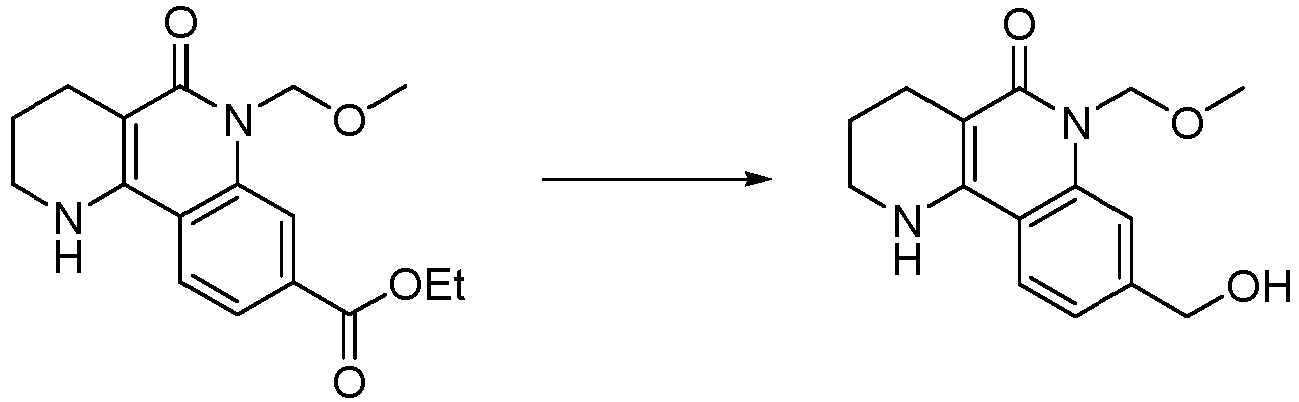
- To the compound (50 g, 160 mmol) prepared in step 4, tetrahydrofuran (1 L) and methanol (0.3 L) were added, followed by cooling to 0°C. Sodium borohydride (36g, 96 mmol) was added slowly to the solution which was then stirred at room temperature for 1 hour, followed by reaction at 60°C for 12 hours. The reaction solution was cooled to room temperature, and then the reaction was stopped with water, after which the reaction solution was neutralized with 2N hydrochloric acid. The reaction solution was concentrated under reduced pressure, and the solid was filtered and washed with water and acetone, thereby obtaining the title compound (44 g, 99 %, yellow solid).
1H NMR (400MHz, DMSO-d6 ); δ 7.82(d, J=8.0Hz, 1H), 7.41 (s, 1H), 7.14(d, J=8.Hz, 1H), 7.07 (s, 1H), 5.58(s, 2H), 5.34 (s, 1H), 4.59(s, 2H), 3.40-3.30(m, 2H), 3.25(s, 3H), 2.50-2.46(m, 2H), 1.83-1.80(m, 2H). -

- To the compound (54 mg, 0.19 mmol) prepared in step 5, dichloromethane (5 mL) was added, and then thionyl chloride (0.028 ml, 0.39 mmol) was added slowly dropwise at 0°C. The solution was stirred at room temperature for 4 hours. After completion of the reaction, dichloromethane and water at 0°C were added to the reaction solution which was then dried with anhydrous magnesium sulfate. The resulting material was concentrated under reduced pressure to give the title compound (37 mg, yield: 44%, yellow solid). The obtained compound was used without further purification in the next step.
1H NMR (400MHz, CD3OD) ; δ 7.72 (d, J=8.Hz, 1H), 7.30 (s, 1H) , 7.21(dd, J=8.8Hz, 1.6Hz, 1H), 4.68(s, 2H), 3.41(t, J=5.4Hz, 2H), 2.59(t, J=6.2Hz, 2H), 1.92-1.88(m, 2H). -

- To the compound (100 mg, 0.34 mmol) prepared in step 6, methanol (5.0 ml) was added, and then 1-(4-methoxyphenyl)piperazine (108 mg, 0.41 mmol) and trimethylamine were added. The mixture was stirred at 80°C for 24 hours. After completion of the reaction, the reaction solution was concentrated, and then extracted with dichloromethane, and the organic solvent layer was dried with anhydrous magnesium sulfate and concentrated under reduced pressure. The obtained residue was purified by column chromatography (hexane: ethyl acetate =1:9) to give the title compound (115 mg, yield: 75%).
1H NMR (400MHz, CDCl3); δ 7.52(s, 1H), 7.41-7.39 (m, 1H), 7.26-7.22(m, 1H), 6.91-6.89(m, 2H), 6.85-6.82(m, 2H),5.75(s, 2H), 3.77(s, 3H), 3.67(s, 2H), 3.49-3.43(m, 5H), 3.12-3.10(m, 4H), 2.70-2.63 (m, 6H), 2.10-1.95 (m, 2H). -

- The compound (115 mg, 0.26 mmol) prepared in step 7 was dissolved in dichloromethane (10 ml), and then added to trifluoroacetic acid (2 ml) and heated with a reflux condenser for 24 hours. After completion of the reaction, the reaction solution was extracted with dichloromethane, and extracted once more with dichloromethane in a saturated aqueous solution of sodium hydrogen carbonate. The extract was dried with anhydrous magnesium sulfate and concentrated under reduced pressure, and the obtained residue was purified by column chromatography (dichloromethane: methanol =1:9) to give the title compound (68 mg, yield: 65%).
1H NMR (400MHz, CDCl3) ; δ 7.40 (d, J=8.0Hz, 1H), 7.312 (br, 1H), 7.25-7.20(m, 1H), 6.90(d, J=8.8Hz, 2H), 6.83(d, J=8.8Hz, 2H), 4.99(s, 1H), 3.77(s, 1H), 3.70(s, 2H), 3.49-3.46(m, 2H), 3.14-3.09(m, 6H), 2.73-2.71(m, 4H), 1.98-1.97(m, 2H). -

- The compound (68 mg, 0.17 mmol) prepared in step 8 was dissolved in methanol (2 ml), and then 1.25M hydrochloric acid methanol solution (2 ml) was added thereto, followed by stirring for 12 hours. After completion of the reaction, the reaction solution was concentrated under reduced pressure to remove the solvent. Then, the solid was produced with ethyl acetate and filtered to give the title compound (83 mg, yield: 100%, solid).
1H NMR (400MHz, DMSO-d6 ); δ 11.05(s, 1H), 11.1-10.9 (br, 1H), 8.34 (d, J=8.4Hz, 1H), 7.84-7.78 (m, 1H), 7.75(s, 1H), 7.35(d, J=9.2Hz, 1H), 7.27(d, J=9.6Hz, 1H), 5.00-4.60(m, 2H), 4.10(s, 3H), 4.04(d, J=13.2Hz, 2H), 3.80-3.74(m, 4H), 3.63-3.58(m, 2H), 3.44-3.41(m, 2H), 2.92-2.88(m, 2H), 2.34-2.32(m, 2H) - Using 8-chloromethyl-10-methoxy-6-methoxymethyl-2,3,4,6-tetrahydro-1H-benzo[h] [1,6]naphthyridin-5-one and 1-(4-fluorophenyl)piperazine, the title compound (17 mg, yield: 64%, white solid) was obtained in the same manner as described in Example 1.
1H NMR (400MHz, DMSO-d6 ); δ 11.91 (br, 1H), 11.66(br, 1H), 7.45 (s, 1H), 7.15-6.95(m, 5H), 4.40(br, 2H), 4.01(s, 3H), 3.80-3.65(m, 2H), 3.45-3.30(m, 2H), 3.30-3.15(m, 4H), 2.70-2.30(m, 4H), 1.90-1.70(m, 2H). - Using 8-chloromethyl-10-ethoxy-6-methoxymethyl-2,3,4,6-tetrahydro-1H-benzo[h][1,6]naphthyridin-5-one and 1-(4-fluorophenyl)piperazine, the compound (36 mg, 0.07 mmol, 87%) was obtained in the same manner as described in Example 1.
1H NMR(400MHz, DMSO-d6 ); δ 11.03(s, 1H), 10.60-10.45(br, 1H), 7.42(s, 1H), 7.12-7.08(m, 2H), 7.04-6.98(m, 2H), 6.88(s, 1H), 4.35(d, J=4.8Hz, 2H), 4.26(q, J=7.0Hz, 2H), 3.73(d, J=12.8Hz, 2H), 3.21-3.17(m, 4H), 3.17-3.06(m, 4H), 1.80-1.70(m, 2H), 1.45 (t, J=7.0Hz, 3H). - Compounds of Examples 4 to 114 were prepared in the same manner as described in Examples 1 to 3, except that substituents were changed as shown in Table 1 below.
[Table 1] Example Structure NMR 4 
1H NMR(400MHz, DMSO-d6 ); δ 11.68(br s, 1H), 11.53(s, 1H), 8.44(s, 2H), 7.35(s, 1H), 6.95(s, 1H), 6.76(s, 1H), 4.69(d, J=14.6Hz, 2H), 4.32(s, 4H), 3.47(t, J=12.4Hz, 2H), 3.77(s, 4H), 3.07(s, 2H), 2.51(s, 2H), 1.78(s, 2H), 1.45 (t, J=5.3Hz, 3H) 5 
1H NMR(400MHz, DMSO-d6 ); δ 12.10-11.90(m, 1H), 11.62(s, 1H), 8.12(d, J=4.8Hz, 1H), 7.94-7.92(m, 2H), 7.39(s, 1H), 7.27(d, J=8.4Hz, 1H), 7.00-7.69(m, 2H), 4.48-4.45 (m, 2H), 4.36-4.31(m, 4H), 3.70-3.60(m, 2H), 3.45-3.30(m, 4H), 3.30-3.10(m, 2H), 2.50-2.40(m, 2H), 1.85-1.70(m, 2H), 1.45 (t, J=3.8, 3H) 6 
1H NMR (400MHz, DMSO-d6 ); δ 11.79(br, 1H), 11.69(br, 1H), 8.55(s, 2H), 7.41(s, 1H), 6.99(s, 1H), 4.62-4.50(m, 2H), 4.39-4.28(m, 4H), 3.33-3.51(m, 6H), 3.02-3.15(br, 2H), 2.38-2.50(m, 2H), 1.81-1.70(m, 2H), 1.47-1.44(m, 3H) 7 
1H NMR (400MHz, DMSO-d6 ); δ 11.81(br, 2H), 8.15(s, 1H), 7.61(t, J=7.6Hz, 1H), 7.45(s, 1H), 7.02(s, 1H), 7.00(t, J=7.6Hz, 1H), 4.34-4.33(m, 4H), 4.27(d, J=13.2Hz, 4H), 3.40-3.31(m, 6H), 3.16-3.11(m, 2H), 1.79(br, 2H), 1.45(t, J=6.6Hz, 3H) 8 
1H NMR(400MHz, DMSO-d6 ); δ 11.72(br, 1H), 11.56(s, 1H), 7.62-7.60(m, 1H), 7.24(s, 1H). 6.98-6.95(m, 2H), 6.76-6.71(m, 1H), 4.33-4.22(m, 6H), 3.48-3.37(m, 6H), 3.09(s, 2H), 2.51(s, 2H), 1.77(s, 2H), 1.43(t, J=5.6Hz, 3H) 9 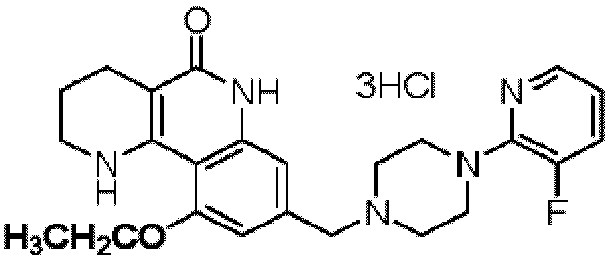
1H NMR (400MHz, DMSO-d6 ); δ 11.72(s, 1H), 11.65(br , 1H), 8.06(s, 1H). 7.62-7.57(m, 1H), 7.39(s, 1H), 7.00(s, 2H), 4.04-4.31(m, 4H), 3.49-3.33(m, 6H), 3.20-3.16(m, 2H), 1.78(s, 2H), 1.44(t, J=6.8Hz, 3H) 10 
1H NMR (400MHz, DMSO-d6 ); δ 10.65(s, 1H), 8.07(d, J=2.0Hz, 1H), 7.83(d, J=2.0Hz, 1H), 7.79(d, J=2.4Hz, 1H), 7.36(s, 1H), 6.79(s, 1H), 6.62(s, 1H), 4.18(q, J=6.8Hz, 2H), 3.47(s, 2H), 3.45-3.35(m, 4H), 3.35-3.25(m, 4H), 2.42(t, J=6.2Hz, 2H), 1.75(t, J=5.4Hz, 2H), 1.41(t, J=6.8Hz, 3H) 11 
1H NMR(400MHz, DMSO-d6 ); δ 11.55(br, 1H). 11.35(s, 1H). 7.84-7.82(m, 1H), 7.32(s, 1H), 7.28-7.21(m, 1H), 7.17(d, J=7.3Hz, 1H), 6.09(s, 1H), 4.42-4.30(m, 6H), 3.45-3.35(m, 6H), 3.12(s, 2H), 2.51(s, 2H), 1.98(s, 2H), 1.44(t, J=6.3Hz, 3H) 12 
1H NMR (400MHz, DMSO-d6 ); δ 11.72(br, 1H). 11.20(s, 1H) 8.61(s, 1H), 8.28(s, 1H), 7.32(s, 1H), 6.91(s, 1H). 4.34-4.28(m, 6H), 4.10-4.07(m, 2H), 3.35-3.21(m, 6H), 2.51(s, 2H), 1.98(s, 2H), 1.50-1.44(m, 3H) 13 
1H NMR(400MHz, DMSO-d6 ); δ 11.19(s, 1H), 11.10-11.00(m, 1H). 8.18(s, 1H), 7.72(d, J=8.8Hz, 1H). 7.16(s, 1H), 6.98(d, J=9.2Hz, 1H), 6.87(s, 1H), 4.36-4.26(m, 4H), 3.35-3.29(m, 6H), 3.20-3.00(m, 4H), 2.50-2.40(m, 2H), 1.80-1.70(m, 2H), 1.45 (t, J=7.0Hz, 3H) 14 
1H NMR(400MHz, DMSO-d6 ); δ 11.49(br, 1H). 11.25(s, 1H). 7.64(t, J=7.3Hz, 1H). 7.26(s, 1H), 6.89-6.87(m, 2H), 6.78(d, J=6.8Hz, 1H), 4.31-4.29(m, 6H), 3.44-3.35(m, 6H), 3.10(s, 2H), 2.51(s, 2H), 1.77(s, 2H), 1.44(t, J=6.3Hz, 3H) 15 
1H NMR (400MHz, CD3OD); δ 8.23(dd, J=4.8, 1.2Hz, 1H), 7.83(dd, J=8.0, 1.6Hz, 1H). 7.36(s, 1H), 7.31(s, 1H), 7.08(q, J=2.8Hz, 1H), 4.52(s, 2H), 4.47(q, J=6.8Hz, 2H), 4.00(br, 2H), 3.60(t, J=5.6Hz, 4H), 3.43(br, 4H), 2.72(t, J=6.8Hz, 2H), 2.00-1.96(m, 2H), 1.58(t, J=6.8Hz, 3H) 16 
1H NMR (400MHz, DMSO-d6 ); δ 11.49(s, 1H), 10.87(br , 1H), 8.23(s, 1H). 8.12(s, 1H), 7.80(dd, J=6.8, 1.9Hz, 1H). 7.54(d, J=8.3Hz, 1H), 7.19(s, 1H), 4.36-4.24(m, 6H), 3.38-3.22(m, 6H), 3.11(s, 2H), 2.51(s, 2H), 1.78(s, 2H), 1.45(t, J=6.8Hz, 3H) 17 
1H NMR(400MHz, DMSO-d6 ); δ 11.71(s, 1H), 11.59(br , 1H). 8.14(s, 1H). 7.81(s, 1H), 7.39(s, 1H), 7.15(s, 1H), 7.04(s, 1H), 4.39(s, 2H), 4.31-4.33(m, 4H), 3.38-3.34(m, 6H), 2.28(s, 3H), 1.77(s, 2H), 1.44(t, J=6.3Hz, 3H) 18 
1H NMR(400MHz, DMSO-d6 ); δ 11.73(br, 1H), 11.55(s, 1H), 8.62(s, 1H), 8.39(br s, 1H), 8.07(d, J=8.7Hz, 1H), 7.35(s, 1H), 7.02(d, J=8.7Hz, 1H), 6.94(s, 1H), 4.32-4.26(m, 6H), 3.49-3.46(m, 2H), 3.36-3.33(m, 4H), 3.11-3.08(m, 2H), 2.76(s, 3H), 2.37-2.32(m, 2H), 1.77(s, 2H), 1.44(t, J=6.8Hz, 3H) 19 
1H NMR (400MHz, DMSO-d6 ); δ 12.11(br, 1H), 12.02(s, 1H), 8.62(s, 1H), 8.16(d, J=8.3 Hz, 1H). 7.49(s, 1H). 7.10(d, J=8.3Hz, 1H), 7.05(s, 1H), 4.55-4.52(m, 4H), 4.37-4.25(m, 6H), 3.59-3.56(m, 2), 3.41-3.14(m, 8H), 1.79(s, 2H), 1.45(t, J=6.1Hz, 3H), 1.10(t, J=7.0Hz, 3H) 20 
1H NMR (400MHz, DMSO-d6 ); δ 11.76(br, 1H), 11.55(s, 1H), 8.67(s, 1H). 8.06-8.04(m, 1H), 7.36(s, 1H), 7.00(d, J=8.7Hz, 1H), 6.94(s, 1H). 4.45-4.48(m, 2H), 4.33-4.25(m, 4H), 3.51-3.49(m, 2H), 3.37-3.33(m, 4H), 3.11-3.08(m, 2H), 1.77(s, 2H), 1.44(t, J=6.83Hz, 3H), 0.69(s, 2H), 0.67(s, 2H), 0.55(s, 1H) 21 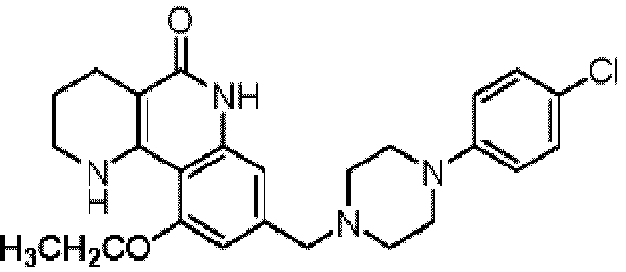
1H NMR(400MHz, DMSO-d6 ); δ 11.90-11.70(m, 2H), 7.44(s, 1H), 7.29(s, 1H), 7.27(s, 1H), 7.01-6.98(m, 3H), 4.80-4.10 (m, 6H), 3.80(d, J=12.0Hz, 2H), 3.40-3.17(m, 6H), 2.60-2.40(m, 2H), 1.85-1.17(m, 2H), 1.52-1.40(m, 3H) 22 
1H NMR (400MHz, DMSO-d6 ); δ 11.50(s, 2H), 7.41(s, 1H), 7.39(s, 1H), 7.34(s, 1H). 6.95-6.93(m, 3H), 4.52-4.29(m, 6H), 3.80(d, J=12.4Hz, 2H), 3.37-3.14(m, 6H), 2.50-2.47(m, 2H), 1.80-1.70(m, 2H), 1.44(t, J=7.0Hz, 3H) 23 
1H NMR(400MHz, DMSO-d6 ); δ 10.66(s, 1H), 7.78(d, J=8.7Hz, 1H). 7.58(d, J=8.7Hz, 1H), 7.36(s, 1H), 7.02(d, J=8.7Hz, 1H), 6.98(d, J=8.7Hz, 1H), 6.79(s, 1H), 6.26(s, 1H), 4.24-4.15(m, 6H), 3.48(s, 2H), 3.17(d, J=8.3Hz, 2H), 2.42(t, J=5.8Hz, 2H), 1.75(s, 2H), 1.41(t, J=6.8Hz, 3H) 24 
1H NMR(400MHz, DMSO-d6 ); δ 11.59(br, 1H), 11.38(s, 1H), 7.79(d, J=13.1Hz, 1H), 7.63(d, J=8.3Hz, 1H), 7.31(s, 1H), 7.21(d, J=8.5Hz, 1H), 6.93(s, 1H). 4.36-4.29(m, 6H), 3.70-3.67(m, 2H), 3.43-3.36 (m, 6H), 3.24 (s, 2H), 1.76(s, 2H), 1.44(t, J=6.5Hz, 3H) 25 
1H NMR (400MHz, DMSO-d6 ); δ 11.60(br, 1H), 11.40(s, 1H), 7.81(d, J=13.3Hz, 1H), 7.66(d, J=8.5Hz, 1H), 7.31(s, 1H). 7.24(d, J=8.5Hz, 1H), 6.93 (s, 1H), 4.33-4.29(m, 6H), 3.71-3.62(m, 2H), 3.43-3.36(m, 6H), 3.22(s, 2H), 1.76(s, 2H), 1.45(t, J=6.7Hz, 3H) 26 
1H NMR(400MHz, DMSO-d6 ); δ 11.43(br, 1H), 11.41(s, 1H), 7.96(s, 1H), 7.64-7.62(m, 2H), 7.35(s, 1H), 7.15(d, J=8.3Hz, 1H), 6.95(s, 1H), 4.38(s, 2H), 4.32(d, J=6.8Hz, 2H), 3.67-3.64(m, 2H), 3.38-3.23(m, 10H), 2.31(s, 2H), 2.27(s, 3H), 1.77(s, 2H), 1.44(t, J=6.8Hz, 3H) 27 
1H NMR (400MHz, DMSO-d6 ); δ 11.30(s, 1H), 11.09(s, 1H), 7.25(s, 1H), 7.07-6.93(m, 4H), 4.36(s, 2H), 4.29(d, J=7.2Hz, 1H), 3.35-3.32(m, 4H), 3.30-3.18(m, 2H), 3.12(br, 4H), 2.50-2.46(m, 2H), 2.26(s, 3H), 1.80-1.70(m, 2H), 1.45 (t, J=6.6Hz, 3H) 28 
1H NMR(400MHz, DMSO-d6 ); δ 11.28(br, 2H), 7.78(s, 1H), 7.75(s, 1H), 7.24(s, 1H), 6.91(s, 1H), 4.35(br, 2H), 4.29(q, J=6.8Hz, 2H), 3.60-3.40(m, 6H), 3.40-3.30(m, 2H), 2.55-2.40(m, 4H), 1.30-1.70(m, 2H), 1.44(t, J=6.8Hz, 3H) 29 
1H NMR(400MHz, DMSO-d6 ); δ 11.62(br, 1H), 11.15(s, 1H), 7.78(d, J=8.7Hz, 1H), 7.19(d, J=8.7Hz, 1H), 7.03(s, 1H), 6.92(d, J=8.7Hz, 1H), 6.86(s, 1H), 4.32-4.27(m, 6H), 4.13-4.01(m, 2H), 3.43-3.34(m, 6H), 3.16(s, 2H), 1.76(s, 2H), 1.44(t, J=6.8Hz, 3H) 30 
1H NMR (400MHz, DMSO-d6 ); δ 10.64(s, 1H), 8.14(s, 1H), 7.69(d, J=8.8Hz, 2H), 7.35(s, 1H), 6.92(d, J=8.8Hz, 2H), 6.78(s, 1H), 6.61(s, 1H), 4.16(q, J=7.2Hz, 2H), 4.08-4.07(m, 2H), 3.24-3.15(m, 8H), 2.41(t, J=5.6Hz, 2H), 1.74(br, 2H), 1.56(s, 2H), 1.40(t, J=6.8Hz, 3H), 1.07(t, J=7.6Hz, 3H) 31 
1H NMR (400MHz, DMSO-d6 ); δ 11.86-11.75(m, 1H), 11.52(s, 1H), 7.84(s, 1H), 7.60(t, 1H, 8.4), 7.41(s, 1H), 7.00-6.97(m, 1H), 6.86-6.78(m, 1H), 4.36-4.32(m, 4H), 3.38-3.30(m, 4H), 3.15 (s, 3H), 2.80-2.70(m, 2H), 2.60-2.40(m, 4H), 2.35-2.34(m, 2H), 1.85-1.75(m, 2H), 1.45(t, J=6.2Hz, 3H) 32 
1H NMR(400MHz, DMSO-d6 ); δ 11.55-11.40(br, 1H), 11.30(s, 1H), 7.89-7.81(m, 2H), 7.32(s, 1H), 6.93(s, 1H), 6.83-6.80(m, 1H), 4.35-4.30(m, 4H), 3.36-3.17(m, 6H), 2.81(t, J=6.2Hz, 2h), 2.5(br, 4H), 1.85-1.70(m, 2H), 1.50-1.40(m, 3H), 1.15(t, J=7.0Hz, 3H) 33 
1H NMR(400MHz, DMSO-d6 ); δ 11.32(s, 1H), 8.51(s, 1H), 7.90(s, 1H), 7.83(d, J=8.3Hz, 1H), 7.28(s, 1H), 7.30(d, J=8.3Hz, 1H), 6.95(s, 1H), 4.39(s, 2H), 4.33(d, J=6.8Hz, 2H), 3.52-3.41(m, 4H), 3.41-3.33(m, 6H), 3.26-3.24(m, 4H), 2.75(s, 3H), 1.77(s, 2H), 1.45 (t, J=6.8Hz, 3H) 34 
1H NMR(400MHz, DMSO-d6 ); δ 11.65(br, 1H), 11.54(s, 1H), 8.49(s, 1H), 7.90(s, 1H), 7.80(d, J=7.8Hz, 1H), 7.39(s, 1H), 7.24(d, J=8.3Hz, 1H), 6.99(s, 2H), 4.40(s, 2H), 4.33(s, 2H), 3.49(d, J=9.7Hz. 2H), 3.37-3.27(m, 8H), 2.82(s, 1H), 1.77(s, 2H), 1.44(t, J=6.8Hz, 3H), 0.68(s. 2H), 0.55(s, 2H) 35 
1H NMR(400MHz, DMSO-d6 ); δ 11.34(s, 1H), 8.51.(s, 1H), 7.90(s, 1H), 7.82(d, J=8.3Hz, 1H), 7.28(s, 1H), 7.26(d, J=8.3Hz, 1H), 6.95(s, 1H), 4.39(s, 2H), 4.31(d, J=6.8Hz, 2H), 3.56-3.45(m, 4H), 3.40-3.36(m, 6.1-1), 3.26-3.24(m, 4H), 2.75(s, 3H), 1.77(s, 2H), 1.44(t, J=6.8Hz, 3H) 36 
1H NMR(400MHz, DMSO-d6 )); δ 11.50(s, 1H), 11.44(br s, 1H), 8.33(d, J=3.9Hz, 1H),7.68(s, 1H), 7.66(d, J=3.7Hz, 1H), 7.37(s, 1H), 7.06(d, J=7.8Hz, 1H), 6.98(s, 1H), 4.38(s, 2H), 4.34-4.29(m, 8H), 2.74(s, 3H), 2.27(s, 3H), 1.77(s, 2H), 1.45(t, J=6.8Hz, 3H) 37 
1H NMR(40OMHz, DMSO-d6 ); δ 11.58(s, 2H), 8.36(s, 1H), 7.68-7.65(m, 2H), 7.42(s, 1H), 7.05(d, J=7.8Hz, 1H), 7.00(s, 1H), 4.39(s, 2H), 4.34-4.32(m, 2H), 3.56-3.33(m, 10H), 2.27(s, 3H), 1.77(s, 2H), 1.45(s, 3H), 1.10(s, 3H) 38 
1H NMR(400MHz, DMSO-d6 ); δ 11.32(s, 2H), 11.22(br, 1H), 8.31(s, 1H), 7.66(s, 1H), 7.63(s, 1H), 7.28(s, 1H), 7,05(d, J=(3.3Hz, 1H), 6.94(s, 1H), 4.37(s, 2H), 4.32(d, J=6.9Hz, 2H), 3.49-3.45(m, 2H), 3.38-3.19(m, 8H), 2.81(s, 1H), 2.26(s, 3H), 1.76(s, 2H), 1.44(t, J=6.8Hz, 3H), 0.67(d, J=6.8Hz, 2H), 0.53(s, 2H) 39 
1H NMR(400MHz, DMSO-d6 ); δ 11.21(br, 2H), 8.13(d, J=4.0Hz, 1H), 7.80-7.65(m, 1H), 7.16(s, 1H), 7.10-7.00(m, 1H), 6.87(s, 1H), 6.90-6.80(m, 1H), 4.40-4.20(m, 4H), 3.95(s, 3H), 3.45-3.25(m, 4H), 3.20-3.05(m, 2H), 2.55-2.40(m, 4H), 1.80-1.70(m, 2H) 40 
1H NMR(400MHz, DMSO-d6 ); δ 11.72(br, 2H), 8.13(d, J=5.2Hz, 1 H), 7.75(d, J=6.8Hz, 1H), 7.40(s, 1H), 7.12(t, J=7.2 Hz, 1H), 7.01(s, 1H), 4.60-4.10(m, 6H), 3.98(s, 3H), 3.70-3.60(m, 2H), 3.60-3.40(m, 2H), 3.40-3.20(m, 4H), 2.26(s, 3H), 1.80-1.70(m, 2H) 41 
1H NMR(400MHz, DMSO-d6 ); δ 11.68(br, 2H), 8.17(d, J=5.2Hz, 1 H), 7.72(d, J=6.9Hz, 1H), 7.40(s, 1H), 7.12(t, J=7.2 Hz, 1H), 7.01(s, 1H), 4.64-4.07(m, 6H), 3.99(s, 3H), 3.73-3.24(m, 2H), 3,63-3.41(m, 2H), 3.42-3.22(m, 4H), 1.81-1.73(m, 2H) 42 
1H NMR(400MHz, DMSO-d6 ); δ 12.02(br, 2H), 7.70-7.60(m, 2H), 7.55-7.40(br, 1H), 7.10-6.95(m, 3H), 4.39(br, 2H), 4.30-3.90(m, 9H), 3.50-3.20(m, 4H), 3.20-3.10(m, 2H), 1.85-1.70(m, 2H) 43 
1H NMR(400MHz, DMSO-d6 ); δ 12.09(br, 1H), 11.74(br, 1H), 7.50(s, 1H), 7.09(s, 1H), 7.05-6.90(m, 3H), 4.37(br, 2H), 3.96(s, 3H), 3.40-3.30(m, 2H), 3.25-3.10(m, 4H), 3.10-2.95(m, 4H), 2.45-2.40(m, 2H), 1.80-1.65(m, 2H) 44 
1H NMR(400MHz, CD3OD); δ 7.53-7.51(m, 2H), 7.37-7.34(m, 2H), 7.18-7.16(m, 1H), 4.63(S, 2H), 4.13(s, 3H), 3.61-3.55(m, 4H), 3.46-3.27(m, 2H), 2.72-2.67(m, 2H), 2.34(S, 3H), 2.05-1.90(m, 2H) 45 
1H NMR(400MHz, DMSO-d6 ); δ 10.68(br, 1H), 7.70(d, J=13.2Hz, 1H), 7.57(d, J=8.4Hz, 1H), 7.42(s, 1H), 7.12(t, J=8.8Hz, 1H), 6.79(s, 1H), 6.61(s, 1H), 4.07(s, 3H), 3.88(br, 2H), 3.45-3.25(m, 6H), 3.25-3.15(m, 4H), 2.45-2.35(m, 2H), 1.80-1.70(m, 2H) 46 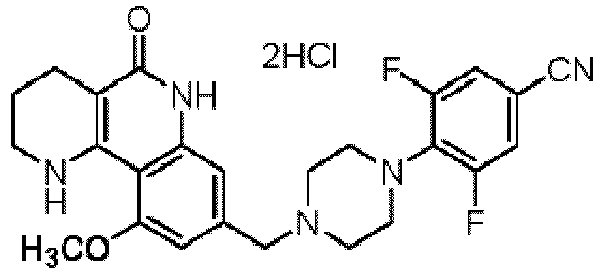
1H NMR(400MHz, DMSO-d6 ); δ 11.89(br, 1H), 11.81(s, 1H), 7.77(s, 1H), 7.74(s, 1H), 7.45(s, 1H), 7.04(s, 1H), 4.40(br, 2H), 4.00(s, 3H), 3.80-3.60(m, 2H), 3.60-3.25(m, 6H), 3.30-3.10(m, 2H), 2.55-2.45(m, 4H), 1.77(m, 2H) 47 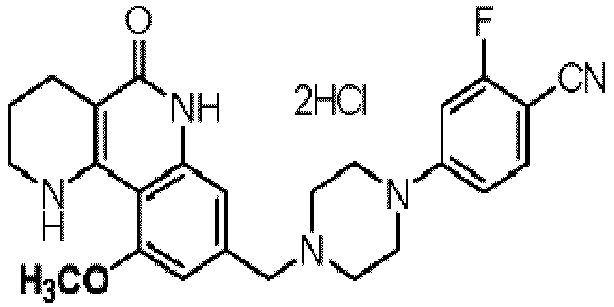
1H NMR(400MHz, DMSO-d6 ); δ 11.74(br, 1H), 11.53(br, 1H), 7.69(t, J=8.8 Hz, 1H), 7.33 (s, 1H), 7.07(d, J=14Hz, 1H), 7.00-6.90(m, 2H), 4.35(br, 2H), 4.15-4.05(m, 2H), 3.98(s, 3H), 3.90-3.60(m. 2H), 3.20-3.10(m, 4H), 2.65-2.45(m, 4H), 1.80-1.70(m, 2H) 48 
1H NMR(400MHz, DMSO-d6 ); δ 11.76(br, 1H), 11.37(br, 1H), 8.06(d, J=8AHz, 1H), 7.59(d, J=8.4Hz, 1H 7.48(s, 1H), 7.15-7.05(m, 2H), 7.05-6.95(m, 2H), 4.44(br, 2H), 3.75-3.65(m, 2H), 3.40-3.30(m, 2H), 3.30-3.10(m, 4H), 2.60-2.45(m, 4H), 1.85-1.75(m, 2H) 49 
1H NMR(400MHz, DMSO-d6 ); δ 11.44(br, 1H), 11.00(br, 1H), 7.97(d, J=8.4Hz, 1H), 7.51(d, J=8.4Hz, 1H), 7.40(s, 1H), 7.10-6.9.5(m, 3H), 4.44(d, J=4.0 Hz, 2H), 4.20-3.80(m, 2H), 3.30-3.20(m, 2H), 3.15-3.00(m, 4H), 2.60-2.40(m, 4H), 2.25(s, 3H), 1.90-1,70(m, 2H) 50 
1H NMR(400MHz, CD3OD); δ 8.15(d, J=8.4Hz, 1H), 7.88(S, 1H), 7.67(d, J-8.4Hz, 1H), 7.45-7.43(m, 2H), 7.15-7.11(m, 1H), 4.57(S. 2H), 3.72(d, J=12.0Hz, 2H), 3.65-3.48(m, 4H), 3.53-3.24(m, 4H), 2.70-2.68(m, 2H), 1.97-1.96(m, 2H) 51 
1H NMR(400MHz, CD3OD); δ 8.17(d, J=8.4Hz, 1H), 7.86(s, 1H), 7.83(s, 1H), 7.68(d, J=8.4Hz, 2H), 7.30(d, J=8.4Hz, 1H), 4.62(s, 2H), 3.70-3.56(m, 4H), 3.46(t, J=10.8Hz, 2H), 3.34-3.25(m, 1H), 2.74(t, J=5.8Hz, 2H), 2.03-2.00(m, 2H) 52 
1H NMR(400MHz, CD3OD); δ 7.92(d, J=2.0Hz, 1H), 7.72(d, J=8.4Hz, 1H), 7.65((dd, J=8.4, 2.0Hz. 1H), 7.30(s, 1H), 7.24-7.19(m, 2H), 3.67(s, 2H), 3.43(t, J=3.4Hz, 2H), 3.17(br, 4H), 2.69(br, 4H), 2.61(t, J=6.4Hz, 2H), 1.93(t, J=5.6Hz, 2H) 53 
1H NMR(400MHz, CD3OD); δ 7.46-7.44(m, 2H), 7.07(d, J=9.2Hz, 1H), 6.85(s, 1H), 6.77(s, 1H), 3.94(s, 3H), 3.58(s, 2H), 3.38-3.36(m, 2H), 2.99(br, 4H), 2.63(br, 4H), 2.55(t, J=6.2Hz, 2H), 2.27(s, 3H), 1.85-1.82(m, 2H) 54 
1H NMR(400MHz, DMSO-d6 ); δ 11.08(s. 1H), 10.73(br, 1H), 7.87(d, J=8.8Hz, 1H), 7.37-7.35(m, 3H), 7.30(s, 1H), 7.01(d, J=8.0Hz, 1H), 4.39(s, 1H), 3.82(s, 3H), 3.66-3.05(m, 12H), 1.82-1.70(m, 2H) 55 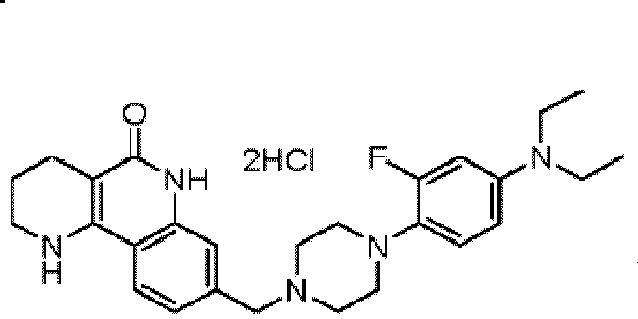
1H NMR(00MHz, DMSO-d6 ): δ 10.99(s, 1H), 7.06-7.02(m, 2H), 6.95-6.92(m, 2H), 6.84(d, J=14.4Hz, 1H), 6.54(d. J=13.2Hz, 1H), 3.52(s, 2H), 3.50-3.30(m, 4H), 3.12-3.02(m, 2H), 2.72-2.65(m 2H), 2.60-2.38 (m. 4H), 2.38-2.30(m, 2H), 1.30-1.70(m, 2H) 56 
1H NMR(400MHz, DMSO-d6 ); δ 11.19(s, 1H), 10.73(br, 1H), 7.94(s, 1H), 7.90-7.85(m, 2H), 7.37(d. J=8.6Hz, 1H), 7.29(s, 1H), 7.25(d, J=8.6Hz, 1H), 4.42(br, 2H), 3.42-3.15(m, 12H), 2.57(s, 3H), 1.78(br, 2H) 57 
1H NMR(400MHz, DMSO-d6 ); δ 11.47(s, 1H), 11.38(br, 1H), 7.98(s, 1H), 7.83(s, 1H), 7.53(s, 1H), 7.40(s, 2H), 7.14(s, 2H), 7.00(s, 1H), 4.42(s, 2H), 3.64-3.62(m, 2H), 3.40-3.23(m, 10H), 1.80(s, 2H) 58 
1H NMR(400MHz, CD3OD); δ 8.15(d, J=8.4Hz. 1H), 7.82(s, 1H), 7.64(d, J=8.4Hz, 1H), 7.44 (s, 1H), 7.42(s, 1H), 4.57(s, 2H), 3.60-3,50(m, 8H), 3.37-2.27(m, 2H), 2.71(t, J=5.8Hz, 2H), 2.00-1.98(m, 2H) 59 
1H NMR(400MHz, DMSO-d6 ); δ 11.26(s, 2H), 8.10-8.00(m, 2H), 7.94(d, J=8.4Hz, 2H), 7.47(d, J=8.8Hz, 1H), 7.35(s, 1H), 7.28-7.24(m, 1H), 4.42(s, 2H), 3.87-3.79(m, 4H), 3.50-3.20(m, 6H), 2.50-2.47(m, 2H), 1.82-1.79(m, 2H) 60 
1H NMR(400MHz, DMSO-d6 ); δ 11.38(br, 2H), 7.95(d, J=8.4Hz, 1H), 7.69(t, J=8.4Hz, 1H), 7.48(d, J=8.4 Hz, 1H), 7.34(s, 1H), 7.06(d, J=13.6Hz, 1H), 6.92(dd, J=9.2Hz, 1.6Hz, 1H), 4.39(br, 2H), 4.18-4.05(m, 2H), 3.48-3.25(m, 4H), 3.20-3.05(m, 2H), 2.50-2.40(m, 4H), 1.85-1.70(m, 2H) 61 
1H NMR(400MHz, DMSO-d6 ); δ 11.38-11.31(m, 2H), 7.95(d, J=8.3Hz, 1H), 7.76(d, J=8.3Hz, 1H), 7.47(d, J=8.3Hz, 1H), 7.32(s, 1H), 7.26(s, 1H), 7.05(d, J=8.7Hz, 1H), 4.38(s, 2H), 4.15(d, J=13.6Hz, 2H), 3.43-3.29(m, 6H), 3.16-3.04(m, 4H), 1.80(s, 2H) 62 
1H NMR(400MHz, DMSO-d6 ); δ 11.18(s, 1H), 11.10-10.95(br, 1H), 7.93-7.88(m, 2H), 7.39-7.36(m, 2H), 7.30-7.27(m, 2H), 4.37(s, 2H), 4.21(d, J=13.6Hz, 2H), 3.41-3.01(m, 4H), 3.14-3.12(m, 2H), 2.50(br, 4H), 1.79-1.78(m, 2H) 63 
1H NMR(400MHz, DMSO-d6 ); δ 11.24(s, 1H), 11.01(m, 1H), 7.91(d, J=8.0Hz, 1H), 7.58(d, J=8.4Hz, 1H), 7.48-7.36(m, 1H), 7.30(s, 1H), 7.01(s, 1H), 6.91(d, J=8.8Hz, 1H), 4.40-4.39(m, 2H), 4.08-4.01(m, 2H), 3.80-3.50(m, 2H), 3.32-3.25(m, 4H), 3.16-3.11(m, 2H), 2.50-2.47 (m, 2H), 2.40(S, 3H), 1.85-1.75(m, 2H) 64 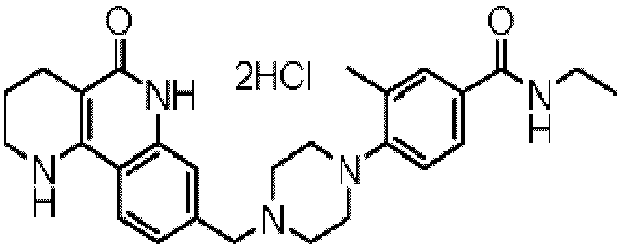
1H NMR 400MHz, DMSO-d6 ); δ 11.27(s, 1H), 10.82(br, 1H), 8.34(s, 1H), 7.94(d, J=8.3Hz, 1H), 7.68-7.65(m, 2H), 7.46(d, J=8.3Hz, 1H), 7.35(s, 1H), 7.06(d, J=8.3Hz, 1H), 4.44(s, 2H), 3.38-3.23(m, 8H), 3.12-3.06(m, 2H), 2.27(s, 3H), 1.80(s, 2H), 1.09(t, J=7.0Hz, 3H) 65 
1H NMR(400MHz, DMSO-d6 ); δ 11.37(s, 1H), 11.10(br , 1H), 8.32(s, 1H), 7.97(d, J=7.3Hz, 1H), 7.66-7.63(m, 2H), 7.52(d, J=7.8Hz, 1H), 7.39(s, 1H), 7.04(d, J=8.3Hz, 1H), 4.44(s, 2H), 3.33-2.22(m, 8H), 3.16-3.13(m, 2H), 2.80(s, 1H), 2.27 (s, 3H), 1.80(s, 2H), 0.66(d, J=5.3Hz, 3H), 0.54(s, 2H) 66 
1H NMR(400MHz, DMSO-d6 ); δ 11.14(s, 1H), 10.55(m, 1H), 8.43-8.34(m, 1H), 7.66-7.62(m, 2H), 7.36-7.31(m, 1H), 7.14-.12(m, 1H), 4.43(S, 2H), 3.41-3.16(m, 10H), 2.75(s, 3H), 2.50-2.46(m, 2H), 1.22-1.20(m, 2H) 67 
1H NMR(400MHz, DMSO-d6 ); δ 11.41(s, 1H), 11.26(br s, 1H), 8.47(s, 1H), 7.97(s, 1H), 7.66-7.63(m, 2H), 7.51(s, 1H), 7.39(s, 1H), 7.13(s, 1H), 4.43(s, 2H), 3.58(s, 2H), 3.34-3.16(m, 8H), 1.80(s, 2H), 1.09(s, 3H) 68 
1H NMR(400MHz, DMSO-d6 ); δ 11.33(s, 1H), 11.10-11.00(m, 1H), 7.94(d, J=8.4Hz, 1H), 7.51-7.44(m, 1H), 7.37(s, 1H), 7.25-7.00(m, 3H), 4.42(s, 2H), 3.96-3.82(m, 2H), 3.47-3.12(m, 10H), 2.60-2.40(m, 2H), 1.90-1.75(m, 2H), 1.06(t, J=7.6Hz, 3H) 69 
1H NMR(400MHz, CD3OD); δ 8.17(d, J=8.0Hz. 1H), 7.90(s, 1H), 7.69(d, J=3.4Hz, 1H), 7.57-7.49(m, 2H), 7.08-7.04(m, 1H), 4.58(s, 1H), 3.67-3.64 (m, 2H), 3.54(s, 4H), 3.40-3.38(m, 2H), 2.75-2.69(m, 3H), 1.96-1.94(m, 2H), 0.74-0.71(m, 2H), 0.56-0.55(m, 2H) 70 
1H NMR(400MHz, DMSO-d6 ); δ 11.18(s. 1H), 10.62(br, 1H), 8.50(s. 1H), 7.91-7.89(m, 2H), 7.81(d, J=8.3Hz, 1H), 7.39(d, J=8.3Hz, 1H), 7.33(s, 1H), 7.26(d, J=8.7Hz, 1H), 4.46(s, 2H), 3.57-3.53(m, 2H), 3.49-3.43(m, 2H), 3.41-3.23(m, 8H), 3.13-3.10(m, 2H), 2.76(s, 3H), 1.79(s, 2H) 71 
1H NMR(400MHz, DMSO-d6 ); δ 11.17(s, 1H), 10.66(br, 1H), 8.51(s, 1H), 7.94-7.89(m, 2H), 7.82(d, J=8.3Hz, 1H), 7.39(d, J=7.8Hz, 1H), 7.33(s, 1H), 7.25(d, J=8.3Hz, 1H), 4.46(s, 2H), 3.52-3.49(m, 2H), 3.43-3.41(m, 2H), 3.32-3.24(m, 8H), 3.16-3.14(m, 2H), 1.80(s, 2H), 1.09(t, J=7.0Hz, 3H) 72 
1H NMR(400MHz, DMSO-d6 );δ 11.16(s, 1H), 10.65(s, 1H), 8.47(d, J=4.0Hz, 1H), 7.90(s, 1H), 7.79(d, J=9.6Hz, 1H), 7.38(d, J=8.4Hz, 1H), 7.32(s, 1H), 7.24(d, J=8.8Hz, 1H), 4.45(s, 2H), 3.51(d, J=11.6Hz, 2H), 3.42(d, J=11.6Hz, 2H), 3.32(s, 2H), 3.26(d, J=10.0Hz, 2H), 3.16-3-3.10(m, 3H), 2.84-2.81 (m, 1H), 2.50-2.45(m, 2H), 1.60-1.90(m, 2H), 0.71-0.67(m, 2H), 0.50-0.60(m, 2H) 73 
1H NMR(400MHz, CDCl3); δ 8.84(br, 1H), 7.96(d, J=2.0Hz, 1H), 7.66(dd, J=8.0. 2.0Hz, 1H), 7.35(d, J=8.4Hz, 1H), 7.17(d, J=8.0Hz, 1H), 7.07(s, 1H), 7.04(d, J=8.4Hz, 1H),3.64(s, 2H), 3.46(br, 2H), 3.14-3.13(m, 4H), 2.99(s, 3H), 2.80-2.67(m, 6H), 2.17-1.96(m, 2H) 74 
1H NMR(400MHz, DMSO-d6 ); δ 11.46(s, 1H), 11.27(br s, 1H), 8.55(t, J=5.1Hz, 1H), 8.09(s, 1H), 7.99(d, J=8.3Hz, 1H), 7.87(d, J=6.8Hz, 1H), 7.54(d, J=8.3Hz, 1H), 7.42(s, 1H), 7.25(d, J=8.3Hz, 1H), 4.46(s, 2H), 3.48-3.16(m, 14H), 1.80(s, 2H), 1.09(t, J=7.3Hz, 3H) 75 
1H NMR(400MHz, DMSO-d6 ); δ 11.12(br, 1H), 8.48(d, J=3.6Hz, 1H), 8.07(s, 1H), 7.89(d, J=8.4Hz,1H), 7.84(d, J=8.8Hz, 1H), 7.32(s, 1H), 7.24(d, J=8.4Hz, 1H), 4.47(s, 2H), 3.39(br, 4H), 3.40-3.30(m, 2H), 2.70-2.60(m, 2H), 2.5(br, 4H), 1.99(s, 1H), 1.85-1.70(m, 2H), 0.69-0,67(m, 2H), 0.55(br, 1H) 76 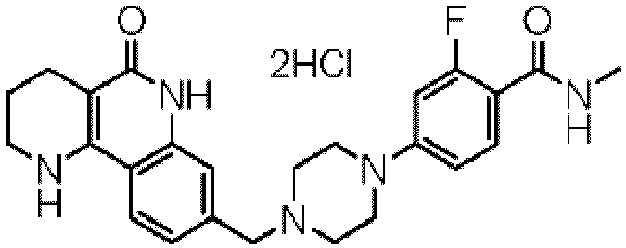
1H NMR(400MHz, DMSO-d6 ); δ 11.40-11.30(m, 2H), 7.94(d, J=8.4Hz, 1H), 7.90-7.80(m, 1H), 7.62-7.57(m, 1H), 7.49(d, J=8.4Hz, 1H), 6.86-6.83(m, 2H), 4.40(s, 1H), 4.00-3.90(m, 2H), 3.38-3.27(m, 4H), 3.15-3.00(m, 2H), 2.75(s, 3H), 2.50-2.47(m, 4H), 1.90-1.80(m, 2H) 77 
1H NMR(400MHz, DMSO-d6 ); δ 11.53(s, 1H), 11.39(br , 1H), 8.00(d, J=8.3Hz, 1H), 7.94-7.90(m, 1H), 7.57(d, J=9.2Hz, 1H), 7.54(d, J=8.7Hz, 1H), 7.39(s, 1H), 6.86-6.82(m, 2H), 4.41(s, 2H), 4.00(d, J=13.1Hz, 1H) 3.34-3.13(m, 12H), 1.80(s, 2H), 1.08(t, J=7.3Hz, 3H) 78 
1H NMR(400MHz, DMSO-d6 ); δ 11.15(s, 1H), 10.69(br, 1H), 7.95(br, 1H), 7.88(d, J=8.0Hz, 1H), 7.50(br, 1H), 7.34(d, J=8.0Hz, 1H), 7.27(s, 1H), 6.83-6.79(m, 2H), 4.39(br, 2H), 3.97(d, J=11.2Hz, 2H), 3.34-3.31(m, 4H), 3.18-3.14(m, 2H), 2.65(br, 1H), 1.78(br, 2H), 0.65-0.64(m, 2H), 0.51(br, 2H) 79 
1H NMR(400MHz, DMSO-d6 ); δ 11.66(s, 1H), 11.46(br s, 1H), 8.03(d, J=8.2Hz, 1H),757(d, J=8.2Hz, 1H), 7.42(s, 1H), 7.20-7.19(m, 1H), 6.87-6.82(m, 2H), 4.44(s, 2H), 3.93(d, J=11.7Hz, 2H), 3.42-3.14(m, 12H), 1.79(s, 2H), 1.09-1.06(m, 3H) 80 
1H NMR(400MHz, DMSO-d6 ); δ 11.27(s, 1H), 10.92(br s, 1H), 8.14-8.13(m, 1H), 7.93(d, J=8.7Hz, 1H), 7.43(d, J=8.3Hz, 1H), 7.34-7.32(m, 2H), 7.03(s, 2H), 6.95(d, J=8,7Hz, 1H), 4.40(s, 2H), 3.96(d, J=10.2Hz, 1H), 3.38-3.27(m, 4H), 3.23-3.16(m, 4H), 2.71(s, 3H), 1.80(s, 2H) 81 
1H NMR(400MHz, DMSO-d6 ); δ 1.15(s, 1H), 10.70-10.50(m, 1H), 8.20-8.18(m, 1H), 7.90(d, J=8.8Hz, 1H), 7.35-7.29(m, 2H), 7.04(s, 1H), 6.94(d, J=10.0Hz, 1H), 4.40(s, 2H), 3.96-3.94(m, 2H), 3.35-3.30(m, 4H), 3.22-3.13(m, 6H), 2.50-2.40(m, 2H), 1.85-1.70(m, 2H), 1.08(t, J=7.0Hz, 3H) 82 
1H NMR(400MHz, DMSO-d6 ); δ 11.13(s, 1H), 10.49(br, 1H), 8.25(d, J=4.0Hz, 1H), 7.88(d, J=8.4Hz, 1H), 7.32-7.27(m, 2H), 7.02(s, 1H), 6.92(d, J=7.2Hz, 1H), 4.39(br, 2H), 3.93(d, J=9.6Hz, 4H), 3.33-3.30(m, 2H), 3.15(br, 5H), 2.75-2.65(m, 2H), 1.78(br, 2H), 0.65-0.64(m, 2H), 0.47(br, 2H) 83 
1H NMR(40OMHz, DMSO-d6 ); δ 11.24(s, 1H), 11.01(m, 1H), 7.91(d, J=8.0Hz, 1H), 7.58(d, J=8.4Hz, 1H), 7.48-7.36(m, 1H), 7.30(s, 1H), 7.01(s, 1H), 6.91(d, J=8.8Hz, 1H), 4.40-4.39(m,2H), 4.21(m, 2H), 4.08-4.01(m, 2H), 3.80-3.50(m, 2H), 3.32-3.25(m, 4H), 3.16-3.11(m, 2H), 2.50-2.47(m, 2H), 1.85-1.75(m, 2H), 1.52(t, J=6.9Hz, 3H) 84 
1H NMR(400MHz, DMSO-d6 ); δ 11.53(s, 1H), 11.39(br, 1H), 8.00(d, J=8.3Hz, 1H), 7.94-7.90(m, 1H), 7.57(d, J=9.2Hz, 1H), 7.54(d, J=8.7Hz, 1H), 7.39(s, 1H), 6.86-6.82(m, 2H), 4.41(s, 2H), 4.00(d, J=13.1Hz, 1H) 3.34-3.13(m, 12H), 1.80(s, 2H), 1.08(t, J=7.3Hz, 3H) 85 
1H NMR(400MHz, DMSO-d6 ); δ 11.22(s, 1H), 11.03(br, 1H), 8.48(d, J=3.2Hz, 1H), 7.71(d, J=8.4Hz, 1H), 7.53(d, J=10.0Hz, 1H), 7.44(d, J=8.0Hz, 1H), 7.34(s, 1H), 4.40(s, 2H), 3.57-3.51(m, 4H), 3.41-3.31(m, 6H), 3.19-3.16(m,2H), 2.80-2.79(m, 1H), 1.80-1.70(m, 2H), 0.67(d, J=6.0Hz, 2H), 0.541(s, 2H) 86 
1H NMR(400MHz, DMSO-d6 ); δ 11.13(s, 1H), 10.75-10.60(br, 1H), 8.15(d, J=4.4Hz, 1H), 7.89(d, J=8.4Hz, 1H), 7.74-7.64(m, 1H), 7.34(d, J=8.0Hz, 1H), 7.28(s, 1H). 7.04-7.70(m, 1H), 6.81-6.80(m, 1H), 4.38(s, 2H), 3.44(br, 4H), 3.32(br, 2H), 2.70-2.65(m, 2H), 2.50(br, 4H), 2.40-2.30(m, 2H) 87 
1H NMR(400MHz, DMSO-d6 ); δ 11.67(s, 1H), 11.45-1.35(br, 1H), 8.80(d, J=5.2Hz, 1H), 8.34(d, J=8.4Hz, 1H), 7.83(d, J=8.4Hz, 1H), 7.72(s, 1H), 7.66(s, 1H), 7.43(d, J=5.6Hz, 1H), 4.94(d, J=13.2Hz, 2H), 4.80-4.79(m, 2H), 3.78-3.75(m, 8H), 3.54-3.51(m, 2H), 2.25-2.15(m, 2H) 88 
1H NMR(400MHz, DMSO-d6 ); δ 11.73(s, 1H), 11.43(br , 1H), 8.55(s, 1H), 8.12(d, J=7.8Hz, 1H), 8.04(d, J=8.6Hz, 1H), 7.60(d, J=8.2Hz, 1H), 7.48(s, 1H), 7.30-7.27(m, 1H), 4.44(s, 2H), 3.54-3.34(m, 10H), 3.31-3.18(s, 2H), 1.79(s, 2H) 89 
1H NMR(400MHz, DMSO-d6 ); δ 11.19(s, 1H), 10.93(s, 1H), 8.60(s, 1H), 7.98(d, J=9.2Hz, 1H), 7.90(d, J=8.4Hz, 1H), 7.37(d, J=8.4Hz, 1H), 7.28(s, 1H), 7.04(d, J=9.2Hz, 1H), 4.56(d, J=13.6Hz, 2H), 4.37(s, 2H), 3.38-3.32(m, 2H), 3.20-3.00(m, 2H), 2.50-2.47(m, 2H), 1.90-1.70(m, 2H) 90 
1H NMR(400MHz, DMSO-d6 ); δ 11.78(br, 1H), 11.67(br, 1H), 8.16(d, J=5.2Hz, 1H), 8.08(d, J=8.4 Hz, 1H), 7.88(d, J=6.8Hz, 1H), 7.62(d, J=8.0Hz, 1H), 7.49(s, 1H), 7.20(t, J=6.0Hz, 1H), 4.47(br, 2H), 3.80-3.70(m, 2H), 3.60-3.45(m, 2H), 3.45-3.25(m, 4H), 2.60-2.45(m, 4H), 2.31(s, 3H), 1.85-1.75(m, 2H) 91 
1H NMR(400MHz, DMSO-d6 ); δ 11.78(s, 1H), 11.36(br , 1H), 8.11(s, 1H), 8.07(d, J=8.7Hz, 1H), 7.62-7.57(m, 2H), 7.49(s, 1H), 4.44(s, 2H), 3.44-3.28(m, 12H), 2.25(s, 3H), 1.81(s, 2H) 92 
1H NMR(400MHz, DMSO-d6 ); δ 12.13(s, 1H), 11.78(br , 1H), 8.47(br, 1H), 8.20(s, 1H), 8.16(d, J=8.2Hz, 1H), 7.97(br s, 1H), 7.66(d, J=8.2Hz, 1H), 7.56(s, 1H), 4.43(s, 2H), 3.54-3.25(m, 8H), 3.13-3.09(s, 2H), 2.55(s, 2H), 1.80(s, 2H) 93 
1H NMR(400MHz, DMSO-d6 ); δ 11.36(s, 1H), 11.16(br, 1H), 7.94(d, J=8.2Hz, 1H), 7.66(d, J=9.3Hz, 1H),7.48-7.42(m, 2H), 7.32(s, 1H), 4.44-4.36(m, 4H), 3.43-3.33(m, 8H), 3.14-3.11(m, 2H), 1.78(s, 2H) 94 
1H NMR(400MHz, DMSO-d6 ); δ 11,28(s, 1H), 10.92(br, 1H), 8.30(s, 1H), 8.12(s, 1H), 7.92(d, J=8.2Hz, 1H), 7.42(d, J=8.6Hz, 1H), 7.33(s, 1H), 4.40(s, 2H), 3.83(d, J=12.1Hz, 1H), 3.38-3.18(m, 10H), 1.78(s, 2H) 95 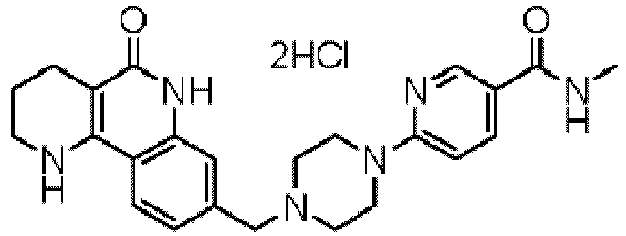
1H NMR(400MHz, CD3OD); δ 8.56(s, 1H), 7.93(d, J=9.0Hz, 1H), 7.74(d, J=8.2Hz, 1H), 7.31(s, 1H), 7.24(d, J=8.2Hz, 1H), 6.81(d, J=9.0Hz, 1H), 3.68(br, 6H), 3.43(t, J=4.8Hz, 2H), 2.88(s, 3H), 2.63-2.62(m, 6H), 1.97-1.92(m, 2H) 96 
1H NMR(400MHz, CD3OD); δ 8.56(d, J=1.2Hz, 1H), 7.83(dd, J=9.0, 2.0Hz, 1H), 7.73(d, J=8.2Hz, 1H), 7.30(s, 1H), 7.23(d, J=8.2Hz, 1H), 6.80(d, J=9.0Hz, 1H), 3.68(br, 6H), 3.44-3.34(m, 4H), 2.63-2.61(m, 6H), 1.93(t, J=5.2Hz, 2H), 1.20(t, J=7.2Hz, 3H) 97 
1H NMR(400MHz, CD3OD); δ 8.54(d, J=2.0Hz, 1H), 7.91(dd, J=8.8, 2.4Hz, 1H), 7.73(d, J=7.9Hz, 1H), 7.30(s, 1H), 7.22(d, J=7.9Hz, 1H), 6.78(d, J=8.8Hz, 1H), 3.66-3.64(m, 6H), 3.43(t, J=5.2Hz, 2H), 2.81-2.79(m, 1H), 2.63-2.57(m, 6H), 1.92(t, J=5.2Hz, 2H), 0.78-0.75(m, 2H), 0.62-0.58(m, 2H) 98 
1H NMR(400MHz, DMSO-d6 ); δ 11.46(br, 2H), 7.98(d, J=8.4Hz, 1H), 7.50(d, J=8.4Hz, 1H), 7.37(s, 1H), 7.27(d, J=3.6Hz, 1H), 7.02(d, J=3.6Hz, 1H), 4.42(s, 2H), 4.08-3.14(m, 12H), 1.81(br, 2H) 99 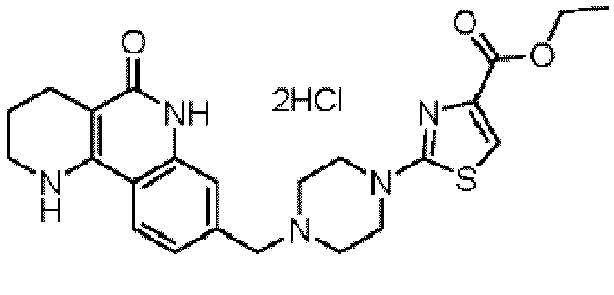
1H NMR(400MHz, DMSO-d6 ); δ 11.64(s, 1H), 11.60(br, 1H), 8.01(d, J=8.4Hz, 1H), 7.81(s, 1H), 7.54(d, J=8.4Hz, 1H), 7.41(s, 1H), 4.41(s, 2H). 4.22(q, J=7.2Hz, 2H), 4.10-3.30(m, 10H), 2.50-1.75(m, 4H), 1.24(t, J=7.2Hz, 3H) 100 
1H NMR(400MHz, CD3OD); δ 7.70(d, J=8.0Hz, 1H), 7.34(s, 1H), 7.27(s, 1H), 7.20(d, J=8.0Hz, 1H), 3.62(s, 1H), 3.51-3.50(m, 4H), 3.40-3.27(m, 8H), 2.13(s, 2H), 1.90-1.89(m, 2H), 1.16-1.14(m, 3H), 0.88-0.84(m, 1H) 101 
1H NMR(400MHz, DMSO-d6 ); δ 11.37(br, 1H), 11.32(s, 1H), 7.95(d, J=8.2Hz, 1H), 7.65(t, J=8.4Hz, 1H), 7.56(d, J=8.2Hz, 1H), 7.45(s, 1H), 6.94(d, J=13.7Hz, 1H), 6.80(d, J=9.4Hz, 1H), 4.28(s, 3H), 3.96(s, 2H), 3.86(d, J=12.2Hz, 2H), 3.36-3.32(m, 4H), 2.30(s, 2H), 1.93-1.91(m, 2H), 1.78(s, 2H) 102 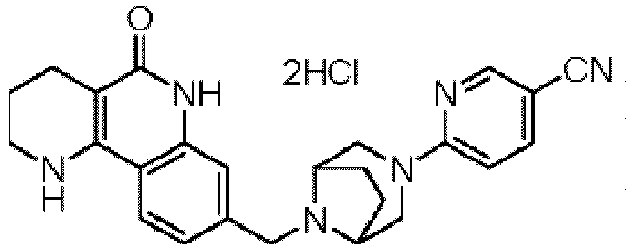
1H NMR(400MHz, DMSO-d6 ); δ 11.24(s, 1H), 11.17(br, 1H), 8.52(s, 1H), 7.93(t, J=8.0Hz, 1H), 7.51(d, J=7.5Hz, 1H), 7.41(s, 1H), 6.92(d, J=9.0Hz, 1H), 4.28(s, 3H), 3.98(s, 1H), 3.31-3.30(m, 4H), 2.30-2.15(m, 4H), 1.84-1.78(m, 4H) 103 
1H NMR(400MHz, DMSO-d6 ); δ 11.09(m, 2H), 7.90-7.87(m, 1H), 7.61(t, J=8.0Hz, 1H), 7.50-7.30(m, 2H), 6.82-6.70(m, 1H), 6.70-6.50(m, 1H), 4.65-4.58(m, 1H), 4.53-4.41(m, 3H), 4.38-4.30(m, 1H), 3.70-3.60(m, 2H), 3.60-3.26(m, 2H), 2.67-2.59(m, 1H), 2.59-2.50(m, 1H), 2.19-2.17(m, 1H), 1.85-1.79(m, 2H) 104 
1H NMR(400MHz, DMSO-d6 ); δ 11.70(br, 1H), 11.44(s, 1H), 10.68(br, 1H), 8.55(s, 1H), 7.98-7.50(m, 3H), 7.42(s, 1H), 5.20-3.97(m, 5H), 3.65-3.36(m, 5H), 2.63-1.76(m, 6H) 105 
1H NMR(400MHz, DMSO-d6 ); δ 11.81(br, 1H), 11.52(s, 1H), 8.54-8.52(m, 2H), 7.53(s, 1H), 7.03(s,1H), 4.82-4.78(m, 2H), 4.80(d, J=12.0Hz, 1H), 4.58(d, J=9.6Hz, 1H), 4.51-4.24(m, 3H), 3.47-3.38(m, 2H), 3.32-3.24(m, 2H), 2.50(br, 2H), 1.90-1.78(m, 2H), 1.57(s, 3H), 1.46-1.43(m, 3H) 106 
1H NMR(400MHz, DMSO-d6 ); δ 11.90-11.80(br, 1H), 11.72(s, 1H), 8.14(s, 1H), 7.62-7.61(m, 2H), 7.44(s, 1H), 7.02-6.99(m, 2H), 4.79(d, J=12.8Hz, 1H), 4.38-4.19(m, 4H), 4.06-4.01(m, 2H), 3.56-3.29(m, 6H), 3.05-2.90(m, 2H), 1.85-1.70(m, 2H), 1.57(d, J=6.0Hz, 2H), 1.46-1.43(m, 3H) 107 
1H NMR(400MHz. DMSO-d6 ); δ 11.07(s, 1H), 10.63(s, 1H), 7.89(d, J=8.0Hz, 1H), 7.78(d, J=13.2Hz, 1H), 7.63(d, J=6.8Hz, 1H), 7.35(d, J=7.6Hz, 1H), 7.21(d, J=8.8Hz, 1H), 7.05-7.03(m, 1H), 4.81-4.78(m, 1H), 4.44-4.39(m, 1H). 4.21-4.17(m, 1H), 3.36-3.65(m, 2H), 3.30-2.95(m, 4H), 2.45-2.33(m, 2H), 1.85-1.60(m. 2H), 1.54-1.53(m, 3H) 108 
1H NMR(400MHz, DMSO-d6 ), δ 11.17(s, 1H), 10.98(br, 1H), 7.90(d, J=7.8Hz, 1H), 7.77(d, J=13,3Hz, 1H), 7.61(d, J=8.6Hz, 1H), 7.41(d, J=8.2Hz, 1H), 7.31(s, 1H), 7.22(d, J=9.0Hz. 1H), 4.78-4.76(m, 2H), 4.26(s, 2H), 3.66-3.12(m, 8H), 1.77(s, 2H), 1.53-1.52(m, 3H) 109 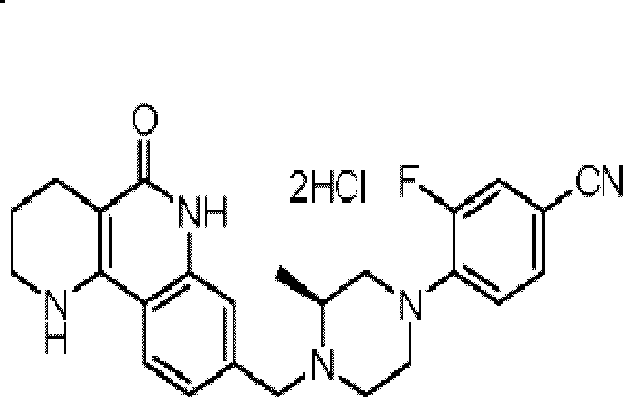
1H NMR(400MHz, DMSO-d6 ); δ 11.26(s, 1H), 11.14(br, 1H), 7.92-7.09(m, 6H), 4.79(d, J=12.1Hz, 2H), 4.15(s, 2H), 3.25-3.05(m, 8H), 1.78(s, 2H). 1.54-1.53(m, 3H) 110 
1H NMR(400MHZ, DMSO-d6 ); δ 11.36(s, 1H). 10.79(br. 1H), 7.94-7.15(m, 6H), 4.49-4.33(m, 4H), 3.66-3.12(m, 8H), 1.77(s, 2H), 1.53-1.52(m, 3H) 111 
1H NMR(400MHz, CD3OD); δ 7.99(s, 1H) 7.62(d, J=8.4Hz, 1H). 7.37-7.33 (m, 1H). 7.12(d, J=8.0Hz, 1H), 6.71-6.67(m, 1H), 4.82(s, 2H), 4.57(d, J=19.6Hz, 1H), 4.07(d, J=13,6Hz, 1H). 3.64-3.52(m, 1H), 3.35-3.31(m, 2H), 3.00-2.95(m, 1H), 2.83-2.72(m, 1H), 2.52(t, J=6.2Hz, 2H). 2.40-2.20(m, 1H). 1.85-1.84(m, 1H), 0.81-0.78(m, 3H) 112 
1H NMR(400MHz, CD3OD); δ 7.99(s, 1H). 7.61-6.64(m, 4H) 4.82(s, 2H). 4.55(d, J=19.1Hz, 1H). 4.07(d. J=13.6Hz, 1H). 3.61-3..3(m, 3H). 3.04-2.70(m, 2H). 3.61-3.33 (m, 3H), 2.50(t, J=(6.3Hz, 2H), 2.41-2.23(m, 1H). 1.83-1.82(m, 1H). 0.81-0.78(m, 3H) 113 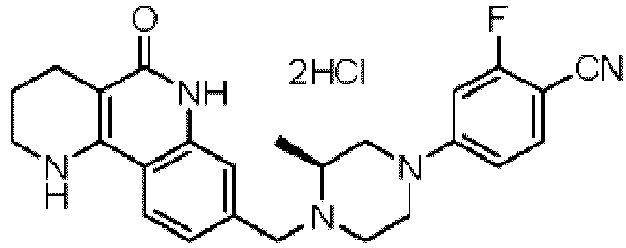
1H NMR(400MHz, DMSO-d6 ); δ 11.08(s, 1H), 10.59(br, 1H), 7.88(d, J=9.4Hz, 1H). 7,67(t, J=8.6H, 1H), 7.31(s. 1H), 7.08-7.04 (m, 2H), 6.92 (d, J = 9.0 Hz, 1 H), 4.77 - 4.75 (m , 2H). 3. 4 5 - 3 . 2 2 (m , 8 H), 3.01(s,2H),1.77(s,2H),1.53-1.52(m, 3H) 114 
1H NMR(400MHz, DMSO-d6 ); δ 11.37(s, 1H), 10.82(br, 1H). 7.91-7.06(m, 6H), 4.49-4.33(m, 4H), 3,66-3,12(m, 8H), 1.77(s, 2H), 1.53-1.52(m, 3H) -

- To the compound (34 g, 123 mmol) prepared in step (5) of Example 1, ethanol (0.38 L) was added and then 12N hydrochloric acid (0.34 L, 419 mmol) was added slowly dropwise. The mixture was allowed to react at 90°C for 4 hours. The reaction mixture was cooled to 0°C, and then neutralized with 4N sodium hydroxide solution. After stirring for 1 hour, the produced solid was filtered and washed with water and ethanol to give the title compound (26 g, 92 %, yellow solid).
1H NMR (400MHz, DMSO-d6 ); δ 10.75(s, 1H), 7.71(d, J=8.4Hz, 1H), 7.17(s, 1H), 6.99(d, J=8.4Hz, 1H), 6.86(s, 1H), 5.26(br, 1H), 4.52(s, 2H), 3.35-3.25(m, 2H), 2.44(d, J=6.4Hz, 2H), 1.84-1.74(m, 2H). -

- To the compound (25 g, 110 mmol) prepared in step (1), dichloromethane (0.66 L) was added, and then thionyl chloride (14.5 ml, 199 mmol) was added slowly dropwise at room temperature. The mixture was stirred at room temperature for 12 hours, and then concentrated under reduced pressure to remove the solvent. Water (200 ml) was added at 0°C, followed by neutralization with 4N sodium hydroxide solution. The reaction mixture was stirred for 1 hour, and the produced solid was washed with ethanol, thereby obtaining the title compound (27 g, 99%, yellow solid).
1H NMR(400MHz, DMSO―d6 ); δ 10.98(s, 1H), 7.80(d, J=8.4Hz, 1H), 7.26(s, 1H), 7.14(d, J=8.4Hz, 1H), 7.00(br, 1H), 4.79(s, 2H), 3.32-3.29(m, 2H), 2.46(d, J=6.0Hz, 2H), 1.83-1.75(m, 2H). -

- Using 8-(chloromethyl)-1,2,3,4-tetrahydrobenzo[h][1,6]naphthyridin-5-(6H)-one (50 mg, 0.20 mmol) prepared in step 2, the title compound (41 mg, yield: 46%, yellow solid) was obtained in the same manner as step 7 of Example 1.
1H NMR (400MHz, CD3OD) ; δ 7.73(d, J=8.4Hz, 1H), 7.46(d, J=8.8Hz, 2H), 7.30(s, 1H), 7.23(d, J=8.4Hz, 1H), 7.03(d, J=8.8Hz, 2H), 3.65(s, 2H), 3.45-3.41(m, 2H), 3.33-3.30(m, 4H), 2.66-2.60(m, 6H), 1.95-1.89(m, 2H) -

- Using 8-({4-[4-(trifluoromethyl)phenyl]piperazin-1-yl}methyl)-1,2,3,4-tetrahydrobenzo[h] [1,2]naphthyridin-5(6H)-one (40 mg, 0.09 mmol) prepared in step 3, the title compound (20 mg, yield: 43%, yellow solid) was obtained in the same manner as step 9 of Example 1.
1H NMR(400MHz, DMSO-d6); δ 11.81(s, 1H), 11.70-11.50(br, 1H), 8.05(d, J=8.8Hz, 1H), 7.58(d, J=8.0Hz, 1H), 7.52(d, J=8.8Hz, 2H), 7.47(s, 1H), 7.08(d, J=8.4Hz, 2H), 4.41(sS, 2H), 3.94(br, 4H), 3.33-3.30(m, 6H), 2.52-2.46(m, 2H), 1.80-1.78(m, 2H) . - Compounds of Examples 116 to 165 were prepared in the same manner as described in Examples 115, except that substituents were changed as shown in Table 2 below.
[Table 2] Exmaple Structure NMR 116 
1H NMR(400MHz, DMSO―d6 ); δ 11.14(s. 1H), 11.06(br. 1H), 8.62(s, 1H). 7.98(d, J=9.2Hz, 1H), 7,45(br, 1H), 7.05-7.03(m, 2H). 6,85(s, 1H). 4.57-4.54(m, 2H), 4.31-4.26(m, 6H), 3.45-3.34(m, 4H), 3.09(br, 2H), 2.45(br, 2H), 1.76(br, 2H), 1.45(t, J=6.8Hz, 3H) 117 
1H NMR(400MHz, DMSO-d6 ); δ 11.15(s, 1H). 11.00-10.90(br, 1H), 7.91(d. J=8.0Hz, 1H), 7.84(s, 1H), 7.70(d, J=8.8Hz, 1H). 7.41(d, J=7.6Hz, 1H), 7.38(s, 1H), 7.36-7.34(m, 1H), 4.46(s, 2H), 3.56(d, J=11.6Hz, 2H). 3.44-3.42(m, 2H), 3.36-3.18(m, 8H), 1.85-1.75(m, 2H) 118 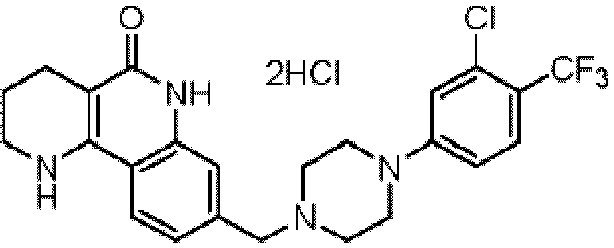
1H NMR(400MHz, DMSO-d6 ); δ 11.17(s, 1H). 11.10-10.90(br, 1H). 7.91(d. J=8.0Hz, 1H), 7.64(d, J=9.2Hz, 1H), 7,40(d, J=8.0Hz, 1H), 7.30(s, 1H), 7.25(s, 1H). 7.03(d, J=8.0Hz, 1H), 4,39(s, 2H), 4.08(d, J=13.2Hz. 2H), 3.23(br, 8H), 3.20-3.10(m, 2H), 1.81-1.80(m, 2H) 119 
1H NMR(400MHz, DMSO-d6 ); δ 11.24(s, 1H). 11.10-10.90(m, 1H), 7.91(d, J=8.0Hz, 1H), 7.58(d, J=8.4Hz, 1H), 7.48-7.36(m, 1H), 7.30(s, 1H), 7.01(s, 1H), 6.91(d, J=8.8Hz, 1H), 4.40-4.39(m, 2H), 4.08-4.01(m, 2H). 3.80-3.50(m, 2H). 3.32-3.25(m, 4H), 3.16-3.11 (m, 2H), 2.50-2.47(m, 2H). 2.40(s. 3H), 1.85-1.75(m, 2H) 120 
1H NMR( 400MHz, DMSO-d6 ); δ 11.26(s, 1H), 10.88(br, 1H), 8.18(s, 1H), 7.92(d, J=8.4Hz, 1H). 7.73-7.70(m, 1H), 7.40(d, J=8.0Hz, 1H), 7.31(s, 1H), 6.98(d, J=13.2Hz, 1H), 4.90-4.33(m, 6H), 3.33-3.24(m, 6H), 3.09(d, J=9.6Hz, 2H), 1.90-1.80(m, 2H) 121 
1H NMR(400MHz, DMSO-d6 ); δ 11.26(s, 1H), 11.04(br, 1H). 8.48(s, 1H), 7.92(d, J=7.6Hz, 2H), 7.41(d, J=7.6Hz, 1H), 7.31(s, 1H). 7.07(d. J=9.2Hz, 1H), 4.53(d, J=13.2Hz, 2H), 4.39(s, 2H), 3.38-3.35(m, 8H), 3.20-3.05(m, 2H), 1.90-1.75(m, 2H) 122 22 
1H NMR(400MHz, DMSO-d6 ); δ 11.21(br, 1H), 11.06(br, 1H), 8.57(s, 1H), 8.01(d, J=6.8Hz, 1H), 7.92(d, J=8.0Hz, 1H), 7.40(d, J=8.0Hz, 1H), 7.31(s, 1H), 7.08(d, J=9.2Hz, 1H), 4.62-4.50(m. 2H). 4.4,9-4.30(m, 2H). 3.50-3.30(m, 6H), 3.25-3.00(m, 5H), 2.70-2.30(m, 2H). 1.85-1.70(m, 2H) 123 
1H NMR(400MHz. DMSO-d6 ); δ 12.02(br, 1H), 11.89(br, 1H), 8.47(s, 1H), 8.13(d, J=8.4Hz, 1H), 7.84(d, J=8.8Hz, 1H), 7.66(d, J=8.4Hz, 1H), 7.53(s, 1H), 7.45(d, J=8,8Hz, 1H), 4.45(s, 21H). 4.18-3.32 (m, 10H). 2.56 (br, 2H), 1.82 (br, 2H) 124 
1H NMR(400MHz, DMSO-d6 ); δ 11.27(br, 1H), 10.94(br, 1H), 8.35(d, J=5.2Hz, 1H), 7.92 (d, J=8.4Hz, 1H). 7.45(s, 1H). 7.45-7.35(m, 1H), 7.31(s, 1H), 7.09(d, J=5.2Hz, 1H). 4.50-4.40(m. 2H), 4.40-4.35(rn, 2H), 3.40-3.25(m, 6H), 3.20-3.00(m, 2H), 1.85-1.70(m, 2H) 125 
1H NMR(400MHz, DMSO-d6 ); δ 11.63(s, 2H), 8.46-8.44(m, 1H), 8.16-8.13(m, 1H), 8,01(d, J=8.4Hz. 1H), 7.56(d, J=8.0Hz, 1H). 7.44(s, 1H). 7.06-7.03(m, 1H), 4.42(s. 2H), 4.21(d, J=13.2Hz, 2H), 3.54(t, J=12.4Hz, 2H), 3.40-3.31(m, 4H), 3.3-3.1(m, 2H), 2.48-2,47(m, 2H), 1.81-1.80(m, 2H) 126 
1H NMR(400MHz, DMSO-d6 ); δ 11.20(s, 1H), 11.09(br s, 1H), 7.91(d, J=7.5Hz, 1H), 7.78-7.67(m, 1H), 7.42(d, J=7.5Hz, 1H), 7.30-7.25(m, 2H), 4.42-4.36(m, 4H), 3,37-3,29(m, 8H), 3.17-3.09(m, 2H), 1.78(s, 2H) 127 
1H NMR(400MHz, DMSO-d6 ); δ 11.74(br, 1H), 11.34(br, 1H). 7.99(d, J=6.81-lz, 1H), 7.96(d, J=8.8 Hz, 1H), 7.49(d, J=7.6 Hz, 1H), 7.33(s, 1H), 6.76(s, 1H), 6.72(d, J=6,4 Hz, 1H), 4,55-4,42(m, 2H), 4,40(s, 2H), 3.97(s, 3H), 3.75-3.55(m, 2H), 3.45-3.10(m, 6H), 2.50-2.40(m, 2H), 1.75-1.85(m, 2H) 128 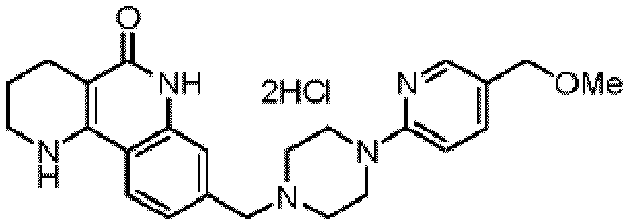
1H NMR(400MHz, CD3OD); δ 8.09-8.06(m 2H), 8.00(s, 1H), 7.76(s, 1H). 7.60(d, J=8.0Hz, 1H), 7.42(d, J=9.6Hz, 1H). 4.57(s, 2H), 4,41(s. 2H). 3.58-3.51(m, 6H), 3.39(s, 3H), 3.28-3.27(m, 4H), 2.68-2,67(m, 2H), 1.99-1.95(m, 2H) 129 
1H NMR(400MHz, DMSO-d6 ); δ 11.15(s, 1H), 10.98(br s, 1H). 8.65(s, 2H). 8.50(s, 1H), 7.90(d, J=8.2Hz, 1H). 7.35(d, J=8,2Hz, 1H), 7.26(s, 1H), 4.63-4.60(m, 2H). 4.35(s, 2H). 3.49-3.31(m, 8H), 3.15(s, 3H), 1.78(s, 2H) 130 
1H NMR(400MHz, DMSO-d6 ); δ 11.18(s, 1H), 10.04(br s, 1H). 8.03-8.01(m, 2H), 7.92(d, J=8.2Hz, 1H), 7.47(d, J=7,9Hz, 1H), 7.31(s, 1H). 4.36(s, 2H). 3.54-3.25(m, 10H), 2.61(s, 3H), 1.77(s, 2H) 131 
1H NMR(400MHz, DMSO-d6 ); δ 11.14(s, 1H), 9.78(br, 1H), 7.90-7.88(m, 1H). 7.64(d, J=9.4Hz, 1H), 7.47(d, J=9.4Hz, 1H), 7.39(s, 1H), 7.29(s, 1H), 4.44-4.36(m, 4H), 3.54-3.25(m, 8H). 1.78(s, 2H) 132 
1H NMR(400MHz. DMSO-d6 ); δ 11.51(s. 1H), 11.37(s, 1H). 8.02-7.45(m, 4H), 7.36(s, 1H), 4.65(d, J=13.6Hz, 2H), 4.39(s, 2H), 3.63-3.12(m, 8H), 2.46(d, J=6.0Hz, 2H), 2.52-2.47 (m, 2H), 1.36-1.78(m, 2H) 133 
1H NMR(400MHz, DMSO-d6 ); δ 11.15(s, 1H), 10.94(br, 1H). 8.68(s. 1H)8.39(s. 1H), 7.90(d, J=8.4Hz, 1H), 7.38(d, J=8.4Hz, 1H), 7.31(s, 1H), 4.40(s, 2H), 4.19(d, J=13.2Hz, 2H), 3.45-3.39(m, 4H), 3.35-3.30(m, 2H), 3.22-3.15(m, 4H), 1.8.5-1.75(m, 2H) 134 
1H NMR(400MHz, DMSO-d6 ); δ 11.56(br, 1H), 11.46(br, 1H), 8.56(s, 1H), 7.98(d, J=8.8 Hz, 1H), 7.51(d, J=8.0 Hz, 1H), 7.39(s, 1H), 7.29(s, 1H). 4.50-4.35(m, 2H), 4.30-3.80(m, 4H), 3.70-3,60(m, 2H), 3.45-3,30(m, 4H), 3.30-3.20(m, 2H), 1.90-1.80(m, 2H) 135 
1H NMR(400MHz, DMSO-d6 ); δ 11.21(br, 1H). 11.06(br, 1H), 8.57(s, 1H), 8.01(d, J=6.3Hz, 1H), 7.92(d, J=8.0Hz, 1H), 7.40(d, J=8.0Hz, 1H), 7.31(s, 1H), 7.08(d, J=9.2Hz, 1H), 4.62-4.50(m, 2H), 4.45-4.30(m, 2H), 3.50-3.30(m, 6H), 3.25-3.00(m, 5H), 2.70-2.30(m, 2H), 1.85-1.70(m, 2H) 136 
1H NMR(400MHz, DMSO-d6 ); δ 11.12(s, 1H), 10.80(br, 1H), 8.46(s, 1H), 7.89(d, J=8.8Hz, 1H). 7.62(s, 1H), 7.35(d, J=8.8Hz, 1H), 7.27(s, 1H), 4.44-4.36(m, 4H), 3.38-3.31(m, 6H). 3.12-3.09(m, 2H), 2.47-2.45(m, 2H), 1.80(br, 2H) 137 
1H NMR(400MHz, DMSO-d6 ); δ 11.52(br, 2H), 8.37(s, 1H). 7.99(d. J=8.0Hz, 1H). 7.51(d, J=8.4Hz. 1H), 7.37(s, 1H), 6.56(s, 1H), 4.65-4.50(m, 2H), 4.38(s, 2H). 3.94(s, 3H), 3.50-3.30(m, 6H), 3.10-3.00(m, 2H). 2.53-2.45(m, 2H). 1.80-1.70(m, 2H) 138 
1H NMR(400MHz, DMSO-d6 ); δ 11.53(br, 1H), 11.44(br, 1H), 8.10(s, 1H), 7.98(d, J=8.0Hz, 1H), 7.51(d, J=8.4Hz, 1H), 7.37(s, 1H), 6.60(s, 1H), 4.50-4.35(m, 6H), 3.91(s, 3H), 3.40-3.25(m, 6H), 3.15-3.00(m, 2H), 1.85-1.70(m, 2H) 139 
1H NMR(400MHz. DMSO-d6 ); δ 11.29(s, 1H), 11.28(br. 1H), 8.11(s, 1H), 7.93(d, J=8.4Hz, 1H). 7.43(d, J=8.4Hz, 1H), 7.31(s, 1H), 4.40(s, 2H), 4,09-3.16(m, 12H), 2.51-2.46(m, 2H), 1.83-1.76(m, 2H) 140 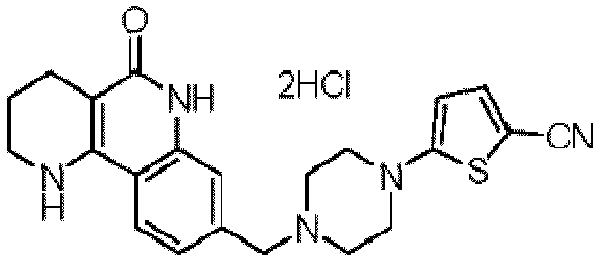
II NMR(400MHz, DMSO-d6 ); δ 11.18(s, 1H), 10.93(br, 1H), 7.90(d, J=8.4Hz, 1H), 7.69(d, J=4.4Hz, 1H). 7.37(d, J=8.4Hz, 1H), 7.29(s, 1H), 7.14(br, 1H), 6.37(d, J=4.4Hz, 1H), 4.41(s, 2H), 3.84-3.16(m, 10H), 2.50-1.76(m, 4H) 141 
1H NMR(400MHz, DMSO-d6 ); δ 11.76(br, 2H). 8.05(d, J=8.0Hz, 1H). 7.91(s, 1H), 7.58(d, J=8.0Hz, 1H). 7.45(s, 1H), 4.43(s, 2H), 4.26-3.17(m, 12H), 2.59-1.77(m, 4H), 1.25(t, J=7.2Hz, 3H) 142 
1H NMR(400MHz, DMSO-d6 ); δ 11.77(br, 1H). 11.51(s, 1H), 8.10(s, 1H), 8.00(d, J=8.4Hz, 1H), 7.53(d, J=8.4Hz, 1H), 7.39(s, 1H), 4.50(s, 2H), 4.18-3.17(m, 10H), 2.56-1.77(m, 4H) 143 
1H NMR(400MHz, DMSO-d6 ); δ 8.71(s, 1H), 7.74(d, J=8.4Hz, 1H), 7.32(s, 1H), 7.24(d, J=7.6Hz, 1H), 3.68(s, 2H), 3.62-3.54(m, 4H), 3.48-3.42(m, 2H), 2.68-2.58(m, 6H), 2.0-1.90(m. 2H) 144 
1H NMR(400MHz, DMSO-d6 ); δ 11.79(br. 1H), 11.48(s. 1H), 8.10(s. 1H), 8.02(d, J=8.5Hz, 1H), 7.51 (d, J=8.3Hz, 1H), 7.39(s, 1H), 4.50(s, 2H), 4.16-3.14(m, 10H), 2.57-1.79(m, 4H) 145 
1H NMR(400MHz, DMSO-d6 ); δ 10.89(br, 1H), 7.71(d, J = 8.0Hz, 1H), 7.14(s, 1H), 7.02(d, J=8.0Hz, 1H). 6.86(br, 1H), 3.54(s, 2H), 3.59-3.40(m, 6H), 3.40-3.20(m. 4H), 3.20-3.10(m, 1H), 2.60-2.38(m, 2H), 1.80-1.70(m, 2 H) 146 
1H NMR(400MHz, CD3OD); δ 7,71(d, J=8.4Hz, 1H), 7.29(s, 1H), 7.21(d, J=8.4Hz, 1H), 3.94(s, 2H), 3.66-3.62(m, 4H), 3.44-3.40(m, 2H), 2.61(t, J=5.2Hz, 4H), 1.96-1.91(m, 2H), 1.34-1.32(m, 2H) 147 
1H NMR(400MHz, DMSO-d6 ); δ 11.41(br, 1H), 11.40(s, 1H). 9.67(s, 1H), 7.98-7.00(m, 6H), 4.44-4.18(m, 4H), 3.70-3.20(m, 8H), 2.56-1.77(m, 4H) 148 
1H NMR(400MHz, CD3OD); δ 7.76-7,73(m, 1H), 7.56-7.54(m, 1H), 7.32(s, 1H), 7.26-7.23(m, 1H), 7.17-7.12(m, 1H), 6.96(s. 1H), 3.67(s, 2H), 3.48-3,46(m, 4H), 3.13(s, 2H), 2.67-2.62(m, 4H), 2.06-2.02(s, 2H), 1.92(s, 2H), 1.47(s, 3H) 149 
1H NMR(400MHz, DMSO-d6 ); δ 11.19(s, 1H), 10.62(br s, 1H), 7.91(d, J=8.2Hz, 1H). 7.59(d, J=9.0Hz, 1H), 7.47-7.38(m, 1H), 7.31(s, 1H), 7.26(s, 1H), 4.42(s, 2H), 3.40-3.11(m, 12H), 1.78(s, 2H) 150 
1H NMR(400MHz, DMSO-d6 ); δ 11.24(s, 1H), 1.91 (s, 1H), 10.62(br, 1H), 7.93(d, J=8.8Hz, 1H), 7.43-7.40(m, 2H), 7.35(s, 1H), 7.20(s, 1H), 6.91(s, 1H), 6.81(d, J=8.8Hz, 1H), 6.31(s, 1H), 4.44(s, 2H), 3.70(d, J=12.0Hz, 2H), 3.43-3.40(m. 2H), 3.33-3.20(m, 8H), 3.12-3.0(m, 2H), 1.85-1.75(m, 2H) 151 
1H NMR(400MHz, DMSO-d6 ); δ 11.37(s, 1H), 10.86(br, 1H), 7.99-7.44(m, 4H), 7.38(s, 1H), 7,22-7,17(m, 2H), 4.44(s, 2H), 3.44-3.05(m, 10H), 2.50-1.77(m, 4H) 152 
1H NMR(400MHz, DMSO-d6 ); δ 11.18-11.14(m, 1H), 7.90(s. 1H), 7.61(d, J=8.8Hz, 1H), 7,33(s, 2H), 6,93(d, J=9.2Hz, 1H), 6,85(s, 1H),. 4,51(s, 2H), 3.86(d, J=12.8Hz, 1H), 3.40-3.33(m, 4H), 3.26-3.24(m, 4H), 3.17-3.12(m, 4H), 1,35-1,75(m, 2H) 153 
1H NMR(400MHz, DMSO-d6 ); δ 11.14(s, 1H). 10.5(3(br s, 1H), 7.89(d, J=8.6Hz, 1H), 7.35(d, J=7.8Hz, 1H), 7.29(s, 1H), 7.19-7.15(m, 3H), 6.94(d, J=9.0Hz, 1H), 4,47-4,42(m, 4H), 3.65(d, J=12.5Hz, 1H), 3.3.9-3.32(m, 4H), 3.17-3.14(m, 2H), 3.02-2.99(m,2H). 1.78(s, 2H) 154 
1H NMR(400MHz, DMSO-d6 ); δ 11.77(br, 1H), 11.34(s, 1H), 9,61(br, 1H), 8.21(d, J=5.6Hz, 1H), 8.07-7.92(m, 2H), 7.49(d, J=8.8Hz, 1H), 7.34(s, 1H), 7.23-7.12(m, 1H), 4.50-4.20(m, 4H), 4.00-3.92(m, 2H), 3,92-3,60(m, 2H), 3.50-3.15(m, 6H), 1.90-1.87(m, 2H) 155 
1H NMR( 400MHz, DMSO-d6 ); δ 10.72(br, 1H), 7.88(d, J=5.2Hz, 1H), 7.74(d, J=8.0Hz, 1H), 7.63(d, J=8.0Hz, 1H), 7.23-7.15(m. 2H), 7.05(d, J=8.0Hz, 1H), 6.87(br, 1H), 3.70-3.60(m, 4H), 3.56(s, 2H), 3.40-3.20(m, 2H), 2.55-2.40(m, 6H), 1.85-1.70(m, 2H) 156 
1H NMR(400MHz, CD3OD); δ 7.71(d, J=8.0Hz, 1H), 7.37(d, J=8.4Hz, 1H), 7.29(s, 1H), 7.22 (d, J=8.4Hz, 1H), 6.20(d, J=8.4Hz, 1H), 4.53(t, J=8.8Hz, 2H), 3.64(s, 2H), 3.43-3.40(m, 6H), 3.11(t, J=8.4Hz, 2H), 2.63-2.57(m, 6H), 1.94-1.91(m, 2H) 157 
1H NMR(400MHz, DMSO-d6 ); δ 11.40(br, 1H), 11.28(br, 1H), 8.42(s, 1H), 7.95(d, J=8.4Hz, 1H), 7.47(d, J=8.4 Hz, 1H). 7.35(s. 1H). 4.50-4.20(m. 6H), 3.50-3.40(m, 2H), 3.40-3.30(m, 2H), 3.20-3.05(m. 2H), 3.00-2.90(m. 4H), 2.55-2.45(m, 2H), 2.10-2.00(m, 2H), 1.85-1.75(m. 2H) 158 
1H NMR(400MHz, DMSO-d 6); δ 11.10(s, 1H), 11.10-10.90(br, 1H), 8.30(s. 1H), 8.12(s, 1H), 7.95-7.90(m, 2H), 7.57-7.44(m, 1H), 7.46-7.38(m, 1H), 4.35-4.30(m, 2H), 4.20-4.16(m, 2H), 3.55-3.40(m, 2H), 3.33(br, 4H), 2.40-2.30(m, 2H), 1.94-1.91(m, 2H), 1.85-1.75(m, 2H) 159 
1H NMR(400MHz, DMSO-d6 ); δ 11.49(s, 1H), 10.79(br, 1H), 8.57(s, 1H), 8.02-7.65(m, 3H), 7.37(s, 1H), 6.97(d, J=9.2Hz, 1H), 4.82(br, 2H), 4.30(s, 2H), 3.35(br, 2H), 3.32(br, 4H), 2.51-1.76(m, 8H) 160 
1H NMR(400MHz, DMSO-d6 ); δ 11.11(s, 1H), 10.77(br. 1H), 7.91(d, J=8,4Hz, 1 H), 7.64(d, J=10.0Hz, 1H), 7.43-7.37(m, 3H), 4.30(d, J=5,6Hz, 2H), 4.20(d, J=14.0Hz, 2H), 4.08-4.00(m, 2H), 3.49-3.46(m, 2H), 3.36-3.30(m, 2H), 2.50-2.47(m, 2H), 2.38-2.30(m, 2H), 1.96-1.91(m, 2H), 1.84-1.76(m, 2H) 161 
1H NMR(400MHz, DMSO-d6 ); δ 11.12(s, 1H), 10.10-9.90(br, 1H), 7.87(d, J=8.0Hz, 1H), 7.69-7.65(m, 1H). 7.47(d, J=8.4Hz, 1H), 7.38(d, J=8.0Hz, 1H), 7.31(s, 1H), 6.95-6.91(m, 1H), 4.73(s, 2H), 4.60-4.57(m, 1H), 4.41(s. 1H), 4.37-4.32(m, 1H), 3.89-3.78(m, 2H), 3.60-3.40(m, 1H), 3.20-3.40(m, 2H), 2.60-2.57(m, 2H), 2.50-2.40(m, 2H), 2.19-2.16(m, 1H), 1.90-1.70(m, 2H) 162 
1H NMR(400MHz, CDCl3); δ 11.14(s, 1H), 10.16(s, 1H), 8.00-8.04(m, 1H), 7.92-7.95(m, 1H ), 7.87(d, J=8,0Hz, 1H), 7.40(d, J=8.0Hz, 1H), 7.32(s, 1H), 7.06-6.94(m,1H), 4.85(s, 1H), 4.53-4.61(m, 1H), 4.45(s, 1H), 4.34-4.39(m, 1H), 3.95(m, 1H), 3,87(m, 1H), 3.62(s, 2H), 3.31(m, 2H), 2.60-2.63(m, 1H),2.44-2.45(m, 2H), 2.20-2.22(m, 1H),1.78(m, 2H) 163 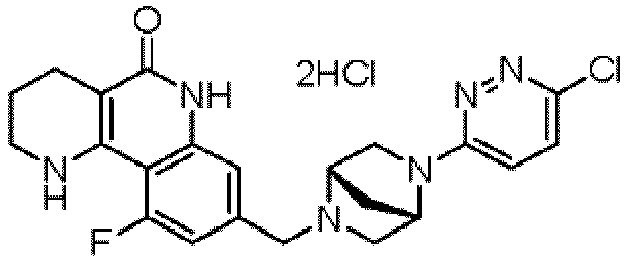
1H NMR(400MHz, DMSO-d6 ); δ 11.22(s, 1H), 10.30-10.20(br, 1H), 7.89(d, J=8.4Hz, 1H). 7.60(d, J=9.6Hz, 1H), 7.45-7.42(m, 1H), 7.35(s, 1H), 7.19(d, J=10.0Hz, 1H), 4.97(s, 1H), 4.60-4,56(m, 1H), 4.78(s, 1H), 4.40-4.35(m, 1H), 4.30-4.10(m, 2H), 3.96-3.93(m, 1H). 3.65(d, J=10.8Hz, 1H). 3.45-3.41(m, 1H), 3.35-3.31 (m, 1H), 2.60(d. J=10.8Hz, 1H), 2.20(d, J=11Hz, 1H), 1.85-1.75(m, 1H) 164 
1H NMR(400MHz, DMSO-d6 ); δ 11.1136(s, 1H), 10.03(br, 1H), 8.07(d, J=13.2Hz, 1H). 7.87-7.85(m, 2H), 7.36(d, J=9.6Hz, 1H), 7.31(s, 1H), 4.95(s, 1H), 4.61-4.56(m, 1H), 4.45(s, 2H), 4.38-4.30(m, 1H). 3.84(d, J=12.41Hz, 1H), 3.61(d, J=10.4Hz, 1H), 3.37-3.35(m, 1H), 3.32-3.22(m, 2H), 2.48-2.44(m, 2H), 1.85-1.70(m, 2H) 165 
1H NMR(400MHz, DMSO-d6 ); δ 11.20(s, 1H), 10.75-10.60(m, 1H), 7.90(d, J=8.4Hz, 1H), 7.68(t, J=8.4Hz, 1H), 7.46(d, J=8.4Hz, 1H). 7.31 (s, 1H), 7.01(d, J=14.4Hz, 1H), 6.85(d, J=8.4HZ, 1H), 4,60-4,40(m, 2H). 4.40-4.25(m, 1H), 4.20-3.80(m, 2H), 3.42-3.38(m, 2H), 3.35-3.30(m, 2H), 3.30-3.10(m, 2H), 2.50-2.40(m, 2H), 1.85-1.75(m, 2H), 1.23(d, J=6.4Hz, 2H) -

- Ethyl 3-amino-2,4-dichloro-5-fluorobenzoate (5.0 g, 17.73 mmol) was dissolved in methanol (70 ml), and then 10%-palladium (500 mg) was added thereto under hydrogen gas, followed by stirring at room temperature for 1 day. After completion of the reaction, the solution was filtered through celite and concentrated under reduced pressure. The residue was purified by column chromatography (dichloromethane: methanol=10:1) to give the title compound (2266.6 mg, yield: 70%, white solid).
1H NMR(400MHz, CDCl3); δ 7.13(s, 1H), 7.09(d, J=8.8Hz, 1H), 6.56-6.53(m, 1H), 4.35(q, J=6.8Hz, 2H), 1.38(t, J=6.8Hz, 3H). -

- 2-chloronicotinic acid (3 g, 18.68 mmol) was dissolved in dichloromethane and cooled to 0°C, and oxalyl chloride was added dropwise thereto. Next, a catalytic amount of N,N-dimethylformamide was added, and the mixture was stirred under reflux for 3 hours. After completion of the reaction, the solution was concentrated under reduced pressure. The obtained 2-chloropyridine-3-carbonyl chloride was dissolved in dichloromethane and cooled to 0°C, and the compound (2.63 g, 14.37 mmol) obtained in step 1 and trimethylamine were added thereto, followed by stirring at room temperature for 12 hours. Then, the reaction solution was concentrated under reduced pressure, and ethyl acetate was added to the residue obtained by concentration under recued pressure, followed by filtration under reduced pressure to remove the solid. After filtration, the obtained filtrate was concentrated under reduced pressure, and then purified by column chromatography (hexane: ethyl acetate = 2:1) to give the title compound (4.20 g, yield: 91%, white solid).
1H NMR (400MHz, CDCl3); δ 8.36-8.35(m, 1H), 7.84-7.82(m, 2H), 7.73-7.71(m, 1H), 7.34-7.32(m, 1H), 7.24-7.22(m, 1H), 4.37(q, J=7.2Hz, 2H), 1.40-1.36(m, 3H). -

- The compound (4.2 g, 13.01 mmol) prepared in step 2 was dissolved in tetrahydrofuran and cooled to 0°C, and then potassium t-butoxide (1844.3 mg, 15.61 mmol) was added thereto, followed by stirring for 30 minutes. Methoxymethyl chloride was added slowly dropwise to the reaction solution, followed by stirring for 1 hour. Then, water was slowly added to stop the reaction. Next, the reaction solution was extracted with dichloromethane, and the organic solvent layer was dried with anhydrous magnesium sulfate and concentrated under reduced pressure. The obtained residue was purified by column chromatography (hexane: ethyl acetate = 10:1) to give the title compound (2.05 g, yield: 46%, yellow solid).
1H NMR(400MHz, CDCl3); δ 8.28(s, 1H), 7.62-7.56(m, 3H), 7.19-7.15(m, 2H), 5.28(s, 2H), 4.35(s, 2H), 3.59(s, 3H), 1.37 (br, 3H) . -

- The compound (2.05 g, 5.93 mmol) prepared in step 3 was dissolved in N,N-dimethylformamide, and then palladium(II) acetate (399.4 mg, 1.78 mmol), bis-diphenylphosphinopropane (733.8 mg, 1.78 mmol), tributylphosphine (1.46 ml, 5.93 mmol) and potassium carbonate (1639.2 mg, 11.86 mmol) were sequentially added to the solution which was then stirred under reflux for 5 hours. Water was added to the reaction solution to stop the reaction, and the reaction solution was extracted with dichloromethane. The organic solvent layer was dried with anhydrous magnesium sulfate and concentrated under reduced pressure. Methanol was added to the residue obtained by concentration under reduced pressure, followed by filtration under reduced pressure. Dichloromethane was added to the filtrate, followed by filtration under reduced pressure to give the title compound (1145.3 mg, yield: 58%, yellow solid).
1H NMR(400MHz, CDCl3) ; δ 9.17(s, 1H), 8.83(d, J=7.6Hz, 1H), 8.16(s, 1H), 7.77(d, J=12.4Hz, 1H), 7.63-7.60(m, 1H), 5.87(s, 2H), 4.46(q, J=6.8Hz, 2H), 3.50(s, 3H), 1.45(t, J=7.2Hz, 3H). -

- The compound (945.3 mg, 2.86 mmol) prepared in step 4 was dissolved in dichloromethane/methanol (15 ml), and then 10%-palladium (4 mg) was added thereto under hydrogen gas, followed by stirring at room temperature for 1 day. After completion of the reaction, the solution was filtered through celite and concentrated under reduced pressure. The residue was purified by column chromatography (hexane: ethyl acetate =1:1) to give the title compound (841.2 mg, yield: 90%, white solid).
1H NMR(400MHz, CDCl3); δ 8.01(s, 1H), 7.49(d, J=14.8Hz, 1H), 6.08(d, J=19.6Hz, 1H), 5.73(s, 2H), 4.42(q, J=6.8Hz, 2H), 3.42(s, 5H), 2.70(t, J=6.0Hz, 2H), 1.98-1.92(m, 2H), 1.42(t, J=6.8Hz, 3H). -

- The compound (200 mg, 0.60 mmol) prepared in step 5 was dissolved in anhydrous tetrahydrofuran (10 ml), and then lithium aluminum hydride (34.1 mg, 0.90 mmol) was added slowly dropwise thereto at 0°C, followed by stirring at 0°C for 2 hours. After completion of the reaction, 0°C water (0.034 ml), 1.0N sodium hydroxide (0.034 ml) and 0°C water (0.068 ml) were sequentially added, followed by stirring for 1 hour. Then, the reaction solution was filtered through celite and concentrated under reduced pressure. The residue was purified by column chromatography (dichloromethane: methanol = 30:1) to give the title compound (130.2 mg, yield: 74%, off-white solid).
1H NMR(400MHz, CDCl3); δ 7.28(s, 1H), 6.91(d, J=14.4Hz, 1H), 6.06(d, J=20.0Hz, 1H), 5.68(s, 2H), 4.76(d, J=5.2Hz, 2H), 3.41(s, 5H), 2.68(t, J=6.0Hz, 2H), 1.94(t, J=6.0Hz, 2H). -

- The compound (44.4 mg, 0.15 mmol) prepared in step 6 was added to anhydrous dichloromethane (7 ml), and then thionyl chloride (0.044 ml, 0.61 mmol) was added slowly dropwise thereto at 0°C. The mixture was stirred at room temperature for 4 hours. After completion of the reaction, dichloromethane and 0°C water was added, and the organic layer was dried with anhydrous magnesium sulfate and concentrated under reduced pressure to give the title compound (33.4 mg, yield: 72 %, white solid). The obtained compound was used without further purification in the next step.
-

- Using the compound (43 mg, 0.14 mmol) prepared in step 7, the title compound (46 mg, yield: 66%, white solid) was obtained in the same manner as step 7 of Example 1.
1H NMR (400MHz, CDCl3); δ 7.99(dd, J=2.0, 0.8Hz, 1H), 7.97(dd, J=2.8, 0.8Hz, 1H), 7.30(s, 1H), 6.97-6.88(m, 2H), 6.07(d, J=19.6Hz, 1H), 5.70(s, 2H), 3.63(s, 2H), 3.48-3.40(m, 5H), 3.40-3.30(m, 4H), 2.72-2.63(m, 6H), 2.00-1.90(m, 2H). -

- Using the compound (46 mg, 0.9 mmol) prepared in step 8, the title compound (34 mg, 74%, yellow solid) was obtained in the same manner as step 8 of Example 1.
1H NMR (400MHz, CDCl3); δ 11.71(br, 1H), 7.98(dd, J=8.0, 2.4Hz, 1H), 7.90(dd, J=13.2, 2.8Hz, 1H), 7.13(s, 1H), 6.94-6.81(m, 2H), 6.03(d, J=17.6Hz, 1H), 3.60(s, 1H), 3.48-3.40(m, 2H), 3.38-3.32(m, 4H), 2.78-2.70(m, 2H), 2.70-2.62(m, 4H), 2.00-1.90(m, 2H). -

- Using the compound (34 mg, 0.07 mmol) prepared in step 9, the title compound (40 mg, 99%, white solid) was obtained in the same manner as step 9 of Example 1.
1H NMR(400MHz, DMSO-d6 ); δ 11.32 (br, 1H), 11.20 (br, 1H), 8.10-8.04(m, 2H), 7.33-7.25(m, 2H), 7.13(s, 1H), 4.40(br, 2H), 3.83-3.67(m, 2H), 3.50-3.20(m, 8H), 2.50-2.40(m, 2H), 1.80-1.70(m, 2H). - Compounds of Examples 167 to 177 were prepared in the same manner as described in Examples 166, except that substituents were changed as shown in Table 3 below.
[Table 3] Example Structure NMR 167 
1H NMR(400MHz. DMSO-d6 ); δ 11.60-11.40(br, 1H), 11.36(s, 1H), 8.13(d, J=5.2Hz, 1H), 8.00-7.70(m, 1H), 7.37(s. 1H). 7.21(d, J=14.0Hz, 1H), 7.11(s, 1H), 6.92(t, J=6.2Hz, 1H), 4.37(s, 2H), 4.0-3.65(m, 4H), 3,65-3.55(m, 2H), 2.60-2.40(m, 4H), 1.76-1.70(m, 2H) 168 
1H NMR(400MHz, DMSO-d6 ); δ 11.35(s, 1H), 11.10-10.98(br, 1H), 8.14(d, J=4.0Hz, 1H), 7.64(d, J=7.6Hz, 1H), 7.34(d, J=14.0Hz, 1H), 7.14(s, 1H), 7.07-7.04(m, 1H), 4.40(s, 2H), 3.53(br, 4H), 3.36-3.26(m, 2H), 2,67-2.44(m, 4H), 2.35-2.30(m, 2H), 2.25(S, 3H), 1.80-1.70(m, 2H) 169 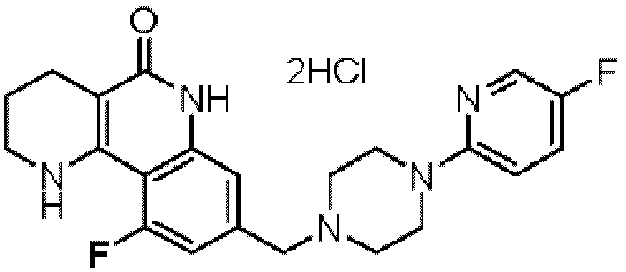
1H NMR(400MHz. DMSO-d6 ); δ 11.36(s, 1H), 11.33(br, 1H), 8.15(s, 1H), 7.60(t, J=7.32Hz, 1H), 7.38(d, J=14.16Hz, 1H), 7.12(s, 1H), 7.00(d, J=8.78Hz, 1H), 4.35(s, 2H), 4.29(d, J=13.18Hz, 2H), 3.37-3.26(m, 6H), 3.10(s, 2H), 1.77(s, 2H) 170 
1H NMR(400MHz, DMSO-d6 ); δ 11.76(br, 1H), 11.62(br, 1H), 8.56(d, J=2.0Hz, 1H), 7.98(dd, J=9.2Hz, 2.4Hz, 1H), 7.42(d, J=14.0Hz, 1H), 7.13(s, 1H), 7.04(d, J=8.8Hz, 1H), 4.60-4.45(m, 2H), 4.35(br, 2H), 3.70-3.25(m, 8H), 2.50-2.40(m, 2H), 1.80-1.70(m, 2H) 171 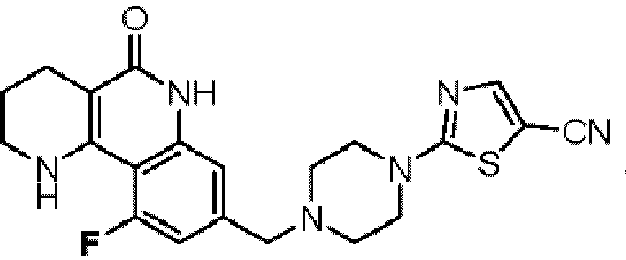
1H NMR(400MHz. DMSO-d6 ); δ 10.96 (br, 1H), 8.02(s, 1H), 7.01(s. 1H), 6.83(d, J=14.8Hz, 1H), 6.52(d, J=14.0Hz, 1H), 3.60-3.50(m, 8H), 3.50-3.20(m, 4H), 2.50-2.40(m, 2H), 1.80-1.70(m, 2H) 172 
1H NMR(400MHz, DMSO-d6 ); δ 11.88(s, 2H), 7.60(d, J=14.4Hz, 1H), 7.29(s, 1H), 7.09-7.07(m, 2H), 7.01(s, 2H), 4.43(s, 2H), 3.80-3.65(m, 2H), 3.40-3.30(m, 4H), 3.21-3.15(m, 4H), 2.55-2.45(m, 2H), 1.85-1.75(m, 2H) 173 
1H NMR(400MHz, DMSO-d6 ); δ 12.0-11.8(br, 1H), 11.4-11.2(s, 1H). 7.69(t, J=8.2Hz, 1H), 7.44-7.40(m, 1H), 7.16-7.05(m, 2H), 6.92(d, J=7.6Hz, 1H), 4.42(s, 2H), 3.71-3.12(m, 6H), 2.50-2.20(m, 6H), 1.80-1.70(m, 2H) 174 
1H NMR(400MHz, DMSO-d6 ); δ 11.62(br, 1 H), 11.40(s, 1H), 7.94(d, J=8.3Hz, 1H), 7.41 -7.36(m, 2H), 7.31(d, J=7.8Hz, 1H), 7.10(s, 1H), 4.36(s, 4H), 4.24(d, J=13.1Hz, 2H), 3.50-3.16(m, 8H), 1.76(s, 2H) 175 
1H NMR(400MHz, DMSO-d6 ); δ 11.35(s, 1H), 10.40-10.25(br, 1H), 7.20(d, J=13.6Hz, 1H), 7.13(s, 1H), 7.09-7.05(m, 1H), 7.02-6.98(m, 1H), 6.65(d, J=12.8Hz, 1H), 4.41(d, J=4.4Hz, 1H), 3.16-3.11(m, 2H), 3.02-2.96(m, 2H), 2.70-2.60(m 2H), 2.34-2.33(m, 2H), 2.26(S, 4H), 1.80-1.70(m, 2H) 176 
1H NMR(400MHz, CD3OD); δ 7.68(s, 1H), 7.49-7.42(m, 3H), 7.13(t, J=7.6Hz, 1H), 4.53(s, 2H), 3.73-3.70(m, 2H), 3.51(br, 4H), 3.35-3.24(m, 4H), 2.75-2.60(m, 2H), 2.00-1.85(m, 2H) 177 
1H NMR(400MHz, DMSO-d6 ); δ 11.42(br, 1H), 11.10(br, 1H), 8.49(s, 1H), 7.89(d, J=9.2 Hz, 1H), 7.47(d, J=14.4 Hz, 1H), 7.21(s, 1H), 6.71(br, 1H), 5.08-4.98(m, 1H), 4.60-4.52(m, 1H), 4.47(br, 2H), 4.40-4.32(m, 1H), 3.68-3.54(m, 2H), 3.50-3.40(m, 1H), 3.36-3.20(m 1H), 2.62-2.56(m, 1H), 2.54-2.40(m, 3H), 2.20-2.12(m, 1H), 1.82-1.70(m, 2H) -

- To the compound (163 mg, 0.52 mmol) prepared in step 7 of Example 166, dichloromethane (8.0 ml) was added, and then trifluoroacetic acid (1.5 ml) was added. The reaction was performed by stirring the mixture at 50°C for 24 hours. The reaction solution was cooled to room temperature, and then neutralized with a saturated aqueous solution of sodium hydrogen carbonate. The organic layer was dried with anhydrous magnesium sulfate, and then concentrated under reduced pressure to give the title compound (124 mg, 89%, yellow solid).
1H NMR (400MHz, DMSO-d6 ); δ 11.11 (br, 1H), 7.08(s, 1H), 6.94(d, J=14.8Hz, 1H), 6.56(d, J=14.0Hz, 1H), 4.75(s, 2H), 3.30-3.20(m, 2H), 2.50-2.40(m, 2H), 1.80-1.70(m, 2H). -

- Using the compound (33 mg, 0.12 mmol) prepared in step 1, the title compound (16 mg, yield: 33%, white solid) was obtained in the same manner as step 7 of Example 1.
1H NMR(400MHz, DMSO-d6 ); δ 10.95(br, 1H), 8.29(s, 1H), 8.06(s, 1H), 7.82(d, J=2.8Hz, 1H), 7.03(s, 1H), 6.84(d, J=14.4Hz, 1H), 6.57(d, J=14.0Hz, 1H), 4.00-3.20 (m, 12H), 2.50-2.40(m, 2H), 1.80-1.70(m, 2H). -

- Using the compound (11 mg, 0.03 mmol) prepared in step 2, the title compound (5 mg, yield: 38%, white solid) was obtained in the same manner as step 9 of Example 1.
1H NMR(400MHz, DMSO-d6 ); δ 11.47 (br, 1H), 11.37 (br, 1H), 8.42(s, 1H), 8.16(s, 1H), 7.95(d, J=2.4Hz, 1H), 7.37(d, J=14.0Hz, 1H), 7.12(s, 1H), 4.50-4.30(m, 4H), 3.50-3.25(m, 6H), 3.20-3.05(m, 2H), 2.50-2.42(m, 2H), 1.80-1.70(m, 2H). - Compounds of Examples 179 to 185 were prepared in the same manner as described in Examples 178, except that substituents were changed as shown in Table 4 below.
[Table 4] Exmaple Structure NMR 179 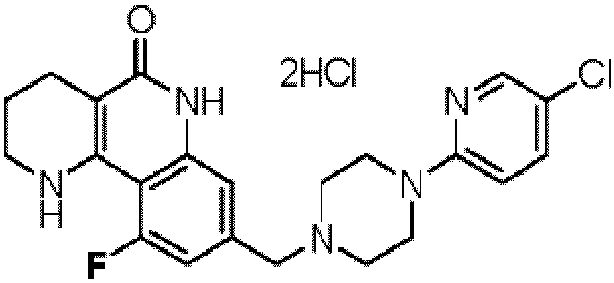
1H NMR(400MHz, DMSO-d6 ); δ 8,17(s, 1H), 7.70(d, J=8,8Hz, 1H), 7.60(s, 1H), 7.40(d, J=14.0Hz, 1H), 6.99(d, J=9,6Hz, 1H), 4,42(s, 2H), 4.40-4.25(m, 2H), 3.45-3.25(m, 6H), 3.15-3.00(m, 2H), 2.60-2.40(m, 2H), 1.85-1.75(m, 2H) 180 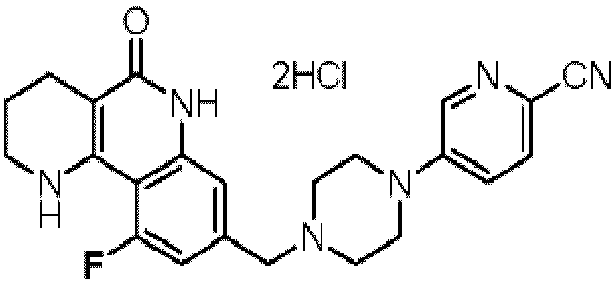
1H NMR(400MHz, DMSO-d6 ); δ 11.39(br, 2H), 8.48(d, J=2.4Hz, 1H), 7.85(d, J=9.2Hz, 1H), 7.46(dd, J1=8.8Hz, J2=3.2Hz, 1H), 7.35(d, J=14.4Hz, 1H), 7.10(s, 1H), 4.37(s, 2H), 4,20-4,10(m, 2H), 3.50-3.25(m, 6H), 3.22-3.10(m, 2H), 2.60-2.40(m, 2H), 1.80-1.70(m, 2H) 181 
1H NMR(400MHz, DMSO-d6 ); δ 11.78(br, 1H), 11.46(br, 1H), 7.66(d, J=9,2Hz, 1H), 7.49(d, J=9.2Hz, 1H), 7.44(d, J=14.0 Hz, 1H), 7.14(s, 1H), 5.00-4.50(br, 2H), 4.50-4.30(m, 6H), 3.55-3.40(m, 2H), 3.40-3.25(m, 4H), 2.50-2.40(m, 4H), 1.80-1.70(m, 2H) 182 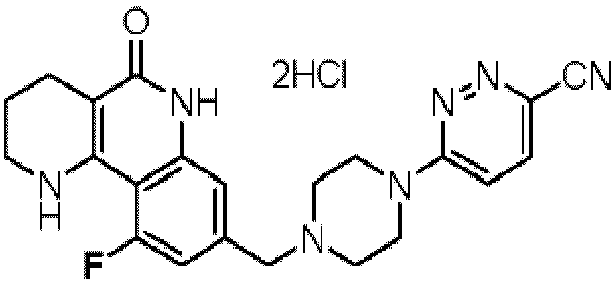
1H NMR(400MHz, DMSO-d6 ); δ 11.37(br, 2H), 8.01(d, J=10 Hz, 1H), 7.47(d, J=10.4Hz, 1H), 7.32(d, J=14Hz, 1H), 7.09(s, 1H), 4.70-4.60(m, 2H), 4.35(s, 2H), 3.60-3.47(m, 2H), 3.47-3.37(m, 2H), 3.35-3.27(m, 2H), 3.22-3.10(m, 2H), 2.70-2.30(m, 2H), 1.80-1.70(m, 2H) 183 
1H NMR(400MHz, DMSO-d6 ); δ 11.43(br, 1H), 11.36(br, 1H), 7.69(d, J=4.4Hz, 1H), 7.33(d, J=15.6Hz, 1H), 7.10(s, 1H), 6.38(d, J=4Hz, 1H), 4.76(br, 2H), 4.00-3.50(m, 4H), 3.50-3.15(m, 6H), 2.50-2.40(m, 2H), 1.80-1.70(m, 2H) 184 
1H NMR(400MHz, DMSO-d6 ); δ 11.78(br, 1H), 11.42(br, 1H), 8.54(s, 1H), 7.96(d, J=8.8Hz, 1H), 7.55(d, J=14.4Hz, 1H), 7.25(s, 1H), 4.35-4.20(m, 2H), 4.05-3.95(m, 2H), 4.35-4.20(m, 2H), 4.05-3.95(m, 2H), 3.70-3.60(m, 2H), 3.40-3.25(m, 2H), 2.50-2.40(m, 2H), 2.35-2.20(m, 2H), 1.90-1.70(m, 4H) 185 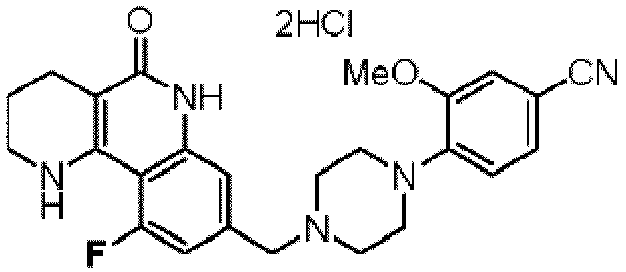
1H NMR(400MHz, DMSO-d6 ); δ 11.44(br, 1H), 11.29(br, 1H), 7.50-7.25(m, 3H), 7.20-6.90(m, 2H), 4.33(br, 2H), 4.20-2.90(m, 13H), 2.60-2.40(m, 2H), 1.80-1.70(m, 2H) -

- To the compound (500 mg, 1.56 mmol) prepared in step 4 of Example 1, ethanol (50 mL) was added, and then 12N hydrochloric acid (5.0 mL, 15.60 mmol) was added slowly dropwise, followed by reaction at room temperature for 24 hours. The reaction mixture was concentrated under reduced pressure to remove ethanol, and then cooled to 0°C by addition of water (5.0 mL), after which it was neutralized with 4N sodium hydroxide solution. After stirring for 1 hour, the produced solid was filtered and washed with water to give the title compound (423 mg, 99 %, yellow solid).
1H NMR(400MHz, CD3OD) ; δ 7.91(s, 1H), 7.79(d, J=8.4Hz, 1H), 7.72(d, J=8.4Hz, 1H), 4.63(br. 2H), 3.45-3.00(m, 2H), 2.62-2.52(m, 2H), 1.95-1.80(m, 2H), 1.35(t, J=7.2Hz, 3H). -

- The compound (150 mg, 0.55 mmol) prepared in step 1 was dissolved in methanol (6 ml), and then aqueous sodium hydroxide solution (200 mg sodium hydroxide in 3 ml water) was added thereto. The reaction solution was cooled under reflux for 24 hours, and then concentrated under reduced pressure to remove the solvent. Ethyl acetate was added to the concentrated residue, followed by neutralization with 2N hydrochloric acid. The produced solid was filtered and washed with ethyl acetate.
1H NMR (400MHz, DMSO-d6 ); δ 11.04(br, 1H), 7.88(d, J=8.0Hz, 1H), 7.28(s, 1H), 7.59(d, J=8.0Hz, 1H), 7.06(br, 1H), 3.30-3.20(m,2H), 2.50-2.40(m, 2H), 1.90-1.80(m, 2H). -

- The compound (30 mg, 0.12 mmol) prepared in step 2 was dissolved in dimethylformamide (3 ml), and then 1-ethyl-3-(3-dimethylaminopropyl)carbodiimide (35 mg, 0.18 mmol), hydroxybenzotriazole (25 mg, 0.18 mmol), 4-methylmorpholine (70 uL, 0.64 mmol), 5-(piperazin-1-yl)-thiophene-carbonitrile hydrochloride (38 mg, 0.17 mmol) were added thereto. The mixture was stirred for 1 hour at room temperature. After completion of the reaction, water was added, followed by the extraction three times with ethyl acetate. The organic solvent layer was dried with anhydrous magnesium sulfate and concentrated under reduced pressure. The residue obtained by concentration under reduced pressure was purified by column chromatography (dichloromethane: methanol = 20:1) to give the title compound (37 mg, yield:71%, white solid).
1H NMR (400MHz, CD3OD) ; δ 7.88(d, J=8.0Hz, 1H), 7.48(d, J=4.4Hz, 1H), 7.38(d, J=0.8Hz, 1H), 7.28(d, J=8.4Hz, 1.6Hz, 1H), 6.26(d, J=4.0Hz, 1H), 3.96(br, 2H), 3.65(br, 2H), 3.50-3.20(m, 6H), 2.60-2.50(m, 2H), 2.00-1.90(m, 2H). -

- Using the compound (25 mg, 0.06 mmol) prepared in step 3, the title compound (27 mg, yield: 91%, white solid) was obtained in the same manner as step 9 of Example 1.
1H NMR(400MHz, DMSO-d6 ); δ 11.13(br, 1H), 7.90(d, J=8.4Hz, 1H), 7.64(d, J=4.4Hz, 1H), 7.28(s, 1H), 7.17(d, J=7.6Hz, 1H), 6.30(d, J=4.4Hz, 1H), 3.80-3.50(m, 4H), 3.45-3.20(m, 6H), 2.60-2.40(m, 2H), 1.80-1.70(m, 2H). - Compounds of Examples 187 to 189 were prepared in the same manner as described in Examples 186, except that substituents were changed as shown in Table 5 below.
[Table 5] Example Structure NMR 187 
1H NMR(400MHz, DMSO-d6 ); δ 11.03(s, 1H), 8.52(s, 2H), 7.92-7.89(m, 2H), 7.27(s, 1H), 7.17(d, J=7.2Hz, 1H), 6.95(d, J=7.6Hz, 1H), 3.79-3.60(m, 8H), 3.60-3.40(m, 2H), 3.36-3.32 (m, 2H), 1.85-1.75(m, 2H) 188 
1H NMR(400MHz, DMSO-d6 ); δ 11.34(s, 1H), 8.00(s, 1H), 7.95 (d, J=8.4Hz, 1H), 7.33(s, 1H), 7.20(d, J=8.8Hz, 1H), 4.78(br, 4H), 3.75-3.33(m, 8H), 1.80-1.65(m, 2H) 189 
1H NMR(400MHz, DMSO-d6 ); δ 11.20(s, 1H), 8.04(s, 1H), 7.90(d, J=8.4Hz, 1H), 7.29(s, 1H), 7.17(d, J=7.6Hz, 1h), 4.19(br, 4H), 3.75-3.62(m, 6H), 3.40-3.30(m, 2H), 1.97-1.80(m, 2H) - The PARP-1 enzyme inhibitory activities of the compounds of the present invention were assayed in the following manner by use of a kit (cat. 80551) purchased from BPS Bioscience.
- The 96-well plate provided in BPS Bioscience kit was coated with histone and incubated at 4°C for 16 hours. Then, the plate was washed four times with PBST (7.5 mM Na2HPO4, 2.5 mM NaH2PO4, 145 mM NaCl, 0.05% Tween 20, pH 7.4), and blocking buffer (provided in BPS Bioscience kit) was added thereto in order to block nonspecific reaction, and was then incubated at 25°C for 1 hour. After incubation for 1 hour, the plate was washed four times with PBST, and varying concentrations of each of the compounds of the Examples were added to a reaction solution containing PARP-1 enzyme (50 ng/well), an assay mixture and activated DNA, and allowed to react at 25°C for 1 hour. After 1 hour, each well was washed four times with PBST, and in order to measure the level of ribosylation by PARP enzyme, streptavidin-linked peroxidase (Strep-HRP, 1:50 dilution) was added and allowed to react at 25°C for 30 minutes. The plate was washed four times with PBST, and then finally an HRP chemiluminescent substrate was added and allowed to react. The level of histone ribosylation formed by each enzyme was quantified using Synergy™ H4 Hybrid Multi-Mode Microplate Reader (BioTek Instruments, Inc., USA). The results obtained for various concentrations of the compounds of the present invention are average values obtained from two wells, and the results were analyzed by calculating the IC50 values of the compounds using SigmaPlot 10 (Systat Software Inc., USA) (see Table 6).
[Table 6] Example PARP-1 enzyme (nM) Example PARP-1 enzyme (nM) Example PARP-1 enzyme (nM) 1 4.99 66 5.51 128 4.50 2 13.70 67 6.59 129 6.28 3 29.57 68 4.74 130 17.35 69 3.04 131 7.59 5 17.97 70 7.90 132 3.60 6 27.98 71 6.87 133 8.29 7 20.15 72 10.54 134 12.23 9 24.63 73 9.73 135 3.66 10 115.13 74 7.11 136 10.31 12 128.56 75 7.27 137 7.43 13 33.75 76 10.87 138 17.61 15 16.04 77 7.11 139 85.82 16 42.99 78 6.64 140 3.06 17 15.36 79 14.40 141 8.83 18 18.31 80 22.34 142 4.60 19 17.98 81 9.58 143 39.79 20 22.78 82 22.11 144 107.73 21 53.20 83 26.44 145 25.41 22 89.96 84 11.91 146 302.93 23 38.55 85 9.87 147 15.88 24 33.53 86 14.08 148 24.51 26 57.07 87 28.63 149 7.61 26 100.61 88 13.48 150 2.49 27 59.63 89 2.35 151 5.65 28 92.00 90 5.49 152 4.86 29 24.71 91 6.61 153 44.84 30 23.45 92 4.92 154 77.37 31 27.75 93 3.25 155 29.26 32 43.98 94 12.93 156 20.36 33 28.87 95 8.59 157 17.88 34 31.60 96 6.01 158 8.23 35 25.84 97 7.38 159 139.8 36 52.37 98 5.04 160 4.82 37 52.27 99 57.63 161 9.41 38 58.94 100 32.33 162 10.22 39 9.13 101 3.87 163 43.45 40 14.65 102 6.67 164 81.74 41 11.52 103 7.00 165 37.01 42 13.72 104 8.16 166 7.46 43 21.74 105 56.85 167 7.24 44 11.57 106 32.01 168 19.63 45 63.13 107 24.38 169 8.47 46 32.51 108 12.35 170 3.30 47 17.33 109 19.83 171 4.99 48 6.49 110 14.25 172 7.94 49 11.08 111 9.01 173 23.98 50 6.65 112 5.61 174 109.76 51 7.69 113 10.31 175 18.57 52 15.93 114 52.90 176 11.47 53 6.44 115 17.42 177 7.28 54 7.47 116 21.22 178 7.33 55 30.09 117 111.98 179 159.00 56 6.67 118 179.64 180 5.27 57 5.98 119 4.82 181 4.65 58 11.57 120 4.81 182 4.02 59 1.95 121 13.97 183 5.04 60 4.80 122 19.42 184 5.79 61 11.12 123 3.49 185 11.78 62 27.82 124 7.09 186 13.28 63 4.46 125 7.08 187 5.92 64 7.55 126 77.15 188 47.98 65 7.85 127 10.38 189 7.43 - The tankyrase-1 or tankyrase-2 enzyme inhibitory activities of the compounds of the present invention were assayed in the following manner by use of a kit (cat. 80573 or 80578) purchased from BPS Bioscience.
- The 96-well plate provided in BPS Bioscience kit was coated with histone and incubated at 4°C for 16 hours. Then, the plate was washed four times with PBST (7.5 mM Na2HPO4, 2.5 mM NaH2PO4, 145 mM NaCl, 0.05% Tween 20, pH 7.4), and blocking buffer (provided in BPS Bioscience kit) was added thereto in order to block nonspecific reaction, and was then incubated at 25°C for 1 hour. After incubation for 1 hour, the plate was washed four times with PBST, and varying concentrations of each of the compounds of the Examples were added to a reaction solution containing tankyrase-1 enzyme (40 ng/well) or tankyrase-2 enzyme (15 ng/well) and an assay mixture, and allowed to react at 25°C for 1 hour. After 1 hour, each well was washed four times with PBST, and in order to measure the level of ribosylation by PARP enzyme, streptavidin-linked peroxidase (Strep-HRP, 1:50 dilution) was added and allowed to react at 25°C for 30 minutes. The plate was washed four times with PBST, and then finally an HRP chemiluminescent substrate was added and allowed to react. The level of histone ribosylation formed by each enzyme was quantified using Synergy™ H4 Hybrid Multi-Mode Microplate Reader (BioTek Instruments, Inc., USA). The results obtained for various concentration of the compounds of the present invention are average values obtained from two wells, and the results were analyzed by calculating the IC50 values of the compounds using SigmaPlot 10 (Systat Software Inc., USA) (see Tables 7 and 8).
[Table7] Example TNK-1 enzyme (nM) Example TNK-1 enzyme (nM) Example TNK-1 enzyme (nM) 1 59.58 84 8.46 134 4.15 85 11.76 135 4.04 7 34.03 89 5.07 137 3.36 39 35.18 90 30.98 139 10.57 48 89.07 91 35.20 140 18.53 50 34.95 92 12.87 141 5.82 51 31.35 93 3.59 142 4.42 52 56.42 94 42.44 143 21.45 53 20.10 95 11.45 145 6.29 54 16.75 96 6.77 149 14.26 56 4.96 97 8.81 150 18.05 57 26.52 98 36.72 151 56.67 59 1.37 99 5.59 152 16.97 60 12.11 100 18.92 158 17.33 61 13.68 101 25.16 160 10.65 62 26.18 102 28.81 161 32.04 63 15.02 103 12.46 166 36.28 64 16.17 104 50.71 167 97.20 65 13.87 107 11.40 169 32.39 66 13.21 108 25.12 170 9.65 67 14.03 110 38.47 171 16.65 68 49.19 111 18.77 172 162.00 69 5.77 112 12.55 174 90.32 70 12.37 113 10.66 176 116.40 71 14.19 119 5.00 177 14.78 72 16.34 120 10.20 178 27.33 73 15.55 122 7.28 180 8.05 74 17.26 123 3.92 181 11.57 75 11.38 124 10.43 182 3.33 76 11.28 125 10.40 183 46.16 77 16.28 128 25.76 184 37.08 78 10.96 129 5.56 185 35.79 80 39.86 131 9.89 186 47.13 81 45.93 132 2.77 187 22.92 82 35.07 133 14.19 189 16.05 [Table8] Example TNK-2 enzyme (nM) Example TNK-2 enzyme (nM) Example TNK-2 enzyme (nM) 48 49.94 91 11.40 136 1.75nM 50 14.52 93 1.97 137 0.95nM 51 14.81 96 1.75 141 2.62nM 53 10.23 97 3.70 142 2.45nM 64 12.79 99 1.99 143 12.01nM 56 3.78 101 15.84 145 3.24nM 59 0.92 103 2.10 149 6.99nM 60 6.47 107 6.21 150 6.06nM 61 3.80 113 3.49 162 10.56nM 63 4.96 119 1.38 158 6.59nM 64 3.38 120 4.82 160 4.63nM 65 4.20 122 2.37 161 8.60nM 67 4.36 123 2.38 169 34.67nM 69 1.32 124 4.71 170 1.96nM 76 2.86 125 3.18 172 67.41 nM 78 1.87 129 1.65 177 10.65nM 85 10.35 131 2.81 180 2.12nM 89 1.48 132 1.31 182 1.26nM 90 13.22 134 2.70 189 14.07nM - In order to examine the PARP-1 enzyme inhibitory abilities of the compounds of the present invention, the amount of PAR produced in cells was measured.
- HCT-15 colorectal cancer cells were cultured in RPMI medium containing 10% fetal bovine serum (FBS). The cultured HCT-15 cells were seeded on a 96-well plate at a density of 2 x 10⁴ cells/well, and then cultured under the conditions of 37°C and 5% CO2 for 16 hours. After culture, the cells were treated with varying concentrations of each of the compounds of the Examples, and then cultured at 37°C for 30 minutes. Next, the cells were treated with 50 mM of the DNA damage material H2O2, and then reacted at 25°C for 5 minutes and fixed with methanol/acetone (7/3) at -20°C for 10 minutes. After 10 minutes, the plate was washed three times with TBST, and then 5% non-fat dry milk was added thereto in order to prevent nonspecific reactions, followed by incubation at 25°C for 1 hour. After 1 hour, anti-PAR antibody (1:1000 dilution) was added and allowed to react at 25°C for 1 hour, and the plate was washed three times with TBST. Next, HRP-conjugated antimouse antibody (1:1000 dilution) was added and allowed to react at 25°C for 1 hour. The plate was washed three times with TBST, and then finally an HRP chemiluminescent substrate was added and allowed to react. The amount of PAR produced in the cells was quantified using Synergy™ H4 Hybrid Multi-Mode Microplate Reader (BioTek Instruments, Inc., USA). The results obtained for various concentration of the compounds of the present invention are average values obtained from three wells, and the results were analyzed by calculating the IC50 values of the compounds using SigmaPlot 10 (Systat Software Inc., USA) (see Table 9).
[Table 9] Example PARP-1 cell (nM) Example PARP-1 cell (nM) Example PARP-1 cell (nM) 1 3.56 80 58.77 132 20.05 81 18.32 133 4.42 7 10.65 82 38.42 134 14.12 20 31.12 84 12.49 135 9.15 39 8.17 85 13.35 137 42.59 48 2.01 86 2.03 140 2.25 50 4.06 89 0.84 141 16.38 51 3.97 90 2.06 142 1.11 52 9.48 91 3.08 149 9.74 53 2.56 92 9.72 150 10.06 54 5.96 93 6.60 151 10.99 56 8.48 94 14.38 152 20.61 57 2.30 95 148.15 158 30.12 59 0.43 96 31.00 160 45.66 60 1.95 97 105.25 161 8.39 61 3.32 98 4.80 166 4.85 62 19.50 101 1.89 167 7.29 63 5.17 102 8.52 168 4.84 64 17.65 103 4.71 169 12.23 65 20.33 104 13.45 170 1.69 66 39.73 107 1.30 171 2.31 67 10.24 108 7.93 172 7.61 68 5.21 110 11.52 174 16.57 69 10.09 111 8.20 176 2.99 70 26.18 112 3.45 177 5.09 71 19.16 113 9.98 178 4.95 72 53.99 119 5.53 180 2.96 73 33.46 120 3.38 181 7.49 74 39.11 123 3.16 182 5.90 75 31.32 124 10.55 183 10.93 76 12.31 125 11.74 184 9.35 77 11.04 128 6.76 187 8.71 78 12.78 129 8.79 189 161.11 79 38.26 131 33.79 - The compounds according to the present invention can inhibit PARP-1, tankyrase-1 or tankyrase-2 activity, and thus can be effectively used for prevention or treatment of neuropathic pain, neurodegenerative diseases, cardiovascular diseases, diabetic neuropathy, inflammatory diseases, osteoporosis, or cancer.
- Although the present invention has been described in detail with reference to the specific features, it will be apparent to those skilled in the art that this description is only of a preferred embodiment thereof, and does not limit the scope of the present invention. Thus, the substantial scope of the present invention will be defined by the appended claims.
- As described above, the tricyclic derivative compounds according to the present invention can inhibit PARP-1, tankyrase-1 or tankyrase-2 activity, and thus can be effectively used for prevention or treatment of neuropathic pain, neurodegenerative diseases, cardiovascular diseases, diabetic neuropathy, inflammatory diseases, osteoporosis, or cancer.
Claims (14)
- A tricyclic derivative compound represented by the following formula 1, an optical isomer thereof, a racemate thereof or a pharmaceutically acceptable salt thereof:
 L is -CH2- or -C(=O)-;R1 is H, a halogen atom, or C1-C3 alkoxy;R2 and R3 are each independently H or C1-C3 alkyl, or R2 and R3 are linked to each other to form a ring;ring A is phenyl or a heteroaryl selected from the group consisting of pyridine, pyrazine, pyrimidine, pyridazine, thiophene, thiazole, thiadiazole, oxazole, oxadiazole, indole, indazole, cyclopentapyridine, dihydrocyclopentapyridine, furopyridine, dihydrofuropyridine, oxazolopyridine, benzoxazole, and benzoisoxazole,wherein the phenyl and the heteroaryl are each independently unsubstituted, or one or more H atoms thereof are each independently substituted with a substituent selected from the group consisting of a halogen atom, -CN, -CF3, -C1-C3 alkyl, - C1-C3 alkoxy, -CH2-OR4, -C(=O)-R4, -C(=O)-OR4, -S(=O)2-R4, -NH-C(=O)-R4, -NO2, -NR4R5 and -C(=O)-NR6R7;R4, R5 and R6 are each independently H or C1-C3 alkyl; andR7 is C1-C3 alkyl or C3-C7 cycloalkyl.
 - The tricyclic derivative compound, the optical isomer thereof, the racemate thereof or the pharmaceutically acceptable salt according to claim 1, wherein
L is -CH2- or -C(=O)-;
R1 is H, a halogen atom or C1-C3 alkoxy;
R2 and R3 are each independently H or C1-C3 alkyl, or R2 and R3 are linked to each other to form a ring;
ring A is the phenyl or the heteroaryl selected from the group consisting of pyridine, pyrazine, pyrimidine, pyridazine, thiophene, thiazole, thiadiazole, oxazole, oxadiazole, indole, indazole, cyclopentapyridine, dihydrocyclopentapyridine, furopyridine, dihydrofuropyridine, oxazolopyridine, benzoxazole, and benzoisoxazole, wherein one or more H atoms of the phenyl is substituted with a substituent selected from the group consisting of a halogen atom, -CN, -CF3, -C1-C3 alkyl, -C1-C3 alkoxy, -C(=O)-R4, -C(=O)-OR4, -S(=O)2-R4, -NH-C(=O)-R4, - NO2, -NR4R5 and -C(=O)-NR6R7, and the heteroaryl is unsubstituted, or one or more H atoms of the heteroaryl is substituted with a substituent selected from the group consisting of a halogen atom, -CN, -CF3, -C1-C3 alkyl, -C1-C3 alkoxy, -CH2-OR4, -C(=O)-OR4, -S(=O)2-R4, -NO2, -NR4R5 and - C(=O)-NR6R7;
R4 is C1-C3 alkyl;
R5 is H or C1-C3 alkyl;
R6 is H or C1-C3 alkyl; and
R7 is C1-C3 alkyl or C3-C7 cycloalkyl. - The tricyclic derivative compound, the optical isomer thereof, the racemate thereof or the pharmaceutically acceptable salt according to claim 2, wherein
L is -CH2- or -C(=O)-;
R1 is H, a halogen atom or C1-C3 alkoxy;
R2 and R3 are each independently H or C1-C3 alkyl, or R2 and R3 are linked to each other to form a ring;
ring A is the phenyl or the heteroaryl selected from the group consisting of pyridine, pyrazine, pyrimidine, pyridazine, thiophene, thiazole, thiadiazole, indole, indazole, cyclopentapyridine, dihydrocyclopentapyridine, dihydrofuropyridine, oxazolopyridine, benzoxazole, and benzoisoxazole, wherein one or more H atoms of the phenyl is substituted with a substituent selected from the group consisting of a halogen atom, -CN, -CF3, -C1-C3 alkyl, -C1-C3 alkoxy, -C(=O)-R4, C(=O)-OR4, -NH-C(=O)-R4, -NO2, -NR4R5 and - C(=O)-NR6R7, and the heteroaryl is unsubstituted, or one or
more H atoms of the heteroaryl is substituted with a substituent selected from the group consisting of a halogen atom, -CN, -CF3, -C1-C3 alkyl, -C1-C3 alkoxy, -CH2-OR4, -C(=O)-OR4, -S(=O)2-R4 and -C(=O)-NR6R7;R4 is C1-C3 alkyl;R5 is H or C1-C3 alkyl;R6 is H or C1-C3 alkyl; andR7 is C1-C3 alkyl or C3-C7 cycloalkyl. - The tricyclic derivative compound, the optical isomer thereof, the racemate thereof or the pharmaceutically acceptable salt according to claim 1, wherein R2 and R3 are each independently H or C1-C3 alkyl.
- The tricyclic derivative compound, the optical isomer thereof, the racemate thereof or the pharmaceutically acceptable salt according to claim 4, wherein ring A is substituted with one or more substituents.
- The tricyclic derivative compound, the optical isomer thereof, the racemate thereof or the pharmaceutically acceptable salt according to claim 1, wherein R2 and R3 are linked to each other to form a ring.
- The tricyclic derivative compound, the optical isomer thereof, the racemate thereof or the pharmaceutically acceptable salt according to claim 1, wherein the compound is any one of the following compounds:1) 8-{[4-(4-methoxyphenyl)piperazin-1-yl]methyl}-1,2,3,4-tetrahydrobenzo[h][1,6]naphthyridin-5(6H)-one;2) 8-{[4-(4-fluorophenyl)piperazin-1-yl]methyl}-10-methoxy-1,2,3,4-tetrahydrobenzo[h][1,6]naphthyridin-5(6H)-one;3) 10-ethoxy-8-{[4-(4-fluorpphenyl)piperazin-1-yl]methyl}-1,2,3,4-tetrahydrobenzo[h][1,6]naphthyridin-5(6H)-one;4) 10-ethoxy-8-{[4-(pyrimidin-2-yl)piperazin-1-yl]methyl}-1,2,3,4-tetrahydrobenzo[h][1,6]naphthyridin-5(6H)-one;5) 10-ethoxy-8-{[4-(pyridin-2-yl)piperazin-1-yl]methyl}-1,2,3,4-tetrahydrobenzo[h][1,6]naphthyridin-5(6H)-one;6) 10-ethoxy-8-{[4-(5-fluoropyrimidin-2-yl)piperazin-1-yl]methyl}-1,2,3,4-tetrahydrobenzo[h][1,6]naphthyridin-5(6H)-one;7) 10-ethoxy-8-{[4-(5-fluoropyridin-2-yl)piperazin-1-yl]methyl}-1,2,3,4-tetrahydrobenzo[h][1,6]naphthyridin-5(6H)-one;8) 10-ethoxy-8-{[4-(6-fluoropyridin-2-yl)piperazin-1-yl]methyl}-1,2,3,4-tetrahydrobenzo[h][1,6]naphthyridin-5 (6H)-one;9) 10-ethoxy-8-{[4-(3-fluoropyridin-2-yl)piperazin-1-yl]methyl}-1,2,3,4-tetrahydrobenzo[h][1,6]naphthyridin-5(6H)-one;10) 8-{[4-(5-chloro-3-fluoropyridin-2-yl)piperazin-1-yl]methyl}-10-ethoxy-1,2,3,4-tetrahydrobenzo[h][1,6]naphthyridin-5 (6H)-one;11) 10-ethoxy-8-{[4-(6-(trifluoromethyl)pyridin-2-yl)piperazin-1-yl]methyl}-1,2,3,4-tetrahydrobenzo[h][1,6]naphthyridin-5(6H)-one;12) 8-({4-[3-chloro-5-(trifluoromethyl)pyridin-2-yl]piperazin-1-yl}methyl)-10-ethoxy-1,2,3,4-tretrahydrobenzo[h][1,6]naphthyridin-5 (6H)-one;13) 8-{[4-(5-chloropyridin-2-yl)piperazin-1-yl]methyl}-10-ethoxy-1,2,3,4-tetrahydrobenzo[h][1,6]naphthyridin-5(6H)-one;14) 8-{[4-(6-chloropyridin-2-yl)piperazin-1-yl]methyl}-10-ethoxy-1,2,3,4-tetrahydrobenzo[h][1,6]naphthyridin-5(6H)-one;15) 8-{[4-(3-chloropyridin-2-yl)piperazin-1-yl]methyl}-10-ethoxy-1,2,3,4-tetrahydrobenzo[h][1,6]naphthyridin-5(6H)-one;16) 8-{[4-(5-bromopyridin-2-yl)piperazin-1-yl]methyl}-10-ethoxy-1,2,3,4-tetrahydrobenzo[h][1,6]naphthyridin-5(6H)-one;17) 10-ethoxy-8-{[4-(3-methylpyridin-2-yl)piperazin-1-yl]methyl}-1,2,3,4-tetrahydrobenzo[h][1,6]naphthyridin-5 (6H)-one;18) 6-{4-{(10-ethoxy-5-oxo-1,2,3,4,5,6-hexahydrobenzo[h][1,6]naphthyridin-8-yl)methyl]piperzin-1-yl}-N-methylnicotinamide;19) 6-{4-{(10-ethoxy-5-oxo-1,2,3,4,5,6-hexahydrobenzo[h][1,6]naphthyridin-8-yl)methyl]piperazin-1-yl}-N-ethylnicotinamide;20) N-cyclopropyl-6-{4-[(10-ethoxy-5-oxo-1,2,3,4,5,6-hexahydrobenzo[h][1,6]naphthyridin-8-yl)methyl]piperazin-1-yl}nicotinamide;21) 8-{[4-(4-chlorophenyl)piperazin-1-yl]methyl}-10-ethoxy-1,2,3,4-tetrahydrobenzo[h][1,6]naphthyridin-5(6H)-one;22) 8-{[4-(4-bromophenyl)piperazin-1-yl]methyl}-10-ethoxy-1,2,3,4-tetrahydrobenzo[h][1,6]naphthyridin-5(6H)-one;23) 4-{4-[(10-ethoxy-5-oxo-1,2,3,4,5,6-hexahydrobenzo[h][1,6]naphthyridin-8-yl)methyl]piperazin-1-yl}benzonitrile;24) 3-fluoro-4-{4-[(10-ethoxy-5-oxo-1,2,3,4,5,6-hexahydrobenzo[h][1,6]naphthyridin-8-yl)methyl]piperazin-1-yl}benzonitrile;25) 3-chloro-4-{4-[(10-ethoxy-5-oxo-1,2,3,4,5,6-hexahydrobenzo[h][1,6]naphthyridin-8-yl)methyl]piperazin-1-yl}benzonitrile;26) 4-{4-[(10-ethoxy-5-oxo-1,2,3,4,5,6-hexahydrobenzo[h][1,6]naphthyridin-8-yl)methyl]piperazin-1-yl}-3-methylbenzonitrile;27) 10-ethoxy-8-{[4-(4-fluoro-2-methylphenyl)piperazin-1-yl]methyl}-1,2,3,4-tetrahydrobenzo[h][1,6]naphthyridin-5(6H)-one;28) 4-{4-[(10-ethoxy-5-oxo-1,2,3,4,5,6-hexahydrobenzo[h][1,6]naphthyridin-8-yl)methyl]piperazin-1-yl}-3,5-difluorobenzonitrile;29) 4-{4-[(10-ethoxy-5-oxo-1,2,3,4,5,6-hexahydrobenzo[h][1,6]naphthyridin-8-yl)methyl]piperazin-1-yl}-2-fluorobenzonitrile;30) 4-{4-[(10-ethoxy-5-oxo-1,2,3,4,5,6-hexahydrobenzo[h][1,6]naphthyridin-8-yl)methyl]piperazin-1-yl}-N-ethylbenzamide;31) 4-{4-[(10-ethoxy-5-oxo-1,2,3,4,5,6-hexahydrobenzo[h][1,6]naphthyridin-8-yl)methyl]piperazin-1-yl}-2-fluoro-N-methylbenzamide;32) 4-{4-[(10-ethoxy-5-oxo-1,2,3,4,5,6-hexahydrobenzo[h][1,6]naphthyridin-8-yl)methyl]piperazin-1-yl}-N-ethyl-2-fluorobenzamide;33) 3-chloro-4-{4-[(10-ethoxy-5-oxo-1,2,3,4,5,6-hexahydrobenzo[h][1,6]naphthyridin-8-yl)methyl]piperazin-1-yl}-N-ethylbenzamide;34) 3-chloro-N-cyclopropyl-4-{4-[(10-ethoxy-5-oxo-1,2,3,4,5,6-hexahydrobenzo[h][1,6]naphthyridin-8-yl)methyl]piperazin-1-yl}benzamide;35) 3-chloro-4-{4-[(10-ethoxy-5-oxo-1,2,3,4,5,6-hexahydrobenzo[h][1,6]naphthyridin-8-yl)methyl]piperazin-1-yl}-N-methylbenzamide;36) 4-{4-[(10-ethoxy-5-oxo-1,2,3,4,5,6-hexahydrobenzo[h][1,6]naphthyridin-8-yl)methyl]piperazin-1-yl}-N,3-dimethylbenzamide;37) 4-{4-[(10-ethoxy-5-oxo-1,2,3,4,5,6-hexahydrobenzo[h][1,6]naphthyridin-8-yl)methyl]piperazin-1-yl}-N-ethyl-3-methylbenzamide;38) N-cyclopropyl-4-{4-[(10-ethoxy-5-oxo-1,2,3,4,5,6-hexahydrobenzo[h][1,6]naphthyridin-8-yl)methyl]piperazin-1-yl}-3-methylbenzamide;39) 10-methoxy-8-{[4-(pyridin-2-yl)piperazin-1-yl]methyl}-1,2,3,4-tetrahydrobenzo[h][1,6]naphthyridin-5(6H)-one;40) 10-methoxy-8-{[4-(3-methylpyridin-2-yl)piperazin-1-yl]methyl}-1,2,3,4-tetrahydrobenzo[h][1,6]naphthyridin-5(6H)-one;41) 8-{[4-(5-fluoropyridin-2-yl)piperazin-1-yl]methyl}-10-methoxy-1,2,3,4-tetrahydrobenzo[h][1,6]naphthyridin-5(6H)-one;42) 4-{4-[(10-methoxy-5-oxo-1,2,3,4,5,6-hexahydrobenzo[h][1,6]naphthyridin-8-yl)methyl]piperazin-1-yl}benzonitrile;43) 8-{ [4-(4-fluoro-2-methylphenyl)piperazin-1-yl]methyl}-10-methoxy-1,2,3,4-tetrahydrobenzo[h][1, 6]naphthyridin-5 (6H)-one;44) 4-{4-[(10-methoxy-5-oxo-1,2,3,4,5,6-hexahydrobenzo[h][1,6]naphthyridin-8-yl)methyl]piperazin-1-yl}-3-methylbenzonitrile;45) 3-fluoro-4-4-[(10-methoxy-5-oxo-1,2,3,4,5,6-hexahydrobenzo[h][1,6]naphthyridin-8-yl)methyl]piperazin-1-yl}benzonitrile;46) 3,5-difluoro-4-{4-[(10-methoxy-5-oxo-l,2,3,4,5,6-hexahydrobenzo[h][1,6]naphthyridin-8-yl)methyl]piperazin-1-yl}benzonitrile;47) 2-fluoro-4-{4-[(10-methoxy-5-oxo-1,2,3,4,5,6-hexahydrobenzo[h][1,6]naphthyridin-8-yl)methyl]piperazin-1-yl}benzonitrile;48) 8-{[4-(4-fluorophenyl)piperazin-1-yl]methyl}-1,2,3,4-tetrahydrobenzo[h][1, 6]naphthyridin-5 (6H)-one;49) 8-{[4-(4-fluoro-2-methylphenyl)piperazin-1-yl]methyl}-1,2,3,4-tetrahydrobenzo[h][1,6]naphthyridin-5(6H)-one;50) 3-fluoro-4-{4-[(5-oxo-1,2,3,4,5,6-hexahydrobenzo[h][1,6]naphthyridin-8-yl)methyl]piperazin-1-yl}benzonitrile;51) 3-chloro-4-{4-[(5-oxo-1,2,3,4,5,6-hexahydrobenzo[h][1,6]naphthyridin-8-yl)methyl]piperazin-1-yl}benzonitrile;52) 3-bromo-4-{4-[(5-oxo-1,2,3,4,5,6-hexahydrobenzo[h][1,6]naphthyridin-8-yl)methyl]piperazin-1-yl}benzonitrile;53) 3-methyl-4-{4-[(5-oxo-1,2,3,4,5,6-hexahydrobenzo[h][1,6]naphthyridin-8-yl)methyl]piperazin-1-yl}benzonitrile;54) 3-methoxy-4-{4-[(5-oxo-1,2,3,4,5,6-hexahydrobenzo[h][1,6]naphthyridin-8-yl)methyl]piperazin-1-yl}benzonitrile;55) 8-({4-[4-(diethylamino)-2-fluorophenyl]piperazin-1-yl}methyl)-1,2,3,4-tetrahydrobenzo[h] [1,6]naphthyridin-5-(6H)-one;56) 3-acetyl-4-{4-[(5-oxo-1,2,3,4,5,6-hexahydrobenzo[h][1,6]naphthyridin-8-yl)methyl]piperazin-1-yl}benzonitrile;57) 4-fluoro-2-{4-[(5-oxo-1,2,3,4,5,6-hexahydrobenzo[h][1,6]naphthyridin-8-yl)methyl]piperazin-1-yl}benzonitrile;58) 3,5-difluoro-4-{4-[(5-oxo-1,2,3,4,5,6-hexahydrobenzo[h][1,6]naphthyridin-8-yl)methyl]piperazin-1-yl}benzonitrile;59) 8-{[4-(2-fluoro-4-nitrophenyl)piperazin-1-yl]methyl}-1,2,3,4-tetrahydrohenzo[h][1,6]naphthyridin-5(6H)-one;60) 2-fluoro-4-{4-[(5-oxo-1,2,3,4,5,6-hexahydrobenzo[h][1,6]naphthyridin-8-yl)methyl]piperazin-1-yl}benzonitrile;61) 2-chloro-4-{4-[(5-oxo-1,2,3,4,5,6-hexahydrobenzo[h][1,6]naphthyridin-8-yl)methyl]piperazin-1-yl}benzonitrile;62) 4-{4-[(5-oxo-1,2,3,4,5,6-hexahydrobenzo[h][1,6]naphthyridin-8-yl)methyl]piperazin-1-yl}-2-(trifluoromethyl)benzonitrile;63) 2-methyl-4-{4-[(5-oxo-1,2,3,4,5,6-hexahydrobenzo[h][1,6]naphthyridin-8-yl)methyl]piperazin-1-yl}benzonitrile;64) N-ethyl-3-methyl-4-{4-[(5-oxo-1,2,3,4,5,6-hexahydrobenzo[h][1,6]naphthyridin-8-yl)methyl]piperazin-1-yl}benzamide;65) N-cyclopropyl-3-methyl-4-{4-[(5-oxo-1,2,3,4,5,6-hexahydrobenzo[h][1,6]naphthyridin-8-yl)methyl]piperazin-1-yl}benzamide;66) 3-fluoro-N-methyl-4-{4-[(5-oxo-1,2,3,4,5,6-hexahydrobenzo[h][1,6]naphthyridin-8-yl)methyl]piperazin-1-yl}benzamide;67) N-ethyl-3-fluoro-4-{4-[(5-oxo-1,2,3,4,5,6-hexahydrobenzo[h][1,6]naphthyridin-8-yl)methyl]piperazin-1-yl}benzamide;68) N-(3-fluoro-4-{4-[(5-oxo-1,2,3,4,5,6-hexahydrobenzo[h][1,6]naphthyridin-8-yl)methyl]piperazin-1-yl}phenyl)propionamide;69) N-cyclopropyl-3-fluoro-4-{4-[(5-oxo-1,2,3,4,5,6-hexahydrobenzo[h][1,6]naphthyridin-8-yl)methyl]piperazin-1-yl}benzamide;70) 3-chloro-N-methyl-4-{4-[ (5-oxo-1,2,3,4,5,6-hexahydrobenzo[h][1,6]naphthyridin-8-yl)methyl]piperazin-1-yl}benzamide;71) 3-chloro-N-ethyl-4-{4-[ (5-oxo-1,2,3,4,5,6-hexahydrobenzo[h][1,6]naphthyridin-8-yl)methyl]piperazin-1-yl}benzamide;72) 3-chloro-N-cyclopropyl-4-{4-[(5-oxo-1,2,3,4,5,6-hexahydrobenzo[h][1,6]naphthyridin-8-yl)methyl]piperazin-1-yl}benzamide;73) 3-bromo-N-methyl-4-{4-[(5-oxo-1,2,3,4,5,6-hexahydrobenzo[h][1,6]naphthyridin-8-yl)methyl]piperazin-1-yl}benzamide;74) 3-bromo-N-ethyl-4-{4-[(5-oxo-1,2,3,4,5,6-hexahydrobenzo[h][1,6]naphthyridin-8-yl)mehyl]piperazin-1-yl}benzamide;75) 3-bromo-N-cyclopropyl-4-{4-[(5-oxo-1,2,3,4,5,6-hexahydrobenzo[h][1,6]naphthyridin-8-yl)methyl]piperazin-1-yl}benzamide;76) 2-fluoro-N-methyl-4-{4-[(5-oxo-1,2,3,4,5,6-hexahydrobenzo[h][1,6]naphthyridin-8-yl)methyl]piperazin-1-yl}benzamide;77) N-ethyl-2-fluoro-4-{4-[(5-oxo-1,2,3,4,5,6-hexahydrobenzo[h][1,6]naphthyridin-8-yl)methyl]piperazin-1-yl}benzamide;78) N-cyclopropyl-2-fluoro-4-{4-[(5-oxo-1,2,3,4,5,6-hexahydrobenzo[h][1,6]naphthyridin-8-yl)methyl]piperazin-1-yl}benzamide;79) N-ethyl-2-fluoro-N-methyl-4-{4-[(5-oxo-1,2,3,4,5,6-hexahydrobenzo[h][1,6]naphthyridin-8-yl)methyl]piperazin-1-yl}benzamide;80) 2-chloro-N-methyl-4-{4-[(5-oxo-1,2,3,4,5,6-hexahydrobenzo[h][1,6]naphthyridin-8-yl)methyl]piperazin-1-yl}benzamide;81) 2-chloro-N-ethyl-4-{4-[(5-oxo-1,2,3,4,5,6-hexahydrobenzo[h][1,6]naphthyridin-8-yl)methyl]piperazin-1-yl}benzamide;82) 2-chloro-N-cyclopropyl-4-{4-[(5-oxo-1,2,3,4,5,6-hexahydrobenzo[h][1,6]naphthyridin-8-yl)methyl]piperazin-1-yl}benzamide;83) ethyl 2-chloro-5-{4-[(5-oxo-1,2,3,4,5,6-hexahydrobenzo[h][1,6]naphthyridin-8-yl)methyl]piperazin-1-yl}benzoate;84) N-ethyl-3,5-difluoro-4-{4-[(5-oxo-1,2,3,4,5,6-hexahydrobenzo[h][1,6]naphthyridin-8-yl)methyl]piperazin-1-yl}benzamide;85) N-cyclopropyl-3,5-difluoro-4-{4-[(5-oxo-l,2,3,4,5,6-hexahydrobenzo[h][1,6]naphthyridin-8-yl)methyl]piperazin-1-yl}benzamide;86) 8-{[4-(pyridin-2-yl)piperazin-1-yl]methyl}-1,2,3,4-tetrahydrobenzo[h][1, 6]naphthyridin-5 (6H)-one;87) 8-({4-[4-(trifluoromethyl)pyridin-2-yl]piperazin-1-yl}methyl)-1,2,3,4-tetrahydrobenzo[h][1,6]naphthyridin-5(6H)-one;88) 8-({4-[3-(trifluoromethyl)pyridin-2-yl]piperazin-1-yl}methyl)-1,2,3,4-tetrahydrobenzo[h] [1, 6]naphthyridin-5 (6H)-one;89) 6-{4-[(5-oxo-1,2,3,4,5,6-hexahydrobenzo[h][1,6]naphthyridin-8-yl)methyl]piperazin-1-yl}nicotinonitrile;90) 8-{[4-(3-methylpyridin-2-yl)piperazin-1-yl]methyl}-1,2,3,4-tetrahydrobenzo[h][1,6]naphthyridin-5(6H)-one;91) 8-{[4-(5-fluoro-3-methylpyridin-2-yl)piperazin-1-yl]methyl}-1,2,3,4-tetrahydrobenzo[h][1,6]naphthyridin-5(6H)-one;92) 8-{[4-(pyrazin-2-yl)piperazin-1-yl]methyl}-1,2,3,4-tetrahydrobenzo[h][1,6]naphthyridin-5 (6H)-one;93) 8-{[4-(6-chloropyridazin-3-yl)piperazin-1-yl]methyl}-1,2,3,4-tetrahydrobenzo[h][1,6]naphthyridin-5(6H)-one;94) 8-{[4-(3,5-dichloropyridin-2-yl)piperazin-1-yl]methyl}-1,2,3,4-tetrahydrobenzo[h] [1, 6]naphthyridin-5 (6H)-one;95) N-methyl-6-{4-[(5-oxo-1,2,3,4,5,6-hexahydrobenzo[h][1,6]naphthyridin-8-yl)methyl]piperazin-1-yl}nicotinamide;96) N-ethyl-6-{4-[(5-oxo-1,2,3,4,5,6-hexahydrobenzo[h][1,6]naphthyridin-8-yl)methyl]piperazin-1-yl}nicotinamide;97) N-cyclopropyl-6-{4-[(5-oxo-1,2,3,4,5,6-hexahydrobenzo[h][1,6]naphthyridin-8-yl)methyl]piperazin-1-yl}nicotinamide;98) 8-{[4-(thiazol-2-yl)piperazin-1-yl]methyl}-1,2,3,4-tetrahydrobenzo[h][1, 6]naphthyridin-5 (6H)-one;99) ethyl 2-{4-[(5-oxo-1,2,3,4,5,6-hexahydrobenzo[h][1,6]naphthyridin-8-yl)methyl]piperazin-1-yl}thiazole-4-carboxylate;100) N-ethyl 2-{4-[(5-oxo-1,2,3,4,5,6-hexahydrobenzo[h][1,6]naphthyridin-8-yl)methyl]piperazin-1-yl}thiazole-4-carboxamide;101) 2-fluoro-4-{8-[(5-oxo-1,2,3,4,5,6-hexahydrobenzo[h][1,6]naphthyridin-8-yl)methyl]-3,8-diazabicyclo[3,2,1]octan-3-yl}benzonitrile;102) 6-{8-[(5-oxo-1,2,3,4,5,6-hexahydrobenzo[h][1,6]naphthyridin-8-yl)methyl]-3,8-diazabicyclo[3,2,1]octan-3-yl}nicotinonitrile;103) 2-fluoro-4-{(1S,4S)-5-[(5-oxo-1,2,3,4,5,6-hexahydrobenzo[h][1,6]naphthyridin-8-yl)methyl]-2,5-diazabicyclo[2.2.1]heptan-2-yl}benzonitrile;104) 6-{(1S,4S)-5-[(oxo-1,2,3,4,5,6-hexahydrobenzo[h][1,6]naphthyridin-8-yl)methyl]-2,5-diazabicyclo[2.2.1]heptan-2-yl}nicotinonitrile;105) 10-ethoxy-8-{[4-(5-fluoropyrimidin-2-yl)-2-methylpiperazin-1-yl]methyl}-1,2,3,4-tetrahydrobenzo[h][1, 6]naphthyridin-5 (6H)-one;106) 10-ethoxy-8-{[4-(5-fluoropyridin-2-yl)-2-methylpiperazin-1-yl]methyl}-1,2,3,4-tetrahydrobenzo[h][1, 6]naphthyridin-5 (6H)-one;107) 3-fluoro-4-{3-methyl-4-[(5-oxo-1,2,3,4,5,6-hexahydrobenzo[h][1,6]naphthyridin-8-yl)methyl]piperazin-1-yl}benzonitrile;108) (R)-3-fluoro-4-{3-methyl-4-[(5-oxo-1,2,3,4,5,6-hexahydrobenzo[h][1,6]naphthyridin-8-yl)methyl]piperazin-1-yl}benzonitrile;109) (S)-3-fluoro-4-{3-methyl-4-[(5-oxo-1,2,3,4,5,6-hexahydrobenzo[h][1,6]naphthyridin-8-yl)methyl]piperazin-1-yl}benzonitrile;110) (R)-3-fluoro-4-{2-methyl-4-[(5-oxo-1,2,3,4,5,6-hexahydrobenzo[h][1,6]naphthyridin-8-yl)methyl]piperazin-1-yl}benzonitrile;111) 2-fluoro-4-{3-methyl-4-[(5-oxo-1,2,3,4,5,6-hexahydrobenzo[h][1,6]naphthyridin-8-yl)methyl]piperazin-1-yl}benzonitrile;112) (R)-2-fluoro-4-{3-methyl-4-[(5-oxo-1,2,3,4,5,6-hexahydrobenzo[h][1,6]naphthyridin-8-yl)methyl]piperazin-1-yl}benzonitrile;113) (S)-2-fluoro-4-{3-methyl-4-[(5-oxo-1,2,3,4,5,6-hexahydrobenzo[h][1,6]naphthyridin-8-yl)methyl]piperazin-1-yl}benzonitrile;114) (R)-2-fluoro-4-{2-methyl-4-[(5-oxo-1,2,3,4,5,6-hexahydrobenzo[h][1,6]naphthyridin-8-yl)methyl]piperazin-1-yl}benzonitrile;115) 8-({4-[4-(trifluoromethyl)phenyl]piperazin-1-yl}methyl)-1,2,3,4-tetrahydrobenzo[h] [1,2]naphthyridin-5(6H)-one;116) 6-{4-[(10-ethoxy-5-oxo-1,2,3,4,5,6-hexahydrobenzo[h][1,6]naphthyridin-8-yl)methyl]piperazin-1-yl}nicotinonitrile;117) 8-({4-[2-chloro-4-(trifluoromethyl)phenyl]piperazin-1-yl}methyl)-1,2,3,4-tetrahydrobenzo[h] [1,6]naphthyridin-5(6H)-one;118) 8-({4-[3-chloro-4-(trifluoromethyl)phenyl]piperazin-1-yl}methyl)-1,2,3,4-tetrahydrobenzo[h] [1,6]naphthyridin-5(6H)-one;119) 8-{[4-(3-fluoro-4-nitrophenyl)piperazin-1-yl]methyl}-1,2,3,4-tetrahydrobenzo[h] [1, 6]naphthyridin-5 (6H)-one;120) 8-{[4-(5-chloropyridin-2-yl)piperazin-1-yl]methyl}-1,2,3,4-tetrahydrobenzo[h][1,6]naphthyridin-5(6H)-one;121) 8-({4-[5-(trifluoromethyl)pyridin-2-yl]piperazin-1-yl}methyl)-1,2,3,4-tetrahydrobenzo[h][1,6]naphthyridin-5(6H)-one;122) 8-({4-[5-(methylsulfonyl)pyridin-2-yl]piperazin-1-yl}methyl)-1,2,3,4-tetrahydrobenzo[h][1,6]naphthyridin-5(6H)-one;123) 5-{4-[(5-oxo-1,2,3,4,5,6-hexahydrobenzo[h][1,6]naphthyridin-8-yl)methyl]piperazin-1-yl}picolinonitrile;124) 2-{4-[(5-oxo-1,2,3,4,5,6-hexahydrobenzo[h][1,6]naphthyridin-8-yl)methyl]piperazin-1-yl}isonicotinonitrile;125) 2-{4-[(5-oxo-1,2,3,4,5,6-hexahydrobenzo[h][1,6]naphthyridin-8-yl)methyl]piperazin-1-yl}nicotinonitrile;126) 6-{4-[(5-oxo-1,2,3,4,5,6-hexahydrobenzo[h][1,6]naphthyridin-8-yl)methyl]piperazin-1-yl}picolinonitrile;127) 8-{[4-(4-methoxypyridin-2-yl)piperazin-1-yl]methyl}-1,2,3,4-tetrahydrobenzo[h][1,6]naphthyridin-5(6H)-one;128) 8-({4-[5-(methoxymethyl)-pyridin-2-yl]piperazin-1-yl}methyl)-1,2,3,4-tetrahydrobenzo[h][1,6]naphthyridin-5(6H)-one;129) 5-{4-[(5-oxo-1,2,3,4,5,6-hexahydrobenzo[h][1,6]naphthyridin-8-yl)methyl]piperazin-1-yl}pyrazine-2-carbonitrile;130) 8-{[4-(6-methylpyridazin-3-yl)piperazin-1-yl]methyl}-1,2,3,4-tetrahydrobenzo[h][1,6]naphthyridin-5(6H)-one;131) 8-{[4-(6-methoxypyridazin-3-yl)piperazin-1-yl]methyl}-1,2,3,4-tetrahydrobenzo[h][1,6]naphthyridin-5(6H)-one;132) 6-{4-[(5-oxo-1,2,3,4,5,6-hexahydrobenzo[h][1,6]naphthyridin-8-yl)methyl]piperazin-1-yl}pyridazine-3-carbonitrile;133) 5-chloro-6-{4-[(5-oxo-1,2,3,4,5,6-hexahydrobenzo[h][1,6]naphthyridin-8-yl)methyl]piperazin-1-yl}nicotinonitrile;134) 6-chloro-4-{4-[(5-oxo-1,2,3,4,5,6-hexahydrobenzo[h][1,6]naphthyridin-8-yl)methyl]piperazin-1-yl}nicotinonitrile;135) 4-chloro-6-{4-[(5-oxo-1,2,3,4,5,6-hexahydrobenzo[h][1,6]naphthyridin-8-yl)methyl]piperazin-1-yl}nicotinonitrile;136) 5-chloro-2-{4-[(5-oxo-1,2,3,4,5,6-hexahydrobenzo[h][1,6]naphthyridin-8-yl)methyl]piperazin-1-yl}isonicotinonitrile;137) 4-methoxy-6-{4-[(5-oxo-1,2,3,4,5,6-hexahydrobenzo[h][1,6]naphthyridin-8-yl)methyl]piperazin-1-yl}nicotinonitrile;138) 8-{[4-(5-bromo-4-methoxypyridin-2-yl)piperazin-1-yl]methyl}-1,2,3,4-tetrahydrobenzo[h] [1, 6]naphthyridin-5 (6H)-one;139) 2-{4-[(5-oxo-1,2,3,4,5,6-hexahydrobenzo[h][1,6]naphthyridin-8-yl)methyl]piperazin-1-yl}thiazole-4-carbonitrile;140) 5-{4-[(5-oxo-1,2,3,4,5,6-hexahydrobenzo[h][1,6]naphthyridin-8-yl)methyl]piperazin-1-yl}thiophene-2-carbonitrile;141) ethyl 2-{4-[((5-oxo-1,2,3,4,5,6-hexahydrobenzo[h][1,6]naphthyridin-8-yl)methyl]piperazin-1-yl}thiazole-5-carboxylate;142) 2-{4-[(5-oxo-1,2,3,4,5,6-hexahydrobenzo[h][1,6]naphthyridin-8-yl)methyl]piperazin-1-yl}thiazole-5-carbonitrile;143) 5-{4-[(5-oxo-1,2,3,4,5,6-hexahydrobenzo[h][1,6]naphthyridin-8-yl)methyl]piperazin-1-yl}-1,3,4-thiadiazole-2-carbonitrile;144) 2-{4-[(5-oxo-1,2,3,4,5,6-hexahydrobenzo[h][1,6]naphthyridin-8-yl)methyl]piperazin-1-yl}oxazole-4-carbonitrile;145) 5-{4-[(5-oxo-1,2,3,4,5,6-hexahydrobenzo[h][1,6]naphthyridin-8-yl)methyl]piperazin-1-yl}-1,2,4-thiadiazole-3-carbonitrile;146) 5-{4-[(5-oxo-1,2,3,4,5,6-hexahydrobenzo[h][1,6]naphthyridin-8-yl)methyl]piperazin-1-yl}-1,3,4-oxadiazole-2-carbonitrile;147) 8-{[4-(5-chlorobenzo[d]oxazol-2-yl)piperazin-1-yl]methyl}-1,2,3,4-tetrahydrobenzo[h] [1, 6]naphthyridin-5 (6H)-one;148) 8-{[4-(2-methylbenzo[d]oxazol-6-yl)piperazin-1-yl]methyl}-1,2,3,4-tetrahydrobenzo[h] [1, 6]naphthyridin-5 (6H)-one;149) 8-{[4-(3-methylbenzo[d]isoxazol-5-yl)piperazin-1-yl]methyl}-1,2,3,4-tetrahydrobenzo[h] [1, 6]naphthyridin-5 (6H)-one;150) 8-{[4-(1H-indol-6-yl)piperazin-1-yl]methyl}-1,2,3,4-tetrahydrobenzo[h][1, 6]naphthyridin-5 (6H)-one;151) 8-{[4-(lH-indazol-5-yl)piperazin-1-yl]methyl}-1,2,3,4-tetrahydrobenzo[h][1,6]naphthyridin-5(6H)-one;152) 8-{[4-(1H-indazol-6-yl)piperazin-1-yl]methyl}-1,2,3,4-tetrahydrobenzo[h][1,6]naphthyridin-5(6H)-one;153) 8-{[4-(benzo[d]isoxazol-5-yl)piperazin-1-yl]methyl}-1,2,3,4-tetrahydrobenzo[h][1,6]naphthyridin-5(6H)-one;154) 8-{[4-(oxazolo[4,5-b]pyridin-2-yl)piperazin-1-yl]methyl}-1,2,3,4-tetrahydrobenzo[h][1,6]naphthyridin-5(6H)-one;155) 8-{[4-(oxazolo[5,4-b]pyridin-2-yl)piperazin-1-yl]methyl}-1,2,3,4-tetrahydrobenzo[h][1,6]naphthyridin-5(6H)-one;156) 8-{[4-(2,3-dihydrofuro[2,3-b]pyridin-6-yl)piperazin-1-yl]methyl}-1,2,3,4-tetrahydrobenzo[h] [1,6]naphthyridin-5(6H)-one;157) 1-{4-[(5-oxo-1,2,3,4,5,6-hexahydrobenzo[h][1,6]naphthyridin-8-yl)methyl]piperazin-1-yl}-6,7-dihydro-5H-cyclopenta[c]pyridine-4-carbonitrile;158) 8-{[3-(pyrazin-2-yl)-3,8-diazabicyclo[3.2.1]octan-8-yl]methyl}-1,2,3,4-tetrahydrobenzo[h] [1, 6]naphthyridin-5 (6H)-one;159) 6-{3-[(5-oxo-1,2,3,4,5,6-hexahydrobenzo[h][1,6]naphthyridin-8-yl)methyl]-3,8-diazabicyclo[3.2.1]octan-8-yl)nicotinonitrile;160) 8-{[3-(6-chloropyridazin-3-yl)-3,8-diazabicyclo[3.2.1]octan-8-yl]methyl}-1,2,3,4-tetrahydrobenzo[h][1, 6]naphthyridin-5 (6H)-one;161) 3-fluoro-4-{(1S,4S)-5-[(5-oxo-1,2,3,4,5,6-hexahydrobenzo[h][1,6]naphthyridin-8-yl)methyl]-2,5-diazabicyclo[2.2.1]heptan-2-yl}benzonitrile;162) 8-{[(1S,4S)-5-(2-fluoro-4-nitrophenyl)-2,5-diazabicyclo[2.2.1]heptan-2-yl]methyl}-11,2,3,4-tetrahydrobenzo[h][1, 6]naphthyridin-5 (6H)-one;163) 8-{[(1S,4S)-5-(6-chloropyridazin-3-yl)-2,5-diazabicyclo[2.2.1]heptan-2-yl]methyl}-10-fluoro-1,2,3,4-tetrahydrobenzo[h][1, 6]naphthyridin-5 (6H)-one;164) 10-fluoro-8-{[(1S,4S)-5-(pyridazin-2-yl)-2,5-diazabicyclo[2.2.1]heptan-2-yl]methyl}-1,2,3,4-tetrahydrobenzo[h][1, 6]naphthyridin-5 (6H)-one;165) (S)-2-fluoro-4-{2-methyl-4-[(5-oxo-1,2,3,4,5,6-hexahydrobenzo[h][1,6]naphthyridin-8-yl)methyl]piperazin-1-yl}benzonitrile;166) 10-fluoro-8-{[4-(2-fluoro-4-nitrophenyl)piperazin-1-yl]methyl}-1,2,3,4-tetrahydrobenzo[h] [1, 6]naphthyridin-5 (6H)-one;167) 10-fluoro-8-{[4-(pyridin-2-yl)piperazin-1-yl]methyl}-1,2,3,4-tetrahydrobenzo[h] [1, 6]naphthyridin-5 (6H)-one;168) 10-fluoro-8-{[4-(3-methylpyridin-2-yl)piperazin-1-yl]methyl}-1,2,3,4-tetrahydrobenzo[h] [1, 6]naphthyridin-5 (6H)-one;169) 10-fluoro-8-{[4-(5-fluoropyridin-2-yl)piperazin-1-yl]methyl}-1,2,3,4-tetrahydrobenzo[h] [1, 6]naphthyridin-5 (6H)-one;170) 6-{4-[(10-fluoro-5-oxo-1,2,3,4,5,6-hexahydrobenzo[h][1,6]naphthyridin-8-yl]methyl}piperazin-1-yl)nicotinonitrile;171) 2-{4-[(10-fluoro-5-oxo-1,2,3,4,5,6-hexahydrobenzo[h][1,6]naphthyridin-8-yl]methyl}piperazin-1-yl)thiazole-5-carbonitrile;172) 10-fluoro-8-{[4-(4-fluorphenyl)piperazin-1-yl]methyl}-1,2,3,4-tetrahydrobenzo[h] [1, 6]naphthyridin-5 (6H)-one;173) 2-fluoro-4-{[4-(10-fluoro-5-oxo-1,2,3,4,5,6-hexahydrobenzo[h][1,6]naphthyridin-8-yl]methyl}piperazin-1-yl)benzonitrile;174) 4-{[4-(10-fluoro-5-oxo-1,2,3,4,5,6-hexahydrobenzo[h][1,6]naphthyridin-8-yl]methyl}piperazin-1-yl)-2-(trifluoromethyl)benzonitrile;175) 10-fluoro-8-{[4-(4-fluoro-2-methylphenyl)piperazin-1-yl]methyl}-1,2,3,4-tetrahydrobenzo[h] [1,6]naphthyridin-5(6H)-one;176) 3-fluoro-4-f4-[(10-fluoro-5-oxo-1,2,3,4,5,6-hexahydrobenzo[h][1,6]naphthyridin-8-yl]methyl}piperazin-1-yl)benzonitrile;177) 6-{(1S,4S)-5-[(10-fluoro-5-oxo-1,2,3,4,5,6-hexahydrobenzo[h][1,6]naphthyridin-8-yl)methyl]-2,5-diazabicyclo[2.2.1]heptan-2-yl}nicotinonitrile;178) 10-fluoro-8-{[4-(pyrazin-2-yl)piperazin-1-yl]methyl}-1,2,3,4-tetrahydrobenzo[h] [1, 6]naphthyridin-5 (6H)-one;179) 8-{[4-(5-chloropyridin-2-yl)piperazin-1-yl]methyl}-10-fluoro-1,2,3,4-tetrahydrobenzo[h] [1,6]naphthyridin-5(6H)-one;180) 5-{4-[(10-fluoro-5-oxo-1,2,3,4,5,6-hexahydrobenzo[h][1,6]naphthyridin-8-yl)methyl]piperazin-1-yl}picolinonitrile;181) 8-{[4-(6-chloropyridazin-3-yl)piperazin-1-yl]methyl}-10-fluoro-1,2,3,4-tetrahydrobenzo[h][1, 6]naphthyridin-5 (6H)-one;182) 6-{4-[(10-fluoro-5-oxo-1,2,3,4,5,6-hexahydrobenzo[h][1,6]naphthyridin-8-yl)methyl]piperazin-1-yl}pyridazine-3-carbonitrile;183) 5-{4-[(10-fluoro-5-oxo-1,2,3,4,5,6-hexahydrobenzo[h][1,6]naphthyridin-8-yl)methyl]piperazin-1-yl}thiophene-2-carbonitrile;184) 6-{8-[(10-fluoro-5-oxo-1,2,3,4,5,6-hexahydrobenzo[h][1,6]naphthyridin-8-yl)methyl]-3,8-diazabicyclo[3,2,1]octan-3-yl}nicotinonitrile;185) 4-{4-[(10-fluoro-5-oxo-1,2,3,4,5,6-hexahydrobenzo[h][1,6]naphthyridin-8-yl)methyl]piperazin-1-yl}-3-methoxybenzonitrile;186) 5-[4-(5-oxo-1,2,3,4,5,6-hexahydrobenzo[h][1,6]naphthyridin-8-carbonyl)piperazin-1-yl]thiophene-2-carbonitrile;187) 6-[4-(5-oxo-1,2,3,4,5,6-hexahydrobenzo[h][1,6]naphthyridin-8-carbonyl)piperazin-1-yl]nicotinonitrile;188) 2-[4-(5-oxo-1,2,3,4,5,6-hexahydrobenzo[h][1,6]naphthyridin-8-carbonyl)piperazin-1-yl]thiazole-4-carbonitrile; and189) 2-[4-(5-oxo-1,2,3,4,5,6-hexahydrobenzo[h][1,6]naphthyridin-8-carbonyl)piperazin-1-yl]thiazole-5-carbonitrile.
- A method for preparing a tricyclic derivative compound represented by the following formula 1a, an optical isomer thereof, a racemate thereof or a pharmaceutically acceptable salt thereof, the method comprising the steps of:(1) preparing an acid chloride using a reagent that converts a nicotinic acid compound of formula 2 to the acid chloride, and subjecting the acid chloride to an amidation reaction with an aniline of formula 3, or subjecting the nicotinic acid compound of formula 2 to a coupling reaction with the aniline of formula 3, thereby preparing a compound of formula 4;(2) introducing a protection group into the compound of formula 4, prepared in step (1), thereby preparing an N-protected compound of formula 5;(3) cyclizing the compound of formula 5, prepared in step (2), in the presence of a metal catalyst, thereby preparing a compound of formula 6;(4) subjecting the compound of formula 6, prepared in step (3), to a ring-reducing reaction with hydrogen in the presence of a palladium (Pd) catalyst, thereby preparing a compound of formula 7;(5) reducing the compound of formula 7, prepared in step (4), with a reducing agent, thereby preparing a compound of formula 8;(6) subjecting the compound of formula 8, prepared in step (5), to halogenation and an amination reaction with an amine compound, thereby preparing a compound of formula 9; and(7) removing the protection group from the compound of formula 9, prepared in step (6), by a deprotection reaction, thereby preparing a compound of formula 1a.
 X is a halogen atom;Y is H, C1-C3 alkoxy or a halogen atom;Alk is a C1-C10 straight or branched chain alkyl;pro is a protection group selected from the group consisting of an aryl group, a benzyl group, a benzyloxymethyl group, a para-methoxybenzyl group (PMB) and a methoxymethyl group (MOM); andB is
- A method for preparing a tricyclic derivative compound represented by the following formula 1a, an optical isomer thereof, a racemate thereof or a pharmaceutically acceptable salt thereof, the method comprising the steps of:(1) removing a protection group from a compound of formula 8 by a deprotection reaction, thereby preparing a compound of formula 10; and(2) subjecting the compound of formula 10, prepared in step (1), to halogenation and an amination reaction with an amine compound, thereby preparing a compound of formula 1a.
 Y is H, C1-C3 alkoxy or a halogen atom;pro is a protection group selected from the group consisting of an aryl group, a benzyl group, a benzyloxymethyl group, a para-methoxybenzyl group (PMB) and a methoxymethyl group (MOM); andB is
- A method for preparing a tricyclic derivative compound represented by the following formula 1b, an optical isomer thereof, a racemate thereof or a pharmaceutically acceptable salt thereof, the method comprising the steps of:(1) removing a protection group from a compound of formula 7 by a deprotection reaction, thereby preparing a compound of formula 11;(2) adding an aqueous solution of potassium hydroxide or sodium hydroxide slowly dropwise to the compound of formula 11, prepared in step (1), thereby preparing a compound of formula 12, which is a hydrolyzed carboxylic acid; and(3) subjecting the compound of formula 12, prepared in step (2), to a coupling reaction with an amine compound, thereby preparing a compound of formula 1b.
 Y is H, C1-C3 alkoxy or a halogen atom;Alk is a C1-C10 straight or branched chain alkyl;pro is a protection group selected from the group consisting of an aryl group, a benzyl group, a benzyloxymethyl group, a para-methoxybenzyl group (PMB) and a methoxymethyl group (MOM); andB is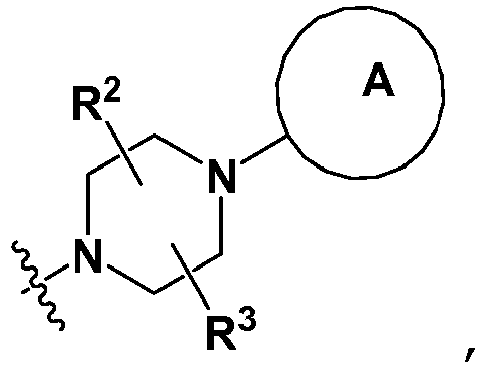
- A pharmaceutical composition for use in prevention or treatment of a disease caused by PARP-1, tankyrase-1 or tankyrase-2 activity, the composition containing, as an active ingredient, the tricyclic derivative compound, the optical isomer thereof, the racemate thereof or the pharmaceutically acceptable salt according to any one of claims 1 to 7, wherein the disease is one or more selected from the group consisting of neurodegenerative disease, cardiovascular disease, diabetic neuropathy, osteoarthritis, osteoporosis, and cancer.
- The pharmaceutical composition for use of claim 11, wherein the neurodegenerative disease is one or more selected from the group consisting of neuropathic pain, epilepsy, stroke, Alzheimer's disease, Parkinson's disease, amyotrophic lateral sclerosis (ALS), Huntington's disease, schizophrenia, chronic or acute pain, ischemic brain injury, neuronal loss after hypoxia, trauma, and nerve damage.
- The pharmaceutical composition for use of claim 11, wherein the cardiovascular disease is one or more selected from the group consisting of atherosclerosis, hyperlipidemia, cardiovascular tissue damage, coronary artery disease, myocardial infarction, angina pectoris, and cardiac shock.
- Use of the tricyclic derivative compound, the optical isomer thereof, the racemate thereof or the pharmaceutically acceptable salt thereof according to any one of claims 1 to 7 in preparation of a medicament for preventing or treating diseases caused by PARP-1, tankyrase-1 or tankyrase-2 activity, wherein the disease is one or more selected from the group consisting of neurodegenerative disease, cardiovascular disease, diabetic neuropathy, osteoarthritis, osteoporosis, and cancer.
Priority Applications (1)
| Application Number | Priority Date | Filing Date | Title |
|---|---|---|---|
| PL16807741T PL3312177T3 (en) | 2015-06-09 | 2016-06-03 | Tricyclic derivative compound, method for preparing same, and pharmaceutical composition comprising same |
Applications Claiming Priority (2)
| Application Number | Priority Date | Filing Date | Title |
|---|---|---|---|
| KR20150081021 | 2015-06-09 | ||
| PCT/KR2016/005911 WO2016200101A2 (en) | 2015-06-09 | 2016-06-03 | Tricyclic derivative compound, method for preparing same, and pharmaceutical composition comprising same |
Publications (3)
| Publication Number | Publication Date |
|---|---|
| EP3312177A2 EP3312177A2 (en) | 2018-04-25 |
| EP3312177A4 EP3312177A4 (en) | 2018-12-05 |
| EP3312177B1 true EP3312177B1 (en) | 2021-04-14 |
Family
ID=57503424
Family Applications (1)
| Application Number | Title | Priority Date | Filing Date |
|---|---|---|---|
| EP16807741.0A Active EP3312177B1 (en) | 2015-06-09 | 2016-06-03 | Tricyclic derivative compound, method for preparing same, and pharmaceutical composition comprising same |
Country Status (21)
| Country | Link |
|---|---|
| US (1) | US10464919B2 (en) |
| EP (1) | EP3312177B1 (en) |
| JP (2) | JP2018521033A (en) |
| KR (1) | KR101837047B1 (en) |
| CN (1) | CN107849040B (en) |
| AU (1) | AU2016276806B9 (en) |
| BR (1) | BR112017026392B1 (en) |
| CA (1) | CA2990277C (en) |
| CL (1) | CL2017003138A1 (en) |
| DK (1) | DK3312177T3 (en) |
| ES (1) | ES2870203T3 (en) |
| MX (1) | MX375707B (en) |
| MY (1) | MY194590A (en) |
| NZ (1) | NZ738187A (en) |
| PH (1) | PH12017502228B1 (en) |
| PL (1) | PL3312177T3 (en) |
| PT (1) | PT3312177T (en) |
| RU (1) | RU2715413C2 (en) |
| SA (1) | SA517390509B1 (en) |
| WO (1) | WO2016200101A2 (en) |
| ZA (1) | ZA201708663B (en) |
Cited By (1)
| Publication number | Priority date | Publication date | Assignee | Title |
|---|---|---|---|---|
| EP4392425A4 (en) * | 2021-08-27 | 2025-09-03 | Impact Therapeutics Shanghai Inc | Substituted tricyclic compounds as PARP inhibiting agents and use thereof |
Families Citing this family (42)
| Publication number | Priority date | Publication date | Assignee | Title |
|---|---|---|---|---|
| ES2870203T3 (en) * | 2015-06-09 | 2021-10-26 | Onconic Therapeutics Inc | Tricyclic derivative compound, method for preparing it and pharmaceutical composition comprising the same |
| CR20170566A (en) | 2015-06-09 | 2018-03-20 | Bayer Pharma AG | POSITIVE ALLOSTERIC MODULATORS OF THE M2 MUSCARINIC RECEIVER |
| KR101775356B1 (en) | 2015-07-06 | 2017-09-06 | 재단법인 아산사회복지재단 | Method for Determining Susceptibility to Dual Inhibitor against PARP and Tankyrase |
| CN109689654A (en) | 2016-07-11 | 2019-04-26 | 拜耳医药股份有限公司 | 7-Substituted 1-pyridyl-naphthyridine-3-carboxamides and their uses |
| JOP20190045A1 (en) | 2016-09-14 | 2019-03-14 | Bayer Ag | Amide-1-aryl-naphthridine-3-carboxylic acid amide compounds are substituted at position 7 and used. |
| CN108727377A (en) * | 2017-04-14 | 2018-11-02 | 四川大学 | 3- cyano pyrazoles simultaneously [1,5-a] pyrimidine derivatives and its preparation method and application |
| WO2019134985A1 (en) | 2018-01-08 | 2019-07-11 | F. Hoffmann-La Roche Ag | Octahydropyrido[1,2-alpha]pyrazines as magl inhibitors |
| US20220110936A1 (en) * | 2019-02-02 | 2022-04-14 | Shanghai Institute Of Organic Chemistry, Chinese Academy Of Sciences | Pharmaceutical composition for treatment of neurodegenerative diseases or diseases caused by abnormality of rna binding protein and applications thereof |
| WO2020207941A1 (en) * | 2019-04-09 | 2020-10-15 | F. Hoffmann-La Roche Ag | Heterocyclic compounds as inhibitors of monoacylglycerol lipase (magl) |
| HUE071067T2 (en) * | 2019-07-19 | 2025-07-28 | Astrazeneca Ab | Parp1 inhibitors |
| US20220265671A1 (en) * | 2019-07-29 | 2022-08-25 | Jeil Pharmaceutical Co., Ltd. | Method for treating stroke by using tricyclic derivative |
| JP7702934B2 (en) * | 2019-08-14 | 2025-07-04 | メトロ インターナショナル バイオテック,エルエルシー | Compounds and compositions for differential modulation of nicotinamide adenine dinucleotide |
| IL326597A (en) | 2019-10-07 | 2026-04-01 | Contineum Therapeutics Inc | Muscarinic acetylcholine m1 receptor antagonists |
| AU2020372682A1 (en) * | 2019-10-31 | 2022-06-09 | Jd Bioscience Inc. | Tricyclic compound and pharmaceutical use thereof |
| US11752149B2 (en) | 2019-12-02 | 2023-09-12 | Pipeline Therapeutics, Inc. | Muscarinic acetylcholine M1 receptor antagonists |
| US11795158B2 (en) | 2020-06-25 | 2023-10-24 | Astrazeneca Ab | Chemical compounds |
| GB202012969D0 (en) * | 2020-08-19 | 2020-09-30 | Univ Of Oxford | Inhibitor compounds |
| CR20230115A (en) | 2020-09-03 | 2023-04-11 | Hoffmann La Roche | HETEROCYCLIC COMPOUNDS |
| CA3216373A1 (en) | 2021-04-19 | 2022-10-27 | Lynnie TRZOSS | Parp1 inhibitors and uses thereof |
| AU2022261011A1 (en) * | 2021-04-22 | 2023-11-16 | Wigen Biomedicine Technology (shanghai) Co., Ltd. | Parp inhibitor containing piperazine structure, preparation method therefor and pharmaceutical use thereof |
| WO2022222966A1 (en) * | 2021-04-23 | 2022-10-27 | 成都百裕制药股份有限公司 | Selective parp1 inhibitor and application thereof |
| CN115702156A (en) * | 2021-04-23 | 2023-02-14 | 南京明德新药研发有限公司 | Pyridine amides |
| US20240246933A1 (en) * | 2021-05-18 | 2024-07-25 | Onconic Therapeutics Inc. | Crystalline form of tricyclic derivative compound, method for preparing same, and pharmaceutical composition comprising same |
| US20240238283A1 (en) * | 2021-05-18 | 2024-07-18 | Onconic Therapeutics Inc. | Parp inhibitor-resistant cancer therapeutic agent |
| CN117320723A (en) * | 2021-05-18 | 2023-12-29 | 安康尼克治疗有限公司 | Therapeutic agents for cancers resistant to PARP inhibitors |
| TWI820847B (en) * | 2021-08-05 | 2023-11-01 | 大陸商上海樞境生物科技有限公司 | Regulators containing tricyclic derivatives, preparation methods and applications thereof |
| WO2023036285A1 (en) * | 2021-09-09 | 2023-03-16 | 南京奥利墨斯医药科技有限公司 | Heteroaromatic compound and application thereof |
| WO2023046034A1 (en) * | 2021-09-22 | 2023-03-30 | 明慧医药(杭州)有限公司 | Nitrogen-containing heterocyclic compound, preparation method therefor, intermediate thereof, and application thereof |
| CR20240144A (en) | 2021-10-01 | 2024-05-24 | Xinthera Inc | Azetidine and pyrrolidine parp1 inhibitors and uses thereof |
| WO2023061406A1 (en) * | 2021-10-12 | 2023-04-20 | 微境生物医药科技(上海)有限公司 | Parp inhibitor containing fused tri-cyclic structure, and preparation method therefor and medical use thereof |
| CA3241875A1 (en) * | 2021-12-22 | 2023-06-29 | Synnovation Therapeutics, Inc. | Parp1 inhibitors |
| WO2023134647A1 (en) * | 2022-01-13 | 2023-07-20 | 优领医药科技(香港)有限公司 | Piperazino ring-containing derivative, pharmaceutically acceptable salt thereof, preparation method therefor, and application thereof |
| AU2023209820B2 (en) | 2022-01-21 | 2024-10-10 | Xinthera, Inc. | Parp1 inhibitors and uses thereof |
| IL315586A (en) * | 2022-03-11 | 2024-11-01 | Impact Therapeutics Shanghai Inc | Modified tricyclic compounds and their use as poly(ADP-ribose) polymerase inhibitors |
| KR20240161147A (en) | 2022-03-14 | 2024-11-12 | 슬랩 파마슈티컬스 엘엘씨 | multicyclic compounds |
| CA3250945A1 (en) | 2022-04-28 | 2023-11-02 | Xinthera, Inc. | Tricyclic parp1 inhibitors and uses thereof |
| JP7835895B2 (en) * | 2022-05-07 | 2026-03-25 | サイブランチ セラピューティクス カンパニー リミテッド | Fluoroquinoxalinone derivatives that selectively inhibit PARP1 |
| CN115232129B (en) * | 2022-08-18 | 2023-12-01 | 上海闻耐医药科技有限公司 | PARP1 selective inhibitor and preparation method and application thereof |
| CN119677736A (en) * | 2022-08-24 | 2025-03-21 | 四川海思科制药有限公司 | A pharmaceutically acceptable salt of a heteroaryl derivative PARP inhibitor and its use |
| WO2024041608A1 (en) * | 2022-08-24 | 2024-02-29 | 四川海思科制药有限公司 | Crystal form of heteroaryl derivative parp inhibitor and use thereof |
| JP2025538192A (en) * | 2022-11-10 | 2025-11-26 | 上海海和薬物研究開発股▲ふん▼有限公司 | Fused tricyclic PARP1 inhibitors, methods for their preparation, and uses |
| CN120677162A (en) * | 2023-06-13 | 2025-09-19 | 中国医药研究开发中心有限公司 | Nitrogen-containing heterocyclic compound and medical application thereof |
Family Cites Families (10)
| Publication number | Priority date | Publication date | Assignee | Title |
|---|---|---|---|---|
| US5391554A (en) * | 1992-09-09 | 1995-02-21 | Warner-Lambert Company | Dihydro- and tetrahydronaphthyridines |
| AUPS137402A0 (en) * | 2002-03-26 | 2002-05-09 | Fujisawa Pharmaceutical Co., Ltd. | Novel tricyclic compounds |
| DE102004028973A1 (en) * | 2004-06-16 | 2006-01-05 | Sanofi-Aventis Deutschland Gmbh | Substituted tetrahydro-2H-isoquinolin-1-one derivatives, process for their preparation and their use as medicaments |
| US7956064B2 (en) * | 2006-09-01 | 2011-06-07 | Cylene Pharmaceuticals, Inc. | Fused tricyclic compounds as serine-threonine protein kinase and PARP modulators |
| PL2215075T3 (en) | 2007-10-26 | 2014-04-30 | Janssen Pharmaceutica Nv | Quinolinone derivatives as parp inhibitors |
| KR101179753B1 (en) * | 2007-11-06 | 2012-09-04 | 제일약품주식회사 | Novel tricyclic derivatives or pharmaceutically acceptable salts thereof, process for the preparation thereof and pharmaceutical composition comprising the same |
| EP2364983B1 (en) * | 2008-11-11 | 2013-10-23 | Jeil Pharmaceutical Co., Ltd. | Novel tricyclic derivative or pharmaceutically acceptable salts thereof, preparation method thereof, and pharmaceutical composition containing the same |
| KR101827444B1 (en) | 2012-02-01 | 2018-02-08 | 제일약품주식회사 | Crystalline acid-added salt of tircyclo derivatives compound or hydrate thereof and preparation thereof |
| ES2870203T3 (en) * | 2015-06-09 | 2021-10-26 | Onconic Therapeutics Inc | Tricyclic derivative compound, method for preparing it and pharmaceutical composition comprising the same |
| KR101775356B1 (en) * | 2015-07-06 | 2017-09-06 | 재단법인 아산사회복지재단 | Method for Determining Susceptibility to Dual Inhibitor against PARP and Tankyrase |
-
2016
- 2016-06-03 ES ES16807741T patent/ES2870203T3/en active Active
- 2016-06-03 AU AU2016276806A patent/AU2016276806B9/en active Active
- 2016-06-03 JP JP2017564557A patent/JP2018521033A/en not_active Ceased
- 2016-06-03 NZ NZ738187A patent/NZ738187A/en unknown
- 2016-06-03 PL PL16807741T patent/PL3312177T3/en unknown
- 2016-06-03 KR KR1020160069199A patent/KR101837047B1/en active Active
- 2016-06-03 PH PH1/2017/502228A patent/PH12017502228B1/en unknown
- 2016-06-03 WO PCT/KR2016/005911 patent/WO2016200101A2/en not_active Ceased
- 2016-06-03 MY MYPI2017704653A patent/MY194590A/en unknown
- 2016-06-03 MX MX2017016013A patent/MX375707B/en active IP Right Grant
- 2016-06-03 RU RU2017146130A patent/RU2715413C2/en active
- 2016-06-03 DK DK16807741.0T patent/DK3312177T3/en active
- 2016-06-03 EP EP16807741.0A patent/EP3312177B1/en active Active
- 2016-06-03 CN CN201680040992.8A patent/CN107849040B/en active Active
- 2016-06-03 US US15/579,692 patent/US10464919B2/en active Active
- 2016-06-03 BR BR112017026392-0A patent/BR112017026392B1/en active IP Right Grant
- 2016-06-03 CA CA2990277A patent/CA2990277C/en active Active
- 2016-06-03 PT PT168077410T patent/PT3312177T/en unknown
-
2017
- 2017-12-07 CL CL2017003138A patent/CL2017003138A1/en unknown
- 2017-12-07 SA SA517390509A patent/SA517390509B1/en unknown
- 2017-12-19 ZA ZA2017/08663A patent/ZA201708663B/en unknown
-
2019
- 2019-05-09 JP JP2019088851A patent/JP6806969B2/en active Active
Non-Patent Citations (1)
| Title |
|---|
| None * |
Cited By (1)
| Publication number | Priority date | Publication date | Assignee | Title |
|---|---|---|---|---|
| EP4392425A4 (en) * | 2021-08-27 | 2025-09-03 | Impact Therapeutics Shanghai Inc | Substituted tricyclic compounds as PARP inhibiting agents and use thereof |
Also Published As
Similar Documents
| Publication | Publication Date | Title |
|---|---|---|
| US10464919B2 (en) | Tricyclic derivative compound, method for preparing same, and pharmaceutical composition comprising same | |
| JP5699223B2 (en) | Heterocyclic derivatives, their synthesis and medical applications | |
| EP3131897B1 (en) | Factor ixa inhibitors | |
| KR100716525B1 (en) | Novel heterocyclic compounds and salts thereof and their pharmaceutical uses | |
| CA3019980A1 (en) | Novel compounds as autotaxin inhibitors and pharmaceutical compositions comprising the same | |
| JP2011526295A (en) | 5- and 6-membered heterocyclic compounds | |
| EP3131896B1 (en) | Factor ixa inhibitors | |
| JP2023524821A (en) | Iminosulfanone inhibitors of ENPP1 | |
| JP2012514044A (en) | Heteroaryl compounds useful as Raf kinase inhibitors | |
| JP4974439B2 (en) | 6-Heterocyclylmethylquinolinone derivatives that inhibit farnesyltransferase | |
| TW201925173A (en) | Halo-allylamine ssao/vap-1 inhibitor and use thereof | |
| JP7561285B2 (en) | Heterocyclic substituted fused gamma-carboline derivatives, their preparation, intermediates and use | |
| TW202122382A (en) | Hydantoin derivative | |
| JP2022517085A (en) | Halogenated allylamine compounds and their applications | |
| EP4232431B1 (en) | Compounds and compositions for treating conditions associated with lpa receptor activity | |
| EP3960736A1 (en) | Heterocyclic compound, application thereof, and composition containing same | |
| JP7736712B2 (en) | NAMPT modulators | |
| CN103848814B (en) | The full ketone derivatives of substituted indole as tyrosine kinase inhibitor | |
| JP7805768B2 (en) | 2-heteroarylaminoquinazolinone derivatives | |
| JPWO1998042680A1 (en) | Novel anilide compound and medicine containing the same | |
| TW202330528A (en) | Heterocyclic-substituted fused [gamma]-carboline derivative, preparation method thereof, intermediate and application thereof being used for preparing drugs for treating neuropsychiatric diseases | |
| EP4036086A1 (en) | Heterocyclic derivative and use thereof | |
| HK1197679A (en) | Poly (adp-ribose) polymerase inhibitor |
Legal Events
| Date | Code | Title | Description |
|---|---|---|---|
| STAA | Information on the status of an ep patent application or granted ep patent |
Free format text: STATUS: THE INTERNATIONAL PUBLICATION HAS BEEN MADE |
|
| PUAI | Public reference made under article 153(3) epc to a published international application that has entered the european phase |
Free format text: ORIGINAL CODE: 0009012 |
|
| STAA | Information on the status of an ep patent application or granted ep patent |
Free format text: STATUS: REQUEST FOR EXAMINATION WAS MADE |
|
| 17P | Request for examination filed |
Effective date: 20171228 |
|
| AK | Designated contracting states |
Kind code of ref document: A2 Designated state(s): AL AT BE BG CH CY CZ DE DK EE ES FI FR GB GR HR HU IE IS IT LI LT LU LV MC MK MT NL NO PL PT RO RS SE SI SK SM TR |
|
| AX | Request for extension of the european patent |
Extension state: BA ME |
|
| A4 | Supplementary search report drawn up and despatched |
Effective date: 20181030 |
|
| RIC1 | Information provided on ipc code assigned before grant |
Ipc: A61K 31/497 20060101ALI20181024BHEP Ipc: C07D 471/04 20060101AFI20181024BHEP Ipc: A61K 31/4375 20060101ALI20181024BHEP Ipc: C07D 401/06 20060101ALI20181024BHEP |
|
| STAA | Information on the status of an ep patent application or granted ep patent |
Free format text: STATUS: EXAMINATION IS IN PROGRESS |
|
| 17Q | First examination report despatched |
Effective date: 20191122 |
|
| GRAP | Despatch of communication of intention to grant a patent |
Free format text: ORIGINAL CODE: EPIDOSNIGR1 |
|
| STAA | Information on the status of an ep patent application or granted ep patent |
Free format text: STATUS: GRANT OF PATENT IS INTENDED |
|
| INTG | Intention to grant announced |
Effective date: 20200804 |
|
| GRAJ | Information related to disapproval of communication of intention to grant by the applicant or resumption of examination proceedings by the epo deleted |
Free format text: ORIGINAL CODE: EPIDOSDIGR1 |
|
| STAA | Information on the status of an ep patent application or granted ep patent |
Free format text: STATUS: EXAMINATION IS IN PROGRESS |
|
| RAP1 | Party data changed (applicant data changed or rights of an application transferred) |
Owner name: ONCONIC THERAPEUTICS INC. |
|
| INTC | Intention to grant announced (deleted) | ||
| GRAS | Grant fee paid |
Free format text: ORIGINAL CODE: EPIDOSNIGR3 |
|
| STAA | Information on the status of an ep patent application or granted ep patent |
Free format text: STATUS: GRANT OF PATENT IS INTENDED |
|
| GRAP | Despatch of communication of intention to grant a patent |
Free format text: ORIGINAL CODE: EPIDOSNIGR1 |
|
| INTG | Intention to grant announced |
Effective date: 20210205 |
|
| GRAA | (expected) grant |
Free format text: ORIGINAL CODE: 0009210 |
|
| STAA | Information on the status of an ep patent application or granted ep patent |
Free format text: STATUS: THE PATENT HAS BEEN GRANTED |
|
| AK | Designated contracting states |
Kind code of ref document: B1 Designated state(s): AL AT BE BG CH CY CZ DE DK EE ES FI FR GB GR HR HU IE IS IT LI LT LU LV MC MK MT NL NO PL PT RO RS SE SI SK SM TR |
|
| AX | Request for extension of the european patent |
Extension state: BA ME |
|
| REG | Reference to a national code |
Ref country code: GB Ref legal event code: FG4D |
|
| REG | Reference to a national code |
Ref country code: CH Ref legal event code: EP Ref country code: CH Ref legal event code: NV Representative=s name: AMMANN PATENTANWAELTE AG BERN, CH |
|
| REG | Reference to a national code |
Ref country code: DE Ref legal event code: R096 Ref document number: 602016056166 Country of ref document: DE |
|
| REG | Reference to a national code |
Ref country code: IE Ref legal event code: FG4D Ref country code: NL Ref legal event code: FP |
|
| REG | Reference to a national code |
Ref country code: AT Ref legal event code: REF Ref document number: 1382291 Country of ref document: AT Kind code of ref document: T Effective date: 20210515 |
|
| REG | Reference to a national code |
Ref country code: PT Ref legal event code: SC4A Ref document number: 3312177 Country of ref document: PT Date of ref document: 20210517 Kind code of ref document: T Free format text: AVAILABILITY OF NATIONAL TRANSLATION Effective date: 20210511 |
|
| REG | Reference to a national code |
Ref country code: DK Ref legal event code: T3 Effective date: 20210701 |
|
| REG | Reference to a national code |
Ref country code: SE Ref legal event code: TRGR |
|
| REG | Reference to a national code |
Ref country code: LT Ref legal event code: MG9D |
|
| REG | Reference to a national code |
Ref country code: ES Ref legal event code: FG2A Ref document number: 2870203 Country of ref document: ES Kind code of ref document: T3 Effective date: 20211026 |
|
| PG25 | Lapsed in a contracting state [announced via postgrant information from national office to epo] |
Ref country code: LT Free format text: LAPSE BECAUSE OF FAILURE TO SUBMIT A TRANSLATION OF THE DESCRIPTION OR TO PAY THE FEE WITHIN THE PRESCRIBED TIME-LIMIT Effective date: 20210414 Ref country code: FI Free format text: LAPSE BECAUSE OF FAILURE TO SUBMIT A TRANSLATION OF THE DESCRIPTION OR TO PAY THE FEE WITHIN THE PRESCRIBED TIME-LIMIT Effective date: 20210414 Ref country code: BG Free format text: LAPSE BECAUSE OF FAILURE TO SUBMIT A TRANSLATION OF THE DESCRIPTION OR TO PAY THE FEE WITHIN THE PRESCRIBED TIME-LIMIT Effective date: 20210714 Ref country code: HR Free format text: LAPSE BECAUSE OF FAILURE TO SUBMIT A TRANSLATION OF THE DESCRIPTION OR TO PAY THE FEE WITHIN THE PRESCRIBED TIME-LIMIT Effective date: 20210414 |
|
| PG25 | Lapsed in a contracting state [announced via postgrant information from national office to epo] |
Ref country code: LV Free format text: LAPSE BECAUSE OF FAILURE TO SUBMIT A TRANSLATION OF THE DESCRIPTION OR TO PAY THE FEE WITHIN THE PRESCRIBED TIME-LIMIT Effective date: 20210414 Ref country code: IS Free format text: LAPSE BECAUSE OF FAILURE TO SUBMIT A TRANSLATION OF THE DESCRIPTION OR TO PAY THE FEE WITHIN THE PRESCRIBED TIME-LIMIT Effective date: 20210814 Ref country code: GR Free format text: LAPSE BECAUSE OF FAILURE TO SUBMIT A TRANSLATION OF THE DESCRIPTION OR TO PAY THE FEE WITHIN THE PRESCRIBED TIME-LIMIT Effective date: 20210715 Ref country code: NO Free format text: LAPSE BECAUSE OF FAILURE TO SUBMIT A TRANSLATION OF THE DESCRIPTION OR TO PAY THE FEE WITHIN THE PRESCRIBED TIME-LIMIT Effective date: 20210714 Ref country code: RS Free format text: LAPSE BECAUSE OF FAILURE TO SUBMIT A TRANSLATION OF THE DESCRIPTION OR TO PAY THE FEE WITHIN THE PRESCRIBED TIME-LIMIT Effective date: 20210414 |
|
| REG | Reference to a national code |
Ref country code: DE Ref legal event code: R097 Ref document number: 602016056166 Country of ref document: DE |
|
| PG25 | Lapsed in a contracting state [announced via postgrant information from national office to epo] |
Ref country code: SK Free format text: LAPSE BECAUSE OF FAILURE TO SUBMIT A TRANSLATION OF THE DESCRIPTION OR TO PAY THE FEE WITHIN THE PRESCRIBED TIME-LIMIT Effective date: 20210414 Ref country code: SM Free format text: LAPSE BECAUSE OF FAILURE TO SUBMIT A TRANSLATION OF THE DESCRIPTION OR TO PAY THE FEE WITHIN THE PRESCRIBED TIME-LIMIT Effective date: 20210414 Ref country code: RO Free format text: LAPSE BECAUSE OF FAILURE TO SUBMIT A TRANSLATION OF THE DESCRIPTION OR TO PAY THE FEE WITHIN THE PRESCRIBED TIME-LIMIT Effective date: 20210414 Ref country code: CZ Free format text: LAPSE BECAUSE OF FAILURE TO SUBMIT A TRANSLATION OF THE DESCRIPTION OR TO PAY THE FEE WITHIN THE PRESCRIBED TIME-LIMIT Effective date: 20210414 Ref country code: EE Free format text: LAPSE BECAUSE OF FAILURE TO SUBMIT A TRANSLATION OF THE DESCRIPTION OR TO PAY THE FEE WITHIN THE PRESCRIBED TIME-LIMIT Effective date: 20210414 Ref country code: MC Free format text: LAPSE BECAUSE OF FAILURE TO SUBMIT A TRANSLATION OF THE DESCRIPTION OR TO PAY THE FEE WITHIN THE PRESCRIBED TIME-LIMIT Effective date: 20210414 |
|
| PLBE | No opposition filed within time limit |
Free format text: ORIGINAL CODE: 0009261 |
|
| STAA | Information on the status of an ep patent application or granted ep patent |
Free format text: STATUS: NO OPPOSITION FILED WITHIN TIME LIMIT |
|
| VS25 | Lapsed in a validation state [announced via postgrant information from nat. office to epo] |
Ref country code: MD Free format text: LAPSE BECAUSE OF FAILURE TO SUBMIT A TRANSLATION OF THE DESCRIPTION OR TO PAY THE FEE WITHIN THE PRESCRIBED TIME-LIMIT Effective date: 20210414 |
|
| REG | Reference to a national code |
Ref country code: BE Ref legal event code: MM Effective date: 20210630 |
|
| 26N | No opposition filed |
Effective date: 20220117 |
|
| PG25 | Lapsed in a contracting state [announced via postgrant information from national office to epo] |
Ref country code: LU Free format text: LAPSE BECAUSE OF NON-PAYMENT OF DUE FEES Effective date: 20210603 |
|
| PG25 | Lapsed in a contracting state [announced via postgrant information from national office to epo] |
Ref country code: IE Free format text: LAPSE BECAUSE OF NON-PAYMENT OF DUE FEES Effective date: 20210603 |
|
| PG25 | Lapsed in a contracting state [announced via postgrant information from national office to epo] |
Ref country code: IS Free format text: LAPSE BECAUSE OF FAILURE TO SUBMIT A TRANSLATION OF THE DESCRIPTION OR TO PAY THE FEE WITHIN THE PRESCRIBED TIME-LIMIT Effective date: 20210814 Ref country code: AL Free format text: LAPSE BECAUSE OF FAILURE TO SUBMIT A TRANSLATION OF THE DESCRIPTION OR TO PAY THE FEE WITHIN THE PRESCRIBED TIME-LIMIT Effective date: 20210414 |
|
| PG25 | Lapsed in a contracting state [announced via postgrant information from national office to epo] |
Ref country code: BE Free format text: LAPSE BECAUSE OF NON-PAYMENT OF DUE FEES Effective date: 20210630 |
|
| REG | Reference to a national code |
Ref country code: AT Ref legal event code: UEP Ref document number: 1382291 Country of ref document: AT Kind code of ref document: T Effective date: 20210414 |
|
| P01 | Opt-out of the competence of the unified patent court (upc) registered |
Effective date: 20230518 |
|
| PG25 | Lapsed in a contracting state [announced via postgrant information from national office to epo] |
Ref country code: CY Free format text: LAPSE BECAUSE OF FAILURE TO SUBMIT A TRANSLATION OF THE DESCRIPTION OR TO PAY THE FEE WITHIN THE PRESCRIBED TIME-LIMIT Effective date: 20210414 |
|
| PG25 | Lapsed in a contracting state [announced via postgrant information from national office to epo] |
Ref country code: HU Free format text: LAPSE BECAUSE OF FAILURE TO SUBMIT A TRANSLATION OF THE DESCRIPTION OR TO PAY THE FEE WITHIN THE PRESCRIBED TIME-LIMIT; INVALID AB INITIO Effective date: 20160603 |
|
| PG25 | Lapsed in a contracting state [announced via postgrant information from national office to epo] |
Ref country code: MK Free format text: LAPSE BECAUSE OF FAILURE TO SUBMIT A TRANSLATION OF THE DESCRIPTION OR TO PAY THE FEE WITHIN THE PRESCRIBED TIME-LIMIT Effective date: 20210414 |
|
| VS25 | Lapsed in a validation state [announced via postgrant information from nat. office to epo] |
Ref country code: MA Free format text: LAPSE BECAUSE OF FAILURE TO SUBMIT A TRANSLATION OF THE DESCRIPTION OR TO PAY THE FEE WITHIN THE PRESCRIBED TIME-LIMIT Effective date: 20210414 |
|
| PG25 | Lapsed in a contracting state [announced via postgrant information from national office to epo] |
Ref country code: MT Free format text: LAPSE BECAUSE OF FAILURE TO SUBMIT A TRANSLATION OF THE DESCRIPTION OR TO PAY THE FEE WITHIN THE PRESCRIBED TIME-LIMIT Effective date: 20210414 |
|
| PGFP | Annual fee paid to national office [announced via postgrant information from national office to epo] |
Ref country code: PL Payment date: 20250521 Year of fee payment: 10 Ref country code: DE Payment date: 20250618 Year of fee payment: 10 |
|
| PGFP | Annual fee paid to national office [announced via postgrant information from national office to epo] |
Ref country code: GB Payment date: 20250618 Year of fee payment: 10 Ref country code: DK Payment date: 20250619 Year of fee payment: 10 |
|
| PGFP | Annual fee paid to national office [announced via postgrant information from national office to epo] |
Ref country code: NL Payment date: 20250624 Year of fee payment: 10 |
|
| PGFP | Annual fee paid to national office [announced via postgrant information from national office to epo] |
Ref country code: PT Payment date: 20250515 Year of fee payment: 10 |
|
| PGFP | Annual fee paid to national office [announced via postgrant information from national office to epo] |
Ref country code: FR Payment date: 20250618 Year of fee payment: 10 |
|
| PGFP | Annual fee paid to national office [announced via postgrant information from national office to epo] |
Ref country code: AT Payment date: 20250624 Year of fee payment: 10 |
|
| PGFP | Annual fee paid to national office [announced via postgrant information from national office to epo] |
Ref country code: TR Payment date: 20250515 Year of fee payment: 10 |
|
| PGFP | Annual fee paid to national office [announced via postgrant information from national office to epo] |
Ref country code: SE Payment date: 20250624 Year of fee payment: 10 |
|
| PGFP | Annual fee paid to national office [announced via postgrant information from national office to epo] |
Ref country code: ES Payment date: 20250710 Year of fee payment: 10 |
|
| PGFP | Annual fee paid to national office [announced via postgrant information from national office to epo] |
Ref country code: IT Payment date: 20250623 Year of fee payment: 10 |
|
| PGFP | Annual fee paid to national office [announced via postgrant information from national office to epo] |
Ref country code: CH Payment date: 20250701 Year of fee payment: 10 |