EP3310765B1 - Process for preparing 1,4-dibenzodiazepines via buchwald-hartwig chemistry - Google Patents
Process for preparing 1,4-dibenzodiazepines via buchwald-hartwig chemistry Download PDFInfo
- Publication number
- EP3310765B1 EP3310765B1 EP16742398.7A EP16742398A EP3310765B1 EP 3310765 B1 EP3310765 B1 EP 3310765B1 EP 16742398 A EP16742398 A EP 16742398A EP 3310765 B1 EP3310765 B1 EP 3310765B1
- Authority
- EP
- European Patent Office
- Prior art keywords
- previous
- process according
- arh
- group
- ligand
- Prior art date
- Legal status (The legal status is an assumption and is not a legal conclusion. Google has not performed a legal analysis and makes no representation as to the accuracy of the status listed.)
- Not-in-force
Links
- 238000006443 Buchwald-Hartwig cross coupling reaction Methods 0.000 title description 5
- 238000004519 manufacturing process Methods 0.000 title 1
- 238000000034 method Methods 0.000 claims description 34
- KDLHZDBZIXYQEI-UHFFFAOYSA-N Palladium Chemical compound [Pd] KDLHZDBZIXYQEI-UHFFFAOYSA-N 0.000 claims description 20
- 238000006243 chemical reaction Methods 0.000 claims description 18
- 230000008569 process Effects 0.000 claims description 16
- 239000003446 ligand Substances 0.000 claims description 13
- 239000003054 catalyst Substances 0.000 claims description 11
- RTZKZFJDLAIYFH-UHFFFAOYSA-N Diethyl ether Chemical compound CCOCC RTZKZFJDLAIYFH-UHFFFAOYSA-N 0.000 claims description 10
- 239000000758 substrate Substances 0.000 claims description 10
- WEVYAHXRMPXWCK-UHFFFAOYSA-N Acetonitrile Chemical compound CC#N WEVYAHXRMPXWCK-UHFFFAOYSA-N 0.000 claims description 9
- YXFVVABEGXRONW-UHFFFAOYSA-N Toluene Chemical compound CC1=CC=CC=C1 YXFVVABEGXRONW-UHFFFAOYSA-N 0.000 claims description 9
- 229910052763 palladium Inorganic materials 0.000 claims description 9
- GQHTUMJGOHRCHB-UHFFFAOYSA-N 2,3,4,6,7,8,9,10-octahydropyrimido[1,2-a]azepine Chemical compound C1CCCCN2CCCN=C21 GQHTUMJGOHRCHB-UHFFFAOYSA-N 0.000 claims description 8
- SECXISVLQFMRJM-UHFFFAOYSA-N N-Methylpyrrolidone Chemical compound CN1CCCC1=O SECXISVLQFMRJM-UHFFFAOYSA-N 0.000 claims description 8
- 230000003197 catalytic effect Effects 0.000 claims description 7
- HEDRZPFGACZZDS-UHFFFAOYSA-N Chloroform Chemical compound ClC(Cl)Cl HEDRZPFGACZZDS-UHFFFAOYSA-N 0.000 claims description 6
- LCGLNKUTAGEVQW-UHFFFAOYSA-N Dimethyl ether Chemical compound COC LCGLNKUTAGEVQW-UHFFFAOYSA-N 0.000 claims description 6
- ZMXDDKWLCZADIW-UHFFFAOYSA-N N,N-Dimethylformamide Chemical compound CN(C)C=O ZMXDDKWLCZADIW-UHFFFAOYSA-N 0.000 claims description 6
- ZMANZCXQSJIPKH-UHFFFAOYSA-N Triethylamine Chemical compound CCN(CC)CC ZMANZCXQSJIPKH-UHFFFAOYSA-N 0.000 claims description 6
- 125000000217 alkyl group Chemical group 0.000 claims description 6
- 125000003118 aryl group Chemical group 0.000 claims description 6
- 239000012298 atmosphere Substances 0.000 claims description 6
- FJDQFPXHSGXQBY-UHFFFAOYSA-L caesium carbonate Chemical compound [Cs+].[Cs+].[O-]C([O-])=O FJDQFPXHSGXQBY-UHFFFAOYSA-L 0.000 claims description 6
- 238000011068 loading method Methods 0.000 claims description 5
- 125000003903 2-propenyl group Chemical group [H]C([*])([H])C([H])=C([H])[H] 0.000 claims description 4
- VTYYLEPIZMXCLO-UHFFFAOYSA-L Calcium carbonate Chemical compound [Ca+2].[O-]C([O-])=O VTYYLEPIZMXCLO-UHFFFAOYSA-L 0.000 claims description 4
- SJRJJKPEHAURKC-UHFFFAOYSA-N N-Methylmorpholine Chemical compound CN1CCOCC1 SJRJJKPEHAURKC-UHFFFAOYSA-N 0.000 claims description 4
- XYFCBTPGUUZFHI-UHFFFAOYSA-N Phosphine Chemical compound P XYFCBTPGUUZFHI-UHFFFAOYSA-N 0.000 claims description 4
- KWYUFKZDYYNOTN-UHFFFAOYSA-M Potassium hydroxide Chemical compound [OH-].[K+] KWYUFKZDYYNOTN-UHFFFAOYSA-M 0.000 claims description 4
- CDBYLPFSWZWCQE-UHFFFAOYSA-L Sodium Carbonate Chemical compound [Na+].[Na+].[O-]C([O-])=O CDBYLPFSWZWCQE-UHFFFAOYSA-L 0.000 claims description 4
- LXNAVEXFUKBNMK-UHFFFAOYSA-N acetic acid;palladium Chemical compound [Pd].CC(O)=O.CC(O)=O LXNAVEXFUKBNMK-UHFFFAOYSA-N 0.000 claims description 4
- 239000001257 hydrogen Substances 0.000 claims description 4
- 229910052739 hydrogen Inorganic materials 0.000 claims description 4
- 150000002431 hydrogen Chemical class 0.000 claims description 4
- BWHMMNNQKKPAPP-UHFFFAOYSA-L potassium carbonate Chemical compound [K+].[K+].[O-]C([O-])=O BWHMMNNQKKPAPP-UHFFFAOYSA-L 0.000 claims description 4
- 239000002904 solvent Substances 0.000 claims description 4
- 125000002827 triflate group Chemical group FC(S(=O)(=O)O*)(F)F 0.000 claims description 4
- 125000000391 vinyl group Chemical group [H]C([*])=C([H])[H] 0.000 claims description 4
- 229920002554 vinyl polymer Polymers 0.000 claims description 4
- KZPYGQFFRCFCPP-UHFFFAOYSA-N 1,1'-bis(diphenylphosphino)ferrocene Chemical compound [Fe+2].C1=CC=C[C-]1P(C=1C=CC=CC=1)C1=CC=CC=C1.C1=CC=C[C-]1P(C=1C=CC=CC=1)C1=CC=CC=C1 KZPYGQFFRCFCPP-UHFFFAOYSA-N 0.000 claims description 3
- RYHBNJHYFVUHQT-UHFFFAOYSA-N 1,4-Dioxane Chemical compound C1COCCO1 RYHBNJHYFVUHQT-UHFFFAOYSA-N 0.000 claims description 3
- 102100032373 Coiled-coil domain-containing protein 85B Human genes 0.000 claims description 3
- 101000868814 Homo sapiens Coiled-coil domain-containing protein 85B Proteins 0.000 claims description 3
- FXHOOIRPVKKKFG-UHFFFAOYSA-N N,N-Dimethylacetamide Chemical compound CN(C)C(C)=O FXHOOIRPVKKKFG-UHFFFAOYSA-N 0.000 claims description 3
- NFHFRUOZVGFOOS-UHFFFAOYSA-N Pd(PPh3)4 Substances [Pd].C1=CC=CC=C1P(C=1C=CC=CC=1)C1=CC=CC=C1.C1=CC=CC=C1P(C=1C=CC=CC=1)C1=CC=CC=C1.C1=CC=CC=C1P(C=1C=CC=CC=1)C1=CC=CC=C1.C1=CC=CC=C1P(C=1C=CC=CC=1)C1=CC=CC=C1 NFHFRUOZVGFOOS-UHFFFAOYSA-N 0.000 claims description 3
- 229910002666 PdCl2 Inorganic materials 0.000 claims description 3
- 150000001299 aldehydes Chemical class 0.000 claims description 3
- 229910000024 caesium carbonate Inorganic materials 0.000 claims description 3
- -1 cationic palladium (II) complexes Chemical class 0.000 claims description 3
- 239000007810 chemical reaction solvent Substances 0.000 claims description 3
- LVTYICIALWPMFW-UHFFFAOYSA-N diisopropanolamine Chemical compound CC(O)CNCC(C)O LVTYICIALWPMFW-UHFFFAOYSA-N 0.000 claims description 3
- 238000011065 in-situ storage Methods 0.000 claims description 3
- 125000001449 isopropyl group Chemical group [H]C([H])([H])C([H])(*)C([H])([H])[H] 0.000 claims description 3
- 150000002576 ketones Chemical class 0.000 claims description 3
- 239000000203 mixture Substances 0.000 claims description 3
- PIBWKRNGBLPSSY-UHFFFAOYSA-L palladium(II) chloride Chemical compound Cl[Pd]Cl PIBWKRNGBLPSSY-UHFFFAOYSA-L 0.000 claims description 3
- KXDHJXZQYSOELW-UHFFFAOYSA-M Carbamate Chemical compound NC([O-])=O KXDHJXZQYSOELW-UHFFFAOYSA-M 0.000 claims description 2
- RQPZNWPYLFFXCP-UHFFFAOYSA-L barium dihydroxide Chemical compound [OH-].[OH-].[Ba+2] RQPZNWPYLFFXCP-UHFFFAOYSA-L 0.000 claims description 2
- 229910052794 bromium Inorganic materials 0.000 claims description 2
- 229910000019 calcium carbonate Inorganic materials 0.000 claims description 2
- 150000001732 carboxylic acid derivatives Chemical class 0.000 claims description 2
- 229910052801 chlorine Inorganic materials 0.000 claims description 2
- LNAMMBFJMYMQTO-FNEBRGMMSA-N chloroform;(1e,4e)-1,5-diphenylpenta-1,4-dien-3-one;palladium Chemical compound [Pd].[Pd].ClC(Cl)Cl.C=1C=CC=CC=1\C=C\C(=O)\C=C\C1=CC=CC=C1.C=1C=CC=CC=1\C=C\C(=O)\C=C\C1=CC=CC=C1.C=1C=CC=CC=1\C=C\C(=O)\C=C\C1=CC=CC=C1 LNAMMBFJMYMQTO-FNEBRGMMSA-N 0.000 claims description 2
- 125000004093 cyano group Chemical group *C#N 0.000 claims description 2
- 125000000753 cycloalkyl group Chemical group 0.000 claims description 2
- 150000002148 esters Chemical class 0.000 claims description 2
- 229910052736 halogen Inorganic materials 0.000 claims description 2
- 150000002367 halogens Chemical group 0.000 claims description 2
- 229910052740 iodine Inorganic materials 0.000 claims description 2
- 125000000449 nitro group Chemical group [O-][N+](*)=O 0.000 claims description 2
- SCVFZCLFOSHCOH-UHFFFAOYSA-M potassium acetate Chemical compound [K+].CC([O-])=O SCVFZCLFOSHCOH-UHFFFAOYSA-M 0.000 claims description 2
- 229910000027 potassium carbonate Inorganic materials 0.000 claims description 2
- 239000011698 potassium fluoride Substances 0.000 claims description 2
- LPNYRYFBWFDTMA-UHFFFAOYSA-N potassium tert-butoxide Chemical compound [K+].CC(C)(C)[O-] LPNYRYFBWFDTMA-UHFFFAOYSA-N 0.000 claims description 2
- 125000002924 primary amino group Chemical group [H]N([H])* 0.000 claims description 2
- 229910000029 sodium carbonate Inorganic materials 0.000 claims description 2
- 238000003756 stirring Methods 0.000 claims description 2
- 150000007970 thio esters Chemical class 0.000 claims description 2
- LWIHDJKSTIGBAC-UHFFFAOYSA-K tripotassium phosphate Chemical compound [K+].[K+].[K+].[O-]P([O-])([O-])=O LWIHDJKSTIGBAC-UHFFFAOYSA-K 0.000 claims description 2
- 229910000404 tripotassium phosphate Inorganic materials 0.000 claims description 2
- 238000005580 one pot reaction Methods 0.000 claims 1
- HEDRZPFGACZZDS-MICDWDOJSA-N Trichloro(2H)methane Chemical compound [2H]C(Cl)(Cl)Cl HEDRZPFGACZZDS-MICDWDOJSA-N 0.000 description 42
- 150000001875 compounds Chemical class 0.000 description 17
- 238000005160 1H NMR spectroscopy Methods 0.000 description 11
- 238000001644 13C nuclear magnetic resonance spectroscopy Methods 0.000 description 10
- 239000007787 solid Substances 0.000 description 9
- QGZKDVFQNNGYKY-UHFFFAOYSA-N Ammonia Chemical compound N QGZKDVFQNNGYKY-UHFFFAOYSA-N 0.000 description 8
- YMWUJEATGCHHMB-UHFFFAOYSA-N Dichloromethane Chemical compound ClCCl YMWUJEATGCHHMB-UHFFFAOYSA-N 0.000 description 6
- ZOQMKQLCDUUNRY-UHFFFAOYSA-N n-[(2-bromophenyl)methylidene]-4-methylbenzenesulfonamide Chemical compound C1=CC(C)=CC=C1S(=O)(=O)N=CC1=CC=CC=C1Br ZOQMKQLCDUUNRY-UHFFFAOYSA-N 0.000 description 6
- RIOQSEWOXXDEQQ-UHFFFAOYSA-N triphenylphosphine Chemical compound C1=CC=CC=C1P(C=1C=CC=CC=1)C1=CC=CC=C1 RIOQSEWOXXDEQQ-UHFFFAOYSA-N 0.000 description 6
- AOPBDRUWRLBSDB-UHFFFAOYSA-N 2-bromoaniline Chemical compound NC1=CC=CC=C1Br AOPBDRUWRLBSDB-UHFFFAOYSA-N 0.000 description 5
- 150000004696 coordination complex Chemical class 0.000 description 5
- XKRFYHLGVUSROY-UHFFFAOYSA-N Argon Chemical compound [Ar] XKRFYHLGVUSROY-UHFFFAOYSA-N 0.000 description 4
- IJGRMHOSHXDMSA-UHFFFAOYSA-N Atomic nitrogen Chemical compound N#N IJGRMHOSHXDMSA-UHFFFAOYSA-N 0.000 description 4
- 229910021529 ammonia Inorganic materials 0.000 description 4
- 230000015572 biosynthetic process Effects 0.000 description 4
- 239000012041 precatalyst Substances 0.000 description 4
- 238000007363 ring formation reaction Methods 0.000 description 4
- VNFWTIYUKDMAOP-UHFFFAOYSA-N sphos Chemical compound COC1=CC=CC(OC)=C1C1=CC=CC=C1P(C1CCCCC1)C1CCCCC1 VNFWTIYUKDMAOP-UHFFFAOYSA-N 0.000 description 4
- ZYEXAOJECIWSTG-UHFFFAOYSA-N 2-nitro-11H-benzo[b][1,4]benzodiazepine Chemical compound [N+](=O)([O-])C1=CC2=C(N=CC3=C(N2)C=CC=C3)C=C1 ZYEXAOJECIWSTG-UHFFFAOYSA-N 0.000 description 3
- UHOVQNZJYSORNB-UHFFFAOYSA-N Benzene Chemical compound C1=CC=CC=C1 UHOVQNZJYSORNB-UHFFFAOYSA-N 0.000 description 3
- OKTJSMMVPCPJKN-UHFFFAOYSA-N Carbon Chemical compound [C] OKTJSMMVPCPJKN-UHFFFAOYSA-N 0.000 description 3
- WYURNTSHIVDZCO-UHFFFAOYSA-N Tetrahydrofuran Chemical compound C1CCOC1 WYURNTSHIVDZCO-UHFFFAOYSA-N 0.000 description 3
- 229910052799 carbon Inorganic materials 0.000 description 3
- UAOMVDZJSHZZME-UHFFFAOYSA-N diisopropylamine Chemical compound CC(C)NC(C)C UAOMVDZJSHZZME-UHFFFAOYSA-N 0.000 description 3
- 239000002243 precursor Substances 0.000 description 3
- 238000003786 synthesis reaction Methods 0.000 description 3
- PAMIQIKDUOTOBW-UHFFFAOYSA-N 1-methylpiperidine Chemical compound CN1CCCCC1 PAMIQIKDUOTOBW-UHFFFAOYSA-N 0.000 description 2
- VTWSBILIFIFEFG-UHFFFAOYSA-N 2-bromo-4-fluoro-6-methylaniline Chemical compound CC1=CC(F)=CC(Br)=C1N VTWSBILIFIFEFG-UHFFFAOYSA-N 0.000 description 2
- BLCREAUZLBFIAK-UHFFFAOYSA-N BrC1=C(C=NS(=O)(=O)C2=CC=C(C=C2)C)C=C(C=C1)OC Chemical compound BrC1=C(C=NS(=O)(=O)C2=CC=C(C=C2)C)C=C(C=C1)OC BLCREAUZLBFIAK-UHFFFAOYSA-N 0.000 description 2
- XEKOWRVHYACXOJ-UHFFFAOYSA-N Ethyl acetate Chemical compound CCOC(C)=O XEKOWRVHYACXOJ-UHFFFAOYSA-N 0.000 description 2
- 229910052786 argon Inorganic materials 0.000 description 2
- 238000006555 catalytic reaction Methods 0.000 description 2
- LCSNDSFWVKMJCT-UHFFFAOYSA-N dicyclohexyl-(2-phenylphenyl)phosphane Chemical compound C1CCCCC1P(C=1C(=CC=CC=1)C=1C=CC=CC=1)C1CCCCC1 LCSNDSFWVKMJCT-UHFFFAOYSA-N 0.000 description 2
- MXFYYFVVIIWKFE-UHFFFAOYSA-N dicyclohexyl-[2-[2,6-di(propan-2-yloxy)phenyl]phenyl]phosphane Chemical compound CC(C)OC1=CC=CC(OC(C)C)=C1C1=CC=CC=C1P(C1CCCCC1)C1CCCCC1 MXFYYFVVIIWKFE-UHFFFAOYSA-N 0.000 description 2
- 239000003814 drug Substances 0.000 description 2
- 150000002466 imines Chemical class 0.000 description 2
- 125000001841 imino group Chemical group [H]N=* 0.000 description 2
- 239000002184 metal Substances 0.000 description 2
- 229910052751 metal Inorganic materials 0.000 description 2
- 229910052757 nitrogen Inorganic materials 0.000 description 2
- 239000003921 oil Substances 0.000 description 2
- 238000002360 preparation method Methods 0.000 description 2
- WLPUWLXVBWGYMZ-UHFFFAOYSA-N tricyclohexylphosphine Chemical compound C1CCCCC1P(C1CCCCC1)C1CCCCC1 WLPUWLXVBWGYMZ-UHFFFAOYSA-N 0.000 description 2
- CXNIUSPIQKWYAI-UHFFFAOYSA-N xantphos Chemical compound C=12OC3=C(P(C=4C=CC=CC=4)C=4C=CC=CC=4)C=CC=C3C(C)(C)C2=CC=CC=1P(C=1C=CC=CC=1)C1=CC=CC=C1 CXNIUSPIQKWYAI-UHFFFAOYSA-N 0.000 description 2
- QFLWZFQWSBQYPS-AWRAUJHKSA-N (3S)-3-[[(2S)-2-[[(2S)-2-[5-[(3aS,6aR)-2-oxo-1,3,3a,4,6,6a-hexahydrothieno[3,4-d]imidazol-4-yl]pentanoylamino]-3-methylbutanoyl]amino]-3-(4-hydroxyphenyl)propanoyl]amino]-4-[1-bis(4-chlorophenoxy)phosphorylbutylamino]-4-oxobutanoic acid Chemical compound CCCC(NC(=O)[C@H](CC(O)=O)NC(=O)[C@H](Cc1ccc(O)cc1)NC(=O)[C@@H](NC(=O)CCCCC1SC[C@@H]2NC(=O)N[C@H]12)C(C)C)P(=O)(Oc1ccc(Cl)cc1)Oc1ccc(Cl)cc1 QFLWZFQWSBQYPS-AWRAUJHKSA-N 0.000 description 1
- KZEDPVFJLQLDIZ-UHFFFAOYSA-N (5-diphenylphosphanyl-9,9-dimethylxanthen-4-yl)-diphenylphosphane Chemical compound C=12OC3=C(P(C=4C=CC=CC=4)C=4C=CC=CC=4)C=CC=C3C(C)(C)C2=CC=CC=1P(C=1C=CC=CC=1)C1=CC=CC=C1.C=12OC3=C(P(C=4C=CC=CC=4)C=4C=CC=CC=4)C=CC=C3C(C)(C)C2=CC=CC=1P(C=1C=CC=CC=1)C1=CC=CC=C1 KZEDPVFJLQLDIZ-UHFFFAOYSA-N 0.000 description 1
- XCJQWJNDLMPEHV-UHFFFAOYSA-N 11H-benzo[b][1,4]benzodiazepine-2-carbonitrile Chemical compound C1=CC=CC=2NC3=C(N=CC=21)C=CC(=C3)C#N XCJQWJNDLMPEHV-UHFFFAOYSA-N 0.000 description 1
- BLOPFAKSIQBSIG-UHFFFAOYSA-N 11h-benzo[b][1,4]benzodiazepine Chemical compound C1=NC2=CC=CC=C2NC2=CC=CC=C21 BLOPFAKSIQBSIG-UHFFFAOYSA-N 0.000 description 1
- QKRJIXSZTKOFTD-UHFFFAOYSA-N 2-bromo-4-(trifluoromethyl)aniline Chemical compound NC1=CC=C(C(F)(F)F)C=C1Br QKRJIXSZTKOFTD-UHFFFAOYSA-N 0.000 description 1
- QTAQWOXSUFGGKH-UHFFFAOYSA-N 2-bromo-5-methylaniline Chemical compound CC1=CC=C(Br)C(N)=C1 QTAQWOXSUFGGKH-UHFFFAOYSA-N 0.000 description 1
- BAAUCXCLMDAZEL-UHFFFAOYSA-N 2-bromo-5-nitroaniline Chemical compound NC1=CC([N+]([O-])=O)=CC=C1Br BAAUCXCLMDAZEL-UHFFFAOYSA-N 0.000 description 1
- NXSDKKWHIUBJTG-UHFFFAOYSA-N 2-methyl-11H-benzo[b][1,4]benzodiazepine Chemical compound CC1=CC2=C(N=CC3=C(N2)C=CC=C3)C=C1 NXSDKKWHIUBJTG-UHFFFAOYSA-N 0.000 description 1
- UAGGUNDAQDTCFW-UHFFFAOYSA-N 3-amino-4-bromobenzonitrile Chemical compound NC1=CC(C#N)=CC=C1Br UAGGUNDAQDTCFW-UHFFFAOYSA-N 0.000 description 1
- ADLVDYMTBOSDFE-UHFFFAOYSA-N 5-chloro-6-nitroisoindole-1,3-dione Chemical compound C1=C(Cl)C([N+](=O)[O-])=CC2=C1C(=O)NC2=O ADLVDYMTBOSDFE-UHFFFAOYSA-N 0.000 description 1
- NZDVQIKGLZNHOC-UHFFFAOYSA-N 5h-benzo[d][1,2]benzodiazepine Chemical compound N1N=CC2=CC=CC=C2C2=CC=CC=C12 NZDVQIKGLZNHOC-UHFFFAOYSA-N 0.000 description 1
- YDYACEWNSGTBQC-UHFFFAOYSA-N 8-fluoro-11H-benzo[b][1,4]benzodiazepine Chemical compound FC1=CC2=C(NC3=C(N=C2)C=CC=C3)C=C1 YDYACEWNSGTBQC-UHFFFAOYSA-N 0.000 description 1
- WAEJXASHJFDVDF-UHFFFAOYSA-N 8-methoxy-11h-benzo[b][1,4]benzodiazepine Chemical compound N1=CC2=CC(OC)=CC=C2NC2=CC=CC=C21 WAEJXASHJFDVDF-UHFFFAOYSA-N 0.000 description 1
- BKKAAXBDVLZSPM-UHFFFAOYSA-N 9-methoxy-11H-benzo[b][1,4]benzodiazepin-8-ol Chemical compound COC=1C(=CC2=C(NC3=C(N=C2)C=CC=C3)C=1)O BKKAAXBDVLZSPM-UHFFFAOYSA-N 0.000 description 1
- MKZXOJFGDOSWCU-UHFFFAOYSA-N 9-methoxy-11H-benzo[b][1,4]benzodiazepine Chemical compound COC=1C=CC2=C(NC3=C(N=C2)C=CC=C3)C=1 MKZXOJFGDOSWCU-UHFFFAOYSA-N 0.000 description 1
- PJMWARSNNZJQQR-UHFFFAOYSA-N BrC1=C(C=NS(=O)(=O)C2=CC=C(C=C2)C)C=C(C(=C1)OC)O Chemical compound BrC1=C(C=NS(=O)(=O)C2=CC=C(C=C2)C)C=C(C(=C1)OC)O PJMWARSNNZJQQR-UHFFFAOYSA-N 0.000 description 1
- FJXYQHBNEKUJNV-UHFFFAOYSA-N BrC1=C(C=NS(=O)(=O)C2=CC=C(C=C2)C)C=C(C=C1)F Chemical compound BrC1=C(C=NS(=O)(=O)C2=CC=C(C=C2)C)C=C(C=C1)F FJXYQHBNEKUJNV-UHFFFAOYSA-N 0.000 description 1
- PQHXEBWKOPVRRS-UHFFFAOYSA-N BrC1=C(C=NS(=O)(=O)C2=CC=C(C=C2)C)C=CC(=C1)OC Chemical compound BrC1=C(C=NS(=O)(=O)C2=CC=C(C=C2)C)C=CC(=C1)OC PQHXEBWKOPVRRS-UHFFFAOYSA-N 0.000 description 1
- CPELXLSAUQHCOX-UHFFFAOYSA-M Bromide Chemical compound [Br-] CPELXLSAUQHCOX-UHFFFAOYSA-M 0.000 description 1
- VEXZGXHMUGYJMC-UHFFFAOYSA-M Chloride anion Chemical compound [Cl-] VEXZGXHMUGYJMC-UHFFFAOYSA-M 0.000 description 1
- QBYOMYFUQAPPFT-UHFFFAOYSA-N FC(C=1C=CC2=C(N=CC3=C(N2)C=CC=C3)C=1)(F)F Chemical compound FC(C=1C=CC2=C(N=CC3=C(N2)C=CC=C3)C=1)(F)F QBYOMYFUQAPPFT-UHFFFAOYSA-N 0.000 description 1
- GCQIQIUIMUYBHO-UHFFFAOYSA-N FC=1C=C(C2=C(N=CC3=C(N2)C=CC(=C3)OC)C=1)C Chemical compound FC=1C=C(C2=C(N=CC3=C(N2)C=CC(=C3)OC)C=1)C GCQIQIUIMUYBHO-UHFFFAOYSA-N 0.000 description 1
- DFFVQRDGRLZLNN-UHFFFAOYSA-N FC=1C=C(C2=C(N=CC3=C(N2)C=CC=C3)C=1)C Chemical compound FC=1C=C(C2=C(N=CC3=C(N2)C=CC=C3)C=1)C DFFVQRDGRLZLNN-UHFFFAOYSA-N 0.000 description 1
- ZKGNPQKYVKXMGJ-UHFFFAOYSA-N N,N-dimethylacetamide Chemical compound CN(C)C(C)=O.CN(C)C(C)=O ZKGNPQKYVKXMGJ-UHFFFAOYSA-N 0.000 description 1
- 208000008469 Peptic Ulcer Diseases 0.000 description 1
- 239000005922 Phosphane Substances 0.000 description 1
- VYPSYNLAJGMNEJ-UHFFFAOYSA-N Silicium dioxide Chemical compound O=[Si]=O VYPSYNLAJGMNEJ-UHFFFAOYSA-N 0.000 description 1
- 229930013930 alkaloid Natural products 0.000 description 1
- 150000003797 alkaloid derivatives Chemical class 0.000 description 1
- 150000001408 amides Chemical class 0.000 description 1
- 238000005576 amination reaction Methods 0.000 description 1
- 125000003277 amino group Chemical group 0.000 description 1
- 150000001448 anilines Chemical class 0.000 description 1
- 239000005557 antagonist Substances 0.000 description 1
- 230000000845 anti-microbial effect Effects 0.000 description 1
- 239000004599 antimicrobial Substances 0.000 description 1
- 238000013459 approach Methods 0.000 description 1
- 125000004391 aryl sulfonyl group Chemical group 0.000 description 1
- 238000006254 arylation reaction Methods 0.000 description 1
- 230000008901 benefit Effects 0.000 description 1
- 150000001649 bromium compounds Chemical class 0.000 description 1
- 238000007036 catalytic synthesis reaction Methods 0.000 description 1
- QZUDBNBUXVUHMW-UHFFFAOYSA-N clozapine Chemical compound C1CN(C)CCN1C1=NC2=CC(Cl)=CC=C2NC2=CC=CC=C12 QZUDBNBUXVUHMW-UHFFFAOYSA-N 0.000 description 1
- 229960004170 clozapine Drugs 0.000 description 1
- 239000012230 colorless oil Substances 0.000 description 1
- 238000004440 column chromatography Methods 0.000 description 1
- 229940125904 compound 1 Drugs 0.000 description 1
- 229940125773 compound 10 Drugs 0.000 description 1
- 229940125782 compound 2 Drugs 0.000 description 1
- 229940126214 compound 3 Drugs 0.000 description 1
- 229940125898 compound 5 Drugs 0.000 description 1
- 238000009833 condensation Methods 0.000 description 1
- 230000005494 condensation Effects 0.000 description 1
- 230000008878 coupling Effects 0.000 description 1
- 238000010168 coupling process Methods 0.000 description 1
- 238000005859 coupling reaction Methods 0.000 description 1
- 238000006880 cross-coupling reaction Methods 0.000 description 1
- 125000005266 diarylamine group Chemical group 0.000 description 1
- SALVHVNECODMJP-GNUCVDFRSA-N diazepinomicin Chemical compound O=C1N(C/C=C(C)/CC/C=C(C)/CCC=C(C)C)C2=CC(O)=CC(O)=C2NC2=C(O)C=CC=C21 SALVHVNECODMJP-GNUCVDFRSA-N 0.000 description 1
- SALVHVNECODMJP-UHFFFAOYSA-N diazepinomicin Natural products O=C1N(CC=C(C)CCC=C(C)CCC=C(C)C)C2=CC(O)=CC(O)=C2NC2=C(O)C=CC=C21 SALVHVNECODMJP-UHFFFAOYSA-N 0.000 description 1
- 150000008533 dibenzodiazepines Chemical class 0.000 description 1
- 229940043279 diisopropylamine Drugs 0.000 description 1
- 125000002147 dimethylamino group Chemical group [H]C([H])([H])N(*)C([H])([H])[H] 0.000 description 1
- 230000008034 disappearance Effects 0.000 description 1
- 229940079593 drug Drugs 0.000 description 1
- 235000019439 ethyl acetate Nutrition 0.000 description 1
- 125000000623 heterocyclic group Chemical group 0.000 description 1
- XMBWDFGMSWQBCA-UHFFFAOYSA-N hydrogen iodide Chemical compound I XMBWDFGMSWQBCA-UHFFFAOYSA-N 0.000 description 1
- 239000011261 inert gas Substances 0.000 description 1
- 230000000977 initiatory effect Effects 0.000 description 1
- ZLVXBBHTMQJRSX-VMGNSXQWSA-N jdtic Chemical compound C1([C@]2(C)CCN(C[C@@H]2C)C[C@H](C(C)C)NC(=O)[C@@H]2NCC3=CC(O)=CC=C3C2)=CC=CC(O)=C1 ZLVXBBHTMQJRSX-VMGNSXQWSA-N 0.000 description 1
- 150000003951 lactams Chemical class 0.000 description 1
- 229960000423 loxapine Drugs 0.000 description 1
- YQZBAXDVDZTKEQ-UHFFFAOYSA-N loxapine succinate Chemical compound [H+].[H+].[O-]C(=O)CCC([O-])=O.C1CN(C)CCN1C1=NC2=CC=CC=C2OC2=CC=C(Cl)C=C12 YQZBAXDVDZTKEQ-UHFFFAOYSA-N 0.000 description 1
- 230000007246 mechanism Effects 0.000 description 1
- 230000007721 medicinal effect Effects 0.000 description 1
- 239000003149 muscarinic antagonist Substances 0.000 description 1
- VLKZOEOYAKHREP-UHFFFAOYSA-N n-Hexane Chemical compound CCCCCC VLKZOEOYAKHREP-UHFFFAOYSA-N 0.000 description 1
- 239000012299 nitrogen atmosphere Substances 0.000 description 1
- CGYWLLGTCBIGSR-UHFFFAOYSA-N nitroxazepine Chemical compound O=C1N(CCCN(C)C)C2=CC=CC=C2OC2=CC=C([N+]([O-])=O)C=C21 CGYWLLGTCBIGSR-UHFFFAOYSA-N 0.000 description 1
- 229950001527 nitroxazepine Drugs 0.000 description 1
- PSACHCMMPFMFAJ-UHFFFAOYSA-N nmm n-methylmorpholine Chemical compound CN1CCOCC1.CN1CCOCC1 PSACHCMMPFMFAJ-UHFFFAOYSA-N 0.000 description 1
- 150000002940 palladium Chemical class 0.000 description 1
- 229910000064 phosphane Inorganic materials 0.000 description 1
- 239000002994 raw material Substances 0.000 description 1
- 239000011541 reaction mixture Substances 0.000 description 1
- 230000035484 reaction time Effects 0.000 description 1
- 230000009257 reactivity Effects 0.000 description 1
- 238000006798 ring closing metathesis reaction Methods 0.000 description 1
- 230000006641 stabilisation Effects 0.000 description 1
- 238000011105 stabilization Methods 0.000 description 1
- 239000007858 starting material Substances 0.000 description 1
- 239000000126 substance Substances 0.000 description 1
- MCZDHTKJGDCTAE-UHFFFAOYSA-M tetrabutylazanium;acetate Chemical compound CC([O-])=O.CCCC[N+](CCCC)(CCCC)CCCC MCZDHTKJGDCTAE-UHFFFAOYSA-M 0.000 description 1
- WROMPOXWARCANT-UHFFFAOYSA-N tfa trifluoroacetic acid Chemical compound OC(=O)C(F)(F)F.OC(=O)C(F)(F)F WROMPOXWARCANT-UHFFFAOYSA-N 0.000 description 1
- ITMCEJHCFYSIIV-UHFFFAOYSA-M triflate Chemical compound [O-]S(=O)(=O)C(F)(F)F ITMCEJHCFYSIIV-UHFFFAOYSA-M 0.000 description 1
- DTQVDTLACAAQTR-UHFFFAOYSA-N trifluoroacetic acid Substances OC(=O)C(F)(F)F DTQVDTLACAAQTR-UHFFFAOYSA-N 0.000 description 1
- 125000001889 triflyl group Chemical group FC(F)(F)S(*)(=O)=O 0.000 description 1
- UGOMMVLRQDMAQQ-UHFFFAOYSA-N xphos Chemical compound CC(C)C1=CC(C(C)C)=CC(C(C)C)=C1C1=CC=CC=C1P(C1CCCCC1)C1CCCCC1 UGOMMVLRQDMAQQ-UHFFFAOYSA-N 0.000 description 1
Classifications
-
- C—CHEMISTRY; METALLURGY
- C07—ORGANIC CHEMISTRY
- C07D—HETEROCYCLIC COMPOUNDS
- C07D243/00—Heterocyclic compounds containing seven-membered rings having two nitrogen atoms as the only ring hetero atoms
- C07D243/06—Heterocyclic compounds containing seven-membered rings having two nitrogen atoms as the only ring hetero atoms having the nitrogen atoms in positions 1 and 4
- C07D243/10—Heterocyclic compounds containing seven-membered rings having two nitrogen atoms as the only ring hetero atoms having the nitrogen atoms in positions 1 and 4 condensed with carbocyclic rings or ring systems
-
- B—PERFORMING OPERATIONS; TRANSPORTING
- B01—PHYSICAL OR CHEMICAL PROCESSES OR APPARATUS IN GENERAL
- B01J—CHEMICAL OR PHYSICAL PROCESSES, e.g. CATALYSIS OR COLLOID CHEMISTRY; THEIR RELEVANT APPARATUS
- B01J31/00—Catalysts comprising hydrides, coordination complexes or organic compounds
- B01J31/16—Catalysts comprising hydrides, coordination complexes or organic compounds containing coordination complexes
- B01J31/24—Phosphines, i.e. phosphorus bonded to only carbon atoms, or to both carbon and hydrogen atoms, including e.g. sp2-hybridised phosphorus compounds such as phosphabenzene, phosphole or anionic phospholide ligands
Definitions
- the present application refers to a catalytic process to afford 1,4-dibenzodiazepines from o-haloaldimines and o-haloanilines via a palladium catalyzed Buchwald-Hartwig reaction and what appears to be an unusual cyclization sequence.
- 1,4-dibenzodiazepine core are a very important class of drugs.
- the first reported synthesis of a dibenzodiazepine (dibenzooxazepine) was clozapine and loxapine (Hunziker et al. 1964). Since this time other routes have been developed that rely on accessing them from their amide, lactam or other precursors (Lednicer 1998 and Tsvelikhovsky and Buchwald, 2011).
- Some important analogues with attractive medicinal properties include the dibenzodiazepinones, sintamil for treating depression, diazepinomicin an antimicrobial alkaloid (Charan et al.
- the present invention intends to provide a new efficient catalytic process which affords dibenzooxazepines in good yields.
- reaction yields are good, and the process is overall very sustainable and atom-economical, its principle advantage is its inherent capacity for product structural diversity generation, and thus has immense potential for preparing multiple-libraries of interesting and useful biologically active molecules.
- the imine substrates used in the process are prepared (or generated in situ ) from simple commercial raw materials by efficient processes, some of which are catalytic themselves.
- the cyclization reactions can be run at temperatures of between 50°C and 130°C using a variety of catalysts. These reactions are Pd catalyzed, the union of the metal complex with the ligand - generally a phosphane like, PPh 3 , SPhos, XPhos or XantPhos, etc) forms the active catalyst which interacts with the substrate.
- Loadings of between 0.1 and 5 mol% of the metal complex can be used.
- the mechanism is not known for sure, but there are strong indications that there is first a Buchwald-Hartwig coupling reaction between the imine and the o-haloaniline to give a diarylaminoimine that undergoes a hitherto unknown N-arylation with expulsion of the arylsulfonyl unit prior or after this ring-closure event (Peixoto et al. 2015).
- the present application describes a novel process for the catalytic synthesis of 1,4-dibenzodiazepines from simple precursors, in other words, the substrates of formula ( I ) and formula ( II ) react under catalytic conditions to give products of formula ( III ) comprising the use of a suitable metal catalyst, wherein the reaction is conducted by adding the palladium pre-catalyst from an appropriate metal complex like, Pd(OAc) 2 , PEPPSI- i Pr, PdCl 2 (dppf), Pd(PPh 3 ) 4 in the presence of a base.
- an appropriate metal complex like, Pd(OAc) 2 , PEPPSI- i Pr, PdCl 2 (dppf), Pd(PPh 3 ) 4 in the presence of a base.
- the preformed catalyst is prepared by adding the ligand to the metal complex in a suitable dry solvent, under an inert atmosphere and allowing the mixture to stir up to 24h, in a temperature range from 50 to 130°C.
- the pre-catalyst used is selected from the group comprising Pd based metal complexes.
- reaction solvent used is selected from the group comprising: THF, toluene, benzene, dimethyl ether, 1,4-dioxane, dichloromethane, acetonitrile, chloroform, DMF, DMA and NMP.
- the ligand used is selected from the group comprising monophosphane type ligands, like; triphenylphosphane, CyJohnPhos, SPhos, RuPhos, PCy 3 , P(nBu) 3 and P( t -Bu) 3 .
- the ligand loading ranges from within 0.25 to 10 mol%.
- the reactions are run under an inert atmosphere (e.g. under dry nitrogen or argon).
- reaction temperature ranges between 50° and 130°C.
- the present application provides a catalytic process that involves o-haloaldimines and o-haloanilines that gives 1,4-dibenzodiazepines under palladium catalysis.
- the substrates can be described by the formulae ( I ) and ( II ), in which
- the sulfonylimine substrates of formula ( I ) are obtained from the corresponding aldehydes (Weinreb, 1997) using common literature methods. Bromide, chloride or iodide precursors can be used, with a preference for the cheaper bromides. Substrates of formula ( II ) are commercially available.
- the reactions are normally conducted by simply adding the pre-catalyst and ligand the sulfonylimine substrates of formula ( I ) and the anilines of formula ( II ) to a flask under an inert gas atmosphere in the presence of a base like; triethylamine, K 2 CO 3 , Na 2 CO 3 , CaCO 3 , Ba(OH) 2 , KOAc, DIPA, K 3 PO 4 , NMM, DBU, KOH, KF, Cs 2 CO 3 , and KOtBu.
- the quantity of base used ranged from 1 to 5 equivalents.
- these were generally commercial monophosphanes, (like; triphenylphosphane, CyJohnPhos, SPhos, RuPhos, PCy 3 , P(nBu) 3 and P( t -Bu) 3 .
- the ligand loading ranges from within 0.25 to 10 mol%.
- the palladium complexes that were used were generally: Pd(OAc) 2 , PEPPSI- i Pr catalyst, Pd 2 (dba) 3 .CHCl 3 , [Pd(TFA) 2 ], PdCl 2 (dppf), Pd(PPh 3 ) 4 , cationic palladium (II) complexes and Pd-NHCs.
- reaction solvents can be used: toluene, dimethyl ether, diethyl ether, 1,4-dioxane, dichloromethane, acetonitrile, chloroform, DMF, DMA and NMP.
- the reactions were run under an inert atmosphere (e.g. under dry nitrogen or argon).
- the reactions are generally run at temperatures of between 50°C and 130°C using a variety of chiral catalysts or non-chiral catalysts. Yields of up to 85% can be achieved. The reaction times varied from between 15 and 24 hours.
- the reactions were performed under a nitrogen atmosphere using a Radleys® 12 position carousel reactor station.
- Pd(OAc) 2 2.5mol%), SPhos (5.0mol%), o-bromoarylimines, o- bromoarylamines, Cs 2 CO 3 (2equivs) and THF were added to the reaction tube.
- the reactions were performed at 100°C for 18h.
- the reactions were monitored by TLC, to follow the disappearance of the starting materials. After completion, the mixture was allowed to cool to room temperature.
- the reaction mixture was filtered with celite and the solvent removed under reduced pressure and then purified by column chromatography using 9:1 Hexane/EtOAc, to give the following pure compounds 1-11.
Landscapes
- Chemical & Material Sciences (AREA)
- Organic Chemistry (AREA)
- Inorganic Chemistry (AREA)
- Engineering & Computer Science (AREA)
- Materials Engineering (AREA)
- Chemical Kinetics & Catalysis (AREA)
- Organic Low-Molecular-Weight Compounds And Preparation Thereof (AREA)
- Heterocyclic Carbon Compounds Containing A Hetero Ring Having Nitrogen And Oxygen As The Only Ring Hetero Atoms (AREA)
- Plural Heterocyclic Compounds (AREA)
Description
- The present application refers to a catalytic process to afford 1,4-dibenzodiazepines from o-haloaldimines and o-haloanilines via a palladium catalyzed Buchwald-Hartwig reaction and what appears to be an unusual cyclization sequence.
- Pharmaceuticals bearing the 1,4-dibenzodiazepine core are a very important class of drugs. The first reported synthesis of a dibenzodiazepine (dibenzooxazepine) was clozapine and loxapine (Hunziker et al. 1964). Since this time other routes have been developed that rely on accessing them from their amide, lactam or other precursors (Lednicer 1998 and Tsvelikhovsky and Buchwald, 2011). Some important analogues with attractive medicinal properties, include the dibenzodiazepinones, sintamil for treating depression, diazepinomicin an antimicrobial alkaloid (Charan et al. 2004) and pirenzapine, an M1 selective antagonist (antimuscarinic agent), used in the treatment of peptic ulcers (Yazdanian et al. 1998) . Five synthetic approaches have been developed to access dibenzodiazepinones (Li et al. 2014, one of the methods was retracted in 2014 - Diao et al. 2011). Not many methods have recently been described for accessing dibenzooxazepins. The method of Buchwald and Tsvelikhovsky is particularly of note (Tsvelikhovsky and Buchwald, 2011). This method involves a Buchwald-Hartwig amination (Guram et al. 1995, Hartwig 2000, Louie and Hartwig 1995, Burke and Marques, 2015) to form the key diarylamine intermediate, followed by a Pd-catalyzed ammonia cross-coupling that terminates with a ketone condensation (Scheme 1). The reaction requires the use of 5-7 equivalents of ammonia, and the yields ranged from 43-93% for 9 examples. Only the tBu-DavePhos ligands provided satisfactory results, and it was suggested that the dimethylamino group present in the flanking ring is key to obtaining the desired reactivity (Lundgren and Stradiotto, 2012). This method constituted the first application of the Pd-Catalyzed coupling of ammonia in the synthesis of complex heterocycles. However, the reaction was carried out in two independent steps, requiring first the preparation of the diraylamine, followed by amination with ammonia and cyclization, as illustrated in the following scheme 1.

- Thus, the present invention intends to provide a new efficient catalytic process which affords dibenzooxazepines in good yields.
- It is the goal of this application to report the development of the formation of 1,4-dibenzodiazepines from o-haloaldimines (either pre-formed or formed in situ) of formula (I) and o-haloanilines of formula (II) via a palladium catalyzed Buchwald-Hartwig reaction and a cyclization sequence, to afford the 1,4-dibenzodiazepine products of formula (III).
- The reaction yields are good, and the process is overall very sustainable and atom-economical, its principle advantage is its inherent capacity for product structural diversity generation, and thus has immense potential for preparing multiple-libraries of interesting and useful biologically active molecules.
- The imine substrates used in the process are prepared (or generated in situ) from simple commercial raw materials by efficient processes, some of which are catalytic themselves. The cyclization reactions can be run at temperatures of between 50°C and 130°C using a variety of catalysts. These reactions are Pd catalyzed, the union of the metal complex with the ligand - generally a phosphane like, PPh3, SPhos, XPhos or XantPhos, etc) forms the active catalyst which interacts with the substrate.
- Loadings of between 0.1 and 5 mol% of the metal complex can be used. The mechanism is not known for sure, but there are strong indications that there is first a Buchwald-Hartwig coupling reaction between the imine and the o-haloaniline to give a diarylaminoimine that undergoes a hitherto unknown N-arylation with expulsion of the arylsulfonyl unit prior or after this ring-closure event (Peixoto et al. 2015).
- In this context, the present application describes a novel process for the catalytic synthesis of 1,4-dibenzodiazepines from simple precursors, in other words, the substrates of formula (I) and formula (II) react under catalytic conditions to give products of formula (III) comprising the use of a suitable metal catalyst, wherein the reaction is conducted by adding the palladium pre-catalyst from an appropriate metal complex like, Pd(OAc)2, PEPPSI-iPr, PdCl2(dppf), Pd(PPh3)4 in the presence of a base.
- In an embodiment, the preformed catalyst is prepared by adding the ligand to the metal complex in a suitable dry solvent, under an inert atmosphere and allowing the mixture to stir up to 24h, in a temperature range from 50 to 130°C.
- In another embodiment, the pre-catalyst used is selected from the group comprising Pd based metal complexes.
- In another embodiment, the reaction solvent used is selected from the group comprising: THF, toluene, benzene, dimethyl ether, 1,4-dioxane, dichloromethane, acetonitrile, chloroform, DMF, DMA and NMP.
- In yet another embodiment, the ligand used is selected from the group comprising monophosphane type ligands, like; triphenylphosphane, CyJohnPhos, SPhos, RuPhos, PCy3, P(nBu)3 and P(t-Bu)3.
- The ligand loading ranges from within 0.25 to 10 mol%.
- In another embodiment, the reactions are run under an inert atmosphere (e.g. under dry nitrogen or argon).
- In yet another embodiment, the reaction temperature ranges between 50° and 130°C.
- The present application provides a catalytic process that involves o-haloaldimines and o-haloanilines that gives 1,4-dibenzodiazepines under palladium catalysis.
- The substrates can be described by the formulae (I) and (II),

- X represents a halogen like, Br, Cl, I, or a triflate group (OTf),
- R represents, an alkyl or aryl group,
- R1 and R3 represent a hydrogen, a saturated alkyl, allyl, vinyl or cycloalkyl group, or an aryl group, or an OH, tiol, amino, nitro, cyano, aldehyde, ketone, ester,thioester, carboxylic acid, carbamate, ether or a thioeter group,
- R2 represents a hydrogen, an alkyl, allyl, vinyl or aryl group,
- the N in both the formulae (I) and (II), can vary position between 3 and 6 in (I), considering position-1 to be the carbon attached to the imino group and 3 and 6 in (I), considering position-1 to be the carbon attached to the imino group, and between 3 and 6 in (II), considering position-1 to be the carbon attached to the amino group 6 in (II).
- The sulfonylimine substrates of formula (I) are obtained from the corresponding aldehydes (Weinreb, 1997) using common literature methods. Bromide, chloride or iodide precursors can be used, with a preference for the cheaper bromides. Substrates of formula (II) are commercially available.
- The reactions are normally conducted by simply adding the pre-catalyst and ligand the sulfonylimine substrates of formula (I) and the anilines of formula (II) to a flask under an inert gas atmosphere in the presence of a base like; triethylamine, K2CO3, Na2CO3, CaCO3, Ba(OH)2, KOAc, DIPA, K3PO4, NMM, DBU, KOH, KF, Cs2CO3, and KOtBu.
- The quantity of base used ranged from 1 to 5 equivalents.
- With regard to the ligands used, these were generally commercial monophosphanes, (like; triphenylphosphane, CyJohnPhos, SPhos, RuPhos, PCy3, P(nBu)3 and P(t-Bu)3.
- The ligand loading ranges from within 0.25 to 10 mol%.
- The palladium complexes that were used were generally: Pd(OAc)2, PEPPSI-iPr catalyst, Pd2(dba)3.CHCl3, [Pd(TFA)2], PdCl2(dppf), Pd(PPh3)4, cationic palladium (II) complexes and Pd-NHCs.
- The following reaction solvents can be used: toluene, dimethyl ether, diethyl ether, 1,4-dioxane, dichloromethane, acetonitrile, chloroform, DMF, DMA and NMP.
- The reactions were run under an inert atmosphere (e.g. under dry nitrogen or argon).
- For the aforementioned catalytic reaction, 0.1-5 mol% of the metal-complex is required relative to the substrate.
- The reactions are generally run at temperatures of between 50°C and 130°C using a variety of chiral catalysts or non-chiral catalysts. Yields of up to 85% can be achieved. The reaction times varied from between 15 and 24 hours.
- The reactions were performed under a nitrogen atmosphere using a Radleys® 12 position carousel reactor station. Pd(OAc)2 (2.5mol%), SPhos (5.0mol%), o-bromoarylimines, o-bromoarylamines, Cs2CO3 (2equivs) and THF were added to the reaction tube. The reactions were performed at 100°C for 18h. The reactions were monitored by TLC, to follow the disappearance of the starting materials. After completion, the mixture was allowed to cool to room temperature. The reaction mixture was filtered with celite and the solvent removed under reduced pressure and then purified by column chromatography using 9:1 Hexane/EtOAc, to give the following pure compounds 1-11.
-

- 5H-Dibenzo[b,e][1,4]diazepine): From N-(2-bromobenzylidene)-4-methylbenzenesulfonamide (0.50g, 1.5mmol) and 2-bromoaniline (0.258g), according to the general procedure, the title compound was obtained as a yellow solid (0.20g, 70%) m.p. 124.0-124.5°C. 1H NMR (400 MHz, CDCl3): δ 7.06-7.12 (m, 2H, ArH), 7.33-7.37 (m, 2H, ArH), 7.42-7.46 (m, 1H, ArH), 7.62-7.66 (m, 2H, ArH), 8.33 (dd, J = 6.6 and 2.0 Hz, 1H, ArH), 8.76 (br s, 1H, HC=N) ppm. 13C NMR (100 MHz, CDCl3) : δ 118.5 (C), 120.0 (CH), 126.3 (C), 127.2 (CH), 128.0 (CH), 128.5 (CH), 129.7 (CH), 133.0 (CH), 133.2 (CH), 133.4 (CH), 134.4 (C), 150.5 (C), 160.8 (HC=N) ppm. MS (ESI- TOF) m/z: 195.2 (M++H).
-

- 2-Fluoro-5H-dibenzo[b,e][1,4]diazepine: From N-(2-bromo-5-fluorobenzylidene)-4-methylbenzenesulfonamide (0.50 g, 1.3mmol) and 2-bromoaniline (0.224g), according to the general procedure, the title compound was obtained as a yellow solid (0.40g, 76%) m.p. 107.2-108.8°C. 1H NMR (400 MHz, CDCl3): δ 7.05-7.14 (m, 3H, ArH), 7.34-7.38 (m, 1H, ArH), 7.58-7.67 (m, 2H, ArH), 8.03-8.06 (m, 1H, ArH), 8.70 (br s, 1H, HC=N) ppm. 13C NMR (100 MHz, CDCl3) : δ 116.0 (d, J=24Hz, CH), 118.7 (C), 119.8 (CH), 120.2 (d, J=23Hz, CH), 127.6 (CH), 128.6 (CH), 133.3 (CH), 134.6 (d, J=7.5Hz, CH), 136.3 (C), 146.1 (C), 150.0 (C), 159.6 (HC=N), 162.3 (d, J=239.7Hz, C-F) ppm. MS (ESI- TOF) m/z: 213.21 (M++H).
-

- 2-Methoxy-5H-dibenzo[b,e][1,4]diazepine: From N-(2-bromo-5-methoxybenzylidene)-4-methylbenzenesulfonamide (0.50g, 1.4mmol) and 2-bromoaniline (0.241g), according to the general procedure the title compound was obtained as a brown semi-solid (0.222 g, 76%). 1H NMR (400 MHz, CDCl3) : δ 3.87 (s, 3H, OMe), 6.91-6.94 (m, 1H, ArH), 7.04-7.10 (m, 2H, ArH), 7.31-7.35 (m, 1H, ArH), 7.47-7.49 (m, 1H, ArH), 7.62-7.64 (m, 1H, ArH), 7.84-7.85 (m, 1H, ArH), 8.69 (br s, 1H, HC=N) ppm. 13C NMR (100 MHz, CDCl3) : δ 55.8 (OMe), 118.0 (CH), 119.9 (CH), 120.7 (CH), 127.2 (CH), 128.4 (C), 128.5 (CH), 132.6 (C), 133.1 (CH), 133.9 (CH), 134.0 (C), 134.8 (C), 150.2 (C), 160.6 (HC=N) ppm. MS (ESI- TOF) m/z: 225.27 (M++H).
-

- 3-Methoxy-5H-dibenzo[b,e][1,4]diazepine: From N-(2-bromo-4-methoxybenzylidene)-4-methylbenzenesulfonamide (0.50g, 1.4mmol) and 2-bromoaniline (0.241g), according to the general procedure the title compound was obtained as a brown solid/oil (0.218 g, 75%). 1H NMR (400 MHz, CDCl3) : δ 3.87 (s, 3H, OMe), 6.95-7.08 (m, 3H, ArH), 7.31-7.35 (m, 1H, ArH), 7.62-7.64 (m, 1H, ArH), 7.89-7.91 (m, 1H, ArH), 8.27-8.29 (m, 1H, ArH), 8.66 (br s, 1H, HC=N) ppm. 13C NMR (100 MHz, CDCl3): δ 55.9 (OMe), 114.6 (CH), 118.1 (CH), 120.0 (CH), 124.9 (CH), 126.8 (C), 128.5 (CH), 128.9 (C), 130.6 (CH), 131.0 (C), 132.6 (C), 133.2 (CH), 156.8 (C), 159.9 (HC=N) ppm. MS (ESI- TOF) m/z: 225.27 (M++H).
-

- 3-Methoxy-5H-dibenzo[b,e][1,4]diazepin-2-ol: From N-(2-bromo-5-hydroxy-4-methoxybenzylidene)-4-methylbenzenesulfonamide (0.50g, 1.3mmol) and 2-bromoaniline (0.224g), according to the general procedure the title compound was obtained as a colorless oil (0.225 g, 72%). 1H NMR (400 MHz, CDCl3) : δ 3.96 (s, 3H, OMe), 4.06 (br s, 1H, OH), 5.68 (br s, 1H, NH), 7.03-7.09 (m, 3H, ArH), 7.31-7.35 (m, 1H, ArH), 7.62-7.64 (m, 1H, ArH), 7.91 (s, 1H, ArH), 8.62 (br s, 1H, HC=N) ppm. 13C NMR (100 MHz, CDCl3) : δ 56.5 (OMe), 114.5 (CH), 114.9 (CH), 120.0 (CH), 127.0 (CH), 128.5 (CH), 132.7 (C), 133.3 (CH), 144.2 (C), 145.5 (C), 150.3 (C), 150.6 (C), 151.8 (C), 160.1 (HC=N) ppm. MS (ESI- TOF) m/z: 241.27 (M++H).
-

- 8-(Trifluoromethyl)-5H-dibenzo[b,e][1,4]diazepine: From N-(2-bromobenzylidene)-4-methylbenzenesulfonamide (0.50g, 1.5mmol) and 2-bromo-4-(trifluoromethyl)aniline (0.360g), according to the general procedure the title compound was obtained as a yellow semi-solid (0.178 g, 46%). 1H NMR (400 MHz, CDCl3): δ 7.10-7.12 (m, 1H, ArH), 7.37-7.46 (m, 2H, ArH), 7.59-7.67 (m, 2H, ArH), 7.90 (br s, 1H, ArH), 8.30-8.33 (m, 1H, ArH), 8.62 (br s, 1H, HC=N) ppm. 13C NMR (100 MHz, CDCl3): δ 125.7 (q, J=7.0Hz, CH), 126.6 (CH), 127.3 (CH), 129.7 (q, J=260.0Hz, CF3), 129.2 (C), 130.0 (q, J=3.8Hz, CH), 130.3 (q, J=6.8Hz, CH), 132.1 (q, J=30.0Hz, C-CF3), 133.7 (CH), 133.9 (CH), 147.1 (C), 153.7 (C), 158.0 (C), 162.2 (HC=N) ppm. MS (ESI- TOF) m/z: 263.24 (M++H).
-

- 7-Methyl-5H-dibenzo[b,e][1,4]diazepine: From N-(2-bromobenzylidene)-4-methylbenzenesulfonamide (0.50g, 1.5mmol) and 2-bromo-5-methylaniline (0.279g), according to the general procedure the title compound was obtained as a white oil (0.203 g, 65%). 1H NMR (400 MHz, CDCl3) : δ 2.36 (s, 3H, CH3), 6.86-6.93 (m, 2H, ArH), 7.32-7.36 (m, 1H, ArH), 7.41-7.46 (m, 1H, ArH), 7.49.7.51 (m, 1H, ArH), 7.62-7.67 (m, 1H, ArH), 8.30-8.33 (m, 1H, ArH), 8.74 (br s, 1H, HC=N) ppm. MS (ESI- TOF) m/z: 209.27 (M++H).
-
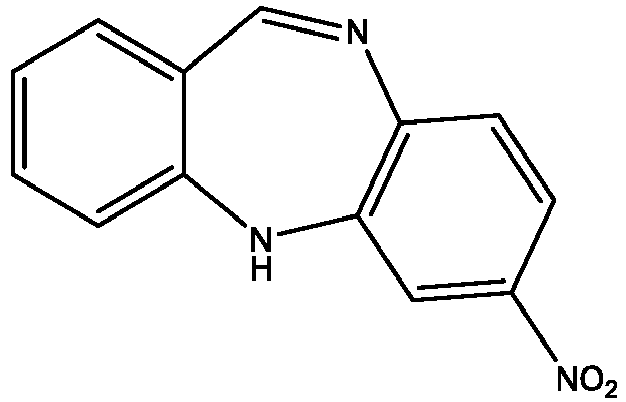
- 7-Nitro-5H-dibenzo[b,e][1,4]diazepine (4ad): From N-(2-bromobenzylidene)-4-methylbenzenesulfonamide (0.50g, 1.5mmol) and 2-bromo-5-nitroaniline (0.326g), according to the general procedure the title compound was obtained as a yellow solid (0.215 g, 60%) m.p. 139.3-139.7°C. 1H NMR (400 MHz, CDCl3): δ 7.40-7.46 (m, 2H, ArH), 7.67 (dd, J=1.2 and 8.0Hz, 1H, ArH), 7.82 (d, J=8.8Hz, ArH), 7.89 (d, J=2.8Hz, ArH), 7.96 (dd, J=2.8 and 8.8Hz, ArH), 8.31 (dd, J=1.2 and 8.0Hz, ArH), 8.82 (br s, 1H, HC=N) ppm. 13C NMR (100 MHz, CDCl3): δ 114.6 (CH), 121.3 (CH), 126.0 (C), 126.8 (C), 128.1 (CH), 129.8 (CH), 133.6 (CH), 133.7 (C), 133.8 (CH), 133.9 (CH), 148.1 (C), 151.5 (C), 162.8 (HC=N) ppm. MS (ESI- TOF) m/z: 240.23 (M++H).
-

- 5H-dibenzo[b,e][1,4]diazepine-7-carbonitrile: From N-(2-bromobenzylidene)-4-methylbenzenesulfonamide (0.25g, 0.74mmol) and 3-amino-4-bromobenzonitrile (0.146g), according to the general procedure, the title compound was obtained as a yellow semi-solid (0.085 g, 53%). 1H NMR (400 MHz, CDCl3): δ 3.68 (br s, 1H, NH), 7.11 (d, J = 8.0 Hz, ArH), 7.38-7.48 (m, 2H, ArH), 7.63-7.67 (m, 2H, ArH), 7.93 (d, J = 1.6 Hz, ArH), 8.29 (dd, J = 2.0 and 7.8 Hz, ArH), 8.74 (br s, 1H, HC=N) ppm. 13C NMR (100 MHz, CDCl3) : δ 110.5 (C), 117.7 (C), 118.3 (C), 120.6 (CH), 126.7 (C), 128.1 (CH), 129.8 (CH), 132.5 (CH), 133.6 (CH), 133.7 (C), 133.8 (CH), 136.6 (CH), 154.7 (C), 162.5 (HC=N) ppm.
-

- 8-Fluoro-6-methyl-5H-dibenzo[b,e][1,4]diazepine: From N-(2-bromobenzylidene)-4-methylbenzenesulfonamide (0.50g, 1.5mmol) and 2-bromo-4-fluoro-6-methylaniline (0.304g), according to the general procedure, the title compound was obtained as a yellow solid (0.251 g, 74%) m.p. 78.4-79.0°C. 1H NMR (400 MHz, CDCl3) : δ 2.22 (s, 3H, CH3), 6.69-6.95 (m, 1H, ArH), 7.21-7.23 (m, 1H, ArH), 7.36-7.45 (m, 2H, ArH), 7.54-7.66 (m, 1H, ArH), 8.27-8.29 (m, 1H, ArH), 8.67 (br s, 1H, HC=N) ppm. 13C NMR (100 MHz, CDCl3) : δ 29.8 (CH3), 116.6 (d, J=21.7Hz, CH), 117.6 (d, J=24.9Hz, CH), 126.2 (C), 128.0 (CH), 129.2 (CH), 131.5 (C), 133.1 (CH), 133.4 (CH), 134.3 (C), 138.5 (C), 146.5 (C), 159.0 (d, J=244.7Hz, C-F), 165.1 (HC=N) ppm. MS (ESI- TOF) m/z: 227.26 (M++H).
-

- 8-Fluoro-2-methoxy-6-methyl-5H-dibenzo[b,e][1,4]diazepine): From N-(2-bromo-5-methoxybenzylidene)-4-methylbenzenesulfonamide (0.50g, 1.4mmol) and 2-bromo-4-fluoro-6-methylaniline (0.276g), according to the general procedure the title compound was obtained as a yellow solid (0.216 g, 62%) 68.5-69.2°C. 1H NMR (400 MHz, CDCl3) : δ 2.22 (s, 3H, CH3), 3.88 (s, 3H, OMe). 6.91.6.98 (m, 2H, ArH), 7.21-7.24 (m, 1H, ArH), 7.51-7.53 (m, 1H, ArH), 7.80-7.81 (m, 1H, ArH), 8.63 (br s, 1H, HC=N) ppm. 13C NMR (100 MHz, CDCl3): δ 19.3 (CH3), 55.9 (OMe), 112.4 (CH), 116.5 (d, J=21.7Hz, CH), 117.1 (C), 117.4 (d, J=26.9Hz, CH), 120.8 (CH), 123.4 (C), 131.5 (d, J=8.2Hz, C), 134.1 (CH), 134.7 (d, J=3.1Hz, C), 146.4 (C), 159.0 (d, J=244.6 Hz, C-F), 159.3 (C), 165.0 (HC=N) ppm. MS (ESI- TOF) m/z: 257.28 (M++H).
- Naturally, the present application is by no means restricted to the embodiments described in this document, and a person with average skills in the art might predict many possibilities of altering the same without departing from the general idea, as defined in the claims.
- Accordingly, the scope of the present application is to be construed in accordance with the substance defined by the following claims.
-
- DBU 1,8-Diazabicyclo[5.4.0]undec-7-ene
- DIPA Diisopropylamine
- DMA Dimethylacetamide
- NHC N-Heterocyclic Carbene
- NMM N-Methylmorpholine
- NMP N-Methylpiperidine
- PEPPSI catalyst Pyridine-Enhanced Precatalyst Preparation Stabilization and Initiation
- SPhos 2-Dicyclohexylphosphino-2',6'-dimethoxybiphenyl
- TBAAc Tetrabutylammonium acetate
- Tf Triflate (trifluoromethylsulfonyl)
- TFA Trifluoroacetic acid
- XantPhos 4,5-Bis(diphenylphosphino)-9,9-dimethylxanthene
- XPhos 2-Dicyclohexylphosphino-2',4',6'-triisopropylbiphenyl
-
- A.J. Burke, C.S. Silva, Catalytic Areolation Methods From the Academic Lab to the Industrial Process, Wiley-VCH, 2015, Weinheim.
- R.D. Charan, G. Schlingmann, J. Janso, V. Bernan, X. Feng, G.T. Carter, J. Nat. Prod. 2004, 67, 1431.
- X. Diao, L. Xu, W. Zhu, Y. Jiang, H. Wang,Y. Guo, D.Ma, Org. Lett. 2011, 13, 6422.
- A.S. Guram, R.A. Rennels, S.L. Buchwald, Angew. Chem. Int. Ed. 1995, 34, 1348.
- J.F. Hartwig, in Modern Amination Methods, A. Ricci (Ed.) pp195, Wiley-VCH, Weinheim, 2000 .
- J. Louie, J.F. Hartwig,Tetrahedron Lett. 1995, 36, 3609.
- F. Hunziker, F. Kunzle, J. Schmutz, O. Schindler, Helv. Chim. Acta 1964, 47, 1163.
- D. Lednicer, Strategies for Organic Drug Synthesis and Design, John Wiley & Sons Inc., New York 1998 .
- X. Li, L. Yang, X. Zhang, D. Zhang-Negrerie, Y. Du, K. Zhao, J. Org. Chem. 2014, 79, 955.
- R.J. Lundgren, M. Stradiotto, Chem. Eur. J. 2012, 18, 9758.
- D. Peixoto, A. Locati, C.S. Marques, A. Goth, J.P. Prates Ramalho, A.J. Burke, RSC Advances. 2015, 5, 99990 - 99999.
- D. Tsvelikhovsky, S. L. Buchwald, J. Am. Chem. Soc. 2011, 133, 14228-14231.
- S. M. Weinreb, Top. Curr. Chem. 1997, 190, 131.
- M. Yazdanian, S.L. Glynn, J.L. Wright, A. Hawi. Pharm. Res. 1998, 15, 1490 .
Claims (9)
- A process for the catalytic one-pot synthesis of products of formula (III) from substrates of formula (I) and (II) respectively,
 X represents a halogen like, Br, Cl, I, or a triflate group (OTf);R represents, an alkyl or aryl group;R1 and R3 represent a hydrogen, a saturated alkyl, allyl, vinyl or cycloalkyl group, or an aryl group, or an OH, tiol, amino, nitro, cyano, aldehyde, ketone, ester,thioester, carboxylic acid, carbamate, ether or a thioeter group;R2 represents a hydrogen, an alkyl, allyl, vinyl or aryl group;comprising the use of an active palladium catalyst, at a loading of between 0.1 and 5 mol%, wherein the reaction is conducted by adding the palladium complex, a ligand at a loading of between 0.25 and 10 mol%, and a base in a solvent.
 - The process according to the previous claim, wherein the active catalyst is prepared by adding the ligand to the palladium complex in a dry solvent, under an inert atmosphere and allowing the mixture to stir up to 24h with a temperature range from 50 to 130°C.
- The process according to any one of the previous claims, wherein the palladium complex used is selected from the group comprising Pd(OAc)2, PEPPSI-iPr catalyst, Pd2(dba)3.CHCl3, [Pd(TFA)2], PdCl2(dppf), Pd(PPh3)4, cationic palladium (II) complexes and Pd-NHCs.
- The process according to any one of the previous claims, wherein the reaction solvent used is selected from the group comprising: toluene, dimethyl ether, diethyl ether, 1,4-dioxane, acetonitrile, chloroform, DMF, DMA and NMP.
- The process according to any one of the previous claims, wherein the ligand is a monophosphane type ligand.
- The process according to any one of the previous claims, wherein the base is selected from the group comprising triethylamine, K2CO3, Na2CO3, CaCO3, Ba(OH)2, KOAc, DIPA, K3PO4, N-methylmorpholine, 1,8-diazabicyclo[5.4.0] undec-7-ene, KOH, KF, Cs2CO3, and KOtBu.
- The process according to any one of the previous claims, wherein the substrate of formula (I) is pre-formed or formed in situ.
- The process according to any one of the previous claims, wherein the reactions are run under an inert atmosphere.
- The process according to any one of the previous claims, wherein the reaction temperature ranges between 50 and 130°C.
Applications Claiming Priority (2)
| Application Number | Priority Date | Filing Date | Title |
|---|---|---|---|
| PT10856615 | 2015-06-22 | ||
| PCT/IB2016/053685 WO2016207790A1 (en) | 2015-06-22 | 2016-06-21 | Process for preparing 1,4-dibenzodiazepines via buchwald-hartwig chemistry |
Publications (2)
| Publication Number | Publication Date |
|---|---|
| EP3310765A1 EP3310765A1 (en) | 2018-04-25 |
| EP3310765B1 true EP3310765B1 (en) | 2019-06-12 |
Family
ID=56550255
Family Applications (1)
| Application Number | Title | Priority Date | Filing Date |
|---|---|---|---|
| EP16742398.7A Not-in-force EP3310765B1 (en) | 2015-06-22 | 2016-06-21 | Process for preparing 1,4-dibenzodiazepines via buchwald-hartwig chemistry |
Country Status (3)
| Country | Link |
|---|---|
| US (1) | US10208001B2 (en) |
| EP (1) | EP3310765B1 (en) |
| WO (1) | WO2016207790A1 (en) |
Families Citing this family (2)
| Publication number | Priority date | Publication date | Assignee | Title |
|---|---|---|---|---|
| US12600703B2 (en) | 2020-05-29 | 2026-04-14 | Amo Pharma Ltd. | Methods of synthesizing farnesyl dibenzodiazepinones |
| CN115850177B (en) * | 2022-05-26 | 2025-06-10 | 湖南大学 | Dibenzo [ c, e ] azepine and its derivative and nickel catalytic synthesis method |
-
2016
- 2016-06-21 EP EP16742398.7A patent/EP3310765B1/en not_active Not-in-force
- 2016-06-21 WO PCT/IB2016/053685 patent/WO2016207790A1/en not_active Ceased
- 2016-06-21 US US15/565,589 patent/US10208001B2/en not_active Expired - Fee Related
Non-Patent Citations (1)
| Title |
|---|
| None * |
Also Published As
| Publication number | Publication date |
|---|---|
| US20180105502A1 (en) | 2018-04-19 |
| WO2016207790A1 (en) | 2016-12-29 |
| EP3310765A1 (en) | 2018-04-25 |
| US10208001B2 (en) | 2019-02-19 |
Similar Documents
| Publication | Publication Date | Title |
|---|---|---|
| Hosseininezhad et al. | Recent advances in the application of alkynes in multicomponent reactions | |
| Battistuzzi et al. | 4‐Aryl‐2‐quinolones through a Pseudo‐Domino Heck/Buchwald–Hartwig Reaction in a Molten Tetrabutylammonium Acetate/Tetrabutylammonium Bromide Mixture | |
| Su et al. | Ruthenium (II)-catalyzed synthesis of indazolone-fused cinnolines via C–H coupling with diazo compounds | |
| Nayak et al. | Construction of benzo-fused indolizines, pyrrolo [1, 2-a] quinolines via alkyne–carbonyl metathesis | |
| Zhang et al. | Synthesis of N-alkyl and N-aryl isoquinolones and derivatives via Pd-catalysed C–H activation and cyclization reactions | |
| JP2019116482A (en) | Complex | |
| Oliva-Madrid et al. | Insertion reactions on carbopalladated benzyne: from eight-to nine-and ten-membered palladacycles. Applications to the synthesis of N-heterocycles | |
| Song et al. | Asymmetric synthesis of highly functionalized spirothiazolidinone tetrahydroquinolines via a squaramide-catalyzed cascade reaction | |
| CN108164535A (en) | The benzene nitrogen Zhuo diindyl derivative and its process for catalytic synthesis of trifluoromethylation | |
| Panda et al. | Transition‐Metal Catalyzed [4+ 2]‐Cycloaddition Reactions: A Sexennial Update | |
| US10208001B2 (en) | Process for preparing 1,4-dibenzodiazepines via Buchwald-Hartwig chemistry | |
| KR20170016469A (en) | Complexes | |
| Xu et al. | Copper‐Chiral Camphor β‐Amino Alcohol Complex Catalyzed Asymmetric Henry Reaction | |
| CN102838522A (en) | Chiral pyrroline synthetic method by palladium-catalyzed asymmetric hydrogenation | |
| CN104689849B (en) | One class phosphamide (primary) secondary amine bifunctional catalyst and its synthetic method | |
| CN105693589B (en) | A kind of synthetic method of indole derivatives | |
| CN105481867B (en) | Three step relays catalysis structure chiral spiro Oxoindole and its synthetic method and application | |
| CN102690227A (en) | Optical active tetrahydropyridine derivative and preparation method thereof | |
| Takallou et al. | Bis (imidazolium) chloride based on 1, 2-phenylenediamine as efficient ligand precursor for palladium-catalyzed Mizoroki-Heck cross-coupling reaction | |
| CN109794295A (en) | A kind of acenaphthene imidazole base N-heterocyclic carbine metal palladium complex catalyst and its preparation and application | |
| JP2003183187A (en) | N-heterocyclic carbene complex and its use | |
| CN111533707A (en) | A kind of preparation method of polysubstituted oxazole-2(3H)-one compounds | |
| Malhotra et al. | Enantiopure synthesis of dihydrobenzo [1, 4]-oxazine-3-carboxylic acids and a route to benzoxazinyl oxazolidinones | |
| SAFAEI et al. | Nano silica supported ferric chloride as a green and efficient catalyst for one pot synthesis of 1, 2-dihydro-1-arylnaphtho [1, 2-e][1, 3] oxazine-3-ones | |
| Bao et al. | One pot synthesis of diarylfurans from aryl esters and PhI (OAc) 2 via palladium-associated iodonium ylides |
Legal Events
| Date | Code | Title | Description |
|---|---|---|---|
| STAA | Information on the status of an ep patent application or granted ep patent |
Free format text: STATUS: THE INTERNATIONAL PUBLICATION HAS BEEN MADE |
|
| PUAI | Public reference made under article 153(3) epc to a published international application that has entered the european phase |
Free format text: ORIGINAL CODE: 0009012 |
|
| STAA | Information on the status of an ep patent application or granted ep patent |
Free format text: STATUS: REQUEST FOR EXAMINATION WAS MADE |
|
| 17P | Request for examination filed |
Effective date: 20180122 |
|
| AK | Designated contracting states |
Kind code of ref document: A1 Designated state(s): AL AT BE BG CH CY CZ DE DK EE ES FI FR GB GR HR HU IE IS IT LI LT LU LV MC MK MT NL NO PL PT RO RS SE SI SK SM TR |
|
| AX | Request for extension of the european patent |
Extension state: BA ME |
|
| DAV | Request for validation of the european patent (deleted) | ||
| DAX | Request for extension of the european patent (deleted) | ||
| GRAP | Despatch of communication of intention to grant a patent |
Free format text: ORIGINAL CODE: EPIDOSNIGR1 |
|
| STAA | Information on the status of an ep patent application or granted ep patent |
Free format text: STATUS: GRANT OF PATENT IS INTENDED |
|
| INTG | Intention to grant announced |
Effective date: 20190215 |
|
| GRAS | Grant fee paid |
Free format text: ORIGINAL CODE: EPIDOSNIGR3 |
|
| GRAA | (expected) grant |
Free format text: ORIGINAL CODE: 0009210 |
|
| STAA | Information on the status of an ep patent application or granted ep patent |
Free format text: STATUS: THE PATENT HAS BEEN GRANTED |
|
| AK | Designated contracting states |
Kind code of ref document: B1 Designated state(s): AL AT BE BG CH CY CZ DE DK EE ES FI FR GB GR HR HU IE IS IT LI LT LU LV MC MK MT NL NO PL PT RO RS SE SI SK SM TR |
|
| REG | Reference to a national code |
Ref country code: GB Ref legal event code: FG4D |
|
| REG | Reference to a national code |
Ref country code: CH Ref legal event code: EP |
|
| REG | Reference to a national code |
Ref country code: AT Ref legal event code: REF Ref document number: 1142396 Country of ref document: AT Kind code of ref document: T Effective date: 20190615 |
|
| REG | Reference to a national code |
Ref country code: IE Ref legal event code: FG4D |
|
| REG | Reference to a national code |
Ref country code: DE Ref legal event code: R096 Ref document number: 602016015264 Country of ref document: DE |
|
| REG | Reference to a national code |
Ref country code: NL Ref legal event code: MP Effective date: 20190612 |
|
| REG | Reference to a national code |
Ref country code: LT Ref legal event code: MG4D |
|
| PG25 | Lapsed in a contracting state [announced via postgrant information from national office to epo] |
Ref country code: FI Free format text: LAPSE BECAUSE OF FAILURE TO SUBMIT A TRANSLATION OF THE DESCRIPTION OR TO PAY THE FEE WITHIN THE PRESCRIBED TIME-LIMIT Effective date: 20190612 Ref country code: NO Free format text: LAPSE BECAUSE OF FAILURE TO SUBMIT A TRANSLATION OF THE DESCRIPTION OR TO PAY THE FEE WITHIN THE PRESCRIBED TIME-LIMIT Effective date: 20190912 Ref country code: SE Free format text: LAPSE BECAUSE OF FAILURE TO SUBMIT A TRANSLATION OF THE DESCRIPTION OR TO PAY THE FEE WITHIN THE PRESCRIBED TIME-LIMIT Effective date: 20190612 Ref country code: AL Free format text: LAPSE BECAUSE OF FAILURE TO SUBMIT A TRANSLATION OF THE DESCRIPTION OR TO PAY THE FEE WITHIN THE PRESCRIBED TIME-LIMIT Effective date: 20190612 Ref country code: HR Free format text: LAPSE BECAUSE OF FAILURE TO SUBMIT A TRANSLATION OF THE DESCRIPTION OR TO PAY THE FEE WITHIN THE PRESCRIBED TIME-LIMIT Effective date: 20190612 Ref country code: LT Free format text: LAPSE BECAUSE OF FAILURE TO SUBMIT A TRANSLATION OF THE DESCRIPTION OR TO PAY THE FEE WITHIN THE PRESCRIBED TIME-LIMIT Effective date: 20190612 |
|
| PG25 | Lapsed in a contracting state [announced via postgrant information from national office to epo] |
Ref country code: RS Free format text: LAPSE BECAUSE OF FAILURE TO SUBMIT A TRANSLATION OF THE DESCRIPTION OR TO PAY THE FEE WITHIN THE PRESCRIBED TIME-LIMIT Effective date: 20190612 Ref country code: BG Free format text: LAPSE BECAUSE OF FAILURE TO SUBMIT A TRANSLATION OF THE DESCRIPTION OR TO PAY THE FEE WITHIN THE PRESCRIBED TIME-LIMIT Effective date: 20190912 Ref country code: LV Free format text: LAPSE BECAUSE OF FAILURE TO SUBMIT A TRANSLATION OF THE DESCRIPTION OR TO PAY THE FEE WITHIN THE PRESCRIBED TIME-LIMIT Effective date: 20190612 |
|
| REG | Reference to a national code |
Ref country code: DE Ref legal event code: R119 Ref document number: 602016015264 Country of ref document: DE |
|
| REG | Reference to a national code |
Ref country code: AT Ref legal event code: MK05 Ref document number: 1142396 Country of ref document: AT Kind code of ref document: T Effective date: 20190612 |
|
| PG25 | Lapsed in a contracting state [announced via postgrant information from national office to epo] |
Ref country code: SK Free format text: LAPSE BECAUSE OF FAILURE TO SUBMIT A TRANSLATION OF THE DESCRIPTION OR TO PAY THE FEE WITHIN THE PRESCRIBED TIME-LIMIT Effective date: 20190612 Ref country code: RO Free format text: LAPSE BECAUSE OF FAILURE TO SUBMIT A TRANSLATION OF THE DESCRIPTION OR TO PAY THE FEE WITHIN THE PRESCRIBED TIME-LIMIT Effective date: 20190612 Ref country code: EE Free format text: LAPSE BECAUSE OF FAILURE TO SUBMIT A TRANSLATION OF THE DESCRIPTION OR TO PAY THE FEE WITHIN THE PRESCRIBED TIME-LIMIT Effective date: 20190612 Ref country code: CZ Free format text: LAPSE BECAUSE OF FAILURE TO SUBMIT A TRANSLATION OF THE DESCRIPTION OR TO PAY THE FEE WITHIN THE PRESCRIBED TIME-LIMIT Effective date: 20190612 Ref country code: NL Free format text: LAPSE BECAUSE OF FAILURE TO SUBMIT A TRANSLATION OF THE DESCRIPTION OR TO PAY THE FEE WITHIN THE PRESCRIBED TIME-LIMIT Effective date: 20190612 Ref country code: AT Free format text: LAPSE BECAUSE OF FAILURE TO SUBMIT A TRANSLATION OF THE DESCRIPTION OR TO PAY THE FEE WITHIN THE PRESCRIBED TIME-LIMIT Effective date: 20190612 Ref country code: PT Free format text: LAPSE BECAUSE OF FAILURE TO SUBMIT A TRANSLATION OF THE DESCRIPTION OR TO PAY THE FEE WITHIN THE PRESCRIBED TIME-LIMIT Effective date: 20191014 |
|
| REG | Reference to a national code |
Ref country code: CH Ref legal event code: PL |
|
| PG25 | Lapsed in a contracting state [announced via postgrant information from national office to epo] |
Ref country code: SM Free format text: LAPSE BECAUSE OF FAILURE TO SUBMIT A TRANSLATION OF THE DESCRIPTION OR TO PAY THE FEE WITHIN THE PRESCRIBED TIME-LIMIT Effective date: 20190612 Ref country code: IS Free format text: LAPSE BECAUSE OF FAILURE TO SUBMIT A TRANSLATION OF THE DESCRIPTION OR TO PAY THE FEE WITHIN THE PRESCRIBED TIME-LIMIT Effective date: 20191012 Ref country code: IT Free format text: LAPSE BECAUSE OF FAILURE TO SUBMIT A TRANSLATION OF THE DESCRIPTION OR TO PAY THE FEE WITHIN THE PRESCRIBED TIME-LIMIT Effective date: 20190612 Ref country code: ES Free format text: LAPSE BECAUSE OF FAILURE TO SUBMIT A TRANSLATION OF THE DESCRIPTION OR TO PAY THE FEE WITHIN THE PRESCRIBED TIME-LIMIT Effective date: 20190612 |
|
| REG | Reference to a national code |
Ref country code: BE Ref legal event code: MM Effective date: 20190630 |
|
| PG25 | Lapsed in a contracting state [announced via postgrant information from national office to epo] |
Ref country code: TR Free format text: LAPSE BECAUSE OF FAILURE TO SUBMIT A TRANSLATION OF THE DESCRIPTION OR TO PAY THE FEE WITHIN THE PRESCRIBED TIME-LIMIT Effective date: 20190612 Ref country code: MC Free format text: LAPSE BECAUSE OF FAILURE TO SUBMIT A TRANSLATION OF THE DESCRIPTION OR TO PAY THE FEE WITHIN THE PRESCRIBED TIME-LIMIT Effective date: 20190612 |
|
| PLBE | No opposition filed within time limit |
Free format text: ORIGINAL CODE: 0009261 |
|
| STAA | Information on the status of an ep patent application or granted ep patent |
Free format text: STATUS: NO OPPOSITION FILED WITHIN TIME LIMIT |
|
| PG25 | Lapsed in a contracting state [announced via postgrant information from national office to epo] |
Ref country code: PL Free format text: LAPSE BECAUSE OF FAILURE TO SUBMIT A TRANSLATION OF THE DESCRIPTION OR TO PAY THE FEE WITHIN THE PRESCRIBED TIME-LIMIT Effective date: 20190612 Ref country code: DK Free format text: LAPSE BECAUSE OF FAILURE TO SUBMIT A TRANSLATION OF THE DESCRIPTION OR TO PAY THE FEE WITHIN THE PRESCRIBED TIME-LIMIT Effective date: 20190612 Ref country code: IE Free format text: LAPSE BECAUSE OF NON-PAYMENT OF DUE FEES Effective date: 20190621 Ref country code: DE Free format text: LAPSE BECAUSE OF NON-PAYMENT OF DUE FEES Effective date: 20200101 |
|
| 26N | No opposition filed |
Effective date: 20200313 |
|
| PG25 | Lapsed in a contracting state [announced via postgrant information from national office to epo] |
Ref country code: LU Free format text: LAPSE BECAUSE OF NON-PAYMENT OF DUE FEES Effective date: 20190621 Ref country code: LI Free format text: LAPSE BECAUSE OF NON-PAYMENT OF DUE FEES Effective date: 20190630 Ref country code: IS Free format text: LAPSE BECAUSE OF FAILURE TO SUBMIT A TRANSLATION OF THE DESCRIPTION OR TO PAY THE FEE WITHIN THE PRESCRIBED TIME-LIMIT Effective date: 20200224 Ref country code: SI Free format text: LAPSE BECAUSE OF FAILURE TO SUBMIT A TRANSLATION OF THE DESCRIPTION OR TO PAY THE FEE WITHIN THE PRESCRIBED TIME-LIMIT Effective date: 20190612 Ref country code: CH Free format text: LAPSE BECAUSE OF NON-PAYMENT OF DUE FEES Effective date: 20190630 Ref country code: BE Free format text: LAPSE BECAUSE OF NON-PAYMENT OF DUE FEES Effective date: 20190630 |
|
| PG2D | Information on lapse in contracting state deleted |
Ref country code: IS |
|
| PG25 | Lapsed in a contracting state [announced via postgrant information from national office to epo] |
Ref country code: FR Free format text: LAPSE BECAUSE OF NON-PAYMENT OF DUE FEES Effective date: 20190812 |
|
| GBPC | Gb: european patent ceased through non-payment of renewal fee |
Effective date: 20200621 |
|
| PG25 | Lapsed in a contracting state [announced via postgrant information from national office to epo] |
Ref country code: GB Free format text: LAPSE BECAUSE OF NON-PAYMENT OF DUE FEES Effective date: 20200621 |
|
| PG25 | Lapsed in a contracting state [announced via postgrant information from national office to epo] |
Ref country code: CY Free format text: LAPSE BECAUSE OF FAILURE TO SUBMIT A TRANSLATION OF THE DESCRIPTION OR TO PAY THE FEE WITHIN THE PRESCRIBED TIME-LIMIT Effective date: 20190612 |
|
| PG25 | Lapsed in a contracting state [announced via postgrant information from national office to epo] |
Ref country code: GR Free format text: LAPSE BECAUSE OF FAILURE TO SUBMIT A TRANSLATION OF THE DESCRIPTION OR TO PAY THE FEE WITHIN THE PRESCRIBED TIME-LIMIT Effective date: 20190612 |
|
| PG25 | Lapsed in a contracting state [announced via postgrant information from national office to epo] |
Ref country code: HU Free format text: LAPSE BECAUSE OF FAILURE TO SUBMIT A TRANSLATION OF THE DESCRIPTION OR TO PAY THE FEE WITHIN THE PRESCRIBED TIME-LIMIT; INVALID AB INITIO Effective date: 20160621 Ref country code: MT Free format text: LAPSE BECAUSE OF FAILURE TO SUBMIT A TRANSLATION OF THE DESCRIPTION OR TO PAY THE FEE WITHIN THE PRESCRIBED TIME-LIMIT Effective date: 20190612 |
|
| PG25 | Lapsed in a contracting state [announced via postgrant information from national office to epo] |
Ref country code: MK Free format text: LAPSE BECAUSE OF FAILURE TO SUBMIT A TRANSLATION OF THE DESCRIPTION OR TO PAY THE FEE WITHIN THE PRESCRIBED TIME-LIMIT Effective date: 20190612 |