EP3310311B1 - Compression garment having enhanced strap configuration - Google Patents
Compression garment having enhanced strap configuration Download PDFInfo
- Publication number
- EP3310311B1 EP3310311B1 EP16734509.9A EP16734509A EP3310311B1 EP 3310311 B1 EP3310311 B1 EP 3310311B1 EP 16734509 A EP16734509 A EP 16734509A EP 3310311 B1 EP3310311 B1 EP 3310311B1
- Authority
- EP
- European Patent Office
- Prior art keywords
- compression garment
- main portion
- straps
- low
- elastic compression
- Prior art date
- Legal status (The legal status is an assumption and is not a legal conclusion. Google has not performed a legal analysis and makes no representation as to the accuracy of the status listed.)
- Active
Links
Images



Classifications
-
- A—HUMAN NECESSITIES
- A61—MEDICAL OR VETERINARY SCIENCE; HYGIENE
- A61F—FILTERS IMPLANTABLE INTO BLOOD VESSELS; PROSTHESES; DEVICES PROVIDING PATENCY TO, OR PREVENTING COLLAPSING OF, TUBULAR STRUCTURES OF THE BODY, e.g. STENTS; ORTHOPAEDIC, NURSING OR CONTRACEPTIVE DEVICES; FOMENTATION; TREATMENT OR PROTECTION OF EYES OR EARS; BANDAGES, DRESSINGS OR ABSORBENT PADS; FIRST-AID KITS
- A61F13/00—Bandages or dressings; Absorbent pads
- A61F13/06—Bandages or dressings; Absorbent pads specially adapted for feet or legs; Corn-pads; Corn-rings
- A61F13/08—Elastic stockings; for contracting aneurisms
- A61F13/085—Openable readjustable
-
- A—HUMAN NECESSITIES
- A61—MEDICAL OR VETERINARY SCIENCE; HYGIENE
- A61F—FILTERS IMPLANTABLE INTO BLOOD VESSELS; PROSTHESES; DEVICES PROVIDING PATENCY TO, OR PREVENTING COLLAPSING OF, TUBULAR STRUCTURES OF THE BODY, e.g. STENTS; ORTHOPAEDIC, NURSING OR CONTRACEPTIVE DEVICES; FOMENTATION; TREATMENT OR PROTECTION OF EYES OR EARS; BANDAGES, DRESSINGS OR ABSORBENT PADS; FIRST-AID KITS
- A61F13/00—Bandages or dressings; Absorbent pads
- A61F2013/00089—Wound bandages
- A61F2013/00119—Wound bandages elastic
- A61F2013/00127—Wound bandages elastic fixation means
-
- A—HUMAN NECESSITIES
- A61—MEDICAL OR VETERINARY SCIENCE; HYGIENE
- A61F—FILTERS IMPLANTABLE INTO BLOOD VESSELS; PROSTHESES; DEVICES PROVIDING PATENCY TO, OR PREVENTING COLLAPSING OF, TUBULAR STRUCTURES OF THE BODY, e.g. STENTS; ORTHOPAEDIC, NURSING OR CONTRACEPTIVE DEVICES; FOMENTATION; TREATMENT OR PROTECTION OF EYES OR EARS; BANDAGES, DRESSINGS OR ABSORBENT PADS; FIRST-AID KITS
- A61F13/00—Bandages or dressings; Absorbent pads
- A61F2013/00089—Wound bandages
- A61F2013/00153—Wound bandages coloured or with decoration pattern or printing
Definitions
- the present invention relates to therapeutic compression garments worn to prevent fluid build-up in the limbs, and particularly relates to low-elastic compression garments having straps that wrap around a patient's limb.
- Therapeutic compression garments are worn to prevent the build-up of fluid in the limbs, a condition commonly referred to as edema and various types of vascular insufficiencies.
- Persons who may use such a garment include post-surgical patients, obese persons, and persons with ailments that impede circulation, such as Chronic Venous Insufficiency, Lymphedema and diabetics.
- Compression garments improve circulation and prevent fluid from collecting in the lower limb portions, such as in the feet and ankles (leg compression garment) or hands (arm compression garment). By improving circulation and reducing the propensity toward fluid build-up, compression garments relieve swelling and associated pain, prevent and help in the treatment of ulcers, and prevent other issues that can result from poor circulation in the limbs.
- One type of compression garment is a tubular shaped, high elastic, knitted compression garment, which provides graduated compression when worn on a limb.
- High elastic compression garments offer only a minimal increase in working pressure allowing them to be easier to don. Depending upon the level of a patient's clinical involvement, such garments may, at times, not provide an adequate level of pressure to improve circulation or prevent edema in the limb.
- Low-elastic stretch-limited compression garments also have been used to provide compression, but such garments likewise must be able to accommodate changes in compression based on changes in the size of the limb.
- Low-elastic garments have an advantage over elastic garments in that low elastic garments provide an increased or higher working pressure in response to increased patient activity or limb edema. As a limb expands due to muscle expansion or edema, the expanded limb pushes up against the low-elastic garment, which is stretch-limited and therefore offers greater resistance as compared to high-elastic garments. This results in higher working pressure.
- the relatively high working pressure of low-elastic garments results in an improved vascular flow and edema containment.
- WO 2010/025186 A1 and US 2010/312160 A1 each independently reveal a compression garment having short-stretch material.
- wrap-style low-elastic compression garments have been employed. Such garments may be wrapped around a limb and secured using a fastening device, such as a hook and loop mechanical fastening device. As such, they may be removed and re-wrapped with differing tensions to accommodate any changing compression needs. Wrapped compression garments may be configured with staggered compression straps or bands that are linked together by a central spine or region, the straps wrapping around the limb. The use of bands or straps provides substantial versatility in achieving a desired amount of compression, both as therapeutically required and to provide a more comfortable fit.
- bands overlap, but overlapping bands can bunch up, particularly where the bands connect to the spine or central region.
- conventional configurations may overlap the bands by as much as 50%. This provides a bulky configuration that requires a significant amount of material to manufacture, and the bulkiness could result in discomfort to the user.
- Another deficiency of conventional low-elastic compression garments pertains to providing versatility of size to accommodate various sized patients.
- a given compression garment be able to accommodate multiple sizes of patients. This reduces the number of different configurations that must be maintained by an end user facility, such as a hospital or nursing home.
- Various sizing schemes, such as markings and other indicators, have been employed to aid in cutting the straps down to appropriate sizes, but such systems often are complicated and prone to user error.
- a related deficiency of conventional low-elastic compression garments is that wrapped compression garments can be difficult to don with sufficient compression. Users often are elderly or infirmed, and the force required to pull the bands or straps tight to the desired level of compression can be difficult for such users to apply. The result may be a donning with inadequate compression, and in turn a resultant inadequate therapeutic performance.
- a low-elastic wrap compression garment may be formed of two halves that are sewn together at a central seam. Each half includes a half main portion and a plurality of straps that extend from the half main portion. Straps may extend from each half main portion. The two half main portions are sewn together, thereby forming a stitched central seam.
- the seam may be configured to provide a biased curvature so that the completed garment has a contour that is intended to be commensurate with a typical limb shape, such as for example a shape of a patient's calf.
- a typical limb shape such as for example a shape of a patient's calf.
- the garment may be formed with a unitary component including a main portion from which the plurality of straps extend.
- the straps are staggered such that when the straps are wrapped around the remainder of the limb, there is an overlap of the lateral edges of the straps in the wrapping around direction.
- the garment may have a notched configuration to enhance the overlapping nature of the straps.
- a notch is provided so that adjacent straps may overlap to provide a gapless configuration, without bunching of the strap material. The notch permits a minimal overlap of less than about 1/4 inch and as little and 1/8 inch.
- a concave curvature may be formed in the half main portion or unitary main portion between the straps, and the notches are provided within the concave curvature adjacent to where a strap extends from the main portion.
- the notches may be configured as shaped recesses formed extending into the half main portion or unitary main portion adjacent to where a strap extends from the main portion.
- Distal and proximal counter pull tabs may be provided on each half main portion or in a unitary main portion, which aids the user in putting tension on the distal and proximal straps to aid in donning the compression garment with the desired level of compression.
- the compression garment further may include woven fabric layers of different colors.
- Removable fastening tabs are provided that are removable from the straps to permit reversibility of the compression garment such that either color may be visible.
- positioning the removable fastening tabs at different locations along the straps provides a marker for cutting the straps to any suitable size for a customized fit. Accordingly, a wide range of user sizes may be accommodated with a single compression garment.
- the low-elastic compression garment includes a central main portion including a plurality of longitudinal outer edges, a plurality of straps that extend laterally from the longitudinal outer edges of the central main portion, each of the plurality of straps having opposite lateral edges, and an end that attaches to the central main portion adjacent an opposite longitudinal outer edge in use, and at least one notch where a lateral edge of one of the straps meets one of the longitudinal outer edges of the central main portion.
- the at least one notch may be configured as a plurality of notches.
- a notch may be provided adjacent to where a lateral edge of one of the straps meets one of the longitudinal outer edges of the central main portion, wherever a lateral edge of one of the straps overlaps a lateral edge of an adjacent strap when the compression garment is in the wrapped position.
- the central main portion may be formed of two half main portions sewn together with a biased seam that has a three-dimensional curvature for form fitting to the curvature of a limb portion.
- the central main portion may include a concave curvature extending between straps, and the notches are provided within the concave curvature adjacent to where a strap extends from the main portion.
- the notches may be configured as shaped recesses formed extending into the central main portion adjacent to where a strap extends from the main portion.
- the central main portion includes first and second opposite lateral outer edges that extend substantially perpendicularly relative to the longitudinal outer edges.
- the compression garment further may include a distal counter pull tab that extends from the first lateral outer edge of the central main portion, and a proximal counter pull tab that extends from the second lateral outer edge of the central main portion.
- each of the plurality of straps has an end that is remote from where the strap meets the longitudinal outer edge of the central main portion.
- a plurality of fastening tabs respectively are provided at each of the ends of the straps, wherein each fastening tab is removable from a respective strap and repositionable at a different location on the respective strap. The ability to remove and reposition the fastening tabs results in a compression garment that is both reversible for different colors, and easily adjusted for a more customized fit.
- the fitting method may include the steps of providing a low-elastic compression garment (for example a compression garment in accordance with any of the embodiments disclosed herein), removing at least one fastening tab from a respective strap, and repositioning the fastening tab at a different location on the respective strap.
- a low-elastic compression garment for example a compression garment in accordance with any of the embodiments disclosed herein
- the fitting method may include repositioning at least one fastening tab laterally on a same side of the respective strap, wherein the repositioned fastening tab acts as a marker for cutting the respective strap to a desired size, and cutting excess strap material that extends laterally beyond the repositioned fastening tab to provide a customized fit.
- the fitting method further may include repositioning the at least one fastening tab on the respective strap from a location on the first woven layer to a location on the second woven layer, thereby rendering the compression garment reversible.
- the positioning of the fastening tab on either the first woven layer or the second woven layer is determinable of which color is visible when the compression garment is in the wrapped position.
- Fig. 1 is a drawing depicting a first configuration of exemplary components 10 for use in a compression garment in accordance with embodiments of the present invention.
- the components 10 essentially are depicted in a laid out position as would be oriented to form a compression garment. As further explained below, the components 10 would be sewn together to form the completed compression garment.
- a compression garment that would be formed from the components 10 may be worn around a limb to prevent the build-up of fluid in the limb (edema).
- Persons who may use such a product include post-surgical patients, obese persons, and persons with ailments that impede circulation, such as Venous Disease or Lymphedema.
- Such a compression garment may improve circulation by compressing a limb or limb portion to prevent fluid from collecting in the lower limb portions, such as in the feet and ankles (leg compression garment) or hands (arm compression garment).
- the low-elastic compression garment generally is made of a stretch-limited material that provides high working pressures by limiting the amount of stretch in response to increased limb edema.
- the low-elastic compression garment is described as being configured as a leg compression garment worn essentially around a portion of a user's leg, and particularly the calf or thigh as typical examples. It will be appreciated, however, that that the features of the invention may be utilized in connection with a leg compression that extends from the calf over the knee to around the thigh, and/or going down to or around the foot and/or ankle. The precise size of the compression garment relative to the scope of the extension over the lower limb will depend upon the compression needs. It will further be appreciated that the features of the invention also may be utilized in connection with an arm compression garment that extends to any desired length over the arm and/or wrist or hand.
- the components 10 for the compression garment may be formed of a first half 12 and a second half 14 that may be fixed together along a center line 16 where a seam can be formed when the two halves are sewn or otherwise fixed together (see additional details below).
- the longitudinal direction is defined as being substantially parallel to the direction by which the center line or seam extends.
- the lateral direction is the direction that is substantially perpendicular to the longitudinal direction.
- substantially is used because it will be appreciated that due to limb curvature, the center line and various edges of the compression garment may not be exactly straight. Rather, there may be a degree of slanting or curvature to the various edges of the compression garment components. Accordingly, references below to edges of the compression garment and components thereof as being either “lateral” or “longitudinal” denote a generalized direction allotting for any suitable slanting or curvature that may be present.
- the first half 12 may include a first half main portion 18 and a plurality of straps that extend laterally from the first main portion.
- two straps 20 and 22 extend laterally from the first half main portion 18.
- the second half 14 may include a second half main portion 24 and a plurality of straps that extend laterally from the second main portion.
- two straps 26 and 28 extend laterally from the second half main portion 24.
- each strap 20, 22, 26, and 28 respectively may have its own associated fastening tab 30, 32, 36, and 38.
- Any suitable fastening means may be employed, and mechanical fastening tabs are particularly suitable.
- the fastening tabs may be hook-and-loop and similar type mechanical fastening elements. The straps may be pulled and secured to tension the straps in the wrapped position, resulting in a compression force being applied to the limb as described above.
- a length of the straps in a direction laterally extending from respective half main portions is approximately equal to the length in the lateral direction of the non-strap half main portions of the compression garment.
- the straps are staggered such that when the straps are wrapped around the remainder of the limb, there is an overlap of the lateral edges of adjacent straps in the wrapping around direction.
- a notch may be provided so that adjacent straps may overlap without bunching of the strap material.
- strap 20 has opposite lateral edges 40 and 42
- strap 22 has opposite lateral edges 44 and 46
- strap 26 has opposite lateral edges 48 and 50
- strap 28 has opposite lateral edges 52 and 54.
- first half main portion 18 has longitudinal outer edges 56 and 58 that extend longitudinally between or adjacent to the straps 20 and 22.
- the second half main portion 24 has longitudinal outer edges 60 and 62 that extend longitudinally between or adjacent to the straps 26 and 28.
- the lateral edges of the straps therefore extend substantially perpendicularly relative to the longitudinal outer edges of the half main portions.
- the plurality of straps extend laterally from the longitudinal outer edges of the central main portion formed when the two half main portions are fixed together.
- At least one notch may be provided adjacent to where a lateral edge of one of the straps meets one of the longitudinal outer edges of the central main portion. Accordingly, when the compression garment is in a wrapped position, lateral edges of adjacent straps that are associated with the at least one notch overlap.
- at least one notch is provided adjacent to where at least one lateral edge meets a corresponding longitudinal outer edge of a respective half main portion.
- a notch 64 is provided where lateral edge 40 meets longitudinal outer edge 56
- another notch 66 is provided where lateral edge 42 meets longitudinal outer edge 58.
- a notch 68 is provided where lateral edge 44 meets longitudinal outer edge 58.
- a notch 70 is provided where lateral edge 50 meets longitudinal outer edge 60.
- a notch 72 is provided where lateral edge 52 meets longitudinal outer edge 60, and another notch 74 is provided where lateral edge 54 meets longitudinal outer edge 62.
- strap 20 is associated with multiple opposite notches 64 and 66
- strap 28 is associated with multiple opposite notches 72 and 74, because straps 20 and 28 each extends between two adjacent straps in the wrapped position.
- straps 22 and 26 each are associated with only one notch (respectively notches 68 and 70) because straps 22 and 26 are the outer most straps in the wrapped configuration, having only one lateral edge adjacent to a lateral edge of another strap in the wrapped position.
- a notch is provided where a lateral edge of one of the straps meets one of the longitudinal outer edges of the central main portion, wherever a lateral edge of one of the straps overlaps a lateral edge of an adjacent strap when the compression garment is in the wrapped position.
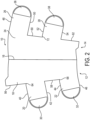
- Fig. 2 is a drawing depicting a second configuration of exemplary components for use in a compression garment in accordance with embodiments of the present invention.
- Fig. 2 bears some similarity to the configuration of Fig. 1 , like reference numerals are used for like components. Referring briefly to Fig. 2 , such embodiment differs as to the precise configuration of the notches.
- a notch 64 is provided where lateral edge 40 meets longitudinal outer edge 56, similarly as in the embodiment of Fig. 1 .
- no notch is provided where lateral edge 42 meets longitudinal outer edge 58.
- a notch 68 is provided where lateral edge 44 meets longitudinal outer edge 58, similarly as the embodiment of Fig. 1 , but as to strap 26 in contrast to the embodiment of Fig. 1 , no notch is provided where lateral edge 50 meets longitudinal outer edge 60.
- a notch 72 is provided where lateral edge 52 meets longitudinal outer edge 60 similarly as the embodiment of Fig. 1 , but in contrast to the embodiment of Fig. 1 no notch is provided where lateral edge 54 meets longitudinal outer edge 62.
- the resultant configuration of Fig. 2 therefore, has fewer notches than the embodiment of Fig. 1 . Specifically, there are half as many notches (three) in the embodiment of Fig. 2 as compared to the number of notches (six) in the embodiment of Fig. 1 . This makes the embodiment of Fig. 2 somewhat easier to manufacture. Accordingly, instead of pairs of cooperating notches as depicted in Fig. 1 , in the embodiment of Fig. 2 each notch 64, 68, and 72 interacts with an opposing straight portion of a lateral edge of an adjacent strap when the compression garment is in the wrapped position so as to form the overlapping region and provide the enhanced fit without bunching of the compression garment.
- the notches in both the example embodiments of Figs. 1 and 2 permit overlap of adjacent straps, but the amount of overlap is minimal as compared to conventional configurations, while still providing an effective gapless configuration.
- the amount of overlap may be 1/4 inch or less, and may be as little as 1/8 inch.
- the amount or degree of overlap is achieved regardless of the size of the compression garment.
- a common amount of overlap may be present in a garment for a large limbed user and a small limbed user, and for a large limb (e.g., thigh garment) as compared to a small limb (e.g., calf or arm garment).
- the low-elastic compression garment is substantially less bulky as compared to conventional configurations.
- the notches being located where the straps extend laterally from the half main portions, there is little tendency for the straps to move laterally relatively to each other.
- the present invention therefore, provides a gapless configuration that has enhanced comfort and requires less material to manufacture.
- the compression garment components may be made of a limited stretch material as are known in the art.
- the compression garment has three layers of material that are bonded together, including an internal compressible layer sandwiched between a first woven fabric layer and a second woven fabric layer.
- the internal compressible layer may be made of a synthetic rubber type material or the like, with neoprene being a suitable example.
- the woven fabric layers may be made of nylon loop type fabric materials or the like, with spandex materials being a suitable example.
- the level of working pressure provided by the limited stretch nature of the material in part is dictated by the maximum stretch of the compression garment when worn as a property of the materials of the layers, and additionally the circumference of the limb of the user.
- the limb circumference in turn is a function of the degree of edema and muscle expansion and contraction, which may change with the changing condition of the user, or use conditions such as whether the user is resting or moving.
- different levels of working pressure may be achieved.
- Typical radial compression or working pressure levels may run from about 20-60 mmHg depending upon the materials being used and the compression needs of the user.
- the low end of the range also would tend to be the pressure with the user at rest, whereas movement would tend to be associated with working pressures on the higher end of the range.
- the limited stretch material may be configured with different portions of the garment being capable of achieving different or graduated levels of compression along the garment.
- the compression garment components 10 may include a distal counter pull tab 76 and a proximal counter pull tab 78.
- the distal and proximal counter pull tabs 76 and 78 are provided as extensions on opposite first and second lateral outer edges 81 and 82 of opposing half main portions 18 and 24.
- the lateral outer edges 81 and 82 extend substantially perpendicularly relative to the longitudinal outer edges of the central main portion. Accordingly, the distal counter pull tab 76 extends from the first lateral outer edge 81 of the central main portion, and the proximal counter pull tab 78 extends from the second lateral outer edge 82 of the central main portion.
- the counter pull tabs 76 and 78 constitute dedicated gripping portions. When pulled by the user, the counter pull tabs 76 and 78 transmit the pulling forces in opposing directions to tension the straps, which aid the user in achieving the requisite tension on the straps.
- the compression garment therefore, is easier to don as compared to conventional wrapped compression garments.
- the compression garment components 10 may be formed of three layers including an internal compressible layer sandwiched between a first woven fabric layer and a second woven fabric layer.
- the first woven layer has a first color
- the second woven layer has a second color different from the first color (e.g., black and beige, although any colors may be employed)
- the compression garment is reversible such that either color may be visible as desired by the user as follows.
- each strap 20, 22, 26, and 28 respectively has an end 80, 82, 86, and 88 that is remote from where the strap meets the respective longitudinal outer edge of the central main portion.
- the ends may have a curved contour which provides for easier manipulation, and reduces tendencies of bunching or creasing of the material as could occur with end shapes having corners.
- Each curved end respectively may have an associated fastening tab 30, 32, 36, and 38 as referenced above that are provided at each of the ends of the straps.
- the fastening tabs also may have a curved contour so as to be shaped commensurately with the curved contour of the strap ends.
- each fastening tab is removable from a respective strap and repositionable at a different location on the respective strap.
- the ability to remove and reposition the fastening tabs results in a compression garment that is both reversible and easily sized for a customized fit.
- the fastening tabs are repositionable on the respective straps from a location on the first woven layer to a location on the second woven layer, thereby rendering the compression garment reversible.
- the first woven layer has a first color
- the second woven layer has a second color different from the first color
- the positioning of the fastening tab on either the first woven layer or the second woven layer is determinable of which color is visible when the compression garment is in a wrapped position. Accordingly, depending upon which side of the straps the fastening tabs are located, the compression garment may be wrapped in either direction, thereby permitting either color of woven fabric layers to be visible as desired by the user.
- each fastening tab may be removed and repositioned laterally on a same side along the respective straps at different lateral locations from the ends 80, 82, 86, and 88.
- the fastening tabs act as a marker for cutting the straps to any suitable or desired size for a customized fit.
- any excess strap material that extends laterally beyond the repositioned fastening tabs may be cut away using the fastening tabs as a guide.
- the present disclosure includes a method of fitting a compression garment that is wrapped around a limb of a user.
- the fitting method may include the steps of providing the compression garment in accordance with any of the described embodiments (including any variations described below), removing at least one fastening tab from a respective strap, and repositioning the fastening tab at a different location on the respective strap.
- the fitting method may include repositioning the at least one fastening tab laterally on a same side of the respective strap, wherein the repositioned fastening tab acts as a marker for cutting the respective strap to a desired size, and cutting excess strap material that extends laterally beyond the repositioned fastening tab to provide a customized fit.
- the fitting method further may include repositioning the at least one fastening tab on the respective strap from a location on the first woven layer to a location on the second woven layer, thereby rendering the compression garment reversible.
- the positioning of the fastening tab on either the first woven layer or the second woven layer is determinable of which color is visible when the compression garment is in the wrapped position.
- Fig. 3 is a drawing depicting a first exemplary low-elastic, wrapped compression garment 90 in an unwrapped position in accordance with embodiments of the present invention.
- the compression garment 90 in one embodiment may be configured using the garment components 10 of Figs. 1 or 2 .
- Fig. 3 includes certain modifications that are made to the components 10 to form the compression garment 90.
- Fig. 3 shows the compression garment components as the two garment halves 12 and 14 would be sewn or otherwise fixed together to form the complete compression garment 90.
- the two half main portions 18 and 24 may be sewn together, thereby forming a central seam 92 configured as a stitched central seam.
- the central main portion of the garment generally may therefore be considered a region of the compression garment substantially around and including the seam, and not including the straps.
- the seam is sewn with the stitched configuration to provide a biased curvature to the central main portion so that the central main portion of the completed garment is non-flat, i.e.
- the garment has a non-flat central region 93 with a curved contour in three dimensions that is intended to be commensurate with a typical shape of a limb portion, such as for example a typical calf for a lower leg compression garment.
- the biased nature into a three-dimensional, non-flat and curved central region is indicated by the shading in Fig. 3 .
- the two half main portions 18 and 24 thus are joined together to form a curved central main portion that wraps around a substantial portion of the limb about the calf.
- the plurality of straps 20, 22, 26, and 28 extend laterally from the central main portion to wrap around the remainder of the limb.
- the exemplary embodiment of Fig 3 also has a different notch configuration relative to the previous embodiments, although the previous notch configurations likewise may also be employed in combination with a biased central seam.
- one or more of the longitudinal edges of at least one of the half main portions may comprise a concave curvature extending between straps, and the notches are provided within one or more of such concave curvatures adjacent to where a strap extends from the central main portion.
- the longitudinal outer edge of the first half main portion 18 may be configured as a concave curvature 94 that is formed into such longitudinal outer edge extending between the straps 20 and 22.
- a notch 96 may be provided in the concave curvature 94 of the first half main portion 18, adjacent to where the strap 20 extends from the concave longitudinal outer edge 94.
- a similar notch configuration may be provided in relation to the second half main portion 24.
- the longitudinal outer edge of the second half main portion 24 may be configured as a concave curvature 98 that is formed into such longitudinal outer edge extending between the straps 26 and 28.
- a notch 100 may be provided in the concave curvature 98 of the second half main portion 24, adjacent to where the strap 26 extends from the concave longitudinal outer edge 98.
- the notch 64 also may be provided similarly as in the embodiment of Fig. 1 .
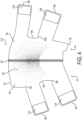
- Fig. 4 is a drawing depicting a second exemplary low-elastic, wrapped compression garment 110 in an unwrapped position in accordance with embodiments of the present invention.
- the configuration of the compression garment components of the compression garment 110 in Fig. 4 bears some similarity to the configuration of the components in the previous embodiments, like reference numerals are used for like components.
- Fig. 4 shows the compression garment components as they would be sewn or otherwise fixed together to form the complete compression garment 110.
- the two half main portions 18 and 24 may be sewn together, thereby forming the central seam 92 configured as a stitched central seam as above to provide a biased curvature in three dimensions to the resultant central main portion 93.
- the completed garment has a non-flat central region or central main portion 93 with a curved contour in three dimensions that is intended to be commensurate with a typical shape of a limb portion, such as for example a typical calf for a lower leg compression garment.
- the biased nature into a three-dimensional, non-flat and curved central region is indicated again by the shading in Fig. 4 .
- the exemplary embodiment of Fig. 4 has essentially the same notch configuration as the embodiment of Fig. 3 , with at least one of the half main portions including a concave curvature (94, 98) extending between straps, and the notches 96 and 100 may be provided within the concave curvature adjacent to where a strap extends from the half main portion.
- the notch 64 also may be provided similarly as in the embodiment of Fig. 1 .
- Fig. 4 differs from previous embodiments in the shapes of the strap ends 80, 82, 86, and 88. Such ends are shaped substantially in a rectangular fashion, and may have rounded corners insofar as referenced above, the curvature can provide for easier manipulation, and reduces tendencies of bunching or creasing of the material as could occur with end shapes having sharp corners.
- fastening tabs 112, 114, 116, and 118 are shaped commensurately with the strap ends.
- each fastening tab is removable from a respective strap and repositionable at a different location on the respective strap on either the same or opposite side. The ability to remove and reposition the fastening tabs again results in a compression garment that is both reversible and easily sized for a customized fit.
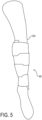
- Fig. 5 is a drawing depicting an exemplary low-elastic, wrapped calf compression garment in use in a wrapped position wrapped around a limb portion 120 in accordance with embodiments of the present invention.
- compression garment 90 is shown, although any of the compression garments or components thereof of the previous embodiments may be employed.
- the biased curvature of the non-flat central region described above permits a contoured fit commensurate with the curved shape of the calf.
- the notches permit the straps to be wrapped around a limb portion in an overlapping configuration both without gaps between the straps, and without bunching of the strap material, resulting in an enhanced fit and comfort as compared to conventional configurations while maintaining full compression along the entirety of the compression garment.
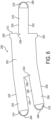
- Fig. 6 is a drawing depicting a third exemplary compression garment 200 in an unwrapped position in accordance with embodiments of the present invention. As further detailed below, the example embodiment of Fig. 6 may be particularly suitable for wrapping around an upper leg portion of a user, such as around the thigh area.
- the compression garment 200 may be formed as a seamless unitary component including the central main portion or region 202, rather than in two half main portions as in the previous embodiments, and the plurality of straps. Accordingly, there is no central seam as in the previous embodiments, as the unitary component comprises in combination the central main portion and the plurality of straps.
- the thigh circumference tends to be substantially larger and more uniform in curvature as compared to the calf. Accordingly, it is less desirable for a thigh garment to be configured with a biased seam in the compression garment, as a unitary component with a seamless main central portion provides for a better fit around the thigh.
- a plurality of straps extend laterally from the main portion.
- two straps 204 and 206 may be spaced apart from each other about a center axis of the garment and extend laterally from the central main portion 202 from a first longitudinal edge 208.
- a third strap 210 may extend from a second longitudinal edge 212 opposite from the first longitudinal edge.
- the third strap 210 may extend from a more central location from the second longitudinal edge 212, such that in the wrapped position the third strap 210 extends between the two straps 204 and 206. It will be appreciated that the precise number of straps may vary depending upon the size of the compression garment relative to the scope of an amount of a limb portion that is desired to be wrapped for compression.
- each strap 204, 206, and 210 respectively has its own associated fastening tab 214, 216, and 218.
- any suitable fastening means may be employed, and mechanical fastening tabs are particularly suitable.
- the fastening tabs may be hook-and-loop and similar type mechanical fastening elements. The straps may be pulled and secured to tension the straps in the wrapped position, resulting in a compression force being applied to the limb as described above.
- a length of the straps in a direction laterally extending from the main portion is approximately equal to the length in the lateral direction of the non-strap main portion of the compression garment.
- the straps are staggered such that when the straps are wrapped around the remainder of the limb, there is an overlap of the lateral edges of adjacent straps in the wrapping around direction.
- a notch configuration may be provided so that adjacent straps may overlap without bunching of the strap material. Any of the notch configurations used with respect to the previous embodiments likewise may also be employed in combination with a unitary central main portion that may be employed for a thigh compression garment.
- strap 204 has opposite lateral edges 222 and 224
- strap 206 has opposite lateral edges 226 and 228, and strap 210 has opposite lateral edges 230 and 232.
- the lateral edges are essentially perpendicular to the longitudinal edges 208 and 212 such that the plurality of straps extend laterally from the longitudinal outer edges of the main portion 202.
- Fig. 6 shows another example of a notch configuration (which also may be used in connection with any of the previous embodiments).
- the notches may be configured as shaped recesses formed extending into the central main portion adjacent to where a strap extends from the central main portion.
- a first shaped notch 234 may be formed in the main portion 202 adjacent to where the strap 206 extends from the main portion near the lateral edge 226.
- a second shaped recess notch 236 may be formed in the main portion 202 adjacent to where the third strap 210 extends from the main portion at the lateral edge 230.
- the notches are rounded indentations into the main portion 202, although any suitable shaped notches may be employed.
- additional notches may be provided, and the notch shapes may be the same or different from each other.
- a comparable notch may be formed in the main portion 202 adjacent to where the strap 204 extends from the main portion at its lateral edge 224, and/or another notch may be formed in the main portion 202 adjacent to where the strap 210 extends from the main portion at the lateral edge 232 opposite from the notch 236. Accordingly, when the compression garment is in a wrapped position, lateral edges of adjacent straps that are associated with the at least one notch overlap similarly as in previous embodiments.
- the presence of the notches thus permits the straps to wrap around a limb portion, and particularly a thigh portion in this example, with the lateral edges overlapping in a gapless configuration without bunching of the strap material as may occur in conventional configurations, while maintaining full compression along the entirety of the compression garment.
- the thigh garment of Fig. 6 also may include pull tabs to aid in donning the garment.
- the compression garment 200 may include a distal counter pull tab 238 and a proximal counter pull tab 240.
- the distal and proximal counter pull tabs 238 and 240 are provided as extensions from the main portion 202.
- the counter pull tabs 238 and 240 constitute dedicated gripping portions.
- the counter pull tabs 238 and 240 transmit the pulling forces in opposing directions to tension the straps, which aids the user in achieving the requisite tension on the straps.
- the compression garment therefore, is easier to don as compared to conventional wrapped compression garments.
- each strap 204, 206, and 210 respectively has an end 244, 246, and 248 that is remote from where the strap meets the respective longitudinal outer edge of the main portion.
- the ends may have a curved contour which provides for easier manipulation, and reduces tendencies of bunching or creasing of the material as could occur with end shapes having corners.
- Each curved end respectively may have the associated fastening tab 214, 216, and 218 similarly as previous embodiments, which are removable from a respective strap and repositionable at a different location on either side of the respective strap so that the garment again is both reversible and easily sized for a customized fit.
- each fastening tab may be removed and repositioned laterally on a same side along the respective straps at different lateral locations from the ends 244, 246, and 248.
- the fastening tabs By positioning the fastening tabs at different locations laterally along the straps relative to the strap ends, the repositioned fastening tabs act as a marker for cutting the straps to any suitable or desired size for a customized fit.
- the compression garment By repositioning the fastening tabs on the opposite side of the respective strap, the compression garment is made reversible.
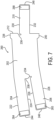
- Fig. 7 is a drawing depicting a second exemplary compression garment 260 in an unwrapped position in accordance with embodiments of the present invention.
- Compression garment 260 is a variation of the thigh compression garment 200 of Fig. 6 . Accordingly, the configuration of the compression garment 260 bears some similarity to the configuration of the compression garment 200, so like reference numerals are used for like components in Figs. 6 and 7 .
- Fig. 7 differs from the previous embodiment of Fig. 6 largely in the shapes of the strap ends 244, 246, and 248.
- the embodiment of Fig. 6 is similar to that of Fig. 4 .
- the strap ends may be shaped substantially in a rectangular fashion, and may have rounded corners insofar as referenced above, the curvature can provide for easier manipulation, and reduces tendencies of bunching or creasing of the material as could occur with end shapes having sharp corners.
- fastening tabs 264, 265, and 268 are shaped commensurately with the strap ends.
- each fastening tab is removable from a respective strap and repositionable at a different location on either side of the respective strap. The ability to remove and reposition the fastening tabs again results in a compression garment that is both reversible and easily sized for a customized fit.
- Fig. 8 is a drawing depicting an exemplary low-elastic, wrapped thigh compression garment such as garment 200 or 260, in use in a wrapped position wrapped around a limb portion 270 in accordance with embodiments of the present invention.
- the notches permit the straps to be wrapped around a limb portion in an overlapping configuration both without gaps between the straps, and without bunching of the strap material, resulting in an enhanced fit and comfort as compared to conventional configurations while maintaining full compression along the entirety of the compression garment.
- the invention concerns a low-elastic, wrapped compression garment that is to be wrapped around a limb of a user.
- the low-elastic compression includes a central main portion including a plurality of longitudinal outer edges, a plurality of straps that extend laterally from the longitudinal outer edges of the central main portion, each of the plurality of straps having opposite lateral edges, and at least one notch adjacent to where a lateral edge of one of the straps meets one of the longitudinal outer edges of the central main portion.
- the low-elastic compression garment may include one or more of the following features, either individually or in combination.
- the at least one notch includes a plurality of notches.
- a notch is provided where a lateral edge of one of the straps meets one of the longitudinal outer edges of the central main portion, wherever a lateral edge of one of the straps overlaps a lateral edge of an adjacent strap when the compression garment is in the wrapped position.
- the at least one notch includes a plurality of notches. Each notch is provided where a lateral edge of one of the straps meets one of the longitudinal outer edges of the central main portion, and each notch interacts with an opposing straight portion of a lateral edge of an adjacent strap when the compression garment is in the wrapped position.
- At least one of the plurality of longitudinal edges of the central main portion comprises a concave curvature extending between straps, and a notch is provided within the concave curvature adjacent to where a strap extends from the central main portion.
- more than one of the plurality of longitudinal edges of the central main portion comprises a concave curvature extending between straps, and a notch is provided within each of the concave curvatures adjacent to where a strap extends from the central main portion.
- the at least one notch comprises a shaped recess formed extending into the central main portion adjacent to where a strap extends from the central main portion.
- the at least one notch comprises a plurality of notches, wherein each notch comprises a shaped recess formed extending into the central main portion adjacent to where a strap extends from the central main portion.
- the plurality of notches comprises at least two notches configured as rounded indentations that extend into the central main portion.
- an amount of overlap of lateral edges of adjacent straps is 1/4 inch or less.
- an amount of overlap of lateral edges of adjacent straps is between 1/8 inch and 1/4 inch.
- the compression garment comprises a first half and a second half that are fixed together at a central seam, the central main portion being a region of the compression garment around the central seam not including the straps.
- the first and second halves are sewn together to configure the central seam as a stitched central seam.
- the central seam provides a biased curvature to the central main portion, wherein the central main portion is non-flat.
- the compression garment is formed as a seamless unitary component including the central main portion and the plurality of straps.
- the low-elastic compression garment includes a central main portion including a plurality of longitudinal outer edges, and first and second opposite lateral outer edges that extend substantially perpendicularly relative to the longitudinal outer edges, a plurality of straps that extend laterally from the longitudinal outer edges of the central main portion, and a distal counter pull tab that extends from the first lateral outer edge of the central main portion, and a proximal counter pull tab that projects from the second lateral outer edge of the central main portion.
- the low-elastic compression garment includes a central main portion including a plurality of longitudinal outer edges, a plurality of straps that extend laterally from the longitudinal outer edges of the central main portion, each of the plurality of straps having an end that is remote from where the strap meets the longitudinal outer edge of the central main portion, and a plurality of fastening tabs respectively provided at each of the ends of the straps, wherein each fastening tab is removable from a respective strap and repositionable at a different location on the respective strap.
- the fastening tabs are repositionable laterally on a same side of the respective straps, wherein a repositioned fastening tab acts as a marker for cutting the respective strap to a desired size.
- the strap ends have a curved contour
- the fastening tabs have a curved contour that is commensurate with the curved contour of the strap ends.
- the compression garment comprises three layers of material including an internal compressible layer between a first woven layer and a second woven layer; and the fastening tabs are repositionable on the respective straps from a location on the first woven layer to a location on the second woven layer, thereby rendering the compression garment reversible.
- the first woven layer has a first color
- the second woven layer has a second color different from the first color
- the positioning of the fastening tab on either the first woven layer or the second woven layer is determinable of which color is visible when the compression garment is in a wrapped position.
- the central main portion further includes first and second opposite lateral outer edges that extend substantially perpendicularly relative to the longitudinal outer edges.
- the compression garment further includes a distal counter pull tab that extends from the first lateral outer edge of the central main portion, and a proximal counter pull tab that extends from the second lateral outer edge of the central main portion, wherein when the distal and proximal counter pull tabs are pulled by the user, pulling forces are transmitted in opposing directions to tension the straps.
- each of the plurality of straps has an end that is remote from where the strap meets the longitudinal outer edge of the central main portion, and a plurality of fastening tabs respectively are provided at each of the ends of the straps, wherein each fastening tab is removable from a respective strap and repositionable at a different location on the respective strap.
- the fastening tabs are repositionable laterally on a same side of the straps, wherein the repositioned fastening tab acts as a marker for cutting the respective strap to a desired size.
- the compression garment comprises three layers of material including an internal compressible layer between a first woven layer and a second woven layer, and the fastening tabs are repositionable on the straps from a location on the first woven layer to a location on the second woven layer, thereby rendering the compression garment reversible.
- the compression garment comprises a first half and a second half that are fixed together at a central seam.
- the central seam provides a biased curvature to the central main portion.
- the first half comprises a first half main portion and a portion of the straps that extend laterally from the first half main portion
- the second half comprises a second half main portion and another portion of the straps that extend laterally from the second half main portion
- a length of the straps extending from the half main portions is approximately equal to a length of the half main portions in the lateral direction.
- each strap has a distal end that attaches to the central main portion in the wrapped position, whereby the compression garment applies a working pressure to a limb to provide limb compression when the compression garment is in the wrapped position.
Landscapes
- Health & Medical Sciences (AREA)
- Engineering & Computer Science (AREA)
- Biomedical Technology (AREA)
- Heart & Thoracic Surgery (AREA)
- Vascular Medicine (AREA)
- Life Sciences & Earth Sciences (AREA)
- Animal Behavior & Ethology (AREA)
- General Health & Medical Sciences (AREA)
- Public Health (AREA)
- Veterinary Medicine (AREA)
- Professional, Industrial, Or Sporting Protective Garments (AREA)
- Sewing Machines And Sewing (AREA)
- Surgical Instruments (AREA)
Description
- This application claims the benefit of
U.S. Provisional Application No. 62/181,560 filed June 18, 2015 - The present invention relates to therapeutic compression garments worn to prevent fluid build-up in the limbs, and particularly relates to low-elastic compression garments having straps that wrap around a patient's limb.
- Therapeutic compression garments are worn to prevent the build-up of fluid in the limbs, a condition commonly referred to as edema and various types of vascular insufficiencies. Persons who may use such a garment include post-surgical patients, obese persons, and persons with ailments that impede circulation, such as Chronic Venous Insufficiency, Lymphedema and diabetics. Compression garments improve circulation and prevent fluid from collecting in the lower limb portions, such as in the feet and ankles (leg compression garment) or hands (arm compression garment). By improving circulation and reducing the propensity toward fluid build-up, compression garments relieve swelling and associated pain, prevent and help in the treatment of ulcers, and prevent other issues that can result from poor circulation in the limbs.
- Various types of compression garments are known in the art. One type of compression garment is a tubular shaped, high elastic, knitted compression garment, which provides graduated compression when worn on a limb. High elastic compression garments offer only a minimal increase in working pressure allowing them to be easier to don. Depending upon the level of a patient's clinical involvement, such garments may, at times, not provide an adequate level of pressure to improve circulation or prevent edema in the limb.
- Accordingly, more "low-elastic", stretch-limited compression garments also have been used to provide compression, but such garments likewise must be able to accommodate changes in compression based on changes in the size of the limb. Low-elastic garments have an advantage over elastic garments in that low elastic garments provide an increased or higher working pressure in response to increased patient activity or limb edema. As a limb expands due to muscle expansion or edema, the expanded limb pushes up against the low-elastic garment, which is stretch-limited and therefore offers greater resistance as compared to high-elastic garments. This results in higher working pressure. The relatively high working pressure of low-elastic garments results in an improved vascular flow and edema containment. As a consequence of the high working pressure and limited stretch, low-elastic garments formed in a tubular shape can be considerably more difficult to don as compared to high-elastic garments.
WO 2010/025186 A1 andUS 2010/312160 A1 each independently reveal a compression garment having short-stretch material. - To provide for a more dynamic compression that adjusts with changing situations and are easier to don, wrap-style low-elastic compression garments have been employed. Such garments may be wrapped around a limb and secured using a fastening device, such as a hook and loop mechanical fastening device. As such, they may be removed and re-wrapped with differing tensions to accommodate any changing compression needs. Wrapped compression garments may be configured with staggered compression straps or bands that are linked together by a central spine or region, the straps wrapping around the limb. The use of bands or straps provides substantial versatility in achieving a desired amount of compression, both as therapeutically required and to provide a more comfortable fit.
- Conventional low-elastic wrapped compression garments with bands or straps, however, still have deficiencies related to providing a desired fit. It is desirable that there not be significant gaps between the straps in use. Any significant gaps constitute areas where compression is not applied, and thus provide areas where fluid may accumulate. This can result in limb tissue bulging between the bands, which reduces the effectiveness of the compression and may result in discomfort. One option to avoid problems associated with gaps is to configure the bands so that they essentially are touching with minimal overlap, but in use, with patients being of different sizes and with movement, it is difficult to create a single product that could accommodate a wide range of limb sizes while maintaining a gapless configuration.
- Another option is to have the bands overlap, but overlapping bands can bunch up, particularly where the bands connect to the spine or central region. To provide high working pressure as referenced above without gaps, conventional configurations may overlap the bands by as much as 50%. This provides a bulky configuration that requires a significant amount of material to manufacture, and the bulkiness could result in discomfort to the user.
- Another deficiency of conventional low-elastic compression garments pertains to providing versatility of size to accommodate various sized patients. To reduce manufacturing costs and complexity, and reduce the need for maintaining a large and varied inventory, it is desirable that a given compression garment be able to accommodate multiple sizes of patients. This reduces the number of different configurations that must be maintained by an end user facility, such as a hospital or nursing home. Various sizing schemes, such as markings and other indicators, have been employed to aid in cutting the straps down to appropriate sizes, but such systems often are complicated and prone to user error.
- A related deficiency of conventional low-elastic compression garments is that wrapped compression garments can be difficult to don with sufficient compression. Users often are elderly or infirmed, and the force required to pull the bands or straps tight to the desired level of compression can be difficult for such users to apply. The result may be a donning with inadequate compression, and in turn a resultant inadequate therapeutic performance.
- In view of the above deficiencies, conventional low-elastic compression garments are not being utilized to their maximum potential.
- The present invention provides an enhanced low-elastic wrap compression garment according to claim 1 that improves over the deficiencies of conventional compression garments. In exemplary embodiments, a low-elastic wrap compression garment may be formed of two halves that are sewn together at a central seam. Each half includes a half main portion and a plurality of straps that extend from the half main portion. Straps may extend from each half main portion. The two half main portions are sewn together, thereby forming a stitched central seam. For wrapping around certain limbs, like the calf, the seam may be configured to provide a biased curvature so that the completed garment has a contour that is intended to be commensurate with a typical limb shape, such as for example a shape of a patient's calf. For limbs in which the curvature is larger and more uniform, such as the thigh, the garment may be formed with a unitary component including a main portion from which the plurality of straps extend.
- The straps are staggered such that when the straps are wrapped around the remainder of the limb, there is an overlap of the lateral edges of the straps in the wrapping around direction. The garment may have a notched configuration to enhance the overlapping nature of the straps. In one exemplary embodiment, where each strap extends from the respective half main portion or a unitary main portion, a notch is provided so that adjacent straps may overlap to provide a gapless configuration, without bunching of the strap material. The notch permits a minimal overlap of less than about 1/4 inch and as little and 1/8 inch. In another exemplary embodiment, a concave curvature may be formed in the half main portion or unitary main portion between the straps, and the notches are provided within the concave curvature adjacent to where a strap extends from the main portion. In another exemplary embodiment, the notches may be configured as shaped recesses formed extending into the half main portion or unitary main portion adjacent to where a strap extends from the main portion. Distal and proximal counter pull tabs may be provided on each half main portion or in a unitary main portion, which aids the user in putting tension on the distal and proximal straps to aid in donning the compression garment with the desired level of compression.
- The compression garment further may include woven fabric layers of different colors. Removable fastening tabs are provided that are removable from the straps to permit reversibility of the compression garment such that either color may be visible. In addition, positioning the removable fastening tabs at different locations along the straps provides a marker for cutting the straps to any suitable size for a customized fit. Accordingly, a wide range of user sizes may be accommodated with a single compression garment.
- An aspect of the invention, therefore, is a low-elastic wrap compression garment. In exemplary embodiments, the low-elastic compression garment includes a central main portion including a plurality of longitudinal outer edges, a plurality of straps that extend laterally from the longitudinal outer edges of the central main portion, each of the plurality of straps having opposite lateral edges, and an end that attaches to the central main portion adjacent an opposite longitudinal outer edge in use, and at least one notch where a lateral edge of one of the straps meets one of the longitudinal outer edges of the central main portion. When the compression garment is in a wrapped position, lateral edges of adjacent straps that are associated with the at least one notch can overlap. The at least one notch may be configured as a plurality of notches. A notch may be provided adjacent to where a lateral edge of one of the straps meets one of the longitudinal outer edges of the central main portion, wherever a lateral edge of one of the straps overlaps a lateral edge of an adjacent strap when the compression garment is in the wrapped position.
- In another exemplary embodiment, the central main portion may be formed of two half main portions sewn together with a biased seam that has a three-dimensional curvature for form fitting to the curvature of a limb portion.
- In another exemplary embodiment, the central main portion may include a concave curvature extending between straps, and the notches are provided within the concave curvature adjacent to where a strap extends from the main portion. In another exemplary embodiment, the notches may be configured as shaped recesses formed extending into the central main portion adjacent to where a strap extends from the main portion.
- In exemplary embodiments of the low-elastic compression garment, the central main portion includes first and second opposite lateral outer edges that extend substantially perpendicularly relative to the longitudinal outer edges. The compression garment further may include a distal counter pull tab that extends from the first lateral outer edge of the central main portion, and a proximal counter pull tab that extends from the second lateral outer edge of the central main portion. When the distal and proximal counter pull tabs are pulled by the user, pulling forces are transmitted in opposing directions to tension the straps.
- According to the invention, each of the plurality of straps has an end that is remote from where the strap meets the longitudinal outer edge of the central main portion. A plurality of fastening tabs respectively are provided at each of the ends of the straps, wherein each fastening tab is removable from a respective strap and repositionable at a different location on the respective strap. The ability to remove and reposition the fastening tabs results in a compression garment that is both reversible for different colors, and easily adjusted for a more customized fit.
- Another aspect of the disclosure is a method of fitting a low-elastic compression garment that is wrapped around a limb of a user. In exemplary embodiments, the fitting method may include the steps of providing a low-elastic compression garment (for example a compression garment in accordance with any of the embodiments disclosed herein), removing at least one fastening tab from a respective strap, and repositioning the fastening tab at a different location on the respective strap.
- The fitting method may include repositioning at least one fastening tab laterally on a same side of the respective strap, wherein the repositioned fastening tab acts as a marker for cutting the respective strap to a desired size, and cutting excess strap material that extends laterally beyond the repositioned fastening tab to provide a customized fit. The fitting method further may include repositioning the at least one fastening tab on the respective strap from a location on the first woven layer to a location on the second woven layer, thereby rendering the compression garment reversible. When the first woven layer has a first color, and the second woven layer has a second color different from the first color, the positioning of the fastening tab on either the first woven layer or the second woven layer is determinable of which color is visible when the compression garment is in the wrapped position.
- These and further features of the present invention will be apparent with reference to the following description and attached drawings. In the description and drawings, particular embodiments of the invention have been disclosed in detail as being indicative of some of the ways in which the principles of the invention may be employed, but it is understood that the invention is not limited correspondingly in scope. Rather, the invention includes all changes, modifications and equivalents coming within the terms of the claims appended hereto. Features that are described and/or illustrated with respect to one embodiment may be used in the same way or in a similar way in one or more other embodiments and/or in combination with or instead of the features of the other embodiments.
-
-
Fig. 1 is a drawing depicting a first configuration of exemplary components for use in a compression garment in accordance with embodiments of the present invention. -
Fig. 2 is a drawing depicting a second configuration of exemplary components for use in a compression garment in accordance with embodiments of the present invention. -
Fig. 3 is a drawing depicting a first exemplary compression garment in an unwrapped position in accordance with embodiments of the present invention. -
Fig. 4 is a drawing depicting a second exemplary compression garment in an unwrapped position in accordance with embodiments of the present invention. -
Fig. 5 is a drawing depicting an exemplary calf compression garment in use in accordance with embodiments of the present invention. -
Fig. 6 is a drawing depicting a third exemplary compression garment in an unwrapped position in accordance with embodiments of the present invention. -
Fig. 7 is a drawing depicting a fourth exemplary compression garment in an unwrapped position in accordance with embodiments of the present invention. -
Fig. 8 is a drawing depicting an exemplary thigh compression garment in use in accordance with embodiments of the present invention. - Embodiments of the present invention will now be described with reference to the drawings, wherein like reference numerals are used to refer to like elements throughout. It will be understood that the drawings are not necessarily to scale.
-
Fig. 1 is a drawing depicting a first configuration ofexemplary components 10 for use in a compression garment in accordance with embodiments of the present invention. Thecomponents 10 essentially are depicted in a laid out position as would be oriented to form a compression garment. As further explained below, thecomponents 10 would be sewn together to form the completed compression garment. - A compression garment that would be formed from the
components 10 may be worn around a limb to prevent the build-up of fluid in the limb (edema). Persons who may use such a product include post-surgical patients, obese persons, and persons with ailments that impede circulation, such as Venous Disease or Lymphedema. Such a compression garment may improve circulation by compressing a limb or limb portion to prevent fluid from collecting in the lower limb portions, such as in the feet and ankles (leg compression garment) or hands (arm compression garment). The low-elastic compression garment generally is made of a stretch-limited material that provides high working pressures by limiting the amount of stretch in response to increased limb edema. In accordance with embodiments of the invention, the low-elastic compression garment is described as being configured as a leg compression garment worn essentially around a portion of a user's leg, and particularly the calf or thigh as typical examples. It will be appreciated, however, that that the features of the invention may be utilized in connection with a leg compression that extends from the calf over the knee to around the thigh, and/or going down to or around the foot and/or ankle. The precise size of the compression garment relative to the scope of the extension over the lower limb will depend upon the compression needs. It will further be appreciated that the features of the invention also may be utilized in connection with an arm compression garment that extends to any desired length over the arm and/or wrist or hand. - The
components 10 for the compression garment may be formed of afirst half 12 and asecond half 14 that may be fixed together along acenter line 16 where a seam can be formed when the two halves are sewn or otherwise fixed together (see additional details below). For purposes of definition, the longitudinal direction is defined as being substantially parallel to the direction by which the center line or seam extends. In addition, the lateral direction is the direction that is substantially perpendicular to the longitudinal direction. The term "substantially" is used because it will be appreciated that due to limb curvature, the center line and various edges of the compression garment may not be exactly straight. Rather, there may be a degree of slanting or curvature to the various edges of the compression garment components. Accordingly, references below to edges of the compression garment and components thereof as being either "lateral" or "longitudinal" denote a generalized direction allotting for any suitable slanting or curvature that may be present. - The
first half 12 may include a first halfmain portion 18 and a plurality of straps that extend laterally from the first main portion. In the exemplary embodiment ofFig. 1 , twostraps main portion 18. Similarly, thesecond half 14 may include a second halfmain portion 24 and a plurality of straps that extend laterally from the second main portion. In the exemplary embodiment ofFig. 1 , twostraps main portion 24. When the two halves are fixed together, the first halfmain portion 18 and the second halfmain portion 24 together form a central main portion from which the straps laterally extend. It will be appreciated that the precise number of straps may vary depending upon the size of the compression garment relative to the scope of an amount of a limb portion that is desired to be wrapped for compression. - Once wrapped around a limb, the straps may be secured to an opposite half main portion by a fastening tab. As seen in the figures, each
strap fastening tab - In exemplary embodiments of the
compression garment components 10, a length of the straps in a direction laterally extending from respective half main portions is approximately equal to the length in the lateral direction of the non-strap half main portions of the compression garment. The straps are staggered such that when the straps are wrapped around the remainder of the limb, there is an overlap of the lateral edges of adjacent straps in the wrapping around direction. Where each strap extends from the respective half main portion, a notch may be provided so that adjacent straps may overlap without bunching of the strap material. - Referring to
Fig. 1 ,strap 20 has oppositelateral edges strap 22 has oppositelateral edges strap 26 has oppositelateral edges strap 28 has oppositelateral edges main portion 18 has longitudinalouter edges straps main portion 24 has longitudinalouter edges straps - In the example embodiment of
Fig. 1 , at least one notch may be provided adjacent to where a lateral edge of one of the straps meets one of the longitudinal outer edges of the central main portion. Accordingly, when the compression garment is in a wrapped position, lateral edges of adjacent straps that are associated with the at least one notch overlap. Referring toFig. 1 as an exemplary configuration, for each strap, at least one notch is provided adjacent to where at least one lateral edge meets a corresponding longitudinal outer edge of a respective half main portion. As seen best inFig. 1 , for example, as to strap 20 anotch 64 is provided wherelateral edge 40 meets longitudinalouter edge 56, and anothernotch 66 is provided wherelateral edge 42 meets longitudinalouter edge 58. As tostrap 22, anotch 68 is provided wherelateral edge 44 meets longitudinalouter edge 58. As tostrap 26, anotch 70 is provided wherelateral edge 50 meets longitudinalouter edge 60. As tostrap 28, anotch 72 is provided wherelateral edge 52 meets longitudinalouter edge 60, and anothernotch 74 is provided wherelateral edge 54 meets longitudinalouter edge 62. - The presence of the notches permits the straps to wrap around a limb portion with the lateral edges overlapping in a gapless configuration without bunching of the strap material as may occur in conventional configurations. In this example,
strap 20 is associated with multipleopposite notches strap 28 is associated with multipleopposite notches straps notches 68 and 70) becausestraps -
Fig. 2 is a drawing depicting a second configuration of exemplary components for use in a compression garment in accordance with embodiments of the present invention. As the configuration ofFig. 2 bears some similarity to the configuration ofFig. 1 , like reference numerals are used for like components. Referring briefly toFig. 2 , such embodiment differs as to the precise configuration of the notches. - In the example of the embodiment of
Fig. 2 , as to strap 20 anotch 64 is provided wherelateral edge 40 meets longitudinalouter edge 56, similarly as in the embodiment ofFig. 1 . However, in contrast to the embodiment ofFig. 1 , no notch is provided wherelateral edge 42 meets longitudinalouter edge 58. As tostrap 22, anotch 68 is provided wherelateral edge 44 meets longitudinalouter edge 58, similarly as the embodiment ofFig. 1 , but as to strap 26 in contrast to the embodiment ofFig. 1 , no notch is provided wherelateral edge 50 meets longitudinalouter edge 60. As tostrap 28, anotch 72 is provided wherelateral edge 52 meets longitudinalouter edge 60 similarly as the embodiment ofFig. 1 , but in contrast to the embodiment ofFig. 1 no notch is provided wherelateral edge 54 meets longitudinalouter edge 62. - The resultant configuration of
Fig. 2 , therefore, has fewer notches than the embodiment ofFig. 1 . Specifically, there are half as many notches (three) in the embodiment ofFig. 2 as compared to the number of notches (six) in the embodiment ofFig. 1 . This makes the embodiment ofFig. 2 somewhat easier to manufacture. Accordingly, instead of pairs of cooperating notches as depicted inFig. 1 , in the embodiment ofFig. 2 eachnotch - The notches in both the example embodiments of
Figs. 1 and2 permit overlap of adjacent straps, but the amount of overlap is minimal as compared to conventional configurations, while still providing an effective gapless configuration. The amount of overlap may be 1/4 inch or less, and may be as little as 1/8 inch. In this regard, the amount or degree of overlap is achieved regardless of the size of the compression garment. For example, a common amount of overlap may be present in a garment for a large limbed user and a small limbed user, and for a large limb (e.g., thigh garment) as compared to a small limb (e.g., calf or arm garment). Accordingly, the low-elastic compression garment is substantially less bulky as compared to conventional configurations. In addition, with the notches being located where the straps extend laterally from the half main portions, there is little tendency for the straps to move laterally relatively to each other. The present invention, therefore, provides a gapless configuration that has enhanced comfort and requires less material to manufacture. - The compression garment components may be made of a limited stretch material as are known in the art. In exemplary embodiments, the compression garment has three layers of material that are bonded together, including an internal compressible layer sandwiched between a first woven fabric layer and a second woven fabric layer. The internal compressible layer may be made of a synthetic rubber type material or the like, with neoprene being a suitable example. The woven fabric layers may be made of nylon loop type fabric materials or the like, with spandex materials being a suitable example.
- The level of working pressure provided by the limited stretch nature of the material in part is dictated by the maximum stretch of the compression garment when worn as a property of the materials of the layers, and additionally the circumference of the limb of the user. The limb circumference in turn is a function of the degree of edema and muscle expansion and contraction, which may change with the changing condition of the user, or use conditions such as whether the user is resting or moving. Depending upon the degree by which the user stretches the compression garment around the given limb circumference, different levels of working pressure may be achieved. Typical radial compression or working pressure levels may run from about 20-60 mmHg depending upon the materials being used and the compression needs of the user. The low end of the range also would tend to be the pressure with the user at rest, whereas movement would tend to be associated with working pressures on the higher end of the range. In addition, the limited stretch material may be configured with different portions of the garment being capable of achieving different or graduated levels of compression along the garment.
- As referenced above, one deficiency of conventional wrapped compression garments is that they can be difficult to don with sufficient compression, particularly for users who are elderly or infirmed. Referring again to
Fig. 1 , to render donning easier, thecompression garment components 10 may include a distalcounter pull tab 76 and a proximalcounter pull tab 78. The distal and proximalcounter pull tabs outer edges main portions outer edges counter pull tab 76 extends from the first lateralouter edge 81 of the central main portion, and the proximalcounter pull tab 78 extends from the second lateralouter edge 82 of the central main portion. - When the compression garment is wrapped, the
counter pull tabs counter pull tabs - As referenced above, the
compression garment components 10 may be formed of three layers including an internal compressible layer sandwiched between a first woven fabric layer and a second woven fabric layer. In exemplary embodiments, the first woven layer has a first color, and the second woven layer has a second color different from the first color (e.g., black and beige, although any colors may be employed), and the compression garment is reversible such that either color may be visible as desired by the user as follows. - As seen in the figures, each
strap end fastening tab - To provide reversibility, the fastening tabs are repositionable on the respective straps from a location on the first woven layer to a location on the second woven layer, thereby rendering the compression garment reversible. When the first woven layer has a first color, and the second woven layer has a second color different from the first color, the positioning of the fastening tab on either the first woven layer or the second woven layer is determinable of which color is visible when the compression garment is in a wrapped position. Accordingly, depending upon which side of the straps the fastening tabs are located, the compression garment may be wrapped in either direction, thereby permitting either color of woven fabric layers to be visible as desired by the user.
- As referenced above, another deficiency of conventional compression garments is that they can be difficult to fit in a customized manner for different size users. The removability of the
fastening tabs ends - The present disclosure, therefore, includes a method of fitting a compression garment that is wrapped around a limb of a user. The fitting method may include the steps of providing the compression garment in accordance with any of the described embodiments (including any variations described below), removing at least one fastening tab from a respective strap, and repositioning the fastening tab at a different location on the respective strap.
- The fitting method may include repositioning the at least one fastening tab laterally on a same side of the respective strap, wherein the repositioned fastening tab acts as a marker for cutting the respective strap to a desired size, and cutting excess strap material that extends laterally beyond the repositioned fastening tab to provide a customized fit. The fitting method further may include repositioning the at least one fastening tab on the respective strap from a location on the first woven layer to a location on the second woven layer, thereby rendering the compression garment reversible. When the first woven layer has a first color, and the second woven layer has a second color different from the first color, the positioning of the fastening tab on either the first woven layer or the second woven layer is determinable of which color is visible when the compression garment is in the wrapped position.
-
Fig. 3 is a drawing depicting a first exemplary low-elastic, wrappedcompression garment 90 in an unwrapped position in accordance with embodiments of the present invention. Thecompression garment 90 in one embodiment may be configured using thegarment components 10 ofFigs. 1 or2 .Fig. 3 includes certain modifications that are made to thecomponents 10 to form thecompression garment 90. As the configuration of the compression garment components of thecompression garment 90 inFig. 3 bears some similarity to the configuration of thecomponents 10 ofFigs. 1 and2 , like reference numerals are used for like components. - Generally,
Fig. 3 shows the compression garment components as the twogarment halves complete compression garment 90. To fix the twohalves main portions central seam 92 configured as a stitched central seam. The central main portion of the garment generally may therefore be considered a region of the compression garment substantially around and including the seam, and not including the straps. The seam is sewn with the stitched configuration to provide a biased curvature to the central main portion so that the central main portion of the completed garment is non-flat, i.e. the garment has a non-flatcentral region 93 with a curved contour in three dimensions that is intended to be commensurate with a typical shape of a limb portion, such as for example a typical calf for a lower leg compression garment. The biased nature into a three-dimensional, non-flat and curved central region is indicated by the shading inFig. 3 . The two halfmain portions straps - The exemplary embodiment of
Fig 3 also has a different notch configuration relative to the previous embodiments, although the previous notch configurations likewise may also be employed in combination with a biased central seam. Generally, one or more of the longitudinal edges of at least one of the half main portions (which form the central main portion) may comprise a concave curvature extending between straps, and the notches are provided within one or more of such concave curvatures adjacent to where a strap extends from the central main portion. Referring to the example ofFig. 3 , the longitudinal outer edge of the first halfmain portion 18 may be configured as aconcave curvature 94 that is formed into such longitudinal outer edge extending between thestraps notch 96 may be provided in theconcave curvature 94 of the first halfmain portion 18, adjacent to where thestrap 20 extends from the concave longitudinalouter edge 94. A similar notch configuration may be provided in relation to the second halfmain portion 24. In particular, the longitudinal outer edge of the second halfmain portion 24 may be configured as aconcave curvature 98 that is formed into such longitudinal outer edge extending between thestraps notch 100 may be provided in theconcave curvature 98 of the second halfmain portion 24, adjacent to where thestrap 26 extends from the concave longitudinalouter edge 98. In the example ofFig. 3 , optionally thenotch 64 also may be provided similarly as in the embodiment ofFig. 1 . -
Fig. 4 is a drawing depicting a second exemplary low-elastic, wrappedcompression garment 110 in an unwrapped position in accordance with embodiments of the present invention. Again, as the configuration of the compression garment components of thecompression garment 110 inFig. 4 bears some similarity to the configuration of the components in the previous embodiments, like reference numerals are used for like components. - Generally,
Fig. 4 shows the compression garment components as they would be sewn or otherwise fixed together to form thecomplete compression garment 110. Similarly as in the embodiment ofFig. 3 , therefore, in the example of thecompression garment 110 ofFig. 4 , the two halfmain portions central seam 92 configured as a stitched central seam as above to provide a biased curvature in three dimensions to the resultant centralmain portion 93. In this manner, the completed garment has a non-flat central region or centralmain portion 93 with a curved contour in three dimensions that is intended to be commensurate with a typical shape of a limb portion, such as for example a typical calf for a lower leg compression garment. The biased nature into a three-dimensional, non-flat and curved central region is indicated again by the shading inFig. 4 . The exemplary embodiment ofFig. 4 has essentially the same notch configuration as the embodiment ofFig. 3 , with at least one of the half main portions including a concave curvature (94, 98) extending between straps, and thenotches Fig. 4 , optionally thenotch 64 also may be provided similarly as in the embodiment ofFig. 1 . - The example of
Fig. 4 differs from previous embodiments in the shapes of the strap ends 80, 82, 86, and 88. Such ends are shaped substantially in a rectangular fashion, and may have rounded corners insofar as referenced above, the curvature can provide for easier manipulation, and reduces tendencies of bunching or creasing of the material as could occur with end shapes having sharp corners. In this embodiment,fastening tabs -
Fig. 5 is a drawing depicting an exemplary low-elastic, wrapped calf compression garment in use in a wrapped position wrapped around alimb portion 120 in accordance with embodiments of the present invention. In the example ofFig. 5 ,compression garment 90 is shown, although any of the compression garments or components thereof of the previous embodiments may be employed. The biased curvature of the non-flat central region described above permits a contoured fit commensurate with the curved shape of the calf. It further is shown that in the wrapped position, the notches permit the straps to be wrapped around a limb portion in an overlapping configuration both without gaps between the straps, and without bunching of the strap material, resulting in an enhanced fit and comfort as compared to conventional configurations while maintaining full compression along the entirety of the compression garment. -
Fig. 6 is a drawing depicting a thirdexemplary compression garment 200 in an unwrapped position in accordance with embodiments of the present invention. As further detailed below, the example embodiment ofFig. 6 may be particularly suitable for wrapping around an upper leg portion of a user, such as around the thigh area. - In the example of
Fig. 6 , thecompression garment 200 may be formed as a seamless unitary component including the central main portion orregion 202, rather than in two half main portions as in the previous embodiments, and the plurality of straps. Accordingly, there is no central seam as in the previous embodiments, as the unitary component comprises in combination the central main portion and the plurality of straps. The thigh circumference tends to be substantially larger and more uniform in curvature as compared to the calf. Accordingly, it is less desirable for a thigh garment to be configured with a biased seam in the compression garment, as a unitary component with a seamless main central portion provides for a better fit around the thigh. - A plurality of straps extend laterally from the main portion. In the exemplary embodiment of
Fig. 6 , twostraps main portion 202 from a firstlongitudinal edge 208. In addition, athird strap 210 may extend from a secondlongitudinal edge 212 opposite from the first longitudinal edge. In such a three-strap configuration, thethird strap 210 may extend from a more central location from the secondlongitudinal edge 212, such that in the wrapped position thethird strap 210 extends between the twostraps - Once wrapped around a limb, the straps may be secured to an opposite end of the central main portion by a fastening tab. As seen in the figures, each
strap fastening tab - In the exemplary embodiment of the
compression garment 200, a length of the straps in a direction laterally extending from the main portion is approximately equal to the length in the lateral direction of the non-strap main portion of the compression garment. The straps are staggered such that when the straps are wrapped around the remainder of the limb, there is an overlap of the lateral edges of adjacent straps in the wrapping around direction. Similarly as in the previous embodiments, a notch configuration may be provided so that adjacent straps may overlap without bunching of the strap material. Any of the notch configurations used with respect to the previous embodiments likewise may also be employed in combination with a unitary central main portion that may be employed for a thigh compression garment. - Referring to
Fig. 6 ,strap 204 has oppositelateral edges strap 206 has oppositelateral edges strap 210 has oppositelateral edges longitudinal edges main portion 202. -
Fig. 6 shows another example of a notch configuration (which also may be used in connection with any of the previous embodiments). In the example embodiment ofFig. 6 , the notches may be configured as shaped recesses formed extending into the central main portion adjacent to where a strap extends from the central main portion. Referring toFig. 6 , a first shapednotch 234 may be formed in themain portion 202 adjacent to where thestrap 206 extends from the main portion near thelateral edge 226. Similarly, a second shapedrecess notch 236 may be formed in themain portion 202 adjacent to where thethird strap 210 extends from the main portion at thelateral edge 230. In this particular example, the notches are rounded indentations into themain portion 202, although any suitable shaped notches may be employed. Optionally, additional notches may be provided, and the notch shapes may be the same or different from each other. For example, a comparable notch may be formed in themain portion 202 adjacent to where thestrap 204 extends from the main portion at itslateral edge 224, and/or another notch may be formed in themain portion 202 adjacent to where thestrap 210 extends from the main portion at thelateral edge 232 opposite from thenotch 236. Accordingly, when the compression garment is in a wrapped position, lateral edges of adjacent straps that are associated with the at least one notch overlap similarly as in previous embodiments. The presence of the notches thus permits the straps to wrap around a limb portion, and particularly a thigh portion in this example, with the lateral edges overlapping in a gapless configuration without bunching of the strap material as may occur in conventional configurations, while maintaining full compression along the entirety of the compression garment. - The thigh garment of
Fig. 6 also may include pull tabs to aid in donning the garment. For example, thecompression garment 200 may include a distalcounter pull tab 238 and a proximalcounter pull tab 240. The distal and proximalcounter pull tabs main portion 202. Similarly as in previous embodiments, when the compression garment is wrapped, thecounter pull tabs counter pull tabs - As seen in the figures, each
strap end Figs. 1 and2 , the ends may have a curved contour which provides for easier manipulation, and reduces tendencies of bunching or creasing of the material as could occur with end shapes having corners. Each curved end respectively may have the associatedfastening tab ends -
Fig. 7 is a drawing depicting a secondexemplary compression garment 260 in an unwrapped position in accordance with embodiments of the present invention.Compression garment 260 is a variation of thethigh compression garment 200 ofFig. 6 . Accordingly, the configuration of thecompression garment 260 bears some similarity to the configuration of thecompression garment 200, so like reference numerals are used for like components inFigs. 6 and7 . - The example of
Fig. 7 differs from the previous embodiment ofFig. 6 largely in the shapes of the strap ends 244, 246, and 248. As to such features, the embodiment ofFig. 6 is similar to that ofFig. 4 . The strap ends may be shaped substantially in a rectangular fashion, and may have rounded corners insofar as referenced above, the curvature can provide for easier manipulation, and reduces tendencies of bunching or creasing of the material as could occur with end shapes having sharp corners. In this embodiment,fastening tabs -
Fig. 8 is a drawing depicting an exemplary low-elastic, wrapped thigh compression garment such asgarment limb portion 270 in accordance with embodiments of the present invention. In the wrapped position, the notches permit the straps to be wrapped around a limb portion in an overlapping configuration both without gaps between the straps, and without bunching of the strap material, resulting in an enhanced fit and comfort as compared to conventional configurations while maintaining full compression along the entirety of the compression garment. - The invention concerns a low-elastic, wrapped compression garment that is to be wrapped around a limb of a user. In exemplary embodiments, the low-elastic compression includes a central main portion including a plurality of longitudinal outer edges, a plurality of straps that extend laterally from the longitudinal outer edges of the central main portion, each of the plurality of straps having opposite lateral edges, and at least one notch adjacent to where a lateral edge of one of the straps meets one of the longitudinal outer edges of the central main portion. When the compression garment is in a wrapped position, lateral edges of adjacent straps that are associated with the at least one notch can overlap. The low-elastic compression garment may include one or more of the following features, either individually or in combination.
- In an exemplary embodiment of the compression garment, the at least one notch includes a plurality of notches. A notch is provided where a lateral edge of one of the straps meets one of the longitudinal outer edges of the central main portion, wherever a lateral edge of one of the straps overlaps a lateral edge of an adjacent strap when the compression garment is in the wrapped position.
- In an exemplary embodiment of the compression garment, the at least one notch includes a plurality of notches. Each notch is provided where a lateral edge of one of the straps meets one of the longitudinal outer edges of the central main portion, and each notch interacts with an opposing straight portion of a lateral edge of an adjacent strap when the compression garment is in the wrapped position.
- In an exemplary embodiment of the compression garment, at least one of the plurality of longitudinal edges of the central main portion comprises a concave curvature extending between straps, and a notch is provided within the concave curvature adjacent to where a strap extends from the central main portion.
- In an exemplary embodiment of the compression garment, more than one of the plurality of longitudinal edges of the central main portion comprises a concave curvature extending between straps, and a notch is provided within each of the concave curvatures adjacent to where a strap extends from the central main portion.
- In an exemplary embodiment of the compression garment, the at least one notch comprises a shaped recess formed extending into the central main portion adjacent to where a strap extends from the central main portion.
- In an exemplary embodiment of the compression garment, the at least one notch comprises a plurality of notches, wherein each notch comprises a shaped recess formed extending into the central main portion adjacent to where a strap extends from the central main portion.
- In an exemplary embodiment of the compression garment, the plurality of notches comprises at least two notches configured as rounded indentations that extend into the central main portion.
- In an exemplary embodiment of the compression garment, an amount of overlap of lateral edges of adjacent straps is 1/4 inch or less.
- In an exemplary embodiment of the compression garment, an amount of overlap of lateral edges of adjacent straps is between 1/8 inch and 1/4 inch.
- In an exemplary embodiment of the compression garment, the compression garment comprises a first half and a second half that are fixed together at a central seam, the central main portion being a region of the compression garment around the central seam not including the straps.
- In an exemplary embodiment of the compression garment, the first and second halves are sewn together to configure the central seam as a stitched central seam.
- In an exemplary embodiment of the compression garment, the central seam provides a biased curvature to the central main portion, wherein the central main portion is non-flat.
- In an exemplary embodiment of the compression garment, the compression garment is formed as a seamless unitary component including the central main portion and the plurality of straps.
- In an exemplary embodiment of the compression garment, the low-elastic compression garment includes a central main portion including a plurality of longitudinal outer edges, and first and second opposite lateral outer edges that extend substantially perpendicularly relative to the longitudinal outer edges, a plurality of straps that extend laterally from the longitudinal outer edges of the central main portion, and a distal counter pull tab that extends from the first lateral outer edge of the central main portion, and a proximal counter pull tab that projects from the second lateral outer edge of the central main portion. When the distal and proximal counter pull tabs are pulled by the user, pulling forces are transmitted in opposing directions to tension the straps.
- According to the invention, the low-elastic compression garment includes a central main portion including a plurality of longitudinal outer edges, a plurality of straps that extend laterally from the longitudinal outer edges of the central main portion, each of the plurality of straps having an end that is remote from where the strap meets the longitudinal outer edge of the central main portion, and a plurality of fastening tabs respectively provided at each of the ends of the straps, wherein each fastening tab is removable from a respective strap and repositionable at a different location on the respective strap.
- In an exemplary embodiment of the compression garment, the fastening tabs are repositionable laterally on a same side of the respective straps, wherein a repositioned fastening tab acts as a marker for cutting the respective strap to a desired size.
- In an exemplary embodiment of the compression garment, the strap ends have a curved contour, and the fastening tabs have a curved contour that is commensurate with the curved contour of the strap ends.
- According to the invention, the compression garment comprises three layers of material including an internal compressible layer between a first woven layer and a second woven layer; and the fastening tabs are repositionable on the respective straps from a location on the first woven layer to a location on the second woven layer, thereby rendering the compression garment reversible.
- In an exemplary embodiment of the compression garment, the first woven layer has a first color, and the second woven layer has a second color different from the first color, and the positioning of the fastening tab on either the first woven layer or the second woven layer is determinable of which color is visible when the compression garment is in a wrapped position.
- In an exemplary embodiment of the compression garment, the central main portion further includes first and second opposite lateral outer edges that extend substantially perpendicularly relative to the longitudinal outer edges. The compression garment further includes a distal counter pull tab that extends from the first lateral outer edge of the central main portion, and a proximal counter pull tab that extends from the second lateral outer edge of the central main portion, wherein when the distal and proximal counter pull tabs are pulled by the user, pulling forces are transmitted in opposing directions to tension the straps.
- In an exemplary embodiment of the compression garment, each of the plurality of straps has an end that is remote from where the strap meets the longitudinal outer edge of the central main portion, and a plurality of fastening tabs respectively are provided at each of the ends of the straps, wherein each fastening tab is removable from a respective strap and repositionable at a different location on the respective strap.
- In an exemplary embodiment of the compression garment, the fastening tabs are repositionable laterally on a same side of the straps, wherein the repositioned fastening tab acts as a marker for cutting the respective strap to a desired size.
- In an exemplary embodiment of the compression garment, the compression garment comprises three layers of material including an internal compressible layer between a first woven layer and a second woven layer, and the fastening tabs are repositionable on the straps from a location on the first woven layer to a location on the second woven layer, thereby rendering the compression garment reversible.
- In an exemplary embodiment of the compression garment, the compression garment comprises a first half and a second half that are fixed together at a central seam.
- In an exemplary embodiment of the compression garment, the central seam provides a biased curvature to the central main portion.
- In an exemplary embodiment of the compression garment, the first half comprises a first half main portion and a portion of the straps that extend laterally from the first half main portion, and the second half comprises a second half main portion and another portion of the straps that extend laterally from the second half main portion, and a length of the straps extending from the half main portions is approximately equal to a length of the half main portions in the lateral direction.
- In an exemplary embodiment of the compression garment, each strap has a distal end that attaches to the central main portion in the wrapped position, whereby the compression garment applies a working pressure to a limb to provide limb compression when the compression garment is in the wrapped position.
Claims (19)
- A low-elastic compression garment (90, 200, 260) that is to be wrapped around a limb (120, 270) of a user, the low-elastic compression garment comprising:a central main portion (18, 24, 202) including a plurality of longitudinal outer edges (56, 58, 60, 62, 208, 212);a plurality of straps (20, 22, 26, 28, 204, 206, 210) that extend laterally from the longitudinal outer edges (56, 58, 60, 62, 208, 212) of the central main portion, each of the plurality of straps having an end (80, 82, 86, 88, 244, 246, 248) that is remote from where the strap meets the longitudinal outer edge of the central main portion; characterized in thata plurality of fastening tabs (30, 32, 36, 38, 112, 114, 116, 118, 214, 216, 218, 264, 265, 268) respectively are provided at each of the ends (80, 82, 86, 88, 244, 246, 248) of the straps (20, 22, 26, 28, 204, 206, 210), wherein each fastening tab is removable from a respective strap and repositionable at a different location on the respective strap,wherein the low-elastic compression garment (90, 200, 260) comprises three layers of material including an internal compressible layer between a first woven layer and a second woven layer; andthe fastening tabs (30, 32, 36, 38, 112, 114, 116, 118, 214, 216, 218, 264, 265, 268) are repositionable on the respective straps (20, 22, 26, 28, 204, 206, 210) from a location on the first woven layer to a location on the second woven layer, thereby rendering the low-elastic compression garment (90, 200, 260) reversible.
- The low-elastic compression garment (90, 200, 260) of claim 1, wherein the fastening tabs (30, 32, 36, 38, 112, 114, 116, 118, 214, 216, 218, 264, 265, 268) are repositionable laterally on a same side of the respective straps (20, 22, 26, 28, 204, 206, 210), wherein a repositioned fastening tab acts as a marker for cutting the respective strap to a desired size.
- The low-elastic compression garment (90, 200, 260) of claim 2, wherein the strap ends (80, 82, 86, 88, 244, 246, 248) have a curved contour, and the fastening tabs (30, 32, 36, 38, 112, 114, 116, 118, 214, 216, 218, 264, 265, 268) have a curved contour that is commensurate with the curved contour of the strap ends.
- The low-elastic compression garment (90, 200, 260) of any of claims 1-3, wherein the fastening tabs (30, 32, 36, 38, 112, 114, 116, 118, 214, 216, 218, 264, 265, 268) are mechanical.
- The low-elastic compression garment (90, 200, 260) of claim 1, wherein the first woven layer has a first color, and the second woven layer has a second color different from the first color, and the positioning of the fastening tab (30, 32, 36, 38, 112, 114, 116, 118, 214, 216, 218, 264, 265, 268) on either the first woven layer or the second woven layer is determinable of which color is visible when the low-elastic compression garment (90, 200, 260) is in a wrapped position.
- The low-elastic compression garment (90, 200, 260) of any of claims 1-5, wherein the central main portion (18, 24, 202) further includes first and second opposite lateral outer edges (81, 82) that extend substantially perpendicularly relative to the longitudinal outer edges (56, 58, 60, 62, 208, 212); and
the low-elastic compression garment (90, 200, 260) further comprises a distal counter pull tab (76, 238) that extends from the first lateral outer edge (81) of the central main portion (18, 24, 202), and a proximal counter pull tab (78, 240) that extends from the second lateral outer edge (82) of the central main portion (18, 24, 202), wherein when the distal and proximal counter pull tabs are pulled by the user, pulling forces are transmitted in opposing directions to tension the straps (20, 22, 26, 28, 204, 206, 210). - The low-elastic compression garment (90, 200, 260) of any of claims 1-6, wherein the low-elastic compression garment comprises a first half (18) and a second half (24) that are fixed together at a central seam (16, 92), the central main portion (202) being a region of the low-elastic compression garment (90, 200, 260) around the central seam not including the straps (20, 22, 26, 28, 204, 206, 210).
- The low-elastic compression garment (90, 200, 260) of claim 7, wherein the first and second halves (18, 24) are sewn together to configure the central seam (16, 92) as a stitched central seam.
- The low-elastic compression garment (90, 200, 260) of any of claims 8, wherein the central seam (16, 92) provides a biased curvature to the central main portion (18, 24, 202), wherein the central main portion is non-flat.
- The low-elastic compression garment (90, 200, 260) of any of claims 7-9, wherein:the first half comprises a first half main portion (18) and a portion of the straps (20, 22, 26, 28, 204, 206, 210) that extend laterally from the first half main portion, and the second half comprises a second half main portion (24) and another portion of the straps that extend laterally from the second half main portion; anda length of the straps extending from the half main portions (18, 24) is approximately equal to a length of the half main portions in the lateral direction.
- The low-elastic compression garment (90, 200, 260) of any of claims 1-6, wherein the low-elastic compression garment is formed as a seamless unitary component including the central main portion (18, 24, 202) and the plurality of straps (20, 22, 26, 28, 204, 206, 210).
- The low-elastic compression garment (90, 200, 260) of any of claims 1-11, further comprising at least one notch (64, 66, 68, 70, 72, 74, 96, 100, 234, 236) adjacent to where a lateral edge (40, 42, 44, 46, 48, 50, 222, 224, 226, 228, 230, 232) of one of the straps (20, 22, 26, 28, 204, 206, 210) meets one of the longitudinal outer edges (56, 58, 60, 62, 208, 212) of the central main portion (18, 24, 202);
whereby when the low-elastic compression garment (90, 200, 260) is in a wrapped position, lateral edges (40, 42, 44, 46, 48, 50, 222, 224, 226, 228, 230, 232) of adjacent straps including a lateral edge that extends from the at least one notch (64, 66, 68, 70, 72, 74, 96, 100, 234, 236) overlap. - The low-elastic compression garment (90, 200, 260) of claim 12, wherein the at least one notch (64, 66, 68, 70, 72, 74, 96, 100, 234, 236) comprises a plurality of notches, wherein:
a notch (64, 66, 68, 70, 72, 74, 96, 100, 234, 236) is provided where a lateral edge (40, 42, 44, 46, 48, 50, 222, 224, 226, 228, 230, 232) of one of the straps (20, 22, 26, 28, 204, 206, 210) meets one of the longitudinal outer edges (56, 58, 60, 62, 208, 212) of the central main portion (18, 24, 202), wherever a lateral edge of one of the straps that extends from one of the notches overlaps a lateral edge of an adjacent strap that extends from another one of the notches when the low-elastic compression garment is in the wrapped position. - The low-elastic compression garment (90, 200, 260) of claim 13, wherein the at least one notch (64, 66, 68, 70, 72, 74, 96, 100, 234, 236) comprises a plurality of notches, wherein:
each notch (64, 66, 68, 70, 72, 74, 96, 100, 234, 236) is provided where a lateral edge (40, 42, 44, 46, 48, 50, 222, 224, 226, 228, 230, 232) of one of the straps (20, 22, 26, 28, 204, 206, 210) meets one of the longitudinal outer edges (56, 58, 60, 62, 208, 212) of the central main portion (18, 24, 202), and each notch receives an opposing straight portion of a lateral edge of an adjacent strap when the low-elastic compression garment is in the wrapped position. - The low-elastic compression garment (90, 200, 260) of claim 12, wherein at least one of the plurality of longitudinal outer edges (56, 58, 60, 62, 208, 212) of the central main portion (18, 24, 202) comprises a concave curvature (94, 98) extending between straps (20, 22, 26, 28, 204, 206, 210), and a notch (64, 66, 68, 70, 72, 74, 96, 100, 234, 236) is provided within the concave curvature adjacent to where a strap extends from the central main portion.
- The low-elastic compression garment (90, 200, 260) of claim 15, wherein more than one of the plurality of longitudinal outer edges (56, 58, 60, 62, 208, 212) of the central main portion (18, 24, 202) comprises a concave curvature (94, 98) extending between straps (20, 22, 26, 28, 204, 206, 210), and a notch (64, 66, 68, 70, 72, 74, 96, 100, 234, 236) is provided within each of the concave curvatures adjacent where a strap extends from the central main portion.
- The low-elastic compression garment (90, 200, 260) of claim 12, wherein the at least one notch (64, 66, 68, 70, 72, 74, 96, 100, 234, 236) comprises a shaped recess formed extending into the central main portion (18, 24, 202) where a strap (20, 22, 26, 28, 204, 206, 210) extends from the central main portion.
- The low-elastic compression garment (90, 200, 260) of claim 17, wherein the at least one notch (64, 66, 68, 70, 72, 74, 96, 100, 234, 236) comprises a plurality of notches, wherein each notch comprises a shaped recess formed extending into the central main portion (18, 24, 202) where a strap (20, 22, 26, 28, 204, 206, 210) extends from the central main portion.
- The low-elastic compression garment (90, 200, 260) of claim 18, wherein the plurality of notches (64, 66, 68, 70, 72, 74, 96, 100, 234, 236) comprises at least two notches configured as rounded indentations that extend into the central main portion (18, 24, 202).
Applications Claiming Priority (2)
| Application Number | Priority Date | Filing Date | Title |
|---|---|---|---|
| US201562181560P | 2015-06-18 | 2015-06-18 | |
| PCT/US2016/037339 WO2016205179A2 (en) | 2015-06-18 | 2016-06-14 | Compression garment having enhanced strap configuration |
Publications (2)
| Publication Number | Publication Date |
|---|---|
| EP3310311A2 EP3310311A2 (en) | 2018-04-25 |
| EP3310311B1 true EP3310311B1 (en) | 2025-01-08 |
Family
ID=56322293
Family Applications (1)
| Application Number | Title | Priority Date | Filing Date |
|---|---|---|---|
| EP16734509.9A Active EP3310311B1 (en) | 2015-06-18 | 2016-06-14 | Compression garment having enhanced strap configuration |
Country Status (5)
| Country | Link |
|---|---|
| US (3) | US11246764B2 (en) |
| EP (1) | EP3310311B1 (en) |
| CA (1) | CA2988985C (en) |
| CL (1) | CL2017003211A1 (en) |
| WO (1) | WO2016205179A2 (en) |
Families Citing this family (7)
| Publication number | Priority date | Publication date | Assignee | Title |
|---|---|---|---|---|
| PL3838037T3 (en) * | 2016-03-08 | 2026-03-09 | KOB GmbH | Sock |
| US11602462B2 (en) | 2017-04-06 | 2023-03-14 | Julius Zorn, Inc. | Reversible compression garment |
| US12662296B2 (en) | 2019-09-03 | 2026-06-23 | TredWear LLC | Closure system for covering a surface of an object |
| US11718459B1 (en) * | 2019-09-03 | 2023-08-08 | TredWear LLC | Flat interlocking wrap for complex shapes |
| GB202105008D0 (en) * | 2021-04-08 | 2021-05-26 | Mas Innovation Private Ltd | Compression apparatus |
| US11848095B2 (en) * | 2021-04-29 | 2023-12-19 | Lymphatech, Inc. | Identifying body part or body area anatomical landmarks from digital imagery for the fitting of compression garments for a person in need thereof |
| US20260157449A1 (en) * | 2024-05-23 | 2026-06-11 | KNITit LLC | Swaddling garment |
Citations (1)
| Publication number | Priority date | Publication date | Assignee | Title |
|---|---|---|---|---|
| US20100292622A1 (en) * | 2009-05-18 | 2010-11-18 | Andrea Carol Weissleder | Hip brace and hip brace kit |
Family Cites Families (25)
| Publication number | Priority date | Publication date | Assignee | Title |
|---|---|---|---|---|
| US2574678A (en) * | 1947-01-28 | 1951-11-13 | Ruth N Wilbur | Body encircling article |
| US3327394A (en) * | 1965-03-04 | 1967-06-27 | Jobst Institute | Measuring and fitting device for surgical garments |
| US3935858A (en) * | 1975-01-13 | 1976-02-03 | Orthopedic Equipment Company, Inc. | Knee immobilizer |
| US5221252A (en) * | 1991-10-15 | 1993-06-22 | Tru-Fit Marketing Corp. | Adjustable knee support |
| US5520630A (en) * | 1994-02-14 | 1996-05-28 | Daneshvar; Yousef | E-Z leg supports |
| US5865777A (en) * | 1998-05-01 | 1999-02-02 | Detty; Gerald D. | Geriatric knee brace |
| WO2000015139A2 (en) * | 1998-09-16 | 2000-03-23 | Circaid Medical Products, Inc. | Compression device with compression measuring system |
| US7901372B2 (en) | 2002-01-07 | 2011-03-08 | Yousef Daneshvar | Daneshvar wound dressing, support units and methods, model jasmine |
| US7217249B2 (en) * | 2002-02-28 | 2007-05-15 | New Options Sports | Adjustable hinge joint support |
| US7329232B2 (en) | 2004-02-27 | 2008-02-12 | Circaid Medical Products, Inc. | Limb encircling therapeutic compression device |
| US8663144B2 (en) | 2004-03-22 | 2014-03-04 | Farrow Medical Innovations Holdings Llc | Modular compression device and method of assembly |
| US7942838B2 (en) | 2004-03-22 | 2011-05-17 | Farrow Medical Innovations, Inc. | Compression garment |
| US20070282232A1 (en) * | 2006-05-30 | 2007-12-06 | Biacare Corporation | Therapeutic device having auxiliary strap holding positions |
| US8007454B1 (en) * | 2008-06-18 | 2011-08-30 | George N. Abdou | Ankle support assembly and method of supporting an ankle |
| US8491514B2 (en) | 2009-06-08 | 2013-07-23 | Farrow Medical Innovations Holdings Llc | Customizable therapeutic compression garment and method |
| US20100056973A1 (en) | 2008-08-28 | 2010-03-04 | Farrow Medical Innovations, Inc. | Therapeutic Compression Garments |
| US8162869B2 (en) * | 2009-07-10 | 2012-04-24 | Tyco Healthcare Group Lp | Hybrid compression garmet |
| US8529483B2 (en) * | 2009-10-09 | 2013-09-10 | Farrow Medical Innovations Holdings Llc | Short stretch therapeutic compression device for the extremity and method |
| US9707132B2 (en) * | 2009-11-24 | 2017-07-18 | Medi Manufacturing, Inc. | Two-part non-planar graduated compression device for the treatment of circulatory disorders |
| US20120078288A1 (en) | 2010-09-29 | 2012-03-29 | Tyco Healthcare Group Lp | Compression garment having grip |
| US8801645B2 (en) | 2011-01-10 | 2014-08-12 | Circaid Medical Products, Inc. | Graduated compression device having separate body and bands |
| US20120220910A1 (en) * | 2011-02-28 | 2012-08-30 | Medical Specialties, Inc. | Knee support device having adjustable openings at opposing ends |
| US20150105845A1 (en) * | 2012-10-17 | 2015-04-16 | Edward Lee Duckworth, JR. | Adjustable heating/cooling pack |
| US9433527B2 (en) * | 2013-03-13 | 2016-09-06 | Carefusion 2200, Inc. | Compressive patient warming device |
| EP2856982B1 (en) * | 2013-10-02 | 2017-03-22 | Qualiteam S.r.l. | Postoperative compression binder |
-
2016
- 2016-06-14 WO PCT/US2016/037339 patent/WO2016205179A2/en not_active Ceased
- 2016-06-14 US US15/580,840 patent/US11246764B2/en active Active
- 2016-06-14 CA CA2988985A patent/CA2988985C/en active Active
- 2016-06-14 EP EP16734509.9A patent/EP3310311B1/en active Active
-
2017
- 2017-12-14 CL CL2017003211A patent/CL2017003211A1/en unknown
-
2021
- 2021-11-11 US US17/524,393 patent/US11707386B2/en active Active
- 2021-11-11 US US17/524,372 patent/US11723811B2/en active Active
Patent Citations (1)
| Publication number | Priority date | Publication date | Assignee | Title |
|---|---|---|---|---|
| US20100292622A1 (en) * | 2009-05-18 | 2010-11-18 | Andrea Carol Weissleder | Hip brace and hip brace kit |
Also Published As
| Publication number | Publication date |
|---|---|
| US20180338868A1 (en) | 2018-11-29 |
| US20220062064A1 (en) | 2022-03-03 |
| CA2988985A1 (en) | 2016-12-22 |
| US11707386B2 (en) | 2023-07-25 |
| WO2016205179A3 (en) | 2017-02-02 |
| CL2017003211A1 (en) | 2018-04-27 |
| US11246764B2 (en) | 2022-02-15 |
| US11723811B2 (en) | 2023-08-15 |
| CA2988985C (en) | 2023-09-26 |
| WO2016205179A2 (en) | 2016-12-22 |
| EP3310311A2 (en) | 2018-04-25 |
| BR112017027290A2 (en) | 2018-09-11 |
| US20220062063A1 (en) | 2022-03-03 |
Similar Documents
| Publication | Publication Date | Title |
|---|---|---|
| US11707386B2 (en) | Compression garment having enhanced strap configuration | |
| CN114504433B (en) | tubular bandage | |
| US8491514B2 (en) | Customizable therapeutic compression garment and method | |
| EP2663268B1 (en) | Graduated compression device having separate body and bands | |
| JP6495889B2 (en) | Compression device | |
| US5152741A (en) | Surgical chest dressing | |
| US9642766B2 (en) | Graduated compression device having separate body and bands | |
| US20100056973A1 (en) | Therapeutic Compression Garments | |
| WO2012021777A2 (en) | Therapeutic compression apparatus | |
| WO2018191733A1 (en) | Belt pre-tensioning and positioning system for training a muscle | |
| CA2276502A1 (en) | Ankle brace with multiple support | |
| EP3606486B1 (en) | Reversible compression garment | |
| BR112017027290B1 (en) | COMPRESSION MESH WITH A PLURALITY OF OVERLAPPING STRIPS | |
| US20160038326A1 (en) | Novel compression band | |
| EP3875072B1 (en) | Compression garments for a limb of a person and method for donning them | |
| EP2674136A1 (en) | Ankle protecting device | |
| JP5311161B2 (en) | Lumbar fixation belt | |
| JP3118555U (en) | Leg warmer for nursing support | |
| IT9020825U1 (en) | BELT, REALIZED ACCORDING TO THE PRINCIPLES OF BIODYNAMICS TO RELIEVE THE ARTHROSIC PAIN OF THE VERTEBRAL COLUMN |
Legal Events
| Date | Code | Title | Description |
|---|---|---|---|
| STAA | Information on the status of an ep patent application or granted ep patent |
Free format text: STATUS: THE INTERNATIONAL PUBLICATION HAS BEEN MADE |
|
| PUAI | Public reference made under article 153(3) epc to a published international application that has entered the european phase |
Free format text: ORIGINAL CODE: 0009012 |
|
| STAA | Information on the status of an ep patent application or granted ep patent |
Free format text: STATUS: REQUEST FOR EXAMINATION WAS MADE |
|
| 17P | Request for examination filed |
Effective date: 20171215 |
|
| AK | Designated contracting states |
Kind code of ref document: A2 Designated state(s): AL AT BE BG CH CY CZ DE DK EE ES FI FR GB GR HR HU IE IS IT LI LT LU LV MC MK MT NL NO PL PT RO RS SE SI SK SM TR |
|
| AX | Request for extension of the european patent |
Extension state: BA ME |
|
| DAV | Request for validation of the european patent (deleted) | ||
| DAX | Request for extension of the european patent (deleted) | ||
| STAA | Information on the status of an ep patent application or granted ep patent |
Free format text: STATUS: EXAMINATION IS IN PROGRESS |
|
| 17Q | First examination report despatched |
Effective date: 20210514 |
|
| GRAP | Despatch of communication of intention to grant a patent |
Free format text: ORIGINAL CODE: EPIDOSNIGR1 |
|
| STAA | Information on the status of an ep patent application or granted ep patent |
Free format text: STATUS: GRANT OF PATENT IS INTENDED |
|
| INTG | Intention to grant announced |
Effective date: 20240801 |
|
| GRAS | Grant fee paid |
Free format text: ORIGINAL CODE: EPIDOSNIGR3 |
|
| GRAA | (expected) grant |
Free format text: ORIGINAL CODE: 0009210 |
|
| STAA | Information on the status of an ep patent application or granted ep patent |
Free format text: STATUS: THE PATENT HAS BEEN GRANTED |
|
| P01 | Opt-out of the competence of the unified patent court (upc) registered |
Free format text: CASE NUMBER: APP_62958/2024 Effective date: 20241127 |
|
| AK | Designated contracting states |
Kind code of ref document: B1 Designated state(s): AL AT BE BG CH CY CZ DE DK EE ES FI FR GB GR HR HU IE IS IT LI LT LU LV MC MK MT NL NO PL PT RO RS SE SI SK SM TR |
|
| REG | Reference to a national code |
Ref country code: GB Ref legal event code: FG4D |
|
| REG | Reference to a national code |
Ref country code: CH Ref legal event code: EP |
|
| REG | Reference to a national code |
Ref country code: DE Ref legal event code: R096 Ref document number: 602016090892 Country of ref document: DE |
|
| REG | Reference to a national code |
Ref country code: IE Ref legal event code: FG4D |
|
| REG | Reference to a national code |
Ref country code: NL Ref legal event code: FP |
|
| REG | Reference to a national code |
Ref country code: LT Ref legal event code: MG9D |
|
| REG | Reference to a national code |
Ref country code: AT Ref legal event code: MK05 Ref document number: 1757871 Country of ref document: AT Kind code of ref document: T Effective date: 20250108 |
|
| PG25 | Lapsed in a contracting state [announced via postgrant information from national office to epo] |
Ref country code: RS Free format text: LAPSE BECAUSE OF FAILURE TO SUBMIT A TRANSLATION OF THE DESCRIPTION OR TO PAY THE FEE WITHIN THE PRESCRIBED TIME-LIMIT Effective date: 20250408 |
|
| PG25 | Lapsed in a contracting state [announced via postgrant information from national office to epo] |
Ref country code: FI Free format text: LAPSE BECAUSE OF FAILURE TO SUBMIT A TRANSLATION OF THE DESCRIPTION OR TO PAY THE FEE WITHIN THE PRESCRIBED TIME-LIMIT Effective date: 20250108 |
|
| PG25 | Lapsed in a contracting state [announced via postgrant information from national office to epo] |
Ref country code: PL Free format text: LAPSE BECAUSE OF FAILURE TO SUBMIT A TRANSLATION OF THE DESCRIPTION OR TO PAY THE FEE WITHIN THE PRESCRIBED TIME-LIMIT Effective date: 20250108 |
|
| PG25 | Lapsed in a contracting state [announced via postgrant information from national office to epo] |
Ref country code: ES Free format text: LAPSE BECAUSE OF FAILURE TO SUBMIT A TRANSLATION OF THE DESCRIPTION OR TO PAY THE FEE WITHIN THE PRESCRIBED TIME-LIMIT Effective date: 20250108 |
|
| PG25 | Lapsed in a contracting state [announced via postgrant information from national office to epo] |
Ref country code: NO Free format text: LAPSE BECAUSE OF FAILURE TO SUBMIT A TRANSLATION OF THE DESCRIPTION OR TO PAY THE FEE WITHIN THE PRESCRIBED TIME-LIMIT Effective date: 20250408 Ref country code: IS Free format text: LAPSE BECAUSE OF FAILURE TO SUBMIT A TRANSLATION OF THE DESCRIPTION OR TO PAY THE FEE WITHIN THE PRESCRIBED TIME-LIMIT Effective date: 20250508 |
|
| PG25 | Lapsed in a contracting state [announced via postgrant information from national office to epo] |
Ref country code: HR Free format text: LAPSE BECAUSE OF FAILURE TO SUBMIT A TRANSLATION OF THE DESCRIPTION OR TO PAY THE FEE WITHIN THE PRESCRIBED TIME-LIMIT Effective date: 20250108 |
|
| PG25 | Lapsed in a contracting state [announced via postgrant information from national office to epo] |
Ref country code: LV Free format text: LAPSE BECAUSE OF FAILURE TO SUBMIT A TRANSLATION OF THE DESCRIPTION OR TO PAY THE FEE WITHIN THE PRESCRIBED TIME-LIMIT Effective date: 20250108 Ref country code: PT Free format text: LAPSE BECAUSE OF FAILURE TO SUBMIT A TRANSLATION OF THE DESCRIPTION OR TO PAY THE FEE WITHIN THE PRESCRIBED TIME-LIMIT Effective date: 20250508 |
|
| PG25 | Lapsed in a contracting state [announced via postgrant information from national office to epo] |
Ref country code: BG Free format text: LAPSE BECAUSE OF FAILURE TO SUBMIT A TRANSLATION OF THE DESCRIPTION OR TO PAY THE FEE WITHIN THE PRESCRIBED TIME-LIMIT Effective date: 20250108 Ref country code: GR Free format text: LAPSE BECAUSE OF FAILURE TO SUBMIT A TRANSLATION OF THE DESCRIPTION OR TO PAY THE FEE WITHIN THE PRESCRIBED TIME-LIMIT Effective date: 20250409 |
|
| PG25 | Lapsed in a contracting state [announced via postgrant information from national office to epo] |
Ref country code: AT Free format text: LAPSE BECAUSE OF FAILURE TO SUBMIT A TRANSLATION OF THE DESCRIPTION OR TO PAY THE FEE WITHIN THE PRESCRIBED TIME-LIMIT Effective date: 20250108 |
|
| PG25 | Lapsed in a contracting state [announced via postgrant information from national office to epo] |
Ref country code: SE Free format text: LAPSE BECAUSE OF FAILURE TO SUBMIT A TRANSLATION OF THE DESCRIPTION OR TO PAY THE FEE WITHIN THE PRESCRIBED TIME-LIMIT Effective date: 20250108 |
|
| PG25 | Lapsed in a contracting state [announced via postgrant information from national office to epo] |
Ref country code: SM Free format text: LAPSE BECAUSE OF FAILURE TO SUBMIT A TRANSLATION OF THE DESCRIPTION OR TO PAY THE FEE WITHIN THE PRESCRIBED TIME-LIMIT Effective date: 20250108 |
|
| REG | Reference to a national code |
Ref country code: DE Ref legal event code: R097 Ref document number: 602016090892 Country of ref document: DE |
|
| PG25 | Lapsed in a contracting state [announced via postgrant information from national office to epo] |
Ref country code: DK Free format text: LAPSE BECAUSE OF FAILURE TO SUBMIT A TRANSLATION OF THE DESCRIPTION OR TO PAY THE FEE WITHIN THE PRESCRIBED TIME-LIMIT Effective date: 20250108 |
|
| PG25 | Lapsed in a contracting state [announced via postgrant information from national office to epo] |
Ref country code: EE Free format text: LAPSE BECAUSE OF FAILURE TO SUBMIT A TRANSLATION OF THE DESCRIPTION OR TO PAY THE FEE WITHIN THE PRESCRIBED TIME-LIMIT Effective date: 20250108 Ref country code: CZ Free format text: LAPSE BECAUSE OF FAILURE TO SUBMIT A TRANSLATION OF THE DESCRIPTION OR TO PAY THE FEE WITHIN THE PRESCRIBED TIME-LIMIT Effective date: 20250108 |
|
| PG25 | Lapsed in a contracting state [announced via postgrant information from national office to epo] |
Ref country code: RO Free format text: LAPSE BECAUSE OF FAILURE TO SUBMIT A TRANSLATION OF THE DESCRIPTION OR TO PAY THE FEE WITHIN THE PRESCRIBED TIME-LIMIT Effective date: 20250108 |
|
| PG25 | Lapsed in a contracting state [announced via postgrant information from national office to epo] |
Ref country code: SK Free format text: LAPSE BECAUSE OF FAILURE TO SUBMIT A TRANSLATION OF THE DESCRIPTION OR TO PAY THE FEE WITHIN THE PRESCRIBED TIME-LIMIT Effective date: 20250108 |
|
| PLBE | No opposition filed within time limit |
Free format text: ORIGINAL CODE: 0009261 |
|
| STAA | Information on the status of an ep patent application or granted ep patent |
Free format text: STATUS: NO OPPOSITION FILED WITHIN TIME LIMIT |
|
| REG | Reference to a national code |
Ref country code: CH Ref legal event code: L10 Free format text: ST27 STATUS EVENT CODE: U-0-0-L10-L00 (AS PROVIDED BY THE NATIONAL OFFICE) Effective date: 20251119 |
|
| 26N | No opposition filed |
Effective date: 20251009 |
|
| REG | Reference to a national code |
Ref country code: CH Ref legal event code: H13 Free format text: ST27 STATUS EVENT CODE: U-0-0-H10-H13 (AS PROVIDED BY THE NATIONAL OFFICE) Effective date: 20260127 |
|
| PG25 | Lapsed in a contracting state [announced via postgrant information from national office to epo] |
Ref country code: MC Free format text: LAPSE BECAUSE OF FAILURE TO SUBMIT A TRANSLATION OF THE DESCRIPTION OR TO PAY THE FEE WITHIN THE PRESCRIBED TIME-LIMIT Effective date: 20250108 |
|
| PG25 | Lapsed in a contracting state [announced via postgrant information from national office to epo] |
Ref country code: LU Free format text: LAPSE BECAUSE OF NON-PAYMENT OF DUE FEES Effective date: 20250614 |
|
| REG | Reference to a national code |
Ref country code: BE Ref legal event code: MM Effective date: 20250630 |
|
| PG25 | Lapsed in a contracting state [announced via postgrant information from national office to epo] |
Ref country code: IE Free format text: LAPSE BECAUSE OF NON-PAYMENT OF DUE FEES Effective date: 20250614 |
|
| PG25 | Lapsed in a contracting state [announced via postgrant information from national office to epo] |
Ref country code: BE Free format text: LAPSE BECAUSE OF NON-PAYMENT OF DUE FEES Effective date: 20250630 Ref country code: IT Free format text: LAPSE BECAUSE OF NON-PAYMENT OF DUE FEES Effective date: 20250614 |
|
| PG25 | Lapsed in a contracting state [announced via postgrant information from national office to epo] |
Ref country code: CH Free format text: LAPSE BECAUSE OF NON-PAYMENT OF DUE FEES Effective date: 20250630 |
|
| PGFP | Annual fee paid to national office [announced via postgrant information from national office to epo] |
Ref country code: NL Payment date: 20260520 Year of fee payment: 11 |
|
| PG25 | Lapsed in a contracting state [announced via postgrant information from national office to epo] |
Ref country code: LT Free format text: LAPSE BECAUSE OF FAILURE TO SUBMIT A TRANSLATION OF THE DESCRIPTION OR TO PAY THE FEE WITHIN THE PRESCRIBED TIME-LIMIT Effective date: 20250108 |
|
| PGFP | Annual fee paid to national office [announced via postgrant information from national office to epo] |
Ref country code: GB Payment date: 20260520 Year of fee payment: 11 |
|
| PGFP | Annual fee paid to national office [announced via postgrant information from national office to epo] |
Ref country code: DE Payment date: 20260520 Year of fee payment: 11 |
|
| PGFP | Annual fee paid to national office [announced via postgrant information from national office to epo] |
Ref country code: FR Payment date: 20260521 Year of fee payment: 11 |
|
| PG25 | Lapsed in a contracting state [announced via postgrant information from national office to epo] |
Ref country code: CY Free format text: LAPSE BECAUSE OF FAILURE TO SUBMIT A TRANSLATION OF THE DESCRIPTION OR TO PAY THE FEE WITHIN THE PRESCRIBED TIME-LIMIT Effective date: 20250108 |