EP3307848B1 - Chiral dopants having a nortricyclan unit - Google Patents
Chiral dopants having a nortricyclan unit Download PDFInfo
- Publication number
- EP3307848B1 EP3307848B1 EP16723021.8A EP16723021A EP3307848B1 EP 3307848 B1 EP3307848 B1 EP 3307848B1 EP 16723021 A EP16723021 A EP 16723021A EP 3307848 B1 EP3307848 B1 EP 3307848B1
- Authority
- EP
- European Patent Office
- Prior art keywords
- liquid
- chiral
- independently
- compounds
- groups
- Prior art date
- Legal status (The legal status is an assumption and is not a legal conclusion. Google has not performed a legal analysis and makes no representation as to the accuracy of the status listed.)
- Not-in-force
Links
- 239000002019 doping agent Substances 0.000 title description 25
- 150000001875 compounds Chemical class 0.000 claims description 61
- 239000000203 mixture Substances 0.000 claims description 37
- 125000004432 carbon atom Chemical group C* 0.000 claims description 13
- 125000000217 alkyl group Chemical group 0.000 claims description 11
- 125000001140 1,4-phenylene group Chemical group [H]C1=C([H])C([*:2])=C([H])C([H])=C1[*:1] 0.000 claims description 6
- 125000004435 hydrogen atom Chemical group [H]* 0.000 claims description 6
- 125000004955 1,4-cyclohexylene group Chemical group [H]C1([H])C([H])([H])C([H])([*:1])C([H])([H])C([H])([H])C1([H])[*:2] 0.000 claims description 5
- 229910052757 nitrogen Inorganic materials 0.000 claims description 4
- 229910052736 halogen Inorganic materials 0.000 claims description 3
- 125000005843 halogen group Chemical group 0.000 claims description 3
- OKKJLVBELUTLKV-UHFFFAOYSA-N Methanol Chemical compound OC OKKJLVBELUTLKV-UHFFFAOYSA-N 0.000 description 28
- 239000004973 liquid crystal related substance Substances 0.000 description 26
- 239000000243 solution Substances 0.000 description 18
- 229910052717 sulfur Inorganic materials 0.000 description 18
- HEDRZPFGACZZDS-MICDWDOJSA-N Trichloro(2H)methane Chemical compound [2H]C(Cl)(Cl)Cl HEDRZPFGACZZDS-MICDWDOJSA-N 0.000 description 16
- 230000003098 cholesteric effect Effects 0.000 description 16
- QTBSBXVTEAMEQO-UHFFFAOYSA-N Acetic acid Chemical compound CC(O)=O QTBSBXVTEAMEQO-UHFFFAOYSA-N 0.000 description 12
- LFQSCWFLJHTTHZ-UHFFFAOYSA-N Ethanol Chemical compound CCO LFQSCWFLJHTTHZ-UHFFFAOYSA-N 0.000 description 12
- YMWUJEATGCHHMB-UHFFFAOYSA-N Dichloromethane Chemical compound ClCCl YMWUJEATGCHHMB-UHFFFAOYSA-N 0.000 description 9
- YXFVVABEGXRONW-UHFFFAOYSA-N Toluene Chemical compound CC1=CC=CC=C1 YXFVVABEGXRONW-UHFFFAOYSA-N 0.000 description 9
- 230000000694 effects Effects 0.000 description 9
- 238000000034 method Methods 0.000 description 7
- DIWVBIXQCNRCFE-QMMMGPOBSA-N (2s)-2-methoxy-2-phenylacetic acid Chemical class CO[C@H](C(O)=O)C1=CC=CC=C1 DIWVBIXQCNRCFE-QMMMGPOBSA-N 0.000 description 6
- -1 1-cyclohexene-1,4-diyl Chemical group 0.000 description 6
- VHYFNPMBLIVWCW-UHFFFAOYSA-N 4-Dimethylaminopyridine Chemical compound CN(C)C1=CC=NC=C1 VHYFNPMBLIVWCW-UHFFFAOYSA-N 0.000 description 6
- HBAQYPYDRFILMT-UHFFFAOYSA-N 8-[3-(1-cyclopropylpyrazol-4-yl)-1H-pyrazolo[4,3-d]pyrimidin-5-yl]-3-methyl-3,8-diazabicyclo[3.2.1]octan-2-one Chemical class C1(CC1)N1N=CC(=C1)C1=NNC2=C1N=C(N=C2)N1C2C(N(CC1CC2)C)=O HBAQYPYDRFILMT-UHFFFAOYSA-N 0.000 description 6
- QOSSAOTZNIDXMA-UHFFFAOYSA-N Dicylcohexylcarbodiimide Chemical compound C1CCCCC1N=C=NC1CCCCC1 QOSSAOTZNIDXMA-UHFFFAOYSA-N 0.000 description 6
- XEKOWRVHYACXOJ-UHFFFAOYSA-N Ethyl acetate Chemical compound CCOC(C)=O XEKOWRVHYACXOJ-UHFFFAOYSA-N 0.000 description 6
- 239000007787 solid Substances 0.000 description 6
- WEVYAHXRMPXWCK-UHFFFAOYSA-N Acetonitrile Chemical compound CC#N WEVYAHXRMPXWCK-UHFFFAOYSA-N 0.000 description 5
- 239000004986 Cholesteric liquid crystals (ChLC) Substances 0.000 description 5
- 125000003342 alkenyl group Chemical group 0.000 description 5
- 125000003545 alkoxy group Chemical group 0.000 description 5
- 238000006243 chemical reaction Methods 0.000 description 5
- 239000011159 matrix material Substances 0.000 description 5
- 230000005693 optoelectronics Effects 0.000 description 5
- 238000000926 separation method Methods 0.000 description 5
- 239000000126 substance Substances 0.000 description 5
- 238000001644 13C nuclear magnetic resonance spectroscopy Methods 0.000 description 4
- 238000005160 1H NMR spectroscopy Methods 0.000 description 4
- 101001110286 Homo sapiens Ras-related C3 botulinum toxin substrate 1 Proteins 0.000 description 4
- VEXZGXHMUGYJMC-UHFFFAOYSA-N Hydrochloric acid Chemical compound Cl VEXZGXHMUGYJMC-UHFFFAOYSA-N 0.000 description 4
- 239000004988 Nematic liquid crystal Substances 0.000 description 4
- WCUXLLCKKVVCTQ-UHFFFAOYSA-M Potassium chloride Chemical compound [Cl-].[K+] WCUXLLCKKVVCTQ-UHFFFAOYSA-M 0.000 description 4
- JUJWROOIHBZHMG-UHFFFAOYSA-N Pyridine Chemical compound C1=CC=NC=C1 JUJWROOIHBZHMG-UHFFFAOYSA-N 0.000 description 4
- 102100022122 Ras-related C3 botulinum toxin substrate 1 Human genes 0.000 description 4
- 125000004183 alkoxy alkyl group Chemical group 0.000 description 4
- 238000002330 electrospray ionisation mass spectrometry Methods 0.000 description 4
- BDAGIHXWWSANSR-UHFFFAOYSA-N methanoic acid Natural products OC=O BDAGIHXWWSANSR-UHFFFAOYSA-N 0.000 description 4
- BWHMMNNQKKPAPP-UHFFFAOYSA-L potassium carbonate Chemical compound [K+].[K+].[O-]C([O-])=O BWHMMNNQKKPAPP-UHFFFAOYSA-L 0.000 description 4
- 239000000047 product Substances 0.000 description 4
- 125000000876 trifluoromethoxy group Chemical group FC(F)(F)O* 0.000 description 4
- XLYOFNOQVPJJNP-UHFFFAOYSA-N water Substances O XLYOFNOQVPJJNP-UHFFFAOYSA-N 0.000 description 4
- 229960000549 4-dimethylaminophenol Drugs 0.000 description 3
- CSCPPACGZOOCGX-UHFFFAOYSA-N Acetone Chemical compound CC(C)=O CSCPPACGZOOCGX-UHFFFAOYSA-N 0.000 description 3
- PNEYBMLMFCGWSK-UHFFFAOYSA-N Alumina Chemical compound [O-2].[O-2].[O-2].[Al+3].[Al+3] PNEYBMLMFCGWSK-UHFFFAOYSA-N 0.000 description 3
- RTZKZFJDLAIYFH-UHFFFAOYSA-N Diethyl ether Chemical compound CCOCC RTZKZFJDLAIYFH-UHFFFAOYSA-N 0.000 description 3
- 239000004990 Smectic liquid crystal Substances 0.000 description 3
- XSTXAVWGXDQKEL-UHFFFAOYSA-N Trichloroethylene Chemical compound ClC=C(Cl)Cl XSTXAVWGXDQKEL-UHFFFAOYSA-N 0.000 description 3
- 230000015572 biosynthetic process Effects 0.000 description 3
- 229910052799 carbon Inorganic materials 0.000 description 3
- 238000004296 chiral HPLC Methods 0.000 description 3
- 239000000470 constituent Substances 0.000 description 3
- 125000004786 difluoromethoxy group Chemical group [H]C(F)(F)O* 0.000 description 3
- 239000007788 liquid Substances 0.000 description 3
- 239000011541 reaction mixture Substances 0.000 description 3
- 239000002904 solvent Substances 0.000 description 3
- 239000007858 starting material Substances 0.000 description 3
- 238000003756 stirring Methods 0.000 description 3
- 239000000758 substrate Substances 0.000 description 3
- 239000000725 suspension Substances 0.000 description 3
- XPPLDROIDHYTIY-VCSBCGKDSA-N (3S,5R,7S)-tricyclo[2.2.1.02,6]heptane-3,5,7-triol Chemical compound C12C3[C@H](C([C@H](C31)O)[C@H]2O)O XPPLDROIDHYTIY-VCSBCGKDSA-N 0.000 description 2
- XPPLDROIDHYTIY-XLIAVMQOSA-N (3S,5S,7S)-tricyclo[2.2.1.02,6]heptane-3,5,7-triol Chemical compound C12C3[C@@H](C([C@H](C31)O)[C@H]2O)O XPPLDROIDHYTIY-XLIAVMQOSA-N 0.000 description 2
- 125000005714 2,5- (1,3-dioxanylene) group Chemical group [H]C1([H])OC([H])([*:1])OC([H])([H])C1([H])[*:2] 0.000 description 2
- OSWFIVFLDKOXQC-UHFFFAOYSA-N 4-(3-methoxyphenyl)aniline Chemical compound COC1=CC=CC(C=2C=CC(N)=CC=2)=C1 OSWFIVFLDKOXQC-UHFFFAOYSA-N 0.000 description 2
- HEDRZPFGACZZDS-UHFFFAOYSA-N Chloroform Chemical compound ClC(Cl)Cl HEDRZPFGACZZDS-UHFFFAOYSA-N 0.000 description 2
- XDTMQSROBMDMFD-UHFFFAOYSA-N Cyclohexane Chemical compound C1CCCCC1 XDTMQSROBMDMFD-UHFFFAOYSA-N 0.000 description 2
- KFSLWBXXFJQRDL-UHFFFAOYSA-N Peracetic acid Chemical compound CC(=O)OO KFSLWBXXFJQRDL-UHFFFAOYSA-N 0.000 description 2
- 239000007983 Tris buffer Substances 0.000 description 2
- 230000002378 acidificating effect Effects 0.000 description 2
- 125000004423 acyloxy group Chemical group 0.000 description 2
- 239000000654 additive Substances 0.000 description 2
- 230000002411 adverse Effects 0.000 description 2
- 125000003302 alkenyloxy group Chemical group 0.000 description 2
- 238000004458 analytical method Methods 0.000 description 2
- 230000003197 catalytic effect Effects 0.000 description 2
- 238000004440 column chromatography Methods 0.000 description 2
- 239000013078 crystal Substances 0.000 description 2
- 238000002425 crystallisation Methods 0.000 description 2
- 230000008025 crystallization Effects 0.000 description 2
- 230000001419 dependent effect Effects 0.000 description 2
- 239000003989 dielectric material Substances 0.000 description 2
- 238000004821 distillation Methods 0.000 description 2
- 239000000975 dye Substances 0.000 description 2
- 125000001495 ethyl group Chemical group [H]C([H])([H])C([H])([H])* 0.000 description 2
- 239000010408 film Substances 0.000 description 2
- 235000019253 formic acid Nutrition 0.000 description 2
- 238000006317 isomerization reaction Methods 0.000 description 2
- 238000004519 manufacturing process Methods 0.000 description 2
- 239000000463 material Substances 0.000 description 2
- 229910052751 metal Inorganic materials 0.000 description 2
- 239000002184 metal Substances 0.000 description 2
- 230000003287 optical effect Effects 0.000 description 2
- CTSLXHKWHWQRSH-UHFFFAOYSA-N oxalyl chloride Chemical compound ClC(=O)C(Cl)=O CTSLXHKWHWQRSH-UHFFFAOYSA-N 0.000 description 2
- 229910000027 potassium carbonate Inorganic materials 0.000 description 2
- 239000001103 potassium chloride Substances 0.000 description 2
- 235000011164 potassium chloride Nutrition 0.000 description 2
- 238000002360 preparation method Methods 0.000 description 2
- 238000000746 purification Methods 0.000 description 2
- UMJSCPRVCHMLSP-UHFFFAOYSA-N pyridine Natural products COC1=CC=CN=C1 UMJSCPRVCHMLSP-UHFFFAOYSA-N 0.000 description 2
- 229910052710 silicon Inorganic materials 0.000 description 2
- 239000010703 silicon Substances 0.000 description 2
- 125000001424 substituent group Chemical group 0.000 description 2
- 238000003786 synthesis reaction Methods 0.000 description 2
- 125000005407 trans-1,4-cyclohexylene group Chemical group [H]C1([H])C([H])([H])[C@]([H])([*:2])C([H])([H])C([H])([H])[C@@]1([H])[*:1] 0.000 description 2
- 230000007704 transition Effects 0.000 description 2
- QBYIENPQHBMVBV-HFEGYEGKSA-N (2R)-2-hydroxy-2-phenylacetic acid Chemical compound O[C@@H](C(O)=O)c1ccccc1.O[C@@H](C(O)=O)c1ccccc1 QBYIENPQHBMVBV-HFEGYEGKSA-N 0.000 description 1
- WOLJELLSKBRBEW-HEHJQADLSA-N (2S)-2-[(3R,5R,7R)-5,7-bis[(S)-carboxy-methoxy-phenylmethyl]-3-tricyclo[2.2.1.02,6]heptanyl]-2-methoxy-2-phenylacetic acid Chemical compound CO[C@@]([C@H]1C2[C@@H](C3C1C3[C@H]2[C@](C4=CC=CC=C4)(C(=O)O)OC)[C@](C5=CC=CC=C5)(C(=O)O)OC)(C6=CC=CC=C6)C(=O)O WOLJELLSKBRBEW-HEHJQADLSA-N 0.000 description 1
- WOLJELLSKBRBEW-AEKIKUEISA-N (2S)-2-[(3S,5S,7S)-5,7-bis[(S)-carboxy-methoxy-phenylmethyl]-3-tricyclo[2.2.1.02,6]heptanyl]-2-methoxy-2-phenylacetic acid Chemical compound CO[C@@]([C@@H]1C2[C@H](C3C1C3[C@@H]2[C@](C4=CC=CC=C4)(C(=O)O)OC)[C@](C5=CC=CC=C5)(C(=O)O)OC)(C6=CC=CC=C6)C(=O)O WOLJELLSKBRBEW-AEKIKUEISA-N 0.000 description 1
- UEMGWPRHOOEKTA-UHFFFAOYSA-N 1,3-difluorobenzene Chemical class FC1=CC=CC(F)=C1 UEMGWPRHOOEKTA-UHFFFAOYSA-N 0.000 description 1
- NGNBDVOYPDDBFK-UHFFFAOYSA-N 2-[2,4-di(pentan-2-yl)phenoxy]acetyl chloride Chemical compound CCCC(C)C1=CC=C(OCC(Cl)=O)C(C(C)CCC)=C1 NGNBDVOYPDDBFK-UHFFFAOYSA-N 0.000 description 1
- PTTSCAGWOHYHDN-UHFFFAOYSA-N 7-[(2-methylpropan-2-yl)oxy]bicyclo[2.2.1]hepta-2,5-diene Chemical compound C1=CC2C=CC1C2OC(C)(C)C PTTSCAGWOHYHDN-UHFFFAOYSA-N 0.000 description 1
- LVZWSLJZHVFIQJ-UHFFFAOYSA-N Cyclopropane Chemical compound C1CC1 LVZWSLJZHVFIQJ-UHFFFAOYSA-N 0.000 description 1
- DIWVBIXQCNRCFE-UHFFFAOYSA-N DL-alpha-Methoxyphenylacetic acid Chemical compound COC(C(O)=O)C1=CC=CC=C1 DIWVBIXQCNRCFE-UHFFFAOYSA-N 0.000 description 1
- 238000005698 Diels-Alder reaction Methods 0.000 description 1
- 230000005526 G1 to G0 transition Effects 0.000 description 1
- 238000005481 NMR spectroscopy Methods 0.000 description 1
- 239000007832 Na2SO4 Substances 0.000 description 1
- LFMZTLMPRHDKII-UHFFFAOYSA-N PC(C1C2C1C1P)C1C2P Chemical compound PC(C1C2C1C1P)C1C2P LFMZTLMPRHDKII-UHFFFAOYSA-N 0.000 description 1
- IWYDHOAUDWTVEP-UHFFFAOYSA-N R-2-phenyl-2-hydroxyacetic acid Natural products OC(=O)C(O)C1=CC=CC=C1 IWYDHOAUDWTVEP-UHFFFAOYSA-N 0.000 description 1
- VYPSYNLAJGMNEJ-UHFFFAOYSA-N Silicium dioxide Chemical compound O=[Si]=O VYPSYNLAJGMNEJ-UHFFFAOYSA-N 0.000 description 1
- PMZURENOXWZQFD-UHFFFAOYSA-L Sodium Sulfate Chemical compound [Na+].[Na+].[O-]S([O-])(=O)=O PMZURENOXWZQFD-UHFFFAOYSA-L 0.000 description 1
- 239000002253 acid Substances 0.000 description 1
- 150000007513 acids Chemical class 0.000 description 1
- 229910021417 amorphous silicon Inorganic materials 0.000 description 1
- 125000000484 butyl group Chemical group [H]C([*])([H])C([H])([H])C([H])([H])C([H])([H])[H] 0.000 description 1
- UHYPYGJEEGLRJD-UHFFFAOYSA-N cadmium(2+);selenium(2-) Chemical compound [Se-2].[Cd+2] UHYPYGJEEGLRJD-UHFFFAOYSA-N 0.000 description 1
- 238000004587 chromatography analysis Methods 0.000 description 1
- 238000001816 cooling Methods 0.000 description 1
- 238000001212 derivatisation Methods 0.000 description 1
- VAYGXNSJCAHWJZ-UHFFFAOYSA-N dimethyl sulfate Chemical compound COS(=O)(=O)OC VAYGXNSJCAHWJZ-UHFFFAOYSA-N 0.000 description 1
- 238000003821 enantio-separation Methods 0.000 description 1
- 125000004185 ester group Chemical group 0.000 description 1
- 230000032050 esterification Effects 0.000 description 1
- 238000005886 esterification reaction Methods 0.000 description 1
- 238000001704 evaporation Methods 0.000 description 1
- 230000008020 evaporation Effects 0.000 description 1
- 239000000284 extract Substances 0.000 description 1
- 239000000706 filtrate Substances 0.000 description 1
- 125000001153 fluoro group Chemical group F* 0.000 description 1
- 125000003187 heptyl group Chemical group [H]C([*])([H])C([H])([H])C([H])([H])C([H])([H])C([H])([H])C([H])([H])C([H])([H])[H] 0.000 description 1
- 125000004051 hexyl group Chemical group [H]C([H])([H])C([H])([H])C([H])([H])C([H])([H])C([H])([H])C([H])([H])* 0.000 description 1
- 239000012212 insulator Substances 0.000 description 1
- 229960002510 mandelic acid Drugs 0.000 description 1
- 238000002844 melting Methods 0.000 description 1
- 230000008018 melting Effects 0.000 description 1
- 229910044991 metal oxide Inorganic materials 0.000 description 1
- 150000004706 metal oxides Chemical class 0.000 description 1
- 125000002496 methyl group Chemical group [H]C([H])([H])* 0.000 description 1
- 238000002156 mixing Methods 0.000 description 1
- PEECTLLHENGOKU-UHFFFAOYSA-N n,n-dimethylpyridin-4-amine Chemical compound CN(C)C1=CC=NC=C1.CN(C)C1=CC=NC=C1 PEECTLLHENGOKU-UHFFFAOYSA-N 0.000 description 1
- 239000003960 organic solvent Substances 0.000 description 1
- 125000001147 pentyl group Chemical group C(CCCC)* 0.000 description 1
- 229910021420 polycrystalline silicon Inorganic materials 0.000 description 1
- 229920006254 polymer film Polymers 0.000 description 1
- 239000002861 polymer material Substances 0.000 description 1
- 229910052700 potassium Inorganic materials 0.000 description 1
- 239000000843 powder Substances 0.000 description 1
- 239000002244 precipitate Substances 0.000 description 1
- 239000002243 precursor Substances 0.000 description 1
- 125000001436 propyl group Chemical group [H]C([*])([H])C([H])([H])C([H])([H])[H] 0.000 description 1
- 238000010992 reflux Methods 0.000 description 1
- 238000007127 saponification reaction Methods 0.000 description 1
- 239000004065 semiconductor Substances 0.000 description 1
- 239000000741 silica gel Substances 0.000 description 1
- 229910002027 silica gel Inorganic materials 0.000 description 1
- 229910052938 sodium sulfate Inorganic materials 0.000 description 1
- 239000010409 thin film Substances 0.000 description 1
- 230000009466 transformation Effects 0.000 description 1
- XPPLDROIDHYTIY-UHFFFAOYSA-N tricyclo[2.2.1.02,6]heptane-3,5,7-triol Chemical compound OC1C2C3C2C(O)C1C3O XPPLDROIDHYTIY-UHFFFAOYSA-N 0.000 description 1
- 150000004072 triols Chemical class 0.000 description 1
Classifications
-
- C—CHEMISTRY; METALLURGY
- C09—DYES; PAINTS; POLISHES; NATURAL RESINS; ADHESIVES; COMPOSITIONS NOT OTHERWISE PROVIDED FOR; APPLICATIONS OF MATERIALS NOT OTHERWISE PROVIDED FOR
- C09K—MATERIALS FOR MISCELLANEOUS APPLICATIONS, NOT PROVIDED FOR ELSEWHERE
- C09K19/00—Liquid crystal materials
- C09K19/52—Liquid crystal materials characterised by components which are not liquid crystals, e.g. additives with special physical aspect: solvents, solid particles
- C09K19/58—Dopants or charge transfer agents
- C09K19/586—Optically active dopants; chiral dopants
-
- C—CHEMISTRY; METALLURGY
- C07—ORGANIC CHEMISTRY
- C07C—ACYCLIC OR CARBOCYCLIC COMPOUNDS
- C07C69/00—Esters of carboxylic acids; Esters of carbonic or haloformic acids
- C07C69/66—Esters of carboxylic acids having esterified carboxylic groups bound to acyclic carbon atoms and having any of the groups OH, O—metal, —CHO, keto, ether, acyloxy, groups, groups, or in the acid moiety
- C07C69/73—Esters of carboxylic acids having esterified carboxylic groups bound to acyclic carbon atoms and having any of the groups OH, O—metal, —CHO, keto, ether, acyloxy, groups, groups, or in the acid moiety of unsaturated acids
- C07C69/734—Ethers
-
- C—CHEMISTRY; METALLURGY
- C07—ORGANIC CHEMISTRY
- C07C—ACYCLIC OR CARBOCYCLIC COMPOUNDS
- C07C69/00—Esters of carboxylic acids; Esters of carbonic or haloformic acids
- C07C69/76—Esters of carboxylic acids having a carboxyl group bound to a carbon atom of a six-membered aromatic ring
-
- C—CHEMISTRY; METALLURGY
- C09—DYES; PAINTS; POLISHES; NATURAL RESINS; ADHESIVES; COMPOSITIONS NOT OTHERWISE PROVIDED FOR; APPLICATIONS OF MATERIALS NOT OTHERWISE PROVIDED FOR
- C09K—MATERIALS FOR MISCELLANEOUS APPLICATIONS, NOT PROVIDED FOR ELSEWHERE
- C09K19/00—Liquid crystal materials
- C09K19/04—Liquid crystal materials characterised by the chemical structure of the liquid crystal components, e.g. by a specific unit
- C09K19/06—Non-steroidal liquid crystal compounds
- C09K19/32—Non-steroidal liquid crystal compounds containing condensed ring systems, i.e. fused, bridged or spiro ring systems
-
- C—CHEMISTRY; METALLURGY
- C07—ORGANIC CHEMISTRY
- C07C—ACYCLIC OR CARBOCYCLIC COMPOUNDS
- C07C2601/00—Systems containing only non-condensed rings
- C07C2601/12—Systems containing only non-condensed rings with a six-membered ring
- C07C2601/14—The ring being saturated
-
- C—CHEMISTRY; METALLURGY
- C07—ORGANIC CHEMISTRY
- C07C—ACYCLIC OR CARBOCYCLIC COMPOUNDS
- C07C2603/00—Systems containing at least three condensed rings
- C07C2603/56—Ring systems containing bridged rings
- C07C2603/58—Ring systems containing bridged rings containing three rings
- C07C2603/60—Ring systems containing bridged rings containing three rings containing at least one ring with less than six members
- C07C2603/62—Ring systems containing bridged rings containing three rings containing at least one ring with less than six members containing three- or four-membered rings
- C07C2603/64—Ring systems containing bridged rings containing three rings containing at least one ring with less than six members containing three- or four-membered rings having a tricyclo[2.2.1.0(2,6)]heptstructure
-
- C—CHEMISTRY; METALLURGY
- C09—DYES; PAINTS; POLISHES; NATURAL RESINS; ADHESIVES; COMPOSITIONS NOT OTHERWISE PROVIDED FOR; APPLICATIONS OF MATERIALS NOT OTHERWISE PROVIDED FOR
- C09K—MATERIALS FOR MISCELLANEOUS APPLICATIONS, NOT PROVIDED FOR ELSEWHERE
- C09K19/00—Liquid crystal materials
- C09K19/04—Liquid crystal materials characterised by the chemical structure of the liquid crystal components, e.g. by a specific unit
- C09K19/06—Non-steroidal liquid crystal compounds
- C09K19/08—Non-steroidal liquid crystal compounds containing at least two non-condensed rings
- C09K19/10—Non-steroidal liquid crystal compounds containing at least two non-condensed rings containing at least two benzene rings
- C09K19/12—Non-steroidal liquid crystal compounds containing at least two non-condensed rings containing at least two benzene rings at least two benzene rings directly linked, e.g. biphenyls
- C09K2019/121—Compounds containing phenylene-1,4-diyl (-Ph-)
- C09K2019/123—Ph-Ph-Ph
-
- C—CHEMISTRY; METALLURGY
- C09—DYES; PAINTS; POLISHES; NATURAL RESINS; ADHESIVES; COMPOSITIONS NOT OTHERWISE PROVIDED FOR; APPLICATIONS OF MATERIALS NOT OTHERWISE PROVIDED FOR
- C09K—MATERIALS FOR MISCELLANEOUS APPLICATIONS, NOT PROVIDED FOR ELSEWHERE
- C09K19/00—Liquid crystal materials
- C09K19/04—Liquid crystal materials characterised by the chemical structure of the liquid crystal components, e.g. by a specific unit
- C09K19/06—Non-steroidal liquid crystal compounds
- C09K19/08—Non-steroidal liquid crystal compounds containing at least two non-condensed rings
- C09K19/10—Non-steroidal liquid crystal compounds containing at least two non-condensed rings containing at least two benzene rings
- C09K19/20—Non-steroidal liquid crystal compounds containing at least two non-condensed rings containing at least two benzene rings linked by a chain containing carbon and oxygen atoms as chain links, e.g. esters or ethers
- C09K19/2007—Non-steroidal liquid crystal compounds containing at least two non-condensed rings containing at least two benzene rings linked by a chain containing carbon and oxygen atoms as chain links, e.g. esters or ethers the chain containing -COO- or -OCO- groups
- C09K2019/2035—Ph-COO-Ph
-
- C—CHEMISTRY; METALLURGY
- C09—DYES; PAINTS; POLISHES; NATURAL RESINS; ADHESIVES; COMPOSITIONS NOT OTHERWISE PROVIDED FOR; APPLICATIONS OF MATERIALS NOT OTHERWISE PROVIDED FOR
- C09K—MATERIALS FOR MISCELLANEOUS APPLICATIONS, NOT PROVIDED FOR ELSEWHERE
- C09K19/00—Liquid crystal materials
- C09K19/04—Liquid crystal materials characterised by the chemical structure of the liquid crystal components, e.g. by a specific unit
- C09K19/06—Non-steroidal liquid crystal compounds
- C09K19/08—Non-steroidal liquid crystal compounds containing at least two non-condensed rings
- C09K19/30—Non-steroidal liquid crystal compounds containing at least two non-condensed rings containing saturated or unsaturated non-aromatic rings, e.g. cyclohexane rings
- C09K19/3001—Cyclohexane rings
- C09K19/3003—Compounds containing at least two rings in which the different rings are directly linked (covalent bond)
- C09K2019/3004—Cy-Cy
-
- C—CHEMISTRY; METALLURGY
- C09—DYES; PAINTS; POLISHES; NATURAL RESINS; ADHESIVES; COMPOSITIONS NOT OTHERWISE PROVIDED FOR; APPLICATIONS OF MATERIALS NOT OTHERWISE PROVIDED FOR
- C09K—MATERIALS FOR MISCELLANEOUS APPLICATIONS, NOT PROVIDED FOR ELSEWHERE
- C09K19/00—Liquid crystal materials
- C09K19/04—Liquid crystal materials characterised by the chemical structure of the liquid crystal components, e.g. by a specific unit
- C09K19/06—Non-steroidal liquid crystal compounds
- C09K19/08—Non-steroidal liquid crystal compounds containing at least two non-condensed rings
- C09K19/30—Non-steroidal liquid crystal compounds containing at least two non-condensed rings containing saturated or unsaturated non-aromatic rings, e.g. cyclohexane rings
- C09K19/3001—Cyclohexane rings
- C09K19/3003—Compounds containing at least two rings in which the different rings are directly linked (covalent bond)
- C09K2019/3009—Cy-Ph
-
- C—CHEMISTRY; METALLURGY
- C09—DYES; PAINTS; POLISHES; NATURAL RESINS; ADHESIVES; COMPOSITIONS NOT OTHERWISE PROVIDED FOR; APPLICATIONS OF MATERIALS NOT OTHERWISE PROVIDED FOR
- C09K—MATERIALS FOR MISCELLANEOUS APPLICATIONS, NOT PROVIDED FOR ELSEWHERE
- C09K19/00—Liquid crystal materials
- C09K19/04—Liquid crystal materials characterised by the chemical structure of the liquid crystal components, e.g. by a specific unit
- C09K19/06—Non-steroidal liquid crystal compounds
- C09K19/08—Non-steroidal liquid crystal compounds containing at least two non-condensed rings
- C09K19/30—Non-steroidal liquid crystal compounds containing at least two non-condensed rings containing saturated or unsaturated non-aromatic rings, e.g. cyclohexane rings
- C09K19/3001—Cyclohexane rings
- C09K19/3003—Compounds containing at least two rings in which the different rings are directly linked (covalent bond)
- C09K2019/3015—Cy-Cy-Ph-Cy
-
- C—CHEMISTRY; METALLURGY
- C09—DYES; PAINTS; POLISHES; NATURAL RESINS; ADHESIVES; COMPOSITIONS NOT OTHERWISE PROVIDED FOR; APPLICATIONS OF MATERIALS NOT OTHERWISE PROVIDED FOR
- C09K—MATERIALS FOR MISCELLANEOUS APPLICATIONS, NOT PROVIDED FOR ELSEWHERE
- C09K19/00—Liquid crystal materials
- C09K19/04—Liquid crystal materials characterised by the chemical structure of the liquid crystal components, e.g. by a specific unit
- C09K19/06—Non-steroidal liquid crystal compounds
- C09K19/08—Non-steroidal liquid crystal compounds containing at least two non-condensed rings
- C09K19/30—Non-steroidal liquid crystal compounds containing at least two non-condensed rings containing saturated or unsaturated non-aromatic rings, e.g. cyclohexane rings
- C09K19/3001—Cyclohexane rings
- C09K19/3066—Cyclohexane rings in which the rings are linked by a chain containing carbon and oxygen atoms, e.g. esters or ethers
- C09K19/3068—Cyclohexane rings in which the rings are linked by a chain containing carbon and oxygen atoms, e.g. esters or ethers chain containing -COO- or -OCO- groups
- C09K2019/3071—Cy-Cy-COO-Cy
-
- C—CHEMISTRY; METALLURGY
- C09—DYES; PAINTS; POLISHES; NATURAL RESINS; ADHESIVES; COMPOSITIONS NOT OTHERWISE PROVIDED FOR; APPLICATIONS OF MATERIALS NOT OTHERWISE PROVIDED FOR
- C09K—MATERIALS FOR MISCELLANEOUS APPLICATIONS, NOT PROVIDED FOR ELSEWHERE
- C09K19/00—Liquid crystal materials
- C09K19/04—Liquid crystal materials characterised by the chemical structure of the liquid crystal components, e.g. by a specific unit
- C09K19/06—Non-steroidal liquid crystal compounds
- C09K19/08—Non-steroidal liquid crystal compounds containing at least two non-condensed rings
- C09K19/30—Non-steroidal liquid crystal compounds containing at least two non-condensed rings containing saturated or unsaturated non-aromatic rings, e.g. cyclohexane rings
- C09K19/3001—Cyclohexane rings
- C09K19/3066—Cyclohexane rings in which the rings are linked by a chain containing carbon and oxygen atoms, e.g. esters or ethers
- C09K19/3068—Cyclohexane rings in which the rings are linked by a chain containing carbon and oxygen atoms, e.g. esters or ethers chain containing -COO- or -OCO- groups
- C09K2019/3077—Cy-Cy-COO-Ph
Definitions
- the present invention relates to chiral dopants having a nortricyclan unit and to liquid-crystalline media which comprise these compounds.
- the present invention furthermore relates to liquid-crystal displays which contain the liquid-crystal mixtures according to the invention.
- the liquid crystals In the known liquid-crystal displays, the liquid crystals, generally liquid-crystalline mixtures, are used as dielectrics whose optical properties change reversibly on application of an electric voltage. These liquid-crystal displays use various electro-optical effects. The commonest of these are the TN ( t wisted n ematic) effect, with a homogeneous, virtually planar initial alignment of the liquid crystals and a nematic structure twisted by about 90°, the STN ( s uper t wisted n ematic) effect and the SBE ( s upertwisted b irefringence e ffect), both of which, like the TN effect, use a twisted, homogeneous initial alignment of the liquid crystals, but here the molecules have a significant surface tilt angle ("tilt angle" for short) at the surface of the substrates, and the twist between the substrates is significantly greater than 90°.
- TN t wisted n ematic
- STN s uper t wi
- the tilt angle at the surface in STN displays is typically between 2° and 10°. It is greater the greater the twist angle.
- the twist angles are generally from about 180° to 240°, sometimes also up to 260° or 270° and in some cases even greater.
- the twist of the liquid-crystal medium by greater than 90° is achieved through the use of chiral liquid-crystal mixtures whose natural twist is selected in accordance with the layer thickness of the liquid-crystal layer.
- the first consists in the use of liquid crystals which are themselves chiral, i.e. cholesteric liquid crystals. Such liquid crystals themselves have a twisted structure. In a homogeneously oriented arrangement between two substrates, which is known as the Grandjean texture, the director of the molecules is helically twisted in the vertical direction, i.e. over the thickness of the layer.
- the characteristic length for a complete rotation through 360° is known as the cholesteric pitch (P).
- P The characteristic length for a complete rotation through 360°.
- the use of cholesteric liquid crystals is often not particularly advantageous since the cholesteric pitch of cholesteric liquid crystals cannot be matched easily to the layer thicknesses of the display cells usually used.
- the cholesteric pitch of these liquid crystals is often disadvantageously and in many cases strongly dependent on the temperature. A change in the composition of the mixtures also usually results in considerable changes in the cholesteric pitch.
- nematic liquid-crystal mixture a chiral substance which induces the desired twist is added to a nematic liquid-crystal mixture. It is not particularly important here whether this compound itself has a mesophase. Rather, it is more important that it has a high twisting power for the nematic base mixture (also known as host mixture) and that it does not significantly deteriorate the advantageous properties of the base mixture, in particular its clearing point in the concentrations usually employed. Preference is thus generally given to compounds which themselves have a mesogenic structure or are even cholesteric.
- cholesteric phases which are induced by addition of chiral substances to nematic liquid crystals are often known as chiral nematic phases. In the present application, however, these are also referred to as cholesteric phases unless explicitly stated otherwise.
- the cholesteric pitch induced by addition of chiral substances (dopants) to nematic liquid crystals is dependent at a given temperature, besides on the enantiomeric purity of the chiral dopant, in particular on the dopant concentration (c) employed and on the twisting power of the dopant.
- This twisting power is known as the HTP ( h elical t wisting p ower).
- HTP h elical t wisting p ower
- the induced cholesteric pitch (P) is inversely proportional to the product of HTP and dopant concentration employed, as shown in equation (1).
- P HTP ⁇ c ⁇ 1
- liquid-crystal mixtures having a cholesteric pitch to layer thickness ratio (d/P) in the range from 0.4 to 0.8, frequently of about 0.5.
- chiral liquid-crystal mixtures are also used in TN displays, here in order to avoid twist in the reverse direction (reverse twist). Occurrence of this would result in the formation of domains and thus in a reduction in contrast.
- TN displays use is generally made of cholesteric liquid-crystal mixtures having a significantly smaller d/P ratio than in STN displays since larger d/P values in most cases result in an increase in the threshold voltage.
- the values here are typically from about 0.01 to 0.3, frequently about 0.1.
- liquid-crystal displays which use liquid-crystal mixtures doped with chiral compounds, like for example LCDs utilising the electro-optical blue phase as a switching medium, or surface-stabilised cholesteric texture (SSCT) displays.
- LCDs utilising the electro-optical blue phase as a switching medium
- SSCT surface-stabilised cholesteric texture
- a cheap, stable, chiral polymerisable dopant is an essential component for the mass production of cholesteric and other chiral optical polymer films made from reactive mesogens for display applications.
- a chiral dopant is also required for example in the mass production of security films made from reactive mesogens.
- Known chiral dopants are, for example, the compounds C15, CB15, R-811 and S-811, R-1011 and S-1011, R-5011 and S-5011, and R-2011 and S-2011, all Merck KGaA.
- Chiral compounds having a nortricyclan unit are also known in the art, see A. E. Hours, J. K. Snyder, "PtCl2-Promoted cyclopropane opening in [4+2+2] homo Diels-Alder cycloadducts", TETRAHEDRON LETTERS, 47 (2006), 675-678 , for instance.
- liquid-crystalline media of positive dielectric anisotropy ⁇
- electro-optical effects which use liquid-crystal media of negative dielectric anisotropy, such as, for example, the ECB ( e lectrically c ontrolled b irefringence) effect and its sub-forms DAP ( d eformation of a capitad p hases), VAN ( v ertically a plantd n ematics) and CSH ( c olour s uper h omeotropics).
- ECB e lectrically c ontrolled b irefringence
- DAP d eformation of a capitad p hases
- VAN v ertically a ligned n ematics
- CSH c olour s uper h omeotropics
- An electro-optical effect having excellent, low viewing-angle dependence of the contrast uses axially symmetrical micropixels (ASMs).
- ASMs axially symmetrical micropixels
- the liquid crystal of each pixel is surrounded cylindrically by a polymer material.
- This mode is particularly suitable for combination with addressing through plasma channels.
- large-area PA LCDs having good viewing-angle dependence of the contrast can be achieved in this way.
- the IPS ( i n p lane s witching) effect employed to an increased extent recently can use both dielectrically positive and dielectrically negative liquid-crystal media, similar to guest-host displays, which can employ dyes either in dielectrically positive or in dielectrically negative media, depending on the display mode used.
- the pixels of the liquid-crystal displays can be addressed directly, time-sequentially, i.e. in time-multiplex mode, or by means of a matrix of active, electrically non-linear elements.
- the most common AMDs hitherto use discrete active electronic switching elements, such as, for example, three-pole switching elements, such as MOS ( m etal o xide s ilicon) transistors or thin-film transistors (TFTs) or varistors or 2-pole switching elements, such as, for example, MIM ( m etal i nsulator m etal) diodes, ring diodes or back-to-back diodes.
- MOS m etal o xide s ilicon
- TFTs thin-film transistors
- 2-pole switching elements such as, for example, MIM ( m etal i nsulator m etal) diodes, ring diodes or back-to-back diodes.
- MIM m etal i nsulator m etal
- various semiconductor materials predominantly silicon or alternatively cadmium selenide, are used.
- Electro-optical displays containing these liquid-crystalline media are also disclosed.
- EP 0 609 566 A1 likewise discloses liquid-crystalline compositions which comprise chiral compounds of the formula in which the rings
- the chiral dopants known from the prior art have the disadvantage that they only result in inadequate twisting in LC mixtures and in addition may adversely affect the properties of the LC mixtures.
- the dopants according to the invention have an advantageous helical twisting power (HTP), high solubility in conventional liquid crystalline mixtures and high stability against light
- HTP helical twisting power
- the present invention thus relates to chiral dopants having a nortricyclan unit of the general formula I: in which:
- the oscillating bonds of the groups P 1 , P 2 and P 3 shall indicate any kind of stereochemistry (R or S) at the involved carbon atom.
- chiral dopants having the following basic structures (Ia) and (Ib): where P 1 to P 3 are defined as in for (I), and the bonds indicate a specific stereostructure.
- the structure (Ia) has a C 3 symmetry, not taking into account any differences in P substitutents, and structure (Ib) has a C 1 symmetry.
- stereopecific structures comprise enantiomers (chiral compounds)
- the structures generally include both enantiomers, unless a specific enantiomer is specified in the context of the drawing.
- the structure (Ia) can comprise the structures
- the compounds are preferably used in enantiomerically pure, almost pure or at least enriched form.
- the groups P 1 , P 2 and P 3 independently, preferably denote a group selected from the following: R-A 2 -A 1 -Z 1 -, R-A 2 -A 2 -A 1 -Z 1 -, or R-A 2 -Z 2 -A 1 -Z 1 -.
- the groups A 1 and A 2 are, independently, selected from the following structures: or more preferably or
- the group Z 1 is preferably a group with a partial function -O-, which is directly connected to the chiral nortricyclan.
- Z 1 is more preferably -O-, -COO-, or -CF 2 O-, more preferably -O- or -COO-.
- the group Z 2 is preferably a single bond, -OCF 2 - or -CF 2 O-, and more preferably a single bond.
- R-(A 2 -Z 2 ) n - in any of P 1 to P 3 is preferably not a single H atom.
- Each P 1 to P 3 is defined independently, but most preferable all P 1 to P 3 are identical.
- R-(A 2 -Z 2 ) n - is preferably selected from the following partial structures: where alkyl is an alkyl radical having from 1 to 12 carbon atoms, which may be straight-chain or branched. It is preferably straight-chain, has 1, 2, 3, 4, 5, 6 or 7 carbon atoms and accordingly is preferably methyl, ethyl, propyl, butyl, pentyl, hexyl or heptyl;
- Unit R-(A 2 -Z 2 ) n is particularly preferably selected from groups (2) to (10), (15) to (20) and (28) to (32) mentioned and in particular groups (3), (5), (7), (9), (11), (15), (17), (19), (27) and (30).
- the compounds of the formula I are prepared by methods known per se, as described in the literature (for example in the standard works, such as Houben-Weyl, Methoden der Organischen Chemie [Methods of Organic Chemistry], Georg-Thieme-Verlag, Stuttgart ), to be precise under reaction conditions which are known and suitable for the said reactions. Use can also be made here of variants which are known per se, but are not mentioned here in detail.
- the tricyclo[2.2.1.0 2,6 ]heptan-3,5,7-triols (nortricycloheptanes) used as a starting material are prepared in a racemic manner and separated into stereoisomers by common resolution techniques, like e.g. derivatization with chiral acids and separation of diastereomers, or by chiral chromatography.
- a synthetic procedure to obtain the racemate and single enantiomers of structures (Ia) and (Ib) is provided in the experimental part.
- racemic nortricycloheptanes are used for the synthesis of desired compounds, followed by enantiomeric resolution.
- resolution of enantiomers can be effected by chromatography on a chiral stationary phase e.g. by chiral HPLC.
- the compounds of the formula I are used as components of liquid-crystalline phases, preferably nematic, liquid-crystalline phases, for example for preventing reverse twist in TN displays.
- the compounds of the formula I are particularly preferably employed as dopants for nematic, liquid-crystalline phases for STN and active-matrix displays. They are particularly distinguished here by a high helical twisting power (HTP) and by high voltage holding ratios.
- HTP high helical twisting power
- doped nematic mixtures of this type can easily be purified by treatment with aluminium oxide, with no or virtually no loss of chiral dopant occurring.
- the chiral derivatives according to the invention can be used to prepare liquid-crystalline media for so-called "phase change" displays (for example Y. Yabe et al., SID 1991 Digest 261-264 ), for displays working in the so-called blue mode or for the preparation of polymerized cholesteric liquid crystal films or layers, i.e. with a helically twisted structure.
- phase change for example Y. Yabe et al., SID 1991 Digest 261-264
- blue mode for the preparation of polymerized cholesteric liquid crystal films or layers, i.e. with a helically twisted structure.
- the present invention thus furthermore also relates to the use of the chiral dopants according to the invention in liquid-crystalline mixtures, preferably for producing twist.
- the present invention thus likewise relates to liquid-crystalline mixtures comprising at least one chiral dopant of the formula I according to the invention.
- the liquid-crystalline mixtures according to the invention comprise from about 0.01 to 30% by weight, preferably from 0.05 to 10% by weight, particularly preferably from 0.1 to 10% by weight and in particular from 0.1 to 5% by weight, of one or more compounds of the formula I.
- L and E which may be identical or different, are each, independently of one another, a divalent radical from the group formed by -Phe-, -Cyc-, -Phe-Phe-, -Phe-Cyc-, -Cyc-Cyc-, -Pyr-, -Dio-, -G-Phe- and -G-Cyc- and their mirror images, where Phe is unsubstituted or fluorine-substituted 1,4-phenylene, Cyc is trans-1,4-cyclohexylene or 1,4-cyclohexylene, Pyr is pyrimidine-2,5-diyl or pyridine-2,5-diyl, Dio is 1,3-dioxane-2,5-diyl, and G is 2-(trans-1,4-cyclohexyl)ethyl, pyrimidine-2,5-diyl, pyrimidine-2,5-diyl
- One of the radicals L and E is preferably Cyc, Phe or Pyr. E is preferably Cyc, Phe or Phe-Cyc.
- the media according to the invention preferably comprise one or more components selected from the compounds of the formulae 1, 2, 3, 4 and 5 in which L and E are selected from the group consisting of Cyc, Phe and Pyr and simultaneously one or more components selected from the compounds of the formulae 1, 2, 3, 4 and 5 in which one of the radicals L and E is selected from the group consisting of Cyc, Phe and Pyr and the other radical is selected from the group consisting of -Phe-Phe-, -Phe-Cyc-, -Cyc-Cyc-, -G-Phe- and -G-Cyc-, and optionally one or more components selected from the compounds of the formulae 1, 2, 3, 4 and 5 in which the radicals L and E are selected from the group consisting of -Phe-Cyc-, -Cyc-Cyc-, -G-
- R' and/or R" are each, independently of one another, alkyl, alkenyl, alkoxy, alkoxyalkyl, alkenyloxy or alkanoyloxy having up to 8 carbon atoms, -F, -CI, -CN, -NCS or -(O) i CH 3-(k+l) F k Cl l , where i is 0 or 1 and k and l are 1, 2 or 3.
- R' and R" are each, independently of one another, alkyl, alkenyl, alkoxy, alkoxyalkyl, alkenyloxy or alkanoyloxy having up to 8 carbon atoms.
- This smaller sub-group is called group A below, and the compounds are referred to by the sub-formulae 1a, 2a, 3a, 4a and 5a.
- R' and R" are different from one another, one of these radicals usually being alkyl, alkenyl, alkoxy or alkoxyalkyl.
- R" is -F, -Cl, -NCS or -(O) i CH 3-(k+l) F k Cl l , where i is 0 or 1, and k and l are 1, 2 or 3; the compounds in which R" has this meaning are referred to by the sub-formulae 1b, 2b, 3b, 4b and 5b. Particular preference is given to those compounds of the sub-formulae 1b, 2b, 3b, 4b and 5b in which R" is -F, -Cl, -NCS, -CF 3 , -OCHF 2 or -OCF 3 .
- R' is as defined for the compounds of the sub-formulae 1a to 5a and is preferably alkyl, alkenyl, alkoxy or alkoxyalkyl.
- R" is -CN; this sub-group is referred to below as group C, and the compounds of this sub-group are correspondingly described by sub-formulae 1c, 2c, 3c, 4c and 5c.
- R' is as defined for the compounds of the sub-formulae 1a to 5a and is preferably alkyl, alkoxy or alkenyl.
- liquid-crystalline mixtures comprising at least one chiral dopant of the formula I according to the invention and at least one liquid-crystalline compound of the formulae 1, 2, 3, 4 and/or 5.
- the media according to the invention particularly preferably comprise one or more compounds selected from groups A, B and/or C.
- the proportions by weight of the compounds from these groups in the media according to the invention are preferably group A: from 0 to 90%, preferably from 20 to 90%, in particular from 30 to 90%, group B: from 0 to 80%, preferably from 10 to 80%, in particular from 10 to 65%, group C: from 0 to 80%, preferably from 5 to 80%, in particular from 5 to 50%, where the sum of the proportions by weight of the group A and/or B and/or C compounds present in the respective media according to the invention are preferably from 5% to 90% and particularly preferably from 10% to 90%.
- liquid-crystal mixtures which can be used in accordance with the invention are prepared in a manner which is conventional per se.
- the desired amount of the components used in lesser amount is dissolved in the components making up the principal constituent, advantageously at elevated temperature.
- an organic solvent for example in acetone, chloroform or methanol
- remove the solvent again for example by distillation, after thorough mixing.
- the dielectrics may also comprise further additives known to the person skilled in the art and described in the literature.
- further additives known to the person skilled in the art and described in the literature.
- 0-15%, preferably 0-10%, of pleochroic dyes and/or additional chiral dopants can be added.
- the individual compounds added are employed in concentrations of from 0.01 to 6%, preferably from 0.1 to 3%.
- concentration data for the other constituents of the liquid-crystal mixtures i.e. of the liquid-crystalline or mesogenic compounds, are indicated without taking into account the concentration of these additives.
- the present invention furthermore relates to electro-optical display elements, in particular liquid-crystal, switching and display devices, containing a liquid-crystalline medium, outer plates, electrodes, at least one alignment layer and optionally additional auxiliary layers, where the liquid-crystalline medium comprises at least one compound of the formula I.
- electro-optical display elements in particular liquid-crystal, switching and display devices, containing a liquid-crystalline medium, outer plates, electrodes, at least one alignment layer and optionally additional auxiliary layers, where the liquid-crystalline medium comprises at least one compound of the formula I.
- the present invention furthermore relates to electro-optical display elements with active-matrix addressing, having nematic or cholesteric phases which comprise at least one compound of the formula I.
- TN TN
- STN STN
- VA blue mode
- IPS displays in particular those of the active-matrix type.
- transflective displays are particularly preferred.
- HTP (p*c) -1 in ⁇ m -1
- p the pitch of the molecular helix, given in ⁇ m
- c the concentration by weight of the chiral compound in the host given in relative values (thus, e.g. a concentration of 1 % by weight is corresponding to a value of c of 0.01).
- the HTP values were determined in the the given host mixture at a concentration of 1 % and a temperature of 20 °C.
- racemic rac-1 400 mg, 2.81 mmol
- 2 (2.32 g, 8.44 mmol)
- DCC 1.95 g, 9.45 mmol
- DMAP 14 mg, 0.12 mmol
- the filtrate was evaporated to dryness, chromatographed (silica gel; toluene) and crystallized from ethanol at 5°C to yield racemic rac -3 (1.4 g, 55%; colorless, crystalline solid).
- the rac -3 (1.4 g, 1.54 mmol) was submitted to enantiomer separation by chiral HPLC (ChiralCel OJ-H; supercritical CO 2 li -propanol 9:1) to yield the two enantiomers, which were crystallized from ethanol at 5°C: 3a (412 mg, 29%) and 3b (448 mg, 32%) as colorless crystals.
- the thus obtained acid chloride of MPA was purified by distillation (60 °C/ 7 ⁇ 10 -2 mbar), and then was dissolved in CH 3 CN (100 mL) and added dropwise to a suspension of nortricycloheptane-3,5,7-triol (2.5 g, 17.6 mmol) 4 , pyridine (6.04 g, 76.5 mmol) and a catalytic amount of DMAP in CH 3 CN.
- the reaction mixture was stirred for additional 3 hours at ambient temperature, while becoming a clear, reddish solution. Completion of the reaction was checked by TLC. Then the solvent was evaporated in vacuo and the residue was extracted with diethyl ether (3 ⁇ 200 mL).
- the soluble in DCM 2-methoxy-2-phenylacetic acid can be used again for esterification of racemic triol.
- the insoluble in DCM enantiopure ( R , R , R )- or ( S , S , S )-triol 4 does not need any additional purification.
- the yield is 0.72 g (96 %).
- the triols ( R , R , R )-4/( S , S , S )-4 are used as starting material for Example 2.
Landscapes
- Chemical & Material Sciences (AREA)
- Organic Chemistry (AREA)
- Crystallography & Structural Chemistry (AREA)
- Engineering & Computer Science (AREA)
- Materials Engineering (AREA)
- Liquid Crystal Substances (AREA)
- Organic Low-Molecular-Weight Compounds And Preparation Thereof (AREA)
Description
- The present invention relates to chiral dopants having a nortricyclan unit and to liquid-crystalline media which comprise these compounds. The present invention furthermore relates to liquid-crystal displays which contain the liquid-crystal mixtures according to the invention.
- In the known liquid-crystal displays, the liquid crystals, generally liquid-crystalline mixtures, are used as dielectrics whose optical properties change reversibly on application of an electric voltage. These liquid-crystal displays use various electro-optical effects. The commonest of these are the TN (twisted nematic) effect, with a homogeneous, virtually planar initial alignment of the liquid crystals and a nematic structure twisted by about 90°, the STN (supertwisted nematic) effect and the SBE (supertwisted birefringence effect), both of which, like the TN effect, use a twisted, homogeneous initial alignment of the liquid crystals, but here the molecules have a significant surface tilt angle ("tilt angle" for short) at the surface of the substrates, and the twist between the substrates is significantly greater than 90°. In this application, unless explicitly stated otherwise, the STN effect and the SBE below are both jointly referred to as the STN effect. The tilt angle at the surface in STN displays is typically between 2° and 10°. It is greater the greater the twist angle. The twist angles are generally from about 180° to 240°, sometimes also up to 260° or 270° and in some cases even greater.
- The twist of the liquid-crystal medium by greater than 90° is achieved through the use of chiral liquid-crystal mixtures whose natural twist is selected in accordance with the layer thickness of the liquid-crystal layer. To this end, two possibilities are available to the person skilled in the art. The first consists in the use of liquid crystals which are themselves chiral, i.e. cholesteric liquid crystals. Such liquid crystals themselves have a twisted structure. In a homogeneously oriented arrangement between two substrates, which is known as the Grandjean texture, the director of the molecules is helically twisted in the vertical direction, i.e. over the thickness of the layer.
- The characteristic length for a complete rotation through 360° is known as the cholesteric pitch (P). However, the use of cholesteric liquid crystals is often not particularly advantageous since the cholesteric pitch of cholesteric liquid crystals cannot be matched easily to the layer thicknesses of the display cells usually used. In addition, the cholesteric pitch of these liquid crystals is often disadvantageously and in many cases strongly dependent on the temperature. A change in the composition of the mixtures also usually results in considerable changes in the cholesteric pitch.
- For this reason, in most practical cases a chiral substance which induces the desired twist is added to a nematic liquid-crystal mixture. It is not particularly important here whether this compound itself has a mesophase. Rather, it is more important that it has a high twisting power for the nematic base mixture (also known as host mixture) and that it does not significantly deteriorate the advantageous properties of the base mixture, in particular its clearing point in the concentrations usually employed. Preference is thus generally given to compounds which themselves have a mesogenic structure or are even cholesteric.
- The cholesteric phases which are induced by addition of chiral substances to nematic liquid crystals are often known as chiral nematic phases. In the present application, however, these are also referred to as cholesteric phases unless explicitly stated otherwise.
- The cholesteric pitch induced by addition of chiral substances (dopants) to nematic liquid crystals is dependent at a given temperature, besides on the enantiomeric purity of the chiral dopant, in particular on the dopant concentration (c) employed and on the twisting power of the dopant. This twisting power is known as the HTP (helical twisting power). To a first approximation, the induced cholesteric pitch (P) is inversely proportional to the product of HTP and dopant concentration employed, as shown in equation (1).

- In STN displays, use is typically made of liquid-crystal mixtures having a cholesteric pitch to layer thickness ratio (d/P) in the range from 0.4 to 0.8, frequently of about 0.5.
- However, chiral liquid-crystal mixtures are also used in TN displays, here in order to avoid twist in the reverse direction (reverse twist). Occurrence of this would result in the formation of domains and thus in a reduction in contrast. In TN displays, use is generally made of cholesteric liquid-crystal mixtures having a significantly smaller d/P ratio than in STN displays since larger d/P values in most cases result in an increase in the threshold voltage. The values here are typically from about 0.01 to 0.3, frequently about 0.1.
- Besides these display types, there are further liquid-crystal displays which use liquid-crystal mixtures doped with chiral compounds, like for example LCDs utilising the electro-optical blue phase as a switching medium, or surface-stabilised cholesteric texture (SSCT) displays.
- A cheap, stable, chiral polymerisable dopant is an essential component for the mass production of cholesteric and other chiral optical polymer films made from reactive mesogens for display applications. A chiral dopant is also required for example in the mass production of security films made from reactive mesogens.
- Known chiral dopants are, for example, the compounds C15, CB15, R-811 and S-811, R-1011 and S-1011, R-5011 and S-5011, and R-2011 and S-2011, all Merck KGaA.
- Chiral compounds having a nortricyclan unit are also known in the art, see A. E. Hours, J. K. Snyder, "PtCl2-Promoted cyclopropane opening in [4+2+2] homo Diels-Alder cycloadducts", TETRAHEDRON LETTERS, 47 (2006), 675-678, for instance.
- In STN and TN displays, use is regularly made of liquid-crystalline media of positive dielectric anisotropy (Δε). Besides the electro-optical effects mentioned above, which require liquid-crystal media of positive dielectric anisotropy, there are other electro-optical effects which use liquid-crystal media of negative dielectric anisotropy, such as, for example, the ECB (electrically controlled birefringence) effect and its sub-forms DAP (deformation of aligned phases), VAN (vertically aligned nematics) and CSH (colour super homeotropics). In these and similar electro-optical effects, use is made of liquid-crystalline media of negative dielectric anisotropy (Δε).
- An electro-optical effect having excellent, low viewing-angle dependence of the contrast uses axially symmetrical micropixels (ASMs). In this effect, the liquid crystal of each pixel is surrounded cylindrically by a polymer material. This mode is particularly suitable for combination with addressing through plasma channels. In particular, large-area PA LCDs having good viewing-angle dependence of the contrast can be achieved in this way.
- The IPS (in plane switching) effect employed to an increased extent recently can use both dielectrically positive and dielectrically negative liquid-crystal media, similar to guest-host displays, which can employ dyes either in dielectrically positive or in dielectrically negative media, depending on the display mode used.
- The pixels of the liquid-crystal displays can be addressed directly, time-sequentially, i.e. in time-multiplex mode, or by means of a matrix of active, electrically non-linear elements.
- The most common AMDs (active matrix displays) hitherto use discrete active electronic switching elements, such as, for example, three-pole switching elements, such as MOS (metal oxide silicon) transistors or thin-film transistors (TFTs) or varistors or 2-pole switching elements, such as, for example, MIM (metal insulator metal) diodes, ring diodes or back-to-back diodes. In the TFTs, various semiconductor materials, predominantly silicon or alternatively cadmium selenide, are used. In particular, amorphous silicon or polycrystalline silicon is used.
- In prior art
DE 43 22 905 A1 discloses chiral 2,6-difluorobenzene derivatives of the formula:
- MG
- is a mesogenic group which is free from ester groups,
- X
- is O or CH2, and
- Q*
- is a chiral radical having at least one chiral carbon atom.
- The use of these derivatives as dopant in tilted smectic liquid-crystal phases results, even when added in small amounts, in strong twisting in the cholesteric phase. Electro-optical displays containing these liquid-crystalline media are also disclosed.
-
EP 0 609 566 A1 likewise discloses liquid-crystalline compositions which comprise chiral compounds of the formula
- a, b, c and d,
- independently of one another, are trans-1,4-cyclohexylene, 1-cyclohexene-1,4-diyl or 1,4-phenylene,
- g, h and i
- are each 0 or 1, where (g + h + i) ≥ 1,
- x, y and z,
- independently of one another, are a single bond, -CH2CH2-, -CH=CH-, -C≡C-, -OCH2- or -CH2O-,
- R3 and R4,
- independently of one another, are H, CnH2n+1-, CnH2n+1-O-, CnH2n+1-O-CkH2k-, CnH2n-1-, CnH2n-1-O-, CnH2n-1-O-CkH2k-, CnH2n-3-, CnH2n-3-O- or CnH2n-3-O-CkH2k-, and
- n and k,
- independently of one another, are an integer from 1 to 18, where (n + k) ≤ 18,
- The chiral dopants known from the prior art have the disadvantage that they only result in inadequate twisting in LC mixtures and in addition may adversely affect the properties of the LC mixtures.
- Based on the cited prior art, it can be regarded as the object of the present invention to provide novel chiral dopants, in particular for TFT-LC mixtures, which are superior to the prior art and which preferably do not adversely affect the properties of the LC material.
- Surprisingly, it has been found that the dopants according to the invention have an advantageous helical twisting power (HTP), high solubility in conventional liquid crystalline mixtures and high stability against light The present invention thus relates to chiral dopants having a nortricyclan unit of the general formula I:

- P1, P2 and P3
- independently, are a group R-(A2-Z2)n-A1-Z1-,
- R
- is, independently, -H, an alkyl or alkenyl radical having from 1 to 12 carbon atoms which is unsubstituted or at least monosubstituted by halogen, and in which one or more non-adjacent -CH2- groups may be replaced by -O- or -S- and/or -C≡C-, as well as F or Cl,
- A1,
- independently, is a 1,4-phenylene, in which one, two or three CH groups may be substituted by N and in which, in addition, one or more H atoms may be replaced by F, 1,4-cyclohexylene, in which, in addition, one or two CH2 groups may be replaced by -O-, or 1,4-bicyclo[2.2.2]octanyl,
- A2,
- independently, is 1,4-phenylene, in which one, two or three CH groups may be substituted by N and in which, in addition, one or more H atoms may be replaced by F, 1,4-cyclohexylene, in which, in addition, one or two CH2 groups may be replaced by -O-, or 1,4-bicyclo[2.2.2]octanyl,
- Z1,
- independentlyis a single bond, -O-, -S-, -CO-, -COO-, -OCO-, -S-CO-, -CO-S-, -O-COO-, -CH2-CH2-, -CH=CH-, -CH=CR0-, -CR0=CR00-, -O-CH2-, -CH2-O-, -CF2-O-, -O-CF2-, -CF2-CF2- or -C≡C-, -CH=CH-COO- or -OCO-CH=CH-, preferably -O-, -CF2-O-or -COO-, more preferably -O-,
- Z2,
- independently is a single bond, -O-, -S-, -CO-, -COO-, -OCO-, -S-CO-, -CO-S-, -O-COO-, -CH2-CH2-, -CH=CH-, -CH=CR0-, -CR0=CR00-, -O-CH2-, -CH2-O-, -CF2-O-, -O-CF2-, -CF2-CF2- or -C≡C-, -CH=CH-COO- or -OCO-CH=CH-, preferably a single bond,
- R0 and R00
- are independently of each other H or alkyl with 1 to 12 C-atoms, F, Cl or CN, and
- n
- is 0, 1, 2 or 3, preferably 0 or 1.
- The oscillating bonds of the groups P1, P2 and P3 shall indicate any kind of stereochemistry (R or S) at the involved carbon atom.
- Preference is given to chiral dopants having the following basic structures (Ia) and (Ib):


- Where stereopecific structures comprise enantiomers (chiral compounds) the structures generally include both enantiomers, unless a specific enantiomer is specified in the context of the drawing. For example the structure (Ia) can comprise the structures

- For the application of the compounds, e.g. as chiral dopants, the compounds are preferably used in enantiomerically pure, almost pure or at least enriched form.
- In the general formulae above and below the groups P1, P2 and P3, independently, preferably denote a group selected from the following:
R-A2-A1-Z1-,
R-A2-A2-A1-Z1-,
or
R-A2-Z2-A1-Z1-.
- In the structures and substructures of formula (I) above and below preferably the groups A1 and A2 are, independently, selected from the following structures:


- In the structures and substructures of formula (I) above and below preferably the group Z1 is preferably a group with a partial function -O-, which is directly connected to the chiral nortricyclan. Z1 is more preferably -O-, -COO-, or -CF2O-, more preferably -O- or -COO-.
- In the structures and substructures of formula (I) above and below the group Z2 is preferably a single bond, -OCF2- or -CF2O-, and more preferably a single bond.
- Among the general formulae (I) or (Ia) and (Ib) the following structures are particularly preferred:


- The partial structure R-(A2-Z2)n- in any of P1 to P3 is preferably not a single H atom. Each P1 to P3 is defined independently, but most preferable all P1 to P3 are identical. Further, R-(A2-Z2)n- is preferably selected from the following partial structures:


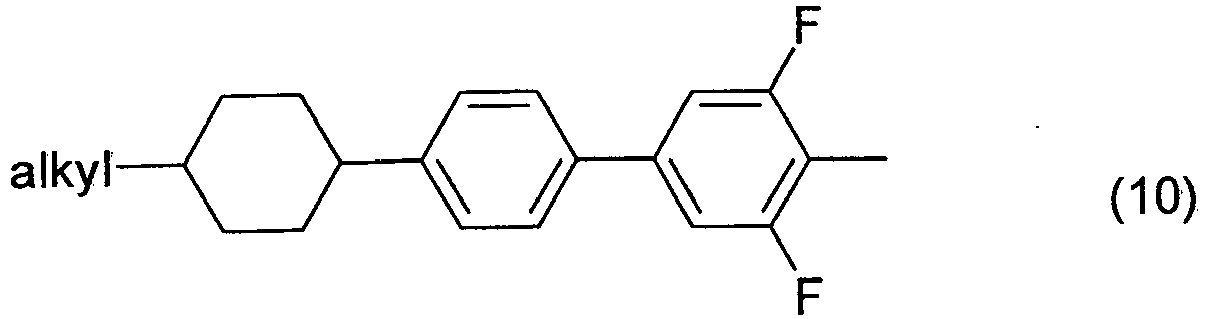


- Unit R-(A2-Z2)n is particularly preferably selected from groups (2) to (10), (15) to (20) and (28) to (32) mentioned and in particular groups (3), (5), (7), (9), (11), (15), (17), (19), (27) and (30).
- Compounds that are more specific are derivable from the exemplified compounds.
- The compounds of the formula I are prepared by methods known per se, as described in the literature (for example in the standard works, such as Houben-Weyl, Methoden der Organischen Chemie [Methods of Organic Chemistry], Georg-Thieme-Verlag, Stuttgart), to be precise under reaction conditions which are known and suitable for the said reactions. Use can also be made here of variants which are known per se, but are not mentioned here in detail.
- The particularly preferred compounds of the formula (I) in which Z1 is -COO-, the ethereal -O- connected to the nortricyclan structure, are prepared as shown in scheme 1:

- The tricyclo[2.2.1.02,6]heptan-3,5,7-triols (nortricycloheptanes) used as a starting material are prepared in a racemic manner and separated into stereoisomers by common resolution techniques, like e.g. derivatization with chiral acids and separation of diastereomers, or by chiral chromatography. A synthetic procedure to obtain the racemate and single enantiomers of structures (Ia) and (Ib) is provided in the experimental part.
- Alternatively, the racemic nortricycloheptanes are used for the synthesis of desired compounds, followed by enantiomeric resolution. In this case resolution of enantiomers can be effected by chromatography on a chiral stationary phase e.g. by chiral HPLC.
- The compounds of the formula I are used as components of liquid-crystalline phases, preferably nematic, liquid-crystalline phases, for example for preventing reverse twist in TN displays.
- The compounds of the formula I are particularly preferably employed as dopants for nematic, liquid-crystalline phases for STN and active-matrix displays. They are particularly distinguished here by a high helical twisting power (HTP) and by high voltage holding ratios. In particular, doped nematic mixtures of this type can easily be purified by treatment with aluminium oxide, with no or virtually no loss of chiral dopant occurring.
- Furthermore, the chiral derivatives according to the invention can be used to prepare liquid-crystalline media for so-called "phase change" displays (for example Y. Yabe et al., SID 1991 Digest 261-264), for displays working in the so-called blue mode or for the preparation of polymerized cholesteric liquid crystal films or layers, i.e. with a helically twisted structure.
- The present invention thus furthermore also relates to the use of the chiral dopants according to the invention in liquid-crystalline mixtures, preferably for producing twist.
- The present invention thus likewise relates to liquid-crystalline mixtures comprising at least one chiral dopant of the formula I according to the invention.
- The liquid-crystalline mixtures according to the invention comprise from about 0.01 to 30% by weight, preferably from 0.05 to 10% by weight, particularly preferably from 0.1 to 10% by weight and in particular from 0.1 to 5% by weight, of one or more compounds of the formula I.
- The most important compounds suitable as further constituents of media according to the invention can be characterised by the formulae 1, 2, 3, 4 and 5:
R'-L-E-R" 1
R'-L-COO-E-R" 2
R'-L-OOC-E-R" 3
R'-L-CH2CH2-E-R" 4
R'-L-C≡C-E-R" 5
- In the formulae 1, 2, 3, 4 and 5, L and E, which may be identical or different, are each, independently of one another, a divalent radical from the group formed by -Phe-, -Cyc-, -Phe-Phe-, -Phe-Cyc-, -Cyc-Cyc-, -Pyr-, -Dio-, -G-Phe- and -G-Cyc- and their mirror images, where Phe is unsubstituted or fluorine-substituted 1,4-phenylene, Cyc is trans-1,4-cyclohexylene or 1,4-cyclohexylene, Pyr is pyrimidine-2,5-diyl or pyridine-2,5-diyl, Dio is 1,3-dioxane-2,5-diyl, and G is 2-(trans-1,4-cyclohexyl)ethyl, pyrimidine-2,5-diyl, pyridine-2,5-diyl or 1,3-dioxane-2,5-diyl.
- One of the radicals L and E is preferably Cyc, Phe or Pyr. E is preferably Cyc, Phe or Phe-Cyc. The media according to the invention preferably comprise one or more components selected from the compounds of the formulae 1, 2, 3, 4 and 5 in which L and E are selected from the group consisting of Cyc, Phe and Pyr and simultaneously one or more components selected from the compounds of the formulae 1, 2, 3, 4 and 5 in which one of the radicals L and E is selected from the group consisting of Cyc, Phe and Pyr and the other radical is selected from the group consisting of -Phe-Phe-, -Phe-Cyc-, -Cyc-Cyc-, -G-Phe- and -G-Cyc-, and optionally one or more components selected from the compounds of the formulae 1, 2, 3, 4 and 5 in which the radicals L and E are selected from the group consisting of -Phe-Cyc-, -Cyc-Cyc-, -G-Phe- and -G-Cyc-.
- R' and/or R" are each, independently of one another, alkyl, alkenyl, alkoxy, alkoxyalkyl, alkenyloxy or alkanoyloxy having up to 8 carbon atoms, -F, -CI, -CN, -NCS or -(O)iCH3-(k+l)FkCll, where i is 0 or 1 and k and l are 1, 2 or 3.
- In a smaller sub-group of the compounds of the formulae 1, 2, 3, 4 and 5, R' and R" are each, independently of one another, alkyl, alkenyl, alkoxy, alkoxyalkyl, alkenyloxy or alkanoyloxy having up to 8 carbon atoms. This smaller sub-group is called group A below, and the compounds are referred to by the sub-formulae 1a, 2a, 3a, 4a and 5a. In most of these compounds, R' and R" are different from one another, one of these radicals usually being alkyl, alkenyl, alkoxy or alkoxyalkyl.
- In another smaller sub-group of the compounds of the formulae 1, 2, 3, 4 and 5, which is known as group B, R" is -F, -Cl, -NCS or -(O)iCH3-(k+l)FkCll, where i is 0 or 1, and k and l are 1, 2 or 3; the compounds in which R" has this meaning are referred to by the sub-formulae 1b, 2b, 3b, 4b and 5b. Particular preference is given to those compounds of the sub-formulae 1b, 2b, 3b, 4b and 5b in which R" is -F, -Cl, -NCS, -CF3, -OCHF2 or -OCF3.
- In the compounds of the sub-formulae 1b, 2b, 3b, 4b and 5b, R' is as defined for the compounds of the sub-formulae 1a to 5a and is preferably alkyl, alkenyl, alkoxy or alkoxyalkyl.
- In a further smaller sub-group of the compounds of the formulae 1, 2, 3, 4 and 5, R" is -CN; this sub-group is referred to below as group C, and the compounds of this sub-group are correspondingly described by sub-formulae 1c, 2c, 3c, 4c and 5c. In the compounds of the sub-formulae 1c, 2c, 3c, 4c and 5c, R' is as defined for the compounds of the sub-formulae 1a to 5a and is preferably alkyl, alkoxy or alkenyl.
- Besides the preferred compounds of groups A, B and C, other compounds of the formulae 1, 2, 3, 4 and 5 having other variants of the proposed substituents are also customary. All these substances are obtainable by methods which are known from the literature or analogously thereto.
- Preference is given to liquid-crystalline mixtures comprising at least one chiral dopant of the formula I according to the invention and at least one liquid-crystalline compound of the formulae 1, 2, 3, 4 and/or 5.
- Besides compounds of the formula I according to the invention, the media according to the invention particularly preferably comprise one or more compounds selected from groups A, B and/or C.
- The proportions by weight of the compounds from these groups in the media according to the invention are preferably
group A: from 0 to 90%, preferably from 20 to 90%, in particular from 30 to 90%, group B: from 0 to 80%, preferably from 10 to 80%, in particular from 10 to 65%, group C: from 0 to 80%, preferably from 5 to 80%, in particular from 5 to 50%, - The liquid-crystal mixtures which can be used in accordance with the invention are prepared in a manner which is conventional per se. In general, the desired amount of the components used in lesser amount is dissolved in the components making up the principal constituent, advantageously at elevated temperature. It is also possible to mix solutions of the components in an organic solvent, for example in acetone, chloroform or methanol, and to remove the solvent again, for example by distillation, after thorough mixing. It is furthermore possible to prepare the mixtures in other conventional manners, for example by using premixes, for example homologue mixtures, or using so-called "multi-bottle" systems.
- The dielectrics may also comprise further additives known to the person skilled in the art and described in the literature. For example, 0-15%, preferably 0-10%, of pleochroic dyes and/or additional chiral dopants can be added. The individual compounds added are employed in concentrations of from 0.01 to 6%, preferably from 0.1 to 3%. However, the concentration data for the other constituents of the liquid-crystal mixtures, i.e. of the liquid-crystalline or mesogenic compounds, are indicated without taking into account the concentration of these additives.
- The present invention furthermore relates to electro-optical display elements, in particular liquid-crystal, switching and display devices, containing a liquid-crystalline medium, outer plates, electrodes, at least one alignment layer and optionally additional auxiliary layers, where the liquid-crystalline medium comprises at least one compound of the formula I.
- The present invention furthermore relates to electro-optical display elements with active-matrix addressing, having nematic or cholesteric phases which comprise at least one compound of the formula I.
- Especially preferred are TN, STN, VA, blue mode and IPS displays, in particular those of the active-matrix type. Further preferred are transflective displays.
- In the present application and in particular in the examples below, the structures of the liquid-crystal compounds are indicated by means of acronyms, the transformation into chemical formulae taking place in accordance with Tables A and B below. All radicals CnH2n+1 and CmH2m+1 are straight-chain alkyl radicals having n and m carbon atoms respectively. The coding in Table B is self-evident. In Table A, only the acronym for the parent structure is indicated. In individual cases, the acronym for the parent structure is followed, separated by a dash, by a code for the substituents R1, R2, L1 and L2:
Code for R1, R2, L1, L2 R1 R2 L1 L2 nm CnH2n+1 CmH2m+1 H H nOm CnH2n+1 OCmH2m+1 H H nO.m OCnH2n+1 CmH2m+1 H H n CnH2n+1 CN H H nN.F CnH2n+1 CN F H nN.F.F CnH2n+1 CN F F nF CnH2n+1 F H H nF.F CnH2n+1 F F H nF.F.F CnH2n+1 F F F nOF OCnH2n+1 F H H nCl CnH2n+1 Cl H H nCl.F CnH2n+1 Cl F H nCI.F.F CnH2n+1 Cl F F nCF3 CnH2n+1 CF3 H H nCF3.F CnH2n+1 CF3 F H nCF3.F.F CnH2n+1 CF3 F F nOCF3 CnH2n+1 OCF3 H H nOCF3.F CnH2n+1 OCF3 F H nOCF3.F.F CnH2n+1 OCF3 F F nOCF2 CnH2n+1 OCHF2 H H nOCF2.F CnH2n+1 OCHF2 F H nOCF2.F.F CnH2n+1 OCHF2 F F nS CnH2n+1 NCS H H nS.F CnH2n+1 NCS F H nS.F.F CnH2n+1 NCS F F rVsN CrH2r+1-CH=CH-CsH2s CN H H rEsN CrH2r+1-O-CsH2s CN H H nAm CnH2n+1 COOCmH2m+1 H H 


- The invention is explained in greater detail below with reference to working examples, but without being restricted thereby in any way.
- Abbreviations:
- DCC
- N,N'-dicyclohexylcarbodiimide
- DMAP
- N,N-dimethylaminopyridine.
- In the foregoing and the following, all temperatures are given in degrees Celsius, and all percentages are by weight, unless stated otherwise. The following abbreviations are used to illustrate the LC phase behaviour: C, K = crystalline; N = nematic; S = smectic; N*, Ch = chiral nematic or cholesteric; I = isotropic. The numbers between these symbols indicate the phase transition temperatures in degree Celsius. Furthermore, mp is the melting point and cp is the clearing point (in deg.C).
- The values of the helical twisting power HTP of a chiral compound in a liquid crystalline host are given according to the equation HTP = (p*c)-1 in µm-1 wherein p is the pitch of the molecular helix, given in µm, and c is the concentration by weight of the chiral compound in the host given in relative values (thus, e.g. a concentration of 1 % by weight is corresponding to a value of c of 0.01). Unless stated otherwise, the HTP values were determined in the the given host mixture at a concentration of 1 % and a temperature of 20 °C. The following abbreviations are used to illustrate the liquid crystalline phase behaviour of the compounds: C = crystalline; N = nematic; S = smectic; N*, Ch = chiral nematic or cholesteric; I = isotropic. The numbers between these symbols indicate the phase transition temperatures in degree Celsius.
-

- 3: A solution of racemic rac-1 (400 mg, 2.81 mmol), 2 (2.32 g, 8.44 mmol), DCC (1.95 g, 9.45 mmol) and DMAP (14 mg, 0.12 mmol) in toluene (35 mL) was stirred for 72 h at r.t. The precipitate was filtered off, and washed with a small amount of toluene. The filtrate was evaporated to dryness, chromatographed (silica gel; toluene) and crystallized from ethanol at 5°C to yield racemic rac-3 (1.4 g, 55%; colorless, crystalline solid).
- The rac-3 (1.4 g, 1.54 mmol) was submitted to enantiomer separation by chiral HPLC (ChiralCel OJ-H; supercritical CO2 li-propanol 9:1) to yield the two enantiomers, which were crystallized from ethanol at 5°C: 3a (412 mg, 29%) and 3b (448 mg, 32%) as colorless crystals.
-

- 6: A solution of (S,S,S)-4 (280 mg, 1.97 mmol), 5 (2.70 g, 9.25 mmol), DMAP (2 mg, 0.02 mmol) and pyridine (0.9 mL) in acetonitrile (40 mL) was stirred for 72 h at r.t. The mixture was diluted with water, extracted three times with CH2Cl2, and the combined extracts were dried over Na2SO4. Evaporation of the solvent and subsequent crystallization from ethanol at 5°C furnished crude (S,S,S)-6 (900 mg, 50%) as a colorless powder.
- The crude (S,S,S)-6 (676 mg) was submitted to further purification by enantiomer separation using chiral HPLC (ChiralCel OJ-H; supercritical CO2 li-propanol 9:1) and subsequent crystallization from ethanol at 5°C to yield pure product (S,S,S)-6 (524 mg, 78%) as colorless crystals. [α]D 25 = +155.5° (CH2Cl2; 12.7 mg/mL).
HTTP: -25 - The enantiomer (R,R,R)-6 was prepared in an analogous manner from (R,R,R)-4.
HTTP: 25 - To the solution of 7-tert-butoxy-norbornadiene (20 g, 0.122 mol) in 100 mL acetic acid by cooling with water bath (reaction is exothermic), 23.75 g (0.122 mol) 39%wt solution of peracetic acid in acetic acid was added drop wise during 30 minutes. Then, reaction mixture was stirred 2 hours by r.t. After reaction completed the acetic acid was evaporated, the residue was solved in formic acid (500 mL) and refluxed for 5 days. The obtained black solution was concentrated in vacuo. The black oily residue was solved in methanol (2 × 500 mL) and filtered. To the methanolic solution g (27.64 g, 0.2 mol) potassium carbonate was added. The suspension was allowed to stir for 4 hours. The resulting solution was concentrated. To the solid residue 10% hydrochloric acid solution was added dropwise till acidic. Then water and acetic acid from resulted solution were evaporated in rotary evaporator (temperature in bath 70 °C). The solid residue was washed with methanol (2 × 100 mL) and filtrated from potassium chloride. The methanolic solution was concentrated in rotary evaporator, washed with THF (3 × 100 mL) and decanted. The soluble in THF C1-symmetric triol was exposed to further isomerisation by reflux with formic acid. The insoluble in THF C3-triol was dried in vacuo. Yield of colourless solid rac-tricyclo[2.2.1.02,6]heptane-3,5,7-triol after first isomerisation is 32%, after second -10%, after third - 3%. Overall yield for three runs is 45 % (7.79 g). Product can be recrystallized from methanol.
-

- RF (MeOH : DCM = 1 : 5) = 0.22
- M.p.: 208-210 °C (MeOH).
- 1H NMR (300 MHz, CDCl3): δ 4.49 (s, 3H), 1.66 (m, 1H), 1.50 (s, 3H).
- 13C NMR (75 MHz, CDCl3): δ 75.69 (s), 48.08 (s), 21.54 (s).
- ESI-MS found m/z 165.0522 (M+ + Na), calculated: 165.0528
- Elem. Anal.: Calc. C 59.14, H 7.09; Found. C 59.03, H 7.22.
- Specific rotation (after separation of enantiomers):
- (S,S,S)-isomer, [α]25 D = - 68.9° (CH3OH, 10 mg/mL).
- (R,R,R)-isomer, [α]25 D = + 68.7° (CH3OH, 10 mg/mL).
-

- The NMR data agree very well with the literature data of compound obtained by Laihia (K. Laihia, E. Kolehmainen, P. Manttari, R. Ryynanen, M. Messala-Rannanpiha, J. Vepsalainen, J. P. Sundelin. Spectrochim. Acta. Part A 1996, 52, 495-504.).
- The triol rac-1 is used as starting material for Example 1.
RF (MeOH : DCM = 1 : 5) = 0.42
Mp: 168-171 °C.
1H NMR (300 MHz, CDCl3): δ 4.56 (s, 1H), 3.95 (s, 1H), 3.76 (t, J = 1.8 Hz, 1H), 1.84 (s, 1H), 1.67 (dt, J = 13.1, 4.8 Hz, 2H), 1.41 (t, J = 5.4 Hz, 1H).
13C NMR (75 MHz, CDCl3): δ 78.35 (s), 76.60 (s), 72.86 (s), 45.97 (s), 22.21 (s), 21.56 (s), 19.02 (s).
ESI-MS found m/z 165.0522 (M+ + Na), calculated: 165.0528. - (S)-(+)-2-methoxy-2-phenylacetic acid (MPA) was obtained from mandelic acid and dimethyl sulfate in 37% yield according to the method described by Jones et al. (
Jones et al., US 2012/0295329 A1 ). - (S)-(+)-2-methoxy-2-phenylacetic acid (MPA) (12.7 g, 76.5 mmol) was added to a stirred solution of oxalyl chloride (30.0 g, 236.4 mmol) in THF (100 mL) in the presence of a catalytic amount of DMF at ambient temperature. After stirring for 2 hours the reaction mixture was concentrated in vacuo. The thus obtained acid chloride of MPA was purified by distillation (60 °C/ 7·10-2 mbar), and then was dissolved in CH3CN (100 mL) and added dropwise to a suspension of nortricycloheptane-3,5,7-triol (2.5 g, 17.6 mmol) 4, pyridine (6.04 g, 76.5 mmol) and a catalytic amount of DMAP in CH3CN. The reaction mixture was stirred for additional 3 hours at ambient temperature, while becoming a clear, reddish solution. Completion of the reaction was checked by TLC. Then the solvent was evaporated in vacuo and the residue was extracted with diethyl ether (3 × 200 mL). The ethereal solution was concentrated and the obtained oily residue was purified by column chromatography. The tris-mandelates (24% of S,S,S-isomer and 30% of R,R,R-isomer) were isolated.
- The mixture of tris-mandelates was separated by careful column chromatography.
-
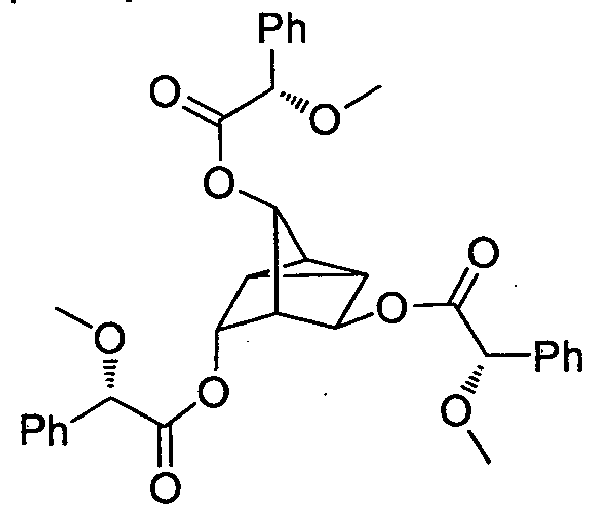
- [α]D 20 = -37.0° (CH3OH, 10 mg/mL).
- M.p. 96-98 °C.
- RF = 0.4 (cyclohexane : ethyl acetate = 2 : 1).
- 1H NMR (300 MHz, CDCl3): δ 7.47 - 7.28 (m, 15H), 5.10 (s, 3H), 4.74 (s, 3H), 3.40 (s, 9H), 2.34 (s, 1H), 1.53 (s, 3H).
- 13C NMR (75 MHz, CDCl3): δ 170.32 (s), 135.85 (s), 128.84 (s), 128.72 (s), 127.06 (s), 82.34 (s), 77.53 (s), 57.35 (s), 40.73 (s), 17.89 (s)
- ESI MS: found 609.2095, calculated (C34H34NaO9) 609.2101.
-

- [α]D 20 = +116.9° (CH3OH, 10 mg/mL).
- M.p. 100-103 °C.
- RF = 0.32 (cyclohexane : ethyl acetate = 2 : 1)
- 1H NMR (300 MHz, CDCl3): δ 7.46 - 7.22 (m, 15H), 4.94 (s, 3H), 4.71 (s, 3H), 3.38 (s, 9H), 1.88 (s, 1H), 1.85 (s, 3H).
- 13C NMR (75 MHz, CDCl3): δ 170.27 (s), 135.73 (s), 128.86 (s), 128.71 (s), 127.12 (s), 82.24 (s), 77.46 (s), 57.27 (s), 40.27 (s), 18.52 (s).
- ESI MS: found 609.2097, calculated (C34H34NaO9) 609.2101.
- To the methanolic solution (100 mL) of one diastereomer of the tris-2-O-methylmandelate esters (3.1 g, 5.28 mmol) potassium carbonate (5.2 g, 37.6 mmol) was added. The suspension was allowed to stir for 4 hours. The resulting solution was concentrated. To the solid residue 10% hydrochloric acid solution was added dropwise till acidic. Then water was evaporated using a rotary evaporator (temperature in bath 70 °C). The solid residue was washed with methanol (2 x 100 mL) and filtrated from potassium chloride. The methanolic solution was concentrated in rotary evaporator, and washed with DCM (3 x 100 mL) and filtrated. The soluble in DCM 2-methoxy-2-phenylacetic acid can be used again for esterification of racemic triol. The insoluble in DCM enantiopure (R,R,R)- or (S,S,S)-triol 4 does not need any additional purification. The yield is 0.72 g (96 %).
- The triols (R,R,R)-4/(S,S,S)-4 are used as starting material for Example 2.
- To a liquid-crystalline base mixture of the following composition:
Acronym Weight-% CCH-301 10 CCH-303 9 CCPC-33 5 CCPC-34 5 CCPC-35 5 CH-33 4 CH-35 4 CH-43 4 CH-45 4 CP-33F 8 CP-35F 8 ME-2N.F 2 ME-3N.F 2 ME-5N.F 4 PCH-301 16 PYP-5-F 10 Compound HTP Example 1 22/-21 (S,R,R-/R,S,S-enantiomer) Example 2 25/-25 (R,R,R-/S,S,S-enantiomer)
Claims (10)
- Chiral compounds of the general formula I:
 P1, P2 and P3 independently, are a group R-(A2-Z2)n-A1-Z1-,R is -H, F, Cl, an alkyl or alkenyl radical having from 1 to 12 carbon atoms which is unsubstituted or at least monosubstituted by halogen, and in which one or more non-adjacent -CH2- groups may be replaced by -O- or -S- and/or -C≡C-,A1, independently, is 1,4-phenylene, in which one, two or three CH groups may be substituted by N and in which, in addition, one or more H atoms may be replaced by F, 1,4-cyclohexylene, in which, in addition, one or two CH2 groups may be replaced by -O-, or 1,4-bicyclo[2.2.2]octanyl,A2, independently, is 1,4-phenylene, in which one, two or three CH groups may be substituted by N and in which, in addition, one or more H atoms may be replaced by F, 1,4-cyclohexylene, in which, in addition, one or two CH2 groups may be replaced by -O-, or 1,4-bicyclo[2.2.2]octanyl,Z1, independently is a single bond, -O-, -S-, -CO-, -COO-, -OCO-,-S-CO-, -CO-S-, -O-COO-, -CH2-CH2-, -CH=CH-, -CH=CR0-, -CR0=CR00-, -O-CH2-, -CH2-O-, -CF2-O-, -O-CF2-, -CF2-CF2- or -C≡C-, -CH=CH-COO- or -OCO-CH=CH-,Z2, independently is a single bond, -O-, -S-, -CO-, -COO-, -OCO-,-S-CO-, -CO-S-, -O-COO-, -CH2-CH2-, -CH=CH-, -CH=CR0-, -CR0=CR00-, -O-CH2-, -CH2-O-, -CF2-O-, -O-CF2-, -CF2-CF2- or -C≡C-, -CH=CH-COO- or -OCO-CH=CH-,R0 and R00 are independently of each other H or alkyl with 1 to 12 C-atoms, F, Cl or CN, andn is from 1 to 3.
 - Chiral compounds according to Claim 1, characterised in that they are selected of the structures

- Chiral compounds according to Claim 1 or 2, characterised in that P1, P2 and P3 are identical groups and are not H.
- Chiral compounds according to one or more of claims 1 to 3, characterised in that
n is 1 or 2. - Chiral compounds according to one or more of claims 1 to 4, characterised in that
A1 and A2 are, independently, selected from the following structures:


- Chiral compounds according to one or more of claims 1 to 5, characterised in thatZ1 is independently -O-, -COO- or -CF2O-.
- Chiral compounds according to one or more of claims 1 to 6, characterised in thatR is independently an alkyl or alkenyl radical having from 1 to 12 carbon atoms which is unsubstituted or at least monosubstituted by halogen, and in which one or more non-adjacent -CH2- groups may be replaced by -O-.
- Use of at least one chiral compound according to at least one of the preceding claims in liquid-crystalline mixtures.
- Liquid-crystalline mixture comprising at least one chiral compound according to at least one of Claims 1 to 7.
- Electro-optical display element containing a liquid-crystalline mixture according to Claim 9.
Applications Claiming Priority (2)
| Application Number | Priority Date | Filing Date | Title |
|---|---|---|---|
| EP15001716 | 2015-06-10 | ||
| PCT/EP2016/000811 WO2016198143A1 (en) | 2015-06-10 | 2016-05-17 | Chiral dopants having a nortricyclan unit |
Publications (2)
| Publication Number | Publication Date |
|---|---|
| EP3307848A1 EP3307848A1 (en) | 2018-04-18 |
| EP3307848B1 true EP3307848B1 (en) | 2019-03-06 |
Family
ID=53432922
Family Applications (1)
| Application Number | Title | Priority Date | Filing Date |
|---|---|---|---|
| EP16723021.8A Not-in-force EP3307848B1 (en) | 2015-06-10 | 2016-05-17 | Chiral dopants having a nortricyclan unit |
Country Status (3)
| Country | Link |
|---|---|
| EP (1) | EP3307848B1 (en) |
| TW (1) | TWI691483B (en) |
| WO (1) | WO2016198143A1 (en) |
Families Citing this family (1)
| Publication number | Priority date | Publication date | Assignee | Title |
|---|---|---|---|---|
| WO2019198422A1 (en) * | 2018-04-10 | 2019-10-17 | Jnc株式会社 | Liquid crystal composition, monomer/(liquid crystal) mixture, polymer/(liquid crystal) composite material, liquid crystal element, and chiral compound |
Family Cites Families (8)
| Publication number | Priority date | Publication date | Assignee | Title |
|---|---|---|---|---|
| DE4322905B4 (en) | 1992-07-24 | 2012-08-09 | Merck Patent Gmbh | Chiral 2,6-difluorobenzene derivatives |
| JP2965229B2 (en) | 1992-12-28 | 1999-10-18 | チッソ株式会社 | Liquid crystal composition |
| AU772427B2 (en) | 1998-11-10 | 2004-04-29 | Genencor International, Inc. | Chemically modified mutant serine hydrolases show improved catalytic activity and chiral selectivity |
| US6750364B2 (en) * | 2001-06-29 | 2004-06-15 | Wyeth | Bridged tricyclic analogs of 2-(carboxycyclopropyl)glycine as inhibitors of glutamate transport |
| US6689905B2 (en) * | 2001-06-29 | 2004-02-10 | Wyeth | Stereoisomers of 3-aminotricyclo[2.2.1.0(2.6)]heptane-1,3-dicarboxylic acid |
| US6689904B2 (en) * | 2001-06-29 | 2004-02-10 | Wyeth | Bridged tricyclic analogs of 2-(carboxycyclopropyl)glycine |
| JP2011090278A (en) * | 2009-09-25 | 2011-05-06 | Hitachi Displays Ltd | Liquid crystal display |
| TWI410477B (en) * | 2010-10-29 | 2013-10-01 | Ind Tech Res Inst | Liquid crystal composition and liquid crystal display employing the same |
-
2016
- 2016-05-17 WO PCT/EP2016/000811 patent/WO2016198143A1/en not_active Ceased
- 2016-05-17 EP EP16723021.8A patent/EP3307848B1/en not_active Not-in-force
- 2016-06-07 TW TW105118032A patent/TWI691483B/en not_active IP Right Cessation
Non-Patent Citations (1)
| Title |
|---|
| None * |
Also Published As
| Publication number | Publication date |
|---|---|
| EP3307848A1 (en) | 2018-04-18 |
| TW201708181A (en) | 2017-03-01 |
| WO2016198143A1 (en) | 2016-12-15 |
| TWI691483B (en) | 2020-04-21 |
Similar Documents
| Publication | Publication Date | Title |
|---|---|---|
| CN101193999B (en) | Liquid crystalline medium comprising 1,2-difluoroethene compound and liquid crystal display | |
| KR101070102B1 (en) | Liquid-crystalline compounds | |
| DE69522699T2 (en) | LIQUID CRYSTAL COMPOSITION AND LIQUID CRYSTAL DISPLAY DEVICE | |
| JP5774873B2 (en) | Liquid crystal compound | |
| EP1454975B1 (en) | Liquid crystalline medium | |
| US20040238789A1 (en) | Liquid crystal compounds | |
| JP2003518154A (en) | Liquid crystal medium | |
| KR101077353B1 (en) | Liquid Crystalline Compound Having Tetrahydropyran Ring | |
| US6723866B2 (en) | Liquid-crystalline compounds | |
| EP2222816A1 (en) | Liquid-crystalline medium | |
| TW201906830A (en) | Thioether derivatives of dibenzothiophene and dibenzofuran | |
| US20040262572A1 (en) | Liquid-crystalline medium | |
| GB2323603A (en) | Liquid-crystalline medium having at least four 2,3-difluoro-1,4-phenylene-containing mesogens & negative dielectric anisotropy and its use in displays, eg IPS | |
| EP1758966B1 (en) | Liquid crystal medium | |
| US6406761B1 (en) | Liquid-crystalline medium | |
| JP2004352992A (en) | Liquid crystal medium | |
| US6706338B2 (en) | Liquid-crystalline compounds | |
| JP4718471B2 (en) | Liquid crystal compound | |
| DE102005027763A1 (en) | Liquid crystal media with good UV stability and high clear point, useful in liquid crystal displays, containing quaterphenyl derivative(s) and phenyl benzoate derivative(s) | |
| WO2016198143A1 (en) | Chiral dopants having a nortricyclan unit | |
| GB2307236A (en) | Chiral dopes having two chiral terminal groups | |
| EP1845147B1 (en) | Liquid-crystalline compounds | |
| EP1479748B1 (en) | Tolane derivatives and liquid crystalline medium | |
| JP2007284439A (en) | Liquid crystal compound, liquid crystal medium and method for preparing the liquid crystal medium | |
| GB2358870A (en) | Liquid crystalline media having 4,4'-dialk-(1E or 3E)-enyl-1,1'-bicyclohexane & 3,4,5-trifluorophenyl-terminated components, and use in IPS displays |
Legal Events
| Date | Code | Title | Description |
|---|---|---|---|
| STAA | Information on the status of an ep patent application or granted ep patent |
Free format text: STATUS: THE INTERNATIONAL PUBLICATION HAS BEEN MADE |
|
| PUAI | Public reference made under article 153(3) epc to a published international application that has entered the european phase |
Free format text: ORIGINAL CODE: 0009012 |
|
| STAA | Information on the status of an ep patent application or granted ep patent |
Free format text: STATUS: REQUEST FOR EXAMINATION WAS MADE |
|
| 17P | Request for examination filed |
Effective date: 20171208 |
|
| AK | Designated contracting states |
Kind code of ref document: A1 Designated state(s): AL AT BE BG CH CY CZ DE DK EE ES FI FR GB GR HR HU IE IS IT LI LT LU LV MC MK MT NL NO PL PT RO RS SE SI SK SM TR |
|
| AX | Request for extension of the european patent |
Extension state: BA ME |
|
| DAV | Request for validation of the european patent (deleted) | ||
| DAX | Request for extension of the european patent (deleted) | ||
| REG | Reference to a national code |
Ref country code: DE Ref legal event code: R079 Ref document number: 602016010757 Country of ref document: DE Free format text: PREVIOUS MAIN CLASS: C09K0019580000 Ipc: C07C0069734000 |
|
| RIC1 | Information provided on ipc code assigned before grant |
Ipc: C09K 19/58 20060101ALI20181017BHEP Ipc: C07C 69/76 20060101ALI20181017BHEP Ipc: C09K 19/20 20060101ALI20181017BHEP Ipc: C09K 19/12 20060101ALI20181017BHEP Ipc: C09K 19/30 20060101ALI20181017BHEP Ipc: C09K 19/32 20060101ALI20181017BHEP Ipc: C07C 69/734 20060101AFI20181017BHEP |
|
| GRAP | Despatch of communication of intention to grant a patent |
Free format text: ORIGINAL CODE: EPIDOSNIGR1 |
|
| STAA | Information on the status of an ep patent application or granted ep patent |
Free format text: STATUS: GRANT OF PATENT IS INTENDED |
|
| INTG | Intention to grant announced |
Effective date: 20181123 |
|
| GRAS | Grant fee paid |
Free format text: ORIGINAL CODE: EPIDOSNIGR3 |
|
| GRAA | (expected) grant |
Free format text: ORIGINAL CODE: 0009210 |
|
| STAA | Information on the status of an ep patent application or granted ep patent |
Free format text: STATUS: THE PATENT HAS BEEN GRANTED |
|
| AK | Designated contracting states |
Kind code of ref document: B1 Designated state(s): AL AT BE BG CH CY CZ DE DK EE ES FI FR GB GR HR HU IE IS IT LI LT LU LV MC MK MT NL NO PL PT RO RS SE SI SK SM TR |
|
| REG | Reference to a national code |
Ref country code: GB Ref legal event code: FG4D |
|
| REG | Reference to a national code |
Ref country code: CH Ref legal event code: EP Ref country code: AT Ref legal event code: REF Ref document number: 1104346 Country of ref document: AT Kind code of ref document: T Effective date: 20190315 |
|
| REG | Reference to a national code |
Ref country code: DE Ref legal event code: R096 Ref document number: 602016010757 Country of ref document: DE |
|
| REG | Reference to a national code |
Ref country code: IE Ref legal event code: FG4D |
|
| REG | Reference to a national code |
Ref country code: NL Ref legal event code: MP Effective date: 20190306 |
|
| REG | Reference to a national code |
Ref country code: LT Ref legal event code: MG4D |
|
| PG25 | Lapsed in a contracting state [announced via postgrant information from national office to epo] |
Ref country code: SE Free format text: LAPSE BECAUSE OF FAILURE TO SUBMIT A TRANSLATION OF THE DESCRIPTION OR TO PAY THE FEE WITHIN THE PRESCRIBED TIME-LIMIT Effective date: 20190306 Ref country code: LT Free format text: LAPSE BECAUSE OF FAILURE TO SUBMIT A TRANSLATION OF THE DESCRIPTION OR TO PAY THE FEE WITHIN THE PRESCRIBED TIME-LIMIT Effective date: 20190306 Ref country code: NO Free format text: LAPSE BECAUSE OF FAILURE TO SUBMIT A TRANSLATION OF THE DESCRIPTION OR TO PAY THE FEE WITHIN THE PRESCRIBED TIME-LIMIT Effective date: 20190606 Ref country code: FI Free format text: LAPSE BECAUSE OF FAILURE TO SUBMIT A TRANSLATION OF THE DESCRIPTION OR TO PAY THE FEE WITHIN THE PRESCRIBED TIME-LIMIT Effective date: 20190306 |
|
| PG25 | Lapsed in a contracting state [announced via postgrant information from national office to epo] |
Ref country code: BG Free format text: LAPSE BECAUSE OF FAILURE TO SUBMIT A TRANSLATION OF THE DESCRIPTION OR TO PAY THE FEE WITHIN THE PRESCRIBED TIME-LIMIT Effective date: 20190606 Ref country code: LV Free format text: LAPSE BECAUSE OF FAILURE TO SUBMIT A TRANSLATION OF THE DESCRIPTION OR TO PAY THE FEE WITHIN THE PRESCRIBED TIME-LIMIT Effective date: 20190306 Ref country code: NL Free format text: LAPSE BECAUSE OF FAILURE TO SUBMIT A TRANSLATION OF THE DESCRIPTION OR TO PAY THE FEE WITHIN THE PRESCRIBED TIME-LIMIT Effective date: 20190306 Ref country code: RS Free format text: LAPSE BECAUSE OF FAILURE TO SUBMIT A TRANSLATION OF THE DESCRIPTION OR TO PAY THE FEE WITHIN THE PRESCRIBED TIME-LIMIT Effective date: 20190306 Ref country code: GR Free format text: LAPSE BECAUSE OF FAILURE TO SUBMIT A TRANSLATION OF THE DESCRIPTION OR TO PAY THE FEE WITHIN THE PRESCRIBED TIME-LIMIT Effective date: 20190607 Ref country code: HR Free format text: LAPSE BECAUSE OF FAILURE TO SUBMIT A TRANSLATION OF THE DESCRIPTION OR TO PAY THE FEE WITHIN THE PRESCRIBED TIME-LIMIT Effective date: 20190306 |
|
| REG | Reference to a national code |
Ref country code: AT Ref legal event code: MK05 Ref document number: 1104346 Country of ref document: AT Kind code of ref document: T Effective date: 20190306 |
|
| PG25 | Lapsed in a contracting state [announced via postgrant information from national office to epo] |
Ref country code: CZ Free format text: LAPSE BECAUSE OF FAILURE TO SUBMIT A TRANSLATION OF THE DESCRIPTION OR TO PAY THE FEE WITHIN THE PRESCRIBED TIME-LIMIT Effective date: 20190306 Ref country code: IT Free format text: LAPSE BECAUSE OF FAILURE TO SUBMIT A TRANSLATION OF THE DESCRIPTION OR TO PAY THE FEE WITHIN THE PRESCRIBED TIME-LIMIT Effective date: 20190306 Ref country code: RO Free format text: LAPSE BECAUSE OF FAILURE TO SUBMIT A TRANSLATION OF THE DESCRIPTION OR TO PAY THE FEE WITHIN THE PRESCRIBED TIME-LIMIT Effective date: 20190306 Ref country code: SK Free format text: LAPSE BECAUSE OF FAILURE TO SUBMIT A TRANSLATION OF THE DESCRIPTION OR TO PAY THE FEE WITHIN THE PRESCRIBED TIME-LIMIT Effective date: 20190306 Ref country code: AL Free format text: LAPSE BECAUSE OF FAILURE TO SUBMIT A TRANSLATION OF THE DESCRIPTION OR TO PAY THE FEE WITHIN THE PRESCRIBED TIME-LIMIT Effective date: 20190306 Ref country code: PT Free format text: LAPSE BECAUSE OF FAILURE TO SUBMIT A TRANSLATION OF THE DESCRIPTION OR TO PAY THE FEE WITHIN THE PRESCRIBED TIME-LIMIT Effective date: 20190706 Ref country code: EE Free format text: LAPSE BECAUSE OF FAILURE TO SUBMIT A TRANSLATION OF THE DESCRIPTION OR TO PAY THE FEE WITHIN THE PRESCRIBED TIME-LIMIT Effective date: 20190306 Ref country code: ES Free format text: LAPSE BECAUSE OF FAILURE TO SUBMIT A TRANSLATION OF THE DESCRIPTION OR TO PAY THE FEE WITHIN THE PRESCRIBED TIME-LIMIT Effective date: 20190306 |
|
| PG25 | Lapsed in a contracting state [announced via postgrant information from national office to epo] |
Ref country code: SM Free format text: LAPSE BECAUSE OF FAILURE TO SUBMIT A TRANSLATION OF THE DESCRIPTION OR TO PAY THE FEE WITHIN THE PRESCRIBED TIME-LIMIT Effective date: 20190306 Ref country code: PL Free format text: LAPSE BECAUSE OF FAILURE TO SUBMIT A TRANSLATION OF THE DESCRIPTION OR TO PAY THE FEE WITHIN THE PRESCRIBED TIME-LIMIT Effective date: 20190306 |
|
| REG | Reference to a national code |
Ref country code: DE Ref legal event code: R097 Ref document number: 602016010757 Country of ref document: DE |
|
| REG | Reference to a national code |
Ref country code: CH Ref legal event code: PL |
|
| PG25 | Lapsed in a contracting state [announced via postgrant information from national office to epo] |
Ref country code: IS Free format text: LAPSE BECAUSE OF FAILURE TO SUBMIT A TRANSLATION OF THE DESCRIPTION OR TO PAY THE FEE WITHIN THE PRESCRIBED TIME-LIMIT Effective date: 20190706 Ref country code: AT Free format text: LAPSE BECAUSE OF FAILURE TO SUBMIT A TRANSLATION OF THE DESCRIPTION OR TO PAY THE FEE WITHIN THE PRESCRIBED TIME-LIMIT Effective date: 20190306 |
|
| PLBE | No opposition filed within time limit |
Free format text: ORIGINAL CODE: 0009261 |
|
| STAA | Information on the status of an ep patent application or granted ep patent |
Free format text: STATUS: NO OPPOSITION FILED WITHIN TIME LIMIT |
|
| PG25 | Lapsed in a contracting state [announced via postgrant information from national office to epo] |
Ref country code: LI Free format text: LAPSE BECAUSE OF NON-PAYMENT OF DUE FEES Effective date: 20190531 Ref country code: DK Free format text: LAPSE BECAUSE OF FAILURE TO SUBMIT A TRANSLATION OF THE DESCRIPTION OR TO PAY THE FEE WITHIN THE PRESCRIBED TIME-LIMIT Effective date: 20190306 Ref country code: CH Free format text: LAPSE BECAUSE OF NON-PAYMENT OF DUE FEES Effective date: 20190531 Ref country code: MC Free format text: LAPSE BECAUSE OF FAILURE TO SUBMIT A TRANSLATION OF THE DESCRIPTION OR TO PAY THE FEE WITHIN THE PRESCRIBED TIME-LIMIT Effective date: 20190306 |
|
| REG | Reference to a national code |
Ref country code: BE Ref legal event code: MM Effective date: 20190531 |
|
| 26N | No opposition filed |
Effective date: 20191209 |
|
| PG25 | Lapsed in a contracting state [announced via postgrant information from national office to epo] |
Ref country code: LU Free format text: LAPSE BECAUSE OF NON-PAYMENT OF DUE FEES Effective date: 20190517 |
|
| PG25 | Lapsed in a contracting state [announced via postgrant information from national office to epo] |
Ref country code: TR Free format text: LAPSE BECAUSE OF FAILURE TO SUBMIT A TRANSLATION OF THE DESCRIPTION OR TO PAY THE FEE WITHIN THE PRESCRIBED TIME-LIMIT Effective date: 20190306 |
|
| PG25 | Lapsed in a contracting state [announced via postgrant information from national office to epo] |
Ref country code: IE Free format text: LAPSE BECAUSE OF NON-PAYMENT OF DUE FEES Effective date: 20190517 |
|
| PG25 | Lapsed in a contracting state [announced via postgrant information from national office to epo] |
Ref country code: BE Free format text: LAPSE BECAUSE OF NON-PAYMENT OF DUE FEES Effective date: 20190531 |
|
| PG25 | Lapsed in a contracting state [announced via postgrant information from national office to epo] |
Ref country code: FR Free format text: LAPSE BECAUSE OF NON-PAYMENT OF DUE FEES Effective date: 20190531 |
|
| GBPC | Gb: european patent ceased through non-payment of renewal fee |
Effective date: 20200517 |
|
| PG25 | Lapsed in a contracting state [announced via postgrant information from national office to epo] |
Ref country code: GB Free format text: LAPSE BECAUSE OF NON-PAYMENT OF DUE FEES Effective date: 20200517 |
|
| PG25 | Lapsed in a contracting state [announced via postgrant information from national office to epo] |
Ref country code: CY Free format text: LAPSE BECAUSE OF FAILURE TO SUBMIT A TRANSLATION OF THE DESCRIPTION OR TO PAY THE FEE WITHIN THE PRESCRIBED TIME-LIMIT Effective date: 20190306 |
|
| PG25 | Lapsed in a contracting state [announced via postgrant information from national office to epo] |
Ref country code: HU Free format text: LAPSE BECAUSE OF FAILURE TO SUBMIT A TRANSLATION OF THE DESCRIPTION OR TO PAY THE FEE WITHIN THE PRESCRIBED TIME-LIMIT; INVALID AB INITIO Effective date: 20160517 Ref country code: MT Free format text: LAPSE BECAUSE OF FAILURE TO SUBMIT A TRANSLATION OF THE DESCRIPTION OR TO PAY THE FEE WITHIN THE PRESCRIBED TIME-LIMIT Effective date: 20190306 |
|
| PG25 | Lapsed in a contracting state [announced via postgrant information from national office to epo] |
Ref country code: SI Free format text: LAPSE BECAUSE OF FAILURE TO SUBMIT A TRANSLATION OF THE DESCRIPTION OR TO PAY THE FEE WITHIN THE PRESCRIBED TIME-LIMIT Effective date: 20190306 |
|
| PG25 | Lapsed in a contracting state [announced via postgrant information from national office to epo] |
Ref country code: MK Free format text: LAPSE BECAUSE OF FAILURE TO SUBMIT A TRANSLATION OF THE DESCRIPTION OR TO PAY THE FEE WITHIN THE PRESCRIBED TIME-LIMIT Effective date: 20190306 |
|
| P01 | Opt-out of the competence of the unified patent court (upc) registered |
Effective date: 20230518 |
|
| PGFP | Annual fee paid to national office [announced via postgrant information from national office to epo] |
Ref country code: DE Payment date: 20230321 Year of fee payment: 8 |
|
| REG | Reference to a national code |
Ref country code: DE Ref legal event code: R119 Ref document number: 602016010757 Country of ref document: DE |
|
| PG25 | Lapsed in a contracting state [announced via postgrant information from national office to epo] |
Ref country code: DE Free format text: LAPSE BECAUSE OF NON-PAYMENT OF DUE FEES Effective date: 20241203 |