EP3306828A1 - Method for determining a precoder in a distributed fashion - Google Patents
Method for determining a precoder in a distributed fashion Download PDFInfo
- Publication number
- EP3306828A1 EP3306828A1 EP16192880.9A EP16192880A EP3306828A1 EP 3306828 A1 EP3306828 A1 EP 3306828A1 EP 16192880 A EP16192880 A EP 16192880A EP 3306828 A1 EP3306828 A1 EP 3306828A1
- Authority
- EP
- European Patent Office
- Prior art keywords
- transmitters
- transmitter
- overall precoder
- precoder
- view
- Prior art date
- Legal status (The legal status is an assumption and is not a legal conclusion. Google has not performed a legal analysis and makes no representation as to the accuracy of the status listed.)
- Granted
Links
Images
Classifications
-
- H—ELECTRICITY
- H04—ELECTRIC COMMUNICATION TECHNIQUE
- H04B—TRANSMISSION
- H04B7/00—Radio transmission systems, i.e. using radiation field
- H04B7/02—Diversity systems; Multi-antenna system, i.e. transmission or reception using multiple antennas
- H04B7/022—Site diversity; Macro-diversity
- H04B7/024—Co-operative use of antennas of several sites, e.g. in co-ordinated multipoint or co-operative multiple-input multiple-output [MIMO] systems
Definitions
- the present invention generally relates to determining, in a distributed fashion, precoders to be applied for transmitting data between a plurality of transmitters and a plurality of receivers in a wireless communication system in which the plurality of transmitters is interconnected by coordination links with limited data rate.
- Wireless communication systems may rely on cooperation in order to improve their performance with regard to their environment. Such cooperation may be found in a context of a MIMO ( Multiple-Input Multiple-Output ) channel-based communications network in which node devices, typically access points such as base stations or eNodeBs, cooperate in order to improve overall robustness of communications via the MIMO channel.
- MIMO Multiple-Input Multiple-Output
- Such cooperation typically relies on data exchanges in between the node devices of the MIMO channel-based communications network, so as to define a precoder to be cooperatively applied by transmitters of the wireless communication network in order to mitigate impact of the environment. Difficulties exist when such data exchanges are performed over coordination links that have limited data rate, which involves applying quantization operations on the data to be exchanged. Indeed, quantization errors refrain from implementing a distributed way of determining the precoder to be cooperatively applied. Moreover, CSIT (Channel State Information at the Transmitter) mismatch amplifies the feeling that a distributed approach would be irrelevant for determining such a precoder to be cooperatively applied.
- CSIT Channel State Information at the Transmitter
- the present invention concerns a method implemented by one transmitter, referred to as j -th transmitter, among a plurality of K t transmitters of a wireless communication system for performing transmissions from the K t transmitters to a plurality of K r receivers via a global MIMO channel H thanks to an overall precoder V to be determined in a distributed fashion, said transmitters being interconnected by coordination links with limited data rate implying quantization operations.
- the method is such that said j -th transmitter performs:
- the overall precoder V to be cooperatively applied by said plurality of transmitters can be estimated in a distributed fashion and be used to improve performance of the transmissions of data via the global MIMO channel H , despite the quantization operations implied by limited rates of coordination links used to exchange short-term data needed to estimate said overall precoder V .
- the performance of the transmissions of data via the global MIMO channel H is improved with respect to a mean square error criterion.
- said j -th transmitter among said plurality of K t transmitters re-computes its adjusted own view ⁇ ( j ) of the overall precoder V each time there is a change in the statistical distributions of the quantization errors ⁇ ( i,j' ) ⁇ ( i,j ) and/or ⁇ ( i,j ) .
- the wireless communication system is reactive to changes in characteristics of the global MIMO channel H .
- said j -th transmitter among said plurality of K t transmitters re-computes its adjusted own view ⁇ ( j ) of the overall precoder V on a regular basis at an occurrence frequency that is defined by a time period during which the statistical distributions of the quantization errors ⁇ ( i,j' ) and ⁇ ( i,j ) are considered to be stable.
- the present invention also concerns a transmitter, referred to as j -th transmitter, among a plurality of K t transmitters of a wireless communication system which are configured for performing transmissions from the K t transmitters to a plurality of K r receivers via a global MIMO channel H thanks to an overall precoder V to be determined in a distributed fashion, said transmitters being interconnected by coordination links with limited data rate implying quantization operations.
- Said j -th transmitter comprises:
- the present invention also concerns a computer program that can be downloaded from a communications network and/or stored on a medium that can be read by a computer or processing device.
- This computer program comprises instructions for causing implementation of the aforementioned method, when said program is run by a processor.
- the present invention also concerns an information storage medium, storing a computer program comprising a set of instructions causing implementation of the aforementioned method, when the stored information is read from said information storage medium and run by a processor.
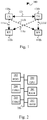
- Fig. 1 schematically represents a wireless communication system 100 in which the present invention may be implemented.
- the wireless communication system 100 comprises a plurality of transmitters, two 120a, 120b of which being represented in Fig. 1 .
- the wireless communication system 100 further comprises a plurality of receivers, two 110a, 110b of which being represented in Fig. 1 .
- the transmitters 120a, 120b are access points or base stations of a wireless telecommunications network
- the receivers 110a, 110b are mobile terminals having access to the wireless telecommunications network via said access points or base stations.
- the wireless communication system 100 comprises more transmitters and receivers.
- the transmitters 120a, 120b cooperate with each other in order to improve performance when performing transmissions from the plurality of transmitters 120a, 120b toward the plurality of receivers 110a, 110b via wireless links 111a, 111b, 111c, 111d.
- the wireless link 111a represents the transmission channel from the transmitter 120a to the receiver 110a
- the wireless link 111b represents the transmission channel from the transmitter 120a to the receiver 110b
- the wireless link 111c represents the transmission channel from the transmitter 120b to the receiver 110a
- the wireless link 111d represents the transmission channel from the transmitter 120b to the receiver 110b.
- the transmitters 120a, 120b are interconnected, as shown by a coordination link 121 in Fig.
- the cooperation link 121 can be wired or wireless.
- said transmitters are interconnected by coordination links so that each transmitter is able to exchange data with any other transmitter, either directly or indirectly (via a relay device, which may be another transmitter among said plurality).
- Said cooperation link 121 has limited data rate, i.e. limited capacity, so that quantization operations are typically required for transmitting data over said cooperation link 121, and more especially for transmitting precoder related data in between the transmitters 120a, 120b.
- Long-term data can however be exchanged over the cooperation link 121 without requiring quantization operations (or by using quantization operations with very high granularity that does not impact quality of the information on said long-term data), as far as such long-term data are required to be processed by the transmitter to which said data are addressed within a laps of time that is greater than or equal to the maximum latency implied by the achievable data rate of said cooperation link 121.
- said precoder related data are short-term data, which are required to be processed by the transmitter to which said data are addressed within a laps of time that is lower than the maximum latency implied by the achievable data rate of said cooperation link 121 (or part of the bandwidth of said cooperation link 121 which can be dedicated to transmitting said data), and which thus requires quantization operations so as to be received on time for processing by the transmitter to which said data are addressed.
- Cooperation is achieved by making the transmitters 120a, 120b apply respective precoders when performing said transmissions. Said precoders are determined in a distributed fashion within the wireless communication system 100 so that each transmitter determines the precoder that said transmitter has to apply in the scope of said transmissions.
- each transmitter determines, independently from the other transmitters of said plurality, an initial own view V ⁇ ( j ) of an overall precoder V that should be cooperatively applied by said plurality of transmitters for performing said transmissions, and further perform optimization in order to adjust its initial own view V ⁇ ( j ) of the overall precoder V , from quantized precoder related data provided by the other transmitters of the wireless communication system 100 via the cooperation links, so as to obtain an adjusted own view ⁇ ( j ) of the overall precoder V .
- This aspect is detailed hereafter with respect to Fig. 3 .
- the quantity of transmitters 120a, 120b in use is denoted K t , each transmitter having a quantity M of transmit antennas
- the quantity of receivers 110a, 110b in use is denoted K r , each receiver having a quantity N of receive antennas.
- the receivers 110a, 110b are configured to simultaneously receive signals from plural transmitters among the K t transmitters.
- a global MIMO channel H is thus created between the K t transmitters and the K r receivers.
- the part of the global MIMO channel H which links a j -th transmitter among the K t transmitters to a k -th receiver among the K r receivers is represented by an N x M matrix herein denoted H j,k .
- H j , k is representative a MIMO channel too.
- H k is representative of a MIMO channel too.
- 0 M ⁇ ( j -1) M in the expression of E j above represents an M ⁇ (j - 1 ) M sub-matrix of E j containing only zeros
- 0 M ⁇ ( Kt-j ) M represents an M ⁇ ( K t -j ) M sub-matrix of E j containing only zeros
- I M ⁇ M represents an M ⁇ M identity sub-matrix (could be an M ⁇ M identity matrix in other contexts herein).
- any and all transmitters know entirely the set of the symbol vectors s k to be transmitted toward the K r receivers at a given instant.
- any j -th transmitter among the K t transmitters has to communicate with the k -th receiver among the K r receivers in such a way that k ⁇ j, reordering of the K t transmitters with respect to the index j and/or of the K r receivers with respect to the index k is performed so as to make the overall precoder V have a block-diagonal shape.
- H k V k s k represents the useful signal from the standpoint of the k -th receiver among the K r receivers and the sum of the terms H k V l s l represents interference incurred by the k -th receiver among the K r receivers during the transmission of the symbol vector s k .
- the K t transmitters are configured to obtain CSIT.
- CSIT is obtained by each transmitter among the K t transmitters from:
- H ⁇ k , i j denotes herein the view of the MIMO channel H k,i from the standpoint of said j -th transmitter and H ⁇ k j denotes the view of the MIMO channel H k from the standpoint of said j -th transmitter.
- the CIST enables each transmitter to independently determine an initial own view of the overall precoder V , using known techniques.
- the overall precoder V and thus said initial own view V ⁇ ( j ) of the overall precoder V are both of one precoder type among the followings:
- this aspect is detailed hereafter with regard to Fig. 3 .
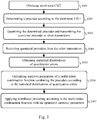
- Fig. 2 schematically represents an example of hardware architecture of a communication device, as used in the wireless communication system 100.
- the hardware architecture illustratively shown in Fig. 2 can represent each transmitter 120a, 120b of the wireless communication system 100 and/or each receiver 110a, 110b of the wireless communication system 100.
- the communication device comprises the following components interconnected by a communications bus 206: a processor, microprocessor, microcontroller or CPU (Central Processing Unit) 200; a RAM (Random-Access Memory) 201; a ROM (Read-Only Memory) 202; an SD (Secure Digital) card reader 203, or an HDD (Hard Disk Drive) or any other device adapted to read information stored on a storage medium; a first communication interface COM1 204 and potentially a second communication interface COM2 205.
- a processor, microprocessor, microcontroller or CPU Central Processing Unit
- RAM Random-Access Memory
- ROM Read-Only Memory
- SD Secure Digital
- HDD Hard Disk Drive
- the first communication interface COM1 204 When the communication device is one receiver among the K r receivers, the first communication interface COM1 204 enables the communication device to receive data from the K t transmitters via the global MIMO channel H.
- the second communication interface COM2 205 is not necessary in this case.
- the first communication interface COM1 204 further enables the communication device to feed back channel state information to one or more transmitter devices among the K t transmitters.
- the first communication interface COM1 204 When the communication device is one transmitter among the K t transmitters, the first communication interface COM1 204 enables the communication device to transmit data to the K r receivers, via the global MIMO channel H, cooperatively with the other transmitters among the K t transmitters. The first communication interface COM1 204 further enables the communication device to receive channel state information fed back by one or more receivers among the K r receivers. Moreover, the second communication interface COM2 205 enables the communication device to exchange data with one or more other transmitters among the K t transmitters (cooperation links).
- CPU 200 is capable of executing instructions loaded into RAM 201 from ROM 202 or from an external memory, such as an SD card. After the communication device has been powered on, CPU 200 is capable of reading instructions from RAM 201 and executing these instructions.
- the instructions form one computer program that causes CPU 200 to perform some or all of the steps of the algorithm described hereafter.
- Any and all steps of the algorithms described hereafter may be implemented in software by execution of a set of instructions or program by a programmable computing machine, such as a PC (Personal Computer), a DSP (Digital Signal Processor) or a microcontroller; or else implemented in hardware by a machine or a dedicated component, such as an FPGA (Field-Programmable Gate Array) or an ASIC (Application-Specific Integrated Circuit).
- a programmable computing machine such as a PC (Personal Computer), a DSP (Digital Signal Processor) or a microcontroller; or else implemented in hardware by a machine or a dedicated component, such as an FPGA (Field-Programmable Gate Array) or an ASIC (Application-Specific Integrated Circuit).
- Fig. 3 schematically represents an algorithm for determining, in a distributed fashion within the wireless communication system 100, estimations of the overall precoder V to be applied for transmitting data from the plurality of K t transmitters 120a, 120b toward the plurality of K r receivers 110a, 110b.
- the algorithm shown in Fig. 3 is independently performed by each and every transmitter among the K t transmitters. Let's illustratively consider that the algorithm of Fig. 3 is performed by the transmitter 120a, which is considered as the j -th transmitter among the K t transmitters.
- the transmitter 120a (which is considered as the j -th transmitter among the K t transmitters) obtains up-to-date (i.e. short-term) CSIT related data needed by the transmitter 120a to have its own view ⁇ ( j ) of the global MIMO channel H.
- the transmitter 120a determines its initial own view ⁇ ( j ) of the precoder V from its own view ⁇ ( j ) of the global MIMO channel H, i.e. from the up-to-date CSIT related data obtained in the step S301.
- the transmitter 120a does so by using known techniques, as already explained. Since the transmitters 120a, 120b of the wireless communication system 100 rely on different CSIT, CSIT mismatch exists at this point. It means that the initial own view V ⁇ ( i ) of the overall precoder V is determined by each i -th transmitter ( i from 1 to K t ) in the same manner, except that each i -th transmitter has relied on its own CSIT related data to do so.
- the transmitter 120a quantizes its initial own view V ⁇ ( j ) of the overall precoder V in order to be able to transmit quantized information representative of said initial own view V ⁇ ( j ) to the other transmitters among the K t transmitters.
- l j,i denotes the coordination link between the j -th transmitter and the i -th transmitter and that the coordination link l j,i is limited to a data rate R j,i
- quantization operations Q j,i based on a codebook having 2 R j,i records are necessary to transmit said initial own view V ⁇ ( j ) of the overall precoder V to said i -th transmitter.
- the data rate R j,i and the codebook in use may differ from one coordination link l j,i to another.
- W ( j,i ) is the quantized version of said initial own view V ⁇ ( j ) to be transmitted on the coordination link l j,i
- ⁇ ( j,i ) represents quantization error when applying the quantization operations Q j,i onto said initial own view V ⁇ ( j ) of the overall precoder V.
- the transmitter 120a transmits, to each i -th transmitter among the K t transmitters ( i ⁇ j ) , the quantized version W ( j , i ) of said initial own view V ⁇ ( j ) of the overall precoder V , which has been determined by the transmitter 120a for the coordination link l j,i between transmitter 120a and said i -th transmitter.
- W ( j,i ) is considered herein as equivalent to V ⁇ ( j ) (some kind of self-feedback with no quantization operations), which further means that ⁇ ( j,j ) is considered herein as being null.
- the transmitter 120a receives, from each other i -th transmitter among the K t transmitters ( i ⁇ j ) , a quantized version W ( i, j) of the initial own view V ⁇ ( i ) that has been determined by said i -th transmitter, wherein said i -th transmitter has applied quantization operations Q i , j based on a codebook having 2 R i,j records so as to obtain the quantized version W ( i,j ) from said initial own view V ⁇ ( i ) in order to meet the data rate R i,j of the coordination link l i,j .
- the transmitter 120a obtains statistical distributions of the quantization errors ⁇ ( i,j ) incurred by the transmissions of the quantized precoders W ( i,j ) ( i from 1 to K t , i ⁇ j ) on the respective coordination links l i,j .
- the transmitter 120a relies on predefined models respectively providing the statistical distributions of the quantization errors ⁇ ( i,j ).
- the transmitters of the wireless communication system 100 cooperatively implement a learning phase so as to build the statistical distributions of the quantization errors ⁇ ( i,j ) .
- Each i -th transmitter ( i from 1 to K t ) indeed knows the codebook in use to perform the quantization operations Q i,j ( j from 1 to K t ,j ⁇ i ) and further knows over time what are the differences between said initial own views V ⁇ ( i ) that said i -th transmitter has obtained over time and the corresponding quantized versions W ( i,j ) that were effectively transmitted.
- said i -th transmitter is able to compute the statistical distributions of the quantization errors ⁇ ( i,j ) and then to share the computed statistical distribution of each quantization error ⁇ ( i,j ) with the other transmitters of the wireless communication system 100, which can be done on a long-term basis by exchanges between the transmitters themselves or on a long-term basis via a central device that gathers such knowledge and then propagates the statistical distributions of the quantization errors ⁇ ( i,j ) to said transmitters.
- the statistical distributions of the quantization errors ⁇ ( i,j ) depend inexplicitly on statistical distributions of the CSIT errors ⁇ ( i ) between the effective global MIMO channel H and the own view ⁇ ( i ) of the global MIMO channel H from the standpoint of each i -th transmitter among the K t transmitters. Knowing how to obtain the initial own views V ⁇ ( i ) of the overall precoder V thanks to the codebooks for performing the quantization operations Q i,j , the statistical distributions of the quantization errors ⁇ ( i,j ) can be refined according to statistical distributions of the CSIT errors ⁇ ( i ) .
- the statistical distribution of the CSIT error ⁇ ( i ) is for instance obtained from a predefined model.
- the statistical distributions of the quantization errors ⁇ ( i,j ) may be represented as histograms representative of probability density functions, or parameterized functions representative of the probability density functions, wherein corresponding parameters thereof only may be exchanged (e.g . mean and variance in the Gaussian case).
- the transmitter 120a (considered as the j -th transmitter among the K t transmitters) optimizes a set of matrices parameters A i j ( i from 1 to K t ) of a multivariate combination function f combining the quantized versions W ( i,j ) of the overall precoder V .
- the transmitter 120a replaces, in the expression of the figure of merit g , the global MIMO channel H by its own view ⁇ ( j ) of the global MIMO channel H .
- the transmitter 120a since the transmitter 120a does not know the quantized precoders ⁇ W ( i,j' ) ⁇ i ⁇ [1, K t ] , with j ' from 1 to K t and j' ⁇ j, the transmitter 120a uses an estimation of ⁇ W ( i,j ' ) ⁇ i ⁇ [1, K t ] by relying on ⁇ W ( i,j ) ⁇ i ⁇ [1,K t ] and on the statistical distribution of the quantization error ⁇ ( i,j ') and ⁇ ( i,j ) .
- the own view ⁇ ( j ) of the global MIMO channel H has been built by the transmitter 120a (considered as the j -th transmitter among the K t transmitters) on CSIT containing errors, the effect of not taking into account said errors is typically insignificant regarding the mismatch between the overall precoder V (as would ideally be applied) and the adjusted own view ⁇ ( j ) of the overall precoder V .
- the estimation g ( j ) of the figure of merit g becomes a mathematical expectation, over the distribution of the CSIT error ⁇ ( j ) between the global MIMO channel H and the own view ⁇ ( j ) of the global MIMO channel H from the standpoint of the j -th transmitter, of the above expressions of the figure of merit g , wherein the transmitter 120a replaces, in the expression of the figure of merit g , the global MIMO channel H by its own view ⁇ ( j ) of the global MIMO channel H plus the CSIT error ⁇ ( j ) ( i.e. replacing H by ⁇ ( j ) - ⁇ ( j ) ) .
- the statistical distribution of the CSIT error ⁇ ( j ) is for instance obtained from a predefined model.
- the transmitter 120a tests values contained in a predefined library of matrices parameters A i j i ⁇ 1 K t , and retains the values providing the best performance according to the estimation g ( j ) of the figure of merit g .
- the transmitter 120a optimizes the matrices parameters A i j i ⁇ 1 K t using a Monte-Carlo simulation.
- the transmitter 120a applies its own part of the distributed precoding according to the multivariate combination function f combining the quantized versions W ( i,j ) of the overall precoder V (wherein j represents the transmitter 120a and with i from 1 to K t ) .
- the transmitter 120a applies a precoding defined by E j T ⁇ ( j ) when performing transmissions within the wireless communication system 100 so as to participate in said transmissions jointly with the other transmitters.
- the algorithm of Fig. 3 is preferably applied by each transmitter of the wireless communication system 100 each time there is a change in the statistical distribution of the quantization error ⁇ ( i,j ) , whatever is coordination link l i,j concerned (a change for any coordination link).
- the algorithm of Fig. 3 is applied by each transmitter of the wireless communication system 100 on a regular basis at an occurrence frequency that is defined by a time period during which the statistical distribution of the quantization error ⁇ ( i,j ) , whatever is coordination link l i,j concerned, is considered to remain stable (stable for any coordination link).
Landscapes
- Engineering & Computer Science (AREA)
- Computer Networks & Wireless Communication (AREA)
- Signal Processing (AREA)
- Radio Transmission System (AREA)
Abstract
Description
- The present invention generally relates to determining, in a distributed fashion, precoders to be applied for transmitting data between a plurality of transmitters and a plurality of receivers in a wireless communication system in which the plurality of transmitters is interconnected by coordination links with limited data rate.
- Wireless communication systems may rely on cooperation in order to improve their performance with regard to their environment. Such cooperation may be found in a context of a MIMO (Multiple-Input Multiple-Output) channel-based communications network in which node devices, typically access points such as base stations or eNodeBs, cooperate in order to improve overall robustness of communications via the MIMO channel.
- Such cooperation typically relies on data exchanges in between the node devices of the MIMO channel-based communications network, so as to define a precoder to be cooperatively applied by transmitters of the wireless communication network in order to mitigate impact of the environment. Difficulties exist when such data exchanges are performed over coordination links that have limited data rate, which involves applying quantization operations on the data to be exchanged. Indeed, quantization errors refrain from implementing a distributed way of determining the precoder to be cooperatively applied. Moreover, CSIT (Channel State Information at the Transmitter) mismatch amplifies the feeling that a distributed approach would be irrelevant for determining such a precoder to be cooperatively applied.
- It is desirable to overcome the aforementioned drawbacks of the prior art. It is more particularly desirable to provide a distributed way for determining a precoder to be cooperatively applied in a MIMO channel-based communications network so as to improve transmissions via the MIMO channel-based communications network, despite quantization operations implied by limited rates of coordination links used to exchange short-term data needed to determine said precoder.
- To that end, the present invention concerns a method implemented by one transmitter, referred to as j-th transmitter, among a plurality of Kt transmitters of a wireless communication system for performing transmissions from the Kt transmitters to a plurality of Kr receivers via a global MIMO channel H thanks to an overall precoder V to be determined in a distributed fashion, said transmitters being interconnected by coordination links with limited data rate implying quantization operations. The method is such that said j-th transmitter performs:
- determining an initial version * of the overall precoder V from its own view Ĥ (j) of the global MIMO channel H;
- quantizing the determined initial version Ṽ (j) of the overall precoder V for further transmissions to the other transmitters among the Kt transmitters via the coordination links, thus implying quantization errors, and transmitting accordingly quantized versions of the initial version Ṽ (j) of the overall precoder V;
- receiving from each other i-th transmitter, via the respective coordination link ℓ i,j, a quantized version W (i,j) of an initial version of the overall precoder V that said other transmitter has determined from its own view H (i) of the global MIMO channel H, wherein i from 1 to Kt, i ≠ j,
- obtaining statistical distributions of the quantization errors incurred by the transmissions of the quantized versions of the initial versions of the overall precoder V on the respective coordination links;
- optimizing a set of matrices parameters


and further considering the obtained statistical distributions of the quantization errors instead of the effective quantization errors; and - participating in said transmissions by applying a precoder that is formed by a part of the adjusted own view Ṽ (j) of the overall precoder V which relates to said j-th transmitter among said plurality of Kt transmitters.
- Thus, the overall precoder V to be cooperatively applied by said plurality of transmitters can be estimated in a distributed fashion and be used to improve performance of the transmissions of data via the global MIMO channel H, despite the quantization operations implied by limited rates of coordination links used to exchange short-term data needed to estimate said overall precoder V.
- According to a particular feature, the multivariate combination function f is defined in one of the following forms:


- Thus, improvement of the estimation of the overall precoder V is achieved in a simple manner.
- According to a particular feature, the figure of merit g is defined as follows:


- wherein 0 M×(j-1)M represents an M × (j - 1)M sub-matrix containing only zeros, 0 M×(Kt -j)M represents an M × (Kt - j)M sub-matrix containing only zeros, and I M×M represents an M × M identity sub-matrix,
- and said j-th transmitter among said plurality of Kt transmitters uses, in the expression of the figure of merit g, an estimation of {W (i,j') } i∈[1,Kt ] by relying on {W (i,j)} i∈[1,Kt ] and on the statistical distributions of the quantization errors η(i,j') and η (i,j) .
- Thus, the performance of the transmissions of data via the global MIMO channel is improved regarding a sum rate criterion.
- According to a particular feature, the figure of merit g is defined as follows:




- wherein 0M×(j-1)M represents an M × (j - 1)M sub-matrix containing only zeros, 0 M×(Kt-j)M represents an M × (Kt - j)M sub-matrix containing only zeros, and I M×M represents an M × M identity sub-matrix,
- and said j-th transmitter among said plurality of Kt transmitters uses, in the expression of the figure of merit g, an estimation of {W (i,j')} i∈[1,Kt ] by relying on {W (i,j)} i∈[1,Kt ] and on the statistical distributions of the quantization errors η(i,j') and η(i,j)
- Thus, the performance of the transmissions of data via the global MIMO channel H is improved with respect to a mean square error criterion.
- According to a particular feature, said j-th transmitter among said plurality of Kt transmitters re-computes its adjusted own view Ṽ (j) of the overall precoder V each time there is a change in the statistical distributions of the quantization errors η(i,j') η(i,j) and/or η (i,j) .
- Thus, the wireless communication system is reactive to changes in characteristics of the global MIMO channel H.
- According to a particular feature, said j-th transmitter among said plurality of Kt transmitters re-computes its adjusted own view Ṽ (j) of the overall precoder V on a regular basis at an occurrence frequency that is defined by a time period during which the statistical distributions of the quantization errors η(i,j') and η(i,j) are considered to be stable.
- Thus, reactivity of the wireless communication system with respect to potential changes in characteristics of the global MIMO channel H is achieved in a simple manner.
- The present invention also concerns a transmitter, referred to as j-th transmitter, among a plurality of Kt transmitters of a wireless communication system which are configured for performing transmissions from the Kt transmitters to a plurality of Kr receivers via a global MIMO channel H thanks to an overall precoder V to be determined in a distributed fashion, said transmitters being interconnected by coordination links with limited data rate implying quantization operations. Said j-th transmitter comprises:
- means for determining an initial version Ṽ (j) of the overall precoder V from its own view Ĥ (j) of the global MIMO channel H;
- means for quantizing the determined initial version Ṽ (j) of the overall precoder V for further transmissions to the other transmitters among the Kt transmitters via the coordination links, thus implying quantization errors, and means for transmitting accordingly quantized versions of the initial version Ṽ (j) of the overall precoder V;
- means for receiving from each other i-th transmitter, via the respective coordination link ℓi,j, a quantized version W (i,j) of an initial version of the overall precoder V that said other transmitter has determined from its own view Ĥ(i) of the global MIMO channel H, wherein i from 1 to Kt, i ≠ j,
- means for obtaining statistical distributions of the quantization errors incurred by the transmissions of the quantized versions of the initial versions of the overall precoder V on the respective coordination links;
- means for optimizing a set of matrices parameters


- wherein η(i,j') represents quantization errors on the coordination link ℓi,j', and respectively η(i,j) represents quantization errors on the coordination link ℓi,j, wherein j' from 1 to Kt, j'≠ j,
- and further considering the obtained statistical distributions about the quantization errors instead of the effective quantization errors; and
- means for participating in said transmissions by applying a precoder that is formed by a part of the adjusted own view Ṽ (j) of the overall precoder V which relates to said j-th transmitter among said plurality of Kt transmitters.
- The present invention also concerns a computer program that can be downloaded from a communications network and/or stored on a medium that can be read by a computer or processing device. This computer program comprises instructions for causing implementation of the aforementioned method, when said program is run by a processor. The present invention also concerns an information storage medium, storing a computer program comprising a set of instructions causing implementation of the aforementioned method, when the stored information is read from said information storage medium and run by a processor.
- Since the features and advantages related to the communications system and to the computer program are identical to those already mentioned with regard to the corresponding aforementioned method, they are not repeated here.
- The characteristics of the invention will emerge more clearly from a reading of the following description of an example of embodiment, said description being produced with reference to the accompanying drawings, among which:
-
Fig. 1 schematically represents a wireless communication system in which the present invention may be implemented; -
Fig. 2 schematically represents an example of hardware architecture of a communication device, as used in the wireless communication system; and -
Fig. 3 schematically represents an algorithm for determining, in a distributed fashion, precoders to be applied for transmitting data from a plurality of transmitters toward a plurality of receivers in the wireless communication system. -
Fig. 1 schematically represents awireless communication system 100 in which the present invention may be implemented. - The
wireless communication system 100 comprises a plurality of transmitters, two 120a, 120b of which being represented inFig. 1 . Thewireless communication system 100 further comprises a plurality of receivers, two 110a, 110b of which being represented inFig. 1 . For instance, thetransmitters receivers wireless communication system 100 comprises more transmitters and receivers. - The
transmitters transmitters receivers wireless links wireless link 111a represents the transmission channel from thetransmitter 120a to thereceiver 110a, thewireless link 111b represents the transmission channel from thetransmitter 120a to thereceiver 110b, thewireless link 111c represents the transmission channel from thetransmitter 120b to thereceiver 110a, and the wireless link 111d represents the transmission channel from thetransmitter 120b to thereceiver 110b. Thetransmitters coordination link 121 in Fig. 1A, so as to be able to exchange long-term statistics about transmission channel observations. Thecooperation link 121 can be wired or wireless. When thewireless communication system 100 comprises more transmitters, said transmitters are interconnected by coordination links so that each transmitter is able to exchange data with any other transmitter, either directly or indirectly (via a relay device, which may be another transmitter among said plurality). Saidcooperation link 121 has limited data rate, i.e. limited capacity, so that quantization operations are typically required for transmitting data over saidcooperation link 121, and more especially for transmitting precoder related data in between thetransmitters cooperation link 121 without requiring quantization operations (or by using quantization operations with very high granularity that does not impact quality of the information on said long-term data), as far as such long-term data are required to be processed by the transmitter to which said data are addressed within a laps of time that is greater than or equal to the maximum latency implied by the achievable data rate of saidcooperation link 121. It means that said precoder related data are short-term data, which are required to be processed by the transmitter to which said data are addressed within a laps of time that is lower than the maximum latency implied by the achievable data rate of said cooperation link 121 (or part of the bandwidth of saidcooperation link 121 which can be dedicated to transmitting said data), and which thus requires quantization operations so as to be received on time for processing by the transmitter to which said data are addressed. - Cooperation is achieved by making the
transmitters wireless communication system 100 so that each transmitter determines the precoder that said transmitter has to apply in the scope of said transmissions. More particularly, each transmitter (identified by an index j among the plurality of transmitters) determines, independently from the other transmitters of said plurality, an initial own view V̂ (j) of an overall precoder V that should be cooperatively applied by said plurality of transmitters for performing said transmissions, and further perform optimization in order to adjust its initial own view V̂ (j) of the overall precoder V, from quantized precoder related data provided by the other transmitters of thewireless communication system 100 via the cooperation links, so as to obtain an adjusted own view Ṽ (j) of the overall precoder V. This aspect is detailed hereafter with respect toFig. 3 . - Herein the quantity of
transmitters receivers receivers - Let's consider a set of symbol vectors sk. Each symbol vector sk of length N represents the data that has to be transmitted to the k-th receiver among the plurality of Kr receivers, at a given instant. Let's further denote s the stacked vector

- Let's further consider the following overall precoder V:

- It should be noted that 0 M×(j-1)M in the expression of Ej above represents an M × (j - 1)M sub-matrix of Ej containing only zeros, 0 M×( Kt-j ) M represents an M×(Kt -j)M sub-matrix of Ej containing only zeros, and I M×M represents an M × M identity sub-matrix (could be an M × M identity matrix in other contexts herein).
- In a joint processing CoMP (Coordinated Multipoint Transmission) approach, any and all transmitters know entirely the set of the symbol vectors sk to be transmitted toward the Kr receivers at a given instant.
- In a coordinated precoding approach where Kt = Kr, each transmitter among the Kt transmitters communicates with one receiver among the Kr receivers. It means that the j-th transmitter among the Kt transmitters only has to know the symbol vector sk to be transmitted to the k-th receiver (with k = j) among the Kr receivers with which said j-th transmitter communicates, which implies that the overall precoder V has a block-diagonal shape. In the case where any j-th transmitter among the Kt transmitters has to communicate with the k-th receiver among the Kr receivers in such a way that k≠ j, reordering of the Kt transmitters with respect to the index j and/or of the Kr receivers with respect to the index k is performed so as to make the overall precoder V have a block-diagonal shape.
- Considering the statements here above, a model of the
wireless communication system 100 can be expressed as follows:
- yk represents a symbol vector as received by the k-th receiver among the Kr receivers when the symbol vector sk has been transmitted to said k-th receiver; and
- nk represents an additive noise incurred by said k-th receiver during the transmission of the symbol vector sk .
- It can be noticed that, in the formula above, the term HkVksk represents the useful signal from the standpoint of the k-th receiver among the Kr receivers and the sum of the terms Hk Vℓ sℓ represents interference incurred by the k-th receiver among the Kr receivers during the transmission of the symbol vector sk .
- The Kt transmitters are configured to obtain CSIT. CSIT is obtained by each transmitter among the Kt transmitters from:
- feedback CSI (Channel State Information) from one or more receivers among the Kr receivers, and/or
- channel estimation performed at said transmitter and using a channel reciprocity property, and/or
- from such CSI or such channel estimation provided by one or more other transmitters among the Kt transmitters,
- in such a way that CSI related data and/or channel estimation related data propagation rules within the
wireless communication system 100 lead to CSIT errors and moreover to CSIT mismatch among the Kt transmitters (i.e. different CSIT from the respective standpoints of the Kt transmitters), for example due to quantization operations. One can note that, in addition to quantization operations, disparities in CSI related data effectively received by the Kt transmitters imply that differences in CSIT exist from one transmitter to another among the Kt transmitters, which leads to CSIT mismatch. - The global MIMO channel H can thus be expressed as follows, considering any j-th transmitter among the Kt transmitters:
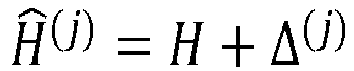
- In a similar manner,


- CIST enables each transmitter to independently determine an initial own view of the overall precoder V, using known techniques. For example, the overall precoder V and thus said initial own view V̂ (j) of the overall precoder V, are both of one precoder type among the followings:
- block-diagonalization precoders, for coordinated multi-point transmissions with joint processing, as addressed in the document " Cooperative Multi-Cell Block Diagonalization with Per-Base-Station Power Constrains", Rui Zhang, in IEEE Journal on Selected Areas in Communications, vol. 28, no. 9, pp. 1435-1445, December 2010;
- interference aware coordinated beamforming precoders, for coordinated multi-point transmissions with coordinated precoding, as addressed in the document " Interference Aware-Coordinated Beamforming in a Multi-Cell System", Chan-Byoung Chae et al, in IEEE Transactions on Wireless Communications, vol. 11, no. 10, pp. 3692-3703, October 2012; and
- regularized zero-forcing precoders, for coordinated multi-point transmissions with joint processing, as addressed in the document " A large system analysis of cooperative multicell downlink system with imperfect CSIT", Jun Zhang et al, in IEEE International Conference on Communications (ICC), pp.4813-4817, 10-15 June 2012.
- Due to the CSIT mismatch, the initial own view V̂ (j) of the overall precoder V is slightly different from one transmitter to another among the Kt transmitters. Optimization is therefore adequately performed so as to improve the performance of the transmissions from the Kt transmitters to the Kr receivers, despite that each j-th transmitter among the Kt transmitters independently determines the overall precoder V part that said transmitter has to apply although CSIT mismatch exists, further despite that quantization operations are performed when the transmitters exchange precoder related data so as to enable them to independently adjust their respective own views V̂ (j) (j = 1 to Kt ) of the overall precoder V in the scope of the optimization. As already mentioned, this aspect is detailed hereafter with regard to
Fig. 3 . -
Fig. 2 schematically represents an example of hardware architecture of a communication device, as used in thewireless communication system 100. The hardware architecture illustratively shown inFig. 2 can represent eachtransmitter wireless communication system 100 and/or eachreceiver wireless communication system 100. - According to the shown architecture, the communication device comprises the following components interconnected by a communications bus 206: a processor, microprocessor, microcontroller or CPU (Central Processing Unit) 200; a RAM (Random-Access Memory) 201; a ROM (Read-Only Memory) 202; an SD (Secure Digital)
card reader 203, or an HDD (Hard Disk Drive) or any other device adapted to read information stored on a storage medium; a firstcommunication interface COM1 204 and potentially a secondcommunication interface COM2 205. - When the communication device is one receiver among the Kr receivers, the first
communication interface COM1 204 enables the communication device to receive data from the Kt transmitters via the global MIMO channel H. The secondcommunication interface COM2 205 is not necessary in this case. The firstcommunication interface COM1 204 further enables the communication device to feed back channel state information to one or more transmitter devices among the Kt transmitters. - When the communication device is one transmitter among the Kt transmitters, the first
communication interface COM1 204 enables the communication device to transmit data to the Kr receivers, via the global MIMO channel H, cooperatively with the other transmitters among the Kt transmitters. The firstcommunication interface COM1 204 further enables the communication device to receive channel state information fed back by one or more receivers among the Kr receivers. Moreover, the secondcommunication interface COM2 205 enables the communication device to exchange data with one or more other transmitters among the Kt transmitters (cooperation links). -
CPU 200 is capable of executing instructions loaded intoRAM 201 fromROM 202 or from an external memory, such as an SD card. After the communication device has been powered on,CPU 200 is capable of reading instructions fromRAM 201 and executing these instructions. The instructions form one computer program that causesCPU 200 to perform some or all of the steps of the algorithm described hereafter. - Any and all steps of the algorithms described hereafter may be implemented in software by execution of a set of instructions or program by a programmable computing machine, such as a PC (Personal Computer), a DSP (Digital Signal Processor) or a microcontroller; or else implemented in hardware by a machine or a dedicated component, such as an FPGA (Field-Programmable Gate Array) or an ASIC (Application-Specific Integrated Circuit).
-
Fig. 3 schematically represents an algorithm for determining, in a distributed fashion within thewireless communication system 100, estimations of the overall precoder V to be applied for transmitting data from the plurality of Kt transmitters 120a, 120b toward the plurality of Kr receivers 110a, 110b. The algorithm shown inFig. 3 is independently performed by each and every transmitter among the Kt transmitters. Let's illustratively consider that the algorithm ofFig. 3 is performed by thetransmitter 120a, which is considered as the j-th transmitter among the Kt transmitters. - In a step S301, the
transmitter 120a (which is considered as the j-th transmitter among the Kt transmitters) obtains up-to-date (i.e. short-term) CSIT related data needed by thetransmitter 120a to have its own view Ĥ (j) of the global MIMO channel H. - In a step S302, the
transmitter 120a determines its initial own view Ṽ (j)of the precoder V from its own view Ĥ (j) of the global MIMO channel H, i.e. from the up-to-date CSIT related data obtained in the step S301. Thetransmitter 120a does so by using known techniques, as already explained. Since thetransmitters wireless communication system 100 rely on different CSIT, CSIT mismatch exists at this point. It means that the initial own view V̂ (i) of the overall precoder V is determined by each i-th transmitter (i from 1 to Kt ) in the same manner, except that each i-th transmitter has relied on its own CSIT related data to do so. - In a step S303, the
transmitter 120a quantizes its initial own view V̂ (j)of the overall precoder V in order to be able to transmit quantized information representative of said initial own view V̂ (j) to the other transmitters among the Kt transmitters. Considering that ℓj,i denotes the coordination link between the j-th transmitter and the i-th transmitter and that the coordination link ℓj,i is limited to a data rate R j,i , quantization operations Qj,i based on a codebook having 2 Rj,i records are necessary to transmit said initial own view V̂ (j) of the overall precoder V to said i-th transmitter. Since all the coordination links may have different capacities, the data rate Rj,i and the codebook in use may differ from one coordination link ℓ j,i to another. Considering that W (j,i) is the quantized version of said initial own view V̂ (j) to be transmitted on the coordination link ℓ j,i , the following relationship applies:
- Then the
transmitter 120a transmits, to each i-th transmitter among the Kt transmitters (i ≠ j), the quantized version W (j,i) of said initial own view V̂ (j) of the overall precoder V, which has been determined by thetransmitter 120a for the coordination link ℓ j,i betweentransmitter 120a and said i-th transmitter. One should note that, by convention, W (j,i) is considered herein as equivalent to V̂ (j) (some kind of self-feedback with no quantization operations), which further means that η(j,j) is considered herein as being null. - In a step S304, the
transmitter 120a receives, from each other i-th transmitter among the Kt transmitters (i≠ j), a quantized version W (i,j) of the initial own view V̂ (i) that has been determined by said i-th transmitter, wherein said i-th transmitter has applied quantization operations Qi,j based on a codebook having 2Ri,j records so as to obtain the quantized version W (i,j) from said initial own view V̂ (i) in order to meet the data rate Ri,j of the coordination link ℓ i,j. - In a step S305, the
transmitter 120a obtains statistical distributions of the quantization errors η(i,j)incurred by the transmissions of the quantized precoders W (i,j) (i from 1 to Kt , i≠ j) on the respective coordination links ℓ i,j . - According to a first example, the
transmitter 120a relies on predefined models respectively providing the statistical distributions of the quantization errors η(i,j ). - According to a second example, the transmitters of the
wireless communication system 100 cooperatively implement a learning phase so as to build the statistical distributions of the quantization errors η(i,j). Each i-th transmitter (i from 1 to Kt) indeed knows the codebook in use to perform the quantization operations Qi,j (j from 1 to Kt,j ≠ i) and further knows over time what are the differences between said initial own views V̂ (i) that said i-th transmitter has obtained over time and the corresponding quantized versions W (i,j) that were effectively transmitted. From this knowledge, said i-th transmitter is able to compute the statistical distributions of the quantization errors η(i,j) and then to share the computed statistical distribution of each quantization error η(i,j) with the other transmitters of thewireless communication system 100, which can be done on a long-term basis by exchanges between the transmitters themselves or on a long-term basis via a central device that gathers such knowledge and then propagates the statistical distributions of the quantization errors η(i,j) to said transmitters. - The statistical distributions of the quantization errors η(i,j) depend inexplicitly on statistical distributions of the CSIT errors Δ(i) between the effective global MIMO channel H and the own view Ĥ (i) of the global MIMO channel H from the standpoint of each i-th transmitter among the Kt transmitters. Knowing how to obtain the initial own views V̂ (i) of the overall precoder V thanks to the codebooks for performing the quantization operations Qi,j , the statistical distributions of the quantization errors η(i,j) can be refined according to statistical distributions of the CSIT errors Δ(i). The statistical distribution of the CSIT error Δ(i) is for instance obtained from a predefined model.
- The statistical distributions of the quantization errors η(i,j) may be represented as histograms representative of probability density functions, or parameterized functions representative of the probability density functions, wherein corresponding parameters thereof only may be exchanged (e.g. mean and variance in the Gaussian case).
- In a step S306, the
transmitter 120a (considered as the j-th transmitter among the Kt transmitters) optimizes a set of matrices parameters


- The multivariate combination function f thus enables the
transmitter 120a (considered as the j-th transmitter among the Kt transmitters) to determine its adjusted own view Ṽ (j) of the overall precoder V from the quantized versions W (i,j) (i from 1 to Kt , i ≠j) received from the other transmitters of thewireless communication system 100, from its initial own view V̂ (j) of the overall precoder V and from the optimized matrices parameter

- The set of matrices parameters

transmitter 120a (considered as the j-th transmitter among the Kt transmitters) instead of the effective global MIMO channel H, further considering an estimation of the set of adjusted precoders {Ṽ (j')} j'∈ [1,Kt ], instead of the effective adjusted precoders {Ṽ (j')} j'∈ [1,Kt ] and further considering the following relationship:
- The figure of merit g (j) is thus defined as an estimation of the figure of merit g with respect to the statistical distribution of the quantization error η(i,j'), as follows:

(i,j') ,i∈[1,Kt ],j'∈[1,Kt ]} represents the mathematical expectation over the statistical distribution of the quantization error η(i,j'). - In a particular embodiment, the figure of merit g is related to the sum rate as follows:

- In another particular embodiment, the figure of merit g is related to the sum of mean square error (MSE) as follows:


- So as to compute the estimation g (j) since the
transmitter 120a does not know the effective global MIMO channel H but has only its own view Ĥ (j) of the global MIMO channel H, thetransmitter 120a replaces, in the expression of the figure of merit g, the global MIMO channel H by its own view Ĥ (j) of the global MIMO channel H. Moreover, since thetransmitter 120a does not know the quantized precoders {W (i,j')} i∈[1,Kt ] , with j' from 1 to Kt and j' ≠ j, thetransmitter 120a uses an estimation of {W (i,j') } i∈[1,Kt ] by relying on {W (i,j)} i∈[1,Kt ] and on the statistical distribution of the quantization error η(i,j') and η(i,j). - Although the own view Ĥ (j) of the global MIMO channel H has been built by the
transmitter 120a (considered as the j-th transmitter among the Kt transmitters) on CSIT containing errors, the effect of not taking into account said errors is typically insignificant regarding the mismatch between the overall precoder V (as would ideally be applied) and the adjusted own view Ṽ (j) of the overall precoder V. - In a particular embodiment where the adjusted own view Ṽ (j) of the overall precoder V is improved regarding the CSIT mismatch, the estimation g (j) of the figure of merit g becomes a mathematical expectation, over the distribution of the CSIT error Δ(j) between the global MIMO channel H and the own view Ĥ (j) of the global MIMO channel H from the standpoint of the j-th transmitter, of the above expressions of the figure of merit g, wherein the
transmitter 120a replaces, in the expression of the figure of merit g, the global MIMO channel H by its own view Ĥ (j) of the global MIMO channel H plus the CSIT error Δ(j) (i.e. replacing H by Ĥ (j)-Δ(j)). The statistical distribution of the CSIT error Δ(j) is for instance obtained from a predefined model. - Optimization of the matrices parameters

transmitter 120a (considered as the j-th transmitter among the Kt transmitters) in various ways known to the one with ordinary skills in the art. According to a first example, thetransmitter 120a tests values contained in a predefined library of matrices parameters
transmitter 120a optimizes the matrices parameters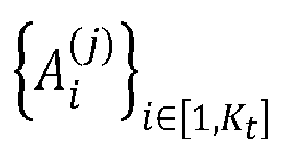
- In a step S307, the
transmitter 120a applies its own part of the distributed precoding according to the multivariate combination function f combining the quantized versions W (i,j) of the overall precoder V (wherein j represents thetransmitter 120a and with i from 1 to Kt ). In other words, thetransmitter 120a applies a precoding defined by Ej TṼ (j) when performing transmissions within thewireless communication system 100 so as to participate in said transmissions jointly with the other transmitters. - The algorithm of
Fig. 3 is preferably applied by each transmitter of thewireless communication system 100 each time there is a change in the statistical distribution of the quantization error η(i,j), whatever is coordination link ℓ i,j concerned (a change for any coordination link). In another embodiment, the algorithm ofFig. 3 is applied by each transmitter of thewireless communication system 100 on a regular basis at an occurrence frequency that is defined by a time period during which the statistical distribution of the quantization error η(i,j), whatever is coordination link ℓ i,j concerned, is considered to remain stable (stable for any coordination link).
Claims (9)
- A method implemented by one transmitter, referred to as j-th transmitter, among a plurality of Kt transmitters of a wireless communication system for performing transmissions from the Kt transmitters to a plurality of Kr receivers via a global MIMO channel H thanks to an overall precoder V to be determined in a distributed fashion, said transmitters being interconnected by coordination links with limited data rate implying quantization operations, characterized in that said j-th transmitter performs:- determining (S302) an initial version Ṽ (j) of the overall precoder V from its own view Ĥ (j) of the global MIMO channel H;- quantizing (S303) the determined initial version Ṽ (j) of the overall precoder V for further transmissions to the other transmitters among the Kt transmitters via the coordination links, thus implying quantization errors, and transmitting accordingly quantized versions of the initial version Ṽ (j) of the overall precoder V;- receiving (S304) from each other i-th transmitter among the plurality of Kt transmitters, via the respective coordination link ℓi,j, a quantized version W (i,j) of an initial version of the overall precoder V that said other transmitter has determined from its own view Ĥ (j) of the global MIMO channel H, wherein i from 1 to Kt , i ≠ j,- obtaining (S305) statistical distributions of the quantization errors incurred by the transmissions of the quantized versions of the initial versions of the overall precoder V on the respective coordination links;- optimizing (S306) a set of matrices parameters


 wherein η(i,j') represents quantization errors on the coordination link ℓi,j' , and respectively η(i,j) represents quantization errors on the coordination link ℓi,j, wherein j' from 1 to Kt,j' ≠ j,and further considering the obtained statistical distributions of the quantization errors instead of the effective quantization errors; and- participating in the transmissions by applying a precoder that is formed by a part of the adjusted own view Ṽ (j) of the overall precoder V which relates to said j-th transmitter among said plurality of Kt transmitters.
 - The method according to claim 1, characterized in that the multivariate combination function f is defined in one of the following forms:


- The method according to any one of claims 1 and 2, characterized in that the figure of merit g is defined as follows:

 wherein 0M×(j-1)M represents an M × (j - 1)M sub-matrix containing only zeros, 0 M×(Kt-j)M represents an M × (Kt - j)M sub-matrix containing only zeros, and I M×M represents an M × M identity sub-matrix,and said j-th transmitter among said plurality of Kt transmitters uses, in the expression of the figure of merit g, an estimation of {W (i,j')} j'∈[1,Kt ] by relying on {W (i,j)} i∈[1,Kt ] and on the statistical distributions of the quantization errors η(i,j') and η (i,j)
 - The method according to any one of claims 1 and 2, characterized in that the figure of merit g is defined as follows:



 wherein 0 M×(j-1)M represents an M × (j - 1)M sub-matrix containing only zeros, 0 M×( Kt-j ) M represents an M × (Kt - j)M sub-matrix containing only zeros, and I M×M represents an M × M identity sub-matrix,and said j-th transmitter among said plurality of Kt transmitters uses, in the expression of the figure of merit g, an estimation of {W (i,j') } i∈[1,K] by relying on {W (i,j')} i∈[1,Kt ] and on the statistical distributions of the quantization errors η(i,j') and η(i,j)
 - The method according to any one of claims 1 to 4, characterized in that said j-th transmitter among said plurality of Kt transmitters re-computes its adjusted own view Ṽ (j) of the overall precoder V each time there is a change in the statistical distributions of the quantization errors η(i,j) and/or η(i,j).
- The method according to any one of claims 1 to 4, characterized in that said j-th transmitter among said plurality of Kt transmitters re-computes its adjusted own view Ṽ (j) of the overall precoder V on a regular basis at an occurrence frequency that is defined by a time period during which the statistical distributions of the quantization errors η(i,j') and η(i,j) are considered to be stable.
- A computer program, characterized in that it comprises program code instructions which can be loaded in a programmable device for implementing the method according to any one of claims 1 to 6, when the program code instructions are run by the programmable device.
- An information storage medium, characterized in that it stores a computer program comprising program code instructions which can be loaded in a programmable device for implementing the method according to any one of claims 1 to 6, when the program code instructions are run by the programmable device.
- A transmitter, referred to as j-th transmitter, among a plurality of Kt transmitters of a wireless communication system which are configured for performing transmissions from the Kt transmitters to a plurality of Kr receivers via a global MIMO channel H thanks to an overall precoder V to be determined in a distributed fashion, said transmitters being interconnected by coordination links with limited data rate implying quantization operations, characterized in that said j-th transmitter comprises:- means for determining (S302) an initial version Ṽ (j) of the overall precoder V from its own view Ĥ (j) of the global MIMO channel H;- means for quantizing (S303) the determined initial version Ṽ (j) of the overall precoder V for further transmissions to the other transmitters among the Kt transmitters via the coordination links, thus implying quantization errors, and means for transmitting accordingly quantized versions of the initial version Ṽ (j) of the overall precoder V;- means for receiving (S304) from each other i-th transmitter, via the respective coordination link ℓi,j , a quantized version W (i,j) of an initial version of the overall precoder V that said other transmitter has determined from its own view Ĥ (i) of the global MIMO channel H, wherein i from 1 to Kt, i ≠ j,- means for obtaining (S305) statistical distributions of the quantization errors incurred by the transmissions of the quantized versions of the initial versions of the overall precoder V on the respective coordination links;- means for optimizing (S306) a set of matrices parameters


 wherein η(i,j') represents quantization errors on the coordination link ℓi,j' , and respectively η(i,j) represents quantization errors on the coordination link ℓi,j, wherein j' from 1 to Kt , j' ≠ j,and further considering the obtained statistical distributions of the quantization errors instead of the effective quantization errors; and- means for participating in said transmissions (S307) by applying a precoder that is formed by a part of the adjusted own view Ṽ (j) of the overall precoder V which relates to saidj-th transmitter among said plurality of Kt transmitters.
Priority Applications (1)
| Application Number | Priority Date | Filing Date | Title |
|---|---|---|---|
| EP16192880.9A EP3306828B1 (en) | 2016-10-07 | 2016-10-07 | Method for determining a precoder in a distributed fashion |
Applications Claiming Priority (1)
| Application Number | Priority Date | Filing Date | Title |
|---|---|---|---|
| EP16192880.9A EP3306828B1 (en) | 2016-10-07 | 2016-10-07 | Method for determining a precoder in a distributed fashion |
Publications (2)
| Publication Number | Publication Date |
|---|---|
| EP3306828A1 true EP3306828A1 (en) | 2018-04-11 |
| EP3306828B1 EP3306828B1 (en) | 2019-06-05 |
Family
ID=57121105
Family Applications (1)
| Application Number | Title | Priority Date | Filing Date |
|---|---|---|---|
| EP16192880.9A Not-in-force EP3306828B1 (en) | 2016-10-07 | 2016-10-07 | Method for determining a precoder in a distributed fashion |
Country Status (1)
| Country | Link |
|---|---|
| EP (1) | EP3306828B1 (en) |
Cited By (2)
| Publication number | Priority date | Publication date | Assignee | Title |
|---|---|---|---|---|
| WO2021081848A1 (en) * | 2019-10-30 | 2021-05-06 | Nokia Shanghai Bell Co., Ltd. | Quantized precoding in massive mimo system |
| US12610329B2 (en) | 2022-10-14 | 2026-04-21 | Nokia Technologies Oy | Adjusting a client device receiver parameter, and related devices, methods and computer programs |
Citations (3)
| Publication number | Priority date | Publication date | Assignee | Title |
|---|---|---|---|---|
| US8588801B2 (en) * | 2009-08-21 | 2013-11-19 | Qualcomm Incorporated | Multi-point equalization framework for coordinated multi-point transmission |
| WO2014026556A1 (en) * | 2012-08-16 | 2014-02-20 | Huawei Technologies Co., Ltd. | SYSTEM AND METHOD FOR LOCALIZED CoMP PRECODING |
| US20150215934A1 (en) * | 2014-01-30 | 2015-07-30 | Intel Corporation | Apparatus, method, and system of inter-node communication |
-
2016
- 2016-10-07 EP EP16192880.9A patent/EP3306828B1/en not_active Not-in-force
Patent Citations (3)
| Publication number | Priority date | Publication date | Assignee | Title |
|---|---|---|---|---|
| US8588801B2 (en) * | 2009-08-21 | 2013-11-19 | Qualcomm Incorporated | Multi-point equalization framework for coordinated multi-point transmission |
| WO2014026556A1 (en) * | 2012-08-16 | 2014-02-20 | Huawei Technologies Co., Ltd. | SYSTEM AND METHOD FOR LOCALIZED CoMP PRECODING |
| US20150215934A1 (en) * | 2014-01-30 | 2015-07-30 | Intel Corporation | Apparatus, method, and system of inter-node communication |
Non-Patent Citations (4)
| Title |
|---|
| CHAN-BYOUNG CHAE ET AL.: "Interference Aware-Coordinated Beamforming in a Multi-Cell System", IEEE TRANSACTIONS ON WIRELESS COMMUNICATIONS, vol. 11, no. 10, October 2012 (2012-10-01), pages 3692 - 3703, XP011469676, DOI: doi:10.1109/TWC.2012.081312.112119 |
| JUN ZHANG ET AL.: "A large system analysis of cooperative multicell downlink system with imperfect CSIT", IEEE INTERNATIONAL CONFERENCE ON COMMUNICATIONS (ICC), 10 June 2012 (2012-06-10), pages 4813 - 4817, XP032273644, DOI: doi:10.1109/ICC.2012.6363813 |
| LAKSHMANA TILAK RAJESH ET AL: "Improved Local Precoder Design for JT-CoMP With Periodical Backhaul CSI Exchange", IEEE COMMUNICATIONS LETTERS, IEEE SERVICE CENTER, PISCATAWAY, NJ, US, vol. 20, no. 3, 1 March 2016 (2016-03-01), pages 566 - 569, XP011602280, ISSN: 1089-7798, [retrieved on 20160308], DOI: 10.1109/LCOMM.2016.2518184 * |
| RUI ZHANG: "Cooperative Multi-Cell Block Diagonalization with Per-Base-Station Power Constraints", IEEE JOURNAL ON SELECTED AREAS IN COMMUNICATIONS, vol. 28, no. 9, December 2010 (2010-12-01), pages 1435 - 1445, XP011336908, DOI: doi:10.1109/JSAC.2010.101205 |
Cited By (3)
| Publication number | Priority date | Publication date | Assignee | Title |
|---|---|---|---|---|
| WO2021081848A1 (en) * | 2019-10-30 | 2021-05-06 | Nokia Shanghai Bell Co., Ltd. | Quantized precoding in massive mimo system |
| US11855719B2 (en) | 2019-10-30 | 2023-12-26 | Nokia Solutions And Networks Oy | Quantized precoding in massive MIMO system |
| US12610329B2 (en) | 2022-10-14 | 2026-04-21 | Nokia Technologies Oy | Adjusting a client device receiver parameter, and related devices, methods and computer programs |
Also Published As
| Publication number | Publication date |
|---|---|
| EP3306828B1 (en) | 2019-06-05 |
Similar Documents
| Publication | Publication Date | Title |
|---|---|---|
| US10819406B2 (en) | Codebook-based channel state information feedback method and device | |
| US8675627B2 (en) | Adaptive precoding codebooks for wireless communications | |
| US10396863B2 (en) | Method for determining parameters for configuring regularized zero-forcing precoder | |
| TWI398134B (en) | System and method for transmitting information in a wireless communication system | |
| US8660202B2 (en) | Robust precoder and receiver filter design for Gaussian interference channel | |
| US9344160B2 (en) | Data transmission method and system, transmitter, and receiver | |
| US11101852B2 (en) | Channel state information feedback method and device | |
| WO2018059072A1 (en) | Method and device for transmitting channel state information | |
| US10419094B2 (en) | Channel state information measurement method, channel state information acquisition method, terminal and network device | |
| CN103155624A (en) | Method and device for LTE channel state information estimation | |
| CN102763447A (en) | System and method for channel status information feedback in a wireless communications system that utilizes multiple-input multiple-output (MIMO) transmission | |
| WO2017124967A1 (en) | Multi-antenna transmission method, base station, and user terminal | |
| JP6641506B2 (en) | Method and device for transmitting data | |
| KR102153207B1 (en) | Method and apparatus for transmitting feedback information | |
| CN102546088A (en) | BD (block diagonalization) pre-coding method and device | |
| US20230269046A1 (en) | Channel Information Reporting Method and Apparatus | |
| TW202437714A (en) | Methods for csi compression and user equipments | |
| EP3306828B1 (en) | Method for determining a precoder in a distributed fashion | |
| CN107733506B (en) | CSI processing method, CSI measurement pilot frequency resource transmission method and device | |
| CN115428345A (en) | Multi-user precoding | |
| CN105208572B (en) | A kind of beam-forming method and base station | |
| US10250307B2 (en) | Method for setting cooperation parameters of communication system, computer program thereof, information storage means thereof, and communication system including plurality of node devices | |
| Bazco-Nogueras et al. | Achieving vanishing rate loss in decentralized network MIMO | |
| WO2017088658A1 (en) | Method and device for acquiring channel information | |
| US20240154653A1 (en) | Neural network for mu-mimo user selection |
Legal Events
| Date | Code | Title | Description |
|---|---|---|---|
| PUAI | Public reference made under article 153(3) epc to a published international application that has entered the european phase |
Free format text: ORIGINAL CODE: 0009012 |
|
| STAA | Information on the status of an ep patent application or granted ep patent |
Free format text: STATUS: THE APPLICATION HAS BEEN PUBLISHED |
|
| AK | Designated contracting states |
Kind code of ref document: A1 Designated state(s): AL AT BE BG CH CY CZ DE DK EE ES FI FR GB GR HR HU IE IS IT LI LT LU LV MC MK MT NL NO PL PT RO RS SE SI SK SM TR |
|
| AX | Request for extension of the european patent |
Extension state: BA ME |
|
| STAA | Information on the status of an ep patent application or granted ep patent |
Free format text: STATUS: REQUEST FOR EXAMINATION WAS MADE |
|
| 17P | Request for examination filed |
Effective date: 20181010 |
|
| RBV | Designated contracting states (corrected) |
Designated state(s): AL AT BE BG CH CY CZ DE DK EE ES FI FR GB GR HR HU IE IS IT LI LT LU LV MC MK MT NL NO PL PT RO RS SE SI SK SM TR |
|
| GRAP | Despatch of communication of intention to grant a patent |
Free format text: ORIGINAL CODE: EPIDOSNIGR1 |
|
| STAA | Information on the status of an ep patent application or granted ep patent |
Free format text: STATUS: GRANT OF PATENT IS INTENDED |
|
| INTG | Intention to grant announced |
Effective date: 20190114 |
|
| RAP1 | Party data changed (applicant data changed or rights of an application transferred) |
Owner name: MITSUBISHI ELECTRIC R&D CENTRE EUROPE B.V. Owner name: MITSUBISHI ELECTRIC CORPORATION |
|
| RIN1 | Information on inventor provided before grant (corrected) |
Inventor name: LI, QIANRUI Inventor name: GRESSET, NICOLAS |
|
| GRAS | Grant fee paid |
Free format text: ORIGINAL CODE: EPIDOSNIGR3 |
|
| GRAA | (expected) grant |
Free format text: ORIGINAL CODE: 0009210 |
|
| STAA | Information on the status of an ep patent application or granted ep patent |
Free format text: STATUS: THE PATENT HAS BEEN GRANTED |
|
| AK | Designated contracting states |
Kind code of ref document: B1 Designated state(s): AL AT BE BG CH CY CZ DE DK EE ES FI FR GB GR HR HU IE IS IT LI LT LU LV MC MK MT NL NO PL PT RO RS SE SI SK SM TR |
|
| REG | Reference to a national code |
Ref country code: GB Ref legal event code: FG4D |
|
| REG | Reference to a national code |
Ref country code: CH Ref legal event code: EP |
|
| REG | Reference to a national code |
Ref country code: AT Ref legal event code: REF Ref document number: 1141037 Country of ref document: AT Kind code of ref document: T Effective date: 20190615 |
|
| REG | Reference to a national code |
Ref country code: IE Ref legal event code: FG4D |
|
| REG | Reference to a national code |
Ref country code: DE Ref legal event code: R096 Ref document number: 602016014746 Country of ref document: DE |
|
| REG | Reference to a national code |
Ref country code: NL Ref legal event code: MP Effective date: 20190605 |
|
| REG | Reference to a national code |
Ref country code: LT Ref legal event code: MG4D |
|
| PG25 | Lapsed in a contracting state [announced via postgrant information from national office to epo] |
Ref country code: FI Free format text: LAPSE BECAUSE OF FAILURE TO SUBMIT A TRANSLATION OF THE DESCRIPTION OR TO PAY THE FEE WITHIN THE PRESCRIBED TIME-LIMIT Effective date: 20190605 Ref country code: NO Free format text: LAPSE BECAUSE OF FAILURE TO SUBMIT A TRANSLATION OF THE DESCRIPTION OR TO PAY THE FEE WITHIN THE PRESCRIBED TIME-LIMIT Effective date: 20190905 Ref country code: AL Free format text: LAPSE BECAUSE OF FAILURE TO SUBMIT A TRANSLATION OF THE DESCRIPTION OR TO PAY THE FEE WITHIN THE PRESCRIBED TIME-LIMIT Effective date: 20190605 Ref country code: SE Free format text: LAPSE BECAUSE OF FAILURE TO SUBMIT A TRANSLATION OF THE DESCRIPTION OR TO PAY THE FEE WITHIN THE PRESCRIBED TIME-LIMIT Effective date: 20190605 Ref country code: LT Free format text: LAPSE BECAUSE OF FAILURE TO SUBMIT A TRANSLATION OF THE DESCRIPTION OR TO PAY THE FEE WITHIN THE PRESCRIBED TIME-LIMIT Effective date: 20190605 Ref country code: HR Free format text: LAPSE BECAUSE OF FAILURE TO SUBMIT A TRANSLATION OF THE DESCRIPTION OR TO PAY THE FEE WITHIN THE PRESCRIBED TIME-LIMIT Effective date: 20190605 Ref country code: ES Free format text: LAPSE BECAUSE OF FAILURE TO SUBMIT A TRANSLATION OF THE DESCRIPTION OR TO PAY THE FEE WITHIN THE PRESCRIBED TIME-LIMIT Effective date: 20190605 |
|
| PG25 | Lapsed in a contracting state [announced via postgrant information from national office to epo] |
Ref country code: RS Free format text: LAPSE BECAUSE OF FAILURE TO SUBMIT A TRANSLATION OF THE DESCRIPTION OR TO PAY THE FEE WITHIN THE PRESCRIBED TIME-LIMIT Effective date: 20190605 Ref country code: BG Free format text: LAPSE BECAUSE OF FAILURE TO SUBMIT A TRANSLATION OF THE DESCRIPTION OR TO PAY THE FEE WITHIN THE PRESCRIBED TIME-LIMIT Effective date: 20190905 Ref country code: GR Free format text: LAPSE BECAUSE OF FAILURE TO SUBMIT A TRANSLATION OF THE DESCRIPTION OR TO PAY THE FEE WITHIN THE PRESCRIBED TIME-LIMIT Effective date: 20190906 Ref country code: LV Free format text: LAPSE BECAUSE OF FAILURE TO SUBMIT A TRANSLATION OF THE DESCRIPTION OR TO PAY THE FEE WITHIN THE PRESCRIBED TIME-LIMIT Effective date: 20190605 |
|
| REG | Reference to a national code |
Ref country code: AT Ref legal event code: MK05 Ref document number: 1141037 Country of ref document: AT Kind code of ref document: T Effective date: 20190605 |
|
| PG25 | Lapsed in a contracting state [announced via postgrant information from national office to epo] |
Ref country code: RO Free format text: LAPSE BECAUSE OF FAILURE TO SUBMIT A TRANSLATION OF THE DESCRIPTION OR TO PAY THE FEE WITHIN THE PRESCRIBED TIME-LIMIT Effective date: 20190605 Ref country code: SK Free format text: LAPSE BECAUSE OF FAILURE TO SUBMIT A TRANSLATION OF THE DESCRIPTION OR TO PAY THE FEE WITHIN THE PRESCRIBED TIME-LIMIT Effective date: 20190605 Ref country code: CZ Free format text: LAPSE BECAUSE OF FAILURE TO SUBMIT A TRANSLATION OF THE DESCRIPTION OR TO PAY THE FEE WITHIN THE PRESCRIBED TIME-LIMIT Effective date: 20190605 Ref country code: EE Free format text: LAPSE BECAUSE OF FAILURE TO SUBMIT A TRANSLATION OF THE DESCRIPTION OR TO PAY THE FEE WITHIN THE PRESCRIBED TIME-LIMIT Effective date: 20190605 Ref country code: AT Free format text: LAPSE BECAUSE OF FAILURE TO SUBMIT A TRANSLATION OF THE DESCRIPTION OR TO PAY THE FEE WITHIN THE PRESCRIBED TIME-LIMIT Effective date: 20190605 Ref country code: NL Free format text: LAPSE BECAUSE OF FAILURE TO SUBMIT A TRANSLATION OF THE DESCRIPTION OR TO PAY THE FEE WITHIN THE PRESCRIBED TIME-LIMIT Effective date: 20190605 Ref country code: PT Free format text: LAPSE BECAUSE OF FAILURE TO SUBMIT A TRANSLATION OF THE DESCRIPTION OR TO PAY THE FEE WITHIN THE PRESCRIBED TIME-LIMIT Effective date: 20191007 |
|
| PGFP | Annual fee paid to national office [announced via postgrant information from national office to epo] |
Ref country code: DE Payment date: 20191021 Year of fee payment: 4 |
|
| PG25 | Lapsed in a contracting state [announced via postgrant information from national office to epo] |
Ref country code: IT Free format text: LAPSE BECAUSE OF FAILURE TO SUBMIT A TRANSLATION OF THE DESCRIPTION OR TO PAY THE FEE WITHIN THE PRESCRIBED TIME-LIMIT Effective date: 20190605 Ref country code: SM Free format text: LAPSE BECAUSE OF FAILURE TO SUBMIT A TRANSLATION OF THE DESCRIPTION OR TO PAY THE FEE WITHIN THE PRESCRIBED TIME-LIMIT Effective date: 20190605 Ref country code: IS Free format text: LAPSE BECAUSE OF FAILURE TO SUBMIT A TRANSLATION OF THE DESCRIPTION OR TO PAY THE FEE WITHIN THE PRESCRIBED TIME-LIMIT Effective date: 20191005 |
|
| PGFP | Annual fee paid to national office [announced via postgrant information from national office to epo] |
Ref country code: FR Payment date: 20191024 Year of fee payment: 4 |
|
| REG | Reference to a national code |
Ref country code: DE Ref legal event code: R097 Ref document number: 602016014746 Country of ref document: DE |
|
| PG25 | Lapsed in a contracting state [announced via postgrant information from national office to epo] |
Ref country code: TR Free format text: LAPSE BECAUSE OF FAILURE TO SUBMIT A TRANSLATION OF THE DESCRIPTION OR TO PAY THE FEE WITHIN THE PRESCRIBED TIME-LIMIT Effective date: 20190605 |
|
| PLBE | No opposition filed within time limit |
Free format text: ORIGINAL CODE: 0009261 |
|
| STAA | Information on the status of an ep patent application or granted ep patent |
Free format text: STATUS: NO OPPOSITION FILED WITHIN TIME LIMIT |
|
| PG25 | Lapsed in a contracting state [announced via postgrant information from national office to epo] |
Ref country code: PL Free format text: LAPSE BECAUSE OF FAILURE TO SUBMIT A TRANSLATION OF THE DESCRIPTION OR TO PAY THE FEE WITHIN THE PRESCRIBED TIME-LIMIT Effective date: 20190605 Ref country code: DK Free format text: LAPSE BECAUSE OF FAILURE TO SUBMIT A TRANSLATION OF THE DESCRIPTION OR TO PAY THE FEE WITHIN THE PRESCRIBED TIME-LIMIT Effective date: 20190605 |
|
| 26N | No opposition filed |
Effective date: 20200306 |
|
| PG25 | Lapsed in a contracting state [announced via postgrant information from national office to epo] |
Ref country code: SI Free format text: LAPSE BECAUSE OF FAILURE TO SUBMIT A TRANSLATION OF THE DESCRIPTION OR TO PAY THE FEE WITHIN THE PRESCRIBED TIME-LIMIT Effective date: 20190605 Ref country code: MC Free format text: LAPSE BECAUSE OF FAILURE TO SUBMIT A TRANSLATION OF THE DESCRIPTION OR TO PAY THE FEE WITHIN THE PRESCRIBED TIME-LIMIT Effective date: 20190605 |
|
| REG | Reference to a national code |
Ref country code: CH Ref legal event code: PL |
|
| PG25 | Lapsed in a contracting state [announced via postgrant information from national office to epo] |
Ref country code: CH Free format text: LAPSE BECAUSE OF NON-PAYMENT OF DUE FEES Effective date: 20191031 Ref country code: LU Free format text: LAPSE BECAUSE OF NON-PAYMENT OF DUE FEES Effective date: 20191007 Ref country code: LI Free format text: LAPSE BECAUSE OF NON-PAYMENT OF DUE FEES Effective date: 20191031 |
|
| REG | Reference to a national code |
Ref country code: BE Ref legal event code: MM Effective date: 20191031 |
|
| PG25 | Lapsed in a contracting state [announced via postgrant information from national office to epo] |
Ref country code: BE Free format text: LAPSE BECAUSE OF NON-PAYMENT OF DUE FEES Effective date: 20191031 |
|
| PG25 | Lapsed in a contracting state [announced via postgrant information from national office to epo] |
Ref country code: IE Free format text: LAPSE BECAUSE OF NON-PAYMENT OF DUE FEES Effective date: 20191007 |
|
| REG | Reference to a national code |
Ref country code: DE Ref legal event code: R119 Ref document number: 602016014746 Country of ref document: DE |
|
| PG25 | Lapsed in a contracting state [announced via postgrant information from national office to epo] |
Ref country code: CY Free format text: LAPSE BECAUSE OF FAILURE TO SUBMIT A TRANSLATION OF THE DESCRIPTION OR TO PAY THE FEE WITHIN THE PRESCRIBED TIME-LIMIT Effective date: 20190605 |
|
| GBPC | Gb: european patent ceased through non-payment of renewal fee |
Effective date: 20201007 |
|
| PG25 | Lapsed in a contracting state [announced via postgrant information from national office to epo] |
Ref country code: MT Free format text: LAPSE BECAUSE OF FAILURE TO SUBMIT A TRANSLATION OF THE DESCRIPTION OR TO PAY THE FEE WITHIN THE PRESCRIBED TIME-LIMIT Effective date: 20190605 Ref country code: DE Free format text: LAPSE BECAUSE OF NON-PAYMENT OF DUE FEES Effective date: 20210501 Ref country code: HU Free format text: LAPSE BECAUSE OF FAILURE TO SUBMIT A TRANSLATION OF THE DESCRIPTION OR TO PAY THE FEE WITHIN THE PRESCRIBED TIME-LIMIT; INVALID AB INITIO Effective date: 20161007 Ref country code: FR Free format text: LAPSE BECAUSE OF NON-PAYMENT OF DUE FEES Effective date: 20201031 |
|
| PG25 | Lapsed in a contracting state [announced via postgrant information from national office to epo] |
Ref country code: GB Free format text: LAPSE BECAUSE OF NON-PAYMENT OF DUE FEES Effective date: 20201007 |
|
| PG25 | Lapsed in a contracting state [announced via postgrant information from national office to epo] |
Ref country code: MK Free format text: LAPSE BECAUSE OF FAILURE TO SUBMIT A TRANSLATION OF THE DESCRIPTION OR TO PAY THE FEE WITHIN THE PRESCRIBED TIME-LIMIT Effective date: 20190605 |