EP3306427A1 - Method for optimized data transmission between an unmanned aerial vehicle and a telecommunications network, unmanned aerial vehicle , system, telecommunications network, program and computer program product - Google Patents
Method for optimized data transmission between an unmanned aerial vehicle and a telecommunications network, unmanned aerial vehicle , system, telecommunications network, program and computer program product Download PDFInfo
- Publication number
- EP3306427A1 EP3306427A1 EP16193126.6A EP16193126A EP3306427A1 EP 3306427 A1 EP3306427 A1 EP 3306427A1 EP 16193126 A EP16193126 A EP 16193126A EP 3306427 A1 EP3306427 A1 EP 3306427A1
- Authority
- EP
- European Patent Office
- Prior art keywords
- unmanned aerial
- aerial vehicle
- telecommunications network
- air interface
- command
- Prior art date
- Legal status (The legal status is an assumption and is not a legal conclusion. Google has not performed a legal analysis and makes no representation as to the accuracy of the status listed.)
- Granted
Links
Images
Classifications
-
- G—PHYSICS
- G08—SIGNALLING
- G08G—TRAFFIC CONTROL SYSTEMS
- G08G5/00—Traffic control systems for aircraft
- G08G5/50—Navigation or guidance aids
- G08G5/55—Navigation or guidance aids for a single aircraft
-
- G—PHYSICS
- G05—CONTROLLING; REGULATING
- G05D—SYSTEMS FOR CONTROLLING OR REGULATING NON-ELECTRIC VARIABLES
- G05D1/00—Control of position, course, altitude or attitude of land, water, air or space vehicles, e.g. using automatic pilots
- G05D1/0011—Control of position, course, altitude or attitude of land, water, air or space vehicles, e.g. using automatic pilots associated with a remote control arrangement
- G05D1/0022—Control of position, course, altitude or attitude of land, water, air or space vehicles, e.g. using automatic pilots associated with a remote control arrangement characterised by the communication link
-
- G—PHYSICS
- G08—SIGNALLING
- G08G—TRAFFIC CONTROL SYSTEMS
- G08G5/00—Traffic control systems for aircraft
- G08G5/20—Arrangements for acquiring, generating, sharing or displaying traffic information
- G08G5/26—Transmission of traffic-related information between aircraft and ground stations
-
- G—PHYSICS
- G08—SIGNALLING
- G08G—TRAFFIC CONTROL SYSTEMS
- G08G5/00—Traffic control systems for aircraft
- G08G5/50—Navigation or guidance aids
- G08G5/57—Navigation or guidance aids for unmanned aircraft
-
- H—ELECTRICITY
- H04—ELECTRIC COMMUNICATION TECHNIQUE
- H04B—TRANSMISSION
- H04B7/00—Radio transmission systems, i.e. using radiation field
- H04B7/14—Relay systems
- H04B7/15—Active relay systems
- H04B7/185—Space-based or airborne stations; Stations for satellite systems
- H04B7/18502—Airborne stations
- H04B7/18504—Aircraft used as relay or high altitude atmospheric platform
-
- H—ELECTRICITY
- H04—ELECTRIC COMMUNICATION TECHNIQUE
- H04W—WIRELESS COMMUNICATION NETWORKS
- H04W4/00—Services specially adapted for wireless communication networks; Facilities therefor
- H04W4/30—Services specially adapted for particular environments, situations or purposes
- H04W4/40—Services specially adapted for particular environments, situations or purposes for vehicles, e.g. vehicle-to-pedestrians [V2P]
-
- B—PERFORMING OPERATIONS; TRANSPORTING
- B64—AIRCRAFT; AVIATION; COSMONAUTICS
- B64U—UNMANNED AERIAL VEHICLES [UAV]; EQUIPMENT THEREFOR
- B64U2101/00—UAVs specially adapted for particular uses or applications
- B64U2101/20—UAVs specially adapted for particular uses or applications for use as communications relays, e.g. high-altitude platforms
-
- B—PERFORMING OPERATIONS; TRANSPORTING
- B64—AIRCRAFT; AVIATION; COSMONAUTICS
- B64U—UNMANNED AERIAL VEHICLES [UAV]; EQUIPMENT THEREFOR
- B64U2201/00—UAVs characterised by their flight controls
- B64U2201/20—Remote controls
-
- H—ELECTRICITY
- H04—ELECTRIC COMMUNICATION TECHNIQUE
- H04W—WIRELESS COMMUNICATION NETWORKS
- H04W84/00—Network topologies
- H04W84/02—Hierarchically pre-organised networks, e.g. paging networks, cellular networks, WLAN [Wireless Local Area Network] or WLL [Wireless Local Loop]
- H04W84/04—Large scale networks; Deep hierarchical networks
- H04W84/042—Public Land Mobile systems, e.g. cellular systems
Definitions
- the present invention relates a method for optimized data transmission between an unmanned aerial vehicle and a telecommunications network, wherein command and control data and/or payload communication data are transmitted
- the present invention relates to an unmanned aerial vehicle for optimized data transmission between the unmanned aerial vehicle and a telecommunications network, wherein the unmanned aerial vehicle is configured such that command and control data and/or payload communication data are transmitted
- the present invention relates to a system and to a telecommunications network for optimized data transmission between an unmanned aerial vehicle and a telecommunications network, the system comprising the unmanned aerial vehicle and the telecommunications network, wherein the system is configured such that command and control data and/or payload communication data are transmitted
- the present invention relates to a program and to a computer program product for optimized data transmission between an unmanned aerial vehicle and a telecommunications network.
- An object of the present invention is to provide an effective and simple solution to provide an optimized data transmission between an unmanned aerial vehicle and a telecommunications network in order to improve operational safety and reliability by means of improved communication channels of such vehicles during operation.
- the object of the present invention is achieved by a method for optimized data transmission between an unmanned aerial vehicle and a telecommunications network, wherein command and control data and/or payload communication data are transmitted
- communication channels can be split up for the different communication types during operation of such unmanned aerial vehicles. Furthermore, it is advantageously possible according to the present invention that the most efficient data communication systems can be provided for each purpose with the option to focus and/or bundle communication capacities in most urgent communication needs such as emergency situations.
- unmanned aerial vehicles have three types of communication needs: First, “Command” communication needs (in order to influence operation); second, “Control” communication needs (in order to observe operation); and third, payload communication needs (in order to transmit payload information).
- First “Command” communication needs (in order to influence operation); second, “Control” communication needs (in order to observe operation); and third, payload communication needs (in order to transmit payload information).
- C2-data basic command and control data
- C3-data other communication data
- pay-load data also called payload communication data.
- NB IoT Narrowband Internet of Things
- LPWA Low Power Wide Area
- a method for optimized data transmission between an unmanned aerial vehicle and a telecommunications network is provided.
- the unmanned aerial vehicle needs - while moving or flying - a data transmission capability in order to transmit command and control data and/or payload communication data.
- There might be situations and use cases of unmanned aerial vehicles such that only command and control data need to be transmitted.
- there might be situations and use cases of unmanned aerial vehicle such that only payload communication data need to be transmitted (i.e., especially temporarily, no command and control data are transmitted).
- only command and control data or both command and control data as well as payload communication data are transmitted or need to be transmitted.
- the command and control data and/or payload communication data that need to be transmitted are transmitted either in uplink direction (i.e. from the unmanned aerial vehicle to the telecommunications network) or in downlink direction (i.e. from the telecommunications network to the unmanned aerial vehicle) or both in uplink and in downlink direction.
- the unmanned aerial vehicle comprises communication means, wherein the communication means is configured to transmit the command and control data and/or the payload communication data in uplink direction to the telecommunications network and/or to receive the command and control data and/or the payload communication data in downlink direction from the telecommunications network.
- the communication means comprise a first air interface towards an optimized cellular narrowband mobile network and a second air interface towards a cellular broadband mobile network.
- the method comprises at least the step of the unmanned aerial vehicle transmitting command and control data in uplink direction to the telecommunications network, using the first air interface towards the optimized cellular narrowband mobile network.
- the method furthermore comprises the step of the unmanned aerial vehicle receiving command and control data in downlink direction from the optimized cellular narrowband mobile network, using the first air interface.
- the optimized cellular narrowband mobile network can be used both in uplink and in downlink direction.
- the communication means comprise a first communication module and a second communication module, wherein the first communication module comprises the first air interface, towards the optimized cellular narrowband mobile network, and wherein the second communication module comprises the second air interface, towards the cellular broadband mobile network.
- the data traffic is separated between the first and second communication module, and hence between the first and second air interface.
- the communication means comprise an integrated communication module, the integrated communication module comprising both the first air interface, towards the optimized cellular narrowband mobile network, as well as the second air interface, towards the cellular broadband mobile network.
- the unmanned aerial vehicle is able to be operated in a first mode of operation, corresponding to normal operation conditions, and in at least a second mode of operation, corresponding to emergency operation conditions, wherein in the first mode of operation command and control data are
- the present invention relates to an unmanned aerial vehicle for optimized data transmission between the unmanned aerial vehicle and a telecommunications network, wherein the unmanned aerial vehicle is configured such that command and control data and/or payload communication data are transmitted
- the unmanned aerial vehicle is configured such that command and control data - besides being transmitted, by the unmanned aerial vehicle, towards the optimized cellular narrowband mobile network and at least during operation of the unmanned aerial vehicle and the telecommunications network in the first mode of operation - are received, by the unmanned aerial vehicle, in downlink direction from the optimized cellular narrowband mobile network, using the first air interface.
- the communication means comprise a first communication module and a second communication module, wherein the first communication module comprises the first air interface, towards the optimized cellular narrowband mobile network, and wherein the second communication module comprises the second air interface, towards the cellular broadband mobile network.
- the communication means comprise an integrated communication module, the integrated communication module comprising both the first air interface, towards the optimized cellular narrowband mobile network, as well as the second air interface, towards the cellular broadband mobile network.
- the present invention relates to a system for optimized data transmission between an unmanned aerial vehicle and a telecommunications network, the system comprising the unmanned aerial vehicle and the telecommunications network, wherein the system is configured such that command and control data and/or payload communication data are transmitted
- the system is configured such that command and control data - besides being transmitted, by the unmanned aerial vehicle, towards the optimized cellular narrowband mobile network and at least during operation of the unmanned aerial vehicle and the telecommunications network in the first mode of operation - are received, by the unmanned aerial vehicle, in downlink direction from the optimized cellular narrowband mobile network, using the first air interface.
- the present invention relates to a telecommunications network for optimized data transmission between an unmanned aerial vehicle and the telecommunications network, wherein the unmanned aerial vehicle is configured such that command and control data and/or payload communication data are transmitted
- the present invention relates to a program comprising a computer readable program code which, when executed on a computer or on a control unit of an unmanned aerial vehicle or on a network node of a telecommunications network, or in part on the control unit of an unmanned aerial vehicle and/or in part on the network node of a telecommunications network, causes the computer or the control unit of an unmanned aerial vehicle or the network node of a telecommunications network to perform the inventive method.
- the present invention relates to a computer program product for optimized data transmission between an unmanned aerial vehicle and a telecommunications network
- the computer program product comprising a computer program stored on a storage medium
- the computer program comprising program code which, when executed on a computer or on a control unit of an unmanned aerial vehicle or on a network node of a telecommunications network, or in part on the control unit of an unmanned aerial vehicle and/or in part on the network node of a telecommunications network, causes the computer or the control unit of an unmanned aerial vehicle or the network node of a telecommunications network to perform the inventive method.
- an unmanned aerial vehicle 10 as well as a telecommunications network 100 according to the present invention are schematically shown.
- the telecommunications network 100 comprises an optimized cellular narrowband mobile network 110 and a cellular broadband mobile network 120.
- the unmanned aerial vehicle 10 is able to connect both to the optimized cellular narrowband mobile network 110 and the cellular broadband mobile network 120, using a first air interface 111 of the communication means 10' (towards the optimized cellular narrowband mobile network 110) and a second air interface 122 of the communication means 10' (towards the cellular broadband mobile network 120).
- the unmanned aerial vehicle 10 further comprises a board computer 18, and a mission equipment 19.
- the board computer 18 typically generates command and control data 200, whereas the mission equipment 19 of the unmanned aerial vehicle 10 typically generates payload communication data 300.
- Figure 1 schematically shows a first embodiment of the present invention, wherein the communication means 10' comprises a first communication module 11 and a second communication module 12.
- the first communication module 11 comprises the first air interface 111, towards the optimized cellular narrowband mobile network 110
- the second communication module 12 comprises the second air interface 122, towards the cellular broadband mobile network 120.
- the command and control data 200, generated by the board computer 18, are transmitted - at least normally (i.e. in a first mode of operation of the unmanned aerial vehicle 10 -, using the first air interface 111, to the optimized cellular narrowband mobile network 110.
- the payload communication data 300 generated by the mission equipment 19, are transmitted - at least normally (i.e. in a first mode of operation of the unmanned aerial vehicle 10 -, using the second air interface 122, to the optimized cellular narrowband mobile network 120.
- the payload communication data 300 are transmitted - at least normally (i.e. in a first mode of operation of the unmanned aerial vehicle 10 -, using the second air interface 122, to the optimized cellular narrowband mobile network 120.
- Figure 2 schematically shows the unmanned aerial vehicle 10 as well as the telecommunications network 100 according to the present invention, wherein the unmanned aerial vehicle 10 is configured according to a second embodiment of the present invention.
- the telecommunications network 100 comprises the optimized cellular narrowband mobile network 110 and the cellular broadband mobile network 120
- the unmanned aerial vehicle 10 comprises the board computer 18, and the mission equipment 19.
- the board computer 18 typically generates command and control data 200
- the mission equipment 19 of the unmanned aerial vehicle 10 typically generates payload communication data 300.
- the unmanned aerial vehicle 10 is able to connect both to the optimized cellular narrowband mobile network 110 and the cellular broadband mobile network 120.
- the communication means 10' comprise an integrated communication module 13, the integrated communication module 13 comprising both the first air interface 111, and the second air interface 122.
- the command and control data 200, generated by the board computer 18, are transmitted - at least normally (i.e. in a first mode of operation of the unmanned aerial vehicle 10 -, using the first air interface 111, to the optimized cellular narrowband mobile network 110.
- the payload communication data 300, generated by the mission equipment 19, are transmitted - at least normally (i.e. in a first mode of operation of the unmanned aerial vehicle 10 -, using the second air interface 122, to the optimized cellular narrowband mobile network 120.
- only one centralized (or integrated) communication module 13 ensures connectivity (towards the optimized cellular narrowband mobile network 110) for tracking and telemetry (or command and control data 200) and (toward the cellular broadband mobile network 120) for payload data (or payload communication data 300). Nevertheless, the transmission still remains separated (i.e. there is still a first air interface 111 and a second air interface 122) to ensure different communications needs of the different data to be transmitted.
- the concept according to the second embodiment of the present invention makes in particular sense if resource management between both transmissions shall be performed, in particular a prioritization of one communication stream shall be done. This can especially be used as a back-up system especially in emergency situations (for transmitting command and control data 200) where the primarily used optimized cellular narrowband mobile network 110 (also called C2 network) is not available.
- Figures 1 and 2 are mainly focused on the uplink direction (i.e. the transmission from the unmanned aerial vehicle 10 to the telecommunications network 100 (or the base station)), as similar logic applies for the downlink direction (i.e. the transmission from base station (or the telecommunications network 100) to the unmanned aerial vehicle 10.
- the downlink direction i.e. the transmission from base station (or the telecommunications network 100) to the unmanned aerial vehicle 10.
- separated communication modules 11, 12 i.e. in case of the first embodiment according to Figure 1
- a centralized (or integrated) communication module 13 it is preferred that the same logic as for the uplink applies with processing the incoming signal and forwarding it to the board Computer 18 or the mission equipment 19.
- command and control data 200 to establish control over the vehicle
- payload communication data 300 transmission data depending on the activity the unmanned aerial vehicle 10 performs
- Both data streams have different specific characteristic. These characteristics do not change very much over time and play an important role for the definition of the most appropriate communication means.
- command and control data 200 typically have the following characteristics:
- the command and control data 200 are transmitted in order to meet communication needs for telemetry & tracking; however, it is also possible that in certain cases video can be understood as being part of the C2-link (to transmit the command and control data 200), e.g. in emergency situations when an operation has to land the unmanned aerial vehicle safely in an unknown area.
- the basic information about status and location and/or movement of the unmanned aerial vehicle 10 can be concentrated in small data packages representing the most relevant data in a comprehensive form.
- command and control data 200 have to be transmitted in almost any circumstance (whether, flight mode, congestion, interferences, location etc.) to ensure seamless control/operation of the unmanned aerial vehicle 10. Accordingly, the telecommunications network 100 has to provide appropriate coverage, stability and reliability while bandwidth plays a minor role. Such features are able to be provided by optimized cellular narrowband mobile networks. Hence, command and control data 200 are preferably transmitted on such optimized cellular narrowband mobile networks to optimize transmission to a control system for those data.
- the payload communication data 300 can have different structure and requirements towards the transmission.
- the range of possible cases or situations includes mission data (that are typically not transmitted but stored on the unmanned aerial vehicle 10) - if there are any -, but also permanent, real-time, broadband or streaming transmission with specific requirements for reliability and latency. Additionally, even payload data (or payload communication data 300) may occur having characteristics in a similar structure as command and control data 200 (or telemetry and tracking). To meet those requirements, such kind of payload data should be allocated to appropriate networks, depending on availability and capabilities, with, e.g., LTE as the (second) air interface 122 as one option in particular for high bandwidth requirements.
- LTE LTE
- FIG. 3 A first specific situation is illustrated in Figure 3 , relating to a shortage in network capacity: Since mobile communication networks represent a shared medium, capacity cannot be guaranteed but depends on a number of factors independent from the device trying to transmit data. In most extreme cases, a network access to a network is not available. Assuming that connectivity is provided on to a narrowband channel as well as on a mobile communication network channel (as the intended working mechanism in normal case), in an emergency case (of very low bandwidth availability) mission critical and/or high priority data are provided a higher priority in data transmission. The data transmission between the unmanned aerial vehicle 10 and the telecommunications network 100 is optimized by closing the (broadband) payload data (i.e.
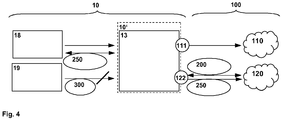
- FIG. 4 A further specific situation is illustrated in Figure 4 , relating to a broadband transmission to (and/or from) the board computer 18.
- the concept so far assumes a situation with all parameters in a predefined range indicating a normal mode of operation. However, in an emergency situation (hence a deviation from normal mode), specific action has to applied to avoid any incidents. This may require a broadband transmission and/or capabilities of the telecommunications network 100 beyond those provided in an optimized cellular narrowband mobile network so far used for transmission of data between the board computer 18 and a centralized system (i.e. the telecommunications network 100). Having such a situation, two procedures may be applied:
Landscapes
- Engineering & Computer Science (AREA)
- Aviation & Aerospace Engineering (AREA)
- General Physics & Mathematics (AREA)
- Physics & Mathematics (AREA)
- Signal Processing (AREA)
- Computer Networks & Wireless Communication (AREA)
- Radar, Positioning & Navigation (AREA)
- Remote Sensing (AREA)
- Automation & Control Theory (AREA)
- Astronomy & Astrophysics (AREA)
- Mobile Radio Communication Systems (AREA)
- Telephonic Communication Services (AREA)
- Selective Calling Equipment (AREA)
Abstract
-- in uplink direction from the unmanned aerial vehicle to the telecommunications network, and/or
-- in downlink direction from the telecommunications network to the unmanned aerial vehicle,
wherein the unmanned aerial vehicle comprises communication means to transmit the command and control data and/or the payload communication data in uplink direction to the telecommunications network and/or to receive the command and control data and/or the payload communication data in downlink direction from the telecommunications network,
wherein the communication means comprise a first air interface towards an optimized cellular narrowband mobile network and a second air interface towards a cellular broadband mobile network,
wherein the method comprises at least the step of the unmanned aerial vehicle transmitting command and control data in uplink direction to the telecommunications network, using the first air interface towards the optimized cellular narrowband mobile network.
Description
- The present invention relates a method for optimized data transmission between an unmanned aerial vehicle and a telecommunications network, wherein command and control data and/or payload communication data are transmitted
- -- in uplink direction from the unmanned aerial vehicle to the telecommunications network, and/or
- -- in downlink direction from the telecommunications network to the unmanned aerial vehicle,
- Furthermore, the present invention relates to an unmanned aerial vehicle for optimized data transmission between the unmanned aerial vehicle and a telecommunications network, wherein the unmanned aerial vehicle is configured such that command and control data and/or payload communication data are transmitted
- -- in uplink direction from the unmanned aerial vehicle to the telecommunications network, and/or
- -- in downlink direction from the telecommunications network to the unmanned aerial vehicle.
- Additionally, the present invention relates to a system and to a telecommunications network for optimized data transmission between an unmanned aerial vehicle and a telecommunications network, the system comprising the unmanned aerial vehicle and the telecommunications network, wherein the system is configured such that command and control data and/or payload communication data are transmitted
- -- in uplink direction from the unmanned aerial vehicle to the telecommunications network, and/or
- -- in downlink direction from the telecommunications network to the unmanned aerial vehicle,
- Additionally, the present invention relates to a program and to a computer program product for optimized data transmission between an unmanned aerial vehicle and a telecommunications network.
- The growing number of unmanned aerial vehicles operating in automated mode requires seamless and robust connectivity between those vehicles and a ground based centralized systems infrastructure. In fact, tracking of those unmanned aerial vehicles to ensure continuous real-time five-dimension positioning information (i.e. typically including all of the following: longitude (of the position), latitude (of the position), altitude (of the position), direction and speed), furthermore added by additional info such as identity, status/condition of the vehicle, requires continuous connectivity with capabilities in line with operation and need for control mechanisms. Additionally, any further pay-load transmission has to be managed.
- On top, high security standards have to be applied since those fast moving objects can endanger people and cause damage once being out of control. For this reason, specific measures have to be taken to provide full safe and reliable connectivity for most critical functions in operation.
- An object of the present invention is to provide an effective and simple solution to provide an optimized data transmission between an unmanned aerial vehicle and a telecommunications network in order to improve operational safety and reliability by means of improved communication channels of such vehicles during operation.
- The object of the present invention is achieved by a method for optimized data transmission between an unmanned aerial vehicle and a telecommunications network, wherein command and control data and/or payload communication data are transmitted
- -- in uplink direction from the unmanned aerial vehicle to the telecommunications network, and/or
- -- in downlink direction from the telecommunications network to the unmanned aerial vehicle,
- It is thereby advantageously possible according to the present invention that communication channels can be split up for the different communication types during operation of such unmanned aerial vehicles. Furthermore, it is advantageously possible according to the present invention that the most efficient data communication systems can be provided for each purpose with the option to focus and/or bundle communication capacities in most urgent communication needs such as emergency situations.
- Basically, unmanned aerial vehicles have three types of communication needs: First, "Command" communication needs (in order to influence operation); second, "Control" communication needs (in order to observe operation); and third, payload communication needs (in order to transmit payload information). For each purpose or for each communication need, the most efficient data communication systems are provided. According to the present invention, it is advantageously possible to split communication up into (a) basic command and control data (C2-data) for controlling and steering (i.e. for Telemetry & Tracking) and (b) other communication data (C3-data), e.g. pay-load data, also called payload communication data. It is advantageously possible according to the present invention that for each purpose, connectivity in line with specific requirements is possible to provide by means of a choice of the most appropriate networks / transmission technology, especially using an optimized cellular narrowband mobile network technology as an integrated and determined means for transmitting the command and control data. Such an optimized cellular narrowband mobile network technology especially relates to (but is not limited to) Narrowband Internet of Things (NB IoT) and/or Low Power Wide Area (LPWA) Networks.
- According to the present invention, a method for optimized data transmission between an unmanned aerial vehicle and a telecommunications network is provided. The unmanned aerial vehicle needs - while moving or flying - a data transmission capability in order to transmit command and control data and/or payload communication data. There might be situations and use cases of unmanned aerial vehicles such that only command and control data need to be transmitted. Likewise, there might be situations and use cases of unmanned aerial vehicle such that only payload communication data need to be transmitted (i.e., especially temporarily, no command and control data are transmitted). However, in most situations either only command and control data or both command and control data as well as payload communication data are transmitted or need to be transmitted. The command and control data and/or payload communication data that need to be transmitted are transmitted either in uplink direction (i.e. from the unmanned aerial vehicle to the telecommunications network) or in downlink direction (i.e. from the telecommunications network to the unmanned aerial vehicle) or both in uplink and in downlink direction.
- In order to transmit the command and control data and/or the payload communication data, the unmanned aerial vehicle comprises communication means, wherein the communication means is configured to transmit the command and control data and/or the payload communication data in uplink direction to the telecommunications network and/or to receive the command and control data and/or the payload communication data in downlink direction from the telecommunications network. In order to be able to transmit the required data in uplink and/or in downlink direction, the communication means comprise a first air interface towards an optimized cellular narrowband mobile network and a second air interface towards a cellular broadband mobile network. According to the present invention, the method comprises at least the step of the unmanned aerial vehicle transmitting command and control data in uplink direction to the telecommunications network, using the first air interface towards the optimized cellular narrowband mobile network.
- According to the present invention it is preferred that - besides the unmanned aerial vehicle transmitting command and control data towards the optimized cellular narrowband mobile network - the method furthermore comprises the step of the unmanned aerial vehicle receiving command and control data in downlink direction from the optimized cellular narrowband mobile network, using the first air interface.
- Thereby, it is advantageously possible according to the present invention that the optimized cellular narrowband mobile network can be used both in uplink and in downlink direction.
- According to a further embodiment of the present invention, the communication means comprise a first communication module and a second communication module, wherein the first communication module comprises the first air interface, towards the optimized cellular narrowband mobile network, and wherein the second communication module comprises the second air interface, towards the cellular broadband mobile network.
- By means of using different communication modules for the first and second air interfaces, it is advantageously possible according to the present invention that the data traffic is separated between the first and second communication module, and hence between the first and second air interface.
- According to a further embodiment of the present invention, it is also possible and preferred that the communication means comprise an integrated communication module, the integrated communication module comprising both the first air interface, towards the optimized cellular narrowband mobile network, as well as the second air interface, towards the cellular broadband mobile network.
- By means of providing an integrated communication module (comprising both the first air interface, as well as the second air interface), it is advantageously possible to flexibly adapt the data transmission between the first air interface and the second air interface, and hence between the optimized cellular narrowband mobile network and the cellular broadband mobile network.
- According to the different embodiment according to the present invention, it is advantageously possible
- -- to provide a split of information depending on purpose and communication needs,
- -- to provide multiple connectivity via optimized cellular narrowband mobile networks as well as cellular broadband transmission technologies, such as LTE, and
- -- to provide flexible allocation of communication capacities depending on the situation and the communication needs.
- According to further embodiments of the present invention, the unmanned aerial vehicle is able to be operated in a first mode of operation, corresponding to normal operation conditions, and in at least a second mode of operation, corresponding to emergency operation conditions,
wherein in the first mode of operation command and control data are - -- transmitted, by the unmanned aerial vehicle to the telecommunications network, and/or
- -- received, by the unmanned aerial vehicle from the telecommunications network, using the first air interface towards the optimized cellular narrowband mobile network, and
- -- transmitted, by the unmanned aerial vehicle to the telecommunications network, and/or
- -- received, by the unmanned aerial vehicle from the telecommunications network, using the first air interface and/or the second air interface.
- By means of using - while operating the unmanned aerial vehicle in the first mode of operation - (only) the first air interface for transmission of command and control data, and by using - while operating the unmanned aerial vehicle in the second mode of operation - the first air interface and/or the second air interface, it is advantageously possible to also use the transmission resources of the second air interface during emergency situations or emergency operation conditions.
- Furthermore, the present invention relates to an unmanned aerial vehicle for optimized data transmission between the unmanned aerial vehicle and a telecommunications network, wherein the unmanned aerial vehicle is configured such that command and control data and/or payload communication data are transmitted
- -- in uplink direction from the unmanned aerial vehicle to the telecommunications network, and/or
- -- in downlink direction from the telecommunications network to the unmanned aerial vehicle,
- Thereby, it is advantageously possible according to the present invention to provide an unmanned aerial vehicle such that the most efficient data communication systems can be provided for each purpose with the option to focus and/or bundle communication capacities in most urgent communication needs such as emergency situations.
- According to the present invention, it is preferred - especially with regard to the inventive unmanned aerial vehicle - that the unmanned aerial vehicle is configured such that command and control data - besides being transmitted, by the unmanned aerial vehicle, towards the optimized cellular narrowband mobile network and at least during operation of the unmanned aerial vehicle and the telecommunications network in the first mode of operation - are received, by the unmanned aerial vehicle, in downlink direction from the optimized cellular narrowband mobile network, using the first air interface.
- Furthermore, it is also preferred according to the present invention - especially with regard to the inventive unmanned aerial vehicle - that the communication means comprise a first communication module and a second communication module, wherein the first communication module comprises the first air interface, towards the optimized cellular narrowband mobile network, and wherein the second communication module comprises the second air interface, towards the cellular broadband mobile network.
- Additionally, it is also preferred according to the present invention - and especially regarding the inventive unmanned aerial vehicle - that the communication means comprise an integrated communication module, the integrated communication module comprising both the first air interface, towards the optimized cellular narrowband mobile network, as well as the second air interface, towards the cellular broadband mobile network.
- Furthermore, the present invention relates to a system for optimized data transmission between an unmanned aerial vehicle and a telecommunications network, the system comprising the unmanned aerial vehicle and the telecommunications network, wherein the system is configured such that command and control data and/or payload communication data are transmitted
- -- in uplink direction from the unmanned aerial vehicle to the telecommunications network, and/or
- -- in downlink direction from the telecommunications network to the unmanned aerial vehicle,
- Thereby, it is advantageously possible to provide a system that is capable of using the most efficient data transmission channel and communication systems that is available for each purpose and situation with the option to focus and/or bundle communication capacities in most urgent communication needs such as emergency situations.
- According to the present invention, it is furthermore preferred - especially with respect to the inventive system - that the system is configured such that command and control data - besides being transmitted, by the unmanned aerial vehicle, towards the optimized cellular narrowband mobile network and at least during operation of the unmanned aerial vehicle and the telecommunications network in the first mode of operation - are received, by the unmanned aerial vehicle, in downlink direction from the optimized cellular narrowband mobile network, using the first air interface.
- Furthermore, the present invention relates to a telecommunications network for optimized data transmission between an unmanned aerial vehicle and the telecommunications network, wherein the unmanned aerial vehicle is configured such that command and control data and/or payload communication data are transmitted
- -- in uplink direction from the unmanned aerial vehicle to the telecommunications network, and/or
- -- in downlink direction from the telecommunications network to the unmanned aerial vehicle,
- Thereby, it is advantageously possible to provide a telecommunications network that is capable of using the most efficient data transmission channel and communication systems that is available for each purpose and situation with the option to focus and/or bundle communication capacities in most urgent communication needs such as emergency situations.
- Additionally, the present invention relates to a program comprising a computer readable program code which, when executed on a computer or on a control unit of an unmanned aerial vehicle or on a network node of a telecommunications network, or in part on the control unit of an unmanned aerial vehicle and/or in part on the network node of a telecommunications network, causes the computer or the control unit of an unmanned aerial vehicle or the network node of a telecommunications network to perform the inventive method.
- Still additionally, the present invention relates to a computer program product for optimized data transmission between an unmanned aerial vehicle and a telecommunications network, the computer program product comprising a computer program stored on a storage medium, the computer program comprising program code which, when executed on a computer or on a control unit of an unmanned aerial vehicle or on a network node of a telecommunications network, or in part on the control unit of an unmanned aerial vehicle and/or in part on the network node of a telecommunications network, causes the computer or the control unit of an unmanned aerial vehicle or the network node of a telecommunications network to perform the inventive method.
- These and other characteristics, features and advantages of the present invention will become apparent from the following detailed description, taken in conjunction with the accompanying drawings, which illustrate, by way of example, the principles of the invention. The description is given for the sake of example only, without limiting the scope of the invention. The reference figures quoted below refer to the attached drawings.
-
-
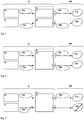
Figure 1 schematically illustrates an unmanned aerial vehicle as well as a telecommunications network according to the present invention, wherein the unmanned aerial vehicle is configured according to a first embodiment of the present invention. -
Figure 2 schematically illustrates the unmanned aerial vehicle as well as the telecommunications network according to the present invention, wherein the unmanned aerial vehicle is configured according to a second embodiment of the present invention. -
Figures 3 and4 schematically illustrate the unmanned aerial vehicle as well as the telecommunications network in different communication scenarios. - The present invention will be described with respect to particular embodiments and with reference to certain drawings but the invention is not limited thereto but only by the claims. The drawings described are only schematic and are non-limiting. In the drawings, the size of some of the elements may be exaggerated and not drawn on scale for illustrative purposes.
- Where an indefinite or definite article is used when referring to a singular noun, e.g. "a", "an", "the", this includes a plural of that noun unless something else is specifically stated.
- Furthermore, the terms first, second, third and the like in the description and in the claims are used for distinguishing between similar elements and not necessarily for describing a sequential or chronological order. It is to be understood that the terms so used are interchangeable under appropriate circumstances and that the embodiments of the invention described herein are capable of operation in other sequences than described or illustrated herein.
- In
Figure 1 , an unmannedaerial vehicle 10 as well as atelecommunications network 100 according to the present invention are schematically shown. Thetelecommunications network 100 comprises an optimized cellular narrowbandmobile network 110 and a cellular broadbandmobile network 120. By means of a communication means 10', the unmannedaerial vehicle 10 is able to connect both to the optimized cellular narrowbandmobile network 110 and the cellular broadbandmobile network 120, using afirst air interface 111 of the communication means 10' (towards the optimized cellular narrowband mobile network 110) and asecond air interface 122 of the communication means 10' (towards the cellular broadband mobile network 120). The unmannedaerial vehicle 10 further comprises aboard computer 18, and amission equipment 19. Theboard computer 18 typically generates command andcontrol data 200, whereas themission equipment 19 of the unmannedaerial vehicle 10 typically generatespayload communication data 300.Figure 1 schematically shows a first embodiment of the present invention, wherein the communication means 10' comprises afirst communication module 11 and asecond communication module 12. Thefirst communication module 11 comprises thefirst air interface 111, towards the optimized cellular narrowbandmobile network 110, and wherein thesecond communication module 12 comprises thesecond air interface 122, towards the cellular broadbandmobile network 120. The command andcontrol data 200, generated by theboard computer 18, are transmitted - at least normally (i.e. in a first mode of operation of the unmanned aerial vehicle 10 -, using thefirst air interface 111, to the optimized cellular narrowbandmobile network 110. Thepayload communication data 300, generated by themission equipment 19, are transmitted - at least normally (i.e. in a first mode of operation of the unmanned aerial vehicle 10 -, using thesecond air interface 122, to the optimized cellular narrowbandmobile network 120. By means of using two separatedcommunication modules aerial vehicle 10, it is advantageously possible to ensure connectivity by means of one reserved (first)communication module 11 for tracking and telemetry (or command and control data 200), and the other (second)communication module 12 forpayload communication data 300, wherein especially bothcommunication modules aerial vehicle 10 itself is foreseen to carry different equipment for specific missions. In this case, integrating the mission relevant communication in the communication module of the unmannedaerial vehicle 10 for each different mission typically creates additional complexity and effort which can be avoided by using separate (i.e. a first and a second) communication modules. - In analogy to
Figure 1, Figure 2 schematically shows the unmannedaerial vehicle 10 as well as thetelecommunications network 100 according to the present invention, wherein the unmannedaerial vehicle 10 is configured according to a second embodiment of the present invention. Again, thetelecommunications network 100 comprises the optimized cellular narrowbandmobile network 110 and the cellular broadbandmobile network 120, and the unmannedaerial vehicle 10 comprises theboard computer 18, and themission equipment 19. Likewise, theboard computer 18 typically generates command andcontrol data 200, whereas themission equipment 19 of the unmannedaerial vehicle 10 typically generatespayload communication data 300. Again, by means of the communication means 10', the unmannedaerial vehicle 10 is able to connect both to the optimized cellular narrowbandmobile network 110 and the cellular broadbandmobile network 120. However, according to the second embodiment of the present invention, the communication means 10' comprise anintegrated communication module 13, theintegrated communication module 13 comprising both thefirst air interface 111, and thesecond air interface 122. Again, the command andcontrol data 200, generated by theboard computer 18, are transmitted - at least normally (i.e. in a first mode of operation of the unmanned aerial vehicle 10 -, using thefirst air interface 111, to the optimized cellular narrowbandmobile network 110. Thepayload communication data 300, generated by themission equipment 19, are transmitted - at least normally (i.e. in a first mode of operation of the unmanned aerial vehicle 10 -, using thesecond air interface 122, to the optimized cellular narrowbandmobile network 120. According to the second embodiment of the present invention, only one centralized (or integrated) communication module 13 (with multi connectivity) ensures connectivity (towards the optimized cellular narrowband mobile network 110) for tracking and telemetry (or command and control data 200) and (toward the cellular broadband mobile network 120) for payload data (or payload communication data 300). Nevertheless, the transmission still remains separated (i.e. there is still afirst air interface 111 and a second air interface 122) to ensure different communications needs of the different data to be transmitted. The concept according to the second embodiment of the present invention makes in particular sense if resource management between both transmissions shall be performed, in particular a prioritization of one communication stream shall be done. This can especially be used as a back-up system especially in emergency situations (for transmitting command and control data 200) where the primarily used optimized cellular narrowband mobile network 110 (also called C2 network) is not available. - While
Figures 1 and 2 are mainly focused on the uplink direction (i.e. the transmission from the unmannedaerial vehicle 10 to the telecommunications network 100 (or the base station)), as similar logic applies for the downlink direction (i.e. the transmission from base station (or the telecommunications network 100) to the unmannedaerial vehicle 10. In case of separatedcommunication modules 11, 12 (i.e. in case of the first embodiment according toFigure 1 ), it is preferred that standard procedures apply for each transmission. In case of a centralized (or integrated)communication module 13, it is preferred that the same logic as for the uplink applies with processing the incoming signal and forwarding it to theboard Computer 18 or themission equipment 19. - According to the present invention, it is advantageously possible to split information depending on purpose and communication needs.
In an automated operation mode of the unmannedaerial vehicle 10, typically the command and control data 200 (to establish control over the vehicle) have to be differentiated from the payload communication data 300 (mission data depending on the activity the unmannedaerial vehicle 10 performs), both data requiring to be transmitted between the remote control (or the telecommunications network 100) and the unmannedaerial vehicle 10. Both data streams have different specific characteristic. These characteristics do not change very much over time and play an important role for the definition of the most appropriate communication means.
In this respect, command andcontrol data 200 typically have the following characteristics: - -- small data volumes (< 100 kbit/s),
- -- transmitted in bursts in a predefined schedule,
- -- stable latency (tolerance +- 5%),
- -- medium low latency (< 20ms),
- -- seamless coverage in operation zones,
- -- high availability > 99,98%.
- According to the present invention, it is advantageously possible to apply multiple connectivity via optimized cellular narrowband mobile networks and cellular Broadband Transmission Technologies such as LTE.
The command andcontrol data 200 are transmitted in order to meet communication needs for telemetry & tracking; however, it is also possible that in certain cases video can be understood as being part of the C2-link (to transmit the command and control data 200), e.g. in emergency situations when an operation has to land the unmanned aerial vehicle safely in an unknown area. The basic information about status and location and/or movement of the unmannedaerial vehicle 10 can be concentrated in small data packages representing the most relevant data in a comprehensive form. Nevertheless, these command andcontrol data 200 have to be transmitted in almost any circumstance (whether, flight mode, congestion, interferences, location etc.) to ensure seamless control/operation of the unmannedaerial vehicle 10. Accordingly, thetelecommunications network 100 has to provide appropriate coverage, stability and reliability while bandwidth plays a minor role. Such features are able to be provided by optimized cellular narrowband mobile networks. Hence, command andcontrol data 200 are preferably transmitted on such optimized cellular narrowband mobile networks to optimize transmission to a control system for those data.
Thepayload communication data 300 can have different structure and requirements towards the transmission. The range of possible cases or situations includes mission data (that are typically not transmitted but stored on the unmanned aerial vehicle 10) - if there are any -, but also permanent, real-time, broadband or streaming transmission with specific requirements for reliability and latency. Additionally, even payload data (or payload communication data 300) may occur having characteristics in a similar structure as command and control data 200 (or telemetry and tracking). To meet those requirements, such kind of payload data should be allocated to appropriate networks, depending on availability and capabilities, with, e.g., LTE as the (second)air interface 122 as one option in particular for high bandwidth requirements. - In
Figures 3 and4 , different communication scenarios of the unmannedaerial vehicle 10 are schematically illustrated, realizing a flexible allocation of communication capacities depending on the situation and the communication needs. - A first specific situation is illustrated in
Figure 3 , relating to a shortage in network capacity: Since mobile communication networks represent a shared medium, capacity cannot be guaranteed but depends on a number of factors independent from the device trying to transmit data. In most extreme cases, a network access to a network is not available. Assuming that connectivity is provided on to a narrowband channel as well as on a mobile communication network channel (as the intended working mechanism in normal case), in an emergency case (of very low bandwidth availability) mission critical and/or high priority data are provided a higher priority in data transmission. The data transmission between the unmannedaerial vehicle 10 and thetelecommunications network 100 is optimized by closing the (broadband) payload data (i.e. the payload communication data 300) to ensure that all available bandwidth is given to the high priority data (command and control data 200), until a situation with higher available bandwidth is once again reached (to operate both transmission streams in parallel). This is shown inFigure 3 by means of the cellular broadbandmobile network 120 being in failed state, and, hence, thepayload communication data 300 from themission equipment 19 being blocked. - A further specific situation is illustrated in
Figure 4 , relating to a broadband transmission to (and/or from) theboard computer 18. The concept so far assumes a situation with all parameters in a predefined range indicating a normal mode of operation. However, in an emergency situation (hence a deviation from normal mode), specific action has to applied to avoid any incidents. This may require a broadband transmission and/or capabilities of thetelecommunications network 100 beyond those provided in an optimized cellular narrowband mobile network so far used for transmission of data between theboard computer 18 and a centralized system (i.e. the telecommunications network 100). Having such a situation, two procedures may be applied: - -- switch of communication technology from the optimized cellular narrowband mobile network to another, more appropriate, technology (with no other effects on any parallel transmission), or
- -- adding a broadband transmission on top of optimized cellular narrowband mobile and prioritization of traffic against any other communication to reserve transmission capacity for most critical purposes.
wherein the communication means comprise a first air interface towards an optimized cellular narrowband mobile network and a second air interface towards a cellular broadband mobile network,
wherein the method comprises at least the step of the unmanned aerial vehicle transmitting command and control data in uplink direction to the telecommunications network, using the first air interface towards the optimized cellular narrowband mobile network.
wherein the communication means comprise a first air interface towards an optimized cellular narrowband mobile network and a second air interface towards a cellular broadband mobile network,
wherein the unmanned aerial vehicle is configured such that - at least during operation of the unmanned aerial vehicle and the telecommunications network in the first mode of operation - command and control data are transmitted, by the unmanned aerial vehicle, in uplink direction to the telecommunications network using the first air interface towards the optimized cellular narrowband mobile network.
wherein the communication means comprise a first air interface towards an optimized cellular narrowband mobile network and a second air interface towards a cellular broadband mobile network,
wherein the system is configured such that - at least during operation of the unmanned aerial vehicle and the telecommunications network in the first mode of operation corresponding to normal operation conditions - command and control data are transmitted, by the unmanned aerial vehicle, in uplink direction to the telecommunications network using the first air interface towards the optimized cellular narrowband mobile network.
wherein the telecommunications network is configured such that - at least during operation of the unmanned aerial vehicle and the telecommunications network in a first mode of operation corresponding to normal operation conditions - command and control data are transmitted, by the unmanned aerial vehicle, in uplink direction to the telecommunications network using the first air interface towards the optimized cellular narrowband mobile network.
Claims (14)
- Method for optimized data transmission between an unmanned aerial vehicle (10) and a telecommunications network (100), wherein command and control data (200) and/or payload communication data (300) are transmitted-- in uplink direction from the unmanned aerial vehicle (10) to the telecommunications network (100), and/or-- in downlink direction from the telecommunications network (100) to the unmanned aerial vehicle (10),wherein the unmanned aerial vehicle (10) comprises communication means (10') to transmit the command and control data (200) and/or the payload communication data (300) in uplink direction to the telecommunications network and/or to receive the command and control data (200) and/or the payload communication data (300) in downlink direction from the telecommunications network (100),
wherein the communication means (10') comprise a first air interface (111) towards an optimized cellular narrowband mobile network (110) and a second air interface (122) towards a cellular broadband mobile network (120), wherein the method comprises at least the step of the unmanned aerial vehicle (10) transmitting command and control data (200) in uplink direction to the telecommunications network (100), using the first air interface (111) towards the optimized cellular narrowband mobile network (110). - Method according to claim 1, wherein - besides the unmanned aerial vehicle (10) transmitting command and control data (200) towards the optimized cellular narrowband mobile network (110) - the method furthermore comprises the step of the unmanned aerial vehicle (10) receiving command and control data (200) in downlink direction from the optimized cellular narrowband mobile network (110), using the first air interface (111).
- Method according to one of the preceding claims, wherein the communication means (10') comprise a first communication module (11) and a second communication module (12), wherein the first communication module (11) comprises the first air interface (111), towards the optimized cellular narrowband mobile network (110), and wherein the second communication module (12) comprises the second air interface (122), towards the cellular broadband mobile network (120).
- Method according to one of the preceding claims, wherein the communication means (10') comprise an integrated communication module (13), the integrated communication module (13) comprising both the first air interface (111), towards the optimized cellular narrowband mobile network (110), as well as the second air interface (122), towards the cellular broadband mobile network (120).
- Method according to one of the preceding claims, wherein the unmanned aerial vehicle (10) is able to be operated in a first mode of operation, corresponding to normal operation conditions, and in at least a second mode of operation, corresponding to emergency operation conditions,
wherein in the first mode of operation command and control data (200) are-- transmitted, by the unmanned aerial vehicle (10) to the telecommunications network (100), and/or-- received, by the unmanned aerial vehicle (10) from the telecommunications network (100),using the first air interface (111) towards the optimized cellular narrowband mobile network (110), and
wherein in the second mode of operation command and control data (200) are-- transmitted, by the unmanned aerial vehicle (10) to the telecommunications network (100), and/or-- received, by the unmanned aerial vehicle (10) from the telecommunications network (100),using the first air interface (111) and/or the second air interface (122). - Unmanned aerial vehicle (10) for optimized data transmission between the unmanned aerial vehicle (10) and a telecommunications network (100), wherein the unmanned aerial vehicle (10) is configured such that command and control data (200) and/or payload communication data (300) are transmitted-- in uplink direction from the unmanned aerial vehicle (10) to the telecommunications network (100), and/or-- in downlink direction from the telecommunications network (100) to the unmanned aerial vehicle (10),wherein the unmanned aerial vehicle (10) comprises communication means (10') to transmit the command and control data (200) and/or the payload communication data (300) in uplink direction to the telecommunications network and/or to receive the command and control data (200) and/or the payload communication data (300) in downlink direction from the telecommunications network (100),
wherein the communication means (10') comprise a first air interface (111) towards an optimized cellular narrowband mobile network (110) and a second air interface (122) towards a cellular broadband mobile network (120), wherein the unmanned aerial vehicle (10) is configured such that - at least during operation of the unmanned aerial vehicle (10) and the telecommunications network (100) in the first mode of operation - command and control data (200) are transmitted, by the unmanned aerial vehicle (10), in uplink direction to the telecommunications network (100) using the first air interface (111) towards the optimized cellular narrowband mobile network (110). - Unmanned aerial vehicle (10) according to claim 6, wherein the unmanned aerial vehicle (10) is configured such that command and control data (200) - besides being transmitted, by the unmanned aerial vehicle (10), towards the optimized cellular narrowband mobile network (110) and at least during operation of the unmanned aerial vehicle (10) and the telecommunications network (100) in the first mode of operation - are received, by the unmanned aerial vehicle (10), in downlink direction from the optimized cellular narrowband mobile network (110), using the first air interface (111).
- Unmanned aerial vehicle (10) according to one of claims 6 or 7, wherein the communication means (10') comprise a first communication module (11) and a second communication module (12), wherein the first communication module (11) comprises the first air interface (111), towards the optimized cellular narrowband mobile network (110), and wherein the second communication module (12) comprises the second air interface (122), towards the cellular broadband mobile network (120).
- Unmanned aerial vehicle (10) according to one of claims 6 to 8, wherein the communication means (10') comprise an integrated communication module (13), the integrated communication module (13) comprising both the first air interface (111), towards the optimized cellular narrowband mobile network (110), as well as the second air interface (122), towards the cellular broadband mobile network (120).
- System for optimized data transmission between an unmanned aerial vehicle (10) and a telecommunications network (100), the system comprising the unmanned aerial vehicle (10) and the telecommunications network (100), wherein the system is configured such that command and control data (200) and/or payload communication data (300) are transmitted-- in uplink direction from the unmanned aerial vehicle (10) to the telecommunications network (100), and/or-- in downlink direction from the telecommunications network (100) to the unmanned aerial vehicle (10),wherein the unmanned aerial vehicle (10) comprises communication means (10') to transmit the command and control data (200) and/or the payload communication data (300) in uplink direction to the telecommunications network and/or to receive the command and control data (200) and/or the payload communication data (300) in downlink direction from the telecommunications network (100),
wherein the communication means (10') comprise a first air interface (111) towards an optimized cellular narrowband mobile network (110) and a second air interface (122) towards a cellular broadband mobile network (120), wherein the system is configured such that - at least during operation of the unmanned aerial vehicle (10) and the telecommunications network (100) in the first mode of operation corresponding to normal operation conditions - command and control data (200) are transmitted, by the unmanned aerial vehicle (10), in uplink direction to the telecommunications network (100) using the first air interface (111) towards the optimized cellular narrowband mobile network (110). - System according to claim 10, wherein the system is configured such that command and control data (200) - besides being transmitted, by the unmanned aerial vehicle (10), towards the optimized cellular narrowband mobile network (110) and at least during operation of the unmanned aerial vehicle (10) and the telecommunications network (100) in the first mode of operation - are received, by the unmanned aerial vehicle (10), in downlink direction from the optimized cellular narrowband mobile network (110), using the first air interface (111).
- Telecommunications network (100) for optimized data transmission between an unmanned aerial vehicle (10) and the telecommunications network (100), wherein the unmanned aerial vehicle (10) is configured such that command and control data (200) and/or payload communication data (300) are transmitted-- in uplink direction from the unmanned aerial vehicle (10) to the telecommunications network (100), and/or-- in downlink direction from the telecommunications network (100) to the unmanned aerial vehicle (10),wherein the telecommunications network (100) comprises an optimized cellular narrowband mobile network (110) and a cellular broadband mobile network (120) to transmit the command and control data (200) and/or the payload communication data (300) in downlink direction to the unmanned aerial vehicle (10) and/or to receive the command and control data (200) and/or the payload communication data (300) in uplink direction from the unmanned aerial vehicle (10), using a first air interface (111) of the optimized cellular narrowband mobile network (110) and a second air interface (122) of the cellular broadband mobile network (120),
wherein the telecommunications network (100) is configured such that - at least during operation of the unmanned aerial vehicle (10) and the telecommunications network (100) in a first mode of operation corresponding to normal operation conditions - command and control data (200) are transmitted, by the unmanned aerial vehicle (10), in uplink direction to the telecommunications network (100) using the first air interface (111) towards the optimized cellular narrowband mobile network (110). - Program comprising a computer readable program code which, when executed on a computer or on a control unit of an unmanned aerial vehicle (10) or on a network node of a telecommunications network (100), or in part on the control unit of an unmanned aerial vehicle (10) and/or in part on the network node of a telecommunications network (100), causes the computer or the control unit of an unmanned aerial vehicle (10) or the network node of a telecommunications network (100) to perform a method according one of claims 1 to 5.
- Computer program product for optimized data transmission between an unmanned aerial vehicle (10) and a telecommunications network (100), the computer program product comprising a computer program stored on a storage medium, the computer program comprising program code which, when executed on a computer or on a control unit of an unmanned aerial vehicle (10) or on a network node of a telecommunications network (100), or in part on the control unit of an unmanned aerial vehicle (10) and/or in part on the network node of a telecommunications network (100), causes the computer or the control unit of an unmanned aerial vehicle (10) or the network node of a telecommunications network (100) to perform a method according one of claims 1 to 5.
Priority Applications (4)
| Application Number | Priority Date | Filing Date | Title |
|---|---|---|---|
| EP16193126.6A EP3306427B1 (en) | 2016-10-10 | 2016-10-10 | Method for optimized data transmission between an unmanned aerial vehicle and a telecommunications network, unmanned aerial vehicle , system, telecommunications network, program and computer program product |
| ES16193126T ES2729662T3 (en) | 2016-10-10 | 2016-10-10 | Method for optimizing data transmission between a remotely controlled air vehicle and a telecommunications network, remotely controlled air vehicle, system, telecommunications network, program and computer program product |
| US16/340,146 US10839700B2 (en) | 2016-10-10 | 2017-08-29 | Optimized data transmission between an unmanned aerial vehicle and a telecommunications network |
| PCT/EP2017/071664 WO2018068943A1 (en) | 2016-10-10 | 2017-08-29 | Method for optimized data transmission between an unmanned aerial vehicle and a telecommunications network, unmanned aerial vehicle, system, telecommunications network, program and computer program product |
Applications Claiming Priority (1)
| Application Number | Priority Date | Filing Date | Title |
|---|---|---|---|
| EP16193126.6A EP3306427B1 (en) | 2016-10-10 | 2016-10-10 | Method for optimized data transmission between an unmanned aerial vehicle and a telecommunications network, unmanned aerial vehicle , system, telecommunications network, program and computer program product |
Publications (2)
| Publication Number | Publication Date |
|---|---|
| EP3306427A1 true EP3306427A1 (en) | 2018-04-11 |
| EP3306427B1 EP3306427B1 (en) | 2019-03-06 |
Family
ID=57226750
Family Applications (1)
| Application Number | Title | Priority Date | Filing Date |
|---|---|---|---|
| EP16193126.6A Active EP3306427B1 (en) | 2016-10-10 | 2016-10-10 | Method for optimized data transmission between an unmanned aerial vehicle and a telecommunications network, unmanned aerial vehicle , system, telecommunications network, program and computer program product |
Country Status (4)
| Country | Link |
|---|---|
| US (1) | US10839700B2 (en) |
| EP (1) | EP3306427B1 (en) |
| ES (1) | ES2729662T3 (en) |
| WO (1) | WO2018068943A1 (en) |
Families Citing this family (3)
| Publication number | Priority date | Publication date | Assignee | Title |
|---|---|---|---|---|
| CN110730495B (en) * | 2019-10-15 | 2022-07-19 | 中国人民解放军陆军工程大学 | Unmanned aerial vehicle data distribution optimization method under energy constraint |
| ES3047396T3 (en) * | 2020-05-20 | 2025-12-03 | Lenovo Singapore Pte Ltd | Managing a c2 communication mode for an unmanned aerial system |
| CN116456302A (en) * | 2023-04-21 | 2023-07-18 | 北京百度网讯科技有限公司 | Control method and control device for automatic driving vehicle |
Citations (3)
| Publication number | Priority date | Publication date | Assignee | Title |
|---|---|---|---|---|
| US6867727B1 (en) * | 2004-03-01 | 2005-03-15 | The United States Of America As Represented By The Secretary Of The Air Force | Multiplatform multifunction avionics architecture |
| WO2006124063A2 (en) * | 2004-11-03 | 2006-11-23 | Flight Safety Technologies, Inc. | Collision alerting and avoidance system |
| EP2853974A1 (en) * | 2013-09-26 | 2015-04-01 | Airbus Defence and Space GmbH | Method for autonomous controlling of a remote controlled aerial vehicle and corresponding system |
Family Cites Families (8)
| Publication number | Priority date | Publication date | Assignee | Title |
|---|---|---|---|---|
| US6211808B1 (en) | 1999-02-23 | 2001-04-03 | Flight Safety Technologies Inc. | Collision avoidance system for use in aircraft |
| NL1011421C2 (en) | 1999-03-02 | 2000-09-05 | Tno | Volumetric phased array antenna system. |
| US9658341B2 (en) * | 2006-04-28 | 2017-05-23 | Telecommunication Systems, Inc. | GNSS long-code acquisition, ambiguity resolution, and signal validation |
| US20110285585A1 (en) * | 2010-05-14 | 2011-11-24 | Marcos Antonio Bergamo | Position Location Using Opportunistic Analog and Digital Radio-Frequency Signals |
| US8990133B1 (en) * | 2012-12-20 | 2015-03-24 | Brain Corporation | Apparatus and methods for state-dependent learning in spiking neuron networks |
| US9412041B1 (en) * | 2012-06-29 | 2016-08-09 | Brain Corporation | Retinal apparatus and methods |
| US20140259618A1 (en) * | 2013-03-15 | 2014-09-18 | Hadal, Inc. | Systems and methods for improved pressure vessels |
| EP2976687B1 (en) * | 2014-05-30 | 2017-09-06 | SZ DJI Technology Co., Ltd. | Systems and methods for uav docking |
-
2016
- 2016-10-10 ES ES16193126T patent/ES2729662T3/en active Active
- 2016-10-10 EP EP16193126.6A patent/EP3306427B1/en active Active
-
2017
- 2017-08-29 US US16/340,146 patent/US10839700B2/en active Active
- 2017-08-29 WO PCT/EP2017/071664 patent/WO2018068943A1/en not_active Ceased
Patent Citations (3)
| Publication number | Priority date | Publication date | Assignee | Title |
|---|---|---|---|---|
| US6867727B1 (en) * | 2004-03-01 | 2005-03-15 | The United States Of America As Represented By The Secretary Of The Air Force | Multiplatform multifunction avionics architecture |
| WO2006124063A2 (en) * | 2004-11-03 | 2006-11-23 | Flight Safety Technologies, Inc. | Collision alerting and avoidance system |
| EP2853974A1 (en) * | 2013-09-26 | 2015-04-01 | Airbus Defence and Space GmbH | Method for autonomous controlling of a remote controlled aerial vehicle and corresponding system |
Also Published As
| Publication number | Publication date |
|---|---|
| WO2018068943A1 (en) | 2018-04-19 |
| ES2729662T3 (en) | 2019-11-05 |
| US20190244532A1 (en) | 2019-08-08 |
| EP3306427B1 (en) | 2019-03-06 |
| US10839700B2 (en) | 2020-11-17 |
Similar Documents
| Publication | Publication Date | Title |
|---|---|---|
| KR102659985B1 (en) | How to transmit sidelink HARQ feedback in a wireless communication system | |
| US12490322B2 (en) | Operation method of relay UE related to relay establishment request in wireless communication system | |
| US12150128B2 (en) | Method and device for operating UE associated with sidelink RLM and RLF in wireless communication system | |
| US12267133B2 (en) | Operation method of UE related to sidelink CSI report in wireless communication system | |
| US11812397B2 (en) | Method and device for performing synchronization in NR V2X | |
| US11778592B2 (en) | 2ND stage SCI-related operation method of UE in wireless communication system | |
| KR102941802B1 (en) | Method of transmitting and receiving sidelink signals in a wireless communication system | |
| US12200518B2 (en) | Signal transmitting and receiving method in wireless communication system | |
| KR102640671B1 (en) | How to transmit and receive signals in a wireless communication system | |
| US10839700B2 (en) | Optimized data transmission between an unmanned aerial vehicle and a telecommunications network | |
| EP4304244A1 (en) | Ue operation method related to sidelink pdb in wireless communication system | |
| US20200068412A1 (en) | Method for controlling a wireless communication system | |
| US12256307B2 (en) | Method for operating link quality-related relay UE in wireless communication system | |
| US12143868B2 (en) | Sidelink transmission in mobile communication involving switching between multiple V2X sidelink technologies | |
| CN120018133A (en) | An airborne multi-mode communication method and system based on MCData | |
| KR20240007117A (en) | Method and device for transmitting and receiving PUCCH in a wireless communication system | |
| KR20230044450A (en) | Operation method of relay UE in wireless communication system | |
| US20220346173A1 (en) | Method for transmitting and receiving signal for terminal in wireless communication system | |
| US12316551B2 (en) | Method for transmitting a data element between a first control unit of a vehicle and a second control unit of the vehicle, computer-readable medium, system and vehicle | |
| CA2952556A1 (en) | Channel management in wireless networks | |
| US12302296B2 (en) | UE operation method related to determining number of slots in wireless communication system | |
| KR102699243B1 (en) | Method of operation of UE related to platooning in wireless communication system | |
| KR20240004690A (en) | UE operation method and device related to sidelink discovery resource request and allocation in a wireless communication system | |
| US12443551B2 (en) | Abstracted interface for differently configured communication hardware | |
| KR102815019B1 (en) | Ue operation method related to discovery resource pool in wireless communication system |
Legal Events
| Date | Code | Title | Description |
|---|---|---|---|
| PUAI | Public reference made under article 153(3) epc to a published international application that has entered the european phase |
Free format text: ORIGINAL CODE: 0009012 |
|
| STAA | Information on the status of an ep patent application or granted ep patent |
Free format text: STATUS: REQUEST FOR EXAMINATION WAS MADE |
|
| 17P | Request for examination filed |
Effective date: 20170622 |
|
| AK | Designated contracting states |
Kind code of ref document: A1 Designated state(s): AL AT BE BG CH CY CZ DE DK EE ES FI FR GB GR HR HU IE IS IT LI LT LU LV MC MK MT NL NO PL PT RO RS SE SI SK SM TR |
|
| AX | Request for extension of the european patent |
Extension state: BA ME |
|
| REG | Reference to a national code |
Ref country code: DE Ref legal event code: R079 Ref document number: 602016010641 Country of ref document: DE Free format text: PREVIOUS MAIN CLASS: G05D0001000000 Ipc: H04B0007185000 |
|
| STAA | Information on the status of an ep patent application or granted ep patent |
Free format text: STATUS: EXAMINATION IS IN PROGRESS |
|
| RIC1 | Information provided on ipc code assigned before grant |
Ipc: H04B 7/185 20060101AFI20180503BHEP Ipc: G08G 5/00 20060101ALI20180503BHEP Ipc: G05D 1/00 20060101ALI20180503BHEP |
|
| 17Q | First examination report despatched |
Effective date: 20180531 |
|
| GRAP | Despatch of communication of intention to grant a patent |
Free format text: ORIGINAL CODE: EPIDOSNIGR1 |
|
| STAA | Information on the status of an ep patent application or granted ep patent |
Free format text: STATUS: GRANT OF PATENT IS INTENDED |
|
| INTG | Intention to grant announced |
Effective date: 20180921 |
|
| GRAS | Grant fee paid |
Free format text: ORIGINAL CODE: EPIDOSNIGR3 |
|
| GRAA | (expected) grant |
Free format text: ORIGINAL CODE: 0009210 |
|
| STAA | Information on the status of an ep patent application or granted ep patent |
Free format text: STATUS: THE PATENT HAS BEEN GRANTED |
|
| AK | Designated contracting states |
Kind code of ref document: B1 Designated state(s): AL AT BE BG CH CY CZ DE DK EE ES FI FR GB GR HR HU IE IS IT LI LT LU LV MC MK MT NL NO PL PT RO RS SE SI SK SM TR |
|
| REG | Reference to a national code |
Ref country code: GB Ref legal event code: FG4D |
|
| REG | Reference to a national code |
Ref country code: CH Ref legal event code: EP Ref country code: AT Ref legal event code: REF Ref document number: 1105971 Country of ref document: AT Kind code of ref document: T Effective date: 20190315 |
|
| REG | Reference to a national code |
Ref country code: DE Ref legal event code: R096 Ref document number: 602016010641 Country of ref document: DE |
|
| REG | Reference to a national code |
Ref country code: IE Ref legal event code: FG4D |
|
| REG | Reference to a national code |
Ref country code: NL Ref legal event code: MP Effective date: 20190306 |
|
| REG | Reference to a national code |
Ref country code: LT Ref legal event code: MG4D |
|
| PG25 | Lapsed in a contracting state [announced via postgrant information from national office to epo] |
Ref country code: LT Free format text: LAPSE BECAUSE OF FAILURE TO SUBMIT A TRANSLATION OF THE DESCRIPTION OR TO PAY THE FEE WITHIN THE PRESCRIBED TIME-LIMIT Effective date: 20190306 Ref country code: FI Free format text: LAPSE BECAUSE OF FAILURE TO SUBMIT A TRANSLATION OF THE DESCRIPTION OR TO PAY THE FEE WITHIN THE PRESCRIBED TIME-LIMIT Effective date: 20190306 Ref country code: SE Free format text: LAPSE BECAUSE OF FAILURE TO SUBMIT A TRANSLATION OF THE DESCRIPTION OR TO PAY THE FEE WITHIN THE PRESCRIBED TIME-LIMIT Effective date: 20190306 Ref country code: NO Free format text: LAPSE BECAUSE OF FAILURE TO SUBMIT A TRANSLATION OF THE DESCRIPTION OR TO PAY THE FEE WITHIN THE PRESCRIBED TIME-LIMIT Effective date: 20190606 |
|
| PG25 | Lapsed in a contracting state [announced via postgrant information from national office to epo] |
Ref country code: HR Free format text: LAPSE BECAUSE OF FAILURE TO SUBMIT A TRANSLATION OF THE DESCRIPTION OR TO PAY THE FEE WITHIN THE PRESCRIBED TIME-LIMIT Effective date: 20190306 Ref country code: RS Free format text: LAPSE BECAUSE OF FAILURE TO SUBMIT A TRANSLATION OF THE DESCRIPTION OR TO PAY THE FEE WITHIN THE PRESCRIBED TIME-LIMIT Effective date: 20190306 Ref country code: GR Free format text: LAPSE BECAUSE OF FAILURE TO SUBMIT A TRANSLATION OF THE DESCRIPTION OR TO PAY THE FEE WITHIN THE PRESCRIBED TIME-LIMIT Effective date: 20190607 Ref country code: LV Free format text: LAPSE BECAUSE OF FAILURE TO SUBMIT A TRANSLATION OF THE DESCRIPTION OR TO PAY THE FEE WITHIN THE PRESCRIBED TIME-LIMIT Effective date: 20190306 Ref country code: BG Free format text: LAPSE BECAUSE OF FAILURE TO SUBMIT A TRANSLATION OF THE DESCRIPTION OR TO PAY THE FEE WITHIN THE PRESCRIBED TIME-LIMIT Effective date: 20190606 Ref country code: NL Free format text: LAPSE BECAUSE OF FAILURE TO SUBMIT A TRANSLATION OF THE DESCRIPTION OR TO PAY THE FEE WITHIN THE PRESCRIBED TIME-LIMIT Effective date: 20190306 |
|
| REG | Reference to a national code |
Ref country code: AT Ref legal event code: MK05 Ref document number: 1105971 Country of ref document: AT Kind code of ref document: T Effective date: 20190306 |
|
| PG25 | Lapsed in a contracting state [announced via postgrant information from national office to epo] |
Ref country code: EE Free format text: LAPSE BECAUSE OF FAILURE TO SUBMIT A TRANSLATION OF THE DESCRIPTION OR TO PAY THE FEE WITHIN THE PRESCRIBED TIME-LIMIT Effective date: 20190306 Ref country code: SK Free format text: LAPSE BECAUSE OF FAILURE TO SUBMIT A TRANSLATION OF THE DESCRIPTION OR TO PAY THE FEE WITHIN THE PRESCRIBED TIME-LIMIT Effective date: 20190306 Ref country code: RO Free format text: LAPSE BECAUSE OF FAILURE TO SUBMIT A TRANSLATION OF THE DESCRIPTION OR TO PAY THE FEE WITHIN THE PRESCRIBED TIME-LIMIT Effective date: 20190306 Ref country code: CZ Free format text: LAPSE BECAUSE OF FAILURE TO SUBMIT A TRANSLATION OF THE DESCRIPTION OR TO PAY THE FEE WITHIN THE PRESCRIBED TIME-LIMIT Effective date: 20190306 Ref country code: AL Free format text: LAPSE BECAUSE OF FAILURE TO SUBMIT A TRANSLATION OF THE DESCRIPTION OR TO PAY THE FEE WITHIN THE PRESCRIBED TIME-LIMIT Effective date: 20190306 Ref country code: PT Free format text: LAPSE BECAUSE OF FAILURE TO SUBMIT A TRANSLATION OF THE DESCRIPTION OR TO PAY THE FEE WITHIN THE PRESCRIBED TIME-LIMIT Effective date: 20190706 |
|
| REG | Reference to a national code |
Ref country code: ES Ref legal event code: FG2A Ref document number: 2729662 Country of ref document: ES Kind code of ref document: T3 Effective date: 20191105 |
|
| PG25 | Lapsed in a contracting state [announced via postgrant information from national office to epo] |
Ref country code: PL Free format text: LAPSE BECAUSE OF FAILURE TO SUBMIT A TRANSLATION OF THE DESCRIPTION OR TO PAY THE FEE WITHIN THE PRESCRIBED TIME-LIMIT Effective date: 20190306 Ref country code: SM Free format text: LAPSE BECAUSE OF FAILURE TO SUBMIT A TRANSLATION OF THE DESCRIPTION OR TO PAY THE FEE WITHIN THE PRESCRIBED TIME-LIMIT Effective date: 20190306 |
|
| REG | Reference to a national code |
Ref country code: DE Ref legal event code: R097 Ref document number: 602016010641 Country of ref document: DE |
|
| PG25 | Lapsed in a contracting state [announced via postgrant information from national office to epo] |
Ref country code: AT Free format text: LAPSE BECAUSE OF FAILURE TO SUBMIT A TRANSLATION OF THE DESCRIPTION OR TO PAY THE FEE WITHIN THE PRESCRIBED TIME-LIMIT Effective date: 20190306 Ref country code: IS Free format text: LAPSE BECAUSE OF FAILURE TO SUBMIT A TRANSLATION OF THE DESCRIPTION OR TO PAY THE FEE WITHIN THE PRESCRIBED TIME-LIMIT Effective date: 20190706 |
|
| PLBE | No opposition filed within time limit |
Free format text: ORIGINAL CODE: 0009261 |
|
| STAA | Information on the status of an ep patent application or granted ep patent |
Free format text: STATUS: NO OPPOSITION FILED WITHIN TIME LIMIT |
|
| PG25 | Lapsed in a contracting state [announced via postgrant information from national office to epo] |
Ref country code: DK Free format text: LAPSE BECAUSE OF FAILURE TO SUBMIT A TRANSLATION OF THE DESCRIPTION OR TO PAY THE FEE WITHIN THE PRESCRIBED TIME-LIMIT Effective date: 20190306 |
|
| 26N | No opposition filed |
Effective date: 20191209 |
|
| PG25 | Lapsed in a contracting state [announced via postgrant information from national office to epo] |
Ref country code: SI Free format text: LAPSE BECAUSE OF FAILURE TO SUBMIT A TRANSLATION OF THE DESCRIPTION OR TO PAY THE FEE WITHIN THE PRESCRIBED TIME-LIMIT Effective date: 20190306 |
|
| PG25 | Lapsed in a contracting state [announced via postgrant information from national office to epo] |
Ref country code: TR Free format text: LAPSE BECAUSE OF FAILURE TO SUBMIT A TRANSLATION OF THE DESCRIPTION OR TO PAY THE FEE WITHIN THE PRESCRIBED TIME-LIMIT Effective date: 20190306 |
|
| PG25 | Lapsed in a contracting state [announced via postgrant information from national office to epo] |
Ref country code: MC Free format text: LAPSE BECAUSE OF FAILURE TO SUBMIT A TRANSLATION OF THE DESCRIPTION OR TO PAY THE FEE WITHIN THE PRESCRIBED TIME-LIMIT Effective date: 20190306 |
|
| REG | Reference to a national code |
Ref country code: CH Ref legal event code: PL |
|
| PG25 | Lapsed in a contracting state [announced via postgrant information from national office to epo] |
Ref country code: LU Free format text: LAPSE BECAUSE OF NON-PAYMENT OF DUE FEES Effective date: 20191010 Ref country code: CH Free format text: LAPSE BECAUSE OF NON-PAYMENT OF DUE FEES Effective date: 20191031 Ref country code: LI Free format text: LAPSE BECAUSE OF NON-PAYMENT OF DUE FEES Effective date: 20191031 |
|
| REG | Reference to a national code |
Ref country code: BE Ref legal event code: MM Effective date: 20191031 |
|
| PG25 | Lapsed in a contracting state [announced via postgrant information from national office to epo] |
Ref country code: BE Free format text: LAPSE BECAUSE OF NON-PAYMENT OF DUE FEES Effective date: 20191031 |
|
| PG25 | Lapsed in a contracting state [announced via postgrant information from national office to epo] |
Ref country code: IE Free format text: LAPSE BECAUSE OF NON-PAYMENT OF DUE FEES Effective date: 20191010 |
|
| PG25 | Lapsed in a contracting state [announced via postgrant information from national office to epo] |
Ref country code: CY Free format text: LAPSE BECAUSE OF FAILURE TO SUBMIT A TRANSLATION OF THE DESCRIPTION OR TO PAY THE FEE WITHIN THE PRESCRIBED TIME-LIMIT Effective date: 20190306 |
|
| PG25 | Lapsed in a contracting state [announced via postgrant information from national office to epo] |
Ref country code: MT Free format text: LAPSE BECAUSE OF FAILURE TO SUBMIT A TRANSLATION OF THE DESCRIPTION OR TO PAY THE FEE WITHIN THE PRESCRIBED TIME-LIMIT Effective date: 20190306 Ref country code: HU Free format text: LAPSE BECAUSE OF FAILURE TO SUBMIT A TRANSLATION OF THE DESCRIPTION OR TO PAY THE FEE WITHIN THE PRESCRIBED TIME-LIMIT; INVALID AB INITIO Effective date: 20161010 |
|
| PG25 | Lapsed in a contracting state [announced via postgrant information from national office to epo] |
Ref country code: MK Free format text: LAPSE BECAUSE OF FAILURE TO SUBMIT A TRANSLATION OF THE DESCRIPTION OR TO PAY THE FEE WITHIN THE PRESCRIBED TIME-LIMIT Effective date: 20190306 |
|
| PGFP | Annual fee paid to national office [announced via postgrant information from national office to epo] |
Ref country code: DE Payment date: 20251020 Year of fee payment: 10 |
|
| PGFP | Annual fee paid to national office [announced via postgrant information from national office to epo] |
Ref country code: GB Payment date: 20251024 Year of fee payment: 10 |
|
| PGFP | Annual fee paid to national office [announced via postgrant information from national office to epo] |
Ref country code: IT Payment date: 20251031 Year of fee payment: 10 |
|
| PGFP | Annual fee paid to national office [announced via postgrant information from national office to epo] |
Ref country code: FR Payment date: 20251029 Year of fee payment: 10 |
|
| PGFP | Annual fee paid to national office [announced via postgrant information from national office to epo] |
Ref country code: ES Payment date: 20251114 Year of fee payment: 10 |