EP3306340A1 - Radar signal processing device - Google Patents
Radar signal processing device Download PDFInfo
- Publication number
- EP3306340A1 EP3306340A1 EP15894071.8A EP15894071A EP3306340A1 EP 3306340 A1 EP3306340 A1 EP 3306340A1 EP 15894071 A EP15894071 A EP 15894071A EP 3306340 A1 EP3306340 A1 EP 3306340A1
- Authority
- EP
- European Patent Office
- Prior art keywords
- feature quantity
- processing device
- signal processing
- radar signal
- radar
- Prior art date
- Legal status (The legal status is an assumption and is not a legal conclusion. Google has not performed a legal analysis and makes no representation as to the accuracy of the status listed.)
- Granted
Links
Images


Classifications
-
- G—PHYSICS
- G01—MEASURING; TESTING
- G01S—RADIO DIRECTION-FINDING; RADIO NAVIGATION; DETERMINING DISTANCE OR VELOCITY BY USE OF RADIO WAVES; LOCATING OR PRESENCE-DETECTING BY USE OF THE REFLECTION OR RERADIATION OF RADIO WAVES; ANALOGOUS ARRANGEMENTS USING OTHER WAVES
- G01S13/00—Systems using the reflection or reradiation of radio waves, e.g. radar systems; Analogous systems using reflection or reradiation of waves whose nature or wavelength is irrelevant or unspecified
- G01S13/88—Radar or analogous systems specially adapted for specific applications
- G01S13/93—Radar or analogous systems specially adapted for specific applications for anti-collision purposes
- G01S13/931—Radar or analogous systems specially adapted for specific applications for anti-collision purposes of land vehicles
-
- G—PHYSICS
- G01—MEASURING; TESTING
- G01S—RADIO DIRECTION-FINDING; RADIO NAVIGATION; DETERMINING DISTANCE OR VELOCITY BY USE OF RADIO WAVES; LOCATING OR PRESENCE-DETECTING BY USE OF THE REFLECTION OR RERADIATION OF RADIO WAVES; ANALOGOUS ARRANGEMENTS USING OTHER WAVES
- G01S13/00—Systems using the reflection or reradiation of radio waves, e.g. radar systems; Analogous systems using reflection or reradiation of waves whose nature or wavelength is irrelevant or unspecified
- G01S13/02—Systems using reflection of radio waves, e.g. primary radar systems; Analogous systems
- G01S13/06—Systems determining position data of a target
- G01S13/42—Simultaneous measurement of distance and other co-ordinates
-
- G—PHYSICS
- G01—MEASURING; TESTING
- G01S—RADIO DIRECTION-FINDING; RADIO NAVIGATION; DETERMINING DISTANCE OR VELOCITY BY USE OF RADIO WAVES; LOCATING OR PRESENCE-DETECTING BY USE OF THE REFLECTION OR RERADIATION OF RADIO WAVES; ANALOGOUS ARRANGEMENTS USING OTHER WAVES
- G01S13/00—Systems using the reflection or reradiation of radio waves, e.g. radar systems; Analogous systems using reflection or reradiation of waves whose nature or wavelength is irrelevant or unspecified
- G01S13/02—Systems using reflection of radio waves, e.g. primary radar systems; Analogous systems
- G01S13/06—Systems determining position data of a target
- G01S13/46—Indirect determination of position data
-
- G—PHYSICS
- G01—MEASURING; TESTING
- G01S—RADIO DIRECTION-FINDING; RADIO NAVIGATION; DETERMINING DISTANCE OR VELOCITY BY USE OF RADIO WAVES; LOCATING OR PRESENCE-DETECTING BY USE OF THE REFLECTION OR RERADIATION OF RADIO WAVES; ANALOGOUS ARRANGEMENTS USING OTHER WAVES
- G01S13/00—Systems using the reflection or reradiation of radio waves, e.g. radar systems; Analogous systems using reflection or reradiation of waves whose nature or wavelength is irrelevant or unspecified
- G01S13/02—Systems using reflection of radio waves, e.g. primary radar systems; Analogous systems
- G01S13/50—Systems of measurement based on relative movement of target
- G01S13/58—Velocity or trajectory determination systems; Sense-of-movement determination systems
- G01S13/581—Velocity or trajectory determination systems; Sense-of-movement determination systems using transmission of interrupted pulse modulated waves and based upon the Doppler effect resulting from movement of targets
- G01S13/582—Velocity or trajectory determination systems; Sense-of-movement determination systems using transmission of interrupted pulse modulated waves and based upon the Doppler effect resulting from movement of targets adapted for simultaneous range and velocity measurements
-
- G—PHYSICS
- G01—MEASURING; TESTING
- G01S—RADIO DIRECTION-FINDING; RADIO NAVIGATION; DETERMINING DISTANCE OR VELOCITY BY USE OF RADIO WAVES; LOCATING OR PRESENCE-DETECTING BY USE OF THE REFLECTION OR RERADIATION OF RADIO WAVES; ANALOGOUS ARRANGEMENTS USING OTHER WAVES
- G01S13/00—Systems using the reflection or reradiation of radio waves, e.g. radar systems; Analogous systems using reflection or reradiation of waves whose nature or wavelength is irrelevant or unspecified
- G01S13/02—Systems using reflection of radio waves, e.g. primary radar systems; Analogous systems
- G01S13/50—Systems of measurement based on relative movement of target
- G01S13/58—Velocity or trajectory determination systems; Sense-of-movement determination systems
- G01S13/583—Velocity or trajectory determination systems; Sense-of-movement determination systems using transmission of continuous unmodulated waves, amplitude-, frequency-, or phase-modulated waves and based upon the Doppler effect resulting from movement of targets
- G01S13/584—Velocity or trajectory determination systems; Sense-of-movement determination systems using transmission of continuous unmodulated waves, amplitude-, frequency-, or phase-modulated waves and based upon the Doppler effect resulting from movement of targets adapted for simultaneous range and velocity measurements
-
- G—PHYSICS
- G01—MEASURING; TESTING
- G01S—RADIO DIRECTION-FINDING; RADIO NAVIGATION; DETERMINING DISTANCE OR VELOCITY BY USE OF RADIO WAVES; LOCATING OR PRESENCE-DETECTING BY USE OF THE REFLECTION OR RERADIATION OF RADIO WAVES; ANALOGOUS ARRANGEMENTS USING OTHER WAVES
- G01S7/00—Details of systems according to groups G01S13/00, G01S15/00, G01S17/00
- G01S7/02—Details of systems according to groups G01S13/00, G01S15/00, G01S17/00 of systems according to group G01S13/00
- G01S7/41—Details of systems according to groups G01S13/00, G01S15/00, G01S17/00 of systems according to group G01S13/00 using analysis of echo signal for target characterisation; Target signature; Target cross-section
-
- G—PHYSICS
- G01—MEASURING; TESTING
- G01S—RADIO DIRECTION-FINDING; RADIO NAVIGATION; DETERMINING DISTANCE OR VELOCITY BY USE OF RADIO WAVES; LOCATING OR PRESENCE-DETECTING BY USE OF THE REFLECTION OR RERADIATION OF RADIO WAVES; ANALOGOUS ARRANGEMENTS USING OTHER WAVES
- G01S7/00—Details of systems according to groups G01S13/00, G01S15/00, G01S17/00
- G01S7/02—Details of systems according to groups G01S13/00, G01S15/00, G01S17/00 of systems according to group G01S13/00
- G01S7/41—Details of systems according to groups G01S13/00, G01S15/00, G01S17/00 of systems according to group G01S13/00 using analysis of echo signal for target characterisation; Target signature; Target cross-section
- G01S7/411—Identification of targets based on measurements of radar reflectivity
-
- G—PHYSICS
- G01—MEASURING; TESTING
- G01S—RADIO DIRECTION-FINDING; RADIO NAVIGATION; DETERMINING DISTANCE OR VELOCITY BY USE OF RADIO WAVES; LOCATING OR PRESENCE-DETECTING BY USE OF THE REFLECTION OR RERADIATION OF RADIO WAVES; ANALOGOUS ARRANGEMENTS USING OTHER WAVES
- G01S7/00—Details of systems according to groups G01S13/00, G01S15/00, G01S17/00
- G01S7/02—Details of systems according to groups G01S13/00, G01S15/00, G01S17/00 of systems according to group G01S13/00
- G01S7/41—Details of systems according to groups G01S13/00, G01S15/00, G01S17/00 of systems according to group G01S13/00 using analysis of echo signal for target characterisation; Target signature; Target cross-section
- G01S7/415—Identification of targets based on measurements of movement associated with the target
-
- G—PHYSICS
- G01—MEASURING; TESTING
- G01S—RADIO DIRECTION-FINDING; RADIO NAVIGATION; DETERMINING DISTANCE OR VELOCITY BY USE OF RADIO WAVES; LOCATING OR PRESENCE-DETECTING BY USE OF THE REFLECTION OR RERADIATION OF RADIO WAVES; ANALOGOUS ARRANGEMENTS USING OTHER WAVES
- G01S13/00—Systems using the reflection or reradiation of radio waves, e.g. radar systems; Analogous systems using reflection or reradiation of waves whose nature or wavelength is irrelevant or unspecified
- G01S13/02—Systems using reflection of radio waves, e.g. primary radar systems; Analogous systems
- G01S13/06—Systems determining position data of a target
- G01S13/46—Indirect determination of position data
- G01S2013/462—Indirect determination of position data using multipath signals
-
- G—PHYSICS
- G01—MEASURING; TESTING
- G01S—RADIO DIRECTION-FINDING; RADIO NAVIGATION; DETERMINING DISTANCE OR VELOCITY BY USE OF RADIO WAVES; LOCATING OR PRESENCE-DETECTING BY USE OF THE REFLECTION OR RERADIATION OF RADIO WAVES; ANALOGOUS ARRANGEMENTS USING OTHER WAVES
- G01S13/00—Systems using the reflection or reradiation of radio waves, e.g. radar systems; Analogous systems using reflection or reradiation of waves whose nature or wavelength is irrelevant or unspecified
- G01S13/88—Radar or analogous systems specially adapted for specific applications
- G01S13/93—Radar or analogous systems specially adapted for specific applications for anti-collision purposes
- G01S13/931—Radar or analogous systems specially adapted for specific applications for anti-collision purposes of land vehicles
- G01S2013/93185—Controlling the brakes
Definitions
- the present invention relates to a radar signal processing device of a vehicle-mounted radar device and, more particularly, relates to a technique for supporting a determination as to whether or not braking control should be performed by identifying a reflected object as a predetermined category.
- the vehicle-mounted application is, for example, a collision damage mitigation braking system that reduces damage at the time when one's own vehicle collides with an anterior obstacle and an adaptive cruise control system that follows an anterior vehicle.
- a target's height from the road surface is estimated from the power distribution of the target (a generation pattern of a null point due to multipath propagation) and a determination is made as to whether or not the target is a subject in which one's own vehicle should be braked.
- the height of an object is estimated by checking an amplitude pattern dictionary (database) preliminarily created by the use of various sorts of objects whose heights are known.
- identification is performed as to whether or not a subject is a vehicle or a person to determine as to whether or not the subject is a braking subject on the basis of received power (radar cross section) and a variation (standard deviation) of the difference between received power in an ascending section and a descending section of frequencies in a frequency modulated continuous wave (FMCW) system.
- received power radar cross section
- FMCW frequency modulated continuous wave
- the braking subject/non-braking subject can be narrowed down by preliminarily identifying an object and thus an improvement in the final determination accuracy can be expected.
- the radar cross section is changed by a beam pattern, an object's material, a posture, and a distance; and accordingly, it is conceivable that a stable determination is difficult.
- a certain level of data accumulation is required for calculating the variations; and accordingly, for example, it is conceivable that handling for a temporally tight situation such as a sudden lane change of an anterior vehicle might be delayed.
- the present invention has been made to solve the foregoing problem, and an object of the present invention is to obtain a radar signal processing device which identifies an object by the use of features of the object extracted from a radar measurement value and is capable of performing a highly accurate determination of a braking subject and a non-braking subject.
- a radar signal processing device of the present invention includes: a first feature quantity extraction block which extracts information as a first feature quantity at a constant time cycle from a received signal of a radar, the information being related to at least a relative distance and a relative speed to an object about a plurality of objects and the direction and the reflection intensity of the object; a data storage processing block which stores the first feature quantity and associates a plurality of the first feature quantities with the same object in time series over a plurality of cycles; a second feature quantity extraction block which extracts a second feature quantity from the first feature quantity in the data storage processing block; an attribution degree calculation block which calculates an attribution degree to the distribution of the second feature quantity related to a preliminarily defined category; and an object determination block which determines the category of the object on the basis of the attribution degree.
- the radar signal processing device of the present invention determines the category (kind) of the object by regarding a change quantity for a short time of the reflection intensity of the object obtained by the radar as a feature quantity, whereby a highly accurate object identification can be achieved for a short time and/or from a small number of measurement points.
- the radar signal processing device of the present invention determines the category (kind) of the object on the basis of a plurality of feature quantities of the object obtained by the radar, whereby a highly accurate object identification can be achieved even when there is a missing and the like.
- FIG. 1 is a configuration diagram showing a radar signal processing device of a vehicle-mounted radar device (also referred to as a "radar") according to Embodiment 1 of the present invention.
- a radar signal processing device 10 shown in FIG. 1 includes: a first feature quantity extraction block 11, a data storage processing block 12, a second feature quantity extraction block 13, an attribution degree calculation block 14, an attribution degree database 15, and an object determination block 16.
- a portion which radiates a radio wave to an object (not shown in the drawing) and receives a reflection wave from the object (also referred to as " reflected object") and a system thereof (FMCW system, frequency modulated interrupted continuous wave (FMICW) system, pulse Doppler system, and the like), a portion that performs the entire control, and the like are equivalent to a general vehicle-mounted radar; and therefore, their description will be omitted.
- FMCW system frequency modulated interrupted continuous wave (FMICW) system, pulse Doppler system, and the like
- the first feature quantity extraction block 11 calculates at least a relative distance, a relative speed, a direction, and reflection intensity, which are related to the object from an obtained received signal.
- these are referred to as a first feature quantity.
- the first feature quantity extraction block 11 extracts information as the first feature quantity at a constant time cycle from the received signal of the radar, the information being related to at least the relative distance and the relative speed to the object and the direction and the reflection intensity of the object about a plurality of the objects.
- the first feature quantity not used in determination processing of a subsequent stage is not necessarily obtained. Incidentally, when there exist a plurality of the reflected objects, the first feature quantity related to a plurality of objects is calculated.
- the direction in the first feature quantity includes an output result by known super-resolution processing, such as estimation of signal parameters via rotational invariance techniques (ESPRIT) and multiple signal classification (MUSIC). Furthermore, the first feature quantity is one obtained at a predetermined cycle (for example, 100 msec).
- ESPRIT rotational invariance techniques
- MUSIC multiple signal classification
- the data storage processing block 12 stores the first feature quantity outputted from the first feature quantity extraction block 11 and gives, for example, the same ID (number) to those related to the same reflected object about the stored first feature quantity. More specifically, a time series of the first feature quantity (relative distance, relative speed, direction, and received power) to which the same ID is given for each reflected object is stored in the data storage processing block 12. More specifically, the data storage processing block 12 associates a plurality of the first feature quantities with the same object in time series over a plurality of cycles . The first feature quantity is made identical in time series in the data storage processing block 12.
- the second feature quantity extraction block 13 calculates a second feature quantity, such as a maximum value (maximum detection distance) of the relative distance, a received power value, a change quantity of the received power value, and wave number information from the first feature quantity.
- a second feature quantity such as a maximum value (maximum detection distance) of the relative distance, a received power value, a change quantity of the received power value, and wave number information from the first feature quantity.
- the received power value can be such that a rapid change caused by noise, multipath propagation, and the like from reflection intensity obtained as the first feature quantity is suppressed.
- the change quantity of the received power value can be set to the difference (or ratio) between the current observation value and its preceding observation value.
- the wave number information can be such that, for example, the number of reflected waves from the object is one wave or two waves (plurality) from a result of estimation of the number of waves.
- the second feature quantity can be other feature quantity obtained by the use of the first feature quantity; for example, a standard deviation, a maximum value, and the difference between the maximum value and the minimum value of the received power value in a predetermined distance range or in a predetermined observation point can be added.
- the attribution degree calculation block 14 calculates a value (attribution degree) for each category (kind) of each feature quantity of the second feature quantity inputted from the second feature quantity extraction block 13 on the basis of the distribution of attribution degree for each second feature quantity obtained from an attribution degree database 15. More specifically, the attribution degree calculation block 14 calculates the attribution degree to the distribution of the second feature quantity related to the preliminarily defined category.
- the attribution degree database 15 quantifies and stores: the distribution of the second feature quantity obtained by preliminarily observing several examples about the preliminarily defined categories; the distribution of the second feature quantity based on theoretical values derived from transmission power, distance, antenna gain, reflection cross section, and the like; and properties based on experimental knowledge related to the categories.
- the object determination block 16 determines to which category the object belongs on the basis of the attribution degree for each category related to the object inputted from the attribution degree calculation block 14, more specifically, determines a kind of the object (for example, vehicle, person, low position object capable of being overridden, and the like) and outputs the result of the determination.
- a kind of the object for example, vehicle, person, low position object capable of being overridden, and the like
- the determination result is used for braking control by a control block (not shown in the drawing).
- the first feature quantity (relative distance, relative speed, direction, and reflection intensity) is calculated by the use of a received signal inputted for each predetermined observation cycle.
- the first feature quantity is based on a general system in which the relative distance, the relative speed, the direction, and the reflection intensity are calculated in the radar, detailed description will be omitted.
- the first feature quantity inputted from the first feature quantity extraction block 11 is stored; objects related to the same reflected object are made to correspond to each other by tracking processing using, for example, a Kalman filter together with the first feature quantity for several past observations stored until then; and the same identification data (ID) (number) to the same reflected object and a time tag in which the update time of data is written or an order tag in which the input order of data is written are given.
- ID identification data
- ID number
- the first feature quantity in which a state where the first feature quantity of the same ID is not updated (added) reaches the number of predetermined observations is eliminated in series, whereby a memory space of the data storage processing block 12 can be saved.
- the second feature quantity such as the maximum detection distance, the received power value, the change quantity of the received power value, and the wave number information is calculated by the use of the first feature quantity.
- the maximum detection distance is a feature quantity that represents a maximum value of a target relative distance. Generally, since an object having a certain height, such as a vehicle and a person is detected from a long distance, the maximum detection distance has a large tendency. On the other hand, since the low position object capable of being overridden is detected for the first time at a relatively short distance, the maximum detection distance has a small tendency.
- the received power value is a feature quantity that represents the reflection intensity of the object.
- an object having a high radar cross section and material of metal etc., such as a vehicle is high in reflection intensity value at the same distance .
- the reflection intensity value is smaller than the vehicle; however, since the person can take various postures, a range of value of the reflection intensity value is large.
- the low position object capable of being overridden such as a joint of a road surface, grating, and the like is small in the received power value at a relatively long distance; however, in the case of approaching, the influence of reflection from an edge portion becomes large and thus the received power value has a relatively large value.
- a change quantity of the received power value is a feature quantity defined by the difference or the ratio between the received power values at the current and the latest observation of the received power value.
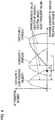
- FIG. 2 is a typical view showing the change quantity of the received power value in a distance change.
- the change quantity of the received power value is transitioned while keeping relatively small in the case of the vehicle except for rapid fluctuation of received power due to multipath propagation.
- the change quantity of the received power value is transitioned more largely than the vehicle.
- the change quantity of the received power value is transitioned small at a long distance as in the vehicle and becomes large by the influence of edges and the like as approaching from a certain distance.
- the wave number information is a feature quantity that represents the number of reflection points from the same object and the direction, which are obtained during angle measurement (super-resolution). For example, in the case of the vehicle, the number of the reflection points is one point or plural points according to a distance. Then, it becomes: a state where the number of the reflection points is clearly plural (when the reflection points have a predetermined direction difference); or a state where the number of the reflection points is not clear, but is plural (directions of the reflection points are closed or one side thereof is out of angle measurement, or the like) . Although it is true also in the case of the person and the low position object, such a state is anticipated to be different in the vehicle, the person, and the low position object.
- the wave number information expresses such each state by a number, for example, 1, 2, ⁇ .
- the attribution degree to each category for example, vehicle, person, and low position object
- the attribution degree to each category for example, vehicle, person, and low position object
- the preliminarily created attribution degree database 15 is used for calculating the attribution degree.
- the attribution degree database 15 represents distribution conditions of the second feature quantity for each relative distance about a predetermined category.
- FIG. 3 shows a typical view of the attribution degree in the case where the category is classified into a category 1 (low position object), a category 2 (person), and a category 3 (vehicle) in a certain relative distance R of the second feature quantity.
- FIG. 4 shows a typical view showing the case where different expression of the attribution degree of the same conditions is used.
- FIG. 3 is a view in which the attribution degree (vertical axis) over the entire feature quantity (horizontal axis) is represented in a distributed shape; and
- FIG. 4 is a view expressed by a representative value (for example, value of the center of gravity, central value, and most frequent value) in a range of value of each category.
- a method of creating the attribution degree database 15 is not limited to the above, but, for example, the entire range of value of each category can also be represented in a rectangular shape.
- an overlap portion of each category can be such that a value divided by the number of overlaps is the distribution of the attribution degree of each category.
- the attribution degree database 15 is created by the representative value such as FIG. 4 , the area (memory) of database can be cut down.
- the attribution degree database 15 can be created by obtaining several examples of sample (teacher data) of each category.
- creation can be performed by normalizing a maximum value after creating a histogram of the sample (teacher data).
- the distribution of the attribution degree is created for each relative distance R in the example of FIG. 3
- characteristics for each distance can also be finely reflected by setting the relative distance small (for example, 1 m) and therefore a highly accurate object identification can be achieved.
- areas having similar characteristics in the second feature quantity are collected and the relative distance is largely set to be, for example, like far/near distance, whereby the areas (memory) of the database can also be cut down.
- the distribution of the attribution degree can also be created for each relative speed.
- the calculation of the attribution degree can be performed by allocating a value ( ⁇ , ⁇ , ⁇ ) of each category distribution in the feature quantity.
- the attribution degree can be allocated by a value of the second feature quantity and a distance (or its inverse number) of the representative value of the attribution degree.
- the attribution degree of the second feature quantity inputted from the attribution degree calculation block 14 is multiplied by a predetermined weight coefficient of the second feature quantity, summation is calculated, and then one having the highest summation value is outputted as the category of the object.
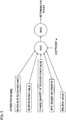
- FIG. 5 shows a conceptual view of object determination processing.
- a coefficient wi is the weight coefficient of each preliminarily defined second feature quantity.
- the relative speed is added to the second feature quantity. Furthermore, a determination result of the previous observation time or a result determined until then can also be inputted as the second feature quantity.
- a stable determination result can be obtained even when the present observation value is missing and/or is deteriorated by noise and the like and, more than that, the past determination result is taken over; and therefore, an effect that obtains a more reliable determination result can be expected.
- the weight coefficient in the determination processing can be set according to a degree of influence to the determination of each second feature quantity.
- all the weight coefficients are set to the same value (for example, 1).
- summation values of all categories can also be outputted in addition to the method of outputting the category of the highest summation value.
- the summation value of each category can be considered as a ratio belonged to each category of the object or reliability.
- the determination result can be easily interpreted by representing in value normalized by the maximum value of the summation value or in percentage.
- the summation value when the summation value is less than a predetermined summation threshold value, it can also be outputted as an indeterminate category that is not belonged to the predetermined category. Moreover, when the difference between the highest summation value and a next higher summation value is less than a predetermined threshold value, it is regarded that categories cannot be narrowed down into one and it can also be outputted as indeterminable.
- the indeterminate category is appended as a new category in the next and succeeding processing, whereby the database can be extended and a determination can be made properly next time or later.
- the respective second feature quantities are all equally treated.
- feature quantities having a high degree of influence on a certain category are determined at an initial stage; and after the categories are narrowed down, the remaining category can also be determined.
- the final determination accuracy can be improved by performing such processing.
- an effective (remarkable in difference) feature quantity in discrimination of the vehicle, the person, and the low position object such as, the change quantity of the received power value is extracted from information of the radar alone and the category is determined; and therefore, a highly accurate object identification can be performed without complicating a system configuration.
- the category is determined for each distance by the use of the feature quantity whose characteristics change for each distance; and therefore, a highly accurate object identification can be performed. More specifically, the category (kind) of the object is determined on the basis of the measurement results for each distance of the object obtained by the radar; and therefore, a highly accurate object identification can be achieved irrespective of the distance.
- the attribution degree is calculated for each distance of one's own vehicle and the object in the calculation of the attribution degree.
- the category is determined on the basis of the observation values not less than two observation cycles; and therefore, instantaneousness of determination can be improved.
- the determination can be made by one observation cycle.
- the determination is performed by extracting a plurality of feature quantities; and therefore, the determination can be made even when the feature quantity cannot be obtained by a partial missing and the like.
- a radar reflection wave is different in characteristics such as the presence or absence of the occurrence of multipath propagation by the height of an object and the mounting position (height) of one's own vehicle's radar.
- the distribution of the attribution degree is created/changed for each mounting position of one's own vehicle's radar; and therefore, a more highly accurate object identification can be performed.
- the present invention can freely combine the respective embodiments and appropriately modify and/or omit the respective embodiments, within the scope of the present invention.
Landscapes
- Engineering & Computer Science (AREA)
- Radar, Positioning & Navigation (AREA)
- Remote Sensing (AREA)
- Physics & Mathematics (AREA)
- Computer Networks & Wireless Communication (AREA)
- General Physics & Mathematics (AREA)
- Electromagnetism (AREA)
- Radar Systems Or Details Thereof (AREA)
Abstract
Description
- The present invention relates to a radar signal processing device of a vehicle-mounted radar device and, more particularly, relates to a technique for supporting a determination as to whether or not braking control should be performed by identifying a reflected object as a predetermined category.
- Formerly, measurement results, such as a relative distance and a relative speed between one's own vehicle and a reflected object, a direction, and reflection intensity, which are measured by a vehicle-mounted radar device, are utilized for a vehicle-mounted application for improving vehicle's safeness and amenity. The vehicle-mounted application is, for example, a collision damage mitigation braking system that reduces damage at the time when one's own vehicle collides with an anterior obstacle and an adaptive cruise control system that follows an anterior vehicle.
- In the application such as this, a determination is made as to whether or not one's own vehicle should be braked on the basis of the measurement results per se related to an object to be targeted or a new feature quantity derived from the measurement results.
- For example, in
Patent Document 1, a target's height from the road surface is estimated from the power distribution of the target (a generation pattern of a null point due to multipath propagation) and a determination is made as to whether or not the target is a subject in which one's own vehicle should be braked. - Furthermore, in
Patent Document 2, the height of an object is estimated by checking an amplitude pattern dictionary (database) preliminarily created by the use of various sorts of objects whose heights are known. - As a different example, in
Patent Document 3, identification is performed as to whether or not a subject is a vehicle or a person to determine as to whether or not the subject is a braking subject on the basis of received power (radar cross section) and a variation (standard deviation) of the difference between received power in an ascending section and a descending section of frequencies in a frequency modulated continuous wave (FMCW) system. -
- Patent Document 1: Japanese Patent Registration No.
4905512 - Patent Document 2: Japanese Patent Registration No.
5543061 - Patent Document 3: Japanese Patent Registration No.
4665948 - Since the known devices are configured as described above, a determination is performed on the basis of only a feature quantity derived from signal intensity in
Patent Document 1 andPatent Document 2; and accordingly, a problem exists in that estimation accuracy deteriorates when the measurement results cannot be normally obtained. - Furthermore, in a system of checking the dictionary as shown in
Patent Document 2, a large number of data needs to be obtained for creating the dictionary which is for performing a highly accurate estimation, and a high calculation load and a large capacity of memory are generally required for checking; and accordingly, a problem exists in that costs are increased. - Moreover, in a method of
Patent Document 3, the braking subject/non-braking subject can be narrowed down by preliminarily identifying an object and thus an improvement in the final determination accuracy can be expected. However, the radar cross section is changed by a beam pattern, an object's material, a posture, and a distance; and accordingly, it is conceivable that a stable determination is difficult. Additionally, a certain level of data accumulation is required for calculating the variations; and accordingly, for example, it is conceivable that handling for a temporally tight situation such as a sudden lane change of an anterior vehicle might be delayed. - The present invention has been made to solve the foregoing problem, and an object of the present invention is to obtain a radar signal processing device which identifies an object by the use of features of the object extracted from a radar measurement value and is capable of performing a highly accurate determination of a braking subject and a non-braking subject.
- A radar signal processing device of the present invention includes: a first feature quantity extraction block which extracts information as a first feature quantity at a constant time cycle from a received signal of a radar, the information being related to at least a relative distance and a relative speed to an object about a plurality of objects and the direction and the reflection intensity of the object; a data storage processing block which stores the first feature quantity and associates a plurality of the first feature quantities with the same object in time series over a plurality of cycles; a second feature quantity extraction block which extracts a second feature quantity from the first feature quantity in the data storage processing block; an attribution degree calculation block which calculates an attribution degree to the distribution of the second feature quantity related to a preliminarily defined category; and an object determination block which determines the category of the object on the basis of the attribution degree.
- The radar signal processing device of the present invention determines the category (kind) of the object by regarding a change quantity for a short time of the reflection intensity of the object obtained by the radar as a feature quantity, whereby a highly accurate object identification can be achieved for a short time and/or from a small number of measurement points.
- Furthermore, the radar signal processing device of the present invention determines the category (kind) of the object on the basis of a plurality of feature quantities of the object obtained by the radar, whereby a highly accurate object identification can be achieved even when there is a missing and the like.
-
- ]
FIG. 1 is a configuration diagram showing a radar signal processing device according toEmbodiment 1 of the present invention; -
FIG. 2 is an explanation view exemplarily showing a change quantity of a received power value to a distance change in the radar signal processing device according toEmbodiment 1 of the present invention; -
FIG. 3 is an explanation view exemplarily showing the distribution of an attribution degree in the radar signal processing device according toEmbodiment 1 of the present invention; -
FIG. 4 is an explanation view exemplarily showing the distribution of a different attribution degree in the radar signal processing device according toEmbodiment 1 of the present invention; and -
FIG. 5 is an explanation view exemplarily showing object determination processing in the radar signal processing device according toEmbodiment 1 of the present invention. -
FIG. 1 is a configuration diagram showing a radar signal processing device of a vehicle-mounted radar device (also referred to as a "radar") according toEmbodiment 1 of the present invention. - A radar
signal processing device 10 shown inFIG. 1 includes: a first featurequantity extraction block 11, a datastorage processing block 12, a second featurequantity extraction block 13, an attributiondegree calculation block 14, anattribution degree database 15, and anobject determination block 16. - Incidentally, a portion which radiates a radio wave to an object (not shown in the drawing) and receives a reflection wave from the object (also referred to as " reflected object") and a system thereof (FMCW system, frequency modulated interrupted continuous wave (FMICW) system, pulse Doppler system, and the like), a portion that performs the entire control, and the like are equivalent to a general vehicle-mounted radar; and therefore, their description will be omitted.
- The first feature
quantity extraction block 11 calculates at least a relative distance, a relative speed, a direction, and reflection intensity, which are related to the object from an obtained received signal. Hereinafter, these are referred to as a first feature quantity. More specifically, the first featurequantity extraction block 11 extracts information as the first feature quantity at a constant time cycle from the received signal of the radar, the information being related to at least the relative distance and the relative speed to the object and the direction and the reflection intensity of the object about a plurality of the objects. In this regard, however, the first feature quantity not used in determination processing of a subsequent stage is not necessarily obtained. Incidentally, when there exist a plurality of the reflected objects, the first feature quantity related to a plurality of objects is calculated. Furthermore, the direction in the first feature quantity includes an output result by known super-resolution processing, such as estimation of signal parameters via rotational invariance techniques (ESPRIT) and multiple signal classification (MUSIC). Furthermore, the first feature quantity is one obtained at a predetermined cycle (for example, 100 msec). - The data
storage processing block 12 stores the first feature quantity outputted from the first featurequantity extraction block 11 and gives, for example, the same ID (number) to those related to the same reflected object about the stored first feature quantity. More specifically, a time series of the first feature quantity (relative distance, relative speed, direction, and received power) to which the same ID is given for each reflected object is stored in the datastorage processing block 12. More specifically, the datastorage processing block 12 associates a plurality of the first feature quantities with the same object in time series over a plurality of cycles . The first feature quantity is made identical in time series in the datastorage processing block 12. - The second feature
quantity extraction block 13 calculates a second feature quantity, such as a maximum value (maximum detection distance) of the relative distance, a received power value, a change quantity of the received power value, and wave number information from the first feature quantity. - Incidentally, the received power value can be such that a rapid change caused by noise, multipath propagation, and the like from reflection intensity obtained as the first feature quantity is suppressed.
- Furthermore, the change quantity of the received power value can be set to the difference (or ratio) between the current observation value and its preceding observation value.
- Additionally, the wave number information can be such that, for example, the number of reflected waves from the object is one wave or two waves (plurality) from a result of estimation of the number of waves.
- Moreover, in addition to those mentioned above, the second feature quantity can be other feature quantity obtained by the use of the first feature quantity; for example, a standard deviation, a maximum value, and the difference between the maximum value and the minimum value of the received power value in a predetermined distance range or in a predetermined observation point can be added.
- The attribution
degree calculation block 14 calculates a value (attribution degree) for each category (kind) of each feature quantity of the second feature quantity inputted from the second featurequantity extraction block 13 on the basis of the distribution of attribution degree for each second feature quantity obtained from anattribution degree database 15. More specifically, the attributiondegree calculation block 14 calculates the attribution degree to the distribution of the second feature quantity related to the preliminarily defined category. - The
attribution degree database 15 quantifies and stores: the distribution of the second feature quantity obtained by preliminarily observing several examples about the preliminarily defined categories; the distribution of the second feature quantity based on theoretical values derived from transmission power, distance, antenna gain, reflection cross section, and the like; and properties based on experimental knowledge related to the categories. - The
object determination block 16 determines to which category the object belongs on the basis of the attribution degree for each category related to the object inputted from the attributiondegree calculation block 14, more specifically, determines a kind of the object (for example, vehicle, person, low position object capable of being overridden, and the like) and outputs the result of the determination. - Incidentally, after that, for example, the determination result is used for braking control by a control block (not shown in the drawing).
- Next, operation will be described.
- First, in the first feature
quantity extraction block 11, the first feature quantity (relative distance, relative speed, direction, and reflection intensity) is calculated by the use of a received signal inputted for each predetermined observation cycle. Incidentally, since the first feature quantity is based on a general system in which the relative distance, the relative speed, the direction, and the reflection intensity are calculated in the radar, detailed description will be omitted. - Next, in the data
storage processing block 12, the first feature quantity inputted from the first featurequantity extraction block 11 is stored; objects related to the same reflected object are made to correspond to each other by tracking processing using, for example, a Kalman filter together with the first feature quantity for several past observations stored until then; and the same identification data (ID) (number) to the same reflected object and a time tag in which the update time of data is written or an order tag in which the input order of data is written are given. Incidentally, since the rapid change due to noise and/or multipath propagation is generally superimposed on the reflection intensity obtained as the first feature quantity, moving average by a predetermined distance range or a predetermined observation point is performed in order to obtain a stable determination result at a subsequent stage. - Incidentally, in the data
storage processing block 12, for example, the first feature quantity in which a state where the first feature quantity of the same ID is not updated (added) reaches the number of predetermined observations is eliminated in series, whereby a memory space of the datastorage processing block 12 can be saved. - Next, in the second feature
quantity extraction block 13, the second feature quantity such as the maximum detection distance, the received power value, the change quantity of the received power value, and the wave number information is calculated by the use of the first feature quantity. - The maximum detection distance is a feature quantity that represents a maximum value of a target relative distance. Generally, since an object having a certain height, such as a vehicle and a person is detected from a long distance, the maximum detection distance has a large tendency. On the other hand, since the low position object capable of being overridden is detected for the first time at a relatively short distance, the maximum detection distance has a small tendency.
- The received power value is a feature quantity that represents the reflection intensity of the object. Generally, an object having a high radar cross section and material of metal etc., such as a vehicle, is high in reflection intensity value at the same distance . On the other hand, since the person is smaller in the radar cross section than the vehicle, the reflection intensity value is smaller than the vehicle; however, since the person can take various postures, a range of value of the reflection intensity value is large. Furthermore, for example, the low position object capable of being overridden, such as a joint of a road surface, grating, and the like is small in the received power value at a relatively long distance; however, in the case of approaching, the influence of reflection from an edge portion becomes large and thus the received power value has a relatively large value.
- A change quantity of the received power value is a feature quantity defined by the difference or the ratio between the received power values at the current and the latest observation of the received power value.
FIG. 2 is a typical view showing the change quantity of the received power value in a distance change. Generally, in a situation approaching to an object (situation where a relative distance between one's own vehicle and an object becomes small), the change quantity of the received power value is transitioned while keeping relatively small in the case of the vehicle except for rapid fluctuation of received power due to multipath propagation. Furthermore, in the case of the person, since the radar cross section changes, the change quantity of the received power value is transitioned more largely than the vehicle. Moreover, in the case of the low position object capable of being overridden, the change quantity of the received power value is transitioned small at a long distance as in the vehicle and becomes large by the influence of edges and the like as approaching from a certain distance. - The wave number information is a feature quantity that represents the number of reflection points from the same object and the direction, which are obtained during angle measurement (super-resolution). For example, in the case of the vehicle, the number of the reflection points is one point or plural points according to a distance. Then, it becomes: a state where the number of the reflection points is clearly plural (when the reflection points have a predetermined direction difference); or a state where the number of the reflection points is not clear, but is plural (directions of the reflection points are closed or one side thereof is out of angle measurement, or the like) . Although it is true also in the case of the person and the low position object, such a state is anticipated to be different in the vehicle, the person, and the low position object. The wave number information expresses such each state by a number, for example, 1, 2, ···.
- Next, in the attribution
degree calculation block 14, the attribution degree to each category (for example, vehicle, person, and low position object) of the extracted second feature quantity is calculated. - The preliminarily created
attribution degree database 15 is used for calculating the attribution degree. - The
attribution degree database 15 represents distribution conditions of the second feature quantity for each relative distance about a predetermined category. -
FIG. 3 shows a typical view of the attribution degree in the case where the category is classified into a category 1 (low position object), a category 2 (person), and a category 3 (vehicle) in a certain relative distance R of the second feature quantity. - Furthermore,
FIG. 4 shows a typical view showing the case where different expression of the attribution degree of the same conditions is used. -
FIG. 3 is a view in which the attribution degree (vertical axis) over the entire feature quantity (horizontal axis) is represented in a distributed shape; andFIG. 4 is a view expressed by a representative value (for example, value of the center of gravity, central value, and most frequent value) in a range of value of each category. - Incidentally, a method of creating the
attribution degree database 15 is not limited to the above, but, for example, the entire range of value of each category can also be represented in a rectangular shape. - Furthermore, an overlap portion of each category can be such that a value divided by the number of overlaps is the distribution of the attribution degree of each category.
- In the case where the
attribution degree database 15 is created by the representative value such asFIG. 4 , the area (memory) of database can be cut down. - The
attribution degree database 15 can be created by obtaining several examples of sample (teacher data) of each category. - For example, in order to obtain the distribution of the attribution degree of
FIG. 3 , creation can be performed by normalizing a maximum value after creating a histogram of the sample (teacher data). Furthermore, although the distribution of the attribution degree is created for each relative distance R in the example ofFIG. 3 , characteristics for each distance can also be finely reflected by setting the relative distance small (for example, 1 m) and therefore a highly accurate object identification can be achieved. Moreover, areas having similar characteristics in the second feature quantity are collected and the relative distance is largely set to be, for example, like far/near distance, whereby the areas (memory) of the database can also be cut down. Additionally, the distribution of the attribution degree can also be created for each relative speed. In this case, like the change quantity of the received power value, it is anticipated that characteristics are different according to the relative speed in the feature quantity that captures a change of a plurality of observation points; however, it can be dealt with that by creating the distribution of the attribution degree for each speed and an effect of reducing deterioration of object identification performance can be expected. - In the case of the distribution of the attribution degree like
FIG. 3 , when the second feature quantity is a value shown by a black point on the horizontal axis, the calculation of the attribution degree can be performed by allocating a value (α, β, γ) of each category distribution in the feature quantity. - Furthermore, in the case of the representative value of the attribution degree like
FIG. 4 , the attribution degree can be allocated by a value of the second feature quantity and a distance (or its inverse number) of the representative value of the attribution degree. - Next, in the
object determination block 16, the attribution degree of the second feature quantity inputted from the attributiondegree calculation block 14 is multiplied by a predetermined weight coefficient of the second feature quantity, summation is calculated, and then one having the highest summation value is outputted as the category of the object. -
FIG. 5 shows a conceptual view of object determination processing. In the same drawing, a coefficient wi is the weight coefficient of each preliminarily defined second feature quantity. - Incidentally, in the configuration of
FIG. 5 , the relative speed is added to the second feature quantity. Furthermore, a determination result of the previous observation time or a result determined until then can also be inputted as the second feature quantity. In this configuration, by inputting the previous determination result, a stable determination result can be obtained even when the present observation value is missing and/or is deteriorated by noise and the like and, more than that, the past determination result is taken over; and therefore, an effect that obtains a more reliable determination result can be expected. - The weight coefficient in the determination processing can be set according to a degree of influence to the determination of each second feature quantity.
- For example, when the degrees of influence of all the second feature quantities are equal, all the weight coefficients are set to the same value (for example, 1).
- Furthermore, when the degree of influence of each secondary feature is different according to the relative distance, a more highly accurate object identification can be achieved by changing the weight coefficient for each relative distance.
- As a method of outputting the determination result, summation values of all categories can also be outputted in addition to the method of outputting the category of the highest summation value.
- In this case, the summation value of each category can be considered as a ratio belonged to each category of the object or reliability. Incidentally, in this case, the determination result can be easily interpreted by representing in value normalized by the maximum value of the summation value or in percentage.
- Furthermore, when the summation value is less than a predetermined summation threshold value, it can also be outputted as an indeterminate category that is not belonged to the predetermined category. Moreover, when the difference between the highest summation value and a next higher summation value is less than a predetermined threshold value, it is regarded that categories cannot be narrowed down into one and it can also be outputted as indeterminable.
- By performing the output which is indeterminate and/or indeterminable in such a manner, it is possible to avoid that classification is made into a predetermined category in a state of having no reliability and, as a result, the category is mistaken and determination accuracy is deteriorated.
- At this time, the indeterminate category is appended as a new category in the next and succeeding processing, whereby the database can be extended and a determination can be made properly next time or later.
- Incidentally, in the above embodiment, the respective second feature quantities are all equally treated. However, for example, feature quantities having a high degree of influence on a certain category are determined at an initial stage; and after the categories are narrowed down, the remaining category can also be determined.
- The final determination accuracy can be improved by performing such processing.
- As described above, in the radar signal processing device according to the present embodiment, an effective (remarkable in difference) feature quantity in discrimination of the vehicle, the person, and the low position object, such as, the change quantity of the received power value is extracted from information of the radar alone and the category is determined; and therefore, a highly accurate object identification can be performed without complicating a system configuration.
- Furthermore, in the radar signal processing device according to the present embodiment, the category is determined for each distance by the use of the feature quantity whose characteristics change for each distance; and therefore, a highly accurate object identification can be performed. More specifically, the category (kind) of the object is determined on the basis of the measurement results for each distance of the object obtained by the radar; and therefore, a highly accurate object identification can be achieved irrespective of the distance. Incidentally, the attribution degree is calculated for each distance of one's own vehicle and the object in the calculation of the attribution degree.
- Moreover, in the radar signal processing device according to the present embodiment, the category is determined on the basis of the observation values not less than two observation cycles; and therefore, instantaneousness of determination can be improved. Incidentally, in the case of not using the change quantity of the received power value, the determination can be made by one observation cycle.
- Additionally, in the radar signal processing device according to the present embodiment, the determination is performed by extracting a plurality of feature quantities; and therefore, the determination can be made even when the feature quantity cannot be obtained by a partial missing and the like.
- As a
different Embodiment 2 of the present invention, it is conceivable that the distribution of an attribution degree is created for each mounting position of one's own vehicle's radar. - As described above, a radar reflection wave is different in characteristics such as the presence or absence of the occurrence of multipath propagation by the height of an object and the mounting position (height) of one's own vehicle's radar.
- Thus, when the mounting position of one's own vehicle's radar is changed by vehicle types and other conditions, a more accurate determination can be performed than using the distribution of attribution degree (database) specialized to its mounting position.
- As described above, according to a radar signal processing device of the
present Embodiment 2, the distribution of the attribution degree is created/changed for each mounting position of one's own vehicle's radar; and therefore, a more highly accurate object identification can be performed. - The present invention can freely combine the respective embodiments and appropriately modify and/or omit the respective embodiments, within the scope of the present invention.
- 10 Radar signal processing device, 11 First feature quantity extraction block, 12 Data storage processing block, 13 Second feature quantity extraction block, 14 Attribution degree calculation block, 16 Object determination block
Claims (10)
- A radar signal processing device of a radar, which is mounted on a vehicle and outputs information related to a plurality of circumferentially existing objects, said radar signal processing device comprising:a first feature quantity extraction block which extracts information as a first feature quantity at a constant time cycle from a received signal of the radar, the information being related to at least a relative distance and a relative speed to an object about a plurality of objects and the direction and the reflection intensity of the object;a data storage processing block which stores the first feature quantity and associates a plurality of the first feature quantities with the same object in time series over a plurality of cycles;a second feature quantity extraction block which extracts a second feature quantity from the first feature quantity in said data storage processing block;an attribution degree calculation block which calculates an attribution degree to the distribution of the second feature quantity related to a preliminarily defined category; andan object determination block which determines the category of the object on the basis of the attribution degree.
- The radar signal processing device according to claim 1,
wherein, as the second feature quantity, a maximum detection distance of the object is extracted. - The radar signal processing device according to claim 1,
wherein, as the second feature quantity, a received power value in which a rapid change is removed is extracted. - The radar signal processing device according to claim 1,
wherein, as the second feature quantity, a change quantity of a received power value of the received signal is extracted. - The radar signal processing device according to claim 1,
wherein, as the second feature quantity, wave number information during angle measurement by the radar is extracted. - The radar signal processing device according to claim 1,
wherein, in the calculation of the attribution degree, the attribution degree is calculated for each distance of one's own vehicle and the object. - The radar signal processing device according to claim 1,
wherein, in the object determination, a summation value of the attribution degree about a plurality of the respective preliminarily defined categories is used. - The radar signal processing device according to claim 1,
wherein, in the object determination, the category of the object is determined on the basis of a summation value in which the attribution degree is multiplied by a preliminarily defined weight coefficient and summation is calculated. - The radar signal processing device according to claim 7 or claim 8,
wherein, in the object determination, when the summation value is less than a preliminarily defined threshold value, the category is regarded as indeterminable and a category is newly added. - The radar signal processing device according to claim 1,
wherein the attribution degree is changed for each mounting height position of the radar.
Applications Claiming Priority (1)
| Application Number | Priority Date | Filing Date | Title |
|---|---|---|---|
| PCT/JP2015/065529 WO2016194036A1 (en) | 2015-05-29 | 2015-05-29 | Radar signal processing device |
Publications (3)
| Publication Number | Publication Date |
|---|---|
| EP3306340A1 true EP3306340A1 (en) | 2018-04-11 |
| EP3306340A4 EP3306340A4 (en) | 2019-01-23 |
| EP3306340B1 EP3306340B1 (en) | 2021-06-23 |
Family
ID=55793188
Family Applications (1)
| Application Number | Title | Priority Date | Filing Date |
|---|---|---|---|
| EP15894071.8A Active EP3306340B1 (en) | 2015-05-29 | 2015-05-29 | Radar signal processing device |
Country Status (5)
| Country | Link |
|---|---|
| US (1) | US10663580B2 (en) |
| EP (1) | EP3306340B1 (en) |
| JP (1) | JP5908193B1 (en) |
| CN (1) | CN107615090B (en) |
| WO (1) | WO2016194036A1 (en) |
Families Citing this family (16)
| Publication number | Priority date | Publication date | Assignee | Title |
|---|---|---|---|---|
| JP6223504B1 (en) * | 2016-05-18 | 2017-11-01 | 三菱電機株式会社 | Radar device and sensor fusion device using the same |
| JP6319361B2 (en) * | 2016-05-26 | 2018-05-09 | マツダ株式会社 | Pedestrian detection device for vehicles |
| JP2018059884A (en) * | 2016-10-07 | 2018-04-12 | 日本無線株式会社 | Target discrimination device, program, and method |
| JP7150292B2 (en) * | 2017-03-31 | 2022-10-11 | 慶應義塾 | Action recognition system and action recognition method |
| JP6489589B2 (en) * | 2017-05-24 | 2019-03-27 | 三菱電機株式会社 | Radar signal processing device |
| JP6874842B2 (en) * | 2017-07-03 | 2021-05-19 | 日本電気株式会社 | Signal processing equipment, signal processing methods and programs |
| JP6570675B2 (en) | 2018-02-15 | 2019-09-04 | 三菱電機株式会社 | Radar signal processing device |
| CN110361710A (en) * | 2018-04-09 | 2019-10-22 | 北京京东尚科信息技术有限公司 | Object recognition method and device based on laser point cloud |
| JP2020016572A (en) * | 2018-07-26 | 2020-01-30 | 日立オートモティブシステムズ株式会社 | Radar sensor |
| CN109407703A (en) * | 2018-12-13 | 2019-03-01 | 广州极飞科技有限公司 | Unmanned plane and its control method and device |
| WO2020258253A1 (en) * | 2019-06-28 | 2020-12-30 | 深圳市大疆创新科技有限公司 | Object recognition method, millimeter wave radar and vehicle |
| GB201919450D0 (en) | 2019-12-31 | 2020-02-12 | Essence Smartcare Ltd | A device for monitoring an environment |
| JP7367585B2 (en) * | 2020-03-30 | 2023-10-24 | 株式会社アイシン | object detection system |
| CN111429791B (en) * | 2020-04-09 | 2022-11-18 | 浙江大华技术股份有限公司 | Identity determination method, identity determination device, storage medium and electronic device |
| KR20220010900A (en) * | 2020-07-20 | 2022-01-27 | 현대모비스 주식회사 | Apparatus and Method for Controlling Radar of Vehicle |
| WO2025083837A1 (en) * | 2023-10-19 | 2025-04-24 | 三菱電機株式会社 | Radar signal processing device, radar signal processing method, radar signal processing program, and recording medium |
Family Cites Families (32)
| Publication number | Priority date | Publication date | Assignee | Title |
|---|---|---|---|---|
| JP3401913B2 (en) * | 1994-05-26 | 2003-04-28 | 株式会社デンソー | Obstacle recognition device for vehicles |
| JP2826494B2 (en) * | 1995-11-21 | 1998-11-18 | 防衛庁技術研究本部長 | Target signal detection method and device |
| JPH10206531A (en) | 1997-01-17 | 1998-08-07 | Fujitsu Ten Ltd | Vehicle radar |
| SE511061C2 (en) * | 1997-11-21 | 1999-07-26 | Celsiustech Electronics Ab | Procedure for classifying raised objects |
| JP3512066B2 (en) * | 1998-12-10 | 2004-03-29 | トヨタ自動車株式会社 | Automotive radar equipment |
| JP4115638B2 (en) * | 1999-10-19 | 2008-07-09 | 本田技研工業株式会社 | Object recognition device |
| GB0017989D0 (en) * | 2000-07-24 | 2001-08-08 | Secr Defence | Target recognition system |
| JP3871875B2 (en) * | 2000-11-06 | 2007-01-24 | 日本電気株式会社 | Target classification method and apparatus |
| JP4016826B2 (en) * | 2002-12-10 | 2007-12-05 | 株式会社デンソー | Object labeling method and apparatus, program |
| JP4046648B2 (en) * | 2003-06-03 | 2008-02-13 | 富士通テン株式会社 | Target discrimination device |
| WO2006025453A1 (en) | 2004-09-01 | 2006-03-09 | Matsushita Electric Industrial Co., Ltd. | Radar apparatus |
| DE102004047087A1 (en) * | 2004-09-29 | 2006-03-30 | Robert Bosch Gmbh | Method for object verifaction in radar systems for motor vehicles |
| DE102005024716B4 (en) * | 2005-05-30 | 2023-09-21 | Robert Bosch Gmbh | Method and device for recognizing and classifying objects |
| US20070253625A1 (en) * | 2006-04-28 | 2007-11-01 | Bbnt Solutions Llc | Method for building robust algorithms that classify objects using high-resolution radar signals |
| JP4211809B2 (en) * | 2006-06-30 | 2009-01-21 | トヨタ自動車株式会社 | Object detection device |
| US7623061B2 (en) | 2006-11-15 | 2009-11-24 | Autoliv Asp | Method and apparatus for discriminating with respect to low elevation target objects |
| JP2009031053A (en) * | 2007-07-25 | 2009-02-12 | Fujitsu Ten Ltd | Device for detecting forward obstacle |
| CN101178773B (en) * | 2007-12-13 | 2010-08-11 | 北京中星微电子有限公司 | Image recognition system and method based on characteristic extracting and categorizer |
| JP4905512B2 (en) | 2009-07-09 | 2012-03-28 | 株式会社デンソー | Target information estimation device |
| DE112010005662T5 (en) * | 2010-06-16 | 2013-03-21 | Toyota Jidosha Kabushiki Kaisha | Object identification device and method |
| JP2013002927A (en) * | 2011-06-15 | 2013-01-07 | Honda Elesys Co Ltd | Obstacle detection apparatus and computer program |
| JP5852456B2 (en) * | 2012-01-30 | 2016-02-03 | トヨタ自動車株式会社 | Peripheral object detection device |
| JP5926069B2 (en) * | 2012-02-20 | 2016-05-25 | トヨタ自動車株式会社 | Obstacle determination device |
| JP2013238452A (en) | 2012-05-14 | 2013-11-28 | Honda Elesys Co Ltd | Position information detection device, position information detection method, position information detection program, and operation control system |
| DE102012107444B3 (en) * | 2012-08-14 | 2013-03-07 | Jenoptik Robot Gmbh | Method for classifying traveling vehicles e.g. passenger car, by tracking vehicle position magnitude in flowing traffic, involves comparing discontinuity portion length with stored typical velocity-normalized lengths to classify vehicle |
| DE102012107445B8 (en) * | 2012-08-14 | 2016-04-28 | Jenoptik Robot Gmbh | Method for classifying moving vehicles |
| JP6212860B2 (en) * | 2012-12-27 | 2017-10-18 | 株式会社デンソー | In-vehicle radar system |
| JP6205729B2 (en) * | 2013-01-21 | 2017-10-04 | 株式会社デンソー | Radar equipment |
| JP6369035B2 (en) * | 2013-02-05 | 2018-08-08 | 株式会社デンソー | Target detection device |
| JP6170704B2 (en) | 2013-03-29 | 2017-07-26 | 富士通テン株式会社 | Radar apparatus and signal processing method |
| US20150378014A1 (en) * | 2013-08-07 | 2015-12-31 | Sandia Corporation | Ascertaining class of a vehicle captured in an image |
| US9664779B2 (en) * | 2014-07-03 | 2017-05-30 | GM Global Technology Operations LLC | Object classification for vehicle radar systems |
-
2015
- 2015-05-29 WO PCT/JP2015/065529 patent/WO2016194036A1/en not_active Ceased
- 2015-05-29 US US15/569,444 patent/US10663580B2/en active Active
- 2015-05-29 CN CN201580080067.3A patent/CN107615090B/en not_active Expired - Fee Related
- 2015-05-29 EP EP15894071.8A patent/EP3306340B1/en active Active
- 2015-05-29 JP JP2015555467A patent/JP5908193B1/en active Active
Also Published As
| Publication number | Publication date |
|---|---|
| CN107615090B (en) | 2021-06-11 |
| JP5908193B1 (en) | 2016-04-26 |
| WO2016194036A1 (en) | 2016-12-08 |
| EP3306340A4 (en) | 2019-01-23 |
| US20180081052A1 (en) | 2018-03-22 |
| CN107615090A (en) | 2018-01-19 |
| US10663580B2 (en) | 2020-05-26 |
| EP3306340B1 (en) | 2021-06-23 |
| JPWO2016194036A1 (en) | 2017-06-22 |
Similar Documents
| Publication | Publication Date | Title |
|---|---|---|
| US10663580B2 (en) | Radar signal processing device | |
| US10866309B2 (en) | Radar signal processing device | |
| EP3812791B1 (en) | Integration of tracking with classifier in mmwave radar | |
| CN111352110B (en) | Method and device for processing radar data | |
| US10228457B2 (en) | Radar device and sensor fusion system using the same | |
| US11668799B2 (en) | Histogram based L-shape detection of target objects | |
| JP6773606B2 (en) | Radar device and its radar signal processing method | |
| CN120298400B (en) | Intelligent anti-collision warning method and system for ship loader | |
| Park et al. | Bidirectional LSTM-based overhead target classification for automotive radar systems | |
| CN113625266A (en) | Method, device, storage medium and equipment for detecting low-speed target by using radar | |
| US11846702B2 (en) | Image processing device and image processing method | |
| CN116879863B (en) | Multi-target measuring method and system for continuous wave 4D millimeter wave radar | |
| Park et al. | Ground reflection-based misalignment detection of automotive radar sensors | |
| RU157396U1 (en) | SCREW RECOGNITION DEVICE | |
| JP2005114416A (en) | Disturbance detection device | |
| CN115144845A (en) | Object type detection method and device | |
| KR102767259B1 (en) | Pdw clustering method based on results from two-dimensional direction finding and signal analysis method using the same | |
| JP2020046218A (en) | Rader device and method for determining target | |
| Lim et al. | Rejection of road clutter using mean-variance method with OS-CFAR for automotive applications | |
| JP6981109B2 (en) | Radar resource management device | |
| KR20250028000A (en) | Effective pre-processing method and system for 4d radar | |
| WO2025083837A1 (en) | Radar signal processing device, radar signal processing method, radar signal processing program, and recording medium | |
| Heuer et al. | An observation model for high resolution radar data in the context of an automotive pedestrian safety system | |
| JP2025022508A (en) | Signal processor and radar device | |
| CN120779350A (en) | Object tracking method based on Lei Dadian cloud |
Legal Events
| Date | Code | Title | Description |
|---|---|---|---|
| STAA | Information on the status of an ep patent application or granted ep patent |
Free format text: STATUS: THE INTERNATIONAL PUBLICATION HAS BEEN MADE |
|
| PUAI | Public reference made under article 153(3) epc to a published international application that has entered the european phase |
Free format text: ORIGINAL CODE: 0009012 |
|
| STAA | Information on the status of an ep patent application or granted ep patent |
Free format text: STATUS: REQUEST FOR EXAMINATION WAS MADE |
|
| 17P | Request for examination filed |
Effective date: 20171103 |
|
| AK | Designated contracting states |
Kind code of ref document: A1 Designated state(s): AL AT BE BG CH CY CZ DE DK EE ES FI FR GB GR HR HU IE IS IT LI LT LU LV MC MK MT NL NO PL PT RO RS SE SI SK SM TR |
|
| AX | Request for extension of the european patent |
Extension state: BA ME |
|
| DAV | Request for validation of the european patent (deleted) | ||
| DAX | Request for extension of the european patent (deleted) | ||
| A4 | Supplementary search report drawn up and despatched |
Effective date: 20190104 |
|
| RIC1 | Information provided on ipc code assigned before grant |
Ipc: G01S 13/93 20060101ALI20181220BHEP Ipc: G01S 7/41 20060101AFI20181220BHEP Ipc: G01S 13/46 20060101ALI20181220BHEP Ipc: G01S 13/42 20060101ALI20181220BHEP Ipc: G01S 13/58 20060101ALI20181220BHEP |
|
| GRAP | Despatch of communication of intention to grant a patent |
Free format text: ORIGINAL CODE: EPIDOSNIGR1 |
|
| STAA | Information on the status of an ep patent application or granted ep patent |
Free format text: STATUS: GRANT OF PATENT IS INTENDED |
|
| INTG | Intention to grant announced |
Effective date: 20210223 |
|
| GRAS | Grant fee paid |
Free format text: ORIGINAL CODE: EPIDOSNIGR3 |
|
| GRAA | (expected) grant |
Free format text: ORIGINAL CODE: 0009210 |
|
| STAA | Information on the status of an ep patent application or granted ep patent |
Free format text: STATUS: THE PATENT HAS BEEN GRANTED |
|
| AK | Designated contracting states |
Kind code of ref document: B1 Designated state(s): AL AT BE BG CH CY CZ DE DK EE ES FI FR GB GR HR HU IE IS IT LI LT LU LV MC MK MT NL NO PL PT RO RS SE SI SK SM TR |
|
| REG | Reference to a national code |
Ref country code: GB Ref legal event code: FG4D |
|
| REG | Reference to a national code |
Ref country code: CH Ref legal event code: EP |
|
| REG | Reference to a national code |
Ref country code: DE Ref legal event code: R096 Ref document number: 602015070759 Country of ref document: DE Ref country code: AT Ref legal event code: REF Ref document number: 1404756 Country of ref document: AT Kind code of ref document: T Effective date: 20210715 |
|
| REG | Reference to a national code |
Ref country code: IE Ref legal event code: FG4D |
|
| REG | Reference to a national code |
Ref country code: LT Ref legal event code: MG9D |
|
| PG25 | Lapsed in a contracting state [announced via postgrant information from national office to epo] |
Ref country code: BG Free format text: LAPSE BECAUSE OF FAILURE TO SUBMIT A TRANSLATION OF THE DESCRIPTION OR TO PAY THE FEE WITHIN THE PRESCRIBED TIME-LIMIT Effective date: 20210923 Ref country code: HR Free format text: LAPSE BECAUSE OF FAILURE TO SUBMIT A TRANSLATION OF THE DESCRIPTION OR TO PAY THE FEE WITHIN THE PRESCRIBED TIME-LIMIT Effective date: 20210623 Ref country code: FI Free format text: LAPSE BECAUSE OF FAILURE TO SUBMIT A TRANSLATION OF THE DESCRIPTION OR TO PAY THE FEE WITHIN THE PRESCRIBED TIME-LIMIT Effective date: 20210623 Ref country code: LT Free format text: LAPSE BECAUSE OF FAILURE TO SUBMIT A TRANSLATION OF THE DESCRIPTION OR TO PAY THE FEE WITHIN THE PRESCRIBED TIME-LIMIT Effective date: 20210623 |
|
| REG | Reference to a national code |
Ref country code: AT Ref legal event code: MK05 Ref document number: 1404756 Country of ref document: AT Kind code of ref document: T Effective date: 20210623 |
|
| PG25 | Lapsed in a contracting state [announced via postgrant information from national office to epo] |
Ref country code: LV Free format text: LAPSE BECAUSE OF FAILURE TO SUBMIT A TRANSLATION OF THE DESCRIPTION OR TO PAY THE FEE WITHIN THE PRESCRIBED TIME-LIMIT Effective date: 20210623 Ref country code: GR Free format text: LAPSE BECAUSE OF FAILURE TO SUBMIT A TRANSLATION OF THE DESCRIPTION OR TO PAY THE FEE WITHIN THE PRESCRIBED TIME-LIMIT Effective date: 20210924 Ref country code: NO Free format text: LAPSE BECAUSE OF FAILURE TO SUBMIT A TRANSLATION OF THE DESCRIPTION OR TO PAY THE FEE WITHIN THE PRESCRIBED TIME-LIMIT Effective date: 20210923 Ref country code: SE Free format text: LAPSE BECAUSE OF FAILURE TO SUBMIT A TRANSLATION OF THE DESCRIPTION OR TO PAY THE FEE WITHIN THE PRESCRIBED TIME-LIMIT Effective date: 20210623 Ref country code: RS Free format text: LAPSE BECAUSE OF FAILURE TO SUBMIT A TRANSLATION OF THE DESCRIPTION OR TO PAY THE FEE WITHIN THE PRESCRIBED TIME-LIMIT Effective date: 20210623 |
|
| REG | Reference to a national code |
Ref country code: NL Ref legal event code: MP Effective date: 20210623 |
|
| PG25 | Lapsed in a contracting state [announced via postgrant information from national office to epo] |
Ref country code: SM Free format text: LAPSE BECAUSE OF FAILURE TO SUBMIT A TRANSLATION OF THE DESCRIPTION OR TO PAY THE FEE WITHIN THE PRESCRIBED TIME-LIMIT Effective date: 20210623 Ref country code: SK Free format text: LAPSE BECAUSE OF FAILURE TO SUBMIT A TRANSLATION OF THE DESCRIPTION OR TO PAY THE FEE WITHIN THE PRESCRIBED TIME-LIMIT Effective date: 20210623 Ref country code: EE Free format text: LAPSE BECAUSE OF FAILURE TO SUBMIT A TRANSLATION OF THE DESCRIPTION OR TO PAY THE FEE WITHIN THE PRESCRIBED TIME-LIMIT Effective date: 20210623 Ref country code: CZ Free format text: LAPSE BECAUSE OF FAILURE TO SUBMIT A TRANSLATION OF THE DESCRIPTION OR TO PAY THE FEE WITHIN THE PRESCRIBED TIME-LIMIT Effective date: 20210623 Ref country code: AT Free format text: LAPSE BECAUSE OF FAILURE TO SUBMIT A TRANSLATION OF THE DESCRIPTION OR TO PAY THE FEE WITHIN THE PRESCRIBED TIME-LIMIT Effective date: 20210623 Ref country code: NL Free format text: LAPSE BECAUSE OF FAILURE TO SUBMIT A TRANSLATION OF THE DESCRIPTION OR TO PAY THE FEE WITHIN THE PRESCRIBED TIME-LIMIT Effective date: 20210623 Ref country code: RO Free format text: LAPSE BECAUSE OF FAILURE TO SUBMIT A TRANSLATION OF THE DESCRIPTION OR TO PAY THE FEE WITHIN THE PRESCRIBED TIME-LIMIT Effective date: 20210623 Ref country code: PT Free format text: LAPSE BECAUSE OF FAILURE TO SUBMIT A TRANSLATION OF THE DESCRIPTION OR TO PAY THE FEE WITHIN THE PRESCRIBED TIME-LIMIT Effective date: 20211025 Ref country code: ES Free format text: LAPSE BECAUSE OF FAILURE TO SUBMIT A TRANSLATION OF THE DESCRIPTION OR TO PAY THE FEE WITHIN THE PRESCRIBED TIME-LIMIT Effective date: 20210623 |
|
| PG25 | Lapsed in a contracting state [announced via postgrant information from national office to epo] |
Ref country code: PL Free format text: LAPSE BECAUSE OF FAILURE TO SUBMIT A TRANSLATION OF THE DESCRIPTION OR TO PAY THE FEE WITHIN THE PRESCRIBED TIME-LIMIT Effective date: 20210623 |
|
| REG | Reference to a national code |
Ref country code: DE Ref legal event code: R097 Ref document number: 602015070759 Country of ref document: DE |
|
| PG25 | Lapsed in a contracting state [announced via postgrant information from national office to epo] |
Ref country code: DK Free format text: LAPSE BECAUSE OF FAILURE TO SUBMIT A TRANSLATION OF THE DESCRIPTION OR TO PAY THE FEE WITHIN THE PRESCRIBED TIME-LIMIT Effective date: 20210623 |
|
| PLBE | No opposition filed within time limit |
Free format text: ORIGINAL CODE: 0009261 |
|
| STAA | Information on the status of an ep patent application or granted ep patent |
Free format text: STATUS: NO OPPOSITION FILED WITHIN TIME LIMIT |
|
| 26N | No opposition filed |
Effective date: 20220324 |
|
| PG25 | Lapsed in a contracting state [announced via postgrant information from national office to epo] |
Ref country code: AL Free format text: LAPSE BECAUSE OF FAILURE TO SUBMIT A TRANSLATION OF THE DESCRIPTION OR TO PAY THE FEE WITHIN THE PRESCRIBED TIME-LIMIT Effective date: 20210623 |
|
| PG25 | Lapsed in a contracting state [announced via postgrant information from national office to epo] |
Ref country code: IT Free format text: LAPSE BECAUSE OF FAILURE TO SUBMIT A TRANSLATION OF THE DESCRIPTION OR TO PAY THE FEE WITHIN THE PRESCRIBED TIME-LIMIT Effective date: 20210623 |
|
| REG | Reference to a national code |
Ref country code: CH Ref legal event code: PL |
|
| REG | Reference to a national code |
Ref country code: BE Ref legal event code: MM Effective date: 20220531 |
|
| GBPC | Gb: european patent ceased through non-payment of renewal fee |
Effective date: 20220529 |
|
| PG25 | Lapsed in a contracting state [announced via postgrant information from national office to epo] |
Ref country code: MC Free format text: LAPSE BECAUSE OF FAILURE TO SUBMIT A TRANSLATION OF THE DESCRIPTION OR TO PAY THE FEE WITHIN THE PRESCRIBED TIME-LIMIT Effective date: 20210623 Ref country code: LU Free format text: LAPSE BECAUSE OF NON-PAYMENT OF DUE FEES Effective date: 20220529 Ref country code: LI Free format text: LAPSE BECAUSE OF NON-PAYMENT OF DUE FEES Effective date: 20220531 Ref country code: CH Free format text: LAPSE BECAUSE OF NON-PAYMENT OF DUE FEES Effective date: 20220531 |
|
| PG25 | Lapsed in a contracting state [announced via postgrant information from national office to epo] |
Ref country code: IE Free format text: LAPSE BECAUSE OF NON-PAYMENT OF DUE FEES Effective date: 20220529 Ref country code: FR Free format text: LAPSE BECAUSE OF NON-PAYMENT OF DUE FEES Effective date: 20220531 |
|
| PG25 | Lapsed in a contracting state [announced via postgrant information from national office to epo] |
Ref country code: GB Free format text: LAPSE BECAUSE OF NON-PAYMENT OF DUE FEES Effective date: 20220529 Ref country code: BE Free format text: LAPSE BECAUSE OF NON-PAYMENT OF DUE FEES Effective date: 20220531 |
|
| P01 | Opt-out of the competence of the unified patent court (upc) registered |
Effective date: 20230512 |
|
| PGFP | Annual fee paid to national office [announced via postgrant information from national office to epo] |
Ref country code: DE Payment date: 20230404 Year of fee payment: 9 |
|
| PG25 | Lapsed in a contracting state [announced via postgrant information from national office to epo] |
Ref country code: HU Free format text: LAPSE BECAUSE OF FAILURE TO SUBMIT A TRANSLATION OF THE DESCRIPTION OR TO PAY THE FEE WITHIN THE PRESCRIBED TIME-LIMIT; INVALID AB INITIO Effective date: 20150529 |
|
| PG25 | Lapsed in a contracting state [announced via postgrant information from national office to epo] |
Ref country code: MK Free format text: LAPSE BECAUSE OF FAILURE TO SUBMIT A TRANSLATION OF THE DESCRIPTION OR TO PAY THE FEE WITHIN THE PRESCRIBED TIME-LIMIT Effective date: 20210623 Ref country code: CY Free format text: LAPSE BECAUSE OF FAILURE TO SUBMIT A TRANSLATION OF THE DESCRIPTION OR TO PAY THE FEE WITHIN THE PRESCRIBED TIME-LIMIT Effective date: 20210623 |
|
| PG25 | Lapsed in a contracting state [announced via postgrant information from national office to epo] |
Ref country code: TR Free format text: LAPSE BECAUSE OF FAILURE TO SUBMIT A TRANSLATION OF THE DESCRIPTION OR TO PAY THE FEE WITHIN THE PRESCRIBED TIME-LIMIT Effective date: 20210623 |
|
| PG25 | Lapsed in a contracting state [announced via postgrant information from national office to epo] |
Ref country code: MT Free format text: LAPSE BECAUSE OF FAILURE TO SUBMIT A TRANSLATION OF THE DESCRIPTION OR TO PAY THE FEE WITHIN THE PRESCRIBED TIME-LIMIT Effective date: 20210623 |
|
| REG | Reference to a national code |
Ref country code: DE Ref legal event code: R119 Ref document number: 602015070759 Country of ref document: DE |
|
| PG25 | Lapsed in a contracting state [announced via postgrant information from national office to epo] |
Ref country code: DE Free format text: LAPSE BECAUSE OF NON-PAYMENT OF DUE FEES Effective date: 20241203 |