EP3305848A2 - Polycarbonate composition and preparation method therefor - Google Patents
Polycarbonate composition and preparation method therefor Download PDFInfo
- Publication number
- EP3305848A2 EP3305848A2 EP16799363.3A EP16799363A EP3305848A2 EP 3305848 A2 EP3305848 A2 EP 3305848A2 EP 16799363 A EP16799363 A EP 16799363A EP 3305848 A2 EP3305848 A2 EP 3305848A2
- Authority
- EP
- European Patent Office
- Prior art keywords
- parts
- resin
- polycarbonate composition
- fire retardant
- component
- Prior art date
- Legal status (The legal status is an assumption and is not a legal conclusion. Google has not performed a legal analysis and makes no representation as to the accuracy of the status listed.)
- Granted
Links
Classifications
-
- C—CHEMISTRY; METALLURGY
- C08—ORGANIC MACROMOLECULAR COMPOUNDS; THEIR PREPARATION OR CHEMICAL WORKING-UP; COMPOSITIONS BASED THEREON
- C08L—COMPOSITIONS OF MACROMOLECULAR COMPOUNDS
- C08L55/00—Compositions of homopolymers or copolymers, obtained by polymerisation reactions only involving carbon-to-carbon unsaturated bonds, not provided for in groups C08L23/00 - C08L53/00
- C08L55/02—ABS [Acrylonitrile-Butadiene-Styrene] polymers
-
- C—CHEMISTRY; METALLURGY
- C08—ORGANIC MACROMOLECULAR COMPOUNDS; THEIR PREPARATION OR CHEMICAL WORKING-UP; COMPOSITIONS BASED THEREON
- C08L—COMPOSITIONS OF MACROMOLECULAR COMPOUNDS
- C08L69/00—Compositions of polycarbonates; Compositions of derivatives of polycarbonates
-
- C—CHEMISTRY; METALLURGY
- C08—ORGANIC MACROMOLECULAR COMPOUNDS; THEIR PREPARATION OR CHEMICAL WORKING-UP; COMPOSITIONS BASED THEREON
- C08L—COMPOSITIONS OF MACROMOLECULAR COMPOUNDS
- C08L2201/00—Properties
- C08L2201/08—Stabilised against heat, light or radiation or oxydation
-
- C—CHEMISTRY; METALLURGY
- C08—ORGANIC MACROMOLECULAR COMPOUNDS; THEIR PREPARATION OR CHEMICAL WORKING-UP; COMPOSITIONS BASED THEREON
- C08L—COMPOSITIONS OF MACROMOLECULAR COMPOUNDS
- C08L2205/00—Polymer mixtures characterised by other features
- C08L2205/02—Polymer mixtures characterised by other features containing two or more polymers of the same C08L -group
- C08L2205/025—Polymer mixtures characterised by other features containing two or more polymers of the same C08L -group containing two or more polymers of the same hierarchy C08L, and differing only in parameters such as density, comonomer content, molecular weight, structure
-
- C—CHEMISTRY; METALLURGY
- C08—ORGANIC MACROMOLECULAR COMPOUNDS; THEIR PREPARATION OR CHEMICAL WORKING-UP; COMPOSITIONS BASED THEREON
- C08L—COMPOSITIONS OF MACROMOLECULAR COMPOUNDS
- C08L2205/00—Polymer mixtures characterised by other features
- C08L2205/03—Polymer mixtures characterised by other features containing three or more polymers in a blend
- C08L2205/035—Polymer mixtures characterised by other features containing three or more polymers in a blend containing four or more polymers in a blend
Definitions
- the present invention relates to the technical field of engineering plastics, particularly relates to a polycarbonate composition and a preparation method thereof.
- Polycarbonate PC has properties such as a relatively high impact resistance and a heat resistance; and to improve its processability and overcome a disadvantage of being sensitive to a notch impact, rubber-modified polymers such as ABS, MBS and the like may generally be added.
- a PC/ABS alloy having PC and ABS as main raw materials is widely applied in fields such as electronic and electrical appliances, office equipment and mobile phone industry.
- demands for miniaturization, weight reduction and thin wall are more and more urgent.
- many improvements in an aspect of polycarbonate composition materials have been done, such as adding more contents of an ABS resin and modifying the ABS resin, reducing a molecular weight of a PC resin and so on. But these measures will more or less cause problems such as incompleteness of products, performance deterioration and heat resistance reduction.
- the inventor surprisingly has found that, when the phenols which are added in a polycarbonate composition formula, based on a total weight of the polycarbonate composition does not exceed 100 ppm, and the K value of a component I of the PC resin is adjusted between 300000 and 500000 and the K value of a component II is adjusted to be less than 300000, the obtained polycarbonate composition has excellent heat resistance and flowability, particularly suitable for occasions with relatively high requirements for an operating environment.
- an object of the present invention is to provide a polycarbonate composition having an excellent heat resistance and flowability.
- Another object of the present invention is to provide a preparation method of the above-described polycarbonate composition.
- a polycarbonate composition comprises the following components in parts by weight:
- R 1 and R 5 represent a hydrogen group, an alkyl, an alkoxy, a hydroxyl, a carboxyl or a carbonyl, and an ester group, except for a hindered group; and R 2 , R 3 and R 4 represent a substituent containing hydrogen atoms, preferably the hydrogen atom.
- a polycarbonate composition comprises the following components in parts by weight:
- R 1 and R 5 represent the hydrogen group, the alkyl, the alkoxy, the hydroxyl, the carboxyl or the carbonyl, and the ester group, except for the hindered group; and R 2 , R 3 and R 4 represent the substituent containing hydrogen atoms, preferably the hydrogen atom.
- the K value is an injection molding flow index of the PC resin, and is a ratio of a viscosity-average molecular weight to a content of terminal phenolic groups.
- the K value reflects a real flowability of the PC resin.
- the flowability of the PC resin is in direct proportion to a viscosity and its distribution of the PC resin and to a composition of terminal parts of molecular segments.
- the viscosity-average molecular weight [M v ] means a value obtained by calculating the Schnell viscosity equation, i.e.
- ⁇ 1.23 ⁇ 10 -4 Mv 0.83 , after determining an intrinsic viscosity [ ⁇ ] (unit: dl/g) by a measurement using an Ubbelohde viscometer with chloromethane as a solvent under a temperature of 20°C.
- the content of terminal groups of the resin is measured by an in-situ infrared method, which may avoid disturbances from water in the air and from substances absorbed by water in background and by other hydroxyl groups.
- the pressure is set as 10 -3 Pa, and a heating process is holding for 3 to 4 hours after heating from a room temperature to 450°C.
- an in-situ cell is put into an infrared cartridge to perform a background scanning followed by being pretreated, then a spectrogram is scanned after the temperature is cooled to the room temperature.
- An infrared scanning is set as that a scanning time is 64 and a resolution is 4 cm -1 .
- the content of terminal hydroxyls is obtained by absorption peaks.
- a test method of the content of the phenols is as follow: weighing a certain amount of the polycarbonate composition, followed by performing a Soxhlet extraction using methanol of 85°C, and then inputting the extracted polycarbonate composition into a styrene-type adsorption column at a certain flow rate under the room temperature, and creating a standard curve of standard phenols solutions in different concentrations, and calculating the content of total phenols in the system according to a specific efflux time by an extrapolation method.
- a percentage of the component I accounts for 50wt% to 70wt% of a total weight of the PC resin; and a percentage of the component II accounts for 30wt% to 50wt% of the total weight of the PC resin.
- the content of the phenols based on the total weight of the polycarbonate composition is less than or equal to 80 ppm; preferably less than or equal to 50 ppm.
- the content of the phenols based on the total weight of the polycarbonate composition is greater than 100 ppm, a reversible unlock reaction is caused under effects of heat and shear, resulting in a degradation of the polycarbonate and generating a sequence of hidden dangers.
- the content of the phenols that is greater than 100 ppm will lead to unstable terminal groups of the polymer.
- the component I is a PC resin with the K value of 320000 to 480000.
- a preparation method of the above-described PC resin with the K value of 300000-500000 is as follow: a dihydroxyl compound and a carbonate precursor (e.g. a phosgene, a halogenated formate, a carbonate or a carbonic ester) react in the presence of generally an acid acceptor and a molecular weight modifier, to produce the PC resin.
- a carbonate precursor e.g. a phosgene, a halogenated formate, a carbonate or a carbonic ester
- the aromatic PC resin of the component II is selected from an aromatic PC resin prepared by a phosgene method and/or a melting method.
- the rubber-modified graft polymer is selected from one or more of a rubber-modified graft polymer prepared by a bulk polymerization method, a rubber-modified graft polymer prepared by an emulsion polymerization method, and a rubber-modified graft polymer prepared by a bulk-suspension polymerization method.
- the bulk polymerization method includes five steps such as dissolving rubber, prepolymerizing, polymerizing, devolatilizing and pelletizing, more particularly, dissolving a rubber in ethylbenzene and styrene; adding monomers in accordance with a formulation amount to prepare into a raw material solution, inputting the prepared raw material solution into a prepolymerizer to perform prepolymerization; during polymerizing, grafting the monomers to the rubber, copolymerizing the monomers at the same time, separating from the solution, forming a discontinuous phase dispersed in a continuous phase in the raw material solution, after enough monomers are polymerized, a copolymer in the discontinuous phase becomes a continuous phase, and the grafted rubber forms a discontinuous phase which is dispersed in the continuous copolymer phase, thereby accomplishing a phase transition; finally, performing further polymerization, vacuum degassing, extruding, cooling and pelletizing to obtain a final product.
- the bulk-suspension polymerization method comprises: regulating a rubber and a monomer solution in accordance with a formula, and adding a polymerization regulator and a radical initiator at the same time; performing bulk polymerization on a monomer mixture at 80°C to 120°C, continuously stirring during polymerizing, and adding deionized water and a suspending agent into the mixture to ensure that the mixture is dispersed; and then performing suspension polymerization by using a radical catalyst, performing coagulating, filtering, washing, dehydrating and drying after obtaining a certain polymerization degree, and then pelletizing to obtain a product.
- the emulsion polymerization method comprises: grafting a rubber by controlling a polymerization temperature at 50°C to 80° C, and adding a monomer mixture into a rubber latex in the presence of an initiator, deionized water, an emulsifier and a cross-linking agent, and finally pelletizing to obtain a product after performing washing, dehydrating and drying.
- the rubber-modified graft polymer is selected from graft polymers containing the following b.1 on b.2 in parts by weight:
- the rubber-modified graft polymer is selected from one or more of a copolymer of acrylonitrile-styrene AS, a graft copolymer of acrylonitrile-butadiene-styrene ABS, a copolymer of methyl methacrylate-acrylonitrile-butadiene-styrene MABS, a terpolymer of acrylonitrile-styrene-acrylic acid ASA, and a graft copolymer of methyl methacrylate-butadiene-styrene MBS; preferably the graft copolymer of acrylonitrile-butadiene-styrene ABS; wherein, a particle diameter of the MBS is preferably 0.1 ⁇ m to 0.5 ⁇ m, a particle diameter of the ABS in the bulk polymerization method is preferably 0.1 ⁇ m to 2 ⁇ m, and a particle diameter of the ABS in the emulsion
- the fire retardant is selected from a halogen-based fire retardant or a halogen-free fire retardant, preferably the halogen-free fire retardant;
- the halogen-based fire retardant is selected from one or more of a brominated polystyrene, a brominated polyphenyl ether, a brominated bisphenol A type epoxy resin, a brominated styrene-maleic anhydride copolymer, a brominated epoxy resin, a brominated phenoxy resin, decabromodiphenyl oxide, decabromodiphenyl, a brominated polycarbonate, perbromotricyclopentadecane or a brominated aromatic cross-linked polymer, preferably the brominated polystyrene;
- the halogen-free fire retardant is selected from one or more of a nitrogen-containing fire retardant, a phosphorus-containing fire retardant or a nitrogen- and phosphorus-containing fire retardant,
- the phosphorus-containing fire retardant is selected from one or more of triphenyl phosphate, tritolyl phosphate, tolyl diphenyl phosphate, trixylyl phosphate, tri(2,4,6-trimethyl phenyl) phosphate, tri(2,4-di-tert-butyl phenyl) phosphate, tri(2,6-di-tert-butyl phenyl) phosphate, resorcinol bis(diphenyl phosphate), hydroquinone bis(diphenyl phosphate), bisphenol A-bis(diphenyl phosphate), resorcinol bis(2,6-di-tert-butyl phenyl phosphate), and hydroquinone bis(2,6-dimethyl phenyl phosphate).
- the other aids of the component d are selected from one or more of a stabilizer, a fire retardant synergist, an anti-dripping agent, a lubricant, a releasing agent, a plasticizer, a filler and a colorant.
- the suitable stabilizer includes an organic phosphite such as triphenyl phosphite, tri(2,6-dimethyl phenyl) phosphite and tri(nonyl phenyl) phosphite, dimethyl phenyl phosphonate, trimethyl phosphate and the like; and one or combinations of the organic phosphite, an alkylated monophenol or polyphenol, an alkylated reaction product of a polyphenol and a diene, a butylated reaction product of p-cresol or dicyclopentadiene, alkylated hydroquinones, hydroxylated thiodiphenyl ethers, alkylene-bisphenol, benzyl compounds, polyol esters, benztriazoles, and bonzo phenones.
- organic phosphite such as triphenyl phosphite, tri(2,6-dimethyl phenyl) phosphite and tri(nony
- the suitable plasticizer is phthalate.
- the suitable releasing agent includes metallic stearates, alkyl stearates, pentaerythritol stearates, paraffin, lignite wax, and the like.
- the suitable colorant includes various pigments, and dyes.
- a preparation method of the above-described polycarbonate composition includes the following steps:
- the polycarbonate composition of the present invention has an excellent long-term heat stability and weathering property, no appearance defects and excellent mechanical property
- the polycarbonate composition of the present invention can be used in outdoor and indoor application fields, for example shell parts of various types and sizes, household appliances such as a TV set, a printer, a modem shell, and a display shell, or automobile parts for outdoor use, an enclosure or cover in a building field, and a housing and a frame for an electrical appliance.
- the present invention has the following advantageous effects:
- a testing method of an impact property after a sample strip for testing was obtained by a 80-ton injection molding machine made by Nissei Plastic Industrial Co., Ltd. under a condition that a barrel temperature was 280°C and a mold temperature was 100°C, an Izod impact value with a notch was measured by an Izod impact tester (made by Toyo Seiki Seisaku-Sho, Ltd.) according to ASTM D265; a testing method of a thermal resistance: by using the 80-ton injection molding machine made by Nissei Plastic Industrial Co., Ltd., the polycarbonate composition was stayed for 5 minutes while the barrel temperature was 280°C, and then the polycarbonate composition was injected; intrinsic viscosities before and after injection were measured, a stability of the intrinsic viscosity was evaluated; the smaller the absolute value of a difference between "an intrinsic viscosity before injection” and "an intrinsic viscosity after injection", the more preferable.
- the thermal resistance was evaluated as "good (G)"
- the thermal resistance was evaluated as "medium (M)”
- the thermal resistance was evaluated as "not good (NG)”.
- the PC resin used in the present invention was prepared according to the following method:
Landscapes
- Chemical & Material Sciences (AREA)
- Health & Medical Sciences (AREA)
- Chemical Kinetics & Catalysis (AREA)
- Medicinal Chemistry (AREA)
- Polymers & Plastics (AREA)
- Organic Chemistry (AREA)
- Compositions Of Macromolecular Compounds (AREA)
Abstract
Description
- The present invention relates to the technical field of engineering plastics, particularly relates to a polycarbonate composition and a preparation method thereof.
- Polycarbonate PC has properties such as a relatively high impact resistance and a heat resistance; and to improve its processability and overcome a disadvantage of being sensitive to a notch impact, rubber-modified polymers such as ABS, MBS and the like may generally be added. Particularly, a PC/ABS alloy having PC and ABS as main raw materials is widely applied in fields such as electronic and electrical appliances, office equipment and mobile phone industry. In present years, demands for miniaturization, weight reduction and thin wall are more and more urgent. In order to satisfy these demands, many improvements in an aspect of polycarbonate composition materials have been done, such as adding more contents of an ABS resin and modifying the ABS resin, reducing a molecular weight of a PC resin and so on. But these measures will more or less cause problems such as incompleteness of products, performance deterioration and heat resistance reduction.
- Until now, no influences of phenols and a K value of the PC resin on the heat resistance and a flowability of a polycarbonate composition have been reported.
- With a result of extensive experiments, the inventor surprisingly has found that, when the phenols which are added in a polycarbonate composition formula, based on a total weight of the polycarbonate composition does not exceed 100 ppm, and the K value of a component I of the PC resin is adjusted between 300000 and 500000 and the K value of a component II is adjusted to be less than 300000, the obtained polycarbonate composition has excellent heat resistance and flowability, particularly suitable for occasions with relatively high requirements for an operating environment.
- To overcome disadvantages and shortcomings of the prior art, an object of the present invention is to provide a polycarbonate composition having an excellent heat resistance and flowability.
- Another object of the present invention is to provide a preparation method of the above-described polycarbonate composition.
- The present invention is accomplished by the following technical solution:
- a polycarbonate composition, which comprises the following components in parts by weight:
- a. 30 to 87 parts of a PC resin;
- b. 8 to 50 parts of a rubber-modified graft polymer;
- c. 5 to 25 parts of a fire retardant; and
- d. 0 to 10 parts of other aids;
- Preferably, a polycarbonate composition comprises the following components in parts by weight:
- a. 35 to 75 parts of the PC resin;
- b. 8 to 35 parts of the rubber-modified graft polymer;
- c. 5 to 20 parts of the fire retardant; and
- d. 0 to 10 parts of other aids;
- component I: a PC resin with a K value of 300000 to 500000;
- component II: an aromatic PC resin with the K value less than 300000;
- wherein a structural formula of the phenols is shown as Formula (1):

- Wherein, R1 and R5 represent a hydrogen group, an alkyl, an alkoxy, a hydroxyl, a carboxyl or a carbonyl, and an ester group, except for a hindered group; and R2, R3 and R4 represent a substituent containing hydrogen atoms, preferably the hydrogen atom.
- More preferably, a polycarbonate composition comprises the following components in parts by weight:
- a. 42 to 70 parts of the PC resin;
- b. 8 to 30 parts of the rubber-modified graft polymer;
- c. 5 to 18 parts of the fire retardant; and
- d. 0 to 10 parts of other aids;
- component I: the PC resin with the K value of 300000-500000;
- component II: the aromatic PC resin with the K value less than 300000;
- wherein the structural formula of the phenols is shown as Formula (1):

- Wherein, R1 and R5 represent the hydrogen group, the alkyl, the alkoxy, the hydroxyl, the carboxyl or the carbonyl, and the ester group, except for the hindered group; and R2, R3 and R4 represent the substituent containing hydrogen atoms, preferably the hydrogen atom.
- Wherein, the K value is an injection molding flow index of the PC resin, and is a ratio of a viscosity-average molecular weight to a content of terminal phenolic groups. The K value reflects a real flowability of the PC resin. The flowability of the PC resin is in direct proportion to a viscosity and its distribution of the PC resin and to a composition of terminal parts of molecular segments. Wherein, the viscosity-average molecular weight [Mv] means a value obtained by calculating the Schnell viscosity equation, i.e. η = 1.23×10⁻⁴Mv0.83, after determining an intrinsic viscosity [η] (unit: dl/g) by a measurement using an Ubbelohde viscometer with chloromethane as a solvent under a temperature of 20°C. The content of terminal groups of the resin is measured by an in-situ infrared method, which may avoid disturbances from water in the air and from substances absorbed by water in background and by other hydroxyl groups. The pressure is set as 10-3 Pa, and a heating process is holding for 3 to 4 hours after heating from a room temperature to 450°C. After an in-situ cell is put into an infrared cartridge to perform a background scanning followed by being pretreated, then a spectrogram is scanned after the temperature is cooled to the room temperature. An infrared scanning is set as that a scanning time is 64 and a resolution is 4 cm-1. The content of terminal hydroxyls is obtained by absorption peaks. Wherein, a test method of the content of the phenols is as follow: weighing a certain amount of the polycarbonate composition, followed by performing a Soxhlet extraction using methanol of 85°C, and then inputting the extracted polycarbonate composition into a styrene-type adsorption column at a certain flow rate under the room temperature, and creating a standard curve of standard phenols solutions in different concentrations, and calculating the content of total phenols in the system according to a specific efflux time by an extrapolation method.
- In the PC resin, a percentage of the component I accounts for 50wt% to 70wt% of a total weight of the PC resin; and a percentage of the component II accounts for 30wt% to 50wt% of the total weight of the PC resin.
- The content of the phenols based on the total weight of the polycarbonate composition is less than or equal to 80 ppm; preferably less than or equal to 50 ppm. When the content of the phenols based on the total weight of the polycarbonate composition is greater than 100 ppm, a reversible unlock reaction is caused under effects of heat and shear, resulting in a degradation of the polycarbonate and generating a sequence of hidden dangers. Besides, the content of the phenols that is greater than 100 ppm will lead to unstable terminal groups of the polymer.
- Preferably, the component I is a PC resin with the K value of 320000 to 480000.
- A preparation method of the above-described PC resin with the K value of 300000-500000 is as follow: a dihydroxyl compound and a carbonate precursor (e.g. a phosgene, a halogenated formate, a carbonate or a carbonic ester) react in the presence of generally an acid acceptor and a molecular weight modifier, to produce the PC resin.
- The aromatic PC resin of the component II is selected from an aromatic PC resin prepared by a phosgene method and/or a melting method.
- The rubber-modified graft polymer is selected from one or more of a rubber-modified graft polymer prepared by a bulk polymerization method, a rubber-modified graft polymer prepared by an emulsion polymerization method, and a rubber-modified graft polymer prepared by a bulk-suspension polymerization method.
- The bulk polymerization method includes five steps such as dissolving rubber, prepolymerizing, polymerizing, devolatilizing and pelletizing, more particularly, dissolving a rubber in ethylbenzene and styrene; adding monomers in accordance with a formulation amount to prepare into a raw material solution, inputting the prepared raw material solution into a prepolymerizer to perform prepolymerization; during polymerizing, grafting the monomers to the rubber, copolymerizing the monomers at the same time, separating from the solution, forming a discontinuous phase dispersed in a continuous phase in the raw material solution, after enough monomers are polymerized, a copolymer in the discontinuous phase becomes a continuous phase, and the grafted rubber forms a discontinuous phase which is dispersed in the continuous copolymer phase, thereby accomplishing a phase transition; finally, performing further polymerization, vacuum degassing, extruding, cooling and pelletizing to obtain a final product.
- The bulk-suspension polymerization method comprises: regulating a rubber and a monomer solution in accordance with a formula, and adding a polymerization regulator and a radical initiator at the same time; performing bulk polymerization on a monomer mixture at 80°C to 120°C, continuously stirring during polymerizing, and adding deionized water and a suspending agent into the mixture to ensure that the mixture is dispersed; and then performing suspension polymerization by using a radical catalyst, performing coagulating, filtering, washing, dehydrating and drying after obtaining a certain polymerization degree, and then pelletizing to obtain a product.
- The emulsion polymerization method comprises: grafting a rubber by controlling a polymerization temperature at 50°C to 80° C, and adding a monomer mixture into a rubber latex in the presence of an initiator, deionized water, an emulsifier and a cross-linking agent, and finally pelletizing to obtain a product after performing washing, dehydrating and drying.
- Wherein, the rubber-modified graft polymer is selected from graft polymers containing the following b.1 on b.2 in parts by weight:
- b.1 5 to 95 parts of a mixture of b.1.1 and b.1.2:
- b.1.1 50 to 95 parts of one or more of styrene, styrene derivatives such as α-methyl styrene, p-benzyl styrene and divinyl styrene, C1-C8 alkyl methacrylate, C1-C8 alkyl acrylate, dimethyl siloxane, phenyl siloxane, and multi-alkyl siloxane;
- b.1.2 5 to 50 parts of one or more of acrylonitrile, methyl acrylonitrile, C1-C8 alkyl methacrylate, and C1-C8 alkyl acrylate;
- b.2 5 to 95 parts of one or more of polybutadiene, polyisoprene, a random copolymer and a block copolymer of styrene-butadiene, a random copolymer and a block copolymer of acrylonitrile-butadiene, a copolymer of polybutadiene and polyisoprene, a copolymer of ethylene and a-alkene, a copolymer of ethylene and a-unsaturated carboxylate, a terpolymer of ethylene-propene-nonconjugated diene, an acryloyl rubber, and an organic siloxane rubber.
- Preferably, the rubber-modified graft polymer is selected from one or more of a copolymer of acrylonitrile-styrene AS, a graft copolymer of acrylonitrile-butadiene-styrene ABS, a copolymer of methyl methacrylate-acrylonitrile-butadiene-styrene MABS, a terpolymer of acrylonitrile-styrene-acrylic acid ASA, and a graft copolymer of methyl methacrylate-butadiene-styrene MBS; preferably the graft copolymer of acrylonitrile-butadiene-styrene ABS; wherein, a particle diameter of the MBS is preferably 0.1 µm to 0.5 µm, a particle diameter of the ABS in the bulk polymerization method is preferably 0.1 µm to 2 µm, and a particle diameter of the ABS in the emulsion polymerization method is preferably 0.05 µm to 0.2 µm.
- The fire retardant is selected from a halogen-based fire retardant or a halogen-free fire retardant, preferably the halogen-free fire retardant; the halogen-based fire retardant is selected from one or more of a brominated polystyrene, a brominated polyphenyl ether, a brominated bisphenol A type epoxy resin, a brominated styrene-maleic anhydride copolymer, a brominated epoxy resin, a brominated phenoxy resin, decabromodiphenyl oxide, decabromodiphenyl, a brominated polycarbonate, perbromotricyclopentadecane or a brominated aromatic cross-linked polymer, preferably the brominated polystyrene; the halogen-free fire retardant is selected from one or more of a nitrogen-containing fire retardant, a phosphorus-containing fire retardant or a nitrogen- and phosphorus-containing fire retardant, preferably the phosphorus-containing fire retardant.
- The phosphorus-containing fire retardant is selected from one or more of triphenyl phosphate, tritolyl phosphate, tolyl diphenyl phosphate, trixylyl phosphate, tri(2,4,6-trimethyl phenyl) phosphate, tri(2,4-di-tert-butyl phenyl) phosphate, tri(2,6-di-tert-butyl phenyl) phosphate, resorcinol bis(diphenyl phosphate), hydroquinone bis(diphenyl phosphate), bisphenol A-bis(diphenyl phosphate), resorcinol bis(2,6-di-tert-butyl phenyl phosphate), and hydroquinone bis(2,6-dimethyl phenyl phosphate).
- The other aids of the component d are selected from one or more of a stabilizer, a fire retardant synergist, an anti-dripping agent, a lubricant, a releasing agent, a plasticizer, a filler and a colorant.
- The suitable stabilizer includes an organic phosphite such as triphenyl phosphite, tri(2,6-dimethyl phenyl) phosphite and tri(nonyl phenyl) phosphite, dimethyl phenyl phosphonate, trimethyl phosphate and the like; and one or combinations of the organic phosphite, an alkylated monophenol or polyphenol, an alkylated reaction product of a polyphenol and a diene, a butylated reaction product of p-cresol or dicyclopentadiene, alkylated hydroquinones, hydroxylated thiodiphenyl ethers, alkylene-bisphenol, benzyl compounds, polyol esters, benztriazoles, and bonzo phenones.
- The suitable plasticizer is phthalate.
- The suitable releasing agent includes metallic stearates, alkyl stearates, pentaerythritol stearates, paraffin, lignite wax, and the like.
- The suitable colorant includes various pigments, and dyes.
- A preparation method of the above-described polycarbonate composition includes the following steps:
- 1) formulating the phenols and dimethyl siloxane into a phenols pretreated solution with a mass fraction of 0.20 ppm to 350 ppm;
- 2) blending the phenols pretreated solution and the PC resin in a high-speed mixer to obtain a pretreated PC resin;
- 3) After weighing the pretreated PC resin, the rubber-modified graft polymer, the fire retardant and other aids in proportion, blending by the high-speed mixer or a mixer, extruding, cooling by means of water, and pelletizing to obtain a columnar particulate polycarbonate composition.
- Because the polycarbonate composition of the present invention has an excellent long-term heat stability and weathering property, no appearance defects and excellent mechanical property, the polycarbonate composition of the present invention can be used in outdoor and indoor application fields, for example shell parts of various types and sizes, household appliances such as a TV set, a printer, a modem shell, and a display shell, or automobile parts for outdoor use, an enclosure or cover in a building field, and a housing and a frame for an electrical appliance.
- Compared with the prior art, the present invention has the following advantageous effects:
- according to the present invention, when the phenols which are added in a polycarbonate composition formula, based on a total weight of the polycarbonate composition does not exceed 100 ppm, and the K value of the component I of the PC resin is adjusted between 300000 and 500000 and the K value of the component II is adjusted to be less than 300000, the obtained polycarbonate composition has excellent heat resistance and flowability, particularly suitable for occasions with relatively high requirements for an operating environment.
- The present invention will be further described below by detailed implementations, the following embodiments are preferred implementations of the present invention, but the implementations of the present invention are not limited by the following embodiments.
- Testing standards or methods of various properties:
- a testing method of a content of phenols: after 2 g of a polycarbonate composition was weighed using an electronic balance, a sample was put into a constant temperature oven of which the temperature was uniform and stable, for 2 hours with a preset temperature of 120°C followed by being put into a Soxhlet extractor device to perform extracting with methanol, an extracting temperature was 85°C, and the time was 48 hours; after an extraction solution was set into a constant temperature, 20 µL of the extraction solution was extracted with a filter screen and then was injected into an adsorption column of C18 to perform separation and quantifying with the help of a mobile phase (methanol : purified water = 90 : 10) at a flow rate of 10ml/min; after a standard curve was created by creating standard solutions of 1ppm, 5ppm, 10ppm and 20ppm, the content of the phenols may be calculated by a specific efflux time of a standard sample and an extrapolation method;
- a testing method of a flowability (3 mm, 1.5 mm, 0.35 mm): strips with different thicknesses were prepared with a strip mold which had an acicular pouring gate and a pin-point gate of 1.0 mm, while an injection temperature was 280°C, an injection speed was 80%, and an injection pressure was 80%, lengths of cooled strips were measured finally, the longer the length, the better the flowability.
- A testing method of an impact property: after a sample strip for testing was obtained by a 80-ton injection molding machine made by Nissei Plastic Industrial Co., Ltd. under a condition that a barrel temperature was 280°C and a mold temperature was 100°C, an Izod impact value with a notch was measured by an Izod impact tester (made by Toyo Seiki Seisaku-Sho, Ltd.) according to ASTM D265;
a testing method of a thermal resistance: by using the 80-ton injection molding machine made by Nissei Plastic Industrial Co., Ltd., the polycarbonate composition was stayed for 5 minutes while the barrel temperature was 280°C, and then the polycarbonate composition was injected; intrinsic viscosities before and after injection were measured, a stability of the intrinsic viscosity was evaluated; the smaller the absolute value of a difference between "an intrinsic viscosity before injection" and "an intrinsic viscosity after injection", the more preferable. Herein, when the absolute value of the difference is less than 0.03 dl/g, the thermal resistance was evaluated as "good (G)", when the absolute value of the difference is greater than 0.03 dl/g and less than 0.10dl/g, the thermal resistance was evaluated as "medium (M)", and when the absolute value of the difference is greater than 0.10 dl/g, the thermal resistance was evaluated as "not good (NG)". - The PC resin used in the present invention was prepared according to the following method:
- component a-1: a PC resin with a K value of 300000-500000, a preparation method thereof: an interface polycondensation method was used, a bisphenol of sodium hydroxide and a carbonate precursor (e.g. a phosgene, a halogenated formate, a carbonate or acid ester) dissolved in dichloromethane reacted on an interphase boundary in the presence of a catalyst triethylamine to generate a low molecular polycarbonate, and then under a condition that a pH value was adjusted below 11 and a m/a ratio was 0.5, a polycarbonate final product with a specific K value was generated by controlling a reaction time for further polycondensation;
wherein:- PC1-1 is a PC resin, with the K value of 300000;
- PC1-2 is a PC resin, with the K value of 320000;
- PC1-3 is a PC resin, with the K value of 500000.
- Component a-2: an aromatic PC resin with the K value less than 300000;
wherein,
PC2-1 was an aromatic PC resin, with the K value of 250000, and a percentage accounts for 30wt% of a total weight of the PC resin; a preparation method thereof: a low molecular polycarbonate was generated by a reaction on the interphase boundary in the presence of a catalyst triethylamine, and under a condition that the pH value was adjusted below 11 and the m/a ratio was 0.3, a polycarbonate final product with a specific K value of 250000 was generated by controlling the reaction time for further polycondensation. - Component a-3:
- PC3-1, with the K value of 600000; a preparation method thereof: a low molecular polycarbonate was generated by a reaction on the interphase boundary in the presence of a catalyst triethylamine, and under a condition that the pH value was adjusted below 11 and the m/a ratio was 0.8, a polycarbonate final product with a specific K value of 600000 was generated by controlling the reaction time.
- The phenols used in the present invention:
- phenol: (TCI, Shanghai);
- 4-methylphenols: (Aladdin); and
- xylenols: (Aladdin);
- rubber-modified graft polymers used in the present invention:
- a component b-1: ABS2 Bulk polymerization method 8391 (Gaoqiao, Shanghai);
- a component b-2: ABS1 Emulsion polymerization method 757 (Chi Mei, Taiwan); and
- a component b-3: MBS EM500 (LG, Korea);
- a fire retardant used in the present invention:
- a component c: BDP, bisphenol A-bis(diphenyl phosphate) (ADEKA);
- other aids used in the present invention:
- a component d-1: PTFE (polytetrafluoroethylene), as an anti-dripping agent; and
- a component d-2: PETS (Pentaerythritol stearate), as an releasing agent.
- Formulating the phenols and dimethyl siloxane into a phenols pretreated solution with a mass fraction of 0.20 ppm to 350 ppm; blending the phenols pretreated solution and the PC resin in a high-speed mixer to obtain a pretreated PC resin; after weighing the pretreated PC resin, the rubber-modified graft polymer, the fire retardant and other aids in proportion according to formulas of Table 1, blending by the high-speed mixer or a mixer, extruding, cooling by means of water, and pelletizing to obtain a columnar particulate polycarbonate composition.

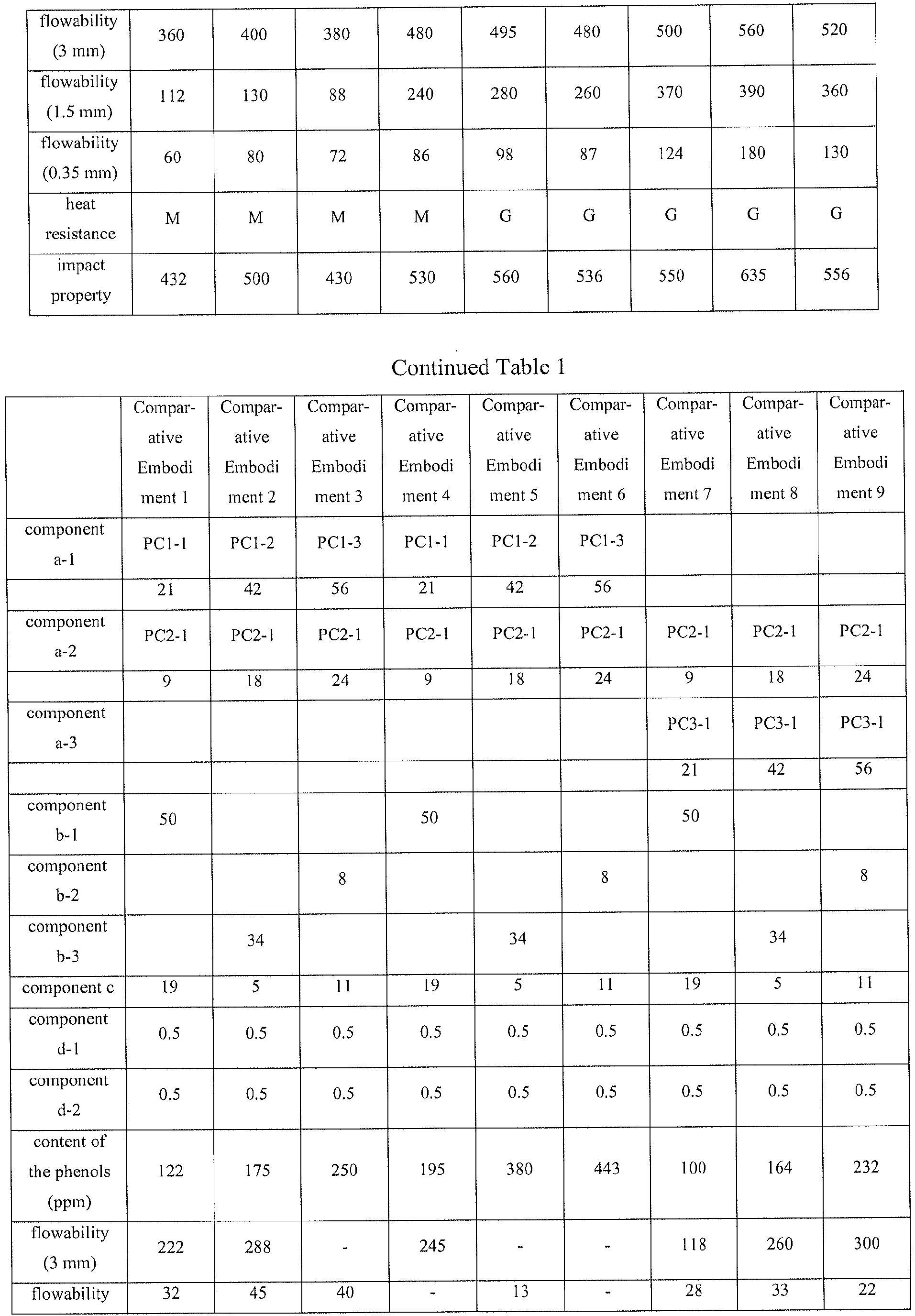

- Wherein: - represents the flowability can't be normally tested.
- It may be seen from a comparison of Embodiments with Comparative Embodiments in Table 1 that: according to the present invention, when the phenols which are added in a polycarbonate composition formula, based on a total weight of the polycarbonate composition does not exceed 100 ppm, and the K value of component I of the PC resin is adjusted between 300000 and 500000 and the K value of component II is adjusted to be less than 300000, the obtained polycarbonate composition has excellent heat resistance and flowability, particularly suitable for occasions with relatively high requirements for an operating environment.
a content of phenols based on a total weight of the polycarbonate composition is less than or equal to 100 ppm;
the PC resin consists of one or mixtures of a component I and/or a component II:
the content of the phenols based on the total weight of the polycarbonate composition is less than or equal to 100 ppm;
the PC resin consists of one or mixtures of the component I and/or the component II:
Claims (14)
- A polycarbonate composition, comprising the following components in parts by weight:a. 30 to 87 parts of a PC resin;b. 8 to 50 parts of a rubber-modified graft polymer;c. 5 to 25 parts of a fire retardant; andd. 0 to 10 parts of other aids;wherein a sum of parts by weight of the four components a, b, c, and d is 100.
- The polycarbonate composition according to claim 1, comprising the following components in parts by weight:a. 35 to 75 parts of the PC resin;b. 8 to 35 parts of the rubber-modified graft polymer;c. 5 to 20 parts of the fire retardant; andd. 0 to 10 parts of other aids;wherein a sum of parts by weight of the four components a, b, c, and d is 100,
a content of phenols based on a total weight of the polycarbonate composition is less than or equal to 100 ppm;
the PC resin consists of one or mixtures of a component I and/or a component II:component I: a PC resin with a K value of 300000-500000;component II: an aromatic PC resin with the K value less than 300000;wherein a structural formula of the phenols is shown as Formula (1):wherein, R1 and R5 represent a hydrogen group, an alkyl, an alkoxy, a hydroxyl, a carboxyl or a carbonyl, and an ester group, except for a hindered group; and R2, R3 and R4 represent a substituent containing hydrogen atoms, preferably the hydrogen atom.
- The polycarbonate composition according to claim 1, comprising the following components in parts by weight:a. 42 to 70 parts of the PC resin;b. 8 to 30 parts of the rubber-modified graft polymer;c. 5 to 18 parts of the fire retardant; andd. 0 to 10 parts of other aids;wherein a sum of parts by weight of the four components a, b, c, and d is 100,
a content of phenols based on a total weight of the polycarbonate composition is less than or equal to 100 ppm;
the PC resin consists of one or mixtures of a component I and/or a component II:component I: a PC resin with the K value of 300000-500000;component II: an aromatic PC resin with the K value less than 300000;wherein a structural formula of the phenols is shown as Formula (1):wherein, R1 and R5 represent a hydrogen group, an alkyl, an alkoxy, a hydroxyl, a carboxyl or a carbonyl, and an ester group, except for a hindered group; and R2, R3 and R4 represent a substituent containing hydrogen atoms, preferably the hydrogen atom.
- The polycarbonate composition according to claim 2 or 3, wherein in the PC resin, a percentage of the component I accounts for 50wt% to 70wt% of a total weight of the PC resin; and a percentage of the component II accounts for 30wt% to 50wt% of the total weight of the PC resin.
- The polycarbonate composition according to claim 2 or 3, wherein the content of the phenols based on the total weight of the polycarbonate composition is less than or equal to 80 ppm; preferably less than or equal to 50 ppm.
- The polycarbonate composition according to claim 2 or 3, wherein the component I is the PC resin with the K value of 320000-480000.
- The polycarbonate composition according to claim 2 or 3, wherein the aromatic resin of the component II is selected from an aromatic PC resin prepared by a phosgene method and/or a melting method.
- The polycarbonate composition according to anyone of claims 1 to 3, wherein the rubber-modified graft polymer is selected from one or more of a rubber-modified graft polymer prepared by a bulk polymerization method, a rubber-modified graft polymer prepared by an emulsion polymerization method, and a rubber-modified graft polymer prepared by a bulk-suspension polymerization method.
- The polycarbonate composition according to anyone of claims 1 to 3, wherein the rubber-modified graft polymer is selected from graft polymers containing the following b.1 on b.2 in parts by weight:b.1 5 to 95 parts of a mixture of b.1.1 and b.1.2:b.1.1 50 to 95 parts of one or more of styrene, styrene derivatives such as α-methyl styrene, p-benzyl styrene and divinyl styrene, C1-C8 alkyl methacrylate, C1-C8 alkyl acrylate, dimethyl siloxane, phenyl siloxane, and multi-alkyl siloxane;b.1.2 5 to 50 parts of one or more of acrylonitrile, methyl acrylonitrile, C1-C8 alkyl methacrylate, and C1-C8 alkyl acrylate;b.2 5 to 95 parts of one or more of polybutadiene, polyisoprene, a random copolymer and a block copolymer of styrene-butadiene, a random copolymer and a block copolymer of acrylonitrile-butadiene, a copolymer of polybutadiene and polyisoprene, a copolymer of ethylene and a-alkene, a copolymer of ethylene and a-unsaturated carboxylate, a terpolymer of ethylene-propene-nonconjugated diene, an acryloyl rubber, and an organic siloxane rubber.
- The polycarbonate composition according to claim 9, wherein the rubber-modified graft polymer is selected from one or more of a copolymer of acrylonitrile-styrene AS, a graft copolymer of acrylonitrile-butadiene-styrene ABS, a copolymer of methyl methacrylate-acrylonitrile-butadiene-styrene MABS, a terpolymer of acrylonitrile-styrene-acrylic acid ASA, and a graft copolymer of methyl methacrylate-butadiene-styrene MBS; Preferably the graft copolymer of acrylonitrile-butadiene-styrene ABS; wherein, a particle diameter of the MBS is preferably 0.1 µm to 0.5 µm, a particle diameter of the ABS in the bulk polymerization method is preferably 0.1 µm to 2 µm, and a particle diameter of the ABS in the emulsion polymerization method is preferably 0.05 µm to 0.2 µm.
- The polycarbonate composition according to anyone of claims 1 to 3, wherein the fire retardant is selected from a halogen-based fire retardant or a halogen-free fire retardant, preferably the halogen-free fire retardant; the halogen-based fire retardant is selected from one or more of a brominated polystyrene, a brominated polyphenyl ether, a brominated bisphenol A type epoxy resin, a brominated copolymer of styrene-maleic anhydride, a brominated epoxy resin, a brominated phenoxy resin, decabromodiphenyl oxide, decabromodiphenyl, a brominated polycarbonate, perbromotricyclopentadecane or a brominated aromatic cross-linked polymer, preferably the brominated polystyrene; the halogen-free fire retardant is selected from one or more of a nitrogen-containing fire retardant, a phosphorus-containing fire retardant or a nitrogen- and phosphorus-containing fire retardant, preferably the phosphorus-containing fire retardant.
- The polycarbonate composition according to claim 11, wherein the phosphorus-containing fire retardant is selected from one or more of triphenyl phosphate, tritolyl phosphate, tolyl diphenyl phosphate, trixylyl phosphate, tri(2,4,6-trimethyl phenyl) phosphate, tri(2,4-di-tert-butyl phenyl) phosphate, tri(2,6-di-tert-butyl phenyl) phosphate, resorcinol bis(diphenyl phosphate), hydroquinone bis(diphenyl phosphate), bisphenol A-bis(diphenyl phosphate), resorcinol bis(2,6-di-tert-butyl phenyl phosphate), and hydroquinone bis(2,6-dimethyl phenyl phosphate).
- The polycarbonate composition according to anyone of claims 1 to 3, wherein the other aids of the component d are selected from one or more of a stabilizer, a fire retardant synergist , an anti-dripping agent, a lubricant, a releasing agent, a plasticizer, a filler, and a colorant.
- A preparation method of the polycarbonate composition according to anyone of claims 1 to 13, characterized in that, it includes the following steps:1) formulating phenols and dimethyl siloxane into a phenols pretreated solution with a mass fraction of 0.20 ppm to 350 ppm;2) blending the phenols pretreated solution and a PC resin in a high-speed mixer to obtain a pretreated PC resin;3) After weighing the pretreated PC resin, a rubber-modified graft polymer, a fire retardant, and other aids in proportion, blending by the high-speed mixer or a mixer, extruding, cooling by means of water, and pelletizing to obtain a columnar particulate polycarbonate composition.
Applications Claiming Priority (2)
| Application Number | Priority Date | Filing Date | Title |
|---|---|---|---|
| CN201510277672.1A CN104877330B (en) | 2015-05-27 | 2015-05-27 | A kind of polycarbonate compositions and preparation method thereof |
| PCT/CN2016/083630 WO2016188476A2 (en) | 2015-05-27 | 2016-05-27 | Polycarbonate composition and preparation method therefor |
Publications (3)
| Publication Number | Publication Date |
|---|---|
| EP3305848A2 true EP3305848A2 (en) | 2018-04-11 |
| EP3305848A4 EP3305848A4 (en) | 2018-12-12 |
| EP3305848B1 EP3305848B1 (en) | 2020-09-16 |
Family
ID=53945024
Family Applications (1)
| Application Number | Title | Priority Date | Filing Date |
|---|---|---|---|
| EP16799363.3A Active EP3305848B1 (en) | 2015-05-27 | 2016-05-27 | Polycarbonate composition and preparation method therefor |
Country Status (4)
| Country | Link |
|---|---|
| US (1) | US10800915B2 (en) |
| EP (1) | EP3305848B1 (en) |
| CN (1) | CN104877330B (en) |
| WO (1) | WO2016188476A2 (en) |
Cited By (1)
| Publication number | Priority date | Publication date | Assignee | Title |
|---|---|---|---|---|
| EP3674367A1 (en) * | 2018-12-27 | 2020-07-01 | Lotte Advanced Materials Co., Ltd. | Thermoplastic resin composition and article produced therefrom |
Families Citing this family (7)
| Publication number | Priority date | Publication date | Assignee | Title |
|---|---|---|---|---|
| CN104877330B (en) | 2015-05-27 | 2016-08-24 | 金发科技股份有限公司 | A kind of polycarbonate compositions and preparation method thereof |
| CN104987691B (en) * | 2015-06-09 | 2016-11-02 | 金发科技股份有限公司 | A kind of polycarbonate compositions and preparation method thereof |
| CN110452517B (en) * | 2019-09-24 | 2021-08-27 | 江苏沃特新材料科技有限公司 | PC-ABS blending material and preparation method thereof |
| CN110643165A (en) * | 2019-10-16 | 2020-01-03 | 江苏沃特新材料科技有限公司 | High-performance ultraviolet-resistant environment-friendly flame-retardant PC/ABS composite material and preparation method thereof |
| CN110791073A (en) * | 2019-11-12 | 2020-02-14 | 江阴超润高分子材料有限公司 | Low-smoke halogen-free high-rigidity flame-retardant PC/ABS material and preparation method thereof |
| CN112646340A (en) * | 2020-09-27 | 2021-04-13 | 武汉顺威赛特工程塑料有限公司 | High-temperature oil-resistant flame-retardant bio-based polycarbonate material and preparation method thereof |
| CN115572472B (en) * | 2022-11-02 | 2024-02-06 | 上海金山锦湖日丽塑料有限公司 | High-magnification-resistant spray-free polycarbonate material for sun cream and preparation method thereof |
Family Cites Families (7)
| Publication number | Priority date | Publication date | Assignee | Title |
|---|---|---|---|---|
| JPH1135816A (en) * | 1997-07-23 | 1999-02-09 | Techno Polymer Kk | Flame-retardant thermoplastic resin composition |
| TW444041B (en) * | 1998-02-13 | 2001-07-01 | Gen Electric | Flame retardant carbonate polymer composition with improved hydrolytic stability |
| WO2000042106A1 (en) * | 1999-01-11 | 2000-07-20 | Idemitsu Petrochemical Co., Ltd. | Flame-retardant polycarbonate resin composition and molded product |
| TW548293B (en) * | 2000-11-14 | 2003-08-21 | Teijin Ltd | Aromatic polycarbonate, production method therefor and composition comprising the same |
| CN101993586B (en) * | 2010-11-30 | 2012-10-10 | 金发科技股份有限公司 | Flame-resistant polycarbonate/ABS (Acrylonitrile Butadiene Styrene) material |
| CN102516734B (en) * | 2011-12-09 | 2014-09-17 | 上海锦湖日丽塑料有限公司 | PC/ABS halogen-free flame-retardant alloy with high surface impact strength and preparation method thereof |
| CN104877330B (en) | 2015-05-27 | 2016-08-24 | 金发科技股份有限公司 | A kind of polycarbonate compositions and preparation method thereof |
-
2015
- 2015-05-27 CN CN201510277672.1A patent/CN104877330B/en active Active
-
2016
- 2016-05-27 EP EP16799363.3A patent/EP3305848B1/en active Active
- 2016-05-27 US US15/576,852 patent/US10800915B2/en active Active
- 2016-05-27 WO PCT/CN2016/083630 patent/WO2016188476A2/en not_active Ceased
Cited By (2)
| Publication number | Priority date | Publication date | Assignee | Title |
|---|---|---|---|---|
| EP3674367A1 (en) * | 2018-12-27 | 2020-07-01 | Lotte Advanced Materials Co., Ltd. | Thermoplastic resin composition and article produced therefrom |
| US11136457B2 (en) | 2018-12-27 | 2021-10-05 | Lotte Advanced Materials Co., Ltd. | Thermoplastic resin composition and article produced therefrom |
Also Published As
| Publication number | Publication date |
|---|---|
| CN104877330A (en) | 2015-09-02 |
| WO2016188476A2 (en) | 2016-12-01 |
| US10800915B2 (en) | 2020-10-13 |
| WO2016188476A3 (en) | 2017-02-09 |
| EP3305848A4 (en) | 2018-12-12 |
| CN104877330B (en) | 2016-08-24 |
| US20180163046A1 (en) | 2018-06-14 |
| EP3305848B1 (en) | 2020-09-16 |
Similar Documents
| Publication | Publication Date | Title |
|---|---|---|
| EP3305848B1 (en) | Polycarbonate composition and preparation method therefor | |
| EP3309217B1 (en) | Polycarbonate composition and preparation method therefor | |
| US7608654B2 (en) | Halogen-free flame retardant polycarbonate compositions | |
| CN105440624B (en) | A kind of polycarbonate composition and preparation method thereof | |
| EP3321324B1 (en) | Polycarbonate composition and preparation method therefor | |
| CN105315641B (en) | A kind of polycarbonate compositions and preparation method thereof | |
| WO2016188475A1 (en) | Polycarbonate composition and preparation method therefor | |
| EP3305849B1 (en) | Polycarbonate composition and preparation method therefor | |
| EP3312239B1 (en) | Polycarbonate composition and preparation method thereof | |
| WO2018095191A1 (en) | Polycarbonate composition and method for preparing same | |
| WO2018099218A1 (en) | Polycarbonate composition and preparation method therefor | |
| CN107793722A (en) | A kind of polycarbonate compositions and preparation method thereof | |
| WO2024082522A1 (en) | Flame-retardant polycarbonate composite material, preparation method therefor, and application thereof | |
| CN106589881B (en) | A kind of polycarbonate composition and preparation method thereof | |
| CN105038174B (en) | A kind of polycarbonate compositions and preparation method thereof | |
| CN105315642B (en) | A kind of polycarbonate compositions and preparation method thereof | |
| JP6990571B2 (en) | Resin composition, manufacturing method of resin composition, and molded product | |
| JPH07116340B2 (en) | Flame-retardant resin composition for injection molding | |
| KR100556619B1 (en) | Styrene-based thermoplastic composition suitable for gas injection molding materials | |
| CN107793721A (en) | A kind of polycarbonate compositions and preparation method thereof | |
| CN107793725A (en) | A kind of polycarbonate compositions and preparation method thereof |
Legal Events
| Date | Code | Title | Description |
|---|---|---|---|
| STAA | Information on the status of an ep patent application or granted ep patent |
Free format text: STATUS: THE INTERNATIONAL PUBLICATION HAS BEEN MADE |
|
| PUAI | Public reference made under article 153(3) epc to a published international application that has entered the european phase |
Free format text: ORIGINAL CODE: 0009012 |
|
| STAA | Information on the status of an ep patent application or granted ep patent |
Free format text: STATUS: REQUEST FOR EXAMINATION WAS MADE |
|
| 17P | Request for examination filed |
Effective date: 20171129 |
|
| AK | Designated contracting states |
Kind code of ref document: A2 Designated state(s): AL AT BE BG CH CY CZ DE DK EE ES FI FR GB GR HR HU IE IS IT LI LT LU LV MC MK MT NL NO PL PT RO RS SE SI SK SM TR |
|
| AX | Request for extension of the european patent |
Extension state: BA ME |
|
| DAV | Request for validation of the european patent (deleted) | ||
| DAX | Request for extension of the european patent (deleted) | ||
| A4 | Supplementary search report drawn up and despatched |
Effective date: 20181114 |
|
| RIC1 | Information provided on ipc code assigned before grant |
Ipc: C08L 55/02 20060101ALI20181108BHEP Ipc: C08L 51/04 20060101ALI20181108BHEP Ipc: C08L 69/00 20060101AFI20181108BHEP Ipc: C08K 5/521 20060101ALI20181108BHEP Ipc: C08K 5/13 20060101ALI20181108BHEP |
|
| STAA | Information on the status of an ep patent application or granted ep patent |
Free format text: STATUS: EXAMINATION IS IN PROGRESS |
|
| 17Q | First examination report despatched |
Effective date: 20191111 |
|
| GRAP | Despatch of communication of intention to grant a patent |
Free format text: ORIGINAL CODE: EPIDOSNIGR1 |
|
| STAA | Information on the status of an ep patent application or granted ep patent |
Free format text: STATUS: GRANT OF PATENT IS INTENDED |
|
| INTG | Intention to grant announced |
Effective date: 20200624 |
|
| GRAS | Grant fee paid |
Free format text: ORIGINAL CODE: EPIDOSNIGR3 |
|
| GRAA | (expected) grant |
Free format text: ORIGINAL CODE: 0009210 |
|
| STAA | Information on the status of an ep patent application or granted ep patent |
Free format text: STATUS: THE PATENT HAS BEEN GRANTED |
|
| AK | Designated contracting states |
Kind code of ref document: B1 Designated state(s): AL AT BE BG CH CY CZ DE DK EE ES FI FR GB GR HR HU IE IS IT LI LT LU LV MC MK MT NL NO PL PT RO RS SE SI SK SM TR |
|
| REG | Reference to a national code |
Ref country code: GB Ref legal event code: FG4D |
|
| REG | Reference to a national code |
Ref country code: CH Ref legal event code: EP |
|
| REG | Reference to a national code |
Ref country code: DE Ref legal event code: R096 Ref document number: 602016044200 Country of ref document: DE |
|
| REG | Reference to a national code |
Ref country code: IE Ref legal event code: FG4D |
|
| REG | Reference to a national code |
Ref country code: AT Ref legal event code: REF Ref document number: 1314150 Country of ref document: AT Kind code of ref document: T Effective date: 20201015 |
|
| REG | Reference to a national code |
Ref country code: NL Ref legal event code: FP |
|
| PG25 | Lapsed in a contracting state [announced via postgrant information from national office to epo] |
Ref country code: GR Free format text: LAPSE BECAUSE OF FAILURE TO SUBMIT A TRANSLATION OF THE DESCRIPTION OR TO PAY THE FEE WITHIN THE PRESCRIBED TIME-LIMIT Effective date: 20201217 Ref country code: NO Free format text: LAPSE BECAUSE OF FAILURE TO SUBMIT A TRANSLATION OF THE DESCRIPTION OR TO PAY THE FEE WITHIN THE PRESCRIBED TIME-LIMIT Effective date: 20201216 Ref country code: BG Free format text: LAPSE BECAUSE OF FAILURE TO SUBMIT A TRANSLATION OF THE DESCRIPTION OR TO PAY THE FEE WITHIN THE PRESCRIBED TIME-LIMIT Effective date: 20201216 Ref country code: FI Free format text: LAPSE BECAUSE OF FAILURE TO SUBMIT A TRANSLATION OF THE DESCRIPTION OR TO PAY THE FEE WITHIN THE PRESCRIBED TIME-LIMIT Effective date: 20200916 Ref country code: HR Free format text: LAPSE BECAUSE OF FAILURE TO SUBMIT A TRANSLATION OF THE DESCRIPTION OR TO PAY THE FEE WITHIN THE PRESCRIBED TIME-LIMIT Effective date: 20200916 Ref country code: SE Free format text: LAPSE BECAUSE OF FAILURE TO SUBMIT A TRANSLATION OF THE DESCRIPTION OR TO PAY THE FEE WITHIN THE PRESCRIBED TIME-LIMIT Effective date: 20200916 |
|
| REG | Reference to a national code |
Ref country code: AT Ref legal event code: MK05 Ref document number: 1314150 Country of ref document: AT Kind code of ref document: T Effective date: 20200916 |
|
| PG25 | Lapsed in a contracting state [announced via postgrant information from national office to epo] |
Ref country code: LV Free format text: LAPSE BECAUSE OF FAILURE TO SUBMIT A TRANSLATION OF THE DESCRIPTION OR TO PAY THE FEE WITHIN THE PRESCRIBED TIME-LIMIT Effective date: 20200916 Ref country code: RS Free format text: LAPSE BECAUSE OF FAILURE TO SUBMIT A TRANSLATION OF THE DESCRIPTION OR TO PAY THE FEE WITHIN THE PRESCRIBED TIME-LIMIT Effective date: 20200916 |
|
| REG | Reference to a national code |
Ref country code: LT Ref legal event code: MG4D |
|
| PG25 | Lapsed in a contracting state [announced via postgrant information from national office to epo] |
Ref country code: EE Free format text: LAPSE BECAUSE OF FAILURE TO SUBMIT A TRANSLATION OF THE DESCRIPTION OR TO PAY THE FEE WITHIN THE PRESCRIBED TIME-LIMIT Effective date: 20200916 Ref country code: SM Free format text: LAPSE BECAUSE OF FAILURE TO SUBMIT A TRANSLATION OF THE DESCRIPTION OR TO PAY THE FEE WITHIN THE PRESCRIBED TIME-LIMIT Effective date: 20200916 Ref country code: PT Free format text: LAPSE BECAUSE OF FAILURE TO SUBMIT A TRANSLATION OF THE DESCRIPTION OR TO PAY THE FEE WITHIN THE PRESCRIBED TIME-LIMIT Effective date: 20210118 Ref country code: RO Free format text: LAPSE BECAUSE OF FAILURE TO SUBMIT A TRANSLATION OF THE DESCRIPTION OR TO PAY THE FEE WITHIN THE PRESCRIBED TIME-LIMIT Effective date: 20200916 Ref country code: CZ Free format text: LAPSE BECAUSE OF FAILURE TO SUBMIT A TRANSLATION OF THE DESCRIPTION OR TO PAY THE FEE WITHIN THE PRESCRIBED TIME-LIMIT Effective date: 20200916 Ref country code: LT Free format text: LAPSE BECAUSE OF FAILURE TO SUBMIT A TRANSLATION OF THE DESCRIPTION OR TO PAY THE FEE WITHIN THE PRESCRIBED TIME-LIMIT Effective date: 20200916 |
|
| PG25 | Lapsed in a contracting state [announced via postgrant information from national office to epo] |
Ref country code: AL Free format text: LAPSE BECAUSE OF FAILURE TO SUBMIT A TRANSLATION OF THE DESCRIPTION OR TO PAY THE FEE WITHIN THE PRESCRIBED TIME-LIMIT Effective date: 20200916 Ref country code: AT Free format text: LAPSE BECAUSE OF FAILURE TO SUBMIT A TRANSLATION OF THE DESCRIPTION OR TO PAY THE FEE WITHIN THE PRESCRIBED TIME-LIMIT Effective date: 20200916 Ref country code: ES Free format text: LAPSE BECAUSE OF FAILURE TO SUBMIT A TRANSLATION OF THE DESCRIPTION OR TO PAY THE FEE WITHIN THE PRESCRIBED TIME-LIMIT Effective date: 20200916 Ref country code: PL Free format text: LAPSE BECAUSE OF FAILURE TO SUBMIT A TRANSLATION OF THE DESCRIPTION OR TO PAY THE FEE WITHIN THE PRESCRIBED TIME-LIMIT Effective date: 20200916 Ref country code: IS Free format text: LAPSE BECAUSE OF FAILURE TO SUBMIT A TRANSLATION OF THE DESCRIPTION OR TO PAY THE FEE WITHIN THE PRESCRIBED TIME-LIMIT Effective date: 20210116 |
|
| REG | Reference to a national code |
Ref country code: DE Ref legal event code: R097 Ref document number: 602016044200 Country of ref document: DE |
|
| PG25 | Lapsed in a contracting state [announced via postgrant information from national office to epo] |
Ref country code: SK Free format text: LAPSE BECAUSE OF FAILURE TO SUBMIT A TRANSLATION OF THE DESCRIPTION OR TO PAY THE FEE WITHIN THE PRESCRIBED TIME-LIMIT Effective date: 20200916 |
|
| PLBE | No opposition filed within time limit |
Free format text: ORIGINAL CODE: 0009261 |
|
| STAA | Information on the status of an ep patent application or granted ep patent |
Free format text: STATUS: NO OPPOSITION FILED WITHIN TIME LIMIT |
|
| 26N | No opposition filed |
Effective date: 20210617 |
|
| PG25 | Lapsed in a contracting state [announced via postgrant information from national office to epo] |
Ref country code: SI Free format text: LAPSE BECAUSE OF FAILURE TO SUBMIT A TRANSLATION OF THE DESCRIPTION OR TO PAY THE FEE WITHIN THE PRESCRIBED TIME-LIMIT Effective date: 20200916 Ref country code: DK Free format text: LAPSE BECAUSE OF FAILURE TO SUBMIT A TRANSLATION OF THE DESCRIPTION OR TO PAY THE FEE WITHIN THE PRESCRIBED TIME-LIMIT Effective date: 20200916 |
|
| PG25 | Lapsed in a contracting state [announced via postgrant information from national office to epo] |
Ref country code: IT Free format text: LAPSE BECAUSE OF FAILURE TO SUBMIT A TRANSLATION OF THE DESCRIPTION OR TO PAY THE FEE WITHIN THE PRESCRIBED TIME-LIMIT Effective date: 20200916 |
|
| REG | Reference to a national code |
Ref country code: CH Ref legal event code: PL |
|
| PG25 | Lapsed in a contracting state [announced via postgrant information from national office to epo] |
Ref country code: MC Free format text: LAPSE BECAUSE OF FAILURE TO SUBMIT A TRANSLATION OF THE DESCRIPTION OR TO PAY THE FEE WITHIN THE PRESCRIBED TIME-LIMIT Effective date: 20200916 Ref country code: LI Free format text: LAPSE BECAUSE OF NON-PAYMENT OF DUE FEES Effective date: 20210531 Ref country code: CH Free format text: LAPSE BECAUSE OF NON-PAYMENT OF DUE FEES Effective date: 20210531 |
|
| REG | Reference to a national code |
Ref country code: BE Ref legal event code: MM Effective date: 20210531 |
|
| PG25 | Lapsed in a contracting state [announced via postgrant information from national office to epo] |
Ref country code: IE Free format text: LAPSE BECAUSE OF NON-PAYMENT OF DUE FEES Effective date: 20210527 |
|
| PG25 | Lapsed in a contracting state [announced via postgrant information from national office to epo] |
Ref country code: BE Free format text: LAPSE BECAUSE OF NON-PAYMENT OF DUE FEES Effective date: 20210531 |
|
| PG25 | Lapsed in a contracting state [announced via postgrant information from national office to epo] |
Ref country code: CY Free format text: LAPSE BECAUSE OF FAILURE TO SUBMIT A TRANSLATION OF THE DESCRIPTION OR TO PAY THE FEE WITHIN THE PRESCRIBED TIME-LIMIT Effective date: 20200916 |
|
| P01 | Opt-out of the competence of the unified patent court (upc) registered |
Effective date: 20230529 |
|
| PG25 | Lapsed in a contracting state [announced via postgrant information from national office to epo] |
Ref country code: HU Free format text: LAPSE BECAUSE OF FAILURE TO SUBMIT A TRANSLATION OF THE DESCRIPTION OR TO PAY THE FEE WITHIN THE PRESCRIBED TIME-LIMIT; INVALID AB INITIO Effective date: 20160527 |
|
| PG25 | Lapsed in a contracting state [announced via postgrant information from national office to epo] |
Ref country code: MK Free format text: LAPSE BECAUSE OF FAILURE TO SUBMIT A TRANSLATION OF THE DESCRIPTION OR TO PAY THE FEE WITHIN THE PRESCRIBED TIME-LIMIT Effective date: 20200916 |
|
| PG25 | Lapsed in a contracting state [announced via postgrant information from national office to epo] |
Ref country code: MT Free format text: LAPSE BECAUSE OF FAILURE TO SUBMIT A TRANSLATION OF THE DESCRIPTION OR TO PAY THE FEE WITHIN THE PRESCRIBED TIME-LIMIT Effective date: 20200916 |
|
| PGFP | Annual fee paid to national office [announced via postgrant information from national office to epo] |
Ref country code: NL Payment date: 20250522 Year of fee payment: 10 |
|
| PGFP | Annual fee paid to national office [announced via postgrant information from national office to epo] |
Ref country code: DE Payment date: 20250519 Year of fee payment: 10 |
|
| PGFP | Annual fee paid to national office [announced via postgrant information from national office to epo] |
Ref country code: GB Payment date: 20250527 Year of fee payment: 10 |
|
| PGFP | Annual fee paid to national office [announced via postgrant information from national office to epo] |
Ref country code: LU Payment date: 20250520 Year of fee payment: 10 |
|
| PGFP | Annual fee paid to national office [announced via postgrant information from national office to epo] |
Ref country code: FR Payment date: 20250526 Year of fee payment: 10 |
|
| PG25 | Lapsed in a contracting state [announced via postgrant information from national office to epo] |
Ref country code: TR Free format text: LAPSE BECAUSE OF FAILURE TO SUBMIT A TRANSLATION OF THE DESCRIPTION OR TO PAY THE FEE WITHIN THE PRESCRIBED TIME-LIMIT Effective date: 20200916 |