EP3305797A1 - Antagonists of nk1 receptors derived from carbohydrates, production method and medical use - Google Patents
Antagonists of nk1 receptors derived from carbohydrates, production method and medical use Download PDFInfo
- Publication number
- EP3305797A1 EP3305797A1 EP16799401.1A EP16799401A EP3305797A1 EP 3305797 A1 EP3305797 A1 EP 3305797A1 EP 16799401 A EP16799401 A EP 16799401A EP 3305797 A1 EP3305797 A1 EP 3305797A1
- Authority
- EP
- European Patent Office
- Prior art keywords
- group
- formula
- compound
- cyclic chain
- alkyl group
- Prior art date
- Legal status (The legal status is an assumption and is not a legal conclusion. Google has not performed a legal analysis and makes no representation as to the accuracy of the status listed.)
- Withdrawn
Links
- 0 CC(C(C1)=CC(C2*C2)=CC1C(F)(F)F)O[C@](C([C@](*1)O)OCC(CC2)=CCC2F)OC1(C1)[C@]1O Chemical compound CC(C(C1)=CC(C2*C2)=CC1C(F)(F)F)O[C@](C([C@](*1)O)OCC(CC2)=CCC2F)OC1(C1)[C@]1O 0.000 description 6
- WSVNYAKEMZAVNJ-UHFFFAOYSA-N CC(C1=C2C3=C1C3C(CO)=CC2)=C Chemical compound CC(C1=C2C3=C1C3C(CO)=CC2)=C WSVNYAKEMZAVNJ-UHFFFAOYSA-N 0.000 description 1
- JVVGPIRSSNSUNF-ZMZCQUNRSA-N C[C@H](c1cc(C(F)(F)F)cc(C(F)(F)F)c1)O[C@@H](C([C@H]1O)OCC(C=C2)=CCC2F)OCC1O Chemical compound C[C@H](c1cc(C(F)(F)F)cc(C(F)(F)F)c1)O[C@@H](C([C@H]1O)OCC(C=C2)=CCC2F)OCC1O JVVGPIRSSNSUNF-ZMZCQUNRSA-N 0.000 description 1
- ZTUNFLBIIFQDKG-UERQWHOISA-N C[C@H](c1cc(C(F)(F)F)cc(C(F)(F)F)c1)O[C@@H]([C@@H]([C@H]1O)OCc(cc2)ccc2F)OC[C@@H]1O Chemical compound C[C@H](c1cc(C(F)(F)F)cc(C(F)(F)F)c1)O[C@@H]([C@@H]([C@H]1O)OCc(cc2)ccc2F)OC[C@@H]1O ZTUNFLBIIFQDKG-UERQWHOISA-N 0.000 description 1
Images

Classifications
-
- C—CHEMISTRY; METALLURGY
- C07—ORGANIC CHEMISTRY
- C07H—SUGARS; DERIVATIVES THEREOF; NUCLEOSIDES; NUCLEOTIDES; NUCLEIC ACIDS
- C07H15/00—Compounds containing hydrocarbon or substituted hydrocarbon radicals directly attached to hetero atoms of saccharide radicals
- C07H15/18—Acyclic radicals, substituted by carbocyclic rings
-
- A—HUMAN NECESSITIES
- A61—MEDICAL OR VETERINARY SCIENCE; HYGIENE
- A61P—SPECIFIC THERAPEUTIC ACTIVITY OF CHEMICAL COMPOUNDS OR MEDICINAL PREPARATIONS
- A61P35/00—Antineoplastic agents
Definitions
- a first aspect of the invention relates to a compound of general formula I , or any of its stereoisomers, or a pharmaceutically acceptable salt thereof, where:
- alkyl groups as they are used in the invention are, but not limited to, n -propyl, isopropyl, n -butyl, sec- butyl, n -pentyl, vinyl, ethynyl, 1- or 2-propenyl, 1- or 2-propynyl, cyclopropyl, cyclohexyl, 4-piperidinyl and also including other preferred groups such as methyl, ethyl, or tert -butyl.
- the alkyl groups can be optionally substituted for one or more substitutes such as, but not limited to, COOH, SO 4 H or PO 4 H 2 .
- step e The transformation of compound XI into the compound of formula I (step e) can be carried out by a process with several steps comprising a glycosidation reaction, preferably but not limited to, through the trichloroacetimidate method, and several protection and deprotection processes on the groups in positions 3, 4, 5 and 6 of the tetrahydropyranyl ring.
- Beta anomer ( R )- ⁇ 1-[3,5-bis-(trifluoromethyl)phenyl]ethyl ⁇ 2- O - p -fluorobenzyl-3,4- O- isopropylidene- ⁇ - D -galactopyranose, 28
- EXAMPLE 6 Antagonistic activity of the NK1 receptors of the synthesised carbohydrate derivatives.
- derivative 2 showed the greatest antagonist activity.
- the inhibition percentages were obtained at a ligand concentration of 10 -6 M ( FIG. 4 ):
- the CHO cells were cultured on a Dulbecco's modified Eagle's medium with a 10% FBS supplement, penicillin/streptomycin, 100U/ml and L-glutamine 2 mM at 37°C in a humid atmosphere of 95% air and 5% CO 2 .
- Non-essential amino acids were also added to the medium (Invitrogen).
Landscapes
- Chemical & Material Sciences (AREA)
- Organic Chemistry (AREA)
- Health & Medical Sciences (AREA)
- General Health & Medical Sciences (AREA)
- Life Sciences & Earth Sciences (AREA)
- Molecular Biology (AREA)
- Medicinal Chemistry (AREA)
- Genetics & Genomics (AREA)
- Biochemistry (AREA)
- Engineering & Computer Science (AREA)
- Chemical Kinetics & Catalysis (AREA)
- General Chemical & Material Sciences (AREA)
- Biotechnology (AREA)
- Nuclear Medicine, Radiotherapy & Molecular Imaging (AREA)
- Pharmacology & Pharmacy (AREA)
- Animal Behavior & Ethology (AREA)
- Public Health (AREA)
- Veterinary Medicine (AREA)
- Pharmaceuticals Containing Other Organic And Inorganic Compounds (AREA)
Abstract

Description
- This invention is primarily directed at the pharmaceutical sector with applications for the prevention and/or treatment of diseases and any type of condition or damage involving substance P (SP), or which, although not it is yet involved, proceeds via the NK1, NK2 and NK3 receptor.
- SP (
FIG. 1 ), neurokinin A (NKA) and neurokinin B (NKB) are mammal tachykinins that act as both neurotransmitters and neuromodulators [Nakanishi, S. Annu Rev Neurosci. 1991, 14, 123]. These peptides exercise their biological effects on the central nervous system (CNS) by binding to their receptors bound to G, NK1, NK2 and NK3 proteins [Quatara, L.; Maggi, C. A. Neuropeptides, 1998, 32, 1]. - In particular, the NK1 receptor (NK1R), the cognate receptor of SP and the most abundant of the tachykinins in the mammalian CNS, is present in areas of the brain involved in the regulation of affective behaviour and the mediation of anxiety, stress and depression [Leroy, V.; Mauser, P.; Gao, Z.; Peet, N. P. Neurokinin Receptor Antagonists. Expert Opin. Invest. Drugs 2000, 9, 735-746].
- The observation that SP release is associated with various psychopathological processes means that the NK1 receptor is currently a highly relevant therapeutic target [(a) Bremer, A.A. and Leeman, S.E. (January 2010) Substance P. In: Encyclopedia of Life Sciences (ELS). John Wiley & Sons, Ltd: Chichester. DOI: 10.1002/9780470015902.a0000206.pub2 (b) Rupniak, N.M.J.; Kramer, M. S. Substance P and related tachykininis. Neuropsychopharmacology. The Fifth Generation of Progress. 2002. Lippincott, Williams, & Wilkins (Ed. Davis, K.L.; Charney, D.; Coyle, J.T.; Nemeroff, C.)].
- Consequently, NK1 receptor antagonists are currently being considered as potential therapeutic agents for a large number of pathologies such as migraine, [Moskowitz, M. A. Trends Pharmacol. Sci. 1992, 13, 307-311] rheumatoid arthritis, [Lotz, M.; Carson, D. A.; Vaughan, J. H. Science 1987, 235, 893-895] astha, inflammatory bowel disease, emesis, [Dando, T: M.; Perry, C. M. DRUGS, 2004, 64, 777-794], el cancer [Folkers, K.; Feng, D. M.; Asano, N.; Hakanson, R.; Wiesenfeld-Hallin, Z.; Leander, S. Spantide II, Proc. Natl. Acad. Sci. USA 1990, 87, 4833-4835], as well as central nervous system disorders such as anxiety, Parkinson's disease and depression [Quartara, L.; Altamura, M. Curr. Drug Targets 2006, 7, 975-992].
- Recent data indicating that NK1 receptor antagonists exert significant anticancer activity are of particular interest [(a) Muñoz, M.; Rosso, M.; Pérez, A.; Coveñas, R.; Rosso, R.; Zamarriego, C; Piruat, J.I. Neuropeptides, 2005, 39, 427. (b) Muñoz, M.; Pérez, A.; Rosso, M.; Zamarriego, C.; Rosso, R. Melanoma Res. 2004, 14, 183. (c) Esteban, F.; Muñoz, M.; Gonzalez-Moles, M.A.; Rosso, M. Cancer Metastasis Rev. 2006, 25, 137]. In this regard, the anticancer activity of the NK1 receptor antagonists turns out to be very broad spectrum, allowing the treatment of human melanoma, neuroblastoma, human Hodgkin's lymphoma, lymphoblastic leukemia, human rhabdomyosarcoma, human Burkitt's lymphoma, human lung carcinoma, human Edwing's sarcoma, human glioma, human osteosarcoma, malignant human gangliomas, human invasive malignant melanoma, human metastatic melanoma cells and human breast cancer among others [Muñoz, M. Use of non-peptide NK1 receptor antagonists for the production of apoptosis in tumour cells. Patent application number:
PCT/ES2005/000068 - The first designs of NK1 receptor antagonists based on the structure of SP have given rise to compounds with a peptide structure with low affinities and poor metabolic stabilities [(a) Enberg, G.; Svensson, T. H.; Rosell, S.; Folkers, K. Nature 1981, 293, 222. (b) Folkers, K., Hakanson, R.; Horig, J.; Jie-Cheng, X.; Leander, S.. Br. J. Pharmacol. 1984, 83, 449. (c) Folkers, K.; Feng, D. M.; Asano, N.; Hakanson, R.; Wiesenfeld-Hallin, Z.; Leander, S. Spantide II. Proc. Natl. Acad. Sci. USA 1990, 87, 4833]. The discovery at the start of the 90s in the last century of the first non-peptide antagonist of the NK1 receptors, CP-96345 [Snider, R. M.; Constantine, J. W.; John A. Lowe, J. A.; Kelly P. Longo, K. P.; Lebel, W. S.; Woody, H. A.; Drozda, S. E.; Desai, M. C.; Vinick, F. J. Robin W. Spencer, R. W.; Hess. H.-J. Science 1991, 251, 435] has driven research in this area, not only in the academic field, but also at the industrial level, with nearly all the major pharmaceutical companies working in this field with the aim of identifying selective and potent NK1 R antagonists [(a) Giardina, G. A.; Gagliardi, S.; Martinelli, M. IDrugs, 2003, 6, 758. (b) Huang, S.-C.; Korlipara, V. L. Exp. Pat. Opin. Ther. Pat. 2010, 20, 1019-1045]. More than two decades of extensive synthetic and economic effort has yielded the discovery of a considerable number of structurally diverse NK1 receptor antagonists, although none of them with the desired therapeutic success.
- Currently, there is only one NK1 receptor antagonist on the market, Aprepitant (Merck), prescribed for the prevention of chemotherapy-induced nausea and vomiting, [Sankhala, K.K.; Pandya, D.M.; Sarantopoulos, J.; Soefje, S.A.; Giles, F.J.; Chawla, S.P. Exp. Opin. Drug Metbol. Toxicol. 2009, 5, 1607]. The main reason for this is that the exact structure of the NK1 receptor, which belongs to the structurally complex superfamily of G-protein-coupled receptors, [(a) Kobilka, B. Angew. Chem. Int. Ed. 2013, 52, 6380. (b) Lefkowitz, R. J. Angew. Chem. Int. Ed. 2013, 52, 6367] is still unknown. Therefore, the design and synthesis of new non-peptide molecules with a high affinity for the NK1 receptor, and preferably with a chemical structure different from known NK1 receptor antagonists, is an important area in modern medical chemistry.
- A first aspect of the invention relates to a compound of general formula I,

- Ra is selected from H and CH2OR1, and wherein R1 is selected from
- hydrogen,
- a C1-C20 alkyl group,
- a C6-C20 aryl group,
- a COR1a group, where R1a is independently selected from methyl, tert-butyl, and phenyl,
- a group which together with R2 forms a cyclic chain and
- a SiR'R"R''' group, where R', R" and R''' are independently selected from methyl, ethyl, tert-butyl, and phenyl;
- Rb is independently selected from a C1-C20 alkyl group, a C6-C20 aryl group, OH and a group of formula II, where Z is selected from O and S, and the carbon adjacent to Z is chiral and can have the R or S configuration, preferably the R;

- X is selected from OR3, NR4R5 and a 3 to 15 members heterocyclic chain, wherein:
- R3 is selected from H, a C1-C20 alkyl group, a C6-C20 aryl group, an acyl group, a alkylsulfonyl group, an arylsulfonyl group, a group of formula III, a group of formula IV, a group of formula V wherein R'''' is a C1-C20 alkyl group or a C6-C20 aryl group, and a group that forms a cyclic chain with R2;
- R4 is selected from H, a C1-C20 alkyl group and a C6-C20 aryl group;
- R5 is selected from H, a group of formula III, a group of formula IV and a group of formula V wherein R'''' is a C1-C20 alkyl group or a C6-C20 aryl group;

- Y is selected from O, S and NH; and
- R2 is H, or forms a cyclic chain with 5 or 6 members along with R1 or R3, in such a way that in said cyclic chain the O adjacent to R2 is separated from the O adjacent to R1 or R3 by at least one C atom consisting of -C(R6)(R7)-, and wherein R6 and R7 are independently selected from H, a C1-C20 alkyl group and a C6-C20 aryl group.
- The term "alkyl" or "alkyl group", as used in the present invention, refers to aliphatic carbon chains that are linear or branched, saturated or unsaturated, cyclic or heterocyclic and which can have 1 to 50 carbon atoms, preferably these chains have between 1 and 20 carbon atoms, more preferably between 1 and 15, or between 1 and 8, or between 1 and 6, or between 1 and 4 carbon atoms. Examples of alkyl groups as they are used in the invention are, but not limited to, n-propyl, isopropyl, n-butyl, sec-butyl, n-pentyl, vinyl, ethynyl, 1- or 2-propenyl, 1- or 2-propynyl, cyclopropyl, cyclohexyl, 4-piperidinyl and also including other preferred groups such as methyl, ethyl, or tert-butyl. The alkyl groups can be optionally substituted for one or more substitutes such as, but not limited to, COOH, SO4H or PO4H2.
- The term "linear chain" refers in this invention to a chain formed by between 1 and 20 carbon atoms joined together through covalent C-C bonds, its structure being supplemented with hydrogen bonds.
- The term "branched-chain" refers in this invention to a carbon chain, in which there is at least 1 additional carbon atom bound to one of the atoms constituting this chain.
- The term "saturated chain" refers in this invention to a carbon chain in which there are no double or triple bonds.
- The term "unsaturated chain" refers in this invention to carbon chains in which there are at least one double or triple C-C bond.
- The term "cyclic chain" refers in this invention to a chain formed by between 3 and 8 carbon atoms with a ring structure, that can be considered the result of eliminating a hydrogen from the terminal carbon in a linear chain and joining it to the first carbon in the chain.
- The term "heterocyclic chain" refers in this invention to a monocyclic, bicyclic or tricyclic chain with 3 to 15 members, comprising of carbon atoms and at least one heteroatom selected from the group consisting of nitrogen, oxygen and sulphur and that is unsaturated, saturated or partially saturated. Preferably, the heterocyclic chain has between 4 and 8 members with one or more heteroatoms, more preferably between 5 and 6 members with one or more heteroatoms and even more preferably from 1 to 3 heteroatoms. For the purpose of this invention the heterocyclic can be a monocyclic, bicyclic or tricyclic system that may include fused rings. The nitrogen, carbon and sulfur atoms in the heterocyclic radical can optionally be oxidised; the nitrogen atoms can optionally be quaternised and the heterocyclic radical can be partially or fully saturated or it can be aromatic. Examples of heterocyclics can be, although not limited to: tetrahydrofuran, dioxane, piperidine and 1,2,3-triazole.
- The term "aryl", as used in the present invention, refers to aromatic cyclic or aromatic heterocyclic chains of between 6 and 20 carbon atoms. The term "aromatic cyclic chain", as used in the present invention, refers to a carbon chain made up of aromatic monocyclic or polycyclic systems. The term "aromatic heterocyclic chain", as used in the present invention, refers to an aromatic cyclic chain in which one or more atoms in the cyclic chain is a heteroatom selected from N, O and S. The aryl groups are for example, but without limitation, phenyl or naphthyl. Preferably, the aryl group has 6 to 10 carbon atoms and more preferably the aryl group is phenyl. The aryl radicals can be optionally substituted by one or more substituents such as methyl, methoxy, fluoride and trifluoromethyl. Substituent aryl radicals are for example, but without limitation, tolyl or p-fluorophenyl.
- The term "acyl" refers to a COR3a group wherein R3a can be a C1-C20 alkyl group or a C6-C20 aryl group.
- The terms "alkylsulfonyl" and "arylsulfonyl" refer to a SO2R3a group where R3a can be, respectively, a C1-C20 alkyl group or a C6-C20 aryl group.
- In this patent, the term "pharmaceutically acceptable salt" is to be understood as referring to any salt that when administered to a receptor is capable of providing (directly or indirectly) a compound as described in this document. However, it will be appreciated that pharmaceutically unacceptable salts are also within the scope of the invention, as these may be useful, for example, in the preparation of pharmaceutically acceptable salts. The preparation of salts can be undertaken using methods known in the art.
- According to this description, pharmaceutically acceptable salts of the compounds referred to in this document, can be synthesised using conventional chemical methods from an initial compound containing a basic or acidic residue. Generally, these salts are prepared, for example, by reacting the free acid or base forms of the compounds with a stoichiometric quantity of the appropriate base or acid in water or an organic solvent or a mixture of both. Non-aqueous media such as ether, ethyl acetate, ethanol, isopropanol or acetonitrile are generally preferred. Examples of acid addition salts include mineral acid addition salts such as, for example, hydrochloride, hydrobromide, hydroiodide, sulfate, nitrate, phosphate and organic acid addition salts such as, for example, acetate, maleate, fumarate, citrate, oxalate, succinate, tartrate, malate, mandelate, methanesulfonate and p-toluenesulfonate. Examples of base addition salts include inorganic salts such as, for example, sodium, potassium, calcium, ammonium, magnesium, aluminium and lithium salts and salts of organic bases such as, for example, ethylenediamine, ethanolamine, N, N-dialkylethanolamine, triethanolamine, glucamine and salts of basic amino acids.
- In a preferred embodiment the compound with general formula I that is described in this patent application is a compound wherein Rb is a group from formula II, in which Z is selected from O and S.

- In this group of formula II, the carbon adjacent to Z is chiral and can have configuration R or S, preferably it is R, such that said compound has the following general formula:

- In a still more preferred embodiment, the compound of general formula I of this invention is a compound of formula la wherein Z is O.
- In a preferred embodiment, the compound of general formula I or la in any of the described embodiments, is a compound wherein Y is O.
- In a preferred embodiment, the compound of general formula I or la in any of the described embodiments, is a compound wherein X is OR3, and R3 has the previously indicated meaning.
- In a preferred embodiment, the compound of general formula I or la in any of the described embodiments, is a compound wherein Ra is CH2OR1 and R2 forms a cyclic chain with R1, wherein the O atom adjacent to R2 is separated from the O atom adjacent to R1 by a -C(R6)(R7)- group, such that R2 forms a cyclic chain with 6 members adjacent to R1, and wherein R6 and R7 are independently selected from H, a C1-C20 alkyl group and a C6-C20 aryl group. Preferably, the -C(R6)(R7)- group is a group selected from -C(CH3)2- and -CH(C6H5)-.
- In a preferred embodiment, the compound of general formula I or la in any of the described embodiments, is a compound wherein Ra is CH2OR1, R1 and R2 form a cyclic chain, and X is OH.
- In a preferred embodiment, the compound of general formula I or la in any of the embodiments described in this patent application, is a compound wherein X is OR3 and R2 forms a cyclic chain with R3, wherein the O atom adjacent to R2 is separated from the O atom adjacent to R3 by a -C(R6)(R7)- group, such that R2 forms a cyclic chain with 5 members with R3, and wherein R6 and R7 are independently selected from H, a C1-C20 alkyl group and a C6-C20 aryl group. Preferably, the -C(R6)(R7)- group is a group selected from -C(CH3)2- and -CH(C6H5)-.
- In a preferred embodiment, the compound of general formula I or la in any of the embodiments described in this patent application, is a compound wherein X is OR3, R3 and R2 form a cyclic chain, in particular a cyclic chain such as has been described in the previous paragraph, and Ra can be H, or a CH2OH group optionally protected by an alcohol protectoing group such as the silyl ethers [for example, tert-butyldiphenylsilyl (TDBPS)]. Preferably Ra is H.
- In a preferred embodiment, the compound of general formula I or la is a compound wherein X is OH and R2 is H, where the remaining substituents can have the meaning that is described in any of the embodiments described in this patent application.
- In a still more preferred embodiment, the compound of general formula I or la is a compound wherein X is OH, R2 is H and Ra is selected from H and CH2OH.
- In a preferred embodiment, the compound of general formula I is selected from the group consisting of:


- In accordance with the present description, any of the previously defined compounds, that is those compounds that correspond to general formula I, including any of the preferred embodiments or examples, can equally be referred to herein as "compound or compounds of the invention".
- The compounds of the invention are analogs of aprepitant and have been shown to exhibit NK1 receptor antagonist behaviour and anticancer activity. Therefore, the compounds of general formula I, and their pharmaceutically acceptable salts, can be useful in medicine to prevent and/or treat different diseases.
- A second aspect of the invention relates to a pharmaceutical composition comprising at least one compound of the invention (including the compound of general formula I or any other of its preferred embodiments), or a pharmaceutically acceptable salt thereof, preferably in a therapeutically effective amount. Hereinafter, said pharmaceutical composition can also be referred to as "pharmaceutical composition of the invention".
- The composition can, for example, comprise at least one pharmaceutically acceptable adjuvant or vehicle, and/or at least one other pharmaceutically acceptable active ingredient or another excipient known in the field in addition to the compound of general formula I, to give rise to a pharmaceutical composition or medicine that an individual can ingest. The preparation of said pharmaceutical composition can be undertaken using conventional methods known to a person skilled in the art. For their therapeutic application, the compounds of formula I will, preferably, be found in a pharmaceutical composition or a pharmaceutically acceptable or substantially pure form, that is, it has a pharmaceutically acceptable level of purity excluding the normal pharmaceutical additives such as diluents and carriers, and not including material considered toxic at normal dosage levels. The purity levels for the active ingredient are preferably greater than 50%, more preferably greater than 70% and even more preferably greater than 90%. In a preferred embodiment, they are greater than 95% compound of formula I.
- The pharmaceutically acceptable adjuvants and vehicles that can be used in said compositions are the adjuvants and vehicles know to those skilled in the art and commonly used in the preparation of therapeutic compositions.
- The compounds of formula I described in this invention, as well as the pharmaceutical compositions that contain them can be used along with other additional drugs, or active ingredients, to provide a combination therapy. These additional drugs can be part of the same pharmaceutical composition or, alternatively, they can be provided in the form of a separate composition for simultaneous administration or not with the pharmaceutical composition comprising a compound of formula I.
- In another particular embodiment, said pharmaceutical composition is prepared in a solid composition form or in an aqueous suspension, in a pharmaceutically acceptable diluent. The therapeutic composition provided by this invention can be administered by any appropriate administration route, therefore, said composition will be formulated in the pharmaceutical form suitable for the chosen administration route. In a particular embodiment, the administration route of the therapeutic composition provided by this invention is oral, topical, rectal or parenteral (including subcutaneous, intraperitoneal, intradermal, intramuscular, intravenous, etc.).
- The amount of the compound of the invention, or of its pharmaceutically acceptable salts, that is therapeutically effective that should be administered (also referred to herein as the therapeutically effective amount), as well as its dosage to treat a pathological condition with these compounds, will depend on numerous factors, including the age and condition of the patient, the severity of the disease, the administration route and frequency, the modulator compound to be used, etc.
- Another aspect of the invention relates to the use of at least one compound of the invention, or a pharmaceutically acceptable salt thereof, in any of its embodiments or alternatives, and of the compositions that it comprises, for the manufacture of a pharmaceutical composition or a medicament. It should be understood with regard to the present invention that any of these uses in the field of medicine are also referred to, and analagously, to a compound of general formula I as herein described for its use in medicine, as well as to a method, such as for administration, relating to the compound for the prevention and treatment of diseases. Likewise, this invention includes the use of a compound of general formula I to prepare a composition for its medicinal use, in any of the cases that will be discussed.
- The compound of formula I of the invention, as well as the pharmaceutical composition comprising any of these compounds, can be used for the treatment and/or prevention of a disease, such as, and without being limited to, a disease related to the nervous system (preferably alterations or disorders of the central nervous system such as Parkinson's disease, anxiety and depression), rheumatoid arthritis, asthma, inflammatory bowel disease, cancer, post-operative abdominal adhesion, migraine, inflammation, a chronic lung disease, including COPD (chronic obstructive pulmonary disease) and bronchial asthma, obstructive sleep apnea, dysregulation of the cardiac function, arterial thrombosis, osteoporosis, obesity, insulin resistance, Crohn's disease, nausea and vomiting.
- The diseases related to the nervous system that can be treated and/or prevented with said compounds or compositions include schizophrenia, Parkinson's disease, stress, anxiety, depression, rabies, psoriasis and pathological pain, such as pain from inflammation and a persistent, degenerative or neuropathic lesion.
- The types of cancer that can be treated and/or prevented with said compounds or compositions include melanoma, neuroblastoma, glioma, Hodgkin's lymphoma, lymphoblastic leukaemia, rhabdomyosarcoma, Burkitt's lymphoma, lung carcinoma, Edwing's sarcoma, osteosarcoma, malignant ganglioma, invasive malignant melanoma, metastatic melanoma cells and breast cancer.
- Another aspect of the present invention relates to the method for obtaining a compound of general formula I as described, in any of its variants, comprising at least the following steps:
- a. Obtaining a thioglycoside of formula VIII, wherein Ra is defined as indicated for a compound of formula I, R is selected from a C6-C20 aryl group and a C1-C20 alkyl group, X' is selected from an OH group and an N3 group, and Y is selected from an OH, S and NH group;

- b. Reacting the thioglycoside of formula VIII with alcohol protecting reagents such as, for example, trialkylsilyl halide, dialkyl aryl silyl halide, dialkyl ketones or their dialkylacetals, arylaldehydes or their dialkylacetals or dialkyltin oxide; this reaction can take place in one or several steps, to obtain the compound of formula IX, wherein only the group in position 2 of the carbohydrate is unprotected;

- A" is selected from H and CH2OP1, wherein P1 is selected from
- a C1-C20 alkyl group,
- a C6-C20 aryl group,
- a COP1a group, wherein P1a is independently selected from methyl, tert-butyl and phenyl,
- a group that forms a cyclic chain along with P2, and
- a SiR'R"R''' group wherein R', R" and R''' are independently selected from methyl, ethyl, tert-butyl and phenyl,
- R is selected from a C6-C20 aryl group and a C1-C20 alkyl,
- X" is selected from an N3 group and an OP3 group, wherein P3 is a group that forms a cyclic chain with 5 members with P2,
- Y is selected from O, S and NH,
- P2 is selected from
- a SiR'R"R''' group wherein R', R" and R''' are independently selected from methyl, ethyl, tert-butyl and phenyl,
- a group that forms a cyclic chain with 6 members with P1, and
- a group that forms a cyclic chain with 5 members with P3,
- so that in the cyclic chain the O adjacent to P2 is separated from the O adjacent to P1 or P3 by a C atom consisting of -C(R6)(R7)-, and wherein R6 and R7 are independently selected from H, a C1-C20 alkyl group and a C6-C20 aryl group;
- A" is selected from H and CH2OP1, wherein P1 is selected from
- c. Reacting the compound of formula IX with an halide or tosylate of p-fluorobenzyl to obtain the compound of formula X, wherein A", R, X" and P2 are as previously defined, and Y is selected from O, S and NH;

- d. Transformation of the compound X obtained in the previous step into a glycosyl donor compound of formula XI, wherein W is selected from OH, an SOR sulfoxide group, an O(OR)2 phosphite group, and a trichloroacetimidate group; and

- e. Transformation of the compound XI obtained in the previous stage into a compound of general formula I as described in any of the embodiments of this patent application, through a glycosidation reaction.
- The transformation of compound XI into the compound of formula I (step e) can be carried out by a process with several steps comprising a glycosidation reaction, preferably but not limited to, through the trichloroacetimidate method, and several protection and deprotection processes on the groups in
positions - In a preferred embodiment, the method for obtaining the compound of general formula I, accord with those embodiments described in this patent application wherein Rb is a group of formula II, comprising making compound XI react with 2,2,2-trichloroacetonitrile, in the presence of catalytic quantities of 1,8-diazabicyclo [5.4.0]undec-7-ene (DBU); and subsequently reacting the product obtained with 1-[3,5-bis(trifluoromethyl)phenyl]ethanol and trimethylsilyl trifluoromethanesulfonate.
- In other preferred embodiments, the method for obtaining the compound of formula I as described in this patent application additionally comprises the selective protection and/or deprotection of groups in
position 3, 4, 5 and/or 6 of the tetrahydropyranyl ring. In other alternative preferred embodiments, the method additionally comprises the reduction and/or alkylation, acylation or Huisgen 1,3-dipolar reaction to obtain compounds of formula I wherein X is NR4R5 or a heterocyclic chain. - In a preferred embodiment, the method for obtaining the compound of formula I as described in this patent application, also comprises at least the following teps:
- f. Reacting the compound obtained in step e of the procedure with an azide-reducing agent, when in the first stage of the procedure a compound of formula VIII is obtained wherein X' is an N3 group;
- g. Reacting the compound obtained in either of steps e or f with tetrabutyl ammonium fluoride in THF;
- h. Reacting the compound obtained in either of steps e, f or g with a catalytic quantity of 10-camphorsulfonic acid in methanol;
- i. Reacting the compound obtained in either of steps g or h with a dimethoxymethyl derivative with formula CH3O-C(R6)(R7)-OCH3, wherein R6 and R7 are defined as indicated for the compound of formula I, if in the first stage of the procedure a compound of formula VIII is obtained wherein Ra is CH2OH;
- j. Reacting the compound obtained in either of steps f, g or h with an alkyl halide of formula R8-X or an acyl halide of formula R9-CO-X, wherein R8 is a C1-C20 alkyl group, a C6-C20 aryl group, or a group of formula III or formula IV as defined for a compound of formula I, wherein R9 is a group of formula V as defined for a compound of formula I.
- In a preferred embodiment, obtaining the thioglycoside of formula VIII wherein X' is OH (step a) in the procedure for obtaining the compound of formula I that is described in this patent application comprises:
- a.1. Reacting a peracetylated carbohydrate of formula VI, wherein Ra is defined as previously indicated, and Y is selected from an OH group, S and NH;


- a.2. Obtaining the thioglycoside of formula VIII through a deacetylation reaction on the peracetylated thioglycoside of formula VII with acid or basic catalysis.
- This patent application also relates to an alternative method for obtaining the compound of formula I of the invention. This procedure comprises:
- a. Obtaining, preferably following steps a.1 and a.2 described above, a thioglycoside of formula VIIIa, wherein Ra is defined as described in relation to a compound of formula I, R is selected from a C6-C20 aryl group and a C1-C20 alkyl group, and Y is selected from an OH group, S and NH.

- b1. Selectively derivatise the hydroxyl group in position 3 on the ring, in one or several steps. Preferably, the derivatisation comprises the formation of the intermediate dioxanestanylene derivative between the hydroxyls in
positions 3 and 4, and its subsequent opening by treatment with an electrophilic reagent, for example, with alkyl halides (chlorides, bromides or iodides), acyl halides or halides or alkyl anhydrides or arylsulfonyl, to obtain a compound of formula XII:
- b2. Reacting the thioglycoside of formula XII with alcohol protecting reagents such as, for example, trialkylsilyl halide, dialkyl aryl silyl halide, dialkyl ketones or their dialkylacetals, arylaldehydes or their dialkylacetals or dialkyltin oxide; this reaction can take place in one or several steps, to obtain the compound of formula XII, wherein only the group in position 2 of the carbohydrate is unprotected;

- A" is selected from H and CH2OP1, wherein P1 is selected from
- a C1-C20 alkyl group,
- a C6-C20 aryl group,
- a COP1a group, wherein P1a is independently selected from methyl, tert-butyl and phenyl,
- a group that forms a cyclic chain along with P2, and
- a SiR'R"R''' group wherein R', R" and R''' are independently selected from methyl, ethyl, tert-butyl and phenyl,
- R is selected from a C6-C20 aryl group and a C1-C20alkyl,
- R3 is selected from a C1-C20 alkyl group, a C6-C20 aryl group, acyl, alkylsulfonyl, arylsulfonyl, a group of formula III, a group of formula IV and a group of formula V;
- Y is an O, S or NH group,
- P2 is selected from
- a SiR'R"R''' group wherein R', R" and R''' are independently selected from methyl, ethyl, tert-butyl and phenyl, and
- a group that forms a cyclic chain with 6 members with P1, such that in this chain the O adjacent to P2 is separated from the O adjacent to P1 by a C atom consisting of - C(R6)(R7)-, and wherein R6 and R7 are independently selected from H, a C1-C20 alkyl group, a C6-C20 aryl group;
- A" is selected from H and CH2OP1, wherein P1 is selected from
- c'. Reacting the compound of formula XIII with an halide or tosylate of p-fluorobenzyl to obtain the compound of formula XIV, wherein A", R, R3 and P2 are as previously defined, and Y is selected from O, S and NH;

- d'. Transformation of the compound XIV obtained in the previous step into a glycosyl donor compound of formula XV, wherein W is selected from OH, an SOR sulfoxide group, an O(OR)2 phosphite group, and a trichloroacetimidate group;
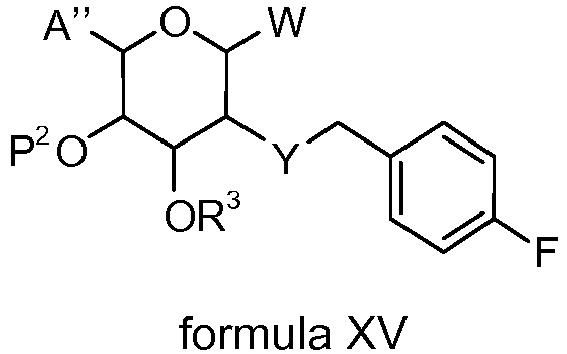
- e'. Transformation of the compound XV obtained in the previous step into a compound of general formula I as described in this patent application, through a glycosidation reaction.
- The transformation of compound XV into the compound of formula I (step e') can be carried out by a process with several stages comprising a glycosidation reaction, preferably but not limited to, through the trichloroacetimidate method, and several protection and deprotection processes on the groups in
positions -
-
FIG 1 . Amino acid sequence that makes up substance P (SP). -
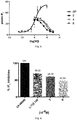
FIG 2 . Dose-response curves for NK1 antagonists with reference CP-96345 and L-732,138 determined by inhibition of substance P (SP) through the IP-One assay. -
FIG 3 . Dose-response curves forderivatives 2, 4 and 5 determined by inhibition of substance P (SP) through the IP-One assay. -
FIG 4 . SP activity inhibition data withderivatives 3, 6 and with reference antagonists CP-96345 and L-732,138 obtained at a ligand concentration of 10-6M. -

- Boron trifluoride etherate (5.00 mL, 40 mmol) is added dropwise to a solution of D-galactose pentaacetate (3.90 g, 10.00 mmol) in anhydrous dichloromethane (40 mL), at 0° °C. After 15 minutes of stirring at room temperature, benzenethiol (1.07 mL, 10.50 mmol) is added. The stirring is maintained at room temperature overnight to continue the reaction; then thin layer chromatography is used to ensure that the starting product has been consumed. Next, a saturated aqueous solution of NaHCO3 is added, the two phases are separated and the aqueous phase is extracted with CH2Cl2 (2x40mL) and the combined organic extracts are washed with saturated NaCl solution. The organic phase is dried over anhydrous Na2SO4, filtered and evaporated in vacuo. The residue obtained has a high degree of purity although it is purified by column chromatography, using ethyl acetate-hexane in a ratio of 1:4 as eluent, yielding product 12 (3.96 g, 9.00 mmol) as a white solid with a yield of 90%. P.f.: 115-116 °C.1H-NMR (500MHz, CDCl3): δ 7.52-7.5 (m, 2H), 7.32-7.31 (m, 3H), 5.42 (d, J=2.7 Hz, 1 H), 5.24 (t, J=10.0 Hz, 1 H), 5.05 (dd, J=3.3 and 9.9 Hz, 1 H), 4.72 (d, J=, 10.0 Hz, 1 H), 4.19 (dd, J=6.9 and 11.4 Hz, 1H), 4.12 (dd, J=6.2 and 11.3 Hz, 1H), 3.94 (t, J=6.9 Hz, 1H), 2.12 (s, 3H), 2.10 (s, 3H), 2.04 (s, 3H), 1.97 (s, 3H). 13C NMR (500 MHz, CDCl3) δ 170.5, 170.4, 170.2, 169.6, 132.7, 132.6, 129.0, 128.3, 86.8, 72.1, 67.3, 67.4, 61.8, 21.0, 20.8. HRMS: calculated for C20H25O9S: [M+H]+ 441.1219 found 441.1200 (-4.4 ppm).
-

- The synthesis follows a procedure similar to that described for the preparation of 12, starting from β-L-arabinose tetraacetate (5.24 g, 16.48 mmol), boron trifluoride etherate (8.27 mL, 65.90 mmol) and benzenethiol (1.77 mL, 17.30 mmol), to obtain product 10 (6.00 g, 16.30 mmol) as an orange oil with quantitative yield, which is used directly in the next reaction without prior purification. 1H-NMR (500MHz, CDCl3): δ 7.49-7.47 (m, 2H), 7.29-7.24 (m, 3H), 5.26-5.24 (m, 1 H), 5.22 (d, J=8.1 Hz, 1 H), 5.11 (dd, J=3.4 and 8.5 Hz, 1H), 4.82 (d, J=, 7.9 Hz, 1H), 4.10 (dd, J=3.6 and 12.3 Hz, 1H), 3.65 (dd, J=1.9 and 12.7 Hz, 1H), 2.05 (s, 3H), 2.04 (s, 3H), 1.98 (s, 3H). 13C NMR (500 MHz, CDCl3) δ 169.8, 169.5, 169.0, 132.0, 129.1, 128.8, 128.7, 127.7, 125.2, 86.3, 70.3, 68.3, 67.4, 65.1, 20.6, 20.5, 20.3. [α]20 D: +24.70 (c 1, chloroform).
-

- A solution of 1 M sodium methoxide in methanol (36 mL, 3.60 mmol) is added to a solution of compound 12 (3.96 g, 9.00 mmol) in methanol (45 mL). After stirring for 30 min, the reaction is neutralised with acidic resin and filtered to obtain product 14 (2.40 g, 8.82 mmol) as a white solid with a quantitative yield, which is used directly in the next reaction without the need for purification. P.f.: 114-115 °C. 1H-NMR (500MHz, MeOD): δ 7.56-7.54 (m, 2H), 7.30-7.27 (m, 2H), 7.24-7.21 (m, 1 H), 4.59 (d, J=9.8 Hz, 1H), 3.90 (d, J=3.0 Hz, 1H), 3.78-3.74 (m, 1H), 3.72-3.69 (m, 1H), 3.61 (t, J=9.5 Hz, 1 H), 3.57 (t, J=6.1 Hz, 1 H), 3.50 (dd, J=3.3 and 9.2 Hz, 1 H). 13C NMR (500 MHz, MeOD) δ 136.1, 132.2, 129.8, 128.0, 90.3, 80.6, 76.4, 71.0, 70.4, 62.6. HRMS: calculated for C12H16O5NaS: [M+Na]+ 295.0616 found 295.0605 (3.6 ppm).
-

- The synthesis follows a procedure similar to that described for the preparation of 14, starting from 13 (6.00 g, 16.30 mmol) and sodium methoxide in methanol 1M (10.00 mL, 10.00 mmol), giving 15 (3.91 g, 16.15 mmol) as a red solid with a quantitative yield, which is used directly in the next reaction without prior purification. P.f.: 114-115 °C. 1H-NMRM (500MHz, MeOD): δ 7.53-7.50 (m, 2H), 7.31-7.22 (m, 3H), 4.64 (d, J=8.1 Hz, 1H), 3.98 (dd, J=3.6 and 12.2 Hz, 1H), 3.89 (td, J=1.9 and 3,4 Hz, 1H), 3.70 (t, J=8.2 Hz, 1H), 3.60-6.56 (m, 2H). 13C NMR (500 MHz, MeOD) δ 136.1, 132.4, 129.8, 128.1, 90.4, 74.9, 71.6, 69.5 (2). [α]20 D: +15.05 (c 1, chloroform).
-

- A catalytic amount of 10-camphorsulfonic acid (CSA) (60.35 mg, 0.26 mmol) it added to a suspension of polyhydroxy derivative 14 (2.21 g, 8.12 mmol) in 60 mL of 2,2-dimethoxypropane (2,2-DMP), at room temperature and under an argon atmosphere, and the mixture is left stirring for 48 hours. After that time, the reaction is neutralised with triethylamine, filtered to remove the ammonium salt that has formed and the solvent is evaporated in vacuo. The residue obtained is dissolved in the minimum possible amount of toluene and evaporated in vacuo, after repeating this process twice the mixed acetal is obtained, together with a small amount of the desired diol. The crude mixture is dissolved in the minimum possible amount of methanol, treated with a catalytic amount of CSA (60.35 mg, 0.26 mmol) at 0°°C and stirred at room temperature for 5 minutes. It is then neutralised with triethylamine, the ammonium salt that has formed is filtered off and the solvent is evaporated in vacuo. The residue obtained is dissolved in toluene and evaporated, repeating this process twice, to obtain 16 (2.16 g, 6.92 mmol) as a white solid with an 85% yield. P.f.: 92-93 °C. 1H-NMR (500MHz, CDCl3): δ 7.48-7.46 (m, 2H), 7.25-7.18 (m, 3H), 4.45 (d, J=10.0 Hz, 1H), 4.08-4.03 (m, 2H), 3.91-3.87 (m, 1H), 3.81-3.78 (m, 1H), 3.76-3.72 (m, 1H), 3.58 (bs, 1H), 3.55-3.51 (m, 1H), 3.17 (bs, 1H), 1.35 (s, 3H), 1.26 (s, 3H). 13C NMR (500 MHz, CDCl3) δ 132.5, 131.7, 128.8, 127.5, 110.0, 87.1, 79.3, 76.9, 73.6, 71.2, 62.0, 27.8, 26.1. HRMS: calculated for C15H21O5S: [M+H]+ 313.1110 found 313.1107 (-0.9 ppm).
-

- The synthesis follows a procedure similar to that described for the preparation of 16, starting with 15 (3.91 g, 16.15 mmol), 2,2-dimethoxypropane (120 mL, 969.00 mmol) and 10-camphorsulfonic acid (0.26 mg, 1.13 mmol), yielding product 17 (3.85 g, 13.63 mmol) as a white solid with a yield of 85%. P.f.: 92-93 °C. 1H-NMR (500MHz, CDCl3): δ 7.56-7.53 (m, 2H), 7.33-7.28 (m, 3H), 4.53 (d, J=9.2 Hz, 1 H), 4.28-4.24 (m, 2H), 4.14-4.19 (m, 1 H), 3.82-3.78 (m, 1 H), 3.67-3.36 (m, 1 H), 1.46 (s, 3H), 1.36 (s, 3H).13C NMR (500 MHz, CDCl3) δ 132.8, 129.1, 128.2, 110.3, 88.3, 78.3, 73.0, 71.7, 65.8, 28.0. [α]20 D: +17.56 (c 1, chloroform).
-

- Tert-butyldiphenylsilane chloride (TBDPSCI) (0.11 mL, 0.41 mmol) and imidazole (56.34 mg, 0.83 mmol) are added to a solution of 16 (103.10 mg, 0.33 mmol) in DMF (66.20 mL, 2 mL / mmol 13). After stirring for 5 hours, the reaction is diluted with ethyl acetate (20 mL), neutralised with saturated NH4Cl solution and the aqueous phase extracted with n-pentane (3x20 mL). The organic extracts are dried over anhydrous sodium sulfate and the solvent is evaporated in vacuo. The residue obtained is purified by column chromatography, using ethyl acetate-hexane in a ratio of 1:4. Product 18 (174.49 mg, 0.32 mmol) is obtained as a white solid with a yield of 96%. P.f.: 50 °C. 1H-NMR (500MHz, CDCl3): δ 7.73-7.70 (m, 4H), 7.54-7.53 (m, 2H), 7.45-7.35 (m, 6H), 7.28-7.27 (m, 3H), 4.44 (d, J=10.3 Hz, 1H), 4.28 (dd, J=1.9 and 5.4 Hz, 1H), 4.08 (t, J=6.2 Hz, 1 H), 4.00-3.89 (m, 3H), 3.55 (ddd, J=2.2, 7.1 and 10.1 Hz, 1 H), 1.41 (s, 3H), 1.33 (s, 3H), 1.06 (s, 9H). 13C NMR (500 MHz, CDCl3) δ 135.8, 134.9, 133.5, 133.4, 132.6, 132.4, 129.9, 129.2, 128.1, 127.9, 127.8, 110.3, 88.5, 79.1, 76.9, 73.4, 71.7, 63.1, 28.3, 26.9, 26.7, 26.4, 19.4. HRMS: calculated for C31H38O5SSiNa: [M+Na]+ 573.2107 found 573.2123 (2.8 ppm).
-

- A solution of sodium hydride (0.73 g, 18.21 mmol) in THF (10 mL) is added to a solution of 18 (4.00 g, 6.07 mmol) in THF (80 mL) and left stirring for 1 hour. After that time, IN(Bu)4 (0.90 g, 2.43 mmol) is added and after 30 minutes stirring a solution of p-fluorobenzyl chloride (1.10 mL, 9.11 mmol) in THF (5 mL) is added. The reaction is left stirring for 48 hours and subsequently neutralised with a saturated aqueous solution of ammonium chloride and the aqueous phase is extracted with ethyl acetate (3x40 mL). The organic extracts are washed with saturated sodium chloride solution and dried over anhydrous sodium sulfate. The residue obtained is purified by column chromatography using ethyl acetate-hexane in a ratio or 1:8, to obtain 19 (3.60 g, 5.46 mmol) as a yellow oil with a yield of 90%. 1H-NMR (500MHz, CDCl3): δ 7.78-7.74 (m, 4H), 7.58-7.56 (m, 2H), 7.48-7.40 (m, 9H), 7.29-7.25 (m, 2H), 7.10-7.04 (m, 2H), 4.84 (d, J=11.3 Hz, 1 H), 4.69 (d, J=11.3 Hz, 1 H), 4.65 (d, J=9.7 Hz, 1 H), 4.34 (dd, J=2.0 and 5.6 Hz, 1 H), 4.28 (t, J=6.0 Hz, 1 H), 4.03-3.98 (m, 2H), 3.92 (td, J=1.9 and 6.5 Hz, 1 H), 3.55 (dd, J=6.4 and 9.7 Hz, 1H), 1.44 (s, 3H), 1.39 (s, 3H), 1.12 (bs, 9H). 13C NMR (500 MHz, CDCl3) δ 162.5, (d, J CF=244.1 Hz), 135.8, 135.7, 135.4, 134.9, 134.0, 133.9, (d, J CF=3.1 Hz), 133.5 (2C), 131.8, 130.1, (d, J CF=8.4 Hz), 129.8, 129.7, 129.0, 127.8 (2C), 127.4, 115.2 (d, J CF=21.4 Hz), 110.0, 86.6, 79.8, 78.4, 76.9, 73.6, 72.8, 63.1, 28.0, 26.9, 26.7, 26.4, 19.3. HRMS calculated for C38H43O5NaSFSi: [M+Na]+ 681.2482 found 681.2479 (-0.5 ppm).
-

- The synthesis follows a procedure similar to that described for the preparation of 19, starting with 17 (3.85 g, 13.63 mmol), sodium hydride (1.00 g, 41.50 mmol), tetrabutylammonium iodide (2.00 g, 5.45 mmol) and p-fluorobenzyl chloride (2.43 mL, 20.45 mmol), yielding product 20 (4.60 g, 12.40 mmol) as a yellow oil with a yield of 91%. 1H-NMR (500MHz, CDCl3): δ 7.52-7.50 (m, 2H), 7.39-7.36 (m, 2H), 7.31-7.24 (m, 3H), 7.05-7.00 (m, 2H), 4.79 (d, J=8.2 Hz, 1H), 4.78 (d, J=11.4 Hz, 1H), 4.31-4.28 (m, 1H), 4.23 (t, J=6.1 Hz, 1H), 4.20 (dd, J=3.8 and 13.2 Hz, 1H), 3.77 (dd, J=3.8 and 13.0 Hz, 1H), 3.59 (dd, J=6.1 and 8.0 Hz, 1H), 1.47 (s, 3H), 1.37 (s, 3H). 13C NMR (500 MHz, CDCl3) δ 162.6 (d, J CF=245.7 Hz), 131.1, 133.7 (d, J CF=3.1 Hz), 132.0, 130.1 (d, J CF=8.1 Hz), 129.0, 127.6, 115.3 (d, J CF=21.4 Hz), 110.1, 86.5, 78.4, 72.8, 72.7, 64.9, 27.9, 26.3. [α]20 D: -9.95 (c 1, chloroform).
-

- N-bromosuccinimide (NBS) (1.03 g, 5.78 mmol) is added to a solution of 19 (3.02 g, 4.59 mmol) in acetone (120 mL) at 99%, in the absence of light, at -15° °C and stirring continued for 30 minutes. After that time, the reaction is treated with saturated aqueous NaHCO3 solution and the aqueous phase is extracted with dichloromethane (3x40mL). The organic extracts are dried over anhydrous sodium sulfate and the solvent is evaporated in vacuo. The residue obtained is purified by column chromatography using ethyl acetate-hexane in a 1:8, ratio yielding a yellow syrup, product 21 (2.37g, 4.18 mmol) as a mixture of the two anomers α:β in a ratio of 2:1 and with a yield of 91%. 1H-NMR (500MHz, CDCl3): δ 7.71-7.66 (m, 4Ha, 4Hb), 7.43-7.31 (m, 8Ha, 8Hb), 7.05-7.00 (m, 2Ha, 2Hb), 5.15 (dd, J=3.7 and 5.0 Hz, 1Ha), 4.78-4.73 (m, 1Ha, 1Hb), 4.67-4.64 (m, 1Ha, 1Hb), 4.41-4.28 (m, 2Ha, 2Hb), 4.23 (t, J=6.1 Hz, 1Hb), 3.96-3.80 (m, 2Ha, 2Hb), 3.55 (dd, J=7.2 and 5.9 Hz, 1Ha), 3.37 (t, J=6.5 Hz, 1Hb), 2.98 (d, J=6.4 Hz, 1 Hb), 2.92 (d, J=4.1 Hz, 1Ha), 1.41 (s, 3Hb), 1.40 (s, 3Ha), 1.36 (s, 3Ha, 3Hb), 1.05 (s, 9Ha, 9Hb). 13C NMR (500 MHz, CDCl3) δ 162.7, (d, J CF=245.6 Hz), 135.8, 135.7 (2C), 133.9, (d, J CF=3.5 Hz), 133.8, 133.7, 133.6, (d, J CF=3.2 Hz), 133.6, 133.4, 130.0, (d, J CF=8.2 Hz), 129.9, (d, J CF=8.5 Hz), 129.8 (2C), 127.8, 127.7 (2C), 115.5 (d, J CF=21.3 Hz), 115.3, (d, J CF=21.1 Hz), 110.0, 109.4, 96.2, 91.0, 80.0, 78.0, 76.3, 74.7, 73.2, 72.9, 72.7, 72.5, 72.1, 68.5, 62.9, 62.8, 27.8, 27.7, 26.9, 26.0, 19.4. HRMS: calculated for C32H39O6NaSiF: [M+Na]+ 589.2398 found 589.2398 (0.1 ppm).
-

- The synthesis follows a procedure similar to that described for the preparation of 21, starting with 17 (4.60 g, 12.40 mmol) and NBS (8.50 g, 47.23 mmol), yielding product 22 (3.16 g, 11.30 mmol) as a mixture of both α and β anomers, in a 2:1 ratio as a yellow syrup with a 91% yield. 1H-NMR (500MHz, CDCl3): δ 7.32-7.26 (m, 2Ha, 2Hb), 6.98-6.94 (m, 2Ha, 2Hb), 5.12 (d, J=2.5 Hz, 1Ha), 4.72-4.69 (m, 1Ha, 2Hb), 4.63-4.60 (m, 1Ha, 1Hb), 4.32 (t, J=6.3 Hz, 1Ha), 4.17-4.10 (m, 2Ha, 3Hb), 3.82 (d, J=13.2 Hz, 1Ha), 3.73 (dd, J=2.9 and 13.2 Hz, 1Hb), 3.49 (dd, J=3.3 and 6.7 Hz, 1Ha), 3.37 (t, J=6.5 Hz, 1Hb), 1.39 (s, 3Hb), 1.38 (s, 3Ha), 1.30 (s, 3Ha, 3Hb). 13C NMR (500 MHz, CDCl3) δ 162.5, (d, J CF=245.6 Hz), 162.4 (d, J CF=244.8 Hz), 134.0 (d, J CF=2.9 Hz), 133.7 (d, J CF=2.9 Hz), 129.9 (d, J CF=9.4 Hz), 129.8 (d, J CF=8.3 Hz), 115.3, (d, J CF=21.1 Hz), 115.1, (d, J CF=19.8 Hz), 109.9, 109.0, 96.0, 90.9, 80.1, 77.8, 76.4, 74.8, 73.1, 73.0, 72.4, 71.7, 62.7, 60.4, 27.8, 27.7, 26.0, 25.7.
-

- A mixture of 98% 2,2,2-trichloroacetonitrile (0.96 mL, 9.35 mmol) and catalytic amounts of 1,8-Diazabicyclo[5.4.0]undec-7-ene (DBU) at 98% (0.23 mL, 1.50 mmol) is added to a solution of 21 (2.12g, 3.74 mmol) in a mixture of cyclohexane/dichloromethane (50 mL) in a proportion of 4:1 as a solvent. The reaction is left stirring overnight. After that time, water is added, the organic phase is washed with saturated aqueous sodium chloride solution, dried over anhydrous sodium sulfate and evaporated in vacuo. A high purity yellow syrup 23 (2.58 g, 3.63 mmol) is obtained as a mixture of the two α:β anomers in a 3:1 ratio and with an 97% yield. The product obtained is used immediately in the following reaction.
-

- It is synthesised using a procedure similar to that described for the preparation of 23, starting from 22 (3.16 g, 11.20 mmol), 2,2,2-trichloroacetonitrile at 98% (2.90 mL, 28.25 mmol) and DBU 98% (0.70 mL, 4.52 mmol), yielding product 24 (4.85 g, 11.00 mmol) as a high purity yellow oil as a mixture of both α and β anomers with a 97% yield, which is used immediately in the following reaction.
- Trimethylsilyl trifluoromethanesulfonate (2.8 mL, 0.015 mmol) is added to a solution of 23 (0.16g, 0.22 mmol) and (1R)-1-[3,5-bis(trifluoromethyl)phenyl]ethanol (0.17g, 0.67 mmol) in ether (7 mL), under an argon atmosphere, with 200 mg of molecular sieve (4Å) at 0 °C. The reaction is stirred for one hour at room temperature. After that time, NaHCO3 is added, the solution is filtered through celite and the solvent evaporated in vacuo. A yellow syrup is obtained as a mixture of the two α:β anomers in a ratio of 3:1. Purification by column chromatography using ethyl acetate-hexane in a ratio of 1:15 yields the α anomer (106.51 mg, 0.13 mmol) as the major product with a yield of 60% and the minority β anomer (48.41 mg, 0.06 mmol) with a yield of 25 %.
-

- 1H-NMR (500MHz, CDCl3): δ 7.86 (bs, 2H), 7.82 (bs, 1H), 7.73-7.70 (m, 4H), 7.47-7.37 (m, 6H), 7.21-7.18 (m, 2H), 6.97-6.92 (m, 2H), 4.91 (c, J=6.6 Hz, 1H), 4.61 (d, J=3.1 Hz, 2H), 4.58 (d, J=3.6 Hz, 1 H), 4.42 (dd, J=5.5 and 7.8 Hz, 1 H), 4.29 (dd, J=2.5 and 5.5 Hz, 1H), 4.18 (td, J=2.4 and 6.4 Hz, 1H), 3.98-3.89 (m, 2H), 3.42 (dd, J=3.7 and 7.8 Hz, 1H), 1.49 (d, J=6.6 Hz, 3H), 1.33 (s, 3H), 1.32 (s, 3H), 1.10 (s, 9H). 13C NMR (500 MHz, CDCl3) δ 162.5, (d, J CF=244.8 Hz), 145.8, 135.8 (2C), 133.9, (d, J CF=3.2 Hz), 133.7, 133.6, 132.1, (c, J CF=33.5 Hz), 129.9, 129.6, (d, J CF=8.3 Hz), 127.9, 127.8, 126.9 (d, J CF=2.4 Hz), 123.5 (c, J CF=272.9 Hz), 121.8, 115.3 (d, J CF=21.4 Hz), 109.3, 94.9, 76.2, 76.1, 73.5, 72.6, 71.5, 68.9, 63.3, 28.3, 27.0, 26.5, 24.4, 22.8, 19.4. HRMS: calculated for C42H45O6F7SiNa: [M+Na]+ 829.2771 found 829.2811 (4.1 ppm).
-
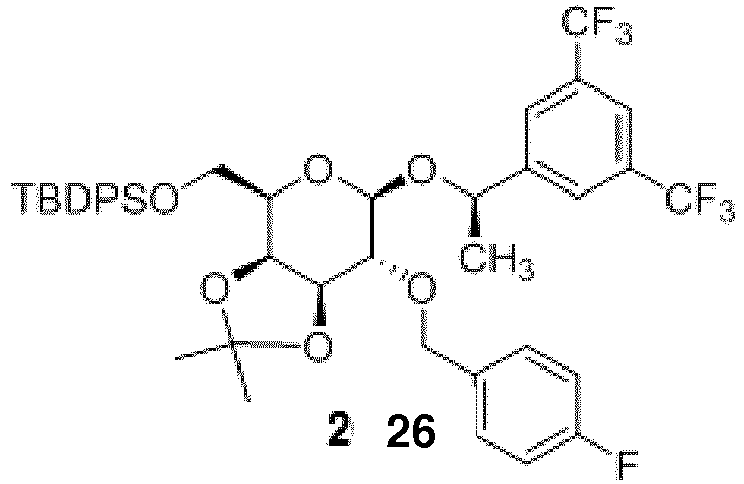
- 1H-NMR (500MHz, CDCl3): δ 7.85 (bs, 1 H), 7.79-7.74 (m, 3H), 7.66-7.61 (m, 4H), 7.43-7.32 (m, 7H), 7.05-7.00 (m, 2H), 4.97 (c, J=6.5 Hz, 1 H), 4.82 (s, 2H), 4.46 (d, J=8.0 Hz, 1H), 4.25 (dd, J=1.7 and 5.5 Hz, 1H), 4.17 (dd, J=5.8 and 6.7 Hz, 1H), 3.87 (dd, J=6.0 and 8.5 Hz, 1 H), 3.77-3.71 (m, 2H), 3.42 (t, J=7.5 Hz, 1 H), 1.50 (d, J=6.5 Hz, 3H), 1.36 (s, 3H), 1.33 (s, 3H), 1.02 (s, 9H). 13C NMR (500 MHz, CDCl3) δ 162.6, (d, J CF=245.2 Hz), 148.4, 146.3, 135.7, 135.6, 134.1, (d, J CF=3.1 Hz), 133.5, 133.3, 131.9, (c, J CF=33.1 Hz), 131.6, (c, J CF=33.1 Hz), 129.9, (d, J CF=8.2 Hz), 129.8, 127.8, 127.5, 125.8 (d, J CF=2.2 Hz), 123.5 (c, J CF=272.3 Hz), 121.4, 115.3 (d, J CF=21.5 Hz), 110.1, 100.7, 79.7, 79.3, 74.9, 73.6, 73.3, 73.0, 62.6, 28.0, 26.8, 26.4, 25.8, 22.3, 19.3. HRMS: calculated for C42H45O6F7SiNa: [M+Na]+ 829.2771 found 829.2809 (4.5 ppm).
- The synthesis follows a procedure similar to that described for the preparation of galactose derivatives 25 and 26, starting from 24 (4.85 g, 11.00 mmol), (1R)-1-[3,5-bis(trifluoromethyl)phenyl]ethanol (8.50 g, 33.00 mmol) and trimethylsilyl trifluoromethanesulfonate (0.14 mL, 0.77 mmol). A yellow oil is obtained with a mixture of the two α:β anomers with a ratio of 2:1. Purification by column chromatography using ethyl-hexane acetate with a ratio of 1:4 yields the β anomer (1.47 g, 2.75 mmol) as a minority product with a yield of 25% and the majority product is the α anomer (3.55 g, 6.60 mmol) with a yield of 60%.
-

- 1H-NMR (500MHz, CDCl3): δ 8.04 (bs, 2H), 7.96 (bs, 1 H), 7.24-7.22 (m, 2H), 6.99-6.94 (m, 2H), 4.99 (c, J=6.6 Hz, 1H), 4.66 (d, J=3.3 Hz, 1H), 4.57 (bs, 2H), 4.37 (dd, J=5.7 and 7.8 Hz, 1H), 4.32 (dd, J=2.5 and 5.6 Hz, 1H), 4.11 (dd, J=2.9 and 13.4 Hz, 1H), 3.90 (d, J=13.4 Hz, 1H), 3.44 (dd, J=3.4 and 7.9 Hz, 1H), 1.51 (d, J=6.6 Hz, 3H), 1.34 (s, 3H), 1.32 (s, 3H). 13C NMR (500 MHz, CDCl3) δ 163.8, (d, J CF=244.4 Hz), 148.0, 135.3 (d, J CF=3.2 Hz), 132.9 (c, J CF=32.9 Hz), 130.8 (d, J CF=8.2 Hz), 128.2, 128.1, 124.9 (c, J CF=272.2 Hz), 122.4 (c, J CF=3.9 Hz), 115.9 (d, J CF=21.3 Hz), 110.0, 96.4, 77.8, 76.6, 74.9, 72.2, 60.2, 28.4, 26.5, 24.5. [α]20 D: +57.00 (c 1, chloroform).
-

- 1H-NMR (500MHz, CDCl3): δ 7.95 (bs, 2H), 7.84 (bs, 1H), 7.44-7.40 (m, 2H), 7.08-7.03 (m, 2H), 5.03 (c, J=6.5 Hz, 1 H), 4.82 (bs, 2H), 4.61 (d, J=7.3 Hz, 1 H), 4.24-4.21 (m, 1 H), 4.17 (t, J=6.5 Hz, 1 H), 3.86 (dd, J=3.1 and 13.2 Hz, 1 H), 3.68 (dd, J=3.6 and 13.1 Hz, 1H), 3.47-3.43 (m, 1H), 1.53 (d, J=6.5 Hz, 3H) 1.36 (s, 3H), 1.32 (s, 3H). 13C NMR (500 MHz, CDCl3) δ 163.8, (d, J CF=243.0 Hz), 149.0, 135.7 (d, J CF=3.2 Hz), 132.6 (c, J CF=33.0 Hz), 131.1 (d, J CF=7.9 Hz), 127.7 (2), 124.9 (c, J CF=272.3 Hz), 121.9 (c, J CF=3.9 Hz), 115.9 (d, J CF=21.8 Hz), 111.0, 102.6, 81.0, 79.6, 76.8, 74.5, 73.6, 63.7, 28.1, 26.2, 23.0. [α]20 D: +10.99 (c 1, chloroform).
- Tetrabutyl ammonium fluoride 1 M (5 equiv.) is added to a solution of 25 or 26 (1 equiv.) in tetrahydrofuran and under an argon atmosphere. After stirring for 1 hour, an ether and saturated NaCl solution is added. The aqueous phase is extracted with ethyl acetate, the organic residues are dried over anhydrous sodium sulfate, and the solvent evaporated in vacuo. The residue obtained is purified by column chromatography, using ethyl acetate-hexane as the eluent with a ratio of 1:4.
-

- The synthesis follows the general procedure from 25 (0.70 g, 0.87 mmol) in THF (20 mL) and tetrabutyl ammonium fluoride 1M (4.34 mL, 4.34 mmol). This yields 27 (0.40 g 0.70 mmol) as a yellow syrup. Yield: 80%. 1H-NMR (500MHz, CDCl3): δ 7.91 (bs, 2H), 7.83 (bs, 1H), 7.20-7.17 (m, 2H), 6.97-6.92 (m, 2H), 4.92 (c, J=6.7 Hz, 1H), 4.64 (d, J=3.5 Hz, 1H), 4.60 (d, J=11.3 Hz, 2H), 4.47 (dd, J=5.6 and 7.9 Hz, 1H), 4.30 (dd, J=2.7 and 5.6 Hz, 1 H), 4.19-4.16 (m, 1 H), 3.97, (dd, J=6.0 and 11.8 Hz, 1 H), 3.87 (dd, J=3.9 and 11.8 Hz, 1 H), 3.42 (dd, J=3.6 and 8.0 Hz, 1 H), 1.52 (d, J=6.7 Hz, 3H), 1.35 (s, 3H), 1.33 (s, 3H). 13C NMR (500 MHz, CDCl3) δ 162.4, (d, J CF=244.2 Hz), 145.5, 133.5 (d, J CF=3.1 Hz), 131.9, (c, JCF=33.3 Hz), 129.5, (d, JCF=8.1 Hz), 126.7, 123.3, (c, JCF=272.8 Hz), 121.7, 115.1 (d, JCF=21.4 Hz), 109.5, 95.1, 76.1, 75.5, 74.5, 72.9, 71.3, 67.9, HRMS: calculated for C26H26F7O6: [M]+ 568.1792 found 568.1790 (0.5 ppm).
-

- The synthesis follows the general procedure from 26 (0.70 g, 0.87 mmol) in THF (20 mL) and tetrabutyl ammonium fluoride 1 M (4.34 mL, 4.34 mmol). A yield of 0.37 g of 28 (0.65 mmol) is obtained as a yellow syrup. Yield: 75%. 1H-NMR (500MHz, CDCl3): δ 7.84 (bs, 2H), 7.79 (bs, 1H), 7.39-7.36 (m, 2H), 7.05-7.00 (m, 2H), 4.98 (c, J=6.4 Hz, 1H), 4.82 (bs, 2H), 4.49 (d, J=7.9 Hz, 1H), 4.19 (dd, J=5.8 and 6.7 Hz, 1H), 4.13-4.09 (m, 2H), 3.80-3.76 (m, 1H), 3.72-3.70, (m, 1H), 3.44 (dd, J=7.0 and 7.8 Hz, 1H), 1.54 (d, J=6.5 Hz, 3H), 1.37 (s, 3H), 1.32 (s, 3H). 13C NMR (500 MHz, CDCl3) δ 162.6, (d, J CF=245.6 Hz), 146.5, 134.0 (d, J CF=3.0 Hz), 131.7, (c, J CF=33.4 Hz), 129.9, (d, J CF=8.2 Hz), 126.5, 123.5, (c, J CF=273.0 Hz), 121.5, 115.3 (d, J CF=21.5 Hz), 110.4, 101.5, 79.6, 79.4, 76.3, 73.9, 73.6, 73.0, 62.3, 27.8, 26.4, 22.8. HRMS: calculated for C26H26F7O6: [M]+ 568.1792 found 568.1789 (0.5 ppm).
- A catalytic quantity of CSA is added to a solution of 3,4-isopropylene derived 27, 28, 7 or 8 (1 equiv.) in methanol and left stirring overnight. After that time the solvent is evaporated in vacuo and the residue obtained is purified by filtration with silica using ethyl as the eluent.
-

- The synthesis follows the general procedure from 27 (0.50 g, 0.88 mmol) in methanol (20 mL). This yields 4 (0.46 g, 0.87 mmol) as a white solid. 1H-NMR (500MHz, CDCl3): δ 7.89 (bs, 2H), 7.84 (bs, 1H), 7.17-7.14 (m, 2H), 6.98-6.94 (m, 2H), 4.92 (c, J=6.5 Hz, 1H), 4.79 (d, J=3.5 Hz, 1H), 4.53 (d, J=11.9 Hz, 1H), 4.34 (d, J=11.8 Hz, 1H) 4.16-4.10 (m, 2H), 4.02-3.88 (m, 3H), 3.69 (dd, J=3.5 and 9.8 Hz, 1H), 2.79 (bs, 1H), 2.34 (d, J=2.6 Hz, 1 H), 2.30 (dd, J=3.6 and 7.1 Hz, 1 H), 3.07 (d, J=6.7 Hz, 3H). 13C NMR (500 MHz, CDCl3) δ 162.7, (d, J CF=244.0 Hz), 145.8, 133.4 (d, J CF=3.5 Hz), 132.2, (c, J CF=33.4 Hz), 129.8, (d, J CF=7.9 Hz), 126.8 (2), 123.4, (c, J CF=271.8 Hz), 122.0 (2), 115.7 (d, J CF=21.0 Hz), 95.1, 75.9, 73.3, 72.1, 70.8, 69.9, 69.1, 63.5, 24.4. HRMS: calculated for C23H23F7O6: [M+Na]+ 551.1281 found 551.1264 (-3.0 ppm).
-

- The synthesis follows the general procedure from 28 (0.50 g, 0.88 mmol) in methanol (20 mL). This yields 3 (0.45 g, 0.85 mmol) as a white solid. Yield: quantitative. 1H-NMR (500MHz, CDCl3): δ 7.81 (bs, 2H), 7.79 (bs, 1 H), 7.36-7.33 (m, 2H), 7.07-7.02 (m, 2H), 4.99 (c, J=6.4 Hz, 1 H), 4.88 (d, J=11.5 Hz, 1 H), 4.71 (d, J=11.5 Hz, 1 H), 4.59 (d, J=6.2 Hz, 1 H), 3.91 (dd, J=3.6 and 5.9 Hz, 1 H), 3.77 (dd, J=3.9 and 12.6 Hz, 1 H), 3.72 (dd, J=3.4 and 8.0 Hz, 2H), 3.58 (dd, J=6.3 and 8.0 Hz, 1 H), 3.46 (dd, J=2.0 and 12.8 Hz, 1 H), 2.70 (bs, 1 H), 2.49 (bs, 1 H), 1.53 (d, J=6.4 Hz, 3H). 13C NMR (500 MHz, CDCl3) δ 162.7, (d, J CF=247.0 Hz), 146.0, 134.0 (d, J CF=2.9 Hz), 131.8, (c, JCF=33.4 Hz), 129.8, (d, JCF=8.2 Hz), 126.4, 123.0, (c, JCF=272.7 Hz), 121.7, 115.6 (d, JCF=21.2 Hz), 101.0, 78.6, 75.2, 73.7, 72.1, 67.4, 64.7, 22.1. HRMS: calculated for C23H23F7O6: [M+Na]+ 551.1281 found 551.1262 (-3.0 ppm).
-

- The synthesis follows the general procedure from 8 (1.47 g, 2.75 mmol) in methanol (60 mL). The procedure yields 6 (1.35 g, 2.72 mmol) as a brown oil with a quantitative yield. 1H-NMR (300MHz, CDCl3): δ 7.89 (bs, 2H), 7.83 (bs, 1H), 7.19-7.15 (m, 2H), 7.00-6.94 (m, 2H), 4.92 (c, J=6.6 Hz, 1H), 4.73 (d, J=3.3 Hz, 1H), 4.53 (d, J=11.7 Hz, 1H), 4.32 (d, J=11.9 Hz, 1H), 4.16-4.09 (m, 1H), 3.95-3.91 (m, 1H), 3.78 (dd, J=1.8 and 12.4 Hz, 1H), 3.67 (dd, J=3.4 and 9.5 Hz, 1H) 1.54 (d, J=6.6 Hz, 3H). [α]20 D: +12.02 (c 1, chloroform).
-

- The synthesis follows the general procedure from 7 (3.55 g, 6.60 mmol) in methanol (160 mL). The procedure yields 5 (3.36 g, 6.55 mmol) as an orange oil with a quantitative yield. 1H-NMR (500MHz, CDCl3): δ 7.81 (bs, 2H), 7.79 (bs, 1H), 7.36-7.32 (m, 2H), 7.06-7.02 (m, 2H), 4.98 (c, J=6.5 Hz, 1H), 4.88 (d, J=11.4 Hz, 1H), 4.71 (d, J=11.6 Hz, 1 H), 4.58 (d, J=6.3 Hz, 1 H), 3.77 (dd, J=3.9 and 12.6 Hz, 1 H), 3.71 (dd, J=3.6 and 8.1 Hz, 1 H) 3.58 (dd, J=6.4 and 8.0 Hz, 1 H), 3.47-3.43 (m, 2H), 1.53 (d, J=6.5 Hz, 3H). 13C NMR (500 MHz, CDCl3) δ 162.6, (d, J CF=246.7 Hz), 146.1, 134.0 (d, J CF=3.1 Hz), 131.8 (c, J CF=33.2 Hz), 129.8 (d, J CF=8.1 Hz), 126.4, 123.4 (c, J CF=274.8 Hz), 121.6, 115.6 (c, J CF=21.3 Hz), 101.1, 78.7, 75.2, 73.8, 72.1, 67.5, 64.8, 22.1. [α]20 D: +8.07 (c 1, chloroform).
- Dimethoxymethyl benzene (1.1 equiv.) and a catalytic amount of CSA are added to a solution of 3 or 4 (1 equiv.) in dimethylformamide (DMF). The reaction is left to rotate in a rotary evaporator at 40 °C for 1 hour. After that time, it is neutralised with saturated NaHCO3 solution, the aqueous phase is extracted with dichloromethane, the organic extracts are dried over anhydrous sodium sulfate and the solvent evaporated in vacuo. The residue obtained is purified by column chromatography using ethyl acetate-hexane in a ratio of 1:4.
-

- The synthesis follows the general procedure from 4 (0.10 g, 0.19 mmol) in DMF (15 mL) and dimethoxymethyl benzene (0.32 mL, 0.21 mmol). The procedure yields 2 (0.11 g, 0.18 mmol) as a white solid. Yield: 95%. P.f.: 158-159 °C. 1H-NMR (500MHz, CDCl3): δ 7.90 (bs, 2H), 7.84 (bs, 1H), 7.47-7.43 (m, 2H), 7.39-7.34 (m, 3H), 7.16-7.13 (m, 2H), 6.95-6.90 (m, 2H), 4.93 (c, J=6.6 Hz, 1 H), 4.80 (d, J=3.5 Hz, 1 H), 4.52 (d, J=2.5 Hz, 2H), 4.36-4.35 (m, 1H), 4.32 (dd, J=1.4 and 12.6 Hz, 1H), 4.28-4.23 (m, 1H), 4.14 (dd, J=1.8 and 12.7 Hz, 1H), 3.84 (bs, 1H), 3.75 (dd, J=3.6 and 10.0 Hz, 1H), 2.33 (d, J=8.8 Hz, 1 H), 1.53 (d, J=6.6 Hz, 3H). 13C NMR (500 MHz, CDCl3) δ 162.6, (d, J CF=246.1 Hz), 145.6, 137.5, 133.6 (d, J CF=3.0 Hz), 132.1, (c, JCF=33.6 Hz), 129.7, (d, JCF=8.2 Hz), 129.4, 128.4, 126.9, 126.4, 123.4, (c, JCF=272.1 Hz), 122.0, 115.4 (d, JCF=21.8 Hz), 101.5, 96.0, 76.3, 76.1, 73.3, 72.6, 69.4, 68.8, 63.3, 24.3. HRMS: calculated for C30H27O6NaF7: [M+Na]+ 639.1594 found 639.1565 (-4.5 ppm).
-
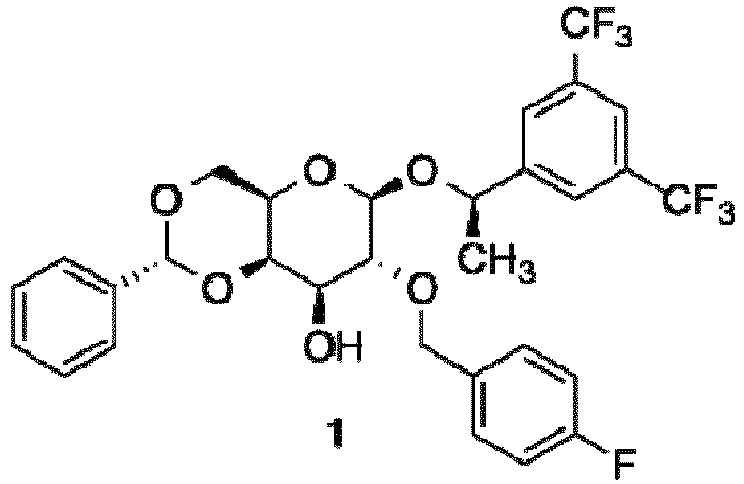
- The synthesis follows the general procedure from 3 (0.10 g, 0.19 mmol) in DMF (15 mL) and dimethoxymethyl benzene (0.32 mL, 0.21 mmol). The procedure yields 1 (0.10 g, 0.17 mmol) as a white solid. Yield: 92%. P.f.: 131 °C. 1H-NMR (500MHz, CDCl3): δ 7.90 (bs, 2H), 7.80 (bs, 1 H), 7.49-7.47 (m, 2H), 7.39-7.36 (m, 5H), 7.06-7.01 (m, 2H), 5.03 (c, J=6.6 Hz, 1 H), 4.93 (d, J=11.3 Hz, 1 H), 4.79 (d, J=11.2 Hz, 1 H), 4.57 (d, J=7.6 Hz, 1H), 4.19 (dd, J=1.0 and 3.9 Hz, 1H), 4.08 (dd, J=1.4 and 12.5 Hz, 1H), 3.98 (dd, J=1.9 and 12.5 Hz, 1H), 3.74 (td, J=3.8 and 8.9 Hz, 1H), 3.67-3.64 (m, 1H), 3.57-3.35 (m, 1 H), 2.45 (d, J=8.4 Hz, 1 H), 1.56 (d, J=6.6 Hz, 3H). 13C NMR (500 MHz, CDCl3) δ 162.6, (d, J CF=246.6 Hz), 146.6, 137.7, 134.4 (d, J CF=2.8 Hz), 131.6, (c, J CF=33.4 Hz), 129.7, (d, J CF=8.1 Hz), 129.4, 128.4, 126.7, 126.6, 123.6, (c, J CF=272.7 Hz), 121.4, 115.4 (d, J CF=21.5 Hz), 101.9, 101.6, 79.8, 76.1, 75.5, 74.6, 73.0, 69.0, 66.7, 22.8. HRMS: calculated for C30H27O6NaF7: [M+Na]+ 639.1594 found 639.1563 (-4.3 ppm).
- The capacity of the synthesised carbohydrate derivatives to modulate the NK1 receptor has been determined experimentally through the Ip-one assay and affinity studies through the displacement of marked SP ([125I]BH-SP).
- 6.1.1. IP-One assay results: The results of the NK1 receptor antagonist activity study are shown as an example, the results are for the IP-One assay on synthesised
carbohydrate derivatives 
- All the compounds tested antagonise SP through the NK1 receptor. We highlight the results for
derivatives 2, 4 and 5, which are excellent inhibitors of SP activity, with very similar Kinact values to those of the reference antagonist (FIG. 2 and3 ): - Kact SP: 1.64E-08 ± 0.62 M; Kinact L-732,138: 8.37E-08 ± 2.63 M; Kinact CP-96345: 3.65E-09 ± 0.55 M; Kinact 2: 2.37E-07 ± 1.16 M; Kinact 4: 7.37E-07 ± 2.71 M; Kinact 5: 5.60E-07 ± 0.53 M
- Of all the derivatives, derivative 2 showed the greatest antagonist activity.
The inhibition percentages were obtained at a ligand concentration of 10-6M (FIG. 4 ): - L-732,138: 69% SP inhibition; Derivative 3: 60% SP inhibition; Derivative 6: 48% SP inhibition.
- 6.1.2. Results of the marked SP displacement study. The affinity of synthesised
carbohydrate derivatives - Summary of the affinity results:
Compound Concentration (M) % Inhibition of the control specific affinity 2 6.0E-05 ≥100 4 6.0E-05 ≥100 5 6.0E-05 ≥100 8 6.0E-05 ≥100 - The compounds show have a greater affinity for the NK1 receptors than SP.
- Cell culture and transfection. The cell lines were obtained from the American Type Culture Collection (Manassas, Virginia, USA). The culture media, foetal bovine serum (FBS) and additives were supplied by Invitrogen.
- The CHO cells were cultured on a Dulbecco's modified Eagle's medium with a 10% FBS supplement, penicillin/streptomycin, 100U/ml and L-glutamine 2 mM at 37°C in a humid atmosphere of 95% air and 5% CO2. Non-essential amino acids were also added to the medium (Invitrogen).
- Transient transfection of the cell lines was carried out by electroporation in a volume of 300 µL with a total of 10 µg DNA (pRK5 Neo-NK1 wild type) plasmid (using up to 500 ng of pRK5como carrier DNA to achieve 10 µg) and with 107 cells in the electroporation buffer (50 mM K2HPO4, 20 mM CH3COOK, 20 mM KOH and 26 mM MgSO4, pH 7.4). After electroporation (280 V, 1mF, GeneZapper 450/2500; IBI, New Haven, Connecticut, USA), the cells were suspended in a complete medium and seeded on well culture plates with a density of 105 per well. The 96-well culture plates were first covered with polyornithine diluted in PBS, then incubated at 37°C for 30 minutes and they were then washed with PBS before being seeded.
- ELISA. The cells were transfected with pRK5-NK1-6His to measure the expression of the transfected receptors. The cells were fixed 24 hours after electroporation using paraformaldehyde at 4% in PBS for 5 minutes and washed 3 times with PBS. A 30-minute block was carried out with PBS and 1% unsupplemented FBS before incubation with the anti-6 His primary antibody (0.5 µg/ml) for 30 minutes. The cells were then washed three times with PBS + 1% FBS for 5 minutes and incubated for 30 minutes with a horseradish peroxidase conjugated anti-mouse antibody (1/1000; Amersham, Orsay,France). The cells were then washed three times with PBS + 1% FBS and three times with PBS. Then 60 µl of PBS and 20 µl of Supersignal ELISA Femto (Perbio-Pierce, Brebières, France) were added to the wells. The luminescence was read using a Wallac Victor2 (PerkinElmer Life and Analytical Sciences, Courtaboeuf, France).
- Second Messenger accumulation (IP1). The activation and inhibition of the route of the IP by the NK1 receptor agonists and antagonists, respectively, was determined using the dynamic IP-One kit (Cisbio Bioassays, Bagnols-sur-Cèze, France). After transfection, 105 cells were distributed in 100 µl of a complete medium into a 96-well assay plate (Greiner Bio-One, Courtaboeuf, France). After 24 hours, the medium was eliminated and replaced by 40 µl of an incubation medium that contained the agonist and/or antagonist in an appropriate concentration. The homogeneous time-resolved fluorescence-fluorescence resonance energy transfer (HTRF-FRET) assay was performed as indicated in the literature (Maurel, D.; Kniazeff, J.; Mathis, G.; Tinquet, E.; Pin, J.P.; Ansanay, H. Anal Biochem. 2004, 329, 253). the inhibitory effect of the non-peptidic NK1 antagonist in SP-induced IP1 accumulation was studied in the same way as Arunlakshana and Schild (1959) (Arunlakshana, or.;) Schild, H.O. Br J Pharmacol. 1959, 14, 48). The 10 minute preincubation was followed by a 30 minute incubation with the antagonist and SP.
- Statistical analysis. The statistical significance of the differences between the experimental groups was determined by one-way or two-way variance analysis followed by a post-hoc Duncan multiple-rank test to perform pairwise comparisons between the means. The Student t test was also used.
- A marked SP concentration of 0.15 nM was used for the displacement studies and the concentration of the products of the invention was 10-6 M. The incubation time was 60 minutes at room temperature and the reference ligand used was [Sar9, Met(O2)11]-SP with IC50=0.29 nM (Heuillet, E. J. Neurochem. 1993, 60, 868-876).
- By way of example, the results are shown for the anticancer activity in lung cancer studies for
derivatives 
- The IC50 was determined in all cases through the MTT test, both for cancerous lung cells (A549) as well as in healthy lung cells (MRC-5) to determine the selectivity of the compounds. The following table shows the IC50 values for the MRC-5 and A549 cell lines corresponding to cisplatin.
IC50 ± SEM (µM) Compuesto MCF7 MCF10 p 2 23.91±4.99 291.32±52.56 0.04057 UACC-62 VH-10 p 31.93±6.01 117.90±12.31 0.01692 - The following table shows the IC50 values for the cell lines MRC-5 and A549 corresponding to the commercial antagonists Aprepitant and CP-96345 and the new synthesised NK1 receptor antagonists.
IC50 ± SEM (µM) Compounds MRC-5 A549 p 1 141.16±1.82 28.00±6.85 0.0047 2 120.10±3.45 19.34±7.93 0.0046 5 50.41±3.27 20.82±4.02 0.0061 7 - 59.32±11.04 - 8 500.99±62.03 133.52±35.18 0.0159 9+10(1:1) 192.18±27.85 42.88±9.19 0.0082 Aprepitant 22.08±6.92 15.66±3.46 >0.05 Cup-96345 57.90±8.07 46.83±8.89 0.4100 - All of our compounds not only showed a clear anticancer activity, they were also selective for lung cancer cells, unlike the commercial NK-1 antagonists Aprepitant and CP-96345. Among all of them, we would highlight the derivative 7, which had a selectivity far superior to the others. All the derivatives except
derivative 8 showed greater activity against the cancer line than Aprepitant and CP-96345. The most active derivatives were 1, 2 and 5. - According to these results, the activity and selectivity of our derivative 2 matches those of cisplatin. Anticancer activity studies were, therefore, carried out with ligand 2 on other cell lines.
- The possible anticancer activity of compound 2 was evaluated in a total of three in-vitro cancer models: breast cancer, lung cancer and melanoma. In all three models, this compound was shown to be more cytotoxic to cancer cells than to normal cells. This selectivity was observed from the lowest concentrations tested and over a range of concentrations, we can, therefore, conclude that this compound presents selective cytotoxic activity. Specifically, it has proved to be 4, 6, and 12 times more selective for melanoma, lung and breast cancer cells respectively, with respect to the corresponding normal cells.
- The following table shows the IC50 values for cell line MCF7 (human breast adenocarcinoma cells) and MCF10 (non-malignant human breast cells) as well as UACC-62 (human melanoma cells) and VH-10 lines (non-malignant human skin cells) for compound 2.
IC50 ± SEM (µM) Compound MCF7 MCF10 p 2 23.91±4.99 291.32±52.56 0.04057 UACC-62 VH-10 p 31.93±6.01 117.90±12.31 0.01692 - Cell lines. A549 human cells from lung adenocarcinoma, MRC5 non-malignant human lung cells and UACC-62 human melanoma cells were obtained from the European Collection of Authenticated Cell Cultures (ECACC). MCF7 human breast adenocarcinoma cells and MCF10 human non-malignant breast cells were generously provided by Dr Ruano and Dr Daza (University of Seville, Spain). VH-10 non-malignant human skin cells were generously provided by Dr Helleday (Karolinska Institute, Sweden).
All the culture media used were supplemented with 2 mM glutamine, 50 µg/ml penicillin, 50 µg/ml streptomycin and 10% fetal bovine serum. An exception was the medium used for the cultivation of MCF10 cells which was a 1:1 mixture of DMEM and HAM's F12 media supplemented with 2 mM glutamine, 50 µg/ml penicillin, 50 µg/ml streptomycin, 20 ng/ml growth factors, 100 ng/ml cholera toxin, 10 µg/ml insulin, 500 ng/ml hydrocortisone and 5% horse serum. - All the cell lines were cultured at 37 °C, 5% CO2 and controlled humidity in an incubator.
- All the products used for the cell culture were obtained from the PAA laboratory, with the exception of the media for the MCF10 cell line which was provided by Dr Navarro.
- Cell viability assay. The cells were exposed to the compounds for 48 hours. After the treatment, the media were withdrawn and cells were incubated for 3-5 hours with 125 µl MTT (1 mg/ml MTT in culture medium). Then, 80
µl 20% SDS in 0.02 M HCl was added to solubilise the formazan-MTT crystals and the plates were incubated overnight in an incubator at 37 °C and 5% CO2. Finally, the plates were read using a plate reader spectrophotometer at 540 nm. The absorbance was directly proportional to cell viability, which is expressed as a percentage relative to the control. All the results were obtained from at least three independent experiments and expressed as mean ± the standard error of the mean (SEM).
Claims (22)
- Compound of general formula I,
 - Ra is selected from H and CH2OR1, and wherein R1 is selected fromhydrogen,a C1-C20 alkyl group,a C6-C20 aryl group,a COR1a group, wherein R1a is independently selected from methyl, tert-butyl, and phenyl,a group which together with R2 forms a cyclic chain, anda SiR'R"R''' group, wherein R', R" and R''' are independently selected from methyl, ethyl, tert-butyl and phenyl;Rb independently selected from a C1-C20 alkyl group, a C6-C20 aryl group, OH and a group of formula II, wherein Z is selected from O and S and the carbon adjacent to Z is chiral and has configuration R or S;
 - X is selected from OR3, NR4R5 and a 3 to 15 members heterocyclic chain, wherein:• R3 is selected from H, a C1-C20 alkyl group, a C6-C20 aryl group, an acyl group, a alkylsulfonyl group, an arylsulfonyl group, a group of formula III, a group of formula IV, a group of formula V wherein R'''' is a C1-C20 alkyl group or a C6-C20 aryl group, and a group that forms a cyclic chain with R2;• R4 is selected from H, a C1-C20 alkyl group and a C6-C20 aryl group;• R5 is selected from H, a group of formula III, a group of formula IV and a group of formula V wherein R"" is a C1-C20 alkyl group or a C6-C20 aryl group;
 - Y is selected from O, S and NH; and- R2 is H, or forms a cyclic chain with 5 or 6 members along with R1 or R3, in such a way that in said cyclic chain the O adjacent to R2 is separated from the O adjacent to R1 or R3 by at least one C atom consisting of -C(R6)(R7)-, and wherein R6 and R7 are independently selected from H, a C1-C20 alkyl group and a C6-C20 aryl group.
 - Compound according to claim 1, wherein Rb is the group of formula II in which Z is selected from O and S.

- Compound according to claim 2, wherein Z is O.
- Compound according to any of claims 1 to 3, wherein Y is O.
- Compound according to any of claims 1 to 4, wherein X is OR3, and R3 is defined as described in claim 1.
- Compound according to any of claims 1 to 5, wherein Ra is CH2OR1 and R2 forms a cyclic chain along with R1, wherein the O atom adjacent to R2 is separated from the O atom adjacent to R1 by a -C(R6)(R7)- group, such that R2 forms a cyclic chain with 6 members along with R1, wherein R6 and R7 are independently selected from H, a C1-C20 alkyl group and a C6-C20 aryl group.
- Compound according to any of claims 1 to 6 wherein Ra is CH2OR1, R1 and R2 form a cyclic chain, and X is OH.
- Compound according to any of claims 1 to 5, wherein X is OR3 and R2 form a cyclic chain along with R3, wherein the O atom adjacent to R2 is separated from the O atom adjacent to R3 by a -C(R6)(R7)- group, such that R2 forms a cyclic chain with 5 members along with R3, and wherein R6 and R7 are independently selected from H, a C1-C20 alkyl group and a C6-C20 aryl group.
- Compound according to any of claims 1 to 5 or 8, wherein X is OR3, R3 and R2 form a cyclic chain, and Ra is H.
- Compound according to any of claims 1 to 5, wherein X is OH and R2 is H.
- Compound according to claim 10, wherein Ra is selected from H and CH2OH.
- Compound according to any of claims 1 to 11 which is selected from the group consisting of:
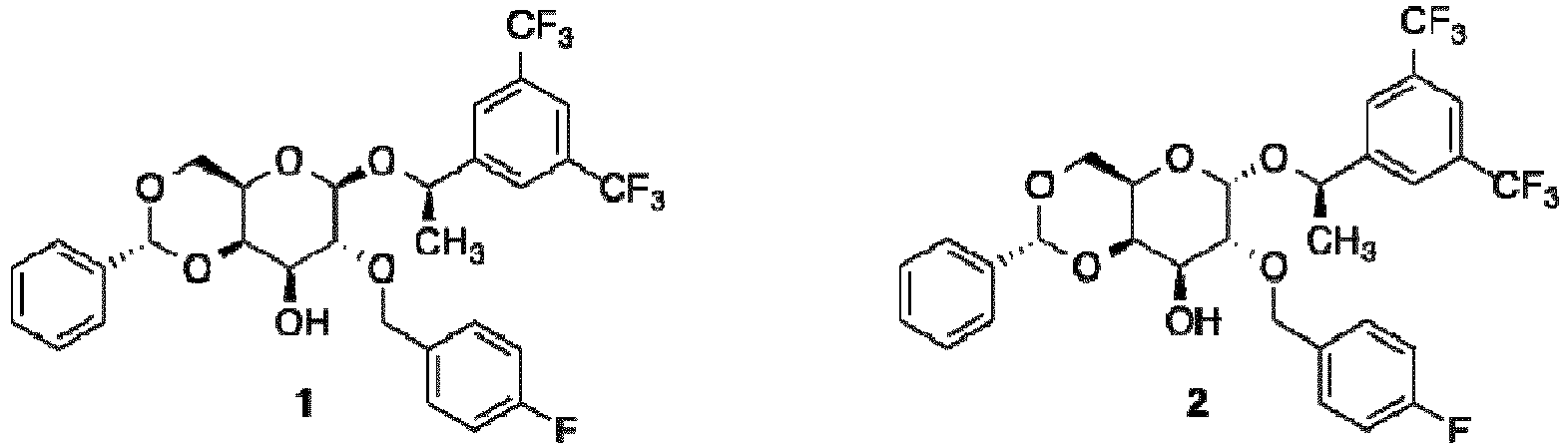
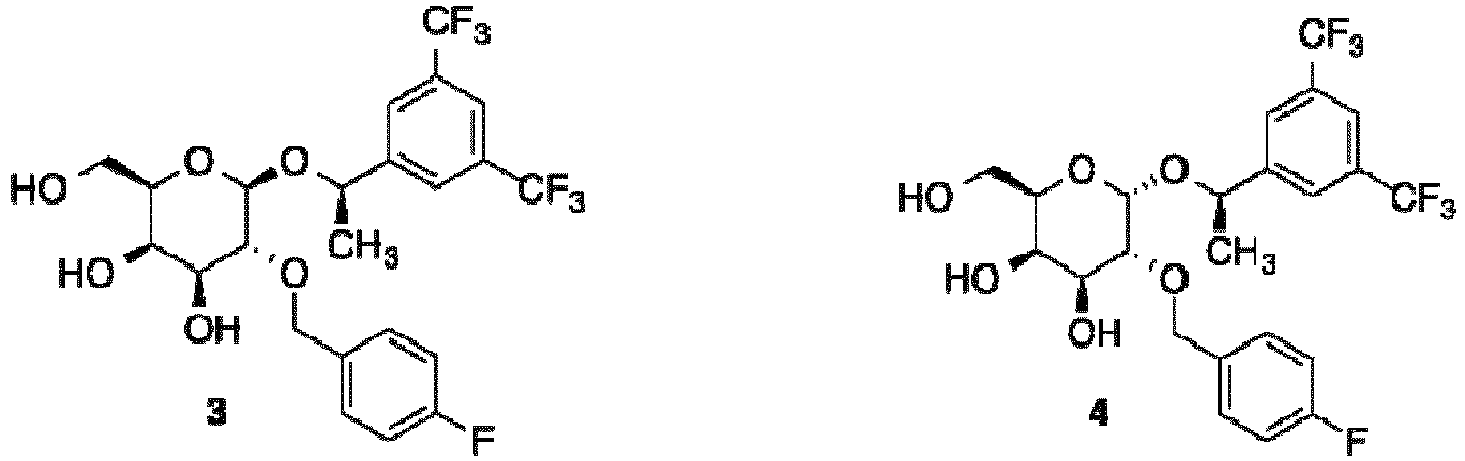


- Pharmaceutical composition characterised in that it comprises at least one compound defined in any of claims 1 to 12, or a pharmaceutically acceptable salt thereof.
- Use of at least one compound according to any of claims 1 to 12, or of a pharmaceutically acceptable salt thereof, for the manufacture of a pharmaceutical composition.
- Use of at least one compound according to any of claims 1 to 12, or of a pharmaceutically acceptable salt thereof, for the manufacture of a pharmaceutical composition for the treatment and/or prevention of a disease.
- Use according to claim 15, wherein the disease is selected from the group consisting of: a disorder of the central nervous system selected from Parkinson's disease, anxiety and depression, rheumatoid arthritis, asthma, inflammatory bowel disease, post-operative abdominal adhesion, migraine, inflammation, a chronic pulmonary disease selected from bronchial asthma or chronic obstructive lung disease (COPD), obstructive sleep apnea, a deregulation of cardiac function, arterial thrombosis, osteoporosis, obesity, resistance to insulin, Crohn's disease, emesis, and a cancer selected from melanoma, neuroblastoma, glioma, Hodgkin's lymphoma, lymphoblastic leukemia, rhabdomyosarcoma, Burkitt's lymphoma, lung carcinoma, Edwing's sarcoma, osteosarcoma, malignant ganglioma, and breast cancer.
- Use according to claim 16, wherein the disease is selected from the group consisting of: melanoma, lung carcinoma and breast cancer.
- Method for obtaining a compound of formula I as defined in any of claims 1 to 12, characterised in that it comprises at least the following steps:a. Obtaining a thioglycoside of formula VIII, wherein Ra is defined as in any of claims 1, 6 or 7, R is selected from a C6-C20 aryl group and a C1-C20 alkyl group, X' is selected from an OH group and a N3 group, and Y is selected from an OH, S and NH group;
 b. Reacting the thioglycoside of formula VIII with alcohol protecting reagents to obtain the compound with formula IX;
 - A" is selected from H and CH2OP1, wherein P1 is selected froma C1-C20 alkyl group,a C6-C20 aryl group,a COP1a group, where R1a is independently selected from methyl, tert-butyl and phenyl,a group that forms a cyclic chain along with P2, anda SiR'R"R''' group, where R', R" and R''' are independently selected from methyl, ethyl, tert-butyl and phenyl,- R is selected from a C6-C20 aryl group and a C1-C20 alkyl group,- X" is selected from an N3 group and an OP3 group, wherein P3 is a group that forms a cyclic chain with 5 members with P2,- Y is selected from O, S and NH,- P2 is selected froma SiR'R"R''' group wherein R', R" and R''' are independently selected from methyl, ethyl, tert-butyl and phenyl,a group that forms a cyclic chain with 6 members with P1, anda group that forms a cyclic chain with 5 members with P3,so that in the cyclic chain the O adjacent to P2 is separated from the O adjacent to P1 or P3 by a C atom consisting of -C(R6)(R7)-, and where R6 and R7 are independently selected from H, a C1-C20 alkyl group and a C6-C20 aryl group;c. Reacting the compound of formula IX with an halide or tosylate of p-fluorobenzyl to obtain the compound of formula X, wherein A", R, X" and P2 are as previously defined, and Y is selected from O, S and NH;
 d. Transformation of the compound X obtained in the previous stage into a glycosyl donor compound of formula XI, wherein W is selected from OH, an SOR sulfoxide group, an O(OR)2 phosphite group and a trichloracetimidate group; and
 e. Transformation of the compound XI obtained in the previous stage into a compound of general formula I as described in any of claims 1 to 12, through a glycosidation reaction.
 - Method according to claim 18, characterised in that when Rb in the compound of general formula I is the group of formula II, said procedure comprises reacting the compound of formula XI with 2,2,2-trichloroacetonitrile in the presence of catalytic quantities of 1,8-diazabicyclo [5.4.0]undec-7-eno (DBU); and subsequently reacting the product obtained with 1-[3,5-bis(trifluoromethyl)phenyl]ethanol and trimethylsilyl trifluoromethanesulfonate.
- Method according to claim 19, additionally comprising the selective protection and/or deprotection of groups in position 3, 4, 5 and/or 6 of the tetrahydropyranyl ring.
- Method according to claim 19, additionally comprising the reduction and/or alkylation, acylation or Huisgen 1,3-dipolar reaction to obtain compounds of formula I wherein X is NR4R5 or a heterocyclic chain.
- Method according to any of claims 18 to 21, additionally comprising at least one of the following steps:f. Reacting the compound obtained in steps e with an azide-reducing agent, when in the first step of the procedure a compound of formula VIII is obtained wherein X' is a N3 group;g. Reacting the compound obtained in step e or f with tetrabutyl ammonium fluoride in THF;h. Reacting the compound obtained in either of steps e, f or g with a catalytic quantity of 10-camphorsulfonic acid in methanol;i. Reacting the compound obtained in any of the steps g or h with a dimethoxymethyl derivative with the formula CH3O-C(R6)(R7)-OCH3, wherein R6 and R7 are as defined in claim 1, if the first step of the procedure yields a compound of formula VIII wherein Ra is CH2OH;j. Reacting the compound obtained in any of steps f, g or h, with an alkyl halide of formula R8-X or an acyl halide of formula R9-CO-X, wherein R8 is a C1-C20 alkyl group, a C6-C20 aryl group or a group of formula III or formula IV as defined in claim 1, and wherein R9 is a group of formula V as defined in claim 1.
Applications Claiming Priority (2)
| Application Number | Priority Date | Filing Date | Title |
|---|---|---|---|
| ES201530732A ES2595442B1 (en) | 2015-05-27 | 2015-05-27 | ANTAGONISTS OF NK1 RECEPTORS DERIVED FROM CARBON HYDRATES, METHOD OF OBTAINING AND MEDICAL USE |
| PCT/ES2016/070383 WO2016189179A1 (en) | 2015-05-27 | 2016-05-20 | Antagonists of nk1 receptors derived from carbohydrates, production method and medical use |
Publications (2)
| Publication Number | Publication Date |
|---|---|
| EP3305797A1 true EP3305797A1 (en) | 2018-04-11 |
| EP3305797A4 EP3305797A4 (en) | 2018-10-31 |
Family
ID=57393809
Family Applications (1)
| Application Number | Title | Priority Date | Filing Date |
|---|---|---|---|
| EP16799401.1A Withdrawn EP3305797A4 (en) | 2015-05-27 | 2016-05-20 | Antagonists of nk1 receptors derived from carbohydrates, production method and medical use |
Country Status (4)
| Country | Link |
|---|---|
| US (1) | US20190092802A1 (en) |
| EP (1) | EP3305797A4 (en) |
| ES (1) | ES2595442B1 (en) |
| WO (1) | WO2016189179A1 (en) |
Family Cites Families (2)
| Publication number | Priority date | Publication date | Assignee | Title |
|---|---|---|---|---|
| ES2246687B2 (en) * | 2004-02-11 | 2006-11-16 | Miguel Muñoz Saez | USE OF NON-PEPTIDIC ANTAGONISTS OF NK1 RECEPTORS FOR THE PRODUCTION OF APOPTOSIS IN TUMOR CELLS. |
| EP2837381A4 (en) * | 2011-12-13 | 2015-12-09 | Servicio Andaluz De Salud | USE OF AGENTS MODIFYING THE PERITUMORAL ENVIRONMENT FOR THE TREATMENT OF CANCER |
-
2015
- 2015-05-27 ES ES201530732A patent/ES2595442B1/en not_active Expired - Fee Related
-
2016
- 2016-05-20 US US15/577,150 patent/US20190092802A1/en not_active Abandoned
- 2016-05-20 EP EP16799401.1A patent/EP3305797A4/en not_active Withdrawn
- 2016-05-20 WO PCT/ES2016/070383 patent/WO2016189179A1/en not_active Ceased
Also Published As
| Publication number | Publication date |
|---|---|
| US20190092802A1 (en) | 2019-03-28 |
| ES2595442A1 (en) | 2016-12-30 |
| WO2016189179A1 (en) | 2016-12-01 |
| EP3305797A4 (en) | 2018-10-31 |
| ES2595442B1 (en) | 2017-10-04 |
Similar Documents
| Publication | Publication Date | Title |
|---|---|---|
| US11576924B2 (en) | Compounds for the prevention and treatment of diseases and the use thereof | |
| AU2018265813A1 (en) | Compounds for the treatment of systemic insulin resistance disorders and the use thereof | |
| EP3939979A1 (en) | Jak kinase inhibitor, preparation method for same, and applications thereof in field of medicine | |
| EP3964518B1 (en) | Cd73 inhibitor, preparation method therefor and application thereof | |
| US20230014870A1 (en) | Novel galactoside inhibitor of galectins | |
| TW202300146A (en) | Triazolyl-methyl substituted alpha-d-galactopyranoside derivatives | |
| EP2727920A1 (en) | 1,5-naphthyridine derivative or salt thereof | |
| CN103739616A (en) | Thiazolyl-containing rapamycin type derivative and application thereof | |
| AU2017228365A1 (en) | Selenogalactoside compounds for the prevention and treatment of diseases associated with galectin and the use thereof | |
| EP3470410B1 (en) | Crystalline form of compound suppressing protein kinase activity, and application thereof | |
| US20190092802A1 (en) | Antagonists of nk1 receptors derived from carbohydrates, production method and medical use | |
| US9085598B2 (en) | Compounds targeting the cell invasion protein complex, their pharmaceutical compositions and methods of use thereof | |
| Khiar et al. | Antagonistas de los receptores NK1 derivados de hidratos de carbono, método de obtención y uso médico | |
| EP4003367B1 (en) | E-selectin antagonists for use in enhancing the survival of reconstituted, bone marrow-depleted hosts | |
| EP4269400B1 (en) | Ykl-40 inhibitors and their therapeutic applications | |
| EP3772355A1 (en) | Bifunctional compound and its use in immunotherapy | |
| CN112812111A (en) | Benzothiazole compound and medical application thereof | |
| EP3085700B1 (en) | Novel piperidine carboxamide compound, preparation method, and usage thereof | |
| WO2025132992A1 (en) | DEUTERATED DERIVATIVES OF 3-HYDROXY-4,5-BIS-BENZYLOXY-6-BENZYLOXYMETHYL-2-PHENYL-2-OXO-2λ5-[1,2]OXAPHOSPHINANE | |
| EP4365181A1 (en) | Galactoside derivative as galectin-3 inhibitor | |
| KR20260043134A (en) | (2S,5R)-5-(hydroxymethyl)morpholine-2-carboxamide as an agonist for SSTR4 | |
| EP4717694A1 (en) | Pyrazolformyl piperazinone compound, pharmaceutical composition and use thereof | |
| EP4212511A1 (en) | Aromatic ethylene compound and preparation method therefor, and intermediate, pharmaceutical composition, and application thereof | |
| BR112018067693B1 (en) | SELENOGALACTOSIDES, THEIR USES, AND COMPOSITION |
Legal Events
| Date | Code | Title | Description |
|---|---|---|---|
| STAA | Information on the status of an ep patent application or granted ep patent |
Free format text: STATUS: THE INTERNATIONAL PUBLICATION HAS BEEN MADE |
|
| PUAI | Public reference made under article 153(3) epc to a published international application that has entered the european phase |
Free format text: ORIGINAL CODE: 0009012 |
|
| STAA | Information on the status of an ep patent application or granted ep patent |
Free format text: STATUS: REQUEST FOR EXAMINATION WAS MADE |
|
| 17P | Request for examination filed |
Effective date: 20171123 |
|
| AK | Designated contracting states |
Kind code of ref document: A1 Designated state(s): AL AT BE BG CH CY CZ DE DK EE ES FI FR GB GR HR HU IE IS IT LI LT LU LV MC MK MT NL NO PL PT RO RS SE SI SK SM TR |
|
| AX | Request for extension of the european patent |
Extension state: BA ME |
|
| DAV | Request for validation of the european patent (deleted) | ||
| DAX | Request for extension of the european patent (deleted) | ||
| A4 | Supplementary search report drawn up and despatched |
Effective date: 20181001 |
|
| RIC1 | Information provided on ipc code assigned before grant |
Ipc: C07H 15/203 20060101AFI20180925BHEP Ipc: A61K 31/7004 20060101ALI20180925BHEP |
|
| GRAP | Despatch of communication of intention to grant a patent |
Free format text: ORIGINAL CODE: EPIDOSNIGR1 |
|
| STAA | Information on the status of an ep patent application or granted ep patent |
Free format text: STATUS: GRANT OF PATENT IS INTENDED |
|
| INTG | Intention to grant announced |
Effective date: 20190612 |
|
| STAA | Information on the status of an ep patent application or granted ep patent |
Free format text: STATUS: THE APPLICATION IS DEEMED TO BE WITHDRAWN |
|
| 18D | Application deemed to be withdrawn |
Effective date: 20191023 |