EP3305795B1 - Tenofovir monobenzyl ester phosphamide prodrug, preparation method and use thereof - Google Patents
Tenofovir monobenzyl ester phosphamide prodrug, preparation method and use thereof Download PDFInfo
- Publication number
- EP3305795B1 EP3305795B1 EP16802483.4A EP16802483A EP3305795B1 EP 3305795 B1 EP3305795 B1 EP 3305795B1 EP 16802483 A EP16802483 A EP 16802483A EP 3305795 B1 EP3305795 B1 EP 3305795B1
- Authority
- EP
- European Patent Office
- Prior art keywords
- compound
- compounds
- tenofovir
- monobenzyl ester
- test
- Prior art date
- Legal status (The legal status is an assumption and is not a legal conclusion. Google has not performed a legal analysis and makes no representation as to the accuracy of the status listed.)
- Active
Links
- 0 *C(*)c1ccccc1 Chemical compound *C(*)c1ccccc1 0.000 description 5
- JVQHEJNJKMZGIQ-PPICWETGSA-N CC(C)OC([C@H](C)NP(CO[C@H](C)C[n]1c(ncnc2N)c2nc1)(OCc1ccccc1)=O)=O Chemical compound CC(C)OC([C@H](C)NP(CO[C@H](C)C[n]1c(ncnc2N)c2nc1)(OCc1ccccc1)=O)=O JVQHEJNJKMZGIQ-PPICWETGSA-N 0.000 description 2
- VUJHZOHASKCDQV-RHQOBYNCSA-N CC(C)OC(CNP(CO[C@H](C)C[n]1c(ncnc2N)c2nc1)(OCc1ccccc1)=O)=O Chemical compound CC(C)OC(CNP(CO[C@H](C)C[n]1c(ncnc2N)c2nc1)(OCc1ccccc1)=O)=O VUJHZOHASKCDQV-RHQOBYNCSA-N 0.000 description 1
- VUJHZOHASKCDQV-RCUPCANXSA-N CC(C)OC(CN[P@@](CO[C@H](C)C[n]1c2ncnc(N)c2nc1)(OCc1ccccc1)=O)=O Chemical compound CC(C)OC(CN[P@@](CO[C@H](C)C[n]1c2ncnc(N)c2nc1)(OCc1ccccc1)=O)=O VUJHZOHASKCDQV-RCUPCANXSA-N 0.000 description 1
- SGOIRFVFHAKUTI-ZCFIWIBFSA-N C[C@H](C[n]1c(ncnc2N)c2nc1)OCP(O)(O)=O Chemical compound C[C@H](C[n]1c(ncnc2N)c2nc1)OCP(O)(O)=O SGOIRFVFHAKUTI-ZCFIWIBFSA-N 0.000 description 1
- MDKOEBXVBMLLND-AOKYCLIISA-N C[C@H](C[n]1c2ncnc(N)c2nc1)OCP(NCC(OC)=O)(OCc1ccccc1)=O Chemical compound C[C@H](C[n]1c2ncnc(N)c2nc1)OCP(NCC(OC)=O)(OCc1ccccc1)=O MDKOEBXVBMLLND-AOKYCLIISA-N 0.000 description 1
- OHRBCLKMXFHPHR-PXLPHJHFSA-N C[C@H](C[n]1c2ncnc(N)c2nc1)OCP(N[C@@H](Cc1ccccc1)C(OC)=O)(OCc1ccccc1)=O Chemical compound C[C@H](C[n]1c2ncnc(N)c2nc1)OCP(N[C@@H](Cc1ccccc1)C(OC)=O)(OCc1ccccc1)=O OHRBCLKMXFHPHR-PXLPHJHFSA-N 0.000 description 1
Classifications
-
- C—CHEMISTRY; METALLURGY
- C07—ORGANIC CHEMISTRY
- C07F—ACYCLIC, CARBOCYCLIC OR HETEROCYCLIC COMPOUNDS CONTAINING ELEMENTS OTHER THAN CARBON, HYDROGEN, HALOGEN, OXYGEN, NITROGEN, SULFUR, SELENIUM OR TELLURIUM
- C07F9/00—Compounds containing elements of Groups 5 or 15 of the Periodic Table
- C07F9/02—Phosphorus compounds
- C07F9/547—Heterocyclic compounds, e.g. containing phosphorus as a ring hetero atom
- C07F9/6561—Heterocyclic compounds, e.g. containing phosphorus as a ring hetero atom containing systems of two or more relevant hetero rings condensed among themselves or condensed with a common carbocyclic ring or ring system, with or without other non-condensed hetero rings
- C07F9/65616—Heterocyclic compounds, e.g. containing phosphorus as a ring hetero atom containing systems of two or more relevant hetero rings condensed among themselves or condensed with a common carbocyclic ring or ring system, with or without other non-condensed hetero rings containing the ring system having three or more than three double bonds between ring members or between ring members and non-ring members, e.g. purine or analogs
-
- A—HUMAN NECESSITIES
- A61—MEDICAL OR VETERINARY SCIENCE; HYGIENE
- A61K—PREPARATIONS FOR MEDICAL, DENTAL OR TOILETRY PURPOSES
- A61K31/00—Medicinal preparations containing organic active ingredients
- A61K31/66—Phosphorus compounds
- A61K31/675—Phosphorus compounds having nitrogen as a ring hetero atom, e.g. pyridoxal phosphate
-
- A—HUMAN NECESSITIES
- A61—MEDICAL OR VETERINARY SCIENCE; HYGIENE
- A61P—SPECIFIC THERAPEUTIC ACTIVITY OF CHEMICAL COMPOUNDS OR MEDICINAL PREPARATIONS
- A61P31/00—Antiinfectives, i.e. antibiotics, antiseptics, chemotherapeutics
- A61P31/12—Antivirals
-
- A—HUMAN NECESSITIES
- A61—MEDICAL OR VETERINARY SCIENCE; HYGIENE
- A61P—SPECIFIC THERAPEUTIC ACTIVITY OF CHEMICAL COMPOUNDS OR MEDICINAL PREPARATIONS
- A61P31/00—Antiinfectives, i.e. antibiotics, antiseptics, chemotherapeutics
- A61P31/12—Antivirals
- A61P31/14—Antivirals for RNA viruses
- A61P31/18—Antivirals for RNA viruses for HIV
-
- A—HUMAN NECESSITIES
- A61—MEDICAL OR VETERINARY SCIENCE; HYGIENE
- A61P—SPECIFIC THERAPEUTIC ACTIVITY OF CHEMICAL COMPOUNDS OR MEDICINAL PREPARATIONS
- A61P31/00—Antiinfectives, i.e. antibiotics, antiseptics, chemotherapeutics
- A61P31/12—Antivirals
- A61P31/20—Antivirals for DNA viruses
-
- C—CHEMISTRY; METALLURGY
- C07—ORGANIC CHEMISTRY
- C07F—ACYCLIC, CARBOCYCLIC OR HETEROCYCLIC COMPOUNDS CONTAINING ELEMENTS OTHER THAN CARBON, HYDROGEN, HALOGEN, OXYGEN, NITROGEN, SULFUR, SELENIUM OR TELLURIUM
- C07F9/00—Compounds containing elements of Groups 5 or 15 of the Periodic Table
- C07F9/02—Phosphorus compounds
- C07F9/547—Heterocyclic compounds, e.g. containing phosphorus as a ring hetero atom
- C07F9/6561—Heterocyclic compounds, e.g. containing phosphorus as a ring hetero atom containing systems of two or more relevant hetero rings condensed among themselves or condensed with a common carbocyclic ring or ring system, with or without other non-condensed hetero rings
Definitions
- the present invention belongs to the field of medicinal chemistry, and specifically relates to a novel tenofovir monobenzyl ester phosphamide compound, or the hydrate, solvate, pharmaceutically acceptable salt or single chiral isomer thereof, as well as the preparation method thereof and use thereof in the medicine.
- Tenofovir Disoproxil Fumarate is a water soluble anti-HIV and anti-HBV oral drug, stable in the stomach, enters the body with the blood after the intestinal absorption, and uniformly distributed within human tissues; less than 20% is metabolized and activated into the Tenofovir parent drug under the action of esterase, and then diphosphorylated into Tenofovir diphosphate to take effect, and about the remaining 80% is excreted out of the body in original form.
- the strategy of introducing the masking group onto the phosphate group of the Tenofovir to form the lipid soluble pro-drug is usually adopted.
- one masking group is linked with the phosphate group to form a phosphoramide structure, another group linked with the phosphate group to form a phospholipid structure.
- the compound with this structure is proven to have the lymph and liver tissue targeting effect.
- Ester-forming groups include various aromatic rings and heteroaromatic rings, especially the substituted or unsubstituted phenyl ( CN201310041647.4 , WO02082841 ).
- the patent CN01813161 ) disclosed a compound GS-7340 obtained by using such pro-drug strategy, which enhanced the liver-targeting properties compared with Tenofovir Disoproxil Fumarate (TDF), while the efficacy enhanced and the toxicity reduced.
- TDF Tenofovir Disoproxil Fumarate
- Patents US20130210757 and CN201380030061.6 disclosed that one masking group was phosphoramide formed by the amino acid ester and the phosphate group; another masking group was benzyl ester with substitution(s) on the benzene ring formed by benzyl with the electron-donating groups such as methyl on the benzene ring at the ortho or para position, and the phosphate group.
- the masking group of o-methyl benzyl of the compound structure disclosed in CN201380030061.6 has a high group-leaving activity and low stability during the blood esterase metabolism, the targeting group is relatively easier to be detached, therefore leading to the relative increase of the active parent drug in the blood and relative decrease of the active parent drug in the liver, and affecting the activity and systemic toxicity.
- Compound 7 was also disclosed in US 2013/2010757 A1 for treatment of infectious diseases or cancer. Further structurally related compounds bearing o-methyl benzyl or higher substituted benzyl masking groups were disclosed in CN 103980318 A and by W.A. Lee et al. in ANTIMICROB AGENTS CH, 2005, p. 1889-1906 .
- the present invention provides a class of tenofovir monobenzyl ester phosphamide compounds without substitution(s) on the benzene ring of the benzyl group, and the preparation method thereof, as well as their use in the lymph-targeting anti-AIDS infection and the liver-targeting anti-hepatitis B treatment; compared with GS-7340 and compound 7, such pro-drugs are more stable against esterase, and further enhance the systemic stability and liver-targeting anti-virus effect of the Tenofovir analogues.
- the inventors of the present invention invented a class of tenofovir monobenzyl ester phosphamide compounds, and accidentally found that the compounds of the present invention can be metabolized into the active parent drug of Tenofovir (TFV) in the cell test, and therefore have anti-virus activities.
- TFV Tenofovir
- the compounds of the present invention can be enriched in the liver, where they are metabolized into the active product of Tenofovir.
- the compounds of the present invention have a higher anti-HBV activity, or are more stable in the plasma, their metabolic segments are safer, and therefore the systemic toxic and side effects caused by the plasma metabolism are reduced.
- the present invention provides a tenofovir monobenzyl ester phosphamide compound of the general formula X, and the hydrate, solvate, pharmaceutically acceptable salt thereof or the resolved single isomer thereof.
- Z is selected from O or S
- R 1 , R 2 , R 3 , R 4 and R 5 are each independently selected from H, substituted or unsubstituted C 1 -C 6 linear alkyl, C 3 -C 6 branched alkyl, C 3 -C 6 cycloalkyl, and C 6 -C 10 aryl or heteroaryl.
- Z is selected from O
- R 1 , R 2 , R 3 , R 4 and R 5 are each independently selected from H, substituted or unsubstituted C 1 -C 6 linear alkyl, C 3 -C 6 branched alkyl, and C 6 -C 10 aryl.
- the tenofovir monobenzyl ester phosphamide compounds of the present invention are selected from the compounds in Table 1.
- Table 1 Compounds and the structures Compound Name Structure Compound 1 Compound 2 Compound 3 Compound 4 Compound 5 Compound 6
- the stereochemistry of the pro-drug can affect its metabolic ability and anti-virus activity in the targeting tissues, and the chiral moiety is on the phosphorus atom, and is also found to be on its masking group of amino acid.
- amino acids with natural configurations have better metabolic activities, and the S isomer of compound 3 with the configuration of the P atom has a higher activity.
- these diastereomers or racemates need be chirally enriched so that the screened result makes more sense.
- the isomer with a single configuration at the chiral center described above is obtained through purification by chiral resolution so that each test compound is essentially a compound with the single chirality.
- Formation of the essentially single compound or chiral enrichment means that the stereoisomer in need accounts for more than about 60%, usually more than 80%, and preferably more than 95% of the compound by weight.
- the separation is carried out through the reverse chromatography column or the chiral chromatography column in the present invention, and the mobile phase is aqueous acetonitrile solution.
- the preparation method of the tenofovir monobenzyl ester phosphamide compound may include the following steps:
- step A Tenofovir is preferably reacted with benzyl bromide or benzyl alcohol, and the base can be various inorganic or organic bases, preferably the organic bases; in step B, the compounds containing the terminal NH group are preferably amino acid ester compounds or amino acid amide compounds.
- DIPEA di-isopropyl ethyl amine
- benzyl bromide or benzyl alcohol into a suspension of Tenofovir in acetonitrile
- adding pyridine and dissolving and then sequentially adding triethyl amine and any one of benzyl glycine ester hydrochlorate, methyl glycine ester hydrochlorate, isopropyl L-alanine ester hydrochlorate, isopropyl L-phenylalanine ester hydrochlorate, isopropyl glycine ester hydrochlorate, and isopropyl N-phenyl glycine ester hydrochlorate, heating the mixture to 50°C-80°C and stirring for 10-60 minutes, adding triphenyl phosphine and 2,2'-dithiodipyridine at this temperature, stirring for
- Another object of the present invention is to provide a preparation method for a tenofovir monobenzyl ester phosphamide compound of general formula X, wherein the synthetic route is present as follow:
- the present invention further includes the chiral resolution method of the compound; collecting eluents of different retention times of the HPLC preparation column separation (preparation column: C18, mobile phase: 10%-50% aqueous acetonitrile solution (V/V)) or the chiral column separation, drying to obtain the isomers of different chiralities.
- the present invention also provides a pharmaceutical composition
- a pharmaceutical composition comprising the tenofovir monobenzyl ester phosphamide compound, or the hydrate thereof, or the solvate thereof, or the pharmaceutically acceptable salt thereof or the resolved single isomer thereof.
- the pharmaceutically acceptable salt of the compound of the present invention can be obtained by the way of acid-base neutralization.
- the compound of the present invention react with sulfuric acid, hydrochloric acid, hydrobromic acid, phosphoric acid, tartaric acid, fumaric acid, maleic acid, citric acid, acetic acid, formic acid, methanesulfonic acid, toluenesulfonic acid, oxalic acid or succinic acid to obtain the corresponding salt.
- the compound of the present invention react with sodium hydroxide, potassium hydroxide, barium hydroxide, etc., an alkali carbonate such as sodium carbonate and calcium carbonate etc., to obtain the corresponding salt.
- the reaction can be carried out in a solvent such as water or an organic solvent such as ethanol, tetrahydrofuran, dioxane, ethylene glycol, and acetic acid, etc., or the mixture of such organic solvent and water. If required, the reaction can also be carried out without any solvent.
- a solvent such as water or an organic solvent such as ethanol, tetrahydrofuran, dioxane, ethylene glycol, and acetic acid, etc., or the mixture of such organic solvent and water. If required, the reaction can also be carried out without any solvent.
- the pharmaceutical composition of the present invention preferably in unit dosage form of pharmaceutical preparation, can be made into any pharmaceutically acceptable dosage forms during the pharmaceutical preparation; these dosage forms are selected from: tablets, sugar coated tablets, film coated tablets, enteric coated tablets, capsules, hard capsules, soft capsules, oral liquid, oral agents, granules, suspensions, solutions, injections, suppositories, ointments, emplastrums, creams, sprays and patches, preferably oral preparations, and most preferably tablets and capsules.
- composition described in the present invention also comprises a pharmaceutically acceptable carrier.
- Conventional techniques of the pharmaceutics can be used to prepare the pharmaceutical preparation, for example, mixing the tenofovir monobenzyl ester phosphamide compound of the present invention, or the hydrate thereof, or the solvate thereof, or the pharmaceutically acceptable salt thereof or the resolved single isomer thereof with a pharmaceutically acceptable carrier.
- the pharmaceutically acceptable carrier includes, but is not limited to, mannitol, sorbitol, sorbic acid or the potassium salt thereof, sodium metabisulfite, sodium bisulfite, sodium thiosulfate, cysteine hydrochloride, thioglycolic acid, methionine, vitamin A, vitamin C, vitamin E, vitamin D, azone, EDTA disodium, EDTA calcium sodium, carbonate, acetate, phosphate of monovalent alkali metal or the aqueous solution thereof, hydrochloride acid, acetic acid, sulfuric acid, phosphoric acid, amino acid, fumaric acid, sodium chloride, potassium chloride, sodium lactate, xylitol, maltose, glucose, fructose, dextran, glycine, starch, sucrose, lactose, mannitol, silicon derivatives, cellulose and derivatives thereof, alginate, gelatin, polyvinylpyrrolidone, glycerol, prop
- unit dosage form can contain 0.1-1000 mg of the pharmaceutically active substance of the present invention, and the balanced is pharmaceutically acceptable carrier.
- Pharmaceutically acceptable carriers account for 0.1-99.9% of total weight of the preparations by weight.
- the usage and dosage of the pharmaceutical compositions of the present invention are determined according to patients' conditions while being used.
- the present invention finally also provides the tenofovir monobenzyl ester phosphamide compound, or the hydrate thereof, or the solvate thereof, or the pharmaceutically acceptable salt thereof or the resolved single isomer thereof for use in treating viral infection diseases, preferably for use in treating AIDS infection or hepatitis B or diseases caused by the hepatitis B virus.
- DIPEA (10 mmol) and benzyl bromide (5 mmol) were added into the suspension of Tenofovir (5 mmol) in acetonitrile (20 mL) sequentially, the mixture was heated to 80°C and stirred for 16 hours and then evaporated to dryness under reduced pressure. The residues were dissolved with pyridine (20 mL), then triethylamine (5 mL) and isopropyl glycine ester hydrochlorate (10 mmol) were added to the solution sequentially.
- DIPEA (10 mmol) and benzyl bromide (5 mmol) were added into the suspension of Tenofovir (5 mmol) in acetonitrile (20 mL) sequentially, the mixture was heated to 80°C and stirred for 16 hours and then evaporated to dryness under reduced pressure. The residues were dissolved with pyridine (20 mL), then triethylamine (5 mL) and methyl glycine ester hydrochlorate (10 mmol) were added to the solution sequentially.
- DIPEA (10 mmol) and benzyl bromide (5 mmol) were added into the suspension of Tenofovir (5 mmol) in acetonitrile (20 mL) sequentially, the mixture was heated to 80°C and stirred for 16 hours and then evaporated to dryness under reduced pressure. The residues were dissolved with pyridine (20 mL), then triethylamine (5 mL) and isopropyl L-alanine ester hydrochlorate (10 mmol) were added to the solution sequentially.
- DIPEA (10 mmol) and benzyl bromide (5 mmol) were added into the suspension of Tenofovir (5 mmol) in acetonitrile (20 mL) sequentially, the mixture was heated to 80°C and stirred for 16 hours and then evaporated to dryness under reduced pressure. The residue was dissolved with pyridine (20 mL), then triethylamine (5 mL) and L-Phenylalanine isopropyl ester hydrochloride (10 mmol) were added to the solution sequentially.
- DIPEA (10 mmol) and benzyl bromide (5 mmol) were added into the suspension of Tenofovir (5 mmol) in acetonitrile (20 mL) sequentially, the mixture was heated to 80°C and stirred for 16 hours and then evaporated to dryness under reduced pressure. The residues were dissolved with pyridine (20 mL), then triethylamine (5 mL) and benzyl glycine ester hydrochlorate (10 mmol) were added to the solution sequentially.
- DIPEA (10 mmol) and benzyl bromide (5 mmol) were added into the suspension of Tenofovir (5 mmol) in acetonitrile (20 mL) sequentially, the mixture was heated to 80°C and stirred for 16 hours and then evaporated to dryness under reduced pressure. The residues were dissolved with pyridine (20 mL), then triethylamine (5 mL) and isopropyl N-phenylglycine ester hydrochlorate (10 mmol) were added to the solution sequentially.
- each of the configurations a and b accounts for 50% of the compounds.
- Test examples The advantage of the present invention is demonstrated by the test examples described below.
- prodrug The most crucial profile of a prodrug is that it is apt to metabolite to the active parent drug meanwhile maintain unattached in other systems, that is, the more stable in systems (gastrointestinal tract, blood, etc.), and more active in the target organs (lymph, liver), then it will be more effective and less toxic as a drug candidate.
- all the prodrugs, including compounds in the present invention and in the reference, will play their anti-virus effect after being metabolized into Tenofovir (TFV), the active parent drug.
- TMV Tenofovir
- Compounds of the present invention are either more efficient or less toxic due to the higher stability of the structures. Moreover, the metabolites of the compounds of the present invention, benzoic acids, are much safer than their counterpart of GS-7340, the toxic phenol, and bring the advantage of being less toxic while having the superior activity. Furthermore, compared with the compounds in the claims of CN201380030061.6 , because the liver-targeting group of the compounds of the present invention is benzyl, which is more stable than o-methyl benzyl, and the activity of benzyl to be detached during the esterase metabolism in blood is comparatively low, the active parent drug in the blood is relatively reduced, the active parent drug in the liver is relatively increased, and therefore exhibit the better activity. The toxicity is lower after benzyl is detached from the compound of the present invention, leading to better systemic stability and lower toxicity. They are specifically present as follow:
- Test example 1 Cell based anti-HBV activity and cytotoxicity tests
- the concentration of HBV DNA in the HepG2.2.15 cell supernatant was detected through the real-time fluorescence quantitative PCR (qPCR) method to determine the anti-HBV activity of the compound in the HepG2.2.15 cells, and the effect of the testing compounds to the HepG2.2.15 cell activity was detected through Cell-titer Blue.
- qPCR real-time fluorescence quantitative PCR
- Dilution of the compounds the initial concentration of each compound in the in vitro anti-HBV activity test was 1 ⁇ M, with 3-fold serial dilution to 8 concentrations; the initial concentration of each compound in the cytotoxicity test was 100 ⁇ M, with 3-fold serial dilution to 8 concentrations; DMSO was used for the dilution of the compound mother liquor.
- Anti-HBV activity test in vitro the HepG2.2.15 cells were plated in the 96-well plate (4 x 10 4 cells/well), and cultured overnight at 37°C in 5% CO 2 . On second day, fresh culture solutions containing compounds of different concentrations were added to the culture wells. See Table 2 for the compound distribution. On 5 th day, the used culture solutions in the culture wells were sucked and discarded, and fresh culture solutions containing compounds of different concentrations were added.
- the supernatant in the culture wells was collected for the extraction of HBV DNA in the supernatant.
- qPCR test was used to detect the concentration of HBV DNA content in the HepG2.2.15 supernatant. 8.3.
- Treatment of the cells in the cell viability test the HepG2.2.15 cells were plated in the 96-well plate (4 x 10 4 cells/well), and cultured overnight at 37°C in 5% CO 2 .
- fresh culture solutions containing compounds of different concentrations were added to the culture wells. See Table 3 for the compound distribution.
- the used culture solutions in the culture wells were sucked and discarded, and fresh culture solutions containing compounds of different concentrations were added.
- the inhibition percentage was calculated using the following formula: % Inh .
- % cell viability fluorescence of sample ⁇ fluorescence of medium control / fluorescence of DMSO control ⁇ fluorescence of medium control ⁇ 100 ⁇ %
- the GraphPad Prism software was used to calculate the 50% effective concentration (EC 50 ) value and the 50% cytotoxic concentration (CC 50 ) value of the compounds. 8.5.
- Table 3 EC 50 and CC 50 values of the anti-HBV test results of the compounds Compound s EC 50 (nM) CC 50 ( ⁇ M) 1a >1000 >100 1b 290.1 >100 2a 418.4 >100 2b >1000 >100 3a 3.39 >100 3b 6 >100 5a 214 >100 5b 847.6 >100
- test compounds of 3a and 3b showed better anti-HBV activities, with EC 50 values below the 10 nM level, 4 test compounds of 1b, 2a, 5a, and 5b showed lower anti-HBV activities, with EC 50 values between 200 nM and 1000 nM; EC 50 values of the anti-HBV activities of the other 2 test compounds of 1a and 2a were higher than the maximum test concentration of 1000 nM.
- Test example 2 Comparative tests of the cell-based anti-HBV activity and cytotoxicity
- Test example 3 Cell based anti-HBV activity and cytotoxicity tests
- Table 5 EC 50 and CC 50 values of the compounds in the anti-HBV test results Compounds EC 50 (nM) CC 50 ( ⁇ M) 3a 5.13 22.53 3b 9.86 16.89 7b 83.65 14.72 GS-7340 14.28 13.34 TDF 16.97 21.33
- Test example 4 Results of the stability study
- test results of the related control substances such as 7-Ethoxycumarin, 7-Hydroxycoumarin, Eucatropine, Chlorambucil, and Omeprazole, etc. verified the effectiveness of this set of tests.
- the test data of the preliminary stability study showed that, for compounds 3a and 3b, GS-7340 and 7b, the stabilities in the human liver S9 were comparative, also the rates of metabolizing to the active parent drug were comparative, implying that the activities of the compounds of the same concentration in the liver cells were comparative.
- the stabilities of 3a and 3b were comparative to GS-7340 but higher than 7b; the stabilities of 3a and 3b in the simulated intestinal fluid were significantly higher than those of 7b and GS-7340.
- the stabilities of 3a and 3b in the human blood were also better than those of the comparative compounds 7b and GS-7340.
- compounds 3a and 3b had higher stabilities in the gastrointestinal tract and blood system compared to GS-7340 and 7b, so that the drug concentration would be lower in the non-target system while higher in the target tissues, implying that compounds 3a and 3b would have better liver-targeting properties and lower systemic toxicities compared to GS-7340 and 7b.
- the CHO cells obtained from AVivaBiosciences that could stably express the hERG K-channel were used in the test, and the cells were incubated at 37°C in 5% CO 2 and under constant humidity.
- DMSO dimethyl sulfoxide
- the whole-cell patch clamp technique was used on the Multiclamp patch-clamp amplifier to test the compound at room temperature, the output signal was digitalized using the DIgiDAta 1440 A/D-D/A plate, and the Pclamp10 software was used for the control of the recording.
- the minimum sealing resistance was set at 500 MOhms, and the minimum specific hERG current was set at 0.4 nA for quality control.
- the IC 50 of compounds 3a and 3b were comparative to those of GS-7340 and 7b in the hERG test, and they were all above 10 ⁇ M, which were safe regarding to the cardiotoxicity, and met the general requirement of the hERG data for further research of the compounds during the new drug research and development.
- Test example 6 In vivo metabolism and tissue distribution test in mice
- each 0.5 mL of blood was taken from the orbit at 15 min, 30 min, 1 h, and 3 h; the mice were sacrificed, and the liver tissues were taken, washed cleanly, and weighed; normal saline was added to the liver with a proportion of 1:1, homogenized, and stored in the refrigerator at -40°C for test.
- internal standard 200 ng/ml theophylline
- Thermo TSQquantum LC-MS and chromatograph column Thermo Hypersil GOLD 2.1 ⁇ 150 mm
- the internal standard was Theophylline
- gradient elution and analysis were carried out after the HPLC-MS injection, the retention times and peak areas of the internal standard, compound 1 and the metabolic product of Tenofovir (TFV) were recorded, and the SRM quantitative detection method was used for the analysis. 12.4.
Landscapes
- Health & Medical Sciences (AREA)
- Life Sciences & Earth Sciences (AREA)
- Chemical & Material Sciences (AREA)
- Organic Chemistry (AREA)
- General Health & Medical Sciences (AREA)
- Virology (AREA)
- Veterinary Medicine (AREA)
- Pharmacology & Pharmacy (AREA)
- Medicinal Chemistry (AREA)
- Animal Behavior & Ethology (AREA)
- Public Health (AREA)
- Molecular Biology (AREA)
- Oncology (AREA)
- Communicable Diseases (AREA)
- Chemical Kinetics & Catalysis (AREA)
- General Chemical & Material Sciences (AREA)
- Nuclear Medicine, Radiotherapy & Molecular Imaging (AREA)
- Biochemistry (AREA)
- Epidemiology (AREA)
- Tropical Medicine & Parasitology (AREA)
- AIDS & HIV (AREA)
- Biotechnology (AREA)
- Engineering & Computer Science (AREA)
- Pharmaceuticals Containing Other Organic And Inorganic Compounds (AREA)
- Organic Low-Molecular-Weight Compounds And Preparation Thereof (AREA)
- Acyclic And Carbocyclic Compounds In Medicinal Compositions (AREA)
Description
- The present invention belongs to the field of medicinal chemistry, and specifically relates to a novel tenofovir monobenzyl ester phosphamide compound, or the hydrate, solvate, pharmaceutically acceptable salt or single chiral isomer thereof, as well as the preparation method thereof and use thereof in the medicine.
- Tenofovir Disoproxil Fumarate (TDF) is a water soluble anti-HIV and anti-HBV oral drug, stable in the stomach, enters the body with the blood after the intestinal absorption, and uniformly distributed within human tissues; less than 20% is metabolized and activated into the Tenofovir parent drug under the action of esterase, and then diphosphorylated into Tenofovir diphosphate to take effect, and about the remaining 80% is excreted out of the body in original form. To improve the bio-availability, currently, the strategy of introducing the masking group onto the phosphate group of the Tenofovir to form the lipid soluble pro-drug is usually adopted. Structurally, one masking group is linked with the phosphate group to form a phosphoramide structure, another group linked with the phosphate group to form a phospholipid structure. The compound with this structure is proven to have the lymph and liver tissue targeting effect. Ester-forming groups include various aromatic rings and heteroaromatic rings, especially the substituted or unsubstituted phenyl (
CN201310041647.4 WO02082841 CN01813161 ) disclosed a compound GS-7340 obtained by using such pro-drug strategy, which enhanced the liver-targeting properties compared with Tenofovir Disoproxil Fumarate (TDF), while the efficacy enhanced and the toxicity reduced. However, due to the unstability of the phenol group acting as the masking group, metabolism may still occur in the blood to produce the active parent drug Tenofovir, and therefore brings certain systemic toxicity. The phenol produced by the metabolism also has relatively high toxicity itself. The benzyl type Tenofovir pro-drug compound with substitution(s) on the benzene ring has been proven to have liver-targeting activities. PatentsUS20130210757 andCN201380030061.6 WO02082841 - The masking group of o-methyl benzyl of the compound structure disclosed in
CN201380030061.6 US 2013/2010757 A1 for treatment of infectious diseases or cancer. Further structurally related compounds bearing o-methyl benzyl or higher substituted benzyl masking groups were disclosed inCN 103980318 A and by W.A. Lee et al. in ANTIMICROB AGENTS CH, 2005, p. 1889-1906.
- To enhance the bio-activity of Tenofovir and upgrade its anti-virus activity, the present invention provides a class of tenofovir monobenzyl ester phosphamide compounds without substitution(s) on the benzene ring of the benzyl group, and the preparation method thereof, as well as their use in the lymph-targeting anti-AIDS infection and the liver-targeting anti-hepatitis B treatment; compared with GS-7340 and compound 7, such pro-drugs are more stable against esterase, and further enhance the systemic stability and liver-targeting anti-virus effect of the Tenofovir analogues.
- The inventors of the present invention invented a class of tenofovir monobenzyl ester phosphamide compounds, and accidentally found that the compounds of the present invention can be metabolized into the active parent drug of Tenofovir (TFV) in the cell test, and therefore have anti-virus activities. In the in vivo animal test, after gastric gavage to the mice, the compounds can be enriched in the liver, where they are metabolized into the active product of Tenofovir. Compared with the prior art, the compounds of the present invention have a higher anti-HBV activity, or are more stable in the plasma, their metabolic segments are safer, and therefore the systemic toxic and side effects caused by the plasma metabolism are reduced.
- In particular, the present invention provides a tenofovir monobenzyl ester phosphamide compound of the general formula X, and the hydrate, solvate, pharmaceutically acceptable salt thereof or the resolved single isomer thereof.

- wherein Z is selected from O, S, Se, NH- or CH2-,
- R1, R2, R3, R4, and R5 are each independently selected from H, substituted or unsubstituted C1-C10 linear alkyl, C3-C10 branched alkyl, C3-C10 cycloalkyl, and C6-C10 aryl or heteroaryl, wherein the substitution is one to three hetero atoms independently selected from O, S, N and Se.
- Preferably,
Z is selected from O or S,
R1, R2, R3, R4 and R5 are each independently selected from H, substituted or unsubstituted C1-C6 linear alkyl, C3-C6 branched alkyl, C3-C6 cycloalkyl, and C6-C10 aryl or heteroaryl. - More preferably,
Z is selected from O,
R1, R2, R3, R4 and R5 are each independently selected from H, substituted or unsubstituted C1-C6 linear alkyl, C3-C6 branched alkyl, and C6-C10 aryl. - Preferably, the tenofovir monobenzyl ester phosphamide compounds of the present invention are selected from the compounds in Table 1.
Table 1 Compounds and the structures Compound Name Structure Compound 1 
Compound 2 
Compound 3 
Compound 4 
Compound 5 
Compound 6 
- We found that the stereochemistry of the pro-drug can affect its metabolic ability and anti-virus activity in the targeting tissues, and the chiral moiety is on the phosphorus atom, and is also found to be on its masking group of amino acid. For example, amino acids with natural configurations have better metabolic activities, and the S isomer of compound 3 with the configuration of the P atom has a higher activity. If the chiral sites are not pure, these diastereomers or racemates need be chirally enriched so that the screened result makes more sense. The isomer with a single configuration at the chiral center described above is obtained through purification by chiral resolution so that each test compound is essentially a compound with the single chirality. Formation of the essentially single compound or chiral enrichment means that the stereoisomer in need accounts for more than about 60%, usually more than 80%, and preferably more than 95% of the compound by weight. The separation is carried out through the reverse chromatography column or the chiral chromatography column in the present invention, and the mobile phase is aqueous acetonitrile solution.
- The preparation method of the tenofovir monobenzyl ester phosphamide compound may include the following steps:
- A: Tenofovir is reacted with benzyl halide or benzyl alcohol in the presence of bases to produce the intermediate of the tenofovir monobenzyl ester.
- B: The intermediate of the tenofovir monobenzyl ester is reacted with various compounds containing terminal NH groups to produce the tenofovir monobenzyl ester phosphamide compound of the present invention.
- Wherein, in step A, Tenofovir is preferably reacted with benzyl bromide or benzyl alcohol, and the base can be various inorganic or organic bases, preferably the organic bases; in step B, the compounds containing the terminal NH group are preferably amino acid ester compounds or amino acid amide compounds.
- In particular, sequentially adding di-isopropyl ethyl amine (DIPEA), benzyl bromide or benzyl alcohol into a suspension of Tenofovir in acetonitrile , heating this mixture to 50°C -80°C and heat-preservation stirring for 2-24 hours, adding pyridine and dissolving, and then sequentially adding triethyl amine and any one of benzyl glycine ester hydrochlorate, methyl glycine ester hydrochlorate, isopropyl L-alanine ester hydrochlorate, isopropyl L-phenylalanine ester hydrochlorate, isopropyl glycine ester hydrochlorate, and isopropyl N-phenyl glycine ester hydrochlorate, heating the mixture to 50°C-80°C and stirring for 10-60 minutes, adding triphenyl phosphine and 2,2'-dithiodipyridine at this temperature, stirring for 3 hours under the temperature of 50°C-100°C, and then spinning to dryness under reduced pressure. Passing the residues through a silica gel column (eluted by methanol/methylene chloride) to obtain a white solid product.
- Another object of the present invention is to provide a preparation method for a tenofovir monobenzyl ester phosphamide compound of general formula X, wherein the synthetic route is present as follow:

- The present invention also provides a pharmaceutical composition comprising the tenofovir monobenzyl ester phosphamide compound, or the hydrate thereof, or the solvate thereof, or the pharmaceutically acceptable salt thereof or the resolved single isomer thereof.
- As desired, conventional techniques in the field of chemistry can be used, and the pharmaceutically acceptable salt of the compound of the present invention can be obtained by the way of acid-base neutralization. For example, let the compound of the present invention react with sulfuric acid, hydrochloric acid, hydrobromic acid, phosphoric acid, tartaric acid, fumaric acid, maleic acid, citric acid, acetic acid, formic acid, methanesulfonic acid, toluenesulfonic acid, oxalic acid or succinic acid to obtain the corresponding salt. Or let the compound of the present invention react with sodium hydroxide, potassium hydroxide, barium hydroxide, etc., an alkali carbonate such as sodium carbonate and calcium carbonate etc., to obtain the corresponding salt. The reaction can be carried out in a solvent such as water or an organic solvent such as ethanol, tetrahydrofuran, dioxane, ethylene glycol, and acetic acid, etc., or the mixture of such organic solvent and water. If required, the reaction can also be carried out without any solvent.
- The pharmaceutical composition of the present invention, preferably in unit dosage form of pharmaceutical preparation, can be made into any pharmaceutically acceptable dosage forms during the pharmaceutical preparation; these dosage forms are selected from: tablets, sugar coated tablets, film coated tablets, enteric coated tablets, capsules, hard capsules, soft capsules, oral liquid, oral agents, granules, suspensions, solutions, injections, suppositories, ointments, emplastrums, creams, sprays and patches, preferably oral preparations, and most preferably tablets and capsules.
- Furthermore, the pharmaceutical composition described in the present invention also comprises a pharmaceutically acceptable carrier.
- Conventional techniques of the pharmaceutics can be used to prepare the pharmaceutical preparation, for example, mixing the tenofovir monobenzyl ester phosphamide compound of the present invention, or the hydrate thereof, or the solvate thereof, or the pharmaceutically acceptable salt thereof or the resolved single isomer thereof with a pharmaceutically acceptable carrier. The pharmaceutically acceptable carrier includes, but is not limited to, mannitol, sorbitol, sorbic acid or the potassium salt thereof, sodium metabisulfite, sodium bisulfite, sodium thiosulfate, cysteine hydrochloride, thioglycolic acid, methionine, vitamin A, vitamin C, vitamin E, vitamin D, azone, EDTA disodium, EDTA calcium sodium, carbonate, acetate, phosphate of monovalent alkali metal or the aqueous solution thereof, hydrochloride acid, acetic acid, sulfuric acid, phosphoric acid, amino acid, fumaric acid, sodium chloride, potassium chloride, sodium lactate, xylitol, maltose, glucose, fructose, dextran, glycine, starch, sucrose, lactose, mannitol, silicon derivatives, cellulose and derivatives thereof, alginate, gelatin, polyvinylpyrrolidone, glycerol, propylene glycol, ethanol, tween 60-80, span-80, bees wax, lanolin, liquid paraffin, cetyl alcohol, gallic acid ester, agar, triethanolamine, basic amino acid, urea, glyoxyldiureide, calcium carbonate, calcium bicarbonate, surfactant, polyethylene glycol, cyclodextrin, β-cyclodextrin, phospholipid materials, kaolin, talc, calcium stearate, and magnesium stearate, etc.
- When the pharmaceutical composition of the present invention is made into preparations, unit dosage form can contain 0.1-1000 mg of the pharmaceutically active substance of the present invention, and the balanced is pharmaceutically acceptable carrier. Pharmaceutically acceptable carriers account for 0.1-99.9% of total weight of the preparations by weight.
- The usage and dosage of the pharmaceutical compositions of the present invention are determined according to patients' conditions while being used.
- The present invention finally also provides the tenofovir monobenzyl ester phosphamide compound, or the hydrate thereof, or the solvate thereof, or the pharmaceutically acceptable salt thereof or the resolved single isomer thereof for use in treating viral infection diseases, preferably for use in treating AIDS infection or hepatitis B or diseases caused by the hepatitis B virus.
- The present invention will be explained in detail below with reference to the specific examples, so that those skilled in the art can have a more comprehensive understanding of the present invention. The specific examples are used only for the illustration of the technical solution of the present invention, and not in any way for the limitation of the present invention.
-
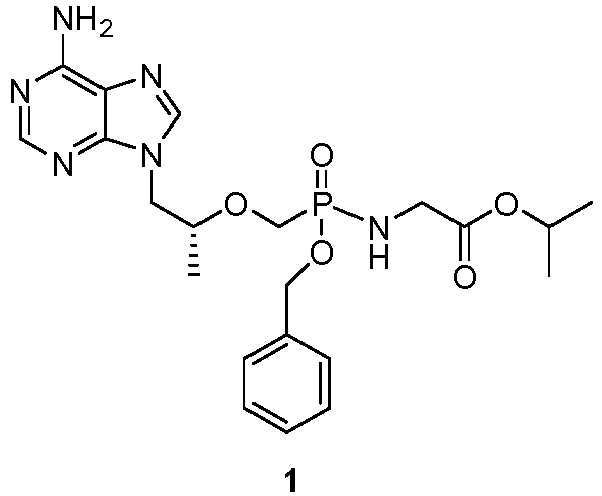
- DIPEA (10 mmol) and benzyl bromide (5 mmol) were added into the suspension of Tenofovir (5 mmol) in acetonitrile (20 mL) sequentially, the mixture was heated to 80°C and stirred for 16 hours and then evaporated to dryness under reduced pressure. The residues were dissolved with pyridine (20 mL), then triethylamine (5 mL) and isopropyl glycine ester hydrochlorate (10 mmol) were added to the solution sequentially. The mixture was heated to 50°C and stirred for 30 minutes, then after triphenyl phosphine (15 mmol) and 2,2'-dithiodipyridine (15 mmol) were added, stirred for 3 hours under the same temperature, and evaporated to dryness under reduced pressure thereafter. The residues were subjected to a silica gel column (eluted by methanol/methylene chloride) to afford a white solid. The yield was 48%.
1H NMR(400 MHz, CDCl3)δ 8.30 (s, 1 H), 7.94, 7.91 (s, s, 1H), 7.37-7.28 (m, 5 H), 6.10, 6.07 (s, s, 2 H), 5.07-4.89 (m, 3 H), 4.38-4.30 (m, 1 H), 4.14-4.05 (m, 1 H), 3.91-3.86 (m, 2 H), 3.71-3.48 (m, 4 H), 1.25-1.18(m, 9 H); 31P NMR (400 MHz, CDCl3) δ 25.76, 25.66; MS (m/z) 477.32 (MH+), 475.18 (MH-). -

- DIPEA (10 mmol) and benzyl bromide (5 mmol) were added into the suspension of Tenofovir (5 mmol) in acetonitrile (20 mL) sequentially, the mixture was heated to 80°C and stirred for 16 hours and then evaporated to dryness under reduced pressure. The residues were dissolved with pyridine (20 mL), then triethylamine (5 mL) and methyl glycine ester hydrochlorate (10 mmol) were added to the solution sequentially. The mixture was heated to 50°C and stirred for 30 minutes, then triphenyl phosphine (15 mmol) and 2,2'-dithiodipyridine (15 mmol) were added, stirred for 3 hours under the same temperature, and evaporated to dryness under reduced pressure thereafter. The residues were subjected to a silica gel column (eluted by methanol/methylene chloride) to afford a white solid. The yield was 57%.
1H NMR (400 MHz, CDCl3) δ 8.26 (s, 1 H), 7.93, 7.92 (s, s, 1 H), 7.31-7.4 (m, 5 H), 6.37 (s, 2 H), 5.01-4.86 (m, 2 H), 4.33-4.25 (m, 1 H), 4.10-4.01 (m, 1 H), 3.93-3.80 (m, 2 H), 3.67-3.53 (m, 4 H), 1.40-1.14(m, 6 H); 31P NMR (400 MHz, CDCl3) δ 25.96, 25.73; MS (m/z) 449.30 (MH+). -

- DIPEA (10 mmol) and benzyl bromide (5 mmol) were added into the suspension of Tenofovir (5 mmol) in acetonitrile (20 mL) sequentially, the mixture was heated to 80°C and stirred for 16 hours and then evaporated to dryness under reduced pressure. The residues were dissolved with pyridine (20 mL), then triethylamine (5 mL) and isopropyl L-alanine ester hydrochlorate (10 mmol) were added to the solution sequentially. The mixture was heated to 50°C and stirred for 30 minutes, then after triphenyl phosphine (15 mmol) and 2,2'-dithiodipyridine (15 mmol) were added, stirred for 3 hours under the same temperature, and evaporated to dryness under reduced pressure thereafter. The residues were subjected to a silica gel column (eluted by methanol/methylene chloride) to afford a white solid. The yield was 54%.
1H NMR (400 MHz, CDCl3) δ 8.34, 8.33 (s, s, 1 H), 7.93, 7.92 (s, s, 1 H), 7.36-7.30 (m, 5 H), 6.00, 5.99 (s, s, 2 H), 5.06-4.97 (m, 2 H), 4.94-4.89 (m, 1 H), 4.40-4.28 (m, 1 H), 4.14-4.06 (m, 1 H), 4.03-3.92 (m, 2 H), 3.89-3.78 (m, 2 H), 3.67-3.53 (m, 2 H), 1.33-1.18 (m, 12 H); 31P NMR (400 MHz, CDCl3) δ 25.02, 24.12; MS (m/z) 491.32 (MH+). -

- DIPEA (10 mmol) and benzyl bromide (5 mmol) were added into the suspension of Tenofovir (5 mmol) in acetonitrile (20 mL) sequentially, the mixture was heated to 80°C and stirred for 16 hours and then evaporated to dryness under reduced pressure. The residue was dissolved with pyridine (20 mL), then triethylamine (5 mL) and L-Phenylalanine isopropyl ester hydrochloride (10 mmol) were added to the solution sequentially. The mixture was heated to 50°C and stirred for 30 minutes, then after triphenyl phosphine (15 mmol) and 2,2'-dithiodipyridine (15 mmol) were added, stirred for 3 hours under the same temperature, and evaporated to dryness under reduced pressure thereafter. The residues were subjected to a silica gel column (eluted by methanol/methylene chloride) to afford a white solid. The yield was 61%.
1H NMR (400 MHz, CDCl3) δ 8.33 (s, 1 H), 7.90 (s, 1 H), 7.30-7.09 (m, 10 H), 6.23 (s, 2 H), 5.03-4.88 (m, 2 H), 4.33-4.29 (m, 1 H), 4.15-3.90 (m, 3 H), 3.81-3.71 (m, 1 H), 3.48-3.43 (m, 1 H), 3.21-3.02 (m, 3 H), 2.94-2.76 (m, 2 H), 1.47-1.42(m, 3 H), 1.26-1.07 (m, 9 H); 31P NMR (400 MHz, CDCl3)δ 20.78; MS (m/z) 567.32 (MH+). -

- DIPEA (10 mmol) and benzyl bromide (5 mmol) were added into the suspension of Tenofovir (5 mmol) in acetonitrile (20 mL) sequentially, the mixture was heated to 80°C and stirred for 16 hours and then evaporated to dryness under reduced pressure. The residues were dissolved with pyridine (20 mL), then triethylamine (5 mL) and benzyl glycine ester hydrochlorate (10 mmol) were added to the solution sequentially. The mixture was heated to 50°C and stirred for 30 minutes, then after triphenyl phosphine (15 mmol) and 2,2'-dithiodipyridine (15 mmol) were added, the mixture was stirred for 3 hours under the same temperature, and evaporated to dryness under reduced pressure thereafter. The residues were subjected to a silica gel column (eluted by methanol/methylene chloride) to afford a white solid. The yield was 58%.
1H NMR (400 MHz, CDCl3) δ 8.30, 8.29 (s, s, 1 H), 7.93, 7.92 (s, s, 1 H), 7.37-7.27 (m, 10 H), 6.14 (s, 2 H), 5.31 (s, 1 H), 5.15 (s, 1 H), 5.10 (s, 1 H), 5.04-4.87 (m, 2 H), 4.34-4.26 (m, 1 H), 4.09-4.00 (m, 1 H), 3.92-3.81 (m, 2H), 3.76-3.54 (m, 1 H), 3.17-3.11 (m, 2 H), 1.18-1.16 (m, 3 H); 31P NMR (400 MHz, CDCl3) δ 25.81, 25.61; MS (m/z) 525.19 (MH+). -

- DIPEA (10 mmol) and benzyl bromide (5 mmol) were added into the suspension of Tenofovir (5 mmol) in acetonitrile (20 mL) sequentially, the mixture was heated to 80°C and stirred for 16 hours and then evaporated to dryness under reduced pressure. The residues were dissolved with pyridine (20 mL), then triethylamine (5 mL) and isopropyl N-phenylglycine ester hydrochlorate (10 mmol) were added to the solution sequentially. The mixture was heated to 50°C and stirred for 30 minutes, then after triphenyl phosphine (15 mmol) and 2,2'-dithiodipyridine (15 mmol) were added, the mixture was stirred for 3 hours under the same temperature, and evaporated to dryness under reduced pressure thereafter. The residues were subjected to a silica gel column (eluted by methanol/methylene chloride) to afford a white solid. The yield was 27%.
1H NMR (400 MHz, CDCl3) δ 8.29 (s, 1 H), 8.09 (s, 1 H), 7.50-7.14 (m, 10 H), 6.60 (s, 2 H), 5.07-4.90 (m, 3 H), 4.37-4.34 (m, 7 H), 3.17-3.12 (m, 3 H), 1.45-1.41 (m, 6 H); 31P NMR(400 MHz, CDCl3) δ 24.43, 24.15; MS (m/z) 553.25 (MH+). - Resolution via HPLC with reverse phase column or chiral column: compound 2 (200 mg) of embodiment 2 was chiral resolved by HPLC with reverse phase column (column: Diamonsil C18, 5 µm, 150x21.1 mm; mobile phase: 20% aqueous acetonitrile solution (V/V)) , afforded compound 2a (83 mg; retention time: 14 min) and compound 2b (90 mg; retention time: 17 min).
Compound 2a: MS (m/z) 449.26 (MH+); 1H NMR (400 MHz, CDCl3) δ 8.28 (s, 1 H), 7.92 (s, 1 H), 7.32-7.24 (m, 5 H), 6.58 (s, 2 H), 5.02-4.88 (m, 2 H), 4.30-4.26 (m, 1 H), 4.16-4.02 (m, 1 H), 3.90-3.84 (m, 2 H), 3.69-3.65 (m, 5 H), 3.60-3.54 (m, 1 H), 1.16 (s, 3 H); 31P NMR (400 MHz, CDCl3) δ 25.87;
Compound 2b: MS (m/z) 449.32 (MH+); 1H NMR (400 MHz, CDCl3) δ 8.28 (s, 1 H), 7.92 (s, 1 H), 7.32-7.27 (m, 5 H), 6.64 (s, 2 H), 5.03-5.01 (m, 2 H), 4.34-4.30 (m, 1 H), 4.10-4.01 (m, 2 H), 3.93-3.84 (m, 2 H), 3.66-3.59 (m, 5 H), 1.14 (s, 3 H); 31P NMR (400 MHz, CDCl3) δ 25.64. - Similar resolution was applied to compounds 1, 3 and 5, and afforded compounds 1a and 1b, 3a and 3b, 5a and 5b respectively.
Compound 1a: 1H NMR (400 MHz, CDCl3) δ 8.25 (s, 1 H), 7.93 (s, 1 H), 7.30-7.26 (m, 5 H), 6.17 (s, 2 H), 5.00-4.90 (m, 2 H), 4.34-4.29 (m, 1 H), 4.11-4.06 (m, 2 H), 3.92-3.81 (m, 2 H), 3.63-3.59 (m, 3 H), 1.18-1.23 (m, 9 H); 31P NMR (400 MHz, CDCl3) δ 25.79;
Compound 1b: 1H NMR (400 MHz, CDCl3) δ 8.28 (s, 1 H), 7.92 (s, 1 H), 7.32-7.27 (m, 5 H), 6.64 (s, 2 H), 5.03-5.01 (m, 2 H), 4.34-4.30 (m, 1 H), 4.10-4.01 (m, 2 H), 3.93-3.84 (m, 2 H), 3.66-3.59 (m, 3 H), 1.16-1.14 (m, 9 H); 31P NMR (400 MHz, CDCl3) δ 25.60.
Compound 3a: 1H NMR (400 MHz, CDCl3) δ 8.30 (s, 1 H), 7.90 (s, 1 H), 7.32-7.27 (m, 5 H), 6.19 (s, 2 H), 5.03-4.96 (m, 2 H), 4.92-4.87 (m, 1 H), 4.30-4.25 (m, 1 H), 4.09-4.03 (m, 1 H), 3.97-3.94 (m, 1 H), 3.90-3.76 (m, 2 H), 3.56-3.50 (m, 1 H), 1.30-1.15 (m, 12 H); 31P NMR (400 MHz, CDCl3) δ 24.18;
Compound 3b: 1H NMR (400 MHz, CDCl3) δ 8.30 (s, 1 H), 7.91 (s, 1 H), 7.36-7.29 (m, 5 H), 6.09 (s, 2 H), 4.99-4.96 (m, 2 H), 4.94-4.87 (m, 1 H), 4.38-4.34 (m, 1 H), 4.12-4.06 (m, 1 H), 3.96-3.90 (m, 2 H), 3.87-3.81 (m, 1 H), 3.60-3.55 (m, 1 H), 3.45-3.40 (m, 1H), 1.31-1.16 (m, 12 H); 31P NMR (400 MHz, CDCl3) δ 25.04
Compound 5a: 1H NMR (400 MHz, CDCl3) δ 8.28 (s, 1 H), 7.95 (s, 1 H), 7.40-7.23 (m, 10 H), 6.33 (s, 2 H), 5.10-4.95 (m, 4 H), 4.32-4.28 (m, 1 H), 4.01-3.84 (m, 2 H), 3.82-3.55 (m, 4 H), 1.24 (s, 3 H); 31P NMR (400 MHz, CDCl3) δ 25.88
Compound 5b: 1H NMR (400 MHz, CDCl3) δ ; 8.27 (s, 1 H), 7.94 (s, 1 H), 7.34-7.27 (m, 10 H), 6.12 (s, 2 H), 4.96-4.84 (m, 4 H), 4.28-4.23 (m, 1 H), 3.83-3.51 (m, 6 H), 1.15 (s, 3 H); 31P NMR (400 MHz, CDCl3) δ 25.59Table 2: List of the chiral compounds of the present invention Compound Structure Compound Structure 1a 
1b 
2a 
2b 
3a 
3b 
5a 
5b 
- In the above compounds, each of the configurations a and b accounts for 50% of the compounds.
- The mixture of one chiral compound of embodiment 7 in Table 2 (1.2 kg), fumaric acid (285 g), and acetonitrile (3 L) was refluxed until it turned to homogeneous and then was filtered while hot. the filtrate was cooled to 5°C and kept for 16 hours at the same temperature. The precipitate was filtered and washed with acetonitrile, dried to afford the product as white powder.
- Test examples: The advantage of the present invention is demonstrated by the test examples described below.
- The most crucial profile of a prodrug is that it is apt to metabolite to the active parent drug meanwhile maintain unattached in other systems, that is, the more stable in systems (gastrointestinal tract, blood, etc.), and more active in the target organs (lymph, liver), then it will be more effective and less toxic as a drug candidate. In the test examples, all the prodrugs, including compounds in the present invention and in the reference, will play their anti-virus effect after being metabolized into Tenofovir (TFV), the active parent drug.

- Currently, compounds with similar structures are the compounds listed in the claims of patent
CN201380030061.6 - Compounds of the present invention are either more efficient or less toxic due to the higher stability of the structures. Moreover, the metabolites of the compounds of the present invention, benzoic acids, are much safer than their counterpart of GS-7340, the toxic phenol, and bring the advantage of being less toxic while having the superior activity. Furthermore, compared with the compounds in the claims of
CN201380030061.6 - The concentration of HBV DNA in the HepG2.2.15 cell supernatant was detected through the real-time fluorescence quantitative PCR (qPCR) method to determine the anti-HBV activity of the compound in the HepG2.2.15 cells, and the effect of the testing compounds to the HepG2.2.15 cell activity was detected through Cell-titer Blue.
8.1. Dilution of the compounds: the initial concentration of each compound in the in vitro anti-HBV activity test was 1 µM, with 3-fold serial dilution to 8 concentrations; the initial concentration of each compound in the cytotoxicity test was 100 µM, with 3-fold serial dilution to 8 concentrations; DMSO was used for the dilution of the compound mother liquor. The initial concentrations of the reference compound TDF for the anti-HBV activity test in vitro and the cytotoxicity test were all set at 0.2 µM, with 3-fold serial dilution to 8 concentrations.
8.2. Anti-HBV activity test in vitro: the HepG2.2.15 cells were plated in the 96-well plate (4 x 10⁴ cells/well), and cultured overnight at 37°C in 5% CO2. On second day, fresh culture solutions containing compounds of different concentrations were added to the culture wells. See Table 2 for the compound distribution. On 5th day, the used culture solutions in the culture wells were sucked and discarded, and fresh culture solutions containing compounds of different concentrations were added. On 8th day, the supernatant in the culture wells was collected for the extraction of HBV DNA in the supernatant. qPCR test was used to detect the concentration of HBV DNA content in the HepG2.2.15 supernatant.
8.3. Treatment of the cells in the cell viability test: the HepG2.2.15 cells were plated in the 96-well plate (4 x 10⁴ cells/well), and cultured overnight at 37°C in 5% CO2. On 2nd day, fresh culture solutions containing compounds of different concentrations were added to the culture wells. See Table 3 for the compound distribution. On 5th day, the used culture solutions in the culture wells were sucked and discarded, and fresh culture solutions containing compounds of different concentrations were added. On 8th day, Cell-titer Blue agent was added to each well, and the microplate reader was used to detect the fluorescence value of each well.
8.4. Data analysis and calculation of the inhibition percentage and relative cell viability:
The inhibition percentage was calculated using the following formula:
The cell viability percentage was calculated using the following formula:
The GraphPad Prism software was used to calculate the 50% effective concentration (EC50) value and the 50% cytotoxic concentration (CC50) value of the compounds.
8.5. Test results and conclusions:Table 3: EC50 and CC50 values of the anti-HBV test results of the compounds Compound s EC50 (nM) CC50 (µM) 1a >1000 >100 1b 290.1 >100 2a 418.4 >100 2b >1000 >100 3a 3.39 >100 3b 6 >100 5a 214 >100 5b 847.6 >100 - There were totally 8 test compounds in the present test, and the test results were summarized as the following: 2 test compounds of 3a and 3b showed better anti-HBV activities, with EC50 values below the 10 nM level, 4 test compounds of 1b, 2a, 5a, and 5b showed lower anti-HBV activities, with EC50 values between 200 nM and 1000 nM; EC50 values of the anti-HBV activities of the other 2 test compounds of 1a and 2a were higher than the maximum test concentration of 1000 nM.
- The structures of compounds 1, 2, 4, 5, and 6 of the present invention were similar to that of compounds 3, therefore they had the similar pharmacodynamic effects.
-
9.1 Drugs: the dilution method and concentrations of compound 3, the reference compound (CN201380030061.6 
9.2 Test method: the test was carried out according to the procedure in example 1.
9.3 Results and analysis:Table 4: EC50 and CC50 values of the compounds in the anti-HBV test Compounds EC50 (nM) CC50 (µM) 3a 3.39 >100 3b 6.00 >100 7a >1000 >100 7b 274.70 >100 GS-7340 17.75 >100 - It could be seen from Table 4 that compounds 3a and 3b of the present invention showed good anti-HBV activities, which were significantly better than that of the reference compounds 7a, 7b, and GS-7340. None of the compounds had apparent impact on the cytotoxicity of HepG2.2.15(CC50>100 µM).
-
9.1. Dilution and concentrations of the compounds and the reference compound (CN01813161GS-7340, TDF) were the same as those in example 1.
9.2. In vitro anti-HIV activity test: after MT-4 cells were infected with 24 TCID50 HIV-1 IIIB/1x105 cells (2.4 TCID50/well) at 37°C for 1 hour, they were plated in the 96-well plate containing the compounds of different concentrations (4x10⁴ cells/well) and cultured at 37°C in 5% CO2 for 5 days. CellTiter Glo was used to determine the activity to calculate the EC50 value.
9.3. Treatment of the cells in the cell viability test: parallel tests were carried out using the same method as that in 9.2, except that the 96-well plate containing the compounds of different concentrations were replaced with the blank 96-well plate, and CellTiter Glo was used to determine the cell viability to calculate the CC50 value.
9.4. Data analysis and calculation of the inhibition percentage: the activity percentage was calculated using the following formula:

The GraphPad Prism software was used to calculate the 50% effective concentration (EC50) value and the 50% cytotoxic concentration (CC50) value of the compounds.
9.5. Test results and conclusions:Table 5: EC50 and CC50 values of the compounds in the anti-HBV test results Compounds EC50 (nM) CC50 (µM) 3a 5.13 22.53 3b 9.86 16.89 7b 83.65 14.72 GS-7340 14.28 13.34 TDF 16.97 21.33 - The anti-HIV activities of compounds 3a and 3b were higher than those of 7b and GS-7340; meanwhile the toxicities to the MT-4 cells of 3a and 3b were lower than those of GS-7340 and 7b.
- Conclusion: it could be seen from example 2 and 3 that, in the preliminary efficacy study, compounds 3a and 3b presented good anti-HBV and anti-HIV activities, and showed significant advantages compared with the activity of GS-7340, the active ingredient of TAF. They were apparently superior to the other two control compounds 7a and 7b. Results of the cytotoxicity study: there was no apparent effect on the cytotoxicity of the HepG2.2.15 (CC50>100 µM); however, regarding the toxicity to the MT-4 cells, the data showed that compounds 3a and 3b had lower MT-4 cytotoxicities than GS-7340 and 7b.
- The following stability test were carried out according to the prior art, and the data of the stability test shown in the table were the residue percentages after the test compounds were incubated for different period of time under the test condition.
10.1 Stability in the simulated gastric fluid (Table 6): Compounds % 0 min % 60 min % 120 min % 360 min % 1440 min 3a (10 µM) 100 85.40 58.07 14.41 0.00 3b (10 µM) 100 84.26 58.54 17.28 0.00 7b (10 µM) 100 82.76 51.39 13.16 0.00 GS-7340 (10 µM) 100 95.40 66.36 23.41 0.19 (Omeprazole20 µM) 100 24.34 9.41 1.58 0.31 10.2 Stability in the simulated intestinal fluid (test concentration: 10 µM) (Table 7): Compounds % 0 min % 60 min % 120 min % 360 min % 1440 min 3a 100 53.62 23.45 1.26 0.00 3b 100 51.07 20.20 0.23 0.00 7b 100 31.28 8.33 0.09 0.00 GS-7340 100 30.09 6.22 0.06 0.00 (Chlorambucil) 100 29.36 3.11 0.00 0.00 10.3 Stability in the human blood (test concentration: 2 µM) (Table 8): Compounds % 0 min % 10 min % 30 min % 60 min % 120 min 3a 100 97.4 98.9 97.8 94.5 3b 100 97.1 96.4 96.1 93.7 7b 100 93.5 91.6 90.5 90.1 GS-7340 100 93.2 91.0 90.3 90.0 (Eucatropine) 100 54.4 37.0 24.4 10.2 10.4 Stability in the human liver S9 (test concentration: 1 µM) (Table 9): Compounds T 1/ 2 min CL lint(s9) uL/min/mg CL lint(s9) uL/min/kg Remaining (T = 60 min) 3a 9.9 70.0 246.4 6% 3b 10.1 68.6 241.5 9% 7b 4.7 147.4 519.0 5% GS-7340 3.3 211.0 742.7 4% (7-Ethoxycumarin) 82.2 8.4 29.7 60% (7-Hydroxycoumarin) 6.6 105.1 370.0 4% - The consistency of test results of the related control substances such as 7-Ethoxycumarin, 7-Hydroxycoumarin, Eucatropine, Chlorambucil, and Omeprazole, etc. verified the effectiveness of this set of tests.
- The test data of the preliminary stability study showed that, for compounds 3a and 3b, GS-7340 and 7b, the stabilities in the human liver S9 were comparative, also the rates of metabolizing to the active parent drug were comparative, implying that the activities of the compounds of the same concentration in the liver cells were comparative.
- In the simulated gastric fluid, the stabilities of 3a and 3b were comparative to GS-7340 but higher than 7b; the stabilities of 3a and 3b in the simulated intestinal fluid were significantly higher than those of 7b and GS-7340. The stabilities of 3a and 3b in the human blood were also better than those of the comparative compounds 7b and GS-7340. Generally, compounds 3a and 3b had higher stabilities in the gastrointestinal tract and blood system compared to GS-7340 and 7b, so that the drug concentration would be lower in the non-target system while higher in the target tissues, implying that compounds 3a and 3b would have better liver-targeting properties and lower systemic toxicities compared to GS-7340 and 7b.
- The CHO cells obtained from AVivaBiosciences that could stably express the hERG K-channel were used in the test, and the cells were incubated at 37°C in 5% CO2 and under constant humidity.
- After the compounds and the positive control compound amitriptyline (Amitriptyline , Sigma-Aldrich, BCBJ8594V) were dissolved in 100% dimethyl sulfoxide (DMSO), they were serially diluted and stored at -20°C for further use. The final concentration of DMSO in the extracellular fluid was not higher than 0.30%.
- The whole-cell patch clamp technique was used on the Multiclamp patch-clamp amplifier to test the compound at room temperature, the output signal was digitalized using the DIgiDAta 1440 A/D-D/A plate, and the Pclamp10 software was used for the control of the recording. The minimum sealing resistance was set at 500 MOhms, and the minimum specific hERG current was set at 0.4 nA for quality control.
- Clampfit (V10.2, Molecular Devices), Excel 2003 and GraphPad Prism 5.0 were used for the data analysis. The calculation formula of the current:

11.4. Test results and conclusions (Table 10): Compounds IC50 (µM) HillSlope Number of cells Amitriptyline 3.56 0.93 4 3a >10.00 - 2 3b >30.00 - 2 7b >10.00 - 2 GS-7340 >10.00 - 2 - Conclusion: the IC50 of compounds 3a and 3b were comparative to those of GS-7340 and 7b in the hERG test, and they were all above 10 µM, which were safe regarding to the cardiotoxicity, and met the general requirement of the hERG data for further research of the compounds during the new drug research and development.
- 12 ICR mice (male, body weight 30±5 g, purchased from the Vital River animal center) were randomly divided into 4 groups, 3 for each group, fasted for 12 h before drug administration, with freely drinking during the fasting. Precisely weighing 30 mg of compound 3 on the analytical balance, adding 100 µL of 75% ethanol for dissolution, further adding saline to 6 mL, the mixture was vortexed to be uniformly mixed and carried out with ultrasonic processing for further use. The dose of the Tenofovir prodrug was 50 mg/kg, and the administration quantity was 10 mL/kg.
- The sample collection protocols: after administration by gastric gavage, each 0.5 mL of blood was taken from the orbit at 15 min, 30 min, 1 h, and 3 h; the mice were sacrificed, and the liver tissues were taken, washed cleanly, and weighed; normal saline was added to the liver with a proportion of 1:1, homogenized, and stored in the refrigerator at -40°C for test.
- Treatment method for the plasma samples: 100 µL of the mouse plasma was taken and placed in a 1.5 mL plastic EP tube, 100 µL solution of internal standard (200 ng/ml theophylline) solution was added, 600 µL acetonitrile was added, vortex shaking for 2 min, centrifuged for 3 min (12500 rpm), the supernatant was taken, purged with nitrogen to dryness, and dissolved again with 100 µL of mobile phase (water:methanol = 95:5), and the injection volume was 10 µL.
- Treatment method for the tissue samples: 200 µL of the mouse tissue samples were taken and placed in a 1.5 mL plastic EP tube, 100 µL solution of internal standard (200 ng/ml theophylline) solution was added, 600 µL acetonitrile was added, vortex shaking for 2 min, centrifuged for 3 min (12500 rpm), the supernatant was taken, purged with nitrogen to dryness, and dissolved again with 100 µL of mobile phase (water:methanol = 95:5), and the injection volume was 20 µL.
- The Thermo TSQquantum LC-MS and chromatograph column Thermo Hypersil GOLD (2.1×150 mm) were used, the internal standard was Theophylline, gradient elution and analysis were carried out after the HPLC-MS injection, the retention times and peak areas of the internal standard, compound 1 and the metabolic product of Tenofovir (TFV) were recorded, and the SRM quantitative detection method was used for the analysis.
12.4. Analysis results of the sample and conclusions (Table 11) Compounds (MS) Cplasma (nmol/mL) Cliver tissue (nmol/mL) Liver tissue selectivity (Cliver tissue/ Cplasma) TFV (287) 0.075 67.251 896 Compound 3 (490) 0.104 0.375 3.61 Interior label (180) 1.11 1.11 1 


- The results showed that after 3 h, the concentrations of compound 3 and its metabolic product of Tenofovir TFV in the liver were both higher than those in the blood, and the overall concentration of both in the liver is 377 times of that in the blood, demonstrating that compound 3 could be effectively enriched in the liver. Meanwhile, the concentration of TFV in the blood was only 0.72 times of that of the parent drug compound 3, while the concentration of the parent drug TFV in the liver was 166 times of that of the prodrug compound 3, demonstrating that compound 3 was relatively stable in the mouse blood, and effectively metabolized into the active parent drug Tenofovir in the liver. Therefore, compound 3 had blood stability and liver-targeting anti-HBV activity in the animal test in vivo.
Claims (8)
- A tenofovir monobenzyl ester phosphamide compound of the general formula X, and the hydrate, solvate, pharmaceutically acceptable salt thereof or the resolved single isomer thereof,
 wherein Z is selected from O, S, Se, NH- or CH2-,R1, R2, R3, R4, and R5 are each independently selected from H, substituted or unsubstituted C1-C10 linear alkyl, C3-C10 branched alkyl, C3-C10 cycloalkyl, and C6-C10 aryl or heteroaryl, wherein the substitution is one to three hetero atoms independently selected from O, S, N and Se.
 - The tenofovir monobenzyl ester phosphamide compound according to claim 1, wherein,
Z is selected from O or S,
R1, R2, R3, R4 and R5 are each independently selected from H, substituted or unsubstituted C1-C6 linear alkyl, C3-C6 branched alkyl, C3-C6 cycloalkyl, and C6-C10 aryl or heteroaryl. - The tenofovir monobenzyl ester phosphamide compound according to claim 2, wherein,
Z is selected from O,
R1, R2, R3, R4 and R5 are each independently selected from H, substituted or unsubstituted C1-C6 linear alkyl, C3-C6 branched alkyl, and C6-C10 aryl. - The tenofovir monobenzyl ester phosphamide compound according to claim 3, wherein the compound is selected from:


- The tenofovir monobenzyl ester phosphamide compound according to claim 4, wherein the isomers of compounds 1, 2, 3, and 5 are 1a and 1b, 2a and 2b, 3a and 3b, and 5a and 5b, respectively, with the structures of:


- A preparation method for a tenofovir monobenzyl ester phosphamide compound of general formula X according to the following synthetic route:
 wherein Z is selected from O, S, Se, NH- or CH2-, andR1, R2, R3, R4, and R5 are each independently selected from H, substituted or unsubstituted C1-C10 linear alkyl, C3-C10 branched alkyl, C3-C10 cycloalkyl, and C6-C10 aryl or heteroaryl, wherein the substitution is one to three hetero atoms independently selected from O, S, N and Se.
 - Tenofovir monobenzyl ester phosphamide compound according to any one of claims 1-5, or the hydrate thereof, or the solvate thereof, or the pharmaceutically acceptable salt thereof or the resolved single isomer thereof for use in treating diseases of viral infections.
- Tenofovir monobenzyl ester phosphamide compound according to claim 7, or the hydrate thereof, or the solvate thereof, or the pharmaceutically acceptable salt thereof or the resolved single isomer thereof for use in treating AIDS infection or hepatitis B or diseases caused by the hepatitis B virus.
Applications Claiming Priority (2)
| Application Number | Priority Date | Filing Date | Title |
|---|---|---|---|
| CN201510290530 | 2015-05-29 | ||
| PCT/CN2016/083407 WO2016192560A1 (en) | 2015-05-29 | 2016-05-26 | Tenofovir monobenzyl ester phosphamide prodrug, preparation method and use thereof |
Publications (3)
| Publication Number | Publication Date |
|---|---|
| EP3305795A1 EP3305795A1 (en) | 2018-04-11 |
| EP3305795A4 EP3305795A4 (en) | 2019-02-06 |
| EP3305795B1 true EP3305795B1 (en) | 2020-05-06 |
Family
ID=57440060
Family Applications (1)
| Application Number | Title | Priority Date | Filing Date |
|---|---|---|---|
| EP16802483.4A Active EP3305795B1 (en) | 2015-05-29 | 2016-05-26 | Tenofovir monobenzyl ester phosphamide prodrug, preparation method and use thereof |
Country Status (14)
| Country | Link |
|---|---|
| US (1) | US10233202B2 (en) |
| EP (1) | EP3305795B1 (en) |
| JP (1) | JP6679624B2 (en) |
| KR (1) | KR20180016437A (en) |
| CN (2) | CN106188139B (en) |
| AU (1) | AU2016270101B2 (en) |
| CA (1) | CA2987473A1 (en) |
| ES (1) | ES2806726T3 (en) |
| IL (1) | IL255892B (en) |
| MY (1) | MY191515A (en) |
| RU (1) | RU2719594C2 (en) |
| SG (1) | SG11201709786WA (en) |
| TW (1) | TWI692479B (en) |
| WO (1) | WO2016192560A1 (en) |
Families Citing this family (10)
| Publication number | Priority date | Publication date | Assignee | Title |
|---|---|---|---|---|
| MX377983B (en) | 2014-09-15 | 2025-03-04 | Univ California | NUCLEOTIDE ANALOGUES. |
| CN105983016B (en) | 2015-03-23 | 2023-08-11 | 天士力医药集团股份有限公司 | A drug combination containing silibinin |
| CN106188139B (en) * | 2015-05-29 | 2020-02-18 | 江苏天士力帝益药业有限公司 | Tenofovir monobenzyl ester phosphate amide prodrug, preparation method and application thereof |
| KR20190100250A (en) | 2016-12-22 | 2019-08-28 | 머크 샤프 앤드 돔 코포레이션 | Antiviral Aliphatic Ester Prodrug of Tenofovir |
| EP3730503B8 (en) * | 2017-12-21 | 2026-03-18 | Shenzhen TargetRx Co., Ltd. | Antiviral nucleoside reverse transcriptase inhibitor |
| EP3808752A4 (en) * | 2018-06-12 | 2022-03-09 | Sichuan Kelun-Biotech Biopharmaceutical Co., Ltd. | PHOSPHONAMIDE ESTER COMPOUND, SALT THEREOF, ASSOCIATED CRYSTALLINE FORM THEREOF, METHOD FOR PREPARATION AND USE |
| CN111018916B (en) * | 2019-12-30 | 2022-04-29 | 天津天士力圣特制药有限公司 | A kind of synthetic method of tenofovir phenyl alkyl ester phosphonamide precursor |
| CN111116655B (en) * | 2019-12-30 | 2022-10-25 | 天津天士力圣特制药有限公司 | Preparation method of high-optical-purity tenofovir benzyl ester phosphonamide prodrug |
| CN114262348A (en) * | 2020-09-16 | 2022-04-01 | 上海本仁科技有限公司 | Cyclic nucleoside phosphate ester compound and application thereof |
| WO2025160208A1 (en) * | 2024-01-24 | 2025-07-31 | Antiva Biosciences, Inc. | Synthesis of ethyl-2-((((2-(2-amino-6-methoxy-9h-purin-9-yl)-ethoxy)-methyl)-(benzyloxy)-phosphoryl)-amino)-propionate |
Family Cites Families (10)
| Publication number | Priority date | Publication date | Assignee | Title |
|---|---|---|---|---|
| CA2410763A1 (en) * | 2000-06-13 | 2002-11-28 | Shionogi & Co., Ltd. | Medicinal compositions containing propenone derivatives |
| HRP20030047B1 (en) * | 2000-07-21 | 2016-02-26 | Gilead Sciences, Inc. | MEDICINES THAT ARE PHOSPHONATE ANALYSIS OF NUCLEOTIDS AND THE METHODS OF SELECTION AND PREPARATION thereof |
| CN1465582A (en) * | 2002-07-01 | 2004-01-07 | 中国人民解放军军事医学科学院放射医 | Nucleotide analogs, medicinal compositions having same and use thereof |
| US8354421B2 (en) * | 2007-06-29 | 2013-01-15 | Korea Research Insitute Of Chemical Technology | HIV reverse transcriptase inhibitors |
| US9095599B2 (en) * | 2011-01-03 | 2015-08-04 | Nanjing Molecular Research, Inc. | O-(substituted benzyl) phosphoramidate compounds and therapeutic use |
| US9156874B2 (en) | 2011-01-03 | 2015-10-13 | Nanjing Molecular Research, Inc. | Double-liver-targeting phosphoramidate and phosphonoamidate prodrugs |
| WO2013187978A1 (en) * | 2012-06-16 | 2013-12-19 | Nanjing Molecular Research, Inc. | Double-liver-targeting phosphoramidate and phosphonoamidate prodrugs |
| CN107312039B (en) * | 2012-08-30 | 2019-06-25 | 江苏豪森药业集团有限公司 | A kind of preparation method of tenofovir prodrug |
| CN103435672A (en) * | 2013-04-25 | 2013-12-11 | 刘沛 | Structure and synthesis of novel nucleoside phosphate prodrug containing substituted benzyl |
| CN106188139B (en) * | 2015-05-29 | 2020-02-18 | 江苏天士力帝益药业有限公司 | Tenofovir monobenzyl ester phosphate amide prodrug, preparation method and application thereof |
-
2016
- 2016-05-25 CN CN201610353768.6A patent/CN106188139B/en active Active
- 2016-05-26 EP EP16802483.4A patent/EP3305795B1/en active Active
- 2016-05-26 AU AU2016270101A patent/AU2016270101B2/en not_active Ceased
- 2016-05-26 US US15/577,956 patent/US10233202B2/en not_active Expired - Fee Related
- 2016-05-26 WO PCT/CN2016/083407 patent/WO2016192560A1/en not_active Ceased
- 2016-05-26 RU RU2017145357A patent/RU2719594C2/en active
- 2016-05-26 KR KR1020177037627A patent/KR20180016437A/en not_active Ceased
- 2016-05-26 MY MYPI2017704555A patent/MY191515A/en unknown
- 2016-05-26 JP JP2017561871A patent/JP6679624B2/en not_active Expired - Fee Related
- 2016-05-26 CA CA2987473A patent/CA2987473A1/en not_active Abandoned
- 2016-05-26 CN CN201680031443.4A patent/CN107709340B/en not_active Expired - Fee Related
- 2016-05-26 SG SG11201709786WA patent/SG11201709786WA/en unknown
- 2016-05-26 ES ES16802483T patent/ES2806726T3/en active Active
- 2016-05-27 TW TW105116542A patent/TWI692479B/en not_active IP Right Cessation
-
2017
- 2017-11-26 IL IL255892A patent/IL255892B/en active IP Right Grant
Non-Patent Citations (1)
| Title |
|---|
| None * |
Also Published As
| Publication number | Publication date |
|---|---|
| RU2719594C2 (en) | 2020-04-21 |
| CN107709340A (en) | 2018-02-16 |
| US10233202B2 (en) | 2019-03-19 |
| JP6679624B2 (en) | 2020-04-15 |
| AU2016270101A1 (en) | 2017-12-14 |
| KR20180016437A (en) | 2018-02-14 |
| RU2017145357A3 (en) | 2019-09-04 |
| TW201702246A (en) | 2017-01-16 |
| IL255892A (en) | 2018-01-31 |
| EP3305795A1 (en) | 2018-04-11 |
| RU2017145357A (en) | 2019-07-01 |
| HK1246799A1 (en) | 2018-09-14 |
| JP2018517698A (en) | 2018-07-05 |
| CN107709340B (en) | 2020-03-17 |
| EP3305795A4 (en) | 2019-02-06 |
| ES2806726T3 (en) | 2021-02-18 |
| MY191515A (en) | 2022-06-28 |
| SG11201709786WA (en) | 2017-12-28 |
| IL255892B (en) | 2020-11-30 |
| US20180127445A1 (en) | 2018-05-10 |
| WO2016192560A1 (en) | 2016-12-08 |
| CN106188139B (en) | 2020-02-18 |
| CN106188139A (en) | 2016-12-07 |
| TWI692479B (en) | 2020-05-01 |
| CA2987473A1 (en) | 2016-12-08 |
| AU2016270101B2 (en) | 2020-01-23 |
Similar Documents
| Publication | Publication Date | Title |
|---|---|---|
| AU2016270101B2 (en) | Tenofovir monobenzyl ester phosphamide prodrug, preparation method and use thereof | |
| KR102057751B1 (en) | Tenofovir prodrug and pharmaceutical uses thereof | |
| CN109071588B (en) | Uridine phosphoramide prodrug, its preparation method and its application in medicine | |
| US20070021380A1 (en) | Novel drug delivery compositions | |
| HK1246799B (en) | Tenofovir monobenzyl ester phosphamide prodrug, preparation method and use thereof | |
| US8349834B2 (en) | Dioxolane derivates for the treatment of cancer | |
| CN111285900B (en) | Coupling molecule DCZ0847 compound based on pterostilbene and apocynin, preparation method and application thereof | |
| DE102015201148B4 (en) | Use of phenyl phosphates and their prodrugs as drugs in cancer therapy | |
| HK1258984B (en) | Uridine phosphoramide prodrug, preparation method therefor, and medicinal uses thereof |
Legal Events
| Date | Code | Title | Description |
|---|---|---|---|
| STAA | Information on the status of an ep patent application or granted ep patent |
Free format text: STATUS: THE INTERNATIONAL PUBLICATION HAS BEEN MADE |
|
| PUAI | Public reference made under article 153(3) epc to a published international application that has entered the european phase |
Free format text: ORIGINAL CODE: 0009012 |
|
| STAA | Information on the status of an ep patent application or granted ep patent |
Free format text: STATUS: REQUEST FOR EXAMINATION WAS MADE |
|
| 17P | Request for examination filed |
Effective date: 20171221 |
|
| AK | Designated contracting states |
Kind code of ref document: A1 Designated state(s): AL AT BE BG CH CY CZ DE DK EE ES FI FR GB GR HR HU IE IS IT LI LT LU LV MC MK MT NL NO PL PT RO RS SE SI SK SM TR |
|
| AX | Request for extension of the european patent |
Extension state: BA ME |
|
| DAV | Request for validation of the european patent (deleted) | ||
| DAX | Request for extension of the european patent (deleted) | ||
| REG | Reference to a national code |
Ref country code: HK Ref legal event code: DE Ref document number: 1246799 Country of ref document: HK |
|
| A4 | Supplementary search report drawn up and despatched |
Effective date: 20190108 |
|
| RIC1 | Information provided on ipc code assigned before grant |
Ipc: C07F 9/6561 20060101AFI20190102BHEP Ipc: A61P 31/12 20060101ALI20190102BHEP Ipc: A61P 31/20 20060101ALI20190102BHEP Ipc: A61P 31/18 20060101ALI20190102BHEP Ipc: A61K 31/675 20060101ALI20190102BHEP |
|
| GRAP | Despatch of communication of intention to grant a patent |
Free format text: ORIGINAL CODE: EPIDOSNIGR1 |
|
| STAA | Information on the status of an ep patent application or granted ep patent |
Free format text: STATUS: GRANT OF PATENT IS INTENDED |
|
| INTG | Intention to grant announced |
Effective date: 20200117 |
|
| GRAS | Grant fee paid |
Free format text: ORIGINAL CODE: EPIDOSNIGR3 |
|
| GRAA | (expected) grant |
Free format text: ORIGINAL CODE: 0009210 |
|
| STAA | Information on the status of an ep patent application or granted ep patent |
Free format text: STATUS: THE PATENT HAS BEEN GRANTED |
|
| AK | Designated contracting states |
Kind code of ref document: B1 Designated state(s): AL AT BE BG CH CY CZ DE DK EE ES FI FR GB GR HR HU IE IS IT LI LT LU LV MC MK MT NL NO PL PT RO RS SE SI SK SM TR |
|
| REG | Reference to a national code |
Ref country code: GB Ref legal event code: FG4D |
|
| REG | Reference to a national code |
Ref country code: CH Ref legal event code: EP Ref country code: AT Ref legal event code: REF Ref document number: 1266552 Country of ref document: AT Kind code of ref document: T Effective date: 20200515 |
|
| REG | Reference to a national code |
Ref country code: DE Ref legal event code: R096 Ref document number: 602016036005 Country of ref document: DE |
|
| REG | Reference to a national code |
Ref country code: IE Ref legal event code: FG4D |
|
| REG | Reference to a national code |
Ref country code: LT Ref legal event code: MG4D |
|
| REG | Reference to a national code |
Ref country code: NL Ref legal event code: MP Effective date: 20200506 |
|
| PG25 | Lapsed in a contracting state [announced via postgrant information from national office to epo] |
Ref country code: SE Free format text: LAPSE BECAUSE OF FAILURE TO SUBMIT A TRANSLATION OF THE DESCRIPTION OR TO PAY THE FEE WITHIN THE PRESCRIBED TIME-LIMIT Effective date: 20200506 Ref country code: LT Free format text: LAPSE BECAUSE OF FAILURE TO SUBMIT A TRANSLATION OF THE DESCRIPTION OR TO PAY THE FEE WITHIN THE PRESCRIBED TIME-LIMIT Effective date: 20200506 Ref country code: FI Free format text: LAPSE BECAUSE OF FAILURE TO SUBMIT A TRANSLATION OF THE DESCRIPTION OR TO PAY THE FEE WITHIN THE PRESCRIBED TIME-LIMIT Effective date: 20200506 Ref country code: NO Free format text: LAPSE BECAUSE OF FAILURE TO SUBMIT A TRANSLATION OF THE DESCRIPTION OR TO PAY THE FEE WITHIN THE PRESCRIBED TIME-LIMIT Effective date: 20200806 Ref country code: GR Free format text: LAPSE BECAUSE OF FAILURE TO SUBMIT A TRANSLATION OF THE DESCRIPTION OR TO PAY THE FEE WITHIN THE PRESCRIBED TIME-LIMIT Effective date: 20200807 Ref country code: IS Free format text: LAPSE BECAUSE OF FAILURE TO SUBMIT A TRANSLATION OF THE DESCRIPTION OR TO PAY THE FEE WITHIN THE PRESCRIBED TIME-LIMIT Effective date: 20200906 Ref country code: PT Free format text: LAPSE BECAUSE OF FAILURE TO SUBMIT A TRANSLATION OF THE DESCRIPTION OR TO PAY THE FEE WITHIN THE PRESCRIBED TIME-LIMIT Effective date: 20200907 |
|
| PG25 | Lapsed in a contracting state [announced via postgrant information from national office to epo] |
Ref country code: LV Free format text: LAPSE BECAUSE OF FAILURE TO SUBMIT A TRANSLATION OF THE DESCRIPTION OR TO PAY THE FEE WITHIN THE PRESCRIBED TIME-LIMIT Effective date: 20200506 Ref country code: HR Free format text: LAPSE BECAUSE OF FAILURE TO SUBMIT A TRANSLATION OF THE DESCRIPTION OR TO PAY THE FEE WITHIN THE PRESCRIBED TIME-LIMIT Effective date: 20200506 Ref country code: RS Free format text: LAPSE BECAUSE OF FAILURE TO SUBMIT A TRANSLATION OF THE DESCRIPTION OR TO PAY THE FEE WITHIN THE PRESCRIBED TIME-LIMIT Effective date: 20200506 Ref country code: BG Free format text: LAPSE BECAUSE OF FAILURE TO SUBMIT A TRANSLATION OF THE DESCRIPTION OR TO PAY THE FEE WITHIN THE PRESCRIBED TIME-LIMIT Effective date: 20200806 |
|
| REG | Reference to a national code |
Ref country code: AT Ref legal event code: MK05 Ref document number: 1266552 Country of ref document: AT Kind code of ref document: T Effective date: 20200506 |
|
| PG25 | Lapsed in a contracting state [announced via postgrant information from national office to epo] |
Ref country code: NL Free format text: LAPSE BECAUSE OF FAILURE TO SUBMIT A TRANSLATION OF THE DESCRIPTION OR TO PAY THE FEE WITHIN THE PRESCRIBED TIME-LIMIT Effective date: 20200506 Ref country code: AL Free format text: LAPSE BECAUSE OF FAILURE TO SUBMIT A TRANSLATION OF THE DESCRIPTION OR TO PAY THE FEE WITHIN THE PRESCRIBED TIME-LIMIT Effective date: 20200506 |
|
| PG25 | Lapsed in a contracting state [announced via postgrant information from national office to epo] |
Ref country code: LI Free format text: LAPSE BECAUSE OF NON-PAYMENT OF DUE FEES Effective date: 20200531 Ref country code: CZ Free format text: LAPSE BECAUSE OF FAILURE TO SUBMIT A TRANSLATION OF THE DESCRIPTION OR TO PAY THE FEE WITHIN THE PRESCRIBED TIME-LIMIT Effective date: 20200506 Ref country code: RO Free format text: LAPSE BECAUSE OF FAILURE TO SUBMIT A TRANSLATION OF THE DESCRIPTION OR TO PAY THE FEE WITHIN THE PRESCRIBED TIME-LIMIT Effective date: 20200506 Ref country code: CH Free format text: LAPSE BECAUSE OF NON-PAYMENT OF DUE FEES Effective date: 20200531 Ref country code: EE Free format text: LAPSE BECAUSE OF FAILURE TO SUBMIT A TRANSLATION OF THE DESCRIPTION OR TO PAY THE FEE WITHIN THE PRESCRIBED TIME-LIMIT Effective date: 20200506 Ref country code: DK Free format text: LAPSE BECAUSE OF FAILURE TO SUBMIT A TRANSLATION OF THE DESCRIPTION OR TO PAY THE FEE WITHIN THE PRESCRIBED TIME-LIMIT Effective date: 20200506 Ref country code: AT Free format text: LAPSE BECAUSE OF FAILURE TO SUBMIT A TRANSLATION OF THE DESCRIPTION OR TO PAY THE FEE WITHIN THE PRESCRIBED TIME-LIMIT Effective date: 20200506 Ref country code: SM Free format text: LAPSE BECAUSE OF FAILURE TO SUBMIT A TRANSLATION OF THE DESCRIPTION OR TO PAY THE FEE WITHIN THE PRESCRIBED TIME-LIMIT Effective date: 20200506 |
|
| REG | Reference to a national code |
Ref country code: DE Ref legal event code: R097 Ref document number: 602016036005 Country of ref document: DE |
|
| REG | Reference to a national code |
Ref country code: ES Ref legal event code: FG2A Ref document number: 2806726 Country of ref document: ES Kind code of ref document: T3 Effective date: 20210218 |
|
| PG25 | Lapsed in a contracting state [announced via postgrant information from national office to epo] |
Ref country code: MC Free format text: LAPSE BECAUSE OF FAILURE TO SUBMIT A TRANSLATION OF THE DESCRIPTION OR TO PAY THE FEE WITHIN THE PRESCRIBED TIME-LIMIT Effective date: 20200506 Ref country code: PL Free format text: LAPSE BECAUSE OF FAILURE TO SUBMIT A TRANSLATION OF THE DESCRIPTION OR TO PAY THE FEE WITHIN THE PRESCRIBED TIME-LIMIT Effective date: 20200506 Ref country code: SK Free format text: LAPSE BECAUSE OF FAILURE TO SUBMIT A TRANSLATION OF THE DESCRIPTION OR TO PAY THE FEE WITHIN THE PRESCRIBED TIME-LIMIT Effective date: 20200506 |
|
| PLBE | No opposition filed within time limit |
Free format text: ORIGINAL CODE: 0009261 |
|
| STAA | Information on the status of an ep patent application or granted ep patent |
Free format text: STATUS: NO OPPOSITION FILED WITHIN TIME LIMIT |
|
| REG | Reference to a national code |
Ref country code: BE Ref legal event code: MM Effective date: 20200531 |
|
| PG25 | Lapsed in a contracting state [announced via postgrant information from national office to epo] |
Ref country code: LU Free format text: LAPSE BECAUSE OF NON-PAYMENT OF DUE FEES Effective date: 20200526 |
|
| 26N | No opposition filed |
Effective date: 20210209 |
|
| PG25 | Lapsed in a contracting state [announced via postgrant information from national office to epo] |
Ref country code: IE Free format text: LAPSE BECAUSE OF NON-PAYMENT OF DUE FEES Effective date: 20200526 |
|
| PG25 | Lapsed in a contracting state [announced via postgrant information from national office to epo] |
Ref country code: BE Free format text: LAPSE BECAUSE OF NON-PAYMENT OF DUE FEES Effective date: 20200531 Ref country code: SI Free format text: LAPSE BECAUSE OF FAILURE TO SUBMIT A TRANSLATION OF THE DESCRIPTION OR TO PAY THE FEE WITHIN THE PRESCRIBED TIME-LIMIT Effective date: 20200506 |
|
| PGFP | Annual fee paid to national office [announced via postgrant information from national office to epo] |
Ref country code: FR Payment date: 20210525 Year of fee payment: 6 Ref country code: DE Payment date: 20210525 Year of fee payment: 6 Ref country code: IT Payment date: 20210531 Year of fee payment: 6 |
|
| PGFP | Annual fee paid to national office [announced via postgrant information from national office to epo] |
Ref country code: ES Payment date: 20210618 Year of fee payment: 6 Ref country code: GB Payment date: 20210526 Year of fee payment: 6 |
|
| PG25 | Lapsed in a contracting state [announced via postgrant information from national office to epo] |
Ref country code: TR Free format text: LAPSE BECAUSE OF FAILURE TO SUBMIT A TRANSLATION OF THE DESCRIPTION OR TO PAY THE FEE WITHIN THE PRESCRIBED TIME-LIMIT Effective date: 20200506 Ref country code: MT Free format text: LAPSE BECAUSE OF FAILURE TO SUBMIT A TRANSLATION OF THE DESCRIPTION OR TO PAY THE FEE WITHIN THE PRESCRIBED TIME-LIMIT Effective date: 20200506 Ref country code: CY Free format text: LAPSE BECAUSE OF FAILURE TO SUBMIT A TRANSLATION OF THE DESCRIPTION OR TO PAY THE FEE WITHIN THE PRESCRIBED TIME-LIMIT Effective date: 20200506 |
|
| PG25 | Lapsed in a contracting state [announced via postgrant information from national office to epo] |
Ref country code: MK Free format text: LAPSE BECAUSE OF FAILURE TO SUBMIT A TRANSLATION OF THE DESCRIPTION OR TO PAY THE FEE WITHIN THE PRESCRIBED TIME-LIMIT Effective date: 20200506 |
|
| REG | Reference to a national code |
Ref country code: DE Ref legal event code: R119 Ref document number: 602016036005 Country of ref document: DE |
|
| GBPC | Gb: european patent ceased through non-payment of renewal fee |
Effective date: 20220526 |
|
| PG25 | Lapsed in a contracting state [announced via postgrant information from national office to epo] |
Ref country code: FR Free format text: LAPSE BECAUSE OF NON-PAYMENT OF DUE FEES Effective date: 20220531 |
|
| PG25 | Lapsed in a contracting state [announced via postgrant information from national office to epo] |
Ref country code: GB Free format text: LAPSE BECAUSE OF NON-PAYMENT OF DUE FEES Effective date: 20220526 Ref country code: DE Free format text: LAPSE BECAUSE OF NON-PAYMENT OF DUE FEES Effective date: 20221201 |
|
| REG | Reference to a national code |
Ref country code: ES Ref legal event code: FD2A Effective date: 20230630 |
|
| PG25 | Lapsed in a contracting state [announced via postgrant information from national office to epo] |
Ref country code: IT Free format text: LAPSE BECAUSE OF NON-PAYMENT OF DUE FEES Effective date: 20220526 Ref country code: ES Free format text: LAPSE BECAUSE OF NON-PAYMENT OF DUE FEES Effective date: 20220527 |