EP3305793B1 - Derivative of nitrogen-doped phenalene-3-ketone, preparation method therefor and application of derivative used as parp inhibitor - Google Patents
Derivative of nitrogen-doped phenalene-3-ketone, preparation method therefor and application of derivative used as parp inhibitor Download PDFInfo
- Publication number
- EP3305793B1 EP3305793B1 EP16799196.7A EP16799196A EP3305793B1 EP 3305793 B1 EP3305793 B1 EP 3305793B1 EP 16799196 A EP16799196 A EP 16799196A EP 3305793 B1 EP3305793 B1 EP 3305793B1
- Authority
- EP
- European Patent Office
- Prior art keywords
- compound
- phenalene
- aza
- ketone
- derivative
- Prior art date
- Legal status (The legal status is an assumption and is not a legal conclusion. Google has not performed a legal analysis and makes no representation as to the accuracy of the status listed.)
- Active
Links
- 239000012661 PARP inhibitor Substances 0.000 title claims description 14
- 229940121906 Poly ADP ribose polymerase inhibitor Drugs 0.000 title claims description 14
- 238000002360 preparation method Methods 0.000 title description 3
- 150000001875 compounds Chemical class 0.000 claims description 57
- OKKJLVBELUTLKV-UHFFFAOYSA-N Methanol Chemical compound OC OKKJLVBELUTLKV-UHFFFAOYSA-N 0.000 claims description 30
- LFQSCWFLJHTTHZ-UHFFFAOYSA-N Ethanol Chemical compound CCO LFQSCWFLJHTTHZ-UHFFFAOYSA-N 0.000 claims description 20
- IKDUDTNKRLTJSI-UHFFFAOYSA-N hydrazine monohydrate Substances O.NN IKDUDTNKRLTJSI-UHFFFAOYSA-N 0.000 claims description 16
- WFDIJRYMOXRFFG-UHFFFAOYSA-N Acetic anhydride Chemical compound CC(=O)OC(C)=O WFDIJRYMOXRFFG-UHFFFAOYSA-N 0.000 claims description 11
- VEJKSNHPNFHCLF-UHFFFAOYSA-N dimethyl 3-aminobenzene-1,2-dicarboxylate Chemical compound COC(=O)C1=CC=CC(N)=C1C(=O)OC VEJKSNHPNFHCLF-UHFFFAOYSA-N 0.000 claims description 10
- 238000010992 reflux Methods 0.000 claims description 10
- 229940125898 compound 5 Drugs 0.000 claims description 8
- DYHSDKLCOJIUFX-UHFFFAOYSA-N tert-butoxycarbonyl anhydride Chemical compound CC(C)(C)OC(=O)OC(=O)OC(C)(C)C DYHSDKLCOJIUFX-UHFFFAOYSA-N 0.000 claims description 8
- QAOWNCQODCNURD-UHFFFAOYSA-N Sulfuric acid Chemical compound OS(O)(=O)=O QAOWNCQODCNURD-UHFFFAOYSA-N 0.000 claims description 6
- 125000001797 benzyl group Chemical group [H]C1=C([H])C([H])=C(C([H])=C1[H])C([H])([H])* 0.000 claims description 6
- 238000009903 catalytic hydrogenation reaction Methods 0.000 claims description 6
- 229940125782 compound 2 Drugs 0.000 claims description 6
- 229940126214 compound 3 Drugs 0.000 claims description 6
- 238000000034 method Methods 0.000 claims description 6
- 238000011160 research Methods 0.000 claims description 6
- ROFZMKDROVBLNY-UHFFFAOYSA-N 4-nitro-2-benzofuran-1,3-dione Chemical compound [O-][N+](=O)C1=CC=CC2=C1C(=O)OC2=O ROFZMKDROVBLNY-UHFFFAOYSA-N 0.000 claims description 5
- MLQMIKSBTAZNBK-UHFFFAOYSA-N dimethyl 3-nitrobenzene-1,2-dicarboxylate Chemical compound COC(=O)C1=CC=CC([N+]([O-])=O)=C1C(=O)OC MLQMIKSBTAZNBK-UHFFFAOYSA-N 0.000 claims description 5
- 125000002496 methyl group Chemical group [H]C([H])([H])* 0.000 claims description 5
- XHXFXVLFKHQFAL-UHFFFAOYSA-N phosphoryl trichloride Chemical compound ClP(Cl)(Cl)=O XHXFXVLFKHQFAL-UHFFFAOYSA-N 0.000 claims description 5
- NWZSZGALRFJKBT-KNIFDHDWSA-N (2s)-2,6-diaminohexanoic acid;(2s)-2-hydroxybutanedioic acid Chemical compound OC(=O)[C@@H](O)CC(O)=O.NCCCC[C@H](N)C(O)=O NWZSZGALRFJKBT-KNIFDHDWSA-N 0.000 claims description 4
- 229940125773 compound 10 Drugs 0.000 claims description 4
- ZLVXBBHTMQJRSX-VMGNSXQWSA-N jdtic Chemical compound C1([C@]2(C)CCN(C[C@@H]2C)C[C@H](C(C)C)NC(=O)[C@@H]2NCC3=CC(O)=CC=C3C2)=CC=CC(O)=C1 ZLVXBBHTMQJRSX-VMGNSXQWSA-N 0.000 claims description 4
- 125000006032 3-methyl-3-butenyl group Chemical group 0.000 claims description 3
- KFIRODWJCYBBHY-UHFFFAOYSA-N 3-nitrophthalic acid Chemical compound OC(=O)C1=CC=CC([N+]([O-])=O)=C1C(O)=O KFIRODWJCYBBHY-UHFFFAOYSA-N 0.000 claims description 3
- 230000000259 anti-tumor effect Effects 0.000 claims description 3
- 239000002246 antineoplastic agent Substances 0.000 claims description 3
- 229940041181 antineoplastic drug Drugs 0.000 claims description 3
- 125000001495 ethyl group Chemical group [H]C([H])([H])C([H])([H])* 0.000 claims description 3
- 125000001449 isopropyl group Chemical group [H]C([H])([H])C([H])(*)C([H])([H])[H] 0.000 claims description 3
- 230000002152 alkylating effect Effects 0.000 claims description 2
- 125000003277 amino group Chemical group 0.000 claims description 2
- 229940125904 compound 1 Drugs 0.000 claims description 2
- 239000007858 starting material Substances 0.000 claims description 2
- 238000002560 therapeutic procedure Methods 0.000 claims description 2
- QFLWZFQWSBQYPS-AWRAUJHKSA-N (3S)-3-[[(2S)-2-[[(2S)-2-[5-[(3aS,6aR)-2-oxo-1,3,3a,4,6,6a-hexahydrothieno[3,4-d]imidazol-4-yl]pentanoylamino]-3-methylbutanoyl]amino]-3-(4-hydroxyphenyl)propanoyl]amino]-4-[1-bis(4-chlorophenoxy)phosphorylbutylamino]-4-oxobutanoic acid Chemical compound CCCC(NC(=O)[C@H](CC(O)=O)NC(=O)[C@H](Cc1ccc(O)cc1)NC(=O)[C@@H](NC(=O)CCCCC1SC[C@@H]2NC(=O)N[C@H]12)C(C)C)P(=O)(Oc1ccc(Cl)cc1)Oc1ccc(Cl)cc1 QFLWZFQWSBQYPS-AWRAUJHKSA-N 0.000 claims 1
- XEKOWRVHYACXOJ-UHFFFAOYSA-N Ethyl acetate Chemical compound CCOC(C)=O XEKOWRVHYACXOJ-UHFFFAOYSA-N 0.000 description 30
- 239000012043 crude product Substances 0.000 description 22
- 239000011541 reaction mixture Substances 0.000 description 19
- 239000000203 mixture Substances 0.000 description 17
- WEVYAHXRMPXWCK-UHFFFAOYSA-N Acetonitrile Chemical compound CC#N WEVYAHXRMPXWCK-UHFFFAOYSA-N 0.000 description 15
- 238000004440 column chromatography Methods 0.000 description 14
- 229920000776 Poly(Adenosine diphosphate-ribose) polymerase Polymers 0.000 description 13
- 241000700159 Rattus Species 0.000 description 13
- 230000015572 biosynthetic process Effects 0.000 description 13
- 239000007787 solid Substances 0.000 description 13
- 238000003786 synthesis reaction Methods 0.000 description 13
- 102000012338 Poly(ADP-ribose) Polymerases Human genes 0.000 description 12
- 108010061844 Poly(ADP-ribose) Polymerases Proteins 0.000 description 12
- XLYOFNOQVPJJNP-UHFFFAOYSA-N water Substances O XLYOFNOQVPJJNP-UHFFFAOYSA-N 0.000 description 11
- 238000012360 testing method Methods 0.000 description 10
- 238000003305 oral gavage Methods 0.000 description 9
- IAZDPXIOMUYVGZ-WFGJKAKNSA-N Dimethyl sulfoxide Chemical compound [2H]C([2H])([2H])S(=O)C([2H])([2H])[2H] IAZDPXIOMUYVGZ-WFGJKAKNSA-N 0.000 description 8
- BWHMMNNQKKPAPP-UHFFFAOYSA-L potassium carbonate Chemical compound [K+].[K+].[O-]C([O-])=O BWHMMNNQKKPAPP-UHFFFAOYSA-L 0.000 description 8
- 239000000047 product Substances 0.000 description 8
- 238000010253 intravenous injection Methods 0.000 description 6
- 239000012044 organic layer Substances 0.000 description 6
- 230000036470 plasma concentration Effects 0.000 description 6
- 238000005160 1H NMR spectroscopy Methods 0.000 description 5
- 230000005778 DNA damage Effects 0.000 description 5
- 231100000277 DNA damage Toxicity 0.000 description 5
- 230000002401 inhibitory effect Effects 0.000 description 5
- 238000002347 injection Methods 0.000 description 5
- 239000007924 injection Substances 0.000 description 5
- 108020004414 DNA Proteins 0.000 description 4
- BZLVMXJERCGZMT-UHFFFAOYSA-N Methyl tert-butyl ether Chemical compound COC(C)(C)C BZLVMXJERCGZMT-UHFFFAOYSA-N 0.000 description 4
- 239000008280 blood Substances 0.000 description 4
- 210000004369 blood Anatomy 0.000 description 4
- 230000000694 effects Effects 0.000 description 4
- 239000000706 filtrate Substances 0.000 description 4
- 230000005764 inhibitory process Effects 0.000 description 4
- BDAGIHXWWSANSR-UHFFFAOYSA-N methanoic acid Natural products OC=O BDAGIHXWWSANSR-UHFFFAOYSA-N 0.000 description 4
- 229910000027 potassium carbonate Inorganic materials 0.000 description 4
- GLGNXYJARSMNGJ-VKTIVEEGSA-N (1s,2s,3r,4r)-3-[[5-chloro-2-[(1-ethyl-6-methoxy-2-oxo-4,5-dihydro-3h-1-benzazepin-7-yl)amino]pyrimidin-4-yl]amino]bicyclo[2.2.1]hept-5-ene-2-carboxamide Chemical compound CCN1C(=O)CCCC2=C(OC)C(NC=3N=C(C(=CN=3)Cl)N[C@H]3[C@H]([C@@]4([H])C[C@@]3(C=C4)[H])C(N)=O)=CC=C21 GLGNXYJARSMNGJ-VKTIVEEGSA-N 0.000 description 3
- SZUVGFMDDVSKSI-WIFOCOSTSA-N (1s,2s,3s,5r)-1-(carboxymethyl)-3,5-bis[(4-phenoxyphenyl)methyl-propylcarbamoyl]cyclopentane-1,2-dicarboxylic acid Chemical compound O=C([C@@H]1[C@@H]([C@](CC(O)=O)([C@H](C(=O)N(CCC)CC=2C=CC(OC=3C=CC=CC=3)=CC=2)C1)C(O)=O)C(O)=O)N(CCC)CC(C=C1)=CC=C1OC1=CC=CC=C1 SZUVGFMDDVSKSI-WIFOCOSTSA-N 0.000 description 3
- GHYOCDFICYLMRF-UTIIJYGPSA-N (2S,3R)-N-[(2S)-3-(cyclopenten-1-yl)-1-[(2R)-2-methyloxiran-2-yl]-1-oxopropan-2-yl]-3-hydroxy-3-(4-methoxyphenyl)-2-[[(2S)-2-[(2-morpholin-4-ylacetyl)amino]propanoyl]amino]propanamide Chemical compound C1(=CCCC1)C[C@@H](C(=O)[C@@]1(OC1)C)NC([C@H]([C@@H](C1=CC=C(C=C1)OC)O)NC([C@H](C)NC(CN1CCOCC1)=O)=O)=O GHYOCDFICYLMRF-UTIIJYGPSA-N 0.000 description 3
- ONBQEOIKXPHGMB-VBSBHUPXSA-N 1-[2-[(2s,3r,4s,5r)-3,4-dihydroxy-5-(hydroxymethyl)oxolan-2-yl]oxy-4,6-dihydroxyphenyl]-3-(4-hydroxyphenyl)propan-1-one Chemical compound O[C@@H]1[C@H](O)[C@@H](CO)O[C@H]1OC1=CC(O)=CC(O)=C1C(=O)CCC1=CC=C(O)C=C1 ONBQEOIKXPHGMB-VBSBHUPXSA-N 0.000 description 3
- UNILWMWFPHPYOR-KXEYIPSPSA-M 1-[6-[2-[3-[3-[3-[2-[2-[3-[[2-[2-[[(2r)-1-[[2-[[(2r)-1-[3-[2-[2-[3-[[2-(2-amino-2-oxoethoxy)acetyl]amino]propoxy]ethoxy]ethoxy]propylamino]-3-hydroxy-1-oxopropan-2-yl]amino]-2-oxoethyl]amino]-3-[(2r)-2,3-di(hexadecanoyloxy)propyl]sulfanyl-1-oxopropan-2-yl Chemical compound O=C1C(SCCC(=O)NCCCOCCOCCOCCCNC(=O)COCC(=O)N[C@@H](CSC[C@@H](COC(=O)CCCCCCCCCCCCCCC)OC(=O)CCCCCCCCCCCCCCC)C(=O)NCC(=O)N[C@H](CO)C(=O)NCCCOCCOCCOCCCNC(=O)COCC(N)=O)CC(=O)N1CCNC(=O)CCCCCN\1C2=CC=C(S([O-])(=O)=O)C=C2CC/1=C/C=C/C=C/C1=[N+](CC)C2=CC=C(S([O-])(=O)=O)C=C2C1 UNILWMWFPHPYOR-KXEYIPSPSA-M 0.000 description 3
- QTBSBXVTEAMEQO-UHFFFAOYSA-N Acetic acid Chemical compound CC(O)=O QTBSBXVTEAMEQO-UHFFFAOYSA-N 0.000 description 3
- WSFSSNUMVMOOMR-UHFFFAOYSA-N Formaldehyde Chemical compound O=C WSFSSNUMVMOOMR-UHFFFAOYSA-N 0.000 description 3
- UFHFLCQGNIYNRP-UHFFFAOYSA-N Hydrogen Chemical compound [H][H] UFHFLCQGNIYNRP-UHFFFAOYSA-N 0.000 description 3
- 238000004458 analytical method Methods 0.000 description 3
- 229940125797 compound 12 Drugs 0.000 description 3
- 229940126543 compound 14 Drugs 0.000 description 3
- 229940125758 compound 15 Drugs 0.000 description 3
- 229940126142 compound 16 Drugs 0.000 description 3
- 239000001257 hydrogen Substances 0.000 description 3
- 229910052739 hydrogen Inorganic materials 0.000 description 3
- 230000008439 repair process Effects 0.000 description 3
- 239000000523 sample Substances 0.000 description 3
- 210000004881 tumor cell Anatomy 0.000 description 3
- OSWFIVFLDKOXQC-UHFFFAOYSA-N 4-(3-methoxyphenyl)aniline Chemical compound COC1=CC=CC(C=2C=CC(N)=CC=2)=C1 OSWFIVFLDKOXQC-UHFFFAOYSA-N 0.000 description 2
- 206010006187 Breast cancer Diseases 0.000 description 2
- 208000026310 Breast neoplasm Diseases 0.000 description 2
- GUUVPOWQJOLRAS-UHFFFAOYSA-N Diphenyl disulfide Chemical compound C=1C=CC=CC=1SSC1=CC=CC=C1 GUUVPOWQJOLRAS-UHFFFAOYSA-N 0.000 description 2
- 241001465754 Metazoa Species 0.000 description 2
- 102000015087 Poly (ADP-Ribose) Polymerase-1 Human genes 0.000 description 2
- 108010064218 Poly (ADP-Ribose) Polymerase-1 Proteins 0.000 description 2
- ATUOYWHBWRKTHZ-UHFFFAOYSA-N Propane Chemical compound CCC ATUOYWHBWRKTHZ-UHFFFAOYSA-N 0.000 description 2
- HEDRZPFGACZZDS-MICDWDOJSA-N Trichloro(2H)methane Chemical compound [2H]C(Cl)(Cl)Cl HEDRZPFGACZZDS-MICDWDOJSA-N 0.000 description 2
- 238000002512 chemotherapy Methods 0.000 description 2
- 238000000132 electrospray ionisation Methods 0.000 description 2
- 238000002474 experimental method Methods 0.000 description 2
- 239000012065 filter cake Substances 0.000 description 2
- 235000019253 formic acid Nutrition 0.000 description 2
- 239000000463 material Substances 0.000 description 2
- 238000002552 multiple reaction monitoring Methods 0.000 description 2
- 230000037361 pathway Effects 0.000 description 2
- 108090000623 proteins and genes Proteins 0.000 description 2
- 238000001959 radiotherapy Methods 0.000 description 2
- 239000012265 solid product Substances 0.000 description 2
- 239000012086 standard solution Substances 0.000 description 2
- 239000011550 stock solution Substances 0.000 description 2
- 238000010200 validation analysis Methods 0.000 description 2
- 0 *N(CCN12)CC1=Nc1cccc3c1C2=NNC3=O Chemical compound *N(CCN12)CC1=Nc1cccc3c1C2=NNC3=O 0.000 description 1
- RYHBNJHYFVUHQT-UHFFFAOYSA-N 1,4-Dioxane Chemical compound C1COCCO1 RYHBNJHYFVUHQT-UHFFFAOYSA-N 0.000 description 1
- SGTNSNPWRIOYBX-UHFFFAOYSA-N 2-(3,4-dimethoxyphenyl)-5-{[2-(3,4-dimethoxyphenyl)ethyl](methyl)amino}-2-(propan-2-yl)pentanenitrile Chemical compound C1=C(OC)C(OC)=CC=C1CCN(C)CCCC(C#N)(C(C)C)C1=CC=C(OC)C(OC)=C1 SGTNSNPWRIOYBX-UHFFFAOYSA-N 0.000 description 1
- NAMYKGVDVNBCFQ-UHFFFAOYSA-N 2-bromopropane Chemical compound CC(C)Br NAMYKGVDVNBCFQ-UHFFFAOYSA-N 0.000 description 1
- QTJCTYHPWIIISW-UHFFFAOYSA-N 2h-pyrido[2,3-h]phthalazin-1-one Chemical class N1=CC=CC2=C3C(=O)NN=CC3=CC=C21 QTJCTYHPWIIISW-UHFFFAOYSA-N 0.000 description 1
- ULTVGTZALNCPBA-UHFFFAOYSA-N 3-methylbut-3-enyl methanesulfonate Chemical compound CC(=C)CCOS(C)(=O)=O ULTVGTZALNCPBA-UHFFFAOYSA-N 0.000 description 1
- WDBQJSCPCGTAFG-QHCPKHFHSA-N 4,4-difluoro-N-[(1S)-3-[4-(3-methyl-5-propan-2-yl-1,2,4-triazol-4-yl)piperidin-1-yl]-1-pyridin-3-ylpropyl]cyclohexane-1-carboxamide Chemical compound FC1(CCC(CC1)C(=O)N[C@@H](CCN1CCC(CC1)N1C(=NN=C1C)C(C)C)C=1C=NC=CC=1)F WDBQJSCPCGTAFG-QHCPKHFHSA-N 0.000 description 1
- MDOJTZQKHMAPBK-UHFFFAOYSA-N 4-iodo-3-nitrobenzamide Chemical compound NC(=O)C1=CC=C(I)C([N+]([O-])=O)=C1 MDOJTZQKHMAPBK-UHFFFAOYSA-N 0.000 description 1
- 108700020463 BRCA1 Proteins 0.000 description 1
- 102000036365 BRCA1 Human genes 0.000 description 1
- 101150072950 BRCA1 gene Proteins 0.000 description 1
- 102000053642 Catalytic RNA Human genes 0.000 description 1
- 108090000994 Catalytic RNA Proteins 0.000 description 1
- 102000011724 DNA Repair Enzymes Human genes 0.000 description 1
- 108010076525 DNA Repair Enzymes Proteins 0.000 description 1
- 230000005971 DNA damage repair Effects 0.000 description 1
- 230000033616 DNA repair Effects 0.000 description 1
- 102000004190 Enzymes Human genes 0.000 description 1
- 108090000790 Enzymes Proteins 0.000 description 1
- 208000031448 Genomic Instability Diseases 0.000 description 1
- VEXZGXHMUGYJMC-UHFFFAOYSA-N Hydrochloric acid Chemical compound Cl VEXZGXHMUGYJMC-UHFFFAOYSA-N 0.000 description 1
- 238000005481 NMR spectroscopy Methods 0.000 description 1
- 206010028980 Neoplasm Diseases 0.000 description 1
- 206010033128 Ovarian cancer Diseases 0.000 description 1
- 206010061535 Ovarian neoplasm Diseases 0.000 description 1
- HCHKCACWOHOZIP-UHFFFAOYSA-N Zinc Chemical compound [Zn] HCHKCACWOHOZIP-UHFFFAOYSA-N 0.000 description 1
- 238000010521 absorption reaction Methods 0.000 description 1
- 230000009471 action Effects 0.000 description 1
- 239000008186 active pharmaceutical agent Substances 0.000 description 1
- 230000010100 anticoagulation Effects 0.000 description 1
- 230000006907 apoptotic process Effects 0.000 description 1
- KCXMKQUNVWSEMD-UHFFFAOYSA-N benzyl chloride Chemical compound ClCC1=CC=CC=C1 KCXMKQUNVWSEMD-UHFFFAOYSA-N 0.000 description 1
- 229940073608 benzyl chloride Drugs 0.000 description 1
- 239000012472 biological sample Substances 0.000 description 1
- 201000011510 cancer Diseases 0.000 description 1
- 230000003197 catalytic effect Effects 0.000 description 1
- 210000004027 cell Anatomy 0.000 description 1
- 238000006243 chemical reaction Methods 0.000 description 1
- 230000002759 chromosomal effect Effects 0.000 description 1
- 238000007398 colorimetric assay Methods 0.000 description 1
- 238000011254 conventional chemotherapy Methods 0.000 description 1
- 230000007812 deficiency Effects 0.000 description 1
- 238000013461 design Methods 0.000 description 1
- 238000010790 dilution Methods 0.000 description 1
- 239000012895 dilution Substances 0.000 description 1
- 239000001177 diphosphate Substances 0.000 description 1
- XPPKVPWEQAFLFU-UHFFFAOYSA-J diphosphate(4-) Chemical compound [O-]P([O-])(=O)OP([O-])([O-])=O XPPKVPWEQAFLFU-UHFFFAOYSA-J 0.000 description 1
- 235000011180 diphosphates Nutrition 0.000 description 1
- 239000003814 drug Substances 0.000 description 1
- 229940079593 drug Drugs 0.000 description 1
- 238000001035 drying Methods 0.000 description 1
- 238000010828 elution Methods 0.000 description 1
- 238000005516 engineering process Methods 0.000 description 1
- 210000003527 eukaryotic cell Anatomy 0.000 description 1
- 238000000605 extraction Methods 0.000 description 1
- 239000007789 gas Substances 0.000 description 1
- 238000012224 gene deletion Methods 0.000 description 1
- 238000004128 high performance liquid chromatography Methods 0.000 description 1
- IXCSERBJSXMMFS-UHFFFAOYSA-N hydrogen chloride Substances Cl.Cl IXCSERBJSXMMFS-UHFFFAOYSA-N 0.000 description 1
- 229910000041 hydrogen chloride Inorganic materials 0.000 description 1
- 239000005457 ice water Substances 0.000 description 1
- HVTICUPFWKNHNG-UHFFFAOYSA-N iodoethane Chemical compound CCI HVTICUPFWKNHNG-UHFFFAOYSA-N 0.000 description 1
- 150000002500 ions Chemical class 0.000 description 1
- 230000003902 lesion Effects 0.000 description 1
- 238000004895 liquid chromatography mass spectrometry Methods 0.000 description 1
- 238000001294 liquid chromatography-tandem mass spectrometry Methods 0.000 description 1
- 239000007791 liquid phase Substances 0.000 description 1
- 238000012423 maintenance Methods 0.000 description 1
- 210000004962 mammalian cell Anatomy 0.000 description 1
- 239000011159 matrix material Substances 0.000 description 1
- 238000005259 measurement Methods 0.000 description 1
- 230000007246 mechanism Effects 0.000 description 1
- 230000035772 mutation Effects 0.000 description 1
- 230000017074 necrotic cell death Effects 0.000 description 1
- 239000012071 phase Substances 0.000 description 1
- 230000035790 physiological processes and functions Effects 0.000 description 1
- 239000013641 positive control Substances 0.000 description 1
- 238000012545 processing Methods 0.000 description 1
- 238000003672 processing method Methods 0.000 description 1
- 239000001294 propane Substances 0.000 description 1
- 102000004169 proteins and genes Human genes 0.000 description 1
- 238000003908 quality control method Methods 0.000 description 1
- 238000011084 recovery Methods 0.000 description 1
- 108091092562 ribozyme Proteins 0.000 description 1
- 238000009097 single-agent therapy Methods 0.000 description 1
- BEOOHQFXGBMRKU-UHFFFAOYSA-N sodium cyanoborohydride Chemical compound [Na+].[B-]C#N BEOOHQFXGBMRKU-UHFFFAOYSA-N 0.000 description 1
- 239000000243 solution Substances 0.000 description 1
- 239000007921 spray Substances 0.000 description 1
- 230000006641 stabilisation Effects 0.000 description 1
- 238000011105 stabilization Methods 0.000 description 1
- 238000003756 stirring Methods 0.000 description 1
- 239000006228 supernatant Substances 0.000 description 1
- 238000013518 transcription Methods 0.000 description 1
- 230000035897 transcription Effects 0.000 description 1
- 229960001722 verapamil Drugs 0.000 description 1
- 238000005303 weighing Methods 0.000 description 1
- 239000012224 working solution Substances 0.000 description 1
- 239000011701 zinc Substances 0.000 description 1
- 229910052725 zinc Inorganic materials 0.000 description 1
Images
Classifications
-
- C—CHEMISTRY; METALLURGY
- C07—ORGANIC CHEMISTRY
- C07D—HETEROCYCLIC COMPOUNDS
- C07D487/00—Heterocyclic compounds containing nitrogen atoms as the only ring hetero atoms in the condensed system, not provided for by groups C07D451/00 - C07D477/00
- C07D487/12—Heterocyclic compounds containing nitrogen atoms as the only ring hetero atoms in the condensed system, not provided for by groups C07D451/00 - C07D477/00 in which the condensed system contains three hetero rings
- C07D487/16—Peri-condensed systems
-
- A—HUMAN NECESSITIES
- A61—MEDICAL OR VETERINARY SCIENCE; HYGIENE
- A61P—SPECIFIC THERAPEUTIC ACTIVITY OF CHEMICAL COMPOUNDS OR MEDICINAL PREPARATIONS
- A61P35/00—Antineoplastic agents
Definitions
- the present invention relates to the field of pharmaceutical synthesis, and in particular, to an aza-phenalene-3-ketone derivative and its application as a PARP inhibitor.
- Poly(adenosinediphosphate-ribose)-polymerase or poly(ADP-ribose)-polymerase (PARP) exists in mammalian cells and most eukaryotic cells, and is a class of catalyzed polyglutase diphosphate ribosylated ribozyme.
- PARP is closely related to many physiological processes, including chromosomal stabilization, DNA damage identification and repair, gene transcription, and cell apoptosis and necrosis. After its discovery, the important role of PARP in DNA damage repair and maintenance of genome stability has attracted wide attention. In all types of DNA damage, DNA single-stranded lesions occur most frequently, and the enzyme involved in a series of repair pathways is PARP.
- PARP detects DNA breaks, and is activated after DNA damage and binds to DNA breaks through an N-terminal DBD (Dibenzamido Diphenyl Disulfide) containing two zinc fingers, increasing the catalytic activity by 10-500
- PARP inhibitor has broad application in antitumor research and therapy. Therefore, the present invention is intended on the basis of preliminary studies, to design and synthesize a new series of aza-phenalene-3-ketone derivatives. The activities of the derivatives have been screened and studies, and the derivatives can be used in anti-tumor drug research.
- An objective of the present invention is to solve the deficiencies of the existing technology, and to provide an aza-phenalene-3-ketone derivative and its application as a PARP inhibitor, its preparation method and its application as a PARP inhibitor.
- the aza-phenalene-3-ketone derivative of the present invention has high inhibitory activity against PARP, and can be used as PARP inhibitor in anti-tumor drug research.
- An aza-phenalene-3-ketone derivative has the following Formula (I):
- R is H, methyl, ethyl, isopropyl, benzyl, or 3-methyl-3-butenyl.
- the activities of the aza-phenalene-3-ketone derivatives have been screened and studies.
- the derivatives have significant inhibitory activity against PARP, and can be used as PARP inhibitors.
- 3-nitrophthalic acid (48.5 g, 0.23 mol) was mixed with acetic anhydride (45 mL), and the resulting mixture was stirred at reflux for 1 hour. After completion of the reaction, the mixture was cooled to 80 °C, 100 mL of methyl tert-butyl ether was added to the mixture, and the mixture was continued to stir until cooled to 15 °C. The mixture was filtered, and the resulted solid was washed with methyl tert-butyl ether and dried at 40 °C to give compound 2 as a white product (36.7 g, 82%).
- 3-Nitrophthalic anhydride (15 g, 77.7 mmol) from step (1) was dissolved in 200 mL of methanol and 5 mL of concentrated sulfuric acid was added. The mixture was heated to reflux for 16 hours. After cooled to room temperature, the reaction mixture was poured into ice water. The mixture was then filtered, and the resulted solid was washed with water and dried to give compound 3 (13.1 g, 71%).
- the yellow-white product (1.9 g, 5.3 mmol) was added to 20 mL of absolute ethanol, and hydrazine monohydrate (85%, 4 mL) was then added. The reaction mixture was stirred at reflux until completion. After the reaction mixture was cooled to room temperature, water (20 mL) and ethyl acetate (20 mL) were added, and the mixture was stirred for 5 minutes. The organic layer was separated, and ethyl acetate was removed to give a crude product. After the crude product was purified by column chromatography to give an off-white solid product Compound 12 (0.20 g, 14.6%).
- the yellow-white product (3.10 g, 9.47 mmol) was added to 50 mL of absolute ethanol, and hydrazine monohydrate (85%, 6 mL) was then added. The reaction mixture was stirred at reflux until completion. After the reaction mixture was cooled to room temperature, water (40 mL) and ethyl acetate (40 mL) were added and stirred for 5 minutes. The organic layer was separated and ethyl acetate was removed to give a crude product. After the crude product was purified by column chromatography to give compound 16 as a white solid (0.45 g, 15.4%).
- Healthy SPF SD male rats 18, weighing 180 - 220 g, purchased from Shanghai Si Lai Ke Lab Animal Co. Ltd.; animal license no. SCXK (Shanghai) 2013-00016.
- Rats were divided into intravenous injection group and oral gavage administration group, and fast for 12-14 hours before experiments. Test compounds' concentration in venous blood was measured. Venous blood was collected by orbital, EDTAK2 anticoagulation. The blood samples were placed on ice, and centrifuged within 30 minutes to separate plasma (centrifugal condition: 5000 rpm / min, 10 min, room temperature). The samples were stored at -80°C prior to analysis.
- Rats in intravenous injection group received a single injection 5 mL / kg of the test compounds.
- Rats in oral gavage administration group received a single dose 10 mL / kg of the test compounds.
- Venous blood sample collection times were: before the injection of the test compound (0 hr); after the injection of the test compound: 15 min, 30 min, 1 h, 2 h, 4 h, 6 h, 8 h and 24 h; before the oral gavage administration of the test compound (0 hr) and after the oral gavage administration of the test compounds, 30 min, 1 h, 2 h, 4 h, 6 h, 8 h and 24 h.
- Compounds A1, A3, and A6 were weighed precisely and added to MDSO to prepare 1.00 mg / mL stock solutions. After the stock solutions were diluted to prepare 10000, 5000, 2000, 1000, 500, 100, 50.0, 20.0 ng / mL standard working solutions. Quality control work concentrations include low (30 ng / mL), medium (500 ng / mL), and high (8000 ng / mL).
- SD rat plasma was subject to method validation in the followings: method specificity, standard curve linearity, precision and accuracy, limits of quantitation, plasma ten-fold dilution accuracy, matrix effect and extraction recovery, all meeting the requirements of biological sample analysis.
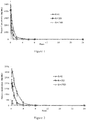
- Figure 1 shows the average plasma concentration versus time curve with a single intravenous injection of compounds A1, A3, and A6 in SD rats at 5 mg / kg
- Figure 2 shows the average plasma concentration versus time curve with a single oral gavage administration of compounds A1, A3, and A6 in SD rats at 10 mg / kg.
- the present invention synthesized a series of aza-phenalene-3-ketone derivatives. Their structures were identified by nuclear magnetic resonance spectroscopy. They were tested for PARP inhibition. Results show that the aza-phenalene-3-ketone derivatives have inhibitory activities against PARP.
Landscapes
- Chemical & Material Sciences (AREA)
- Organic Chemistry (AREA)
- Health & Medical Sciences (AREA)
- General Chemical & Material Sciences (AREA)
- Medicinal Chemistry (AREA)
- Nuclear Medicine, Radiotherapy & Molecular Imaging (AREA)
- Chemical Kinetics & Catalysis (AREA)
- Pharmacology & Pharmacy (AREA)
- Life Sciences & Earth Sciences (AREA)
- Animal Behavior & Ethology (AREA)
- General Health & Medical Sciences (AREA)
- Public Health (AREA)
- Veterinary Medicine (AREA)
- Pharmaceuticals Containing Other Organic And Inorganic Compounds (AREA)
Description
- The present invention relates to the field of pharmaceutical synthesis, and in particular, to an aza-phenalene-3-ketone derivative and its application as a PARP inhibitor.
- Poly(adenosinediphosphate-ribose)-polymerase or poly(ADP-ribose)-polymerase (PARP) exists in mammalian cells and most eukaryotic cells, and is a class of catalyzed polyglutase diphosphate ribosylated ribozyme. PARP is closely related to many physiological processes, including chromosomal stabilization, DNA damage identification and repair, gene transcription, and cell apoptosis and necrosis. After its discovery, the important role of PARP in DNA damage repair and maintenance of genome stability has attracted wide attention. In all types of DNA damage, DNA single-stranded lesions occur most frequently, and the enzyme involved in a series of repair pathways is PARP. PARP detects DNA breaks, and is activated after DNA damage and binds to DNA breaks through an N-terminal DBD (Dibenzamido Diphenyl Disulfide) containing two zinc fingers, increasing the catalytic activity by 10-500 times.
- Conventional chemotherapy and radiotherapy directly or indirectly attack DNA, causing DNA damage to tumor cells and killing the cancer cells. In tumor cells, however, DNA repair enzyme is overexpressed, and DNA damage self-repair mechanism is activated, thereby generating chemotherapy and radiotherapy resistant. Research has shown that PARP inhibitor can block the DNA repair pathway, reducing the ability of tumor cells to repair itself, so the PARP inhibitor in combination with chemotherapy can effectively enhance the anti-tumor effect. Research also found that PARP inhibitor monotherapy effectively inhibits BRCA1 / 2 (breast cancer type susceptibility protein) gene deletion or mutation in breast cancer and ovarian cancer.
US 2015/0018356 discloses pyridophthalazinone derivatives useful as PARP inhibitors. - In summary, PARP inhibitor has broad application in antitumor research and therapy. Therefore, the present invention is intended on the basis of preliminary studies, to design and synthesize a new series of aza-phenalene-3-ketone derivatives. The activities of the derivatives have been screened and studies, and the derivatives can be used in anti-tumor drug research.
- An objective of the present invention is to solve the deficiencies of the existing technology, and to provide an aza-phenalene-3-ketone derivative and its application as a PARP inhibitor, its preparation method and its application as a PARP inhibitor. The aza-phenalene-3-ketone derivative of the present invention has high inhibitory activity against PARP, and can be used as PARP inhibitor in anti-tumor drug research.
- An aza-phenalene-3-ketone derivative has the following Formula (I):

- In Formula (I), R is H, methyl, ethyl, isopropyl, benzyl, or 3-methyl-3-butenyl.
- The synthetic route to prepare the aza-phenalene-3-ketone derivative is as follows:


- (1) using 3-nitrophthalic acid (compound 1) as starting material, refluxing in acetic anhydride (Ac2O) to obtain 3-nitrophthalic anhydride (compound 2);
- (2) reacting compound 2 with methanol in the presence of sulfuric acid (H2SO4) to obtain dimethyl 3-nitrophthalate (compound 3);
- (3) reducing compound 3 by catalytic hydrogenation to obtain dimethyl 3-aminophthalate (compound 4);
- (4) reacting
compound 4 with benzyl 3-oxopiperazine-1-carboxlyate in the presence of phosphorus (V) oxychloride to obtain compound 5; - (5) reducing compound 5 by catalytic hydrogenation in the presence of Boc2O to obtain compound 6; condensing compound 6 with hydrazine hydrate to obtain compound 7; removing protection group of compound 7 to obtain compound 8 (R = H); and
- (6) reducing compound by catalytic hydrogenation to remove protecting group Cbz to obtain compound 9, alkylating amino group of compound 9 to obtain compound 10, reacting compound 10 with hydrazine hydrate in ethanol to obtain a series of aza-phenalene-3-ketone derivatives (compounds 12-16, R is ethyl, methyl, isopropyl, benzyl, and 3-methyl-3-butenyl, respectively). The above-described aza-phenalene-3-ketone derivatives can be used as PARP inhibitors.
- The activities of the aza-phenalene-3-ketone derivatives have been screened and studies. The derivatives have significant inhibitory activity against PARP, and can be used as PARP inhibitors.
-
-
Figure 1 shows the average plasma concentration versus time curve with a single intravenous injection of compounds A1, A3, and A6 in SD rats at 5 mg / kg; -
Figure 2 shows the average plasma concentration versus time curve with a single oral gavage administration of compounds A1, A3, and A6 in SD rats at 10 mg / kg. - Reference will now be made in detail to embodiments of the present invention.
- 3-nitrophthalic acid (48.5 g, 0.23 mol) was mixed with acetic anhydride (45 mL), and the resulting mixture was stirred at reflux for 1 hour. After completion of the reaction, the mixture was cooled to 80 °C, 100 mL of methyl tert-butyl ether was added to the mixture, and the mixture was continued to stir until cooled to 15 °C. The mixture was filtered, and the resulted solid was washed with methyl tert-butyl ether and dried at 40 °C to give compound 2 as a white product (36.7 g, 82%).
- 3-Nitrophthalic anhydride (15 g, 77.7 mmol) from step (1) was dissolved in 200 mL of methanol and 5 mL of concentrated sulfuric acid was added. The mixture was heated to reflux for 16 hours. After cooled to room temperature, the reaction mixture was poured into ice water. The mixture was then filtered, and the resulted solid was washed with water and dried to give compound 3 (13.1 g, 71%).
- Dimethyl 3-nitrophthalate (18.1 g, 75.7 mmol) from step (2) was dissolved in 400 mL ethanol and 10% Pd / C (50% water, 1.8 g) was added. The reaction mixture was stirred overnight under a hydrogen atmosphere. The reaction mixture was filtered, and the filter cake was wash with ethanol. Ethanol was removed to give
compound 4 as a yellow solid (14.2 g, 90%). - Dimethyl 3-aminophthalate (compound 4) (8.3 g, 40 mmol), benzyl 3-oxopiperazine-1-carboxlyate (10.31 g, 44 mmol), and phosphorus oxychloride (12.27 g, 7.3 mL) were successively added 1,4-dioxane (280 mL). The resulted reaction mixture was stirred at 80 °C for 2 hour. The mixture was concentrated to give an oily crude product, which was purified by column chromatography to give compound 5 (14.6 g, 93%).
- Compound 5 (3.93 g, 10 mmol), Boc2O (di-tert-butyl dicarbonate) (2.4 g, 11 mmol), and 10% Pd / C (50% water, 0.4 g) were added to methanol (280 mL) and stirred overnight under a hydrogen atmosphere. The reaction mixture was filtered, and the filter cake was washed with methanol. Methanol was removed to give a crude product, which was purified by column chromatography to give compound 6 as a yellow oily product compound 6 (3.52 g, 98%).
- Compound 6 (1.9 g, 5.3 mmol) was added to 10 mL of absolute ethanol, and hydrazine monohydrate (85%, 4mL) was then added. The reaction mixture was stirred at reflux until completion. After reaction mixture was cooled to room temperature, water (20 mL) and ethyl acetate (20 mL) were added and stirred for 5 minutes. The organic layer was separated, and ethyl acetate was removed to give a crude product. The crude product was purified by column chromatography to give compound 7 as an off-white solid (0.20 g, 11%).
- Compound 7 (0.20 g, 0.6 mmol) was added to a methanol solution of hydrogen chloride (4 M, 10 mL), and the reaction mixture was stirred for 4 hours at room temperature. The mixture was concentrated to give
compound 8 as an off-white solid (0.15 g, 92%).
1H NMR (400 MHz, DMSO-d6): δ = 12.08 (s, 1H), 7.82-7.94 (m, 2H), 7.63 (d, J = 8.0 Hz, 1H), 3.63-4.25 (m, 6H). - Compound 5 (6.0 g, 15.2 mmol) and 10% Pd / C (50% water, 0.6 g) in methanol (80 mL) were stirred overnight under a hydrogen atmosphere. The reaction mixture was filtered and washed with methanol. Methanol was removed to give a crude produce. The crude product was purified by column chromatography to give compound 9 as a yellow oily product (2.8 g, 71%).
- Compound 9 (1.48 g, 5.7 mmol), potassium carbonate (1.57 g, 11.4 mmol), ethyl iodide (1.78 g, 11.4 mmol), and acetonitrile (30 mL) were stirred at room temperature overnight. The mixture was filtered and the filtrate was concentrated to give a crude product. The crude product was purified by column chromatography to give a yellow-white solid (1.10 g, 67%).
- The yellow-white product (1.9 g, 5.3 mmol) was added to 20 mL of absolute ethanol, and hydrazine monohydrate (85%, 4 mL) was then added. The reaction mixture was stirred at reflux until completion. After the reaction mixture was cooled to room temperature, water (20 mL) and ethyl acetate (20 mL) were added, and the mixture was stirred for 5 minutes. The organic layer was separated, and ethyl acetate was removed to give a crude product. After the crude product was purified by column chromatography to give an off-white solid product Compound 12 (0.20 g, 14.6%).
1H NMR (400 MHz, CDCl3): δ = 9.71 (s, 1H), 7.99 (m, J = 8.0 Hz, 1H), 7.82 (m, 1H), 7.60 (d, J = 8.0 Hz, 1H), 3.83 (m, 2H), 3.64 (s, 2H), 2.94 (m, 2H), 2.63 (m, 2H), 1.22 (t, J = 7.2 Hz, 3H). - Compound 9 (1.70 g, 6.5 mmol), aqueous formaldehyde (37%, 6 mL), sodium cyanoborohydride (4.24 g, 20 mmol), acetic acid (0.5 mL) and acetonitrile (30 mL) were stirred at room temperature for 1.5 hours. The mixture was filtered and concentrated to give a crude product. The crude product was purified by column chromatography to give a yellow-white solid (1.32 g, 74%).
- The yellow-white product (1.25 g, 4.57 mmol) was added to 20 mL of absolute ethanol, and hydrazine monohydrate (85%, 4 mL) was then added. The reaction mixture was stirred at reflux until completion. After the reaction mixture was cooled to room temperature, water (20 mL) and ethyl acetate (20 mL) were added and stirred for 5 minutes. The organic layer was separated, and ethyl acetate was removed. The crude product was purified by column chromatography to give compound 13 as an off-white solid product (0.18 g, 15.4%).
1H NMR (400 MHz, DMSO-d6): δ = 11.90 (s, 1H), 7.72-7.86 (m, 2H), 7.51-7.54 (m, 1H), 3.49-3.71 (m, 4H), 2.86 (t, J = 5.6 Hz, 2H), 2.37 (s, 3H). - Compound 9 (3.0 g, 11.57 mmol), potassium carbonate (2.07 g, 15 mmol), isopropyl bromide mixture of propane (8.54 g, 69.4 mmol) and DMF (30mL) was stirred at 80 °C 5 hours. The mixture was filtered and the filtrate have spin dry after drying, the crude product was purified by column chromatography to give a yellow-white solid (1.84g, 53%); the product (1.80 g, 5.97 mmol) was added 30mL of anhydrous ethanol and then adding an aqueous hydrazine monohydrate (85%, 5 mL). The reaction mixture was stirred at reflux until completion. After the reaction mixture was cooled to room temperature, water was added (30 mL) and ethyl acetate (30 mL) and stirred for 5 minutes. The organic layer was separated and dried spin dry. After the crude product was purified by column chromatography to give white solid compound 14 (0.27g, 15.9%).
- Compound 9 (1.29 g, 5 mmol), potassium carbonate (1.38 g, 10 mmol), benzyl chloride (0.83 g, 6.5 mmol) and acetonitrile (20 mL) were stirred for 5 hours at room temperature. The mixture was filtered and the filtrate was concentrated to give a crude product. The crude product was purified by column chromatography to give a yellow-white solid (1.25 g, 71.5%).
- The yellow-white product (1.24 g, 3.55 mmol) was added to 20mL of absolute ethanol, and hydrazine monohydrate (85%, 4 mL) was then added. The reaction mixture was stirred at reflux until completion. After the reaction mixture was cooled to room temperature, water (30 mL) and ethyl acetate (30 mL) were added and stirred for 5 minutes. The organic layer was separated and concentrated to give a crude product. After the crude product was purified by column chromatography to give compound 15 as a white solid (0.22 g, 18.7%).
1H NMR (400 MHz, DMSO-d6): 8 = 11.92 (s, 1H), 7.71-7.84 (m, 2H), 7.31-7.49 (m, 6H), 3.70 (m, 4H), 3.52 (s, 2H), 2.91 (m, 2H). - Compound 9 (4.0 g, 15.4 mmol), potassium carbonate (4.28 g, 31 mmol), 3-methyl-3-butenyl methanesulfonate (3.8 g, 23.1 mmol), and acetonitrile (40 mL) were stirred at 60°C for 5 hours. The mixture was filtered and the filtrate was concentrated to give a crude product. The crude product was purified by column chromatography to give a yellow-white solid (3.12 g, 62%).
- The yellow-white product (3.10 g, 9.47 mmol) was added to 50 mL of absolute ethanol, and hydrazine monohydrate (85%, 6 mL) was then added. The reaction mixture was stirred at reflux until completion. After the reaction mixture was cooled to room temperature, water (40 mL) and ethyl acetate (40 mL) were added and stirred for 5 minutes. The organic layer was separated and ethyl acetate was removed to give a crude product. After the crude product was purified by column chromatography to give
compound 16 as a white solid (0.45 g, 15.4%). - 1H NMR (400 MHz, DMSO-d6): δ = 11.88 (s, 1H), 7.71-7.85 (m, 2H), 7.52 (m, 1H), 4.76 (m, 2H), 3.57-3.69 (m, 4H), 2.94 (s, 2H), 2.62 (d, J = 7.2 Hz, 2H), 2.28 (d, J = 8.4 Hz, 2H), 1.75 (s, 3H).
- Universal PARP colorimetric assay kit (US Trevigen company)
-
Compoud Structure IC50 (nM) 3-AB Standard 
100% (inhibition rate, 1 mM) BSI-201 Positive Control 
22.4% (inhibition rate,1uM) A1 
90.5 A2 
65.7 A3 
130 A4 
111 A5 
58.7 A6 
39.1 - Considering compounds' PARP inhibition rates IC50, there compounds A1, A3, and A6 (where: A1 =
compound 8; A2 =compound 12; A3 = compound 13; A4 = compound 14; A5 = compound 15; A6 = compound 16) were selected for pharmacokinetic study. - Agilent 1200 HPLC;
API QTAP 4000 LC-MS/MS System - Healthy SPF SD male rats: 18, weighing 180 - 220 g, purchased from Shanghai Si Lai Ke Lab Animal Co. Ltd.; animal license no. SCXK (Shanghai) 2013-00016.
- Rats were divided into intravenous injection group and oral gavage administration group, and fast for 12-14 hours before experiments. Test compounds' concentration in venous blood was measured. Venous blood was collected by orbital, EDTAK2 anticoagulation. The blood samples were placed on ice, and centrifuged within 30 minutes to separate plasma (centrifugal condition: 5000 rpm / min, 10 min, room temperature). The samples were stored at -80°C prior to analysis.
- Rats in intravenous injection group received a single injection 5 mL / kg of the test compounds. Rats in oral gavage administration group received a single dose 10 mL / kg of the test compounds. Venous blood sample collection times were: before the injection of the test compound (0 hr); after the injection of the test compound: 15 min, 30 min, 1 h, 2 h, 4 h, 6 h, 8 h and 24 h; before the oral gavage administration of the test compound (0 hr) and after the oral gavage administration of the test compounds, 30 min, 1 h, 2 h, 4 h, 6 h, 8 h and 24 h.
- Liquid phase conditions: column: Agilent Eclipse plus-C 18 (4.6 × 150mm, 5.0 µm), mobile phase: 0.1% aqueous formic acid (A) / 0.1% formic acid in acetonitrile (B); gradient elution, flow rate: 1.00 mL / min (split v: v = 1: 1); injection volume: 10 µL.
- MS conditions: using electrospray ionization (ESI) and the positive ion mode under multiple reaction monitoring (MRM).
A1: m/z 242.30/187.30 A3: m/z 255.90/0.30 A3 : m/z 310.00/254.40 IS: m/z 455.30/165.10 DP: 73V DP: 77V DP : 69V DP: 90 V CE: 37eV CE: 45 eV CE : 26eV CE: 37 eV CXP: 11V CXP: 12 V CXP : 5V CXP: 9 V Gas 1: 60 psi Spray Voltage: 5000 V Gas 2: 40 psi Temprature: 500 °C Curtain Gas: 15 psi CAD: High - Compounds A1, A3, and A6 were weighed precisely and added to MDSO to prepare 1.00 mg / mL stock solutions. After the stock solutions were diluted to prepare 10000, 5000, 2000, 1000, 500, 100, 50.0, 20.0 ng / mL standard working solutions. Quality control work concentrations include low (30 ng / mL), medium (500 ng / mL), and high (8000 ng / mL).
- 10 µL plasma sample was added 100 µL verapamil internal standard solution. The mixture was vortexed for 60 seconds and then centrifuged (12000 rpm, 3 min). 70 µL supernatant was transferred to a 96-well plate with equal volume of water in each well. LC-MS / MS analysis was then conducted, and the injection volume was 10 µL.
- Data were processed by using WinNonlin 6.3 pharmacokinetic calculation software and non-compartment pharmacokinetic model to obtain major pharmacokinetic parameters.
- Based on-clinical pharmacokinetic study technical guidelines, SD rat plasma was subject to method validation in the followings: method specificity, standard curve linearity, precision and accuracy, limits of quantitation, plasma ten-fold dilution accuracy, matrix effect and extraction recovery, all meeting the requirements of biological sample analysis.
-
Figure 1 shows the average plasma concentration versus time curve with a single intravenous injection of compounds A1, A3, and A6 in SD rats at 5 mg / kg;Figure 2 shows the average plasma concentration versus time curve with a single oral gavage administration of compounds A1, A3, and A6 in SD rats at 10 mg / kg.Table 1: SD Pharmacokinetic parameters of SD rats after a single intravenous injection of A1, A3, and A6 at 5mg / kg Intravenous injection A1 (R = H) A3 (R = CH3) A6 (R = C5H9) Parameters Units Mean±SD Mean±SD Mean±SD Dosage mg·kg-1 5.00 Kel h-1 0.463±0.063 1.02±0.034 3.64±0.22 t1/2 h 1.53±0.16 0.722±0.082 0.191±0.012 AUC0-t h·ng·mL-1 4252±304 2286±323 1004±92 AUC0-inf h·ng·mL-1 4281±317 2290±321 1038±118 AUMC0-t h·h·ng·mL-1 3790±547 1145±120 196±27 AUMC0-inf h·h·ng·mL-1 4190±575 1175±105 232±17 CL mL·kg-1·min-1 19.5±1.4 38.4±2.5 83.1±13.3 MRTIV h 0.953±0.104 0.506±0.040 0.222±0.026 VdSS L·kg-1 1.11±0.11 1.15±0.07 1.10±0.15 Table 2: Pharmacokinetic parameters of SD rats after a single oral gavage administration of A1, A3, and A6 at 10 mg / kg Oral gavage A1(R=H) A3(R=CH3) A6(R=C5H9) Parameters Unite Mean±SD Mean±SD Mean±SD Doseage mg·kg-1 10.0 Kel h-1 0.523±0.046 0.818±0.036 1.77±0.28 t1/2 h 1.34±0.12 0.849±0.055 0.513±0.041 tmax h 0.500±0 0.250±0 0.500±0 Cmax ng·mL-1 3121±173 1865±251 259±28 AUC0-t h·ng·mL-1 5712±802 2341±334 264±36 AUC0-inf h·ng·mL-1 5744±841 2314±309 271±43 AUMC0-t h·h·ng·mL-1 8548±240 2566±474 269±33 AUMC0-inf h·h·ng·mL-1 9200±336 2658±308 284±29 MRTPO h 1.55±0.20 1.08±0.094 1.17±0.09 Vz L·kg-1 3.62±0.37 5.22±0.81 31.2±4.8 CL mL·min·kg-1 29.7±3.2 71.3±7.6 626±93 F % 67.1±9.5 50.5±6.8 13.0±2.1 - As shown in the plasma concentration versus time curves of
Figure 1 and Figure 2 and drug pharmacokinetic parameters of Table 1 and Table 2, the exposure levels of compounds A1, A3, and A6 in SD rats (AUC0-t) were higher. After oral gavage administration, the test compounds were detected within 15 minutes, and absorption was rapid (tmax is only 0.25-0.5 h, reaching peak plasma concentration) and action lasted a longtime. Especially, the oral bioavailability of compound A1 was 67.5 ± 9.5%. - The present invention synthesized a series of aza-phenalene-3-ketone derivatives. Their structures were identified by nuclear magnetic resonance spectroscopy. They were tested for PARP inhibition. Results show that the aza-phenalene-3-ketone derivatives have inhibitory activities against PARP.
Claims (7)
- An aza-phenalene-3-ketone derivative having Formula (I):

- A method of preparing the aza-phenalene-3-ketone derivative of claim 1, characterized in that the process is as follows:


- The method of claim 2, characterized in that:(1) using 3-nitrophthalic acid (compound 1) as starting material, refluxing in acetic anhydride to obtain 3-nitrophthalic anhydride (compound 2);(2) reacting 3-nitrophthalic anhydride (compound 2) with methanol in the presence of sulfuric acid to obtain dimethyl 3-nitrophthalate (compound 3);(3) reducing dimethyl 3-nitrophthalate (compound 3) by catalytic hydrogenation to obtain dimethyl 3-aminophthalate (compound 4);(4) reacting dimethyl 3-aminophthalate (compound 4) with benzyl 3-oxopiperazine-1-carboxlyate in the presence of phosphorus oxychloride to obtain compound 5;(5) reducing compound 5 by catalytic hydrogenation in the presence of Boc2O to obtain compound 6; condensing compound 6 with hydrazine hydrate to obtain compound 7; removing protection group of compound 7 to obtain compound 8; and(6) reducing compound 5 by catalytic hydrogenation to remove protecting group Cbz to obtain compound 9, alkylating amino group of compound 9 to obtain compound 10, reacting compound 10 with hydrazine hydrate in ethanol to obtain aza-phenalene-3-ketone derivatives (compound 11).
- Ex vivo use of the aza-phenalene-3-ketone derivative of claim 1, as a PARP inhibitor.
- The aza-phenalene-3-ketone derivative of claim 1, wherein the aza-phenalene-3-ketone derivative is selected from the group consisting of:

- Ex vivo use according to claim 4 in anti-tumor drug research.
- The aza-phenalene-3-ketone derivative according to claim 1, for use as a PARP inhibitor in antitumor therapy.
Applications Claiming Priority (2)
| Application Number | Priority Date | Filing Date | Title |
|---|---|---|---|
| CN201510267732.1A CN104945406B (en) | 2015-05-25 | 2015-05-25 | Derivative, its preparation method and its application as PARP inhibitor of that non-ketone of alkene 3 of azepine |
| PCT/CN2016/081035 WO2016188307A1 (en) | 2015-05-25 | 2016-05-04 | Derivative of nitrogen-doped phenalene-3-ketone, preparation method therefor and application of derivative used as parp inhibitor |
Publications (3)
| Publication Number | Publication Date |
|---|---|
| EP3305793A1 EP3305793A1 (en) | 2018-04-11 |
| EP3305793A4 EP3305793A4 (en) | 2018-11-14 |
| EP3305793B1 true EP3305793B1 (en) | 2019-11-27 |
Family
ID=54160525
Family Applications (1)
| Application Number | Title | Priority Date | Filing Date |
|---|---|---|---|
| EP16799196.7A Active EP3305793B1 (en) | 2015-05-25 | 2016-05-04 | Derivative of nitrogen-doped phenalene-3-ketone, preparation method therefor and application of derivative used as parp inhibitor |
Country Status (4)
| Country | Link |
|---|---|
| US (1) | US10106550B2 (en) |
| EP (1) | EP3305793B1 (en) |
| CN (1) | CN104945406B (en) |
| WO (1) | WO2016188307A1 (en) |
Families Citing this family (6)
| Publication number | Priority date | Publication date | Assignee | Title |
|---|---|---|---|---|
| CN104945406B (en) * | 2015-05-25 | 2017-10-10 | 苏州康润医药有限公司 | Derivative, its preparation method and its application as PARP inhibitor of that non-ketone of alkene 3 of azepine |
| CN106631844A (en) * | 2016-11-22 | 2017-05-10 | 山东友帮生化科技有限公司 | Preparation method of dimethyl 3-aminophthalate |
| CN109970568B (en) * | 2019-05-21 | 2022-09-02 | 扬州工业职业技术学院 | Synthesis process of 3-amino dimethyl phthalate |
| CN111499530B (en) * | 2019-12-31 | 2023-02-07 | 扬州工业职业技术学院 | Method for preparing amino methyl phthalate by one step |
| CN111499533B (en) * | 2019-12-31 | 2023-04-07 | 扬州工业职业技术学院 | Method for preparing acetamino dimethyl phthalate |
| CN111499531B (en) * | 2019-12-31 | 2023-04-07 | 扬州工业职业技术学院 | Method for preparing dimethyl aminophthalate |
Citations (1)
| Publication number | Priority date | Publication date | Assignee | Title |
|---|---|---|---|---|
| CN104945406A (en) * | 2015-05-25 | 2015-09-30 | 苏州康润医药有限公司 | Aza-phenalene-3-ketone derivative, preparation method thereof and application of aza-phenalene-3-ketone derivative as PARP inhibitor |
Family Cites Families (8)
| Publication number | Priority date | Publication date | Assignee | Title |
|---|---|---|---|---|
| US6291425B1 (en) * | 1999-09-01 | 2001-09-18 | Guilford Pharmaceuticals Inc. | Compounds, methods and pharmaceutical compositions for treating cellular damage, such as neural or cardiovascular tissue damage |
| WO2004105700A2 (en) * | 2003-05-28 | 2004-12-09 | Guildford Pharmaceuticals, Inc. | Compounds, methods and pharmaceutical compositions for inhibiting parp |
| EP1680426B1 (en) * | 2003-06-10 | 2007-09-19 | F. Hoffmann-La Roche Ag | 1.3.4-triaza-phenalene and 1,3,4,6-tetraazaphenalene derivatives |
| MX2007008771A (en) * | 2005-01-19 | 2007-09-11 | Mgi Gp Inc | Diazabenzo[de]anthracen-3-one compounds and methods for inhibiting parp. |
| MX2010003564A (en) * | 2007-10-03 | 2010-09-10 | Eisai Inc | Parp inhibitor compounds, compositions and methods of use. |
| US8541403B2 (en) * | 2010-02-03 | 2013-09-24 | Biomarin Pharmaceutical Inc. | Dihydropyridophthalazinone inhibitors of poly(ADP-ribose)polymerase (PARP) for use in treatment of diseases associated with a PTEN deficiency |
| SG11201403538TA (en) * | 2011-12-31 | 2014-09-26 | Beigene Ltd | Fused tetra or penta-cyclic pyridophthalazinones as parp inhibitors |
| CN103936735B (en) * | 2014-04-04 | 2015-11-11 | 沈阳工业大学 | Azepine benzo azulene derivatives and its production and use |
-
2015
- 2015-05-25 CN CN201510267732.1A patent/CN104945406B/en active Active
-
2016
- 2016-05-04 WO PCT/CN2016/081035 patent/WO2016188307A1/en not_active Ceased
- 2016-05-04 US US15/572,838 patent/US10106550B2/en active Active
- 2016-05-04 EP EP16799196.7A patent/EP3305793B1/en active Active
Patent Citations (1)
| Publication number | Priority date | Publication date | Assignee | Title |
|---|---|---|---|---|
| CN104945406A (en) * | 2015-05-25 | 2015-09-30 | 苏州康润医药有限公司 | Aza-phenalene-3-ketone derivative, preparation method thereof and application of aza-phenalene-3-ketone derivative as PARP inhibitor |
Also Published As
| Publication number | Publication date |
|---|---|
| US10106550B2 (en) | 2018-10-23 |
| EP3305793A4 (en) | 2018-11-14 |
| US20180134722A1 (en) | 2018-05-17 |
| CN104945406A (en) | 2015-09-30 |
| EP3305793A1 (en) | 2018-04-11 |
| CN104945406B (en) | 2017-10-10 |
| WO2016188307A1 (en) | 2016-12-01 |
Similar Documents
| Publication | Publication Date | Title |
|---|---|---|
| EP3305793A1 (en) | Derivative of nitrogen-doped phenalene-3-ketone, preparation method therefor and application of derivative used as parp inhibitor | |
| EP4067351B1 (en) | Diazaindole derivative and use thereof as chk1 inhibitor | |
| EP2647622B1 (en) | Kinesin spindle protein inhibitors and application thereof | |
| KR20130128308A (en) | Methods and compositions for inhibition of the transitional endoplasmic reticulum atpase | |
| EP3020714A1 (en) | Imidazole diketone compound and use thereof | |
| WO2016177347A1 (en) | Heterocyclic compounds as idh2 inhibitors | |
| EP2906564B1 (en) | Treating brain cancer using agelastatin a (aa) and analogues thereof | |
| JP6933644B2 (en) | Androgen receptor antagonist | |
| EP3661935B1 (en) | Substituted pyrazolopyrimidines useful as kinases inhibitors | |
| EP3844166B1 (en) | Substituted macrocycles useful as kinase inhibitors | |
| CN107879975A (en) | Histon deacetylase (HDAC) inhibitor and its application | |
| EP3154547B1 (en) | Pyrimidine compounds and methods using the same | |
| EP3176160A1 (en) | Pyridine-substituted 2-aminopyridine protein kinase inhibitors | |
| EP3819299A1 (en) | Hypoxanthine compound | |
| US9879014B2 (en) | Method for screening substance capable of inhibiting abnormal splicing causative of onset or progress of disease | |
| CN112004799B (en) | AKR1C3 inhibitor and medical application thereof | |
| CN116514902A (en) | Deuterated peptidomimetic compounds and application thereof | |
| CN115894456A (en) | A deuterated pyrazole aminopyrimidine compound, pharmaceutical composition and use | |
| EP4046686A1 (en) | Salt types, crystal forms, and preparation methods for benzopyrazole compounds as rho kinase inhibitors | |
| EP2865680B1 (en) | Xanthine derivative | |
| CN116041324B (en) | A deuterated pyrazole dichlorobenzamide compound, pharmaceutical composition and use thereof | |
| EP4342897A1 (en) | Pharmaceutically acceptable salt of pyrazoloheteroaryl derivative and crystal form thereof | |
| WO2018153279A1 (en) | Dihydropyridophthalazinone compounds as inhibitors of poly (adp-ribose) polymerase (parp) for treatment of diseases and method of use thereof | |
| CN113677341A (en) | Bicyclic pyridine compositions and methods of use for cancer treatment | |
| EP3586838B1 (en) | Amide derivative |
Legal Events
| Date | Code | Title | Description |
|---|---|---|---|
| STAA | Information on the status of an ep patent application or granted ep patent |
Free format text: STATUS: THE INTERNATIONAL PUBLICATION HAS BEEN MADE |
|
| PUAI | Public reference made under article 153(3) epc to a published international application that has entered the european phase |
Free format text: ORIGINAL CODE: 0009012 |
|
| STAA | Information on the status of an ep patent application or granted ep patent |
Free format text: STATUS: REQUEST FOR EXAMINATION WAS MADE |
|
| 17P | Request for examination filed |
Effective date: 20171110 |
|
| AK | Designated contracting states |
Kind code of ref document: A1 Designated state(s): AL AT BE BG CH CY CZ DE DK EE ES FI FR GB GR HR HU IE IS IT LI LT LU LV MC MK MT NL NO PL PT RO RS SE SI SK SM TR |
|
| AX | Request for extension of the european patent |
Extension state: BA ME |
|
| DAV | Request for validation of the european patent (deleted) | ||
| DAX | Request for extension of the european patent (deleted) | ||
| A4 | Supplementary search report drawn up and despatched |
Effective date: 20181017 |
|
| RIC1 | Information provided on ipc code assigned before grant |
Ipc: C07D 487/16 20060101AFI20181011BHEP Ipc: A61K 31/519 20060101ALI20181011BHEP Ipc: A61P 35/00 20060101ALI20181011BHEP |
|
| STAA | Information on the status of an ep patent application or granted ep patent |
Free format text: STATUS: EXAMINATION IS IN PROGRESS |
|
| 17Q | First examination report despatched |
Effective date: 20190418 |
|
| GRAP | Despatch of communication of intention to grant a patent |
Free format text: ORIGINAL CODE: EPIDOSNIGR1 |
|
| STAA | Information on the status of an ep patent application or granted ep patent |
Free format text: STATUS: GRANT OF PATENT IS INTENDED |
|
| INTG | Intention to grant announced |
Effective date: 20190712 |
|
| GRAS | Grant fee paid |
Free format text: ORIGINAL CODE: EPIDOSNIGR3 |
|
| GRAA | (expected) grant |
Free format text: ORIGINAL CODE: 0009210 |
|
| STAA | Information on the status of an ep patent application or granted ep patent |
Free format text: STATUS: THE PATENT HAS BEEN GRANTED |
|
| AK | Designated contracting states |
Kind code of ref document: B1 Designated state(s): AL AT BE BG CH CY CZ DE DK EE ES FI FR GB GR HR HU IE IS IT LI LT LU LV MC MK MT NL NO PL PT RO RS SE SI SK SM TR |
|
| RAP1 | Party data changed (applicant data changed or rights of an application transferred) |
Owner name: SUZHOU KANGRUN PHARMACEUTICALS, INC. |
|
| REG | Reference to a national code |
Ref country code: GB Ref legal event code: FG4D |
|
| REG | Reference to a national code |
Ref country code: CH Ref legal event code: EP |
|
| REG | Reference to a national code |
Ref country code: AT Ref legal event code: REF Ref document number: 1206562 Country of ref document: AT Kind code of ref document: T Effective date: 20191215 |
|
| REG | Reference to a national code |
Ref country code: DE Ref legal event code: R096 Ref document number: 602016025223 Country of ref document: DE |
|
| REG | Reference to a national code |
Ref country code: IE Ref legal event code: FG4D |
|
| REG | Reference to a national code |
Ref country code: NL Ref legal event code: MP Effective date: 20191127 |
|
| REG | Reference to a national code |
Ref country code: LT Ref legal event code: MG4D |
|
| PG25 | Lapsed in a contracting state [announced via postgrant information from national office to epo] |
Ref country code: GR Free format text: LAPSE BECAUSE OF FAILURE TO SUBMIT A TRANSLATION OF THE DESCRIPTION OR TO PAY THE FEE WITHIN THE PRESCRIBED TIME-LIMIT Effective date: 20200228 Ref country code: NO Free format text: LAPSE BECAUSE OF FAILURE TO SUBMIT A TRANSLATION OF THE DESCRIPTION OR TO PAY THE FEE WITHIN THE PRESCRIBED TIME-LIMIT Effective date: 20200227 Ref country code: BG Free format text: LAPSE BECAUSE OF FAILURE TO SUBMIT A TRANSLATION OF THE DESCRIPTION OR TO PAY THE FEE WITHIN THE PRESCRIBED TIME-LIMIT Effective date: 20200227 Ref country code: FI Free format text: LAPSE BECAUSE OF FAILURE TO SUBMIT A TRANSLATION OF THE DESCRIPTION OR TO PAY THE FEE WITHIN THE PRESCRIBED TIME-LIMIT Effective date: 20191127 Ref country code: LV Free format text: LAPSE BECAUSE OF FAILURE TO SUBMIT A TRANSLATION OF THE DESCRIPTION OR TO PAY THE FEE WITHIN THE PRESCRIBED TIME-LIMIT Effective date: 20191127 Ref country code: SE Free format text: LAPSE BECAUSE OF FAILURE TO SUBMIT A TRANSLATION OF THE DESCRIPTION OR TO PAY THE FEE WITHIN THE PRESCRIBED TIME-LIMIT Effective date: 20191127 Ref country code: LT Free format text: LAPSE BECAUSE OF FAILURE TO SUBMIT A TRANSLATION OF THE DESCRIPTION OR TO PAY THE FEE WITHIN THE PRESCRIBED TIME-LIMIT Effective date: 20191127 Ref country code: NL Free format text: LAPSE BECAUSE OF FAILURE TO SUBMIT A TRANSLATION OF THE DESCRIPTION OR TO PAY THE FEE WITHIN THE PRESCRIBED TIME-LIMIT Effective date: 20191127 |
|
| PG25 | Lapsed in a contracting state [announced via postgrant information from national office to epo] |
Ref country code: IS Free format text: LAPSE BECAUSE OF FAILURE TO SUBMIT A TRANSLATION OF THE DESCRIPTION OR TO PAY THE FEE WITHIN THE PRESCRIBED TIME-LIMIT Effective date: 20200327 Ref country code: HR Free format text: LAPSE BECAUSE OF FAILURE TO SUBMIT A TRANSLATION OF THE DESCRIPTION OR TO PAY THE FEE WITHIN THE PRESCRIBED TIME-LIMIT Effective date: 20191127 Ref country code: RS Free format text: LAPSE BECAUSE OF FAILURE TO SUBMIT A TRANSLATION OF THE DESCRIPTION OR TO PAY THE FEE WITHIN THE PRESCRIBED TIME-LIMIT Effective date: 20191127 |
|
| PG25 | Lapsed in a contracting state [announced via postgrant information from national office to epo] |
Ref country code: AL Free format text: LAPSE BECAUSE OF FAILURE TO SUBMIT A TRANSLATION OF THE DESCRIPTION OR TO PAY THE FEE WITHIN THE PRESCRIBED TIME-LIMIT Effective date: 20191127 |
|
| PG25 | Lapsed in a contracting state [announced via postgrant information from national office to epo] |
Ref country code: DK Free format text: LAPSE BECAUSE OF FAILURE TO SUBMIT A TRANSLATION OF THE DESCRIPTION OR TO PAY THE FEE WITHIN THE PRESCRIBED TIME-LIMIT Effective date: 20191127 Ref country code: ES Free format text: LAPSE BECAUSE OF FAILURE TO SUBMIT A TRANSLATION OF THE DESCRIPTION OR TO PAY THE FEE WITHIN THE PRESCRIBED TIME-LIMIT Effective date: 20191127 Ref country code: PT Free format text: LAPSE BECAUSE OF FAILURE TO SUBMIT A TRANSLATION OF THE DESCRIPTION OR TO PAY THE FEE WITHIN THE PRESCRIBED TIME-LIMIT Effective date: 20200419 Ref country code: EE Free format text: LAPSE BECAUSE OF FAILURE TO SUBMIT A TRANSLATION OF THE DESCRIPTION OR TO PAY THE FEE WITHIN THE PRESCRIBED TIME-LIMIT Effective date: 20191127 Ref country code: RO Free format text: LAPSE BECAUSE OF FAILURE TO SUBMIT A TRANSLATION OF THE DESCRIPTION OR TO PAY THE FEE WITHIN THE PRESCRIBED TIME-LIMIT Effective date: 20191127 Ref country code: CZ Free format text: LAPSE BECAUSE OF FAILURE TO SUBMIT A TRANSLATION OF THE DESCRIPTION OR TO PAY THE FEE WITHIN THE PRESCRIBED TIME-LIMIT Effective date: 20191127 |
|
| REG | Reference to a national code |
Ref country code: DE Ref legal event code: R097 Ref document number: 602016025223 Country of ref document: DE |
|
| PG25 | Lapsed in a contracting state [announced via postgrant information from national office to epo] |
Ref country code: SM Free format text: LAPSE BECAUSE OF FAILURE TO SUBMIT A TRANSLATION OF THE DESCRIPTION OR TO PAY THE FEE WITHIN THE PRESCRIBED TIME-LIMIT Effective date: 20191127 Ref country code: SK Free format text: LAPSE BECAUSE OF FAILURE TO SUBMIT A TRANSLATION OF THE DESCRIPTION OR TO PAY THE FEE WITHIN THE PRESCRIBED TIME-LIMIT Effective date: 20191127 |
|
| REG | Reference to a national code |
Ref country code: AT Ref legal event code: MK05 Ref document number: 1206562 Country of ref document: AT Kind code of ref document: T Effective date: 20191127 |
|
| PLBE | No opposition filed within time limit |
Free format text: ORIGINAL CODE: 0009261 |
|
| STAA | Information on the status of an ep patent application or granted ep patent |
Free format text: STATUS: NO OPPOSITION FILED WITHIN TIME LIMIT |
|
| 26N | No opposition filed |
Effective date: 20200828 |
|
| PG25 | Lapsed in a contracting state [announced via postgrant information from national office to epo] |
Ref country code: AT Free format text: LAPSE BECAUSE OF FAILURE TO SUBMIT A TRANSLATION OF THE DESCRIPTION OR TO PAY THE FEE WITHIN THE PRESCRIBED TIME-LIMIT Effective date: 20191127 Ref country code: SI Free format text: LAPSE BECAUSE OF FAILURE TO SUBMIT A TRANSLATION OF THE DESCRIPTION OR TO PAY THE FEE WITHIN THE PRESCRIBED TIME-LIMIT Effective date: 20191127 Ref country code: PL Free format text: LAPSE BECAUSE OF FAILURE TO SUBMIT A TRANSLATION OF THE DESCRIPTION OR TO PAY THE FEE WITHIN THE PRESCRIBED TIME-LIMIT Effective date: 20191127 |
|
| PG25 | Lapsed in a contracting state [announced via postgrant information from national office to epo] |
Ref country code: MC Free format text: LAPSE BECAUSE OF FAILURE TO SUBMIT A TRANSLATION OF THE DESCRIPTION OR TO PAY THE FEE WITHIN THE PRESCRIBED TIME-LIMIT Effective date: 20191127 Ref country code: CH Free format text: LAPSE BECAUSE OF NON-PAYMENT OF DUE FEES Effective date: 20200531 Ref country code: LI Free format text: LAPSE BECAUSE OF NON-PAYMENT OF DUE FEES Effective date: 20200531 Ref country code: IT Free format text: LAPSE BECAUSE OF FAILURE TO SUBMIT A TRANSLATION OF THE DESCRIPTION OR TO PAY THE FEE WITHIN THE PRESCRIBED TIME-LIMIT Effective date: 20191127 |
|
| REG | Reference to a national code |
Ref country code: BE Ref legal event code: MM Effective date: 20200531 |
|
| PG25 | Lapsed in a contracting state [announced via postgrant information from national office to epo] |
Ref country code: LU Free format text: LAPSE BECAUSE OF NON-PAYMENT OF DUE FEES Effective date: 20200504 |
|
| PG25 | Lapsed in a contracting state [announced via postgrant information from national office to epo] |
Ref country code: IE Free format text: LAPSE BECAUSE OF NON-PAYMENT OF DUE FEES Effective date: 20200504 |
|
| PG25 | Lapsed in a contracting state [announced via postgrant information from national office to epo] |
Ref country code: BE Free format text: LAPSE BECAUSE OF NON-PAYMENT OF DUE FEES Effective date: 20200531 |
|
| PG25 | Lapsed in a contracting state [announced via postgrant information from national office to epo] |
Ref country code: TR Free format text: LAPSE BECAUSE OF FAILURE TO SUBMIT A TRANSLATION OF THE DESCRIPTION OR TO PAY THE FEE WITHIN THE PRESCRIBED TIME-LIMIT Effective date: 20191127 Ref country code: MT Free format text: LAPSE BECAUSE OF FAILURE TO SUBMIT A TRANSLATION OF THE DESCRIPTION OR TO PAY THE FEE WITHIN THE PRESCRIBED TIME-LIMIT Effective date: 20191127 Ref country code: CY Free format text: LAPSE BECAUSE OF FAILURE TO SUBMIT A TRANSLATION OF THE DESCRIPTION OR TO PAY THE FEE WITHIN THE PRESCRIBED TIME-LIMIT Effective date: 20191127 |
|
| PG25 | Lapsed in a contracting state [announced via postgrant information from national office to epo] |
Ref country code: MK Free format text: LAPSE BECAUSE OF FAILURE TO SUBMIT A TRANSLATION OF THE DESCRIPTION OR TO PAY THE FEE WITHIN THE PRESCRIBED TIME-LIMIT Effective date: 20191127 |
|
| PGFP | Annual fee paid to national office [announced via postgrant information from national office to epo] |
Ref country code: GB Payment date: 20220527 Year of fee payment: 7 Ref country code: FR Payment date: 20220525 Year of fee payment: 7 Ref country code: DE Payment date: 20220527 Year of fee payment: 7 |
|
| REG | Reference to a national code |
Ref country code: DE Ref legal event code: R119 Ref document number: 602016025223 Country of ref document: DE |
|
| GBPC | Gb: european patent ceased through non-payment of renewal fee |
Effective date: 20230504 |
|
| PG25 | Lapsed in a contracting state [announced via postgrant information from national office to epo] |
Ref country code: DE Free format text: LAPSE BECAUSE OF NON-PAYMENT OF DUE FEES Effective date: 20231201 Ref country code: GB Free format text: LAPSE BECAUSE OF NON-PAYMENT OF DUE FEES Effective date: 20230504 |
|
| PG25 | Lapsed in a contracting state [announced via postgrant information from national office to epo] |
Ref country code: FR Free format text: LAPSE BECAUSE OF NON-PAYMENT OF DUE FEES Effective date: 20230531 |