EP3303367B1 - Stabilized minimal coiled-coil mimetics - Google Patents
Stabilized minimal coiled-coil mimetics Download PDFInfo
- Publication number
- EP3303367B1 EP3303367B1 EP16808232.9A EP16808232A EP3303367B1 EP 3303367 B1 EP3303367 B1 EP 3303367B1 EP 16808232 A EP16808232 A EP 16808232A EP 3303367 B1 EP3303367 B1 EP 3303367B1
- Authority
- EP
- European Patent Office
- Prior art keywords
- linker
- amino acid
- residue
- leu
- alkyl
- Prior art date
- Legal status (The legal status is an assumption and is not a legal conclusion. Google has not performed a legal analysis and makes no representation as to the accuracy of the status listed.)
- Active
Links
Images








Classifications
-
- C—CHEMISTRY; METALLURGY
- C07—ORGANIC CHEMISTRY
- C07K—PEPTIDES
- C07K7/00—Peptides having 5 to 20 amino acids in a fully defined sequence; Derivatives thereof
- C07K7/04—Linear peptides containing only normal peptide links
- C07K7/06—Linear peptides containing only normal peptide links having 5 to 11 amino acids
-
- A—HUMAN NECESSITIES
- A61—MEDICAL OR VETERINARY SCIENCE; HYGIENE
- A61P—SPECIFIC THERAPEUTIC ACTIVITY OF CHEMICAL COMPOUNDS OR MEDICINAL PREPARATIONS
- A61P35/00—Antineoplastic agents
- A61P35/02—Antineoplastic agents specific for leukemia
-
- C—CHEMISTRY; METALLURGY
- C07—ORGANIC CHEMISTRY
- C07K—PEPTIDES
- C07K14/00—Peptides having more than 20 amino acids; Gastrins; Somatostatins; Melanotropins; Derivatives thereof
-
- G—PHYSICS
- G01—MEASURING; TESTING
- G01N—INVESTIGATING OR ANALYSING MATERIALS BY DETERMINING THEIR CHEMICAL OR PHYSICAL PROPERTIES
- G01N33/00—Investigating or analysing materials by specific methods not covered by groups G01N1/00 - G01N31/00
- G01N33/48—Biological material, e.g. blood, urine; Haemocytometers
- G01N33/50—Chemical analysis of biological material, e.g. blood, urine; Testing involving biospecific ligand binding methods; Immunological testing
- G01N33/68—Chemical analysis of biological material, e.g. blood, urine; Testing involving biospecific ligand binding methods; Immunological testing involving proteins, peptides or amino acids
-
- A—HUMAN NECESSITIES
- A61—MEDICAL OR VETERINARY SCIENCE; HYGIENE
- A61K—PREPARATIONS FOR MEDICAL, DENTAL OR TOILETRY PURPOSES
- A61K38/00—Medicinal preparations containing peptides
-
- A—HUMAN NECESSITIES
- A61—MEDICAL OR VETERINARY SCIENCE; HYGIENE
- A61K—PREPARATIONS FOR MEDICAL, DENTAL OR TOILETRY PURPOSES
- A61K48/00—Medicinal preparations containing genetic material which is inserted into cells of the living body to treat genetic diseases; Gene therapy
-
- C—CHEMISTRY; METALLURGY
- C07—ORGANIC CHEMISTRY
- C07K—PEPTIDES
- C07K2319/00—Fusion polypeptide
- C07K2319/70—Fusion polypeptide containing domain for protein-protein interaction
- C07K2319/73—Fusion polypeptide containing domain for protein-protein interaction containing coiled-coiled motif (leucine zippers)
Definitions
- This invention is directed to coiled-coil mimics.
- Mimicry of critical secondary structure motifs that mediate protein-protein interactions offers a promising approach for the discovery of new classes of therapeutics ( Wells et al., Nature 450:1001 (2007 ); Ko et al., Chem. Soc. Rev. 40: 4411 (2011 ); Milroy et al., Chem. Rev. 114:4695 (2014 ); Arkin et al., Chem. Biol. 21:1102 (2014 )).
- Several inhibitors of helical protein interfaces have been described owing to the high occurrence of helices at PPI interfaces ( Bullock et al., J. Am. Chem. Soc.
- multi-helix interfaces are commonly comprised of individual helices from the a-helical coiled-coil motif ( Crick, Acta Crystallographica 6:689 (1953 ); Lupas et al., Adv. Protein Chem. 70:37 (2005 ); Burkhard et al., Trends Cell Biol. 11:82 (2001 ); Woolfson, Adv. Protein Chem. 70:79 (2005 )).
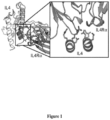
- An example of such an interface is shown in Figure 1 , where a protein partner presents critical residues for biomolecular recognition from helices that are part of two-strand coiled-coil assemblies.
- coiled-coil assemblies Formation of coiled-coil assemblies is implicated in many biological processes.
- Canonical coiled-coils are stabilized by a series of hydrophobic knobs-into-holes ( Crick, Acta Crystallographica 6:689 (1953 )) packing interactions along with inter- and intra-strand electrostatic contacts ( Lupas et al., Adv. Protein Chem. 70:37 (2005 ); Burkhard et al., Trends Cell Biol. 11:82 (2001 ); Woolfson, Adv. Protein Chem. 70:79 (2005 )).
- Several helical peptides and peptidomimetic inhibitors that target coiled-coil domain assembly in biological processes, such as viral fusion have been described ( Dimitrov, Nat. Rev.
- This strategy may also be applicable to complexes between globular proteins and pre-formed coiled-coils, such as the one depicted in Figure 1 .
- an alternative strategy could be to utilize coiled-coil mimics or stable helix dimers that display the desired functionality to interact with the globular protein partner.
- Coiled-coils consisting of less than three heptads are generally not stable ( Lau et al., J. Biol. Chem. 259:13253 (1984 ); Burkhard et al., Protein Sci. 9:2294 (2000 )). Although highly engineered short coiled-coils have been described ( Woolfson, Adv. Protein Chem. 70:79 (2005 ); Burkhard et al., Protein Sci. 9:2294 (2000 ); Dong et al., Biomacromolecules 7:691 (2006 )), these approaches may not be suitable for inhibitor design as at least one face of the dimer is needed to display appropriate functionality to engage the target.
- the present invention is directed to overcoming these and other deficiencies in the art.
- the present invention relates to a macrostructure and composition as defined in the appended claims.
- Coiled-coils are a major motif in proteins and orchestrate multimerization of various complexes important for biological processes. Inhibition of coiled-coil-mediated interactions has significant biomedical potential. However, general approaches that afford short peptides with defined coiled-coil conformation have remained elusive. As described more fully herein, several strategies to stabilize minimal helical bundles with the dimer motif as the initial focus were evaluated. A stable dimeric scaffold was realized in a synthetic sequence by replacing an interhelical ionic bond with a covalent bond.
- Figures 1 shows an example of a protein complex that utilizes residues from both helices of a dimeric coiled-coil domain to target the partner protein.
- the model depicts the complex between IL-4 and IL-4 receptor alpha chain (PDB code 1IAR).
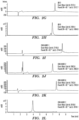
- Figures 2A-P are analytical HPLC traces of peptide A ( Figure 2A ), peptide B ( Figure 2B ), constrained peptides AB-1, AB-2, and AB-3 ( Figures 2C-E , respectively), coiled-coil mimics AB-4, AB-5, and AB-6 ( Figures 2F-H , respectively), and NHR2 mimics CHD-NHR2-1, CHD-NHR2-2, CHD-NHR2-6, CHD-NHR2-7, CHD DS -NHR2-3, CHD DS -NHR2-4, CHD DS -NHR2-5, and CHD DT - NHR2-3 ( Figures 2I-P , respectively).
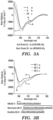
- Figures 3A-B show CD spectra of unconstrained peptides A (SEQ ID NO: 1) and B (SEQ ID NO:2), equimolar mixture of A and B peptides ( Figure 3A ), and constrained peptides AB-1 (SEQ ID NO:3), AB-2 (SEQ ID NO:4), and AB-3 (SEQ ID NO:5) ( Figure 3B ).
- CD spectra were acquired in 50 mM aqueous KF, pH 7.4.
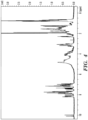
- Figure 4 is the 1 H NMR spectrum of AB-4 .
- Figures 5A-B are NMR spectra showing the amide region of NOESY ( Figure 5A ) and amide to side-chain connectivity of TOCSY ( Figure 5B ) of AB-4 .
- Figure 6 is an NMR spectrum showing the fingerprint region of NOESY from AB-4 .
- Figure 7 shows the structure of flu-N2B used in the peptide-binding assays (top) and its analytical UV trace measured at 220 nm on an XTerra RP18 3.5 ⁇ m 2.1 x 150mm column (Part No. 186000410) (bottom). 10% B to 90% B over 10 min; A: 0.1% aqueous TFA, B: acetonitrile; flow rate 400 ⁇ L/min. Exact mass calcd [M+H] + (m/z): 2056.0; found: 2055.9 m / z.
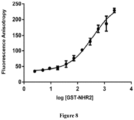
- Figure 8 is the saturation binding curve of NHR2 482-551 with flu-N2B.
- Figures 9A-B are graphs of the saturation binding of flu-N2B with designed CHD mimetics and a native control.
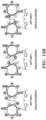
- Figures 10A-E show strategies to template coiled-coil formation of designed peptides.
- Figure 10A shows a potential antiparallel coiled-coil assembly between peptides A and B.
- Figure 10B shows use of hydrogen bond surrogate helices to stabilize helical dimers.
- Figure 10C shows macrocyclization of peptides.
- Figure 10D shows the utilization of interhelical disulfide bridges in place of hydrophobic contacts to aid assembly.
- Figure 10E shows placement of covalent bonds in place of interstrand ionic interactions. See Table 1 below. Table 1. Strategies used to stabilize antiparallel coiled coil mimics and their characteristics Compound Modification (location) Minimum at 222/208
- Figures 11A-D relate to the design of crosslinked helix dimers by replacement of an interstrand ionic contact with bistriazole
- the acidic strand A (SEQ ID NO:1) and the basic strand B (SEQ ID NO:2) were used to synthesize the crosslinked helix dimers.
- Bis-triazole linkers of varying lengths resulting from azidoalanine, azidohomoalanine, and azidolysine residues were incorporated at coiled-coil positions e / e' to obtain dimers AB-4, AB-5, and AB-6, respectively.
- Figure 11B shows CD spectra of AB-4-AB-6 in 50 mM aqueous KF, pH 7.4.
- Figure 11C shows a helical wheel diagram of AB-4 .
- Figure 11D depicts NMR-derived structure of AB-4 .
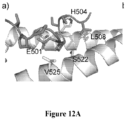
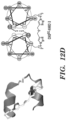
- Figure 12A-D relate to the design of coiled-coil mimics of NHR2.
- Figure 12A is a model depicting binding of NHR2 (gray) to N2B (magenta) with critical residues labeled.
- Figure 12B are helical wheel diagrams depicting sequences for the native (CHD-NHR2-1) ( Figure 12B , top), the redesigned (CHD-NHR2-2) ( Figure 12B , middle), and disulfide-linked ( CHD DS -NHR2-3 ) ( Figure 12B , bottom) NHR2 coiled-coil mimetics.
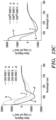
- Figure 12C is the CD spectra of CHD-NHR2-1, CHD-NHR2-2, and CHD DS -NHR2-3 in 50 mM aqueous KF, pH 7.4.
- Figure 12D shows a computational model of CHD DS -NHR2-3 .
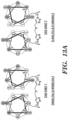
- Figures 13A-C show helical wheel diagrams of mono-crosslinked NHR2 helix dimers CHD-NHR2-1 (SEQ ID NO:6/SEQ ID NO:7) and CHD-NHR2- 2 (SEQ ID NO:8/SEQ ID NO:9) ( Figure 13A ) and disulfide-stabilized double crosslinked NHR2 helix dimers CHD DS -NHR2-3 (SEQ ID NO:10/SEQ ID NO:11), CHD DS -NHR2-4 (SEQ ID NO:12/SEQ ID NO:13), and CHD DS -NHR2-5 (SEQ ID NO:14/SEQ ID NO:15) ( Figure 13B ), and CD spectra of designed CHD-NHR2 peptides ( Figure 13C ). CD spectra were acquired in 50 mM aqueous KF, pH 7.4.
- the present invention provides a macrostructure comprising:
- At least one of Linker B, Linker C, Linker F, and Linker G when present, is independently selected from the group consisting of disulfides, diselenides, C 1-8 alkylene, C 2-8 alkenylene, arylene, heteroarylene, triazole-diyl, and thiazole-diyl.
- at least one of Linker B, Linker C, Linker F, and Linker G when present, is independently a disulfide bond from a cysteine or homocysteine residue, a diselenide from a selenocysteine residue, an alkylene from an allylglycine residue, or an arylene linker.
- one Linker is present or two Linkers are present.
- the macrostructure comprises the antiparallel coiled-coil structure.
- the macrostructure is or wherein a, b, c, d, e, f, g, a', b', c', d', e', f', and g' indicate the location of the amino acid residues within the coiled-coil structure;
- E glutamic acid
- I is isoleucine
- L leucine
- H histidine
- C cysteine
- Z azidolysine derived bistriazole linker
- R is arginine
- S is serine
- V valine
- W tryptophan
- the macrostructure comprises the parallel coiled-coil structure.
- the macrostructure consists of the antiparallel coiled-coil structure (i) or the parallel coiled-coil structure (ii).
- a macrostructure that comprises:
- an antiparallel coiled-coil of formula I g 0 -a 1 -b 1 -c 1 -d 1 -e 1 -f 1 -g 1 -a 2 -b 2 -c 2 -d 2 -e 2 -f 2 -g 2 -a 3 -b 3 -c 3 -d 3 -e 3 -f 3 / f 0 -g' 0 -a' 1 -b' 1 -c' 1 -d' 1 -e' 1 -f' 1 -g' 1 -a' 2 -b' 2 -c' 2 -d' 2 -e' 2 -f' 2 -g' 2 -a' 3 -b' 3 -c' 3 -d' 3 -e' 3 (I);
- an antiparallel coiled-coil of formula I g 0 -a 1 -b 1 -c 1 -d 1 -e 1 -f 1 -g 1 -a 2 -b 2 -c 2 -d 2 -e 2 -f 2 -g 2 -a 3 -b 3 -c 3 -d 3 -e 3 -f 3 / f 0 -g' 0 -a' 1 -b' 1 -c' 1 -d' 1 -e' 1 -f' 1 -g' 1 -a' 2 -b' 2 -c' 2 -d' 2 -e' 2 -f' 2 -g' 2 -a' 3 -b' 3 -c' 3 -d' 3 -e' 3 (I);
- a parallel coiled-coil of formula II f 0 -g 0 -a 1 -b 1 -c 1 -d 1 -e 1 -f 1 -g 1 -a 2 -b 2 -c 2 -d 2 -e 2 -f 2 -g 2 -a 3 -b 3 -c 3 -d 3 -e 3 / f 0 -g' 0 -a' 1 -b' 1 -c' 1 -d' 1 -e' 1 -f' 1 -g' 1 -a' 2 -b' 2 -c' 2 -d' 2 -e' 2 -f' 2 -g' 2 -a' 3 -b' 3 -c' 3 -d' 3 -e' 3 (II);
- a parallel coiled-coil of formula II f 0 -g 0 -a 1 -b 1 -c 1 -d 1 -e 1 -f 1 -g 1 -a 2 -b 2 -c 2 -d 2 -e 2 -f 2 -g 2 -a 3 -b 3 -c 3 -d 3 -e 3 / f 0 -g' 0 -a' 1 -b' 1 -c' 1 -d' 1 -e' 1 -f' 1 -g' 1 -a' 2 -b' 2 -c' 2 -d' 2 -e' 2 -f' 2 -g' 2 -a' 3 -b' 3 -c' 3 -d' 3 -e' 3 (II);
- Antiparallel coiled-coil structures and parallel coiled-coil structures each have a first amino acid strand (or first coil) and a second amino acid strand (or second coil).
- first amino acid strand or first coil
- second amino acid strand or second coil
- A/B or " x A y / x' B y' " is used to identify the sequence of each strand (either specifically or generically), where A is the sequence (X 1 -X 2 -X 3 ...) of the first strand, B is the sequence (X 1 '-X 2 '-X 3 '%) of the second strand, x, x', y, and y' identify the starting (x, x') and ending (y, y') locations of the corresponding sequences relative to heptad(s) in each strand, and "/" separates one sequence from the other.
- the A and B sequences are both written, left to right, in an N-to-C orientation.
- the strands in an antiparallel coiled-coil structure are spatially aligned in opposite directions, e.g., in a top view taken perpendicular to the axis of an antiparallel coiled-coil, the N-terminal of the first strand will be top-most and the C-terminal of the second strand will be top-most; conversely, as will be readily apparent to the skilled artisan, the strands in a parallel coiled-coil structure are spatially aligned in the same direction, e.g.
- the N-terminal of the first strand will be top-most and the N-terminal of the second strand will be top-most.
- the location and structure of the linker(s) are sometimes identified using "Z" and "Z'" in place of X and X', respectively, in the A and B sequences.
- the location and structure of the linker(s) are identified by additional explanation ( e.g ., "there is a disulfide linker between residue X n and residue X n ''').
- the helical wheel views herein show the spatial orientation of each coil in the antiparallel or parallel coiled-coil structure, while the two-dimensional views show the connections between residues.
- alkyl means an aliphatic hydrocarbon group which may be straight or branched having about 1 to about 8 ( e.g., 1-2, 1-3, 1-4, 1-5, 1-6, 1-7, 1-8) carbon atoms in the chain. Branched means that one or more lower alkyl groups such as methyl, ethyl, or propyl are attached to a linear alkyl chain. Exemplary alkyl groups include methyl, ethyl, n-propyl, i-propyl, n-butyl, t-butyl, n-pentyl, and 3-pentyl.
- alkenyl means an aliphatic hydrocarbon group containing a carbon-carbon double bond and which may be straight or branched having about 2 to about 8 ( e.g., 2-3, 2-4, 2-5, 2-6, 2-7, 2-8) carbon atoms in the chain. Preferred alkenyl groups have 2 to about 4 carbon atoms in the chain. Exemplary alkenyl groups include ethenyl, propenyl, n-butenyl, and i-butenyl.
- alkynyl means an aliphatic hydrocarbon group containing a carbon-carbon triple bond and which may be straight or branched having about 2 to about 8 ( e.g., 2-3, 2-4, 2-5, 2-6, 2-7, 2-8) carbon atoms in the chain. Preferred alkynyl groups have 2 to about 4 carbon atoms in the chain. Exemplary alkynyl groups include ethynyl, propynyl, n-butynyl, 2-butynyl, 3-methylbutynyl, and n-pentynyl.
- cycloalkyl refers to a non-aromatic saturated or unsaturated mono- or polycyclic ring system which may contain 3 to 8 (3, 4, 5, 6, 7, 8, 3-4, 3-5, 3-6, 3-7, 4-5, 4-6, 4-7, 4-8, 5-6, 5-7, 5-8, 6-7, 6-8, 7-8) carbon atoms, and which may include at least one double bond.
- Exemplary cycloalkyl groups include, without limitation, cyclopropyl, cyclobutyl, cyclopentyl, cyclohexyl, cyclopropenyl, cyclobutenyl, cyclopentenyl, cyclohexenyl, anti- bicyclopropane, or syn -bicyclopropane.
- alkane refers to aliphatic hydrocarbons of formula C n H 2n+2 , which may be straight or branched having about 1 to about 8 ( e.g., 1-2, 1-3, 1-4, 1-5, 1-6, 1-7, 1-8) carbon atoms in the chain. Branched means that one or more lower alkyl groups such as methyl, ethyl, or propyl are attached to a linear alkyl chain.
- Exemplary alkanes include methane, ethane, n-propane, i-propane, n-butane, t-butane, n-pentane, and 3-pentane.
- alkylene refers to a divalent group formed from an alkane by removal of two hydrogen atoms. Exemplary alkylene groups include, but are not limited to, divalent groups derived from the alkanes described above.
- alkene referes to aliphatic unsaturated hydrocarbons of formula C n H 2n , which may be straight or branched having about 2 to about 8 ( e.g., 2-3, 2-4, 2-5, 2-6, 2-7, 2-8) carbon atoms in the chain.
- exemplary alkenes include ethylene, propylene, n-butylene, and i-butylene.
- alkenylene refers to a divalent group formed from an alkene by removal of two hydrogen atoms. Alkenylenes contain a carbon-to-carbon double bond and are represented by the formula -(C n H 2n-2 )-.
- Exemplary alkenylene groups include, but are not limited to, divalent groups derived from the alkenes described above.
- alkyne refers to aliphatic unsaturated hydrocarbons of formula C n H 2n-2 , which may be straight or branched having about 2 to about 8 ( e.g., 2-3, 2-4, 2-5, 2-6, 2-7, 2-8) carbon atoms in the chain.
- exemplary alkynes include acetylene, propyne, butyne, and pentyne.
- alkynylene refers to a divalent groups formed from alkynes by removal of two hydrogen atoms. Alkynylene contains a carbon-to-carbon triple bond and is represented by the formula -(C n H 2n-4 )-.
- Exemplary alkynylene groups include, but are not limited to, divalent groups derived from the alkynes described above.
- Aromatic rings and heteroaromatic rings can be any single, multiple, or fused ring structures.
- aromatic or heteroaromatic rings include 5- or 6-membered aromatic or heteroaromatic rings containing 0-3 (0, 1, 2, or 3) heteroatoms selected from O, N, and S; a bicyclic 9- or 10-membered aromatic or heteroaromatic ring system containing 0-3 (0, 1, 2, or 3) heteroatoms selected from O, N, and S; or a tricyclic 13- or 14-membered aromatic or heteroaromatic ring system containing 0-3 (0, 1, 2, or 3) heteroatoms selected from O, N, and S.
- Aromatic 5- to 14-membered (5-, 6-, 7-, 8, 9-, 10-, 11-, 12-, 13-, or 14-membered) carbocyclic rings include, e.g ., cyclopenta-1,3-diene, benzene, naphthalene, indane, tetralin, and anthracene.
- 5- to 10-Membered (5-, 6-, 7-, 8-, 9-, or 10-membered) aromatic heterocyclic rings include, e.g ., imidazole, pyridine, indole, thiophene, benzopyranone, thiazole, furan, benzimidazole, quinoline, isoquinoline, quinoxaline, pyrimidine, pyrazine, tetrazole, pyrazole, benzimidazole, pyridazine, pyrrole, imidazole, oxazole, isooxazole, indazole, isoindole, imidazole, purine, triazine, quinazoline, cinnoline, benzoxazole, acridine, benzisooxazole, and benzothiazole.
- arylene refers to a divalent group derived from an aromatic ring by removal of a hydrogen atom from two ring carbon atoms.
- exemplary arylene groups include, but are not limited to, divalent groups derived from the aromatic rings described above.
- heteroarylene refers to a divalent group derived from a heteroaromatic ring.
- exemplary heteroarylene groups include, but are not limited to, divalent groups derived from the heteroaromatic rings described above.
- ether means a group having the formula -R-O-R-.
- Each R can be independently selected from the group consisting of a bond, C 1-8 alkylene, C 2-8 alkenylene, arylene, and heteroarylene.
- exemplary ethers include, but are not limited to, -C 1-8 alkylene-O-C 1-8 alkylene- (e.g., -(CH 2 ) 2 -O-(CH 2 ) 2 -),-C 2-8 alkenylene-O-C 2-8 alkenylene-, -arylene-O-arylene-, -heteroarylene-O-heteroarylene-, and -C 1-8 alkylene-O-heteroarylene-.
- thioether means a group having the formula -R-S-R-. Each R can be independently selected from the group consisting of a bond, C 1-8 alkylene, C 2-8 alkenylene, arylene, and heteroarylene.
- exemplary thioethers include, but are not limited to, -C 1-8 alkylene-S-C 1-8 alkylene- (e.g., -(CH 2 ) 2 -S-(CH 2 ) 2 -), -C 2-8 alkenylene-S-C 2-8 alkenylene-, -arylene-S-arylene-, -heteroarylene-S-heteroarylene-, and -C 1-8 alkylene-S-heteroarylene-.
- amide means a group having the formula -C(O)N(R 1 )(R 1 ) or -C(O)N(R 1 )-.
- Amides include, e.g., -C(O)N(R 1 )R-, -R-C(O)N(R 1 )R-, - CHR 1 -C(O)N(R 1 )R-, and -C(R 1 )(R 1 )-C(O)N(R 1 )R-.
- Each R can be independently selected from the group consisting of a bond, C 1-8 alkylene, C 2-8 alkenylene, arylene, and heteroarylene
- each R 1 can be independently selected from the group consisting of hydrogen, C 1-8 alkyl, C 2-8 alkenyl, C 2-8 alkynyl, C 3-8 cycloalkyl, aryl, heteroaryl, heterocyclyl, and arylalkyl.
- Exemplary amides include, but are not limited to, -C 1-8 alkylene-C(O)N(aryl)-, -C 2-8 alkenylene-C(O)N(aryl)-, and -C 1-8 alkylene-C(O)N(C 1-8 alkyl)- (e.g., -(CH 2 ) 2 -C(O)N(CH 3 )-).
- esters means a group having the formula -C(O)O-. Esters include, e.g., -R-C(O)O-R-, -CHR 1 -C(O)O-R-, and -C(R 1 )(R 1 )-C(O)OR-.
- Each R can be independently selected from the group consisting of a bond, C 1-8 alkylene, C 2-8 alkenylene, arylene, and heteroarylene
- each R 1 can be independently selected from the group consisting of hydrogen, C 1-8 alkyl, C 2-8 alkenyl, C 2-8 alkynyl, C 3-8 cycloalkyl, aryl, heteroaryl, heterocyclyl, and arylalkyl.
- esters include, but are not limited to, -C 1-8 alkylene-C(O)O-arylene-, -C 2-8 alkenylene-C(O)O-arylene-, -C 1-8 alkylene-C(O)O-heteroarylene-, -C 1-8 alkylene-C(O)O-C 1-8 alkylene - (e.g., -(CH 2 ) 2 -C(O)O-(CH 2 ) 2 -), and - C 1-8 alkylene-C(O)O- (e.g., -(CH 2 ) 2 -C(O)O-).
- heterocyclyl refers to a stable 3- to 18-membered (3-, 4-, 5-, 6-, 7-, 8-, 9-, 10-, 11-, 12-, 13-, 14-, 15-, 16-, 17-, or 18-membered) ring system that consists of carbon atoms and from one to five (1, 2, 3, 4, 5, 1-2, 1-3, 1-4, 2-3, 2-4, 2-5, 3-4, 3-5, 4-5) heteroatoms selected from the group consisting of nitrogen, oxygen, and sulfur.
- the heterocyclyl may be a monocyclic or a polycyclic ring system, which may include fused, bridged, or spiro ring systems; and the nitrogen, carbon, or sulfur atoms in the heterocyclyl may be optionally oxidized; the nitrogen atom may be optionally quaternized; and the ring may be partially or fully saturated.
- Representative monocyclic heterocyclyls include piperidine, piperazine, pyrimidine, morpholine, thiomorpholine, pyrrolidine, tetrahydrofuran, pyran, tetrahydropyran, oxetane, and the like.
- Representative polycyclic heterocyclyls include indole, isoindole, indolizine, quinoline, isoquinoline, purine, carbazole, dibenzofuran, chromene, xanthene, and the like.
- aryl refers to an aromatic monocyclic or polycyclic ring system containing from 6 to 19 (6, 7, 8, 9, 10, 11, 12, 13, 14, 15, 16, 17, 18, 19, 6-7, 6-8, 6-9, 6-10, 6-11, 6-12, 6-13, 6-14, 6-15, 6-16, 1-17, 6-18, 7-8, 7-9, 7-10, 7-11, 7-12, 7-13, 7-14, 7-15, 7-16, 7-18, 7-19, 8-9, 8-10, 8-11, 8-12, 8-13, 8-14, 8-15, 8-16, 8-17, 8-18, 8-19, 9-10, 9-11, 9-12, 9-13, 9-14, 9-15, 9-16, 9-17, 9-18, 9-19, 10-11, 10-12, 10-13, 10-14, 10-15, 10-16, 10-17, 10-18, 10-19, 11-12, 11-13, 11-14, 11-15, 11-16, 11-17, 11-18, 11-19, 12-13, 12-14, 12-15, 12-16, 12-17, 12-18, 12-19, 13-14, 13-15, 12-16, 12-17,
- Aryl groups of the present invention and disclosure include, but are not limited to, groups such as phenyl, naphthyl, azulenyl, phenanthrenyl, anthracenyl, fluorenyl, pyrenyl, triphenylenyl, chrysenyl, and naphthacenyl.
- heteroaryl refers to an aromatic ring radical which consists of carbon atoms and from one to five heteroatoms selected from the group consisting of nitrogen, oxygen, and sulfur.
- heteroaryl groups include, without limitation, pyrrolyl, pyrazolyl, imidazolyl, triazolyl, furyl, thiophenyl, oxazolyl, isoxazolyl, thiazolyl, isothiazolyl, oxadiazolyl, thiadiazolyl, pyridyl, pyrazinyl, pyrimidinyl, pyridazinyl, triazinyl, thienopyrrolyl, furopyrrolyl, indolyl, azaindolyl, isoindolyl, indolinyl, indolizinyl, indazolyl, benzimidazolyl, imidazopyridinyl, benzotriazolyl, benzo
- arylalkyl refers to a moiety of the formula -R a R b where R a is an alkyl or cycloalkyl as defined above and R b is an aryl or heteroaryl as defined above.
- Compounds described herein may contain one or more asymmetric centers and may thus give rise to enantiomers, diastereomers, and other stereoisomeric forms.
- Each chiral center may be defined, in terms of absolute stereochemistry, as (R)- or (S)-. This technology is meant to include all such possible isomers, as well as mixtures thereof, including racemic and optically pure forms.
- Optically active (R)- and (S)-, (-)- and (+)-, or (D)- and (L)- isomers may be prepared using chiral synthons or chiral reagents, or resolved using conventional techniques.
- the compounds described herein contain olefinic double bonds or other centers of geometric asymmetry, and unless specified otherwise, it is intended that the compounds include both E and Z geometric isomers. Likewise, all tautomeric forms are also intended to be included.
- monocyclic carbocycle means a monocyclic ring system of 5 to about 8 (e.g., 5, 6, 7, 8, 5-6, 5-7, 6-7, 6-8, 7-8) ring carbon atoms, preferably 5 or 6.
- the ring is nonaromatic, but may contain one or more carbon-carbon double bonds.
- monocyclic carbocycle also includes divalent groups derived from a monocyclic ring system.
- Representative monocyclic carbocycles include divalent groups derived from cyclopentane, cyclohexane, cyclopentene, cyclohexene, and the like.
- fused bicyclic carbocycle means a bicyclic ring system consisting of about 8 to 11 (e.g., 8, 9, 10, 11, 8-9, 8-10, 9-10, 9-11, 10-11) ring carbon atoms, preferably 9 or 10. One or both of the rings is/are aromatic.
- fused bicyclic carbocycle also encompasses divalent groups derived from a bicyclic ring system. Representative monocyclic carbocycles include divalent groups derived from dihydronaphthalene, tetrahydronaphthalene, tetrahydrobenzoannulene, and the like.
- non-aromatic heterocycle means a non-aromatic monocyclic system containing 3 to 10 atoms (e.g., 3, 4, 5, 6, 7, 8, 9, 10, 3-4, 3-5, 3-6, 3-7, 3-8, 3-9, 4-5, 4-6, 4-7, 4-8, 4-9, 4-10, 5-6, 5-7, 5-8, 5-9, 5-10, 6-7, 6-8, 6-9, 6-10, 7-8, 7-9, 7-10, 8-9, 8-10, 9-10), preferably 4 to about 7 carbon atoms, in which one or more of the atoms in the ring system is/are element(s) other than carbon, for example, nitrogen, oxygen, or sulfur.
- element(s) other than carbon for example, nitrogen, oxygen, or sulfur.
- non-aromatic heterocycle also includes divalent groups derived from a non-aromatic heterocyclic rings.
- Representative non-aromatic heterocycle groups include divalent groups derived from pyrrolidine, 2-oxopyrrolidine, piperidine, 2-oxopiperidine, azepane, 2-oxoazepane, 2-oxooxazolidine, morpholine, 3-oxomorpholine, thiomorpholine, 1,1-dioxothiomorpholine, piperazine, tetrohydro-2H-oxazine, and the like.
- polycyclic or “multi-cyclic” used herein indicates a molecular structure having two or more rings, including, but not limited to, fused, bridged, or spiro rings.
- a group may have a substituent at each substitutable atom of the group (including more than one substituent on a single atom), provided that the designated atom's normal valency is not exceeded and the identity of each substituent is independent of the others.
- Up to three H atoms in each residue are replaced with alkyl, halogen, haloalkyl, hydroxy, loweralkoxy, carboxy, carboalkoxy (also referred to as alkoxycarbonyl), carboxamido (also referred to as alkylaminocarbonyl), cyano, carbonyl, nitro, amino, alkylamino, dialkylamino, mercapto, alkylthio, sulfoxide, sulfone, acylamino, amidino, phenyl, benzyl, heteroaryl, phenoxy, benzyloxy, or heteroaryloxy. "Unsubstituted" atoms bear all of the hydrogen atoms dictated by their valency.
- halogen means fluorine, chlorine, bromine, or iodine.
- a "peptide” as used herein is any oligomer of two or more natural or non-natural amino acids, including alpha amino acids, beta amino acids, gamma amino acids, L-amino acids, D-amino acids, and combinations thereof.
- the peptide is ⁇ 2 to ⁇ 30 ( e.g., ⁇ 2 to ⁇ 5, ⁇ 2 to ⁇ 10, ⁇ 5 to ⁇ 10, ⁇ 2 to ⁇ 17, ⁇ 5 to ⁇ 17, ⁇ 10 to ⁇ 17, ⁇ 5 to ⁇ 30, ⁇ 10 to ⁇ 30, or ⁇ 18 to ⁇ 30) amino acids in length.
- the peptide is 10-17 amino acids in length.
- the peptide contains a mixture of alpha and beta amino acids, preferably in the pattern ⁇ 3/ ⁇ 1.
- amino acid as used herein can be any natural or non-natural amino acid, including alpha amino acids, beta amino acids, gamma amino acids, L-amino acids, and D-amino acids.
- Amino acid side chains can be any amino acid side chain of such an amino acid.
- An amino acid as used herein also includes an analogue of a natural or non-natural amino acid.
- An amino acid analogue is an alpha amino acid with a nonnatural side chain consisting of alkyl, cycloalkyl, aryl, cycloaryl, alkenyl, or alkynyl; or a beta3-amino acid with a side chain consisting of alkyl, cycloalkyl, aryl, cycloaryl, alkenyl, or alkynyl.
- an amino acid analogue also refers to a natural or nonnatural amino acid that may be substituted for an amino acid residue in the coiled-coil without loss of function relative to the native coiled-coil sequence.
- Suitable amino acid analogues/substitutions include the natural amino acid substitions described in Betts & Russell, “Amino Acid Properties and Consequences of Substitutions,” in Bioinformatics for Geneticists 289-316 (Michael R. Barnes & Ian C. Gray eds. 2003 ), as well as the nonnatural substitutions set forth below (all available from Sigma Aldrich) and the nonnatural substitutions described in Gfeller et al., "SwissSidechain: A Molecular and Structural Database of Non-Natural Sidechains," Nucl. Acids Res. 41:D327-D332 (2013 ).
- analogues in the table below that are listed as having a protecting group at the N- and/or C-terminal would be deprotected during conjugation to an adjacent residue.
- Amino Acid Exemplary Non-Natural Analogue(s) Alanine N-Acetyl-3-(3,4-dimethoxyphenyl)-D-alanine, H- ⁇ -Ala- ⁇ -naphthalene, Albizziin, (R)-(+)- ⁇ -Allylalanine, (S)-(-)- ⁇ -Allylalanine, D-2-Aminobutyric acid, L-2-Aminobutyric acid, DL-2-Aminobutyric acid, DL-2-Aminobutyric acid, 2-Aminoisobutyric acid, ⁇ -Aminoisobutyric acid, (S)-(+)-2-Amino-4-phenylbutyric acid ethyl ester, Benzyl ⁇ -
- Tyrosine 3-Amino-L-tyrosine, Boc-3-chloro-D-Tyr-OH, Boc-Tyr(3,5-I2)-Osu, 3-Chloro-L-tyrosine, Fmoc-Tyr(3-NO2)-OH, Fmoc-Tyr(3,5-I2)-OH, ⁇ -Methyl-DL-tyrosine, 3-Nitro-L-tyrosine, 3-Nitro-L-tyrosine ethyl ester, 3-Nitro-L-tyrosine ethyl ester, DL-o-Tyrosine.
- Arginine L-Homoarginine hydrochloride unnatural arginine analog, L-2-Amino-3-guanidinopropionic acid, L-2-Amino-3-guanidinopropionic acid hydrochloride, 4-Guanidinobutyric acid, 3-Guanidinopropionic acid. Histidine N-Boc-3-(3-methyl-4-nitrobenzyl)-L-histidine methyl ester.
- Lysine (S)-(-)-1-[N-(1-Ethoxycarbonyl-3-phenylpropyl)-N-trifluoroacetyl]-L-lysine, Fmoc- ⁇ -Lys(Boc)-OH, Fmoc-Lys(palmitoyl)-OH, DL-5-Hydroxylysine, (5R)-5-Hydroxy-L-lysine.
- Non-limiting examples of substitutions for certain amino acid residues include, without limitation, those shown below.
- the amino acids herein may also be optionally modified. Modifications include, for example, phosphorylation (e.g ., phosphoserine, phosphotyrosine, phosphothreonine), halogenation ( esp. with 3-9 halogens) (preferably with fluorine, e.g., hexafluoroleucine, hexafluorovaline), methylation ( e.g. , aspartic acid methyl ester, glutamic acid methyl ester, methyllysine, dimethyllysine, trimethyllysine, dimethylarginine, methylarginine, methyltryptophan), and acetylation (e.g. , acetyllysine).
- phosphorylation e.g ., phosphoserine, phosphotyrosine, phosphothreonine
- halogenation esp. with 3-9 halogens
- fluorine e.g., hexafluoroleucine
- the linkers herein create a covalent bridge between an amino acid residue/analogue on one coil of the coiled-coil structure and an amino acid residue/analogue on the other coil in the coiled-coil structure.
- any covalent linker can be used, provided the appropriate spatial distance between the two linked residues is maintained.
- the spatial distance as used herein refers to the distance of atoms in the coiled-coil structure when in its solid state, as determined using a static molecular modeling program (e.g ., UCSF Chimera) and/or by evaluating the crystal structure of the macrocycle.
- Linkers between g or e and g' or e' residues (Linker A, Linker D, Linker E, Linker H, linkers for g 0 -g' 2 , g 1 -g' 1 , g 2 -g' 0 , e 1 -e' 3 , e 2 -e' 2 , and e 3 -e' 1 in Formula I, and linkers for g 0 -e' 1 , g 1 -e' 2 , g 2 -e' 3 , e 1 -g' 0 , e 2 -g' 1 , and e 3 -g' 2 in Formula II)
- the appropriate spatial distance is 10-25 ⁇ (10-11, 10-12, 10-13, 10-14, 10-15, 10-16, 10-17, 10-18, 10-19, 10-20, 10-21, 10-22, 10-23, 10-24, 11-12, 11-13, 11-14, 11-15, 11-16, 11-17, 11-18, 11-19, 11-20, 11-21,
- the spatial distance is 11-17 ⁇ . In at least one embodiment, the spatial distance is 15-20 ⁇ .
- Linkers between a or d and a' or d' residues (Linker B, Linker C, Linker F, Linker G, linkers for a 1 -d' 3 , a 2 -d' 2 , a 3 -d' 1 , d 1 -a' 3 , d 2 -a' 2 , and d 3 -a' 1 in Formula I, and linkers for d 1 -d' 1 , d 2 -d' 2 , d 3 -d' 3 , a 1 -a' 1 , a 2 -a' 2 , and a 3 -a' 3 in Formula II) the appropriate spatial distance is 5-15 ⁇ (5-6, 5-7, 5-8, 5-9, 5-10, 5-11, 5-12, 5-13, 5-14, 6-7, 6-8, 6-9, 6-10, 6-11, 6-12, 6-13,
- the spatial distance is 6-8 ⁇ . In at least one embodiment, the spatial distance is 5-10 ⁇ .
- the two amino acids/analogues may be covalently connected to each other using alkylene, alkenylene, arylene, heteroarylene, ethers, thioethers, amides, maleimides, esters, disulfides, diselenides, -O-, -S-, -Se-, and any combination thereof.
- the linkers may be symmetrical or asymmetrical.
- linkers between g or e and g' or e' residues include, without limitation, those having the formula -Z n -, wherein n is a number from 1 to 25 (1, 2, 3, 4, 5, 6, 7, 8, 9, 10, 11, 12, 13, 14, 15, 16, 17, 18, 19, 20, 21, 22, 23, 24, 25, or any range within 1 and 25, including, e.g.,
- symmetrical linkers include, without limitation, and wherein each marks a connection point to the C ⁇ carbon in a linked residue/analogue.
- the linker between g or e and g' or e' residues (Linker A, Linker D, Linker E, Linker H, linkers for g 0 -g' 2 , g 1 -g' 1 , g 2 -g' 0 , e 1 -e' 3 , e 2 -e' 2 , and e 3 -e' 1 in Formula I, and linkers for g 0 -e' 1 , g 1 -e' 2 , g 2 -e' 3 , e 1 -g' 0 , e 2 -g' 1 , and e 3 -g' 2 in Formula II) has the following formula or
- the linker between g or e and g' or e' residues (Linker A, Linker D, Linker E, Linker H, linkers for g 0 -g' 2 , g 1 -g' 1 , g 2 -g' 0 , e 1 -e' 3 , e 2 -e' 2 , and e 3 -e' 1 in Formula I, and linkers for g 0 -e' 1 , g 1 -e' 2 , g 2 -e' 3 , e 1 -g' 0 , e 2 -g' 1 , and e 3 -g' 2 in Formula II) has the formula wherein:
- the linker between g or e and g' or e' residues (Linker A, Linker D, Linker E, Linker H, linkers for g 0 -g' 2 , g 1 -g' 1 , g 2 -g' 0 , e 1 -e' 3 , e 2 -e' 2 , and e 3 -e' 1 in Formula I, and linkers for g 0 -e' 1 , g 1 -e' 2 , g 2 -e' 3 , e 1 -g' 0 , e 2 -g' 1 , and e 3 -g' 2 in Formula II) has the following formula or wherein X is O, S, CR 2 , NR, or P (preferably O, S, CH 2 or NR), wherein X 1 is O, S, C, CR, N, NH, and NR, wherein each R is independently H, alkyl, or aryl
- Linkers between a or d and a' or d' residues include disulfides, diselenides, C 1-8 alkylene, C 2-8 alkenylene, arylene, and heteroarylene ( esp.
- the linkers between a or d and a' or d' residues are a disulfide bond from cysteine/homocysteine, a diselenide from selenocysteine, an alkylene from allylglycine, or an arylene linker.
- the antiparallel coiled-coil structures and the parallel coiled-coil structures according to the present disclosure can each contain anywhere from only one of the linkers to all of the linkers. In at least one preferred embodiment, only one linker is present. In at least one preferred embodiment, only two linkers are present.
- At least one linker between a g-g' pair or between an e-e' pair (Linker A, Linker D, linkers for g 0 -g' 2 , g 1 -g' 1 , g 2 -g' 0 , e 1 -e' 3 , e 2 -e' 2 , and e 3 -e' 1 in Formula I) is present and at least one linker between an a-d' pair or a d-a' pair (Linker B, Linker C, linkers for a 1 -d' 3 , a 2 -d' 2 , a 3 -d' 1 , d 1 -a' 3 , d 2 -a' 2 , and d 3 -a' 1 in Formula I) is present.
- one linker between a g-g' pair or between an e-e' pair is present and one linker between an a-d' pair or a d-a' pair is present.
- linker E Linker H, linkers for g 0 -e' 1 , g 1 -e' 2 , g 2 -e' 3 , e 1 -g' 0 , e 2 -g' 1 , and e 3 -g' 2 in Formula II
- Linker F Linker G, linkers for d 1 -d' 1 , d 2 -d' 2 , d 3 -d' 3 , a 1 -a' 1 , a 2 -a' 2 , and a 3 -a' 3 in Formula II
- Linker F Linker G, linkers for d 1 -d' 1 , d 2 -d' 2 , d 3 -d' 3 , a 1 -a' 1 , a 2 -a' 2 , and a 3 -a' 3 in Formula II
- one linker between a g-e' pair or between an e-g' pair is present and one linker between a d-d' pair or between an a-a' pair is present.
- the coiled-coil structures will contain the minimum number of linkers necessary to stabilize the coiled-coil. This number will vary depending on the general stability of the native coiled-coil, as will be apparent to the skilled artisan. In a preferred embodiment, only one linker is present. In another preferred embodiment, only two linkers are present.
- Protecting groups function primarily to protect or mask the reactivity of functional groups.
- Protecting groups that are suitable for the protection of an amine group are well known in the art, including without limitation, carbamates, amides, N -alkyl and N -aryl amines, imine derivatives, enamine derivatives, and N- hetero atom derivatives as described by THEODORA W. GREENE & PETER G.M. WUTS, PROTECTIVE GROUPS IN ORGANIC SYNTHESIS 494-615 (1999 ).
- Suitable protecting groups include, e.g., tert-butyloxycarbonyl ("Boc"), 9-fluorenylmethyloxycarbonyl (“Fmoc”), carbobenzyloxy (“Cbz”), and trityl.
- Protecting groups that are suitable for the protection of an alcohol are also well known in the art.
- Suitable alcohol protecting groups include, without limitation, silyl ethers, esters, and alkyl/aryl ethers.
- Protecting groups that are suitable for the protection of a thiol group are also well known in the art.
- Suitable thiol protecting groups include, without limitation, aryl/alkyl thio ethers and disulfides.
- amino acid side chains of Asn, Asp, Gln, Glu, Cys, Ser, His, Lys, Arg, Trp, or Thr will typically need to be protected while carrying out the methods described herein.
- Protecting groups that are suitable for protecting these amino acid side chains are also well known in the art. Methods of protecting and deprotecting functional groups vary depending on the chosen protecting group; however, these methods are well known in the art and described in THEODORA W. GREENE & PETER G.M. WUTS, PROTECTIVE GROUPS IN ORGANIC SYNTHESIS 372-450 and 494-615 (1999 ).
- a “tag” as used herein includes any labeling moiety that facilitates the detection, quantitation, separation, and/or purification of the compounds of the present invention and disclosure. Suitable tags include purification tags, radioactive or fluorescent labels, and enzymatic tags.
- Purification tags such as poly-histidine (His 6- ), a glutathione-S-transferase (GST-), or maltose-binding protein (MBP-), can assist in compound purification or separation but can later be removed, i.e., cleaved from the compound following recovery. Protease-specific cleavage sites can be used to facilitate the removal of the purification tag. The desired product can be purified further to remove the cleaved purification tags.
- His 6- poly-histidine
- GST- glutathione-S-transferase
- MBP-binding protein MBP-
- Suitable tags include radioactive labels, such as, 125 I, 131 I, 111 In, or 99 TC. Methods of radiolabeling compounds are known in the art and described in U.S. Patent No. 5,830,431 to Srinivasan et al. Radioactivity is detected and quantified using a scintillation counter or autoradiography. Alternatively, the compound can be conjugated to a fluorescent tag. Suitable fluorescent tags include, without limitation, chelates (europium chelates), fluorescein and its derivatives, rhodamine and its derivatives, dansyl, Lissamine, phycoerythrin, and Texas Red. The fluorescent labels can be conjugated to the compounds using techniques disclosed in CURRENT PROTOCOLS IN IMMUNOLOGY (Coligen et al. eds., 1991 ). Fluorescence can be detected and quantified using a fluorometer.
- Enzymatic tags generally catalyze a chemical alteration of a chromogenic substrate which can be measured using various techniques.
- the enzyme may catalyze a color change in a substrate, which can be measured spectrophotometrically.
- the enzyme may alter the fluorescence or chemiluminescence of the substrate.
- suitable enzymatic tags include luciferases (e.g., firefly luciferase and bacterial luciferase; see e.g., U.S. Patent No. 4,737,456 to Weng et al.
- luciferin 2,3-dihydrophthalazinediones, malate dehydrogenase, urease, peroxidases (e.g ., horseradish peroxidase), alkaline phosphatase, ⁇ -galactosidase, glucoamylase, lysozyme, saccharide oxidases ( e.g ., glucose oxidase, galactose oxidase, and glucose-6-phosphate dehydrogenase), heterocyclic oxidases ( e.g. , uricase and xanthine oxidase), lactoperoxidase, microperoxidase, and the like.
- peroxidases e.g ., horseradish peroxidase
- alkaline phosphatase e.g ., ⁇ -galactosidase
- glucoamylase glucoamylase
- lysozyme sacchar
- a targeting moiety according to the present invention and disclosure functions to (i) promote the cellular uptake of the compound, (ii) target the compound to a particular cell or tissue type (e.g., signaling peptide sequence), or (iii) target the compound to a specific sub-cellular localization after cellular uptake ( e.g. , transport peptide sequence).
- a particular cell or tissue type e.g., signaling peptide sequence
- a specific sub-cellular localization after cellular uptake e.g. , transport peptide sequence
- the targeting moiety may be a cell penetrating peptide (CPP).
- CPPs translocate across the plasma membrane of eukaryotic cells by a seemingly energy-independent pathway and have been used successfully for intracellular delivery of macromolecules, including antibodies, peptides, proteins, and nucleic acids, with molecular weights several times greater than their own.
- CPPs including polyarginines, transportant, protamine, maurocalcine, and M918, are suitable targeting moieties for use in the present invention and disclosure and are well known in the art (see Stewart et al., "Cell-Penetrating Peptides as Delivery Vehicles for Biology and Medicine," Organic Biomolecular Chem. 6:2242-55 (2008 )). Additionally, methods of making CPP are described in U.S. Patent Application Publication No. 20080234183 to Hallbrink et al.
- Another suitable targeting moiety useful for enhancing the cellular uptake of a compound is an "importation competent" signal peptide as disclosed by U.S. Patent No. 6,043,339 to Lin et al.
- An importation competent signal peptide is generally about 10 to about 50 amino acid residues in length-typically hydrophobic residues-that render the compound capable of penetrating through the cell membrane from outside the cell to the interior of the cell.
- An exemplary importation competent signal peptide includes the signal peptide from Kaposi fibroblast growth factor ( see U.S. Patent No. 6,043,339 to Lin et al. ).
- Other suitable peptide sequences can be selected from the SIGPEP database ( see von Heijne G., "SIGPEP: A Sequence Database for Secretory Signal Peptides," Protein Seq. Data Anal. 1(1):41-42 (1987 )).
- Another suitable targeting moiety is a signal peptide sequence capable of targeting the compounds of the present invention and disclosure to a particular tissue or cell type.
- the signaling peptide can include at least a portion of a ligand binding protein.
- Suitable ligand binding proteins include high-affinity antibody fragments (e.g ., Fab, Fab' and F(ab') 2 , single-chain Fv antibody fragments), nanobodies or nanobody fragments, fluorobodies, or aptamers.
- ligand binding proteins include biotin-binding proteins, lipid-binding proteins, periplasmic binding proteins, lectins, serum albumins, enzymes, phosphate and sulfate binding proteins, immunophilins, metallothionein, or various other receptor proteins.
- the signaling peptide is preferably a ligand binding domain of a cell specific membrane receptor.
- the compound may be conjugated to an alphafeto protein receptor as disclosed by U.S. Patent No. 6,514,685 to Moro , or to a monoclonal GAH antibody as disclosed by U.S. Patent No. 5,837,845 to Hosokawa .
- the compound may be conjugated to an antibody recognizing elastin microfibril interfacer (EMILIN2) ( Van Hoof et al., "Identification of Cell Surface for Antibody-Based Selection of Human Embryonic Stem Cell-Derived Cardiomyocytes," J. Proteom. Res.
- EMILIN2 elastin microfibril interfacer
- the signaling peptide may include a ligand domain specific to the hepatocyte-specific asialoglycoprotein receptor.
- Another suitable targeting moiety is a transport peptide that directs intracellular compartmentalization of the compound once it is internalized by a target cell or tissue.
- a transport peptide that directs intracellular compartmentalization of the compound once it is internalized by a target cell or tissue.
- the compound can be conjugated to an ER transport peptide sequence.
- signal peptides are known in the art, including the signal peptide MMSFVSLLLVGILFYATEAEQLTKCEVFQ (SEQ ID NO:16).
- ER signal peptides include the N-terminus endoplasmic reticulum targeting sequence of the enzyme 17 ⁇ -hydroxysteroid dehydrogenase type 11 ( Horiguchi et al., "Identification and Characterization of the ER/Lipid Droplet-Targeting Sequence in 17 ⁇ -hydroxysteroid Dehydrogenase Type 11," Arch. Biochem. Biophys. 479(2):121-30 (2008 )), or any of the ER signaling peptides (including the nucleic acid sequences encoding the ER signal peptides) disclosed in U.S. Patent Application Publication No. 20080250515 to Reed et al.
- the compounds can contain an ER retention signal, such as the retention signal KEDL (SEQ ID NO:17).
- KEDL retention signal
- Methods of modifying the compounds of the present invention and disclosure to incorporate transport peptides for localization of the compounds to the ER can be carried out as described in U.S. Patent Application Publication No. 20080250515 to Reed et al.
- the compounds of the present invention and disclosure can include a nuclear localization transport signal. Suitable nuclear transport peptide sequences are known in the art, including the nuclear transport peptide PPKKKRKV (SEQ ID NO:18).
- nuclear localization transport signals include, for example, the nuclear localization sequence of acidic fibroblast growth factor and the nuclear localization sequence of the transcription factor NF-KB p50 as disclosed by U.S. Patent No. 6,043,339 to Lin et al.
- Other nuclear localization peptide sequences known in the art are also suitable for use in the compounds of the present invention and disclosure.
- Suitable transport peptide sequences for targeting to the mitochondria include MLSLRQSIRFFKPATRTLCSSRYLL (SEQ ID NO:19).
- Other suitable transport peptide sequences suitable for selectively targeting the compounds of the present invention and disclosure to the mitochondria are disclosed in U.S. Patent Application Publication No. 20070161544 to Wipf .
- the antiparallel coiled-coil structure is an antiparallel coiled-coil of Formula III: wherein:
- Each R 4 in Formula III is independently hydrogen, an alkyl, an alkenyl, an alkynyl, a cycloalkyl, a heterocyclyl, an aryl, a heteroaryl, or an arylalkyl.
- R 4 is hydrogen.
- R 1a , R 1b , R 1c , and R 1d are each independently hydrogen, an amino acid side chain, an alkyl, an alkenyl, an alkynyl, a cycloalkyl, a heterocyclyl, an aryl, a heteroaryl, or an arylalkyl, wherein each amino acid side chain, alkyl, alkenyl, alkynyl, cycloalkyl, heterocyclyl, aryl, heteroaryl, and arylalkyl can be optionally substituted with H, an alkyl, an alkenyl, an alkynyl, an azide, -OR 5 , or -SR 5 ; and at least one of R1 a and R 1c is a side chain of a modified or unmodified amino acid selected from the group consisting of cysteine, homocysteine, selenocysteine, leucine, isoleucine, hexafluoride, hexaflu
- one of R 1a and R 1c is the side chain of a modified or unmodified amino acid selected from the group consisting of cysteine, homocysteine, selenocysteine, leucine, isoleucine, hexafluoroleucine, valine, hexafluorovaline, allylglycine, threonine, and analogues of each of the preceding residues, and
- R 1b , R 1d , and the other of R 1a and R 1c are each independently hydrogen, a C 1-3 alkyl (preferably methyl or ethyl), or a C 2-3 alkenyl (preferably ethenyl).
- R 2a , R 2b , R 2c , and R 2d are each independently hydrogen, an amino acid side chain, an alkyl, an alkenyl, an alkynyl, a cycloalkyl, a heterocyclyl, an aryl, a heteroaryl, or an arylalkyl, wherein each amino acid side chain, alkyl, alkenyl, alkynyl, cycloalkyl, heterocyclyl, aryl, heteroaryl, and arylalkyl can be optionally substituted with H, an alkyl, an alkenyl, an alkynyl, an azide, -OR 5 , or -SR 5 ; and at least one of R 2a and R 2c is an amino acid side chain.
- the Linker A or Linker D is attached to or replaces one of R 2a , R 2b ,
- R 2a and R 2c are each independently hydrogen or a C 1-3 alkyl (e.g., methyl, ethyl).
- each R 3 is independently hydrogen, an amino acid side chain, an alkyl, an alkenyl, an alkynyl, a cycloalkyl, a heterocyclyl, an aryl, a heteroaryl, or an arylalkyl, wherein each amino acid side chain, alkyl, alkenyl, alkynyl, cycloalkyl, heterocyclyl, aryl, heteroaryl, and arylalkyl can be optionally substituted with H, an alkyl, an alkenyl, an alkynyl, an azide, -OR 5 , or -SR 5 .
- at least one R 3 is a side chain of a modified or unmodified amino acid.
- residues of formula (c) are selected to facilitate molecular recognition of a target by the coiled-coil structure.
- Each R 5 in Formula III is independently selected from the group consisting of H, - PG (where PG is a protecting group), an alkyl, an alkenyl, an alkynyl, a cycloalkyl, an aryl, a heteroaryl, a heterocyclyl, and an arylalkyl.
- the parallel coiled-coil structure is a parallel coiled-coil of Formula IV: wherein:
- one of R 1a and R 1c is the side chain of a modified or unmodified amino acid selected from the group consisting of cysteine, homocysteine, selenocysteine, leucine, isoleucine, hexafluoroleucine, valine, hexafluorovaline, allylglycine, threonine, and analogues of each of the preceding residues, and
- R 1b , R 1d , and the other of R 1a and R 1c are each independently hydrogen, a C 1-3 alkyl (preferably methyl or ethyl), or a C 2-3 alkenyl (preferably ethenyl).
- Each R 5 in Formula IV is independently selected from the group consisting of H,-PG (where PG is a protecting group), an alkyl, an alkenyl, an alkynyl, a cycloalkyl, an aryl, a heteroaryl, a heterocyclyl, and an arylalkyl.
- PG is independently selected at each occurrence thereof from the group consisting of a protecting group for protection of an amine, a protecting group for protection of a thiol, and a protecting group for protection of a carboxylic acid.
- f 0 is any residue; g 0 is Trp, Met, Phe, Ala, Glu, or His; a 1 is Cys, HCys, Leu, Ile, allylleucine, Val, allylglycine, Thr, selenocysteine, hexafluoroleucine, or hexafluorovaline; b 1 is any residue; c 1 is Gln, Trp, Leu, Phe, Tyr, or Met; d 1 is Cys, HCys, Leu, Ile, allylleucine, Val, allylglycine, Thr, selenocysteine, hexafluoroleucine, or hexafluorovaline; e 1 is any residue; f 1 is any residue; g 1 is any residue; a 2 is Cys, HCys, Leu, Ile, allylleucine
- c 1 is Glu; d 1 is Leu; e 1 is Glu; f 1 is Arg; g 1 is Glu; a 2 is Ile; b 2 is Arg; c 2 is Trp; d 2 is Leu; e 2 is Z; c' 1 is Glu; d' 1 is Leu; e' 1 is Glu; f' 1 is Arg; g' 1 is Z; a' 2 is Ile; b' 2 is Arg; c' 2 is Trp; d' 2 is Leu, e' 2 is Arg; where any amino acid residue may be modified for attachment of Z, which is a covalent linker (e.g., a bis-triazole linker) between pair g 1 -e' 2 .
- a covalent linker e.g., a bis-triazole linker
- a covalent linker e.g., a bis-triazole linker
- the compound comprises an antiparallel coiled-coil structure that mimics the Nervy homology two (NHR2) domain of the AML1-ETO-containing transcription factor complex (AETFC).
- the compound is selected from the group consisting of (i) a macrostructure comprising an antiparallel coiled-coil structure that mimics the NHR2 domain and (ii) an antiparallel coiled-coil structure of Formula I that mimics the NHR2 domain.
- the first strand of the antiparallel coiled-coil structure comprises at least ten contiguous modified or unmodified amino acid residues (or analogues thereof), wherein the at least ten contiguous amino acid residues/analogues have the formula g X 1 -X 2 -X 3 -X 4 -X 5 -X 6 -X 7 -X 8 -X 9 -X 10 b , wherein X 1 , X 2 , X 3 , X 4 , X 5 , X 6 , X 7 , X 8 , X 9 , and X 10 are selected from the group of amino acid residues (or analogues thereof) set forth below; and (ii) the second strand of the antiparallel coiled-coil structure comprises at least ten contiguous modified or unmodified amino acid residues (or analogues thereof), wherein the at least ten contiguous amino acid residues/analogues
- g , b , c' , and e' indicate where the ten contiguous amino acids/analogues appear within the antiparallel coiled-coil structure (i.e., the first strand can begin at the g 0 , g 1 , or g 2 position and the second strand can begin at the c 1 ', c 2 ', or c 3 ' position).
- residues in the e/e' and g/g' positions can be optionally modified to facilitate attachment of a linker or replaced with a linker, if present.
- Trp Trp
- Trp X 3 ' Any residue ( esp . Trp) X 4 His , Tyr, Phe, Lys, Gln, Trp X 4 ' Any residue (esp. Arg) X 5 Cys, HCys, Leu , Ile, allylleucine, Val, allylglycine, Thr, selenocysteine, hexafluoroleucine, hexafluorovaline X 5 ' Ala, Ser , Thr, Gly, Asp X 6 Any residue X 6 ' Cys, HCys, Leu, Ile , allylleucine, Val, allylglycine, Thr, selenocysteine, hexafluoroleucine, hexafluorovaline X 7 Glu , Asn, Trp, Leu, Glu, Gln X 7 ' Arg , Leu, Gln, Met, Glu,
- g 1 is Glu, Leu, Arg, Lys, Thr or Val
- a 2 is Cys, HCys, Leu, Ile, allylleucine, Val, allylglycine, Thr, selenocysteine, hexafluoroleucine, or hexafluorovaline
- b 2 is any residue
- c 2 is His, Tyr, Phe, Lys, Gln, or Trp
- d 2 is Cys, HCys, Leu, Ile, allylleucine, Val, allylglycine, Thr, selenocysteine, hexafluoroleucine, or hexafluorovaline
- e 2 is any residue
- f 2 is Glu, Asn, Trp, Leu, Glu, or Gln
- g 2 is Leu, Met, Ala, His, or Ser
- a 3 is Cys, HCys, Leu, I
- g 1 is Glu
- a 2 is Leu
- b 2 is Trp
- c 2 is His
- d 2 is Leu
- e 2 is Z
- f 2 is Glu
- g 2 is Leu
- a 3 is Leu
- b 3 is Arg
- c' 1 is Glu
- d' 1 is Leu
- e' 1 is Trp
- f' 1 is Arg
- g' 1 is Ser
- a' 2 is Ile
- b' 2 is Arg
- c' 2 is Val
- d' 2 is Leu
- e' 2 is Z
- each Z is a lysine residue that has been modified for attachment of a covalent linker (e.g., a bis-triazole linker) between pair e 2 -e' 2 .
- a covalent linker e.g., a bis-triazole linker
- g 1 is Glu
- a 2 is Leu
- b 2 is Trp
- c 2 is His
- d 2 is Leu
- e 2 is Z
- f 2 is Glu
- g 2 is Leu
- a 3 is Z'
- b 3 is Arg
- c' 1 is Glu
- d' 1 is Z'
- e' 1 is Trp
- f' 1 is Arg
- g' 1 is Ser
- a' 2 is Ile
- b' 2 is Arg
- c' 2 is Val
- d' 2 is Leu
- e' 2 is Z
- each Z is a lysine residue that has been modified for attachment of a covalent linker (e.g., a bis-triazole linker) between pair e 2 -e' 2
- each Z' is a cysteine residue that has been modified for attachment of a covalent linker (e.g., a disulfide link
- the compound is an NHR2 coiled-coil mimetic selected from the group consisting of CHD-NHR2-2, CHD DS -NHR2-3, CHD-NHR2-6, and CHD-NHR2-7.
- CHD-NHR2-2 and CHD DS -NHR2-3 are particularly preferred.
- compositions comprising any of the above described compounds (i) of the present invention or (ii) of the present disclosure, and a pharmaceutically acceptable carrier.
- Acceptable pharmaceutical carriers include solutions, suspensions, emulsions, excipients, powders, or stabilizers. The carrier should be suitable for the desired mode of delivery.
- the pharmaceutical formulations of the present invention and disclosure may further comprise one or more pharmaceutically acceptable diluents, adjuvants, excipients, or vehicles, such as preserving agents, fillers, disintegrating agents, wetting agents, emulsifying agents, suspending agents, sweetening agents, flavoring agents, perfuming agents, antibacterial agents, antifungal agents, lubricating agents and dispensing agents, depending on the nature of the mode of administration and dosage forms.
- suspending agents include ethoxylated isostearyl alcohols, polyoxyethylene sorbitol and sorbitan esters, microcrystalline cellulose, aluminum metahydroxide, bentonite, agar-agar and tragacanth, or mixtures of these substances.
- antibacterial and antifungal agents for example, parabens, chlorobutanol, phenol, sorbic acid, and the like. It may also be desirable to include isotonic agents, for example sugars, sodium chloride, and the like. Prolonged absorption of the injectable pharmaceutical form can be brought about by the use of agents delaying absorption, for example, aluminum monosterate and gelatin.
- suitable carriers, diluents, solvents, or vehicles include water, ethanol, polyols, suitable mixtures thereof, vegetable oils (such as olive oil), and injectable organic esters such as ethyl oleate.
- excipients include lactose, milk sugar, sodium citrate, calcium carbonate, and dicalcium phosphate.
- disintegrating agents include starch, alginic acids, and certain complex silicates.
- lubricants include magnesium stearate, sodium lauryl sulphate, talc, as well as high molecular weight polyethylene glycols.
- a method of inhibiting interaction between the AETFC and an NHR2 binding motif involves contacting the transcription factor complex and/or the NHR2 binding motif with a compound that comprises an antiparallel coiled-coil structure that mimics the NHR2 domain, as described above, under conditions effective to inhibit interaction between the AML1-ETO-containing transcription factor complex and the NHR2 binding motif.
- contacting is carried out in a cell.
- contacting is carried out in a subject and contacting comprises administering the compound to the subject.
- the compounds of the present invention and disclosure can be administered orally, parenterally, for example, subcutaneously, intravenously, intramuscularly, intraperitoneally, by intranasal instillation, or by application to mucous membranes, such as, that of the nose, throat, and bronchial tubes. They may be administered alone or with suitable pharmaceutical carriers, and can be in solid or liquid form such as, tablets, capsules, powders, solutions, suspensions, or emulsions.
- the active compounds of the present invention and disclosure may be orally administered, for example, with an inert diluent, or with an assimilable edible carrier, or they may be enclosed in hard or soft shell capsules, or they may be compressed into tablets, or they may be incorporated directly with the food of the diet.
- these active compounds may be incorporated with excipients and used in the form of tablets, capsules, elixirs, suspensions, syrups, and the like.
- Such compositions and preparations should contain at least 0.1% of active compound.
- the percentage of the compound in these compositions may, of course, be varied and may conveniently be between about 2% to about 60% of the weight of the unit.
- the amount of active compound in such therapeutically useful compositions is such that a suitable dosage will be obtained.
- Preferred compositions according to the present invention and disclosure are prepared so that an oral dosage unit contains between about 1 and 250 mg of active compound.
- the tablets, capsules, and the like may also contain a binder such as gum tragacanth, acacia, corn starch, or gelatin; excipients such as dicalcium phosphate; a disintegrating agent such as corn starch, potato starch, alginic acid; a lubricant such as magnesium stearate; and a sweetening agent such as sucrose, lactose, or saccharin.
- a binder such as gum tragacanth, acacia, corn starch, or gelatin
- excipients such as dicalcium phosphate
- a disintegrating agent such as corn starch, potato starch, alginic acid
- a lubricant such as magnesium stearate
- a sweetening agent such as sucrose, lactose, or saccharin.
- a liquid carrier such as a fatty oil.
- tablets may be coated with shellac, sugar, or both.
- a syrup may contain, in addition to active ingredient, sucrose as a sweetening agent, methyl and propylparabens as preservatives, a dye, and flavoring such as cherry or orange flavor.
- active compounds may also be administered parenterally.
- Solutions or suspensions of these active compounds can be prepared in water suitably mixed with a surfactant, such as hydroxypropylcellulose.
- Dispersions can also be prepared in glycerol, liquid polyethylene glycols, and mixtures thereof in oils.
- Illustrative oils are those of petroleum, animal, vegetable, or synthetic origin, for example, peanut oil, soybean oil, or mineral oil.
- water, saline, aqueous dextrose and related sugar solution, and glycols such as, propylene glycol or polyethylene glycol, are preferred liquid carriers, particularly for injectable solutions. Under ordinary conditions of storage and use, these preparations contain a preservative to prevent the growth of microorganisms.
- the pharmaceutical forms suitable for injectable use include sterile aqueous solutions or dispersions and sterile powders for the extemporaneous preparation of sterile injectable solutions or dispersions.
- the form must be sterile and must be fluid to the extent that easy syringability exists. It must be stable under the conditions of manufacture and storage and must be preserved against the contaminating action of microorganisms, such as bacteria and fungi.
- the carrier can be a solvent or dispersion medium containing, for example, water, ethanol, polyol (e.g., glycerol, propylene glycol, and liquid polyethylene glycol), suitable mixtures thereof, and vegetable oils.
- the compounds of the present invention and disclosure may also be administered directly to the airways in the form of an aerosol.
- the compounds in solution or suspension may be packaged in a pressurized aerosol container together with suitable propellants, for example, hydrocarbon propellants like propane, butane, or isobutane with conventional adjuvants.
- suitable propellants for example, hydrocarbon propellants like propane, butane, or isobutane with conventional adjuvants.
- suitable propellants for example, hydrocarbon propellants like propane, butane, or isobutane with conventional adjuvants.
- the materials of the present invention and disclosure also may be administered in a non-pressurized form such as in a nebulizer or atomizer.
- Also disclosed herein is a method of modulating transcription of a gene in a cell, wherein transcription of the gene is regulated by interaction between AETFC and an NHR2 binding motif.
- This method involves contacting the cell with a compound of the present invention or disclosure that comprises an antiparallel coiled-coil structure that mimics the NHR2 domain, as described above, under conditions effective to modulate transcription of the gene.
- the cell is contacted under conditions effective to cause nuclear uptake of the compound, where the compound disrupts interaction of AETFC and the NHR2-binding domain and thereby reduces transcription of the gene.
- Modulating according to this aspect of the present disclosure refers to up-regulating transcription of genes that are typically down-regulated by AETFC, or down-regulating transcription of genes that are typically up-regulated by AETFC.
- Genes typically downregulated by AETFC include, e.g., FOS, EGFR1, STYK1, MYCN, TAL1, BAALC, and 1D1.
- Genes typically upregulated by AETFC include, e.g., VAV1, SLA, ANXA1, PTPN12, BPI, and OGG1.
- Genes whose transcription can be modulated according to this aspect of the present disclosure include FOS, EGFR1, STYK1, MYCN, TAL1, BAALC, 1D1, VAV1, SLA, ANXA1, PTPN12, BPI, OGG1, and those described in Sun et al., "A Stable Transcription Factor Complex Nucleated by Oligomeric AML1-ETO Controls Leukaemogenesis," Nature 500:93-98 (2013 ); Westendorf et al., "The t(8;21) Fusion Product, AML-1-ETO, Associates with C/EBP- ⁇ , Inhibits C/EBP- ⁇ -Dependent Transcription, and Blocks Granulocytic Differentiation," Mol. Cell.
- AML1/ETO Oncoprotein Is Directed to AML1 Binding Regions and Co-Localizes with AML1 and HEB on Its Targets PLoS Genet. 4:e1000275 (2008 ); Guo et al., “Multivalent Binding of the ETO Corepressor to E Proteins Facilitates Dual Repression Controls Targeting Chromatin and the Basal Transcription Machinery,” Mol. Cell. Biol.
- the NHR2-mediated oligomerization of AML1-ETO has been shown to be critical for leukaemogenesis ( Sun et al., "A Stable Transcription Factor Complex Nucleated by Oligomeric AML1-ETO Controls Leukaemogenesis,” Nature 500:93-98 (2013 )).
- a method of treating leukemia in a subject involves administering to the subject a compound of the present invention or disclosure that comprises an antiparallel coiled-coil structure that mimics the NHR2 domain, as described above, under conditions effective to treat leukemia in the subject.
- the first strand of the antiparallel coiled-coil structure comprises at least ten contiguous modified or unmodified amino acid residues (or analogues thereof), wherein the at least ten contiguous amino acid residues/analogues have the formula g X 1 -X 2 -X 3 -X 4 -X 5 -X 6 -X 7 -X 8 -X 9 -X 10 b , wherein X 1 , X 2 , X 3 , X 4 , X 5 , X 6 , X 7 , X 8 , X 9 , and X 10 are selected from the group of amino acid residues (or analogues thereof) set forth below; and (ii) the second strand of the antiparallel coiled-coil structure comprises at least ten contiguous modified or unmodified amino acid residues (or analogues thereof), wherein the at least ten contiguous amino acid residues/analogues
- g , b , c' , and e' indicate where the ten contiguous amino acids/analogues appear within the antiparallel coiled-coil structure (i.e. , the first strand can begin at the g 0 , g 1 , or g 2 position and the second strand can begin at the c 1 ', c 2 ', or c 3 ' position).
- residues in the e/e' and g/g' positions can be optionally modified to facilitate attachment of a linker or replaced with a linker, if present.
- Trp Trp
- Trp X 3 ' Any residue ( esp . Trp) X 4 His , Tyr, Phe, Lys, Gln, Trp X 4 ' Any residue (esp. Arg) X 5 Cys, HCys, Leu , Ile, allylleucine, Val, allylglycine, Thr, selenocysteine, hexafluoroleucine, hexafluorovaline X 5 ' Ala, Ser , Thr, Gly, Asp X 6 Any residue X 6 ' Cys, HCys, Leu, Ile , allylleucine, Val, allylglycine, Thr, selenocysteine, hexafluoroleucine, hexafluorovaline X 7 Glu , Asn, Trp, Leu, Glu, Gln X 7 ' Arg , Leu, Gln, Met, Glu,
- g 1 is Glu, Leu, Arg, Lys, Thr or Val
- a 2 is Cys, HCys, Leu, Ile, allylleucine, Val, allylglycine, Thr, selenocysteine, hexafluoroleucine, or hexafluorovaline
- b 2 is any residue
- c 2 is His, Tyr, Phe, Lys, Gln, or Trp
- d 2 is Cys, HCys, Leu, Ile, allylleucine, Val, allylglycine, Thr, selenocysteine, hexafluoroleucine, or hexafluorovaline
- e 2 is any residue
- f 2 is Glu, Asn, Trp,
- a compound of the present invention or disclosure that comprises an antiparallel coiled-coil structure g 1 is Glu, a 2 is Leu, b 2 is Trp, c 2 is His, d 2 is Leu, e 2 is Z, f 2 is Glu, g 2 is Leu, a 3 is Leu, b 3 is Arg, c' 1 is Glu, d' 1 is Leu, e' 1 is Trp, f' 1 is Arg, g' 1 is Ser, a' 2 is Ile, b' 2 is Arg, c' 2 is Val, d' 2 is Leu, e' 2 is Z, and each Z is a lysine residue that has been modified for attachment of a covalent linker (e.g., a bis-triazole linker) between pair e 2 -e' 2 .
- a covalent linker e.g., a bis-triazole linker
- a compound of the present invention or disclosure that comprises an antiparallel coiled-coil structure g 1 is Glu, a 2 is Leu, b 2 is Trp, c 2 is His, d 2 is Leu, e 2 is Z, f 2 is Glu, g 2 is Leu, a 3 is Z', b 3 is Arg, c' 1 is Glu, d' 1 is Z', e' 1 is Trp, f' 1 is Arg, g' 1 is Ser, a' 2 is Ile, b' 2 is Arg, c' 2 is Val, d' 2 is Leu, e' 2 is Z, each Z is a lysine residue that has been modified for attachment of a covalent linker (e.g., a bis-triazole linker) between pair e 2 -e' 2 , and each Z' is a covalent linker (e.g., a bis-triazole linker) between pair e 2 -e
- the compound is an NHR2 coiled-coil mimetic selected from the group consisting of CHD-NHR2-2, CHD DS -NHR2-3, CHD-NHR2-6, and CHD-NHR2-7 (esp. CHD-NHR2-2 or CHD DS -NHR2-3).
- suitable cells include, without limitation, mammalian cells (e.g. , human cells, cat cells, dog cells, horse cells, cattle cells, goat cells, sheep cells, pig cells, mice cells, rat cells) and avian cells (e.g., chicken cells).
- mammalian cells e.g. , human cells, cat cells, dog cells, horse cells, cattle cells, goat cells, sheep cells, pig cells, mice cells, rat cells
- avian cells e.g., chicken cells.
- the cells are leukemia cells (esp. acute myeloid leukemia cells, t(8;21)-positive leukemia cells).
- suitable subjects include mammals (e.g. , humans, cats, dogs, horses, cattle, goats, sheeps, pigs, mice, rats) and birds (e.g. , chickens).
- the subject has leukemia ( esp . acute myeloid leukemia, t(8;21)-positive leukemia).
- contacting can be carried out using methods that will be apparent to the skilled artisan, and can be done in vitro or in vivo.
- liposomes One approach for delivering agents into cells involves the use of liposomes. Basically, this involves providing a liposome which includes agent(s) to be delivered, and then contacting the target cell, tissue, or organ with the liposomes under conditions effective for delivery of the agent into the cell, tissue, or organ.
- This liposome delivery system can also be made to accumulate at a target organ, tissue, or cell via active targeting (e.g. , by incorporating an antibody or hormone on the surface of the liposomal vehicle). This can be achieved according to known methods.
- the chimeric agent can include a ligand domain and the agent (e.g., a compound of the invention or disclosure).
- the ligand domain is specific for receptors located on a target cell.
- Compounds of the present invention and disclosure may be delivered directly to the targeted cell/tissue/organ.
- the compounds may be administered to a non-targeted area along with one or more agents that facilitate migration of the compounds to (and/or uptake by) a targeted tissue, organ, or cell.
- the compound itself can be modified to facilitate its transport to a target tissue, organ, or cell, including its transport across the blood-brain barrier; and/or to facilitate its uptake by a target cell (e.g., its transport across cell membranes).
- the peptide of the invention or disclosure is modified, and/or delivered with an appropriate vehicle, to facilitate its delivery to the nucleus of the target cell ( Wender et al., "The Design, Synthesis, and Evaluation of Molecules That Enable or Enhance Cellular Uptake: Peptoid Molecular Transporters," Proc. Nat'l Acad. Sci. USA 97:13003-08 (2000 ); Roberts, “Buyer's Guide to Protein Transduction Reagents," People 18:42-43 (2004 ); Joliot & Prochiantz, "Transduction Peptides: From Technology to Physiology," Nat. Cell Biol. 6:189-96 (2004 )).
- Fmoc amino acids and peptide synthesis reagents were purchased from Novabiochem and Chem-Impex International. Fmoc-azido amino acids were synthesized as previously described ( Lau et al., Synlett 1917 (2011 ); Sminia et al., Synlett 2643 (2012 )).
- HBS peptides were synthesized as previously described ( Patgiri et al., Org. Biomol. Chem. 8:1773 (2010 )). Peptide sequences up to the i+3rd residue of the parent strand were synthesized on solid phase on a CEM ® Liberty Peptide Synthesizer. A solution containing premixed o-nitrobenzesulfonyl chloride (10 eq) and 2,4,6-collidine (10 eq) in DCM was added to resin containing Fmoc-deprotected peptide. Resin was washed sequentially with dichloromethane, dimethylformamide, and diethyl ether (3x5 mL each). Resin was dried overnight under vacuum.
- Resin was washed with DMF, DCM, and diethyl ether (3x5 mL) and treated with the desired Fmoc amino acid (20 eq), DIC (20 eq) and HOAt (10 eq) in DMF. The reaction was allowed to agitate at room temperature for 12 to 16 hours. Resin containing elongated peptide was washed, and coupled to the desired Fmoc amino acid residue (5 eq) and 4-pentenoic acid (5 eq) with HBTU (5 eq) and DIEA (10 eq) in DMF.
- Ring-closing metathesis of bis-olefin 9 was performed with Hoveyda-Grubbs II catalyst (20 mol%) in 1,2-dichloroethane under microwave irradiation at 120 °C for 10 min as previously described ( Miller et al., Curr. Prot. Chem. Biol. 6:101 (2014 ); Patgiri et al., Nat. Prot. 5:1857 (2010 )). The ring-closing reaction was monitored by MALDI-TOF.
- PEG RAM resin 0.4 mmol/g was swelled in DMF and preloaded with Fmoc-Asp-OAllyl (1 eq), HBTU (1.5 eq), and diisopropylethylamine (1.5 eq) for 1 hour.
- the resin was then N-acetyl capped with 0.5 M acetic anhydride (2x5 mL) and the loading was modified to ⁇ 0.2 mmol/g loading as assessed by % loading.
- Solid phase peptide synthesis was performed using standard Fmoc solid phase chemistry on a CEM ® Liberty Peptide Synthesizer. The resin bearing the parent peptide was transferred to a fritted polypropylene SPE tube.
- Peptides were cleaved from the resin using 95% trifluoroacetic acid, 2.5% TIPS, and 2.5% H 2 O, and purified by reversed-phase HPLC (gradient 15-60 acetonitrile/water with 0.1% TFA over 60 min) and characterized by MALDI-TOF.
- Disulfide coiled-coiled mimic AB-3 was synthesized as shown in Scheme 3 below.
- Parent peptide (0.25 mmol) was synthesized on a CEM ® Liberty Peptide Synthesizer using standard Fmoc solid phase chemistry with Knorr Amide MBHA resin, and N-acetyl capped with 0.5 M acetic anhydride in DMF (2x5 mL), resulting in resin-bound coiled-coil mimic.
- the peptide was treated with a solution containing 95% trifluoroacetic acid, 2.5% TIPS, and 2.5% H 2 O. After 3 hours, the reaction mixture was filter and concentrated in vacuo. The crude solid was precipitated with cold diethyl ether and dried under a stream of nitrogen gas.
- Peptides were purified by reversed-phase HPLC (gradient 15-60 acetonitrile/water with 0.1% TFA over 60min), and after lyophiliziation yielded bisthiol as a white powder.
- the bis thiol was oxidized with 20% DMSO, 20% TFE in 0.8 M ammonium bicarbonate and 0.84 M acetic acid (pH 6.0), affording only intramolecular disulfide formation as monitored by MALDI-TOF ( Tam et al., J. Am. Chem. Soc. 113:6657 (1991 ); Miller et al., Proc. Natl. Acad. Sci. USA 111:6636 (2014 )). 10-30 mg purified product recovered from 0.25 mmol scale.
- Parent peptide (0.25 mmol) was synthesized on a CEM ® Liberty Peptide Synthesizer using standard Fmoc solid phase chemistry with Knorr Amide MBHA resin.
- the resin bearing the parent peptide was transferred to a fritted polypropylene SPE tube, washed, and transferred to a microwave tube.
- the resin was subsequently swelled in 3 mL of NMP and the bisalkyne propargyl ether (257 ⁇ L, 2.5 mmol, 10 eq) was added.
- a magnetic stir bar was added, and the reaction mixture was subjected to microwave irradiation at 80 °C for 45 minutes, after which the resin was transferred to a fritted polypropylene SPE tube and washed with a 20 mM solution of sodium diethyldithiocarbamate in water (3x15 mL) followed by NMP (3x15 mL).
- a microcleavage of resin (95% trifluoroacetic acid, 2.5% TIPS, and 2.5% H 2 O) showed the starting material to be consumed after one reaction.
- the mono-triazole peptide was transferred to another microwave tube containing CuSO 4 (20 mg, 0.125 mmol, 0.5 eq), sodium ascorbate (149 mg, 0.75 mmol, 3 eq), Fmoc-azidolysine-NH 2 (294 mg, 0.75 mmol, 3 eq), and Tris[(1-benzyl-1H-1,2,3-triazol-4-yl)methyl]amine (132 mg, 0.25 mmol, 1 eq) in prepared solution as described above.
- the resulting reaction mixture was subjected to microwave irradiation at 80 °C for 45 minutes, after which the resin was transferred to a fritted polypropylene SPE tube and washed as described above.
- a microcleavage of resin (95% trifluoroacetic acid, 2.5% TIPS, and 2.5% H 2 O) showed the starting material to be consumed after one reaction.
- the resulting on-resin peptide was added to the CEM ® Liberty microwave peptide synthesizer.
- the sequence was continued using standard Fmoc solid phase chemistry and N-acetyl capped with 0.5 M acetic anhydride in DMF (2x5 mL), resulting in resin-bound coiled-coil mimic.
- the peptide was treated with a solution containing 95% trifluoroacetic acid, 2.5% TIPS, and 2.5% H 2 O. After 3 hours, the reaction mixture was filtered and concentrated in vacuo. The crude solid was precipitated with cold diethyl ether and dried under a stream of nitrogen gas.
- CD spectra were recorded on an AVIV 202SF CD spectrometer equipped with a temperature controller using 1 mm length cells and a scan speed of 5 nm/min. The spectra were averaged over 8 scans with the background subtracted according to the analogueous experimental conditions. Each sample was prepared in a 50 mM potassium fluoride solution in water (pH 7.4) with a final concentration of 20 ⁇ M. The concentrations of each peptide was determined by the UV absorption of tryptophan residues at 280 nm. See Figures 3A-3B .
- the solution NMR structure of AB-4 was computed using Monte Carlo conformational search in Macromodel 2015.
- the Merck Molecular Force Field (MMFF) was applied to the AB-4 peptide with water as an explicit solvent.
- a total of 70 conformers were obtained using 65 NOESY and 18 dihedral angle ( ⁇ ) constraints.
- the 20 lowest energy structures show minimal overall deviation from each other.
- Distance constraints were implemented in the structural model according to observed NOE crosspeaks: strong (2.5 ⁇ ), medium (4.0 ⁇ ), and weak (5.5 ⁇ ).
- the 3 J NHCH ⁇ coupling constants were used to calculate the ⁇ angles from the Karplus equation.
- GST-labeled NHR2 protein was expressed and purified as previously reported ( Sun et al., Nature 500:93 (2013 ); Bartel et al., Biomed. Res. Int. 2013:297692 (2013 )).
- the pGEX4T-3-NHR2 fusion vector was transformed into BL21 (DE3) competent E. coli (Novagen) in LB media. Protein production was induced with 1 mM IPTG at OD 600 of 0.75 for 4 hours at 25 °C. Production of the desired GST-NHR2 fusion product was verified by SDS-PAGE.
- Cells were harvested and resuspended in lysis buffer (50 mM Tris pH 7.5, 150 mM NaCl, 0.05% TritonX 100) with 10 mg/mL Leupeptin A, 1 mg/mL Pepstatin A, 500 ⁇ M PMSF, 1 mM DTT, and 0.5% glycerol (Sigma). Cell pellets were lysed via sonication and centrifuged at 4 °C at 5,000 rpm for 40 minutes. The bacterial supernatant was poured over preequilibrated glutathione Sepharose beads (G-Biosciences) and allowed to bind for 1 hour at 25 °C.
- lysis buffer 50 mM Tris pH 7.5, 150 mM NaCl, 0.05% TritonX 100
- Nonspecific binding proteins were removed from resin using washed buffer (100 mM Tris pH 8.0, 0.5% glycerol, 1 mM DTT), and the fusion protein GST-NHR2 was eluted with buffer (100 mM Tris pH 8.0, 0.5% glycerol, 1 mM DTT, 10 mM glutathione). Purity was assessed using SDS-PAGE.
- the relative affinity of native GST-tagged NHR2 protein and CHD-NHR2 peptides was determined using a fluorescence polarization based direct binding assay with fluorescein-labeled N2B peptide, flu-N2B (see Figure 7 ).
- the polarization experiments were performed with a DTX 880 Multimode Detector (Beckman) at 25 °C, with excitation and emission wavelengths at 485 and 525 nm, respectively.
- binding affinity (K D ) values reported for each CHD peptide and GST-NHR2 were performed in triplicate, and were determined by fitting the experimental data to a sigmoidal dose-response nonlinear regression model in GraphPad Prism 6.0.
- Coiled-coils consist of heptad repeats with critical hydrophobic contacts at the a and d positions and ionic residues at the e and g positions. It was hypothesized that a helix capable of a minimum of three a / d hydrophobic contacts (or 1.5 heptads) provides a reasonable starting point for development of minimal coiled-coil mimics. It was postulated that strategies that stabilize such short helix dimers would also be applicable for longer chains since coiled-coil stability increases with number of contacts ( Lau et al., J. Biol. Chem. 259:13253 (1984 )).
- CD Circular dichroism spectroscopy was used to assess the conformational stability of peptides.
- CD provides a distinct signature for ⁇ -helices with a maximum near 190 nm and minima at 208 and 222 nm ( Kallenbach et al., in CIRCULAR DICHROISM AND THE CONFORMATIONAL ANALYSIS OF BIOMOLECULES 201-260 (Gerald D. Fasman ed., 1996 )).
- the relative helicity of peptides is typically estimated by the mean residue ellipticity at 222 nm ( Kallenbach et al., in CIRCULAR DICHROISM AND THE CONFORMATIONAL ANALYSIS OF BIOMOLECULES 201-260 (Gerald D.
- Noncovalent interhelical contacts can be strengthened by substitution with covalent bonds ( Patgiri et al., Acc. Chem. Res. 41:1289 (2008 ); Zhou et al., Biochemistry 32:3178 (1993 ); Haney et al., Chemistry 19:11342 (2013 )). Each of these models was systematically evaluated. Studies revealed that replacement of an interhelical ionic bond with a covalent bond provides a general and versatile approach for stabilization of short helix dimers.
- the constrained, antiparallel coiled-coil mimics were extensively characterized by circular dichroism (CD) and 2D NMR spectroscopies, and then the design was applied to the modulation of a PPI involved in leukaemogenesis, where complex formation depends on coiled-coil assembly.
- HBS hydrogen bond surrogate
- a bis-cysteine peptide (AB-3: ECAELEWRLGGSSGGLAERIARCR (SEQ ID NO:5)) was synthesized on resin followed by disulfide formation and characterized its helical content by CD ( Figure 3B ). Analysis revealed that this approach also did not provise significant helical stabilization in short sequences.
- Salt-bridge networks contribute significantly to coiled-coil chain alignment as well as to general helix stability ( Woolfson, Adv. Protein Chem. 70:79 (2005 ); O'Shea et al., Cell 68:699 (1992 ); Steinmetz et al., Proc. Natl. Acad. Sci. USA 104:7062 (2007 )); although there is debate ( Lavigne et al., Science 271:1136 (1996 ); Lumb et al., Science 268:436 (1995 )), individual salt-bridges are thought to stabilize helices and coiled-coils by ⁇ 0.5 kcal/mol ( Spek et al., Protein Sci.
- the conformational stability of the crosslinked helix dimer (CHD) AB-4 was further assessed using a combination of 1D NMR, total correlation spectroscopy (TOCSY), and nuclear Overhauser effect spectroscopy (NOESY) in 10% d3-CH 3 CN in H 2 O with 0.1% TFA (pH 5). Addition of 10% acetonitrile was found to be necessary to limit aggregation of the peptide at the 0.5 mM concentration needed for NMR.
- the NOESY spectrum revealed NOE crosspeaks indicative of a helical tertiary structure, showing sequential d NN (i , i+1) and several medium range NOEs ( d ⁇ N (i , i+3)) suggestive of stable ⁇ -helices ( Figures 5A-B ). Additionally, the backbone dihedral angles ( ⁇ ) calculated from 3 J NHCH ⁇ coupling constants fall in the range expected for canonical ⁇ -helices ( Kurt Wiithrich, NMR OF PROTEINS AND NUCLEIC ACIDS (1986 )). The dihedral angles found for the crosslinked azidolysine residues did not differ from those calculated for the rest of the residues in the helical dimer. A structural model of AB-4 was calculated using 65 NOESY crosspeaks and 18 ⁇ constraints ( Figure 11D ).
- Example 14 Coiled-Coil Mimics of Nervy Homology Two (NHR2) Domain of the AML1-ETO-Containing Transcription Factor Complex (AETFC)
- CHD-NHR2-1 was redesigned to include the optimal hydrophobic residues from AB-4 and intrahelical salt-bridges at the i and i+3 positions while preserving the native residues that interact with N2B to obtain CHD-NHR2-2: g ELWHLZELLR b / c 'ELWRSIRVLZ e ' (SEQ ID NO:8/SEQ ID NO:9) ( Figure 12B , middle).
- the redesigned sequence is significantly more helical than the parent, as ascertained by the intensity of the 222 nm minimum and the ratio of the 222 nm and 208 nm bands ( Figure 12C ).
- Disulfide bridges may be placed at different a / d positions within CHD-NHR2-2 such that they are located adjacent to the triazole link at e / e' positions or farther away ( Figure 12D and Figures13A-C ). It was conjectured that placement of the disulfide bond farthest away from the triazole bridge would have the highest impact on helix stability, as the designed salt bridge surrogate may not be an optimal helix nucleator ( Patgiri et al.,”Acc. Chem. Res. 41:1289 (2008 )). The results support this hypothesis.
- CHD DS -NHR2-3 ( g ELWHLZELCR b / c' ECWRSIRVLZ e' (SEQ ID NO:10/SEQ ID NO:11)) ( Figure 12B , bottom) in which the disulfide is located distal from the triazole bridge is significantly more helical, according to CD spectroscopy, than CHD DS -NHR2-4 ( g ELWHCZELLR b / c' ELWRSCRVLZ e' (SEQ ID NO:12/SEQ ID NO:13)) and CHD DS -NHR2-5 ( g ECWHLZELLR b / c' ELWRSIRVCZ e' (SEQ ID NO:14/SEQ ID NO:15)) where the disulfide bonds are placed near the triazole linker ( Figures13A-C ).
- CHD DS -NHR2-3 is also significantly more helical than CHD-NHR2-2, with the
- the binding affinities of the designed NHR2 mimetics were determined to correlate their molecular recognition attributes with the conformational stability.
- Previously described fluorescence polarization assay with a fluorescein-labeled N2B peptide was utilized to evaluate binding of the crosslinked dimers as compared to the native NHR2 coiled-coil (NHR2 482-551 ) ( Sun et al., Nature 500:93 (2013 )).
- Coiled-coil mimetics containing the following linker have also been synthesized, using a brominated precursor and coupling the precursor to cysteine side chains.
Landscapes
- Health & Medical Sciences (AREA)
- Chemical & Material Sciences (AREA)
- Life Sciences & Earth Sciences (AREA)
- Organic Chemistry (AREA)
- Medicinal Chemistry (AREA)
- General Health & Medical Sciences (AREA)
- Molecular Biology (AREA)
- Proteomics, Peptides & Aminoacids (AREA)
- Biochemistry (AREA)
- Hematology (AREA)
- Engineering & Computer Science (AREA)
- Genetics & Genomics (AREA)
- Biophysics (AREA)
- Immunology (AREA)
- Biomedical Technology (AREA)
- Urology & Nephrology (AREA)
- Animal Behavior & Ethology (AREA)
- Chemical Kinetics & Catalysis (AREA)
- Gastroenterology & Hepatology (AREA)
- Veterinary Medicine (AREA)
- Public Health (AREA)
- Pharmacology & Pharmacy (AREA)
- Nuclear Medicine, Radiotherapy & Molecular Imaging (AREA)
- General Chemical & Material Sciences (AREA)
- Oncology (AREA)
- Analytical Chemistry (AREA)
- Pathology (AREA)
- General Physics & Mathematics (AREA)
- Microbiology (AREA)
- Cell Biology (AREA)
- Physics & Mathematics (AREA)
- Food Science & Technology (AREA)
- Biotechnology (AREA)
- Peptides Or Proteins (AREA)
Description
- This application claims the benefit of
U.S. Provisional Patent Application Serial No. 62/172,669, filed June 8, 2015 U.S. Provisional Patent Application Serial No. 62/211,603, filed August 28, 2015 - This invention was made with government support under grant number R01GM073943 awarded by the National Institutes of Health. The government has certain rights in this invention.
- This invention is directed to coiled-coil mimics.
- Mimicry of critical secondary structure motifs that mediate protein-protein interactions (PPIs) offers a promising approach for the discovery of new classes of therapeutics (Wells et al., Nature 450:1001 (2007); Ko et al., Chem. Soc. Rev. 40: 4411 (2011); Milroy et al., Chem. Rev. 114:4695 (2014); Arkin et al., Chem. Biol. 21:1102 (2014)). Several inhibitors of helical protein interfaces have been described owing to the high occurrence of helices at PPI interfaces (Bullock et al., J. Am. Chem. Soc. 133:14220 (2011); Jochim et al., ACS Chem. Biol. 5:919 (2010)), and development of synthetic approaches that enabled mimicry of this secondary structure (Jayatunga et al., Bioorg. Med. Chem. Lett. 24:717 (2014); Azzarito et al., Nat. Chem. 5:161 (2013); Henchey et al., Curr. Opin. Chem. Biol. 12:692 (2008)). Examination of PPI interfaces suggests that many complexes often utilize contacts from multiple helices, and that these complexes will potentially require inhibitors that are capable of interactions beyond mimicry of a single helix (Watkins et al., "Protein-Protein Interactions Mediated by Helical Tertiary Structure Motifs," J. Am. Chem. Soc. 137:11622-11630 (2015); Checco et al., Proc. Natl. Acad. Sci. USA 112:4552 (2015)). These multi-helix interfaces are commonly comprised of individual helices from the a-helical coiled-coil motif (Crick, Acta Crystallographica 6:689 (1953); Lupas et al., Adv. Protein Chem. 70:37 (2005); Burkhard et al., Trends Cell Biol. 11:82 (2001); Woolfson, Adv. Protein Chem. 70:79 (2005)). An example of such an interface is shown in
Figure 1 , where a protein partner presents critical residues for biomolecular recognition from helices that are part of two-strand coiled-coil assemblies. A comprehensive analysis of high-resolution structures in the Protein Data Bank has been undertaken to identify all PPIs mediated by helix dimers (Watkins et al., "Protein-Protein Interactions Mediated by Helical Tertiary Structure Motifs," J. Am. Chem. Soc. 137:11622-11630 (2015)). - Formation of coiled-coil assemblies is implicated in many biological processes. Canonical coiled-coils are stabilized by a series of hydrophobic knobs-into-holes (Crick, Acta Crystallographica 6:689 (1953)) packing interactions along with inter- and intra-strand electrostatic contacts (Lupas et al., Adv. Protein Chem. 70:37 (2005); Burkhard et al., Trends Cell Biol. 11:82 (2001); Woolfson, Adv. Protein Chem. 70:79 (2005)). Several helical peptides and peptidomimetic inhibitors that target coiled-coil domain assembly in biological processes, such as viral fusion have been described (Dimitrov, Nat. Rev. Microbiol. 2:109 (2004); Eckert et al., Annu. Rev. Biochem. 70:777 (2001); Horne et al., Proc. Natl. Acad. Sci. U.S.A. 106:14751 (2009); Kilby et al., Nat. Med. 4:1302 (1998); Wang et al., Angew. Chem. Int. Ed. Engl. 47:1879 (2008); Eckert et al., Cell 99:103 (1999); Shepherd et al., J. Am. Chem. Soc. 128:13284 (2006)). These inhibitors function by inhibiting formation of coiled-coil contacts. This strategy may also be applicable to complexes between globular proteins and pre-formed coiled-coils, such as the one depicted in
Figure 1 . However, an alternative strategy could be to utilize coiled-coil mimics or stable helix dimers that display the desired functionality to interact with the globular protein partner. - A survey of the structural data reveals that typical helical dimers in PPIs span 12-18 residues per helix (Watkins et al., "Protein-Protein Interactions Mediated by Helical Tertiary Structure Motifs," J. Am. Chem. Soc. 137:11622-11630 (2015)), which is consistent with the average length of helices at protein interfaces (Bullock et al., J. Am. Chem. Soc. 133:14220 (2011); Jochim et al., ACS Chem. Biol, 5:919 (2010)). A suitable dimeric helix scaffold would therefore be capable of spanning this length. The stability of coiled-coils, however, is directly proportional to the number of heptad repeats and the correct pairing of the hydrophobic and ionic residues. Coiled-coils consisting of less than three heptads are generally not stable (Lau et al., J. Biol. Chem. 259:13253 (1984); Burkhard et al., Protein Sci. 9:2294 (2000)). Although highly engineered short coiled-coils have been described (Woolfson, Adv. Protein Chem. 70:79 (2005); Burkhard et al., Protein Sci. 9:2294 (2000); Dong et al., Biomacromolecules 7:691 (2006)), these approaches may not be suitable for inhibitor design as at least one face of the dimer is needed to display appropriate functionality to engage the target.
- The present invention is directed to overcoming these and other deficiencies in the art.
- The present invention relates to a macrostructure and composition as defined in the appended claims.
- Coiled-coils are a major motif in proteins and orchestrate multimerization of various complexes important for biological processes. Inhibition of coiled-coil-mediated interactions has significant biomedical potential. However, general approaches that afford short peptides with defined coiled-coil conformation have remained elusive. As described more fully herein, several strategies to stabilize minimal helical bundles with the dimer motif as the initial focus were evaluated. A stable dimeric scaffold was realized in a synthetic sequence by replacing an interhelical ionic bond with a covalent bond. For a native protein-protein interaction with a less stable native coiled-coil, an additional constraint, a disulfide bond at the internal a/d' position along with a linker at the e/e" positions, was used to enhanced conformational stability. It is expected that the coiled-coil stabilization methodology described herein can yield new classes of modulators for the subset of protein-protein interactions that utilize this motif for complex formation and that this synthetic approach could be applied to stabilize a range of helical dimers in a sequence-independent manner.
-
Figures 1 shows an example of a protein complex that utilizes residues from both helices of a dimeric coiled-coil domain to target the partner protein. The model depicts the complex between IL-4 and IL-4 receptor alpha chain (PDB code 1IAR).
Figures 2A-P are analytical HPLC traces of peptide A (Figure 2A ), peptide B (Figure 2B ), constrained peptides AB-1, AB-2, and AB-3 (Figures 2C-E , respectively), coiled-coil mimics AB-4, AB-5, and AB-6 (Figures 2F-H , respectively), and NHR2 mimics CHD-NHR2-1, CHD-NHR2-2, CHD-NHR2-6, CHD-NHR2-7, CHDDS-NHR2-3, CHDDS-NHR2-4, CHDDS-NHR2-5, and CHDDT -NHR2-3 (Figures 2I-P , respectively).
Figures 3A-B show CD spectra of unconstrained peptides A (SEQ ID NO: 1) and B (SEQ ID NO:2), equimolar mixture of A and B peptides (Figure 3A ), and constrained peptides AB-1 (SEQ ID NO:3), AB-2 (SEQ ID NO:4), and AB-3 (SEQ ID NO:5) (Figure 3B ). CD spectra were acquired in 50 mM aqueous KF, pH 7.4.
Figure 4 is the 1H NMR spectrum of AB-4.
Figures 5A-B are NMR spectra showing the amide region of NOESY (Figure 5A ) and amide to side-chain connectivity of TOCSY (Figure 5B ) of AB-4.
Figure 6 is an NMR spectrum showing the fingerprint region of NOESY from AB-4.
Figure 7 shows the structure of flu-N2B used in the peptide-binding assays (top) and its analytical UV trace measured at 220 nm on an XTerra RP18 3.5 µm 2.1 x 150mm column (Part No. 186000410) (bottom). 10% B to 90% B over 10 min; A: 0.1% aqueous TFA, B: acetonitrile;flow rate 400 µL/min. Exact mass calcd [M+H]+ (m/z): 2056.0; found: 2055.9 m/z.
Figure 8 is the saturation binding curve of NHR2482-551 with flu-N2B. KD = 363 ± 60 µM. Literature reported: 380 ± 18 µM (Sun et al., Nature 500:93 (2013)).
Figures 9A-B are graphs of the saturation binding of flu-N2B with designed CHD mimetics and a native control.
Figures 10A-E show strategies to template coiled-coil formation of designed peptides.Figure 10A shows a potential antiparallel coiled-coil assembly between peptides A and B.Figure 10B shows use of hydrogen bond surrogate helices to stabilize helical dimers.Figure 10C shows macrocyclization of peptides.Figure 10D shows the utilization of interhelical disulfide bridges in place of hydrophobic contacts to aid assembly.Figure 10E shows placement of covalent bonds in place of interstrand ionic interactions. See Table 1 below.Table 1. Strategies used to stabilize antiparallel coiled coil mimics and their characteristics Compound Modification (location) Minimum at 222/208 |θ222| AB* N/A 0.58 9510 AB-1 N-terminal HBS constraint 0.73 8475 AB-2 Two GGSSGG linkers at the N and C termini 0.62 8950 AB-3 Interhelical cysteine disulfide bridges at the A-D' positions 0.62 9460 AB-4‡ Bis-triazole azidolysine 0.86 9935 AB-5‡ Bis-triazole azidohomoalanine 0.71 11450 AB-6‡ Bis-triazole azidoalanine 0.46 8505 *Exhibits random coil-like signature; ‡Click reaction performed with propargyl ether
Figures 11A-D relate to the design of crosslinked helix dimers by replacement of an interstrand ionic contact with bistriazole linkers. As shown inFigure 11A , the acidic strand A (SEQ ID NO:1) and the basic strand B (SEQ ID NO:2) were used to synthesize the crosslinked helix dimers. Bis-triazole linkers of varying lengths resulting from azidoalanine, azidohomoalanine, and azidolysine residues were incorporated at coiled-coil positions e/e' to obtain dimers AB-4, AB-5, and AB-6, respectively.Figure 11B shows CD spectra of AB-4-AB-6 in 50 mM aqueous KF, pH 7.4.Figure 11C shows a helical wheel diagram of AB-4.Figure 11D depicts NMR-derived structure of AB-4. The lowest conformer (top) and ensemble of 20 lowest conformers (bottom) are shown.
Figures 12A-D relate to the design of coiled-coil mimics of NHR2.Figure 12A is a model depicting binding of NHR2 (gray) to N2B (magenta) with critical residues labeled. PDB code: 4JOL.Figure 12B are helical wheel diagrams depicting sequences for the native (CHD-NHR2-1) (Figure 12B , top), the redesigned (CHD-NHR2-2) (Figure 12B , middle), and disulfide-linked (CHDDS-NHR2-3) (Figure 12B , bottom) NHR2 coiled-coil mimetics. Z denotes azidolysine derived bis-triazole linker.Figure 12C is the CD spectra of CHD-NHR2-1, CHD-NHR2-2, and CHDDS-NHR2-3 in 50 mM aqueous KF, pH 7.4.Figure 12D shows a computational model of CHDDS-NHR2-3.
Figures 13A-C show helical wheel diagrams of mono-crosslinked NHR2 helix dimers CHD-NHR2-1 (SEQ ID NO:6/SEQ ID NO:7) and CHD-NHR2-2 (SEQ ID NO:8/SEQ ID NO:9) (Figure 13A ) and disulfide-stabilized double crosslinked NHR2 helix dimers CHDDS-NHR2-3 (SEQ ID NO:10/SEQ ID NO:11), CHDDS-NHR2-4 (SEQ ID NO:12/SEQ ID NO:13), and CHDDS-NHR2-5 (SEQ ID NO:14/SEQ ID NO:15) (Figure 13B ), and CD spectra of designed CHD-NHR2 peptides (Figure 13C ). CD spectra were acquired in 50 mM aqueous KF, pH 7.4. - In a first aspect, the present invention provides a macrostructure comprising:
- (i) an antiparallel coiled-coil structure of formula:
 wherein:
- each ○ and each ⊗ is independently absent or a modified or unmodified amino acid residue, with the proviso that at least seven and up to 21 contiguous amino acid residues are present in each coil, wherein
a, b, c, d, e, f, g, a', b', c', d', e', f', and g' indicate the location of the amino acid residues within the coiled-coil structure and - each ⊗ amino acid residue is a modified or unmodified amino acid selected from the group consisting of cysteine, homocysteine, selenocysteine, leucine, isoleucine, hexafluoroleucine, valine, hexafluorovaline, allylglycine and threonine;
- each is absent or a covalent linker (Linker) between two amino acid residues, wherein:

- each Linker A is independently a linker between a g* amino acid residue and a g'* amino acid residue, wherein the length of the linker is such that the spatial distance between the Cα position of the g* amino acid residue and the Cα position of the g'* amino acid residue is 10-25 Å;
- each Linker B is independently a linker between an a* amino acid residue and a d'* amino acid residue, wherein the length of the linker is such that the spatial distance between the Cα position of the a* amino acid residue and the Cα position of the d'* amino acid residue is 5-15 Å;
- each Linker C is independently a linker between a d* amino acid residue and an a'* amino acid residue, wherein the length of the linker is such that the spatial distance between the Cα position of the d* amino acid residue and the Cα position of the a'* amino acid residue is 5-15 Å;
- each Linker D is independently a linker between an e* amino acid residue and an e'* amino acid residue, wherein the length of the linker is such that the spatial distance between the Cα position of the e* amino acid residue and the Cα position of the e'* amino acid residue is 10-25 Å; and
- at least one Linker A or Linker D is present and the or each one Linker A or Linker D is independently selected from the group consisting of


- wherein each

- each Linker B and Linker C, when present, is independently selected from the group consisting of alkylene, alkenylene, arylene, heteroarylene, ethers, thioethers, amides, maleimides, esters, disulfides, diselenides, -O-, -S-, -Se-, and any combination thereof;
- wherein each
- each

- each

- wherein, in ○ and ⊗, when present, g1 is Glu, Leu, Arg, Lys, Thr or Val; a2 is Cys, HCys, Leu, Ile, allylleucine, Val, allylglycine, Thr, selenocysteine, hexafluoroleucine, or hexafluorovaline; b2 is any residue; c2 is His, Tyr, Phe, Lys, Gln, or Trp; d2 is Cys, HCys, Leu, Ile, allylleucine, Val, allylglycine, Thr, selenocysteine, hexafluoroleucine, or hexafluorovaline; e2 is any residue; f2 is Glu, Asn, Trp, Leu, Glu, or Gln; g2 is Leu, Met, Ala, His, or Ser; a3 is Cys, HCys, Leu, Ile, allylleucine, Val, allylglycine, Thr, selenocysteine, hexafluoroleucine, or hexafluorovaline; b3 is any residue; c'1 is Glu, Asn, Leu, Gln, Met, or Ala; d'1 is Cys, HCys, Leu, Ile, allylleucine, Val, allylglycine, Thr, selenocysteine, hexafluoroleucine, or hexafluorovaline; e'1 is any residue; f'1 is any residue; g'1 is Ala, Ser, Thr, Gly, or Asp; a'2 is Cys, HCys, Leu, Ile, allylleucine, Val, allylglycine, Thr, selenocysteine, hexafluoroleucine, or hexafluorovaline; b'2 is Arg, Leu, Gln, Met, Glu, or Asp; c'2 is Tyr, Val, Phe, Trp, or Met; d'2 is Cys, HCys, Leu, Ile, allylleucine, Val, allylglycine, Thr, selenocysteine, hexafluoroleucine, or hexafluorovaline, e'2 is any residue, where any amino acid residue may be modified for attachment of Z, which is a covalent linker (e.g., a bis-triazole linker) between pair g-g' or e2-e'2;
- or (ii) a parallel coiled-coil structure of formula
 wherein:
- each ○ and each ⊗ is independently absent or a modified or unmodified amino acid residue, with the proviso that at least seven and up to 21 contiguous amino acid residues are present in each coil, wherein
- a, b, c, d, e, f, g, a', b', c', d', e', f', and g' indicate the location of the amino acid residues within the coiled-coil structure and
- each ⊗ amino acid residue is a modified or unmodified amino acid selected from the group consisting of cysteine, homocysteine, selenocysteine, leucine, isoleucine, hexafluoroleucine, valine, hexafluorovaline, allylglycine and threonine;
- each is absent or a covalent linker (Linker) between two amino acid residues, wherein:
- each Linker E is independently a linker between a g* amino acid residue and an e'* amino acid residue, wherein the length of the linker is such that the spatial distance between the Cα position of the g* amino acid residue and the Cα position of the e'* amino acid residue is 10-25 Å;
- each Linker F is independently a linker between a d* amino acid residue and a d'* amino acid residue, wherein the length of the linker is such that the spatial distance between the Cα position of the d* amino acid residue and the Cα position of the d'* amino acid residue is 5-15 Å;
- each Linker G is independently a linker between an a* amino acid residue and an a'* amino acid residue, wherein the length of the linker is such that the spatial distance between the Cα position of the a* amino acid residue and the Cα position of the a'* amino acid residue is 5-15 Å;
- each Linker H is independently a linker between an e* amino acid residue and a g'* amino acid residue, wherein the length of the linker is such that the spatial distance between the Cα position of the e* amino acid residue and the Cα position of the g'* amino acid residue is 10-25 Å; and
- at least one Linker E or Linker H is present and the or each Linker E or Linker H is selected from the group consisting of


- wherein each

- each Linker F and Linker G, when presentis independently selected from the group consisting of alkylene, alkenylene, arylene, heteroarylene, ethers, thioethers, amides, maleimides, esters, disulfides, diselenides, -O-, -S-, -Se-, and any combination thereof;
- wherein each
- each

- each

- wherein, in ○ and ⊗, when present, f0 is any residue; g0 is Trp, Met, Phe, Ala, Glu, or His; a1 is Cys, HCys, Leu, Ile, allylleucine, Val, allylglycine, Thr, selenocysteine, hexafluoroleucine, or hexafluorovaline; b1 is any residue; c1 is Gln, Trp, Leu, Phe, Tyr, or Met; d1 is Cys, HCys, Leu, Ile, allylleucine, Val, allylglycine, Thr, selenocysteine, hexafluoroleucine, or hexafluorovaline; e1 is any residue; f1 is any residue; g1 is any residue; a2 is Cys, HCys, Leu, Ile, allylleucine, Val, allylglycine, Thr, selenocysteine, hexafluoroleucine, or hexafluorovaline; b2 is any residue; c2 is any residue; d2 is Cys, HCys, Leu, Ile, allylleucine, Val, allylglycine, Thr, selenocysteine, hexafluoroleucine, or hexafluorovaline; e2 is any residue; g'0 is any residue; a'1 is Cys, HCys, Leu, Ile, allylleucine, Val, allylglycine, Thr, selenocysteine, hexafluoroleucine, or hexafluorovaline; b'1 is His, Phe, Trp, Tyr, Val, Leu, or Ile; c'1 is any residue; d'1 is Cys, HCys, Leu, Ile, allylleucine, Val, allylglycine, Thr, selenocysteine, hexafluoroleucine, or hexafluorovaline; e'1 is His, Phe, Trp, Tyr, Val, Leu, or Ile, e'1 is any residue; f'1 is any residue; g'1 is any residue; a'2 is Cys, HCys, Leu, Ile, allylleucine, Val, allylglycine, Thr, selenocysteine, hexafluoroleucine, or hexafluorovaline; b'2 Asp, Asn, Glu, Gln, Tyr, Ser, or Thr; c'2 is any residue; d'2 is Cys, HCys, Leu, Ile, allylleucine, Val, allylglycine, Thr, selenocysteine, hexafluoroleucine, or hexafluorovaline, e'2 is His, Phe, Trp, Tyr, Val, Leu, or Ile; f'2 is any residue; where any amino acid residue may be modified for attachment of Z, which is a covalent linker (e.g., a bis-triazole linker) between pair e2-g'1.
- each ○ and each ⊗ is independently absent or a modified or unmodified amino acid residue, with the proviso that at least seven and up to 21 contiguous amino acid residues are present in each coil, wherein
- each ○ and each ⊗ is independently absent or a modified or unmodified amino acid residue, with the proviso that at least seven and up to 21 contiguous amino acid residues are present in each coil, wherein
- In some embodiments, at least one of Linker B, Linker C, Linker F, and Linker G, when present, is independently selected from the group consisting of disulfides, diselenides, C1-8 alkylene, C2-8 alkenylene, arylene, heteroarylene, triazole-diyl, and thiazole-diyl. For example, at least one of Linker B, Linker C, Linker F, and Linker G, when present, is independently a disulfide bond from a cysteine or homocysteine residue, a diselenide from a selenocysteine residue, an alkylene from an allylglycine residue, or an arylene linker.
- In some embodiments, one Linker is present or two Linkers are present.
- In some embodiments,
- (i) (a) at least one Linker A or Linker D is present and at least one Linker B or Linker C is present or (b) at least one Linker E or Linker H is present and at least one Linker F or Linker G is present; or
- (ii) (a) one Linker A or Linker D is present and one Linker B or Linker C is present or (b) one Linker E or Linker H is present and one Linker F or Linker G is present.
- In some embodiments,
- (i) the macrostructure comprises an antiparallel coiled-coil structure of Formula III:

- a1*, a2*, a3*, b1, b2, b3, c1, c2, c3, d1*, d2*, d3*, e1*, e2*, e3*, f1, f2, f3, g0*, g1*, g2*, a1'*, a2'*, a3'*, b1, b2', b3', c1', c2', c3', d1'*, d2'*, d3'*, e1'*, e2'*, e3'*, f0', f1', f2', g0'*, g1'*, and g2'* are each independently absent or a modified or unmodified amino acid residue, with the proviso that at least seven contiguous amino acid residues are present in each coil;
- a1*, a2*, a3*, d1*, d2*, d3*, a1'*, a2'*, a3'*, d1'*, d2'*, and d3'* each independently have the formula (a)

- R1a, R1b, R1c, and R1d are each independently hydrogen, an amino acid side chain, an alkyl, an alkenyl, an alkynyl, a cycloalkyl, a heterocyclyl, an aryl, a heteroaryl, or an arylalkyl, wherein each amino acid side chain, alkyl, alkenyl, alkynyl, cycloalkyl, heterocyclyl, aryl, heteroaryl, and arylalkyl can be optionally substituted with H, an alkyl, an alkenyl, an alkynyl, an azide, -OR5, or -SR5; and at least one of R1a and R1c is a side chain of a modified or unmodified amino acid selected from the group consisting of cysteine, homocysteine, selenocysteine, leucine, isoleucine, hexafluoroleucine, valine, hexafluorovaline, allylglycine and threonine; and
- when a Linker B or a Linker C is attached to the residue of formula (a), the Linker B or Linker C is attached to or replaces one of R1a, R1b, R1c, and R1d;
- e1*, e2*, e3*, g1*, g2*, e1'*, e2'*, e3'*, g0'*, g1'*, and g2'* each independently have the formula (b) and g0* has the formula (b')

- R2a, R2b, R2c, and R2d are each independently hydrogen, an amino acid side chain, an alkyl, an alkenyl, an alkynyl, a cycloalkyl, a heterocyclyl, an aryl, a heteroaryl, or an arylalkyl, wherein each amino acid side chain, alkyl, alkenyl, alkynyl, cycloalkyl, heterocyclyl, aryl, heteroaryl, and arylalkyl can be optionally substituted with H, an alkyl, an alkenyl, an alkynyl, an azide, -OR5, or -SR5; and at least one of R2a and R2c is an amino acid side chain; and
- the or each at least one Linker A or Linker D is attached to a residue of formula (b) and the Linker A or Linker D is attached to or replaces one of R2a, R2b, R2c, and R2d;
- b1, b2, b3, c1, c2, c3, f1, f2, f3, b1', b2', b3', c1', c2', c3', f1', and f2' each independently have the formula (c) and f0' has the formula (c')

- each R4 is independently hydrogen, an alkyl, an alkenyl, an alkynyl, a cycloalkyl, a heterocyclyl, an aryl, a heteroaryl, or an arylalkyl; and each R5 in Formula III is independently selected from the group consisting of H, - PG (where PG is a protecting group), an alkyl, an alkenyl, an alkynyl, a cycloalkyl, an aryl, a heteroaryl, a heterocyclyl, and an arylalkyl; or
- (ii) the macrostructure comprises a parallel coiled-coil structure of Formula IV:

- a1*, a2*, a3*, b1, b2, b3, c1, c2, c3, d1 *, d2*, d3*, e1 *, e2 *, e3*, f0, f1, f2, g0 *, g1 *, g2 *, a1'*, a2'*, a3'*, b1', b2', b3', c1', c2', c3', d1'*, d2'*, d3'*, e1'*, e2'*, e3'*, f0', f1', f2', g0'*, g1'*, and g2'* are each independently absent or a modified or unmodified amino acid residue, with the proviso that at least seven contiguous amino acid residues are present in each coil;
- a1*, a2*, a3*, d1*, d2*, d3*, a1'*, a2'*, a3'*, d1'*, d2'*, and d3'* each independently have the formula (a)

- R1a, R1b, R1c, and R1d are each independently hydrogen, an amino acid side chain, an alkyl, an alkenyl, an alkynyl, a cycloalkyl, a heterocyclyl, an aryl, a heteroaryl, or an arylalkyl, wherein each amino acid side chain, alkyl, alkenyl, alkynyl, cycloalkyl, heterocyclyl, aryl, heteroaryl, and arylalkyl can be optionally substituted with H, an alkyl, an alkenyl, an alkynyl, an azide, -OR5, or -SR5; and at least one of R1a and R1c is a side chain of a modified or unmodified amino acid selected from the group consisting of cysteine, homocysteine, selenocysteine, leucine, isoleucine, hexafluoroleucine, valine, hexafluorovaline, allylglycine and threonine; and
- when a Linker G or a Linker F is attached to the residue of formula (a), the Linker G or Linker F is attached to or replaces one of R1a, R1b, R1c, and R1d;
- e1*, e2*, e3*, g0*, g1*, g2*, e1'*, e2'*, e3'*, g0'*, g1'*, and g2'* each independently have the formula (b)

- R2a, R2b, R2c, and R2d are each independently hydrogen, an amino acid side chain, an alkyl, an alkenyl, an alkynyl, a cycloalkyl, a heterocyclyl, an aryl, a heteroaryl, or an arylalkyl, wherein each amino acid side chain, alkyl, alkenyl, alkynyl, cycloalkyl, heterocyclyl, aryl, heteroaryl, and arylalkyl can be optionally substituted with H, an alkyl, an alkenyl, an alkynyl, an azide, -OR5, or -SR5; and at least one of R2a and R2c is an amino acid side chain; and
- the or each at least one Linker E or Linker H is attached to a residue of formula (b) and the Linker E or Linker H is attached to or replaces one of R2a, R2b, R2c, and R2d;
- b1, b2, b3, c1, c2, c3, f1, f2, b1', b2', b3', c1', c2', c3', f1', and f2' each independently have the formula (c) and f0 and f0' have the formula (c')
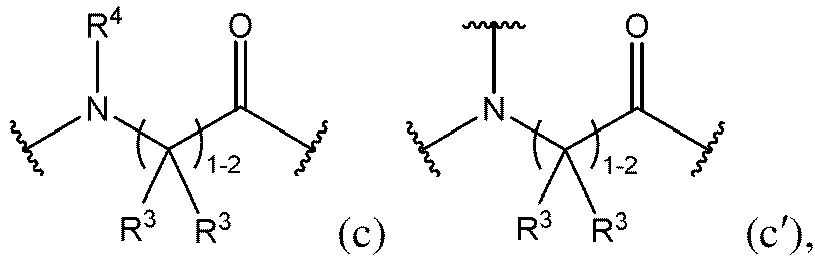
- each R4 is independently hydrogen, an alkyl, an alkenyl, an alkynyl, a cycloalkyl, a heterocyclyl, an aryl, a heteroaryl, or an arylalkyl; and each R5 is independently selected from the group consisting of H, -PG (where PG is a protecting group), an alkyl, an alkenyl, an alkynyl, a cycloalkyl, an aryl, a heteroaryl, a heterocyclyl, and an arylalkyl.
- In some embodiments,
- (i) the macrostructure comprises an antiparallel coiled-coil structure of Formula III and at least one of the following conditions is met:
- (A) in at least one residue of formula (a), (i) one of R1a and R1c is the side chain of a modified or unmodified amino acid selected from the group consisting of cysteine, homocysteine, selenocysteine, leucine, isoleucine, hexafluoroleucine, valine, hexafluorovaline, allylglycine and threonine, and (ii) R1b, R1d, and the other of R1a and R1c are each independently hydrogen, a C1-3 alkyl, or a C2-3 alkenyl;
- (B) in at least one residue of formula (b), (i) one of R2a and R2c is an amino acid side chain and (ii) R2b, R2d, and the other of R2a and R2c are each independently hydrogen or a C1-3 alkyl; or
- (ii) the macrostructure comprises a parallel coiled-coil structure of Formula IV and at least one of the following conditions is met:
- (A) in at least one residue of formula (a), (i) one of R1a and R1c is the side chain of a modified or unmodified amino acid selected from the group consisting of cysteine, homocysteine, selenocysteine, leucine, isoleucine, hexafluoroleucine, valine, hexafluorovaline, allylglycine and threonine, and (ii) R1b, R1d, and the other of R1a and R1e are each independently hydrogen, a C1-3 alkyl, or a C2-3 alkenyl;
- (B) in at least one residue of formula (b), (i) one of R2a and R2c is an amino acid side chain and (ii) R2b, R2d, and the other of R2a and R2c are each independently hydrogen or a C1-3 alkyl.
- In some embodiments, the macrostructure comprises the antiparallel coiled-coil structure.
- In some embodiments,
- (i) the first strand of the antiparallel coiled-coil structure comprises at least ten contiguous modified or unmodified amino acid residues, wherein the at least ten contiguous amino acid residues have the formula gX1-X2-X3-X4-X5-X6-X7-X8-X9-X10 b, wherein X1 is Glu, Leu, Arg, Lys, Thr, or Val; X2 is Cys, HCys, Leu, Ile, allylleucine, Val, allylglycine, Thr, selenocysteine, hexafluoroleucine, or hexafluorovaline ; X3 is any residue; X4 is His, Tyr, Phe, Lys, Gln, or Trp ; X5 is Cys, HCys, Leu, Ile, allylleucine, Val, allylglycine, Thr, selenocysteine, hexafluoroleucine, or hexafluorovaline ; X6 is any residue; X7 is Glu, Asn, Trp, Leu, Glu, or Gln ; X8 is Leu, Met, Ala, His, or Ser ; X9 is Cys, HCys, Leu, Ile, allylleucine, Val, allylglycine, Thr, selenocysteine, hexafluoroleucine, or hexafluorovaline ; and X10 is any residue;
- (ii) the second strand of the antiparallel coiled-coil structure comprises at least ten contiguous modified or unmodified amino acid residues, wherein the at least ten contiguous amino acid residues have the formula c'X1'-X2'-X3'-X4'-X5'-X6'-X7'-X8'-X9'-X10 e', wherein X1' is Glu, Asn, Leu, Gln, Met, or Ala; X2' is Cys, HCys, Leu, Ile, allylleucine, Val, allylglycine, Thr, selenocysteine, hexafluoroleucine, or hexafluorovaline ; X3' is any residue; X4' is any residue; X5' is Ala, Ser, Thr, Gly, or Asp ; X6' is Cys, HCys, Leu, Ile, allylleucine, Val, allylglycine, Thr, selenocysteine, hexafluoroleucine, or hexafluorovaline ; X7' is Arg, Leu, Gln, Met, Glu, or Asp ; X8' is Tyr, Val, Phe, Trp, or Met ; X9' is Cys, HCys, Leu, Ile, allylleucine, Val, allylglycine, Thr, selenocysteine, hexafluoroleucine, or hexafluorovaline ; and X10' is any residue;
- (iii) g, b, c', and e' indicate where the ten contiguous amino acids appear within the antiparallel coiled-coil structure;
- (iv) residues in the e/e' and g/g' positions can be optionally modified to facilitate attachment of a Linker or replaced with a Linker, if present; and
- (v) residues in the a/a' and d/d' positions can be optionally modified to facilitate attachment of a Linker, if present.
- In some embodiments, the macrostructure is


- E is glutamic acid; I is isoleucine; L is leucine; H is histidine; C is cysteine; Z is azidolysine derived bistriazole linker; R is arginine; S is serine; V is valine; and W is tryptophan.
- In some embodiments, the macrostructure comprises the parallel coiled-coil structure.
- In some embodiments, the macrostructure consists of the antiparallel coiled-coil structure (i) or the parallel coiled-coil structure (ii).
- Disclosed herein is a macrostructure that comprises:
- (i) an antiparallel coiled-coil structure of formula:
 wherein:
- each ○ and each ⊗ is independently absent or a modified or unmodified amino acid residue or analogue thereof, with the proviso that at least seven contiguous amino acid residues/analogues are present in each coil, wherein
- a, b, c, d, e, f, g, a', b', c', d', e', f', and g' indicate the location of the amino acid residues/analogues within the coiled-coil structure and
- each ⊗ amino acid residue is a modified or unmodified amino acid selected from the group consisting of cysteine, homocysteine, selenocysteine, leucine, isoleucine, hexafluoroleucine, valine, hexafluorovaline, allylglycine, threonine, and analogues of each of the preceding residues;
- each is absent or a covalent linker (Linker) between two amino acid residues/analogues, wherein:
- each Linker A is independently a linker between a g* amino acid residue and a g'* amino acid residue, wherein the length of the linker is such that the spatial distance between the Cα position of the g* amino acid residue and the Cα position of the g'* amino acid residue is 10-25 Å;
- each Linker B is independently a linker between an a* amino acid residue and a d'* amino acid residue, wherein the length of the linker is such that the spatial distance between the Cα position of the a* amino acid residue and the Cα position of the d'* amino acid residue is 5-15 Å;
- each Linker C is independently a linker between a d* amino acid residue and an a'* amino acid residue, wherein the length of the linker is such that the spatial distance between the Cα position of the d* amino acid residue and the Cα position of the a'* amino acid residue is 5-15 Å;
- each Linker D is independently a linker between an e* amino acid residue and an e'* amino acid residue, wherein the length of the linker is such that the spatial distance between the Cα position of the e* amino acid residue and the Cα position of the e'* amino acid residue is 10-25 Å; and
- at least one Linker A or Linker D is present;
- each

- each

- or (ii) a parallel coiled-coil structure of formula
 wherein:
- each ○ and each ⊗ is independently absent or a modified or unmodified amino acid residue or analogue thereof, with the proviso that at least seven contiguous amino acid residues/analogues are present in each coil, wherein a, b, c, d, e, f, g, a', b', c', d', e', f', and g' indicate the location of the amino acid residues/analogues within the coiled-coil structure and
each ⊗ amino acid residue is a modified or unmodified amino acid selected from the group consisting of cysteine, homocysteine, selenocysteine, leucine, isoleucine, hexafluoroleucine, valine, hexafluorovaline, allylglycine, threonine, and analogues of each of the preceding residues; - each is absent or a covalent linker (Linker) between two amino acid residues/analogues, wherein:
- each Linker E is independently a linker between a g* amino acid residue and an e'* amino acid residue, wherein the length of the linker is such that the spatial distance between the Cα position of the g* amino acid residue and the Cα position of the e'* amino acid residue is 10-25 Å;
- each Linker F is independently a linker between a d* amino acid residue and a d'* amino acid residue, wherein the length of the linker is such that the spatial distance between the Cα position of the d* amino acid residue and the Cα position of the d'* amino acid residue is 5-15 Å;
- each Linker G is independently a linker between an a* amino acid residue and an a'* amino acid residue, wherein the length of the linker is such that the spatial distance between the Cα position of the a* amino acid residue and the Cα position of the a'* amino acid residue is 5-15 Å;
- each Linker H is independently a linker between an e* amino acid residue and a g'* amino acid residue, wherein the length of the linker is such that the spatial distance between the Cα position of the e* amino acid residue and the Cα position of the g'* amino acid residue is 10-25 Å; and
- at least one Linker E or Linker H is present; and
- each

- each

- each ○ and each ⊗ is independently absent or a modified or unmodified amino acid residue or analogue thereof, with the proviso that at least seven contiguous amino acid residues/analogues are present in each coil, wherein a, b, c, d, e, f, g, a', b', c', d', e', f', and g' indicate the location of the amino acid residues/analogues within the coiled-coil structure and
- each ○ and each ⊗ is independently absent or a modified or unmodified amino acid residue or analogue thereof, with the proviso that at least seven contiguous amino acid residues/analogues are present in each coil, wherein
- Also disclosed herein is an antiparallel coiled-coil of formula I:
g0-a1-b1-c1-d1-e1-f1-g1-a2-b2-c2-d2-e2-f2-g2-a3-b3-c3-d3-e3-f3 / f0-g'0-a'1-b'1-c'1-d'1-e'1-f'1-g'1-a'2-b'2-c'2-d'2-e'2-f'2-g'2-a'3-b'3-c'3-d'3-e'3 (I);
- wherein each b1-3, c1-3, e1-3, f1-3, g0-2, b'1-3, c'1-3, e'1-3, f'0-2, and g'0-2 is independently absent or is a modified or unmodified amino acid residue or an analogue thereof, and each a1-3, d1-3, a'1-3, and d'1-3, is independently absent or is a modified or unmodified amino acid selected from the group consisting of cysteine, homocysteine, selenocysteine, leucine, isoleucine, hexafluoroleucine, valine, hexafluorovaline, allylglycine, threonine, and analogues of each of the preceding amino acids, with the proviso that at least seven contiguous amino acid residues/analogues are present in each coil;
- wherein one or more of the following pairs are covalently bound by a linker: g0-g'2, g1-g'1, g2-g'0, a1-d'3, a2-d'2, a3-d'1, d1-a'3, d2-a'2, d3-a'1, e1-e'3, e2-e'2, and e3-e'1.
- Also disclosed herein is an antiparallel coiled-coil of formula I:
g0-a1-b1-c1-d1-e1-f1-g1-a2-b2-c2-d2-e2-f2-g2-a3-b3-c3-d3-e3-f3 / f0-g'0-a'1-b'1-c'1-d'1-e'1-f'1-g'1-a'2-b'2-c'2-d'2-e'2-f'2-g'2-a'3-b'3-c'3-d'3-e'3 (I);
- wherein each b1-3, c1-3, e1-3, f1-3, g0-2, b'1-3, c'1-3, e'1-3, f'0-2, and g'0-2 is independently absent or is a modified or unmodified amino acid residue or an analogue thereof, and each a1-3, d1-3, a'1-3, and d'1-3, is independently absent or is a modified or unmodified amino acid selected from the group consisting of cysteine, homocysteine, selenocysteine, leucine, isoleucine, hexafluoroleucine, valine, hexafluorovaline, allylglycine, threonine, and analogues of each of the preceding amino acids, with the proviso that at least seven contiguous amino acid residues/analogues are present in each coil;
- wherein one or more of the following pairs are covalently bound by a linker: g0-g'2, g1-g'1, g2-g'0, a1-d'3, a2-d'2, a3-d'1, d1-a'3, d2-a'2, d3-a'1, e1-e'3, e2-e'2, and e3-e'1;
- wherein the terminal nitrogen of each coil is covalently bound to one or more H, -PG1, -C(O)R, -C(O)NR2, -C(O)NH2, -R, -C(O)OR, an amino acid, a peptide, a tag, or a targeting moiety, where each R is independently hydrogen, an alkyl, an alkenyl, an alkynyl, a cycloalkyl, an aryl, a heteroaryl, a heterocyclyl, an arylalkyl, a peptide, a targeting moiety, or a tag; and wherein PG1 is a protecting group for protection of an amine; and
- wherein the terminal carbonyl of each coil is covalently bound to H, -OPG2, -NPG2, -OR, -OH, -NR2,-NH2, -NRC(O)C1-6 alkyl, - NHC(O)C1-6 alkyl, an amino acid, a peptide, a tag, or a targeting moiety, where each R is independently hydrogen, an alkyl, an alkenyl, an alkynyl, a cycloalkyl, an aryl, a heteroaryl, a heterocyclyl, an arylalkyl, a peptide, a targeting moiety, or a tag; and wherein PG2 is a protecting group for protection of a carboxylic acid.
- Also disclosed herein is a parallel coiled-coil of formula II:
f0-g0-a1-b1-c1-d1-e1-f1-g1-a2-b2-c2-d2-e2-f2-g2-a3-b3-c3-d3-e3 / f0-g'0-a'1-b'1-c'1-d'1-e'1-f'1-g'1-a'2-b'2-c'2-d'2-e'2-f'2-g'2-a'3-b'3-c'3-d'3-e'3 (II);
- wherein each b1-3, c1-3, e1-3, f0-2, g0-2, b'1-3, c'1-3, e'1-3, f'0-2, and g'0-2 is independently absent or is a modified or unmodified amino acid residue or an analogue thereof, and each a1-3, d1-3, a'1-3, and d'1-3, is independently absent or is a modified or unmodified amino acid selected from the group consisting of cysteine, homocysteine, selenocysteine, leucine, isoleucine, hexafluoroleucine, valine, hexafluorovaline, allylglycine, threonine, and analogues of each of the preceding amino acids, with the proviso that at least seven contiguous amino acid residues/analogues are present in each coil;
- wherein one or more of the following pairs are covalently bound by a linker: g0-e'1, g1-e'2, g2-e'3, d1-d'1, d2-d'2, d3-d'3, a1-a'1, a2-a'2, a3-a'3, e1-g'0, e2-g'1, and e3-g'2.
- Also disclosed herein is a parallel coiled-coil of formula II:
f0-g0-a1-b1-c1-d1-e1-f1-g1-a2-b2-c2-d2-e2-f2-g2-a3-b3-c3-d3-e3 / f0-g'0-a'1-b'1-c'1-d'1-e'1-f'1-g'1-a'2-b'2-c'2-d'2-e'2-f'2-g'2-a'3-b'3-c'3-d'3-e'3 (II);
- wherein each b1-3, c1-3, e1-3, f0-2, g0-2, b'1-3, c'1-3, e'1-3, f'0-2, and g'0-2 is independently absent or is a modified or unmodified amino acid residue or an analogue thereof, and each a1-3, d1-3, a'1-3, and d'1-3, is independently absent or is a modified or unmodified amino acid selected from the group consisting of cysteine, homocysteine, selenocysteine, leucine, isoleucine, hexafluoroleucine, valine, hexafluorovaline, allylglycine, threonine, and analogues of each of the preceding amino acids, with the proviso that at least seven contiguous amino acid residues/analogues are present in each coil;
- wherein one or more of the following pairs are covalently bound by a linker: g0-e'1, g1-e'2, g2-e'3, d1-d'1, d2-d'2, d3-d'3, a1-a'1, a2-a'2, a3-a'3, e1-g'0, e2-g'1, and e3-g'2;
- wherein the terminal nitrogen of each coil is covalently bound to one or more H, - PG1, -C(O)R, -C(O)NR2, -C(O)NH2, -R, -C(O)OR, an amino acid, a peptide, a tag, or a targeting moiety, where each R is independently hydrogen, an alkyl, an alkenyl, an alkynyl, a cycloalkyl, an aryl, a heteroaryl, a heterocyclyl, an arylalkyl, a peptide, a targeting moiety, or a tag; and wherein PG1 is a protecting group for protection of an amine; and
- wherein the terminal carbonyl of each coil is covalently bound to H, -OPG2, - NPG2, -OR, -OH, -NR2,-NH2, -NRC(O)C1-6 alkyl, -NHC(O)C1-6 alkyl, an amino acid, a peptide, a tag, or a targeting moiety, where each R is independently hydrogen, an alkyl, an alkenyl, an alkynyl, a cycloalkyl, an aryl, a heteroaryl, a heterocyclyl, an arylalkyl, a peptide, a targeting moiety, or a tag; and wherein PG2 is a protecting group for protection of a carboxylic acid.
- Antiparallel coiled-coil structures and parallel coiled-coil structures each have a first amino acid strand (or first coil) and a second amino acid strand (or second coil). As will be readily apparent to the skilled artisan, the following conventions are commonly used to characterize coiled-coil structures and are used throughout this application. The convention "A/B" or "xAy/x'By'" is used to identify the sequence of each strand (either specifically or generically), where A is the sequence (X1-X2-X3...) of the first strand, B is the sequence (X1'-X2'-X3'...) of the second strand, x, x', y, and y' identify the starting (x, x') and ending (y, y') locations of the corresponding sequences relative to heptad(s) in each strand, and "/" separates one sequence from the other. Conventionally, for both antiparallel and parallel coiled-coil structures, the A and B sequences are both written, left to right, in an N-to-C orientation. However, as will be readily apparent to the skilled artisan, the strands in an antiparallel coiled-coil structure are spatially aligned in opposite directions, e.g., in a top view taken perpendicular to the axis of an antiparallel coiled-coil, the N-terminal of the first strand will be top-most and the C-terminal of the second strand will be top-most; conversely, as will be readily apparent to the skilled artisan, the strands in a parallel coiled-coil structure are spatially aligned in the same direction, e.g., in a top view taken perpendicular to the axis of a parallel coiled-coil, the N-terminal of the first strand will be top-most and the N-terminal of the second strand will be top-most. As will be readily apparent to the skilled artisan, in the compounds of the present invention and disclosure, there is also at least one covalent linker between a residue in the first strand and a residue in the second strand. The location and structure of the linker(s) are sometimes identified using "Z" and "Z'" in place of X and X', respectively, in the A and B sequences. Alternatively, the location and structure of the linker(s) are identified by additional explanation (e.g., "there is a disulfide linker between residue Xn and residue Xn''').
- As will be readily apparent to the skilled artisan, the helical wheel views herein show the spatial orientation of each coil in the antiparallel or parallel coiled-coil structure, while the two-dimensional views show the connections between residues.
- As used above, and throughout the present description, the following terms, unless otherwise indicated, shall be understood to have the following meanings. If not defined otherwise herein, all technical and scientific terms used herein have the same meaning as is commonly understood by one of ordinary skill in the art to which this invention and disclosure belong. In the event that there is a plurality of definitions for a term herein, those in this section prevail unless stated otherwise.
- As used herein, the term "alkyl" means an aliphatic hydrocarbon group which may be straight or branched having about 1 to about 8 (e.g., 1-2, 1-3, 1-4, 1-5, 1-6, 1-7, 1-8) carbon atoms in the chain. Branched means that one or more lower alkyl groups such as methyl, ethyl, or propyl are attached to a linear alkyl chain. Exemplary alkyl groups include methyl, ethyl, n-propyl, i-propyl, n-butyl, t-butyl, n-pentyl, and 3-pentyl.
- The term "alkenyl" means an aliphatic hydrocarbon group containing a carbon-carbon double bond and which may be straight or branched having about 2 to about 8 (e.g., 2-3, 2-4, 2-5, 2-6, 2-7, 2-8) carbon atoms in the chain. Preferred alkenyl groups have 2 to about 4 carbon atoms in the chain. Exemplary alkenyl groups include ethenyl, propenyl, n-butenyl, and i-butenyl.
- The term "alkynyl" means an aliphatic hydrocarbon group containing a carbon-carbon triple bond and which may be straight or branched having about 2 to about 8 (e.g., 2-3, 2-4, 2-5, 2-6, 2-7, 2-8) carbon atoms in the chain. Preferred alkynyl groups have 2 to about 4 carbon atoms in the chain. Exemplary alkynyl groups include ethynyl, propynyl, n-butynyl, 2-butynyl, 3-methylbutynyl, and n-pentynyl.
- As used herein, the term "cycloalkyl" refers to a non-aromatic saturated or unsaturated mono- or polycyclic ring system which may contain 3 to 8 (3, 4, 5, 6, 7, 8, 3-4, 3-5, 3-6, 3-7, 4-5, 4-6, 4-7, 4-8, 5-6, 5-7, 5-8, 6-7, 6-8, 7-8) carbon atoms, and which may include at least one double bond. Exemplary cycloalkyl groups include, without limitation, cyclopropyl, cyclobutyl, cyclopentyl, cyclohexyl, cyclopropenyl, cyclobutenyl, cyclopentenyl, cyclohexenyl, anti-bicyclopropane, or syn-bicyclopropane.
- As used herein, the term "alkane" refers to aliphatic hydrocarbons of formula CnH2n+2, which may be straight or branched having about 1 to about 8 (e.g., 1-2, 1-3, 1-4, 1-5, 1-6, 1-7, 1-8) carbon atoms in the chain. Branched means that one or more lower alkyl groups such as methyl, ethyl, or propyl are attached to a linear alkyl chain. Exemplary alkanes include methane, ethane, n-propane, i-propane, n-butane, t-butane, n-pentane, and 3-pentane. The term "alkylene" refers to a divalent group formed from an alkane by removal of two hydrogen atoms. Exemplary alkylene groups include, but are not limited to, divalent groups derived from the alkanes described above.
- As used herein, the term "alkene" referes to aliphatic unsaturated hydrocarbons of formula CnH2n, which may be straight or branched having about 2 to about 8 (e.g., 2-3, 2-4, 2-5, 2-6, 2-7, 2-8) carbon atoms in the chain. Exemplary alkenes include ethylene, propylene, n-butylene, and i-butylene. The term "alkenylene" refers to a divalent group formed from an alkene by removal of two hydrogen atoms. Alkenylenes contain a carbon-to-carbon double bond and are represented by the formula -(CnH2n-2)-. Exemplary alkenylene groups include, but are not limited to, divalent groups derived from the alkenes described above.
- As used herein, the term "alkyne" refers to aliphatic unsaturated hydrocarbons of formula CnH2n-2, which may be straight or branched having about 2 to about 8 (e.g., 2-3, 2-4, 2-5, 2-6, 2-7, 2-8) carbon atoms in the chain. Exemplary alkynes include acetylene, propyne, butyne, and pentyne. The term "alkynylene" refers to a divalent groups formed from alkynes by removal of two hydrogen atoms. Alkynylene contains a carbon-to-carbon triple bond and is represented by the formula -(CnH2n-4)-. Exemplary alkynylene groups include, but are not limited to, divalent groups derived from the alkynes described above.
- Aromatic rings and heteroaromatic rings can be any single, multiple, or fused ring structures. For example, aromatic or heteroaromatic rings include 5- or 6-membered aromatic or heteroaromatic rings containing 0-3 (0, 1, 2, or 3) heteroatoms selected from O, N, and S; a bicyclic 9- or 10-membered aromatic or heteroaromatic ring system containing 0-3 (0, 1, 2, or 3) heteroatoms selected from O, N, and S; or a tricyclic 13- or 14-membered aromatic or heteroaromatic ring system containing 0-3 (0, 1, 2, or 3) heteroatoms selected from O, N, and S. Aromatic 5- to 14-membered (5-, 6-, 7-, 8, 9-, 10-, 11-, 12-, 13-, or 14-membered) carbocyclic rings include, e.g., cyclopenta-1,3-diene, benzene, naphthalene, indane, tetralin, and anthracene. 5- to 10-Membered (5-, 6-, 7-, 8-, 9-, or 10-membered) aromatic heterocyclic rings include, e.g., imidazole, pyridine, indole, thiophene, benzopyranone, thiazole, furan, benzimidazole, quinoline, isoquinoline, quinoxaline, pyrimidine, pyrazine, tetrazole, pyrazole, benzimidazole, pyridazine, pyrrole, imidazole, oxazole, isooxazole, indazole, isoindole, imidazole, purine, triazine, quinazoline, cinnoline, benzoxazole, acridine, benzisooxazole, and benzothiazole. The term "arylene" refers to a divalent group derived from an aromatic ring by removal of a hydrogen atom from two ring carbon atoms. Exemplary arylene groups include, but are not limited to, divalent groups derived from the aromatic rings described above. The term "heteroarylene" refers to a divalent group derived from a heteroaromatic ring. Exemplary heteroarylene groups include, but are not limited to, divalent groups derived from the heteroaromatic rings described above.
- The term "ether" means a group having the formula -R-O-R-. Each R can be independently selected from the group consisting of a bond, C1-8 alkylene, C2-8 alkenylene, arylene, and heteroarylene. Exemplary ethers include, but are not limited to, -C1-8 alkylene-O-C1-8 alkylene- (e.g., -(CH2)2-O-(CH2)2-),-C2-8 alkenylene-O-C2-8 alkenylene-, -arylene-O-arylene-, -heteroarylene-O-heteroarylene-, and -C1-8 alkylene-O-heteroarylene-.
- The term "thioether" means a group having the formula -R-S-R-. Each R can be independently selected from the group consisting of a bond, C1-8 alkylene, C2-8 alkenylene, arylene, and heteroarylene. Exemplary thioethers include, but are not limited to, -C1-8 alkylene-S-C1-8 alkylene- (e.g., -(CH2)2-S-(CH2)2-), -C2-8 alkenylene-S-C2-8 alkenylene-, -arylene-S-arylene-, -heteroarylene-S-heteroarylene-, and -C1-8 alkylene-S-heteroarylene-.
- The term "amide" means a group having the formula -C(O)N(R1)(R1) or -C(O)N(R1)-. Amides include, e.g., -C(O)N(R1)R-, -R-C(O)N(R1)R-, - CHR1-C(O)N(R1)R-, and -C(R1)(R1)-C(O)N(R1)R-. Each R can be independently selected from the group consisting of a bond, C1-8 alkylene, C2-8 alkenylene, arylene, and heteroarylene, and each R1 can be independently selected from the group consisting of hydrogen, C1-8 alkyl, C2-8 alkenyl, C2-8 alkynyl, C3-8 cycloalkyl, aryl, heteroaryl, heterocyclyl, and arylalkyl. Exemplary amides include, but are not limited to, -C1-8 alkylene-C(O)N(aryl)-, -C2-8 alkenylene-C(O)N(aryl)-, and -C1-8 alkylene-C(O)N(C1-8 alkyl)- (e.g., -(CH2)2-C(O)N(CH3)-).
- The term "ester" means a group having the formula -C(O)O-. Esters include, e.g., -R-C(O)O-R-, -CHR1-C(O)O-R-, and -C(R1)(R1)-C(O)OR-. Each R can be independently selected from the group consisting of a bond, C1-8 alkylene, C2-8 alkenylene, arylene, and heteroarylene, and each R1 can be independently selected from the group consisting of hydrogen, C1-8 alkyl, C2-8 alkenyl, C2-8 alkynyl, C3-8 cycloalkyl, aryl, heteroaryl, heterocyclyl, and arylalkyl. Exemplary esters include, but are not limited to, -C1-8 alkylene-C(O)O-arylene-, -C2-8 alkenylene-C(O)O-arylene-, -C1-8 alkylene-C(O)O-heteroarylene-, -C1-8 alkylene-C(O)O-C1-8 alkylene - (e.g., -(CH2)2-C(O)O-(CH2)2-), and - C1-8 alkylene-C(O)O- (e.g., -(CH2)2-C(O)O-).
- As used herein, the term "heterocyclyl" refers to a stable 3- to 18-membered (3-, 4-, 5-, 6-, 7-, 8-, 9-, 10-, 11-, 12-, 13-, 14-, 15-, 16-, 17-, or 18-membered) ring system that consists of carbon atoms and from one to five (1, 2, 3, 4, 5, 1-2, 1-3, 1-4, 2-3, 2-4, 2-5, 3-4, 3-5, 4-5) heteroatoms selected from the group consisting of nitrogen, oxygen, and sulfur. The heterocyclyl may be a monocyclic or a polycyclic ring system, which may include fused, bridged, or spiro ring systems; and the nitrogen, carbon, or sulfur atoms in the heterocyclyl may be optionally oxidized; the nitrogen atom may be optionally quaternized; and the ring may be partially or fully saturated. Representative monocyclic heterocyclyls include piperidine, piperazine, pyrimidine, morpholine, thiomorpholine, pyrrolidine, tetrahydrofuran, pyran, tetrahydropyran, oxetane, and the like. Representative polycyclic heterocyclyls include indole, isoindole, indolizine, quinoline, isoquinoline, purine, carbazole, dibenzofuran, chromene, xanthene, and the like.
- As used herein, the term "aryl" refers to an aromatic monocyclic or polycyclic ring system containing from 6 to 19 (6, 7, 8, 9, 10, 11, 12, 13, 14, 15, 16, 17, 18, 19, 6-7, 6-8, 6-9, 6-10, 6-11, 6-12, 6-13, 6-14, 6-15, 6-16, 1-17, 6-18, 7-8, 7-9, 7-10, 7-11, 7-12, 7-13, 7-14, 7-15, 7-16, 7-18, 7-19, 8-9, 8-10, 8-11, 8-12, 8-13, 8-14, 8-15, 8-16, 8-17, 8-18, 8-19, 9-10, 9-11, 9-12, 9-13, 9-14, 9-15, 9-16, 9-17, 9-18, 9-19, 10-11, 10-12, 10-13, 10-14, 10-15, 10-16, 10-17, 10-18, 10-19, 11-12, 11-13, 11-14, 11-15, 11-16, 11-17, 11-18, 11-19, 12-13, 12-14, 12-15, 12-16, 12-17, 12-18, 12-19, 13-14, 13-15, 13-16, 13-17, 13-18, 13-19, 14-15, 14-16, 14-17, 14-18, 14-19, 15-16, 15-17, 15-18, 15-19, 16-17, 16-18, 16-19, 17-18, 17-19, 18-19) carbon atoms, where the ring system may be optionally substituted. Aryl groups of the present invention and disclosure include, but are not limited to, groups such as phenyl, naphthyl, azulenyl, phenanthrenyl, anthracenyl, fluorenyl, pyrenyl, triphenylenyl, chrysenyl, and naphthacenyl.
- As used herein, "heteroaryl" refers to an aromatic ring radical which consists of carbon atoms and from one to five heteroatoms selected from the group consisting of nitrogen, oxygen, and sulfur. Examples of heteroaryl groups include, without limitation, pyrrolyl, pyrazolyl, imidazolyl, triazolyl, furyl, thiophenyl, oxazolyl, isoxazolyl, thiazolyl, isothiazolyl, oxadiazolyl, thiadiazolyl, pyridyl, pyrazinyl, pyrimidinyl, pyridazinyl, triazinyl, thienopyrrolyl, furopyrrolyl, indolyl, azaindolyl, isoindolyl, indolinyl, indolizinyl, indazolyl, benzimidazolyl, imidazopyridinyl, benzotriazolyl, benzoxazolyl, benzoxadiazolyl, benzothiazolyl, pyrazolopyridinyl, triazolopyridinyl, thienopyridinyl, benzothiadiazolyl, benzofuyl, benzothiophenyl, quinolinyl, isoquinolinyl, tetrahydroquinolyl, tetrahydroisoquinolyl, cinnolinyl, quinazolinyl, quinolizilinyl, phthalazinyl, benzotriazinyl, chromenyl, naphthyridinyl, acrydinyl, phenanzinyl, phenothiazinyl, phenoxazinyl, pteridinyl, and purinyl. Additional heteroaryls are described in COMPREHENSIVE HETEROCYCLIC CHEMISTRY: THE STRUCTURE, REACTIONS, SYNTHESIS AND USE OF HETEROCYCLIC COMPOUNDS (Katritzky et al. eds., 1984).
- The term "arylalkyl" refers to a moiety of the formula -RaRb where Ra is an alkyl or cycloalkyl as defined above and Rb is an aryl or heteroaryl as defined above.
- Compounds described herein may contain one or more asymmetric centers and may thus give rise to enantiomers, diastereomers, and other stereoisomeric forms. Each chiral center may be defined, in terms of absolute stereochemistry, as (R)- or (S)-. This technology is meant to include all such possible isomers, as well as mixtures thereof, including racemic and optically pure forms. Optically active (R)- and (S)-, (-)- and (+)-, or (D)- and (L)- isomers may be prepared using chiral synthons or chiral reagents, or resolved using conventional techniques. When the compounds described herein contain olefinic double bonds or other centers of geometric asymmetry, and unless specified otherwise, it is intended that the compounds include both E and Z geometric isomers. Likewise, all tautomeric forms are also intended to be included.
- The term "monocyclic carbocycle" means a monocyclic ring system of 5 to about 8 (e.g., 5, 6, 7, 8, 5-6, 5-7, 6-7, 6-8, 7-8) ring carbon atoms, preferably 5 or 6. The ring is nonaromatic, but may contain one or more carbon-carbon double bonds. The term "monocyclic carbocycle" also includes divalent groups derived from a monocyclic ring system. Representative monocyclic carbocycles include divalent groups derived from cyclopentane, cyclohexane, cyclopentene, cyclohexene, and the like.
- The term "fused bicyclic carbocycle" means a bicyclic ring system consisting of about 8 to 11 (e.g., 8, 9, 10, 11, 8-9, 8-10, 9-10, 9-11, 10-11) ring carbon atoms, preferably 9 or 10. One or both of the rings is/are aromatic. The term "fused bicyclic carbocycle" also encompasses divalent groups derived from a bicyclic ring system. Representative monocyclic carbocycles include divalent groups derived from dihydronaphthalene, tetrahydronaphthalene, tetrahydrobenzoannulene, and the like.
- The term "non-aromatic heterocycle" means a non-aromatic monocyclic system containing 3 to 10 atoms (e.g., 3, 4, 5, 6, 7, 8, 9, 10, 3-4, 3-5, 3-6, 3-7, 3-8, 3-9, 4-5, 4-6, 4-7, 4-8, 4-9, 4-10, 5-6, 5-7, 5-8, 5-9, 5-10, 6-7, 6-8, 6-9, 6-10, 7-8, 7-9, 7-10, 8-9, 8-10, 9-10), preferably 4 to about 7 carbon atoms, in which one or more of the atoms in the ring system is/are element(s) other than carbon, for example, nitrogen, oxygen, or sulfur. The term "non-aromatic heterocycle" also includes divalent groups derived from a non-aromatic heterocyclic rings. Representative non-aromatic heterocycle groups include divalent groups derived from pyrrolidine, 2-oxopyrrolidine, piperidine, 2-oxopiperidine, azepane, 2-oxoazepane, 2-oxooxazolidine, morpholine, 3-oxomorpholine, thiomorpholine, 1,1-dioxothiomorpholine, piperazine, tetrohydro-2H-oxazine, and the like.
- The term "monocyclic" used herein indicates a molecular structure having one ring.
- The term "polycyclic" or "multi-cyclic" used herein indicates a molecular structure having two or more rings, including, but not limited to, fused, bridged, or spiro rings.
- The term "optionally substituted" is used to indicate that a group may have a substituent at each substitutable atom of the group (including more than one substituent on a single atom), provided that the designated atom's normal valency is not exceeded and the identity of each substituent is independent of the others. Up to three H atoms in each residue are replaced with alkyl, halogen, haloalkyl, hydroxy, loweralkoxy, carboxy, carboalkoxy (also referred to as alkoxycarbonyl), carboxamido (also referred to as alkylaminocarbonyl), cyano, carbonyl, nitro, amino, alkylamino, dialkylamino, mercapto, alkylthio, sulfoxide, sulfone, acylamino, amidino, phenyl, benzyl, heteroaryl, phenoxy, benzyloxy, or heteroaryloxy. "Unsubstituted" atoms bear all of the hydrogen atoms dictated by their valency. When a substituent is keto (i.e., =0), then two hydrogens on the atom are replaced. Combinations of substituents and/or variables are permissible only if such combinations result in stable compounds; by "stable compound" or "stable structure" is meant a compound that is sufficiently robust to survive isolation to a useful degree of purity from a reaction mixture, and formulation into an efficacious therapeutic agent.
- The term "halogen" means fluorine, chlorine, bromine, or iodine.
- A "peptide" as used herein is any oligomer of two or more natural or non-natural amino acids, including alpha amino acids, beta amino acids, gamma amino acids, L-amino acids, D-amino acids, and combinations thereof. In preferred embodiments, the peptide is ~2 to ~30 (e.g., ~2 to ~5, ~2 to ~10, ~5 to ~10, ~2 to ~17, ~5 to ~17, ~10 to ~17, ~5 to ~30, ~10 to ~30, or ~18 to ~30) amino acids in length. Typically, the peptide is 10-17 amino acids in length. In at least one embodiment, the peptide contains a mixture of alpha and beta amino acids, preferably in the pattern α3/β1.
- An amino acid as used herein can be any natural or non-natural amino acid, including alpha amino acids, beta amino acids, gamma amino acids, L-amino acids, and D-amino acids. Amino acid side chains can be any amino acid side chain of such an amino acid.
- An amino acid as used herein also includes an analogue of a natural or non-natural amino acid. An amino acid analogue is an alpha amino acid with a nonnatural side chain consisting of alkyl, cycloalkyl, aryl, cycloaryl, alkenyl, or alkynyl; or a beta3-amino acid with a side chain consisting of alkyl, cycloalkyl, aryl, cycloaryl, alkenyl, or alkynyl. As used herein, an amino acid analogue also refers to a natural or nonnatural amino acid that may be substituted for an amino acid residue in the coiled-coil without loss of function relative to the native coiled-coil sequence. Suitable amino acid analogues/substitutions include the natural amino acid substitions described in Betts & Russell, "Amino Acid Properties and Consequences of Substitutions," in Bioinformatics for Geneticists 289-316 (Michael R. Barnes & Ian C. Gray eds. 2003), as well as the nonnatural substitutions set forth below (all available from Sigma Aldrich) and the nonnatural substitutions described in Gfeller et al., "SwissSidechain: A Molecular and Structural Database of Non-Natural Sidechains," Nucl. Acids Res. 41:D327-D332 (2013). As will be understood by the skilled artisan, analogues in the table below that are listed as having a protecting group at the N- and/or C-terminal would be deprotected during conjugation to an adjacent residue.
Amino Acid Exemplary Non-Natural Analogue(s) Alanine N-Acetyl-3-(3,4-dimethoxyphenyl)-D-alanine, H-β-Ala-β-naphthalene, Albizziin, (R)-(+)-α-Allylalanine, (S)-(-)-α-Allylalanine, D-2-Aminobutyric acid, L-2-Aminobutyric acid, DL-2-Aminobutyric acid, DL-2-Aminobutyric acid, 2-Aminoisobutyric acid, α-Aminoisobutyric acid, (S)-(+)-2-Amino-4-phenylbutyric acid ethyl ester, Benzyl α-aminoisobutyrate, Boc-Abu-OH, Boc-D-Abu-OH, Boc-Aib-OH, Boc-β-(9-anthryl)-Ala-OH, Boc-β-(3-benzothienyl)-Ala-OH, Boc-β-(3-benzothienyl)-D-Ala-OH, Boc-Cha-OH, Boc-Cha-OMe, Boc-β-(2-furyl)-Ala-OH, Boc-β-(2-furyl)-D-Ala-OH, Boc-β-iodo-Ala-OBzl, Boc-β-iodo-D-Ala-OBzl, Boc-3-iodo-D-Ala-OMe, Boc-β-iodo-Ala-OMe, Boc-β-iodo-Ala-OMe, Boc-1-Nal-OH, Boc-D-1-Nal-OH, Boc-D-1-Nal-OH, Boc-2-Nal-OH, Boc-D-2-Nal-OH, (R)-Boc-3-(2-naphthyl)-β-Ala-OH, (S)-Boc-3-(2-naphthyl)-β-Ala-OH, Boc-β-phenyl-Phe-OH, Boc-3-(2-pyridyl)-Ala-OH, Boc-3-(3-pyridyl)-Ala-OH, Boc-3-(3-pyridyl)-D-Ala-OH, (S)-Boc-3-(3-pyridyl)-β-Ala-OH, Boc-3-(4-pyridyl)-Ala-OH, Boc-3-(4-pyridyl)-D-Ala-OH, Boc-β-(2-quinolyl)-Ala-OH, Boc-3-(2-quinolyl)-DL-Ala-OH, Boc-3-(3-quinolyl)-DL-Ala-OH, Boc-3-(2-quinoxalyl)-DL-Ala-OH, Boc-β-(4-thiazolyl)-Ala-OH, Boc-β-(2-thienyl)-Ala-OH, Boc-β-(2-thienyl)-D-Ala-OH, Boc-β-(3-thienyl)-Ala-OH, Boc-β-(3-thienyl)-D-Ala-OH, 3-Chloro-D-alanine methyl ester, N-[(4-Chlorophenyl)sulfonyl]-β-alanine, 3-Cyclohexyl-D-alanine, 3-Cyclopentyl-DL-alanine, (-)-3-(3,4-Dihydroxyphenyl)-2-methyl-L-alanine, 3,3-Diphenyl-D-alanine, 3,3-Diphenyl-L-alanine, N-[(S)-(+)-1-(Ethoxycarbonyl)-3-phenylpropyl]-L-alanine, N-[1-(S)-(+)-Ethoxycarbonyl-3-phenylpropyl]-L-alanyl carboxyanhydride, N-(3-fluorobenzyl)alanine, Fmoc-Abu-OH, Fmoc-3-(9-anthryl)-Ala-OH, Fmoc-β-azido-Ala-OH, Fmoc-(S)-2-(4-azidobutane)Ala-OH, Fmoc-(S)-2-(2-azidoethane)Ala-OH, Fmoc-(S)-2-(6-azidohexane)Ala-OH, Fmoc-(S)-2-(5-azidopentane)Ala-OH, Fmoc-Cha-OH, Fmoc-3-cyclopentyl-DL-Ala-OH, Fmoc-β-(2-furyl)-Ala-OH, Fmoc-β-(2-furyl)-D-Ala-OH, Fmoc-α-Me-Ala-OH, Fmoc-1-Nal-OH, Fmoc-D-1-Nal-OH, Fmoc-2-Nal-OH, Fmoc-D-2-Nal-OH, Fmoc-(S)-2-(7-octenyl)Ala-OH, Fmoc-(R)-2-(pentenyl)Ala-OH, Fmoc-(S)-2-(4-pentenyl)Ala-OH, Fmoc-β-phenyl-Phe-OH, Fmoc-(R)-2-(2-propenyl)Ala-OH, Fmoc-β-(2-pyridyl)-Ala-OH ≥97.0% (HPLC), Fmoc-β-(2-pyridyl)-D-Ala-OH, Fmoc-β-(3-pyridyl)-Ala-OH, Fmoc-β-(3-pyridyl)-D-Ala-OH, Fmoc-β-(4-pyridyl)-Ala-OH, Fmoc-β-(4-pyridyl)-D-Ala-OH, Fmoc-3-(2-quinolyl)-DL-Ala-OH, Fmoc-β-(4-thiazolyl)-Ala-OH, Fmoc-β-(2-thienyl)-Ala-OH, Fmoc-β-(3-thienyl)-Ala-OH, Fmoc-β-(3-thienyl)-D-Ala-OH, N-(3-Indolylacetyl)-L-alanine, Methyl (RS)-2-(aminomethyl)-3-phenylpropionate, 3-(2-Oxo-1,2-dihydro-4-quinolinyl)alanine, 3-(1-Pyrazolyl)-L-alanine, 3-(2-Pyridyl)-D-alanine, 3-(2-Pyridyl)-L-alanine, 3-(3-Pyridyl)-L-alanine, 3-(4-Pyridyl)-D-alanine, 3-(4-Pyridyl)-L-alanine, 3-(2-Quinolyl)-DL-alanine, 3-(4-Quinolyl)-DL-alanine, D-styrylalanine, L-styrylalanine, 3-(2-Thienyl)-L-alanine, 3-(2-Thienyl)-DL-alanine, 3-(2-Thienyl)-DL-alanine, 3,3,3-Trifluoro-DL-alanine, 3-Ureidopropionic acid, Z-Aib-OH, Z-Cha-OH, Z-Dehydro-Ala-OMe, Z-dehydro-Ala-OH, Z-D-2-Nal-OH. Isoleucine Boc-allo-Ile-OH, D-allo-Isoleucine, D-allo-Isoleucine, DL-allo-Isoleucine. Leucine Homoleucine, N-[(2S,3R)-3-Amino-2-hydroxy-4-phenylbutyryl]-L-leucine, Boc-4,5-dehydro-Leu-OH, Boc-Ile-Osu, Cycloleucine, N-(3,5-Dinitrobenzoyl)-DL-leucine, Fmoc-tBu-Gly-OH, N-Formyl-Leu-OH, N-(3-Indolylacetyl)-L-isoleucine, D-tert-Leucine, D-tert-Leucine, L-tert-Leucine, L-tert-Leucine, DL-tert-Leucine, DL-tert-Leucine, L-tert-Leucine methyl ester, 5,5,5-Trifluoro-DL-leucine. Valine 3-Fluoro-DL-valine, 4,4,4,4',4',4'-Hexafluoro-DL-valine, (R)-(+)-α-Methylvaline, (S)-(-)-α-Methylvaline. Phenylalanine Boc-Homophenylalanine-OH, Boc-D-Homophenylalanine-OH, Fmoc-Homophenylalanine-OH, Fmoc-D-Homophenylalanine-OH, Z-Homophenylalanine-OH, Boc-(R)-β2-homophenylalanine, DL-homophenylalanine methyl ester, D-Homophenylalanine, L-Homophenylalanine, DL-Homophenylalanine, D-Homophenylalanine ethyl ester, Ac-p-bromo-DL-Phe-OH, (S)-N-acetyl-4- bromophenylalanine, N-Acetyl-2-fluoro-DL-phenylalanine, N-Acetyl-4-fluoro-DL-phenylalanine, 4-Amino-L-phenylalanine, Boc-4-azido-Phe-OH, Boc-Bpa-OH, Boc-D-Bpa-OH, Boc-4-tert-butyl-Phe-OH, Boc-4-tert-butyl-D-Phe-OH, Boc-4-(Fmoc-amino)-L-phenylalanine, rac-Boc-β2-homophenylalanine, (S)-Boc-4-methoxy-β-Phe-OH, Boc-2-nitro-L-phenylalanine, Boc-pentafluoro-D-phenylalanine, Boc-pentafluoro-L-phenylalanine, Boc-Phe(4-Br)-OH, Boc-D-Phe(4-Br)-OH, Boc-Phe(2-CF3)-OH, Boc-D-Phe(2-CF3)-OH, Boc-Phe(3-CF3)-OH, Boc-D-Phe(3-CF3)-OH, Boc-Phe(4-CF3)-OH, Boc-D-Phe(4-CF3)-OH, Boc-Phe(2-Cl)-OH, Boc-D-Phe(2-Cl)-OH, Boc-Phe(2,4-Cl2)-OH, Boc-D-Phe(2,4-Cl2)-OH, Boc-D-Phe(3-Cl)-OH, Boc-Phe(3,4-Cl2)-OH, Boc-D-Phe(3,4-Cl2)-OH, Boc-Phe(4-Cl)-OH, Boc-D-Phe(4-Cl)-OH, Boc-Phe(2-CN)-OH, Boc-D-Phe(2-CN)-OH, Boc-Phe(3-CN)-OH, Boc-D-Phe(3-CN)-OH, Boc-Phe(4-CN)-OH, Boc-D-Phe(4-CN)-OH, Boc-Phe(2-Me)-OH, Boc-D-Phe(2-Me)-OH, Boc-Phe(3-Me)-OH, Boc-D-Phe(3-Me)-OH, Boc-Phe(4-Me)-OH, Boc-Phe(4-NH2)-OH, Boc-Phe(4-NO2)-OH, Boc-D-Phe(4-NO2)-OH, Boc-Phe(2-F)-OH, Boc-D-Phe(2-F)-OH, Boc-Phe(3-F)-OH, Boc-D-Phe(3-F)-OH, Boc-Phe(3,4-F2)-OH, Boc-D-Phe(3,4-F2)-OH, Boc-Phe(3,5-F2)-OH, Boc-Phe(4-F)-OH, Boc-D-Phe(4-F)-OH, Boc-Phe(4-I)-OH, Boc-D-Phe(4-I)-OH, Boc-D-3,4,5-trifluorophenylalanine, 4-Borono-D-phenylalanine, 4-Borono-L-phenylalanine, 4-Borono-DL-phenylalanine, p-Bromo-DL-phenylalanine, 4-Bromo-L-phenylalanine, N-(tert-Butoxycarbonyl)-β-phenyl-D-phenylalanine, 4-Chloro-L-phenylalanine, DL-2,3-Difluorophenylalanine, DL-3,5-Difluorophenylalanine, 3,4-Dihydroxy-L-phenylalanine, 3-(3,4-Dimethoxyphenyl)-L-alanine, N-[(9H-Fluoren-9-ylmethoxy)carbonyl]-2-methoxy-L-phenylalanine, o-Fluoro-DL-phenylalanine, m-Fluoro-L-phenylalanine, m-Fluoro-DL-phenylalanine, p-Fluoro-D-phenylalanine, p-Fluoro-D-phenylalanine, p-Fluoro-L-phenylalanine, p-Fluoro-DL-phenylalanine, 4-Fluoro-D-phenylalanine, 2-fluoro-L-phenylalanine methyl ester, H-p-fluoro-DL-Phe-OMe, Fmoc-Bpa-OH, Fmoc-D-Bpa-OH, Fmoc-D-3-bromophenylalanine, Fmoc-D-4-bromophenylalanine, L-Fmoc-β-(6-chloro-4-pyridinyl)alanine, Fmoc-D-3,5-difluorophenylalanine, L-Fmoc-3-fluorophenylalanine, L-Fmoc-4-fluorophenylalanine, L-Fmoc-β-(1H-5-indolyl)alanine, Fmoc-2-nitro-L-phenylalanine, Fmoc-pentafluoro-L-phenylalanine, Fmoc-Phe(4-Boc2-guanidino)-OH, Fmoc-Phe(3-Br)-OH, Fmoc-Phe(4-Br)-OH, Fmoc-Phe(2-CF3)-OH, Fmoc-D-Phe(2-CF3)-OH, Fmoc-Phe(3-CF3)-OH, Fmoc-D-Phe(3-CF3)-OH, Fmoc-Phe(4-CF3)-OH, Fmoc-D-Phe(4-CF3)-OH, Fmoc-Phe(2-Cl)-OH, Fmoc-D-Phe(2-Cl)-OH, Fmoc-Phe(2,4-Cl2)-OH, Fmoc-D-Phe(2,4-Cl2)-OH, Fmoc-Phe(3,4-Cl2)-OH, Fmoc-D-Phe(3,4-Cl2)-OH, Fmoc-Phe(4-Cl)-OH, Fmoc-D-Phe(4-Cl)-OH, Fmoc-Phe(2-CN)-OH, Fmoc-D-Phe(2-CN)-OH, Fmoc-Phe(3-CN)-OH, Fmoc-D-Phe(3-CN)-OH, Fmoc-Phe(4-CN)-OH, Fmoc-Phe(2-Me)-OH, Fmoc-Phe(3-Me)-OH, Fmoc-D-Phe(3-Me)-OH, Fmoc-Phe(4-NO2)-OH, Fmoc-D-Phe(4-NO2)-OH, Fmoc-D-Phe(2-F)-OH, Fmoc-Phe(3-F)-OH, Fmoc-D-Phe(3-F)-OH, Fmoc-Phe(3,4-F2)-OH, Fmoc-Phe(3,5-F2)-OH, Fmoc-Phe(4-F)-OH, Fmoc-D-Phe(4-F)-OH, Fmoc-Phe(4-I)-OH, Fmoc-D-Phe(4-I)-OH, Fmoc-4-(phosphonomethyl)-Phe-OH, L-Fmoc-4-trifluoromethylphenylalanine, Fmoc-3,4,5-trifluoro-D-phenylalanine, Fmoc-L-3,4,5-trifluorophenylalanine, 6-Hydroxy-DL-DOPA, 4-(Hydroxymethyl)-D-phenylalanine, N-(3-Indolylacetyl)-L-phenylalanine, p-Iodo-D-phenylalanine, 4-Iodo-L-phenylalanine, α-Methyl-D-phenylalanine, α-Methyl-L-phenylalanine, α-Methyl-DL-phenylalanine, α-Methyl-DL-phenylalanine methyl ester, 4-Nitro-D-phenylalanine, 4-Nitro-L-phenylalanine, 4-Nitro-DL-phenylalanine, (S)-(+)-4-Nitrophenylalanine methyl ester, 2-(Trifluoromethyl)-D-phenylalanine, 2-(Trifluoromethyl)-L-phenylalanine, 3-(Trifluoromethyl)-D-phenylalanine, 3-(Trifluoromethyl)-L-phenylalanine, 4-(Trifluoromethyl)-D-phenylalanine, 3,3',5-Triiodo-L-thyronine, Z-L-Phe chloromethyl ketone. Tryptophan 5-Fluoro-L-tryptophan, 5-Fluoro-DL-tryptophan, 5-Hydroxy-L-tryptophan, 5-Methoxy-DL-tryptophan, 5-Methyl-DL-tryptophan tryptophan analog, H-Tpi-Ome. Tyrosine 3-Amino-L-tyrosine, Boc-3-chloro-D-Tyr-OH, Boc-Tyr(3,5-I2)-Osu, 3-Chloro-L-tyrosine, Fmoc-Tyr(3-NO2)-OH, Fmoc-Tyr(3,5-I2)-OH, α-Methyl-DL-tyrosine, 3-Nitro-L-tyrosine, 3-Nitro-L-tyrosine ethyl ester, 3-Nitro-L-tyrosine ethyl ester, DL-o-Tyrosine. Asparagine Boc-Asn(Xan)-OH, Nα-Boc-Nβ-xanthenyl-L-asparagine. Cysteine Homocysteine, DL-Homocysteine, L-Homocysteine thiolactone, L-Homocysteine thiolactone, L-Homocystine, BOC-CYS(ME)-OH, L-Cysteic acid, L-Cysteinesulfinic acid, D-Ethionine, Fmoc-Cys(Boc-methyl)-OH, Seleno-L-cystine, S-(2-Thiazolyl)-L-cysteine, S-(4-Tolyl)-L-cysteine. Glutamine Boc-Cit-OH, D-Citrulline, Fmoc-Cit-OH, Thio-L-citrulline. Serine Fmoc-Homoser(Trt)-OH, Fmoc-D-Homoser(Trt)-OH, D-Homoserine, L-3-Homoserine, N-Trityl-L-homoserine, N-Benzoyl-(2R,3S)-3-phenylisoserine, D-Cycloserine, Fmoc-Gly-Val-OH, Fmoc-Ser[GalNAc(Ac)3-α-D]-OH, L-Isoserine, DL-Isoserine, DL-3-Phenylserine, N-Z-L-Homoserine lactone. Threonine Fmoc-Thr[GalNAc(Ac)3-α-D]-OH, L-allo-Threonine, D-Thyroxine. Aspartic acid (S)-(-)-4-tert-Butyl hydrogen 2-azidosuccinate, N-Z-L-aspartic anhydride. Glutamic acid (S)-5-tert-Butyl hydrogen 2-azidoglutarate, γ-Carboxy-DL-glutamic acid, 4-Fluoro-DL-glutamic acid, (4S)-4-(4-Trifluoromethyl-benzyl)-L-glutamic acid. Arginine L-Homoarginine hydrochloride unnatural arginine analog, L-2-Amino-3-guanidinopropionic acid, L-2-Amino-3-guanidinopropionic acid hydrochloride, 4-Guanidinobutyric acid, 3-Guanidinopropionic acid. Histidine N-Boc-3-(3-methyl-4-nitrobenzyl)-L-histidine methyl ester. Lysine (S)-(-)-1-[N-(1-Ethoxycarbonyl-3-phenylpropyl)-N-trifluoroacetyl]-L-lysine, Fmoc-β-Lys(Boc)-OH, Fmoc-Lys(palmitoyl)-OH, DL-5-Hydroxylysine, (5R)-5-Hydroxy-L-lysine. Glycine Fmoc-allyl-Gly-OH, Fmoc-propargyl-Gly-OH, (±)-Boc-α-phosphonoglycine trimethyl ester, Fmoc-D-propargyl-Gly-OH, Fmoc-D-allyl-Gly-OH, Boc-D-allyl-Gly-OH, Boc-allyl-Gly-OH, Boc-D-Chg-OH, Boc-Chg-OH, N-Fmoc-iminodiacetic acid, Di-tert-butyl-iminodicarboxylate, N-Boc-iminodiacetic acid, N-(2-Hydroxyethyl)iminodiacetic acid, Iminodiacetic acid, Fmoc-N-(1-Boc-4-piperidyl)glycine, N-Lauroylsarcosine, D-α-Cyclohexylglycine, L-α-Neopentylglycine , L-C-Propargylglycine, Sarcosine, Z-D-Chg-OH, (±)-Z-α-Phosphonoglycine trimethyl ester, Sarcosine, N-(Phosphonomethyl)glycine, Z-α-Phosphonoglycine trimethyl ester, N-[Bis(methylthio)methylene]glycine methyl ester, N-(2-Furoyl)glycine, N-(2-Furfurylideneacetyl)glycine methyl ester, N-(Chloroacetyl)glycine ethyl ester, Boc-(2-indanyl)-Gly-OH, Fmoc-(2-indanyl)-Gly-OH, Fmoc-N-(2-Boc-aminoethyl)-Gly-OH, Fmoc-N-(4-Boc-aminobutyl)-Gly-OH, Fmoc-N-(2,4-dimethoxybenzyl)-Gly-OH, Boc-D-cyclopropylglycine, Boc-(S)-2-thienylglycine, Boc-(R)-2-thienylglycine, Boc-(S)-3-thienylglycine, Boc-(R)-3-thienylglycine, Boc-L-cyclopropylglycine, L-α-Cyclopropylglycine, Boc-propargyl-Gly-OH, D-Allylglycine, (2S,3R,4S)-α-(Carboxycyclopropyl)glycine, D-Propargylglycine, N-Boc-2-(4-trifluoromethyl-phenyl)-DL-glycine, Boc-D-propargylglycine, (S)-(+)-2-chlorophenylglycine methyl ester, (R)-N-Boc-4-fluorophenylglycine, (S)-N-Boc-4-fluorophenylglycine, N-(2-fluorophenyl)-N-(methylsulfonyl) glycine, N-(4-fluorophenyl)-N-(methylsulfonyl)glycine, N-(2-chlorophenyl)-N-(methylsulfonyl)glycine, Ethyl acetamidocyanoacetate, N-(4-Hydroxyphenyl)glycine. Proline trans-1-Acetyl-4-hydroxy-L-proline, N-[3-(Acetylthio)-(2S)-methylpropionyl]-L-proline, (S)-α-Allyl-proline, Boc-(S)-α-allyl-Pro-OH, Boc-α-allyl-DL-Pro-OH, N-Boc-cis-4-azido-L-proline, Boc-(S)-α-benzyl-Pro-OH, Boc-α-(2-bromobenzyl)-DL-Pro-OH, Boc-α-(4-bromobenzyl)-DL-Pro-OH, Boc-α-(2-chlorobenzyl)-DL-Pro-OH, Boc-α-(3-chlorobenzyl)-DL-Pro-OH, N-Boc-4-(2,2-difluorocyclopropyl)-L-proline, Boc-α-(diphenylmethyl)-DL-Pro-OH, Boc-(R)-α-(4-fluorobenzyl)-Pro-OH, Boc-(S)-α-(4-fluorobenzyl)-Pro-OH, Boc-α-(4-fluorobenzyl)-DL-Pro-OH, N-Boc-cis-4-N-Fmoc-amino-L-proline, N-Boc-trans-4-N-Fmoc-amino-L-proline, N-Boc-cis-4-hydroxy-D-proline, N-Boc-cis-4-hydroxy-L-proline, N-Boc-trans-4-hydroxy-D-proline, N-Boc-cis-4-hydroxy-L-proline methyl ester, N-Boc-trans-4-hydroxy-L-proline methyl ester, N-Boc-4-hydroxy-D-pyrrolidine lactone, N-Boc-4-hydroxy-L-pyrrolidine lactone, Boc-Hyp(Bzl)-OH, Boc-Hyp-OH, Boc-α-Me-DL-Pro-OH, Boc-α-(4-methylbenzyl)-DL-Pro-OH, Boc-α-(1-naphthylmethyl)-DL-Pro-OH, N-Boc-2-piperidinecarboxylic acid, (R)-(+)-N-Boc-2-piperidinecarboxylic acid, Boc-Pip-OH, Boc-α-propyl-DL-Pro-OH, Boc-α-(2-propynyl)-L-proline, Boc-(R)-4-(2-propynyl)-L-proline, N-Boc-trans-4-(p-tosyloxy)-L-proline methyl ester, Boc-(R)-4-[2-(trifluoromethyl)benzyl]-L-proline, Boc-(R)-4-[4-(trifluoromethyl)benzyl]-L-proline, Boc-(R)-α-(4-trifluoromethylbenzyl)-Pro-OH, Boc-(S)-α-(4-trifluoromethylbenzyl)-Pro-OH, 3,4-Dehydro-L-proline, 3,4-Dehydro-DL-proline, Fmoc-Hyp-OH, Fmoc-Hyp(tBu)-OH, Fmoc-Pip-OH, Fmoc-D-Pip-OH, cis-3-Hydroxy-DL-proline, cis-4-Hydroxy-D-proline, cis-4-Hydroxy-L-proline collagen synthesis inhibitor, trans-4-Hydroxy-D-proline, trans-4-Hydroxy-L-proline, trans-4-Hydroxy-L-proline, L-4-Hydroxy-proline benzyl ester hydrochloride, L-4-Hydroxyproline methyl ester, (S)-(+)-Methyl indoline-2-carboxylate, α-Methyl-L-proline, (S)-1-Z-4-oxopyrrolidine-2-carboxylic acid, L-Pipecolic acid, L-Pipecolic acid Proline homolog, Pipecolinic acid, D-Pipecolinic acid, Z-Hyp-OH. - Non-limiting examples of substitutions for certain amino acid residues include, without limitation, those shown below.
Amino Acid Examplary Substition Serine Threonine Tyrosine Phenylalanine Aspartic acid Phosphoserine Glutamic acid Phosphoserine Lysine arginine, ornithine, diaminoproprionic acid, diaminobutyric acid Arginine Lysine - The amino acids herein may also be optionally modified. Modifications include, for example, phosphorylation (e.g., phosphoserine, phosphotyrosine, phosphothreonine), halogenation (esp. with 3-9 halogens) (preferably with fluorine, e.g., hexafluoroleucine, hexafluorovaline), methylation (e.g., aspartic acid methyl ester, glutamic acid methyl ester, methyllysine, dimethyllysine, trimethyllysine, dimethylarginine, methylarginine, methyltryptophan), and acetylation (e.g., acetyllysine).
- As will be apparent to the skilled artisan, the linkers herein create a covalent bridge between an amino acid residue/analogue on one coil of the coiled-coil structure and an amino acid residue/analogue on the other coil in the coiled-coil structure. As will be apparent to the skilled artisan, in the macromolecules of the present disclosure, virtually any covalent linker can be used, provided the appropriate spatial distance between the two linked residues is maintained. The spatial distance as used herein refers to the distance of atoms in the coiled-coil structure when in its solid state, as determined using a static molecular modeling program (e.g., UCSF Chimera) and/or by evaluating the crystal structure of the macrocycle. For linkers between g or e and g' or e' residues (Linker A, Linker D, Linker E, Linker H, linkers for g0-g'2, g1-g'1, g2-g'0, e1-e'3, e2-e'2, and e3-e'1 in Formula I, and linkers for g0-e'1, g1-e'2, g2-e'3, e1-g'0, e2-g'1, and e3-g'2 in Formula II) the appropriate spatial distance is 10-25 Å (10-11, 10-12, 10-13, 10-14, 10-15, 10-16, 10-17, 10-18, 10-19, 10-20, 10-21, 10-22, 10-23, 10-24, 11-12, 11-13, 11-14, 11-15, 11-16, 11-17, 11-18, 11-19, 11-20, 11-21, 11-22, 11-23, 11-24, 11-25, 12-13, 12-14, 12-15, 12-16, 12-17, 12-18, 12-19, 12-20, 12-21, 12-22, 12-23, 12-24, 12-25, 13-14, 13-15, 13-16, 13-17, 13-18, 13-19, 13-20, 13-21, 13-22, 13-23, 13-24, 13-25, 14-15, 14-16, 14-17, 14-18, 14-19, 14-20, 14-21, 14-22, 14-23, 14-24, 14-25, 15-16, 15-17, 15-18, 15-19, 15-20, 15-21, 15-22, 15-23, 15-24, 15-25, 16-17, 16-18, 16-19, 16-20, 16-21, 16-22, 16-23, 16-24, 16-25, 17-18, 17-19, 17-20, 17-21, 17-22, 17-23, 17-24, 17-25, 18-19, 18-20, 18-21, 18-22, 18-23, 18-24, 18-25, 19-20, 19-21, 19-22, 19-23, 19-24, 19-25, 20-21, 20-22, 20-23, 20-24, 20-25, 21-22, 21-23, 21-24, 21-25, 22-23, 22-24, 22-25, 23-24, 23-25, or 24-25 Å). In at least one embodiment, the spatial distance is 11-17 Å. In at least one embodiment, the spatial distance is 15-20 Å. For linkers between a or d and a' or d' residues (Linker B, Linker C, Linker F, Linker G, linkers for a1-d'3, a2-d'2, a3-d'1, d1-a'3, d2-a'2, and d3-a'1 in Formula I, and linkers for d1-d'1, d2-d'2, d3-d'3, a1-a'1, a2-a'2, and a3-a'3 in Formula II) the appropriate spatial distance is 5-15 Å (5-6, 5-7, 5-8, 5-9, 5-10, 5-11, 5-12, 5-13, 5-14, 6-7, 6-8, 6-9, 6-10, 6-11, 6-12, 6-13, 6-14, 6-15, 7-8, 7-9, 7-10, 7-11, 7-12, 7-13, 7-14, 7-15, 8-9, 8-10, 8-11, 8-12, 8-13, 8-14, 8-15, 9-10, 9-11, 9-12, 9-13, 9-14, 9-15, 10-11, 10-12, 10-13, 10-14, 10-15, 11-12, 11-13, 11-14, 11-15, 12-13, 12-14, 12-15, 13-14, 13-15, or 14-15 Å). In at least one embodiment, the spatial distance is 6-8 Å. In at least one embodiment, the spatial distance is 5-10 Å. Methods of modifying amino acid residues to facilitate attachment of a suitable linker (including replacement of an amino acid side chain with the linker) will also be apparent to the skilled artisan.
- In a preferred embodiment of the present disclosure, the two amino acids/analogues may be covalently connected to each other using alkylene, alkenylene, arylene, heteroarylene, ethers, thioethers, amides, maleimides, esters, disulfides, diselenides, -O-, -S-, -Se-, and any combination thereof. As will be apparent to the skilled artisan, the linkers may be symmetrical or asymmetrical.
- In the macromolecules of the present disclosure, suitable examples of linkers between g or e and g' or e' residues (Linker A, Linker D, Linker E, Linker H, linkers for g0-g'2, g1-g'1, g2-g'0, e1-e'3, e2-e'2, and e3-e'1 in Formula I, and linkers for g0-e'1, g1-e'2, g2-e'3, e1-g'0, e2-g'1, and e3-g'2 in Formula II) include, without limitation, those having the formula -Zn-, wherein n is a number from 1 to 25 (1, 2, 3, 4, 5, 6, 7, 8, 9, 10, 11, 12, 13, 14, 15, 16, 17, 18, 19, 20, 21, 22, 23, 24, 25, or any range within 1 and 25, including, e.g., 1-2, 1-3, 1-4, 1-5, 1-6, 1-7, 1-8, 1-9, 1-10, 1-11, 1-12, 1-13, 1-14, 1-15, 1-16, 1-17, 1-18, 1-19, 1-20, 1-21, 1-22, 1-23, 1-24, 1-25, 2-3, 2-4, 2-5, 2-6, 2-7, 2-8, 2-9, 2-10, 2-11, 2-12, 2-13, 2-14, 2-15, 2-16, 2-17, 2-18, 2-19, 2-20, 2-21, 2-22, 2-23, 2-24, 2-25, 3-4, 3-5, 3-6, 3-7, 3-8, 3-9, 3-10, 3-11, 3-12, 3-13, 3-14, 3-15, 3-16, 3-17, 3-18, 3-19, 3-20, 3-21, 3-22, 3-23, 3 24, 3-25, 4-5, 4-6, 4-7, 4-8, 4-9, 4-10, 4-11, 4-12, 4-13, 4-14, 4-15, 4-16, 4-17, 4-18, 4-19, 4-20, 4-21, 4-22, 4-23, 4-24, 4-25, 5-6, 5-7, 5-8, 5-9, 5-10, 5-11, 5-12, 5-13, 5-14, 5-15, 5-16, 5-17, 5-18, 5-19, 5-20, 5-21, 5-22, 5-23, 5-24, 5-25, 6-10, 6-15, 6-20, 6-25, 7-10, 7-15, 7-20, 7-25, 8-10, 8-15, 8-20, 8-25, 9-10, 9-15, 9-20, 9-25, 10-15, 10-20, 10-25, 11-15, 11-20, 11-25, 12-15, 12-20, 12-25, 13-15, 13-20, 13-25, 14-15, 14-20, 14-25, 15-20, 15-25, 16-20, 16-25, 17-20, 17-25, 18-20, 18-25, 19-20, 19-25, 20-25, 21-25, 22-25, 23-25, 24-25; in at least one embodiment, n is 5-25) and each Z is independently selected at each occurrence thereof from the group consisting of alkylene, alkenylene, arylene, heteroarylene (esp. triazole-diyl, thiazole-diyl, oxazole-diyl), ethers, amides, esters, maleimides, thioethers, O, S, and Se. Some preferred examples of symmetrical linkers include, without limitation,


- wherein X is O, S, CR2, NR, or P (preferably O, S, CH2 or NR), wherein X1 is O, S, NH, and NR, wherein each R is independently H, alkyl, or aryl, wherein Y is S, and
- wherein each

- In at least one embodiment, the linker between g or e and g' or e' residues (Linker A, Linker D, Linker E, Linker H, linkers for g0-g'2, g1-g'1, g2-g'0, e1-e'3, e2-e'2, and e3-e'1 in Formula I, and linkers for g0-e'1, g1-e'2, g2-e'3, e1-g'0, e2-g'1, and e3-g'2 in Formula II) has the formula

- Q1 is a C1-8 alkylene or a moiety of formula (C1-8 alkylene-X-C0-8 alkylene)n;
- Q2 is C1-8 alkylene, C2-8 alkenylene, C2-8 alkynylene, monocyclic carbocycle, fused bicyclic carbocycle, non-aromatic heterocycle, arylene, and heteroarylene, a moiety of formula C1-8 alkylene-X-C1-8 alkylene, or a moiety of formula -Q4-Q5-Q6-; wherein each C1-8 alkylene, C2-8 alkenylene, C2-8 alkynylene, monocyclic carbocycle, fused bicyclic carbocycle, non-aromatic heterocycle, arylene, and heteroarylene can be optionally substituted from 1 to 4 (1, 2, 3, or 4) times with substituents independently selected at each occurrence thereof from the group consisting of H, halogen, C1-8 alkyl, =C(O), NHR, N(R)2, OR, and SR;
- Q3 is a C1-8 alkylene or a moiety of formula (C1-8 alkylene-X-C0-8 alkylene)n;
- Q4 is selected from the group consisting of O, -C(O)-NR-, -NR-C(O)-, -C(O)-O-, -O-C(O)-, -C(O)-S-, -S-C(O)-, C1-8 alkylene, C2-8 alkenylene, C2-8 alkynylene, monocyclic carbocycle, fused bicyclic carbocycle, non-aromatic heterocycle, arylene, and heteroarylene, wherein each C1-8 alkylene, C2-8 alkenylene, C2-8 alkynylene, monocyclic carbocycle, fused bicyclic carbocycle, non-aromatic heterocycle, arylene, and heteroarylene can be optionally substituted from 1 to 4 (1, 2, 3, or 4) times with substituents independently selected at each occurrence thereof from the group consisting of H, halogen, C1-8 alkyl, =C(O), NHR, N(R)2, OR, and SR;
- Q5 is selected from the group consisting of -C(O)-NR-, -NR-C(O)-,-C(O)-O-, -O-C(O)-, -C(O)-S-, -S-C(O)-, C1-8 alkylene, C2-8 alkynylene, monocyclic carbocycle, fused bicyclic carbocycle, non-aromatic heterocycle, arylene, and heteroarylene, or is a moiety of formula C1-8 alkylene-(X-C1-8 alkylene)n, wherein each of C1-8 alkylene, C2-8 alkynylene, monocyclic carbocycle, fused bicyclic carbocycle, non-aromatic heterocycle, arylene, and heteroarylene can be optionally substituted from 1 to 4 (1, 2, 3, or 4) times with substituents independently selected at each occurrence thereof from the group consisting of H, halogen, C1-8 alkyl, =C(O), NHR, N(R)2, OR, and SR;
- Q6 is selected from the group consisting of O, -C(O)-NR-, -NR-C(O)-, -C(O)-O-, -O-C(O)-, -C(O)-S-, -S-C(O)-, C1-8 alkylene, C2-8 alkenylene, C2-8 alkynylene, monocyclic carbocycle, fused bicyclic carbocycle, non-aromatic heterocycle, arylene, and heteroarylene, wherein each C1-8 alkylene, C2-8 alkenylene, C2-8 alkynylene, monocyclic carbocycle, fused bicyclic carbocycle, non-aromatic heterocycle, arylene, and heteroarylene can be optionally substituted from 1 to 4 (1, 2, 3, or 4) times with substituents independently selected at each occurrence thereof from the group consisting of H, halogen, C1-8 alkyl, =C(O), NHR, N(R)2, OR, and SR;
- each X is selected from the group consisting of O, S, CR2, NR, P, C2-8 alkynylene, arylene, and heteroarylene (preferably O, S, CH2, NR, or CR≡CR);
- each R is independently H, C1-8 alkyl, or aryl;
- n is 1 to 10; and
- each
- In at least one embodiment, the linker between g or e and g' or e' residues (Linker A, Linker D, Linker E, Linker H, linkers for g0-g'2, g1-g'1, g2-g'0, e1-e'3, e2-e'2, and e3-e'1 in Formula I, and linkers for g0-e'1, g1-e'2, g2-e'3, e1-g'0, e2-g'1, and e3-g'2 in Formula II) has the following formula


- Preferred examples for linkers between a or d and a' or d' residues (Linker B, Linker C, Linker F, Linker G, linkers for a1-d'3, a2-d'2, a3-d'1, d1-a'3, d2-a'2, and d3-a'1 in Formula I, and linkers for d1-d'1, d2-d'2, d3-d'3, a1-a'1, a2-a'2, and a3-a'3 in Formula II) include disulfides, diselenides, C1-8 alkylene, C2-8 alkenylene, arylene, and heteroarylene (esp. triazole-diyl and thiazole-diyl). In a preferred embodiment, the linkers between a or d and a' or d' residues (Linker B, Linker C, Linker F, Linker G, linkers for a1-d'3, a2-d'2, a3-d'1, d1-a'3, d2-a'2, and d3-a'1 in Formula I, and linkers for d1-d'1, d2-d'2, d3-d'3, a1-a'1, a2-a'2, and a3-a'3 in Formula II) are a disulfide bond from cysteine/homocysteine, a diselenide from selenocysteine, an alkylene from allylglycine, or an arylene linker.
- As will be apparent to the skilled artisan, the antiparallel coiled-coil structures and the parallel coiled-coil structures according to the present disclosure can each contain anywhere from only one of the linkers to all of the linkers. In at least one preferred embodiment, only one linker is present. In at least one preferred embodiment, only two linkers are present. In at least one preferred embodiment of the antiparallel coiled-coil structures, at least one linker between a g-g' pair or between an e-e' pair (Linker A, Linker D, linkers for g0-g'2, g1-g'1, g2-g'0, e1-e'3, e2-e'2, and e3-e'1 in Formula I) is present and at least one linker between an a-d' pair or a d-a' pair (Linker B, Linker C, linkers for a1-d'3, a2-d'2, a3-d'1, d1-a'3, d2-a'2, and d3-a'1 in Formula I) is present. In at least one preferred embodiment of the antiparallel coiled-coil structures, one linker between a g-g' pair or between an e-e' pair is present and one linker between an a-d' pair or a d-a' pair is present. In at least one preferred embodiment of the parallel coiled-coil structures, as least one linker between a g-e' pair or between an e-g' pair (Linker E, Linker H, linkers for g0-e'1, g1-e'2, g2-e'3, e1-g'0, e2-g'1, and e3-g'2 in Formula II) is present and at least one linker between a d-d' pair or between an a-a' pair (Linker F, Linker G, linkers for d1-d'1, d2-d'2, d3-d'3, a1-a'1, a2-a'2, and a3-a'3 in Formula II) is present. In at least one preferred embodiment of the parallel coiled-coil structures, one linker between a g-e' pair or between an e-g' pair is present and one linker between a d-d' pair or between an a-a' pair is present. Typically, the coiled-coil structures will contain the minimum number of linkers necessary to stabilize the coiled-coil. This number will vary depending on the general stability of the native coiled-coil, as will be apparent to the skilled artisan. In a preferred embodiment, only one linker is present. In another preferred embodiment, only two linkers are present.
- Protecting groups function primarily to protect or mask the reactivity of functional groups. Protecting groups that are suitable for the protection of an amine group are well known in the art, including without limitation, carbamates, amides, N-alkyl and N-aryl amines, imine derivatives, enamine derivatives, and N-hetero atom derivatives as described by THEODORA W. GREENE & PETER G.M. WUTS, PROTECTIVE GROUPS IN ORGANIC SYNTHESIS 494-615 (1999). Suitable protecting groups according to this and all aspects of the present invention and disclosure include, e.g., tert-butyloxycarbonyl ("Boc"), 9-fluorenylmethyloxycarbonyl ("Fmoc"), carbobenzyloxy ("Cbz"), and trityl. Protecting groups that are suitable for the protection of an alcohol are also well known in the art. Suitable alcohol protecting groups include, without limitation, silyl ethers, esters, and alkyl/aryl ethers. Protecting groups that are suitable for the protection of a thiol group are also well known in the art. Suitable thiol protecting groups include, without limitation, aryl/alkyl thio ethers and disulfides. As will be apparent to those of ordinary skill in the art, amino acid side chains of Asn, Asp, Gln, Glu, Cys, Ser, His, Lys, Arg, Trp, or Thr will typically need to be protected while carrying out the methods described herein. Protecting groups that are suitable for protecting these amino acid side chains are also well known in the art. Methods of protecting and deprotecting functional groups vary depending on the chosen protecting group; however, these methods are well known in the art and described in THEODORA W. GREENE & PETER G.M. WUTS, PROTECTIVE GROUPS IN ORGANIC SYNTHESIS 372-450 and 494-615 (1999).
- A "tag" as used herein includes any labeling moiety that facilitates the detection, quantitation, separation, and/or purification of the compounds of the present invention and disclosure. Suitable tags include purification tags, radioactive or fluorescent labels, and enzymatic tags.
- Purification tags, such as poly-histidine (His6-), a glutathione-S-transferase (GST-), or maltose-binding protein (MBP-), can assist in compound purification or separation but can later be removed, i.e., cleaved from the compound following recovery. Protease-specific cleavage sites can be used to facilitate the removal of the purification tag. The desired product can be purified further to remove the cleaved purification tags.
- Other suitable tags include radioactive labels, such as, 125I, 131I, 111In, or 99TC. Methods of radiolabeling compounds are known in the art and described in
U.S. Patent No. 5,830,431 to Srinivasan et al. Radioactivity is detected and quantified using a scintillation counter or autoradiography. Alternatively, the compound can be conjugated to a fluorescent tag. Suitable fluorescent tags include, without limitation, chelates (europium chelates), fluorescein and its derivatives, rhodamine and its derivatives, dansyl, Lissamine, phycoerythrin, and Texas Red. The fluorescent labels can be conjugated to the compounds using techniques disclosed in CURRENT PROTOCOLS IN IMMUNOLOGY (Coligen et al. eds., 1991). Fluorescence can be detected and quantified using a fluorometer. - Enzymatic tags generally catalyze a chemical alteration of a chromogenic substrate which can be measured using various techniques. For example, the enzyme may catalyze a color change in a substrate, which can be measured spectrophotometrically. Alternatively, the enzyme may alter the fluorescence or chemiluminescence of the substrate. Examples of suitable enzymatic tags include luciferases (e.g., firefly luciferase and bacterial luciferase; see e.g.,
U.S. Patent No. 4,737,456 to Weng et al. ), luciferin, 2,3-dihydrophthalazinediones, malate dehydrogenase, urease, peroxidases (e.g., horseradish peroxidase), alkaline phosphatase, β-galactosidase, glucoamylase, lysozyme, saccharide oxidases (e.g., glucose oxidase, galactose oxidase, and glucose-6-phosphate dehydrogenase), heterocyclic oxidases (e.g., uricase and xanthine oxidase), lactoperoxidase, microperoxidase, and the like. Techniques for conjugating enzymes to proteins and peptides are described in O'Sullivan et al., Methods for the Preparation of Enzyme-Antibody Conjugates for Use in Enzyme Immunoassay, in METHODS IN ENZYMOLOGY 147-66 (Langone et al. eds., 1981). - A targeting moiety according to the present invention and disclosure functions to (i) promote the cellular uptake of the compound, (ii) target the compound to a particular cell or tissue type (e.g., signaling peptide sequence), or (iii) target the compound to a specific sub-cellular localization after cellular uptake (e.g., transport peptide sequence).
- To promote the cellular uptake of a compound of the present invention or disclosure, the targeting moiety may be a cell penetrating peptide (CPP). CPPs translocate across the plasma membrane of eukaryotic cells by a seemingly energy-independent pathway and have been used successfully for intracellular delivery of macromolecules, including antibodies, peptides, proteins, and nucleic acids, with molecular weights several times greater than their own. Several commonly used CPPs, including polyarginines, transportant, protamine, maurocalcine, and M918, are suitable targeting moieties for use in the present invention and disclosure and are well known in the art (see Stewart et al., "Cell-Penetrating Peptides as Delivery Vehicles for Biology and Medicine," Organic Biomolecular Chem. 6:2242-55 (2008)). Additionally, methods of making CPP are described in
U.S. Patent Application Publication No. 20080234183 to Hallbrink et al. - Another suitable targeting moiety useful for enhancing the cellular uptake of a compound is an "importation competent" signal peptide as disclosed by
U.S. Patent No. 6,043,339 to Lin et al. An importation competent signal peptide is generally about 10 to about 50 amino acid residues in length-typically hydrophobic residues-that render the compound capable of penetrating through the cell membrane from outside the cell to the interior of the cell. An exemplary importation competent signal peptide includes the signal peptide from Kaposi fibroblast growth factor (seeU.S. Patent No. 6,043,339 to Lin et al. ). Other suitable peptide sequences can be selected from the SIGPEP database (see von Heijne G., "SIGPEP: A Sequence Database for Secretory Signal Peptides," Protein Seq. Data Anal. 1(1):41-42 (1987)). - Another suitable targeting moiety is a signal peptide sequence capable of targeting the compounds of the present invention and disclosure to a particular tissue or cell type. The signaling peptide can include at least a portion of a ligand binding protein. Suitable ligand binding proteins include high-affinity antibody fragments (e.g., Fab, Fab' and F(ab')2, single-chain Fv antibody fragments), nanobodies or nanobody fragments, fluorobodies, or aptamers. Other ligand binding proteins include biotin-binding proteins, lipid-binding proteins, periplasmic binding proteins, lectins, serum albumins, enzymes, phosphate and sulfate binding proteins, immunophilins, metallothionein, or various other receptor proteins. For cell specific targeting, the signaling peptide is preferably a ligand binding domain of a cell specific membrane receptor. Thus, when the modified compound is delivered intravenously or otherwise introduced into blood or lymph, the compound will adsorb to the targeted cell, and the targeted cell will internalize the compound. For example, if the target cell is a cancer cell, the compound may be conjugated to an anti-C3B(I) antibody as disclosed by
U.S. Patent No. 6,572,856 to Taylor et al. Alternatively, the compound may be conjugated to an alphafeto protein receptor as disclosed byU.S. Patent No. 6,514,685 to Moro , or to a monoclonal GAH antibody as disclosed byU.S. Patent No. 5,837,845 to Hosokawa . For targeting a compound to a cardiac cell, the compound may be conjugated to an antibody recognizing elastin microfibril interfacer (EMILIN2) (Van Hoof et al., "Identification of Cell Surface for Antibody-Based Selection of Human Embryonic Stem Cell-Derived Cardiomyocytes," J. Proteom. Res. 9:1610-18 (2010)), cardiac troponin I, connexin-43, or any cardiac cell-surface membrane receptor that is known in the art. For targeting a compound to a hepatic cell, the signaling peptide may include a ligand domain specific to the hepatocyte-specific asialoglycoprotein receptor. Methods of preparing such chimeric proteins and peptides are described inU.S. Patent No. 5,817,789 to Heartlein, et al. - Another suitable targeting moiety is a transport peptide that directs intracellular compartmentalization of the compound once it is internalized by a target cell or tissue. For transport to the endoplasmic reticulum (ER), for example, the compound can be conjugated to an ER transport peptide sequence. A number of such signal peptides are known in the art, including the signal peptide MMSFVSLLLVGILFYATEAEQLTKCEVFQ (SEQ ID NO:16). Other suitable ER signal peptides include the N-terminus endoplasmic reticulum targeting sequence of the enzyme 17β-hydroxysteroid dehydrogenase type 11 (Horiguchi et al., "Identification and Characterization of the ER/Lipid Droplet-Targeting Sequence in 17β-)), or any of the ER signaling peptides (including the nucleic acid sequences encoding the ER signal peptides) disclosed in
U.S. Patent Application Publication No. 20080250515 to Reed et al. Additionally, the compounds can contain an ER retention signal, such as the retention signal KEDL (SEQ ID NO:17). Methods of modifying the compounds of the present invention and disclosure to incorporate transport peptides for localization of the compounds to the ER can be carried out as described inU.S. Patent Application Publication No. 20080250515 to Reed et al. For transport to the nucleus, the compounds of the present invention and disclosure can include a nuclear localization transport signal. Suitable nuclear transport peptide sequences are known in the art, including the nuclear transport peptide PPKKKRKV (SEQ ID NO:18). Other nuclear localization transport signals include, for example, the nuclear localization sequence of acidic fibroblast growth factor and the nuclear localization sequence of the transcription factor NF-KB p50 as disclosed byU.S. Patent No. 6,043,339 to Lin et al. Other nuclear localization peptide sequences known in the art are also suitable for use in the compounds of the present invention and disclosure. - Suitable transport peptide sequences for targeting to the mitochondria include MLSLRQSIRFFKPATRTLCSSRYLL (SEQ ID NO:19). Other suitable transport peptide sequences suitable for selectively targeting the compounds of the present invention and disclosure to the mitochondria are disclosed in
U.S. Patent Application Publication No. 20070161544 to Wipf . - In a preferred embodiment of the compounds of the present disclosure, the antiparallel coiled-coil structure is an antiparallel coiled-coil of Formula III:

- * represents the residue to which an optional linker may be attached;
- a1*, a2*, a3*, b1, b2, b3, c1, c2, c3, d1*, d2*, d3*, e1*, e2*, e3*, f1, f2, f3, g0*, g1*, g2*, a1'*, a2'*, a3'*, b1', b2', b3', c1', c2', c3', d1'*, d2'*, d3'*, e1'*, e2'*, e3'*, f0', f1', f2', g0'*, g1'*, and g2'* are each independently absent or a modified or unmodified amino acid residue or analogue thereof, with the proviso that at least seven contiguous amino acid residues/analogues are present in each coil;
- a1*, a2*, a3*, d1*, d2*, d3*, a1'*, a2'*, a3'*, d1'*, d2'*, and d3'* each independently have the formula (a)

- e1*, e2*, e3*, g1*, g2*, e1'*, e2'*, e3'*, g0'*, g1'*, and g2'* each independently have the formula (b) and g0* has the formula (b')
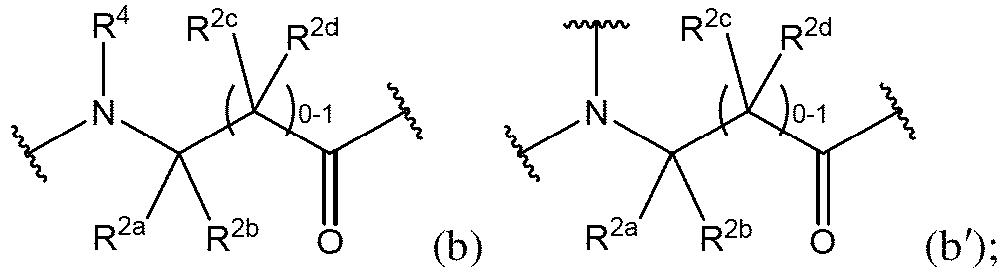
- b1, b2, b3, c1, c2, c3, f1, f2, f3, b1', b2', b3', c1', c2', c3', f1', and f2' each independently have the formula (c) and f0' has the formula (c')

- e1*, e2*, e3*, g1*, g2*, e1'*, e2'*, e3'*, g0'*, g1'*, and g2'* each independently have the formula (b) and g0* has the formula (b')
- Each R4 in Formula III is independently hydrogen, an alkyl, an alkenyl, an alkynyl, a cycloalkyl, a heterocyclyl, an aryl, a heteroaryl, or an arylalkyl. Preferably, R4 is hydrogen.
- In each residue of formula (a):
R1a, R1b, R1c, and R1d are each independently hydrogen, an amino acid side chain, an alkyl, an alkenyl, an alkynyl, a cycloalkyl, a heterocyclyl, an aryl, a heteroaryl, or an arylalkyl, wherein each amino acid side chain, alkyl, alkenyl, alkynyl, cycloalkyl, heterocyclyl, aryl, heteroaryl, and arylalkyl can be optionally substituted with H, an alkyl, an alkenyl, an alkynyl, an azide, -OR5, or -SR5; and at least one of R1a and R1c is a side chain of a modified or unmodified amino acid selected from the group consisting of cysteine, homocysteine, selenocysteine, leucine, isoleucine, hexafluoroleucine, valine, hexafluorovaline, allylglycine, threonine, and analogues of each of the preceding residues. When a Linker B or a Linker C is attached to a residue of formula (a), the Linker B or Linker C is attached to or replaces one of R1a, R1b, R1c, and R1d. - In a preferred embodiment, (i) one of R1a and R1c is the side chain of a modified or unmodified amino acid selected from the group consisting of cysteine, homocysteine, selenocysteine, leucine, isoleucine, hexafluoroleucine, valine, hexafluorovaline, allylglycine, threonine, and analogues of each of the preceding residues, and (ii) R1b, R1d, and the other of R1a and R1c are each independently hydrogen, a C1-3 alkyl (preferably methyl or ethyl), or a C2-3 alkenyl (preferably ethenyl).
- In each residue of formula (b):
R2a, R2b, R2c, and R2d are each independently hydrogen, an amino acid side chain, an alkyl, an alkenyl, an alkynyl, a cycloalkyl, a heterocyclyl, an aryl, a heteroaryl, or an arylalkyl, wherein each amino acid side chain, alkyl, alkenyl, alkynyl, cycloalkyl, heterocyclyl, aryl, heteroaryl, and arylalkyl can be optionally substituted with H, an alkyl, an alkenyl, an alkynyl, an azide, -OR5, or -SR5; and at least one of R2a and R2c is an amino acid side chain. When a Linker A or a Linker D is attached to a residue of formula (b), the Linker A or Linker D is attached to or replaces one of R2a, R2b, R2c, and R2d. - In a preferred embodiment, (i) one of R2a and R2c is an amino acid side chain and (ii) R2b, R2d, and the other of R2a and R2c are each independently hydrogen or a C1-3 alkyl (e.g., methyl, ethyl).
- In each residue of formula (c):
each R3 is independently hydrogen, an amino acid side chain, an alkyl, an alkenyl, an alkynyl, a cycloalkyl, a heterocyclyl, an aryl, a heteroaryl, or an arylalkyl, wherein each amino acid side chain, alkyl, alkenyl, alkynyl, cycloalkyl, heterocyclyl, aryl, heteroaryl, and arylalkyl can be optionally substituted with H, an alkyl, an alkenyl, an alkynyl, an azide, -OR5, or -SR5. In at least one embodiment, at least one R3 is a side chain of a modified or unmodified amino acid. - In a preferred embodiment, residues of formula (c) are selected to facilitate molecular recognition of a target by the coiled-coil structure.
- Each R5 in Formula III is independently selected from the group consisting of H, - PG (where PG is a protecting group), an alkyl, an alkenyl, an alkynyl, a cycloalkyl, an aryl, a heteroaryl, a heterocyclyl, and an arylalkyl.
- In a preferred embodiment of the compounds of the present disclosure, the parallel coiled-coil structure is a parallel coiled-coil of Formula IV:

- * represents the residue to which an optional linker may be attached;
- a1*, a2*, a3*, b1, b2, b3, c1, c2, c3, d1*, d2*, d3*, e1*, e2*, e3*, f0, f1, f2, g0*, g1*, g2*, a1'*, a2'*, a3'*, b1', b2', b3', c1', c2', c3', d1'*, d2'*, d3'*, e1'*, e2'*, e3'*, f0', f1', f2', g0'*, g1'*, and g2'* are each independently absent or a modified or unmodified amino acid residue or analogue thereof, with the proviso that at least seven contiguous amino acid residues/analogues are present in each coil;
- a1*, a2*, a3*, d1*, d2*, d3*, a1'*, a2'*, a3'*, d1'*, d2'*, and d3'* each independently have the formula (a)

- e1*, e2*, e3*, g0*, g1*, g2*, e1'*, e2'*, e3'*, g0'*, g1'*, and g2'* each independently have the formula (b)

- b1, b2, b3, c1, c2, c3, f1, f2, b1', b2', b3', c1', c2', c3', f1', and f2' each independently have the formula (c) and f0 and f0' have the formula (c')

- Each R4 in Formula IV is independently hydrogen, an alkyl, an alkenyl, an alkynyl, a cycloalkyl, a heterocyclyl, an aryl, a heteroaryl, or an arylalkyl. Preferably, R4 is hydrogen.
- In each residue of formula (a):
- R1a, R1b, R1c, and R1d are each independently hydrogen, an amino acid side chain, an alkyl, an alkenyl, an alkynyl, a cycloalkyl, a heterocyclyl, an aryl, a heteroaryl, or an arylalkyl, wherein each amino acid side chain, alkyl, alkenyl, alkynyl, cycloalkyl, heterocyclyl, aryl, heteroaryl, and arylalkyl can be optionally substituted with H, an alkyl, an alkenyl, an alkynyl, an azide, -OR5, or -SR5; and at least one of R1a and R1c is a side chain of a modified or unmodified amino acid selected from the group consisting of cysteine, homocysteine, selenocysteine, leucine, isoleucine, hexafluoroleucine, valine, hexafluorovaline, allylglycine, threonine, and analogues of each of the preceding residues. When a Linker B or a Linker C is attached to a residue of formula (a), the Linker B or Linker C is attached to or replaces one of R1a, R1b, R1c, and R1d.
- In a preferred embodiment, (i) one of R1a and R1c is the side chain of a modified or unmodified amino acid selected from the group consisting of cysteine, homocysteine, selenocysteine, leucine, isoleucine, hexafluoroleucine, valine, hexafluorovaline, allylglycine, threonine, and analogues of each of the preceding residues, and (ii) R1b, R1d, and the other of R1a and R1c are each independently hydrogen, a C1-3 alkyl (preferably methyl or ethyl), or a C2-3 alkenyl (preferably ethenyl).
- In each residue of formula (b):
- R2a, R2b, R2c, and R2d are each independently hydrogen, an amino acid side chain, an alkyl, an alkenyl, an alkynyl, a cycloalkyl, a heterocyclyl, an aryl, a heteroaryl, or an arylalkyl, wherein each amino acid side chain, alkyl, alkenyl, alkynyl, cycloalkyl, heterocyclyl, aryl, heteroaryl, and arylalkyl can be optionally substituted with H, an alkyl, an alkenyl, an alkynyl, an azide, -OR5, or -SR5; and at least one of R2a and R2c is an amino acid side chain. When a Linker A or a Linker D is attached to a residue of formula (b), the Linker A or Linker D is attached to or replaces one of R2a, R2b, R2c, and R2d.
- In a preferred embodiment, (i) one of R2a and R2c is an amino acid side chain and (ii) R2b, R2d, and the other of R2a and R2c are each independently hydrogen or a C1-3 alkyl (e.g., methyl, ethyl).
- In each residue of formula (c):
- each R3 is independently hydrogen, an amino acid side chain, an alkyl, an alkenyl, an alkynyl, a cycloalkyl, a heterocyclyl, an aryl, a heteroaryl, or an arylalkyl, wherein each amino acid side chain, alkyl, alkenyl, alkynyl, cycloalkyl, heterocyclyl, aryl, heteroaryl, and arylalkyl can be optionally substituted with H, an alkyl, an alkenyl, an alkynyl, an azide, -OR5, or -SR5. In at least one embodiment, at least one R3 is a side chain of a modified or unmodified amino acid.
- In a preferred embodiment, residues of formula (c) are selected to facilitate molecular recognition of a target by the coiled-coil structure.
- Each R5 in Formula IV is independently selected from the group consisting of H,-PG (where PG is a protecting group), an alkyl, an alkenyl, an alkynyl, a cycloalkyl, an aryl, a heteroaryl, a heterocyclyl, and an arylalkyl.
- In some at least some embodiments of the compounds of the present disclosure, PG is independently selected at each occurrence thereof from the group consisting of a protecting group for protection of an amine, a protecting group for protection of a thiol, and a protecting group for protection of a carboxylic acid.
- In at least one embodiment of the parallel coiled-coils of the present disclosure, f0 is any residue; g0 is Trp, Met, Phe, Ala, Glu, or His; a1 is Cys, HCys, Leu, Ile, allylleucine, Val, allylglycine, Thr, selenocysteine, hexafluoroleucine, or hexafluorovaline; b1 is any residue; c1 is Gln, Trp, Leu, Phe, Tyr, or Met; d1 is Cys, HCys, Leu, Ile, allylleucine, Val, allylglycine, Thr, selenocysteine, hexafluoroleucine, or hexafluorovaline; e1 is any residue; f1 is any residue; g1 is any residue; a2 is Cys, HCys, Leu, Ile, allylleucine, Val, allylglycine, Thr, selenocysteine, hexafluoroleucine, or hexafluorovaline; b2 is any residue; c2 is any residue; d2 is Cys, HCys, Leu, Ile, allylleucine, Val, allylglycine, Thr, selenocysteine, hexafluoroleucine, or hexafluorovaline; e2 is any residue; g'0 is any residue; a'1 is Cys, HCys, Leu, Ile, allylleucine, Val, allylglycine, Thr, selenocysteine, hexafluoroleucine, or hexafluorovaline; b'1 is His, Phe, Trp, Tyr, Val, Leu, or Ile; c'1 is any residue; d'1 is Cys, HCys, Leu, Ile, allylleucine, Val, allylglycine, Thr, selenocysteine, hexafluoroleucine, or hexafluorovaline; e'1 is His, Phe, Trp, Tyr, Val, Leu, or Ile, e'1 is any residue; f'1 is any residue; g'1 is any residue; a'2 is Cys, HCys, Leu, Ile, allylleucine, Val, allylglycine, Thr, selenocysteine, hexafluoroleucine, or hexafluorovaline; b'2 Asp, Asn, Glu, Gln, Tyr, Ser, or Thr; c'2 is any residue; d'2 is Cys, HCys, Leu, Ile, allylleucine, Val, allylglycine, Thr, selenocysteine, hexafluoroleucine, or hexafluorovaline, e'2 is His, Phe, Trp, Tyr, Val, Leu, or Ile; f'2 is any residue; where any amino acid residue may be modified for attachment of Z, which is a covalent linker (e.g., a bis-triazole linker) between pair e2-g'1.
- In at least one embodiment of the parallel coiled-coils of the present disclosure, c1 is Glu; d1 is Leu; e1 is Glu; f1 is Arg; g1 is Glu; a2 is Ile; b2 is Arg; c2 is Trp; d2 is Leu; e2 is Z; c'1 is Glu; d'1 is Leu; e'1 is Glu; f'1 is Arg; g'1 is Z; a'2 is Ile; b'2 is Arg; c'2 is Trp; d'2 is Leu, e'2 is Arg; where any amino acid residue may be modified for attachment of Z, which is a covalent linker (e.g., a bis-triazole linker) between pair g1-e'2.
- In at least one embodiment of the parallel coiled-coils of the present disclosure, c1 is Glu; d1 is Cys; e1 is Glu; f1 is Arg; g1 is Glu; a2 is Ile; b2 is Arg; c2 is Trp; d2 is Leu; e2 is Z; c'1 is Glu; d'1 is Cys; e'1 is Glu; f'1 is Arg; g'1 is Z; a'2 is Ile; b'2 is Arg; c'2 is Trp; d'2 is Leu, e'2 is Arg; where any amino acid residue may be modified for attachment of Z, which is a covalent linker (e.g., a bis-triazole linker) between pair g1-e'2.
- In some embodiments of the compounds of the present disclosure, the compound comprises an antiparallel coiled-coil structure that mimics the Nervy homology two (NHR2) domain of the AML1-ETO-containing transcription factor complex (AETFC). In these embodiments, the compound is selected from the group consisting of (i) a macrostructure comprising an antiparallel coiled-coil structure that mimics the NHR2 domain and (ii) an antiparallel coiled-coil structure of Formula I that mimics the NHR2 domain. In these compounds, (i) the first strand of the antiparallel coiled-coil structure comprises at least ten contiguous modified or unmodified amino acid residues (or analogues thereof), wherein the at least ten contiguous amino acid residues/analogues have the formula gX1-X2-X3-X4-X5-X6-X7-X8-X9-X10 b, wherein X1, X2, X3, X4, X5, X6, X7, X8, X9, and X10 are selected from the group of amino acid residues (or analogues thereof) set forth below; and (ii) the second strand of the antiparallel coiled-coil structure comprises at least ten contiguous modified or unmodified amino acid residues (or analogues thereof), wherein the at least ten contiguous amino acid residues/analogues have the formula c'X1'-X2'-X3'-X4'-X5'-X6'-X7'-X8'-X9'-X10 e', wherein X1', X2', X3', X4', X5', X6', X7', X8', X9', and X10' are selected from the group of amino acid residues (or analogues thereof) set forth below. As will be apparent to the skilled artisan, g, b, c', and e' indicate where the ten contiguous amino acids/analogues appear within the antiparallel coiled-coil structure (i.e., the first strand can begin at the g0, g1, or g2 position and the second strand can begin at the c1', c2', or c3' position). As will be apparent to the skilled artisan, residues in the e/e' and g/g' positions can be optionally modified to facilitate attachment of a linker or replaced with a linker, if present. As will be apparent to the skilled artisan, residues in the a/a' and d/d' positions can be optionally modified to facilitate attachment of a linker, if present.
NHR2 Preferred Sequences STRAND 1 STRAND 2 X Amino Acid Residues1 X' Amino Acid Residues1 gX1 Glu, Leu, Arg, Lys, Thr, Val c'X1' Glu, Asn, Leu, Gln, Met, Ala X2 Cys, HCys, Leu, Ile, allylleucine, Val, allylglycine, Thr, selenocysteine, hexafluoroleucine, hexafluorovaline X2' Cys, HCys, Leu, Ile, allylleucine, Val, allylglycine, Thr, selenocysteine, hexafluoroleucine, hexafluorovaline X3 Any residue (esp. Trp) X3' Any residue (esp. Trp) X4 His, Tyr, Phe, Lys, Gln, Trp X4' Any residue (esp. Arg) X5 Cys, HCys, Leu, Ile, allylleucine, Val, allylglycine, Thr, selenocysteine, hexafluoroleucine, hexafluorovaline X5' Ala, Ser, Thr, Gly, Asp X6 Any residue X6' Cys, HCys, Leu, Ile, allylleucine, Val, allylglycine, Thr, selenocysteine, hexafluoroleucine, hexafluorovaline X7 Glu, Asn, Trp, Leu, Glu, Gln X7' Arg, Leu, Gln, Met, Glu, Asp X8 Leu, Met, Ala, His, Ser X8' Tyr, Val, Phe, Trp, Met X9 Cys, HCys, Leu, Ile, allylleucine, Val, allylglycine, Thr, selenocysteine, hexafluoroleucine, hexafluorovaline X9' Cys, HCys, Leu, Ile, allylleucine, Val, allylglycine, Thr, selenocysteine, hexafluoroleucine, hexafluorovaline bX10 Any residue (esp. Trp) e'X10' Any residue 1Underlined residues are particularly preferred. - In at least one embodiment of the antiparallel coiled-coils of the present disclosure, g1 is Glu, Leu, Arg, Lys, Thr or Val; a2 is Cys, HCys, Leu, Ile, allylleucine, Val, allylglycine, Thr, selenocysteine, hexafluoroleucine, or hexafluorovaline; b2 is any residue; c2 is His, Tyr, Phe, Lys, Gln, or Trp; d2 is Cys, HCys, Leu, Ile, allylleucine, Val, allylglycine, Thr, selenocysteine, hexafluoroleucine, or hexafluorovaline; e2 is any residue; f2 is Glu, Asn, Trp, Leu, Glu, or Gln; g2 is Leu, Met, Ala, His, or Ser; a3 is Cys, HCys, Leu, Ile, allylleucine, Val, allylglycine, Thr, selenocysteine, hexafluoroleucine, or hexafluorovaline; b3 is any residue; c'1 is Glu, Asn, Leu, Gln, Met, or Ala; d'1 is Cys, HCys, Leu, Ile, allylleucine, Val, allylglycine, Thr, selenocysteine, hexafluoroleucine, or hexafluorovaline; e'1 is any residue; f'1 is any residue; g'1 is Ala, Ser, Thr, Gly, or Asp; a'2 is Cys, HCys, Leu, Ile, allylleucine, Val, allylglycine, Thr, selenocysteine, hexafluoroleucine, or hexafluorovaline; b'2 is Arg, Leu, Gln, Met, Glu, or Asp; c'2 is Tyr, Val, Phe, Trp, or Met; d'2 is Cys, HCys, Leu, Ile, allylleucine, Val, allylglycine, Thr, selenocysteine, hexafluoroleucine, or hexafluorovaline, e'2 is any residue, where any amino acid residue may be modified for attachment of Z, which is a covalent linker (e.g., a bis-triazole linker) between pair g-g' or e2-e'2.
- In at least one embodiment of the antiparallel coiled-coils of the present disclosure, g1 is Glu, a2 is Leu, b2 is Trp, c2 is His, d2 is Leu, e2 is Z, f2 is Glu, g2 is Leu, a3 is Leu, b3 is Arg, c'1 is Glu, d'1 is Leu, e'1 is Trp, f'1 is Arg, g'1 is Ser, a'2 is Ile, b'2 is Arg, c'2 is Val, d'2 is Leu, e'2 is Z, and each Z is a lysine residue that has been modified for attachment of a covalent linker (e.g., a bis-triazole linker) between pair e2-e'2.
- In at least one embodiment of the antiparallel coiled-coils of the present disclosure, g1 is Glu, a2 is Leu, b2 is Trp, c2 is His, d2 is Leu, e2 is Z, f2 is Glu, g2 is Leu, a3 is Z', b3 is Arg, c'1 is Glu, d'1 is Z', e'1 is Trp, f'1 is Arg, g'1 is Ser, a'2 is Ile, b'2 is Arg, c'2 is Val, d'2 is Leu, e'2 is Z, each Z is a lysine residue that has been modified for attachment of a covalent linker (e.g., a bis-triazole linker) between pair e2-e'2, and each Z' is a cysteine residue that has been modified for attachment of a covalent linker (e.g., a disulfide linker) between pair a3-d'1.
- In at least one embodiment of the compounds of the present disclosure, the compound is an NHR2 coiled-coil mimetic selected from the group consisting of CHD-NHR2-2, CHDDS-NHR2-3, CHD-NHR2-6, and CHD-NHR2-7. CHD-NHR2-2 and CHDDS-NHR2-3 are particularly preferred.
- Another aspect of the present (i) invention and (ii) disclosure relates to pharmaceutical formulations comprising any of the above described compounds (i) of the present invention or (ii) of the present disclosure, and a pharmaceutically acceptable carrier. Acceptable pharmaceutical carriers include solutions, suspensions, emulsions, excipients, powders, or stabilizers. The carrier should be suitable for the desired mode of delivery.
- In addition, the pharmaceutical formulations of the present invention and disclosure may further comprise one or more pharmaceutically acceptable diluents, adjuvants, excipients, or vehicles, such as preserving agents, fillers, disintegrating agents, wetting agents, emulsifying agents, suspending agents, sweetening agents, flavoring agents, perfuming agents, antibacterial agents, antifungal agents, lubricating agents and dispensing agents, depending on the nature of the mode of administration and dosage forms. Examples of suspending agents include ethoxylated isostearyl alcohols, polyoxyethylene sorbitol and sorbitan esters, microcrystalline cellulose, aluminum metahydroxide, bentonite, agar-agar and tragacanth, or mixtures of these substances. Prevention of the action of microorganisms can be ensured by various antibacterial and antifungal agents, for example, parabens, chlorobutanol, phenol, sorbic acid, and the like. It may also be desirable to include isotonic agents, for example sugars, sodium chloride, and the like. Prolonged absorption of the injectable pharmaceutical form can be brought about by the use of agents delaying absorption, for example, aluminum monosterate and gelatin. Examples of suitable carriers, diluents, solvents, or vehicles include water, ethanol, polyols, suitable mixtures thereof, vegetable oils (such as olive oil), and injectable organic esters such as ethyl oleate. Examples of excipients include lactose, milk sugar, sodium citrate, calcium carbonate, and dicalcium phosphate. Examples of disintegrating agents include starch, alginic acids, and certain complex silicates. Examples of lubricants include magnesium stearate, sodium lauryl sulphate, talc, as well as high molecular weight polyethylene glycols.
- Disclosed herein is a method of inhibiting interaction between the AETFC and an NHR2 binding motif (e.g., in an E protein). This method involves contacting the transcription factor complex and/or the NHR2 binding motif with a compound that comprises an antiparallel coiled-coil structure that mimics the NHR2 domain, as described above, under conditions effective to inhibit interaction between the AML1-ETO-containing transcription factor complex and the NHR2 binding motif. Preferably, contacting is carried out in a cell. In another preferred embodiment, contacting is carried out in a subject and contacting comprises administering the compound to the subject.
- The compounds of the present invention and disclosure can be administered orally, parenterally, for example, subcutaneously, intravenously, intramuscularly, intraperitoneally, by intranasal instillation, or by application to mucous membranes, such as, that of the nose, throat, and bronchial tubes. They may be administered alone or with suitable pharmaceutical carriers, and can be in solid or liquid form such as, tablets, capsules, powders, solutions, suspensions, or emulsions.
- The active compounds of the present invention and disclosure may be orally administered, for example, with an inert diluent, or with an assimilable edible carrier, or they may be enclosed in hard or soft shell capsules, or they may be compressed into tablets, or they may be incorporated directly with the food of the diet. For oral therapeutic administration, these active compounds may be incorporated with excipients and used in the form of tablets, capsules, elixirs, suspensions, syrups, and the like. Such compositions and preparations should contain at least 0.1% of active compound. The percentage of the compound in these compositions may, of course, be varied and may conveniently be between about 2% to about 60% of the weight of the unit. The amount of active compound in such therapeutically useful compositions is such that a suitable dosage will be obtained. Preferred compositions according to the present invention and disclosure are prepared so that an oral dosage unit contains between about 1 and 250 mg of active compound.
- The tablets, capsules, and the like may also contain a binder such as gum tragacanth, acacia, corn starch, or gelatin; excipients such as dicalcium phosphate; a disintegrating agent such as corn starch, potato starch, alginic acid; a lubricant such as magnesium stearate; and a sweetening agent such as sucrose, lactose, or saccharin. When the dosage unit form is a capsule, it may contain, in addition to materials of the above type, a liquid carrier, such as a fatty oil.
- Various other materials may be present as coatings or to modify the physical form of the dosage unit. For instance, tablets may be coated with shellac, sugar, or both. A syrup may contain, in addition to active ingredient, sucrose as a sweetening agent, methyl and propylparabens as preservatives, a dye, and flavoring such as cherry or orange flavor.
- These active compounds may also be administered parenterally. Solutions or suspensions of these active compounds can be prepared in water suitably mixed with a surfactant, such as hydroxypropylcellulose. Dispersions can also be prepared in glycerol, liquid polyethylene glycols, and mixtures thereof in oils. Illustrative oils are those of petroleum, animal, vegetable, or synthetic origin, for example, peanut oil, soybean oil, or mineral oil. In general, water, saline, aqueous dextrose and related sugar solution, and glycols such as, propylene glycol or polyethylene glycol, are preferred liquid carriers, particularly for injectable solutions. Under ordinary conditions of storage and use, these preparations contain a preservative to prevent the growth of microorganisms.
- The pharmaceutical forms suitable for injectable use include sterile aqueous solutions or dispersions and sterile powders for the extemporaneous preparation of sterile injectable solutions or dispersions. In all cases, the form must be sterile and must be fluid to the extent that easy syringability exists. It must be stable under the conditions of manufacture and storage and must be preserved against the contaminating action of microorganisms, such as bacteria and fungi. The carrier can be a solvent or dispersion medium containing, for example, water, ethanol, polyol (e.g., glycerol, propylene glycol, and liquid polyethylene glycol), suitable mixtures thereof, and vegetable oils.
- The compounds of the present invention and disclosure may also be administered directly to the airways in the form of an aerosol. For use as aerosols, the compounds in solution or suspension may be packaged in a pressurized aerosol container together with suitable propellants, for example, hydrocarbon propellants like propane, butane, or isobutane with conventional adjuvants. The materials of the present invention and disclosure also may be administered in a non-pressurized form such as in a nebulizer or atomizer.
- Also disclosed herein is a method of modulating transcription of a gene in a cell, wherein transcription of the gene is regulated by interaction between AETFC and an NHR2 binding motif. This method involves contacting the cell with a compound of the present invention or disclosure that comprises an antiparallel coiled-coil structure that mimics the NHR2 domain, as described above, under conditions effective to modulate transcription of the gene. In a preferred embodiment, the cell is contacted under conditions effective to cause nuclear uptake of the compound, where the compound disrupts interaction of AETFC and the NHR2-binding domain and thereby reduces transcription of the gene.
- Modulating according to this aspect of the present disclosure refers to up-regulating transcription of genes that are typically down-regulated by AETFC, or down-regulating transcription of genes that are typically up-regulated by AETFC. Genes typically downregulated by AETFC include, e.g., FOS, EGFR1, STYK1, MYCN, TAL1, BAALC, and 1D1. Genes typically upregulated by AETFC include, e.g., VAV1, SLA, ANXA1, PTPN12, BPI, and OGG1.
- Genes whose transcription can be modulated according to this aspect of the present disclosure include FOS, EGFR1, STYK1, MYCN, TAL1, BAALC, 1D1, VAV1, SLA, ANXA1, PTPN12, BPI, OGG1, and those described in Sun et al., "A Stable Transcription Factor Complex Nucleated by Oligomeric AML1-ETO Controls Leukaemogenesis," Nature 500:93-98 (2013); Westendorf et al., "The t(8;21) Fusion Product, AML-1-ETO, Associates with C/EBP-α, Inhibits C/EBP-α-Dependent Transcription, and Blocks Granulocytic Differentiation," Mol. Cell. Biol. 18:322-333 (1998); Mao et al., "Functional and Physical Interactions Between AML1 Proteins and an ETS Protein, MEF: Implications for the Pathogenesis of t(8;21)-Positive Leukemias," Mol. Cell. Biol. 19:3635-3644 (1999); Elagib et al., "RUNX1 and GATA-1 Coexpression and Cooperation in Megakaryocytic Differentiation," Blood 101:4333-4341 (2003); Zhang et al., "E Protein Silencing by the Leukemogenic AML1-ETO Fusion Protein," Science 305:1286-1289 (2004); Gardini et al. "AML1/ETO Oncoprotein Is Directed to AML1 Binding Regions and Co-Localizes with AML1 and HEB on Its Targets," PLoS Genet. 4:e1000275 (2008); Guo et al., "Multivalent Binding of the ETO Corepressor to E Proteins Facilitates Dual Repression Controls Targeting Chromatin and the Basal Transcription Machinery," Mol. Cell. Biol. 29:2644-2657 (2009); Martens et al., "ERG and FLI1 Binding Sites Demarcate Targets for Aberrant Epigenetic Regulation by AML1-ETO in Acute Myeloid Leukemia," Blood 120:4038-4048 (2012); Wang et al., "The Leukemogenicity of AML1-ETO Is Dependent on Site-Specific Lysine Acetylation," Science 333:765-769 (2011); Shia et al., "PRMT1 Interacts with AML1-ETO to Promote Its Transcriptional Activation and Progenitor Cell Proliferative Potential," Blood 119:4953-4962 (2012); and Miyoshi et al., "The t(8;21) Translocation in Acute Myeloid Leukemia Results in Production of an AML1-MTG8 Fusion Transcript," EMBO J. 12:2715-2721 (1993).
- The NHR2-mediated oligomerization of AML1-ETO has been shown to be critical for leukaemogenesis (Sun et al., "A Stable Transcription Factor Complex Nucleated by Oligomeric AML1-ETO Controls Leukaemogenesis," Nature 500:93-98 (2013)). Thus, also disclosed herein is a method of treating leukemia in a subject. This method involves administering to the subject a compound of the present invention or disclosure that comprises an antiparallel coiled-coil structure that mimics the NHR2 domain, as described above, under conditions effective to treat leukemia in the subject.
- In all aspects of the present disclosure involving contacting a cell with, or administering to a subject, a compound of the present invention or disclosure that comprises an antiparallel coiled-coil structure that mimics the NHR2 domain, the compound is selected from the group consisting of (i) a macrostructure comprising an antiparallel coiled-coil structure that mimics the NHR2 domain and (ii) an antiparallel coiled-coil structure of Formula I that mimics the NHR2 domain. In these compounds, (i) the first strand of the antiparallel coiled-coil structure comprises at least ten contiguous modified or unmodified amino acid residues (or analogues thereof), wherein the at least ten contiguous amino acid residues/analogues have the formula gX1-X2-X3-X4-X5-X6-X7-X8-X9-X10 b, wherein X1, X2, X3, X4, X5, X6, X7, X8, X9, and X10 are selected from the group of amino acid residues (or analogues thereof) set forth below; and (ii) the second strand of the antiparallel coiled-coil structure comprises at least ten contiguous modified or unmodified amino acid residues (or analogues thereof), wherein the at least ten contiguous amino acid residues/analogues have the formula c'X1'-X2'-X3'-X4'-X5'-X6'-X7'-X8'-X9'-X10 e', wherein X1', X2', X3', X4', X5', X6', X7', X8', X9', and X10' are selected from the group of amino acid residues (or analogues thereof) set forth below. As will be apparent to the skilled artisan, g, b, c', and e' indicate where the ten contiguous amino acids/analogues appear within the antiparallel coiled-coil structure (i.e., the first strand can begin at the g0, g1, or g2 position and the second strand can begin at the c1', c2', or c3' position). As will be apparent to the skilled artisan, residues in the e/e' and g/g' positions can be optionally modified to facilitate attachment of a linker or replaced with a linker, if present. As will be apparent to the skilled artisan, residues in the a/a' and d/d' positions can be optionally modified to facilitate attachment of a linker, if present.
NHR2 Preferred Sequences STRAND 1 STRAND 2 X Amino Acid Residues1 X' Amino Acid Residues1 gX1 Glu, Leu, Arg, Lys, Thr, Val c'X1' Glu, Asn, Leu, Gln, Met, Ala X2 Cys, HCys, Leu, Ile, allylleucine, Val, allylglycine, Thr, selenocysteine, hexafluoroleucine, hexafluorovaline X2' Cys, HCys, Leu, Ile, allylleucine, Val, allylglycine, Thr, selenocysteine, hexafluoroleucine, hexafluorovaline X3 Any residue (esp. Trp) X3' Any residue (esp. Trp) X4 His, Tyr, Phe, Lys, Gln, Trp X4' Any residue (esp. Arg) X5 Cys, HCys, Leu, Ile, allylleucine, Val, allylglycine, Thr, selenocysteine, hexafluoroleucine, hexafluorovaline X5' Ala, Ser, Thr, Gly, Asp X6 Any residue X6' Cys, HCys, Leu, Ile, allylleucine, Val, allylglycine, Thr, selenocysteine, hexafluoroleucine, hexafluorovaline X7 Glu, Asn, Trp, Leu, Glu, Gln X7' Arg, Leu, Gln, Met, Glu, Asp X8 Leu, Met, Ala, His, Ser X8' Tyr, Val, Phe, Trp, Met X9 Cys, HCys, Leu, Ile, allylleucine, Val, allylglycine, Thr, selenocysteine, hexafluoroleucine, hexafluorovaline X9' Cys, HCys, Leu, Ile, allylleucine, Val, allylglycine, Thr, selenocysteine, hexafluoroleucine, hexafluorovaline bX10 Any residue (esp. Trp) e'X10' Any residue 1Underlined residues are particularly preferred. - In at least one embodiment of all aspects of the present disclosure involving contacting a cell with, or administering to a subject, a compound of the present invention or disclosure that comprises an antiparallel coiled-coil structure, g1 is Glu, Leu, Arg, Lys, Thr or Val; a2 is Cys, HCys, Leu, Ile, allylleucine, Val, allylglycine, Thr, selenocysteine, hexafluoroleucine, or hexafluorovaline; b2 is any residue; c2 is His, Tyr, Phe, Lys, Gln, or Trp; d2 is Cys, HCys, Leu, Ile, allylleucine, Val, allylglycine, Thr, selenocysteine, hexafluoroleucine, or hexafluorovaline; e2 is any residue; f2 is Glu, Asn, Trp, Leu, Glu, or Gln; g2 is Leu, Met, Ala, His, or Ser; a3 is Cys, HCys, Leu, Ile, allylleucine, Val, allylglycine, Thr, selenocysteine, hexafluoroleucine, or hexafluorovaline; b3 is any residue; c'1 is Glu, Asn, Leu, Gln, Met, or Ala; d'1 is Cys, HCys, Leu, Ile, allylleucine, Val, allylglycine, Thr, selenocysteine, hexafluoroleucine, or hexafluorovaline; e'1 is any residue; f'1 is any residue; g'1 is Ala, Ser, Thr, Gly, or Asp; a'2 is Cys, HCys, Leu, Ile, allylleucine, Val, allylglycine, Thr, selenocysteine, hexafluoroleucine, or hexafluorovaline; b'2 is Arg, Leu, Gln, Met, Glu, or Asp; c'2 is Tyr, Val, Phe, Trp, or Met; d'2 is Cys, HCys, Leu, Ile, allylleucine, Val, allylglycine, Thr, selenocysteine, hexafluoroleucine, or hexafluorovaline, e'2 is any residue, where any amino acid residue may be modified for attachment of Z, which is a covalent linker (e.g., a bis-triazole linker) between pair g-g' or e2-e'2.
- In at least one embodiment of all aspects of the present disclosure involving contacting a cell with, or administering to a subject, a compound of the present invention or disclosure that comprises an antiparallel coiled-coil structure, g1 is Glu, a2 is Leu, b2 is Trp, c2 is His, d2 is Leu, e2 is Z, f2 is Glu, g2 is Leu, a3 is Leu, b3 is Arg, c'1 is Glu, d'1 is Leu, e'1 is Trp, f'1 is Arg, g'1 is Ser, a'2 is Ile, b'2 is Arg, c'2 is Val, d'2 is Leu, e'2 is Z, and each Z is a lysine residue that has been modified for attachment of a covalent linker (e.g., a bis-triazole linker) between pair e2-e'2.
- In at least one embodiment of all aspects of the present disclosure involving contacting a cell with, or administering to a subject, a compound of the present invention or disclosure that comprises an antiparallel coiled-coil structure, g1 is Glu, a2 is Leu, b2 is Trp, c2 is His, d2 is Leu, e2 is Z, f2 is Glu, g2 is Leu, a3 is Z', b3 is Arg, c'1 is Glu, d'1 is Z', e'1 is Trp, f'1 is Arg, g'1 is Ser, a'2 is Ile, b'2 is Arg, c'2 is Val, d'2 is Leu, e'2 is Z, each Z is a lysine residue that has been modified for attachment of a covalent linker (e.g., a bis-triazole linker) between pair e2-e'2, and each Z' is a cysteine residue that has been modified for attachment of a covalent linker (e.g., a disulfide linker) between pair a3-d'1.
- In at least one embodiment of all aspects of the present disclosure involving contacting a cell with, or administering to a subject, a compound of the present invention or disclosure that comprises an antiparallel coiled-coil structure that mimics the NHR2 domain, the compound is an NHR2 coiled-coil mimetic selected from the group consisting of CHD-NHR2-2, CHDDS-NHR2-3, CHD-NHR2-6, and CHD-NHR2-7 (esp. CHD-NHR2-2 or CHDDS-NHR2-3).
- In all aspects of the present disclosure involving contacting a cell, suitable cells include, without limitation, mammalian cells (e.g., human cells, cat cells, dog cells, horse cells, cattle cells, goat cells, sheep cells, pig cells, mice cells, rat cells) and avian cells (e.g., chicken cells). In at least one preferred embodiment, the cells are leukemia cells (esp. acute myeloid leukemia cells, t(8;21)-positive leukemia cells).
- In all aspects of the present disclosure involving a subject, suitable subjects include mammals (e.g., humans, cats, dogs, horses, cattle, goats, sheeps, pigs, mice, rats) and birds (e.g., chickens). In at least one preferred embodiment, the subject has leukemia (esp. acute myeloid leukemia, t(8;21)-positive leukemia).
- In all aspects of the present disclosure directed to methods involving contacting a cell with one or more compounds, contacting can be carried out using methods that will be apparent to the skilled artisan, and can be done in vitro or in vivo.
- One approach for delivering agents into cells involves the use of liposomes. Basically, this involves providing a liposome which includes agent(s) to be delivered, and then contacting the target cell, tissue, or organ with the liposomes under conditions effective for delivery of the agent into the cell, tissue, or organ.
- This liposome delivery system can also be made to accumulate at a target organ, tissue, or cell via active targeting (e.g., by incorporating an antibody or hormone on the surface of the liposomal vehicle). This can be achieved according to known methods.
- An alternative approach for delivery of protein- or polypeptide-containing agents involves the conjugation of the desired agent to a polymer that is stabilized to avoid enzymatic degradation of the conjugated protein or polypeptide. Conjugated proteins or polypeptides of this type are described in
U.S. Patent No. 5,681,811 to Ekwuribe . - Yet another approach for delivery of agents involves preparation of chimeric agents according to
U.S. Patent No. 5,817,789 to Heartlein et al. The chimeric agent can include a ligand domain and the agent (e.g., a compound of the invention or disclosure). The ligand domain is specific for receptors located on a target cell. Thus, when the chimeric agent is delivered intravenously or otherwise introduced into blood or lymph, the chimeric agent will adsorb to the targeted cell, and the targeted cell will internalize the chimeric agent. - Compounds of the present invention and disclosure may be delivered directly to the targeted cell/tissue/organ.
- Additionally and/or alternatively, the compounds may be administered to a non-targeted area along with one or more agents that facilitate migration of the compounds to (and/or uptake by) a targeted tissue, organ, or cell. As will be apparent to one of ordinary skill in the art, the compound itself can be modified to facilitate its transport to a target tissue, organ, or cell, including its transport across the blood-brain barrier; and/or to facilitate its uptake by a target cell (e.g., its transport across cell membranes). In a preferred embodiment, the peptide of the invention or disclosure is modified, and/or delivered with an appropriate vehicle, to facilitate its delivery to the nucleus of the target cell (Wender et al., "The Design, Synthesis, and Evaluation of Molecules That Enable or Enhance Cellular Uptake: Peptoid Molecular Transporters," Proc. Nat'l Acad. Sci. USA 97:13003-08 (2000); Roberts, "Buyer's Guide to Protein Transduction Reagents," Scientist 18:42-43 (2004); Joliot & Prochiantz, "Transduction Peptides: From Technology to Physiology," Nat. Cell Biol. 6:189-96 (2004)).
- The present invention and disclosure may be further illustrated by reference to the following examples.
- Research grade solvents and reagents were used without further purfication. Fmoc amino acids and peptide synthesis reagents were purchased from Novabiochem and Chem-Impex International. Fmoc-azido amino acids were synthesized as previously described (Lau et al., Synlett 1917 (2011); Sminia et al., Synlett 2643 (2012)).
- Hydrogen bond surrogate coiled-coil mimic AB-1 was synthesiszed as shown in
Scheme 1 below.
- HBS peptides were synthesized as previously described (Patgiri et al., Org. Biomol. Chem. 8:1773 (2010)). Peptide sequences up to the i+3rd residue of the parent strand were synthesized on solid phase on a CEM® Liberty Peptide Synthesizer. A solution containing premixed o-nitrobenzesulfonyl chloride (10 eq) and 2,4,6-collidine (10 eq) in DCM was added to resin containing Fmoc-deprotected peptide. Resin was washed sequentially with dichloromethane, dimethylformamide, and diethyl ether (3x5 mL each). Resin was dried overnight under vacuum. Dried resin, PPh3, and Pd2(dba)3 were flushed under inert argon for 30 minutes. The resin with reactants was swelled in THF, and allymethylcarbonate was added to the reaction vessel. The solution was agitated at room temperature for 2 hours under argon to afford allylated peptide. Resin was filtered and washed with DCM, DMF, 0.2 M sodium diethylcarbamate trihydrate in NMP, and diethyl ether (3x5 mL). The nosyl protecting group was then removed by the addition of 1,8-diazabicyclo[5.4.0]undec-7-ene (DBU, 5 eq) and 2-mercaptoethanol (10 eq) in DMF. Resin was washed with DMF, DCM, and diethyl ether (3x5 mL) and treated with the desired Fmoc amino acid (20 eq), DIC (20 eq) and HOAt (10 eq) in DMF. The reaction was allowed to agitate at room temperature for 12 to 16 hours. Resin containing elongated peptide was washed, and coupled to the desired Fmoc amino acid residue (5 eq) and 4-pentenoic acid (5 eq) with HBTU (5 eq) and DIEA (10 eq) in DMF. Ring-closing metathesis of bis-
olefin 9 was performed with Hoveyda-Grubbs II catalyst (20 mol%) in 1,2-dichloroethane under microwave irradiation at 120 °C for 10 min as previously described (Miller et al., Curr. Prot. Chem. Biol. 6:101 (2014); Patgiri et al., Nat. Prot. 5:1857 (2010)). The ring-closing reaction was monitored by MALDI-TOF. Peptides were cleaved from the resin using 95% trifluoroacetic acid, 2.5% TIPS, and 2.5% H2O, and purified by reversed-phase HPLC (gradient 15-60 acetonitrile/water with 0.1% TFA over 60 min) and characterized by MALDI-TOF. - Macrocycle coiled-coil mimic AB-2 was synthesized as shown in
Scheme 2 below.
- PEG RAM resin 0.4 mmol/g was swelled in DMF and preloaded with Fmoc-Asp-OAllyl (1 eq), HBTU (1.5 eq), and diisopropylethylamine (1.5 eq) for 1 hour. The resin was then N-acetyl capped with 0.5 M acetic anhydride (2x5 mL) and the loading was modified to ~0.2 mmol/g loading as assessed by % loading. Solid phase peptide synthesis was performed using standard Fmoc solid phase chemistry on a CEM® Liberty Peptide Synthesizer. The resin bearing the parent peptide was transferred to a fritted polypropylene SPE tube. Following N-terminal deprotection with 20% piperidine in NMP (2x5 mL) and washing with dichloromethane, methanol, and dimethylformamide (3x5 mL each), allyl deprotection was performed using Pd(PPh3)4 (3 eq) in a solution of chloroform: acetic acid: N-methylmorpholine (37:3:1). After 3 hours, the resin was washed again with dichloromethane, methanol and dimethylformamide (3x5 mL each). Addition of PyBOP (1.5 eq) and DIPEA (1.5 eq) yielded complete macrocyclization with no observed linear product. Peptides were cleaved from the resin using 95% trifluoroacetic acid, 2.5% TIPS, and 2.5% H2O, and purified by reversed-phase HPLC (gradient 15-60 acetonitrile/water with 0.1% TFA over 60 min) and characterized by MALDI-TOF.
- Disulfide coiled-coiled mimic AB-3 was synthesized as shown in
Scheme 3 below.
- Parent peptide (0.25 mmol) was synthesized on a CEM® Liberty Peptide Synthesizer using standard Fmoc solid phase chemistry with Knorr Amide MBHA resin, and N-acetyl capped with 0.5 M acetic anhydride in DMF (2x5 mL), resulting in resin-bound coiled-coil mimic. The peptide was treated with a solution containing 95% trifluoroacetic acid, 2.5% TIPS, and 2.5% H2O. After 3 hours, the reaction mixture was filter and concentrated in vacuo. The crude solid was precipitated with cold diethyl ether and dried under a stream of nitrogen gas. Peptides were purified by reversed-phase HPLC (gradient 15-60 acetonitrile/water with 0.1% TFA over 60min), and after lyophiliziation yielded bisthiol as a white powder. The bis thiol was oxidized with 20% DMSO, 20% TFE in 0.8 M ammonium bicarbonate and 0.84 M acetic acid (pH 6.0), affording only intramolecular disulfide formation as monitored by MALDI-TOF (Tam et al., J. Am. Chem. Soc. 113:6657 (1991); Miller et al., Proc. Natl. Acad. Sci. USA 111:6636 (2014)). 10-30 mg purified product recovered from 0.25 mmol scale.
- Crosslinked helix dimer coiled-coiled mimic AB-4 was synthesized as shown in
Scheme 4 below.
- Parent peptide (0.25 mmol) was synthesized on a CEM® Liberty Peptide Synthesizer using standard Fmoc solid phase chemistry with Knorr Amide MBHA resin. The resin bearing the parent peptide was transferred to a fritted polypropylene SPE tube, washed, and transferred to a microwave tube. The resin was subsequently swelled in 3 mL of NMP and the bisalkyne propargyl ether (257 µL, 2.5 mmol, 10 eq) was added.
- A solution of CuSO4 (20 mg, 0.125 mmol, 0.5 eq) dissolved in 500 µL of water was separately prepared. To this solution, Tris[(1-benzyl-1H-1,2,3-triazol-4-yl)methyl]amine (132 mg, 0.25 mmol, 1 eq) dissolved in 1 mL of NMP was added. This mixture was added to a solution of sodium ascorbate (495 mg, 2.5 mmol, 10 eq) prepared in 1.5 mL of water. The resulting mixture was pipetted into the microwave tube containing propargyl ether and peptide. A magnetic stir bar was added, and the reaction mixture was subjected to microwave irradiation at 80 °C for 45 minutes, after which the resin was transferred to a fritted polypropylene SPE tube and washed with a 20 mM solution of sodium diethyldithiocarbamate in water (3x15 mL) followed by NMP (3x15 mL). A microcleavage of resin (95% trifluoroacetic acid, 2.5% TIPS, and 2.5% H2O) showed the starting material to be consumed after one reaction.
- Following the initial CuAAC reaction, the mono-triazole peptide was transferred to another microwave tube containing CuSO4 (20 mg, 0.125 mmol, 0.5 eq), sodium ascorbate (149 mg, 0.75 mmol, 3 eq), Fmoc-azidolysine-NH2 (294 mg, 0.75 mmol, 3 eq), and Tris[(1-benzyl-1H-1,2,3-triazol-4-yl)methyl]amine (132 mg, 0.25 mmol, 1 eq) in prepared solution as described above. The resulting reaction mixture was subjected to microwave irradiation at 80 °C for 45 minutes, after which the resin was transferred to a fritted polypropylene SPE tube and washed as described above. A microcleavage of resin (95% trifluoroacetic acid, 2.5% TIPS, and 2.5% H2O) showed the starting material to be consumed after one reaction.
- The resulting on-resin peptide was added to the CEM® Liberty microwave peptide synthesizer. The sequence was continued using standard Fmoc solid phase chemistry and N-acetyl capped with 0.5 M acetic anhydride in DMF (2x5 mL), resulting in resin-bound coiled-coil mimic. The peptide was treated with a solution containing 95% trifluoroacetic acid, 2.5% TIPS, and 2.5% H2O. After 3 hours, the reaction mixture was filtered and concentrated in vacuo. The crude solid was precipitated with cold diethyl ether and dried under a stream of nitrogen gas. HPLC purification (gradient 15-60 acetonitrile/water with 0.1% TFA over 60 minutes) and lyophiliziation yielded peptide as a white powder, which was characterized by MALDI-TOF. CHD-peptides yield, sequence dependently, 20-40 mg of peptide from a 0.25 mmol scale.
- AB-5 and AB-6 were synthesized in a similar manner.
- Crosslinked Helix DimerDS Coiled-coil Mimics were synthesized as shown in
Scheme 5 below.
- Parent peptide (0.25 mmol) was synthesized as described above where upon elongation, consecutive CuAAC reactions were implemented, and further elongated using standard Fmoc solid phase chemistry to afford the dithiol crosslinked helix dimer (CHDDT). After N-acetyl capping with 0.5 M acetic anhydrided in DMF (2x5 mL), the CHDDT-peptide was cleaved from resin using 94% trifluoroacetic acid, 2.5% 1,2-ethanedithiol, 2.5% H2O, and 1% triisopropylsilane. The resulting peptide was precipitated with cold diethyl ether and dried under a stream of nitrogen gas. Crude peptide was purified by reversed-phase HPLC (gradient 15-60 acetonitrile/water with 0.1% TFA over 60min), and after lyophiliziation yielded bisthiol as a white powder. The bisthiol was oxidized with 20% DMSO, 20% TFE in 0.8 M ammonium bicarbonate and 0.84 M acetic acid, pH 6.0 affording only intramolecular disulfide formation as monitored by MALDI-TOF (Tam et al., J. Am. Chem. Soc. 113:6657 (1991); Miller et al., Proc. Natl. Acad. Sci. USA 111:6636 (2014)).
- Analytical HPLC traces of peptides were obtained at 220 nm from a gradient of 10% B to 90% B over 10 min on an XTerra RP18 3.5 µm 2.1 x 150mm column (Part No. 186000410); A: 0.1% aqueous TFA, B: acetonitrile;
flow rate 400 µL/min. Exact masses were found using a Bruker Matrix-assisted laser desorption/ionization (MALDI-TOF) instrument. 10-30 mg purified product recovered from 0.25 mmol scale. SeeFigures 2A-2P . - CD spectra were recorded on an AVIV 202SF CD spectrometer equipped with a temperature controller using 1 mm length cells and a scan speed of 5 nm/min. The spectra were averaged over 8 scans with the background subtracted according to the analogueous experimental conditions. Each sample was prepared in a 50 mM potassium fluoride solution in water (pH 7.4) with a final concentration of 20 µM. The concentrations of each peptide was determined by the UV absorption of tryptophan residues at 280 nm. See
Figures 3A-3B . - All experiments were carried out on a
Bruker Avance 600 MHz spectrometer at 25 °C. A 500 µM solution of AB-4 was prepared in 400 µL of 10% d3-CH3CN in H2O with 0.1% trifluoroacetic acid (pH =5). Proton NMR, TOCSY, and NOESY spectra were used to assign amide protons (see Table 2 and Table 3 below). Solvent supression was achieved with a 3919 Watergate pulse sequence. All 2D spectra were recorded by collecting 4092 complex data points in the t2 domain by averaging 64 scans and 128 increments in the t1 domain with the States-TPPI mode. TOCSY experiments were performed with a mixing time of 80 ms, while NOESY experiments were performed with a mixing time of 300 ms. All NMR data were processed and analyzed using the Bruker TOPSPIN program. The original free induction decays were zero-filled to give a final matrix of 2048 by 2048 real data points. A 90° sine-squared window function was applied in both dimensions. Nucleaver Overhauser effect (NOE) cross-peaks are listed in Table 3 below. SeeFigure 4 (HNMR),Figure 5A (NOESY amide),Figure 6 (NOESY fingerprint), andFigure 5B (TOCSY amide to side chain).Table 2. 1H NMR assignments and chemical shifts (δ, ppm) for AB-4 (298 K) in 10% d3-CH3CN in D2O (pH 5), and calculated dihedral angles, Φ, derived from 3JNHCαH coupling constants. Residue Φ° NH Hα Hβ Hy H6 Hε E (A1) -53.86 7.824 4.10 N/A N/A N/A N/A L (A2) -52.67 8.217 4.15 1.89 N/A 0.756 N/A A (A3) -52.67 8.06 4.03 1.54 N/A N/A N/A E (A4) -55.60 7.907 3.97 1.96 2.31 N/A N/A L (A5) -57.84 7.75 4.03 1.58 N/A N/A N/A Z (A6) -52.07 7.16 4.06 1.76 1.57 N/A 3.08 W (A7) -51.47 7.65 4.48 3.19 N/A N/A N/A R (A8) -57.29 7.85 3.9 1.58 1.04 N/A N/A L (A9) -52.67 7.818 4.10 1.44 1.39 1.38δ 1.296 L (B1) -55.60 7.76 3.80 2.05 1.41 1.04 N/A W (B2) -55.60 7.91 4.38 3.19 N/A N/A N/A E (B3) -56.73 8.18 3.98 N/A N/A N/A N/A R (B4) -52.07 7.143 4.04 N/A N/A N/A N/A I (B5) -53.27 7.77 3.92 1.76 N/A 0.74 N/A A (B6) -55.60 8.03 3.97 1.24 N/A N/A N/A R (B7) -55.60 8.2 4.12 N/A N/A N/A N/A L (B8) -49.62 7.78 4.13 1.60 N/A 0.76 N/A Z (B9) -58.38 7.1 4.04 1.66 1.39 N/A 3.5 3JNHCαH coupling constants were obtained from TOCSY spectrum (Wang et al., J. Biomol. NMR 10:373 (1997)). ϕ angles were calculated by applying the Pardi parameterized Karplus equation (Pardi et al., J. Mol. Biol. 180:741 (1984)). Table 3. Observed NOE crosspeaks from NOESY spectra of AB-4. Residue Chemical shift, ppm Atom 1 Atom 2 Atom 1 Atom 2 NOE intensity E(A1)-NH E(A1)-Hα 7.82 4.10 strong E(A1)-Hα L(A5)-Hβ 4.10 1.58 weak L(A2)-NH L(A2)-Hα 8.216 4.15 strong L(A2)-Hα L(A2)-Hβ 4.15 1.89 medium L(A2)-Hα A(A3)-Hβ 4.15 1.54 weak L(A2)-Hα L(A2)-Hβ 4.15 1.898 weak A(A3)-NH A(A3)-Hα 8.06 4.12 strong A(A3)-NH Z(A6)-Hα 8.06 4.06 weak A(A3)-NH E(A4)-Hα 8.06 4.06 medium A(A3)-NH A(A3)-Hβ 8.06 1.54 medium E(A4)-NH E(A4)-Hα 7.907 4.06 strong E(A4)-NH E(A4)-Hγ 7.907 2.31 weak E(A4)-NH E(A4)-Hβ 7.907 1.96 strong E(A4)-Hα E(A4)-Hβ 4.06 1.96 strong L(A5)-NH L(A4)-Hα 7.75 4.03 strong L(A5)-Hα I(B5)-Hβ 4.03 1.76 weak Z(A6)-NH Z(A6)-Hα 7.16 4.06 strong Z(A6)-Hα Z(A6)-Hβ 4.06 1.758 medium Z(A6)-Hα Z(A6)-Hε 4.06 3.08 strong W(A7)-NH W(A7)-Hα 7.65 4.48 strong W(A7)-NH R(A8)-Hα 7.65 3.9 medium W(A7)-Hα W(A7)-Hβ 4.48 3.19 strong R(A8)-NH R(A8)-Hα 7.85 4.48 strong R(A8)-NH L(A9)-Hα 7.85 3.9 medium R(A8)-NH R(A8)-Hγ 7.85 1.04 medium R(A8)-NH R(A8)-Hβ 7.85 1.58 medium L(A9)-NH L(A9)-Hα 7.82 4.10 strong L(A9)-NH L(B1)-Hα 7.82 3.8 weak L(A9)-NH L(A9)-Hβ 7.82 1.44 medium L(A9)-NH L(A9)-Hγ 7.82 1.41 strong L(A9)-NH L(A9)-Hδ 7.82 1.38 medium L(A9)-Hδ L(B1)-Hγ 1.38 1.04 weak L(A9)-Hα I(B5)-Hβ 4.10 1.758 weak L(B1)-NH L(B1)-Hα 7.76 3.8 strong L(B1)-NH W(B2)-Hα 7.76 3.19 strong L(B1)-NH L(B1)-Hβ 7.76 2.05 weak L(B1)-NH L(B1)-Hγ 7.76 1.41 strong L(B1)-NH L(B1)-Hδ 7.76 1.04 medium L(B1)-Hα I(B5)-Hβ 3.80 1.758 weak L(B1)-Hγ L(B1)-Hδ 1.41 1.04 medium W(B2)-NH W(B2)-Hα 7.91 4.38 strong W(B2)-NH E(B3)-Hα 7.91 3.98 medium W(B2)-NH W(B2)-Hβ 7.91 3.19 strong E(B3)-NH E(B3)-Hα 8.18 3.98 medium E(B3)-NH A(B6)-Hα 8.18 8.03 weak E(B3)-Hα A(B6)-Hβ 3.98 1.24 weak R(B4)-NH R(B4)-Hα 7.143 4.04 strong R(B4)-Hα I(B5)-Hβ 4.04 1.76 weak I(B5)-NH I(B5)-Hα 7.77 3.92 strong I(B5)-NH A(B6)-Hα 7.77 3.97 medium I(B5)-NH I(B5)-Hβ 7.77 1.76 strong I(B5)-NH A(B6)-Hβ 7.77 1.04 strong I(B5)-Hβ I(B5)-Hδ 1.76 0.74 weak I(B5)-Hα L(B1)-Hβ 3.92 2.05 weak A(B6)-NH A(B6)-Hα 8.03 3.97 strong A(B6)-NH A(B6)-Hβ 8.03 1.24 strong A(B6)-Hα A(B6)-Hβ 3.97 1.24 weak R(B7)-NH R(B7)-Hα 8.20 4.12 strong R(B7)-Hα R(B7)-Hβ 4.12 1.58 weak L(B8)-NH L(B8)-Hα 7.78 4.13 strong L(B8)-NH L(B8)-Hβ 7.78 1.60 weak L(B8)-NH L(B8)-H6 7.78 0.77 weak L(B8)-Hβ L(A1)-Hδ 1.60 0.756 weak L(B8)-Hα Z(B9)-Hβ 4.13 1.66 weak Z(B9)-NH Z(B9)-Hα 7.1 4.04 strong - The solution NMR structure of AB-4 was computed using Monte Carlo conformational search in Macromodel 2015. The Merck Molecular Force Field (MMFF) was applied to the AB-4 peptide with water as an explicit solvent. A total of 70 conformers were obtained using 65 NOESY and 18 dihedral angle (Φ) constraints. The 20 lowest energy structures show minimal overall deviation from each other. Distance constraints were implemented in the structural model according to observed NOE crosspeaks: strong (2.5 Ǻ), medium (4.0 Ǻ), and weak (5.5 Ǻ). The 3 J NHCHα coupling constants were used to calculate the Φ angles from the Karplus equation.
- GST-labeled NHR2 protein was expressed and purified as previously reported (Sun et al., Nature 500:93 (2013); Bartel et al., Biomed. Res. Int. 2013:297692 (2013)). The pGEX4T-3-NHR2 fusion vector was transformed into BL21 (DE3) competent E. coli (Novagen) in LB media. Protein production was induced with 1 mM IPTG at OD600 of 0.75 for 4 hours at 25 °C. Production of the desired GST-NHR2 fusion product was verified by SDS-PAGE. Cells were harvested and resuspended in lysis buffer (50 mM Tris pH 7.5, 150 mM NaCl, 0.05% TritonX 100) with 10 mg/mL Leupeptin A, 1 mg/mL Pepstatin A, 500 µM PMSF, 1 mM DTT, and 0.5% glycerol (Sigma). Cell pellets were lysed via sonication and centrifuged at 4 °C at 5,000 rpm for 40 minutes. The bacterial supernatant was poured over preequilibrated glutathione Sepharose beads (G-Biosciences) and allowed to bind for 1 hour at 25 °C. Nonspecific binding proteins were removed from resin using washed buffer (100 mM Tris pH 8.0, 0.5% glycerol, 1 mM DTT), and the fusion protein GST-NHR2 was eluted with buffer (100 mM Tris pH 8.0, 0.5% glycerol, 1 mM DTT, 10 mM glutathione). Purity was assessed using SDS-PAGE.
- The relative affinity of native GST-tagged NHR2 protein and CHD-NHR2 peptides was determined using a fluorescence polarization based direct binding assay with fluorescein-labeled N2B peptide, flu-N2B (see
Figure 7 ). The polarization experiments were performed with a DTX 880 Multimode Detector (Beckman) at 25 °C, with excitation and emission wavelengths at 485 and 525 nm, respectively. Each binding experiment was prepared in 96-well plates in assay buffer: 10mM Tris 20 mM NaCl pH=7.4 with 0.1% pluronic F-68 (Sigma). The binding affinity (KD) values reported for each CHD peptide and GST-NHR2 were performed in triplicate, and were determined by fitting the experimental data to a sigmoidal dose-response nonlinear regression model in GraphPad Prism 6.0. - The affinity of flu-N2B for its native partner GST-NHR2 was first determined. Addition of serially diluted concentrations of GST-NHR2 from 2.35 mM to 2.5 µM into 100 nM of flu-N2b in assay buffer afforded the saturation binding curve (
Figure 8 ) in agreement with previously reported results (Sun et al., Nature 500:93 (2013)). The affinity of flu-N2b for each CHD-NHR2 peptide was prepared in the same manner (Figures 9A-B ). KD was calculated usingequation 1 below.
- RT = Total concentration of NHR2
- LST = Total concentration of fluorescent peptide
- FSB = Fraction of bound fluorescent peptide
- Coiled-coils consist of heptad repeats with critical hydrophobic contacts at the a and d positions and ionic residues at the e and g positions. It was hypothesized that a helix capable of a minimum of three a/d hydrophobic contacts (or 1.5 heptads) provides a reasonable starting point for development of minimal coiled-coil mimics. It was postulated that strategies that stabilize such short helix dimers would also be applicable for longer chains since coiled-coil stability increases with number of contacts (Lau et al., J. Biol. Chem. 259:13253 (1984)). Short, helical dimers can project side chains for biomolecular recognition only if individual helices are packed against each other (Crick, Acta Crystallographica 6:689 (1953)). Four different approaches for the de novo design of minimal coiled-coil mimics for the stabilization of a model sequence were envisioned (
Figures 10B-10E ). The model sequence incorporates favorable hydrophobic residues at a/d positions as well as judicioulsly placed inter- and intrastrand ionic interactions to enhance both the helix and the dimer stability. A hydrophobic interface following the recently described design rules for vertical triads was created (Hadley et al., Proc. Natl. Acad. Sci. USA 105:530 (2008)). Gellman and Woolfson and coworkers suggest that placement of Leu-Ile-Leu residues at a-a'-a positions contributes significantly to helical dimer stability because of optimal packing interactions (Hadley et al., Proc. Natl. Acad. Sci. USA 105:530 (2008)). Intra- and inter-helical salt bridges were positioned at appropriate positions to enhance stability of coiled-coiled assemblies (Burkhard et al., Trends Cell Biol. 11:82 (2001); Woolfson, Adv. Protein Chem. 70:79 (2005); Mason et al., ChemBiochem 5:170 (2004)). These design considerations led to peptide sequences A: Ac-ELAELEWRL-NH2 (SEQ ID NO:1) and B: Ac-LWERIARLR-NH2 (SEQ ID NO:2). Potential inter- and intrastrand interactions between A and B in the context of an antiparallel coiled-coil are depicted inFigure 10A . - Seminal work investigating the stabilities of minimal, de novo-designed coiled-coils suggests that designed peptides (A and B) would not spontaneously assemble in aqueous solution (Lau et al., J. Biol. Chem. 259:13253 (1984); Burkhard et al., Protein Sci. 9:2294 (2000)), because (a) short peptides do not adopt stable helical conformations (Scholtz et al., FASEB J. 6:A345 (1992); Zimm et al., J. Chem. Phys. 31:526 (1959)) and (b) short helices do not create enough contacts to favor dimer assembly. Circular dichroism spectroscopy was used to assess the conformational stability of peptides. CD provides a distinct signature for α-helices with a maximum near 190 nm and minima at 208 and 222 nm (Kallenbach et al., in CIRCULAR DICHROISM AND THE CONFORMATIONAL ANALYSIS OF BIOMOLECULES 201-260 (Gerald D. Fasman ed., 1996)). The relative helicity of peptides is typically estimated by the mean residue ellipticity at 222 nm (Kallenbach et al., in CIRCULAR DICHROISM AND THE CONFORMATIONAL ANALYSIS OF BIOMOLECULES 201-260 (Gerald D. Fasman ed., 1996); Manning et al., Biopolymers 31:569 (1991)), although these estimates are often not accurate for short helices (Shepherd et al., J. Am. Chem. Soc. 127:2974 (2005); Chin et al., Proc. Natl. Acad. Sci. U.S.A. 99:15416 (2002); Wang et al., J. Am. Chem. Soc. 128:9248 (2006)). The ratio of the 222 and 208 nm bands offers an additional gauge of α-helicity. The origin and effect of peptide sequence on this ratio remains ill-defined (Kallenbach et al., in CIRCULAR DICHROISM AND THE CONFORMATIONAL ANALYSIS OF BIOMOLECULES 201-260 (Gerald D. Fasman ed., 1996)), but a ratio of ≥1 is expected of stable α-helices (Wallimann et al., J. Am. Chem. Soc. 125:1203 (2003)). CD results displayed nonhelical signatures for each individual peptide (A and B), and their equimolar mixture at 20 µM concentration (
Figure 3A ). - The potential of four synthetic strategies to create conformationally defined coiled-coil mimics was evaluated (
Figures 10B-10E ). The minimal mimetic design was built on the following key hypotheses: (a) stabilization of individual helices will enhance stability of the dimeric assembly, and coil formation in an attached peptide can be nucleated with a preformed helix (Torres et al., ChemBiochem 9:1701 (2008); Houston et al., J. Mol. Biol. 262:270 (1996); Litowski et al., J. Biol. Chem. 277:37272 (2002)). (b) Macrocyclization of the dimeric scaffold would aid interpeptide contacts and helix formation. (c) Noncovalent interhelical contacts can be strengthened by substitution with covalent bonds (Patgiri et al., Acc. Chem. Res. 41:1289 (2008); Zhou et al., Biochemistry 32:3178 (1993); Haney et al., Chemistry 19:11342 (2013)). Each of these models was systematically evaluated. Studies revealed that replacement of an interhelical ionic bond with a covalent bond provides a general and versatile approach for stabilization of short helix dimers. The constrained, antiparallel coiled-coil mimics were extensively characterized by circular dichroism (CD) and 2D NMR spectroscopies, and then the design was applied to the modulation of a PPI involved in leukaemogenesis, where complex formation depends on coiled-coil assembly. - Whether a preformed helix could nucleate helical conformation in an attached peptide was first determined. The hydrogen bond surrogate (HBS) (Wallimann et al., J. Am. Chem. Soc. 125:1203 (2003); Patgiri et al., Acc. Chem. Res. 41:1289 (2008)) strategy was utilized to stabilize the helical conformation in peptide A, and a GGSSGG (SEQ ID NO:20) linker (Hadley et al., Proc. Natl. Acad. Sci. USA 105:530 (2008)) was installed between HBS-A helix and peptide B to synthesize AB-1 as a potential antiparallel helix-loop-helix motif (
Figure 10B ). However, CD studies indicated a weakly helical signature in AB-1 reminiscent of a single short helix stabilized by the HBS approach (Figure 3B ). - It was next tested whether macrocycliclization of peptides A and B with two loops (GGSSGG (SEQ ID NO:20) and GGSNGG (SEQ ID NO:21)) (AB-2: cyclo(GGSSGGELAELEWRLGGSNGGLAERIARLR (SEQ ID NO:4)) could induce helical dimer association in both sequences (
Figure 10C ). This scaffold would potentially limit fraying at all four peptide termini while promoting interstrand hydrophobic interactions. However, CD spectroscopy again revealed minimal helicity suggesting that macrocyclization did not lead to a significant conformational stability relative to the HBS strategy (Figure 3B ). Subsequently, it was determined whether an interhelical-disulfide linkage in place of hydrophobic pairing would lead to a stable helix dimer (Figure 10D ). Hodges and coworkers have previously demonstrated that mutation of hydrophobic residues to create disulfide bridges with cysteine residues increases coiled-coil stability while preserving coiled-coil structure (Zhou et al., Biochemistry 32:3178 (1993)). Their seminal work serves as the basis of the present disulfide design. A bis-cysteine peptide (AB-3: ECAELEWRLGGSSGGLAERIARCR (SEQ ID NO:5)) was synthesized on resin followed by disulfide formation and characterized its helical content by CD (Figure 3B ). Analysis revealed that this approach also did not provise significant helical stabilization in short sequences. - Salt-bridge networks contribute significantly to coiled-coil chain alignment as well as to general helix stability (Woolfson, Adv. Protein Chem. 70:79 (2005); O'Shea et al., Cell 68:699 (1992); Steinmetz et al., Proc. Natl. Acad. Sci. USA 104:7062 (2007)); although there is debate (Lavigne et al., Science 271:1136 (1996); Lumb et al., Science 268:436 (1995)), individual salt-bridges are thought to stabilize helices and coiled-coils by ≤0.5 kcal/mol (Spek et al., Protein Sci. 7:2431 (1998); Zhou et al., J. Mol. Biol. 237:500 (1994); Marqusee et al., Proc. Natl. Acad. Sci. U.S.A. 84:8898 (1987)). It was envisioned that replacement of a weak interhelical ionic bond at g/g' or e/e' positions with a covalent bond would offer an attractive option for stabilizing helical dimers (
Figure 10E ). Bis-trizole linkers formed via copper catalyzed azide-alkyne cycloaddition reaction (Meldal et al., Chem. Rev. 108:2952 (2008); Rostovtsev et al., Angew. Chem. Int. Ed. 4:2596 (2002)) were designed to constrain peptides A and B (Figures 11A-D ) (Torres et al., ChemBiochem 9:1701 (2008); Horne et al., J. Am. Chem. Soc. 126:15366 (2004); Angell et al., Chem. Soc. Rev. 36:1674 (2007); Holub et al., Chem. Soc. Rev. 39:1325 (2010)). Bis-triazole bridges of varying lengths resulting from azidoalanine, azidohomoalanine, and azidolysine residues were incorporated at positions e/e' to obtain dimers AB-4, AB-5, and AB-6, respectively (seeFigure 11A ). The azido side chains were reacted with propargyl ether to obtain the bis-triazole linkers. Solid-phase synthesis of AB-4-AB-6 is described in Example 5 supra. CD analysis reveals that replacement of an ionic bond with a covalent linkage has a dramatic effect on the conformational stability in a linker length dependent manner (Figure 11B ). Based on the intensity of the 222 nm minimum and 222/208 nm ratio, AB-4 and AB-5 constructs derived from azidolysine and azidohomoalanine were found to be significantly more helical than AB-6. - The conformational stability of the crosslinked helix dimer (CHD) AB-4 (
Figure 11C ) was further assessed using a combination of 1D NMR, total correlation spectroscopy (TOCSY), and nuclear Overhauser effect spectroscopy (NOESY) in 10% d3-CH3CN in H2O with 0.1% TFA (pH 5). Addition of 10% acetonitrile was found to be necessary to limit aggregation of the peptide at the 0.5 mM concentration needed for NMR. The NOESY spectrum revealed NOE crosspeaks indicative of a helical tertiary structure, showing sequential dNN (i , i+1) and several medium range NOEs (dαN (i , i+3)) suggestive of stable α-helices (Figures 5A-B ). Additionally, the backbone dihedral angles (Φ) calculated from 3JNHCHα coupling constants fall in the range expected for canonical α-helices ( Kurt Wiithrich, NMR OF PROTEINS AND NUCLEIC ACIDS (1986)). The dihedral angles found for the crosslinked azidolysine residues did not differ from those calculated for the rest of the residues in the helical dimer. A structural model of AB-4 was calculated using 65 NOESY crosspeaks and 18 Φ constraints (Figure 11D ). - To establish that the CHD strategy can be translated from a designed sequence to a native protein coiled-coil, mimics of Nervy homology two (NHR2) domain of the AML1-ETO-containing transcription factor complex (AETFC) which interacts with NHR2-binding (N2B) motif of E-proteins (Sun et al., Nature 500:93
- (2013)), were developed. This complex is critical for leukaemogenesis and features a dimeric, antiparallel coiled-coil from NHR2 at the interface to engage N2B (
Figure 12A ). Computational alanine scanning (see Table 4 below) and experimental mutagenesis data (Sun et al., Nature 500:93 (2013)), reveal residues E501, H504, L508, V525, and S522 as key for binding.Table 4: Analysis of NHR2-N2B interaction. Hot spot residues were identified through computational alanine scanning (Kortemme et al., Sci. Signal. 2004:pl2 (2004); Sun et al., Nature 500:93 (2013)). Sequence ΔΔG from Rosetta analysis in kcal/mol 501 - EWKHLDHLLN (SEQ ID NO:22) E501 (1.41) H504 (1.81) L508 (1.40) 518 - KTRRSLTVLR (SEQ ID NO:23) V525 (1.05) S522 (H-bonding) - To investigate the potential of a bis-triazole bridge to induce stable, dimeric helical conformation in an NHR2 sequence, azidolysine residues were inserted at the e/e" position of the native sequence to obtain CHD-NHR2-1: gEWKHLZHLLNb/c'KTRRSLTVLZe' (SEQ ID NO:6/SEQ ID NO:7) (
Figure 12B , top). CD spectroscopy showed this construct to be largely non-helical (Figure 12C ). This result was attributed to the missing stabilizing contribution from the hydrophobic vertical triad since the native sequence contains potentially disruptive large tryptophan and polar thereonine within the interior of its hydrophobic core (Liu et al., Proc. Natl. Acad. Sci. USA 101:16156 (2004); Akey et al., Biochemistry 40:6352 (2001)). The native sequence also contains two positively charged residues near the amino terminus, which likely reduce the helical stability. CHD-NHR2-1 was redesigned to include the optimal hydrophobic residues from AB-4 and intrahelical salt-bridges at the i and i+3 positions while preserving the native residues that interact with N2B to obtain CHD-NHR2-2: gELWHLZELLRb/c'ELWRSIRVLZe' (SEQ ID NO:8/SEQ ID NO:9) (Figure 12B , middle). The redesigned sequence is significantly more helical than the parent, as ascertained by the intensity of the 222 nm minimum and the ratio of the 222 nm and 208 nm bands (Figure 12C ). However, the overall helical stability of this native sequence remained low (θ222 < 10,000) as compared to the designed sequence AB-4 (θ222 = 14,000). This result prompted the reevaluation of the stabilization approach to determine whether further constraints can be placed to stabilize the dimer in the context of difficult biological sequences. Placement of more than one linker at the g/g' position is not desirable as it would influence the binding surface. Although the internal disulfide bridge did not offer significant stability in the context of a flexible tether (AB-3), it was sought to determine the effect of interhelical disulfide bonds in enhancing stability of triazole crosslinked dimer CHD-NHR2-2. - Disulfide bridges may be placed at different a/d positions within CHD-NHR2-2 such that they are located adjacent to the triazole link at e/e' positions or farther away (
Figure 12D andFigures13A-C ). It was conjectured that placement of the disulfide bond farthest away from the triazole bridge would have the highest impact on helix stability, as the designed salt bridge surrogate may not be an optimal helix nucleator (Patgiri et al.,"Acc. Chem. Res. 41:1289 (2008)). The results support this hypothesis. CHDDS-NHR2-3 (gELWHLZELCRb/c'ECWRSIRVLZe' (SEQ ID NO:10/SEQ ID NO:11)) (Figure 12B , bottom) in which the disulfide is located distal from the triazole bridge is significantly more helical, according to CD spectroscopy, than CHDDS-NHR2-4 (gELWHCZELLRb/c'ELWRSCRVLZe' (SEQ ID NO:12/SEQ ID NO:13)) and CHDDS-NHR2-5 (gECWHLZELLRb/c'ELWRSIRVCZe' (SEQ ID NO:14/SEQ ID NO:15)) where the disulfide bonds are placed near the triazole linker (Figures13A-C ). CHDDS-NHR2-3 is also significantly more helical than CHD-NHR2-2, with the overall CD signature similar in intensity to that of the artificial construct AB-4 (Figure 12C ). - The binding affinities of the designed NHR2 mimetics were determined to correlate their molecular recognition attributes with the conformational stability. Previously described fluorescence polarization assay with a fluorescein-labeled N2B peptide was utilized to evaluate binding of the crosslinked dimers as compared to the native NHR2 coiled-coil (NHR2482-551) (Sun et al., Nature 500:93 (2013)). The native NHR2 domain binds to the N2B peptide in agreement with published results (Kd = 356 ± 90 µM), while CHD-NHR2-1, CHD-NHR2-2, and CHDDS-NHR2-3 target N2B with Kd values of > 10,000 µM, 212 ± 80 µM, 66 ± 20 µM respectively, highlighting the influence of conformational stability on molecular recognition (see Table 5 below). As expected, the doubly crosslinked dimer, with higher conformational stability, binds to the target with the highest affinity. The fivefold enhanced affinity of the much shorter CHDDS-NHR2-3 (20 residues) mimetic versus the native NHR2 coiled-coil (138 residues) is notable and supports the present design principles.
Table 5. Sequences and binding affinities of the native NHR2 coiled-coil and the crosslinked helix dimer (CHD) mimics. Compound Sequence a Kd (µM) b NHR2 GST-NHR2(482-551) 356 ± 90 CHD-NHR2-1 EWKHLZHLLN/KTRRSLTVLZ (SEQ ID NO:6/SEQ ID NO:7) >10,000 CHD-NHR2-2 ELWHLZELLR/ELWRSIRVLZ (SEQ ID NO:8/SEQ ID NO:9) 212 ± 80 CHDDS-NHR2-3 ELWHLZELCR/ECWRSIRVLZ (SEQ ID NO:10/SEQ ID NO:11) 66 ± 20 CHD-NHR2-6 ALWHLZEALR/ELWRSIRVLZ (SEQ ID NO:24/SEQ ID NO:9) >3000 CHD-NHR2-7 ELWHLZELLR/ELWRAIRALZ (SEQ ID NO:8/SEQ ID NO:25) > 3000 aZ= azidolysine-derived bis-triazole linker; alanine mutations are underlined. bBinding affinity calculated using a fluorescence polarization assay with fluorescein-labeled N2B peptide. - It was next investigated whether contacts from both helices are required for binding to N2B peptide - i.e., if the dimeric construct is necessary for interacting with the target peptide. Residues S522 and V525 on one helix strand and E501 and L508 on the opposite strand are suggested to be critical for binding. CHD-NHR2-6 (S522A/V525A) and CHD-NHR2-7 (E501A/L508A) were designed as controls for CHD-NHR2-2, and contain alanine mutations on one strand per dimer while retaining CHD-NHR2-2 sequence on the other strand (see Table 5 above). Both control constructs bound N2B with diminished affinity (Kd>3000 µM) supporting the requirement of critical residues on each helical strand and the present hypothesis that a dimer is needed to engage such PPIs.
- In summary, various stabilization strategies to design minimal mimics of helical tertiary structures were investigated. The present studies reveal that judicious replacement of interhelical ionic contacts with a covalent linkages and substitution of internal hydrophobic interactions with disulfide bonds afford stable dimeric helical conformations in difficult biological sequences. The design principles were applied to the stabilization of short sequences from a biological assembly to evaluate the potential of the minimal mimetics to reproduce native binding interactions of much longer protein coiled-coils. The present studies illustrate that the mimetics are capable of participating in biomolecular recognition with high specificity as mutation of specific residues abrogated binding. We previously examined coiled-coils and helix bundles that mediate complex formation to create a platform for the discovery of potential tertiary structure mimetics and identified critical features of these helical interfaces with respect to coiled-coil and other helical PPIs (Watkins et al., "Protein-Protein Interactions Mediated by Helical Tertiary Structure Motifs," J. Am. Chem. Soc. 137:11622-11630 (2015)). Analysis revealed that more than 300 biomedically relevant complexes in the current Protein Data Bank will require a helix dimer or coiled-coil mimic for inhibition, because the hot spot residues reside on two neighboring helices (Watkins et al., "Protein-Protein Interactions Mediated by Helical Tertiary Structure Motifs," J. Am. Chem. Soc. 137:11622-11630 (2015)). Given the ubiquity of coiled-coil mediated PPIs (Watkins et al., "Protein-Protein Interactions Mediated by Helical Tertiary Structure Motifs," J. Am. Chem. Soc. 137:11622-11630 (2015)), it is expected that coiled-coil mimics will prove to be useful leads for ligand design.
- Coiled-coil mimetics containing the following linker have also been synthesized, using a brominated precursor and coupling the precursor to cysteine side chains.

Claims (12)
- A macrostructure comprising:(i) an antiparallel coiled-coil structure of formula:
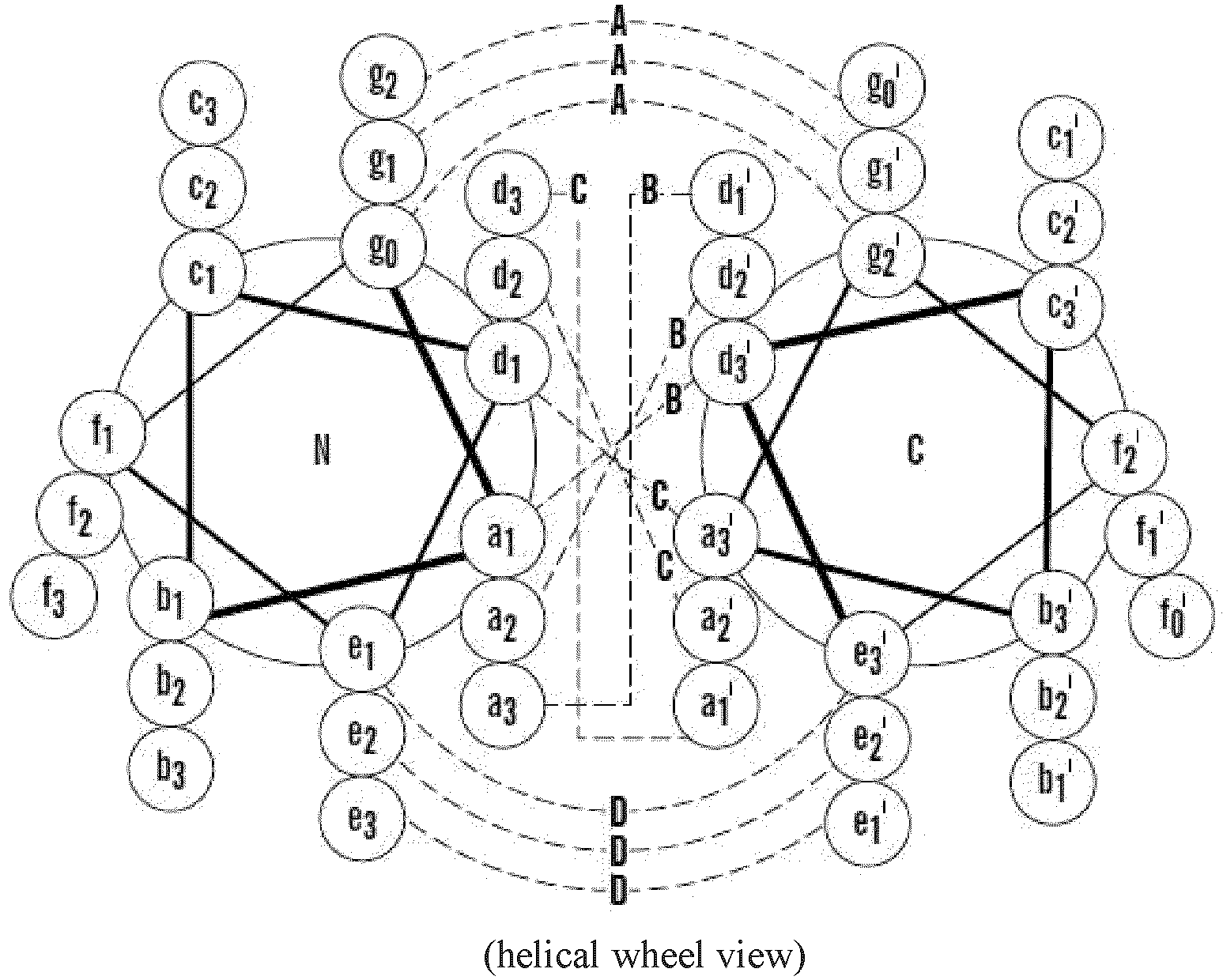 wherein:
 each ○ and each ⊗ is independently absent or a modified or unmodified amino acidresidue, with the proviso that at least seven and up to 21 contiguous amino acid residues are present in each coil, whereina, b, c, d, e, f, g, a', b', c', d', e', f', and g' indicate the location of the amino acid residues within the coiled-coil structure andeach ⊗ amino acid residue is a modified or unmodified amino acid selected from the group consisting of cysteine, homocysteine, selenocysteine, leucine, isoleucine, hexafluoroleucine, valine, hexafluorovaline, allylglycine and threonine;eachis absent or a covalent linker (Linker) between two amino acid residues, wherein:
 each Linker A is independently a linker between a g* amino acid residue and a g'* amino acid residue, wherein the length of the linker is such that the spatial distance between the Cα position of the g* amino acid residue and the Cα position of the g'* amino acid residue is 10-25 Å;each Linker B is independently a linker between an a* amino acid residue and a d'* amino acid residue, wherein the length of the linker is such that the spatial distance between the Cα position of the a* amino acid residue and the Cα position of the d'* amino acid residue is 5-15 Å;each Linker C is independently a linker between a d* amino acid residue and an a'* amino acid residue, wherein the length of the linker is such that the spatial distance between the Cα position of the d* amino acid residue and the Cα position of the a'* amino acid residue is 5-15 Å;each Linker D is independently a linker between an e* amino acid residue and an e'* amino acid residue, wherein the length of the linker is such that the spatial distance between the Cα position of the e* amino acid residue and the Cα position of the e'* amino acid residue is 10-25 Å; andat least one Linker A or Linker D is present and the or each one Linker A or Linker D is independently selected from the group consisting of


 wherein each
 each Linker B and Linker C, when present, is independently selected from the group consisting of alkylene, alkenylene, arylene, heteroarylene, ethers, thioethers, amides, maleimides, esters, disulfides, diselenides, -O-, -S-, -Se-, and any combination thereof;each
 each
each wherein, in ○ and ⊗, when present, g1 is Glu, Leu, Arg, Lys, Thr or Val; a2 is Cys, HCys, Leu, Ile, allylleucine, Val, allylglycine, Thr, selenocysteine, hexafluoroleucine, or hexafluorovaline; b2 is any residue; c2 is His, Tyr, Phe, Lys, Gln, or Trp; d2 is Cys, HCys, Leu, Ile, allylleucine, Val, allylglycine, Thr, selenocysteine, hexafluoroleucine, or hexafluorovaline; e2 is any residue; f2 is Glu, Asn, Trp, Leu, Glu, or Gln; g2 is Leu, Met, Ala, His, or Ser; a3 is Cys, HCys, Leu, Ile, allylleucine, Val, allylglycine, Thr, selenocysteine, hexafluoroleucine, or hexafluorovaline; b3 is any residue; c'1 is Glu, Asn, Leu, Gln, Met, or Ala; d'1 is Cys, HCys, Leu, Ile, allylleucine, Val, allylglycine, Thr, selenocysteine, hexafluoroleucine, or hexafluorovaline; e'1 is any residue; f'1 is any residue; g'1 is Ala, Ser, Thr, Gly, or Asp; a'2 is Cys, HCys, Leu, Ile, allylleucine, Val, allylglycine, Thr, selenocysteine, hexafluoroleucine, or hexafluorovaline; b'2 is Arg, Leu, Gln, Met, Glu, or Asp; c'2 is Tyr, Val, Phe, Trp, or Met; d'2 is Cys, HCys, Leu, Ile, allylleucine, Val, allylglycine, Thr, selenocysteine, hexafluoroleucine, or hexafluorovaline, e'2 is any residue, where any amino acid residue may be modified for attachment of Z, which is a covalent linker (e.g., a bis-triazole linker) between pair g-g' or e2-e'2;or (ii) a parallel coiled-coil structure of formula
 wherein:
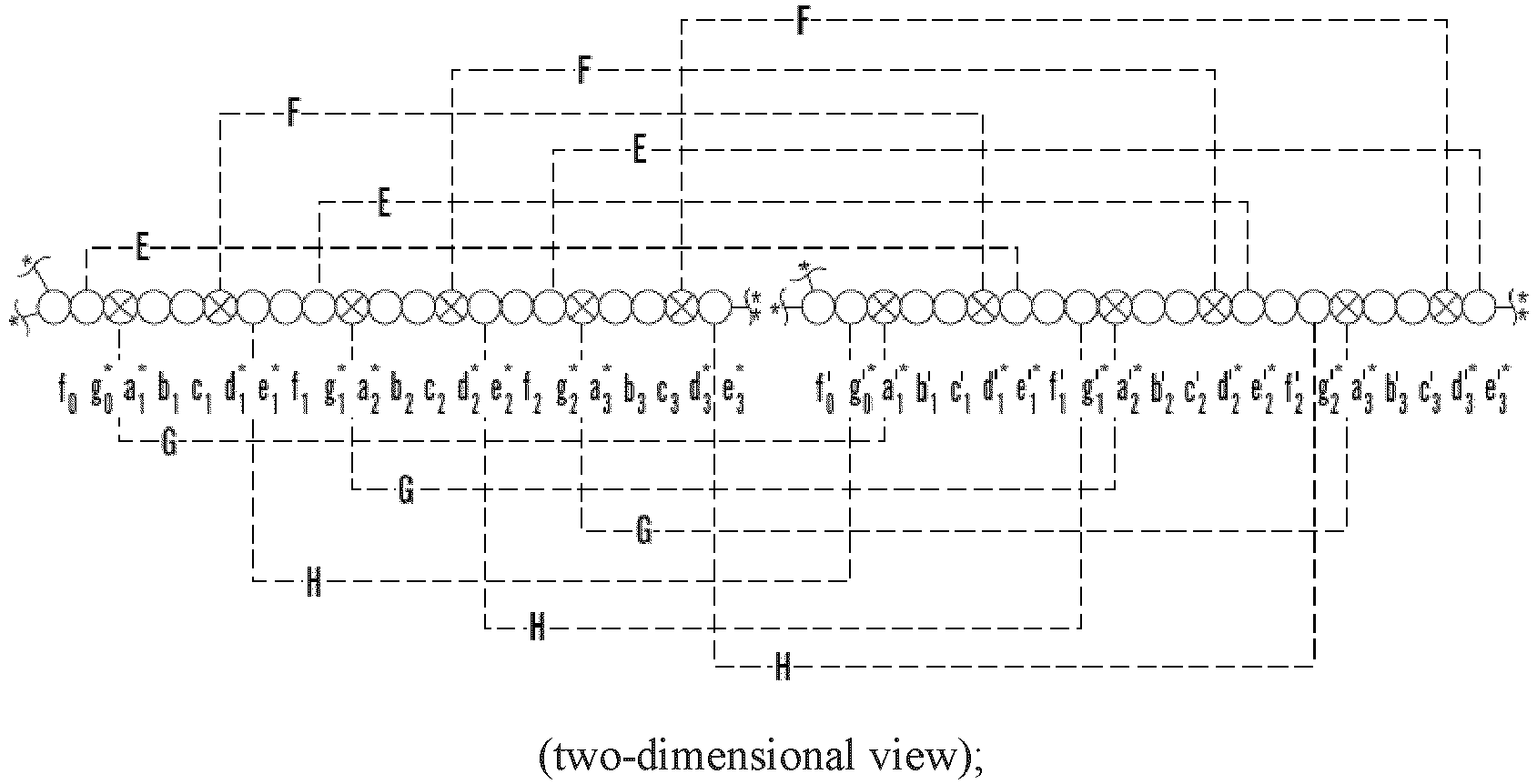 each ○ and each ⊗ is independently absent or a modified or unmodified amino acid residue, with the proviso that at least seven and up to 21 contiguous amino acid residues are present in each coil, whereina, b, c, d, e, f, g, a', b', c', d', e', f', and g' indicate the location of the amino acid residues within the coiled-coil structure andeach ⊗ amino acid residue is a modified or unmodified amino acid selected from the group consisting of cysteine, homocysteine, selenocysteine, leucine, isoleucine, hexafluoroleucine, valine, hexafluorovaline, allylglycine and threonine;eachis absent or a covalent linker (Linker) between two amino acid residues, wherein:each Linker E is independently a linker between a g* amino acid residue and an e'* amino acid residue, wherein the length of the linker is such that the spatial distance between the Cα position of the g* amino acid residue and the Cα position of the e'* amino acid residue is 10-25 Å;each Linker F is independently a linker between a d* amino acid residue and a d'* amino acid residue, wherein the length of the linker is such that the spatial distance between the Cα position of the d* amino acid residue and the Cα position of the d'* amino acid residue is 5-15 Å;each Linker G is independently a linker between an a* amino acid residue and an a'* amino acid residue, wherein the length of the linker is such that the spatial distance between the Cα position of the a* amino acid residue and the Cα position of the a'* amino acid residue is 5-15 Å;each Linker H is independently a linker between an e* amino acid residue and a g'* amino acid residue, wherein the length of the linker is such that the spatial distance between the Cα position of the e* amino acid residue and the Cα position of the g'* amino acid residue is 10-25 Å; andat least one Linker E or Linker H is present and the or each Linker E or Linker H is selected from the group consisting of


 wherein eachmarks a connection point to the Cα carbon in a linked residue;
 each Linker F and Linker G, when presentis independently selected from the group consisting of alkylene, alkenylene, arylene, heteroarylene, ethers, thioethers, amides, maleimides, esters, disulfides, diselenides, -O-, -S-, -Se-, and any combination thereof;each
 is a point of attachment from a terminal nitrogen to H, -PG1, -C(O)R, - C(O)NR2, -C(O)NH2, -R, -C(O)OR, an amino acid, a peptide, a tag, or a targeting moiety, where each R is independently hydrogen, an alkyl, an alkenyl, an alkynyl, a cycloalkyl, an aryl, a heteroaryl, a heterocyclyl, an arylalkyl, a peptide, a targeting moiety, or a tag; and wherein PG1 is a protecting group for protection of an amine; andeach
 is a point of attachment from a terminal carbonyl to H, -OPG2, -NPG2, -OR, - OH, -NR2,-NH2, -NRC(O)C1-6 alkyl, -NHC(O)C1-6 alkyl, an amino acid, a peptide, a tag, or a targeting moiety, where each R is independently hydrogen, an alkyl, an alkenyl, an alkynyl, a cycloalkyl, an aryl, a heteroaryl, a heterocyclyl, an arylalkyl, a peptide, a targeting moiety, or a tag; and wherein PG2 is a protecting group for protection of a carboxylic acid; andwherein, in ○ and ⊗, when present, f0 is any residue; g0 is Trp, Met, Phe, Ala, Glu, or His; a1 is Cys, HCys, Leu, Ile, allylleucine, Val, allylglycine, Thr, selenocysteine, hexafluoroleucine, or hexafluorovaline; b1 is any residue; c1 is Gln, Trp, Leu, Phe, Tyr, or Met; d1 is Cys, HCys, Leu, Ile, allylleucine, Val, allylglycine, Thr, selenocysteine, hexafluoroleucine, or hexafluorovaline; e1 is any residue; f1 is any residue; g1 is any residue; a2 is Cys, HCys, Leu, Ile, allylleucine, Val, allylglycine, Thr, selenocysteine, hexafluoroleucine, or hexafluorovaline; b2 is any residue; c2 is any residue; d2 is Cys, HCys, Leu, Ile, allylleucine, Val, allylglycine, Thr, selenocysteine, hexafluoroleucine, or hexafluorovaline; e2 is any residue; g'0 is any residue; a'1 is Cys, HCys, Leu, Ile, allylleucine, Val, allylglycine, Thr, selenocysteine, hexafluoroleucine, or hexafluorovaline; b'1 is His, Phe, Trp, Tyr, Val, Leu, or Ile; c'1 is any residue; d'1 is Cys, HCys, Leu, Ile, allylleucine, Val, allylglycine, Thr, selenocysteine, hexafluoroleucine, or hexafluorovaline; e'1 is His, Phe, Trp, Tyr, Val, Leu, or Ile, e'1 is any residue; f'1 is any residue; g'1 is any residue; a'2 is Cys, HCys, Leu, Ile, allylleucine, Val, allylglycine, Thr, selenocysteine, hexafluoroleucine, or hexafluorovaline; b'2 Asp, Asn, Glu, Gln, Tyr, Ser, or Thr; c'2 is any residue; d'2 is Cys, HCys, Leu, Ile, allylleucine, Val, allylglycine, Thr, selenocysteine, hexafluoroleucine, or hexafluorovaline, e'2 is His, Phe, Trp, Tyr, Val, Leu, or Ile; f'2 is any residue; where any amino acid residue may be modified for attachment of Z, which is a covalent linker (e.g., a bis-triazole linker) between pair e2-g'1.
 - The macrostructure of claim 1, wherein at least one of Linker B, Linker C, Linker F, and Linker G, when present:(i) is independently selected from the group consisting of disulfides, diselenides, C1-8 alkylene, C2-8 alkenylene, arylene, heteroarylene, triazole-diyl, and thiazole-diyl; for example(ii) is independently a disulfide bond from a cysteine or homocysteine residue, a diselenide from a selenocysteine residue, an alkylene from an allylglycine residue, or an arylene linker.
- The macrostructure of claim 1, wherein one Linker is present or two Linkers are present.
- The macrostructure of claim 1, wherein:(i) (a) at least one Linker A or Linker D is present and at least one Linker B or Linker C is present or (b) at least one Linker E or Linker H is present and at least one Linker F or Linker G is present; or(ii) (a) one Linker A or Linker D is present and one Linker B or Linker C is present or (b) one Linker E or Linker H is present and one Linker F or Linker G is present.
- The macrostructure of claim 1, wherein:(i) the macrostructure comprises an antiparallel coiled-coil structure of Formula III:
 a1*, a2*, a3*, b1, b2, b3, c1, c2, c3, d1*, d2*, d3*, e1*, e2*, e3*, f1, f2, f3, g0*, g1*, g2*, a1'*, a2'*, a3'*, b1', b2', b3', c1', c2', c3', d1'*, d2'*, d3'*, e1'*, e2'*, e3'*, f0', f1', f2', g0'*, g1'*, and g2'* are each independently absent or a modified or unmodified amino acid residue, with the proviso that at least seven contiguous amino acid residues are present in each coil;a1*, a2*, a3*, d1*, d2*, d3*, a1'*, a2'*, a3'*, d1'*, d2'*, and d3'* each independently have the formula (a)
 R1a, R1b, R1c, and R1d are each independently hydrogen, an amino acid side chain, an alkyl, an alkenyl, an alkynyl, a cycloalkyl, a heterocyclyl, an aryl, a heteroaryl, or an arylalkyl, wherein each amino acid side chain, alkyl, alkenyl, alkynyl, cycloalkyl, heterocyclyl, aryl, heteroaryl, and arylalkyl can be optionally substituted with H, an alkyl, an alkenyl, an alkynyl, an azide, -OR5, or -SR5; and at least one of R1a and R1c is a side chain of a modified or unmodified amino acid selected from the group consisting of cysteine, homocysteine, selenocysteine, leucine, isoleucine, hexafluoroleucine, valine, hexafluorovaline, allylglycine and threonine; andwhen a Linker B or a Linker C is attached to the residue of formula (a), the Linker B or Linker C is attached to or replaces one of R1a, R1b, R1c, and R1d;e1*, e2*, e3*, g1*, g2*, e1'*, e2'*, e3'*, g0'*, g1'*, and g2'* each independently have the formula (b) and g0* has the formula (b')
 R2a, R2b, R2c, and R2d are each independently hydrogen, an amino acid side chain, an alkyl, an alkenyl, an alkynyl, a cycloalkyl, a heterocyclyl, an aryl, a heteroaryl, or an arylalkyl, wherein each amino acid side chain, alkyl, alkenyl, alkynyl, cycloalkyl, heterocyclyl, aryl, heteroaryl, and arylalkyl can be optionally substituted with H, an alkyl, an alkenyl, an alkynyl, an azide, -OR5, or -SR5; and at least one of R2a and R2c is an amino acid side chain; andthe or each at least one Linker A or Linker D is attached to a residue of formula (b) and the Linker A or Linker D is attached to or replaces one of R2a, R2b, R2c, and R2d;b1, b2, b3, c1, c2, c3, f1, f2, f3, b1', b2', b3', c1', c2', c3', f1', and f2' each independently have the formula (c) and f0' has the formula (c')
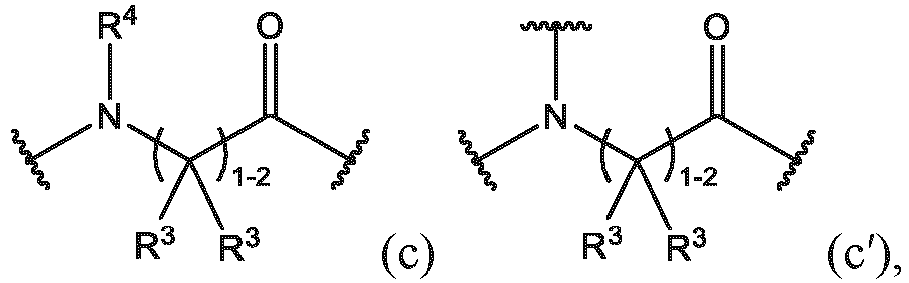 each R4 is independently hydrogen, an alkyl, an alkenyl, an alkynyl, a cycloalkyl, a heterocyclyl, an aryl, a heteroaryl, or an arylalkyl; andeach R5 in Formula III is independently selected from the group consisting of H, -PG (where PG is a protecting group), an alkyl, an alkenyl, an alkynyl, a cycloalkyl, an aryl, a heteroaryl, a heterocyclyl, and an arylalkyl; or(ii) the macrostructure comprises a parallel coiled-coil structure of Formula IV:
 a1*, a2*, a3*, d1*, d2*, d3*, e1*, e2*, e3*, g0*, g1*, g2*, a1'*, a2'*, a3'*, b1', b2', b3', c1', c2', c3', d1'*, d2'*, d3'*, e1'*, e2'*, e3'*, f0', f1', f2', g0'*, g1'*, and g2'* are each independently absent or a modified or unmodified amino acid residue, with the proviso that at least seven contiguous amino acid residues are present in each coil;a1*, a2*, a3*, d1*, d2*, d3*, a1'*, a2'*, a3'*, d1'*, d2'*, and d3'* each independently have the formula (a)
 R1a, R1b, R1c, and R1d are each independently hydrogen, an amino acid side chain, an alkyl, an alkenyl, an alkynyl, a cycloalkyl, a heterocyclyl, an aryl, a heteroaryl, or an arylalkyl, wherein each amino acid side chain, alkyl, alkenyl, alkynyl, cycloalkyl, heterocyclyl, aryl, heteroaryl, and arylalkyl can be optionally substituted with H, an alkyl, an alkenyl, an alkynyl, an azide, -OR5, or -SR5; and at least one of R1a and R1c is a side chain of a modified or unmodified amino acid selected from the group consisting of cysteine, homocysteine, selenocysteine, leucine, isoleucine, hexafluoroleucine, valine, hexafluorovaline, allylglycine and threonine; andwhen a Linker G or a Linker F is attached to the residue of formula (a), the Linker G or Linker F is attached to or replaces one of R1a, R1b, R1c, and R1d;e1*, e2*, e3*, g0*, g1*, g2*, e1'*, e2'*, e3'*, g0'*, g1'*, and g2'* each independently have the formula (b)
 R2a, R2b, R2c, and R2d are each independently hydrogen, an amino acid side chain, an alkyl, an alkenyl, an alkynyl, a cycloalkyl, a heterocyclyl, an aryl, a heteroaryl, or an arylalkyl, wherein each amino acid side chain, alkyl, alkenyl, alkynyl, cycloalkyl, heterocyclyl, aryl, heteroaryl, and arylalkyl can be optionally substituted with H, an alkyl, an alkenyl, an alkynyl, an azide, -OR5, or -SR5; and at least one of R2a and R2c is an amino acid side chain; andthe or each at least one Linker E or Linker H is attached to a residue of formula (b) and the Linker E or Linker H is attached to or replaces one of R2a, R2b, R2c, and R2d;b1, b2, b3, c1, c2, c3, f1, f2, b1', b2', b3', c1', c2', c3', f1', and f2' each independently have the formula (c) and f0 and f0' have the formula (c')
 each R4 is independently hydrogen, an alkyl, an alkenyl, an alkynyl, a cycloalkyl, a heterocyclyl, an aryl, a heteroaryl, or an arylalkyl; andeach R5 is independently selected from the group consisting of H, -PG (where PG is a protecting group), an alkyl, an alkenyl, an alkynyl, a cycloalkyl, an aryl, a heteroaryl, a heterocyclyl, and an arylalkyl.
 - The macrostructure of claim 5, wherein:(i) the macrostructure comprises an antiparallel coiled-coil structure of Formula III and at least one of the following conditions is met:(A) in at least one residue of formula (a), (i) one of R1a and R1c is the side chain of a modified or unmodified amino acid selected from the group consisting of cysteine, homocysteine, selenocysteine, leucine, isoleucine, hexafluoroleucine, valine, hexafluorovaline, allylglycine and threonine, and (ii) R1b, R1d, and the other of R1a and R1c are each independently hydrogen, a C1-3 alkyl, or a C2-3 alkenyl;(B) in at least one residue of formula (b), (i) one of R2a and R2c is an amino acid side chain and (ii) R2b, R2d, and the other of R2a and R2c are each independently hydrogen or a C1-3 alkyl; or(ii) the macrostructure comprises a parallel coiled-coil structure of Formula IV and at least one of the following conditions is met:(A) in at least one residue of formula (a), (i) one of R1a and R1c is the side chain of a modified or unmodified amino acid selected from the group consisting of cysteine, homocysteine, selenocysteine, leucine, isoleucine, hexafluoroleucine, valine, hexafluorovaline, allylglycine and threonine, and (ii) R1b, R1d, and the other of R1a and R1c are each independently hydrogen, a C1-3 alkyl, or a C2-3 alkenyl;(B) in at least one residue of formula (b), (i) one of R2a and R2c is an amino acid side chain and (ii) R2b, R2d, and the other of R2a and R2c are each independently hydrogen or a C1-3 alkyl.
- The macrostructure of claim 1, wherein the macrostructure comprises the antiparallel coiled-coil structure.
- The macrostructure of claim 7, wherein:(i) the first strand of the antiparallel coiled-coil structure comprises at least ten contiguous modified or unmodified amino acid residues, wherein the at least ten contiguous amino acid residues have the formula gX1-X2-X3-X4-X5-X6-X7-X8-X9-X10 b, wherein X1 is Glu, Leu, Arg, Lys, Thr, or Val ; X2 is Cys, HCys, Leu, Ile, allylleucine, Val, allylglycine, Thr, selenocysteine, hexafluoroleucine, or hexafluorovaline ; X3 is any residue; X4 is His, Tyr, Phe, Lys, Gln, or Trp ; X5 is Cys, HCys, Leu, Ile, allylleucine, Val, allylglycine, Thr, selenocysteine, hexafluoroleucine, or hexafluorovaline ; X6 is any residue; X7 is Glu, Asn, Trp, Leu, Glu, or Gln ; X8 is Leu, Met, Ala, His, or Ser ; X9 is Cys, HCys, Leu, Ile, allylleucine, Val, allylglycine, Thr, selenocysteine, hexafluoroleucine, or hexafluorovaline ; and X10 is any residue;(ii) the second strand of the antiparallel coiled-coil structure comprises at least ten contiguous modified or unmodified amino acid residues, wherein the at least ten contiguous amino acid residues have the formula c'X1'-X2'-X3'-X4'-X5'-X6'-X7'-X8'-X9-X10 e', wherein X1' is Glu, Asn, Leu, Gln, Met, or Ala ; X2' is Cys, HCys, Leu, Ile, allylleucine, Val, allylglycine, Thr, selenocysteine, hexafluoroleucine, or hexafluorovaline ; X3' is any residue; X4' is any residue; X5' is Ala, Ser, Thr, Gly, or Asp ; X6' is Cys, HCys, Leu, Ile, allylleucine, Val, allylglycine, Thr, selenocysteine, hexafluoroleucine, or hexafluorovaline ; X7' is Arg, Leu, Gln, Met, Glu, or Asp ; X8' is Tyr, Val, Phe, Trp, or Met; X9' is Cys, HCys, Leu, Ile, allylleucine, Val, allylglycine, Thr, selenocysteine, hexafluoroleucine, or hexafluorovaline ; and X10' is any residue;(iii) g, b, c', and e' indicate where the ten contiguous amino acids appear within the antiparallel coiled-coil structure;(iv) residues in the e/e' and g/g' positions can be optionally modified to facilitate attachment of a Linker or replaced with a Linker, if present; and(v) residues in the a/a' and d/d' positions can be optionally modified to facilitate attachment of a Linker, if present.
- The macrostructure of claim 1, wherein the macrostructure is

 wherein a, b, c, d, e, f, g, a', b', c', d', e', f', and g' indicate the location of the amino acid residues within the coiled-coil structure;E is glutamic acid; I is isoleucine; L is leucine; H is histidine; C is cysteine; Z is azidolysine derived bistriazole linker; R is arginine; S is serine; V is valine; and W is tryptophan.
 - The macrostructure of claim 1, wherein the macrostructure comprises the parallel coiled-coil structure.
- A pharmaceutical composition comprising a macrostructure according to claim 1 and a pharmaceutically acceptable vehicle.
- A macrostructure as described in claim 1, wherein the macrostructure consists of said antiparallel coiled-coil structure (i) or of said parallel coiled-coil structure (ii).
Applications Claiming Priority (3)
| Application Number | Priority Date | Filing Date | Title |
|---|---|---|---|
| US201562172669P | 2015-06-08 | 2015-06-08 | |
| US201562211603P | 2015-08-28 | 2015-08-28 | |
| PCT/US2016/036531 WO2016201007A1 (en) | 2015-06-08 | 2016-06-08 | Stabilized minimal coiled-coil mimetics |
Publications (3)
| Publication Number | Publication Date |
|---|---|
| EP3303367A1 EP3303367A1 (en) | 2018-04-11 |
| EP3303367A4 EP3303367A4 (en) | 2019-01-23 |
| EP3303367B1 true EP3303367B1 (en) | 2025-06-18 |
Family
ID=57504180
Family Applications (1)
| Application Number | Title | Priority Date | Filing Date |
|---|---|---|---|
| EP16808232.9A Active EP3303367B1 (en) | 2015-06-08 | 2016-06-08 | Stabilized minimal coiled-coil mimetics |
Country Status (4)
| Country | Link |
|---|---|
| US (2) | US10851133B2 (en) |
| EP (1) | EP3303367B1 (en) |
| ES (1) | ES3043007T3 (en) |
| WO (1) | WO2016201007A1 (en) |
Families Citing this family (5)
| Publication number | Priority date | Publication date | Assignee | Title |
|---|---|---|---|---|
| ES3043007T3 (en) | 2015-06-08 | 2025-11-24 | Univ New York | Stabilized minimal coiled-coil mimetics |
| US11891422B2 (en) | 2018-11-16 | 2024-02-06 | New York University | NEMO coiled coil mimics and methods of using same |
| US20230279054A1 (en) * | 2020-09-25 | 2023-09-07 | University Of Washington | De novo designed mixed chirality peptide macrocycles with internal symmetry |
| WO2022146865A2 (en) * | 2020-12-28 | 2022-07-07 | New York University | Crosslinked helix dimer mimics of sos and methods of using same |
| WO2024064661A2 (en) * | 2022-09-20 | 2024-03-28 | The Curators Of The University Of Missouri | Amino acid-modified lipids for rna delivery |
Citations (2)
| Publication number | Priority date | Publication date | Assignee | Title |
|---|---|---|---|---|
| WO1999016883A2 (en) * | 1997-10-01 | 1999-04-08 | Dana-Farber Cancer Institute | STABILIZATION OF ENVELOPE GLYCOPROTEIN TRIMERS BY DISULFIDE BONDS INTRODUCED INTO A gp41 GLYCOPROTEIN ECTODOMAIN |
| WO2015067198A1 (en) * | 2013-11-07 | 2015-05-14 | Generon (Shanghai) Corporation Ltd. | Use of il-22 dimers in manufacture of medicaments for treating pancreatitis |
Family Cites Families (1)
| Publication number | Priority date | Publication date | Assignee | Title |
|---|---|---|---|---|
| ES3043007T3 (en) | 2015-06-08 | 2025-11-24 | Univ New York | Stabilized minimal coiled-coil mimetics |
-
2016
- 2016-06-08 ES ES16808232T patent/ES3043007T3/en active Active
- 2016-06-08 EP EP16808232.9A patent/EP3303367B1/en active Active
- 2016-06-08 US US15/580,987 patent/US10851133B2/en active Active
- 2016-06-08 WO PCT/US2016/036531 patent/WO2016201007A1/en not_active Ceased
-
2020
- 2020-08-26 US US17/003,686 patent/US11440938B2/en active Active
Patent Citations (2)
| Publication number | Priority date | Publication date | Assignee | Title |
|---|---|---|---|---|
| WO1999016883A2 (en) * | 1997-10-01 | 1999-04-08 | Dana-Farber Cancer Institute | STABILIZATION OF ENVELOPE GLYCOPROTEIN TRIMERS BY DISULFIDE BONDS INTRODUCED INTO A gp41 GLYCOPROTEIN ECTODOMAIN |
| WO2015067198A1 (en) * | 2013-11-07 | 2015-05-14 | Generon (Shanghai) Corporation Ltd. | Use of il-22 dimers in manufacture of medicaments for treating pancreatitis |
Non-Patent Citations (7)
| Title |
|---|
| CRISTINA CHAMORRO ET AL: "Enhancing membrane disruption by targeting and multivalent presentation of antimicrobial peptides", BIOCHIMICA ET BIOPHYSICA ACTA, ELSEVIER, AMSTERDAM, NL, vol. 1818, no. 9, 9 April 2012 (2012-04-09), pages 2171 - 2174, XP028493209, ISSN: 0005-2736, [retrieved on 20120414], DOI: 10.1016/J.BBAMEM.2012.04.004 * |
| DEL RIZZO P A ET AL: "ATP Synthase b Subunit Dimerization Domain: A Right-Handed Coiled Coil with Offset Helices", JOURNAL OF MOLECULAR BIOLOGY, ACADEMIC PRESS, UNITED KINGDOM, vol. 364, no. 4, 8 December 2006 (2006-12-08), pages 735 - 746, XP024951525, ISSN: 0022-2836, [retrieved on 20061208], DOI: 10.1016/J.JMB.2006.09.028 * |
| HODGES R S: "DE NOVO DESIGN OF ALPHA-HELICAL PROTEINS: BASIC RESEARCH TO MEDICALAPPLICATIONS", BIOCHEMISTRY AND CELL BIOLOGY. BIOCHIMIE ET BIOLOGIE CELLULAIRE, NRC RESEARCH PRESS, CA, vol. 74, no. 2, 1 January 1996 (1996-01-01), pages 133 - 154, XP000605834, ISSN: 0829-8211 * |
| JUSTIN M. HOLUB ET AL: "Tricks with clicks: modification of peptidomimetic oligomers via copper-catalyzed azide-alkyne [3 + 2] cycloaddition", CHEMICAL SOCIETY REVIEWS, vol. 39, no. 4, 4 March 2010 (2010-03-04), UK, pages 1325, XP055507089, ISSN: 0306-0012, DOI: 10.1039/b901977b * |
| O D MONERA ET AL: "Comparison of antiparallel and parallel two-stranded alpha-helical coiled-coils. Design, synthesis, and characterization", THE JOURNAL OF BIOLOGICAL CHEMISTRY, vol. 268, no. 26, 15 September 1993 (1993-09-15), pages 19218 - 19227, XP055724257 * |
| WAGSCHAL K ET AL: "De novo design of a model peptide sequence to examine the effects of single amino acid substitutions in the hydrophobic core on both stability and oligomerization state of coiled-coils", JOURNAL OF MOLECULAR BIOLOGY, ACADEMIC PRESS, UNITED KINGDOM, vol. 285, no. 2, 15 January 1999 (1999-01-15), pages 785 - 803, XP025993470, ISSN: 0022-2836, [retrieved on 19990115], DOI: 10.1006/JMBI.1998.2284 * |
| ZHOU N E ET AL: "Disulfide bond contribution to protein stability: positional effects of substitution in the hydrophobic core of the two-stranded alpha-helical coiled - coil", BIOCHEMISTRY, AMERICAN CHEMICAL SOCIETY, vol. 32, no. 12, 1 March 1993 (1993-03-01), pages 3178 - 3187, XP002097560, ISSN: 0006-2960, DOI: 10.1021/BI00063A033 * |
Also Published As
| Publication number | Publication date |
|---|---|
| EP3303367A4 (en) | 2019-01-23 |
| EP3303367A1 (en) | 2018-04-11 |
| US11440938B2 (en) | 2022-09-13 |
| WO2016201007A1 (en) | 2016-12-15 |
| US10851133B2 (en) | 2020-12-01 |
| US20180162907A1 (en) | 2018-06-14 |
| ES3043007T3 (en) | 2025-11-24 |
| US20210277059A1 (en) | 2021-09-09 |
Similar Documents
| Publication | Publication Date | Title |
|---|---|---|
| US11440938B2 (en) | Stabilized minimal coiled-coil mimetics | |
| AU2018385697B2 (en) | Stabilized peptide-mediated targeted protein degradation | |
| AU2010259278B2 (en) | Melanocortin receptor-specific peptides | |
| US20130123196A1 (en) | Thioether-, ether-, and alkylamine-linked hydrogen bond surrogate peptidomimetics | |
| US11560359B2 (en) | Oxopiperazine helix mimetics for control of hypoxia-inducible gene expression | |
| US11180481B2 (en) | Oxopiperazine helix mimetics as inhibitors of the p53-MDM2 interaction | |
| US20260001924A1 (en) | Nemo coiled coil mimics and methods of using same | |
| US20240124539A1 (en) | Crosslinked helix dimer mimics of sos and methods of using same | |
| Brown | Macrocyclization approaches towards stabilization of secondary and tertiary protein motifs: synthetic studies, applications, and uptake studies | |
| Crystal Chan et al. | Synthesis and Biological Evaluation of Termini-Modified and Cyclic Variants of the Connexin43 Inhibitor Peptide5 | |
| Byerly-Duke et al. | Thioimidate solutions to thioamide problems during peptide synthesis | |
| Zimmeter | Stabilization of alpha helical peptides by guanidine stapling | |
| Ortet | Structurally constrained peptides as protein-protein interaction modulators | |
| Pal et al. | Targeting the NOT9 subunit of the CCR4-NOT complex inhibits mRNA deadenylation | |
| Szantai-Kis | Development of Thioamides as Protein Probes | |
| CA2408885A1 (en) | Vectors for dna delivery | |
| Kazantzis | Solid-phase syntheses and studies of conformationally constrained analogues of the calcitonin gene peptide superfamily polypeptides calcitonin (Ct) and islet amyloid polypeptide (IAPP) |
Legal Events
| Date | Code | Title | Description |
|---|---|---|---|
| STAA | Information on the status of an ep patent application or granted ep patent |
Free format text: STATUS: THE INTERNATIONAL PUBLICATION HAS BEEN MADE |
|
| PUAI | Public reference made under article 153(3) epc to a published international application that has entered the european phase |
Free format text: ORIGINAL CODE: 0009012 |
|
| STAA | Information on the status of an ep patent application or granted ep patent |
Free format text: STATUS: REQUEST FOR EXAMINATION WAS MADE |
|
| 17P | Request for examination filed |
Effective date: 20180104 |
|
| AK | Designated contracting states |
Kind code of ref document: A1 Designated state(s): AL AT BE BG CH CY CZ DE DK EE ES FI FR GB GR HR HU IE IS IT LI LT LU LV MC MK MT NL NO PL PT RO RS SE SI SK SM TR |
|
| AX | Request for extension of the european patent |
Extension state: BA ME |
|
| DAV | Request for validation of the european patent (deleted) | ||
| DAX | Request for extension of the european patent (deleted) | ||
| A4 | Supplementary search report drawn up and despatched |
Effective date: 20190103 |
|
| RIC1 | Information provided on ipc code assigned before grant |
Ipc: G01N 33/53 20060101ALI20181219BHEP Ipc: C07K 14/00 20060101AFI20181219BHEP Ipc: C07K 7/00 20060101ALI20181219BHEP |
|
| STAA | Information on the status of an ep patent application or granted ep patent |
Free format text: STATUS: EXAMINATION IS IN PROGRESS |
|
| 17Q | First examination report despatched |
Effective date: 20200827 |
|
| P01 | Opt-out of the competence of the unified patent court (upc) registered |
Effective date: 20230518 |
|
| GRAP | Despatch of communication of intention to grant a patent |
Free format text: ORIGINAL CODE: EPIDOSNIGR1 |
|
| STAA | Information on the status of an ep patent application or granted ep patent |
Free format text: STATUS: GRANT OF PATENT IS INTENDED |
|
| INTG | Intention to grant announced |
Effective date: 20250107 |
|
| GRAS | Grant fee paid |
Free format text: ORIGINAL CODE: EPIDOSNIGR3 |
|
| GRAA | (expected) grant |
Free format text: ORIGINAL CODE: 0009210 |
|
| STAA | Information on the status of an ep patent application or granted ep patent |
Free format text: STATUS: THE PATENT HAS BEEN GRANTED |
|
| AK | Designated contracting states |
Kind code of ref document: B1 Designated state(s): AL AT BE BG CH CY CZ DE DK EE ES FI FR GB GR HR HU IE IS IT LI LT LU LV MC MK MT NL NO PL PT RO RS SE SI SK SM TR |
|
| REG | Reference to a national code |
Ref country code: GB Ref legal event code: FG4D |
|
| REG | Reference to a national code |
Ref country code: CH Ref legal event code: EP |
|
| REG | Reference to a national code |
Ref country code: DE Ref legal event code: R096 Ref document number: 602016092600 Country of ref document: DE |
|
| REG | Reference to a national code |
Ref country code: CH Ref legal event code: EP |
|
| REG | Reference to a national code |
Ref country code: IE Ref legal event code: FG4D |
|
| PG25 | Lapsed in a contracting state [announced via postgrant information from national office to epo] |
Ref country code: FI Free format text: LAPSE BECAUSE OF FAILURE TO SUBMIT A TRANSLATION OF THE DESCRIPTION OR TO PAY THE FEE WITHIN THE PRESCRIBED TIME-LIMIT Effective date: 20250618 |
|
| REG | Reference to a national code |
Ref country code: LT Ref legal event code: MG9D |
|
| PG25 | Lapsed in a contracting state [announced via postgrant information from national office to epo] |
Ref country code: GR Free format text: LAPSE BECAUSE OF FAILURE TO SUBMIT A TRANSLATION OF THE DESCRIPTION OR TO PAY THE FEE WITHIN THE PRESCRIBED TIME-LIMIT Effective date: 20250919 Ref country code: NO Free format text: LAPSE BECAUSE OF FAILURE TO SUBMIT A TRANSLATION OF THE DESCRIPTION OR TO PAY THE FEE WITHIN THE PRESCRIBED TIME-LIMIT Effective date: 20250918 |
|
| REG | Reference to a national code |
Ref country code: NL Ref legal event code: FP |
|
| PG25 | Lapsed in a contracting state [announced via postgrant information from national office to epo] |
Ref country code: BG Free format text: LAPSE BECAUSE OF FAILURE TO SUBMIT A TRANSLATION OF THE DESCRIPTION OR TO PAY THE FEE WITHIN THE PRESCRIBED TIME-LIMIT Effective date: 20250618 |
|
| PG25 | Lapsed in a contracting state [announced via postgrant information from national office to epo] |
Ref country code: HR Free format text: LAPSE BECAUSE OF FAILURE TO SUBMIT A TRANSLATION OF THE DESCRIPTION OR TO PAY THE FEE WITHIN THE PRESCRIBED TIME-LIMIT Effective date: 20250618 |
|
| PG25 | Lapsed in a contracting state [announced via postgrant information from national office to epo] |
Ref country code: RS Free format text: LAPSE BECAUSE OF FAILURE TO SUBMIT A TRANSLATION OF THE DESCRIPTION OR TO PAY THE FEE WITHIN THE PRESCRIBED TIME-LIMIT Effective date: 20250918 |
|
| PG25 | Lapsed in a contracting state [announced via postgrant information from national office to epo] |
Ref country code: LV Free format text: LAPSE BECAUSE OF FAILURE TO SUBMIT A TRANSLATION OF THE DESCRIPTION OR TO PAY THE FEE WITHIN THE PRESCRIBED TIME-LIMIT Effective date: 20250618 |
|
| REG | Reference to a national code |
Ref country code: ES Ref legal event code: FG2A Ref document number: 3043007 Country of ref document: ES Kind code of ref document: T3 Effective date: 20251124 |
|
| PG25 | Lapsed in a contracting state [announced via postgrant information from national office to epo] |
Ref country code: PT Free format text: LAPSE BECAUSE OF FAILURE TO SUBMIT A TRANSLATION OF THE DESCRIPTION OR TO PAY THE FEE WITHIN THE PRESCRIBED TIME-LIMIT Effective date: 20251020 |
|
| REG | Reference to a national code |
Ref country code: AT Ref legal event code: MK05 Ref document number: 1804116 Country of ref document: AT Kind code of ref document: T Effective date: 20250618 |
|
| PG25 | Lapsed in a contracting state [announced via postgrant information from national office to epo] |
Ref country code: IS Free format text: LAPSE BECAUSE OF FAILURE TO SUBMIT A TRANSLATION OF THE DESCRIPTION OR TO PAY THE FEE WITHIN THE PRESCRIBED TIME-LIMIT Effective date: 20251018 |
|
| PG25 | Lapsed in a contracting state [announced via postgrant information from national office to epo] |
Ref country code: AT Free format text: LAPSE BECAUSE OF FAILURE TO SUBMIT A TRANSLATION OF THE DESCRIPTION OR TO PAY THE FEE WITHIN THE PRESCRIBED TIME-LIMIT Effective date: 20250618 Ref country code: SM Free format text: LAPSE BECAUSE OF FAILURE TO SUBMIT A TRANSLATION OF THE DESCRIPTION OR TO PAY THE FEE WITHIN THE PRESCRIBED TIME-LIMIT Effective date: 20250618 |
|
| PG25 | Lapsed in a contracting state [announced via postgrant information from national office to epo] |
Ref country code: CZ Free format text: LAPSE BECAUSE OF FAILURE TO SUBMIT A TRANSLATION OF THE DESCRIPTION OR TO PAY THE FEE WITHIN THE PRESCRIBED TIME-LIMIT Effective date: 20250618 |
|
| PG25 | Lapsed in a contracting state [announced via postgrant information from national office to epo] |
Ref country code: PL Free format text: LAPSE BECAUSE OF FAILURE TO SUBMIT A TRANSLATION OF THE DESCRIPTION OR TO PAY THE FEE WITHIN THE PRESCRIBED TIME-LIMIT Effective date: 20250618 |
|
| PG25 | Lapsed in a contracting state [announced via postgrant information from national office to epo] |
Ref country code: EE Free format text: LAPSE BECAUSE OF FAILURE TO SUBMIT A TRANSLATION OF THE DESCRIPTION OR TO PAY THE FEE WITHIN THE PRESCRIBED TIME-LIMIT Effective date: 20250618 |
|
| PG25 | Lapsed in a contracting state [announced via postgrant information from national office to epo] |
Ref country code: SK Free format text: LAPSE BECAUSE OF FAILURE TO SUBMIT A TRANSLATION OF THE DESCRIPTION OR TO PAY THE FEE WITHIN THE PRESCRIBED TIME-LIMIT Effective date: 20250618 Ref country code: RO Free format text: LAPSE BECAUSE OF FAILURE TO SUBMIT A TRANSLATION OF THE DESCRIPTION OR TO PAY THE FEE WITHIN THE PRESCRIBED TIME-LIMIT Effective date: 20250618 |
|
| REG | Reference to a national code |
Ref country code: DE Ref legal event code: R097 Ref document number: 602016092600 Country of ref document: DE |
|
| PG25 | Lapsed in a contracting state [announced via postgrant information from national office to epo] |
Ref country code: DK Free format text: LAPSE BECAUSE OF FAILURE TO SUBMIT A TRANSLATION OF THE DESCRIPTION OR TO PAY THE FEE WITHIN THE PRESCRIBED TIME-LIMIT Effective date: 20250618 |
|
| PLBE | No opposition filed within time limit |
Free format text: ORIGINAL CODE: 0009261 |
|
| STAA | Information on the status of an ep patent application or granted ep patent |
Free format text: STATUS: NO OPPOSITION FILED WITHIN TIME LIMIT |
|
| REG | Reference to a national code |
Ref country code: CH Ref legal event code: L10 Free format text: ST27 STATUS EVENT CODE: U-0-0-L10-L00 (AS PROVIDED BY THE NATIONAL OFFICE) Effective date: 20260430 |