EP3303349B1 - Novel heteroaromatic silicon-fluoride-acceptors useful for 18f labeling of molecules and biomolecules, and methods of preparing same - Google Patents
Novel heteroaromatic silicon-fluoride-acceptors useful for 18f labeling of molecules and biomolecules, and methods of preparing same Download PDFInfo
- Publication number
- EP3303349B1 EP3303349B1 EP16800638.5A EP16800638A EP3303349B1 EP 3303349 B1 EP3303349 B1 EP 3303349B1 EP 16800638 A EP16800638 A EP 16800638A EP 3303349 B1 EP3303349 B1 EP 3303349B1
- Authority
- EP
- European Patent Office
- Prior art keywords
- substituted
- group
- compound
- alkyl
- triazolyl
- Prior art date
- Legal status (The legal status is an assumption and is not a legal conclusion. Google has not performed a legal analysis and makes no representation as to the accuracy of the status listed.)
- Active
Links
Images


Classifications
-
- C—CHEMISTRY; METALLURGY
- C07—ORGANIC CHEMISTRY
- C07F—ACYCLIC, CARBOCYCLIC OR HETEROCYCLIC COMPOUNDS CONTAINING ELEMENTS OTHER THAN CARBON, HYDROGEN, HALOGEN, OXYGEN, NITROGEN, SULFUR, SELENIUM OR TELLURIUM
- C07F7/00—Compounds containing elements of Groups 4 or 14 of the Periodic Table
- C07F7/02—Silicon compounds
- C07F7/08—Compounds having one or more C—Si linkages
- C07F7/12—Organo silicon halides
-
- A—HUMAN NECESSITIES
- A61—MEDICAL OR VETERINARY SCIENCE; HYGIENE
- A61K—PREPARATIONS FOR MEDICAL, DENTAL OR TOILETRY PURPOSES
- A61K51/00—Preparations containing radioactive substances for use in therapy or testing in vivo
- A61K51/02—Preparations containing radioactive substances for use in therapy or testing in vivo characterised by the carrier, i.e. characterised by the agent or material covalently linked or complexing the radioactive nucleus
- A61K51/04—Organic compounds
- A61K51/08—Peptides, e.g. proteins, carriers being peptides, polyamino acids, proteins
- A61K51/10—Antibodies or immunoglobulins; Fragments thereof, the carrier being an antibody, an immunoglobulin or a fragment thereof, e.g. a camelised human single domain antibody or the Fc fragment of an antibody
- A61K51/1027—Antibodies or immunoglobulins; Fragments thereof, the carrier being an antibody, an immunoglobulin or a fragment thereof, e.g. a camelised human single domain antibody or the Fc fragment of an antibody against receptors, cell-surface antigens or cell-surface determinants
-
- A—HUMAN NECESSITIES
- A61—MEDICAL OR VETERINARY SCIENCE; HYGIENE
- A61K—PREPARATIONS FOR MEDICAL, DENTAL OR TOILETRY PURPOSES
- A61K51/00—Preparations containing radioactive substances for use in therapy or testing in vivo
- A61K51/02—Preparations containing radioactive substances for use in therapy or testing in vivo characterised by the carrier, i.e. characterised by the agent or material covalently linked or complexing the radioactive nucleus
- A61K51/04—Organic compounds
- A61K51/08—Peptides, e.g. proteins, carriers being peptides, polyamino acids, proteins
- A61K51/10—Antibodies or immunoglobulins; Fragments thereof, the carrier being an antibody, an immunoglobulin or a fragment thereof, e.g. a camelised human single domain antibody or the Fc fragment of an antibody
- A61K51/1045—Antibodies or immunoglobulins; Fragments thereof, the carrier being an antibody, an immunoglobulin or a fragment thereof, e.g. a camelised human single domain antibody or the Fc fragment of an antibody against animal or human tumor cells or tumor cell determinants
- A61K51/1072—Antibodies or immunoglobulins; Fragments thereof, the carrier being an antibody, an immunoglobulin or a fragment thereof, e.g. a camelised human single domain antibody or the Fc fragment of an antibody against animal or human tumor cells or tumor cell determinants the tumor cell being from the reproductive system, e.g. ovaria, uterus, testes or prostate
-
- C—CHEMISTRY; METALLURGY
- C07—ORGANIC CHEMISTRY
- C07B—GENERAL METHODS OF ORGANIC CHEMISTRY; APPARATUS THEREFOR
- C07B59/00—Introduction of isotopes of elements into organic compounds ; Labelled organic compounds per se
- C07B59/004—Acyclic, carbocyclic or heterocyclic compounds containing elements other than carbon, hydrogen, halogen, oxygen, nitrogen, sulfur, selenium or tellurium
-
- C—CHEMISTRY; METALLURGY
- C07—ORGANIC CHEMISTRY
- C07B—GENERAL METHODS OF ORGANIC CHEMISTRY; APPARATUS THEREFOR
- C07B2200/00—Indexing scheme relating to specific properties of organic compounds
- C07B2200/05—Isotopically modified compounds, e.g. labelled
Definitions
- SiFAs Silicon fluoride acceptors
- PET positron emission tomography
- IEX 18 F- 19 F isotopic exchange reaction
- SiFA-based PET probes has been hampered by their high intrinsic lipophilicity, originating from bulky tert -butyl groups required for in vivo stabilization of the Si- 18 F bond.
- the problems associated with currently known SiFA-imaging probes in preclinical investigations are poor in vivo stability and unfavorable pharmacokinetic behavior.
- WO2008/040441 discloses silicon substituted target compounds suitable for or already radiolabeled with 18 F, method for making such compounds and use of such compounds for diagnostic imaging.
- the present invention relates to a compound of Formula 1: wherein in Formula 1 is in accordance with claim 1.
- Optional features of the compound of Formula 1 are provided in the dependent claims.
- a 1 is selected from the group consisting of indole, 7-azaindole, benzothiophene, furan, pyrrole, pyrazole, imidazole, and pyridine.
- R 1 and R 2 are tert-butyl groups.
- a 1 is selected from the group consisting of indole, 7-azaindole, benzothiophene, furan, pyrrole, pyrazole, imidazole, and pyridine, and R 1 and R 2 are tert-butyl groups.
- the compound is selected from the group consisting of:
- the compound is selected from the group consisting of:
- the present invention also relates to a compound of Formula 4: wherein in Formula 4 is as defined in claim 5.
- a 1 is selected from the group consisting of indole, 7-azaindole, benzothiophene, furan, pyrrole, pyrazole, imidazole, and pyridine.
- R 1 and R 2 are tert-butyl groups.
- a 1 is selected from the group consisting of indole, 7-azaindole, benzothiophene, furan, pyrrole, pyrazole, imidazole, and pyridine, and R 1 and R 2 are tert-butyl groups.
- a 2 includes at least one of an unsubstituted alkylene, an unsubstituted polyethylene glycol (PEG), or a bisubstituted triazole.
- a 3 is selected from the group consisting of an NHS ester, a maleimide, an amide, and a maleimide-thiol adduct.
- the invention also relates to an imaging agent comprising the compound of Formula 1 for use in imaging a biological target by PET scanning as claimed in claim 11.
- the imaging agent is obtained by site-selective chemical conjugation of the ligand with the compound. Conjugation occurs via a thiol group. and maleimide adduct.
- the present invention also relates to a kit for 18 F-labeling of a compound of Formula 1 or Formula 4, the kit includes a compound of Formula 1 or Formula 4 in which F is 19 F, an 18 F isotopic exchange reagent and an instruction manual for the use thereof.
- the aromatic heterocycles included are derivatives of indole, 7-azaindole, benzothiophene, furan, pyrrole, pyrazole, imidazole and pyridine.
- the invention provides heteroaromatic silicon-fluoride-acceptors. In one embodiment, the invention provides 18 F-labeled compounds derived from SiFAs.
- the precursors for SiFAs are synthetically accessible by a methodology using potassium tert-butoxide as a catalyst for the silylation of C-H bonds in aromatic heterocycles, methodology described by Toutov et al., Nature, 2015, 518:80-84 .
- the invention provides use of the compounds for 18 F-radiolabeling of SiFAs by isotopic exchange.
- the isotopic exchange is performed on various platforms including a commercial radiosynthesizer (ELYXIS, Sofie Biosciences), an in-house developed microfluidic Teflon ® -coated chip, and a manual procedure in a sealed glass vial.
- ELYXIS commercial radiosynthesizer
- Sofie Biosciences Sofie Biosciences
- microfluidic Teflon ® -coated chip an in-house developed microfluidic Teflon ® -coated chip
- the invention provides a kit for 18 F-radiolabeling of SiFAs by isotopic exchange.
- the language "pharmaceutically acceptable salt” refers to a salt of the administered compounds prepared from pharmaceutically acceptable non-toxic acids, including inorganic acids, organic acids, solvates, hydrates, or clathrates thereof.
- inorganic acids are hydrochloric, hydrobromic, hydroiodic, nitric, sulfuric, phosphoric, acetic, hexafluorophosphoric, citric, gluconic, benzoic, propionic, butyric, sulfosalicylic, maleic, lauric, malic, fumaric, succinic, tartaric, amsonic, pamoic, p-tolunenesulfonic, and mesylic.
- organic acids may be selected, for example, from aliphatic, aromatic, carboxylic and sulfonic classes of organic acids, examples of which are formic, acetic, propionic, succinic, camphorsulfonic, citric, fumaric, gluconic, isethionic, lactic, malic, mucic, tartaric, para-toluenesulfonic, glycolic, glucuronic, maleic, furoic, glutamic, benzoic, anthranilic, salicylic, phenylacetic, mandelic, embonic (pamoic), methanesulfonic, ethanesulfonic, pantothenic, benzenesulfonic (besylate), stearic, sulfanilic, alginic, galacturonic, and the like.
- pharmaceutically acceptable salts include, by way of non-limiting example, alkaline earth metal salts (e.g., calcium or magnesium), alkali metal salt
- Up to two heteroatoms may be consecutive, such as, for example, -CH 2 -NH-OCH 3 , or -CH 2 -CH 2 -S-S-CH 3 .
- An example of a 3-membered heterocycloalkyl group includes, and is not limited to, aziridine.
- 4-membered heterocycloalkyl groups include, and are not limited to, azetidine and a beta lactam.
- 5-membered heterocycloalkyl groups include, and are not limited to, pyrrolidine, oxazolidine and thiazolidinedione.
- 6-membered heterocycloalkyl groups include, and are not limited to, piperidine, morpholine and piperazine.
- Other non-limiting examples of heterocycloalkyl groups are:
- non-aromatic heterocycles include monocyclic groups such as aziridine, oxirane, thiirane, azetidine, oxetane, thietane, pyrrolidine, pyrroline, pyrazolidine, imidazoline, dioxolane, sulfolane, 2,3-dihydrofuran, 2,5-dihydrofuran, tetrahydrofuran, thiophane, piperidine, 1,2,3,6-tetrahydropyridine, 1,4-dihydropyridine, piperazine, morpholine, thiomorpholine, pyran, 2,3-dihydropyran, tetrahydropyran, 1,4-dioxane, 1,3-dioxane, homopiperazine, homopiperidine, 1,3-dioxepane, 4,7-dihydro-1,3-dioxepin, and hexamethyleneoxide
- aromatic refers to a carbocycle or heterocycle with one or more polyunsaturated rings and having aromatic character, i.e. having (4n + 2) delocalized ⁇ (pi) electrons, where n is an integer.
- aryl employed alone or in combination with other terms, means, unless otherwise stated, a carbocyclic aromatic system containing one or more rings (typically one, two or three rings), wherein such rings may be attached together in a pendent manner, such as a biphenyl, or may be fused, such as naphthalene.
- aryl groups include phenyl, anthracyl, and naphthyl.
- aryl-(C 1 -C 3 )alkyl means a functional group wherein a one- to three-carbon alkylene chain is attached to an aryl group, e.g., -CH 2 CH 2 -phenyl. Preferred is aryl-CH 2 - and aryl-CH(CH 3 )-.
- substituted aryl-(C 1 -C 3 )alkyl means an aryl-(C 1 -C 3 )alkyl functional group in which the aryl group is substituted. Preferred is substituted aryl(CH 2 )-.
- heteroaryl-(C 1 -C 3 )alkyl means a functional group wherein a one to three carbon alkylene chain is attached to a heteroaryl group, e.g., -CH 2 CH 2 -pyridyl.
- the heteroaryl-(C 1 -C 3 )alkyl is heteroaryl-(CH 2 )-.
- substituted heteroaryl-(C 1 -C 3 )alkyl means a heteroaryl-(C 1 -C 3 )alkyl functional group in which the heteroaryl group is substituted.
- the substituted heteroaryl-(C 1 -C 3 )alkyl is substituted heteroaryl-(CH 2 )-.
- heteroaryl or “heteroaromatic” refers to a heterocycle having aromatic character.
- a polycyclic heteroaryl may include one or more rings that are partially saturated. Examples include the following moieties:
- heteroaryl groups also include pyridyl, pyrazinyl, pyrimidinyl (particularly 2- and 4-pyrimidinyl), pyridazinyl, thienyl, furyl, pyrrolyl (particularly 2-pyrrolyl), imidazolyl, thiazolyl, oxazolyl, pyrazolyl (particularly 3- and 5-pyrazolyl), isothiazolyl, 1,2,3-triazolyl, 1,2,4-triazolyl, 1,3,4-triazolyl, tetrazolyl, 1,2,3-thiadiazolyl, 1,2,3-oxadiazolyl, 1,3,4-thiadiazolyl and 1,3,4-oxadiazolyl.
- polycyclic heterocycles and heteroaryls examples include indolyl (particularly 3-, 4-, 5-, 6- and 7-indolyl), indolinyl, quinolyl, tetrahydroquinolyl, isoquinolyl (particularly 1- and 5-isoquinolyl), 1,2,3,4-tetrahydroisoquinolyl, cinnolinyl, quinoxalinyl (particularly 2- and 5-quinoxalinyl), quinazolinyl, phthalazinyl, 1,8-naphthyridinyl, 1,4-benzodioxanyl, coumarin, dihydrocoumarin, 1,5-naphthyridinyl, benzofuryl (particularly 3-, 4-, 5-, 6- and 7-benzofuryl), 2,3-dihydrobenzofuryl, 1,2-benzisoxazolyl, benzothienyl (particularly 3-, 4-, 5-, 6-, and 7-benzothienyl), benzoxazoly
- substituted means that an atom or group of atoms has replaced hydrogen as the substituent attached to another group.
- substituted further refers to any level of substitution, namely mono-, di-, tri-, tetra-, or penta-substitution, where such substitution is permitted.
- the substituents are independently selected, and substitution may be at any chemically accessible position. In one embodiment, the substituents vary in number between one and four. In another embodiment, the substituents vary in number between one and three. In yet another embodiment, the substituents vary in number between one and two.
- the term "optionally substituted” means that the referenced group may be substituted or unsubstituted. In one embodiment, the referenced group is optionally substituted with zero substituents, i.e., the referenced group is unsubstituted. In another embodiment, the referenced group is optionally substituted with one or more additional group(s) individually and independently selected from groups described herein.
- the substituents are independently selected from the group consisting of C 1-6 alkyl, -OH, C 1-6 alkoxy, halo, amino, acetamido, oxo and nitro. In yet another embodiment, the substituents are independently selected from the group consisting of C 16 alkyl, C 16 alkoxy, halo, acetamido, and nitro. As used herein, where a substituent is an alkyl or alkoxy group, the carbon chain may be branched, straight or cyclic, with straight being preferred.
- PEG-chains, polar groups, charges are needed Due to charged pyridine-moiety no or less additional polar auxiliaries are needed No additional steric hindrance provided on phenyl N -methyl group on pyrrole-moiety additionally increases steric hindrance Phenyl moiety weakly decreases Lewis acidity on silicon Electron rich pyrrole moiety strongly decreases Lewis acidity on silicon
- the heteroaromatic ring A 1 is selected from the group consisting of indole, azaindole, 7-azaindole, benzothiophene, furan, pyrrole, pyrazole, imidazole, and pyridine.
- R 1 and R 2 are each independently selected from the group consisting of methyl, ethyl, propyl, isopropyl, and tert-butyl. In one embodiment, R 1 and R 2 are tert-butyl groups.
- a 3 is selected from the group consisting of an N-hydroxysuccinimide (NHS) ester, a maleimide, an amide, and a maleimide-thiol adduct.
- a PEG-spacer is added for additional polarity.
- a 4 is a carboxylic acid.
- a 5 is an engineered antibody fragment.
- a 5 is an anti-PSCA A2 cys-diabody.
- heteroaromatic silicon-fluoride-acceptors of the invention are highlighted in Tables 2 and 3 (the name indicates the corresponding heteroaromatic ring, and the substitution site indicates, without limitation, potential connectivity sites for a linker, and/or any other ancillary group): Table 2 indole 7-azaindole benzothiophene furan pyrrole pyrazole imidazole pyridine
- the compounds of the invention may possess one or more stereocenters, and each stereocenter may exist independently in either the R or S configuration.
- compounds described herein are present in optically active or racemic forms. It is to be understood that the compounds described herein encompass racemic, optically-active, regioisomeric and stereoisomeric forms, or combinations thereof that possess the therapeutically useful properties described herein. Preparation of optically active forms is achieved in any suitable manner, including by way of non-limiting example, by resolution of the racemic form with recrystallization techniques, synthesis from optically-active starting materials, chiral synthesis, or chromatographic separation using a chiral stationary phase. In one embodiment, a mixture of one or more isomer is utilized as the therapeutic compound described herein.
- compounds described herein contain one or more chiral centers. These compounds are prepared by any means, including stereoselective synthesis, enantioselective synthesis and/or separation of a mixture of enantiomers and/ or diastereomers. Resolution of compounds and isomers thereof is achieved by any means including, by way of non-limiting example, chemical processes, enzymatic processes, fractional crystallization, distillation, and chromatography.
- the methods and formulations described herein include the use of N-oxides (if appropriate), crystalline forms (also known as polymorphs), solvates, amorphous phases, and/or pharmaceutically acceptable salts of compounds having the structure of any compound of the invention, as well as metabolites and active metabolites of these compounds having the same type of activity.
- Solvates include water, ether (e.g., tetrahydrofuran, methyl tert-butyl ether) or alcohol (e.g., ethanol) solvates, acetates and the like.
- the compounds described herein exist in solvated forms with pharmaceutically acceptable solvents such as water, and ethanol.
- the compounds described herein exist in unsolvated form.
- the compounds of the invention may exist as tautomers. All tautomers are included within the scope of the compounds presented herein.
- Carboxylic acid and hydroxy reactive moieties are blocked with base labile groups such as, but not limited to, methyl, ethyl, and acetyl, in the presence of amines that are blocked with acid labile groups, such as t-butyl carbamate, or with carbamates that are both acid and base stable but hydrolytically removable.
- base labile groups such as, but not limited to, methyl, ethyl, and acetyl
- carboxylic acid and hydroxy reactive moieties are blocked with hydrolytically removable protective groups such as the benzyl group, while amine groups capable of hydrogen bonding with acids are blocked with base labile groups such as Fmoc.
- Carboxylic acid reactive moieties are protected by conversion to simple ester compounds as exemplified herein, which include conversion to alkyl esters, or are blocked with oxidatively-removable protective groups such as 2,4-dimethoxybenzyl, while co-existing amino groups are blocked with fluoride labile silyl carbamates.
- Allyl blocking groups are useful in the presence of acid- and base- protecting groups since the former are stable and are subsequently removed by metal or pi-acid catalysts.
- an allyl-blocked carboxylic acid is deprotected with a palladium-catalyzed reaction in the presence of acid labile t-butyl carbamate or base-labile acetate amine protecting groups.
- Yet another form of protecting group is a resin to which a compound or intermediate is attached. As long as the residue is attached to the resin, that functional group is blocked and does not react. Once released from the resin, the functional group is available to react.
- blocking/protecting groups may be selected from:
- a method of synthesis of heteroaromatic Silicon-Fluoride-Acceptors is described.
- the precursors for SiFAs may be synthetically accessible by a methodology using potassium tert-butoxide as a catalyst for the silylation of C-H bonds in aromatic heterocycles, methodology described by Toutov et al., Nature, 2015, 518:80-84 .
- Scheme 1 depicts an exemplary method for the synthesis of SiFAs. Accordingly, a heteroaromatic compound can be first treated with a catalytic amount of potassium tert-butoxide, and then reacted with di-tert-butyl silane, to afford an intermediate heteroarylsilane. The intermediate is thereafter reacted with potassium fluoride in the presence of a crown ether, to afford a 19 F-SiFA compound of the current invention.
- Compounds described herein include isotopically-labeled compounds wherein one or more atoms is replaced by an atom having the same atomic number, but an atomic mass or mass number different from the atomic mass or mass number usually found in nature.
- isotopes suitable for inclusion in the compounds described herein include and are not limited to 2 H, 3 H, 11 C, 13 C, 14 C, 36 Cl , 18 F, 123 I, 125 I, 13 N, 15 N, 15 O, 17 O, 18 O, 32 P, and 35 S.
- isotopically-labeled compounds are useful in drug and/or substrate tissue distribution studies.
- Scheme 2 depicts an exemplary method of performing the 19 F to 18 F isotopic exchange. Accordingly, a 19 F-SiFA compound of the current invention can be exchanged with an 18 F-fluoride, to afford an 18 F-compound of the current invention.
- Purification of the labeled compound can be performed using any method known in the art.
- purification of the final labeling product is achieved by a cartridge purification (C18 or alumina).
Landscapes
- Health & Medical Sciences (AREA)
- Chemical & Material Sciences (AREA)
- Life Sciences & Earth Sciences (AREA)
- Organic Chemistry (AREA)
- Proteomics, Peptides & Aminoacids (AREA)
- Animal Behavior & Ethology (AREA)
- Public Health (AREA)
- Optics & Photonics (AREA)
- Pharmacology & Pharmacy (AREA)
- Epidemiology (AREA)
- Physics & Mathematics (AREA)
- General Health & Medical Sciences (AREA)
- Medicinal Chemistry (AREA)
- Veterinary Medicine (AREA)
- Immunology (AREA)
- Oncology (AREA)
- Cell Biology (AREA)
- Reproductive Health (AREA)
- Medicines Containing Antibodies Or Antigens For Use As Internal Diagnostic Agents (AREA)
- Plural Heterocyclic Compounds (AREA)
- Organic Low-Molecular-Weight Compounds And Preparation Thereof (AREA)
Description
- The most common 18F-labeling method for biomolecules to date, utilizes 18F-SFB, a radiolabeled prosthetic group that reacts with the ε-amino group of surface-exposed lysine residues (Liu et al., 2011, Mol. Imaging 10:168; Cai et al., 2007, J. Nucl. Med. 48:304; Olafsen et al., 2012, Tumor Biol. 33:669). In addition, site-specific conjugation using 4-18F-fluorobenzaldehyde (18F-FBA) has also been demonstrated (Cheng et al., 2008, J. Nucl. Med. 49:804). While 18F-SFB has been successfully used to generated 18F-labeled proteins and peptides, labeling with 18F-SFB is far from ideal; in addition to its unselective conjugation, its 3-step synthesis and subsequent protein conjugation results in very poor decay-corrected radiochemical yields of 1.4 - 2.5%.
- Silicon fluoride acceptors (SiFAs) are under study as new imaging agents useful for positron emission tomography (PET; Wängler et al., 2012, Appl. Sci., 2:277-302). They can be labeled with the radioisotope flourine-18 via a fast and mild 18F-19F isotopic exchange reaction (IEX; Kostikov et al., 2012, Nature Protocols, 7:1956-1963). However, the application of SiFA-based PET probes has been hampered by their high intrinsic lipophilicity, originating from bulky tert-butyl groups required for in vivo stabilization of the Si-18F bond. The problems associated with currently known SiFA-imaging probes in preclinical investigations are poor in vivo stability and unfavorable pharmacokinetic behavior.
-
WO2008/040441 discloses silicon substituted target compounds suitable for or already radiolabeled with 18F, method for making such compounds and use of such compounds for diagnostic imaging. - There is a need in the art for novel precursors for 18F-labeled compounds, novel 18F-labeled compounds, and methods for preparing and using thereof. The present invention addresses this unmet need.
- The present invention relates to a compound of Formula 1:

- In one embodiment, A1 is selected from the group consisting of indole, 7-azaindole, benzothiophene, furan, pyrrole, pyrazole, imidazole, and pyridine. In another embodiment, R1 and R2 are tert-butyl groups. In another embodiment, A1 is selected from the group consisting of indole, 7-azaindole, benzothiophene, furan, pyrrole, pyrazole, imidazole, and pyridine, and R1 and R2 are tert-butyl groups. In another embodiment, the compound is selected from the group consisting of:


- In another embodiment, the compound is selected from the group consisting of:


- Described but not claimed is a compound of Formula 2:

- F is selected from the group consisting of 19F and 18F;
- A1 is a monocyclic or bicyclic heteroaryl ring optionally substituted with 0-4 Ra groups;
- A2 is a linker;
- A3 is a moiety capable of chemical conjugation or bioconjugation;
- A4 is a moiety comprising a polar auxiliary that may optionally contain a charge;
- Ra is selected, at each independent occurrence, from the group consisting of null, H, F, Cl, Br, I, CN, NO2, ORc, OC(=O)Rc, OC(=O)ORc, OC(=O)NRcRd, CRcRd, CORc, C(=O)Rc, C(=O)NRcRd, C(=O)ORc, NRcRd, NRcC(=O)Rd, NRcC(=O)ORd, NRcC(=O)NRdRe, NRcS(=O)2Rd, NRcS(=O)2NRdRe, SRc, S(=O)Rc, S(=O)2Rc, and S(=O)2NRcRd, C1-6 alkyl, C1-6 haloalkyl, C2-6 alkenyl, C2-6 alkynyl, aryl, cycloalkyl, heteroaryl, heterocycloalkyl, arylalkyl, heteroarylalkyl, cycloalkylalkyl, and heterocycloalkylalkyl, wherein each of the C1-6 alkyl, C1-6 haloalkyl, C2-6 alkenyl, C2-6 alkynyl, aryl, cycloalkyl, heteroaryl, heterocycloalkyl, arylalkyl, heteroarylalkyl, cycloalkylalkyl, and heterocycloalkylalkyl is optionally substituted by 1, 2, 3, 4, or 5 substituents independently selected from F, Cl, Br, I, CN, NO2, ORc, OC(=O)Rc, OC(=O)ORc, OC(=O)NRcRd, CRcRd, CORc, C(=O)Rc, C(=O)NRcRd, C(=O)ORc, NRcRd, NRcC(=O)Rd, NRcC(=O)ORd, NRcC(=O)NRdRe, NRcS(=O)2Rd, NRcS(=O)2NRdRe, SRc, S(=O)Rc, S(=O)2Rc, and S(=O)2NRcRd, or independent Ra groups can optionally be joined to form additional rings;
- Rc, Rd and Re are selected, at each independent occurrence, from the group consisting of H, and optionally substituted C1-6 alkyl, C1-6 haloalkyl, C2-6 alkenyl, C2-6 alkynyl, aryl, cycloalkyl, heteroaryl, heterocycloalkyl, arylalkyl, heteroarylalkyl, cycloalkylalkyl, and heterocycloalkylalkyl, and any of Rc, Rd or Re can optionally be joined to form additional rings; and
- R1 and R2 are each independently an alkyl group.
- A1 may be selected from the group consisting of indole, 7-azaindole, benzothiophene, furan, pyrrole, pyrazole, imidazole, and pyridine. In another embodiment, R1 and R2 are tert-butyl groups. Alternatively, A1 may be selected from the group consisting of indole, 7-azaindole, benzothiophene, furan, pyrrole, pyrazole, imidazole, and pyridine, and R1 and R2 are tert-butyl groups. Further, A2 may include at least one of an unsubstituted alkyl, an unsubstituted polyethylene glycol (PEG), and a bisubstituted triazole. A3 may be selected from the group consisting of an N-hydroxysuccinimide (NHS) ester and maleimide.
- The compound of Formula 2 may be a compound of Formula 3:

m and n are each independently an integer selected from the group consisting of 0, 1, 2, 3, 4, 5, and 6. For example, m = 2 and n = 3. - The present invention also relates to a compound of Formula 4:

claim 5. - In one embodiment, A1 is selected from the group consisting of indole, 7-azaindole, benzothiophene, furan, pyrrole, pyrazole, imidazole, and pyridine. In another embodiment, R1 and R2 are tert-butyl groups. In another embodiment, A1 is selected from the group consisting of indole, 7-azaindole, benzothiophene, furan, pyrrole, pyrazole, imidazole, and pyridine, and R1 and R2 are tert-butyl groups. A2 includes at least one of an unsubstituted alkylene, an unsubstituted polyethylene glycol (PEG), or a bisubstituted triazole. A3 is selected from the group consisting of an NHS ester, a maleimide, an amide, and a maleimide-thiol adduct.
- The invention also relates to an imaging agent comprising the compound of Formula 1 for use in imaging a biological target by PET scanning as claimed in claim 11.
- The imaging agent is obtained by site-selective chemical conjugation of the ligand with the compound. Conjugation occurs via a thiol group. and maleimide adduct.
- The present invention also relates to a kit for 18F-labeling of a compound of Formula 1 or Formula 4, the kit includes a compound of Formula 1 or Formula 4 in which F is 19F, an 18F isotopic exchange reagent and an instruction manual for the use thereof.
- The following detailed description of preferred embodiments of the invention will be better understood when read in conjunction with the appended drawings. For the purpose of illustrating the invention, there are shown in the drawings embodiments which are presently preferred. It should be understood, however, that the invention is not limited to the precise arrangements and instrumentalities of the embodiments shown in the drawings.
-
Figure 1 is a schematic illustrating an exemplary process for 18F-labeling of an exemplary 1-methyl-indole heteroaromatic silicon-fluoride-acceptor. -
Figure 2 is a schematic illustrating an exemplary one-step 18F labeling process of 1-methyl-indole-SiFA on a microfluidic device. -
Figure 3 is a graph depicting the results of a kinetic study on RCCs over time in the IEX of an exemplary benzothiophene-SiFA and an exemplary 1-methyl-indole-SiFA with chip-produced [18F]TBAF (tetra-n-butylammonium fluoride). -
Figure 4 is a graph depicting the results of a kinetic study on RCCs over time in the IEX of several different heteroaromatic silicon-fluoride-acceptors. -
Figure 5 depicts antibody fragment-based imaging of PSCA-expressing prostate cancer, specifically engineered PSCA-specific antibody fragments, namely Cysdiabodies (cDb), retaining high selective binding of the parental antibody yet exhibiting rapid blood clearance, making them suitable for labeling with short-lived radionuclides such as positron emitting Fluorine-18. - The present invention relates to the unexpected discovery of novel heteroaromatic silicon-fluoride-acceptors useful for the 18F-radiolabeling of biomolecules. This novel class of heteroaromatic silicon-fluoride-acceptors significantly improves many aspects of currently available phenyl SiFAs in terms of their preparation and pharmacokinetic properties. As demonstrated herein, the synthesis of heteroaromatic silicon-fluoride-acceptors does not require the use of highly pyrophoric lithium or magnesium reagents, does not require prefunctionalization of the aryl, can potentially be scaled up to amounts that are of industrial interest, and uses cheaper and more environmentally friendly substrates which aligns with the current goals of sustainable chemistry. The huge variety of available heteroaromatic compounds that can be transformed into SiFAs enables the development of SiFAs with different electronic structures, polarities and free sites for derivatization, advantages which currently available phenyl SiFAs do not have. In one embodiment, the aromatic heterocycles included are derivatives of indole, 7-azaindole, benzothiophene, furan, pyrrole, pyrazole, imidazole and pyridine.
- In one embodiment, the invention provides heteroaromatic silicon-fluoride-acceptors. In one embodiment, the invention provides 18F-labeled compounds derived from SiFAs.
- In one embodiment, the precursors for SiFAs are synthetically accessible by a methodology using potassium tert-butoxide as a catalyst for the silylation of C-H bonds in aromatic heterocycles, methodology described by Toutov et al., Nature, 2015, 518:80-84.
- In one embodiment, the invention provides use of the compounds for 18F-radiolabeling of SiFAs by isotopic exchange. In one embodiment, the isotopic exchange is performed on various platforms including a commercial radiosynthesizer (ELYXIS, Sofie Biosciences), an in-house developed microfluidic Teflon®-coated chip, and a manual procedure in a sealed glass vial.
- In one embodiment, the invention provides a kit for 18F-radiolabeling of SiFAs by isotopic exchange.
- In one embodiment, the invention provides use of the compounds for 18F-based imaging methods, including, but not limited to, positron emission tomography (PET).
- Unless defined otherwise, all technical and scientific terms used herein have the same meaning as commonly understood by one of ordinary skill in the art to which this invention belongs. Although any methods and materials similar or equivalent to those described herein can be used in the practice or testing of the present invention, the preferred methods and materials are described.
- As used herein, each of the following terms has the meaning associated with it in this section.
- The articles "a" and "an" are used herein to refer to one or to more than one (i.e., to at least one) of the grammatical object of the article. By way of example, "an element" means one element or more than one element.
- "About" as used herein when referring to a measurable value such as an amount, a temporal duration, and the like, is meant to encompass variations of ±20% or ±10%, more preferably ±5%, even more preferably ±1%, and still more preferably ±0.1% from the specified value, as such variations are appropriate to perform the disclosed methods.
- As used herein, the term "pharmaceutically acceptable" refers to a material, such as a carrier or diluent, which does not abrogate the biological activity or properties of the compound, and is relatively non-toxic, i.e., the material may be administered to an individual without causing undesirable biological effects or interacting in a deleterious manner with any of the components of the composition in which it is contained.
- As used herein, the language "pharmaceutically acceptable salt" refers to a salt of the administered compounds prepared from pharmaceutically acceptable non-toxic acids, including inorganic acids, organic acids, solvates, hydrates, or clathrates thereof. Examples of such inorganic acids are hydrochloric, hydrobromic, hydroiodic, nitric, sulfuric, phosphoric, acetic, hexafluorophosphoric, citric, gluconic, benzoic, propionic, butyric, sulfosalicylic, maleic, lauric, malic, fumaric, succinic, tartaric, amsonic, pamoic, p-tolunenesulfonic, and mesylic. Appropriate organic acids may be selected, for example, from aliphatic, aromatic, carboxylic and sulfonic classes of organic acids, examples of which are formic, acetic, propionic, succinic, camphorsulfonic, citric, fumaric, gluconic, isethionic, lactic, malic, mucic, tartaric, para-toluenesulfonic, glycolic, glucuronic, maleic, furoic, glutamic, benzoic, anthranilic, salicylic, phenylacetic, mandelic, embonic (pamoic), methanesulfonic, ethanesulfonic, pantothenic, benzenesulfonic (besylate), stearic, sulfanilic, alginic, galacturonic, and the like. Furthermore, pharmaceutically acceptable salts include, by way of non-limiting example, alkaline earth metal salts (e.g., calcium or magnesium), alkali metal salts (e.g., sodium-dependent or potassium), and ammonium salts.
- As used herein, the terms "imaging agent," "imaging probe," or "imaging compound," means, unless otherwise stated, a molecule which can be detected by its emitted signal, such as positron emission, autofluorescence emission, or optical properties. The method of detection of the compounds may include, but are not necessarily limited to, nuclear scintigraphy, positron emission tomography (PET), single photon emission computed tomography (SPECT), magnetic resonance imaging, magnetic resonance spectroscopy, computed tomography, or a combination thereof depending on the intended use and the imaging methodology available to the medical or research personnel.
- As used herein, the term "biomolecule" refers to any molecule produced by a living organism and may be selected from the group consisting of proteins, peptides, polysaccharides, carbohydrates, lipids, as well as analogs and fragments thereof. Preferred examples of biomolecules are proteins and peptides.
- As used herein, the terms "bioconjugation" and "conjugation," unless otherwise stated, refers to the chemical derivatization of a macromolecule with another molecular entity. The molecular entity can be any molecule and can include a small molecule or another macromolecule. Examples of molecular entities include, but are not limited to, compounds of the invention, other macromolecules, polymers or resins, such as polyethylene glycol (PEG) or polystyrene, non-immunogenic high molecular weight compounds, fluorescent, chemiluminescent radioisotope and bioluminescent marker compounds, antibodies, biotin, diagnostic detector molecules, such as a maleimide derivatized fluorescein, coumarin, a metal chelator or any other modifying group. The terms bioconjugation and conjugation are used interchangeably throughout the Specification.
- As used herein, the term "alkyl," by itself or as part of another substituent means, unless otherwise stated, a straight or branched chain hydrocarbon having the number of carbon atoms designated (i.e. C1-6 means one to six carbon atoms) and including straight, branched chain, substituent groups. Examples include methyl, ethyl, propyl, isopropyl, butyl, isobutyl, tert-butyl, pentyl, neopentyl, hexyl, and cyclopropylmethyl. Most preferred is (C1-C6)alkyl, particularly ethyl, methyl, isopropyl, isobutyl, n-pentyl, n-hexyl and cyclopropylmethyl.
- As used herein, the term "substituted alkyl" means alkyl as defined above, substituted by one, two or three substituents selected from the group consisting of halogen, - OH, alkoxy, -NH2, -N(CH3)2, -C(=O)OH, trifluoromethyl, -C≡N, -C(=O)O(C1-C4)alkyl,-C(=O)NH2, -SO2NH2, -C(=NH)NH2, and -NO2, preferably containing one or two substituents selected from halogen, -OH, alkoxy, -NH2, trifluoromethyl, -N(CH3)2, and -C(=O)OH, more preferably selected from halogen, alkoxy and -OH. Examples of substituted alkyls include, but are not limited to, 2,2-difluoropropyl, 2-carboxycyclopentyl and 3-chloropropyl.
- As used herein, the term "heteroalkyl" by itself or in combination with another term means, unless otherwise stated, a stable straight or branched chain alkyl group consisting of the stated number of carbon atoms and one or two heteroatoms selected from the group consisting of O, N, and S, and wherein the nitrogen and sulfur atoms may be optionally oxidized and the nitrogen heteroatom may be optionally quaternized. The heteroatom(s) may be placed at any position of the heteroalkyl group, including between the rest of the heteroalkyl group and the fragment to which it is attached, as well as attached to the most distal carbon atom in the heteroalkyl group. Examples include: -O-CH2-CH2-CH3, -CH2-CH2-CH2-OH, -CH2-CH2-NH-CH3, -CH2-S-CH2-CH3, and -CH2-CH2-S(=O)-CH3. Up to two heteroatoms may be consecutive, such as, for example, -CH2-NH-OCH3, or -CH2-CH2-S-S-CH3.
- As used herein, the term "alkoxy" employed alone or in combination with other terms means, unless otherwise stated, an alkyl group having the designated number of carbon atoms, as defined above, connected to the rest of the molecule via an oxygen atom, such as, for example, methoxy, ethoxy, 1-propoxy, 2-propoxy (isopropoxy) and the higher homologs and isomers. In one embodiment, the alkoxy group is (C1-C3) alkoxy, such as ethoxy and methoxy.
- As used herein, the term "halo" or "halogen" alone or as part of another substituent means, unless otherwise stated, a fluorine, chlorine, bromine, or iodine atom.
- As used herein, the term "cycloalkyl" refers to a mono cyclic or polycyclic non-aromatic radical, wherein each of the atoms forming the ring (i.e. skeletal atoms) is a carbon atom. In another embodiment, the cycloalkyl group is fused with an aromatic ring. Cycloalkyl groups include groups having from 3 to 10 ring atoms. Illustrative examples of cycloalkyl groups include, but are not limited to, the following moieties:


- Monocyclic cycloalkyls include, but are not limited to, cyclopropyl, cyclobutyl, cyclopentyl, cyclohexyl, cycloheptyl, and cyclooctyl. Dicyclic cycloalkyls include, but are not limited to, tetrahydronaphthyl, indanyl, and tetrahydropentalene. Polycyclic cycloalkyls include adamantine and norbornane.
- As used herein, the term "heterocycloalkyl" or "heterocyclyl" refers to a heteroalicyclic group containing one to four ring heteroatoms each selected from O, Sand N. In one embodiment, each heterocycloalkyl group has from 4 to 10 atoms in its ring system, with the proviso that the ring of said group does not contain two adjacent O or S atoms. In another embodiment, the heterocycloalkyl group is fused with an aromatic ring. In one embodiment, the nitrogen and sulfur heteroatoms may be optionally oxidized, and the nitrogen atom may be optionally quaternized. The heterocyclic system may be attached, unless otherwise stated, at any heteroatom or carbon atom that affords a stable structure. A heterocycle may be aromatic or non-aromatic in nature. In one embodiment, the heterocycle is a heteroaryl.
- An example of a 3-membered heterocycloalkyl group includes, and is not limited to, aziridine. Examples of 4-membered heterocycloalkyl groups include, and are not limited to, azetidine and a beta lactam. Examples of 5-membered heterocycloalkyl groups include, and are not limited to, pyrrolidine, oxazolidine and thiazolidinedione. Examples of 6-membered heterocycloalkyl groups include, and are not limited to, piperidine, morpholine and piperazine. Other non-limiting examples of heterocycloalkyl groups are:




- Examples of non-aromatic heterocycles include monocyclic groups such as aziridine, oxirane, thiirane, azetidine, oxetane, thietane, pyrrolidine, pyrroline, pyrazolidine, imidazoline, dioxolane, sulfolane, 2,3-dihydrofuran, 2,5-dihydrofuran, tetrahydrofuran, thiophane, piperidine, 1,2,3,6-tetrahydropyridine, 1,4-dihydropyridine, piperazine, morpholine, thiomorpholine, pyran, 2,3-dihydropyran, tetrahydropyran, 1,4-dioxane, 1,3-dioxane, homopiperazine, homopiperidine, 1,3-dioxepane, 4,7-dihydro-1,3-dioxepin, and hexamethyleneoxide.
- As used herein, the term "aromatic" refers to a carbocycle or heterocycle with one or more polyunsaturated rings and having aromatic character, i.e. having (4n + 2) delocalized π (pi) electrons, where n is an integer.
- As used herein, the term "aryl," employed alone or in combination with other terms, means, unless otherwise stated, a carbocyclic aromatic system containing one or more rings (typically one, two or three rings), wherein such rings may be attached together in a pendent manner, such as a biphenyl, or may be fused, such as naphthalene. Examples of aryl groups include phenyl, anthracyl, and naphthyl.
- As used herein, the term "aryl-(C1-C3)alkyl" means a functional group wherein a one- to three-carbon alkylene chain is attached to an aryl group, e.g., -CH2CH2-phenyl. Preferred is aryl-CH2- and aryl-CH(CH3)-. The term "substituted aryl-(C1-C3)alkyl" means an aryl-(C1-C3)alkyl functional group in which the aryl group is substituted. Preferred is substituted aryl(CH2)-. Similarly, the term "heteroaryl-(C1-C3)alkyl" means a functional group wherein a one to three carbon alkylene chain is attached to a heteroaryl group, e.g., -CH2CH2-pyridyl. In one embodiment, the heteroaryl-(C1-C3)alkyl is heteroaryl-(CH2)-. The term "substituted heteroaryl-(C1-C3)alkyl" means a heteroaryl-(C1-C3)alkyl functional group in which the heteroaryl group is substituted. In one embodiment, the substituted heteroaryl-(C1-C3)alkyl is substituted heteroaryl-(CH2)-.
- As used herein, the term "heteroaryl" or "heteroaromatic" refers to a heterocycle having aromatic character. A polycyclic heteroaryl may include one or more rings that are partially saturated. Examples include the following moieties:


- Examples of heteroaryl groups also include pyridyl, pyrazinyl, pyrimidinyl (particularly 2- and 4-pyrimidinyl), pyridazinyl, thienyl, furyl, pyrrolyl (particularly 2-pyrrolyl), imidazolyl, thiazolyl, oxazolyl, pyrazolyl (particularly 3- and 5-pyrazolyl), isothiazolyl, 1,2,3-triazolyl, 1,2,4-triazolyl, 1,3,4-triazolyl, tetrazolyl, 1,2,3-thiadiazolyl, 1,2,3-oxadiazolyl, 1,3,4-thiadiazolyl and 1,3,4-oxadiazolyl.
Examples of polycyclic heterocycles and heteroaryls include indolyl (particularly 3-, 4-, 5-, 6- and 7-indolyl), indolinyl, quinolyl, tetrahydroquinolyl, isoquinolyl (particularly 1- and 5-isoquinolyl), 1,2,3,4-tetrahydroisoquinolyl, cinnolinyl, quinoxalinyl (particularly 2- and 5-quinoxalinyl), quinazolinyl, phthalazinyl, 1,8-naphthyridinyl, 1,4-benzodioxanyl, coumarin, dihydrocoumarin, 1,5-naphthyridinyl, benzofuryl (particularly 3-, 4-, 5-, 6- and 7-benzofuryl), 2,3-dihydrobenzofuryl, 1,2-benzisoxazolyl, benzothienyl (particularly 3-, 4-, 5-, 6-, and 7-benzothienyl), benzoxazolyl, benzothiazolyl (particularly 2-benzothiazolyl and 5-benzothiazolyl), purinyl, benzimidazolyl (particularly 2-benzimidazolyl), benzotriazolyl, thioxanthinyl, carbazolyl, carbolinyl, acridinyl, pyrrolizidinyl, and quinolizidinyl. - As used herein, the term "substituted" means that an atom or group of atoms has replaced hydrogen as the substituent attached to another group. The term "substituted" further refers to any level of substitution, namely mono-, di-, tri-, tetra-, or penta-substitution, where such substitution is permitted. The substituents are independently selected, and substitution may be at any chemically accessible position. In one embodiment, the substituents vary in number between one and four. In another embodiment, the substituents vary in number between one and three. In yet another embodiment, the substituents vary in number between one and two.
- As used herein, the term "optionally substituted" means that the referenced group may be substituted or unsubstituted. In one embodiment, the referenced group is optionally substituted with zero substituents, i.e., the referenced group is unsubstituted. In another embodiment, the referenced group is optionally substituted with one or more additional group(s) individually and independently selected from groups described herein.
- In one embodiment, the substituents are independently selected from the group consisting of oxo, halogen, -CN, -NH2, -OH, -NH(CH3), -N(CH3)2, alkyl (including straight chain, branched and/or unsaturated alkyl), substituted or unsubstituted cycloalkyl, substituted or unsubstituted heterocycloalkyl, fluoro alkyl, substituted or unsubstituted heteroalkyl, substituted or unsubstituted alkoxy, fluoroalkoxy, -S-alkyl, S(=O)2alkyl,-C(=O)NH[substituted or unsubstituted alkyl, or substituted or unsubstituted phenyl], - C(=O)N[H or alkyl]2, -OC(=O)N[substituted or unsubstituted alkyl]2, -NHC(=O)NH[substituted or unsubstituted alkyl, or substituted or unsubstituted phenyl], -NHC(=O)alkyl, -N[substituted or unsubstituted alkyl]C(=O)[substituted or unsubstituted alkyl], -NHC(=O)[substituted or unsubstituted alkyl], -C(OH)[substituted or unsubstituted alkyl]2, and -C(NH2)[substituted or unsubstituted alkyl]2. In another embodiment, by way of example, an optional substituent is selected from oxo, fluorine, chlorine, bromine, iodine, -CN, -NH2, -OH, -NH(CH3), -N(CH3)2, -CH3,-CH2CH3, -CH(CH3)2, -CF3, -CH2CF3, -OCH3, -OCH2CH3, -OCH(CH3)2, -OCF3,-OCH2CF3, -S(=O)2-CH3, -C(=O)NH2, -C(=O)-NHCH3, -NHC(=O)NHCH3, -C(=O)CH3, and -C(=O)OH. In yet one embodiment, the substituents are independently selected from the group consisting of C1-6 alkyl, -OH, C1-6 alkoxy, halo, amino, acetamido, oxo and nitro. In yet another embodiment, the substituents are independently selected from the group consisting of C16 alkyl, C16 alkoxy, halo, acetamido, and nitro. As used herein, where a substituent is an alkyl or alkoxy group, the carbon chain may be branched, straight or cyclic, with straight being preferred.
- Ranges: throughout this disclosure, various aspects of the invention can be presented in a range format. It should be understood that the description in range format is merely for convenience and brevity and should not be construed as an inflexible limitation on the scope of the invention. Accordingly, the description of a range should be considered to have specifically disclosed all the possible sub-ranges as well as individual numerical values within that range. For example, description of a range such as from 1 to 6 should be considered to have specifically disclosed sub-ranges such as from 1 to 3, from 1 to 4, from 1 to 5, from 2 to 4, from 2 to 6, from 3 to 6 etc., as well as individual numbers within that range, for example, 1, 2, 2.7, 3, 4, 5, 5.3, and 6. This applies regardless of the breadth of the range.
- As used herein, an "instructional material" includes a publication, a recording, a diagram, or any other medium of expression which can be used to communicate the usefulness of the composition of the invention for its designated use. The instructional material of the kit of the invention may, for example, be affixed to a container which contains the composition or be shipped together with a container which contains the composition. Alternatively, the instructional material may be shipped separately from the container with the intention that the instructional material and the composition be used cooperatively by the recipient.
- The present invention relates to the unexpected discovery of novel heteroaromatic silicon-fluoride-acceptors useful for the 18F-radiolabeling of biomolecules. This novel class of heteroaromatic silicon-fluoride-acceptors exclusively improves many aspects of currently available phenyl SiFAs in terms of their preparation and pharmacokinetic properties. The huge variety of available heteroaromatic compounds that can be transformed into SiFAs enables the development of SiFAs with different electronic structures, polarities and free sites for derivatization, advantages which currently available phenyl SiFAs do not have. Table 1 highlights some of the unexpected improvements of exemplary compounds over a currently available SiFA:
Table 1 Existing state of the art phenyl SiFA Novel heteroaromatic silicon-fluoride-acceptor 

Highly lipophilic (clogP = 4.47) Moderately hydrophilic (clogP = -0.44) Additional polar auxiliaries of high molecular weight (e.g. PEG-chains, polar groups, charges) are needed Due to charged pyridine-moiety no or less additional polar auxiliaries are needed No additional steric hindrance provided on phenyl N-methyl group on pyrrole-moiety additionally increases steric hindrance Phenyl moiety weakly decreases Lewis acidity on silicon Electron rich pyrrole moiety strongly decreases Lewis acidity on silicon - The compounds of the present invention may be synthesized using techniques well-known in the art of organic synthesis. The starting materials and intermediates required for the synthesis may be obtained from commercial sources or synthesized according to methods known to those skilled in the art.
- In one aspect, the invention provides a compound of Formula 1:

- Described but not claimed is a compound of Formula 2:

Formula 2, - F is selected from the group consisting of 19F and 18F;
- A1 is a monocyclic or bicyclic heteroaryl ring optionally substituted with 0-4 Ra groups;
- A2 is a linker;
- A3 is a moiety capable of chemical conjugation or bioconjugation;
- A4 is a moiety comprising a polar auxiliary that may optionally contain a charge;
- Ra is selected, at each independent occurrence, from the group consisting of null, H, F, Cl, Br, I, CN, NO2, ORc, OC(=O)Rc, OC(=O)ORc, OC(=O)NRcRd, CRcRd, CORc, C(=O)Rc, C(=O)NRcRd, C(=O)ORc, NRcRd, NRcC(=O)Rd, NRcC(=O)ORd, NRcC(=O)NRdRe, NRcS(=O)2Rd, NRcS(=O)2NRdRe, SRc, S(=O)Rc, S(=O)2Rc, and S(=O)2NRcRd, C1-6 alkyl, C1-6 haloalkyl, C2-6 alkenyl, C2-6 alkynyl, aryl, cycloalkyl, heteroaryl, heterocycloalkyl, arylalkyl, heteroarylalkyl, cycloalkylalkyl, and heterocycloalkylalkyl, wherein each of the C1-6 alkyl, C1-6 haloalkyl, C2-6 alkenyl, C2-6 alkynyl, aryl, cycloalkyl, heteroaryl, heterocycloalkyl, arylalkyl, heteroarylalkyl, cycloalkylalkyl, and heterocycloalkylalkyl is optionally substituted by 1, 2, 3, 4, or 5 substituents independently selected from F, Cl, Br, I, CN, NO2, ORc, OC(=O)Rc, OC(=O)ORc, OC(=O)NRcRd, CRcRd, CORc, C(=O)Rc, C(=O)NRcRd, C(=O)ORc, NRcRd, NRcC(=O)Rd, NRcC(=O)ORd, NRcC(=O)NRdRe, NRcS(=O)2Rd, NRcS(=O)2NRdRe, SRc, S(=O)Rc, S(=O)2Rc, and S(=O)2NRcRd, or independent Ra groups can optionally be joined to form additional rings;
- Rc, Rd and Re are selected, at each independent occurrence, from the group consisting of H, and optionally substituted C1-6 alkyl, C1-6 haloalkyl, C2-6 alkenyl, C2-6 alkynyl, aryl, cycloalkyl, heteroaryl, heterocycloalkyl, arylalkyl, heteroarylalkyl, cycloalkylalkyl, and heterocycloalkylalkyl, and any of Rc, Rd or Re can optionally be joined to form additional rings; and
- R1 and R2 are each independently an alkyl group.
- Also described but not claimed is a compound of Formula 3:

- F is selected from the group consisting of 19F and 18F; and
- m and n are each independently an integer selected from the group consisting of 0, 1, 2, 3, 4, 5, and 6.
- In another aspect, the invention provides a compound of Formula 4:

claim 5. - In one embodiment, the heteroaromatic ring A1 is selected from the group consisting of indole, azaindole, 7-azaindole, benzothiophene, furan, pyrrole, pyrazole, imidazole, and pyridine. In one embodiment, R1 and R2 are each independently selected from the group consisting of methyl, ethyl, propyl, isopropyl, and tert-butyl. In one embodiment, R1 and R2 are tert-butyl groups. In one embodiment, the heteroaromatic ring A1 is selected from the group consisting of indole, 7-azaindole, benzothiophene, furan, pyrrole, pyrazole, imidazole, and pyridine, and R1 and R2 are tert-butyl groups. In one embodiment, the linker A2 includes an unsubstituted alkyl. In one embodiment, the linker A2 includes an unsubstituted polyethylene glycol (PEG). In one embodiment, the linker A2 includes a PEG4 linker. In one embodiment, the linker A2 includes a PEG6 linker. In one embodiment, the linker A2 includes a disubstituted triazole. A3 is selected from the group consisting of an N-hydroxysuccinimide (NHS) ester, a maleimide, an amide, and a maleimide-thiol adduct. In one embodiment, a PEG-spacer is added for additional polarity. A4 is a carboxylic acid. In one embodiment, A5 is an engineered antibody fragment. In one embodiment, A5 is an anti-PSCA A2 cys-diabody.
- Exemplary embodiments of the heteroaromatic silicon-fluoride-acceptors of the invention are highlighted in Tables 2 and 3 (the name indicates the corresponding heteroaromatic ring, and the substitution site indicates, without limitation, potential connectivity sites for a linker, and/or any other ancillary group):
Table 2 


indole 7-azaindole benzothiophene furan 


pyrrole pyrazole imidazole pyridine 
- Compounds of
Formulae 1, 2, 3, and 4 may be prepared by the general schemes described herein, using synthetic methods known by those skilled in the art. The following examples illustrate non-limiting embodiments of the invention. - The compounds of the invention may possess one or more stereocenters, and each stereocenter may exist independently in either the R or S configuration. In one embodiment, compounds described herein are present in optically active or racemic forms. It is to be understood that the compounds described herein encompass racemic, optically-active, regioisomeric and stereoisomeric forms, or combinations thereof that possess the therapeutically useful properties described herein. Preparation of optically active forms is achieved in any suitable manner, including by way of non-limiting example, by resolution of the racemic form with recrystallization techniques, synthesis from optically-active starting materials, chiral synthesis, or chromatographic separation using a chiral stationary phase. In one embodiment, a mixture of one or more isomer is utilized as the therapeutic compound described herein. In another embodiment, compounds described herein contain one or more chiral centers. These compounds are prepared by any means, including stereoselective synthesis, enantioselective synthesis and/or separation of a mixture of enantiomers and/ or diastereomers. Resolution of compounds and isomers thereof is achieved by any means including, by way of non-limiting example, chemical processes, enzymatic processes, fractional crystallization, distillation, and chromatography.
- The methods and formulations described herein include the use of N-oxides (if appropriate), crystalline forms (also known as polymorphs), solvates, amorphous phases, and/or pharmaceutically acceptable salts of compounds having the structure of any compound of the invention, as well as metabolites and active metabolites of these compounds having the same type of activity. Solvates include water, ether (e.g., tetrahydrofuran, methyl tert-butyl ether) or alcohol (e.g., ethanol) solvates, acetates and the like. In one embodiment, the compounds described herein exist in solvated forms with pharmaceutically acceptable solvents such as water, and ethanol. In another embodiment, the compounds described herein exist in unsolvated form.
- In one embodiment, the compounds of the invention may exist as tautomers. All tautomers are included within the scope of the compounds presented herein.
- In one embodiment, sites on, for example, the heteroaromatic or aromatic ring portion of compounds of the invention are susceptible to various metabolic reactions. Incorporation of appropriate substituents on the heteroaromatic or aromatic ring structures may reduce, minimize or eliminate this metabolic pathway. In one embodiment, the appropriate substituent to decrease or eliminate the susceptibility of the aromatic ring to metabolic reactions is, by way of example only, a deuterium, a halogen, or an alkyl group.
- The compounds described herein, and other related compounds having different substituents are synthesized using techniques and materials described herein and as described, for example, in Fieser & Fieser's Reagents for Organic Synthesis, Volumes 1-17 (John Wiley and Sons, 1991); Rodd's Chemistry of Carbon Compounds, Volumes 1-5 and Supplementals (Elsevier Science Publishers, 1989); Organic Reactions, Volumes 1-40 (John Wiley and Sons, 1991), Larock's Comprehensive Organic Transformations (VCH Publishers Inc., 1989), March, Advanced Organic Chemistry 4th Ed., (Wiley 1992); Carey & Sundberg, Advanced Organic Chemistry 4th Ed., Vols. A and B (Plenum 2000, 2001), and Green & Wuts, Protective Groups in Organic Synthesis 3rd Ed., (Wiley 1999). General methods for the preparation of compound as described herein are modified by the use of appropriate reagents and conditions, for the introduction of the various moieties found in the formula as provided herein.
- Compounds described herein are synthesized using any suitable procedures starting from compounds that are available from commercial sources, or are prepared using procedures described herein.
- In one embodiment, reactive functional groups, such as hydroxyl, amino, imino, thio or carboxy groups, are protected in order to avoid their unwanted participation in reactions. Protecting groups are used to block some or all of the reactive moieties and prevent such groups from participating in chemical reactions until the protective group is removed. In another embodiment, each protective group is removable by a different means. Protective groups that are cleaved under totally disparate reaction conditions fulfill the requirement of differential removal.
- In one embodiment, protective groups are removed by acid, base, reducing conditions (such as, for example, hydrogenolysis), and/or oxidative conditions. Groups such as trityl, dimethoxytrityl, acetal and t-butyldimethylsilyl are acid labile and are used to protect carboxy and hydroxy reactive moieties in the presence of amino groups protected with Cbz groups, which are removable by hydrogenolysis, and Fmoc groups, which are base labile. Carboxylic acid and hydroxy reactive moieties are blocked with base labile groups such as, but not limited to, methyl, ethyl, and acetyl, in the presence of amines that are blocked with acid labile groups, such as t-butyl carbamate, or with carbamates that are both acid and base stable but hydrolytically removable.
- In one embodiment, carboxylic acid and hydroxy reactive moieties are blocked with hydrolytically removable protective groups such as the benzyl group, while amine groups capable of hydrogen bonding with acids are blocked with base labile groups such as Fmoc. Carboxylic acid reactive moieties are protected by conversion to simple ester compounds as exemplified herein, which include conversion to alkyl esters, or are blocked with oxidatively-removable protective groups such as 2,4-dimethoxybenzyl, while co-existing amino groups are blocked with fluoride labile silyl carbamates.
- Allyl blocking groups are useful in the presence of acid- and base- protecting groups since the former are stable and are subsequently removed by metal or pi-acid catalysts. For example, an allyl-blocked carboxylic acid is deprotected with a palladium-catalyzed reaction in the presence of acid labile t-butyl carbamate or base-labile acetate amine protecting groups. Yet another form of protecting group is a resin to which a compound or intermediate is attached. As long as the residue is attached to the resin, that functional group is blocked and does not react. Once released from the resin, the functional group is available to react.
- Typically blocking/protecting groups may be selected from:


- Other protecting groups, plus a detailed description of techniques applicable to the creation of protecting groups and their removal are described in Greene & Wuts, Protective Groups in Organic Synthesis, 3rd Ed., John Wiley & Sons, New York, NY, 1999, and Kocienski, Protective Groups, Thieme Verlag, New York, NY, 1994.
- A method of synthesis of heteroaromatic Silicon-Fluoride-Acceptors is described. The precursors for SiFAs may be synthetically accessible by a methodology using potassium tert-butoxide as a catalyst for the silylation of C-H bonds in aromatic heterocycles, methodology described by Toutov et al., Nature, 2015, 518:80-84.
- Scheme 1 depicts an exemplary method for the synthesis of SiFAs. Accordingly, a heteroaromatic compound can be first treated with a catalytic amount of potassium tert-butoxide, and then reacted with di-tert-butyl silane, to afford an intermediate heteroarylsilane. The intermediate is thereafter reacted with potassium fluoride in the presence of a crown ether, to afford a 19F-SiFA compound of the current invention.

- Compounds described herein include isotopically-labeled compounds wherein one or more atoms is replaced by an atom having the same atomic number, but an atomic mass or mass number different from the atomic mass or mass number usually found in nature. Examples of isotopes suitable for inclusion in the compounds described herein include and are not limited to 2H, 3H, 11C, 13C, 14C, 36Cl , 18F, 123I, 125I, 13N, 15N, 15O, 17O, 18O, 32P, and 35S. In one embodiment, isotopically-labeled compounds are useful in drug and/or substrate tissue distribution studies. In another embodiment, substitution with heavier isotopes such as deuterium affords greater metabolic stability (for example, increased in vivo half-life or reduced dosage requirements). In yet another embodiment, substitution with positron emitting isotopes, such as 11C, 18F, 15O and 13N, is useful in Positron Emission Topography (PET) studies for examining substrate receptor occupancy. Isotopically-labeled compounds are prepared by any suitable method or by processes using an appropriate isotopically-labeled reagent in place of the non-labeled reagent otherwise employed. In one embodiment, the compounds described herein are labeled by other means, including, but not limited to, the use of chromophores or fluorescent moieties, bioluminescent labels, or chemiluminescent labels.
- Methods for 18F-radiolabeling of SiFAs by isotopic exchange are described. The novel class of heteroaromatic silicon-fluoride-acceptors described herein can be labeled with the PET isotope 18F on various platforms. In one example, the isotopic exchange is performed on various platforms including a commercial radiosynthesizer (ELYXIS, Sofie Biosciences), an in-house developed microfluidic Teflon®-coated chip, and a manual procedure in a sealed glass vial.
-
Scheme 2 depicts an exemplary method of performing the 19F to 18F isotopic exchange. Accordingly, a 19F-SiFA compound of the current invention can be exchanged with an 18F-fluoride, to afford an 18F-compound of the current invention.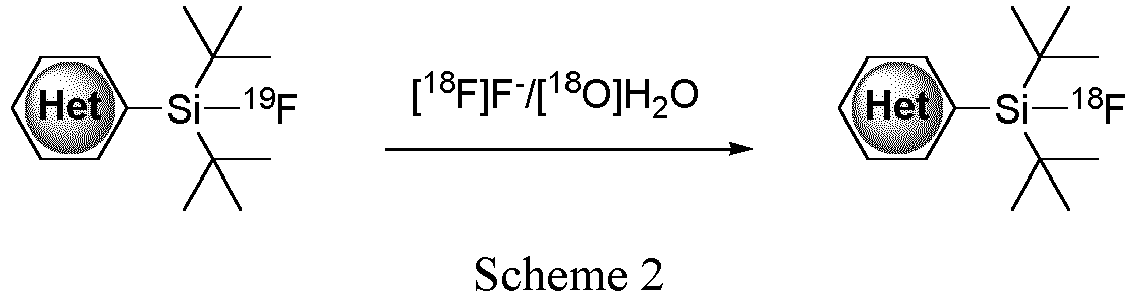
- Purification of the labeled compound can be performed using any method known in the art. In a non-limiting example, purification of the final labeling product is achieved by a cartridge purification (C18 or alumina).
- The present invention encompasses various kits for 18F-labeling of heteroaromatic silicon-fluoride-acceptors, the kit comprising a heteroaromatic silicon-fluoride-acceptor, an 18F-labeling reagent, and an instructional materials which describe use of the kit to perform the methods of the invention. These instructions simply embody the methods and examples provided herein. Although model kits are described below, the contents of other useful kits will be apparent to the skilled artisan in light of the present disclosure. Each of these kits is contemplated within the present invention. A kit is envisaged for each embodiment of the present invention.
- The heteroaromatic silicon-fluoride-acceptor of the present kit essentially includes the elements disclosed elsewhere herein. The heteroaromatic silicon-fluoride-acceptor can comprise a monocyclic or bicyclic heteroaryl ring optionally substituted, a linker, a moiety capable of chemical conjugation or bioconjugation, a moiety comprising a polar auxiliary that may optionally contain a charge, and a moiety comprising a disease targeting molecule or biomolecule. The 18F-labeling reagent can comprise [18F]F- from the cyclotron.
- The kits of the present invention can further comprise additional reagents disclosed herein, such as plates and dishes used in the methods of the present invention, buffers, solutions and the like, as well as an applicator or other implements for performing the methods of the present invention. The kits of the present invention further comprise an instructional material. In one embodiment the kit comprises micropipettes, vials, a Teflon®-coated glass chip, a heater, and an alumina or other suitable purification cartridge.
- It is to be understood that wherever values and ranges are provided herein, all values and ranges encompassed by these values and ranges, are meant to be encompassed within the scope of the present invention. Moreover, all values that fall within these ranges, as well as the upper or lower limits of a range of values, are also contemplated by the present application.
- The following examples further illustrate aspects of the present invention. However, they are in no way a limitation of the teachings or disclosure of the present invention as set forth herein.
- The invention is further described in detail by reference to the following experimental examples. These examples are provided for purposes of illustration only, and are not intended to be limiting unless otherwise specified. Thus, the invention should in no way be construed as being limited to the following examples, but rather, should be construed to encompass any and all variations which become evident as a result of the teaching provided herein.
-

- The exemplary compound 1-methyl-indole-SiFA was labeled in a simple and fast radiosynthesis using wet [18F]F- from the cyclotron. Unreacted [18F]F- was efficiently removed with a Sep-Pak Alumina N cartridge. This method is also the basis for a preparation kit. An example of this method is also depicted in
Figure 1 . Batch results are summarized in Table 4.Table 4 Heteroaromatic Silicon-Fluoride-Acceptor RCC RCY (d.c.) Time RCP SA (AS) 40 nmol (61 ± 13)% (n = 4) (32 ± 8)% (n = 2) (25 ± 4)min (n = 2) >99% 30-31 mCi/µmol 20 nmol (44 ± 16)% (n = 2) 28-XX % (n = 2) 24-XX min (n = 2) >99% 44 mCi/µmol 40 nmol (59±12)% (n = 5) (42±19)% (n = 3) (24±3) min (n = 3) >99% 28-31 mCi/µmol 20 nmol (46±15)% (n = 4) (31±20)% (n = 3) (23±1) min (n = 3) >99% 44-72 mCi/µmol -

- Exemplary compound 1-Methyl-indole-SiFA was labeled with [1gF]TBAF in ACN, using a commercial radiosynthesizer (ELYXIS, Sofie Biosciences).
-

- Exemplary compound 1 -Methyl-indole-SiFA was labeled with aqueous [18F]F-using a Teflon®-coated glass chip on a thermoelectric heater.
Figure 2 is a further graphical depiction of the process of 18F labeling of a SiFA on a microfluidic Teflon®-coated chip in a true one-step radiochemical reaction under mild conditions starting with cyclotron derived [18F]fluoride in [18O]H2O. Batch results are summarized in Table 5.Table 5 Heteroaromatic Silicon-Fluoride-Acceptor F- Solvent Additive Temp Min RCC 50 nmol aq. [18F]F- CAN - 60 ° C 15 2% 50 nmol aq. [18F]F- DMSO - 60-80 °C 35 19% 5 nmol aq. [18F]F- DMF Thexyl alcohol 60 °C 12 12% 10 nmol aq. [18F]F- DMF TBACO3 60 °C 14 0% 50 nmol aq. [18F]F- DMF - 60 ° C 15 86-93 % 10 nmol aq. [18F]F- DMF - 60 ° C 15 64-66 % 5 nmol aq. [18F]F- DMF - 60 °C 13 28-44 % 100 nmol aq. [18F]TBAF∗ CAN - rt 10 85 % 5 nmol aq. [18F]TBAF∗ CAN - rt 10 42% ∗ Obtained on the chip by azeotropic drying of [18F]F-/[18O]H2O in the presence of TBACO3 and ACN. - The RCCs over time in the IEX of various different heteroaromatic silicon-fluoride-acceptors were determined (
Figures 3 and4 ). The significant varieties in the [18F]F-incorporation rates demonstrate differences in the electronic and structural parameters of the compounds. -
Table 6 Heteroaromatic silicon-fluoride-acceptors for bioorthogonal conjugation to biomolecules 
Novel 18F-heteroaromatic silicon-fluoride-acceptor- TCO (trans cyclooctene) 
-

-

- TCO-SiFAs are used for example in antibody fragment-based imaging of PSCA-expressing prostate cancer (
Figure 5 ). Engineered PSCA-specific antibody fragments, namely Cysdiabodies (cDb), retaining high selective binding of the parental antibody yet exhibiting rapid blood clearance, are suitable for labeling with short-lived radionuclides such as positron emitting Fluorine-18, which is achieved by click chemistry attachment of a cisDb-tetrazine derivative to a TCO-heteroaromatic silicon-fluoride-acceptor.
Claims (13)
- A compound of Formula 1:
 F is 19F or 18F;A1 is a monocyclic or bicyclic heteroaryl ring optionally substituted with 1-4 Ra groups;Ra is selected, at each independent occurrence, from the group consisting of F, Cl, Br, I, CN, NO2, ORc, OC(=O)Rc, OC(=O)ORc, OC(=O)NRcRd, C(=O)Rc, C(=O)NRcRd, C(=O)ORc, NRcRd, NRcC(=O)Rd, NRcC(=O)ORd, NRcC(=O)NRdRe, NRcS(=O)2Rd, NRcS(=O)2NRdRe, SRc, S(=O)Rc, S(=O)2Rc, and S(=O)2NRcRd, C1-6 alkyl, C1-6 haloalkyl, C2-6 alkenyl, C2-6 alkynyl, aryl, cycloalkyl, heteroaryl, heterocycloalkyl, arylalkyl, heteroarylalkyl, cycloalkylalkyl, and heterocycloalkylalkyl, wherein each of the C1-6 alkyl, C1-6 haloalkyl, C2-6 alkenyl, C2-6 alkynyl, aryl, cycloalkyl, heteroaryl, heterocycloalkyl, arylalkyl, heteroarylalkyl, cycloalkylalkyl, and heterocycloalkylalkyl is optionally substituted by 1, 2, 3, 4, or 5 substituents independently selected from F, Cl, Br, I, CN, NO2, ORc, OC(=O)Rc, OC(=O)ORc, OC(=O)NRcRd, C(=O)Rc, C(=O)NRcRd, C(=O)ORc, NRcRd, NRcC(=O)Rd, NRcC(=O)ORd, NRcC(=O)NRdRe, NRcS(=O)2Rd, NRcS(=O)2NRdRe, SRc, S(=O)Rc, S(=O)2Rc, and S(=O)2NRcRd, or independent Ra groups can optionally be joined to form additional rings;Rc, Rd and Re are selected, at each independent occurrence, from the group consisting of H, and optionally substituted C1-6 alkyl, C1-6 haloalkyl, C2-6 alkenyl, C2-6 alkynyl, aryl, cycloalkyl, heteroaryl, heterocycloalkyl, arylalkyl, heteroarylalkyl, cycloalkylalkyl, and heterocycloalkylalkyl, and any of Rc, Rd or Re can optionally be joined to form additional rings; andR1 and R2 are each independently an alkyl group, preferably both tert-butyl;wherein F is 19F and the monocyclic or bicyclic heteroaryl ring of A1 is selected from the group consisting of pyrazinyl, pyrimidinyl, pyridazinyl, pyrrolyl, imidazolyl, thiazolyl, oxazolyl, isothiazolyl, 1,2,4-triazolyl, 1,3,4-triazolyl, tetrazolyl, 1,2,3-thiadiazolyl, 1,2,3-oxadiazolyl, 1,3,4-thiadiazolyl, 1,3,4-oxadiazolyl, indolinyl,quinolyl, tetrahydroquinolyl, 1,2,3,4-tetrahydroisoquinolyl, cinnolinyl, quinoxalinyl, quinazolinyl, phthalazinyl, 1,8-naphthyridinyl, 1,4-benzodioxanyl, coumarin, dihydrocoumarin, 1,5-naphthyridinyl, benzofuryl, 2,3-dihydrobenzofuryl, 1,2-benzisoxazolyl, benzothienyl, benzoxazolyl, benzothiazolyl, purinyl, benzimidazolyl, benzotriazolyl, thioxanthinyl, carbazolyl, carbolinyl, acridinyl, pyrrolizidinyl, quinolizidinyl and 7-azaindolyl; orwherein F is 18F and the monocyclic or bicyclic heteroaryl ring of A1 is selected from the group consisting of pyridyl, pyrazinyl, pyrimidinyl, pyridazinyl, furanyl, thienyl, pyrrolyl, imidazolyl, thiazolyl, oxazolyl, pyrazolyl, isothiazolyl, 1,2,4-triazolyl, 1,3,4-triazolyl, tetrazolyl, 1,2,3-thiadiazolyl, 1,2,3-oxadiazolyl, 1,3,4-thiadiazolyl, 1,3,4-oxadiazolyl, indolinyl, indolyl, quinolyl, tetrahydroquinolyl, 1,2,3,4-tetrahydroisoquinolyl, cinnolinyl, quinoxalinyl, quinazolinyl, phthalazinyl, 1,8-naphthyridinyl, 1,4-benzodioxanyl, coumarin, dihydrocoumarin, 1,5-naphthyridinyl, benzofuryl, 2,3-dihydrobenzofuryl, 1,2-benzisoxazolyl, benzothienyl, benzoxazolyl, benzothiazolyl, purinyl, benzimidazolyl, benzotriazolyl, thioxanthinyl, carbazolyl, carbolinyl, acridinyl, pyrrolizidinyl, quinolizidinyl and 7-azaindolyl; andwherein the Si is bonded to a carbon of A1.
 - The compound of claim 1, wherein A1 is selected from the group consisting of substituted furanyl, substituted pyrazinyl, substituted pyridinyl, substituted pyrimidinyl, substituted pyridazinyl, substituted thienyl, substituted pyrrolyl, substituted imidazolyl, substituted thiazolyl, substituted oxazolyl, substituted isothiazolyl, substituted pyrazolyl, substituted 1,2,4-triazolyl, substituted 1,3,4-triazolyl, substituted 1,2,3-thiadiazolyl, substituted 1,2,3- oxadiazolyl, substituted 1,3,4-thiadiazolyl, substituted 1,3,4-oxadiazolyl, substituted quinolyl, substituted benzofuryl, substituted 1,2-benzisoxazolyl, substituted benzothienyl, substituted benzoxazolyl, and substituted benzothiazolyl; and 1 2
R and R are tert-butyl groups. - The compound of claim 1, wherein the compound is selected from the group consisting of:

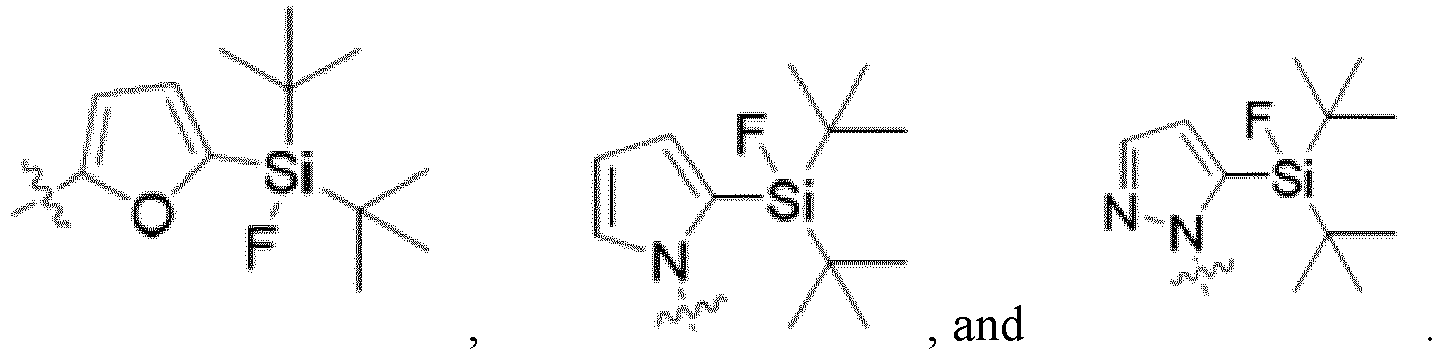
- The compound of claim 1, wherein the compound is selected from the group consisting of:


- A compound of Formula 4:
 F is 19F or 18F;A1 is a monocyclic or bicyclic heteroaryl ring optionally substituted with 1-4 Ra groups;A2 is an unsubstituted alkylene, and unsubstituted polyethylene glycol (PEG) ether, or a bisubstituted triazolyl;A3 is an amide, an N-hydroxysuccinimide (NHS) ester, a maleimide, or_a maleimide-thiol adduct,;A4 is a carboxylic acid group;A5 is a moiety comprising a disease targeting molecule or biomolecule;Ra is selected, at each independent occurrence, from the group consisting of F, Cl, Br, I, CN, NO2, ORc, OC(=O)Rc, OC(=O)ORc, OC(=O)NRcRd, C(=O)Rc, C(=O)NRcRd, C(=O)ORc, NRcRd, NRcC(=O)Rd, NRcC(=O)ORd, NRcC(=O)NRdRe, NRcS(=O)2Rd, NRcS(=O)2NRdRe, SRc, S(=O)Rc, S(=O)2Rc, and S(=O)2NRcRd, C1-6 alkyl, C1-6 haloalkyl, C2-6 alkenyl, C2-6 alkynyl, aryl, cycloalkyl, heteroaryl, heterocycloalkyl, arylalkyl, heteroarylalkyl, cycloalkylalkyl, and heterocycloalkylalkyl, wherein each of the C1-6 alkyl, C1-6 haloalkyl, C2-6 alkenyl, C2-6 alkynyl, aryl, cycloalkyl, heteroaryl, heterocycloalkyl, arylalkyl, heteroarylalkyl, cycloalkylalkyl, and heterocycloalkylalkyl is optionally substituted by 1, 2, 3, 4, or 5 substituents independently selected from F, Cl, Br, I, CN, NO2, ORc, OC(=O)Rc, OC(=O)ORc, OC(=O)NRcRd, C(=O)Rc, C(=O)NRcRd, C(=O)ORc, NRcRd, NRcC(=O)Rd, NRcC(=O)ORd, NRcC(=O)NRdRe, NRcS(=O)2Rd, NRcS(=O)2NRdRe, SRc, S(=O)Rc, S(=O)2Rc, or S(=O)2NRcRd, or independent Ra groups can optionally be joined to form additional rings;Rc, Rd and Re are selected, at each independent occurrence, from the group consisting of H, and optionally substituted C1-6 alkyl, C1-6 haloalkyl, C2-6 alkenyl, C2-6 alkynyl, aryl, cycloalkyl, heteroaryl, heterocycloalkyl, arylalkyl, heteroarylalkyl, cycloalkylalkyl, and heterocycloalkylalkyl, and any of Rc, Rd or Re can optionally be joined to form additional rings;R1 and R2 are each independently an alkyl group, preferably both tert-butyl; and preferably wherein the monocyclic or bicyclic heteroaryl ring of A1 is selected from the group consisting of pyridyl, pyrazinyl, pyrimidinyl, pyridazinyl, furanyl, thienyl, pyrrolyl, imidazolyl, thiazolyl, oxazolyl, pyrazolyl, isothiazolyl, 1,2,4-triazolyl, 1,3,4-triazolyl, tetrazolyl, 1,2,3-thiadiazolyl, 1,2,3-oxadiazolyl, 1,3,4-thiadiazolyl, 1,3,4-oxadiazolyl, indolinyl, indolyl, quinolyl, tetrahydroquinolyl, 1,2,3,4-tetrahydroisoquinolyl, cinnolinyl, quinoxalinyl, quinazolinyl, phthalazinyl, 1,8-naphthyridinyl, 1,4-benzodioxanyl, coumarin, dihydrocoumarin, 1,5-naphthyridinyl, benzofuryl, 2,3-dihydrobenzofuryl, 1,2-benzisoxazolyl, benzothienyl, benzoxazolyl, benzothiazolyl, purinyl, benzimidazolyl, benzotriazolyl, thioxanthinyl, carbazolyl, carbolinyl, acridinyl, pyrrolizidinyl, quinolizidinyl and azaindolyl.
 - The compound of claim 5, wherein:the monocyclic or bicyclic heteroaryl ring of A1 is selected from the group consisting of indolyl, 7-azaindolyl, benzothiophenyl, furanyl, pyrrolyl, pyrazolyl, imidazolyl, and pyridinyl; and/orR1 and R2 are tert-butyl groups.
- The compound of claim 1, or 5, wherein R1 and R2 are both tert-butyl groups.
- The compound of claim 1, wherein F is 18F.
- The compound of claim 1, or 5, wherein the monocyclic or bicyclic heteroaryl ring of A1 is furanyl, pyridyl, pyrazinyl, pyrimidinyl, pyridazinyl, thienyl, pyrrolyl, imidazolyl, thiazolyl, oxazolyl, pyrazolyl, isothiazolyl, 1,2,4-triazolyl, 1,3,4-triazolyl, tetrazolyl, 1,2,3-thiadiazolyl, 1,2,3- oxadiazolyl, 1,3,4-thiadiazolyl, 1,3,4-oxadiazolyl, indolyl, indolinyl, quinolyl, tetrahydroquinolyl, 1,2,3,4-tetrahydroisoquinolyl, cinnolinyl, quinoxalinyl, quinazolinyl, phthalazinyl, 1,8-naphthyridinyl, 1,4-benzodioxanyl, coumarin, dihydrocoumarin, 1,5-naphthyridinyl, benzofuryl, 2,3-dihydrobenzofuryl, 1,2-benzisoxazolyl, benzothienyl, benzoxazolyl, benzothiazolyl, purinyl, benzimidazolyl, benzotriazolyl, thioxanthinyl, carbazolyl, carbolinyl, acridinyl, pyrrolizidinyl, or quinolizidinyl;
and F is 18F. - The compound of claim 1 for use as a diagnostic detector molecule.
- An imaging agent comprising a compound of claim 1 for use in imaging a biological target by PET scanning, wherein F is 18F, and wherein the compound is conjugated to a ligand for the biological target; optionally wherein:(a) the ligand for the biological target comprises a disease targeting molecule or biomolecule;(b) the ligand for the biological target comprises a peptide, a protein, an enzyme, an antibody, or a small molecule; and/or(c) the conjugation comprises a maleimide-thiol adduct.
- A kit for 18F-labeling of a compound of any of claims 1, or 5, the kit comprising a compound of claim 1, or 5, wherein F is 19F, an 18F isotopic exchange reagent, and an instruction manual for the use thereof.
- An imaging agent comprising a compound of claim 1 , that is conjugated to a ligand for a biological target; optionally wherein:(a) the ligand for the biological target comprises a disease targeting molecule or biomolecule; and/or(b) the ligand for the biological target comprises a peptide, a protein, an enzyme, an antibody, or a small molecule.
Applications Claiming Priority (2)
| Application Number | Priority Date | Filing Date | Title |
|---|---|---|---|
| US201562166240P | 2015-05-26 | 2015-05-26 | |
| PCT/US2016/033923 WO2016191424A2 (en) | 2015-05-26 | 2016-05-24 | Novel heteroaromatic silicon-fluoride-acceptors useful for 18f labeling of molecules and biomolecules, and methods of preparing same |
Publications (3)
| Publication Number | Publication Date |
|---|---|
| EP3303349A2 EP3303349A2 (en) | 2018-04-11 |
| EP3303349A4 EP3303349A4 (en) | 2019-03-13 |
| EP3303349B1 true EP3303349B1 (en) | 2022-07-06 |
Family
ID=57394170
Family Applications (1)
| Application Number | Title | Priority Date | Filing Date |
|---|---|---|---|
| EP16800638.5A Active EP3303349B1 (en) | 2015-05-26 | 2016-05-24 | Novel heteroaromatic silicon-fluoride-acceptors useful for 18f labeling of molecules and biomolecules, and methods of preparing same |
Country Status (6)
| Country | Link |
|---|---|
| US (4) | US10800797B2 (en) |
| EP (1) | EP3303349B1 (en) |
| JP (2) | JP7266365B2 (en) |
| CN (1) | CN107667109B (en) |
| CA (1) | CA2982269C (en) |
| WO (1) | WO2016191424A2 (en) |
Families Citing this family (8)
| Publication number | Priority date | Publication date | Assignee | Title |
|---|---|---|---|---|
| JP7266365B2 (en) * | 2015-05-26 | 2023-04-28 | ザ リージェンツ オブ ザ ユニバーシティ オブ カリフォルニア | Novel heteroaromatic silicon fluoride acceptors useful for 18F labeling of molecules and biomolecules and methods for their preparation |
| NZ760537A (en) * | 2017-07-28 | 2026-01-30 | Univ Muenchen Tech | Dual mode radiotracer and -therapeutics |
| GB2581619A (en) | 2017-09-15 | 2020-08-26 | Univ California | Inhibition of aminoacylase 3 (AA3) in the treatment of cancer |
| EP3917581A1 (en) * | 2019-01-30 | 2021-12-08 | Technische Universität München | Silicon-fluoride acceptor substituted radiopharmaceuticals and precursors thereof |
| WO2020220020A1 (en) * | 2019-04-26 | 2020-10-29 | The Regents Of The University Of California | Silicon-fluoride heteroaromatic systems for applications in positron emission tomography (pet) molecular imaging |
| IL288378B2 (en) * | 2019-05-24 | 2025-02-01 | Univ Duke | 18f-radiolabeled biomolecules |
| WO2021243337A1 (en) * | 2020-05-29 | 2021-12-02 | Fuzionaire. Inc. | Methods for rapid formation of chemicals including positron emission tomography biomarkers |
| US20230355813A1 (en) * | 2022-04-20 | 2023-11-09 | Fuzionaire Diagnostics, Inc. | Theranostic Silicon-Fluoride Heteroaromatic Systems and Methods Thereof |
Family Cites Families (5)
| Publication number | Priority date | Publication date | Assignee | Title |
|---|---|---|---|---|
| US6972336B2 (en) * | 2002-07-18 | 2005-12-06 | Novartis Ag | N-alkylation of indole derivatives |
| US20090035215A1 (en) * | 2006-10-02 | 2009-02-05 | Ananth Srinivasan | Radiofluorination |
| US20120046242A1 (en) * | 2008-12-24 | 2012-02-23 | Massachusetts Institute Of Technology | Molecular activators of the wnt/beta-catenin pathway |
| JP2014507400A (en) * | 2010-12-22 | 2014-03-27 | ジーイー・ヘルスケア・リミテッド | HER2-binding peptide labeled with aluminum- [18F] fluoride complexed with NOTA |
| JP7266365B2 (en) | 2015-05-26 | 2023-04-28 | ザ リージェンツ オブ ザ ユニバーシティ オブ カリフォルニア | Novel heteroaromatic silicon fluoride acceptors useful for 18F labeling of molecules and biomolecules and methods for their preparation |
-
2016
- 2016-05-24 JP JP2017548194A patent/JP7266365B2/en active Active
- 2016-05-24 CN CN201680030562.8A patent/CN107667109B/en active Active
- 2016-05-24 WO PCT/US2016/033923 patent/WO2016191424A2/en not_active Ceased
- 2016-05-24 US US15/575,979 patent/US10800797B2/en active Active
- 2016-05-24 EP EP16800638.5A patent/EP3303349B1/en active Active
- 2016-05-24 CA CA2982269A patent/CA2982269C/en active Active
-
2020
- 2020-08-19 US US16/997,240 patent/US11447508B2/en active Active
-
2021
- 2021-02-05 JP JP2021017722A patent/JP2021073293A/en not_active Withdrawn
-
2022
- 2022-09-19 US US17/933,234 patent/US12371445B2/en active Active
-
2025
- 2025-06-25 US US19/248,601 patent/US20250333425A1/en active Pending
Also Published As
| Publication number | Publication date |
|---|---|
| US20180346491A1 (en) | 2018-12-06 |
| US20230114064A1 (en) | 2023-04-13 |
| US20200377529A1 (en) | 2020-12-03 |
| US12371445B2 (en) | 2025-07-29 |
| JP7266365B2 (en) | 2023-04-28 |
| WO2016191424A3 (en) | 2016-12-29 |
| EP3303349A2 (en) | 2018-04-11 |
| US11447508B2 (en) | 2022-09-20 |
| CA2982269A1 (en) | 2016-12-01 |
| WO2016191424A2 (en) | 2016-12-01 |
| EP3303349A4 (en) | 2019-03-13 |
| US10800797B2 (en) | 2020-10-13 |
| JP2018521956A (en) | 2018-08-09 |
| CA2982269C (en) | 2023-12-05 |
| CN107667109A (en) | 2018-02-06 |
| CN107667109B (en) | 2021-08-03 |
| JP2021073293A (en) | 2021-05-13 |
| US20250333425A1 (en) | 2025-10-30 |
Similar Documents
| Publication | Publication Date | Title |
|---|---|---|
| US12371445B2 (en) | Heteroaromatic silicon-fluoride-acceptors useful for 18F labeling of molecules and biomolecules, and methods of preparing same | |
| JP7290638B2 (en) | Macrocycles and their use as Wee1 inhibitors | |
| JP5995441B2 (en) | Asymmetric pyrrolobenzodiazepine-dimer for the treatment of proliferative diseases | |
| JP6367204B2 (en) | Synthesis and intermediates of pyrrolobenzodiazepine derivatives for conjugation | |
| JP2007532524A (en) | Fluorination method | |
| EP2146944B1 (en) | A method for the preparation of 18f-labelled folates | |
| Satyamurthy et al. | No-carrier-added 3-(2′-[18F] fluoroethyl) spiperone, a new dopamine receptor-binding tracer for positron emission tomography | |
| US20230106083A1 (en) | Silicon-fluoride heteroaromatic systems for applications in positron emission tomography (pet) molecular imaging | |
| AU2023316524A1 (en) | Salt of endothelin a (eta) receptor antagonist compound, and preparation method therefor and medical use thereof | |
| JP6491214B2 (en) | Methods and reagents for radiolabeling | |
| KR101168115B1 (en) | Radiolabelled Fluorobenzamide analogues, their synthesis and use in diagnostic imaging | |
| US8506927B2 (en) | Pegylated fluorobenzamide analogues, their synthesis and use in diagnostic imaging | |
| JP5870031B2 (en) | Automated radiosynthesis | |
| EP3758696B1 (en) | [1,2,4]triazolo[1,5-a]pyrimidine compounds and use in stabilizing microtubules | |
| JP7607799B2 (en) | Derivatives of six-membered aromatic heterourea rings and uses thereof | |
| JP7509340B2 (en) | Trigonelline-Based Compounds | |
| CN116120327B (en) | 13,14-symmetrical disubstituted derivatives of β-elemene and preparation method and application thereof | |
| JP7714224B2 (en) | Boronophenylalanine amide derivatives | |
| WO2024233951A1 (en) | Heterocyclic compounds for imaging aggregated alpha synuclein in the synucleinopathies | |
| WO2017196544A1 (en) | Novel compositions for labeling biomolecules and methods using same | |
| KR20020093404A (en) | Novel N,N'-disubstituted diaminedithiol radioactive metal complexes for labelling and imaging agents, and novel N,N'-disubstituted diaminedithiol ligands |
Legal Events
| Date | Code | Title | Description |
|---|---|---|---|
| STAA | Information on the status of an ep patent application or granted ep patent |
Free format text: STATUS: THE INTERNATIONAL PUBLICATION HAS BEEN MADE |
|
| PUAI | Public reference made under article 153(3) epc to a published international application that has entered the european phase |
Free format text: ORIGINAL CODE: 0009012 |
|
| STAA | Information on the status of an ep patent application or granted ep patent |
Free format text: STATUS: REQUEST FOR EXAMINATION WAS MADE |
|
| 17P | Request for examination filed |
Effective date: 20171221 |
|
| AK | Designated contracting states |
Kind code of ref document: A2 Designated state(s): AL AT BE BG CH CY CZ DE DK EE ES FI FR GB GR HR HU IE IS IT LI LT LU LV MC MK MT NL NO PL PT RO RS SE SI SK SM TR |
|
| AX | Request for extension of the european patent |
Extension state: BA ME |
|
| DAV | Request for validation of the european patent (deleted) | ||
| DAX | Request for extension of the european patent (deleted) | ||
| A4 | Supplementary search report drawn up and despatched |
Effective date: 20190212 |
|
| RIC1 | Information provided on ipc code assigned before grant |
Ipc: A61K 51/04 20060101ALI20190206BHEP Ipc: A61K 51/10 20060101ALI20190206BHEP Ipc: C07F 13/00 20060101ALI20190206BHEP Ipc: C07B 59/00 20060101AFI20190206BHEP Ipc: C07F 7/08 20060101ALI20190206BHEP Ipc: C07F 19/00 20060101ALI20190206BHEP Ipc: C07F 7/12 20060101ALI20190206BHEP |
|
| STAA | Information on the status of an ep patent application or granted ep patent |
Free format text: STATUS: EXAMINATION IS IN PROGRESS |
|
| 17Q | First examination report despatched |
Effective date: 20191218 |
|
| RAP1 | Party data changed (applicant data changed or rights of an application transferred) |
Owner name: CALIFORNIA INSTITUTE OF TECHNOLOGY Owner name: THE REGENTS OF THE UNIVERSITY OF CALIFORNIA |
|
| REG | Reference to a national code |
Ref country code: DE Ref legal event code: R079 Ref document number: 602016073366 Country of ref document: DE Free format text: PREVIOUS MAIN CLASS: C07F0007080000 Ipc: C07B0059000000 |
|
| GRAP | Despatch of communication of intention to grant a patent |
Free format text: ORIGINAL CODE: EPIDOSNIGR1 |
|
| STAA | Information on the status of an ep patent application or granted ep patent |
Free format text: STATUS: GRANT OF PATENT IS INTENDED |
|
| INTG | Intention to grant announced |
Effective date: 20220211 |
|
| RIC1 | Information provided on ipc code assigned before grant |
Ipc: A61K 51/10 20060101ALI20220128BHEP Ipc: A61K 51/04 20060101ALI20220128BHEP Ipc: C07F 7/12 20060101ALI20220128BHEP Ipc: C07B 59/00 20060101AFI20220128BHEP |
|
| GRAS | Grant fee paid |
Free format text: ORIGINAL CODE: EPIDOSNIGR3 |
|
| GRAA | (expected) grant |
Free format text: ORIGINAL CODE: 0009210 |
|
| STAA | Information on the status of an ep patent application or granted ep patent |
Free format text: STATUS: THE PATENT HAS BEEN GRANTED |
|
| AK | Designated contracting states |
Kind code of ref document: B1 Designated state(s): AL AT BE BG CH CY CZ DE DK EE ES FI FR GB GR HR HU IE IS IT LI LT LU LV MC MK MT NL NO PL PT RO RS SE SI SK SM TR |
|
| REG | Reference to a national code |
Ref country code: AT Ref legal event code: REF Ref document number: 1502785 Country of ref document: AT Kind code of ref document: T Effective date: 20220715 Ref country code: CH Ref legal event code: EP |
|
| REG | Reference to a national code |
Ref country code: DE Ref legal event code: R096 Ref document number: 602016073366 Country of ref document: DE |
|
| REG | Reference to a national code |
Ref country code: IE Ref legal event code: FG4D |
|
| REG | Reference to a national code |
Ref country code: LT Ref legal event code: MG9D |
|
| REG | Reference to a national code |
Ref country code: NL Ref legal event code: MP Effective date: 20220706 |
|
| PG25 | Lapsed in a contracting state [announced via postgrant information from national office to epo] |
Ref country code: SE Free format text: LAPSE BECAUSE OF FAILURE TO SUBMIT A TRANSLATION OF THE DESCRIPTION OR TO PAY THE FEE WITHIN THE PRESCRIBED TIME-LIMIT Effective date: 20220706 Ref country code: RS Free format text: LAPSE BECAUSE OF FAILURE TO SUBMIT A TRANSLATION OF THE DESCRIPTION OR TO PAY THE FEE WITHIN THE PRESCRIBED TIME-LIMIT Effective date: 20220706 Ref country code: PT Free format text: LAPSE BECAUSE OF FAILURE TO SUBMIT A TRANSLATION OF THE DESCRIPTION OR TO PAY THE FEE WITHIN THE PRESCRIBED TIME-LIMIT Effective date: 20221107 Ref country code: NO Free format text: LAPSE BECAUSE OF FAILURE TO SUBMIT A TRANSLATION OF THE DESCRIPTION OR TO PAY THE FEE WITHIN THE PRESCRIBED TIME-LIMIT Effective date: 20221006 Ref country code: NL Free format text: LAPSE BECAUSE OF FAILURE TO SUBMIT A TRANSLATION OF THE DESCRIPTION OR TO PAY THE FEE WITHIN THE PRESCRIBED TIME-LIMIT Effective date: 20220706 Ref country code: LV Free format text: LAPSE BECAUSE OF FAILURE TO SUBMIT A TRANSLATION OF THE DESCRIPTION OR TO PAY THE FEE WITHIN THE PRESCRIBED TIME-LIMIT Effective date: 20220706 Ref country code: LT Free format text: LAPSE BECAUSE OF FAILURE TO SUBMIT A TRANSLATION OF THE DESCRIPTION OR TO PAY THE FEE WITHIN THE PRESCRIBED TIME-LIMIT Effective date: 20220706 Ref country code: FI Free format text: LAPSE BECAUSE OF FAILURE TO SUBMIT A TRANSLATION OF THE DESCRIPTION OR TO PAY THE FEE WITHIN THE PRESCRIBED TIME-LIMIT Effective date: 20220706 Ref country code: ES Free format text: LAPSE BECAUSE OF FAILURE TO SUBMIT A TRANSLATION OF THE DESCRIPTION OR TO PAY THE FEE WITHIN THE PRESCRIBED TIME-LIMIT Effective date: 20220706 |
|
| REG | Reference to a national code |
Ref country code: AT Ref legal event code: MK05 Ref document number: 1502785 Country of ref document: AT Kind code of ref document: T Effective date: 20220706 |
|
| PG25 | Lapsed in a contracting state [announced via postgrant information from national office to epo] |
Ref country code: PL Free format text: LAPSE BECAUSE OF FAILURE TO SUBMIT A TRANSLATION OF THE DESCRIPTION OR TO PAY THE FEE WITHIN THE PRESCRIBED TIME-LIMIT Effective date: 20220706 Ref country code: IS Free format text: LAPSE BECAUSE OF FAILURE TO SUBMIT A TRANSLATION OF THE DESCRIPTION OR TO PAY THE FEE WITHIN THE PRESCRIBED TIME-LIMIT Effective date: 20221106 Ref country code: HR Free format text: LAPSE BECAUSE OF FAILURE TO SUBMIT A TRANSLATION OF THE DESCRIPTION OR TO PAY THE FEE WITHIN THE PRESCRIBED TIME-LIMIT Effective date: 20220706 Ref country code: GR Free format text: LAPSE BECAUSE OF FAILURE TO SUBMIT A TRANSLATION OF THE DESCRIPTION OR TO PAY THE FEE WITHIN THE PRESCRIBED TIME-LIMIT Effective date: 20221007 |
|
| REG | Reference to a national code |
Ref country code: DE Ref legal event code: R097 Ref document number: 602016073366 Country of ref document: DE |
|
| PG25 | Lapsed in a contracting state [announced via postgrant information from national office to epo] |
Ref country code: SM Free format text: LAPSE BECAUSE OF FAILURE TO SUBMIT A TRANSLATION OF THE DESCRIPTION OR TO PAY THE FEE WITHIN THE PRESCRIBED TIME-LIMIT Effective date: 20220706 Ref country code: RO Free format text: LAPSE BECAUSE OF FAILURE TO SUBMIT A TRANSLATION OF THE DESCRIPTION OR TO PAY THE FEE WITHIN THE PRESCRIBED TIME-LIMIT Effective date: 20220706 Ref country code: DK Free format text: LAPSE BECAUSE OF FAILURE TO SUBMIT A TRANSLATION OF THE DESCRIPTION OR TO PAY THE FEE WITHIN THE PRESCRIBED TIME-LIMIT Effective date: 20220706 Ref country code: CZ Free format text: LAPSE BECAUSE OF FAILURE TO SUBMIT A TRANSLATION OF THE DESCRIPTION OR TO PAY THE FEE WITHIN THE PRESCRIBED TIME-LIMIT Effective date: 20220706 Ref country code: AT Free format text: LAPSE BECAUSE OF FAILURE TO SUBMIT A TRANSLATION OF THE DESCRIPTION OR TO PAY THE FEE WITHIN THE PRESCRIBED TIME-LIMIT Effective date: 20220706 |
|
| PLBE | No opposition filed within time limit |
Free format text: ORIGINAL CODE: 0009261 |
|
| STAA | Information on the status of an ep patent application or granted ep patent |
Free format text: STATUS: NO OPPOSITION FILED WITHIN TIME LIMIT |
|
| PG25 | Lapsed in a contracting state [announced via postgrant information from national office to epo] |
Ref country code: SK Free format text: LAPSE BECAUSE OF FAILURE TO SUBMIT A TRANSLATION OF THE DESCRIPTION OR TO PAY THE FEE WITHIN THE PRESCRIBED TIME-LIMIT Effective date: 20220706 Ref country code: EE Free format text: LAPSE BECAUSE OF FAILURE TO SUBMIT A TRANSLATION OF THE DESCRIPTION OR TO PAY THE FEE WITHIN THE PRESCRIBED TIME-LIMIT Effective date: 20220706 |
|
| 26N | No opposition filed |
Effective date: 20230411 |
|
| P01 | Opt-out of the competence of the unified patent court (upc) registered |
Effective date: 20230516 |
|
| PG25 | Lapsed in a contracting state [announced via postgrant information from national office to epo] |
Ref country code: AL Free format text: LAPSE BECAUSE OF FAILURE TO SUBMIT A TRANSLATION OF THE DESCRIPTION OR TO PAY THE FEE WITHIN THE PRESCRIBED TIME-LIMIT Effective date: 20220706 |
|
| PG25 | Lapsed in a contracting state [announced via postgrant information from national office to epo] |
Ref country code: SI Free format text: LAPSE BECAUSE OF FAILURE TO SUBMIT A TRANSLATION OF THE DESCRIPTION OR TO PAY THE FEE WITHIN THE PRESCRIBED TIME-LIMIT Effective date: 20220706 |
|
| PG25 | Lapsed in a contracting state [announced via postgrant information from national office to epo] |
Ref country code: MC Free format text: LAPSE BECAUSE OF FAILURE TO SUBMIT A TRANSLATION OF THE DESCRIPTION OR TO PAY THE FEE WITHIN THE PRESCRIBED TIME-LIMIT Effective date: 20220706 |
|
| REG | Reference to a national code |
Ref country code: BE Ref legal event code: MM Effective date: 20230531 |
|
| PG25 | Lapsed in a contracting state [announced via postgrant information from national office to epo] |
Ref country code: MC Free format text: LAPSE BECAUSE OF FAILURE TO SUBMIT A TRANSLATION OF THE DESCRIPTION OR TO PAY THE FEE WITHIN THE PRESCRIBED TIME-LIMIT Effective date: 20220706 Ref country code: LU Free format text: LAPSE BECAUSE OF NON-PAYMENT OF DUE FEES Effective date: 20230524 Ref country code: IT Free format text: LAPSE BECAUSE OF FAILURE TO SUBMIT A TRANSLATION OF THE DESCRIPTION OR TO PAY THE FEE WITHIN THE PRESCRIBED TIME-LIMIT Effective date: 20220706 |
|
| PG25 | Lapsed in a contracting state [announced via postgrant information from national office to epo] |
Ref country code: BE Free format text: LAPSE BECAUSE OF NON-PAYMENT OF DUE FEES Effective date: 20230531 |
|
| PG25 | Lapsed in a contracting state [announced via postgrant information from national office to epo] |
Ref country code: BG Free format text: LAPSE BECAUSE OF FAILURE TO SUBMIT A TRANSLATION OF THE DESCRIPTION OR TO PAY THE FEE WITHIN THE PRESCRIBED TIME-LIMIT Effective date: 20220706 |
|
| PG25 | Lapsed in a contracting state [announced via postgrant information from national office to epo] |
Ref country code: BG Free format text: LAPSE BECAUSE OF FAILURE TO SUBMIT A TRANSLATION OF THE DESCRIPTION OR TO PAY THE FEE WITHIN THE PRESCRIBED TIME-LIMIT Effective date: 20220706 |
|
| PGFP | Annual fee paid to national office [announced via postgrant information from national office to epo] |
Ref country code: DE Payment date: 20250529 Year of fee payment: 10 |
|
| PGFP | Annual fee paid to national office [announced via postgrant information from national office to epo] |
Ref country code: GB Payment date: 20250523 Year of fee payment: 10 |
|
| PGFP | Annual fee paid to national office [announced via postgrant information from national office to epo] |
Ref country code: FR Payment date: 20250526 Year of fee payment: 10 |
|
| PGFP | Annual fee paid to national office [announced via postgrant information from national office to epo] |
Ref country code: CH Payment date: 20250601 Year of fee payment: 10 |
|
| PG25 | Lapsed in a contracting state [announced via postgrant information from national office to epo] |
Ref country code: CY Free format text: LAPSE BECAUSE OF FAILURE TO SUBMIT A TRANSLATION OF THE DESCRIPTION OR TO PAY THE FEE WITHIN THE PRESCRIBED TIME-LIMIT; INVALID AB INITIO Effective date: 20160524 |
|
| PGFP | Annual fee paid to national office [announced via postgrant information from national office to epo] |
Ref country code: IE Payment date: 20250528 Year of fee payment: 10 |
|
| PG25 | Lapsed in a contracting state [announced via postgrant information from national office to epo] |
Ref country code: HU Free format text: LAPSE BECAUSE OF FAILURE TO SUBMIT A TRANSLATION OF THE DESCRIPTION OR TO PAY THE FEE WITHIN THE PRESCRIBED TIME-LIMIT; INVALID AB INITIO Effective date: 20160524 |
|
| PG25 | Lapsed in a contracting state [announced via postgrant information from national office to epo] |
Ref country code: TR Free format text: LAPSE BECAUSE OF FAILURE TO SUBMIT A TRANSLATION OF THE DESCRIPTION OR TO PAY THE FEE WITHIN THE PRESCRIBED TIME-LIMIT Effective date: 20220706 |