EP3301611A1 - Artificial neural networks for human activity recognition - Google Patents
Artificial neural networks for human activity recognition Download PDFInfo
- Publication number
- EP3301611A1 EP3301611A1 EP17193073.8A EP17193073A EP3301611A1 EP 3301611 A1 EP3301611 A1 EP 3301611A1 EP 17193073 A EP17193073 A EP 17193073A EP 3301611 A1 EP3301611 A1 EP 3301611A1
- Authority
- EP
- European Patent Office
- Prior art keywords
- activity
- data
- classification
- samples
- sequence length
- Prior art date
- Legal status (The legal status is an assumption and is not a legal conclusion. Google has not performed a legal analysis and makes no representation as to the accuracy of the status listed.)
- Granted
Links
Images




Classifications
-
- G—PHYSICS
- G06—COMPUTING OR CALCULATING; COUNTING
- G06N—COMPUTING ARRANGEMENTS BASED ON SPECIFIC COMPUTATIONAL MODELS
- G06N3/00—Computing arrangements based on biological models
- G06N3/02—Neural networks
- G06N3/04—Architecture, e.g. interconnection topology
-
- G—PHYSICS
- G06—COMPUTING OR CALCULATING; COUNTING
- G06F—ELECTRIC DIGITAL DATA PROCESSING
- G06F3/00—Input arrangements for transferring data to be processed into a form capable of being handled by the computer; Output arrangements for transferring data from processing unit to output unit, e.g. interface arrangements
- G06F3/01—Input arrangements or combined input and output arrangements for interaction between user and computer
- G06F3/011—Arrangements for interaction with the human body, e.g. for user immersion in virtual reality
- G06F3/015—Input arrangements based on nervous system activity detection, e.g. brain waves [EEG] detection, electromyograms [EMG] detection, electrodermal response detection
-
- A—HUMAN NECESSITIES
- A61—MEDICAL OR VETERINARY SCIENCE; HYGIENE
- A61B—DIAGNOSIS; SURGERY; IDENTIFICATION
- A61B5/00—Measuring for diagnostic purposes; Identification of persons
- A61B5/02—Detecting, measuring or recording for evaluating the cardiovascular system, e.g. pulse, heart rate, blood pressure or blood flow
- A61B5/0205—Simultaneously evaluating both cardiovascular conditions and different types of body conditions, e.g. heart and respiratory condition
-
- A—HUMAN NECESSITIES
- A61—MEDICAL OR VETERINARY SCIENCE; HYGIENE
- A61B—DIAGNOSIS; SURGERY; IDENTIFICATION
- A61B5/00—Measuring for diagnostic purposes; Identification of persons
- A61B5/02—Detecting, measuring or recording for evaluating the cardiovascular system, e.g. pulse, heart rate, blood pressure or blood flow
- A61B5/0205—Simultaneously evaluating both cardiovascular conditions and different types of body conditions, e.g. heart and respiratory condition
- A61B5/02055—Simultaneously evaluating both cardiovascular condition and temperature
-
- A—HUMAN NECESSITIES
- A61—MEDICAL OR VETERINARY SCIENCE; HYGIENE
- A61B—DIAGNOSIS; SURGERY; IDENTIFICATION
- A61B5/00—Measuring for diagnostic purposes; Identification of persons
- A61B5/103—Measuring devices for testing the shape, pattern, colour, size or movement of the body or parts thereof, for diagnostic purposes
- A61B5/11—Measuring movement of the entire body or parts thereof, e.g. head or hand tremor or mobility of a limb
- A61B5/1118—Determining activity level
-
- A—HUMAN NECESSITIES
- A61—MEDICAL OR VETERINARY SCIENCE; HYGIENE
- A61B—DIAGNOSIS; SURGERY; IDENTIFICATION
- A61B5/00—Measuring for diagnostic purposes; Identification of persons
- A61B5/72—Signal processing specially adapted for physiological signals or for diagnostic purposes
- A61B5/7235—Details of waveform analysis
- A61B5/7264—Classification of physiological signals or data, e.g. using neural networks, statistical classifiers, expert systems or fuzzy systems
-
- G—PHYSICS
- G06—COMPUTING OR CALCULATING; COUNTING
- G06F—ELECTRIC DIGITAL DATA PROCESSING
- G06F18/00—Pattern recognition
- G06F18/20—Analysing
- G06F18/24—Classification techniques
- G06F18/241—Classification techniques relating to the classification model, e.g. parametric or non-parametric approaches
- G06F18/2413—Classification techniques relating to the classification model, e.g. parametric or non-parametric approaches based on distances to training or reference patterns
-
- G—PHYSICS
- G06—COMPUTING OR CALCULATING; COUNTING
- G06F—ELECTRIC DIGITAL DATA PROCESSING
- G06F18/00—Pattern recognition
- G06F18/20—Analysing
- G06F18/24—Classification techniques
- G06F18/241—Classification techniques relating to the classification model, e.g. parametric or non-parametric approaches
- G06F18/2413—Classification techniques relating to the classification model, e.g. parametric or non-parametric approaches based on distances to training or reference patterns
- G06F18/24133—Distances to prototypes
- G06F18/24137—Distances to cluster centroïds
- G06F18/2414—Smoothing the distance, e.g. radial basis function networks [RBFN]
-
- G—PHYSICS
- G06—COMPUTING OR CALCULATING; COUNTING
- G06F—ELECTRIC DIGITAL DATA PROCESSING
- G06F18/00—Pattern recognition
- G06F18/20—Analysing
- G06F18/24—Classification techniques
- G06F18/241—Classification techniques relating to the classification model, e.g. parametric or non-parametric approaches
- G06F18/2413—Classification techniques relating to the classification model, e.g. parametric or non-parametric approaches based on distances to training or reference patterns
- G06F18/24133—Distances to prototypes
- G06F18/24143—Distances to neighbourhood prototypes, e.g. restricted Coulomb energy networks [RCEN]
-
- G—PHYSICS
- G06—COMPUTING OR CALCULATING; COUNTING
- G06N—COMPUTING ARRANGEMENTS BASED ON SPECIFIC COMPUTATIONAL MODELS
- G06N20/00—Machine learning
-
- G—PHYSICS
- G06—COMPUTING OR CALCULATING; COUNTING
- G06N—COMPUTING ARRANGEMENTS BASED ON SPECIFIC COMPUTATIONAL MODELS
- G06N3/00—Computing arrangements based on biological models
- G06N3/02—Neural networks
- G06N3/04—Architecture, e.g. interconnection topology
- G06N3/0464—Convolutional networks [CNN, ConvNet]
-
- G—PHYSICS
- G06—COMPUTING OR CALCULATING; COUNTING
- G06N—COMPUTING ARRANGEMENTS BASED ON SPECIFIC COMPUTATIONAL MODELS
- G06N3/00—Computing arrangements based on biological models
- G06N3/02—Neural networks
- G06N3/08—Learning methods
- G06N3/09—Supervised learning
-
- G—PHYSICS
- G06—COMPUTING OR CALCULATING; COUNTING
- G06V—IMAGE OR VIDEO RECOGNITION OR UNDERSTANDING
- G06V40/00—Recognition of biometric, human-related or animal-related patterns in image or video data
- G06V40/20—Movements or behaviour, e.g. gesture recognition
- G06V40/23—Recognition of whole body movements, e.g. for sport training
-
- A—HUMAN NECESSITIES
- A61—MEDICAL OR VETERINARY SCIENCE; HYGIENE
- A61B—DIAGNOSIS; SURGERY; IDENTIFICATION
- A61B5/00—Measuring for diagnostic purposes; Identification of persons
- A61B5/02—Detecting, measuring or recording for evaluating the cardiovascular system, e.g. pulse, heart rate, blood pressure or blood flow
- A61B5/024—Measuring pulse rate or heart rate
- A61B5/02438—Measuring pulse rate or heart rate with portable devices, e.g. worn by the patient
-
- G—PHYSICS
- G06—COMPUTING OR CALCULATING; COUNTING
- G06F—ELECTRIC DIGITAL DATA PROCESSING
- G06F2203/00—Indexing scheme relating to G06F3/00 - G06F3/048
- G06F2203/01—Indexing scheme relating to G06F3/01
- G06F2203/011—Emotion or mood input determined on the basis of sensed human body parameters such as pulse, heart rate or beat, temperature of skin, facial expressions, iris, voice pitch, brain activity patterns
-
- G—PHYSICS
- G06—COMPUTING OR CALCULATING; COUNTING
- G06F—ELECTRIC DIGITAL DATA PROCESSING
- G06F2218/00—Aspects of pattern recognition specially adapted for signal processing
- G06F2218/12—Classification; Matching
Definitions
- the present disclosure relates to techniques, devices and systems for recognizing human activity based on sensed information, such as signals acquired by wearable sensor devices.
- Wearable sensor device may continuously acquire and store information, and periodically transmit signals conveying the information, which may be processed in real time, for example, remotely by a host device or locally by the wearable device itself. Activities in which a wearer is engaged may be detected based on the information conveyed by the sensor signals.
- the signals may convey physiological data, acceleration data, rotation data, position data, etc.
- a wearable sensor device may include one or more accelerometers, and an activity of the wearer may be determined based on accelerometer data from the one or more accelerometers, complemented by one or more gyroscopes. Simplest models may typically be employed to determine an activity of a wearer based on accelerometer data.
- a method comprises: receiving activity-related data; determining activity classifications based on the received activity-related data and an activity-classification model trained using a classification-equalized training data set; and generating a classification signal based on the determined classifications.
- a sequence length t j such that the total number of samples N j for the class c j , assuming the sequences of the class c j are truncated at sequence length t j , equals or just exceeds the number N of samples in the class c i .
- N j ⁇ N for length t j - 1.
- t j for each class other than the determined class is determined based on the number of samples N in the determined class.
- the classification-equalized training data set comprises a first class having a first sequence length and a number of samples N, and one or more additional classes each having a respective sequence length t j and a respective number of samples N j which satisfy:
- the method comprises: generating the classification-equalized training data set; and training the activity-classification model.
- the determining activity classifications comprises extracting feature data based on the received activity-related data.
- the determining comprises using an artificial neural network having a feed-forward architecture.
- the artificial neural network comprises a layered architecture including one or more of: one or more convolutional layers; one or more pooling layers; one or more fully connected layers; and one or more softmax layers.
- the artificial neural network comprises a finite state machine.
- the determining comprises using an artificial neural network having a recurrent architecture.
- the determining comprises using feature extraction and a random forest.
- the determining comprises applying a temporal filter.
- the activity-related data comprises one or more of: acceleration data, orientation data, geographical position data, and physiological data.
- a device comprises: an interface, which, in operation, receives one or more signals indicative of activity; and signal processing circuitry, which, in operation: determines activity classifications based on the received signals indicative of activity and an activity-classification model trained using a classification-equalized training data set; and generates a classification signal based on the determined classifications.
- the classification-equalized training data set comprises a first class having a first sequence length and a number of samples N, and one or more additional classes each having a respective sequence length t j and a respective number of samples N j which satisfy:
- the signal processing circuitry comprises a feature extractor, a random forest and a temporal filter.
- the signal processing circuitry comprises an artificial neural network having a feed-forward architecture.
- the artificial neural network comprises a layered architecture including one or more of: one or more convolutional layers; one or more pooling layers; one or more fully connected layers; and one or more softmax layers.
- the signal processing circuitry comprises an artificial neural network having a recurrent architecture.
- the signal processing circuitry in operation: generates the classification-equalized training data set; and trains the activity-classification model.
- the signal processing circuitry comprises a finite state machine.
- the one or more signals indicative of activity comprise signals indicative of one or more of: acceleration data, orientation data, geographical position data, and physiological data.
- a system comprises: one or more sensors, which, in operation, generate one or more activity-related signals; and signal processing circuitry, which, in operation: determines activity classifications based on activity-related signals and an activity-classification model trained using a classification-equalized training data set; and generates a classification signal based on the determined classifications.
- the classification-equalized training data set comprises a first class having a first sequence length and a number of samples N, and one or more additional classes each having a respective sequence length t j and a respective number of samples N j which satisfy:
- the signal processing circuitry comprises a feature extractor, a random forest and a temporal filter.
- the signal processing circuitry comprises an artificial neural network having a feed-forward architecture.
- the signal processing circuitry comprises an artificial neural network having a recurrent architecture.
- the one or more sensors include one or more of: an accelerometer; a gyroscope; a position sensor; and a physiological sensor.
- a system comprises: means for providing activity-related data; and means for generating an activity classification signal based on activity-related data and an activity-classification model trained using a classification-equalized training data set.
- the classification-equalized training data set comprises a first class having a first sequence length and a number of samples N, and one or more additional classes each having a respective sequence length t j and a respective number of samples N j which satisfy:
- the means for generating the activity classification signal comprises a memory and one or more processor cores, wherein the memory stores contents which in operation configure the one or more processor cores to generate the activity classification signal.
- a non-transitory computer-readable medium's contents configure signal processing circuitry to perform a method, the method comprising: receiving activity-related data; determining activity classifications based on the received activity-related data and an activity-classification model trained using a classification-equalized training data set; and generating a classification signal based on the determined classifications.
- the classification-equalized training data set comprises a first class having a first sequence length and a number of samples N, and one or more additional classes each having a respective sequence length t j and a respective number of samples N j which satisfy:
- the method comprises: generating the classification-equalized training data set; and training the activity-classification model.
- the determining activity classifications comprises extracting feature data based on the received activity-related data.
- the determining comprises using an artificial neural network having a feed-forward architecture.
- the artificial neural network comprises a layered architecture including one or more of: one or more convolutional layers; one or more pooling layers; one or more fully connected layers; one or more softmax layers.
- the artificial neural network comprises a finite state machine.
- the determining comprises using an artificial neural network having a recurrent architecture.
- the artificial neural network comprises a finite state machine.
- the determining comprises using feature extraction and a random forest.
- the determining comprises applying a temporal filter.
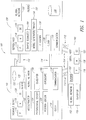
- FIG. 1 is a functional block diagram of an embodiment of a system 100 to determine an activity of a wearer of a wearable device.
- the system 100 comprises a wearable sensor device 110, a host/server 150, and an optional local host 190.
- the wearable sensor device 110, the host/server 150, and the optional local host 190 as illustrated are communicatively coupled together by one or more wireless communication links 112 and one or more wired communication links 114, which may be used alone or in various combinations to facilitate transmission of control and data signals between the wearable device 110, the host/server 150 and the optional local host 190.
- the optional local host may facilitate communication between the wearable device 110 and the host/server 150, for example, when the host/server 150 is a remote server.
- the wearable sensor device 110, the host/server 150 and the optional local host include circuitry comprising one or more processors or processor cores P 116, one or more memories M 118, and discrete circuitry DC 120, such as one or more adders, one or more multipliers, one or more filters (such as band pass, low pass, high pass filters, infinite impulse response (IIR), finite impulse (FIR) filters, etc.), etc., which may, alone or in various combinations, implement one or more functions of the system 100.
- circuitry comprising one or more processors or processor cores P 116, one or more memories M 118, and discrete circuitry DC 120, such as one or more adders, one or more multipliers, one or more filters (such as band pass, low pass, high pass filters, infinite impulse response (IIR), finite impulse (FIR) filters, etc.), etc., which may, alone or in various combinations, implement one or more functions of the system 100.
- the wearable device 110 comprises circuitry including one or more accelerometers 122, such as a triaxle accelerometer, one or more gyroscopes, such as the illustrated triaxle gyroscope 160, etc., one or more physiological sensors 124, such as a heart rate sensor, a temperature sensor, a respiration sensor, etc., one or more position sensors 126, such as a global position sensor, etc., one or more clocks 128, one or more communication circuits 130, and one or more database structures 132.
- accelerometers 122 such as a triaxle accelerometer
- gyroscopes such as the illustrated triaxle gyroscope 160
- physiological sensors 124 such as a heart rate sensor, a temperature sensor, a respiration sensor, etc.
- position sensors 126 such as a global position sensor, etc.
- clocks 1208 one or more communication circuits 130
- database structures 132 for ease of illustration, other circuitry, which may typically be included in a wearable
- the one or more accelerometers 122 sense movement data and generate signals indicative of the movement data, such as acceleration data for three axis of movement x, y and z of the wearable device 110.
- Multiple accelerometers 122 may be employed, such as an accelerometer for each axis, an accelerometer configured to gather acceleration data along two axes, together with an accelerometer to gather acceleration data along a third axis, an accelerometer configured to gather acceleration data alone three axes, etc., and various combinations thereof.
- the one or more physiological sensors 124 gather physiological data, such as heart rate information, temperature information, respiration information, etc., related to a wearer of the wearable device 110.
- the one or more position sensors 126 gather position data, such as a data related to a geographical position of the wearable device 110, data related to a position of the wearable device 110 on a wearer, etc.
- the one or more clocks 128 provide timing signals to facilitate the collection of data samples, for use, for example, in generating training data, determining wearer activities associated with the data samples, time stamps etc.
- the one or more communication circuits 130 facilitate the exchange of data and control signals between components of the system 100, and may include, for example, near-field communication circuits, serial bus communication circuits, LAN and WAN communication circuits, wi-fi communication circuits, mobile telephone communication circuits, etc., and various combinations thereof.
- the one or more data structures 132 may store, for example, training data, test data, control parameters, such as modeling parameters, instructions (for example, for execution by the one or more processors P 116), etc., and various combinations thereof.
- the one or more gyroscopes 160 sense orientation data and generate signals indicative of the orientation data, such as orientation data with respect to three axis of a three-dimensional space x, y and z of the wearable device 110.
- Multiple gyroscopes 160 may be employed, such as a gyroscope for each axis.
- the server/host 150 comprises circuitry including a neural network 152, one or more filter banks 153, such as IIR filters, FIR filters, etc., a sample equalizer 154, a model generator/trainer 156, one or more data structures 132, a classifier 158, which may classify a data sample based on a model generated by the model generator 156 and/or data stored in the one or more data structures 132 as being associated with one or more activities (e.g., stationary, walking, fast walking, jogging, biking, driving, etc.), one or more clocks 128 and communication circuitry 130.
- other circuitry which may typically be included in a server/host such as the server/host 150, are omitted from Figure 1 .
- Such circuitry may include bus systems, power systems, interfaces, etc.
- one or more functions of the wearable device 110, of the server/host 150 and/or of the optional local host 190 may instead or also be performed by another of the wearable device 110, the server/host 150 and/or the optional local host 190.
- the wearable device and/or the local host may include a neural network, such as the neural network 152, and a classifier, such as the classifier 158, similar to those of the server/host 150.
- Table 1 illustrates the number of samples associated with various activity classes in an example training data set, referred to herein after as Dataset 1.1, Training Set.
- Table 1 Example Dataset 1.1, Training Set Distribution Activity Class Number of Samples Percentage of Total Samples Stationary 4,536,217 46.44 Walking 1,448,165 14.83 Jogging 1,679,551 17.20 Biking 594,737 6.09 Driving 1,508,601 15.45
- Table 2 illustrates a number of samples associated with various activity classes for a first test data set, referred to hereinafter as Dataset 1.1, Test Set 1.
- Table 2 Example Dataset 1.1, Test Set 1 Distribution Activity Class Number of Samples Percentage of Total Samples Stationary 216,048 40.68 Walking 81,018 15.25 Jogging 81,018 15.25 Biking 72,016 13.56 Driving 81,018 15.25
- Table 3 illustrates a number of samples associated with various activity classes for a second test data set, referred to hereinafter as Dataset 1.1, Test Set 2.
- Table 3 Example Data Set 1.1, Test Set 2 Distribution Activity Class Number of Samples Percentage of Total Samples Stationary 207,046 39.66 Walking 81,018 15.52 Jogging 81,018 15.52 Biking 72,016 13.79 Driving 81,018 15.52
- the data sequences used to generate the training and test data sets were acquired at a frequency of 50 Hz, but other acquisition frequencies may be employed, such as, for example, 16 Hz.
- the data sequences were decimated at a 1:3 ratio, generating sequences having an acquisition frequency of approximately 16 Hz.
- the training data set in the example of Table 1 was generated from 434 data sequences organized into five classes: stationary, walking, jogging, biking and driving.
- the test data set in the example of Table 2 was generated from 59 acquired data sequences not included in the training data set, and organized into the same five classes.
- the test data set in the example of Table 3 was generated from 58 acquired data sequences, which may include sequences included in the training data set, and organized into the same five classes.
- Table 4 illustrates a number of samples associated with various activities for cleaned-up test data set, and includes a column showing a number of samples in the training data set.
- the cleaned-up test data set in the example of Table 4 was generated from 1054 acquired data sequences and organized into the same five classes. The distribution of samples is skewed toward the stationary and walking sequences.
- the cleaned up test data set of Table 4 will be referred to hereinafter as Dataset 2.0, Cleaned-Up Test Set 1.
- Table 4 Dataset 2.0, Cleaned-Up Test Set 1 Distribution Activity Number of Samples Percentage of Total Samples Training Data Set Samples Stationary 8,674,636 80.11 4,536,217 Walking 1,844,416 17.03 1,448,165 Jogging 23,350 00.22 1,679,551 Biking 49,052 00.45 594,737 Driving 237,372 02.19 1,508,601
- the training error is often computed as the sum of the errors of each sample. If, as in the case of both the first test data set, Dataset 1.1, Test Set 1, and the Dataset 2.0, Cleaned-Up Test Set 1, some classes are more represented, the training error promotes those classes to the detriment of the least represented classes. For example, in the case of the Cleaned-Up Test Set of Table 4, a True Positive Rate (TPR) of 80.11% can be reached by predicting "stationary" all the time. To facilitate avoiding this issue, the data set may be equalized, that is, the same number of samples (or approximately the same number of samples) may be selected for each class.
- TPR True Positive Rate
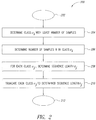
- Figure 2 illustrates an embodiment of a method 200, which may be employed by the system 100 of Figure 1 ( e.g., by the sample equalizer 154), to equalize the number of samples in a data set, such as a data set used for training or for evaluating the performing of the system 100.
- a data set such as a data set used for training or for evaluating the performing of the system 100.
- Figure 2 will be described with reference to the system 100 of Figure 1 and the training data set of Table 1.
- Other embodiments of systems and devices may employ the method 200 of Figure 2 with other data sets.
- the method 200 proceeds from 202 to 204.
- the system 100 determines a class c i having a fewest number of samples N.
- Biking would be selected as the class c i having the fewest number of samples N.
- the method 200 proceeds from 204 to 206.
- the system 100 determines the number of samples N in the determined class c i .
- the number of samples N in the Biking class c i would be determined to be 594,737.
- the method 200 proceeds from 206 to 208.
- the system 100 determines, for each class c j other than the determined class c i , a sequence length t j such that the total number of samples N j for the class c j , assuming the sequences of the class c j are truncated at sequence length t j , equals or just exceeds the number N of samples in the class c i .
- N j ⁇ N for length t j - 1.
- t j for each class other than the determined class is determined based on the number of samples N in the determined class.
- the method 200 proceeds from 208 to 210.
- the system 100 for each class c j other than the determined class c i , truncates all of the sequences in the class c j to the determined sequence length t j for the class c j . In other words, samples in each sequence for each class c j beyond the determined length t j are discarded.
- the method 200 proceeds from 210 to 212, where the system 100 may perform other processing, such as returning an equalized data set for use in training or evaluating a model, such as a neural network model.
- Embodiments of the method 200 may include other acts not shown in Figure 2 , may not perform all of the acts shown in Figure 2 , and may perform the acts shown in Figure 2 in various orders.
- acts 204 and 206 may be combined. Equalizing the number of samples by truncating the sequence lengths facilitates discarding whole sequences during the sample selection process. Other methods of equalizing the number of samples may be employed in some embodiments. For example, other conditions may be applied to determine the sequence lengths to be applied.
- the system 100 may instead determine, for each class c j other than the determined class c i , a sequence length t j such that the total number of samples N j for the class c j , assuming the sequences of the class c j are truncated at sequence length t j , is within a threshold number of the number N.
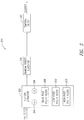
- Figure 3 illustrates an embodiment of a classification pipeline circuit 300 which may be employed, for example, by an embodiment of a system, such as the system 100 of Figure 1 (e.g., by the classifier 158), to classify samples.
- the classification pipeline 300 will be described with reference to the system 100 of Figure 1 and with reference to acceleration data.
- Other embodiments of systems and devices may employ the classification pipeline 300 of Figure 3 with other and/or additional activity-related data, such as acceleration data, orientation data, geographical position data, physiological data, etc., and various combinations thereof.
- Acceleration data is received by a feature extractor 302.
- the feature extractor 302 includes one or more adders 304, one or more multipliers 306, one or more band-pass FIR/IIR filters 308, one or more low-pass FIR/IIR filters 310 and one or more high-pass FIR/IIR filters 312.
- Other mathematic operation circuits may be employed, such as dividers, square root operators, etc.
- vectors may be indicated with bold typeface herein.
- the signal A is filtered with a band-pass FIR/IIR filter 308 and/or a low-pass FIR/IIR filter 310 and/or a high-pass FIR/IIR filter 312.
- the feature extractor provides extracted feature information to a random forest classifier 320 and to a temporal filter 340.
- the random forest classifier 320 in an embodiment may comprise a multitude of decision trees, which discriminate classes.
- the random forest trees may be implemented using complex sequences hard-coded if-then-else structures in C language.
- the temporal filter 340 handles special cases based on the output of the random forest classifier 320 and corrects the output of the random forest classifier 320 in case of misclassification errors by filtering the current, future and previous classification samples (in time order) to output the correct class recognized: for example, some data at the output of 320 may indicate a classification output should be stationary, even if previous classification data indicates a different class.
- the output of the temporal filter may provide a more correct and coherent series of classifications of a current activity by exploiting temporal correlation of various previous decisions at the output of the random forest 320 that otherwise would be incoherent if left as they are.
- the random forest classifier 320 may output 6 (subsequent in time) classifications in the following sequence: running, running, driving, running, running, running etc.
- the 3rd classification output ( driving ) is highly incoherent with the previous and future ones and therefore will be replaced at the output of the temporal filter 340 with running so that the mistake is corrected.
- ESN Echo State Network
- Convolutional Neural Network having four layers.
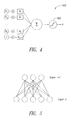
- a typical neuron structure 400 of an embodiment is represented in Figure 4 .
- a set of inputs may comprise outputs of other neurons h i , and input signals u, and are weighted by a set of values w 1 , w 2 , ... w k+1 , and then summed.
- the outputs of other neurons provides as input may be, for example, generated exclusively by neurons in a previous level or layer in an Acyclic Connected Graph (ACG) structure of a feed forward network, generated from values computed in the same layer in a previous time step in a recurrent network, etc.
- ACG Acyclic Connected Graph
- a non-linearity function f (x) 402 as illustrated a sigmoid function as a non-limiting example since other functions may be used such as ReLU (Rectified Linear Unit), generating an output of the neuron y.
- ReLU Rectified Linear Unit
- the outputs y j of multiple neurons may be generated by stacking weights in a weight matrix W , determining a matrix product of the inputs and the weight matrix, generating as vector, and applying the nonlinearity element-wise on the vector.
- a bias term b may be added to the neuron to compensate for the mean value of the input.
- x t is the input at the current time step
- y t-1 is the output of the layer in the previous time step.
- the neuron input is split between the forward term W x and the recurrent term W h , which depends on the layer output in the previous time step.
- f ( x ) may be employed in various embodiments.
- a Rectified Linear Unit (ReLU) function may be employed.
- a sigmoid function such as a logistic function (S-shaped curve) with a mid-point at zero and a maximum of 1, may be employed.
- hyperbolic tangent function may be employed.
- the ReLU nonlinearity may typically be employed in feed-forward networks, and the sigmoid or tanh nonlinearities may typically be employed in recurrent networks.
- a Multi-Layer Perceptron also known as fully connected architecture may be the simplest neural architecture, where a collection of neurons (layer) compute the output values from a previous (input) layer; the first layer is the input data, and the last layer is the prediction. Multiple layers can be stacked to compute increasing complex functions of the input. Because the output of a layer depends only on the values computed by the previous layer, the architecture is a feed-forward architecture. If a MLP is used as part of a larger network, each layer of the MLP may be referred to as a dense layer or a fully connected layer.
- Figure 5 illustrates an example structure of a MLP architecture of an embodiment.
- a softmax layer may be employed.
- a softmax may thus be treated as 1) exponentiate the output of each neuron and 2) normalize the result across the whole layer to obtain probabilities.
- the softmax may be treated as a generalization of the sigmoid / logistic function to multiple dimensions.
- Figure 6 illustrates an example logistic sigmoid function.
- the number of weights required to process an image or a window of a sequential signal grow as n 2 where n is the number of input values and thus may lead to overfitting.
- a convolutional layer may be employed to reduce the number of parameters, and facilitate avoiding overfitting.
- a convolutional layer may reduce the number of parameters through weight sharing and local connectivity. For example, in weight sharing neurons in layer n + 1 may be connected to the neurons in layer n using the same set of weights. When local connectivity is employed, only the neurons in layer n near the location of the neuron in later n +1 are connected.
- Figure 7 illustrates an example of a convolutional layer employing a sliding window.
- Computing the weighted sum of the previous layer over a sliding window is equivalent to a FIR filtering operation on the previous layer; the layer is thus called convolutional.
- the layers n and n +1 have a number of channels, that is, values referred to the same spatial position (such as stereo channels in audio signals or color channels in images).
- the convolution is thus extended to all the input channels by applying a different filter to each channel and summing the results.
- a number of output channels are generated by applying a different set of filters to the input channels.
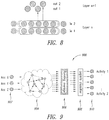
- Figure 8 shows the structure of an example convolutional network in a typical case.
- the filter weights are all learned, so in the design phase only three parameters are specified: the number of input channels c, the number of output channels m and the size of the filter kernel k.
- a pooling layer may be employed to down-sample the input in order to introduce shift-invariance (insensitivity to small changes in alignment in the input signal) and to reduce the number of neurons in the subsequent layers.
- a pooling layer is often used after a convolutional layer and before a fully connected layer.
- An Echo State Network may be employed in an embodiment as an alternative to the convolutional neural network.
- the ESN reservoir is characterized by a hidden state h t of size n r and a weight matrix W r of size n r ⁇ n r .
- the network receives an input a t of size n i weighted by a matrix W in of size n r ⁇ n i .
- a bias b r can be added to each neuron.
- the matrix W r may be computed by sampling the coefficients randomly from a uniform distribution in -1, 1: w ij ⁇ u ([-1,1]) and randomly setting weights to zero with probability p, where p the sparsity of the weight matrix.
- an average may be employed instead of directly classifying the hidden state.
- the effective window size for averaging may be 1/ ⁇ .
- Figure 9 illustrates an example embodiment of an ESN pipeline 900.
- Figures 9 to 16 are described with reference to acceleration data.
- Various types of activity-related data may be employed in embodiments, such as acceleration data, orientation data, geographical position data, physiological data, etc., and various combinations thereof.
- Accelerometer data is received at 902 and provided to the reservoir network at 904.
- a running average is determined at 906, and logistic classification occurs at 908.
- the prediction is output at 910.
- scalar products which combine ADD and MUL operations in a predictable pattern.
- the number of operations is discussed in terms of MADD for simplicity.
- the number of MUL is equal to the number of MADD, while the number of ADD is slightly lower.
- For each sample the hidden state is computed, requiring n r ⁇ ( n r + n in + 1) MADDs and n r nonlinear function evaluations and the exponential average computed with 2 ⁇ ( n in + n r ) MADDs.
- weight matrices and biases need to be stored, in an embodiment, ( n r + n o ) ⁇ ( n r + n in + 1) floats may be employed. Moreover, buffers for the hidden state, the running average and the classifier output, totaling n o + 2 ⁇ n r + n i floats may be employed.
- a convolutional neural network was employed. This model is feed-forward, that is, the output depends only on the input window and not on the temporal history of observations (in contrast with the ESN model).
- the CNN network in the study was built from m convolutional and n fully connected layers. The first m layers were applied to each acceleration axis separately; the resulting features were max pooled with size and stride of q and then fed to a Multi-Layer Perceptron (MLP) with p hidden neurons (fully connected to the MLP inputs) and r output neurons (one per class). The output of the CNN network was provided to a softmax layer (as a non-limiting example) giving the probability of each class and the class with the highest probability was selected as the prediction.
- MLP Multi-Layer Perceptron
- a state filter in this case, a finite state automata (FSA)
- FSA finite state automata
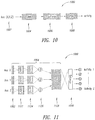
- Figure 10 outlines an embodiment of a CNN network pipeline 1000, and Figure 11 illustrates the embodiment 1000 of Figure 10 in more detail.
- Accelerometer data 1002 is provided to the CNN 1004, the output of the CNN is processed by a softmax layer 1006, and as illustrated, the prediction by the softmax layer 1006 is filtered by an optional FSA filter 1008.
- Figure 11 illustrates the CNN and Softmax portions of an embodiment of the CNN 1000 of Figure 10 .
- the convolutional layers 1122, 1124 learn filters of size k.
- the first layer 1122 generates m output features and the second layer 1124 generates again n features in output.
- the features are collected over a window of w samples and windows are separated by a step of s samples.
- the output of the convolutional layer 1124 is down-sampled by 2 (for example) in a pooling layer 1126.
- the MLP layer 1128 receives values in input and computes the hidden states.
- the softmax layer 1006 computes the output as a softmax function with z output values, e.g., standing, walking, jogging, biking, driving, etc.
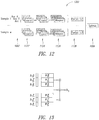
- Figure 12 illustrates an embodiment of a partial CNN computation method 1200 that may be employed by the embodiment 1000 of a CNN of Figure 10 .
- the CNN model uses all of the samples from a window in order to make a decision, the samples can be processed in the convolutional layers as they arrive in order to interleave the computation with sensor reading ( e.g., when implemented on an embedded platform) and reuse results between overlapping windows.
- the output of the pooling 1126 and the fully-connected layer 3 ( fc3 ) 1128 layers can be partially computed as soon as the filtered outputs of the convolutional layers are available for the current sample.
- the three acceleration axes were processed separately through the two convolutional and the pooling layers, producing in output v values per sample.
- the values were multiplied by a slice W 3 i of the weight matrix W 3 for the fc3 layer and accumulated on the fc3 output h 3 until all the samples 1,.., w of the current window were processed.
- the input values and the weights were re-ordered to match the order of the incoming values and to preserve the results of the matrix multiplication.
- Figure 13 shows a logical diagram of the operations involved in the partial fc3 computation embodiment of the study.
- the decision was computed by a softmax layer taking h 3 as input after all the samples in the window are processed.
- a single buffer may be employed as long as the step between windows is larger than 4 ⁇ ( k - 1) where k is the size of the convolutional kernel; this condition ensures that the output of each window has no overlap. For shorter steps, more than one buffer and more than one fc3 output would be computed per sample, increasing memory and computational requirements.
- Figure 14 shows how the computational load is distributed, in the scenario where samples are read at a frequency of 16 Hz, and the partial computation of layers conv1 to fc3 (including an optional softmax ) can be completed in less than 1/16 th of a second.
- the CNN output can be affected by transient outliers, that is, predictions that for 1 or two windows give a different value from all the previous predictions because of, e.g., false positives.
- the outliers can be removed by examining the predictions in a window. This increases accuracy, at the cost of also increasing the latency in the prediction after an activity change.
- the outliers don't affect significantly the distribution of the predictions over a window, so the choice of an outlier removal mechanism may typically be a median filter with window size W.
- FIG. 15 illustrates an example histogram of a label distribution on a window and a label selected by a median filter.
- the prediction is Activity 3, which is underrepresented in the window, but which is in the center of the window.
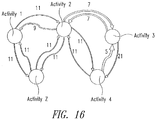
- the likelihood of the transitions can be encoded in a variable window size, with longer windows selected for unlikely transitions.
- the transitions may be encoded in a Finite State Machine (FSM), also referred to as a Finite State Automata (FSA), where the states represent a confirmed prediction and the edges encode the window size to confirm a transition to another state.
- FSM Finite State Machine
- FSA Finite State Automata
- An example embodiment of an FSM (or FSA) is illustrated in Figure 16 .
- the dependence on the label order may be removed by using a majority filter, where a label is selected if at least 50% of the predictions in the window agree on a specific outcome.
- the FSM may be implemented as a transition matrix T, where the element t ij represents the window size from node i to node j and a special value (e.g., infinity) indicates that no transition is allowed. For transitions into the same state, a conventional value of 0 may be used.
- a queue of the last t max predictions may be maintained, where t max the maximum window size, and a transition from i to j is allowed if in the last t ij predictions, at least t ij 2 + 1 ( consensus threshold ) agree on the j label. If t ij is the special value or no transition reaches the consensus threshold, the state is not changed.
- neural network models may be trained end-to-end and do not require any specific parameter tuning, development of ad hoc rules, features, classification steps, etc. This may be advantageous in some embodiments.
- neural network embodiment may employ shorter design times for a classifier assuming a growing number of activities to be recognized from time to time.
- training tools optimized for powerful processor designs may significantly shorten the training times.
- the Dataset 2.0 has a skewed class distribution, where the stationary class is overrepresented. As the stationary activity is much more likely than all the other activities, it makes sense to use a larger set of examples and adopt a training strategy that minimizes false negatives for the stationary class. For neural networks the same mechanism may be implemented explicitly (e.g. hard negative mining).
- the wearable device 110 of Figure 1 may comprise one or more other sensors, such as one or more gyroscopes 160, in addition to one or more accelerometers 122.
- Figure 17 illustrates CNN and Softmax portions of an embodiment of a CNN 1700, similar to the embodiment 1000 of Figures 10 and 11 , but which processes accelerometer and gyroscope data.
- Accelerometer data 1702 and gyroscope data 1704 are provided to the CNN 1706, the output of the CNN is processed by a softmax layer 1708.
- the prediction by the softmax layer 1708 may be filtered by an optional FSA filter (see FSA filter 1008 of Figure 10 ).
- the training data set including acceleration and orientation data used to train the activity-classification model may be equalized with respect to the classifications.
- additional activity-related data may be considered in the classification model, such as data from one or more physiological sensors, such as the physiological sensor 124 of Figure 1 , data from one or more position sensors, such as the position sensor 126 of Figure 1 , etc., and various combinations thereof.
- Figure 18 illustrates CNN and Softmax portions of an embodiment of a CNN 1800, similar to the embodiment 1000 of Figures 10 and 11 , where the fc3 layer has been replaced with a global mean pooling layer 1806.
- Accelerometer data 1802 are provided to a series of convolutional layer 1804, an output of the series of convolutional layers 1804 is provided to the global mean pooling layer 1806.
- the global mean pooling layer selects the mean values across all the convolutional channels and the current window and provides these values to the softmax layer 1808.
- the prediction by the softmax layer 1808 may be filtered by an optional FSA filter (see FSA filter 1008 of Figure 10 ).
- Some embodiments may employ other types of global pooling layers, such as a global maximum pooling layer, a global minimum pooling layer, etc.
- Using a global pooling layer instead of an fc3 layer may facilitate significantly reducing the number of parameters and operations.
- using a global mean pooling layer instead of an fc3 layer may reduce the number of parameters by a factor of 10, and the number of operations by a factor of 2.
- a computer readable medium including a computer program adapted to perform one or more of the methods or functions described above.
- the medium may be a physical storage medium such as for example a Read Only Memory (ROM) chip, or a disk such as a Digital Versatile Disk (DVD-ROM), Compact Disk (CD-ROM), a hard disk, a memory, a network, or a portable media article to be read by an appropriate drive or via an appropriate connection, including as encoded in one or more barcodes or other related codes stored on one or more such computer-readable mediums and being readable by an appropriate reader device.
- ROM Read Only Memory
- DVD-ROM Digital Versatile Disk
- CD-ROM Compact Disk
- some of the systems and/or modules and/or circuits and/or blocks may be implemented or provided in other manners, such as at least partially in firmware and/or hardware, including, but not limited to, one or more application-specific integrated circuits (ASICs), digital signal processors, discrete circuitry, logic gates, standard integrated circuits, state machines, look-up tables, controllers (e.g., by executing appropriate instructions, and including microcontrollers and/or embedded controllers), field-programmable gate arrays (FPGAs), complex programmable logic devices (CPLDs), etc., as well as devices that employ RFID technology, and various combinations thereof.
- ASICs application-specific integrated circuits
- DSPs digital signal processors
- discrete circuitry discrete circuitry
- logic gates e.g., logic gates, standard integrated circuits, state machines, look-up tables
- controllers e.g., by executing appropriate instructions, and including microcontrollers and/or embedded controllers
- FPGAs field-programmable gate arrays
- CPLDs
Landscapes
- Engineering & Computer Science (AREA)
- Health & Medical Sciences (AREA)
- Life Sciences & Earth Sciences (AREA)
- Theoretical Computer Science (AREA)
- Physics & Mathematics (AREA)
- Data Mining & Analysis (AREA)
- Artificial Intelligence (AREA)
- General Engineering & Computer Science (AREA)
- General Physics & Mathematics (AREA)
- Evolutionary Computation (AREA)
- General Health & Medical Sciences (AREA)
- Biomedical Technology (AREA)
- Molecular Biology (AREA)
- Biophysics (AREA)
- Computer Vision & Pattern Recognition (AREA)
- Physiology (AREA)
- Mathematical Physics (AREA)
- Software Systems (AREA)
- Cardiology (AREA)
- Medical Informatics (AREA)
- Computing Systems (AREA)
- Evolutionary Biology (AREA)
- Bioinformatics & Computational Biology (AREA)
- Bioinformatics & Cheminformatics (AREA)
- Pathology (AREA)
- Heart & Thoracic Surgery (AREA)
- Veterinary Medicine (AREA)
- Public Health (AREA)
- Animal Behavior & Ethology (AREA)
- Surgery (AREA)
- Computational Linguistics (AREA)
- Pulmonology (AREA)
- Psychiatry (AREA)
- Human Computer Interaction (AREA)
- Fuzzy Systems (AREA)
- Signal Processing (AREA)
- Dentistry (AREA)
- Oral & Maxillofacial Surgery (AREA)
- Social Psychology (AREA)
- Multimedia (AREA)
Abstract
Description
- The present disclosure relates to techniques, devices and systems for recognizing human activity based on sensed information, such as signals acquired by wearable sensor devices.
- Wearable sensor device may continuously acquire and store information, and periodically transmit signals conveying the information, which may be processed in real time, for example, remotely by a host device or locally by the wearable device itself. Activities in which a wearer is engaged may be detected based on the information conveyed by the sensor signals. The signals may convey physiological data, acceleration data, rotation data, position data, etc.
- The information may be analyzed to determine one or more activities in which the wearer is engaged. For example, a wearable sensor device may include one or more accelerometers, and an activity of the wearer may be determined based on accelerometer data from the one or more accelerometers, complemented by one or more gyroscopes. Simplest models may typically be employed to determine an activity of a wearer based on accelerometer data.
- In an embodiment, a method comprises: receiving activity-related data; determining activity classifications based on the received activity-related data and an activity-classification model trained using a classification-equalized training data set; and generating a classification signal based on the determined classifications. In an embodiment, for each class cj other than a determined class ci , a sequence length tj such that the total number of samples Nj for the class cj , assuming the sequences of the class cj are truncated at sequence length tj, equals or just exceeds the number N of samples in the class ci . In other words, Nj < N for length tj - 1. Thus, in an embodiment, tj for each class other than the determined class is determined based on the number of samples N in the determined class. In an embodiment, the classification-equalized training data set comprises a first class having a first sequence length and a number of samples N, and one or more additional classes each having a respective sequence length tj and a respective number of samples Nj which satisfy:
- Nj > N, for sequence length tj; and
- Nj < N, for sequence length tj-1.
- In an embodiment, the method comprises: generating the classification-equalized training data set; and training the activity-classification model. In an embodiment, the determining activity classifications comprises extracting feature data based on the received activity-related data. In an embodiment, the determining comprises using an artificial neural network having a feed-forward architecture. In an embodiment, the artificial neural network comprises a layered architecture including one or more of: one or more convolutional layers; one or more pooling layers; one or more fully connected layers; and one or more softmax layers. In an embodiment, the artificial neural network comprises a finite state machine. In an embodiment, the determining comprises using an artificial neural network having a recurrent architecture. In an embodiment, the determining comprises using feature extraction and a random forest. In an embodiment, the determining comprises applying a temporal filter. In an embodiment, the activity-related data comprises one or more of: acceleration data, orientation data, geographical position data, and physiological data.
- In an embodiment, a device comprises: an interface, which, in operation, receives one or more signals indicative of activity; and signal processing circuitry, which, in operation: determines activity classifications based on the received signals indicative of activity and an activity-classification model trained using a classification-equalized training data set; and generates a classification signal based on the determined classifications. In an embodiment, the classification-equalized training data set comprises a first class having a first sequence length and a number of samples N, and one or more additional classes each having a respective sequence length tj and a respective number of samples Nj which satisfy:
- Nj > N, for sequence length tj; and
- Nj < N, for sequence length tj-1.
- In an embodiment, the signal processing circuitry comprises a feature extractor, a random forest and a temporal filter. In an embodiment, the signal processing circuitry comprises an artificial neural network having a feed-forward architecture. In an embodiment, the artificial neural network comprises a layered architecture including one or more of: one or more convolutional layers; one or more pooling layers; one or more fully connected layers; and one or more softmax layers. In an embodiment, the signal processing circuitry comprises an artificial neural network having a recurrent architecture. In an embodiment, the signal processing circuitry, in operation: generates the classification-equalized training data set; and trains the activity-classification model. In an embodiment, the signal processing circuitry comprises a finite state machine. In an embodiment, the one or more signals indicative of activity comprise signals indicative of one or more of: acceleration data, orientation data, geographical position data, and physiological data.
- In an embodiment, a system comprises: one or more sensors, which, in operation, generate one or more activity-related signals; and signal processing circuitry, which, in operation: determines activity classifications based on activity-related signals and an activity-classification model trained using a classification-equalized training data set; and generates a classification signal based on the determined classifications. In an embodiment, the classification-equalized training data set comprises a first class having a first sequence length and a number of samples N, and one or more additional classes each having a respective sequence length tj and a respective number of samples Nj which satisfy:
- Nj > N, for sequence length tj; and
- Nj < N, for sequence length tj-1.
- In an embodiment, the signal processing circuitry comprises a feature extractor, a random forest and a temporal filter. In an embodiment, the signal processing circuitry comprises an artificial neural network having a feed-forward architecture. In an embodiment, the signal processing circuitry comprises an artificial neural network having a recurrent architecture. In an embodiment, the one or more sensors include one or more of: an accelerometer; a gyroscope; a position sensor; and a physiological sensor.
- In an embodiment, a system, comprises: means for providing activity-related data; and means for generating an activity classification signal based on activity-related data and an activity-classification model trained using a classification-equalized training data set. In an embodiment, the classification-equalized training data set comprises a first class having a first sequence length and a number of samples N, and one or more additional classes each having a respective sequence length tj and a respective number of samples Nj which satisfy:
- Nj> N, for sequence length tj; and
- Nj < N, for sequence length tj-1.
- In an embodiment, the means for generating the activity classification signal comprises a memory and one or more processor cores, wherein the memory stores contents which in operation configure the one or more processor cores to generate the activity classification signal.
- In an embodiment, a non-transitory computer-readable medium's contents configure signal processing circuitry to perform a method, the method comprising: receiving activity-related data; determining activity classifications based on the received activity-related data and an activity-classification model trained using a classification-equalized training data set; and generating a classification signal based on the determined classifications. In an embodiment, the classification-equalized training data set comprises a first class having a first sequence length and a number of samples N, and one or more additional classes each having a respective sequence length tj and a respective number of samples Nj which satisfy:
- Nj> N, for sequence length tj; and
- Nj < N, for sequence length tj-1.
- In an embodiment, the method comprises: generating the classification-equalized training data set; and training the activity-classification model. In an embodiment, the determining activity classifications comprises extracting feature data based on the received activity-related data. In an embodiment, the determining comprises using an artificial neural network having a feed-forward architecture. In an embodiment, the artificial neural network comprises a layered architecture including one or more of: one or more convolutional layers; one or more pooling layers; one or more fully connected layers; one or more softmax layers. In an embodiment, the artificial neural network comprises a finite state machine. In an embodiment, the determining comprises using an artificial neural network having a recurrent architecture. In an embodiment, the artificial neural network comprises a finite state machine. In an embodiment, the determining comprises using feature extraction and a random forest. In an embodiment, the determining comprises applying a temporal filter.
-
-
Figure 1 is a functional block diagram of an embodiment of a system to detect user activities based on information gathered by a wearable device. -
Figure 2 illustrates an embodiment of a method of equalizing a number of samples in a data set. -
Figure 3 illustrates an embodiment of a classification pipeline to classify samples. -
Figure 4 illustrates an embodiment of a neuron structure. -
Figure 5 illustrates an embodiment of a structure of fully connected layer architecture. -
Figure 6 illustrates an embodiment of a logistic sigmoid function. -
Figure 7 illustrates an embodiment of a convolutional layer employing a sliding window. -
Figure 8 illustrates an embodiment of the structure of a convolutional network. -
Figure 9 illustrates an embodiment of a recurrent neural Echo State Network (ESN) pipeline. -
Figure 10 illustrates an embodiment of a convolutional neural network (CNN) pipeline. -
Figure 11 illustrates a portion of the embodiment of a CNN ofFigure 10 in more detail. -
Figure 12 illustrates an embodiment of a partial CNN computation process that may be employed by the embodiment of a CNN ofFigure 10 . -
Figure 13 illustrates an embodiment of a logical diagram of a partial computation of a CNN network. -
Figure 14 illustrates an example distribution of a computational load of an embodiment. -
Figure 15 illustrates an example histogram of a label distribution on a window and a label selected by a median filter of an embodiment of a CNN pipeline. -
Figure 16 illustrates an embodiment of an encoding of a Finite State Machine (FSM), or a Finite State Automata (FSA). -
Figure 17 illustrates an embodiment of a convolutional neural network CNN pipeline which receives accelerometer and gyroscope data. -
Figure 18 illustrates an embodiment of a convolutional neural network CNN pipeline employing a global mean pooling layer. - In the following description, certain details are set forth in order to provide a thorough understanding of various embodiments of devices, systems, methods and articles. However, one of skill in the art will understand that other embodiments may be practiced without these details. In other instances, well-known structures and methods associated with, for example, wearable devices and signal processing circuitry, such as transistors, multipliers, transmitters, NFC circuits, integrated circuits, etc., have not been shown or described in detail in some figures to avoid unnecessarily obscuring descriptions of the embodiments.
- Unless the context requires otherwise, throughout the specification and claims which follow, the word "comprise" and variations thereof, such as "comprising," and "comprises," are to be construed in an open, inclusive sense, that is, as "including, but not limited to."
- Reference throughout this specification to "one embodiment," or "an embodiment" means that a particular feature, structure or characteristic described in connection with the embodiment is included in at least one embodiment. Thus, the appearances of the phrases "in one embodiment," or "in an embodiment" in various places throughout this specification are not necessarily referring to the same embodiment, or to all embodiments. Furthermore, the particular features, structures, or characteristics may be combined in any suitable manner in one or more embodiments to obtain further embodiments.
- The headings are provided for convenience only, and do not interpret the scope or meaning of this disclosure.
- The sizes and relative positions of elements in the drawings are not necessarily drawn to scale. For example, the shapes of various elements and angles are not drawn to scale, and some of these elements are enlarged and positioned to improve drawing legibility. Further, the particular shapes of the elements as drawn are not necessarily intended to convey any information regarding the actual shape of particular elements, and have been selected solely for ease of recognition in the drawings.
-
Figure 1 is a functional block diagram of an embodiment of asystem 100 to determine an activity of a wearer of a wearable device. As illustrated, thesystem 100 comprises awearable sensor device 110, a host/server 150, and an optionallocal host 190. Thewearable sensor device 110, the host/server 150, and the optionallocal host 190 as illustrated are communicatively coupled together by one or morewireless communication links 112 and one or morewired communication links 114, which may be used alone or in various combinations to facilitate transmission of control and data signals between thewearable device 110, the host/server 150 and the optionallocal host 190. The optional local host may facilitate communication between thewearable device 110 and the host/server 150, for example, when the host/server 150 is a remote server. As illustrated, thewearable sensor device 110, the host/server 150 and the optional local host include circuitry comprising one or more processors orprocessor cores P 116, one ormore memories M 118, anddiscrete circuitry DC 120, such as one or more adders, one or more multipliers, one or more filters (such as band pass, low pass, high pass filters, infinite impulse response (IIR), finite impulse (FIR) filters, etc.), etc., which may, alone or in various combinations, implement one or more functions of thesystem 100. - As illustrated, the
wearable device 110 comprises circuitry including one ormore accelerometers 122, such as a triaxle accelerometer, one or more gyroscopes, such as theillustrated triaxle gyroscope 160, etc., one or morephysiological sensors 124, such as a heart rate sensor, a temperature sensor, a respiration sensor, etc., one ormore position sensors 126, such as a global position sensor, etc., one ormore clocks 128, one ormore communication circuits 130, and one ormore database structures 132. For ease of illustration, other circuitry, which may typically be included in a wearable device such as thewearable device 110, are omitted fromFigure 1 . Such circuitry may include bus systems, power systems, interfaces, etc. - The one or
more accelerometers 122 sense movement data and generate signals indicative of the movement data, such as acceleration data for three axis of movement x, y and z of thewearable device 110.Multiple accelerometers 122 may be employed, such as an accelerometer for each axis, an accelerometer configured to gather acceleration data along two axes, together with an accelerometer to gather acceleration data along a third axis, an accelerometer configured to gather acceleration data alone three axes, etc., and various combinations thereof. - The one or more
physiological sensors 124 gather physiological data, such as heart rate information, temperature information, respiration information, etc., related to a wearer of thewearable device 110. The one ormore position sensors 126 gather position data, such as a data related to a geographical position of thewearable device 110, data related to a position of thewearable device 110 on a wearer, etc. The one ormore clocks 128 provide timing signals to facilitate the collection of data samples, for use, for example, in generating training data, determining wearer activities associated with the data samples, time stamps etc. The one ormore communication circuits 130 facilitate the exchange of data and control signals between components of thesystem 100, and may include, for example, near-field communication circuits, serial bus communication circuits, LAN and WAN communication circuits, wi-fi communication circuits, mobile telephone communication circuits, etc., and various combinations thereof. The one ormore data structures 132 may store, for example, training data, test data, control parameters, such as modeling parameters, instructions (for example, for execution by the one or more processors P 116), etc., and various combinations thereof. - The one or
more gyroscopes 160 sense orientation data and generate signals indicative of the orientation data, such as orientation data with respect to three axis of a three-dimensional space x, y and z of thewearable device 110.Multiple gyroscopes 160 may be employed, such as a gyroscope for each axis. - As illustrated, the server/
host 150 comprises circuitry including aneural network 152, one ormore filter banks 153, such as IIR filters, FIR filters, etc., asample equalizer 154, a model generator/trainer 156, one ormore data structures 132, aclassifier 158, which may classify a data sample based on a model generated by themodel generator 156 and/or data stored in the one ormore data structures 132 as being associated with one or more activities (e.g., stationary, walking, fast walking, jogging, biking, driving, etc.), one ormore clocks 128 andcommunication circuitry 130. For ease of illustration, other circuitry, which may typically be included in a server/host such as the server/host 150, are omitted fromFigure 1 . Such circuitry may include bus systems, power systems, interfaces, etc. - In some embodiments, one or more functions of the
wearable device 110, of the server/host 150 and/or of the optionallocal host 190 may instead or also be performed by another of thewearable device 110, the server/host 150 and/or the optionallocal host 190. For example, in some embodiments, the wearable device and/or the local host may include a neural network, such as theneural network 152, and a classifier, such as theclassifier 158, similar to those of the server/host 150. - The inventors have recognized that the number of samples in training data, such as data used to train a neural network to classify data samples, as well as the number of samples in test data sets to be classified (which may also be employed to update models) may tend to be skewed in favor of activities of a particular class. Table 1, below, illustrates the number of samples associated with various activity classes in an example training data set, referred to herein after as Dataset 1.1, Training Set.
Table 1: Example Dataset 1.1, Training Set Distribution Activity Class Number of Samples Percentage of Total Samples Stationary 4,536,217 46.44 Walking 1,448,165 14.83 Jogging 1,679,551 17.20 Biking 594,737 6.09 Driving 1,508,601 15.45 - Table 2, below, illustrates a number of samples associated with various activity classes for a first test data set, referred to hereinafter as Dataset 1.1,
Test Set 1.Table 2: Example Dataset 1.1, Test Set 1 DistributionActivity Class Number of Samples Percentage of Total Samples Stationary 216,048 40.68 Walking 81,018 15.25 Jogging 81,018 15.25 Biking 72,016 13.56 Driving 81,018 15.25 - Table 3, below, illustrates a number of samples associated with various activity classes for a second test data set, referred to hereinafter as Dataset 1.1,
Test Set 2.Table 3: Example Data Set 1.1, Test Set 2 DistributionActivity Class Number of Samples Percentage of Total Samples Stationary 207,046 39.66 Walking 81,018 15.52 Jogging 81,018 15.52 Biking 72,016 13.79 Driving 81,018 15.52 - The data sequences used to generate the training and test data sets were acquired at a frequency of 50 Hz, but other acquisition frequencies may be employed, such as, for example, 16 Hz. For training and test purposes, the data sequences were decimated at a 1:3 ratio, generating sequences having an acquisition frequency of approximately 16 Hz. The training data set in the example of Table 1 was generated from 434 data sequences organized into five classes: stationary, walking, jogging, biking and driving. The test data set in the example of Table 2 was generated from 59 acquired data sequences not included in the training data set, and organized into the same five classes. The test data set in the example of Table 3 was generated from 58 acquired data sequences, which may include sequences included in the training data set, and organized into the same five classes.
- Table 4, below, illustrates a number of samples associated with various activities for cleaned-up test data set, and includes a column showing a number of samples in the training data set. The cleaned-up test data set in the example of Table 4 was generated from 1054 acquired data sequences and organized into the same five classes. The distribution of samples is skewed toward the stationary and walking sequences. For ease of reference, the cleaned up test data set of Table 4 will be referred to hereinafter as Dataset 2.0, Cleaned-
Up Test Set 1.Table 4: Dataset 2.0, Cleaned- Up Test Set 1 DistributionActivity Number of Samples Percentage of Total Samples Training Data Set Samples Stationary 8,674,636 80.11 4,536,217 Walking 1,844,416 17.03 1,448,165 Jogging 23,350 00.22 1,679,551 Biking 49,052 00.45 594,737 Driving 237,372 02.19 1,508,601 - In the training of a model, the training error is often computed as the sum of the errors of each sample. If, as in the case of both the first test data set, Dataset 1.1,
Test Set 1, and the Dataset 2.0, Cleaned-Up Test Set 1, some classes are more represented, the training error promotes those classes to the detriment of the least represented classes. For example, in the case of the Cleaned-Up Test Set of Table 4, a True Positive Rate (TPR) of 80.11% can be reached by predicting "stationary" all the time. To facilitate avoiding this issue, the data set may be equalized, that is, the same number of samples (or approximately the same number of samples) may be selected for each class. -
Figure 2 illustrates an embodiment of amethod 200, which may be employed by thesystem 100 ofFigure 1 (e.g., by the sample equalizer 154), to equalize the number of samples in a data set, such as a data set used for training or for evaluating the performing of thesystem 100. For convenience,Figure 2 will be described with reference to thesystem 100 ofFigure 1 and the training data set of Table 1. Other embodiments of systems and devices may employ themethod 200 ofFigure 2 with other data sets. - The
method 200 proceeds from 202 to 204. At 204, thesystem 100 determines a class ci having a fewest number of samples N. In the example of the training data set of Table 1, Biking would be selected as the class ci having the fewest number of samples N. - The
method 200 proceeds from 204 to 206. At 206, thesystem 100 determines the number of samples N in the determined class ci . In the example of the training data set of Table 1, the number of samples N in the Biking class ci would be determined to be 594,737. - The
method 200 proceeds from 206 to 208. At 208, thesystem 100 determines, for each class cj other than the determined class ci , a sequence length tj such that the total number of samples Nj for the class cj , assuming the sequences of the class cj are truncated at sequence length tj, equals or just exceeds the number N of samples in the class ci . In other words, Nj < N for length tj - 1. Thus, tj for each class other than the determined class is determined based on the number of samples N in the determined class. - The
method 200 proceeds from 208 to 210. At 210, thesystem 100, for each class cj other than the determined class ci , truncates all of the sequences in the class cj to the determined sequence length tj for the class cj . In other words, samples in each sequence for each class cj beyond the determined length tj are discarded. - The
method 200 proceeds from 210 to 212, where thesystem 100 may perform other processing, such as returning an equalized data set for use in training or evaluating a model, such as a neural network model. - Embodiments of the
method 200 may include other acts not shown inFigure 2 , may not perform all of the acts shown inFigure 2 , and may perform the acts shown inFigure 2 in various orders. For example, in some embodiments acts 204 and 206 may be combined. Equalizing the number of samples by truncating the sequence lengths facilitates discarding whole sequences during the sample selection process. Other methods of equalizing the number of samples may be employed in some embodiments. For example, other conditions may be applied to determine the sequence lengths to be applied. For example, at 208, thesystem 100 may instead determine, for each class cj other than the determined class ci , a sequence length tj such that the total number of samples Nj for the class cj , assuming the sequences of the class cj are truncated at sequence length tj, is within a threshold number of the number N. -
Figure 3 illustrates an embodiment of aclassification pipeline circuit 300 which may be employed, for example, by an embodiment of a system, such as thesystem 100 ofFigure 1 (e.g., by the classifier 158), to classify samples. For convenience, theclassification pipeline 300 will be described with reference to thesystem 100 ofFigure 1 and with reference to acceleration data. Other embodiments of systems and devices may employ theclassification pipeline 300 ofFigure 3 with other and/or additional activity-related data, such as acceleration data, orientation data, geographical position data, physiological data, etc., and various combinations thereof. - Acceleration data is received by a
feature extractor 302. As illustrated, thefeature extractor 302 includes one ormore adders 304, one ormore multipliers 306, one or more band-pass FIR/IIR filters 308, one or more low-pass FIR/IIR filters 310 and one or more high-pass FIR/IIR filters 312. Other mathematic operation circuits may be employed, such as dividers, square root operators, etc. - The acceleration data may be received by the
feature extractor 302 in the form of input vectors a normalized with respect to a gravity acceleration g, with vectors a having a component in each of three axis and expressed in m/s2 (e.g., a = [a x , a y, a z ]). For convenience, vectors may be indicated with bold typeface herein. In an embodiment, the feature extractor computes an acceleration norm A for each received input as follows:
- In an embodiment, the signal A is filtered with a band-pass FIR/
IIR filter 308 and/or a low-pass FIR/IIR filter 310 and/or a high-pass FIR/IIR filter 312. As illustrated, the feature extractor provides extracted feature information to arandom forest classifier 320 and to atemporal filter 340. - The
random forest classifier 320 in an embodiment may comprise a multitude of decision trees, which discriminate classes. In an embodiment, the random forest trees may be implemented using complex sequences hard-coded if-then-else structures in C language. In an embodiment, thetemporal filter 340 handles special cases based on the output of therandom forest classifier 320 and corrects the output of therandom forest classifier 320 in case of misclassification errors by filtering the current, future and previous classification samples (in time order) to output the correct class recognized: for example, some data at the output of 320 may indicate a classification output should be stationary, even if previous classification data indicates a different class. The output of the temporal filter may provide a more correct and coherent series of classifications of a current activity by exploiting temporal correlation of various previous decisions at the output of therandom forest 320 that otherwise would be incoherent if left as they are. For example therandom forest classifier 320 may output 6 (subsequent in time) classifications in the following sequence: running, running, driving, running, running, running etc. Clearly the 3rd classification output (driving) is highly incoherent with the previous and future ones and therefore will be replaced at the output of thetemporal filter 340 with running so that the mistake is corrected. - Training of artificial neural network architectures on raw acceleration data was performed in a study in an end-to-end fashion without input sample pre-processing and feature design. Two architectures were evaluated: an Echo State Network (ESN) having a reservoir, three inputs (one for each acceleration axis) and an output trained through logistic regression; and a Convolutional Neural Network having four layers.
- A
typical neuron structure 400 of an embodiment is represented inFigure 4 . A set of inputs may comprise outputs of other neurons h i, and input signals u, and are weighted by a set of values w1, w2, ... wk+1, and then summed. The outputs of other neurons provides as input (the h i values) may be, for example, generated exclusively by neurons in a previous level or layer in an Acyclic Connected Graph (ACG) structure of a feed forward network, generated from values computed in the same layer in a previous time step in a recurrent network, etc. The summed value is then subjected to a non-linearity function f(x) 402, as illustrated a sigmoid function as a non-limiting example since other functions may be used such as ReLU (Rectified Linear Unit), generating an output of the neuron y. - The outputs yj of multiple neurons may be generated by stacking weights in a weight matrix W , determining a matrix product of the inputs and the weight matrix, generating as vector, and applying the nonlinearity element-wise on the vector. In an embodiment, a bias term b may be added to the neuron to compensate for the mean value of the input.
- For a feed-forward network, the output of a neuron layer may be represented as:

- For a recurrent network, the output y t of a neuron layer may be represented as:

- A number of different nonlinearities f(x) may be employed in various embodiments. For example, a Rectified Linear Unit (ReLU) function may be employed. An example ReLU function returns zero for negative values, and does not change the value otherwise, and may be represented mathematically as follows:

- A sigmoid function, such as a logistic function (S-shaped curve) with a mid-point at zero and a maximum of 1, may be employed. An example sigmoid function may be represented mathematically as follows:

- A hyperbolic tangent function may be employed. An example hyperbolic tangent function may be represented mathematically as follows:

- The ReLU nonlinearity may typically be employed in feed-forward networks, and the sigmoid or tanh nonlinearities may typically be employed in recurrent networks.
- A Multi-Layer Perceptron (MLP) also known as fully connected architecture may be the simplest neural architecture, where a collection of neurons (layer) compute the output values from a previous (input) layer; the first layer is the input data, and the last layer is the prediction. Multiple layers can be stacked to compute increasing complex functions of the input. Because the output of a layer depends only on the values computed by the previous layer, the architecture is a feed-forward architecture. If a MLP is used as part of a larger network, each layer of the MLP may be referred to as a dense layer or a fully connected layer.
Figure 5 illustrates an example structure of a MLP architecture of an embodiment. - The sigmoid nonlinearity takes only values between 0 and 1 and thus can be interpreted as a probability estimate in a binary classification problem, e.g. a problem where only two classes are available. However, for multiple classes a tool which can estimate the probabilities over n classes is needed. In an embodiment, a softmax layer may be employed. In an embodiment, a softmax layer may be defined as:


- Thus the softmax may be treated as a generalization of the sigmoid / logistic function to multiple dimensions.
Figure 6 illustrates an example logistic sigmoid function. - The number of weights required to process an image or a window of a sequential signal grow as n 2 where n is the number of input values and thus may lead to overfitting. A convolutional layer may be employed to reduce the number of parameters, and facilitate avoiding overfitting. A convolutional layer may reduce the number of parameters through weight sharing and local connectivity. For example, in weight sharing neurons in layer n+1 may be connected to the neurons in layer n using the same set of weights. When local connectivity is employed, only the neurons in layer n near the location of the neuron in later n+1 are connected.
-
Figure 7 illustrates an example of a convolutional layer employing a sliding window. Computing the weighted sum of the previous layer over a sliding window is equivalent to a FIR filtering operation on the previous layer; the layer is thus called convolutional. In the most general case, the layers n and n+1 have a number of channels, that is, values referred to the same spatial position (such as stereo channels in audio signals or color channels in images). The convolution is thus extended to all the input channels by applying a different filter to each channel and summing the results. Moreover, a number of output channels are generated by applying a different set of filters to the input channels.Figure 8 shows the structure of an example convolutional network in a typical case. The filter weights are all learned, so in the design phase only three parameters are specified: the number of input channels c, the number of output channels m and the size of the filter kernel k. - A pooling layer may be employed to down-sample the input in order to introduce shift-invariance (insensitivity to small changes in alignment in the input signal) and to reduce the number of neurons in the subsequent layers. A pooling layer is often used after a convolutional layer and before a fully connected layer. The pooling layer is characterized by the window size N and a pooling function. Typical choices for the pooling function are the max function:


- An Echo State Network (ESN) may be employed in an embodiment as an alternative to the convolutional neural network. The ESN reservoir is characterized by a hidden state h t of size nr and a weight matrix W r of size nr × nr . The network receives an input a t of size ni weighted by a matrix W in of size nr × ni . Optionally, a bias b r can be added to each neuron. The matrix W r may be computed by sampling the coefficients randomly from a uniform distribution in -1, 1: wij∼u([-1,1]) and randomly setting weights to zero with probability p, where p the sparsity of the weight matrix. For classification tasks, instead of directly classifying the hidden state, an average may be employed. To save memory, the exponential average
y t = (1 - α) y t + αy t-1 may be used instead, where α is an averaging factor. The effective window size for averaging may be 1/α. The hidden state may be determined according to:

-
Figure 9 illustrates an example embodiment of anESN pipeline 900. For convenience,Figures 9 to 16 are described with reference to acceleration data. Various types of activity-related data may be employed in embodiments, such as acceleration data, orientation data, geographical position data, physiological data, etc., and various combinations thereof. Accelerometer data is received at 902 and provided to the reservoir network at 904. A running average is determined at 906, and logistic classification occurs at 908. The prediction is output at 910. - In neural network architectures the computations are dominated by scalar products, which combine ADD and MUL operations in a predictable pattern. The number of operations is discussed in terms of MADD for simplicity. The number of MUL is equal to the number of MADD, while the number of ADD is slightly lower. For each sample the hidden state is computed, requiring nr · (nr + nin + 1) MADDs and nr nonlinear function evaluations and the exponential average computed with 2 · (nin + nr ) MADDs. For classification, no · (nr + nin + 1) MADDs and no CMPs.
- The weight matrices and biases need to be stored, in an embodiment, (nr + no ) · (nr + nin + 1) floats may be employed. Moreover, buffers for the hidden state, the running average and the classifier output, totaling no + 2 · nr + ni floats may be employed.
- In the study, a convolutional neural network was employed. This model is feed-forward, that is, the output depends only on the input window and not on the temporal history of observations (in contrast with the ESN model). The CNN network in the study was built from m convolutional and n fully connected layers. The first m layers were applied to each acceleration axis separately; the resulting features were max pooled with size and stride of q and then fed to a Multi-Layer Perceptron (MLP) with p hidden neurons (fully connected to the MLP inputs) and r output neurons (one per class). The output of the CNN network was provided to a softmax layer (as a non-limiting example) giving the probability of each class and the class with the highest probability was selected as the prediction. To stabilize the prediction, a state filter (in this case, a finite state automata (FSA)) may be applied.
Figure 10 outlines an embodiment of aCNN network pipeline 1000, andFigure 11 illustrates theembodiment 1000 ofFigure 10 in more detail. As illustrated inFigure 10 ,Accelerometer data 1002 is provided to theCNN 1004, the output of the CNN is processed by asoftmax layer 1006, and as illustrated, the prediction by thesoftmax layer 1006 is filtered by anoptional FSA filter 1008. -
Figure 11 illustrates the CNN and Softmax portions of an embodiment of theCNN 1000 ofFigure 10 . Theconvolutional layers first layer 1122 generates m output features and thesecond layer 1124 generates again n features in output. The features are collected over a window of w samples and windows are separated by a step of s samples. The output of theconvolutional layer 1124 is down-sampled by 2 (for example) in apooling layer 1126. TheMLP layer 1128 receives values in input and computes the hidden states. Then, thesoftmax layer 1006 computes the output as a softmax function with z output values, e.g., standing, walking, jogging, biking, driving, etc. -
Figure 12 illustrates an embodiment of a partialCNN computation method 1200 that may be employed by theembodiment 1000 of a CNN ofFigure 10 . While the CNN model uses all of the samples from a window in order to make a decision, the samples can be processed in the convolutional layers as they arrive in order to interleave the computation with sensor reading (e.g., when implemented on an embedded platform) and reuse results between overlapping windows. Moreover, the output of the pooling 1126 and the fully-connected layer 3 (fc3) 1128 layers can be partially computed as soon as the filtered outputs of the convolutional layers are available for the current sample. - In the study, the three acceleration axes were processed separately through the two convolutional and the pooling layers, producing in output v values per sample. The values were multiplied by a slice W 3i of the weight matrix W 3 for the fc3 layer and accumulated on the fc3 output h 3 until all the
samples 1,.., w of the current window were processed. The input values and the weights were re-ordered to match the order of the incoming values and to preserve the results of the matrix multiplication.Figure 13 shows a logical diagram of the operations involved in the partial fc3 computation embodiment of the study. - In the study, the decision was computed by a softmax layer taking h 3 as input after all the samples in the window are processed. A single buffer may be employed as long as the step between windows is larger than 4 · (k - 1) where k is the size of the convolutional kernel; this condition ensures that the output of each window has no overlap. For shorter steps, more than one buffer and more than one fc3 output would be computed per sample, increasing memory and computational requirements.
-
Figure 14 shows how the computational load is distributed, in the scenario where samples are read at a frequency of 16 Hz, and the partial computation of layers conv1 to fc3 (including an optional softmax) can be completed in less than 1/16th of a second. - The CNN output can be affected by transient outliers, that is, predictions that for 1 or two windows give a different value from all the previous predictions because of, e.g., false positives. The outliers can be removed by examining the predictions in a window. This increases accuracy, at the cost of also increasing the latency in the prediction after an activity change. The outliers don't affect significantly the distribution of the predictions over a window, so the choice of an outlier removal mechanism may typically be a median filter with window size W.
- The use of a median filter, however, may present drawbacks. For example, all the state transitions are treated democratically by a median filter, even if some of the changes (e.g., jogging to driving) are implausible. In addition, an ordering in the activities given by the label codes is assumed, even if that order in meaningless, thus a prediction may be selected even if the prediction is underrepresented, because the prediction is in the middle of the distribution.
Figure 15 illustrates an example histogram of a label distribution on a window and a label selected by a median filter. InFigure 15 , the prediction isActivity 3, which is underrepresented in the window, but which is in the center of the window. - To facilitate addressing the drawbacks of a median filter, the likelihood of the transitions can be encoded in a variable window size, with longer windows selected for unlikely transitions. The transitions may be encoded in a Finite State Machine (FSM), also referred to as a Finite State Automata (FSA), where the states represent a confirmed prediction and the edges encode the window size to confirm a transition to another state. An example embodiment of an FSM (or FSA) is illustrated in
Figure 16 . The dependence on the label order may be removed by using a majority filter, where a label is selected if at least 50% of the predictions in the window agree on a specific outcome. - The FSM (or FSA) may be implemented as a transition matrix T, where the element tij represents the window size from node i to node j and a special value (e.g., infinity) indicates that no transition is allowed. For transitions into the same state, a conventional value of 0 may be used. A queue of the last tmax predictions may be maintained, where tmax the maximum window size, and a transition from i to j is allowed if in the last tij predictions, at
least 
- It is noted that the neural network models may be trained end-to-end and do not require any specific parameter tuning, development of ad hoc rules, features, classification steps, etc. This may be advantageous in some embodiments. For example neural network embodiment may employ shorter design times for a classifier assuming a growing number of activities to be recognized from time to time. In addition, training tools optimized for powerful processor designs may significantly shorten the training times.
- The Dataset 2.0 has a skewed class distribution, where the stationary class is overrepresented. As the stationary activity is much more likely than all the other activities, it makes sense to use a larger set of examples and adopt a training strategy that minimizes false negatives for the stationary class. For neural networks the same mechanism may be implemented explicitly (e.g. hard negative mining).
- As mentioned above, the
wearable device 110 ofFigure 1 may comprise one or more other sensors, such as one ormore gyroscopes 160, in addition to one ormore accelerometers 122.Figure 17 illustrates CNN and Softmax portions of an embodiment of aCNN 1700, similar to theembodiment 1000 ofFigures 10 and 11 , but which processes accelerometer and gyroscope data. As illustrated inFigure 17 ,Accelerometer data 1702 andgyroscope data 1704 are provided to theCNN 1706, the output of the CNN is processed by asoftmax layer 1708. The prediction by thesoftmax layer 1708 may be filtered by an optional FSA filter (seeFSA filter 1008 ofFigure 10 ). The training data set including acceleration and orientation data used to train the activity-classification model may be equalized with respect to the classifications. In some embodiments, additional activity-related data may be considered in the classification model, such as data from one or more physiological sensors, such as thephysiological sensor 124 ofFigure 1 , data from one or more position sensors, such as theposition sensor 126 ofFigure 1 , etc., and various combinations thereof. -
Figure 18 illustrates CNN and Softmax portions of an embodiment of aCNN 1800, similar to theembodiment 1000 ofFigures 10 and 11 , where the fc3 layer has been replaced with a globalmean pooling layer 1806. As illustrated inFigure 18 ,Accelerometer data 1802 are provided to a series ofconvolutional layer 1804, an output of the series ofconvolutional layers 1804 is provided to the globalmean pooling layer 1806. The global mean pooling layer selects the mean values across all the convolutional channels and the current window and provides these values to thesoftmax layer 1808. The prediction by thesoftmax layer 1808 may be filtered by an optional FSA filter (seeFSA filter 1008 ofFigure 10 ). Some embodiments may employ other types of global pooling layers, such as a global maximum pooling layer, a global minimum pooling layer, etc. Using a global pooling layer instead of an fc3 layer may facilitate significantly reducing the number of parameters and operations. In some embodiments, using a global mean pooling layer instead of an fc3 layer may reduce the number of parameters by a factor of 10, and the number of operations by a factor of 2. - Some embodiments may take the form of or include computer program products. For example, according to one embodiment there is provided a computer readable medium including a computer program adapted to perform one or more of the methods or functions described above. The medium may be a physical storage medium such as for example a Read Only Memory (ROM) chip, or a disk such as a Digital Versatile Disk (DVD-ROM), Compact Disk (CD-ROM), a hard disk, a memory, a network, or a portable media article to be read by an appropriate drive or via an appropriate connection, including as encoded in one or more barcodes or other related codes stored on one or more such computer-readable mediums and being readable by an appropriate reader device.
- Furthermore, in some embodiments, some of the systems and/or modules and/or circuits and/or blocks may be implemented or provided in other manners, such as at least partially in firmware and/or hardware, including, but not limited to, one or more application-specific integrated circuits (ASICs), digital signal processors, discrete circuitry, logic gates, standard integrated circuits, state machines, look-up tables, controllers (e.g., by executing appropriate instructions, and including microcontrollers and/or embedded controllers), field-programmable gate arrays (FPGAs), complex programmable logic devices (CPLDs), etc., as well as devices that employ RFID technology, and various combinations thereof.
- The various embodiments described above can be combined to provide further embodiments. Aspects of the embodiments can be modified, if necessary to employ concepts of the various patents, applications and publications to provide yet further embodiments.
- These and other changes can be made to the embodiments in light of the above-detailed description. In general, in the following claims, the terms used should not be construed to limit the claims to the specific embodiments disclosed in the specification and the claims, but should be construed to include all possible embodiments along with the full scope of equivalents to which such claims are entitled. Accordingly, the claims are not limited by the disclosure.
Claims (14)
- A method, comprising:receiving (112, 114) activity-related data (122, 124, 126, 160);determining (152, 158) activity classifications based on the received activity-related data and an activity-classification model trained using a classification-equalized training data set (212); andgenerating a classification signal (300) based on the determined classifications.
- The method of claim 1 wherein the classification-equalized training data set (212) comprises a first class having a first sequence length and a number of samples N, and one or more additional classes each having a respective sequence length tj and a respective number of samples Nj which satisfy:Nj > N, for sequence length tj; andNj < N, for sequence length tj-1.
- The method of claim 2, comprising:generating (200; 202 to 212) the classification-equalized training data set; andtraining the activity-classification model (152).
- The method of claim 1 wherein the determining activity classifications comprises extracting feature data (302) based on the received accelerometer data.
- The method of claim 1 wherein the determining comprises using an artificial neural network (152; 1000) having a feed-forward architecture.
- The method of claim 5 wherein the artificial neural network (1000) comprises a layered architecture including one or more of:one or more convolutional layers (1122, 1124) ;one or more pooling layers (1126); andone or more softmax layers (1006) .
- The method of claim 1 wherein the determining comprises using an artificial neural network (1000) having a recurrent architecture.
- The method of any of claims 5, 6 or 7 wherein the artificial neural network (152) comprises a finite state machine.
- The method of claim 1 wherein the determining comprises using feature extraction (302) and a random forest (320) .
- The method of claim 9 wherein the determining comprises applying a temporal filter (340).
- The method of claim 1 wherein the activity-related data comprises one or more of:acceleration data (122);orientation data (160);geographical position data (126); andphysiological data (124).
- A device, comprising:an interface (112, 114), which, in operation, receives one or more signals indicative of activity (122, 124, 126, 160); andsignal processing circuitry (150, 190), which, in operation:determines (152, 158) activity classifications based on the received signals indicative of activity and an activity-classification model trained using a classification-equalized training data set (212);; andgenerates a classification signal (300) based on the determined classifications,wherein the device is configured for operating with the method of any of claims 1 to 11.
- A system, comprising:one or more sensors (122, 124, 126, 160), which, in operation, generate one or more activity-related signals; andthe device of claim 12 with said interface(112, 114), coupled with the one or more sensors to receive therefrom said one or more signals indicative of activity.
- The system of claim 13 wherein the one or more sensors (122, 124, 126, 160) comprise a memory and one or more processor cores, wherein the memory stores contents which in operation configure the one or more processor cores to generate the activity classification signal.
Applications Claiming Priority (1)
| Application Number | Priority Date | Filing Date | Title |
|---|---|---|---|
| US15/280,463 US20180089586A1 (en) | 2016-09-29 | 2016-09-29 | Artificial neural networks for human activity recognition |
Publications (2)
| Publication Number | Publication Date |
|---|---|
| EP3301611A1 true EP3301611A1 (en) | 2018-04-04 |
| EP3301611B1 EP3301611B1 (en) | 2021-11-10 |
Family
ID=60119786
Family Applications (1)
| Application Number | Title | Priority Date | Filing Date |
|---|---|---|---|
| EP17193073.8A Active EP3301611B1 (en) | 2016-09-29 | 2017-09-26 | Artificial neural networks for human activity recognition |
Country Status (3)
| Country | Link |
|---|---|
| US (1) | US20180089586A1 (en) |
| EP (1) | EP3301611B1 (en) |
| CN (1) | CN107885322B (en) |
Cited By (1)
| Publication number | Priority date | Publication date | Assignee | Title |
|---|---|---|---|---|
| US11537840B2 (en) | 2017-11-15 | 2022-12-27 | Stmicroelectronics S.R.L. | Method, system, and computer program product to employ a multi-layered neural network for classification |
Families Citing this family (22)
| Publication number | Priority date | Publication date | Assignee | Title |
|---|---|---|---|---|
| CN108549857B (en) * | 2018-03-30 | 2021-04-23 | 国信优易数据股份有限公司 | Event detection model training method, device and event detection method |
| CN108875821A (en) * | 2018-06-08 | 2018-11-23 | Oppo广东移动通信有限公司 | Training method and device of classification model, mobile terminal and readable storage medium |
| CN109002890A (en) * | 2018-07-11 | 2018-12-14 | 北京航空航天大学 | The modeling method and device of convolutional neural networks model |
| CN109086704A (en) * | 2018-07-23 | 2018-12-25 | 杭州电子科技大学 | A kind of physical activity recognition methods classified based on rarefaction representation and Softmax |
| CN109508677B (en) * | 2018-11-15 | 2021-07-13 | 电子科技大学 | An air handwriting action recognition method based on improved CNN network |
| US20200210813A1 (en) * | 2018-12-30 | 2020-07-02 | Robert Bosch Gmbh | Distributed neural networks for edge devices |
| CN109840691B (en) * | 2018-12-31 | 2023-04-28 | 天津求实智源科技有限公司 | Non-invasive polynomial electric quantity estimation method based on deep neural network |
| BR112021020748A2 (en) * | 2019-04-15 | 2021-12-14 | Sports Data Labs Inc | Animal data monetization |
| CN113692589B (en) * | 2019-04-29 | 2025-01-17 | 西门子(中国)有限公司 | Classification model training method, device and computer readable medium |
| CN110458033B (en) * | 2019-07-17 | 2023-01-03 | 哈尔滨工程大学 | Human body behavior sequence identification method based on wearable position sensor |
| CN110522426A (en) * | 2019-09-05 | 2019-12-03 | 大连海事大学 | Intelligent ship personnel behavior monitoring system based on multiple sensors |
| CN110705599B (en) * | 2019-09-06 | 2021-10-19 | 北京理工大学 | A Human Action Recognition Method Based on Online Transfer Learning |
| US12295082B2 (en) | 2019-10-07 | 2025-05-06 | Signify Holding B.V. | System and methods to provide immersive lighting interaction |
| CN110942105B (en) * | 2019-12-13 | 2022-09-16 | 东华大学 | Mixed pooling method based on maximum pooling and average pooling |
| US20210304001A1 (en) * | 2020-03-30 | 2021-09-30 | Google Llc | Multi-head neural network model to simultaneously predict multiple physiological signals from facial RGB video |
| US11423058B2 (en) * | 2020-09-25 | 2022-08-23 | International Business Machines Corporation | Classifying and filtering data from a data stream |
| CN112545525B (en) * | 2020-11-30 | 2022-05-13 | 中国科学技术大学 | Electrocardiogram data classification method, device and system |
| CN113326885A (en) | 2021-06-16 | 2021-08-31 | 北京百度网讯科技有限公司 | Method and device for training classification model and data classification |
| JP7574770B2 (en) * | 2021-09-13 | 2024-10-29 | トヨタ自動車株式会社 | Information processing device |
| CN114732373B (en) * | 2022-06-13 | 2022-12-02 | 深圳市奋达智能技术有限公司 | Gait detection-based walking activity calorie consumption calculation method and device |
| KR102515065B1 (en) * | 2022-07-29 | 2023-03-29 | 국방과학연구소 | Human activity recognition apparatus, human activity recognition method and computer program for classifying activity categories of user |
| WO2026072605A1 (en) * | 2024-09-27 | 2026-04-02 | Apple Inc. | User activity predictions for wearable device users based on user activity context tracking |
Family Cites Families (4)
| Publication number | Priority date | Publication date | Assignee | Title |
|---|---|---|---|---|
| US20030093162A1 (en) * | 2001-11-13 | 2003-05-15 | Koninklijke Philips Electronics N.V. | Classifiers using eigen networks for recognition and classification of objects |
| US7835999B2 (en) * | 2007-06-27 | 2010-11-16 | Microsoft Corporation | Recognizing input gestures using a multi-touch input device, calculated graphs, and a neural network with link weights |
| US9174123B2 (en) * | 2009-11-09 | 2015-11-03 | Invensense, Inc. | Handheld computer systems and techniques for character and command recognition related to human movements |
| US9619035B2 (en) * | 2011-03-04 | 2017-04-11 | Microsoft Technology Licensing, Llc | Gesture detection and recognition |
-
2016
- 2016-09-29 US US15/280,463 patent/US20180089586A1/en not_active Abandoned
-
2017
- 2017-09-14 CN CN201710825963.9A patent/CN107885322B/en active Active
- 2017-09-26 EP EP17193073.8A patent/EP3301611B1/en active Active
Non-Patent Citations (3)
| Title |
|---|
| ANDREAS BULLING ET AL: "A tutorial on human activity recognition using body-worn inertial sensors", ACM COMPUTING SURVEYS, ACM, NEW YORK, NY, US, US, vol. 46, no. 3, 1 January 2014 (2014-01-01), pages 1 - 33, XP058043677, ISSN: 0360-0300, DOI: 10.1145/2499621 * |
| FRANCISCO ORD??EZ ET AL: "Deep Convolutional and LSTM Recurrent Neural Networks for Multimodal Wearable Activity Recognition", SENSORS, vol. 16, no. 1, 18 January 2016 (2016-01-18), pages 115, XP055368352, DOI: 10.3390/s16010115 * |
| MUHAMMAD SHOAIB ET AL: "Towards Physical Activity Recognition Using Smartphone Sensors", 2013 IEEE 10TH INTERNATIONAL CONFERENCE ON UBIQUITOUS INTELLIGENCE AND COMPUTING AND 2013 IEEE 10TH INTERNATIONAL CONFERENCE ON AUTONOMIC AND TRUSTED COMPUTING, 18 December 2013 (2013-12-18), pages 80 - 87, XP055446152, ISBN: 978-1-4799-2481-3, DOI: 10.1109/UIC-ATC.2013.43 * |
Cited By (1)
| Publication number | Priority date | Publication date | Assignee | Title |
|---|---|---|---|---|
| US11537840B2 (en) | 2017-11-15 | 2022-12-27 | Stmicroelectronics S.R.L. | Method, system, and computer program product to employ a multi-layered neural network for classification |
Also Published As
| Publication number | Publication date |
|---|---|
| EP3301611B1 (en) | 2021-11-10 |
| US20180089586A1 (en) | 2018-03-29 |
| CN107885322A (en) | 2018-04-06 |
| CN107885322B (en) | 2021-09-03 |
Similar Documents
| Publication | Publication Date | Title |
|---|---|---|
| EP3301611B1 (en) | Artificial neural networks for human activity recognition | |
| EP3438890B1 (en) | Method and apparatus for generating fixed-point quantized neural network | |
| US11093789B2 (en) | Method and apparatus for object re-identification | |
| CN110770758B (en) | Determine the location of movable equipment | |
| US20190286990A1 (en) | Deep Learning Apparatus and Method for Predictive Analysis, Classification, and Feature Detection | |
| US20190286953A1 (en) | System and Methods for Efficiently Implementing a Convolutional Neural Network Incorporating Binarized Filter and Convolution Operation for Performing Image Classification | |
| US11537840B2 (en) | Method, system, and computer program product to employ a multi-layered neural network for classification | |
| US11960988B2 (en) | Learning method, corresponding system, device and computer program product to update classifier model parameters of a classification device | |
| WO2016206765A1 (en) | Deriving movement behaviour from sensor data | |
| AU2020297435B2 (en) | Depth-first convolution in deep neural networks | |
| CN112567387A (en) | Characterizing activity in a recurrent artificial neural network and encoding and decoding information | |
| KR102264285B1 (en) | Method for quantifying algal for management of water quality | |
| KR20220057405A (en) | Method for quantifying algal for management of water quality | |
| US12450477B2 (en) | Adversarial information bottleneck strategy for improved machine learning | |
| EP4211595A1 (en) | Video-based activity recognition | |
| Khan et al. | Bridgeout: stochastic bridge regularization for deep neural networks | |
| Sharma et al. | Sugarcane diseases detection using optimized convolutional neural network with enhanced environmental adaptation method | |
| Galabuzi et al. | EfficientNet-Based deep learning neural network for accurate plant disease detection | |
| Selvakumar et al. | Machine learning based classification of diseased mango leaves | |
| Peker | Classification of rice varieties using a deep neural network model | |
| Park | Convolutional LSTM Neural Network Autoencoder Based Fault Detection in Manufacturing Predictive Maintenance | |
| Sadhasivam et al. | Efficient deep learning architecture for the classification of diseased plant leaves | |
| Shrikhande et al. | Evaluating various learning algorithms for crop disease detection in precision agriculture—A comparative study | |
| US20220157045A1 (en) | Automatic early-exiting machine learning models | |
| Annepu et al. | A Hybrid Deep Learning Approach for Accurate and Efficient Classification for Vegetable Recognition |
Legal Events
| Date | Code | Title | Description |
|---|---|---|---|
| PUAI | Public reference made under article 153(3) epc to a published international application that has entered the european phase |
Free format text: ORIGINAL CODE: 0009012 |
|
| STAA | Information on the status of an ep patent application or granted ep patent |
Free format text: STATUS: THE APPLICATION HAS BEEN PUBLISHED |
|
| AK | Designated contracting states |
Kind code of ref document: A1 Designated state(s): AL AT BE BG CH CY CZ DE DK EE ES FI FR GB GR HR HU IE IS IT LI LT LU LV MC MK MT NL NO PL PT RO RS SE SI SK SM TR |
|
| AX | Request for extension of the european patent |
Extension state: BA ME |
|
| STAA | Information on the status of an ep patent application or granted ep patent |
Free format text: STATUS: REQUEST FOR EXAMINATION WAS MADE |
|
| 17P | Request for examination filed |
Effective date: 20180920 |
|
| RBV | Designated contracting states (corrected) |
Designated state(s): AL AT BE BG CH CY CZ DE DK EE ES FI FR GB GR HR HU IE IS IT LI LT LU LV MC MK MT NL NO PL PT RO RS SE SI SK SM TR |
|
| STAA | Information on the status of an ep patent application or granted ep patent |
Free format text: STATUS: EXAMINATION IS IN PROGRESS |
|
| 17Q | First examination report despatched |
Effective date: 20190313 |
|
| GRAP | Despatch of communication of intention to grant a patent |
Free format text: ORIGINAL CODE: EPIDOSNIGR1 |
|
| STAA | Information on the status of an ep patent application or granted ep patent |
Free format text: STATUS: GRANT OF PATENT IS INTENDED |
|
| RIC1 | Information provided on ipc code assigned before grant |
Ipc: G06K 9/00 20060101AFI20210526BHEP Ipc: G06K 9/62 20060101ALI20210526BHEP Ipc: G06N 3/04 20060101ALI20210526BHEP |
|
| INTG | Intention to grant announced |
Effective date: 20210628 |
|
| GRAS | Grant fee paid |
Free format text: ORIGINAL CODE: EPIDOSNIGR3 |
|
| GRAA | (expected) grant |
Free format text: ORIGINAL CODE: 0009210 |
|
| STAA | Information on the status of an ep patent application or granted ep patent |
Free format text: STATUS: THE PATENT HAS BEEN GRANTED |
|
| AK | Designated contracting states |
Kind code of ref document: B1 Designated state(s): AL AT BE BG CH CY CZ DE DK EE ES FI FR GB GR HR HU IE IS IT LI LT LU LV MC MK MT NL NO PL PT RO RS SE SI SK SM TR |
|
| REG | Reference to a national code |
Ref country code: GB Ref legal event code: FG4D |
|
| REG | Reference to a national code |
Ref country code: AT Ref legal event code: REF Ref document number: 1446761 Country of ref document: AT Kind code of ref document: T Effective date: 20211115 Ref country code: CH Ref legal event code: EP |
|
| REG | Reference to a national code |
Ref country code: DE Ref legal event code: R079 Ref document number: 602017049020 Country of ref document: DE Free format text: PREVIOUS MAIN CLASS: G06K0009000000 Ipc: G06V0010000000 |
|
| REG | Reference to a national code |
Ref country code: DE Ref legal event code: R096 Ref document number: 602017049020 Country of ref document: DE |
|
| REG | Reference to a national code |
Ref country code: IE Ref legal event code: FG4D |
|
| REG | Reference to a national code |
Ref country code: LT Ref legal event code: MG9D |
|
| REG | Reference to a national code |
Ref country code: NL Ref legal event code: MP Effective date: 20211110 |
|
| REG | Reference to a national code |
Ref country code: AT Ref legal event code: MK05 Ref document number: 1446761 Country of ref document: AT Kind code of ref document: T Effective date: 20211110 |
|
| PG25 | Lapsed in a contracting state [announced via postgrant information from national office to epo] |
Ref country code: RS Free format text: LAPSE BECAUSE OF FAILURE TO SUBMIT A TRANSLATION OF THE DESCRIPTION OR TO PAY THE FEE WITHIN THE PRESCRIBED TIME-LIMIT Effective date: 20211110 Ref country code: LT Free format text: LAPSE BECAUSE OF FAILURE TO SUBMIT A TRANSLATION OF THE DESCRIPTION OR TO PAY THE FEE WITHIN THE PRESCRIBED TIME-LIMIT Effective date: 20211110 Ref country code: FI Free format text: LAPSE BECAUSE OF FAILURE TO SUBMIT A TRANSLATION OF THE DESCRIPTION OR TO PAY THE FEE WITHIN THE PRESCRIBED TIME-LIMIT Effective date: 20211110 Ref country code: BG Free format text: LAPSE BECAUSE OF FAILURE TO SUBMIT A TRANSLATION OF THE DESCRIPTION OR TO PAY THE FEE WITHIN THE PRESCRIBED TIME-LIMIT Effective date: 20220210 Ref country code: AT Free format text: LAPSE BECAUSE OF FAILURE TO SUBMIT A TRANSLATION OF THE DESCRIPTION OR TO PAY THE FEE WITHIN THE PRESCRIBED TIME-LIMIT Effective date: 20211110 |
|
| PG25 | Lapsed in a contracting state [announced via postgrant information from national office to epo] |
Ref country code: IS Free format text: LAPSE BECAUSE OF FAILURE TO SUBMIT A TRANSLATION OF THE DESCRIPTION OR TO PAY THE FEE WITHIN THE PRESCRIBED TIME-LIMIT Effective date: 20220310 Ref country code: SE Free format text: LAPSE BECAUSE OF FAILURE TO SUBMIT A TRANSLATION OF THE DESCRIPTION OR TO PAY THE FEE WITHIN THE PRESCRIBED TIME-LIMIT Effective date: 20211110 Ref country code: PT Free format text: LAPSE BECAUSE OF FAILURE TO SUBMIT A TRANSLATION OF THE DESCRIPTION OR TO PAY THE FEE WITHIN THE PRESCRIBED TIME-LIMIT Effective date: 20220310 Ref country code: PL Free format text: LAPSE BECAUSE OF FAILURE TO SUBMIT A TRANSLATION OF THE DESCRIPTION OR TO PAY THE FEE WITHIN THE PRESCRIBED TIME-LIMIT Effective date: 20211110 Ref country code: NO Free format text: LAPSE BECAUSE OF FAILURE TO SUBMIT A TRANSLATION OF THE DESCRIPTION OR TO PAY THE FEE WITHIN THE PRESCRIBED TIME-LIMIT Effective date: 20220210 Ref country code: NL Free format text: LAPSE BECAUSE OF FAILURE TO SUBMIT A TRANSLATION OF THE DESCRIPTION OR TO PAY THE FEE WITHIN THE PRESCRIBED TIME-LIMIT Effective date: 20211110 Ref country code: LV Free format text: LAPSE BECAUSE OF FAILURE TO SUBMIT A TRANSLATION OF THE DESCRIPTION OR TO PAY THE FEE WITHIN THE PRESCRIBED TIME-LIMIT Effective date: 20211110 Ref country code: HR Free format text: LAPSE BECAUSE OF FAILURE TO SUBMIT A TRANSLATION OF THE DESCRIPTION OR TO PAY THE FEE WITHIN THE PRESCRIBED TIME-LIMIT Effective date: 20211110 Ref country code: GR Free format text: LAPSE BECAUSE OF FAILURE TO SUBMIT A TRANSLATION OF THE DESCRIPTION OR TO PAY THE FEE WITHIN THE PRESCRIBED TIME-LIMIT Effective date: 20220211 Ref country code: ES Free format text: LAPSE BECAUSE OF FAILURE TO SUBMIT A TRANSLATION OF THE DESCRIPTION OR TO PAY THE FEE WITHIN THE PRESCRIBED TIME-LIMIT Effective date: 20211110 |
|
| PG25 | Lapsed in a contracting state [announced via postgrant information from national office to epo] |
Ref country code: SM Free format text: LAPSE BECAUSE OF FAILURE TO SUBMIT A TRANSLATION OF THE DESCRIPTION OR TO PAY THE FEE WITHIN THE PRESCRIBED TIME-LIMIT Effective date: 20211110 Ref country code: SK Free format text: LAPSE BECAUSE OF FAILURE TO SUBMIT A TRANSLATION OF THE DESCRIPTION OR TO PAY THE FEE WITHIN THE PRESCRIBED TIME-LIMIT Effective date: 20211110 Ref country code: RO Free format text: LAPSE BECAUSE OF FAILURE TO SUBMIT A TRANSLATION OF THE DESCRIPTION OR TO PAY THE FEE WITHIN THE PRESCRIBED TIME-LIMIT Effective date: 20211110 Ref country code: EE Free format text: LAPSE BECAUSE OF FAILURE TO SUBMIT A TRANSLATION OF THE DESCRIPTION OR TO PAY THE FEE WITHIN THE PRESCRIBED TIME-LIMIT Effective date: 20211110 Ref country code: DK Free format text: LAPSE BECAUSE OF FAILURE TO SUBMIT A TRANSLATION OF THE DESCRIPTION OR TO PAY THE FEE WITHIN THE PRESCRIBED TIME-LIMIT Effective date: 20211110 Ref country code: CZ Free format text: LAPSE BECAUSE OF FAILURE TO SUBMIT A TRANSLATION OF THE DESCRIPTION OR TO PAY THE FEE WITHIN THE PRESCRIBED TIME-LIMIT Effective date: 20211110 |
|
| REG | Reference to a national code |
Ref country code: DE Ref legal event code: R097 Ref document number: 602017049020 Country of ref document: DE |
|
| PLBE | No opposition filed within time limit |
Free format text: ORIGINAL CODE: 0009261 |
|
| STAA | Information on the status of an ep patent application or granted ep patent |
Free format text: STATUS: NO OPPOSITION FILED WITHIN TIME LIMIT |
|
| 26N | No opposition filed |
Effective date: 20220811 |
|
| PG25 | Lapsed in a contracting state [announced via postgrant information from national office to epo] |
Ref country code: AL Free format text: LAPSE BECAUSE OF FAILURE TO SUBMIT A TRANSLATION OF THE DESCRIPTION OR TO PAY THE FEE WITHIN THE PRESCRIBED TIME-LIMIT Effective date: 20211110 |
|
| PG25 | Lapsed in a contracting state [announced via postgrant information from national office to epo] |
Ref country code: SI Free format text: LAPSE BECAUSE OF FAILURE TO SUBMIT A TRANSLATION OF THE DESCRIPTION OR TO PAY THE FEE WITHIN THE PRESCRIBED TIME-LIMIT Effective date: 20211110 |
|
| PG25 | Lapsed in a contracting state [announced via postgrant information from national office to epo] |
Ref country code: MC Free format text: LAPSE BECAUSE OF FAILURE TO SUBMIT A TRANSLATION OF THE DESCRIPTION OR TO PAY THE FEE WITHIN THE PRESCRIBED TIME-LIMIT Effective date: 20211110 |
|
| REG | Reference to a national code |
Ref country code: CH Ref legal event code: PL |
|
| GBPC | Gb: european patent ceased through non-payment of renewal fee |
Effective date: 20220926 |
|
| REG | Reference to a national code |
Ref country code: BE Ref legal event code: MM Effective date: 20220930 |
|
| PG25 | Lapsed in a contracting state [announced via postgrant information from national office to epo] |
Ref country code: IT Free format text: LAPSE BECAUSE OF FAILURE TO SUBMIT A TRANSLATION OF THE DESCRIPTION OR TO PAY THE FEE WITHIN THE PRESCRIBED TIME-LIMIT Effective date: 20211110 |
|
| PG25 | Lapsed in a contracting state [announced via postgrant information from national office to epo] |
Ref country code: LU Free format text: LAPSE BECAUSE OF NON-PAYMENT OF DUE FEES Effective date: 20220926 |
|
| PG25 | Lapsed in a contracting state [announced via postgrant information from national office to epo] |
Ref country code: LI Free format text: LAPSE BECAUSE OF NON-PAYMENT OF DUE FEES Effective date: 20220930 Ref country code: IE Free format text: LAPSE BECAUSE OF NON-PAYMENT OF DUE FEES Effective date: 20220926 Ref country code: FR Free format text: LAPSE BECAUSE OF NON-PAYMENT OF DUE FEES Effective date: 20220930 Ref country code: CH Free format text: LAPSE BECAUSE OF NON-PAYMENT OF DUE FEES Effective date: 20220930 |
|
| PG25 | Lapsed in a contracting state [announced via postgrant information from national office to epo] |
Ref country code: BE Free format text: LAPSE BECAUSE OF NON-PAYMENT OF DUE FEES Effective date: 20220930 |
|
| PG25 | Lapsed in a contracting state [announced via postgrant information from national office to epo] |
Ref country code: GB Free format text: LAPSE BECAUSE OF NON-PAYMENT OF DUE FEES Effective date: 20220926 |
|
| PG25 | Lapsed in a contracting state [announced via postgrant information from national office to epo] |
Ref country code: HU Free format text: LAPSE BECAUSE OF FAILURE TO SUBMIT A TRANSLATION OF THE DESCRIPTION OR TO PAY THE FEE WITHIN THE PRESCRIBED TIME-LIMIT; INVALID AB INITIO Effective date: 20170926 |
|
| PG25 | Lapsed in a contracting state [announced via postgrant information from national office to epo] |
Ref country code: CY Free format text: LAPSE BECAUSE OF FAILURE TO SUBMIT A TRANSLATION OF THE DESCRIPTION OR TO PAY THE FEE WITHIN THE PRESCRIBED TIME-LIMIT Effective date: 20211110 |
|
| PG25 | Lapsed in a contracting state [announced via postgrant information from national office to epo] |
Ref country code: MK Free format text: LAPSE BECAUSE OF FAILURE TO SUBMIT A TRANSLATION OF THE DESCRIPTION OR TO PAY THE FEE WITHIN THE PRESCRIBED TIME-LIMIT Effective date: 20211110 |
|
| PG25 | Lapsed in a contracting state [announced via postgrant information from national office to epo] |
Ref country code: TR Free format text: LAPSE BECAUSE OF FAILURE TO SUBMIT A TRANSLATION OF THE DESCRIPTION OR TO PAY THE FEE WITHIN THE PRESCRIBED TIME-LIMIT Effective date: 20211110 |
|
| PG25 | Lapsed in a contracting state [announced via postgrant information from national office to epo] |
Ref country code: MT Free format text: LAPSE BECAUSE OF FAILURE TO SUBMIT A TRANSLATION OF THE DESCRIPTION OR TO PAY THE FEE WITHIN THE PRESCRIBED TIME-LIMIT Effective date: 20211110 |
|
| PGFP | Annual fee paid to national office [announced via postgrant information from national office to epo] |
Ref country code: DE Payment date: 20250820 Year of fee payment: 9 |