EP3301361A1 - Pilot/main fuel shifting in an axial stage combustor for a gas turbine engine - Google Patents
Pilot/main fuel shifting in an axial stage combustor for a gas turbine engine Download PDFInfo
- Publication number
- EP3301361A1 EP3301361A1 EP17193551.3A EP17193551A EP3301361A1 EP 3301361 A1 EP3301361 A1 EP 3301361A1 EP 17193551 A EP17193551 A EP 17193551A EP 3301361 A1 EP3301361 A1 EP 3301361A1
- Authority
- EP
- European Patent Office
- Prior art keywords
- combustor
- fuel
- fuel injection
- injection system
- percentage
- Prior art date
- Legal status (The legal status is an assumption and is not a legal conclusion. Google has not performed a legal analysis and makes no representation as to the accuracy of the status listed.)
- Granted
Links
Images






Classifications
-
- F—MECHANICAL ENGINEERING; LIGHTING; HEATING; WEAPONS; BLASTING
- F02—COMBUSTION ENGINES; HOT-GAS OR COMBUSTION-PRODUCT ENGINE PLANTS
- F02C—GAS-TURBINE PLANTS; AIR INTAKES FOR JET-PROPULSION PLANTS; CONTROLLING FUEL SUPPLY IN AIR-BREATHING JET-PROPULSION PLANTS
- F02C7/00—Features, components parts, details or accessories, not provided for in, or of interest apart form groups F02C1/00 - F02C6/00; Air intakes for jet-propulsion plants
- F02C7/22—Fuel supply systems
- F02C7/228—Dividing fuel between various burners
-
- F—MECHANICAL ENGINEERING; LIGHTING; HEATING; WEAPONS; BLASTING
- F23—COMBUSTION APPARATUS; COMBUSTION PROCESSES
- F23N—REGULATING OR CONTROLLING COMBUSTION
- F23N1/00—Regulating fuel supply
- F23N1/002—Regulating fuel supply using electronic means
-
- F—MECHANICAL ENGINEERING; LIGHTING; HEATING; WEAPONS; BLASTING
- F23—COMBUSTION APPARATUS; COMBUSTION PROCESSES
- F23N—REGULATING OR CONTROLLING COMBUSTION
- F23N5/00—Systems for controlling combustion
- F23N5/003—Systems for controlling combustion using detectors sensitive to combustion gas properties
-
- F—MECHANICAL ENGINEERING; LIGHTING; HEATING; WEAPONS; BLASTING
- F23—COMBUSTION APPARATUS; COMBUSTION PROCESSES
- F23N—REGULATING OR CONTROLLING COMBUSTION
- F23N5/00—Systems for controlling combustion
- F23N5/16—Systems for controlling combustion using noise-sensitive detectors
-
- F—MECHANICAL ENGINEERING; LIGHTING; HEATING; WEAPONS; BLASTING
- F23—COMBUSTION APPARATUS; COMBUSTION PROCESSES
- F23R—GENERATING COMBUSTION PRODUCTS OF HIGH PRESSURE OR HIGH VELOCITY, e.g. GAS-TURBINE COMBUSTION CHAMBERS
- F23R3/00—Continuous combustion chambers using liquid or gaseous fuel
- F23R3/28—Continuous combustion chambers using liquid or gaseous fuel characterised by the fuel supply
- F23R3/34—Feeding into different combustion zones
- F23R3/343—Pilot flames, i.e. fuel nozzles or injectors using only a very small proportion of the total fuel to insure continuous combustion
-
- F—MECHANICAL ENGINEERING; LIGHTING; HEATING; WEAPONS; BLASTING
- F23—COMBUSTION APPARATUS; COMBUSTION PROCESSES
- F23R—GENERATING COMBUSTION PRODUCTS OF HIGH PRESSURE OR HIGH VELOCITY, e.g. GAS-TURBINE COMBUSTION CHAMBERS
- F23R3/00—Continuous combustion chambers using liquid or gaseous fuel
- F23R3/28—Continuous combustion chambers using liquid or gaseous fuel characterised by the fuel supply
- F23R3/34—Feeding into different combustion zones
- F23R3/346—Feeding into different combustion zones for staged combustion
-
- Y—GENERAL TAGGING OF NEW TECHNOLOGICAL DEVELOPMENTS; GENERAL TAGGING OF CROSS-SECTIONAL TECHNOLOGIES SPANNING OVER SEVERAL SECTIONS OF THE IPC; TECHNICAL SUBJECTS COVERED BY FORMER USPC CROSS-REFERENCE ART COLLECTIONS [XRACs] AND DIGESTS
- Y02—TECHNOLOGIES OR APPLICATIONS FOR MITIGATION OR ADAPTATION AGAINST CLIMATE CHANGE
- Y02T—CLIMATE CHANGE MITIGATION TECHNOLOGIES RELATED TO TRANSPORTATION
- Y02T50/00—Aeronautics or air transport
- Y02T50/60—Efficient propulsion technologies, e.g. for aircraft
Definitions
- the present disclosure relates to a gas turbine engine and, more particularly, to a combustor section therefor.
- Gas turbine engines such as those which power modem commercial and military aircrafts, include a compressor for pressurizing a supply of air, a combustor for burning a hydrocarbon fuel in the presence of the pressurized air, and a turbine for extracting energy from the resultant combustion gases.
- the combustor generally includes radially spaced apart inner and outer liners that define an annular combustion chamber therebetween. Arrays of circumferentially distributed combustion air holes penetrate multiple axial locations along each liner to radially admit the pressurized air into the combustion chamber. A plurality of circumferentially distributed fuel injectors axially project into a forward section of the combustion chamber to supply the fuel for mixing with the pressurized air.
- NOX nitrogen oxide
- Lean-staged liquid-fueled aeroengine combustors can provide low NOx and particulate matter emissions, but are also prone to combustion instabilities. There are several mechanism that may cause combustion instabilities in radial-staged lean combustors including heat release concentrated in the front of the combustor, and weak flame holding at certain operating conditions where main stage air dilutes the pilot stage fuel-air ratio.
- a combustor for a gas turbine engine can include an axial fuel injection system in communication with a combustion chamber, the axial fuel injection system operable to supply a first percentage of fuel; and a radial fuel injection system that communicates with the combustion chamber downstream of the axial fuel injection system, the radial fuel injection system operable to supply a second percentage of fuel, the first percentage and the second percentage of fuel scheduled in response to an engine operating parameter.
- a further embodiment of the present disclosure may include, wherein the radial fuel injection system is radially outboard and radially inboard of the combustion chamber.
- a further embodiment of the present disclosure may include, wherein the radial fuel injection system includes a multiple of non-fueled mixers.
- a further embodiment of the present disclosure may include, wherein the radial fuel injection system is radially outboard of the combustion chamber.
- a further embodiment of the present disclosure may include, wherein the combustion chamber is defined between an inner liner and an outer liner.
- a further embodiment of the present disclosure may include, wherein the engine operating parameter is engine power.
- a further embodiment of the present disclosure may include, wherein the engine operating parameter is throttle position.
- a further embodiment of the present disclosure may include, wherein the engine operating parameter is an aircraft flight condition.
- a further embodiment of the present disclosure may include, wherein the first percentage and the second percentage of fuel scheduled in response to the engine operating parameter to control a combustor metric.
- a further embodiment of the present disclosure may include, wherein the combustor metric includes at least one of combustor tones, emissions, combustor efficiency, lean blow-out margin, and altitude re-light capability.
- a method of controlling a pilot/main fuel schedule to a combustor of a gas turbine engine can include scheduling a first percentage of fuel to an axial fuel injection system and a second percentage of fuel to a radial fuel injection system the scheduled in response to an engine operating parameter.
- a further embodiment of the present disclosure may include, wherein the engine operating parameter is engine power.
- a further embodiment of the present disclosure may include, wherein the engine operating parameter is throttle position.
- a further embodiment of the present disclosure may include, wherein the engine operating parameter is an aircraft flight condition.
- a further embodiment of the present disclosure may include scheduling the first percentage and the second percentage of fuel in response to the engine operating parameter to control a combustor metric.
- a further embodiment of the present disclosure may include, wherein the combustor metric includes at least one of combustor tones, emissions, combustor efficiency, lean blow-out margin, and altitude re-light capability.
- a method of controlling a pilot/main fuel schedule to a combustor of a gas turbine engine can include scheduling a first percentage of fuel to an axial fuel injection system and a second percentage of fuel to a radial fuel injection system the scheduled in response to an engine operating parameter to control a combustor metric.
- a further embodiment of the present disclosure may include, wherein the engine operating parameter is at least one of engine power, throttle position, and an aircraft flight condition.
- a further embodiment of the present disclosure may include, wherein the combustor metric includes at least one of combustor tones, emissions, combustor efficiency, lean blow-out margin, and altitude re-light capability.
- a further embodiment of the present disclosure may include, wherein the engine operating parameter is at least one of engine power, throttle position, and an aircraft flight condition and the combustor metric includes at least one of combustor tones, emissions, combustor efficiency, lean blow-out margin, and altitude re-light capability.
- FIG. 1 schematically illustrates a gas turbine engine 20.
- the gas turbine engine 20 is disclosed herein as a two-spool turbo fan that generally incorporates a fan section 22, a compressor section 24, a combustor section 26 and a turbine section 28.
- the fan section 22 drives air along a bypass flowpath while the compressor section 24 drives air along a core flowpath for compression and communication into the combustor section 26 then expansion through the turbine section 28.
- turbofan in the disclosed non-limiting embodiment, it should be understood that the concepts described herein are not limited to use with turbofans as the teachings may be applied to other types of turbine engines such as a turbojets, turboshafts, and three-spool (plus fan) turbofans wherein an intermediate spool includes an intermediate pressure compressor ("IPC") between a Low Pressure Compressor (“LPC”) and a High Pressure Compressor (“HPC”), and an intermediate pressure turbine (“IPT”) between the high pressure turbine (“HPT”) and the Low pressure Turbine (“LPT”).
- IPC intermediate pressure compressor
- LPC Low Pressure Compressor
- HPC High Pressure Compressor
- IPT intermediate pressure turbine
- the engine 20 generally includes a low spool 30 and a high spool 32 mounted for rotation about an engine central longitudinal axis A relative to an engine static structure 36 via several bearing structures 38.
- the low spool 30 generally includes an inner shaft 40 that interconnects a fan 42, a low pressure compressor (“LPC”) 44 and a low pressure turbine (“LPT”) 46.
- the inner shaft 40 drives the fan 42 directly or through a geared architecture 48 to drive the fan 42 at a lower speed than the low spool 30.
- An exemplary reduction transmission is an epicyclic transmission, namely a planetary or star gear system.
- the high spool 32 includes an outer shaft 50 that interconnects a high pressure compressor (“HPC”) 52 and high pressure turbine (“HPT”) 54.
- a combustor 56 is arranged between the high pressure compressor 52 and the high pressure turbine 54.
- the inner shaft 40 and the outer shaft 50 are concentric and rotate about the engine central longitudinal axis A which is collinear with their longitudinal axes.
- the main engine shafts 40, 50 are supported at a plurality of points by bearing structures 38 within the static structure 36. It should be understood that various bearing structures 38 at various locations may alternatively or additionally be provided.
- the gas turbine engine 20 is a high-bypass geared aircraft engine.
- the gas turbine engine 20 bypass ratio is greater than about six (6:1).
- the geared architecture 48 can include an epicyclic gear train, such as a planetary gear system or other gear system.
- the example epicyclic gear train has a gear reduction ratio of greater than about 2.3, and in another example is greater than about 2.5:1.
- the geared turbofan enables operation of the low spool 30 at higher speeds which can increase the operational efficiency of the LPC 44 and LPT 46 and render increased pressure in a fewer number of stages.
- a pressure ratio associated with the LPT 46 is pressure measured prior to the inlet of the LPT 46 as related to the pressure at the outlet of the LPT 46 prior to an exhaust nozzle of the gas turbine engine 20.
- the bypass ratio of the gas turbine engine 20 is greater than about ten (10:1)
- the fan diameter is significantly larger than that of the LPC 44
- the LPT 46 has a pressure ratio that is greater than about five (5:1). It should be understood, however, that the above parameters are only exemplary of one embodiment of a geared architecture engine and that the present disclosure is applicable to other gas turbine engines including direct drive turbofans.
- a significant amount of thrust is provided by the bypass flow path due to the high bypass ratio.
- the fan section 22 of the gas turbine engine 20 is designed for a particular flight condition - typically cruise at about 0.8 Mach and about 35,000 feet (10668 m). This flight condition, with the gas turbine engine 20 at its best fuel consumption, is also known as bucket cruise Thrust Specific Fuel Consumption (TSFC).
- TSFC Thrust Specific Fuel Consumption
- the Fan Pressure Ratio is the pressure ratio across a blade of the fan section 22 without the use of a Fan Exit Guide Vane system.
- the low Fan Pressure Ratio according to one non-limiting embodiment of the example gas turbine engine 20 is less than 1.45.
- Low Corrected Fan Tip Speed is the actual fan tip speed divided by an industry standard temperature correction of ("Tram" / 518.7) 0.5 .
- the Low Corrected Fan Tip Speed according to one non-limiting embodiment of the example gas turbine engine 20 is less than about 1150 fps (351 m/s).
- the combustor section 26 generally includes a combustor 56 with an outer combustor liner assembly 60, an inner combustor liner assembly 62 and a diffuser case module 64.
- the outer combustor liner assembly 60 and the inner combustor liner assembly 62 are spaced apart such that a combustion chamber 66 is defined therebetween.
- the combustion chamber 66 is generally annular in shape.
- the outer combustor liner assembly 60 is spaced radially inward from an outer diffuser case 64-O of the diffuser case module 64 to define an outer annular plenum 76.
- the inner combustor liner assembly 62 is spaced radially outward from an inner diffuser case 64-I of the diffuser case module 64 to define an inner annular plenum 78. It should be understood that although a particular combustor is illustrated, other combustor types with various combustor liner arrangements will also benefit herefrom. It should be further understood that the disclosed cooling flow paths are but an illustrated embodiment and should not be limited only thereto.
- the combustor liner assemblies 60, 62 contain the combustion products for direction toward the turbine section 28.
- Each combustor liner assembly 60, 62 generally includes a respective support shell 68, 70 which supports one or more liner panels 72, 74 mounted to a hot side of the respective support shell 68, 70.
- Each of the liner panels 72, 74 may be generally rectilinear and manufactured of, for example, a nickel based super alloy, ceramic or other temperature resistant material and are arranged to form a liner array.
- the liner array includes a multiple of forward liner panels 72A and a multiple of aft liner panels 72B that are circumferentially staggered to line the hot side of the outer shell 68 (also shown in Figure 3 ).
- a multiple of forward liner panels 74A and a multiple of aft liner panels 74B are circumferentially staggered to line the hot side of the inner shell 70 (also shown in Figure 3 ).
- the combustor 56 further includes a forward assembly 80 immediately downstream of the compressor section 24 to receive compressed airflow therefrom.
- the forward assembly 80 generally includes an annular hood 82, a bulkhead assembly 84, a multiple of forward fuel nozzles 86 (one shown) and a multiple of swirlers 90 (one shown).
- the multiple of fuel nozzles 86 (one shown) and the multiple of swirlers 90 (one shown) define an axial pilot fuel injection system 92 that directs the fuel-air mixture into the combustor chamber generally along an axis F.
- the bulkhead assembly 84 includes a bulkhead support shell 96 secured to the combustor liner assemblies 60, 62, and a multiple of circumferentially distributed bulkhead liner panels 98 secured to the bulkhead support shell 96.
- the annular hood 82 extends radially between, and is secured to, the forwardmost ends of the combustor liner assemblies 60, 62.
- the annular hood 82 includes a multiple of circumferentially distributed hood ports 94 that accommodate the respective forward fuel nozzles 86 and direct air into the forward end of the combustion chamber 66 through a respective swirler 90.
- Each forward fuel nozzle 86 may be secured to the diffuser case module 64 and project through one of the hood ports 94 and through the respective swirler 90.
- Each of the fuel nozzles 86 is directed through the respective swirler 90 and the bulkhead assembly 84 along a respective axis F.
- the forward assembly 80 introduces core combustion air into the forward section of the combustion chamber 66 while the remainder enters the outer annular plenum 76 and the inner annular plenum 78.
- the multiple of fuel nozzles 86 and adjacent structure generate a blended fuel-air mixture that supports stable combustion in the combustion chamber 66.
- the outer and inner support shells 68, 70 are mounted to a first row of Nozzle Guide Vanes (NGVs) 54A in the HPT 54 to define a combustor exit 100.
- NGVs 54A are static engine components which direct core airflow combustion gases onto the turbine blades of the first turbine rotor in the turbine section 28 to facilitate the conversion of pressure energy into kinetic energy.
- the combustion gases are also accelerated by the NGVs 54A because of their convergent shape and are typically given a "spin” or a "swirl” in the direction of turbine rotor rotation.
- the turbine rotor blades absorb this energy to drive the turbine rotor at high speed.
- a multiple of cooling impingement holes 104 penetrate through the support shells 68, 70 to allow air from the respective annular plenums 76, 78 to enter cavities 106A, 106B formed in the combustor liner assemblies 60, 62 between the respective support shells 68, 70 and liner panels 72, 74.
- the cooling impingement holes 104 are generally normal to the surface of the liner panels 72, 74.
- the air in the cavities 106A, 106B provides cold side impingement cooling of the liner panels 72, 74 that is generally defined herein as heat removal via internal convection.
- the geometry of the film holes, e.g, diameter, shape, density, surface angle, incidence angle, etc., as well as the location of the holes with respect to the high temperature main flow also contributes to effusion film cooling.
- the liner panels 72, 74 with a combination of impingement holes 104 and film holes 108 may sometimes be referred to as an Impingement Film Floatliner assembly. It should be appreciated that other liner panel assemblies inclusive of a single panel.
- the cooling film holes 108 allow the air to pass from the cavities 106A, 106B defined in part by a cold side 110 of the liner panels 72, 74 to a hot side 112 of the liner panels 72, 74 and thereby facilitate the formation of a film of cooling air along the hot side 112.
- the cooling film holes 108 are generally more numerous than the impingement holes 104 to promote the development of a film cooling along the hot side 112 to sheath the liner panels 72, 74.
- Film cooling as defined herein is the introduction of a relatively cooler airflow at one or more discrete locations along a surface exposed to a high temperature environment to protect that surface in the immediate region of the airflow injection as well as downstream thereof.
- a multiple of dilution holes 116 may penetrate through both the respective support shells 68, 70 and liner panels 72, 74 along a common axis downstream of the forward assembly 80 to quench the hot gases by supplying cooling air radially into the combustor. That is, the multiple of dilution holes 116 provide a direct path for airflow from the annular plenums 76, 78 into the combustion chamber 66.
- a radial main fuel injection system 120 communicates with the combustion chamber 66 downstream of the axial pilot fuel injection system 92 generally transverse to axis F of an Axially Controlled Stoichiometry (ACS) Combustor.
- the radial main fuel injection system 120 introduces a portion of the fuel required for desired combustion performance, e.g., emissions, operability, durability, as well as to lean-out the fuel contribution provided by the axial pilot fuel injection system 92.
- the radial main fuel injection system 120 is positioned downstream of the axial pilot fuel injection system 92 and upstream of the multiple of dilution holes 116.
- the radial main fuel injection system 120 generally includes a radially outer fuel injection manifold 122 (illustrated schematically) and/or a radially inner fuel injection manifold 124 (illustrated schematically) with a respective multiple of outer fuel nozzles 126 and a multiple of inner fuel nozzles 128.
- the radially outer fuel injection manifold 122 and/or a radially inner fuel injection manifold 124 may be mounted to the diffuser case module 64 and/or to the shell 68, 70, however, various mount arrangements may alternatively or additionally provided.
- Each of the multiple of outer fuel nozzles 126 inner fuel nozzles 128 are located within a respective mixer 130, 132 to mix the supply of fuel with the pressurized air within the diffuser case module 64.
- a “mixer” as compared to a “swirler” may generate, for example, zero swirl, a counter-rotating swirl, a specific swirl which provides a resultant swirl or a residual net swirl which may be further directed at an angle. It should be appreciated that various combinations thereof may alternatively be utilized.
- the radial main fuel injection system 120 may include only the radially outer fuel injection manifold 96 with the multiple of outer fuel nozzles 126; only the radially inner fuel injection manifold 124 with the multiple of inner fuel nozzles 128; or both (shown). It should be appreciated that the radial main fuel injection system 120 may include single sets of outer fuel nozzles 126 and inner fuel nozzles 128 (shown) or multiple axially distributed sets of, for example, relatively smaller fuel nozzles.
- the radial main fuel injection system 120 may be circumferentially arranged in a multiple of configurations.
- the multiple of outer fuel nozzles 126 and the multiple of inner fuel nozzles 128 are circumferentially arranged so that the nozzles 126, 128 are directly opposed ( Figure 5 ).
- the multiple of outer fuel nozzles 126 and the multiple of inner fuel nozzles 128 are circumferentially staggered so that the nozzles 126, 128 are not directly opposed ( Figure 6 ).
- nozzles 126, 128 may be angled perpendicularly ( Figure 7 ), tangentially ( Figure 8 ), or at an angle such as downstream ( Figure 9 ) relative to the cross flow from the fuel nozzles 86 of the axial pilot fuel injection system 92 that are directed along axis F.
- the multiple of outer fuel nozzles 126 may be positioned through the outer liner 72 opposite or staggered relative to a non-fueled mixer 132' on the inner liner 74 ( Figure 10 ). That is, the non-fueled mixer 132' provides airflow but not fuel.
- the lean-staging is accomplished by axially distributing the fuel injection with a front-end pilot injector and a downstream main injector to axially distribute the heat release similar to an RQL designs, but with lean/lean combustion to enable low NOx and PM emissions. This is different than radial staged designs where all the fuel is injected at the front-end of the combustor. Moving the heat release away from the front-end can be a pressure anti-node for longitudinal acoustic modes to decrease coupling with these modes.
- the forward fuel nozzles 86 are circumferentially spaced apart between about 80% - 200% of a bulkhead height B.
- the bulkhead height B as defined herein is the radial distance between the liner panels 72, 74 at the forward end of the combustion chamber 66 at the bulkhead liner panels 98 of bulkhead assembly 84.
- the multiple of outer fuel nozzles 126 and the inner fuel nozzles 128 are axially spaced a distance D between 50% - 150% of the bulkhead height B aft of the forward fuel nozzles 86.
- outer fuel nozzles 126 are radially spaced a distance R from the inner fuel nozzles 128 at between about 100% - 200% of the bulkhead height B. It should be understood that the distance R may be with respect to the liner panels 72, 74 should the radial main fuel injection system 120 only utilize outer fuel nozzles 126 ( Figure 12 ) or inner fuel nozzles 128 ( Figure 13 ).
- the multiple of outer fuel nozzles 126 and multiple of inner fuel nozzles 128 may be arranged circumferentially in-line with the forward fuel nozzles 86.
- the multiple of outer fuel nozzles 126 and multiple of inner fuel nozzles 128 may be arranged circumferentially between the forward fuel nozzles 86 at, for example, quarter pitch ( Figure 15 ).
- the multiple of outer fuel nozzles 126 and/or the multiple of inner fuel nozzles 128 may be spaced apart a distance C of between 25% - 100% of the bulkhead height B circumferentially, which alternatively, may be defined as about 1.5 - 5 fuel jet diameters. It should be appreciated that various circumferential and other relationships may be utilized and that fuel jet diameter and bulkhead sizing are but examples thereof.
- the multiple of outer fuel nozzles 126 may be more numerous than the forward fuel nozzles 86. In this disclosed non-limiting embodiment, twice the number of outer fuel nozzles 126 as compared to the forward fuel nozzles 86.
- the multiple of outer fuel nozzles 126 include both in-line and circumferentially distributed forward fuel nozzles 86
- the axial pilot fuel injection system 92, the radial main fuel injection system 120 and the multiple of dilution holes 116 define a forward combustion zone 140 axially between the bulkhead assembly 84 and the forward section of the radial main fuel injection system 120, as well as a downstream combustion zone 142 between the forward section of the radial main fuel injection system 120 and the combustor exit 100.
- the downstream combustion zone 142 is axially proximate the multiple of dilution holes 116.
- the axial pilot fuel injection system 92 provides about 10% - 35% of the combustor airflow
- the radial main fuel injection system 120 provides about 30% - 60% of combustor airflow
- the multiple of dilution holes 116 provide about 5% - 20% of the combustor airflow.
- these ranges of combustor airflow may define a total combustor airflow less than 100% with the remainder being cooling airflow.
- the radial main fuel injection system 120 decreases and vice-versa with the balance being from the multiple of dilution holes 116.
- the axial pilot fuel injection system 92 provides about 20% of the combustor airflow
- the radial main fuel injection system 120 provides about 45% of combustor airflow
- the multiple of dilution holes 116 provide about 10% of the combustor airflow with the remainder being cooling airflow.
- the forward combustion zone 140 defines about 20% to 50% of the total combustor chamber 66 volume and the downstream combustion zone 142 defines about 50% to 80% of the total combustor chamber 66 volume.
- the downstream combustion zone 142 forms an axial length L of about 100% - 250% a height H of the combustion chamber 66 between the liners 72, 74 at the radial main fuel injection system 120 location.
- the height H as defined herein is the radial distance between the liner panels 72, 74 within the combustion chamber 66 proximate the radial main fuel injection system 120 location. It should be appreciated that various combinations of the above-described geometries may be provided.
- a pilot/main fuel schedule controls how the fuel flow may be shifted between the axial pilot fuel injection system 92 and the radial main fuel injection system 120 to alter the heat release distribution and convective time delays associated with each zone and enable de-tuning away from instabilities.
- the approach can be used to mitigate both Rayleigh gain type thermoacoustic instabilities and entropy mode type instabilities.
- the range of fuel shifting possible will be constrained by other combustor requirements for emissions, efficiency, LBO, etc. Movement of the heat release away from the front-end which can be a pressure anti-node for longitudinal modes decreases coupling with these modes.
- the fuel percentage split between the axial pilot fuel injection system 92 and the radial main fuel injection system 120 may be scheduled accordingly, based on, for example, engine power level or other operating condition to, for example, mitigate combustor tones or control other combustor performance metrics.
- the engine operating parameter may include, for example, at least one of engine power, throttle position, total fuel flow, and an aircraft flight condition and the combustor metric may include at least one of combustor tones, emissions, combustor efficiency, lean blow-out margin, and altitude re-light capability, etc.
- a nominal fuel schedule is correlated as a percentage of the axial pilot fuel injection system 92, e.g., pilot fuel flow, with respect to an operating condition, e.g., engine power level.
- a low range and a high range envelope maintains the axial pilot fuel injection system 92, e.g., pilot fuel flow, and the radial main fuel injection system 120, e.g., main zone fuel flow, Fuel-Air (F/A) ratio within a desired limit for combustor operability.
- the fuel split may be further optimized within this high-low range to mitigate combustor tones while also meeting other combustor metrics such as emissions, combustor efficiency, lean blow-out margin, altitude re-light capability, etc.
- a fuel-rich combustion environment in the forward combustion zone 140 is provided for low power operations.
- a fuel-lean combustion environment is maintained in both the forward combustion zone 140 and the downstream combustion zone 142.
- the method includes the step of selectively distributing the fuel being supplied between the forward combustion zone 140 and the downstream combustion zone 142 with 80% to 100% as the axial pilot fuel injection system 92 of fuel and with 0% to 20% as the radial main fuel injection system 120 flow of fuel.
- 40% to 100% as the flow of fuel may be supplied by the axial pilot fuel injection system 92 and 0% to 60% by the radial main fuel injection system 120.
- the gas turbine combustor and the method for operating the gas turbine combustor as disclosed herein provides for lower NOx emissions at low, mid and high power operation at generally equivalent weight and operability relative to a typical conventional gas turbine combustor.
- the forward combustion zone 140 may be robustly fueled to establish a fuel-rich combustion environment and provide for ignition, combustion stability, and low emissions.
- fuel flow to the downstream combustion zone 142 increases and fuel flow to the forward combustion zone 140 decreases whereby both combustion zones operate fuel lean in order to control NOx formation.
- the increased temperature of the combustion gases from the forward combustion zone 140 flow across the downstream combustion zone 142 to further facilitate stable combustion in the downstream zone and achievement of high combustion efficiency.
- the pilot/main fuel schedule permits control of combustion dynamics in an axially-staged lean-lean combustor configuration.
- the fuel split between the pilot and main can be optimized to mitigate dynamics while also meeting all other combustor performance metrics.
- the fuel split between pilot & main is optimized to mitigate combustor tones. This alters the axial heat release distribution and associated convective time delays.
- Application of this method to a liquid-fueled aeroengine axially-staged lean-lean combustor configuration is new.
Landscapes
- Engineering & Computer Science (AREA)
- Chemical & Material Sciences (AREA)
- Combustion & Propulsion (AREA)
- Mechanical Engineering (AREA)
- General Engineering & Computer Science (AREA)
Abstract
Description
- The present disclosure relates to a gas turbine engine and, more particularly, to a combustor section therefor.
- Gas turbine engines, such as those which power modem commercial and military aircrafts, include a compressor for pressurizing a supply of air, a combustor for burning a hydrocarbon fuel in the presence of the pressurized air, and a turbine for extracting energy from the resultant combustion gases. The combustor generally includes radially spaced apart inner and outer liners that define an annular combustion chamber therebetween. Arrays of circumferentially distributed combustion air holes penetrate multiple axial locations along each liner to radially admit the pressurized air into the combustion chamber. A plurality of circumferentially distributed fuel injectors axially project into a forward section of the combustion chamber to supply the fuel for mixing with the pressurized air.
- Combustion of hydrocarbon fuel in the presence of pressurized air may produce nitrogen oxide (NOX) emissions that are subject to excessively stringent controls by regulatory authorities, and thus may be sought to be minimized. Lean-staged liquid-fueled aeroengine combustors can provide low NOx and particulate matter emissions, but are also prone to combustion instabilities. There are several mechanism that may cause combustion instabilities in radial-staged lean combustors including heat release concentrated in the front of the combustor, and weak flame holding at certain operating conditions where main stage air dilutes the pilot stage fuel-air ratio.
- A combustor for a gas turbine engine according to one disclosed non-limiting embodiment of the present disclosure can include an axial fuel injection system in communication with a combustion chamber, the axial fuel injection system operable to supply a first percentage of fuel; and a radial fuel injection system that communicates with the combustion chamber downstream of the axial fuel injection system, the radial fuel injection system operable to supply a second percentage of fuel, the first percentage and the second percentage of fuel scheduled in response to an engine operating parameter.
- A further embodiment of the present disclosure may include, wherein the radial fuel injection system is radially outboard and radially inboard of the combustion chamber.
- A further embodiment of the present disclosure may include, wherein the radial fuel injection system includes a multiple of non-fueled mixers.
- A further embodiment of the present disclosure may include, wherein the radial fuel injection system is radially outboard of the combustion chamber.
- A further embodiment of the present disclosure may include, wherein the combustion chamber is defined between an inner liner and an outer liner.
- A further embodiment of the present disclosure may include, wherein the engine operating parameter is engine power.
- A further embodiment of the present disclosure may include, wherein the engine operating parameter is throttle position.
- A further embodiment of the present disclosure may include, wherein the engine operating parameter is an aircraft flight condition.
- A further embodiment of the present disclosure may include, wherein the first percentage and the second percentage of fuel scheduled in response to the engine operating parameter to control a combustor metric.
- A further embodiment of the present disclosure may include, wherein the combustor metric includes at least one of combustor tones, emissions, combustor efficiency, lean blow-out margin, and altitude re-light capability.
- A method of controlling a pilot/main fuel schedule to a combustor of a gas turbine engine according to one disclosed non-limiting embodiment of the present disclosure can include scheduling a first percentage of fuel to an axial fuel injection system and a second percentage of fuel to a radial fuel injection system the scheduled in response to an engine operating parameter.
- A further embodiment of the present disclosure may include, wherein the engine operating parameter is engine power.
- A further embodiment of the present disclosure may include, wherein the engine operating parameter is throttle position.
- A further embodiment of the present disclosure may include, wherein the engine operating parameter is an aircraft flight condition.
- A further embodiment of the present disclosure may include scheduling the first percentage and the second percentage of fuel in response to the engine operating parameter to control a combustor metric.
- A further embodiment of the present disclosure may include, wherein the combustor metric includes at least one of combustor tones, emissions, combustor efficiency, lean blow-out margin, and altitude re-light capability.
- A method of controlling a pilot/main fuel schedule to a combustor of a gas turbine engine according to one disclosed non-limiting embodiment of the present disclosure can include scheduling a first percentage of fuel to an axial fuel injection system and a second percentage of fuel to a radial fuel injection system the scheduled in response to an engine operating parameter to control a combustor metric.
- A further embodiment of the present disclosure may include, wherein the engine operating parameter is at least one of engine power, throttle position, and an aircraft flight condition.
- A further embodiment of the present disclosure may include, wherein the combustor metric includes at least one of combustor tones, emissions, combustor efficiency, lean blow-out margin, and altitude re-light capability.
- A further embodiment of the present disclosure may include, wherein the engine operating parameter is at least one of engine power, throttle position, and an aircraft flight condition and the combustor metric includes at least one of combustor tones, emissions, combustor efficiency, lean blow-out margin, and altitude re-light capability.
- The foregoing features and elements may be combined in various combinations without exclusivity, unless expressly indicated otherwise. These features and elements as well as the operation thereof will become more apparent in light of the following description and the accompanying drawings. It should be understood, however, the following description and drawings are intended to be exemplary in nature and non-limiting.
- Various features will become apparent to those skilled in the art from the following detailed description of the disclosed non-limiting embodiment. The drawings that accompany the detailed description can be briefly described as follows:
-
Figure 1 is a schematic cross-section of an example gas turbine engine architecture; -
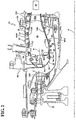
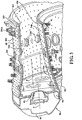
Figure 2 is an expanded longitudinal schematic sectional view of a combustor section according to one non-limiting embodiment that may be used with the example gas turbine engineFigure 3 is a perspective partial longitudinal sectional view of the combustor section; -
Figure 4 is a schematic longitudinal sectional view of the combustor section which illustrates a forward axial fuel injection system and a downstream radial fuel injections system according to one disclosed non-limiting embodiment; -
Figure 5 is a schematic lateral sectional view of a combustor which illustrates an in-line fuel nozzle arrangement according to another disclosed non-limiting embodiment; -
Figure 6 is a schematic lateral sectional view of a combustor which illustrates a clocked fuel nozzle arrangement according to another disclosed non-limiting embodiment; -
Figure 7 is a schematic longitudinal sectional view of a combustor which illustrates a tangential fuel nozzle arrangement according to another disclosed non-limiting embodiment; -
Figure 8 is a schematic lateral sectional view of a combustor which illustrates a tangential fuel nozzle arrangement according to another disclosed non-limiting embodiment; -
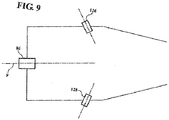
Figure 9 is a schematic longitudinal sectional view of a combustor which illustrates an axially angled fuel nozzle arrangement according to another disclosed non-limiting embodiment; -
Figure 10 is a schematic longitudinal sectional view of a combustor which illustrates an outer radial fuel injection system arrangement according to another disclosed non-limiting embodiment; -
Figure 11 is a schematic longitudinal sectional view of a combustor which illustrates a relationship between the axial and radial fuel injection systems according to another disclosed non-limiting embodiment; -
Figure 12 is a schematic longitudinal sectional view of a combustor which illustrates a relationship between the axial and radial fuel injection systems according to another disclosed non-limiting embodiment; -
Figure 13 is a schematic longitudinal sectional view of a combustor which illustrates a relationship between the axial and radial fuel injection systems according to another disclosed non-limiting embodiment; -
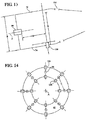
Figure 14 is a schematic lateral sectional view of a combustor which illustrates a relationship between the axial and radial fuel injection systems according to another disclosed non-limiting embodiment; -
Figure 15 is a schematic lateral sectional view of a combustor which illustrates a relationship between the axial and radial fuel injection systems according to another disclosed non-limiting embodiment; -
Figure 16 is a schematic lateral sectional view of a combustor which illustrates the axial and radial fuel injection systems that include a numerically different relationship according to another disclosed non-limiting embodiment; -
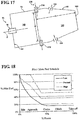
Figure 17 is a schematic longitudinal sectional view of a combustor which illustrates a relationship between the axial and radial fuel injection systems according to another disclosed non-limiting embodiment; and -
Figure 18 is a graphical representation of a pilot/main fuel schedule according to one disclosed non-limiting embodiment. -
Figure 1 schematically illustrates agas turbine engine 20. Thegas turbine engine 20 is disclosed herein as a two-spool turbo fan that generally incorporates afan section 22, acompressor section 24, acombustor section 26 and aturbine section 28. Thefan section 22 drives air along a bypass flowpath while thecompressor section 24 drives air along a core flowpath for compression and communication into thecombustor section 26 then expansion through theturbine section 28. Although depicted as a turbofan in the disclosed non-limiting embodiment, it should be understood that the concepts described herein are not limited to use with turbofans as the teachings may be applied to other types of turbine engines such as a turbojets, turboshafts, and three-spool (plus fan) turbofans wherein an intermediate spool includes an intermediate pressure compressor ("IPC") between a Low Pressure Compressor ("LPC") and a High Pressure Compressor ("HPC"), and an intermediate pressure turbine ("IPT") between the high pressure turbine ("HPT") and the Low pressure Turbine ("LPT"). - The
engine 20 generally includes alow spool 30 and ahigh spool 32 mounted for rotation about an engine central longitudinal axis A relative to an enginestatic structure 36 viaseveral bearing structures 38. Thelow spool 30 generally includes aninner shaft 40 that interconnects afan 42, a low pressure compressor ("LPC") 44 and a low pressure turbine ("LPT") 46. Theinner shaft 40 drives thefan 42 directly or through a gearedarchitecture 48 to drive thefan 42 at a lower speed than thelow spool 30. An exemplary reduction transmission is an epicyclic transmission, namely a planetary or star gear system. - The
high spool 32 includes anouter shaft 50 that interconnects a high pressure compressor ("HPC") 52 and high pressure turbine ("HPT") 54. Acombustor 56 is arranged between thehigh pressure compressor 52 and thehigh pressure turbine 54. Theinner shaft 40 and theouter shaft 50 are concentric and rotate about the engine central longitudinal axis A which is collinear with their longitudinal axes. - Core airflow is compressed by the
LPC 44 then theHPC 52, mixed with the fuel and burned in thecombustor 56, then expanded over theHPT 54 and theLPT 46. Theturbines low spool 30 andhigh spool 32 in response to the expansion. Themain engine shafts structures 38 within thestatic structure 36. It should be understood that various bearingstructures 38 at various locations may alternatively or additionally be provided. - In one non-limiting example, the
gas turbine engine 20 is a high-bypass geared aircraft engine. In a further example, thegas turbine engine 20 bypass ratio is greater than about six (6:1). The gearedarchitecture 48 can include an epicyclic gear train, such as a planetary gear system or other gear system. The example epicyclic gear train has a gear reduction ratio of greater than about 2.3, and in another example is greater than about 2.5:1. The geared turbofan enables operation of thelow spool 30 at higher speeds which can increase the operational efficiency of theLPC 44 andLPT 46 and render increased pressure in a fewer number of stages. - A pressure ratio associated with the
LPT 46 is pressure measured prior to the inlet of theLPT 46 as related to the pressure at the outlet of theLPT 46 prior to an exhaust nozzle of thegas turbine engine 20. In one non-limiting embodiment, the bypass ratio of thegas turbine engine 20 is greater than about ten (10:1), the fan diameter is significantly larger than that of theLPC 44, and theLPT 46 has a pressure ratio that is greater than about five (5:1). It should be understood, however, that the above parameters are only exemplary of one embodiment of a geared architecture engine and that the present disclosure is applicable to other gas turbine engines including direct drive turbofans. - In one embodiment, a significant amount of thrust is provided by the bypass flow path due to the high bypass ratio. The
fan section 22 of thegas turbine engine 20 is designed for a particular flight condition - typically cruise at about 0.8 Mach and about 35,000 feet (10668 m). This flight condition, with thegas turbine engine 20 at its best fuel consumption, is also known as bucket cruise Thrust Specific Fuel Consumption (TSFC). TSFC is an industry standard parameter of fuel consumption per unit of thrust. - Fan Pressure Ratio is the pressure ratio across a blade of the
fan section 22 without the use of a Fan Exit Guide Vane system. The low Fan Pressure Ratio according to one non-limiting embodiment of the examplegas turbine engine 20 is less than 1.45. Low Corrected Fan Tip Speed is the actual fan tip speed divided by an industry standard temperature correction of ("Tram" / 518.7)0.5. The Low Corrected Fan Tip Speed according to one non-limiting embodiment of the examplegas turbine engine 20 is less than about 1150 fps (351 m/s).
With reference toFigure 2 , thecombustor section 26 generally includes acombustor 56 with an outercombustor liner assembly 60, an innercombustor liner assembly 62 and adiffuser case module 64. The outercombustor liner assembly 60 and the innercombustor liner assembly 62 are spaced apart such that acombustion chamber 66 is defined therebetween. Thecombustion chamber 66 is generally annular in shape. - The outer
combustor liner assembly 60 is spaced radially inward from an outer diffuser case 64-O of thediffuser case module 64 to define an outerannular plenum 76. The innercombustor liner assembly 62 is spaced radially outward from an inner diffuser case 64-I of thediffuser case module 64 to define an innerannular plenum 78. It should be understood that although a particular combustor is illustrated, other combustor types with various combustor liner arrangements will also benefit herefrom. It should be further understood that the disclosed cooling flow paths are but an illustrated embodiment and should not be limited only thereto. - The
combustor liner assemblies turbine section 28. Eachcombustor liner assembly respective support shell more liner panels respective support shell liner panels forward liner panels 72A and a multiple ofaft liner panels 72B that are circumferentially staggered to line the hot side of the outer shell 68 (also shown inFigure 3 ). A multiple offorward liner panels 74A and a multiple ofaft liner panels 74B are circumferentially staggered to line the hot side of the inner shell 70 (also shown inFigure 3 ). - The
combustor 56 further includes aforward assembly 80 immediately downstream of thecompressor section 24 to receive compressed airflow therefrom. Theforward assembly 80 generally includes anannular hood 82, abulkhead assembly 84, a multiple of forward fuel nozzles 86 (one shown) and a multiple of swirlers 90 (one shown). The multiple of fuel nozzles 86 (one shown) and the multiple of swirlers 90 (one shown) define an axial pilotfuel injection system 92 that directs the fuel-air mixture into the combustor chamber generally along an axis F. - The
bulkhead assembly 84 includes abulkhead support shell 96 secured to thecombustor liner assemblies bulkhead liner panels 98 secured to thebulkhead support shell 96. Theannular hood 82 extends radially between, and is secured to, the forwardmost ends of thecombustor liner assemblies annular hood 82 includes a multiple of circumferentially distributedhood ports 94 that accommodate the respectiveforward fuel nozzles 86 and direct air into the forward end of thecombustion chamber 66 through arespective swirler 90. Eachforward fuel nozzle 86 may be secured to thediffuser case module 64 and project through one of thehood ports 94 and through therespective swirler 90. Each of thefuel nozzles 86 is directed through therespective swirler 90 and thebulkhead assembly 84 along a respective axis F. - The
forward assembly 80 introduces core combustion air into the forward section of thecombustion chamber 66 while the remainder enters the outerannular plenum 76 and the innerannular plenum 78. The multiple offuel nozzles 86 and adjacent structure generate a blended fuel-air mixture that supports stable combustion in thecombustion chamber 66. - Opposite the
forward assembly 80, the outer andinner support shells HPT 54 to define acombustor exit 100. TheNGVs 54A are static engine components which direct core airflow combustion gases onto the turbine blades of the first turbine rotor in theturbine section 28 to facilitate the conversion of pressure energy into kinetic energy. The combustion gases are also accelerated by theNGVs 54A because of their convergent shape and are typically given a "spin" or a "swirl" in the direction of turbine rotor rotation. The turbine rotor blades absorb this energy to drive the turbine rotor at high speed. - With reference to
Figure 3 , a multiple of coolingimpingement holes 104 penetrate through thesupport shells annular plenums cavities combustor liner assemblies respective support shells liner panels liner panels cavities liner panels - A multiple of cooling film holes 108 penetrate through each of the
liner panels liner panels - The cooling film holes 108 allow the air to pass from the
cavities cold side 110 of theliner panels hot side 112 of theliner panels hot side 112. The cooling film holes 108 are generally more numerous than the impingement holes 104 to promote the development of a film cooling along thehot side 112 to sheath theliner panels - A multiple of dilution holes 116 may penetrate through both the
respective support shells liner panels forward assembly 80 to quench the hot gases by supplying cooling air radially into the combustor. That is, the multiple of dilution holes 116 provide a direct path for airflow from theannular plenums combustion chamber 66. - With reference to
Figure 4 , a radial mainfuel injection system 120 communicates with thecombustion chamber 66 downstream of the axial pilotfuel injection system 92 generally transverse to axis F of an Axially Controlled Stoichiometry (ACS) Combustor. The radial mainfuel injection system 120 introduces a portion of the fuel required for desired combustion performance, e.g., emissions, operability, durability, as well as to lean-out the fuel contribution provided by the axial pilotfuel injection system 92. In one disclosed non-limiting embodiment, the radial mainfuel injection system 120 is positioned downstream of the axial pilotfuel injection system 92 and upstream of the multiple of dilution holes 116. - The radial main
fuel injection system 120 generally includes a radially outer fuel injection manifold 122 (illustrated schematically) and/or a radially inner fuel injection manifold 124 (illustrated schematically) with a respective multiple ofouter fuel nozzles 126 and a multiple ofinner fuel nozzles 128. The radially outerfuel injection manifold 122 and/or a radially innerfuel injection manifold 124 may be mounted to thediffuser case module 64 and/or to theshell - Each of the multiple of
outer fuel nozzles 126inner fuel nozzles 128 are located within arespective mixer diffuser case module 64. As defined herein, a "mixer" as compared to a "swirler" may generate, for example, zero swirl, a counter-rotating swirl, a specific swirl which provides a resultant swirl or a residual net swirl which may be further directed at an angle. It should be appreciated that various combinations thereof may alternatively be utilized. - The radial main
fuel injection system 120 may include only the radially outerfuel injection manifold 96 with the multiple ofouter fuel nozzles 126; only the radially innerfuel injection manifold 124 with the multiple ofinner fuel nozzles 128; or both (shown). It should be appreciated that the radial mainfuel injection system 120 may include single sets ofouter fuel nozzles 126 and inner fuel nozzles 128 (shown) or multiple axially distributed sets of, for example, relatively smaller fuel nozzles. - The radial main
fuel injection system 120 may be circumferentially arranged in a multiple of configurations. In one disclosed non-limiting embodiment, the multiple ofouter fuel nozzles 126 and the multiple ofinner fuel nozzles 128 are circumferentially arranged so that thenozzles Figure 5 ). In another disclosed non-limiting embodiment, the multiple ofouter fuel nozzles 126 and the multiple ofinner fuel nozzles 128 are circumferentially staggered so that thenozzles Figure 6 ). Furthermore, thenozzles Figure 7 ), tangentially (Figure 8 ), or at an angle such as downstream (Figure 9 ) relative to the cross flow from thefuel nozzles 86 of the axial pilotfuel injection system 92 that are directed along axis F. - Alternatively still, the multiple of
outer fuel nozzles 126 may be positioned through theouter liner 72 opposite or staggered relative to a non-fueled mixer 132' on the inner liner 74 (Figure 10 ). That is, the non-fueled mixer 132' provides airflow but not fuel. - The lean-staging is accomplished by axially distributing the fuel injection with a front-end pilot injector and a downstream main injector to axially distribute the heat release similar to an RQL designs, but with lean/lean combustion to enable low NOx and PM emissions. This is different than radial staged designs where all the fuel is injected at the front-end of the combustor. Moving the heat release away from the front-end can be a pressure anti-node for longitudinal acoustic modes to decrease coupling with these modes.
- With respect to
Figure 11 , theforward fuel nozzles 86 are circumferentially spaced apart between about 80% - 200% of a bulkhead height B. The bulkhead height B as defined herein is the radial distance between theliner panels combustion chamber 66 at thebulkhead liner panels 98 ofbulkhead assembly 84. The multiple ofouter fuel nozzles 126 and theinner fuel nozzles 128 are axially spaced a distance D between 50% - 150% of the bulkhead height B aft of theforward fuel nozzles 86. - The multiple of
outer fuel nozzles 126 are radially spaced a distance R from theinner fuel nozzles 128 at between about 100% - 200% of the bulkhead height B. It should be understood that the distance R may be with respect to theliner panels fuel injection system 120 only utilize outer fuel nozzles 126 (Figure 12 ) or inner fuel nozzles 128 (Figure 13 ). - With respect to
Figure 14 , the multiple ofouter fuel nozzles 126 and multiple ofinner fuel nozzles 128 may be arranged circumferentially in-line with theforward fuel nozzles 86. Alternatively, the multiple ofouter fuel nozzles 126 and multiple ofinner fuel nozzles 128 may be arranged circumferentially between theforward fuel nozzles 86 at, for example, quarter pitch (Figure 15 ). The multiple ofouter fuel nozzles 126 and/or the multiple ofinner fuel nozzles 128 may be spaced apart a distance C of between 25% - 100% of the bulkhead height B circumferentially, which alternatively, may be defined as about 1.5 - 5 fuel jet diameters. It should be appreciated that various circumferential and other relationships may be utilized and that fuel jet diameter and bulkhead sizing are but examples thereof. - Alternatively still, with respect to
Figure 16 , the multiple ofouter fuel nozzles 126 may be more numerous than theforward fuel nozzles 86. In this disclosed non-limiting embodiment, twice the number ofouter fuel nozzles 126 as compared to theforward fuel nozzles 86. The multiple ofouter fuel nozzles 126 include both in-line and circumferentially distributedforward fuel nozzles 86 - With reference to
Figure 17 , the axial pilotfuel injection system 92, the radial mainfuel injection system 120 and the multiple of dilution holes 116 define aforward combustion zone 140 axially between thebulkhead assembly 84 and the forward section of the radial mainfuel injection system 120, as well as adownstream combustion zone 142 between the forward section of the radial mainfuel injection system 120 and thecombustor exit 100. Thedownstream combustion zone 142 is axially proximate the multiple of dilution holes 116. - In one disclosed non-limiting embodiment, the axial pilot
fuel injection system 92 provides about 10% - 35% of the combustor airflow, the radial mainfuel injection system 120 provides about 30% - 60% of combustor airflow while the multiple of dilution holes 116 provide about 5% - 20% of the combustor airflow. It should be appreciated that these ranges of combustor airflow may define a total combustor airflow less than 100% with the remainder being cooling airflow. It should be further appreciated that generally as the combustor airflow from the axial pilotfuel injection system 92 increases, the radial mainfuel injection system 120 decreases and vice-versa with the balance being from the multiple of dilution holes 116. In one specific example, the axial pilotfuel injection system 92 provides about 20% of the combustor airflow, the radial mainfuel injection system 120 provides about 45% of combustor airflow while the multiple of dilution holes 116 provide about 10% of the combustor airflow with the remainder being cooling airflow. - In one disclosed non-limiting embodiment, the
forward combustion zone 140 defines about 20% to 50% of thetotal combustor chamber 66 volume and thedownstream combustion zone 142 defines about 50% to 80% of thetotal combustor chamber 66 volume. - In one disclosed non-limiting embodiment, the
downstream combustion zone 142 forms an axial length L of about 100% - 250% a height H of thecombustion chamber 66 between theliners fuel injection system 120 location. The height H as defined herein is the radial distance between theliner panels combustion chamber 66 proximate the radial mainfuel injection system 120 location. It should be appreciated that various combinations of the above-described geometries may be provided. - With reference to
Figure 18 , a pilot/main fuel schedule controls how the fuel flow may be shifted between the axial pilotfuel injection system 92 and the radial mainfuel injection system 120 to alter the heat release distribution and convective time delays associated with each zone and enable de-tuning away from instabilities. The approach can be used to mitigate both Rayleigh gain type thermoacoustic instabilities and entropy mode type instabilities. The range of fuel shifting possible will be constrained by other combustor requirements for emissions, efficiency, LBO, etc. Movement of the heat release away from the front-end which can be a pressure anti-node for longitudinal modes decreases coupling with these modes. - For any given operating condition with required total fuel flow, the fuel percentage split between the axial pilot
fuel injection system 92 and the radial mainfuel injection system 120 may be scheduled accordingly, based on, for example, engine power level or other operating condition to, for example, mitigate combustor tones or control other combustor performance metrics. The engine operating parameter may include, for example, at least one of engine power, throttle position, total fuel flow, and an aircraft flight condition and the combustor metric may include at least one of combustor tones, emissions, combustor efficiency, lean blow-out margin, and altitude re-light capability, etc. - In this example, a nominal fuel schedule is correlated as a percentage of the axial pilot
fuel injection system 92, e.g., pilot fuel flow, with respect to an operating condition, e.g., engine power level. A low range and a high range envelope maintains the axial pilotfuel injection system 92, e.g., pilot fuel flow, and the radial mainfuel injection system 120, e.g., main zone fuel flow, Fuel-Air (F/A) ratio within a desired limit for combustor operability. The fuel split may be further optimized within this high-low range to mitigate combustor tones while also meeting other combustor metrics such as emissions, combustor efficiency, lean blow-out margin, altitude re-light capability, etc. - In operation, a fuel-rich combustion environment in the
forward combustion zone 140 is provided for low power operations. During high power operations, a fuel-lean combustion environment is maintained in both theforward combustion zone 140 and thedownstream combustion zone 142. During engine idle, the method includes the step of selectively distributing the fuel being supplied between theforward combustion zone 140 and thedownstream combustion zone 142 with 80% to 100% as the axial pilotfuel injection system 92 of fuel and with 0% to 20% as the radial mainfuel injection system 120 flow of fuel. During approach, 40% to 100% as the flow of fuel may be supplied by the axial pilotfuel injection system fuel injection system 120. At higher power operation of the gas turbine engine, 15% to 50% of the flow of fuel is supplied by the axial pilotfuel injection system 92 with 50% to 85% from the radial mainfuel injection system 120. Higher power operation of the gas turbine engine may include engine operation at cruise, engine operation at climb, and engine operation at take-off. - The gas turbine combustor and the method for operating the gas turbine combustor as disclosed herein provides for lower NOx emissions at low, mid and high power operation at generally equivalent weight and operability relative to a typical conventional gas turbine combustor. At low power, such as idle and approach, the
forward combustion zone 140 may be robustly fueled to establish a fuel-rich combustion environment and provide for ignition, combustion stability, and low emissions. When power increases, e.g. during cruise, climb and take-off, fuel flow to thedownstream combustion zone 142 increases and fuel flow to theforward combustion zone 140 decreases whereby both combustion zones operate fuel lean in order to control NOx formation. The increased temperature of the combustion gases from theforward combustion zone 140 flow across thedownstream combustion zone 142 to further facilitate stable combustion in the downstream zone and achievement of high combustion efficiency. - The pilot/main fuel schedule permits control of combustion dynamics in an axially-staged lean-lean combustor configuration. The fuel split between the pilot and main can be optimized to mitigate dynamics while also meeting all other combustor performance metrics. For any given operating condition with required total fuel flow, the fuel split between pilot & main is optimized to mitigate combustor tones. This alters the axial heat release distribution and associated convective time delays. Application of this method to a liquid-fueled aeroengine axially-staged lean-lean combustor configuration is new.
- The use of the terms "a" and "an" and "the" and similar references in the context of description (especially in the context of the following claims) are to be construed to cover both the singular and the plural, unless otherwise indicated herein or specifically contradicted by context. The modifier "about" used in connection with a quantity is inclusive of the stated value and has the meaning dictated by the context (e.g., it includes the degree of error associated with measurement of the particular quantity). All ranges disclosed herein are inclusive of the endpoints, and the endpoints are independently combinable with each other. It should be appreciated that relative positional terms such as "forward," "aft," "upper," "lower," "above," "below," and the like are with reference to the normal operational attitude of the vehicle and should not be considered otherwise limiting.
- Although the different non-limiting embodiments have specific illustrated components, the embodiments of this invention are not limited to those particular combinations. It is possible to use some of the components or features from any of the non-limiting embodiments in combination with features or components from any of the other non-limiting embodiments.
- It should be appreciated that like reference numerals identify corresponding or similar elements throughout the several drawings. It should also be appreciated that although a particular component arrangement is disclosed in the illustrated embodiment, other arrangements will benefit herefrom.
- Although particular step sequences are shown, described, and claimed, it should be understood that steps may be performed in any order, separated or combined unless otherwise indicated and will still benefit from the present disclosure.
- The foregoing description is exemplary rather than defined by the limitations within. Various non-limiting embodiments are disclosed herein, however, one of ordinary skill in the art would recognize that various modifications and variations in light of the above teachings will fall within the scope of the appended claims. It is therefore to be appreciated that within the scope of the appended claims, the disclosure may be practiced other than as specifically described. For that reason the appended claims should be studied to determine true scope and content.
Claims (15)
- A combustor (56) for a gas turbine engine (20) comprising:an first fuel injection system (92) in communication with a combustion chamber (56), the first fuel injection system (92) operable to supply a first percentage of fuel; anda second fuel injection system (120) that communicates with the combustion chamber (56) downstream of the first fuel injection system (92), the second fuel injection system (120) operable to supply a second percentage of fuel, the first percentage and the second percentage of fuel scheduled in response to an engine operating parameter.
- The combustor as recited in claim 1, wherein the second fuel injection system (120) is radially outboard and/or radially inboard of the combustion chamber (56).
- The combustor as recited in claim 1 or 2, wherein the second fuel injection system (128) includes a multiple of non-fueled mixers (130, 132).
- The combustor as recited in claim 1, 2 or 3, wherein the combustion chamber (56) is defined between an inner liner and an outer liner (60, 62).
- The combustor as recited in any preceding claim, wherein the engine operating parameter includes engine power.
- The combustor as recited in any preceding claim, wherein the engine operating parameter includes throttle position.
- The combustor as recited in any preceding claim, wherein the engine operating parameter includes an aircraft flight condition.
- The combustor as recited in any preceding claim, wherein the first percentage and the second percentage of fuel scheduled in response to the engine operating parameter to control a combustor metric.
- The combustor as recited in claim 8, wherein the combustor metric includes at least one of combustor tones, emissions, combustor efficiency, lean blow-out margin, and altitude re-light capability.
- A method of controlling a pilot/main fuel schedule to a combustor (56) of a gas turbine engine (20) comprising:scheduling a first percentage of fuel to an axial fuel injection system (92) and a second percentage of fuel to a radial fuel injection system (120) the scheduled in response to an engine operating parameter.
- The method as recited in claim 10, wherein the engine operating parameter includes engine power.
- The method as recited in claim 10 or 11, wherein the engine operating parameter includes throttle position.
- The method as recited in claim 10, 11 or 12, wherein the engine operating parameter includes an aircraft flight condition.
- The method as recited in claim 10, further comprising scheduling the first percentage and the second percentage of fuel in response to the engine operating parameter to control a combustor metric.
- The method as recited in claim 14, wherein:the engine operating parameter is at least one of engine power, throttle position, and an aircraft flight condition; and/orthe combustor metric includes at least one of combustor tones, emissions, combustor efficiency, lean blow-out margin, and altitude re-light capability.
Applications Claiming Priority (1)
| Application Number | Priority Date | Filing Date | Title |
|---|---|---|---|
| US15/283,639 US10738704B2 (en) | 2016-10-03 | 2016-10-03 | Pilot/main fuel shifting in an axial staged combustor for a gas turbine engine |
Publications (2)
| Publication Number | Publication Date |
|---|---|
| EP3301361A1 true EP3301361A1 (en) | 2018-04-04 |
| EP3301361B1 EP3301361B1 (en) | 2025-05-14 |
Family
ID=59974260
Family Applications (1)
| Application Number | Title | Priority Date | Filing Date |
|---|---|---|---|
| EP17193551.3A Active EP3301361B1 (en) | 2016-10-03 | 2017-09-27 | Pilot/main fuel shifting in an axial stage combustor for a gas turbine engine |
Country Status (2)
| Country | Link |
|---|---|
| US (1) | US10738704B2 (en) |
| EP (1) | EP3301361B1 (en) |
Cited By (2)
| Publication number | Priority date | Publication date | Assignee | Title |
|---|---|---|---|---|
| EP3875742A1 (en) * | 2020-03-04 | 2021-09-08 | Rolls-Royce plc | Staged combustion |
| US11293640B2 (en) | 2019-03-28 | 2022-04-05 | Rolls-Royce Plc | Gas turbine engine combustor apparatus |
Families Citing this family (17)
| Publication number | Priority date | Publication date | Assignee | Title |
|---|---|---|---|---|
| GB2599423B (en) * | 2020-10-01 | 2025-05-28 | Bosch Thermotechnology Ltd Uk | Method for operating a combustion device, combustion device and heating unit |
| RU2753203C1 (en) * | 2020-10-09 | 2021-08-12 | Открытое акционерное общество "Всероссийский дважды ордена Трудового Красного Знамени теплотехнический научно-исследовательский институт" (ОАО "ВТИ") | Method for burning fuel in a low-emission combustion chamber |
| RU2753202C1 (en) * | 2020-10-09 | 2021-08-12 | Открытое акционерное общество "Всероссийский дважды ордена Трудового Красного Знамени теплотехнический научно-исследовательский институт" (ОАО "ВТИ") | Method for burning fuel in a low-emission combustion chamber |
| CN114517920B (en) * | 2020-11-19 | 2023-08-08 | 中国航发商用航空发动机有限责任公司 | Injection device, combustion chamber head, combustion chamber and aeroengine |
| US11725824B2 (en) * | 2021-04-08 | 2023-08-15 | Raytheon Technologies Corporation | Turbulence generator mixer for rotating detonation engine |
| CN113864063B (en) * | 2021-09-28 | 2024-06-14 | 北京永旭腾风新能源动力科技发展有限公司 | Dual fuel system for micro-combustion engine, micro-combustion engine and control method thereof |
| GB202205358D0 (en) | 2022-04-12 | 2022-05-25 | Rolls Royce Plc | Loading parameters |
| GB202205355D0 (en) | 2022-04-12 | 2022-05-25 | Rolls Royce Plc | Gas turbine operation |
| GB202205354D0 (en) | 2022-04-12 | 2022-05-25 | Rolls Royce Plc | Fuel delivery |
| GB202219385D0 (en) * | 2022-12-21 | 2023-02-01 | Rolls Royce Plc | Aircraft combustion systems |
| GB202219380D0 (en) | 2022-12-21 | 2023-02-01 | Rolls Royce Plc | Gas turbine operating conditions |
| GB202219384D0 (en) | 2022-12-21 | 2023-02-01 | Rolls Royce Plc | Aircraft fuelling |
| US20240263590A1 (en) * | 2023-02-02 | 2024-08-08 | Pratt & Whitney Canada Corp | Fuel system with pilot and main injectors for hydrogen-driven gas turbine engine |
| US20240309810A1 (en) * | 2023-03-14 | 2024-09-19 | Raytheon Technologies Corporation | Introducing steam into core air upstream of turbine engine diffuser plenum |
| US20240401811A1 (en) * | 2023-05-31 | 2024-12-05 | General Electric Company | Turbine engine including a combustor |
| US12130016B1 (en) | 2023-05-31 | 2024-10-29 | General Electric Company | Turbine engine including a combustor |
| CN121162935B (en) * | 2025-11-21 | 2026-03-24 | 中国航发湖南动力机械研究所 | Partial oil-rich ignition and flameout device and aeroengine combustion chamber |
Citations (5)
| Publication number | Priority date | Publication date | Assignee | Title |
|---|---|---|---|---|
| US20060130455A1 (en) * | 2003-12-23 | 2006-06-22 | Michael Griffiths | Fuel system |
| US20090077973A1 (en) * | 2007-09-20 | 2009-03-26 | Hamilton Sundstrand Corporation | Gas Turbine Fuel System for High Altitude Starting and Operation |
| WO2015061217A1 (en) * | 2013-10-24 | 2015-04-30 | United Technologies Corporation | Circumferentially and axially staged can combustor for gas turbine engine |
| US20160123596A1 (en) * | 2013-06-11 | 2016-05-05 | United Technologies Corporation | Combustor with axial staging for a gas turbine engine |
| US20160245525A1 (en) * | 2013-10-24 | 2016-08-25 | United Technologies Corporation | Circumferentially and axially staged annular combustor for gas turbine engine |
Family Cites Families (33)
| Publication number | Priority date | Publication date | Assignee | Title |
|---|---|---|---|---|
| US5749219A (en) * | 1989-11-30 | 1998-05-12 | United Technologies Corporation | Combustor with first and second zones |
| JPH05203148A (en) * | 1992-01-13 | 1993-08-10 | Hitachi Ltd | Gas turbine combustion apparatus and its control method |
| US5361586A (en) * | 1993-04-15 | 1994-11-08 | Westinghouse Electric Corporation | Gas turbine ultra low NOx combustor |
| US5647215A (en) * | 1995-11-07 | 1997-07-15 | Westinghouse Electric Corporation | Gas turbine combustor with turbulence enhanced mixing fuel injectors |
| US6715292B1 (en) | 1999-04-15 | 2004-04-06 | United Technologies Corporation | Coke resistant fuel injector for a low emissions combustor |
| GB9915770D0 (en) * | 1999-07-07 | 1999-09-08 | Rolls Royce Plc | A combustion chamber |
| US6481209B1 (en) | 2000-06-28 | 2002-11-19 | General Electric Company | Methods and apparatus for decreasing combustor emissions with swirl stabilized mixer |
| US6606861B2 (en) | 2001-02-26 | 2003-08-19 | United Technologies Corporation | Low emissions combustor for a gas turbine engine |
| US6484489B1 (en) | 2001-05-31 | 2002-11-26 | General Electric Company | Method and apparatus for mixing fuel to decrease combustor emissions |
| US6865889B2 (en) | 2002-02-01 | 2005-03-15 | General Electric Company | Method and apparatus to decrease combustor emissions |
| US6871501B2 (en) | 2002-12-03 | 2005-03-29 | General Electric Company | Method and apparatus to decrease gas turbine engine combustor emissions |
| US6862889B2 (en) | 2002-12-03 | 2005-03-08 | General Electric Company | Method and apparatus to decrease combustor emissions |
| US6868676B1 (en) * | 2002-12-20 | 2005-03-22 | General Electric Company | Turbine containing system and an injector therefor |
| US7065972B2 (en) | 2004-05-21 | 2006-06-27 | Honeywell International, Inc. | Fuel-air mixing apparatus for reducing gas turbine combustor exhaust emissions |
| US7059135B2 (en) | 2004-08-30 | 2006-06-13 | General Electric Company | Method to decrease combustor emissions |
| JP4486549B2 (en) * | 2005-06-06 | 2010-06-23 | 三菱重工業株式会社 | Gas turbine combustor |
| US7685823B2 (en) | 2005-10-28 | 2010-03-30 | Power Systems Mfg., Llc | Airflow distribution to a low emissions combustor |
| US7762073B2 (en) * | 2006-03-01 | 2010-07-27 | General Electric Company | Pilot mixer for mixer assembly of a gas turbine engine combustor having a primary fuel injector and a plurality of secondary fuel injection ports |
| US8028529B2 (en) | 2006-05-04 | 2011-10-04 | General Electric Company | Low emissions gas turbine combustor |
| US8001761B2 (en) * | 2006-05-23 | 2011-08-23 | General Electric Company | Method and apparatus for actively controlling fuel flow to a mixer assembly of a gas turbine engine combustor |
| JP4959524B2 (en) * | 2007-11-29 | 2012-06-27 | 三菱重工業株式会社 | Burning burner |
| EP2107312A1 (en) * | 2008-04-01 | 2009-10-07 | Siemens Aktiengesellschaft | Pilot combustor in a burner |
| US8112216B2 (en) * | 2009-01-07 | 2012-02-07 | General Electric Company | Late lean injection with adjustable air splits |
| JP4797079B2 (en) * | 2009-03-13 | 2011-10-19 | 川崎重工業株式会社 | Gas turbine combustor |
| US20100263382A1 (en) * | 2009-04-16 | 2010-10-21 | Alfred Albert Mancini | Dual orifice pilot fuel injector |
| EP2402652A1 (en) * | 2010-07-01 | 2012-01-04 | Siemens Aktiengesellschaft | Burner |
| US9080770B2 (en) | 2011-06-06 | 2015-07-14 | Honeywell International Inc. | Reverse-flow annular combustor for reduced emissions |
| EP2742291B1 (en) * | 2011-08-11 | 2020-07-08 | General Electric Company | System for injecting fuel in a gas turbine engine |
| US9631560B2 (en) * | 2011-11-22 | 2017-04-25 | United Technologies Corporation | Fuel-air mixture distribution for gas turbine engine combustors |
| US9400110B2 (en) | 2012-10-19 | 2016-07-26 | Honeywell International Inc. | Reverse-flow annular combustor for reduced emissions |
| US20150159877A1 (en) * | 2013-12-06 | 2015-06-11 | General Electric Company | Late lean injection manifold mixing system |
| US9551490B2 (en) * | 2014-04-08 | 2017-01-24 | General Electric Company | System for cooling a fuel injector extending into a combustion gas flow field and method for manufacture |
| US10001281B2 (en) * | 2015-04-17 | 2018-06-19 | General Electric Company | Fuel nozzle with dual-staged main circuit |
-
2016
- 2016-10-03 US US15/283,639 patent/US10738704B2/en active Active
-
2017
- 2017-09-27 EP EP17193551.3A patent/EP3301361B1/en active Active
Patent Citations (5)
| Publication number | Priority date | Publication date | Assignee | Title |
|---|---|---|---|---|
| US20060130455A1 (en) * | 2003-12-23 | 2006-06-22 | Michael Griffiths | Fuel system |
| US20090077973A1 (en) * | 2007-09-20 | 2009-03-26 | Hamilton Sundstrand Corporation | Gas Turbine Fuel System for High Altitude Starting and Operation |
| US20160123596A1 (en) * | 2013-06-11 | 2016-05-05 | United Technologies Corporation | Combustor with axial staging for a gas turbine engine |
| WO2015061217A1 (en) * | 2013-10-24 | 2015-04-30 | United Technologies Corporation | Circumferentially and axially staged can combustor for gas turbine engine |
| US20160245525A1 (en) * | 2013-10-24 | 2016-08-25 | United Technologies Corporation | Circumferentially and axially staged annular combustor for gas turbine engine |
Cited By (5)
| Publication number | Priority date | Publication date | Assignee | Title |
|---|---|---|---|---|
| US11293640B2 (en) | 2019-03-28 | 2022-04-05 | Rolls-Royce Plc | Gas turbine engine combustor apparatus |
| EP3875742A1 (en) * | 2020-03-04 | 2021-09-08 | Rolls-Royce plc | Staged combustion |
| US11530652B2 (en) | 2020-03-04 | 2022-12-20 | Rolls-Royce Plc | Water injection |
| US11530651B2 (en) | 2020-03-04 | 2022-12-20 | Rolls-Royce Plc | Staged combustion |
| US11821373B2 (en) | 2020-03-04 | 2023-11-21 | Rolls-Royce Plc | Staged combustion |
Also Published As
| Publication number | Publication date |
|---|---|
| US20180163629A1 (en) | 2018-06-14 |
| US10738704B2 (en) | 2020-08-11 |
| EP3301361B1 (en) | 2025-05-14 |
Similar Documents
| Publication | Publication Date | Title |
|---|---|---|
| EP3301361B1 (en) | Pilot/main fuel shifting in an axial stage combustor for a gas turbine engine | |
| EP3008391B1 (en) | Combustor with axial staging for a gas turbine engine | |
| EP3301372B1 (en) | Circumferential fuel shifting and biasing in an axial staged combustor for a gas turbine engine | |
| US11365884B2 (en) | Radial fuel shifting and biasing in an axial staged combustor for a gas turbine engine | |
| US12560326B2 (en) | Main mixer in an axial staged combustor for a gas turbine engine | |
| EP3404331B1 (en) | Gas turbine engine combustor with a fuel air mixer assembly | |
| EP2977680B1 (en) | Dilution hole assembly | |
| US9404657B2 (en) | Combuster with radial fuel injection | |
| EP3333486B1 (en) | Main mixer for a gas turbine engine combustor | |
| US20160327272A1 (en) | Multi-streamed dilution hole configuration for a gas turbine engine | |
| US11226102B2 (en) | Fuel nozzle for a gas turbine engine | |
| US12305571B2 (en) | Combustor | |
| US10816206B2 (en) | Gas turbine engine quench pattern for gas turbine engine combustor |
Legal Events
| Date | Code | Title | Description |
|---|---|---|---|
| PUAI | Public reference made under article 153(3) epc to a published international application that has entered the european phase |
Free format text: ORIGINAL CODE: 0009012 |
|
| STAA | Information on the status of an ep patent application or granted ep patent |
Free format text: STATUS: THE APPLICATION HAS BEEN PUBLISHED |
|
| AK | Designated contracting states |
Kind code of ref document: A1 Designated state(s): AL AT BE BG CH CY CZ DE DK EE ES FI FR GB GR HR HU IE IS IT LI LT LU LV MC MK MT NL NO PL PT RO RS SE SI SK SM TR |
|
| AX | Request for extension of the european patent |
Extension state: BA ME |
|
| STAA | Information on the status of an ep patent application or granted ep patent |
Free format text: STATUS: REQUEST FOR EXAMINATION WAS MADE |
|
| 17P | Request for examination filed |
Effective date: 20181004 |
|
| RBV | Designated contracting states (corrected) |
Designated state(s): AL AT BE BG CH CY CZ DE DK EE ES FI FR GB GR HR HU IE IS IT LI LT LU LV MC MK MT NL NO PL PT RO RS SE SI SK SM TR |
|
| RAP1 | Party data changed (applicant data changed or rights of an application transferred) |
Owner name: RAYTHEON TECHNOLOGIES CORPORATION |
|
| STAA | Information on the status of an ep patent application or granted ep patent |
Free format text: STATUS: EXAMINATION IS IN PROGRESS |
|
| 17Q | First examination report despatched |
Effective date: 20210422 |
|
| RAP3 | Party data changed (applicant data changed or rights of an application transferred) |
Owner name: RTX CORPORATION |
|
| GRAP | Despatch of communication of intention to grant a patent |
Free format text: ORIGINAL CODE: EPIDOSNIGR1 |
|
| STAA | Information on the status of an ep patent application or granted ep patent |
Free format text: STATUS: GRANT OF PATENT IS INTENDED |
|
| INTG | Intention to grant announced |
Effective date: 20241204 |
|
| GRAS | Grant fee paid |
Free format text: ORIGINAL CODE: EPIDOSNIGR3 |
|
| GRAA | (expected) grant |
Free format text: ORIGINAL CODE: 0009210 |
|
| STAA | Information on the status of an ep patent application or granted ep patent |
Free format text: STATUS: THE PATENT HAS BEEN GRANTED |
|
| AK | Designated contracting states |
Kind code of ref document: B1 Designated state(s): AL AT BE BG CH CY CZ DE DK EE ES FI FR GB GR HR HU IE IS IT LI LT LU LV MC MK MT NL NO PL PT RO RS SE SI SK SM TR |
|
| REG | Reference to a national code |
Ref country code: GB Ref legal event code: FG4D |
|
| REG | Reference to a national code |
Ref country code: CH Ref legal event code: EP |
|
| REG | Reference to a national code |
Ref country code: IE Ref legal event code: FG4D |
|
| REG | Reference to a national code |
Ref country code: DE Ref legal event code: R096 Ref document number: 602017089431 Country of ref document: DE |
|
| REG | Reference to a national code |
Ref country code: NL Ref legal event code: MP Effective date: 20250514 |
|
| PG25 | Lapsed in a contracting state [announced via postgrant information from national office to epo] |
Ref country code: FI Free format text: LAPSE BECAUSE OF FAILURE TO SUBMIT A TRANSLATION OF THE DESCRIPTION OR TO PAY THE FEE WITHIN THE PRESCRIBED TIME-LIMIT Effective date: 20250514 Ref country code: PT Free format text: LAPSE BECAUSE OF FAILURE TO SUBMIT A TRANSLATION OF THE DESCRIPTION OR TO PAY THE FEE WITHIN THE PRESCRIBED TIME-LIMIT Effective date: 20250915 Ref country code: ES Free format text: LAPSE BECAUSE OF FAILURE TO SUBMIT A TRANSLATION OF THE DESCRIPTION OR TO PAY THE FEE WITHIN THE PRESCRIBED TIME-LIMIT Effective date: 20250514 |
|
| PGFP | Annual fee paid to national office [announced via postgrant information from national office to epo] |
Ref country code: DE Payment date: 20250820 Year of fee payment: 9 |
|
| REG | Reference to a national code |
Ref country code: LT Ref legal event code: MG9D |
|
| PG25 | Lapsed in a contracting state [announced via postgrant information from national office to epo] |
Ref country code: GR Free format text: LAPSE BECAUSE OF FAILURE TO SUBMIT A TRANSLATION OF THE DESCRIPTION OR TO PAY THE FEE WITHIN THE PRESCRIBED TIME-LIMIT Effective date: 20250815 Ref country code: NO Free format text: LAPSE BECAUSE OF FAILURE TO SUBMIT A TRANSLATION OF THE DESCRIPTION OR TO PAY THE FEE WITHIN THE PRESCRIBED TIME-LIMIT Effective date: 20250814 |
|
| PG25 | Lapsed in a contracting state [announced via postgrant information from national office to epo] |
Ref country code: NL Free format text: LAPSE BECAUSE OF FAILURE TO SUBMIT A TRANSLATION OF THE DESCRIPTION OR TO PAY THE FEE WITHIN THE PRESCRIBED TIME-LIMIT Effective date: 20250514 Ref country code: PL Free format text: LAPSE BECAUSE OF FAILURE TO SUBMIT A TRANSLATION OF THE DESCRIPTION OR TO PAY THE FEE WITHIN THE PRESCRIBED TIME-LIMIT Effective date: 20250514 |
|
| REG | Reference to a national code |
Ref country code: AT Ref legal event code: MK05 Ref document number: 1795041 Country of ref document: AT Kind code of ref document: T Effective date: 20250514 |
|
| PG25 | Lapsed in a contracting state [announced via postgrant information from national office to epo] |
Ref country code: BG Free format text: LAPSE BECAUSE OF FAILURE TO SUBMIT A TRANSLATION OF THE DESCRIPTION OR TO PAY THE FEE WITHIN THE PRESCRIBED TIME-LIMIT Effective date: 20250514 |
|
| PGFP | Annual fee paid to national office [announced via postgrant information from national office to epo] |
Ref country code: GB Payment date: 20250827 Year of fee payment: 9 |
|
| PG25 | Lapsed in a contracting state [announced via postgrant information from national office to epo] |
Ref country code: HR Free format text: LAPSE BECAUSE OF FAILURE TO SUBMIT A TRANSLATION OF THE DESCRIPTION OR TO PAY THE FEE WITHIN THE PRESCRIBED TIME-LIMIT Effective date: 20250514 |
|
| PG25 | Lapsed in a contracting state [announced via postgrant information from national office to epo] |
Ref country code: AT Free format text: LAPSE BECAUSE OF FAILURE TO SUBMIT A TRANSLATION OF THE DESCRIPTION OR TO PAY THE FEE WITHIN THE PRESCRIBED TIME-LIMIT Effective date: 20250514 |
|
| PGFP | Annual fee paid to national office [announced via postgrant information from national office to epo] |
Ref country code: FR Payment date: 20250820 Year of fee payment: 9 |
|
| PG25 | Lapsed in a contracting state [announced via postgrant information from national office to epo] |
Ref country code: RS Free format text: LAPSE BECAUSE OF FAILURE TO SUBMIT A TRANSLATION OF THE DESCRIPTION OR TO PAY THE FEE WITHIN THE PRESCRIBED TIME-LIMIT Effective date: 20250814 |
|
| PG25 | Lapsed in a contracting state [announced via postgrant information from national office to epo] |
Ref country code: IS Free format text: LAPSE BECAUSE OF FAILURE TO SUBMIT A TRANSLATION OF THE DESCRIPTION OR TO PAY THE FEE WITHIN THE PRESCRIBED TIME-LIMIT Effective date: 20250914 |
|
| PG25 | Lapsed in a contracting state [announced via postgrant information from national office to epo] |
Ref country code: LV Free format text: LAPSE BECAUSE OF FAILURE TO SUBMIT A TRANSLATION OF THE DESCRIPTION OR TO PAY THE FEE WITHIN THE PRESCRIBED TIME-LIMIT Effective date: 20250514 |
|
| PG25 | Lapsed in a contracting state [announced via postgrant information from national office to epo] |
Ref country code: SM Free format text: LAPSE BECAUSE OF FAILURE TO SUBMIT A TRANSLATION OF THE DESCRIPTION OR TO PAY THE FEE WITHIN THE PRESCRIBED TIME-LIMIT Effective date: 20250514 Ref country code: DK Free format text: LAPSE BECAUSE OF FAILURE TO SUBMIT A TRANSLATION OF THE DESCRIPTION OR TO PAY THE FEE WITHIN THE PRESCRIBED TIME-LIMIT Effective date: 20250514 |
|
| PG25 | Lapsed in a contracting state [announced via postgrant information from national office to epo] |
Ref country code: CZ Free format text: LAPSE BECAUSE OF FAILURE TO SUBMIT A TRANSLATION OF THE DESCRIPTION OR TO PAY THE FEE WITHIN THE PRESCRIBED TIME-LIMIT Effective date: 20250514 |
|
| PG25 | Lapsed in a contracting state [announced via postgrant information from national office to epo] |
Ref country code: EE Free format text: LAPSE BECAUSE OF FAILURE TO SUBMIT A TRANSLATION OF THE DESCRIPTION OR TO PAY THE FEE WITHIN THE PRESCRIBED TIME-LIMIT Effective date: 20250514 |
|
| PG25 | Lapsed in a contracting state [announced via postgrant information from national office to epo] |
Ref country code: SK Free format text: LAPSE BECAUSE OF FAILURE TO SUBMIT A TRANSLATION OF THE DESCRIPTION OR TO PAY THE FEE WITHIN THE PRESCRIBED TIME-LIMIT Effective date: 20250514 Ref country code: RO Free format text: LAPSE BECAUSE OF FAILURE TO SUBMIT A TRANSLATION OF THE DESCRIPTION OR TO PAY THE FEE WITHIN THE PRESCRIBED TIME-LIMIT Effective date: 20250514 |
|
| PG25 | Lapsed in a contracting state [announced via postgrant information from national office to epo] |
Ref country code: IT Free format text: LAPSE BECAUSE OF FAILURE TO SUBMIT A TRANSLATION OF THE DESCRIPTION OR TO PAY THE FEE WITHIN THE PRESCRIBED TIME-LIMIT Effective date: 20250514 |
|
| REG | Reference to a national code |
Ref country code: DE Ref legal event code: R097 Ref document number: 602017089431 Country of ref document: DE |
|
| PLBE | No opposition filed within time limit |
Free format text: ORIGINAL CODE: 0009261 |
|
| STAA | Information on the status of an ep patent application or granted ep patent |
Free format text: STATUS: NO OPPOSITION FILED WITHIN TIME LIMIT |
|
| REG | Reference to a national code |
Ref country code: CH Ref legal event code: L10 Free format text: ST27 STATUS EVENT CODE: U-0-0-L10-L00 (AS PROVIDED BY THE NATIONAL OFFICE) Effective date: 20260325 |
|
| 26N | No opposition filed |
Effective date: 20260217 |
|
| REG | Reference to a national code |
Ref country code: CH Ref legal event code: H13 Free format text: ST27 STATUS EVENT CODE: U-0-0-H10-H13 (AS PROVIDED BY THE NATIONAL OFFICE) Effective date: 20260425 |