EP3301100A1 - Organometallic fluconazole derivates and their use as antimycotics - Google Patents
Organometallic fluconazole derivates and their use as antimycotics Download PDFInfo
- Publication number
- EP3301100A1 EP3301100A1 EP16191930.3A EP16191930A EP3301100A1 EP 3301100 A1 EP3301100 A1 EP 3301100A1 EP 16191930 A EP16191930 A EP 16191930A EP 3301100 A1 EP3301100 A1 EP 3301100A1
- Authority
- EP
- European Patent Office
- Prior art keywords
- unsubstituted
- substituted
- alkyl
- independently
- compound according
- Prior art date
- Legal status (The legal status is an assumption and is not a legal conclusion. Google has not performed a legal analysis and makes no representation as to the accuracy of the status listed.)
- Withdrawn
Links
- 230000001857 anti-mycotic effect Effects 0.000 title claims description 9
- 239000002543 antimycotic Substances 0.000 title claims description 7
- RFHAOTPXVQNOHP-UHFFFAOYSA-N fluconazole Chemical compound C1=NC=NN1CC(C=1C(=CC(F)=CC=1)F)(O)CN1C=NC=N1 RFHAOTPXVQNOHP-UHFFFAOYSA-N 0.000 title description 13
- 229960004884 fluconazole Drugs 0.000 title description 11
- 125000002524 organometallic group Chemical group 0.000 title description 4
- 150000001875 compounds Chemical class 0.000 claims abstract description 98
- 150000002902 organometallic compounds Chemical class 0.000 claims abstract description 46
- 229910052751 metal Inorganic materials 0.000 claims abstract description 34
- 239000002184 metal Substances 0.000 claims abstract description 33
- 150000001728 carbonyl compounds Chemical class 0.000 claims abstract description 4
- IJGRMHOSHXDMSA-UHFFFAOYSA-N Atomic nitrogen Chemical compound N#N IJGRMHOSHXDMSA-UHFFFAOYSA-N 0.000 claims description 32
- 125000004178 (C1-C4) alkyl group Chemical group 0.000 claims description 28
- 229910052739 hydrogen Inorganic materials 0.000 claims description 25
- 239000001257 hydrogen Substances 0.000 claims description 25
- 125000000217 alkyl group Chemical group 0.000 claims description 20
- 241000222122 Candida albicans Species 0.000 claims description 17
- 239000003814 drug Substances 0.000 claims description 17
- NINIDFKCEFEMDL-UHFFFAOYSA-N Sulfur Chemical compound [S] NINIDFKCEFEMDL-UHFFFAOYSA-N 0.000 claims description 16
- QVGXLLKOCUKJST-UHFFFAOYSA-N atomic oxygen Chemical compound [O] QVGXLLKOCUKJST-UHFFFAOYSA-N 0.000 claims description 16
- 150000002431 hydrogen Chemical group 0.000 claims description 16
- 229910052757 nitrogen Inorganic materials 0.000 claims description 16
- 229910052760 oxygen Inorganic materials 0.000 claims description 16
- 239000001301 oxygen Substances 0.000 claims description 16
- 125000000229 (C1-C4)alkoxy group Chemical group 0.000 claims description 14
- 125000006413 ring segment Chemical group 0.000 claims description 14
- 239000011593 sulfur Substances 0.000 claims description 14
- 229910052717 sulfur Inorganic materials 0.000 claims description 14
- KAESVJOAVNADME-UHFFFAOYSA-N Pyrrole Chemical compound C=1C=CNC=1 KAESVJOAVNADME-UHFFFAOYSA-N 0.000 claims description 12
- 125000006552 (C3-C8) cycloalkyl group Chemical group 0.000 claims description 11
- 125000000304 alkynyl group Chemical group 0.000 claims description 11
- 125000003342 alkenyl group Chemical group 0.000 claims description 10
- 125000000000 cycloalkoxy group Chemical group 0.000 claims description 10
- 238000011282 treatment Methods 0.000 claims description 10
- 125000000008 (C1-C10) alkyl group Chemical group 0.000 claims description 9
- 229910052742 iron Inorganic materials 0.000 claims description 9
- 125000000027 (C1-C10) alkoxy group Chemical group 0.000 claims description 8
- 125000006374 C2-C10 alkenyl group Chemical group 0.000 claims description 7
- 125000005865 C2-C10alkynyl group Chemical group 0.000 claims description 7
- 125000001313 C5-C10 heteroaryl group Chemical group 0.000 claims description 7
- 125000005915 C6-C14 aryl group Chemical group 0.000 claims description 7
- UFHFLCQGNIYNRP-UHFFFAOYSA-N Hydrogen Chemical compound [H][H] UFHFLCQGNIYNRP-UHFFFAOYSA-N 0.000 claims description 7
- 229940095731 candida albicans Drugs 0.000 claims description 7
- 125000001997 phenyl group Chemical group [H]C1=C([H])C([H])=C(*)C([H])=C1[H] 0.000 claims description 7
- 102000017168 Sterol 14-Demethylase Human genes 0.000 claims description 6
- 108010013803 Sterol 14-Demethylase Proteins 0.000 claims description 6
- 206010017533 Fungal infection Diseases 0.000 claims description 5
- 208000031888 Mycoses Diseases 0.000 claims description 5
- 229910052707 ruthenium Inorganic materials 0.000 claims description 5
- 150000003839 salts Chemical class 0.000 claims description 5
- 125000000876 trifluoromethoxy group Chemical group FC(F)(F)O* 0.000 claims description 5
- 150000003973 alkyl amines Chemical class 0.000 claims description 4
- 125000004093 cyano group Chemical group *C#N 0.000 claims description 4
- 125000000753 cycloalkyl group Chemical group 0.000 claims description 4
- 229910052748 manganese Inorganic materials 0.000 claims description 4
- 125000002023 trifluoromethyl group Chemical group FC(F)(F)* 0.000 claims description 4
- 125000000623 heterocyclic group Chemical group 0.000 claims description 3
- 229910052713 technetium Inorganic materials 0.000 claims description 3
- 150000003573 thiols Chemical class 0.000 claims description 3
- 150000001299 aldehydes Chemical class 0.000 claims description 2
- 229910052804 chromium Inorganic materials 0.000 claims description 2
- 239000003112 inhibitor Substances 0.000 claims description 2
- 229910052759 nickel Inorganic materials 0.000 claims description 2
- 125000000449 nitro group Chemical group [O-][N+](*)=O 0.000 claims description 2
- 229910052762 osmium Inorganic materials 0.000 claims description 2
- 229910052702 rhenium Inorganic materials 0.000 claims description 2
- 125000004435 hydrogen atom Chemical group [H]* 0.000 claims 1
- OKKJLVBELUTLKV-MZCSYVLQSA-N Deuterated methanol Chemical compound [2H]OC([2H])([2H])[2H] OKKJLVBELUTLKV-MZCSYVLQSA-N 0.000 description 28
- 239000003446 ligand Substances 0.000 description 25
- OKKJLVBELUTLKV-UHFFFAOYSA-N Methanol Chemical compound OC OKKJLVBELUTLKV-UHFFFAOYSA-N 0.000 description 21
- XEKOWRVHYACXOJ-UHFFFAOYSA-N Ethyl acetate Chemical compound CCOC(C)=O XEKOWRVHYACXOJ-UHFFFAOYSA-N 0.000 description 18
- 125000002496 methyl group Chemical group [H]C([H])([H])* 0.000 description 18
- VLKZOEOYAKHREP-UHFFFAOYSA-N n-Hexane Chemical compound CCCCCC VLKZOEOYAKHREP-UHFFFAOYSA-N 0.000 description 18
- CSCPPACGZOOCGX-UHFFFAOYSA-N Acetone Chemical compound CC(C)=O CSCPPACGZOOCGX-UHFFFAOYSA-N 0.000 description 16
- 238000006243 chemical reaction Methods 0.000 description 14
- 125000003118 aryl group Chemical group 0.000 description 13
- 125000001072 heteroaryl group Chemical group 0.000 description 13
- XEEYBQQBJWHFJM-UHFFFAOYSA-N iron Substances [Fe] XEEYBQQBJWHFJM-UHFFFAOYSA-N 0.000 description 13
- 125000001424 substituent group Chemical group 0.000 description 13
- VEXZGXHMUGYJMC-UHFFFAOYSA-M Chloride anion Chemical compound [Cl-] VEXZGXHMUGYJMC-UHFFFAOYSA-M 0.000 description 12
- 230000000843 anti-fungal effect Effects 0.000 description 12
- 229940079593 drug Drugs 0.000 description 12
- 238000000034 method Methods 0.000 description 12
- 229940121375 antifungal agent Drugs 0.000 description 11
- XLYOFNOQVPJJNP-UHFFFAOYSA-N water Substances O XLYOFNOQVPJJNP-UHFFFAOYSA-N 0.000 description 11
- 125000004432 carbon atom Chemical group C* 0.000 description 10
- 230000002538 fungal effect Effects 0.000 description 10
- 125000005647 linker group Chemical group 0.000 description 10
- 239000000203 mixture Substances 0.000 description 10
- WGYKZJWCGVVSQN-UHFFFAOYSA-O propan-1-aminium Chemical compound CCC[NH3+] WGYKZJWCGVVSQN-UHFFFAOYSA-O 0.000 description 10
- IAZDPXIOMUYVGZ-UHFFFAOYSA-N Dimethylsulphoxide Chemical compound CS(C)=O IAZDPXIOMUYVGZ-UHFFFAOYSA-N 0.000 description 9
- 240000004808 Saccharomyces cerevisiae Species 0.000 description 9
- VYPSYNLAJGMNEJ-UHFFFAOYSA-N Silicium dioxide Chemical compound O=[Si]=O VYPSYNLAJGMNEJ-UHFFFAOYSA-N 0.000 description 9
- 125000003545 alkoxy group Chemical group 0.000 description 9
- 235000019439 ethyl acetate Nutrition 0.000 description 9
- KTWOOEGAPBSYNW-UHFFFAOYSA-N ferrocene Chemical class [Fe+2].C=1C=C[CH-]C=1.C=1C=C[CH-]C=1 KTWOOEGAPBSYNW-UHFFFAOYSA-N 0.000 description 9
- 208000015181 infectious disease Diseases 0.000 description 9
- 230000037361 pathway Effects 0.000 description 9
- YMWUJEATGCHHMB-UHFFFAOYSA-N Dichloromethane Chemical compound ClCCl YMWUJEATGCHHMB-UHFFFAOYSA-N 0.000 description 8
- LFQSCWFLJHTTHZ-UHFFFAOYSA-N Ethanol Chemical compound CCO LFQSCWFLJHTTHZ-UHFFFAOYSA-N 0.000 description 8
- -1 Ferroquine Chemical compound 0.000 description 8
- CSNNHWWHGAXBCP-UHFFFAOYSA-L Magnesium sulfate Chemical compound [Mg+2].[O-][S+2]([O-])([O-])[O-] CSNNHWWHGAXBCP-UHFFFAOYSA-L 0.000 description 8
- ZMANZCXQSJIPKH-UHFFFAOYSA-N Triethylamine Chemical compound CCN(CC)CC ZMANZCXQSJIPKH-UHFFFAOYSA-N 0.000 description 8
- 239000007787 solid Substances 0.000 description 8
- 206010007134 Candida infections Diseases 0.000 description 7
- 201000003984 candidiasis Diseases 0.000 description 7
- 125000001495 ethyl group Chemical group [H]C([H])([H])C([H])([H])* 0.000 description 7
- 230000001965 increasing effect Effects 0.000 description 7
- 125000001449 isopropyl group Chemical group [H]C([H])([H])C([H])(*)C([H])([H])[H] 0.000 description 7
- 239000000243 solution Substances 0.000 description 7
- 239000002904 solvent Substances 0.000 description 7
- UGFAIRIUMAVXCW-UHFFFAOYSA-N Carbon monoxide Chemical compound [O+]#[C-] UGFAIRIUMAVXCW-UHFFFAOYSA-N 0.000 description 6
- RTZKZFJDLAIYFH-UHFFFAOYSA-N Diethyl ether Chemical compound CCOCC RTZKZFJDLAIYFH-UHFFFAOYSA-N 0.000 description 6
- 230000015572 biosynthetic process Effects 0.000 description 6
- 229910052799 carbon Inorganic materials 0.000 description 6
- 229910002091 carbon monoxide Inorganic materials 0.000 description 6
- 210000004027 cell Anatomy 0.000 description 6
- RAXXELZNTBOGNW-UHFFFAOYSA-N imidazole Natural products C1=CNC=N1 RAXXELZNTBOGNW-UHFFFAOYSA-N 0.000 description 6
- 239000003921 oil Substances 0.000 description 6
- 235000019198 oils Nutrition 0.000 description 6
- 239000011541 reaction mixture Substances 0.000 description 6
- 239000000126 substance Substances 0.000 description 6
- 238000003786 synthesis reaction Methods 0.000 description 6
- 235000019502 Orange oil Nutrition 0.000 description 5
- 239000003429 antifungal agent Substances 0.000 description 5
- 230000003013 cytotoxicity Effects 0.000 description 5
- 231100000135 cytotoxicity Toxicity 0.000 description 5
- 229940000406 drug candidate Drugs 0.000 description 5
- 230000000694 effects Effects 0.000 description 5
- 238000000921 elemental analysis Methods 0.000 description 5
- 125000001183 hydrocarbyl group Chemical group 0.000 description 5
- 239000002609 medium Substances 0.000 description 5
- 239000010502 orange oil Substances 0.000 description 5
- 241000894007 species Species 0.000 description 5
- 238000003756 stirring Methods 0.000 description 5
- 201000004647 tinea pedis Diseases 0.000 description 5
- UIXQTZYZQHYHRL-UHFFFAOYSA-N 1-[[2-(2,4-difluorophenyl)oxiran-2-yl]methyl]-1,2,4-triazole Chemical compound FC1=CC(F)=CC=C1C1(CN2N=CN=C2)OC1 UIXQTZYZQHYHRL-UHFFFAOYSA-N 0.000 description 4
- 238000001644 13C nuclear magnetic resonance spectroscopy Methods 0.000 description 4
- 238000004293 19F NMR spectroscopy Methods 0.000 description 4
- 238000005160 1H NMR spectroscopy Methods 0.000 description 4
- WEVYAHXRMPXWCK-UHFFFAOYSA-N Acetonitrile Chemical compound CC#N WEVYAHXRMPXWCK-UHFFFAOYSA-N 0.000 description 4
- KWOLFJPFCHCOCG-UHFFFAOYSA-N Acetophenone Chemical compound CC(=O)C1=CC=CC=C1 KWOLFJPFCHCOCG-UHFFFAOYSA-N 0.000 description 4
- 241000235349 Ascomycota Species 0.000 description 4
- 241000228197 Aspergillus flavus Species 0.000 description 4
- 241001225321 Aspergillus fumigatus Species 0.000 description 4
- 241000221198 Basidiomycota Species 0.000 description 4
- 206010005913 Body tinea Diseases 0.000 description 4
- 201000007336 Cryptococcosis Diseases 0.000 description 4
- 241001522864 Cryptococcus gattii VGI Species 0.000 description 4
- 241000221204 Cryptococcus neoformans Species 0.000 description 4
- 241000228404 Histoplasma capsulatum Species 0.000 description 4
- VEXZGXHMUGYJMC-UHFFFAOYSA-N Hydrochloric acid Chemical compound Cl VEXZGXHMUGYJMC-UHFFFAOYSA-N 0.000 description 4
- 241000142787 Pneumocystis jirovecii Species 0.000 description 4
- 208000002474 Tinea Diseases 0.000 description 4
- 241000222126 [Candida] glabrata Species 0.000 description 4
- 229940091771 aspergillus fumigatus Drugs 0.000 description 4
- 208000032343 candida glabrata infection Diseases 0.000 description 4
- 238000005119 centrifugation Methods 0.000 description 4
- VNFPBHJOKIVQEB-UHFFFAOYSA-N clotrimazole Chemical compound ClC1=CC=CC=C1C(N1C=NC=C1)(C=1C=CC=CC=1)C1=CC=CC=C1 VNFPBHJOKIVQEB-UHFFFAOYSA-N 0.000 description 4
- 229960004022 clotrimazole Drugs 0.000 description 4
- 238000004440 column chromatography Methods 0.000 description 4
- 238000010908 decantation Methods 0.000 description 4
- 238000001212 derivatisation Methods 0.000 description 4
- 238000002330 electrospray ionisation mass spectrometry Methods 0.000 description 4
- 239000003480 eluent Substances 0.000 description 4
- 230000005764 inhibitory process Effects 0.000 description 4
- 229910052943 magnesium sulfate Inorganic materials 0.000 description 4
- 239000002244 precipitate Substances 0.000 description 4
- 239000000047 product Substances 0.000 description 4
- 239000000377 silicon dioxide Substances 0.000 description 4
- 238000004611 spectroscopical analysis Methods 0.000 description 4
- UCSJYZPVAKXKNQ-HZYVHMACSA-N streptomycin Chemical compound CN[C@H]1[C@H](O)[C@@H](O)[C@H](CO)O[C@H]1O[C@@H]1[C@](C=O)(O)[C@H](C)O[C@H]1O[C@@H]1[C@@H](NC(N)=N)[C@H](O)[C@@H](NC(N)=N)[C@H](O)[C@H]1O UCSJYZPVAKXKNQ-HZYVHMACSA-N 0.000 description 4
- 239000006228 supernatant Substances 0.000 description 4
- 201000003875 tinea corporis Diseases 0.000 description 4
- 229910052723 transition metal Inorganic materials 0.000 description 4
- 150000003624 transition metals Chemical class 0.000 description 4
- XCHRPVARHBCFMJ-UHFFFAOYSA-N 1-(2,4-difluorophenyl)-2-(1,2,4-triazol-1-yl)ethanone Chemical compound FC1=CC(F)=CC=C1C(=O)CN1N=CN=C1 XCHRPVARHBCFMJ-UHFFFAOYSA-N 0.000 description 3
- 241000132177 Aspergillus glaucus Species 0.000 description 3
- 0 C*(C1)C2=CC*C1C(CNCC(C[n]1ncnc1)(c(c(F)c1)ccc1F)O)C2 Chemical compound C*(C1)C2=CC*C1C(CNCC(C[n]1ncnc1)(c(c(F)c1)ccc1F)O)C2 0.000 description 3
- 241000233866 Fungi Species 0.000 description 3
- 235000014680 Saccharomyces cerevisiae Nutrition 0.000 description 3
- HEMHJVSKTPXQMS-UHFFFAOYSA-M Sodium hydroxide Chemical compound [OH-].[Na+] HEMHJVSKTPXQMS-UHFFFAOYSA-M 0.000 description 3
- 125000004429 atom Chemical group 0.000 description 3
- 239000002552 dosage form Substances 0.000 description 3
- 238000006735 epoxidation reaction Methods 0.000 description 3
- 230000012010 growth Effects 0.000 description 3
- 230000007062 hydrolysis Effects 0.000 description 3
- 238000006460 hydrolysis reaction Methods 0.000 description 3
- 238000001727 in vivo Methods 0.000 description 3
- 230000003993 interaction Effects 0.000 description 3
- BDAGIHXWWSANSR-UHFFFAOYSA-N methanoic acid Natural products OC=O BDAGIHXWWSANSR-UHFFFAOYSA-N 0.000 description 3
- 230000004048 modification Effects 0.000 description 3
- 238000012986 modification Methods 0.000 description 3
- 238000005935 nucleophilic addition reaction Methods 0.000 description 3
- 239000012074 organic phase Substances 0.000 description 3
- 150000002923 oximes Chemical class 0.000 description 3
- 230000001575 pathological effect Effects 0.000 description 3
- 239000000843 powder Substances 0.000 description 3
- 238000010561 standard procedure Methods 0.000 description 3
- 230000009885 systemic effect Effects 0.000 description 3
- 150000003536 tetrazoles Chemical class 0.000 description 3
- 238000002560 therapeutic procedure Methods 0.000 description 3
- 231100000419 toxicity Toxicity 0.000 description 3
- 230000001988 toxicity Effects 0.000 description 3
- SHAHPWSYJFYMRX-GDLCADMTSA-N (2S)-2-(4-{[(1R,2S)-2-hydroxycyclopentyl]methyl}phenyl)propanoic acid Chemical compound C1=CC([C@@H](C(O)=O)C)=CC=C1C[C@@H]1[C@@H](O)CCC1 SHAHPWSYJFYMRX-GDLCADMTSA-N 0.000 description 2
- VUDZSIYXZUYWSC-DBRKOABJSA-N (4r)-1-[(2r,4r,5r)-3,3-difluoro-4-hydroxy-5-(hydroxymethyl)oxolan-2-yl]-4-hydroxy-1,3-diazinan-2-one Chemical compound FC1(F)[C@H](O)[C@@H](CO)O[C@H]1N1C(=O)N[C@H](O)CC1 VUDZSIYXZUYWSC-DBRKOABJSA-N 0.000 description 2
- VIMMECPCYZXUCI-MIMFYIINSA-N (4s,6r)-6-[(1e)-4,4-bis(4-fluorophenyl)-3-(1-methyltetrazol-5-yl)buta-1,3-dienyl]-4-hydroxyoxan-2-one Chemical compound CN1N=NN=C1C(\C=C\[C@@H]1OC(=O)C[C@@H](O)C1)=C(C=1C=CC(F)=CC=1)C1=CC=C(F)C=C1 VIMMECPCYZXUCI-MIMFYIINSA-N 0.000 description 2
- IGVKWAAPMVVTFX-BUHFOSPRSA-N (e)-octadec-5-en-7,9-diynoic acid Chemical compound CCCCCCCCC#CC#C\C=C\CCCC(O)=O IGVKWAAPMVVTFX-BUHFOSPRSA-N 0.000 description 2
- MBVFRSJFKMJRHA-UHFFFAOYSA-N 4-fluoro-1-benzofuran-7-carbaldehyde Chemical compound FC1=CC=C(C=O)C2=C1C=CO2 MBVFRSJFKMJRHA-UHFFFAOYSA-N 0.000 description 2
- 229920001817 Agar Polymers 0.000 description 2
- KLSJWNVTNUYHDU-UHFFFAOYSA-N Amitrole Chemical group NC1=NC=NN1 KLSJWNVTNUYHDU-UHFFFAOYSA-N 0.000 description 2
- 108091003079 Bovine Serum Albumin Proteins 0.000 description 2
- CPELXLSAUQHCOX-UHFFFAOYSA-M Bromide Chemical compound [Br-] CPELXLSAUQHCOX-UHFFFAOYSA-M 0.000 description 2
- KAKZBPTYRLMSJV-UHFFFAOYSA-N Butadiene Chemical compound C=CC=C KAKZBPTYRLMSJV-UHFFFAOYSA-N 0.000 description 2
- XFXPMWWXUTWYJX-UHFFFAOYSA-N Cyanide Chemical compound N#[C-] XFXPMWWXUTWYJX-UHFFFAOYSA-N 0.000 description 2
- WQZGKKKJIJFFOK-GASJEMHNSA-N Glucose Chemical compound OC[C@H]1OC(O)[C@H](O)[C@@H](O)[C@@H]1O WQZGKKKJIJFFOK-GASJEMHNSA-N 0.000 description 2
- OAKJQQAXSVQMHS-UHFFFAOYSA-N Hydrazine Chemical compound NN OAKJQQAXSVQMHS-UHFFFAOYSA-N 0.000 description 2
- WTDHULULXKLSOZ-UHFFFAOYSA-N Hydroxylamine hydrochloride Chemical compound Cl.ON WTDHULULXKLSOZ-UHFFFAOYSA-N 0.000 description 2
- 208000037026 Invasive Fungal Infections Diseases 0.000 description 2
- MZRVEZGGRBJDDB-UHFFFAOYSA-N N-Butyllithium Chemical compound [Li]CCCC MZRVEZGGRBJDDB-UHFFFAOYSA-N 0.000 description 2
- 206010028980 Neoplasm Diseases 0.000 description 2
- JCXJVPUVTGWSNB-UHFFFAOYSA-N Nitrogen dioxide Chemical compound O=[N]=O JCXJVPUVTGWSNB-UHFFFAOYSA-N 0.000 description 2
- 229930182555 Penicillin Natural products 0.000 description 2
- JGSARLDLIJGVTE-MBNYWOFBSA-N Penicillin G Chemical compound N([C@H]1[C@H]2SC([C@@H](N2C1=O)C(O)=O)(C)C)C(=O)CC1=CC=CC=C1 JGSARLDLIJGVTE-MBNYWOFBSA-N 0.000 description 2
- 241000960405 Penicillium paneum Species 0.000 description 2
- JUJWROOIHBZHMG-UHFFFAOYSA-N Pyridine Chemical compound C1=CC=NC=C1 JUJWROOIHBZHMG-UHFFFAOYSA-N 0.000 description 2
- PLXBWHJQWKZRKG-UHFFFAOYSA-N Resazurin Chemical compound C1=CC(=O)C=C2OC3=CC(O)=CC=C3[N+]([O-])=C21 PLXBWHJQWKZRKG-UHFFFAOYSA-N 0.000 description 2
- PXIPVTKHYLBLMZ-UHFFFAOYSA-N Sodium azide Chemical group [Na+].[N-]=[N+]=[N-] PXIPVTKHYLBLMZ-UHFFFAOYSA-N 0.000 description 2
- 239000004480 active ingredient Substances 0.000 description 2
- 125000002252 acyl group Chemical group 0.000 description 2
- 239000008272 agar Substances 0.000 description 2
- 125000002723 alicyclic group Chemical group 0.000 description 2
- 125000001931 aliphatic group Chemical group 0.000 description 2
- 150000001412 amines Chemical group 0.000 description 2
- 239000003430 antimalarial agent Substances 0.000 description 2
- 150000004945 aromatic hydrocarbons Chemical class 0.000 description 2
- 150000003851 azoles Chemical class 0.000 description 2
- 150000001721 carbon Chemical group 0.000 description 2
- 239000011203 carbon fibre reinforced carbon Substances 0.000 description 2
- 239000003153 chemical reaction reagent Substances 0.000 description 2
- HVYWMOMLDIMFJA-DPAQBDIFSA-N cholesterol Chemical compound C1C=C2C[C@@H](O)CC[C@]2(C)[C@@H]2[C@@H]1[C@@H]1CC[C@H]([C@H](C)CCCC(C)C)[C@@]1(C)CC2 HVYWMOMLDIMFJA-DPAQBDIFSA-N 0.000 description 2
- 229910017052 cobalt Inorganic materials 0.000 description 2
- 239000010941 cobalt Substances 0.000 description 2
- 238000010293 colony formation assay Methods 0.000 description 2
- 239000003937 drug carrier Substances 0.000 description 2
- 238000000119 electrospray ionisation mass spectrum Methods 0.000 description 2
- 230000008686 ergosterol biosynthesis Effects 0.000 description 2
- 239000012894 fetal calf serum Substances 0.000 description 2
- 235000019253 formic acid Nutrition 0.000 description 2
- 230000036541 health Effects 0.000 description 2
- 125000004446 heteroarylalkyl group Chemical group 0.000 description 2
- 125000005842 heteroatom Chemical group 0.000 description 2
- 238000000338 in vitro Methods 0.000 description 2
- 238000011534 incubation Methods 0.000 description 2
- 239000000463 material Substances 0.000 description 2
- 150000002739 metals Chemical class 0.000 description 2
- UHOVQNZJYSORNB-UHFFFAOYSA-N monobenzene Natural products C1=CC=CC=C1 UHOVQNZJYSORNB-UHFFFAOYSA-N 0.000 description 2
- 230000007935 neutral effect Effects 0.000 description 2
- 239000002547 new drug Substances 0.000 description 2
- 238000010534 nucleophilic substitution reaction Methods 0.000 description 2
- 239000002245 particle Substances 0.000 description 2
- 229940049954 penicillin Drugs 0.000 description 2
- 239000008194 pharmaceutical composition Substances 0.000 description 2
- 239000011148 porous material Substances 0.000 description 2
- 238000002360 preparation method Methods 0.000 description 2
- 230000008569 process Effects 0.000 description 2
- 230000000069 prophylactic effect Effects 0.000 description 2
- 102000004169 proteins and genes Human genes 0.000 description 2
- 108090000623 proteins and genes Proteins 0.000 description 2
- 238000000746 purification Methods 0.000 description 2
- 238000011160 research Methods 0.000 description 2
- 150000003335 secondary amines Chemical class 0.000 description 2
- 239000012279 sodium borohydride Substances 0.000 description 2
- 229910000033 sodium borohydride Inorganic materials 0.000 description 2
- 229960005322 streptomycin Drugs 0.000 description 2
- 150000003512 tertiary amines Chemical class 0.000 description 2
- 230000001225 therapeutic effect Effects 0.000 description 2
- 150000003852 triazoles Chemical class 0.000 description 2
- OILXMJHPFNGGTO-UHFFFAOYSA-N (22E)-(24xi)-24-methylcholesta-5,22-dien-3beta-ol Natural products C1C=C2CC(O)CCC2(C)C2C1C1CCC(C(C)C=CC(C)C(C)C)C1(C)CC2 OILXMJHPFNGGTO-UHFFFAOYSA-N 0.000 description 1
- RQOCXCFLRBRBCS-UHFFFAOYSA-N (22E)-cholesta-5,7,22-trien-3beta-ol Natural products C1C(O)CCC2(C)C(CCC3(C(C(C)C=CCC(C)C)CCC33)C)C3=CC=C21 RQOCXCFLRBRBCS-UHFFFAOYSA-N 0.000 description 1
- XMAYWYJOQHXEEK-OZXSUGGESA-N (2R,4S)-ketoconazole Chemical compound C1CN(C(=O)C)CCN1C(C=C1)=CC=C1OC[C@@H]1O[C@@](CN2C=NC=C2)(C=2C(=CC(Cl)=CC=2)Cl)OC1 XMAYWYJOQHXEEK-OZXSUGGESA-N 0.000 description 1
- 125000006527 (C1-C5) alkyl group Chemical group 0.000 description 1
- WHTVZRBIWZFKQO-AWEZNQCLSA-N (S)-chloroquine Chemical compound ClC1=CC=C2C(N[C@@H](C)CCCN(CC)CC)=CC=NC2=C1 WHTVZRBIWZFKQO-AWEZNQCLSA-N 0.000 description 1
- UIXQTZYZQHYHRL-NSHDSACASA-N 1-[[(2s)-2-(2,4-difluorophenyl)oxiran-2-yl]methyl]-1,2,4-triazole Chemical compound FC1=CC(F)=CC=C1[C@@]1(CN2N=CN=C2)OC1 UIXQTZYZQHYHRL-NSHDSACASA-N 0.000 description 1
- 125000004972 1-butynyl group Chemical group [H]C([H])([H])C([H])([H])C#C* 0.000 description 1
- 125000000530 1-propynyl group Chemical group [H]C([H])([H])C#C* 0.000 description 1
- 125000003903 2-propenyl group Chemical group [H]C([*])([H])C([H])=C([H])[H] 0.000 description 1
- OSWFIVFLDKOXQC-UHFFFAOYSA-N 4-(3-methoxyphenyl)aniline Chemical compound COC1=CC=CC(C=2C=CC(N)=CC=2)=C1 OSWFIVFLDKOXQC-UHFFFAOYSA-N 0.000 description 1
- OQMZNAMGEHIHNN-UHFFFAOYSA-N 7-Dehydrostigmasterol Natural products C1C(O)CCC2(C)C(CCC3(C(C(C)C=CC(CC)C(C)C)CCC33)C)C3=CC=C21 OQMZNAMGEHIHNN-UHFFFAOYSA-N 0.000 description 1
- DLYPREQTTOHKSM-UHFFFAOYSA-N 7-chloro-n-[[2-[(dimethylamino)methyl]cyclopenta-1,4-dien-1-yl]methyl]quinolin-4-amine;cyclopenta-1,3-diene;iron(2+) Chemical compound [Fe+2].C1C=CC=[C-]1.C1=[C-]CC(CN(C)C)=C1CNC1=CC=NC2=CC(Cl)=CC=C12 DLYPREQTTOHKSM-UHFFFAOYSA-N 0.000 description 1
- PVFOHMXILQEIHX-UHFFFAOYSA-N 8-[(6-bromo-1,3-benzodioxol-5-yl)sulfanyl]-9-[2-(2-bromophenyl)ethyl]purin-6-amine Chemical compound C=1C=2OCOC=2C=C(Br)C=1SC1=NC=2C(N)=NC=NC=2N1CCC1=CC=CC=C1Br PVFOHMXILQEIHX-UHFFFAOYSA-N 0.000 description 1
- HBAQYPYDRFILMT-UHFFFAOYSA-N 8-[3-(1-cyclopropylpyrazol-4-yl)-1H-pyrazolo[4,3-d]pyrimidin-5-yl]-3-methyl-3,8-diazabicyclo[3.2.1]octan-2-one Chemical class C1(CC1)N1N=CC(=C1)C1=NNC2=C1N=C(N=C2)N1C2C(N(CC1CC2)C)=O HBAQYPYDRFILMT-UHFFFAOYSA-N 0.000 description 1
- APKFDSVGJQXUKY-KKGHZKTASA-N Amphotericin-B Natural products O[C@H]1[C@@H](N)[C@H](O)[C@@H](C)O[C@H]1O[C@H]1C=CC=CC=CC=CC=CC=CC=C[C@H](C)[C@@H](O)[C@@H](C)[C@H](C)OC(=O)C[C@H](O)C[C@H](O)CC[C@@H](O)[C@H](O)C[C@H](O)C[C@](O)(C[C@H](O)[C@H]2C(O)=O)O[C@H]2C1 APKFDSVGJQXUKY-KKGHZKTASA-N 0.000 description 1
- 108010023063 Bacto-peptone Proteins 0.000 description 1
- 125000006725 C1-C10 alkenyl group Chemical group 0.000 description 1
- 241000222120 Candida <Saccharomycetales> Species 0.000 description 1
- OKTJSMMVPCPJKN-UHFFFAOYSA-N Carbon Chemical compound [C] OKTJSMMVPCPJKN-UHFFFAOYSA-N 0.000 description 1
- 239000004215 Carbon black (E152) Substances 0.000 description 1
- 206010009944 Colon cancer Diseases 0.000 description 1
- JPVYNHNXODAKFH-UHFFFAOYSA-N Cu2+ Chemical compound [Cu+2] JPVYNHNXODAKFH-UHFFFAOYSA-N 0.000 description 1
- 239000006144 Dulbecco’s modified Eagle's medium Substances 0.000 description 1
- 241000196324 Embryophyta Species 0.000 description 1
- 108090000790 Enzymes Proteins 0.000 description 1
- 102000004190 Enzymes Human genes 0.000 description 1
- DNVPQKQSNYMLRS-NXVQYWJNSA-N Ergosterol Natural products CC(C)[C@@H](C)C=C[C@H](C)[C@H]1CC[C@H]2C3=CC=C4C[C@@H](O)CC[C@]4(C)[C@@H]3CC[C@]12C DNVPQKQSNYMLRS-NXVQYWJNSA-N 0.000 description 1
- KRHYYFGTRYWZRS-UHFFFAOYSA-M Fluoride anion Chemical compound [F-] KRHYYFGTRYWZRS-UHFFFAOYSA-M 0.000 description 1
- 238000005727 Friedel-Crafts reaction Methods 0.000 description 1
- 229910052688 Gadolinium Inorganic materials 0.000 description 1
- 206010048461 Genital infection Diseases 0.000 description 1
- AVXURJPOCDRRFD-UHFFFAOYSA-N Hydroxylamine Chemical compound ON AVXURJPOCDRRFD-UHFFFAOYSA-N 0.000 description 1
- 238000004566 IR spectroscopy Methods 0.000 description 1
- 229910010084 LiAlH4 Inorganic materials 0.000 description 1
- 206010058467 Lung neoplasm malignant Diseases 0.000 description 1
- 238000005481 NMR spectroscopy Methods 0.000 description 1
- IABBAGAOMDWOCW-UHFFFAOYSA-N Nicametate citrate Chemical compound OC(=O)CC(O)(C(O)=O)CC(O)=O.CCN(CC)CCOC(=O)C1=CC=CN=C1 IABBAGAOMDWOCW-UHFFFAOYSA-N 0.000 description 1
- 206010033128 Ovarian cancer Diseases 0.000 description 1
- 208000030852 Parasitic disease Diseases 0.000 description 1
- 239000012980 RPMI-1640 medium Substances 0.000 description 1
- 229910019999 S(O)2O Inorganic materials 0.000 description 1
- 238000004639 Schlenk technique Methods 0.000 description 1
- 206010040047 Sepsis Diseases 0.000 description 1
- 239000004280 Sodium formate Substances 0.000 description 1
- 239000005864 Sulphur Substances 0.000 description 1
- ZQMDEFXMGDOJTR-UHFFFAOYSA-N [C-]1(C=CC=C1)CNC(C)C.[CH-]1C=CC=C1.[Fe+2] Chemical compound [C-]1(C=CC=C1)CNC(C)C.[CH-]1C=CC=C1.[Fe+2] ZQMDEFXMGDOJTR-UHFFFAOYSA-N 0.000 description 1
- 230000009471 action Effects 0.000 description 1
- 239000013543 active substance Substances 0.000 description 1
- 150000001263 acyl chlorides Chemical class 0.000 description 1
- 239000002671 adjuvant Substances 0.000 description 1
- 125000006193 alkinyl group Chemical group 0.000 description 1
- HSFWRNGVRCDJHI-UHFFFAOYSA-N alpha-acetylene Natural products C#C HSFWRNGVRCDJHI-UHFFFAOYSA-N 0.000 description 1
- 125000003368 amide group Chemical group 0.000 description 1
- 230000003698 anagen phase Effects 0.000 description 1
- 238000004458 analytical method Methods 0.000 description 1
- 125000000129 anionic group Chemical group 0.000 description 1
- 230000001028 anti-proliverative effect Effects 0.000 description 1
- 238000009635 antibiotic susceptibility testing Methods 0.000 description 1
- 239000003963 antioxidant agent Substances 0.000 description 1
- 230000003078 antioxidant effect Effects 0.000 description 1
- VLAXZGHHBIJLAD-UHFFFAOYSA-N arsphenamine Chemical compound [Cl-].[Cl-].C1=C(O)C([NH3+])=CC([As]=[As]C=2C=C([NH3+])C(O)=CC=2)=C1 VLAXZGHHBIJLAD-UHFFFAOYSA-N 0.000 description 1
- 125000003710 aryl alkyl group Chemical group 0.000 description 1
- 238000003556 assay Methods 0.000 description 1
- VSRXQHXAPYXROS-UHFFFAOYSA-N azanide;cyclobutane-1,1-dicarboxylic acid;platinum(2+) Chemical compound [NH2-].[NH2-].[Pt+2].OC(=O)C1(C(O)=O)CCC1 VSRXQHXAPYXROS-UHFFFAOYSA-N 0.000 description 1
- 125000000852 azido group Chemical group *N=[N+]=[N-] 0.000 description 1
- 230000008901 benefit Effects 0.000 description 1
- 230000004071 biological effect Effects 0.000 description 1
- 208000037815 bloodstream infection Diseases 0.000 description 1
- 239000012267 brine Substances 0.000 description 1
- 239000000872 buffer Substances 0.000 description 1
- 239000007853 buffer solution Substances 0.000 description 1
- 125000004369 butenyl group Chemical group C(=CCC)* 0.000 description 1
- 125000000484 butyl group Chemical group [H]C([*])([H])C([H])([H])C([H])([H])C([H])([H])[H] 0.000 description 1
- 201000011510 cancer Diseases 0.000 description 1
- 229940041514 candida albicans extract Drugs 0.000 description 1
- 238000001460 carbon-13 nuclear magnetic resonance spectrum Methods 0.000 description 1
- 229960004562 carboplatin Drugs 0.000 description 1
- 150000003857 carboxamides Chemical class 0.000 description 1
- 125000003178 carboxy group Chemical group [H]OC(*)=O 0.000 description 1
- 230000003197 catalytic effect Effects 0.000 description 1
- 125000002091 cationic group Chemical group 0.000 description 1
- 238000004113 cell culture Methods 0.000 description 1
- 230000003833 cell viability Effects 0.000 description 1
- 238000003570 cell viability assay Methods 0.000 description 1
- 239000003795 chemical substances by application Substances 0.000 description 1
- 230000000973 chemotherapeutic effect Effects 0.000 description 1
- 238000004296 chiral HPLC Methods 0.000 description 1
- 229960003677 chloroquine Drugs 0.000 description 1
- WHTVZRBIWZFKQO-UHFFFAOYSA-N chloroquine Natural products ClC1=CC=C2C(NC(C)CCCN(CC)CC)=CC=NC2=C1 WHTVZRBIWZFKQO-UHFFFAOYSA-N 0.000 description 1
- 235000012000 cholesterol Nutrition 0.000 description 1
- 238000004587 chromatography analysis Methods 0.000 description 1
- DQLATGHUWYMOKM-UHFFFAOYSA-L cisplatin Chemical compound N[Pt](N)(Cl)Cl DQLATGHUWYMOKM-UHFFFAOYSA-L 0.000 description 1
- 229960004316 cisplatin Drugs 0.000 description 1
- 239000011248 coating agent Substances 0.000 description 1
- 238000000576 coating method Methods 0.000 description 1
- XLJKHNWPARRRJB-UHFFFAOYSA-N cobalt(2+) Chemical compound [Co+2] XLJKHNWPARRRJB-UHFFFAOYSA-N 0.000 description 1
- 230000005757 colony formation Effects 0.000 description 1
- 229940125898 compound 5 Drugs 0.000 description 1
- 239000000470 constituent Substances 0.000 description 1
- 238000001816 cooling Methods 0.000 description 1
- 150000004696 coordination complex Chemical class 0.000 description 1
- 238000002425 crystallisation Methods 0.000 description 1
- 230000008025 crystallization Effects 0.000 description 1
- 125000001651 cyanato group Chemical group [*]OC#N 0.000 description 1
- FSCUSVNBJPMSBE-UHFFFAOYSA-N cyclopenta-1,3-diene 1-cyclopenta-2,4-dien-1-yl-N-methylmethanamine iron(2+) Chemical compound [Fe++].c1cc[cH-]c1.CNC[c-]1cccc1 FSCUSVNBJPMSBE-UHFFFAOYSA-N 0.000 description 1
- XXSFGJVVNHVYSI-UHFFFAOYSA-N cyclopenta-1,3-diene N-(cyclopenta-2,4-dien-1-ylmethyl)ethanamine iron(2+) Chemical compound [Fe++].c1cc[cH-]c1.CCNC[c-]1cccc1 XXSFGJVVNHVYSI-UHFFFAOYSA-N 0.000 description 1
- UFWOJTBIAZNEAW-UHFFFAOYSA-N cyclopenta-1,3-diene iron(2+) 1-methylcyclopenta-1,3-diene Chemical class [Fe++].c1cc[cH-]c1.Cc1ccc[cH-]1 UFWOJTBIAZNEAW-UHFFFAOYSA-N 0.000 description 1
- 125000002704 decyl group Chemical group [H]C([H])([H])C([H])([H])C([H])([H])C([H])([H])C([H])([H])C([H])([H])C([H])([H])C([H])([H])C([H])([H])C([H])([H])* 0.000 description 1
- 230000000881 depressing effect Effects 0.000 description 1
- 150000001993 dienes Chemical class 0.000 description 1
- 238000010790 dilution Methods 0.000 description 1
- 239000012895 dilution Substances 0.000 description 1
- 229940042396 direct acting antivirals thiosemicarbazones Drugs 0.000 description 1
- 201000010099 disease Diseases 0.000 description 1
- 208000037265 diseases, disorders, signs and symptoms Diseases 0.000 description 1
- 239000012153 distilled water Substances 0.000 description 1
- 238000009510 drug design Methods 0.000 description 1
- 238000000132 electrospray ionisation Methods 0.000 description 1
- 238000005516 engineering process Methods 0.000 description 1
- 230000002708 enhancing effect Effects 0.000 description 1
- DNVPQKQSNYMLRS-SOWFXMKYSA-N ergosterol Chemical compound C1[C@@H](O)CC[C@]2(C)[C@H](CC[C@]3([C@H]([C@H](C)/C=C/[C@@H](C)C(C)C)CC[C@H]33)C)C3=CC=C21 DNVPQKQSNYMLRS-SOWFXMKYSA-N 0.000 description 1
- 125000002534 ethynyl group Chemical group [H]C#C* 0.000 description 1
- 230000005284 excitation Effects 0.000 description 1
- 238000002474 experimental method Methods 0.000 description 1
- 229950010451 ferroquine Drugs 0.000 description 1
- 210000002950 fibroblast Anatomy 0.000 description 1
- 238000004401 flow injection analysis Methods 0.000 description 1
- 238000009472 formulation Methods 0.000 description 1
- 238000001640 fractional crystallisation Methods 0.000 description 1
- 238000004508 fractional distillation Methods 0.000 description 1
- UIWYJDYFSGRHKR-UHFFFAOYSA-N gadolinium atom Chemical compound [Gd] UIWYJDYFSGRHKR-UHFFFAOYSA-N 0.000 description 1
- 239000007789 gas Substances 0.000 description 1
- 210000004392 genitalia Anatomy 0.000 description 1
- 239000008103 glucose Substances 0.000 description 1
- 150000004820 halides Chemical class 0.000 description 1
- 229910052736 halogen Inorganic materials 0.000 description 1
- 150000002367 halogens Chemical class 0.000 description 1
- 238000005570 heteronuclear single quantum coherence Methods 0.000 description 1
- 210000005260 human cell Anatomy 0.000 description 1
- 150000004677 hydrates Chemical class 0.000 description 1
- 229930195733 hydrocarbon Natural products 0.000 description 1
- XMBWDFGMSWQBCA-UHFFFAOYSA-N hydrogen iodide Chemical compound I XMBWDFGMSWQBCA-UHFFFAOYSA-N 0.000 description 1
- 125000002887 hydroxy group Chemical group [H]O* 0.000 description 1
- 239000012216 imaging agent Substances 0.000 description 1
- 150000002466 imines Chemical class 0.000 description 1
- 125000001841 imino group Chemical group [H]N=* 0.000 description 1
- 210000000987 immune system Anatomy 0.000 description 1
- 238000012750 in vivo screening Methods 0.000 description 1
- 230000002779 inactivation Effects 0.000 description 1
- 238000002329 infrared spectrum Methods 0.000 description 1
- 239000000543 intermediate Substances 0.000 description 1
- 238000010255 intramuscular injection Methods 0.000 description 1
- 239000007927 intramuscular injection Substances 0.000 description 1
- 238000001990 intravenous administration Methods 0.000 description 1
- 238000011835 investigation Methods 0.000 description 1
- 125000001261 isocyanato group Chemical group *N=C=O 0.000 description 1
- 125000002462 isocyano group Chemical group *[N+]#[C-] 0.000 description 1
- 125000001810 isothiocyanato group Chemical group *N=C=S 0.000 description 1
- 229960004125 ketoconazole Drugs 0.000 description 1
- 238000002514 liquid chromatography mass spectrum Methods 0.000 description 1
- 239000012280 lithium aluminium hydride Substances 0.000 description 1
- UBJFKNSINUCEAL-UHFFFAOYSA-N lithium;2-methylpropane Chemical compound [Li+].C[C-](C)C UBJFKNSINUCEAL-UHFFFAOYSA-N 0.000 description 1
- 210000004072 lung Anatomy 0.000 description 1
- 201000005296 lung carcinoma Diseases 0.000 description 1
- 210000004962 mammalian cell Anatomy 0.000 description 1
- 238000004519 manufacturing process Methods 0.000 description 1
- 238000004949 mass spectrometry Methods 0.000 description 1
- 238000005259 measurement Methods 0.000 description 1
- 244000005700 microbiome Species 0.000 description 1
- 238000002156 mixing Methods 0.000 description 1
- 239000002808 molecular sieve Substances 0.000 description 1
- 150000002762 monocarboxylic acid derivatives Chemical class 0.000 description 1
- 125000001280 n-hexyl group Chemical group C(CCCCC)* 0.000 description 1
- 239000006199 nebulizer Substances 0.000 description 1
- 239000013642 negative control Substances 0.000 description 1
- 230000017066 negative regulation of growth Effects 0.000 description 1
- 229960000988 nystatin Drugs 0.000 description 1
- VQOXZBDYSJBXMA-NQTDYLQESA-N nystatin A1 Chemical compound O[C@H]1[C@@H](N)[C@H](O)[C@@H](C)O[C@H]1O[C@H]1/C=C/C=C/C=C/C=C/CC/C=C/C=C/[C@H](C)[C@@H](O)[C@@H](C)[C@H](C)OC(=O)C[C@H](O)C[C@H](O)C[C@H](O)CC[C@@H](O)[C@H](O)C[C@](O)(C[C@H](O)[C@H]2C(O)=O)O[C@H]2C1 VQOXZBDYSJBXMA-NQTDYLQESA-N 0.000 description 1
- 125000002347 octyl group Chemical group [H]C([*])([H])C([H])([H])C([H])([H])C([H])([H])C([H])([H])C([H])([H])C([H])([H])C([H])([H])[H] 0.000 description 1
- 230000003287 optical effect Effects 0.000 description 1
- 125000000962 organic group Chemical group 0.000 description 1
- 239000012044 organic layer Substances 0.000 description 1
- 230000008520 organization Effects 0.000 description 1
- 230000002611 ovarian Effects 0.000 description 1
- DWAFYCQODLXJNR-BNTLRKBRSA-L oxaliplatin Chemical compound O1C(=O)C(=O)O[Pt]11N[C@@H]2CCCC[C@H]2N1 DWAFYCQODLXJNR-BNTLRKBRSA-L 0.000 description 1
- 229960001756 oxaliplatin Drugs 0.000 description 1
- 150000002924 oxiranes Chemical group 0.000 description 1
- 125000004430 oxygen atom Chemical group O* 0.000 description 1
- 244000045947 parasite Species 0.000 description 1
- 238000007911 parenteral administration Methods 0.000 description 1
- 244000052769 pathogen Species 0.000 description 1
- 230000001717 pathogenic effect Effects 0.000 description 1
- 230000007170 pathology Effects 0.000 description 1
- 230000000737 periodic effect Effects 0.000 description 1
- 239000000546 pharmaceutical excipient Substances 0.000 description 1
- 239000000825 pharmaceutical preparation Substances 0.000 description 1
- 150000003057 platinum Chemical class 0.000 description 1
- 239000013641 positive control Substances 0.000 description 1
- 230000003389 potentiating effect Effects 0.000 description 1
- 238000002953 preparative HPLC Methods 0.000 description 1
- 125000002924 primary amino group Chemical group [H]N([H])* 0.000 description 1
- 230000035755 proliferation Effects 0.000 description 1
- 230000002035 prolonged effect Effects 0.000 description 1
- 125000004368 propenyl group Chemical group C(=CC)* 0.000 description 1
- 125000001436 propyl group Chemical group [H]C([*])([H])C([H])([H])C([H])([H])[H] 0.000 description 1
- 238000000425 proton nuclear magnetic resonance spectrum Methods 0.000 description 1
- UMJSCPRVCHMLSP-UHFFFAOYSA-N pyridine Natural products COC1=CC=CN=C1 UMJSCPRVCHMLSP-UHFFFAOYSA-N 0.000 description 1
- 230000009467 reduction Effects 0.000 description 1
- 239000013558 reference substance Substances 0.000 description 1
- 238000010992 reflux Methods 0.000 description 1
- 239000013557 residual solvent Substances 0.000 description 1
- HSSLDCABUXLXKM-UHFFFAOYSA-N resorufin Chemical compound C1=CC(=O)C=C2OC3=CC(O)=CC=C3N=C21 HSSLDCABUXLXKM-UHFFFAOYSA-N 0.000 description 1
- 239000000790 retinal pigment Substances 0.000 description 1
- 210000000844 retinal pigment epithelial cell Anatomy 0.000 description 1
- 206010039073 rheumatoid arthritis Diseases 0.000 description 1
- 238000007142 ring opening reaction Methods 0.000 description 1
- 230000000630 rising effect Effects 0.000 description 1
- 229920006395 saturated elastomer Polymers 0.000 description 1
- 238000000926 separation method Methods 0.000 description 1
- 206010040872 skin infection Diseases 0.000 description 1
- URGAHOPLAPQHLN-UHFFFAOYSA-N sodium aluminosilicate Chemical compound [Na+].[Al+3].[O-][Si]([O-])=O.[O-][Si]([O-])=O URGAHOPLAPQHLN-UHFFFAOYSA-N 0.000 description 1
- HLBBKKJFGFRGMU-UHFFFAOYSA-M sodium formate Chemical compound [Na+].[O-]C=O HLBBKKJFGFRGMU-UHFFFAOYSA-M 0.000 description 1
- 235000019254 sodium formate Nutrition 0.000 description 1
- HPALAKNZSZLMCH-UHFFFAOYSA-M sodium;chloride;hydrate Chemical compound O.[Na+].[Cl-] HPALAKNZSZLMCH-UHFFFAOYSA-M 0.000 description 1
- 239000002689 soil Substances 0.000 description 1
- 238000007711 solidification Methods 0.000 description 1
- 230000008023 solidification Effects 0.000 description 1
- 238000001228 spectrum Methods 0.000 description 1
- 239000007858 starting material Substances 0.000 description 1
- 238000007920 subcutaneous administration Methods 0.000 description 1
- 238000010254 subcutaneous injection Methods 0.000 description 1
- 239000007929 subcutaneous injection Substances 0.000 description 1
- 125000000475 sulfinyl group Chemical group [*:2]S([*:1])=O 0.000 description 1
- 125000005864 sulfonamidyl group Chemical group 0.000 description 1
- 125000000472 sulfonyl group Chemical group *S(*)(=O)=O 0.000 description 1
- 239000000829 suppository Substances 0.000 description 1
- 239000000725 suspension Substances 0.000 description 1
- 208000006379 syphilis Diseases 0.000 description 1
- 230000008685 targeting Effects 0.000 description 1
- GKLVYJBZJHMRIY-UHFFFAOYSA-N technetium atom Chemical compound [Tc] GKLVYJBZJHMRIY-UHFFFAOYSA-N 0.000 description 1
- BWMISRWJRUSYEX-SZKNIZGXSA-N terbinafine hydrochloride Chemical compound Cl.C1=CC=C2C(CN(C\C=C\C#CC(C)(C)C)C)=CC=CC2=C1 BWMISRWJRUSYEX-SZKNIZGXSA-N 0.000 description 1
- 125000000858 thiocyanato group Chemical group *SC#N 0.000 description 1
- 150000003584 thiosemicarbazones Chemical class 0.000 description 1
- 230000001960 triggered effect Effects 0.000 description 1
- BPLKQGGAXWRFOE-UHFFFAOYSA-M trimethylsulfoxonium iodide Chemical compound [I-].C[S+](C)(C)=O BPLKQGGAXWRFOE-UHFFFAOYSA-M 0.000 description 1
- 239000003981 vehicle Substances 0.000 description 1
- 125000000391 vinyl group Chemical group [H]C([*])=C([H])[H] 0.000 description 1
- 239000003643 water by type Substances 0.000 description 1
- 239000012138 yeast extract Substances 0.000 description 1
Images


Classifications
-
- C—CHEMISTRY; METALLURGY
- C07—ORGANIC CHEMISTRY
- C07F—ACYCLIC, CARBOCYCLIC OR HETEROCYCLIC COMPOUNDS CONTAINING ELEMENTS OTHER THAN CARBON, HYDROGEN, HALOGEN, OXYGEN, NITROGEN, SULFUR, SELENIUM OR TELLURIUM
- C07F17/00—Metallocenes
- C07F17/02—Metallocenes of metals of Groups 8, 9 or 10 of the Periodic Table
-
- A—HUMAN NECESSITIES
- A01—AGRICULTURE; FORESTRY; ANIMAL HUSBANDRY; HUNTING; TRAPPING; FISHING
- A01N—PRESERVATION OF BODIES OF HUMANS OR ANIMALS OR PLANTS OR PARTS THEREOF; BIOCIDES, e.g. AS DISINFECTANTS, AS PESTICIDES OR AS HERBICIDES; PEST REPELLANTS OR ATTRACTANTS; PLANT GROWTH REGULATORS
- A01N43/00—Biocides, pest repellants or attractants, or plant growth regulators containing heterocyclic compounds
- A01N43/64—Biocides, pest repellants or attractants, or plant growth regulators containing heterocyclic compounds having rings with three nitrogen atoms as the only ring hetero atoms
- A01N43/647—Triazoles; Hydrogenated triazoles
- A01N43/653—1,2,4-Triazoles; Hydrogenated 1,2,4-triazoles
-
- A—HUMAN NECESSITIES
- A61—MEDICAL OR VETERINARY SCIENCE; HYGIENE
- A61P—SPECIFIC THERAPEUTIC ACTIVITY OF CHEMICAL COMPOUNDS OR MEDICINAL PREPARATIONS
- A61P33/00—Antiparasitic agents
Definitions
- the present invention relates to fluconazole derivatives and their use as antimycotics.
- Fungal infections are triggered by tiny parasites called fungi , present in water, soil, plants, invertebrates and mammalians. Their pathogen colonization can be superficial (cutaneous and subcutaneous level) or systemic. Local infections (e.g. athlete's foot ) are contracted by 20-25% of the whole world population. Systemic parasitotis are the 4 th most common cause of bloodstream infections with a lifetime incidence rising up even to 75% (e.g. candidiasis ) .
- the drugs Salvarsan (1909 against syphilis) and Cisplatin (1965-1978 against cancer) are undoubtedly the best examples of metal-based drugs which have reached the market.
- Other Platinum derivatives such as Oxaliplatin and Carboplatin are nowadays involved in chemotherapeutic treatments against several cancers including ovarian, lung and colon carcinoma.
- Other metal-based compounds containing technetium or gadolinium are also used in the clinics worldwide as imaging agents.
- Gold complexes are benchmark products against rheumatoid arthritis.
- An organometallic derivative of the well-known antimalarial drug Chloroquine, namely Ferroquine has shown extremely promising results as a novel antimalarial drug candidate.
- Clotrimazole and Fluconazole are the two most common antifungal drugs, inscribed in the List of Essential Medicines of the WHO and commercially available. Both these therapeutics are belonging to the azole class. Fluconazole can be applied topically as well as systemically and is used predominantly for the treatment of Candidiasis. Both those azoles are specifically targeting the enzyme lanosterol-14 ⁇ -demethylase which plays a central role in the biosynthesis of ergosterol, an important fungal wall component. The inhibition of this protein leads to wall instability and fungal death. Mammalian cells use cholesterol instead of ergosterol which reduces unwanted side effects by inhibition of this enzyme.
- Clotrimazole as well as Fluconazole against skin, genital and invasive fungal infections, has given rise to fungal strains with a resistance against these substances. This limits the usability of Clotrimazole and Fluconazole especially in the treatment of Candidiasis.
- the objective of the present invention is to provide means and methods to use organometallic compounds as antifungal agents, in particular agents able to overcome a resistance against known antifungal agent. This objective is attained by the claims of the present specification.
- the inventors unexpectedly discovered that the potency of derivatives of Fluconazole comprising an organometallic compound as antifungal agent is vastly increased. Even fungal strains resistant to treatment with Fluconazole can be effectively treated by the compounds of the present invention.
- the present invention discloses the organometallic derivatization of Fluconazole with a metallocenyl and in particular a ferrocenyl moiety at the C3 position.
- the azole group (imidazole, triazole or tetrazole), which is carrying the inhibition activity, and the mono- or disubstituted phenyl group responsible for active site interaction.
- the metallocenyl derivatization is supposed to play an important role for the overall biodistribution and uptake (increasing the lipophilicity of the parent drug).
- the metal center in particular the iron center, possesses redox catalytic properties that could alter the antioxidant balance of the target microorganism, enhancing the overall activity with a second additional mode of action.
- organometallic compounds characterized by a general formula (1), or a salt thereof wherein
- Salts of the compound of general formula (1) include all halides, in particular chloride, bromide, iodide, fluoride, more particular chloride and bromide.
- substituted refers to the addition of a substituent group to a parent compound.
- Substituent groups can be protected or unprotected and can be added to one available site or to many available sites in a parent compound. Substituent groups may also be further substituted with other substituent groups and may be attached directly or by a linking group such as an alkyl or hydrocarbyl group to a parent compound.
- each R ⁇ , R ⁇ and R ⁇ is, independently, H or a further substituent group with a preferred list including without limitation, H, alkyl, alkenyl, alkynyl, aliphatic, alkoxy, acyl, aryl, heteroaryl, alicyclic, heterocyclic and heteroarylalkyl.
- alkyl refers to a saturated straight or branched hydrocarbon moiety containing up to 10, particularly up to 5 carbon atoms.
- alkyl groups include, without limitation, methyl, ethyl, propyl, butyl, isopropyl, n-hexyl, octyl, decyl and the like.
- Alkyl groups typically include from 1 to about 10 carbon atoms (C 1 -C 10 alkyl), particularly with from 1 to about 5 carbon atoms (C 1 -C 5 alkyl).
- cycloalkyl refers to an interconnected alkyl group forming a ring structure. Alkyl or cycloalkyl groups as used herein may optionally include further substituent groups.
- alkenyl refers to a straight or branched hydrocarbon chain moiety containing up to 10 carbon atoms and having at least one carbon-carbon double bond.
- alkenyl groups include, without limitation, ethenyl, propenyl, butenyl, 1-methyl-2-buten-1-yl, dienes such as 1,3-butadiene and the like.
- Alkenyl groups typically include from 2 to about 10 carbon atoms, more typically from 2 to about 4 carbon atoms. Alkenyl groups as used herein may optionally include further substituent groups.
- alkynyl refers to a straight or branched hydrocarbon moiety containing up to 10 carbon atoms and having at least one carbon-carbon triple bond.
- alkynyl groups include, without limitation, ethynyl, 1-propynyl, 1-butynyl, and the like.
- Alkynyl groups typically include from 2 to about 10 carbon atoms, more typically from 2 to about 4 carbon atoms. Alkynyl groups as used herein may optionally include further substituent groups.
- alkoxy refers to an oxygen-alkyl moiety, wherein the oxygen atom is used to attach the alkoxy group to a parent molecule.
- alkoxy groups include without limitation, methoxy, ethoxy, propoxy, isopropoxy, n-butoxy, sec-butoxy, tert -butoxy, n-pentoxy, neopentoxy, n-hexoxy and the like.
- cycloalkoxy refers to an interconnected alkoxy group forming a ring structure. Alkoxy or cycloalkoxy groups as used herein may optionally include further substituent groups.
- aryl refers to a hydrocarbon with alternating double and single bonds between the carbon atoms forming a ring structure (in the following an "aromatic hydrocarbon”).
- heteroaryl refers to aryl compounds in which at least one carbon atom is replaced with an oxygen, a nitrogen or a sulphur atom.
- the aromatic hydrocarbon may be neutral or charged.
- aryl or heteroaryl groups are benzene, pyridine, pyrrole or cyclopenta-1,3-diene-anion.
- Ary lor heteroaryl groups as used herein may optionally include further substituent groups.
- organometallic compound refers to a compound comprising a metal, in particular a transition metal (a metal selected from the group 3 to group 12 metals of the periodic table), bound to at least one carbon.
- metal sandwich compound refers to a compound comprising a metal, in particular a transition metal, bound to two aryl or heteroaryl ligands (in the following "sandwich ligands") by a haptic covalent bound.
- the aryl or heteroaryl ligands may be unsubstituted or substituted.
- half metal sandwich compound refers to a compound comprising a metal, in particular a transition metal, bound to just one aryl or heteroaryl ligand (sandwich ligand).
- the other ligand may comprise - without being limited to - alkyl, allyl, CN or CO, in particular CO.
- metal carbonyl compound refers to a coordination complex of at least one transition metal with a carbon monoxide (CO) ligand. It may comprise a neutral, anionic or cationic complex.
- the carbon monoxide ligand may be bound terminally to a single metal atom or may be bridging to two or more metal atoms.
- the complex may be homoeleptic (containing only carbon monoxide ligands) or heteroeleptic.
- metalocene refers to a metal sandwich compound comprising an aryl or heteroaryl five ring ligand (in the following “cp-ligand” or “hetero cp-ligand”).
- the upper ring structure in general formula (1) may be an imidazole with Z 1 and Z 2 being a -C. In some embodiments the upper ring structure may be a triazole with Z 1 being a -N and Z 2 being a -C. In some embodiments the upper ring structure may be a tetrazole with Z 1 and Z 2 being a -N.
- the organometallic compound (OM) may be attached to the -C-N(R 1 )-moiety of the parent compound by a linker comprising a methyl with Y being a C 1 -alkyl.
- the OM may be attached by a linker comprising a C 2 to C 5 alkyl.
- the OM may be attached by a linker comprising a C 3 to C 8 cycloalkyl, in particular with the OM being in ortho or para position to the attachment point of the linker with the parent compound.
- n of X n 1 is 1 or 2, and each X 1 independently from any other X 1 is -CN, -CF 3 , -OCF 3 , -SCF 3 , -SOCF 3 , -SO 2 CF 3 ,-F, -Cl, -Br or -I, in particular each X 1 independently from any other X 1 is -F, -Cl, -Br or -I.
- n of X n 1 is 2 and one of the two X 1 is in ortho position and the other X 1 is in para position to the attachment position of the benzene moiety.
- n of X n 1 is 2 and one of the two X 1 is in meta position and the other X 1 is in para position to the attachment position of the benzene moiety.
- the amine moiety of the parent compound binding the linker Y is a secondary amine with R 1 being a hydrogen. In some embodiments the amine moiety of the parent compound binding the linker Y is a tertiary amine with R 1 being a substituted or unsubstituted C 1 to C 3 alkyl.
- the organometallic compound (OM) is separated from the parent compound by a linker with Y being a substituted or unsubstituted C 1 to C 3 alkyl.
- OM is a metal sandwich complex, wherein each of the two sandwich ligands is selected independently from a five-membered or six-membered aryl group or a five-membered or six-membered heteroaryl group. In some embodiments, OM is a metal sandwich complex, wherein both sandwich ligands are the same and are selected from a five-membered or six-membered aryl group or a five-membered or six-membered heteroaryl group.
- OM is a metal sandwich complex, wherein at least one of the two ligands is selected from a five-membered or six-membered aryl group, wherein the other is selected from a five-membered or six-membered heteroaryl group.
- OM is a substituted or unsubstituted metallocene, wherein each of two ligands is selected independently from a five-membered aryl group (cp-ligand) or a five-membered heteroaryl group (hetero cp-ligand).
- the metal sandwich complex may be connected to the parent molecule by any atom of one of the two sandwich ligands.
- the organometallic compound is characterized by a general formula (2a) wherein M is a metal selected from Fe, Ru, Co, Ni, Cr, Os or Mn, and z of R z U is 0, 1, 2, 3 or 4, and y of Ry L is 0, 1, 2, 3, 4 or 5 and each R L and each R U are independently from any other R L and R U selected from
- the upper of the sandwich ligands is substituted by a compound according to general formula (3a) with z of R z U being 1 and R U being general formula (3a). In some embodiments, the upper of the sandwich ligands is substituted by a compound according to general formula (3b) with z of R z U being 1 and R U being general formula (3b).
- the lower of the sandwich ligands is substituted by a compound according to general formula (3a) with y of Ry L being 1 and R L being general formula (3a). In some embodiments, the lower of the sandwich ligands is substituted by a compound according to general formula (3b) with y of Ry L being 1 and R L being general formula (3b).
- OM is unsubstituted ferrocene with M of general formula (2a) being Fe and y and z being 0.
- OM is a substituted ferrocene with M of general formula (2a) being Fe and z of R z U is 0, 1, 2, 3 or 4, and y of Ry L is 0, 1, 2, 3, 4 or 5 and each R L and each R U are independently from any other R L and R U selected from
- OM is a substituted ferrocene with M of general formula (2a) being Fe and y of Ry L being 1 with R L being general formula (3a). In some embodiments, OM is a substituted ferrocene with M of general formula (2a) being Fe and y of Ry L being 1 with R L being general formula (3b).
- OM is a substituted ferrocene with M of general formula (2a) being Fe and z of R z U being 1 with R U being general formula (3a). In some embodiments, OM is a substituted ferrocene with M of general formula (2a) being Fe and z of R z U being 1 with R U being general formula (3b).
- each R L and each R U is independently from any other R L and R U selected from -OR 3 , -SR 3 , -C(O)R 3 , -C(S)R 3 , -C(O)OR 3 , -C(S)OR 3 , -C(O)SR 3 , -C(O)NR 3 R 4 , -NR 3 R 4 , -S(O)2 R 3 , -S(O) 2 O R 3 , and -S(O) 2 NR 3 R 4 , wherein R 3 and R 4 are independently selected from the group consisting of hydrogen, unsubstituted C 1 -C 4 alkyl, and C 1 -C 4 alkyl substituted with C 1 -C 4 alkoxy.
- each R L and each R U is independently from any other R L and R U selected from general formula (3a).
- each R L and each R U is independently from any other R L and R U selected from general formula (3b).
- OM is a metallocene with M being selected from Fe, Ru or Co.
- OM is an unsubstituted metallocene with M being selected from Fe, Ru or Co and y and z being 0.
- OM is an organometallic compound according to the general formula (2b),
- z of R z U of the general formula (2b) is 0, 1, 2, 3 or 4, and each R U is independently from any other R U selected from -OR 3 , -SR 3 , -C(O)R 3 , -C(S)R 3 , -C(O)OR 3 , -C(S)OR 3 , -C(O)SR 3 , -C(O)NR 3 R 4 , -NR 3 R 4 , -S(O) 2 R 3 , -S(O) 2 OR 3 , and -S(O) 2 NR 3 R 4 , wherein R 3 and R 4 are independently selected from the group consisting of hydrogen, unsubstituted C 1 -C 4 alkyl, and C 1 -C 4 alkyl substituted with C 1 -C 4 alkoxy.
- z of R z U of the general formula (2b) is 1, and R U is selected from -OR 3 , -SR 3 , -C(O)R 3 , -C(S)R 3 , -C(O)OR 3 , -C(S)OR 3 , -C(O)SR 3 , -C(O)NR 3 R 4 , -NR 3 R 4 , -S(O) 2 R 3 , -S(O) 2 OR 3 and -S(O) 2 NR 3 R 4 , wherein R 3 and R 4 are independently selected from the group consisting of hydrogen, unsubstituted C 1 -C 4 alkyl, and C 1 -C 4 alkyl substituted with C 1 -C 4 alkoxy.
- z of R z U of the general formula 2b is 0.
- OM is an organometallic compound according to the general formula (2c),
- R c of the general formula (2c) is selected from -OR 3 , -SR 3 , -C(O)R 3 , -C(S)R 3 , -C(O)OR 3 , -C(S)OR 3 , -C(O)SR 3 , -C(O)NR 3 R 4 , -NR 3 R 4 , -S(O) 2 R 3 , -S(O) 2 OR 3 , and -S(O) 2 NR 3 R 4 , wherein R 3 and R 4 are independently selected from the group consisting of hydrogen, unsubstituted C 1 -C 4 alkyl, and C 1 -C 4 alkyl substituted with C 1 -C 4 alkoxy.
- R c of the general formula (2c) is hydrogen.
- R c of the general formula (2c) is an unsubstituted or substituted C 1 -C 10 alkyl, an unsubstituted or substituted C 1 -C 10 alkenyl, an unsubstituted or substituted C 1 -C 10 alkynyl, an unsubstituted or substituted C 3 -C 8 cycloalkyl, an unsubstituted or substituted C 1 -C 10 alkoxy, an unsubstituted or substituted C 3 -C 8 cycloalkoxy.
- the compounds of the general formula (1) can also be obtained in the form of their hydrates and/or also can include other solvents used for example for the crystallization of compounds present in the solid form. Depending on the method and/or the reaction conditions, compounds of the general formula (1) can be obtained in the free form or in the form of salts.
- the compounds of the general formula (1) may be present as optical isomers or as mixtures thereof.
- the stereocenter in the formulas is located on the C 1 carbon atom of the ethyl moiety.
- the invention relates both to the pure isomers, racemic mixtures and all possible isomeric mixtures and is hereinafter understood as doing so, even if stereochemical details are not specifically mentioned in every case.
- Diastereoisomeric mixtures of compounds of the general formula (1) which are obtainable by the process or any other way, may be separated in known manner - on the basis of the physical-chemical differences of their components - into pure diastereoisomers, for example by fractional crystallisation, distillation and/or chromatography, in particular by preparative HPLC using a chiral HPLC column.
- a further aspect of the invention is the process for the preparation of the compounds described by the general formula (1).
- the preparation comprises a compound (9) described by the formula with X n 1 , Z 1 and Z 2 having the same meaning as defined above.
- the compound is synthesized by a Corey-Chaykovski epoxidation.
- the reaction pathway is depicted in scheme 1.
- X n 1 Z 1 and Z 2 have the same meaning as defined above.
- compound (9) was treated with compound (10; N-alkyl-methylaminoferrocene) yielding compound (11) by nucleophilic addition.
- the reaction pathway is depicted in scheme 2.
- Reaction pathways for compounds comprising the half metal sandwich complexes OM of the general formula (2b) follow a similar pathway as the above mentioned reactions, in particular a similar pathway as depicted in scheme 2, which is easily adaptable for a person skilled in the art. Reference is made to the cited conditions, references and reactions pathways. Reaction pathways for compounds comprising the cobalt carbonyl complex OM of the general formula (2c) follow a similar pathways as the above mentioned reactions in particular a similar pathway as depicted in scheme 2, which is easily adaptable for a person skilled in the art. In particular starting with an alkinyl that is coupled to a cobalt carbonyl resulting in a organometallic compound according to general formula (2c) that is coupled to the parent compound as described in Gasser et al. (Inorg. Chem. 2009, 48, 3157-3166 ).
- the compounds defined in the first aspect of the invention are provided for the use as a medicament.
- the compounds defined in the first aspect of the invention are provided for the use as an antimycotic substance.
- the compounds provided are for treating infections caused by the Ascomycota and Basidiomycota famlies in particular species of Candida albicans , Candida glabrata , other Candidiasis , Aspergillus fumigatus, Aspergillus flavus, Cryptococcus neoformans, Cryptococcus gattii, Histoplasma capsulatum, Pneumocystis jirovecii, Tinea pedis, Tinea corporis, Blastommycesdermatidis.
- the method is comprising the administration of a compound according to the above aspects or embodiments of the invention to a patient in need thereof.
- the treatment may be for prophylactic or therapeutic purposes.
- a compound according to the above aspect of the invention is preferably provided in the form of a pharmaceutical preparation comprising the compound in chemically pure form and optionally a pharmaceutically acceptable carrier and optionally adjuvants.
- the compound is used in an amount effective against antifungal infection.
- the dosage of the compound depends upon the species, the patient age, weight, and individual condition, the individual pharmacokinetic data, mode of administration, and whether the administration is for prophylactic or therapeutic purposes.
- the daily dose administered ranges from approximately 1 ⁇ g/kg to approximately 1000 mg/kg, preferably from approximately 1 ⁇ g to approximately 100 ⁇ g, of the active agent according to the invention.
- the compounds defined in the first aspect of the invention are provided for the use in the treatment of fungal infections caused by azole-resistant Candida albicans.
- a pharmaceutical composition for preventing or treating fungal infection comprising a compound according to the above aspects or embodiments of the invention.
- compositions comprise approximately 1% to approximately 95% active ingredient, preferably from approximately 20% to approximately 90% active ingredient.
- Dosage forms may be for administration via various routes, including nasal, buccal, rectal, transdermal or oral administration, or as an inhalation formulation or suppository.
- dosage forms may be for parenteral administration, such as intravenous, intrahepatic, or especially subcutaneous, or intramuscular injection forms.
- a pharmaceutically acceptable carrier and/or excipient may be present.
- Medicaments according to the invention are manufactured by methods known in the art, especially by conventional mixing, coating, granulating, dissolving or lyophilizing.
- the compounds defined in the first aspect of the invention are provided as an inhibitor of lanosterol-14 ⁇ -demethylase.
- Lanosterol-14 ⁇ -demethylase plays a central role in the biosynthesis of ergosterol, an important fungal wall constituent. The inhibition of this protein leads to wall instability and fungal death. Without wishing to be bound by theory the inventors believe that the compounds defined in the first aspect of the invention interact with Lanosterol-14 ⁇ -demethylase. This interaction includes different parts of their chemical structure as indicated in figure 1 . The interaction results in the inactivation of Lanosterol-14 ⁇ -demethylase and thereby inhibits fungal growth.
- the synthesis of the new antifungal drug candidates was designed in order to minimize the synthetic steps, to involve cheap reagents and to be performed under mild reaction conditions.
- the N -substituted methylferrocenes were prepared starting from ferrocenylaldheyde upon imine formation and subsequent reduction in presence of NaBH 4 .
- the antimycotic potency of the complex overcomes the values of the parent drug up to a factor of 800 fold (e.g. P.paneum ) and was able to overcome azole resistance (e.g. C . albicans resistant strain).
- Table 2 In vivo antifungal activity Strain MethylMIC 50 [ ⁇ M] FluconazoleMI C 50 [ ⁇ M] C. albicans 0.07 0.8 C. albicans 0.7 >209 (res. Strains) P. paneum 0.25 >209 A. glaucus >1 0.8 T. asahi 0.13 1.6
- LC-MS spectra were measured on an AcquityTM from Waters system equipped with a PDA detector and an auto sampler using an Agilent Zorbax 300SB-C18 analytical column (5.0 ⁇ m particle size, 100 A pore size, 150 ⁇ 3.0 mm) or an Macherey - Nagel 100 - 5 C18 (3.5 ⁇ m particle size, 300 A pore size, 150 ⁇ 3.0 mm).
- This LC was coupled to an Esquire HCT from Bruker (Bremen, Germany) for the MS measurements.
- High-resolution ESI mass spectra were recorded on a Bruker maxis QTOF-MS instrument (Bruker Daltonics GmbH, Bremen, Germany). The samples (around 0.5 mg) were dissolved in 0.5 mL of MeCN/H 2 O 1:1 + 0.1% HCOOH.
- the solution was then diluted 10:1 and analysed via continuous flow injection at 3 ⁇ l.min-1.
- the mass spectrometer was operated in the positive electrospray ionization mode at 4000 V capillary voltage, -500 V 20 endplate offset, with a N2 nebulizer pressure of 0.4 bar and dry gas flow of 4.0 l/min at 180°C.
- MS acquisitions were performed in the full scan mode in the mass range from m / z 100 to 2000 at 20'000 resolution and 1 scan per second.
- Masses were calibrated with a 2 mmol/l solution of sodium formate over m / z 158 to 1450 mass range with an accuracy below 2 ppm.
- Wild type C. robusta was freshly inoculated and cultured in autoclaved YPD buffer containing 2% bacto peptone, 1% bacto yeast extract and 2% glucose anhydrous at 30°C (Kuehner shaker Labtherm, Kuehner Switzerland).
- the activity of the compounds of the present invention C. robusta was evaluated via a colony formation assay as described in R. Rubbiani, O. Blacque, G. Gasser, Dalton Trans. 2016, 45, 6619-6626 . Briefly, one day before treatment, an aliquot of wild type C. robusta was inoculated in 5 mL YPD buffer solution (see above) and incubated overnight at 30°C. The fungal proliferation was then quantified at 600 nm in a Cary60 UV/Vis (Agilent Technologies). The SC was then seeded at different concentrations of the yeast (representing OD of 0.2, 0.02, 0.002 and 0.0002 for different colony growth rate) in 24-wells plates containing 2 mL growing terrain.
- the growing terrain was composed of YPD containing 2% of agar, autoclaved and kept at 50°C (water bath, Kotterman AG). Just before use, the growing terrain was treated with increasing concentrations of the compounds of the invention or with fluconazole (used for comparison) and poured into the different wells, before solidification. The treated plates were loaded with C . robusta and incubated for 24 h at 30 °C. The fungal colony formation was monitored with Alpha Digitec camera (Bucher Biotec) and the colony density was calculated with Alphalmager software (v1.3.0.7) with multiplex band analysis mode / single tool. A series of blanks (with the terrain not seeded with C . robusta ), negative controls (with the terrain seeded with C . robusta and treated just DMSO as vehicle) and Clotrimazole as a positive control were performed.
- Human fibroblast (MRC-5) and retinal pigment epithelial (RPE) cell lines were cultured in F-10 medium supplemented with 10% fetal calf serum (FCS, Gibco), 100 U/mL penicillin, 100 ⁇ g/mL streptomycin or DMEM medium (Gibco) supplemented with 10% fetal calf serum (FCS, Gibco), 100 U/mL penicillin, 100 ⁇ g/mL streptomycin, respectively, at 37 °C and 6% CO 2 .
- Cytotoxicity studies of the compounds of the present invention were performed by a fluorometric cell viability assay using resazurin (Promocell GmbH). Briefly, one day before treatment the cells were plated in triplicate in 96-well plates at a density of 4 ⁇ 10 3 cells per well in 100 ⁇ L. Upon treating the cells with increasing concentrations of the compounds of the present invention, the cells were incubated for 48 h at 37 °C/6% CO 2 , the medium was removed, and 100 ⁇ L of complete medium containing resazurin (0.2 mg mL -1 final concentration) was added.
- Candida strains were tested for their susceptibility to the azole (7 dilution series, ranging from 1 mM to 0.01 mM) following the European Committee for Antimicrobial Susceptibility Testing protocol (EUCAST Definitive Document EDef 7.2 Revision, 2012). Briefly, cells were grown in RPMI1640 medium supplied with 2.0% glucose, counted and inoculated at a concentration of 1-5 x 10 5 CFU/ml. MIC 50 values were determined at 530 nm using a spectrophotometer, as the lowest concentration of the drug that resulted in ⁇ 50% inhibition of growth relative to the growth control after 48 h incubation.
- ferrocene carboxaldehyde (0.30 g, 1.40 mmol), NaOH (0.34 g, 8.5 mmol) and hydroxylamine hydrochloride (0.39 g, 5.61 mmol) were dissolved in EtOH (15 mL). The solution was refluxed for 3 h and then cooled to room temperature. After hydrolysis of the mixture (35 mL H 2 O) the target complex was extracted with CH 2 Cl 2 (3 x 50 mL). The combined organic phases were dried over MgSO 4 , filtered and evaporated to afford ferrocenecarbaldehyde oxime as an orange amorphous solid. Yield: 81% (260 mg, 1.13 mmol). The spectroscopic data matched those known in the art.
- ferrocene carboxaldehyde (0.25 g, 1.17 mmol) was dissolved in 40% aqueous alkylamine solution (55.45 mmol). After stirring at room temperature for 2 h, the product was extracted with Et 2 O (2 x 30 mL). The combined organic phases were washed with H 2 O (20 mL), dried over MgSO 4 , filtered and evaporated to give 1-ferrocenyl- N- alkylmethanimine as a red crystalline solid or red oil, which was used for the next reaction step without further purification. Yield: 74% (0.25 g, 1.10 mmol). The spectroscopic data matched those known in the art.
- 1 H NMR (500 MHz, CD 3 OD) ⁇ /ppm 9.48 ( s , 1H, NCHN), 9.46 ( s , 1 H, NCHN), 8.56 ( s , 1 H, NCHN), 8.55 ( s , 1 H, NCHN), 7.65 - 7.59 ( m , 2H, arom. H), 7.22 - 7.06 ( m , 4H, arom.
- the obtained metallocenylcarboxaladheyde is then reacted with hydroxylamine or alkylamine, reduced with NaBH 4 in order to obtain the N-alkyl-methylaminometallocenyl derivatives as depicted in scheme 5.
Landscapes
- Life Sciences & Earth Sciences (AREA)
- Health & Medical Sciences (AREA)
- Organic Chemistry (AREA)
- Chemical & Material Sciences (AREA)
- General Health & Medical Sciences (AREA)
- Veterinary Medicine (AREA)
- General Chemical & Material Sciences (AREA)
- Public Health (AREA)
- Medicinal Chemistry (AREA)
- Pharmacology & Pharmacy (AREA)
- Chemical Kinetics & Catalysis (AREA)
- Animal Behavior & Ethology (AREA)
- Tropical Medicine & Parasitology (AREA)
- Nuclear Medicine, Radiotherapy & Molecular Imaging (AREA)
- Agronomy & Crop Science (AREA)
- Pest Control & Pesticides (AREA)
- Plant Pathology (AREA)
- Engineering & Computer Science (AREA)
- Dentistry (AREA)
- Wood Science & Technology (AREA)
- Zoology (AREA)
- Environmental Sciences (AREA)
Abstract
The invention relates to compounds characterized by a general formula (1),
wherein OM is an organometallic compound. OM is independently selected from the group of an unsubstituted or substituted metal sandwich compound, an unsubstituted or substituted half metal sandwich compound or a metal carbonyl compound.
Description
- The present invention relates to fluconazole derivatives and their use as antimycotics.
- Fungal infections are triggered by tiny parasites called fungi, present in water, soil, plants, invertebrates and mammalians. Their pathogen colonization can be superficial (cutaneous and subcutaneous level) or systemic. Local infections (e.g. athlete's foot) are contracted by 20-25% of the whole world population. Systemic parasitotis are the 4thmost common cause of bloodstream infections with a lifetime incidence rising up even to 75% (e.g. candidiasis). Even if such dizzying morbidity still does not end up in a high mortality rate, local parasitosis together with invasive fungal infections (IFI) represent nowadays a grave problem, depressing the immune system, increasing the risk of contracting other pathologies and having indeed a deep impact on the whole health system economy. Although potent drugs are involved in antifungal therapy, the infections rate is warningly increasing every year. Moreover, many cases of developed resistance against conventional antimycotics appeared recently, especially for prolonged therapies (several weeks or months). Strangely, instead of observing a strong output in antifungal research, the discovery trend is not following the increment of disease cases. During the second half of 20th century, antifungal-directed research mainly focused on an intensive derivatization of the already accepted compounds (e.g. ketoconazole → fluconazole, AmpB → Nystatin or AmpBlyposomes). Despite these efforts, just seven compounds are nowadays on the list of World Health Organization Essential Medicine (WHO-EM, data of October 2013). Moreover, the benchmark drugs were all discovered almost 20 or more years ago. Novel strategies to fight fungal infections are therefore urgently required.
- The drugs Salvarsan (1909 against syphilis) and Cisplatin (1965-1978 against cancer) are undoubtedly the best examples of metal-based drugs which have reached the market. Other Platinum derivatives such as Oxaliplatin and Carboplatin are nowadays involved in chemotherapeutic treatments against several cancers including ovarian, lung and colon carcinoma. Other metal-based compounds containing technetium or gadolinium are also used in the clinics worldwide as imaging agents. Gold complexes are benchmark products against rheumatoid arthritis. An organometallic derivative of the well-known antimalarial drug Chloroquine, namely Ferroquine, has shown extremely promising results as a novel antimalarial drug candidate. These stunning examples of the use of metal complexes contrasts with the relatively low efforts made in the utilization of such compounds in the field of antifungal therapy. Sporadic reports proved the effectiveness of different metals (e.g. Co(II), Ni(II), Cu(II), Pd(ll)) bearing a variety of ligands (e.g. azole moieties, thiosemicarbazones, carboxamides) against several fungal strains.
- The two most common antifungal drugs, inscribed in the List of Essential Medicines of the WHO and commercially available, are Clotrimazole and Fluconazole. Both these therapeutics are belonging to the azole class. Fluconazole can be applied topically as well as systemically and is used predominantly for the treatment of Candidiasis. Both those azoles are specifically targeting the enzyme lanosterol-14α-demethylase which plays a central role in the biosynthesis of ergosterol, an important fungal wall component. The inhibition of this protein leads to wall instability and fungal death. Mammalian cells use cholesterol instead of ergosterol which reduces unwanted side effects by inhibition of this enzyme.
- The widespread use of Clotrimazole as well as Fluconazole against skin, genital and invasive fungal infections, has given rise to fungal strains with a resistance against these substances. This limits the usability of Clotrimazole and Fluconazole especially in the treatment of Candidiasis.
- Based on the above mentioned state of the art, the objective of the present invention is to provide means and methods to use organometallic compounds as antifungal agents, in particular agents able to overcome a resistance against known antifungal agent. This objective is attained by the claims of the present specification.
- The inventors unexpectedly discovered that the potency of derivatives of Fluconazole comprising an organometallic compound as antifungal agent is vastly increased. Even fungal strains resistant to treatment with Fluconazole can be effectively treated by the compounds of the present invention.
- The present invention discloses the organometallic derivatization of Fluconazole with a metallocenyl and in particular a ferrocenyl moiety at the C3 position. The azole group (imidazole, triazole or tetrazole), which is carrying the inhibition activity, and the mono- or disubstituted phenyl group responsible for active site interaction. Without wishing to be bound by theory the metallocenyl derivatization is supposed to play an important role for the overall biodistribution and uptake (increasing the lipophilicity of the parent drug). Moreover, the metal center, in particular the iron center, possesses redox catalytic properties that could alter the antioxidant balance of the target microorganism, enhancing the overall activity with a second additional mode of action.
- According to a first aspect of the invention provided herein are organometallic compounds characterized by a general formula (1),

- Z1 and Z2 are independently from each other -C or -N,
- A is selected from -H, -OH, -SH, a substituted or unsubstituted C1 to C4 thiol, a substituted or unsubstituted C1 to C4 alkylamine, a substituted or unsubstituted C1 to C4 alkoxy, a substituted or unsubstituted C1 to C4 aldehyde, a substituted or unsubstituted C3-C6 heterocycle,
- R1 is hydrogen, a substituted or unsubstituted C1 to C5 alkyl, substituted or unsubstituted C3-C8 cycloalkyl, substituted or unsubstituted C1 to C5 alkenyl, substituted or unsubstituted C1 to C5 alkynyl,
- Y is a substituted or unsubstituted C1 to C5 alkyl, substituted or unsubstituted C3-C8 cycloalkyl, substituted or unsubstituted C1 to C5 alkenyl, substituted or unsubstituted C1 to C5 alkynyl, -ORa-, -C(O)Ra-, -C(S)ORa-, -Ra-O-Ra-, -Ra-CO(=O)-Ra-,
wherein each Ra is independently from each other Ra selected from the group consisting of hydrogen, unsubstituted C1 to C4 alkyl, and C1 to C4 alkyl substituted with C1 to C4 alkoxy, - OM is an organometallic compound independently selected from the group of an unsubstituted or substituted metal sandwich compound, an unsubstituted or substituted half metal sandwich compound or a metal carbonyl compound,
- n of Xn 1 is 1 or 2 and each X1 independently from each other X1 is -C(=O)OR2, -C(=O)NR2 2, -C(=O)SR2, -C(=S)OR2, -C(NH)NR2 2, -CN4H2, -NR2 2, -C(=O)R2, -C(=S)R2, -OR2, -SR2, -CF3,-OCF3, -SCF3, -SOCF3, -SO2CF3, -CN, -NO2, -F, -Cl, -Br or -I, with each R2 independently from any other R2 being a hydrogen or C1-C4 alkyl.
- Salts of the compound of general formula (1) include all halides, in particular chloride, bromide, iodide, fluoride, more particular chloride and bromide.
- The term "substituted" refers to the addition of a substituent group to a parent compound.
- "Substituent groups" can be protected or unprotected and can be added to one available site or to many available sites in a parent compound. Substituent groups may also be further substituted with other substituent groups and may be attached directly or by a linking group such as an alkyl or hydrocarbyl group to a parent compound. "Substituent groups" amenable herein include, without limitation, halogen, oxygen, nitrogen, sulphur, hydroxyl, alkyl, alkenyl, alkynyl, acyl (-C(O)Rα), carboxyl (-C(O)ORα), aliphatic groups, alicyclic groups, alkoxy, substituted oxy (-ORα), aryl, aralkyl, heterocyclic radical, heteroaryl, heteroarylalkyl, amino (-N(Rβ)(Rγ)), imino(=NRβ), amido (-C(O)N(Rβ)(Rγ) or -N(Rβ)C(O)Rα), hydrazine derivates (-C(NH)NRαRβ), tetrazole(CN4H2), azido (-N3), nitro (-NO2), cyano (-CN), isocyano (-NC), cyanato (-OCN), isocyanato (-NCO), thiocyanato (-SCN); isothiocyanato (-NCS); carbamido (-OC(O)N(Rβ)(Rγ) or -N(Rβ)C(O)ORα), thiol (-SRβ), sulfinyl (-S(O)Rβ), sulfonyl (-S(O)2R) β, sulfonamidyl (-S(O)2N(Rβ)(Rγ)or -N(Rβ)S(O)2Rβ) and fluorinated compounds -CF3, -OCF3, -SCF3, -SOCF3 or -SO2CF3. Wherein each Rα, Rβ and Rγ is, independently, H or a further substituent group with a preferred list including without limitation, H, alkyl, alkenyl, alkynyl, aliphatic, alkoxy, acyl, aryl, heteroaryl, alicyclic, heterocyclic and heteroarylalkyl.
- As used herein the term "alkyl" refers to a saturated straight or branched hydrocarbon moiety containing up to 10, particularly up to 5 carbon atoms. Examples of alkyl groups include, without limitation, methyl, ethyl, propyl, butyl, isopropyl, n-hexyl, octyl, decyl and the like. Alkyl groups typically include from 1 to about 10 carbon atoms (C1-C10 alkyl), particularly with from 1 to about 5 carbon atoms (C1-C5 alkyl). The term "cycloalkyl" refers to an interconnected alkyl group forming a ring structure. Alkyl or cycloalkyl groups as used herein may optionally include further substituent groups.
- As used herein the term "alkenyl" refers to a straight or branched hydrocarbon chain moiety containing up to 10 carbon atoms and having at least one carbon-carbon double bond. Examples of alkenyl groups include, without limitation, ethenyl, propenyl, butenyl, 1-methyl-2-buten-1-yl, dienes such as 1,3-butadiene and the like. Alkenyl groups typically include from 2 to about 10 carbon atoms, more typically from 2 to about 4 carbon atoms. Alkenyl groups as used herein may optionally include further substituent groups.
- As used herein the term "alkynyl" refers to a straight or branched hydrocarbon moiety containing up to 10 carbon atoms and having at least one carbon-carbon triple bond. Examples of alkynyl groups include, without limitation, ethynyl, 1-propynyl, 1-butynyl, and the like. Alkynyl groups typically include from 2 to about 10 carbon atoms, more typically from 2 to about 4 carbon atoms. Alkynyl groups as used herein may optionally include further substituent groups.
- As used herein the term "alkoxy" refers to an oxygen-alkyl moiety, wherein the oxygen atom is used to attach the alkoxy group to a parent molecule. Examples of alkoxy groups include without limitation, methoxy, ethoxy, propoxy, isopropoxy, n-butoxy, sec-butoxy, tert-butoxy, n-pentoxy, neopentoxy, n-hexoxy and the like. The term "cycloalkoxy" refers to an interconnected alkoxy group forming a ring structure. Alkoxy or cycloalkoxy groups as used herein may optionally include further substituent groups.
- As used herein the term "aryl" refers to a hydrocarbon with alternating double and single bonds between the carbon atoms forming a ring structure (in the following an "aromatic hydrocarbon"). The term "heteroaryl" refers to aryl compounds in which at least one carbon atom is replaced with an oxygen, a nitrogen or a sulphur atom. The aromatic hydrocarbon may be neutral or charged. Examples of aryl or heteroaryl groups are benzene, pyridine, pyrrole or cyclopenta-1,3-diene-anion. Ary lor heteroaryl groups as used herein may optionally include further substituent groups.
- As used herein the term "organometallic compound" refers to a compound comprising a metal, in particular a transition metal (a metal selected from the group 3 to group 12 metals of the periodic table), bound to at least one carbon.
- As used herein the term "metal sandwich compound" refers to a compound comprising a metal, in particular a transition metal, bound to two aryl or heteroaryl ligands (in the following "sandwich ligands") by a haptic covalent bound. The aryl or heteroaryl ligands may be unsubstituted or substituted.
- As used herein the term "half metal sandwich compound" refers to a compound comprising a metal, in particular a transition metal, bound to just one aryl or heteroaryl ligand (sandwich ligand). The other ligand may comprise - without being limited to - alkyl, allyl, CN or CO, in particular CO.
- As used herein the term "metal carbonyl compound" refers to a coordination complex of at least one transition metal with a carbon monoxide (CO) ligand. It may comprise a neutral, anionic or cationic complex. The carbon monoxide ligand may be bound terminally to a single metal atom or may be bridging to two or more metal atoms. The complex may be homoeleptic (containing only carbon monoxide ligands) or heteroeleptic.
- As used herein the term "metallocene" refers to a metal sandwich compound comprising an aryl or heteroaryl five ring ligand (in the following "cp-ligand" or "hetero cp-ligand").
- In some embodiments the upper ring structure in general formula (1) may be an imidazole with Z1 and Z2 being a -C. In some embodiments the upper ring structure may be a triazole with Z1 being a -N and Z2 being a -C. In some embodiments the upper ring structure may be a tetrazole with Z1 and Z2 being a -N.
- In some embodiments the organometallic compound (OM) may be attached to the -C-N(R1)-moiety of the parent compound by a linker comprising a methyl with Y being a C1-alkyl. In some embodiment the OM may be attached by a linker comprising a C2 to C5 alkyl. In some embodiments the OM may be attached by a linker comprising a C3 to C8 cycloalkyl, in particular with the OM being in ortho or para position to the attachment point of the linker with the parent compound.
- In some embodiments the n of Xn 1 is 1 or 2, and each X1 independently from any other X1 is -CN, -CF3, -OCF3, -SCF3, -SOCF3, -SO2CF3,-F, -Cl, -Br or -I, in particular each X1 independently from any other X1 is -F, -Cl, -Br or -I.
- In some embodiments, n of Xn 1 is 2 and one of the two X1 is in ortho position and the other X1 is in para position to the attachment position of the benzene moiety.
- In some embodiments, n of Xn 1 is 2 and one of the two X1 is in meta position and the other X1 is in para position to the attachment position of the benzene moiety.
- In some embodiments, the amine moiety of the parent compound binding the linker Y is a secondary amine with R1 being a hydrogen. In some embodiments the amine moiety of the parent compound binding the linker Y is a tertiary amine with R1 being a substituted or unsubstituted C1 to C3 alkyl.
- In some embodiments, the organometallic compound (OM) is separated from the parent compound by a linker with Y being a substituted or unsubstituted C1 to C3 alkyl.
- In some embodiments, OM is a metal sandwich complex, wherein each of the two sandwich ligands is selected independently from a five-membered or six-membered aryl group or a five-membered or six-membered heteroaryl group. In some embodiments, OM is a metal sandwich complex, wherein both sandwich ligands are the same and are selected from a five-membered or six-membered aryl group or a five-membered or six-membered heteroaryl group. In some embodiments, OM is a metal sandwich complex, wherein at least one of the two ligands is selected from a five-membered or six-membered aryl group, wherein the other is selected from a five-membered or six-membered heteroaryl group. In some embodiments, OM is a substituted or unsubstituted metallocene, wherein each of two ligands is selected independently from a five-membered aryl group (cp-ligand) or a five-membered heteroaryl group (hetero cp-ligand). The metal sandwich complex may be connected to the parent molecule by any atom of one of the two sandwich ligands.
- In some embodiments, the organometallic compound is characterized by a general formula (2a)

- an unsubstituted or substituted C1-C10 alkyl, an unsubstituted or substituted C2-C10 alkenyl, an unsubstituted or substituted C2-C10 alkynyl, an unsubstituted or substituted C3-C8 cycloalkyl, an unsubstituted or substituted C1-C10 alkoxy, an unsubstituted or substituted C3-C8 cycloalkoxy,
- an unsubstituted or substituted C6-C14 aryl,
- an unsubstituted or substituted 5- to 10-membered heteroaryl, wherein 1 to 4 ring atoms are independently selected from nitrogen, oxygen or sulfur,
- an unsubstituted or substituted 5- to 10-membered heteroalicyclic ring, wherein 1 to 3 ring atoms are independently nitrogen, oxygen or sulfur,
- -OR3, -SR3, -C(O)R3,-C(S)R3 -C(O)OR3,-C(S)OR3, -C(O)SR3, -C(O)NR3R4, -NR3R4, -S(O)2R3, -S(O)2OR3 and -S(O)2NR3R4,
wherein- R3 and R4 are independently selected from the group consisting of hydrogen, unsubstituted C1-C4 alkyl, and C1-C4 alkyl substituted with C1-C4 alkoxy,
- general formula (3a) or (3b)

- In some embodiments, the upper of the sandwich ligands is substituted by a compound according to general formula (3a) with z of Rz U being 1 and RU being general formula (3a). In some embodiments, the upper of the sandwich ligands is substituted by a compound according to general formula (3b) with z of Rz U being 1 and RU being general formula (3b).
- In some embodiments, the lower of the sandwich ligands is substituted by a compound according to general formula (3a) with y of RyL being 1 and RL being general formula (3a). In some embodiments, the lower of the sandwich ligands is substituted by a compound according to general formula (3b) with y of RyL being 1 and RL being general formula (3b).
- In some embodiments, OM is unsubstituted ferrocene with M of general formula (2a) being Fe and y and z being 0.
- In some embodiments, OM is a substituted ferrocene with M of general formula (2a) being Fe and z of Rz U is 0, 1, 2, 3 or 4, and y of RyL is 0, 1, 2, 3, 4 or 5 and
each RL and each RU are independently from any other RL and RUselected from - an unsubstituted or substituted C1-C10 alkyl, an unsubstituted or substituted C2-C10 alkenyl, an unsubstituted or substituted C2-C10 alkynyl, an unsubstituted or substituted C3-C8 cycloalkyl, an unsubstituted or substituted C1-C10 alkoxy, an unsubstituted or substituted C3-C8 cycloalkoxy,
- an unsubstituted or substituted C6-C14 aryl,
- an unsubstituted or substituted 5- to 10-membered heteroaryl, wherein 1 to 4 ring atoms are independently selected from nitrogen, oxygen or sulfur,
- an unsubstituted or substituted 5- to 10-membered heteroalicyclic ring, wherein 1 to 3 ring atoms are independently nitrogen, oxygen or sulfur,
- -OR3, -SR3, -C(O)R3, -C(S)R3, -C(O)OR3, -C(S)OR3, -C(O)SR3, -C(O)NR3R4, -NR3R4, -S(O)2R3, -S(O)2OR3 and -S(O)2NR3R4,
wherein- R3 and R4 are independently selected from the group consisting of hydrogen, unsubstituted C1-C4 alkyl, and C1-C4 alkyl substituted with C1-C4 alkoxy,
- general formula (3a) or (3b).
- In some embodiments, OM is a substituted ferrocene with M of general formula (2a) being Fe and y of RyL being 1 with RL being general formula (3a). In some embodiments, OM is a substituted ferrocene with M of general formula (2a) being Fe and y of RyL being 1 with RL being general formula (3b).
- In some embodiments, OM is a substituted ferrocene with M of general formula (2a) being Fe and z of Rz U being 1 with RU being general formula (3a). In some embodiments, OM is a substituted ferrocene with M of general formula (2a) being Fe and z of Rz U being 1 with RU being general formula (3b).
- In some embodiments, each RL and each RU is independently from any other RL and RUselected from -OR3, -SR3, -C(O)R3, -C(S)R3, -C(O)OR3, -C(S)OR3, -C(O)SR3, -C(O)NR3R4, -NR3R4, -S(O)2 R3, -S(O)2O R3, and -S(O)2NR3R4, wherein
R3 and R4 are independently selected from the group consisting of hydrogen, unsubstituted C1-C4 alkyl, and C1-C4 alkyl substituted with C1-C4 alkoxy. - In some embodiments, each RL and each RU is independently from any other RL and RU selected from general formula (3a).
- In some embodiments, each RL and each RU is independently from any other RL and RU selected from general formula (3b).
- In some embodiments, OM is a metallocene with M being selected from Fe, Ru or Co.
- In some embodiments, OM is an unsubstituted metallocene with M being selected from Fe, Ru or Co and y and z being 0.
- In some embodiments, OM is an organometallic compound according to the general formula (2b),

- wherein M is a metal selected from the group of Mn, Re or Tc, and
- z of Rz U is 0,1,2,3 or 4, and
- an unsubstituted or substituted C1-C10 alkyl, an unsubstituted or substituted C2-C10 alkenyl, an unsubstituted or substituted C2-C10 alkynyl, an unsubstituted or substituted C3-C8 cycloalkyl, an unsubstituted or substituted C1-C10 alkoxy, an unsubstituted or substituted C3-C8 cycloalkoxy,
- an unsubstituted or substituted C6-C14 aryl,
- an unsubstituted or substituted 5- to 10-membered heteroaryl, wherein 1 to 4 ring atoms are independently selected from nitrogen, oxygen or sulfur,
- an unsubstituted or substituted 5- to 10-membered heteroalicyclic ring, wherein 1 to 3 ring atoms are independently nitrogen, oxygen or sulfur,
- -OR3, -SR3, -C(O)R3, -C(S)R3, -C(O)OR3, -C(S)OR3, -C(O)SR3, -C(O)NR3R4, -NR3R4, -S(O)2R3, -S(O)2OR3, and -S(O)2NR3R4,
wherein- R3 and R4 are independently selected from the group consisting of hydrogen, unsubstituted C1-C4 alkyl, and C1-C4 alkyl substituted with C1-C4 alkoxy.
- In some embodiments, z of Rz U of the general formula (2b) is 0, 1, 2, 3 or 4, and each RU is independently from any other RU selected from -OR3, -SR3, -C(O)R3, -C(S)R3, -C(O)OR3, -C(S)OR3, -C(O)SR3, -C(O)NR3R4, -NR3R4, -S(O)2R3, -S(O)2OR3, and -S(O)2NR3R4, wherein R3 and R4 are independently selected from the group consisting of hydrogen, unsubstituted C1-C4 alkyl, and C1-C4 alkyl substituted with C1-C4 alkoxy.
- In some embodiments, z of Rz U of the general formula (2b) is 1, and RU is selected from -OR3, -SR3, -C(O)R3, -C(S)R3, -C(O)OR3, -C(S)OR3, -C(O)SR3, -C(O)NR3R4, -NR3R4, -S(O)2R3, -S(O)2OR3 and -S(O)2NR3R4, wherein R3 and R4 are independently selected from the group consisting of hydrogen, unsubstituted C1-C4 alkyl, and C1-C4 alkyl substituted with C1-C4 alkoxy.
- In some embodiments, z of Rz U of the general formula 2b is 0.
- In some embodiments, OM is an organometallic compound according to the general formula (2c),

- wherein Rc is selected from
- hydrogen,
- an unsubstituted or substituted C1-C10 alkyl, an unsubstituted or substituted C2-C10 alkenyl, an unsubstituted or substituted C2-C10 alkynyl, an unsubstituted or substituted C3-C8 cycloalkyl, an unsubstituted or substituted C1-C10 alkoxy, an unsubstituted or substituted C3-C8 cycloalkoxy,
- an unsubstituted or substituted C6-C14 aryl,
- an unsubstituted or substituted 5- to 10-membered heteroaryl, wherein 1 to 4 ring atoms are independently selected from nitrogen, oxygen or sulfur,
- an unsubstituted or substituted 5- to 10-membered heteroalicyclic ring, wherein 1 to 3 ring atoms are independently nitrogen, oxygen or sulfur,
- -OR3, -SR3, -C(O)R3, -C(S)R3, -C(O)OR3, -C(S)OR3, -C(O)SR3, -C(O)NR3R4, -NR3R4, -S(O)2R3, -S(O)2OR3, and -S(O)2NR3R4,
wherein- R3 and R4 are independently selected from the group consisting of hydrogen, unsubstituted C1-C4 alkyl, and C1-C4 alkyl substituted with C1-C4 alkoxy.
- In some embodiments, Rc of the general formula (2c) is selected from -OR3, -SR3, -C(O)R3, -C(S)R3, -C(O)OR3, -C(S)OR3, -C(O)SR3, -C(O)NR3R4, -NR3R4, -S(O)2R3, -S(O)2OR3, and -S(O)2NR3R4, wherein R3 and R4 are independently selected from the group consisting of hydrogen, unsubstituted C1-C4 alkyl, and C1-C4 alkyl substituted with C1-C4 alkoxy.
- In some embodiments, Rc of the general formula (2c) is hydrogen.
- In some embodiments, Rc of the general formula (2c) is an unsubstituted or substituted C1-C10 alkyl, an unsubstituted or substituted C1-C10 alkenyl, an unsubstituted or substituted C1-C10 alkynyl, an unsubstituted or substituted C3-C8 cycloalkyl, an unsubstituted or substituted C1-C10 alkoxy, an unsubstituted or substituted C3-C8 cycloalkoxy.
- Particular embodiments of this aspect of the invention are:
- a. syn/anti-N-(ferrocenylmethyl)-2-(2,4-difluorophenyl)-2-hydroxy-3-(1H-1,2,4-triazol-1-yl)propan-1-amine, compound 4 with Z1=N, Z2=C, A=OH, R1=hydrogen, Y=methyl, OM= unsubstituted ferrocenyl and n of Xn 1 is 2 and each X1 is F:

- b. syn/anti-N-(ferrocenylmethyl)-2-(2,4-difluorophenyl)-2-hydroxy-3-(1H-1,2,4-triazol-1-yl)propan-1-aminium chloride, compound 4a with Z1=N, Z2=C, A=OH, R1=hydrogen, Y=methyl, OM= unsubstituted ferrocenyl and n of Xn 1 is 2 and each X1 is F:

- c. syn/anti-N-(ferrocenylmethyl)-2-(2,4-difluorophenyl)-2-hydroxy-N-methyl-3-(1H-1,2,4-triazol-1-yl)propan-1-amine, compound 5 with Z1=N, Z2=C, A=OH, R1=methyl, Y=methyl, OM= unsubstituted ferrocenyl and n of Xn 1 is 2 and each X1 is F

- d. syn/anti-N-(ferrocenylmethyl)-2-(2,4-difluorophenyl)-2-hydroxy-N-methyl-3-(1H-1,2,4-triazol-1-yl)propan-1-aminium chloride, compound 5a with Z1=N, Z2=C, A=OH, R1=methyl, Y=methyl, OM= unsubstituted ferrocenyl and n of Xn 1 is 2 and each X1 is F

- e. syn/anti-N-(ferrocenylmethyl)-2-(2,4-difluorophenyl)-2-hydroxy-N-ethyl-3-(1H-1,2,4-triazol-1-yl)propan-1-amine, compound 6 with Z1=N, Z2=C, A=OH, R1=ethyl, Y=methyl, OM= unsubstituted ferrocenyl and n of Xn 1 is 2 and each X1 is F
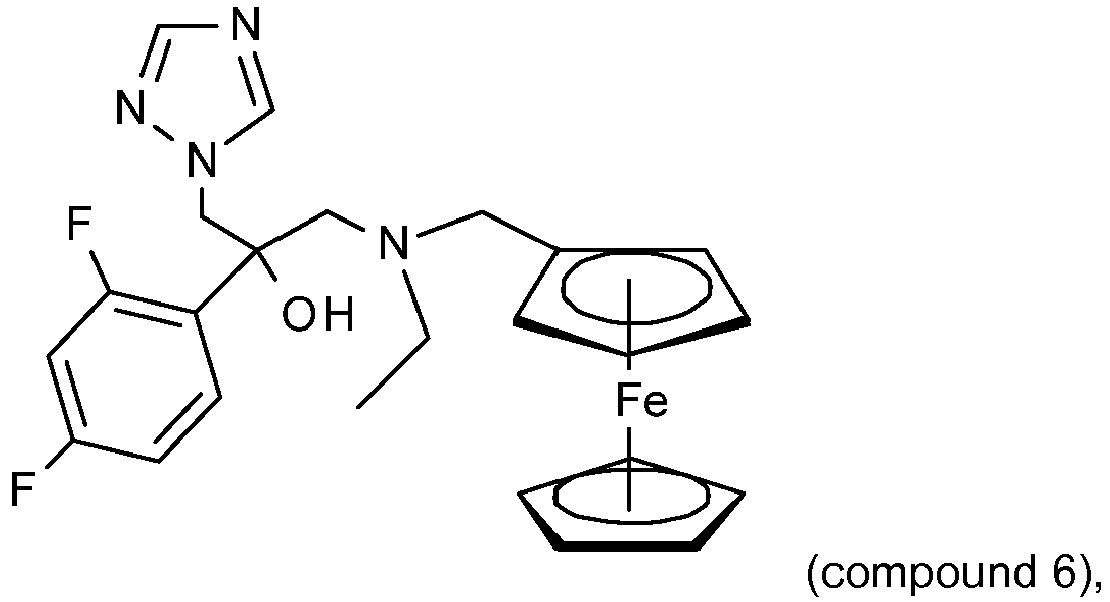
- f. syn/anti-N-(ferrocenylmethyl)-2-(2,4-difluorophenyl)-2-hydroxy-N-ethyl-3-(1H-1,2,4-triazol-1-yl)propan-1-aminium chloride, compound 6a with Z1=N, Z2=C, A=OH, R1=ethyl, Y=methyl, OM= unsubstituted ferrocenyl and n of Xn 1 is 2 and each X1 is F

- g. syn/anti-N-(ferrocenylmethyl)-2-(2,4-difluorophenyl)-2-hydroxy-N-isopropyl-3-(1H-1,2,4-triazol-1-yl)propan-1-amine, compound 7 with Z1=N, Z2=C, A=OH, R1=isopropyl, Y=methyl, OM= unsubstituted ferrocenyl and n of Xn 1 is 2 and each X1 is F

- h. syn/anti-N-(ferrocenylmethyl)-2-(2,4-difluorophenyl)-2-hydroxy-N-isopropyl-3-(1H-1,2,4-triazol-1-yl)propan-1-aminium chloride, compound 7a with Z1=N, Z2=C, A=OH, R1=isopropyl, Y=methyl, OM= unsubstituted ferrocenyl and n of Xn 1 is 2 and each X1 is F
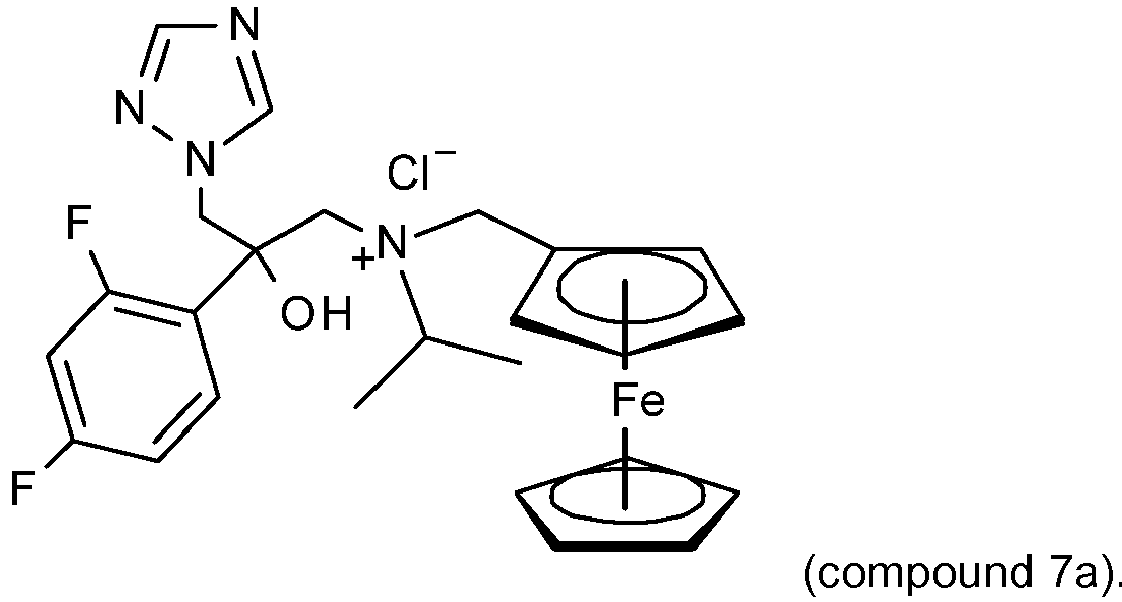
- The compounds of the general formula (1) can also be obtained in the form of their hydrates and/or also can include other solvents used for example for the crystallization of compounds present in the solid form. Depending on the method and/or the reaction conditions, compounds of the general formula (1) can be obtained in the free form or in the form of salts.
- The compounds of the general formula (1) may be present as optical isomers or as mixtures thereof. The stereocenter in the formulas is located on the C1 carbon atom of the ethyl moiety. The invention relates both to the pure isomers, racemic mixtures and all possible isomeric mixtures and is hereinafter understood as doing so, even if stereochemical details are not specifically mentioned in every case. Diastereoisomeric mixtures of compounds of the general formula (1), which are obtainable by the process or any other way, may be separated in known manner - on the basis of the physical-chemical differences of their components - into pure diastereoisomers, for example by fractional crystallisation, distillation and/or chromatography, in particular by preparative HPLC using a chiral HPLC column.
- If not stated otherwise a racemic mixture is used.
- According to the invention, apart from separation of corresponding isomer mixtures, generally known methods of diastereoselective or enantioselective synthesis can also be applied to obtain pure diastereoisomers or enantiomers, e.g. by carrying out the method described hereinafter and using educts with correspondingly suitable stereochemistry.
- It is advantageous to isolate or synthesise the biologically more active isomer, provided that the individual compounds have different biological activities.
- A further aspect of the invention is the process for the preparation of the compounds described by the general formula (1).
- The preparation comprises a compound (9) described by the formula


- Scheme 1: Xn 1 Z1 and Z2 have the same meaning as defined above. Compound (8) includes the commercially available 2,4-difluoro-a-(1H-1,2,4-triazolyl)acetophenone (CAS number 86404-63-9) in the case of n=2 and X1=F , Z1=C and Z2=N and was reacted by Corey-Chaykovski epoxidation to compound (9).
- In one embodiment, compound (9) was treated with compound (10; N-alkyl-methylaminoferrocene) yielding compound (11) by nucleophilic addition. The reaction pathway is depicted in scheme 2.

- Scheme 2: Compound (10) was reacted via nucleophilic addition with the epoxide ring compound (9) yielding compound (11). Xn 1, Z1, Z2, M and R1 have the same meaning as defined above. The reaction scheme is applicable for the synthesis of compounds (4), (5), (6) and (7) in case of n=2 and X1=F, M=Fe, Z1=C and Z2=N and R1 being H, C1, C2- or C3-alkyl, respectively. Compound (10) may also include different linkers Y. The given reaction scheme with Y=methyl is usable for the other linkers Y mentioned above.
- Reaction pathways for compounds comprising the half metal sandwich complexes OM of the general formula (2b) follow a similar pathway as the above mentioned reactions, in particular a similar pathway as depicted in scheme 2, which is easily adaptable for a person skilled in the art. Reference is made to the cited conditions, references and reactions pathways. Reaction pathways for compounds comprising the cobalt carbonyl complex OM of the general formula (2c) follow a similar pathways as the above mentioned reactions in particular a similar pathway as depicted in scheme 2, which is easily adaptable for a person skilled in the art. In particular starting with an alkinyl that is coupled to a cobalt carbonyl resulting in a organometallic compound according to general formula (2c) that is coupled to the parent compound as described in Gasser et al. (Inorg. Chem. 2009, 48, 3157-3166).
- According to a second aspect of the invention, the compounds defined in the first aspect of the invention are provided for the use as a medicament.
- According to a third aspect of the invention, the compounds defined in the first aspect of the invention are provided for the use as an antimycotic substance. In particular the compounds provided are for treating infections caused by the Ascomycota and Basidiomycota famlies in particular species of Candida albicans, Candida glabrata, other Candidiasis, Aspergillus fumigatus, Aspergillus flavus, Cryptococcus neoformans, Cryptococcus gattii, Histoplasma capsulatum, Pneumocystis jirovecii, Tinea pedis, Tinea corporis, Blastommycesdermatidis. The method is comprising the administration of a compound according to the above aspects or embodiments of the invention to a patient in need thereof.
- The treatment may be for prophylactic or therapeutic purposes. For administration, a compound according to the above aspect of the invention is preferably provided in the form of a pharmaceutical preparation comprising the compound in chemically pure form and optionally a pharmaceutically acceptable carrier and optionally adjuvants. The compound is used in an amount effective against antifungal infection. The dosage of the compound depends upon the species, the patient age, weight, and individual condition, the individual pharmacokinetic data, mode of administration, and whether the administration is for prophylactic or therapeutic purposes. The daily dose administered ranges from approximately 1 µg/kg to approximately 1000 mg/kg, preferably from approximately 1µg to approximately 100 µg, of the active agent according to the invention.
- According to a fourth aspect of the invention, the compounds defined in the first aspect of the invention are provided for the use in the treatment of fungal infections caused by azole-resistant Candida albicans.
- Pharmaceutically acceptable salts of the compounds provided herein are deemed to be encompassed by the scope of the present invention.
- According to one aspect of the invention, a pharmaceutical composition for preventing or treating fungal infection, particularly infection by the Ascomycota and Basidiomycota famlies in particular species of Candida albicans, Candida glabrata, other Candidiasis, Aspergillus fumigatus, Aspergillus flavus, Cryptococcus neoformans, Cryptococcus gattii, Histoplasma capsulatum, Pneumocystis jirovecii, Tinea pedis, Tinea corporis, Blastommycesdermatidis is provided, comprising a compound according to the above aspects or embodiments of the invention.
- The pharmaceutical compositions comprise approximately 1% to approximately 95% active ingredient, preferably from approximately 20% to approximately 90% active ingredient. According to one aspect of the invention, a dosage form for preventing or treating antifungal infection, particularly infection by by the Ascomycota and Basidiomycota famlies in particular species of Candida albicans, Candida glabrata, other Candidiasis, Aspergillus fumigatus, Aspergillus flavus, Cryptococcus neoformans, Cryptococcus gattii, Histoplasma capsulatum, Pneumocystis jirovecii, Tinea pedis, Tinea corporis, Blastommycesdermatidisis provided, comprising a compound according to the above aspect or embodiments of the invention.
- Dosage forms may be for administration via various routes, including nasal, buccal, rectal, transdermal or oral administration, or as an inhalation formulation or suppository. Alternatively, dosage forms may be for parenteral administration, such as intravenous, intrahepatic, or especially subcutaneous, or intramuscular injection forms. Optionally, a pharmaceutically acceptable carrier and/or excipient may be present.
- According to one aspect of the invention, a method for manufacture of a medicament for preventing or treating antifungal infection by the Ascomycota and Basidiomycota famlies in particular species of Candida albicans, Candida glabrata, other Candidiasis, Aspergillus fumigatus, Aspergillus flavus, Cryptococcus neoformans, Cryptococcus gattii, Histoplasma capsulatum, Pneumocystis jirovecii, Tinea pedis, Tinea corporis, Blastommycesdermatidis comprising the use of a compound according to the above aspect or embodiments of the invention. Medicaments according to the invention are manufactured by methods known in the art, especially by conventional mixing, coating, granulating, dissolving or lyophilizing. According to a fifth aspect of the invention, the compounds defined in the first aspect of the invention are provided as an inhibitor of lanosterol-14α-demethylase.
- Lanosterol-14α-demethylase plays a central role in the biosynthesis of ergosterol, an important fungal wall constituent. The inhibition of this protein leads to wall instability and fungal death. Without wishing to be bound by theory the inventors believe that the compounds defined in the first aspect of the invention interact with Lanosterol-14α-demethylase. This interaction includes different parts of their chemical structure as indicated in
figure 1 . The interaction results in the inactivation of Lanosterol-14α-demethylase and thereby inhibits fungal growth. - Wherever reference is made herein to an embodiment of the invention, and such embodiment only refers to one feature of the invention, it is intended that such embodiment may be combined with any other embodiment referring to a different feature. For example, every embodiment that defines Y may be combined with every embodiment that defines Rn or X to characterize a group of compounds of the invention or a single compound of the invention with different properties.
- The invention is further illustrated by the following examples and figures, from which further embodiments and advantages can be drawn. These examples are meant to illustrate the invention but not to limit its scope.
-
- Fig. 1
- shows the strategy for drug design of the compound of the first aspect of the invention.
- Fig. 2
- shows example of colony formation assay for the first generation of complexes. Compounds tested were: compound 4a (H), compound 5a (methyl), compound 6a (ethyl) and compound 7a (isopropyl). The compound concentration tested was declining from left to right. The numbers indicate EC50-values in µM.
- The synthesis of the new antifungal drug candidates was designed in order to minimize the synthetic steps, to involve cheap reagents and to be performed under mild reaction conditions. Starting from the commercially available 2,4-difluoro-a-(1H-1,2,4-triazolyl)acetophenone (CAS number 86404-63-9) a Corey-Chaykovski epoxidation was performed (see Scheme 3). In parallel the N-substituted methylferrocenes were prepared starting from ferrocenylaldheyde upon imine formation and subsequent reduction in presence of NaBH4. Finally, the epoxide ring opening via nucleophilic addition by the N-alkyl-methhylaminoferrocene yielded a series of the compounds of the present invention. Four different alkyl side chains, with R= -H, -methyl, -ethyl or -isopropyl, with increasing degree of hindrance and lipophilicity were envisaged in order to obtain a preliminary structure-activtiy relationship. All complexes were characterized by Nuclear Magnetic Resonance techniques, Mass Spectrometry, Infrared Spectroscopy and their purity assessed via elemental analysis.

- In both topic and systemic applications, antimycotic drugs are getting in contact with patient tissues. It is therefore of utmost importance that new drug candidates display a lack of host toxicity. Thus, the antiproliferative effect of the new complexes were investigated in vitro on human retinal pigment epithelial cell (RPE-1-hTert). As expected, fluconazole as a reference substance did not affect cell viability. The compounds of the present invention displayed all IC50 values in the mid-high micromolar range, following the order of potency isopropyl> ethyl > methyl> H (see table 1). This suggested that a decrease in the size of the N-substituent correlates with a decrease in host toxicity.
Table 1: Host cytotoxicity Compound IC50 [µM] Fluconazole >100 H >100 Methyl 74.7 ±5.2 Ethyl 51.2 ±0.1 Isopropyl 48.4 ±2.9 - To evaluate the antifungal acitivty of the new drug candidates, a well-plate based assay was used. The first investigation of antimycotic activity has been performed on a well-known model, namely Candida Robusta. Wild type colony of C. robusta was cultured and diluted to start the growing phase just before treatment and then seeded at different concentrations on the agar terrain poured with different concentrations of the target complexes and incubated for 24 h at 30 °C. Interestingly, all complexes displayed a better antifungal activity in comparison with the parent drug (
figure 2 ). Tertiary amines as linkers showed a better profile compared to secondary amines. A small substituent on the N resulted in higher mycotoxicity with R=-methyl resulting in the highest antimycotic activity. - In vivo studies were performed on pathological isolated strains. The inventors chose the methyl derivative since it displayed the best in vitro mycotoxicity and a low cytotoxicity against human cells. The compounds of the present invention were tested against Candida albicans, its azole-resistant type and three different pathologic fungi, namely Penicillumpaneum, Aspergillus glaucus and Trichosporonasahi (see table 2). Of utmost interest, the new antifungal drug candidate displayed a very strong activity towards almost all investigated strains (only in the case of A. glaucus was the MIC50 not in the nanomolar range). Moreover, the antimycotic potency of the complex overcomes the values of the parent drug up to a factor of 800 fold (e.g. P.paneum) and was able to overcome azole resistance (e.g. C. albicans resistant strain).
Table 2: In vivo antifungal activity Strain MethylMIC50 [µM] FluconazoleMI C50 [µM] C. albicans 0.07 0.8 C. albicans 0.7 >209 (res. Strains) P. paneum 0.25 >209 A. glaucus >1 0.8 T. asahi 0.13 1.6 - All chemicals were of reagent grade quality or better, obtained from commercial suppliers and used without further purification. Solvents were used as received or dried over 4 A or 3 A molecular sieves. THF and Et2O were freshly distilled under N2 by employing standard procedures. All syntheses were carried out using standard Schlenk techniques. Instrumentation and methods: 1H- and 13C-NMR spectra were recorded in deuterated solvents on a Bruker DRX 400 or AV2 500 at 30 °C. The chemical shifts δ, are reported in ppm. The residual solvent peaks have been used as internal reference. The abbreviations for the peak multiplicities are as follows: s (singlet), d (doublet), dd (doublet of doublet), t (triplet), q (quartet), m (multiplet) and br (broad). Infrared spectra were recorded on a PerkinElmer spectrum BX TF-IR spectrometer and KBrpresslings were used for solids. Signal intensities are abbreviated w (weak), m (medium), s (strong) and br (5 broad). ESI mass spectra were recorded on a Bruker Esquire 6000 or on a Bruker maxis QTOF-MS instrument (Bruker Daltonics GmbH, Bremen, Germany). LC-MS spectra were measured on an AcquityTM from Waters system equipped with a PDA detector and an auto sampler using an Agilent Zorbax 300SB-C18 analytical column (5.0 µm particle size, 100 A pore size, 150 × 3.0 mm) or an Macherey - Nagel 100 - 5 C18 (3.5 µm particle size, 300 A pore size, 150 × 3.0 mm). This LC was coupled to an Esquire HCT from Bruker (Bremen, Germany) for the MS measurements. The LC run (flow rate: 0.3 mL min-1) was performed with a linear gradient of A (distilled water containing 0.1% v/v formic acid) and B (acetonitrile, Sigma-Aldrich, HPLCgrade), t = 0 min, 5% B; t = 3 min, 5% B; t = 17 min, 100% B; t = 20 min, 100% B; t = 25 min, 15 5% B. High-resolution ESI mass spectra were recorded on a Bruker maxis QTOF-MS instrument (Bruker Daltonics GmbH, Bremen, Germany). The samples (around 0.5 mg) were dissolved in 0.5 mL of MeCN/H2O 1:1 + 0.1% HCOOH. The solution was then diluted 10:1 and analysed via continuous flow injection at 3 µl.min-1. The mass spectrometer was operated in the positive electrospray ionization mode at 4000 V capillary voltage, -500 V 20 endplate offset, with a N2 nebulizer pressure of 0.4 bar and dry gas flow of 4.0 l/min at 180°C. MS acquisitions were performed in the full scan mode in the mass range from m/z 100 to 2000 at 20'000 resolution and 1 scan per second. Masses were calibrated with a 2 mmol/l solution of sodium formate over m/z 158 to 1450 mass range with an accuracy below 2 ppm.
- Wild type C. robusta was freshly inoculated and cultured in autoclaved YPD buffer containing 2% bacto peptone, 1% bacto yeast extract and 2% glucose anhydrous at 30°C (Kuehner shaker Labtherm, Kuehner Switzerland).
- The activity of the compounds of the present invention C. robusta was evaluated via a colony formation assay as described in R. Rubbiani, O. Blacque, G. Gasser, Dalton Trans. 2016, 45, 6619-6626. Briefly, one day before treatment, an aliquot of wild type C. robustawas inoculated in 5 mL YPD buffer solution (see above) and incubated overnight at 30°C. The fungal proliferation was then quantified at 600 nm in a Cary60 UV/Vis (Agilent Technologies). The SC was then seeded at different concentrations of the yeast (representing OD of 0.2, 0.02, 0.002 and 0.0002 for different colony growth rate) in 24-wells plates containing 2 mL growing terrain. The growing terrain was composed of YPD containing 2% of agar, autoclaved and kept at 50°C (water bath, Kotterman AG). Just before use, the growing terrain was treated with increasing concentrations of the compounds of the invention or with fluconazole (used for comparison) and poured into the different wells, before solidification. The treated plates were loaded with C. robusta and incubated for 24 h at 30 °C. The fungal colony formation was monitored with Alpha Digitec camera (Bucher Biotec) and the colony density was calculated with Alphalmager software (v1.3.0.7) with multiplex band analysis mode / single tool. A series of blanks (with the terrain not seeded with C. robusta), negative controls (with the terrain seeded with C. robusta and treated just DMSO as vehicle) and Clotrimazole as a positive control were performed.
- Human fibroblast (MRC-5) and retinal pigment epithelial (RPE) cell lines were cultured in F-10 medium supplemented with 10% fetal calf serum (FCS, Gibco), 100 U/mL penicillin, 100 µg/mL streptomycin or DMEM medium (Gibco) supplemented with 10% fetal calf serum (FCS, Gibco), 100 U/mL penicillin, 100 µg/mL streptomycin, respectively, at 37 °C and 6% CO2.
- Cytotoxicity studies of the compounds of the present invention were performed by a fluorometric cell viability assay using resazurin (Promocell GmbH). Briefly, one day before treatment the cells were plated in triplicate in 96-well plates at a density of 4 × 10³ cells per well in 100 µL. Upon treating the cells with increasing concentrations of the compounds of the present invention, the cells were incubated for 48 h at 37 °C/6% CO2, the medium was removed, and 100 µL of complete medium containing resazurin (0.2 mg mL-1 final concentration) was added. After 4 h of incubation at 37 °C/6% CO2, the fluorescence of the highly red fluorescent resorufin product was quantified at 590 nm emission with 540 nm excitation wavelength using a SpectraMax M5 Microplate Reader. The results were expressed as mean ± standard deviation error of independent experiments.
- Candida strains were tested for their susceptibility to the azole (7 dilution series, ranging from 1 mM to 0.01 mM) following the European Committee for Antimicrobial Susceptibility Testing protocol (EUCAST Definitive Document EDef 7.2 Revision, 2012). Briefly, cells were grown in RPMI1640 medium supplied with 2.0% glucose, counted and inoculated at a concentration of 1-5 x 10⁵ CFU/ml. MIC50 values were determined at 530 nm using a spectrophotometer, as the lowest concentration of the drug that resulted in ≥ 50% inhibition of growth relative to the growth control after 48 h incubation.
- In a 250 mL round-bottom flask, NaH (0.02 g, 0.79 mmol) was dispersed in dry DMSO (10 mL) and trimethylsulfoxonium iodide (0.17 g, 0.77 mmol) was added. The suspension was stirred at room temperature for 20 min, while the mixture became clear. 1-(2,4-difluorophenyl)-2-(1H-1,2,4-triazol-1-yl)ethan-1-one (0.14 g, 0.64 mmol) in dry DMSO (20 mL) was added and the reaction mixture was heated to 85 °C for 5 h. After cooling the solution to room temperature, the reaction mixture was poured into cold H2O (80 mL, 10°C).
- The product was extracted with EtOAc (2 x 50 mL) and the combined organic phases were washed with H2O (50 mL), brine (50 mL), dried over MgSO4, filtered and evaporated to give (R)/(S)-1-((2-(2,4-difluorophenyl)oxiran-2-yl)methyl)-1H-1,2,4-triazole as an orange oil, which was stored at -20 °C and used for the next reaction step within the next 16 h. Yield: 76% (0.12 g, 0.51 mmol). The spectroscopic data matched those known in the art.
- In a 50 mL round-bottom flask, ferrocene carboxaldehyde (0.30 g, 1.40 mmol), NaOH (0.34 g, 8.5 mmol) and hydroxylamine hydrochloride (0.39 g, 5.61 mmol) were dissolved in EtOH (15 mL). The solution was refluxed for 3 h and then cooled to room temperature. After hydrolysis of the mixture (35 mL H2O) the target complex was extracted with CH2Cl2 (3 x 50 mL). The combined organic phases were dried over MgSO4, filtered and evaporated to afford ferrocenecarbaldehyde oxime as an orange amorphous solid. Yield: 81% (260 mg, 1.13 mmol). The spectroscopic data matched those known in the art.
- In a 50 mL round-bottom flask, LiAlH4 (0.23 g, 6.06 mmol) was dissolved in THF (8 mL). A solution of crude ferrocenecarbaldehyde oxime (0.26 g, 1.14 mmol) in THF (8 mL) was added dropwise and the mixture was refluxed for 3 h. The reaction was quenched with H2O (25 mL) and extracted with CH2Cl2 (3 x 50 mL). The combined organic layers were dried over MgSO4, filtered and evaporated to give ferrocenylmethanamine as red oil. Yield: 89% (0.22 mg, 1.01 mmol). The spectroscopic data matched those known in the art.
- In a 25 mL round-bottom flask, ferrocene carboxaldehyde (0.25 g, 1.17 mmol) was dissolved in 40% aqueous alkylamine solution (55.45 mmol). After stirring at room temperature for 2 h, the product was extracted with Et2O (2 x 30 mL). The combined organic phases were washed with H2O (20 mL), dried over MgSO4, filtered and evaporated to give 1-ferrocenyl-N-alkylmethanimine as a red crystalline solid or red oil, which was used for the next reaction step without further purification. Yield: 74% (0.25 g, 1.10 mmol). The spectroscopic data matched those known in the art.
- In a 50 mL round-bottom flask, crude 1-((2-(2,4-difluorophenyl)oxiran-2-yl)methyl)-1H-1,2,4-triazole (0.12 g, 51 mmol) was dissolved in dry THF (10 mL). Ferrocenylmethanamine (0.09 g, 0.42 mmol) and Et3N (0.11 mL, 0.79 mmol) were added to the solution. The reaction mixture was stirred at room temperature for 4 h and then at reflux for 7.5 h. The solvent were evaporated and the residue purified by column chromatography on silica using EtOAc:hexane (4:1) and EtOAc:CH2Cl2:MeOH (40:1:1) as the eluent (Rf = 0.62, EtOAc:CH2Cl2:MeOH (5:1:1)) to afford (R)/(S)-1-((ferrocenylmethyl)amino)-2-(2,4-difluorophenyl)-3-(1H-1,2,4-triazol-1-yl)propan-2-ol as an orange oil. The obtained oil (0.11 g, 0.24 mmol) was then dissolved acetone (4 mL) and 32% aq. HCl (26.5 µL, 0.27 mmol) was added. After 3 h of stirring, an orange precipitate was formed which was separated from the supernatant by centrifugation and decantation. The orange powder was washed with acetone, Et2O, and dried on high vacuum to afford syn/anti-N-(cyclopentylmethyl)-2-(2,4-difluorophenyl)-2-hydroxy-3-(1H-1,2,4-triazol-1-yl)propan-1-aminium chloride as a yellow amorphous solid. Yield: 82% (0.10 g, 0.20 mmol). IR (cm-1): 3105w, 1615m, 1500m, 1395w, 1270m, 1140s, 970m, 850s, 780w, 675s, 445s. 1H NMR (500 MHz, CD3OD) : δ/ppm = 8.28 (s, 1H, NCHN), 7.86 (s, 1 H, NCHN), 7.56 - 7.51 (m, 1 H, arom. H), 7.05 - 6.98 (m, 2H, arom. H), 4.69 (d, 2J = 15.0 Hz, 1H, CH2 NN), 4.64 (d, 2J = 15.0 Hz, 1H, CH2 NN), 4.40 (s, 1H, C5 H 4), 4.33 (s, 1 H, C5 H 4), 4.31 (s, 2H, C5 H 4), 4.21 (s, 5H, C5 H 5), 4.02 (s, 2H, CH 2C5H4), 3.56 (d, 2J = 10.0 Hz, 1 H, NH2CH 2COH), 3.33 (1 H, NH2CH 2COH, peak covered by CD3OD peak). 13C NMR (125 MHz, CD3OD) : δ/ppm = 166.1, 166.0, 164.1, 164.0, 161.9, 161.8, 160.0, 159.9, 152.1, 146.4, 131.5, 131.4, 131.4, 131.4, 123.0, 123.0, 122.9, 122.9, 113.0, 113.0, 112.9, 112.8, 106.0, 105.8, 105.6, 76.3, 73.6, 73.6, 71.8, 71.0, 70.1, 56.5, 56.5, 52.4, 52.3, 1 peak covered by CD3OD peak, but identified in 13C HSQC. 19F NMR (470 MHz, CD3OD) : δ/ppm = 109.20, 110.88. ESI-MS: m/z (%) = 452.1 ([M-HCl]+, 100), 198.9 (C11H10Fe+, 25), 255.1 (C11H13F2N4O+, 20). Elemental Analysis (%): calcd. for C22H23N4OF2CIFe = C, 54.07; H, 4.74; N, 11.46. Found = C, 53.81; H, 4.71; N, 11.50.
- In a 250 mL round-bottom flask, crude 1-((2-(2,4-difluorophenyl)oxiran-2-yl)methyl)-1H-1,2,4-triazole (0.18 g, 0.76 mmol) was dissolved together with 1-ferrocenyl-N-methylmethanamine (0.19 g, 0.83 mmol) and Et3N (0.37 mL, 2.66 mmol) in dry EtOH (4 mL). The reaction mixture was refluxed for 7 h. The solvent was evaporated and the residue was purified by column chromatography on silica using EtOAc:hexane:MeOH (22:22:1) as the eluent (Rf = 0.38, EtOAc:hexane:MeOH (22:22.1)) to afford (R)/(S)-1-((ferrocenylmethyl)(methyl)amino)-2-(2,4-difluorophenyl)-3-(1H-1,2,4-triazol-1-yl)propan-2-ol as an orange oil). The obtained oil (0.14 g, 0.29 mmol) was then dissolved in acetone (4 mL) and 32% aq. HCl (26.5 µL, 0.31 mmol) was added. After 3 h of stirring an orange precipitate was formed which was separated from the supernatant by centrifugation and decantation. The residue was washed with acetone, Et2O and dried on high vacuum to afford syn/anti-N-(ferrocenylmethyl)-2-(2,4-difluorophenyl)-2-hydroxy-N-methyl-3-(1H-1,2,4-triazol-1-yl)propan-1-aminium chloride as a yellow-orange amorphous solid. Yield: 82% (0.11 g, 0.22 mmol). IR (cm-1): 3105w, 2350w, 1615m, 1500m, 1425m, 1270m, 1210w, 1135m, 1020m, 965m, 845s, 675m, 485s. 1H NMR (500 MHz, CD3OD): δ/ppm = 8.56 (s, 1 H, NCHN), 8.52 (s, 1 H, NCHN), 8.04 (s, 1 H, NCHN), 8.02 (s, 1 H, NCHN), 7.63 - 7.58 (m, 1H, arom. H), 7.13 - 7.00 (m, 4H, arom. H), 4.77 - 4.67 (m, 3H, CH2 NN), 4.55 (d, 2J = 15.0 Hz, 1 H, CH2 NN), 4.45 (s, 1 H, C5 H 4), 4.37 - 4.30 (m, 5H, C5 H 4; 1 H, NHCH 2COH), 4.24 (s, 5H, C5 H 5; 1 H, C5 H 4), 4.19 - 4.13 (m, 5H, C5 H 5; 1 H, C5 H 4; 1 H, NHCH 2COH), 4.01 - 3.98 (m, 2H, NHCH 2C5H4; 1 H, NHCH 2COH) , 3.75 (d, 2J = 15.0, 1 H, CH 2C5H4), 3.55 (d, 2J = 15.0, 1H, CH 2C5H4), 3.47 (d, 2J = 15.0, 1H, NHCH 2COH), 2.87 (s, 3H, CH 3), 2.49 (s, 3H, CH 3). 13C NMR (125 MHz, CD3OD): δ/ppm = 166.2, 166.2, 166.1, 166.1, 164.2, 164.2, 164.1, 164.1, 161.5, 161.5, 159.6, 159.6, 152.5, 146.5, 131.3, 131.3, 131.3, 130.8, 130.8, 130.8, 124.3, 124.3, 124.3, 123.4, 123.3, 123.3, 113.5, 113.5, 113.3, 113.2, 113.2, 113.1, 113.1, 106.5, 106.3, 106.3, 106.1, 106.1, 105.8, 105.8, 74.8, 74.6, 74.6, 74.1, 74.1, 73.2, 73.2, 72.9, 72.9, 72.3, 72.3, 71.8, 71.8, 71.5, 71.5, 71.4, 71.2, 70.2, 60.7, 60.5, 59.7, 59.6, 57.1, 56.8, 49.6, 49.5, 49.5, 49.3, 49.3, 49.2, 49.0, 48.8, 48.7, 48.5, 44.5, 43.2. 19F NMR (470 MHz, CD3OD): δ/ppm = 107.75, 108.88, 110.23, 110.41. ESI-MS: m/z (%) = 467.1 ([M-Cl]+, 100), 198.9 (C11H10Fe+, 47), 269.1 (C12H14F2N4O+, 20). Elemental Analysis (%): calcd. for C23H25N4OF2CIFe •·H2O = C, 53.05; H, 5.23; N, 10.76. Found = C, 52.87; H, 5.65; N, 10.33.
- In a 250 mL round-bottom flask, crude 1-((2-(2,4-difluorophenyl)oxiran-2-yl)methyl)-1H-1,2,4-triazole (0.18 g, 0.76 mmol) was dissolved together with 1-ferrocenyl-N-ethylmethanamine (0.17 g, 0.70 mmol) and Et3N (0.37 mL, 2.66 mmol) in dry EtOH (4 mL). The reaction mixture was refluxed for 6 h. The solvent was evaporated and the residue was purified by column chromatography on silica using EtOAc:hexane:MeOH (22:22:1) as the eluent (Rf = 0.64, EtOAc:hexane:MeOH (22:22.1)) to afford (R)/(S)-1-((ferrocenylmethyl)(ethyl)amino)-2-(2,4-difluorophenyl)-3-(1H-1,2,4-triazol-1-yl)propan-2-ol as an orange oil). The obtained oil (0.12 g, 0.25 mmol) was dissolved in acetone (4 mL) and 32% aq. HCl (25.4 µL, 0.26 mmol) was added. After 3 h of stirring, an orange precipitate was formed which was separated from the supernatant by centrifugation and decantation. The orange powder was washed with acetone, Et2O and dried on high vacuum to afford syn/anti-N-(ferrocenylmethyl)-2-(2,4-difluorophenyl)-2-hydroxy-N-ethyl-3-(1H-1,2,4-triazol-1-yl)propan-1-aminium chloride as a yellow amorphous solid. Yield: 93% (0.11 g, 0.21 mmol). IR (cm-1): 3040w, 1615w, 1500m, 1415m, 1255w, 1145m, 970m, 850m, 640s, 500s. 1H NMR (500 MHz, CD3OD) δ/ppm = 9.48 (s, 1H, NCHN), 9.46 (s, 1 H, NCHN), 8.56 (s, 1 H, NCHN), 8.55 (s, 1 H, NCHN), 7.65 - 7.59 (m, 2H, arom. H), 7.22 - 7.06 (m, 4H, arom. H), 5.03 - 4.93 (m, 3H, CH2NN), 4.70 (d, 2J = 15.0 Hz, 1 H, CH2 NN), 4.53 (s, 1 H, C5 H 4), 4.44 - 4.21 (m, 5H, C5 H 5; 7H, C5 H 4; 2H, NHCH 2COH), 4.09 (s, 5H, C5 H 5), 3.92 - 3.64 (m, 2H, NHCH 2COH; 4H, CH 2C5H4), 3.28 - 3.26 (m, 1 H, CH 2CH3), 3.16 - 3.12 (m, 1 H, CH 2CH3), 2.97 - 2.94 (m, 2H, CH 2CH3), 1.33 (t, 3J= 7.5 Hz, 3H, CH 3), 1.11 (t, 3J = 7.5 Hz, 3H, CH 3).13C NMR (125 MHz, CD3OD) : δ/ppm = 165.1, 164.9, 163.0, 162.9, 160.4, 160.3, 158.5, 158.3, 144.9, 143.4, 130.0, 129.7, 121.7, 112.1, 112.0, 105.3, 104.9, 104.7, 104.5, 73.2, 72.7, 72.0, 71.9, 71.7, 71.4, 70.7, 70.0, 70.0, 69.0, 68.8, 57.0, 56.3, 55.6, 55.4, 54.9, 54.7, 50.6, 50.2, 7.7, 7.5. 19F NMR (470 MHz, CD3OD): δ/ppm = 107.51, 108.62, 109.80. ESI-MS: m/z (%) = 481.1 ([M-Cl]+, 100), 198.9 (C11H10Fe+, 43), 283.1 (C13H17F2N4O+, 16). Elemental Analysis (%): calcd. for C24H27N4OF2ClFe • 2 H2O = C, 52.14; H, 5.65; N, 10.13. Found = C, 52.00; H, 5.06; N, 9.90.
- In a 250 mL round-bottom flask, crude 1-((2-(2,4-difluorophenyl)oxiran-2-yl)methyl)-1H-1,2,4-triazole (0.09 g, 0.38 mmol) was dissolved together with 1-ferrocenyl-N-isopropylmethanamine (0.24 g, 0.96 mmol) and Et3N (0.32 mL, 2.48 mmol) in dry EtOH (5 mL). The reaction mixture was refluxed for 7.5 h. The solvent was evaporated and the residue was purified by column chromatography on silica using EtOAc:hexane:MeOH (22:22:1) as the eluent to afford (R)/(S)-1-((ferrocenylmethyl)(isopropyl)amino)-2-(2,4-difluorophenyl)-3-(1H-1,2,4-triazol-1-yl)propan-2-ol as an orange oil). The obtained oil (0.09 g, 0.18 mmol) was then dissolved in acetone (4 mL) and 32% aq. HCl (19.1 µL, 0.19 mmol) was added. After 3 h of stirring an orange precipitate formed which was separated from the supernatant by centrifugation and decantation. The orange powder was washed with acetone, Et2O and dried on high vacuum to afford syn/anti-N-(ferrocenylmethyl)-2-(2,4-difluorophenyl)-2-hydroxy-N-isopropyl-3-(1 H-1,2,4-triazol-1-yl)propan-1-aminium chloride as a yellow amorphous solid. Yield: 77% (0.07 g, 0.13 mmol). IR (cm-1): 3010w, 2255w, 1615w, 1495m, 1395m, 1270m, 1140s, 1090m, 970m, 830w, 680m, 495s. 1H NMR (500 MHz, CD3OD δ/ppm = 8.39 (s, 1 H, NCHN), 8.30 (s, 1 H, NCHN), 7.96 (s, 2H, NCHN), 7.76 - 7.70 (m, 1 H, arom. H), 7.62 - 7.58 (m, 1 H, arom. H), 7.30 - 7.22 (m, 2H, arom. H), 7.20 - 7.06 (m, 2H, arom. H), 4.89 - 4.76 (m, 3H, CH2NN), 4.62 (d, 2J = 10.0 Hz, 1 H, CH2NN), 4.51 - 4.35 (m, 4H, C5H4), 4.30 - 4.23 (m, 5H, C5H5, 2H, C5H4), 4.17 (s, 1 H, C5H4) , 4.01 (s, 5H, C5H5, 1H, C5H4), 3.92 (d, 2J = 15.0 Hz, 1H, CH2), 3.75 3.57 (m, 7H, CH2), 1.33 - 1.06 (m, 12H, CH3). 13C NMR (125 MHz, CD3OD): δ/ppm = 166.3, 166.2, 166.1, 166.0, 164.4, 164.3, 164.2, 164.1, 162.1, 162.0, 161.8, 161.7, 160.1, 1560.0, 159.8, 159.7, 152.3, 146.8, 146.5, 131.6, 131.6, 131.6, 131.5, 131.1, 124.9, 124.3, 122.9, 122.9, 122.8, 113.5, 113.4, 113.1, 113.0, 112.8, 112.8, 106.5, 106.2, 106.0, 105.9, 105.9, 105.7, 105.5, 75.4, 74.5, 74.0, 73.7, 73.7, 73.2, 73.0, 72.9, 72.9, 72.6, 72.2, 71.4, 71.2, 71.2, 70.3, 70.1, 58.2, 56.5, 55.6, 54.9, 54.5, 53.9, 53.0, 50.8, 50.8, 24.2, 18.6, 18.5, 18.3, 16.7, 14.8. 19F NMR (470 MHz, CD3OD) : δ/ppm = 107.53, 108.52, 109.90, 110.27. ESI-MS: m/z (%) = 495.1 ([M-Cl]+, 100), 198.9 (C11H10Fe+, 40), 297.2 (C14H19F2N4O+, 17). Elemental Analysis (%): calcd. for C25H29N4OF2CIFe = C, 56.57; H, 5.51; N, 10.55. Found = C, 56.43; H, 5.61; N, 10.61.
- Different organic groups are added to the ferrocene scaffold following standard procedures starting from commercially available ferrocenyl dibromide. The starting material is reacted with PhCH2ONH2 and subsequently alkylated (S. Dey et al., Organometallics, 2015, 34, 3039-3046) obtaining the monoaminomonobromo derivative or with CICOOEt in presence of n-butyl-lithium followed by hydrolysis to obtain the monocarboxylic acid mono bromo derivative. The final organic derivatization is obtained via Friedel-Crafts reaction with the acyl chloride of the target substituent or via nucleophilic substitution as depicted in scheme 4.

- Different metallocenyls are synthesized following standard procedures. Cobaltoceneandruthenocene are commercially available and are halogenated in the presence of Br2 and tert-butyl-lithium. The obtained bromo-metallocenes undergo a microwave-assisted nucleophilic substitution with NaN3 (according to Y. Ju etal.,J. Org. Chem.,2006,71, 6697-6700), followed by hydrolysis, resulting in the respective metallocenylcarboxaladheyde (according to Patra et al. Chem. Commun., 2011, 47, 114444-11446). The obtained metallocenylcarboxaladheydeis then reacted with hydroxylamine or alkylamine, reduced with NaBH4 in order to obtain the N-alkyl-methylaminometallocenyl derivatives as depicted in scheme 5.

Claims (14)
- A compound characterized by a general formula (1),

wherein- Z1 and Z2 are independently from each other -C or -N,- A is selected from -H, -OH, -SH, a substituted or unsubstituted C1 to C4 thiol, a substituted or unsubstituted C1 to C4 alkylamine, a substituted or unsubstituted C1-C4 alkoxy, a substituted or unsubstituted C1-C4 aldehyde, a substituted or unsubstituted C3-C6 heterocycle,- R1 is hydrogen, a substituted or unsubstituted C1 to C5 alkyl, substituted or unsubstituted C3-C8 cycloalkyl, substituted or unsubstituted C2 to C5 alkenyl, substituted or unsubstituted C2 to C5 alkynyl,- Y is a substituted or unsubstituted C1 to C5 alkyl, substituted or unsubstituted C3 to C8 cycloalkyl, substituted or unsubstituted C2 to C5 alkenyl, substituted or unsubstituted C2 to C5 alkynyl, -ORa-, -C(O)Ra-, -C(S)ORa-, -Ra-O-Ra-, -Ra-CO(=O)-R a-,wherein each Ra is independently from each other Ra selected from the group consisting of hydrogen, unsubstituted C1-C4 alkyl, and C1-C4 alkyl substituted with C1-C4 alkoxy,- OM is an organometallic compound independently selected from the group of an unsubstituted or substituted metal sandwich compound, an unsubstituted or substituted half metal sandwich compound or a metal carbonyl compound,- n of Xn 1 is 1 or 2 and each X1 independently from each other X1 is -C(=O)OR2, -C(=O)NR2 2, -C(=O)SR2, -C(=S)OR2, -C(NH)NR2 2, CN4H2, -NR2 2, -C(=O)R2, -C(=S)R2, -OR2, -SR2, -CF3, -OCF3, -SCF3, -SOCF3, -SO2CF3, -CN, -NO2, -F, -Cl, -Br or -I, with each R2 independently from any other R2 being a hydrogen or C1-C4 alkyl. - The compound according to claim 1, wherein n of Xn 1 is 1 or 2, and each X1 independently from any other X1 is -CN, -CF3, -OCF3, -SCF3, -SOCF3, -SO2CF3,-F,-CI, -Br or -I, in particular each X1 independently from any other X1 is -F, -Cl, -Br or -I.
- The compound according to any one of claims 1 or 2, wherein n of Xn 1 is 2 and one of the two X1 is in ortho position and the other X1 is in para position to the attachment position of the benzene moiety, or one of the two X1 is in meta position and the other X1 is in para position to the attachment position of the benzene moiety, in particular one of the two X1 is in meta position and the other X1 is in para position to the attachment position of the benzene moiety.
- The compound according to any one of claims 1 to 3, wherein R1 is hydrogen or a substituted or unsubstituted C1 to C3 alkyl.
- The compound according to any one of claims 1 to 4, wherein Y is a substituted or unsubstituted C1 to C3 alkyl.
- The compound according to any one of claims 1 to 5, wherein OM is an organometallic compound according to general formula (2a),
 wherein M is a metal selected from Fe, Ru, Co, Ni, Cr, Os or Mn, andz of Rz U is 0, 1, 2, 3 or 4, and y of Ry L is 0, 1, 2, 3, 4 or 5 and
each RL and each RU are independently from any other RL and RUselected from- an unsubstituted or substituted C1-C10 alkyl, an unsubstituted or substituted C2-C10 alkenyl, an unsubstituted or substituted C2-C10 alkynyl, an unsubstituted or substituted C3-C8 cycloalkyl, an unsubstituted or substituted C1-C10 alkoxy, an unsubstituted or substituted C3-C8 cycloalkoxy,- an unsubstituted or substituted C6-C14 aryl,- an unsubstituted or substituted 5- to 10-membered heteroaryl, wherein 1 to 4 ring atoms are independently selected from nitrogen, oxygen or sulfur,- an unsubstituted or substituted 5- to 10-membered heteroalicyclic ring, wherein 1 to 3 ring atoms are independently nitrogen, oxygen or sulfur,- -OR3, -SR3, -C(O)R3, -C(S)R3, -C(O)OR3, -C(S)OR3, -C(O)SR3, -C(O)NR3R4, -NR3R4, -S(O)2R3, -S(O)2OR3 and -S(O)2NR3R4,
whereinR3and R4 are independently selected from the group consisting of hydrogen, unsubstituted C1-C4 alkyl, and C1-C4 alkyl substituted with C1-C4 alkoxy,- general formula (3a) or (3b)
- The compound according to claim 6, wherein each RL and each RU are independently from any other RL and RU selected from:- -OR3, -SR3,-C(O)R3,-C(S)R3, -C(O)OR3, -C(S)OR3, -C(O)SR3, -C(O)NR3R4, -NR3R4, -S(O)2 R3, -S(O)20 R3, and -S(O)2NR3R4, whereinR3 and R4 are independently selected from the group consisting of hydrogen, unsubstituted C1-C4 alkyl, and C1-C4 alkyl substituted with C1-C4 alkoxy,or- general formula (3a) or (3b)

- The compound according to any one of claims 6 or 7, wherein M is selected from the group of Fe, Ru or Co, wherein in particular M is Fe; and/or wherein y and z are 0.
- The compound according to any one of claims 1 to 5, wherein OM is an organometallic compound according to the general formula (2b),
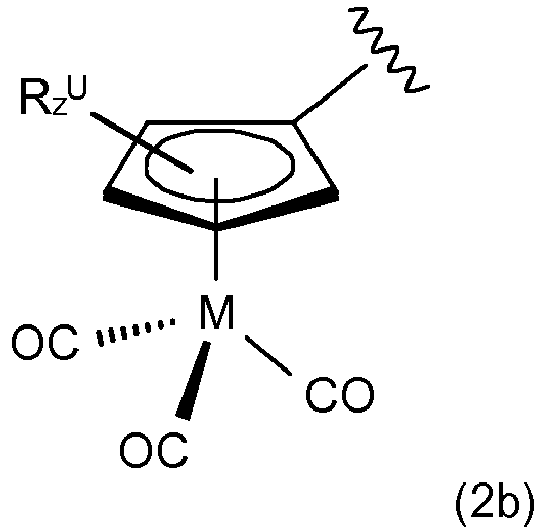 wherein M is a metal selected from the group of Mn, Re or Tc, andz of Rz U is 0, 1, 2, 3 or 4, and
each RU is independently from any other RU selected from- an unsubstituted or substituted C1-C10 alkyl, an unsubstituted or substituted C2-C10 alkenyl, an unsubstituted or substituted C2-C10 alkynyl, an unsubstituted or substituted C3-C8 cycloalkyl, an unsubstituted or substituted C1-C10 alkoxy, an unsubstituted or substituted C3-C8 cycloalkoxy,- an unsubstituted or substituted C6-C14 aryl,- an unsubstituted or substituted 5- to 10-membered heteroaryl, wherein 1 to 4 ring atoms are independently selected from nitrogen, oxygen or sulfur,- an unsubstituted or substituted 5- to 10-membered heteroalicyclic ring, wherein 1 to 3 ring atoms are independently nitrogen, oxygen or sulfur,- -OR3, -SR3, -C(O)R3, -C(S)R3, -C(O)OR3, -C(S)OR3, -C(O)SR3, -C(O)NR3R4, -NR3R4, -S(O)2R3, -S(O)2OR3 and -S(O)2NR3R4,
whereinR3 and R4 are independently selected from the group consisting of hydrogen, unsubstituted C1-C4 alkyl, and C1-C4 alkyl substituted with C1-C4 alkoxy. - The compound according to any one of claims 1 to 5, wherein OM is an organometallic compound according to the general formula (2c),
 wherein Rc is selected from- hydrogen,- an unsubstituted or substituted C1-C10 alkyl, an unsubstituted or substituted C2-C10 alkenyl, an unsubstituted or substituted C2-C10 alkynyl, an unsubstituted or substituted C3-C8 cycloalkyl, an unsubstituted or substituted C1-C10 alkoxy, an unsubstituted or substituted C3-C8 cycloalkoxy,- an unsubstituted or substituted C6-C14 aryl,- an unsubstituted or substituted 5- to 10-membered heteroaryl, wherein 1 to 4 ring atoms are independently selected from nitrogen, oxygen or sulfur,- an unsubstituted or substituted 5- to 10-membered heteroalicyclic ring, wherein 1 to 3 ring atoms are independently nitrogen, oxygen or sulfur, or- -OR3, -SR3, -C(O)R3, -C(S)R3, -C(O)OR3, -C(S)OR3, -C(O)SR3, -C(O)NR3R4, -NR3R4, -S(O)2R3, -S(O)2OR3 and -S(O)2NR3R4,
whereinR3 and R4 are independently selected from the group consisting of hydrogen, unsubstituted C1-C4 alkyl, and C1-C4 alkyl substituted with C1-C4 alkoxy. - A compound according to any one of the claims 1 to 10 for use as a medicament.
- A compound according to any one of the claims 1 to 10 for use as an antimycotic.
- A compound according to any one of the claims 1 to 10 for use in the treatment of fungal infections caused by azole-resistant Candida albicans.
- An inhibitor of lanosterol-14α-demethylase comprising the compound according to any one of claims 1 to 10.
Priority Applications (2)
| Application Number | Priority Date | Filing Date | Title |
|---|---|---|---|
| EP16191930.3A EP3301100A1 (en) | 2016-09-30 | 2016-09-30 | Organometallic fluconazole derivates and their use as antimycotics |
| PCT/EP2017/074881 WO2018060483A1 (en) | 2016-09-30 | 2017-09-29 | Organometallic fluconazole derivates and their use as antimycotics |
Applications Claiming Priority (1)
| Application Number | Priority Date | Filing Date | Title |
|---|---|---|---|
| EP16191930.3A EP3301100A1 (en) | 2016-09-30 | 2016-09-30 | Organometallic fluconazole derivates and their use as antimycotics |
Publications (1)
| Publication Number | Publication Date |
|---|---|
| EP3301100A1 true EP3301100A1 (en) | 2018-04-04 |
Family
ID=57121057
Family Applications (1)
| Application Number | Title | Priority Date | Filing Date |
|---|---|---|---|
| EP16191930.3A Withdrawn EP3301100A1 (en) | 2016-09-30 | 2016-09-30 | Organometallic fluconazole derivates and their use as antimycotics |
Country Status (2)
| Country | Link |
|---|---|
| EP (1) | EP3301100A1 (en) |
| WO (1) | WO2018060483A1 (en) |
Cited By (1)
| Publication number | Priority date | Publication date | Assignee | Title |
|---|---|---|---|---|
| CN110862421A (en) * | 2019-11-04 | 2020-03-06 | 佛山奕安赛医药科技有限公司 | Synthetic method of nitrogenous heterocyclic ferrocene derivative |
-
2016
- 2016-09-30 EP EP16191930.3A patent/EP3301100A1/en not_active Withdrawn
-
2017
- 2017-09-29 WO PCT/EP2017/074881 patent/WO2018060483A1/en not_active Ceased
Non-Patent Citations (2)
| Title |
|---|
| BIOT C ET AL: "Synthesis and antifungal activity of a ferrocene-fluconazole analogue", BIOORGANIC & MEDICINAL CHEMISTRY LETTERS, PERGAMON, AMSTERDAM, NL, vol. 10, no. 8, 1 April 2000 (2000-04-01), pages 839 - 841, XP027377605, ISSN: 0960-894X, [retrieved on 20000401] * |
| ZHONGJUN GUAN ET AL: "Synthesis, Molecular Docking, and Biological Evaluation of Novel Triazole Derivatives as Antifungal Agents", CHEMICAL BIOLOGY & DRUG DESIGN., vol. 76, no. 6, 25 October 2010 (2010-10-25), GB, pages 496 - 504, XP055343339, ISSN: 1747-0277, DOI: 10.1111/j.1747-0285.2010.01038.x * |
Cited By (1)
| Publication number | Priority date | Publication date | Assignee | Title |
|---|---|---|---|---|
| CN110862421A (en) * | 2019-11-04 | 2020-03-06 | 佛山奕安赛医药科技有限公司 | Synthetic method of nitrogenous heterocyclic ferrocene derivative |
Also Published As
| Publication number | Publication date |
|---|---|
| WO2018060483A1 (en) | 2018-04-05 |
Similar Documents
| Publication | Publication Date | Title |
|---|---|---|
| Rylands et al. | Structure-activity relationship studies of antiplasmodial cyclometallated ruthenium (II), rhodium (III) and iridium (III) complexes of 2-phenylbenzimidazoles | |
| CN101824002B (en) | Water soluble triazole compound and synthesis method thereof | |
| Kancharla et al. | Synthesis and structure–activity relationships of tambjamines and B-ring functionalized prodiginines as potent antimalarials | |
| Mezgebe et al. | Synthesis and pharmacological activities of Schiff bases with some transition metal complexes: a review | |
| JP6031122B2 (en) | Tricyclic boron compounds for antimicrobial therapy | |
| FR2928151A1 (en) | N-HETEROCYCLIC PLATINUM-CARBENE DERIVATIVES, THEIR PREPARATION AND THERAPEUTIC USE THEREOF | |
| Mazur et al. | Synthesis, crystal structure and biological activities of a novel amidrazone derivative and its copper (II) complex—A potential antitumor drug | |
| Malhi et al. | Highly efficient electrocarboxylation method to synthesize novel acid derivatives of 1, 4-dihydropyridines and to study their antimicrobial activity | |
| Barwa et al. | Experimental and computational investigations of new organotin (IV) complexes derived from hydrazone ligands: Synthesis, structural analysis and biological assessment | |
| Galassi et al. | Synthesis and characterization of azolate gold (I) phosphane complexes as thioredoxin reductase inhibiting antitumor agents | |
| Hanifa et al. | Three isomeric 4-[(n-bromophenyl) carbamoyl] butanoic acids (n= 2, 3 and 4) as DNA intercalator: Synthesis, physicochemical characterization, antimicrobial activity, antioxidant potential and in silico study | |
| Yousef et al. | Benzohydrazide derivative metal complex's antimicrobial and inhibitory effects on liver cancer cell lines and quinone oxidoreductase 2: Experimental, molecular docking, and DFT investigations | |
| Das et al. | Deciphering the Mechanism of MRSA Targeting Copper (II) Complexes of NN 2 Pincer-Type Ligands | |
| CN115353488A (en) | Two kinds of 3-aryl isoquinoline compounds and their application as fungicides against phytopathogenic fungi | |
| Rodionov et al. | Synthesis and properties of 5-ferrocenyl-1H-pyrazole-3-carbaldehydes | |
| CA2855868A1 (en) | Methods for preparing functional tetraazacycloalkane compounds using a specific cyclic bisaminal compound | |
| Ayşen et al. | Benzimidazole-hydrazone derivatives: Synthesis, in vitro anticancer, antimicrobial, antioxidant activities, in silico DFT and ADMET studies | |
| Guo et al. | Synthesis of mono-and di-[12] aneN 3 ligands and study on the catalytic cleavage of RNA model 2-hydroxypropyl-p-nitrophenyl phosphate with their metal complexes | |
| WO2018060483A1 (en) | Organometallic fluconazole derivates and their use as antimycotics | |
| Al-Hazmi et al. | Studies on Photophysical and Biological Activity of Newly Synthesized of 4-Methylpiperidin-4-ol Substituted Pyrazole Derivatives | |
| CN100379733C (en) | Triazole antifungal medicine and its preparation method | |
| EP3093020A1 (en) | Anti-malarial agent | |
| CN113999211A (en) | Indazole skeleton derivatives containing 1,2, 3-triazole and having specific activity of resisting prostate cancer | |
| RU2828876C1 (en) | NOVEL ANTIBACTERIAL AGENT 3-(CARBOXYMETHYL)-1-(IMIDAZO[1,2-b][1,2,4,5]TETRAZIN-3-YL)-1H-BENZO[D]IMIDAZOLE-3-IUM CHLORIDE, ACTIVITY AGAINST NEISSERIA GONORRHOEAE AND MYCOBACTERIUM TUBERCULOSIS | |
| Yadav et al. | Synthesis, antimicrobial activity and DFT study of piperazine-phthalimide clubbed 1, 4-disubstituted 1, 2, 3-triazoles |
Legal Events
| Date | Code | Title | Description |
|---|---|---|---|
| PUAI | Public reference made under article 153(3) epc to a published international application that has entered the european phase |
Free format text: ORIGINAL CODE: 0009012 |
|
| AK | Designated contracting states |
Kind code of ref document: A1 Designated state(s): AL AT BE BG CH CY CZ DE DK EE ES FI FR GB GR HR HU IE IS IT LI LT LU LV MC MK MT NL NO PL PT RO RS SE SI SK SM TR |
|
| AX | Request for extension of the european patent |
Extension state: BA ME |
|
| STAA | Information on the status of an ep patent application or granted ep patent |
Free format text: STATUS: THE APPLICATION IS DEEMED TO BE WITHDRAWN |
|
| 18D | Application deemed to be withdrawn |
Effective date: 20181005 |