EP3300155A1 - Crosslinked wholly aromatic proton conductive polymeric electrolytes based on quinoline units - Google Patents
Crosslinked wholly aromatic proton conductive polymeric electrolytes based on quinoline units Download PDFInfo
- Publication number
- EP3300155A1 EP3300155A1 EP17020443.2A EP17020443A EP3300155A1 EP 3300155 A1 EP3300155 A1 EP 3300155A1 EP 17020443 A EP17020443 A EP 17020443A EP 3300155 A1 EP3300155 A1 EP 3300155A1
- Authority
- EP
- European Patent Office
- Prior art keywords
- cross
- membranes
- phenyl
- linking
- aromatic
- Prior art date
- Legal status (The legal status is an assumption and is not a legal conclusion. Google has not performed a legal analysis and makes no representation as to the accuracy of the status listed.)
- Withdrawn
Links
- 125000003118 aryl group Chemical group 0.000 title claims abstract description 17
- 239000003792 electrolyte Substances 0.000 title claims description 8
- 125000002943 quinolinyl group Chemical group N1=C(C=CC2=CC=CC=C12)* 0.000 title description 3
- 239000012528 membrane Substances 0.000 claims abstract description 74
- 238000004132 cross linking Methods 0.000 claims abstract description 55
- 239000000446 fuel Substances 0.000 claims abstract description 31
- 229920001519 homopolymer Polymers 0.000 claims abstract description 31
- 239000005518 polymer electrolyte Substances 0.000 claims abstract description 29
- 239000000178 monomer Substances 0.000 claims abstract description 23
- FSEXLNMNADBYJU-UHFFFAOYSA-N 2-phenylquinoline Chemical group C1=CC=CC=C1C1=CC=C(C=CC=C2)C2=N1 FSEXLNMNADBYJU-UHFFFAOYSA-N 0.000 claims abstract description 19
- 229920000642 polymer Polymers 0.000 claims abstract description 16
- -1 hydroxyl-phenyl Chemical group 0.000 claims abstract description 13
- 125000002887 hydroxy group Chemical group [H]O* 0.000 claims abstract description 12
- 239000004971 Cross linker Substances 0.000 claims abstract description 9
- 125000001997 phenyl group Chemical group [H]C1=C([H])C([H])=C(*)C([H])=C1[H] 0.000 claims abstract description 8
- 238000002360 preparation method Methods 0.000 claims abstract description 4
- 238000007080 aromatic substitution reaction Methods 0.000 claims abstract description 3
- 125000001153 fluoro group Chemical group F* 0.000 claims abstract description 3
- 230000006641 stabilisation Effects 0.000 claims abstract 2
- 238000011105 stabilization Methods 0.000 claims abstract 2
- NBIIXXVUZAFLBC-UHFFFAOYSA-N Phosphoric acid Chemical compound OP(O)(O)=O NBIIXXVUZAFLBC-UHFFFAOYSA-N 0.000 claims description 34
- 229910000147 aluminium phosphate Inorganic materials 0.000 claims description 17
- 229910052739 hydrogen Inorganic materials 0.000 claims description 17
- 239000000203 mixture Substances 0.000 claims description 13
- SECXISVLQFMRJM-UHFFFAOYSA-N N-Methylpyrrolidone Chemical compound CN1CCCC1=O SECXISVLQFMRJM-UHFFFAOYSA-N 0.000 claims description 12
- 238000000034 method Methods 0.000 claims description 11
- 229920000570 polyether Polymers 0.000 claims description 11
- SMWDFEZZVXVKRB-UHFFFAOYSA-N Quinoline Chemical compound N1=CC=CC2=CC=CC=C21 SMWDFEZZVXVKRB-UHFFFAOYSA-N 0.000 claims description 10
- ZMXDDKWLCZADIW-UHFFFAOYSA-N N,N-Dimethylformamide Chemical compound CN(C)C=O ZMXDDKWLCZADIW-UHFFFAOYSA-N 0.000 claims description 9
- 239000004721 Polyphenylene oxide Substances 0.000 claims description 8
- 229910000027 potassium carbonate Inorganic materials 0.000 claims description 8
- IAZDPXIOMUYVGZ-UHFFFAOYSA-N Dimethylsulphoxide Chemical compound CS(C)=O IAZDPXIOMUYVGZ-UHFFFAOYSA-N 0.000 claims description 6
- 230000015572 biosynthetic process Effects 0.000 claims description 4
- 229910052731 fluorine Inorganic materials 0.000 claims description 4
- 238000003786 synthesis reaction Methods 0.000 claims description 4
- FXHOOIRPVKKKFG-UHFFFAOYSA-N N,N-Dimethylacetamide Chemical compound CN(C)C(C)=O FXHOOIRPVKKKFG-UHFFFAOYSA-N 0.000 claims description 3
- 150000001491 aromatic compounds Chemical group 0.000 claims description 3
- 150000008378 aryl ethers Chemical class 0.000 claims description 3
- 238000009835 boiling Methods 0.000 claims description 3
- FJDQFPXHSGXQBY-UHFFFAOYSA-L caesium carbonate Chemical compound [Cs+].[Cs+].[O-]C([O-])=O FJDQFPXHSGXQBY-UHFFFAOYSA-L 0.000 claims description 3
- 229910000024 caesium carbonate Inorganic materials 0.000 claims description 3
- 229920001577 copolymer Polymers 0.000 claims description 3
- 150000007529 inorganic bases Chemical class 0.000 claims description 3
- 239000003586 protic polar solvent Substances 0.000 claims description 3
- DGAQECJNVWCQMB-PUAWFVPOSA-M Ilexoside XXIX Chemical compound C[C@@H]1CC[C@@]2(CC[C@@]3(C(=CC[C@H]4[C@]3(CC[C@@H]5[C@@]4(CC[C@@H](C5(C)C)OS(=O)(=O)[O-])C)C)[C@@H]2[C@]1(C)O)C)C(=O)O[C@H]6[C@@H]([C@H]([C@@H]([C@H](O6)CO)O)O)O.[Na+] DGAQECJNVWCQMB-PUAWFVPOSA-M 0.000 claims description 2
- ZLMJMSJWJFRBEC-UHFFFAOYSA-N Potassium Chemical compound [K] ZLMJMSJWJFRBEC-UHFFFAOYSA-N 0.000 claims description 2
- 239000011591 potassium Substances 0.000 claims description 2
- 239000011734 sodium Substances 0.000 claims description 2
- 229910000029 sodium carbonate Inorganic materials 0.000 claims description 2
- 239000002253 acid Substances 0.000 abstract description 4
- 238000006116 polymerization reaction Methods 0.000 abstract description 4
- 150000007513 acids Chemical class 0.000 abstract description 3
- 150000001875 compounds Chemical class 0.000 abstract description 2
- 238000005457 optimization Methods 0.000 abstract description 2
- 230000000712 assembly Effects 0.000 abstract 1
- 238000000429 assembly Methods 0.000 abstract 1
- OKKJLVBELUTLKV-UHFFFAOYSA-N Methanol Chemical compound OC OKKJLVBELUTLKV-UHFFFAOYSA-N 0.000 description 21
- JUJWROOIHBZHMG-UHFFFAOYSA-N Pyridine Chemical group C1=CC=NC=C1 JUJWROOIHBZHMG-UHFFFAOYSA-N 0.000 description 16
- UFHFLCQGNIYNRP-UHFFFAOYSA-N Hydrogen Chemical compound [H][H] UFHFLCQGNIYNRP-UHFFFAOYSA-N 0.000 description 14
- 239000001257 hydrogen Substances 0.000 description 14
- 229910052799 carbon Inorganic materials 0.000 description 13
- BWHMMNNQKKPAPP-UHFFFAOYSA-L potassium carbonate Chemical compound [K+].[K+].[O-]C([O-])=O BWHMMNNQKKPAPP-UHFFFAOYSA-L 0.000 description 12
- OKTJSMMVPCPJKN-UHFFFAOYSA-N Carbon Chemical compound [C] OKTJSMMVPCPJKN-UHFFFAOYSA-N 0.000 description 9
- QVGXLLKOCUKJST-UHFFFAOYSA-N atomic oxygen Chemical compound [O] QVGXLLKOCUKJST-UHFFFAOYSA-N 0.000 description 8
- 239000007789 gas Substances 0.000 description 8
- 229910052760 oxygen Inorganic materials 0.000 description 8
- 239000001301 oxygen Substances 0.000 description 8
- 229920002492 poly(sulfone) Polymers 0.000 description 8
- 229920005597 polymer membrane Polymers 0.000 description 8
- 239000000126 substance Substances 0.000 description 8
- 239000000463 material Substances 0.000 description 7
- UMJSCPRVCHMLSP-UHFFFAOYSA-N pyridine Natural products COC1=CC=CN=C1 UMJSCPRVCHMLSP-UHFFFAOYSA-N 0.000 description 6
- 238000002411 thermogravimetry Methods 0.000 description 6
- BASFCYQUMIYNBI-UHFFFAOYSA-N platinum Chemical compound [Pt] BASFCYQUMIYNBI-UHFFFAOYSA-N 0.000 description 5
- 230000010287 polarization Effects 0.000 description 5
- 238000001542 size-exclusion chromatography Methods 0.000 description 5
- WOCGGVRGNIEDSZ-UHFFFAOYSA-N 4-[2-(4-hydroxy-3-prop-2-enylphenyl)propan-2-yl]-2-prop-2-enylphenol Chemical compound C=1C=C(O)C(CC=C)=CC=1C(C)(C)C1=CC=C(O)C(CC=C)=C1 WOCGGVRGNIEDSZ-UHFFFAOYSA-N 0.000 description 4
- XKRFYHLGVUSROY-UHFFFAOYSA-N Argon Chemical compound [Ar] XKRFYHLGVUSROY-UHFFFAOYSA-N 0.000 description 4
- 150000002009 diols Chemical class 0.000 description 4
- 238000004519 manufacturing process Methods 0.000 description 4
- 238000006068 polycondensation reaction Methods 0.000 description 4
- RZVAJINKPMORJF-UHFFFAOYSA-N Acetaminophen Chemical compound CC(=O)NC1=CC=C(O)C=C1 RZVAJINKPMORJF-UHFFFAOYSA-N 0.000 description 3
- 238000005481 NMR spectroscopy Methods 0.000 description 3
- 239000003570 air Substances 0.000 description 3
- 239000004305 biphenyl Substances 0.000 description 3
- 239000003054 catalyst Substances 0.000 description 3
- 229920006037 cross link polymer Polymers 0.000 description 3
- 238000011161 development Methods 0.000 description 3
- 238000001704 evaporation Methods 0.000 description 3
- 230000008020 evaporation Effects 0.000 description 3
- 238000010438 heat treatment Methods 0.000 description 3
- 230000002209 hydrophobic effect Effects 0.000 description 3
- 238000005259 measurement Methods 0.000 description 3
- 230000001590 oxidative effect Effects 0.000 description 3
- 239000005297 pyrex Substances 0.000 description 3
- 239000002904 solvent Substances 0.000 description 3
- 238000012360 testing method Methods 0.000 description 3
- 238000001757 thermogravimetry curve Methods 0.000 description 3
- 0 *c(c(F)c(c(F)c1*)F)c1-c(cc(-c1ccccc1)c1c2)nc1ccc2-c(cc1)ccc1O Chemical compound *c(c(F)c(c(F)c1*)F)c1-c(cc(-c1ccccc1)c1c2)nc1ccc2-c(cc1)ccc1O 0.000 description 2
- HEDRZPFGACZZDS-UHFFFAOYSA-N Chloroform Chemical compound ClC(Cl)Cl HEDRZPFGACZZDS-UHFFFAOYSA-N 0.000 description 2
- LFQSCWFLJHTTHZ-UHFFFAOYSA-N Ethanol Chemical compound CCO LFQSCWFLJHTTHZ-UHFFFAOYSA-N 0.000 description 2
- 238000005033 Fourier transform infrared spectroscopy Methods 0.000 description 2
- KFZMGEQAYNKOFK-UHFFFAOYSA-N Isopropanol Chemical compound CC(C)O KFZMGEQAYNKOFK-UHFFFAOYSA-N 0.000 description 2
- 239000004693 Polybenzimidazole Substances 0.000 description 2
- CDBYLPFSWZWCQE-UHFFFAOYSA-L Sodium Carbonate Chemical compound [Na+].[Na+].[O-]C([O-])=O CDBYLPFSWZWCQE-UHFFFAOYSA-L 0.000 description 2
- 238000013459 approach Methods 0.000 description 2
- 229910052786 argon Inorganic materials 0.000 description 2
- 239000012298 atmosphere Substances 0.000 description 2
- IISBACLAFKSPIT-UHFFFAOYSA-N bisphenol A Chemical compound C=1C=C(O)C=CC=1C(C)(C)C1=CC=C(O)C=C1 IISBACLAFKSPIT-UHFFFAOYSA-N 0.000 description 2
- 238000005266 casting Methods 0.000 description 2
- 238000012512 characterization method Methods 0.000 description 2
- 238000006243 chemical reaction Methods 0.000 description 2
- 238000009833 condensation Methods 0.000 description 2
- 230000005494 condensation Effects 0.000 description 2
- 238000001816 cooling Methods 0.000 description 2
- 239000003431 cross linking reagent Substances 0.000 description 2
- 230000003247 decreasing effect Effects 0.000 description 2
- 230000003292 diminished effect Effects 0.000 description 2
- 230000000694 effects Effects 0.000 description 2
- 238000005516 engineering process Methods 0.000 description 2
- RTZKZFJDLAIYFH-UHFFFAOYSA-N ether Substances CCOCC RTZKZFJDLAIYFH-UHFFFAOYSA-N 0.000 description 2
- 238000011156 evaluation Methods 0.000 description 2
- 238000005227 gel permeation chromatography Methods 0.000 description 2
- 238000007654 immersion Methods 0.000 description 2
- 238000011065 in-situ storage Methods 0.000 description 2
- VNWKTOKETHGBQD-UHFFFAOYSA-N methane Chemical compound C VNWKTOKETHGBQD-UHFFFAOYSA-N 0.000 description 2
- 239000003960 organic solvent Substances 0.000 description 2
- 229920002480 polybenzimidazole Polymers 0.000 description 2
- 229920001343 polytetrafluoroethylene Polymers 0.000 description 2
- 239000004810 polytetrafluoroethylene Substances 0.000 description 2
- 238000003825 pressing Methods 0.000 description 2
- 238000000746 purification Methods 0.000 description 2
- 238000002407 reforming Methods 0.000 description 2
- XLYOFNOQVPJJNP-UHFFFAOYSA-N water Substances O XLYOFNOQVPJJNP-UHFFFAOYSA-N 0.000 description 2
- 230000004580 weight loss Effects 0.000 description 2
- 239000004793 Polystyrene Substances 0.000 description 1
- 102100040678 Programmed cell death protein 1 Human genes 0.000 description 1
- 101710089372 Programmed cell death protein 1 Proteins 0.000 description 1
- 239000004809 Teflon Substances 0.000 description 1
- 229920006362 Teflon® Polymers 0.000 description 1
- VCCBEIPGXKNHFW-UHFFFAOYSA-N biphenyl-4,4'-diol Chemical group C1=CC(O)=CC=C1C1=CC=C(O)C=C1 VCCBEIPGXKNHFW-UHFFFAOYSA-N 0.000 description 1
- 229940106691 bisphenol a Drugs 0.000 description 1
- 230000003197 catalytic effect Effects 0.000 description 1
- YCIMNLLNPGFGHC-UHFFFAOYSA-N catechol Chemical compound OC1=CC=CC=C1O YCIMNLLNPGFGHC-UHFFFAOYSA-N 0.000 description 1
- OFPOICCBUABQMM-UHFFFAOYSA-N chembl66874 Chemical compound C1=CC(O)=CC=C1C1=CC=CC(C=2C=CC(O)=CC=2)=N1 OFPOICCBUABQMM-UHFFFAOYSA-N 0.000 description 1
- 238000010382 chemical cross-linking Methods 0.000 description 1
- 238000006482 condensation reaction Methods 0.000 description 1
- 239000004020 conductor Substances 0.000 description 1
- 238000010276 construction Methods 0.000 description 1
- 239000002826 coolant Substances 0.000 description 1
- 230000004069 differentiation Effects 0.000 description 1
- 238000004090 dissolution Methods 0.000 description 1
- 239000002019 doping agent Substances 0.000 description 1
- 230000005611 electricity Effects 0.000 description 1
- 238000003487 electrochemical reaction Methods 0.000 description 1
- 239000003344 environmental pollutant Substances 0.000 description 1
- 239000004744 fabric Substances 0.000 description 1
- 235000019000 fluorine Nutrition 0.000 description 1
- 229920006158 high molecular weight polymer Polymers 0.000 description 1
- 229920001600 hydrophobic polymer Polymers 0.000 description 1
- 238000005470 impregnation Methods 0.000 description 1
- 238000003780 insertion Methods 0.000 description 1
- 230000037431 insertion Effects 0.000 description 1
- 238000011068 loading method Methods 0.000 description 1
- 239000011159 matrix material Substances 0.000 description 1
- 238000010907 mechanical stirring Methods 0.000 description 1
- 239000003345 natural gas Substances 0.000 description 1
- 239000012299 nitrogen atmosphere Substances 0.000 description 1
- 229910000510 noble metal Inorganic materials 0.000 description 1
- 230000003647 oxidation Effects 0.000 description 1
- 238000007254 oxidation reaction Methods 0.000 description 1
- 229910052697 platinum Inorganic materials 0.000 description 1
- 231100000572 poisoning Toxicity 0.000 description 1
- 230000000607 poisoning effect Effects 0.000 description 1
- 231100000719 pollutant Toxicity 0.000 description 1
- 229920006393 polyether sulfone Polymers 0.000 description 1
- 229920002223 polystyrene Polymers 0.000 description 1
- 239000000843 powder Substances 0.000 description 1
- 238000012545 processing Methods 0.000 description 1
- 239000000376 reactant Substances 0.000 description 1
- 238000010992 reflux Methods 0.000 description 1
- 238000006057 reforming reaction Methods 0.000 description 1
- 238000000926 separation method Methods 0.000 description 1
- 229910052708 sodium Inorganic materials 0.000 description 1
- 239000000725 suspension Substances 0.000 description 1
- 238000007669 thermal treatment Methods 0.000 description 1
- 238000011282 treatment Methods 0.000 description 1
- 230000004584 weight gain Effects 0.000 description 1
- 235000019786 weight gain Nutrition 0.000 description 1
Images





Classifications
-
- H—ELECTRICITY
- H01—ELECTRIC ELEMENTS
- H01M—PROCESSES OR MEANS, e.g. BATTERIES, FOR THE DIRECT CONVERSION OF CHEMICAL ENERGY INTO ELECTRICAL ENERGY
- H01M8/00—Fuel cells; Manufacture thereof
- H01M8/10—Fuel cells with solid electrolytes
- H01M8/1016—Fuel cells with solid electrolytes characterised by the electrolyte material
- H01M8/1018—Polymeric electrolyte materials
- H01M8/102—Polymeric electrolyte materials characterised by the chemical structure of the main chain of the ion-conducting polymer
- H01M8/1027—Polymeric electrolyte materials characterised by the chemical structure of the main chain of the ion-conducting polymer having carbon, oxygen and other atoms, e.g. sulfonated polyethersulfones [S-PES]
-
- B—PERFORMING OPERATIONS; TRANSPORTING
- B01—PHYSICAL OR CHEMICAL PROCESSES OR APPARATUS IN GENERAL
- B01D—SEPARATION
- B01D67/00—Processes specially adapted for manufacturing semi-permeable membranes for separation processes or apparatus
- B01D67/0002—Organic membrane manufacture
- B01D67/0006—Organic membrane manufacture by chemical reactions
-
- B—PERFORMING OPERATIONS; TRANSPORTING
- B01—PHYSICAL OR CHEMICAL PROCESSES OR APPARATUS IN GENERAL
- B01D—SEPARATION
- B01D67/00—Processes specially adapted for manufacturing semi-permeable membranes for separation processes or apparatus
- B01D67/0081—After-treatment of organic or inorganic membranes
- B01D67/0088—Physical treatment with compounds, e.g. swelling, coating or impregnation
-
- B—PERFORMING OPERATIONS; TRANSPORTING
- B01—PHYSICAL OR CHEMICAL PROCESSES OR APPARATUS IN GENERAL
- B01D—SEPARATION
- B01D69/00—Semi-permeable membranes for separation processes or apparatus characterised by their form, structure or properties; Manufacturing processes specially adapted therefor
- B01D69/02—Semi-permeable membranes for separation processes or apparatus characterised by their form, structure or properties; Manufacturing processes specially adapted therefor characterised by their properties
-
- B—PERFORMING OPERATIONS; TRANSPORTING
- B01—PHYSICAL OR CHEMICAL PROCESSES OR APPARATUS IN GENERAL
- B01D—SEPARATION
- B01D71/00—Semi-permeable membranes for separation processes or apparatus characterised by the material; Manufacturing processes specially adapted therefor
- B01D71/06—Organic material
- B01D71/30—Polyalkenyl halides
- B01D71/32—Polyalkenyl halides containing fluorine atoms
-
- B—PERFORMING OPERATIONS; TRANSPORTING
- B01—PHYSICAL OR CHEMICAL PROCESSES OR APPARATUS IN GENERAL
- B01D—SEPARATION
- B01D71/00—Semi-permeable membranes for separation processes or apparatus characterised by the material; Manufacturing processes specially adapted therefor
- B01D71/06—Organic material
- B01D71/52—Polyethers
- B01D71/522—Aromatic polyethers
-
- B—PERFORMING OPERATIONS; TRANSPORTING
- B01—PHYSICAL OR CHEMICAL PROCESSES OR APPARATUS IN GENERAL
- B01D—SEPARATION
- B01D71/00—Semi-permeable membranes for separation processes or apparatus characterised by the material; Manufacturing processes specially adapted therefor
- B01D71/06—Organic material
- B01D71/58—Other polymers having nitrogen in the main chain, with or without oxygen or carbon only
- B01D71/62—Polycondensates having nitrogen-containing heterocyclic rings in the main chain
-
- B—PERFORMING OPERATIONS; TRANSPORTING
- B01—PHYSICAL OR CHEMICAL PROCESSES OR APPARATUS IN GENERAL
- B01D—SEPARATION
- B01D71/00—Semi-permeable membranes for separation processes or apparatus characterised by the material; Manufacturing processes specially adapted therefor
- B01D71/06—Organic material
- B01D71/66—Polymers having sulfur in the main chain, with or without nitrogen, oxygen or carbon only
- B01D71/68—Polysulfones; Polyethersulfones
-
- C—CHEMISTRY; METALLURGY
- C08—ORGANIC MACROMOLECULAR COMPOUNDS; THEIR PREPARATION OR CHEMICAL WORKING-UP; COMPOSITIONS BASED THEREON
- C08G—MACROMOLECULAR COMPOUNDS OBTAINED OTHERWISE THAN BY REACTIONS ONLY INVOLVING UNSATURATED CARBON-TO-CARBON BONDS
- C08G65/00—Macromolecular compounds obtained by reactions forming an ether link in the main chain of the macromolecule
- C08G65/34—Macromolecular compounds obtained by reactions forming an ether link in the main chain of the macromolecule from hydroxy compounds or their metallic derivatives
- C08G65/38—Macromolecular compounds obtained by reactions forming an ether link in the main chain of the macromolecule from hydroxy compounds or their metallic derivatives derived from phenols
- C08G65/40—Macromolecular compounds obtained by reactions forming an ether link in the main chain of the macromolecule from hydroxy compounds or their metallic derivatives derived from phenols from phenols (I) and other compounds (II), e.g. OH-Ar-OH + X-Ar-X, where X is halogen atom, i.e. leaving group
- C08G65/4075—Macromolecular compounds obtained by reactions forming an ether link in the main chain of the macromolecule from hydroxy compounds or their metallic derivatives derived from phenols from phenols (I) and other compounds (II), e.g. OH-Ar-OH + X-Ar-X, where X is halogen atom, i.e. leaving group from self-polymerisable monomers, e.g. OH-Ar-X
-
- C—CHEMISTRY; METALLURGY
- C08—ORGANIC MACROMOLECULAR COMPOUNDS; THEIR PREPARATION OR CHEMICAL WORKING-UP; COMPOSITIONS BASED THEREON
- C08G—MACROMOLECULAR COMPOUNDS OBTAINED OTHERWISE THAN BY REACTIONS ONLY INVOLVING UNSATURATED CARBON-TO-CARBON BONDS
- C08G65/00—Macromolecular compounds obtained by reactions forming an ether link in the main chain of the macromolecule
- C08G65/34—Macromolecular compounds obtained by reactions forming an ether link in the main chain of the macromolecule from hydroxy compounds or their metallic derivatives
- C08G65/48—Polymers modified by chemical after-treatment
-
- C—CHEMISTRY; METALLURGY
- C08—ORGANIC MACROMOLECULAR COMPOUNDS; THEIR PREPARATION OR CHEMICAL WORKING-UP; COMPOSITIONS BASED THEREON
- C08J—WORKING-UP; GENERAL PROCESSES OF COMPOUNDING; AFTER-TREATMENT NOT COVERED BY SUBCLASSES C08B, C08C, C08F, C08G or C08H
- C08J5/00—Manufacture of articles or shaped materials containing macromolecular substances
- C08J5/20—Manufacture of shaped structures of ion-exchange resins
- C08J5/22—Films, membranes or diaphragms
-
- C—CHEMISTRY; METALLURGY
- C08—ORGANIC MACROMOLECULAR COMPOUNDS; THEIR PREPARATION OR CHEMICAL WORKING-UP; COMPOSITIONS BASED THEREON
- C08J—WORKING-UP; GENERAL PROCESSES OF COMPOUNDING; AFTER-TREATMENT NOT COVERED BY SUBCLASSES C08B, C08C, C08F, C08G or C08H
- C08J5/00—Manufacture of articles or shaped materials containing macromolecular substances
- C08J5/20—Manufacture of shaped structures of ion-exchange resins
- C08J5/22—Films, membranes or diaphragms
- C08J5/2206—Films, membranes or diaphragms based on organic and/or inorganic macromolecular compounds
- C08J5/2218—Synthetic macromolecular compounds
- C08J5/2256—Synthetic macromolecular compounds based on macromolecular compounds obtained by reactions other than those involving carbon-to-carbon bonds, e.g. obtained by polycondensation
- C08J5/2262—Synthetic macromolecular compounds based on macromolecular compounds obtained by reactions other than those involving carbon-to-carbon bonds, e.g. obtained by polycondensation containing fluorine
-
- H—ELECTRICITY
- H01—ELECTRIC ELEMENTS
- H01M—PROCESSES OR MEANS, e.g. BATTERIES, FOR THE DIRECT CONVERSION OF CHEMICAL ENERGY INTO ELECTRICAL ENERGY
- H01M8/00—Fuel cells; Manufacture thereof
- H01M8/10—Fuel cells with solid electrolytes
- H01M8/1016—Fuel cells with solid electrolytes characterised by the electrolyte material
- H01M8/1018—Polymeric electrolyte materials
-
- H—ELECTRICITY
- H01—ELECTRIC ELEMENTS
- H01M—PROCESSES OR MEANS, e.g. BATTERIES, FOR THE DIRECT CONVERSION OF CHEMICAL ENERGY INTO ELECTRICAL ENERGY
- H01M8/00—Fuel cells; Manufacture thereof
- H01M8/10—Fuel cells with solid electrolytes
- H01M8/1016—Fuel cells with solid electrolytes characterised by the electrolyte material
- H01M8/1018—Polymeric electrolyte materials
- H01M8/102—Polymeric electrolyte materials characterised by the chemical structure of the main chain of the ion-conducting polymer
- H01M8/103—Polymeric electrolyte materials characterised by the chemical structure of the main chain of the ion-conducting polymer having nitrogen, e.g. sulfonated polybenzimidazoles [S-PBI], polybenzimidazoles with phosphoric acid, sulfonated polyamides [S-PA] or sulfonated polyphosphazenes [S-PPh]
-
- H—ELECTRICITY
- H01—ELECTRIC ELEMENTS
- H01M—PROCESSES OR MEANS, e.g. BATTERIES, FOR THE DIRECT CONVERSION OF CHEMICAL ENERGY INTO ELECTRICAL ENERGY
- H01M8/00—Fuel cells; Manufacture thereof
- H01M8/10—Fuel cells with solid electrolytes
- H01M8/1016—Fuel cells with solid electrolytes characterised by the electrolyte material
- H01M8/1018—Polymeric electrolyte materials
- H01M8/1039—Polymeric electrolyte materials halogenated, e.g. sulfonated polyvinylidene fluorides
-
- H—ELECTRICITY
- H01—ELECTRIC ELEMENTS
- H01M—PROCESSES OR MEANS, e.g. BATTERIES, FOR THE DIRECT CONVERSION OF CHEMICAL ENERGY INTO ELECTRICAL ENERGY
- H01M8/00—Fuel cells; Manufacture thereof
- H01M8/10—Fuel cells with solid electrolytes
- H01M8/1016—Fuel cells with solid electrolytes characterised by the electrolyte material
- H01M8/1018—Polymeric electrolyte materials
- H01M8/1041—Polymer electrolyte composites, mixtures or blends
- H01M8/1046—Mixtures of at least one polymer and at least one additive
- H01M8/1048—Ion-conducting additives, e.g. ion-conducting particles, heteropolyacids, metal phosphate or polybenzimidazole with phosphoric acid
-
- H—ELECTRICITY
- H01—ELECTRIC ELEMENTS
- H01M—PROCESSES OR MEANS, e.g. BATTERIES, FOR THE DIRECT CONVERSION OF CHEMICAL ENERGY INTO ELECTRICAL ENERGY
- H01M8/00—Fuel cells; Manufacture thereof
- H01M8/10—Fuel cells with solid electrolytes
- H01M8/1016—Fuel cells with solid electrolytes characterised by the electrolyte material
- H01M8/1018—Polymeric electrolyte materials
- H01M8/1069—Polymeric electrolyte materials characterised by the manufacturing processes
- H01M8/1072—Polymeric electrolyte materials characterised by the manufacturing processes by chemical reactions, e.g. in situ polymerisation or in situ crosslinking
-
- B—PERFORMING OPERATIONS; TRANSPORTING
- B01—PHYSICAL OR CHEMICAL PROCESSES OR APPARATUS IN GENERAL
- B01D—SEPARATION
- B01D2323/00—Details relating to membrane preparation
- B01D2323/15—Use of additives
- B01D2323/218—Additive materials
- B01D2323/2181—Inorganic additives
- B01D2323/21815—Acids
-
- B—PERFORMING OPERATIONS; TRANSPORTING
- B01—PHYSICAL OR CHEMICAL PROCESSES OR APPARATUS IN GENERAL
- B01D—SEPARATION
- B01D2323/00—Details relating to membrane preparation
- B01D2323/15—Use of additives
- B01D2323/218—Additive materials
- B01D2323/2182—Organic additives
- B01D2323/21823—Alcohols or hydroxydes, e.g. ethanol, glycerol or phenol
-
- B—PERFORMING OPERATIONS; TRANSPORTING
- B01—PHYSICAL OR CHEMICAL PROCESSES OR APPARATUS IN GENERAL
- B01D—SEPARATION
- B01D2323/00—Details relating to membrane preparation
- B01D2323/30—Cross-linking
-
- B—PERFORMING OPERATIONS; TRANSPORTING
- B01—PHYSICAL OR CHEMICAL PROCESSES OR APPARATUS IN GENERAL
- B01D—SEPARATION
- B01D2325/00—Details relating to properties of membranes
- B01D2325/22—Thermal or heat-resistance properties
-
- B—PERFORMING OPERATIONS; TRANSPORTING
- B01—PHYSICAL OR CHEMICAL PROCESSES OR APPARATUS IN GENERAL
- B01D—SEPARATION
- B01D2325/00—Details relating to properties of membranes
- B01D2325/26—Electrical properties
-
- C—CHEMISTRY; METALLURGY
- C08—ORGANIC MACROMOLECULAR COMPOUNDS; THEIR PREPARATION OR CHEMICAL WORKING-UP; COMPOSITIONS BASED THEREON
- C08J—WORKING-UP; GENERAL PROCESSES OF COMPOUNDING; AFTER-TREATMENT NOT COVERED BY SUBCLASSES C08B, C08C, C08F, C08G or C08H
- C08J2371/00—Characterised by the use of polyethers obtained by reactions forming an ether link in the main chain; Derivatives of such polymers
- C08J2371/08—Polyethers derived from hydroxy compounds or from their metallic derivatives
-
- H—ELECTRICITY
- H01—ELECTRIC ELEMENTS
- H01M—PROCESSES OR MEANS, e.g. BATTERIES, FOR THE DIRECT CONVERSION OF CHEMICAL ENERGY INTO ELECTRICAL ENERGY
- H01M8/00—Fuel cells; Manufacture thereof
- H01M8/10—Fuel cells with solid electrolytes
- H01M2008/1095—Fuel cells with polymeric electrolytes
-
- H—ELECTRICITY
- H01—ELECTRIC ELEMENTS
- H01M—PROCESSES OR MEANS, e.g. BATTERIES, FOR THE DIRECT CONVERSION OF CHEMICAL ENERGY INTO ELECTRICAL ENERGY
- H01M2300/00—Electrolytes
- H01M2300/0017—Non-aqueous electrolytes
- H01M2300/0065—Solid electrolytes
- H01M2300/0082—Organic polymers
-
- Y—GENERAL TAGGING OF NEW TECHNOLOGICAL DEVELOPMENTS; GENERAL TAGGING OF CROSS-SECTIONAL TECHNOLOGIES SPANNING OVER SEVERAL SECTIONS OF THE IPC; TECHNICAL SUBJECTS COVERED BY FORMER USPC CROSS-REFERENCE ART COLLECTIONS [XRACs] AND DIGESTS
- Y02—TECHNOLOGIES OR APPLICATIONS FOR MITIGATION OR ADAPTATION AGAINST CLIMATE CHANGE
- Y02E—REDUCTION OF GREENHOUSE GAS [GHG] EMISSIONS, RELATED TO ENERGY GENERATION, TRANSMISSION OR DISTRIBUTION
- Y02E60/00—Enabling technologies; Technologies with a potential or indirect contribution to GHG emissions mitigation
- Y02E60/30—Hydrogen technology
- Y02E60/50—Fuel cells
-
- Y—GENERAL TAGGING OF NEW TECHNOLOGICAL DEVELOPMENTS; GENERAL TAGGING OF CROSS-SECTIONAL TECHNOLOGIES SPANNING OVER SEVERAL SECTIONS OF THE IPC; TECHNICAL SUBJECTS COVERED BY FORMER USPC CROSS-REFERENCE ART COLLECTIONS [XRACs] AND DIGESTS
- Y02—TECHNOLOGIES OR APPLICATIONS FOR MITIGATION OR ADAPTATION AGAINST CLIMATE CHANGE
- Y02P—CLIMATE CHANGE MITIGATION TECHNOLOGIES IN THE PRODUCTION OR PROCESSING OF GOODS
- Y02P70/00—Climate change mitigation technologies in the production process for final industrial or consumer products
- Y02P70/50—Manufacturing or production processes characterised by the final manufactured product
Definitions
- the present invention refers to the development of novel polyether electrolytes for application in high temperature polymer electrolyte membrane fuel cells.
- PEM-FCs Polymer electrolyte membrane fuel cells
- the polymer electrolyte acts as the proton conductor while simultaneously IT separates the anode and the cathode compartments both electrochemically and electrically. It is widely known, that the operation of the polymer electrolyte membrane fuel cells at higher temperatures (HT-PEMFCs) offers the following advantages:
- the present invention and the polymeric materials herein described provide a viable and valuable solution for operation of HT-PEMFCs at temperatures above 200°C and therefore, allows their use in several applications, of which the previous PEM-FCs were excluded.
- the present invention provides solutions to the above mentioned shortcomings and ensures the below advantages, among others:
- polymer electrolyte membranes described in the present invention are based on new polymeric structures, that have never been published up to now. These polymer membranes may comprise linear or cross-linked polymers, via chemical cross-linking that also has never been presented before for the development of such type of polymer electrolyte membranes.
- the new polyether electrolytes disclosed in the present invention are intended for high temperature polymer electrolyte membrane fuel cells (HT-PEMFCs), bear quinoline units along their main chain polymeric backbone and are synthesized via polycondensation of A-B quinoline difunctional monomers carrying both aromatic hydroxyl and aromatic fluorinated moieties.
- the herein presented polymer electrolytes can be further cross-linked toward cross-linked polymer electrolytes with creation of aromatic ether cross-linking bonds.
- the produced polymer membranes combine excellent mechanical, thermal and oxidative stability.
- the polymeric membranes before or after cross-linking are doped with phosphoric acid at high doping levels leading to high ionic conductivity values in the order of 10 -1 S/cm.
- the present invention discloses novel polymeric materials based on aromatic polyether backbones bearing quinoline units that are able to be cross-linked.
- the polymeric materials are synthesized via polyetherification at high temperatures of aromatic compounds of phenyl-quinoline bearing hydroxylated and fluorinated phenyl rings on the same molecule.
- these difunctional quinoline monomers of the A-B type can be homopolymerized in the presence of an inorganic base such as potassium carbonate, sodium carbonate or cesium carbonate in high boiling point non protic solvents such as dimethylformamide, dimethylacetamide, N-methylpryrollidone, dimethylsulfoxide, and as shown below.
- an inorganic base such as potassium carbonate, sodium carbonate or cesium carbonate in high boiling point non protic solvents such as dimethylformamide, dimethylacetamide, N-methylpryrollidone, dimethylsulfoxide, and as shown below.
- the present invention describes for the first time polymer electrolytes bearing phenyl-quinolines that are prepared via homopolymerization polycondensation in a single step of ⁇ , ⁇ -difunctional monomers of phenyl-quinoline which carry aromatic hydroxyl units and aromatic fluorides. These polymer electrolytes are further stabilized in respect to their polymeric structure through cross-linking of the polymeric chains via nucleophillic aromatic substitution of the remaining fluorine atoms of the polyfluorinated phenyl rings.
- the cross-linkers employed are aromatic molecules with hydroxyl units or even oligomers of homo- or co-polymers that possess free end hydroxyl functionalities.
- aromatic ether bonds are formed as the cross-linking bonds.
- the invention presents membranes of the above polymer electrolytes, that possess high ionic conductivity values and that have increased thermal stability in the temperature range of interest, namely from 160°C up to ans including 210°C.
- the polymer electrolytes of the present invention before or after their cross-linking are doped with phosphoric acid at high doping levels leading thus to high ionic conductivities.
- polyether poly-electrolytes applied in high temperature polymer electrolyte membrane fuel cells.
- the present method provides the advantage that difunctional A-B type monomers of quinoline are homopolymerized via polycondensation in the presence of inorganic base such as sodium or potassium or cesium carbonate in high boiling point non-protic solvents such as dimethylformamide, dimethylacetamide, N-methyl pyrollidone, dimethylsulfoxide etc.
- inorganic base such as sodium or potassium or cesium carbonate
- non-protic solvents such as dimethylformamide, dimethylacetamide, N-methyl pyrollidone, dimethylsulfoxide etc.
- the present invention provides also the advantage that these polymer electrolyte membranes when doped with phosphoric acid at different temperatures and for different periods of time, depending on the exact composition of each membrane, their dimensions before and after doping along the x,y axes are only differentiated by a percentage of 0-10%.
- the polymer electrolyte membranes of the present invention are cross-linked at different percentages, which in combination with the modulation of their exact chemical structure allow the development of polymeric membranes of controlled doping levels, from 250 - 500 %wt, thermal stability above 400°C and high ionic conductivities above 0.1 S/cm.
- Table 1 depicts the molecular characteristics of the described homopolymers, via size exclusion chromatography, for different polymerization conditions, together with the quality of the respective membranes.
- polymeric materials present high thermal and oxidative stability, increased and simultaneously controlled doping levels with phosphoric acid and high ionic conductivity values.
- the particular materials are applicable as the polymer electrolytes in high temperature polymer electrolyte fuel cells / HT-PEMFCs.
- Of particular advantage is the fact that the procedures and materials disclosed in the present invention are of low cost and the produced polymer membranes combine all prerequisites for a successful application in fuel cells operating above 200°C.
- Membranes of the homopolymers were doped in phosphoric acid for different periods of time and at different temperatures, depending on the exact chemical composition of the membrane.
- the doping level of the membrane is defined as the percentage by weight of acid per gram of polymer.
- aromatic dihydroxy compounds such as dihydroxyl-benzene, 4,4'-dihydroxyl-biphenyl, Bisphenol-A, tetramethyl-biphenyl-dihydroxy diol, 2,2'-diallyl-bisphenol-A.
- aromatic diols that bear units which may interact further with the doping agent, meaning the phosphoric acid, can also be used as cross-linkers.
- diols that bear pyridine units may be used.
- oligomers of aromatic polysulfones or respective aromatic polyethers may be employed as cross-linkers provided they are hydroxyl terminated at both their polymeric chain ends.
- Characterization of the cross-linked polymers is performed using techniques such as thermogravimetric analysis and doping level examination.
- the excellent thermal stability of the initial homopolymers is preserved and in some cases further enhanced in the respective cross-linked membranes.
- Examples of the thermogravimetric analysis of cross-linked membranes are given in Figures 3 and 4 , in which can be seen that the cross-linked membranes do not present any weight loss below 500°C. At 800°C the final weight loss of the cross-linked membranes lies between 25 %wt and 40 %wt depending on the cross-linking method and the cross-linking degree.
- the membranes are stabilized both chemically and physically. Therefore, the operation temperature of the membranes and their MEAs can be increased above 180°C which is the typical operating temperature of such fuel cell systems today.
- the ability to define the cross-linking degree, the exact cross-linking method (monomer vs. oligomer) in addition to the ability to control the exact structure of the initial and of the cross-linked membrane (via selection of the cross-linking agent) allows the creation of cross-linked membranes of controlled and well defined doping levels, thermal and mechanical stability.
- the most important advantage of fuel cells operating at elevated temperatures is the ability to use hydrogen of lower purity as feed gas, without poisoning of the catalyst (increased lifetime of the catalytic system) and improved kinetics of the overall electrochemical reactions.
- the membrane electrode assembly is prepared in the following way.
- the carbon support onto which the electrode is constructed maybe a carbon cloth or a carbon paper.
- a hydrophobic layer comprising carbon (20-70 %wt) and a hydrophobic polymer (30-80 %wt) is positioned on the carbon support.
- a suspension of Teflon (polytetrafluoroethylene (PTFE) is mixed with carbon through mechanical stirring for 30min.
- the produced ink is coated onto the carbon support and after heating at 350°C for 40 min, this matrix becomes hydrophobic.
- the platinum catalyst (Pt) supported onto carbon is dispersed in an isopropanol/water mixture.
- the noble metal to carbon ratio varies from 1 :9 to 4:6 and preferably 3:7.
- the catalyst ink is sprayed on top of the above mentioned hydrophobic layer.
- the prepared electrodes are dried under vacuum at 190°C for 1-2 h. The final Pt loading is thus 0.5-1.5 mg/cm 2 .
- the active surface area of the electrodes is 4 cm 2 while the membrane is doped at a 100-400%wt doping level and its thickness varies from 90-350 um.
- the present invention provides the following representatives examples which should not be considered as limiting factors as to the breadth of the invention.
- GPC Gel Permeation Chromatography
- SEC Size Exclusion Chromatography
- NMR Nuclear Magnetic Resonance Spectroscopy
- FT-IR Fourier transform infrared spectroscopy
- TGA Thermogravimetric Analyses
- Electrochemical studies in a single fuel cell (SINGLE FUEL CELL TEST): used for the efficiency evaluation of MEAs and the determination of actual conductivity of the membranes under real operating fuel cell conditions.
- the final mixture was quickly filtrated or centrifuged and placed in a covered Pyrex Petri dish in which it remained at 120°C under an inert atmosphere for 12 h. Then, the temperature was decreased to 80°C and the top dish was removed allowing for a slow evaporation of the organic solvent and casting of the crosslinked membrane. The membrane thus formed, was removed from the Petri dish and dried under vacuum at 100°C for 12 h for the complete removal of the solvent traces.
- the final mixture was quickly filtrated or centrifuged and then placed in a covered Pyrex Petri dish in which it remained at 120°C under an inert atmosphere for 12 h. Then, the temperature was decreased to 80°C and the top dish was removed allowing for a slow evaporation of the organic solvent and casting of the crosslinked membrane. The membrane thus formed, was removed from the Petri dish and dried under vacuum at 100°C for 12 h for the complete removal of the solvent traces.
- Analogue synthetic routes are employed for the preparation of all other homopolymers and cross-linked membranes at various cross-linking degrees or when using analogues cross-linkers either monomeric or oligomeric end hydroxyl terminated ones.
- the membranes were immersed in 85% phosphoric acid solution at the specified temperature for various time intervals. After each immersion, the samples were wiped with paper and the weight gain was calculated from the samples' weight before and after the immersion.
- the doping level is defined as the weight percent of the phosphoric acid per gram of each membrane.
- the membrane electrode assembly is prepared in the 2x2 cm 2 cell.
- the IV curves are obtained after the MEAs were first activated under normal fuel cell operation for 24 h at 0.2 A/cm 2 , at 180°C and ambient pressure. Pure and dry hydrogen and oxygen (or air) gases were supplied to the anode and cathode compartments, respectively. A constant reactant utilization of 50% for oxygen and 83% for hydrogen were used for all measurements.
- CM4 of Table 2 a 17 %wt cross-linking degree
Landscapes
- Chemical & Material Sciences (AREA)
- Chemical Kinetics & Catalysis (AREA)
- Engineering & Computer Science (AREA)
- Manufacturing & Machinery (AREA)
- General Chemical & Material Sciences (AREA)
- Electrochemistry (AREA)
- Sustainable Development (AREA)
- Sustainable Energy (AREA)
- Life Sciences & Earth Sciences (AREA)
- Health & Medical Sciences (AREA)
- Medicinal Chemistry (AREA)
- Polymers & Plastics (AREA)
- Organic Chemistry (AREA)
- Crystallography & Structural Chemistry (AREA)
- Materials Engineering (AREA)
- Inorganic Chemistry (AREA)
- Composite Materials (AREA)
- Fuel Cell (AREA)
Abstract
The current invention presents new polymer electrolytes comprising phenyl-quinoline units. These polymers are prepared through the homopolymerization of A-B difunctional monomers of phenyl-quinoline that bear simultaneously hydroxyl-phenyl and polyfluorinated phenyl rings. Extended studies were performed for the optimization of the polymerization conditions and of the molecular characteristics of the final homopolymers. Further stabilization of the polymeric structures is achieved via cross-linking of the polymeric chains through nucleative aromatic substitution of the remaining fluorine atoms of the structures that bear polyfluorinated rings. As cross-linkers are employed aromatic dihydroxyl substituted compounds either monomers or homo-oligomers or co- oligomers having free end hydroxyl units. Membranes of the above polymers were characterized for their properties such as mechanical, thermal and doping ability in strong protic acids. The membranes were used for the preparation of membrane electrode assemblies (MEAs) and were studied in single fuel cells presenting high ionic conductivities and operational stability at temperatures from 160°C up to 210°C.
Description
- The present invention refers to the development of novel polyether electrolytes for application in high temperature polymer electrolyte membrane fuel cells.
- Polymer electrolyte membrane fuel cells (PEM-FCs) are one of the most promising technologies for the production of clean energy with negligible or zero emission of pollutants for stationary or transportation applications, mainly due to their high overall energy production yield.
- In this type of fuel cells, the polymer electrolyte acts as the proton conductor while simultaneously IT separates the anode and the cathode compartments both electrochemically and electrically. It is widely known, that the operation of the polymer electrolyte membrane fuel cells at higher temperatures (HT-PEMFCs) offers the following advantages:
- (1) optimization of the reaction kinetics at both electrodes
- (2) simplification of the cooling system due to the higher temperature difference between the operating cell and the coolant
- (3) the produced heat can be recovered and used, thus further increasing significantly the overall systems yield.
- (4) the tolerance to CO is drastically enhanced (e.g. from 10-20 ppm to CO at 80°C to 1000 ppm at 130°C and even up to 30000 ppm at 200°C, J. Electrochem. Soc. 150, 2003, A1599). This increased tolerance to CO allows the use of hydrogen that is directly produced from a natural gas or alcohol reformer. Therefore the reformer's water-gas-shift reactor, the selective oxidation part and/or the separation membrane for the removal of CO can be omitted from the produced fuel processing system.
- However and even up to now, a further increase of the operation temperature of HT-PEMFCs above 200°C has not been achieved.
- The present invention and the polymeric materials herein described provide a viable and valuable solution for operation of HT-PEMFCs at temperatures above 200°C and therefore, allows their use in several applications, of which the previous PEM-FCs were excluded. For example, the combination of methanol reformer with a PEM fuel cell in a single system or the electrochemical purification of hydrogen via a polymer electrolyte membrane. More specifically the present invention provides solutions to the above mentioned shortcomings and ensures the below advantages, among others:
- (a) A PEMFC operating at temperatures of 200°C and above, can be directly combined with a methanol reformer, since the reforming reaction of methanol towards the production of hydrogen is performed at the same temperature range. In such a combined closed loop system there is no requirement for additional heating or cooling of the produced hydrogen fuel feed before its insertion in the FC compartment.
- (b) Applications of such HT-PEMFCs are envisaged, that were not foreseen for previous PEMFCs, such as combined methanol reforming-fuel cell systems, electrochemical hydrogen purification through a polymeric membrane, cogeneration of electricity and steam water heating systems.
- The polymer electrolyte membranes described in the present invention are based on new polymeric structures, that have never been published up to now. These polymer membranes may comprise linear or cross-linked polymers, via chemical cross-linking that also has never been presented before for the development of such type of polymer electrolyte membranes.
- The advantages of these novel polymeric structures are:
- The polymer membranes of the present invention are prepared from difunctional A-B type monomers. The presence of both the required functionalities onto the same molecule offers the advantage of minimal stoichiometry effects of the monomers on the molecular weight of the final polymer and thus, high molecular weight membranes can be actually achieved.
- The polymer membranes of the present invention comprise, in their chemical structure, only polyether bonds and thus present increased thermal and chemical stability compared to previous aromatic polyether sulfones based on pyridine units ("Pyridine Containing Aromatic Polyether Membranes" J. K. Kallitsis, A. K Andreopoulou, M. Daletou, S. Neophytides, , in Part I: Approaches to HTPEM Fuel Cells, in "High Temperature Polymer Electrolyte Fuel Cells - Approaches, Status and Perspectives", Springer International Publishing Switzerland, ISBN 978-3-319-17081-7, ISBN 978-3-319-17082-4 (eBook), DOI 10.1007/978-3-319-17082-4, Edited by: Q. Li, D. Aili, H. A. Hjuler, J. O. Jensen, 2016).
- Due to their chemical structure the polymer membranes of the present invention may operate at higher temperatures in a HT-PEMFC than the state of the art representative material of this category, namely the polybenzimidazole (PBI).
- Moreover, after their impregnation (doping) in strong protic acids the membranes of the present invention provide doped polymer electrolyte membranes of higher ionic conductivities related to known today analogous polymeric membranes.
- The swelling-expansion behaviour of the herein described polymer membranes after doping in strong protic acids is different than those described in current literature. Due to their exact chemical structure, the polymer membranes of the present invention expand only along the z-dimension (axis) when absorbing phosphoric acid meaning they increase only their thickness, while at the same time they retain their other two dimensions. This behaviour is in strong contrast to the today known membranes that during doping in phosphoric acid increase their dimensions along all three axes simultaneously, meaning their length, width and thickness, dimensions x and y. This fact is extremely important for the operational stability of the final fuel cell system, since differentiations of the membranes' dimensions during operation due to humidity or temperature deviations create leak points. This drawback is minimized, or even totally diminished, with the technology described in the present invention.
- The new polyether electrolytes disclosed in the present invention are intended for high temperature polymer electrolyte membrane fuel cells (HT-PEMFCs), bear quinoline units along their main chain polymeric backbone and are synthesized via polycondensation of A-B quinoline difunctional monomers carrying both aromatic hydroxyl and aromatic fluorinated moieties. The herein presented polymer electrolytes can be further cross-linked toward cross-linked polymer electrolytes with creation of aromatic ether cross-linking bonds.
- The produced polymer membranes combine excellent mechanical, thermal and oxidative stability. The polymeric membranes before or after cross-linking are doped with phosphoric acid at high doping levels leading to high ionic conductivity values in the order of 10-1 S/cm.
- In conclusion, the present invention discloses novel polymeric materials based on aromatic polyether backbones bearing quinoline units that are able to be cross-linked.
- Preferably, the polymeric materials are synthesized via polyetherification at high temperatures of aromatic compounds of phenyl-quinoline bearing hydroxylated and fluorinated phenyl rings on the same molecule.
- Preferably, these difunctional quinoline monomers of the A-B type, can be homopolymerized in the presence of an inorganic base such as potassium carbonate, sodium carbonate or cesium carbonate in high boiling point non protic solvents such as dimethylformamide, dimethylacetamide, N-methylpryrollidone, dimethylsulfoxide, and as shown below.
- The presence of both required functionalities onto the same monomer provides the advantage of diminished exact stoichiometry effect of co-monomers in the polymeric mixture, for example due to the purity of the initial co-monomers, on the molecular weight of the final polymer, allowing thus the production of high molecular weight polymers.
- More specifically, the present invention describes for the first time polymer electrolytes bearing phenyl-quinolines that are prepared via homopolymerization polycondensation in a single step of α,β-difunctional monomers of phenyl-quinoline which carry aromatic hydroxyl units and aromatic fluorides. These polymer electrolytes are further stabilized in respect to their polymeric structure through cross-linking of the polymeric chains via nucleophillic aromatic substitution of the remaining fluorine atoms of the polyfluorinated phenyl rings.
- Preferably, for this type of polymer electrolytes the cross-linkers employed are aromatic molecules with hydroxyl units or even oligomers of homo- or co-polymers that possess free end hydroxyl functionalities. Thus, during cross-linking, aromatic ether bonds are formed as the cross-linking bonds.
- In addition the invention presents membranes of the above polymer electrolytes, that possess high ionic conductivity values and that have increased thermal stability in the temperature range of interest, namely from 160°C up to ans including 210°C.
- Preferably the polymer electrolytes of the present invention before or after their cross-linking are doped with phosphoric acid at high doping levels leading thus to high ionic conductivities.
- Disclosed are also polyether poly-electrolytes applied in high temperature polymer electrolyte membrane fuel cells.
- We disclose also a method for the preparation of the polymer electrolytes of the present invention via high temperature polycondensation of aromatic compounds of phenyl-quinoline bearing simultaneously hydroxyl and polyfluorinated aromatic units onto the same molecular entity.
- The present method provides the advantage that difunctional A-B type monomers of quinoline are homopolymerized via polycondensation in the presence of inorganic base such as sodium or potassium or cesium carbonate in high boiling point non-protic solvents such as dimethylformamide, dimethylacetamide, N-methyl pyrollidone, dimethylsulfoxide etc.
- The present invention discloses also the synthesis of homopolymer aromatic polyethers of phenyl-quinoline from A-B difunctional monomers carrying hydroxyl groups and polyfluorinated phenyl ring in which R=H, F.

- The present invention provides also the advantage that these polymer electrolyte membranes when doped with phosphoric acid at different temperatures and for different periods of time, depending on the exact composition of each membrane, their dimensions before and after doping along the x,y axes are only differentiated by a percentage of 0-10%. Preferably, the polymer electrolyte membranes of the present invention are cross-linked at different percentages, which in combination with the modulation of their exact chemical structure allow the development of polymeric membranes of controlled doping levels, from 250 - 500 %wt, thermal stability above 400°C and high ionic conductivities above 0.1 S/cm.
- Synthesis of homopolymer aromatic phenyl-quinoline polyethers starting from an A-B difunctional monomer bearing hydroxyl groups and polyfluorinated phenyl rings in which R=H, F.
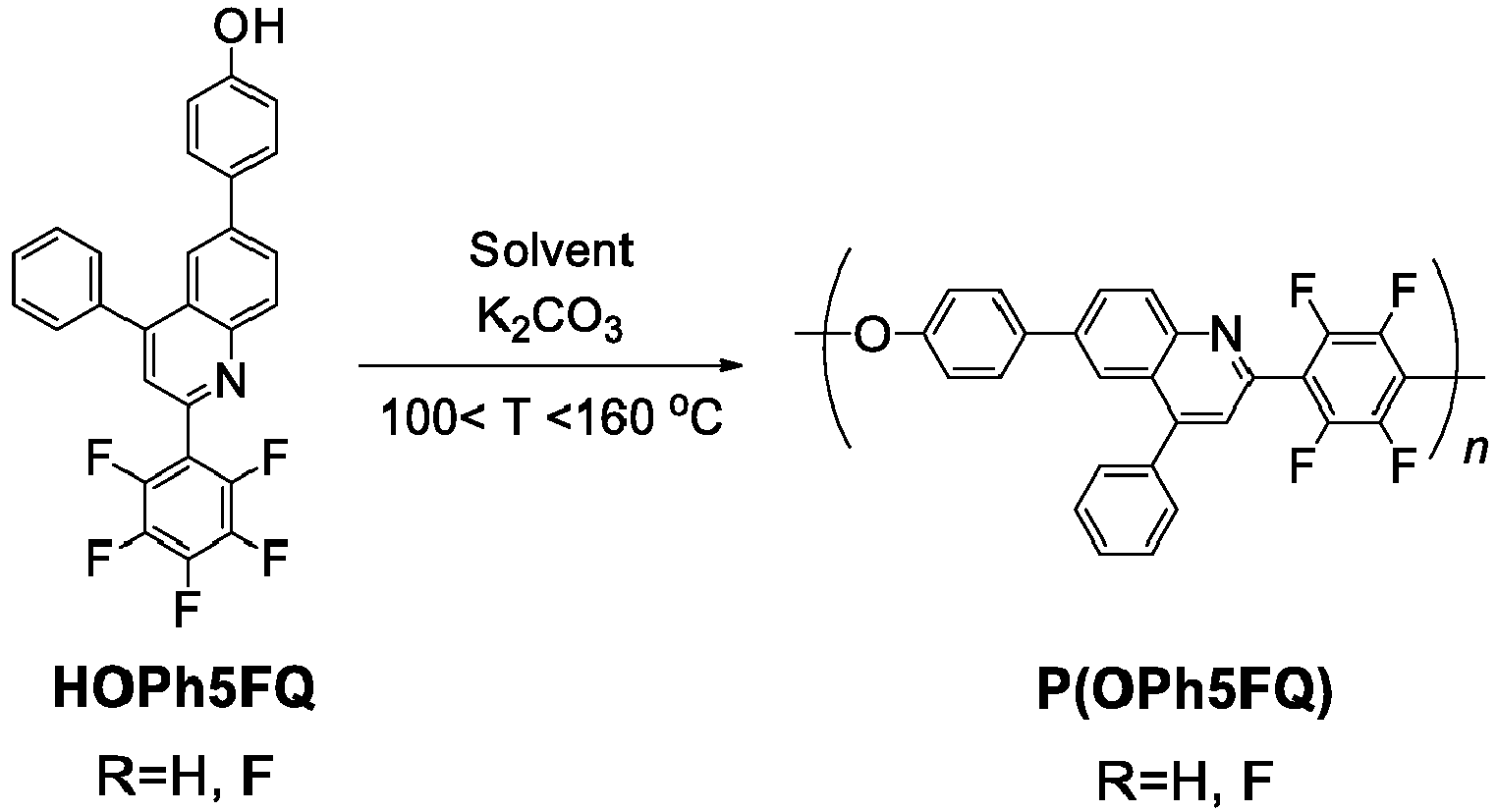
- Table 1 depicts the molecular characteristics of the described homopolymers, via size exclusion chromatography, for different polymerization conditions, together with the quality of the respective membranes.
- These polymeric materials present high thermal and oxidative stability, increased and simultaneously controlled doping levels with phosphoric acid and high ionic conductivity values. The particular materials are applicable as the polymer electrolytes in high temperature polymer electrolyte fuel cells / HT-PEMFCs. Of particular advantage is the fact that the procedures and materials disclosed in the present invention are of low cost and the produced polymer membranes combine all prerequisites for a successful application in fuel cells operating above 200°C.
Table 1: Molecular characteristics, via size exclusion chromatography, and quality of the final membranes for homopolymers P(OPhFQ) where R=F, prepared under different polymerization conditions a/a SECa Polymerization Conditions Membrane Qualityb Solubilityc Mn Mw PD 1 52400 260940 4.9 1 h@120°C 

4h@150°C 4h@170° C 2 5100 7500 1.5 1 h@140°C 

2h@160° C 1 h@170° C 3 15000 43800 2.9 2h@120°C 

2h@140°C 2h@160° C 4 20560 49300 2.4 0.5h@120°C 

2h@130°C 4h@160° C 5 10700 22400 2.1 2h@120°C 

6h@140° C 6 9300 28000 2.9 1 h@120°C 

6h@140° C 7 13000 50000 3.8 1 h@120°C 

4h@140°C 3h@150° C 8 13500 51000 3 1h@120°C 

4h@140°C 3h@150°C 12h@110°C 9 13800 51600 3.7 4h@100°C 

10h@140° C 10 21000 43200 2.1 12h@110°C 

11 19100 54200 2.8 12h@110° C 

12 22000 56300 2.6 12h@110°C 

13 19800 42300 2.1 12h@110°C 

a) SEC using CHCl3 as eloquent, at 25°C, 1 mL/min, versus polystyrene standards
b)excellent, good,
good, average,
 not good
c) in N-methyl pyrollidone (NMP) at 60°C - The homopolymers P(OPhFQ) present excellent thermal stability as proven from their thermogravimetric analysis examination. Examples of thermogravimetric analysis of homopolymer P(OPhFQ) where R=F (
entry 10 of Table 1) are given inFigure 1 . - Membranes of the homopolymers were doped in phosphoric acid for different periods of time and at different temperatures, depending on the exact chemical composition of the membrane. The doping level of the membrane is defined as the percentage by weight of acid per gram of polymer.
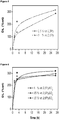
- Examples of the doping level dependence over time for the homopolymer P(OPhFQ) where R=F (
entry 12 of Table 1) are given inFigure 2 . The doping level in phosphoric acid increases with temperature reaching maximum values for extended doping periods. Doping levels from 250 %wt to 500 %wt are desirable and preferable from 300 %wt to 400 %wt. - These particular quinoline homopolymes can be further cross-linked creating aromatic ether linkages after condensation reaction with aromatic dihydroxy compounds (aromatic diols) such as dihydroxyl-benzene, 4,4'-dihydroxyl-biphenyl, Bisphenol-A, tetramethyl-biphenyl-dihydroxy diol, 2,2'-diallyl-bisphenol-A.
- Moreover, aromatic diols that bear units which may interact further with the doping agent, meaning the phosphoric acid, can also be used as cross-linkers. As such, diols that bear pyridine units may be used.
- Likewise, it is possible that oligomers of aromatic polysulfones or respective aromatic polyethers may be employed as cross-linkers provided they are hydroxyl terminated at both their polymeric chain ends.
- In the below
Figure 7 is depicted the cross-linking route of hompolymers P(OPhFQ) where R=F, using either aromatic diols (monomer cross-linking) or polysulfone aromatic oligomers (oligomer cross-linking).
- In more detail the mechanism of cross-linking through condensation of aromatic fluorines of the homopolymer with aromatic hydroxyls of the cross-linker is depicted in the below reaction for homopolymer P(OPhFQ) where R=F (
Figure 8 ).
- The cross-linking degree can be controlled through the quantity of the dihydroxyl bearing cross-linker as seen in Table 2 in which results of the cross-linking of homopolymer P(OPhFQ) are given, where R=F using various ratios of a diol bearing pyridine units or an end-hydroxyl terminated oligomer of polysulfone bearing pyridine units.
- Characterization of the cross-linked polymers is performed using techniques such as thermogravimetric analysis and doping level examination. The excellent thermal stability of the initial homopolymers is preserved and in some cases further enhanced in the respective cross-linked membranes. Examples of the thermogravimetric analysis of cross-linked membranes are given in
Figures 3 and 4 , in which can be seen that the cross-linked membranes do not present any weight loss below 500°C. At 800°C the final weight loss of the cross-linked membranes lies between 25 %wt and 40 %wt depending on the cross-linking method and the cross-linking degree. - The ability of the cross-linked membranes to be doped with phosphoric acid at various temperatures is depicted in
Figures 5 and 6 . It is evident that the superior doping ability of the initial homopolymers is maintained even after cross-linking. Doping levels as high as 300 %wt can be achieved even at the low temperature of 60°C for membranes doped for only a few hours in the phosphoric acid doping medium.Table 2: Cross-linking degrees and quality of the final cross-linked membranes of homopolymer P(OPhFQ) where R=F using a monomer or an oligomer as the cross-linking agent, respectively. a/a Cross-linking degree % wt Membrane qualitya Soluble Fractionb % Cross-linking using monomer 2,6PyCM1 2.5 
62 CM2 5 
75 CM3 9 
20 CM4 17 
15 CM5 25 
0 CM6 35 
0 Cross-linking using oligomer 2,6PySO2CO1 5 
74 CO2 5 
70 CO3 10 
18 CO4 17 
8 CO5 25 
0 CO6 35 
0 a) excellent, good,
good, average
b) in N-methyl-pyrollidone (NMP) at 80°C, 8 hr. - Of particular importance is the dimensional stability of the cross-linked membranes after doping, along the x,y axes. This fact is demonstrated in Table 3 that contains measurements of the cross-linked membranes dimensions before and after doping. Even for high doping levels such as 500%wt, the cross-linked membranes with cross-linking degrees of more than 10% present deviations in their dimensions along the x,y axes of 0-10%. On the contrary, there is a drastic increase of the membranes thickness after doping, meaning their z-axis dimension. This phenomenon is critical and offers great advantage for these cross-linked membranes applied in MEAs for HT-PEMFCs.
- By this cross-linking methodology the membranes are stabilized both chemically and physically. Therefore, the operation temperature of the membranes and their MEAs can be increased above 180°C which is the typical operating temperature of such fuel cell systems today. Moreover, the ability to define the cross-linking degree, the exact cross-linking method (monomer vs. oligomer) in addition to the ability to control the exact structure of the initial and of the cross-linked membrane (via selection of the cross-linking agent) allows the creation of cross-linked membranes of controlled and well defined doping levels, thermal and mechanical stability.
- The most important advantage of fuel cells operating at elevated temperatures is the ability to use hydrogen of lower purity as feed gas, without poisoning of the catalyst (increased lifetime of the catalytic system) and improved kinetics of the overall electrochemical reactions.
- Another possibility offered by operating the fuel cell at a temperature above 200°C is the direct use of hydrogen produced from methanol reforming or the combination of the two systems, namely methanol reformer and fuel cell in one single system. (Triantafyllopoulos, N.; Geormezi, M.; Neophytides, S.; loannides, T.; Avgouropoulos, G.; Papavasiliou, I.; Daletou, M.; Kallitsis, J.; Internal Reforming Alcohol High Temperature PEM Fuel Cell,US Pub No:
US-2010-0062293 , Int. Pub No:WO 2010/029431 ) - The membrane electrode assembly is prepared in the following way.
- The carbon support onto which the electrode is constructed maybe a carbon cloth or a carbon paper. Initially, a hydrophobic layer comprising carbon (20-70 %wt) and a hydrophobic polymer (30-80 %wt) is positioned on the carbon support. More particularly, a suspension of Teflon (polytetrafluoroethylene (PTFE) is mixed with carbon through mechanical stirring for 30min. The produced ink is coated onto the carbon support and after heating at 350°C for 40 min, this matrix becomes hydrophobic.
- The platinum catalyst (Pt) supported onto carbon is dispersed in an isopropanol/water mixture. The noble metal to carbon ratio varies from 1 :9 to 4:6 and preferably 3:7. The catalyst ink is sprayed on top of the above mentioned hydrophobic layer. The prepared electrodes are dried under vacuum at 190°C for 1-2 h. The final Pt loading is thus 0.5-1.5 mg/cm2.
- Before the construction of the final membrane - electrode assembly (MEA) a certain amount of phosphoric acid (commonly 2 gH3PO4/gPt) is sprayed on the electrode. Finally, the MEA is prepared either via thermal pressing of the sandwiched electrode-doped membrane-electrode using an automated pressing system (at 150°C and 0.1 t/cm2 for 15 min) or directly in a single fuel cell with assembling forces of 4-4.5 N*m per screw of the cell (screws No=8). The active surface area of the electrodes is 4 cm2 while the membrane is doped at a 100-400%wt doping level and its thickness varies from 90-350 um.

-
-
Figure 1 : TGA thermograms, under N2 atmosphere, of homopolymer I before (-■-) and after (-▲-) thermal treatment. -
Figure 2 : Doping level dependence over time for homopolymer I P(OPhFQ) where R=F, attemperatures 100°C, 60°C and 25°C -
Figure 3 : TGA thermograms of homopolymer I P(OPhFQ) where R=F after cross-linking using an aromatic diol bearing pyridine (2,6Py). -
Figure 4 : TGA thermograms of homopolymer I P(OPhFQ) where R=F after cross-linking using a polysulfone end-terminated oligomer (2,6PySO2). -
Figure 5 : Doping level dependence over time for homopolymer I P(OPhFQ) where R=F after cross-linking using an aromatic diol bearing pyridine (2,6Py), at different cross-linking ratios and at 60°C. -
Figure 6 : Doping level dependence over time for homopolymer I P(OPhFQ) where R=F after cross-linking using a polysulfone end-terminated oligomer (2,6PySO2), at different cross-linking ratios and at 60°C. -
Figure 7 : Route of cross-linking of homopolymers P(OPhFQ) where R=F using an aromatic diol bearing pyridine (2,6Py) (Cross-linking via Monomer) or a polysulfone end-terminated oligomer (2,6PySO2) (Cross-linking via Oligomer). -
Figure 8 : Analytic description of the cross-linking mechanism via condensation of aromatic fluorine atoms of the homopolymer with aromatic hydroxyl units of the cross-linker. The mechanism is depicted for the homopolymer P(OPhFQ) where R=F. -
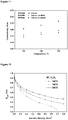
Figure 9 : Conductivity values vs temperature of P(OPhFQ) where R=F membranes after cross-linking using an aromatic diol bearing pyridine (2,6Py) at a cross-linking degree of 17 %wt (CM4) or using a polysulfone end-terminated oligomer (2,6PySO2) at a cross-linking degree of 25 %wt (CO5). - Conductivities were measured in situ from the corresponding MEAs (active area: 4 cm2) at several operating temperatures at 0.2 Acm-2 using dry hydrogen and oxygen gases (stoichiometric ratio of 1.2 and 2, respectively) at ambient pressure.
-
Figure 10 : IV polarization curves of a single fuel cell of P(OPhFQ) where R=F after cross-linking using an aromatic diol bearing pyridine (2,6Py) at a cross-linking degree of 17 %wt (CM4) with a thickness of 230 um and a doping level of 250 %wt. The IV curves were obtained using dry hydrogen and oxygen or air gases with a stoichiometry of λH2=1.2 and λO2=2 at ambient pressure. -
Figure 11 : Conductivity values vs temperature of P(OPhFQ) where R=F membranes after cross-linking using aromatic diols with non-dopable units namely diallyl-bisphenol-A or 4,4'-diphenyl diol, at a cross-linking degree of 20 %wt in both cases and with doping levels of 270 %wt and 250 %wt, respectively. Conductivities were measured in situ from the corresponding MEAs (active area: 4 cm2) at several operating temperatures at 0.2 Acm-2 using dry hydrogen and oxygen gases (stoichiometric ratio of 1.2 and 2, respectively) at ambient pressure. -
Figure 12 : IV polarization curves of a single fuel cell of P(OPhFQ) where R=F after cross-linking using an aromatic diol with non-dopable units namely diallyl-bisphenol-A at 160-200°C, at a cross-linking degree of 20 %wt with a doping level of 270 %wt. The IV curves were obtained using dry hydrogen and oxygen or air gases with a stoichiometry of λH2=1.2 and λO2=2 at ambient pressure. -
Figure 13 : IV polarization curves of a single fuel cell of P(OPhFQ) where R=F after cross-linking using an aromatic diol with non-dopable units namely 4,4'-diphenyl diol at 160-200°C, at a cross-linking degree of 20 %wt with a doping level of 250 %wt. The IV curves were obtained using dry hydrogen and oxygen or air gases with a stoichiometry of λH2=1.2 and λO2=2 at ambient pressure. - The present invention provides the following representatives examples which should not be considered as limiting factors as to the breadth of the invention.
- Gel Permeation Chromatography (GPC) or otherwise known as Size Exclusion Chromatography (SEC) which is employed for the molecular characteristics determination of the synthesized polymers (Mn, Mw and polydispersity PD).
- Nuclear Magnetic Resonance Spectroscopy (NMR) used for the identification of chemical and molecular structure of polymers, and also purity of monomers and ratio of co-monomers in the case of copolymers.
- Fourier transform infrared spectroscopy (FT-IR) used for the chemical and molecular composition of polymers in combination with NMR spectroscopy. Thermogravimetric Analyses (TGA) used for the thermal and oxidative stability evaluation of polymers before and after different treatments, like Fenton's test, doping in phosphoric acid etc.
- Electrochemical studies in a single fuel cell (SINGLE FUEL CELL TEST): used for the efficiency evaluation of MEAs and the determination of actual conductivity of the membranes under real operating fuel cell conditions.
- All homopolymers were studied using combinations of the above techniques in order to evaluate their properties and to identify their applicability as polymer electrolytes for HT-PEMFC applications.
- In a flame-dried round bottom flask equipped with a reflux condenser were added under argon OHPh5FQ (2.00 g, 4.30 mmol), K2CO3 (0.89 g, 6.50 mmol) and NMP (50 mL). The mixture was degassed and filled with argon three times and then it was heated at 110°C for 12 h. The viscous solution formed was cooled at ambient temperature and the polymer was precipitated with methanol, filtered and dried under vacuum at 50°C for 8 h. Membranes of these homopolymers were prepared after dissolution of the polymer powder in NMP resulting to 3 %wt solutions. The solutions were casted in Pyrex Petri dishes in an oven at 80°C for the slow evaporation of the solvent. The membranes thus formed were additionally dried at 120°C under vacuum. The thickness of the membranes was around 80 - 120 µm.
- Cross-linking via the creation of ether bonds of the homopolymer P(OPhFQ) where R=F using the
aromatic pyridine diol 2,6-bis(4-hydroxylphenyl)pyridine (2,6Py) at a 25%wt cross-linking degree. - In a dry round bottom flask 0.55 g of P(OPh5FQ) where R=F, K2CO3 (0.23 g) and NMP (15 mL) were added and the resulting mixture was stirred at 110°C for 1 h. In another flask, 2,6-bis(4-hydroxyphenyl)pyridine (2,6Py) (0.18 g, 0.68 mmol), K2CO3 (7.50 mg, 0.54 mmol) and NMP (11.3 mL) were added and the resulting mixture was stirred at 110°C for 1 h. Then, the contents of the two flasks were mixed and stirred for 10 min at 110°C. The final mixture was quickly filtrated or centrifuged and placed in a covered Pyrex Petri dish in which it remained at 120°C under an inert atmosphere for 12 h. Then, the temperature was decreased to 80°C and the top dish was removed allowing for a slow evaporation of the organic solvent and casting of the crosslinked membrane. The membrane thus formed, was removed from the Petri dish and dried under vacuum at 100°C for 12 h for the complete removal of the solvent traces.
- Cross-linking via the creation of ether bonds of the homopolymer P(OPhFQ) where R=F using the polysulfone oligomer (2,6PySO2) at a cross-linking degree of 23%wt.
- In a dry round bottom flask, 1.5 g of P(OPh5FQ) where R=F, K2CO3 (0.7 g) and NMP (40 mL) were added and the resulting mixture was stirred at 110°C for 1 h. In another flask, the hydroxy-terminated
oligomer 2,6PySO2 (0.45 g), K2CO3 (0.2 g) and NMP (4 mL) were placed and the resulting mixture was stirred at 110°C for 1 h. Then, the contents of the two flasks were mixed and stirred for 10 min. The final mixture was quickly filtrated or centrifuged and then placed in a covered Pyrex Petri dish in which it remained at 120°C under an inert atmosphere for 12 h. Then, the temperature was decreased to 80°C and the top dish was removed allowing for a slow evaporation of the organic solvent and casting of the crosslinked membrane. The membrane thus formed, was removed from the Petri dish and dried under vacuum at 100°C for 12 h for the complete removal of the solvent traces. - Analogue synthetic routes are employed for the preparation of all other homopolymers and cross-linked membranes at various cross-linking degrees or when using analogues cross-linkers either monomeric or oligomeric end hydroxyl terminated ones.
- The membranes were immersed in 85% phosphoric acid solution at the specified temperature for various time intervals. After each immersion, the samples were wiped with paper and the weight gain was calculated from the samples' weight before and after the immersion. The doping level is defined as the weight percent of the phosphoric acid per gram of each membrane.
- The membrane electrode assembly is prepared in the 2x2 cm2 cell. The IV curves are obtained after the MEAs were first activated under normal fuel cell operation for 24 h at 0.2 A/cm2, at 180°C and ambient pressure. Pure and dry hydrogen and oxygen (or air) gases were supplied to the anode and cathode compartments, respectively. A constant reactant utilization of 50% for oxygen and 83% for hydrogen were used for all measurements.
Figure 10 depicts polarization curves (IV curves) obtained for P(OPhFQ) where R=F cross-linked using thearomatic pyridine diol 2,6-bis(4-hydroxylphenyl)pyridine (2,6Py) at a 17 %wt cross-linking degree (CM4 of Table 2) having a thickness of 230 um and a doping level of 250 %wt. Using pure dry oxygen at 160°C and at 200mA/cm2 the cell's potential value was at 688mV while it increased at 722 mV at 180°C and at 734 mV at 200°C. Using air as the cathode feed gas and at 200 mA/cm2 the cell's power density is 650 mV at 180°C. In analogy,Figures 12 and13 depict polarization curves (IV curves) obtained for P (OPhFQ) where R=F cross-linked using aromati diols bearing non-dopable units namely diallyl-bisphenol-A and 4,4'-diphenyl diol, respectively, at a 20 %wt cross-linked degree in both cases. - Such cell efficiencies, although these measurements are initial and unoptimized, are comparable or even better those found in current literature for HT-PEMFCs. (Q. Li, J. O. Jensen, R. F. Savinell, N. J. Bjerrum, Progress in Polymer Science 2009, 34, 449-477).
Claims (10)
- Polymeric electrolytes comprising phenyl-quinoline groups and that are prepared from the homopolymerization in a single step of A-B difunctional monomers of phenyl-quinoline that bear simultaneously groups of hydroxylphenyl and polyfluorinated-phenyls and to which is performed stabilization of the polymeric structure via cross-linking of the polymeric chains through nucleative aromatic substitution of the remaining fluorine atoms of the polymeric structures that contain polyfluorinated rings.
- Polymeric electrolytes according to claim 1, where the cross-linkers are aromatic compounds bearing two hydroxyl units or oligomers of homo- or co-polymers with free end hydroxyl units, which leads to the creation of aromatic ether cross-linking bonds.
- Membranes of the polymers according to each of claims 1 and 2 that present high conductivity values and high thermal stability at the temperature range of 160°C to 210°C.
- Polymeric electrolytes according to any of claims 1 to 3, that before and after cross-linking are doped in phosphoric acid at high doping levels that leads to high conductivity values.
- Use of the polyether electrolytes of according to any of claims 1 to 4 in high temperature polymer electrolyte fuel cells (HT-PEMFCs).
- Method for the preparation of polymer electrolytes according to any one of claims 1 to 4 that are prepared through polyetherification at high temperatures of aromatic phenyl-quinolines bearing hydroxyl substituted phenyls and fluorinated phenyl rings on the same molecule.
- Method according to claim 6, wherein the difunctional quinoline monomers of A-B type are homopolymerized in the presence of inorganic base such as sodium, potassium or cesium carbonate and in polar non protic solvents of high boiling points such as dimethylformamide, dimethylacetamide, N-methylpyrollidone, dimethylsulfoxide etc.
- Synthesis of homopolymers of aromatic polyether of phenyl-quinoline from monomer of A-B type bearing hydroxyl and polyfluorinated phenyl rings, where R=H, F.

- Membranes of polymer electrolytes according to any one of claims 1 to 4 that are doped in phosphoric acid at different temperatures and for different period of time depending on the composition of the membrane, that the dimensions of the cross-linked membranes before and after doping along the x,y axes deviate only by a 0 - 10 %.
- Membranes polymer electrolytes according to any one of claims 1 to 4 and 9, wherein the cross-linking degree in combination with the control of the various structural characteristics of the membrane allow the creation of membranes of controlled doping levels of 250-500 %wt, thermal stability above 400°C and ionic conductivity of above 0.1 S/cm.
Applications Claiming Priority (1)
| Application Number | Priority Date | Filing Date | Title |
|---|---|---|---|
| GR20160100491A GR1009335B (en) | 2016-09-26 | 2016-09-26 | Crosslinked wholly aromatic polymeric electrolyte proton conductors based on quinoline units |
Publications (1)
| Publication Number | Publication Date |
|---|---|
| EP3300155A1 true EP3300155A1 (en) | 2018-03-28 |
Family
ID=58413144
Family Applications (1)
| Application Number | Title | Priority Date | Filing Date |
|---|---|---|---|
| EP17020443.2A Withdrawn EP3300155A1 (en) | 2016-09-26 | 2017-09-26 | Crosslinked wholly aromatic proton conductive polymeric electrolytes based on quinoline units |
Country Status (2)
| Country | Link |
|---|---|
| EP (1) | EP3300155A1 (en) |
| GR (1) | GR1009335B (en) |
Citations (4)
| Publication number | Priority date | Publication date | Assignee | Title |
|---|---|---|---|---|
| US4579679A (en) * | 1981-05-18 | 1986-04-01 | Chevron Research Company | Electroactive polymers |
| US6462148B1 (en) * | 1997-04-07 | 2002-10-08 | Hitachi Chemical Co., Ltd. | Adhesive film of quinoline polymer and bismaleimide |
| US20080152986A1 (en) * | 2006-12-20 | 2008-06-26 | Samsung Sdi Co., Ltd. | Polymer electrolyte membrane for fuel cell, method of manufacturing the same, and fuel cell employing the same |
| EP2048183A1 (en) * | 2007-10-11 | 2009-04-15 | Samsung Electronics Co., Ltd. | Polybenzimidazole-base complex, crosslinked material of polybenzoxazines formed thereof, and fuel cell using the same |
-
2016
- 2016-09-26 GR GR20160100491A patent/GR1009335B/en active IP Right Grant
-
2017
- 2017-09-26 EP EP17020443.2A patent/EP3300155A1/en not_active Withdrawn
Patent Citations (4)
| Publication number | Priority date | Publication date | Assignee | Title |
|---|---|---|---|---|
| US4579679A (en) * | 1981-05-18 | 1986-04-01 | Chevron Research Company | Electroactive polymers |
| US6462148B1 (en) * | 1997-04-07 | 2002-10-08 | Hitachi Chemical Co., Ltd. | Adhesive film of quinoline polymer and bismaleimide |
| US20080152986A1 (en) * | 2006-12-20 | 2008-06-26 | Samsung Sdi Co., Ltd. | Polymer electrolyte membrane for fuel cell, method of manufacturing the same, and fuel cell employing the same |
| EP2048183A1 (en) * | 2007-10-11 | 2009-04-15 | Samsung Electronics Co., Ltd. | Polybenzimidazole-base complex, crosslinked material of polybenzoxazines formed thereof, and fuel cell using the same |
Also Published As
| Publication number | Publication date |
|---|---|
| GR20160100491A (en) | 2018-05-18 |
| GR1009335B (en) | 2018-07-31 |
Similar Documents
| Publication | Publication Date | Title |
|---|---|---|
| Park et al. | Chemically durable polymer electrolytes for solid-state alkaline water electrolysis | |
| US7771857B2 (en) | Proton-conducting polymer membrane | |
| Jheng et al. | A novel asymmetric polybenzimidazole membrane for high temperature proton exchange membrane fuel cells | |
| Si et al. | Rigid-rod poly (phenylenesulfonic acid) proton exchange membranes with cross-linkable biphenyl groups for fuel cell applications | |
| Liu et al. | Aromatic poly (ether ketone) s with pendant sulfonic acid phenyl groups prepared by a mild sulfonation method for proton exchange membranes | |
| EP1828278B1 (en) | Branched and sulphonated multi block copolymer and electrolyte membrane using the same | |
| EP3490043B1 (en) | Hydrocarbon-based cross-linked membrane in which nanoparticles are used, method for manufacturing said membrane, and fuel cell | |
| CN101633734B (en) | Block copolymers and use thereof | |
| US6478987B1 (en) | Proton conducting polymer, method for producing the same, solid polymer electrolyte and electrode | |
| US20100159347A1 (en) | Hyper-branched polymer, electrode for fuel cell including the hyper-branched polymer, electrolyte membrane for fuel cell including the hyper-branched polymer, and fuel cell including at least one of the electrode and the electrolyte membrane | |
| Kallitsis et al. | Crosslinked wholly aromatic polyether membranes based on quinoline derivatives and their application in high temperature polymer electrolyte membrane fuel cells | |
| Lee et al. | Poly (arylene ether sulfone) s containing pendant sulfonic acid groups as membrane materials for direct methanol fuel cells | |
| Hong et al. | Improvement of electrochemical performances of sulfonated poly (arylene ether sulfone) via incorporation of sulfonated poly (arylene ether benzimidazole) | |
| Papadimitriou et al. | Covalent cross-linking in phosphoric acid of pyridine based aromatic polyethers bearing side double bonds for use in high temperature polymer electrolyte membrane fuelcells | |
| EP2134768B1 (en) | Proton conducting aromatic polyether type copolymers bearing main and side chain pyridine groups and use thereof in proton exchange membrane fuel cells | |
| Seel et al. | Polyphenylquinoxaline-based proton exchange membranes synthesized via the PPA Process for high temperature fuel cell systems | |
| JP2007517923A (en) | Ion conductive copolymers containing one or more hydrophobic oligomers | |
| EP2161771A1 (en) | Membrane-electrode assembly, method for production thereof, and solid polymer fuel cell | |
| EP2169748A1 (en) | Membrane-electrode assembly, method for producing the same and solid polymer fuel cell | |
| Yoon et al. | Synthesis and characterization of sulfonated poly (arylene ether sulfone) ionomers incorporating perfluorohexylene units for DMFC membranes | |
| Lin et al. | Sulfonated poly (propylene oxide) oligomers/Nafion® acid-base blend membranes for DMFC | |
| Lee et al. | Optimal method for preparing sulfonated polyaryletherketones with high ion exchange capacity by acid‐catalyzed crosslinking for proton exchange membrane fuel cells | |
| EP3300155A1 (en) | Crosslinked wholly aromatic proton conductive polymeric electrolytes based on quinoline units | |
| KR20090055737A (en) | Method for producing partially crosslinked hydrogen ion conductive polymer electrolyte membrane, membrane-electrode assembly using partially crosslinked polymer electrolyte membrane prepared therefrom, and fuel cell employing the same | |
| Krishnan et al. | Alkyl chain modified sulfonated poly (ether sulfone) for fuel cell applications |
Legal Events
| Date | Code | Title | Description |
|---|---|---|---|
| PUAI | Public reference made under article 153(3) epc to a published international application that has entered the european phase |
Free format text: ORIGINAL CODE: 0009012 |
|
| 17P | Request for examination filed |
Effective date: 20171025 |
|
| AK | Designated contracting states |
Kind code of ref document: A1 Designated state(s): AL AT BE BG CH CY CZ DE DK EE ES FI FR GB GR HR HU IE IS IT LI LT LU LV MC MK MT NL NO PL PT RO RS SE SI SK SM TR |
|
| AX | Request for extension of the european patent |
Extension state: BA ME |
|
| STAA | Information on the status of an ep patent application or granted ep patent |
Free format text: STATUS: THE APPLICATION IS DEEMED TO BE WITHDRAWN |
|
| 18D | Application deemed to be withdrawn |
Effective date: 20180929 |