EP3300026A1 - Iterative image reconstruction method, iterative image reconstruction program, and tomography apparatus - Google Patents
Iterative image reconstruction method, iterative image reconstruction program, and tomography apparatus Download PDFInfo
- Publication number
- EP3300026A1 EP3300026A1 EP17001519.2A EP17001519A EP3300026A1 EP 3300026 A1 EP3300026 A1 EP 3300026A1 EP 17001519 A EP17001519 A EP 17001519A EP 3300026 A1 EP3300026 A1 EP 3300026A1
- Authority
- EP
- European Patent Office
- Prior art keywords
- image reconstruction
- image
- iterative
- reconstruction
- state variables
- Prior art date
- Legal status (The legal status is an assumption and is not a legal conclusion. Google has not performed a legal analysis and makes no representation as to the accuracy of the status listed.)
- Granted
Links
Images


Classifications
-
- G—PHYSICS
- G06—COMPUTING OR CALCULATING; COUNTING
- G06T—IMAGE DATA PROCESSING OR GENERATION, IN GENERAL
- G06T12/00—Tomographic reconstruction from projections
-
- G—PHYSICS
- G06—COMPUTING OR CALCULATING; COUNTING
- G06T—IMAGE DATA PROCESSING OR GENERATION, IN GENERAL
- G06T12/00—Tomographic reconstruction from projections
- G06T12/20—Inverse problem, i.e. transformations from projection space into object space
-
- G—PHYSICS
- G06—COMPUTING OR CALCULATING; COUNTING
- G06T—IMAGE DATA PROCESSING OR GENERATION, IN GENERAL
- G06T12/00—Tomographic reconstruction from projections
- G06T12/10—Image preprocessing, e.g. calibration, positioning of sources or scatter correction
-
- G—PHYSICS
- G06—COMPUTING OR CALCULATING; COUNTING
- G06T—IMAGE DATA PROCESSING OR GENERATION, IN GENERAL
- G06T12/00—Tomographic reconstruction from projections
- G06T12/30—Image post-processing, e.g. metal artefact correction
-
- G—PHYSICS
- G06—COMPUTING OR CALCULATING; COUNTING
- G06T—IMAGE DATA PROCESSING OR GENERATION, IN GENERAL
- G06T2207/00—Indexing scheme for image analysis or image enhancement
- G06T2207/10—Image acquisition modality
- G06T2207/10072—Tomographic images
- G06T2207/10081—Computed x-ray tomography [CT]
-
- G—PHYSICS
- G06—COMPUTING OR CALCULATING; COUNTING
- G06T—IMAGE DATA PROCESSING OR GENERATION, IN GENERAL
- G06T2210/00—Indexing scheme for image generation or computer graphics
- G06T2210/41—Medical
-
- G—PHYSICS
- G06—COMPUTING OR CALCULATING; COUNTING
- G06T—IMAGE DATA PROCESSING OR GENERATION, IN GENERAL
- G06T2211/00—Image generation
- G06T2211/40—Computed tomography
- G06T2211/421—Filtered back projection [FBP]
-
- G—PHYSICS
- G06—COMPUTING OR CALCULATING; COUNTING
- G06T—IMAGE DATA PROCESSING OR GENERATION, IN GENERAL
- G06T2211/00—Image generation
- G06T2211/40—Computed tomography
- G06T2211/424—Iterative
Definitions
- the present invention relates to an iterative image reconstruction method, an iterative image reconstruction program, and a tomography apparatus for reconstructing an image using a successive approximation method.
- Such a method can be considered as a successive approximation method based on objective function maximization.
- a reconstructed image is obtained by maximizing the objective function F represented by the following Formula (1).
- F ⁇ y D ⁇ y + ⁇ R ⁇
- ⁇ in the aforementioned Formula (1) is a reconstructed image vector
- y is projection data
- D is called "data term” and the like, which indicates the degree of conformity with measurement data, and is defined by likelihood calculated from measured projection (actually measured projection data obtained by an X-ray detector) and estimated parameters (the estimated image estimated by the aforementioned Formula (1)). Since ⁇ and y are vectors, they are written in bold.
- R is generally called “penalty term” or the like and reflects the validity of the estimated parameter (estimated image).
- R will be referred to as “validity term” for the sake of convenience.
- ⁇ is a coefficient that controls the strength of the validity term R, which is determined empirically.
- ⁇ in Formula (2) is called a step size and has a role of controlling the magnitude of the update amount in the gradient direction. Further, ⁇ in Formula (2) is a gradient, which is a partial differential with respect to the estimation parameter (reconstructed image).
- the update formula in the j th pixel is represented by the following Formula (3).
- ⁇ j n + 1 ⁇ j n + ⁇ ⁇ ⁇ ⁇ ⁇ j D ⁇ y + ⁇ ⁇ ⁇ ⁇ ⁇ ⁇ j R ⁇
- ⁇ and ⁇ are assumed to not depend on the number of iterations and the pixel position, and R is assumed to not depend on the number of iterations. On the other hand, they may also be assumed to depend on the number of iterations and the pixel position.
- the aforementioned Non-Patent Document 2 is directed to an image reconstruction method in which ⁇ depends on the number of iterations (indirectly also depends on the pixel value which is being reconstructed), and the aforementioned Patent Document 2 is directed to an image reconstruction method in which ⁇ and P depend on the pixel position.
- Formula (3) may be represented by the following Formula (4).
- ⁇ j n + 1 ⁇ j n + ⁇ j n ⁇ ⁇ ⁇ ⁇ j D ⁇ y + ⁇ j n ⁇ ⁇ j n ⁇ ⁇ ⁇ ⁇ j R n ⁇
- ⁇ n , ⁇ n , and R n are not direct estimation targets but are auxiliary variables for obtaining a reconstructed image, and are variables for deciding update conditions for obtaining the reconstructed image, which depend on the number of iterations or the pixel position. Such variables are called state variables in this specification. Such state variables may also be called update condition variables in this specification.
- R n is a function in a strict sense, but in this specification, those including this will be called state variables.
- FIG. 5 is a flowchart showing processing for reconstructing an image by an iterative image reconstruction method using such state variables.
- Step S11 When reconstructing an image by an iterative image reconstruction method, initially, preprocessing is performed.
- the reconstructed image ⁇ 0 and the state variables ⁇ 0 , ⁇ 0 , and R 0 are initialized (Step S11).
- the initial image for example, a blank image (image in which all pixel values are zero) may be used.
- This iterative processing is a processing step that iteratively performs the calculation represented by the aforementioned Formula (4).
- forward projection processing is performed (Step S12).
- back projection processing is performed (Step S 13).
- update processing of state variables is performed (Step S 15).
- the second term in Formula (4) is calculated by the forward projection processing and the back projection processing
- the third term is calculated by the image update processing, and addition calculations of the entire right side are performed.
- ⁇ n , ⁇ n , and R n are updated. This iterative processing is repeated until the convergence condition is satisfied (Step S 16).
- Step S 17 the reconstructed image after convergence condition is satisfied is output.
- the present invention was made to solve the aforementioned problems, and aims to provide an iterative image reconstruction method, an iterative image reconstruction program, and a tomography apparatus capable of efficiently performing image reconstruction by shortening computation time even in the case of resuming the image reconstruction when performing the image reconstruction using a successive approximation method.
- the invention as recited in claim 1 is directed to an iterative image reconstruction method of reconstructing an image using a successive approximation method characterized in that image reconstruction is performed with a successive approximation method using state variables which depend on the number of iterations or the pixel position to determine update conditions for obtaining a reconstructed image, the state variables are stored at the end of the image reconstruction, and image reconstruction is performed after reading the stored state variables when resuming the image reconstruction.
- an image is reconstructed with the successive approximation method using a plurality of state variables, and all or a part of the plurality of state variables are stored.
- a steepest descent method or a Newton's method is used as an optimization algorithm for the image reconstruction, and the plurality of state variables includes a data term and a penalty term.
- the invention as recited in claim 4 is directed to an iterative image reconstruction program for making a computer perform the iterative image reconstruction method recited in any one of claims 1 to 3.
- the invention as recited in claim 5 is a tomography apparatus equipped with computing means for performing the iterative image reconstruction program recited in claim 4.
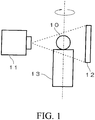
- FIG. 1 is a schematic diagram of a tomography apparatus to which an iterative image reconstruction method according to the present invention is applied.
- This tomography apparatus is for performing X-ray CT imaging of an imaging target 10, and is equipped with a stage 13 configured to rotate about an axis oriented in the vertical direction with the imaging target 10 placed thereon, an X-ray tube 11 configured to irradiate an X-ray toward the imaging target 10 that rotates together with the stage 13, and a flat panel detector 12 configured to detect the X-ray irradiated from the X-ray tube 11 and transmitted through the imaging target 10.
- the flat panel detector 12 acquires X-ray projection data based on the detected X-ray.
- other X-ray detectors such as an image intensifier (I.I.) may be used.
- FIG. 2 is a functional block diagram of an image reconstruction unit 20 for reconstructing an image with a successive approximation method based on the projection data of the X-ray acquired by the flat panel detector 12.
- the image reconstruction unit 20 is composed of a computer including a CPU as a processor for performing a logical operation, a ROM for storing an operation program necessary for controlling an apparatus, and a RAM for temporarily storing data or the like at the time of control, and constitutes a part of a control unit for controlling the entire apparatus.
- the image reconstruction unit 20 includes a forward projection processing unit 21 for performing forward projection processing, a back projection processing unit 22 for performing back projection processing, an image update processing unit 23 for performing image update processing, and a state variable update processing unit 24 for performing update processing of the state variables.
- the image reconstruction unit 20 further includes a program storage unit 25 for storing an iterative image reconstruction program for making a computer perform the iterative image reconstruction method according to the present invention, a reconstructed image storage unit 26 for storing reconstructed images to be sequentially created, and a state variable storage unit 27 for storing state variables to be sequentially created.
- This image reconstruction unit 20 is connected to the flat panel detector 12 shown in FIG. 1 .
- FIG. 3 is a flowchart showing the processing of reconstructing an image by the iterative image reconstruction method according to the present invention.
- FIG. 4 is a conceptual diagram showing a basic idea of the iterative image reconstruction method according to the present invention. Note that in this embodiment, a steepest descent method is used as the optimization algorithm for image reconstruction and the aforementioned Formula (4) is applied. Instead of using the steepest descent method, a Newton's method may be used.
- the iterative image reconstruction method in the iterative image reconstruction method according to the present invention, a configuration is adopted in which, in cases where the image quality after reconstruction is insufficient when the image was obtained with the number of iterations of 100 times in the first image reconstruction processing, when resuming the image reconstruction, the reconstructed image and the state variables at the end of the reconstruction in which the number of iterations is 100 times are read, and then the image reconstruction is resumed.
- Step S1 when reconstructing an image by using the iterative image reconstruction method according to the present invention, initially, preprocessing is performed.
- sequential approximation number of iterations Ks is set as a resume condition
- an ending number Ke is set as a convergence condition (Step S1).
- the resume condition is uniquely determined by designating the image which was reconstructed.
- the convergence condition for example, it is also possible to set the value of the objective function.
- Step S2 it is judged whether or not the reconstruction processing is the first time.
- the initial image for example, a blank image (image in which all pixel values are zero) may be used.
- the reconstruction processing is not the first time, that is, when Ks is not 0 and the reconstruction processing is resumed, the reconstructed image ⁇ Ks-1 at the Ks-1 th time is read from the reconstructed image storage unit 26 shown in FIG. 2 and the state variables ⁇ Ks-1 , ⁇ Ks-1 , R Ks-1 at the Ks-1 th time are read from the state variable storage unit 27 shown in FIG. 2 .
- Step S5 forward projection processing is performed
- Step S6 back projection processing is performed
- Step S8 the update processing of state variables is performed (Step S8).
- the second term in Formula (4) is calculated by forward projection processing and back projection processing
- calculation of the third term is performed by image update processing
- addition calculation of the entire right side is performed.
- the state variables ⁇ n , ⁇ n , R n are updated. This iterative processing is repeated until the convergence condition is satisfied, that is, until the number of iterations Ks reaches the termination number Ke (Step S9).
- Step S10 the reconstructed image and the state variables after the convergence condition is satisfied are output. That is, the reconstructed image ⁇ Ke after the iterative processing is outputted and stored in the reconstructed image storage unit 26 shown in FIG. 2 . Also, the state variables ⁇ Ke , ⁇ Ke , R Ke updated after the iterative processing are output and stored in the state variable storage unit 27 shown in FIG. 2 .
- the state variables to be stored in the state variable storage unit 27 shown in FIG. 2 may be not all of ⁇ Ke , ⁇ Ke , R Ke , but may be a part of ⁇ Ke , ⁇ Ke , and R Ke .
- the reconstruction conditions are the same in the case of initially performing the reconstruction processing and the case of resuming the reconstruction processing.
- reconstruction may be performed at a low resolution when the reconstruction processing is initially performed, and reconstruction at a high resolution may be performed when the reconstruction processing is resumed.
- the reconstructed image stored in the reconstructed image storage unit 26 and/or a part of the state variables stored in the state variable storage unit 27 may be changed or created by another method.
- the iterative image reconstruction method according to the present invention is applied to the tomography apparatus for performing X-ray CT imaging of the imaging target 10.
- the iterative image reconstruction method according to the present invention may be applied to a medical X-ray CT apparatus, a medical tomosynthesis imaging apparatus or the like.
Landscapes
- Physics & Mathematics (AREA)
- General Physics & Mathematics (AREA)
- Engineering & Computer Science (AREA)
- Theoretical Computer Science (AREA)
- Apparatus For Radiation Diagnosis (AREA)
- Analysing Materials By The Use Of Radiation (AREA)
- Algebra (AREA)
- Mathematical Analysis (AREA)
- Mathematical Optimization (AREA)
- Mathematical Physics (AREA)
- Pure & Applied Mathematics (AREA)
Abstract

Description
- The present invention relates to an iterative image reconstruction method, an iterative image reconstruction program, and a tomography apparatus for reconstructing an image using a successive approximation method.
- For example, when performing an image reconstruction in an X-ray CT (Computed Tomography) apparatus as a tomography apparatus, filtered backprojection (FBP: Filtered Back Projection) method has been conventionally used as a standard image reconstruction method. On the other hand, in recent years, research and practical realization of the image reconstruction using a successive approximation method is progressing due to, e.g., improved performance of computers. In the case of using a successive approximation method, to reduce artifacts due to various factors, it is possible to reflect complicated physical models, prior knowledge, etc., and therefore various methods have been proposed so far (see
Patent Document 1, Patent Document 2, Non-Patent Document 1). - Such a method can be considered as a successive approximation method based on objective function maximization. In this method, a reconstructed image is obtained by maximizing the objective function F represented by the following Formula (1).

- Here, µ in the aforementioned Formula (1) is a reconstructed image vector, and y is projection data. D is called "data term" and the like, which indicates the degree of conformity with measurement data, and is defined by likelihood calculated from measured projection (actually measured projection data obtained by an X-ray detector) and estimated parameters (the estimated image estimated by the aforementioned Formula (1)). Since µ and y are vectors, they are written in bold.
- In addition, R is generally called "penalty term" or the like and reflects the validity of the estimated parameter (estimated image). In this specification, hereinafter, R will be referred to as "validity term" for the sake of convenience. Further, β is a coefficient that controls the strength of the validity term R, which is determined empirically.
- In the actual calculation in the aforementioned Formula (1), an optimization algorithm such as a steepest descent method and a Newton method is used. Further, in order to avoid falling into a local solution, a combinatorial optimization method such as a genetic algorithm and an annealing method may sometimes be incorporated. When a steepest descent method is used as an optimization algorithm, the update formula of the reconstructed image by the aforementioned objective function is represented by the following Formula (2).

- α in Formula (2) is called a step size and has a role of controlling the magnitude of the update amount in the gradient direction. Further, ∇ in Formula (2) is a gradient, which is a partial differential with respect to the estimation parameter (reconstructed image). The update formula in the jth pixel is represented by the following Formula (3).

- In the aforementioned Formula (3), α and β are assumed to not depend on the number of iterations and the pixel position, and R is assumed to not depend on the number of iterations. On the other hand, they may also be assumed to depend on the number of iterations and the pixel position. For example, the aforementioned Non-Patent Document 2 is directed to an image reconstruction method in which α depends on the number of iterations (indirectly also depends on the pixel value which is being reconstructed), and the aforementioned Patent Document 2 is directed to an image reconstruction method in which α and P depend on the pixel position.
- In this way, when α, β, and R are assumed to depend on the number of iterations and the pixel position, the aforementioned Formula (3) may be represented by the following Formula (4).

- Here αn, βn, and Rn are not direct estimation targets but are auxiliary variables for obtaining a reconstructed image, and are variables for deciding update conditions for obtaining the reconstructed image, which depend on the number of iterations or the pixel position. Such variables are called state variables in this specification. Such state variables may also be called update condition variables in this specification. Here, Rn is a function in a strict sense, but in this specification, those including this will be called state variables.
-
FIG. 5 is a flowchart showing processing for reconstructing an image by an iterative image reconstruction method using such state variables. - When reconstructing an image by an iterative image reconstruction method, initially, preprocessing is performed. In this preprocessing, the reconstructed image µ0 and the state variables α0, β0, and R0 are initialized (Step S11). At this time, as the initial image, for example, a blank image (image in which all pixel values are zero) may be used.
- Next, iterative processing is performed. This iterative processing is a processing step that iteratively performs the calculation represented by the aforementioned Formula (4). At this time, firstly, forward projection processing is performed (Step S12). Next, back projection processing is performed (Step S 13). Then, after performing image update processing (Step S 14), update processing of state variables is performed (Step S 15). At this time, the second term in Formula (4) is calculated by the forward projection processing and the back projection processing, the third term is calculated by the image update processing, and addition calculations of the entire right side are performed. Then, αn, βn, and Rn are updated. This iterative processing is repeated until the convergence condition is satisfied (Step S 16).
- Thereafter, post-processing is performed. At the time of this post-processing, the reconstructed image after convergence condition is satisfied is output (Step S 17).
-
- Patent Document 1: Japanese Patent Application Publication No.
2011-156302 - Patent Document 2:
U.S. Patent No. 8,958,660 - Non-Patent Document 1: C. Lemmens: Suppression of Metal Artifacts in CT Reconstruction Procedure That Combines MAP and Projection Completion IEEE Transactions on Medical Imaging, Volume: 28 Issue: 2 (2009)
- Non-Patent Document 2: E. Tanaka: Subset-dependent relaxation in brock-iterative algorithms for image reconstruction in emission tomography, Phys Med Biol 48: 1405-1422 (2003)
- In the case of reconstructing an image using the successive approximation method, it requires more processing time as compared with a conventional filtered backprojection method. In the case of reconstructing an image using a successive approximation method, at the time when a preset predetermined stopping criterion is satisfied, or at the time when the operator confirms the image which is being reconstructed and judges that necessary image quality is obtained, the iterative calculation is completed, and a reconstructed image is output. Here, there are many cases that the stopping criterion for the iterative calculation is set empirically in consideration of the processing time and the image quality, but there is no guarantee that the iterative calculation has converged and the necessary image quality has been obtained at that point. For this reason, in some cases, after completion of the calculation for reconstruction, the image quality of the reconstructed image is considered to be insufficient and therefore recalculation is required. In particular, it is considered that such recalculation is often required in industrial CT apparatus and the like having various image targets.
- When performing such recalculation, in cases where α and β do not depend on the number of iterations and the pixel position and R does not depend on the number of iterations as shown in the aforementioned Formula (3), that is, in cases where no state variables depend on the number of iterations or the like are used, the reconstructed image finally output is read and set as an initial value, and then the image is reconstructed again using the successive approximation method.
- On the other hand, as shown in the aforementioned Formula (4), in cases where state variables which depend on the number of iterations or the like are used, the state variables have been discarded at the time of the recalculation. Therefore, it is necessary to restart the image reconstruction using the successive approximation method from the beginning.
- For example, even in cases where it is desired to perform reconstruction of an image in which the number of iterations is 200 times on the basis of a judgement that image quality of a reconstructed image was insufficient after obtaining an image in which the number of iterations was 100 times in the first image reconstruction processing, it is required to perform recalculation from the 1st time of the number of iterations. Assuming that the probabilistic element is not included in the reconstruction processing, the calculation result from the 1st time to the 100th time in the repetitive image reconstruction processing is the same as the calculation result of the initial image reconstruction processing, which indicates that useless calculation is performed.
- The present invention was made to solve the aforementioned problems, and aims to provide an iterative image reconstruction method, an iterative image reconstruction program, and a tomography apparatus capable of efficiently performing image reconstruction by shortening computation time even in the case of resuming the image reconstruction when performing the image reconstruction using a successive approximation method.
- The invention as recited in
claim 1 is directed to an iterative image reconstruction method of reconstructing an image using a successive approximation method characterized in that image reconstruction is performed with a successive approximation method using state variables which depend on the number of iterations or the pixel position to determine update conditions for obtaining a reconstructed image, the state variables are stored at the end of the image reconstruction, and image reconstruction is performed after reading the stored state variables when resuming the image reconstruction. - According to the invention as recited in claim 2, in the invention recited in
claim 1, an image is reconstructed with the successive approximation method using a plurality of state variables, and all or a part of the plurality of state variables are stored. - According to the invention as recited in claim 3, in the invention recited in claim 2, a steepest descent method or a Newton's method is used as an optimization algorithm for the image reconstruction, and the plurality of state variables includes a data term and a penalty term.
- The invention as recited in claim 4 is directed to an iterative image reconstruction program for making a computer perform the iterative image reconstruction method recited in any one of
claims 1 to 3. - The invention as recited in claim 5 is a tomography apparatus equipped with computing means for performing the iterative image reconstruction program recited in claim 4.
- According to the inventions as recited
claims 1 to 5, when an image is reconstructed using a successive approximation method, it becomes possible to efficiently perform the image reconstruction by shortening the computation time even in the case of resuming the image reconstruction. - According to the invention as recited in claims 2 and 3, it becomes possible to adjust the data amount of the state variables to be stored to an appropriate amount according to the image quality of the reconstructed image.
-
-
FIG. 1 is a schematic diagram of a tomography apparatus to which an iterative image reconstruction method according to the present invention is applied. -
FIG. 2 is a functional block diagram of animage reconstruction unit 20. -
FIG. 3 is a flowchart showing processing for reconstructing an image with an iterative image reconstruction method according to the present invention. -
FIG. 4 is a conceptual diagram showing a basic idea of the iterative image reconstruction method according to the present invention. -
FIG. 5 is a flowchart showing processing for reconstructing an image with an iterative image reconstruction method. - Hereinafter, embodiments of the present invention will be described with reference to the attached drawings.
FIG. 1 is a schematic diagram of a tomography apparatus to which an iterative image reconstruction method according to the present invention is applied. - This tomography apparatus is for performing X-ray CT imaging of an
imaging target 10, and is equipped with astage 13 configured to rotate about an axis oriented in the vertical direction with theimaging target 10 placed thereon, anX-ray tube 11 configured to irradiate an X-ray toward theimaging target 10 that rotates together with thestage 13, and aflat panel detector 12 configured to detect the X-ray irradiated from theX-ray tube 11 and transmitted through theimaging target 10. Theflat panel detector 12 acquires X-ray projection data based on the detected X-ray. In place of theflat panel detector 12, other X-ray detectors such as an image intensifier (I.I.) may be used. -
FIG. 2 is a functional block diagram of animage reconstruction unit 20 for reconstructing an image with a successive approximation method based on the projection data of the X-ray acquired by theflat panel detector 12. - The
image reconstruction unit 20 is composed of a computer including a CPU as a processor for performing a logical operation, a ROM for storing an operation program necessary for controlling an apparatus, and a RAM for temporarily storing data or the like at the time of control, and constitutes a part of a control unit for controlling the entire apparatus. - The
image reconstruction unit 20 includes a forwardprojection processing unit 21 for performing forward projection processing, a backprojection processing unit 22 for performing back projection processing, an imageupdate processing unit 23 for performing image update processing, and a state variableupdate processing unit 24 for performing update processing of the state variables. Theimage reconstruction unit 20 further includes aprogram storage unit 25 for storing an iterative image reconstruction program for making a computer perform the iterative image reconstruction method according to the present invention, a reconstructedimage storage unit 26 for storing reconstructed images to be sequentially created, and a statevariable storage unit 27 for storing state variables to be sequentially created. Thisimage reconstruction unit 20 is connected to theflat panel detector 12 shown inFIG. 1 . - Next, the image reconstruction operation by the iterative image reconstruction method according to the present invention will be described.
FIG. 3 is a flowchart showing the processing of reconstructing an image by the iterative image reconstruction method according to the present invention.FIG. 4 is a conceptual diagram showing a basic idea of the iterative image reconstruction method according to the present invention. Note that in this embodiment, a steepest descent method is used as the optimization algorithm for image reconstruction and the aforementioned Formula (4) is applied. Instead of using the steepest descent method, a Newton's method may be used. - In the case of reconstructing an image using a successive approximation method, as shown in
FIG. 4 , there are some cases in which the image quality of the reconstructed image is insufficient when an image is obtained in which the number of iterations in the first image reconstruction processing is 100 times. In such a case, for example, in order to obtain an image in which the number of iterations is 200 times, it is required to perform the recalculation from the 1st time of the number of iterations. At this time, assuming that no probabilistic element is included in the reconstruction processing, it is required for the calculation results from the 1st time to the 100th time in the image reconstruction processing to be performed again to perform a duplicate calculation similar to the calculation of the first image reconstruction processing. This means that unnecessary calculations are performed. - In contrast, in the iterative image reconstruction method according to the present invention, a configuration is adopted in which, in cases where the image quality after reconstruction is insufficient when the image was obtained with the number of iterations of 100 times in the first image reconstruction processing, when resuming the image reconstruction, the reconstructed image and the state variables at the end of the reconstruction in which the number of iterations is 100 times are read, and then the image reconstruction is resumed.
- That is, as shown in
FIG. 3 , when reconstructing an image by using the iterative image reconstruction method according to the present invention, initially, preprocessing is performed. In this preprocessing, initially, sequential approximation number of iterations Ks is set as a resume condition, and an ending number Ke is set as a convergence condition (Step S1). The resume condition is uniquely determined by designating the image which was reconstructed. As the convergence condition, for example, it is also possible to set the value of the objective function. - Then, a reconstructed image and state variables are set. At this time, it is judged whether or not the reconstruction processing is the first time (Step S2). Then, when the reconstruction processing is the first time, that is, when Ks = 0, the reconstructed image µ0 and the state variables α0, β0, R0 are initialized in the same manner as in the preprocessing shown in
FIG. 5 (Step S3). At this time, as the initial image, for example, a blank image (image in which all pixel values are zero) may be used. - On the other hand, when the reconstruction processing is not the first time, that is, when Ks is not 0 and the reconstruction processing is resumed, the reconstructed image µKs-1 at the Ks-1th time is read from the reconstructed
image storage unit 26 shown inFIG. 2 and the state variables αKs-1, βKs-1, RKs-1 at the Ks-1th time are read from the statevariable storage unit 27 shown inFIG. 2 . - Thereafter, iterative processing is performed. At this time, in the same manner as in the case of iterative processing shown in
FIG. 5 , the calculation represented by Formula (4) is repeatedly performed. That is, initially, forward projection processing is performed (Step S5), and then back projection processing is performed (Step S6). After performing the image update processing (Step S7), the update processing of state variables is performed (Step S8). At this time, the second term in Formula (4) is calculated by forward projection processing and back projection processing, calculation of the third term is performed by image update processing, and addition calculation of the entire right side is performed. Then, the state variables αn, βn , Rn are updated. This iterative processing is repeated until the convergence condition is satisfied, that is, until the number of iterations Ks reaches the termination number Ke (Step S9). - Thereafter, post-processing is performed. At this post-processing, the reconstructed image and the state variables after the convergence condition is satisfied are output (Step S10). That is, the reconstructed image µKe after the iterative processing is outputted and stored in the reconstructed
image storage unit 26 shown inFIG. 2 . Also, the state variables αKe, βKe, RKe updated after the iterative processing are output and stored in the statevariable storage unit 27 shown inFIG. 2 . - As described above, in the iterative image reconstruction method according to the present invention, a configuration is adopted in which, when resuming the image reconstruction, the image reconstruction is resumed after reading the reconstructed image and the state variables at the end of the last reconstruction. Therefore, when an image is reconstructed using the successive approximation method, it becomes possible to efficiently perform the reconstruction by shortening the computation time even in cases where the image reconstruction is resumed.
- In the aforementioned embodiment, the state variables to be stored in the state
variable storage unit 27 shown inFIG. 2 may be not all of αKe, βKe , RKe, but may be a part of αKe, βKe, and RKe. In the case of adopting such an embodiment, it is possible to adjust the data amount of the state variables that needs to be stored in the statevariable storage unit 27 to an appropriate amount according to the image quality of the reconstructed image. - In the aforementioned embodiment, the reconstruction conditions are the same in the case of initially performing the reconstruction processing and the case of resuming the reconstruction processing. However, for example, reconstruction may be performed at a low resolution when the reconstruction processing is initially performed, and reconstruction at a high resolution may be performed when the reconstruction processing is resumed. Also, the reconstructed image stored in the reconstructed
image storage unit 26 and/or a part of the state variables stored in the statevariable storage unit 27 may be changed or created by another method. - In the aforementioned embodiment, the case in which the steepest descent method is adopted as the optimization algorithm was described. However, as described above, a Newton's method may be used in place of the steepest descent method, and furthermore, other optimization algorithms may be used. Further, in the aforementioned embodiment, the case in which αn, βn , Rn are used as the state variables was described, but variables other than αn, βn, Rn may be used as the state variables.
- Furthermore, in the aforementioned embodiment, the case in which the iterative image reconstruction method according to the present invention is applied to the tomography apparatus for performing X-ray CT imaging of the
imaging target 10. However, the iterative image reconstruction method according to the present invention may be applied to a medical X-ray CT apparatus, a medical tomosynthesis imaging apparatus or the like. -
- 10:
- imaging target
- 11:
- X-ray tube
- 12:
- flat panel detector
- 13:
- rotary stage
- 20:
- image reconstruction unit
- 21:
- forward projection processing unit
- 22:
- back projection processing unit
- 23:
- image update processing unit
- 24:
- state variable update processing unit
- 25:
- program storage unit
- 26:
- reconstructed image storage unit
- 27:
- state variable storage unit
Claims (5)
- An iterative image reconstruction method of reconstructing an image using a successive approximation method, comprising:performing image reconstruction with the successive approximation method using state variables which depend on the number of iterations or a pixel position to determine update conditions for obtaining a reconstructed image;storing the state variables at an end of the image reconstruction; andperforming image reconstruction after reading the stored state variables when resuming the image reconstruction.
- The iterative image reconstruction method as recited in claim 1, wherein
the image reconstruction is performed with the successive approximation method using a plurality of state variables, and
all or a part of the plurality of state variables are stored. - The iterative image reconstruction method as recited in claim 2, wherein
a steepest descent method or a Newton's method is used as an optimization algorithm for the image reconstruction, and
the plurality of state variables includes a data term and a penalty term. - An iterative image reconstruction program for making a computer perform the iterative image reconstruction method as recited in any one of claims 1 to 3.
- A tomography apparatus equipped with computing means for performing the iterative image reconstruction program as recited in claim 4.
Applications Claiming Priority (1)
| Application Number | Priority Date | Filing Date | Title |
|---|---|---|---|
| JP2016183744A JP6699482B2 (en) | 2016-09-21 | 2016-09-21 | Iterative image reconstruction method, iterative image reconstruction program, and tomography apparatus |
Publications (2)
| Publication Number | Publication Date |
|---|---|
| EP3300026A1 true EP3300026A1 (en) | 2018-03-28 |
| EP3300026B1 EP3300026B1 (en) | 2020-10-21 |
Family
ID=59858477
Family Applications (1)
| Application Number | Title | Priority Date | Filing Date |
|---|---|---|---|
| EP17001519.2A Not-in-force EP3300026B1 (en) | 2016-09-21 | 2017-09-11 | Iterative image reconstruction method, iterative image reconstruction program, and tomography apparatus |
Country Status (4)
| Country | Link |
|---|---|
| US (1) | US10311605B2 (en) |
| EP (1) | EP3300026B1 (en) |
| JP (1) | JP6699482B2 (en) |
| CN (1) | CN107862722B (en) |
Families Citing this family (4)
| Publication number | Priority date | Publication date | Assignee | Title |
|---|---|---|---|---|
| EP3428627B1 (en) * | 2016-03-11 | 2021-06-09 | Shimadzu Corporation | Image reconstruction method, image reconstruction program, and tomography device equipped with same |
| JP7093075B2 (en) * | 2018-04-09 | 2022-06-29 | 東芝エネルギーシステムズ株式会社 | Medical image processing equipment, medical image processing methods, and programs |
| US20250336634A1 (en) | 2022-01-05 | 2025-10-30 | Shimadzu Corporation | X-ray imaging apparatus and x-ray imaging method |
| US20250232491A1 (en) * | 2024-01-14 | 2025-07-17 | Czestochowa University Of Technology | Statistical reconstruction method based on a continuous-to-continuous data model with iterative coordinate descent optimization strategy for emission tomography |
Citations (3)
| Publication number | Priority date | Publication date | Assignee | Title |
|---|---|---|---|---|
| JP2011156302A (en) | 2010-02-03 | 2011-08-18 | Kyoto Univ | X-ray ct image processing method, x-ray ct program, and x-ray ct device mounted with the program |
| US20120089015A1 (en) * | 2009-01-19 | 2012-04-12 | Koninklijke Philips Electronics N.V. | Regional reconstruction and quantitative assessment in list mode pet imaging |
| US8958660B2 (en) | 2012-06-22 | 2015-02-17 | General Electric Company | Method and apparatus for iterative reconstruction |
Family Cites Families (8)
| Publication number | Priority date | Publication date | Assignee | Title |
|---|---|---|---|---|
| US8189735B2 (en) * | 2010-07-22 | 2012-05-29 | General Electric Company | System and method for reconstruction of X-ray images |
| US20120128265A1 (en) * | 2010-11-23 | 2012-05-24 | Toshiba Medical Systems Corporation | Method and system utilizing iterative reconstruction with adaptive parameters for computer tomography (ct) images |
| CN102331433B (en) * | 2011-05-30 | 2013-09-11 | 重庆大学 | External spiral cone beam CT (computed tomography) scanning imaging method of large-size industrial long pipeline pipe wall |
| CN102243766A (en) * | 2011-06-08 | 2011-11-16 | 无锡引速得信息科技有限公司 | New method for accelerating reconstruction of computerized tomography (CT) image |
| DE102011080733A1 (en) * | 2011-08-10 | 2013-02-14 | Siemens Aktiengesellschaft | Method for phase correlated tomographic image reconstruction from data measured by medical imaging, involves performing phase-correlated iterative image reconstruction which is initialized with non-phase related image volume |
| DE102012111304A1 (en) * | 2012-11-22 | 2014-05-22 | Fraunhofer-Gesellschaft zur Förderung der angewandten Forschung e.V. | Apparatus, method and computer program for reconstructing a movement of an object |
| CN104182932B (en) * | 2013-05-27 | 2017-04-12 | 株式会社日立制作所 | CT (Computed Tomography) device, CT image system and CT image generation method |
| US10360697B2 (en) * | 2015-09-02 | 2019-07-23 | Siemens Healthcare Gmbh | Fast sparse computed tomography image reconstruction from few views |
-
2016
- 2016-09-21 JP JP2016183744A patent/JP6699482B2/en active Active
-
2017
- 2017-09-11 EP EP17001519.2A patent/EP3300026B1/en not_active Not-in-force
- 2017-09-15 US US15/706,507 patent/US10311605B2/en active Active
- 2017-09-15 CN CN201710831013.7A patent/CN107862722B/en active Active
Patent Citations (3)
| Publication number | Priority date | Publication date | Assignee | Title |
|---|---|---|---|---|
| US20120089015A1 (en) * | 2009-01-19 | 2012-04-12 | Koninklijke Philips Electronics N.V. | Regional reconstruction and quantitative assessment in list mode pet imaging |
| JP2011156302A (en) | 2010-02-03 | 2011-08-18 | Kyoto Univ | X-ray ct image processing method, x-ray ct program, and x-ray ct device mounted with the program |
| US8958660B2 (en) | 2012-06-22 | 2015-02-17 | General Electric Company | Method and apparatus for iterative reconstruction |
Non-Patent Citations (2)
| Title |
|---|
| C. LEMMENS, SUPPRESSION OF METAL ARTIFACTS IN CT RECONSTRUCTION PROCEDURE THAT COMBINES MAP AND PROJECTION COMPLETION IEEE TRANSACTIONS ON MEDICAL IMAGING, vol. 28, no. 2, 2009 |
| E. TANAKA: "Subset-dependent relaxation in brock-iterative algorithms for image reconstruction in emission tomography", PHYS MED BIOL, vol. 48, 2003, pages 1405 - 1422 |
Also Published As
| Publication number | Publication date |
|---|---|
| JP2018046976A (en) | 2018-03-29 |
| JP6699482B2 (en) | 2020-05-27 |
| US10311605B2 (en) | 2019-06-04 |
| EP3300026B1 (en) | 2020-10-21 |
| CN107862722A (en) | 2018-03-30 |
| CN107862722B (en) | 2025-06-06 |
| US20180082446A1 (en) | 2018-03-22 |
Similar Documents
| Publication | Publication Date | Title |
|---|---|---|
| JP6312401B2 (en) | Image processing apparatus, image processing method, and program | |
| EP3300026B1 (en) | Iterative image reconstruction method, iterative image reconstruction program, and tomography apparatus | |
| EP2605211B1 (en) | Image processing apparatus, image processing method, and program | |
| EP2748798B1 (en) | Automatic determination of regularization factor for iterative image reconstruction with regularization and/or image de-noising | |
| EP2992504B1 (en) | De-noised reconstructed image data edge improvement | |
| US9177374B2 (en) | Model-based processing of image data | |
| EP1728214B1 (en) | Artifact correction | |
| JP2007117740A (en) | Method for tomographic image reconstruction and tomographic apparatus | |
| CN103052959A (en) | Efficient computed tomography with optimized recursion | |
| CN102270349A (en) | Iterative reconstruction of ct images without regularization term | |
| JP6569733B2 (en) | Image reconstruction processing method, image reconstruction processing program, and tomographic apparatus equipped with the same | |
| CN109118555B (en) | Metal artifact correction method and system for computed tomography | |
| CN101095165A (en) | Apparatus and method for artifact correction in X-ray projections | |
| JP6558491B2 (en) | Image reconstruction processing method, image reconstruction processing program, and tomographic apparatus equipped with the same | |
| CN111325737A (en) | Low-dose CT image processing method and device and computer equipment | |
| CN103177460A (en) | Image Data Reconstruction |
Legal Events
| Date | Code | Title | Description |
|---|---|---|---|
| PUAI | Public reference made under article 153(3) epc to a published international application that has entered the european phase |
Free format text: ORIGINAL CODE: 0009012 |
|
| STAA | Information on the status of an ep patent application or granted ep patent |
Free format text: STATUS: THE APPLICATION HAS BEEN PUBLISHED |
|
| AK | Designated contracting states |
Kind code of ref document: A1 Designated state(s): AL AT BE BG CH CY CZ DE DK EE ES FI FR GB GR HR HU IE IS IT LI LT LU LV MC MK MT NL NO PL PT RO RS SE SI SK SM TR |
|
| AX | Request for extension of the european patent |
Extension state: BA ME |
|
| STAA | Information on the status of an ep patent application or granted ep patent |
Free format text: STATUS: REQUEST FOR EXAMINATION WAS MADE |
|
| 17P | Request for examination filed |
Effective date: 20180928 |
|
| RBV | Designated contracting states (corrected) |
Designated state(s): AL AT BE BG CH CY CZ DE DK EE ES FI FR GB GR HR HU IE IS IT LI LT LU LV MC MK MT NL NO PL PT RO RS SE SI SK SM TR |
|
| STAA | Information on the status of an ep patent application or granted ep patent |
Free format text: STATUS: EXAMINATION IS IN PROGRESS |
|
| 17Q | First examination report despatched |
Effective date: 20190808 |
|
| GRAP | Despatch of communication of intention to grant a patent |
Free format text: ORIGINAL CODE: EPIDOSNIGR1 |
|
| STAA | Information on the status of an ep patent application or granted ep patent |
Free format text: STATUS: GRANT OF PATENT IS INTENDED |
|
| INTG | Intention to grant announced |
Effective date: 20200417 |
|
| GRAS | Grant fee paid |
Free format text: ORIGINAL CODE: EPIDOSNIGR3 |
|
| GRAA | (expected) grant |
Free format text: ORIGINAL CODE: 0009210 |
|
| STAA | Information on the status of an ep patent application or granted ep patent |
Free format text: STATUS: THE PATENT HAS BEEN GRANTED |
|
| AK | Designated contracting states |
Kind code of ref document: B1 Designated state(s): AL AT BE BG CH CY CZ DE DK EE ES FI FR GB GR HR HU IE IS IT LI LT LU LV MC MK MT NL NO PL PT RO RS SE SI SK SM TR |
|
| REG | Reference to a national code |
Ref country code: GB Ref legal event code: FG4D |
|
| REG | Reference to a national code |
Ref country code: CH Ref legal event code: EP |
|
| REG | Reference to a national code |
Ref country code: IE Ref legal event code: FG4D |
|
| REG | Reference to a national code |
Ref country code: DE Ref legal event code: R096 Ref document number: 602017025693 Country of ref document: DE |
|
| REG | Reference to a national code |
Ref country code: AT Ref legal event code: REF Ref document number: 1326616 Country of ref document: AT Kind code of ref document: T Effective date: 20201115 |
|
| REG | Reference to a national code |
Ref country code: AT Ref legal event code: MK05 Ref document number: 1326616 Country of ref document: AT Kind code of ref document: T Effective date: 20201021 |
|
| REG | Reference to a national code |
Ref country code: NL Ref legal event code: MP Effective date: 20201021 |
|
| PG25 | Lapsed in a contracting state [announced via postgrant information from national office to epo] |
Ref country code: PT Free format text: LAPSE BECAUSE OF FAILURE TO SUBMIT A TRANSLATION OF THE DESCRIPTION OR TO PAY THE FEE WITHIN THE PRESCRIBED TIME-LIMIT Effective date: 20210222 Ref country code: RS Free format text: LAPSE BECAUSE OF FAILURE TO SUBMIT A TRANSLATION OF THE DESCRIPTION OR TO PAY THE FEE WITHIN THE PRESCRIBED TIME-LIMIT Effective date: 20201021 Ref country code: NO Free format text: LAPSE BECAUSE OF FAILURE TO SUBMIT A TRANSLATION OF THE DESCRIPTION OR TO PAY THE FEE WITHIN THE PRESCRIBED TIME-LIMIT Effective date: 20210121 Ref country code: FI Free format text: LAPSE BECAUSE OF FAILURE TO SUBMIT A TRANSLATION OF THE DESCRIPTION OR TO PAY THE FEE WITHIN THE PRESCRIBED TIME-LIMIT Effective date: 20201021 Ref country code: GR Free format text: LAPSE BECAUSE OF FAILURE TO SUBMIT A TRANSLATION OF THE DESCRIPTION OR TO PAY THE FEE WITHIN THE PRESCRIBED TIME-LIMIT Effective date: 20210122 |
|
| REG | Reference to a national code |
Ref country code: LT Ref legal event code: MG4D |
|
| PG25 | Lapsed in a contracting state [announced via postgrant information from national office to epo] |
Ref country code: SE Free format text: LAPSE BECAUSE OF FAILURE TO SUBMIT A TRANSLATION OF THE DESCRIPTION OR TO PAY THE FEE WITHIN THE PRESCRIBED TIME-LIMIT Effective date: 20201021 Ref country code: BG Free format text: LAPSE BECAUSE OF FAILURE TO SUBMIT A TRANSLATION OF THE DESCRIPTION OR TO PAY THE FEE WITHIN THE PRESCRIBED TIME-LIMIT Effective date: 20210121 Ref country code: IS Free format text: LAPSE BECAUSE OF FAILURE TO SUBMIT A TRANSLATION OF THE DESCRIPTION OR TO PAY THE FEE WITHIN THE PRESCRIBED TIME-LIMIT Effective date: 20210221 Ref country code: PL Free format text: LAPSE BECAUSE OF FAILURE TO SUBMIT A TRANSLATION OF THE DESCRIPTION OR TO PAY THE FEE WITHIN THE PRESCRIBED TIME-LIMIT Effective date: 20201021 Ref country code: LV Free format text: LAPSE BECAUSE OF FAILURE TO SUBMIT A TRANSLATION OF THE DESCRIPTION OR TO PAY THE FEE WITHIN THE PRESCRIBED TIME-LIMIT Effective date: 20201021 Ref country code: AT Free format text: LAPSE BECAUSE OF FAILURE TO SUBMIT A TRANSLATION OF THE DESCRIPTION OR TO PAY THE FEE WITHIN THE PRESCRIBED TIME-LIMIT Effective date: 20201021 Ref country code: ES Free format text: LAPSE BECAUSE OF FAILURE TO SUBMIT A TRANSLATION OF THE DESCRIPTION OR TO PAY THE FEE WITHIN THE PRESCRIBED TIME-LIMIT Effective date: 20201021 |
|
| PG25 | Lapsed in a contracting state [announced via postgrant information from national office to epo] |
Ref country code: NL Free format text: LAPSE BECAUSE OF FAILURE TO SUBMIT A TRANSLATION OF THE DESCRIPTION OR TO PAY THE FEE WITHIN THE PRESCRIBED TIME-LIMIT Effective date: 20201021 Ref country code: HR Free format text: LAPSE BECAUSE OF FAILURE TO SUBMIT A TRANSLATION OF THE DESCRIPTION OR TO PAY THE FEE WITHIN THE PRESCRIBED TIME-LIMIT Effective date: 20201021 |
|
| REG | Reference to a national code |
Ref country code: DE Ref legal event code: R097 Ref document number: 602017025693 Country of ref document: DE |
|
| PG25 | Lapsed in a contracting state [announced via postgrant information from national office to epo] |
Ref country code: RO Free format text: LAPSE BECAUSE OF FAILURE TO SUBMIT A TRANSLATION OF THE DESCRIPTION OR TO PAY THE FEE WITHIN THE PRESCRIBED TIME-LIMIT Effective date: 20201021 Ref country code: SK Free format text: LAPSE BECAUSE OF FAILURE TO SUBMIT A TRANSLATION OF THE DESCRIPTION OR TO PAY THE FEE WITHIN THE PRESCRIBED TIME-LIMIT Effective date: 20201021 Ref country code: CZ Free format text: LAPSE BECAUSE OF FAILURE TO SUBMIT A TRANSLATION OF THE DESCRIPTION OR TO PAY THE FEE WITHIN THE PRESCRIBED TIME-LIMIT Effective date: 20201021 Ref country code: EE Free format text: LAPSE BECAUSE OF FAILURE TO SUBMIT A TRANSLATION OF THE DESCRIPTION OR TO PAY THE FEE WITHIN THE PRESCRIBED TIME-LIMIT Effective date: 20201021 Ref country code: SM Free format text: LAPSE BECAUSE OF FAILURE TO SUBMIT A TRANSLATION OF THE DESCRIPTION OR TO PAY THE FEE WITHIN THE PRESCRIBED TIME-LIMIT Effective date: 20201021 Ref country code: LT Free format text: LAPSE BECAUSE OF FAILURE TO SUBMIT A TRANSLATION OF THE DESCRIPTION OR TO PAY THE FEE WITHIN THE PRESCRIBED TIME-LIMIT Effective date: 20201021 |
|
| PLBE | No opposition filed within time limit |
Free format text: ORIGINAL CODE: 0009261 |
|
| STAA | Information on the status of an ep patent application or granted ep patent |
Free format text: STATUS: NO OPPOSITION FILED WITHIN TIME LIMIT |
|
| PG25 | Lapsed in a contracting state [announced via postgrant information from national office to epo] |
Ref country code: DK Free format text: LAPSE BECAUSE OF FAILURE TO SUBMIT A TRANSLATION OF THE DESCRIPTION OR TO PAY THE FEE WITHIN THE PRESCRIBED TIME-LIMIT Effective date: 20201021 |
|
| 26N | No opposition filed |
Effective date: 20210722 |
|
| PG25 | Lapsed in a contracting state [announced via postgrant information from national office to epo] |
Ref country code: AL Free format text: LAPSE BECAUSE OF FAILURE TO SUBMIT A TRANSLATION OF THE DESCRIPTION OR TO PAY THE FEE WITHIN THE PRESCRIBED TIME-LIMIT Effective date: 20201021 Ref country code: IT Free format text: LAPSE BECAUSE OF FAILURE TO SUBMIT A TRANSLATION OF THE DESCRIPTION OR TO PAY THE FEE WITHIN THE PRESCRIBED TIME-LIMIT Effective date: 20201021 |
|
| PG25 | Lapsed in a contracting state [announced via postgrant information from national office to epo] |
Ref country code: SI Free format text: LAPSE BECAUSE OF FAILURE TO SUBMIT A TRANSLATION OF THE DESCRIPTION OR TO PAY THE FEE WITHIN THE PRESCRIBED TIME-LIMIT Effective date: 20201021 |
|
| REG | Reference to a national code |
Ref country code: CH Ref legal event code: PL |
|
| REG | Reference to a national code |
Ref country code: BE Ref legal event code: MM Effective date: 20210930 |
|
| PG25 | Lapsed in a contracting state [announced via postgrant information from national office to epo] |
Ref country code: IS Free format text: LAPSE BECAUSE OF FAILURE TO SUBMIT A TRANSLATION OF THE DESCRIPTION OR TO PAY THE FEE WITHIN THE PRESCRIBED TIME-LIMIT Effective date: 20210221 Ref country code: MC Free format text: LAPSE BECAUSE OF FAILURE TO SUBMIT A TRANSLATION OF THE DESCRIPTION OR TO PAY THE FEE WITHIN THE PRESCRIBED TIME-LIMIT Effective date: 20201021 |
|
| PG25 | Lapsed in a contracting state [announced via postgrant information from national office to epo] |
Ref country code: LU Free format text: LAPSE BECAUSE OF NON-PAYMENT OF DUE FEES Effective date: 20210911 Ref country code: IE Free format text: LAPSE BECAUSE OF NON-PAYMENT OF DUE FEES Effective date: 20210911 Ref country code: BE Free format text: LAPSE BECAUSE OF NON-PAYMENT OF DUE FEES Effective date: 20210930 |
|
| PG25 | Lapsed in a contracting state [announced via postgrant information from national office to epo] |
Ref country code: LI Free format text: LAPSE BECAUSE OF NON-PAYMENT OF DUE FEES Effective date: 20210930 Ref country code: CH Free format text: LAPSE BECAUSE OF NON-PAYMENT OF DUE FEES Effective date: 20210930 |
|
| PGFP | Annual fee paid to national office [announced via postgrant information from national office to epo] |
Ref country code: GB Payment date: 20220728 Year of fee payment: 6 Ref country code: DE Payment date: 20220803 Year of fee payment: 6 |
|
| PGFP | Annual fee paid to national office [announced via postgrant information from national office to epo] |
Ref country code: FR Payment date: 20220808 Year of fee payment: 6 |
|
| PG25 | Lapsed in a contracting state [announced via postgrant information from national office to epo] |
Ref country code: HU Free format text: LAPSE BECAUSE OF FAILURE TO SUBMIT A TRANSLATION OF THE DESCRIPTION OR TO PAY THE FEE WITHIN THE PRESCRIBED TIME-LIMIT; INVALID AB INITIO Effective date: 20170911 |
|
| PG25 | Lapsed in a contracting state [announced via postgrant information from national office to epo] |
Ref country code: CY Free format text: LAPSE BECAUSE OF FAILURE TO SUBMIT A TRANSLATION OF THE DESCRIPTION OR TO PAY THE FEE WITHIN THE PRESCRIBED TIME-LIMIT Effective date: 20201021 |
|
| REG | Reference to a national code |
Ref country code: DE Ref legal event code: R119 Ref document number: 602017025693 Country of ref document: DE |
|
| PG25 | Lapsed in a contracting state [announced via postgrant information from national office to epo] |
Ref country code: MK Free format text: LAPSE BECAUSE OF FAILURE TO SUBMIT A TRANSLATION OF THE DESCRIPTION OR TO PAY THE FEE WITHIN THE PRESCRIBED TIME-LIMIT Effective date: 20201021 |
|
| GBPC | Gb: european patent ceased through non-payment of renewal fee |
Effective date: 20230911 |
|
| PG25 | Lapsed in a contracting state [announced via postgrant information from national office to epo] |
Ref country code: TR Free format text: LAPSE BECAUSE OF FAILURE TO SUBMIT A TRANSLATION OF THE DESCRIPTION OR TO PAY THE FEE WITHIN THE PRESCRIBED TIME-LIMIT Effective date: 20201021 |
|
| PG25 | Lapsed in a contracting state [announced via postgrant information from national office to epo] |
Ref country code: GB Free format text: LAPSE BECAUSE OF NON-PAYMENT OF DUE FEES Effective date: 20230911 |
|
| PG25 | Lapsed in a contracting state [announced via postgrant information from national office to epo] |
Ref country code: GB Free format text: LAPSE BECAUSE OF NON-PAYMENT OF DUE FEES Effective date: 20230911 Ref country code: FR Free format text: LAPSE BECAUSE OF NON-PAYMENT OF DUE FEES Effective date: 20230930 Ref country code: DE Free format text: LAPSE BECAUSE OF NON-PAYMENT OF DUE FEES Effective date: 20240403 |
|
| PG25 | Lapsed in a contracting state [announced via postgrant information from national office to epo] |
Ref country code: MT Free format text: LAPSE BECAUSE OF FAILURE TO SUBMIT A TRANSLATION OF THE DESCRIPTION OR TO PAY THE FEE WITHIN THE PRESCRIBED TIME-LIMIT Effective date: 20201021 |