EP3299986A1 - Program verification method, verification program, and information processing device - Google Patents
Program verification method, verification program, and information processing device Download PDFInfo
- Publication number
- EP3299986A1 EP3299986A1 EP15892576.8A EP15892576A EP3299986A1 EP 3299986 A1 EP3299986 A1 EP 3299986A1 EP 15892576 A EP15892576 A EP 15892576A EP 3299986 A1 EP3299986 A1 EP 3299986A1
- Authority
- EP
- European Patent Office
- Prior art keywords
- program
- value
- storage unit
- computer
- calculated
- Prior art date
- Legal status (The legal status is an assumption and is not a legal conclusion. Google has not performed a legal analysis and makes no representation as to the accuracy of the status listed.)
- Withdrawn
Links
Images






Classifications
-
- G—PHYSICS
- G06—COMPUTING OR CALCULATING; COUNTING
- G06F—ELECTRIC DIGITAL DATA PROCESSING
- G06F21/00—Security arrangements for protecting computers, components thereof, programs or data against unauthorised activity
- G06F21/50—Monitoring users, programs or devices to maintain the integrity of platforms, e.g. of processors, firmware or operating systems
- G06F21/51—Monitoring users, programs or devices to maintain the integrity of platforms, e.g. of processors, firmware or operating systems at application loading time, e.g. accepting, rejecting, starting or inhibiting executable software based on integrity or source reliability
-
- G—PHYSICS
- G06—COMPUTING OR CALCULATING; COUNTING
- G06F—ELECTRIC DIGITAL DATA PROCESSING
- G06F21/00—Security arrangements for protecting computers, components thereof, programs or data against unauthorised activity
- G06F21/30—Authentication, i.e. establishing the identity or authorisation of security principals
- G06F21/44—Program or device authentication
-
- G—PHYSICS
- G06—COMPUTING OR CALCULATING; COUNTING
- G06F—ELECTRIC DIGITAL DATA PROCESSING
- G06F21/00—Security arrangements for protecting computers, components thereof, programs or data against unauthorised activity
- G06F21/50—Monitoring users, programs or devices to maintain the integrity of platforms, e.g. of processors, firmware or operating systems
- G06F21/57—Certifying or maintaining trusted computer platforms, e.g. secure boots or power-downs, version controls, system software checks, secure updates or assessing vulnerabilities
- G06F21/575—Secure boot
-
- G—PHYSICS
- G06—COMPUTING OR CALCULATING; COUNTING
- G06F—ELECTRIC DIGITAL DATA PROCESSING
- G06F9/00—Arrangements for program control, e.g. control units
- G06F9/06—Arrangements for program control, e.g. control units using stored programs, i.e. using an internal store of processing equipment to receive or retain programs
- G06F9/44—Arrangements for executing specific programs
- G06F9/4401—Bootstrapping
- G06F9/442—Shutdown
-
- G—PHYSICS
- G06—COMPUTING OR CALCULATING; COUNTING
- G06F—ELECTRIC DIGITAL DATA PROCESSING
- G06F2221/00—Indexing scheme relating to security arrangements for protecting computers, components thereof, programs or data against unauthorised activity
- G06F2221/03—Indexing scheme relating to G06F21/50, monitoring users, programs or devices to maintain the integrity of platforms
- G06F2221/033—Test or assess software
Definitions
- This invention relates to a technique for verification of a program.
- Programs of a device that is connected to a network such as the Internet may be rewritten by unauthorized access from the outside, and the rewriting may cause serious troubles and the like in some cases.
- unauthorized rewriting of a program installed in a car causes malfunction of the device inside the car and leads to an accident fatal to human lives.
- a computer divides a program into plural pages and calculates a hash value for each of the plural pages. Then, the computer generates a hash array based on the hash values and further generates a digital signature of the hash array.
- a microprocessor executes a hash calculation on memory contents in order to find an audit hash value, and compares the audit hash value with a valid hash value found by executing the hash calculation on valid memory contents.
- an authentication device reads out a digest table and a digital signature from a storage unit into a memory. Then, the authentication device authenticates contents data by using the digital signature and digest values included in the digest table, which were read into the memory.
- an object of this invention is to provide a technique for shortening time required for starting a device when verifying validity of a program at the time of starting.
- a program verification method relating to this invention includes: reading out, from a first storage unit, a first value that was calculated before shutdown of the computer for each part of a first program at start of the computer; and determining whether the first program is valid based on the read out first value for each part of the first program and a second value that was calculated for each part of a second program that is valid and is stored in a second storage unit.
- FIG. 1 is a diagram depicting an overview of a system in this embodiment
- FIG. 1 illustrates an overview of a system in this embodiment.
- a main control apparatus 1 embedded in, for example, a car is able to perform wireless communication with a server 3 via a network such as the Internet or a VPN (Virtual Private Network).
- a network such as the Internet or a VPN (Virtual Private Network).
- Drivers, an OS, middleware, application programs, and the like are installed in the main control apparatus 1 at the time of manufacture. However, there is a case where programs are additionally downloaded from the sever 3 even after starting operation.
- the program to be additionally installed is, for example, a program for adding a function, a corrected program and the like. Programs installed in the main control apparatus 1 has a possibility to be rewritten improperly by attacks (for example, sending malicious programs) from a network.
- FIG. 2 illustrates a hardware configuration of the main control apparatus 1.
- the main control apparatus 1 has a CPU (Central Processing Unit) 1001, a display device 1003, a communication controller 1005, a bus 1007, a RAM (Random Access Memory) 1009, and a storage device 1011.
- CPU Central Processing Unit
- display device 1003 a display device 1003
- communication controller 1005 a communication controller
- bus 1007 a bus 1007
- RAM Random Access Memory
- the storage device 1011 is an HDD (Hard Disk Drive), a NAND (Not AND)-type flash memory or the like, and stores a program for executing processing for this embodiment, a driver, an OS, middleware, an application program, and the like.
- the programs stored in the storage device 1011 are read out by the CPU 1001, loaded into the RAM 1009, and executed.
- a display device 1003 which is, for example, a monitor displays a screen that displays a warning, a screen for navigation or the like.
- the communication controller 1005 is a hardware for performing communication via a network.
- FIG. 3 illustrates a functional block diagram of the main control apparatus 1.
- the main control apparatus 1 includes a first verification unit 101, a second verification unit 102, a calculator 103, a valid value storage unit 104, a setting data storage unit 105, a first hash value storage unit 106, a second hash value storage unit 107 and a third hash value storage unit 108.
- the first verification unit 101 executes processing to determine validity of a program loaded in the RAM 1009 at the time of starting the main control apparatus 1. Specifically, the first verification unit 101 calls the calculator 103, and the calculator 103 executes processing based on data stored in the valid value storage unit 104, data stored in the setting data storage unit 105 and data stored in the first hash value storage unit 106. And the calculator 103 stores results of the processing in the second hash value storage unit 107 and the third hash value storage unit 108. The second verification unit 102 executes processing to determine validity of a program loaded in the RAM 1009 after starting the main control apparatus 1.
- the second verification unit 102 calls the calculator 103, and the calculator 103 executes processing based on the data stored in the valid value storage unit 104 and the data stored in the setting data storage unit 105. And the calculator 103 stores results of the processing in the first hash value storage unit 106, the second hash value storage unit 107, and the third hash value storage unit 108.
- the valid value storage unit 104, the setting data storage unit 105, the first hash value storage unit 106, the second hash value storage unit 107, and the third hash value storage unit 108 is provided in the storage device 1011. Therefore, even when the power of the main control apparatus 1 is turned off, data is not erased.
- a driver of the car powers on the main control apparatus 1.
- the CPU 1001 of the main control apparatus 1 loads a basic function module stored in the storage device 1011 into the RAM 1009 ( FIG. 4 : step S1).
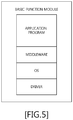
- the basic function module includes programs initially installed in devices and programs for realizing basic functions. Therefore, as illustrated in FIG. 5 , for example, the basic function module includes a driver for controlling devices of the main control apparatus 1, an OS, middleware for realizing basic functions, and an application program.
- the first verification unit 101 of the main control apparatus 1 calls the calculator 103. Then, the calculator 103 reads out hash values stored in the first hash value storage unit 106, calculates a new hash value from the read out hash values, and stores it in the second hash value storage unit 107. Furthermore, the calculator 103 newly calculates a hash value from the calculated hash value (step S3) and stores it in the third hash value storage unit 108.
- a dashed arrow represents hash calculation.
- a program which is a target of hash calculation and has been loaded in the memory, is divided into a predetermined number of blocks (n in FIG. 6 (n is a natural number that is 2 or more)), and a hash value is calculated from each block of the divided blocks.
- n hash values are calculated and are stored in the first hash value storage unit 106.
- one hash value is newly calculated from the n number of hash values stored in the first hash value storage unit 106. Then, the calculated hash value is stored in the second hash value storage unit 107.
- one hash value is calculated from the hash value stored in the second hash value storage unit 107 and is stored in the third hash value storage unit 108.
- one hash value is calculated from one hash value.
- the second hash value may be used as it is as the third hash value.
- hash calculation in a case where a program is additionally loaded in the RAM 1009 after starting the main control apparatus 1 will be explained.
- a dashed arrow represents hash calculation.
- originally loaded program is divided into n blocks, and each of additionally loaded programs is also divided into n blocks.
- N hash values are calculated from the originally loaded program and n hash values are calculated from each of the additionally loaded programs, and the calculated hash values are stored in the first hash value storage unit 106.
- one hash value is newly calculated from the n hash values stored in the first hash value storage unit 106 and is stored in the second hash value storage unit 107.
- one hash value is newly calculated from the n hash values stored in the first hash value storage unit 106 and is stored in the second hash value storage unit 107.
- one hash value is calculated from the hash values stored in the second hash value storage unit 107 and is stored in the third hash value storage unit 108.
- the number of hash values stored in the second hash value storage unit 107 is 2 or more, one hash value is calculated from 2 or more hash values.
- step S3 by using hash values calculated before the main control apparatus 1 shut down, it becomes possible to shorten time required for completing calculation of a hash value to be stored in the third hash value storage unit 108.
- FIGs. 8 to 10 illustrate state transition of the RAM 1009.
- FIG. 8 is a diagram depicting a state of the RAM 1009 immediately after start.
- programs in this embodiment, the basic function module and the extended function module
- programs that are targets of hash calculation are programs loaded at the time of start, which are surrounded by a thick solid line.
- FIG. 9 is a diagram depicting a state of the RAM 1009 when a program is additionally loaded after start.
- a program loaded at the time of start and a program additionally loaded after start are stored.
- programs that are targets of hash calculation are programs loaded at the time of start and programs additionally loaded after start, which are surrounded by a thick solid line.
- FIG. 10 is a diagram depicting a state of the RAM 1009 when some programs are unloaded.
- the RAM 1009 programs loaded at the time of start and programs additionally loaded after start are stored. However, because some of the programs additionally loaded after start have been unloaded, an area where programs are stored is narrow compared to the state of FIG. 9 .
- programs that are targets of hash calculation are programs loaded at the time of start and programs that have not been unloaded among programs additionally loaded after start, which are surrounded by a thick solid line.
- Hash values stored in the first hash value storage unit 106 and hash values corresponding to unloaded programs among hash values stored in the second hash value storage unit 107 are deleted.
- the first verification unit 101 reads out a hash value calculated from a valid program from the valid value storage unit 104, and reads out the hash value calculated in the step S3 from the third hash value storage unit 108. Then, the first verification unit 101 determines whether programs installed in the main control apparatus 1 are valid (namely, it is not rewritten) depending on whether or not the former hash value and the latter hash value match (step S5).
- the program to be verified in step S5 is a program before the main control apparatus 1 shut down, and they are not programs installed in the main control apparatus 1 at the time of step S5.
- the programs before shutdown of the main control apparatus 1 include the basic function module, the extended function module, additionally installed programs, and the like.
- the extended function module includes a program for realizing functions other than basic functions. Therefore, asillustratedinFIG. 11, for example, the extended function module includes a driver, middleware, and application program for realizing extended functions.
- step S5 when the program are not valid (step S5: No route), the first verification unit 101 causes the display device 1003 to display an alert message that represents the programs are not valid (step S7). Then, the processing ends.
- step S5 when the programs are valid (step S5: Yes route), the first verification unit 101 permits the CPU 1001 to execute the basic function module loaded in the RAM 1009 in step S1 (step S9). In response to this, the CPU 1001 starts executing the basic function module.
- the first verification unit 101 calls the calculator 103 to execute first verification processing for the basic function module loaded in the RAM 1009 (step S11).
- step S11 the basic function module is divided into n blocks, and hash values are calculated by the method explained with reference to FIG. 6 . Since size of the basic function module is smaller than that of the extended function module described later, in the first verification processing, cyclic hash calculation is not performed. Then, the first verification unit 101 compares the hash value calculated for the basic function module (in this case, the hash value stored in the third hash value storage unit 108) with the hash value stored in the valid value storage unit 104 to determine whether the basic function module is valid (step S13).
- step S13 When the basic function module is not valid (step S13: No route), the first verification unit 101 causes the display device 1003 to display an alert message representing that the basic function module is not valid (step S15). Then, the processing ends.
- step S13 if the basic function module is valid (step S13: Yes route), the first verification unit 101 loads the extended function module into the RAM 1009 (step S16).
- the first verification unit 101 calls the calculator 103 to execute second verification processing for the extended function module loaded in the RAM 1009 (step S17) . Since size of the extended function module is larger than that of the basic function module, cyclic hash calculation is performed in the second verification processing.
- the second verification processing will be explained with reference to FIGs. 12 and 13 .
- the calculator 103 determines whether it is the first time processing (that is, whether the calculation processing described later has not been executed yet in this call) ( FIG. 12 : step S51). When it is not the first time processing (step S51: No route), the calculator 103 determines whether a timeout of a cycle timer has occurred (step S53). When the timeout of the cycle timer has not occurred (step S53: No route), the processing shifts to processing of step S57.
- the cycle timer is a timer for managing a cycle for calculating in step S55.
- step S55 when it is the first time processing (step S51: Yes route) or when the timeout has occurred (step S53: Yes route), the calculator 103 executes calculation processing (step S55).
- the calculation processing will be explained with reference to FIG. 13 .
- step S61 it is determined whether or not a cycle CIT (second) of the cycle timer has already been set.
- step S65 the calculator 103 sets the cycle CIT of the cycle timer.
- processing for calculating a hash value from one block is executed within a predetermined time. As a result, time spent in completing the hash calculation for all blocks is almost constant.
- step S65 CIT is set as an initial cycle of the cycle timer.
- CIT, BN, and the maximum allowable time MOCT (second) that is the maximum time that is allowed to be spent in calculating hash values from all blocks are used in calculating hash values from the program.
- size APS (bytes) of an initial program and a processing speed CPP (bytes/second) of processing to calculate a hash value from the program are set by the designer in advance.
- the designer or the like preferentially sets values for the maximum delay time MRT (second) of a response to an event and the maximum CPU occupancy rate MOR (%) .
- the maximum delay time of a response to an event is the maximum time that is allowed to be spent in completing control performed when a specific event occurred.
- These parameters are stored in advance in the setting data storage unit 105. These parameters are set so that relationships that are MOCT>APS/ (CPP*MOR), MRT> (APS/BN) /CPP andMOR> ((APS/BN) /CPP) /CIT hold.
- step S67 the calculator 103 initializes a block number N (step S67).
- step S67 "0" is set as the block number N. Then, the processing returns to the calling-source processing.
- step S63 Yes route
- step S68 the calculator 103 starts the cycle timer
- the calculator 103 increments the block number N by 1 (step S69). Then, the calculator 103 calculates a hash value from the Nth block in the program (here, the extended function module) loaded in the RAM 1009 and stores it in the first hash value storage unit 106 (step S71).
- step S73 Yes route
- the calculator 103 newly calculates a hash value from the hash values stored in the first hash value storage unit 106, and stores it in the second hash value storage unit 107 (step S75).
- the calculator 103 newly calculates a hash value from the hash value stored in the second hash value storage unit 107 and stores it in the third hash value storage unit 108. Then, the calculator 103 stops the cycle timer and removes the setting (step S77). Then, the processing returns to the calling-source processing.
- the first verification unit 101 compares the hash value calculated for the extended function module (in this case, the hash value stored in the third hash value storage unit 108) with the hash value stored in the valid value storage unit 104 to determine whether the extended function module is valid (step S19).
- the first verification unit 101 causes the display device 1003 to display an alert message representing that the extended function module is not valid (step S15). Then, the processing ends.
- step S19: Yes route the first verification unit 101 permits the CPU 1001 to execute the extended function module loaded in the RAM 1009 in step S16 (step S20). In response to this, the CPU 1001 starts execution of the extended function module. Then, the processing ends.
- the aforementioned processing By executing the aforementioned processing, it is possible not to calculate hash values from a program at the time of starting, and it becomes possible to shorten time required for starting. Moreover, the size of the extended function module is large compared to the basic function module, and it takes time to perform verification as it is. However, since the block number BN, the cycle CIT and the like are set in advance and hash values are calculated according to them, it becomes possible to prevent time required for verification from becoming longer. According to this embodiment, verification of the extended function module is to be completed in almost constant time.
- an alert message is displayed, and the user is able to respond in accordance with the alert message.
- a thread for executing this processing is periodically activated. This processing may be performed in parallel by plural threads.
- the second verification unit 102 determines whether a trigger of start of verification has occurred ( FIG. 14 : step S21).
- the trigger of start of verification is such that (1) an amount of data received per unit time exceeds a threshold (hereinafter, referred to as RT), (2) an amount of data to be sent per unit time exceeds a threshold (hereinafter, referred to as ST), (3) rewriting to an area where the basic function module was loaded has occurred, (4) an amount of data rewritten in an area where the extended function module was loaded has exceeded a threshold, or (5) a certain period of time has elapsed since the last trigger occurred.
- RT>ST holds and RT and ST are larger than the maximum amount of communication data, which is an assumed amount at the time of designing.
- step S23 When the trigger of start of verification has not occurred (step S23: No route), the processing ends.
- step S23 Yes route
- the second verification unit 102 determines whether the second verification processing is being executed (step S25). Since the trigger described above occurs at an arbitrary timing, a new trigger may occur during execution of the second verification processing, and there is a case where the second verification processing is executed redundantly.
- step S27 When the second verification processing is not being executed (step S27: No route), the second verification unit 102 records information on the trigger determined in step S21 to have occurred (stepS29) . Then, by calling the calculator 103, the secondverification unit 102 executes the second verification processing for the program loaded in the RAM 1009 (step S31).
- the second detection processing has been explained with reference to FIGs . 12 and 13 , and the explanation is omitted here.
- the program that is a target of verification in step S31 includes the basic function module, the extended function module, and the additionally loaded program.
- the second verification unit 102 restores the changed cycle CIT to a default value when the second verification processing in step S31 has been completed.
- the second verification unit 102 compares the hash value calculated for the program loaded in the RAM 1009 (in this case, the hash value stored in the third hash value storage unit 108) with the hash value stored in the valid value storage unit 104 to determine whether the program loaded in the RAM 1009 is valid (step S38).
- step S38: No route the second verification unit 102 causes the display device 1003 to display an alert message representing that the program loaded in the RAM 1009 is not valid (step S39) .
- step S38: Yes route the processing ends.
- step S27 Yes route
- the second verification unit 102 records information on the trigger that has occurred this time, and determines a combination of the trigger that has already occurred and the trigger that has occurred this time (step S33). Since the information on the trigger that has occurred is recorded in steps S29 and S33, the combination is determined using that information.
- FIG. 15 illustrates a relationship between combinations of triggers that have occurred and MOR.
- the numbers in parentheses represents triggers that were used in the explanation of step S21. However, only combinations of triggers (1) to (4) are illustrated here. "(#)" represents that one of the triggers (1) to (4) occurs or no trigger occurs.
- the greater the number of triggers included in the combination of triggers is, the larger value MOR is set to.
- CIT APS/ (MOR*CPP*BN)
- CIT becomes shorter. This makes time required for calculating a hash value from one block shorter. However, setting is made so that MOR does not become 100 (%).
- the second verification unit 102 determines whether the cycle CIT is changed (step S35). When the cycle CIT is not changed (step S35: No route), the processing ends. On the other hand, when the cycle CIT is changed (step S35: Yes route), the second verification unit 102 changes MOR according to the combination of triggers and the relationship illustrated in FIG. 15 . Further, the second verification unit 102 changes the cycle CIT according to the changed MOR (step S37). Then, the processing ends. In addition, once the cycle CIT is changed, the value of the cycle CIT is not restored to the default value until the second verification processing in step S31 is completed.
- the aforementioned configuration of data storage isamereexample, and may be changed. Furthermore, as for the processing flow, as long as the processing results do not change, the turns of the steps may be exchanged or the steps may be executed in parallel.
- the start may be stopped when the basic function module or the extended function module is determined not to be valid at the time of starting.
- the aforementioned server 3 is a computer apparatus as illustrated in FIG. 16 . That is, a memory 2501, a CPU 2503 (Central Processing Unit), a hard disk drive (HDD) 2505, a display controller 2507 connected to a display device 2509, a drive device 2513 for a removable disk 2511, an input unit 2515, and a communication controller 2517 for connection with a network are connected through a bus 2519 as illustrated in FIG. 16 .
- An operating system (OS) and an application program for carrying out the foregoing processing in the embodiment, are stored in the HDD 2505, and when executed by the CPU 2503, they are read out from the HDD 2505 to the memory 2501.
- OS operating system
- an application program for carrying out the foregoing processing in the embodiment
- the CPU 2503 controls the display controller 2507, the communication controller 2517, and the drive device 2513, and causes them to perform predetermined operations. Moreover, intermediate processing data is stored in the memory 2501, and if necessary, it is stored in the HDD 2505.
- the application program to realize the aforementioned processing is stored in the computer-readable, non-transitory removable disk 2511 and distributed, and then it is installed into the HDD 2505 from the drive device 2513. It may be installed into the HDD 2505 via the network such as the Internet and the communication controller 2517.
- the hardware such as the CPU 2503 and the memory 2501, the OS and the application programs systematically cooperate with each other, so that various functions as described above in details are realized.
- a program verification method relating to this embodiment includes: (A) reading out, from a first storage unit, a first value that was calculated before shutdown of the computer for each part of a first program at start of the computer; and (B) determining whether the first program is valid based on the read out first value for each part of the first program and a second value that was calculated for each part of a second program that is valid and is stored in a second storage unit.
- the program verification method may further include: (C) determining whether a start condition that is a condition for start of verification is satisfied after start of the computer; (D) first calculating, within a first period, a third value for each part of a third program loaded in a memory, when the start condition is satisfied; and (E) determining whether the third program is valid based on the second value for each part of the second program and the third value calculated for each part of the third program. In this way, it becomes possible to prevent time required for calculating a value for each part of a program from becoming longer.
- the program verification method may further include (F) second calculating the third value for each part of the third program within a second period that is shorter than the first period, when the start condition is further satisfied during the first calculating. In this way, it becomes possible to shorten time for completing verification when the start condition is satisfied in a superimposed manner.
- the aforementioned start condition may include at least one of a condition that an amount of data that the computer has received per unit time exceeds a first amount, a condition that an amount of data that the computer has transmitted per unit time exceeds a second amount, a condition that a first part that includes an operating system in the thirdprogramhas been rewritten, a condition that an amount of data that has been written in an area in which parts other than the first part were loaded exceeds a third amount, and a condition that a predetermined time has elapsed since the start condition was satisfied last time.
- a condition that an amount of data that the computer has received per unit time exceeds a first amount a condition that an amount of data that the computer has transmitted per unit time exceeds a second amount
- a condition that a first part that includes an operating system in the thirdprogramhas been rewritten a condition that an amount of data that has been written in an area in which parts other than the first part were loaded exceeds a third amount
- the program verification method may further include: (G) third calculating, within the first period, a fourth value for each part of a fourth program that is other than the third program, when the fourth program is additionally loaded in the memory after start of the computer; and (H) determining whether the third program and the fourth program are valid based on the third value for each part of the third program, the fourth value calculated for each part of the fourth program and the second value for each part of the second program. In this way, even in the case where another program is additionally loaded, it becomes possible to determine validity of the another program while preventing time required for calculating a value from becoming longer.
- the program verification method may further include: (I) determining the first period and the second period based on at least one of size of the third program, an occupancy rate of a processor, an amount of data that the computer is able to process per unit time, and a number of parts of the third program. In this way, it becomes possible to properly calculate the first period and the second period.
- first value for each part of the first program and the second value for each part of the second program may be hash values.
- a program causing a processor to execute the aforementioned processing, and such a program is stored in a computer readable storage medium or storage device such as a flexible disk, CD-ROM, magneto-optic disk, a semiconductor memory, and hard disk.
- a computer readable storage medium or storage device such as a flexible disk, CD-ROM, magneto-optic disk, a semiconductor memory, and hard disk.
- the intermediate processing result is temporarily stored in a storage device such as a main memory or the like.
Landscapes
- Engineering & Computer Science (AREA)
- Computer Security & Cryptography (AREA)
- Software Systems (AREA)
- Theoretical Computer Science (AREA)
- General Engineering & Computer Science (AREA)
- Computer Hardware Design (AREA)
- Physics & Mathematics (AREA)
- General Physics & Mathematics (AREA)
- Debugging And Monitoring (AREA)
- Storage Device Security (AREA)
Abstract
Description
- This invention relates to a technique for verification of a program.
- Programs of a device that is connected to a network such as the Internet may be rewritten by unauthorized access from the outside, and the rewriting may cause serious troubles and the like in some cases. For example, unauthorized rewriting of a program installed in a car causes malfunction of the device inside the car and leads to an accident fatal to human lives.
- Moreover, there are cases where a user of a device on which a program is installed intentionally rewrites the program (for example, rewrites in order to disable speed limits), which causes troubles, and the device becomes unavailable.
- As a technique for verifying validness of a program, a technique called Secure Boot to check that a program such as an OS (Operating System) or the like is valid when starting a device is known. However, it takes a long time to start the device when using the Secure Boot.
- Moreover, a certain document discloses the following technique. Specifically, a computer divides a program into plural pages and calculates a hash value for each of the plural pages. Then, the computer generates a hash array based on the hash values and further generates a digital signature of the hash array.
- In addition, a certain document discloses the following technique. Specifically, a microprocessor executes a hash calculation on memory contents in order to find an audit hash value, and compares the audit hash value with a valid hash value found by executing the hash calculation on valid memory contents.
- Moreover, a certain document discloses the following technique. Specifically, an authentication device reads out a digest table and a digital signature from a storage unit into a memory. Then, the authentication device authenticates contents data by using the digital signature and digest values included in the digest table, which were read into the memory.
- However, even if the techniques described in these documents are used, it is not possible to realize both verification of validity of a program at the time of starting a device and shortening of time spent in starting the device.
-
- Patent Document 1: Japanese National Publication of International Patent Application No.
2007- 506187 - Patent Document 2: Japanese National Publication of International Patent Application No.
2001- 500293 - Patent Document 3: Japanese Laid-open Patent Publication No.
2012- 114934 - Accordingly, in one aspect, an object of this invention is to provide a technique for shortening time required for starting a device when verifying validity of a program at the time of starting.
- A program verification method relating to this invention includes: reading out, from a first storage unit, a first value that was calculated before shutdown of the computer for each part of a first program at start of the computer; and determining whether the first program is valid based on the read out first value for each part of the first program and a second value that was calculated for each part of a second program that is valid and is stored in a second storage unit.
- In one aspect, it becomes possible to shorten time required for starting a device when verifying validity of a program at the time of starting.
-
FIG. 1 is a diagram depicting an overview of a system in this embodiment; -
FIG. 2 is a diagram depicting a hardware configuration of a main control apparatus; -
FIG. 3 is a functional block diagram of the main control apparatus; -
FIG. 4 is a diagram depicting a processing flow of processing executed at the time of starting the main control apparatus; -
FIG. 5 is a diagram for explaining basic function module; -
FIG. 6 is a diagram for explaining hash calculation in this embodiment; -
FIG. 7 is a diagram for explaining the hash calculation in this embodiment; -
FIG. 8 is a diagram for explaining state transition of a RAM; -
FIG. 9 is a diagram for explaining the state transition of the RAM; -
FIG. 10 is a diagram for explaining the state transition of the RAM; -
FIG. 11 is a diagram for explaining extended function modules; -
FIG. 12 is a diagram depicting a processing flow for second verification processing; -
FIG. 13 is a diagram depicting a processing flow for calculation processing; -
FIG. 14 is a diagram depicting a processing flow for processing to be executed by the main control apparatus after start; -
FIG. 15 is a diagram depicting a relationship between combinations of triggers and CPU occupancy rates; and -
FIG. 16 is a functional block diagram of a computer. -
FIG. 1 illustrates an overview of a system in this embodiment. Amain control apparatus 1 embedded in, for example, a car is able to perform wireless communication with aserver 3 via a network such as the Internet or a VPN (Virtual Private Network). - Drivers, an OS, middleware, application programs, and the like are installed in the
main control apparatus 1 at the time of manufacture. However, there is a case where programs are additionally downloaded from thesever 3 even after starting operation. The program to be additionally installed is, for example, a program for adding a function, a corrected program and the like. Programs installed in themain control apparatus 1 has a possibility to be rewritten improperly by attacks (for example, sending malicious programs) from a network. -
FIG. 2 illustrates a hardware configuration of themain control apparatus 1. Themain control apparatus 1 has a CPU (Central Processing Unit) 1001, adisplay device 1003, acommunication controller 1005, abus 1007, a RAM (Random Access Memory) 1009, and astorage device 1011. - The
storage device 1011 is an HDD (Hard Disk Drive), a NAND (Not AND)-type flash memory or the like, and stores a program for executing processing for this embodiment, a driver, an OS, middleware, an application program, and the like. The programs stored in thestorage device 1011 are read out by theCPU 1001, loaded into theRAM 1009, and executed. Adisplay device 1003 which is, for example, a monitor displays a screen that displays a warning, a screen for navigation or the like. Thecommunication controller 1005 is a hardware for performing communication via a network. -
FIG. 3 illustrates a functional block diagram of themain control apparatus 1. Themain control apparatus 1 includes afirst verification unit 101, asecond verification unit 102, acalculator 103, a validvalue storage unit 104, a settingdata storage unit 105, a first hashvalue storage unit 106, a second hashvalue storage unit 107 and a third hashvalue storage unit 108. - The
first verification unit 101 executes processing to determine validity of a program loaded in theRAM 1009 at the time of starting themain control apparatus 1. Specifically, thefirst verification unit 101 calls thecalculator 103, and thecalculator 103 executes processing based on data stored in the validvalue storage unit 104, data stored in the settingdata storage unit 105 and data stored in the first hashvalue storage unit 106. And thecalculator 103 stores results of the processing in the second hashvalue storage unit 107 and the third hashvalue storage unit 108. Thesecond verification unit 102 executes processing to determine validity of a program loaded in theRAM 1009 after starting themain control apparatus 1. Specifically, thesecond verification unit 102 calls thecalculator 103, and thecalculator 103 executes processing based on the data stored in the validvalue storage unit 104 and the data stored in the settingdata storage unit 105. And thecalculator 103 stores results of the processing in the first hashvalue storage unit 106, the second hashvalue storage unit 107, and the third hashvalue storage unit 108. The validvalue storage unit 104, the settingdata storage unit 105, the first hashvalue storage unit 106, the second hashvalue storage unit 107, and the third hashvalue storage unit 108 is provided in thestorage device 1011. Therefore, even when the power of themain control apparatus 1 is turned off, data is not erased. - Next, with reference to
FIGs. 4 to 15 , processing executed by themain control apparatus 1 will be explained. For example, a driver of the car powers on themain control apparatus 1. When themain control apparatus 1 is powered on, theCPU 1001 of themain control apparatus 1 loads a basic function module stored in thestorage device 1011 into the RAM 1009 (FIG. 4 : step S1). - The basic function module includes programs initially installed in devices and programs for realizing basic functions. Therefore, as illustrated in
FIG. 5 , for example, the basic function module includes a driver for controlling devices of themain control apparatus 1, an OS, middleware for realizing basic functions, and an application program. - The
first verification unit 101 of themain control apparatus 1 calls thecalculator 103. Then, thecalculator 103 reads out hash values stored in the first hashvalue storage unit 106, calculates a new hash value from the read out hash values, and stores it in the second hashvalue storage unit 107. Furthermore, thecalculator 103 newly calculates a hash value from the calculated hash value (step S3) and stores it in the third hashvalue storage unit 108. - With reference to
FIG. 6 , the hash calculation in this embodiment will be explained. InFIG. 6 , a dashed arrow represents hash calculation. In this embodiment, a program, which is a target of hash calculation and has been loaded in the memory, is divided into a predetermined number of blocks (n inFIG. 6 (n is a natural number that is 2 or more)), and a hash value is calculated from each block of the divided blocks. In this case, n hash values are calculated and are stored in the first hashvalue storage unit 106. - Then, one hash value is newly calculated from the n number of hash values stored in the first hash
value storage unit 106. Then, the calculated hash value is stored in the second hashvalue storage unit 107. - Furthermore, one hash value is calculated from the hash value stored in the second hash
value storage unit 107 and is stored in the third hashvalue storage unit 108. In an example ofFIG. 6 , since one hash value is stored in the second hashvalue storage unit 107, one hash value is calculated from one hash value. In this case, the second hash value may be used as it is as the third hash value. - With reference to
FIG. 7 , hash calculation in a case where a program is additionally loaded in theRAM 1009 after starting themain control apparatus 1 will be explained. InFIG. 7 , a dashed arrow represents hash calculation. In the case where a program is additionally loaded, originally loaded program is divided into n blocks, and each of additionally loaded programs is also divided into n blocks. N hash values are calculated from the originally loaded program and n hash values are calculated from each of the additionally loaded programs, and the calculated hash values are stored in the first hashvalue storage unit 106. - Then, for the originally loaded program, one hash value is newly calculated from the n hash values stored in the first hash
value storage unit 106 and is stored in the second hashvalue storage unit 107. For each of the additionally loaded programs, one hash value is newly calculated from the n hash values stored in the first hashvalue storage unit 106 and is stored in the second hashvalue storage unit 107. - Further, one hash value is calculated from the hash values stored in the second hash
value storage unit 107 and is stored in the third hashvalue storage unit 108. In an example ofFIG. 7 , because the number of hash values stored in the second hashvalue storage unit 107 is 2 or more, one hash value is calculated from 2 or more hash values. - As described above, there are processing to calculate hash values from a program and processing to calculate a hash value from hash values, and the cause of prolongation of time spent in starting is the former processing. Therefore, in step S3, by using hash values calculated before the
main control apparatus 1 shut down, it becomes possible to shorten time required for completing calculation of a hash value to be stored in the third hashvalue storage unit 108. -
FIGs. 8 to 10 illustrate state transition of theRAM 1009.FIG. 8 is a diagram depicting a state of theRAM 1009 immediately after start. In theRAM 1009, programs (in this embodiment, the basic function module and the extended function module) loaded at the time of start are stored. In this case, programs that are targets of hash calculation are programs loaded at the time of start, which are surrounded by a thick solid line. -
FIG. 9 is a diagram depicting a state of theRAM 1009 when a program is additionally loaded after start. In theRAM 1009, a program loaded at the time of start and a program additionally loaded after start are stored. In this case, programs that are targets of hash calculation are programs loaded at the time of start and programs additionally loaded after start, which are surrounded by a thick solid line. -
FIG. 10 is a diagram depicting a state of theRAM 1009 when some programs are unloaded. In theRAM 1009, programs loaded at the time of start and programs additionally loaded after start are stored. However, because some of the programs additionally loaded after start have been unloaded, an area where programs are stored is narrow compared to the state ofFIG. 9 . In this case, programs that are targets of hash calculation are programs loaded at the time of start and programs that have not been unloaded among programs additionally loaded after start, which are surrounded by a thick solid line. Hash values stored in the first hashvalue storage unit 106 and hash values corresponding to unloaded programs among hash values stored in the second hashvalue storage unit 107 are deleted. - Returning to the explanation of
FIG. 4 , thefirst verification unit 101 reads out a hash value calculated from a valid program from the validvalue storage unit 104, and reads out the hash value calculated in the step S3 from the third hashvalue storage unit 108. Then, thefirst verification unit 101 determines whether programs installed in themain control apparatus 1 are valid (namely, it is not rewritten) depending on whether or not the former hash value and the latter hash value match (step S5). However, the program to be verified in step S5 is a program before themain control apparatus 1 shut down, and they are not programs installed in themain control apparatus 1 at the time of step S5. The programs before shutdown of themain control apparatus 1 include the basic function module, the extended function module, additionally installed programs, and the like. - Assume that a valid value is stored in the valid
value storage unit 104 for each of the entire program, basic function module, extended function module, and the like. Moreover, in the case of downloading a program and loading the program additionally, the valid value is recalculated at the time of downloading. The extended function module includes a program for realizing functions other than basic functions. Therefore, asillustratedinFIG. 11, for example, the extended function module includes a driver, middleware, and application program for realizing extended functions. - Returning to the explanation of
FIG. 4 , when the program are not valid (step S5: No route), thefirst verification unit 101 causes thedisplay device 1003 to display an alert message that represents the programs are not valid (step S7). Then, the processing ends. - On the other hand, when the programs are valid (step S5: Yes route), the
first verification unit 101 permits theCPU 1001 to execute the basic function module loaded in theRAM 1009 in step S1 (step S9). In response to this, theCPU 1001 starts executing the basic function module. - The
first verification unit 101 calls thecalculator 103 to execute first verification processing for the basic function module loaded in the RAM 1009 (step S11). In step S11, the basic function module is divided into n blocks, and hash values are calculated by the method explained with reference toFIG. 6 . Since size of the basic function module is smaller than that of the extended function module described later, in the first verification processing, cyclic hash calculation is not performed. Then, thefirst verification unit 101 compares the hash value calculated for the basic function module (in this case, the hash value stored in the third hash value storage unit 108) with the hash value stored in the validvalue storage unit 104 to determine whether the basic function module is valid (step S13). - When the basic function module is not valid (step S13: No route), the
first verification unit 101 causes thedisplay device 1003 to display an alert message representing that the basic function module is not valid (step S15). Then, the processing ends. - On the other hand, if the basic function module is valid (step S13: Yes route), the
first verification unit 101 loads the extended function module into the RAM 1009 (step S16). - The
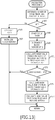
first verification unit 101 calls thecalculator 103 to execute second verification processing for the extended function module loaded in the RAM 1009 (step S17) . Since size of the extended function module is larger than that of the basic function module, cyclic hash calculation is performed in the second verification processing. The second verification processing will be explained with reference toFIGs. 12 and13 . - First, the
calculator 103 determines whether it is the first time processing (that is, whether the calculation processing described later has not been executed yet in this call) (FIG. 12 : step S51). When it is not the first time processing (step S51: No route), thecalculator 103 determines whether a timeout of a cycle timer has occurred (step S53). When the timeout of the cycle timer has not occurred (step S53: No route), the processing shifts to processing of step S57. The cycle timer is a timer for managing a cycle for calculating in step S55. - On the other hand, when it is the first time processing (step S51: Yes route) or when the timeout has occurred (step S53: Yes route), the
calculator 103 executes calculation processing (step S55). The calculation processing will be explained with reference toFIG. 13 . - First, the
calculator 103 determines whether or not the cycle timer has been set (FIG. 13 : step S61). In step S61, it is determined whether or not a cycle CIT (second) of the cycle timer has already been set. - When the cycle timer has not been set (step S63: No route), the
calculator 103 sets the cycle CIT of the cycle timer (step S65) . By using such cycle CIT, processing for calculating a hash value from one block is executed within a predetermined time. As a result, time spent in completing the hash calculation for all blocks is almost constant. - In this embodiment, at the time of designing of the
main control apparatus 1, a designer sets the cycle CIT and the number BN for division of the program in advance. In step S65, CIT is set as an initial cycle of the cycle timer. CIT, BN, and the maximum allowable time MOCT (second) that is the maximum time that is allowed to be spent in calculating hash values from all blocks are used in calculating hash values from the program. - Moreover, when selecting hardware of the
main control apparatus 1 and designing software of themain control apparatus 1, size APS (bytes) of an initial program and a processing speed CPP (bytes/second) of processing to calculate a hash value from the program are set by the designer in advance. - Moreover, in the design of a device, the designer or the like preferentially sets values for the maximum delay time MRT (second) of a response to an event and the maximum CPU occupancy rate MOR (%) . The maximum delay time of a response to an event is the maximum time that is allowed to be spent in completing control performed when a specific event occurred.
- These parameters are stored in advance in the setting
data storage unit 105. These parameters are set so that relationships that are MOCT>APS/ (CPP*MOR), MRT> (APS/BN) /CPP andMOR> ((APS/BN) /CPP) /CIT hold. - From these relationship, it is possible to derive relationships that are BN>APS/(MRT*CPP), CIT>APS/(MOR*CPP*BN), and MOCT>APS/ (MOR*CPP).
- Returning to the explanation of
FIG. 13 , thecalculator 103 initializes a block number N (step S67). In step S67, "0" is set as the block number N. Then, the processing returns to the calling-source processing. - On the other hand, when the cycle timer has already been set (step S63: Yes route), the
calculator 103 starts the cycle timer (step S68). By the processing of step S68, measurement of time is started. - The
calculator 103 increments the block number N by 1 (step S69). Then, thecalculator 103 calculates a hash value from the Nth block in the program (here, the extended function module) loaded in theRAM 1009 and stores it in the first hash value storage unit 106 (step S71). - The
calculator 103 determines whether the block number N = BN holds (step S73) . When the block number N = BN does not hold (step S73: No route), the processing returns to the calling-source processing. - On the other hand, when the block number N = BN holds (step S73: Yes route), the
calculator 103 newly calculates a hash value from the hash values stored in the first hashvalue storage unit 106, and stores it in the second hash value storage unit 107 (step S75). - The
calculator 103 newly calculates a hash value from the hash value stored in the second hashvalue storage unit 107 and stores it in the third hashvalue storage unit 108. Then, thecalculator 103 stops the cycle timer and removes the setting (step S77). Then, the processing returns to the calling-source processing. - Returning to the explanation of
FIG. 12 , thecalculator 103 determines whether or not the block number N = BN holds (step S57). WhenblocknumberN=BNdoesnothold (step S57 : No route), the processing returns to step S51. On the other hand, when the block number N = BN holds (step S57: Yes route), the processing returns to the calling-source processing. - Returning to the explanation of
FIG. 4 , thefirst verification unit 101 compares the hash value calculated for the extended function module (in this case, the hash value stored in the third hash value storage unit 108) with the hash value stored in the validvalue storage unit 104 to determine whether the extended function module is valid (step S19). - When the extended function module is not valid (step S19: No route), the
first verification unit 101 causes thedisplay device 1003 to display an alert message representing that the extended function module is not valid (step S15). Then, the processing ends. - On the other hand, when the extended function module is valid (step S19: Yes route), the
first verification unit 101 permits theCPU 1001 to execute the extended function module loaded in theRAM 1009 in step S16 (step S20). In response to this, theCPU 1001 starts execution of the extended function module. Then, the processing ends. - By executing the aforementioned processing, it is possible not to calculate hash values from a program at the time of starting, and it becomes possible to shorten time required for starting. Moreover, the size of the extended function module is large compared to the basic function module, and it takes time to perform verification as it is. However, since the block number BN, the cycle CIT and the like are set in advance and hash values are calculated according to them, it becomes possible to prevent time required for verification from becoming longer. According to this embodiment, verification of the extended function module is to be completed in almost constant time.
- Then, when it is determined that the program is not valid (for example, it is not the same as the program at the time of manufacture), an alert message is displayed, and the user is able to respond in accordance with the alert message.
- Next, with reference to
FIGs. 14 and15 , processing executed by themain control apparatus 1 after starting will be explained. A thread for executing this processing is periodically activated. This processing may be performed in parallel by plural threads. - First, the
second verification unit 102 determines whether a trigger of start of verification has occurred (FIG. 14 : step S21). In this embodiment, the trigger of start of verification is such that (1) an amount of data received per unit time exceeds a threshold (hereinafter, referred to as RT), (2) an amount of data to be sent per unit time exceeds a threshold (hereinafter, referred to as ST), (3) rewriting to an area where the basic function module was loaded has occurred, (4) an amount of data rewritten in an area where the extended function module was loaded has exceeded a threshold, or (5) a certain period of time has elapsed since the last trigger occurred. However, it is assumed that RT>ST holds and RT and ST are larger than the maximum amount of communication data, which is an assumed amount at the time of designing. - When the trigger of start of verification has not occurred (step S23: No route), the processing ends. When the trigger of start of verification occurred (step S23 : Yes route), the
second verification unit 102 determines whether the second verification processing is being executed (step S25). Since the trigger described above occurs at an arbitrary timing, a new trigger may occur during execution of the second verification processing, and there is a case where the second verification processing is executed redundantly. - When the second verification processing is not being executed (step S27: No route), the
second verification unit 102 records information on the trigger determined in step S21 to have occurred (stepS29) . Then, by calling thecalculator 103, thesecondverification unit 102 executes the second verification processing for the program loaded in the RAM 1009 (step S31). The second detection processing has been explained with reference toFIGs . 12 and13 , and the explanation is omitted here. The program that is a target of verification in step S31 includes the basic function module, the extended function module, and the additionally loaded program. - Assume that the
second verification unit 102 restores the changed cycle CIT to a default value when the second verification processing in step S31 has been completed. - The
second verification unit 102 compares the hash value calculated for the program loaded in the RAM 1009 (in this case, the hash value stored in the third hash value storage unit 108) with the hash value stored in the validvalue storage unit 104 to determine whether the program loaded in theRAM 1009 is valid (step S38). - When the program loaded in the
RAM 1009 is not valid (step S38: No route), thesecond verification unit 102 causes thedisplay device 1003 to display an alert message representing that the program loaded in theRAM 1009 is not valid (step S39) . When the program loaded in theRAM 1009 is valid (step S38: Yes route), the processing ends. - On the other hand, when the second verification processing is being executed (step S27: Yes route), the
second verification unit 102 records information on the trigger that has occurred this time, and determines a combination of the trigger that has already occurred and the trigger that has occurred this time (step S33). Since the information on the trigger that has occurred is recorded in steps S29 and S33, the combination is determined using that information. -
FIG. 15 illustrates a relationship between combinations of triggers that have occurred and MOR. The numbers in parentheses represents triggers that were used in the explanation of step S21. However, only combinations of triggers (1) to (4) are illustrated here. "(#)" represents that one of the triggers (1) to (4) occurs or no trigger occurs. As illustrated inFIG. 15 , in this embodiment, the greater the number of triggers included in the combination of triggers is, the larger value MOR is set to. Then, according to CIT>APS/ (MOR*CPP*BN), CIT becomes shorter. This makes time required for calculating a hash value from one block shorter. However, setting is made so that MOR does not become 100 (%). - Returning to the explanation of
FIG. 14 , thesecond verification unit 102 determines whether the cycle CIT is changed (step S35). When the cycle CIT is not changed (step S35: No route), the processing ends. On the other hand, when the cycle CIT is changed (step S35: Yes route), thesecond verification unit 102 changes MOR according to the combination of triggers and the relationship illustrated inFIG. 15 . Further, thesecond verification unit 102 changes the cycle CIT according to the changed MOR (step S37). Then, the processing ends. In addition, once the cycle CIT is changed, the value of the cycle CIT is not restored to the default value until the second verification processing in step S31 is completed. - By executing the aforementioned processing, it is possible to change the cycle CIT according to the state, and it becomes possible to further suppress time required for the verification processing.
- Moreover, since the verification is started only when a trigger occurs after starting, an excessive load does not occur on the
CPU 1001. - Although the embodiment of this invention was explained above, this invention is not limited to those. For example, the functional block configuration of the
main control apparatus 1 described above does not always correspond to actual program module configuration. - Moreover, the aforementioned configuration of data storage isamereexample, and may be changed. Furthermore, as for the processing flow, as long as the processing results do not change, the turns of the steps may be exchanged or the steps may be executed in parallel.
- The start may be stopped when the basic function module or the extended function module is determined not to be valid at the time of starting.
- In addition, the
aforementioned server 3 is a computer apparatus as illustrated inFIG. 16 . That is, amemory 2501, a CPU 2503 (Central Processing Unit), a hard disk drive (HDD) 2505, adisplay controller 2507 connected to adisplay device 2509, adrive device 2513 for aremovable disk 2511, aninput unit 2515, and acommunication controller 2517 for connection with a network are connected through abus 2519 as illustrated inFIG. 16 . An operating system (OS) and an application program for carrying out the foregoing processing in the embodiment, are stored in theHDD 2505, and when executed by theCPU 2503, they are read out from theHDD 2505 to thememory 2501. As the need arises, theCPU 2503 controls thedisplay controller 2507, thecommunication controller 2517, and thedrive device 2513, and causes them to perform predetermined operations. Moreover, intermediate processing data is stored in thememory 2501, and if necessary, it is stored in theHDD 2505. In this embodiment of this technique, the application program to realize the aforementioned processing is stored in the computer-readable, non-transitoryremovable disk 2511 and distributed, and then it is installed into theHDD 2505 from thedrive device 2513. It may be installed into theHDD 2505 via the network such as the Internet and thecommunication controller 2517. In the computer device as stated above, the hardware such as theCPU 2503 and thememory 2501, the OS and the application programs systematically cooperate with each other, so that various functions as described above in details are realized. - The aforementioned embodiment of this invention may be summarized as follows.
- A program verification method relating to this embodiment includes: (A) reading out, from a first storage unit, a first value that was calculated before shutdown of the computer for each part of a first program at start of the computer; and (B) determining whether the first program is valid based on the read out first value for each part of the first program and a second value that was calculated for each part of a second program that is valid and is stored in a second storage unit.
- In this way, because it is unnecessary to perform processing to calculate a value from a program at the start of the computer, it becomes possible to reduce time required for the start.
- Moreover, the program verification method may further include: (C) determining whether a start condition that is a condition for start of verification is satisfied after start of the computer; (D) first calculating, within a first period, a third value for each part of a third program loaded in a memory, when the start condition is satisfied; and (E) determining whether the third program is valid based on the second value for each part of the second program and the third value calculated for each part of the third program. In this way, it becomes possible to prevent time required for calculating a value for each part of a program from becoming longer.
- Moreover, the program verification method may further include (F) second calculating the third value for each part of the third program within a second period that is shorter than the first period, when the start condition is further satisfied during the first calculating. In this way, it becomes possible to shorten time for completing verification when the start condition is satisfied in a superimposed manner.
- Moreover, the aforementioned start condition may include at least one of a condition that an amount of data that the computer has received per unit time exceeds a first amount, a condition that an amount of data that the computer has transmitted per unit time exceeds a second amount, a condition that a first part that includes an operating system in the thirdprogramhas been rewritten, a condition that an amount of data that has been written in an area in which parts other than the first part were loaded exceeds a third amount, and a condition that a predetermined time has elapsed since the start condition was satisfied last time. In this way, it becomes possible to start verification when there is a possibility that a program will be rewritten.
- Moreover, the program verification method may further include: (G) third calculating, within the first period, a fourth value for each part of a fourth program that is other than the third program, when the fourth program is additionally loaded in the memory after start of the computer; and (H) determining whether the third program and the fourth program are valid based on the third value for each part of the third program, the fourth value calculated for each part of the fourth program and the second value for each part of the second program. In this way, even in the case where another program is additionally loaded, it becomes possible to determine validity of the another program while preventing time required for calculating a value from becoming longer.
- Moreover, the program verification method may further include: (I) determining the first period and the second period based on at least one of size of the third program, an occupancy rate of a processor, an amount of data that the computer is able to process per unit time, and a number of parts of the third program. In this way, it becomes possible to properly calculate the first period and the second period.
- Moreover, the first value for each part of the first program and the second value for each part of the second program may be hash values.
- Incidentally, it is possible to create a program causing a processor to execute the aforementioned processing, and such a program is stored in a computer readable storage medium or storage device such as a flexible disk, CD-ROM, magneto-optic disk, a semiconductor memory, and hard disk. In addition, the intermediate processing result is temporarily stored in a storage device such as a main memory or the like.
Claims (9)
- A program verification method executed by a computer for verifying validness of a program by using a value calculated from the program, comprising:reading out, from a first storage unit, a first value that was calculated before shutdown of the computer for each part of the program at start of the computer; anddetermining whether the program is valid based on the read out first values and a second value that was calculated for each part of a valid program and is stored in a second storage unit.
- The program verification method as set forth in claim 1, further comprising:determining whether a start condition that is a condition for start of verification is satisfied after start of the computer;first calculating, within a first period, a third value for each part of the program loaded in a memory, when the start condition is satisfied; anddetermining whether the program is valid based on second values and the third value calculated for each part of the program.
- The program verification method as set forth in claim 2, wherein the program verification method further comprises second calculating the third value for each part of the program loaded in the memory within a second period that is shorter than the first period, when the start condition is further satisfied during the first calculating.
- The program verification method as set forth in claim 2, wherein the start condition includes at least one of a condition that an amount of data that the computer has received per unit time exceeds a first amount, a condition that an amount of data that the computer has transmitted per unit time exceeds a second amount, a condition that a first part that includes an operating system in the program has been rewritten, a condition that an amount of data that has been written in an area in which parts other than the first part were loaded exceeds a third amount, and a condition that a predetermined time has elapsed since the start condition was satisfied last time.
- The program verification method as set forth in claim 2, further comprising:third calculating, within the first period, a fourth value for each part of another program that is other than the program, when the another program is additionally loaded in the memory after start of the computer; anddetermining whether the program and the another program are valid based on the third value, the fourth value and the second value.
- The program verification method as set forth in claim 3, wherein the program verification method further comprises determining the first period and the second period based on at least one of size of the program, an occupancy rate of a processor, an amount of data that the computer is able to process per unit time, and a number of parts of the program.
- The program verification method as set forth in claim 1, wherein the first value and the second value are hash values.
- A verification program that causes a computer to verify validness of a program by using a value calculated from the program, comprising:reading out, from a first storage unit, a first value that was calculated before shutdown of the computer for each part of the program at start of the computer; anddetermining whether the program is valid based on the read out first value for each part of the program and a second value that was calculated for each part of a valid program and is stored in a second storage unit.
- An information processing apparatus that performs processing to verify validness of a program by using a value calculated from the program, comprising:a first storage unit that stores a first value that was calculated before shutdown of the information processing apparatus for each of the program;a second storage unit that stores a second value calculated for each part of a valid program; anda determination unit reads out, from the first storage unit, first values at start of the information processing apparatus, and determines whether the program is valid based on the read out first values and second values that are stored in the second storage unit.
Applications Claiming Priority (1)
| Application Number | Priority Date | Filing Date | Title |
|---|---|---|---|
| PCT/JP2015/064428 WO2016185577A1 (en) | 2015-05-20 | 2015-05-20 | Program verification method, verification program, and informaiton processing device |
Publications (2)
| Publication Number | Publication Date |
|---|---|
| EP3299986A1 true EP3299986A1 (en) | 2018-03-28 |
| EP3299986A4 EP3299986A4 (en) | 2018-05-16 |
Family
ID=57319690
Family Applications (1)
| Application Number | Title | Priority Date | Filing Date |
|---|---|---|---|
| EP15892576.8A Withdrawn EP3299986A4 (en) | 2015-05-20 | 2015-05-20 | Program verification method, verification program, and information processing device |
Country Status (4)
| Country | Link |
|---|---|
| US (1) | US10872141B2 (en) |
| EP (1) | EP3299986A4 (en) |
| JP (1) | JP6601491B2 (en) |
| WO (1) | WO2016185577A1 (en) |
Families Citing this family (7)
| Publication number | Priority date | Publication date | Assignee | Title |
|---|---|---|---|---|
| JP6949416B2 (en) * | 2017-07-13 | 2021-10-13 | 株式会社デンソー | Electronic control device, program tampering detection method |
| JP6463435B1 (en) * | 2017-10-04 | 2019-02-06 | 三菱電機株式会社 | Control device and control method |
| WO2019151013A1 (en) * | 2018-02-02 | 2019-08-08 | 日本電気株式会社 | Information processing device, information processing method, and recording medium |
| JP6659180B2 (en) * | 2018-04-16 | 2020-03-04 | 三菱電機株式会社 | Control device and control method |
| JP7179482B2 (en) * | 2018-04-19 | 2022-11-29 | キヤノン株式会社 | Information processing device, control method, and its program |
| CN113348110B (en) * | 2019-01-30 | 2024-03-22 | 日立安斯泰莫株式会社 | Electronic control device and security verification method for electronic control device |
| JP7321795B2 (en) * | 2019-06-27 | 2023-08-07 | キヤノン株式会社 | Information processing device, information processing method and program |
Family Cites Families (22)
| Publication number | Priority date | Publication date | Assignee | Title |
|---|---|---|---|---|
| US6026293A (en) | 1996-09-05 | 2000-02-15 | Ericsson Inc. | System for preventing electronic memory tampering |
| US6263431B1 (en) * | 1998-12-31 | 2001-07-17 | Intle Corporation | Operating system bootstrap security mechanism |
| US7103779B2 (en) | 2003-09-18 | 2006-09-05 | Apple Computer, Inc. | Method and apparatus for incremental code signing |
| US7533274B2 (en) * | 2003-11-13 | 2009-05-12 | International Business Machines Corporation | Reducing the boot time of a TCPA based computing system when the core root of trust measurement is embedded in the boot block code |
| US7594124B2 (en) * | 2004-06-09 | 2009-09-22 | Intel Corporation | Cross validation of data using multiple subsystems |
| US8291226B2 (en) * | 2006-02-10 | 2012-10-16 | Qualcomm Incorporated | Method and apparatus for securely booting from an external storage device |
| SE531992C2 (en) * | 2006-02-24 | 2009-09-22 | Oniteo Ab | Method and system for secure software commissioning |
| US8122258B2 (en) * | 2006-05-22 | 2012-02-21 | Hewlett-Packard Development Company, L.P. | System and method for secure operating system boot |
| US20080126779A1 (en) * | 2006-09-19 | 2008-05-29 | Ned Smith | Methods and apparatus to perform secure boot |
| JP2009009372A (en) * | 2007-06-28 | 2009-01-15 | Panasonic Corp | Information terminal, client server system, and program |
| WO2009044533A1 (en) * | 2007-10-05 | 2009-04-09 | Panasonic Corporation | Secure boot terminal, secure boot method, secure boot program, recording medium, and integrated circuit |
| US20090193211A1 (en) * | 2008-01-24 | 2009-07-30 | Broadcom Corporation | Software authentication for computer systems |
| EP2339499A4 (en) * | 2008-08-22 | 2012-05-09 | Ibm | Storage device, information processing device, and program |
| US8738932B2 (en) * | 2009-01-16 | 2014-05-27 | Teleputers, Llc | System and method for processor-based security |
| US8812854B2 (en) * | 2009-10-13 | 2014-08-19 | Google Inc. | Firmware verified boot |
| JP5582909B2 (en) * | 2010-07-29 | 2014-09-03 | キヤノン株式会社 | Platform integrity verification system |
| JP5315422B2 (en) | 2012-01-10 | 2013-10-16 | 任天堂株式会社 | Data authentication method and data authentication system |
| US9070251B2 (en) * | 2013-03-08 | 2015-06-30 | Igt | Multi-tiered static chain of trust |
| JP2015049785A (en) * | 2013-09-03 | 2015-03-16 | 株式会社デンソー | Program processing device |
| JP6244759B2 (en) * | 2013-09-10 | 2017-12-13 | 株式会社ソシオネクスト | Secure boot method, semiconductor device, and secure boot program |
| US9740863B2 (en) * | 2014-11-25 | 2017-08-22 | Intel Corporation | Protecting a secure boot process against side channel attacks |
| US10153904B2 (en) * | 2015-04-29 | 2018-12-11 | Ncr Corporation | Validating resources execution |
-
2015
- 2015-05-20 WO PCT/JP2015/064428 patent/WO2016185577A1/en not_active Ceased
- 2015-05-20 EP EP15892576.8A patent/EP3299986A4/en not_active Withdrawn
- 2015-05-20 JP JP2017518679A patent/JP6601491B2/en not_active Expired - Fee Related
-
2017
- 2017-11-17 US US15/817,020 patent/US10872141B2/en not_active Expired - Fee Related
Also Published As
| Publication number | Publication date |
|---|---|
| JPWO2016185577A1 (en) | 2018-02-22 |
| US20180096132A1 (en) | 2018-04-05 |
| EP3299986A4 (en) | 2018-05-16 |
| US10872141B2 (en) | 2020-12-22 |
| JP6601491B2 (en) | 2019-11-06 |
| WO2016185577A1 (en) | 2016-11-24 |
Similar Documents
| Publication | Publication Date | Title |
|---|---|---|
| US10872141B2 (en) | Method and apparatus for program verification | |
| US9205809B2 (en) | Vehicle unit and method for operating the vehicle unit | |
| CN107403089B (en) | Resource tampering identification method and device based on application program | |
| CN111930406B (en) | Vehicle-mounted terminal micro control unit software upgrading method, electronic equipment and storage medium | |
| EP3037303B1 (en) | Vehicle control device | |
| KR100872175B1 (en) | Secure booting apparatus and method of mobile platform using TPM | |
| JP5975923B2 (en) | Vehicle control device | |
| CN110737453A (en) | Security chip upgrade method, device and security chip | |
| US8245085B2 (en) | Dump output control apparatus and dump output control method | |
| KR20230082388A (en) | Apparatus for verifying bootloader of ecu and method thereof | |
| KR100988157B1 (en) | A computer readable medium comprising methods and apparatus for detecting a memory device configuration and instructions for performing a method for detecting the memory device configuration. | |
| CN105550071A (en) | System file upgrading and detecting method and communication device | |
| US20250013752A1 (en) | Method for detecting anomalies suggesting a manipulation during a secure starting operation of a software-controlled device | |
| US10915623B2 (en) | Information processing apparatus, information processing method, and computer program product | |
| JP7411902B1 (en) | Information processing device, control method and program for information processing device | |
| US20130091324A1 (en) | Data processing apparatus and validity verification method | |
| CN110134546B (en) | Batch restarting windows system method, electronic device and storage medium | |
| WO2024231730A1 (en) | System and method for updating gpts (global partitioning tables) and partition contents of a computing device in real-time system recovery mode | |
| US20090158267A1 (en) | System and method for inserting authorized code into a program | |
| CN109753363B (en) | Embedded system memory management method and device | |
| JP6443583B2 (en) | Information processing apparatus, information processing method, and information processing program | |
| CN106406954B (en) | A kind of method and device upgrading BootLoader program | |
| CN116225490B (en) | Upgrading method and upgrading device of memory firmware, electronic equipment and medium | |
| US12158847B2 (en) | Control device, control method, recording medium in which control program is recorded, and vehicle | |
| US12579273B2 (en) | Information processing apparatus, information processing method, and non-transitory computer readable medium for verifying software |
Legal Events
| Date | Code | Title | Description |
|---|---|---|---|
| STAA | Information on the status of an ep patent application or granted ep patent |
Free format text: STATUS: THE INTERNATIONAL PUBLICATION HAS BEEN MADE |
|
| PUAI | Public reference made under article 153(3) epc to a published international application that has entered the european phase |
Free format text: ORIGINAL CODE: 0009012 |
|
| STAA | Information on the status of an ep patent application or granted ep patent |
Free format text: STATUS: REQUEST FOR EXAMINATION WAS MADE |
|
| 17P | Request for examination filed |
Effective date: 20171106 |
|
| AK | Designated contracting states |
Kind code of ref document: A1 Designated state(s): AL AT BE BG CH CY CZ DE DK EE ES FI FR GB GR HR HU IE IS IT LI LT LU LV MC MK MT NL NO PL PT RO RS SE SI SK SM TR |
|
| AX | Request for extension of the european patent |
Extension state: BA ME |
|
| A4 | Supplementary search report drawn up and despatched |
Effective date: 20180413 |
|
| RIC1 | Information provided on ipc code assigned before grant |
Ipc: G06F 21/57 20130101AFI20180409BHEP Ipc: G06F 21/51 20130101ALI20180409BHEP |
|
| DAV | Request for validation of the european patent (deleted) | ||
| DAX | Request for extension of the european patent (deleted) | ||
| GRAP | Despatch of communication of intention to grant a patent |
Free format text: ORIGINAL CODE: EPIDOSNIGR1 |
|
| STAA | Information on the status of an ep patent application or granted ep patent |
Free format text: STATUS: GRANT OF PATENT IS INTENDED |
|
| RIC1 | Information provided on ipc code assigned before grant |
Ipc: G06F 21/51 20130101ALI20181205BHEP Ipc: G06F 21/57 20130101ALI20181205BHEP Ipc: G06F 21/44 20130101AFI20181205BHEP |
|
| INTG | Intention to grant announced |
Effective date: 20190104 |
|
| STAA | Information on the status of an ep patent application or granted ep patent |
Free format text: STATUS: THE APPLICATION IS DEEMED TO BE WITHDRAWN |
|
| 18D | Application deemed to be withdrawn |
Effective date: 20190515 |