EP3299375A1 - Noble metal nanoparticles coated with terphenylphosphine ligands for h2 generation from ammonia-borane and alcohols - Google Patents
Noble metal nanoparticles coated with terphenylphosphine ligands for h2 generation from ammonia-borane and alcohols Download PDFInfo
- Publication number
- EP3299375A1 EP3299375A1 EP16382444.4A EP16382444A EP3299375A1 EP 3299375 A1 EP3299375 A1 EP 3299375A1 EP 16382444 A EP16382444 A EP 16382444A EP 3299375 A1 EP3299375 A1 EP 3299375A1
- Authority
- EP
- European Patent Office
- Prior art keywords
- noble metal
- ligands
- nanoparticles according
- terphenylphosphine
- alkyl
- Prior art date
- Legal status (The legal status is an assumption and is not a legal conclusion. Google has not performed a legal analysis and makes no representation as to the accuracy of the status listed.)
- Withdrawn
Links
Images








Classifications
-
- C—CHEMISTRY; METALLURGY
- C07—ORGANIC CHEMISTRY
- C07F—ACYCLIC, CARBOCYCLIC OR HETEROCYCLIC COMPOUNDS CONTAINING ELEMENTS OTHER THAN CARBON, HYDROGEN, HALOGEN, OXYGEN, NITROGEN, SULFUR, SELENIUM OR TELLURIUM
- C07F9/00—Compounds containing elements of Groups 5 or 15 of the Periodic Table
- C07F9/02—Phosphorus compounds
- C07F9/28—Phosphorus compounds with one or more P—C bonds
- C07F9/50—Organo-phosphines
- C07F9/5045—Complexes or chelates of phosphines with metallic compounds or metals
-
- B—PERFORMING OPERATIONS; TRANSPORTING
- B01—PHYSICAL OR CHEMICAL PROCESSES OR APPARATUS IN GENERAL
- B01J—CHEMICAL OR PHYSICAL PROCESSES, e.g. CATALYSIS OR COLLOID CHEMISTRY; THEIR RELEVANT APPARATUS
- B01J35/00—Catalysts, in general, characterised by their form or physical properties
- B01J35/40—Catalysts, in general, characterised by their form or physical properties characterised by dimensions, e.g. grain size
- B01J35/45—Nanoparticles
-
- B—PERFORMING OPERATIONS; TRANSPORTING
- B01—PHYSICAL OR CHEMICAL PROCESSES OR APPARATUS IN GENERAL
- B01J—CHEMICAL OR PHYSICAL PROCESSES, e.g. CATALYSIS OR COLLOID CHEMISTRY; THEIR RELEVANT APPARATUS
- B01J23/00—Catalysts comprising metals or metal oxides or hydroxides, not provided for in group B01J21/00
- B01J23/38—Catalysts comprising metals or metal oxides or hydroxides, not provided for in group B01J21/00 of noble metals
- B01J23/40—Catalysts comprising metals or metal oxides or hydroxides, not provided for in group B01J21/00 of noble metals of the platinum group metals
- B01J23/42—Platinum
-
- B—PERFORMING OPERATIONS; TRANSPORTING
- B01—PHYSICAL OR CHEMICAL PROCESSES OR APPARATUS IN GENERAL
- B01J—CHEMICAL OR PHYSICAL PROCESSES, e.g. CATALYSIS OR COLLOID CHEMISTRY; THEIR RELEVANT APPARATUS
- B01J31/00—Catalysts comprising hydrides, coordination complexes or organic compounds
-
- B—PERFORMING OPERATIONS; TRANSPORTING
- B01—PHYSICAL OR CHEMICAL PROCESSES OR APPARATUS IN GENERAL
- B01J—CHEMICAL OR PHYSICAL PROCESSES, e.g. CATALYSIS OR COLLOID CHEMISTRY; THEIR RELEVANT APPARATUS
- B01J31/00—Catalysts comprising hydrides, coordination complexes or organic compounds
- B01J31/16—Catalysts comprising hydrides, coordination complexes or organic compounds containing coordination complexes
- B01J31/24—Phosphines, i.e. phosphorus bonded to only carbon atoms, or to both carbon and hydrogen atoms, including e.g. sp2-hybridised phosphorus compounds such as phosphabenzene, phosphole or anionic phospholide ligands
- B01J31/2404—Cyclic ligands, including e.g. non-condensed polycyclic ligands, the phosphine-P atom being a ring member or a substituent on the ring
-
- B—PERFORMING OPERATIONS; TRANSPORTING
- B01—PHYSICAL OR CHEMICAL PROCESSES OR APPARATUS IN GENERAL
- B01J—CHEMICAL OR PHYSICAL PROCESSES, e.g. CATALYSIS OR COLLOID CHEMISTRY; THEIR RELEVANT APPARATUS
- B01J37/00—Processes, in general, for preparing catalysts; Processes, in general, for activation of catalysts
- B01J37/02—Impregnation, coating or precipitation
- B01J37/0215—Coating
- B01J37/0221—Coating of particles
-
- C—CHEMISTRY; METALLURGY
- C01—INORGANIC CHEMISTRY
- C01B—NON-METALLIC ELEMENTS; COMPOUNDS THEREOF; METALLOIDS OR COMPOUNDS THEREOF NOT COVERED BY SUBCLASS C01C
- C01B3/00—Hydrogen; Gaseous mixtures containing hydrogen; Separation of hydrogen from mixtures containing it; Purification of hydrogen; Reversible storage of hydrogen
- C01B3/02—Production of hydrogen; Production of gaseous mixtures containing hydrogen
- C01B3/06—Production of hydrogen; Production of gaseous mixtures containing hydrogen by reaction of inorganic compounds containing electro-positively bound hydrogen with inorganic reducing agents
-
- B—PERFORMING OPERATIONS; TRANSPORTING
- B01—PHYSICAL OR CHEMICAL PROCESSES OR APPARATUS IN GENERAL
- B01J—CHEMICAL OR PHYSICAL PROCESSES, e.g. CATALYSIS OR COLLOID CHEMISTRY; THEIR RELEVANT APPARATUS
- B01J2235/00—Indexing scheme associated with group B01J35/00, related to the analysis techniques used to determine the catalysts form or properties
-
- B—PERFORMING OPERATIONS; TRANSPORTING
- B01—PHYSICAL OR CHEMICAL PROCESSES OR APPARATUS IN GENERAL
- B01J—CHEMICAL OR PHYSICAL PROCESSES, e.g. CATALYSIS OR COLLOID CHEMISTRY; THEIR RELEVANT APPARATUS
- B01J2235/00—Indexing scheme associated with group B01J35/00, related to the analysis techniques used to determine the catalysts form or properties
- B01J2235/05—Nuclear magnetic resonance [NMR]
-
- B—PERFORMING OPERATIONS; TRANSPORTING
- B01—PHYSICAL OR CHEMICAL PROCESSES OR APPARATUS IN GENERAL
- B01J—CHEMICAL OR PHYSICAL PROCESSES, e.g. CATALYSIS OR COLLOID CHEMISTRY; THEIR RELEVANT APPARATUS
- B01J2235/00—Indexing scheme associated with group B01J35/00, related to the analysis techniques used to determine the catalysts form or properties
- B01J2235/30—Scanning electron microscopy; Transmission electron microscopy
-
- B—PERFORMING OPERATIONS; TRANSPORTING
- B01—PHYSICAL OR CHEMICAL PROCESSES OR APPARATUS IN GENERAL
- B01J—CHEMICAL OR PHYSICAL PROCESSES, e.g. CATALYSIS OR COLLOID CHEMISTRY; THEIR RELEVANT APPARATUS
- B01J2531/00—Additional information regarding catalytic systems classified in B01J31/00
- B01J2531/80—Complexes comprising metals of Group VIII as the central metal
- B01J2531/82—Metals of the platinum group
- B01J2531/821—Ruthenium
-
- B—PERFORMING OPERATIONS; TRANSPORTING
- B01—PHYSICAL OR CHEMICAL PROCESSES OR APPARATUS IN GENERAL
- B01J—CHEMICAL OR PHYSICAL PROCESSES, e.g. CATALYSIS OR COLLOID CHEMISTRY; THEIR RELEVANT APPARATUS
- B01J2531/00—Additional information regarding catalytic systems classified in B01J31/00
- B01J2531/80—Complexes comprising metals of Group VIII as the central metal
- B01J2531/82—Metals of the platinum group
- B01J2531/824—Palladium
-
- B—PERFORMING OPERATIONS; TRANSPORTING
- B01—PHYSICAL OR CHEMICAL PROCESSES OR APPARATUS IN GENERAL
- B01J—CHEMICAL OR PHYSICAL PROCESSES, e.g. CATALYSIS OR COLLOID CHEMISTRY; THEIR RELEVANT APPARATUS
- B01J2531/00—Additional information regarding catalytic systems classified in B01J31/00
- B01J2531/80—Complexes comprising metals of Group VIII as the central metal
- B01J2531/82—Metals of the platinum group
- B01J2531/828—Platinum
-
- Y—GENERAL TAGGING OF NEW TECHNOLOGICAL DEVELOPMENTS; GENERAL TAGGING OF CROSS-SECTIONAL TECHNOLOGIES SPANNING OVER SEVERAL SECTIONS OF THE IPC; TECHNICAL SUBJECTS COVERED BY FORMER USPC CROSS-REFERENCE ART COLLECTIONS [XRACs] AND DIGESTS
- Y02—TECHNOLOGIES OR APPLICATIONS FOR MITIGATION OR ADAPTATION AGAINST CLIMATE CHANGE
- Y02E—REDUCTION OF GREENHOUSE GAS [GHG] EMISSIONS, RELATED TO ENERGY GENERATION, TRANSMISSION OR DISTRIBUTION
- Y02E60/00—Enabling technologies; Technologies with a potential or indirect contribution to GHG emissions mitigation
- Y02E60/30—Hydrogen technology
- Y02E60/36—Hydrogen production from non-carbon containing sources, e.g. by water electrolysis
Definitions
- the invention relates to noble metal nanoparticles coated with terphenylphosphine ligands as catalysts for production of H 2 from the alcoholysis of ammonia-borane (AB, NH 3 ⁇ BH 3 ).
- Hydrogen Economy Hydrogen as a Future Energy Carrier, Eds. A. Zuttel, A. Borgschulte, L. Schalpbach, 2008, Wiley-VCH ].
- fuel cells the energy stored in the molecule of H 2 can be cleanly converted into electricity.
- water is the only generated by-product, preventing emissions of greenhouse gases.
- this technology in different fields, such as in mobile electronic devices and in the automotive industry (i.e. hydrogen-powered vehicles).
- H 2 -storage in a chemical reagent by formation of covalent bonds has attracted considerable attention [ M. Yadav, Q. Xu, Energy Environ. Sci. 2012, 5, 9698-9725 ; U. Eberle, M. Felderhoff, F. Schuth, Angew. Chem. Int. Ed. 2009, 48, 6608-6630 ].
- ammonia-borane (AB, NH 3 ⁇ BH 3 ), due to its high gravimetric content of hydrogen (19.6% wt) and physical properties (stable solid, non-flammable) is considered as one of the most promising H 2 -rich containing materials for applications in automotive and mobile devices [ T.B. Marder, Angew. Chem. Int. Ed. 2007, 46, 8116-81118 ; B. Peng, J. Chen, Energy Environ. Sci. 2008, 1, 479-483 ].
- Hydrogen generation from AB can be performed in different ways.
- a first method is based on the thermal or catalytic decomposition of AB. This methodology has the disadvantage of the formation of different by-products, from which it is difficult to regenerate the AB molecule [ N. C. Smythe, J.C. Gordon, Eur. J. Inorg. Chem. 2010, 509-521 ].
- full release of the available hydrogen in AB (3 equiv. of H 2 ) is normally not achieved.
- a second type of processes is based on the generation of H 2 through solvolysis of AB by a protic solvent, such as water [ U. Sanyal, U.B. Demirci, B. R. Jagirdar, P.
- the present invention discloses novel catalysts comprising noble metal nanoparticles coated with terphenylphosphine ligands and their use for H 2 generation by reaction of ammonia-borane with an alcohol.
- the first aspect of the present invention relates to noble metal nanoparticles coated with terphenylphosphine ligands of formula (I), wherein:
- a C 1 -C 10 alkyl refers to a linear or branched alkyl chain containing between 1 to 10 carbon atoms and includes the groups methyl, ethyl, propyl, isopropyl, butyl, isobutyl, sec- butyl, terc -butyl, etc.
- a C 3 -C 10 cycloalkyl refers to a non-aromatic ring that it is fully hydrogenated containing a cycle of an alkyl chain between 3 and 10 carbon atoms.
- Examples of such carbocyclic rings include cyclopropyl, cyclobutyl, cyclopentyl,etc.
- a C 1 -C 10 alkoxy refers to a linear or branched alkoxy chain containing between 1 to 10 carbon atoms and includes the groups methoxy, ethoxy, 1-propyloxy, 2-propyloxy, 1-butoxy, isobutoxy, sec -butoxy and terc -butoxy etc.
- a C 5 -C 7 heteroaryl is an aromatic ring of 5 to 7 members which contains one or two heteroatoms (an atom different from carbon) selected from N, O and S.
- a nanoparticle coated with ligands is a nanoparticle comprising a noble metal surface functionalized by covalently bound ligands.
- the noble metal is selected from Ru, Pd and Pt, preferably the noble metal is Pt.
- n and m is 1 or 2, preferably n is 2 and/or m is 2.
- the terphenylphosphine ligands have the formula (II): wherein R 1 , R 2 , R 3 and R 4 were defined above.
- each R 1 and R 2 represents independently C 1 -C 10 alkyl or C 3 -C 10 cycloalky; preferably each R 1 and R 2 represents independently C 1 -C 4 alkyl, more preferably each R 1 and R 2 represents independently methyl, ethyl, propyl and isopropyl. Preferably, R 1 and R 2 are equal.
- R 1 and R 2 are methyl.
- the terphenylphosphine ligands have the formula (II), the noble metal is Pt and R 1 and R 2 are methyl.
- R 1 and R 2 are isopropyl.
- the terphenylphosphine ligands have the formula (II), the noble metal is Pt and R 1 and R 2 are isopropyl.
- R 3 and R 4 are independently C 1 -C 10 alkyl or C 3 -C 10 cycloalkyl, preferably R 3 and R 4 are independently C 1 -C 4 alkyl, more preferably R 3 and R 4 are independently methyl or ethyl.
- the terphenylphosphine ligands have the formula (II), the noble metal is Pt, R 1 and R 2 are methyl and R 3 and R 4 are independently C 1 -C 10 alkyl or C 3 -C 10 cycloalkyl, preferably R 3 and R 4 are independently C 1 -C 4 alkyl, more preferably R 3 and R 4 are independently methyl or ethyl.
- the terphenylphosphine ligands have the formula (II), the noble metal is Pt, R 1 and R 2 are isopropyl and R 3 and R 4 are independently C 1 -C 10 alkyl or C 3 -C 10 cycloalkyl, preferably R 3 and R 4 are independently C 1 -C 4 alkyl, more preferably R 3 and R 4 are independently methyl or ethyl.
- R 3 and R 4 are methyl.
- the terphenylphosphine ligands have the formula (II), the noble metal is Pt, R 1 and R 2 are isopropyl and R 3 and R 4 are methyl.
- the terphenylphosphine ligands have the formula (II), the noble metal is Pt, R 1 and R 2 are methyl and R 3 and R 4 are methyl.
- R 3 and R 4 are ethyl.
- the terphenylphosphine ligands have the formula (II), the noble metal is Pt, R 1 and R 2 are isopropyl and R 3 and R 4 are ethyl.
- the terphenylphosphine ligands have the formula (II), the noble metal is Pt, R 1 and R 2 are methyl and R 3 and R 4 are ethyl.
- the terphenylphosphine ligands have the formula (A), (B) or (C):
- nanoparticles of the invention are coated by ligands of formula (A), (B), (C) or mixtures thereof.
- the terphenylphosphine ligands have the formula B.
- the terphenylphosphine ligands have the formula B and the ligand/Pt molar ratio is 0.2
- the ligand/noble metal molar ratio is between 0.1 and 0.7, preferably between 0.2 and 0.5.
- the ligand/noble metal molar ratio is between 0.1 and 0.7, preferably between 0.2 and 0.5 and the noble metal is Pt.
- the mean diameter of the noble metal nanoparticles is between 1 nm and 3 nm, preferably between 1.5 nm and 2.5 nm, more preferably between 1.9 nm and 2.3 nm.
- a second aspect of the present invention relates to a process for obtaining the nanoparticles as described above comprising the steps:
- the noble metal complex is selected from [Pt 2 (dba) 3 ], [Pt(dba) 2 ], Pt(COD) 2 , PtCl 2 (COD) 2 , PtMe2(COD)2, PtMe2(NBD), PtPh 2 (COD) 2 , Pt(NBD) 3 , [Pd(dba) 2 ], [Ru(COD)(COT)], [Rh(allyl) 3 ], [Ir(allyl) 3 ], Ir(acac) 3 , [Rh(OMe)(COD)] 2 [Ir(OMe)(COD)] 2 and mixtures thereof, preferably the noble metal complex is selected from [Pt(dba) 2 ], [Pt 2 (dba) 3 ] and mixtures thereof, more preferably the metal complex is a mixture of [Pt(dba) 2 ], [Pt 2 (dba) 3
- the noble metal is selected from Ru, Pd and Pt, preferably Pt. Therefore, the noble metal complex is selected from [Pt 2 (dba) 3 ], [Pt(dba) 2 ], Pt(COD) 2 , PtCl 2 (COD) 2 , PtMe2(COD)2, PtMe2(NBD), PtPh 2 (COD) 2 , Pt(NBD) 3 , [Pd(dba) 2 ], [Ru(COD)(COT)], and mixtures thereof, preferably the noble metal complex is selected from [Pt(dba) 2 ], [Pt 2 (dba) 3 ] and mixtures thereof, more preferably the metal complex is a mixture of [Pt(dba) 2 ], [Pt 2 (dba) 3 ].
- Dba is dibenzylideneacetone
- COD is 1,5-cyclooctadiene
- NBD is 2,5-norbornadiene
- COT is 1,3,5,7-cyclooctatetraene
- acac is acetylacetonate.
- n and m is 1 or 2, preferably n is 2 and/or m is 2.
- the terphenylphosphine ligands have the formula (II): wherein R 1 , R 2 , R 3 and R 4 were defined above.
- each R 1 and R 2 represents independently C 1 -C 10 alkyl or C 3 -C 10 cycloalkyl; preferably each R 1 and R 2 represents independently C 1 -C 4 alkyl, more preferably each R 1 and R 2 represents independently methyl, ethyl, propyl and isopropyl. Preferably, R 1 and R 2 are equal.
- R 1 and R 2 are methyl.
- the terphenylphosphine ligands have the formula (II), the noble metal is Pt and R 1 and R 2 are methyl.
- R 1 and R 2 are isopropyl.
- the terphenylphosphine ligands have the formula (II), the noble metal is Pt and R 1 and R 2 are isopropyl.
- R 3 and R 4 are independently C 1 -C 10 alkyl or C 3 -C 10 cycloalkyl, preferably R 3 and R 4 are independently C 1 -C 4 alkyl, more preferably R 3 and R 4 are independently methyl or ethyl.
- the terphenylphosphine ligands have the formula (II), the noble metal is Pt, R 1 and R 2 are methyl and R 3 and R 4 are independently C 1 -C 10 alkyl or C 3 -C 10 cycloalkyl, preferably R 3 and R 4 are independently C 1 -C 4 alkyl, more preferably R 3 and R 4 are independently methyl or ethyl.
- the terphenylphosphine ligands have the formula (II), the noble metal is Pt, R 1 and R 2 are isopropyl and R 3 and R 4 are independently C 1 -C 10 alkyl or C 3 -C 10 cycloalkyl, preferably R 3 and R 4 are independently C 1 -C 4 alkyl, more preferably R 3 and R 4 are independently methyl or ethyl.
- R 3 and R 4 are methyl.
- the terphenylphosphine ligands have the formula (II), the noble metal is Pt, R 1 and R 2 are isopropyl and R 3 and R 4 are methyl.
- the terphenylphosphine ligands have the formula (II), the noble metal is Pt, R 1 and R 2 are methyl and R 3 and R 4 are methyl.
- R 3 and R 4 are ethyl.
- the terphenylphosphine ligands have the formula (II), the noble metal is Pt, R 1 and R 2 are isopropyl and R 3 and R 4 are ethyl.
- the terphenylphosphine ligands have the formula (II), the noble metal is Pt, R 1 and R 2 are methyl and R 3 and R 4 are ethyl.
- the terphenylphosphine ligands have the formula (A), (B) or (C), preferably the terphenylphosphine ligands have the formula (B).
- the ligand/noble metal molar ratio is between 0.1 and 0.7, preferably between 0.2 and 0.5.
- the ligand/noble metal molar ratio is between 0.1 and 0.7, preferably between 0.2 and 0.5 and the noble metal is Pt.
- the mean diameter of the noble metal nanoparticles is between 1 nm and 3 nm, preferably between 1.5 nm and 2.5 nm, more preferably between 1.9 nm and 2.3 nm.
- a third aspect of the present invention relates to the use of the nanoparticles as described above as a catalyst for hydrogen generation from ammonia-borane.
- the hydrogen generation from the alcoholysis of ammonia-borane more preferably from the methanolysis of ammonia-borane.
- a fourth aspect of the present invention relates to a process for the hydrogen generation from ammonia-borane and an C 1 -C 6 alcohol comprising contacting a C 1 -C 6 alcohol with ammonia-borane in the presence of the noble metal nanoparticles coated with terphenylphosphine ligands of formula (I) as described above at a temperature between 20°C to 60°C.
- a C 1 -C 6 alcohol refers to a linear or branched alkyl chain containing 1 to 6 carbon atoms and at least one hydroxyl group.
- examples of such alcohol are methanol, ethanol, propanol, isopropanol, butanol, isobutanol, sec -butanol, terc -butanol, pentanol, etc.
- the C 1 -C 6 alcohol is selected from methanol, ethanol, propanol and isopropanol, more preferably the C 1 -C 6 alcohol is methanol.
- the molar ratio ammonia-borane/noble metal is 100 to 10000, preferably the molar ratio ammonia-borane/noble metal is 500 to 5000.
- H 2 generation was followed using a Fischer-Porter bottle (25 ml) connected to a vacuum line and coupled to a pressure gauge model GS4200-USB (0-6 bar) plugged to a computer.
- Quantitative formation of ammonium tetramethoxide (NH 4 B(OMe) 4 ) was determined by 11 B NMR (singlet at ⁇ 7.5 ppm) [ P. V. Ramachandran, P. D. Gagare, Inorg. Chem. 2007, 46, 7810-7817 ].
- H 2 generation was followed using a Fischer-Porter bottle (25 ml) connected to a vacuum line and coupled to a pressure gauge model GS4200-USB (0-6 bar) plugged to a computer.
- Quantitative formation of ammonium tetramethoxide (NH 4 B(OMe) 4 ) was determined by 11 B NMR (singlet at ⁇ 7.5 ppm) [ P. V. Ramachandran, P. D. Gagare, Inorg. Chem. 2007, 46, 7810-7817 ].
Landscapes
- Chemical & Material Sciences (AREA)
- Organic Chemistry (AREA)
- Engineering & Computer Science (AREA)
- Chemical Kinetics & Catalysis (AREA)
- Materials Engineering (AREA)
- Health & Medical Sciences (AREA)
- Inorganic Chemistry (AREA)
- General Health & Medical Sciences (AREA)
- Life Sciences & Earth Sciences (AREA)
- Biochemistry (AREA)
- Molecular Biology (AREA)
- Combustion & Propulsion (AREA)
- Catalysts (AREA)
Abstract
The present invention relates to catalysts comprising noble metal nanoparticles and terphenylphosphine ligands of formula (I), wherein each R1 and R2 represent independently C1-C4 alkyl or C1-C4 alkoxy; wherein R3 and R4 represent independently C1-C4 alkyl; and wherein n and m a whole number between 1 and 5; and wherein the noble metal is selected from Ru, Os, Rh, Ir, Pd and Pt and the ligand/noble metal molar ratio is between 0.05 and 0.8.
Description
- The invention relates to noble metal nanoparticles coated with terphenylphosphine ligands as catalysts for production of H2 from the alcoholysis of ammonia-borane (AB, NH3·BH3).
- As a consequence of the limited reserves of fossil fuels and the adverse effects on the climate caused by their use in energy production, the development of new ways for generation of energy from renewable and less polluting sources remains a major social challenge. In addition, since energy production from renewable sources is not always temporarily coupled with the energy demand, a full implementation of renewable energy sources requires the development of methods for the storage of energy surplus. In this context, energy storage as chemical energy in the hydrogen molecule is considered as a practical alternative for both stationary and mobile applications.
- In fact, the implementation of a global economy based on hydrogen as an energy vector ("Hydrogen Economy") has been envisaged [Hydrogen as a Future Energy Carrier, Eds. A. Zuttel, A. Borgschulte, L. Schalpbach, 2008, Wiley-VCH]. For example, by using fuel cells, the energy stored in the molecule of H2 can be cleanly converted into electricity. In this transformation, water is the only generated by-product, preventing emissions of greenhouse gases. As an example, it can be mentioned the use of this technology in different fields, such as in mobile electronic devices and in the automotive industry (i.e. hydrogen-powered vehicles).
- The controlled storage and supply of H2 is a complex problem, primarily due to the physical properties of this molecule (highly flammable gas under normal pressure and temperature conditions) [N.Armaroli, V. Balzani, ChemSusChem 2011, 4, 21-26]. Among the different approaches tested, H2-storage in a chemical reagent by formation of covalent bonds has attracted considerable attention [M. Yadav, Q. Xu, Energy Environ. Sci. 2012, 5, 9698-9725; U. Eberle, M. Felderhoff, F. Schuth, Angew. Chem. Int. Ed. 2009, 48, 6608-6630]. In this context, ammonia-borane (AB, NH3·BH3), due to its high gravimetric content of hydrogen (19.6% wt) and physical properties (stable solid, non-flammable) is considered as one of the most promising H2-rich containing materials for applications in automotive and mobile devices [T.B. Marder, Angew. Chem. Int. Ed. 2007, 46, 8116-81118; B. Peng, J. Chen, Energy Environ. Sci. 2008, 1, 479-483].
- Hydrogen generation from AB can be performed in different ways. A first method is based on the thermal or catalytic decomposition of AB. This methodology has the disadvantage of the formation of different by-products, from which it is difficult to regenerate the AB molecule [N. C. Smythe, J.C. Gordon, Eur. J. Inorg. Chem. 2010, 509-521]. In addition, in these processes full release of the available hydrogen in AB (3 equiv. of H2) is normally not achieved. A second type of processes is based on the generation of H2 through solvolysis of AB by a protic solvent, such as water [U. Sanyal, U.B. Demirci, B. R. Jagirdar, P. Miele, ChemSusChem 2011, 4, 1731-1739; H-L. Jiang, Q. Xu, Catal. Today 2011, 170, 56-63; M. Zahmakiran, S. Özkar, Top. Catal. 2013, 56, 1171-1183] or an alcohol [P. V. Ramachandran, P.D. Gagare, Inorg. Chem. 2007, 46, 7810-7817;
P.V. Ramachandran, P.D. Gagare, C. R. Bhimapaka, US20070243122 ]. Despite AB presents a high solubility in water and methanol (23% wt at 23°C) and its solutions are stable for long periods of time, H2 generation can be produced under smooth temperature conditions in the presence of a catalyst. In these catalytic reactions, 3 equiv. of H2/equiv. from AB are generated with the concomitant generation of predominantly a single product. In the case of the hydrolysis of AB, the formed ammonium metaborate is difficult to recycle back. As an alternative, methanolysis of AB mainly yields ammonium tetramethoxide, which can be easily transformed in AB by reaction of this material with LiAlH4 and NH4Cl at room temperature [P. V. Ramachandran, P. D. Gagare, Inorg. Chem. 2007, 46, 7810-7817;P. V. Ramachandran, P. D. Gagare, C. R. Bhimapaka US20070243122 ].
- In the literature, different catalysts have been described for the methanolysis of ammonia borane. Particularly, nanoparticles of noble metals (Pd, Rh, Ru) supported on an inorganic solid [S. Çalkan, M. Zahmakiran, S. Özkar, Appl. Catal. B Environ. 2010, 93, 387-394; H-B. Dai, X-D. Kang, P. Wang, Int. J. Hydrogen Energy 2010, 35, 10317-10323; D. Özhava, S. Özkar, Int. J. Hydrogen Energy 2015, 40, 10491-10501; D. Özhava, S. Özkar, Appl. Catal. B Environ. 2016, 181, 716-726] or an organic support [H. Erdog
 an, Ö. Metin, S. Özkar, Phys. Chem. Chem. Phys. 2009, 11, 10519-10525; H. Erdo
 an, Ö. Metin, S. Özkar, Catal. Today 2011, 170, 93-98; J-K. Sun, W-W. Zhan, T. Akita, Q. Xu, J. Am. Chem. Soc. 2015, 137, 7063-7066; S. Peng, J. Liu, J. Zhang, F. Wang, Int. ] have provided high catalytic activities. In addition, metal complexes based on phosphine ligands have also been employed for hydrogen generation from AB and alcohols [
K. Abdur-Rashid, T. Graham, C-W. Tsang, X. Chen, R. Guo, W. Jia, D. Amoroso, C. Sui-Seng, WO2008/141439 ]. - The present invention discloses novel catalysts comprising noble metal nanoparticles coated with terphenylphosphine ligands and their use for H2 generation by reaction of ammonia-borane with an alcohol.
- The present invention has the following advantages:
- It allows the formation of well-controlled and very stable nanoparticles;
- Electronic and steric properties of nanoparticles can be modified easily by a proper choice of the terphenylphosphine ligands, allowing the control of the catalytic activity;
- when the alcohol is methanol, it is easy to recycle the catalyst by distillation of the H2-depleted ammonium tetramethoxide by-product.
- The first aspect of the present invention relates to noble metal nanoparticles coated with terphenylphosphine ligands of formula (I),

- each R1 and R2 represents independently C1-C10 alkyl, C3-C10 cycloalkyl or C1-C10 alkoxy;
- R3 and R4 represent independently C1-C10 alkyl, C3-C10 cycloalkyl, C1-C10 alkoxy, phenyl or C5-C7 heteroaryl;
- n and m are whole numbers independently between 0 and 5; and wherein the noble metal is selected from Ru, Os, Rh, Ir, Pd and Pt and the ligand/noble metal molar ratio is between 0.05 and 0.8.
- A C1-C10 alkyl refers to a linear or branched alkyl chain containing between 1 to 10 carbon atoms and includes the groups methyl, ethyl, propyl, isopropyl, butyl, isobutyl, sec-butyl, terc-butyl, etc.
- A C3-C10 cycloalkyl refers to a non-aromatic ring that it is fully hydrogenated containing a cycle of an alkyl chain between 3 and 10 carbon atoms. Examples of such carbocyclic rings include cyclopropyl, cyclobutyl, cyclopentyl,etc.
- A C1-C10 alkoxy refers to a linear or branched alkoxy chain containing between 1 to 10 carbon atoms and includes the groups methoxy, ethoxy, 1-propyloxy, 2-propyloxy, 1-butoxy, isobutoxy, sec-butoxy and terc-butoxy etc.
- A C5-C7 heteroaryl is an aromatic ring of 5 to 7 members which contains one or two heteroatoms (an atom different from carbon) selected from N, O and S.
- In the context of the invention, a nanoparticle coated with ligands is a nanoparticle comprising a noble metal surface functionalized by covalently bound ligands.
- In one embodiment of the first aspect of the present invention, the noble metal is selected from Ru, Pd and Pt, preferably the noble metal is Pt.
- In another embodiment of the first aspect of the present invention, n and m is 1 or 2, preferably n is 2 and/or m is 2.
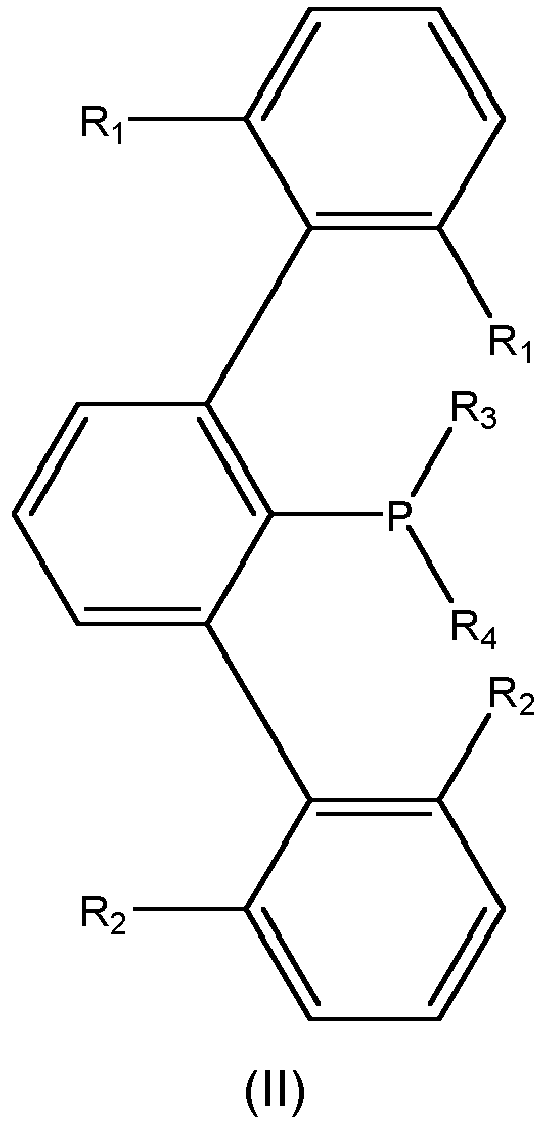
- In another embodiment of the first aspect of the present invention, the terphenylphosphine ligands have the formula (II):

- In another embodiment of the first aspect of the present invention, each R1 and R2 represents independently C1-C10 alkyl or C3-C10 cycloalky; preferably each R1 and R2 represents independently C1-C4 alkyl, more preferably each R1 and R2 represents independently methyl, ethyl, propyl and isopropyl. Preferably, R1 and R2 are equal.
- In another embodiment of the first aspect of the present invention, R1 and R2 are methyl.
- In another embodiment of the first aspect of the present invention, the terphenylphosphine ligands have the formula (II), the noble metal is Pt and R1 and R2 are methyl.
- In another embodiment of the first aspect of the present invention, R1 and R2 are isopropyl.
- In another embodiment of the first aspect of the present invention, the terphenylphosphine ligands have the formula (II), the noble metal is Pt and R1 and R2 are isopropyl.
- In another embodiment of the first aspect of the present invention, R3 and R4 are independently C1-C10 alkyl or C3-C10 cycloalkyl, preferably R3 and R4 are independently C1-C4 alkyl, more preferably R3 and R4 are independently methyl or ethyl.
- In another embodiment of the first aspect of the present invention, the terphenylphosphine ligands have the formula (II), the noble metal is Pt, R1 and R2 are methyl and R3 and R4 are independently C1-C10 alkyl or C3-C10 cycloalkyl, preferably R3 and R4 are independently C1-C4 alkyl, more preferably R3 and R4 are independently methyl or ethyl.
- In another embodiment of the first aspect of the present invention, the terphenylphosphine ligands have the formula (II), the noble metal is Pt, R1 and R2 are isopropyl and R3 and R4 are independently C1-C10 alkyl or C3-C10 cycloalkyl, preferably R3 and R4 are independently C1-C4 alkyl, more preferably R3 and R4 are independently methyl or ethyl.
- In another embodiment of the first aspect of the present invention, R3 and R4 are methyl.
- In another embodiment of the first aspect of the present invention, the terphenylphosphine ligands have the formula (II), the noble metal is Pt, R1 and R2 are isopropyl and R3 and R4 are methyl.
- In another embodiment of the first aspect of the present invention, the terphenylphosphine ligands have the formula (II), the noble metal is Pt, R1 and R2 are methyl and R3 and R4 are methyl.
- In another embodiment of the first aspect of the present invention, R3 and R4 are ethyl.
- In another embodiment of the first aspect of the present invention, the terphenylphosphine ligands have the formula (II), the noble metal is Pt, R1 and R2 are isopropyl and R3 and R4 are ethyl.
- In another embodiment of the first aspect of the present invention, the terphenylphosphine ligands have the formula (II), the noble metal is Pt, R1 and R2 are methyl and R3 and R4 are ethyl.
- In another embodiment of the first aspect of the present invention, the terphenylphosphine ligands have the formula (A), (B) or (C):

- The nanoparticles of the invention are coated by ligands of formula (A), (B), (C) or mixtures thereof.
- In another embodiment of the first aspect of the present invention, the terphenylphosphine ligands have the formula B.
- In another embodiment of the first aspect of the present invention, the terphenylphosphine ligands have the formula B and the ligand/Pt molar ratio is 0.2
- In another embodiment of the first aspect of the present invention, the ligand/noble metal molar ratio is between 0.1 and 0.7, preferably between 0.2 and 0.5.
- In another embodiment of the first aspect of the present invention, the ligand/noble metal molar ratio is between 0.1 and 0.7, preferably between 0.2 and 0.5 and the noble metal is Pt.
- In another embodiment of the first aspect of the present invention, the mean diameter of the noble metal nanoparticles is between 1 nm and 3 nm, preferably between 1.5 nm and 2.5 nm, more preferably between 1.9 nm and 2.3 nm.
- A second aspect of the present invention relates to a process for obtaining the nanoparticles as described above comprising the steps:
- a) provide a solution of a noble metal complex, wherein the noble metal is selected from Ru, Os, Rh, Ir, Pd and Pt; and
- b) put the solution of step (a) in contact with the ligand of formula (I) wherein R1, R2, R3, R4, m and n are defined above, at a temperature in between -60°C and 30°C under H2 at a pressure between 1. and 5 bar, preferably the temperature is between -60°C and -30°C.
- In another embodiment of the second aspect of the present invention, the noble metal complex is selected from [Pt2(dba)3], [Pt(dba)2], Pt(COD)2, PtCl2(COD)2, PtMe2(COD)2, PtMe2(NBD), PtPh2(COD)2, Pt(NBD)3, [Pd(dba)2], [Ru(COD)(COT)], [Rh(allyl)3], [Ir(allyl)3], Ir(acac)3, [Rh(OMe)(COD)]2 [Ir(OMe)(COD)]2 and mixtures thereof, preferably the noble metal complex is selected from [Pt(dba)2], [Pt2(dba)3] and mixtures thereof, more preferably the metal complex is a mixture of [Pt(dba)2], [Pt2(dba)3].
In one embodiment of the second aspect of the present invention, the noble metal is selected from Ru, Pd and Pt, preferably Pt. Therefore, the noble metal complex is selected from [Pt2(dba)3], [Pt(dba)2], Pt(COD)2, PtCl2(COD)2, PtMe2(COD)2, PtMe2(NBD), PtPh2(COD)2, Pt(NBD)3, [Pd(dba)2], [Ru(COD)(COT)], and mixtures thereof, preferably the noble metal complex is selected from [Pt(dba)2], [Pt2(dba)3] and mixtures thereof, more preferably the metal complex is a mixture of [Pt(dba)2], [Pt2(dba)3]. - Dba is dibenzylideneacetone; COD is 1,5-cyclooctadiene; NBD is 2,5-norbornadiene; COT is 1,3,5,7-cyclooctatetraene; acac is acetylacetonate.
- In another embodiment of the second aspect of the present invention, n and m is 1 or 2, preferably n is 2 and/or m is 2.
- In another embodiment of the second aspect of the present invention, the terphenylphosphine ligands have the formula (II):

- In another embodiment of the second aspect of the present invention, each R1 and R2 represents independently C1-C10 alkyl or C3-C10 cycloalkyl; preferably each R1 and R2 represents independently C1-C4 alkyl, more preferably each R1 and R2 represents independently methyl, ethyl, propyl and isopropyl. Preferably, R1 and R2 are equal.
- In another embodiment of the second aspect of the present invention, R1 and R2 are methyl.
- In another embodiment of the second aspect of the present invention, the terphenylphosphine ligands have the formula (II), the noble metal is Pt and R1 and R2 are methyl.
- In another embodiment of the second aspect of the present invention, R1 and R2 are isopropyl.
- In another embodiment of the second aspect of the present invention, the terphenylphosphine ligands have the formula (II), the noble metal is Pt and R1 and R2 are isopropyl.
- In another embodiment of the second aspect of the present invention, R3 and R4 are independently C1-C10 alkyl or C3-C10 cycloalkyl, preferably R3 and R4 are independently C1-C4 alkyl, more preferably R3 and R4 are independently methyl or ethyl.
- In another embodiment of the second aspect of the present invention, the terphenylphosphine ligands have the formula (II), the noble metal is Pt, R1 and R2 are methyl and R3 and R4 are independently C1-C10 alkyl or C3-C10 cycloalkyl, preferably R3 and R4 are independently C1-C4 alkyl, more preferably R3 and R4 are independently methyl or ethyl.
- In another embodiment of the second aspect of the present invention, the terphenylphosphine ligands have the formula (II), the noble metal is Pt, R1 and R2 are isopropyl and R3 and R4 are independently C1-C10 alkyl or C3-C10 cycloalkyl, preferably R3 and R4 are independently C1-C4 alkyl, more preferably R3 and R4 are independently methyl or ethyl.
- In another embodiment of the second aspect of the present invention, R3 and R4 are methyl.
- In another embodiment of the second aspect of the present invention, the terphenylphosphine ligands have the formula (II), the noble metal is Pt, R1 and R2 are isopropyl and R3 and R4 are methyl.
- In another embodiment of the second aspect of the present invention, the terphenylphosphine ligands have the formula (II), the noble metal is Pt, R1 and R2 are methyl and R3 and R4 are methyl.
- In another embodiment of the second aspect of the present invention, R3 and R4 are ethyl.
- In another embodiment of the second aspect of the present invention, the terphenylphosphine ligands have the formula (II), the noble metal is Pt, R1 and R2 are isopropyl and R3 and R4 are ethyl.
- In another embodiment of the second aspect of the present invention, the terphenylphosphine ligands have the formula (II), the noble metal is Pt, R1 and R2 are methyl and R3 and R4 are ethyl.
- In another embodiment of the second aspect of the present invention, the terphenylphosphine ligands have the formula (A), (B) or (C), preferably the terphenylphosphine ligands have the formula (B).
- In another embodiment of the second aspect of the present invention, the ligand/noble metal molar ratio is between 0.1 and 0.7, preferably between 0.2 and 0.5.
- In another embodiment of the second aspect of the present invention, the ligand/noble metal molar ratio is between 0.1 and 0.7, preferably between 0.2 and 0.5 and the noble metal is Pt.
- In another embodiment of the second aspect of the present invention, the mean diameter of the noble metal nanoparticles is between 1 nm and 3 nm, preferably between 1.5 nm and 2.5 nm, more preferably between 1.9 nm and 2.3 nm.
- A third aspect of the present invention relates to the use of the nanoparticles as described above as a catalyst for hydrogen generation from ammonia-borane. Preferably the hydrogen generation from the alcoholysis of ammonia-borane, more preferably from the methanolysis of ammonia-borane.
- A fourth aspect of the present invention relates to a process for the hydrogen generation from ammonia-borane and an C1-C6 alcohol comprising contacting a C1-C6 alcohol with ammonia-borane in the presence of the noble metal nanoparticles coated with terphenylphosphine ligands of formula (I) as described above at a temperature between 20°C to 60°C.
- A C1-C6 alcohol refers to a linear or branched alkyl chain containing 1 to 6 carbon atoms and at least one hydroxyl group. Examples of such alcohol are methanol, ethanol, propanol, isopropanol, butanol, isobutanol, sec-butanol, terc-butanol, pentanol, etc. Preferably the C1-C6 alcohol is selected from methanol, ethanol, propanol and isopropanol, more preferably the C1-C6 alcohol is methanol.
- In one embodiment of the fourth aspect of the present invention, the molar ratio ammonia-borane/noble metal is 100 to 10000, preferably the molar ratio ammonia-borane/noble metal is 500 to 5000.
- Unless otherwise defined, all technical and scientific terms used herein have the same meaning as commonly understood by one of ordinary skilled in the art to which this invention belongs. Methods and materials similar or equivalent to those described herein can be used in the practice of the present invention. Throughout the description and claims the word "comprise" and its variations are not intended to exclude other technical features, additives, components, or steps. Additional objects, advantages and features of the invention will become apparent to those skilled in the art upon examination of the description or may be learned by practice of the invention. The following examples and drawings are provided by way of illustration and are not intended to be limiting of the present invention.
-
- Fig. 1A.
- TEM image of the CN1 of example 1.
- Fig. 1B.
- Size histogram of the CN1 of example 1
- Fig. 2A.
- TEM image of the CN2 of example 2.
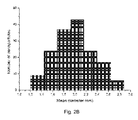
- Fig. 2B
- Size histogram of the CN2 of example 2
- Fig. 3A.
- TEM image of the CN3 of example 3
- Fig. 3B
- Size histogram of the CN3 of example 3
- Fig. 4A
- TEM image of the CN4 of example 4
- Fig. 4B
- Size histogram of the CN4 of example 4
- Fig. 5
- H2 generation using the coated nanoparticles of the invention.
- All the reactions have been carried out in a glovebox or under nitrogen or argon atmosphere. Solvents have been dried by already known procedures and distilled under argon or nitrogen atmosphere before their use. Methanol was dried with sodium methoxide (MeONa) and distilled under argon. AB was purchased from Aldrich and was used without any further purification. Terphenylphosphine ligands were prepared according to already published procedures [R. C. Smith, R. A. Woloszynek, W. Chen, T. Renb, J. D. Protasiewicza, Tetrahedron Lett. 2004, 45, 8327-8330; B. Buster, A. A. Diaz, T. Graham, R. Khan, M. A. Khan, D. R. Powell, R. J. Wehmschulte, Inorg. Chim. Acta 2009, 362, 3465-3474; L. Ortega-Moreno, M. Fernández-Espada, J. J. Moreno, C. Navarro-Gilabert, J. Campos, S. Conejero, J. López-Serrano, C. Maya, R. Peloso, E. Carmona, Polyhedron, 2016, 116, 170-181]. [Pt(dba)2] was obtained by a previously reported method [K. Moseley, P. M. Maitlis, Chem. Commun. 1971, 982-983], and its %wt of Pt was determined by ICP. TEM analyses were performed at the "Centro de Investigación, Tecnología e Innovación -CITIUS" by using a Philips CM-200 working at 200 kV with a point resolution of 2.8 A. The approximation of the particles mean size was made through a manual analysis of enlarged micrographs by measuring ca 200 particles on a given grid. ICP analyses were performed at the "Mikroanalystisches Labor Pascher" (Germany). 11B NMR spectra were acquired in a Bruker spectrometer DPX-300 (96 MHz for 11B) using the signal of BF3(C2H5)2O as reference.
- Platinum nanoparticles have been prepared by adaptation of a previously reported procedure [C. Amiens et al., J. Am. Chem. Soc. 1993, 115, 11638; K. Philippot and B. Chaudret, in Comprehensive Organometallic Chemistry III, R. H. Crabtree & M. P. Mingos (Eds-in-Chief), Elsevier, Vol. 12 - Applications III: Functional Materials, Environmental and Biological Applications, Dermot O'Hare (Volumen Ed.), 2007, Chapter 12-03, 71-99], using [Pt(dba)2] (dba= dibenzylideneacetone) under 3 bar of H2 in the presence of variable amounts of ligand.
- [Pt(dba)2] (250 mg, 0.36 mmol) was introduced in a Fischer-Porter bottle and dissolved in 35 ml of freshly distilled and degassed THF by argon bubbling. The resulting violet solution was cooled at -60°C and a solution of 15 ml of THF containing ligand A (25.6 mg, 0.074 mmol) was added into the reactor. The Fischer-Porter bottle was pressurized with 3 bar of H2 and the solution was left to reach slowly the room temperature under vigorous stirring. The homogenous solution, which turns black after 30 minutes of reaction, was kept under stirring overnight at room temperature. After this period of time, excess of H2 was eliminated and the volume of solvent was reduced to 10 ml under vacuum. 40 ml of pentane were then added to the colloidal suspension which was cooled down to -30°C to precipitate the particles. After filtration under argon with a cannula, the black solid powder was washed twice with pentane (2 x 40 ml) and filtrated again before drying under vacuum. Pt content (ICP): 64%, TEM (see
fig. 1A ): NPs of 2.2 nm mean size (standard deviation 0.5, seeFigure 1 B) . - [Pt(dba)2] (250 mg, 0.36 mmol) was introduced in a Fischer-Porter bottle and dissolved in 35 ml of freshly distilled and degassed THF by argon bubbling. The resulting violet solution was cooled at -60°C and a solution of 15 ml of THF containing ligand A (64.1 mg, 0.19 mmol) was added into the reactor. The Fischer-Porter bottle was pressurized with 3 bar of H2 and the solution was left to reach slowly the room temperature under vigorous stirring. The homogenous solution, which turns black after 30 minutes of reaction, was kept under stirring overnight at room temperature. After this period of time, excess of H2 was eliminated and the volume of solvent was reduced to 10 ml under vacuum. 40 ml of pentane were then added to the colloidal suspension which was cooled down to -30°C to precipitate the particles. After filtration under argon with a cannula, the black solid powder was washed twice with pentane (2 x 40 ml) and filtrated again before drying under vacuum. Pt content (ICP): 52%, TEM (
Fig. 2A ): NPs of 2.0 (0.3) nm mean size (seeFigure 2B ). - [Pt(dba)2] (250 mg, 0.36 mmol) was introduced in a Fischer-Porter bottle and dissolved in 35 ml of freshly distilled and degassed THF by argon bubbling. The resulting violet solution was cooled at -60°C and a solution of 15 ml of THF containing ligand B (34.0 mg, 0.074 mmol) was added into the reactor. The Fischer-Porter bottle was pressurized with 3 bar of H2 and the solution was left to reach slowly the room temperature under vigorous stirring. The homogenous solution, which turns black after 30 minutes of reaction, was kept under stirring overnight at room temperature. After this period of time, excess of H2 was eliminated and the volume of solvent was reduced to 10 ml under vacuum. 40 ml of pentane were then added to the colloidal suspension which was cooled down to -30°C to precipitate the particles. After filtration under argon with a cannula, the black solid powder was washed twice with pentane (2 x 40 ml) and filtrated again before drying under vacuum. Pt content (ICP): 69%, TEM (see
fig. 3A ): NPs of 2.0 (0.5) nm mean size (seeFigure 3B ). - [Pt(dba)2] (250 mg, 0.36 mmol) was introduced in a Fischer-Porter bottle and dissolved in 35 mL of freshly distilled and degassed THF by argon bubbling. The resulting violet solution was cooled at -60 °C and a solution of 15 ml of THF containing ligand C (27.8 mg, 0.074 mmol) was added into the reactor. The Fischer-Porter bottle was pressurized with 3 bar of H2 and the solution was left to reach slowly the room temperature under vigorous stirring. The homogeneous solution, which turns black after 30 minutes of reaction, was kept under stirring overnight at room temperature. After this period of time, excess of H2 was eliminated and the volume of solvent was reduced to 10 mL under vacuum. 40 mL of pentane were then added to the colloidal suspension which was cooled down to -30 °C to precipitate the particles. After filtration under argon with a cannula, the black solid powder was washed twice with pentane (2 x 40 mL) and filtered again before drying under vacuum. Pt content (ICP): 67 %, TEM (
Fig. 4A ): NPs of 1.5 (0.2) nm mean size (seeFigure 4B ). - H2 generation was followed using a Fischer-Porter bottle (25 ml) connected to a vacuum line and coupled to a pressure gauge model GS4200-USB (0-6 bar) plugged to a computer. Quantitative formation of ammonium tetramethoxide (NH4B(OMe)4) was determined by 11B NMR (singlet at δ 7.5 ppm) [P. V. Ramachandran, P. D. Gagare, Inorg. Chem. 2007, 46, 7810-7817].
- A solution of AB (1.9 M) in MeOH (1.0 mL, 1.9 mmol) was added to a colloidal suspension of the coated nanoparticles of the invention indicated in the table below, in MeOH, thermostated to 30°C (except example 5.5, which was performed at 55°C) and stirred at 750 rpm. H2 generation was followed by registering the increase of pressure in the system (see table below and
Figure 5 ).coated nanoparticles ml MeOH (suspension) H2 generated [mmol H2/(mmol Pt x min)-1] Ex. mg µmol Pt 5.1 CN1 1.0 3.3 0.5 191 5.2 CN2 1.0 2.7 0.5 107 5.3 CN3 1.0 3.5 0.5 284 5.4 CN3 0.4 1.4 0.1 253 5.5 CN3 0.1 0.35 0.1 120 5.6 CN4 1.0 3.4 0.5 76 - H2 generation was followed using a Fischer-Porter bottle (25 ml) connected to a vacuum line and coupled to a pressure gauge model GS4200-USB (0-6 bar) plugged to a computer. Quantitative formation of ammonium tetramethoxide (NH4B(OMe)4) was determined by 11B NMR (singlet at δ 7.5 ppm) [P. V. Ramachandran, P. D. Gagare, Inorg. Chem. 2007, 46, 7810-7817].
- A solution of AB (1.9 M) in MeOH (1.0 mL, 1.9 mmol) was added to a colloidal suspension of the coated nanoparticles of the invention (1.0 mg) indicated in the table below in MeOH (0.5 mL) thermostated to 25°C for (CN1 and CN3) and 30 °C for CN4 and stirred at 750 rpm. H2 generation was followed by registering the increase of pressure in the system. After the reaction proceeds to completion, solvent and ammonium tetramethoxide are evaporated under vacuum. MeOH (0.5 mL) and a solution 1.9 M of AB in MeOH (1.0 mL, 1.9 mmol) are added and H2 generation is followed. The process is repeated five times (see table below).
CN1 CN3 CN4 Cycle TOFa TOFa TOFa 1 118 231 76 2 119 153 62 3 77 157 42 4 89 61 49 5 43 19 27 Amount of catalyst used mg (µmol) 1.0 (3.3) 1.0 (3.5) 1.0 (3.4) Total amount of H2 generatedb 8640 8055 8382 TOFa (mmol H2) × (mmol Pt)-1 × min-1; Amount of H2 generatedb (mmol H2)× (mmol Pt)-1
Claims (18)
- Noble metal nanoparticles coated with terphenylphosphine ligands of formula (I),
 each R1 and R2 represents independently C1-C10 alkyl, C3-C10 cycloalkyl or C1-C10 alkoxy;R3 and R4 represent independently C1-C10 alkyl, C3-C10 cycloalkyl C1-C10 alkoxy, phenyl or C5-C7 heteroaryl;n and m are whole numbers independently between 0 and 5; andwherein the noble metal is selected from Ru, Os, Rh, Ir, Pd and Pt and the ligand/noble metal molar ratio is between 0.05 and 0.8.
 - Nanoparticles according to claim 1, wherein the noble metal is selected from Ru, Pd and Pt, preferably the noble metal is Pt.
- Nanoparticles according to any of claims 1 or 2, wherein n and m is 1 or 2, preferably n is 2 and/or m is 2.
- Nanoparticles according to any of claims 1 to 3, wherein the terphenylphosphine ligands have the formula (II):
- Nanoparticles according to any of claims 1 to 4, wherein each R1 and R2 represents independently C1-C10 alkyl or C3-C10 cycloalkyl, preferably each R1 and R2 represents independently C1-C4 alkyl, more preferably each R1 and R2 represents independently methyl, ethyl, propyl and isopropyl.
- Nanoparticles according to any of claims 1 to 5, wherein R1 and R2 are methyl.
- Nanoparticles according to any of claims 1 to 5, wherein R1 and R2 are isopropyl.
- Nanoparticles according to any of claims 1 to 7, wherein R3 and R4 are independently C1-C10 alkyl or C3-C10 cycloalkyl, preferably R3 and R4 are independently C1-C4 alkyl, more preferably R3 and R4 are independently methyl or ethyl.
- Nanoparticles according to any of claims 1 to 8, wherein R3 and R4 are methyl.
- Nanoparticles according to any of claims 1 to 8, wherein R3 and R4 are ethyl.
- Nanoparticles according to any of claims 1 to 4, wherein the terphenylphosphine ligands have the formula (A), (B) or (C):

- Nanoparticles according to any of claims 1 to 11, wherein the ligand/noble metal molar ratio is between 0.1 and 0.7.
- Nanoparticles according to any of claims 1 to 12, wherein the mean diameter of the noble metal nanoparticles is between 1 nm and 3 nm, preferably between 1.5 nm and 2.5 nm.
- Process for obtaining the nanoparticles according to any of claims 1 to 13 comprising the steps:a) provide a solution of a noble metal complex, wherein the noble metal is selected from Ru, Os, Rh, Ir, Pd and Pt; andb) put the solution of step (a) in contact with the ligand of formula (I) wherein R1, R2, R3, R4, m and n are defined in claim 1, at a temperature in between -60°C and 30°C under H2 at a pressure between 1 and 5 bar.
- Process according to claim 14, wherein the noble metal complex is selected from [Pt2(dba)3], [Pt(dba)2], Pt(COD)2, PtCl2(COD)2, PtMe2(COD)2, PtMe2(NBD), PtPh2(COD)2, Pt(NBD)3, [Pd(dba)2], [Ru(COD)(COT)], [Rh(allyl)3], [Ir(allyl)3], Ir(acac)3, [Rh(OMe)(COD)]2 [Ir(OMe)(COD)]2 and mixtures thereof, preferably the noble metal complex is selected from [Pt(dba)2], [Pt2(dba)3] and mixtures thereof.
- Process according to any of claims 14 and 15, wherein the noble metal is selected from Ru, Pd and Pt, preferably Pt.
- Use of the nanoparticles according to claims 1 to 13 as a catalyst for hydrogen generation from ammonia-borane.
- rocess for hydrogen generation from ammonia-borane and an C1-C6 alcohol comprising contacting a C1C6 alcohol with ammonia-borane in the presence of nanoparticles according to claims 1 to 13 at a temperature between 20°C to 60°C.
Priority Applications (1)
| Application Number | Priority Date | Filing Date | Title |
|---|---|---|---|
| EP16382444.4A EP3299375A1 (en) | 2016-09-23 | 2016-09-23 | Noble metal nanoparticles coated with terphenylphosphine ligands for h2 generation from ammonia-borane and alcohols |
Applications Claiming Priority (1)
| Application Number | Priority Date | Filing Date | Title |
|---|---|---|---|
| EP16382444.4A EP3299375A1 (en) | 2016-09-23 | 2016-09-23 | Noble metal nanoparticles coated with terphenylphosphine ligands for h2 generation from ammonia-borane and alcohols |
Publications (1)
| Publication Number | Publication Date |
|---|---|
| EP3299375A1 true EP3299375A1 (en) | 2018-03-28 |
Family
ID=57003470
Family Applications (1)
| Application Number | Title | Priority Date | Filing Date |
|---|---|---|---|
| EP16382444.4A Withdrawn EP3299375A1 (en) | 2016-09-23 | 2016-09-23 | Noble metal nanoparticles coated with terphenylphosphine ligands for h2 generation from ammonia-borane and alcohols |
Country Status (1)
| Country | Link |
|---|---|
| EP (1) | EP3299375A1 (en) |
Cited By (4)
| Publication number | Priority date | Publication date | Assignee | Title |
|---|---|---|---|---|
| CN109772455A (en) * | 2019-03-14 | 2019-05-21 | 福州大学 | Preparation and application of a porous polyamine composite material encapsulating fine and highly dispersed palladium nanoparticles |
| EP3766891A4 (en) * | 2018-03-07 | 2021-12-08 | Dongguan Stephen Catalyst Co., Ltd. | TRIARYLPHOSPHINE LIGANDS, THEIR METHOD OF PREPARATION AND THEIR USE IN THE CATALYSIS OF COUPLING REACTIONS |
| EP4438173A1 (en) * | 2023-03-29 | 2024-10-02 | Université de Bourgogne | Nanocatalyst systems and their use for h2 delivery from solid storage |
| EP4714542A1 (en) * | 2024-09-20 | 2026-03-25 | Université de Bourgogne | Functionalized nanodiamonds and catalysts thereof for high-flow rate catalytic of h2 delivery from solid storage |
Citations (2)
| Publication number | Priority date | Publication date | Assignee | Title |
|---|---|---|---|---|
| US20070243122A1 (en) | 2006-03-13 | 2007-10-18 | Ramachandran P V | Process for the synthesis and methanolysis of ammonia borane and borazine |
| WO2008141439A1 (en) | 2007-05-18 | 2008-11-27 | Kanata Chemical Technologies Inc. | Method for the production of hydrogen from ammonia borane |
-
2016
- 2016-09-23 EP EP16382444.4A patent/EP3299375A1/en not_active Withdrawn
Patent Citations (2)
| Publication number | Priority date | Publication date | Assignee | Title |
|---|---|---|---|---|
| US20070243122A1 (en) | 2006-03-13 | 2007-10-18 | Ramachandran P V | Process for the synthesis and methanolysis of ammonia borane and borazine |
| WO2008141439A1 (en) | 2007-05-18 | 2008-11-27 | Kanata Chemical Technologies Inc. | Method for the production of hydrogen from ammonia borane |
Non-Patent Citations (30)
| Title |
|---|
| "Hydrogen as a Future Energy Carrier", 2008, WILEY-VCH |
| B. BUSTER; A. A. DIAZ; T. GRAHAM; R. KHAN; M. A. KHAN; D. R. POWELL; R. J. WEHMSCHULTE, INORG. CHIM. ACTA, vol. 362, 2009, pages 3465 - 3474 |
| B. PENG; J. CHEN, ENERGY ENVIRON. SCI., vol. 1, 2008, pages 479 - 483 |
| C. AMIENS ET AL., J. AM. CHEM. SOC., vol. 115, 1993, pages 11638 |
| D. OZHAVA; S. OZKAR, APPL. CATAL. B ENVIRON., vol. 181, 2016, pages 716 - 726 |
| D. OZHAVA; S. OZKAR, INT. J. HYDROGEN ENERGY, vol. 40, 2015, pages 10491 - 10501 |
| DERMOT O'HARE: "Applications III: Functional Materials, Environmental and Biological Applications", 2007, pages: 71 - 99 |
| H. ERDOGAN; O. METIN; S. OZKAR, CATAL. TODAY, vol. 170, 2011, pages 93 - 98 |
| H. ERDOGAN; O. METIN; S. OZKAR, PHYS. CHEM. CHEM. PHYS., vol. 11, 2009, pages 10519 - 10525 |
| H-B. DAI; X-D. KANG; P. WANG, INT. J. HYDROGEN ENERGY, vol. 35, 2010, pages 10317 - 10323 |
| H-L. JIANG; Q. XU, CATAL. TODAY, vol. 170, 2011, pages 56 - 63 |
| JESSICA F. SONNENBERG ET AL: "Evidence for Iron Nanoparticles Catalyzing the Rapid Dehydrogenation of Ammonia-Borane", ACS CATALYSIS, vol. 3, no. 6, 7 June 2013 (2013-06-07), US, pages 1092 - 1102, XP055343410, ISSN: 2155-5435, DOI: 10.1021/cs400115p * |
| J-K. SUN; W-W. ZHAN; T. AKITA; Q. XU, J. AM. CHEM. SOC., vol. 137, 2015, pages 7063 - 7066 |
| K. MOSELEY; P. M. MAITLIS, CHEM. COMMUN., 1971, pages 982 - 983 |
| K. PHILIPPOT; B. CHAUDRET: "Comprehensive Organometallic Chemistry III", vol. 12, ELSEVIER |
| L. ORTEGA-MORENO; M. FERNANDEZ-ESPADA; J. J. MORENO; C. NAVARRO-GILABERT; J. CAMPOS; S. CONEJERO; J. LOPEZ-SERRANO; C. MAYA; R. PE, POLYHEDRON, vol. 116, 2016, pages 170 - 181 |
| M. YADAV; Q. XU, ENERGY ENVIRON. SCI., vol. 5, 2012, pages 9698 - 9725 |
| M. ZAHMAKIRAN; S. OZKAR, TOP. CATAL., vol. 56, 2013, pages 1171 - 1183 |
| MARCO FETZ ET AL: "Hydrolysis of Ammonia Borane Catalyzed by Aminophosphine-Stabilized Precursors of Rhodium Nanoparticles: Ligand Effects and Solvent-Controlled Product Formation", CHEMISTRY - A EUROPEAN JOURNAL, vol. 17, no. 17, 18 April 2011 (2011-04-18), pages 4732 - 4736, XP055343393, ISSN: 0947-6539, DOI: 10.1002/chem.201003543 * |
| N. C. SMYTHE; J.C. GORDON, EUR. J. INORG. CHEM., 2010, pages 509 - 521 |
| N.ARMAROLI; V. BALZANI, CHEMSUSCHEM, vol. 4, 2011, pages 21 - 26 |
| P. V. RAMACHANDRAN; P. D. GAGARE, INORG. CHEM., vol. 46, 2007, pages 7810 - 7817 |
| P. V. RAMACHANDRAN; P.D. GAGARE, INORG. CHEM., vol. 46, 2007, pages 7810 - 7817 |
| R. C. SMITH; R. A. WOLOSZYNEK; W. CHEN; T. RENB; J. D. PROTASIEWICZA, TETRAHEDRON LETT., vol. 45, 2004, pages 8327 - 8330 |
| S. PENG; J. LIU; J. ZHANG; F. WANG, INT. J. HYDROGEN ENERGY, vol. 40, 2015, pages 10856 - 10866 |
| S. QALI KAN; M. ZAHMAKIRAN; S. OZKAR, APPL. CATAL. B ENVIRON, vol. 93, 2010, pages 387 - 394 |
| T.B. MARDER, ANGEW. CHEM. INT. ED., vol. 46, 2007, pages 8116 - 81118 |
| U. EBERLE; M. FELDERHOFF; F. SCHUTH, ANGEW. CHEM. INT. ED., vol. 48, 2009, pages 6608 - 6630 |
| U. SANYAL; U.B. DEMIRCI; B. R. JAGIRDAR; P. MIELE, CHEMSUSCHEM, vol. 4, 2011, pages 1731 - 1739 |
| VIRGINIA SAN NACIANCENO ET AL: "Hydrido{(acylphosphine)(diphenylphosphinous acid)}rhodium(III) Complexes. Catalysts for the Homogeneous Hydrolysis of Ammonia- or Amine-Boranes under Air", ORGANOMETALLICS, vol. 33, no. 21, 10 November 2014 (2014-11-10), US, pages 6044 - 6052, XP055343368, ISSN: 0276-7333, DOI: 10.1021/om500666w * |
Cited By (6)
| Publication number | Priority date | Publication date | Assignee | Title |
|---|---|---|---|---|
| EP3766891A4 (en) * | 2018-03-07 | 2021-12-08 | Dongguan Stephen Catalyst Co., Ltd. | TRIARYLPHOSPHINE LIGANDS, THEIR METHOD OF PREPARATION AND THEIR USE IN THE CATALYSIS OF COUPLING REACTIONS |
| CN109772455A (en) * | 2019-03-14 | 2019-05-21 | 福州大学 | Preparation and application of a porous polyamine composite material encapsulating fine and highly dispersed palladium nanoparticles |
| EP4438173A1 (en) * | 2023-03-29 | 2024-10-02 | Université de Bourgogne | Nanocatalyst systems and their use for h2 delivery from solid storage |
| WO2024200745A1 (en) * | 2023-03-29 | 2024-10-03 | Université de Bourgogne | Nanocatalyst systems and their use for h2 delivery from solid storage |
| EP4714542A1 (en) * | 2024-09-20 | 2026-03-25 | Université de Bourgogne | Functionalized nanodiamonds and catalysts thereof for high-flow rate catalytic of h2 delivery from solid storage |
| WO2026062139A1 (en) * | 2024-09-20 | 2026-03-26 | Université Bourgogne Europe | Functionalized nanodiamonds and catalysts thereof for high-flow rate catalytic of h2 delivery from solid storage |
Similar Documents
| Publication | Publication Date | Title |
|---|---|---|
| Mellone et al. | Selective formic acid dehydrogenation catalyzed by Fe-PNP pincer complexes based on the 2, 6-diaminopyridine scaffold | |
| Mavila et al. | A general approach to mono-and bimetallic organometallic nanoparticles | |
| Qin et al. | Visible-light reduction CO2 with dodecahedral zeolitic imidazolate framework ZIF-67 as an efficient co-catalyst | |
| Liao et al. | Post-synthetic exchange (PSE) of UiO-67 frameworks with Ru/Rh half-sandwich units for visible-light-driven H 2 evolution and CO 2 reduction | |
| Lara et al. | Phosphane‐decorated Platinum Nanoparticles as Efficient Catalysts for H2 Generation from Ammonia Borane and Methanol | |
| Sen et al. | Highly efficient catalytic dehydrogenation of dimethyl ammonia borane via monodisperse palladium–nickel alloy nanoparticles assembled on PEDOT | |
| Rui et al. | The synergistic catalysis on Co nanoparticles and CoNx sites of aniline-modified ZIF derived Co@ NCs for oxidative esterification of HMF | |
| Robertson et al. | Heterogeneous dehydrocoupling of amine–borane adducts by skeletal nickel catalysts | |
| Kassymova et al. | Post-synthetically modified MOF for the A 3-coupling reaction of aldehyde, amine, and alkyne | |
| Asensio et al. | Synthesis of Water‐Soluble Palladium Nanoparticles Stabilized by Sulfonated N‐Heterocyclic Carbenes | |
| Duman et al. | Oleylamine-stabilized ruthenium (0) nanoparticles catalyst in dehydrogenation of dimethylamine-borane | |
| CN108298499B (en) | A kind of method that water-soluble metal complex catalyzes formic acid to decompose hydrogen | |
| Ding et al. | A Hexagonal Covalent Porphyrin Framework as an Efficient Support for Gold Nanoparticles toward Catalytic Reduction of 4‐Nitrophenol | |
| Ma et al. | Ruthenium single-atom anchored in polyoxometalate-ionic liquids for N-formylation of amines with CO2 and H2 | |
| CN111041517A (en) | A kind of preparation method of two-dimensional bismuthene nanosheet and its application | |
| Rösler et al. | Encapsulation of Bimetallic Metal Nanoparticles into Robust Zirconium‐Based Metal–Organic Frameworks: Evaluation of the Catalytic Potential for Size‐Selective Hydrogenation | |
| Dutta et al. | Dehydrogenation of formic acid mediated by a Phosphorus–Nitrogen PN3P-manganese pincer complex: Catalytic performance and mechanistic insights | |
| CN106749417A (en) | A kind of three core ruthenium NNN complexs and preparation method thereof | |
| Du et al. | Hemicelluloses supported palladium/xylan nanocomposites containing N and O ligands: highly-performance heterogeneous catalysts for Suzuki reaction | |
| Chen et al. | Synergy of metallic Co and oxygen vacancy sites in Co/Ce-MOF catalysts for efficiently promoting lignin derived phenols and macromolecular lignin hydrodeoxygenation | |
| Birkelbach et al. | Enabling the terpyridine ligand motif for Ir-based solid molecular catalysts | |
| Hao et al. | “In situ immobilization” of a multicomponent chiral catalyst (MCC) via non-covalent interactions for heterogeneous asymmetric hydrogenation reactions | |
| Yuan et al. | Three birds, one-stone strategy for fabrication of hierarchically arrayed Ru/BU-TiO2 nanoribbon assemblies toward efficient hydrogen evolution | |
| Schröder et al. | Simultaneous Gas‐Phase Loading of MOF‐5 with Two Metal Precursors: towards Bimetallics@ MOF | |
| Kumar et al. | Heterogenization of cobalt nanoparticles on hollow carbon capsules: Lab-in-capsule for catalytic transfer hydrogenation of carbonyl compounds |
Legal Events
| Date | Code | Title | Description |
|---|---|---|---|
| PUAI | Public reference made under article 153(3) epc to a published international application that has entered the european phase |
Free format text: ORIGINAL CODE: 0009012 |
|
| STAA | Information on the status of an ep patent application or granted ep patent |
Free format text: STATUS: THE APPLICATION HAS BEEN PUBLISHED |
|
| AK | Designated contracting states |
Kind code of ref document: A1 Designated state(s): AL AT BE BG CH CY CZ DE DK EE ES FI FR GB GR HR HU IE IS IT LI LT LU LV MC MK MT NL NO PL PT RO RS SE SI SK SM TR |
|
| AX | Request for extension of the european patent |
Extension state: BA ME |
|
| STAA | Information on the status of an ep patent application or granted ep patent |
Free format text: STATUS: THE APPLICATION IS DEEMED TO BE WITHDRAWN |
|
| 18D | Application deemed to be withdrawn |
Effective date: 20180929 |