EP3298529B1 - Electronic device and method in an electronic device - Google Patents
Electronic device and method in an electronic device Download PDFInfo
- Publication number
- EP3298529B1 EP3298529B1 EP15726602.4A EP15726602A EP3298529B1 EP 3298529 B1 EP3298529 B1 EP 3298529B1 EP 15726602 A EP15726602 A EP 15726602A EP 3298529 B1 EP3298529 B1 EP 3298529B1
- Authority
- EP
- European Patent Office
- Prior art keywords
- electronic device
- security policy
- execution environment
- secure execution
- kernel
- Prior art date
- Legal status (The legal status is an assumption and is not a legal conclusion. Google has not performed a legal analysis and makes no representation as to the accuracy of the status listed.)
- Active
Links
Images

Classifications
-
- G—PHYSICS
- G06—COMPUTING OR CALCULATING; COUNTING
- G06F—ELECTRIC DIGITAL DATA PROCESSING
- G06F21/00—Security arrangements for protecting computers, components thereof, programs or data against unauthorised activity
- G06F21/50—Monitoring users, programs or devices to maintain the integrity of platforms, e.g. of processors, firmware or operating systems
Definitions
- the present invention relates to an electronic device, corresponding methods and computer program.
- security policies may be used to control access right to various system or application resources.
- the security policy system comprises of a set of rules applications in the electronic device should obey.
- the security policy is included in a boot image of an operating system (OS), such as Linux or Android.
- OS operating system
- the boot image comprises the OS kernel and RAM disk and must be read-only because it must be authenticated and integrity checked every time the device starts. The authenticity and integrity is protected by a cryptographic signature of the boot image.
- US 2012/0216242 A1 concerns systems and methods for enhanced security in wireless communication by means of a policy server and a protection core.
- US 2010/0132012 A1 addresses application of local instance of a general security policy.
- WO 2015/021547 A1 discloses a system wherein the operation system middleware comprises a Domain Policy Service that verifies a security policy that is to be enforced by the kernel.
- An objective of embodiments of the present invention is to provide a solution which mitigates or solves the shortcomings of conventional solutions.
- an electronic device comprising:
- An advantage with the solution according to the first aspect is that the security policy may be more easily updated while maintaining security, since the updated data package containing the policy is much smaller than the entire OS image.
- the verification of the integrity and authenticity of the policy is performed in the secure execution environment.
- An easy and safe mechanism for updating the security policy without a need to perform extensive system configuration update may be obtained.
- the advantage in such a scenario is that policy changes reach the device faster and in a more reliable way.
- Another advantage is that policy changes may be made for individual devices, rather than for a full class of devices.
- the kernel may be a kernel of an operation system. It is advantageous to use a secure execution environment for performing some or all security critical operations in the electronic device, e.g.
- a further advantage is that it is possible to enabling or disabling hardware features in the electronic device on demand. This may allow for downgrading or upgrading device features in the electronic device, like a high quality camera or other peripherals at any time, even without modifying the OS image itself.
- the secure execution environment is configured to verify that the verified security policy is applied by the kernel to the electronic device.
- the device further comprises a memory, and wherein the secure execution environment further is configured to receive an update of the security policy from an administration server and store the update in the memory.
- the memory may be a non-volatile memory which may comprise a read-write file system, suitable for storing the policy.
- the update is requested by the electronic device and is pulled from the administration server.
- the update is pushed from the administration server to the electronic device.
- the administration server is a root administration server, or a delegated administration server wherein the delegated administration server is authorized by the root administration server to provide the update of the security policy to the electronic device.
- the operating system kernel is configured to apply the security policy to the electronic device once updated, or at a secure boot sequence. It may be advantageous to be able for the kernel to apply the verified security policy directly once updated, since this avoids the need for system restart. This also reduced the security risk of having a device operating a period of time with an outdated security policy, i.e. being vulnerable. Alternatively the security policy may be applied at the next secure boot sequence.
- the operating system kernel is configured to request the secure execution environment to provide a security policy, whereafter the secure execution environment is configured to transmit the verified security policy to the kernel.
- the operating system kernel is configured to request the secure execution environment to provide a security policy after completing a secure boot sequence.
- the operating system kernel is configured to request the secure execution environment to provide a security policy at any time on run-time of the electronic device.
- the secure execution environment is configured to receive the security policy in encrypted form.
- the secure execution environment is configured to verify the integrity and authenticity of the received security policy by using digital signatures or Message Authentication Codes, MAC.
- MAC Message Authentication Codes
- the secure execution environment is configured to check the entitlement of the security policy by verifying a certificate of policy authority and signature of the security policy, or by verifying an Access Control List.
- the advantage of this is that the secure execution environment may verify that the security policy was issued by an authorized entity, entitled to issue a security policy.
- the secure execution environment is comprised in the processor, such that the processor comprises a main operating environment configured to host the operating system kernel and wherein the secure execution environment is separated from the main operating environment.
- the secure execution environment may be securely implemented in the processor circuit.
- the secure execution environment may be a Trusted Execution Environment, TEE.
- the TEE is a secure area that resides in the processor of the electronic device and enables that sensitive data to be stored, processed and protected in a trusted and secure environment.
- the TEE is an isolated environment that runs in parallel with the kernel of the operating system. Thus a high level of security may be obtained.
- the secure execution environment may be implemented in a co-processor, in a discrete component.
- a discrete component may be a Secure Element, SE, such as a universal integrated circuit, UICC, an embedded SE or a microSD.
- SE Secure Element
- UICC universal integrated circuit
- embedded SE embedded SE
- microSD microSD
- the kernel may be a kernel of an operating system.
- the secure execution environment verifies that the verified security policy is applied by the kernel to the electronic device.
- the secure execution environment receives an update of the security policy from an administration server and stores the update in a memory.
- the update is requested by the electronic device and is pulled from the administration server.
- the update is pushed from the administration server to the electronic device.
- the administration server is a root administration server, or a delegated administration server wherein the delegated administration server is authorized by the root administration server to provide the update of the security policy to the electronic device.
- the operating system kernel applies the security policy to the electronic device once updated, or at a secure boot sequence.
- the operating system kernel requests the secure execution environment to provide a security policy, whereafter the secure execution environment transmits the verified security policy to the kernel.
- the operating system kernel requests the secure execution environment to provide a security policy after completing a secure boot sequence.
- the operating system kernel requests the secure execution environment to provide a security policy at any time on run-time of the electronic device.
- the secure execution environment verifies the integrity and authenticity of the received security policy by using digital signatures or Message Authentication Codes, MAC.
- the secure execution environment checks the entitlement of the security policy by verifying a certificate of policy authority and signature of the security policy, or by verifying an Access Control List.
- the secure execution environment is comprised in the processor, such that the processor comprises a main operating environment configured to host the operating system kernel and wherein the secure execution environment is separated from the main operating environment.
- a computer program comprising program code for performing a method according to the present invention when the computer program runs on a computer.
- the invention also relates to a computer program product comprising a computer readable medium and said mentioned computer program, wherein said computer program is included in the computer readable medium, and comprises of one or more from the group: ROM (Read-Only Memory), PROM (Programmable ROM), EPROM (Erasable PROM), Flash memory, EEPROM (Electrically EPROM) and hard disk drive.
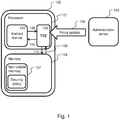
- an example of an electronic device 100 comprising a processor 101 and a secure execution environment 103.
- the processor 101 is configured to operate a kernel 102 of an operating system.
- the secure execution environment 103 is configured to protect the integrity and authenticity of a security policy of the electronic device 100.
- the electronic device 100 further comprises a memory 104.
- the memory is a non-volatile memory having a file system for storing the security policy.
- the operating system kernel 102 is configured to request 108 the secure execution environment 103 to provide a security policy. This may be done after completing a secure boot sequence or at any time on run-time of the electronic device 100.
- the secure execution environment 103 is configured to retrieve 109 a security policy from the memory 104, and verify the integrity and authenticity of the security policy.
- the integrity and authenticity of the security is verified by using digital signatures or Message Authentication Codes, MAC.
- the security policy may be verified by a secure application running in the secure execution environment.
- the secure execution environment 103 is configured thereafter to transmit 110 the verified security policy to the kernel 102 for application.
- the kernel 102 is configured to apply the verified security policy to the electronic device 100.
- the operating system kernel 102 may be configured to apply the security policy to the electronic device 100 once updated, or at a subsequent secure boot sequence.
- the application of the security policy to the electronic device 100 by the kernel 102 is verified by the secure execution environment 103.
- the secure execution environment 103 is configured to receive an update 106 of the security policy from an administration server 105 and store 111 the update 106 in the memory 104.
- the update 106 may be requested by the electronic device 100 and pulled from the administration server 105. This may be the case when an application or system resource in the electronic device is added or altered, wherein this change requires an update of the security policy. Alternatively the update 106 may be pushed from the administration server 105 to the electronic device 100. This may be the case when a central update of the security policy is required.
- the secure execution environment 103 may be configured to receive the security policy in encrypted or in unencrypted form.
- the security policy may be stored in the memory 104 in encrypted form if it is required from a privacy point of view.
- the secure execution environment 103 is further configured to check the entitlement of the security policy.
- the entitlement is checked in order to verify that the security policy was created by an entity, e.g. a server, which was entitled (i.e. had the right to) create the policy.
- the entitlement may be checked by verifying a certificate of policy authority and signature of the security policy, or by verifying an Access Control List.
- the secure execution environment 103 is comprised in the processor, 101.
- the processor 101 thus comprises a main operating environment configured to host the operating system kernel 102 and the secure execution environment 103 is separated from the main operating environment.
- the separation of the main operating environment and the secure execution environment is defined in the hardware of the processor 101.
- the secure execution environment is a Trusted Execution Environment, TEE.
- the TEE is an isolated environment that runs in parallel with the kernel 102 of the operating system.
- the TEE is a secure area that resides in the processor 101 of the electronic device 100 and enables that sensitive data to be stored, processed and protected in a trusted and secure environment, e.g. using ARM TrustZone technology.
- the secure execution environment 103 is implemented in a Secure Element, SE, a discrete circuit separate from the processor 101. According to yet a further alternative not part of the current invention the secure execution environment 103 may be implemented in software.
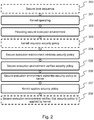
- a secure boot sequence is performed, 200.
- a kernel 102 of an operating system is thus operating 201.
- a secure execution environment 103 such as a TEE, is provided 202 for protecting the integrity and authenticity of a security policy of the device.
- the kernel requests 203 the secure execution environment to provide the most recent security policy for the device.
- the secure execution environment 103 retrieves 204 a security policy from a memory of the device.
- An application in the secure execution environment 103 verifies 205 the integrity and authenticity of the security policy.
- the verified security policy is transmitted 206 to the kernel 102.
- the kernel applies 207 the verified security policy to the electronic device 100, thus applying the rules contained in the security policy.
- the application of the security policy by the kernel is verified 208 by an application in the secure execution environment, to make sure that the policy was applied.
- the security policy is updated from an administration server 105.
- the update may either be pushed or pulled from the administration server.
- the administration server 105 may communicate directly with the secure execution environment 103 for every electronic device 100 and send updates to the security policy rules during run-time of the electronic device.
- the update of the security policy is received in the secure execution environment 103.
- An application in the secure execution environment 103 checks the integrity and authenticity of the security policy, and the entitlement of the administration server 105.
- the update of the security policy is stored in the memory 104 of the electronic device.
- the security policy may be stored in encrypted form to protect the privacy of the data.
- the update may be received in the secure execution environment 103 from the administration server 105 through a secure communication channel. This will safeguard that the security policy is distributed by an authorized server.
- the electronic device side end-point of the secure channel is the secure execution environment 103 or an application in the secure execution environment 103.
- the secure channel is used to authenticate the administration server 105 and the security policy update received.
- the secure channel protects the integrity of the security policy update and may be confidentially protected.
- the secure channel may utilize symmetric or asymmetric cryptography, and cryptographic keys to bootstrap the secure channel are provided to the device by suitable key management framework.
- a separate authorization token is provided to the secure execution environment 103.
- This authorization token is a signed statement specifying rights to provide policy updates or even further delegate rights to provide policy updates.
- the system and method is illustrated in Fig. 3 .
- First the electronic device 300 receives and installs a Public Key of the Root Administration Server, PK RAS, 301. This may be done in a secure manufacturing facility or by using other well-known security techniques.
- the Root Administration server 302 is then able to send signed policy statements or Authorization Tokens (AuthToken) 303 allowing a Delegated administration server 304 to sign policy updates.
- AuthToken is sent and contains a public key of the Delegated Authorization server (DAS), 305. Thereafter the DAS 305 signs the policy update by using its own private key.
- DAS Delegated Authorization server
- Any method according to the present invention may be implemented in a computer program, having code means, which when run by processing means causes the processing means to execute the steps of the method.
- the computer program is included in a computer readable medium of a computer program product.
- the computer readable medium may comprises of essentially any memory, such as a ROM (Read-Only Memory), a PROM (Programmable Read-Only Memory), an EPROM (Erasable PROM), a Flash memory, an EEPROM (Electrically Erasable PROM), or a hard disk drive.
- the present electronic device comprises the necessary capabilities in the form of e.g., functions, means, units, elements, etc., for performing the present solution.
- means, units, elements and functions are: processors, memory, buffers, control logic, encoders, decoders, rate matchers, de-rate matchers, mapping units, multipliers, decision units, selecting units, switches, interleavers, de-interleavers, modulators, demodulators, inputs, outputs, antennas, amplifiers, receiver units, transmitter units, DSPs, MSDs, TCM encoder, TCM decoder, power supply units, power feeders, communication interfaces, communication protocols, etc. which are suitably arranged together for performing the present solution.
- the processors of the present devices may comprise, e.g., one or more instances of a Central Processing Unit (CPU), a processing unit, a processing circuit, a processor, an Application Specific Integrated Circuit (ASIC), a microprocessor, or other processing logic that may interpret and execute instructions.
- CPU Central Processing Unit
- ASIC Application Specific Integrated Circuit
- the expression "processor” may thus represent a processing circuitry comprising a plurality of processing circuits, such as, e.g., any, some or all of the ones mentioned above.
- the processing circuitry may further perform data processing functions for inputting, outputting, and processing of data comprising data buffering and device control functions, such as call processing control, user interface control, or the like.
Landscapes
- Engineering & Computer Science (AREA)
- Computer Security & Cryptography (AREA)
- Software Systems (AREA)
- Theoretical Computer Science (AREA)
- Computer Hardware Design (AREA)
- Physics & Mathematics (AREA)
- General Engineering & Computer Science (AREA)
- General Physics & Mathematics (AREA)
- Storage Device Security (AREA)
Description
- The present invention relates to an electronic device, corresponding methods and computer program.
- In electronic devices, such as mobile phones, tablets, gaming devices, audio devices, television devices, personal computers, vehicles etc., security policies may be used to control access right to various system or application resources. The security policy system comprises of a set of rules applications in the electronic device should obey.
- It is important that the content of the security policy may be trusted by the system, i.e. that the integrity of the policy data may be protected. One solution to this is to provide the security policy hard coded in a portion of a memory of the device which is signed by the Original Equipment Manufacturer (OEM) and thus trusted.
- Conventionally, the security policy is included in a boot image of an operating system (OS), such as Linux or Android. The boot image comprises the OS kernel and RAM disk and must be read-only because it must be authenticated and integrity checked every time the device starts. The authenticity and integrity is protected by a cryptographic signature of the boot image.
- The shortcoming of this process is that device manufacturers provide one binary - the boot image, which includes both the kernel and the all the files that are read during device start up. The boot image has only one signature. As a consequence of this, changing any file in the boot image must come with a new digital signature from the manufacturer. Since the private key must be kept secret, the signature can only be generated at the location of the manufacturing. This means that there will not be any individual device changes to the binary but a whole class of devices will get the same file without any individualisation.
- Thus the security policy is difficult to update, and is not very easy to adopt to different types of devices or to various user needs. For instance there is no easy way to update the policy as platform or device applications are being installed or updated.
US 2012/0216242 A1 concerns systems and methods for enhanced security in wireless communication by means of a policy server and a protection core.US 2010/0132012 A1 addresses application of local instance of a general security policy.WO 2015/021547 A1 discloses a system wherein the operation system middleware comprises a Domain Policy Service that verifies a security policy that is to be enforced by the kernel. - An objective of embodiments of the present invention is to provide a solution which mitigates or solves the shortcomings of conventional solutions.
- The above objectives are solved by the subject matter of the independent claims. Further advantageous implementation forms of the present invention can be found in the dependent claims.
- According to a first aspect of the invention an electronic device is provided, the device comprising:
- a processor configured to operate a kernel, and
- a secure execution environment configured to
- receive a security policy,
- verify the integrity and authenticity of the security policy,
- transmit the verified security policy to the kernel,
- wherein the kernel further is configured to apply the verified security policy to the electronic device, characterized in that the secure execution environment is implemented in a discrete circuit separate from the processor.
- An advantage with the solution according to the first aspect is that the security policy may be more easily updated while maintaining security, since the updated data package containing the policy is much smaller than the entire OS image. The verification of the integrity and authenticity of the policy is performed in the secure execution environment. Thus an easy and safe mechanism for updating the security policy without a need to perform extensive system configuration update may be obtained. The advantage in such a scenario is that policy changes reach the device faster and in a more reliable way. Another advantage is that policy changes may be made for individual devices, rather than for a full class of devices. The kernel may be a kernel of an operation system. It is advantageous to use a secure execution environment for performing some or all security critical operations in the electronic device, e.g. in view of the large and complex code base than may be included in the kernel of the device, making it vulnerable to attacks. A further advantage is that it is possible to enabling or disabling hardware features in the electronic device on demand. This may allow for downgrading or upgrading device features in the electronic device, like a high quality camera or other peripherals at any time, even without modifying the OS image itself. In a first possible implementation form of the electronic device according to the first aspect the secure execution environment is configured to verify that the verified security policy is applied by the kernel to the electronic device. An advantage is thus that the security of implementation of the policy to the device may be further improved.
- In a second possible implementation form of the electronic device according to the first possible implementation form of the first aspect or to the first aspect as such the device further comprises a memory, and wherein the secure execution environment further is configured to receive an update of the security policy from an administration server and store the update in the memory. The memory may be a non-volatile memory which may comprise a read-write file system, suitable for storing the policy. An advantage of this implementation is that the security policy thus may be stored on the device for simple retrieval by the secure execution environment.
- In a third possible implementation form of the electronic device according to the second possible implementation form of the first aspect the update is requested by the electronic device and is pulled from the administration server. As an alternative the update is pushed from the administration server to the electronic device. An advantage is thus that an update of the security policy may either be initiated remotely by the administration server and sent to the device and the secure execution environment for verification, or the update may be initiated by a request from the electronic device, such that upon updating application resources on the device.
- In a fourth possible implementation form of the electronic device according to the second or third possible implementation forms of the first aspect the administration server is a root administration server, or a delegated administration server wherein the delegated administration server is authorized by the root administration server to provide the update of the security policy to the electronic device. An advantage of this is that the authorization of updating the security policy of electronic devices may be distributed from the root server, e.g. to allow administration servers of partners to update security policies of various electronic devices.
- In a fifth possible implementation form of the electronic device according to the second, third or fourth possible implementation forms of the first aspect the operating system kernel is configured to apply the security policy to the electronic device once updated, or at a secure boot sequence. It may be advantageous to be able for the kernel to apply the verified security policy directly once updated, since this avoids the need for system restart. This also reduced the security risk of having a device operating a period of time with an outdated security policy, i.e. being vulnerable. Alternatively the security policy may be applied at the next secure boot sequence.
- In a sixth possible implementation form of the electronic device according to the any of the preceding possible implementation forms of the first aspect or to the first aspect as such the operating system kernel is configured to request the secure execution environment to provide a security policy, whereafter the secure execution environment is configured to transmit the verified security policy to the kernel. An advantage is thus that the kernel may be supplied with the latest, updated, security policy upon request, from the secure execution environment.
- In a seventh possible implementation form of the electronic device according to the sixth possible implementation form of the first aspect the operating system kernel is configured to request the secure execution environment to provide a security policy after completing a secure boot sequence. An advantage is thus that the kernel may be supplied with the latest, updated, security policy upon secure boot, which may be applied after completing the secure boot sequence.
- In an eighth possible implementation form of the electronic device according to the sixth possible implementation form of the first aspect the operating system kernel is configured to request the secure execution environment to provide a security policy at any time on run-time of the electronic device. An advantage is thus that the kernel may be supplied with the latest, updated, security policy during run-time, which may be applied without needing to restart the electronic device.
- In a ninth possible implementation form of the electronic device according to any of the preceding possible implementation forms of the first aspect or to the first aspect as such the secure execution environment is configured to receive the security policy in encrypted form. An advantage is thus that the privacy of the user of the electronic device may be protected. Personalized security policies in an electronic device, corporate or user specific policies may contain privacy sensitive data. Alternatively the secure execution environment may be configured to receive the security policy in unencrypted form, thus reducing the need for cryptographic processing of the security policy.
- In a tenth possible implementation form of the electronic device according to any of the preceding possible implementation forms of the first aspect or to the first aspect as such the secure execution environment is configured to verify the integrity and authenticity of the received security policy by using digital signatures or Message Authentication Codes, MAC. Thus the verification of the integrity and authenticity of the received security policy may advantageously be performed in the secure execution environment.
- In an eleventh possible implementation form of the electronic device according to any of the preceding possible implementation forms of the first aspect or to the first aspect as such the secure execution environment is configured to check the entitlement of the security policy by verifying a certificate of policy authority and signature of the security policy, or by verifying an Access Control List. The advantage of this is that the secure execution environment may verify that the security policy was issued by an authorized entity, entitled to issue a security policy.
- In a twelfth possible implementation form of the electronic device according to any of the preceding possible implementation forms of the first aspect or to the first aspect as such the secure execution environment is comprised in the processor, such that the processor comprises a main operating environment configured to host the operating system kernel and wherein the secure execution environment is separated from the main operating environment. An advantage of this is that the secure execution environment may be securely implemented in the processor circuit. The secure execution environment may be a Trusted Execution Environment, TEE. The TEE is a secure area that resides in the processor of the electronic device and enables that sensitive data to be stored, processed and protected in a trusted and secure environment. The TEE is an isolated environment that runs in parallel with the kernel of the operating system. Thus a high level of security may be obtained. Alternatively the secure execution environment may be implemented in a co-processor, in a discrete component. Such a discrete component may be a Secure Element, SE, such as a universal integrated circuit, UICC, an embedded SE or a microSD. The secure execution environment may as a further alternative be implemented in software.
- According to a second aspect of the invention, the above mentioned and other objectives are achieved with a method in an electronic device, comprising:
- operating a kernel,
- providing a secure execution environment,
- receiving a security policy in the secure execution environment,
- in the secure execution environment, verifying the integrity and authenticity of the security policy,
- transmitting the verified security policy to the kernel, and
- the kernel applying the verified security policy to the electronic device, characterized in that the secure execution environment is implemented in a discrete circuit separate from the processor.
- The kernel may be a kernel of an operating system.
- In a first possible implementation form of the electronic device according to the second aspect the secure execution environment verifies that the verified security policy is applied by the kernel to the electronic device.
- In a second possible implementation form of the electronic device according to the first possible implementation form of the second aspect or to the second aspect as such the secure execution environment receives an update of the security policy from an administration server and stores the update in a memory.
- In a third possible implementation form of the electronic device according to the second possible implementation form of the second aspect the update is requested by the electronic device and is pulled from the administration server. As an alternative the update is pushed from the administration server to the electronic device.
- In a fourth possible implementation form of the electronic device according to the second or third possible implementation forms of the second aspect the administration server is a root administration server, or a delegated administration server wherein the delegated administration server is authorized by the root administration server to provide the update of the security policy to the electronic device.
- In a fifth possible implementation form of the electronic device according to the second, third or fourth possible implementation forms of the second aspect the operating system kernel applies the security policy to the electronic device once updated, or at a secure boot sequence.
- In a sixth possible implementation form of the electronic device according to the any of the preceding possible implementation forms of the second aspect or to the second aspect as such the operating system kernel requests the secure execution environment to provide a security policy, whereafter the secure execution environment transmits the verified security policy to the kernel.
- In a seventh possible implementation form of the electronic device according to the sixth possible implementation form of the second aspect the operating system kernel requests the secure execution environment to provide a security policy after completing a secure boot sequence.
- In an eighth possible implementation form of the electronic device according to the sixth possible implementation form of the second aspect the operating system kernel requests the secure execution environment to provide a security policy at any time on run-time of the electronic device.
- In a ninth possible implementation form of the electronic device according to any of the preceding possible implementation forms of the second aspect or to the second aspect as such the secure execution environment receives the security policy in encrypted form.
- In a tenth possible implementation form of the electronic device according to any of the preceding possible implementation forms of the second aspect or to the second aspect as such the secure execution environment verifies the integrity and authenticity of the received security policy by using digital signatures or Message Authentication Codes, MAC.
- In an eleventh possible implementation form of the electronic device according to any of the preceding possible implementation forms of the second aspect or to the second aspect as such the secure execution environment checks the entitlement of the security policy by verifying a certificate of policy authority and signature of the security policy, or by verifying an Access Control List.
- In a twelfth possible implementation form of the electronic device according to any of the preceding possible implementation forms of the second aspect or to the second aspect as such the secure execution environment is comprised in the processor, such that the processor comprises a main operating environment configured to host the operating system kernel and wherein the secure execution environment is separated from the main operating environment.
- According to a third aspect of the invention a computer program is provided comprising program code for performing a method according to the present invention when the computer program runs on a computer. Further, the invention also relates to a computer program product comprising a computer readable medium and said mentioned computer program, wherein said computer program is included in the computer readable medium, and comprises of one or more from the group: ROM (Read-Only Memory), PROM (Programmable ROM), EPROM (Erasable PROM), Flash memory, EEPROM (Electrically EPROM) and hard disk drive.
- The advantages of the methods according to the second aspect and the computer program according to the third aspect correspond to those for the corresponding electronic device according to the first aspect.
- Further applications and advantages of the present invention will be apparent from the following detailed description.
- An "or" in the description and the corresponding claims is to be understood as a mathematical OR which covers "and" and "or", and is not to be understand as an XOR (exclusive OR).
- The appended drawings are intended to clarify and explain different embodiments of the present invention, in which:
- Fig. 1
- shows an electronic device according to an embodiment of the invention.
- Fig. 2
- shows a method according to an embodiment of the invention.
- Fig. 3
- shows a method and system according to another embodiment of the invention.
- With reference to
Fig. 1 , an example of anelectronic device 100 is shown, comprising aprocessor 101 and asecure execution environment 103. Theprocessor 101 is configured to operate akernel 102 of an operating system. Thesecure execution environment 103 is configured to protect the integrity and authenticity of a security policy of theelectronic device 100. Theelectronic device 100 further comprises amemory 104. The memory is a non-volatile memory having a file system for storing the security policy. - The
operating system kernel 102 is configured to request 108 thesecure execution environment 103 to provide a security policy. This may be done after completing a secure boot sequence or at any time on run-time of theelectronic device 100. - The
secure execution environment 103 is configured to retrieve 109 a security policy from thememory 104, and verify the integrity and authenticity of the security policy. The integrity and authenticity of the security is verified by using digital signatures or Message Authentication Codes, MAC. The security policy may be verified by a secure application running in the secure execution environment. - The
secure execution environment 103 is configured thereafter to transmit 110 the verified security policy to thekernel 102 for application. Thekernel 102 is configured to apply the verified security policy to theelectronic device 100. Theoperating system kernel 102 may be configured to apply the security policy to theelectronic device 100 once updated, or at a subsequent secure boot sequence. The application of the security policy to theelectronic device 100 by thekernel 102 is verified by thesecure execution environment 103. - The
secure execution environment 103 is configured to receive anupdate 106 of the security policy from anadministration server 105 andstore 111 theupdate 106 in thememory 104. - Two alternative embodiments of the present invention are provided. The
update 106 may be requested by theelectronic device 100 and pulled from theadministration server 105. This may be the case when an application or system resource in the electronic device is added or altered, wherein this change requires an update of the security policy. Alternatively theupdate 106 may be pushed from theadministration server 105 to theelectronic device 100. This may be the case when a central update of the security policy is required. - The
secure execution environment 103 may be configured to receive the security policy in encrypted or in unencrypted form. The security policy may be stored in thememory 104 in encrypted form if it is required from a privacy point of view. - When verifying the integrity and authenticity of the security policy, the
secure execution environment 103 is further configured to check the entitlement of the security policy. The entitlement is checked in order to verify that the security policy was created by an entity, e.g. a server, which was entitled (i.e. had the right to) create the policy. The entitlement may be checked by verifying a certificate of policy authority and signature of the security policy, or by verifying an Access Control List. - According to the example shown in
Fig. 1 , thesecure execution environment 103 is comprised in the processor, 101. Theprocessor 101 thus comprises a main operating environment configured to host theoperating system kernel 102 and thesecure execution environment 103 is separated from the main operating environment. The separation of the main operating environment and the secure execution environment is defined in the hardware of theprocessor 101. In this example the secure execution environment is a Trusted Execution Environment, TEE. The TEE is an isolated environment that runs in parallel with thekernel 102 of the operating system. The TEE is a secure area that resides in theprocessor 101 of theelectronic device 100 and enables that sensitive data to be stored, processed and protected in a trusted and secure environment, e.g. using ARM TrustZone technology. - According to the invention the
secure execution environment 103 is implemented in a Secure Element, SE, a discrete circuit separate from theprocessor 101. According to yet a further alternative not part of the current invention thesecure execution environment 103 may be implemented in software. - In
Fig. 2 an example of a method in an electronic device is shown. In theelectronic device 100, a secure boot sequence is performed, 200. Akernel 102 of an operating system is thus operating 201. Asecure execution environment 103, such as a TEE, is provided 202 for protecting the integrity and authenticity of a security policy of the device. The kernel requests 203 the secure execution environment to provide the most recent security policy for the device. Thesecure execution environment 103 retrieves 204 a security policy from a memory of the device. An application in thesecure execution environment 103 verifies 205 the integrity and authenticity of the security policy. - Thereafter the verified security policy is transmitted 206 to the
kernel 102. The kernel applies 207 the verified security policy to theelectronic device 100, thus applying the rules contained in the security policy. The application of the security policy by the kernel is verified 208 by an application in the secure execution environment, to make sure that the policy was applied. - The security policy is updated from an
administration server 105. The update may either be pushed or pulled from the administration server. Theadministration server 105 may communicate directly with thesecure execution environment 103 for everyelectronic device 100 and send updates to the security policy rules during run-time of the electronic device. The update of the security policy is received in thesecure execution environment 103. An application in thesecure execution environment 103 checks the integrity and authenticity of the security policy, and the entitlement of theadministration server 105. The update of the security policy is stored in thememory 104 of the electronic device. The security policy may be stored in encrypted form to protect the privacy of the data. - The update may be received in the
secure execution environment 103 from theadministration server 105 through a secure communication channel. This will safeguard that the security policy is distributed by an authorized server. The electronic device side end-point of the secure channel is thesecure execution environment 103 or an application in thesecure execution environment 103. The secure channel is used to authenticate theadministration server 105 and the security policy update received. The secure channel protects the integrity of the security policy update and may be confidentially protected. The secure channel may utilize symmetric or asymmetric cryptography, and cryptographic keys to bootstrap the secure channel are provided to the device by suitable key management framework. - As an alternative, a separate authorization token is provided to the
secure execution environment 103. This authorization token is a signed statement specifying rights to provide policy updates or even further delegate rights to provide policy updates. The system and method is illustrated inFig. 3 . First theelectronic device 300 receives and installs a Public Key of the Root Administration Server, PK RAS, 301. This may be done in a secure manufacturing facility or by using other well-known security techniques. TheRoot Administration server 302 is then able to send signed policy statements or Authorization Tokens (AuthToken) 303 allowing a Delegatedadministration server 304 to sign policy updates. In this case AuthToken is sent and contains a public key of the Delegated Authorization server (DAS), 305. Thereafter theDAS 305 signs the policy update by using its own private key. - Any method according to the present invention may be implemented in a computer program, having code means, which when run by processing means causes the processing means to execute the steps of the method. The computer program is included in a computer readable medium of a computer program product. The computer readable medium may comprises of essentially any memory, such as a ROM (Read-Only Memory), a PROM (Programmable Read-Only Memory), an EPROM (Erasable PROM), a Flash memory, an EEPROM (Electrically Erasable PROM), or a hard disk drive.
- Moreover, it is realized by the skilled person that the present electronic device comprises the necessary capabilities in the form of e.g., functions, means, units, elements, etc., for performing the present solution. Examples of other such means, units, elements and functions are: processors, memory, buffers, control logic, encoders, decoders, rate matchers, de-rate matchers, mapping units, multipliers, decision units, selecting units, switches, interleavers, de-interleavers, modulators, demodulators, inputs, outputs, antennas, amplifiers, receiver units, transmitter units, DSPs, MSDs, TCM encoder, TCM decoder, power supply units, power feeders, communication interfaces, communication protocols, etc. which are suitably arranged together for performing the present solution.
- Especially, the processors of the present devices may comprise, e.g., one or more instances of a Central Processing Unit (CPU), a processing unit, a processing circuit, a processor, an Application Specific Integrated Circuit (ASIC), a microprocessor, or other processing logic that may interpret and execute instructions. The expression "processor" may thus represent a processing circuitry comprising a plurality of processing circuits, such as, e.g., any, some or all of the ones mentioned above. The processing circuitry may further perform data processing functions for inputting, outputting, and processing of data comprising data buffering and device control functions, such as call processing control, user interface control, or the like.
- Finally, it should be understood that the present invention is not limited to the embodiments described above, but also relates to and incorporates all embodiments within the scope of the appended independent claims.
Claims (15)
- An electronic device (100) comprising:a processor (101) configured to operate a kernel (102), anda secure execution environment (103), configured toreceive a security policy,verify the integrity and authenticity of the security policy,transmit the verified security policy to the kernel (102),wherein the kernel (102) further is configured to apply the verified security policy to the electronic device (100),characterized in thatthe secure execution environment (103) is implemented in a discrete circuit separate from the processor (101).
- The electronic device (100) according to claim 1 wherein the secure execution environment (103) further is configured to verify that the verified security policy is applied by the kernel (102) to the electronic device.
- The electronic device (100) according to claim 1 or 2, further comprising a memory (104), and wherein the secure execution environment (103) further is configured to receive an update (106) of the security policy from an administration server (105) and store the update (106) in the memory (104).
- The electronic device (100) according to claim 3, wherein the update (106) is requested by the electronic device (100) and is pulled from the administration server (105), or wherein the update (106) is pushed from the administration server (105) to the electronic device (100).
- The electronic device (100) according to claim 3 or 4, wherein the administration server is a root administration server, or a delegated administration server wherein the delegated administration server is authorized by the root administration server to provide the update (106) of the security policy to the electronic device.
- The electronic device (100) according to claim 3, 4 or 5, wherein the operating system kernel (102) further is configured to apply the security policy to the electronic device (100) once updated, or at a secure boot sequence.
- The electronic device (100) according to any one of the preceding claims, wherein the operating system kernel (102) is configured to request the secure execution environment (103) to provide a security policy, whereafter the secure execution environment (103) is configured to transmit the verified security policy to the kernel (102).
- The electronic device (100) according to claim 7, wherein the operating system kernel (102) is configured to request the secure execution environment (103) to provide a security policy after completing a secure boot sequence.
- The electronic device (100) according to claim 7, wherein the operating system kernel (102) is configured to request the secure execution environment (103) to provide a security policy at any time on run-time of the electronic device (103).
- The electronic device (100) according to any one of the preceding claims, wherein the secure execution environment (103) is configured to receive the security policy in encrypted or in unencrypted form.
- The electronic device (100) according to any one of the preceding claims, wherein the secure execution environment (103) is configured to verify the integrity and authenticity of the received security policy by using digital signatures or Message Authentication Codes, MAC.
- The electronic device (100) according to any one of the preceding claims, wherein the secure execution environment (103) further is configured to check the entitlement of the security policy by verifying a certificate of policy authority and signature of the security policy, or by verifying an Access Control List.
- The electronic device (100) according to any one of the preceding claims, wherein the secure execution environment is comprised in the processor, such that the processor (101) comprises a main operating environment configured to host the operating system kernel (102) and wherein the secure execution environment (103) is separated from the main operating environment.
- Method in an electronic device (100), comprising:operating (201) a kernel (102) in a processor (101),providing (202) a secure execution environment (103),receiving (204) a security policy in the secure execution environment (103),in the secure execution environment (103), verifying (205) the integrity and authenticity of the security policy,transmitting (206) the verified security policy to the kernel (102), andthe kernel applying (207) the verified security policy to the electronic device (100),characterized byproviding (202) the secure execution environment (103) implemented in a discrete circuit separate from the processor (101).
- Computer program with a program code for performing a method according to claim 14 when the computer program runs on a computer.
Applications Claiming Priority (1)
| Application Number | Priority Date | Filing Date | Title |
|---|---|---|---|
| PCT/EP2015/062236 WO2016192774A1 (en) | 2015-06-02 | 2015-06-02 | Electronic device and method in an electronic device |
Publications (2)
| Publication Number | Publication Date |
|---|---|
| EP3298529A1 EP3298529A1 (en) | 2018-03-28 |
| EP3298529B1 true EP3298529B1 (en) | 2021-09-08 |
Family
ID=53276881
Family Applications (1)
| Application Number | Title | Priority Date | Filing Date |
|---|---|---|---|
| EP15726602.4A Active EP3298529B1 (en) | 2015-06-02 | 2015-06-02 | Electronic device and method in an electronic device |
Country Status (3)
| Country | Link |
|---|---|
| EP (1) | EP3298529B1 (en) |
| CN (1) | CN107636672B (en) |
| WO (1) | WO2016192774A1 (en) |
Families Citing this family (6)
| Publication number | Priority date | Publication date | Assignee | Title |
|---|---|---|---|---|
| US11222118B2 (en) | 2017-10-30 | 2022-01-11 | Huawei Technologies Co., Ltd. | Method for updating selinux security policy and terminal |
| CN108055132B (en) | 2017-11-16 | 2020-04-28 | 阿里巴巴集团控股有限公司 | Method, device and equipment for service authorization |
| CN112292678B (en) * | 2019-01-04 | 2025-01-14 | 百度时代网络技术(北京)有限公司 | Method and system for validating kernel objects to be executed by a data processing accelerator of a host system |
| CN111400723A (en) * | 2020-04-01 | 2020-07-10 | 中国人民解放军国防科技大学 | Mandatory access control method and system for operating system kernel based on TEE extension |
| CN114116118B (en) * | 2021-10-15 | 2026-03-17 | 阿里巴巴(中国)有限公司 | Methods, apparatus, electronic devices and media for security monitoring of container applications |
| CN115459940A (en) * | 2022-07-21 | 2022-12-09 | 新华三信息安全技术有限公司 | A verification method, device, electronic equipment and medium for a security policy |
Family Cites Families (7)
| Publication number | Priority date | Publication date | Assignee | Title |
|---|---|---|---|---|
| US7712143B2 (en) * | 2006-09-27 | 2010-05-04 | Blue Ridge Networks, Inc. | Trusted enclave for a computer system |
| US8479256B2 (en) * | 2008-11-26 | 2013-07-02 | Red Hat, Inc. | Merging mandatory access control (MAC) policies in a system with multiple execution containers |
| US8635705B2 (en) * | 2009-09-25 | 2014-01-21 | Intel Corporation | Computer system and method with anti-malware |
| US20120216281A1 (en) * | 2011-02-22 | 2012-08-23 | PCTEL Secure LLC | Systems and Methods for Providing a Computing Device Having a Secure Operating System Kernel |
| CN102707985A (en) * | 2011-03-28 | 2012-10-03 | 中兴通讯股份有限公司 | Access control method and system for virtual machine system |
| CN102254124B (en) * | 2011-07-21 | 2017-10-13 | 慧盾信息安全科技(苏州)股份有限公司 | A kind of information of mobile terminal security protection system and method |
| KR102096550B1 (en) * | 2013-08-12 | 2020-04-02 | 씨아이에스 맥스웰, 엘엘씨 | Operating system integrated domain management |
-
2015
- 2015-06-02 EP EP15726602.4A patent/EP3298529B1/en active Active
- 2015-06-02 WO PCT/EP2015/062236 patent/WO2016192774A1/en not_active Ceased
- 2015-06-02 CN CN201580080045.7A patent/CN107636672B/en active Active
Also Published As
| Publication number | Publication date |
|---|---|
| CN107636672B (en) | 2020-11-17 |
| EP3298529A1 (en) | 2018-03-28 |
| CN107636672A (en) | 2018-01-26 |
| WO2016192774A1 (en) | 2016-12-08 |
Similar Documents
| Publication | Publication Date | Title |
|---|---|---|
| US11080405B2 (en) | Securing operating system configuration using hardware | |
| EP2761523B1 (en) | Provisioning of operating systems to user terminals | |
| EP3039604B1 (en) | Method of authorizing an operation to be performed on a targeted computing device | |
| CN103221961B (en) | Method and apparatus including architecture for protecting multi-user sensitive code and data | |
| KR101190479B1 (en) | Ticket authorized secure installation and boot | |
| EP3227823B1 (en) | Remote crypto services using tpm of server | |
| US20190280883A1 (en) | Key-Attestation-Contingent Certificate Issuance | |
| US20160134660A1 (en) | Securely operating a process using user-specific and device-specific security constraints | |
| US11165780B2 (en) | Systems and methods to secure publicly-hosted cloud applications to run only within the context of a trusted client application | |
| WO2016192774A1 (en) | Electronic device and method in an electronic device | |
| CN112257086A (en) | A kind of user privacy data protection method and electronic device | |
| US20180198618A1 (en) | Apparatus and method for providing secure execution environment for mobile cloud | |
| US10878114B2 (en) | Software handling device, server system and methods thereof | |
| CN118923077A (en) | Apparatus and method for controlling use of encryption key | |
| US11947676B2 (en) | Processor system with a communication interface | |
| US11954234B2 (en) | System and method for protecting browser data | |
| EP3792801B1 (en) | A processor system | |
| TW202314480A (en) | Trusted system upgrade and secrets transfer in a secure computing environment | |
| KR20130085534A (en) | Authentication platform of mobile terminal and method for servicing using its | |
| TW202001661A (en) | Communication device and security service control element and security service control method |
Legal Events
| Date | Code | Title | Description |
|---|---|---|---|
| STAA | Information on the status of an ep patent application or granted ep patent |
Free format text: STATUS: THE INTERNATIONAL PUBLICATION HAS BEEN MADE |
|
| PUAI | Public reference made under article 153(3) epc to a published international application that has entered the european phase |
Free format text: ORIGINAL CODE: 0009012 |
|
| STAA | Information on the status of an ep patent application or granted ep patent |
Free format text: STATUS: REQUEST FOR EXAMINATION WAS MADE |
|
| 17P | Request for examination filed |
Effective date: 20171222 |
|
| AK | Designated contracting states |
Kind code of ref document: A1 Designated state(s): AL AT BE BG CH CY CZ DE DK EE ES FI FR GB GR HR HU IE IS IT LI LT LU LV MC MK MT NL NO PL PT RO RS SE SI SK SM TR |
|
| AX | Request for extension of the european patent |
Extension state: BA ME |
|
| DAV | Request for validation of the european patent (deleted) | ||
| DAX | Request for extension of the european patent (deleted) | ||
| STAA | Information on the status of an ep patent application or granted ep patent |
Free format text: STATUS: EXAMINATION IS IN PROGRESS |
|
| 17Q | First examination report despatched |
Effective date: 20200312 |
|
| GRAP | Despatch of communication of intention to grant a patent |
Free format text: ORIGINAL CODE: EPIDOSNIGR1 |
|
| STAA | Information on the status of an ep patent application or granted ep patent |
Free format text: STATUS: GRANT OF PATENT IS INTENDED |
|
| INTG | Intention to grant announced |
Effective date: 20210401 |
|
| GRAS | Grant fee paid |
Free format text: ORIGINAL CODE: EPIDOSNIGR3 |
|
| GRAA | (expected) grant |
Free format text: ORIGINAL CODE: 0009210 |
|
| STAA | Information on the status of an ep patent application or granted ep patent |
Free format text: STATUS: THE PATENT HAS BEEN GRANTED |
|
| AK | Designated contracting states |
Kind code of ref document: B1 Designated state(s): AL AT BE BG CH CY CZ DE DK EE ES FI FR GB GR HR HU IE IS IT LI LT LU LV MC MK MT NL NO PL PT RO RS SE SI SK SM TR |
|
| REG | Reference to a national code |
Ref country code: GB Ref legal event code: FG4D |
|
| REG | Reference to a national code |
Ref country code: CH Ref legal event code: EP Ref country code: AT Ref legal event code: REF Ref document number: 1429232 Country of ref document: AT Kind code of ref document: T Effective date: 20210915 |
|
| REG | Reference to a national code |
Ref country code: DE Ref legal event code: R096 Ref document number: 602015073084 Country of ref document: DE |
|
| REG | Reference to a national code |
Ref country code: IE Ref legal event code: FG4D |
|
| REG | Reference to a national code |
Ref country code: LT Ref legal event code: MG9D |
|
| REG | Reference to a national code |
Ref country code: NL Ref legal event code: MP Effective date: 20210908 |
|
| PG25 | Lapsed in a contracting state [announced via postgrant information from national office to epo] |
Ref country code: HR Free format text: LAPSE BECAUSE OF FAILURE TO SUBMIT A TRANSLATION OF THE DESCRIPTION OR TO PAY THE FEE WITHIN THE PRESCRIBED TIME-LIMIT Effective date: 20210908 Ref country code: RS Free format text: LAPSE BECAUSE OF FAILURE TO SUBMIT A TRANSLATION OF THE DESCRIPTION OR TO PAY THE FEE WITHIN THE PRESCRIBED TIME-LIMIT Effective date: 20210908 Ref country code: SE Free format text: LAPSE BECAUSE OF FAILURE TO SUBMIT A TRANSLATION OF THE DESCRIPTION OR TO PAY THE FEE WITHIN THE PRESCRIBED TIME-LIMIT Effective date: 20210908 Ref country code: NO Free format text: LAPSE BECAUSE OF FAILURE TO SUBMIT A TRANSLATION OF THE DESCRIPTION OR TO PAY THE FEE WITHIN THE PRESCRIBED TIME-LIMIT Effective date: 20211208 Ref country code: ES Free format text: LAPSE BECAUSE OF FAILURE TO SUBMIT A TRANSLATION OF THE DESCRIPTION OR TO PAY THE FEE WITHIN THE PRESCRIBED TIME-LIMIT Effective date: 20210908 Ref country code: FI Free format text: LAPSE BECAUSE OF FAILURE TO SUBMIT A TRANSLATION OF THE DESCRIPTION OR TO PAY THE FEE WITHIN THE PRESCRIBED TIME-LIMIT Effective date: 20210908 Ref country code: BG Free format text: LAPSE BECAUSE OF FAILURE TO SUBMIT A TRANSLATION OF THE DESCRIPTION OR TO PAY THE FEE WITHIN THE PRESCRIBED TIME-LIMIT Effective date: 20211208 Ref country code: LT Free format text: LAPSE BECAUSE OF FAILURE TO SUBMIT A TRANSLATION OF THE DESCRIPTION OR TO PAY THE FEE WITHIN THE PRESCRIBED TIME-LIMIT Effective date: 20210908 |
|
| REG | Reference to a national code |
Ref country code: AT Ref legal event code: MK05 Ref document number: 1429232 Country of ref document: AT Kind code of ref document: T Effective date: 20210908 |
|
| PG25 | Lapsed in a contracting state [announced via postgrant information from national office to epo] |
Ref country code: LV Free format text: LAPSE BECAUSE OF FAILURE TO SUBMIT A TRANSLATION OF THE DESCRIPTION OR TO PAY THE FEE WITHIN THE PRESCRIBED TIME-LIMIT Effective date: 20210908 Ref country code: GR Free format text: LAPSE BECAUSE OF FAILURE TO SUBMIT A TRANSLATION OF THE DESCRIPTION OR TO PAY THE FEE WITHIN THE PRESCRIBED TIME-LIMIT Effective date: 20211209 |
|
| PG25 | Lapsed in a contracting state [announced via postgrant information from national office to epo] |
Ref country code: AT Free format text: LAPSE BECAUSE OF FAILURE TO SUBMIT A TRANSLATION OF THE DESCRIPTION OR TO PAY THE FEE WITHIN THE PRESCRIBED TIME-LIMIT Effective date: 20210908 |
|
| PG25 | Lapsed in a contracting state [announced via postgrant information from national office to epo] |
Ref country code: IS Free format text: LAPSE BECAUSE OF FAILURE TO SUBMIT A TRANSLATION OF THE DESCRIPTION OR TO PAY THE FEE WITHIN THE PRESCRIBED TIME-LIMIT Effective date: 20220108 Ref country code: SM Free format text: LAPSE BECAUSE OF FAILURE TO SUBMIT A TRANSLATION OF THE DESCRIPTION OR TO PAY THE FEE WITHIN THE PRESCRIBED TIME-LIMIT Effective date: 20210908 Ref country code: SK Free format text: LAPSE BECAUSE OF FAILURE TO SUBMIT A TRANSLATION OF THE DESCRIPTION OR TO PAY THE FEE WITHIN THE PRESCRIBED TIME-LIMIT Effective date: 20210908 Ref country code: RO Free format text: LAPSE BECAUSE OF FAILURE TO SUBMIT A TRANSLATION OF THE DESCRIPTION OR TO PAY THE FEE WITHIN THE PRESCRIBED TIME-LIMIT Effective date: 20210908 Ref country code: PT Free format text: LAPSE BECAUSE OF FAILURE TO SUBMIT A TRANSLATION OF THE DESCRIPTION OR TO PAY THE FEE WITHIN THE PRESCRIBED TIME-LIMIT Effective date: 20220110 Ref country code: PL Free format text: LAPSE BECAUSE OF FAILURE TO SUBMIT A TRANSLATION OF THE DESCRIPTION OR TO PAY THE FEE WITHIN THE PRESCRIBED TIME-LIMIT Effective date: 20210908 Ref country code: NL Free format text: LAPSE BECAUSE OF FAILURE TO SUBMIT A TRANSLATION OF THE DESCRIPTION OR TO PAY THE FEE WITHIN THE PRESCRIBED TIME-LIMIT Effective date: 20210908 Ref country code: EE Free format text: LAPSE BECAUSE OF FAILURE TO SUBMIT A TRANSLATION OF THE DESCRIPTION OR TO PAY THE FEE WITHIN THE PRESCRIBED TIME-LIMIT Effective date: 20210908 Ref country code: CZ Free format text: LAPSE BECAUSE OF FAILURE TO SUBMIT A TRANSLATION OF THE DESCRIPTION OR TO PAY THE FEE WITHIN THE PRESCRIBED TIME-LIMIT Effective date: 20210908 Ref country code: AL Free format text: LAPSE BECAUSE OF FAILURE TO SUBMIT A TRANSLATION OF THE DESCRIPTION OR TO PAY THE FEE WITHIN THE PRESCRIBED TIME-LIMIT Effective date: 20210908 |
|
| REG | Reference to a national code |
Ref country code: DE Ref legal event code: R097 Ref document number: 602015073084 Country of ref document: DE |
|
| PLBE | No opposition filed within time limit |
Free format text: ORIGINAL CODE: 0009261 |
|
| STAA | Information on the status of an ep patent application or granted ep patent |
Free format text: STATUS: NO OPPOSITION FILED WITHIN TIME LIMIT |
|
| PG25 | Lapsed in a contracting state [announced via postgrant information from national office to epo] |
Ref country code: DK Free format text: LAPSE BECAUSE OF FAILURE TO SUBMIT A TRANSLATION OF THE DESCRIPTION OR TO PAY THE FEE WITHIN THE PRESCRIBED TIME-LIMIT Effective date: 20210908 |
|
| 26N | No opposition filed |
Effective date: 20220609 |
|
| PG25 | Lapsed in a contracting state [announced via postgrant information from national office to epo] |
Ref country code: SI Free format text: LAPSE BECAUSE OF FAILURE TO SUBMIT A TRANSLATION OF THE DESCRIPTION OR TO PAY THE FEE WITHIN THE PRESCRIBED TIME-LIMIT Effective date: 20210908 |
|
| PG25 | Lapsed in a contracting state [announced via postgrant information from national office to epo] |
Ref country code: MC Free format text: LAPSE BECAUSE OF FAILURE TO SUBMIT A TRANSLATION OF THE DESCRIPTION OR TO PAY THE FEE WITHIN THE PRESCRIBED TIME-LIMIT Effective date: 20210908 Ref country code: IT Free format text: LAPSE BECAUSE OF FAILURE TO SUBMIT A TRANSLATION OF THE DESCRIPTION OR TO PAY THE FEE WITHIN THE PRESCRIBED TIME-LIMIT Effective date: 20210908 |
|
| REG | Reference to a national code |
Ref country code: CH Ref legal event code: PL |
|
| REG | Reference to a national code |
Ref country code: BE Ref legal event code: MM Effective date: 20220630 |
|
| GBPC | Gb: european patent ceased through non-payment of renewal fee |
Effective date: 20220602 |
|
| PG25 | Lapsed in a contracting state [announced via postgrant information from national office to epo] |
Ref country code: LU Free format text: LAPSE BECAUSE OF NON-PAYMENT OF DUE FEES Effective date: 20220602 Ref country code: LI Free format text: LAPSE BECAUSE OF NON-PAYMENT OF DUE FEES Effective date: 20220630 Ref country code: IE Free format text: LAPSE BECAUSE OF NON-PAYMENT OF DUE FEES Effective date: 20220602 Ref country code: CH Free format text: LAPSE BECAUSE OF NON-PAYMENT OF DUE FEES Effective date: 20220630 |
|
| PG25 | Lapsed in a contracting state [announced via postgrant information from national office to epo] |
Ref country code: GB Free format text: LAPSE BECAUSE OF NON-PAYMENT OF DUE FEES Effective date: 20220602 Ref country code: BE Free format text: LAPSE BECAUSE OF NON-PAYMENT OF DUE FEES Effective date: 20220630 |
|
| PG25 | Lapsed in a contracting state [announced via postgrant information from national office to epo] |
Ref country code: HU Free format text: LAPSE BECAUSE OF FAILURE TO SUBMIT A TRANSLATION OF THE DESCRIPTION OR TO PAY THE FEE WITHIN THE PRESCRIBED TIME-LIMIT; INVALID AB INITIO Effective date: 20150602 |
|
| PG25 | Lapsed in a contracting state [announced via postgrant information from national office to epo] |
Ref country code: MK Free format text: LAPSE BECAUSE OF FAILURE TO SUBMIT A TRANSLATION OF THE DESCRIPTION OR TO PAY THE FEE WITHIN THE PRESCRIBED TIME-LIMIT Effective date: 20210908 Ref country code: CY Free format text: LAPSE BECAUSE OF FAILURE TO SUBMIT A TRANSLATION OF THE DESCRIPTION OR TO PAY THE FEE WITHIN THE PRESCRIBED TIME-LIMIT Effective date: 20210908 |
|
| PG25 | Lapsed in a contracting state [announced via postgrant information from national office to epo] |
Ref country code: MT Free format text: LAPSE BECAUSE OF FAILURE TO SUBMIT A TRANSLATION OF THE DESCRIPTION OR TO PAY THE FEE WITHIN THE PRESCRIBED TIME-LIMIT Effective date: 20210908 |
|
| PGFP | Annual fee paid to national office [announced via postgrant information from national office to epo] |
Ref country code: DE Payment date: 20250429 Year of fee payment: 11 |
|
| PGFP | Annual fee paid to national office [announced via postgrant information from national office to epo] |
Ref country code: FR Payment date: 20250508 Year of fee payment: 11 |
|
| PG25 | Lapsed in a contracting state [announced via postgrant information from national office to epo] |
Ref country code: TR Free format text: LAPSE BECAUSE OF FAILURE TO SUBMIT A TRANSLATION OF THE DESCRIPTION OR TO PAY THE FEE WITHIN THE PRESCRIBED TIME-LIMIT Effective date: 20210908 |