EP3297170A1 - Matrix operation device, matrix operation method, and program - Google Patents
Matrix operation device, matrix operation method, and program Download PDFInfo
- Publication number
- EP3297170A1 EP3297170A1 EP16792703.7A EP16792703A EP3297170A1 EP 3297170 A1 EP3297170 A1 EP 3297170A1 EP 16792703 A EP16792703 A EP 16792703A EP 3297170 A1 EP3297170 A1 EP 3297170A1
- Authority
- EP
- European Patent Office
- Prior art keywords
- order
- denotes
- polynomial
- vector
- matrix
- Prior art date
- Legal status (The legal status is an assumption and is not a legal conclusion. Google has not performed a legal analysis and makes no representation as to the accuracy of the status listed.)
- Granted
Links
Images

Classifications
-
- G—PHYSICS
- G06—COMPUTING OR CALCULATING; COUNTING
- G06F—ELECTRIC DIGITAL DATA PROCESSING
- G06F17/00—Digital computing or data processing equipment or methods, specially adapted for specific functions
- G06F17/10—Complex mathematical operations
- G06F17/16—Matrix or vector computation, e.g. matrix-matrix or matrix-vector multiplication, matrix factorization
-
- G—PHYSICS
- G06—COMPUTING OR CALCULATING; COUNTING
- G06F—ELECTRIC DIGITAL DATA PROCESSING
- G06F7/00—Methods or arrangements for processing data by operating upon the order or content of the data handled
- G06F7/60—Methods or arrangements for performing computations using a digital non-denominational number representation, i.e. number representation without radix; Computing devices using combinations of denominational and non-denominational quantity representations, e.g. using difunction pulse trains, STEELE computers, phase computers
- G06F7/72—Methods or arrangements for performing computations using a digital non-denominational number representation, i.e. number representation without radix; Computing devices using combinations of denominational and non-denominational quantity representations, e.g. using difunction pulse trains, STEELE computers, phase computers using residue arithmetic
- G06F7/724—Finite field arithmetic
-
- H—ELECTRICITY
- H03—ELECTRONIC CIRCUITRY
- H03M—CODING; DECODING; CODE CONVERSION IN GENERAL
- H03M13/00—Coding, decoding or code conversion, for error detection or error correction; Coding theory basic assumptions; Coding bounds; Error probability evaluation methods; Channel models; Simulation or testing of codes
- H03M13/03—Error detection or forward error correction by redundancy in data representation, i.e. code words containing more digits than the source words
- H03M13/05—Error detection or forward error correction by redundancy in data representation, i.e. code words containing more digits than the source words using block codes, i.e. a predetermined number of check bits joined to a predetermined number of information bits
- H03M13/13—Linear codes
- H03M13/15—Cyclic codes, i.e. cyclic shifts of codewords produce other codewords, e.g. codes defined by a generator polynomial, Bose-Chaudhuri-Hocquenghem [BCH] codes
-
- H—ELECTRICITY
- H03—ELECTRONIC CIRCUITRY
- H03M—CODING; DECODING; CODE CONVERSION IN GENERAL
- H03M13/00—Coding, decoding or code conversion, for error detection or error correction; Coding theory basic assumptions; Coding bounds; Error probability evaluation methods; Channel models; Simulation or testing of codes
- H03M13/03—Error detection or forward error correction by redundancy in data representation, i.e. code words containing more digits than the source words
- H03M13/05—Error detection or forward error correction by redundancy in data representation, i.e. code words containing more digits than the source words using block codes, i.e. a predetermined number of check bits joined to a predetermined number of information bits
- H03M13/13—Linear codes
- H03M13/15—Cyclic codes, i.e. cyclic shifts of codewords produce other codewords, e.g. codes defined by a generator polynomial, Bose-Chaudhuri-Hocquenghem [BCH] codes
- H03M13/151—Cyclic codes, i.e. cyclic shifts of codewords produce other codewords, e.g. codes defined by a generator polynomial, Bose-Chaudhuri-Hocquenghem [BCH] codes using error location or error correction polynomials
- H03M13/158—Finite field arithmetic processing
-
- H—ELECTRICITY
- H03—ELECTRONIC CIRCUITRY
- H03M—CODING; DECODING; CODE CONVERSION IN GENERAL
- H03M13/00—Coding, decoding or code conversion, for error detection or error correction; Coding theory basic assumptions; Coding bounds; Error probability evaluation methods; Channel models; Simulation or testing of codes
- H03M13/03—Error detection or forward error correction by redundancy in data representation, i.e. code words containing more digits than the source words
- H03M13/05—Error detection or forward error correction by redundancy in data representation, i.e. code words containing more digits than the source words using block codes, i.e. a predetermined number of check bits joined to a predetermined number of information bits
- H03M13/13—Linear codes
- H03M13/15—Cyclic codes, i.e. cyclic shifts of codewords produce other codewords, e.g. codes defined by a generator polynomial, Bose-Chaudhuri-Hocquenghem [BCH] codes
- H03M13/151—Cyclic codes, i.e. cyclic shifts of codewords produce other codewords, e.g. codes defined by a generator polynomial, Bose-Chaudhuri-Hocquenghem [BCH] codes using error location or error correction polynomials
- H03M13/1515—Reed-Solomon codes
Definitions
- the present invention relates to an encoding technique.
- it relates to a technique of efficiently performing an encoding process.
- Reed-Solomon codes are described in the non-patent literature 1, for example.
- An encoding process for an error correcting code is a process of determining an output vector b by multiplying an input vector a in the form of a plaintext by a linear transformation (i.e., a matrix) A, which can be expressed by the formula (1). More specifically, the i-th row of the matrix A indicates coefficients by which the elements of the input vector a are multiplied in order to produce the i-th element b i of the output vector b.
- b Aa linear transformation
- a decoding process for the error correcting code can also be regarded as a linear transformation.
- the input vector a is a k-th order vector expressed by the formula (4), where k denotes an integer equal to or greater than 2.
- a a 0 ⁇ a k ⁇ 1
- the output vector b is an n-th order vector expressed by the formula (5), where n denotes an integer equal to or greater than 2, and n ⁇ 2k-1.
- b b 0 ⁇ b n ⁇ 1
- the Vandermonde matrix is a matrix having a special configuration in which elements of rows or columns are the terms of a geometric progression sequentially arranged.
- the matrix A is an n-by-k matrix expressed by the formula (7).
- the matrix A is a identity matrix up to the k-th row thereof, the first to k-th elements b 0 , ..., b k-1 of the output vector b agree with the elements a 0 , ..., a k-1 of the input vector a.
- the elements of the output vector b that agree with the corresponding elements of the input vector a are referred to as a "data share", and the other elements are referred to as a "parity share".
- Non-patent literature 1 Bernard Sklar, "Digital Communications:
- the conventional error correcting coding technique has a problem that the processing amount is high.
- the processing amount of the field multiplication performed in the encoding process is high.
- an object of the present invention is to provide a matrix application technique that can reduce the processing amount of a field multiplication in an encoding technique.
- a matrix application apparatus is a matrix application apparatus that computes a vector b by multiplying a vector a and a matrix A, provided that x denotes an element of an irreducible polynomial f[X] that generates an extension field GF(x q ), q denotes an extension degree of the extension field GF(x q ), d denotes the order of a term of the highest order of a polynomial f obtained by removing a term of the highest order from the irreducible polynomial f[X], k denotes an integer equal to or greater than 2, m denotes an integer equal to or greater than 1, (m-1)(k-1) ⁇ q-d, a denotes a k-th order vector having elements a 0 , ..., a k-1 (a 0 , ..., a k-1 ⁇ GF(x q )), b denotes
- a matrix application apparatus is a matrix application apparatus that computes a vector b by multiplying a vector a and a matrix A, provided that x denotes an element of an irreducible polynomial f[X] that generates an extension field GF(x q ), q denotes an extension degree of the extension field GF(x q ), d denotes the order of a term of the highest order of a polynomial f obtained by removing a term of the highest order from the irreducible polynomial f[X], k denotes an integer equal to or greater than 2, m denotes an integer equal to or greater than 1, a denotes a k-th order vector having elements a 0 , ..., a k-1 (a 0 , ..., a k-1 ⁇ GF(x q )), b denotes an m-th order vector having elements b 0 , ..., b m-1
- the processing amount of a field multiplication involved in an encoding technique can be reduced.
- GF(2 64 ) is a set of remainders of a division of a polynomial by a 64-th order polynomial f[X] whose coefficients are integers modulo 2 (division as polynomials).
- GF(2 64 ) is a field on which the four arithmetic operations are possible.
- GF(2 64 ) may also be regarded as a 64-th order vector of bits with a special arithmetic.
- Multiplication of a and b (a, b ⁇ GF(2 64 )) is an operation of multiplying two 63-th order polynomials a and b (see the formula (8)) by each other and then dividing the product by the 64-th order polynomial f (see the formula (9)).
- a coefficient of a ⁇ -th order term is expressed by the formula (10).
- the formula (11) can be transformed into the formula (12), which represents a relation that reduces the 64-th order term to a fourth-order formula.
- x 64 x 4 + x 3 + x + 1 mod f
- the 126-th order polynomial can be expressed by a 63-th order polynomial g and a 62-th order polynomial h according to the formula (14).
- g + x 64 h g + x 4 + x 3 + x + 1 h mod f
- each term of x n a is equivalent to 2 n times the term in the integer expression or the term left-shifted by n bits.
- x n a can be expressed by the formula (16).
- h is a 62-th order polynomial
- the term h ⁇ ⁇ 4 ⁇ h ⁇ ⁇ 3 in the formula (16) is a 64-th or higher order polynomial, and the order needs to be further reduced.
- the part of 64-th or higher order is expressed by the formula (17).
- x 4 h 62 x 62 + h 61 x 61 + h 60 x 60 + x 3 h 62 x 62 + h 61 x 61 x 64 h > > 60 ⁇ h > > 61
- a parity share is generated by using the Vandermonde matrix.
- the parity share is computed from k inputs a 0 , ..., a k-1 (a 0 , ..., a k-1 ⁇ GF(x q )) according to the formula (20).
- GF(x q ) is an extension field that is generated from an irreducible polynomial f[X] and has an extension degree of q.
- the computation can be made more efficient. It is assumed that a part of the irreducible polynomial f that excludes the term of the highest order is denoted as f'. It is also assumed that the order of the term of the highest order of the polynomial f is denoted by d. Then, if a relation (m-1)(k-1) ⁇ q-d holds, the multiplication is simpler than normal as described below.
- a remainder with respect to f is determined based on f ⁇ X q ⁇ -f'. That is, provided that a part of aX i comprising the terms of orders lower than q is denoted by g, and a polynomial obtained by dividing a part of aX i comprising the terms of q-th or higher orders by X q is denoted by h, a relation aX i ⁇ g-hf' holds. In extension field multiplication, such order reduction is repeated until the order of g-hf is q-1.
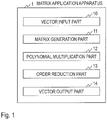
- a matrix application apparatus 1 As illustrated in Fig. 1 , a matrix application apparatus 1 according to a first embodiment comprises a vector input part 10, a matrix generation part 11, a polynomial multiplication part 12, an order reduction part 13, and a vector output part 14. A matrix application method according to the first embodiment is achieved by the matrix application apparatus 1 performing processings in steps illustrated in Fig. 2 .
- the matrix application apparatus 1 is a special apparatus formed by a well-known or dedicated computer in which a special program is loaded, the computer having a central processing unit (CPU: Central Processing Unit), a main memory (RAM: Random Access Memory), and other components.
- the matrix application apparatus 1 performs the processings under the control of the central processing unit. Data input to the matrix application apparatus 1 and data resulting from the processings are stored in the main memory, and the data stored in the main memory is loaded to the central processing unit and used for other processings. At least part of the processing parts of the matrix application apparatus 1 may be formed by hardware, such as an integrated circuit.
- a k-th order vector a (a 0 , ..., a k-1 ) having elements a 0 , ..., a k-1 (a 0 , ..., a k-1 ⁇ GF(x q )) is input to the vector input part 10.
- the vector a is fed to the polynomial multiplication part 12.
- step S 11 the matrix generation part 11 generates an m-by-k Vandermonde matrix A.
- m and k are values for which a relation (m-1)(k-1) ⁇ q-d holds.
- the matrix A is fed to the polynomial multiplication part 12.
- the matrix A is defined by the formula (24).
- a ij x i ⁇ k j where i ⁇ 0, ... , m ⁇ 1 , j ⁇ 0, ... , k ⁇ 1
- the matrix A is an m-by-k matrix expressed by the formula (25).
- step S13 the order reduction part 13 generates, for i (i ⁇ ⁇ 0, ..., m-1 ⁇ ), a polynomial h i obtained by dividing a part of the value b i having q-th or higher orders by X q and a polynomial g i that is a part of the value b i having orders lower than q.
- g i -h i f' is computed from the polynomials h i and g i to update the value b i .
- Updated values b 0 , ..., b m-1 are fed to the vector output part 14.
- steps S12 and S13 are performed for each i (i ⁇ 0, ..., m-1 ⁇ ). In this way, the values b 0 , ..., b m-1 are computed. The processings for different values of i can be performed in parallel.
- a second embodiment is an extension in which the processing amount of the field multiplication is reduced even if the relation (m-1)(k-1) ⁇ q-d does not hold.
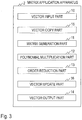
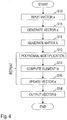
- a matrix application apparatus 2 As illustrated in Fig. 3 , as with the matrix application apparatus 1 according to the first embodiment, a matrix application apparatus 2 according to the second embodiment comprises the vector input part 10, the matrix generation part 11, the polynomial multiplication part 12, the order reduction part 13, and the vector output part 14. The matrix application apparatus 2 further comprises a vector copy part 15 and a vector update part 16. A matrix application method according to the second embodiment is achieved by the matrix application apparatus 2 performing processings in steps illustrated in Fig. 4 .
- step S11 the matrix generation part 11 generates an m-by-k Vandermonde matrix A. Unlike the first embodiment, the relation (m-1)(k-1) ⁇ q-d may not hold. The matrix A is fed to the polynomial multiplication part 12.
- ⁇ denotes a positive integer equal to or smaller than q-d.
- the second embodiment is inferior to the first embodiment in reduction of the processing amount, the second embodiment is sufficiently effective in quickening the processing if the number of times of update by the vector update part 16 is low (that is, if ⁇ is appropriately set).
- the addition is simply an exclusive-OR (XOR) operation.
- X is 2 in an integer expression
- the polynomial multiplication (a j x ij ) is simply an ij bit shift.
- the present invention is advantageous due to the fact that, with the Vandermonde matrix, x of the right ax of the multiplication is fixed in a simple range. If the order of any of a j X j in the polynomial multiplication exceeds 2q-d-1, one order reduction does not suffice. And the polynomial multiplication of x ij is simply a bit shift operation because all the elements of the Vandermonde matrix are powers of x.
- the program that describes the specific processings can be recorded in a computer readable recording medium.
- Any computer readable recording medium can be used, such as a magnetic recording device, an optical disk, a magneto-optical recording medium, or a semiconductor memory.
- the program can be distributed by selling, transferring or lending a portable recording medium, such as a DVD, or a CD-ROM, on which the program is recorded, for example. Furthermore, the program may be distributed by storing the program in a memory of a server computer and transferring the program from the server computer to another computer.
- a portable recording medium such as a DVD, or a CD-ROM
- the computer that executes the program first temporarily stores, in a memory thereof, the program recorded on a portable recording medium or transferred from a server computer, for example.
- the computer reads the program from the memory of the computer and performs the processings according to the read program.
- the computer may read the program directly from the portable recording medium and perform the processings according to the program, or the computer may perform the processings according to the program each time the computer receives the program transferred from the server computer.
- the processings described above may be performed on an application service provider (ASP) basis, in which the server computer does not transfer the program to the computer, and the processings are implemented only through execution instruction and result acquisition.
- the program according to the embodiments of the present invention includes a quasi-program, which is information to be processed by a computer (such as data that is not a direct instruction to a computer but has a property that defines the processings performed by the computer).
Landscapes
- Physics & Mathematics (AREA)
- Engineering & Computer Science (AREA)
- General Physics & Mathematics (AREA)
- Mathematical Physics (AREA)
- Theoretical Computer Science (AREA)
- Pure & Applied Mathematics (AREA)
- Mathematical Optimization (AREA)
- Mathematical Analysis (AREA)
- Computational Mathematics (AREA)
- Algebra (AREA)
- Probability & Statistics with Applications (AREA)
- Computing Systems (AREA)
- General Engineering & Computer Science (AREA)
- Data Mining & Analysis (AREA)
- Databases & Information Systems (AREA)
- Software Systems (AREA)
- Error Detection And Correction (AREA)
- Complex Calculations (AREA)
Abstract
Description
- The present invention relates to an encoding technique. In particular, it relates to a technique of efficiently performing an encoding process.
- A conventional error correcting coding technique is Reed-Solomon codes. Reed-Solomon Codes are described in the non-patent literature 1, for example.
- An encoding process for an error correcting code is a process of determining an output vector b by multiplying an input vector a in the form of a plaintext by a linear transformation (i.e., a matrix) A, which can be expressed by the formula (1). More specifically, the i-th row of the matrix A indicates coefficients by which the elements of the input vector a are multiplied in order to produce the i-th element bi of the output vector b.

- A decoding process for the error correcting code can also be regarded as a linear transformation. Provided that A' and b' are a matrix and a vector obtained by extracting only the rows corresponding to k elements of the matrix A and the vector b used for the decoding, respectively, the decoding process can be expressed by the formula (2). 12

- Thus, if the matrix A has an inverse matrix, the vector a can be decoded according to the formula (3).

- In encoding for the error correcting code, it is assumed that the input vector a is a k-th order vector expressed by the formula (4), where k denotes an integer equal to or greater than 2.

- It is assumed that the output vector b is an n-th order vector expressed by the formula (5), where n denotes an integer equal to or greater than 2, and n ≥ 2k-1.

- The matrix A is a matrix formed by vertically connecting a k-by-k unit matrix and an m-by-k Vandermonde matrix, where m = n-k. The Vandermonde matrix is a matrix having a special configuration in which elements of rows or columns are the terms of a geometric progression sequentially arranged.


- In short, the matrix A is an n-by-k matrix expressed by the formula (7).

- Since the matrix A is a identity matrix up to the k-th row thereof, the first to k-th elements b0, ..., bk-1 of the output vector b agree with the elements a0, ..., ak-1 of the input vector a. The elements of the output vector b that agree with the corresponding elements of the input vector a are referred to as a "data share", and the other elements are referred to as a "parity share".
- Non-patent literature 1: Bernard Sklar, "Digital Communications:
- Foundations and Applications," Pearson Education, 2006
- The conventional error correcting coding technique has a problem that the processing amount is high. In particular, the processing amount of the field multiplication performed in the encoding process is high.
- In view of such circumstances, an object of the present invention is to provide a matrix application technique that can reduce the processing amount of a field multiplication in an encoding technique.
- To solve the problems described above, a matrix application apparatus according to a first aspect of the present invention is a matrix application apparatus that computes a vector b by multiplying a vector a and a matrix A, provided that x denotes an element of an irreducible polynomial f[X] that generates an extension field GF(xq), q denotes an extension degree of the extension field GF(xq), d denotes the order of a term of the highest order of a polynomial f obtained by removing a term of the highest order from the irreducible polynomial f[X], k denotes an integer equal to or greater than 2, m denotes an integer equal to or greater than 1, (m-1)(k-1) ≤ q-d, a denotes a k-th order vector having elements a0, ..., ak-1 (a0, ..., ak-1∈GF(xq)), b denotes an m-th order vector having elements b0, ..., bm-1 (b0, ..., bm-1∈GF(xq)), and A denotes a m-by-k Vandermonde matrix, and the matrix application apparatus comprises: a polynomial multiplication part that computes a value bi for i (i∈{0, ..., m-1}) according to the following formula:

an order reduction part that designates gi-hif' as the value bi for i (i∈{0, ..., m-1}) by using a polynomial hi obtained by dividing a part of the value bi having an order equal to or higher than q by Xq and a polynomial gi formed by a part of the value bi having an order lower than q. - A matrix application apparatus according to a second aspect of the present invention is a matrix application apparatus that computes a vector b by multiplying a vector a and a matrix A, provided that x denotes an element of an irreducible polynomial f[X] that generates an extension field GF(xq), q denotes an extension degree of the extension field GF(xq), d denotes the order of a term of the highest order of a polynomial f obtained by removing a term of the highest order from the irreducible polynomial f[X], k denotes an integer equal to or greater than 2, m denotes an integer equal to or greater than 1, a denotes a k-th order vector having elements a0, ..., ak-1(a0, ..., ak-1∈GF(xq)), b denotes an m-th order vector having elements b0, ..., bm-1 (b0, ..., bm-1∈GF(xq)), A denotes a m-by-k Vandermonde matrix, and α denotes a positive integer equal to or smaller than q-d, and the matrix application apparatus comprises: a vector copy part that designates aj and 0 as a'j and dj, respectively, (a'j = aj, dj = 0) for j (j∈{0, ..., k-1}); a polynomial multiplication part that computes the value bi for i (i∈{0, ..., m-1}) according to the following formula:

an order reduction part that designates gi-hif as the value bi for i (i∈{0, ..., m-1}) by using a polynomial hi obtained by dividing a part of the value bi having an order equal to or higher than q by Xq and a polynomial gi formed by a part of the value bi having an order lower than q; and a vector update part that updates a'j: and dj: according to a'j: = a'jxα and dj: = dj+α, respectively, for i (i∈{0, ..., m-1}) and j (j∈{0, ..., k-1}) if i ≠ m-1 and (i+1)j-d ≥ q-d. - According to the present invention, the processing amount of a field multiplication involved in an encoding technique can be reduced.
-
-
Fig. 1 is a diagram illustrating a functional configuration of a matrix application apparatus according to a first embodiment; -
Fig. 2 is a diagram illustrating a process flow of a matrix application method according to the first embodiment; -
Fig. 3 is a diagram illustrating a functional configuration of a matrix application apparatus according to a second embodiment; -
Fig. 4 is a diagram illustrating a process flow of a matrix application method according to the second embodiment. - Before describing an embodiment, a principle of the present invention will be described.
- The following description will be made on the assumption that x represents an element X of an extension field GF(264) expressed by an irreducible polynomial f[X]=X64+X4+X3+X2+X+1, x is 2 in an integer expression.
- GF(264) is a set of remainders of a division of a polynomial by a 64-th order polynomial f[X] whose coefficients are integers modulo 2 (division as polynomials). GF(264) is a field on which the four arithmetic operations are possible. GF(264) may also be regarded as a 64-th order vector of bits with a special arithmetic. GF(264) can be expressed by a 64-bit integer, a term x¡ of which is expressed as 2i. For example, 1+x+x3 is expressed as 20+21+23=11.
- Multiplication of a and b (a, b∈GF(264)) is an operation of multiplying two 63-th order polynomials a and b (see the formula (8)) by each other and then dividing the product by the 64-th order polynomial f (see the formula (9)). A coefficient of a λ-th order term is expressed by the formula (10).


- In the formula (9), a process of taking a modulus f of the 126-th order polynomial to provide a 63-th order polynomial is referred to as reduction. The reduction is achieved by using the equivalence relation expressed by the formula (11).

- The formula (11) can be transformed into the formula (12), which represents a relation that reduces the 64-th order term to a fourth-order formula.

- As shown by the formula (13), the order of any 64-th or higher order term can be reduced by 60.

- The 126-th order polynomial can be expressed by a 63-th order polynomial g and a 62-th order polynomial h according to the formula (14).

- A multiplication (x+1)a of an arbitrary element a and x+1 can be expressed by the formula (15).

- In addition, since the order of each term of xna is n higher than the order of the corresponding term of a, each term of xna is equivalent to 2n times the term in the integer expression or the term left-shifted by n bits. Thus, xna can be expressed by the formula (16).

- Since h is a 62-th order polynomial, the term

in the formula (16) is a 64-th or higher order polynomial, and the order needs to be further reduced. The part of 64-th or higher order is expressed by the formula (17).
- Considering that in the case of the 64-bit integer, any number is truncated to 64 bits, computation can be performed according to the formula (18).

- In multiplication, if one of the multiplier is a number with 61 bits or a smaller number of bits (more strictly, if the total number of bits of the multipliers is equal to or less than 125), the formula (19) holds, so that the reduction can be made more efficient.

- Thus, considering the processing amount including the reduction, the multiplication by a 61-bit number with only one bit being 1, that is, 2i where 0 ≤ i ≤ 60 is quick.
- For the conventional error correcting code, a parity share is generated by using the Vandermonde matrix. The parity share is computed from k inputs a0, ..., ak-1 (a0, ..., ak-1∈GF(xq)) according to the formula (20). GF(xq) is an extension field that is generated from an irreducible polynomial f[X] and has an extension degree of q. x denotes an element of the irreducible polynomial f[X], and f[X]=X.

- When the field is an extension field, the computation can be made more efficient. It is assumed that a part of the irreducible polynomial f that excludes the term of the highest order is denoted as f'. It is also assumed that the order of the term of the highest order of the polynomial f is denoted by d. Then, if a relation (m-1)(k-1) ≤ q-d holds, the multiplication is simpler than normal as described below.
- If i is smaller than q, xi = Xi. Assuming that the input a is expressed by the formula (21), the result of the polynomial multiplication is as shown by the formula (22).


- Since the order is equal to or higher than q, a remainder with respect to f is determined based on f≡⇔Xq≡-f'. That is, provided that a part of aXi comprising the terms of orders lower than q is denoted by g, and a polynomial obtained by dividing a part of aXi comprising the terms of q-th or higher orders by Xq is denoted by h, a relation aXi≡g-hf' holds. In extension field multiplication, such order reduction is repeated until the order of g-hf is q-1. If i is equal to or smaller than q-d, the order of aXi is only q-1+q-d≡2q-d-1, and the order of h is only q-d-1. Since f' is a d-th order polynomial, the order of hf is only q-1, and one order reduction suffices.
- In the following, embodiments of the present invention will be described in detail. In the drawings, components having the same function are denoted by the same reference numerals, and redundant descriptions thereof will be omitted.
- As illustrated in
Fig. 1 , a matrix application apparatus 1 according to a first embodiment comprises avector input part 10, amatrix generation part 11, apolynomial multiplication part 12, anorder reduction part 13, and avector output part 14. A matrix application method according to the first embodiment is achieved by the matrix application apparatus 1 performing processings in steps illustrated inFig. 2 . - The matrix application apparatus 1 is a special apparatus formed by a well-known or dedicated computer in which a special program is loaded, the computer having a central processing unit (CPU: Central Processing Unit), a main memory (RAM: Random Access Memory), and other components. The matrix application apparatus 1 performs the processings under the control of the central processing unit. Data input to the matrix application apparatus 1 and data resulting from the processings are stored in the main memory, and the data stored in the main memory is loaded to the central processing unit and used for other processings. At least part of the processing parts of the matrix application apparatus 1 may be formed by hardware, such as an integrated circuit.
- With reference to
Fig. 2 , a procedure of the matrix application method according to the first embodiment will be described. - In step S10, a k-th order vector a = (a0, ..., ak-1) having elements a0, ..., ak-1 (a0, ..., ak-1 ∈GF(xq)) is input to the
vector input part 10. The vector a is fed to thepolynomial multiplication part 12. The vector a is defined by the formula (23)
- In
step S 11, thematrix generation part 11 generates an m-by-k Vandermonde matrix A. m and k are values for which a relation (m-1)(k-1) ≤ q-d holds. The matrix A is fed to thepolynomial multiplication part 12. The matrix A is defined by the formula (24).

- That is, the matrix A is an m-by-k matrix expressed by the formula (25).

- In step S12, the
polynomial multiplication part 12 computes a value bi for i (i∈{0, ..., m-1}) according to the formula (26). Values b0, ..., bm-1 are fed to theorder reduction part 13.
- In step S13, the
order reduction part 13 generates, for i (i ∈ {0, ..., m-1}), a polynomial hi obtained by dividing a part of the value bi having q-th or higher orders by Xq and a polynomial gi that is a part of the value bi having orders lower than q. gi-hif' is computed from the polynomials hi and gi to update the value bi. Updated values b0, ..., bm-1 are fed to thevector output part 14. - The processings in steps S12 and S13 are performed for each i (i∈{0, ..., m-1}). In this way, the values b0, ..., bm-1 are computed. The processings for different values of i can be performed in parallel.
- In step S14, the
vector output part 14 outputs an m-th vector b (b = (b0, ..., bm-1)) having values b0, ..., bm-1 as elements. - In the matrix application method according to the first embodiment, a relation (m-1)(k-1) ≤ q-d holds, so that one reduction suffices in all field multiplications. Thus, the processing amount of the multiplication including reductions is reduced.
- A second embodiment is an extension in which the processing amount of the field multiplication is reduced even if the relation (m-1)(k-1) ≤ q-d does not hold.
- As illustrated in
Fig. 3 , as with the matrix application apparatus 1 according to the first embodiment, a matrix application apparatus 2 according to the second embodiment comprises thevector input part 10, thematrix generation part 11, thepolynomial multiplication part 12, theorder reduction part 13, and thevector output part 14. The matrix application apparatus 2 further comprises avector copy part 15 and avector update part 16. A matrix application method according to the second embodiment is achieved by the matrix application apparatus 2 performing processings in steps illustrated inFig. 4 . - With reference to
Fig. 4 , a procedure of the matrix application method according to the second embodiment will be described. The following description will be focused mainly on differences from the first embodiment described above. - In
step S 15, thevector copy part 15 designates aj as a'j (a'j = aj) for j (j∈{0, ..., k-1}). In addition, thevector copy part 15 designates 0 as dj (dj = 0). A vector a'(a' = (a'0, ..., a'k-1)) and values d0, ..., dk-1 are fed to thepolynomial multiplication part 12. - In step S11, the
matrix generation part 11 generates an m-by-k Vandermonde matrix A. Unlike the first embodiment, the relation (m-1)(k-1) ≤ q-d may not hold. The matrix A is fed to thepolynomial multiplication part 12. - In step S12, the
polynomial multiplication part 12 computes the value bi for i (i∈{0, ..., m-1}) according to the formula (27). Values b0, ..., bm-1 are fed to theorder reduction part 13.
- In step S16, for j (j∈{0, ..., k-1}), if i ≠ m-1 and (i+1)j-d ≥ q-d, the
vector update part 16 updates a'j: and dj: according to a'j: = a'jxα, and dj: = dj+α, respectively. α denotes a positive integer equal to or smaller than q-d. The updated vector a' (a' = (a'0, ..., a'k-1)) and the updated values d0, ..., dk-1 are fed to thepolynomial multiplication part 12. - Although the second embodiment is inferior to the first embodiment in reduction of the processing amount, the second embodiment is sufficiently effective in quickening the processing if the number of times of update by the
vector update part 16 is low (that is, if α is appropriately set). - In the embodiments described above, if the order of the extension field is a power of 2, the addition is simply an exclusive-OR (XOR) operation. In addition, since X is 2 in an integer expression, the polynomial multiplication (ajxij) is simply an ij bit shift. Thus, the processing is more efficiently performed by a computer.
- The present invention is advantageous due to the fact that, with the Vandermonde matrix, x of the right ax of the multiplication is fixed in a simple range. If the order of any of ajXj in the polynomial multiplication exceeds 2q-d-1, one order reduction does not suffice. And the polynomial multiplication of xij is simply a bit shift operation because all the elements of the Vandermonde matrix are powers of x.
- The present invention is not limited to the embodiments described above, and modifications can be made as required without departing from the spirit of the present invention. The various processings described above with regard to the embodiments are not necessarily sequentially performed in the order described above but also can be performed in parallel with or independently of each other depending on the processing capacity of the apparatus that performs the processings or as required.
- When a computer carries out the various processing functions of the apparatus according to the embodiments described above, the specific processings of the functions that the apparatus needs to have are described in a program. The various processing functions of the apparatus described above are implemented on the computer by the computer executing the program.
- The program that describes the specific processings can be recorded in a computer readable recording medium. Any computer readable recording medium can be used, such as a magnetic recording device, an optical disk, a magneto-optical recording medium, or a semiconductor memory.
- The program can be distributed by selling, transferring or lending a portable recording medium, such as a DVD, or a CD-ROM, on which the program is recorded, for example. Furthermore, the program may be distributed by storing the program in a memory of a server computer and transferring the program from the server computer to another computer.
- The computer that executes the program first temporarily stores, in a memory thereof, the program recorded on a portable recording medium or transferred from a server computer, for example. When performing the processings, the computer reads the program from the memory of the computer and performs the processings according to the read program. In an alternative implementation, the computer may read the program directly from the portable recording medium and perform the processings according to the program, or the computer may perform the processings according to the program each time the computer receives the program transferred from the server computer. As a further alternative, the processings described above may be performed on an application service provider (ASP) basis, in which the server computer does not transfer the program to the computer, and the processings are implemented only through execution instruction and result acquisition. The program according to the embodiments of the present invention includes a quasi-program, which is information to be processed by a computer (such as data that is not a direct instruction to a computer but has a property that defines the processings performed by the computer).
- Although the apparatus according to the embodiments of the present invention have been described as being implemented by a computer executing a predetermined program, at least part of the specific processings may be implemented by hardware.
Claims (5)
- A matrix application apparatus that computes a vector b by multiplying a vector a and a matrix A, wherein
x denotes an element of an irreducible polynomial f[X] that generates an extension field GF(xq), q denotes an extension degree of the extension field GF(xq), d denotes the order of a term of the highest order of a polynomial f obtained by removing a term of the highest order from the irreducible polynomial f[X], k denotes an integer equal to or greater than 2, m denotes an integer equal to or greater than 1, (m-1)(k-1) ≤ q-d, a denotes a k-th order vector having elements a0, ..., ak-1 (a0, ..., ak-1∈GF(xq)), b denotes an m-th order vector having elements b0, ..., bm-1 (b0, ..., bm-1∈GF(xq)), A denotes a m-by-k Vandermonde matrix, and
the matrix application apparatus comprising:a polynomial multiplication part that computes a value bi for i (i∈{0, ..., m-1}) according to the following formula: an order reduction part that designates gi-hif' as the value bi for i (i∈{0, ..., m-1}) by using a polynomial hi obtained by dividing a part of the value bi having an order equal to or higher than q by Xq and a polynomial gi formed by a part of the value bi having an order lower than q.
 - A matrix application apparatus that computes a vector b by multiplying a vector a and a matrix A, wherein
x denotes an element of an irreducible polynomial f[X] that generates an extension field GF(xq), q denotes an extension degree of the extension field GF(xq), d denotes the order of a term of the highest order of a polynomial f obtained by removing a term of the highest order from the irreducible polynomial f[X], k denotes an integer equal to or greater than 2, m denotes an integer equal to or greater than 1, a denotes a k-th order vector having elements a0, ..., ak-1 (a0, ..., ak-1∈GF(xq)), b denotes an m-th order vector having elements b0, ..., bm-1 (b0, ..., bm-1∈GF(xq)), A denotes a m-by-k Vandermonde matrix, α denotes a positive integer equal to or smaller than q-d, and
the matrix application apparatus comprising:a vector copy part that designates aj and 0 as a'j and dj, respectively, (a'j = aj, dj = 0) for j (j∈{0, ..., k-1});a polynomial multiplication part that computes the value bi for i (i∈{0, ..., m-1}) according to the following formula: an order reduction part that designates gi-hif' as the value bi for i (i∈{0, ..., m-1}) by using a polynomial hi obtained by dividing a part of the value bi having an order equal to or higher than q by Xq and a polynomial gi formed by a part of the value bi having an order lower than q; anda vector update part that updates a'j and dj according to a'j: = a'jxα and dj: = dj+α, respectively, for i (i∈{0, ..., m-1}) and j (j∈{0, ..., k-1}) if i ≠ m-1 and (i+1)j-d ≥ q-d.
 - A matrix application method of computing a vector b by multiplying a vector a and a matrix A, wherein
x denotes an element of an irreducible polynomial f[X] that generates an extension field GF(xq), q denotes an extension degree of the extension field GF(xq), d denotes the order of a term of the highest order of a polynomial f obtained by removing a term of the highest order from the irreducible polynomial f[X], k denotes an integer equal to or greater than 2, m denotes an integer equal to or greater than 1, (m-1)(k-1) ≤ q-d, a denotes a k-th order vector having elements a0, ..., ak-1 (a0, ..., ak-1∈GF(xq)), b denotes an m-th order vector having elements b0, ..., bm-1 (b0, ..., bm-1∈GF(xq)), A denotes a m-by-k Vandermonde matrix, and
the matrix application method comprising:a polynomial multiplication step of a polynomial multiplication part computing a value bi for i (i∈{0, ..., m-1}) according to the following formula: an order reduction step of an order reduction part designating gi-hif' as the value bi for i (i∈{0, ..., m-1}) by using a polynomial hi obtained by dividing a part of the value bi having an order equal to or higher than q by Xq and a polynomial gi formed by a part of the value bi having an order lower than q.
 - A matrix application method of computing a vector b by multiplying a vector a and a matrix A, wherein
x denotes an element of an irreducible polynomial f[X] that generates an extension field GF(xq), q denotes an extension degree of the extension field GF(xq), d denotes the order of a term of the highest order of a polynomial f obtained by removing a term of the highest order from the irreducible polynomial f[X], k denotes an integer equal to or greater than 2, m denotes an integer equal to or greater than 1, a denotes a k-th order vector having elements a0, ..., ak-1 (a0, ..., ak-1∈GF(xq)), b denotes an m-th order vector having elements b0, ..., bm-1 (b0, ..., bm-1∈GF(xq)), A denotes a m-by-k Vandermonde matrix, α denotes a positive integer equal to or smaller than q-d, and
the matrix application method comprising:a vector copy step of a vector copy part designating aj and 0 as a'j and dj, respectively, (a'j = aj, dj = 0) for j (j∈{0, ..., k-1});a polynomial multiplication step of a polynomial multiplication part computing the value bi for i (i∈{0, ..., m-1}) according to the following formula: an order reduction step of an order reduction part designating gi-hif' as the value bi for i (i∈{0, ..., m-1}) by using a polynomial hi obtained by dividing a part of the value bi having an order equal to or higher than q by Xq and a polynomial gi formed by a part of the value bi having an order lower than q; anda vector update step of a vector update part updating a'j and dj according to a'j: = a'jxα and dj: = dj+α, respectively, for i (i∈{0, ..., m-1}) and j (j∈{0, ..., k-1}) if i ≠ m-1 and (i+1)j-d ≥ q-d.
 - A program that makes a computer function as a matrix application apparatus according to claim 1 or 2.
Applications Claiming Priority (2)
| Application Number | Priority Date | Filing Date | Title |
|---|---|---|---|
| JP2015097277A JP5927323B1 (en) | 2015-05-12 | 2015-05-12 | Matrix action device, matrix action method, and program |
| PCT/JP2016/063955 WO2016181978A1 (en) | 2015-05-12 | 2016-05-11 | Matrix operation device, matrix operation method, and program |
Publications (3)
| Publication Number | Publication Date |
|---|---|
| EP3297170A1 true EP3297170A1 (en) | 2018-03-21 |
| EP3297170A4 EP3297170A4 (en) | 2018-12-26 |
| EP3297170B1 EP3297170B1 (en) | 2022-03-02 |
Family
ID=56089772
Family Applications (1)
| Application Number | Title | Priority Date | Filing Date |
|---|---|---|---|
| EP16792703.7A Active EP3297170B1 (en) | 2015-05-12 | 2016-05-11 | Efficient reed-solomon encoding |
Country Status (5)
| Country | Link |
|---|---|
| US (1) | US10120837B2 (en) |
| EP (1) | EP3297170B1 (en) |
| JP (1) | JP5927323B1 (en) |
| CN (1) | CN107534450B (en) |
| WO (1) | WO2016181978A1 (en) |
Families Citing this family (2)
| Publication number | Priority date | Publication date | Assignee | Title |
|---|---|---|---|---|
| JP5918884B1 (en) * | 2015-05-12 | 2016-05-18 | 日本電信電話株式会社 | Decoding device, decoding method, and program |
| KR102252311B1 (en) * | 2018-07-30 | 2021-05-14 | 부산대학교 산학협력단 | A method for large-size cryptography matrix operation optimized processing in a low power device environment |
Family Cites Families (12)
| Publication number | Priority date | Publication date | Assignee | Title |
|---|---|---|---|---|
| US6598201B1 (en) * | 1999-03-15 | 2003-07-22 | Texas Instruments Incorporated | Error coding structure and method |
| US6766344B2 (en) * | 2001-05-08 | 2004-07-20 | International Business Machines Corporation | Processing Galois Field arithmetic |
| US7581156B2 (en) * | 2002-12-16 | 2009-08-25 | Microsoft Corporation | Systems and methods for providing improved encoding and reconstruction of data |
| FR2860360B1 (en) * | 2003-09-29 | 2005-12-09 | Canon Kk | ENCODING / DECODING DEVICE USING REED-SOLOMON ENCODER / DECODER |
| JP2006033233A (en) * | 2004-07-14 | 2006-02-02 | Sony Corp | Reed-Solomon decoding method and apparatus |
| DE102006013989A1 (en) * | 2006-03-22 | 2007-09-27 | IHP GmbH - Innovations for High Performance Microelectronics/Institut für innovative Mikroelektronik | Method of reducing a polynomial in a binary finite field |
| US8732559B2 (en) * | 2006-07-25 | 2014-05-20 | Thomson Licensing | Recovery from burst packet loss in internet protocol based wireless networks using staggercasting and cross-packet forward error correction |
| JP4756489B2 (en) * | 2006-09-12 | 2011-08-24 | 学校法人玉川学園 | Error correction coding apparatus, error correction coding method, and program |
| US8201060B2 (en) * | 2007-07-11 | 2012-06-12 | Ternarylocig LLC | Methods and systems for rapid error correction of Reed-Solomon codes |
| CN101621299B (en) * | 2008-07-04 | 2013-01-30 | 华为技术有限公司 | Burst correcting method, equipment and device |
| CN101431340B (en) * | 2008-12-12 | 2011-07-20 | 东南大学 | Fast self-adapting confidence propagation interpretation method for Reed-Solomon code |
| CN102801501B (en) * | 2012-08-21 | 2015-03-11 | 中国电子科技集团公司第三十六研究所 | Identification method of code parameter of BCH (broadcast channel) shortened code |
-
2015
- 2015-05-12 JP JP2015097277A patent/JP5927323B1/en active Active
-
2016
- 2016-05-11 US US15/567,812 patent/US10120837B2/en active Active
- 2016-05-11 CN CN201680027025.8A patent/CN107534450B/en active Active
- 2016-05-11 WO PCT/JP2016/063955 patent/WO2016181978A1/en not_active Ceased
- 2016-05-11 EP EP16792703.7A patent/EP3297170B1/en active Active
Also Published As
| Publication number | Publication date |
|---|---|
| CN107534450B (en) | 2021-03-02 |
| EP3297170B1 (en) | 2022-03-02 |
| EP3297170A4 (en) | 2018-12-26 |
| US20180107629A1 (en) | 2018-04-19 |
| CN107534450A (en) | 2018-01-02 |
| JP2016213731A (en) | 2016-12-15 |
| WO2016181978A1 (en) | 2016-11-17 |
| JP5927323B1 (en) | 2016-06-01 |
| US10120837B2 (en) | 2018-11-06 |
Similar Documents
| Publication | Publication Date | Title |
|---|---|---|
| US10348491B2 (en) | Secret sharing method, secret sharing system, distributing apparatus and program | |
| US6631172B1 (en) | Efficient list decoding of Reed-Solomon codes for message recovery in the presence of high noise levels | |
| US8433985B2 (en) | Error correction mechanisms for flash memories | |
| US8261176B2 (en) | Polynomial division | |
| US9450612B2 (en) | Encoding method and system for quasi-cyclic low-density parity-check code | |
| EP3297171B1 (en) | Efficient erasure decoding for mds codes | |
| CN114389752B (en) | Cyclic redundancy check code generation method, device, equipment, medium and program product | |
| US6487691B1 (en) | Reed-solomon decoder | |
| US10333554B2 (en) | Efficient generalized tensor product codes encoding schemes | |
| Trifonov | Low-complexity implementation of RAID based on Reed-Solomon codes | |
| US10120837B2 (en) | Matrix application apparatus, matrix application method and program | |
| CN104012029A (en) | Determining division remainders and prime number candidates for cryptographic applications by at least one Montgomery operation | |
| US10171109B2 (en) | Fast encoding method and device for Reed-Solomon codes with a small number of redundancies | |
| KR102754848B1 (en) | Apparatus and method for performing reduction operation on polynomial matrices using differences in degrees between terms of polynomial in list decoding algorithm | |
| KR101541157B1 (en) | Method for multiplying operation of binary extension finite field | |
| KR102856750B1 (en) | Device for computing solutions of linear systems and its application to digital signature generations | |
| US20140149479A1 (en) | Method of performing multiplication operation in binary extension finite field | |
| Hazmi et al. | Systolic design space exploration of polynomial division over GF (m 2) | |
| WO2025128659A1 (en) | Low-complexity parallel chien search architecture based on matrix decomposition | |
| US20080092021A1 (en) | System and Method for Performing Reed-Solomon Encoding | |
| Srivastava et al. | Efficient VLSI architecture for interpolation decoding of Hermitian codes | |
| Repka | Note on Modular Reduction in Extended Finite Fields and Polynomial Rings for Simple Hardware |
Legal Events
| Date | Code | Title | Description |
|---|---|---|---|
| STAA | Information on the status of an ep patent application or granted ep patent |
Free format text: STATUS: THE INTERNATIONAL PUBLICATION HAS BEEN MADE |
|
| PUAI | Public reference made under article 153(3) epc to a published international application that has entered the european phase |
Free format text: ORIGINAL CODE: 0009012 |
|
| STAA | Information on the status of an ep patent application or granted ep patent |
Free format text: STATUS: REQUEST FOR EXAMINATION WAS MADE |
|
| 17P | Request for examination filed |
Effective date: 20171212 |
|
| AK | Designated contracting states |
Kind code of ref document: A1 Designated state(s): AL AT BE BG CH CY CZ DE DK EE ES FI FR GB GR HR HU IE IS IT LI LT LU LV MC MK MT NL NO PL PT RO RS SE SI SK SM TR |
|
| AX | Request for extension of the european patent |
Extension state: BA ME |
|
| DAV | Request for validation of the european patent (deleted) | ||
| DAX | Request for extension of the european patent (deleted) | ||
| A4 | Supplementary search report drawn up and despatched |
Effective date: 20181123 |
|
| RIC1 | Information provided on ipc code assigned before grant |
Ipc: H03M 13/15 20060101AFI20181119BHEP Ipc: G06F 7/72 20060101ALI20181119BHEP |
|
| STAA | Information on the status of an ep patent application or granted ep patent |
Free format text: STATUS: EXAMINATION IS IN PROGRESS |
|
| 17Q | First examination report despatched |
Effective date: 20190806 |
|
| GRAP | Despatch of communication of intention to grant a patent |
Free format text: ORIGINAL CODE: EPIDOSNIGR1 |
|
| STAA | Information on the status of an ep patent application or granted ep patent |
Free format text: STATUS: GRANT OF PATENT IS INTENDED |
|
| INTG | Intention to grant announced |
Effective date: 20211018 |
|
| GRAS | Grant fee paid |
Free format text: ORIGINAL CODE: EPIDOSNIGR3 |
|
| GRAA | (expected) grant |
Free format text: ORIGINAL CODE: 0009210 |
|
| STAA | Information on the status of an ep patent application or granted ep patent |
Free format text: STATUS: THE PATENT HAS BEEN GRANTED |
|
| AK | Designated contracting states |
Kind code of ref document: B1 Designated state(s): AL AT BE BG CH CY CZ DE DK EE ES FI FR GB GR HR HU IE IS IT LI LT LU LV MC MK MT NL NO PL PT RO RS SE SI SK SM TR |
|
| REG | Reference to a national code |
Ref country code: GB Ref legal event code: FG4D |
|
| REG | Reference to a national code |
Ref country code: CH Ref legal event code: EP Ref country code: AT Ref legal event code: REF Ref document number: 1473098 Country of ref document: AT Kind code of ref document: T Effective date: 20220315 |
|
| REG | Reference to a national code |
Ref country code: DE Ref legal event code: R096 Ref document number: 602016069634 Country of ref document: DE |
|
| REG | Reference to a national code |
Ref country code: IE Ref legal event code: FG4D |
|
| REG | Reference to a national code |
Ref country code: LT Ref legal event code: MG9D |
|
| REG | Reference to a national code |
Ref country code: NL Ref legal event code: MP Effective date: 20220302 |
|
| PG25 | Lapsed in a contracting state [announced via postgrant information from national office to epo] |
Ref country code: SE Free format text: LAPSE BECAUSE OF FAILURE TO SUBMIT A TRANSLATION OF THE DESCRIPTION OR TO PAY THE FEE WITHIN THE PRESCRIBED TIME-LIMIT Effective date: 20220302 Ref country code: RS Free format text: LAPSE BECAUSE OF FAILURE TO SUBMIT A TRANSLATION OF THE DESCRIPTION OR TO PAY THE FEE WITHIN THE PRESCRIBED TIME-LIMIT Effective date: 20220302 Ref country code: NO Free format text: LAPSE BECAUSE OF FAILURE TO SUBMIT A TRANSLATION OF THE DESCRIPTION OR TO PAY THE FEE WITHIN THE PRESCRIBED TIME-LIMIT Effective date: 20220602 Ref country code: LT Free format text: LAPSE BECAUSE OF FAILURE TO SUBMIT A TRANSLATION OF THE DESCRIPTION OR TO PAY THE FEE WITHIN THE PRESCRIBED TIME-LIMIT Effective date: 20220302 Ref country code: HR Free format text: LAPSE BECAUSE OF FAILURE TO SUBMIT A TRANSLATION OF THE DESCRIPTION OR TO PAY THE FEE WITHIN THE PRESCRIBED TIME-LIMIT Effective date: 20220302 Ref country code: ES Free format text: LAPSE BECAUSE OF FAILURE TO SUBMIT A TRANSLATION OF THE DESCRIPTION OR TO PAY THE FEE WITHIN THE PRESCRIBED TIME-LIMIT Effective date: 20220302 Ref country code: BG Free format text: LAPSE BECAUSE OF FAILURE TO SUBMIT A TRANSLATION OF THE DESCRIPTION OR TO PAY THE FEE WITHIN THE PRESCRIBED TIME-LIMIT Effective date: 20220602 |
|
| REG | Reference to a national code |
Ref country code: AT Ref legal event code: MK05 Ref document number: 1473098 Country of ref document: AT Kind code of ref document: T Effective date: 20220302 |
|
| PG25 | Lapsed in a contracting state [announced via postgrant information from national office to epo] |
Ref country code: PL Free format text: LAPSE BECAUSE OF FAILURE TO SUBMIT A TRANSLATION OF THE DESCRIPTION OR TO PAY THE FEE WITHIN THE PRESCRIBED TIME-LIMIT Effective date: 20220302 Ref country code: LV Free format text: LAPSE BECAUSE OF FAILURE TO SUBMIT A TRANSLATION OF THE DESCRIPTION OR TO PAY THE FEE WITHIN THE PRESCRIBED TIME-LIMIT Effective date: 20220302 Ref country code: GR Free format text: LAPSE BECAUSE OF FAILURE TO SUBMIT A TRANSLATION OF THE DESCRIPTION OR TO PAY THE FEE WITHIN THE PRESCRIBED TIME-LIMIT Effective date: 20220603 Ref country code: FI Free format text: LAPSE BECAUSE OF FAILURE TO SUBMIT A TRANSLATION OF THE DESCRIPTION OR TO PAY THE FEE WITHIN THE PRESCRIBED TIME-LIMIT Effective date: 20220302 |
|
| PG25 | Lapsed in a contracting state [announced via postgrant information from national office to epo] |
Ref country code: NL Free format text: LAPSE BECAUSE OF FAILURE TO SUBMIT A TRANSLATION OF THE DESCRIPTION OR TO PAY THE FEE WITHIN THE PRESCRIBED TIME-LIMIT Effective date: 20220302 |
|
| PG25 | Lapsed in a contracting state [announced via postgrant information from national office to epo] |
Ref country code: SM Free format text: LAPSE BECAUSE OF FAILURE TO SUBMIT A TRANSLATION OF THE DESCRIPTION OR TO PAY THE FEE WITHIN THE PRESCRIBED TIME-LIMIT Effective date: 20220302 Ref country code: SK Free format text: LAPSE BECAUSE OF FAILURE TO SUBMIT A TRANSLATION OF THE DESCRIPTION OR TO PAY THE FEE WITHIN THE PRESCRIBED TIME-LIMIT Effective date: 20220302 Ref country code: RO Free format text: LAPSE BECAUSE OF FAILURE TO SUBMIT A TRANSLATION OF THE DESCRIPTION OR TO PAY THE FEE WITHIN THE PRESCRIBED TIME-LIMIT Effective date: 20220302 Ref country code: PT Free format text: LAPSE BECAUSE OF FAILURE TO SUBMIT A TRANSLATION OF THE DESCRIPTION OR TO PAY THE FEE WITHIN THE PRESCRIBED TIME-LIMIT Effective date: 20220704 Ref country code: EE Free format text: LAPSE BECAUSE OF FAILURE TO SUBMIT A TRANSLATION OF THE DESCRIPTION OR TO PAY THE FEE WITHIN THE PRESCRIBED TIME-LIMIT Effective date: 20220302 Ref country code: CZ Free format text: LAPSE BECAUSE OF FAILURE TO SUBMIT A TRANSLATION OF THE DESCRIPTION OR TO PAY THE FEE WITHIN THE PRESCRIBED TIME-LIMIT Effective date: 20220302 Ref country code: AT Free format text: LAPSE BECAUSE OF FAILURE TO SUBMIT A TRANSLATION OF THE DESCRIPTION OR TO PAY THE FEE WITHIN THE PRESCRIBED TIME-LIMIT Effective date: 20220302 |
|
| PG25 | Lapsed in a contracting state [announced via postgrant information from national office to epo] |
Ref country code: IS Free format text: LAPSE BECAUSE OF FAILURE TO SUBMIT A TRANSLATION OF THE DESCRIPTION OR TO PAY THE FEE WITHIN THE PRESCRIBED TIME-LIMIT Effective date: 20220702 Ref country code: AL Free format text: LAPSE BECAUSE OF FAILURE TO SUBMIT A TRANSLATION OF THE DESCRIPTION OR TO PAY THE FEE WITHIN THE PRESCRIBED TIME-LIMIT Effective date: 20220302 |
|
| REG | Reference to a national code |
Ref country code: DE Ref legal event code: R097 Ref document number: 602016069634 Country of ref document: DE |
|
| REG | Reference to a national code |
Ref country code: CH Ref legal event code: PL |
|
| PLBE | No opposition filed within time limit |
Free format text: ORIGINAL CODE: 0009261 |
|
| STAA | Information on the status of an ep patent application or granted ep patent |
Free format text: STATUS: NO OPPOSITION FILED WITHIN TIME LIMIT |
|
| REG | Reference to a national code |
Ref country code: BE Ref legal event code: MM Effective date: 20220531 |
|
| PG25 | Lapsed in a contracting state [announced via postgrant information from national office to epo] |
Ref country code: MC Free format text: LAPSE BECAUSE OF FAILURE TO SUBMIT A TRANSLATION OF THE DESCRIPTION OR TO PAY THE FEE WITHIN THE PRESCRIBED TIME-LIMIT Effective date: 20220302 Ref country code: LU Free format text: LAPSE BECAUSE OF NON-PAYMENT OF DUE FEES Effective date: 20220511 Ref country code: LI Free format text: LAPSE BECAUSE OF NON-PAYMENT OF DUE FEES Effective date: 20220531 Ref country code: DK Free format text: LAPSE BECAUSE OF FAILURE TO SUBMIT A TRANSLATION OF THE DESCRIPTION OR TO PAY THE FEE WITHIN THE PRESCRIBED TIME-LIMIT Effective date: 20220302 Ref country code: CH Free format text: LAPSE BECAUSE OF NON-PAYMENT OF DUE FEES Effective date: 20220531 |
|
| 26N | No opposition filed |
Effective date: 20221205 |
|
| PG25 | Lapsed in a contracting state [announced via postgrant information from national office to epo] |
Ref country code: SI Free format text: LAPSE BECAUSE OF FAILURE TO SUBMIT A TRANSLATION OF THE DESCRIPTION OR TO PAY THE FEE WITHIN THE PRESCRIBED TIME-LIMIT Effective date: 20220302 |
|
| PG25 | Lapsed in a contracting state [announced via postgrant information from national office to epo] |
Ref country code: IE Free format text: LAPSE BECAUSE OF NON-PAYMENT OF DUE FEES Effective date: 20220511 |
|
| PG25 | Lapsed in a contracting state [announced via postgrant information from national office to epo] |
Ref country code: BE Free format text: LAPSE BECAUSE OF NON-PAYMENT OF DUE FEES Effective date: 20220531 |
|
| PG25 | Lapsed in a contracting state [announced via postgrant information from national office to epo] |
Ref country code: IT Free format text: LAPSE BECAUSE OF FAILURE TO SUBMIT A TRANSLATION OF THE DESCRIPTION OR TO PAY THE FEE WITHIN THE PRESCRIBED TIME-LIMIT Effective date: 20220302 |
|
| PG25 | Lapsed in a contracting state [announced via postgrant information from national office to epo] |
Ref country code: HU Free format text: LAPSE BECAUSE OF FAILURE TO SUBMIT A TRANSLATION OF THE DESCRIPTION OR TO PAY THE FEE WITHIN THE PRESCRIBED TIME-LIMIT; INVALID AB INITIO Effective date: 20160511 |
|
| PG25 | Lapsed in a contracting state [announced via postgrant information from national office to epo] |
Ref country code: MK Free format text: LAPSE BECAUSE OF FAILURE TO SUBMIT A TRANSLATION OF THE DESCRIPTION OR TO PAY THE FEE WITHIN THE PRESCRIBED TIME-LIMIT Effective date: 20220302 Ref country code: CY Free format text: LAPSE BECAUSE OF FAILURE TO SUBMIT A TRANSLATION OF THE DESCRIPTION OR TO PAY THE FEE WITHIN THE PRESCRIBED TIME-LIMIT Effective date: 20220302 |
|
| PG25 | Lapsed in a contracting state [announced via postgrant information from national office to epo] |
Ref country code: MT Free format text: LAPSE BECAUSE OF FAILURE TO SUBMIT A TRANSLATION OF THE DESCRIPTION OR TO PAY THE FEE WITHIN THE PRESCRIBED TIME-LIMIT Effective date: 20220302 |
|
| PGFP | Annual fee paid to national office [announced via postgrant information from national office to epo] |
Ref country code: DE Payment date: 20250521 Year of fee payment: 10 |
|
| PGFP | Annual fee paid to national office [announced via postgrant information from national office to epo] |
Ref country code: GB Payment date: 20250527 Year of fee payment: 10 |
|
| PGFP | Annual fee paid to national office [announced via postgrant information from national office to epo] |
Ref country code: FR Payment date: 20250528 Year of fee payment: 10 |
|
| PG25 | Lapsed in a contracting state [announced via postgrant information from national office to epo] |
Ref country code: TR Free format text: LAPSE BECAUSE OF FAILURE TO SUBMIT A TRANSLATION OF THE DESCRIPTION OR TO PAY THE FEE WITHIN THE PRESCRIBED TIME-LIMIT Effective date: 20220302 |
|
| REG | Reference to a national code |
Ref country code: DE Ref legal event code: R081 Ref document number: 602016069634 Country of ref document: DE Owner name: NTT, INC., JP Free format text: FORMER OWNER: NIPPON TELEGRAPH AND TELEPHONE CORP., TOKYO, JP Ref country code: DE Ref legal event code: R082 Ref document number: 602016069634 Country of ref document: DE Representative=s name: DENNEMEYER & ASSOCIATES RECHTSANWALTSGESELLSCH, DE |