EP3296426A1 - Chemical vapor deposition starting material comprising heterogeneous polynuclear complex, and chemical vapor deposition method using said chemical vapor deposition starting material - Google Patents
Chemical vapor deposition starting material comprising heterogeneous polynuclear complex, and chemical vapor deposition method using said chemical vapor deposition starting material Download PDFInfo
- Publication number
- EP3296426A1 EP3296426A1 EP16792642.7A EP16792642A EP3296426A1 EP 3296426 A1 EP3296426 A1 EP 3296426A1 EP 16792642 A EP16792642 A EP 16792642A EP 3296426 A1 EP3296426 A1 EP 3296426A1
- Authority
- EP
- European Patent Office
- Prior art keywords
- raw material
- chemical deposition
- less
- thin film
- transition metal
- Prior art date
- Legal status (The legal status is an assumption and is not a legal conclusion. Google has not performed a legal analysis and makes no representation as to the accuracy of the status listed.)
- Withdrawn
Links
- 0 C*(C(*)=N*)=N* Chemical compound C*(C(*)=N*)=N* 0.000 description 1
Images


Classifications
-
- C—CHEMISTRY; METALLURGY
- C07—ORGANIC CHEMISTRY
- C07F—ACYCLIC, CARBOCYCLIC OR HETEROCYCLIC COMPOUNDS CONTAINING ELEMENTS OTHER THAN CARBON, HYDROGEN, HALOGEN, OXYGEN, NITROGEN, SULFUR, SELENIUM OR TELLURIUM
- C07F15/00—Compounds containing elements of Groups 8, 9, 10 or 18 of the Periodic Table
- C07F15/0006—Compounds containing elements of Groups 8, 9, 10 or 18 of the Periodic Table compounds of the platinum group
- C07F15/0046—Ruthenium compounds
-
- C—CHEMISTRY; METALLURGY
- C07—ORGANIC CHEMISTRY
- C07C—ACYCLIC OR CARBOCYCLIC COMPOUNDS
- C07C251/00—Compounds containing nitrogen atoms doubly-bound to a carbon skeleton
- C07C251/02—Compounds containing nitrogen atoms doubly-bound to a carbon skeleton containing imino groups
- C07C251/04—Compounds containing nitrogen atoms doubly-bound to a carbon skeleton containing imino groups having carbon atoms of imino groups bound to hydrogen atoms or to acyclic carbon atoms
- C07C251/06—Compounds containing nitrogen atoms doubly-bound to a carbon skeleton containing imino groups having carbon atoms of imino groups bound to hydrogen atoms or to acyclic carbon atoms to carbon atoms of a saturated carbon skeleton
- C07C251/08—Compounds containing nitrogen atoms doubly-bound to a carbon skeleton containing imino groups having carbon atoms of imino groups bound to hydrogen atoms or to acyclic carbon atoms to carbon atoms of a saturated carbon skeleton being acyclic
-
- C—CHEMISTRY; METALLURGY
- C07—ORGANIC CHEMISTRY
- C07F—ACYCLIC, CARBOCYCLIC OR HETEROCYCLIC COMPOUNDS CONTAINING ELEMENTS OTHER THAN CARBON, HYDROGEN, HALOGEN, OXYGEN, NITROGEN, SULFUR, SELENIUM OR TELLURIUM
- C07F13/00—Compounds containing elements of Groups 7 or 17 of the Periodic Table
-
- C—CHEMISTRY; METALLURGY
- C07—ORGANIC CHEMISTRY
- C07F—ACYCLIC, CARBOCYCLIC OR HETEROCYCLIC COMPOUNDS CONTAINING ELEMENTS OTHER THAN CARBON, HYDROGEN, HALOGEN, OXYGEN, NITROGEN, SULFUR, SELENIUM OR TELLURIUM
- C07F15/00—Compounds containing elements of Groups 8, 9, 10 or 18 of the Periodic Table
-
- C—CHEMISTRY; METALLURGY
- C07—ORGANIC CHEMISTRY
- C07F—ACYCLIC, CARBOCYCLIC OR HETEROCYCLIC COMPOUNDS CONTAINING ELEMENTS OTHER THAN CARBON, HYDROGEN, HALOGEN, OXYGEN, NITROGEN, SULFUR, SELENIUM OR TELLURIUM
- C07F15/00—Compounds containing elements of Groups 8, 9, 10 or 18 of the Periodic Table
- C07F15/06—Cobalt compounds
-
- C—CHEMISTRY; METALLURGY
- C07—ORGANIC CHEMISTRY
- C07F—ACYCLIC, CARBOCYCLIC OR HETEROCYCLIC COMPOUNDS CONTAINING ELEMENTS OTHER THAN CARBON, HYDROGEN, HALOGEN, OXYGEN, NITROGEN, SULFUR, SELENIUM OR TELLURIUM
- C07F19/00—Metal compounds according to more than one of main groups C07F1/00 - C07F17/00
-
- C—CHEMISTRY; METALLURGY
- C23—COATING METALLIC MATERIAL; COATING MATERIAL WITH METALLIC MATERIAL; CHEMICAL SURFACE TREATMENT; DIFFUSION TREATMENT OF METALLIC MATERIAL; COATING BY VACUUM EVAPORATION, BY SPUTTERING, BY ION IMPLANTATION OR BY CHEMICAL VAPOUR DEPOSITION, IN GENERAL; INHIBITING CORROSION OF METALLIC MATERIAL OR INCRUSTATION IN GENERAL
- C23C—COATING METALLIC MATERIAL; COATING MATERIAL WITH METALLIC MATERIAL; SURFACE TREATMENT OF METALLIC MATERIAL BY DIFFUSION INTO THE SURFACE, BY CHEMICAL CONVERSION OR SUBSTITUTION; COATING BY VACUUM EVAPORATION, BY SPUTTERING, BY ION IMPLANTATION OR BY CHEMICAL VAPOUR DEPOSITION, IN GENERAL
- C23C16/00—Chemical coating by decomposition of gaseous compounds, without leaving reaction products of surface material in the coating, i.e. chemical vapour deposition [CVD] processes
- C23C16/06—Chemical coating by decomposition of gaseous compounds, without leaving reaction products of surface material in the coating, i.e. chemical vapour deposition [CVD] processes characterised by the deposition of metallic material
-
- C—CHEMISTRY; METALLURGY
- C23—COATING METALLIC MATERIAL; COATING MATERIAL WITH METALLIC MATERIAL; CHEMICAL SURFACE TREATMENT; DIFFUSION TREATMENT OF METALLIC MATERIAL; COATING BY VACUUM EVAPORATION, BY SPUTTERING, BY ION IMPLANTATION OR BY CHEMICAL VAPOUR DEPOSITION, IN GENERAL; INHIBITING CORROSION OF METALLIC MATERIAL OR INCRUSTATION IN GENERAL
- C23C—COATING METALLIC MATERIAL; COATING MATERIAL WITH METALLIC MATERIAL; SURFACE TREATMENT OF METALLIC MATERIAL BY DIFFUSION INTO THE SURFACE, BY CHEMICAL CONVERSION OR SUBSTITUTION; COATING BY VACUUM EVAPORATION, BY SPUTTERING, BY ION IMPLANTATION OR BY CHEMICAL VAPOUR DEPOSITION, IN GENERAL
- C23C16/00—Chemical coating by decomposition of gaseous compounds, without leaving reaction products of surface material in the coating, i.e. chemical vapour deposition [CVD] processes
- C23C16/06—Chemical coating by decomposition of gaseous compounds, without leaving reaction products of surface material in the coating, i.e. chemical vapour deposition [CVD] processes characterised by the deposition of metallic material
- C23C16/18—Chemical coating by decomposition of gaseous compounds, without leaving reaction products of surface material in the coating, i.e. chemical vapour deposition [CVD] processes characterised by the deposition of metallic material from metallo-organic compounds
-
- C—CHEMISTRY; METALLURGY
- C23—COATING METALLIC MATERIAL; COATING MATERIAL WITH METALLIC MATERIAL; CHEMICAL SURFACE TREATMENT; DIFFUSION TREATMENT OF METALLIC MATERIAL; COATING BY VACUUM EVAPORATION, BY SPUTTERING, BY ION IMPLANTATION OR BY CHEMICAL VAPOUR DEPOSITION, IN GENERAL; INHIBITING CORROSION OF METALLIC MATERIAL OR INCRUSTATION IN GENERAL
- C23C—COATING METALLIC MATERIAL; COATING MATERIAL WITH METALLIC MATERIAL; SURFACE TREATMENT OF METALLIC MATERIAL BY DIFFUSION INTO THE SURFACE, BY CHEMICAL CONVERSION OR SUBSTITUTION; COATING BY VACUUM EVAPORATION, BY SPUTTERING, BY ION IMPLANTATION OR BY CHEMICAL VAPOUR DEPOSITION, IN GENERAL
- C23C16/00—Chemical coating by decomposition of gaseous compounds, without leaving reaction products of surface material in the coating, i.e. chemical vapour deposition [CVD] processes
- C23C16/44—Chemical coating by decomposition of gaseous compounds, without leaving reaction products of surface material in the coating, i.e. chemical vapour deposition [CVD] processes characterised by the method of coating
- C23C16/455—Chemical coating by decomposition of gaseous compounds, without leaving reaction products of surface material in the coating, i.e. chemical vapour deposition [CVD] processes characterised by the method of coating characterised by the method used for introducing gases into reaction chamber or for modifying gas flows in reaction chamber
- C23C16/45523—Pulsed gas flow or change of composition over time
- C23C16/45525—Atomic layer deposition [ALD]
- C23C16/45553—Atomic layer deposition [ALD] characterized by the use of precursors specially adapted for ALD
-
- C—CHEMISTRY; METALLURGY
- C23—COATING METALLIC MATERIAL; COATING MATERIAL WITH METALLIC MATERIAL; CHEMICAL SURFACE TREATMENT; DIFFUSION TREATMENT OF METALLIC MATERIAL; COATING BY VACUUM EVAPORATION, BY SPUTTERING, BY ION IMPLANTATION OR BY CHEMICAL VAPOUR DEPOSITION, IN GENERAL; INHIBITING CORROSION OF METALLIC MATERIAL OR INCRUSTATION IN GENERAL
- C23C—COATING METALLIC MATERIAL; COATING MATERIAL WITH METALLIC MATERIAL; SURFACE TREATMENT OF METALLIC MATERIAL BY DIFFUSION INTO THE SURFACE, BY CHEMICAL CONVERSION OR SUBSTITUTION; COATING BY VACUUM EVAPORATION, BY SPUTTERING, BY ION IMPLANTATION OR BY CHEMICAL VAPOUR DEPOSITION, IN GENERAL
- C23C16/00—Chemical coating by decomposition of gaseous compounds, without leaving reaction products of surface material in the coating, i.e. chemical vapour deposition [CVD] processes
- C23C16/44—Chemical coating by decomposition of gaseous compounds, without leaving reaction products of surface material in the coating, i.e. chemical vapour deposition [CVD] processes characterised by the method of coating
- C23C16/46—Chemical coating by decomposition of gaseous compounds, without leaving reaction products of surface material in the coating, i.e. chemical vapour deposition [CVD] processes characterised by the method of coating characterised by the method used for heating the substrate
-
- H—ELECTRICITY
- H10—SEMICONDUCTOR DEVICES; ELECTRIC SOLID-STATE DEVICES NOT OTHERWISE PROVIDED FOR
- H10P—GENERIC PROCESSES OR APPARATUS FOR THE MANUFACTURE OR TREATMENT OF DEVICES COVERED BY CLASS H10
- H10P14/00—Formation of materials, e.g. in the shape of layers or pillars
- H10P14/40—Formation of materials, e.g. in the shape of layers or pillars of conductive or resistive materials
- H10P14/42—Formation of materials, e.g. in the shape of layers or pillars of conductive or resistive materials using a gas or vapour
-
- H—ELECTRICITY
- H10—SEMICONDUCTOR DEVICES; ELECTRIC SOLID-STATE DEVICES NOT OTHERWISE PROVIDED FOR
- H10P—GENERIC PROCESSES OR APPARATUS FOR THE MANUFACTURE OR TREATMENT OF DEVICES COVERED BY CLASS H10
- H10P14/00—Formation of materials, e.g. in the shape of layers or pillars
- H10P14/60—Formation of materials, e.g. in the shape of layers or pillars of insulating materials
-
- H—ELECTRICITY
- H10—SEMICONDUCTOR DEVICES; ELECTRIC SOLID-STATE DEVICES NOT OTHERWISE PROVIDED FOR
- H10P—GENERIC PROCESSES OR APPARATUS FOR THE MANUFACTURE OR TREATMENT OF DEVICES COVERED BY CLASS H10
- H10P14/00—Formation of materials, e.g. in the shape of layers or pillars
- H10P14/60—Formation of materials, e.g. in the shape of layers or pillars of insulating materials
- H10P14/63—Formation of materials, e.g. in the shape of layers or pillars of insulating materials characterised by the formation processes
- H10P14/6326—Deposition processes
- H10P14/6328—Deposition from the gas or vapour phase
- H10P14/6334—Deposition from the gas or vapour phase using decomposition or reaction of gaseous or vapour phase compounds, i.e. chemical vapour deposition
-
- H—ELECTRICITY
- H10—SEMICONDUCTOR DEVICES; ELECTRIC SOLID-STATE DEVICES NOT OTHERWISE PROVIDED FOR
- H10P—GENERIC PROCESSES OR APPARATUS FOR THE MANUFACTURE OR TREATMENT OF DEVICES COVERED BY CLASS H10
- H10P14/00—Formation of materials, e.g. in the shape of layers or pillars
- H10P14/60—Formation of materials, e.g. in the shape of layers or pillars of insulating materials
- H10P14/69—Inorganic materials
- H10P14/692—Inorganic materials composed of oxides, glassy oxides or oxide-based glasses
- H10P14/6938—Inorganic materials composed of oxides, glassy oxides or oxide-based glasses the material containing at least one metal element, e.g. metal oxides, metal oxynitrides or metal oxycarbides
- H10P14/6939—Inorganic materials composed of oxides, glassy oxides or oxide-based glasses the material containing at least one metal element, e.g. metal oxides, metal oxynitrides or metal oxycarbides characterised by the metal
- H10P14/69397—Inorganic materials composed of oxides, glassy oxides or oxide-based glasses the material containing at least one metal element, e.g. metal oxides, metal oxynitrides or metal oxycarbides characterised by the metal the material containing two or more metal elements
Definitions
- the present invention relates to a chemical deposition raw material including a heterogeneous polynuclear complex, which is used for producing a composite metal thin film or a composite metal compound thin film including different kinds of metals by a chemical deposition method such as a CVD method or an ALD method.
- a chemical deposition raw material which is capable of forming a thin film including a composite metal in one-time film formation and which is capable of forming a film at low temperature (about 200°C) while having moderate thermal stability.
- various kinds of metal thin films are used for satisfying the required properties of the devices.
- a chemical deposition method such as a CVD method, which is capable of forming a uniform and homogeneous film at a high film formation rate and in conformity with even a three-dimensional shape etc. of a device, is used.
- a complex including a plurality of ligands such as cyclopentadienyl with one metal as a central metal (nucleus) (hereinafter, referred to as a mononuclear complex) as shown in the following chemical formula 1 is known.
- a complex including a plurality of metals of the same kind as central metals (hereinafter, referred to as a homogeneous polynuclear complex) as shown in the following chemical formula 2 is also known.
- a thin film including a plurality of kinds of metals is often applied.
- a device having a reduced size and weight, such as a semiconductor a plurality of metal thin films are applied, and deposited for imparting various kinds of required properties, so that the device is densified and highly integrated while attaining required properties.
- a structure is used in which a thin film of MnO, MnSiO and the like as a barrier layer for preventing diffusion of copper, and a thin film of ruthenium or the like as a base for introducing the barrier layer are deposited together.
- Patent Document 1 suggests that a plurality of mononuclear complexes etc. are provided, and metal thin films are sequentially deposited from the complexes to form a plurality of metal layers each including a single metal.
- Patent Document 2 suggests that a plurality of mononuclear complexes etc. are mixed beforehand, and dissolved or emulsified to obtain an inert liquid, and from the inert liquid, a composite metal thin film containing a plurality of metals is formed.
- the present invention has been made in view of the background described above, and provides a chemical deposition raw material which is capable of forming a plurality of kinds of metal thin films in a simple process, and capable of forming a homogeneous thin film, and is easily quality-controlled.
- the present inventors conducted the following studies for synthesizing a complex including a plurality of kinds of metals as central metals in one complex (hereinafter, referred to as a heterogeneous polynuclear complex), and applying the complex as a chemical deposition raw material instead of applying a plurality of complexes having different metal species as in a conventional art.
- a heterogeneous polynuclear complex When a heterogeneous polynuclear complex is applied as a chemical deposition raw material, first a plurality of kinds of metals as central metals should be all deposited in formation of a metal thin film by a chemical deposition method as a required property of the chemical deposition raw material. Preferably, the deposition ratios of a plurality of metals are almost the same.
- the chemical deposition raw material should also have such a general required property of a chemical deposition raw material that in formation of a thin film by a chemical deposition method, the chemical deposition raw material has thermal stability sufficient to prevent thermal decomposition in a vaporization stage while having a decomposition property which ensures that a film can be formed at low temperature.
- the present inventors extensively conducted studies on a complex having all the above-mentioned properties, and resultantly arrived at a chemical deposition raw material of the present invention which includes a heterogeneous polynuclear complex having a configuration as described below.
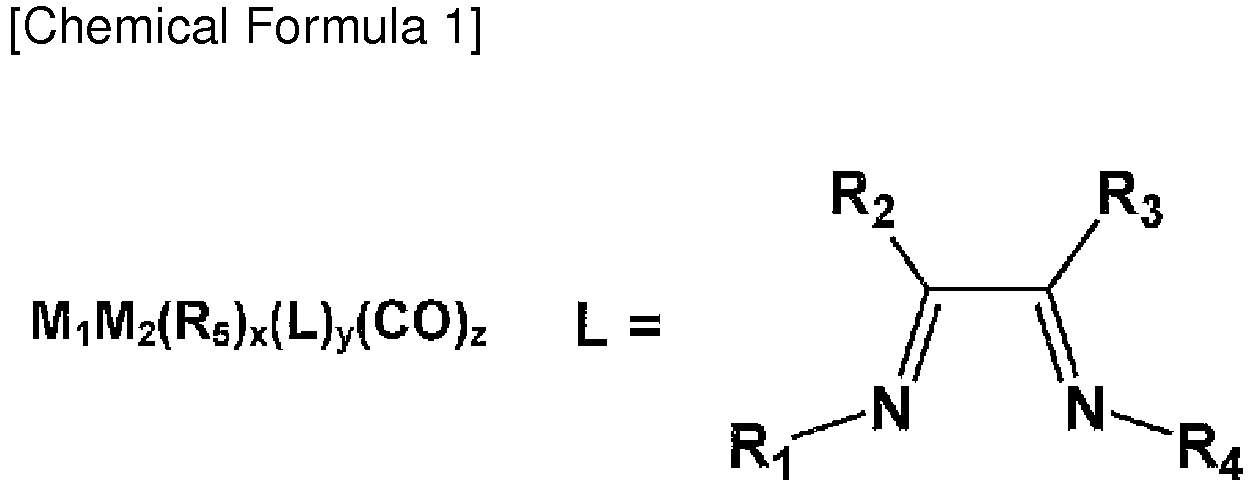
- the present invention relates to a chemical deposition raw material for producing a composite metal thin film or a composite metal compound thin film by a chemical deposition method, including a heterogeneous polynuclear complex in which at least a diimine (L) containing two imines and a carbonyl are coordinated to a first transition metal (M 1 ) and a second transition metal (M 2 ) as central metals, the heterogeneous polynuclear complex being represented by the following formula: wherein M 1 and M 2 are mutually different transition metals; x is an integer of 0 or more and 2 or less, y is an integer of 1 or more and 2 or less, and z is an integer of 1 or more and 10 or less; R 1 to R 4 are each one of a hydrogen atom and an alkyl group with a carbon number of 1 or more and 5 or less; and R 5 is a hydrogen atom, a carbonyl, an alkyl group with a carbon number of 1 or more and 7 or less, an allyl group or
- the complex in the present invention is a heterogeneous polynuclear complex including a plurality of kinds of transition metals: a first transition metal (M 1 ) and a second transition metal (M 2 ) as central metals of the complex, and to these central metals are coordinated at least a diimine (L) and a carbonyl (-CO) as ligands.
- a thin film is formed from the complex by a chemical deposition method, a plurality of metals as central metals are all deposited.
- the complex of the present invention has moderate thermal stability because the diimine as a ligand has a relatively strong bonding force with a transition metal, and the carbonyl as a ligand has a relatively weak bonding forth with a transition metal. Since the carbon number of the alkyl group as each of substituents R 1 to R 5 is arbitrarily designed, the vapor pressure and the melting point can be adjusted.
- heterogeneous polynuclear complex included in the chemical deposition raw material according to the present invention will be described in detail.
- x, y and z representing the numbers of ligands (R 5 ), diimines (L) and carbonyls (CO), respectively, in the raw material of the present invention will be described.
- x is an integer of 0 or more and 2 or less
- y is an integer of 1 or more and 2 or less
- z is an integer of 1 or more and 10 or less;
- x is 1 or more and 2 or less
- y is 1 or more and 2 or less
- z is 3 or more and 8 or less.
- Preferred ranges of the integers that can be selected as x, y and z depend on the kind (valence) of the transition metal and the correlation associated with the value of x.
- M 1 and M 2 is Fe or Ru
- y is 2 and z is 4 to 6 when x is 0, preferably, y is 1 and z is 4 to 7 when x is 1, and preferably, y is 1 and z is 2 to 6 when x is 2.
- x 1, y is 1 and z is n + 2 as a combination of x, y and z, and mention is made of, for example, a chemical deposition raw material including a heterogeneous polynuclear complex represented by the following formula: wherein M 1 and M 2 are mutually different transition metals; n is 3 or more and 6 or less; Each of R 1 and R 4 is an alkyl group with a carbon number of 1 or more and 4 or less, and each of R 2 and R 3 is a hydrogen atom, or an alkyl group with a carbon number of 1 or more and 3 or less; and R 5 is a carbonyl, or an alkyl group with a carbon number of 1 or more and 4 or less.
- M 1 and M 2 are mutually different transition metals.
- the transition metal include titanium (Ti), vanadium (V), chromium (Cr), manganese (Mn), iron (Fe), cobalt (Co), nickel (Ni), copper (Cu), niobium (Nb), molybdenum (Mo), ruthenium (Ru), rhodium (Rh), palladium (Pd), silver (Ag), tantalum (Ta), tungsten (W), rhenium (Re), osmium (Os), iridium (Ir), platinum (Pt) and gold (Au).
- transition metal Mn, Fe, Co, Ni, Cu, Nb, Mo, Ru, Rh, Ta, W, Ir and Pt are preferable, and Mn, Fe, Co, Ni, Cu, Mo, Ru, W and Pt are especially preferable.
- transition metal as M 1 , Ru, Mn and Fe are especially preferable, and as the transition metal as M 2 , Mn, Fe, Co and Ni are especially preferable.
- the "diimine (L)" as a ligand refers to a ligand which has a secondary amine (imino group) having a carbon-nitrogen double bond, and includes a conjugated diene including two conjugated double bonds as carbon-carbon bonds.
- a ligand having two secondary amines as described above tends to improve thermal stability of the complex because nitrogen atoms in two imino groups are strongly bonded to central metals.
- a diimine compound tends to have a small molecular weight and a low boiling point, is easily evaporated after decomposition, and thus hardly remains as an impurity in a metal film, and in addition to this advantage, the diimine compound can increase the vapor pressure of a complex having the diimine compound as a ligand.
- the second transition metal M 2 to which only the carbonyl is coordinated is apt to be deposited in a larger amount in the composite metal thin film than the first transition metal M 1 to which the diimine is coordinated.
- M 1 and M 2 are mutually different transition metals;
- n is 3 or more and 6 or less;
- R 1 and R 4 is an alkyl group with a carbon number of 1 or more and 4 or less, and each of R 2 and R 3 is a hydrogen atom, or an alkyl group with a carbon number of 1 or more and 3 or less;
- R 5 is a carbonyl, or an alkyl group with a carbon number of 1 or more and 4 or less.
- R 1 to R 4 are each one of a hydrogen atom and an alkyl group with a carbon number of 1 or more and 5 or less; and When the carbon chain is excessively long, the vapor pressure of the complex tends to decrease, and in the case of a long-chain alkyl group with a carbon number of more than 5, the complex is difficult to vaporize. Either a linear or branched alkyl group can be applied as each of substituents R 1 to R 4 .
- a n-propyl group, an iso-propyl group, a n-butyl group, an iso-butyl group, a sec-butyl group, a tert-butyl group or the like can be applied.
- each of R 1 and R 4 is preferably an alkyl group with a carbon number of 1 or more and 4 or less, especially preferably one of an ethyl group, a propyl group and a butyl group.
- Each of alkyl groups of R 1 and R 4 is preferably a branched alkyl group, especially preferably one of an iso (i-)propyl group, a tert-butyl group and a sec-butyl group.
- Each of R 2 and R 3 is preferably a hydrogen atom or an alkyl group with a carbon number of 1 or more and 3 or less, especially preferably one of a hydrogen atom, a methyl group and an ethyl group.
- the number of ligands R 5 is 0 or more and 2 or less, and preferably, one of the ligands R 5 is a ligand of M 1 .
- R 5 is one of a hydrogen atom, a carbonyl, an alkyl with a carbon number of 1 or more and 7 or less, an allyl or an allyl derivative, preferably a carbonyl or an alkyl with a carbon number of 1 or more and 4 or less, especially preferably a carbonyl, methyl ethyl or propyl. Which of a carbonyl and an alkyl is preferred as the ligand R 5 depends on the kind of the first transition metal (M 1 ).
- a carbonyl is especially preferable when M 1 is Mn, Co, Rh, Re or Ir, and an alkyl is especially preferable when M 1 is Fe, Ru or Os.
- the ligand R 5 is an alkyl, either a linear or branched alkyl can be applied.
- the total number of carbonyls (CO) is 1 or more and 10 or less, and preferably, the ligand of the first transition metal (M 1 ) has two or three carbonyls.
- the coordination number (n) of carbonyls as the ligand of the second transition metal (M 2 ) is preferably 4 or 5, and which coordination number is preferred depends on the kind of the second transition metal (M 2 ).
- the coordination number (n) is especially preferably 5 when M 2 is Mn or Re, and the coordination number (n) is especially preferably 4 when M 2 is Co, Rh or Ir.
- heterogeneous polynuclear complexes that are preferred for the chemical deposition raw material of the present invention are listed below as examples.
- the chemical deposition raw material of the present invention described above can be produced in the following manner: a starting raw material that is a diazabutadiene derivative with the first transition metal (M 1 ) as a central metal is reacted with a complex to which a plurality of carbonyls are coordinated with the second transition metal (M 2 ) as a central metal.
- the present chemical deposition raw material is useful for formation of a composite metal thin film by a CVD method.
- This thin film formation method includes preparing a reaction gas by vaporizing a raw material including a heterogeneous polynuclear complex, introducing the reaction gas to a substrate surface, and decomposing the complex to deposit a plurality of metals.
- the heterogeneous polynuclear complex according to the present invention is used as a raw material.
- the reaction atmosphere during formation of the thin film is preferably a reducing atmosphere, and therefore preferably, hydrogen or ammonia is introduced as a reaction gas.
- the heating temperature during film formation is preferably 150°C to 350°C. When the heating temperature is lower than 150°C, the film formation hardly proceeds, and thus a required thickness is hard to obtain. When the heating temperature is higher than 350°C, formation of a uniform thin film is difficult.
- a composite metal thin film or a composite metal compound thin film containing a plurality of metals can be formed from a single raw material as described above.
- the raw material of the present invention has a high vapor pressure, is capable of producing a thin film at low temperature, has moderate thermal stability, and is thus suitable for film formation by a chemical deposition method.
- the following four kinds of complexes were synthesized. Synthesized complexes were each evaluated for physical properties, and subjected to a film formation test as a chemical deposition raw material.
- Example 1 A heterogeneous polynuclear complex (pentacarbonyl[dicarbonyl(N,N'-diisopropyl-1,4-diazabutadiene)methylruthenium ]manganese (Mn-Ru)) having ruthenium as a first transition metal and manganese as a second transition metal was produced.
- the synthesis reaction formula is as described below. Hereinafter, the production process will be described in detail.
- reaction mixture was extracted with hexane, and purified by column chromatography with alumina as a carrier and hexane as an eluent. Sublimation purification was performed to obtain 3.30 g (6.5 mmol) of pentacarbonyl[dicarbonyl(N,N'-diisopropyl-1,4-diazabutadiene)methylruthenium] manganese (Mn-Ru) as a specified substance (yield: 65%).
- Example 2 A heterogeneous polynuclear complex (tricarbonyl(N,N'-diisopropyl-1,4-diazabutadiene)(tetracarbonylcobalt)manganes e (Co-Mn)) having manganese as a first transition metal and cobalt as a second transition metal was produced.
- the synthesis reaction formula is as described below. Hereinafter, the production process will be described in detail.
- Example 3 A heterogeneous polynuclear complex (dicarbonyl(N,N'-diisopropyl-1,4-diazabutadiene)(tetracarbonylcobalt)methylruth enium (Co-Ru)) having ruthenium as a first transition metal and cobalt as a second transition metal was produced.
- the synthesis reaction formula is as described below. Hereinafter, the production process will be described in detail.
- reaction mixture was extracted with hexane, and purified by column chromatography with alumina as a carrier and hexane as an eluent. Sublimation purification was performed to obtain 2.42 g (5.0 mmol) of dicarbonyl(N,N'-diisopropyl-1,4-diazabutadiene)(tetracarbonylcobalt)methylruth enium (Co-Ru) as a specified substance (yield: 50%).
- Example 4 A heterogeneous polynuclear complex (pentacarbonyl[dicarbonyl(ethyl)(N,N'-diisopropyl-1,4-diazabutadiene)ruthenium ]manganese (Mn-Ru)) having ruthenium as a first transition metal and manganese as a second transition metal was produced.
- the synthesis reaction formula is as described below. Hereinafter, the production process will be described in detail.
- reaction mixture was extracted with hexane, and purified by column chromatography with alumina as a carrier and hexane as an eluent. Sublimation purification was performed to obtain 2.98 g (5.7 mmol) of pentacarbonyl[dicarbonyl(ethyl)(N,N'-diisopropyl-1,4-diazabutadiene)ruthenium] manganese (Mn-Ru) as a specified substance (yield: 57%).
- Evaluation of physical properties of heterogeneous polynuclear complex Physical properties were evaluated by TG for the heterogeneous polynuclear complexes produced in Examples 1 and 4. Analysis was performed by observing a change in weight of a complex sample (5 mg) in heating of the sample at a temperature elevation rate of 5°C/min over a measurement temperature range, i.e. from room temperature to 450°C, under a nitrogen atmosphere in TG-DTA2000SA manufactured by BRUKER Corporation. For Example 1, analysis (TG measurement under reduced pressure) with a complex sample heated at a pressure of 5 Torr was performed. The results are shown in Fig. 1 .
- Fig. 1 shows that the complexes in Examples 1 and 4 were vaporized and decomposed by heating at about 130°C, and thus these complexes had a low decomposition temperature, and were capable of forming a film at low temperature.
- the results of the TG measurement under reduced pressure showed that the complex in Example 1 was totally vaporized without being decomposed at a pressure during film formation.
- Film formation test Next, a film formation test was conducted in which a composite metal thin film was formed by a CVD method with the complex produced in Example 1 as a raw material compound.
- the metal thin film was formed on a substrate (15 mm x 15 mm) with a silicon oxide film deposited on a silicon substrate by use of tetraethoxysilane (TEOS).
- TEOS tetraethoxysilane
- a hot wall type thermal CVD apparatus was used as a film formation apparatus.
- a reaction gas (hydrogen) was fed at a constant flow rate by use of a mass flow controller. Film formation conditions are as described below. The result of observing a cross-section of the metal thin film with a SEM is shown in Fig. 2 .
- the metal thin film formed in this way was glossy pure white, and had a thickness of 47.2 nm.
- Fig. 2 shows that the metal thin film formed on SiO 2 had a smooth and uniform surface.
- M 1 /M 2 ratio the Ru/Mn ratio was analyzed as an abundance of metal elements by an X-ray photoelectron spectroscopy (XPS) method for the metal thin film formed as described above.
- XPS X-ray photoelectron spectroscopy
- KRATOS Axis Nova manufactured by Shimadzu Corporation was used as a measurement apparatus.
- the thin film (thickness: 47.2 nm) was analyzed in a depth direction from the vicinity of the surface to the upper side of the vicinity of the interface with the SiO 2 film.
- actions of Si and O made it difficult to correctly analyze the Ru/Mn ratio, and the analysis was performed over a range where the impact was low.
- the results are shown in Fig. 3 .
- the horizontal axis in Fig. 3 is approximately consistent with a thickness (47.2 nm) from the thin film surface to the upper side of the vicinity of the interface with the SiO 2 film.
- Fig. 3 shows that both Ru and Mn were deposited in the metal thin film.
- the Ru/Mn ratio was almost constant (around 0.45) although it tended to be slightly high in the vicinity of the surface of the thin film.
- a composite metal thin film can be formed from a single raw material by a chemical deposition method, and it is easy to make the thin film homogeneous and control quality of raw materials.
- the present invention can be applied to uses which employ a structure in which a plurality of metal layers are deposited, such as copper diffusion layers in semiconductor devices.
Landscapes
- Chemical & Material Sciences (AREA)
- Organic Chemistry (AREA)
- General Chemical & Material Sciences (AREA)
- Chemical Kinetics & Catalysis (AREA)
- Engineering & Computer Science (AREA)
- Materials Engineering (AREA)
- Mechanical Engineering (AREA)
- Metallurgy (AREA)
- Chemical Vapour Deposition (AREA)
- Electrodes Of Semiconductors (AREA)
- Organic Low-Molecular-Weight Compounds And Preparation Thereof (AREA)
Abstract
Description
- The present invention relates to a chemical deposition raw material including a heterogeneous polynuclear complex, which is used for producing a composite metal thin film or a composite metal compound thin film including different kinds of metals by a chemical deposition method such as a CVD method or an ALD method. Specifically, the present invention relates to a chemical deposition raw material which is capable of forming a thin film including a composite metal in one-time film formation and which is capable of forming a film at low temperature (about 200°C) while having moderate thermal stability.
- In various kinds of devices such as semiconductors, various kinds of metal thin films are used for satisfying the required properties of the devices. As a method for forming these metal thin films, a chemical deposition method such as a CVD method, which is capable of forming a uniform and homogeneous film at a high film formation rate and in conformity with even a three-dimensional shape etc. of a device, is used.
- As a metal complex that is a raw material in formation of a metal thin film by the chemical deposition method, a complex including a plurality of ligands such as cyclopentadienyl with one metal as a central metal (nucleus) (hereinafter, referred to as a mononuclear complex) as shown in the following
chemical formula 1 is known. A complex including a plurality of metals of the same kind as central metals (hereinafter, referred to as a homogeneous polynuclear complex) as shown in the following chemical formula 2 is also known.

- In formation of a metal thin film for use in a device such as a semiconductor by use of the above-mentioned mononuclear complex or homogeneous polynuclear complex as a chemical deposition raw material, a thin film including a plurality of kinds of metals is often applied. In a device having a reduced size and weight, such as a semiconductor, a plurality of metal thin films are applied, and deposited for imparting various kinds of required properties, so that the device is densified and highly integrated while attaining required properties. For example, when copper is used as a wiring material of a semiconductor, a structure is used in which a thin film of MnO, MnSiO and the like as a barrier layer for preventing diffusion of copper, and a thin film of ruthenium or the like as a base for introducing the barrier layer are deposited together.
- As an example of forming a thin film including a plurality of metals as described above, mention is made of
Patent Document 1, Patent Document 2 and so on.Patent Document 1 suggests that a plurality of mononuclear complexes etc. are provided, and metal thin films are sequentially deposited from the complexes to form a plurality of metal layers each including a single metal. Patent Document 2 suggests that a plurality of mononuclear complexes etc. are mixed beforehand, and dissolved or emulsified to obtain an inert liquid, and from the inert liquid, a composite metal thin film containing a plurality of metals is formed. -
- Patent Document 1:
JP 2011-1568 A - Patent Document 2:
JP 2002-60944 A - However, when a plurality of thin films are sequentially formed by use of a plurality of complexes as in
Patent Document 1, a large number of steps are required for film formation, condition setting is complicated, much time and labor is needed for quality control of raw materials, and use of a plurality of raw materials causes an increase in cost. When a plurality of metal complexes are mixed beforehand as in Patent Document 2, the complexes have different vaporization properties, and therefore the ratio of metals in the thin film easily varies, so that formation of a homogeneous film becomes difficult. Before film formation, raw materials may react with each other, leading to degeneration. - The present invention has been made in view of the background described above, and provides a chemical deposition raw material which is capable of forming a plurality of kinds of metal thin films in a simple process, and capable of forming a homogeneous thin film, and is easily quality-controlled.
- As a solution to the problems described above, the present inventors conducted the following studies for synthesizing a complex including a plurality of kinds of metals as central metals in one complex (hereinafter, referred to as a heterogeneous polynuclear complex), and applying the complex as a chemical deposition raw material instead of applying a plurality of complexes having different metal species as in a conventional art.
- When a heterogeneous polynuclear complex is applied as a chemical deposition raw material, first a plurality of kinds of metals as central metals should be all deposited in formation of a metal thin film by a chemical deposition method as a required property of the chemical deposition raw material. Preferably, the deposition ratios of a plurality of metals are almost the same. The chemical deposition raw material should also have such a general required property of a chemical deposition raw material that in formation of a thin film by a chemical deposition method, the chemical deposition raw material has thermal stability sufficient to prevent thermal decomposition in a vaporization stage while having a decomposition property which ensures that a film can be formed at low temperature. The present inventors extensively conducted studies on a complex having all the above-mentioned properties, and resultantly arrived at a chemical deposition raw material of the present invention which includes a heterogeneous polynuclear complex having a configuration as described below.
- The present invention relates to a chemical deposition raw material for producing a composite metal thin film or a composite metal compound thin film by a chemical deposition method, including a heterogeneous polynuclear complex in which at least a diimine (L) containing two imines and a carbonyl are coordinated to a first transition metal (M1) and a second transition metal (M2) as central metals, the heterogeneous polynuclear complex being represented by the following formula:

- As described above, the complex in the present invention is a heterogeneous polynuclear complex including a plurality of kinds of transition metals: a first transition metal (M1) and a second transition metal (M2) as central metals of the complex, and to these central metals are coordinated at least a diimine (L) and a carbonyl (-CO) as ligands. When a thin film is formed from the complex by a chemical deposition method, a plurality of metals as central metals are all deposited.
- The complex of the present invention has moderate thermal stability because the diimine as a ligand has a relatively strong bonding force with a transition metal, and the carbonyl as a ligand has a relatively weak bonding forth with a transition metal. Since the carbon number of the alkyl group as each of substituents R1 to R5 is arbitrarily designed, the vapor pressure and the melting point can be adjusted.
- Hereinafter, the heterogeneous polynuclear complex included in the chemical deposition raw material according to the present invention will be described in detail.
- First, x, y and z representing the numbers of ligands (R5), diimines (L) and carbonyls (CO), respectively, in the raw material of the present invention will be described. x is an integer of 0 or more and 2 or less, y is an integer of 1 or more and 2 or less, and z is an integer of 1 or more and 10 or less; Preferably, x is 1 or more and 2 or less, y is 1 or more and 2 or less, and z is 3 or more and 8 or less.
- Preferred ranges of the integers that can be selected as x, y and z depend on the kind (valence) of the transition metal and the correlation associated with the value of x. For example, provided that at least one of M1 and M2 is Fe or Ru, preferably, y is 2 and z is 4 to 6 when x is 0, preferably, y is 1 and z is 4 to 7 when x is 1, and preferably, y is 1 and z is 2 to 6 when x is 2.
- It is especially preferable that x is 1, y is 1 and z is n + 2 as a combination of x, y and z, and mention is made of, for example, a chemical deposition raw material including a heterogeneous polynuclear complex represented by the following formula:


- M1 and M2 are mutually different transition metals. Examples of the transition metal include titanium (Ti), vanadium (V), chromium (Cr), manganese (Mn), iron (Fe), cobalt (Co), nickel (Ni), copper (Cu), niobium (Nb), molybdenum (Mo), ruthenium (Ru), rhodium (Rh), palladium (Pd), silver (Ag), tantalum (Ta), tungsten (W), rhenium (Re), osmium (Os), iridium (Ir), platinum (Pt) and gold (Au). As the transition metal, Mn, Fe, Co, Ni, Cu, Nb, Mo, Ru, Rh, Ta, W, Ir and Pt are preferable, and Mn, Fe, Co, Ni, Cu, Mo, Ru, W and Pt are especially preferable. As the transition metal as M1, Ru, Mn and Fe are especially preferable, and as the transition metal as M2, Mn, Fe, Co and Ni are especially preferable.
- Ligands to be coordinated to central metals will now be described. In the raw material of the present invention, at least a diimine and a carbonyl are coordinated to central metals including two transition metals as in, for example, the following compound. The present inventors arrived at the raw material based on the following grounds regarding the configurations of the central metals and the ligands coordinated to the central metals.

- The "diimine (L)" as a ligand refers to a ligand which has a secondary amine (imino group) having a carbon-nitrogen double bond, and includes a conjugated diene including two conjugated double bonds as carbon-carbon bonds. A ligand having two secondary amines as described above tends to improve thermal stability of the complex because nitrogen atoms in two imino groups are strongly bonded to central metals. A diimine compound tends to have a small molecular weight and a low boiling point, is easily evaporated after decomposition, and thus hardly remains as an impurity in a metal film, and in addition to this advantage, the diimine compound can increase the vapor pressure of a complex having the diimine compound as a ligand.
- Comparison between the ligands for ease of separation from the central metal shows that the carbonyl (-CO) tends to be more easily separated from the central metal than the diimine (L). Here, when a composite metal thin film is formed by a chemical deposition method, the amount of each transition metal deposited in the thin film often depends on the kind of a ligand coordinated to each transition metal. Of two transition metals, a transition metal having a larger amount of the carbonyl and a smaller amount of the diimine in terms of a ligand tends to be deposited in a larger amount in the formed composite metal thin film. For example, in the case of the following compound that is mentioned as a preferred example in the present invention, the second transition metal M2 to which only the carbonyl is coordinated is apt to be deposited in a larger amount in the composite metal thin film than the first transition metal M1 to which the diimine is coordinated.

- Substituents R1 to R4 of the diimine will now be described. R1 to R4 are each one of a hydrogen atom and an alkyl group with a carbon number of 1 or more and 5 or less; and When the carbon chain is excessively long, the vapor pressure of the complex tends to decrease, and in the case of a long-chain alkyl group with a carbon number of more than 5, the complex is difficult to vaporize. Either a linear or branched alkyl group can be applied as each of substituents R1 to R4. For example, when a propyl group or a butyl group is applied, a n-propyl group, an iso-propyl group, a n-butyl group, an iso-butyl group, a sec-butyl group, a tert-butyl group or the like can be applied.
- With regard to each substituent, each of R1 and R4 is preferably an alkyl group with a carbon number of 1 or more and 4 or less, especially preferably one of an ethyl group, a propyl group and a butyl group. Each of alkyl groups of R1 and R4 is preferably a branched alkyl group, especially preferably one of an iso (i-)propyl group, a tert-butyl group and a sec-butyl group. Each of R2 and R3 is preferably a hydrogen atom or an alkyl group with a carbon number of 1 or more and 3 or less, especially preferably one of a hydrogen atom, a methyl group and an ethyl group.
- The number of ligands R5 is 0 or more and 2 or less, and preferably, one of the ligands R5 is a ligand of M1. R5 is one of a hydrogen atom, a carbonyl, an alkyl with a carbon number of 1 or more and 7 or less, an allyl or an allyl derivative, preferably a carbonyl or an alkyl with a carbon number of 1 or more and 4 or less, especially preferably a carbonyl, methyl ethyl or propyl. Which of a carbonyl and an alkyl is preferred as the ligand R5 depends on the kind of the first transition metal (M1). A carbonyl is especially preferable when M1 is Mn, Co, Rh, Re or Ir, and an alkyl is especially preferable when M1 is Fe, Ru or Os. When the ligand R5 is an alkyl, either a linear or branched alkyl can be applied.
- In the complex in the present invention, the total number of carbonyls (CO) is 1 or more and 10 or less, and preferably, the ligand of the first transition metal (M1) has two or three carbonyls. The coordination number (n) of carbonyls as the ligand of the second transition metal (M2) is preferably 4 or 5, and which coordination number is preferred depends on the kind of the second transition metal (M2). The coordination number (n) is especially preferably 5 when M2 is Mn or Re, and the coordination number (n) is especially preferably 4 when M2 is Co, Rh or Ir.
- Specific kinds of heterogeneous polynuclear complexes that are preferred for the chemical deposition raw material of the present invention are listed below as examples.


- The chemical deposition raw material of the present invention described above can be produced in the following manner: a starting raw material that is a diazabutadiene derivative with the first transition metal (M1) as a central metal is reacted with a complex to which a plurality of carbonyls are coordinated with the second transition metal (M2) as a central metal.
- The present chemical deposition raw material is useful for formation of a composite metal thin film by a CVD method. This thin film formation method includes preparing a reaction gas by vaporizing a raw material including a heterogeneous polynuclear complex, introducing the reaction gas to a substrate surface, and decomposing the complex to deposit a plurality of metals. In this method, the heterogeneous polynuclear complex according to the present invention is used as a raw material.
- The reaction atmosphere during formation of the thin film is preferably a reducing atmosphere, and therefore preferably, hydrogen or ammonia is introduced as a reaction gas. The heating temperature during film formation is preferably 150°C to 350°C. When the heating temperature is lower than 150°C, the film formation hardly proceeds, and thus a required thickness is hard to obtain. When the heating temperature is higher than 350°C, formation of a uniform thin film is difficult.
- With the chemical deposition raw material according to the present invention, a composite metal thin film or a composite metal compound thin film containing a plurality of metals can be formed from a single raw material as described above. The raw material of the present invention has a high vapor pressure, is capable of producing a thin film at low temperature, has moderate thermal stability, and is thus suitable for film formation by a chemical deposition method.
-
-
Fig. 1 illustrates a TG curve of a metal complex produced in an embodiment. -
Fig. 2 shows a photograph of a cross-section of a metal thin film formed in an embodiment. -
Fig. 3 illustrates a Ru/Mn ratio in a metal thin film formed in an embodiment. - Hereinafter, the best embodiments in the present invention will be described.
- In the embodiments, the following four kinds of complexes were synthesized. Synthesized complexes were each evaluated for physical properties, and subjected to a film formation test as a chemical deposition raw material.


- Example 1: A heterogeneous polynuclear complex (pentacarbonyl[dicarbonyl(N,N'-diisopropyl-1,4-diazabutadiene)methylruthenium ]manganese (Mn-Ru)) having ruthenium as a first transition metal and manganese as a second transition metal was produced. The synthesis reaction formula is as described below. Hereinafter, the production process will be described in detail.

- 1.95 g (5 mmol) of decacarbonyldimanganese and 0.23 g (10 mmol) of metal sodium were added in a flask containing 250 ml of tetrahydrofuran. The solution was stirred at room temperature for 24 hours, a solution obtained by dissolving 4.39 g (10 mmol) of dicarbonyliodo(N,N'-diisopropyl-1,4-diazabutadiene)methylruthenium in 250 ml of tetrahydrofuran was then added, and the mixture was stirred at room temperature for 4 hours. After completion of the reaction, the reaction product was concentrated to obtain a muddy reaction mixture. The reaction mixture was extracted with hexane, and purified by column chromatography with alumina as a carrier and hexane as an eluent. Sublimation purification was performed to obtain 3.30 g (6.5 mmol) of pentacarbonyl[dicarbonyl(N,N'-diisopropyl-1,4-diazabutadiene)methylruthenium] manganese (Mn-Ru) as a specified substance (yield: 65%).
- Example 2: A heterogeneous polynuclear complex (tricarbonyl(N,N'-diisopropyl-1,4-diazabutadiene)(tetracarbonylcobalt)manganes e (Co-Mn)) having manganese as a first transition metal and cobalt as a second transition metal was produced. The synthesis reaction formula is as described below. Hereinafter, the production process will be described in detail.

- 1.71 g (5 mmol) of octacarbonyldicobalt and 0.23 g (10 mmol) of metal sodium were added in a flask containing 250 ml of tetrahydrofuran. The solution was stirred at room temperature for 24 hours, a solution obtained by dissolving 3.60 g (10 mmol) of bromotricarbonyl(N,N'-diisopropyl-1,4-diazabutadiene)manganese in 250 ml of tetrahydrofuran was then added, and the mixture was stirred at room temperature for 4 hours. After completion of the reaction, the reaction product was concentrated, and then extracted with hexane. After recrystallization from hexane at -30°C, sublimation purification was performed to obtain 1.13 g (5.0 mmol) of tricarbonyl(N,N'-diisopropyl-1,4-diazabutadiene)(tetracarbonylcobalt)manganes e (Co-Mn) as a specified substance (yield: 50%).
- Example 3: A heterogeneous polynuclear complex (dicarbonyl(N,N'-diisopropyl-1,4-diazabutadiene)(tetracarbonylcobalt)methylruth enium (Co-Ru)) having ruthenium as a first transition metal and cobalt as a second transition metal was produced. The synthesis reaction formula is as described below. Hereinafter, the production process will be described in detail.

- 1.71 g (5 mmol) of octacarbonyldicobalt and 0.23 g (10 mmol) of metal sodium were added in a flask containing 250 ml of tetrahydrofuran. The solution was stirred at room temperature for 24 hours, a solution obtained by dissolving 4.39 g (10 mmol) of dicarbonyliodo(N,N'-diisopropyl-1,4-diazabutadiene)methylruthenium in 250 ml of tetrahydrofuran was then added, and the mixture was stirred at room temperature for 4 hours. After completion of the reaction, the reaction product was concentrated to obtain a muddy reaction mixture. The reaction mixture was extracted with hexane, and purified by column chromatography with alumina as a carrier and hexane as an eluent. Sublimation purification was performed to obtain 2.42 g (5.0 mmol) of dicarbonyl(N,N'-diisopropyl-1,4-diazabutadiene)(tetracarbonylcobalt)methylruth enium (Co-Ru) as a specified substance (yield: 50%).
- Example 4: A heterogeneous polynuclear complex (pentacarbonyl[dicarbonyl(ethyl)(N,N'-diisopropyl-1,4-diazabutadiene)ruthenium ]manganese (Mn-Ru)) having ruthenium as a first transition metal and manganese as a second transition metal was produced. The synthesis reaction formula is as described below. Hereinafter, the production process will be described in detail.

- 1.95 g (5 mmol) of decacarbonyldimanganese and 0.23 g (10 mmol) of metal sodium were added in a flask containing 250 ml of tetrahydrofuran. The solution was stirred at room temperature for 24 hours, a solution obtained by dissolving 4.53 g (10 mmol) of dicarbonylethyliodo(N,N'-diisopropyl-1,4-diazabutadiene)ruthenium in 250 ml of tetrahydrofuran was then added, and the mixture was stirred at room temperature for 4 hours. After completion of the reaction, the reaction product was concentrated to obtain a muddy reaction mixture. The reaction mixture was extracted with hexane, and purified by column chromatography with alumina as a carrier and hexane as an eluent. Sublimation purification was performed to obtain 2.98 g (5.7 mmol) of pentacarbonyl[dicarbonyl(ethyl)(N,N'-diisopropyl-1,4-diazabutadiene)ruthenium] manganese (Mn-Ru) as a specified substance (yield: 57%).
- Evaluation of physical properties of heterogeneous polynuclear complex: Physical properties were evaluated by TG for the heterogeneous polynuclear complexes produced in Examples 1 and 4. Analysis was performed by observing a change in weight of a complex sample (5 mg) in heating of the sample at a temperature elevation rate of 5°C/min over a measurement temperature range, i.e. from room temperature to 450°C, under a nitrogen atmosphere in TG-DTA2000SA manufactured by BRUKER Corporation. For Example 1, analysis (TG measurement under reduced pressure) with a complex sample heated at a pressure of 5 Torr was performed. The results are shown in
Fig. 1 . -
Fig. 1 shows that the complexes in Examples 1 and 4 were vaporized and decomposed by heating at about 130°C, and thus these complexes had a low decomposition temperature, and were capable of forming a film at low temperature. The results of the TG measurement under reduced pressure showed that the complex in Example 1 was totally vaporized without being decomposed at a pressure during film formation. - Film formation test: Next, a film formation test was conducted in which a composite metal thin film was formed by a CVD method with the complex produced in Example 1 as a raw material compound.
- The metal thin film was formed on a substrate (15 mm x 15 mm) with a silicon oxide film deposited on a silicon substrate by use of tetraethoxysilane (TEOS). As a film formation apparatus, a hot wall type thermal CVD apparatus was used. A reaction gas (hydrogen) was fed at a constant flow rate by use of a mass flow controller. Film formation conditions are as described below. The result of observing a cross-section of the metal thin film with a SEM is shown in
Fig. 2 . -
- Substrate: SiO2
- Film formation temperature: 250°C
- Sample temperature: 100°C
- Film formation pressure: 5 torr
- Reaction gas (hydrogen) flow rate: 10 sccm
- Film formation time: 60 minutes
- The metal thin film formed in this way was glossy pure white, and had a thickness of 47.2 nm.
Fig. 2 shows that the metal thin film formed on SiO2 had a smooth and uniform surface. - M1/M2 ratio: the Ru/Mn ratio was analyzed as an abundance of metal elements by an X-ray photoelectron spectroscopy (XPS) method for the metal thin film formed as described above. As a measurement apparatus, KRATOS Axis Nova manufactured by Shimadzu Corporation was used. In this measurement, the thin film (thickness: 47.2 nm) was analyzed in a depth direction from the vicinity of the surface to the upper side of the vicinity of the interface with the SiO2 film. In the vicinity of the interface with the SiO2 film, actions of Si and O made it difficult to correctly analyze the Ru/Mn ratio, and the analysis was performed over a range where the impact was low. The results are shown in
Fig. 3 . The horizontal axis inFig. 3 is approximately consistent with a thickness (47.2 nm) from the thin film surface to the upper side of the vicinity of the interface with the SiO2 film. -
Fig. 3 shows that both Ru and Mn were deposited in the metal thin film. The Ru/Mn ratio was almost constant (around 0.45) although it tended to be slightly high in the vicinity of the surface of the thin film. - According to the present invention, a composite metal thin film can be formed from a single raw material by a chemical deposition method, and it is easy to make the thin film homogeneous and control quality of raw materials. Thus, the present invention can be applied to uses which employ a structure in which a plurality of metal layers are deposited, such as copper diffusion layers in semiconductor devices.
Claims (8)
- A chemical deposition raw material for producing a composite metal thin film or a composite metal compound thin film by a chemical deposition method, comprising a heterogeneous polynuclear complex in which as ligands, at least a diimine (L) and a carbonyl are coordinated to a first transition metal (M1) and a second transition metal (M2) as central metals, the heterogeneous polynuclear complex being represented by the following formula:

- The chemical deposition raw material according to claim 1, wherein x is 1, y is 1 and z is n + 2, the chemical deposition raw material comprising a heterogeneous polynuclear complex represented by the following formula:


- The chemical deposition raw material according to claim 1, wherein the transition metal is one of Mn, Fe, Co, Ni, Cu, Nb, Mo, Ru, Rh, Ta, W, Ir and Pt.
- The chemical deposition raw material according to claim 1, wherein M1 is one of Ru, Mn and Fe, M2 is one of Mn, Fe, Co and Ni, and M1 and M2 are mutually different.
- The chemical deposition raw material according to any of claims 1 to 4, wherein each of R1 and R4 is one of an ethyl group, a propyl group and a butyl group.
- The chemical deposition raw material according to any of claims 1 to 5, wherein each of R2 and R3 is one of a hydrogen atom, a methyl group and an ethyl group.
- The chemical deposition raw material according to any of claims 1 to 6, wherein R5 is a carbonyl, methyl, ethyl or propyl.
- A chemical deposition method of a composite metal thin film or a composite metal compound thin film, comprising preparing a raw material gas by vaporizing a raw material including a heterogeneous polynuclear complex, and heating the raw material gas while introducing the raw material gas to a substrate surface, wherein the method uses the chemical deposition raw material defined in any of claims 1 to 7 as the raw material.
Applications Claiming Priority (2)
| Application Number | Priority Date | Filing Date | Title |
|---|---|---|---|
| JP2015096980A JP5952461B1 (en) | 2015-05-12 | 2015-05-12 | Chemical vapor deposition material comprising heterogeneous binuclear complex and chemical vapor deposition method using the chemical vapor deposition material |
| PCT/JP2016/063694 WO2016181917A1 (en) | 2015-05-12 | 2016-05-09 | Chemical vapor deposition starting material comprising heterogeneous polynuclear complex, and chemical vapor deposition method using said chemical vapor deposition starting material |
Publications (2)
| Publication Number | Publication Date |
|---|---|
| EP3296426A1 true EP3296426A1 (en) | 2018-03-21 |
| EP3296426A4 EP3296426A4 (en) | 2018-04-25 |
Family
ID=56375147
Family Applications (1)
| Application Number | Title | Priority Date | Filing Date |
|---|---|---|---|
| EP16792642.7A Withdrawn EP3296426A4 (en) | 2015-05-12 | 2016-05-09 | Chemical vapor deposition starting material comprising heterogeneous polynuclear complex, and chemical vapor deposition method using said chemical vapor deposition starting material |
Country Status (6)
| Country | Link |
|---|---|
| US (1) | US10407450B2 (en) |
| EP (1) | EP3296426A4 (en) |
| JP (1) | JP5952461B1 (en) |
| KR (1) | KR102040386B1 (en) |
| TW (1) | TWI596101B (en) |
| WO (1) | WO2016181917A1 (en) |
Families Citing this family (4)
| Publication number | Priority date | Publication date | Assignee | Title |
|---|---|---|---|---|
| US10978293B2 (en) | 2018-03-28 | 2021-04-13 | Meidensha Corporation | Oxide film formation method |
| EP3599240A1 (en) * | 2018-07-27 | 2020-01-29 | Umicore Ag & Co. Kg | Metal organic compounds |
| WO2020110406A1 (en) | 2018-11-30 | 2020-06-04 | 株式会社明電舎 | Oxide film forming device |
| JP6860048B2 (en) | 2019-08-30 | 2021-04-14 | 株式会社明電舎 | Atomic layer deposition method |
Family Cites Families (7)
| Publication number | Priority date | Publication date | Assignee | Title |
|---|---|---|---|---|
| US5171610A (en) * | 1990-08-28 | 1992-12-15 | The Regents Of The University Of Calif. | Low temperature photochemical vapor deposition of alloy and mixed metal oxide films |
| US6521561B1 (en) * | 1998-05-01 | 2003-02-18 | President And Fellows Of Harvard College | Main-group metal based asymmetric catalysts and applications thereof |
| US6984591B1 (en) | 2000-04-20 | 2006-01-10 | International Business Machines Corporation | Precursor source mixtures |
| GB0411742D0 (en) * | 2004-05-26 | 2004-06-30 | Exxonmobil Chem Patents Inc | Transition metal compounds for olefin polymerization and oligomerization |
| US20060040822A1 (en) * | 2004-08-23 | 2006-02-23 | Shveima Joseph S | Catalyst compositions, processes, and products utilizing pillared clays |
| JP5487748B2 (en) | 2009-06-16 | 2014-05-07 | 東京エレクトロン株式会社 | Barrier layer, film forming method and processing system |
| JP6043835B1 (en) * | 2015-05-12 | 2016-12-14 | 田中貴金属工業株式会社 | Chemical vapor deposition material comprising heterogeneous binuclear complex and chemical vapor deposition method using the chemical vapor deposition material |
-
2015
- 2015-05-12 JP JP2015096980A patent/JP5952461B1/en active Active
-
2016
- 2016-05-04 TW TW105113841A patent/TWI596101B/en active
- 2016-05-09 WO PCT/JP2016/063694 patent/WO2016181917A1/en not_active Ceased
- 2016-05-09 KR KR1020177027925A patent/KR102040386B1/en active Active
- 2016-05-09 EP EP16792642.7A patent/EP3296426A4/en not_active Withdrawn
- 2016-05-09 US US15/558,011 patent/US10407450B2/en active Active
Also Published As
| Publication number | Publication date |
|---|---|
| WO2016181917A1 (en) | 2016-11-17 |
| KR102040386B1 (en) | 2019-11-04 |
| US20180079764A1 (en) | 2018-03-22 |
| US10407450B2 (en) | 2019-09-10 |
| TW201710274A (en) | 2017-03-16 |
| JP5952461B1 (en) | 2016-07-13 |
| JP2016210742A (en) | 2016-12-15 |
| KR20170127498A (en) | 2017-11-21 |
| EP3296426A4 (en) | 2018-04-25 |
| TWI596101B (en) | 2017-08-21 |
Similar Documents
| Publication | Publication Date | Title |
|---|---|---|
| US10526698B2 (en) | Chemical deposition raw material including heterogeneous polynuclear complex and chemical deposition method using the chemical deposition raw material | |
| US20080248648A1 (en) | Deposition precursors for semiconductor applications | |
| EP2307589B1 (en) | Method for deposition of transition metal-containing films using heteroleptic cyclopentadienyl transition metal precursors | |
| US20100261350A1 (en) | Methods of forming thin metal-containing films by chemical phase deposition | |
| US20090208670A1 (en) | Organometallic compounds, processes for the preparation thereof and methods of use thereof | |
| US10407450B2 (en) | Heterogeneous polynuclear complex for use in the chemical deposition of composite metal or metal compound thin films | |
| TWI722456B (en) | Bis(diazadiene)cobalt compounds, method of making and method of use thereof | |
| WO2009015270A1 (en) | Organometallic precursors for use in chemical phase deposition processes | |
| EP3348667A1 (en) | Chemical vapor deposition feedstock comprising organic ruthenium compound and chemical vapor deposition method using said chemical vapor deposition feedstock | |
| TW201825700A (en) | Cobalt compound, its manufacture and use method | |
| US9034761B2 (en) | Heteroleptic (allyl)(pyrroles-2-aldiminate) metal-containing precursors, their synthesis and vapor deposition thereof to deposit metal-containing films | |
| EP3342899A1 (en) | Chemical vapor deposition starting material comprising a binuclear ruthenium complex and chemical vapor deposition method using chemical vapor deposition starting material | |
| TW201823262A (en) | Process for the generation of thin inorganic films | |
| Blakeney | Synthesis Of Volatile And Thermally Stable Aluminum Hydride Complexes And Their Use In Atomic Layer Deposition Of Metal Thin Films | |
| JP2010059471A (en) | Ruthenium particle and manufacturing method thereof, and manufacturing method of metal-containing thin film using ruthenium particles for lower metal film |
Legal Events
| Date | Code | Title | Description |
|---|---|---|---|
| PUAI | Public reference made under article 153(3) epc to a published international application that has entered the european phase |
Free format text: ORIGINAL CODE: 0009012 |
|
| 17P | Request for examination filed |
Effective date: 20171201 |
|
| AK | Designated contracting states |
Kind code of ref document: A1 Designated state(s): AL AT BE BG CH CY CZ DE DK EE ES FI FR GB GR HR HU IE IS IT LI LT LU LV MC MK MT NL NO PL PT RO RS SE SI SK SM TR |
|
| AX | Request for extension of the european patent |
Extension state: BA ME |
|
| A4 | Supplementary search report drawn up and despatched |
Effective date: 20180328 |
|
| RIC1 | Information provided on ipc code assigned before grant |
Ipc: C07F 15/00 20060101ALI20180320BHEP Ipc: C23C 16/18 20060101AFI20180320BHEP Ipc: H01L 21/31 20060101ALI20180320BHEP Ipc: C07F 13/00 20060101ALI20180320BHEP Ipc: C07F 15/06 20060101ALI20180320BHEP Ipc: H01L 21/285 20060101ALI20180320BHEP Ipc: C07C 251/08 20060101ALI20180320BHEP Ipc: C07F 19/00 20060101ALI20180320BHEP |
|
| DAV | Request for validation of the european patent (deleted) | ||
| DAX | Request for extension of the european patent (deleted) | ||
| GRAP | Despatch of communication of intention to grant a patent |
Free format text: ORIGINAL CODE: EPIDOSNIGR1 |
|
| INTG | Intention to grant announced |
Effective date: 20181119 |
|
| STAA | Information on the status of an ep patent application or granted ep patent |
Free format text: STATUS: THE APPLICATION IS DEEMED TO BE WITHDRAWN |
|
| 18D | Application deemed to be withdrawn |
Effective date: 20190330 |