EP3296280A1 - Obscurant emission systems and methods - Google Patents
Obscurant emission systems and methods Download PDFInfo
- Publication number
- EP3296280A1 EP3296280A1 EP17192096.0A EP17192096A EP3296280A1 EP 3296280 A1 EP3296280 A1 EP 3296280A1 EP 17192096 A EP17192096 A EP 17192096A EP 3296280 A1 EP3296280 A1 EP 3296280A1
- Authority
- EP
- European Patent Office
- Prior art keywords
- obscurant
- emitting
- composition
- hydrated salt
- weight
- Prior art date
- Legal status (The legal status is an assumption and is not a legal conclusion. Google has not performed a legal analysis and makes no representation as to the accuracy of the status listed.)
- Withdrawn
Links
- 238000000034 method Methods 0.000 title claims description 17
- 239000000203 mixture Substances 0.000 claims abstract description 189
- 150000003839 salts Chemical class 0.000 claims abstract description 93
- 239000007800 oxidant agent Substances 0.000 claims abstract description 54
- 239000000446 fuel Substances 0.000 claims abstract description 45
- XTEGARKTQYYJKE-UHFFFAOYSA-M Chlorate Chemical compound [O-]Cl(=O)=O XTEGARKTQYYJKE-UHFFFAOYSA-M 0.000 claims abstract description 12
- 150000001768 cations Chemical class 0.000 claims abstract description 8
- 150000001450 anions Chemical class 0.000 claims abstract description 7
- 229910002651 NO3 Inorganic materials 0.000 claims abstract description 6
- NHNBFGGVMKEFGY-UHFFFAOYSA-N Nitrate Chemical compound [O-][N+]([O-])=O NHNBFGGVMKEFGY-UHFFFAOYSA-N 0.000 claims abstract description 6
- 229910052783 alkali metal Inorganic materials 0.000 claims abstract description 6
- 150000001340 alkali metals Chemical class 0.000 claims abstract description 6
- 229910052784 alkaline earth metal Inorganic materials 0.000 claims abstract description 6
- SXDBWCPKPHAZSM-UHFFFAOYSA-M bromate Inorganic materials [O-]Br(=O)=O SXDBWCPKPHAZSM-UHFFFAOYSA-M 0.000 claims abstract description 6
- SXDBWCPKPHAZSM-UHFFFAOYSA-N bromic acid Chemical compound OBr(=O)=O SXDBWCPKPHAZSM-UHFFFAOYSA-N 0.000 claims abstract description 6
- 229910001919 chlorite Inorganic materials 0.000 claims abstract description 6
- 229910052619 chlorite group Inorganic materials 0.000 claims abstract description 6
- QBWCMBCROVPCKQ-UHFFFAOYSA-N chlorous acid Chemical compound OCl=O QBWCMBCROVPCKQ-UHFFFAOYSA-N 0.000 claims abstract description 6
- ICIWUVCWSCSTAQ-UHFFFAOYSA-M iodate Chemical compound [O-]I(=O)=O ICIWUVCWSCSTAQ-UHFFFAOYSA-M 0.000 claims abstract description 6
- VLTRZXGMWDSKGL-UHFFFAOYSA-M perchlorate Inorganic materials [O-]Cl(=O)(=O)=O VLTRZXGMWDSKGL-UHFFFAOYSA-M 0.000 claims abstract description 6
- VLTRZXGMWDSKGL-UHFFFAOYSA-N perchloric acid Chemical compound OCl(=O)(=O)=O VLTRZXGMWDSKGL-UHFFFAOYSA-N 0.000 claims abstract description 6
- KHIWWQKSHDUIBK-UHFFFAOYSA-N periodic acid Chemical compound OI(=O)(=O)=O KHIWWQKSHDUIBK-UHFFFAOYSA-N 0.000 claims abstract description 6
- 150000001342 alkaline earth metals Chemical class 0.000 claims abstract description 5
- 150000001875 compounds Chemical class 0.000 claims description 36
- 229930000044 secondary metabolite Natural products 0.000 claims description 33
- ZLNQQNXFFQJAID-UHFFFAOYSA-L magnesium carbonate Chemical compound [Mg+2].[O-]C([O-])=O ZLNQQNXFFQJAID-UHFFFAOYSA-L 0.000 claims description 25
- 229910001701 hydrotalcite Inorganic materials 0.000 claims description 17
- -1 artinite Chemical compound 0.000 claims description 16
- GDVKFRBCXAPAQJ-UHFFFAOYSA-A dialuminum;hexamagnesium;carbonate;hexadecahydroxide Chemical compound [OH-].[OH-].[OH-].[OH-].[OH-].[OH-].[OH-].[OH-].[OH-].[OH-].[OH-].[OH-].[OH-].[OH-].[OH-].[OH-].[Mg+2].[Mg+2].[Mg+2].[Mg+2].[Mg+2].[Mg+2].[Al+3].[Al+3].[O-]C([O-])=O GDVKFRBCXAPAQJ-UHFFFAOYSA-A 0.000 claims description 16
- 229960001545 hydrotalcite Drugs 0.000 claims description 16
- 229910052599 brucite Inorganic materials 0.000 claims description 15
- 229910001679 gibbsite Inorganic materials 0.000 claims description 14
- XWNSFEAWWGGSKJ-UHFFFAOYSA-N 4-acetyl-4-methylheptanedinitrile Chemical compound N#CCCC(C)(C(=O)C)CCC#N XWNSFEAWWGGSKJ-UHFFFAOYSA-N 0.000 claims description 13
- 239000004153 Potassium bromate Substances 0.000 claims description 13
- 229940094037 potassium bromate Drugs 0.000 claims description 13
- 235000019396 potassium bromate Nutrition 0.000 claims description 13
- ZFSLODLOARCGLH-UHFFFAOYSA-N isocyanuric acid Chemical compound OC1=NC(O)=NC(O)=N1 ZFSLODLOARCGLH-UHFFFAOYSA-N 0.000 claims description 12
- LZFFTXYPIUCBCO-UHFFFAOYSA-L magnesium;2-hydroxyacetate Chemical compound [Mg+2].OCC([O-])=O.OCC([O-])=O LZFFTXYPIUCBCO-UHFFFAOYSA-L 0.000 claims description 7
- 238000004519 manufacturing process Methods 0.000 claims description 7
- FIJPWGLOBMXXSF-UHFFFAOYSA-M potassium;2-hydroxyacetate Chemical compound [K+].OCC([O-])=O FIJPWGLOBMXXSF-UHFFFAOYSA-M 0.000 claims description 7
- XUXNAKZDHHEHPC-UHFFFAOYSA-M sodium bromate Chemical compound [Na+].[O-]Br(=O)=O XUXNAKZDHHEHPC-UHFFFAOYSA-M 0.000 claims description 7
- 238000002156 mixing Methods 0.000 claims description 4
- IOLCXVTUBQKXJR-UHFFFAOYSA-M potassium bromide Chemical compound [K+].[Br-] IOLCXVTUBQKXJR-UHFFFAOYSA-M 0.000 description 18
- 238000002485 combustion reaction Methods 0.000 description 16
- 239000000463 material Substances 0.000 description 16
- CURLTUGMZLYLDI-UHFFFAOYSA-N Carbon dioxide Chemical compound O=C=O CURLTUGMZLYLDI-UHFFFAOYSA-N 0.000 description 14
- XLYOFNOQVPJJNP-UHFFFAOYSA-N water Chemical compound O XLYOFNOQVPJJNP-UHFFFAOYSA-N 0.000 description 13
- 238000000354 decomposition reaction Methods 0.000 description 10
- 230000008901 benefit Effects 0.000 description 7
- 239000001569 carbon dioxide Substances 0.000 description 7
- 229910002092 carbon dioxide Inorganic materials 0.000 description 7
- FGDRWGHOLRLYFN-UHFFFAOYSA-K tripotassium;1,3,5-triazine-2,4,6-triolate Chemical compound [K+].[K+].[K+].[O-]C1=NC([O-])=NC([O-])=N1 FGDRWGHOLRLYFN-UHFFFAOYSA-K 0.000 description 7
- 239000007789 gas Substances 0.000 description 6
- 239000011777 magnesium Substances 0.000 description 6
- 238000001816 cooling Methods 0.000 description 5
- WHXSMMKQMYFTQS-UHFFFAOYSA-N Lithium Chemical compound [Li] WHXSMMKQMYFTQS-UHFFFAOYSA-N 0.000 description 4
- 238000006243 chemical reaction Methods 0.000 description 4
- 230000005670 electromagnetic radiation Effects 0.000 description 4
- 229910052744 lithium Inorganic materials 0.000 description 4
- 230000005855 radiation Effects 0.000 description 4
- FYYHWMGAXLPEAU-UHFFFAOYSA-N Magnesium Chemical compound [Mg] FYYHWMGAXLPEAU-UHFFFAOYSA-N 0.000 description 3
- 229940125717 barbiturate Drugs 0.000 description 3
- HNYOPLTXPVRDBG-UHFFFAOYSA-N barbituric acid Chemical compound O=C1CC(=O)NC(=O)N1 HNYOPLTXPVRDBG-UHFFFAOYSA-N 0.000 description 3
- 239000011230 binding agent Substances 0.000 description 3
- 229910052749 magnesium Inorganic materials 0.000 description 3
- VTHJTEIRLNZDEV-UHFFFAOYSA-L magnesium dihydroxide Chemical compound [OH-].[OH-].[Mg+2] VTHJTEIRLNZDEV-UHFFFAOYSA-L 0.000 description 3
- 239000000347 magnesium hydroxide Substances 0.000 description 3
- 229910001862 magnesium hydroxide Inorganic materials 0.000 description 3
- 239000002245 particle Substances 0.000 description 3
- OKTJSMMVPCPJKN-UHFFFAOYSA-N Carbon Chemical compound [C] OKTJSMMVPCPJKN-UHFFFAOYSA-N 0.000 description 2
- ZLMJMSJWJFRBEC-UHFFFAOYSA-N Potassium Chemical compound [K] ZLMJMSJWJFRBEC-UHFFFAOYSA-N 0.000 description 2
- 230000008033 biological extinction Effects 0.000 description 2
- IIPYXGDZVMZOAP-UHFFFAOYSA-N lithium nitrate Chemical compound [Li+].[O-][N+]([O-])=O IIPYXGDZVMZOAP-UHFFFAOYSA-N 0.000 description 2
- 239000001095 magnesium carbonate Substances 0.000 description 2
- 229910000021 magnesium carbonate Inorganic materials 0.000 description 2
- 238000012856 packing Methods 0.000 description 2
- 229910052700 potassium Inorganic materials 0.000 description 2
- 239000011591 potassium Substances 0.000 description 2
- FGIUAXJPYTZDNR-UHFFFAOYSA-N potassium nitrate Chemical compound [K+].[O-][N+]([O-])=O FGIUAXJPYTZDNR-UHFFFAOYSA-N 0.000 description 2
- VWDWKYIASSYTQR-UHFFFAOYSA-N sodium nitrate Chemical compound [Na+].[O-][N+]([O-])=O VWDWKYIASSYTQR-UHFFFAOYSA-N 0.000 description 2
- JQWHASGSAFIOCM-UHFFFAOYSA-M sodium periodate Chemical compound [Na+].[O-]I(=O)(=O)=O JQWHASGSAFIOCM-UHFFFAOYSA-M 0.000 description 2
- QHFDHWJHIAVELW-UHFFFAOYSA-M sodium;4,6-dioxo-1h-1,3,5-triazin-2-olate Chemical compound [Na+].[O-]C1=NC(=O)NC(=O)N1 QHFDHWJHIAVELW-UHFFFAOYSA-M 0.000 description 2
- 238000001228 spectrum Methods 0.000 description 2
- MLIWQXBKMZNZNF-KUHOPJCQSA-N (2e)-2,6-bis[(4-azidophenyl)methylidene]-4-methylcyclohexan-1-one Chemical compound O=C1\C(=C\C=2C=CC(=CC=2)N=[N+]=[N-])CC(C)CC1=CC1=CC=C(N=[N+]=[N-])C=C1 MLIWQXBKMZNZNF-KUHOPJCQSA-N 0.000 description 1
- BNGXYYYYKUGPPF-UHFFFAOYSA-M (3-methylphenyl)methyl-triphenylphosphanium;chloride Chemical compound [Cl-].CC1=CC=CC(C[P+](C=2C=CC=CC=2)(C=2C=CC=CC=2)C=2C=CC=CC=2)=C1 BNGXYYYYKUGPPF-UHFFFAOYSA-M 0.000 description 1
- RNFJDJUURJAICM-UHFFFAOYSA-N 2,2,4,4,6,6-hexaphenoxy-1,3,5-triaza-2$l^{5},4$l^{5},6$l^{5}-triphosphacyclohexa-1,3,5-triene Chemical compound N=1P(OC=2C=CC=CC=2)(OC=2C=CC=CC=2)=NP(OC=2C=CC=CC=2)(OC=2C=CC=CC=2)=NP=1(OC=1C=CC=CC=1)OC1=CC=CC=C1 RNFJDJUURJAICM-UHFFFAOYSA-N 0.000 description 1
- WBPWDGRYHFQTRC-UHFFFAOYSA-N 2-ethoxycyclohexan-1-one Chemical compound CCOC1CCCCC1=O WBPWDGRYHFQTRC-UHFFFAOYSA-N 0.000 description 1
- BZSXEZOLBIJVQK-UHFFFAOYSA-N 2-methylsulfonylbenzoic acid Chemical compound CS(=O)(=O)C1=CC=CC=C1C(O)=O BZSXEZOLBIJVQK-UHFFFAOYSA-N 0.000 description 1
- CBQMKYHLDADRLN-UHFFFAOYSA-N 7-methylhypoxanthine Chemical compound N1C=NC(=O)C2=C1N=CN2C CBQMKYHLDADRLN-UHFFFAOYSA-N 0.000 description 1
- 229910001369 Brass Inorganic materials 0.000 description 1
- RYGMFSIKBFXOCR-UHFFFAOYSA-N Copper Chemical compound [Cu] RYGMFSIKBFXOCR-UHFFFAOYSA-N 0.000 description 1
- MYMOFIZGZYHOMD-UHFFFAOYSA-N Dioxygen Chemical compound O=O MYMOFIZGZYHOMD-UHFFFAOYSA-N 0.000 description 1
- 206010013647 Drowning Diseases 0.000 description 1
- DGAQECJNVWCQMB-PUAWFVPOSA-M Ilexoside XXIX Chemical compound C[C@@H]1CC[C@@]2(CC[C@@]3(C(=CC[C@H]4[C@]3(CC[C@@H]5[C@@]4(CC[C@@H](C5(C)C)OS(=O)(=O)[O-])C)C)[C@@H]2[C@]1(C)O)C)C(=O)O[C@H]6[C@@H]([C@H]([C@@H]([C@H](O6)CO)O)O)O.[Na+] DGAQECJNVWCQMB-PUAWFVPOSA-M 0.000 description 1
- MXRIRQGCELJRSN-UHFFFAOYSA-N O.O.O.[Al] Chemical compound O.O.O.[Al] MXRIRQGCELJRSN-UHFFFAOYSA-N 0.000 description 1
- NPYPAHLBTDXSSS-UHFFFAOYSA-N Potassium ion Chemical compound [K+] NPYPAHLBTDXSSS-UHFFFAOYSA-N 0.000 description 1
- VLRXBEHPKIJLJR-UHFFFAOYSA-M [Li+].[O-]Br=O Chemical compound [Li+].[O-]Br=O VLRXBEHPKIJLJR-UHFFFAOYSA-M 0.000 description 1
- 229910052782 aluminium Inorganic materials 0.000 description 1
- XAGFODPZIPBFFR-UHFFFAOYSA-N aluminium Chemical compound [Al] XAGFODPZIPBFFR-UHFFFAOYSA-N 0.000 description 1
- ZRGUXTGDSGGHLR-UHFFFAOYSA-K aluminum;triperchlorate Chemical compound [Al+3].[O-]Cl(=O)(=O)=O.[O-]Cl(=O)(=O)=O.[O-]Cl(=O)(=O)=O ZRGUXTGDSGGHLR-UHFFFAOYSA-K 0.000 description 1
- ZRDJERPXCFOFCP-UHFFFAOYSA-N azane;iodic acid Chemical compound [NH4+].[O-]I(=O)=O ZRDJERPXCFOFCP-UHFFFAOYSA-N 0.000 description 1
- 230000009286 beneficial effect Effects 0.000 description 1
- 239000010951 brass Substances 0.000 description 1
- 239000006229 carbon black Substances 0.000 description 1
- 239000007795 chemical reaction product Substances 0.000 description 1
- 238000004891 communication Methods 0.000 description 1
- 239000002826 coolant Substances 0.000 description 1
- 229910052802 copper Inorganic materials 0.000 description 1
- 239000010949 copper Substances 0.000 description 1
- 230000008878 coupling Effects 0.000 description 1
- 238000010168 coupling process Methods 0.000 description 1
- 238000005859 coupling reaction Methods 0.000 description 1
- 230000018044 dehydration Effects 0.000 description 1
- 238000006297 dehydration reaction Methods 0.000 description 1
- QYQIKTBQNRWCEW-UHFFFAOYSA-K dichlorosyloxyalumanyl chlorite Chemical compound [Al+3].[O-]Cl=O.[O-]Cl=O.[O-]Cl=O QYQIKTBQNRWCEW-UHFFFAOYSA-K 0.000 description 1
- ISLMYCBVMTZDDJ-UHFFFAOYSA-K diiodyloxyalumanyl iodate Chemical compound [Al+3].[O-][I](=O)=O.[O-][I](=O)=O.[O-][I](=O)=O ISLMYCBVMTZDDJ-UHFFFAOYSA-K 0.000 description 1
- JCCYXJAEFHYHPP-OLXYHTOASA-L dilithium;(2r,3r)-2,3-dihydroxybutanedioate Chemical compound [Li+].[Li+].[O-]C(=O)[C@H](O)[C@@H](O)C([O-])=O JCCYXJAEFHYHPP-OLXYHTOASA-L 0.000 description 1
- 229910001882 dioxygen Inorganic materials 0.000 description 1
- IQIJGDUFXUSSNM-UHFFFAOYSA-K diperiodyloxyalumanyl periodate Chemical compound [Al+3].[O-][I](=O)(=O)=O.[O-][I](=O)(=O)=O.[O-][I](=O)(=O)=O IQIJGDUFXUSSNM-UHFFFAOYSA-K 0.000 description 1
- AXZAYXJCENRGIM-UHFFFAOYSA-J dipotassium;tetrabromoplatinum(2-) Chemical compound [K+].[K+].[Br-].[Br-].[Br-].[Br-].[Pt+2] AXZAYXJCENRGIM-UHFFFAOYSA-J 0.000 description 1
- 239000003063 flame retardant Substances 0.000 description 1
- 229910021389 graphene Inorganic materials 0.000 description 1
- 229910002804 graphite Inorganic materials 0.000 description 1
- 239000010439 graphite Substances 0.000 description 1
- 231100001261 hazardous Toxicity 0.000 description 1
- 231100000086 high toxicity Toxicity 0.000 description 1
- 230000002401 inhibitory effect Effects 0.000 description 1
- 229910052500 inorganic mineral Inorganic materials 0.000 description 1
- 230000031700 light absorption Effects 0.000 description 1
- XQHAGELNRSUUGU-UHFFFAOYSA-M lithium chlorate Chemical compound [Li+].[O-]Cl(=O)=O XQHAGELNRSUUGU-UHFFFAOYSA-M 0.000 description 1
- MHCFAGZWMAWTNR-UHFFFAOYSA-M lithium perchlorate Chemical compound [Li+].[O-]Cl(=O)(=O)=O MHCFAGZWMAWTNR-UHFFFAOYSA-M 0.000 description 1
- 229910001486 lithium perchlorate Inorganic materials 0.000 description 1
- DSOSKIYNVXMGOA-UHFFFAOYSA-M lithium;2-hydroxyacetate Chemical compound [Li+].OCC([O-])=O DSOSKIYNVXMGOA-UHFFFAOYSA-M 0.000 description 1
- KAGBQTDQNWOCND-UHFFFAOYSA-M lithium;chlorite Chemical compound [Li+].[O-]Cl=O KAGBQTDQNWOCND-UHFFFAOYSA-M 0.000 description 1
- SYWXNZXEJFSLEU-UHFFFAOYSA-M lithium;periodate Chemical compound [Li+].[O-]I(=O)(=O)=O SYWXNZXEJFSLEU-UHFFFAOYSA-M 0.000 description 1
- 229940095060 magnesium tartrate Drugs 0.000 description 1
- MUZDLCBWNVUYIR-ZVGUSBNCSA-L magnesium;(2r,3r)-2,3-dihydroxybutanedioate Chemical compound [Mg+2].[O-]C(=O)[C@H](O)[C@@H](O)C([O-])=O MUZDLCBWNVUYIR-ZVGUSBNCSA-L 0.000 description 1
- 229910000000 metal hydroxide Inorganic materials 0.000 description 1
- 150000004692 metal hydroxides Chemical class 0.000 description 1
- 239000010445 mica Substances 0.000 description 1
- 229910052618 mica group Inorganic materials 0.000 description 1
- 239000011707 mineral Substances 0.000 description 1
- 235000010755 mineral Nutrition 0.000 description 1
- NALMPLUMOWIVJC-UHFFFAOYSA-N n,n,4-trimethylbenzeneamine oxide Chemical compound CC1=CC=C([N+](C)(C)[O-])C=C1 NALMPLUMOWIVJC-UHFFFAOYSA-N 0.000 description 1
- 239000008188 pellet Substances 0.000 description 1
- 239000004014 plasticizer Substances 0.000 description 1
- AVTYONGGKAJVTE-OLXYHTOASA-L potassium L-tartrate Chemical compound [K+].[K+].[O-]C(=O)[C@H](O)[C@@H](O)C([O-])=O AVTYONGGKAJVTE-OLXYHTOASA-L 0.000 description 1
- VKJKEPKFPUWCAS-UHFFFAOYSA-M potassium chlorate Chemical compound [K+].[O-]Cl(=O)=O VKJKEPKFPUWCAS-UHFFFAOYSA-M 0.000 description 1
- JLKDVMWYMMLWTI-UHFFFAOYSA-M potassium iodate Chemical compound [K+].[O-]I(=O)=O JLKDVMWYMMLWTI-UHFFFAOYSA-M 0.000 description 1
- 239000001230 potassium iodate Substances 0.000 description 1
- 235000006666 potassium iodate Nutrition 0.000 description 1
- 229940093930 potassium iodate Drugs 0.000 description 1
- 239000004323 potassium nitrate Substances 0.000 description 1
- 235000010333 potassium nitrate Nutrition 0.000 description 1
- 229910001487 potassium perchlorate Inorganic materials 0.000 description 1
- 239000001472 potassium tartrate Substances 0.000 description 1
- 229940111695 potassium tartrate Drugs 0.000 description 1
- 235000011005 potassium tartrates Nutrition 0.000 description 1
- VISKNDGJUCDNMS-UHFFFAOYSA-M potassium;chlorite Chemical compound [K+].[O-]Cl=O VISKNDGJUCDNMS-UHFFFAOYSA-M 0.000 description 1
- 239000000047 product Substances 0.000 description 1
- 239000000779 smoke Substances 0.000 description 1
- 229910052708 sodium Inorganic materials 0.000 description 1
- 239000011734 sodium Substances 0.000 description 1
- HELHAJAZNSDZJO-OLXYHTOASA-L sodium L-tartrate Chemical compound [Na+].[Na+].[O-]C(=O)[C@H](O)[C@@H](O)C([O-])=O HELHAJAZNSDZJO-OLXYHTOASA-L 0.000 description 1
- UKLNMMHNWFDKNT-UHFFFAOYSA-M sodium chlorite Chemical compound [Na+].[O-]Cl=O UKLNMMHNWFDKNT-UHFFFAOYSA-M 0.000 description 1
- 229960002218 sodium chlorite Drugs 0.000 description 1
- VILMUCRZVVVJCA-UHFFFAOYSA-M sodium glycolate Chemical compound [Na+].OCC([O-])=O VILMUCRZVVVJCA-UHFFFAOYSA-M 0.000 description 1
- 239000011697 sodium iodate Substances 0.000 description 1
- 235000015281 sodium iodate Nutrition 0.000 description 1
- 229940032753 sodium iodate Drugs 0.000 description 1
- 239000004317 sodium nitrate Substances 0.000 description 1
- 235000010344 sodium nitrate Nutrition 0.000 description 1
- BAZAXWOYCMUHIX-UHFFFAOYSA-M sodium perchlorate Chemical compound [Na+].[O-]Cl(=O)(=O)=O BAZAXWOYCMUHIX-UHFFFAOYSA-M 0.000 description 1
- 229910001488 sodium perchlorate Inorganic materials 0.000 description 1
- 239000001433 sodium tartrate Substances 0.000 description 1
- 229960002167 sodium tartrate Drugs 0.000 description 1
- 235000011004 sodium tartrates Nutrition 0.000 description 1
- NYCVSSWORUBFET-UHFFFAOYSA-M sodium;bromite Chemical compound [Na+].[O-]Br=O NYCVSSWORUBFET-UHFFFAOYSA-M 0.000 description 1
- MHQHHBYRYFICDV-UHFFFAOYSA-M sodium;pyrimidin-3-ide-2,4,6-trione Chemical compound [Na+].O=C1CC(=O)[N-]C(=O)N1 MHQHHBYRYFICDV-UHFFFAOYSA-M 0.000 description 1
- 239000000126 substance Substances 0.000 description 1
- 231100000167 toxic agent Toxicity 0.000 description 1
Images

Classifications
-
- C—CHEMISTRY; METALLURGY
- C06—EXPLOSIVES; MATCHES
- C06B—EXPLOSIVES OR THERMIC COMPOSITIONS; MANUFACTURE THEREOF; USE OF SINGLE SUBSTANCES AS EXPLOSIVES
- C06B23/00—Compositions characterised by non-explosive or non-thermic constituents
- C06B23/006—Stabilisers (e.g. thermal stabilisers)
-
- C—CHEMISTRY; METALLURGY
- C06—EXPLOSIVES; MATCHES
- C06B—EXPLOSIVES OR THERMIC COMPOSITIONS; MANUFACTURE THEREOF; USE OF SINGLE SUBSTANCES AS EXPLOSIVES
- C06B23/00—Compositions characterised by non-explosive or non-thermic constituents
-
- C—CHEMISTRY; METALLURGY
- C06—EXPLOSIVES; MATCHES
- C06B—EXPLOSIVES OR THERMIC COMPOSITIONS; MANUFACTURE THEREOF; USE OF SINGLE SUBSTANCES AS EXPLOSIVES
- C06B23/00—Compositions characterised by non-explosive or non-thermic constituents
- C06B23/04—Compositions characterised by non-explosive or non-thermic constituents for cooling the explosion gases including antifouling and flash suppressing agents
-
- C—CHEMISTRY; METALLURGY
- C06—EXPLOSIVES; MATCHES
- C06B—EXPLOSIVES OR THERMIC COMPOSITIONS; MANUFACTURE THEREOF; USE OF SINGLE SUBSTANCES AS EXPLOSIVES
- C06B29/00—Compositions containing an inorganic oxygen-halogen salt, e.g. chlorate, perchlorate
-
- C—CHEMISTRY; METALLURGY
- C06—EXPLOSIVES; MATCHES
- C06D—MEANS FOR GENERATING SMOKE OR MIST; GAS-ATTACK COMPOSITIONS; GENERATION OF GAS FOR BLASTING OR PROPULSION (CHEMICAL PART)
- C06D3/00—Generation of smoke or mist (chemical part)
Definitions
- Obscurants are materials disseminated into the air to block or obscure the view of objects in an area by scattering, absorbing, or reflecting electromagnetic radiation. Obscurants may be designed to block or obstruct visible light, or other frequencies on the electromagnetic spectrum (e.g., infrared radiation).
- obscurant-emitting compositions such as those comprising pyrotechnic compositions, exhibit undesirable properties such as high toxicity, high burn temperature which may cause undesired fire, inorganic residue build-up inhibiting emission of the obscurant, limited functional temperature range, low obscurant yield, humidity dependence, or a number of other shortcomings, making their use inefficient, or potentially hazardous to users.
- an obscurant-emitting composition (e.g. an obscurant-emitting composition produced by the methods as herein described) may comprise an oxidizer comprising a cation comprising at least one of an alkali metal or an alkaline earth metal, and an anion comprising at least one of nitrate, chlorate, bromate, iodate, perchlorate, periodate, or chlorite; a fuel; and a hydrated salt composition, wherein the obscurant-emitting composition comprises between 0.001% and 8% by weight hydrated salt composition.
- the obscurant-emitting composition may comprise between 45% and 90% by weight oxidizer. In various embodiments, the obscurant-emitting composition may comprise between 6% and 40% by weight fuel. In various embodiments, the hydrated salt composition may comprise between 90% and 99.9% by weight primary compound. In various embodiments, the hydrated salt composition may comprise between 0.1 % and 10% by weight secondary compound.
- an obscurant-emitting system may comprise a vessel; an obscurant-emitting composition (e.g. an obscurant-emitting system as herein described)comprised within the vessel comprising an oxidizer, a fuel, and a hydrated salt composition, wherein, the obscurant-emitting composition comprises between 0.001% and 8% by weight hydrated salt composition.
- the obscurant-emitting system may further comprise an ignition device configured to ignite the obscurant-emitting composition.
- the hydrated salt composition may comprise at least one of hydromagnesite, artinite, hydrotalcite, dypingite, giorgiosite, brucite, gibbsite, or protomagnesite.
- the hydrated salt composition may comprise a primary compound and a secondary compound, e.g. wherein the primary compound comprises at least one of hydromagnesite, artinite, hydrotalcite, dypingite, giorgiosite, brucite, gibbsite, or protomagnesite.
- the secondary compound may comprise at least one of hydromagnesite, artinite, hydrotalcite, dypingite, giorgiosite, brucite, gibbsite, or protomagnesite.
- the oxidizer may comprise at least one of sodium bromate or potassium bromate.
- the fuel may comprise at least one of a salt of cyanuric acid, potassium hydroxyacetate, or magnesium hydroxyacetate.
- the obscurant-emitting composition may comprise between 45% and 90% by weight oxidizer.
- the obscurant-emitting composition may comprise between 6% and 40% by weight fuel.
- the hydrated salt composition may comprise between 90% and 99.9% by weight primary compound, and/or the hydrated salt composition may comprise between 0.1% and 10% by weight secondary compound.
- a method of making an obscurant-emitting composition may comprise forming an obscurant-emitting composition (e.g. a composition as herein described) by combining an oxidizer, a fuel and a hydrated salt composition, wherein the hydrated salt composition may comprise a primary compound and a secondary compound, wherein the obscurant-emitting composition may comprise between 0.001% and 8% by weight hydrated salt composition.
- a method of making an obscurant-emitting system e.g. an obscurant-emitting system as herein described
- the method may further comprise disposing the oxidizer, the fuel, and the hydrated salt composition in a vessel, wherein the mixing occurs at least one of before, during, or after the disposing.
- the oxidizer may comprise a cation comprising at least one of an alkali metal or an alkaline earth metal, and an anion comprising at least one of nitrate, chlorate, bromate, iodate, perchlorate, periodate, or chlorite.
- an obscurant-emitting system 100 may comprise a vessel 110 with a vessel interior 112.
- An obscurant-emitting composition may be disposed in vessel interior 112.
- Vessel 110 may also comprise an ignition device 114 such as a primer, an electronic match, a hot filament, and/or the like. In operation, ignition device 114 may be actuated, and ignition device 114 may cause ignition of the obscurant-emitting composition.
- the obscurant-emitting composition may burn and emit an obscurant cloud 120 (e.g., a smoke, particulate, and/or vapor cloud) configured to absorb, scatter, or reflect electromagnetic radiation (e.g., visible light, infrared radiation, or any other frequency on the electromagnetic spectrum) in order to obscure vision, or other communication, into the area occupied by obscurant cloud 120.
- Obscurant cloud 120 may be emitted through any suitable portion of vessel 110.
- Obscurant cloud 120 may absorb, scatter, or reflect electromagnetic radiation such that the obscurant in obscurant cloud 120 may prevent, or partially prevent, electromagnetic radiation from passing through obscurant cloud 120.
- an obscurant-emitting composition may comprise an oxidizer, a fuel, and a hydrated salt composition.
- the oxidizer may comprise a compound comprising a cation and an anion.
- the cation of the oxidizer may be the ionic form of an alkali metal and/or an alkali-earth metal.
- the cation of the oxidizer may be a sodium, lithium, or potassium cation.
- the anion of the oxidizer may comprise nitrate, chlorate, bromate, iodate, perchlorate, periodates, and/or chlorite.
- the oxidizer may comprise lithium nitrate, sodium nitrate, potassium nitrate, aluminum nitrate, lithium chlorate, sodium chlorate, potassium chlorate, lithium bromate, sodium bromate, potassium bromate, lithium iodate, sodium iodate, potassium iodate, aluminum iodate, ammonium iodate, lithium perchlorate, sodium perchlorate, potassium perchlorate, aluminum perchlorate, lithium periodate, sodium periodate, potassium periodate, aluminum periodate, lithium chlorite, sodium chlorite, potassium chlorite, aluminum chlorite, lithium bromite, sodium bromite, or mixtures thereof.
- the oxidizer comprises potassium bromate (KBrO 3 )
- the oxidizer (KBrO 3 ) decomposes directly into the obscurant, potassium bromide (KBr), in response to burning, the reaction for which is shown in Equation 1: 2 KBrO 3 ⁇ 2 KBr + 3 O 2
- the potassium bromate decomposition provides efficient obscurant production.
- potassium bromide decomposition may exhibit a 100% yield of potassium bromide, further demonstrating the efficiency of obscurant production.
- the density of potassium bromate which is 3.27 grams per cubic centimeter, allows efficient packing of the oxidizer into a vessel, such as vessel 110 in FIG. 1 , thereby allowing a single vessel to produce greater amounts of obscurant than a vessel comprising a less-dense oxidizer.
- An obscurant-emitting composition may comprise one or more species of oxidizers as described herein. In various embodiments, the obscurant-emitting composition may comprise 45% to 90% by weight oxidizer. In various embodiments, the obscurant-emitting composition may comprise 60% to 80% by weight oxidizer. In various embodiments, the obscurant-emitting composition may comprise 65% to 75% by weight oxidizer. In various embodiments, the obscurant-emitting composition may comprise 65% to 72% by weight oxidizer.
- the fuel of the obscurant-emitting composition may comprise a salt of cyanuric acid, such as lithium cyanurate, sodium cyanurate, potassium cyanurate, magnesium cyanurate, lithium isocyanurate, sodium cyanurate, potassium isocyanurate, magnesium isocyanurate, or other organic salts, such as lithium barbiturate, sodium barbiturate, potassium barbiturate, magnesium barbiturate, lithium hydroxyacetate, sodium hydroxyacetate, potassium hydroxyacetate, magnesium hydroxyacetate, lithium tartrate, sodium tartrate, potassium tartrate, magnesium tartrate, or mixtures thereof.
- cyanuric acid such as lithium cyanurate, sodium cyanurate, potassium cyanurate, magnesium cyanurate, lithium isocyanurate, sodium cyanurate, potassium isocyanurate, magnesium isocyanurate, or other organic salts, such as lithium barbiturate, sodium barbiturate, potassium barbiturate, magnesium barbiturate, lithium hydroxyacetate, sodium
- potassium cyanurate in which potassium cyanurate is the fuel of the obscurant-emitting composition, the potassium cyanurate may contribute to the potassium bromide decomposition giving a 100% yield of potassium bromide.
- Potassium cyanurate decomposes at about the same temperature as potassium bromate, causing a complete decomposition of the oxidizer and fuel. Additionally, the complete decomposition of the oxidizer and fuel minimizes, if not eliminates, the production of inorganic residue which may obstruct the exit of the obscurant and other decomposition reaction products from the vessel in which they are housed.
- the decomposition of potassium cyanurate is an endothermic reaction, helping the decomposition reaction proceed with a lower flame temperature than with other fuels. A lower flame temperature helps avoid an undesired fire being caused by the ignition and burning of the obscurant-emitting composition.
- the oxidizer may be present in a greater amount than the fuel in the obscurant-emitting composition. Accordingly, the weight ratio of oxidizer to fuel can be greater than about 1:1, allowing for a cleaner burning composition. In various embodiments, the weight ratio of oxidizer to fuel is from about 3:2 to about 5:1. In various embodiments, the weight ratio of oxidizer to fuel is from about 4:1 to about 10:1. In various embodiments, the obscurant-emitting composition may comprise 6% and 40% by weight fuel. In various embodiments, the obscurant-emitting composition may comprise 20% and 35% by weight fuel. In various embodiments, the obscurant-emitting composition may comprise 25% and 30% by weight fuel.
- the hydrated salt composition of the obscurant-emitting composition may comprise one or more different compounds (e.g., hydrated salts and/or salt hydroxides) and, in various embodiments, two or more different compounds.
- the hydrated salt composition may comprise a primary compound and a secondary compound.
- the primary compound may be hydromagnesite (MgCO 3 ⁇ Mg(OH) 2 ⁇ 4H 2 O), artinite (Mg 2 (CO 3 )(OH) 2 ⁇ 3H 2 O), hydrotalcite Mg 6 Al 2 CO 3 (OH) 16 ⁇ 4(H 2 O), dypingite (MgCO 3 ⁇ Mg(OH) 2 ⁇ 5H 2 O), giorgiosite Mg 5 (CO 3 ) 4 (OH) 2 ⁇ 5(H 2 O), brucite (Mg(OH) 2 ), gibbsite (Al(OH) 3 ), and/or protomagnesite (Mg 5 (CO 3 ) 4 (OH) 2 ⁇ 11H 2 O).
- the secondary compound may be hydromagnesite, artinite, hydrotalcite, dypingite, giorgiosite, and/or protomagnesite.
- the hydrated salt composition may be chosen to absorb thermal energy of the obscurant-emitting composition combustion reaction, throughout the range of combustion temperatures, such as between 200°C (392°C) to 500°C (932°F).
- the hydrated salt composition may absorb energy of the combustion reaction by releasing vaporized water molecules through dehydration of hydrated salts and/or metal hydroxides, and release carbon dioxide through further mineral decomposition. Such release of water and carbon dioxide molecules may help modulate the temperature of the combustion reaction of the obscurant-emitting composition creating the obscurant.
- the primary compound in the hydrated salt composition may be hydromagnesite, which releases water molecules at temperatures up to 300°C (572°F). Therefore, in response to the flame temperature of the combustion of the obscurant-emitting composition reaching temperatures up to 300°C (572°F), the decomposition of hydromagnesite may release water molecules to cool the flame temperature. Additionally, hydromagnesite continues to absorb heat of the obscurant-emitting composition combustion reaction up to 560°C (1040°F), with the further emission of carbon dioxide gas. Therefore, up to 560°C (1040°F), hydromagnesite may function to modulate the combustion reaction temperature of the obscurant-emitting composition.
- the releasing water of water molecules may be a more effective cooling method than the release of carbon dioxide gas. Therefore, it may be beneficial to have a secondary compound which releases water molecules at a temperature higher than 300°C (572°F).
- the secondary compound of the hydrated salt composition may comprise dypingite, which releases water molecules at temperatures up to about 380°C (716°F). Therefore, in response to the obscurant-emitting composition combustion reaction reaching temperatures over 300°C (572°F), dypingite may provide the release of water molecules in addition to those released by the primary compound (e.g., hydromagnesite) and already released by dypingite. Additionally, dypingite releases carbon dioxide at temperatures up to about 570°C (1058°F) to provide further cooling.
- the hydrated salt composition provides a tiered cooling of the obscurant-emitting composition combustion reaction as it reaches higher and higher temperatures. Therefore, the hydrated salt composition absorbs heat and releases cooling agents (i.e., water and/or carbon dioxide molecules) in response to the obscurant-emitting composition combustion reaction reaching temperatures requiring cooling.
- the modulated cooling by the hydrated salt composition also allows the obscurant-emitting composition to be effective at combusting and producing the obscurant independent of ambient humidity.
- the products of the combustion reaction of the obscurant-emitting composition (water vapor, oxygen gas, and carbon dioxide gas, specifically) not only help cool the reaction, but they also help disperse and aerosolize the obscurant into the air to form the desired obscurant cloud (such as obscurant cloud 120 in FIG. 1 ).
- the obscurant-emitting composition may comprise 0.001% to 8% by weight hydrated salt composition. In various embodiments, the obscurant-emitting composition may comprise 1% to 7% by weight hydrated salt composition. In various embodiments, the obscurant-emitting composition may comprise 2% to 6% by weight hydrated salt composition. In various embodiments, the obscurant-emitting composition may comprise 3% to 4% by weight hydrated salt composition. More than 10% by weight of the hydrated salt composition in the obscurant-emitting composition may result in a less efficient combustion reaction of the obscurant-emitting composition because of the release of too many water molecules from the hydrated salts, which may result in drowning out the flame of the reaction.
- the obscurant-emitting composition may comprise more oxidizer to produce more obscurant.
- the hydrated salt composition may comprise between 90% and 100% by weight primary compound. In various embodiments, the hydrated salt composition may comprise between 90% and 99.9% by weight primary compound. In various embodiments, the hydrated salt composition may comprise between 93% and 98% by weight primary compound. In various embodiments, the hydrated salt composition may comprise between 94% and 96% by weight primary compound. In various embodiments, the hydrated salt composition may comprise between 0% and 10% by weight secondary compound. In various embodiments, the hydrated salt composition may comprise between 0.1% and 10% by weight secondary compound. In various embodiments, the hydrated salt composition may comprise between 2% and 8% by weight secondary compound. In various embodiments, the hydrated salt composition may comprise between 4% and 6% by weight secondary compound.
- additional materials such as multispectral materials
- multispectral materials may allow an obscurant-emitting composition to have multi-spectral use.
- the hydrated salt composition and/or obscurant-emitting composition may further comprise brass, aluminum, and/or copper flakes, graphite, graphene, carbon black, mica, and/or any other suitable multispectral.
- the obscurant-emitting composition may comprise between 0% and 25% by weight, or between 5% to 15% by weight, multispectral material. The combustion of an obscurant-emitting composition comprising such multispectral materials may produce an obscurant cloud capable of absorbing infrared radiation.
- exemplary particle sizes for the oxidizer (e.g., KBrO 3 ) and fuel (e.g., potassium cyanurate) may range from 1 ⁇ m (3.9e -5 inch) to 100 ⁇ m (0.0039 inch), from 1 (3.9e -5 inch) ⁇ m to 50 ⁇ m (0.0020 inch), or from 1 (3.9e -5 inch) ⁇ m to 30 ⁇ m (0.0012 inch).
- exemplary particle sizes for the hydrated salts e.g. hydromagnesite and dypingite
- the obscurant-emitting composition may comprise a binder, such as a polymeric material or plasticizer.
- the binder may be used to aggregate the particles of the oxidizer, fuel, and/or hydrated salt composition to form desired shapes or orientations (i.e., pellets, stars, chips, etc.), which may allow more efficient packing into a vessel and/or more efficient combustion of the obscurant-emitting composition.
- the obscurant-emitting composition may comprise between 0.2% and 10% by weight binder.
- the obscurant-emitting composition has been shown to effectively perform (i.e., combust and emit the obscurant) in a broad temperature range of -40°C (-40°F) to 71°C (160°F) because, among other things, of the temperature modulation of the combustion reaction by the hydrated salt composition.
- the obscurant, potassium bromide has been shown to be an effective flame retardant, giving the obscurant-emitting composition a further use as a fire suppressant.
- Such use as a fire suppressant in embodiments in which the obscurant-emitting composition comprises a material which should not be combusted, such as various multispectral materials, may mitigate or eliminate the undesirable combustion of such materials.
- the effectiveness of an obscurant in the field is measured by a number of factors: the absorption of light in a medium (i.e., how well vision of an area is obscured by the obscurant), the density at which the material may be packed, and how well the material may be disseminated.
- the unit figure of merit (FOM) may be used to show the field performance effectiveness of an obscurant-emitting system, such as a gas grenade.
- an obscurant-emitting composition comprising 65% to 72% by weight potassium bromate oxidizer, 25% to 30% by weight potassium cyanurate fuel, and 3% to 4% by weight hydrated salt composition comprising hydromagnesite as the primary compound and dypingite as the secondary compound
- the obscurant-emitting composition gave an FOM of between 3 and 3.5, which is independent of ambient humidity and releases very little, if any, toxic compounds.
- Such an FOM is better than other preexisting obscurant-emitting compositions having the advantages of the obscurant-emitting composition described herein.
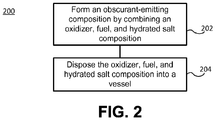
- an obscurant-emitting composition may be formed by combining an oxidizer, a fuel, and a hydrated salt composition (step 202).
- the components of the hydrated salt composition may be any of the compounds discussed herein, and in any of the amounts discussed herein.
- the oxidizer, fuel, and hydrated salt composition may be disposed into a vessel (step 204), such as a gas grenade.
- the oxidizer, fuel, and hydrated salt composition (including the mixing of the primary compound and the secondary compound) may be mixed before, during, or after being disposed into the vessel.
- references to "one embodiment”, “an embodiment”, “various embodiments”, etc. indicate that the embodiment described may include a particular feature, structure, or characteristic, but every embodiment may not necessarily include the particular feature, structure, or characteristic. Moreover, such phrases are not necessarily referring to the same embodiment. Further, when a particular feature, structure, or characteristic is described in connection with an embodiment, it is submitted that it is within the knowledge of one skilled in the art to affect such feature, structure, or characteristic in connection with other embodiments whether or not explicitly described. After reading the description, it will be apparent to one skilled in the relevant art(s) how to implement the disclosure in alternative embodiments.
Landscapes
- Chemical & Material Sciences (AREA)
- Organic Chemistry (AREA)
- Engineering & Computer Science (AREA)
- Botany (AREA)
- Pest Control & Pesticides (AREA)
- Plant Pathology (AREA)
- Life Sciences & Earth Sciences (AREA)
- Combustion & Propulsion (AREA)
- Inorganic Chemistry (AREA)
- Treating Waste Gases (AREA)
- Cosmetics (AREA)
- Fireproofing Substances (AREA)
- Solid Fuels And Fuel-Associated Substances (AREA)
Abstract
An obscurant-emitting composition may comprise an oxidizer comprising a cation comprising at least one of an alkali metal or an alkaline earth metal, and an anion comprising at least one of nitrate, chlorate, bromate, iodate, perchlorate, periodate, or chlorite; a fuel; and a hydrated salt composition, wherein the obscurant-emitting composition comprises between 0.001% and 8% by weight hydrated salt composition.
Description
- This disclosure relates to systems and methods for emitting obscurant from a combustible composition.
- Obscurants are materials disseminated into the air to block or obscure the view of objects in an area by scattering, absorbing, or reflecting electromagnetic radiation. Obscurants may be designed to block or obstruct visible light, or other frequencies on the electromagnetic spectrum (e.g., infrared radiation). Traditionally, obscurant-emitting compositions, such as those comprising pyrotechnic compositions, exhibit undesirable properties such as high toxicity, high burn temperature which may cause undesired fire, inorganic residue build-up inhibiting emission of the obscurant, limited functional temperature range, low obscurant yield, humidity dependence, or a number of other shortcomings, making their use inefficient, or potentially hazardous to users.
- In various embodiments, an obscurant-emitting composition (e.g. an obscurant-emitting composition produced by the methods as herein described) may comprise an oxidizer comprising a cation comprising at least one of an alkali metal or an alkaline earth metal, and an anion comprising at least one of nitrate, chlorate, bromate, iodate, perchlorate, periodate, or chlorite; a fuel; and a hydrated salt composition, wherein the obscurant-emitting composition comprises between 0.001% and 8% by weight hydrated salt composition. In various embodiments, the hydrated salt composition may comprise at least one of hydromagnesite, artinite, hydrotalcite, dypingite, giorgiosite, brucite, gibbsite, or protomagnesite. In various embodiments, the hydrated salt composition may comprise a primary compound and a secondary compound, e.g. wherein the primary compound comprises at least one of hydromagnesite, artinite, hydrotalcite, dypingite, giorgiosite, brucite, gibbsite, or protomagnesite. In various embodiments, the secondary compound may comprise at least one of hydromagnesite, artinite, hydrotalcite, dypingite, giorgiosite, brucite, gibbsite, or protomagnesite. In various embodiments, the oxidizer may comprise at least one of sodium bromate or potassium bromate. In various embodiments, the fuel may comprise at least one of a salt of cyanuric acid, potassium hydroxyacetate, or magnesium hydroxyacetate.
- In various embodiments, the obscurant-emitting composition may comprise between 45% and 90% by weight oxidizer. In various embodiments, the obscurant-emitting composition may comprise between 6% and 40% by weight fuel. In various embodiments, the hydrated salt composition may comprise between 90% and 99.9% by weight primary compound. In various embodiments, the hydrated salt composition may comprise between 0.1 % and 10% by weight secondary compound.
- In various embodiments, an obscurant-emitting system may comprise a vessel; an obscurant-emitting composition (e.g. an obscurant-emitting system as herein described)comprised within the vessel comprising an oxidizer, a fuel, and a hydrated salt composition, wherein, the obscurant-emitting composition comprises between 0.001% and 8% by weight hydrated salt composition. In various embodiments, the obscurant-emitting system may further comprise an ignition device configured to ignite the obscurant-emitting composition.
- In various embodiments, the hydrated salt composition may comprise at least one of hydromagnesite, artinite, hydrotalcite, dypingite, giorgiosite, brucite, gibbsite, or protomagnesite. In various embodiments, the hydrated salt composition may comprise a primary compound and a secondary compound, e.g. wherein the primary compound comprises at least one of hydromagnesite, artinite, hydrotalcite, dypingite, giorgiosite, brucite, gibbsite, or protomagnesite. In various embodiments, the secondary compound may comprise at least one of hydromagnesite, artinite, hydrotalcite, dypingite, giorgiosite, brucite, gibbsite, or protomagnesite. In various embodiments, the oxidizer may comprise at least one of sodium bromate or potassium bromate. In various embodiments, the fuel may comprise at least one of a salt of cyanuric acid, potassium hydroxyacetate, or magnesium hydroxyacetate. In various embodiments, the obscurant-emitting composition may comprise between 45% and 90% by weight oxidizer. In various embodiments, the obscurant-emitting composition may comprise between 6% and 40% by weight fuel. In various embodiments, the hydrated salt composition may comprise between 90% and 99.9% by weight primary compound, and/or the hydrated salt composition may comprise between 0.1% and 10% by weight secondary compound.
- In various embodiments, a method of making an obscurant-emitting composition may comprise forming an obscurant-emitting composition (e.g. a composition as herein described) by combining an oxidizer, a fuel and a hydrated salt composition, wherein the hydrated salt composition may comprise a primary compound and a secondary compound, wherein the obscurant-emitting composition may comprise between 0.001% and 8% by weight hydrated salt composition. In various embodiments, a method of making an obscurant-emitting system (e.g. an obscurant-emitting system as herein described) may comprise forming an obscurant-emitting composition (e.g. a composition as herein described) by combining an oxidizer, a fuel and a hydrated salt composition, wherein the hydrated salt composition may comprise a primary compound and a secondary compound, wherein the obscurant-emitting composition may comprise between 0.001% and 8% by weight hydrated salt composition. In various embodiments, the method may further comprise disposing the oxidizer, the fuel, and the hydrated salt composition in a vessel, wherein the mixing occurs at least one of before, during, or after the disposing. In any of the embodiments described herein the oxidizer may comprise a cation comprising at least one of an alkali metal or an alkaline earth metal, and an anion comprising at least one of nitrate, chlorate, bromate, iodate, perchlorate, periodate, or chlorite.
- The subject matter of the present disclosure is particularly pointed out and distinctly claimed in the concluding portion of the specification. A more complete understanding of the present disclosure, however, may best be obtained by referring to the detailed description and claims when considered in connection with the drawing figures. In the figures, like referenced numerals may refer to like parts throughout the different figures unless otherwise specified.
-
FIG. 1 illustrates an obscurant-emitting system, in accordance with various embodiments; and -
FIG. 2 illustrates a method for making an obscurant-emitting system, in accordance with various embodiments. - All ranges may include the upper and lower values, and all ranges and ratio limits disclosed herein may be combined. It is to be understood that unless specifically stated otherwise, references to "a," "an," and/or "the" may include one or more than one and that reference to an item in the singular may also include the item in the plural.
- The detailed description of various embodiments herein makes reference to the accompanying drawings, which show various embodiments by way of illustration. While these various embodiments are described in sufficient detail to enable those skilled in the art to practice the disclosure, it should be understood that other embodiments may be realized and that logical, chemical, and mechanical changes may be made without departing from the scope of the disclosure. Thus, the detailed description herein is presented for purposes of illustration only and not of limitation. For example, the steps recited in any of the method or process descriptions may be executed in any order and are not necessarily limited to the order presented. Furthermore, any reference to singular includes plural embodiments, and any reference to more than one component or step may include a singular embodiment or step. Also, any reference to attached, fixed, connected, or the like may include permanent, removable, temporary, partial, full, and/or any other possible attachment option. Additionally, any reference to without contact (or similar phrases) may also include reduced contact or minimal contact.
- In various embodiments, with reference to
FIG. 1 , an obscurant-emitting system 100 may comprise avessel 110 with avessel interior 112. An obscurant-emitting composition may be disposed in vessel interior 112. Vessel 110 may also comprise anignition device 114 such as a primer, an electronic match, a hot filament, and/or the like. In operation,ignition device 114 may be actuated, andignition device 114 may cause ignition of the obscurant-emitting composition. The obscurant-emitting composition may burn and emit an obscurant cloud 120 (e.g., a smoke, particulate, and/or vapor cloud) configured to absorb, scatter, or reflect electromagnetic radiation (e.g., visible light, infrared radiation, or any other frequency on the electromagnetic spectrum) in order to obscure vision, or other communication, into the area occupied byobscurant cloud 120.Obscurant cloud 120 may be emitted through any suitable portion ofvessel 110.Obscurant cloud 120 may absorb, scatter, or reflect electromagnetic radiation such that the obscurant inobscurant cloud 120 may prevent, or partially prevent, electromagnetic radiation from passing throughobscurant cloud 120. - In various embodiments, an obscurant-emitting composition may comprise an oxidizer, a fuel, and a hydrated salt composition. In various embodiments, the oxidizer may comprise a compound comprising a cation and an anion. The cation of the oxidizer may be the ionic form of an alkali metal and/or an alkali-earth metal. For example, the cation of the oxidizer may be a sodium, lithium, or potassium cation. The anion of the oxidizer may comprise nitrate, chlorate, bromate, iodate, perchlorate, periodates, and/or chlorite. In various embodiments, the oxidizer may comprise lithium nitrate, sodium nitrate, potassium nitrate, aluminum nitrate, lithium chlorate, sodium chlorate, potassium chlorate, lithium bromate, sodium bromate, potassium bromate, lithium iodate, sodium iodate, potassium iodate, aluminum iodate, ammonium iodate, lithium perchlorate, sodium perchlorate, potassium perchlorate, aluminum perchlorate, lithium periodate, sodium periodate, potassium periodate, aluminum periodate, lithium chlorite, sodium chlorite, potassium chlorite, aluminum chlorite, lithium bromite, sodium bromite, or mixtures thereof.
- In various embodiments in which the oxidizer comprises potassium bromate (KBrO3), in operation, the oxidizer (KBrO3) decomposes directly into the obscurant, potassium bromide (KBr), in response to burning, the reaction for which is shown in Equation 1:

vessel 110 inFIG. 1 , thereby allowing a single vessel to produce greater amounts of obscurant than a vessel comprising a less-dense oxidizer. - An obscurant-emitting composition may comprise one or more species of oxidizers as described herein. In various embodiments, the obscurant-emitting composition may comprise 45% to 90% by weight oxidizer. In various embodiments, the obscurant-emitting composition may comprise 60% to 80% by weight oxidizer. In various embodiments, the obscurant-emitting composition may comprise 65% to 75% by weight oxidizer. In various embodiments, the obscurant-emitting composition may comprise 65% to 72% by weight oxidizer.
- In various embodiments, the fuel of the obscurant-emitting composition may comprise a salt of cyanuric acid, such as lithium cyanurate, sodium cyanurate, potassium cyanurate, magnesium cyanurate, lithium isocyanurate, sodium cyanurate, potassium isocyanurate, magnesium isocyanurate, or other organic salts, such as lithium barbiturate, sodium barbiturate, potassium barbiturate, magnesium barbiturate, lithium hydroxyacetate, sodium hydroxyacetate, potassium hydroxyacetate, magnesium hydroxyacetate, lithium tartrate, sodium tartrate, potassium tartrate, magnesium tartrate, or mixtures thereof.
- In various embodiments, in which potassium cyanurate is the fuel of the obscurant-emitting composition, the potassium cyanurate may contribute to the potassium bromide decomposition giving a 100% yield of potassium bromide. Potassium cyanurate decomposes at about the same temperature as potassium bromate, causing a complete decomposition of the oxidizer and fuel. Additionally, the complete decomposition of the oxidizer and fuel minimizes, if not eliminates, the production of inorganic residue which may obstruct the exit of the obscurant and other decomposition reaction products from the vessel in which they are housed. Further, the decomposition of potassium cyanurate is an endothermic reaction, helping the decomposition reaction proceed with a lower flame temperature than with other fuels. A lower flame temperature helps avoid an undesired fire being caused by the ignition and burning of the obscurant-emitting composition.
- In various embodiments, the oxidizer may be present in a greater amount than the fuel in the obscurant-emitting composition. Accordingly, the weight ratio of oxidizer to fuel can be greater than about 1:1, allowing for a cleaner burning composition. In various embodiments, the weight ratio of oxidizer to fuel is from about 3:2 to about 5:1. In various embodiments, the weight ratio of oxidizer to fuel is from about 4:1 to about 10:1. In various embodiments, the obscurant-emitting composition may comprise 6% and 40% by weight fuel. In various embodiments, the obscurant-emitting composition may comprise 20% and 35% by weight fuel. In various embodiments, the obscurant-emitting composition may comprise 25% and 30% by weight fuel.
- In various embodiments, the hydrated salt composition of the obscurant-emitting composition may comprise one or more different compounds (e.g., hydrated salts and/or salt hydroxides) and, in various embodiments, two or more different compounds. In various embodiments, the hydrated salt composition may comprise a primary compound and a secondary compound. In various embodiments, the primary compound may be hydromagnesite (MgCO3·Mg(OH)2·4H2O), artinite (Mg2(CO3)(OH)2·3H2O), hydrotalcite Mg6Al2CO3(OH)16·4(H2O), dypingite (MgCO3·Mg(OH)2·5H2O), giorgiosite Mg5(CO3)4(OH)2·5(H2O), brucite (Mg(OH)2), gibbsite (Al(OH)3), and/or protomagnesite (Mg5(CO3)4(OH)2·11H2O). In various embodiments, the secondary compound may be hydromagnesite, artinite, hydrotalcite, dypingite, giorgiosite, and/or protomagnesite.
- In various embodiments, the hydrated salt composition may be chosen to absorb thermal energy of the obscurant-emitting composition combustion reaction, throughout the range of combustion temperatures, such as between 200°C (392°C) to 500°C (932°F). The hydrated salt composition may absorb energy of the combustion reaction by releasing vaporized water molecules through dehydration of hydrated salts and/or metal hydroxides, and release carbon dioxide through further mineral decomposition. Such release of water and carbon dioxide molecules may help modulate the temperature of the combustion reaction of the obscurant-emitting composition creating the obscurant.
- In various embodiments, the primary compound in the hydrated salt composition may be hydromagnesite, which releases water molecules at temperatures up to 300°C (572°F). Therefore, in response to the flame temperature of the combustion of the obscurant-emitting composition reaching temperatures up to 300°C (572°F), the decomposition of hydromagnesite may release water molecules to cool the flame temperature. Additionally, hydromagnesite continues to absorb heat of the obscurant-emitting composition combustion reaction up to 560°C (1040°F), with the further emission of carbon dioxide gas. Therefore, up to 560°C (1040°F), hydromagnesite may function to modulate the combustion reaction temperature of the obscurant-emitting composition.
- The releasing water of water molecules may be a more effective cooling method than the release of carbon dioxide gas. Therefore, it may be beneficial to have a secondary compound which releases water molecules at a temperature higher than 300°C (572°F). In various embodiments, for example, the secondary compound of the hydrated salt composition may comprise dypingite, which releases water molecules at temperatures up to about 380°C (716°F). Therefore, in response to the obscurant-emitting composition combustion reaction reaching temperatures over 300°C (572°F), dypingite may provide the release of water molecules in addition to those released by the primary compound (e.g., hydromagnesite) and already released by dypingite. Additionally, dypingite releases carbon dioxide at temperatures up to about 570°C (1058°F) to provide further cooling.
- The hydrated salt composition, with the primary and secondary compounds, provides a tiered cooling of the obscurant-emitting composition combustion reaction as it reaches higher and higher temperatures. Therefore, the hydrated salt composition absorbs heat and releases cooling agents (i.e., water and/or carbon dioxide molecules) in response to the obscurant-emitting composition combustion reaction reaching temperatures requiring cooling. The modulated cooling by the hydrated salt composition also allows the obscurant-emitting composition to be effective at combusting and producing the obscurant independent of ambient humidity. In addition, the products of the combustion reaction of the obscurant-emitting composition (water vapor, oxygen gas, and carbon dioxide gas, specifically) not only help cool the reaction, but they also help disperse and aerosolize the obscurant into the air to form the desired obscurant cloud (such as
obscurant cloud 120 inFIG. 1 ). - In various embodiments, the obscurant-emitting composition may comprise 0.001% to 8% by weight hydrated salt composition. In various embodiments, the obscurant-emitting composition may comprise 1% to 7% by weight hydrated salt composition. In various embodiments, the obscurant-emitting composition may comprise 2% to 6% by weight hydrated salt composition. In various embodiments, the obscurant-emitting composition may comprise 3% to 4% by weight hydrated salt composition. More than 10% by weight of the hydrated salt composition in the obscurant-emitting composition may result in a less efficient combustion reaction of the obscurant-emitting composition because of the release of too many water molecules from the hydrated salts, which may result in drowning out the flame of the reaction. Additionally, with less hydrated salt composition, the obscurant-emitting composition may comprise more oxidizer to produce more obscurant. In various embodiments, the hydrated salt composition may comprise between 90% and 100% by weight primary compound. In various embodiments, the hydrated salt composition may comprise between 90% and 99.9% by weight primary compound. In various embodiments, the hydrated salt composition may comprise between 93% and 98% by weight primary compound. In various embodiments, the hydrated salt composition may comprise between 94% and 96% by weight primary compound. In various embodiments, the hydrated salt composition may comprise between 0% and 10% by weight secondary compound. In various embodiments, the hydrated salt composition may comprise between 0.1% and 10% by weight secondary compound. In various embodiments, the hydrated salt composition may comprise between 2% and 8% by weight secondary compound. In various embodiments, the hydrated salt composition may comprise between 4% and 6% by weight secondary compound.
- In various embodiments, additional materials, such as multispectral materials, may be added to the hydrated salt composition and/or obscurant-emitting composition as a whole. Multispectral materials may allow an obscurant-emitting composition to have multi-spectral use. For example, if an obscurant of infrared radiation is desired, the hydrated salt composition and/or obscurant-emitting composition may further comprise brass, aluminum, and/or copper flakes, graphite, graphene, carbon black, mica, and/or any other suitable multispectral. In various embodiments, the obscurant-emitting composition may comprise between 0% and 25% by weight, or between 5% to 15% by weight, multispectral material. The combustion of an obscurant-emitting composition comprising such multispectral materials may produce an obscurant cloud capable of absorbing infrared radiation.
- In various embodiments, exemplary particle sizes for the oxidizer (e.g., KBrO3) and fuel (e.g., potassium cyanurate) may range from 1 µm (3.9e-5 inch) to 100 µm (0.0039 inch), from 1 (3.9e-5 inch) µm to 50 µm (0.0020 inch), or from 1 (3.9e-5 inch) µm to 30 µm (0.0012 inch). In various embodiments, exemplary particle sizes for the hydrated salts (e.g. hydromagnesite and dypingite) may be less than 100 µm (0.0039 inch), less than 40 µm (0.0016 inch), or less than 10 µm (0.00039 inch).
- In various embodiments, the obscurant-emitting composition may comprise a binder, such as a polymeric material or plasticizer. The binder may be used to aggregate the particles of the oxidizer, fuel, and/or hydrated salt composition to form desired shapes or orientations (i.e., pellets, stars, chips, etc.), which may allow more efficient packing into a vessel and/or more efficient combustion of the obscurant-emitting composition. In various embodiments, the obscurant-emitting composition may comprise between 0.2% and 10% by weight binder.
- The obscurant-emitting composition has been shown to effectively perform (i.e., combust and emit the obscurant) in a broad temperature range of -40°C (-40°F) to 71°C (160°F) because, among other things, of the temperature modulation of the combustion reaction by the hydrated salt composition. Additionally, the obscurant, potassium bromide, has been shown to be an effective flame retardant, giving the obscurant-emitting composition a further use as a fire suppressant. Such use as a fire suppressant, in embodiments in which the obscurant-emitting composition comprises a material which should not be combusted, such as various multispectral materials, may mitigate or eliminate the undesirable combustion of such materials.
- The effectiveness of an obscurant in the field is measured by a number of factors: the absorption of light in a medium (i.e., how well vision of an area is obscured by the obscurant), the density at which the material may be packed, and how well the material may be disseminated. The unit figure of merit (FOM) may be used to show the field performance effectiveness of an obscurant-emitting system, such as a gas grenade. The FOM is given by FOM = αρFY, wherein α is the extinction coefficient in square meters per gram, which shows the ability of the obscurant to absorb light (i.e., if the cloud of emitted obscurant is opaque, it will have a higher extinction coefficient); ρ is the density of the obscurant material; F is the fill factor, which is the ratio of packed density to the intrinsic material density; and yield is the ratio of airborne mass to initial mass of material in the vessel (e.g., a gas grenade). In accordance with various embodiments, with an obscurant-emitting composition comprising 65% to 72% by weight potassium bromate oxidizer, 25% to 30% by weight potassium cyanurate fuel, and 3% to 4% by weight hydrated salt composition comprising hydromagnesite as the primary compound and dypingite as the secondary compound, the obscurant-emitting composition gave an FOM of between 3 and 3.5, which is independent of ambient humidity and releases very little, if any, toxic compounds. Such an FOM is better than other preexisting obscurant-emitting compositions having the advantages of the obscurant-emitting composition described herein.
- In various embodiments, with reference to
FIG. 2 , amethod 200 for making an obscurant-emitting system is depicted. In various embodiments, an obscurant-emitting composition may be formed by combining an oxidizer, a fuel, and a hydrated salt composition (step 202). The components of the hydrated salt composition may be any of the compounds discussed herein, and in any of the amounts discussed herein. In various embodiments, the oxidizer, fuel, and hydrated salt composition may be disposed into a vessel (step 204), such as a gas grenade. The oxidizer, fuel, and hydrated salt composition (including the mixing of the primary compound and the secondary compound) may be mixed before, during, or after being disposed into the vessel. - Benefits, other advantages, and solutions to problems have been described herein with regard to specific embodiments. Furthermore, the connecting lines shown in the various figures contained herein are intended to represent exemplary functional relationships and/or physical couplings between the various elements. It should be noted that many alternative or additional functional relationships or physical connections may be present in a practical system. However, the benefits, advantages, solutions to problems, and any elements that may cause any benefit, advantage, or solution to occur or become more pronounced are not to be construed as critical, required, or essential features or elements of the disclosure. The scope of the disclosure is accordingly to be limited by nothing other than the appended claims, in which reference to an element in the singular is not intended to mean "one and only one" unless explicitly so stated, but rather "one or more." Moreover, where a phrase similar to "at least one of A, B, or C" is used in the claims, it is intended that the phrase be interpreted to mean that A alone may be present in an embodiment, B alone may be present in an embodiment, C alone may be present in an embodiment, or that any combination of the elements A, B and C may be present in a single embodiment; for example, A and B, A and C, B and C, or A and B and C. Different cross-hatching is used throughout the figures to denote different parts but not necessarily to denote the same or different materials.
- Systems, methods and apparatus are provided herein. In the detailed description herein, references to "one embodiment", "an embodiment", "various embodiments", etc., indicate that the embodiment described may include a particular feature, structure, or characteristic, but every embodiment may not necessarily include the particular feature, structure, or characteristic. Moreover, such phrases are not necessarily referring to the same embodiment. Further, when a particular feature, structure, or characteristic is described in connection with an embodiment, it is submitted that it is within the knowledge of one skilled in the art to affect such feature, structure, or characteristic in connection with other embodiments whether or not explicitly described. After reading the description, it will be apparent to one skilled in the relevant art(s) how to implement the disclosure in alternative embodiments.
- Furthermore, no element, component, or method step in the present disclosure is intended to be dedicated to the public regardless of whether the element, component, or method step is explicitly recited in the claims. No claim element herein is intended to invoke 35 U.S.C. 112(f) unless the element is expressly recited using the phrase "means for." As used herein, the terms "comprises", "comprising", or any other variation thereof, are intended to cover a non-exclusive inclusion, such that a process, method, article, or apparatus that comprises a list of elements does not include only those elements but may include other elements not expressly listed or inherent to such process, method, article, or apparatus.
- Certain preferred embodiments of the present invention are as follows:
- 1. An obscurant-emitting composition, comprising:
- an oxidizer comprising a cation comprising at least one of an alkali metal or an alkaline earth metal, and an anion comprising at least one of nitrate, chlorate, bromate, iodate, perchlorate, periodate, or chlorite;
- a fuel; and
- a hydrated salt composition, wherein the obscurant-emitting composition comprises between 0.001% and 8% by weight the hydrated salt composition.
- 2. The obscurant-emitting composition of embodiment 1, wherein the hydrated salt composition comprises a primary compound and a secondary compound, wherein the primary compound comprises at least one of hydromagnesite, artinite, hydrotalcite, dypingite, giorgiosite, brucite, gibbsite, or protomagnesite.
- 3. The obscurant-emitting composition of embodiment 2, wherein the secondary compound comprises at least one of hydromagnesite, artinite, hydrotalcite, dypingite, giorgiosite, brucite, gibbsite, or protomagnesite.
- 4. The obscurant-emitting composition of embodiment 3, wherein the oxidizer comprises at least one of sodium bromate or potassium bromate.
- 5. The obscurant-emitting composition of embodiment 4, wherein the fuel comprises at least one of a salt of cyanuric acid, potassium hydroxyacetate, or magnesium hydroxyacetate.
- 6. The obscurant-emitting composition of embodiment 5, wherein the obscurant-emitting composition comprises between 45% and 90% by weight the oxidizer.
- 7. The obscurant-emitting composition of embodiment 6, wherein the obscurant-emitting composition comprises between 6% and 40% by weight the fuel.
- 8. The obscurant-emitting composition of embodiment 7, wherein the hydrated salt composition comprises between 90% and 99.9% by weight the primary compound.
- 9. The obscurant-emitting composition of embodiment 8, wherein the hydrated salt composition comprises between 0.1% and 10% by weight the secondary compound.
- 10. An obscurant-emitting system, comprising:
- a vessel;
- an obscurant-emitting composition comprised within the vessel comprising an oxidizer, a fuel, and a hydrated salt composition,
- wherein, the obscurant-emitting composition comprises between 0.001% and 8% by weight the hydrated salt composition.
- 11. The obscurant-emitting system of embodiment 10, further comprising an ignition device configured to ignite the obscurant-emitting composition.
- 12. The obscurant-emitting system of embodiment 10, wherein the hydrated salt composition comprises a primary compound and a secondary compound, wherein the primary compound comprises at least one of hydromagnesite, artinite, hydrotalcite, dypingite, giorgiosite, brucite, gibbsite, or protomagnesite.
- 13. The obscurant-emitting system of embodiment 12, wherein the secondary compound comprises at least one of hydromagnesite, artinite, hydrotalcite, dypingite, giorgiosite, brucite, gibbsite, or protomagnesite.
- 14. The obscurant-emitting system of embodiment 13, wherein the oxidizer comprises at least one of sodium bromate or potassium bromate.
- 15. The obscurant-emitting system of embodiment 14, wherein the fuel comprises at least one of a salt of cyanuric acid, potassium hydroxyacetate, or magnesium hydroxyacetate.
- 16. The obscurant-emitting system of embodiment 15, wherein the obscurant-emitting composition comprises between 45% and 90% by weight the oxidizer.
- 17. The obscurant-emitting system of embodiment 16, wherein the obscurant-emitting composition comprises between 6% and 40% by weight the fuel.
- 18. The obscurant-emitting system of embodiment 17, wherein the hydrated salt composition comprises between 90% and 99.9% by weight the primary compound, and the hydrated salt composition comprises between 0.1% and 10% by weight the secondary compound.
- 19. A method of making an obscurant-emitting system, comprising:
- forming an obscurant-emitting composition by combining an oxidizer, a fuel, and a hydrated salt composition, wherein the hydrated salt composition comprises a primary compound and a secondary compound, wherein the obscurant-emitting composition comprises between 0.001% and 8% by weight the hydrated salt composition.
- 20. The method of embodiment 19, further comprising disposing the oxidizer, the fuel, and the hydrated salt composition in a vessel, wherein the mixing occurs at least one of before, during, or after the disposing.
Claims (15)
- An obscurant-emitting composition, comprising:an oxidizer comprising a cation comprising at least one of an alkali metal or an alkaline earth metal, and an anion comprising at least one of nitrate, chlorate, bromate, iodate, perchlorate, periodate, or chlorite;a fuel; anda hydrated salt composition, wherein the obscurant-emitting composition comprises between 0.001% and 8% by weight the hydrated salt composition.
- The obscurant-emitting composition of claim 1, wherein the hydrated salt composition comprises a primary compound and a secondary compound, wherein the primary compound comprises at least one of hydromagnesite, artinite, hydrotalcite, dypingite, giorgiosite, brucite, gibbsite, or protomagnesite.
- The obscurant-emitting composition of claim 2, wherein the secondary compound comprises at least one of hydromagnesite, artinite, hydrotalcite, dypingite, giorgiosite, brucite, gibbsite, or protomagnesite.
- The obscurant-emitting composition of any preceding claim, wherein the oxidizer comprises at least one of sodium bromate or potassium bromate, and/or wherein the fuel comprises at least one of a salt of cyanuric acid, potassium hydroxyacetate, or magnesium hydroxyacetate.
- The obscurant-emitting composition of any preceding claim, wherein the obscurant-emitting composition comprises between 45% and 90% by weight the oxidizer, and/or between 6% and 40% by weight the fuel.
- The obscurant-emitting composition of any preceding claim, wherein the hydrated salt composition comprises between 90% and 99.9% by weight the primary compound, and/or between 0.1% and 10% by weight the secondary compound.
- An obscurant-emitting system, comprising:a vessel;an obscurant-emitting composition comprised within the vessel comprising an oxidizer, a fuel, and a hydrated salt composition,wherein, the obscurant-emitting composition comprises between 0.001% and 8% by weight the hydrated salt composition.
- The obscurant-emitting system of claim 7, further comprising an ignition device configured to ignite the obscurant-emitting composition.
- The obscurant-emitting system of claim 7 or claim 8, wherein the hydrated salt composition comprises a primary compound and a secondary compound, wherein the primary compound comprises at least one of hydromagnesite, artinite, hydrotalcite, dypingite, giorgiosite, brucite, gibbsite, or protomagnesite.
- The obscurant-emitting system of claim 9, wherein the secondary compound comprises at least one of hydromagnesite, artinite, hydrotalcite, dypingite, giorgiosite, brucite, gibbsite, or protomagnesite.
- The obscurant-emitting system of any one of claims 7-10, wherein the oxidizer comprises at least one of sodium bromate or potassium bromate, and/or wherein the fuel comprises at least one of a salt of cyanuric acid, potassium hydroxyacetate, or magnesium hydroxyacetate.
- The obscurant-emitting system of any one of claims 7-11, wherein the obscurant-emitting composition comprises between 45% and 90% by weight the oxidizer, and/or between 6% and 40% by weight the fuel.
- The obscurant-emitting system of any one of claims 7-12, wherein the hydrated salt composition comprises between 90% and 99.9% by weight the primary compound, and/or the hydrated salt composition comprises between 0.1% and 10% by weight the secondary compound.
- A method of making an obscurant-emitting system, comprising:forming an obscurant-emitting composition by combining an oxidizer, a fuel, and a hydrated salt composition, wherein the hydrated salt composition comprises a primary compound and a secondary compound, wherein the obscurant-emitting composition comprises between 0.001% and 8% by weight the hydrated salt composition.
- The method of claim 14, further comprising disposing the oxidizer, the fuel, and the hydrated salt composition in a vessel, wherein the mixing occurs at least one of before, during, or after the disposing.
Applications Claiming Priority (1)
| Application Number | Priority Date | Filing Date | Title |
|---|---|---|---|
| US15/271,076 US10519074B2 (en) | 2016-09-20 | 2016-09-20 | Obscurant emission systems and methods |
Publications (1)
| Publication Number | Publication Date |
|---|---|
| EP3296280A1 true EP3296280A1 (en) | 2018-03-21 |
Family
ID=60117446
Family Applications (1)
| Application Number | Title | Priority Date | Filing Date |
|---|---|---|---|
| EP17192096.0A Withdrawn EP3296280A1 (en) | 2016-09-20 | 2017-09-20 | Obscurant emission systems and methods |
Country Status (3)
| Country | Link |
|---|---|
| US (2) | US10519074B2 (en) |
| EP (1) | EP3296280A1 (en) |
| IL (1) | IL253296B (en) |
Families Citing this family (2)
| Publication number | Priority date | Publication date | Assignee | Title |
|---|---|---|---|---|
| US10717685B1 (en) * | 2018-04-20 | 2020-07-21 | The United States Of America As Represented By The Secretary Of The Army | Pyrotechnic smoke obscurants containing metal-organic frameworks and composites thereof |
| US11828578B2 (en) * | 2020-08-26 | 2023-11-28 | Bae Systems Land & Armaments L.P. | Tactical obscurant device and methods of powder packing |
Citations (6)
| Publication number | Priority date | Publication date | Assignee | Title |
|---|---|---|---|---|
| US3862866A (en) * | 1971-08-02 | 1975-01-28 | Specialty Products Dev Corp | Gas generator composition and method |
| US20050242319A1 (en) * | 2004-04-30 | 2005-11-03 | Posson Philip L | Flame suppressant aerosol generant |
| US20130139935A1 (en) * | 2011-09-21 | 2013-06-06 | Armtec Defense Products Co. | Flameless, smoke generating signaling material |
| US20160107012A1 (en) * | 2014-10-16 | 2016-04-21 | Goodrich Corporation | Combustible fire suppressant aerosol composition |
| US20160115090A1 (en) * | 2013-05-30 | 2016-04-28 | Jared D. Moretti | Pyrotechnic yellow smoke compositions based on solvent yellow 33 |
| EP3219365A1 (en) * | 2016-03-18 | 2017-09-20 | Goodrich Corporation | Combustible aerosol composition |
Family Cites Families (14)
| Publication number | Priority date | Publication date | Assignee | Title |
|---|---|---|---|---|
| US380703A (en) | 1888-04-10 | Rivet-extractor | ||
| US3607472A (en) | 1969-11-12 | 1971-09-21 | Us Navy | White smoke composition containing red phophorous |
| GB1424523A (en) | 1972-05-05 | 1976-02-11 | Albright & Wilson | Phosphorus-containing compositions |
| US4032374A (en) | 1976-09-22 | 1977-06-28 | The United States Of America As Represented By The Secretary Of The Navy | Cinnamic acid containing pyrotechnic smoke composition |
| DE3728380C1 (en) | 1987-08-26 | 1988-11-24 | Nico Pyrotechnik | Pyrotechnic mixture for the production of a camouflage mist and ignition mixture therefor |
| US5154782A (en) | 1991-08-15 | 1992-10-13 | Thiokol Corporation | Obscuring and nontoxic smoke compositions |
| US5522320A (en) | 1993-07-12 | 1996-06-04 | Thiokol Corporation | Low-toxicity obscuring smoke formulation |
| US5682010A (en) | 1996-12-04 | 1997-10-28 | The United States Of America As Represented By The Secretary Of The Army | Method for creating a one way visible screening smoke |
| US6558487B1 (en) | 2001-07-24 | 2003-05-06 | The United States Of America As Represented By The Secretary Of The Army | Smoke generating compositions and methods of making the same |
| US20070163787A1 (en) | 2006-01-05 | 2007-07-19 | Universal Propulsion Company, Inc. | Fire suppression device |
| US7753618B2 (en) * | 2007-06-28 | 2010-07-13 | Calera Corporation | Rocks and aggregate, and methods of making and using the same |
| DE102008010942B4 (en) | 2008-02-25 | 2012-09-27 | Rheinmetall Waffe Munition Gmbh | Pyrotechnic fog set to create a cloak fog |
| US20120267016A1 (en) | 2011-04-19 | 2012-10-25 | Lombardi John L | Nontoxic Obscurant Compositions and Method of Using Same |
| US9546438B2 (en) | 2015-04-23 | 2017-01-17 | Goodrich Corporation | Low z high performance carbon composite materials |
-
2016
- 2016-09-20 US US15/271,076 patent/US10519074B2/en active Active
-
2017
- 2017-07-04 IL IL253296A patent/IL253296B/en unknown
- 2017-09-20 EP EP17192096.0A patent/EP3296280A1/en not_active Withdrawn
-
2019
- 2019-11-19 US US16/688,258 patent/US11286214B2/en active Active
Patent Citations (6)
| Publication number | Priority date | Publication date | Assignee | Title |
|---|---|---|---|---|
| US3862866A (en) * | 1971-08-02 | 1975-01-28 | Specialty Products Dev Corp | Gas generator composition and method |
| US20050242319A1 (en) * | 2004-04-30 | 2005-11-03 | Posson Philip L | Flame suppressant aerosol generant |
| US20130139935A1 (en) * | 2011-09-21 | 2013-06-06 | Armtec Defense Products Co. | Flameless, smoke generating signaling material |
| US20160115090A1 (en) * | 2013-05-30 | 2016-04-28 | Jared D. Moretti | Pyrotechnic yellow smoke compositions based on solvent yellow 33 |
| US20160107012A1 (en) * | 2014-10-16 | 2016-04-21 | Goodrich Corporation | Combustible fire suppressant aerosol composition |
| EP3219365A1 (en) * | 2016-03-18 | 2017-09-20 | Goodrich Corporation | Combustible aerosol composition |
Also Published As
| Publication number | Publication date |
|---|---|
| US10519074B2 (en) | 2019-12-31 |
| IL253296B (en) | 2021-09-30 |
| US11286214B2 (en) | 2022-03-29 |
| IL253296A0 (en) | 2017-09-28 |
| US20180079695A1 (en) | 2018-03-22 |
| US20200079707A1 (en) | 2020-03-12 |
Similar Documents
| Publication | Publication Date | Title |
|---|---|---|
| US5425886A (en) | On demand, non-halon, fire extinguishing systems | |
| US5522320A (en) | Low-toxicity obscuring smoke formulation | |
| NO165103B (en) | PROCEDURE FOR PROTECTION OF RADIATION IN THE VISIBLE PART AND THE INFRARED PART OF THE SPECT EXPOSED FROM A TARGET AND DEVELOPING, PYTORETNIC AMMUNISION FOR USE IN THE PROCEDURE. | |
| Koch | Special materials in pyrotechnics: V. Military applications of phosphorus and its compounds | |
| Sabatini | A review of illuminating pyrotechnics | |
| US7946228B2 (en) | Self contained non toxic obscurant grenade and self-contained aerosol dispersing grenade | |
| US20140238258A1 (en) | Colored Pyrotechnic Smoke-Producing Composition | |
| JP3592714B2 (en) | Pyrotechnic smokescreen compositions for camouflage and their use in smokescreen elements | |
| US11286214B2 (en) | Obscurant emission systems and methods | |
| JP2009522045A (en) | Flame suppression device | |
| US8282749B1 (en) | Green light emitting pyrotechnic compositions | |
| Sabatini | Advances toward the development of “Green” pyrotechnics | |
| AU764554B1 (en) | Expendable infra-red radiating means | |
| CN107198851A (en) | Inflammability aerosol combination | |
| Koch | Special materials in pyrotechnics: IV. The chemistry of phosphorus and its compounds | |
| JP2017206425A (en) | Smoking agent composition and smoke emitting device | |
| US6521064B1 (en) | Pyrotechnic burster composition | |
| RU2115450C1 (en) | Method of volume fire extinguishing and device for its embodiment | |
| Shaw et al. | Pyrotechnic smoke compositions containing boron carbide | |
| US2885277A (en) | Hydrogen gas generating propellent compositions | |
| KR101183488B1 (en) | Multi-purpose thermobaric hand grenade with fragmentation effects | |
| JP4681282B2 (en) | Heating agents, igniting agents and smoke cylinders | |
| US9938203B2 (en) | Pyrotechnic compositions comprising nanostructured crystalline boron phosphide and oxidizer | |
| US3046728A (en) | Hydrogen gas generating propellant compositions | |
| WO2018183523A1 (en) | Obscurant compositions |
Legal Events
| Date | Code | Title | Description |
|---|---|---|---|
| PUAI | Public reference made under article 153(3) epc to a published international application that has entered the european phase |
Free format text: ORIGINAL CODE: 0009012 |
|
| STAA | Information on the status of an ep patent application or granted ep patent |
Free format text: STATUS: THE APPLICATION HAS BEEN PUBLISHED |
|
| AK | Designated contracting states |
Kind code of ref document: A1 Designated state(s): AL AT BE BG CH CY CZ DE DK EE ES FI FR GB GR HR HU IE IS IT LI LT LU LV MC MK MT NL NO PL PT RO RS SE SI SK SM TR |
|
| AX | Request for extension of the european patent |
Extension state: BA ME |
|
| STAA | Information on the status of an ep patent application or granted ep patent |
Free format text: STATUS: THE APPLICATION IS DEEMED TO BE WITHDRAWN |
|
| 18D | Application deemed to be withdrawn |
Effective date: 20180922 |