EP3295804A1 - Beverage having degree of sweetness inhibited from being reduced - Google Patents
Beverage having degree of sweetness inhibited from being reduced Download PDFInfo
- Publication number
- EP3295804A1 EP3295804A1 EP17775545.1A EP17775545A EP3295804A1 EP 3295804 A1 EP3295804 A1 EP 3295804A1 EP 17775545 A EP17775545 A EP 17775545A EP 3295804 A1 EP3295804 A1 EP 3295804A1
- Authority
- EP
- European Patent Office
- Prior art keywords
- beverage
- rebd
- reba
- rebm
- sweetness
- Prior art date
- Legal status (The legal status is an assumption and is not a legal conclusion. Google has not performed a legal analysis and makes no representation as to the accuracy of the status listed.)
- Granted
Links
Images
Classifications
-
- A—HUMAN NECESSITIES
- A23—FOODS OR FOODSTUFFS; TREATMENT THEREOF, NOT COVERED BY OTHER CLASSES
- A23L—FOODS, FOODSTUFFS OR NON-ALCOHOLIC BEVERAGES, NOT OTHERWISE PROVIDED FOR; PREPARATION OR TREATMENT THEREOF
- A23L27/00—Spices; Flavouring agents or condiments; Artificial sweetening agents; Table salts; Dietetic salt substitutes; Preparation or treatment thereof
- A23L27/30—Artificial sweetening agents
- A23L27/33—Artificial sweetening agents containing sugars or derivatives
- A23L27/36—Terpene glycosides
-
- A—HUMAN NECESSITIES
- A23—FOODS OR FOODSTUFFS; TREATMENT THEREOF, NOT COVERED BY OTHER CLASSES
- A23L—FOODS, FOODSTUFFS OR NON-ALCOHOLIC BEVERAGES, NOT OTHERWISE PROVIDED FOR; PREPARATION OR TREATMENT THEREOF
- A23L2/00—Non-alcoholic beverages; Dry compositions or concentrates therefor; Preparation or treatment thereof
- A23L2/38—Other non-alcoholic beverages
-
- A—HUMAN NECESSITIES
- A23—FOODS OR FOODSTUFFS; TREATMENT THEREOF, NOT COVERED BY OTHER CLASSES
- A23L—FOODS, FOODSTUFFS OR NON-ALCOHOLIC BEVERAGES, NOT OTHERWISE PROVIDED FOR; PREPARATION OR TREATMENT THEREOF
- A23L2/00—Non-alcoholic beverages; Dry compositions or concentrates therefor; Preparation or treatment thereof
- A23L2/52—Adding ingredients
- A23L2/60—Sweeteners
-
- A—HUMAN NECESSITIES
- A23—FOODS OR FOODSTUFFS; TREATMENT THEREOF, NOT COVERED BY OTHER CLASSES
- A23V—INDEXING SCHEME RELATING TO FOODS, FOODSTUFFS OR NON-ALCOHOLIC BEVERAGES AND LACTIC OR PROPIONIC ACID BACTERIA USED IN FOODSTUFFS OR FOOD PREPARATION
- A23V2002/00—Food compositions, function of food ingredients or processes for food or foodstuffs
Definitions
- An embodiment of the present invention relates to a beverage with suppressed decrease in degree of sweetness.
- Patent Literature 1 a functional sweetener composition containing a vitamin, a high intensity sweetener, and a sweetness-improving composition is known.
- Patent Literature 2 a beverage containing a steviol glycoside as a natural sweetener.
- a beverage containing a steviol glycoside as a high intensity sweetener experiences a decrease in sweetness during storage.
- a further study has led the inventors to infer that the decrease in sweetness is attributable to conversion of RebA, which is a main component of a steviol glycoside.
- the present invention aims to provide a natural and low-calorie-oriented beverage with suppressed decrease in sweetness during storage.
- An embodiment of the present invention is a beverage meeting the following conditions: (A) mass ratio of (RebD and/or RebM)/RebA is 0.52 to 1.58; and (B) the total Brix in terms of sucrose of RebA and RebD and/or RebM is 5 to 10.
- the present invention is embodied in a beverage containing RebA and RebD and/or RebM, wherein the mass ratio of (RebD and/or RebM)/RebA is 0.52 to 1.58.
- the scope of the beverage according to the embodiment of the present invention encompasses a wide variety of common beverages. Examples of the beverages include refreshing beverages, non-alcoholic beverages, and alcoholic beverages. These may be carbonated or non-carbonated beverages. Specific examples include, but are not limited to, green tea beverages, black tea beverages, oolong tea beverages, barley tea beverages, sports drinks, milk beverages, coffee, coffee beverages, fruit juice beverages and vegetable beverages.
- Reb is used herein as an abbreviation of Rebaudioside.
- Reb is known as a sweet component contained in stevia extract.
- the stevia extract can be obtained by extraction from stevia dry leaves, followed by purification.
- Stevia is an Asteraceous perennial plant native to Paraguay in South America, and its scientific name is Stevia Rebaudiana Bertoni.
- Stevia contains a component having sweetness which is about 300 times or more that of sucrose and, for this reason, stevia is grown and used as a source of natural sweetener.
- the types of Reb previously reported include various glycosides such as RebA, RebB, RebC, RebD and RebE and further include RebM described in National Publication of International Patent Application No. 2012-504552 .
- RebA is evaluated as a sweetener having a high degree of sweetness and favorable sweetness and is widely used.
- methods for obtaining RebA, RebD and RebM include, but are not limited to: buying on the market; synthesis by organic chemical process or the like; and separation from or purification of a natural product.
- a stevia extract can be used as a starting material.
- RebA, RebD and RebM can be obtained by purification according to a method described in National Publication of International Patent Application No.
- Reb including RebA, RebD, and RebM may be analysed by any method, for example, by a high performance liquid chromatograph (HPLC) set under the conditions described in National Publication of International Patent Application No. 2012-504552 . This method is used herein for analysis of Reb such as RebA, RebD and RebM, unless otherwise specified.
- HPLC high performance liquid chromatograph
- the mass ratio of RebD and/or RebM to RebA (this ratio is referred to herein as "(RebD and/or RebM)/RebA") in the beverage is adjusted to a specific range.
- This allows suppression of the RebA-associated decrease in sweetness of a steviol glycoside-containing beverage during storage, as well as exploitation of the favorable flavour-related characteristics of RebA.
- the flavour-related characteristics of RebA include, but are not limited to, providing body feeling and sweetness quickly and having sharp flavour.
- the mass ratio of (RebD and/or RebM)/RebA can be adjusted to 0.52 to 1.58, preferably to 0.52 to 1.05, more preferably to 0.52 to 0.8, further preferably to 0.52 to 0.7.
- the mass ratio of (RebD and/or RebM)/RebA means a value calculated by dividing the total mass of RebD and RebM by the mass of RebA when both RebD and RebM are present, and the conjunction "or" is used to encompass a situation where RebD or RebM is not contained.
- the total Brix of RebA and RebD and/or RebM in terms of sucrose in the beverage can be adjusted to such an extent as not to cause any flavour-related disadvantage.
- the total Brix of RebA and RebD and/or RebM in terms of sucrose in the beverage is, for example, but not limited to, 5 to 10.
- the Brix in terms of sucrose can be calculated herein from the content of Reb and the degree of sweetness of Reb relative to that of sucrose. For example, RebA has a degree of sweetness which is 300 times that of sucrose, RebD has a degree of sweetness which is 285 times that of sucrose, and RebM has a degree of sweetness which is 285 times that of sucrose.
- Brix 1 in terms of sucrose corresponds to 33.3 ppm of RebA, 35.1 ppm of RebD and 35.1 ppm of RebM.
- the "ppm” as used herein means weight/weight (w/w) ppm, unless otherwise described.
- the total Brix of RebA and RebD and/or RebM in terms of sucrose, as described herein, means the sum of the Brix values of RebA, RebD and RebM in terms of sucrose when both RebD and RebM are present, and the conjunction "or" is used to encompass the situation where RebD or RebM is not contained.
- the beverage is low calorie.
- Being low calorie means that the calorie content is preferably 20 kcal/100 ml or less, more preferably 2 kcal/100 ml, and further preferably zero.
- the method for producing the carbonated beverage is not particularly limited.
- Carbonic acid gas may be generated by fermentation in the beverage or carbonic acid gas may be artificially injected into the beverage.
- the gas pressure can be, for example, 1 to 5 kgf/cm 2 , preferably 2 to 5 kgf/cm 2 and more preferably 3 to 5 kgf/cm 2 .
- the addition of carbonic acid gas can be accomplished by any method known to those skilled in the art.
- the carbonic acid gas pressure can be measured, for example, as follows: the beverage conditioned to 20°C is fixed in a gas internal pressure meter, and the cock of the gas internal pressure meter is opened to expose the beverage to the atmosphere and is then closed, after which the gas internal pressure meter is shaken, and a value is read when the pointer of the meter stops at a certain position. This method is used herein for measurement of the carbonic acid gas pressure, unless otherwise described.
- a beverage according to an embodiment of the present invention may further contain other components usable in drinks and foods unless the other components impair the effect of the present invention
- the components include: polyphenols such as catechins; plant extracts; caffeine; cinnamaldehyde; caramel coloring; sweeteners (including saccharides such as sugar and isomerized liquid sugars and high intensity sweeteners such as aspartame, sucralose, and acesulfame K); flavoring agents; acidulants (such as citric acid, tartaric acid, malic acid, phosphoric acid, and lactic acid); colorants; fruit juices; fruit juice purees; milk; milk products; other flavours; and nutrient supplements (such as vitamins, calcium, minerals, and amino acids).
- a beverage according to an embodiment of the present invention may be packed in a container, although the present invention is not limited thereto.
- the container used may be any form of container made of any material and is, for example, a glass bottle, a can, a barrel or a PET bottle.
- the embodiment of the present invention provides the effect of suppressing the decrease in sweetness of a RebA-containing beverage, regardless of the storage temperature, since the sweetness of such a beverage can decrease even during storage at ordinary temperatures, cold storage, or storage at lower temperatures if the storage period is long.
- the embodiment of the present invention is therefore preferably applicable to any beverages, including hot beverages to be stored under hot conditions, beverages to be stored under ordinary temperature conditions, and beverages to be stored under cold conditions.
- Beverages in which the total Brix in terms of sucrose was 10 were prepared by incorporation of RebA and RebD.
- the proportion of the Brix of RebD in terms of sucrose in the total Brix was adjusted to 0%, 33%, 66%, and 100%.
- Each of the beverages thus prepared was stored at 25°C for 21 days (3 weeks).
- a portion of each beverage was sampled as a 0-day-stored beverage, which was stocked at 5°C until the time of sensory test.
- the 0-day-stored and 21-day-stored beverages were subjected to sensory evaluation of intensity of sweetness by expert panels.
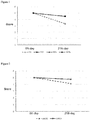
- the intensity of sweetness of the 0-day-stored beverages was rated as "5 points", and the intensity of sweetness of the other beverages was evaluated with reference to the sweetness of the 0-day-stored beverages in decrements of 0.5 points ( Figure 1 ).
- the scores shown in Figure 1 are average values.
- the intensity of sweetness decreased as a result of storage at 25°C.
- the proportion of the Brix of RebD in terms of sucrose was 100%, the decrease in intensity of sweetness tended to be suppressed. Similar results were obtained for the beverages in which the proportion of the Brix of RebD in terms of sucrose was 33% or 66%.
- RebD is more stable in terms of intensity of sweetness than RebA. It was also confirmed that the decrease in intensity of sweetness of a beverage is suppressed when the proportion of the Brix of RebD in terms of sucrose in the total Brix of RebA and RebD in terms of sucrose in the beverage is 33% or more, namely, when the mass ratio (RebD and/or RebM)/RebA is 0.52 or more. Given that RebD and RebM have analogous chemical structures, it should be understood that results similar to those described above are obtained when RebM is incorporated in a beverage instead of RebD or when both RebM and RebD are incorporated in a beverage.
- beverages in which the total Brix in terms of sucrose was 5 were prepared by incorporation of RebA and RebD.
- the proportion of the Brix of RebD in terms of sucrose in the total Brix was adjusted to 0% and 100%.
- Each of the beverages thus prepared was stored at 25°C for 21 days (3 weeks).
- a portion of each beverage was sampled as a 0-day-stored beverage, which was stocked at 5°C until the time of sensory test.
- the sensory test was conducted in the same manner as for the specific examples described above ( Figure 2 ).
- RebD is more stable in terms of intensity of sweetness than RebA and the use of RebD suppresses the decrease in intensity of sweetness of the beverage.
- RebD and RebM have analogous chemical structures, it should be understood that results similar to those described above are obtained when RebM is incorporated in a beverage instead of RebD or when both RebM and RebD are incorporated in a beverage.
- Beverages in which the total Brix in terms of sucrose was 10 were prepared as specific examples of embodiments of the present invention by incorporation of RebA and RebD.
- the proportion of the Brix of RebA in terms of sucrose in the total Brix was adjusted to 0%, 20%, 40%, 60%, and 100%, and the rest of the total Brix was accounted for by RebD.
- the beverages thus prepared were subjected to sensory evaluation of sharpness by five expert panels.
- the beverages were evaluated with reference to the sharpness of the beverage in which the proportion of the Brix in terms of sucrose of RebA was 100%.
- a beverage for which such sharpness was perceived was rated as " ⁇ "
- a beverage for which such sharpness was not perceived was rated as " ⁇ ”.
- a comprehensive evaluation was made on the basis of the observations of all of the panels (Table 1). The following three criteria were used for the comprehensive evaluation.
Landscapes
- Life Sciences & Earth Sciences (AREA)
- Health & Medical Sciences (AREA)
- Nutrition Science (AREA)
- Chemical & Material Sciences (AREA)
- Engineering & Computer Science (AREA)
- Food Science & Technology (AREA)
- Polymers & Plastics (AREA)
- Proteomics, Peptides & Aminoacids (AREA)
- Non-Alcoholic Beverages (AREA)
- Coloring Foods And Improving Nutritive Qualities (AREA)
Abstract
Description
- An embodiment of the present invention relates to a beverage with suppressed decrease in degree of sweetness.
- There is an increasing demand for natural and low-calorie-oriented beverages. In pursuit of giving sweetness to beverages, much attention is being paid to high intensity natural sweeteners having a higher degree of sweetness than sucrose. In this context, a functional sweetener composition containing a vitamin, a high intensity sweetener, and a sweetness-improving composition is known (Patent Literature 1). There is also known a beverage containing a steviol glycoside as a natural sweetener (Patent Literature 2).
-
- Patent Literature 1: National Publication of International Patent Application No.
2009-517043 - Patent Literature 2: Japanese Patent Laid-Open No.
2015-502404 - Through research and development of natural and low-calorie-oriented beverages, the present inventors have found that a beverage containing a steviol glycoside as a high intensity sweetener experiences a decrease in sweetness during storage. A further study has led the inventors to infer that the decrease in sweetness is attributable to conversion of RebA, which is a main component of a steviol glycoside.
- The present invention aims to provide a natural and low-calorie-oriented beverage with suppressed decrease in sweetness during storage.
- An embodiment of the present invention is a beverage meeting the following conditions: (A) mass ratio of (RebD and/or RebM)/RebA is 0.52 to 1.58; and (B) the total Brix in terms of sucrose of RebA and RebD and/or RebM is 5 to 10.
-
- [
Figure 1] Figure 1 shows the influence of the proportion of Brix of RebD in terms of sucrose on the sweetness of a stored beverage (in which Brix in terms of sucrose is 10). - [
Figure 2] Figure 2 shows the influence of the proportion of Brix of RebD in terms of sucrose on the sweetness of a stored beverage (in which Brix in terms of sucrose is 5). - Hereinafter, an embodiment of the present invention will be described with reference to the drawings.
- The present invention is embodied in a beverage containing RebA and RebD and/or RebM, wherein the mass ratio of (RebD and/or RebM)/RebA is 0.52 to 1.58. The scope of the beverage according to the embodiment of the present invention encompasses a wide variety of common beverages. Examples of the beverages include refreshing beverages, non-alcoholic beverages, and alcoholic beverages. These may be carbonated or non-carbonated beverages. Specific examples include, but are not limited to, green tea beverages, black tea beverages, oolong tea beverages, barley tea beverages, sports drinks, milk beverages, coffee, coffee beverages, fruit juice beverages and vegetable beverages.
- The term "Reb" is used herein as an abbreviation of Rebaudioside. Reb is known as a sweet component contained in stevia extract. The stevia extract can be obtained by extraction from stevia dry leaves, followed by purification. Stevia is an Asteraceous perennial plant native to Paraguay in South America, and its scientific name is Stevia Rebaudiana Bertoni. Stevia contains a component having sweetness which is about 300 times or more that of sucrose and, for this reason, stevia is grown and used as a source of natural sweetener. The types of Reb previously reported include various glycosides such as RebA, RebB, RebC, RebD and RebE and further include RebM described in National Publication of International Patent Application No.
2012-504552 . Among the various types of Reb, RebA is evaluated as a sweetener having a high degree of sweetness and favorable sweetness and is widely used. Examples of methods for obtaining RebA, RebD and RebM include, but are not limited to: buying on the market; synthesis by organic chemical process or the like; and separation from or purification of a natural product. When RebA, RebD or RebM is obtained by separation or purification, a stevia extract can be used as a starting material. For example, RebA, RebD and RebM can be obtained by purification according to a method described in National Publication of International Patent Application No.2009-517043 , a method described inUS8414949 , and a method described in Foods 2014, 3(1), 162-175; doi: 10.3390/foods 3010162, respectively. Reb including RebA, RebD, and RebM may be analysed by any method, for example, by a high performance liquid chromatograph (HPLC) set under the conditions described in National Publication of International Patent Application No.2012-504552 . This method is used herein for analysis of Reb such as RebA, RebD and RebM, unless otherwise specified. - In the embodiment of the present invention, the mass ratio of RebD and/or RebM to RebA (this ratio is referred to herein as "(RebD and/or RebM)/RebA") in the beverage is adjusted to a specific range. This allows suppression of the RebA-associated decrease in sweetness of a steviol glycoside-containing beverage during storage, as well as exploitation of the favorable flavour-related characteristics of RebA. Examples of the flavour-related characteristics of RebA include, but are not limited to, providing body feeling and sweetness quickly and having sharp flavour. For example, the mass ratio of (RebD and/or RebM)/RebA can be adjusted to 0.52 to 1.58, preferably to 0.52 to 1.05, more preferably to 0.52 to 0.8, further preferably to 0.52 to 0.7. If the mass ratio is less than 0.52, the decrease in degree of sweetness of the beverage during storage cannot be suppressed. If the mass ratio is more than 1.58, the favorable flavour-related characteristics of RebA cannot be exhibited. The mass ratio of (RebD and/or RebM)/RebA, as described herein, means a value calculated by dividing the total mass of RebD and RebM by the mass of RebA when both RebD and RebM are present, and the conjunction "or" is used to encompass a situation where RebD or RebM is not contained.
- In the embodiment of the present invention, the total Brix of RebA and RebD and/or RebM in terms of sucrose in the beverage can be adjusted to such an extent as not to cause any flavour-related disadvantage. The total Brix of RebA and RebD and/or RebM in terms of sucrose in the beverage is, for example, but not limited to, 5 to 10. The Brix in terms of sucrose can be calculated herein from the content of Reb and the degree of sweetness of Reb relative to that of sucrose. For example, RebA has a degree of sweetness which is 300 times that of sucrose, RebD has a degree of sweetness which is 285 times that of sucrose, and RebM has a degree of sweetness which is 285 times that of sucrose. Thus,
Brix 1 in terms of sucrose corresponds to 33.3 ppm of RebA, 35.1 ppm of RebD and 35.1 ppm of RebM. The "ppm" as used herein means weight/weight (w/w) ppm, unless otherwise described. The total Brix of RebA and RebD and/or RebM in terms of sucrose, as described herein, means the sum of the Brix values of RebA, RebD and RebM in terms of sucrose when both RebD and RebM are present, and the conjunction "or" is used to encompass the situation where RebD or RebM is not contained. - In an embodiment of the present invention, the beverage is low calorie. Being low calorie means that the calorie content is preferably 20 kcal/100 ml or less, more preferably 2 kcal/100 ml, and further preferably zero.
- When a beverage according to an embodiment of the present invention is produced as a carbonated beverage (namely, a sparkling beverage), the method for producing the carbonated beverage is not particularly limited. Carbonic acid gas may be generated by fermentation in the beverage or carbonic acid gas may be artificially injected into the beverage. When carbonic acid gas is injected into the beverage at a temperature of 20°C, the gas pressure can be, for example, 1 to 5 kgf/cm2, preferably 2 to 5 kgf/cm2 and more preferably 3 to 5 kgf/cm2. The addition of carbonic acid gas can be accomplished by any method known to those skilled in the art. The carbonic acid gas pressure can be measured, for example, as follows: the beverage conditioned to 20°C is fixed in a gas internal pressure meter, and the cock of the gas internal pressure meter is opened to expose the beverage to the atmosphere and is then closed, after which the gas internal pressure meter is shaken, and a value is read when the pointer of the meter stops at a certain position. This method is used herein for measurement of the carbonic acid gas pressure, unless otherwise described.
- A beverage according to an embodiment of the present invention may further contain other components usable in drinks and foods unless the other components impair the effect of the present invention, and examples of the components include: polyphenols such as catechins; plant extracts; caffeine; cinnamaldehyde; caramel coloring; sweeteners (including saccharides such as sugar and isomerized liquid sugars and high intensity sweeteners such as aspartame, sucralose, and acesulfame K); flavoring agents; acidulants (such as citric acid, tartaric acid, malic acid, phosphoric acid, and lactic acid); colorants; fruit juices; fruit juice purees; milk; milk products; other flavours; and nutrient supplements (such as vitamins, calcium, minerals, and amino acids). These components may be added singly or as a combination of a plurality of these components in the beverage. A beverage according to an embodiment of the present invention may be packed in a container, although the present invention is not limited thereto. The container used may be any form of container made of any material and is, for example, a glass bottle, a can, a barrel or a PET bottle.
- The higher the temperature at which a RebA-containing beverage is stored, the greater the decrease in sweetness of the beverage. Thus, the effect of suppressing the decrease in sweetness, which is provided by embodiments of the present invention, becomes more beneficial as the storage temperature of the beverage increases. It should be understood that the embodiment of the present invention provides the effect of suppressing the decrease in sweetness of a RebA-containing beverage, regardless of the storage temperature, since the sweetness of such a beverage can decrease even during storage at ordinary temperatures, cold storage, or storage at lower temperatures if the storage period is long. The embodiment of the present invention is therefore preferably applicable to any beverages, including hot beverages to be stored under hot conditions, beverages to be stored under ordinary temperature conditions, and beverages to be stored under cold conditions.
- Specific examples of embodiments of the present invention will be described hereinafter. The specific examples are given for better understanding of the present invention and are by no means intended to limit the scope of the invention.
- Beverages in which the total Brix in terms of sucrose was 10 were prepared by incorporation of RebA and RebD. The proportion of the Brix of RebD in terms of sucrose in the total Brix was adjusted to 0%, 33%, 66%, and 100%. Each of the beverages thus prepared was stored at 25°C for 21 days (3 weeks). Immediately before the start of the test, a portion of each beverage was sampled as a 0-day-stored beverage, which was stocked at 5°C until the time of sensory test. The 0-day-stored and 21-day-stored beverages were subjected to sensory evaluation of intensity of sweetness by expert panels. The intensity of sweetness of the 0-day-stored beverages was rated as "5 points", and the intensity of sweetness of the other beverages was evaluated with reference to the sweetness of the 0-day-stored beverages in decrements of 0.5 points (
Figure 1 ). The scores shown inFigure 1 are average values. For the beverage in which the proportion of the Brix of RebD in terms of sucrose was 0% (RebA 100%), the intensity of sweetness decreased as a result of storage at 25°C. By contrast, for the beverage in which the proportion of the Brix of RebD in terms of sucrose was 100%, the decrease in intensity of sweetness tended to be suppressed. Similar results were obtained for the beverages in which the proportion of the Brix of RebD in terms of sucrose was 33% or 66%. This demonstrated that RebD is more stable in terms of intensity of sweetness than RebA. It was also confirmed that the decrease in intensity of sweetness of a beverage is suppressed when the proportion of the Brix of RebD in terms of sucrose in the total Brix of RebA and RebD in terms of sucrose in the beverage is 33% or more, namely, when the mass ratio (RebD and/or RebM)/RebA is 0.52 or more. Given that RebD and RebM have analogous chemical structures, it should be understood that results similar to those described above are obtained when RebM is incorporated in a beverage instead of RebD or when both RebM and RebD are incorporated in a beverage. - As in the above specific examples, beverages in which the total Brix in terms of sucrose was 5 were prepared by incorporation of RebA and RebD. The proportion of the Brix of RebD in terms of sucrose in the total Brix was adjusted to 0% and 100%. Each of the beverages thus prepared was stored at 25°C for 21 days (3 weeks). Immediately before the start of the test, a portion of each beverage was sampled as a 0-day-stored beverage, which was stocked at 5°C until the time of sensory test. The sensory test was conducted in the same manner as for the specific examples described above (
Figure 2 ). As a result, it was demonstrated that, also for a beverage in which the total Brix in terms of sucrose is 5, RebD is more stable in terms of intensity of sweetness than RebA and the use of RebD suppresses the decrease in intensity of sweetness of the beverage. Given that RebD and RebM have analogous chemical structures, it should be understood that results similar to those described above are obtained when RebM is incorporated in a beverage instead of RebD or when both RebM and RebD are incorporated in a beverage. - Beverages in which the total Brix in terms of sucrose was 10 were prepared as specific examples of embodiments of the present invention by incorporation of RebA and RebD. The proportion of the Brix of RebA in terms of sucrose in the total Brix was adjusted to 0%, 20%, 40%, 60%, and 100%, and the rest of the total Brix was accounted for by RebD. The beverages thus prepared were subjected to sensory evaluation of sharpness by five expert panels. The beverages were evaluated with reference to the sharpness of the beverage in which the proportion of the Brix in terms of sucrose of RebA was 100%. A beverage for which such sharpness was perceived was rated as "○", while a beverage for which such sharpness was not perceived was rated as "×". A comprehensive evaluation was made on the basis of the observations of all of the panels (Table 1). The following three criteria were used for the comprehensive evaluation.
- No sharpness was perceived: ×
- Sharpness was perceived: ○
- Sharpness was vividly perceived: ⊚
- In consequence, it was confirmed that the higher the proportion of the Brix of RebA in terms of sucrose in a beverage, the higher the rating for the sharpness, and that sharpness is lost when the proportion is less than 40%. This result suggests that the sharpness of a beverage can be maintained when the proportion of the Brix of RebD in terms of sucrose in the total Brix in terms of sucrose is 60% or less and more preferably 50% or less. The mass ratio (RebD and/or RebM)/RebA in the beverage is calculated, from the proportion of the Brix, to be 1.58 (the calculation is made as follows: (0.6 × 35.1)/(0.4 × 33.3) = 1.58) or less, more preferably 1.05 or less, even more preferably 0.8 or less. Given that RebD and RebM have analogous chemical structures and the same degree of sweetness, it should be understood that results similar to those described above are obtained when RebM is incorporated in a beverage instead of RebD or when both RebM and RebD are incorporated in a beverage.
- Beverages in which the Brix in terms of sucrose was 10 were prepared as specific examples of embodiments of the present invention by incorporation of any one of RebA, RebD and RebM. Each beverage was stored at 10°C or at 55°C for 2 days, and the compositions of steviol glycosides in the beverage were analysed. The analysis was carried out using HPLC (LCMS) to which a mass spectrometer was connected and which was set under the conditions described in National Publication of International Patent Application No.
2012-504552 (Table 2).Table 2 Reb incorporated Storage temperature Proportions of steviol glycosides after storage (%) RebA RebB RebC RebD Stebioside RebF RebM Total RebA 10°C 99.10 0.00 0.26 0.32 0.22 0.10 0.00 100.0 55°C 98.50 0.45 0.15 0.26 0.52 0.08 0.00 100.0 RebD 10°C 1.42 0.00 0.02 98.40 0.13 0.00 0.00 100.0 55°C 1.53 0.00 0.01 98.30 0.09 0.02 0.06 100.0 RebM 10°C 1.46 1.22 0.04 0.48 0.21 0.00 96.60 100.0 55°C 0.63 1.07 0.10 0.59 0.40 0.00 97.20 100.0 - For the composition of steviol glycosides in the beverage prepared by incorporation of RebA, it was confirmed that the proportion of steviol glycosides other than RebA was higher in the case of storage at 555°C than in the case of storage at 10°C. In particular, the proportion of RebB significantly varied as a result of storage at 55°C. For the composition of steviol glycosides in the beverage prepared by incorporation of RebD, there was little difference in the compositions of steviol glycosides between storage at 10°C and storage at 555°C. The same trend was observed for the compositions of steviol glycosides in the beverages prepared by incorporation of RebM. These results suggest that the decrease in sweetness of a beverage prepared by incorporation of RebA is attributed to the fact that the conversion of RebA to another Reb causes a change in the composition of steviol glycosides in the beverage during storage. RebB, whose proportion was significantly increased during storage, has a degree of sweetness which is only about 50 times that of sucrose and lower than that of RebA. It is therefore suggested that RebB is responsible for the decrease in sweetness of the stored beverage. By contrast, for the beverages prepared by incorporation of RebD or RebM, the storage did not cause conversion of RebD or RebM or change in the composition of steviol glycosides in the beverage, which suggests that RebD or RebM does not affect the sweetness of the beverage. In this embodiment a temperature of 55°C, which is relatively high, was employed as the storage temperature to shorten the experimental period. It should be understood, however, that changes similar to those described above can occur even at a temperature lower than 55°C if the storage period is extended.
| | |||||
| 0 | 20 | 40 | 60 | 100 | |
| | × | × | × | ○ | ○ |
| | × | × | × | ○ | ○ |
| | × | × | ○ | ○ | ○ |
| Panel 4 | × | ○ | ○ | ○ | ○ |
| | × | × | ○ | ○ | ○ |
| Comprehensive evaluation | × | × | ○ | ⊚ | ⊚ |
Claims (2)
- A beverage meeting the following conditions:(A) a mass ratio RebM/RebA is 0.52 to 1.58; and(B) a total Brix of RebA and RebM in terms of sucrose is 5 to 10.
- A beverage according to claim 1 wherein the mass ratio is 0.52 to 1.05.
Priority Applications (1)
| Application Number | Priority Date | Filing Date | Title |
|---|---|---|---|
| EP25189640.3A EP4606228A3 (en) | 2016-03-31 | 2017-03-31 | Beverage having degree of sweetness inhibited from being reduced |
Applications Claiming Priority (2)
| Application Number | Priority Date | Filing Date | Title |
|---|---|---|---|
| JP2016071130 | 2016-03-31 | ||
| PCT/JP2017/013631 WO2017171014A1 (en) | 2016-03-31 | 2017-03-31 | Beverage having degree of sweetness inhibited from being reduced |
Related Child Applications (1)
| Application Number | Title | Priority Date | Filing Date |
|---|---|---|---|
| EP25189640.3A Division EP4606228A3 (en) | 2016-03-31 | 2017-03-31 | Beverage having degree of sweetness inhibited from being reduced |
Publications (3)
| Publication Number | Publication Date |
|---|---|
| EP3295804A1 true EP3295804A1 (en) | 2018-03-21 |
| EP3295804A4 EP3295804A4 (en) | 2018-05-23 |
| EP3295804B1 EP3295804B1 (en) | 2025-08-13 |
Family
ID=59965979
Family Applications (2)
| Application Number | Title | Priority Date | Filing Date |
|---|---|---|---|
| EP17775545.1A Active EP3295804B1 (en) | 2016-03-31 | 2017-03-31 | Beverage having degree of sweetness inhibited from being reduced |
| EP25189640.3A Pending EP4606228A3 (en) | 2016-03-31 | 2017-03-31 | Beverage having degree of sweetness inhibited from being reduced |
Family Applications After (1)
| Application Number | Title | Priority Date | Filing Date |
|---|---|---|---|
| EP25189640.3A Pending EP4606228A3 (en) | 2016-03-31 | 2017-03-31 | Beverage having degree of sweetness inhibited from being reduced |
Country Status (7)
| Country | Link |
|---|---|
| US (1) | US20180125109A1 (en) |
| EP (2) | EP3295804B1 (en) |
| JP (1) | JP6217056B1 (en) |
| AU (3) | AU2017241871B2 (en) |
| ES (1) | ES3041069T3 (en) |
| NZ (1) | NZ746969A (en) |
| WO (1) | WO2017171014A1 (en) |
Families Citing this family (2)
| Publication number | Priority date | Publication date | Assignee | Title |
|---|---|---|---|---|
| JP6824222B2 (en) * | 2018-05-18 | 2021-02-03 | サントリーホールディングス株式会社 | A method for improving foam retention in effervescent beverages having foam retention and effervescent beverages. |
| JP6824223B2 (en) * | 2018-05-18 | 2021-02-03 | サントリーホールディングス株式会社 | A method for improving foam retention in effervescent beverages having foam retention and effervescent beverages. |
Family Cites Families (6)
| Publication number | Priority date | Publication date | Assignee | Title |
|---|---|---|---|---|
| US20130071521A1 (en) * | 2007-03-14 | 2013-03-21 | Pepsico, Inc. | Rebaudioside d sweeteners and food products sweetened with rebaudioside d |
| US8414949B2 (en) | 2009-10-15 | 2013-04-09 | Purecircle Sdn Bhd | High-purity rebaudioside D and low-calorie yogurt containing the same |
| CA3152828A1 (en) * | 2011-12-19 | 2013-06-27 | The Coca-Cola Company | Methods for purifying steviol glycosides and uses of the same |
| US20140342043A1 (en) * | 2013-05-14 | 2014-11-20 | Pepsico, Inc. | Rebaudioside Sweetener Compositions and Food Products Sweetened with Same |
| US20140342044A1 (en) * | 2013-05-14 | 2014-11-20 | Pepsico, Inc. | Compositions and Comestibles |
| CN115211549A (en) * | 2013-08-15 | 2022-10-21 | 嘉吉公司 | Sweetener compositions and sweetened compositions incorporating rebaudioside N |
-
2017
- 2017-03-31 EP EP17775545.1A patent/EP3295804B1/en active Active
- 2017-03-31 US US15/571,416 patent/US20180125109A1/en not_active Abandoned
- 2017-03-31 WO PCT/JP2017/013631 patent/WO2017171014A1/en not_active Ceased
- 2017-03-31 ES ES17775545T patent/ES3041069T3/en active Active
- 2017-03-31 AU AU2017241871A patent/AU2017241871B2/en active Active
- 2017-03-31 EP EP25189640.3A patent/EP4606228A3/en active Pending
- 2017-03-31 JP JP2017537346A patent/JP6217056B1/en active Active
- 2017-03-31 NZ NZ746969A patent/NZ746969A/en unknown
-
2018
- 2018-10-18 AU AU2018250442A patent/AU2018250442B2/en active Active
-
2020
- 2020-09-09 AU AU2020230261A patent/AU2020230261B2/en active Active
Also Published As
| Publication number | Publication date |
|---|---|
| EP3295804A4 (en) | 2018-05-23 |
| AU2017241871B2 (en) | 2019-07-04 |
| EP4606228A2 (en) | 2025-08-27 |
| EP4606228A3 (en) | 2025-11-19 |
| NZ746969A (en) | 2019-08-30 |
| JP6217056B1 (en) | 2017-10-25 |
| NZ747443A (en) | 2025-05-30 |
| AU2020230261B2 (en) | 2022-06-09 |
| EP3295804B1 (en) | 2025-08-13 |
| AU2018250442B2 (en) | 2020-07-02 |
| US20180125109A1 (en) | 2018-05-10 |
| AU2017241871A1 (en) | 2018-10-18 |
| ES3041069T3 (en) | 2025-11-06 |
| WO2017171014A1 (en) | 2017-10-05 |
| AU2020230261A1 (en) | 2020-10-01 |
| JPWO2017171014A1 (en) | 2018-04-05 |
| AU2018250442A1 (en) | 2018-11-15 |
Similar Documents
| Publication | Publication Date | Title |
|---|---|---|
| US11122824B2 (en) | Stevia-containing beverage | |
| US20220338511A1 (en) | Beverage, method for producing beverage, and method for suppressing foaming of beverage | |
| AU2020230259B2 (en) | Carbonated beverage containing caramel and steviol glycoside | |
| EP3437485B1 (en) | Stevia-containing beverage | |
| AU2020230261B2 (en) | Beverage with suppressed decrease in degree of sweetness | |
| JP6261834B1 (en) | Beverage, beverage manufacturing method, and method for improving beverage flavor | |
| JP2017123863A (en) | Beverage, method for producing beverage, and method for suppressing foaming of beverage |
Legal Events
| Date | Code | Title | Description |
|---|---|---|---|
| STAA | Information on the status of an ep patent application or granted ep patent |
Free format text: STATUS: THE INTERNATIONAL PUBLICATION HAS BEEN MADE |
|
| PUAI | Public reference made under article 153(3) epc to a published international application that has entered the european phase |
Free format text: ORIGINAL CODE: 0009012 |
|
| STAA | Information on the status of an ep patent application or granted ep patent |
Free format text: STATUS: REQUEST FOR EXAMINATION WAS MADE |
|
| 17P | Request for examination filed |
Effective date: 20171212 |
|
| AK | Designated contracting states |
Kind code of ref document: A1 Designated state(s): AL AT BE BG CH CY CZ DE DK EE ES FI FR GB GR HR HU IE IS IT LI LT LU LV MC MK MT NL NO PL PT RO RS SE SI SK SM TR |
|
| AX | Request for extension of the european patent |
Extension state: BA ME |
|
| A4 | Supplementary search report drawn up and despatched |
Effective date: 20180425 |
|
| RIC1 | Information provided on ipc code assigned before grant |
Ipc: A23L 2/38 20060101ALI20180419BHEP Ipc: A23L 2/60 20060101AFI20180419BHEP Ipc: A23L 27/30 20160101ALI20180419BHEP |
|
| TPAC | Observations filed by third parties |
Free format text: ORIGINAL CODE: EPIDOSNTIPA |
|
| STAA | Information on the status of an ep patent application or granted ep patent |
Free format text: STATUS: EXAMINATION IS IN PROGRESS |
|
| 17Q | First examination report despatched |
Effective date: 20190211 |
|
| DAV | Request for validation of the european patent (deleted) | ||
| DAX | Request for extension of the european patent (deleted) | ||
| GRAP | Despatch of communication of intention to grant a patent |
Free format text: ORIGINAL CODE: EPIDOSNIGR1 |
|
| STAA | Information on the status of an ep patent application or granted ep patent |
Free format text: STATUS: GRANT OF PATENT IS INTENDED |
|
| INTG | Intention to grant announced |
Effective date: 20250307 |
|
| GRAS | Grant fee paid |
Free format text: ORIGINAL CODE: EPIDOSNIGR3 |
|
| GRAA | (expected) grant |
Free format text: ORIGINAL CODE: 0009210 |
|
| STAA | Information on the status of an ep patent application or granted ep patent |
Free format text: STATUS: THE PATENT HAS BEEN GRANTED |
|
| P01 | Opt-out of the competence of the unified patent court (upc) registered |
Free format text: CASE NUMBER: APP_30699/2025 Effective date: 20250626 |
|
| AK | Designated contracting states |
Kind code of ref document: B1 Designated state(s): AL AT BE BG CH CY CZ DE DK EE ES FI FR GB GR HR HU IE IS IT LI LT LU LV MC MK MT NL NO PL PT RO RS SE SI SK SM TR |
|
| REG | Reference to a national code |
Ref country code: GB Ref legal event code: FG4D |
|
| REG | Reference to a national code |
Ref country code: CH Ref legal event code: EP |
|
| REG | Reference to a national code |
Ref country code: DE Ref legal event code: R096 Ref document number: 602017091189 Country of ref document: DE |
|
| REG | Reference to a national code |
Ref country code: IE Ref legal event code: FG4D |
|
| REG | Reference to a national code |
Ref country code: ES Ref legal event code: FG2A Ref document number: 3041069 Country of ref document: ES Kind code of ref document: T3 Effective date: 20251106 |
|
| REG | Reference to a national code |
Ref country code: NL Ref legal event code: MP Effective date: 20250813 |
|
| PG25 | Lapsed in a contracting state [announced via postgrant information from national office to epo] |
Ref country code: IS Free format text: LAPSE BECAUSE OF FAILURE TO SUBMIT A TRANSLATION OF THE DESCRIPTION OR TO PAY THE FEE WITHIN THE PRESCRIBED TIME-LIMIT Effective date: 20251213 |
|
| PG25 | Lapsed in a contracting state [announced via postgrant information from national office to epo] |
Ref country code: NO Free format text: LAPSE BECAUSE OF FAILURE TO SUBMIT A TRANSLATION OF THE DESCRIPTION OR TO PAY THE FEE WITHIN THE PRESCRIBED TIME-LIMIT Effective date: 20251113 |
|
| REG | Reference to a national code |
Ref country code: LT Ref legal event code: MG9D |
|
| PG25 | Lapsed in a contracting state [announced via postgrant information from national office to epo] |
Ref country code: PT Free format text: LAPSE BECAUSE OF FAILURE TO SUBMIT A TRANSLATION OF THE DESCRIPTION OR TO PAY THE FEE WITHIN THE PRESCRIBED TIME-LIMIT Effective date: 20251215 |
|
| PG25 | Lapsed in a contracting state [announced via postgrant information from national office to epo] |
Ref country code: FI Free format text: LAPSE BECAUSE OF FAILURE TO SUBMIT A TRANSLATION OF THE DESCRIPTION OR TO PAY THE FEE WITHIN THE PRESCRIBED TIME-LIMIT Effective date: 20250813 |
|
| PG25 | Lapsed in a contracting state [announced via postgrant information from national office to epo] |
Ref country code: NL Free format text: LAPSE BECAUSE OF FAILURE TO SUBMIT A TRANSLATION OF THE DESCRIPTION OR TO PAY THE FEE WITHIN THE PRESCRIBED TIME-LIMIT Effective date: 20250813 Ref country code: HR Free format text: LAPSE BECAUSE OF FAILURE TO SUBMIT A TRANSLATION OF THE DESCRIPTION OR TO PAY THE FEE WITHIN THE PRESCRIBED TIME-LIMIT Effective date: 20250813 |
|
| PG25 | Lapsed in a contracting state [announced via postgrant information from national office to epo] |
Ref country code: GR Free format text: LAPSE BECAUSE OF FAILURE TO SUBMIT A TRANSLATION OF THE DESCRIPTION OR TO PAY THE FEE WITHIN THE PRESCRIBED TIME-LIMIT Effective date: 20251114 |
|
| PG25 | Lapsed in a contracting state [announced via postgrant information from national office to epo] |
Ref country code: SE Free format text: LAPSE BECAUSE OF FAILURE TO SUBMIT A TRANSLATION OF THE DESCRIPTION OR TO PAY THE FEE WITHIN THE PRESCRIBED TIME-LIMIT Effective date: 20250813 |
|
| PG25 | Lapsed in a contracting state [announced via postgrant information from national office to epo] |
Ref country code: LV Free format text: LAPSE BECAUSE OF FAILURE TO SUBMIT A TRANSLATION OF THE DESCRIPTION OR TO PAY THE FEE WITHIN THE PRESCRIBED TIME-LIMIT Effective date: 20250813 |
|
| PG25 | Lapsed in a contracting state [announced via postgrant information from national office to epo] |
Ref country code: PL Free format text: LAPSE BECAUSE OF FAILURE TO SUBMIT A TRANSLATION OF THE DESCRIPTION OR TO PAY THE FEE WITHIN THE PRESCRIBED TIME-LIMIT Effective date: 20250813 Ref country code: BG Free format text: LAPSE BECAUSE OF FAILURE TO SUBMIT A TRANSLATION OF THE DESCRIPTION OR TO PAY THE FEE WITHIN THE PRESCRIBED TIME-LIMIT Effective date: 20250813 |
|
| PG25 | Lapsed in a contracting state [announced via postgrant information from national office to epo] |
Ref country code: RS Free format text: LAPSE BECAUSE OF FAILURE TO SUBMIT A TRANSLATION OF THE DESCRIPTION OR TO PAY THE FEE WITHIN THE PRESCRIBED TIME-LIMIT Effective date: 20251113 |
|
| REG | Reference to a national code |
Ref country code: AT Ref legal event code: MK05 Ref document number: 1823683 Country of ref document: AT Kind code of ref document: T Effective date: 20250813 |
|
| PG25 | Lapsed in a contracting state [announced via postgrant information from national office to epo] |
Ref country code: SM Free format text: LAPSE BECAUSE OF FAILURE TO SUBMIT A TRANSLATION OF THE DESCRIPTION OR TO PAY THE FEE WITHIN THE PRESCRIBED TIME-LIMIT Effective date: 20250813 |
|
| PGFP | Annual fee paid to national office [announced via postgrant information from national office to epo] |
Ref country code: GB Payment date: 20260224 Year of fee payment: 10 |
|
| PG25 | Lapsed in a contracting state [announced via postgrant information from national office to epo] |
Ref country code: DK Free format text: LAPSE BECAUSE OF FAILURE TO SUBMIT A TRANSLATION OF THE DESCRIPTION OR TO PAY THE FEE WITHIN THE PRESCRIBED TIME-LIMIT Effective date: 20250813 |
|
| PG25 | Lapsed in a contracting state [announced via postgrant information from national office to epo] |
Ref country code: AT Free format text: LAPSE BECAUSE OF FAILURE TO SUBMIT A TRANSLATION OF THE DESCRIPTION OR TO PAY THE FEE WITHIN THE PRESCRIBED TIME-LIMIT Effective date: 20250813 |
|
| PG25 | Lapsed in a contracting state [announced via postgrant information from national office to epo] |
Ref country code: IT Free format text: LAPSE BECAUSE OF FAILURE TO SUBMIT A TRANSLATION OF THE DESCRIPTION OR TO PAY THE FEE WITHIN THE PRESCRIBED TIME-LIMIT Effective date: 20250813 |
|
| PGFP | Annual fee paid to national office [announced via postgrant information from national office to epo] |
Ref country code: FR Payment date: 20260217 Year of fee payment: 10 |
|
| PG25 | Lapsed in a contracting state [announced via postgrant information from national office to epo] |
Ref country code: CZ Free format text: LAPSE BECAUSE OF FAILURE TO SUBMIT A TRANSLATION OF THE DESCRIPTION OR TO PAY THE FEE WITHIN THE PRESCRIBED TIME-LIMIT Effective date: 20250813 |
|
| PG25 | Lapsed in a contracting state [announced via postgrant information from national office to epo] |
Ref country code: SK Free format text: LAPSE BECAUSE OF FAILURE TO SUBMIT A TRANSLATION OF THE DESCRIPTION OR TO PAY THE FEE WITHIN THE PRESCRIBED TIME-LIMIT Effective date: 20250813 Ref country code: EE Free format text: LAPSE BECAUSE OF FAILURE TO SUBMIT A TRANSLATION OF THE DESCRIPTION OR TO PAY THE FEE WITHIN THE PRESCRIBED TIME-LIMIT Effective date: 20250813 |
|
| REG | Reference to a national code |
Ref country code: DE Ref legal event code: R097 Ref document number: 602017091189 Country of ref document: DE |
|
| PLBE | No opposition filed within time limit |
Free format text: ORIGINAL CODE: 0009261 |
|
| STAA | Information on the status of an ep patent application or granted ep patent |
Free format text: STATUS: NO OPPOSITION FILED WITHIN TIME LIMIT |
|
| REG | Reference to a national code |
Ref country code: CH Ref legal event code: L10 Free format text: ST27 STATUS EVENT CODE: U-0-0-L10-L00 (AS PROVIDED BY THE NATIONAL OFFICE) Effective date: 20260624 |
|
| PG25 | Lapsed in a contracting state [announced via postgrant information from national office to epo] |
Ref country code: LT Free format text: LAPSE BECAUSE OF FAILURE TO SUBMIT A TRANSLATION OF THE DESCRIPTION OR TO PAY THE FEE WITHIN THE PRESCRIBED TIME-LIMIT Effective date: 20250813 |
|
| PGFP | Annual fee paid to national office [announced via postgrant information from national office to epo] |
Ref country code: ES Payment date: 20260401 Year of fee payment: 10 |
|
| 26N | No opposition filed |
Effective date: 20260515 |