EP3294285B1 - Cabazitaxel and its use for treating cancer - Google Patents
Cabazitaxel and its use for treating cancer Download PDFInfo
- Publication number
- EP3294285B1 EP3294285B1 EP16721844.5A EP16721844A EP3294285B1 EP 3294285 B1 EP3294285 B1 EP 3294285B1 EP 16721844 A EP16721844 A EP 16721844A EP 3294285 B1 EP3294285 B1 EP 3294285B1
- Authority
- EP
- European Patent Office
- Prior art keywords
- patients
- cabazitaxel
- dose
- cohort
- hepatic impairment
- Prior art date
- Legal status (The legal status is an assumption and is not a legal conclusion. Google has not performed a legal analysis and makes no representation as to the accuracy of the status listed.)
- Revoked
Links
- BMQGVNUXMIRLCK-OAGWZNDDSA-N CC(C)(C)OC(N[C@H]([C@H](C(O[C@@H](C1)C(C)=C([C@H](C([C@](C)([C@H](C[C@H]2OC3)OC)[C@H]([C@@H]4OC(c5ccccc5)=O)[C@@]23OC(C)=O)=O)OC)C(C)(C)[C@@]14O)=O)O)c1ccccc1)=O Chemical compound CC(C)(C)OC(N[C@H]([C@H](C(O[C@@H](C1)C(C)=C([C@H](C([C@](C)([C@H](C[C@H]2OC3)OC)[C@H]([C@@H]4OC(c5ccccc5)=O)[C@@]23OC(C)=O)=O)OC)C(C)(C)[C@@]14O)=O)O)c1ccccc1)=O BMQGVNUXMIRLCK-OAGWZNDDSA-N 0.000 description 1
Classifications
-
- A—HUMAN NECESSITIES
- A61—MEDICAL OR VETERINARY SCIENCE; HYGIENE
- A61K—PREPARATIONS FOR MEDICAL, DENTAL OR TOILETRY PURPOSES
- A61K31/00—Medicinal preparations containing organic active ingredients
- A61K31/33—Heterocyclic compounds
- A61K31/335—Heterocyclic compounds having oxygen as the only ring hetero atom, e.g. fungichromin
- A61K31/337—Heterocyclic compounds having oxygen as the only ring hetero atom, e.g. fungichromin having four-membered rings, e.g. taxol
-
- A—HUMAN NECESSITIES
- A61—MEDICAL OR VETERINARY SCIENCE; HYGIENE
- A61J—CONTAINERS SPECIALLY ADAPTED FOR MEDICAL OR PHARMACEUTICAL PURPOSES; DEVICES OR METHODS SPECIALLY ADAPTED FOR BRINGING PHARMACEUTICAL PRODUCTS INTO PARTICULAR PHYSICAL OR ADMINISTERING FORMS; DEVICES FOR ADMINISTERING FOOD OR MEDICINES ORALLY; BABY COMFORTERS; DEVICES FOR RECEIVING SPITTLE
- A61J1/00—Containers specially adapted for medical or pharmaceutical purposes
-
- A—HUMAN NECESSITIES
- A61—MEDICAL OR VETERINARY SCIENCE; HYGIENE
- A61P—SPECIFIC THERAPEUTIC ACTIVITY OF CHEMICAL COMPOUNDS OR MEDICINAL PREPARATIONS
- A61P1/00—Drugs for disorders of the alimentary tract or the digestive system
- A61P1/16—Drugs for disorders of the alimentary tract or the digestive system for liver or gallbladder disorders, e.g. hepatoprotective agents, cholagogues, litholytics
-
- A—HUMAN NECESSITIES
- A61—MEDICAL OR VETERINARY SCIENCE; HYGIENE
- A61P—SPECIFIC THERAPEUTIC ACTIVITY OF CHEMICAL COMPOUNDS OR MEDICINAL PREPARATIONS
- A61P13/00—Drugs for disorders of the urinary system
- A61P13/08—Drugs for disorders of the urinary system of the prostate
-
- A—HUMAN NECESSITIES
- A61—MEDICAL OR VETERINARY SCIENCE; HYGIENE
- A61P—SPECIFIC THERAPEUTIC ACTIVITY OF CHEMICAL COMPOUNDS OR MEDICINAL PREPARATIONS
- A61P35/00—Antineoplastic agents
-
- A—HUMAN NECESSITIES
- A61—MEDICAL OR VETERINARY SCIENCE; HYGIENE
- A61J—CONTAINERS SPECIALLY ADAPTED FOR MEDICAL OR PHARMACEUTICAL PURPOSES; DEVICES OR METHODS SPECIALLY ADAPTED FOR BRINGING PHARMACEUTICAL PRODUCTS INTO PARTICULAR PHYSICAL OR ADMINISTERING FORMS; DEVICES FOR ADMINISTERING FOOD OR MEDICINES ORALLY; BABY COMFORTERS; DEVICES FOR RECEIVING SPITTLE
- A61J2205/00—General identification or selection means
- A61J2205/30—Printed labels
Definitions
- the present invention concerns the use of cabazitaxel for treating cancer in patients with hepatic impairment. It also concerns a method of managing the risk of hepatic impairment to allow an effective and safe use of cabazitaxel in the treatment of cancer.
- Cabazitaxel is a semi-synthetic derivative of the natural taxoids 10-deacetylbaccatin III with potential antineoplastic activity. Cabazitaxel binds to and stabilizes tubulin, resulting in the inhibition of microtubule depolymerization and tumor cell proliferation. Unlike other taxane compounds, this agent is active in tumor models poorly or not sensitive to chemotherapy, including taxanes. In addition, cabazitaxel penetrates the blood-brain barrier.
- Cabazitaxel has been developed and is registered under the trademark Jevtana® for the treatment of patients with hormone refractory metastatic prostate cancer (HRPC) previously treated with a docetaxel containing regimen, in combination with prednisone or prednisolone.
- the recommended dose is 25 mg/m 2 administered as a 1-hour intravenous infusion every 3 weeks in combination with oral prednisone or prednisolone 10 mg administered daily throughout cabazitaxel treatment. It is available in vials of concentrate (sterile concentrate) and solvent for solution for infusion (60 mg).
- cabazitaxel for the treatment of cancer, for example for the treatment of prostate cancer, may provoke some adverse reactions which may be fatal for the patients, notably for patients presenting hepatic impairment.
- JEVTANA should not be given to patients with hepatic impairment (total bilirubin ⁇ 1 x ULN, or AST and/or ALT ⁇ 1.5 ⁇ ULN)."
- total bilirubin ⁇ 1 x ULN, or AST and/or ALT ⁇ 1.5 ⁇ ULN A similar wording is included in the prescribing information for Jevtana in all the countries where the product is marketed.
- the invention answers that need by providing safe dosage regimens of cabazitaxel or recommendation not to use cabazitaxel depending on the degree of hepatic impairment in the treatment of cancer in patients with varying degrees of hepatic impairment.
- the invention is limited to the subject-matter defined in the appended claims; the following description is limited to this limitation.
- the present invention relates to the compound having the following formula (I): which may be in base form or in the form of a hydrate or a solvate, for its use as a medicament in the treatment of cancer in patients with hepatic impairment where the administered standard dose of 25 mg/m 2 of cabazitaxel is reduced.
- the present invention also relates to a method for treating cancer in a patient with hepatic impairment in need of treatment, said method comprising administering a reduced dose of the compound of formula (I) as defined above, which may be in base form or in the form of a hydrate or a solvate, to said patient, wherein said reduced dose is less than the standard dose of 25 mg/m 2 of cabazitaxel.
- the present invention also relates to a method of managing the risk of hepatic impairment, to allow an effective and safe use of the compound of formula (I) as defined above, in the treatment of patients treated for cancer, said method comprising the following steps:
- the present invention relates to patients with hepatic impairment that may be mild, moderate or severe.
- the cancer to be treated may be a solid tumor.
- the cancer may be an advanced, measurable or non-measurable, non-hematological cancer.
- the cancer may be one that is either refractory to standard therapy or for which no standard therapy exists.
- the cancer may be for example a castration resistant or hormone-refractory metastatic prostate cancer.
- the compound of formula (I) is in the form of an acetone solvate.
- This acetone solvate may contain between 5% and 8%, and preferably between 5% and 7%, by weight of acetone.
- cabazitaxel may be administered by intravenous infusion at a dose of 15 mg/m 2 , this administration cycle of the antitumour agent being repeated at an interval of 3 weeks between each cabazitaxel administration, which interval may be prolonged by 1 to 2 weeks depending on the tolerance to the preceding cabazitaxel administration.
- the administration of the compound of formula (I) is repeated as a new cycle every 3 weeks.
- the reduced and maximum tolerated dose for patients with moderate hepatic impairment is 15 mg/m 2 .
- a patient includes both human and animals.
- a patient is a human.
- hepatic impairment is an abnormal hepatic function that is to say a reduced liver function.
- a normal hepatic function is defined as a total bilirubin level ⁇ upper limit of normal [ULN] and by an aspartate aminotransferase level [AST] ⁇ ULN.
- Abnormal hepatic functions are:
- cabazitaxel corresponds to the compound belonging to the taxoid family of formula (I):
- cabazitaxel is 4 ⁇ -acetoxy-2 ⁇ -benzoyloxy-5 ⁇ ,20-epoxy-1 ⁇ -hydroxy-7 ⁇ ,10 ⁇ -dimethoxy-9-oxo-11-taxen-13 ⁇ -yl (2R,3S)-3- tert -butoxycarbonylamino-2-hydroxy-3-phenylpropionate.
- Cabazitaxel is synonymously known as (2 ⁇ ,5 ⁇ ,7 ⁇ ,10 ⁇ ,13 ⁇ )-4-acetoxy-13-( ⁇ (2R,3S)-3-[(tertbutoxycarbonyl)amino]-2-hydroxy-3-phenylpropanoyl ⁇ oxy)-1-hydroxy-7,10-dimethoxy-9-oxo-5,20-epoxytax-11-en-2-yl benzoate.
- Cabazitaxel may be administered in base form (cf. above formula), or in the form of a hydrate. It may also be a solvate, i.e. a molecular complex characterized by the incorporation of the crystallization solvent into the crystal of the molecule of the active principle (see in this respect page 1276 of J. Pharm. Sci. 1975, 64(8), 1269-1288 ). In particular, it may be an acetone solvate, and, more particularly, may be the solvate described in WO 2005/028462 .
- acetone solvate of cabazitaxel containing between 5% and 8% and preferably between 5% and 7% by weight of acetone (% means content of acetone/content of acetone+cabazitaxel ⁇ 100).
- An average value of the acetone content is 7%, which approximately represents the acetone stoichiometry, which is 6.5% for a solvate containing one molecule of acetone.
- the resulting mixture is stirred for about 10 to 22 hours, and 1.5 litres of purified water are added over 4 to 5 hours. This mixture is stirred for 60 to 90 minutes, and the suspension is then filtered under reduced pressure. The cake is washed on the filter with a solution prepared from 450 ml of acetone and 550 ml of purified water, and then oven-dried at 55°C under reduced pressure (0.7 kPa) for 4 hours.
- One aspect of the present invention relates to the compound having the following formula (I): which may be in base form or in the form of a hydrate or a solvate, for its use as a medicament in the treatment of cancer in patients with hepatic impairment where the administered standard dose of 25 mg/m 2 of cabazitaxel is reduced.
- the present invention also relates to a method for treating cancer in a patient with hepatic impairment, said method comprising the administration of the compound of formula (I) as defined above, which may be in base form or in the form of a hydrate or a solvate, where the administered standard dose of 25 mg/m 2 of cabazitaxel is reduced.
- the present invention also relates to a method of managing the risk of hepatic impairment, to allow an effective and safe use of the compound of formula (I) as defined above, in the treatment of patients treated for cancer, said method comprising the following steps:
- the present invention relates to patients with hepatic impairment that may be mild, moderate or severe.
- the cancer to be treated may be a solid tumor.
- the cancer may be an advanced, measurable or non-measurable, non-hematological cancer.
- the cancer may be one that is either refractory to standard therapy or for which no standard therapy exists.
- the cancer may be for example a castration resistant or hormone-refractory metastatic prostate cancer.
- One aspect of the invention is a method of treating castration resistant or hormone-refractory metastatic prostate cancer in a patient in need thereof, said method comprising administering a reduced dose of the compound of formula (I) as defined above, which may be in base form or in the form of a hydrate or a solvate, to said patient, wherein said patient has hepatic impairment and wherein said reduced dose is less than the standard dose of 25 mg/m 2 of cabazitaxel.
- the compound of formula (I) is in the form of an acetone solvate.
- This acetone solvate may contain between 5% and 8%, and preferably between 5% and 7%, by weight of acetone.
- cabazitaxel may be administered by intravenous infusion at a dose of 15 mg/m 2 , this administration cycle of the antitumour agent being repeated at an interval of 3 weeks between each cabazitaxel administration, which interval may be prolonged by 1 to 2 weeks depending on the tolerance to the preceding cabazitaxel administration.
- the administration of the compound of formula (I) is repeated as a new cycle every 3 weeks.
- the reduced and maximum tolerated dose for patients with moderate hepatic impairment is 15 mg/m 2 .
- Cabazitaxel may be administered parenterally, such as via intravenous administration.
- a galenical form of cabazitaxel suitable for administration by intravenous infusion is that in which the cabazitaxel is dissolved in water in the presence of excipients chosen from surfactants, cosolvents, glucose or sodium chloride, etc.
- a galenical form of cabazitaxel may be prepared by diluting a premix solution of cabazitaxel contained in a sterile vial (80 mg of cabazitaxel + 2 ml of solvent + Polysorbate 80) with a sterile vial containing a solution of 6 ml of water and ethanol (13% by weight of 95% ethanol) in order to obtain 8 ml of a solution ready to be rediluted in a perfusion bag.
- the concentration of cabazitaxel in this ready-to-redilute solution is about 10 mg/ml.
- the perfusion is then prepared by injecting the appropriate amount of this ready-to-redilute solution into the perfusion bag containing water and glucose (about 5%) or sodium chloride (about 0.9%).
- the present invention is based on the monitoring of the patient concerning the hepatic impairment as mentioned above. Indeed, if the patient to be treated experiences any of these hepatic impairments before or during the administration cycle, then the cancer treatment has to be adapted or discontinued. If the hepatic impairment is resolved, the cancer treatment may be continued. Depending on the patient's conditions, the cancer treatment may also be stopped.
- Cabazitaxel is administered repeatedly according to a protocol that depends on the patient to be treated (age, weight, treatment history, etc.), which can be determined by a skilled physician.
- cabazitaxel is administered by perfusion to the patient according to an intermittent program with an interval between each administration of 3 weeks, which may be prolonged by 1 to 2 weeks depending on the tolerance to the preceding administration.
- the patient to be treated has prostate cancer that is resistant to hormone therapy (i.e., hormone refractory) and has previously been treated with docetaxel.
- hormone therapy i.e., hormone refractory
- the patient has prostate cancer that progressed during or after treatment with docetaxel.
- the patient was previously treated with at least 225 mg/m 2 cumulative dose of docetaxel.
- the patient showed progression of their disease in the six months following hormone therapy or during docetaxel treatment or after docetaxel treatment.
- the patient showed progression of their disease in the three months following hormone therapy or after docetaxel treatment.
- cabazitaxel is administered to a patient with castration resistant or hormone-refractory metastatic prostate cancer in combination with a corticoid, such as prednisone or prednisolone.
- the corticoid is preferably administered at a daily dose of 10 mg orally.
- the treatment does not include patients for whom:
- the present invention also relates to a method of providing the compound of formula (I) as defined above, which may be in base form or in the form of a hydrate or a solvate, wherein said compound is provided along with information indicating that it is useful for treating patients with cancer, for example castration resistant or hormone-refractory metastatic prostate cancer, said patients being at risk of developing hepatic impairment.
- the information comprises printed matter, preferably a label, that advises that the compound of formula (I) is useful for treating patients suffering from cancer, for example castration resistant or hormone-refractory metastatic prostate cancer, said patients being at risk of developing hepatic impairment.
- the present invention also relates to a method of promoting the use of the compound of formula (I) as defined above, the method comprising the step of conveying to a recipient at least one message selected from the group consisting of:
- the present invention also relates to a method of promoting the use of the compound of formula (I) as defined above, the method comprising the step of conveying to a recipient at least one message selected from the group consisting of:
- the present invention also relates to a method of promoting the use of the compound of formula (I) as defined above, the method comprising the step of conveying to a recipient at least one message selected from the group consisting of:
- the present invention also relates to an article of manufacture comprising:
- the present invention also relates to a package comprising the compound of formula (I) as defined above and a label, said label comprising one or more messages that:
- the present invention also relates to a package comprising the compound of formula (I) as defined above and a label, said label comprising one or more messages that:
- the present invention also relates to a package comprising the compound of formula (I) as defined above and a label, said label comprising one or more messages that:
- the compound of formula (I) may be in the form of an acetone solvate.
- liver function tests must be completed within 48 hours prior to start of treatment, and reviewed by the investigator or his designee before treatment administration.
- Cabazitaxel is administered on Day 1 of each 3-week cycle. Patients received cabazitaxel administered by IV infusion over 1 hour at the dose specified for each cohort. The actual amount of cabazitaxel administered was adjusted at each cycle based on body surface area (BSA) to a maximum BSA of 2.1 m 2 (i.e., patients with a BSA over 2.1 m2 will receive the same amount of cabazitaxel as those with a BSA of 2.1 m 2 ).
- BSA body surface area
- antihistamine diphenhydramine 25 mg or other antihistamines
- steroid diphenhydramine 25 mg or other antihistamines
- H2 antagonist ranitidine or other H2 antagonist with the exception of cimetidine
- the cutoff date for full data collection was when the last patient has completed cycle 1 treatment and the subsequent 30 days follow up. However, if patients were still receiving treatment after the cutoff date, SAEs and investigational medicinal product (IMP) administration continued to be captured and communicated to the sponsor.
- IMP investigational medicinal product
- Cohort 3 has been initiated after at least 3 patients of Cohort 2 completed the first cycle of treatment with no dose-limiting toxicities (DLTs) being observed.
- Cohort 4 began after 3 patients complete the first cycle of Cohort 3, providing no DLT has occurred.
- the starting dose in Cohort 4 could be 5 or 10 mg/m 2 , was decided by the study committee based on the safety and PK information from the first 3 patients in Cohort 3.
- Dose levels Cabazitaxel, mg/m 2 Cabazitaxel, mg/m 2 0 (Starting dose) 5 10 +1 10 15 +2 15 20 +3 20 25
- the dose escalation criteria as described in the table below had to be met at each dose level following Cycle 1 in order to enroll and treat additional patients at the next dose level.
- a 1 week gap was required between the treatment of each patient for the first 3 patients in each dose level to allow safety evaluation.
- Dose-escalation decision rule 0 of the first 3 patients Escalate dose level and enter at least 3 patients at next dose level (Cohorts 2 through 4) or at the same dose level (Cohort 1) 1 out of the first 3 patients Enter up to 3 additional patients at this dose level. If 0 of the 3 additional patients experience a DLT, then proceed to the next higher dose level, to a maximum dose of 25 mg/m 2 If 1 or more of the 3 additional patients experience a DLT, then dose escalation will be stopped. Decrease dose to the next available lower dose level. If a lower dose is not available, enrollment will be stopped for a given cohort. 2 of the first 3 patients Decrease dose to the next available lower dose level. If a lower dose is not available, enrollment will be stopped for a given cohort
- DLT Dose-Limiting Toxicities
- MTD Maximum Tolerated Dose
- the clinical adverse event (AE) or laboratory abnormality should be drug-related as assessed by the investigator.
- Liver DLTs in patients with hepatic dysfunction were defined as an increase in total and direct bilirubin and/or transaminase levels to 3 times the baseline value.
- a treatment delay due to cabazitaxel related toxicity of 2 weeks between cycles was considered a DLT.
- the MTD was defined as the highest dose at which 0 of the first 3 patients, or 1 of 6 patients experienced a DLT during the first cycle of cabazitaxel to a maximum dose of 25 mg/m 2 .
- the MTD was one dose below the MAD. If the MAD reached at 5 or 10 mg/m 2 (Cohorts 3 and 4), then no patients were further enrolled as the MTD could not be established. There was no dose recommendation for such patient population.
- Real time PK information has been used to inform the dose selection in the next dose level for Cohort 3 and 4 and in the starting dose of Cohort 4 along with safety information.
Landscapes
- Health & Medical Sciences (AREA)
- Animal Behavior & Ethology (AREA)
- Veterinary Medicine (AREA)
- Public Health (AREA)
- General Health & Medical Sciences (AREA)
- Pharmacology & Pharmacy (AREA)
- Life Sciences & Earth Sciences (AREA)
- Chemical & Material Sciences (AREA)
- Medicinal Chemistry (AREA)
- Nuclear Medicine, Radiotherapy & Molecular Imaging (AREA)
- Organic Chemistry (AREA)
- General Chemical & Material Sciences (AREA)
- Chemical Kinetics & Catalysis (AREA)
- Epidemiology (AREA)
- Engineering & Computer Science (AREA)
- Bioinformatics & Cheminformatics (AREA)
- Urology & Nephrology (AREA)
- Gastroenterology & Hepatology (AREA)
- Pharmaceuticals Containing Other Organic And Inorganic Compounds (AREA)
- Epoxy Compounds (AREA)
Description
- The present invention concerns the use of cabazitaxel for treating cancer in patients with hepatic impairment. It also concerns a method of managing the risk of hepatic impairment to allow an effective and safe use of cabazitaxel in the treatment of cancer.
- Cabazitaxel is a semi-synthetic derivative of the natural taxoids 10-deacetylbaccatin III with potential antineoplastic activity. Cabazitaxel binds to and stabilizes tubulin, resulting in the inhibition of microtubule depolymerization and tumor cell proliferation. Unlike other taxane compounds, this agent is active in tumor models poorly or not sensitive to chemotherapy, including taxanes. In addition, cabazitaxel penetrates the blood-brain barrier.
- Cabazitaxel has been developed and is registered under the trademark Jevtana® for the treatment of patients with hormone refractory metastatic prostate cancer (HRPC) previously treated with a docetaxel containing regimen, in combination with prednisone or prednisolone. The recommended dose is 25 mg/m2 administered as a 1-hour intravenous infusion every 3 weeks in combination with oral prednisone or prednisolone 10 mg administered daily throughout cabazitaxel treatment. It is available in vials of concentrate (sterile concentrate) and solvent for solution for infusion (60 mg).
- It has been observed that the use of cabazitaxel for the treatment of cancer, for example for the treatment of prostate cancer, may provoke some adverse reactions which may be fatal for the patients, notably for patients presenting hepatic impairment.
- In the prescribing information as published for Jevtana in the US at its date of launch in June 2010, the following warnings and precautions for use were given: "No dedicated hepatic impairment trial for JEVTANA has been conducted. Patients with impaired hepatic function (total bilirubin ≥ 1 x ULN, or AST and/or ALT ≥ 1.5 × ULN) were excluded from the randomized clinical trial. Cabazitaxel is extensively metabolized in the liver, and hepatic impairment is likely to increase cabazitaxel concentrations. Hepatic impairment increases the risk of severe and life-threatening complications in patients receiving other drugs belonging to the same class as JEVTANA. JEVTANA should not be given to patients with hepatic impairment (total bilirubin ≥ 1 x ULN, or AST and/or ALT ≥ 1.5 × ULN)." A similar wording is included in the prescribing information for Jevtana in all the countries where the product is marketed.
- Thus there is a need to find a safe treatment for cancer patients presenting hepatic impairment.
- The invention answers that need by providing safe dosage regimens of cabazitaxel or recommendation not to use cabazitaxel depending on the degree of hepatic impairment in the treatment of cancer in patients with varying degrees of hepatic impairment.
- The invention is limited to the subject-matter defined in the appended claims; the following description is limited to this limitation. The present invention relates to the compound having the following formula (I):
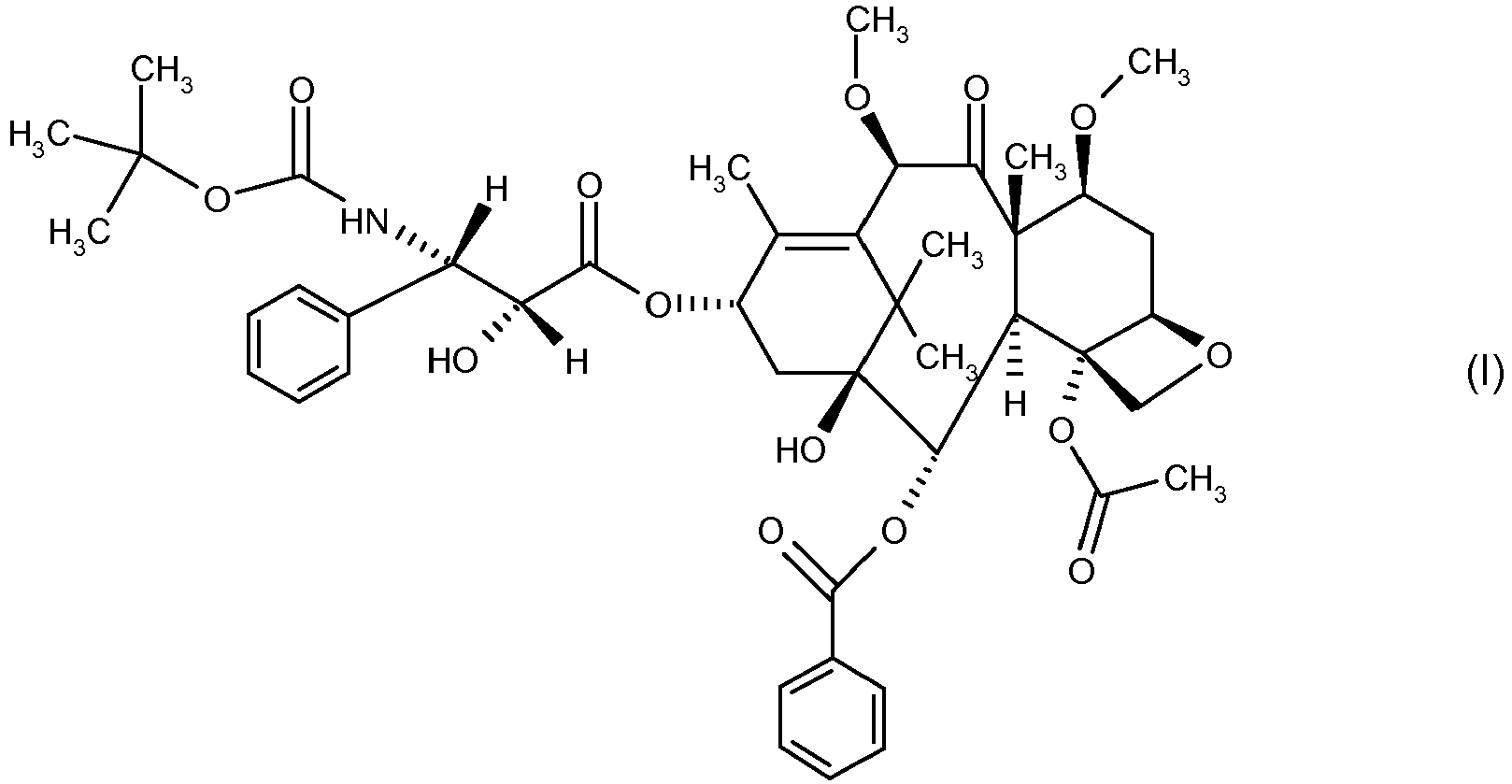
for its use as a medicament in the treatment of cancer in patients with hepatic impairment where the administered standard dose of 25 mg/m2 of cabazitaxel is reduced. - The present invention also relates to a method for treating cancer in a patient with hepatic impairment in need of treatment, said method comprising administering a reduced dose of the compound of formula (I) as defined above, which may be in base form or in the form of a hydrate or a solvate, to said patient, wherein said reduced dose is less than the standard dose of 25 mg/m2 of cabazitaxel.
- The present invention also relates to a method of managing the risk of hepatic impairment, to allow an effective and safe use of the compound of formula (I) as defined above, in the treatment of patients treated for cancer, said method comprising the following steps:
- a) initially check the patients suffering from cancer for any hepatic impairment;
- b) if any hepatic impairment is detected, then the administered standard dose of 25 mg/m2 of cabazitaxel should be reduced
- c) optionally if after a diagnosis of hepatic impairment is excluded, treatment with the compound of formula (I) should be reinitiated, patients should be closely monitored.
- The present invention relates to patients with hepatic impairment that may be mild, moderate or severe.
- In one aspect of the invention, the cancer to be treated may be a solid tumor. In another aspect, the cancer may be an advanced, measurable or non-measurable, non-hematological cancer. In another aspect, the cancer may be one that is either refractory to standard therapy or for which no standard therapy exists. The cancer may be for example a castration resistant or hormone-refractory metastatic prostate cancer.
- In one aspect of the invention, the compound of formula (I) is in the form of an acetone solvate. This acetone solvate may contain between 5% and 8%, and preferably between 5% and 7%, by weight of acetone.
- In some aspects of the invention, cabazitaxel may be administered by intravenous infusion at a dose of 15 mg/m2, this administration cycle of the antitumour agent being repeated at an interval of 3 weeks between each cabazitaxel administration, which interval may be prolonged by 1 to 2 weeks depending on the tolerance to the preceding cabazitaxel administration.
- In one aspect of the invention, the administration of the compound of formula (I) is repeated as a new cycle every 3 weeks.
- According to the invention, the reduced and maximum tolerated dose for patients with moderate hepatic impairment is 15 mg/m2.
- The term "patient," as used herein, includes both human and animals. In one embodiment, a patient is a human.
- The term "hepatic impairment" as used herein, is an abnormal hepatic function that is to say a reduced liver function.
A normal hepatic function is defined as a total bilirubin level ≤ upper limit of normal [ULN] and by an aspartate aminotransferase level [AST] ≤ ULN. - Abnormal hepatic functions are:
- mild hepatic impairment (total bilirubin >1 to ≤1.5xULN or AST >1.5xULN),
- moderate hepatic impairment (total bilirubin >1.5x to ≤3.0xULN; AST=any),
- severe hepatic impairment (total bilirubin >3.0x - 10xULN; AST=any).
- The term "cabazitaxel" corresponds to the compound belonging to the taxoid family of formula (I):

- The chemical name of cabazitaxel is 4α-acetoxy-2α-benzoyloxy-5β,20-epoxy-1β-hydroxy-7β,10β-dimethoxy-9-oxo-11-taxen-13α-yl (2R,3S)-3-tert-butoxycarbonylamino-2-hydroxy-3-phenylpropionate. Cabazitaxel is synonymously known as (2α,5β,7β,10β,13α)-4-acetoxy-13-({(2R,3S)-3-[(tertbutoxycarbonyl)amino]-2-hydroxy-3-phenylpropanoyl}oxy)-1-hydroxy-7,10-dimethoxy-9-oxo-5,20-epoxytax-11-en-2-yl benzoate.
- This compound and a preparative method thereof is described in
WO 96/30355 EP 0 817 779 B1 andUS 5 847 170 . Cabazitaxel may be administered in base form (cf. above formula), or in the form of a hydrate. It may also be a solvate, i.e. a molecular complex characterized by the incorporation of the crystallization solvent into the crystal of the molecule of the active principle (see in this respect page 1276 of J. Pharm. Sci. 1975, 64(8), 1269-1288). In particular, it may be an acetone solvate, and, more particularly, may be the solvate described inWO 2005/028462 . It may be an acetone solvate of cabazitaxel containing between 5% and 8% and preferably between 5% and 7% by weight of acetone (% means content of acetone/content of acetone+cabazitaxel × 100). An average value of the acetone content is 7%, which approximately represents the acetone stoichiometry, which is 6.5% for a solvate containing one molecule of acetone. The procedure described below allows the preparation of an acetone solvate of cabazitaxel: - 940 ml of purified water are added at 20±5°C (room temperature) to a solution of 207 g of 4α-acetoxy-2α-benzoyloxy-5β,20-epoxy-1β-hydroxy-7β,10β-dimethoxy-9-oxo-11-taxen-13α-yl (2R,3S)-3-tert-butoxycarbonylamino-2-hydroxy-3-phenylpropionate at about 92% by weight in about 2 litres of acetone, followed by seeding with a suspension of 2 g of 4α-acetoxy-2α-benzoyloxy-5β,20-epoxy-1β-hydroxy-7β,10β-dimethoxy-9-oxo-11-taxen-13α-yl (2R,3S)-3-tert-butoxycarbonylamino-2-hydroxy-3-phenylpropionate isolated from acetone/water in a mixture of 20 ml of water and 20 ml of acetone. The resulting mixture is stirred for about 10 to 22 hours, and 1.5 litres of purified water are added over 4 to 5 hours. This mixture is stirred for 60 to 90 minutes, and the suspension is then filtered under reduced pressure. The cake is washed on the filter with a solution prepared from 450 ml of acetone and 550 ml of purified water, and then oven-dried at 55°C under reduced pressure (0.7 kPa) for 4 hours. 197 g of 4α-acetoxy-2α-benzoyloxy-5β,20-epoxy-1β-hydroxy-7β,10β-dimethoxy-9-oxo-11-taxen-13α-yl (2R,3S)-3-tert-butoxycarbonylamino-2-hydroxy-3-phenylpropionate acetone containing 0.1% water and 7.2% acetone (theoretical amount: 6.5% for a stoichiometric solvate) are obtained.
- One aspect of the present invention relates to the compound having the following formula (I):

for its use as a medicament in the treatment of cancer in patients with hepatic impairment where the administered standard dose of 25 mg/m2 of cabazitaxel is reduced. - The present invention also relates to a method for treating cancer in a patient with hepatic impairment, said method comprising the administration of the compound of formula (I) as defined above, which may be in base form or in the form of a hydrate or a solvate, where the administered standard dose of 25 mg/m2 of cabazitaxel is reduced.
- The present invention also relates to a method of managing the risk of hepatic impairment, to allow an effective and safe use of the compound of formula (I) as defined above, in the treatment of patients treated for cancer, said method comprising the following steps:
- d) initially check the patients suffering from cancer for any hepatic impairment;
- e) if any hepatic impairment is detected, then the administered standard dose of 25 mg/m2 of cabazitaxel should be reduced
- f) optionally if after a diagnosis of hepatic impairment is excluded, treatment with the compound of formula (I) should be reinitiated, patients should be closely monitored.
- The present invention relates to patients with hepatic impairment that may be mild, moderate or severe.
- In one aspect of the invention, the cancer to be treated may be a solid tumor. In another aspect, the cancer may be an advanced, measurable or non-measurable, non-hematological cancer. In another aspect, the cancer may be one that is either refractory to standard therapy or for which no standard therapy exists. The cancer may be for example a castration resistant or hormone-refractory metastatic prostate cancer.
- One aspect of the invention is a method of treating castration resistant or hormone-refractory metastatic prostate cancer in a patient in need thereof, said method comprising administering a reduced dose of the compound of formula (I) as defined above, which may be in base form or in the form of a hydrate or a solvate, to said patient, wherein said patient has hepatic impairment and wherein said reduced dose is less than the standard dose of 25 mg/m2 of cabazitaxel.
- In one aspect of the invention, the compound of formula (I) is in the form of an acetone solvate. This acetone solvate may contain between 5% and 8%, and preferably between 5% and 7%, by weight of acetone.
- In some aspects of the invention, cabazitaxel may be administered by intravenous infusion at a dose of 15 mg/m2, this administration cycle of the antitumour agent being repeated at an interval of 3 weeks between each cabazitaxel administration, which interval may be prolonged by 1 to 2 weeks depending on the tolerance to the preceding cabazitaxel administration.
- In one aspect of the invention, the administration of the compound of formula (I) is repeated as a new cycle every 3 weeks.
- According to the invention, the reduced and maximum tolerated dose for patients with moderate hepatic impairment is 15 mg/m2.
- Cabazitaxel may be administered parenterally, such as via intravenous administration. A galenical form of cabazitaxel suitable for administration by intravenous infusion is that in which the cabazitaxel is dissolved in water in the presence of excipients chosen from surfactants, cosolvents, glucose or sodium chloride, etc. For example, a galenical form of cabazitaxel may be prepared by diluting a premix solution of cabazitaxel contained in a sterile vial (80 mg of cabazitaxel + 2 ml of solvent + Polysorbate 80) with a sterile vial containing a solution of 6 ml of water and ethanol (13% by weight of 95% ethanol) in order to obtain 8 ml of a solution ready to be rediluted in a perfusion bag. The concentration of cabazitaxel in this ready-to-redilute solution is about 10 mg/ml. The perfusion is then prepared by injecting the appropriate amount of this ready-to-redilute solution into the perfusion bag containing water and glucose (about 5%) or sodium chloride (about 0.9%).
- The present invention is based on the monitoring of the patient concerning the hepatic impairment as mentioned above. Indeed, if the patient to be treated experiences any of these hepatic impairments before or during the administration cycle, then the cancer treatment has to be adapted or discontinued. If the hepatic impairment is resolved, the cancer treatment may be continued. Depending on the patient's conditions, the cancer treatment may also be stopped.
- Cabazitaxel is administered repeatedly according to a protocol that depends on the patient to be treated (age, weight, treatment history, etc.), which can be determined by a skilled physician. In one aspect of the invention, cabazitaxel is administered by perfusion to the patient according to an intermittent program with an interval between each administration of 3 weeks, which may be prolonged by 1 to 2 weeks depending on the tolerance to the preceding administration.
- In some aspects of the invention, the patient to be treated has prostate cancer that is resistant to hormone therapy (i.e., hormone refractory) and has previously been treated with docetaxel. In some aspects, the patient has prostate cancer that progressed during or after treatment with docetaxel. In some aspects, the patient was previously treated with at least 225 mg/m2 cumulative dose of docetaxel. In a particular aspect, the patient showed progression of their disease in the six months following hormone therapy or during docetaxel treatment or after docetaxel treatment. In another particular aspect, the patient showed progression of their disease in the three months following hormone therapy or after docetaxel treatment.
- In some aspects of the invention, cabazitaxel is administered to a patient with castration resistant or hormone-refractory metastatic prostate cancer in combination with a corticoid, such as prednisone or prednisolone. The corticoid is preferably administered at a daily dose of 10 mg orally.
- In some aspects, the treatment does not include patients for whom:
- Eastern Cooperative Oncology Group (ECOG) performance status (PS) >2
- Life expectancy <3 months
- Need for a major surgical procedure or radiation therapy during the study
- Evidence of another active malignancy
- Prior chemotherapy, other investigational drug, biological therapy, targeted non-cytotoxic therapy and radiotherapy within 3 weeks prior to registration
- Patients with known history of Gilbert's syndrome
- Prior treatment with Cabazitaxel and a history of severe (Grade ≥3) hypersensitivity to taxanes, polysorbate-80, or to compounds with similar chemical structures.
- The present invention also relates to a method of providing the compound of formula (I) as defined above, which may be in base form or in the form of a hydrate or a solvate, wherein said compound is provided along with information indicating that it is useful for treating patients with cancer, for example castration resistant or hormone-refractory metastatic prostate cancer, said patients being at risk of developing hepatic impairment.
- According to an embodiment, the information comprises printed matter, preferably a label, that advises that the compound of formula (I) is useful for treating patients suffering from cancer, for example castration resistant or hormone-refractory metastatic prostate cancer, said patients being at risk of developing hepatic impairment.
- The present invention also relates to a method of promoting the use of the compound of formula (I) as defined above, the method comprising the step of conveying to a recipient at least one message selected from the group consisting of:
- (a) the reduced and recommended dose for patients with mild hepatic impairment is 20 mg/m2.
- (b) the reduced and maximum tolerated dose for patients with moderate hepatic impairment is 15 mg/m2.
- (c) the administration of cabazitaxel in patients with mild hepatic impairment may have to be stopped.
- (d) the administration of cabazitaxel in patients with severe hepatic impairment has to be avoided.
- The present invention also relates to a method of promoting the use of the compound of formula (I) as defined above, the method comprising the step of conveying to a recipient at least one message selected from the group consisting of:
- (a) Patients with mild hepatic impairment (total bilirubin >1 to 1.5 x Upper Limit of Normal (ULN) or AST >1.5 x ULN), should have cabazitaxel dose reduced to 20 mg/m2. Administration of cabazitaxel to patients with mild hepatic impairment should be undertaken with caution and close monitoring of safety;
- (b) Limited efficacy data for cabazitaxel at 15 mg/m 2, the maximum tolerated dose in patients with moderate hepatic impairment (total bilirubin >1.5 to < 3 x ULN) are available to recommend this dose in this population;
- (c) cabazitaxel should not be given to patients with severe hepatic impairment (total bilirubin >3 xULN).
- The present invention also relates to a method of promoting the use of the compound of formula (I) as defined above, the method comprising the step of conveying to a recipient at least one message selected from the group consisting of:
- (a) Patients with mild hepatic impairment (total bilirubin >1 to ≤1.5 x Upper Limit of Normal (ULN) or AST >1.5 x ULN), should have cabazitaxel dose reduced to 20 mg/m2. Administration of cabazitaxel to patients with mild hepatic impairment should be undertaken with caution and close monitoring of safety;
- (b) In patients with moderate hepatic impairment (total bilirubin >1.5 to ≤ 3.0 x ULN), the maximum tolerated dose (MTD) is 15 mg/m2. If the treatment is envisaged in patients with moderate hepatic impairment the dose of cabazitaxel should not exceed 15 mg/m2. However, limited efficacy data are available at this dose;
- (c) Cabazitaxel should not be given to patients with severe hepatic impairment (total bilirubin >3 x ULN.
- The present invention also relates to an article of manufacture comprising:
- a) a packaging material;
- b) the compound of formula (I) in the form of an acetone solvate; and
- c) a label or package insert contained within the packaging material indicating that hepatic impairment can occur.
- The article of manufacture as defined above may comprise a label or package insert contained within the packaging material indicating at least one message selected from the group consisting of:
- (a) the reduced and recommended dose for patients with mild hepatic impairment is 20 mg/m2.
- (b) the reduced and maximum tolerated dose for patients with moderate hepatic impairment is 15 mg/m2.
- (c) the administration of cabazitaxel in patients with mild hepatic impairment may have to be stopped.
- (d) the administration of cabazitaxel in patients with severe hepatic impairment is contraindicated.
- The article of manufacture as defined above may comprise a label or package insert contained within the packaging material indicating at least one message selected from the group consisting of:
- (a) Patients with mild hepatic impairment (total bilirubin >1 to 1.5 x Upper Limit of Normal (ULN) or AST >1.5 x ULN), should have cabazitaxel dose reduced to 20 mg/m2. Administration of cabazitaxel to patients with mild hepatic impairment should be undertaken with caution and close monitoring of safety;
- (b) Limited efficacy data for cabazitaxel at 15 mg/m 2, the maximum tolerated dose in patients with moderate hepatic impairment (total bilirubin >1.5 to < 3 x ULN) are available to recommend this dose in this population;
- (c) cabazitaxel should not be given to patients with severe hepatic impairment (total bilirubin >3 xULN).
- The article of manufacture as defined above may comprise a label or package insert contained within the packaging material indicating at least one message selected from the group consisting of:
- (a) Patients with mild hepatic impairment (total bilirubin >1 to ≤1.5 x Upper Limit of Normal (ULN) or AST >1.5 x ULN), should have cabazitaxel dose reduced to 20 mg/m2. Administration of cabazitaxel to patients with mild hepatic impairment should be undertaken with caution and close monitoring of safety;
- (b) In patients with moderate hepatic impairment (total bilirubin >1.5 to ≤ 3.0 x ULN), the maximum tolerated dose (MTD) is 15 mg/m2. If the treatment is envisaged in patients with moderate hepatic impairment the dose of cabazitaxel should not exceed 15 mg/m2. However, limited efficacy data are available at this dose;
- (c) Cabazitaxel should not be given to patients with severe hepatic impairment (total bilirubin >3 x ULN.
- The present invention also relates to a package comprising the compound of formula (I) as defined above and a label, said label comprising one or more messages that:
- a) the reduced and recommended dose for patients with mild hepatic impairment is 20 mg/m2.
- (b) the reduced and maximum tolerated dose for patients with moderate hepatic impairment is 15 mg/m2.
- (c) the administration of cabazitaxel in patients with mild hepatic impairment may have to be stopped.
- (d) the administration of cabazitaxel in patients with severe hepatic impairment is contraindicated.
- The present invention also relates to a package comprising the compound of formula (I) as defined above and a label, said label comprising one or more messages that:
- (a) Patients with mild hepatic impairment (total bilirubin >1 to 1.5 x Upper Limit of Normal (ULN) or AST >1.5 x ULN), should have cabazitaxel dose reduced to 20 mg/m2. Administration of cabazitaxel to patients with mild hepatic impairment should be undertaken with caution and close monitoring of safety;
- (b) Limited efficacy data for cabazitaxel at 15 mg/m2, the maximum tolerated dose in patients with moderate hepatic impairment (total bilirubin >1.5 to < 3 x ULN) are available to recommend this dose in this population;
- (c) cabazitaxel should not be given to patients with severe hepatic impairment (total bilirubin >3 xULN).
- The present invention also relates to a package comprising the compound of formula (I) as defined above and a label, said label comprising one or more messages that:
- (a) Patients with mild hepatic impairment (total bilirubin >1 to ≤1.5 x Upper Limit of Normal (ULN) or AST >1.5 x ULN), should have cabazitaxel dose reduced to 20 mg/m2. Administration of cabazitaxel to patients with mild hepatic impairment should be undertaken with caution and close monitoring of safety;
- (b) In patients with moderate hepatic impairment (total bilirubin >1.5 to ≤ 3.0 x ULN), the maximum tolerated dose (MTD) is 15 mg/m2. If the treatment is envisaged in patients with moderate hepatic impairment the dose of cabazitaxel should not exceed 15 mg/m2. However, limited efficacy data are available at this dose;
- (c) Cabazitaxel should not be given to patients with severe hepatic impairment (total bilirubin >3 x ULN.
- In the package of the invention, the compound of formula (I) may be in the form of an acetone solvate.
- Study Title: Phase I safety and pharmacokinetic study of XRP6258 (cabazitaxel) in advanced solid tumor patients with varying degrees of hepatic impairment (POP6792)
-
- To determine the maximum tolerated dose (MTD) and safety of cabazitaxel administered to advanced solid tumor patients with varying degrees of hepatic impairment.
- To determine the pharmacokinetics (PK) of cabazitaxel in patients with varying degrees of hepatic impairment.
- To correlate PK variables with pharmacodynamic (PD) safety parameters in order to guide prescribers with regard to dosing in this patient population.
-
- The primary endpoint was the occurrence of DLTs during Cycle 1.
- The secondary endpoints were:
- Treatment-emergent adverse events (TEAEs);
- Laboratory abnormalities; and,
- Pharmacokinetic parameters (Cmax, Ceoi, tmax, tlast, AUClast, AUC0-24, AUC0-72, t1/2z, AUC, CL and Vss).
- The effect of the degree of hepatic impairment on cabazitaxel PK parameters was evaluated according to a linear mixed effects model (Log [parameter] = Cohort + Error) with a fixed term for Cohort, fit by estimated generalized least squares (GLS) using SAS PROC MIXED. Estimate and 90% confidence interval (CI) for the geometric mean ratio of each cohort versus Cohort 1 and of Cohorts 3 and 4 versus Cohort 2 were provided for CL, CL/BSA, and exposure parameters (Cmax, AUC, AUClast, AUC0-24 and AUC0-72) normalized to actual cabazitaxel dose in mg/m2.
- Inclusion criteria:
- Patients with a diagnosis of advanced, measurable or non-measurable, non-hematological cancer who have varying degrees of hepatic impairment. The cancer must be one that is either refractory to standard therapy or for which no standard therapy exists.
- Exclusion criteria:
- Eastern Cooperative Oncology Group (ECOG) performance status (PS) >2
- Life expectancy <3 months
- Need for a major surgical procedure or radiation therapy during the study
- Evidence of another active malignancy
- Prior chemotherapy, other investigational drug, biological therapy, targeted non-cytotoxic therapy and radiotherapy within 3 weeks prior to registration
- Patients with known history of Gilbert's syndrome
- Prior treatment with Cabazitaxel and a history of severe (Grade ≥3) hypersensitivity to taxanes, polysorbate-80, or to compounds with similar chemical structures
-
- The study was designed as an open-label, dose-escalation, multi-center study of cabazitaxel administered as a 1-hour intravenous (IV) infusion every 3 weeks in cancer patients with varying degrees of hepatic impairment. Patients were enrolled in 4 cohorts based on hepatic function at baseline graded by total bilirubin and aspartate aminotransferase (AST):
- Cohort 1: normal hepatic function (total bilirubin ≤upper limit of normal [ULN]; aspartate aminotransferase [AST] ≤ULN),
- Cohort 2: mild hepatic impairment (total bilirubin >1 to ≤1.5xULN or AST
>1.5xULN), - Cohort 3: moderate hepatic impairment (total bilirubin >1.5x to ≤ 3.0xULN; AST=any),
- Cohort 4: severe hepatic impairment (total bilirubin >3.0x - 10xULN; AST=any).
- All liver function tests must be completed within 48 hours prior to start of treatment, and reviewed by the investigator or his designee before treatment administration.
- Cabazitaxel is administered on Day 1 of each 3-week cycle. Patients received cabazitaxel administered by IV infusion over 1 hour at the dose specified for each cohort. The actual amount of cabazitaxel administered was adjusted at each cycle based on body surface area (BSA) to a maximum BSA of 2.1 m2 (i.e., patients with a BSA over 2.1 m2 will receive the same amount of cabazitaxel as those with a BSA of 2.1 m2).
- Required IV premedication included: antihistamine (dexchlorpheniramine 5 mg, diphenhydramine 25 mg or other antihistamines); steroid (dexamethasone 8 mg or equivalent steroid). H2 antagonist (ranitidine or other H2 antagonist with the exception of cimetidine).
- These premedications were administered by IV infusion, at least 30 minutes prior to each dose of cabazitaxel.
- New cycles of therapy did not begin until the absolute neutrophil count (ANC) ≥ 1,500/mm3, platelet count ≥75,000/mm3, hemoglobin ≥9.0 g/dL, INR ≤1.3, serum creatinine ≤1.5 mg/dL or ≤1.5 ULN, and non-hematologic toxicities (except alopecia, asthenia, local reactions, and other toxicities that are uncomfortable but do not cause serious morbidity to patients) have recovered to either Grade ≤1 or baseline grades.
- A maximum of 2 weeks treatment delay was allowed between treatment cycles. Patients discontinued study treatment if treatment delay exceeds 2 weeks.
- Patients continued on treatment until they experience unacceptable toxicities/AEs, disease progression, withdraw their consent, the investigator decided to withdraw the patient, or study cutoff date, whichever occurs first.
- The cutoff date for full data collection was when the last patient has completed cycle 1 treatment and the subsequent 30 days follow up. However, if patients were still receiving treatment after the cutoff date, SAEs and investigational medicinal product (IMP) administration continued to be captured and communicated to the sponsor.
- The starting dose of cabazitaxel was:
- Cohort 1: 25 mg/m2,
- Cohort 2: 20 mg/m2,
- Cohort 3: 10 mg/m2,
- Cohort 4: 10 mg/m2.
- As planned in protocol, there was no dose escalation for Cohort 1. For Cohorts 2, 3 and 4, dose-escalation was based on dose-limiting toxicities (DLTs) during Cycle 1; real time PK information was used along with safety information. The maximum administered dose (MAD) was to be reached at the dose level when at least 2 patients develop a DLT during Cycle 1. The MTD was defined as the highest dose at which no more than 0 of the first 3 patients, or 1 of 6 patients, experience a DLT during Cycle 1, to a maximum dose of 25 mg/m2. The MTD was one dose level below the MAD.
- Cohort 3 has been initiated after at least 3 patients of Cohort 2 completed the first cycle of treatment with no dose-limiting toxicities (DLTs) being observed. Similarly, Cohort 4 began after 3 patients complete the first cycle of Cohort 3, providing no DLT has occurred.
-
Dose levels Cabazitaxel, mg/m2 -1 15 0 (Starting dose) 20 +1 25 -
Dose levels Cabazitaxel, mg/m2 0 (Starting dose) 10 +1 15 +2 20 +3 25 - The starting dose in Cohort 4 could be 5 or 10 mg/m2, was decided by the study committee based on the safety and PK information from the first 3 patients in Cohort 3.
Dose levels Cabazitaxel, mg/m2 Cabazitaxel, mg/m2 0 (Starting dose) 5 10 +1 10 15 +2 15 20 +3 20 25 - For each cohort, the dose escalation criteria as described in the table below had to be met at each dose level following Cycle 1 in order to enroll and treat additional patients at the next dose level. For Cohorts 2, 3 and 4, a 1 week gap was required between the treatment of each patient for the first 3 patients in each dose level to allow safety evaluation.
-
Patients with Cycle 1 DLT at a given dose level Dose-escalation decision rule 0 of the first 3 patients Escalate dose level and enter at least 3 patients at next dose level (Cohorts 2 through 4) or at the same dose level (Cohort 1) 1 out of the first 3 patients Enter up to 3 additional patients at this dose level. If 0 of the 3 additional patients experience a DLT, then proceed to the next higher dose level, to a maximum dose of 25 mg/m2 If 1 or more of the 3 additional patients experience a DLT, then dose escalation will be stopped. Decrease dose to the next available lower dose level. If a lower dose is not available, enrollment will be stopped for a given cohort. 2 of the first 3 patients Decrease dose to the next available lower dose level. If a lower dose is not available, enrollment will be stopped for a given cohort - To be considered a DLT, the clinical adverse event (AE) or laboratory abnormality should be drug-related as assessed by the investigator.
- Liver DLTs in patients with hepatic dysfunction (Cohorts 2, 3 and 4) were defined as an increase in total and direct bilirubin and/or transaminase levels to 3 times the baseline value. In addition, a treatment delay due to cabazitaxel related toxicity of 2 weeks between cycles was considered a DLT.
- All other DLTs were defined [according to the National Cancer Institute Common Terminology Criteria for Adverse Events (NCI CTCAE) Version 4.0 grading scale] during the first treatment cycle, as follows:
- Non-hematological toxicity Grade 3 or 4 except:
- Grade 3 fever without documented infection
- Grade 3 nausea and vomiting in the absence of effective maximal antiemetic therapy
- Grade 3 mucositis/stomatitis in the absence of effective symptomatic treatment
- Grade 3 fatigue
- Grade 3 anorexia
- Grade 3 AST/ALT or bilirubin elevation that returns to baseline prior to next treatment cycle (Cohort 1 only)
- Grade 3 hypersensitivity reaction in the absence of required premedication
- Peripheral neuropathy Grade 3 that returns to Grade 2 or less at the initiation of next treatment cycle
- Hematological toxicity defined as:
- Febrile neutropenia: fever (of unknown origin without clinically or microbiologically documented infection) ≥ 38.5°C with neutropenia Grade 3 or 4
- Neutropenia Grade 4 lasting >7 days
- Thrombocytopenia Grade 4
- If 1 DLT occurs in the first cycle, 3 additional patients were included at the same dose level. The MAD of Cohort 2, 3 and 4 was reached at the dose level when at least 2 patients develop a DLT during the first cycle.
- Patients who were not treated, or were withdrawn during the first 3 weeks of treatment, for reasons other than DLT and before the MAD is determined, were replaced.
- Maximal Tolerated Dose: The MTD was defined as the highest dose at which 0 of the first 3 patients, or 1 of 6 patients experienced a DLT during the first cycle of cabazitaxel to a maximum dose of 25 mg/m2. The MTD was one dose below the MAD. If the MAD reached at 5 or 10 mg/m2 (Cohorts 3 and 4), then no patients were further enrolled as the MTD could not be established. There was no dose recommendation for such patient population.
- Prophylactic and therapeutic use of hematopoietic growth factors was not permitted during the first cycle of study treatment unless a hematological DLT is encountered.
- Vital signs, medical history, physical examinations, Eastern Cooperative Oncology Group (ECOG) performance status (PS), electrocardiogram (ECG), and laboratory safety tests (including hematology, serum chemistries, and urinalysis) were obtained prior to study drug administration and at designated intervals throughout the study. Treatment-emergent AEs (TEAEs) were collected during the study and up to 30 days after the end of study treatment. Any serious adverse events (SAEs) considered related to the study medication were collected regardless of when they occur. Adverse events were graded according to the NCI CTCAE v. 4.0).
- However, if patients were still receiving treatment after the cutoff date, SAEs and IMP administration continued to be captured.
- Blood samples for the determination of cabazitaxel (total) plasma concentrations were to be collected from all patients at the following time points in Cycle 1: immediately before the start of infusion, 5 minutes (min) before the end of infusion, then 5 min, 15 min, 30 min, 1 hour (h), 2 h, 3 h, 5 h, 7 h and 10 h after the end of infusion, and then 24 h (Day 2), 48 h (Day 3), 72 h (Day 4), 96 h (Day 5), 168 h (Day 8) and 216 h (Day 10) after the start of infusion. Total cabazitaxel concentrations in plasma were determined using a validated liquid chromatography with tandem mass spectrometry method (LC-MS/MS) with a lower limit of quantification (LLOQ) of 1 ng/mL.
- Real time PK information has been used to inform the dose selection in the next dose level for Cohort 3 and 4 and in the starting dose of Cohort 4 along with safety information.
-
- A total of 43 patients were enrolled and treated with cabazitaxel. Six (6) patients were treated in Cohort 1 (at 25 mg/m2). The MTD in Cohort 2 was 20 mg/m2 and a total of 12 patients were treated at this dose level. The MTD in Cohort 3 was 15 mg/m2 and a total of 7 patients were treated at this dose level. Cohort 4 was prematurely closed in agreement with the FDA after a total of 7 patients were treated; the MAD and MTD were not determined. The safety population comprised all 43 enrolled patients, 38 patients were evaluable for DLT assessment, and the PK population comprised 38 patients.
- All patients had discontinued study treatment by the cut-off date, with the exception of 1 patient in Cohort 2 at 20 mg/m2. The most frequent reason for study treatment discontinuation was disease progression overall (28/43 patients [65.1%]) and at the MTD in Cohorts 2 and 3 (8/12 patients [66.7%] and 4/7 patients [57.1%], respectively).
- Most of the patients in the safety population were Caucasian/White (34/43 patients [79.1%]). Male and female patients were approximately equally represented. The median age was 60.0 years (range: 18:79). The ECOG performance status was 1 in most of the patients (35/43 patients [81.4%]). The most frequent primary tumor sites were colon and liver (8/43 patients [18.6%] each). The disease stage at entry in the study was metastatic in most of the patients (39/43 patients [90.7%]). Prior anticancer therapies were given as follows: drug therapy in all patients, radiotherapy in 20/43 patients (46.5%) and surgery in 15/43 patients (34.9%).
- The median [range] number of study treatment cycles administered per patient in Cohorts 1, 2 at the MTD and 3 at the MTD was 3.0 [1:4], 2.0 [1:31] and 2.0 [1:3], respectively. The median [range] relative dose intensity (RDI) was 0.991 [0.63:1.01], 0.971 [0.84:1.02] and 0.895 [0.72:1.01], respectively. The number [%] of patients with at least 1 cycle administered at a reduced dose of cabazitaxel in Cohorts 1, 2 (at the MTD) and 3 (at the MTD) was 2/6 [33.3%], 3/12 [25.0%] and 3/7 [42.9%], respectively.
- In Cohort 1, DLTs were reported in Cycle 1 in 3/4 DLT-evaluable patients (75.0%); these were Gr 4 febrile neutropenia (1 Pt), Gr 4 neutropenia (1 Pt), Gr 4 atrial fibrillation and Gr 4 hypotension (1 Pt). The MTD in Cohort 2 was 20 mg/m2; the MAD was 25 mg/m2. At the MTD, 3/11 DLT-evaluable patients (27.3%) experienced a DLT during Cycle 1 (Gr 4 Candida sepsis, Gr 4 febrile neutropenia and Gr 4 platelet count decreased in 1 Pt; Gr 4 febrile neutropenia and Gr 3 diarrhea in 1 Pt; and, Gr 4 neutropenia in 1 Pt). The MTD in Cohort 3 was 15 mg/m2; the MAD was 20 mg/m2. At the MTD, 1/6 DLT-evaluable patients (16.7%) experienced a DLT during Cycle 1 (Gr 3 hepatic encephalopathy).
- The MTD and MAD in Cohort 4 were not determined due to premature discontinuation of this cohort following the death of the first patient treated at the 20 mg/m2 dose level due to AEs (including DLTs of Gr 3 dehydration, Gr 4 septic shock, Gr 4 tumor lysis syndrome and Gr 3 urinary tract infection) and disease progression. At the lower dose levels evaluated (10 and 15 mg/m2), none of the 6 evaluable patients experienced a DLT during Cycle 1.
- The most frequent non-hematological study drug-related TEAEs were fatigue in Cohort 1 (5/6 patients [83.3%]), and diarrhea in Cohort 2 at the MTD and in Cohort 3 at the MTD (5/12 patients [41.7%] and 3/7 patients [42.9%], respectively). Study drug-related febrile neutropenia was reported in 1/6 patients (16.7%) in Cohort 1, 3/12 patients (25.0%) in Cohort 2 at the MTD, and 1/7 patients (14.3%) in Cohort 3 at the MTD. No patient experienced febrile neutropenia in Cohort 4.
- TEAEs leading to cabazitaxel dose reduction in Cohort 1, Cohort 2 at the MTD, and Cohort 3 at the MTD (2/6 patients [33.3%], 2/12 patients [11.1%] and 2/7 patients [16.7%], respectively) were neutropenia (Gr ≥3) and/or febrile neutropenia (Gr ≥3). No
- TEAEs leading to permanent study treatment discontinuation were reported in more than 1 patient in any Cohort/dose level.
- The most frequent Gr ≥3 on-treatment hematology laboratory abnormalities in Cohort 1, Cohort 2 at the MTD, and Cohort 3 at the MTD were neutrophil count decreased and white blood cell count decreased (5/6 patients [83.3%] each, 9/12 patients [75.0%] each and 4/7 patients [57.1%] each, respectively).
- The study drug-related serious TEAEs reported in more than 1 patient in any Cohort/dose level were neutropenia (Gr ≥3) (2/6 patients [33.3%] in Cohort 1 and 2/6 patients [33.3%] in Cohort 2/25 mg/m2) and febrile neutropenia (3/12 patients [25.0%] in Cohort 2 at the MTD). Twenty-three (23) patients (53.5%) died by the cut-off date; the most frequent reason for death was disease progression (21/43 patients [48.8%]). One patient in Cohort 2/20 mg/m2 died due to Gr 4 Candida sepsis related to study drug. One patient in Cohort 4/20 mg/m2 died due to a combination of shock, acute renal failure, tumor lysis syndrome (all related to study drug), acute respiratory failure (not related to study drug), and disease progression.
- The patients in Cohort 3/10 mg/m2 had an aberrant PK behavior with a mean CL/BSA (517 L/h/m2) approximately 20-fold higher than that for the other Cohort 3 patients (15 and 20 mg/m2: 30.5 L/h/m2). These patients were excluded from the statistical analysis of the effect of hepatic impairment on cabazitaxel PK.
- CL/BSA estimate in Cohort 1 (13.4 L/h/m2; 90% CI: 8.6-20.8) was in the very low range of the typical cabazitaxel clearance determined by population PK analysis (POH0124) (26.4 L/h/m2, CV=38.8%, n=170). Because of these low values of CL/BSA in Cohort 1, this made an assessment of the effect of hepatic impairment on cabazitaxel PK by comparison with Cohort 1 impractical.
- CL/BSA estimate in Cohort 2 (23.5 L/h/m2; 90% CI: 17.6-31.4) was in the range of those typically observed in previous studies (POH0124) suggesting that mild hepatic impairment has no effect on cabazitaxel PK parameters. While a comparison of Cohort 2 to Cohort 1 showed a 75% increase of CL/BSA in Cohort 2 (ratio=1.75; 90% CI: 1.04-2.96), it is
likely this is due to a lower than normal CL/BSA value for Cohort 1. - A comparison of Cohorts 3 and 4 to Cohort 2 showed a 19% increase of CL/BSA in Cohort 3 (ratio=1.19; 90% CI: 0.74-1.91) while a 23% decrease of CL/BSA (ratio=0.77; 90% CI: 0.39-1.53) was observed in Cohort 4. The opposite trend was observed for AUC parameters; the highest magnitude effect was observed on AUClast/dose, which showed a 14% decrease in Cohort 3 (ratio=0.86; 90% CI: 0.50-1.46) and a 17% increase in Cohort 4 (ratio=1.17; 90% CI: 0.63-2.14).
- A sensitivity analysis performed after exclusion of patients with an erratic PK profile provided consistent findings, with a 6% decrease of CL/BSA in Cohort 3 (ratio=0.94; 90% CI: 0.64-1.38) and a 39% decrease of CL/BSA in Cohort 4 (ratio=0.61; 90% CI: 0.36-1.05).
-
- The MTD of cabazitaxel administered as a 1-hour IV infusion every 3 weeks in advanced solid tumor patients with mild hepatic impairment (total bilirubin >1 to ≤1.5xULN or AST>1.5xULN) was 20 mg/m2. The MTD in patients with moderate hepatic impairment (total bilirubin >1.5x to ≤3.0xULN; AST=any) was 15 mg/m2.
- The MTD in patients with severe hepatic impairment (total bilirubin >3.0x - 10xULN; AST=any) was not determined due to premature discontinuation of this cohort following the death of the first patient treated at the 20 mg/m2 dose level due to AEs (including DLTs) and disease progression. At the lower dose levels evaluated (10 and 15 mg/m2), none of the 6 evaluable patients experienced a DLT during Cycle 1.
- The safety profile of cabazitaxel at the MTD in patients with mild or moderate hepatic impairment was generally similar to that observed at 25 mg/m2 in patients with normal hepatic function. Overall, the safety profile of cabazitaxel in POP6792 was consistent with the known safety profile of cabazitaxel; no new safety issues were identified.
- Cabazitaxel CL/BSA estimates were 13.4 L/h/m2 in patients with normal hepatic function, and 23.5, 27.9 and 18.1 L/h/m2 in patients with mild, moderate or severe hepatic impairment, respectively. CL/BSA in patients with normal hepatic function was in the very low range of the typical CL/BSA determined from the historical patient database analysis in POH0124 (26.4 L/h/m2, CV=38.8%, n=170). Therefore, there is no evidence that mild or moderate hepatic impairment results in a substantial decline in cabazitaxel clearance.
| Ages Eligible for Study: | 18 Years and older |
| Genders Eligible for Study: | Both |
| Accepts Healthy Volunteers: | No |
Claims (3)
- Compound having the following formula (I):

for its use as a medicament in the treatment of cancer in patients with hepatic impairment where the administered standard dose of 25 mg/m2 of the compound is reduced, wherein the hepatic impairment is moderate, wherein the compound is administered at a reduced dose of 15 mg/m2, wherein the cancer to be treated is a castration resistant or hormone-refractory metastatic prostate cancer. - Compound for the use according to claim 1, wherein the compound of formula (I) is in the form of an acetone solvate.
- Compound for the use according to any one of claims 1 to 2, wherein the compound is administered with a corticoid.
Priority Applications (2)
| Application Number | Priority Date | Filing Date | Title |
|---|---|---|---|
| PL16721844T PL3294285T3 (en) | 2015-05-13 | 2016-05-12 | Cabazitaxel and its use for treating cancer |
| EP19209255.9A EP3643307A1 (en) | 2015-05-13 | 2016-05-12 | Cabazitaxel and its use for treating cancer |
Applications Claiming Priority (2)
| Application Number | Priority Date | Filing Date | Title |
|---|---|---|---|
| EP15305720.3A EP3093014A1 (en) | 2015-05-13 | 2015-05-13 | Cabazitaxel and its use for treating cancer |
| PCT/EP2016/060759 WO2016180943A1 (en) | 2015-05-13 | 2016-05-12 | Cabazitaxel and its use for treating cancer |
Related Child Applications (2)
| Application Number | Title | Priority Date | Filing Date |
|---|---|---|---|
| EP19209255.9A Division EP3643307A1 (en) | 2015-05-13 | 2016-05-12 | Cabazitaxel and its use for treating cancer |
| EP19209255.9A Division-Into EP3643307A1 (en) | 2015-05-13 | 2016-05-12 | Cabazitaxel and its use for treating cancer |
Publications (2)
| Publication Number | Publication Date |
|---|---|
| EP3294285A1 EP3294285A1 (en) | 2018-03-21 |
| EP3294285B1 true EP3294285B1 (en) | 2019-12-18 |
Family
ID=53177311
Family Applications (3)
| Application Number | Title | Priority Date | Filing Date |
|---|---|---|---|
| EP15305720.3A Ceased EP3093014A1 (en) | 2015-05-13 | 2015-05-13 | Cabazitaxel and its use for treating cancer |
| EP16721844.5A Revoked EP3294285B1 (en) | 2015-05-13 | 2016-05-12 | Cabazitaxel and its use for treating cancer |
| EP19209255.9A Withdrawn EP3643307A1 (en) | 2015-05-13 | 2016-05-12 | Cabazitaxel and its use for treating cancer |
Family Applications Before (1)
| Application Number | Title | Priority Date | Filing Date |
|---|---|---|---|
| EP15305720.3A Ceased EP3093014A1 (en) | 2015-05-13 | 2015-05-13 | Cabazitaxel and its use for treating cancer |
Family Applications After (1)
| Application Number | Title | Priority Date | Filing Date |
|---|---|---|---|
| EP19209255.9A Withdrawn EP3643307A1 (en) | 2015-05-13 | 2016-05-12 | Cabazitaxel and its use for treating cancer |
Country Status (15)
| Country | Link |
|---|---|
| US (1) | US20160331717A1 (en) |
| EP (3) | EP3093014A1 (en) |
| JP (1) | JP2018516890A (en) |
| KR (1) | KR20180006417A (en) |
| CN (1) | CN108135878A (en) |
| AU (1) | AU2016259775A1 (en) |
| CA (1) | CA2985408A1 (en) |
| EA (1) | EA201792502A1 (en) |
| ES (1) | ES2774101T3 (en) |
| IL (1) | IL255541A (en) |
| MX (1) | MX2017014463A (en) |
| PL (1) | PL3294285T3 (en) |
| PT (1) | PT3294285T (en) |
| TW (1) | TW201705950A (en) |
| WO (1) | WO2016180943A1 (en) |
Families Citing this family (2)
| Publication number | Priority date | Publication date | Assignee | Title |
|---|---|---|---|---|
| AU2010310986A1 (en) | 2009-10-29 | 2012-06-14 | Aventis Pharma S.A. | Novel antitumoral use of cabazitaxel |
| EP3093014A1 (en) | 2015-05-13 | 2016-11-16 | Aventis Pharma S.A. | Cabazitaxel and its use for treating cancer |
Citations (2)
| Publication number | Priority date | Publication date | Assignee | Title |
|---|---|---|---|---|
| WO2011051894A1 (en) | 2009-10-29 | 2011-05-05 | Aventis Pharma S.A. | Novel antitumoral use of cabazitaxel |
| WO2016180943A1 (en) | 2015-05-13 | 2016-11-17 | Aventis Pharma S.A. | Cabazitaxel and its use for treating cancer |
Family Cites Families (6)
| Publication number | Priority date | Publication date | Assignee | Title |
|---|---|---|---|---|
| MA23823A1 (en) | 1995-03-27 | 1996-10-01 | Aventis Pharma Sa | NEW TAXOIDS, THEIR PREPARATION AND THE COMPOSITIONS CONTAINING THEM |
| US5847170A (en) | 1995-03-27 | 1998-12-08 | Rhone-Poulenc Rorer, S.A. | Taxoids, their preparation and pharmaceutical compositions containing them |
| ATE302685T1 (en) | 2003-07-02 | 2005-09-15 | Scheuten Glasgroep Bv | METHOD FOR PRODUCING FIRE-PROOF GLAZING |
| FR2859996B1 (en) | 2003-09-19 | 2006-02-03 | Aventis Pharma Sa | ACETONIC SOLVAT OF DIMETHOXY DOCETAXEL AND PROCESS FOR PREPARING THE SAME |
| BR112012012210B8 (en) * | 2009-11-23 | 2021-05-25 | Cerulean Pharma Inc | cyclodextrin-containing polymer (cdp)-taxane conjugate, composition, pharmaceutical composition, dosage form, kit and use of a cdp-taxane conjugate |
| JP2014526506A (en) * | 2011-09-15 | 2014-10-06 | ノバルティス アーゲー | 4-amino-5-fluoro-3- [6- (4-methylpiperazin-1-yl) -1H-benzimidazol-2-yl] -1H-quinolin-2-one in the treatment of cancer in patients with moderate liver injury use |
-
2015
- 2015-05-13 EP EP15305720.3A patent/EP3093014A1/en not_active Ceased
-
2016
- 2016-05-12 US US15/153,128 patent/US20160331717A1/en not_active Abandoned
- 2016-05-12 WO PCT/EP2016/060759 patent/WO2016180943A1/en not_active Ceased
- 2016-05-12 EA EA201792502A patent/EA201792502A1/en unknown
- 2016-05-12 AU AU2016259775A patent/AU2016259775A1/en not_active Abandoned
- 2016-05-12 EP EP16721844.5A patent/EP3294285B1/en not_active Revoked
- 2016-05-12 PL PL16721844T patent/PL3294285T3/en unknown
- 2016-05-12 ES ES16721844T patent/ES2774101T3/en active Active
- 2016-05-12 CN CN201680040986.2A patent/CN108135878A/en active Pending
- 2016-05-12 KR KR1020177035580A patent/KR20180006417A/en not_active Withdrawn
- 2016-05-12 JP JP2017558939A patent/JP2018516890A/en active Pending
- 2016-05-12 CA CA2985408A patent/CA2985408A1/en not_active Abandoned
- 2016-05-12 PT PT167218445T patent/PT3294285T/en unknown
- 2016-05-12 EP EP19209255.9A patent/EP3643307A1/en not_active Withdrawn
- 2016-05-12 MX MX2017014463A patent/MX2017014463A/en unknown
- 2016-05-13 TW TW105114982A patent/TW201705950A/en unknown
-
2017
- 2017-11-09 IL IL255541A patent/IL255541A/en unknown
Patent Citations (2)
| Publication number | Priority date | Publication date | Assignee | Title |
|---|---|---|---|---|
| WO2011051894A1 (en) | 2009-10-29 | 2011-05-05 | Aventis Pharma S.A. | Novel antitumoral use of cabazitaxel |
| WO2016180943A1 (en) | 2015-05-13 | 2016-11-17 | Aventis Pharma S.A. | Cabazitaxel and its use for treating cancer |
Non-Patent Citations (58)
| Title |
|---|
| "Assessment Report For Jevtana (cabazitaxel) Procedure No.: EMEA/H/C/002018 UPA", EMA ASSESSMENT REPORT, January 2011 (2011-01-01), XP055511201 |
| "CLINICAL PHARMACOLOGY AND BIOPHARMACEUTICS REVIEW(S) APPLICATION NUMBER: 201023", 31 March 2010 (2010-03-31), XP055770059 |
| "Guidance for Industry Pharmacokinetics in Patients with Impaired Hepatic Function: Study Design, Data Analysis, and Impact on Dosing and Labeling", GUIDANCE FOR INDUSTRY, May 2003 (2003-05-01), XP055771219 |
| "Guideline on the evaluation of the pharmacokinetics of medicinal products in patients with impaired hepatic function", CHMP, 17 February 2005 (2005-02-17), pages 1 - 10, XP055772570 |
| "JEVTANA (cabazitaxel) injection", HIGHLIGHTS OF PRESCRIBING INFORMATION, January 2018 (2018-01-01), pages 1 - 28, XP055772501 |
| "JEVTANA (cabazitaxel) Injection", HIGHLIGHTS OF PRESCRIBING INFORMATION, June 2010 (2010-06-01), pages 1 - 25, XP055770144 |
| "Pharmacokinetics in Patients with Impaired Hepatic Function: Study Design, Data Analysis, and Impact on Dosing and Labeling", FDA GUIDANCE FOR INDUSTRY, May 2003 (2003-05-01), XP055771219 |
| "Pharmacokinetics in patients with impaired hepatic function: study, design, data analysis, and impact on dosing and labelling", GUIDANCE FOR INDUSTRY, May 2003 (2003-05-01), XP055771219 |
| "Safety and Pharmacokinetic Study of Cabazitaxel in Patients With Advanced Solid Tumors and Liver Impairment", CLINICALTRIALS.GOV ARCHIVE, STUDY NCT01140607, 19 August 2014 (2014-08-19), XP055770132 |
| "Safety and Pharmacokinetic Study of Cabazitaxel in Patients With Advanced Solid Tumors and Liver Impairment", CLINICALTRIALS.GOV ARCHIVE, STUDY NCT01140607, 8 June 2010 (2010-06-08), XP055770132 |
| "Specific Instructions for the Use of Protocol Templates for Organ Dysfunction Studies", CTEP ORGAN DYSFUNCTION WORKING GROUP PROTOCOL TEMPLATE, 26 November 2014 (2014-11-26), XP055772544 |
| A P VENOOK ET AL: "Phase I and Pharmacokinetic Trial of Paclitaxel in Patients With Hepatic Dysfunction: Cancer and Leukemia Group B 9264", ABSTRACT OF JOURNAL OF CLINICAL ONCOLOGY, vol. 16, no. 5, 1998, pages 1811 - 1819, XP055771614 |
| A P VENOOK, M J EGORIN, G L ROSNER, T D BROWN, T M JAHAN, G BATIST, R HOHL, D BUDMAN, M J RATAIN, C M KEARNS, R L SCHILSKY: "Phase I and pharmacokinetic trial of paclitaxel in patients with hepatic dysfunction: Cancer and Leukemia Group B 9264", JOURNAL OF CLINICAL ONCOLOGY, vol. 16, no. 5, 1998, pages 1811 - 1819, XP055771666 |
| ABRAMS, J. ET AL.: "A Handbook for Clinical Investigators Conducting Therapeutic Clinical Trials Supported by CTEP, DCTD, NCI", INVESTIGATOR'S HANDBOOK, VERSION 1.2, 2014, pages 13 - 19, XP055772536 |
| AFROZ ABIDI: "Cabazitaxel: A novel taxane for metastatic castration-resistant prostate cancer-currentimplications and future prospects", J. PHARMACOL. PHARMACOTHER., vol. 4, no. 4, October 2013 (2013-10-01), pages 230 - 237, XP055771588 |
| ALAIN C. MITA ET AL: "Phase I and Pharmacokinetic Study of XRP6258 (RPR 116258A), a Novel Taxane, Administered as a 1-Hour Infusion Every 3 Weeks in Patients with Advanced Solid Tumors", CLIN CANCER RES, vol. 15, no. 2, 2009, pages 723 - 730, XP002623316 |
| ALFRED E. CHANG, PATRICIA A. GANZ, DANIEL F. HAYES, TIMOTHY J. KINSELLA, HARVEY I. PASS, JOAN H. SCHILLER, RICHARD M. STONE, VICTO: "Oncology An Evidence-Based Approach", 2006, SPRINGER SCIENCE+BUSINESS MEDIA, INC., article "Microtubule-Targeting Drugs", pages: 2pp, 33 - 35, XP055770139 |
| ANONYMOUS: "Assessment Report For Jevtana (cabazitaxel) Procedure No.: EMEA/H/C/002018", EUROPEAN MEDICINES AGENCY: COMMITTEE FOR MEDICINAL PRODUCTS FOR HUMAN USE (CHMP), 20 January 2011 (2011-01-20), pages 1 - 66, XP055511201 |
| ANONYMOUS: "Australian Public Assessment Report for Cabazitaxel", THERAPEUTIC GOODS ADMINISTRATION (TGA), 9 February 2012 (2012-02-09), pages 1 - 61, XP055770157 |
| ANONYMOUS: "CLINICAL PHARMACOLOGY AND BIOPHARMACEUTICS REVIEW(S) APPLICA TION NUMBER: 201023", CENTER FOR DRUG EVALUATION AND RESEARCH, 31 March 2010 (2010-03-31), pages 1-44, 51 - 76, XP055770059 |
| ANONYMOUS: "CLINICAL PHARMACOLOGY AND BIOPHARMACEUTICS REVIEW(S) APPLICA TION NUMBER: 201023", CENTER FOR DRUG EVALUATION AND RESEARCH,, 31 March 2010 (2010-03-31), pages 1-44, 51 - 76, XP055770059 |
| ANONYMOUS: "HIGHLIGHTS OF PRESCRIBING INFORMATION - JEVTANA (cabazitaxel)", June 2010 (2010-06-01), pages 1 - 25, XP055770144 |
| ANONYMOUS: "History of Study NCT01140607. Safety and Pharmacokinetic Study of Cabazitaxel in Patients With Advanced Solid Tumors and Liver Impairment", CLINICALTRIALS.GOV STUDY NCT01140607, 19 August 2014 (2014-08-19), XP055771195, Retrieved from the Internet <URL:https://clinicaltrials.gov/ct2/history/NCT01140607?V_35=View#StudyPageTop> |
| ANONYMOUS: "Mosteller-Formel, Wikipedia", 30 May 2019 (2019-05-30), pages 1 - 2, XP055770179, Retrieved from the Internet <URL:https://de.wikipedia.org/w/index.php?title=Mosteller-Formel&oldid=189073314> |
| ANONYMOUS: "Phase 1 Safety and Pharmacokinetic Study ofXRP6258 (Cabazitaxel) In Advanced Solid Tumor Patients With Varying Degrees of Hepatic Impairment", SANOFI, 16 July 2015 (2015-07-16), pages 1 - 5, XP055770165 |
| ANONYMOUS: "Safety and Pharmacokinetic Study of Cabazitaxel in Patients With Advanced Solid Tumors and Liver Impairment", CLINICALTRIALS.GOV ARCHIVE, STUDY NCT01140607, 2013, pages 1 - 11, XP055770172 |
| AUSTRALIAN PUBLIC ASSESSMENT REPORT (AUSPAR) FOR CABAZITAXEL, February 2012 (2012-02-01), XP055770157 |
| BALLOVÁ ET AL.: "ESMO HANDBOOK OF CANCER TREATMENTS IN SPECIAL CLINICAL SITUATIONS", 2013, article JOERGER ET AL.: "Chapter 3 - Cancer treatment in patients with Hepatic Dysfunction", pages: 22 - 29, XP055770126 |
| CENTER FOR DRUG EVALUATION AND RESEARCH,: "CLINICAL PHARMACOLOGY AND BIOPHARMACEUTICS REVIEW(S)", 31 March 2010 (2010-03-31), XP055770059 |
| DANIEL P. PETRYLAK: "Practical guide to the use of chemotherapy in castration resistant prostate cancer", THE CANADIAN JOURNAL OF UROLOGY, vol. 21, no. Suppl 1, April 2014 (2014-04-01), pages 77 - 83, XP055770135 |
| DIERAS ET AL.: "Cabzitaxel in patients with advanced solid tumors: Results of a Phase I and pharmacokinetic study", EUROPEAN JOURNAL OF CANCER, vol. 49, 2013, pages 25 - 34, XP055770114 |
| ECKMANN, K. ET AL.: "Pilot study to assess toxicity and pharmacokinetics of docetaxel in patients with metastatic breast cancer and impaired liver function secondary to hepatic metastases", J. ONCOL. PHARM. PRACTICE, vol. 20, no. 2, 2014, pages 120 - 129, XP055817881 |
| EMA: "Assessment Report For Jevtana (cabazitaxel) Procedure No.: EMEA/H/C/002018", 20 January 2011 (2011-01-20), XP055511201 |
| ERIC RAYMOND ET AL: "Dosage Adjustment and pharmacokinetic profile of irinotecan in cancer patients with hepatic dysfunction", JOURNAL OF CLINICAL ONCOLOGY, vol. 20, no. 21, 2002, pages 4303 - 4312, XP055771602 |
| FABIEN CALCAGNO, THIERRY NGUYEN, ERION DOBI, CRISTIAN VILLANUEVA, ELSA CURTIT, STEFANO KIM, PHILIPPE MONTCUQUET, FRANGOIS KLEINCLA: "Safety and efficacy of cabazitaxel in the docetaxel- treated patients with hormone-refractory prostate cancer", CLINICAL MEDICINE INSIGHTS: ONCOLOGY, vol. 7, 20 December 2012 (2012-12-20), pages 1 - 12, XP055770176 |
| FDA: "Guidance for Industry Pharmacokinetics in Patients with Impaired Hepatic Function: Study Design, Data Analysis, and Impact on Dosing and Labeling", FDA GUIDANCE FOR INDUSTRY, May 2003 (2003-05-01), XP055771219 |
| FDA: "Jevtana 60 mg concentrate and solvent for solution for infusion", ANNEX I SUMMARY OF PRODUCT CHARACTERISTICS, 22 March 2011 (2011-03-22), pages 1 - 34, XP055771233 |
| FERRON, G.M. ET AL.: "Population pharmacokinetics of cabazitaxel in patients with advanced solid tumors", CANCER CHEMOTHER. PHARMACOL., vol. 71, 2013, pages 681 - 692, XP035339913 |
| FIELD AND MICHAEL: "Part II: Liver function in oncology: towards safer chemotherapy use", LANCET ONCOL, vol. 9, December 2008 (2008-12-01), pages 1181 - 1190, XP025695502 |
| FIELD K M; MICHAEL M: "Part II: Liver function in oncology: towards safer chemotherapy use", LANCET ONCOLOGY, vol. 9, no. 12, 2008, pages 1181 - 1190, XP025695502, DOI: 10.1016/S1470-2045(08)70307-3 |
| GALSKY ET AL.: "Cabazitaxel", NATURE REVIEWS, DRUG DISCOVERY, vol. 9, 2010, XP002623319, DOI: 10.1038/nrd3254 |
| GIBALDI, M. ET AL.: "BIOPHARMACEUTICS AND CLINICAL PHARMACOKINETICS, 2nd ed.", 1977, pages: 123, XP055817897 |
| HIRONOBU MINAMI ET AL: "Population pharmacokinetics of docetaxel in patients with hepatic dysfunction treated in an oncology practice", CANCER SCI, vol. 100, no. 1, 2009, pages 144 - 149, XP055771619 |
| HOOKER ET AL.: "Population Pharmacokinetic Model for Docetaxel in Patients with Varying Degrees of Liver Function: Incorporating Cytochrome P450 3A Activity Measurements", CLIN PHARMACOL THER, vol. 84, no. 1, July 2008 (2008-07-01), pages 111 - 118, XP055770850 |
| JEVTANA® LABEL, November 2014 (2014-11-01) |
| JOERGER MARKUS: "Metabolism of the taxanes including nab-paclitaxel, Expert Opinion on Drug Metabolism & Toxicology", EXPERT OPINION ON DRUG METABOLISM & TOXICOLOGY, vol. 11, no. 5, 1 May 2015 (2015-05-01), pages 691 - 702, XP009185790 |
| KANG, Y.K. ET AL.: "A Phase I study of cabazitaxel in patients with advanced gastric cancer who have failed prior chemotherapy (GASTANA)", CANCER CHEMOTHER. PHARMACOL., vol. 75, 2015, pages 309 - 318, XP035434974 |
| M. JORGER ET AL: "ESMO Handbook of Cancer Treatment in special clinical situations", 2013, ESMO PRESS, article "3 Cancer Treatment In Patients with Hepatic Dysfunction", pages: 22 - 29, XP055771210 |
| MITA ET AL.: "Phase I and Pharmacokinetic Study of XRP6258 (RPR 116258A), a Novel Taxane, Administered as a 1-Hour Infusion Every 3 Weeks in Patients with Advanced Solid Tumors", CLIN CANCER RES, vol. 15, no. 2, 15 January 2009 (2009-01-15), pages 723, XP002623316 |
| PACLITAXEL LABLE, June 2013 (2013-06-01) |
| SARANTOPOULOS JOHN; MITA ALAIN C; HE AIWU; WADE JAMES L; HSUEH CHUNG-TSEN; MORRIS JOHN C; LOCKHART A CRAIG; QUINN DAVID I; HWANG J: "Safety and pharmacokinetics of cabazitaxel in patients with hepatic impairment: a phase I dose-escalation study", CANCER CHEMOTHERAPY AND PHARMACOLOGY, vol. 79, no. 2, 5 January 2017 (2017-01-05), pages 339 - 351, XP036149300 |
| SARANTOPOULOS, J. ET AL.: "Safety and pharmacokinetics of cabazitaxel in patients with hepatic impairment", 2015 ASCO ANNUAL MEETING, POSTER BOARD 254, Abstract 2538, 30 May 2015 (2015-05-30), Chicago |
| SARTOR ET AL.: "Improving Outcomes with Recent Advances in Chemotherapy for Castrate-Resistant Protaste Cancer", CLINICAL GENITOURINARY CANCER, vol. 8, 2010, XP009149078, DOI: 10.3816/CGC.2010.n.004 |
| TSAO ET AL.: "Clinical Development of cabazitaxel for the Treatment of Castration- Resistant Prostate Cancer", CLINICAL MEDICINE INSIGHTS: ONCOLOGY, vol. 5, 2011, pages 163 - 169, XP055772558 |
| U.S. NATIONAL LIBRARY OF MEDICINE: "Safety and Pharmacokinetic Study of Cabazitaxel in Patients With Advanced Solid Tumors and Liver Impairment", CLINICALTRIALS.GOV ARCHIVE, STUDY NCT01140607, 19 August 2014 (2014-08-19), pages 1 - 9, XP055770132 |
| V. DIERAS, A. LORTHOLARY, V. LAURENCE , R. DELVA, V. GIRRE, A. LIVARTOWSKI, S. ASSADOURIAN, D. SEMIOND, J.Y. PIERGA: "Cabazitaxel in patients with advanced solid tumours: Results of a Phase I and pharmacokinetic study", EUROPEAN JOURNAL OF CANCER, vol. 49, 10 September 2012 (2012-09-10), pages 25 - 34, XP055770114 |
| VENOOK ET AL.: "Phase I and Pharmacokinetic Trial of Paclitaxel in Patients with Hepatic Dysfunction: Cancer and Leukemia Group B 9264", JOURNAL OF CLINICAL ONCOLOGY, vol. 16, no. 5, May 1998 (1998-05-01), pages 1811 - 1819, XP055771666 |
| VERONIKA BALLOVA , MARIANO PROVENCIO PULLA: "ESMO HANDBOOK OF CANCER TREATMENTS IN SPECIAL CLINICAL SITUATIONS", 2013, ESMO PRESS, article M. JOERGER, J. H. BEUMER: "Cancer treatment in patients with Hepatic Dysfunction", pages: 4pp, v-xii, 22 - 29, XP055770126 |
Also Published As
| Publication number | Publication date |
|---|---|
| WO2016180943A1 (en) | 2016-11-17 |
| EA201792502A1 (en) | 2018-02-28 |
| JP2018516890A (en) | 2018-06-28 |
| CA2985408A1 (en) | 2016-11-17 |
| TW201705950A (en) | 2017-02-16 |
| CN108135878A (en) | 2018-06-08 |
| EP3643307A1 (en) | 2020-04-29 |
| AU2016259775A1 (en) | 2018-01-04 |
| EP3093014A1 (en) | 2016-11-16 |
| MX2017014463A (en) | 2018-03-21 |
| IL255541A (en) | 2018-01-31 |
| KR20180006417A (en) | 2018-01-17 |
| ES2774101T3 (en) | 2020-07-16 |
| US20160331717A1 (en) | 2016-11-17 |
| PL3294285T3 (en) | 2020-05-18 |
| EP3294285A1 (en) | 2018-03-21 |
| PT3294285T (en) | 2020-03-06 |
Similar Documents
| Publication | Publication Date | Title |
|---|---|---|
| US12453712B2 (en) | Antitumoral use of cabazitaxel | |
| CA2867343C (en) | Method of treating bendamustine-responsive conditions in patients requiring reduced volumes for administration | |
| TW201306837A (en) | Compositions and methods for treating cancer using PI3K inhibitor and MEK inhibitor | |
| US20180153931A1 (en) | Antitumoral combination comprising cabazitaxel and cisplatin | |
| EP3643307A1 (en) | Cabazitaxel and its use for treating cancer | |
| AU2004251444B2 (en) | Cancer treatment with epothilones | |
| AU2015200149B2 (en) | Novel antitumoral use of cabazitaxel | |
| EP2620148A1 (en) | Antitumoral combination comprising cabazitaxel and cisplatin | |
| HK1173071A (en) | Novel antitumoral use of cabazitaxel | |
| HK1173071B (en) | Novel antitumoral use of cabazitaxel |
Legal Events
| Date | Code | Title | Description |
|---|---|---|---|
| STAA | Information on the status of an ep patent application or granted ep patent |
Free format text: STATUS: THE INTERNATIONAL PUBLICATION HAS BEEN MADE |
|
| PUAI | Public reference made under article 153(3) epc to a published international application that has entered the european phase |
Free format text: ORIGINAL CODE: 0009012 |
|
| STAA | Information on the status of an ep patent application or granted ep patent |
Free format text: STATUS: REQUEST FOR EXAMINATION WAS MADE |
|
| 17P | Request for examination filed |
Effective date: 20171213 |
|
| AK | Designated contracting states |
Kind code of ref document: A1 Designated state(s): AL AT BE BG CH CY CZ DE DK EE ES FI FR GB GR HR HU IE IS IT LI LT LU LV MC MK MT NL NO PL PT RO RS SE SI SK SM TR |
|
| AX | Request for extension of the european patent |
Extension state: BA ME |
|
| DAV | Request for validation of the european patent (deleted) | ||
| DAX | Request for extension of the european patent (deleted) | ||
| GRAP | Despatch of communication of intention to grant a patent |
Free format text: ORIGINAL CODE: EPIDOSNIGR1 |
|
| STAA | Information on the status of an ep patent application or granted ep patent |
Free format text: STATUS: GRANT OF PATENT IS INTENDED |
|
| INTG | Intention to grant announced |
Effective date: 20190710 |
|
| RAP1 | Party data changed (applicant data changed or rights of an application transferred) |
Owner name: SANOFI MATURE IP |
|
| GRAS | Grant fee paid |
Free format text: ORIGINAL CODE: EPIDOSNIGR3 |
|
| GRAA | (expected) grant |
Free format text: ORIGINAL CODE: 0009210 |
|
| STAA | Information on the status of an ep patent application or granted ep patent |
Free format text: STATUS: THE PATENT HAS BEEN GRANTED |
|
| AK | Designated contracting states |
Kind code of ref document: B1 Designated state(s): AL AT BE BG CH CY CZ DE DK EE ES FI FR GB GR HR HU IE IS IT LI LT LU LV MC MK MT NL NO PL PT RO RS SE SI SK SM TR |
|
| REG | Reference to a national code |
Ref country code: CH Ref legal event code: EP |
|
| REG | Reference to a national code |
Ref country code: IE Ref legal event code: FG4D |
|
| REG | Reference to a national code |
Ref country code: DE Ref legal event code: R096 Ref document number: 602016026373 Country of ref document: DE |
|
| REG | Reference to a national code |
Ref country code: AT Ref legal event code: REF Ref document number: 1213815 Country of ref document: AT Kind code of ref document: T Effective date: 20200115 |
|
| REG | Reference to a national code |
Ref country code: PT Ref legal event code: SC4A Ref document number: 3294285 Country of ref document: PT Date of ref document: 20200306 Kind code of ref document: T Free format text: AVAILABILITY OF NATIONAL TRANSLATION Effective date: 20200228 |
|
| REG | Reference to a national code |
Ref country code: FI Ref legal event code: FGE |
|
| REG | Reference to a national code |
Ref country code: NL Ref legal event code: FP |
|
| PG25 | Lapsed in a contracting state [announced via postgrant information from national office to epo] |
Ref country code: SE Free format text: LAPSE BECAUSE OF FAILURE TO SUBMIT A TRANSLATION OF THE DESCRIPTION OR TO PAY THE FEE WITHIN THE PRESCRIBED TIME-LIMIT Effective date: 20191218 Ref country code: NO Free format text: LAPSE BECAUSE OF FAILURE TO SUBMIT A TRANSLATION OF THE DESCRIPTION OR TO PAY THE FEE WITHIN THE PRESCRIBED TIME-LIMIT Effective date: 20200318 Ref country code: LV Free format text: LAPSE BECAUSE OF FAILURE TO SUBMIT A TRANSLATION OF THE DESCRIPTION OR TO PAY THE FEE WITHIN THE PRESCRIBED TIME-LIMIT Effective date: 20191218 Ref country code: LT Free format text: LAPSE BECAUSE OF FAILURE TO SUBMIT A TRANSLATION OF THE DESCRIPTION OR TO PAY THE FEE WITHIN THE PRESCRIBED TIME-LIMIT Effective date: 20191218 Ref country code: BG Free format text: LAPSE BECAUSE OF FAILURE TO SUBMIT A TRANSLATION OF THE DESCRIPTION OR TO PAY THE FEE WITHIN THE PRESCRIBED TIME-LIMIT Effective date: 20200318 |
|
| REG | Reference to a national code |
Ref country code: LT Ref legal event code: MG4D |
|
| REG | Reference to a national code |
Ref country code: GR Ref legal event code: EP Ref document number: 20200400748 Country of ref document: GR Effective date: 20200518 |
|
| PG25 | Lapsed in a contracting state [announced via postgrant information from national office to epo] |
Ref country code: RS Free format text: LAPSE BECAUSE OF FAILURE TO SUBMIT A TRANSLATION OF THE DESCRIPTION OR TO PAY THE FEE WITHIN THE PRESCRIBED TIME-LIMIT Effective date: 20191218 Ref country code: HR Free format text: LAPSE BECAUSE OF FAILURE TO SUBMIT A TRANSLATION OF THE DESCRIPTION OR TO PAY THE FEE WITHIN THE PRESCRIBED TIME-LIMIT Effective date: 20191218 |
|
| REG | Reference to a national code |
Ref country code: DE Ref legal event code: R026 Ref document number: 602016026373 Country of ref document: DE |
|
| PLBI | Opposition filed |
Free format text: ORIGINAL CODE: 0009260 |
|
| PLBI | Opposition filed |
Free format text: ORIGINAL CODE: 0009260 |
|
| PG25 | Lapsed in a contracting state [announced via postgrant information from national office to epo] |
Ref country code: AL Free format text: LAPSE BECAUSE OF FAILURE TO SUBMIT A TRANSLATION OF THE DESCRIPTION OR TO PAY THE FEE WITHIN THE PRESCRIBED TIME-LIMIT Effective date: 20191218 |
|
| REG | Reference to a national code |
Ref country code: FI Ref legal event code: MDE Opponent name: ACCORD HEALTHCARE Ref country code: FI Ref legal event code: MDE Opponent name: FRESENIUS KABI DEUTSCHLAND GMBH Ref country code: FI Ref legal event code: MDE Opponent name: TEVA PHARMACEUTICAL INDUSTRIES LTD. Ref country code: FI Ref legal event code: MDE Opponent name: HEXAL AG |
|
| 26 | Opposition filed |
Opponent name: ACCORD HEALTHCARE Effective date: 20200603 |
|
| PLBI | Opposition filed |
Free format text: ORIGINAL CODE: 0009260 |
|
| REG | Reference to a national code |
Ref country code: ES Ref legal event code: FG2A Ref document number: 2774101 Country of ref document: ES Kind code of ref document: T3 Effective date: 20200716 |
|
| PLBI | Opposition filed |
Free format text: ORIGINAL CODE: 0009260 |
|
| REG | Reference to a national code |
Ref country code: FI Ref legal event code: MDE Opponent name: TEVA PHARMACEUTICAL INDUSTRIES LTD. Ref country code: FI Ref legal event code: MDE Opponent name: HEXAL AG Ref country code: FI Ref legal event code: MDE Opponent name: ACCORD HEALTHCARE Ref country code: FI Ref legal event code: MDE Opponent name: FRESENIUS KABI DEUTSCHLAND GMBH |
|
| 26 | Opposition filed |
Opponent name: TEVA PHARMACEUTICAL INDUSTRIES LTD. Effective date: 20200609 |
|
| PG25 | Lapsed in a contracting state [announced via postgrant information from national office to epo] |
Ref country code: EE Free format text: LAPSE BECAUSE OF FAILURE TO SUBMIT A TRANSLATION OF THE DESCRIPTION OR TO PAY THE FEE WITHIN THE PRESCRIBED TIME-LIMIT Effective date: 20191218 Ref country code: CZ Free format text: LAPSE BECAUSE OF FAILURE TO SUBMIT A TRANSLATION OF THE DESCRIPTION OR TO PAY THE FEE WITHIN THE PRESCRIBED TIME-LIMIT Effective date: 20191218 Ref country code: RO Free format text: LAPSE BECAUSE OF FAILURE TO SUBMIT A TRANSLATION OF THE DESCRIPTION OR TO PAY THE FEE WITHIN THE PRESCRIBED TIME-LIMIT Effective date: 20191218 |
|
| REG | Reference to a national code |
Ref country code: FI Ref legal event code: MDE Opponent name: ACCORD HEALTHCARE Ref country code: FI Ref legal event code: MDE Opponent name: HEXAL AG Ref country code: FI Ref legal event code: MDE Opponent name: FRESENIUS KABI DEUTSCHLAND GMBH Ref country code: FI Ref legal event code: MDE Opponent name: TEVA PHARMACEUTICAL INDUSTRIES LTD. |
|
| 26 | Opposition filed |
Opponent name: HEXAL AG Effective date: 20200701 |
|
| REG | Reference to a national code |
Ref country code: FI Ref legal event code: MDE Opponent name: HEXAL AG Ref country code: FI Ref legal event code: MDE Opponent name: FRESENIUS KABI DEUTSCHLAND GMBH Ref country code: FI Ref legal event code: MDE Opponent name: TEVA PHARMACEUTICAL INDUSTRIES LTD. Ref country code: FI Ref legal event code: MDE Opponent name: ACCORD HEALTHCARE |
|
| 26 | Opposition filed |
Opponent name: FRESENIUS KABI DEUTSCHLAND GMBH Effective date: 20200709 |
|
| PLAZ | Examination of admissibility of opposition: despatch of communication + time limit |
Free format text: ORIGINAL CODE: EPIDOSNOPE2 |
|
| PLAB | Opposition data, opponent's data or that of the opponent's representative modified |
Free format text: ORIGINAL CODE: 0009299OPPO |
|
| PLBI | Opposition filed |
Free format text: ORIGINAL CODE: 0009260 |
|
| PG25 | Lapsed in a contracting state [announced via postgrant information from national office to epo] |
Ref country code: IS Free format text: LAPSE BECAUSE OF FAILURE TO SUBMIT A TRANSLATION OF THE DESCRIPTION OR TO PAY THE FEE WITHIN THE PRESCRIBED TIME-LIMIT Effective date: 20200418 Ref country code: SK Free format text: LAPSE BECAUSE OF FAILURE TO SUBMIT A TRANSLATION OF THE DESCRIPTION OR TO PAY THE FEE WITHIN THE PRESCRIBED TIME-LIMIT Effective date: 20191218 Ref country code: SM Free format text: LAPSE BECAUSE OF FAILURE TO SUBMIT A TRANSLATION OF THE DESCRIPTION OR TO PAY THE FEE WITHIN THE PRESCRIBED TIME-LIMIT Effective date: 20191218 |
|
| PGFP | Annual fee paid to national office [announced via postgrant information from national office to epo] |
Ref country code: GB Payment date: 20200430 Year of fee payment: 5 |
|
| REG | Reference to a national code |
Ref country code: GB Ref legal event code: S29 Free format text: OFFER FILED; APPLICATION FILED 03 JULY 2020 |
|
| REG | Reference to a national code |
Ref country code: AT Ref legal event code: UEP Ref document number: 1213815 Country of ref document: AT Kind code of ref document: T Effective date: 20191218 |
|
| PLBI | Opposition filed |
Free format text: ORIGINAL CODE: 0009260 |
|
| PLBI | Opposition filed |
Free format text: ORIGINAL CODE: 0009260 |
|
| PLBA | Examination of admissibility of opposition: reply received |
Free format text: ORIGINAL CODE: EPIDOSNOPE4 |
|
| REG | Reference to a national code |
Ref country code: FI Ref legal event code: MDE Opponent name: ZENTIVA, K.S. Ref country code: FI Ref legal event code: MDE Opponent name: ACCORD HEALTHCARE Ref country code: FI Ref legal event code: MDE Opponent name: TEVA PHARMACEUTICAL INDUSTRIES LTD. Ref country code: FI Ref legal event code: MDE Opponent name: HEXAL AG Ref country code: FI Ref legal event code: MDE Opponent name: FRESENIUS KABI DEUTSCHLAND GMBH Ref country code: FI Ref legal event code: MDE Opponent name: DR. REDDY'S LABORATORIES LTD./ BETAPHARM ARZNEIMITTEL GMBH Ref country code: FI Ref legal event code: MDE Opponent name: GENERICS (UK) LIMITED Ref country code: FI Ref legal event code: MDE Opponent name: STADA ARZNEIMITTEL AG Ref country code: FI Ref legal event code: MDE Opponent name: MEDAC GESELLSCHAFT FUER KLINISCHE SPEZIALPRAEPARATE MBH |
|
| 26 | Opposition filed |
Opponent name: DR. REDDY'S LABORATORIES LTD./ BETAPHARM ARZNEIMITTEL GMBH Effective date: 20200826 |
|
| R26 | Opposition filed (corrected) |
Opponent name: TEVA PHARMACEUTICAL INDUSTRIES LTD. Effective date: 20200609 |
|
| PLAX | Notice of opposition and request to file observation + time limit sent |
Free format text: ORIGINAL CODE: EPIDOSNOBS2 |
|
| REG | Reference to a national code |
Ref country code: FI Ref legal event code: MDE Opponent name: ACCORD HEALTHCARE Ref country code: FI Ref legal event code: MDE Opponent name: TEVA PHARMACEUTICAL INDUSTRIES LTD. Ref country code: FI Ref legal event code: MDE Opponent name: HEXAL AG Ref country code: FI Ref legal event code: MDE Opponent name: FRESENIUS KABI DEUTSCHLAND GMBH Ref country code: FI Ref legal event code: MDE Opponent name: DR. REDDY'S LABORATORIES LTD./ BETAPHARM ARZNEIMITTEL GMBH Ref country code: FI Ref legal event code: MDE Opponent name: GENERICS (UK) LIMITED Ref country code: FI Ref legal event code: MDE Opponent name: STADA ARZNEIMITTEL AG Ref country code: FI Ref legal event code: MDE Opponent name: ZENTIVA, K.S. Ref country code: FI Ref legal event code: MDE Opponent name: MEDAC GESELLSCHAFT FUER KLINISCHE SPEZIALPRAEPARATE MBH |
|
| 26 | Opposition filed |
Opponent name: GENERICS (UK) LIMITED Effective date: 20200916 Opponent name: STADA ARZNEIMITTEL AG Effective date: 20200917 |
|
| REG | Reference to a national code |
Ref country code: FI Ref legal event code: MDE Opponent name: ACCORD HEALTHCARE Ref country code: FI Ref legal event code: MDE Opponent name: TEVA PHARMACEUTICAL INDUSTRIES LTD. Ref country code: FI Ref legal event code: MDE Opponent name: HEXAL AG Ref country code: FI Ref legal event code: MDE Opponent name: FRESENIUS KABI DEUTSCHLAND GMBH Ref country code: FI Ref legal event code: MDE Opponent name: DR. REDDY'S LABORATORIES LTD./ BETAPHARM ARZNEIMITTEL GMBH Ref country code: FI Ref legal event code: MDE Opponent name: GENERICS (UK) LIMITED Ref country code: FI Ref legal event code: MDE Opponent name: STADA ARZNEIMITTEL AG Ref country code: FI Ref legal event code: MDE Opponent name: ZENTIVA, K.S. Ref country code: FI Ref legal event code: MDE Opponent name: MEDAC GESELLSCHAFT FUER KLINISCHE SPEZIALPRAEPARATE MBH |
|
| 26 | Opposition filed |
Opponent name: MEDAC GESELLSCHAFT FUER KLINISCHE SPEZIALPRAEPARATE MBH Effective date: 20200918 Opponent name: ZENTIVA, K.S. Effective date: 20200918 |
|
| PG25 | Lapsed in a contracting state [announced via postgrant information from national office to epo] |
Ref country code: DK Free format text: LAPSE BECAUSE OF FAILURE TO SUBMIT A TRANSLATION OF THE DESCRIPTION OR TO PAY THE FEE WITHIN THE PRESCRIBED TIME-LIMIT Effective date: 20191218 |
|
| REG | Reference to a national code |
Ref country code: GB Ref legal event code: S29 Free format text: OFFER ACCEPTED |
|
| PG25 | Lapsed in a contracting state [announced via postgrant information from national office to epo] |
Ref country code: SI Free format text: LAPSE BECAUSE OF FAILURE TO SUBMIT A TRANSLATION OF THE DESCRIPTION OR TO PAY THE FEE WITHIN THE PRESCRIBED TIME-LIMIT Effective date: 20191218 |
|
| PLAF | Information modified related to communication of a notice of opposition and request to file observations + time limit |
Free format text: ORIGINAL CODE: EPIDOSCOBS2 |
|
| PLAB | Opposition data, opponent's data or that of the opponent's representative modified |
Free format text: ORIGINAL CODE: 0009299OPPO |
|
| PG25 | Lapsed in a contracting state [announced via postgrant information from national office to epo] |
Ref country code: MC Free format text: LAPSE BECAUSE OF FAILURE TO SUBMIT A TRANSLATION OF THE DESCRIPTION OR TO PAY THE FEE WITHIN THE PRESCRIBED TIME-LIMIT Effective date: 20191218 Ref country code: GB Free format text: LAPSE BECAUSE OF THE APPLICANT RENOUNCES Effective date: 20201118 |
|
| R26 | Opposition filed (corrected) |
Opponent name: TEVA PHARMACEUTICAL INDUSTRIES LTD. Effective date: 20200609 |
|
| PG25 | Lapsed in a contracting state [announced via postgrant information from national office to epo] |
Ref country code: LU Free format text: LAPSE BECAUSE OF NON-PAYMENT OF DUE FEES Effective date: 20200512 |
|
| PLAB | Opposition data, opponent's data or that of the opponent's representative modified |
Free format text: ORIGINAL CODE: 0009299OPPO |
|
| PLBB | Reply of patent proprietor to notice(s) of opposition received |
Free format text: ORIGINAL CODE: EPIDOSNOBS3 |
|
| PG25 | Lapsed in a contracting state [announced via postgrant information from national office to epo] |
Ref country code: IE Free format text: LAPSE BECAUSE OF NON-PAYMENT OF DUE FEES Effective date: 20200512 |
|
| R26 | Opposition filed (corrected) |
Opponent name: STADA ARZNEIMITTEL AG Effective date: 20200917 |
|
| PLBP | Opposition withdrawn |
Free format text: ORIGINAL CODE: 0009264 |
|
| REG | Reference to a national code |
Ref country code: FI Ref legal event code: MDE Opponent name: MEDAC GESELLSCHAFT FUER KLINISCHE SPEZIALPRAEPARATE MBH Ref country code: FI Ref legal event code: MDE Opponent name: ZENTIVA, K.S. Ref country code: FI Ref legal event code: MDE Opponent name: STADA ARZNEIMITTEL AG Ref country code: FI Ref legal event code: MDE Opponent name: GENERICS (UK) LIMITED Ref country code: FI Ref legal event code: MDE Opponent name: DR. REDDY'S LABORATORIES LTD./ BETAPHARM ARZNEIMITTEL GMBH Ref country code: FI Ref legal event code: MDE Opponent name: FRESENIUS KABI DEUTSCHLAND GMBH Ref country code: FI Ref legal event code: MDE Opponent name: HEXAL AG Ref country code: FI Ref legal event code: MDE Opponent name: TEVA PHARMACEUTICAL INDUSTRIES LTD. Ref country code: FI Ref legal event code: MDE Opponent name: ACCORD HEALTHCARE |
|
| PLAB | Opposition data, opponent's data or that of the opponent's representative modified |
Free format text: ORIGINAL CODE: 0009299OPPO |
|
| PLAB | Opposition data, opponent's data or that of the opponent's representative modified |
Free format text: ORIGINAL CODE: 0009299OPPO |
|
| PGFP | Annual fee paid to national office [announced via postgrant information from national office to epo] |
Ref country code: CH Payment date: 20220314 Year of fee payment: 7 |
|
| R26 | Opposition filed (corrected) |
Opponent name: ACCORD HEALTHCARE Effective date: 20200603 |
|
| PG25 | Lapsed in a contracting state [announced via postgrant information from national office to epo] |
Ref country code: MT Free format text: LAPSE BECAUSE OF FAILURE TO SUBMIT A TRANSLATION OF THE DESCRIPTION OR TO PAY THE FEE WITHIN THE PRESCRIBED TIME-LIMIT Effective date: 20191218 Ref country code: CY Free format text: LAPSE BECAUSE OF FAILURE TO SUBMIT A TRANSLATION OF THE DESCRIPTION OR TO PAY THE FEE WITHIN THE PRESCRIBED TIME-LIMIT Effective date: 20191218 |
|
| PGFP | Annual fee paid to national office [announced via postgrant information from national office to epo] |
Ref country code: PL Payment date: 20220311 Year of fee payment: 7 Ref country code: NL Payment date: 20220314 Year of fee payment: 7 Ref country code: FR Payment date: 20220308 Year of fee payment: 7 |
|
| PG25 | Lapsed in a contracting state [announced via postgrant information from national office to epo] |
Ref country code: MK Free format text: LAPSE BECAUSE OF FAILURE TO SUBMIT A TRANSLATION OF THE DESCRIPTION OR TO PAY THE FEE WITHIN THE PRESCRIBED TIME-LIMIT Effective date: 20191218 |
|
| PGFP | Annual fee paid to national office [announced via postgrant information from national office to epo] |
Ref country code: PT Payment date: 20220511 Year of fee payment: 7 Ref country code: IT Payment date: 20220412 Year of fee payment: 7 Ref country code: ES Payment date: 20220603 Year of fee payment: 7 Ref country code: DE Payment date: 20220316 Year of fee payment: 7 |
|
| PGFP | Annual fee paid to national office [announced via postgrant information from national office to epo] |
Ref country code: TR Payment date: 20220511 Year of fee payment: 7 Ref country code: GR Payment date: 20220420 Year of fee payment: 7 Ref country code: FI Payment date: 20220509 Year of fee payment: 7 Ref country code: BE Payment date: 20220420 Year of fee payment: 7 Ref country code: AT Payment date: 20220425 Year of fee payment: 7 |
|
| RDAF | Communication despatched that patent is revoked |
Free format text: ORIGINAL CODE: EPIDOSNREV1 |
|
| REG | Reference to a national code |
Ref country code: DE Ref legal event code: R103 Ref document number: 602016026373 Country of ref document: DE Ref country code: DE Ref legal event code: R064 Ref document number: 602016026373 Country of ref document: DE |
|
| RDAG | Patent revoked |
Free format text: ORIGINAL CODE: 0009271 |
|
| STAA | Information on the status of an ep patent application or granted ep patent |
Free format text: STATUS: PATENT REVOKED |
|
| REG | Reference to a national code |
Ref country code: CH Ref legal event code: PL |
|
| REG | Reference to a national code |
Ref country code: FI Ref legal event code: MGE |
|
| 27W | Patent revoked |
Effective date: 20220912 |
|
| REG | Reference to a national code |
Ref country code: AT Ref legal event code: MA03 Ref document number: 1213815 Country of ref document: AT Kind code of ref document: T Effective date: 20220912 |
|
| PG25 | Lapsed in a contracting state [announced via postgrant information from national office to epo] |
Ref country code: GR Free format text: LAPSE BECAUSE OF NON-PAYMENT OF DUE FEES Effective date: 20231208 |
|
| PG25 | Lapsed in a contracting state [announced via postgrant information from national office to epo] |
Ref country code: GR Free format text: LAPSE BECAUSE OF NON-PAYMENT OF DUE FEES Effective date: 20231208 |