EP3293204A1 - Silane-modified polymer, rubber compounding ingredient, and rubber composition - Google Patents
Silane-modified polymer, rubber compounding ingredient, and rubber composition Download PDFInfo
- Publication number
- EP3293204A1 EP3293204A1 EP17188695.5A EP17188695A EP3293204A1 EP 3293204 A1 EP3293204 A1 EP 3293204A1 EP 17188695 A EP17188695 A EP 17188695A EP 3293204 A1 EP3293204 A1 EP 3293204A1
- Authority
- EP
- European Patent Office
- Prior art keywords
- silane
- modified polymer
- rubber
- units
- compounding ingredient
- Prior art date
- Legal status (The legal status is an assumption and is not a legal conclusion. Google has not performed a legal analysis and makes no representation as to the accuracy of the status listed.)
- Granted
Links
Classifications
-
- C—CHEMISTRY; METALLURGY
- C08—ORGANIC MACROMOLECULAR COMPOUNDS; THEIR PREPARATION OR CHEMICAL WORKING-UP; COMPOSITIONS BASED THEREON
- C08F—MACROMOLECULAR COMPOUNDS OBTAINED BY REACTIONS ONLY INVOLVING CARBON-TO-CARBON UNSATURATED BONDS
- C08F230/00—Copolymers of compounds having one or more unsaturated aliphatic radicals, each having only one carbon-to-carbon double bond, and containing phosphorus, selenium, tellurium or a metal
- C08F230/04—Copolymers of compounds having one or more unsaturated aliphatic radicals, each having only one carbon-to-carbon double bond, and containing phosphorus, selenium, tellurium or a metal containing a metal
- C08F230/08—Copolymers of compounds having one or more unsaturated aliphatic radicals, each having only one carbon-to-carbon double bond, and containing phosphorus, selenium, tellurium or a metal containing a metal containing silicon
- C08F230/085—Copolymers of compounds having one or more unsaturated aliphatic radicals, each having only one carbon-to-carbon double bond, and containing phosphorus, selenium, tellurium or a metal containing a metal containing silicon the monomer being a polymerisable silane, e.g. (meth)acryloyloxy trialkoxy silanes or vinyl trialkoxysilanes
-
- C—CHEMISTRY; METALLURGY
- C08—ORGANIC MACROMOLECULAR COMPOUNDS; THEIR PREPARATION OR CHEMICAL WORKING-UP; COMPOSITIONS BASED THEREON
- C08F—MACROMOLECULAR COMPOUNDS OBTAINED BY REACTIONS ONLY INVOLVING CARBON-TO-CARBON UNSATURATED BONDS
- C08F136/00—Homopolymers of compounds having one or more unsaturated aliphatic radicals, at least one having two or more carbon-to-carbon double bonds
- C08F136/02—Homopolymers of compounds having one or more unsaturated aliphatic radicals, at least one having two or more carbon-to-carbon double bonds the radical having only two carbon-to-carbon double bonds
- C08F136/04—Homopolymers of compounds having one or more unsaturated aliphatic radicals, at least one having two or more carbon-to-carbon double bonds the radical having only two carbon-to-carbon double bonds conjugated
- C08F136/08—Isoprene
-
- C—CHEMISTRY; METALLURGY
- C08—ORGANIC MACROMOLECULAR COMPOUNDS; THEIR PREPARATION OR CHEMICAL WORKING-UP; COMPOSITIONS BASED THEREON
- C08C—TREATMENT OR CHEMICAL MODIFICATION OF RUBBERS
- C08C19/00—Chemical modification of rubber
- C08C19/25—Incorporating silicon atoms into the molecule
-
- B—PERFORMING OPERATIONS; TRANSPORTING
- B60—VEHICLES IN GENERAL
- B60C—VEHICLE TYRES; TYRE INFLATION; TYRE CHANGING; CONNECTING VALVES TO INFLATABLE ELASTIC BODIES IN GENERAL; DEVICES OR ARRANGEMENTS RELATED TO TYRES
- B60C1/00—Tyres characterised by the chemical composition or the physical arrangement or mixture of the composition
-
- C—CHEMISTRY; METALLURGY
- C08—ORGANIC MACROMOLECULAR COMPOUNDS; THEIR PREPARATION OR CHEMICAL WORKING-UP; COMPOSITIONS BASED THEREON
- C08F—MACROMOLECULAR COMPOUNDS OBTAINED BY REACTIONS ONLY INVOLVING CARBON-TO-CARBON UNSATURATED BONDS
- C08F236/00—Copolymers of compounds having one or more unsaturated aliphatic radicals, at least one having two or more carbon-to-carbon double bonds
- C08F236/02—Copolymers of compounds having one or more unsaturated aliphatic radicals, at least one having two or more carbon-to-carbon double bonds the radical having only two carbon-to-carbon double bonds
- C08F236/04—Copolymers of compounds having one or more unsaturated aliphatic radicals, at least one having two or more carbon-to-carbon double bonds the radical having only two carbon-to-carbon double bonds conjugated
- C08F236/08—Isoprene
-
- C—CHEMISTRY; METALLURGY
- C08—ORGANIC MACROMOLECULAR COMPOUNDS; THEIR PREPARATION OR CHEMICAL WORKING-UP; COMPOSITIONS BASED THEREON
- C08F—MACROMOLECULAR COMPOUNDS OBTAINED BY REACTIONS ONLY INVOLVING CARBON-TO-CARBON UNSATURATED BONDS
- C08F36/00—Homopolymers and copolymers of compounds having one or more unsaturated aliphatic radicals, at least one having two or more carbon-to-carbon double bonds
- C08F36/02—Homopolymers and copolymers of compounds having one or more unsaturated aliphatic radicals, at least one having two or more carbon-to-carbon double bonds the radical having only two carbon-to-carbon double bonds
- C08F36/04—Homopolymers and copolymers of compounds having one or more unsaturated aliphatic radicals, at least one having two or more carbon-to-carbon double bonds the radical having only two carbon-to-carbon double bonds conjugated
- C08F36/08—Isoprene
-
- C—CHEMISTRY; METALLURGY
- C08—ORGANIC MACROMOLECULAR COMPOUNDS; THEIR PREPARATION OR CHEMICAL WORKING-UP; COMPOSITIONS BASED THEREON
- C08F—MACROMOLECULAR COMPOUNDS OBTAINED BY REACTIONS ONLY INVOLVING CARBON-TO-CARBON UNSATURATED BONDS
- C08F8/00—Chemical modification by after-treatment
- C08F8/42—Introducing metal atoms or metal-containing groups
-
- C—CHEMISTRY; METALLURGY
- C08—ORGANIC MACROMOLECULAR COMPOUNDS; THEIR PREPARATION OR CHEMICAL WORKING-UP; COMPOSITIONS BASED THEREON
- C08K—Use of inorganic or non-macromolecular organic substances as compounding ingredients
- C08K5/00—Use of organic ingredients
- C08K5/54—Silicon-containing compounds
- C08K5/548—Silicon-containing compounds containing sulfur
-
- C—CHEMISTRY; METALLURGY
- C08—ORGANIC MACROMOLECULAR COMPOUNDS; THEIR PREPARATION OR CHEMICAL WORKING-UP; COMPOSITIONS BASED THEREON
- C08L—COMPOSITIONS OF MACROMOLECULAR COMPOUNDS
- C08L23/00—Compositions of homopolymers or copolymers of unsaturated aliphatic hydrocarbons having only one carbon-to-carbon double bond; Compositions of derivatives of such polymers
- C08L23/26—Compositions of homopolymers or copolymers of unsaturated aliphatic hydrocarbons having only one carbon-to-carbon double bond; Compositions of derivatives of such polymers modified by chemical after-treatment
-
- C—CHEMISTRY; METALLURGY
- C08—ORGANIC MACROMOLECULAR COMPOUNDS; THEIR PREPARATION OR CHEMICAL WORKING-UP; COMPOSITIONS BASED THEREON
- C08L—COMPOSITIONS OF MACROMOLECULAR COMPOUNDS
- C08L7/00—Compositions of natural rubber
-
- C—CHEMISTRY; METALLURGY
- C08—ORGANIC MACROMOLECULAR COMPOUNDS; THEIR PREPARATION OR CHEMICAL WORKING-UP; COMPOSITIONS BASED THEREON
- C08L—COMPOSITIONS OF MACROMOLECULAR COMPOUNDS
- C08L9/00—Compositions of homopolymers or copolymers of conjugated diene hydrocarbons
- C08L9/06—Copolymers with styrene
-
- C—CHEMISTRY; METALLURGY
- C08—ORGANIC MACROMOLECULAR COMPOUNDS; THEIR PREPARATION OR CHEMICAL WORKING-UP; COMPOSITIONS BASED THEREON
- C08L—COMPOSITIONS OF MACROMOLECULAR COMPOUNDS
- C08L2205/00—Polymer mixtures characterised by other features
- C08L2205/03—Polymer mixtures characterised by other features containing three or more polymers in a blend
Definitions
- This invention relates to a silane-modified polymer as well as a rubber compounding ingredient and rubber composition comprising the same. More particularly, it relates to a silane-modified polymer of polybutadiene or polystyrene skeleton, a method for preparing the same, a rubber compounding ingredient and rubber composition comprising the same, and a tire obtained from the rubber composition.
- Sulfur-containing organosilicon compounds are useful as an essential component when tires are produced from silica-filled rubber compositions.
- Silica-filled tires show excellent performance in automotive applications, especially wear resistance, rolling resistance and wet grip. Since these performance improvements are closely related to a saving of fuel consumption of tires, active efforts are currently devoted thereto.
- silica loading in rubber composition is essential for a saving of fuel consumption.
- the silica-filled rubber compositions are effective for reducing rolling resistance and improving wet grip of tires, but have drawbacks including a high unvulcanized viscosity, multi-stage milling, and inefficient working. Therefore, rubber compositions simply loaded with inorganic fillers like silica suffer from problems like poor dispersion of the filler and substantial drops of rupture strength and wear resistance. Under such circumstances, it is desired to improve the dispersion of inorganic filler in rubber, and sulfur-containing organosilicon compounds are found essential for establishing chemical bonds between the filler and the rubber matrix. See Patent Document 1.
- sulfur-containing organosilicon compound compounds containing an alkoxysilyl group and polysulfidesilyl group in the molecule, for example, bis-triethoxysilylpropyltetrasulfide and bis-triethoxysilylpropyldisulfide are known effective from Patent Documents 2 to 5.
- Patent Documents 6 to 10 it is also known from Patent Documents 6 to 10 to apply a capped mercapto-containing organosilicon compound of thio ester type (advantageous for silica dispersion) and a sulfur-containing organosilicon compound of the type resulting from transesterification of an aminoalcohol compound to a hydrolysable silyl group which is advantageous to affinity to silica via hydrogen bond.
- Patent Documents 11 to 13 disclose silane-modified polybutadiene compounds, although not silane-modified polyisoprene compounds.
- Patent Document 14 describes polyisoprene compounds which are modified with a silane, specifically mercapto-containing organosilicon compound. When these compounds are used, no satisfactory tire physical properties are developed in some compounding systems.
- An aim herein is to provide new polymer compounds useful for incorporation in rubber compositions, especially filled rubber compositions, and which can be effective for improving the wet grip and/or substantially reducing the hysteresis loss of the cured rubber composition, e.g. so that desired low fuel consumption tires may be manufactured from the rubber composition.
- Other objects are to provide a method for preparing the polymer, a rubber compounding ingredient comprising the polymer, a rubber composition comprising the rubber compounding ingredient, and a tire obtained from the rubber composition. The corresponding uses and methods are further aspects.
- a silane-modified polymer of polyisoprene skeleton is an effective rubber compounding ingredient and that when added to a rubber composition, it can be effective for providing low hysteresis loss, or substantially reducing the hysteresis loss of the cured rubber composition.
- Tires obtained from the rubber composition comprising the rubber compounding ingredient are found to exhibit the desirable wet grip and achieve a substantial saving of fuel consumption.
- the invention provides a silane-modified polymer comprising constituent units of at least one type selected from units having the formulae (1) and (2).
- * designates a bond to an adjoining unit
- R 1 is each independently a C 1 -C 10 alkyl group or C 6 -C 10 aryl group
- R 2 is each independently a C 1 -C 10 alkyl group or C 6 -C 10 aryl group
- m is an integer of 1 to 3.
- the invention provides a method for preparing the silane-modified polymer defined above, comprising the step of effecting hydrosilylation reaction of a polymer comprising constituent units of at least one type selected from units having the formulae (3) and (4): wherein * has the same meaning as above, with an organosilicon compound having the formula (5): wherein R 1 , R 2 and m are as defined above, in the presence of a platinum compound-containing catalyst or a platinum compound-containing catalyst and a co-catalyst.
- the products obtainable by the method are a further aspect.
- the invention provides a rubber compounding ingredient comprising the silane-modified polymer defined above.
- the rubber compounding ingredient may further comprise a sulfide-containing organosilicon compound and/or at least one powder.
- a total content (A) of the silane-modified polymer and the sulfide-containing organosilicon compound and a content (B) of the powder are in a weight ratio (A/B) of from 70/30 to 5/95.
- the invention provides a rubber composition comprising the rubber compounding ingredient defined above.
- a tire obtained by molding the rubber composition is also provided.
- the silane-modified polymer having a polyisoprene skeleton and a hydrolysable silyl group is useful as a rubber compounding ingredient.
- Tires obtained from the rubber composition comprising the rubber compounding ingredient are found to meet desired low fuel consumption tire characteristics.
- One aspect of the invention is a silane-modified polymer comprising constituent units of at least one type selected from units having the formulae (1) and (2).
- R 1 is each independently a C 1 -C 10 alkyl group or C 6 -C 10 aryl group
- R 2 is each independently a C 1 -C 10 alkyl group or C 6 -C 10 aryl group
- m is an integer of 1 to 3.
- Suitable C 1 -C 10 alkyl groups may be straight, branched or cyclic and include methyl, ethyl, n-propyl, i-propyl, n-butyl, s-butyl, t-butyl, n-pentyl, n-hexyl, n-heptyl, n-octyl, n-nonyl, n-decyl, cyclopropyl, cyclobutyl, cyclopentyl, cyclohexyl, cycloheptyl, and cyclooctyl.
- Suitable C 6 -C 10 aryl groups include phenyl, ⁇ -naphthyl and ⁇ -naphthyl.
- R 1 is preferably a straight alkyl group, more preferably methyl or ethyl.
- R 2 is preferably a straight alkyl group, more preferably methyl or ethyl.
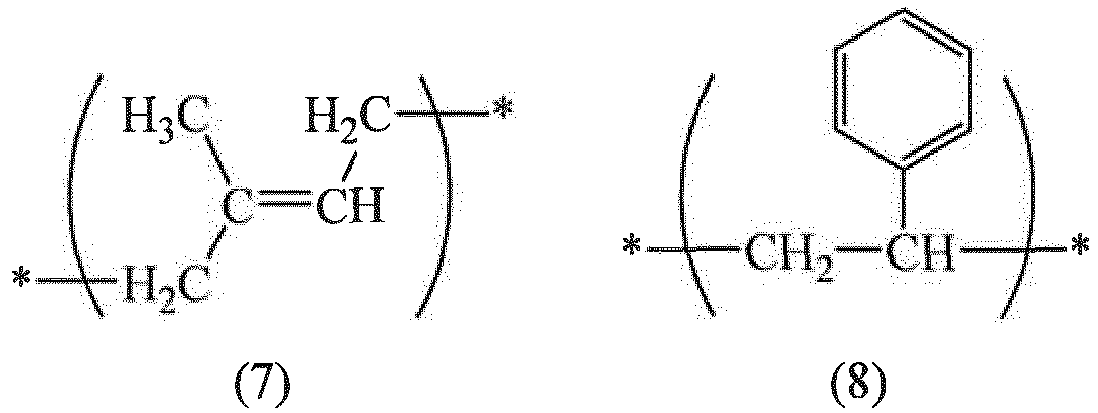
- the silane-modified polymer may comprise constituent units of one or more types selected from units having the formulae (3), (4), (6) and (7), and optionally further styrene constituent units having the formula (8).
- the arrangement of constituent units is arbitrary.
- the polymer may consist or consist essentially of constituent units selected from the mentioned types.
- the silane-modified polymer should preferably have a number average molecular weight (Mn) of 5,000 to 200,000, more preferably 5,000 to 100,000, as measured versus polystyrene standards by gel permeation chromatography (GPC).
- Mn number average molecular weight
- constituent units of at least one type selected from units having formulae (1) and (2) be included in an amount of at least 0.5 mol%, more preferably at least 1 mol% of the overall units of the silane-modified polymer.
- An upper limit is not critical.
- the silane-modified polymer may be prepared by effecting hydrosilylation reaction of a polymer comprising constituent units of at least one type selected from units having the formulae (3) and (4) with an organosilicon compound having the formula (5) in the presence of a platinum compound-containing catalyst, preferably in the presence of a platinum compound-containing catalyst and a co-catalyst.
- a platinum compound-containing catalyst preferably in the presence of a platinum compound-containing catalyst and a co-catalyst.
- * has the same meaning as above, and R 1 , R 2 and m are as defined above.
- Polymers comprising constituent units of at least one type selected from units having the formulae (3) and (4) are commercially available.
- isoprene homopolymers may be used and are available e.g. under the trade name of KL-10, LIR-15, LIR-30 and LIR-50 from Kuraray Co., Ltd.
- Styrene-isoprene copolymers may be used and are available e.g. under the trade name of LIR-310 from Kuraray Co., Ltd.
- organosilicon compound having formula (5) examples include trimethoxysilane, triethoxysilane, dimethoxymethylsilane, and diethoxymethylsilane.
- the platinum compound-containing catalyst used in hydrosilylation reaction is not particularly limited.
- Suitable catalysts include chloroplatinic acid, alcohol solutions of chloroplatinic acid, toluene and xylene solutions of platinum-1,3-divinyl-1,1,3,3-tetramethyldisiloxane complex, tetrakistriphenylphosphine platinum, dichlorobistriphenylphosphine platinum, dichlorobisacetonitrile platinum, dichlorobisbenzonitrile platinum, and dichlorocyclooctadiene platinum, as well as supported catalysts such as platinum-on-carbon, platinum-on-alumina and platinum-on-silica.
- the amount of the platinum compound-containing catalyst used is not particularly limited. In view of reactivity and productivity, the catalyst is preferably used in an amount to provide 1 ⁇ 10 -8 to 1 ⁇ 10 -2 mole, more preferably 1 ⁇ 10 -7 to 1 ⁇ 10 -3 mole of platinum atom per mole of the organosilicon compound having formula (5).
- a co-catalyst may be used to increase the rate of hydrosilylation reaction.
- the co-catalyst is preferably selected from ammonium salts of inorganic acids, acid amide compounds, carboxylic acids, and mixtures thereof.
- Suitable ammonium salts of inorganic acids include ammonium chloride, ammonium sulfate, ammonium amidosulfonate, ammonium nitrate, monoammonium dihydrogenphosphate, diammonium hydrogenphosphate, triammonium phosphate, ammonium hypophosphite, ammonium carbonate, ammonium hydrogencarbonate, ammonium sulfide, ammonium borate, and ammonium borofluoride.
- ammonium salts of inorganic acids having pKa of at least 2 are preferred, with ammonium carbonate and ammonium hydrogencarbonate being most preferred.
- Suitable acid amide compounds include formamide, acetamide, N-methylacetamide, N,N-dimethylacetamide, propionamide, acrylamide, malonamide, succinamide, maleamide, fumaramide, benzamide, phthalamide, palmitamide, and stearamide.
- Suitable carboxylic acids include formic acid, acetic acid, propionic acid, butyric acid, methoxyacetic acid, pentanoic acid, caproic acid, heptanoic acid, octanoic acid, lactic acid, and glycolic acid.
- formic acid, acetic acid and lactic acid are preferred, with acetic acid being most preferred.
- the amount of the co-catalyst used is not particularly limited. In view of reactivity, selectivity and cost, the co-catalyst is preferably used in an amount of 1 ⁇ 10 -5 to 1 ⁇ 10 -1 mole, more preferably 1 ⁇ 10 -4 to 5 ⁇ 10 -1 mole per mole of the organosilicon compound having formula (5).
- a solvent may be used although the reaction can take place in a solventless system.
- Suitable solvents include hydrocarbon solvents such as pentane, hexane, cyclohexane, heptane, isooctane, benzene, toluene, and xylene, ether solvents such as diethyl ether, tetrahydrofuran, and dioxane, ester solvents such as ethyl acetate and butyl acetate, aprotic polar solvents such as N,N-dimethylformamide, and chlorinated hydrocarbon solvents such as dichloromethane and chloroform, which may be used alone or in admixture.
- hydrocarbon solvents such as pentane, hexane, cyclohexane, heptane, isooctane, benzene, toluene, and xylene
- ether solvents such as diethyl
- the temperature for hydrosilylation reaction is not particularly limited, it is preferably 0°C to an elevated temperature, more preferably 0 to 200°C.
- An elevated temperature is preferred for gaining an appropriate reaction rate.
- the reaction temperature is preferably 40 to 110°C, more preferably 40 to 90°C.
- the reaction time is not particularly limited, it is preferably 1 to about 60 hours, more preferably 1 to 30 hours, and even more preferably 1 to 20 hours.
- Another embodiment of the invention is a rubber compounding ingredient comprising a silane-modified polymer defined above.
- the rubber compounding ingredient may further comprise a sulfide-containing organosilicon compound which may be effective for improving tire physical properties.
- Suitable sulfide-containing organosilicon compounds include bis(trimethoxysilylpropyl)tetrasulfide, bis(triethoxysilylpropyl)tetrasulfide, bis(trimethoxysilylpropyl)disulfide, and bis(triethoxysilylpropyl)disulfide, but are not limited thereto.
- the silane-modified polymer and the sulfide-containing organosilicon compound are preferably present in a weight ratio of from 5:95 to 80:20, more preferably from 10:90 to 50:50.
- a mixture of the silane-modified polymer and the sulfide-containing organosilicon compound with at least one powder is useful as the rubber compounding ingredient.
- Suitable powders include carbon black, talc, calcium carbonate, stearic acid, silica, aluminum hydroxide, alumina, and magnesium hydroxide. Of these, silica and aluminum hydroxide are preferred for reinforcement, with silica being most preferred.
- a total content (A) of the silane-modified polymer and the sulfide-containing organosilicon compound and a content (B) of the powder are preferably in a weight ratio (A/B) of from 70/30 to 5/95, more preferably from 60/40 to 10/90.
- the rubber compounding ingredient may further contain organic polymers and rubbers such as fatty acids, fatty acid salts, polyethylene, polypropylene, polyoxyalkylenes, polyesters, polyurethane, polystyrene, polybutadiene, polyisoprene, natural rubber, and styrene-butadiene copolymers. There may also be added additives for tires and general rubbers such as vulcanizing agents, crosslinking agents, vulcanizing accelerators, crosslinking accelerators, oils, antioxidants, fillers, and plasticizers.
- the rubber compounding ingredient may take the form of liquid or solid, or be diluted with organic solvents or emulsified.
- the rubber compounding ingredient is compounded in filler-containing rubber compositions.
- suitable fillers include silica, talc, clay, aluminum hydroxide, magnesium hydroxide, calcium carbonate, and titanium oxide. More preferably, the rubber compounding ingredient is compounded in silica-containing rubber compositions.
- an amount of the rubber compounding ingredient compounded in a filled rubber composition is preferably selected such that a total amount of the silane-modified polymer and sulfide-containing organosilicon compound is 0.2 to 30 parts, more preferably 1 to 20 parts by weight per 100 parts by weight of the filler.
- the amount of the filler in a rubber composition may be ordinary as long as the objects of the invention are not impaired.
- the rubber serving as a base in a rubber composition to which the rubber compounding ingredient is added may be any of rubbers commonly used in various rubber compositions. Suitable rubbers include natural rubber (NR), diene rubbers such as isoprene rubber (IR), styrene-butadiene copolymer rubbers (SBR), polybutadiene rubbers (BR), and acrylonitrile-butadiene copolymer rubbers (NBR), and non-diene rubbers such as butyl rubber (IIR) and ethylene-propylene copolymer rubbers (EPR, EPDM), which may be used alone or in admixture.
- the amount of rubber in the rubber composition may be ordinary, typically 20 to 80 % by weight, though not limited thereto.
- additives commonly used in tire and general rubber compositions such as carbon black, vulcanizing agents, crosslinking agents, vulcanizing accelerators, crosslinking accelerators, oils, antioxidants, and plasticizers may also be compounded in the rubber composition.
- the amounts of the additives may be ordinary as long as the objects of the invention are not impaired.
- the rubber composition having the rubber compounding ingredient compounded therein may be prepared by kneading various components by a standard technique, which is ready for use in the manufacture of rubber articles to be vulcanized or crosslinked, typically tires. Especially in manufacturing tires, the rubber composition is preferably used as treads. Since the tires obtained from the rubber composition are significantly reduced in rolling resistance and wear resistance, the desired saving of fuel consumption is achievable.
- the tire may have any prior art well-known structures and be manufactured by any prior art well-known techniques.
- the gas introduced therein may be ordinary air, air having a controlled oxygen partial pressure, or an inert gas such as nitrogen, argon or helium.
- Mn is a number average molecular weight as measured versus polystyrene standards by gel permeation chromatography (GPC). The viscosity is measured at 25°C by a rotational viscometer.
- 72 g (0.44 mol) of triethoxysilane was added dropwise over 2 hours to the mixture, which was stirred at 80°C for a further 1 hour.
- the reaction mixture was concentrated under reduced pressure and filtered, obtaining a yellow transparent liquid having a viscosity of 5,000 mPa ⁇ s and a Mn of 10,700. From the 1 H-NMR spectrum and Mn, the number of constituent units having triethoxysilyl group was computed to be 3 mol% of the overall units.
- the reaction mixture was concentrated under reduced pressure and filtered, obtaining a yellow transparent liquid having a viscosity of 5,000 mPa ⁇ s and a Mn of 10,700. From the 1 H-NMR spectrum and Mn, the number of constituent units having triethoxysilyl group was computed to be 3 mol% of the overall units.
- the reaction mixture was concentrated under reduced pressure and filtered, obtaining a yellow transparent liquid having a viscosity of 5,000 mPa ⁇ s and a Mn of 10,700. From the 1 H-NMR spectrum and Mn, the number of constituent units having triethoxysilyl group was computed to be 3 mol% of the overall units.
- the reaction mixture was concentrated under reduced pressure and filtered, obtaining a yellow transparent liquid having a viscosity of 5,500 mPa ⁇ s and a Mn of 10,500. From the 1 H-NMR spectrum and Mn, the number of constituent units having triethoxysilyl group was computed to be 3 mol% of the overall units.
- the reaction mixture was concentrated under reduced pressure and filtered, obtaining a yellow transparent liquid having a viscosity of 30,000 mPa ⁇ s and a Mn of 20,900. From the 1 H-NMR spectrum and Mn, the number of constituent units having triethoxysilyl group was computed to be 3 mol% of the overall units.
- the reaction mixture was concentrated under reduced pressure and filtered, obtaining a yellow transparent liquid having a viscosity of 140,000 mPa ⁇ s and a Mn of 30,000. From the 1 H-NMR spectrum and Mn, the number of constituent units having triethoxysilyl group was computed to be 3 mol% of the overall units.
- the reaction mixture was concentrated under reduced pressure and filtered, obtaining a yellow transparent liquid having a viscosity of 950,000 mPa ⁇ s and a Mn of 58,000. From the 1 H-NMR spectrum and Mn, the number of constituent units having triethoxysilyl group was computed to be 3 mol% of the overall units.
- the reaction mixture was concentrated under reduced pressure and filtered, obtaining a yellow transparent liquid having a viscosity of 3,000,000 mPa ⁇ s and a Mn of 33,600. From the 1 H-NMR spectrum and Mn, the number of constituent units having triethoxysilyl group was computed to be 3 mol% of the overall units.
- a silane-modified polymer was synthesized as follows.
- the mixture was stirred at 200°C for 5 hours.
- the reaction mixture was concentrated under reduced pressure and filtered, obtaining a pale yellow transparent liquid having a viscosity of 200,000 mPa ⁇ s and a Mn of 59,000.
- a master batch was prepared by mixing 110 parts of oil-extended emulsion polymerization SBR #1712 (by JSR Corp.), 20 parts of NR (RSS#3 grade), 20 parts of carbon black (N234 grade), 50 parts of silica (Nipsil AQ by Nippon Silica Industry Co., Ltd.), 6.5 parts of the silane-modified polymer of Example 1-1 or 6.5 parts (total) of the silane-modified polymer plus KBE-846 (bis(triethoxysilylpropyl)tetrasulfide, by Shin-Etsu Chemical Co., Ltd.), 1 part of stearic acid, and 1 part of antioxidant (Nocrac 6C by Ouchi Shinko Chemical Industrial Co., Ltd.).
- a vulcanizing accelerator DM dibenzothiazyl disulfide
- a vulcanizing accelerator NS N-t-butyl-2-benzothiazolylsulfenamide
- Rubber compositions were prepared as in Example 2-3 aside from replacing the silane-modified polymer of Example 1-1 by the silane-modified polymers of Examples 1-4 to 1-8 as shown in Table 1.
- a rubber composition was prepared as in Example 2-3 aside from replacing the silane-modified polymer of Example 1-2 by the silane-modified polymer of Reference Example 1-1 as shown in Table 2.
- a rubber composition was prepared as in Example 2-1 aside from replacing the silane-modified polymer of Example 1-2 by KBE-846 as shown in Table 2.
- Example 2-1 to 2-8 and Comparative Examples 2-1 to 2-2 were measured for physical properties in unvulcanized and vulcanized states by the following tests. The results are also shown in Tables 1 and 2.
- tensile dynamic strain 5 % was a sheet 0.2 cm thick and 0.5 cm wide, the clamp span was 2 cm, and the initial weight was 160 g.
- the value of tan ⁇ was expressed as an index based on 100 for Comparative Example 2-2. A greater index at 0°C indicates a better wet grip. A lower index at 60°C corresponds to a smaller hysteresis loss and lower heat generation.
- the abrasion test was carried out using a Lambourn abrasion tester at room temperature and slip rate 25 %.
- the measurement result was expressed as an index based on 100 for Comparative Example 2-2. A greater index indicates a smaller abrasion and hence, better wear resistance.
- the rubber compositions of Examples 2-1 to 2-8 have a lower Mooney viscosity and better workability than the rubber compositions of Comparative Examples 2-1 to 2-2.
- the vulcanized rubber compositions of Examples 2-1 to 2-8 have a better wet grip performance, lower heat generation, and better wear resistance than the vulcanized rubber compositions of Comparative Examples 2-1 to 2-2.
- a master batch was prepared by mixing 100 parts of NR (RSS#3 grade), 38 parts of process oil, 5 parts of carbon black (N234 grade), 105 parts of silica (Nipsil AQ by Nippon Silica Industry Co., Ltd.), 8.4 parts of the silane-modified polymer of Example 1-1 or 8.4 parts (total) of the silane-modified polymer plus KBE-846 (bis(triethoxysilylpropyl)tetrasulfide by Shin-Etsu Chemical Co., Ltd.), 2 parts of stearic acid, and 2 parts of antioxidant (Nocrac 6C by Ouchi Shinko Chemical Industrial Co., Ltd.).
- Rubber compositions were prepared as in Example 2-11 aside from replacing the silane-modified polymer of Example 1-1 by the silane-modified polymers of Examples 1-4 to 1-8 as shown in Table 3.
- a rubber composition was prepared as in Example 2-11 aside from replacing the silane-modified polymer of Example 1-1 by the silane-modified polymer of Reference Example 1-1 as shown in Table 4.
- a rubber composition was prepared as in Example 2-9 aside from replacing the silane-modified polymer of Example 1-1 by KBE-846 as shown in Table 4.
- the rubber compositions were measured for unvulcanized physical properties (Mooney viscosity) and vulcanized physical properties (dynamic viscoelasticity, wear resistance) by the same tests as above.
- the measurement results, expressed as an index based on 100 for Comparative Example 2-4, are also shown in Tables 3 and 4.
- the vulcanized rubber compositions of Examples 2-9 to 2-16 have a lower dynamic viscoelasticity, i.e. lower hysteresis loss and lower heat generation, and better wear resistance than the vulcanized rubber compositions of Comparative Examples 2-3 to 2-4.
Landscapes
- Chemical & Material Sciences (AREA)
- Health & Medical Sciences (AREA)
- Chemical Kinetics & Catalysis (AREA)
- Medicinal Chemistry (AREA)
- Polymers & Plastics (AREA)
- Organic Chemistry (AREA)
- General Chemical & Material Sciences (AREA)
- Engineering & Computer Science (AREA)
- Mechanical Engineering (AREA)
- Compositions Of Macromolecular Compounds (AREA)
- Tires In General (AREA)
- Addition Polymer Or Copolymer, Post-Treatments, Or Chemical Modifications (AREA)
Abstract
Description
- This invention relates to a silane-modified polymer as well as a rubber compounding ingredient and rubber composition comprising the same. More particularly, it relates to a silane-modified polymer of polybutadiene or polystyrene skeleton, a method for preparing the same, a rubber compounding ingredient and rubber composition comprising the same, and a tire obtained from the rubber composition.
- Sulfur-containing organosilicon compounds are useful as an essential component when tires are produced from silica-filled rubber compositions. Silica-filled tires show excellent performance in automotive applications, especially wear resistance, rolling resistance and wet grip. Since these performance improvements are closely related to a saving of fuel consumption of tires, active efforts are currently devoted thereto.
- An increase of silica loading in rubber composition is essential for a saving of fuel consumption. The silica-filled rubber compositions are effective for reducing rolling resistance and improving wet grip of tires, but have drawbacks including a high unvulcanized viscosity, multi-stage milling, and inefficient working. Therefore, rubber compositions simply loaded with inorganic fillers like silica suffer from problems like poor dispersion of the filler and substantial drops of rupture strength and wear resistance. Under such circumstances, it is desired to improve the dispersion of inorganic filler in rubber, and sulfur-containing organosilicon compounds are found essential for establishing chemical bonds between the filler and the rubber matrix. See Patent Document 1.
- As the sulfur-containing organosilicon compound, compounds containing an alkoxysilyl group and polysulfidesilyl group in the molecule, for example, bis-triethoxysilylpropyltetrasulfide and bis-triethoxysilylpropyldisulfide are known effective from Patent Documents 2 to 5.
- In addition to the polysulfide-containing organosilicon compounds mentioned above, it is also known from Patent Documents 6 to 10 to apply a capped mercapto-containing organosilicon compound of thio ester type (advantageous for silica dispersion) and a sulfur-containing organosilicon compound of the type resulting from transesterification of an aminoalcohol compound to a hydrolysable silyl group which is advantageous to affinity to silica via hydrogen bond.
- Patent Documents 11 to 13 disclose silane-modified polybutadiene compounds, although not silane-modified polyisoprene compounds. Patent Document 14 describes polyisoprene compounds which are modified with a silane, specifically mercapto-containing organosilicon compound. When these compounds are used, no satisfactory tire physical properties are developed in some compounding systems.
-
- Patent Document 1:
JP-B S51-20208 - Patent Document 2:
JP-A 2004-525230 - Patent Document 3:
JP-A 2004-018511 - Patent Document 4:
JP-A 2002-145890 - Patent Document 5: USP
6,229,036 - Patent Document 6:
JP-A 2005-008639 - Patent Document 7:
JP-A 2008-150546 - Patent Document 8:
JP-A 2010-132604 - Patent Document 9:
JP 4571125 - Patent Document 10: USP
6,414,061 - Patent Document 11:
JP-A S62-265301 - Patent Document 12:
JP-A 2000-344948 - Patent Document 13:
JP-A 2001-131464 - Patent Document 14:
JP 5899050 - An aim herein is to provide new polymer compounds useful for incorporation in rubber compositions, especially filled rubber compositions, and which can be effective for improving the wet grip and/or substantially reducing the hysteresis loss of the cured rubber composition, e.g. so that desired low fuel consumption tires may be manufactured from the rubber composition. Other objects are to provide a method for preparing the polymer, a rubber compounding ingredient comprising the polymer, a rubber composition comprising the rubber compounding ingredient, and a tire obtained from the rubber composition. The corresponding uses and methods are further aspects.
- The inventor has found that a silane-modified polymer of polyisoprene skeleton is an effective rubber compounding ingredient and that when added to a rubber composition, it can be effective for providing low hysteresis loss, or substantially reducing the hysteresis loss of the cured rubber composition. Tires obtained from the rubber composition comprising the rubber compounding ingredient are found to exhibit the desirable wet grip and achieve a substantial saving of fuel consumption.
- In one aspect, the invention provides a silane-modified polymer comprising constituent units of at least one type selected from units having the formulae (1) and (2).

- In another aspect, the invention provides a method for preparing the silane-modified polymer defined above, comprising the step of effecting hydrosilylation reaction of a polymer comprising constituent units of at least one type selected from units having the formulae (3) and (4):


- In a further aspect, the invention provides a rubber compounding ingredient comprising the silane-modified polymer defined above.
- The rubber compounding ingredient may further comprise a sulfide-containing organosilicon compound and/or at least one powder. A total content (A) of the silane-modified polymer and the sulfide-containing organosilicon compound and a content (B) of the powder are in a weight ratio (A/B) of from 70/30 to 5/95.
- In a still further aspect, the invention provides a rubber composition comprising the rubber compounding ingredient defined above.
- A tire obtained by molding the rubber composition is also provided.
- Throughout the specification, the asterisk (*) in the chemical formula designates a bond to an adjoining unit.
- The silane-modified polymer having a polyisoprene skeleton and a hydrolysable silyl group is useful as a rubber compounding ingredient. Tires obtained from the rubber composition comprising the rubber compounding ingredient are found to meet desired low fuel consumption tire characteristics.
- One aspect of the invention is a silane-modified polymer comprising constituent units of at least one type selected from units having the formulae (1) and (2).

- Herein R1 is each independently a C1-C10 alkyl group or C6-C10 aryl group, R2 is each independently a C1-C10 alkyl group or C6-C10 aryl group, and m is an integer of 1 to 3.
- Suitable C1-C10 alkyl groups may be straight, branched or cyclic and include methyl, ethyl, n-propyl, i-propyl, n-butyl, s-butyl, t-butyl, n-pentyl, n-hexyl, n-heptyl, n-octyl, n-nonyl, n-decyl, cyclopropyl, cyclobutyl, cyclopentyl, cyclohexyl, cycloheptyl, and cyclooctyl. Suitable C6-C10 aryl groups include phenyl, α-naphthyl and β-naphthyl. Among others, R1 is preferably a straight alkyl group, more preferably methyl or ethyl. Also R2 is preferably a straight alkyl group, more preferably methyl or ethyl.
- In addition to constituent units of formula (1) and/or (2), the silane-modified polymer may comprise constituent units of one or more types selected from units having the formulae (3), (4), (6) and (7), and optionally further styrene constituent units having the formula (8). The arrangement of constituent units is arbitrary. The polymer may consist or consist essentially of constituent units selected from the mentioned types.


- For the purposes of improving properties of the rubber composition, preventing the composition from viscosity build-up, and making the composition easy to handle, the silane-modified polymer should preferably have a number average molecular weight (Mn) of 5,000 to 200,000, more preferably 5,000 to 100,000, as measured versus polystyrene standards by gel permeation chromatography (GPC).
- In order for the silane-modified polymer to be effective for improving properties of the rubber composition, it is preferred that constituent units of at least one type selected from units having formulae (1) and (2) be included in an amount of at least 0.5 mol%, more preferably at least 1 mol% of the overall units of the silane-modified polymer. An upper limit is not critical.
- The silane-modified polymer may be prepared by effecting hydrosilylation reaction of a polymer comprising constituent units of at least one type selected from units having the formulae (3) and (4) with an organosilicon compound having the formula (5) in the presence of a platinum compound-containing catalyst, preferably in the presence of a platinum compound-containing catalyst and a co-catalyst.

- Polymers comprising constituent units of at least one type selected from units having the formulae (3) and (4) are commercially available. For example, isoprene homopolymers may be used and are available e.g. under the trade name of KL-10, LIR-15, LIR-30 and LIR-50 from Kuraray Co., Ltd. Styrene-isoprene copolymers may be used and are available e.g. under the trade name of LIR-310 from Kuraray Co., Ltd.
- Examples of the organosilicon compound having formula (5) include trimethoxysilane, triethoxysilane, dimethoxymethylsilane, and diethoxymethylsilane.
- The platinum compound-containing catalyst used in hydrosilylation reaction is not particularly limited. Suitable catalysts include chloroplatinic acid, alcohol solutions of chloroplatinic acid, toluene and xylene solutions of platinum-1,3-divinyl-1,1,3,3-tetramethyldisiloxane complex, tetrakistriphenylphosphine platinum, dichlorobistriphenylphosphine platinum, dichlorobisacetonitrile platinum, dichlorobisbenzonitrile platinum, and dichlorocyclooctadiene platinum, as well as supported catalysts such as platinum-on-carbon, platinum-on-alumina and platinum-on-silica. In view of selectivity upon hydrosilylation, zero-valent platinum complexes are preferred, with toluene and xylene solutions of platinum-1,3-divinyl-1,1,3,3-tetramethyldisiloxane complex being more preferred.
- The amount of the platinum compound-containing catalyst used is not particularly limited. In view of reactivity and productivity, the catalyst is preferably used in an amount to provide 1 × 10⁻⁸ to 1 × 10⁻² mole, more preferably 1 × 10⁻⁷ to 1 × 10⁻³ mole of platinum atom per mole of the organosilicon compound having formula (5).
- If necessary, a co-catalyst may be used to increase the rate of hydrosilylation reaction. The co-catalyst is preferably selected from ammonium salts of inorganic acids, acid amide compounds, carboxylic acids, and mixtures thereof. Suitable ammonium salts of inorganic acids include ammonium chloride, ammonium sulfate, ammonium amidosulfonate, ammonium nitrate, monoammonium dihydrogenphosphate, diammonium hydrogenphosphate, triammonium phosphate, ammonium hypophosphite, ammonium carbonate, ammonium hydrogencarbonate, ammonium sulfide, ammonium borate, and ammonium borofluoride. Inter alia, ammonium salts of inorganic acids having pKa of at least 2 are preferred, with ammonium carbonate and ammonium hydrogencarbonate being most preferred.
- Suitable acid amide compounds include formamide, acetamide, N-methylacetamide, N,N-dimethylacetamide, propionamide, acrylamide, malonamide, succinamide, maleamide, fumaramide, benzamide, phthalamide, palmitamide, and stearamide.
- Suitable carboxylic acids include formic acid, acetic acid, propionic acid, butyric acid, methoxyacetic acid, pentanoic acid, caproic acid, heptanoic acid, octanoic acid, lactic acid, and glycolic acid. Inter alia, formic acid, acetic acid and lactic acid are preferred, with acetic acid being most preferred.
- The amount of the co-catalyst used is not particularly limited. In view of reactivity, selectivity and cost, the co-catalyst is preferably used in an amount of 1 × 10⁻⁵ to 1 × 10⁻¹ mole, more preferably 1 × 10⁻⁴ to 5 × 10⁻¹ mole per mole of the organosilicon compound having formula (5).
- A solvent may be used although the reaction can take place in a solventless system. Suitable solvents include hydrocarbon solvents such as pentane, hexane, cyclohexane, heptane, isooctane, benzene, toluene, and xylene, ether solvents such as diethyl ether, tetrahydrofuran, and dioxane, ester solvents such as ethyl acetate and butyl acetate, aprotic polar solvents such as N,N-dimethylformamide, and chlorinated hydrocarbon solvents such as dichloromethane and chloroform, which may be used alone or in admixture.
- Although the temperature for hydrosilylation reaction is not particularly limited, it is preferably 0°C to an elevated temperature, more preferably 0 to 200°C. An elevated temperature is preferred for gaining an appropriate reaction rate. In this sense, the reaction temperature is preferably 40 to 110°C, more preferably 40 to 90°C. Although the reaction time is not particularly limited, it is preferably 1 to about 60 hours, more preferably 1 to 30 hours, and even more preferably 1 to 20 hours.
- Another embodiment of the invention is a rubber compounding ingredient comprising a silane-modified polymer defined above.
- The rubber compounding ingredient may further comprise a sulfide-containing organosilicon compound which may be effective for improving tire physical properties. Suitable sulfide-containing organosilicon compounds include bis(trimethoxysilylpropyl)tetrasulfide, bis(triethoxysilylpropyl)tetrasulfide, bis(trimethoxysilylpropyl)disulfide, and bis(triethoxysilylpropyl)disulfide, but are not limited thereto. In the rubber compounding ingredient, the silane-modified polymer and the sulfide-containing organosilicon compound are preferably present in a weight ratio of from 5:95 to 80:20, more preferably from 10:90 to 50:50.
- Also a mixture of the silane-modified polymer and the sulfide-containing organosilicon compound with at least one powder is useful as the rubber compounding ingredient. Suitable powders include carbon black, talc, calcium carbonate, stearic acid, silica, aluminum hydroxide, alumina, and magnesium hydroxide. Of these, silica and aluminum hydroxide are preferred for reinforcement, with silica being most preferred. In view of ease of handling and transportation cost of the rubber compounding ingredient, a total content (A) of the silane-modified polymer and the sulfide-containing organosilicon compound and a content (B) of the powder are preferably in a weight ratio (A/B) of from 70/30 to 5/95, more preferably from 60/40 to 10/90.
- The rubber compounding ingredient may further contain organic polymers and rubbers such as fatty acids, fatty acid salts, polyethylene, polypropylene, polyoxyalkylenes, polyesters, polyurethane, polystyrene, polybutadiene, polyisoprene, natural rubber, and styrene-butadiene copolymers. There may also be added additives for tires and general rubbers such as vulcanizing agents, crosslinking agents, vulcanizing accelerators, crosslinking accelerators, oils, antioxidants, fillers, and plasticizers. The rubber compounding ingredient may take the form of liquid or solid, or be diluted with organic solvents or emulsified.
- Typically the rubber compounding ingredient is compounded in filler-containing rubber compositions. Suitable fillers include silica, talc, clay, aluminum hydroxide, magnesium hydroxide, calcium carbonate, and titanium oxide. More preferably, the rubber compounding ingredient is compounded in silica-containing rubber compositions. In view of rubber physical properties, the extent of available effects, and a balance thereof with economy, an amount of the rubber compounding ingredient compounded in a filled rubber composition is preferably selected such that a total amount of the silane-modified polymer and sulfide-containing organosilicon compound is 0.2 to 30 parts, more preferably 1 to 20 parts by weight per 100 parts by weight of the filler. The amount of the filler in a rubber composition may be ordinary as long as the objects of the invention are not impaired.
- The rubber serving as a base in a rubber composition to which the rubber compounding ingredient is added may be any of rubbers commonly used in various rubber compositions. Suitable rubbers include natural rubber (NR), diene rubbers such as isoprene rubber (IR), styrene-butadiene copolymer rubbers (SBR), polybutadiene rubbers (BR), and acrylonitrile-butadiene copolymer rubbers (NBR), and non-diene rubbers such as butyl rubber (IIR) and ethylene-propylene copolymer rubbers (EPR, EPDM), which may be used alone or in admixture. The amount of rubber in the rubber composition may be ordinary, typically 20 to 80 % by weight, though not limited thereto.
- Besides the foregoing components, various additives commonly used in tire and general rubber compositions such as carbon black, vulcanizing agents, crosslinking agents, vulcanizing accelerators, crosslinking accelerators, oils, antioxidants, and plasticizers may also be compounded in the rubber composition. The amounts of the additives may be ordinary as long as the objects of the invention are not impaired.
- The rubber composition having the rubber compounding ingredient compounded therein may be prepared by kneading various components by a standard technique, which is ready for use in the manufacture of rubber articles to be vulcanized or crosslinked, typically tires. Especially in manufacturing tires, the rubber composition is preferably used as treads. Since the tires obtained from the rubber composition are significantly reduced in rolling resistance and wear resistance, the desired saving of fuel consumption is achievable. The tire may have any prior art well-known structures and be manufactured by any prior art well-known techniques. In the case of pneumatic tires, the gas introduced therein may be ordinary air, air having a controlled oxygen partial pressure, or an inert gas such as nitrogen, argon or helium.
- Examples of the invention are given below by way of illustration and not by way of limitation. All parts are by weight (pbw). Mn is a number average molecular weight as measured versus polystyrene standards by gel permeation chromatography (GPC). The viscosity is measured at 25°C by a rotational viscometer.
- A 2-L separable flask equipped with a stirrer, reflux condenser, dropping funnel and thermometer was charged with 1,000 g of isoprene homopolymer KL-10 (Mn = 10,000, by Kuraray Co., Ltd.), an amount (0.44×10⁻³ mol of platinum atom) of toluene solution of platinum-1,3-divinyl-1,1,3,3-tetramethyldisiloxane complex, and 0.03 g (0.44×10⁻³ mol) of acetic acid. At an internal temperature of 75-85°C, 72 g (0.44 mol) of triethoxysilane was added dropwise over 2 hours to the mixture, which was stirred at 80°C for a further 1 hour. At the end of stirring, the reaction mixture was concentrated under reduced pressure and filtered, obtaining a yellow transparent liquid having a viscosity of 5,000 mPa·s and a Mn of 10,700. From the 1H-NMR spectrum and Mn, the number of constituent units having triethoxysilyl group was computed to be 3 mol% of the overall units.
- A flask as in Example 1-1 was charged with 1,000 g of isoprene homopolymer KL-10 (Mn = 10,000, by Kuraray Co., Ltd.), an amount (0.44×10⁻³ mol of platinum atom) of toluene solution of platinum-1,3-divinyl-1,1,3,3-tetramethyldisiloxane complex, and 0.03 g (0.44×10⁻³ mol) of ammonium hydrogencarbonate. At an internal temperature of 75-85°C, 72 g (0.44 mol) of triethoxysilane was added dropwise over 2 hours to the mixture, which was stirred at 80°C for a further 1 hour. At the end of stirring, the reaction mixture was concentrated under reduced pressure and filtered, obtaining a yellow transparent liquid having a viscosity of 5,000 mPa·s and a Mn of 10,700. From the 1H-NMR spectrum and Mn, the number of constituent units having triethoxysilyl group was computed to be 3 mol% of the overall units.
- A flask as in Example 1-1 was charged with 1,000 g of isoprene homopolymer KL-10 (Mn = 10,000, by Kuraray Co., Ltd.), an amount (0.44×10⁻³ mol of platinum atom) of toluene solution of platinum-1,3-divinyl-1,1,3,3-tetramethyldisiloxane complex, and 0.02 g (0.44×10⁻³ mol) of formamide. At an internal temperature of 75-85°C, 72 g (0.44 mol) of triethoxysilane was added dropwise over 2 hours to the mixture, which was stirred at 80°C for a further 1 hour. At the end of stirring, the reaction mixture was concentrated under reduced pressure and filtered, obtaining a yellow transparent liquid having a viscosity of 5,000 mPa·s and a Mn of 10,700. From the 1H-NMR spectrum and Mn, the number of constituent units having triethoxysilyl group was computed to be 3 mol% of the overall units.
- A flask as in Example 1-1 was charged with 1,000 g of isoprene homopolymer KL-10 (Mn = 10,000, by Kuraray Co., Ltd.), an amount (0.44×10⁻³ mol of platinum atom) of toluene solution of platinum-1,3-divinyl-1,1,3,3-tetramethyldisiloxane complex, and 0.03 g (0.44×10⁻³ mol) of acetic acid. At an internal temperature of 75-85°C, 54 g (0.44 mol) of trimethoxysilane was added dropwise over 2 hours to the mixture, which was stirred at 80°C for a further 1 hour. At the end of stirring, the reaction mixture was concentrated under reduced pressure and filtered, obtaining a yellow transparent liquid having a viscosity of 5,500 mPa·s and a Mn of 10,500. From the 1H-NMR spectrum and Mn, the number of constituent units having triethoxysilyl group was computed to be 3 mol% of the overall units.
- A flask as in Example 1-1 was charged with 1,000 g of isoprene homopolymer LIR-15 (Mn = 19,500, by Kuraray Co., Ltd.), an amount (0.44×10⁻³ mol of platinum atom) of toluene solution of platinum-1,3-divinyl-1,1,3,3-tetramethyldisiloxane complex, and 0.03 g (0.44×10⁻³ mol) of acetic acid. At an internal temperature of 75-85°C, 72 g (0.44 mol) of triethoxysilane was added dropwise over 2 hours to the mixture, which was stirred at 80°C for a further 1 hour. At the end of stirring, the reaction mixture was concentrated under reduced pressure and filtered, obtaining a yellow transparent liquid having a viscosity of 30,000 mPa·s and a Mn of 20,900. From the 1H-NMR spectrum and Mn, the number of constituent units having triethoxysilyl group was computed to be 3 mol% of the overall units.
- A flask as in Example 1-1 was charged with 1,000 g of isoprene homopolymer LIR-30 (Mn = 28,000, by Kuraray Co., Ltd.), an amount (0.44×10⁻³ mol of platinum atom) of toluene solution of platinum-1,3-divinyl-1,1,3,3-tetramethyldisiloxane complex, and 0.03 g (0.44×10⁻³ mol) of acetic acid. At an internal temperature of 75-85°C, 72 g (0.44 mol) of triethoxysilane was added dropwise over 2 hours to the mixture, which was stirred at 80°C for a further 1 hour. At the end of stirring, the reaction mixture was concentrated under reduced pressure and filtered, obtaining a yellow transparent liquid having a viscosity of 140,000 mPa·s and a Mn of 30,000. From the 1H-NMR spectrum and Mn, the number of constituent units having triethoxysilyl group was computed to be 3 mol% of the overall units.
- A flask as in Example 1-1 was charged with 1,000 g of isoprene homopolymer LIR-50 (Mn = 54,000, by Kuraray Co., Ltd.), an amount (0.44×10⁻³ mol of platinum atom) of toluene solution of platinum-1,3-divinyl-1,1,3,3-tetramethyldisiloxane complex, and 0.03 g (0.44×10⁻³ mol) of acetic acid. At an internal temperature of 75-85°C, 72 g (0.44 mol) of triethoxysilane was added dropwise over 2 hours to the mixture, which was stirred at 80°C for a further 1 hour. At the end of stirring, the reaction mixture was concentrated under reduced pressure and filtered, obtaining a yellow transparent liquid having a viscosity of 950,000 mPa·s and a Mn of 58,000. From the 1H-NMR spectrum and Mn, the number of constituent units having triethoxysilyl group was computed to be 3 mol% of the overall units.
- A flask as in Example 1-1 was charged with 1,000 g of isoprene homopolymer LIR-310 (Mn = 32,000, by Kuraray Co., Ltd.), an amount (0.40×10⁻³ mol of platinum atom) of toluene solution of platinum-1,3-divinyl-1,1,3,3-tetramethyldisiloxane complex, and 0.03 g (0.40×10⁻³ mol) of acetic acid. At an internal temperature of 75-85°C, 66 g (0.40 mol) of triethoxysilane was added dropwise over 2 hours to the mixture, which was stirred at 80°C for a further 1 hour. At the end of stirring, the reaction mixture was concentrated under reduced pressure and filtered, obtaining a yellow transparent liquid having a viscosity of 3,000,000 mPa·s and a Mn of 33,600. From the 1H-NMR spectrum and Mn, the number of constituent units having triethoxysilyl group was computed to be 3 mol% of the overall units.
- With reference to
JP 5899050 - A master batch was prepared by mixing 110 parts of oil-extended emulsion polymerization SBR #1712 (by JSR Corp.), 20 parts of NR (RSS#3 grade), 20 parts of carbon black (N234 grade), 50 parts of silica (Nipsil AQ by Nippon Silica Industry Co., Ltd.), 6.5 parts of the silane-modified polymer of Example 1-1 or 6.5 parts (total) of the silane-modified polymer plus KBE-846 (bis(triethoxysilylpropyl)tetrasulfide, by Shin-Etsu Chemical Co., Ltd.), 1 part of stearic acid, and 1 part of antioxidant (Nocrac 6C by Ouchi Shinko Chemical Industrial Co., Ltd.).
- To the master batch were added 3 parts of zinc white, 0.5 part of a vulcanizing accelerator DM (dibenzothiazyl disulfide), 1 part of a vulcanizing accelerator NS (N-t-butyl-2-benzothiazolylsulfenamide) and 1.5 parts of sulfur. They were kneaded to form a rubber composition.
- Rubber compositions were prepared as in Example 2-3 aside from replacing the silane-modified polymer of Example 1-1 by the silane-modified polymers of Examples 1-4 to 1-8 as shown in Table 1.
- A rubber composition was prepared as in Example 2-3 aside from replacing the silane-modified polymer of Example 1-2 by the silane-modified polymer of Reference Example 1-1 as shown in Table 2.
- A rubber composition was prepared as in Example 2-1 aside from replacing the silane-modified polymer of Example 1-2 by KBE-846 as shown in Table 2.
- The rubber compositions of Example 2-1 to 2-8 and Comparative Examples 2-1 to 2-2 were measured for physical properties in unvulcanized and vulcanized states by the following tests. The results are also shown in Tables 1 and 2.
- According to JIS K6300, measurement was made under conditions as follows: preheating 1 minute, measurement 4 minutes, and temperature 130°C. The measurement result was expressed as an index based on 100 for Comparative Example 2-2. A lower index corresponds to a lower Mooney viscosity and indicates better workability.
- Using a viscoelasticity meter (Rheometric Scientific Inc.), measurement was made under conditions as follows: tensile dynamic strain 5 %, frequency 15 Hz, and 0°C or 60°C. The test specimen was a sheet 0.2 cm thick and 0.5 cm wide, the clamp span was 2 cm, and the initial weight was 160 g. The value of tanδ was expressed as an index based on 100 for Comparative Example 2-2. A greater index at 0°C indicates a better wet grip. A lower index at 60°C corresponds to a smaller hysteresis loss and lower heat generation.
- According to JIS K 6264-2:2005, the abrasion test was carried out using a Lambourn abrasion tester at room temperature and slip rate 25 %. The measurement result was expressed as an index based on 100 for Comparative Example 2-2. A greater index indicates a smaller abrasion and hence, better wear resistance.
Table 1 Formulation (pbw) Example 2-1 2-2 2-3 2-4 2-5 2-6 2-7 2-8 SBR 110 110 110 110 110 110 110 110 NR 20 20 20 20 20 20 20 20 Carbon black 20 20 20 20 20 20 20 20 Silica 50 50 50 50 50 50 50 50 Silane-modified polymer Example 1-1 6.5 3.3 1.6 - - - - - Example 1-4 - - - 1.6 - - - - Example 1-5 - - - - 1.6 - - - Example 1-6 - - - - - 1.6 - - Example 1-7 - - - - - - 1.6 - Example 1-8 - - - - - - - 1.6 KBE-846 - 3.2 4.9 4.9 4.9 4.9 4.9 4.9 Stearic acid 1 1 1 1 1 1 1 1 Antioxidant 6C 1 1 1 1 1 1 1 1 Zinc white 3 3 3 3 3 3 3 3 Vulcanizing accelerator DM 0.5 0.5 0.5 0.5 0.5 0.5 0.5 0.5 Vulcanizing accelerator NS 1 1 1 1 1 1 1 1 Sulfur 1.5 1.5 1.5 1.5 1.5 1.5 1.5 1.5 Unvulcanized physical prope rties Mooney viscosity 90 92 92 93 93 93 94 94 Vulcanized physical properties Dynamic viscoelasticity tanδ 0°C 100 106 107 110 110 109 108 108 60°C 92 85 85 86 84 88 88 89 Wear resistance 102 106 105 106 104 105 105 106 Table 2 Formulation (pbw) Comparative Example 2-1 2-2 SBR 110 110 NR 20 20 Carbon black 20 20 Silica 50 50 Organosilicon compound Reference Example 1-1 1.6 - KBE-846 4.9 4.9 Stearic acid 1 1 Antioxidant 6C 1 1 Zinc white 3 3 Vulcanizing accelerator DM 0.5 0.5 Vulcanizing accelerator NS 1 1 Sulfur 1.5 1.5 Unvulcanized physical properties Mooney viscosity 99 100 Vulcanized physical properties Dynamic viscoelasticity tanδ 0°C 100 100 60°C 102 100 Wear resistance 90 100 - As seen from Tables 1 and 2, the rubber compositions of Examples 2-1 to 2-8 have a lower Mooney viscosity and better workability than the rubber compositions of Comparative Examples 2-1 to 2-2. The vulcanized rubber compositions of Examples 2-1 to 2-8 have a better wet grip performance, lower heat generation, and better wear resistance than the vulcanized rubber compositions of Comparative Examples 2-1 to 2-2.
- A master batch was prepared by mixing 100 parts of NR (RSS#3 grade), 38 parts of process oil, 5 parts of carbon black (N234 grade), 105 parts of silica (Nipsil AQ by Nippon Silica Industry Co., Ltd.), 8.4 parts of the silane-modified polymer of Example 1-1 or 8.4 parts (total) of the silane-modified polymer plus KBE-846 (bis(triethoxysilylpropyl)tetrasulfide by Shin-Etsu Chemical Co., Ltd.), 2 parts of stearic acid, and 2 parts of antioxidant (Nocrac 6C by Ouchi Shinko Chemical Industrial Co., Ltd.).
- To the master batch were added 2 parts of zinc oxide, 3 parts of a vulcanizing accelerator CZ (Nocceler, N-cyclohexyl-2-benzothiazolylsulfenamide), and 2 parts of sulfur. They were kneaded to form a rubber composition.
- Rubber compositions were prepared as in Example 2-11 aside from replacing the silane-modified polymer of Example 1-1 by the silane-modified polymers of Examples 1-4 to 1-8 as shown in Table 3.
- A rubber composition was prepared as in Example 2-11 aside from replacing the silane-modified polymer of Example 1-1 by the silane-modified polymer of Reference Example 1-1 as shown in Table 4.
- A rubber composition was prepared as in Example 2-9 aside from replacing the silane-modified polymer of Example 1-1 by KBE-846 as shown in Table 4.
- The rubber compositions were measured for unvulcanized physical properties (Mooney viscosity) and vulcanized physical properties (dynamic viscoelasticity, wear resistance) by the same tests as above. The measurement results, expressed as an index based on 100 for Comparative Example 2-4, are also shown in Tables 3 and 4.
Table 3 Formulation (pbw) Example 2-9 2-10 2-11 2-12 2-13 2-14 2-15 2-16 NR 100 100 100 100 100 100 100 100 Process oil 38 38 38 38 38 38 38 38 Carbon black 5 5 5 5 5 5 5 5 Silica 105 105 105 105 105 105 105 105 Silane-modified polymer Example 1-1 8.4 4.2 2.1 - - - - - Example 1-4 - - - 2.1 - - - - Example 1-5 - - - - 2.1 - - - Example 1-6 - - - - - 2.1 - - Example 1-7 - - - - - - 2.1 - Example 1-8 - - - - - - - 2.1 KBE-846 - 4.2 6.3 6.3 6.3 6.3 6.3 6.3 Stearic acid 2 2 2 2 2 2 2 2 Antioxidant 6C 2 2 2 2 2 2 2 2 Zinc oxide 2 2 2 2 2 2 2 2 Vulcanizing accelerator CZ 3 3 3 3 3 3 3 3 Sulfur 2 2 2 2 2 2 2 2 Unvulcanized physical properties Mooney viscosity 92 93 93 93 93 94 94 94 Vulcanized physical properties Dynamic viscoelasticity tanδ 0°C 100 105 106 108 108 109 108 108 60°C 90 85 83 84 85 85 85 85 Wear resistance 102 106 107 107 106 106 105 105 Table 4 Formulation (pbw) Comparative Example 2-3 2-4 NR 100 100 Process oil 38 38 Carbon black 5 5 Silica 105 105 Organosilicon compound Reference Example 1-1 2.1 - KBE-846 6.3 8.4 Stearic acid 2 2 Antioxidant 6C 2 2 Zinc oxide 2 2 Vulcanizing accelerator CZ 3 3 Sulfur 2 2 Unvulcanized physical properties Mooney viscosity 99 100 Vulcanized physical properties Dynamic viscoelasticity tanδ 0°C 100 100 60°C 102 100 Wear resistance 95 100 - As seen from Tables 3 and 4, the vulcanized rubber compositions of Examples 2-9 to 2-16 have a lower dynamic viscoelasticity, i.e. lower hysteresis loss and lower heat generation, and better wear resistance than the vulcanized rubber compositions of Comparative Examples 2-3 to 2-4.
- In respect of numerical ranges disclosed in the present description it will of course be understood that in the normal way the technical criterion for the upper limit is different from the technical criterion for the lower limit, i.e. the upper and lower limits are intrinsically distinct proposals.
- For the avoidance of doubt it is confirmed that in the general description above, in the usual way the proposal of general preferences and options in respect of different features of the polymer, method, compounding ingredient, use, rubber composition and tire constitutes the proposal of general combinations of those general preferences and options for the different features, insofar as they are combinable and compatible and are put forward in the same context.
- As a precaution in case of translation error the entire disclosure of Japanese Patent Application No.
2016-174718 - Although some preferred embodiments have been described, many modifications and variations may be made thereto in light of the above teachings. It is therefore to be understood that the invention may be practised otherwise than as specifically described without departing from the scope of the general teachings herein.
Claims (15)
- A silane-modified polymer comprising constituent units of at least one type selected from units having the formulae (1) and (2):

- A silane-modified polymer of claim 1 having a number average molecular weight (Mn) of 5,000 to 200,000, more preferably 5,000 to 100,000, as measured versus polystyrene standards by gel permeation chromatography (GPC).
- A silane-modified polymer of claim 1 or 2 in which the constituent units selected from units having formulae (1) and (2) are included in an amount of at least 0.5 mol%, preferably at least 1 mol%, of the overall units of the silane-modified polymer.
- A silane-modified polymer of claim 1, 2 or 3 which is a silane-modified isoprene homopolymer.
- A silane-modified polymer of claim 1, 2 or 3 further comprising constituent units of one or more types selected from units having the formulae (3), (4), (6) and (7), and/or further styrene constituent units having the formula (8):

- A method for preparing a silane-modified polymer of any one of claims 1 to 5, comprising the step of effecting hydrosilylation reaction of a polymer comprising constituent units of at least one type selected from units having the formulae (3) and (4):


- A rubber compounding ingredient comprising a silane-modified polymer of any one of claims 1 to 5.
- A rubber compounding ingredient of claim 7, further comprising a sulfide-containing organosilicon compound.
- A rubber compounding ingredient of claim 7 or 8 further comprising at least one powder, wherein a total content (A) of the silane-modified polymer and any sulfide-containing organosilicon compound and a content (B) of the powder are in a weight ratio (A/B) of from 70/30 to 5/95.
- A rubber compounding method in which silane-modified polymer of any one of claims 1 to 5 or rubber compounding ingredient of any one of claims 7 to 9 is incorporated into the rubber.
- Use of a silane-modified polymer of any one of claims 1 to 5 as a rubber compounding ingredient.
- Use according to claim 11 in which the silane-modified polymer is compounded in a silica-filled rubber with a sulfide-containing organosilicon compound.
- A rubber composition comprising silane-modified polymer of any one of claims 1 to 5 or rubber compounding ingredient of any one of claims 7 to 9.
- A rubber composition of claim 13 in which a base rubber is selected from natural rubber (NR), diene rubbers such as isoprene rubbers (IR), styrene-butadiene copolymer rubbers (SBR), polybutadiene rubbers (BR) and acrylonitrile-butadiene copolymer rubbers (NBR), and non-diene rubbers such as butyl rubbers (IIR) and ethylene-propylene copolymer rubbers (EPR, EPDM), which may be used alone or in admixture.
- A tire obtained by molding a rubber composition of claim 13 or 14.
Applications Claiming Priority (1)
| Application Number | Priority Date | Filing Date | Title |
|---|---|---|---|
| JP2016174718A JP6638603B2 (en) | 2016-09-07 | 2016-09-07 | Rubber compounding agent and rubber composition |
Publications (2)
| Publication Number | Publication Date |
|---|---|
| EP3293204A1 true EP3293204A1 (en) | 2018-03-14 |
| EP3293204B1 EP3293204B1 (en) | 2020-07-15 |
Family
ID=59914269
Family Applications (1)
| Application Number | Title | Priority Date | Filing Date |
|---|---|---|---|
| EP17188695.5A Active EP3293204B1 (en) | 2016-09-07 | 2017-08-31 | Silane-modified polymer, rubber compounding ingredient, and rubber composition |
Country Status (6)
| Country | Link |
|---|---|
| US (1) | US10815323B2 (en) |
| EP (1) | EP3293204B1 (en) |
| JP (1) | JP6638603B2 (en) |
| KR (1) | KR102394077B1 (en) |
| CN (1) | CN107793499B (en) |
| TW (1) | TWI688584B (en) |
Families Citing this family (2)
| Publication number | Priority date | Publication date | Assignee | Title |
|---|---|---|---|---|
| JP7021650B2 (en) * | 2019-02-15 | 2022-02-17 | 信越化学工業株式会社 | Rubber compositions and organosilicon compounds |
| US20260098175A1 (en) * | 2024-10-03 | 2026-04-09 | H.B. Fuller Company | Solvent-based sealant composition |
Citations (20)
| Publication number | Priority date | Publication date | Assignee | Title |
|---|---|---|---|---|
| JPS5120208B2 (en) | 1972-11-13 | 1976-06-23 | ||
| JPS62265301A (en) | 1986-05-12 | 1987-11-18 | Nippon Soda Co Ltd | Silane-modified butadiene polymer and surface treating agent containing same |
| EP0658575A2 (en) * | 1993-12-14 | 1995-06-21 | Kanegafuchi Kagaku Kogyo Kabushiki Kaisha | Method of preparing polymer containing functional group |
| JP2000344948A (en) | 1999-06-09 | 2000-12-12 | Ohtsu Tire & Rubber Co Ltd :The | Rubber composition |
| US6191220B1 (en) * | 1997-03-02 | 2001-02-20 | Dow Corning Asia, Ltd. | Method for manufacturing hydrocarbon oxysilyl functional polymer |
| US6229036B1 (en) | 1998-09-29 | 2001-05-08 | Degussa-Hüls Aktiengesellschaft | Sulfanylsilanes |
| JP2001131464A (en) | 1999-11-05 | 2001-05-15 | Kanegafuchi Chem Ind Co Ltd | Curable resin composition for paint and coated product obtained by applying the same |
| JP2002145890A (en) | 2000-11-08 | 2002-05-22 | Shin Etsu Chem Co Ltd | Organosilicon compound and method for producing the same |
| US6414061B1 (en) | 1997-08-21 | 2002-07-02 | Crompton Corporation | Blocked mercaptosilane coupling agents for filled rubbers |
| JP2003064104A (en) * | 2001-08-23 | 2003-03-05 | Tokai Rubber Ind Ltd | Curable rubber composition and member for electrophotography using the same |
| JP2004018511A (en) | 2002-06-20 | 2004-01-22 | Shin Etsu Chem Co Ltd | Organosilicon compound, method for producing the same, and compounding agent for rubber |
| JP2004525230A (en) | 2001-04-10 | 2004-08-19 | ソシエテ ド テクノロジー ミシュラン | Tires and treads containing bis-alkoxysilane tetrasulfide as coupling agent |
| JP2005008639A (en) | 2003-06-20 | 2005-01-13 | Degussa Ag | Organosilicon compound |
| JP2008150546A (en) | 2006-12-20 | 2008-07-03 | Shin Etsu Chem Co Ltd | Compounding agent for rubber |
| JP2010132604A (en) | 2008-12-04 | 2010-06-17 | Bridgestone Corp | Organosilicon compound, rubber composition employing the same, and tire |
| JP4571125B2 (en) | 2003-03-03 | 2010-10-27 | モーメンティブ・パフォーマンス・マテリアルズ・インク | Process for producing blocked mercaptosilane |
| EP2857407A2 (en) * | 2013-10-03 | 2015-04-08 | Shin-Etsu Chemical Co., Ltd. | Organosilicon compound, making method, adhesive composition, and article |
| WO2015086039A1 (en) * | 2013-12-09 | 2015-06-18 | Trinseo Europe Gmbh | Silane modified elastomeric polymers |
| JP5899050B2 (en) | 2012-05-31 | 2016-04-06 | 株式会社ブリヂストン | Rubber composition and tire |
| JP2016174718A (en) | 2015-03-19 | 2016-10-06 | 田河 將義 | Folding spectacle case |
Family Cites Families (10)
| Publication number | Priority date | Publication date | Assignee | Title |
|---|---|---|---|---|
| US3881536A (en) * | 1972-08-31 | 1975-05-06 | Ppg Industries Inc | Rubber vulcanizates |
| JPS5120208A (en) | 1974-08-12 | 1976-02-18 | Tatsuo Ikeno | Anshodehatsukosuru tojishitsutairu oyobi sonotairuomochiita mozaikuban |
| DE3003893A1 (en) * | 1980-02-02 | 1981-10-15 | Chemische Werke Hüls AG, 4370 Marl | REACTIVE SILYL GROUPS CARRYING HOMO- OR COPOLYMERS OF 1,3-DIENES, PROCESS FOR THEIR PRODUCTION AND THE USE THEREOF |
| JPH01110543A (en) * | 1987-10-22 | 1989-04-27 | Bridgestone Corp | Rubber composition |
| US7351774B2 (en) * | 2005-09-15 | 2008-04-01 | Michelin Recherche Et Technique S.A. | Silicon-modified crumb rubber composition |
| DE102007038333A1 (en) * | 2007-08-14 | 2009-02-19 | Wacker Chemie Ag | Silane-modified additives and silane-modified polymer compositions |
| JP2010168528A (en) * | 2008-10-09 | 2010-08-05 | Ube Ind Ltd | Modified conjugated diene polymer and method of production thereof, rubber reinforcing agent-compounded rubber composition containing the modified conjugate diene polymer and method of production thereof, and tire containing the rubber reinforcing agent-compounded rubber composition |
| JP2012140514A (en) * | 2010-12-28 | 2012-07-26 | Toyo Tire & Rubber Co Ltd | Method for producing modified dienic rubber polymer |
| EA201490496A1 (en) * | 2011-08-26 | 2014-08-29 | Асахи Касеи Кемикалз Корпорейшн | A method for producing modified polymers of conjugated dienes, modified polymers of conjugated dienes, composite compositions of modified polymers of conjugated dienes, rubber composites, and a body code. |
| JP2013185059A (en) * | 2012-03-07 | 2013-09-19 | Bridgestone Corp | Polymer and producing method thereof, rubber composition containing the polymer, and tire having the rubber composition |
-
2016
- 2016-09-07 JP JP2016174718A patent/JP6638603B2/en active Active
-
2017
- 2017-08-30 US US15/691,222 patent/US10815323B2/en active Active
- 2017-08-31 EP EP17188695.5A patent/EP3293204B1/en active Active
- 2017-09-04 KR KR1020170112370A patent/KR102394077B1/en active Active
- 2017-09-06 TW TW106130364A patent/TWI688584B/en active
- 2017-09-07 CN CN201710798167.0A patent/CN107793499B/en active Active
Patent Citations (20)
| Publication number | Priority date | Publication date | Assignee | Title |
|---|---|---|---|---|
| JPS5120208B2 (en) | 1972-11-13 | 1976-06-23 | ||
| JPS62265301A (en) | 1986-05-12 | 1987-11-18 | Nippon Soda Co Ltd | Silane-modified butadiene polymer and surface treating agent containing same |
| EP0658575A2 (en) * | 1993-12-14 | 1995-06-21 | Kanegafuchi Kagaku Kogyo Kabushiki Kaisha | Method of preparing polymer containing functional group |
| US6191220B1 (en) * | 1997-03-02 | 2001-02-20 | Dow Corning Asia, Ltd. | Method for manufacturing hydrocarbon oxysilyl functional polymer |
| US6414061B1 (en) | 1997-08-21 | 2002-07-02 | Crompton Corporation | Blocked mercaptosilane coupling agents for filled rubbers |
| US6229036B1 (en) | 1998-09-29 | 2001-05-08 | Degussa-Hüls Aktiengesellschaft | Sulfanylsilanes |
| JP2000344948A (en) | 1999-06-09 | 2000-12-12 | Ohtsu Tire & Rubber Co Ltd :The | Rubber composition |
| JP2001131464A (en) | 1999-11-05 | 2001-05-15 | Kanegafuchi Chem Ind Co Ltd | Curable resin composition for paint and coated product obtained by applying the same |
| JP2002145890A (en) | 2000-11-08 | 2002-05-22 | Shin Etsu Chem Co Ltd | Organosilicon compound and method for producing the same |
| JP2004525230A (en) | 2001-04-10 | 2004-08-19 | ソシエテ ド テクノロジー ミシュラン | Tires and treads containing bis-alkoxysilane tetrasulfide as coupling agent |
| JP2003064104A (en) * | 2001-08-23 | 2003-03-05 | Tokai Rubber Ind Ltd | Curable rubber composition and member for electrophotography using the same |
| JP2004018511A (en) | 2002-06-20 | 2004-01-22 | Shin Etsu Chem Co Ltd | Organosilicon compound, method for producing the same, and compounding agent for rubber |
| JP4571125B2 (en) | 2003-03-03 | 2010-10-27 | モーメンティブ・パフォーマンス・マテリアルズ・インク | Process for producing blocked mercaptosilane |
| JP2005008639A (en) | 2003-06-20 | 2005-01-13 | Degussa Ag | Organosilicon compound |
| JP2008150546A (en) | 2006-12-20 | 2008-07-03 | Shin Etsu Chem Co Ltd | Compounding agent for rubber |
| JP2010132604A (en) | 2008-12-04 | 2010-06-17 | Bridgestone Corp | Organosilicon compound, rubber composition employing the same, and tire |
| JP5899050B2 (en) | 2012-05-31 | 2016-04-06 | 株式会社ブリヂストン | Rubber composition and tire |
| EP2857407A2 (en) * | 2013-10-03 | 2015-04-08 | Shin-Etsu Chemical Co., Ltd. | Organosilicon compound, making method, adhesive composition, and article |
| WO2015086039A1 (en) * | 2013-12-09 | 2015-06-18 | Trinseo Europe Gmbh | Silane modified elastomeric polymers |
| JP2016174718A (en) | 2015-03-19 | 2016-10-06 | 田河 將義 | Folding spectacle case |
Also Published As
| Publication number | Publication date |
|---|---|
| JP6638603B2 (en) | 2020-01-29 |
| US20180066085A1 (en) | 2018-03-08 |
| EP3293204B1 (en) | 2020-07-15 |
| TW201815853A (en) | 2018-05-01 |
| CN107793499A (en) | 2018-03-13 |
| KR20180028027A (en) | 2018-03-15 |
| JP2018039908A (en) | 2018-03-15 |
| US10815323B2 (en) | 2020-10-27 |
| TWI688584B (en) | 2020-03-21 |
| KR102394077B1 (en) | 2022-05-04 |
| CN107793499B (en) | 2021-08-24 |
Similar Documents
| Publication | Publication Date | Title |
|---|---|---|
| KR102716052B1 (en) | Organic silicon compounds, rubber compounding agents and rubber compositions using the same | |
| CN103298871B (en) | The rubber combination that the disilane with improvement strengthens | |
| EP3466996B1 (en) | Organic silicon compound, and additive for rubber and rubber composition using same | |
| EP2602262B1 (en) | Organosilicon compound and method for preparing same, compounding agent for rubber, and rubber composition. | |
| WO2012043856A1 (en) | Method for manufacturing rubber composition | |
| EP3293204B1 (en) | Silane-modified polymer, rubber compounding ingredient, and rubber composition | |
| JP2008163125A (en) | Rubber composition and pneumatic tire using the same | |
| US12180369B2 (en) | Rubber composition and organosilicon compound | |
| WO2020166292A1 (en) | Rubber composition | |
| WO2012147895A1 (en) | Rubber composition | |
| JP2017210619A (en) | Rubber composition | |
| JP2010270055A (en) | Organosilicon compound, and rubber composition, tire, primer composition, coating composition and adhesive, comprising the same |
Legal Events
| Date | Code | Title | Description |
|---|---|---|---|
| PUAI | Public reference made under article 153(3) epc to a published international application that has entered the european phase |
Free format text: ORIGINAL CODE: 0009012 |
|
| STAA | Information on the status of an ep patent application or granted ep patent |
Free format text: STATUS: THE APPLICATION HAS BEEN PUBLISHED |
|
| AK | Designated contracting states |
Kind code of ref document: A1 Designated state(s): AL AT BE BG CH CY CZ DE DK EE ES FI FR GB GR HR HU IE IS IT LI LT LU LV MC MK MT NL NO PL PT RO RS SE SI SK SM TR |
|
| AX | Request for extension of the european patent |
Extension state: BA ME |
|
| STAA | Information on the status of an ep patent application or granted ep patent |
Free format text: STATUS: REQUEST FOR EXAMINATION WAS MADE |
|
| 17P | Request for examination filed |
Effective date: 20180914 |
|
| RBV | Designated contracting states (corrected) |
Designated state(s): AL AT BE BG CH CY CZ DE DK EE ES FI FR GB GR HR HU IE IS IT LI LT LU LV MC MK MT NL NO PL PT RO RS SE SI SK SM TR |
|
| STAA | Information on the status of an ep patent application or granted ep patent |
Free format text: STATUS: EXAMINATION IS IN PROGRESS |
|
| 17Q | First examination report despatched |
Effective date: 20190823 |
|
| GRAP | Despatch of communication of intention to grant a patent |
Free format text: ORIGINAL CODE: EPIDOSNIGR1 |
|
| STAA | Information on the status of an ep patent application or granted ep patent |
Free format text: STATUS: GRANT OF PATENT IS INTENDED |
|
| RIC1 | Information provided on ipc code assigned before grant |
Ipc: C08F 136/08 20060101ALI20200128BHEP Ipc: C08F 236/08 20060101ALI20200128BHEP Ipc: C08C 19/25 20060101AFI20200128BHEP Ipc: C08F 36/08 20060101ALI20200128BHEP |
|
| INTG | Intention to grant announced |
Effective date: 20200226 |
|
| GRAS | Grant fee paid |
Free format text: ORIGINAL CODE: EPIDOSNIGR3 |
|
| GRAA | (expected) grant |
Free format text: ORIGINAL CODE: 0009210 |
|
| STAA | Information on the status of an ep patent application or granted ep patent |
Free format text: STATUS: THE PATENT HAS BEEN GRANTED |
|
| RBV | Designated contracting states (corrected) |
Designated state(s): DE FR GB IT |
|
| AK | Designated contracting states |
Kind code of ref document: B1 Designated state(s): DE FR GB IT |
|
| REG | Reference to a national code |
Ref country code: GB Ref legal event code: FG4D |
|
| REG | Reference to a national code |
Ref country code: DE Ref legal event code: R096 Ref document number: 602017019694 Country of ref document: DE |
|
| REG | Reference to a national code |
Ref country code: DE Ref legal event code: R097 Ref document number: 602017019694 Country of ref document: DE |
|
| PLBE | No opposition filed within time limit |
Free format text: ORIGINAL CODE: 0009261 |
|
| STAA | Information on the status of an ep patent application or granted ep patent |
Free format text: STATUS: NO OPPOSITION FILED WITHIN TIME LIMIT |
|
| 26N | No opposition filed |
Effective date: 20210416 |
|
| PGFP | Annual fee paid to national office [announced via postgrant information from national office to epo] |
Ref country code: DE Payment date: 20250820 Year of fee payment: 9 |
|
| PGFP | Annual fee paid to national office [announced via postgrant information from national office to epo] |
Ref country code: IT Payment date: 20250825 Year of fee payment: 9 |
|
| PGFP | Annual fee paid to national office [announced via postgrant information from national office to epo] |
Ref country code: GB Payment date: 20250821 Year of fee payment: 9 |
|
| PGFP | Annual fee paid to national office [announced via postgrant information from national office to epo] |
Ref country code: FR Payment date: 20250828 Year of fee payment: 9 |