EP3293075A1 - Automated vehicle rear-wheel steering system - Google Patents
Automated vehicle rear-wheel steering system Download PDFInfo
- Publication number
- EP3293075A1 EP3293075A1 EP17189665.7A EP17189665A EP3293075A1 EP 3293075 A1 EP3293075 A1 EP 3293075A1 EP 17189665 A EP17189665 A EP 17189665A EP 3293075 A1 EP3293075 A1 EP 3293075A1
- Authority
- EP
- European Patent Office
- Prior art keywords
- vehicle
- host
- actuator
- controller
- steering
- Prior art date
- Legal status (The legal status is an assumption and is not a legal conclusion. Google has not performed a legal analysis and makes no representation as to the accuracy of the status listed.)
- Withdrawn
Links
- 238000004891 communication Methods 0.000 claims abstract description 7
- 238000001514 detection method Methods 0.000 description 2
- 238000010586 diagram Methods 0.000 description 1
- 238000005516 engineering process Methods 0.000 description 1
- 230000006870 function Effects 0.000 description 1
- 238000000034 method Methods 0.000 description 1
- 238000007790 scraping Methods 0.000 description 1
- 230000000007 visual effect Effects 0.000 description 1
Images


Classifications
-
- B—PERFORMING OPERATIONS; TRANSPORTING
- B62—LAND VEHICLES FOR TRAVELLING OTHERWISE THAN ON RAILS
- B62D—MOTOR VEHICLES; TRAILERS
- B62D6/00—Arrangements for automatically controlling steering depending on driving conditions sensed and responded to, e.g. control circuits
- B62D6/001—Arrangements for automatically controlling steering depending on driving conditions sensed and responded to, e.g. control circuits the torque NOT being among the input parameters
-
- B—PERFORMING OPERATIONS; TRANSPORTING
- B62—LAND VEHICLES FOR TRAVELLING OTHERWISE THAN ON RAILS
- B62D—MOTOR VEHICLES; TRAILERS
- B62D15/00—Steering not otherwise provided for
- B62D15/02—Steering position indicators ; Steering position determination; Steering aids
- B62D15/025—Active steering aids, e.g. helping the driver by actively influencing the steering system after environment evaluation
- B62D15/0265—Automatic obstacle avoidance by steering
-
- B—PERFORMING OPERATIONS; TRANSPORTING
- B62—LAND VEHICLES FOR TRAVELLING OTHERWISE THAN ON RAILS
- B62D—MOTOR VEHICLES; TRAILERS
- B62D13/00—Steering specially adapted for trailers
- B62D13/02—Steering specially adapted for trailers for centrally-pivoted axles
-
- B—PERFORMING OPERATIONS; TRANSPORTING
- B62—LAND VEHICLES FOR TRAVELLING OTHERWISE THAN ON RAILS
- B62D—MOTOR VEHICLES; TRAILERS
- B62D6/00—Arrangements for automatically controlling steering depending on driving conditions sensed and responded to, e.g. control circuits
- B62D6/002—Arrangements for automatically controlling steering depending on driving conditions sensed and responded to, e.g. control circuits computing target steering angles for front or rear wheels
-
- B—PERFORMING OPERATIONS; TRANSPORTING
- B62—LAND VEHICLES FOR TRAVELLING OTHERWISE THAN ON RAILS
- B62D—MOTOR VEHICLES; TRAILERS
- B62D6/00—Arrangements for automatically controlling steering depending on driving conditions sensed and responded to, e.g. control circuits
- B62D6/002—Arrangements for automatically controlling steering depending on driving conditions sensed and responded to, e.g. control circuits computing target steering angles for front or rear wheels
- B62D6/003—Arrangements for automatically controlling steering depending on driving conditions sensed and responded to, e.g. control circuits computing target steering angles for front or rear wheels in order to control vehicle yaw movement, i.e. around a vertical axis
-
- G—PHYSICS
- G05—CONTROLLING; REGULATING
- G05D—SYSTEMS FOR CONTROLLING OR REGULATING NON-ELECTRIC VARIABLES
- G05D1/00—Control of position, course, altitude or attitude of land, water, air or space vehicles, e.g. using automatic pilots
- G05D1/02—Control of position or course in two dimensions
- G05D1/021—Control of position or course in two dimensions specially adapted to land vehicles
- G05D1/0231—Control of position or course in two dimensions specially adapted to land vehicles using optical position detecting means
- G05D1/0238—Control of position or course in two dimensions specially adapted to land vehicles using optical position detecting means using obstacle or wall sensors
-
- G—PHYSICS
- G08—SIGNALLING
- G08G—TRAFFIC CONTROL SYSTEMS
- G08G1/00—Traffic control systems for road vehicles
- G08G1/16—Anti-collision systems
Definitions
- This disclosure generally relates to a rear-wheel steering system, and more particularly relates to a system that determines a location of the object relative to a host-vehicle, and controls the angle of the rear-wheels of the host-vehicle to avoid the object.
- a rear-wheel steering system that detects the presence of an object proximate to a host-vehicle, and operates rear-wheel-steering of the host-vehicle so as to avoid contact with, i.e. scraping or side-swiping, the object. That is, the rear-wheel angle is actively adjusted based on the location of the object rather than blindly or passively adjusting the rear-wheel angle based on the front-steering-angle of front-wheels.
- a rear-wheel steering system suitable for use on an automated vehicle.
- the system includes an object-detector, and actuator, and a controller.
- the object-detector is used to detect an object proximate to a host-vehicle.
- the actuator is used to adjust a rear-steering-angle of rear-wheels of the host-vehicle.
- the controller is in communication with the object-detector and the actuator. The controller is configured to determine a location of the object relative to the host-vehicle based on information from the object-detector, and operate the actuator to avoid the object when the host-vehicle moves.
- the host-vehicle may be characterized as a single-vehicle, and the actuator may be part of a rear-axel assembly of the single-vehicle.
- the host-vehicle (12) may be characterized as a combination of a tow-vehicle and a trailer, and the actuator may be part of a trailer-axel assembly of the trailer.
- the tow-vehicle may be equipped with a steering-axel at a front-end of the tow-vehicle and a drive-axel assembly at a rear-end of the tow-vehicle, the system may include a second-actuator used to adjust a drive-angle of the drive-axel assembly, the controller may be in communication with the second-actuator, and the controller may be configured to operate the second-actuator to avoid the object when the host-vehicle moves.
- Fig. 1 illustrates a non-limiting example of a rear-wheel steering system 10, hereafter referred to as the system 10, which is suitable for use on an automated vehicle, a host-vehicle 12 for example.
- the term 'automated vehicle' is not meant to suggest that fully automated or autonomous operation of the host-vehicle 12 is required. It is contemplated that the teachings presented herein are applicable to instances where the host-vehicle 12 is entirely manually operated by a human-operator (not shown) except for the control of a rear-steering-angle 14 the rear-wheels of the host-vehicle 12.
- the host-vehicle 12 may be operable in an automated-mode 16 which may be a fully autonomous type of operation where the human-operator does little more than designate a destination, and/or the host-vehicle 12 may be operable in a manual-mode 18 where the human-operator generally controls the steering, accelerator, and brakes of the host-vehicle.
- an automated-mode 16 which may be a fully autonomous type of operation where the human-operator does little more than designate a destination
- the host-vehicle 12 may be operable in a manual-mode 18 where the human-operator generally controls the steering, accelerator, and brakes of the host-vehicle.
- the one aspect of automation of the host-vehicle 12 that is generally required is that the system 10 actively steers the rear-wheels of the host-vehicle 12 based on a location 20 of an object 22 rather than merely passively steering the rear-wheels based only on dynamic variables of the host-vehicle 12 such as a front-steering-angle 24 and/or a speed 26 of the host-vehicle 12.
- the system 10 includes an object-detector 30 used to detect the object 22 when it is proximate to the host-vehicle 12, in particular when the location 20 of the object 22 is such that the movement or motion of the host-vehicle 12 may cause the host-vehicle 12 to make contact with (e.g. collide with, scrape, or side-swipe) the object 22.
- the object 22 may be a curb 32 ( Figs. 2 , 3A-D ) that defines the edge of a roadway 34, or a sign, traffic-signal, or telephone-pole 36 near the edge of the roadway 34.
- an instance of the object 22 e.g.
- the curb 32 and/or the telephone-pole 36 is proximate to a corner 38 where a tight-radius turn by a vehicle not equipped with the system 10 described herein may cause the rear-wheels to 'jump' the curb 32 at the corner 38, and/or make contact with (i.e. scrap or side-swipe) the telephone-pole 36.
- the object 22 could be mobile object such as a pedestrian walking on or near the roadway 34, a person riding a bicycle, or a vehicle moving into or out of a parking place adjacent to the roadway.
- the object-detector 30 may be, but is not limited to, a camera 30A, a radar-unit 30B, a lidar-unit 30C, or any combination of single or multiple instances of any of those devices or other devices using suitable detection technologies.
- the camera 30A may be an advantageous choice to determine the identification 44 of the object 22, where the identification 44 is effective to distinguish the curb 32 from the telephone-pole 36.
- the camera 30A may not be the best choice to determine a distance to the object, which is where the radar-unit 30B and the lidar-unit 30C are considered to have the advantage. As such, it is expected that the combination of the camera 30A and either the radar-unit 30B or the lidar-unit 30C will be a preferred configuration.
- the system 10 includes an actuator 40 used to adjust the rear-steering-angle 14 of the rear-wheels of the host-vehicle 12.
- the actuator 40 may turn the wheels relative to an axel-line between the wheels similar to how the front wheels are angled on virtually every automobile in use today.
- the angle of the wheels relative to the axel-line may be fixed, so to change the wheel-angle the entire axel assembly is rotated or pivoted, which can be seen in some limited use on farm equipment, e.g. a hay-wagon.
- the actuator may be an electric-motor where rotation of the electric-motor is mechanically coupled to the axel assembly.
- the actuator may be hydraulic based where a pump is operated, for example, via a mechanical connection to the engine of the host-vehicle 12.
- the system 10 also includes a controller 42 in communication with the object-detector 30 and the actuator 40.
- the controller 42 may include a processor (not specifically shown) such as a microprocessor or other control circuitry such as analog and/or digital control circuitry including an application specific integrated circuit (ASIC) for processing data as should be evident to those in the art.
- the controller 42 may include memory (not specifically shown), including non-volatile memory, such as electrically erasable programmable read-only memory (EEPROM) for storing one or more routines, thresholds, and captured data.
- EEPROM electrically erasable programmable read-only memory
- the one or more routines may be executed by the processor to perform steps for determining the location 20 of the object 22 and a travel-path of the host-vehicle 12 based on signals received by the controller 42 from the object-detector 30 as described herein. That is, the controller 42 is generally configured to determine the location 20 of the object 22 relative to the host-vehicle 12 based on information from the object-detector 30, and operate the actuator 40 to avoid the object 22 when the host-vehicle 12 moves, i.e. travels forward or backward around a curve for example.
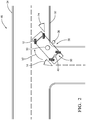
- Fig. 2 illustrates a non-limiting example of a traffic-scenario 46 where the host-vehicle 12 is characterized as a single-vehicle 48.
- the term 'single-vehicle' is used to indicate instances of vehicles generally intended for stand-alone use, usually built on a single frame.
- examples of a single-vehicle include an automobile, a light-duty pickup truck, a van, a large delivery truck, and a bus.
- Specifically excluded from the list of vehicles characterized as a single-vehicle are heavy-duty semis, i.e. tractor/trailer combinations.
- the tractor itself may be characterized as a single-vehicle.
- the actuator 40 is part of a rear-axel assembly 50 of the single-vehicle 48. If the single-vehicle 48 is rear-wheel-drive as are most pick-up trucks, then the rear-axel assembly 50 may be quite similar to the front-axel assembly of a four-wheel-drive truck. If the single-vehicle 48 is front-wheel-drive, then the rear-axel assembly 50 may be quite similar to the front-wheel assembly or steering-wheel assembly found on rear-wheel two-wheel drive type vehicles.
- Fig. 2 shows a non-limiting example of the host-vehicle 12 mid-way through executing a turn 52.
- One instance of the object 22 is the curb 32. That is, the identification 44 of the object 22 is 'curb'.
- An object-detection function 54 that is part of the controller 42 may be configured to classify the curb as 'low', i.e. lower than some threshold, so the body of the host-vehicle 12 is far enough above the roadway 34 that the curb 32 can pass underneath the body of the host-vehicle 12 as illustrated.
- the controller 42 is preferably configured to control the rear-steering-angle 14 so the rear-wheels do not scrub, go over, 'jump', or contact the curb 32.
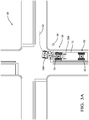
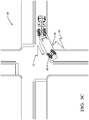
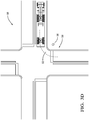
- Figs. 3A , 3B , 3C , and 3D illustrates a non-limiting example of a turn-sequence 56, where the host-vehicle 12 is characterized as a combination 58 of a tow-vehicle 58A and a trailer 58B. That is, the combination 58 as a whole is the host-vehicle 12, so the rear-wheels of the host-vehicle 12 in this example are the trailer wheels, so the actuator 40 is part of a trailer-axel assembly 60 of the trailer 58B. As can be seen in Figs. 3B and 3C , the trailer-wheel angle 62 is varied throughout the turn 52 so that the host-vehicle 12, specifically the trailer 58B does not contact the telephone-pole 36.
- the controller 42 may be configured to take some action if the human-operator is steering the tow-vehicle 58A in such a way (e.g. making the turn 52 too tight or too sharp) that it will be impossible for the system 10 to avoid the object, e.g. the telephone-pole 36.
- the system 10 may issue a warning 64 such as an audible-sound and/or synthesized-voice and/or visual indicator that the turn 52 should be taken wider.
- the controller 42 may apply the brakes of the host-vehicle 12 to prevent contact with the object 22.
- the tow-vehicle 58A is equipped with a steering-axel 66 at a front-end of the tow-vehicle 58A, and a drive-axel assembly 68 at a rear-end of the tow-vehicle 58A.
- the system 10, or more specifically the drive-axel assembly 68 includes a second-actuator 70 used to adjust a drive-angle 72 of the drive-axel assembly 68. That is, both the trailer-axel assembly 60 and the drive-axel assembly 68 of the host-vehicle, i.e. the combination 58, have adjustable steering angles.
- controller 42 is in communication with the second-actuator 70, and the controller 42 is configured to operate the second-actuator 70 in combination or cooperation with the operation of the actuator 40 to avoid the object 22 when the host-vehicle 12 moves.
- both the drive-wheel angle 72 and the trailer-wheel angle 62 are varied throughout the turn 52 so that the host-vehicle 12, specifically the trailer 58B does not contact the telephone-pole 36.
- trailer-wheel angle 62 could be operated to swing or steer the trailer 58B into an adjacent-lane 74 ( Fig. 3B ) if necessary to avoid the telephone-pole 36.
- a rear-wheel steering system (the system 10), a controller 42 for the system 10, and a method of operating the system 10 is provided.
- the object-detector 30 suitably located and configured to detect the presence of an object 22 proximate to the host-vehicle 12 that may be contacted by the host-vehicle 12 during a turn, and providing the controller 42 to operate the actuator 40 and/or the second-actuator 70, such contact can be avoided.
- the system 10 is generally configured to minimize the amount or degree that the host-vehicle 12 crosses into the adjacent-lane 74 or any other lanes designated for travel in the same or opposite direction as that of the host-vehicle 12 while performing the turn 52.
- the host-vehicle 12 is equipped with the rear-wheel steering system described herein, the degree to which the host-vehicle 12 crosses into other lanes will be reduced when compared to a vehicle of similar size that is not equipped with the system 10.
Landscapes
- Engineering & Computer Science (AREA)
- Mechanical Engineering (AREA)
- Chemical & Material Sciences (AREA)
- Combustion & Propulsion (AREA)
- Transportation (AREA)
- Physics & Mathematics (AREA)
- Mathematical Physics (AREA)
- General Physics & Mathematics (AREA)
- Electromagnetism (AREA)
- Aviation & Aerospace Engineering (AREA)
- Radar, Positioning & Navigation (AREA)
- Remote Sensing (AREA)
- Automation & Control Theory (AREA)
- Steering Control In Accordance With Driving Conditions (AREA)
Abstract
A rear-wheel steering system (10) suitable for use on an automated vehicle includes an object-detector (30), and actuator (40), and a controller (42). The object-detector (30) is used to detect an object (22) proximate to a host-vehicle (12). The actuator (40) is used to adjust a rear-steering-angle (14) of rear-wheels of the host-vehicle (12). The controller (42) is in communication with the object-detector (30) and the actuator (40). The controller (42) is configured to determine a location (20) of the object (22) relative to the host-vehicle (12) based on information from the object-detector (30), and operate the actuator (40) to avoid the object (22) when the host-vehicle (12) moves.
Description
- This disclosure generally relates to a rear-wheel steering system, and more particularly relates to a system that determines a location of the object relative to a host-vehicle, and controls the angle of the rear-wheels of the host-vehicle to avoid the object.
- It is known to equip vehicles with rear-wheel steering that controls a rear-steering-angle of rear-wheels of a host-vehicle based on a front-steering-angle of front-wheels of the host-vehicle. However, there is still a risk that the host-vehicle may scrape or side-swipe an object located on the inside of a corner turned by the host-vehicle.
- Described herein is a rear-wheel steering system that detects the presence of an object proximate to a host-vehicle, and operates rear-wheel-steering of the host-vehicle so as to avoid contact with, i.e. scraping or side-swiping, the object. That is, the rear-wheel angle is actively adjusted based on the location of the object rather than blindly or passively adjusting the rear-wheel angle based on the front-steering-angle of front-wheels.
- In accordance with one embodiment, a rear-wheel steering system suitable for use on an automated vehicle is provided. The system includes an object-detector, and actuator, and a controller. The object-detector is used to detect an object proximate to a host-vehicle. The actuator is used to adjust a rear-steering-angle of rear-wheels of the host-vehicle. The controller is in communication with the object-detector and the actuator. The controller is configured to determine a location of the object relative to the host-vehicle based on information from the object-detector, and operate the actuator to avoid the object when the host-vehicle moves.
- The host-vehicle may be characterized as a single-vehicle, and the actuator may be part of a rear-axel assembly of the single-vehicle. The host-vehicle (12) may be characterized as a combination of a tow-vehicle and a trailer, and the actuator may be part of a trailer-axel assembly of the trailer. The tow-vehicle may be equipped with a steering-axel at a front-end of the tow-vehicle and a drive-axel assembly at a rear-end of the tow-vehicle, the system may include a second-actuator used to adjust a drive-angle of the drive-axel assembly, the controller may be in communication with the second-actuator, and the controller may be configured to operate the second-actuator to avoid the object when the host-vehicle moves.
- Further features and advantages will appear more clearly on a reading of the following detailed description of the preferred embodiment, which is given by way of non-limiting example only and with reference to the accompanying drawings.
- The present invention will now be described, by way of example with reference to the accompanying drawings, in which:
-
Fig. 1 is a diagram of a rear-wheel steering system in accordance with one embodiment; -
Fig. 2 is an illustration of a traffic-scenario encountered by the system ofFig. 1 in accordance with one embodiment; and -
Fig. 3A ,3B ,3C , and3D cooperatively form illustration of a traffic-scenario encountered by the system ofFig. 1 in accordance with one embodiment. -
Fig. 1 illustrates a non-limiting example of a rear-wheel steering system 10, hereafter referred to as thesystem 10, which is suitable for use on an automated vehicle, a host-vehicle 12 for example. As used herein, the term 'automated vehicle' is not meant to suggest that fully automated or autonomous operation of the host-vehicle 12 is required. It is contemplated that the teachings presented herein are applicable to instances where the host-vehicle 12 is entirely manually operated by a human-operator (not shown) except for the control of a rear-steering-angle 14 the rear-wheels of the host-vehicle 12. That is, the host-vehicle 12 may be operable in an automated-mode 16 which may be a fully autonomous type of operation where the human-operator does little more than designate a destination, and/or the host-vehicle 12 may be operable in a manual-mode 18 where the human-operator generally controls the steering, accelerator, and brakes of the host-vehicle. As will be described in more detail below, the one aspect of automation of the host-vehicle 12 that is generally required is that thesystem 10 actively steers the rear-wheels of the host-vehicle 12 based on alocation 20 of anobject 22 rather than merely passively steering the rear-wheels based only on dynamic variables of the host-vehicle 12 such as a front-steering-angle 24 and/or aspeed 26 of the host-vehicle 12. - Accordingly, the
system 10 includes an object-detector 30 used to detect theobject 22 when it is proximate to the host-vehicle 12, in particular when thelocation 20 of theobject 22 is such that the movement or motion of the host-vehicle 12 may cause the host-vehicle 12 to make contact with (e.g. collide with, scrape, or side-swipe) theobject 22. By way of specific non-limiting examples, theobject 22 may be a curb 32 (Figs. 2 ,3A-D ) that defines the edge of aroadway 34, or a sign, traffic-signal, or telephone-pole 36 near the edge of theroadway 34. Of particular interest is when an instance of the object 22 (e.g. thecurb 32 and/or the telephone-pole 36) is proximate to acorner 38 where a tight-radius turn by a vehicle not equipped with thesystem 10 described herein may cause the rear-wheels to 'jump' thecurb 32 at thecorner 38, and/or make contact with (i.e. scrap or side-swipe) the telephone-pole 36. While the examples of object above are generally stationary, it is also contemplated that theobject 22 could be mobile object such as a pedestrian walking on or near theroadway 34, a person riding a bicycle, or a vehicle moving into or out of a parking place adjacent to the roadway. - The object-
detector 30 may be, but is not limited to, acamera 30A, a radar-unit 30B, a lidar-unit 30C, or any combination of single or multiple instances of any of those devices or other devices using suitable detection technologies. As will be recognized by those in the art, thecamera 30A may be an advantageous choice to determine theidentification 44 of theobject 22, where theidentification 44 is effective to distinguish thecurb 32 from the telephone-pole 36. However, thecamera 30A may not be the best choice to determine a distance to the object, which is where the radar-unit 30B and the lidar-unit 30C are considered to have the advantage. As such, it is expected that the combination of thecamera 30A and either the radar-unit 30B or the lidar-unit 30C will be a preferred configuration. - In order to make the host-
vehicle 12 more maneuverable so instances of theobject 22 such as those described above can be avoided, thesystem 10 includes anactuator 40 used to adjust the rear-steering-angle 14 of the rear-wheels of the host-vehicle 12. Theactuator 40 may turn the wheels relative to an axel-line between the wheels similar to how the front wheels are angled on virtually every automobile in use today. Alternatively, the angle of the wheels relative to the axel-line may be fixed, so to change the wheel-angle the entire axel assembly is rotated or pivoted, which can be seen in some limited use on farm equipment, e.g. a hay-wagon. The actuator may be an electric-motor where rotation of the electric-motor is mechanically coupled to the axel assembly. As another non-limiting example, the actuator may be hydraulic based where a pump is operated, for example, via a mechanical connection to the engine of the host-vehicle 12. - In order to provide for active control of the rear-steering-
angle 14 so that instances of theobject 22 can be avoided, thesystem 10 also includes acontroller 42 in communication with the object-detector 30 and theactuator 40. Thecontroller 42 may include a processor (not specifically shown) such as a microprocessor or other control circuitry such as analog and/or digital control circuitry including an application specific integrated circuit (ASIC) for processing data as should be evident to those in the art. Thecontroller 42 may include memory (not specifically shown), including non-volatile memory, such as electrically erasable programmable read-only memory (EEPROM) for storing one or more routines, thresholds, and captured data. The one or more routines may be executed by the processor to perform steps for determining thelocation 20 of theobject 22 and a travel-path of the host-vehicle 12 based on signals received by thecontroller 42 from the object-detector 30 as described herein. That is, thecontroller 42 is generally configured to determine thelocation 20 of theobject 22 relative to the host-vehicle 12 based on information from the object-detector 30, and operate theactuator 40 to avoid theobject 22 when the host-vehicle 12 moves, i.e. travels forward or backward around a curve for example. -
Fig. 2 illustrates a non-limiting example of a traffic-scenario 46 where the host-vehicle 12 is characterized as a single-vehicle 48. As used herein, the term 'single-vehicle' is used to indicate instances of vehicles generally intended for stand-alone use, usually built on a single frame. By way of example and not limitation, examples of a single-vehicle include an automobile, a light-duty pickup truck, a van, a large delivery truck, and a bus. Specifically excluded from the list of vehicles characterized as a single-vehicle are heavy-duty semis, i.e. tractor/trailer combinations. However, as will be explained in more detail later, the tractor itself may be characterized as a single-vehicle. For the single-vehicle 48, theactuator 40 is part of a rear-axel assembly 50 of the single-vehicle 48. If the single-vehicle 48 is rear-wheel-drive as are most pick-up trucks, then the rear-axel assembly 50 may be quite similar to the front-axel assembly of a four-wheel-drive truck. If the single-vehicle 48 is front-wheel-drive, then the rear-axel assembly 50 may be quite similar to the front-wheel assembly or steering-wheel assembly found on rear-wheel two-wheel drive type vehicles. -
Fig. 2 shows a non-limiting example of the host-vehicle 12 mid-way through executing aturn 52. One instance of theobject 22 is thecurb 32. That is, theidentification 44 of theobject 22 is 'curb'. An object-detection function 54 that is part of thecontroller 42 may be configured to classify the curb as 'low', i.e. lower than some threshold, so the body of the host-vehicle 12 is far enough above theroadway 34 that thecurb 32 can pass underneath the body of the host-vehicle 12 as illustrated. However, thecontroller 42 is preferably configured to control the rear-steering-angle 14 so the rear-wheels do not scrub, go over, 'jump', or contact thecurb 32. - The combination of
Figs. 3A ,3B ,3C , and3D illustrates a non-limiting example of a turn-sequence 56, where the host-vehicle 12 is characterized as acombination 58 of a tow-vehicle 58A and atrailer 58B. That is, thecombination 58 as a whole is the host-vehicle 12, so the rear-wheels of the host-vehicle 12 in this example are the trailer wheels, so theactuator 40 is part of a trailer-axel assembly 60 of thetrailer 58B. As can be seen inFigs. 3B and3C , the trailer-wheel angle 62 is varied throughout theturn 52 so that the host-vehicle 12, specifically thetrailer 58B does not contact the telephone-pole 36. - It is contemplated that the
controller 42 may be configured to take some action if the human-operator is steering the tow-vehicle 58A in such a way (e.g. making theturn 52 too tight or too sharp) that it will be impossible for thesystem 10 to avoid the object, e.g. the telephone-pole 36. By way of example, thesystem 10 may issue awarning 64 such as an audible-sound and/or synthesized-voice and/or visual indicator that theturn 52 should be taken wider. It is also contemplated that thecontroller 42 may apply the brakes of the host-vehicle 12 to prevent contact with theobject 22. - In another embodiment of the
combination 58 of the tow-vehicle 58A and thetrailer 58B, the tow-vehicle 58A is equipped with a steering-axel 66 at a front-end of the tow-vehicle 58A, and a drive-axel assembly 68 at a rear-end of the tow-vehicle 58A. Thesystem 10, or more specifically the drive-axel assembly 68 includes a second-actuator 70 used to adjust a drive-angle 72 of the drive-axel assembly 68. That is, both the trailer-axel assembly 60 and the drive-axel assembly 68 of the host-vehicle, i.e. thecombination 58, have adjustable steering angles. It follows that thecontroller 42 is in communication with the second-actuator 70, and thecontroller 42 is configured to operate the second-actuator 70 in combination or cooperation with the operation of theactuator 40 to avoid theobject 22 when the host-vehicle 12 moves. As can be seen inFigs. 3B and3C , both the drive-wheel angle 72 and the trailer-wheel angle 62 are varied throughout theturn 52 so that the host-vehicle 12, specifically thetrailer 58B does not contact the telephone-pole 36. - While not specifically illustrated in this example, it is contemplated that the trailer-
wheel angle 62 could be operated to swing or steer thetrailer 58B into an adjacent-lane 74 (Fig. 3B ) if necessary to avoid the telephone-pole 36. - Accordingly, a rear-wheel steering system (the system 10), a
controller 42 for thesystem 10, and a method of operating thesystem 10 is provided. By providing the object-detector 30 suitably located and configured to detect the presence of anobject 22 proximate to the host-vehicle 12 that may be contacted by the host-vehicle 12 during a turn, and providing thecontroller 42 to operate theactuator 40 and/or the second-actuator 70, such contact can be avoided. It is noted that thesystem 10 is generally configured to minimize the amount or degree that the host-vehicle 12 crosses into the adjacent-lane 74 or any other lanes designated for travel in the same or opposite direction as that of the host-vehicle 12 while performing theturn 52. It should be appreciated that because the host-vehicle 12 is equipped with the rear-wheel steering system described herein, the degree to which the host-vehicle 12 crosses into other lanes will be reduced when compared to a vehicle of similar size that is not equipped with thesystem 10. - While this invention has been described in terms of the preferred embodiments thereof, it is not intended to be so limited, but rather only to the extent set forth in the claims that follow.
Claims (4)
- A rear-wheel steering system (10) suitable for use on an automated vehicle, said system (10) comprising:an object-detector (30) used to detect an object (22) proximate to a host-vehicle (12);an actuator (40) used to adjust a rear-steering-angle (14) of rear-wheels of the host-vehicle (12);a controller (42) in communication with the object-detector (30) and the actuator (40), wherein said controller (42) is configured to determine a location (20) of the object (22) relative to the host-vehicle (12) based on information from the object-detector (30), and operate the actuator (40) to avoid the object (22) when the host-vehicle (12) moves.
- The system (10) in accordance with claim 1, wherein the host-vehicle (12) is characterized as a single-vehicle (48), and the actuator (40) is part of a rear-axel assembly (50) of the single-vehicle (48).
- The system (10) according to any one of the preceding claims, wherein the host-vehicle (12) is characterized as a combination (58) of a tow-vehicle (58A) and a trailer (58B), and the actuator (40) is part of a trailer-axel assembly (60) of the trailer (58B).
- The system (10) in accordance with claim 3, wherein the tow-vehicle (58A) is equipped with a steering-axel (66) at a front-end of the tow-vehicle (58A) and a drive-axel assembly (68) at a rear-end of the tow-vehicle (58A), the system (10) includes a second-actuator (70) used to adjust a drive-angle (72) of the drive-axel assembly (68), the controller (42) is in communication with the second-actuator (70), and the controller (42) is configured to operate the second-actuator (70) to avoid the object (22) when the host-vehicle (12) moves.
Applications Claiming Priority (1)
| Application Number | Priority Date | Filing Date | Title |
|---|---|---|---|
| US15/264,121 US9944318B2 (en) | 2016-09-13 | 2016-09-13 | Automated vehicle rear-wheel steering system |
Publications (1)
| Publication Number | Publication Date |
|---|---|
| EP3293075A1 true EP3293075A1 (en) | 2018-03-14 |
Family
ID=59811115
Family Applications (1)
| Application Number | Title | Priority Date | Filing Date |
|---|---|---|---|
| EP17189665.7A Withdrawn EP3293075A1 (en) | 2016-09-13 | 2017-09-06 | Automated vehicle rear-wheel steering system |
Country Status (3)
| Country | Link |
|---|---|
| US (1) | US9944318B2 (en) |
| EP (1) | EP3293075A1 (en) |
| CN (1) | CN107813871B (en) |
Families Citing this family (4)
| Publication number | Priority date | Publication date | Assignee | Title |
|---|---|---|---|---|
| CN111127954B (en) * | 2020-03-19 | 2021-10-22 | 安徽中科美络信息技术有限公司 | Safe passing method for vehicles at signal lamp-free intersection |
| US12082516B2 (en) | 2020-12-28 | 2024-09-10 | Cnh Industrial America Llc | Automatic implement detection and management system |
| FR3119177B1 (en) | 2021-01-28 | 2023-03-24 | Soviar | SNOW REMOVAL TRAILER WITH DETECTION MEANS OF A THIRD-PARTY VEHICLE |
| US20220314719A1 (en) * | 2021-04-06 | 2022-10-06 | Ford Global Technologies, Llc | Trailer assistance system with improved contact detection performance from vehicle start or standstill |
Citations (2)
| Publication number | Priority date | Publication date | Assignee | Title |
|---|---|---|---|---|
| US20060229782A1 (en) * | 2005-04-06 | 2006-10-12 | Weiwen Deng | Vehicle-trailer stability and handling performance improvement using rear-wheel steering control |
| DE102012203228A1 (en) * | 2012-03-01 | 2013-09-05 | Robert Bosch Gmbh | A method for avoiding or mitigating consequences in collisions of a motor vehicle with an obstacle in a lateral vicinity of the motor vehicle and driver assistance system |
Family Cites Families (10)
| Publication number | Priority date | Publication date | Assignee | Title |
|---|---|---|---|---|
| FR2587962A1 (en) | 1985-09-30 | 1987-04-03 | Martinet Simon | DEVICE FOR SERVICING THE DIRECTION OF AN ARTICULATED VEHICLE |
| US5201836A (en) | 1992-03-13 | 1993-04-13 | Dewitt Nicklas R | Automatic trailer steering mechanism |
| US5479999A (en) | 1994-09-19 | 1996-01-02 | Proia; Cataldo | Powered, automatic, self-tracking system for the rear axles of trucks, trailers and buses |
| JP3467136B2 (en) * | 1995-11-07 | 2003-11-17 | 富士重工業株式会社 | Travel control device for autonomous vehicles |
| US6560524B2 (en) * | 2001-09-26 | 2003-05-06 | General Motors Corporation | Integration of rear wheel steering with vehicle stability enhancement system |
| US6604753B1 (en) | 2002-08-22 | 2003-08-12 | Joseph J. Boyd | Rear wheel steering process |
| US7793965B2 (en) | 2006-02-10 | 2010-09-14 | Padula Santo A | Trailer steering system for a tractor/trailer combination |
| FI124208B (en) * | 2010-02-24 | 2014-05-15 | Sandvik Mining & Constr Oy | Transport device suitable for transporting broken rock material and trailer thereto |
| US8469125B2 (en) * | 2011-03-25 | 2013-06-25 | Honda Motor Co., Ltd. | System and method for controlling a trailer connected to a vehicle |
| US9523984B1 (en) * | 2013-07-12 | 2016-12-20 | Google Inc. | Methods and systems for determining instructions for pulling over an autonomous vehicle |
-
2016
- 2016-09-13 US US15/264,121 patent/US9944318B2/en active Active
-
2017
- 2017-09-06 EP EP17189665.7A patent/EP3293075A1/en not_active Withdrawn
- 2017-09-12 CN CN201710815997.XA patent/CN107813871B/en active Active
Patent Citations (2)
| Publication number | Priority date | Publication date | Assignee | Title |
|---|---|---|---|---|
| US20060229782A1 (en) * | 2005-04-06 | 2006-10-12 | Weiwen Deng | Vehicle-trailer stability and handling performance improvement using rear-wheel steering control |
| DE102012203228A1 (en) * | 2012-03-01 | 2013-09-05 | Robert Bosch Gmbh | A method for avoiding or mitigating consequences in collisions of a motor vehicle with an obstacle in a lateral vicinity of the motor vehicle and driver assistance system |
Also Published As
| Publication number | Publication date |
|---|---|
| CN107813871A (en) | 2018-03-20 |
| US20180072344A1 (en) | 2018-03-15 |
| US9944318B2 (en) | 2018-04-17 |
| CN107813871B (en) | 2020-10-30 |
Similar Documents
| Publication | Publication Date | Title |
|---|---|---|
| US7742864B2 (en) | Vehicle surroundings monitoring apparatus and traveling control system incorporating the apparatus | |
| US9168954B2 (en) | Method for parking a vehicle and corresponding parking assistance system and vehicle | |
| CN106740811B (en) | Curve automatic steering system and automatic curve steering method based on the system | |
| CN101282853B (en) | Driver assistance system | |
| KR101900787B1 (en) | System and method for capturing a rear part of a vehicle | |
| US9944318B2 (en) | Automated vehicle rear-wheel steering system | |
| CN113260545B (en) | Method and device for selecting a target object for automatic distance adjustment of vehicles on a monorail | |
| US12415504B2 (en) | Method for operating a vehicle, parking assistance system and vehicle | |
| DE102016217637B4 (en) | Odometry method for determining a position of a motor vehicle, control device and motor vehicle | |
| CN101903229A (en) | Method and device for matching vehicle guidance | |
| RU2618837C2 (en) | Method and system for assisting in line control for vehicle | |
| US20220379956A1 (en) | System and Method for Controlling Steering Torque of a Steering System of a Vehicle | |
| CN105263785A (en) | Vehicle control system | |
| DE102013114109A1 (en) | Vehicle driving assistance device | |
| US10752289B2 (en) | Control system for steering a towing vehicle with a trailer | |
| DE102015222934A1 (en) | Controlling a motor vehicle | |
| US20150088338A1 (en) | method and device for determining a lane-adaptation parameter for a lane-keeping system of a vehicle, as well as method and device for lane guidance of a vehicle | |
| US20180170380A1 (en) | Lane-keeping assistance device, motor vehicle having such a lane-keeping assistance device, and a method for monitoring lane-keeping | |
| JP6986463B2 (en) | Driving support device, driving support method and driving support system | |
| US12515489B2 (en) | Method and device for assisting detection of objects in an environment of a motor vehicle | |
| DE102015117904A1 (en) | Method for determining an area occupied by a trailer connected to a motor vehicle, driver assistance system and motor vehicle | |
| CN114938642A (en) | Sensor device for a tractor of a trailer vehicle and trailer vehicle having such a sensor device | |
| US12159463B2 (en) | Target vehicle recognition apparatus and processing method of target vehicle recognition apparatus | |
| CN119408529A (en) | Vehicle turning diameter optimization method, device, vehicle and medium | |
| US10198007B1 (en) | Automated vehicle system to avoid trajectory deflection caused by ridge in roadway |
Legal Events
| Date | Code | Title | Description |
|---|---|---|---|
| PUAI | Public reference made under article 153(3) epc to a published international application that has entered the european phase |
Free format text: ORIGINAL CODE: 0009012 |
|
| AK | Designated contracting states |
Kind code of ref document: A1 Designated state(s): AL AT BE BG CH CY CZ DE DK EE ES FI FR GB GR HR HU IE IS IT LI LT LU LV MC MK MT NL NO PL PT RO RS SE SI SK SM TR |
|
| AX | Request for extension of the european patent |
Extension state: BA ME |
|
| STAA | Information on the status of an ep patent application or granted ep patent |
Free format text: STATUS: THE APPLICATION IS DEEMED TO BE WITHDRAWN |
|
| 18D | Application deemed to be withdrawn |
Effective date: 20180915 |