EP3290432B1 - High performance liquid chromatography method for polypeptide mixtures - Google Patents
High performance liquid chromatography method for polypeptide mixtures Download PDFInfo
- Publication number
- EP3290432B1 EP3290432B1 EP15890235.3A EP15890235A EP3290432B1 EP 3290432 B1 EP3290432 B1 EP 3290432B1 EP 15890235 A EP15890235 A EP 15890235A EP 3290432 B1 EP3290432 B1 EP 3290432B1
- Authority
- EP
- European Patent Office
- Prior art keywords
- mobile phase
- gradient elution
- glatiramer acetate
- liquid chromatography
- proportion
- Prior art date
- Legal status (The legal status is an assumption and is not a legal conclusion. Google has not performed a legal analysis and makes no representation as to the accuracy of the status listed.)
- Active
Links
Images

Classifications
-
- B—PERFORMING OPERATIONS; TRANSPORTING
- B01—PHYSICAL OR CHEMICAL PROCESSES OR APPARATUS IN GENERAL
- B01D—SEPARATION
- B01D15/00—Separating processes involving the treatment of liquids with solid sorbents; Apparatus therefor
- B01D15/08—Selective adsorption, e.g. chromatography
- B01D15/10—Selective adsorption, e.g. chromatography characterised by constructional or operational features
- B01D15/16—Selective adsorption, e.g. chromatography characterised by constructional or operational features relating to the conditioning of the fluid carrier
- B01D15/166—Fluid composition conditioning, e.g. gradient
-
- G—PHYSICS
- G01—MEASURING; TESTING
- G01N—INVESTIGATING OR ANALYSING MATERIALS BY DETERMINING THEIR CHEMICAL OR PHYSICAL PROPERTIES
- G01N30/00—Investigating or analysing materials by separation into components using adsorption, absorption or similar phenomena or using ion-exchange, e.g. chromatography or field flow fractionation
- G01N30/02—Column chromatography
- G01N30/26—Conditioning of the fluid carrier; Flow patterns
- G01N30/28—Control of physical parameters of the fluid carrier
- G01N30/34—Control of physical parameters of the fluid carrier of fluid composition, e.g. gradient
-
- A—HUMAN NECESSITIES
- A61—MEDICAL OR VETERINARY SCIENCE; HYGIENE
- A61K—PREPARATIONS FOR MEDICAL, DENTAL OR TOILETRY PURPOSES
- A61K38/00—Medicinal preparations containing peptides
- A61K38/03—Peptides having up to 20 amino acids in an undefined or only partially defined sequence; Derivatives thereof
-
- A—HUMAN NECESSITIES
- A61—MEDICAL OR VETERINARY SCIENCE; HYGIENE
- A61P—SPECIFIC THERAPEUTIC ACTIVITY OF CHEMICAL COMPOUNDS OR MEDICINAL PREPARATIONS
- A61P25/00—Drugs for disorders of the nervous system
- A61P25/28—Drugs for disorders of the nervous system for treating neurodegenerative disorders of the central nervous system, e.g. nootropic agents, cognition enhancers, drugs for treating Alzheimer's disease or other forms of dementia
-
- B—PERFORMING OPERATIONS; TRANSPORTING
- B01—PHYSICAL OR CHEMICAL PROCESSES OR APPARATUS IN GENERAL
- B01D—SEPARATION
- B01D15/00—Separating processes involving the treatment of liquids with solid sorbents; Apparatus therefor
- B01D15/08—Selective adsorption, e.g. chromatography
- B01D15/26—Selective adsorption, e.g. chromatography characterised by the separation mechanism
- B01D15/32—Bonded phase chromatography
- B01D15/325—Reversed phase
-
- B—PERFORMING OPERATIONS; TRANSPORTING
- B01—PHYSICAL OR CHEMICAL PROCESSES OR APPARATUS IN GENERAL
- B01D—SEPARATION
- B01D15/00—Separating processes involving the treatment of liquids with solid sorbents; Apparatus therefor
- B01D15/08—Selective adsorption, e.g. chromatography
- B01D15/26—Selective adsorption, e.g. chromatography characterised by the separation mechanism
- B01D15/36—Selective adsorption, e.g. chromatography characterised by the separation mechanism involving ionic interaction, e.g. ion-exchange, ion-pair, ion-suppression or ion-exclusion
- B01D15/361—Ion-exchange
- B01D15/362—Cation-exchange
-
- B—PERFORMING OPERATIONS; TRANSPORTING
- B01—PHYSICAL OR CHEMICAL PROCESSES OR APPARATUS IN GENERAL
- B01D—SEPARATION
- B01D15/00—Separating processes involving the treatment of liquids with solid sorbents; Apparatus therefor
- B01D15/08—Selective adsorption, e.g. chromatography
- B01D15/26—Selective adsorption, e.g. chromatography characterised by the separation mechanism
- B01D15/36—Selective adsorption, e.g. chromatography characterised by the separation mechanism involving ionic interaction, e.g. ion-exchange, ion-pair, ion-suppression or ion-exclusion
- B01D15/361—Ion-exchange
- B01D15/363—Anion-exchange
-
- C—CHEMISTRY; METALLURGY
- C07—ORGANIC CHEMISTRY
- C07K—PEPTIDES
- C07K14/00—Peptides having more than 20 amino acids; Gastrins; Somatostatins; Melanotropins; Derivatives thereof
-
- G—PHYSICS
- G01—MEASURING; TESTING
- G01N—INVESTIGATING OR ANALYSING MATERIALS BY DETERMINING THEIR CHEMICAL OR PHYSICAL PROPERTIES
- G01N21/00—Investigating or analysing materials by the use of optical means, i.e. using sub-millimetre waves, infrared, visible or ultraviolet light
- G01N21/17—Systems in which incident light is modified in accordance with the properties of the material investigated
- G01N21/25—Colour; Spectral properties, i.e. comparison of effect of material on the light at two or more different wavelengths or wavelength bands
- G01N21/31—Investigating relative effect of material at wavelengths characteristic of specific elements or molecules, e.g. atomic absorption spectrometry
- G01N21/33—Investigating relative effect of material at wavelengths characteristic of specific elements or molecules, e.g. atomic absorption spectrometry using ultraviolet light
-
- G—PHYSICS
- G01—MEASURING; TESTING
- G01N—INVESTIGATING OR ANALYSING MATERIALS BY DETERMINING THEIR CHEMICAL OR PHYSICAL PROPERTIES
- G01N30/00—Investigating or analysing materials by separation into components using adsorption, absorption or similar phenomena or using ion-exchange, e.g. chromatography or field flow fractionation
- G01N30/02—Column chromatography
- G01N30/62—Detectors specially adapted therefor
- G01N30/74—Optical detectors
-
- G—PHYSICS
- G01—MEASURING; TESTING
- G01N—INVESTIGATING OR ANALYSING MATERIALS BY DETERMINING THEIR CHEMICAL OR PHYSICAL PROPERTIES
- G01N30/00—Investigating or analysing materials by separation into components using adsorption, absorption or similar phenomena or using ion-exchange, e.g. chromatography or field flow fractionation
- G01N30/02—Column chromatography
- G01N30/86—Signal analysis
- G01N30/8624—Detection of slopes or peaks; baseline correction
- G01N30/8631—Peaks
-
- G—PHYSICS
- G01—MEASURING; TESTING
- G01N—INVESTIGATING OR ANALYSING MATERIALS BY DETERMINING THEIR CHEMICAL OR PHYSICAL PROPERTIES
- G01N30/00—Investigating or analysing materials by separation into components using adsorption, absorption or similar phenomena or using ion-exchange, e.g. chromatography or field flow fractionation
- G01N30/02—Column chromatography
- G01N30/88—Integrated analysis systems specially adapted therefor, not covered by a single one of the groups G01N30/04 - G01N30/86
-
- G—PHYSICS
- G01—MEASURING; TESTING
- G01N—INVESTIGATING OR ANALYSING MATERIALS BY DETERMINING THEIR CHEMICAL OR PHYSICAL PROPERTIES
- G01N33/00—Investigating or analysing materials by specific methods not covered by groups G01N1/00 - G01N31/00
- G01N33/48—Biological material, e.g. blood, urine; Haemocytometers
- G01N33/50—Chemical analysis of biological material, e.g. blood, urine; Testing involving biospecific ligand binding methods; Immunological testing
- G01N33/68—Chemical analysis of biological material, e.g. blood, urine; Testing involving biospecific ligand binding methods; Immunological testing involving proteins, peptides or amino acids
- G01N33/6803—General methods of protein analysis not limited to specific proteins or families of proteins
-
- C—CHEMISTRY; METALLURGY
- C07—ORGANIC CHEMISTRY
- C07K—PEPTIDES
- C07K1/00—General methods for the preparation of peptides, i.e. processes for the organic chemical preparation of peptides or proteins of any length
- C07K1/14—Extraction; Separation; Purification
- C07K1/16—Extraction; Separation; Purification by chromatography
- C07K1/18—Ion-exchange chromatography
-
- C—CHEMISTRY; METALLURGY
- C07—ORGANIC CHEMISTRY
- C07K—PEPTIDES
- C07K1/00—General methods for the preparation of peptides, i.e. processes for the organic chemical preparation of peptides or proteins of any length
- C07K1/14—Extraction; Separation; Purification
- C07K1/16—Extraction; Separation; Purification by chromatography
- C07K1/20—Partition-, reverse-phase or hydrophobic interaction chromatography
-
- G—PHYSICS
- G01—MEASURING; TESTING
- G01N—INVESTIGATING OR ANALYSING MATERIALS BY DETERMINING THEIR CHEMICAL OR PHYSICAL PROPERTIES
- G01N30/00—Investigating or analysing materials by separation into components using adsorption, absorption or similar phenomena or using ion-exchange, e.g. chromatography or field flow fractionation
- G01N30/02—Column chromatography
- G01N30/88—Integrated analysis systems specially adapted therefor, not covered by a single one of the groups G01N30/04 - G01N30/86
- G01N2030/8809—Integrated analysis systems specially adapted therefor, not covered by a single one of the groups G01N30/04 - G01N30/86 analysis specially adapted for the sample
- G01N2030/8813—Integrated analysis systems specially adapted therefor, not covered by a single one of the groups G01N30/04 - G01N30/86 analysis specially adapted for the sample biological materials
- G01N2030/8831—Integrated analysis systems specially adapted therefor, not covered by a single one of the groups G01N30/04 - G01N30/86 analysis specially adapted for the sample biological materials involving peptides or proteins
Definitions
- the present invention relates to the field of biological medicines, especially to a high performance liquid chromatography method for polypeptide mixtures.
- Glatiramer acetate is a synthetic peptide mixture (relative molecular weight: 4700-11000 Daltons), a random polymer consisting of four kinds of amino acids: L-alanine, L-glutamic, L-tyrosine and L-lysine, with a length of 45-100 amino acids.
- the molar ratios of each kind of amino acids are approximately 0.392-0.462, 0.129-0.153, 0.086-0.100 and 0.300-0.374.
- This drug is manufactured by the Israeli TEVA pharmaceutical factory (TEVA) with a trade name of Copaxone ® . It was approved for the treatment of multiple sclerosis by FDA in 1996, and there are two kinds of products, water needle and freeze-dried powder needle, both of which are administered by subcutaneous injection.
- Glatiramer acetate is a copolymer with high continuity
- the structure of the glatiramer acetate is as follows: (Glu,Ala,Lys,Tyr) x x CH 3 COOH (C 5 H 9 NO 4 .C 3 H 7 NO 2 .C 6 H 14 N 2 O 2 .C 9 H 11 NO 3 ) x . x C 2 H 4 O 2 CAS-147245-92-9
- compositional differences between the imitation of glatiramer acetate and the control group of the glatiramer acetate can only be examined based on some of the inherent properties of the drug.
- the difference between a sample and a commercial product (reference substance) is examined by gradient elution in an anion exchange liquid chromatography, in the present invention based on the electric charge, polar or nonpolar character of the sample in different buffer solutions.
- glatiramer acetate is a copolymer with high continuity, it is difficult to clarify the various components with only one separation method.
- a size exclusion method is used in the prior art for a simple separation and analysis (dividing a single peak into several components, and then collecting and analyzing the components).
- WO2007127977 A2 discloses a method for purifying samples comprising glatiramer acetate by a method selected from the group consisting of gel electrophoresis, size exclusion chromatography, capillary electrophoresis, ion exchange chromatography, reversed- phase liquid chromatography, solvent extraction, precipitation, affinity chromatography, selection of phosphopeptides, selection of low abundance amino acids, linking one or more amino acids, peptides, and polypeptides to an affinity tag, transesterification of one or more carboxyl groups of one or more amino acids, peptides, and polypeptides, treating the sample with EDC/amine chemistry, and treating the sample with a protein that binds one or more carboxyl groups of the one or more amino acids, peptides, and polypeptides.
- WO2012123959 A2 discloses A process for preparation of Glatiramer acetate and the characterization of Glatiramer acetate by peptide mapping using trypsin and carboxypeptidase B comprising the steps of,
- the present invention relates to a method performing linear or stepped gradient elution on a glatiramer acetate with a high-performance liquid chromatography and determining whether the content of each component of the glatiramer acetate is qualified.
- the method comprises the following steps:
- step (2) The elution gradient in step (2) is as follow.
- the chromatographic conditions used in the anion exchange liquid chromatography in step (2) are as follows.
- the detection analysis in step (3) uses an ultraviolet detector to detect a wavelength of 260-280 nm.
- the fluorescence detector When the fluorescence detector is used, its excitation wavelength is 230 nm and its emission wavelength is 300 nm.
- a Waters 2695 high performance liquid chromatography and a 2475 multiwavelength fluorescence detector are used.
- the excitation wavelength (Ex) is 230 nm and the emission wavelength (Em) is 300 nm.
- the chromatographic column has a length of 150 mm and a diameter of 4.6 mm.
- the packing material for the chromatographic column is polystyrene-divinylbenzene particles with a particle diameter of 3 ⁇ m.
- the mobile phase A is 20 mM tris(hydroxymethyl)aminomethane hydrochloride, the pH of which is adjusted to 11.2 with a NaOH solution.
- the mobile phase B is 20 mM tris(hydroxymethyl)aminomethane hydrochloride containing 1 M NaCl, the pH of which is adjusted to 9.8 with a hydrochloric acid solution.
- the proportions of the mobile phase A and mobile phase B are set according to the following Table 1.
- Mobile phase solutions are added to dissolve commercial glatiramer acetate product (hereinafter referred to as "reference substance") and pre-production glatiramer acetate sample (hereinafter referred to as "test sample”), respectively, to obtain a solution with a glatiramer acetate concentration of 20 mg/mL for examination.
- the injection volume is 25 ⁇ L.
- the flow rate is 0.8 mL/min.
- the column temperature is 30 °C.
- Table 2 The proportions of each component are shown in Table 2.
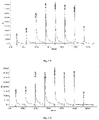
- the chromatographic analysis diagram of a test sample is shown in Fig. 1-1 .
- Table 1 Proportions of mobile phase A and mobile phase B in embodiment 1 Time (min) Mobile phase A (%) Mobile phase B (%) 0 100 0 15 100 0 15.1 97.5 2.5 30 97.5 2.5 30.1 95 5 45 95 5 45.1 90 10 60 90 10 60.1 87.5 12.5 75 87.5 12.5 75.1 85 15 90 85 15 90.1 80 20 105 80 20 105.1 70 30 120 70 30 120.1 50 50 135 50 50 135.1 100 0 140 100 0
- Table 2 Comparisons and analyses of compositions of anion exchanges between three batches of reference substances and three batches of test samples Batch number Component proportions of each elution peak (%) 1 2 3 4 5 6 7 8 Reference Substance 1 4.55 33.58 20.55 16.08 11.37 6.89 5.54 1.45 Reference Substance 2 3.38 35.15 21.16 16.08 11.06 6.69 5.15 1.32 Reference Substance 3 4.05 33.39
- a Waters 2695 high performance liquid chromatography and a 2475 multiwavelength fluorescence detector are used.
- the excitation wavelength (Ex) is 230 nm and the emission wavelength (Em) is 300 nm.
- the chromatographic column has a length of 150 mm and a diameter of 4.6 mm.
- the packing material for the chromatographic column is polystyrene-divinylbenzene particles with a particle diameter of 5 ⁇ m.
- the mobile phase A is 10 mM tris(hydroxymethyl)aminomethane hydrochloride, the pH of which is adjusted to 10 with a NaOH solution.
- the mobile phase B is 10 mM tris(hydroxymethyl)aminomethane hydrochloride containing 1.5 M NaCl, the pH of which is adjusted to 8 with a hydrochloric acid solution.
- the proportions of the mobile phase A and mobile phase B are set according to the following Table 1. Mobile phase solutions are added to dissolve the reference substance or the test sample, respectively, to obtain a solution of 20 mg/mL for examination.
- the injection volume is 15 ⁇ L.
- the flow rate is 0.5 mL/min.
- the column temperature is 25 °C.
- a chromatographic analysis diagram of a test sample is shown in Fig. 1-2 .
- a Waters 2695 high performance liquid chromatography and a 2489 multiwavelength fluorescence detector are used.
- the wavelength is 275 nm.
- the chromatographic column has a length of 150 mm and a diameter of 4.6 mm.
- the packing material for the chromatographic column is polystyrene-divinylbenzene particles with a particle diameter of 10 ⁇ m.
- the mobile phase A is 50 mM tris(hydroxymethyl)aminomethane hydrochloride, the pH of which is adjusted to 12 with a NaOH solution.
- the mobile phase B is 50 mM tris(hydroxymethyl)aminomethane hydrochloride containing 0.5 M NaCl, the pH of which is adjusted to 10 with a hydrochloric acid solution.
- the proportions of the mobile phase A and mobile phase B are set according to the following Table 1.
- Mobile phase solutions are added to dissolve the reference substance or the test sample, respectively, to obtain a solution of 10 mg/mL for examination.
- the injection volume is 50 ⁇ L.
- the flow rate is 15 mL/min.
- the column temperature is 50 °C.
- a chromatographic analysis diagram of a test sample is shown in Fig. 1-3 .
- a Waters 2695 high performance liquid chromatography and a 2489 multiwavelength fluorescence detector are used.
- the wavelength is 275 nm.
- the chromatographic column has a length of 150 mm and a diameter of 4.6 mm.
- the packing material for the chromatographic column is polystyrene-divinylbenzene particles with a particle diameter of 3 ⁇ m.
- the mobile phase A is 30 mM tris(hydroxymethyl)aminomethane hydrochloride, the pH of which is adjusted to 10 with a NaOH solution.
- the mobile phase B is 30 mM tris(hydroxymethyl)aminomethane hydrochloride containing 1 M NaCl, the pH of which is adjusted to 8 with a hydrochloric acid solution.
- the proportions of the mobile phase A and mobile phase B are set according to the following Table 3.
- Mobile phase solutions are added to dissolve the reference substance or the test sample, respectively, to obtain a solution of 10 mg/mL for examination.
- the injection volume is 25 ⁇ L.
- the flow rate is 0.8 mL/min.
- the column temperature is 40 °C.
- a chromatographic analysis diagram of a test sample is shown in Fig. 1-4 .
- Table 3 Proportions of mobile phase A and mobile phase B in embodiment 4 Time (min) Mobile phase A (%) Mobile phase B (%) 0 100 0 15 95 5 30 92.5 7.5 45 90 10 60 87.5 12.5 75 85 15 90 80 20 105 70 30 120 50 50 135 100 0 150 100 0
- a Waters 2695 high performance liquid chromatography and a 2475 multiwavelength fluorescence detector are used.
- the excitation wavelength (Ex) is 230 nm and the emission wavelength (Em) is 300 nm.
- the chromatographic column has a length of 150 mm and a diameter of 4.6 mm.
- the packing material for the chromatographic column is polystyrene-divinylbenzene particles with a particle diameter of 3 ⁇ m.
- the mobile phase A is 20 mM tris(hydroxymethyl)aminomethane hydrochloride, the pH of which is adjusted to 11.2 with a NaOH solution.
- the mobile phase B is 20 mM tris(hydroxymethyl)aminomethane hydrochloride containing 1 M NaCl, the pH of which is adjusted to 9.8 with a hydrochloric acid solution.
- the proportions of the mobile phase A and mobile phase B are set according to the following Table 4. Mobile phase solutions are added to dissolve the reference substance or the test sample, respectively, to obtain a solution of 20 mg/mL for examination.
- the injection volume is 25 ⁇ L.
- the flow rate is 1 mL/min.
- the column temperature is 30 °C.
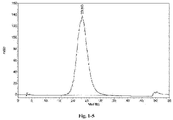
- a chromatographic analysis diagram of a test sample is shown in Fig. 1-5 . It can be seen that the components of the samples cannot be effectively separated under the elution condition.
- Table 4 Proportions of mobile phase A and mobile phase B in embodiment 5 Time (min) Mobile phase A (%) Mobile phase B (%) 0 100 0 10 100 0 30 0 100 40 0 100 41 100 0 55 100 0
- a Waters 2695 high performance liquid chromatography and a 2498 multiwavelength fluorescence detector are used.
- the wavelength is 275 nm.
- the chromatographic column has a length of 150 mm and a diameter of 4.6 mm.
- the packing material for the chromatographic column is polystyrene-divinylbenzene particles with a particle diameter of 3 ⁇ m.
- the mobile phase A is 20 mM tris(hydroxymethyl)aminomethane hydrochloride, the pH of which is adjusted to 11.2 with a NaOH solution.
- the mobile phase B is 20 mM tris(hydroxymethyl)aminomethane hydrochloride containing 1 M NaCl, the pH of which is adjusted to 9.8 with a hydrochloric acid solution.
- the proportions of the mobile phase A and mobile phase B are set according to the following Table 6.
- Mobile phase solutions are added to dissolve the reference substance or the test sample, respectively, to obtain a solution of 20 mg/mL for examination.
- the injection volume is 25 ⁇ L.
- the flow rate is 0.8 mL/min.
- the column temperature is 30 °C.
- the proportions of each component are shown in Table 6.
- Table 5 Proportions of mobile phase A and mobile phase B in embodiment 6 Time (min) Mobile phase A (%) Mobile phase B (%) 0 100 0 10 100 0 10.1 97 3 15 97 3 15.1 93 7 20 93 7 20.1 90 10 30 90 10 30.1 85 15 40 85 15 40.1 80 20 50 80 20 50.1 75 25 60 75 25 60.1 70 30 75 70 30 75.1 65 35 85 65 35 85.1 60 40 95 60 40 95.1 55 45 105 55 45 105.1 50 50 120 50 120.1 100 0 140 100 0
- Table 6 Comparisons and analyses of compositions of anion exchanges between three batches of reference substances and three batches of test samples Batch number Component proportions of each elution peak (%) 1 2 3 4 5 6 7 8 9 10 Reference Substance 1 3.32 32.16 19.55 16.94 10.95 6.02 5.21 2.26 1.96 1.63 Reference Substance 2 4.02 34.51 20.86 15.38 10.06 6.51 4.56 1.32 1.59 1.20 Reference Substance 3 3.65 32.99 19.88 15.79 11.11 7.01 5.28 1.48 1.
- the present invention is effective and feasible in analyzing the content of each component of the glatiramer acetate.
- the present invention could be used in the study of comparative analysis and qualification uniformity of the glatiramer acetate product.
Landscapes
- Chemical & Material Sciences (AREA)
- Health & Medical Sciences (AREA)
- Life Sciences & Earth Sciences (AREA)
- Analytical Chemistry (AREA)
- General Health & Medical Sciences (AREA)
- Physics & Mathematics (AREA)
- Immunology (AREA)
- Biochemistry (AREA)
- Engineering & Computer Science (AREA)
- Pathology (AREA)
- General Physics & Mathematics (AREA)
- Chemical Kinetics & Catalysis (AREA)
- Medicinal Chemistry (AREA)
- Molecular Biology (AREA)
- Proteomics, Peptides & Aminoacids (AREA)
- Bioinformatics & Cheminformatics (AREA)
- Organic Chemistry (AREA)
- Biomedical Technology (AREA)
- Spectroscopy & Molecular Physics (AREA)
- Biophysics (AREA)
- Pharmacology & Pharmacy (AREA)
- Animal Behavior & Ethology (AREA)
- Public Health (AREA)
- Veterinary Medicine (AREA)
- Hematology (AREA)
- Urology & Nephrology (AREA)
- Epidemiology (AREA)
- Genetics & Genomics (AREA)
- Gastroenterology & Hepatology (AREA)
- Neurology (AREA)
- Neurosurgery (AREA)
- Biotechnology (AREA)
- Bioinformatics & Computational Biology (AREA)
- Cell Biology (AREA)
- Microbiology (AREA)
- Food Science & Technology (AREA)
- Hospice & Palliative Care (AREA)
- Psychiatry (AREA)
- General Chemical & Material Sciences (AREA)
- Nuclear Medicine, Radiotherapy & Molecular Imaging (AREA)
Description
- The present invention relates to the field of biological medicines, especially to a high performance liquid chromatography method for polypeptide mixtures.
- Glatiramer acetate (GA) is a synthetic peptide mixture (relative molecular weight: 4700-11000 Daltons), a random polymer consisting of four kinds of amino acids: L-alanine, L-glutamic, L-tyrosine and L-lysine, with a length of 45-100 amino acids. The molar ratios of each kind of amino acids are approximately 0.392-0.462, 0.129-0.153, 0.086-0.100 and 0.300-0.374. This drug is manufactured by the Israeli TEVA pharmaceutical factory (TEVA) with a trade name of Copaxone®. It was approved for the treatment of multiple sclerosis by FDA in 1996, and there are two kinds of products, water needle and freeze-dried powder needle, both of which are administered by subcutaneous injection.
- Glatiramer acetate is a copolymer with high continuity, the structure of the glatiramer acetate is as follows:
(Glu,Ala,Lys,Tyr) xxCH3COOH
(C5H9NO4.C3H7NO2.C6H14N2O2.C9H11NO3) x .
x C2H4O2
CAS-147245-92-9
- For the manufacturers imitating the drug, the compositional differences between the imitation of glatiramer acetate and the control group of the glatiramer acetate can only be examined based on some of the inherent properties of the drug.
- The difference between a sample and a commercial product (reference substance) is examined by gradient elution in an anion exchange liquid chromatography, in the present invention based on the electric charge, polar or nonpolar character of the sample in different buffer solutions.
- As the glatiramer acetate is a copolymer with high continuity, it is difficult to clarify the various components with only one separation method. A size exclusion method is used in the prior art for a simple separation and analysis (dividing a single peak into several components, and then collecting and analyzing the components).
- Specifically
WO2007127977 A2 discloses a method for purifying samples comprising glatiramer acetate by a method selected from the group consisting of gel electrophoresis, size exclusion chromatography, capillary electrophoresis, ion exchange chromatography, reversed- phase liquid chromatography, solvent extraction, precipitation, affinity chromatography, selection of phosphopeptides, selection of low abundance amino acids, linking one or more amino acids, peptides, and polypeptides to an affinity tag, transesterification of one or more carboxyl groups of one or more amino acids, peptides, and polypeptides, treating the sample with EDC/amine chemistry, and treating the sample with a protein that binds one or more carboxyl groups of the one or more amino acids, peptides, and polypeptides. -
WO2012123959 A2 discloses A process for preparation of Glatiramer acetate and the characterization of Glatiramer acetate by peptide mapping using trypsin and carboxypeptidase B comprising the steps of, - a) enzymatic treatment of Glatiramer acetate using trypsin to obtain peptide fragments of short chain lengths;
- b) treating the obtained peptide fragments with carboxypeptidase B resulting in further fragmentation of peptide chain;
- c) separating and analyzing the peptide fragments obtained in step b) using HPLC-UV to obtain the chromatogram; and
- d) comparing the chromatogram thus obtained with the chromatogram of reference standard to determine the structural similarity. Preferably, the reference standard used for peptide mapping is Copaxone<®> (marketed formulation).
- Thus, the prior art is very tedious. It is very necessary to develop an analytical method for an effective separation of the components of the glatiramer acetate.
- The present invention relates to a method performing linear or stepped gradient elution on a glatiramer acetate with a high-performance liquid chromatography and determining whether the content of each component of the glatiramer acetate is qualified.
- The method comprises the following steps:
- step (1): preparing a solution of the glatiramer acetate to be tested;
- step (2): performing gradient elution on a sample to be tested with an anion exchange liquid chromatography;
- step (3): determining a peak area corresponding to each component of the glatiramer acetate, comparing the peak area with a peak area of a reference substance to determine whether the content of each component of the sample to be tested is in a qualified range.
- The elution gradient in step (2) is as follow.
- The chromatographic conditions used in the anion exchange liquid chromatography in step (2) are as follows.
- carboxyl-bonded polystyrene-divinylbenzene particle with a particle diameter of 1.7-10 µm is used as a packing material for a chromatographic column;
- a solution containing 10-50 mM tris(hydroxymethyl)aminomethane hydrochloride is used as mobile phase A, wherein pH of the mobile phase A is adjusted to 10-12 with a NaOH solution;
- a solution containing 10-50 mM tris(hydroxymethyl)aminomethane hydrochloride and 0.5-1.5 M NaCl is used as mobile phase B, wherein pH of the mobile phase B is adjusted to 8-10 with a hydrochloric acid solution;
- injection volume is 5-50 uL, the concentration of the sample is 1-20 mg/mL;
- a flow rate is 0.5-1.5 mL/min, the time for the gradient elution is 50-250 min;
- different forms of elution gradients are used in gradient elution;
- column temperature is 25-50°C;
- the elution gradient is as follow:
- a total time of the gradient elution is divided into N steps uniformly for gradient elution sequentially, wherein 2 ≤ N ≤ 20; in the first N-1 steps, the proportion of the mobile phase A is gradually reduced from 100% to 50%, and the proportion of the mobile phase B is gradually increased from 0 to 50%; in the N-th step, the proportion of the mobile phase A is 100%, and the proportion of the mobile phase B is 0;
- preferably, 5 ≤ N ≤ 15, more preferably, 8 ≤ N ≤ 12, most preferably, N = 10.
- The detection analysis in step (3) uses an ultraviolet detector to detect a wavelength of 260-280 nm.
- When the fluorescence detector is used, its excitation wavelength is 230 nm and its emission wavelength is 300 nm.
-
-
Fig. 1-1 is a chromatographic analysis diagram of a test sample in embodiment 1. -
Fig. 1-2 is a chromatographic analysis diagram of a test sample in embodiment 2. -
Fig. 1-3 is a chromatographic analysis diagram of a test sample in embodiment 3. -
Fig. 1-4 is a chromatographic analysis diagram of a test sample in embodiment 4. -
Fig. 1-5 is a chromatographic analysis diagram of a test sample inembodiment 5. - A Waters 2695 high performance liquid chromatography and a 2475 multiwavelength fluorescence detector are used. The excitation wavelength (Ex) is 230 nm and the emission wavelength (Em) is 300 nm. The chromatographic column has a length of 150 mm and a diameter of 4.6 mm. The packing material for the chromatographic column is polystyrene-divinylbenzene particles with a particle diameter of 3 µm. The mobile phase A is 20 mM tris(hydroxymethyl)aminomethane hydrochloride, the pH of which is adjusted to 11.2 with a NaOH solution. The mobile phase B is 20 mM tris(hydroxymethyl)aminomethane hydrochloride containing 1 M NaCl, the pH of which is adjusted to 9.8 with a hydrochloric acid solution. The proportions of the mobile phase A and mobile phase B are set according to the following Table 1. Mobile phase solutions are added to dissolve commercial glatiramer acetate product (hereinafter referred to as "reference substance") and pre-production glatiramer acetate sample (hereinafter referred to as "test sample"), respectively, to obtain a solution with a glatiramer acetate concentration of 20 mg/mL for examination. The injection volume is 25 µL. The flow rate is 0.8 mL/min. The column temperature is 30 °C. The proportions of each component are shown in Table 2. The chromatographic analysis diagram of a test sample is shown in
Fig. 1-1 .Table 1: Proportions of mobile phase A and mobile phase B in embodiment 1 Time (min) Mobile phase A (%) Mobile phase B (%) 0 100 0 15 100 0 15.1 97.5 2.5 30 97.5 2.5 30.1 95 5 45 95 5 45.1 90 10 60 90 10 60.1 87.5 12.5 75 87.5 12.5 75.1 85 15 90 85 15 90.1 80 20 105 80 20 105.1 70 30 120 70 30 120.1 50 50 135 50 50 135.1 100 0 140 100 0 Table 2: Comparisons and analyses of compositions of anion exchanges between three batches of reference substances and three batches of test samples Batch number Component proportions of each elution peak (%) 1 2 3 4 5 6 7 8 Reference Substance 1 4.55 33.58 20.55 16.08 11.37 6.89 5.54 1.45 Reference Substance 2 3.38 35.15 21.16 16.08 11.06 6.69 5.15 1.32 Reference Substance 3 4.05 33.39 20.28 16.19 11.51 7.41 5.68 1.48 Test sample 1 1.63 27.94 20.52 17.62 13.38 8.99 7.83 2.08 Test sample 2 3.77 29.51 19.87 17.14 12.73 8.49 6.89 1.59 Test sample 3 3.85 31.63 20.48 17.05 11.97 7.81 5.91 1.29 - A Waters 2695 high performance liquid chromatography and a 2475 multiwavelength fluorescence detector are used. The excitation wavelength (Ex) is 230 nm and the emission wavelength (Em) is 300 nm. The chromatographic column has a length of 150 mm and a diameter of 4.6 mm. The packing material for the chromatographic column is polystyrene-divinylbenzene particles with a particle diameter of 5 µm. The mobile phase A is 10 mM tris(hydroxymethyl)aminomethane hydrochloride, the pH of which is adjusted to 10 with a NaOH solution. The mobile phase B is 10 mM tris(hydroxymethyl)aminomethane hydrochloride containing 1.5 M NaCl, the pH of which is adjusted to 8 with a hydrochloric acid solution. The proportions of the mobile phase A and mobile phase B are set according to the following Table 1. Mobile phase solutions are added to dissolve the reference substance or the test sample, respectively, to obtain a solution of 20 mg/mL for examination. The injection volume is 15 µL. The flow rate is 0.5 mL/min. The column temperature is 25 °C. A chromatographic analysis diagram of a test sample is shown in
Fig. 1-2 . - A Waters 2695 high performance liquid chromatography and a 2489 multiwavelength fluorescence detector are used. The wavelength is 275 nm. The chromatographic column has a length of 150 mm and a diameter of 4.6 mm. The packing material for the chromatographic column is polystyrene-divinylbenzene particles with a particle diameter of 10 µm. The mobile phase A is 50 mM tris(hydroxymethyl)aminomethane hydrochloride, the pH of which is adjusted to 12 with a NaOH solution. The mobile phase B is 50 mM tris(hydroxymethyl)aminomethane hydrochloride containing 0.5 M NaCl, the pH of which is adjusted to 10 with a hydrochloric acid solution. The proportions of the mobile phase A and mobile phase B are set according to the following Table 1. Mobile phase solutions are added to dissolve the reference substance or the test sample, respectively, to obtain a solution of 10 mg/mL for examination. The injection volume is 50 µL. The flow rate is 15 mL/min. The column temperature is 50 °C. A chromatographic analysis diagram of a test sample is shown in
Fig. 1-3 . - A Waters 2695 high performance liquid chromatography and a 2489 multiwavelength fluorescence detector are used. The wavelength is 275 nm. The chromatographic column has a length of 150 mm and a diameter of 4.6 mm. The packing material for the chromatographic column is polystyrene-divinylbenzene particles with a particle diameter of 3 µm. The mobile phase A is 30 mM tris(hydroxymethyl)aminomethane hydrochloride, the pH of which is adjusted to 10 with a NaOH solution. The mobile phase B is 30 mM tris(hydroxymethyl)aminomethane hydrochloride containing 1 M NaCl, the pH of which is adjusted to 8 with a hydrochloric acid solution. The proportions of the mobile phase A and mobile phase B are set according to the following Table 3. Mobile phase solutions are added to dissolve the reference substance or the test sample, respectively, to obtain a solution of 10 mg/mL for examination. The injection volume is 25 µL. The flow rate is 0.8 mL/min. The column temperature is 40 °C. A chromatographic analysis diagram of a test sample is shown in
Fig. 1-4 .Table 3: Proportions of mobile phase A and mobile phase B in embodiment 4 Time (min) Mobile phase A (%) Mobile phase B (%) 0 100 0 15 95 5 30 92.5 7.5 45 90 10 60 87.5 12.5 75 85 15 90 80 20 105 70 30 120 50 50 135 100 0 150 100 0 - A Waters 2695 high performance liquid chromatography and a 2475 multiwavelength fluorescence detector are used. The excitation wavelength (Ex) is 230 nm and the emission wavelength (Em) is 300 nm. The chromatographic column has a length of 150 mm and a diameter of 4.6 mm. The packing material for the chromatographic column is polystyrene-divinylbenzene particles with a particle diameter of 3 µm. The mobile phase A is 20 mM tris(hydroxymethyl)aminomethane hydrochloride, the pH of which is adjusted to 11.2 with a NaOH solution. The mobile phase B is 20 mM tris(hydroxymethyl)aminomethane hydrochloride containing 1 M NaCl, the pH of which is adjusted to 9.8 with a hydrochloric acid solution. The proportions of the mobile phase A and mobile phase B are set according to the following Table 4. Mobile phase solutions are added to dissolve the reference substance or the test sample, respectively, to obtain a solution of 20 mg/mL for examination. The injection volume is 25 µL. The flow rate is 1 mL/min. The column temperature is 30 °C. A chromatographic analysis diagram of a test sample is shown in
Fig. 1-5 . It can be seen that the components of the samples cannot be effectively separated under the elution condition.Table 4: Proportions of mobile phase A and mobile phase B in embodiment 5Time (min) Mobile phase A (%) Mobile phase B (%) 0 100 0 10 100 0 30 0 100 40 0 100 41 100 0 55 100 0 - A Waters 2695 high performance liquid chromatography and a 2498 multiwavelength fluorescence detector are used. The wavelength is 275 nm. The chromatographic column has a length of 150 mm and a diameter of 4.6 mm. The packing material for the chromatographic column is polystyrene-divinylbenzene particles with a particle diameter of 3 µm. The mobile phase A is 20 mM tris(hydroxymethyl)aminomethane hydrochloride, the pH of which is adjusted to 11.2 with a NaOH solution. The mobile phase B is 20 mM tris(hydroxymethyl)aminomethane hydrochloride containing 1 M NaCl, the pH of which is adjusted to 9.8 with a hydrochloric acid solution. The proportions of the mobile phase A and mobile phase B are set according to the following Table 6. Mobile phase solutions are added to dissolve the reference substance or the test sample, respectively, to obtain a solution of 20 mg/mL for examination. The injection volume is 25 µL. The flow rate is 0.8 mL/min. The column temperature is 30 °C. The proportions of each component are shown in Table 6.
Table 5: Proportions of mobile phase A and mobile phase B in embodiment 6 Time (min) Mobile phase A (%) Mobile phase B (%) 0 100 0 10 100 0 10.1 97 3 15 97 3 15.1 93 7 20 93 7 20.1 90 10 30 90 10 30.1 85 15 40 85 15 40.1 80 20 50 80 20 50.1 75 25 60 75 25 60.1 70 30 75 70 30 75.1 65 35 85 65 35 85.1 60 40 95 60 40 95.1 55 45 105 55 45 105.1 50 50 120 50 50 120.1 100 0 140 100 0 Table 6: Comparisons and analyses of compositions of anion exchanges between three batches of reference substances and three batches of test samples Batch number Component proportions of each elution peak (%) 1 2 3 4 5 6 7 8 9 10 Reference Substance 1 3.32 32.16 19.55 16.94 10.95 6.02 5.21 2.26 1.96 1.63 Reference Substance 2 4.02 34.51 20.86 15.38 10.06 6.51 4.56 1.32 1.59 1.20 Reference Substance 3 3.65 32.99 19.88 15.79 11.11 7.01 5.28 1.48 1.67 1.13 Test sample 1 2.33 26.61 20.19 17.29 13.05 8.66 7.50 1.75 1.48 1.16 Test sample 2 3.39 29.13 19.49 16.76 12.35 8.11 6.51 1.59 1.52 1.14 Test sample 3 3.44 31.22 20.07 16.64 11.56 7.4 5.50 1.60 1.27 1.29 - The embodiments mentioned above indicate that the present invention is effective and feasible in analyzing the content of each component of the glatiramer acetate. Thus, the present invention could be used in the study of comparative analysis and qualification uniformity of the glatiramer acetate product.
Claims (3)
- A method for performing linear or stepped gradient elution on a glatiramer acetate with a high-performance liquid chromatography and determining whether the content of each component of the glatiramer acetate is qualified, comprising the following steps:step (1): preparing a solution of the glatiramer acetate to be tested;step (2): performing gradient elution on a sample to be tested with an anion exchange liquid chromatography;step (3): determining a peak area corresponding to each component of the glatiramer acetate, comparing the peak area with a peak area of a reference substance to determine whether the content of each component of the sample to be tested is in a qualified range.
- The method according to claim 1, wherein in step (2), chromatographic conditions for the anion exchange liquid chromatography are as follows:carboxyl-bonded polystyrene-divinylbenzene particle with a particle diameter of 1.7-10 µm is used as a packing material for a chromatographic column;a solution containing 10-50 mM tris(hydroxymethyl)aminomethane hydrochloride is used as mobile phase A, wherein pH of the mobile phase A is adjusted to 10-12 with a NaOH solution;a solution containing 10-50 mM tris(hydroxymethyl)aminomethane hydrochloride and 0.5-1.5 M NaCl is used as mobile phase B, wherein pH of the mobile phase B is adjusted to 8-10 with a hydrochloric acid solution;injection volume is 5-50 uL, the concentration of the sample is 1-20 mg/mL;a flow rate is 0.5-1.5 mL/min, the time for the gradient elution is 50-250 min;gradient of the gradient elution is as follows:a total time of the gradient elution is divided into N steps uniformly for gradient elution sequentially, wherein 2 ≤ N ≤ 20,in the first N-1 steps, the proportion of the mobile phase A is gradually reduced from 100% to 50%, and the proportion of the mobile phase B is gradually increased from 0 to 50%,in the N-th step, the proportion of the mobile phase A is 100%, and the proportion of the mobile phase B is 0;preferably, 5 ≤ N ≤ 15, more preferably, 8 ≤ N ≤ 12, most preferably, N = 10;column temperature is 25-50°C .
- The method according to claim 1 or 2, wherein a detection analysis in step (3) uses an ultraviolet detector to detect a wavelength of 260-280 nm; wherein when a fluorescence detector is used, an excitation wavelength of the fluorescence detector is 230 nm and an emission wavelength of the fluorescence detector is 300 nm.
Priority Applications (2)
| Application Number | Priority Date | Filing Date | Title |
|---|---|---|---|
| EP19198022.6A EP3613756B1 (en) | 2015-04-28 | 2015-04-28 | High performance liquid chromatography method for polypeptide mixtures |
| EP19198009.3A EP3603764B1 (en) | 2015-04-28 | 2015-04-28 | High performance liquid chromatography method for polypeptide mixtures |
Applications Claiming Priority (1)
| Application Number | Priority Date | Filing Date | Title |
|---|---|---|---|
| PCT/CN2015/077690 WO2016172855A1 (en) | 2015-04-28 | 2015-04-28 | High performance liquid chromatography method for polypeptide mixtures |
Related Child Applications (4)
| Application Number | Title | Priority Date | Filing Date |
|---|---|---|---|
| EP19198009.3A Division EP3603764B1 (en) | 2015-04-28 | 2015-04-28 | High performance liquid chromatography method for polypeptide mixtures |
| EP19198009.3A Division-Into EP3603764B1 (en) | 2015-04-28 | 2015-04-28 | High performance liquid chromatography method for polypeptide mixtures |
| EP19198022.6A Division EP3613756B1 (en) | 2015-04-28 | 2015-04-28 | High performance liquid chromatography method for polypeptide mixtures |
| EP19198022.6A Division-Into EP3613756B1 (en) | 2015-04-28 | 2015-04-28 | High performance liquid chromatography method for polypeptide mixtures |
Publications (3)
| Publication Number | Publication Date |
|---|---|
| EP3290432A1 EP3290432A1 (en) | 2018-03-07 |
| EP3290432A4 EP3290432A4 (en) | 2019-03-27 |
| EP3290432B1 true EP3290432B1 (en) | 2022-03-30 |
Family
ID=57198918
Family Applications (3)
| Application Number | Title | Priority Date | Filing Date |
|---|---|---|---|
| EP19198009.3A Active EP3603764B1 (en) | 2015-04-28 | 2015-04-28 | High performance liquid chromatography method for polypeptide mixtures |
| EP19198022.6A Active EP3613756B1 (en) | 2015-04-28 | 2015-04-28 | High performance liquid chromatography method for polypeptide mixtures |
| EP15890235.3A Active EP3290432B1 (en) | 2015-04-28 | 2015-04-28 | High performance liquid chromatography method for polypeptide mixtures |
Family Applications Before (2)
| Application Number | Title | Priority Date | Filing Date |
|---|---|---|---|
| EP19198009.3A Active EP3603764B1 (en) | 2015-04-28 | 2015-04-28 | High performance liquid chromatography method for polypeptide mixtures |
| EP19198022.6A Active EP3613756B1 (en) | 2015-04-28 | 2015-04-28 | High performance liquid chromatography method for polypeptide mixtures |
Country Status (5)
| Country | Link |
|---|---|
| US (1) | US10330650B2 (en) |
| EP (3) | EP3603764B1 (en) |
| JP (1) | JP6676072B2 (en) |
| CN (3) | CN112649538B (en) |
| WO (1) | WO2016172855A1 (en) |
Families Citing this family (14)
| Publication number | Priority date | Publication date | Assignee | Title |
|---|---|---|---|---|
| CN111060635A (en) * | 2019-11-27 | 2020-04-24 | 吉尔生化(上海)有限公司 | Analysis and detection method of carbetocin |
| CN111138516B (en) * | 2020-01-10 | 2023-04-25 | 大理大学 | A kind of Vespa peptide and its preparation method and application |
| CN112858522B (en) * | 2021-02-20 | 2022-09-20 | 重庆工贸职业技术学院 | A method for separation and determination of heteroamino acids in high-purity valine by high performance liquid chromatography |
| CN113009014B (en) * | 2021-02-24 | 2023-04-07 | 上海旭东海普药业有限公司 | High performance liquid detection method for 2-methoxy-5-fluorouracil impurities |
| CN113720941B (en) * | 2021-09-18 | 2023-03-24 | 广东丸美生物技术股份有限公司 | Detection method of polypeptide in skin care product raw material or skin care product and high performance liquid chromatography detection method of polypeptide |
| US20250102426A1 (en) * | 2021-10-22 | 2025-03-27 | Barrelwise Technologies Ltd. | System and method for rapid determination of free sulfur dioxide concentration in a liquid |
| CN114280179B (en) * | 2021-12-22 | 2024-03-15 | 北京美福润医药科技股份有限公司 | Pretreatment of exenatide and detection method of isomer in His amino acid eluent obtained by pretreatment |
| CN114384194B (en) * | 2021-12-28 | 2023-09-22 | 湖南中晟全肽生化有限公司 | A high-throughput method for detecting peptides |
| CN114609286A (en) * | 2022-03-18 | 2022-06-10 | 浙江理工大学 | A kind of method for detecting isophthalic acid content of polyester fabric |
| KR102742623B1 (en) * | 2022-04-07 | 2024-12-16 | 에쓰대시오일 주식회사 | Method and device for measuring the amount of rubber in impact polypropylene |
| CN115078592B (en) * | 2022-07-15 | 2024-01-23 | 广东广纳安疗科技有限公司 | Detection method of acrylamide monomer and application thereof |
| CN115586288B (en) * | 2022-10-08 | 2024-07-26 | 广州朗圣药业有限公司 | High performance liquid chromatography detection method for SZFZ-A content in SZFZ-A-containing composition |
| CN115656391B (en) * | 2022-12-12 | 2023-04-07 | 哈尔滨吉象隆生物技术有限公司 | Method for detecting impurities contained in teriparatide |
| CN116429950B (en) * | 2023-06-07 | 2023-08-11 | 成都佩德生物医药有限公司 | Method for analyzing related substances of polypeptide PD-DP-005 |
Family Cites Families (26)
| Publication number | Priority date | Publication date | Assignee | Title |
|---|---|---|---|---|
| IL119989A0 (en) * | 1997-01-10 | 1997-04-15 | Yeda Res & Dev | Pharmaceutical compositions for oral treatment of multiple sclerosis |
| JPH11271294A (en) * | 1998-03-23 | 1999-10-05 | Mitsubishi Chemical Corp | Spherical porous crosslinked polymer particles and method for producing the same |
| EP1084136B1 (en) * | 1998-06-01 | 2004-08-25 | Genentech, Inc. | Separation of antibody monomers from its multimers by use of ion-exchange chromatography |
| WO2000005250A1 (en) * | 1998-07-23 | 2000-02-03 | Yeda Research And Development Co., Ltd | Treatment of autoimmune conditions with copolymer 1 and related copolymers and peptides |
| EP2090583B1 (en) * | 1998-09-25 | 2011-07-13 | Yeda Research And Development Co., Ltd. | Copolymer 1 related polypeptides for use as molecular weight markers and for therapeutic use |
| LT1543038T (en) * | 2002-09-11 | 2017-07-10 | Genentech, Inc. | Protein purification |
| CN1591005A (en) * | 2003-09-02 | 2005-03-09 | 浙江大学 | Linkage type cation chromatographic column and its preparation method |
| GB2426584A (en) * | 2004-02-18 | 2006-11-29 | Guy S And St Thomas Nhs Founda | Itpase gene polymorphisms associated with adverse drug reactions to azathioprine |
| ES2565035T3 (en) * | 2006-04-28 | 2016-03-30 | Momenta Pharmaceuticals, Inc. | Methods to evaluate peptide mixtures |
| WO2007142578A1 (en) * | 2006-06-09 | 2007-12-13 | Ge Healthcare Bio-Sciences Ab | Method of separating monomeric protein (s) |
| WO2009129018A1 (en) * | 2008-04-16 | 2009-10-22 | Momenta Pharmaceuticals, Inc. | Analysis of amino acid copolymer compositions |
| JP2012526288A (en) * | 2009-05-08 | 2012-10-25 | サイノファーム タイワン リミテッド | Methods for analyzing peptide mixtures |
| EP2451824A4 (en) * | 2009-07-09 | 2013-04-24 | Biocon Ltd | A preparative non-linear gradient based chromatographic method and purified products thereof |
| JPWO2011090188A1 (en) * | 2010-01-25 | 2013-05-23 | 株式会社日立ハイテクノロジーズ | Liquid chromatograph and liquid chromatograph feeding device |
| US8337845B2 (en) * | 2010-03-03 | 2012-12-25 | Boehringer Ingelheim International Gmbh | A-beta binding polypeptides |
| AU2011282635B2 (en) * | 2010-07-29 | 2015-05-28 | Dr. Reddy's Laboratories Ltd. | Glatiramer acetate molecular weight markers |
| WO2012123959A2 (en) * | 2011-02-14 | 2012-09-20 | Usv Limited | Copolymer-1, process for preparation and analytical methods thereof |
| CA2865578C (en) * | 2012-02-27 | 2023-01-17 | Amunix Operating Inc. | Xten conjugate compositions and methods of making same |
| CN104098655B (en) * | 2013-04-09 | 2018-01-30 | 深圳翰宇药业股份有限公司 | Target polypeptide in mass spectrum for synthesizing acetic acid copaxone |
| CN103265624B (en) * | 2013-05-27 | 2015-04-22 | 成都圣诺生物制药有限公司 | Method for preparing copaxone |
| CN103335873B (en) * | 2013-06-04 | 2017-04-19 | 深圳翰宇药业股份有限公司 | Method for measuring chloride ion content of amino acid-N-formic anhydride |
| JP6367195B2 (en) * | 2013-07-17 | 2018-08-01 | 積水メディカル株式会社 | Gradient liquid feeder in sample analyzer |
| CN104371012A (en) * | 2013-08-12 | 2015-02-25 | 深圳翰宇药业股份有限公司 | Synthesis method of glatiramer acetate |
| CN104297404B (en) * | 2014-09-26 | 2016-08-24 | 深圳翰宇药业股份有限公司 | A kind of for measuring the method for piperidines impurity content in acetic acid copaxone sample |
| US20180164275A1 (en) * | 2015-04-30 | 2018-06-14 | Teva Pharmaceutical Industries Ltd. | Method of determining the molecular weight distribution of glatiramer acetate using multi-angle laser light scattering (malls) |
| EP3170836B1 (en) * | 2015-11-23 | 2018-10-24 | Chemi SPA | Rp-hplc analysis of complex polypeptide mixtures |
-
2015
- 2015-04-28 EP EP19198009.3A patent/EP3603764B1/en active Active
- 2015-04-28 EP EP19198022.6A patent/EP3613756B1/en active Active
- 2015-04-28 CN CN202011643350.1A patent/CN112649538B/en active Active
- 2015-04-28 CN CN201580079194.1A patent/CN107531750B/en active Active
- 2015-04-28 EP EP15890235.3A patent/EP3290432B1/en active Active
- 2015-04-28 JP JP2017556727A patent/JP6676072B2/en active Active
- 2015-04-28 WO PCT/CN2015/077690 patent/WO2016172855A1/en not_active Ceased
- 2015-04-28 CN CN202011638347.0A patent/CN112649537B/en active Active
- 2015-04-28 US US15/559,428 patent/US10330650B2/en active Active
Non-Patent Citations (1)
| Title |
|---|
| None * |
Also Published As
| Publication number | Publication date |
|---|---|
| EP3290432A1 (en) | 2018-03-07 |
| JP6676072B2 (en) | 2020-04-08 |
| WO2016172855A1 (en) | 2016-11-03 |
| CN107531750B (en) | 2021-03-16 |
| EP3613756A1 (en) | 2020-02-26 |
| US10330650B2 (en) | 2019-06-25 |
| EP3603764A1 (en) | 2020-02-05 |
| CN107531750A (en) | 2018-01-02 |
| CN112649538A (en) | 2021-04-13 |
| JP2018515766A (en) | 2018-06-14 |
| CN112649537B (en) | 2024-03-29 |
| CN112649537A (en) | 2021-04-13 |
| US20180080909A1 (en) | 2018-03-22 |
| CN112649538B (en) | 2024-03-29 |
| EP3613756B1 (en) | 2024-02-21 |
| EP3603764B1 (en) | 2022-03-30 |
| EP3290432A4 (en) | 2019-03-27 |
Similar Documents
| Publication | Publication Date | Title |
|---|---|---|
| EP3603764B1 (en) | High performance liquid chromatography method for polypeptide mixtures | |
| Sköld et al. | A neuroproteomic approach to targeting neuropeptides in the brain | |
| Rubinstein et al. | Characterization of proteins and peptides by high-performance liquid chromatography and fluorescence monitoring of their tryptic digests | |
| Machtejevas et al. | Automated multi-dimensional liquid chromatography: sample preparation and identification of peptides from human blood filtrate | |
| US9109006B2 (en) | Glatiramer acetate molecular weight markers | |
| Bietz | High performance liquid chromatography: How proteins look in cereals | |
| US10539568B2 (en) | RP-HPLC analysis of complex polypeptide mixtures | |
| WO2023187703A1 (en) | An improved method for separating and detecting of free or residual polyethylene glycol in pegylated protein mixture | |
| Yaron et al. | Lysine oligopeptides. Preparation by ion‐exchange chromatography | |
| Hamidi et al. | A reversed‐phase high‐performance liquid chromatography method for bovine serum albumin assay in pharmaceutical dosage forms and protein/antigen delivery systems | |
| Cserháti | Chromatography of amino acids and short peptides. New advances | |
| Štěpánová et al. | Analysis of peptides by capillary electromigration methods | |
| Oliva et al. | Analysis of peptides and proteins: Evaluation of purity, stability, and structural characterization of insulin | |
| CN105223281B (en) | A kind of chromatographic process for being used to detect acetic acid copaxone concentration in the loose preparation of Kappa | |
| Miramon et al. | Highly resolutive separations of hardly soluble synthetic polypeptides by capillary electrophoresis | |
| Cervantes et al. | Development and validation of an LC/MS method of glatiramer and its sequential amino acids, at pharmaceutical product | |
| CN105136930A (en) | Detection method for thymosin for injection | |
| HUANG et al. | Transferrin and its isoforms from normal human serum revealed by several analytical techniques | |
| van de VEN et al. | 500‐MHz 1H‐NMR studies of ribosomal proteins isolated from 70‐S ribosomes of Escherichia coli | |
| WO2019049038A1 (en) | Process for the characterization of glatiramer acetate | |
| CN106872624A (en) | A kind of method suitable for pegylated protein purity detecting | |
| CN116626196A (en) | A method for simultaneously determining the contents of various nucleosides and free amino acids in donkey-hide gelatin | |
| CN117007704A (en) | Liquid phase analysis method for quantitatively detecting isomer content in dipeptide | |
| Tamizi | Application of capillary electrophoresis in stability studies of some biopharmaceutical products. | |
| Venkateshwaran | Part~ I: Solution conformation of peptides and polypeptides using particle beam LC/FT-IR spectrometry and electrospray mass spectrometry. Part~ II: HPLC methods development for selected pharmaceutical mixtures in 0.9 percent sodium chloride injection USP |
Legal Events
| Date | Code | Title | Description |
|---|---|---|---|
| STAA | Information on the status of an ep patent application or granted ep patent |
Free format text: STATUS: THE INTERNATIONAL PUBLICATION HAS BEEN MADE |
|
| PUAI | Public reference made under article 153(3) epc to a published international application that has entered the european phase |
Free format text: ORIGINAL CODE: 0009012 |
|
| STAA | Information on the status of an ep patent application or granted ep patent |
Free format text: STATUS: REQUEST FOR EXAMINATION WAS MADE |
|
| 17P | Request for examination filed |
Effective date: 20171023 |
|
| AK | Designated contracting states |
Kind code of ref document: A1 Designated state(s): AL AT BE BG CH CY CZ DE DK EE ES FI FR GB GR HR HU IE IS IT LI LT LU LV MC MK MT NL NO PL PT RO RS SE SI SK SM TR |
|
| AX | Request for extension of the european patent |
Extension state: BA ME |
|
| DAV | Request for validation of the european patent (deleted) | ||
| DAX | Request for extension of the european patent (deleted) | ||
| RIC1 | Information provided on ipc code assigned before grant |
Ipc: B01D 15/36 20060101ALI20181112BHEP Ipc: B01D 15/32 20060101ALI20181112BHEP Ipc: A61K 31/785 20060101ALI20181112BHEP Ipc: C07K 2/00 20060101AFI20181112BHEP Ipc: C07K 14/00 20060101ALI20181112BHEP Ipc: A61P 25/28 20060101ALI20181112BHEP Ipc: A61K 38/03 20060101ALI20181112BHEP |
|
| A4 | Supplementary search report drawn up and despatched |
Effective date: 20190221 |
|
| RIC1 | Information provided on ipc code assigned before grant |
Ipc: A61K 31/785 20060101ALI20190215BHEP Ipc: B01D 15/32 20060101ALI20190215BHEP Ipc: A61K 38/03 20060101ALI20190215BHEP Ipc: B01D 15/36 20060101ALI20190215BHEP Ipc: A61P 25/28 20060101ALI20190215BHEP Ipc: C07K 2/00 20060101AFI20190215BHEP Ipc: C07K 14/00 20060101ALI20190215BHEP |
|
| STAA | Information on the status of an ep patent application or granted ep patent |
Free format text: STATUS: EXAMINATION IS IN PROGRESS |
|
| 17Q | First examination report despatched |
Effective date: 20201118 |
|
| REG | Reference to a national code |
Ref country code: DE Ref legal event code: R079 Ref document number: 602015077950 Country of ref document: DE Free format text: PREVIOUS MAIN CLASS: C07K0002000000 Ipc: B01D0015360000 |
|
| GRAP | Despatch of communication of intention to grant a patent |
Free format text: ORIGINAL CODE: EPIDOSNIGR1 |
|
| STAA | Information on the status of an ep patent application or granted ep patent |
Free format text: STATUS: GRANT OF PATENT IS INTENDED |
|
| RIC1 | Information provided on ipc code assigned before grant |
Ipc: A61P 25/28 20060101ALI20210930BHEP Ipc: A61K 38/03 20060101ALI20210930BHEP Ipc: C07K 14/00 20060101ALI20210930BHEP Ipc: B01D 15/16 20060101ALI20210930BHEP Ipc: B01D 15/36 20060101AFI20210930BHEP |
|
| INTG | Intention to grant announced |
Effective date: 20211018 |
|
| GRAS | Grant fee paid |
Free format text: ORIGINAL CODE: EPIDOSNIGR3 |
|
| GRAA | (expected) grant |
Free format text: ORIGINAL CODE: 0009210 |
|
| STAA | Information on the status of an ep patent application or granted ep patent |
Free format text: STATUS: THE PATENT HAS BEEN GRANTED |
|
| AK | Designated contracting states |
Kind code of ref document: B1 Designated state(s): AL AT BE BG CH CY CZ DE DK EE ES FI FR GB GR HR HU IE IS IT LI LT LU LV MC MK MT NL NO PL PT RO RS SE SI SK SM TR |
|
| REG | Reference to a national code |
Ref country code: GB Ref legal event code: FG4D |
|
| REG | Reference to a national code |
Ref country code: CH Ref legal event code: EP |
|
| REG | Reference to a national code |
Ref country code: DE Ref legal event code: R096 Ref document number: 602015077950 Country of ref document: DE |
|
| REG | Reference to a national code |
Ref country code: AT Ref legal event code: REF Ref document number: 1478643 Country of ref document: AT Kind code of ref document: T Effective date: 20220415 |
|
| REG | Reference to a national code |
Ref country code: IE Ref legal event code: FG4D |
|
| REG | Reference to a national code |
Ref country code: LT Ref legal event code: MG9D |
|
| PG25 | Lapsed in a contracting state [announced via postgrant information from national office to epo] |
Ref country code: SE Free format text: LAPSE BECAUSE OF FAILURE TO SUBMIT A TRANSLATION OF THE DESCRIPTION OR TO PAY THE FEE WITHIN THE PRESCRIBED TIME-LIMIT Effective date: 20220330 Ref country code: RS Free format text: LAPSE BECAUSE OF FAILURE TO SUBMIT A TRANSLATION OF THE DESCRIPTION OR TO PAY THE FEE WITHIN THE PRESCRIBED TIME-LIMIT Effective date: 20220330 Ref country code: NO Free format text: LAPSE BECAUSE OF FAILURE TO SUBMIT A TRANSLATION OF THE DESCRIPTION OR TO PAY THE FEE WITHIN THE PRESCRIBED TIME-LIMIT Effective date: 20220630 Ref country code: LT Free format text: LAPSE BECAUSE OF FAILURE TO SUBMIT A TRANSLATION OF THE DESCRIPTION OR TO PAY THE FEE WITHIN THE PRESCRIBED TIME-LIMIT Effective date: 20220330 Ref country code: HR Free format text: LAPSE BECAUSE OF FAILURE TO SUBMIT A TRANSLATION OF THE DESCRIPTION OR TO PAY THE FEE WITHIN THE PRESCRIBED TIME-LIMIT Effective date: 20220330 Ref country code: BG Free format text: LAPSE BECAUSE OF FAILURE TO SUBMIT A TRANSLATION OF THE DESCRIPTION OR TO PAY THE FEE WITHIN THE PRESCRIBED TIME-LIMIT Effective date: 20220630 |
|
| REG | Reference to a national code |
Ref country code: NL Ref legal event code: MP Effective date: 20220330 |
|
| REG | Reference to a national code |
Ref country code: AT Ref legal event code: MK05 Ref document number: 1478643 Country of ref document: AT Kind code of ref document: T Effective date: 20220330 |
|
| PG25 | Lapsed in a contracting state [announced via postgrant information from national office to epo] |
Ref country code: LV Free format text: LAPSE BECAUSE OF FAILURE TO SUBMIT A TRANSLATION OF THE DESCRIPTION OR TO PAY THE FEE WITHIN THE PRESCRIBED TIME-LIMIT Effective date: 20220330 Ref country code: GR Free format text: LAPSE BECAUSE OF FAILURE TO SUBMIT A TRANSLATION OF THE DESCRIPTION OR TO PAY THE FEE WITHIN THE PRESCRIBED TIME-LIMIT Effective date: 20220701 Ref country code: FI Free format text: LAPSE BECAUSE OF FAILURE TO SUBMIT A TRANSLATION OF THE DESCRIPTION OR TO PAY THE FEE WITHIN THE PRESCRIBED TIME-LIMIT Effective date: 20220330 |
|
| PG25 | Lapsed in a contracting state [announced via postgrant information from national office to epo] |
Ref country code: NL Free format text: LAPSE BECAUSE OF FAILURE TO SUBMIT A TRANSLATION OF THE DESCRIPTION OR TO PAY THE FEE WITHIN THE PRESCRIBED TIME-LIMIT Effective date: 20220330 |
|
| PG25 | Lapsed in a contracting state [announced via postgrant information from national office to epo] |
Ref country code: SM Free format text: LAPSE BECAUSE OF FAILURE TO SUBMIT A TRANSLATION OF THE DESCRIPTION OR TO PAY THE FEE WITHIN THE PRESCRIBED TIME-LIMIT Effective date: 20220330 Ref country code: SK Free format text: LAPSE BECAUSE OF FAILURE TO SUBMIT A TRANSLATION OF THE DESCRIPTION OR TO PAY THE FEE WITHIN THE PRESCRIBED TIME-LIMIT Effective date: 20220330 Ref country code: RO Free format text: LAPSE BECAUSE OF FAILURE TO SUBMIT A TRANSLATION OF THE DESCRIPTION OR TO PAY THE FEE WITHIN THE PRESCRIBED TIME-LIMIT Effective date: 20220330 Ref country code: PT Free format text: LAPSE BECAUSE OF FAILURE TO SUBMIT A TRANSLATION OF THE DESCRIPTION OR TO PAY THE FEE WITHIN THE PRESCRIBED TIME-LIMIT Effective date: 20220801 Ref country code: ES Free format text: LAPSE BECAUSE OF FAILURE TO SUBMIT A TRANSLATION OF THE DESCRIPTION OR TO PAY THE FEE WITHIN THE PRESCRIBED TIME-LIMIT Effective date: 20220330 Ref country code: EE Free format text: LAPSE BECAUSE OF FAILURE TO SUBMIT A TRANSLATION OF THE DESCRIPTION OR TO PAY THE FEE WITHIN THE PRESCRIBED TIME-LIMIT Effective date: 20220330 Ref country code: CZ Free format text: LAPSE BECAUSE OF FAILURE TO SUBMIT A TRANSLATION OF THE DESCRIPTION OR TO PAY THE FEE WITHIN THE PRESCRIBED TIME-LIMIT Effective date: 20220330 Ref country code: AT Free format text: LAPSE BECAUSE OF FAILURE TO SUBMIT A TRANSLATION OF THE DESCRIPTION OR TO PAY THE FEE WITHIN THE PRESCRIBED TIME-LIMIT Effective date: 20220330 |
|
| PG25 | Lapsed in a contracting state [announced via postgrant information from national office to epo] |
Ref country code: PL Free format text: LAPSE BECAUSE OF FAILURE TO SUBMIT A TRANSLATION OF THE DESCRIPTION OR TO PAY THE FEE WITHIN THE PRESCRIBED TIME-LIMIT Effective date: 20220330 Ref country code: IS Free format text: LAPSE BECAUSE OF FAILURE TO SUBMIT A TRANSLATION OF THE DESCRIPTION OR TO PAY THE FEE WITHIN THE PRESCRIBED TIME-LIMIT Effective date: 20220730 Ref country code: AL Free format text: LAPSE BECAUSE OF FAILURE TO SUBMIT A TRANSLATION OF THE DESCRIPTION OR TO PAY THE FEE WITHIN THE PRESCRIBED TIME-LIMIT Effective date: 20220330 |
|
| REG | Reference to a national code |
Ref country code: CH Ref legal event code: PL |
|
| REG | Reference to a national code |
Ref country code: DE Ref legal event code: R097 Ref document number: 602015077950 Country of ref document: DE |
|
| REG | Reference to a national code |
Ref country code: BE Ref legal event code: MM Effective date: 20220430 |
|
| PG25 | Lapsed in a contracting state [announced via postgrant information from national office to epo] |
Ref country code: MC Free format text: LAPSE BECAUSE OF FAILURE TO SUBMIT A TRANSLATION OF THE DESCRIPTION OR TO PAY THE FEE WITHIN THE PRESCRIBED TIME-LIMIT Effective date: 20220330 Ref country code: LU Free format text: LAPSE BECAUSE OF NON-PAYMENT OF DUE FEES Effective date: 20220428 Ref country code: LI Free format text: LAPSE BECAUSE OF NON-PAYMENT OF DUE FEES Effective date: 20220430 Ref country code: DK Free format text: LAPSE BECAUSE OF FAILURE TO SUBMIT A TRANSLATION OF THE DESCRIPTION OR TO PAY THE FEE WITHIN THE PRESCRIBED TIME-LIMIT Effective date: 20220330 Ref country code: CH Free format text: LAPSE BECAUSE OF NON-PAYMENT OF DUE FEES Effective date: 20220430 |
|
| PLBE | No opposition filed within time limit |
Free format text: ORIGINAL CODE: 0009261 |
|
| STAA | Information on the status of an ep patent application or granted ep patent |
Free format text: STATUS: NO OPPOSITION FILED WITHIN TIME LIMIT |
|
| PG25 | Lapsed in a contracting state [announced via postgrant information from national office to epo] |
Ref country code: BE Free format text: LAPSE BECAUSE OF NON-PAYMENT OF DUE FEES Effective date: 20220430 |
|
| GBPC | Gb: european patent ceased through non-payment of renewal fee |
Effective date: 20220630 |
|
| 26N | No opposition filed |
Effective date: 20230103 |
|
| PG25 | Lapsed in a contracting state [announced via postgrant information from national office to epo] |
Ref country code: IE Free format text: LAPSE BECAUSE OF NON-PAYMENT OF DUE FEES Effective date: 20220428 Ref country code: FR Free format text: LAPSE BECAUSE OF NON-PAYMENT OF DUE FEES Effective date: 20220530 |
|
| PG25 | Lapsed in a contracting state [announced via postgrant information from national office to epo] |
Ref country code: SI Free format text: LAPSE BECAUSE OF FAILURE TO SUBMIT A TRANSLATION OF THE DESCRIPTION OR TO PAY THE FEE WITHIN THE PRESCRIBED TIME-LIMIT Effective date: 20220330 Ref country code: GB Free format text: LAPSE BECAUSE OF NON-PAYMENT OF DUE FEES Effective date: 20220630 |
|
| PG25 | Lapsed in a contracting state [announced via postgrant information from national office to epo] |
Ref country code: IT Free format text: LAPSE BECAUSE OF FAILURE TO SUBMIT A TRANSLATION OF THE DESCRIPTION OR TO PAY THE FEE WITHIN THE PRESCRIBED TIME-LIMIT Effective date: 20220330 |
|
| PG25 | Lapsed in a contracting state [announced via postgrant information from national office to epo] |
Ref country code: HU Free format text: LAPSE BECAUSE OF FAILURE TO SUBMIT A TRANSLATION OF THE DESCRIPTION OR TO PAY THE FEE WITHIN THE PRESCRIBED TIME-LIMIT; INVALID AB INITIO Effective date: 20150428 |
|
| PG25 | Lapsed in a contracting state [announced via postgrant information from national office to epo] |
Ref country code: MK Free format text: LAPSE BECAUSE OF FAILURE TO SUBMIT A TRANSLATION OF THE DESCRIPTION OR TO PAY THE FEE WITHIN THE PRESCRIBED TIME-LIMIT Effective date: 20220330 Ref country code: CY Free format text: LAPSE BECAUSE OF FAILURE TO SUBMIT A TRANSLATION OF THE DESCRIPTION OR TO PAY THE FEE WITHIN THE PRESCRIBED TIME-LIMIT Effective date: 20220330 |
|
| PG25 | Lapsed in a contracting state [announced via postgrant information from national office to epo] |
Ref country code: TR Free format text: LAPSE BECAUSE OF FAILURE TO SUBMIT A TRANSLATION OF THE DESCRIPTION OR TO PAY THE FEE WITHIN THE PRESCRIBED TIME-LIMIT Effective date: 20220330 |
|
| PG25 | Lapsed in a contracting state [announced via postgrant information from national office to epo] |
Ref country code: MT Free format text: LAPSE BECAUSE OF FAILURE TO SUBMIT A TRANSLATION OF THE DESCRIPTION OR TO PAY THE FEE WITHIN THE PRESCRIBED TIME-LIMIT Effective date: 20220330 |
|
| PGFP | Annual fee paid to national office [announced via postgrant information from national office to epo] |
Ref country code: DE Payment date: 20250422 Year of fee payment: 11 |