EP3288207A1 - Communication device and base station - Google Patents
Communication device and base station Download PDFInfo
- Publication number
- EP3288207A1 EP3288207A1 EP17186909.2A EP17186909A EP3288207A1 EP 3288207 A1 EP3288207 A1 EP 3288207A1 EP 17186909 A EP17186909 A EP 17186909A EP 3288207 A1 EP3288207 A1 EP 3288207A1
- Authority
- EP
- European Patent Office
- Prior art keywords
- soft buffer
- tti length
- partition
- communication device
- tti
- Prior art date
- Legal status (The legal status is an assumption and is not a legal conclusion. Google has not performed a legal analysis and makes no representation as to the accuracy of the status listed.)
- Granted
Links
Images




Classifications
-
- H—ELECTRICITY
- H04—ELECTRIC COMMUNICATION TECHNIQUE
- H04W—WIRELESS COMMUNICATION NETWORKS
- H04W72/00—Local resource management
- H04W72/04—Wireless resource allocation
- H04W72/044—Wireless resource allocation based on the type of the allocated resource
- H04W72/0446—Resources in time domain, e.g. slots or frames
-
- H—ELECTRICITY
- H04—ELECTRIC COMMUNICATION TECHNIQUE
- H04L—TRANSMISSION OF DIGITAL INFORMATION, e.g. TELEGRAPHIC COMMUNICATION
- H04L1/00—Arrangements for detecting or preventing errors in the information received
- H04L1/02—Arrangements for detecting or preventing errors in the information received by diversity reception
- H04L1/06—Arrangements for detecting or preventing errors in the information received by diversity reception using space diversity
- H04L1/0618—Space-time coding
- H04L1/0625—Transmitter arrangements
-
- H—ELECTRICITY
- H04—ELECTRIC COMMUNICATION TECHNIQUE
- H04L—TRANSMISSION OF DIGITAL INFORMATION, e.g. TELEGRAPHIC COMMUNICATION
- H04L1/00—Arrangements for detecting or preventing errors in the information received
- H04L1/12—Arrangements for detecting or preventing errors in the information received by using return channel
- H04L1/16—Arrangements for detecting or preventing errors in the information received by using return channel in which the return channel carries supervisory signals, e.g. repetition request signals
- H04L1/18—Automatic repetition systems, e.g. Van Duuren systems
- H04L1/1822—Automatic repetition systems, e.g. Van Duuren systems involving configuration of automatic repeat request [ARQ] with parallel processes
-
- H—ELECTRICITY
- H04—ELECTRIC COMMUNICATION TECHNIQUE
- H04L—TRANSMISSION OF DIGITAL INFORMATION, e.g. TELEGRAPHIC COMMUNICATION
- H04L1/00—Arrangements for detecting or preventing errors in the information received
- H04L1/12—Arrangements for detecting or preventing errors in the information received by using return channel
- H04L1/16—Arrangements for detecting or preventing errors in the information received by using return channel in which the return channel carries supervisory signals, e.g. repetition request signals
- H04L1/18—Automatic repetition systems, e.g. Van Duuren systems
- H04L1/1829—Arrangements specially adapted for the receiver end
- H04L1/1835—Buffer management
-
- H—ELECTRICITY
- H04—ELECTRIC COMMUNICATION TECHNIQUE
- H04L—TRANSMISSION OF DIGITAL INFORMATION, e.g. TELEGRAPHIC COMMUNICATION
- H04L1/00—Arrangements for detecting or preventing errors in the information received
- H04L1/12—Arrangements for detecting or preventing errors in the information received by using return channel
- H04L1/16—Arrangements for detecting or preventing errors in the information received by using return channel in which the return channel carries supervisory signals, e.g. repetition request signals
- H04L1/18—Automatic repetition systems, e.g. Van Duuren systems
- H04L1/1867—Arrangements specially adapted for the transmitter end
- H04L1/1874—Buffer management
-
- H—ELECTRICITY
- H04—ELECTRIC COMMUNICATION TECHNIQUE
- H04L—TRANSMISSION OF DIGITAL INFORMATION, e.g. TELEGRAPHIC COMMUNICATION
- H04L1/00—Arrangements for detecting or preventing errors in the information received
- H04L1/12—Arrangements for detecting or preventing errors in the information received by using return channel
- H04L1/16—Arrangements for detecting or preventing errors in the information received by using return channel in which the return channel carries supervisory signals, e.g. repetition request signals
- H04L1/18—Automatic repetition systems, e.g. Van Duuren systems
- H04L1/1867—Arrangements specially adapted for the transmitter end
- H04L1/1887—Scheduling and prioritising arrangements
Definitions
- the present invention relates to a communication device and a base station. More particularly, the present invention relates to a communication device and a base station for partitioning a soft buffer unequally among the different transmission time interval (TTI) length configurations.
- TTI transmission time interval
- HARQ is an essential physical layer transmission technique in modern communication systems, where retransmissions are requested by the receiver by sending a HARQ feedback message in the case of decoding failure.
- the HARQ feedback message can be as simple as an acknowledgment/negative-acknowledgment (ACK/NACK) to signify whether the last decoding was successful or not.
- ACK/NACK acknowledgment/negative-acknowledgment
- the transmitter Upon receiving a NACK, the transmitter sends a retransmission, which is combined in some ways with failed previous transmissions to form a better judgment as there is still useful information embedded in previous failed transmissions.
- the receiver has to be aware of the existence of a transmission in advance even if the transmission itself fails to be correctly decoded, so that the failed transmission can be retained and combined with the retransmissions later.
- the enhanced NodeB eNB
- the UE thus expects a DL transmission in a predetermined time-frequency resource, and buffers the DL transmission if it fails decoding.
- a soft buffer for storing soft channel bits is required at the UE to perform HARQ soft combining.
- the soft buffer at UE for storing soft channel bits is equally divided among the component carriers (CCs), and further divided among the transport blocks and HARQ processes.
- CCs component carriers
- TTI transmission time interval
- An embodiment of this disclosure is to provide a communication device.
- the communication device is configured to communicate with a network via at least one carrier, in which the at least one carrier includes a plurality of transmission time interval (TTI) length configurations.
- the communication device includes a soft buffer for storing a downlink data transmission from the network; a storage unit configured to store a program code; and a processor electrically coupled to the storage unit.
- the processor is configured to access the program code to partition the soft buffer into a plurality of soft buffer partitions among the TTI length configurations according to a plurality of HARQ process numbers corresponding to the TTI length configurations.
- An embodiment of this disclosure is to provide a communication device.
- the communication device is configured to communicate with a network via at least one carrier, wherein the at least one carrier includes a plurality of transmission time interval (TTI) length configurations, in which the communication device includes a soft buffer for storing a downlink data transmission from the network; a storage unit configured to store a program code; and a processor electrically coupled to the storage unit, wherein the processor is configured to access the program code to partition the soft buffer into a plurality of soft buffer partitions among the TTI length configurations according to a plurality of physical resource block (PRB) values corresponding to the TTI length configurations.
- TTI transmission time interval
- An embodiment of this disclosure is to provide a communication device.
- the communication device is configured to communicate with a network via at least one carrier, wherein the at least one carrier includes a plurality of transmission time interval (TTI) length configurations, in which the communication device includes a soft buffer for storing a downlink data transmission from the network; a storage unit configured to store a program code; and a processor electrically coupled to the storage unit, wherein the processor is configured to access the program code to partition the soft buffer into a plurality of soft buffer partitions among the TTI length configurations according to a plurality of maximum transport block size (TBS) values corresponding to the TTI length configurations.
- TTI transmission time interval
- the base station is configured to communicate with a communication device via at least one carrier, wherein the communication device comprising a soft buffer.
- the at least one carrier includes a plurality of transmission time interval (TTI) length configurations.
- the base station includes: a storage unit configured to store a program code; and a processor electrically coupled to the storage unit, wherein the processor is configured to access the program code to obtain a soft buffer size of the communication device and a corresponding TTI length configuration value for each of the TTI length configurations, calculate a partition size for each of the TTI length configurations according to the soft buffer size and the corresponding TTI length configuration value, and determine a circular buffer size for each of the TTI length configurations according to the partition size.
- TTI transmission time interval
- the embodiments of the present disclosure is to provide a communication device and a base station, and in particular, a communication device and a base station for a soft buffer unequally among the different transmission time interval (TTI) length configurations, in order to reduce the cost.
- TTI transmission time interval
- a soft buffer for storing soft channel bits is required at the user equipment (UE) to perform HARQ soft combining.
- the UE's total soft buffer size is specified as one of multiple properties of the UE category.
- the total soft buffer size is proportional to the maximum transport block size supported, and the carrier aggregation (CA) capability.
- CA carrier aggregation
- the term soft buffer refers to the buffer used for storing total number of soft channel bits.
- FIG. 1 is a schematic diagram of a wireless communication system 100 according to some embodiments of the present disclosure.
- the wireless communication system 100 includes network 110 and several communication devices 130.
- the communication devices 130 may be user equipment (UE).
- the network 110 and the communication devices 130 may communicate with each other via one or more carriers of licensed band(s) and/or unlicensed band(s).
- the communication devices 130 and the network 110 are simply utilized for illustrating the structure of the wireless communication system 100, and the present disclosure is not limited thereto.
- the network may be an evolved UTRAN (E-UTRAN) including at least one evolved NB (eNB) and/or at least one relay in a long term evolution (LTE) system, a LTE-Advanced (LTE-A) system or an evolution of the LTE-A system.
- E-UTRAN evolved UTRAN
- eNB evolved NB
- LTE-A LTE-Advanced
- LTE-A evolution of the LTE-A system
- the eNB or the relay may be termed as a base station.
- the configured carriers between the network 110 and the communication devices 130 may include several different transmission time interval (TTI) length configurations.
- the transmission time interval (TTI) length configurations may include a normal TTI and a shortened TTI.
- the TTI length configuration values among the TTI length configurations are different.
- the TTI length configuration values include but not limited to the number of codeblock, the number of MIMO (Multi-input Multi-output) transport blocks, the TTI length values, and the number of HARQ processes.
- the TTI length configuration values are configured by the network.
- FIG. 2 is a schematic block diagram of a communication device 130 according to some embodiments of the present disclosure.
- the communication device 130 may include a processor 132, a storage unit 134, a soft buffer SB, and a communication interfacing unit 136.
- the soft buffer SB is configured to store a downlink data transmission from the network 110.
- the storage unit 134 stores a program code 135.
- the program code may be accessed by the processor 132 to perform several operations according to the program code 135.
- the communication interfacing unit 136 is configured to communicate with the network 110 according to the operation results of the processor 132.
- the communication interfacing unit 136 may communicate with the network 110 by wireless signals.
- FIG. 3 is a schematic diagram of a soft buffer SB according to some embodiments of the present disclosure.
- the soft buffer SB has a size of Nsoft.
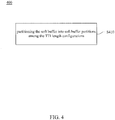
- FIG. 4 is a flow chart of a communication method 400 according to some embodiments of the present disclosure.
- the communication method 400 includes operation S410.
- the operation S410 may be performed by the processor 132 of FIG. 2 .
- FIG. 2 For ease of explanation and understanding, reference is made to FIG. 2 , FIG. 3 , and FIG. 4 .
- the soft buffer SB may be partitioned into soft buffer partitions SBP1 and SBP2.
- the soft buffer partition SBP1 has a size of Nsoftp(1)
- the soft buffer partition SBP2 has a size of Nsoftp(2).
- the sum of the partition size Nsoftp of the soft buffer partitions SBP1 and SBP2 is equal to the soft buffer size Nsoft of the soft buffer SB.
- Each of the soft buffer partitions SBP1 and SBP2 corresponds to one of the TTI length configuration.
- the proportions of the soft buffer partitions SBP among the different TTI length configurations may be determined by multiple factors, including but not limited to the TTI length, allocated frequency bandwidth, number of HARQ processes, and/or the maximum supported transport block size (TBS) of the TTI length configuration.
- TBS transport block size
- the soft buffer SB is partitioned into soft buffer partitions SBP among the TTI length configurations according to a plurality of HARQ process numbers corresponding to the TTI length configurations
- operation S410 includes the following operations: for each of the TTI length configurations, calculating a corresponding proportion of a corresponding HARQ process number over a sum of the plurality of HARQ process numbers; and partitioning the soft buffer according to the corresponding proportion, such that each of the TTI length configurations corresponds to a corresponding soft buffer partition.
- h(k) denotes the HARQ process number of TTI length configuration k;
- HARQ process number 3 + 8
- HARQ process number proportion of the normal TTI length configuration 8 3 + 8 .
- the HARQ process number for h(k) are for illustrative purposes only and the present disclosure is not limited thereto, as long as the unit of measurement is consistent.
- the soft buffer SB is then partitioned among different TTI length configurations in a proportion to the respective HARQ process numbers.
- Nsoftp(k) denotes the partition size Nsoftp required for storing soft channel bits of TTI length configuration k;
- Nsoft denotes the minimum soft buffer size Nsoft required for storing soft channel bits for a carrier at the UE or the carrier between the communication device 130 and internet 110;
- h(k) denotes the
- HARQ process number of TTI length configuration k 1 K h k denotes the sum of the HARQ process numbers of the TTI length configurations.
- the processor 132 is further configured to partition the corresponding soft buffer partitions SBP equally among the corresponding HARQ value.
- the processor 132 is further configured to partition the corresponding soft buffer partitions SBP equally among a plurality of corresponding codeblock values, and/or a plurality of corresponding MIMO transport block values.
- the soft buffer partition SBP1 may be further partitioned into several soft buffer units SBU1, and the soft buffer partition SBP2 may be further partitioned into several soft buffer units SBU2.
- Each of the soft buffer units SBU1 has a soft buffer unit size of Nir 1
- each of the soft buffer units SBU2 has a soft buffer unit size of Nir 2.
- the soft buffer SB is partitioned into soft buffer partitions SBP among the TTI length configurations according to a plurality of physical resource block (PRB) values corresponding to the TTI length configurations.
- PRB physical resource block
- operation S410 includes the following operations: for each of the TTI length configurations, calculating a corresponding proportion of a corresponding PRB value over a sum of the plurality of PRB values; and partitioning the soft buffer according to the corresponding proportion, such that each of the TTI length configurations corresponds to a corresponding soft buffer partition.
- configuration 1 is the shortened TTI
- configuration 2 is the normal TTI
- K 2.
- the PRB value proportion of the shortened TTI length configuration is 2 ⁇ 35 2 ⁇ 35 + 14 ⁇ 75
- the PRB value proportion of the normal TTI length configuration is 14 ⁇ 75 2 ⁇ 35 + 14 ⁇ 75 .
- the soft buffer SB is then partitioned among different TTI length configurations in a proportion to the respective PRB values.
- a shortened TTI with TTI length of 2 OFDM symbols and a configured bandwidth of 35 PRBs, and a normal TTI with TTI length of 14 OFDM symbols and a configured bandwidth of 75 PRBs are configured.
- the processor 132 is further configured to partition the corresponding soft buffer partitions SBP equally among the corresponding PRB value.
- the processor 132 is further configured to partition the corresponding soft buffer partitions SBP equally among a plurality of corresponding codeblock values, and/or a plurality of corresponding MIMO transport block values.
- the soft buffer partition SBP1 may be further partitioned into several soft buffer units SBU1, and the soft buffer partition SBP2 may be further partitioned into several soft buffer units SBU2.
- Each of the soft buffer units SBU1 has a soft buffer unit size of Nir 1
- each of the soft buffer units SBU2 has a soft buffer unit size of Nir 2.
- the soft buffer SB is partitioned into soft buffer partitions SBP among the TTI length configurations according to a plurality of maximum transport block size (TBS) values corresponding to the TTI length configurations.
- TBS maximum transport block size
- operation S410 includes the following operations: for each of the TTI length configurations, calculating a corresponding proportion of a corresponding maximum transport block size (TBS) value over a sum of the plurality of maximum transport block size (TBS) values; and partitioning the soft buffer according to the corresponding proportion, such that each of the TTI length configurations corresponds to a corresponding soft buffer partition.
- TBS maximum transport block size
- TBS(k) denotes the maximum supported downlink (DL) TBS for TTI length configuration k.
- TBS value proportion of the shortened TTI length configuration is 21384 21384 + 149776
- TBS value proportion of the normal TTI length configuration is 149776 21384 + 149776 .
- the soft buffer is then partitioned among different TTI length configurations in a proportion to the respective TBS values.
- the shortened TTI with TBS value of 21384 and a normal TTI with TBS value of 149776 are configured.
- the processor 132 is further configured to partition the corresponding soft buffer partitions SBP equally among the corresponding maximum transport block size (TBS) value.
- the processor 132 is further configured to partition the corresponding soft buffer partitions SBP equally among a plurality of corresponding codeblock values, and/or a plurality of corresponding MIMO transport block values.
- the soft buffer partition SBP1 may be further partitioned into several soft buffer units SBU1, and the soft buffer partition SBP2 may be further partitioned into several soft buffer units SBU2.
- Each of the soft buffer units SBU1 has a soft buffer unit size of Nir 1
- each of the soft buffer units SBU2 has a soft buffer unit size of Nir 2.
- the soft buffer SB may be divided into at least one soft buffer SB according to the number of downlink carriers. Since only a normal TTI is configured, the soft buffer SB needs not to be partitioned among the TTI configurations.
- the size Nsoftp soft buffer partition SBP of the normal carrier and the size Nsoft of the soft buffer SB are the same.
- the soft buffer partition SBP may be further partitioned into several soft buffer units SBU among the codeblock values, the MIMO transport block values, and the HARQ process numbers.
- Nir denotes the soft buffer unit size of the soft buffer unit SBU;
- Nsoft denotes the soft buffer size Nsoft of the soft buffer SB;
- C denotes the codeblock value;
- NcellsDL denotes the number of downlink carriers;
- KMIMO denotes MIMO transport block values;
- MDLHARQ denotes the HARQ process numbers; and Mlimit denotes a limit value.
- the soft buffer SB may be divided into at least one soft buffer SB according to the number of downlink carriers.
- the soft buffer SB may be partitioned into soft buffer partitions SBP1 and SBP2 according to the TTI length configuration values, as mentioning above.
- the soft buffer partitions SBP1 and SBP2 may be further partitioned into several soft buffer units SBU1 and SBU2, respectively, among the codeblock values, the MIMO transport block values, and the HARQ process numbers.
- the communication device 130 determines the soft buffer partition size Nsoftp for storing soft channel bits for each TTI length configuration using the unequal partition method previously described on a given soft buffer size Nsoft, which may be specified in the specification.
- the communication device 130 further determines the soft buffer unit size for a codeblock with a configured number of MIMO transport blocks, and a number of specified HARQ processes within the soft buffer partitioned for a particular TTI length configuration using an equal partition method.
- the soft buffer may be partitioned into soft buffer partitions with partition sizes in a proportion to the product of TTI length, bandwidth, and number of HARQ processes, or in a proportion to the product of number of HARQ processes and maximum supported TBS.
- the principle remains the same, and similar rules can be obtained following the teachings described above.
- FIG. 5 is a schematic diagram of a wireless communication system 500 according to some embodiments of the present disclosure.
- the wireless communication system 500 includes base station 510 and several communication devices 530.
- the communication devices 530 may be user equipment (UE).
- the base station 510 and the communication devices 530 may communicate with each other via one or more carriers of licensed band(s) and/or unlicensed band(s).
- the base station 510 and several communication devices 530 are simply utilized for illustrating the structure of the wireless communication system 500, and the present disclosure is not limited thereto.
- the configured carriers between the network 510 and the communication devices 530 may include several different transmission time interval (TTI) length configurations.
- the transmission time interval (TTI) length configurations may include a normal TTI and a shortened TTI.
- the TTI length configuration values among the TTI length configurations are different.
- the TTI length configuration values include but not limited to the number of codeblock, the number of MIMO transport blocks, the TTI length values, and the number of HARQ processes.
- the TTI length configuration values are configured by the network.
- FIG. 6 is a schematic block diagram of a base station 510 according to some embodiments of the present disclosure.
- the base station 510 may include a processor 512, a storage unit 514, and a communication interfacing unit 516.
- the storage unit 514 stores a program code 515.
- the program code may be accessed by the processor 512 to perform several operations according to the program code 515 accessed.
- the communication interfacing unit 516 is configured to communicate with the communication device 530 according to the operation results of the processor 512. In some embodiments, the communication interfacing unit 516 may communicate with the communication device 530 by wireless signals.
- FIG. 7 is a flow chart of a communication method 700 according to some embodiments of the present disclosure.
- the communication method 700 includes operations S710-S730.
- the operations S710-S730 may be performed by the processor 512 in FIG. 6 .
- S710 obtaining a soft buffer size of the communication device and a corresponding TTI length configuration value for each of the TTI length configurations;
- S750 determining a circular buffer size for each of the TTI length configurations according to the partition size.
- obtaining a soft buffer size of the communication device and a corresponding TTI length configuration value for each of the TTI length configurations may obtain the soft buffer size Nsoft of the communication devices 530.
- the sum of the partition sizes Nsoftp is equal to a soft buffer size of the at least one soft buffer Nsoft.
- the partition sizes Nsoftp are unequal among the TTI length configurations.
- the partition sizes of the TTI length configurations are in a proportion to the TTI length configuration values respectively.
- the TTI length configuration value may be the HARQ process number, the maximum transport block size value, the physical resource block (PRB) value, or a combination thereof.
- PRB physical resource block
- operation S730 further includes the following operations: for each of the TTI length configurations, calculating a corresponding proportion of the corresponding TTI length configuration value over a sum of the TTI length configuration values corresponding to the plurality of TTI length configuration; and calculating the partition size according to the corresponding proportion, such that each of the TTI length configurations corresponds to a corresponding partition size.
- the TTI length configuration value proportions are calculated according to the HARQ process numbers, the transport block size values, the physical resource block (PRB) values, or a combination thereof.
- PRB physical resource block
- the processor 512 is further configured to partition the soft buffer partitions SBP among the codeblock values, the MIMO transport block values, and the HARQ process numbers.
- the codeblock values, the transport block values, and the HARQ process numbers correspond to the TTI length configurations.
- Nir denotes the soft buffer unit size; Nsoft denotes the soft buffer size of the soft buffer; C denotes the codeblock value; KMIMO denotes MIMO transport block values; MDLHARQ denotes the HARQ process numbers; and Mlimit denotes a limit value.
- Nir denotes the soft buffer unit size
- Nsoft denotes the soft buffer size of the soft buffer
- C denotes the codeblock value
- KMIMO denotes MIMO transport block values
- MDLHARQ denotes the HARQ process numbers
- Mlimit denotes a limit value
- Nsoft denotes the soft buffer size of the soft buffer SB
- k 1 or 2 depending on the TTI length configuration
- Nsoftp k Nsoft may be obtained as above-mentioned.
- the processor 512 is further configured to encode a data into a encoded data and truncate the encoded data according to the size of the circular buffer, and store the truncated encoded data in the circular buffer.
- the truncated encoded data may be transmitted to the communication device 530 and stored in the soft buffer SB of the communication device 530.
- the base station 510 determines the length of the circular buffer according to the size of the encoded data and the partition sizes Nsoftp of the soft buffer partitions SBP as derived above. If the encoded data size exceeds the corresponding partition size Nsoftp, the encoded data is truncated. The base station 510 then performs rate matching operation on the truncated data. Otherwise if the encoded data size does not exceed the corresponding partition size Nsoftp, the base station performs rate matching operation on the whole encoded data without truncation. In some embodiments, the remaining data that exceeds the partition size Nsoftp are discarded.
- the processor 132 and 512 may be a microprocessor or an Application Specific Integrated Circuit (ASIC), or other devices or circuits with the function of calculating, processing, information receiving/sending or other similar functions.
- the storage unit 134 and 514 may be a subscriber identity module (SIM), read-only memory (ROM), flash memory, random-access memory (RAM), hard disk, optical data storage device, or other devices or circuits with the function of data storing or other similar functions.
- the embodiment of the present disclosure is to provide a communication device and a base station, and in particular, a communication device and a base station for partitioning a soft buffer unequally among the different transmission time interval (TTI) length configurations, in order to reduce the cost.
- TTI transmission time interval
Landscapes
- Engineering & Computer Science (AREA)
- Computer Networks & Wireless Communication (AREA)
- Signal Processing (AREA)
- Mobile Radio Communication Systems (AREA)
Description
- This application claims priority to
U.S. Provisional Application Serial Number 62/376,926, filed August 19, 2016 - The present invention relates to a communication device and a base station. More particularly, the present invention relates to a communication device and a base station for partitioning a soft buffer unequally among the different transmission time interval (TTI) length configurations.
- HARQ is an essential physical layer transmission technique in modern communication systems, where retransmissions are requested by the receiver by sending a HARQ feedback message in the case of decoding failure. The HARQ feedback message can be as simple as an acknowledgment/negative-acknowledgment (ACK/NACK) to signify whether the last decoding was successful or not. Upon receiving a NACK, the transmitter sends a retransmission, which is combined in some ways with failed previous transmissions to form a better judgment as there is still useful information embedded in previous failed transmissions.
- To appropriately operate HARQ, the receiver has to be aware of the existence of a transmission in advance even if the transmission itself fails to be correctly decoded, so that the failed transmission can be retained and combined with the retransmissions later. In LTE/LTE-A, the enhanced NodeB (eNB) issues an explicit control message, a DL grant or an UL grant, to a user equipment (UE) for a DL transmission and an UL transmission, respectively. The UE thus expects a DL transmission in a predetermined time-frequency resource, and buffers the DL transmission if it fails decoding.
- A soft buffer for storing soft channel bits is required at the UE to perform HARQ soft combining. Normally, the soft buffer at UE for storing soft channel bits is equally divided among the component carriers (CCs), and further divided among the transport blocks and HARQ processes. For a system supporting various transmission time interval (TTI) lengths concurrently, equally dividing the soft buffer among transport blocks and HARQ processes is neither desirable nor cost-effective.
- Therefore, how to partition a soft buffer unequally among the different transmission time interval (TTI) length configurations, in order to reduce the cost, are problems to be improved in the field.
- An embodiment of this disclosure is to provide a communication device. The communication device is configured to communicate with a network via at least one carrier, in which the at least one carrier includes a plurality of transmission time interval (TTI) length configurations. The communication device includes a soft buffer for storing a downlink data transmission from the network; a storage unit configured to store a program code; and a processor electrically coupled to the storage unit. The processor is configured to access the program code to partition the soft buffer into a plurality of soft buffer partitions among the TTI length configurations according to a plurality of HARQ process numbers corresponding to the TTI length configurations.
- An embodiment of this disclosure is to provide a communication device. The communication device is configured to communicate with a network via at least one carrier, wherein the at least one carrier includes a plurality of transmission time interval (TTI) length configurations, in which the communication device includes a soft buffer for storing a downlink data transmission from the network; a storage unit configured to store a program code; and a processor electrically coupled to the storage unit, wherein the processor is configured to access the program code to partition the soft buffer into a plurality of soft buffer partitions among the TTI length configurations according to a plurality of physical resource block (PRB) values corresponding to the TTI length configurations.
- An embodiment of this disclosure is to provide a communication device. The communication device is configured to communicate with a network via at least one carrier, wherein the at least one carrier includes a plurality of transmission time interval (TTI) length configurations, in which the communication device includes a soft buffer for storing a downlink data transmission from the network; a storage unit configured to store a program code; and a processor electrically coupled to the storage unit, wherein the processor is configured to access the program code to partition the soft buffer into a plurality of soft buffer partitions among the TTI length configurations according to a plurality of maximum transport block size (TBS) values corresponding to the TTI length configurations.
- Yet another embodiment of this disclosure is to provide a base station. The base station is configured to communicate with a communication device via at least one carrier, wherein the communication device comprising a soft buffer. The at least one carrier includes a plurality of transmission time interval (TTI) length configurations. The base station includes: a storage unit configured to store a program code; and a processor electrically coupled to the storage unit, wherein the processor is configured to access the program code to obtain a soft buffer size of the communication device and a corresponding TTI length configuration value for each of the TTI length configurations, calculate a partition size for each of the TTI length configurations according to the soft buffer size and the corresponding TTI length configuration value, and determine a circular buffer size for each of the TTI length configurations according to the partition size.
- The embodiments of the present disclosure is to provide a communication device and a base station, and in particular, a communication device and a base station for a soft buffer unequally among the different transmission time interval (TTI) length configurations, in order to reduce the cost.
- These and other features, aspects, and advantages of the present invention will become better understood with reference to the following description and appended claims.
- It is to be understood that both the foregoing general description and the following detailed description are by examples, and are intended to provide further explanation of the invention as claimed.
- The invention can be more fully understood by reading the following detailed description of the embodiment, with reference made to the accompanying drawings as follows:
-
FIG. 1 is a schematic diagram of a wireless communication system according to some embodiments of the present disclosure. -
FIG. 2 is a schematic block diagram of a communication device according to some embodiments of the present disclosure. -
FIG. 3 is a schematic diagram of a soft buffer according to some embodiments of the present disclosure. -
FIG. 4 is a flow chart of a communication method according to some embodiments of the present disclosure. -
FIG. 5 is a schematic diagram of a wireless communication system according to some embodiments of the present disclosure. -
FIG. 6 is a schematic block diagram of a base station according to some embodiments of the present disclosure. -
FIG. 7 is a flow chart of a communication method according to some embodiments of the present disclosure. - A soft buffer for storing soft channel bits is required at the user equipment (UE) to perform HARQ soft combining. The UE's total soft buffer size is specified as one of multiple properties of the UE category. The total soft buffer size is proportional to the maximum transport block size supported, and the carrier aggregation (CA) capability. The term soft buffer refers to the buffer used for storing total number of soft channel bits.
-
FIG. 1 is a schematic diagram of awireless communication system 100 according to some embodiments of the present disclosure. Thewireless communication system 100 includesnetwork 110 andseveral communication devices 130. Thecommunication devices 130 may be user equipment (UE). Thenetwork 110 and thecommunication devices 130 may communicate with each other via one or more carriers of licensed band(s) and/or unlicensed band(s). InFIG. 1 , thecommunication devices 130 and thenetwork 110 are simply utilized for illustrating the structure of thewireless communication system 100, and the present disclosure is not limited thereto. Practically, the network may be an evolved UTRAN (E-UTRAN) including at least one evolved NB (eNB) and/or at least one relay in a long term evolution (LTE) system, a LTE-Advanced (LTE-A) system or an evolution of the LTE-A system. The eNB or the relay may be termed as a base station. - The configured carriers between the
network 110 and thecommunication devices 130 may include several different transmission time interval (TTI) length configurations. In some embodiments, the transmission time interval (TTI) length configurations may include a normal TTI and a shortened TTI. The TTI length configuration values among the TTI length configurations are different. The TTI length configuration values include but not limited to the number of codeblock, the number of MIMO (Multi-input Multi-output) transport blocks, the TTI length values, and the number of HARQ processes. In some embodiments, the TTI length configuration values are configured by the network. - Reference is made to
FIG. 2. FIG. 2 is a schematic block diagram of acommunication device 130 according to some embodiments of the present disclosure. Thecommunication device 130 may include aprocessor 132, astorage unit 134, a soft buffer SB, and acommunication interfacing unit 136. In some embodiments, the soft buffer SB is configured to store a downlink data transmission from thenetwork 110. In some embodiments, thestorage unit 134 stores aprogram code 135. The program code may be accessed by theprocessor 132 to perform several operations according to theprogram code 135. Thecommunication interfacing unit 136 is configured to communicate with thenetwork 110 according to the operation results of theprocessor 132. In some embodiments, thecommunication interfacing unit 136 may communicate with thenetwork 110 by wireless signals. - Reference is made to
FIG. 3. FIG. 3 is a schematic diagram of a soft buffer SB according to some embodiments of the present disclosure. The soft buffer SB has a size of Nsoft. - Reference is made to
FIG. 4. FIG. 4 is a flow chart of acommunication method 400 according to some embodiments of the present disclosure. Thecommunication method 400 includes operation S410. In some embodiments, the operation S410 may be performed by theprocessor 132 ofFIG. 2 . - S410: partitioning the soft buffer into a plurality of soft buffer partitions among the TTI length configurations.
- For ease of explanation and understanding, reference is made to
FIG. 2 ,FIG. 3 , andFIG. 4 . - In S410: partitioning the soft buffer into a plurality of soft buffer partitions among the TTI length configurations. The soft buffer size SB of the soft buffer SB is equal to the sum of the partition sizes Nsoftp of the soft buffer portions SBP. For example, assume K different TTI length configurations are configured; K > 1. Let Nsoftp(k) denotes the partition size Nsoftp required for storing soft channel bits of TTI length configuration k, ;
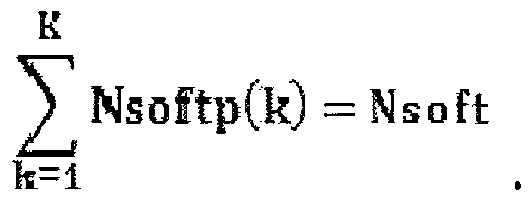
- As illustrated in
FIG. 3 , the soft buffer SB may be partitioned into soft buffer partitions SBP1 and SBP2. The soft buffer partition SBP1 has a size of Nsoftp(1), and the soft buffer partition SBP2 has a size of Nsoftp(2). The sum of the partition size Nsoftp of the soft buffer partitions SBP1 and SBP2 is equal to the soft buffer size Nsoft of the soft buffer SB. Each of the soft buffer partitions SBP1 and SBP2 corresponds to one of the TTI length configuration. - The proportions of the soft buffer partitions SBP among the different TTI length configurations may be determined by multiple factors, including but not limited to the TTI length, allocated frequency bandwidth, number of HARQ processes, and/or the maximum supported transport block size (TBS) of the TTI length configuration.
- In some embodiments, the soft buffer SB is partitioned into soft buffer partitions SBP among the TTI length configurations according to a plurality of HARQ process numbers corresponding to the TTI length configurations
- For example, in some embodiments, operation S410 includes the following operations: for each of the TTI length configurations, calculating a corresponding proportion of a corresponding HARQ process number over a sum of the plurality of HARQ process numbers; and partitioning the soft buffer according to the corresponding proportion, such that each of the TTI length configurations corresponds to a corresponding soft buffer partition.
- For example, let h(k) denotes the HARQ process number of TTI length configuration k. Mathematically the HARQ process number proportions may be calculated as the following equation, assuming a total of K TTI length configurations are configured:


- For example, assume
configuration 1 is the shortened TTI, andconfiguration 2 is the normal TTI, and K = 2. If the shortened TTI with HARQ process number of 3 and the normal TTI with HARQ process number of 8 are configured. That is, h(1) = 3 and h(2) = 8. The HARQ process number proportion of the shortened TTI length configuration is

- The soft buffer SB is then partitioned among different TTI length configurations in a proportion to the respective HARQ process numbers. The partition sizes Nsoftp are in a proportion to the HARQ process numbers respectively, as the following equation:

communication device 130 andinternet 110; h(k) denotes the - HARQ process number of TTI length configuration k; and

- In some embodiments, in the event that the soft buffer partitions do not have an integer during partitioning, a certain rule for rounding may be specified. For example, rounding down to the nearest integer, or rounding up to the nearest integer for all k except k = 1.
- For example, if the soft buffer size Nsoft is obtained from the specification of the
communication device 130 as 3667200, assumingconfiguration 1 is the shortened TTI, andconfiguration 2 is the normal TTI, and K = 2. If the shortened TTI with HARQ process number of 3 and the normal TTI with HARQ process number of 8 are configured. That is, h(1) = 3 and h(2) = 8. The rule of rounding up to the nearest integer for all k except k = 1 is adopted. According to the HARQ process number proportions, the soft buffer partition size Nsoftp of shortened TTI is

- In some embodiments, for each of the TTI length configurations, the
processor 132 is further configured to partition the corresponding soft buffer partitions SBP equally among the corresponding HARQ value. - In some embodiments, the
processor 132 is further configured to partition the corresponding soft buffer partitions SBP equally among a plurality of corresponding codeblock values, and/or a plurality of corresponding MIMO transport block values. - As shown in
FIG. 3 , the soft buffer partition SBP1 may be further partitioned into several soft buffer units SBU1, and the soft buffer partition SBP2 may be further partitioned into several soft buffer units SBU2. Each of the soft buffer units SBU1 has a soft buffer unit size ofNir 1, and each of the soft buffer units SBU2 has a soft buffer unit size ofNir 2. - In some other embodiments, in operation S410, the soft buffer SB is partitioned into soft buffer partitions SBP among the TTI length configurations according to a plurality of physical resource block (PRB) values corresponding to the TTI length configurations.
- For example, in some embodiments, operation S410 includes the following operations: for each of the TTI length configurations, calculating a corresponding proportion of a corresponding PRB value over a sum of the plurality of PRB values; and partitioning the soft buffer according to the corresponding proportion, such that each of the TTI length configurations corresponds to a corresponding soft buffer partition.
- In some embodiments, the PRB value proportions are calculated according to the configured bandwidth values and the TTI length values. In some embodiments, the PRB value proportions are calculated by multiplying the configured bandwidth values and the TTI length values. For example, let 1(k) denotes the TTI length value of TTI length configuration k, and b(k) denotes the configured bandwidth value for TTI length configuration k. Mathematically the PRB value proportions may be calculated as the following equation, assuming a total of K TTI length configurations are configured:


- For example, assume
configuration 1 is the shortened TTI, andconfiguration 2 is the normal TTI, and K = 2. If the shortened TTI with TTI length of 2 OFDM symbols and the normal TTI with TTI length of 14 OFDM symbols are configured, l(1) = 2 and l(2) = 14. If the shortened TTI with a configured frequency bandwidth of 35 PRBs and the normal TTI with a configured frequency bandwidth 75 PRBs are configured, b(1) = 35 and b(2) = 75. The PRB value proportion of the shortened TTI length configuration is

- The soft buffer SB is then partitioned among different TTI length configurations in a proportion to the respective PRB values. the partition sizes Nsoftp are in a proportion to the PRB values respectively, as the following equation:

communication device 130 andinternet 110; 1(k)b(k) denotes the PRB value of the TTI length configuration k; and
- For example, if the soft buffer size Nsoft is obtained from the specification of the
communication device 130 as 3667200, assumingconfiguration 1 is the shortened TTI, andconfiguration 2 is the normal TTI, and K = 2. A shortened TTI with TTI length of 2 OFDM symbols and a configured bandwidth of 35 PRBs, and a normal TTI with TTI length of 14 OFDM symbols and a configured bandwidth of 75 PRBs are configured. According to the PRB value proportions, the soft buffer partition size Nsoftp for the shortened TTI is

- In some embodiments, for each of the TTI length configurations, the
processor 132 is further configured to partition the corresponding soft buffer partitions SBP equally among the corresponding PRB value. - In some embodiments, the
processor 132 is further configured to partition the corresponding soft buffer partitions SBP equally among a plurality of corresponding codeblock values, and/or a plurality of corresponding MIMO transport block values. - As shown in
FIG. 3 , the soft buffer partition SBP1 may be further partitioned into several soft buffer units SBU1, and the soft buffer partition SBP2 may be further partitioned into several soft buffer units SBU2. Each of the soft buffer units SBU1 has a soft buffer unit size ofNir 1, and each of the soft buffer units SBU2 has a soft buffer unit size ofNir 2. - In some other embodiments, in operation S410, the soft buffer SB is partitioned into soft buffer partitions SBP among the TTI length configurations according to a plurality of maximum transport block size (TBS) values corresponding to the TTI length configurations.
- For example, in some embodiments, operation S410 includes the following operations: for each of the TTI length configurations, calculating a corresponding proportion of a corresponding maximum transport block size (TBS) value over a sum of the plurality of maximum transport block size (TBS) values; and partitioning the soft buffer according to the corresponding proportion, such that each of the TTI length configurations corresponds to a corresponding soft buffer partition.
- For example, let TBS(k) denotes the maximum supported downlink (DL) TBS for TTI length configuration k. Mathematically the TBS value proportions may be calculated as the following equation:


- For example, assume
configuration 1 is the shortened TTI, andconfiguration 2 is the normal TTI, and K = 2. If the shortened TTI with TBS value of 21384 and the normal TTI with TBS value of 149776 are configured. That is, TBS(1) = 21384 and TBS(2) = 149776, the TBS value proportion of the shortened TTI length configuration is

- The soft buffer is then partitioned among different TTI length configurations in a proportion to the respective TBS values. The partition sizes are in a proportion to the TTI length configuration values respectively, as the following equation:

communication device 130 andinternet 110; TBS(k) denotes the maximum supported downlink (DL) TBS for TTI length configuration k; and
- For example, if the soft buffer size Nsoft is obtained from the specification of the
communication device 130 as 3667200, assumingconfiguration 1 is the shortened TTI, andconfiguration 2 is the normal TTI, and K = 2. The shortened TTI with TBS value of 21384 and a normal TTI with TBS value of 149776 are configured. According to the TTI value proportions, the soft buffer partition size Nsoftp of shortened TTI is

- In some embodiments, for each of the TTI length configurations, the
processor 132 is further configured to partition the corresponding soft buffer partitions SBP equally among the corresponding maximum transport block size (TBS) value. - In some embodiments, the
processor 132 is further configured to partition the corresponding soft buffer partitions SBP equally among a plurality of corresponding codeblock values, and/or a plurality of corresponding MIMO transport block values. - As shown in
FIG. 3 , the soft buffer partition SBP1 may be further partitioned into several soft buffer units SBU1, and the soft buffer partition SBP2 may be further partitioned into several soft buffer units SBU2. Each of the soft buffer units SBU1 has a soft buffer unit size ofNir 1, and each of the soft buffer units SBU2 has a soft buffer unit size ofNir 2. - For example, assume only a normal TTI is configured. The soft buffer SB may be divided into at least one soft buffer SB according to the number of downlink carriers. Since only a normal TTI is configured, the soft buffer SB needs not to be partitioned among the TTI configurations. The size Nsoftp soft buffer partition SBP of the normal carrier and the size Nsoft of the soft buffer SB are the same. The soft buffer partition SBP may be further partitioned into several soft buffer units SBU among the codeblock values, the MIMO transport block values, and the HARQ process numbers.
- Mathematically, the soft buffer unit size Nir of the soft buffer unit when only a normal TTI is configured may be as the following equation:

- For another example, assume a shortened TTI and a normal TTI are configured.
Configuration 1 is the shortened TTI, andconfiguration 2 is the normal TTI. The soft buffer SB may be divided into at least one soft buffer SB according to the number of downlink carriers. The soft buffer SB may be partitioned into soft buffer partitions SBP1 and SBP2 according to the TTI length configuration values, as mentioning above. The soft buffer partitions SBP1 and SBP2 may be further partitioned into several soft buffer units SBU1 and SBU2, respectively, among the codeblock values, the MIMO transport block values, and the HARQ process numbers. - Mathematically, the soft buffer unit size Nir of the soft buffer unit when only a normal TTI is configured may be as the following equation:


- When multiple TTI length configurations are configured, the
communication device 130 determines the soft buffer partition size Nsoftp for storing soft channel bits for each TTI length configuration using the unequal partition method previously described on a given soft buffer size Nsoft, which may be specified in the specification. Thecommunication device 130 further determines the soft buffer unit size for a codeblock with a configured number of MIMO transport blocks, and a number of specified HARQ processes within the soft buffer partitioned for a particular TTI length configuration using an equal partition method. - Note that the proportion values calculated according to other combinations of TTI length value, frequency bandwidth value, number of HARQ processes, and/or maximum supported TBS for partitioning the soft buffer are not precluded. For example, the soft buffer may be partitioned into soft buffer partitions with partition sizes in a proportion to the product of TTI length, bandwidth, and number of HARQ processes, or in a proportion to the product of number of HARQ processes and maximum supported TBS. The principle remains the same, and similar rules can be obtained following the teachings described above.
- Reference is made to
FIG. 5. FIG. 5 is a schematic diagram of awireless communication system 500 according to some embodiments of the present disclosure. Thewireless communication system 500 includesbase station 510 andseveral communication devices 530. Thecommunication devices 530 may be user equipment (UE). Thebase station 510 and thecommunication devices 530 may communicate with each other via one or more carriers of licensed band(s) and/or unlicensed band(s). InFIG. 1 , thebase station 510 andseveral communication devices 530 are simply utilized for illustrating the structure of thewireless communication system 500, and the present disclosure is not limited thereto. - The configured carriers between the
network 510 and thecommunication devices 530 may include several different transmission time interval (TTI) length configurations. In some embodiments, the transmission time interval (TTI) length configurations may include a normal TTI and a shortened TTI. The TTI length configuration values among the TTI length configurations are different. The TTI length configuration values include but not limited to the number of codeblock, the number of MIMO transport blocks, the TTI length values, and the number of HARQ processes. In some embodiments, the TTI length configuration values are configured by the network. - Reference is made to
FIG. 6. FIG. 6 is a schematic block diagram of abase station 510 according to some embodiments of the present disclosure. Thebase station 510 may include aprocessor 512, astorage unit 514, and acommunication interfacing unit 516. In some embodiments, thestorage unit 514 stores aprogram code 515. The program code may be accessed by theprocessor 512 to perform several operations according to theprogram code 515 accessed. Thecommunication interfacing unit 516 is configured to communicate with thecommunication device 530 according to the operation results of theprocessor 512. In some embodiments, thecommunication interfacing unit 516 may communicate with thecommunication device 530 by wireless signals. - Reference is made to
FIG. 7. FIG. 7 is a flow chart of acommunication method 700 according to some embodiments of the present disclosure. Thecommunication method 700 includes operations S710-S730. The operations S710-S730 may be performed by theprocessor 512 inFIG. 6 . - S710: obtaining a soft buffer size of the communication device and a corresponding TTI length configuration value for each of the TTI length configurations;
- S730: calculating a partition size for each of the TTI length configurations according to the soft buffer size and the corresponding TTI length configuration value; and
- S750: determining a circular buffer size for each of the TTI length configurations according to the partition size.
- In operation S710, obtaining a soft buffer size of the communication device and a corresponding TTI length configuration value for each of the TTI length configurations. The
base station 510 may obtain the soft buffer size Nsoft of thecommunication devices 530. - In operation S730, calculating a partition size for each of the TTI length configurations according to the soft buffer size and the corresponding TTI length configuration value. The sum of the partition sizes Nsoftp is equal to a soft buffer size of the at least one soft buffer Nsoft. The partition sizes Nsoftp are unequal among the TTI length configurations. In some embodiments, the partition sizes of the TTI length configurations are in a proportion to the TTI length configuration values respectively. The TTI length configuration value may be the HARQ process number, the maximum transport block size value, the physical resource block (PRB) value, or a combination thereof. The details of the calculation of the partition sizes Nsoftp may be as the above mentioned, and will not be repeated here.
- In some embodiments, operation S730 further includes the following operations: for each of the TTI length configurations, calculating a corresponding proportion of the corresponding TTI length configuration value over a sum of the TTI length configuration values corresponding to the plurality of TTI length configuration; and calculating the partition size according to the corresponding proportion, such that each of the TTI length configurations corresponds to a corresponding partition size. The TTI length configuration value proportions are calculated according to the HARQ process numbers, the transport block size values, the physical resource block (PRB) values, or a combination thereof. The details of operation S730 may be as the above mentioned, and will not be repeated here.
- In some embodiments, the
processor 512 is further configured to partition the soft buffer partitions SBP among the codeblock values, the MIMO transport block values, and the HARQ process numbers. The codeblock values, the transport block values, and the HARQ process numbers correspond to the TTI length configurations. - For example, the soft buffer unit size Nir of the soft buffer unit when only a normal TTI and only a downlink carrier is configured may be as the following equation:

- For another example, the soft buffer unit size Nir of the soft buffer unit when a shortened TTI and a normal TTI are configured, and only a downlink carrier is configured, in which
configuration 1 is the shortened TTI, andconfiguration 2 is the normal TTI, may be as the following equation:

- In operation S750, determining a circular buffer size for each of the TTI length configurations according to the partition size. In some embodiments, the
processor 512 is further configured to encode a data into a encoded data and truncate the encoded data according to the size of the circular buffer, and store the truncated encoded data in the circular buffer. In some embodiments, the truncated encoded data may be transmitted to thecommunication device 530 and stored in the soft buffer SB of thecommunication device 530. - The
base station 510 then determines the length of the circular buffer according to the size of the encoded data and the partition sizes Nsoftp of the soft buffer partitions SBP as derived above. If the encoded data size exceeds the corresponding partition size Nsoftp, the encoded data is truncated. Thebase station 510 then performs rate matching operation on the truncated data. Otherwise if the encoded data size does not exceed the corresponding partition size Nsoftp, the base station performs rate matching operation on the whole encoded data without truncation. In some embodiments, the remaining data that exceeds the partition size Nsoftp are discarded. - Note that a normal cyclic prefix (CP) in LTE systems has been assumed in the disclosure. The current disclosure may straightforwardly apply to a communication system with extended CP.
- In some embodiments, the
processor storage unit - According to the embodiments of the present disclosure, it is understood that the embodiment of the present disclosure is to provide a communication device and a base station, and in particular, a communication device and a base station for partitioning a soft buffer unequally among the different transmission time interval (TTI) length configurations, in order to reduce the cost.
- Although the present invention has been described in considerable detail with reference to certain embodiments thereof, other embodiments are possible. Therefore, the scope of the appended claims should not be limited to the description of the embodiments contained herein.
Claims (15)
- A communication device configured to communicate with a network via at least one carrier, wherein the at least one carrier comprises a plurality of transmission time interval (TTI) length configurations, wherein the communication device comprises:a soft buffer for storing a downlink data transmission from the network;a storage unit configured to store a program code; anda processor electrically coupled to the storage unit, wherein the processor is configured to access the program code to partition the soft buffer into a plurality of soft buffer partitions among the TTI length configurations according to a plurality of HARQ process numbers corresponding to the TTI length configurations.
- The communication device of claim 1, wherein partitioning the soft buffer of the communication device into soft buffer partitions comprises:for each of the TTI length configurations, calculating a corresponding proportion of a corresponding HARQ process number over a sum of the plurality of HARQ process numbers; andpartitioning the soft buffer according to the corresponding proportion, such that each of the TTI length configurations corresponds to a corresponding soft buffer partition.
- The communication device of claim 2, wherein for each of the TTI length configurations, the processor is further configured to partition the corresponding soft buffer partition equally among the corresponding HARQ process number.
- The communication device of claim 2, wherein for each of the TTI length configurations, the processor is further configured to partition the corresponding soft buffer partition equally among a plurality of corresponding codeblock values, and/or a plurality of corresponding MIMO transport block values.
- A communication device configured to communicate with a network via at least one carrier, wherein the at least one carrier comprises a plurality of transmission time interval (TTI) length configurations, wherein the communication device comprises:a soft buffer for storing a downlink data transmission from the network;a storage unit configured to store a program code; anda processor electrically coupled to the storage unit, wherein the processor is configured to access the program code to partition the soft buffer into a plurality of soft buffer partitions among the TTI length configurations according to a plurality of physical resource block (PRB) values corresponding to the TTI length configurations.
- The communication device of claim 5, wherein partitioning the soft buffer of the communication device into soft buffer partitions comprises:for each of the TTI length configurations, calculating a corresponding proportion of a corresponding PRB value over a sum of the plurality of PRB values; andpartitioning the soft buffer according to the corresponding proportion, such that each of the TTI length configurations corresponds to a corresponding soft buffer partition.
- The communication device of claim 6, wherein for each of the TTI length configurations, the processor is further configured to partition the corresponding soft buffer partition equally among a plurality of corresponding codeblock values, and/or a plurality of corresponding MIMO transport block values, and/or a plurality of corresponding HARQ process numbers.
- A communication device configured to communicate with a network via at least one carrier, wherein the at least one carrier comprises a plurality of transmission time interval (TTI) length configurations, wherein the communication device comprises:a soft buffer for storing a downlink data transmission from the network;a storage unit configured to store a program code; anda processor electrically coupled to the storage unit, wherein the processor is configured to access the program code to partition the soft buffer into a plurality of soft buffer partitions among the TTI length configurations according to a plurality of maximum transport block size (TBS) values corresponding to the TTI length configurations.
- The communication device of claim 8, wherein a soft buffer size of the soft buffer is equal to a sum of a plurality of partition sizes of the soft buffer partitions.
- The communication device of claim 8, wherein partitioning the soft buffer of the communication device into soft buffer partitions comprises:for each of the TTI length configurations, calculating a corresponding proportion of a corresponding maximum transport block size (TBS) value over a sum of the plurality of maximum transport block size (TBS) values; andpartitioning the soft buffer according to the corresponding proportion, such that each of the TTI length configurations corresponds to a corresponding soft buffer partition.
- The communication device of claim 10, wherein for each of the TTI length configurations, the processor is further configured to partition the corresponding soft buffer partition equally among a plurality of corresponding codeblock values, and/or a plurality of corresponding MIMO transport block values, and/or a plurality of corresponding HARQ process numbers.
- A base station configured to communicate with a communication device via at least one carrier, wherein the communication device comprising a soft buffer, wherein the at least one carrier comprises a plurality of transmission time interval (TTI) length configurations, wherein the base station comprises:a storage unit configured to store a program code; anda processor electrically coupled to the storage unit, wherein the processor is configured to access the program code to obtain a soft buffer size of the communication device and a corresponding TTI length configuration value for each of the TTI length configurations, calculate a partition size for each of the TTI length configurations according to the soft buffer size and the corresponding TTI length configuration value, and determine a circular buffer size for each of the TTI length configurations according to the partition size.
- The base station of claim 12, wherein the corresponding TTI length configuration value comprises a HARQ process number, a maximum transport block size (TBS) value, a physical resource block (PRB) value, or a combination thereof.
- The base station of claim 12, wherein calculating the partition size comprises:for each of the TTI length configurations, calculating a corresponding proportion of the corresponding TTI length configuration value over a sum of the TTI length configuration values corresponding to the plurality of TTI length configuration; andcalculating the partition size according to the corresponding proportion, such that each of the TTI length configurations corresponds to a corresponding partition size.
- The base station of claim 12, wherein the processor is further configured to encode a data into an encoded data, and truncate the encoded data according to the size of the circular buffer, and store the truncated encoded data in the circular buffer.
Applications Claiming Priority (1)
| Application Number | Priority Date | Filing Date | Title |
|---|---|---|---|
| US201662376926P | 2016-08-19 | 2016-08-19 |
Publications (2)
| Publication Number | Publication Date |
|---|---|
| EP3288207A1 true EP3288207A1 (en) | 2018-02-28 |
| EP3288207B1 EP3288207B1 (en) | 2020-10-07 |
Family
ID=59655984
Family Applications (1)
| Application Number | Title | Priority Date | Filing Date |
|---|---|---|---|
| EP17186909.2A Active EP3288207B1 (en) | 2016-08-19 | 2017-08-18 | Communication device and base station |
Country Status (2)
| Country | Link |
|---|---|
| US (1) | US10292157B2 (en) |
| EP (1) | EP3288207B1 (en) |
Cited By (2)
| Publication number | Priority date | Publication date | Assignee | Title |
|---|---|---|---|---|
| EP3528536A4 (en) * | 2016-11-03 | 2019-11-06 | Huawei Technologies Co., Ltd. | Method and apparatus for wireless communication |
| CN111510258A (en) * | 2019-01-31 | 2020-08-07 | 大唐移动通信设备有限公司 | Data processing method and device |
Families Citing this family (6)
| Publication number | Priority date | Publication date | Assignee | Title |
|---|---|---|---|---|
| CN109644370B (en) * | 2016-08-31 | 2022-10-04 | 株式会社Ntt都科摩 | User terminal and wireless communication method |
| US11497007B2 (en) | 2017-05-05 | 2022-11-08 | Qualcomm Incorporated | Sounding reference signal configuration and transport block size scaling in low latency systems |
| US11005602B2 (en) * | 2017-10-02 | 2021-05-11 | Mediatek Inc. | HARQ buffer size design for communication systems |
| CN110808815B (en) * | 2019-10-30 | 2021-10-22 | 紫光展锐(重庆)科技有限公司 | Data storage method and device |
| US11575472B2 (en) * | 2020-02-27 | 2023-02-07 | Sierra Wireless, Inc. | Methods and apparatuses for supporting multi transport block grant data transmission |
| WO2022012637A1 (en) * | 2020-07-15 | 2022-01-20 | Mediatek Singapore Pte. Ltd. | Complexity reduction in new radio reduced-capability user equipment devices in mobile communications |
Citations (3)
| Publication number | Priority date | Publication date | Assignee | Title |
|---|---|---|---|---|
| WO2002030000A2 (en) * | 2000-10-03 | 2002-04-11 | Qualcomm Incorporated | Data buffer structure for physical and transport channels in a cdma system |
| WO2016114875A1 (en) * | 2015-01-12 | 2016-07-21 | Qualcomm Incorporated | Techniques for managing soft buffers in wireless communications |
| WO2017136678A1 (en) * | 2016-02-03 | 2017-08-10 | Interdigital Patent Holdings, Inc. | Methods, systems and apparatus for scheduling of subframes and hybrid automatic repeat request (harq) feedback |
Family Cites Families (14)
| Publication number | Priority date | Publication date | Assignee | Title |
|---|---|---|---|---|
| EP2077646A1 (en) * | 2008-01-05 | 2009-07-08 | Panasonic Corporation | Control channel signaling using code points for indicating the scheduling mode |
| US9185697B2 (en) * | 2012-12-27 | 2015-11-10 | Google Technology Holdings LLC | Method and apparatus for device-to-device communication |
| KR20150074494A (en) * | 2013-12-24 | 2015-07-02 | 주식회사 아이티엘 | Method and apparatus of controlling soft buffer for tdd-fdd carrier aggregation |
| EP3100425B1 (en) * | 2014-01-30 | 2017-11-22 | Telefonaktiebolaget LM Ericsson (publ) | 256 quadrature amplitude modulation user equipment category handling |
| EP3100426B1 (en) * | 2014-01-30 | 2017-10-25 | Telefonaktiebolaget LM Ericsson (publ) | 256 quadrature amplitude modulation user equipment category handling |
| US9654584B2 (en) * | 2014-03-20 | 2017-05-16 | Intel IP Corporation | Apparatus and methods for reducing soft buffer size in MTC devices |
| US9839039B2 (en) * | 2014-04-15 | 2017-12-05 | Telefonaktiebolaget Lm Ericsson (Publ) | 256 quadrature amplitude modulation user equipment category handling |
| WO2016031683A1 (en) * | 2014-08-29 | 2016-03-03 | 株式会社Nttドコモ | User terminal, wireless base station, and wireless communication method |
| US10326560B2 (en) * | 2014-11-03 | 2019-06-18 | Lg Electronics Inc. | Data buffering method and apparatus for hybrid automatic repeat request in wireless access system supporting non-orthogonal multiple access scheme |
| CN105743619B (en) * | 2014-12-26 | 2020-10-27 | 北京三星通信技术研究有限公司 | Method and apparatus for hybrid automatic repeat request (HARQ) transmission |
| CN106797583A (en) * | 2015-02-20 | 2017-05-31 | 株式会社Ntt都科摩 | User device and cache control method |
| CN114024805B (en) * | 2015-07-20 | 2024-05-21 | 北京三星通信技术研究有限公司 | Multi-user data transmission method and device |
| US10271316B2 (en) * | 2016-03-21 | 2019-04-23 | Sharp Kabushiki Kaisha | User equipments, base stations and methods |
| US10314037B2 (en) * | 2016-07-08 | 2019-06-04 | Qualcomm Incorporated | Latency reduction techniques in wireless communications |
-
2017
- 2017-08-18 US US15/680,237 patent/US10292157B2/en active Active
- 2017-08-18 EP EP17186909.2A patent/EP3288207B1/en active Active
Patent Citations (3)
| Publication number | Priority date | Publication date | Assignee | Title |
|---|---|---|---|---|
| WO2002030000A2 (en) * | 2000-10-03 | 2002-04-11 | Qualcomm Incorporated | Data buffer structure for physical and transport channels in a cdma system |
| WO2016114875A1 (en) * | 2015-01-12 | 2016-07-21 | Qualcomm Incorporated | Techniques for managing soft buffers in wireless communications |
| WO2017136678A1 (en) * | 2016-02-03 | 2017-08-10 | Interdigital Patent Holdings, Inc. | Methods, systems and apparatus for scheduling of subframes and hybrid automatic repeat request (harq) feedback |
Cited By (4)
| Publication number | Priority date | Publication date | Assignee | Title |
|---|---|---|---|---|
| EP3528536A4 (en) * | 2016-11-03 | 2019-11-06 | Huawei Technologies Co., Ltd. | Method and apparatus for wireless communication |
| US10785010B2 (en) | 2016-11-03 | 2020-09-22 | Huawei Technologies Co., Ltd. | Wireless communications method and apparatus |
| CN111510258A (en) * | 2019-01-31 | 2020-08-07 | 大唐移动通信设备有限公司 | Data processing method and device |
| CN111510258B (en) * | 2019-01-31 | 2021-06-11 | 大唐移动通信设备有限公司 | Data processing method and device |
Also Published As
| Publication number | Publication date |
|---|---|
| US20180054819A1 (en) | 2018-02-22 |
| US10292157B2 (en) | 2019-05-14 |
| EP3288207B1 (en) | 2020-10-07 |
Similar Documents
| Publication | Publication Date | Title |
|---|---|---|
| US10292157B2 (en) | Communication device and base station | |
| US12149977B2 (en) | Method and apparatus for multiplexing higher-resolution channel state information (CSI) | |
| US11076444B2 (en) | Apparatus and method for transmitting uplink control information through a physical uplink control channel | |
| US10742349B2 (en) | Apparatus and method for encoding and decoding channel in communication or broadcasting system | |
| US11381353B2 (en) | Communication apparatus and buffer partitioning method | |
| EP3238361B1 (en) | Transmission of uplink control information in carrier aggregation with a large number of cells | |
| EP3869702B1 (en) | Method and apparatus for multiplexing higher-resolution channel state information (csi) | |
| EP3412006B1 (en) | Interlace determination for device | |
| EP3288328B1 (en) | Method and apparatus for encoding uplink control information | |
| CN111447687B (en) | User equipment, access network equipment and feedback information sending and receiving method | |
| EP3145108A1 (en) | System and method for uplink control information transmission in carrier aggregation | |
| US9660781B2 (en) | Methods and related devices for sending and receiving uplink control signaling | |
| EP3996306A1 (en) | Method for processing harq-ack and device | |
| KR20160118905A (en) | Method and apparatus for reduction of transmission time interval in wirelss cellular communication system | |
| CN107432018A (en) | User terminal, wireless base station, wireless communication system and wireless communications method | |
| CN111713059B (en) | Shared unlicensed transfer assisted fifth generation new radio uplink multiplexing | |
| CN107432007A (en) | User equipment, the network equipment and the method for determining physical uplink control channel resource | |
| EP2757728A1 (en) | ARO values in PUCCH resource allocation for EPDCCH in TDD | |
| EP2696529A2 (en) | Method of handling communication operation in TDD system and related apparatus | |
| EP2870811B1 (en) | Method and network node for allocating resources of an uplink subframe | |
| EP3371917B1 (en) | Payload transmission in a subframe | |
| US10178659B2 (en) | Device and method of handling shortened enhanced physical downlink control channel transmission | |
| EP2830255B1 (en) | Method of blind decoding of control channel for a wireless communication system |
Legal Events
| Date | Code | Title | Description |
|---|---|---|---|
| PUAI | Public reference made under article 153(3) epc to a published international application that has entered the european phase |
Free format text: ORIGINAL CODE: 0009012 |
|
| STAA | Information on the status of an ep patent application or granted ep patent |
Free format text: STATUS: REQUEST FOR EXAMINATION WAS MADE |
|
| 17P | Request for examination filed |
Effective date: 20170818 |
|
| AK | Designated contracting states |
Kind code of ref document: A1 Designated state(s): AL AT BE BG CH CY CZ DE DK EE ES FI FR GB GR HR HU IE IS IT LI LT LU LV MC MK MT NL NO PL PT RO RS SE SI SK SM TR |
|
| AX | Request for extension of the european patent |
Extension state: BA ME |
|
| STAA | Information on the status of an ep patent application or granted ep patent |
Free format text: STATUS: EXAMINATION IS IN PROGRESS |
|
| 17Q | First examination report despatched |
Effective date: 20180309 |
|
| RBV | Designated contracting states (corrected) |
Designated state(s): AL AT BE BG CH CY CZ DE DK EE ES FI FR GB GR HR HU IE IS IT LI LT LU LV MC MK MT NL NO PL PT RO RS SE SI SK SM TR |
|
| GRAP | Despatch of communication of intention to grant a patent |
Free format text: ORIGINAL CODE: EPIDOSNIGR1 |
|
| STAA | Information on the status of an ep patent application or granted ep patent |
Free format text: STATUS: GRANT OF PATENT IS INTENDED |
|
| INTG | Intention to grant announced |
Effective date: 20200526 |
|
| GRAS | Grant fee paid |
Free format text: ORIGINAL CODE: EPIDOSNIGR3 |
|
| GRAA | (expected) grant |
Free format text: ORIGINAL CODE: 0009210 |
|
| STAA | Information on the status of an ep patent application or granted ep patent |
Free format text: STATUS: THE PATENT HAS BEEN GRANTED |
|
| AK | Designated contracting states |
Kind code of ref document: B1 Designated state(s): AL AT BE BG CH CY CZ DE DK EE ES FI FR GB GR HR HU IE IS IT LI LT LU LV MC MK MT NL NO PL PT RO RS SE SI SK SM TR |
|
| REG | Reference to a national code |
Ref country code: GB Ref legal event code: FG4D |
|
| REG | Reference to a national code |
Ref country code: AT Ref legal event code: REF Ref document number: 1322301 Country of ref document: AT Kind code of ref document: T Effective date: 20201015 Ref country code: CH Ref legal event code: EP |
|
| REG | Reference to a national code |
Ref country code: IE Ref legal event code: FG4D |
|
| REG | Reference to a national code |
Ref country code: DE Ref legal event code: R096 Ref document number: 602017024911 Country of ref document: DE |
|
| REG | Reference to a national code |
Ref country code: NL Ref legal event code: FP |
|
| REG | Reference to a national code |
Ref country code: AT Ref legal event code: MK05 Ref document number: 1322301 Country of ref document: AT Kind code of ref document: T Effective date: 20201007 |
|
| PG25 | Lapsed in a contracting state [announced via postgrant information from national office to epo] |
Ref country code: GR Free format text: LAPSE BECAUSE OF FAILURE TO SUBMIT A TRANSLATION OF THE DESCRIPTION OR TO PAY THE FEE WITHIN THE PRESCRIBED TIME-LIMIT Effective date: 20210108 Ref country code: FI Free format text: LAPSE BECAUSE OF FAILURE TO SUBMIT A TRANSLATION OF THE DESCRIPTION OR TO PAY THE FEE WITHIN THE PRESCRIBED TIME-LIMIT Effective date: 20201007 Ref country code: PT Free format text: LAPSE BECAUSE OF FAILURE TO SUBMIT A TRANSLATION OF THE DESCRIPTION OR TO PAY THE FEE WITHIN THE PRESCRIBED TIME-LIMIT Effective date: 20210208 Ref country code: RS Free format text: LAPSE BECAUSE OF FAILURE TO SUBMIT A TRANSLATION OF THE DESCRIPTION OR TO PAY THE FEE WITHIN THE PRESCRIBED TIME-LIMIT Effective date: 20201007 Ref country code: NO Free format text: LAPSE BECAUSE OF FAILURE TO SUBMIT A TRANSLATION OF THE DESCRIPTION OR TO PAY THE FEE WITHIN THE PRESCRIBED TIME-LIMIT Effective date: 20210107 |
|
| REG | Reference to a national code |
Ref country code: LT Ref legal event code: MG4D |
|
| PG25 | Lapsed in a contracting state [announced via postgrant information from national office to epo] |
Ref country code: AT Free format text: LAPSE BECAUSE OF FAILURE TO SUBMIT A TRANSLATION OF THE DESCRIPTION OR TO PAY THE FEE WITHIN THE PRESCRIBED TIME-LIMIT Effective date: 20201007 Ref country code: ES Free format text: LAPSE BECAUSE OF FAILURE TO SUBMIT A TRANSLATION OF THE DESCRIPTION OR TO PAY THE FEE WITHIN THE PRESCRIBED TIME-LIMIT Effective date: 20201007 Ref country code: BG Free format text: LAPSE BECAUSE OF FAILURE TO SUBMIT A TRANSLATION OF THE DESCRIPTION OR TO PAY THE FEE WITHIN THE PRESCRIBED TIME-LIMIT Effective date: 20210107 Ref country code: IS Free format text: LAPSE BECAUSE OF FAILURE TO SUBMIT A TRANSLATION OF THE DESCRIPTION OR TO PAY THE FEE WITHIN THE PRESCRIBED TIME-LIMIT Effective date: 20210207 Ref country code: LV Free format text: LAPSE BECAUSE OF FAILURE TO SUBMIT A TRANSLATION OF THE DESCRIPTION OR TO PAY THE FEE WITHIN THE PRESCRIBED TIME-LIMIT Effective date: 20201007 Ref country code: PL Free format text: LAPSE BECAUSE OF FAILURE TO SUBMIT A TRANSLATION OF THE DESCRIPTION OR TO PAY THE FEE WITHIN THE PRESCRIBED TIME-LIMIT Effective date: 20201007 Ref country code: SE Free format text: LAPSE BECAUSE OF FAILURE TO SUBMIT A TRANSLATION OF THE DESCRIPTION OR TO PAY THE FEE WITHIN THE PRESCRIBED TIME-LIMIT Effective date: 20201007 |
|
| PG25 | Lapsed in a contracting state [announced via postgrant information from national office to epo] |
Ref country code: HR Free format text: LAPSE BECAUSE OF FAILURE TO SUBMIT A TRANSLATION OF THE DESCRIPTION OR TO PAY THE FEE WITHIN THE PRESCRIBED TIME-LIMIT Effective date: 20201007 |
|
| REG | Reference to a national code |
Ref country code: DE Ref legal event code: R097 Ref document number: 602017024911 Country of ref document: DE |
|
| PG25 | Lapsed in a contracting state [announced via postgrant information from national office to epo] |
Ref country code: SK Free format text: LAPSE BECAUSE OF FAILURE TO SUBMIT A TRANSLATION OF THE DESCRIPTION OR TO PAY THE FEE WITHIN THE PRESCRIBED TIME-LIMIT Effective date: 20201007 Ref country code: RO Free format text: LAPSE BECAUSE OF FAILURE TO SUBMIT A TRANSLATION OF THE DESCRIPTION OR TO PAY THE FEE WITHIN THE PRESCRIBED TIME-LIMIT Effective date: 20201007 Ref country code: SM Free format text: LAPSE BECAUSE OF FAILURE TO SUBMIT A TRANSLATION OF THE DESCRIPTION OR TO PAY THE FEE WITHIN THE PRESCRIBED TIME-LIMIT Effective date: 20201007 Ref country code: LT Free format text: LAPSE BECAUSE OF FAILURE TO SUBMIT A TRANSLATION OF THE DESCRIPTION OR TO PAY THE FEE WITHIN THE PRESCRIBED TIME-LIMIT Effective date: 20201007 Ref country code: EE Free format text: LAPSE BECAUSE OF FAILURE TO SUBMIT A TRANSLATION OF THE DESCRIPTION OR TO PAY THE FEE WITHIN THE PRESCRIBED TIME-LIMIT Effective date: 20201007 Ref country code: CZ Free format text: LAPSE BECAUSE OF FAILURE TO SUBMIT A TRANSLATION OF THE DESCRIPTION OR TO PAY THE FEE WITHIN THE PRESCRIBED TIME-LIMIT Effective date: 20201007 |
|
| PLBE | No opposition filed within time limit |
Free format text: ORIGINAL CODE: 0009261 |
|
| STAA | Information on the status of an ep patent application or granted ep patent |
Free format text: STATUS: NO OPPOSITION FILED WITHIN TIME LIMIT |
|
| PG25 | Lapsed in a contracting state [announced via postgrant information from national office to epo] |
Ref country code: DK Free format text: LAPSE BECAUSE OF FAILURE TO SUBMIT A TRANSLATION OF THE DESCRIPTION OR TO PAY THE FEE WITHIN THE PRESCRIBED TIME-LIMIT Effective date: 20201007 |
|
| 26N | No opposition filed |
Effective date: 20210708 |
|
| PG25 | Lapsed in a contracting state [announced via postgrant information from national office to epo] |
Ref country code: AL Free format text: LAPSE BECAUSE OF FAILURE TO SUBMIT A TRANSLATION OF THE DESCRIPTION OR TO PAY THE FEE WITHIN THE PRESCRIBED TIME-LIMIT Effective date: 20201007 Ref country code: IT Free format text: LAPSE BECAUSE OF FAILURE TO SUBMIT A TRANSLATION OF THE DESCRIPTION OR TO PAY THE FEE WITHIN THE PRESCRIBED TIME-LIMIT Effective date: 20201007 |
|
| PG25 | Lapsed in a contracting state [announced via postgrant information from national office to epo] |
Ref country code: SI Free format text: LAPSE BECAUSE OF FAILURE TO SUBMIT A TRANSLATION OF THE DESCRIPTION OR TO PAY THE FEE WITHIN THE PRESCRIBED TIME-LIMIT Effective date: 20201007 |
|
| REG | Reference to a national code |
Ref country code: CH Ref legal event code: PL |
|
| PG25 | Lapsed in a contracting state [announced via postgrant information from national office to epo] |
Ref country code: MC Free format text: LAPSE BECAUSE OF FAILURE TO SUBMIT A TRANSLATION OF THE DESCRIPTION OR TO PAY THE FEE WITHIN THE PRESCRIBED TIME-LIMIT Effective date: 20201007 |
|
| REG | Reference to a national code |
Ref country code: BE Ref legal event code: MM Effective date: 20210831 |
|
| PG25 | Lapsed in a contracting state [announced via postgrant information from national office to epo] |
Ref country code: LI Free format text: LAPSE BECAUSE OF NON-PAYMENT OF DUE FEES Effective date: 20210831 Ref country code: CH Free format text: LAPSE BECAUSE OF NON-PAYMENT OF DUE FEES Effective date: 20210831 |
|
| PG25 | Lapsed in a contracting state [announced via postgrant information from national office to epo] |
Ref country code: IS Free format text: LAPSE BECAUSE OF FAILURE TO SUBMIT A TRANSLATION OF THE DESCRIPTION OR TO PAY THE FEE WITHIN THE PRESCRIBED TIME-LIMIT Effective date: 20210207 Ref country code: LU Free format text: LAPSE BECAUSE OF NON-PAYMENT OF DUE FEES Effective date: 20210818 |
|
| PG25 | Lapsed in a contracting state [announced via postgrant information from national office to epo] |
Ref country code: IE Free format text: LAPSE BECAUSE OF NON-PAYMENT OF DUE FEES Effective date: 20210818 Ref country code: BE Free format text: LAPSE BECAUSE OF NON-PAYMENT OF DUE FEES Effective date: 20210831 |
|
| PG25 | Lapsed in a contracting state [announced via postgrant information from national office to epo] |
Ref country code: HU Free format text: LAPSE BECAUSE OF FAILURE TO SUBMIT A TRANSLATION OF THE DESCRIPTION OR TO PAY THE FEE WITHIN THE PRESCRIBED TIME-LIMIT; INVALID AB INITIO Effective date: 20170818 |
|
| PG25 | Lapsed in a contracting state [announced via postgrant information from national office to epo] |
Ref country code: CY Free format text: LAPSE BECAUSE OF FAILURE TO SUBMIT A TRANSLATION OF THE DESCRIPTION OR TO PAY THE FEE WITHIN THE PRESCRIBED TIME-LIMIT Effective date: 20201007 |
|
| P01 | Opt-out of the competence of the unified patent court (upc) registered |
Effective date: 20230602 |
|
| PG25 | Lapsed in a contracting state [announced via postgrant information from national office to epo] |
Ref country code: MK Free format text: LAPSE BECAUSE OF FAILURE TO SUBMIT A TRANSLATION OF THE DESCRIPTION OR TO PAY THE FEE WITHIN THE PRESCRIBED TIME-LIMIT Effective date: 20201007 |
|
| PG25 | Lapsed in a contracting state [announced via postgrant information from national office to epo] |
Ref country code: TR Free format text: LAPSE BECAUSE OF FAILURE TO SUBMIT A TRANSLATION OF THE DESCRIPTION OR TO PAY THE FEE WITHIN THE PRESCRIBED TIME-LIMIT Effective date: 20201007 |
|
| PG25 | Lapsed in a contracting state [announced via postgrant information from national office to epo] |
Ref country code: MT Free format text: LAPSE BECAUSE OF FAILURE TO SUBMIT A TRANSLATION OF THE DESCRIPTION OR TO PAY THE FEE WITHIN THE PRESCRIBED TIME-LIMIT Effective date: 20201007 |
|
| PGFP | Annual fee paid to national office [announced via postgrant information from national office to epo] |
Ref country code: GB Payment date: 20250626 Year of fee payment: 9 |
|
| PGFP | Annual fee paid to national office [announced via postgrant information from national office to epo] |
Ref country code: NL Payment date: 20250613 Year of fee payment: 9 |
|
| PGFP | Annual fee paid to national office [announced via postgrant information from national office to epo] |
Ref country code: FR Payment date: 20250610 Year of fee payment: 9 |
|
| PGFP | Annual fee paid to national office [announced via postgrant information from national office to epo] |
Ref country code: DE Payment date: 20250624 Year of fee payment: 9 |