EP3286292B1 - Detergent compositions comprising and a shading dye incorporated into a water-soluble film - Google Patents
Detergent compositions comprising and a shading dye incorporated into a water-soluble film Download PDFInfo
- Publication number
- EP3286292B1 EP3286292B1 EP16718970.3A EP16718970A EP3286292B1 EP 3286292 B1 EP3286292 B1 EP 3286292B1 EP 16718970 A EP16718970 A EP 16718970A EP 3286292 B1 EP3286292 B1 EP 3286292B1
- Authority
- EP
- European Patent Office
- Prior art keywords
- dye
- film
- water
- detergent
- detergent composition
- Prior art date
- Legal status (The legal status is an assumption and is not a legal conclusion. Google has not performed a legal analysis and makes no representation as to the accuracy of the status listed.)
- Revoked
Links
Images
Classifications
-
- C—CHEMISTRY; METALLURGY
- C11—ANIMAL OR VEGETABLE OILS, FATS, FATTY SUBSTANCES OR WAXES; FATTY ACIDS THEREFROM; DETERGENTS; CANDLES
- C11D—DETERGENT COMPOSITIONS; USE OF SINGLE SUBSTANCES AS DETERGENTS; SOAP OR SOAP-MAKING; RESIN SOAPS; RECOVERY OF GLYCEROL
- C11D3/00—Other compounding ingredients of detergent compositions covered in group C11D1/00
- C11D3/40—Dyes ; Pigments
-
- C—CHEMISTRY; METALLURGY
- C11—ANIMAL OR VEGETABLE OILS, FATS, FATTY SUBSTANCES OR WAXES; FATTY ACIDS THEREFROM; DETERGENTS; CANDLES
- C11D—DETERGENT COMPOSITIONS; USE OF SINGLE SUBSTANCES AS DETERGENTS; SOAP OR SOAP-MAKING; RESIN SOAPS; RECOVERY OF GLYCEROL
- C11D17/00—Detergent materials or soaps characterised by their shape or physical properties
- C11D17/04—Detergent materials or soaps characterised by their shape or physical properties combined with or containing other objects
- C11D17/041—Compositions releasably affixed on a substrate or incorporated into a dispensing means
- C11D17/042—Water soluble or water disintegrable containers or substrates containing cleaning compositions or additives for cleaning compositions
-
- C—CHEMISTRY; METALLURGY
- C11—ANIMAL OR VEGETABLE OILS, FATS, FATTY SUBSTANCES OR WAXES; FATTY ACIDS THEREFROM; DETERGENTS; CANDLES
- C11D—DETERGENT COMPOSITIONS; USE OF SINGLE SUBSTANCES AS DETERGENTS; SOAP OR SOAP-MAKING; RESIN SOAPS; RECOVERY OF GLYCEROL
- C11D17/00—Detergent materials or soaps characterised by their shape or physical properties
- C11D17/04—Detergent materials or soaps characterised by their shape or physical properties combined with or containing other objects
- C11D17/041—Compositions releasably affixed on a substrate or incorporated into a dispensing means
- C11D17/042—Water soluble or water disintegrable containers or substrates containing cleaning compositions or additives for cleaning compositions
- C11D17/043—Liquid or thixotropic (gel) compositions
-
- C—CHEMISTRY; METALLURGY
- C11—ANIMAL OR VEGETABLE OILS, FATS, FATTY SUBSTANCES OR WAXES; FATTY ACIDS THEREFROM; DETERGENTS; CANDLES
- C11D—DETERGENT COMPOSITIONS; USE OF SINGLE SUBSTANCES AS DETERGENTS; SOAP OR SOAP-MAKING; RESIN SOAPS; RECOVERY OF GLYCEROL
- C11D3/00—Other compounding ingredients of detergent compositions covered in group C11D1/00
- C11D3/16—Organic compounds
- C11D3/34—Organic compounds containing sulfur
- C11D3/349—Organic compounds containing sulfur additionally containing nitrogen atoms, e.g. nitro, nitroso, amino, imino, nitrilo, nitrile groups containing compounds or their derivatives or thio urea
-
- C—CHEMISTRY; METALLURGY
- C11—ANIMAL OR VEGETABLE OILS, FATS, FATTY SUBSTANCES OR WAXES; FATTY ACIDS THEREFROM; DETERGENTS; CANDLES
- C11D—DETERGENT COMPOSITIONS; USE OF SINGLE SUBSTANCES AS DETERGENTS; SOAP OR SOAP-MAKING; RESIN SOAPS; RECOVERY OF GLYCEROL
- C11D3/00—Other compounding ingredients of detergent compositions covered in group C11D1/00
- C11D3/16—Organic compounds
- C11D3/34—Organic compounds containing sulfur
- C11D3/3481—Organic compounds containing sulfur containing sulfur in a heterocyclic ring, e.g. sultones or sulfolanes
Definitions
- the present disclosure relates in part to a detergent composition comprising a water-soluble or water-dispersible film and a shading dye.
- the invention also relates to a process for making such a detergent composition.
- Detergents today are available in a wide variety of forms such as powders, granules, liquids and gels.
- Unit dose and concentrated (or compact) detergent forms are becoming increasingly popular due to the convenience they offer the consumer on lower weight and, in the case of unit dose, simplified dosing.
- the highly concentrated nature of these forms offers further sustainability advantages, such as reduced shipping costs and environmental impact (e.g. carbon footprint).
- shading dyes are generally to visually whiten these textile substrates and counteract the fading and yellowing of the substrates.
- shading dyes may be found in laundry detergents and are therefore applied to textile substrates during the laundering process.
- EP2133410 relates to pouches for use in laundry comprising water-soluble film with a fabric shading dye in the encapsulated composition.
- US2003/060387 relates to water-soluble unit dose detergent in which a fluorescent dye is in the water-soluble film.
- WO2009/047124 relates to visual cues made from water-soluble film optionally containing shading dye, for incorporation into detergents.
- the visual cues may include shading dye.
- WO03/031264 relates to hollow bodies for a cleaning composition. These may be coloured with dyes.
- shading dyes typically dominates the overall appearance of the composition in which it resides. Further, it is also known that shading dyes interact negatively with certain adjunct material in the composition in which it resides.
- the detergent compositions of the present disclosure which incorporate the shading dyes in the water-soluble film are not only effective in cleaning and whitening of textile substrates, but also provide flexibility in the composition's appearance and components.
- the present disclosure relates to a detergent composition
- a detergent composition comprising a first composition, a water-soluble film, and a blue or violet shading dye.
- the water-soluble film encapsulates the first composition and the first composition is selected from the group consisting of a liquid detergent, a granular detergent, or a tablet detergent, and at least about 10% by weight of the shading dye is incorporated into the water-soluble film.
- the present disclosure also relates to a method of making a detergent composition comprising a first composition, a water-soluble film and a shading dye.
- the method comprises the steps of incorporating the shading dye into the film and encapsulating the first composition in the water-soluble film.
- the present disclosure not according to the invention also relates to a unit dose detergent composition
- a unit dose detergent composition comprising at least one compartment, a water-soluble film, and a shading dye. At least about 10% of the shading dye is incorporated into the water-soluble film.
- the present disclosure relates to detergent compositions that comprise a water-soluble film and a shading dye.
- compositions that comprises a component may consist essentially of that component, or consist of that component.
- the terms “substantially free of' or “substantially free from” mean that the indicated material is at the very minimum not deliberately added to the composition to form part of it, or, preferably, is not present at analytically detectable levels. It is meant to include compositions whereby the indicated material is present only as an impurity in one of the other materials deliberately included.
- the term "soiled material” is used non-specifically and may refer to any type of flexible material consisting of a network of natural or artificial fibers, including natural, artificial, and synthetic fibers, such as, but not limited to, cotton, linen, wool, polyester, nylon, silk, acrylic, and the like, as well as various blends and combinations.
- Soiled material may further refer to any type of hard surface, including natural, artificial, or synthetic surfaces, such as, but not limited to, tile, granite, grout, glass, composite, vinyl, hardwood, metal, cooking surfaces, plastic, and the like, as well as blends and combinations.
- detergent composition includes compositions and formulations designed for cleaning soiled material.
- Such compositions include, but are not limited to, laundry cleaning compositions and detergents, fabric softening compositions, fabric enhancing compositions, fabric freshening compositions, laundry prewash, laundry pretreat, laundry additives, spray products, dry cleaning agent or composition, laundry rinse additive, wash additive, post-rinse fabric treatment, ironing aid, dish washing compositions, hard surface cleaning compositions, unit dose formulation, delayed delivery formulation, detergent contained on or in a porous substrate or nonwoven sheet, and other suitable forms that may be apparent to one skilled in the art in view of the teachings herein.
- compositions may be used as a pre-laundering treatment, a post-laundering treatment, or may be added during the rinse or wash cycle of the laundering operation.
- the detergent compositions may have a form selected from liquid, powder, slurry, single-phase or multi-phase unit dose articles, pouch, tablet, gel, paste, bar, or flake.
- the detergent composition comprises a first composition where the first composition is selected from the group consisting of a liquid detergent, a granular detergent, or a tablet detergent.
- the first composition is a granular detergent or a tablet detergent
- the first composition is encased in either a water-soluble film or a water-soluble coating.
- Liquid detergent compositions and other forms of detergent compositions that include a liquid component may contain water and other solvents as fillers or carriers.
- Low molecular weight primary or secondary alcohols exemplified by methanol, ethanol, propanol, and isopropanol are suitable.
- Monohydric alcohols may be used in some examples for solubilizing surfactants, and polyols such as those containing from 2 to about 6 carbon atoms and from 2 to about 6 hydroxy groups (e.g., 1,3-propanediol, ethylene glycol, glycerine, and 1,2-propanediol) may also be used.
- Amine-containing solvents may also be used. Solvents particularly useful in unit dose articles are described below.
- the detergent compositions may contain from about 5% to about 90%, and in some examples, from about 10% to about 50%, by weight of the composition, of such carriers.
- the use of water may be lower than about 40% by weight of the composition, or lower than about 20%, or lower than about 5%, or less than about 4% free water, or less than about 3% free water, or less than about 2% free water, or substantially free of free water (i.e., anhydrous).
- the liquid detergent compositions may comprise water. However, when the liquid composition will be in contact with water-soluble film, for example in a unit dose article, it is typically desirable to limit the amount of water so as to preserve the film's integrity and to prevent a tacky feel to the pouches. Therefore, in some embodiments, the liquid detergent composition comprises less than about 50% water by weight of the liquid composition, or less than about 40% water by weight of the liquid composition, or from about 1% to about 30%, or preferably from about 2% to about 20%, or from about 5% to about 13%, water by weight of the liquid composition.
- suitable fillers may include, but are not limited to, sodium sulfate, sodium chloride, clay, or other inert solid ingredients. Fillers may also include biomass or decolorized biomass. Fillers in granular, bar, or other solid detergent compositions may comprise less than about 80% by weight of the detergent composition, and in some examples, less than about 50% by weight of the detergent composition. Compact or supercompact powder or solid detergent compositions may comprise less than about 40% filler by weight of the detergent composition, or less than about 20%, or less than about 10%.
- the level of liquid or solid filler in the product may be reduced, such that either the same amount of active chemistry is delivered to the wash liquor as compared to noncompacted detergent compositions, or in some examples, the detergent composition is more efficient such that less active chemistry is delivered to the wash liquor as compared to noncompacted compositions.
- the wash liquor may be formed by contacting the detergent composition to water in such an amount so that the concentration of detergent composition in the wash liquor is from above 0g/l to 4g/l.
- the concentration may be from about 1g/l to about 3.5g/l, or to about 3.0g/l, or to about 2.5g/l, or to about 2.0g/l, or to about 1.5g/l, or from about 0g/l to about 1.0g/l, or from about 0g/l to about 0.5g/l.
- the detergent composition is in the form of a unit dose article 10.
- the unit dose article 10 comprises at least one compartment, wherein the compartment comprises a composition, for example a first composition 20.
- a unit dose article 10 is intended to provide a single, easy to use dose of the composition contained within the article for a particular application.
- the detergent composition is in unit dose form 10 and comprises water-soluble film that encapsulates a liquid detergent.
- the compartment should be understood as meaning a closed internal space within the unit dose article, which holds the composition.
- the unit dose article comprises a water-soluble film.
- the unit dose article is manufactured such that the water-soluble film completely surrounds the composition and in doing so defines the compartment in which the composition resides.
- the unit dose article may comprise two films.
- a first film 40 may be shaped to comprise an open compartment into which the composition is added.
- a second film 50 is then laid over the first film 40 in such an orientation as to close the opening of the compartment.
- the first 40 and second 50 films are then sealed together along a seal region 70.
- the seal region 70 may comprise a flange.
- the flange is comprised of excess sealed film material that protrudes beyond the edge of the unit dose article and provides increased surface area for seal of the first 40 and second 50 films.
- the film is described in more detail below.
- the unit dose article 10 comprises three, four, five or more films.
- the unit dose article 10 may comprise more than one compartment, even at least two compartments, or even at least three compartments.
- the unit dose article 10 comprises 1, or 2, or 3, or 4, or 5 compartments.
- the compartments may be arranged in superposed orientation, i.e., one positioned on top of the other, as shown in Fig. 3 , where they may share a common wall 60.
- at least one compartment is superposed on another compartment.
- the compartments may be positioned in a side-by-side orientation, i.e., one orientated next to the other, as shown in Fig. 4 .
- the compartments may even be orientated in a 'tire and rim' arrangement, i.e., a first compartment is positioned next to a second compartment, but the first compartment at least partially surrounds the second compartment, but does not completely enclose the second compartment.
- one compartment may be completely enclosed within another compartment.
- one of the compartments may be smaller than the other compartment.
- two of the compartments may be smaller than the third compartment, and preferably the smaller compartments are superposed on the larger compartment.
- the smaller superposed compartments preferably are orientated side-by-side.
- each compartment may comprise identical compositions, or each compartment may independently comprise a different composition.
- the compartments may be sensorially different; for example, the compartments may have different shapes, or they may be different colors.
- the encapsulated compositions may be any suitable composition.
- the composition may be in the form of a solid, a liquid, a dispersion, a gel, a paste, or a mixture thereof.
- the compositions in each compartment of a multicompartment unit dose article may be different. However, typically at least one compartment of the unit dose article, preferably each compartment, comprises a liquid.
- the composition is described in more detail below.
- the detergent composition of the present disclosure comprises water-soluble film.
- the film encapsulates the first composition.
- the film may encapsulate a liquid composition, a granular detergent, a tablet detergent, or mixtures thereof.
- the film of the present invention is soluble or dispersible in water.
- the water-soluble film preferably has a thickness of from about 20x10 -6 m to 150x10 -6 m (20 to about 150 microns), preferably about 35x10 -6 m to 125x10 -6 m (35 to about 125 microns), even more preferably about 50x10 -6 m to 110x10 -6 m (50 to about 110 microns), most preferably about 76x10 -6 m (76 microns).
- the film has a water-solubility of at least 50%, preferably at least 75% or even at least 95%, as measured by the method set out here after using a glass-filter with a maximum pore size of 20 microns: 50 grams ⁇ 0.1 gram of film material is added in a pre-weighed 400 ml beaker and 245ml ⁇ 1ml of distilled water is added. This is stirred vigorously on a magnetic stirrer, Lab-Line model No. 1250 or equivalent and 5 cm magnetic stirrer, set at 600 rpm, for 30 minutes at 24°C. Then, the mixture is filtered through a folded qualitative sintered-glass filter with a pore size as defined above (max.
- the water is dried off from the collected filtrate by any conventional method, and the weight of the remaining material is determined (which is the dissolved or dispersed fraction). Then, the percentage solubility or dispersability can be calculated.
- Preferred film materials are preferably polymeric materials.
- the film material can, for example, be obtained by casting, blow-molding, extrusion, or blown extrusion of the polymeric material, as known in the art.
- Preferably the film is obtained by an extrusion process or by a casting process.
- Preferred polymers including copolymers, terpolymers, or derivatives thereof
- suitable for use as film material are selected from polyvinyl alcohols (PVA), polyvinyl pyrrolidone, polyalkylene oxides, acrylamide, acrylic acid, cellulose, cellulose ethers, cellulose esters, cellulose amides, polyvinyl acetates, polycarboxylic acids and salts, polyaminoacids or peptides, polyamides, polyacrylamide, copolymers of maleic/acrylic acids, polysaccharides including starch and gelatine, natural gums such as xanthum and carragum.
- PVA polyvinyl alcohols
- PVA polyvinyl pyrrolidone
- polyalkylene oxides acrylamide, acrylic acid, cellulose, cellulose ethers, cellulose esters, cellulose amides, polyvinyl acetates, polycarboxylic acids and salts, polyaminoacids or peptide
- More-preferred polymers are selected from polyacrylates and water-soluble acrylate copolymers, methylcellulose, carboxymethylcellulose sodium, dextrin, ethylcellulose, hydroxyethyl cellulose, hydroxypropyl methylcellulose, maltodextrin, polymethacrylates, and most preferably selected from polyvinyl alcohols, polyvinyl alcohol copolymers and hydroxypropyl methyl cellulose (HPMC), and combinations thereof.
- the polymers of the film material are free of carboxylate groups.
- the level of polymer in the film material is at least 60%.
- the polymer can have any weight average molecular weight, preferably from about 1000 to 1,000,000, more preferably from about 10,000 to 300,000, yet more preferably from about 20,000 to 150,000.
- Mixtures of polymers can also be used as the film material. This can be beneficial to control the mechanical and/or dissolution properties of the compartments or pouch, depending on the application thereof and the required needs.
- Suitable mixtures include for example mixtures wherein one polymer has a higher water-solubility than another polymer, and/or one polymer has a higher mechanical strength than another polymer.
- mixtures of polymers having different weight average molecular weights for example a mixture of PVA or a copolymer thereof of a weight average molecular weight of about 10,000 to about 40,000, preferably about 20,000, and of PVA or copolymer thereof, with a weight average molecular weight of about 100,000 to about 300,000, preferably about 150,000.
- polymer blend compositions for example comprising hydrolytically degradable and water-soluble polymer blends such as polylactide and polyvinyl alcohol, obtained by mixing polylactide and polyvinyl alcohol, typically comprising about 1-35% by weight polylactide and about 65% to 99% by weight polyvinyl alcohol.
- polymers preferably polyvinyl alcohol, have a degree of hydrolysis of from about 60% to about 99%, preferably from about 80% to about 99%, even more preferably from about 80% to about 90%, to improve the dissolution characteristics of the material.
- the degree of hydrolysis is expressed as a percentage of vinyl acetate units converted to vinyl alcohol units.
- Preferred films exhibit good dissolution in cold water, meaning unheated distilled water.
- Preferably such films exhibit good dissolution at temperatures 24°C, even more preferably at 10°C.
- good dissolution it is meant that the film exhibits water-solubility of at least 50%, preferably at least 75% or even at least 95%, as measured, by the method set out herein using a glass-filter with a maximum pore size of 20 microns, described above. Water-solubility may be determined at 24°C, or preferably at 10°C.
- Preferred films are those supplied by Monosol (Merrillville, Indiana, USA) under the trade references M8630, M8900, M8779, and M8310 films described in US 6 166 117 and US 6 787 512 , and PVA films of corresponding solubility and deformability characteristics.
- Other suitable films may include called Solublon ® PT, Solublon ® GA, Solublon ® KC or Solublon ® KL from the Aicello Chemical Europe GmbH, the films VF-HP by Kuraray, or the films by Nippon Gohsei, such as Hi fame.
- Further preferred films are those described in US2006/0213801 , US2011/0188784 , WO2010/119022 , and US6787512 .
- Preferred water soluble films are those derived from a resin that comprises a blend of polymers, preferably wherein at least one polymer in the blend is polyvinyl alcohol.
- the water soluble film resin comprises a blend of PVA polymers.
- the PVA resin can include at least two PVA polymers, wherein as used herein the first PVA polymer has a viscosity less than the second PVA polymer.
- a first PVA polymer can have a viscosity of at least 0.008Pa.s (8 centipoise (cP)), O.OlPa.s (10 cP), 0.012Pa.s (12 cP), or 0.013Pa.s (13 cP) and at most 0.04Pa.s (40 cP), 0.02Pa.s (20 cP), 0.015Pa.s (15 cP), or 0.013Pa.s (13 cP), for example in a range of about 0.008Pa.s (8 cP) to about 0.04Pa.s (40 cP), or O.OlPa.s (10 cP) to about 0.02Pa.s (20 cP), or about O.OlPa.s (10 cP) to about 0.015Pa.s (15 cP), or about 0.012Pa.s (12 cP) to about 0.014Pa.s (14 cP), or 0.013Pa.s
- a second PVA polymer can have a viscosity of at least about O.OlPa.s (10 cP), 0.02Pa.s (20 cP), or 0.022Pa.s (22 cP) and at most about 0.04Pa.s (40 cP), 0.03Pa.s (30 cP), 0.025Pa.s (25 cP), or 0.024Pa.s (24 cP), for example in a range of about O.OlPa.s (10 cP) to about 0.04Pa.s (40 cP), or 0.02Pa.s to about 0.03Pa.s (20 to about 30 cP), or about 0.02Pa.s to about 0.025Pa.s (20 to about 25 cP), or about 0.022Pa.s to about 0.024Pa.s, or about 0.023Pa.s (22 to about 24, or about 23 cP).
- the viscosity of a PVA polymer is determined by measuring a freshly made solution using a Brookfield LV type viscometer with UL adapter as described in British Standard EN ISO 15023-2:2006 Annex E Brookfield Test method. It is international practice to state the viscosity of 4% aqueous polyvinyl alcohol solutions at 20 °C. All viscosities specified herein in Pa.s (cP) should be understood to refer to the viscosity of 4% aqueous polyvinyl alcohol solution at 20 °C, unless specified otherwise.
- the individual PVA polymers can have any suitable degree of hydrolysis, as long as the degree of hydrolysis of the PVA resin is within the ranges described herein.
- the PVA resin can, in addition or in the alternative, include a first PVA polymer that has a molecular weight in a range of about 50,000 to about 300,000 Daltons, or about 60,000 to about 150,000 Daltons; and a second PVA polymer that has a molecular weight in a range of about 60,000 to about 300,000 Daltons, or about 80,000 to about 250,000 Daltons.
- Different film material and/or films of different thickness may be employed in making the compartments of the present invention.
- a benefit in selecting different films is that the resulting compartments may exhibit different solubility or release characteristics.
- the film material herein can also comprise one or more additive ingredients.
- the film preferably comprises a plasticizing agent.
- the plasticizing agent may comprise water, glycerol, ethylene glycol, diethylene glycol, propylene glycol, sorbitol, or mixtures thereof.
- the film comprises from about 2% to about 35%, or from about 5% to about 25%, by weight of the film, a plasticizing agent selected from group comprising water, glycerol, diethylene glycol, sorbitol, and mixtures thereof.
- the film material comprises at least two, or preferably at least three, plasticizing agents.
- the film is substantially free of ethanol, meaning that the film comprises from 0% (including 0%) to about 0.1% ethanol by weight of the film.
- the plasticizing agents are the same as the plasticizing solvents in the liquid composition, described below.
- additives may include water and functional detergent additives, including surfactant, to be delivered to the wash water, for example, organic polymeric dispersants, etc.
- the detergent composition comprises a blue or violet shading dye.
- a blue or violet shading dye Preferably, at least about 10%, 30%, 50%, 70%, 90%, or even about 95% of the shading dye is incorporated into the water-soluble film.
- substantially all of the shading dye is incorporated into water-soluble film.
- the shading dye can be incorporated into any part of the film(s), as discussed above.
- the shading dye is incorporated into one of or both of the first film and/or the second film.
- the shading dye is incorporated into the common wall and, in one particularly preferred embodiment substantially all of the shading dye is incorporated into the common wall.
- the shading dye typically provides a blue or violet shade to fabric.
- Shading dyes can be used either alone or in combination to create a specific shade of hueing and/or to shade different fabric types. This may be provided for example by mixing a red and green-blue dye to yield a blue or violet shade.
- the hueing dye is a blue or violet hueing dye, providing a blue or violet color to a white cloth or fabric. Such a white cloth treated with the composition will have a hue angle of 240 to 345, more preferably 260 to 325, even more preferably 270 to 310.
- a hueing dye suitable for use in the present invention has, in the wavelength range of about 400 nm to about 750 nm, in methanol solution, a maximum extinction coefficient greater than about 1000 liter/mol/cm. In one aspect, a hueing dye suitable for use in the present invention has, in the wavelength range of about 540 nm to about 630 nm, a maximum extinction coefficient from about 10,000 to about 100,000 liter/mol/cm. In one aspect, a hueing dye suitable for use in the present invention has, in the wavelength range of about 560 nm to about 610 nm, a maximum extinction coefficient from about 20,000 to about 70,000 liter/mol/cm or even about 90,000 liter/mol/cm.
- Test Methods provided below can be used to determine if a dye, or a mixture of dyes, is a shading dye for the purposes of the present invention.
- a dye, or mixture of dyes is considered a shading dye (also known as a hueing dye) for the purposes of the present invention if (a) either the HD cotton or the HD polyester is greater than or equal to 2.0 DE* units or preferably greater than or equal to 3.0, or 4.0 or even 5.0, according to the formula above, and (b) the relative hue angle (see Method III. below) on the fabric that meets the DE* criterion in (a) is within 240 to 345, more preferably 260 to 325, even more preferably 270 to 310. If the value of HD for both fabric types is less than 2.0 DE* units, or if the relative hue angle is not within the prescribed range on each fabric for which the DE* meets the criteria the dye is not a shading dye for the purposes of the present invention.
- the shading dye may be selected from any chemical class of dye as known in the art, including but not limited to acridine, anthraquinone (including polycyclic quinones), azine, azo (e.g., monoazo, disazo, trisazo, tetrakisazo, polyazo), benzodifurane, benzodifuranone, carotenoid, coumarin, cyanine, diazahemicyanine, diphenylmethane, formazan, hemicyanine, indigoids, methane, naphthalimides, naphthoquinone, nitro, nitroso, oxazine, phthalocyanine, pyrazoles, stilbene, styryl, triarylmethane, triphenylmethane, xanthenes and mixtures thereof.
- acridine e.g., monoazo, disazo, trisazo, tetrakisazo, polyazo
- Suitable shading dyes include small molecule dyes, polymeric dyes and dye-clay conjugates. Preferred shading dyes are selected from small molecule dyes and polymeric dyes.
- Suitable small molecule dyes may be selected from the group consisting of dyes falling into the Colour Index (C.I., Society of Dyers and Colourists, Bradford, UK) classifications of Acid, Direct, Basic, Reactive, Solvent or Disperse dyes. Preferably such dyes can be classified as Blue, Violet, Red, Green or Black, and provide the desired shade either alone or in combination with other dyes or in combination with other adjunct ingredients.
- Reactive dyes may contain small amounts of hydrolyzed dye as sourced, and in detergent formulations or in the wash may undergo additional hydrolysis. Such hydrolyzed dyes and mixtures may also serve as suitable small molecule dyes.
- suitable dyes include those selected from the group consisting of dyes denoted by the Colour Index designations such as Direct Violet 5, 7, 9, 11, 31, 35, 48, 51, 66, and 99, Direct Blue 1, 71, 80 and 279, Acid Red 17, 73, 52, 88 and 150, Acid Violet 15, 17, 24, 43, 49 and 50, Acid Blue 15, 17, 25, 29, 40, 45, 48, 75, 80, 83, 90 and 113, Basic Violet 1, 3, 4, 10 and 35, Basic Blue 3, 16, 22, 47, 66, 75 and 159, anthraquinone Disperse or Solvent dyes such as Solvent Violet 11, 13, 14, 15, 15, 26, 28, 29, 30, 31, 32, 33, 34, 26, 37, 38, 40, 41, 42, 45, 48, 59; Solvent Blue 11, 12, 13, 14, 15, 17, 18, 19, 20, 21, 22,35,36,40,41,45,59,59:1, 63, 65, 68, 69, 78, 90; Disperse Violet 1, 4, 8, 11, 11:1, 14, 15, 17, 22, 26, 27, 28, 29, 34, 35, 36,
- small molecule dyes can be selected from the group consisting of C. I. numbers Acid Violet 17, Acid Blue 80, Acid Violet 50, Direct Blue 71, Direct Violet 51, Direct Blue 1, Acid Red 88, Acid Red 150, Acid Blue 29, Acid Blue 113 or mixtures thereof.
- suitable small molecule dyes include dyes with CAS-No's 52583-54-7 , 42783-06-2, 210758-04-6, 104366-25-8,122063-39-2,167940-11-6,52239-04-0, 105076-77-5,84425-43-4, and 87606-56-2, and non-azo dyes Disperse Blue 250, 354, 364, Solvent Violet 8, Solvent blue 43, 57, Lumogen F Blau 650, and Lumogen F Violet 570.
- suitable small molecule dyes include azo dyes, preferably mono-azo dyes, covalently bound to phthalocyanine moieties, preferably Al- and Si-phthalocyanine moieties, via an organic linking moiety.
- Suitable polymeric dyes include dyes selected from the group consisting of polymers containing covalently bound (sometimes referred to as conjugated) chromogens, (also known as dye-polymer conjugates), for example polymers with chromogen monomers co-polymerized into the backbone of the polymer and mixtures thereof.
- Polymeric dyes include: (a) Reactive dyes bound to water soluble polyester polymers via at least one and preferably two free OH groups on the water soluble polyester polymer.
- the water soluble polyester polymers can be comprised of comonomers of a phenyl dicarboxylate, an oxyalkyleneoxy and a polyoxyalkyleneoxy; (b) Reactive dyes bound to polyamines which are polyalkylamines that are generally linear or branched.
- the amines in the polymer may be primary, secondary and/or tertiary. Polyethyleneimine in one aspect is preferred.
- the polyamines are ethoxylated;
- dye polymer conjugates comprising at least one reactive dye and a polymer comprising a moiety selected from the group consisting of a hydroxyl moiety, a primary amine moiety, a secondary amine moiety, a thiol moiety and combinations thereof; said polymers preferably selected from the group consisting of polysaccharides,
- carboxymethyl cellulose may be covalently bound to one or more reactive blue, reactive violet or reactive red dye such as CMC conjugated with C.I. Reactive Blue 19, sold by Megazyme, Wicklow, Ireland under the product name AZO-CM-CELLULOSE, product code S-ACMC.
- polymeric dyes include polymeric dyes selected from the group consisting of alkoxylated triphenyl-methane polymeric colourants, alkoxylated carbocyclic and alkoxylated heterocyclic azo colourants, including alkoxylated thiophene polymeric colourants, and mixtures thereof.
- Preferred polymeric dyes comprise the optionally substituted alkoxylated dyes, such as alkoxylated triphenyl-methane polymeric colourants, alkoxylated carbocyclic and alkoxylated heterocyclic azo colourants including alkoxylated thiophene polymeric colourants, and mixtures thereof, such as the fabric-substantive colorants sold under the name of Liquitint® (Milliken, Spartanburg, South Carolina, USA).
- alkoxylated triphenyl-methane polymeric colourants alkoxylated carbocyclic and alkoxylated heterocyclic azo colourants including alkoxylated thiophene polymeric colourants, and mixtures thereof, such as the fabric-substantive colorants sold under the name of Liquitint® (Milliken, Spartanburg, South Carolina, USA).
- Suitable polymeric dyes are illustrated below.
- the organic synthesis may produce a mixture of molecules having different degrees of alkoxylation.
- the randomness of the ethylene oxide addition results in a mixture of oligomers with different degrees of ethoxylation.
- ethylene oxide number distribution which often follows a Poisson law, a commercial material contains substances with somewhat different properties.
- the product is a mixture of several homologs whose total of ethylene oxide units varies from about 2 to about 10.
- Industrially relevant processes will typically result in such mixtures, which may normally be used directly to provide the shading dye, or less commonly may undergo a purification step.
- the shading dye may wherein the shading dye has the following structure: Dye-(G)a-NR 1 R 2 , wherein the -(G)a-NR 1 R 2 group is attached to an aromatic ring of the dye, G is independently -SO 2 - or -C(O)-, the index a is an integer with a value of 0 or 1 and R 1 and R 2 are independently selected from H, a polyoxyalkylene chain, a C 1-8 alkyl, optionally the alkyl chains comprise ether (C-O-C), ester and/or amide links, optionally the alkyl chains are substituted with -Cl, -Br, -CN, -NO 2 , -SO 2 CH 3 , -OH and mixtures thereof, C 6-10 aryl, optionally substituted with a polyoxyalkylene chain, C 7-16 alkaryl optionally substituted with ether (C-O-C), ester and/or amide links, optionally substituted with -Cl,
- the shading dye may have the structure of Formula A: wherein the index values x and y are independently selected from 1 to 10.
- the average degree of ethoxylation, x + y is from about 3 to about12, preferably from about 4 to about 8.
- the average degree of ethoxylation, x + y can be from about 5 to about 6.
- the range of ethoxylation present in the mixture varies depending on the average number of ethoxylates incorporated. Typical distributions for ethoxylation of toluidine with either 5 or 8 ethoxylates are shown in Table II on page 42 in the Journal of Chromatography A 1989, volume 462, pp.
- the whitening agents are synthesized according to the procedures disclosed in U.S. Pat. No. 4,912,203 to Kluger et al. ; a primary aromatic amine is reacted with an appropriate amount of ethylene oxide, according to procedures well known in the art.
- the polyethyleneoxy substituted m-toluidine useful in the preparation of the colorant can be prepared by a number of well known methods. It is preferred, however, that the polyethyleneoxy groups be introduced into the m-toluidine molecule by reaction of the m-toluidine with ethylene oxide. Generally the reaction proceeds in two steps, the first being the formation of the corresponding N,N-dihydroxyethyl substituted m-toluidine.
- no catalyst is utilized in this first step (for example as disclosed at Column 4, lines 16-25 of U.S. Pat. No. 3,927,044 to Foster et al.).
- the dihydroxyethyl substituted m-toluidine is then reacted with additional ethylene oxide in the presence of a catalyst such as sodium (described in Preparation II of U.S. Pat. No. 3,157,633 to Kuhn), or it may be reacted with additional ethylene oxide in the presence of sodium or potassium hydroxide (described in Example 5 of U.S. Pat. No. 5,071,440 to Hines et al. ).
- the amount of ethylene oxide added to the reaction mixture determines the number of ethyleneoxy groups which ultimately attach to the nitrogen atom.
- an excess of the polyethyleneoxy substituted m-toluidine coupler may be employed in the formation of the whitening agent and remain as a component in the final colorant mixture.
- the presence of excess coupler may confer advantageous properties to a mixture in which it is incorporated such as the raw material, a pre-mix, a finished product or even the wash solution prepared from the finished product.
- the shading dye may preferably have the following structure: wherein:
- the hueing dye may be a thiophene dye such as a thiophene azo dye, preferably alkoxylated.
- the dye may be substituted with at least one solubilising group selected from sulphonic, carboxylic or quaternary ammonium groups.
- Non-limiting examples of suitable shading dyes are:
- Suitable dye clay conjugates include dye clay conjugates selected from the group comprising at least one cationic/basic dye and a smectite clay; a preferred clay may be selected from the group consisting of Montmorillonite clay, Hectorite clay, Saponite clay and mixtures thereof.
- suitable dye clay conjugates include dye clay conjugates selected from the group consisting of a clay and one cationic/basic dye selected from the group consisting of C.I. Basic Red 1 through 118, C.I. Basic Violet 1 through 51, C.I. Basic Blue 1 through 164.
- suitable dye clay conjugates include dye clay conjugates selected from the group consisting of: Montmorillonite Basic Blue B7 C.I.
- the detergent composition of the present disclosure comprises water-soluble film which comprises the shading dye, meaning that the shading dye may be an integral part of the film and/or in contact with an exterior surface of the film.
- the shading dye may be added to the film-forming polymeric material prior to forming the film, for example prior to extruding or casting the film.
- the shading dye may be on an exterior surface of the water-soluble film, where an interior surface is in contact with the first composition.
- the shading dye may be applied to the exterior surface of the film by any suitable means.
- the shading dye may be applied to the exterior of the film by dusting, powdering, coating, painting, printing, spraying, atomizing, or mixtures thereof.
- the shading dye is applied to the unit dose composition by spraying or atomizing a composition comprising the shading dye and a plasticizing solvent, which is described below.
- the shading dye is sprayed or atomized onto a film
- the sprayed or atomized composition may be non-aqueous, meaning that it comprises less than 20%, or less than 15%, or less than 10%, or less than 5%, or less than 1% water by weight of the sprayed or atomized composition.
- the sprayed or atomized composition may even comprise zero percent water.
- the detergent composition may comprise a coating, where the coating comprises the shading dye.
- the concentration of the shading dye on the surface of the film is from about 10ppb to about 10,000ppm, or preferably from about 50 ppb to about 200 ppm, or more preferably from about 10ppm to about 250ppm. In some aspects, the concentration of the shading dye is determined after storage of the unit dose article for one month at 25°C and 60% relative humidity.
- the shading dye is encapsulated separately or isolated from other components in the water-soluble film, for example, via capsules or microcapsules. It will be understood that when present in a capsules or microcapsule, the shading dyes color can be blocked or otherwise distorted.
- the detergent composition may comprise other suitable adjuncts which, in some aspects, can be wholly or partially incorporated into the film. Adjuncts may be selected according to the detergent composition's intended function.
- the first composition may comprise an adjunct.
- the adjuncts may be part of a non-first (e.g., second, third, fourth, etc.) composition encapsulated in compartments separate from the first composition.
- the non-first composition may be any suitable composition.
- the non-first composition may be in the form of a solid, a liquid, a dispersion, a gel, a paste or a mixture thereof. Where the unit dose comprises multiple compartments, the shading dye may be added to or present in one, two, or even all the compartments.
- Non-limiting examples of detergent compositions include cleaning compositions, fabric care compositions and hard surface cleaners. More particularly, the compositions may be a laundry, fabric care or dish washing composition including, pre-treatment or soaking compositions and other rinse additive compositions. The composition may be a fabric detergent composition or an automatic dish washing composition. The fabric detergent composition may be used during the main wash process or could be used as pre-treatment or soaking compositions.
- Fabric care compositions include fabric detergents, fabric softeners, 2-in-1 detergent and softening, pre-treatment compositions and the like.
- Fabric care compositions may comprise typical fabric care adjuncts, including surfactants, builders, chelating agents, dye transfer inhibiting agents, dispersants, enzymes, and enzyme stabilizers, plasticizing solvents, catalytic materials, bleach activators, polymeric dispersing agents, clay soil removal/anti-redeposition agents, brighteners, suds suppressors, dyes, additional perfume and perfume delivery systems, structure elasticizing agents, fabric softeners, carriers, hydrotropes, processing aids and/or pigments and mixtures thereof.
- the composition may be a laundry detergent composition comprising an adjunct selected from the group comprising a surfactant, polymers, perfumes, encapsulated perfume materials, structurant and mixtures thereof.
- the composition may be an automatic dish washing composition comprising an adjunct selected from surfactant, builder, sulfonated / carboxylated polymer, silicone suds suppressor, silicate, metal and/or glass care agent, enzyme, bleach, bleach activator, bleach catalyst, source of alkalinity, perfume, dye, solvent, filler and mixtures thereof.
- an adjunct selected from surfactant, builder, sulfonated / carboxylated polymer, silicone suds suppressor, silicate, metal and/or glass care agent, enzyme, bleach, bleach activator, bleach catalyst, source of alkalinity, perfume, dye, solvent, filler and mixtures thereof.
- the liquid composition comprises a surfactant.
- Surfactants can be selected from anionic, cationic, zwitterionic, non-ionic, amphoteric or mixtures thereof.
- the unit dose composition comprises anionic surfactant, non-ionic surfactant, or mixtures thereof.
- the detergent composition preferably the liquid composition, may comprise from about 1% to about 70%, or from about 3% to about 50%, or from about 5% to about 25%, by weight of a surfactant system.
- the anionic surfactant may be selected from linear alkyl benzene sulfonate, alkyl ethoxylate sulphate and combinations thereof.
- Suitable anionic surfactants useful herein can comprise any of the conventional anionic surfactant types typically used in liquid detergent products. These include the alkyl benzene sulfonic acids and their salts as well as alkoxylated or non-alkoxylated alkyl sulfate materials.
- Suitable nonionic surfactants for use herein include the alcohol alkoxylate nonionic surfactants.
- Alcohol alkoxylates are materials which correspond to the general formula: R 1 (C m H 2m O) n OH wherein R 1 is a C 8 -C 16 alkyl group, m is from 2 to 4, and n ranges from about 2 to 12.
- R 1 is an alkyl group, which may be primary or secondary, that comprises from about 9 to 15 carbon atoms, or from about 10 to 14 carbon atoms.
- the alkoxylated fatty alcohols will also be ethoxylated materials that contain from about 2 to 12 ethylene oxide moieties per molecule, or from about 3 to 10 ethylene oxide moieties per molecule.
- compositions can comprise one or more detergent enzymes which provide cleaning performance and/or fabric care benefits.
- suitable enzymes include, but are not limited to, hemicellulases, peroxidases, proteases, cellulases, xylanases, lipases, phospholipases, esterases, cutinases, pectinases, keratanases, reductases, oxidases, phenoloxidases, lipoxygenases, ligninases, pullulanases, tannases, pentosanases, malanases, ⁇ -glucanases, arabinosidases, hyaluronidase, chondroitinase, laccase, and amylases, or mixtures thereof.
- a typical combination is a cocktail of conventional applicable enzymes like protease, lipase, cutinase and/or cellulase in conjunction with amylase.
- compositions of the present invention may comprise one or more bleaching agents.
- Suitable bleaching agents other than bleaching catalysts include photobleaches, bleach activators, hydrogen peroxide, sources of hydrogen peroxide, pre-formed peracids and mixtures thereof.
- the compositions of the present invention may comprise from about 0.1% to about 50% or even from about 0.1% to about 25% bleaching agent by weight of the cleaning composition.
- the composition may comprise a brightener.
- Suitable brighteners are stilbenes, such as brightener 15.
- Other suitable brighteners are hydrophobic brighteners, and brightener 49.
- the brightener may be in micronized particulate form, having a weight average particle size in the range of from 3 to 30 micrometers, or from 3 micrometers to 20 micrometers, or from 3 to 10 micrometers.
- the brightener can be alpha or beta crystalline form.
- compositions herein may also optionally contain one or more copper, iron and/or manganese chelating agents.
- chelating agents will generally comprise from about 0.1% by weight of the compositions herein to about 15%, or even from about 3.0% to about 15% by weight of the compositions herein.
- Suitable chelants include a chelant selected from the group consisting of DTPA (Diethylene triamine pentaacetic acid), HEDP (Hydroxyethane diphosphonic acid), DTPMP (Diethylene triamine penta(methylene phosphonic acid)), ethylenediaminedisuccinic acid (EDDS), 1,2-Dihydroxybenzene-3,5-disulfonic acid disodium salt hydrate, and derivatives of such chelants.
- DTPA Diethylene triamine pentaacetic acid
- HEDP Hydroxyethane diphosphonic acid
- DTPMP Diethylene triamine penta(methylene phosphonic acid)
- EDDS ethylenediamined
- the composition may comprise a calcium carbonate crystal growth inhibitor, such as one selected from the group consisting of: 1-hydroxyethanediphosphonic acid (HEDP) and salts thereof; N,N-dicarboxymethyl-2-aminopentane-1,5-dioic acid and salts thereof; 2-phosphonobutane-1,2,4-tricarboxylic acid and salts thereof; and any combination thereof.
- HEDP 1-hydroxyethanediphosphonic acid
- HEDP 1-hydroxyethanediphosphonic acid
- N,N-dicarboxymethyl-2-aminopentane-1,5-dioic acid and salts thereof 2-phosphonobutane-1,2,4-tricarboxylic acid and salts thereof; and any combination thereof.
- compositions of the present disclosure may also include one or more dye transfer inhibiting agents.
- Suitable polymeric dye transfer inhibiting agents include, but are not limited to, polyvinylpyrrolidone polymers, polyamine N-oxide polymers, copolymers of N-vinylpyrrolidone and N-vinylimidazole, polyvinyloxazolidones and polyvinylimidazoles or mixtures thereof.
- the dye transfer inhibiting agents are present at levels from about 0.0001%, from about 0.01%, from about 0.05% by weight of the cleaning compositions to about 10%, about 2%, or even about 1% by weight of the cleaning compositions.
- the composition may comprise one or more polymers.
- Suitable polymers include carboxylate polymers, polyethylene glycol polymers, polyester soil release polymers such as terephthalate polymers, amine polymers, cellulosic polymers, dye transfer inhibition polymers, dye lock polymers such as a condensation oligomer produced by condensation of imidazole and epichlorhydrin, optionally in ratio of 1:4:1, hexamethylenediamine derivative polymers, and any combination thereof.
- suitable cellulosic polymers may have a degree of substitution (DS) of from 0.01 to 0.99 and a degree of blockiness (DB) such that either DS+DB is of at least 1.00 or DB+2DS-DS 2 is at least 1.20.
- the substituted cellulosic polymer can have a degree of substitution (DS) of at least 0.55.
- the substituted cellulosic polymer can have a degree of blockiness (DB) of at least 0.35.
- the substituted cellulosic polymer can have a DS + DB, of from 1.05 to 2.00.
- a suitable substituted cellulosic polymer is carboxymethylcellulose.
- Another suitable cellulosic polymer is cationically modified hydroxyethyl cellulose.
- Suitable perfumes include perfume microcapsules, polymer assisted perfume delivery systems including Schiff base perfume/polymer complexes, starch-encapsulated perfume accords, perfume-loaded zeolites, blooming perfume accords, and any combination thereof.
- a suitable perfume microcapsule is melamine formaldehyde based, typically comprising perfume that is encapsulated by a shell comprising melamine formaldehyde. It may be highly suitable for such perfume microcapsules to comprise cationic and/or cationic precursor material in the shell, such as polyvinyl formamide (PVF) and/or cationically modified hydroxyethyl cellulose (catHEC).
- PVF polyvinyl formamide
- catHEC cationically modified hydroxyethyl cellulose
- Suitable suds suppressors include silicone and/or fatty acid such as stearic acid.
- the liquid composition preferably comprises a plasticizing solvent.
- the liquid composition may comprise from about 10% to about 50%, or from about 15% to about 40%, by weight of the liquid composition, of the plasticizing solvent.
- the plasticizing solvent in the present compositions can be a plasticizing solvent containing water, organic solvent, or mixtures thereof.
- Suitable organic solvents include low molecular weight alcohols and/or low molecular weight glycols, wherein "low molecular weight” in this context means having a molecular weight of less than about 500.
- Suitable organic solvents preferably include glycerol, 1,2-propanediol, 1,3-propanediol, dipropylene glycol, diethylene glycol, sorbitol, and mixtures thereof.
- the plasticizing solvent comprises water, glycerol, 1,2-propanediol, 1-3-propanediol, dipropylene glycol, diethylene glycol, sorbitol, or mixtures thereof.
- the present disclosure not according to the invention also relates to a process for the washing, for example by machine, of laundry or dishware using a composition according to the present disclosure, comprising the steps of, placing a detergent composition according to the present disclosure into contact with the laundry or dishware to be washed, and carrying out a washing or cleaning operation.
- washing machine Any suitable washing machine may be used. Those skilled in the art will recognize suitable machines for the relevant wash operation.
- the article of the present invention may be used in combination with other compositions, such as fabric additives, fabric softeners, rinse aids, and the like.
- detergent compositions of the present disclosure may be used in known hand washing methods.
- the present disclosure relates to a method of making a detergent composition. More specifically, the present disclosure relates to a method of making a detergent composition comprising a first composition, a water-soluble film and a shading dye, where the method comprises the step of incorporating the shading dye into the water-soluble film and encapsulating the first composition into the water soluble film.
- the incorporating step may be according to any suitable method of making a detergent composition known to one of ordinary skill, for example by spraying, atomizing, or mixtures thereof said shading dye into said film.
- the shading dye may be added to the film composition prior to casting or extrusion of the film
- the method comprises the step of encasing the first composition in either a water-soluble film or a water-soluble coating.
- the method may comprise the step of providing the first composition already encased in either a water-soluble film or a water-soluble coating.
- the present disclosure relates to making a film comprising a shading dye, wherein the method comprises the steps of providing a liquid composition comprising a shading dye and a plasticizing solvent, and contacting a water-soluble film with the liquid composition, wherein the film comprises a plasticizing agent.
- the film may be formed into a pouch and sealed, thereby forming a sealed pouch.
- the sealed pouch encapsulates surfactant.
- the contacting results from filling the pouch with the liquid composition.
- the contacting results from spraying or atomizing said liquid composition onto said film.
- the film may be formed into a pouch after the spraying or atomizing.
- the process of the present disclosure may be continuous or intermittent.
- the process comprises the general steps of forming an open pouch, preferably by forming a water-soluble film, which may comprise a shading dye, into a mould to form said open pouch, filling the open pouch with a composition, closing the open pouch filled with a composition, preferably using a second water-soluble film, which may comprise a shading dye, to form the unit dose article.
- the second film may also comprise additional compartments, which may or may not comprise compositions.
- the second film may be a second closed pouch containing one or more compartments, used to close the open pouch.
- the process is one in which a web of unit dose article are made, said web is then cut to form individual unit dose articles.
- the first film may be formed into an open pouch comprising more than one compartment.
- the compartments formed from the first pouch may be in a side-by-side or 'tire and rim' orientation.
- the second film may also comprise compartments, which may or may not comprise compositions.
- the second film may be a second closed pouch used to close the multicompartment open pouch.
- the unit dose article may be made by thermoforming, vacuum-forming or a combination thereof.
- Unit dose articles may be sealed using any sealing method known in the art. Suitable sealing methods may include heat sealing, solvent sealing, pressure sealing, ultrasonic sealing, pressure sealing, laser sealing or a combination thereof.
- Examples of continuous in-line processes of manufacturing water-soluble containers are set forth in U.S. 7,125,828 , U.S. 2009/0199877A1 , EP 2380965 , EP 2380966 , U.S. 7,127,874 and US2007/0241022 (all to Procter & Gamble Company, Ohio, USA).
- Examples of non-continuous in-line processes of manufacturing water-soluble containers are set forth in U.S. 7,797,912 (to Reckitt Benckiser, Berkshire, GB).
- the unit dose articles may be dusted with a dusting agent.
- Dusting agents can include talc, silica, zeolite, carbonate or mixtures thereof.
- An exemplary means of making the unit dose article of the present disclosure is a continuous process for making an article, comprising the steps of:
- the second water-soluble film may comprise at least one open or closed compartment.
- a first web of open pouches is combined with a second web of closed pouches preferably wherein the first and second webs are brought together and sealed together via a suitable means, and preferably wherein the second web is a rotating drum set-up.
- the closed pouches come down to meet the first web of pouches, preferably open pouches, formed preferably on a horizontal forming surface. It has been found especially suitable to place the rotating drum unit above the horizontal forming surface unit.
- the resultant web of closed pouches is cut to produce individual unit dose articles.
- Mono compartment pouches are filled with liquid detergents of composition 1.1, shown in Table 1.
- the pouches are made using M8779 film, available from Monosol, and formed using standard thermoforming techniques. Specifically, 0.7g of a 76 ⁇ m thick film M8779 and 0.0025g of Dye Formula 8, shown above, are thermoformed to form a single compartment pouch measuring 41mm by 43 mm. The pouch is filled with 23.7 mL (25.4 g) of composition 1.1. Table 1.
- 5 RA Reserve Alkalinity (g NaOH/dose) 6 PEI600 EO20, available from BASF
Landscapes
- Chemical & Material Sciences (AREA)
- Life Sciences & Earth Sciences (AREA)
- Engineering & Computer Science (AREA)
- Chemical Kinetics & Catalysis (AREA)
- Oil, Petroleum & Natural Gas (AREA)
- Wood Science & Technology (AREA)
- Organic Chemistry (AREA)
- Dispersion Chemistry (AREA)
- Detergent Compositions (AREA)
- Wrappers (AREA)
Description
- The present disclosure relates in part to a detergent composition comprising a water-soluble or water-dispersible film and a shading dye. The invention also relates to a process for making such a detergent composition.
- Detergents today are available in a wide variety of forms such as powders, granules, liquids and gels. Unit dose and concentrated (or compact) detergent forms are becoming increasingly popular due to the convenience they offer the consumer on lower weight and, in the case of unit dose, simplified dosing. The highly concentrated nature of these forms offers further sustainability advantages, such as reduced shipping costs and environmental impact (e.g. carbon footprint).
- Further, as textile substrates age, their color tends to fade or yellow due to exposure to light, air, soil, and natural degradation of the fibers that comprise the substrates. Thus, the purpose of shading dyes is generally to visually whiten these textile substrates and counteract the fading and yellowing of the substrates. Typically, shading dyes may be found in laundry detergents and are therefore applied to textile substrates during the laundering process.
EP2133410 relates to pouches for use in laundry comprising water-soluble film with a fabric shading dye in the encapsulated composition.US2003/060387 relates to water-soluble unit dose detergent in which a fluorescent dye is in the water-soluble film.WO2009/047124 relates to visual cues made from water-soluble film optionally containing shading dye, for incorporation into detergents. The visual cues may include shading dye.WO03/031264 - However, the color of shading dyes typically dominates the overall appearance of the composition in which it resides. Further, it is also known that shading dyes interact negatively with certain adjunct material in the composition in which it resides.
- As a result, there exists a need for a detergent composition that includes both a water-soluble film and a shading dye, but also provides flexibility in the composition's appearance and components.
- It has surprisingly been found that the detergent compositions of the present disclosure which incorporate the shading dyes in the water-soluble film are not only effective in cleaning and whitening of textile substrates, but also provide flexibility in the composition's appearance and components.
- The present disclosure relates to a detergent composition comprising a first composition, a water-soluble film, and a blue or violet shading dye. The water-soluble film encapsulates the first composition and the first composition is selected from the group consisting of a liquid detergent, a granular detergent, or a tablet detergent, and at least about 10% by weight of the shading dye is incorporated into the water-soluble film.
- The present disclosure also relates to a method of making a detergent composition comprising a first composition, a water-soluble film and a shading dye. The method comprises the steps of incorporating the shading dye into the film and encapsulating the first composition in the water-soluble film.
- The present disclosure not according to the invention also relates to a unit dose detergent composition comprising at least one compartment, a water-soluble film, and a shading dye. At least about 10% of the shading dye is incorporated into the water-soluble film.
-
-
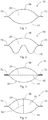
Figure 1 is a side view of a unit dose article according to the present invention; -
Figure 2 is a side view of another embodiment of unit dose article according to the present invention; -
Figure 3 is a side view of another embodiment of unit dose article according to the present invention; -
Figure 4 is a side view of another embodiment of unit dose article according to the present invention. - The present disclosure relates to detergent compositions that comprise a water-soluble film and a shading dye.
- Features and benefits of the various embodiments of the present invention will become apparent from the following description, which includes examples of specific embodiments intended to give a broad representation of the invention. Various modifications will be apparent to those skilled in the art from this description and from practice of the invention. The scope is not intended to be limited to the particular forms disclosed and the invention covers all modifications, equivalents, and alternatives falling within the spirit and scope of the invention as defined by the claims.
- As used herein, the articles including "the," "a" and "an" when used in a claim or in the specification, are understood to mean one or more of what is claimed or described.
- As used herein, the terms "include," "includes" and "including" are meant to be non-limiting. The phases "comprising" or "comprises" are intended to include the more limiting phrases "consisting essentially of' and "consisting of." Therefore, a composition that comprises a component may consist essentially of that component, or consist of that component.
- As used herein, the terms "substantially free of' or "substantially free from" mean that the indicated material is at the very minimum not deliberately added to the composition to form part of it, or, preferably, is not present at analytically detectable levels. It is meant to include compositions whereby the indicated material is present only as an impurity in one of the other materials deliberately included.
- As used herein, the term "soiled material" is used non-specifically and may refer to any type of flexible material consisting of a network of natural or artificial fibers, including natural, artificial, and synthetic fibers, such as, but not limited to, cotton, linen, wool, polyester, nylon, silk, acrylic, and the like, as well as various blends and combinations. Soiled material may further refer to any type of hard surface, including natural, artificial, or synthetic surfaces, such as, but not limited to, tile, granite, grout, glass, composite, vinyl, hardwood, metal, cooking surfaces, plastic, and the like, as well as blends and combinations.
- In this description, all concentrations and ratios are on a weight basis of the composition unless otherwise specified.
- As used herein, the phrase "detergent composition" includes compositions and formulations designed for cleaning soiled material. Such compositions include, but are not limited to, laundry cleaning compositions and detergents, fabric softening compositions, fabric enhancing compositions, fabric freshening compositions, laundry prewash, laundry pretreat, laundry additives, spray products, dry cleaning agent or composition, laundry rinse additive, wash additive, post-rinse fabric treatment, ironing aid, dish washing compositions, hard surface cleaning compositions, unit dose formulation, delayed delivery formulation, detergent contained on or in a porous substrate or nonwoven sheet, and other suitable forms that may be apparent to one skilled in the art in view of the teachings herein. Such compositions may be used as a pre-laundering treatment, a post-laundering treatment, or may be added during the rinse or wash cycle of the laundering operation. The detergent compositions may have a form selected from liquid, powder, slurry, single-phase or multi-phase unit dose articles, pouch, tablet, gel, paste, bar, or flake.
- In some aspects, the detergent composition comprises a first composition where the first composition is selected from the group consisting of a liquid detergent, a granular detergent, or a tablet detergent. Preferably, when the first composition is a granular detergent or a tablet detergent, the first composition is encased in either a water-soluble film or a water-soluble coating.
- Liquid detergent compositions and other forms of detergent compositions that include a liquid component (such as liquid-containing unit dose detergent compositions) may contain water and other solvents as fillers or carriers. Low molecular weight primary or secondary alcohols exemplified by methanol, ethanol, propanol, and isopropanol are suitable. Monohydric alcohols may be used in some examples for solubilizing surfactants, and polyols such as those containing from 2 to about 6 carbon atoms and from 2 to about 6 hydroxy groups (e.g., 1,3-propanediol, ethylene glycol, glycerine, and 1,2-propanediol) may also be used. Amine-containing solvents may also be used. Solvents particularly useful in unit dose articles are described below.
- The detergent compositions may contain from about 5% to about 90%, and in some examples, from about 10% to about 50%, by weight of the composition, of such carriers. For compact or super-compact heavy duty liquid or other forms of detergent compositions, the use of water may be lower than about 40% by weight of the composition, or lower than about 20%, or lower than about 5%, or less than about 4% free water, or less than about 3% free water, or less than about 2% free water, or substantially free of free water (i.e., anhydrous).
- The liquid detergent compositions may comprise water. However, when the liquid composition will be in contact with water-soluble film, for example in a unit dose article, it is typically desirable to limit the amount of water so as to preserve the film's integrity and to prevent a tacky feel to the pouches. Therefore, in some embodiments, the liquid detergent composition comprises less than about 50% water by weight of the liquid composition, or less than about 40% water by weight of the liquid composition, or from about 1% to about 30%, or preferably from about 2% to about 20%, or from about 5% to about 13%, water by weight of the liquid composition.
- For powder or bar detergent compositions, or forms that include a solid or powder component (such as powder-containing unit dose detergent composition), suitable fillers may include, but are not limited to, sodium sulfate, sodium chloride, clay, or other inert solid ingredients. Fillers may also include biomass or decolorized biomass. Fillers in granular, bar, or other solid detergent compositions may comprise less than about 80% by weight of the detergent composition, and in some examples, less than about 50% by weight of the detergent composition. Compact or supercompact powder or solid detergent compositions may comprise less than about 40% filler by weight of the detergent composition, or less than about 20%, or less than about 10%.
- For either compacted or supercompacted liquid or powder detergent compositions, or other forms, the level of liquid or solid filler in the product may be reduced, such that either the same amount of active chemistry is delivered to the wash liquor as compared to noncompacted detergent compositions, or in some examples, the detergent composition is more efficient such that less active chemistry is delivered to the wash liquor as compared to noncompacted compositions. For example, the wash liquor may be formed by contacting the detergent composition to water in such an amount so that the concentration of detergent composition in the wash liquor is from above 0g/l to 4g/l. In some examples, the concentration may be from about 1g/l to about 3.5g/l, or to about 3.0g/l, or to about 2.5g/l, or to about 2.0g/l, or to about 1.5g/l, or from about 0g/l to about 1.0g/l, or from about 0g/l to about 0.5g/l. These dosages are not intended to be limiting, and other dosages may be used that will be apparent to those of ordinary skill in the art.
- In some aspects, referring to the embodiments in
Figs. 1-4 , the detergent composition is in the form of aunit dose article 10. Theunit dose article 10 comprises at least one compartment, wherein the compartment comprises a composition, for example afirst composition 20. Aunit dose article 10 is intended to provide a single, easy to use dose of the composition contained within the article for a particular application. In some aspects, the detergent composition is inunit dose form 10 and comprises water-soluble film that encapsulates a liquid detergent. - The compartment should be understood as meaning a closed internal space within the unit dose article, which holds the composition. Preferably, the unit dose article comprises a water-soluble film. The unit dose article is manufactured such that the water-soluble film completely surrounds the composition and in doing so defines the compartment in which the composition resides. The unit dose article may comprise two films. A
first film 40 may be shaped to comprise an open compartment into which the composition is added. Asecond film 50 is then laid over thefirst film 40 in such an orientation as to close the opening of the compartment. The first 40 and second 50 films are then sealed together along aseal region 70. Theseal region 70 may comprise a flange. The flange is comprised of excess sealed film material that protrudes beyond the edge of the unit dose article and provides increased surface area for seal of the first 40 and second 50 films. The film is described in more detail below. In some aspects, theunit dose article 10 comprises three, four, five or more films. - The
unit dose article 10 may comprise more than one compartment, even at least two compartments, or even at least three compartments. In some aspects, theunit dose article 10 comprises 1, or 2, or 3, or 4, or 5 compartments. The compartments may be arranged in superposed orientation, i.e., one positioned on top of the other, as shown inFig. 3 , where they may share acommon wall 60. In one aspect, at least one compartment is superposed on another compartment. Alternatively, the compartments may be positioned in a side-by-side orientation, i.e., one orientated next to the other, as shown inFig. 4 . The compartments may even be orientated in a 'tire and rim' arrangement, i.e., a first compartment is positioned next to a second compartment, but the first compartment at least partially surrounds the second compartment, but does not completely enclose the second compartment. Alternatively, one compartment may be completely enclosed within another compartment. - When the unit dose article comprises at least two compartments, one of the compartments may be smaller than the other compartment. When the unit dose article comprises at least three compartments, two of the compartments may be smaller than the third compartment, and preferably the smaller compartments are superposed on the larger compartment. The smaller superposed compartments preferably are orientated side-by-side.
- When the unit dose article comprises at least two compartments, each compartment may comprise identical compositions, or each compartment may independently comprise a different composition. The compartments may be sensorially different; for example, the compartments may have different shapes, or they may be different colors.
- The encapsulated compositions may be any suitable composition. The composition may be in the form of a solid, a liquid, a dispersion, a gel, a paste, or a mixture thereof. The compositions in each compartment of a multicompartment unit dose article may be different. However, typically at least one compartment of the unit dose article, preferably each compartment, comprises a liquid. The composition is described in more detail below.
- The detergent composition of the present disclosure comprises water-soluble film. The film encapsulates the first composition. The film may encapsulate a liquid composition, a granular detergent, a tablet detergent, or mixtures thereof.
- The film of the present invention is soluble or dispersible in water. The water-soluble film preferably has a thickness of from about 20x10-6m to 150x10-6m (20 to about 150 microns), preferably about 35x10-6m to 125x10-6m (35 to about 125 microns), even more preferably about 50x10-6m to 110x10-6m (50 to about 110 microns), most preferably about 76x10-6m (76 microns).
- Preferably, the film has a water-solubility of at least 50%, preferably at least 75% or even at least 95%, as measured by the method set out here after using a glass-filter with a maximum pore size of 20 microns:
50 grams ± 0.1 gram of film material is added in a pre-weighed 400 ml beaker and 245ml ± 1ml of distilled water is added. This is stirred vigorously on a magnetic stirrer, Lab-Line model No. 1250 or equivalent and 5 cm magnetic stirrer, set at 600 rpm, for 30 minutes at 24°C. Then, the mixture is filtered through a folded qualitative sintered-glass filter with a pore size as defined above (max. 20x10-6m (20 micron)). The water is dried off from the collected filtrate by any conventional method, and the weight of the remaining material is determined (which is the dissolved or dispersed fraction). Then, the percentage solubility or dispersability can be calculated. - Preferred film materials are preferably polymeric materials. The film material can, for example, be obtained by casting, blow-molding, extrusion, or blown extrusion of the polymeric material, as known in the art. Preferably the film is obtained by an extrusion process or by a casting process.
- Preferred polymers (including copolymers, terpolymers, or derivatives thereof) suitable for use as film material are selected from polyvinyl alcohols (PVA), polyvinyl pyrrolidone, polyalkylene oxides, acrylamide, acrylic acid, cellulose, cellulose ethers, cellulose esters, cellulose amides, polyvinyl acetates, polycarboxylic acids and salts, polyaminoacids or peptides, polyamides, polyacrylamide, copolymers of maleic/acrylic acids, polysaccharides including starch and gelatine, natural gums such as xanthum and carragum. More-preferred polymers are selected from polyacrylates and water-soluble acrylate copolymers, methylcellulose, carboxymethylcellulose sodium, dextrin, ethylcellulose, hydroxyethyl cellulose, hydroxypropyl methylcellulose, maltodextrin, polymethacrylates, and most preferably selected from polyvinyl alcohols, polyvinyl alcohol copolymers and hydroxypropyl methyl cellulose (HPMC), and combinations thereof. Preferably, the polymers of the film material are free of carboxylate groups.
- Preferably, the level of polymer in the film material, for example a PVA polymer, is at least 60%. The polymer can have any weight average molecular weight, preferably from about 1000 to 1,000,000, more preferably from about 10,000 to 300,000, yet more preferably from about 20,000 to 150,000.
- Mixtures of polymers can also be used as the film material. This can be beneficial to control the mechanical and/or dissolution properties of the compartments or pouch, depending on the application thereof and the required needs. Suitable mixtures include for example mixtures wherein one polymer has a higher water-solubility than another polymer, and/or one polymer has a higher mechanical strength than another polymer. Also suitable are mixtures of polymers having different weight average molecular weights, for example a mixture of PVA or a copolymer thereof of a weight average molecular weight of about 10,000 to about 40,000, preferably about 20,000, and of PVA or copolymer thereof, with a weight average molecular weight of about 100,000 to about 300,000, preferably about 150,000. Also suitable herein are polymer blend compositions, for example comprising hydrolytically degradable and water-soluble polymer blends such as polylactide and polyvinyl alcohol, obtained by mixing polylactide and polyvinyl alcohol, typically comprising about 1-35% by weight polylactide and about 65% to 99% by weight polyvinyl alcohol. Preferred for use herein are polymers, preferably polyvinyl alcohol, have a degree of hydrolysis of from about 60% to about 99%, preferably from about 80% to about 99%, even more preferably from about 80% to about 90%, to improve the dissolution characteristics of the material. As used herein, the degree of hydrolysis is expressed as a percentage of vinyl acetate units converted to vinyl alcohol units.
- Preferred films exhibit good dissolution in cold water, meaning unheated distilled water. Preferably such films exhibit good dissolution at temperatures 24°C, even more preferably at 10°C. By good dissolution it is meant that the film exhibits water-solubility of at least 50%, preferably at least 75% or even at least 95%, as measured, by the method set out herein using a glass-filter with a maximum pore size of 20 microns, described above. Water-solubility may be determined at 24°C, or preferably at 10°C.
- Preferred films are those supplied by Monosol (Merrillville, Indiana, USA) under the trade references M8630, M8900, M8779, and M8310 films described in
US 6 166 117 andUS 6 787 512 , and PVA films of corresponding solubility and deformability characteristics. Other suitable films may include called Solublon ® PT, Solublon ® GA, Solublon ® KC or Solublon ® KL from the Aicello Chemical Europe GmbH, the films VF-HP by Kuraray, or the films by Nippon Gohsei, such as Hi Selon. Further preferred films are those described inUS2006/0213801 ,US2011/0188784 ,WO2010/119022 , andUS6787512 . In some aspects, it is preferable to use a film that exhibits better dissolution than M8630 film, supplied by Monosol, at temperatures 24°C, even more preferably at 10°C. - Preferred water soluble films are those derived from a resin that comprises a blend of polymers, preferably wherein at least one polymer in the blend is polyvinyl alcohol. Preferably, the water soluble film resin comprises a blend of PVA polymers. For example, the PVA resin can include at least two PVA polymers, wherein as used herein the first PVA polymer has a viscosity less than the second PVA polymer. A first PVA polymer can have a viscosity of at least 0.008Pa.s (8 centipoise (cP)), O.OlPa.s (10 cP), 0.012Pa.s (12 cP), or 0.013Pa.s (13 cP) and at most 0.04Pa.s (40 cP), 0.02Pa.s (20 cP), 0.015Pa.s (15 cP), or 0.013Pa.s (13 cP), for example in a range of about 0.008Pa.s (8 cP) to about 0.04Pa.s (40 cP), or O.OlPa.s (10 cP) to about 0.02Pa.s (20 cP), or about O.OlPa.s (10 cP) to about 0.015Pa.s (15 cP), or about 0.012Pa.s (12 cP) to about 0.014Pa.s (14 cP), or 0.013Pa.s (13 cP). Furthermore, a second PVA polymer can have a viscosity of at least about O.OlPa.s (10 cP), 0.02Pa.s (20 cP), or 0.022Pa.s (22 cP) and at most about 0.04Pa.s (40 cP), 0.03Pa.s (30 cP), 0.025Pa.s (25 cP), or 0.024Pa.s (24 cP), for example in a range of about O.OlPa.s (10 cP) to about 0.04Pa.s (40 cP), or 0.02Pa.s to about 0.03Pa.s (20 to about 30 cP), or about 0.02Pa.s to about 0.025Pa.s (20 to about 25 cP), or about 0.022Pa.s to about 0.024Pa.s, or about 0.023Pa.s (22 to about 24, or about 23 cP). The viscosity of a PVA polymer is determined by measuring a freshly made solution using a Brookfield LV type viscometer with UL adapter as described in British Standard EN ISO 15023-2:2006 Annex E Brookfield Test method. It is international practice to state the viscosity of 4% aqueous polyvinyl alcohol solutions at 20 °C. All viscosities specified herein in Pa.s (cP) should be understood to refer to the viscosity of 4% aqueous polyvinyl alcohol solution at 20 °C, unless specified otherwise. Similarly, when a resin is described as having (or not having) a particular viscosity, unless specified otherwise, it is intended that the specified viscosity is the average viscosity for the resin, which inherently has a corresponding molecular weight distribution.
- The individual PVA polymers can have any suitable degree of hydrolysis, as long as the degree of hydrolysis of the PVA resin is within the ranges described herein. Optionally, the PVA resin can, in addition or in the alternative, include a first PVA polymer that has a molecular weight in a range of about 50,000 to about 300,000 Daltons, or about 60,000 to about 150,000 Daltons; and a second PVA polymer that has a molecular weight in a range of about 60,000 to about 300,000 Daltons, or about 80,000 to about 250,000 Daltons.
- Different film material and/or films of different thickness may be employed in making the compartments of the present invention. A benefit in selecting different films is that the resulting compartments may exhibit different solubility or release characteristics.
- The film material herein can also comprise one or more additive ingredients. For example, the film preferably comprises a plasticizing agent. The plasticizing agent may comprise water, glycerol, ethylene glycol, diethylene glycol, propylene glycol, sorbitol, or mixtures thereof. In some aspects, the film comprises from about 2% to about 35%, or from about 5% to about 25%, by weight of the film, a plasticizing agent selected from group comprising water, glycerol, diethylene glycol, sorbitol, and mixtures thereof. In some aspects, the film material comprises at least two, or preferably at least three, plasticizing agents. In some aspects, the film is substantially free of ethanol, meaning that the film comprises from 0% (including 0%) to about 0.1% ethanol by weight of the film. In some aspects, the plasticizing agents are the same as the plasticizing solvents in the liquid composition, described below.
- Other additives may include water and functional detergent additives, including surfactant, to be delivered to the wash water, for example, organic polymeric dispersants, etc.
- The detergent composition comprises a blue or violet shading dye. Preferably, at least about 10%, 30%, 50%, 70%, 90%, or even about 95% of the shading dye is incorporated into the water-soluble film. In one preferred embodiment, substantially all of the shading dye is incorporated into water-soluble film. It will be understood that the shading dye can be incorporated into any part of the film(s), as discussed above. For example, in one embodiment, the shading dye is incorporated into one of or both of the first film and/or the second film. In yet another embodiment, the shading dye is incorporated into the common wall and, in one particularly preferred embodiment substantially all of the shading dye is incorporated into the common wall.
- The shading dye (sometimes referred to as hueing, bluing or whitening agents) typically provides a blue or violet shade to fabric. Shading dyes can be used either alone or in combination to create a specific shade of hueing and/or to shade different fabric types. This may be provided for example by mixing a red and green-blue dye to yield a blue or violet shade. The hueing dye is a blue or violet hueing dye, providing a blue or violet color to a white cloth or fabric. Such a white cloth treated with the composition will have a hue angle of 240 to 345, more preferably 260 to 325, even more preferably 270 to 310.
- In one aspect, a hueing dye suitable for use in the present invention has, in the wavelength range of about 400 nm to about 750 nm, in methanol solution, a maximum extinction coefficient greater than about 1000 liter/mol/cm. In one aspect, a hueing dye suitable for use in the present invention has, in the wavelength range of about 540 nm to about 630 nm, a maximum extinction coefficient from about 10,000 to about 100,000 liter/mol/cm. In one aspect, a hueing dye suitable for use in the present invention has, in the wavelength range of about 560 nm to about 610 nm, a maximum extinction coefficient from about 20,000 to about 70,000 liter/mol/cm or even about 90,000 liter/mol/cm.
- The Test Methods provided below can be used to determine if a dye, or a mixture of dyes, is a shading dye for the purposes of the present invention.
-
- a.) Unbrightened Multifiber Fabric Style 41 swatches (MFF41, 5cm x 10cm, average weight 1.46g) serged with unbrightened thread are purchased from Testfabrics, Inc. (West Pittston, PA). MFF41 swatches are stripped prior to use by washing two full cycles in AATCC heavy duty liquid laundry detergent (HDL) nil brightener at 49°C and washing 3 additional full cycles at 49°C without detergent. Four replicate swatches are placed into each flask.
- b.) A sufficient volume of AATCC standard nil brightener HDL detergent solution is prepared by dissolving the detergent in 0 gpg water at room temperature at a concentration of 1.55 g per liter.
- c.) A concentrated stock solution of dye is prepared in an appropriate solvent selected from dimethyl sulfoxide (DMSO), ethanol or 50:50 ethanol:water. Ethanol is preferred. The dye stock is added to a beaker containing 400mL detergent solution (prepared in step I.b. above) in an amount sufficient to produce an aqueous solution absorbance at the λmax of 0.1 AU (± 0.01AU) in a cuvette of path length 1.0 cm. For a mixture of dyes, the sum of the aqueous solution absorbance at the λmax of the individual dyes is 0.1 AU (± 0.01AU) in a cuvette of path length 1.0 cm. Total organic solvent concentration in a wash solution from the concentrated stock solution is less than 0.5%. A 125mL aliquot of the wash solution is placed into 3 separate disposable 250mL Erlenmeyer flasks (Thermo Fisher Scientific, Rochester, NY).
- d.) Four MFF41 swatches are placed into each flask, flasks are capped and manually shaken to wet the swatches. Flasks are placed onto a Model 75 wrist action shaker from Burrell Scientific, Inc. (Pittsburg, PA) and agitated on the highest setting of 10 (390 oscillations per minute with an arc of 14.6°). After 12 minutes, the wash solution is removed by vacuum aspiration, 125mL of Ogpg water is added for a rinse, and the flasks agitated for 4 additional minutes. Rinse solution is removed by vacuum aspiration and swatches are spun in a Mini Countertop Spin Dryer (The Laundry Alternative Inc., Nashua, NH) for 5 minutes, after which they are allowed to air dry in the dark.
- e.) L*, a*, and b* values for the 3 most consumer relevant fabric types, cotton and polyester, are measured on the dry swatches using a LabScan XE reflectance spectrophotometer (HunterLabs, Reston, VA; D65 illumination, 10° observer, UV light excluded). The L*, a*, and b* values of the 12 swatches (3 flasks each containing 4 swatches) are averaged and the hueing deposition (HD) of the dye is calculated for each fabric type using the following equation:

-
- a) The a* and b* values of the 12 swatches from each solution were averaged and the following formulas used to determine Δa* and Δb*:

- b.) If the absolute value of both Δa* and Δb* < 0.25, no Relative Hue Angle (RHA) was calculated. If the absolute value of either Δa* or Δb* were ≥ 0.25, the RHA was determined using one of the following formulas:
- When Δb* ≥ 0, RHA = ATAN2(Δa*,Δb*)
- When Δb* < 0, RHA = 360 + ATAN2(Δa*,Δb*)
- A dye, or mixture of dyes, is considered a shading dye (also known as a hueing dye) for the purposes of the present invention if (a) either the HDcotton or the HDpolyester is greater than or equal to 2.0 DE* units or preferably greater than or equal to 3.0, or 4.0 or even 5.0, according to the formula above, and (b) the relative hue angle (see Method III. below) on the fabric that meets the DE* criterion in (a) is within 240 to 345, more preferably 260 to 325, even more preferably 270 to 310. If the value of HD for both fabric types is less than 2.0 DE* units, or if the relative hue angle is not within the prescribed range on each fabric for which the DE* meets the criteria the dye is not a shading dye for the purposes of the present invention.
- The shading dye may be selected from any chemical class of dye as known in the art, including but not limited to acridine, anthraquinone (including polycyclic quinones), azine, azo (e.g., monoazo, disazo, trisazo, tetrakisazo, polyazo), benzodifurane, benzodifuranone, carotenoid, coumarin, cyanine, diazahemicyanine, diphenylmethane, formazan, hemicyanine, indigoids, methane, naphthalimides, naphthoquinone, nitro, nitroso, oxazine, phthalocyanine, pyrazoles, stilbene, styryl, triarylmethane, triphenylmethane, xanthenes and mixtures thereof.
- Suitable shading dyes include small molecule dyes, polymeric dyes and dye-clay conjugates. Preferred shading dyes are selected from small molecule dyes and polymeric dyes.
- Suitable small molecule dyes may be selected from the group consisting of dyes falling into the Colour Index (C.I., Society of Dyers and Colourists, Bradford, UK) classifications of Acid, Direct, Basic, Reactive, Solvent or Disperse dyes. Preferably such dyes can be classified as Blue, Violet, Red, Green or Black, and provide the desired shade either alone or in combination with other dyes or in combination with other adjunct ingredients. Reactive dyes may contain small amounts of hydrolyzed dye as sourced, and in detergent formulations or in the wash may undergo additional hydrolysis. Such hydrolyzed dyes and mixtures may also serve as suitable small molecule dyes.
- In another aspect, suitable dyes include those selected from the group consisting of dyes denoted by the Colour Index designations such as Direct Violet 5, 7, 9, 11, 31, 35, 48, 51, 66, and 99, Direct Blue 1, 71, 80 and 279, Acid Red 17, 73, 52, 88 and 150, Acid Violet 15, 17, 24, 43, 49 and 50, Acid Blue 15, 17, 25, 29, 40, 45, 48, 75, 80, 83, 90 and 113, Basic Violet 1, 3, 4, 10 and 35, Basic Blue 3, 16, 22, 47, 66, 75 and 159, anthraquinone Disperse or Solvent dyes such as Solvent Violet 11, 13, 14, 15, 15, 26, 28, 29, 30, 31, 32, 33, 34, 26, 37, 38, 40, 41, 42, 45, 48, 59; Solvent Blue 11, 12, 13, 14, 15, 17, 18, 19, 20, 21, 22,35,36,40,41,45,59,59:1, 63, 65, 68, 69, 78, 90; Disperse Violet 1, 4, 8, 11, 11:1, 14, 15, 17, 22, 26, 27, 28, 29, 34, 35, 36, 38, 41, 44, 46, 47, 51, 56, 57, 59, 60, 61, 62, 64, 65, 67, 68, 70, 71, 72, 78, 79, 81, 83, 84, 85, 87, 89, 105; Disperse Blue 2, 3, 3:2, 8, 9, 13, 13:1, 14, 16, 17, 18, 19, 22, 23, 24, 26, 27, 28, 31, 32, 34, 35, 40, 45, 52, 53, 54, 55, 56, 60, 61, 62, 64, 65, 68, 70, 72, 73, 76, 77, 80, 81, 83, 84, 86, 87, 89, 91, 93, 95, 97, 98, 103, 104, 105, 107, 108, 109, 11, 112, 113, 114, 115, 116, 117, 118, 119, 123, 126, 127, 131, 132, 134, 136, 140, 141, 144, 145, 147, 150, 151, 152, 153, 154, 155, 156, 158, 159, 160, 161, 162, 163, 164, 166, 167, 168, 169, 170, 176, 179, 180, 180:1, 181, 182, 184, 185, 190, 191, 192, 196, 197, 198, 199, 203, 204, 213, 214, 215, 216, 217, 218, 223, 226, 227, 228, 229, 230, 231, 232, 234, 235, 236, 237, 238, 239, 240, 241, 242, 243, 244, 245, 246, 247, 249, 252, 261, 262, 263, 271, 272, 273, 274, 275, 276, 277, 289, 282, 288, 289, 292, 293, 296, 297, 298, 299, 300, 302, 306, 307, 308, 309, 310, 311, 312, 314, 318, 320, 323, 325, 326, 327, 331, 332, 334, 347, 350, 359, 361, 363, 372, 377 and 379, azo Disperse dyes such as Disperse Blue 10, 11, 12, 21, 30, 33, 36, 38, 42, 43, 44,47,79,79:1,79:2,79:3, 82, 85, 88, 90, 94, 96, 100, 101, 102, 106, 106:1, 121, 122, 124, 125, 128, 130, 133, 137, 138, 139, 142, 146, 148, 149, 165, 165:1, 165:2, 165:3, 171, 173, 174, 175, 177, 183, 187, 189, 193, 194, 200, 201, 202, 206, 207, 209, 210, 211, 212, 219, 220, 224, 225, 248, 252, 253, 254, 255, 256, 257, 258, 259, 260, 264, 265, 266, 267, 268, 269, 270, 278, 279, 281, 283, 284, 285, 286, 287, 290, 291, 294, 295, 301, 304, 313, 315, 316, 317:319, 321, 322, 324, 328, 330, 333, 335, 336, 337, 338, 339, 340, 341, 342, 343, 344, 345, 346, 351, 352, 353, 355, 356, 358, 360, 366, 367, 368, 369, 371, 373, 374, 375, 376 and 378, Disperse Violet 2, 3, 5, 6, 7, 9, 10, 12, 3, 16, 24, 25,33,39, 42, 43, 45, 48, 49, 50, 53, 54, 55, 58, 60, 63, 66, 69, 75, 76, 77, 82, 86, 88, 91, 92, 93, 93:1, 94, 95, 96, 97, 98, 99, 100, 102, 104, 106 and 107. Preferably, small molecule dyes can be selected from the group consisting of C. I. numbers Acid Violet 17, Acid Blue 80,
Acid Violet 50, Direct Blue 71, Direct Violet 51, Direct Blue 1, Acid Red 88, Acid Red 150, Acid Blue 29, Acid Blue 113 or mixtures thereof. - In another aspect suitable small molecule dyes include dyes with CAS-No's 52583-54-7, 42783-06-2, 210758-04-6, 104366-25-8,122063-39-2,167940-11-6,52239-04-0, 105076-77-5,84425-43-4, and 87606-56-2, and non-azo dyes Disperse Blue 250, 354, 364, Solvent Violet 8, Solvent blue 43, 57, Lumogen F Blau 650, and Lumogen F Violet 570.
- In another aspect suitable small molecule dyes include azo dyes, preferably mono-azo dyes, covalently bound to phthalocyanine moieties, preferably Al- and Si-phthalocyanine moieties, via an organic linking moiety.
- Suitable polymeric dyes include dyes selected from the group consisting of polymers containing covalently bound (sometimes referred to as conjugated) chromogens, (also known as dye-polymer conjugates), for example polymers with chromogen monomers co-polymerized into the backbone of the polymer and mixtures thereof.
- Polymeric dyes include: (a) Reactive dyes bound to water soluble polyester polymers via at least one and preferably two free OH groups on the water soluble polyester polymer. The water soluble polyester polymers can be comprised of comonomers of a phenyl dicarboxylate, an oxyalkyleneoxy and a polyoxyalkyleneoxy; (b) Reactive dyes bound to polyamines which are polyalkylamines that are generally linear or branched. The amines in the polymer may be primary, secondary and/or tertiary. Polyethyleneimine in one aspect is preferred. In another aspect, the polyamines are ethoxylated; (c) Dye polymers having dye moieties carrying negatively charged groups obtainable by copolymerization of an alkene bound to a dye containing an anionic group and one or more further alkene comonomers not bound to a dye moiety; (d) Dye polymers having dye moieties carrying positively charged groups obtainable by copolymerization of an alkene bound to a dye containing an cationic group and one or more further alkene comonomers not bound to a dye moiety; (e) Polymeric thiophene azo polyoxyalkylene dyes containing carboxylate groups; and (f) dye polymer conjugates comprising at least one reactive dye and a polymer comprising a moiety selected from the group consisting of a hydroxyl moiety, a primary amine moiety, a secondary amine moiety, a thiol moiety and combinations thereof; said polymers preferably selected from the group consisting of polysaccharides, proteins, polyalkyleneimines, polyamides, polyols, and silicones. In one aspect, carboxymethyl cellulose (CMC) may be covalently bound to one or more reactive blue, reactive violet or reactive red dye such as CMC conjugated with C.I. Reactive Blue 19, sold by Megazyme, Wicklow, Ireland under the product name AZO-CM-CELLULOSE, product code S-ACMC.
- Other suitable polymeric dyes include polymeric dyes selected from the group consisting of alkoxylated triphenyl-methane polymeric colourants, alkoxylated carbocyclic and alkoxylated heterocyclic azo colourants, including alkoxylated thiophene polymeric colourants, and mixtures thereof. Preferred polymeric dyes comprise the optionally substituted alkoxylated dyes, such as alkoxylated triphenyl-methane polymeric colourants, alkoxylated carbocyclic and alkoxylated heterocyclic azo colourants including alkoxylated thiophene polymeric colourants, and mixtures thereof, such as the fabric-substantive colorants sold under the name of Liquitint® (Milliken, Spartanburg, South Carolina, USA).
- Suitable polymeric dyes are illustrated below. As with all such alkoxylated compounds, the organic synthesis may produce a mixture of molecules having different degrees of alkoxylation. During a typical ethoxylation process, for example, the randomness of the ethylene oxide addition results in a mixture of oligomers with different degrees of ethoxylation. As a consequence of its ethylene oxide number distribution, which often follows a Poisson law, a commercial material contains substances with somewhat different properties. For example, in one aspect, the polymeric dye resulting from an ethoxylation is not a single compound containing five (CH2CH2O) units as the general structure (Formula A, with x+y = 5) may suggest. Instead, the product is a mixture of several homologs whose total of ethylene oxide units varies from about 2 to about 10. Industrially relevant processes will typically result in such mixtures, which may normally be used directly to provide the shading dye, or less commonly may undergo a purification step.
- Preferably, the shading dye may wherein the shading dye has the following structure:
Dye-(G)a-NR1R2,
wherein the -(G)a-NR1R2group is attached to an aromatic ring of the dye, G is independently -SO2- or -C(O)-, the index a is an integer with a value of 0 or 1 and R1 and R2 are independently selected from H, a polyoxyalkylene chain, a C1-8 alkyl, optionally the alkyl chains comprise ether (C-O-C), ester and/or amide links, optionally the alkyl chains are substituted with -Cl, -Br, -CN, -NO2, -SO2CH3, -OH and mixtures thereof, C6-10 aryl, optionally substituted with a polyoxyalkylene chain, C7-16 alkaryl optionally substituted with ether (C-O-C), ester and/or amide links, optionally substituted with -Cl, -Br, -CN, -NO2, -SO2CH3, -OH, polyoxyalkylene chain substituted C1-8 alkyl, polyoxyalkylene chain substituted C6-10 aryl, polyoxyalkylene chain substituted C7-16 alkaryl and mixtures thereof; said polyoxyalkylene chains independently having from about 2 to about 100, about 2 to about 50, about 3 to about 30 or about 4 to about 20 repeating units. Preferably, the repeating units are selected from the group consisting of ethylene oxide, propylene oxide, butylene oxide and mixtures thereof. Preferably, the repeating units are essentially ethylene oxide. - Preferably, the shading dye may have the structure of Formula A:

U.S. Pat. No. 4,912,203 to Kluger et al. ; a primary aromatic amine is reacted with an appropriate amount of ethylene oxide, according to procedures well known in the art. The polyethyleneoxy substituted m-toluidine useful in the preparation of the colorant can be prepared by a number of well known methods. It is preferred, however, that the polyethyleneoxy groups be introduced into the m-toluidine molecule by reaction of the m-toluidine with ethylene oxide. Generally the reaction proceeds in two steps, the first being the formation of the corresponding N,N-dihydroxyethyl substituted m-toluidine. In some aspects, no catalyst is utilized in this first step (for example as disclosed at Column 4, lines 16-25 ofU.S. Pat. No. 3,927,044 to Foster et al.). The dihydroxyethyl substituted m-toluidine is then reacted with additional ethylene oxide in the presence of a catalyst such as sodium (described in Preparation II ofU.S. Pat. No. 3,157,633 to Kuhn), or it may be reacted with additional ethylene oxide in the presence of sodium or potassium hydroxide (described in Example 5 ofU.S. Pat. No. 5,071,440 to Hines et al. ). The amount of ethylene oxide added to the reaction mixture determines the number of ethyleneoxy groups which ultimately attach to the nitrogen atom. In some aspects, an excess of the polyethyleneoxy substituted m-toluidine coupler may be employed in the formation of the whitening agent and remain as a component in the final colorant mixture. In certain aspects, the presence of excess coupler may confer advantageous properties to a mixture in which it is incorporated such as the raw material, a pre-mix, a finished product or even the wash solution prepared from the finished product. - The shading dye may preferably have the following structure:

- R1 and R2 are independently selected from the group consisting of: H; alkyl; alkoxy; alkyleneoxy; alkyl capped alkyleneoxy; urea; and amido;
- R3 is a substituted aryl group;
- X is a substituted group comprising sulfonamide moiety and optionally an alkyl and/or aryl moiety, and wherein the substituent group comprises at least one alkyleneoxy chain.
- The hueing dye may be a thiophene dye such as a thiophene azo dye, preferably alkoxylated. Optionally the dye may be substituted with at least one solubilising group selected from sulphonic, carboxylic or quaternary ammonium groups.
- Non-limiting examples of suitable shading dyes are:


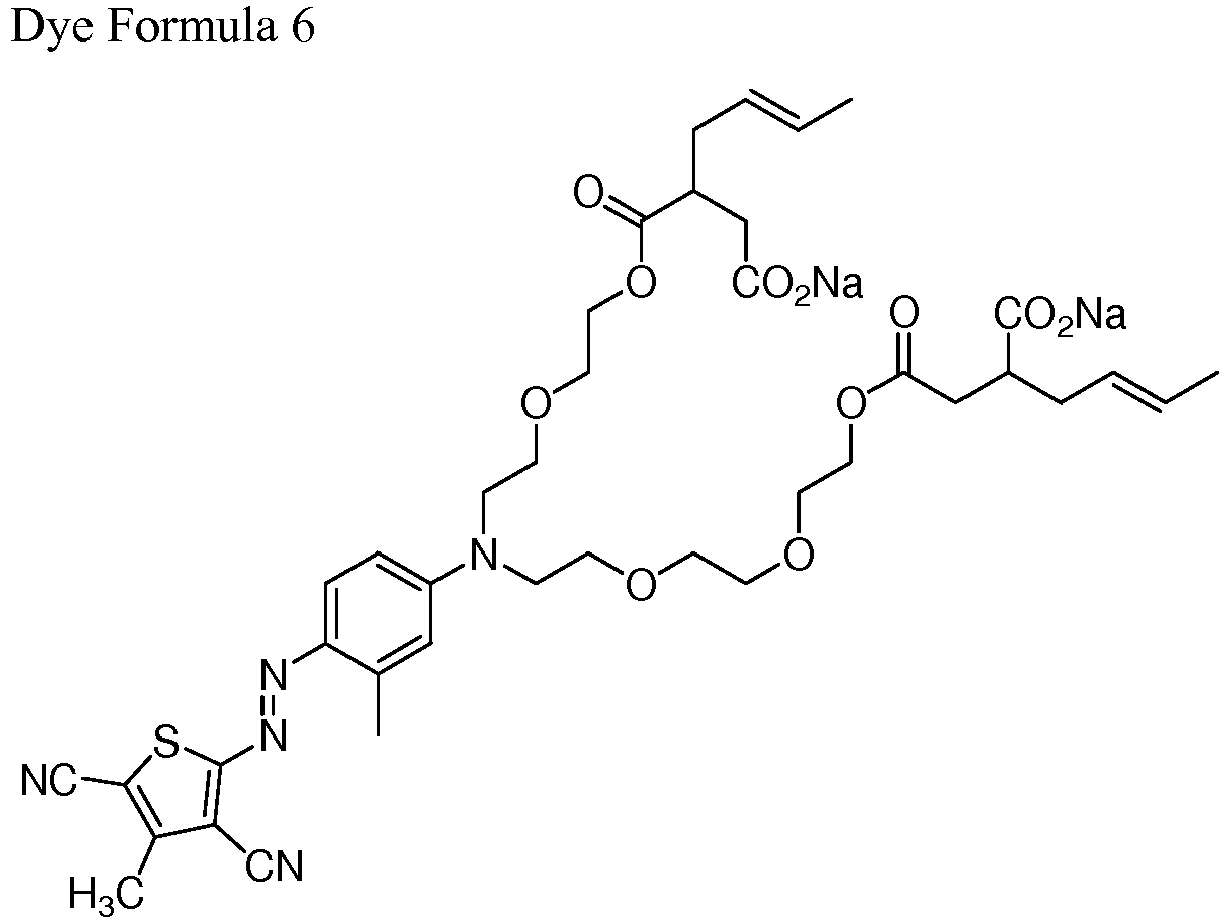


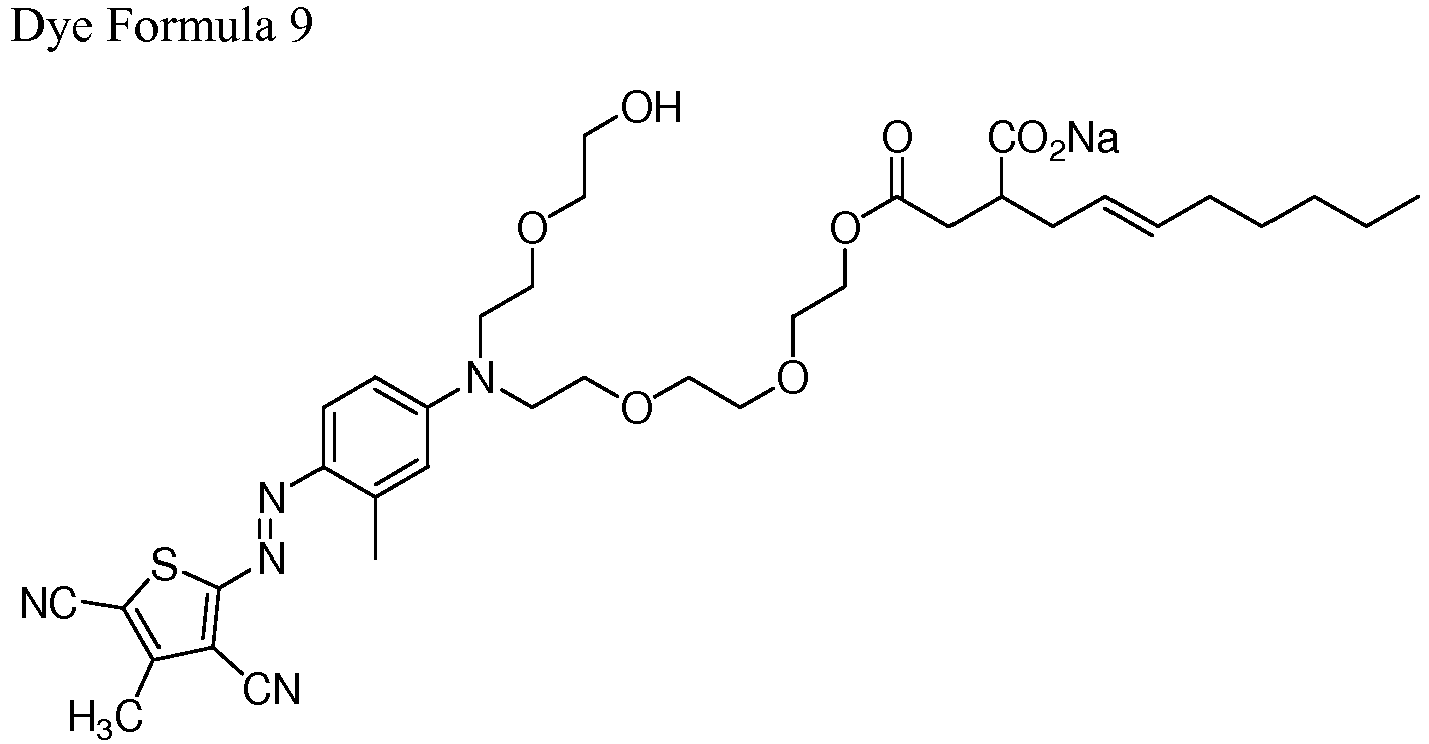

- Suitable dye clay conjugates include dye clay conjugates selected from the group comprising at least one cationic/basic dye and a smectite clay; a preferred clay may be selected from the group consisting of Montmorillonite clay, Hectorite clay, Saponite clay and mixtures thereof. In another aspect, suitable dye clay conjugates include dye clay conjugates selected from the group consisting of a clay and one cationic/basic dye selected from the group consisting of C.I. Basic Red 1 through 118, C.I. Basic Violet 1 through 51, C.I. Basic Blue 1 through 164. In still another aspect, suitable dye clay conjugates include dye clay conjugates selected from the group consisting of: Montmorillonite Basic Blue B7 C.I. 42595 conjugate, Montmorillonite Basic Blue B9 C.I. 52015 conjugate, Montmorillonite Basic Violet V3 C.I. 42555 conjugate, Montmorillonite Basic Red R1 C.I. 45160 conjugate, Hectorite Basic Blue B7 C.I. 42595 conjugate, Hectorite Basic Blue B9 C.I. 52015 conjugate, Hectorite Basic Violet V3 C.I. 42555 conjugate, Hectorite Basic Red R1 C.I. 45160 conjugate, Saponite Basic Blue B7 C.I. 42595 conjugate, Saponite Basic Blue B9 C.I. 52015 conjugate, Saponite Basic Violet V3 C.I. 42555 conjugate, Saponite Basic Red R1 C.I. 45160 conjugate, and mixtures thereof.
- The detergent composition of the present disclosure comprises water-soluble film which comprises the shading dye, meaning that the shading dye may be an integral part of the film and/or in contact with an exterior surface of the film. The shading dye may be added to the film-forming polymeric material prior to forming the film, for example prior to extruding or casting the film. The shading dye may be on an exterior surface of the water-soluble film, where an interior surface is in contact with the first composition. The shading dye may be applied to the exterior surface of the film by any suitable means. For example, the shading dye may be applied to the exterior of the film by dusting, powdering, coating, painting, printing, spraying, atomizing, or mixtures thereof. In some aspects, the shading dye is applied to the unit dose composition by spraying or atomizing a composition comprising the shading dye and a plasticizing solvent, which is described below. When the shading dye is sprayed or atomized onto a film, the sprayed or atomized composition may be non-aqueous, meaning that it comprises less than 20%, or less than 15%, or less than 10%, or less than 5%, or less than 1% water by weight of the sprayed or atomized composition. The sprayed or atomized composition may even comprise zero percent water.
- The detergent composition may comprise a coating, where the coating comprises the shading dye.
- In some aspects, the concentration of the shading dye on the surface of the film is from about 10ppb to about 10,000ppm, or preferably from about 50 ppb to about 200 ppm, or more preferably from about 10ppm to about 250ppm. In some aspects, the concentration of the shading dye is determined after storage of the unit dose article for one month at 25°C and 60% relative humidity.
- In one preferred embodiment, the shading dye is encapsulated separately or isolated from other components in the water-soluble film, for example, via capsules or microcapsules. It will be understood that when present in a capsules or microcapsule, the shading dyes color can be blocked or otherwise distorted.
- The detergent composition may comprise other suitable adjuncts which, in some aspects, can be wholly or partially incorporated into the film. Adjuncts may be selected according to the detergent composition's intended function. The first composition may comprise an adjunct. In some aspects, in the case of multi-compartment unit dose articles, the adjuncts may be part of a non-first (e.g., second, third, fourth, etc.) composition encapsulated in compartments separate from the first composition. The non-first composition may be any suitable composition. The non-first composition may be in the form of a solid, a liquid, a dispersion, a gel, a paste or a mixture thereof. Where the unit dose comprises multiple compartments, the shading dye may be added to or present in one, two, or even all the compartments.
- Non-limiting examples of detergent compositions include cleaning compositions, fabric care compositions and hard surface cleaners. More particularly, the compositions may be a laundry, fabric care or dish washing composition including, pre-treatment or soaking compositions and other rinse additive compositions. The composition may be a fabric detergent composition or an automatic dish washing composition. The fabric detergent composition may be used during the main wash process or could be used as pre-treatment or soaking compositions.
- Fabric care compositions include fabric detergents, fabric softeners, 2-in-1 detergent and softening, pre-treatment compositions and the like. Fabric care compositions may comprise typical fabric care adjuncts, including surfactants, builders, chelating agents, dye transfer inhibiting agents, dispersants, enzymes, and enzyme stabilizers, plasticizing solvents, catalytic materials, bleach activators, polymeric dispersing agents, clay soil removal/anti-redeposition agents, brighteners, suds suppressors, dyes, additional perfume and perfume delivery systems, structure elasticizing agents, fabric softeners, carriers, hydrotropes, processing aids and/or pigments and mixtures thereof. The composition may be a laundry detergent composition comprising an adjunct selected from the group comprising a surfactant, polymers, perfumes, encapsulated perfume materials, structurant and mixtures thereof.
- The composition may be an automatic dish washing composition comprising an adjunct selected from surfactant, builder, sulfonated / carboxylated polymer, silicone suds suppressor, silicate, metal and/or glass care agent, enzyme, bleach, bleach activator, bleach catalyst, source of alkalinity, perfume, dye, solvent, filler and mixtures thereof.
- Preferably, the liquid composition comprises a surfactant. Surfactants can be selected from anionic, cationic, zwitterionic, non-ionic, amphoteric or mixtures thereof. Preferably, the unit dose composition comprises anionic surfactant, non-ionic surfactant, or mixtures thereof. The detergent composition, preferably the liquid composition, may comprise from about 1% to about 70%, or from about 3% to about 50%, or from about 5% to about 25%, by weight of a surfactant system.
- The anionic surfactant may be selected from linear alkyl benzene sulfonate, alkyl ethoxylate sulphate and combinations thereof.
- Suitable anionic surfactants useful herein can comprise any of the conventional anionic surfactant types typically used in liquid detergent products. These include the alkyl benzene sulfonic acids and their salts as well as alkoxylated or non-alkoxylated alkyl sulfate materials.
- Suitable nonionic surfactants for use herein include the alcohol alkoxylate nonionic surfactants. Alcohol alkoxylates are materials which correspond to the general formula: R1(CmH2mO)nOH wherein R1 is a C8-C16 alkyl group, m is from 2 to 4, and n ranges from about 2 to 12. In one aspect, R1 is an alkyl group, which may be primary or secondary, that comprises from about 9 to 15 carbon atoms, or from about 10 to 14 carbon atoms. In one aspect, the alkoxylated fatty alcohols will also be ethoxylated materials that contain from about 2 to 12 ethylene oxide moieties per molecule, or from about 3 to 10 ethylene oxide moieties per molecule.
- The compositions can comprise one or more detergent enzymes which provide cleaning performance and/or fabric care benefits. Examples of suitable enzymes include, but are not limited to, hemicellulases, peroxidases, proteases, cellulases, xylanases, lipases, phospholipases, esterases, cutinases, pectinases, keratanases, reductases, oxidases, phenoloxidases, lipoxygenases, ligninases, pullulanases, tannases, pentosanases, malanases, β-glucanases, arabinosidases, hyaluronidase, chondroitinase, laccase, and amylases, or mixtures thereof. A typical combination is a cocktail of conventional applicable enzymes like protease, lipase, cutinase and/or cellulase in conjunction with amylase.
- The compositions of the present invention may comprise one or more bleaching agents. Suitable bleaching agents other than bleaching catalysts include photobleaches, bleach activators, hydrogen peroxide, sources of hydrogen peroxide, pre-formed peracids and mixtures thereof. In general, when a bleaching agent is used, the compositions of the present invention may comprise from about 0.1% to about 50% or even from about 0.1% to about 25% bleaching agent by weight of the cleaning composition.
- The composition may comprise a brightener. Suitable brighteners are stilbenes, such as brightener 15. Other suitable brighteners are hydrophobic brighteners, and brightener 49. The brightener may be in micronized particulate form, having a weight average particle size in the range of from 3 to 30 micrometers, or from 3 micrometers to 20 micrometers, or from 3 to 10 micrometers. The brightener can be alpha or beta crystalline form.
- The compositions herein may also optionally contain one or more copper, iron and/or manganese chelating agents. If utilized, chelating agents will generally comprise from about 0.1% by weight of the compositions herein to about 15%, or even from about 3.0% to about 15% by weight of the compositions herein. Suitable chelants include a chelant selected from the group consisting of DTPA (Diethylene triamine pentaacetic acid), HEDP (Hydroxyethane diphosphonic acid), DTPMP (Diethylene triamine penta(methylene phosphonic acid)), ethylenediaminedisuccinic acid (EDDS), 1,2-Dihydroxybenzene-3,5-disulfonic acid disodium salt hydrate, and derivatives of such chelants.
- The composition may comprise a calcium carbonate crystal growth inhibitor, such as one selected from the group consisting of: 1-hydroxyethanediphosphonic acid (HEDP) and salts thereof; N,N-dicarboxymethyl-2-aminopentane-1,5-dioic acid and salts thereof; 2-phosphonobutane-1,2,4-tricarboxylic acid and salts thereof; and any combination thereof.
- The compositions of the present disclosure may also include one or more dye transfer inhibiting agents. Suitable polymeric dye transfer inhibiting agents include, but are not limited to, polyvinylpyrrolidone polymers, polyamine N-oxide polymers, copolymers of N-vinylpyrrolidone and N-vinylimidazole, polyvinyloxazolidones and polyvinylimidazoles or mixtures thereof. When present in the compositions herein, the dye transfer inhibiting agents are present at levels from about 0.0001%, from about 0.01%, from about 0.05% by weight of the cleaning compositions to about 10%, about 2%, or even about 1% by weight of the cleaning compositions.
- The composition may comprise one or more polymers. Suitable polymers include carboxylate polymers, polyethylene glycol polymers, polyester soil release polymers such as terephthalate polymers, amine polymers, cellulosic polymers, dye transfer inhibition polymers, dye lock polymers such as a condensation oligomer produced by condensation of imidazole and epichlorhydrin, optionally in ratio of 1:4:1, hexamethylenediamine derivative polymers, and any combination thereof.
- Other suitable cellulosic polymers may have a degree of substitution (DS) of from 0.01 to 0.99 and a degree of blockiness (DB) such that either DS+DB is of at least 1.00 or DB+2DS-DS2 is at least 1.20. The substituted cellulosic polymer can have a degree of substitution (DS) of at least 0.55. The substituted cellulosic polymer can have a degree of blockiness (DB) of at least 0.35. The substituted cellulosic polymer can have a DS + DB, of from 1.05 to 2.00. A suitable substituted cellulosic polymer is carboxymethylcellulose.
- Another suitable cellulosic polymer is cationically modified hydroxyethyl cellulose.
- Suitable perfumes include perfume microcapsules, polymer assisted perfume delivery systems including Schiff base perfume/polymer complexes, starch-encapsulated perfume accords, perfume-loaded zeolites, blooming perfume accords, and any combination thereof. A suitable perfume microcapsule is melamine formaldehyde based, typically comprising perfume that is encapsulated by a shell comprising melamine formaldehyde. It may be highly suitable for such perfume microcapsules to comprise cationic and/or cationic precursor material in the shell, such as polyvinyl formamide (PVF) and/or cationically modified hydroxyethyl cellulose (catHEC).
- Suitable suds suppressors include silicone and/or fatty acid such as stearic acid.
- When the detergent composition comprises a liquid composition encapsulated by the water-soluble film, the liquid composition preferably comprises a plasticizing solvent. The liquid composition may comprise from about 10% to about 50%, or from about 15% to about 40%, by weight of the liquid composition, of the plasticizing solvent.
- The plasticizing solvent in the present compositions can be a plasticizing solvent containing water, organic solvent, or mixtures thereof. Suitable organic solvents include low molecular weight alcohols and/or low molecular weight glycols, wherein "low molecular weight" in this context means having a molecular weight of less than about 500. Suitable organic solvents preferably include glycerol, 1,2-propanediol, 1,3-propanediol, dipropylene glycol, diethylene glycol, sorbitol, and mixtures thereof. In some aspects, the plasticizing solvent comprises water, glycerol, 1,2-propanediol, 1-3-propanediol, dipropylene glycol, diethylene glycol, sorbitol, or mixtures thereof.
- The present disclosure not according to the invention also relates to a process for the washing, for example by machine, of laundry or dishware using a composition according to the present disclosure, comprising the steps of, placing a detergent composition according to the present disclosure into contact with the laundry or dishware to be washed, and carrying out a washing or cleaning operation.
- Any suitable washing machine may be used. Those skilled in the art will recognize suitable machines for the relevant wash operation. The article of the present invention may be used in combination with other compositions, such as fabric additives, fabric softeners, rinse aids, and the like.
- Additionally, the detergent compositions of the present disclosure may be used in known hand washing methods.
- The present disclosure relates to a method of making a detergent composition. More specifically, the present disclosure relates to a method of making a detergent composition comprising a first composition, a water-soluble film and a shading dye, where the method comprises the step of incorporating the shading dye into the water-soluble film and encapsulating the first composition into the water soluble film. The incorporating step may be according to any suitable method of making a detergent composition known to one of ordinary skill, for example by spraying, atomizing, or mixtures thereof said shading dye into said film. In such embodiments, the shading dye may be added to the film composition prior to casting or extrusion of the film
- Where the first composition is a granular detergent or a tablet detergent, the method comprises the step of encasing the first composition in either a water-soluble film or a water-soluble coating. Alternatively, the method may comprise the step of providing the first composition already encased in either a water-soluble film or a water-soluble coating.
- In some aspects, not according to the invention, the present disclosure relates to making a film comprising a shading dye, wherein the method comprises the steps of providing a liquid composition comprising a shading dye and a plasticizing solvent, and contacting a water-soluble film with the liquid composition, wherein the film comprises a plasticizing agent. The film may be formed into a pouch and sealed, thereby forming a sealed pouch. In some aspects, the sealed pouch encapsulates surfactant. In some aspects, the contacting results from filling the pouch with the liquid composition. In some aspects, the contacting results from spraying or atomizing said liquid composition onto said film. The film may be formed into a pouch after the spraying or atomizing.
- The method of making unit dose articles is described in more detail below.
- The process of the present disclosure may be continuous or intermittent. The process comprises the general steps of forming an open pouch, preferably by forming a water-soluble film, which may comprise a shading dye, into a mould to form said open pouch, filling the open pouch with a composition, closing the open pouch filled with a composition, preferably using a second water-soluble film, which may comprise a shading dye, to form the unit dose article. The second film may also comprise additional compartments, which may or may not comprise compositions. Alternatively, the second film may be a second closed pouch containing one or more compartments, used to close the open pouch. Preferably, the process is one in which a web of unit dose article are made, said web is then cut to form individual unit dose articles.
- Alternatively, the first film may be formed into an open pouch comprising more than one compartment. In which case, the compartments formed from the first pouch may be in a side-by-side or 'tire and rim' orientation. The second film may also comprise compartments, which may or may not comprise compositions. Alternatively, the second film may be a second closed pouch used to close the multicompartment open pouch.
- The unit dose article may be made by thermoforming, vacuum-forming or a combination thereof. Unit dose articles may be sealed using any sealing method known in the art. Suitable sealing methods may include heat sealing, solvent sealing, pressure sealing, ultrasonic sealing, pressure sealing, laser sealing or a combination thereof. Examples of continuous in-line processes of manufacturing water-soluble containers are set forth in
U.S. 7,125,828 ,U.S. 2009/0199877A1 ,EP 2380965 ,EP 2380966 ,U.S. 7,127,874 andUS2007/0241022 (all to Procter & Gamble Company, Ohio, USA). Examples of non-continuous in-line processes of manufacturing water-soluble containers are set forth inU.S. 7,797,912 (to Reckitt Benckiser, Berkshire, GB). - The unit dose articles may be dusted with a dusting agent. Dusting agents can include talc, silica, zeolite, carbonate or mixtures thereof.
- An exemplary means of making the unit dose article of the present disclosure is a continuous process for making an article, comprising the steps of:
- a. continuously feeding a first water-soluble film, which comprises a shading dye, onto a horizontal portion of an continuously and rotatably moving endless surface, which comprises a plurality of moulds, or onto a non-horizontal portion thereof and continuously moving the film to said horizontal portion;
- b. forming from the film on the horizontal portion of the continuously moving surface, and in the moulds on the surface, a continuously moving, horizontally positioned web of open pouches;
- c. filling the continuously moving, horizontally positioned web of open pouches with a product, to obtain a horizontally positioned web of open, filled pouches;
- d. preferably continuously, closing the web of open pouches, to obtain closed pouches, preferably by feeding a second water-soluble film, which may comprise a shading dye, onto the horizontally positioned web of open, filed pouches, to obtain closed pouches; and
- e. optionally sealing the closed pouches to obtain a web of closed pouches.
- The second water-soluble film may comprise at least one open or closed compartment.
- In one embodiment, a first web of open pouches is combined with a second web of closed pouches preferably wherein the first and second webs are brought together and sealed together via a suitable means, and preferably wherein the second web is a rotating drum set-up. In such a set-up, pouches are filled at the top of the drum and preferably sealed afterwards with a layer of film, the closed pouches come down to meet the first web of pouches, preferably open pouches, formed preferably on a horizontal forming surface. It has been found especially suitable to place the rotating drum unit above the horizontal forming surface unit.
- Preferably, the resultant web of closed pouches is cut to produce individual unit dose articles.
- Mono compartment pouches are filled with liquid detergents of composition 1.1, shown in Table 1. The pouches are made using M8779 film, available from Monosol, and formed using standard thermoforming techniques. Specifically, 0.7g of a 76 µm thick film M8779 and 0.0025g of Dye Formula 8, shown above, are thermoformed to form a single compartment pouch measuring 41mm by 43 mm. The pouch is filled with 23.7 mL (25.4 g) of composition 1.1.
Table 1. Ingredients Composition 1.1 Linear C9-C15 Alkylbenzene sulfonic acid 20 C12-14 alkyl 9-ethoxylate 15 Citric Acid 1 Fatty acid 8 C12-14 alkyl ethoxy 3 sulfate 9 Chelant 1 Polymer 7 Enzymes 1 Structurant 0.15 Glycerol 6 1,2 propanediol 11 Water 10 Mono-ethanolamine or NaOH (or mixture thereof) neutralize to pH to about 7.4 Additives, Minor To 100% 1Sulfuric acid mono-[2-(3,4-dihydro-isoquinolin-2-yl)-1-(2-ethyl-hexyloxymethyl)-ethyl]ester as described in US7169744
2PAP = Phthaloyl-Amino-Peroxycaproic acid, as a 70% active wet cake
3Polyethylenimine (molecular weight = 600) with 20 ethoxylate groups per -NH.
4Ethoxylated thiophene of Formula A, shown above, EO (x+y) = 5; At least 10%, preferably at least 50% of the dye present is incorporated in at least one of the multiple films that comprise the article.
5 RA = Reserve Alkalinity (g NaOH/dose)
6 PEI600 EO20, available from BASF - The dimensions and values disclosed herein are not to be understood as being strictly limited to the exact numerical values recited. Instead, unless otherwise specified, each such dimension is intended to mean both the recited value and a functionally equivalent range surrounding that value. For example, a dimension disclosed as "40 mm" is intended to mean "about 40 mm."
Claims (15)
- A detergent composition comprising:a. a first composition;b. a water-soluble film; andc. a blue or violet shading dye,wherein said water-soluble film encapsulates said first composition;
said first composition is selected from the group consisting of a liquid detergent, a granular detergent, or a tablet detergent, and
wherein at least about 10% by weight of said shading dye is incorporated into said water-soluble film. - A detergent composition according to any preceding claim, wherein the shading dye is selected from the group consisting of acridines, anthraquinones, azines, azos, benzodifuranes, benzodifuranones, carotenoids, coumarins, cyanines, diazahemicyanines, diphenylmethanes, formazans, hemicyanines, indigoids, methanes, naphthalimides, naphthoquinones, nitros, nitrosos, oxazines, phthalocyanines, pyrazoles, stilbenes, styryls, triarylmethanes, triphenylmethanes, xanthenes and mixtures thereof.
- A detergent composition according to any preceding claim, wherein the shading dye is selected from the group consisting of a small molecule anthraquinone dye, a small molecule azine dye, a small molecule azo dye, a polymeric anthraquinone dye, a polymeric azine dye, a polymeric azo dye, and mixtures thereof.
- A detergent composition according to any preceding claim, wherein the shading dye has the following structure:
Dye-(G)a-NR1R2,
wherein the -(G)a-NR1R2group is attached to an aromatic ring of the dye, G is independently -SO2- or -C(O)-, the index a is an integer with a value of 0 or 1, and R1 and R2 are independently selected from the group consisting of H, a polyoxyalkylene chain, C1-8 alkyl, C6-10 aryl, C7-16 alkaryl, polyoxyalkylene chain substituted C1-8 alkyl, polyoxyalkylene chain substituted C6-10 aryl, polyoxyalkylene chain substituted C7-16 alkaryl and mixtures thereof; said polyoxyalkylene chains independently having from about 2 to about 100 repeating units. - A detergent composition according to claim 4, wherein the shading dye is a polymeric dye and at least one of R1 and R2 comprises a polyalkyleneoxy chain.
- A detergent composition according to claim 4 or claim 5, wherein the polyalkyleneoxy chain comprises from about 2 to about 50 repeating units, wherein the repeating units are essentially ethylene oxide.
- A detergent composition according to any preceding claim, wherein substantially all of the shading dye is incorporated into the water-soluble film.
- A detergent composition according to any preceding claim, wherein the detergent composition is in the form of a unit dose article.
- A detergent composition according to claim 8, wherein the unit dose article comprises a first film and a second film.
- A detergent composition according to claim 9, wherein the shading dye is incorporated into both the first film and the second film.
- A detergent composition according to claims 8-10, wherein the unit dose article comprises a first film, a second film and a common wall.
- A detergent composition according to claim 11, wherein substantially all of the shading dye is incorporated into the common wall.
- A detergent composition according to any preceding claim, wherein the first composition is a liquid detergent.
- A detergent composition according to any preceding claim, wherein said first composition comprises an adjunct selected from the group consisting of surfactants, builders, chelating agents, dye transfer inhibiting agents, dispersants, enzymes, enzyme stabilizers, catalytic materials, bleach activators, polymeric dispersing agents, clay soil removal agents, antiredeposition agents, brighteners, suds suppressors, dyes, perfume, perfume delivery systems, structure elasticizing agents, fabric softeners, carriers, hydrotropes, processing aids, pigments and mixtures thereof.
- A method of making a detergent composition according to any preceding claim, wherein said method comprises the steps of;a) incorporating the blue or violet shading dye into the film andb) encapsulating the first composition in the water-soluble film.
Applications Claiming Priority (2)
| Application Number | Priority Date | Filing Date | Title |
|---|---|---|---|
| US14/694,096 US10633617B2 (en) | 2015-04-23 | 2015-04-23 | Detergent compositions |
| PCT/US2016/028257 WO2016172088A1 (en) | 2015-04-23 | 2016-04-19 | Detergent compositions comprising and a shading dye incorporated into a water-soluble film |
Publications (2)
| Publication Number | Publication Date |
|---|---|
| EP3286292A1 EP3286292A1 (en) | 2018-02-28 |
| EP3286292B1 true EP3286292B1 (en) | 2019-03-20 |
Family
ID=55854816
Family Applications (1)
| Application Number | Title | Priority Date | Filing Date |
|---|---|---|---|
| EP16718970.3A Revoked EP3286292B1 (en) | 2015-04-23 | 2016-04-19 | Detergent compositions comprising and a shading dye incorporated into a water-soluble film |
Country Status (7)
| Country | Link |
|---|---|
| US (1) | US10633617B2 (en) |
| EP (1) | EP3286292B1 (en) |
| JP (2) | JP6833717B2 (en) |
| AR (1) | AR104387A1 (en) |
| CA (1) | CA2981620C (en) |
| WO (1) | WO2016172088A1 (en) |
| ZA (1) | ZA201706609B (en) |
Families Citing this family (18)
| Publication number | Priority date | Publication date | Assignee | Title |
|---|---|---|---|---|
| JP6810258B2 (en) * | 2016-11-01 | 2021-01-06 | ザ プロクター アンド ギャンブル カンパニーThe Procter & Gamble Company | Leuco colorant as a bluish agent in laundry care compositions |
| MX2019009275A (en) * | 2017-02-06 | 2019-12-11 | Procter & Gamble | Laundry detergent sheet with printed graphic patterns. |
| JP7234625B2 (en) * | 2017-12-28 | 2023-03-08 | 三菱ケミカル株式会社 | POLYVINYL ALCOHOL-BASED FILM, METHOD FOR MANUFACTURING SAME, AND DRUG PACKAGE |
| US11193097B2 (en) | 2018-01-26 | 2021-12-07 | The Procter & Gamble Company | Water-soluble unit dose articles comprising enzyme |
| EP3743502A1 (en) | 2018-01-26 | 2020-12-02 | The Procter & Gamble Company | Water-soluble unit dose articles comprising perfume |
| US20190233782A1 (en) * | 2018-01-26 | 2019-08-01 | The Procter & Gamble Company | Unitary laundry detergent article having fibrous substrates |
| WO2019144371A1 (en) * | 2018-01-26 | 2019-08-01 | The Procter & Gamble Company | Unitary laundry detergent article |
| US11001793B2 (en) * | 2018-03-05 | 2021-05-11 | Henkel IP & Holding GmbH | Detergent single dose packs and methods of producing the same |
| US10696928B2 (en) * | 2018-03-21 | 2020-06-30 | The Procter & Gamble Company | Detergent compositions contained in a water-soluble film containing a leuco colorant |
| DE102018209707A1 (en) * | 2018-06-15 | 2019-12-19 | Henkel Ag & Co. Kgaa | Serving unit of a detergent |
| CN112955226A (en) * | 2018-10-29 | 2021-06-11 | 宝洁公司 | Process for preparing encapsulated liquid compositions |
| ES2932508T3 (en) * | 2020-05-08 | 2023-01-20 | Procter & Gamble | Detergent product container with closure |
| CA3189776A1 (en) | 2020-08-19 | 2022-02-24 | The Procter & Gamble Company | Flexible, porous, dissolvable solid sheet article containing direct-added microcapsules and process for making same |
| JP7737797B2 (en) * | 2020-12-28 | 2025-09-11 | ライオン株式会社 | Laundry article for textiles comprising detergent composition and fragrance composition |
| ES2960743T3 (en) * | 2021-04-06 | 2024-03-06 | Fameccanica Data Spa | Child-resistant paper or cardboard container |
| WO2022238179A1 (en) * | 2021-05-14 | 2022-11-17 | Unilever Ip Holdings B.V. | Package containing water-soluble capsules |
| JP7814159B2 (en) * | 2021-12-22 | 2026-02-16 | ライオン株式会社 | Liquid cleaning products |
| USD1088343S1 (en) | 2022-05-11 | 2025-08-12 | People Against Dirty Holdings Limited | Packet |
Citations (12)
| Publication number | Priority date | Publication date | Assignee | Title |
|---|---|---|---|---|
| GB1031831A (en) | 1962-05-03 | 1966-06-02 | Colgate Palmolive Co | Detergent tablets |
| WO2001083669A1 (en) | 2000-04-28 | 2001-11-08 | The Procter & Gamble Company | Pouched compositions |
| DE10053329A1 (en) | 2000-10-27 | 2002-05-08 | Henkel Kgaa | Covering, used for laundry, dish-washing or cleaning detergent portions, is based on (partly) water-soluble polymer material, and also contains enzyme, organic compound containing 2 or more hydroxyl groups and crosslinker |
| WO2003010266A1 (en) | 2001-07-24 | 2003-02-06 | Unilever N.V. | Polymer products |
| US20030060387A1 (en) | 2001-09-20 | 2003-03-27 | Unilever Home And Personal Care, Usa, Division Of Conopco, Inc. | Water-soluble package with fluorescent dye in the film |
| WO2003031637A1 (en) | 2001-10-09 | 2003-04-17 | Arrow Coated Products Limited | Method of manufacturing embedded water soluble film carrier |
| US20070259170A1 (en) | 2006-05-05 | 2007-11-08 | The Procter & Gamble Company | Films with microcapsules |
| US20120048769A1 (en) | 2010-07-02 | 2012-03-01 | Mark Robert Sivik | Process for making films from nonwoven webs |
| WO2013036662A1 (en) | 2011-09-06 | 2013-03-14 | The Sun Products Corporation | Solid and liquid textile-treating compositions |
| WO2014016144A1 (en) | 2012-07-23 | 2014-01-30 | Henkel Ag & Co. Kgaa | Colored, water-soluble packaging |
| WO2014089270A1 (en) | 2012-12-06 | 2014-06-12 | The Procter & Gamble Company | Use of composition to reduce weeping and migration through a water soluble film |
| US20140283484A1 (en) | 2009-05-19 | 2014-09-25 | The Procter & Gamble Company | Method for printing water-soluble film |
Family Cites Families (8)
| Publication number | Priority date | Publication date | Assignee | Title |
|---|---|---|---|---|
| AU2001256248A1 (en) * | 2000-04-14 | 2001-10-30 | Unilever Plc | Water soluble package and liquid contents thereof |
| DE10163254A1 (en) | 2001-10-09 | 2003-07-17 | Henkel Kgaa | Multi-part blow molded body |
| DE102006047229A1 (en) * | 2006-10-04 | 2008-04-10 | Henkel Kgaa | Detergent or detergent dispensing system |
| PL2142632T3 (en) | 2007-10-12 | 2011-04-29 | Unilever Nv | Laundry treatment compositions with lamellar visual cues |
| US8298583B2 (en) | 2007-10-19 | 2012-10-30 | Monosol Rx, Llc | Film delivery system for tetrahydrolipstatin |
| ATE539141T1 (en) | 2008-06-13 | 2012-01-15 | Procter & Gamble | MULTI-CHAMBER BAGS |
| US20120101018A1 (en) * | 2010-10-22 | 2012-04-26 | Gregory Scot Miracle | Bis-azo colorants for use as bluing agents |
| MX2015006935A (en) * | 2012-12-06 | 2015-09-21 | Procter & Gamble | Soluble pouch comprising hueing dye. |
-
2015
- 2015-04-23 US US14/694,096 patent/US10633617B2/en active Active
-
2016
- 2016-04-19 JP JP2017555237A patent/JP6833717B2/en active Active
- 2016-04-19 WO PCT/US2016/028257 patent/WO2016172088A1/en not_active Ceased
- 2016-04-19 EP EP16718970.3A patent/EP3286292B1/en not_active Revoked
- 2016-04-19 CA CA2981620A patent/CA2981620C/en active Active
- 2016-04-22 AR ARP160101146A patent/AR104387A1/en unknown
-
2017
- 2017-10-02 ZA ZA2017/06609A patent/ZA201706609B/en unknown
-
2019
- 2019-10-23 JP JP2019192834A patent/JP2020033567A/en active Pending
Patent Citations (13)
| Publication number | Priority date | Publication date | Assignee | Title |
|---|---|---|---|---|
| GB1031831A (en) | 1962-05-03 | 1966-06-02 | Colgate Palmolive Co | Detergent tablets |
| WO2001083669A1 (en) | 2000-04-28 | 2001-11-08 | The Procter & Gamble Company | Pouched compositions |
| DE10053329A1 (en) | 2000-10-27 | 2002-05-08 | Henkel Kgaa | Covering, used for laundry, dish-washing or cleaning detergent portions, is based on (partly) water-soluble polymer material, and also contains enzyme, organic compound containing 2 or more hydroxyl groups and crosslinker |
| WO2003010266A1 (en) | 2001-07-24 | 2003-02-06 | Unilever N.V. | Polymer products |
| US20030060387A1 (en) | 2001-09-20 | 2003-03-27 | Unilever Home And Personal Care, Usa, Division Of Conopco, Inc. | Water-soluble package with fluorescent dye in the film |
| WO2003031637A1 (en) | 2001-10-09 | 2003-04-17 | Arrow Coated Products Limited | Method of manufacturing embedded water soluble film carrier |
| US20070259170A1 (en) | 2006-05-05 | 2007-11-08 | The Procter & Gamble Company | Films with microcapsules |
| US20070269651A1 (en) | 2006-05-05 | 2007-11-22 | Denome Frank W | Films with microcapsules |
| US20140283484A1 (en) | 2009-05-19 | 2014-09-25 | The Procter & Gamble Company | Method for printing water-soluble film |
| US20120048769A1 (en) | 2010-07-02 | 2012-03-01 | Mark Robert Sivik | Process for making films from nonwoven webs |
| WO2013036662A1 (en) | 2011-09-06 | 2013-03-14 | The Sun Products Corporation | Solid and liquid textile-treating compositions |
| WO2014016144A1 (en) | 2012-07-23 | 2014-01-30 | Henkel Ag & Co. Kgaa | Colored, water-soluble packaging |
| WO2014089270A1 (en) | 2012-12-06 | 2014-06-12 | The Procter & Gamble Company | Use of composition to reduce weeping and migration through a water soluble film |
Non-Patent Citations (2)
| Title |
|---|
| PORCHEROT ET AL.: "Seeing, smelling, feeling! Is there an influence of color on subjective affective responses to perfumed fabric softeners?", FOOD QUALITY AND PREFERENCE, vol. 27, 2013, pages 161 - 169, XP055659142 |
| WIKIPEDIA EXCERPT'ATAN2, XP055659146 |
Also Published As
| Publication number | Publication date |
|---|---|
| EP3286292A1 (en) | 2018-02-28 |
| JP2018517015A (en) | 2018-06-28 |
| US10633617B2 (en) | 2020-04-28 |
| US20160312158A1 (en) | 2016-10-27 |
| WO2016172088A1 (en) | 2016-10-27 |
| CA2981620C (en) | 2020-03-10 |
| ZA201706609B (en) | 2019-05-29 |
| JP6833717B2 (en) | 2021-02-24 |
| CA2981620A1 (en) | 2016-10-27 |
| JP2020033567A (en) | 2020-03-05 |
| AR104387A1 (en) | 2017-07-19 |
Similar Documents
| Publication | Publication Date | Title |
|---|---|---|
| CA2981620C (en) | Detergent compositions comprising a shading dye incorporated into a water-soluble film | |
| JP7350835B2 (en) | Leuco colorants as blue tint agents in laundry care compositions | |
| RU2645335C1 (en) | Compositions containing bitter agent | |
| JP6741741B2 (en) | Laundry detergent composition | |
| US20170349863A1 (en) | Laundry unit dose article | |
| JP6049679B2 (en) | Bizazo dyes intended for use as bluing agents | |
| EP3114202B1 (en) | Compositions comprising a bittering agent | |
| US10696928B2 (en) | Detergent compositions contained in a water-soluble film containing a leuco colorant | |
| US20150275152A1 (en) | Laundry unit dose article | |
| US20170349864A1 (en) | Laundry unit dose article | |
| US9719059B2 (en) | Lamellar phase-containing laundry detergent in a multi-compartment water-soluble pouch | |
| EP3115446A1 (en) | Compacted liquid laundry treatment composition | |
| US20150252306A1 (en) | Compositions comprising a pungent agent | |
| EP2924162A1 (en) | Method of washing laundry |
Legal Events
| Date | Code | Title | Description |
|---|---|---|---|
| STAA | Information on the status of an ep patent application or granted ep patent |
Free format text: STATUS: THE INTERNATIONAL PUBLICATION HAS BEEN MADE |
|
| PUAI | Public reference made under article 153(3) epc to a published international application that has entered the european phase |
Free format text: ORIGINAL CODE: 0009012 |
|
| STAA | Information on the status of an ep patent application or granted ep patent |
Free format text: STATUS: REQUEST FOR EXAMINATION WAS MADE |
|
| 17P | Request for examination filed |
Effective date: 20171018 |
|
| AK | Designated contracting states |
Kind code of ref document: A1 Designated state(s): AL AT BE BG CH CY CZ DE DK EE ES FI FR GB GR HR HU IE IS IT LI LT LU LV MC MK MT NL NO PL PT RO RS SE SI SK SM TR |
|
| AX | Request for extension of the european patent |
Extension state: BA ME |
|
| DAV | Request for validation of the european patent (deleted) | ||
| DAX | Request for extension of the european patent (deleted) | ||
| GRAP | Despatch of communication of intention to grant a patent |
Free format text: ORIGINAL CODE: EPIDOSNIGR1 |
|
| STAA | Information on the status of an ep patent application or granted ep patent |
Free format text: STATUS: GRANT OF PATENT IS INTENDED |
|
| INTG | Intention to grant announced |
Effective date: 20181004 |
|
| GRAS | Grant fee paid |
Free format text: ORIGINAL CODE: EPIDOSNIGR3 |
|
| GRAA | (expected) grant |
Free format text: ORIGINAL CODE: 0009210 |
|
| STAA | Information on the status of an ep patent application or granted ep patent |
Free format text: STATUS: THE PATENT HAS BEEN GRANTED |
|
| AK | Designated contracting states |
Kind code of ref document: B1 Designated state(s): AL AT BE BG CH CY CZ DE DK EE ES FI FR GB GR HR HU IE IS IT LI LT LU LV MC MK MT NL NO PL PT RO RS SE SI SK SM TR |
|
| REG | Reference to a national code |
Ref country code: GB Ref legal event code: FG4D |
|
| REG | Reference to a national code |
Ref country code: CH Ref legal event code: EP |
|
| REG | Reference to a national code |
Ref country code: DE Ref legal event code: R096 Ref document number: 602016011312 Country of ref document: DE |
|
| REG | Reference to a national code |
Ref country code: AT Ref legal event code: REF Ref document number: 1110526 Country of ref document: AT Kind code of ref document: T Effective date: 20190415 |
|
| REG | Reference to a national code |
Ref country code: IE Ref legal event code: FG4D |
|
| REG | Reference to a national code |
Ref country code: NL Ref legal event code: MP Effective date: 20190320 |
|
| PG25 | Lapsed in a contracting state [announced via postgrant information from national office to epo] |
Ref country code: FI Free format text: LAPSE BECAUSE OF FAILURE TO SUBMIT A TRANSLATION OF THE DESCRIPTION OR TO PAY THE FEE WITHIN THE PRESCRIBED TIME-LIMIT Effective date: 20190320 Ref country code: NO Free format text: LAPSE BECAUSE OF FAILURE TO SUBMIT A TRANSLATION OF THE DESCRIPTION OR TO PAY THE FEE WITHIN THE PRESCRIBED TIME-LIMIT Effective date: 20190620 Ref country code: SE Free format text: LAPSE BECAUSE OF FAILURE TO SUBMIT A TRANSLATION OF THE DESCRIPTION OR TO PAY THE FEE WITHIN THE PRESCRIBED TIME-LIMIT Effective date: 20190320 Ref country code: LT Free format text: LAPSE BECAUSE OF FAILURE TO SUBMIT A TRANSLATION OF THE DESCRIPTION OR TO PAY THE FEE WITHIN THE PRESCRIBED TIME-LIMIT Effective date: 20190320 |
|
| REG | Reference to a national code |
Ref country code: LT Ref legal event code: MG4D |
|
| PG25 | Lapsed in a contracting state [announced via postgrant information from national office to epo] |
Ref country code: GR Free format text: LAPSE BECAUSE OF FAILURE TO SUBMIT A TRANSLATION OF THE DESCRIPTION OR TO PAY THE FEE WITHIN THE PRESCRIBED TIME-LIMIT Effective date: 20190621 Ref country code: BG Free format text: LAPSE BECAUSE OF FAILURE TO SUBMIT A TRANSLATION OF THE DESCRIPTION OR TO PAY THE FEE WITHIN THE PRESCRIBED TIME-LIMIT Effective date: 20190620 Ref country code: HR Free format text: LAPSE BECAUSE OF FAILURE TO SUBMIT A TRANSLATION OF THE DESCRIPTION OR TO PAY THE FEE WITHIN THE PRESCRIBED TIME-LIMIT Effective date: 20190320 Ref country code: NL Free format text: LAPSE BECAUSE OF FAILURE TO SUBMIT A TRANSLATION OF THE DESCRIPTION OR TO PAY THE FEE WITHIN THE PRESCRIBED TIME-LIMIT Effective date: 20190320 Ref country code: LV Free format text: LAPSE BECAUSE OF FAILURE TO SUBMIT A TRANSLATION OF THE DESCRIPTION OR TO PAY THE FEE WITHIN THE PRESCRIBED TIME-LIMIT Effective date: 20190320 Ref country code: RS Free format text: LAPSE BECAUSE OF FAILURE TO SUBMIT A TRANSLATION OF THE DESCRIPTION OR TO PAY THE FEE WITHIN THE PRESCRIBED TIME-LIMIT Effective date: 20190320 |
|
| REG | Reference to a national code |
Ref country code: AT Ref legal event code: MK05 Ref document number: 1110526 Country of ref document: AT Kind code of ref document: T Effective date: 20190320 |
|
| PG25 | Lapsed in a contracting state [announced via postgrant information from national office to epo] |
Ref country code: SK Free format text: LAPSE BECAUSE OF FAILURE TO SUBMIT A TRANSLATION OF THE DESCRIPTION OR TO PAY THE FEE WITHIN THE PRESCRIBED TIME-LIMIT Effective date: 20190320 Ref country code: RO Free format text: LAPSE BECAUSE OF FAILURE TO SUBMIT A TRANSLATION OF THE DESCRIPTION OR TO PAY THE FEE WITHIN THE PRESCRIBED TIME-LIMIT Effective date: 20190320 Ref country code: EE Free format text: LAPSE BECAUSE OF FAILURE TO SUBMIT A TRANSLATION OF THE DESCRIPTION OR TO PAY THE FEE WITHIN THE PRESCRIBED TIME-LIMIT Effective date: 20190320 Ref country code: IT Free format text: LAPSE BECAUSE OF FAILURE TO SUBMIT A TRANSLATION OF THE DESCRIPTION OR TO PAY THE FEE WITHIN THE PRESCRIBED TIME-LIMIT Effective date: 20190320 Ref country code: ES Free format text: LAPSE BECAUSE OF FAILURE TO SUBMIT A TRANSLATION OF THE DESCRIPTION OR TO PAY THE FEE WITHIN THE PRESCRIBED TIME-LIMIT Effective date: 20190320 Ref country code: PT Free format text: LAPSE BECAUSE OF FAILURE TO SUBMIT A TRANSLATION OF THE DESCRIPTION OR TO PAY THE FEE WITHIN THE PRESCRIBED TIME-LIMIT Effective date: 20190720 Ref country code: AL Free format text: LAPSE BECAUSE OF FAILURE TO SUBMIT A TRANSLATION OF THE DESCRIPTION OR TO PAY THE FEE WITHIN THE PRESCRIBED TIME-LIMIT Effective date: 20190320 Ref country code: CZ Free format text: LAPSE BECAUSE OF FAILURE TO SUBMIT A TRANSLATION OF THE DESCRIPTION OR TO PAY THE FEE WITHIN THE PRESCRIBED TIME-LIMIT Effective date: 20190320 |
|
| PG25 | Lapsed in a contracting state [announced via postgrant information from national office to epo] |
Ref country code: SM Free format text: LAPSE BECAUSE OF FAILURE TO SUBMIT A TRANSLATION OF THE DESCRIPTION OR TO PAY THE FEE WITHIN THE PRESCRIBED TIME-LIMIT Effective date: 20190320 Ref country code: PL Free format text: LAPSE BECAUSE OF FAILURE TO SUBMIT A TRANSLATION OF THE DESCRIPTION OR TO PAY THE FEE WITHIN THE PRESCRIBED TIME-LIMIT Effective date: 20190320 |
|
| REG | Reference to a national code |
Ref country code: CH Ref legal event code: PL |
|
| REG | Reference to a national code |
Ref country code: DE Ref legal event code: R026 Ref document number: 602016011312 Country of ref document: DE |
|
| PLBI | Opposition filed |
Free format text: ORIGINAL CODE: 0009260 |
|
| REG | Reference to a national code |
Ref country code: BE Ref legal event code: MM Effective date: 20190430 |
|
| PG25 | Lapsed in a contracting state [announced via postgrant information from national office to epo] |
Ref country code: AT Free format text: LAPSE BECAUSE OF FAILURE TO SUBMIT A TRANSLATION OF THE DESCRIPTION OR TO PAY THE FEE WITHIN THE PRESCRIBED TIME-LIMIT Effective date: 20190320 Ref country code: LU Free format text: LAPSE BECAUSE OF NON-PAYMENT OF DUE FEES Effective date: 20190419 Ref country code: IS Free format text: LAPSE BECAUSE OF FAILURE TO SUBMIT A TRANSLATION OF THE DESCRIPTION OR TO PAY THE FEE WITHIN THE PRESCRIBED TIME-LIMIT Effective date: 20190720 |
|
| 26 | Opposition filed |
Opponent name: UNILEVER N.V. / UNILEVER PLC Effective date: 20191205 Opponent name: HENKEL AG & CO. KGAA Effective date: 20191209 |
|
| PLAX | Notice of opposition and request to file observation + time limit sent |
Free format text: ORIGINAL CODE: EPIDOSNOBS2 |
|
| PG25 | Lapsed in a contracting state [announced via postgrant information from national office to epo] |
Ref country code: DK Free format text: LAPSE BECAUSE OF FAILURE TO SUBMIT A TRANSLATION OF THE DESCRIPTION OR TO PAY THE FEE WITHIN THE PRESCRIBED TIME-LIMIT Effective date: 20190320 Ref country code: CH Free format text: LAPSE BECAUSE OF NON-PAYMENT OF DUE FEES Effective date: 20190430 Ref country code: MC Free format text: LAPSE BECAUSE OF FAILURE TO SUBMIT A TRANSLATION OF THE DESCRIPTION OR TO PAY THE FEE WITHIN THE PRESCRIBED TIME-LIMIT Effective date: 20190320 Ref country code: LI Free format text: LAPSE BECAUSE OF NON-PAYMENT OF DUE FEES Effective date: 20190430 |
|
| PG25 | Lapsed in a contracting state [announced via postgrant information from national office to epo] |
Ref country code: BE Free format text: LAPSE BECAUSE OF NON-PAYMENT OF DUE FEES Effective date: 20190430 Ref country code: SI Free format text: LAPSE BECAUSE OF FAILURE TO SUBMIT A TRANSLATION OF THE DESCRIPTION OR TO PAY THE FEE WITHIN THE PRESCRIBED TIME-LIMIT Effective date: 20190320 |
|
| PG25 | Lapsed in a contracting state [announced via postgrant information from national office to epo] |
Ref country code: TR Free format text: LAPSE BECAUSE OF FAILURE TO SUBMIT A TRANSLATION OF THE DESCRIPTION OR TO PAY THE FEE WITHIN THE PRESCRIBED TIME-LIMIT Effective date: 20190320 |
|
| PG25 | Lapsed in a contracting state [announced via postgrant information from national office to epo] |
Ref country code: IE Free format text: LAPSE BECAUSE OF NON-PAYMENT OF DUE FEES Effective date: 20190419 |
|
| PLBB | Reply of patent proprietor to notice(s) of opposition received |
Free format text: ORIGINAL CODE: EPIDOSNOBS3 |
|
| PLAB | Opposition data, opponent's data or that of the opponent's representative modified |
Free format text: ORIGINAL CODE: 0009299OPPO |
|
| R26 | Opposition filed (corrected) |
Opponent name: HENKEL AG & CO. KGAA Effective date: 20191209 |
|
| PG25 | Lapsed in a contracting state [announced via postgrant information from national office to epo] |
Ref country code: CY Free format text: LAPSE BECAUSE OF FAILURE TO SUBMIT A TRANSLATION OF THE DESCRIPTION OR TO PAY THE FEE WITHIN THE PRESCRIBED TIME-LIMIT Effective date: 20190320 |
|
| PG25 | Lapsed in a contracting state [announced via postgrant information from national office to epo] |
Ref country code: MT Free format text: LAPSE BECAUSE OF FAILURE TO SUBMIT A TRANSLATION OF THE DESCRIPTION OR TO PAY THE FEE WITHIN THE PRESCRIBED TIME-LIMIT Effective date: 20190320 Ref country code: HU Free format text: LAPSE BECAUSE OF FAILURE TO SUBMIT A TRANSLATION OF THE DESCRIPTION OR TO PAY THE FEE WITHIN THE PRESCRIBED TIME-LIMIT; INVALID AB INITIO Effective date: 20160419 |
|
| APAH | Appeal reference modified |
Free format text: ORIGINAL CODE: EPIDOSCREFNO |
|
| APBM | Appeal reference recorded |
Free format text: ORIGINAL CODE: EPIDOSNREFNO |
|
| APBP | Date of receipt of notice of appeal recorded |
Free format text: ORIGINAL CODE: EPIDOSNNOA2O |
|
| APBM | Appeal reference recorded |
Free format text: ORIGINAL CODE: EPIDOSNREFNO |
|
| APBP | Date of receipt of notice of appeal recorded |
Free format text: ORIGINAL CODE: EPIDOSNNOA2O |
|
| PLAB | Opposition data, opponent's data or that of the opponent's representative modified |
Free format text: ORIGINAL CODE: 0009299OPPO |
|
| APBQ | Date of receipt of statement of grounds of appeal recorded |
Free format text: ORIGINAL CODE: EPIDOSNNOA3O |
|
| R26 | Opposition filed (corrected) |
Opponent name: HENKEL AG & CO. KGAA Effective date: 20191209 |
|
| APBQ | Date of receipt of statement of grounds of appeal recorded |
Free format text: ORIGINAL CODE: EPIDOSNNOA3O |
|
| PLAB | Opposition data, opponent's data or that of the opponent's representative modified |
Free format text: ORIGINAL CODE: 0009299OPPO |
|
| R26 | Opposition filed (corrected) |
Opponent name: HENKEL AG & CO. KGAA Effective date: 20191209 |
|
| PG25 | Lapsed in a contracting state [announced via postgrant information from national office to epo] |
Ref country code: MK Free format text: LAPSE BECAUSE OF FAILURE TO SUBMIT A TRANSLATION OF THE DESCRIPTION OR TO PAY THE FEE WITHIN THE PRESCRIBED TIME-LIMIT Effective date: 20190320 |
|
| P01 | Opt-out of the competence of the unified patent court (upc) registered |
Effective date: 20230429 |
|
| PGFP | Annual fee paid to national office [announced via postgrant information from national office to epo] |
Ref country code: GB Payment date: 20240229 Year of fee payment: 9 |
|
| APBU | Appeal procedure closed |
Free format text: ORIGINAL CODE: EPIDOSNNOA9O |
|
| REG | Reference to a national code |
Ref country code: DE Ref legal event code: R103 Ref document number: 602016011312 Country of ref document: DE Ref country code: DE Ref legal event code: R064 Ref document number: 602016011312 Country of ref document: DE |
|
| RDAF | Communication despatched that patent is revoked |
Free format text: ORIGINAL CODE: EPIDOSNREV1 |
|
| STAA | Information on the status of an ep patent application or granted ep patent |
Free format text: STATUS: PATENT REVOKED |
|
| RDAG | Patent revoked |
Free format text: ORIGINAL CODE: 0009271 |
|
| PGFP | Annual fee paid to national office [announced via postgrant information from national office to epo] |
Ref country code: FR Payment date: 20240308 Year of fee payment: 9 |
|
| REG | Reference to a national code |
Ref country code: CH Ref legal event code: PL |
|
| 27W | Patent revoked |
Effective date: 20240521 |
|
| GBPR | Gb: patent revoked under art. 102 of the ep convention designating the uk as contracting state |
Effective date: 20240521 |
|
| PGFP | Annual fee paid to national office [announced via postgrant information from national office to epo] |
Ref country code: DE Payment date: 20240306 Year of fee payment: 9 |