EP3286270B1 - Coating composition including alkyl oximes - Google Patents
Coating composition including alkyl oximes Download PDFInfo
- Publication number
- EP3286270B1 EP3286270B1 EP16783691.5A EP16783691A EP3286270B1 EP 3286270 B1 EP3286270 B1 EP 3286270B1 EP 16783691 A EP16783691 A EP 16783691A EP 3286270 B1 EP3286270 B1 EP 3286270B1
- Authority
- EP
- European Patent Office
- Prior art keywords
- composition
- skinning
- oxime
- coating composition
- methyl
- Prior art date
- Legal status (The legal status is an assumption and is not a legal conclusion. Google has not performed a legal analysis and makes no representation as to the accuracy of the status listed.)
- Active
Links
Images

Classifications
-
- C—CHEMISTRY; METALLURGY
- C07—ORGANIC CHEMISTRY
- C07C—ACYCLIC OR CARBOCYCLIC COMPOUNDS
- C07C249/00—Preparation of compounds containing nitrogen atoms doubly-bound to a carbon skeleton
- C07C249/04—Preparation of compounds containing nitrogen atoms doubly-bound to a carbon skeleton of oximes
- C07C249/14—Separation; Purification; Stabilisation; Use of additives
-
- C—CHEMISTRY; METALLURGY
- C09—DYES; PAINTS; POLISHES; NATURAL RESINS; ADHESIVES; COMPOSITIONS NOT OTHERWISE PROVIDED FOR; APPLICATIONS OF MATERIALS NOT OTHERWISE PROVIDED FOR
- C09D—COATING COMPOSITIONS, e.g. PAINTS, VARNISHES OR LACQUERS; FILLING PASTES; CHEMICAL PAINT OR INK REMOVERS; INKS; CORRECTING FLUIDS; WOODSTAINS; PASTES OR SOLIDS FOR COLOURING OR PRINTING; USE OF MATERIALS THEREFOR
- C09D7/00—Features of coating compositions, not provided for in group C09D5/00; Processes for incorporating ingredients in coating compositions
- C09D7/40—Additives
- C09D7/46—Anti-skinning agents
-
- C—CHEMISTRY; METALLURGY
- C07—ORGANIC CHEMISTRY
- C07C—ACYCLIC OR CARBOCYCLIC COMPOUNDS
- C07C251/00—Compounds containing nitrogen atoms doubly-bound to a carbon skeleton
- C07C251/32—Oximes
- C07C251/34—Oximes with oxygen atoms of oxyimino groups bound to hydrogen atoms or to carbon atoms of unsubstituted hydrocarbon radicals
- C07C251/36—Oximes with oxygen atoms of oxyimino groups bound to hydrogen atoms or to carbon atoms of unsubstituted hydrocarbon radicals with the carbon atoms of the oxyimino groups bound to hydrogen atoms or to acyclic carbon atoms
- C07C251/38—Oximes with oxygen atoms of oxyimino groups bound to hydrogen atoms or to carbon atoms of unsubstituted hydrocarbon radicals with the carbon atoms of the oxyimino groups bound to hydrogen atoms or to acyclic carbon atoms to carbon atoms of a saturated carbon skeleton
-
- C—CHEMISTRY; METALLURGY
- C07—ORGANIC CHEMISTRY
- C07C—ACYCLIC OR CARBOCYCLIC COMPOUNDS
- C07C249/00—Preparation of compounds containing nitrogen atoms doubly-bound to a carbon skeleton
- C07C249/04—Preparation of compounds containing nitrogen atoms doubly-bound to a carbon skeleton of oximes
- C07C249/08—Preparation of compounds containing nitrogen atoms doubly-bound to a carbon skeleton of oximes by reaction of hydroxylamines with carbonyl compounds
-
- C—CHEMISTRY; METALLURGY
- C07—ORGANIC CHEMISTRY
- C07C—ACYCLIC OR CARBOCYCLIC COMPOUNDS
- C07C45/00—Preparation of compounds having >C = O groups bound only to carbon or hydrogen atoms; Preparation of chelates of such compounds
- C07C45/78—Separation; Purification; Stabilisation; Use of additives
- C07C45/81—Separation; Purification; Stabilisation; Use of additives by change in the physical state, e.g. crystallisation
- C07C45/82—Separation; Purification; Stabilisation; Use of additives by change in the physical state, e.g. crystallisation by distillation
-
- C—CHEMISTRY; METALLURGY
- C09—DYES; PAINTS; POLISHES; NATURAL RESINS; ADHESIVES; COMPOSITIONS NOT OTHERWISE PROVIDED FOR; APPLICATIONS OF MATERIALS NOT OTHERWISE PROVIDED FOR
- C09D—COATING COMPOSITIONS, e.g. PAINTS, VARNISHES OR LACQUERS; FILLING PASTES; CHEMICAL PAINT OR INK REMOVERS; INKS; CORRECTING FLUIDS; WOODSTAINS; PASTES OR SOLIDS FOR COLOURING OR PRINTING; USE OF MATERIALS THEREFOR
- C09D167/00—Coating compositions based on polyesters obtained by reactions forming a carboxylic ester link in the main chain; Coating compositions based on derivatives of such polymers
- C09D167/08—Polyesters modified with higher fatty oils or their acids, or with natural resins or resin acids
-
- C—CHEMISTRY; METALLURGY
- C09—DYES; PAINTS; POLISHES; NATURAL RESINS; ADHESIVES; COMPOSITIONS NOT OTHERWISE PROVIDED FOR; APPLICATIONS OF MATERIALS NOT OTHERWISE PROVIDED FOR
- C09D—COATING COMPOSITIONS, e.g. PAINTS, VARNISHES OR LACQUERS; FILLING PASTES; CHEMICAL PAINT OR INK REMOVERS; INKS; CORRECTING FLUIDS; WOODSTAINS; PASTES OR SOLIDS FOR COLOURING OR PRINTING; USE OF MATERIALS THEREFOR
- C09D201/00—Coating compositions based on unspecified macromolecular compounds
-
- C—CHEMISTRY; METALLURGY
- C09—DYES; PAINTS; POLISHES; NATURAL RESINS; ADHESIVES; COMPOSITIONS NOT OTHERWISE PROVIDED FOR; APPLICATIONS OF MATERIALS NOT OTHERWISE PROVIDED FOR
- C09D—COATING COMPOSITIONS, e.g. PAINTS, VARNISHES OR LACQUERS; FILLING PASTES; CHEMICAL PAINT OR INK REMOVERS; INKS; CORRECTING FLUIDS; WOODSTAINS; PASTES OR SOLIDS FOR COLOURING OR PRINTING; USE OF MATERIALS THEREFOR
- C09D5/00—Coating compositions, e.g. paints, varnishes or lacquers, characterised by their physical nature or the effects produced; Filling pastes
-
- C—CHEMISTRY; METALLURGY
- C09—DYES; PAINTS; POLISHES; NATURAL RESINS; ADHESIVES; COMPOSITIONS NOT OTHERWISE PROVIDED FOR; APPLICATIONS OF MATERIALS NOT OTHERWISE PROVIDED FOR
- C09D—COATING COMPOSITIONS, e.g. PAINTS, VARNISHES OR LACQUERS; FILLING PASTES; CHEMICAL PAINT OR INK REMOVERS; INKS; CORRECTING FLUIDS; WOODSTAINS; PASTES OR SOLIDS FOR COLOURING OR PRINTING; USE OF MATERIALS THEREFOR
- C09D7/00—Features of coating compositions, not provided for in group C09D5/00; Processes for incorporating ingredients in coating compositions
Definitions
- the present invention relates to coating compositions including an anti-skinning agent and, in particular, relates to high purity anti-skinning agents.
- Air-drying coating compositions like paints, include unsaturated resins dissolved in an organic or aqueous solvent medium along with additives such as driers that impact the drying profile.
- the driers are catalysts used to accelerate the drying process, and may include multiple metal salts, such as metal octoates.
- a paint composition may include cobalt or manganese salts to promote the autoxidation, zirconium salts for the polymerization or crosslinking of the resin, and calcium salts to control the film formation. These catalyst driers enable the paint to dry within a few hours.
- the cobalt and/or manganese salts are oxidation catalysts that play an important role in initiating the oxidation process.
- Coating compositions such as alkyd paints that can dry in air are typically stored in cans. During storage, the paint may react with the air present over the composition to form a thin skin of cured paint on top of the paint. This unwanted reaction is referred to as the "skinning" of paints.
- This skinning phenomenon deteriorates the quality of the paint composition, impacts the strength of the driers, and negatively impacts the drying profile of the remaining paint. This skin formation is due to oxidative crosslinking of the resin and results in drying of the paint composition.
- anti-skinning agent additives are added to the coating composition to prevent the skinning of paints.
- these anti-skinning agents not only behave as antioxidants to prevent oxidative crosslinking of the paint resin, but the anti-skinning agents also form complexes with the transition metal salt driers to avoid pre-mature drying inside the can. Without wishing to be held to any particular theory, it is believed that a complex formed between the anti-skinning agent and the transition metal salt driers is far less effective as a catalyst for the autoxidation polymerization process, and thus prevents premature drying of the paint in the can.
- the coating composition is applied to a substrate, the surface area is increased, enabling the anti-skinning agent to evaporate. Evaporation of the anti-skinning agent destroys the complex between the anti-skinning agent and the metal salt driers, enabling the catalytic activity of the metal ions to be restored and the paint to dry.
- methyl ethyl ketoxime is typically regarded as the most effective and widely used anti-skinning agent.
- MEKO is known to form a complex with the primary metal salt driers to prevent premature drying in the can. MEKO will also evaporate easily to free the metal ion from the complex to facilitate the drying process once the paint is applied on a substrate.
- MEKO provides benefits including low odor, low required dosage, applicability to a wide range of coatings, no yellowing or discoloration, no residue, no impact on the drying profile of the coating, and no impact on the performance of the coating, such as gloss, adhesion, or solvent resistance.
- US 3846140 discloses electrical resistor inks comprising a mixture of at least one pyropolymeric semi-conducting organic refractory oxide material, a vehicle consisting of a binder, and a suitable solvent, for use in forming resistors in electrical circuits used for thick film circuits.
- Environmental Project No 884 2003 - Substitution of Cobalt Driers and Methyl Ethyl Ketoxime, November 2003 (Pilemand, Wallstrom, Hoffman, Poulsen) discloses replacements for MEKO in air-drying coatings.
- the present disclosure provides a coating composition comprising:
- the anti-skinning composition is a high-purity 2-pentanone oxime. In one more particular embodiment, the anti-skinning composition has a purity of at least 92 wt.% 2-pentanone oxime. In one more particular embodiment, the anti-skinning composition has a purity of at least 98 wt.% 2-pentanone oxime. In another more particular embodiment, the anti-skinning composition comprises less than 0.5 wt.% methyl isobutyl ketoxime, based on the total weight of the anti-skinning composition. In another more particular embodiment, the coating composition comprises less than 0.06 wt.% methyl isobutyl ketoxime, based on the total weight of the composition.
- the anti-skinning composition has a purity of at least 98 wt.% 2-pentanone oxime and has less than 0.5 wt.% methyl isobutyl ketoxime based on the total weight of the anti-skinning composition, preferably less than 0.06 wt.% methyl isobutyl ketoxime, based on the total weight of the composition.
- the anti-skinning agent consists essentially of 2-pentanone oxime.
- the anti-skinning agent is a high-purity 3-methyl-2-butanone oxime.
- a coating composition comprising at least one solvent, at least one alkyd resin, at least one drier, and an anti-skinning composition capable of preventing oxidative crosslinking of the resin to form a skin, wherein the anti-skinning composition comprises at least 92 wt.%, or more particularly at least 98 wt.%, of an alkyl oxime selected from 2-pentanone oxime and 3-methyl-2-butanone oxime.
- the anti-skinning composition comprises a high-purity 2-pentanone oxime and methyl ethyl ketoxime. In one more particular embodiment, the anti-skinning composition has less than 0.5 wt.% methyl isobutyl ketoxime, based on the total weight of the anti-skinning composition. In another more particular embodiment, the coating composition has less than 0.06 wt.% methyl isobutyl ketoxime, based on the total weight of the composition. In one more particular embodiment, the anti-skinning composition consists essentially of 2-pentanone oxime and methyl ethyl ketoxime.
- a coating composition including at least one solvent, at least one alkyd resin, at least one drier, and an anti-skinning composition capable of preventing oxidative crosslinking of the resin to form a skin, wherein the anti-skinning composition comprises at least 92 wt.%, or more particularly at least 98 wt.%, based on the total weight of the anti-skinning composition, of an alkyl oxime selected from 2-pentanone oxime and 3-methyl-2-butanone oxime.
- the anti-skinning composition comprises at least 92 wt.% 2-pentanone oxime. In one more particular embodiment, the anti-skinning composition comprises at least 98 wt.% 2-pentanone oxime. In a more particular embodiment, the anti-skinning composition comprises at least 99 wt.% 2-pentanone oxime. In another more particular embodiment, the anti-skinning composition comprises at least 99.5 wt.% 2-pentanone oxime. In still another more particular embodiment, the anti-skinning composition comprises at least 99.9 wt.% 2-pentanone oxime. In another more particular embodiment, the anti-skinning composition is a high-purity 3-methyl-2-butanone oxime.
- an anti-skinning composition capable of preventing oxidative crosslinking of the resin to form a skin
- the anti-skinning composition comprises at least 92 wt.%, or more particularly at least 98 wt.%, of an alkyl oxime selected from 2-pentanone oxime and 3-methyl-2-butanone oxime.
- the anti-skinning composition comprises 2-pentanone oxime provided in combination with a solvent selected from xylene, mineral spirits, alcohol, and water.
- the anti-skinning composition comprises at least 92 wt.% 2-pentanone oxime.
- the anti-skinning composition comprises at least 98 wt.% 2-pentanone oxime.
- a coating composition comprising either of the above anti-skinning compositions is provided.
- the anti-skinning composition is a high-purity 3-methyl-2-butanone oxime.
- the anti-skinning composition comprises less than 0.5 wt.% methyl isobutyl ketoxime, based on the total weight of the anti-skinning composition. In another more particular embodiment of any of the above embodiments, the anti-skinning composition comprises less than 0.3 wt.% methyl isobutyl ketoxime, based on the total weight of the anti-skinning composition. In another more particular embodiment of any of the above embodiments, the anti-skinning composition comprises less than 0.1 wt.% methyl isobutyl ketoxime, based on the total weight of the anti-skinning composition.
- the anti-skinning agent comprises at least 92 wt.% 2-pentanone oxime, preferably at least 98 wt.% 2-pentanone oxime, at least 99 wt.% 2-pentanone oxime, at least 99.5 wt.% 2-pentanone oxime, and or at least 99.9 wt.% 2-pentanone oxime, based on the total weight of the composition.
- the anti-skinning composition comprises less than 0.5 wt.% methyl isobutyl ketoxime, preferably less than 0.3 wt.% methyl isobutyl ketoxime, or less than 0.1 wt.% methyl isobutyl ketoxime, based on the total weight of the composition.
- the anti-skinning composition comprises at least 92 wt.% 2-pentanone oxime, preferably at least 98 wt.% 2-pentanone oxime, at least 99 wt.% 2-pentanone oxime, at least 99.5 wt.% 2-pentanone oxime, or at least 99.9 wt.% 2-pentanone oxime and the anti-skinning composition comprises less than 0.5 wt.% methyl isobutyl ketoxime, less than 0.3 wt.% methyl isobutyl ketoxime, or less than 0.1 wt.% methyl isobutyl ketoxime, based on the total weight of the anti-skinning composition.
- At least one drier is present that comprises cobalt esters and manganese esters.
- the at least one solvent comprises at least one solvent selected from the group consisting of: xylene, mineral spirits, alcohol, and water, and combinations thereof.
- the coating composition further includes at least one additive selected from the group consisting of: fillers, pigments, surfactants, stabilizers, thickeners, emulsifiers, texture additives, adhesion promoters, biocides, and additives to modify viscosity or finished appearance.
- the coating composition has a drying time at least as short as a similar composition having the same components except that the weight percentage of 2-pentanone oxime and/or 3-methyl-2-butanone oxime is replaced with an equivalent weight percentage of methyl ethyl ketoxime.
- Alkyl oximes having five carbon atoms include 2-pentanone oxime and 3-methyl-2-butanone oxime. As shown below, it has been discovered that high-purity 2-pentanone oxime and 3-methyl-2-butanone oxime function as effective anti-skinning agents.
- 2-pentanone oxime also known as methyl propylketoxime, is an alkyl oxime having the following formula (I):
- 2-PO functions as an effective anti-skinning agent.
- 2-PO has a vapor pressure similar to that of MEKO.
- 2-PO provides similar benefits to MEKO, including low required dosage, applicability to a wide range of coatings, no yellowing or discoloration, no residue, and no impact on the performance of the coating, such as gloss, adhesion, or solvent resistance.
- high-purity 2-PO which includes relatively low levels of methyl isobutyl ketoxime (MIBKO) as described below, provides similar drying profiles to MEKO, as well as low odor.
- MIBKO methyl isobutyl ketoxime
- 2-PO has a positive toxicology profile compared to MEKO.
- the saturated vapor concentration of MEKO is 1350 ppm, while that of 2-PO is only 300 ppm, or less than 25% of that of MEKO.
- the lower saturated vapor concentration provides a lower inhalation risk for 2-PO compared to MEKO.
- MEKO is a slight irritant, while 2-PO produces no irritation.
- MEKO is categorized as causing serious eye damage (code H318), while 2-PO is categorized as only causing serious eye irritation (code H319).
- MEKO is classified as a sensitizer (R43), while 2-PO is not a sensistizer.
- MEKO has an effective concentration of 50% growth inhabitation (EC 50 ) for algae of only 7 ppm, while the corresponding EC 50 of 2-PO for algae is 88 ppm.
- MEKO has an lethal concentration of 50% mortality (LC 50 ) for fish of only 48 ppm, while the corresponding LC 50 of 2-PO for fish is greater than 100 ppm.
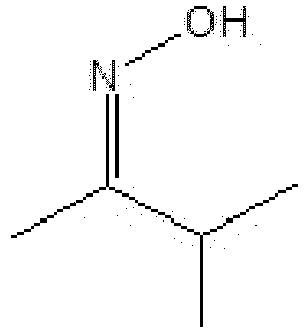
- 3-methyl-2-butanone oxime also known as methyl isopropyl ketoxime, is a alkyl oxime having the following formula (II):
- 3-methyl-2-butanone oxime has a vapor pressure at 20°C of less than 130 Pa (0.975 mm Hg), compared to about 213 Pa (about 1.60 mm Hg) for 2-PO and 267 Pa (2.00 mm Hg) for MEKO.
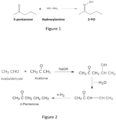
- 2-pentanone oxime is produced from the oximation of 2-pentanone with hydroxylamine, as shown in Figure 1 .
- 2- pentanone is commercially produced from acetaldehyde and acetone via aldol condensation, dehydration and hydrogenation, as shown by the reaction summarized in Figure 2 .
- MIBK methyl isobutyl ketone
- FIG. 3 the 2-pentanone product produced by the reaction shown in Figure 1 will contain at least some MIBK, which may be as much as 8-10 wt.% of the total mixture of 2-pentanone and MIBK.
- MIBKO methyl isobutyl ketoxime
- reaction 22 acetaldehyde and acetone are reacted in reaction 22 to form 2-pentanone by the reaction mechanism shown in Figure 2 .
- a portion of the acetone undergoes self-condensation to form MIBK, as shown in Figure 3 .
- the product of reaction 22 includes a mixture of 2-pentanone and MIBK, as shown in Figure 5 .
- the oximation 24 of this mixture with hydroxylamine results in oximation of 2-pentanone to form 2-PO, as shown in Figure 1 , and the oximation of MIBK to form MIBKO, as shown in Figure 4 .
- the product of oximation 24 is a mixture of 2-PO and MIBKO.
- direct oximation of 2-pentanone to form a 2-PO product will include a significant amount of MIBKO, due to the unavoidable presence of at least some MIBK in the 2-pentanone reactant.
- MIBKO methyl isobutyl ketoxime
- the vapor pressure of MIBKO is significantly lower than that of 2-pentanone oxime, about 2.14 hPa, at 20°C.
- MIBKO will also form complexes with the transition metal salt driers.
- complexes formed between MIBKO and the transition metal salt driers will be much more stable and retard the drying process to a significantly greater extent than complexes formed between 2-PO and the transition metal salt driers, leading to an undesirably lengthy drying time for the coating composition.
- MIBKO is known to have very strong objectionable odor, which is undesirable in coating formulations such as alkyd paints.
- the objectionable odor would negatively affect the desirability of use of alkyd paints and other coating compositions which include MIBKO, especially for indoor applications and for do-it-yourself (DIY) customers.
- MIBKO and 2-PO are temperature sensitive materials, which are subject to thermal decomposition below their respective atmospheric boiling points. As a result, vacuum distillation is required for the distillation of these oximes.
- an operating pressure less than 6.67 kPa (50 mm Hg) would be required.
- the MIBKO rich bottoms product has limited economic value, and incineration of the bottoms product would be required for disposal.
- the methods disclosed herein avoid the need to remove MIBKO from 2-PO by separating MIBK from 2-pentanone prior to the oximation reaction.
- compositions including a high-purity 2-PO or high-purity 3-methyl-2-butanone oxime
- a coating composition is provided.
- the coating composition is an alkyd paint composition.
- the coating composition includes an anti-skinning agent in the form of a high-purity alkyl oxime, or more particularly an alkyl oxime having 5 carbon atoms, such as 2-PO or high-purity 3-methyl-2-butanone oxime.
- high purity 2-PO is generally used herein to refer to an anti-skinning composition which comprises at least 92 wt.%, preferably at least 98 wt.%, at least 99 wt.%, at least 99.5 wt.%, or at least 99.9 wt.% 2-PO by weight of the anti-skinning agent composition.
- the "high purity 2-PO” comprises less than 0.5 wt.% methyl isobutyl ketoxime, less than 0.3 wt.% methyl isobutyl ketoxime, or less than 0.1 wt.% methyl isobutyl ketoxime of the total anti-skinning agent composition.
- high purity 3-methyl-2-butanone oxime is generally used herein to refer to an anti-skinning composition which at least 92 wt.%, least 98 wt.%, at least 99 wt.%, 99.5 wt.%, or at least 99.9 wt.% 3-methyl-2-butanone oxime by weight of the anti-skinning agent composition.
- the coating composition includes one or more components selected from the group consisting of: one or more binders, one or more fillers, one or more pigments, one or more solvents, and one or more driers.
- the coating composition may include one or more solvents and one or more driers, or may include one or more binders and one or more pigments, or may include one or more solvents, one or more driers, and one or more pigments.
- Exemplary solvents include xylene, mineral spirits, alcohol, and water.
- the coating composition has a similar drying time or a similar drying rate than that of a similar coating composition in which the 2-pentanone oxime, 3-methyl-2-butanone oxime, or mixture thereof is replaced on an equal weight basis with MEKO. In some embodiments, the coating composition has a faster drying time and/or a greater drying rate than that of a similar coating composition in which the 2-pentanone oxime, 3-methyl-2-butanone oxime, or mixture thereof is replaced on an equal weight basis with MEKO.
- the coating composition includes at least one high-purity alkyl oxime having 5 carbon atoms as an anti-skinning agent, such as 2-PO or high-purity 3-methyl-2-butanone oxime.
- an anti-skinning agent such as 2-PO or high-purity 3-methyl-2-butanone oxime.
- the purity levels of the anti-skinning agent are expressed as a weight percentage, either as a weight percentage of the anti-skinning chemical compound in connection with a particular anti-skinning agent, or in connection with an anti-skinning agent composition including one or more particular anti-skinning agent chemical compounds.
- Exemplary anti-skinning chemical compounds include 2-PO, 3-methyl-2-butanone oxime, and MEKO.
- Exemplary impurities include MIBKO.
- the high-purity alkyl oxime is 2-PO.
- the purity level of 2-PO is at least 92 wt.%, greater than 97 wt,%, at least 98 wt.%, greater than 98 wt.%, at least 99 wt.%, greater than 99 wt.%, at least 99.5 wt.%, greater than 99.5 wt.%, or at least 99.9 wt.%, or within any range defined between any two of the foregoing values, such as at least 92 wt.% to 99.9 wt.%, greater than 97 wt.% to 99.9 wt.%, greater than 98 wt.% to 99.9 wt.%, 99 wt.% to 99.9 wt.%, greater than 99 wt.% to 99.9 wt.%, 99.5 wt.% to 99.9 wt.% or greater than 99.5 wt
- the high purity 2-PO comprises no more than 2 wt.% MIBKO, no more than 1.5 wt.% MIBKO, no more than 1 wt.% MIBKO, no more than 0.5 wt.% MIBKO, no more than 0.3 wt.% MIBKO, or no more than 0.1 wt.% MIBKO.
- the composition includes as little as 0.1 wt.%, 0.2 wt.%, 0.25 wt.%, 0.3 wt.%, 0.35 wt.%, 0.4 wt.%, as great as 0.5 wt.%, 0.99 wt.% 1.0 wt.%, 1.25 wt.%, 1.5 wt.%, 2 wt.%, 3 wt.%, of the high-purity 2-PO based on the total weight of the composition, or within any range defined between any two of the foregoing values such as 0.1 wt.% to 3 wt.%, 0.2 wt.% to 2 wt.%, 0.25 wt.% to 1.5 wt.%, 0.3 wt.% to 1.25 wt.%, 0.35 wt.% to 0.99 wt.%, or 0.4 wt.% to 0.5 wt.%.
- composition may comprise 0.2 wt.% to 0.5 wt.%, 0.2 wt.% to 0.4 wt.%, 0.25 wt. % to 1.0 wt.% or 0.5 wt.% to 0.99 wt.% of the total anti-skinning agent based on the total weight of the composition.
- the composition includes the same or less 2-PO as an anti-skinning agent than the amount of MEKO in a similar composition to achieve at least one of the same drying time and the same drying rate.
- the composition comprises no more than 0.06 wt.% MIBKO, preferably no more than 0.05 wt.% MIBKO, no more than 0.02 wt.% MIBKO, no more than 0.01 wt.% MIBKO, no more than 0.005 wt.% MIBKO, no more than 0.002 wt.% MIBKO, no more than 0.001 wt.% MIBKO, no more than 0.0005 wt.% MIBKO, no more than 0.0002 wt.% MIBKO, or no more than 0.0001 wt.% MIBKO, based on the total weight of the composition.
- the anti-skinning agent includes a mixture of 2-PO and MEKO. In one embodiment, the anti-skinning agent consists essentially of 2-pentanone oxime and methyl ethyl ketoxime In some embodiments, the composition includes as little as 0.1 wt.%, 0.2 wt.%, 0.3 wt.%, 0.35 wt.%, 0.4 wt.
- composition may comprise 0.25 wt. % to 1.0 wt.% or 0.2 wt.% to 1.5 wt.% of the total anti-skinning agent based on the total weight of the composition.
- the high-purity alkyl oxime is 3-methyl-2-butanone oxime.
- the purity level of 3-methyl-2-butanone oxime is at least 92 wt.%, greater than 97 wt,%, at least 98 wt.%, greater than 98 wt.%, at least 99 wt.%, greater than 99 wt.%, at least 99.5 wt.%, greater than 99.5 wt.%, or at least 99.9 wt.%, or within any range defined between any two of the foregoing values, such as at least 92 wt.% to 99.9 wt.%, greater than 97 wt.% to 99.9 wt.%, greater than 98 wt.% to 99.9 wt.%, 99 wt.% to 99.9 wt.%, greater than 99 wt.% to 99.9 wt.%, 99.5 wt.% to
- the composition includes as little as 0.1 wt.%, 0.2 wt.%, 0.25 wt.%, 0.3 wt.%, 0.35 wt.%, 0.4 wt.%, as great as 0.5 wt.%, 0.99 wt.% 1.0 wt.%, 1.25 wt.%, 1.5 wt.%, 2 wt.%, 3 wt.%, of the high-purity 3-methyl-2-butanone oxime based on the total weight of the composition, or within any range defined between any two of the foregoing values such as 0.1 wt.% to 3 wt.%, 0.2 wt.% to 2 wt.%, 0.25 wt.% to 1.5 wt.%, 0.3 wt.% to 1.25 wt.%, 0.35 wt.% to 0.99 wt.%, or 0.4 wt.% to 0.5 wt.%.
- composition may comprise 0.2 wt.% to 0.5 wt.%, 0.2 wt.% to 0.4 wt.%, 0.25 wt. % to 1.0 wt.% or 0.5 wt.% to 0.99 wt.% of the total anti-skinning agent based on the total weight of the composition.
- the composition includes the same or less 3-methyl-2-butanone oxime as an anti-skinning agent than the amount of MEKO in a similar composition to achieve at least one of the same drying time and the same drying rate.
- the anti-skinning agent includes a mixture of 3-methyl-2-butanone oxime and MEKO. In one embodiment, the anti-skinning agent consists essentially of 3-methyl-2-butanone oxime. In some embodiments, the composition includes as little as 0.1 wt.%, 0.2 wt.%, 0.3 wt.%, 0.35 wt.%, 0.4 wt.
- composition may comprise 0.25 wt. % to 1.0 wt.% or 0.2 wt.% to 1.5 wt.% of the total anti-skinning agent based on the total weight of the composition.
- the anti-skinning agent includes a mixture of 2-PO and 3-methyl-2-butanone oxime.
- the anti-skinning agent includes a mixture of 2-PO, 3-methyl-2-butanone oxime, and MEKO.
- the coating composition includes one or more binders.
- binders include various types of alkyd resins.
- Exemplary alkyd resins include alkyd resins having short, medium, long, and very long oil length.
- alkyd resin also includes alkyds modified with other resins such as acrylic, epoxy, phenolic, urethane, polystyrene, silicone, rosin and rosin ester alkyds, and bio-alkyds, such as Setal 900 SM-90, in which the polyester segment is derived from renewable acids and esters.
- the composition includes as little as 1 wt.%, 5 wt.%, 10 wt.%, 15 wt.%, 25 wt.%, 30 wt.%, as great as 35 wt.%, 40 wt.%, 50 wt.%, 60 wt.%, of the one or more binders based on the total weight of the composition, or within any range defined between any two of the foregoing values such as 1 wt.% to 60 wt.%, 5 wt.% to 50 wt.%, 10 wt.% to 40 wt.%, 15 wt.% to 35 wt.% or 25 wt.% to 30 wt.%.
- composition may comprise 5 wt.% to 60 wt.%, 5 wt.% to 10 wt.%, 20 wt.% to 30 wt.%, or 35 wt.% to 60 wt.% of the one or more binders based on the total weight of the composition.
- the coating composition includes one or more aqueous or organic solvents like mineral spirits and alcohols.
- exemplary solvents include hydrocarbon solvent or their blends.
- the hydrocarbon solvents may be aliphatic or aromatic solvents.
- organic solvents are petroleum distillates such as pentane, hexane, petroleum naptha, heptanes, and 90 solvent (an aliphatic solvent with a flash point of 60 °C (140°F)).
- Aromatic solvents include xylene, toluene, Aromatic 100 and other suitable aromatic solvents.
- mineral spirits also known as “white spirits” encompasses compositions which comprise a mixture of C 7 to C 12 aliphatic and alicyclic hydrocarbons, and in a more particular embodiment comprises 15 wt.% to 20 wt.% or less of C 7 to C 12 aromatic hydrocarbons, based on the total weight of the composition.
- Mineral spirits include mixtures or blends of paraffins, cycloparaffins, and aromatic hydrocarbons. Typical mineral spirits have boiling ranges between about 150°C and 220°C, are generally clear water-white liquids, are chemically stable and non-corrosive, and possess a mild odor.
- Exemplary mineral spirits include Low Aromatic White Spirit (LAWS) such as Shell Sol 15 ( CAS 64742-88-7 ) and ShellSol H ( CAS 64742-82-1 ).
- LAWS Low Aromatic White Spirit
- the term "alcohol” encompasses is intended to encompass C 1 to C 12 alcohols, including C 1 to C 12 straight chain and branched alcohols.
- Exemplary alcohols include triethylene glycol ( CAS 112-27-6 ) and diethylene glycol ethylether ( CAS 111-90-0 ).
- the coating composition comprises a solvent selected from the group consisting of xylene, mineral spirits, alcohol, water, and combinations thereof.
- the composition includes as little as 5 wt.%, 10 wt.%, 15 wt.%, 17 wt.%, 20 wt.%, 25 wt.%, as great as 30 wt.%, 40 wt.%, 60 wt.%, of the one or more solvents based on the total weight of the composition, or within any range defined between any two of the foregoing values such as 5 wt.% to 60 wt.%, 10 wt.% to 40 wt.%, or 25 wt.% to 30 wt.%.
- composition may comprise 10 wt.% to 20 wt.%, 25 wt.% to 35 wt.%, or 40 wt.% to 60 wt.% of the one or more solvents based on the total weight of the composition.
- the coating composition includes one or more driers.
- the driers are catalysts used to accelerate the drying process.
- the at least one drier is an oxidation catalyst selected from cobalt esters or manganese esters that control the film formation. Driers enable the paint to fully dry within a few hours, such as within three hours, two hours, or less, after application to a surface.
- Cobalt or manganese esters are oxidation catalysts that play a role in initiating the oxidation process, and include esters of C 6 -C 19 branched fatty acids.
- Examples are Cobalt 2-ethylhexanoate, propionate, Neodecanoate, Naphthenate, Cobalt embeded polymer product called ECOS ND15 available from Umicore, Manganese Octoate, Manganese-amine complex called Nuodex Drycoat available from Huntsman.
- the drier composition includes as little as 0.1 wt.%, 0.3 wt.%, 0.6 wt.%, as great as 1.0 wt.%, 1.2 wt.%, 1.5 wt.%, 3.5 wt.%, 6.0 wt.%, of the one or more driers based on the total weight of the composition, or within any range defined between any two of the foregoing values such as 0.1 wt.% to 6 wt.%, 0.3 wt.% to 3.5 wt.% or 0.6 wt.% to 1.5 wt.%.
- composition may comprise 0.1 wt.% to 1.0 wt.%, 1.0 wt.% to 3.0 wt.%, or 3.0 wt.% to 6 wt.% of the one or more driers based on the total weight of the composition.
- the coating composition includes one or more additives such as fillers, pigments, surfactants, stabilizers, thickeners, emulsifiers, texture additives, adhesion promoters, biocides, flow promoters, dispersing agents, and additives to modify viscosity or finished appearance.
- additives such as fillers, pigments, surfactants, stabilizers, thickeners, emulsifiers, texture additives, adhesion promoters, biocides, flow promoters, dispersing agents, and additives to modify viscosity or finished appearance.
- the composition includes as little as 0.1 wt.%, 0.5 wt.%, 1.0 wt.%, 1.5 wt.%, as great as 2.0 wt.%, 5.0 wt.%, 10.0 wt.%, 20 wt.%, 25 wt.%, 30 wt.%, of the one or more additives based on the total weight of the composition, or within any range defined between any two of the foregoing values. such as 0.1 wt.% to 10 wt.%, 1.0 wt.% to 5.0 wt.% or 1.5 wt.% to 2.0 wt.%.
- composition may comprise 0.1 wt.% to 1.5 wt.%, 1.5 wt.% to 5.0 wt.%, or 5.0 wt.% to 10.0 wt.% of the one or more additives based on the total weight of the composition.
- the coating composition includes one or more fillers to thicken and increase the volume of the composition.
- Exemplary fillers include titanium oxide, calcium carbonate, clays, and talc.
- the coating composition includes one or more pigments to color the composition and/or provide opacity to the composition.
- pigment includes both inorganic metal oxides and organic Color pigments.
- Exemplary pigments include metal oxides such as titanium oxide and iron oxides, Zinc Chromates, Chromium oxides, Cadmium sulfides, Azurite (made from kaolin, Sodium carbonate, sulfur and carbon), Lithopone (zinc sulfide and Barium sulfate blend).
- organic color pigments examples include Phthalocyanine Blue (alpha & beta), Dinitraniline Orange (PO-5), Perylene Red, Toluidine Red (PR-3), Diarylide Yellow (PY-12,13) and Quinacridone Red (PV-19)
- the composition includes as little as 0 wt.%, 1 wt.%, 5 wt.%, 10 wt.%, as great as 15 wt.%, 20 wt.%, 25 wt.%, 30 wt.% of a filler and/or pigment, such as titanium dioxide based on the total weight of the composition, or within any range defined between any two of the foregoing values such as 0 wt.% to 30 wt.%, 5 wt.% to 25 wt.%, or 15 wt.% to 30 wt.%.
- a filler and/or pigment such as titanium dioxide
- the coating composition includes one or more additives selected from the group consisting of surfactants, stabilizers, thickeners, emulsifiers, texture additives, adhesion promoters, biocides, and additives to modify viscosity or finished appearance.
- additives selected from the group consisting of surfactants, stabilizers, thickeners, emulsifiers, texture additives, adhesion promoters, biocides, and additives to modify viscosity or finished appearance.
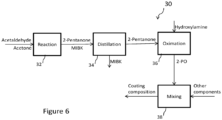
- a process 30 for producing a coating composition includes distilling 34 the MIBKO from the 2-pentanone after the reaction process 32 and prior to the oximation reaction 36. By performing this step prior to addition of the hydroxylamine, the MIBK is removed from the 2-pentanone reactant stream, and does not undergo the oximation reaction shown in Figure 5 . This in turn prevents the formation of the undesirable MIBKO product component as a part of the 2-PO product during the oximation reaction 36.
- a coating composition is then formed by combining 38 the resulting high-purity 2-PO product with other components, such as resins, fillers, pigments, solvents, driers, and other additives as described above.
- Film formation of the coating was determined by visual observation. If a film was observed, it was removed and the film thickness was measured. Film formation may be observed after two months at room temperature or after accelerated aging for four weeks at 50°C.
- Drying times were determined using a drying time recorder according to ASTM D5895, standard test methods for evaluating drying or curing during film formation of organic coatings using mechanical recorders.
- a post-aging drying time was determined following storage of a sample at an elevated temperature of 50°C for four weeks to model accelerated aging of the sample.
- the samples were placed in closed containers having a large air volume compared to the coating formulation volume to further accelerate the aging process. After four weeks, the samples were visually inspected for film formation.
- a post-aging drying time was determined using the same method as for the initial stage dry time.
- Example 1 Glossy white one-coat finish using various purity anti-skinning agents
- Glossy white one-coat finish EU SF 3.11 //cobalt drier formulations were prepared according to the weight percentages shown in Table 1: Table 1: Example 1 formulations (wt.%) Part Component Function Wt. % A SETAL AF 681 TB Alkyd resin 30 A White spirit D60 Solvent 10 A Borchi Gen 911 Wetting and dispersing agent 2.6 A Kronos 2310 Titanium dioxide 26 A Borchi Gol E, 50% in Solvesso 100 Flow promoter and release agent 1 A Octa-Soligen Calcium 10, basic Calcium-containing drier 0.5 B SETAL AF 681 TB Alkyd resin 20 B White spirit D60 Solvent 7.6 B Borchi Gol OL 17, 10% in xylene Flow promoter and release agent 1 B Octa-Soligen Zirconium 12 Zirconium-containing drier 0.5 B Octa-Soligen 69 Cobalt-containing drier 0.3 C Anti-skinning agent Anti-skinning agent 0.5
- the Part A components were subjected to ball milling at 3500 rpm for 45 minutes prior to cooling.
- the Part B components were then incorporated under gentle agitation/homogenization for 5 minutes.
- the Part C anti-skin additive for each formulation was varied according to the formulations provided in Table 2.
- the Part C anti-skin additive was incorporated into Part A and Part B one day following preparation of Part A and Part B for Ex. 1-3 and Ref. Ex. 9, two days for Ex. 4-7, and seven days following preparation for Ex. 8.
- Table 2 Anti-skinning agent composition (wt.%) Formulation % MEKO % 2-PO % MIBKO Ex. 1 - 92% 8% Ex. 2 - 94% 6% Ex. 3 - 96% 4% Ex. 4 - 97% 3% Ex. 5 - 98% 2% Ex. 6 - 99% 1% Ex. 7 - 99.5% 0.50% Ex. 8 - 99.7% 0.30% Ref. Ex. 9 100% - - -
- the Ex. 1-8 formulations had relatively similar initial dry times to the Ref. Ex. 9 MEKO formulation.
- the Ex. 5-8 formulations, having a 2-PO purity of at least 98 wt.% 2-PO had no skin formation following the accelerated aging test.
- Example 1 illustrates that compositions having a purity of at least 92 wt.% 2-PO are effective anti-skinning agents and can function as a substitute anti-skinning agent for MEKO.
- Example 2A Glossy white one-coat finish with cobalt-based drier
- Glossy white one-coat finish EU SF 3.11 //cobalt drier formulations at 0.25 wt.% anti-skinning agent, 0.35 wt.% anti-skinning agent, and 0.5 wt.% anti-skinning agent were prepared according to the weight percentages shown in Table 5.
- the amount of the solvent white spirit D60 added in Part B and the anti-skinning agent added in Part C for each formulation are provided in Table 6.
- the MEKO was provided as a 100% MEKO composition.
- the 2-PO was provided as a >99.9 wt.% 2-PO composition.
- the 3-methyl-2-butanone oxime was provided as a 100% 3-methyl-2-butanone oxime composition.
- the Part A components were subjected to ball milling at 3500 rpm for 45 minutes prior to cooling.
- the Part B components were then incorporated under gentle agitation/homogenization for 5 minutes.
- the Part C anti-skin additive for each formulation was varied according to the formulations provided in Table 6.
- the Part C anti-skin additive was incorporated into Part A and Part B seven days following preparation of Part A and Part B for Ref. Ex. 11-13 and Ex. 14-15, and eight days following preparation for Ex. 16-19.
- Example 2A illustrates that 2-PO and 3-methyl-2-butanone oxime can function as a substitute anti-skinning agent at equivalent levels as MEKO in a glossy white one-coat finish with a cobalt-based drier.
- Example 2B Glossy white one-coat finish with cobalt-free drier
- Glossy white one-coat finish EU SF 3.11 //cobalt free formulations at 0.25 wt.% anti-skinning agent, 0.35 wt.% anti-skinning agent, and 0.5 wt.% anti-skinning agent were prepared according to the weight percentages shown in Table 9. The amount of the solvent white spirit D60 added in Part B and the anti-skinning agent added in Part C for each formulation are provided in Table 10.
- Example 2B formulations (wt.%) Part Component Function Wt.% A SETAL AF 681 TB Alkyd resin 30 A White spirit D60 Solvent 10 A Borchi Gen 911 Wetting and dispersing agent 2.6 A Kronos 2310 Titanium dioxide 26 A Borchi Gol E, 50% in Solvesso 100 Flow promoter and release agent 1 A Octa-Soligen Calcium 10, basic Calcium-containing Drier 0.5 B SETAL AF 681 TB Alkyd resin 20 B White spirit D60 Solvent See Table 6 B Borchi Gol OL 17, 10% in xylene Flow promoter and release agent 1 B Borchi OXY - coat Manganese-containing drier 1 C Anti-skinning agent Anti-skinning agent See Table 6 Table 10: Anti-skinning agent composition (wt.%) Formulation Part B White spirit D60 MEKO 2-PO 3-methyl-2-butanone oxime Ref.
- the MEKO was provided as a 100% MEKO composition.
- the 2-PO was provided as a >99.9 wt.% 2-PO composition.
- the 3-methyl-2-butanone oxime was provided as a 100% 3-methyl-2-butanone oxime composition.
- the Part A components were subjected to ball milling at 3500 rpm for 45 minutes prior to cooling.
- the Part B components were then incorporated under gentle agitation/homogenization for 5 minutes.
- the Part C anti-skin additive for each formulation was varied according to the formulations provided in Table 6.
- the Part C anti-skin additive was incorporated into Part A and Part B eight days following preparation of Part A and Part B for Ref. Ex. 20-22 and Ex. 23, and nine days following preparation for Ex. 24-28.
- Example 2B illustrates that 2-PO and 3-methyl-2-butanone oxime can function as a substitute anti-skinning agent at equivalent levels as MEKO in a glossy white one-coat finish with a cobalt-free drier.
- Anti-skinning agent was added to a clear gloss base as shown in Table 13.
- Table 13 Example 3 formulations (g) Formulation Clear gloss base (g) MEKO (g) 2-PO (g) Ref. Ex. 29 36 0.35 - Ref. Ex. 30 36 0.5 - Ref. Ex. 31 36 0.8 - Ex. 32 36 - 0.35 Ex. 33 36 - 0.5 Ex. 34 36 - 0.8
- Example 3 illustrates that 2-PO can function as a substitute anti-skinning agent at equivalent levels as MEKO in a clear gloss base.
- Anti-skinning agent was added to a satin clear base as shown in Table 16.
- Table 16 Example 4 formulations (g) Formulation Satin clear base (g) MEKO (g) 2-PO (g) Ref. Ex. 35 99.65 0.35 - Ref. Ex. 36 99.5 0.5 - Ref. Ex. 37 99.2 0.8 - Ex. 38 99.65 - 0.35 Ex. 39 99.5 - 0.5 Ex. 40 99.2 - 0.8
- Example 4 illustrates that 2-PO can function as a substitute anti-skinning agent at equivalent levels as MEKO in a satin clear base.
Landscapes
- Chemical & Material Sciences (AREA)
- Organic Chemistry (AREA)
- Wood Science & Technology (AREA)
- Life Sciences & Earth Sciences (AREA)
- Engineering & Computer Science (AREA)
- Materials Engineering (AREA)
- Chemical Kinetics & Catalysis (AREA)
- Oil, Petroleum & Natural Gas (AREA)
- Crystallography & Structural Chemistry (AREA)
- Paints Or Removers (AREA)
- Organic Low-Molecular-Weight Compounds And Preparation Thereof (AREA)
- Health & Medical Sciences (AREA)
- Medicinal Chemistry (AREA)
- Polymers & Plastics (AREA)
- Application Of Or Painting With Fluid Materials (AREA)
Description
- The present invention relates to coating compositions including an anti-skinning agent and, in particular, relates to high purity anti-skinning agents.
- Air-drying coating compositions, like paints, include unsaturated resins dissolved in an organic or aqueous solvent medium along with additives such as driers that impact the drying profile. The driers are catalysts used to accelerate the drying process, and may include multiple metal salts, such as metal octoates. For example, a paint composition may include cobalt or manganese salts to promote the autoxidation, zirconium salts for the polymerization or crosslinking of the resin, and calcium salts to control the film formation. These catalyst driers enable the paint to dry within a few hours. The cobalt and/or manganese salts are oxidation catalysts that play an important role in initiating the oxidation process.
- Coating compositions such as alkyd paints that can dry in air are typically stored in cans. During storage, the paint may react with the air present over the composition to form a thin skin of cured paint on top of the paint. This unwanted reaction is referred to as the "skinning" of paints. This skinning phenomenon deteriorates the quality of the paint composition, impacts the strength of the driers, and negatively impacts the drying profile of the remaining paint. This skin formation is due to oxidative crosslinking of the resin and results in drying of the paint composition. Thus, anti-skinning agent additives are added to the coating composition to prevent the skinning of paints.
- It is known that these anti-skinning agents not only behave as antioxidants to prevent oxidative crosslinking of the paint resin, but the anti-skinning agents also form complexes with the transition metal salt driers to avoid pre-mature drying inside the can. Without wishing to be held to any particular theory, it is believed that a complex formed between the anti-skinning agent and the transition metal salt driers is far less effective as a catalyst for the autoxidation polymerization process, and thus prevents premature drying of the paint in the can. When the coating composition is applied to a substrate, the surface area is increased, enabling the anti-skinning agent to evaporate. Evaporation of the anti-skinning agent destroys the complex between the anti-skinning agent and the metal salt driers, enabling the catalytic activity of the metal ions to be restored and the paint to dry.
- Although several organic additives based on hydroxylamine derivatives, phenols, amino compounds and oximes of aldehydes and ketones have been used as anti-skinning agents, in practice, methyl ethyl ketoxime (MEKO) is typically regarded as the most effective and widely used anti-skinning agent. MEKO is known to form a complex with the primary metal salt driers to prevent premature drying in the can. MEKO will also evaporate easily to free the metal ion from the complex to facilitate the drying process once the paint is applied on a substrate. Additionally, MEKO provides benefits including low odor, low required dosage, applicability to a wide range of coatings, no yellowing or discoloration, no residue, no impact on the drying profile of the coating, and no impact on the performance of the coating, such as gloss, adhesion, or solvent resistance.
- However, concerns have been raised relating to the toxicity of MEKO. MEKO has been identified as a skin sensitizer and a suspected carcinogen. In addition, the German Hazardous Substances Commission has reduced the Occupational Exposure Limit (OEL) for MEKO to a level of only 0.3 ppm. On February 2, 2016, the German Federal Institute for Occupational Safety and Health (BAuA) has notified the European Chemicals Agency (ECHA) of its intention to submit a proposal to revise the harmonized classification of MEKO from a Carcinogenic, Mutagenic, or Toxic for Reproduction (CMR) category Carc. 2 to the more severe CMR category Carc. 1B.
- Other anti-skinning agents have been proposed as a replacement for MEKO, but each lacks one or more of the benefits of MEKO, as described above.
- Improvements in the foregoing processes are desired.
-
US 3846140 discloses electrical resistor inks comprising a mixture of at least one pyropolymeric semi-conducting organic refractory oxide material, a vehicle consisting of a binder, and a suitable solvent, for use in forming resistors in electrical circuits used for thick film circuits.
Environmental Project No 884 2003 - Substitution of Cobalt Driers and Methyl Ethyl Ketoxime, November 2003 (Pilemand, Wallstrom, Hoffman, Poulsen) , Danish Environmental Protection Agency discloses replacements for MEKO in air-drying coatings. - The present disclosure provides a coating composition comprising:
- at least one solvent;
- at least one alkyd resin;
- at least one drier; and
- an anti-skinning composition capable of preventing oxidative crosslinking of the resin to form a skin, the anti-skinning composition comprising at least 92 wt.% of an alkyl oxime based on the total weight of the anti-skinning composition, wherein the alkyl oxime is selected from 2-pentanone oxime and 3-methyl-2-butanone oxime; and wherein the at least one drier is an oxidation catalyst selected from cobalt esters and manganese esters.
- In one embodiment, the anti-skinning composition is a high-purity 2-pentanone oxime. In one more particular embodiment, the anti-skinning composition has a purity of at least 92 wt.% 2-pentanone oxime. In one more particular embodiment, the anti-skinning composition has a purity of at least 98 wt.% 2-pentanone oxime. In another more particular embodiment, the anti-skinning composition comprises less than 0.5 wt.% methyl isobutyl ketoxime, based on the total weight of the anti-skinning composition. In another more particular embodiment, the coating composition comprises less than 0.06 wt.% methyl isobutyl ketoxime, based on the total weight of the composition. Preferably, the anti-skinning composition has a purity of at least 98 wt.% 2-pentanone oxime and has less than 0.5 wt.% methyl isobutyl ketoxime based on the total weight of the anti-skinning composition, preferably less than 0.06 wt.% methyl isobutyl ketoxime, based on the total weight of the composition. In one more particular embodiment, the anti-skinning agent consists essentially of 2-pentanone oxime. In another more particular embodiment, the anti-skinning agent is a high-purity 3-methyl-2-butanone oxime.
- In one embodiment, a coating composition is provided. The coating composition comprises at least one solvent, at least one alkyd resin, at least one drier, and an anti-skinning composition capable of preventing oxidative crosslinking of the resin to form a skin, wherein the anti-skinning composition comprises at least 92 wt.%, or more particularly at least 98 wt.%, of an alkyl oxime selected from 2-pentanone oxime and 3-methyl-2-butanone oxime.
- In one more particular embodiment, the anti-skinning composition comprises a high-purity 2-pentanone oxime and methyl ethyl ketoxime. In one more particular embodiment, the anti-skinning composition has less than 0.5 wt.% methyl isobutyl ketoxime, based on the total weight of the anti-skinning composition. In another more particular embodiment, the coating composition has less than 0.06 wt.% methyl isobutyl ketoxime, based on the total weight of the composition. In one more particular embodiment, the anti-skinning composition consists essentially of 2-pentanone oxime and methyl ethyl ketoxime.
- In one embodiment, a coating composition is provided including at least one solvent, at least one alkyd resin, at least one drier, and an anti-skinning composition capable of preventing oxidative crosslinking of the resin to form a skin, wherein the anti-skinning composition comprises at least 92 wt.%, or more particularly at least 98 wt.%, based on the total weight of the anti-skinning composition, of an alkyl oxime selected from 2-pentanone oxime and 3-methyl-2-butanone oxime.
- In one more particular embodiment, the anti-skinning composition comprises at least 92 wt.% 2-pentanone oxime. In one more particular embodiment, the anti-skinning composition comprises at least 98 wt.% 2-pentanone oxime. In a more particular embodiment, the anti-skinning composition comprises at least 99 wt.% 2-pentanone oxime. In another more particular embodiment, the anti-skinning composition comprises at least 99.5 wt.% 2-pentanone oxime. In still another more particular embodiment, the anti-skinning composition comprises at least 99.9 wt.% 2-pentanone oxime. In another more particular embodiment, the anti-skinning composition is a high-purity 3-methyl-2-butanone oxime.
- In one embodiment, an anti-skinning composition capable of preventing oxidative crosslinking of the resin to form a skin is provided wherein the anti-skinning composition comprises at least 92 wt.%, or more particularly at least 98 wt.%, of an alkyl oxime selected from 2-pentanone oxime and 3-methyl-2-butanone oxime. In one more particular embodiment, the anti-skinning composition comprises 2-pentanone oxime provided in combination with a solvent selected from xylene, mineral spirits, alcohol, and water. In a more particular embodiment, the anti-skinning composition comprises at least 92 wt.% 2-pentanone oxime. In another more particular embodiment, the anti-skinning composition comprises at least 98 wt.% 2-pentanone oxime. In another embodiment, a coating composition comprising either of the above anti-skinning compositions is provided. In another more particular embodiment, the anti-skinning composition is a high-purity 3-methyl-2-butanone oxime.
- In a more particular embodiment of any of the above embodiments, the anti-skinning composition comprises less than 0.5 wt.% methyl isobutyl ketoxime, based on the total weight of the anti-skinning composition. In another more particular embodiment of any of the above embodiments, the anti-skinning composition comprises less than 0.3 wt.% methyl isobutyl ketoxime, based on the total weight of the anti-skinning composition. In another more particular embodiment of any of the above embodiments, the anti-skinning composition comprises less than 0.1 wt.% methyl isobutyl ketoxime, based on the total weight of the anti-skinning composition.
- In a more particular embodiment of any of the above embodiments, the anti-skinning agent comprises at least 92 wt.% 2-pentanone oxime, preferably at least 98 wt.% 2-pentanone oxime, at least 99 wt.% 2-pentanone oxime, at least 99.5 wt.% 2-pentanone oxime, and or at least 99.9 wt.% 2-pentanone oxime, based on the total weight of the composition. In another more particular embodiment of any of the above embodiments, the anti-skinning composition comprises less than 0.5 wt.% methyl isobutyl ketoxime, preferably less than 0.3 wt.% methyl isobutyl ketoxime, or less than 0.1 wt.% methyl isobutyl ketoxime, based on the total weight of the composition. In a more particular embodiment of any of the above embodiments, the anti-skinning composition comprises at least 92 wt.% 2-pentanone oxime, preferably at least 98 wt.% 2-pentanone oxime, at least 99 wt.% 2-pentanone oxime, at least 99.5 wt.% 2-pentanone oxime, or at least 99.9 wt.% 2-pentanone oxime and the anti-skinning composition comprises less than 0.5 wt.% methyl isobutyl ketoxime, less than 0.3 wt.% methyl isobutyl ketoxime, or less than 0.1 wt.% methyl isobutyl ketoxime, based on the total weight of the anti-skinning composition.
- In the coating compositions of the present invention at least one drier is present that comprises cobalt esters and manganese esters. In another more particular embodiment of any of the above embodiments, the at least one solvent comprises at least one solvent selected from the group consisting of: xylene, mineral spirits, alcohol, and water, and combinations thereof. In another more particular embodiment of any of the above embodiments, the coating composition further includes at least one additive selected from the group consisting of: fillers, pigments, surfactants, stabilizers, thickeners, emulsifiers, texture additives, adhesion promoters, biocides, and additives to modify viscosity or finished appearance.
- In a more particular embodiment of any of the above embodiments, the coating composition has a drying time at least as short as a similar composition having the same components except that the weight percentage of 2-pentanone oxime and/or 3-methyl-2-butanone oxime is replaced with an equivalent weight percentage of methyl ethyl ketoxime.
- The above mentioned and other features of the invention, and the manner of attaining them, will become more apparent and the invention itself will be better understood by reference to the following description of embodiments of the invention taken in conjunction with the accompanying drawings.
-
-
FIG. 1 shows the oximation of 2-pentanone to form 2-pentanone oxime ("2-PO") using hydroxylamine. -
FIG. 2 shows the production of 2-pentanone from acetaldehyde and acetone. -
FIG. 3 shows the formation of methyl isobutyl ketone ("MIBK") from the self-condensation of acetone. -
FIG. 4 shows the oximation of MIBK to methyl isobutyl ketoxime ("MIBKO") using hydroxylamine. -
FIG. 5 shows an exemplary process for producing a 2-PO product. -
FIG. 6 shows an exemplary process for producing a coating composition including a high-purity 2-PO product. - Alkyl oximes having five carbon atoms include 2-pentanone oxime and 3-methyl-2-butanone oxime. As shown below, it has been discovered that high-purity 2-pentanone oxime and 3-methyl-2-butanone oxime function as effective anti-skinning agents.
- 2-pentanone oxime ("2-PO"), also known as methyl propylketoxime, is an alkyl oxime having the following formula (I):

- As shown below, it has been discovered that high-purity 2-PO functions as an effective anti-skinning agent. 2-PO has a vapor pressure similar to that of MEKO. In addition, 2-PO provides similar benefits to MEKO, including low required dosage, applicability to a wide range of coatings, no yellowing or discoloration, no residue, and no impact on the performance of the coating, such as gloss, adhesion, or solvent resistance. Additionally, high-purity 2-PO, which includes relatively low levels of methyl isobutyl ketoxime (MIBKO) as described below, provides similar drying profiles to MEKO, as well as low odor.
- However, 2-PO has a positive toxicology profile compared to MEKO.
- The saturated vapor concentration of MEKO is 1350 ppm, while that of 2-PO is only 300 ppm, or less than 25% of that of MEKO. The lower saturated vapor concentration provides a lower inhalation risk for 2-PO compared to MEKO.
- For dermal irritation, MEKO is a slight irritant, while 2-PO produces no irritation. For eye irriation, MEKO is categorized as causing serious eye damage (code H318), while 2-PO is categorized as only causing serious eye irritation (code H319).
- MEKO is classified as a sensitizer (R43), while 2-PO is not a sensistizer.
- MEKO has an effective concentration of 50% growth inhabitation (EC50) for algae of only 7 ppm, while the corresponding EC50 of 2-PO for algae is 88 ppm. MEKO has an lethal concentration of 50% mortality (LC50) for fish of only 48 ppm, while the corresponding LC50 of 2-PO for fish is greater than 100 ppm.
- The positive toxicology profile of 2-PO compared to MEKO was unexpected.
- 3-methyl-2-butanone oxime, also known as methyl isopropyl ketoxime, is a alkyl oxime having the following formula (II):
- 3-methyl-2-butanone oxime has a vapor pressure at 20°C of less than 130 Pa (0.975 mm Hg), compared to about 213 Pa (about 1.60 mm Hg) for 2-PO and 267 Pa (2.00 mm Hg) for MEKO.
- 2-pentanone oxime is produced from the oximation of 2-pentanone with hydroxylamine, as shown in
Figure 1 . 2- pentanone is commercially produced from acetaldehyde and acetone via aldol condensation, dehydration and hydrogenation, as shown by the reaction summarized inFigure 2 . - However, in the reaction shown in
Figure 2 , it is known and unavoidable that a portion of the acetone reactant will undergo self-condensation following the same reaction pathway to form methyl isobutyl ketone (MIBK), also known as 4-methyl-2- pentanone. This side reaction is shown inFigure 3 . As a result, the 2-pentanone product produced by the reaction shown inFigure 1 will contain at least some MIBK, which may be as much as 8-10 wt.% of the total mixture of 2-pentanone and MIBK. - However, in direct oximation of a 2-pentanone feed that also includes MIBK, the hydroxylamine also reacts with the MIBK product in an oximation reaction as shown in
Figure 4 to form methyl isobutyl ketoxime (MIBKO). - The above reactions are summarized by
process 20 shown inFigure 5 . As shown inFigure 5 , acetaldehyde and acetone are reacted inreaction 22 to form 2-pentanone by the reaction mechanism shown inFigure 2 . However, a portion of the acetone undergoes self-condensation to form MIBK, as shown inFigure 3 . Accordingly, the product ofreaction 22 includes a mixture of 2-pentanone and MIBK, as shown inFigure 5 . Theoximation 24 of this mixture with hydroxylamine results in oximation of 2-pentanone to form 2-PO, as shown inFigure 1 , and the oximation of MIBK to form MIBKO, as shown inFigure 4 . The product ofoximation 24 is a mixture of 2-PO and MIBKO. In this manner, direct oximation of 2-pentanone to form a 2-PO product will include a significant amount of MIBKO, due to the unavoidable presence of at least some MIBK in the 2-pentanone reactant. - The presence of methyl isobutyl ketoxime (MIBKO) in coating compositions is undesirable for several reasons.
- First, the vapor pressure of MIBKO, about 0.13 hPa, is significantly lower than that of 2-pentanone oxime, about 2.14 hPa, at 20°C. Like MEKO and 2-PO, MIBKO will also form complexes with the transition metal salt driers. However, due to the significantly lower vapor pressure of MIBKO, complexes formed between MIBKO and the transition metal salt driers will be much more stable and retard the drying process to a significantly greater extent than complexes formed between 2-PO and the transition metal salt driers, leading to an undesirably lengthy drying time for the coating composition.
- Second, MIBKO is known to have very strong objectionable odor, which is undesirable in coating formulations such as alkyd paints. The objectionable odor would negatively affect the desirability of use of alkyd paints and other coating compositions which include MIBKO, especially for indoor applications and for do-it-yourself (DIY) customers.
- Removal of MIBKO from 2-PO by distillation is relatively difficult. Both MIBKO and 2-PO are temperature sensitive materials, which are subject to thermal decomposition below their respective atmospheric boiling points. As a result, vacuum distillation is required for the distillation of these oximes. In an apparatus to produce MIBKO substantially free of 2-PO in the bottoms, an operating pressure less than 6.67 kPa (50 mm Hg) would be required. Additionally, the MIBKO rich bottoms product has limited economic value, and incineration of the bottoms product would be required for disposal. The methods disclosed herein avoid the need to remove MIBKO from 2-PO by separating MIBK from 2-pentanone prior to the oximation reaction.
- In one embodiment, a coating composition is provided. The coating composition is an alkyd paint composition. The coating composition includes an anti-skinning agent in the form of a high-purity alkyl oxime, or more particularly an alkyl oxime having 5 carbon atoms, such as 2-PO or high-purity 3-methyl-2-butanone oxime.
- The term "high purity 2-PO" is generally used herein to refer to an anti-skinning composition which comprises at least 92 wt.%, preferably at least 98 wt.%, at least 99 wt.%, at least 99.5 wt.%, or at least 99.9 wt.% 2-PO by weight of the anti-skinning agent composition. Preferably the "high purity 2-PO" comprises less than 0.5 wt.% methyl isobutyl ketoxime, less than 0.3 wt.% methyl isobutyl ketoxime, or less than 0.1 wt.% methyl isobutyl ketoxime of the total anti-skinning agent composition.
- The term "high purity 3-methyl-2-butanone oxime" is generally used herein to refer to an anti-skinning composition which at least 92 wt.%, least 98 wt.%, at least 99 wt.%, 99.5 wt.%, or at least 99.9 wt.% 3-methyl-2-butanone oxime by weight of the anti-skinning agent composition.
- In some embodiments, the coating composition includes one or more components selected from the group consisting of: one or more binders, one or more fillers, one or more pigments, one or more solvents, and one or more driers. For example, the coating composition may include one or more solvents and one or more driers, or may include one or more binders and one or more pigments, or may include one or more solvents, one or more driers, and one or more pigments. Exemplary solvents include xylene, mineral spirits, alcohol, and water.
- In some embodiments, the coating composition has a similar drying time or a similar drying rate than that of a similar coating composition in which the 2-pentanone oxime, 3-methyl-2-butanone oxime, or mixture thereof is replaced on an equal weight basis with MEKO. In some embodiments, the coating composition has a faster drying time and/or a greater drying rate than that of a similar coating composition in which the 2-pentanone oxime, 3-methyl-2-butanone oxime, or mixture thereof is replaced on an equal weight basis with MEKO.
- In one embodiment, the coating composition includes at least one high-purity alkyl oxime having 5 carbon atoms as an anti-skinning agent, such as 2-PO or high-purity 3-methyl-2-butanone oxime. As disclosed herein, the purity levels of the anti-skinning agent are expressed as a weight percentage, either as a weight percentage of the anti-skinning chemical compound in connection with a particular anti-skinning agent, or in connection with an anti-skinning agent composition including one or more particular anti-skinning agent chemical compounds. Exemplary anti-skinning chemical compounds include 2-PO, 3-methyl-2-butanone oxime, and MEKO. Exemplary impurities include MIBKO.
- In one embodiment, the high-purity alkyl oxime is 2-PO. In a more particular embodiment, the purity level of 2-PO is at least 92 wt.%, greater than 97 wt,%, at least 98 wt.%, greater than 98 wt.%, at least 99 wt.%, greater than 99 wt.%, at least 99.5 wt.%, greater than 99.5 wt.%, or at least 99.9 wt.%, or within any range defined between any two of the foregoing values, such as at least 92 wt.% to 99.9 wt.%, greater than 97 wt.% to 99.9 wt.%, greater than 98 wt.% to 99.9 wt.%, 99 wt.% to 99.9 wt.%, greater than 99 wt.% to 99.9 wt.%, 99.5 wt.% to 99.9 wt.% or greater than 99.5 wt.% to 99.9 wt.%.
- In one embodiment, the high purity 2-PO comprises no more than 2 wt.% MIBKO, no more than 1.5 wt.% MIBKO, no more than 1 wt.% MIBKO, no more than 0.5 wt.% MIBKO, no more than 0.3 wt.% MIBKO, or no more than 0.1 wt.% MIBKO.
- In some embodiments, the composition includes as little as 0.1 wt.%, 0.2 wt.%, 0.25 wt.%, 0.3 wt.%, 0.35 wt.%, 0.4 wt.%, as great as 0.5 wt.%, 0.99 wt.% 1.0 wt.%, 1.25 wt.%, 1.5 wt.%, 2 wt.%, 3 wt.%, of the high-purity 2-PO based on the total weight of the composition, or within any range defined between any two of the foregoing values such as 0.1 wt.% to 3 wt.%, 0.2 wt.% to 2 wt.%, 0.25 wt.% to 1.5 wt.%, 0.3 wt.% to 1.25 wt.%, 0.35 wt.% to 0.99 wt.%, or 0.4 wt.% to 0.5 wt.%. It will also be appreciated that the composition may comprise 0.2 wt.% to 0.5 wt.%, 0.2 wt.% to 0.4 wt.%, 0.25 wt. % to 1.0 wt.% or 0.5 wt.% to 0.99 wt.% of the total anti-skinning agent based on the total weight of the composition.
- In some embodiments, the composition includes the same or less 2-PO as an anti-skinning agent than the amount of MEKO in a similar composition to achieve at least one of the same drying time and the same drying rate.
- In some embodiments, the composition comprises no more than 0.06 wt.% MIBKO, preferably no more than 0.05 wt.% MIBKO, no more than 0.02 wt.% MIBKO, no more than 0.01 wt.% MIBKO, no more than 0.005 wt.% MIBKO, no more than 0.002 wt.% MIBKO, no more than 0.001 wt.% MIBKO, no more than 0.0005 wt.% MIBKO, no more than 0.0002 wt.% MIBKO, or no more than 0.0001 wt.% MIBKO, based on the total weight of the composition.
- In another embodiment, the anti-skinning agent includes a mixture of 2-PO and MEKO. In one embodiment, the anti-skinning agent consists essentially of 2-pentanone oxime and methyl ethyl ketoxime In some embodiments, the composition includes as little as 0.1 wt.%, 0.2 wt.%, 0.3 wt.%, 0.35 wt.%, 0.4 wt. %, 0.5 wt.%, as great as 1.0 wt.%, 1.25 wt.%, 1.5 wt.%, 2 wt.%, 3 wt.%, of the total anti-skinning agent based on the total weight of the composition, or within any range defined between any two of the foregoing values such as 0.1 wt.% to 3 wt.%, 0.2 wt.% to 2 wt.%, 0.25 wt.% to 1.5 wt. %, 0.3 wt.% to 1.35 wt.%, 0.3 wt.% to 0.99 wt.%, or 0.4 wt.% to 0.5 wt.%. It will also be appreciated that the composition may comprise 0.25 wt. % to 1.0 wt.% or 0.2 wt.% to 1.5 wt.% of the total anti-skinning agent based on the total weight of the composition.
- In one embodiment, the high-purity alkyl oxime is 3-methyl-2-butanone oxime. In a more particular embodiment, the purity level of 3-methyl-2-butanone oxime is at least 92 wt.%, greater than 97 wt,%, at least 98 wt.%, greater than 98 wt.%, at least 99 wt.%, greater than 99 wt.%, at least 99.5 wt.%, greater than 99.5 wt.%, or at least 99.9 wt.%, or within any range defined between any two of the foregoing values, such as at least 92 wt.% to 99.9 wt.%, greater than 97 wt.% to 99.9 wt.%, greater than 98 wt.% to 99.9 wt.%, 99 wt.% to 99.9 wt.%, greater than 99 wt.% to 99.9 wt.%, 99.5 wt.% to 99.9 wt.% or greater than 99.5 wt.% to 99.9 wt.%.
- In some embodiments, the composition includes as little as 0.1 wt.%, 0.2 wt.%, 0.25 wt.%, 0.3 wt.%, 0.35 wt.%, 0.4 wt.%, as great as 0.5 wt.%, 0.99 wt.% 1.0 wt.%, 1.25 wt.%, 1.5 wt.%, 2 wt.%, 3 wt.%, of the high-purity 3-methyl-2-butanone oxime based on the total weight of the composition, or within any range defined between any two of the foregoing values such as 0.1 wt.% to 3 wt.%, 0.2 wt.% to 2 wt.%, 0.25 wt.% to 1.5 wt.%, 0.3 wt.% to 1.25 wt.%, 0.35 wt.% to 0.99 wt.%, or 0.4 wt.% to 0.5 wt.%. It will also be appreciated that the composition may comprise 0.2 wt.% to 0.5 wt.%, 0.2 wt.% to 0.4 wt.%, 0.25 wt. % to 1.0 wt.% or 0.5 wt.% to 0.99 wt.% of the total anti-skinning agent based on the total weight of the composition.
- In some embodiments, the composition includes the same or less 3-methyl-2-butanone oxime as an anti-skinning agent than the amount of MEKO in a similar composition to achieve at least one of the same drying time and the same drying rate.
- In another embodiment, the anti-skinning agent includes a mixture of 3-methyl-2-butanone oxime and MEKO. In one embodiment, the anti-skinning agent consists essentially of 3-methyl-2-butanone oxime. In some embodiments, the composition includes as little as 0.1 wt.%, 0.2 wt.%, 0.3 wt.%, 0.35 wt.%, 0.4 wt. %, 0.5 wt.%, as great as 1.0 wt.%, 1.25 wt.%, 1.5 wt.%, 2 wt.%, 3 wt.%, of the total anti-skinning agent based on the total weight of the composition, or within any range defined between any two of the foregoing values such as 0.1 wt.% to 3 wt.%, 0.2 wt.% to 2 wt.%, 0.25 wt.% to 1.5 wt. %, 0.3 wt.% to 1.35 wt.%, 0.3 wt.% to 0.99 wt.%, or 0.4 wt.% to 0.5 wt.%. It will also be appreciated that the composition may comprise 0.25 wt. % to 1.0 wt.% or 0.2 wt.% to 1.5 wt.% of the total anti-skinning agent based on the total weight of the composition.
- In another embodiment, the anti-skinning agent includes a mixture of 2-PO and 3-methyl-2-butanone oxime.
- In another embodiment, the anti-skinning agent includes a mixture of 2-PO, 3-methyl-2-butanone oxime, and MEKO.
- In one embodiment, the coating composition includes one or more binders. Exemplary binders include various types of alkyd resins. Exemplary alkyd resins include alkyd resins having short, medium, long, and very long oil length. The term "alkyd resin" also includes alkyds modified with other resins such as acrylic, epoxy, phenolic, urethane, polystyrene, silicone, rosin and rosin ester alkyds, and bio-alkyds, such as Setal 900 SM-90, in which the polyester segment is derived from renewable acids and esters.
- In some embodiments, the composition includes as little as 1 wt.%, 5 wt.%, 10 wt.%, 15 wt.%, 25 wt.%, 30 wt.%, as great as 35 wt.%, 40 wt.%, 50 wt.%, 60 wt.%, of the one or more binders based on the total weight of the composition, or within any range defined between any two of the foregoing values such as 1 wt.% to 60 wt.%, 5 wt.% to 50 wt.%, 10 wt.% to 40 wt.%, 15 wt.% to 35 wt.% or 25 wt.% to 30 wt.%. It will also be appreciated that the composition may comprise 5 wt.% to 60 wt.%, 5 wt.% to 10 wt.%, 20 wt.% to 30 wt.%, or 35 wt.% to 60 wt.% of the one or more binders based on the total weight of the composition.
- In one embodiment, the coating composition includes one or more aqueous or organic solvents like mineral spirits and alcohols. Exemplary solvents include hydrocarbon solvent or their blends. The hydrocarbon solvents may be aliphatic or aromatic solvents. Examples of organic solvents are petroleum distillates such as pentane, hexane, petroleum naptha, heptanes, and 90 solvent (an aliphatic solvent with a flash point of 60 °C (140°F)). Aromatic solvents include xylene, toluene, Aromatic 100 and other suitable aromatic solvents. The term "mineral spirits", also known as "white spirits", encompasses compositions which comprise a mixture of C7 to C12 aliphatic and alicyclic hydrocarbons, and in a more particular embodiment comprises 15 wt.% to 20 wt.% or less of C7 to C12 aromatic hydrocarbons, based on the total weight of the composition. Mineral spirits include mixtures or blends of paraffins, cycloparaffins, and aromatic hydrocarbons. Typical mineral spirits have boiling ranges between about 150°C and 220°C, are generally clear water-white liquids, are chemically stable and non-corrosive, and possess a mild odor. Exemplary mineral spirits include Low Aromatic White Spirit (LAWS) such as Shell Sol 15 (CAS 64742-88-7) and ShellSol H (CAS 64742-82-1). The term "alcohol" encompasses is intended to encompass C1 to C12 alcohols, including C1 to C12 straight chain and branched alcohols. Exemplary alcohols include triethylene glycol (CAS 112-27-6) and diethylene glycol ethylether (CAS 111-90-0). In a more particular embodiment, the coating composition comprises a solvent selected from the group consisting of xylene, mineral spirits, alcohol, water, and combinations thereof.
- In some embodiments, the composition includes as little as 5 wt.%, 10 wt.%, 15 wt.%, 17 wt.%, 20 wt.%, 25 wt.%, as great as 30 wt.%, 40 wt.%, 60 wt.%, of the one or more solvents based on the total weight of the composition, or within any range defined between any two of the foregoing values such as 5 wt.% to 60 wt.%, 10 wt.% to 40 wt.%, or 25 wt.% to 30 wt.%. It will also be appreciated that the composition may comprise 10 wt.% to 20 wt.%, 25 wt.% to 35 wt.%, or 40 wt.% to 60 wt.% of the one or more solvents based on the total weight of the composition.
- The coating composition includes one or more driers. The driers are catalysts used to accelerate the drying process. The at least one drier is an oxidation catalyst selected from cobalt esters or manganese esters that control the film formation. Driers enable the paint to fully dry within a few hours, such as within three hours, two hours, or less, after application to a surface. Cobalt or manganese esters are oxidation catalysts that play a role in initiating the oxidation process, and include esters of C6-C19 branched fatty acids. Examples are Cobalt 2-ethylhexanoate, propionate, Neodecanoate, Naphthenate, Cobalt embeded polymer product called ECOS ND15 available from Umicore, Manganese Octoate, Manganese-amine complex called Nuodex Drycoat available from Huntsman.
- In some embodiments, the drier composition includes as little as 0.1 wt.%, 0.3 wt.%, 0.6 wt.%, as great as 1.0 wt.%, 1.2 wt.%, 1.5 wt.%, 3.5 wt.%, 6.0 wt.%, of the one or more driers based on the total weight of the composition, or within any range defined between any two of the foregoing values such as 0.1 wt.% to 6 wt.%, 0.3 wt.% to 3.5 wt.% or 0.6 wt.% to 1.5 wt.%. It will also be appreciated that the composition may comprise 0.1 wt.% to 1.0 wt.%, 1.0 wt.% to 3.0 wt.%, or 3.0 wt.% to 6 wt.% of the one or more driers based on the total weight of the composition.
- In one embodiment, the coating composition includes one or more additives such as fillers, pigments, surfactants, stabilizers, thickeners, emulsifiers, texture additives, adhesion promoters, biocides, flow promoters, dispersing agents, and additives to modify viscosity or finished appearance.
- In some embodiments, the composition includes as little as 0.1 wt.%, 0.5 wt.%, 1.0 wt.%, 1.5 wt.%, as great as 2.0 wt.%, 5.0 wt.%, 10.0 wt.%, 20 wt.%, 25 wt.%, 30 wt.%, of the one or more additives based on the total weight of the composition, or within any range defined between any two of the foregoing values. such as 0.1 wt.% to 10 wt.%, 1.0 wt.% to 5.0 wt.% or 1.5 wt.% to 2.0 wt.%. It will also be appreciated that the composition may comprise 0.1 wt.% to 1.5 wt.%, 1.5 wt.% to 5.0 wt.%, or 5.0 wt.% to 10.0 wt.% of the one or more additives based on the total weight of the composition.
- In one embodiment, the coating composition includes one or more fillers to thicken and increase the volume of the composition. Exemplary fillers include titanium oxide, calcium carbonate, clays, and talc.
- In one embodiment, the coating composition includes one or more pigments to color the composition and/or provide opacity to the composition. As used herein, pigment includes both inorganic metal oxides and organic Color pigments. Exemplary pigments include metal oxides such as titanium oxide and iron oxides, Zinc Chromates, Chromium oxides, Cadmium sulfides, Azurite (made from kaolin, Sodium carbonate, sulfur and carbon), Lithopone (zinc sulfide and Barium sulfate blend). Examples of organic color pigments are Phthalocyanine Blue (alpha & beta), Dinitraniline Orange (PO-5), Perylene Red, Toluidine Red (PR-3), Diarylide Yellow (PY-12,13) and Quinacridone Red (PV-19)
- In some embodiments, the composition includes as little as 0 wt.%, 1 wt.%, 5 wt.%, 10 wt.%, as great as 15 wt.%, 20 wt.%, 25 wt.%, 30 wt.% of a filler and/or pigment, such as titanium dioxide based on the total weight of the composition, or within any range defined between any two of the foregoing values such as 0 wt.% to 30 wt.%, 5 wt.% to 25 wt.%, or 15 wt.% to 30 wt.%.
- In one embodiment, the coating composition includes one or more additives selected from the group consisting of surfactants, stabilizers, thickeners, emulsifiers, texture additives, adhesion promoters, biocides, and additives to modify viscosity or finished appearance.
- Referring next to
Figure 6 , aprocess 30 for producing a coating composition is provided. The process includes distilling 34 the MIBKO from the 2-pentanone after thereaction process 32 and prior to theoximation reaction 36. By performing this step prior to addition of the hydroxylamine, the MIBK is removed from the 2-pentanone reactant stream, and does not undergo the oximation reaction shown inFigure 5 . This in turn prevents the formation of the undesirable MIBKO product component as a part of the 2-PO product during theoximation reaction 36. A coating composition is then formed by combining 38 the resulting high-purity 2-PO product with other components, such as resins, fillers, pigments, solvents, driers, and other additives as described above. - The coating formulations below were evaluated according to the following test methods.
- Film formation of the coating was determined by visual observation. If a film was observed, it was removed and the film thickness was measured. Film formation may be observed after two months at room temperature or after accelerated aging for four weeks at 50°C.
- Drying times were determined using a drying time recorder according to ASTM D5895, standard test methods for evaluating drying or curing during film formation of organic coatings using mechanical recorders.
- An initial stage dry time was determined 1 day following paint preparation. A coating sample was applied to a Leneta sheet at a fixed humid thickness. The drying time recorder was immediately placed on the wet film and the stylus lowered on to the wet paint. After the stylus has moved across the sheet at a constant speed, the stages of drying time are determined by examining the sheet. Stage I is a set-to-touch time; Stage II is a tack-free time, Stage III is a dry-hard time, and Stage IV is a dry-through time.
- A post-aging drying time was determined following storage of a sample at an elevated temperature of 50°C for four weeks to model accelerated aging of the sample. The samples were placed in closed containers having a large air volume compared to the coating formulation volume to further accelerate the aging process. After four weeks, the samples were visually inspected for film formation. A post-aging drying time was determined using the same method as for the initial stage dry time.
- Glossy white one-coat finish = EU SF 3.11 //cobalt drier formulations were prepared according to the weight percentages shown in Table 1:
Table 1: Example 1 formulations (wt.%) Part Component Function Wt. % A SETAL AF 681 TB Alkyd resin 30 A White spirit D60 Solvent 10 A Borchi Gen 911 Wetting and dispersing agent 2.6 A Kronos 2310 Titanium dioxide 26 A Borchi Gol E, 50% in Solvesso 100 Flow promoter and release agent 1 A Octa-Soligen Calcium 10, basic Calcium-containing drier 0.5 B SETAL AF 681 TB Alkyd resin 20 B White spirit D60 Solvent 7.6 B Borchi Gol OL 17, 10% in xylene Flow promoter and release agent 1 B Octa-Soligen Zirconium 12 Zirconium-containing drier 0.5 B Octa-Soligen 69 Cobalt-containing drier 0.3 C Anti-skinning agent Anti-skinning agent 0.5 - The Part A components were subjected to ball milling at 3500 rpm for 45 minutes prior to cooling. The Part B components were then incorporated under gentle agitation/homogenization for 5 minutes.
- The Part C anti-skin additive for each formulation was varied according to the formulations provided in Table 2. The Part C anti-skin additive was incorporated into Part A and Part B one day following preparation of Part A and Part B for Ex. 1-3 and Ref. Ex. 9, two days for Ex. 4-7, and seven days following preparation for Ex. 8.
Table 2: Anti-skinning agent composition (wt.%) Formulation % MEKO % 2-PO % MIBKO Ex. 1 - 92% 8% Ex. 2 - 94% 6% Ex. 3 - 96% 4% Ex. 4 - 97% 3% Ex. 5 - 98% 2% Ex. 6 - 99% 1% Ex. 7 - 99.5% 0.50% Ex. 8 - 99.7% 0.30% Ref. Ex. 9 100% - - - In addition, a Ref. Ex. 10 formulation was similarly prepared, but lacking any anti-skinning agent.
- Each formulation was subjected to an additional initial drying test, in which the times for Stage I "Set-to-Touch," Stage II "Tack-free," and Stage IV "Dry-through" were determined. The results are provided in Table 4
Table 3: Initial drying times for Example 1 Formulation Stage I Dry Time (hr) Stage II Dry Time (hr) Stage IV Dry Time (hr) Ex. 1 1.61 3.77 5.44 Ex. 2 1.57 3.69 5.25 Ex. 3 1.72 3.92 5.59 Ex. 4 1.56 3.54 4.89 Ex. 5 1.57 3.71 5.20 Ex. 6 1.57 3.59 5.02 Ex. 7 1.63 3.92 5.39 Ex. 8 1.44 3.16 4.46 Ref. Ex. 9 1.55 3.46 4.82 Ref. Ex. 10 1.30 - 3.01 - Each formulation was also subjected to an additional initial drying test, as well as determining film formation and a drying test following accelerated aging for four weeks at 50°C. In addition, film formation was determined following two months at room temperature. The results are provided in Table 4
Table 4: Additional results for Example 1 Formulation Initial Stage IV Dry Time (hr) Post-aging Stage IV Dry Time (hr) Skin Formation - 2 mo @ RT Skin Formation - 4 wk @ 50°C Dry skin thickness after aging 4wk @ 50°C (mm) Ex. 1 5.46 11.74 None Yes 0.3 Ex. 2 5.27 11.11 None Yes 0.25 Ex. 3 5.62 12.42 None Yes 0.34 Ex. 4 4.87 12.77 None Yes 0.47 Ex. 5 5.24 9.73 None None Easily redispersible Ex. 6 5.04 9.86 None None Easily redispersible Ex. 7 5.43 11.19 None None Easily redispersible Ex. 8 4.48 11.27 None None Easily redispersible Ref. Ex. 9 4.84 10.13 None None Easily redispersible Ref. Ex. 10 3.05 N/A Yes (solid) Yes N/A - The Ref. Ex. 10 formulation, having no anti-skinning agent, was completely solid following two months at room temperature.
- As shown in Tables 3 and 4, the Ex. 1-8 formulations had relatively similar initial dry times to the Ref. Ex. 9 MEKO formulation. The Ex. 5-8 formulations, having a 2-PO purity of at least 98 wt.% 2-PO had no skin formation following the accelerated aging test.
- Example 1 illustrates that compositions having a purity of at least 92 wt.% 2-PO are effective anti-skinning agents and can function as a substitute anti-skinning agent for MEKO.
- b) Example 2A: Glossy white one-coat finish with cobalt-based drier
- Glossy white one-coat finish = EU SF 3.11 //cobalt drier formulations at 0.25 wt.% anti-skinning agent, 0.35 wt.% anti-skinning agent, and 0.5 wt.% anti-skinning agent were prepared according to the weight percentages shown in Table 5. The amount of the solvent white spirit D60 added in Part B and the anti-skinning agent added in Part C for each formulation are provided in Table 6.
Table 5: Example 2A formulations (wt.%) Part Component Function Wt.% A SETAL AF 681 TB Alkyd resin 30 A White spirit D60 Solvent 10 A Borchi Gen 911 Wetting and dispersing agent 2.6 A Kronos 2310 Titanium dioxide 26 A Borchi Gol E, 50% in Solvesso 100 Flow promoter and release agent 1 A Octa-Soligen Calcium 10, basic Calcium-containing drier 0.5 B SETAL AF 681 TB Alkyd resin 20 B White spirit D60 Solvent See Table 6 B Borchi Gol OL 17, 10% in xylene Flow promoter and release agent 1 B Octa-Soligen Zirconium 12 Zirconium-containing drier 0.5 B Octa-Soligen 69 Cobalt-containing drier 0.3 C Anti-skinning agent Anti-skinning agent See Table 6 Table 6: Anti-skinning agent composition (wt.%) Formulation Part B White spirit D60 MEKO 2-PO 3-methyl-2-butanone oxime Ref. Ex. 11 7.85 0.25 - - Ref. Ex. 12 7.75 0.35 - - Ref. Ex. 13 7.60 0.50 - - Ex. 14 7.85 - 0.25 - Ex. 15 7.75 - 0.35 - Ex. 16 7.60 - 0.50 - Ex. 17 7.85 - - 0.25 Ex. 18 7.75 - - 0.35 Ex. 19 7.60 - - 0.50 - The MEKO was provided as a 100% MEKO composition. The 2-PO was provided as a >99.9 wt.% 2-PO composition. The 3-methyl-2-butanone oxime was provided as a 100% 3-methyl-2-butanone oxime composition.
- The Part A components were subjected to ball milling at 3500 rpm for 45 minutes prior to cooling. The Part B components were then incorporated under gentle agitation/homogenization for 5 minutes.
- The Part C anti-skin additive for each formulation was varied according to the formulations provided in Table 6. The Part C anti-skin additive was incorporated into Part A and Part B seven days following preparation of Part A and Part B for Ref. Ex. 11-13 and Ex. 14-15, and eight days following preparation for Ex. 16-19.
- Each formulation was subjected to an additional initial drying test, in which the times for Stage I "Set-to-Touch," Stage II "Tack-free," and Stage IV "Dry-through" were determined. The results are provided in Table 7.
Table 7: Initial drying times for Example 2A Formulation Stage I Dry Time (hr) Stage II Dry Time (hr) Stage IV Dry Time (hr) Ref. Ex. 11 1.52 2.86 3.47 Ref. Ex. 12 1.43 2.98 4.13 Ref. Ex. 13 1.49 3.27 4.42 Ex. 14 1.49 3.32 4.28 Ex. 15 1.52 3.65 4.89 Ex. 16 1.37 3.20 4.57 Ex. 17 1.45 2.88 3.89 Ex. 18 1.51 2.87 3.78 Ex. 19 1.53 3.14 4.46 - Each formulation was also subjected to an additional initial drying test, as well as determining film formation and a drying test following accelerated aging for four weeks at 50°C. In addition, film formation was determined following two months at room temperature. The results are provided in Table 8
Table 8: Additional results for Example 2A Formulation Initial Stage IV Dry Time (hr) Post-aging Stage IV Dry Time (hr) Skin Formation-2 mo @ RT Skin Formation-4 wk @ 50°C Dry skin thickness after aging 4wk @ 50°C (mm) Ref. Ex. 11 3.50 7.58 None Yes 0.25 Ref. Ex. 12 4.15 10.39 None Yes 0.40 Ref. Ex. 13 4.45 >13.7 None Yes 0.52 Ex. 14 4.31 7.31 None Yes 0.22 Ex. 15 4.93 10.00 None Yes 0.25 Ex. 16 4.60 >13.7 None Yes 0.67 Ex. 17 3.92 8.32 Yes Yes 0.27-0.60 Ex. 18 3.81 13.25 None Yes 0.35 Ex. 19 4.48 13.23 None Yes 0.62 - As shown in Tables 7 and 8, the formulations containing MEKO (Ref. Ex. 11-13) had similar drying times to formulations having equivalent levels of 2-PO (Ex. 14-16) and 3-methyl-2-butanone oxime (Ex. 17-19).
- Example 2A illustrates that 2-PO and 3-methyl-2-butanone oxime can function as a substitute anti-skinning agent at equivalent levels as MEKO in a glossy white one-coat finish with a cobalt-based drier.
- Glossy white one-coat finish = EU SF 3.11 //cobalt free formulations at 0.25 wt.% anti-skinning agent, 0.35 wt.% anti-skinning agent, and 0.5 wt.% anti-skinning agent were prepared according to the weight percentages shown in Table 9. The amount of the solvent white spirit D60 added in Part B and the anti-skinning agent added in Part C for each formulation are provided in Table 10.
Table 9: Example 2B formulations (wt.%) Part Component Function Wt.% A SETAL AF 681 TB Alkyd resin 30 A White spirit D60 Solvent 10 A Borchi Gen 911 Wetting and dispersing agent 2.6 A Kronos 2310 Titanium dioxide 26 A Borchi Gol E, 50% in Solvesso 100 Flow promoter and release agent 1 A Octa-Soligen Calcium 10, basic Calcium-containing Drier 0.5 B SETAL AF 681 TB Alkyd resin 20 B White spirit D60 Solvent See Table 6 B Borchi Gol OL 17, 10% in xylene Flow promoter and release agent 1 B Borchi OXY - coat Manganese-containing drier 1 C Anti-skinning agent Anti-skinning agent See Table 6 Table 10: Anti-skinning agent composition (wt.%) Formulation Part B White spirit D60 MEKO 2-PO 3-methyl-2-butanone oxime Ref. Ex. 20 8.37 0.25 - - Ref. Ex. 21 8.27 0.35 - - Ref. Ex. 22 8.12 0.50 - - Ex. 23 8.37 - 0.25 - Ex. 24 8.27 - 0.35 - Ex. 25 8.12 - 0.50 - Ex. 26 8.37 - - 0.25 Ex. 27 8.27 - - 0.35 Ex. 28 8.12 - - 0.50 - The MEKO was provided as a 100% MEKO composition. The 2-PO was provided as a >99.9 wt.% 2-PO composition. The 3-methyl-2-butanone oxime was provided as a 100% 3-methyl-2-butanone oxime composition.
- The Part A components were subjected to ball milling at 3500 rpm for 45 minutes prior to cooling. The Part B components were then incorporated under gentle agitation/homogenization for 5 minutes.
- The Part C anti-skin additive for each formulation was varied according to the formulations provided in Table 6. The Part C anti-skin additive was incorporated into Part A and Part B eight days following preparation of Part A and Part B for Ref. Ex. 20-22 and Ex. 23, and nine days following preparation for Ex. 24-28.
- Each formulation was subjected to an additional initial drying test, in which the times for Stage I "Set-to-Touch," Stage II "Tack-free," and Stage IV "Dry-through" were determined. The results are provided in Table 11.
Table 11: Initial drying times for Example 2B Formulation Stage I Dry Time (hr) Stage II Dry Time (hr) Stage IV Dry Time (hr) Ref. Ex. 20 1.43 2.77 3.37 Ref. Ex. 21 1.25 2.61 3.27 Ref. Ex. 22 1.48 2.80 3.66 Ex. 23 1.38 2.64 3.86 Ex. 24 1.41 2.77 2.54 Ex. 25 1.46 2.92 3.69 Ex. 26 1.42 2.47 3.49 Ex. 27 1.52 2.81 3.92 Ex. 28 1.32 2.63 3.54 - Each formulation was also subjected to an additional initial drying test, as well as determining film formation and a drying test following accelerated aging for four weeks at 50°C. In addition, film formation was determined following two months at room temperature. The results are provided in Table 1
Table 12: Additional results for Example 2B Formulation Initial Stage IV Dry Time (hr) Post-aging Stage IV Dry Time (hr) Skin Formation - 2 mo @ RT Skin Formation-4 wk @ 50°C Dry skin thickness after aging 4wk @ 50°C (mm) Ref. Ex. 20 3.26 5.72 None, but gel formation Yes 7-8 Ref. Ex. 21 3.29 >13.7 None, but gel formation None Easily redispersible Ref. Ex. 22 3.68 >13.7 None None Easily redispersible Ex. 23 3.91 5.4 None Yes 4-5 Ex. 24 3.67 6.73 None Yes 7 Ex. 25 3.73 6.41 None Yes Gelation on top part of paint Ex. 26 3.52 9.20 None Yes 1.3 Ex. 27 3.96 6.08 None Yes Gelation on top part of paint Ex. 28 3.59 6.80 None Yes Gelation on top part of paint - As shown in Tables 11 and 12, the formulations containing MEKO (Ref. Ex. 20-22) had similar drying times to formulations having equivalent levels of 2-PO (Ex. 23-25) and 3-methyl-2-butanone oxime (Ex. 26-28).
- Example 2B illustrates that 2-PO and 3-methyl-2-butanone oxime can function as a substitute anti-skinning agent at equivalent levels as MEKO in a glossy white one-coat finish with a cobalt-free drier.
- Anti-skinning agent was added to a clear gloss base as shown in Table 13.
Table 13: Example 3 formulations (g) Formulation Clear gloss base (g) MEKO (g) 2-PO (g) Ref. Ex. 29 36 0.35 - Ref. Ex. 30 36 0.5 - Ref. Ex. 31 36 0.8 - Ex. 32 36 - 0.35 Ex. 33 36 - 0.5 Ex. 34 36 - 0.8 - Each formulation was subjected to an additional initial drying test, in which the times for Stage I "Set-to-Touch," Stage II "Tack-free," and Stage IV "Dry-through" were determined. The results are provided in Table 14.
Table 14: Initial drying times for Example 3 Formulation Stage I Dry Time (hr) Stage IV Dry Time (hr) Ref. Ex. 29 0.57 1.82 Ref. Ex. 30 0.56 1.67 Ref. Ex. 31 0.56 1.55 Ex. 32 0.69 1.98 Ex. 33 0.59 1.62 Ex. 34 0.61 1.37 - Each formulation was also subjected to an additional initial drying test, as well as determining film formation and a drying test following accelerated aging for four weeks at 50°C. In addition, film formation was determined following two months at room temperature. The results are provided in Table 12
Table 15: Additional results for Example 3 Formulation Initial Stage IV Dry Time (hr) Post-aging Stage IV Dry Time (hr) Skin Formation-2 mo @ RT Skin Formation-4 wk @ 50°C Dry skin thickness after aging 4wk @ 50°C (mm) Ref. Ex. 29 1.87 4.39 None None None, but gelation Ref. Ex. 30 1.71 3.32 None None None, but gelation Ref. Ex. 31 1.59 3.06 None None None, but gelation Ex. 32 2.02 - None None None, but gelation Ex. 33 1.66 2.37 None None None, but gelation Ex. 34 1.35 4.19 None None None, but gelation - As shown in Tables 14 and 15, the formulations containing MEKO (Ref. Ex. 29-31) had similar drying times to formulations having equivalent levels of 2-PO (Ex. 32-34).
- Example 3 illustrates that 2-PO can function as a substitute anti-skinning agent at equivalent levels as MEKO in a clear gloss base.
- Anti-skinning agent was added to a satin clear base as shown in Table 16.
Table 16: Example 4 formulations (g) Formulation Satin clear base (g) MEKO (g) 2-PO (g) Ref. Ex. 35 99.65 0.35 - Ref. Ex. 36 99.5 0.5 - Ref. Ex. 37 99.2 0.8 - Ex. 38 99.65 - 0.35 Ex. 39 99.5 - 0.5 Ex. 40 99.2 - 0.8 - Each formulation was subjected to an additional initial drying test, in which the times for Stage I "Set-to-Touch," Stage II "Tack-free," and Stage IV "Dry-through" were determined. The results are provided in Table 17.
Table 17: Initial drying times for Example 4 Formulation Stage I Dry Time (hr) Stage IV Dry Time (hr) Ref. Ex. 35 0.60 2.15 Ref. Ex. 36 0.60 2.52 Ref. Ex. 37 0.58 2.47 Ex. 38 0.64 3.01 Ex. 39 0.62 2.98 Ex. 40 0.71 4.06 - Each formulation was also subjected to an additional initial drying test, as well as determining film formation and a drying test following accelerated aging for four weeks at 50°C. In addition, film formation was determined following two months at room temperature. The results are provided in Table 12
Table 18: Additional results for Example 4 Formulation Initial Stage IV Dry Time (hr) Post-aging Stage IV Dry Time (hr) Skin Formation-2 mo @ RT Skin Formation-4 wk @ 50°C Dry skin thickness after aging 4wk @ 50°C (mm) Ref. Ex. 35 2.18 2.00 Yes - gelation Yes 0.85, gelation of liquid paint Ref. Ex. 36 2.54 1.84 Yes - gelation Yes 1, gelation of liquid paint Ref. Ex. 37 2.49 3.69 No Yes N/A, gelation of liquid paint Ex. 38 3.04 2.52 Yes - gelation Yes 0.9, gelation of liquid paint Ex. 39 3.01 3.14 Yes - gelation Yes 1, gelation of liquid paint Ex. 40 4.09 N/A Yes - gelation Yes N/A, gelation of liquid paint - For Ex. 40, aging at 50°C induced severe modifications in the liquid paint, and the drying time determination became meaningless.
- As shown in Tables 17 and 18, the formulations containing MEKO (Ref. Ex. 35-37) had similar drying times to formulations having equivalent levels of 2-PO (Ex. 38-40).
- Example 4 illustrates that 2-PO can function as a substitute anti-skinning agent at equivalent levels as MEKO in a satin clear base.
Claims (7)
- A coating composition comprising:at least one solvent;at least one alkyd resin;at least one drier; andan anti-skinning composition capable of preventing oxidative crosslinking of the resin to form a skin, the anti-skinning composition comprising at least 92 wt.% of an alkyl oxime based on the total weight of the anti-skinning composition, wherein the alkyl oxime is selected from 2-pentanone oxime and 3-methyl-2-butanone oxime; andwherein the at least one drier is an oxidation catalyst selected from cobalt esters and manganese esters.
- The coating composition of claim 1, wherein the alkyl oxime comprises 2-pentanone oxime.
- The coating composition of claim 2, wherein the anti-skinning composition comprises at least 98 wt.% 2-pentanone oxime, based on the total weight of the anti-skinning composition.
- The coating composition of claim 2, wherein the anti-skinning composition comprises less than 0.5 wt.% methyl isobutyl ketoxime, based on the total weight of the anti-skinning composition.
- The coating composition of claim 2, wherein the anti-skinning composition comprises less than 0.3 wt.% methyl isobutyl ketoxime, based on the total weight of the anti-skinning composition.
- The coating composition of claim 2, wherein the coating composition comprises less than 0.06 wt.% methyl isobutyl ketoxime, based on the total weight of the coating composition.
- The coating composition of claim 1, wherein the solvent is present in an amount of 10 wt.% to 40 wt.% based on the total weight of the coating composition.
Priority Applications (1)
| Application Number | Priority Date | Filing Date | Title |
|---|---|---|---|
| EP23200389.7A EP4310153A3 (en) | 2015-04-20 | 2016-04-19 | Coating composition including alkyl oximes |
Applications Claiming Priority (2)
| Application Number | Priority Date | Filing Date | Title |
|---|---|---|---|
| US201562149894P | 2015-04-20 | 2015-04-20 | |
| PCT/US2016/028290 WO2016172108A1 (en) | 2015-04-20 | 2016-04-19 | Coating composition including alkyl oximes |
Related Child Applications (2)
| Application Number | Title | Priority Date | Filing Date |
|---|---|---|---|
| EP23200389.7A Division EP4310153A3 (en) | 2015-04-20 | 2016-04-19 | Coating composition including alkyl oximes |
| EP23200389.7A Division-Into EP4310153A3 (en) | 2015-04-20 | 2016-04-19 | Coating composition including alkyl oximes |
Publications (3)
| Publication Number | Publication Date |
|---|---|
| EP3286270A1 EP3286270A1 (en) | 2018-02-28 |
| EP3286270A4 EP3286270A4 (en) | 2019-02-27 |
| EP3286270B1 true EP3286270B1 (en) | 2024-01-24 |
Family
ID=57129628
Family Applications (2)
| Application Number | Title | Priority Date | Filing Date |
|---|---|---|---|
| EP16783691.5A Active EP3286270B1 (en) | 2015-04-20 | 2016-04-19 | Coating composition including alkyl oximes |
| EP23200389.7A Pending EP4310153A3 (en) | 2015-04-20 | 2016-04-19 | Coating composition including alkyl oximes |
Family Applications After (1)
| Application Number | Title | Priority Date | Filing Date |
|---|---|---|---|
| EP23200389.7A Pending EP4310153A3 (en) | 2015-04-20 | 2016-04-19 | Coating composition including alkyl oximes |
Country Status (20)
| Country | Link |
|---|---|
| US (4) | US20160304732A1 (en) |
| EP (2) | EP3286270B1 (en) |
| JP (3) | JP6860499B2 (en) |
| KR (3) | KR102567437B1 (en) |
| CN (2) | CN112724039A (en) |
| AU (2) | AU2016252288B2 (en) |
| BR (1) | BR112017022548B1 (en) |
| CA (2) | CA3180614A1 (en) |
| DE (1) | DE23200389T1 (en) |
| DK (1) | DK3286270T3 (en) |
| ES (2) | ES2984750T2 (en) |
| FI (1) | FI3286270T3 (en) |
| HU (1) | HUE066177T2 (en) |
| LT (1) | LT3286270T (en) |
| MX (2) | MX2017013368A (en) |
| NZ (2) | NZ736218A (en) |
| PL (2) | PL4310153T1 (en) |
| PT (1) | PT3286270T (en) |
| RU (1) | RU2684086C1 (en) |
| WO (1) | WO2016172108A1 (en) |
Families Citing this family (4)
| Publication number | Priority date | Publication date | Assignee | Title |
|---|---|---|---|---|
| CN112724039A (en) | 2015-04-20 | 2021-04-30 | 艾德凡斯化学公司 | Coating compositions comprising alkyl oximes |
| ES2834977T3 (en) | 2017-07-28 | 2021-06-21 | Daw Se | Solvent-containing color tone paste |
| CN109627422B (en) * | 2018-11-19 | 2021-04-20 | 万华化学集团股份有限公司 | Preparation method of butanone oxime closed polyisocyanate |
| US12031060B1 (en) | 2022-12-19 | 2024-07-09 | Patcham Usa Llc | Efficient MEKO-free anti-skinning agent |
Citations (11)
| Publication number | Priority date | Publication date | Assignee | Title |
|---|---|---|---|---|
| GB546127A (en) | 1940-01-26 | 1942-06-29 | Nat Aniline & Chem Co Inc | Improvements in or relating to air-hardenable coating compositions |
| US2306016A (en) | 1942-12-22 | Antiskinning agent | ||
| US3846140A (en) | 1972-08-18 | 1974-11-05 | Universal Oil Prod Co | Electrical resistor inks |
| US3940509A (en) | 1973-12-19 | 1976-02-24 | Universal Oil Products Company | Semi-conducting materials and a method for the manufacture thereof |
| US3947278A (en) | 1973-12-19 | 1976-03-30 | Universal Oil Products Company | Duplex resistor inks |
| JPH01240583A (en) | 1988-03-22 | 1989-09-26 | Dainippon Ink & Chem Inc | Coating composition |
| WO2010085520A1 (en) | 2009-01-21 | 2010-07-29 | Mylan Inc. | Disintegrable formulations of lanthanum carbonate |
| WO2010101605A1 (en) | 2009-03-04 | 2010-09-10 | Troy Corporation | Anti-skinning composition for oil-based coating material |
| CN103193672A (en) | 2013-03-11 | 2013-07-10 | 浙江圣安化工有限公司 | Distillation method of oxime |
| WO2014095670A1 (en) | 2012-12-18 | 2014-06-26 | Akzo Nobel Coatings International B.V. | Drier for auto-oxidisable coating compositions |
| WO2016055114A1 (en) | 2014-10-09 | 2016-04-14 | Ppg Europe B.V. | Coating composition comprising anti-skinning agent |
Family Cites Families (21)
| Publication number | Priority date | Publication date | Assignee | Title |
|---|---|---|---|---|
| CA453619A (en) * | 1948-12-28 | A. Eitelman Michael | Anti-skinning agent | |
| US2647861A (en) * | 1949-06-16 | 1953-08-04 | Standard Oil Dev Co | Purification of ketones by distillation |
| US3346523A (en) * | 1964-08-03 | 1967-10-10 | Exxon Research Engineering Co | Coating compositions made from oximes |
| US3764622A (en) | 1969-07-14 | 1973-10-09 | Texaco Inc | Purification process |
| US3992212A (en) * | 1972-08-18 | 1976-11-16 | Universal Oil Products Company | Electrical resistor inks |
| SU1578121A1 (en) * | 1987-07-27 | 1990-07-15 | Ярославский политехнический институт | Method of obtaining pentanon-2 |
| SU1578122A1 (en) * | 1987-09-23 | 1990-07-15 | Предприятие П/Я А-1748 | Method of obtaining (c3-c4) aliphatic ketones |
| JPH0772114B2 (en) * | 1991-06-26 | 1995-08-02 | セントラル硝子株式会社 | Fertilizer coating composition, coated granular fertilizer and method for producing the same |
| US5583263A (en) * | 1995-08-30 | 1996-12-10 | Shell Oil Company | Process of making ketones |
| US6235935B1 (en) * | 1998-11-24 | 2001-05-22 | Silicon Valley Chemlabs, Inc. | Method of manufacturing high purity oximes from aqueous hydroxylamine and ketones |
| RU2197466C2 (en) * | 2000-06-02 | 2003-01-27 | Институт нефтехимии и катализа АН РБ и УНЦ РАН | Method of preparing 5,5'-(oxydi)pentan-2-one |
| JP4250954B2 (en) * | 2002-04-26 | 2009-04-08 | 住友化学株式会社 | Method for producing ruthenium-supported alumina and method for oxidizing alcohol |
| US6979751B2 (en) | 2002-12-23 | 2005-12-27 | Eastman Chemical Company | Processes for the preparation of higher molecular weight ketones |
| BRPI0619729A2 (en) * | 2005-12-14 | 2011-10-11 | Sasol Tech Pty Ltd | Method and apparatus for producing purified methyl isobutyl ketone |
| CN101386770A (en) * | 2007-09-14 | 2009-03-18 | 中涂化工(上海)有限公司 | High weather resistant leadless catalyst alkyde resin top-coat |
| RU2351625C1 (en) * | 2007-11-28 | 2009-04-10 | Виктор Владимирович Ковалев | Paint alkyd-urethane enamel composition (versions) |
| JP5469607B2 (en) | 2008-09-19 | 2014-04-16 | 昭和電工株式会社 | Catalyst used for hydrogen transfer reaction of alcohol, process for producing the same, and process for producing carbonyl group-containing compound |
| EP2474578A1 (en) * | 2011-01-06 | 2012-07-11 | Rahu Catalytics Limited | Antiskinning compositions |
| EP2895454B1 (en) * | 2012-09-14 | 2016-11-30 | ExxonMobil Chemical Patents Inc. | Process for separating methylcyclopentanone from cyclohexanone |
| CN104447255B (en) * | 2014-12-11 | 2017-01-04 | 派尔科化工材料(启东)有限公司 | A kind of method being prepared 2 pentanone by 2-amylene |
| CN112724039A (en) | 2015-04-20 | 2021-04-30 | 艾德凡斯化学公司 | Coating compositions comprising alkyl oximes |
-
2016
- 2016-04-19 CN CN202110124556.1A patent/CN112724039A/en active Pending
- 2016-04-19 HU HUE16783691A patent/HUE066177T2/en unknown
- 2016-04-19 PL PL23200389.7T patent/PL4310153T1/en unknown
- 2016-04-19 FI FIEP16783691.5T patent/FI3286270T3/en active
- 2016-04-19 DE DE23200389.7T patent/DE23200389T1/en active Pending
- 2016-04-19 DK DK16783691.5T patent/DK3286270T3/en active
- 2016-04-19 CN CN201680036259.9A patent/CN107980055B/en active Active
- 2016-04-19 BR BR112017022548-4A patent/BR112017022548B1/en active IP Right Grant
- 2016-04-19 CA CA3180614A patent/CA3180614A1/en active Pending
- 2016-04-19 KR KR1020177033013A patent/KR102567437B1/en active Active
- 2016-04-19 KR KR1020257003658A patent/KR20250025496A/en active Pending
- 2016-04-19 CA CA2982405A patent/CA2982405C/en active Active
- 2016-04-19 ES ES23200389T patent/ES2984750T2/en active Pending
- 2016-04-19 MX MX2017013368A patent/MX2017013368A/en unknown
- 2016-04-19 JP JP2017554572A patent/JP6860499B2/en active Active
- 2016-04-19 EP EP16783691.5A patent/EP3286270B1/en active Active
- 2016-04-19 NZ NZ736218A patent/NZ736218A/en unknown
- 2016-04-19 US US15/132,954 patent/US20160304732A1/en not_active Abandoned
- 2016-04-19 EP EP23200389.7A patent/EP4310153A3/en active Pending
- 2016-04-19 AU AU2016252288A patent/AU2016252288B2/en active Active
- 2016-04-19 KR KR1020237027071A patent/KR102790236B1/en active Active
- 2016-04-19 RU RU2017138273A patent/RU2684086C1/en active
- 2016-04-19 LT LTEPPCT/US2016/028290T patent/LT3286270T/en unknown
- 2016-04-19 WO PCT/US2016/028290 patent/WO2016172108A1/en not_active Ceased
- 2016-04-19 PL PL16783691.5T patent/PL3286270T3/en unknown
- 2016-04-19 NZ NZ775173A patent/NZ775173A/en unknown
- 2016-04-19 PT PT167836915T patent/PT3286270T/en unknown
- 2016-04-19 ES ES16783691T patent/ES2973265T3/en active Active
-
2017
- 2017-10-17 MX MX2023013530A patent/MX2023013530A/en unknown
-
2018
- 2018-02-22 US US15/902,307 patent/US20180179398A1/en not_active Abandoned
-
2019
- 2019-11-22 AU AU2019268198A patent/AU2019268198B2/en active Active
-
2021
- 2021-03-26 JP JP2021052548A patent/JP7539332B2/en active Active
- 2021-05-13 US US17/319,492 patent/US20210261800A1/en not_active Abandoned
-
2022
- 2022-11-17 JP JP2022184076A patent/JP7541564B2/en active Active
-
2023
- 2023-04-26 US US18/139,818 patent/US20230265296A1/en active Pending
Patent Citations (11)
| Publication number | Priority date | Publication date | Assignee | Title |
|---|---|---|---|---|
| US2306016A (en) | 1942-12-22 | Antiskinning agent | ||
| GB546127A (en) | 1940-01-26 | 1942-06-29 | Nat Aniline & Chem Co Inc | Improvements in or relating to air-hardenable coating compositions |
| US3846140A (en) | 1972-08-18 | 1974-11-05 | Universal Oil Prod Co | Electrical resistor inks |
| US3940509A (en) | 1973-12-19 | 1976-02-24 | Universal Oil Products Company | Semi-conducting materials and a method for the manufacture thereof |
| US3947278A (en) | 1973-12-19 | 1976-03-30 | Universal Oil Products Company | Duplex resistor inks |
| JPH01240583A (en) | 1988-03-22 | 1989-09-26 | Dainippon Ink & Chem Inc | Coating composition |
| WO2010085520A1 (en) | 2009-01-21 | 2010-07-29 | Mylan Inc. | Disintegrable formulations of lanthanum carbonate |
| WO2010101605A1 (en) | 2009-03-04 | 2010-09-10 | Troy Corporation | Anti-skinning composition for oil-based coating material |
| WO2014095670A1 (en) | 2012-12-18 | 2014-06-26 | Akzo Nobel Coatings International B.V. | Drier for auto-oxidisable coating compositions |
| CN103193672A (en) | 2013-03-11 | 2013-07-10 | 浙江圣安化工有限公司 | Distillation method of oxime |
| WO2016055114A1 (en) | 2014-10-09 | 2016-04-14 | Ppg Europe B.V. | Coating composition comprising anti-skinning agent |
Non-Patent Citations (20)
| Title |
|---|
| "Additives for Coatings", 25 May 2000, WILEY-VCH, Weinheim, article J. BIELEMAN, J. K. GLASER, R. SPANG, T. BOLLE, A. BRAIG, M. KÖHLER, A. VALET: "Chapter 8: Additives for Special Functions", pages: 257 - 352, XP009560481, DOI: 10.1002/9783527613304.ch8 |
| "Wikipedia", 28 November 2014, article ANONYMOUS: "Acetone Oxime", XP093233236 |
| ANONYMOUS: " Duroxime P; PRODUCT CODE: 69901 - Safety Data Sheet", DURA, 29 April 2015 (2015-04-29), XP093233243 |
| ANONYMOUS: "2-Pentanone oxime 10595964 - Safety Data Sheet", HONEYWELL, VERSION 2.1, 8 April 2013 (2013-04-08), XP093233235 |
| ANONYMOUS: "2-PO (2-Pentanone oxime) - Product Specification", HONEYWELL; SPECIFICATION NUMBER 610677, 5 June 2012 (2012-06-05), XP093233221 |
| ANONYMOUS: "Butanone oxime EC No 202-496-6 CAS No 96-29-7", SUBSTANCE EVALUATION CONCLUSION DOCUMENT AS REQUIRED BY REACH ARTICLE 48, 18 March 2014 (2014-03-18), XP093233206 |
| ANONYMOUS: "Code of Practice for 2-Butanone, oxime (Butanone oxime) Associated with the Interior Application of Consumer Alkyd Paint and Coating Products", HEALTH CANADA, 1 June 2014 (2014-06-01), XP093233212, Retrieved from the Internet <URL:https://www.canada.ca/content/dam/hc-sc/migration/hc-sc/ewh-semt/alt_formats/pdf/pubs/contaminants/butanone-oxime/butanone-oxime-eng.pdf> |
| ANONYMOUS: "Duroxime P (Product # 69901) - Technical Data Sheet", DURA, 29 April 2015 (2015-04-29), XP093233238 |
| ANONYMOUS: "OS-1600 Crosslinking agent (Toxicological profile of 2-pentanone)", NATIONAL INDUSTRIAL CHEMICALS NOTIFICATION AND ASSESSMENT SCHEME (NICNAS) - PUBLIC REPORT (FILE NO: STD/1416), 1 January 2013 (2013-01-01), XP093233215, Retrieved from the Internet <URL:https://www.industrialchemicals.gov.au/sites/default/files/STD1416%20Public%20Report%20PDF.pdf> |
| ANONYMOUS: "Varnish", WIKIPEDIA, 8 March 2015 (2015-03-08), XP093233216, Retrieved from the Internet <URL:http://en.wikipedia.org/w/index.php?title=Varnish&oldid=650430422> |
| ANONYMOUS: "VEILIGHEIDSINFORMATIEBLAD Exkin 2 RUBRIEK 1: IDENTIFICATIE VAN DE STOF OF HET MENGSEL EN VAN DE VENNOOTSCHAP/ONDERNEMING (2-BUTANONOXIM)", ROCKWOOD PIGMENTS, 25 June 2013 (2013-06-25), XP093233231 |
| article " 8.1 Anti-Skinning Agents" |
| D27 - https://web.archive.org/web/20150814012311/ht tp://www.durachem.com/news.html |
| HE, D. DING, Y. CHEN, W. LU, Y. LUO, H.: "One-step synthesis of 2-pentanone from ethanol over K-Pd/MnO"x-ZrO"2-ZnO catalyst", JOURNAL OF MOLECULAR CATALYSIS A CHEMICAL, ELSEVIER, AMSTERDAM., NL, vol. 226, no. 1, 1 February 2005 (2005-02-01), NL , pages 89 - 92, XP004692172, ISSN: 1381-1169, DOI: 10.1016/j.molcata.2004.08.002 |
| JACOB ASK HANSEN, JENS BOMHOLD, RAVNBæK, DAVID LöF, JOHN WEIJNEN: "Substitution of cobalt in wood protection products", DANISH ENVIRONMENTAL PROTECTION AGENCY - ENVIRONMENTAL PROJECT NO. 1791, 1 January 2015 (2015-01-01), pages 1 - 34, XP055763700, Retrieved from the Internet <URL:https://www2.mst.dk/Udgiv/publications/2015/10/978-87-93352-76-6.pdf> [retrieved on 20210112] |
| JOHAN BIELEMAN: "Additives for Coatings", 25 May 2000, WILEY-VCH, Weinheim, ISBN: 3-527-29785-5, article JOHAN BIELEMAN: "1 Introduction", pages: 1 - 4, XP009560480, DOI: 10.1002/9783527613304.ch1 |
| JOHANNES W. DE BOER, PHILANA V. WESENHAGEN, ERICA C. M. WENKER, KARIN MAAIJEN, FRANJO GOL, HUGH GIBBS, RONALD HAGE: "The Quest for Cobalt-Free Alkyd Paint Driers", EUROPEAN JOURNAL OF INORGANIC CHEMISTRY, WILEY-VCH VERLAG , WENHEIM, DE, vol. 2013, no. 21, 12 July 2013 (2013-07-12), DE , pages 3581 - 3591, XP055275713, ISSN: 1434-1948, DOI: 10.1002/ejic.201300205 |
| KOHL CHRISTOPHER, SCHILLER CLAUS D., GESCHER ANDREAS, FARMER PETER B., BAILEY ERIC: "Acetoxime is metabolized by human and rodent hepatic cytochrome P450 enzymes to the genotoxicant and carcinogen propane 2-nitronate", CARCINOGENESIS, OXFORD UNIVERSITY PRESS, GB, vol. 13, no. 7, 1 January 1992 (1992-01-01), GB , pages 1091 - 1094, XP093233227, ISSN: 0143-3334, DOI: 10.1093/carcin/13.7.1091 |
| PILEMAND CHARLOTTE ET AL: "Substitution of Cobalt Driers and Methyl Ethyl Ketoxime", ENVIRONMENTAL PROJECT NO.884, 1 January 2003 (2003-01-01), pages 1 - 119, XP055910374 * |
| PILEMAND CHARLOTTE, WALLSTROM, EVA; HOFFMANN, LEIF; BRUNN POULSEN, PIA: "Substitution of Cobalt Driers and Methyl Ethyl Ketoxime", ENVIRONMENTAL PROJECT NO.884, 1 January 2003 (2003-01-01), pages 1 - 119, XP055910374 |
Also Published As
Similar Documents
| Publication | Publication Date | Title |
|---|---|---|
| US20230265296A1 (en) | Coating composition including alkyl oximes | |
| KR20190030730A (en) | Desiccant composition for alkyd resin | |
| EP2957591B1 (en) | Remediation of yellowing in a coating formulation containing a sorbate ester or a sorbamide coalescent | |
| EP1275701A1 (en) | Antiskinning agent | |
| US7253222B2 (en) | Antiskinning compound and compositions containing them | |
| JP2019506466A (en) | Anti-skinning and desiccant polymer compounds | |
| EP1778777B1 (en) | Antiskinning compound and compositions containing them | |
| HK40042575A (en) | Coating composition including alkyl oximes | |
| US6849205B2 (en) | Use of additive combinations for preventing skin formation on air-drying lacquers | |
| EP4389837B1 (en) | Efficient meko-free anti-skinning agent |
Legal Events
| Date | Code | Title | Description |
|---|---|---|---|
| STAA | Information on the status of an ep patent application or granted ep patent |
Free format text: STATUS: THE INTERNATIONAL PUBLICATION HAS BEEN MADE |
|
| PUAI | Public reference made under article 153(3) epc to a published international application that has entered the european phase |
Free format text: ORIGINAL CODE: 0009012 |
|
| STAA | Information on the status of an ep patent application or granted ep patent |
Free format text: STATUS: REQUEST FOR EXAMINATION WAS MADE |
|
| 17P | Request for examination filed |
Effective date: 20171117 |
|
| AK | Designated contracting states |
Kind code of ref document: A1 Designated state(s): AL AT BE BG CH CY CZ DE DK EE ES FI FR GB GR HR HU IE IS IT LI LT LU LV MC MK MT NL NO PL PT RO RS SE SI SK SM TR |
|
| AX | Request for extension of the european patent |
Extension state: BA ME |
|
| DAV | Request for validation of the european patent (deleted) | ||
| DAX | Request for extension of the european patent (deleted) | ||
| RIC1 | Information provided on ipc code assigned before grant |
Ipc: C09D 167/00 20060101AFI20181020BHEP Ipc: C09D 5/00 20060101ALI20181020BHEP Ipc: C07C 45/82 20060101ALI20181020BHEP Ipc: C09D 167/08 20060101ALI20181020BHEP Ipc: C09D 7/46 20180101ALI20181020BHEP |
|
| REG | Reference to a national code |
Ref country code: DE Ref legal event code: R079 Free format text: PREVIOUS MAIN CLASS: C09D0007040000 Ipc: C09D0167000000 |
|
| RIC1 | Information provided on ipc code assigned before grant |
Ipc: C07C 45/82 20060101ALI20181020BHEP Ipc: C09D 7/46 20180101ALI20181020BHEP Ipc: C09D 167/00 20060101AFI20181020BHEP Ipc: C09D 167/08 20060101ALI20181020BHEP Ipc: C09D 5/00 20060101ALI20181020BHEP |
|
| A4 | Supplementary search report drawn up and despatched |
Effective date: 20190130 |
|
| RIC1 | Information provided on ipc code assigned before grant |
Ipc: C09D 167/00 20060101AFI20190124BHEP Ipc: C09D 7/46 20180101ALI20190124BHEP Ipc: C07C 45/82 20060101ALI20190124BHEP Ipc: C09D 5/00 20060101ALI20190124BHEP Ipc: C09D 167/08 20060101ALI20190124BHEP |
|
| STAA | Information on the status of an ep patent application or granted ep patent |
Free format text: STATUS: EXAMINATION IS IN PROGRESS |
|
| 17Q | First examination report despatched |
Effective date: 20210301 |
|
| TPAC | Observations filed by third parties |
Free format text: ORIGINAL CODE: EPIDOSNTIPA |
|
| TPAC | Observations filed by third parties |
Free format text: ORIGINAL CODE: EPIDOSNTIPA |
|
| P01 | Opt-out of the competence of the unified patent court (upc) registered |
Effective date: 20230502 |
|
| RIN1 | Information on inventor provided before grant (corrected) |
Inventor name: MILITCH, ERIKA D. Inventor name: AMERSON, EDWIN J. Inventor name: ASIRVATHAM, EDWARD |
|
| RIN1 | Information on inventor provided before grant (corrected) |
Inventor name: ASIRVATHAM, EDWARD |
|
| GRAP | Despatch of communication of intention to grant a patent |
Free format text: ORIGINAL CODE: EPIDOSNIGR1 |
|
| STAA | Information on the status of an ep patent application or granted ep patent |
Free format text: STATUS: GRANT OF PATENT IS INTENDED |
|
| GRAS | Grant fee paid |
Free format text: ORIGINAL CODE: EPIDOSNIGR3 |
|
| GRAA | (expected) grant |
Free format text: ORIGINAL CODE: 0009210 |
|
| STAA | Information on the status of an ep patent application or granted ep patent |
Free format text: STATUS: THE PATENT HAS BEEN GRANTED |
|
| INTG | Intention to grant announced |
Effective date: 20231206 |
|
| AK | Designated contracting states |
Kind code of ref document: B1 Designated state(s): AL AT BE BG CH CY CZ DE DK EE ES FI FR GB GR HR HU IE IS IT LI LT LU LV MC MK MT NL NO PL PT RO RS SE SI SK SM TR |
|
| REG | Reference to a national code |
Ref country code: GB Ref legal event code: FG4D |
|
| REG | Reference to a national code |
Ref country code: CH Ref legal event code: EP |
|
| REG | Reference to a national code |
Ref country code: DE Ref legal event code: R096 Ref document number: 602016085484 Country of ref document: DE |
|
| REG | Reference to a national code |
Ref country code: IE Ref legal event code: FG4D |
|
| REG | Reference to a national code |
Ref country code: SE Ref legal event code: TRGR |
|
| REG | Reference to a national code |
Ref country code: NL Ref legal event code: FP |
|
| REG | Reference to a national code |
Ref country code: DK Ref legal event code: T3 Effective date: 20240312 |
|
| REG | Reference to a national code |
Ref country code: PT Ref legal event code: SC4A Ref document number: 3286270 Country of ref document: PT Date of ref document: 20240416 Kind code of ref document: T Free format text: AVAILABILITY OF NATIONAL TRANSLATION Effective date: 20240411 |
|
| REG | Reference to a national code |
Ref country code: FI Ref legal event code: FGE |
|
| REG | Reference to a national code |
Ref country code: GR Ref legal event code: EP Ref document number: 20240400965 Country of ref document: GR Effective date: 20240516 |
|
| P04 | Withdrawal of opt-out of the competence of the unified patent court (upc) registered |
Effective date: 20240507 |
|
| REG | Reference to a national code |
Ref country code: ES Ref legal event code: FG2A Ref document number: 2973265 Country of ref document: ES Kind code of ref document: T3 Effective date: 20240619 |
|
| PG25 | Lapsed in a contracting state [announced via postgrant information from national office to epo] |
Ref country code: IS Free format text: LAPSE BECAUSE OF FAILURE TO SUBMIT A TRANSLATION OF THE DESCRIPTION OR TO PAY THE FEE WITHIN THE PRESCRIBED TIME-LIMIT Effective date: 20240524 |
|
| PG25 | Lapsed in a contracting state [announced via postgrant information from national office to epo] |
Ref country code: RS Free format text: LAPSE BECAUSE OF FAILURE TO SUBMIT A TRANSLATION OF THE DESCRIPTION OR TO PAY THE FEE WITHIN THE PRESCRIBED TIME-LIMIT Effective date: 20240424 Ref country code: HR Free format text: LAPSE BECAUSE OF FAILURE TO SUBMIT A TRANSLATION OF THE DESCRIPTION OR TO PAY THE FEE WITHIN THE PRESCRIBED TIME-LIMIT Effective date: 20240124 |
|
| REG | Reference to a national code |
Ref country code: HU Ref legal event code: AG4A Ref document number: E066177 Country of ref document: HU |
|
| PG25 | Lapsed in a contracting state [announced via postgrant information from national office to epo] |
Ref country code: RS Free format text: LAPSE BECAUSE OF FAILURE TO SUBMIT A TRANSLATION OF THE DESCRIPTION OR TO PAY THE FEE WITHIN THE PRESCRIBED TIME-LIMIT Effective date: 20240424 Ref country code: IS Free format text: LAPSE BECAUSE OF FAILURE TO SUBMIT A TRANSLATION OF THE DESCRIPTION OR TO PAY THE FEE WITHIN THE PRESCRIBED TIME-LIMIT Effective date: 20240524 Ref country code: HR Free format text: LAPSE BECAUSE OF FAILURE TO SUBMIT A TRANSLATION OF THE DESCRIPTION OR TO PAY THE FEE WITHIN THE PRESCRIBED TIME-LIMIT Effective date: 20240124 Ref country code: BG Free format text: LAPSE BECAUSE OF FAILURE TO SUBMIT A TRANSLATION OF THE DESCRIPTION OR TO PAY THE FEE WITHIN THE PRESCRIBED TIME-LIMIT Effective date: 20240124 |
|
| PG25 | Lapsed in a contracting state [announced via postgrant information from national office to epo] |
Ref country code: LV Free format text: LAPSE BECAUSE OF FAILURE TO SUBMIT A TRANSLATION OF THE DESCRIPTION OR TO PAY THE FEE WITHIN THE PRESCRIBED TIME-LIMIT Effective date: 20240124 |
|
| PG25 | Lapsed in a contracting state [announced via postgrant information from national office to epo] |
Ref country code: SM Free format text: LAPSE BECAUSE OF FAILURE TO SUBMIT A TRANSLATION OF THE DESCRIPTION OR TO PAY THE FEE WITHIN THE PRESCRIBED TIME-LIMIT Effective date: 20240124 |
|
| REG | Reference to a national code |
Ref country code: DE Ref legal event code: R026 Ref document number: 602016085484 Country of ref document: DE |
|
| PG25 | Lapsed in a contracting state [announced via postgrant information from national office to epo] |
Ref country code: EE Free format text: LAPSE BECAUSE OF FAILURE TO SUBMIT A TRANSLATION OF THE DESCRIPTION OR TO PAY THE FEE WITHIN THE PRESCRIBED TIME-LIMIT Effective date: 20240124 |
|
| REG | Reference to a national code |
Ref country code: GB Ref legal event code: S72Z Free format text: CLAIM LODGED; COUNTERCLAIM FOR REVOCATION LODGED AT THE PATENT COURT ON 8TH OCTOBER 2024 (HP-2024-000033) |
|
| PLBI | Opposition filed |
Free format text: ORIGINAL CODE: 0009260 |
|
| PG25 | Lapsed in a contracting state [announced via postgrant information from national office to epo] |
Ref country code: SK Free format text: LAPSE BECAUSE OF FAILURE TO SUBMIT A TRANSLATION OF THE DESCRIPTION OR TO PAY THE FEE WITHIN THE PRESCRIBED TIME-LIMIT Effective date: 20240124 |
|
| PG25 | Lapsed in a contracting state [announced via postgrant information from national office to epo] |
Ref country code: SM Free format text: LAPSE BECAUSE OF FAILURE TO SUBMIT A TRANSLATION OF THE DESCRIPTION OR TO PAY THE FEE WITHIN THE PRESCRIBED TIME-LIMIT Effective date: 20240124 Ref country code: SK Free format text: LAPSE BECAUSE OF FAILURE TO SUBMIT A TRANSLATION OF THE DESCRIPTION OR TO PAY THE FEE WITHIN THE PRESCRIBED TIME-LIMIT Effective date: 20240124 Ref country code: RO Free format text: LAPSE BECAUSE OF FAILURE TO SUBMIT A TRANSLATION OF THE DESCRIPTION OR TO PAY THE FEE WITHIN THE PRESCRIBED TIME-LIMIT Effective date: 20240124 Ref country code: EE Free format text: LAPSE BECAUSE OF FAILURE TO SUBMIT A TRANSLATION OF THE DESCRIPTION OR TO PAY THE FEE WITHIN THE PRESCRIBED TIME-LIMIT Effective date: 20240124 |
|
| PLBI | Opposition filed |
Free format text: ORIGINAL CODE: 0009260 |
|
| PG25 | Lapsed in a contracting state [announced via postgrant information from national office to epo] |
Ref country code: MC Free format text: LAPSE BECAUSE OF FAILURE TO SUBMIT A TRANSLATION OF THE DESCRIPTION OR TO PAY THE FEE WITHIN THE PRESCRIBED TIME-LIMIT Effective date: 20240124 |
|
| PLAX | Notice of opposition and request to file observation + time limit sent |
Free format text: ORIGINAL CODE: EPIDOSNOBS2 |
|
| 26 | Opposition filed |
Opponent name: AKZO NOBEL COATINGS INTERNATIONAL B.V. Effective date: 20241022 |
|
| PG25 | Lapsed in a contracting state [announced via postgrant information from national office to epo] |
Ref country code: MC Free format text: LAPSE BECAUSE OF FAILURE TO SUBMIT A TRANSLATION OF THE DESCRIPTION OR TO PAY THE FEE WITHIN THE PRESCRIBED TIME-LIMIT Effective date: 20240124 |
|
| 26 | Opposition filed |
Opponent name: PAGE, WHITE & FARRER LIMITED Effective date: 20241024 Opponent name: TROY CHEMICAL COMPANY B.V. Effective date: 20241024 |
|
| PLBB | Reply of patent proprietor to notice(s) of opposition received |
Free format text: ORIGINAL CODE: EPIDOSNOBS3 |
|
| PG25 | Lapsed in a contracting state [announced via postgrant information from national office to epo] |
Ref country code: SI Free format text: LAPSE BECAUSE OF FAILURE TO SUBMIT A TRANSLATION OF THE DESCRIPTION OR TO PAY THE FEE WITHIN THE PRESCRIBED TIME-LIMIT Effective date: 20240124 |
|
| PLAB | Opposition data, opponent's data or that of the opponent's representative modified |
Free format text: ORIGINAL CODE: 0009299OPPO |
|
| R26 | Opposition filed (corrected) |
Opponent name: PAGE, WHITE & FARRER LIMITED Effective date: 20241024 |
|
| PG25 | Lapsed in a contracting state [announced via postgrant information from national office to epo] |
Ref country code: CY Free format text: LAPSE BECAUSE OF FAILURE TO SUBMIT A TRANSLATION OF THE DESCRIPTION OR TO PAY THE FEE WITHIN THE PRESCRIBED TIME-LIMIT; INVALID AB INITIO Effective date: 20160419 |
|
| PLBP | Opposition withdrawn |
Free format text: ORIGINAL CODE: 0009264 |
|
| APAH | Appeal reference modified |
Free format text: ORIGINAL CODE: EPIDOSCREFNO |
|
| APBP | Date of receipt of notice of appeal recorded |
Free format text: ORIGINAL CODE: EPIDOSNNOA2O |
|
| APBQ | Date of receipt of statement of grounds of appeal recorded |
Free format text: ORIGINAL CODE: EPIDOSNNOA3O |
|
| PGFP | Annual fee paid to national office [announced via postgrant information from national office to epo] |
Ref country code: SE Payment date: 20260227 Year of fee payment: 11 |
|
| PGFP | Annual fee paid to national office [announced via postgrant information from national office to epo] |
Ref country code: GB Payment date: 20260303 Year of fee payment: 11 Ref country code: LT Payment date: 20260319 Year of fee payment: 11 |
|
| PGFP | Annual fee paid to national office [announced via postgrant information from national office to epo] |
Ref country code: IE Payment date: 20260224 Year of fee payment: 11 |
|
| PGFP | Annual fee paid to national office [announced via postgrant information from national office to epo] |
Ref country code: BE Payment date: 20260317 Year of fee payment: 11 Ref country code: IT Payment date: 20260320 Year of fee payment: 11 |
|
| PGFP | Annual fee paid to national office [announced via postgrant information from national office to epo] |
Ref country code: NL Payment date: 20260317 Year of fee payment: 11 |
|
| PGFP | Annual fee paid to national office [announced via postgrant information from national office to epo] |
Ref country code: FR Payment date: 20260223 Year of fee payment: 11 |
|
| PGFP | Annual fee paid to national office [announced via postgrant information from national office to epo] |
Ref country code: GR Payment date: 20260310 Year of fee payment: 11 Ref country code: PL Payment date: 20260227 Year of fee payment: 11 |
|
| REG | Reference to a national code |
Ref country code: CH Ref legal event code: U11 Free format text: ST27 STATUS EVENT CODE: U-0-0-U10-U11 (AS PROVIDED BY THE NATIONAL OFFICE) Effective date: 20260501 |
|
| PGFP | Annual fee paid to national office [announced via postgrant information from national office to epo] |
Ref country code: LU Payment date: 20260415 Year of fee payment: 11 |
|
| PGFP | Annual fee paid to national office [announced via postgrant information from national office to epo] |
Ref country code: HU Payment date: 20260316 Year of fee payment: 11 |
|
| PGFP | Annual fee paid to national office [announced via postgrant information from national office to epo] |
Ref country code: ES Payment date: 20260518 Year of fee payment: 11 |
|
| PGFP | Annual fee paid to national office [announced via postgrant information from national office to epo] |
Ref country code: DK Payment date: 20260413 Year of fee payment: 11 |
|
| PGFP | Annual fee paid to national office [announced via postgrant information from national office to epo] |
Ref country code: DE Payment date: 20260225 Year of fee payment: 11 |
|
| PGFP | Annual fee paid to national office [announced via postgrant information from national office to epo] |
Ref country code: NO Payment date: 20260409 Year of fee payment: 11 |
|
| PGFP | Annual fee paid to national office [announced via postgrant information from national office to epo] |
Ref country code: FI Payment date: 20260415 Year of fee payment: 11 Ref country code: AT Payment date: 20260325 Year of fee payment: 11 |
|
| PGFP | Annual fee paid to national office [announced via postgrant information from national office to epo] |
Ref country code: CH Payment date: 20260501 Year of fee payment: 11 |
|
| PGFP | Annual fee paid to national office [announced via postgrant information from national office to epo] |
Ref country code: PT Payment date: 20260416 Year of fee payment: 11 |
|
| PGFP | Annual fee paid to national office [announced via postgrant information from national office to epo] |
Ref country code: CZ Payment date: 20260407 Year of fee payment: 11 Ref country code: TR Payment date: 20260415 Year of fee payment: 11 |