EP3286177B1 - Quinoline derivatives as tam rtk inhibitors - Google Patents
Quinoline derivatives as tam rtk inhibitors Download PDFInfo
- Publication number
- EP3286177B1 EP3286177B1 EP16716247.8A EP16716247A EP3286177B1 EP 3286177 B1 EP3286177 B1 EP 3286177B1 EP 16716247 A EP16716247 A EP 16716247A EP 3286177 B1 EP3286177 B1 EP 3286177B1
- Authority
- EP
- European Patent Office
- Prior art keywords
- hydrogen
- methyl
- group
- occurrence
- alkyl
- Prior art date
- Legal status (The legal status is an assumption and is not a legal conclusion. Google has not performed a legal analysis and makes no representation as to the accuracy of the status listed.)
- Active
Links
- 0 CCO*(C(*(N[C@](C)([C@]1*C1)C=CC(O[*@](C)*=C(C=C=C([C@](C=CC)OC)OC)N=CC)=CC)=O)=C)=* Chemical compound CCO*(C(*(N[C@](C)([C@]1*C1)C=CC(O[*@](C)*=C(C=C=C([C@](C=CC)OC)OC)N=CC)=CC)=O)=C)=* 0.000 description 14
- LTPQNBDFAPVLRE-UHFFFAOYSA-N CCOc1c[n](CCOC(F)(F)F)nc1C(Nc(nc1)ccc1Oc1c(cc(c(OC)c2)OC)c2ncc1)=O Chemical compound CCOc1c[n](CCOC(F)(F)F)nc1C(Nc(nc1)ccc1Oc1c(cc(c(OC)c2)OC)c2ncc1)=O LTPQNBDFAPVLRE-UHFFFAOYSA-N 0.000 description 2
- JNCQOOXYRUOZLS-UHFFFAOYSA-N CCOc(c(C(Nc(cc1)ncc1Oc1c(cc(c(OC)c2)OC)c2ncc1)=O)c1)n[n]1-c1cccnc1 Chemical compound CCOc(c(C(Nc(cc1)ncc1Oc1c(cc(c(OC)c2)OC)c2ncc1)=O)c1)n[n]1-c1cccnc1 JNCQOOXYRUOZLS-UHFFFAOYSA-N 0.000 description 1
- FDTLFKMISPYMRQ-UHFFFAOYSA-N CCOc1c(C(Nc(cc2)ncc2Oc2c(cc(c(OC)c3)OC)c3ncc2)=O)[n](-c(cc2CN(C)C)ccc2Cl)nc1 Chemical compound CCOc1c(C(Nc(cc2)ncc2Oc2c(cc(c(OC)c3)OC)c3ncc2)=O)[n](-c(cc2CN(C)C)ccc2Cl)nc1 FDTLFKMISPYMRQ-UHFFFAOYSA-N 0.000 description 1
- BWBRVJKEOMMNHS-UHFFFAOYSA-N CCOc1c(C(Nc(cc2)ncc2Oc2c(cc(c(OC)c3)OC)c3ncc2)=O)[n](-c2c[s]cc2)nc1 Chemical compound CCOc1c(C(Nc(cc2)ncc2Oc2c(cc(c(OC)c3)OC)c3ncc2)=O)[n](-c2c[s]cc2)nc1 BWBRVJKEOMMNHS-UHFFFAOYSA-N 0.000 description 1
- RMCXNGWTUQNWBH-UHFFFAOYSA-N CCOc1c(C(Nc(cc2)ncc2Oc2c(cc(c(OC)c3)OC)c3ncc2)=O)[n](-c2cnc(C(F)(F)F)nc2)nc1 Chemical compound CCOc1c(C(Nc(cc2)ncc2Oc2c(cc(c(OC)c3)OC)c3ncc2)=O)[n](-c2cnc(C(F)(F)F)nc2)nc1 RMCXNGWTUQNWBH-UHFFFAOYSA-N 0.000 description 1
- OOKGQFKGOQEZPP-UHFFFAOYSA-N CCOc1c(C(Nc(cc2)ncc2Oc2c(cc(c(OC)c3)OC)c3ncc2)=O)[n](-c2cnc[n]2C)nc1 Chemical compound CCOc1c(C(Nc(cc2)ncc2Oc2c(cc(c(OC)c3)OC)c3ncc2)=O)[n](-c2cnc[n]2C)nc1 OOKGQFKGOQEZPP-UHFFFAOYSA-N 0.000 description 1
- JYTGZPSOOVNKAI-UHFFFAOYSA-N CCOc1c(C(Nc(cc2)ncc2Oc2c(cc(c(OC)c3)OC)c3ncc2)=O)nc(-c2cnccc2)[s]1 Chemical compound CCOc1c(C(Nc(cc2)ncc2Oc2c(cc(c(OC)c3)OC)c3ncc2)=O)nc(-c2cnccc2)[s]1 JYTGZPSOOVNKAI-UHFFFAOYSA-N 0.000 description 1
- XZSYGSGNNXIRAA-UHFFFAOYSA-N CCOc1c(C(Nc(nc2)ccc2Oc2c(cc(c(OC)c3)OC)c3ncc2)=O)[n](CCOC(F)F)nc1 Chemical compound CCOc1c(C(Nc(nc2)ccc2Oc2c(cc(c(OC)c3)OC)c3ncc2)=O)[n](CCOC(F)F)nc1 XZSYGSGNNXIRAA-UHFFFAOYSA-N 0.000 description 1
- FZGGQZJEYMDUMS-UHFFFAOYSA-N CCOc1c(C(Nc(nc2)ccc2Oc2c(cc(c(OC)c3)OC)c3ncc2)=O)[n](Cc2cnccc2)nc1 Chemical compound CCOc1c(C(Nc(nc2)ccc2Oc2c(cc(c(OC)c3)OC)c3ncc2)=O)[n](Cc2cnccc2)nc1 FZGGQZJEYMDUMS-UHFFFAOYSA-N 0.000 description 1
- QMPVLEHLWBWEKS-UHFFFAOYSA-N CCOc1c[nH]nc1C(Nc(nc1)ccc1Oc1c(cc(c(OC)c2)OC)c2ncc1)=O Chemical compound CCOc1c[nH]nc1C(Nc(nc1)ccc1Oc1c(cc(c(OC)c2)OC)c2ncc1)=O QMPVLEHLWBWEKS-UHFFFAOYSA-N 0.000 description 1
- IJDCGHAFVZNWDG-UHFFFAOYSA-N CCOc1c[n](-c(c(CN(C)C)c2)ncc2Cl)nc1C(Nc(cc1)ncc1Oc1c(cc(c(OC)c2)OC)c2ncc1)=O Chemical compound CCOc1c[n](-c(c(CN(C)C)c2)ncc2Cl)nc1C(Nc(cc1)ncc1Oc1c(cc(c(OC)c2)OC)c2ncc1)=O IJDCGHAFVZNWDG-UHFFFAOYSA-N 0.000 description 1
- BTCMDVGTOIWQNG-UHFFFAOYSA-N CCOc1c[n](-c2c(C)cc(N)nc2)nc1C(Nc(cc1)ncc1Oc1c(cc(c(OC)c2)OC)c2ncc1)=O Chemical compound CCOc1c[n](-c2c(C)cc(N)nc2)nc1C(Nc(cc1)ncc1Oc1c(cc(c(OC)c2)OC)c2ncc1)=O BTCMDVGTOIWQNG-UHFFFAOYSA-N 0.000 description 1
- DRMIWLYLEKIJTF-UHFFFAOYSA-N CCOc1c[n](-c2c(C)nccc2)nc1C(Nc(nc1)ccc1Oc1c(cc(c(OC)c2)OC)c2ncc1)=O Chemical compound CCOc1c[n](-c2c(C)nccc2)nc1C(Nc(nc1)ccc1Oc1c(cc(c(OC)c2)OC)c2ncc1)=O DRMIWLYLEKIJTF-UHFFFAOYSA-N 0.000 description 1
- BMNJNMIBFKWDDE-UHFFFAOYSA-N CCOc1c[n](-c2ccc(C)cc2F)nc1C(Nc(nc1)ccc1Oc1c(cc(c(OC)c2)OC)c2ncc1)=O Chemical compound CCOc1c[n](-c2ccc(C)cc2F)nc1C(Nc(nc1)ccc1Oc1c(cc(c(OC)c2)OC)c2ncc1)=O BMNJNMIBFKWDDE-UHFFFAOYSA-N 0.000 description 1
- RUPLKAHSXIFCDJ-UHFFFAOYSA-N CCOc1c[n](-c2cnc(N)nc2)nc1C(Nc(cc1)ncc1Oc1c(cc(c(OC)c2)OC)c2ncc1)=O Chemical compound CCOc1c[n](-c2cnc(N)nc2)nc1C(Nc(cc1)ncc1Oc1c(cc(c(OC)c2)OC)c2ncc1)=O RUPLKAHSXIFCDJ-UHFFFAOYSA-N 0.000 description 1
- LIIDNUOHPXGGJM-UHFFFAOYSA-N CCOc1c[n](-c2cncnc2N2CCCC2)nc1C(Nc(nc1)ccc1Oc1c(cc(c(OC)c2)OC)c2ncc1)=O Chemical compound CCOc1c[n](-c2cncnc2N2CCCC2)nc1C(Nc(nc1)ccc1Oc1c(cc(c(OC)c2)OC)c2ncc1)=O LIIDNUOHPXGGJM-UHFFFAOYSA-N 0.000 description 1
- VRYVSLINUAPFOW-UHFFFAOYSA-N CCOc1c[n](-c2n[nH]cn2)nc1C(Nc(nc1)ccc1Oc1c(cc(c(OC)c2)OC)c2ncc1)=O Chemical compound CCOc1c[n](-c2n[nH]cn2)nc1C(Nc(nc1)ccc1Oc1c(cc(c(OC)c2)OC)c2ncc1)=O VRYVSLINUAPFOW-UHFFFAOYSA-N 0.000 description 1
- BPAHWJQGAXTMFB-UHFFFAOYSA-N CCOc1c[n](-c2ncc(C#N)nc2)nc1C(Nc(nc1)ccc1Oc1c(cc(c(OC)c2)OC)c2ncc1)=O Chemical compound CCOc1c[n](-c2ncc(C#N)nc2)nc1C(Nc(nc1)ccc1Oc1c(cc(c(OC)c2)OC)c2ncc1)=O BPAHWJQGAXTMFB-UHFFFAOYSA-N 0.000 description 1
- NAEYJEVARKWAOW-UHFFFAOYSA-N CCOc1c[n](-c2ncccc2)nc1C(Nc(cc1)ncc1Oc1c(cc(c(OC)c2)OC)c2ncc1)=O Chemical compound CCOc1c[n](-c2ncccc2)nc1C(Nc(cc1)ncc1Oc1c(cc(c(OC)c2)OC)c2ncc1)=O NAEYJEVARKWAOW-UHFFFAOYSA-N 0.000 description 1
- WDTJPBTZOZMKFA-DEDYPNTBSA-N CCOc1c[n](/C(/C(C)C)=C/C(O)=N)nc1C(Nc(cc1)ncc1Oc1c(cc(c(OC)c2)OC)c2ncc1)=O Chemical compound CCOc1c[n](/C(/C(C)C)=C/C(O)=N)nc1C(Nc(cc1)ncc1Oc1c(cc(c(OC)c2)OC)c2ncc1)=O WDTJPBTZOZMKFA-DEDYPNTBSA-N 0.000 description 1
- CJBUBWPLNRBHHH-UHFFFAOYSA-N CCOc1c[n](C(C=N2)=CNC2OC)nc1C(Nc(cc1)ncc1Oc1c(cc(c(OC)c2)OC)c2ncc1)=O Chemical compound CCOc1c[n](C(C=N2)=CNC2OC)nc1C(Nc(cc1)ncc1Oc1c(cc(c(OC)c2)OC)c2ncc1)=O CJBUBWPLNRBHHH-UHFFFAOYSA-N 0.000 description 1
- KHLSXMRELBJMFO-UHFFFAOYSA-N CCOc1c[n](C)nc1C(Nc(cc1)ncc1Oc1c(cc(c(OC)c2)OC)c2ncc1)=O Chemical compound CCOc1c[n](C)nc1C(Nc(cc1)ncc1Oc1c(cc(c(OC)c2)OC)c2ncc1)=O KHLSXMRELBJMFO-UHFFFAOYSA-N 0.000 description 1
- UDJUMXXWDRQXRO-UHFFFAOYSA-N CCOc1c[n](CCC(O)=O)nc1C(Nc(cc1)ncc1Oc1c(cc(c(OC)c2)OC)c2ncc1)=O Chemical compound CCOc1c[n](CCC(O)=O)nc1C(Nc(cc1)ncc1Oc1c(cc(c(OC)c2)OC)c2ncc1)=O UDJUMXXWDRQXRO-UHFFFAOYSA-N 0.000 description 1
Images

Classifications
-
- C—CHEMISTRY; METALLURGY
- C07—ORGANIC CHEMISTRY
- C07D—HETEROCYCLIC COMPOUNDS
- C07D401/00—Heterocyclic compounds containing two or more hetero rings, having nitrogen atoms as the only ring hetero atoms, at least one ring being a six-membered ring with only one nitrogen atom
- C07D401/14—Heterocyclic compounds containing two or more hetero rings, having nitrogen atoms as the only ring hetero atoms, at least one ring being a six-membered ring with only one nitrogen atom containing three or more hetero rings
-
- A—HUMAN NECESSITIES
- A61—MEDICAL OR VETERINARY SCIENCE; HYGIENE
- A61K—PREPARATIONS FOR MEDICAL, DENTAL OR TOILETRY PURPOSES
- A61K31/00—Medicinal preparations containing organic active ingredients
- A61K31/33—Heterocyclic compounds
- A61K31/395—Heterocyclic compounds having nitrogen as a ring hetero atom, e.g. guanethidine or rifamycins
- A61K31/435—Heterocyclic compounds having nitrogen as a ring hetero atom, e.g. guanethidine or rifamycins having six-membered rings with one nitrogen as the only ring hetero atom
- A61K31/47—Quinolines; Isoquinolines
- A61K31/4709—Non-condensed quinolines and containing further heterocyclic rings
-
- A—HUMAN NECESSITIES
- A61—MEDICAL OR VETERINARY SCIENCE; HYGIENE
- A61K—PREPARATIONS FOR MEDICAL, DENTAL OR TOILETRY PURPOSES
- A61K31/00—Medicinal preparations containing organic active ingredients
- A61K31/33—Heterocyclic compounds
- A61K31/395—Heterocyclic compounds having nitrogen as a ring hetero atom, e.g. guanethidine or rifamycins
- A61K31/435—Heterocyclic compounds having nitrogen as a ring hetero atom, e.g. guanethidine or rifamycins having six-membered rings with one nitrogen as the only ring hetero atom
- A61K31/47—Quinolines; Isoquinolines
- A61K31/472—Non-condensed isoquinolines, e.g. papaverine
- A61K31/4725—Non-condensed isoquinolines, e.g. papaverine containing further heterocyclic rings
-
- A—HUMAN NECESSITIES
- A61—MEDICAL OR VETERINARY SCIENCE; HYGIENE
- A61K—PREPARATIONS FOR MEDICAL, DENTAL OR TOILETRY PURPOSES
- A61K31/00—Medicinal preparations containing organic active ingredients
- A61K31/33—Heterocyclic compounds
- A61K31/395—Heterocyclic compounds having nitrogen as a ring hetero atom, e.g. guanethidine or rifamycins
- A61K31/495—Heterocyclic compounds having nitrogen as a ring hetero atom, e.g. guanethidine or rifamycins having six-membered rings with two or more nitrogen atoms as the only ring heteroatoms, e.g. piperazine or tetrazines
- A61K31/4965—Non-condensed pyrazines
- A61K31/497—Non-condensed pyrazines containing further heterocyclic rings
-
- A—HUMAN NECESSITIES
- A61—MEDICAL OR VETERINARY SCIENCE; HYGIENE
- A61K—PREPARATIONS FOR MEDICAL, DENTAL OR TOILETRY PURPOSES
- A61K31/00—Medicinal preparations containing organic active ingredients
- A61K31/33—Heterocyclic compounds
- A61K31/395—Heterocyclic compounds having nitrogen as a ring hetero atom, e.g. guanethidine or rifamycins
- A61K31/495—Heterocyclic compounds having nitrogen as a ring hetero atom, e.g. guanethidine or rifamycins having six-membered rings with two or more nitrogen atoms as the only ring heteroatoms, e.g. piperazine or tetrazines
- A61K31/50—Pyridazines; Hydrogenated pyridazines
- A61K31/501—Pyridazines; Hydrogenated pyridazines not condensed and containing further heterocyclic rings
-
- A—HUMAN NECESSITIES
- A61—MEDICAL OR VETERINARY SCIENCE; HYGIENE
- A61K—PREPARATIONS FOR MEDICAL, DENTAL OR TOILETRY PURPOSES
- A61K31/00—Medicinal preparations containing organic active ingredients
- A61K31/33—Heterocyclic compounds
- A61K31/395—Heterocyclic compounds having nitrogen as a ring hetero atom, e.g. guanethidine or rifamycins
- A61K31/495—Heterocyclic compounds having nitrogen as a ring hetero atom, e.g. guanethidine or rifamycins having six-membered rings with two or more nitrogen atoms as the only ring heteroatoms, e.g. piperazine or tetrazines
- A61K31/505—Pyrimidines; Hydrogenated pyrimidines, e.g. trimethoprim
- A61K31/506—Pyrimidines; Hydrogenated pyrimidines, e.g. trimethoprim not condensed and containing further heterocyclic rings
-
- A—HUMAN NECESSITIES
- A61—MEDICAL OR VETERINARY SCIENCE; HYGIENE
- A61K—PREPARATIONS FOR MEDICAL, DENTAL OR TOILETRY PURPOSES
- A61K45/00—Medicinal preparations containing active ingredients not provided for in groups A61K31/00 - A61K41/00
- A61K45/06—Mixtures of active ingredients without chemical characterisation, e.g. antiphlogistics and cardiaca
-
- A—HUMAN NECESSITIES
- A61—MEDICAL OR VETERINARY SCIENCE; HYGIENE
- A61P—SPECIFIC THERAPEUTIC ACTIVITY OF CHEMICAL COMPOUNDS OR MEDICINAL PREPARATIONS
- A61P35/00—Antineoplastic agents
-
- A—HUMAN NECESSITIES
- A61—MEDICAL OR VETERINARY SCIENCE; HYGIENE
- A61P—SPECIFIC THERAPEUTIC ACTIVITY OF CHEMICAL COMPOUNDS OR MEDICINAL PREPARATIONS
- A61P35/00—Antineoplastic agents
- A61P35/02—Antineoplastic agents specific for leukemia
-
- A—HUMAN NECESSITIES
- A61—MEDICAL OR VETERINARY SCIENCE; HYGIENE
- A61P—SPECIFIC THERAPEUTIC ACTIVITY OF CHEMICAL COMPOUNDS OR MEDICINAL PREPARATIONS
- A61P35/00—Antineoplastic agents
- A61P35/04—Antineoplastic agents specific for metastasis
-
- C—CHEMISTRY; METALLURGY
- C07—ORGANIC CHEMISTRY
- C07D—HETEROCYCLIC COMPOUNDS
- C07D401/00—Heterocyclic compounds containing two or more hetero rings, having nitrogen atoms as the only ring hetero atoms, at least one ring being a six-membered ring with only one nitrogen atom
- C07D401/02—Heterocyclic compounds containing two or more hetero rings, having nitrogen atoms as the only ring hetero atoms, at least one ring being a six-membered ring with only one nitrogen atom containing two hetero rings
- C07D401/12—Heterocyclic compounds containing two or more hetero rings, having nitrogen atoms as the only ring hetero atoms, at least one ring being a six-membered ring with only one nitrogen atom containing two hetero rings linked by a chain containing hetero atoms as chain links
-
- C—CHEMISTRY; METALLURGY
- C07—ORGANIC CHEMISTRY
- C07D—HETEROCYCLIC COMPOUNDS
- C07D405/00—Heterocyclic compounds containing both one or more hetero rings having oxygen atoms as the only ring hetero atoms, and one or more rings having nitrogen as the only ring hetero atom
- C07D405/14—Heterocyclic compounds containing both one or more hetero rings having oxygen atoms as the only ring hetero atoms, and one or more rings having nitrogen as the only ring hetero atom containing three or more hetero rings
-
- C—CHEMISTRY; METALLURGY
- C07—ORGANIC CHEMISTRY
- C07D—HETEROCYCLIC COMPOUNDS
- C07D409/00—Heterocyclic compounds containing two or more hetero rings, at least one ring having sulfur atoms as the only ring hetero atoms
- C07D409/14—Heterocyclic compounds containing two or more hetero rings, at least one ring having sulfur atoms as the only ring hetero atoms containing three or more hetero rings
-
- C—CHEMISTRY; METALLURGY
- C07—ORGANIC CHEMISTRY
- C07D—HETEROCYCLIC COMPOUNDS
- C07D413/00—Heterocyclic compounds containing two or more hetero rings, at least one ring having nitrogen and oxygen atoms as the only ring hetero atoms
- C07D413/14—Heterocyclic compounds containing two or more hetero rings, at least one ring having nitrogen and oxygen atoms as the only ring hetero atoms containing three or more hetero rings
-
- C—CHEMISTRY; METALLURGY
- C07—ORGANIC CHEMISTRY
- C07D—HETEROCYCLIC COMPOUNDS
- C07D417/00—Heterocyclic compounds containing two or more hetero rings, at least one ring having nitrogen and sulfur atoms as the only ring hetero atoms, not provided for by group C07D415/00
- C07D417/14—Heterocyclic compounds containing two or more hetero rings, at least one ring having nitrogen and sulfur atoms as the only ring hetero atoms, not provided for by group C07D415/00 containing three or more hetero rings
Definitions
- the present invention relates to novel compounds which are inhibitors of TAM (Axl, Mer and Tyro3) family and/or Met receptor tyrosine kinases (RTKs). These compounds are suitable for the treatment of disorders associated with, accompanied by, caused by or induced by a receptor of the TAM family, in particular a hyperfunction thereof.
- the compounds are suitable for the treatment of hyperproliferative disorders, such as cancer, particularly immune-suppressive cancer, refractory cancer and cancer metastases.
- the compounds are also suitable for the treatment of infectious diseases, particularly those caused by viral infection.
- infectious diseases particularly those caused by viral infection.
- infectious diseases including HIV virus disease, Ebola virus disease and WMN.
- Activation of TAM protein is known to reduce the innate immune signaling in IFN signal of the dendritic cells (Rothlin et al., 2007).
- the compounds led to a marked reduction in virus infectivity for HIV-1-derived lentivirus and WMN (Bhattacharyya et al., 2013).
- Receptor tyrosine kinases are cell surface receptors that transmit signals from the extracellular environment to control growth, differentiation and survival of cells. Deregulated expression of protein kinases by gene deletion, -mutation or -amplification has been found to be important for tumor initiation and -progression, involving cancer cell proliferation, - survival, -motility and -invasivity as well tumor angiogenesis and chemotherapy resistance. Because of the advanced understanding of their critical role, protein kinases are important targets for novel therapies, especially for cancer (Hananhan et al., 2000; Blume-Jensen et al., 2001).
- TAM family RTKs regulate a diverse range of cellular responses, including cell survival, proliferation, migration and adhesion (Hafizi et al., 2006).
- TAM receptor signalling has been shown to regulate vascular smooth muscle homeostasis, platelet function, thrombus stabilization (Angelillo-Scherrer et al., 2001), and erythropoiesis (Angelillo-Scherrer et al., 2008).
- TAM receptors are implicated in the control of oligodendrocyte cell survival and the regulation of osteoclast function.
- the TAM receptors play pivotal roles in innate immunity (Lemke et al., 2008) and in inflammation (Sharif et al., 2006; Rothlin et al., 2007).
- the TAM family promotes the phagocytosis of apoptotic cells and stimulates the differentiation of natural killer cells (Park et al., 2009; Caraux et al., 2006).
- Axl activation is linked to several signal transduction pathways, including Akt, MAP kinases, NF-kappa B, STAT signal transduction pathways and others (Hafizi et al., 2006).
- Axl is a member of the TAM (Tyro-Axl-Mer) receptor tyrosine kinases. This family is characterised by an extracellular domain, consisting of two immunoglobulin-like domains followed by two fibronectin type 3-like domains.
- the activation of the Axl RTK subfamily occurs by its cognate protein ligand, growth arrest specific 6 (Gas6).
- the affinity of Gas6 is highest for Axl, followed by Tyro3, and finally Mer, and thereby activates the three proteins to varying degrees.
- Gas6 is a member of the vitamin K- dependent family and shows a 43% sequence identity to and the same domain organisation as the protein S, a serum protein (Hafizi et al., 2006).
- Axl expression is observed in many human tumors (Shieh et al., 2005; Sun et al., 2004; Green et al., 2006; Ito et al., 1999) and it is associated with tumor stage and -progression in cancer patients (Gjerdrum et al., 2010; Sawabu et al., 2007; Green et al., 2006; Shieh et al., 2005).
- the kinase activity of Axl is required for erlotinib resistance in EGFR-mutant NSCLC tumor models. Genetic or pharmacologic inhibition of Axl restored sensitivity to erlotinib in these tumor models (Zhang et al., 2012). Accordingly, inhibition of Axl could prevent or overcome EGFR TKI acquired reistance in EGFR-mutant lung cancer patients.
- Met is a receptor tyrosine kinase, like Axl, which has been associated with tumor progression in a wide variety of human malignancies, including those involved in proliferation, motility, migration and invasion.
- the inhibition of Axl and Met activity may overcome resistance therapy in metastatic renal cell carcinoma (Zhou et al., 2015; Burbridge et al., 2013).
- EP 2 423 208 A1 discloses 1-nitrogen-heterocyclic-2-carboxamides of general formula (I) as having an Axl receptor tyrosine kinase inhibiting activity.
- TAM receptors may be a useful target in anti-cancer therapy.
- the present invention relates to a compound having TAM family and Met receptor tyrosine kinase-inhibitor activity and having the general formula I: wherein
- one of X 1 and X 2 is N and the other is not, preferably X 2 is N and X 1 is CH.
- the present invention relates to a compound having the general formula II: wherein
- the present invention relates to a compound having the general formula III: wherein
- the present invention relates to a compound having the general formula IV: wherein
- the present invention also relates to a compound having TAM family and Met receptor tyrosine kinase-inhibitor activity and having the general formula V: wherein
- the compound according to the present invention is a compound selected from compounds 1-280, as listed further below in any of tables 1-4, particularly in table 4.
- the present invention also relates to a compound according to the present invention for use as a pharmaceutically active agent.
- the compounds according to the present invention are for use as an inhibitor of a TAM family receptor tyrosine kinase and/or a Met receptor tyrosine kinase.
- the compounds according to the present invention are for use in the treatment of a disorder associated with, accompanied by, caused by and/or induced by TAM family receptor tyrosine kinase and/or Met receptor tyrosine kinase, preferably a hyperfunction of said TAM family receptor tyrosine kinase and/or of said Met receptor tyrosine kinase.
- the TAM family receptor tyrosine kinase induced disorder is selected from hyperproliferative disorders and infectious diseases.
- the hyperproliferative disorders are selected from the group comprising cancer, in particular immune-suppressive cancer and primary tumor metastases.
- the hyperproliferative disorders are selected refractory cancers.
- the hyperproliferative disorder is selected from adenocarcinoma, choroidal melanoma, acute leukemia, acoustic neurinoma, ampullary carcinoma, anal carcinoma, astrocytoma, basal cell carcinoma, pancreatic cancer, desmoid tumor, bladder cancer, bronchial carcinoma, breast cancer, Burkitt's lymphoma, corpus cancer, CUP-syndrome, colorectal cancer, small intestine cancer, small intestinal tumors, ovarian cancer, endometrial carcinoma, ependymoma, epithelial cancer types, Ewing's tumors, gastrointestinal tumors, gastric cancer, gallbladder cancer, gall bladder carcinomas, uterine cancer, cervical cancer, cervix, glioblastomas, gynecologic tumors, ear tumors, nose tumors and throat tumors, hematologic neoplasias, hairy cell leukemia, urethral cancer
- said use is in combination with another anti-cancer agent, preferably an inhibitor of a growth factor receptor, more preferably an inhibitor of an epidermal growth factor receptor (EGFR) or of a vascular endothelial growth factor receptor (VEGFR), e. g. erlotinib, afatinib, cetuximab, panitumumab, lenvatinib, motesanib, regorafenib, and pazopanib.
- EGFR epidermal growth factor receptor
- VEGFR vascular endothelial growth factor receptor
- the present invention also relates to a pharmaceutical composition
- a pharmaceutical composition comprising at least one compound according to any of claims 1-6, together with at least one pharmaceutically acceptable carrier, excipient and/or diluent.
- the pharmaceutical composition according to the present invention further comprises another anti-cancer agent, preferably an inhibitor of a growth factor receptor, more preferably an inhibitor of an epidermal growth factor receptor (EGFR) or of a vascular endothelial growth factor receptor (VEGFR), e. g. erlotinib, afatinib, cetuximab, panitumumab, lenvatinib, motesanib, regorafenib, and pazopanib.
- EGFR epidermal growth factor receptor
- VEGFR vascular endothelial growth factor receptor
- the present invention also relates to the use of a compound as defined above for the manufacture of a medicament for the treatment of a disease associated with, accompanied by, caused by and/or induced by TAM family RTKs. Also disclosed is to a method of treatment of a disease associated with, accompanied by, caused by and/or induced by TAM family RTKs, said method comprising the administration of a compound according to the present invention to a patient in need thereof.
- the disease associated with, accompanied by, caused by and/or induced by TAM family RTKs is a disease selected from hyperproliferative disorders and infectious diseases.
- the compounds of the present invention are efficient inhibitors of TAM family RTKs and thus, are suitable for the treatment of disorders associated with, accompanied by, caused by and/or induced by TAM family RTKs, in particular their hyperfunction, and thereby having an effect on one or several of cell survival, proliferation, autophagy, vascular smooth muscle homeostasis, migration, adhesion, angiogenesis, platelet aggregation, thrombus stabilization, erythropoiesis, oligodendrocyte cell survival, osteoclast function, innate immunity, inflammation, phagocytosis of apoptotic cells and/or natural killer cell differentiation.
- the compounds of the invention are capable of inhibiting cell proliferation and thus, are suitable for the treatment and/or prevention of TAM receptor tyrosine kinase induced hyperproliferative disorders, particularly selected from the group comprising cancer, especially immune-suppressive cancer and refractory cancer, and primary tumor metastases.
- TAM receptor tyrosine kinase induced disorders are associated with TAM receptor tyrosine kinase receptor overexpression and/or hyperactivity, e.g. an increased degree of autophosphorylation compared to normal tissue.
- the disorders may be selected from breast cancer, colon cancer, prostate cancer, lung cancer, gastric cancer, ovarian cancer, endometrial cancer, renal cancer, hepatocellular cancer, thyroid cancer, uterine cancer, esophagus cancer, squamous cell cancer, leukemia, osteosarcoma, melanoma, glioblastoma and neuroblastoma.
- the disorders are selected from breast cancer, glioblastoma, renal cancer, non-small cell lung cancer (NSCLC), and melanoma.
- disorders associated with, accompanied by, caused by and/or induced by TAM hyperfunction are acute lymphoblastic leukemia, acute myeloid leukemia, adrenocortical carcinoma, aids-related cancers, aids-related lymphoma, anal cancer, appendix cancer, astrocytomas, atypical teratoid/rhabdoid tumor, basal cell carcinoma, bile duct cancer, bladder cancer, bone cancer, osteosarcoma and malignant fibrous histiocytoma, brain stem glioma, brain tumor, central nervous system atypical teratoid/rhabdoid tumor, astrocytomas, craniopharyngioma, ependymoblastoma, ependymoma, medulloblastoma, medulloepithelioma, pineal parenchymal tumors of intermediate differentiation, supratentorial primitive neuroectodermal tumors and pineoblastoma, brain and spinal
- the compounds of the present invention are efficient inhibitors of TAM family and/or Met RTKs.
- the inventive compounds are suitable for the use as a pharmaceutically active agent.
- the inventive compounds are suitable for the treatment of disorders associated with, accompanied by, caused by and/or induced by TAM family RTKs, in particular a hyperfunction thereof.
- the inventive compounds are thus suitable for the treatment of TAM receptor tyrosine kinase induced disorders.
- inventive compounds are also useful in the manufacture of a medicament or of a pharmaceutical composition for the treatment of disorders associated with, accompanied by, caused by and/or induced by TAM family receptor tyrosine kinases, in particular a hyperfunction thereof.
- inventive compounds are further used in the manufacture of a medicament or of a pharmaceutical composition for the treatment and/or prevention of TAM receptor tyrosine induced disorders.
- halogen including fluorine, chlorine, C 1 -C 3 alkyl, C 1 -C 3 haloalkyl, e. g. CH 2 F, CHF 2 , CF 3 , CH 2 CF 3 , methylhydroxyl, hydroxyl, COOMe, C(O)H, COOH, alkoxy, in particular C1-C3 alkoxy, e.g. OMe, or OCF 3 ;
- the present invention also relates to pharmeceutically acceptable salts of the compounds according to the present invention.
- the present invention also relates to combinations of compounds in accordance with the present invention as well as to combinations of a compound in accordance with the present invention together with another anti-cancer agent.
- the combination of a compound in accordance with the present invention with another anti-cancer agent has a synergistic effect.
- combinations with other anti-cancer agents may restore sensitivity of cell lines which have become resistant to other anti-cancer agents.
- inhibitors of growth factor receptors should be mentioned, in particular inhibitors of epidermal growth factor receptor (EGFR inhibitors) or of vascular endothelial growth factor receptor (VEGFR inhibitors) should be mentioned.
- growth factor receptor inhibitors are erlotinib, afatinib, cetuximab, panitumumab, lenvatinib, motesanib, regorafenib, and pazopanib.
- Other combinations may also or instead include several compounds in accordance with the present invention together. These are also envisaged and encompassed by combinations in accordance with the present invention.
- alkyl refers to a monovalent straight, branched or cyclic chain, saturated aliphatic hydrocarbon radical having a number of carbon atoms in the specified range.
- C 1 -C 6 alkyl refers to any of the hexyl alkyl and pentyl alkyl isomers as well as n-, iso-, sec-, and t-butyl, n- and isopropyl, cyclic propyl, ethyl and methyl.
- alkenyl refers to a monovalent straight or branched chain aliphatic hydrocarbon radical containing one carbon-carbon double bond and having a number of carbon atoms in the specified range.
- C 2 -C 6 alkenyl refers to all of the hexenyl and pentenyl isomers as well as 1-butenyl, 2-butenyl, 3-butenyl, isobutenyl, 1-propenyl, 2-propenyl, and ethenyl (or vinyl).
- cycloalkyl refers to a group, such as optionally substituted or non-substituted cyclic hydrocarbon, having from three to eight carbon atoms, unless otherwise defined.
- C 3 -C 8 cycloalkyl refers to cyclopropyl, cyclobutyl, cyclopentyl, cyclohexyl, cycloheptyl, and cyclooctyl.
- haloalkyl refers to an alkyl group, as defined herein that is substituted with at least one halogen.
- straight or branched chained “haloalkyl” groups useful in the present invention include, but are not limited to, methyl, ethyl, propyl, isopropyl, n -butyl, and t -butyl substituted independently with one or more halogens.
- haloalkyl should be interpreted to include such substituents such as -CHF 2 , -CF 3 , -CH 2 -CH 2 -F, -CH 2 -CF 3 , and the like.
- heteroalkyl refers to an alkyl group where one or more carbon atoms have been replaced with a heteroatom, such as, O, N, or S.
- a heteroatom e.g ., O, N, or S
- the resulting heteroalkyl groups are, respectively, an alkoxy group ( e.g ., -OCH 3 , etc.), an amine ( e.g ., -NHCH 3 , -N(CH 3 ) 2 , etc.), or thioalkyl group ( e.g ., -SCH 3 , etc.).
- a non-terminal carbon atom of the alkyl group which is not attached to the parent molecule is replaced with a heteroatom (e . g ., O, N, or S) and the resulting heteroalkyl groups are, respectively, an alkyl ether ( e.g ., -CH 2 CH 2 -O-CH 3 , etc.), alkyl amine (e.g ., -CH 2 NHCH 3 , -CH 2 N(CH 3 ) 2 , etc.), or thioalkyl ether (e.g., -CH 2 -S-CH 3 ).
- an alkyl ether e.g ., -CH 2 CH 2 -O-CH 3 , etc.
- alkyl amine e.g -CH 2 NHCH 3 , -CH 2 N(CH 3 ) 2 , etc.
- thioalkyl ether e.g., -CH 2 -S-CH 3
- halogen refers to fluorine, chlorine, bromine, or iodine.
- phenyl as used herein is meant to indicate an optionally substituted or non-substituted phenyl group.
- benzyl as used herein is meant to indicate an optionally substituted or non-substituted benzyl group.
- heteroaryl refers to (i) optionally substituted 5- and 6-membered heteroaromatic rings and (ii) optionally substituted 9- and 10-membered bicyclic, fused ring systems in which at least one ring is aromatic, wherein the heteroaromatic ring or the bicyclic, fused ring system contains from 1 to 4 heteroatoms independently selected from N, O, and S, where each N is optionally in the form of an oxide and each S in a ring which is not aromatic is optionally S(O) or S(O) 2 .
- Suitable 5- and 6-membered heteroaromatic rings include, for example, pyridyl, pyrrolyl, pyrazinyl, pyrimidinyl, pyridazinyl, triazinyl, thienyl, furanyl, imidazolyl, pyrazolyl, triazolyl, tetrazolyl, oxazolyl, isooxazolyl, oxadiazolyl, thiazolyl, isothiazolyl, and thiadiazolyl.
- Suitable 9-and 10-membered heterobicyclic, fused ring systems include, for example, benzofuranyl, indolyl, indazolyl, naphthyridinyl, isobenzofuranyl, benzopiperidinyl, benzisoxazolyl, benzoxazolyl, chromenyl, quinolinyl, isoquinolinyl, cinnolinyl, quinazolinyl, tetrahydroquinolinyl, tetrahydroisoquinolinyl, isoindolyl, benzodioxolyl, benzofuranyl, imidazo[1,2-a]pyridinyl, benzotriazolyl, dihydroindolyl, dihydroisoindolyl, indazolyl, indolinyl, isoindolinyl, quinoxalinyl, quinazolinyl, 2,3-dihydrobenzo
- heterocyclyl refers to (i) optionally substituted 4- to 8-membered, saturated and unsaturated but non-aromatic monocyclic rings containing at least one carbon atom and from 1 to 4 heteroatoms, (ii) optionally substituted bicyclic ring systems containing from 1 to 6 heteroatoms, and (iii) optionally substituted tricyclic ring systems, wherein each ring in (ii) or (iii) is independent of fused to, or bridged with the other ring or rings and each ring is saturated or unsaturated but nonaromatic, and wherein each heteroatom in (i), (ii), and (iii) is independently selected from N, O, and S, wherein each N is optionally in the form of an oxide and each S is optionally oxidized to S(O) or S(O) 2 .
- Suitable 4- to 8-membered saturated heterocyclyls include, for example, azetidinyl, piperidinyl, morpholinyl, thiomorpholinyl, thiazolidinyl, isothiazolidinyl, oxazolidinyl, isoxazolidinyl, pyrrolidinyl, imidazolidinyl, piperazinyl, tetrahydrofuranyl, tetrahydrothienyl, pyrazolidinyl, hexahydropyrimidinyl, thiazinanyl, thiazepanyl, azepanyl, diazepanyl, tetrahydropyranyl, tetrahydrothiopyranyl, dioxanyl, and azacyclooctyl.
- Suitable unsaturated heterocyclic rings include those corresponding to the saturated heterocyclic rings listed in the above sentence in which a single bond is replaced with a double bond. It is understood that the specific rings and ring systems suitable for use in the present invention are not limited to those listed in this and the preceding paragraphs. These rings and ring systems are merely representative.
- Examples of pharmaceutically acceptable addition salts include, without limitation, the nontoxic inorganic and organic acid addition salts such as the acetate derived from acetic acid, the aconate derived from aconitic acid, the ascorbate derived from ascorbic acid, the benzenesulfonate derived from benzensulfonic acid, the benzoate derived from benzoic acid, the cinnamate derived from cinnamic acid, the citrate derived from citric acid, the embonate derived from embonic acid, the enantate derived from enanthic acid, the formate derived from formic acid, the fumarate derived from fumaric acid, the glutamate derived from glutamic acid, the glycolate derived from glycolic acid, the hydrochloride derived from hydrochloric acid, the hydrobromide derived from hydrobromic acid, the lactate derived from lactic acid, the maleate derived from maleic acid, the malonate derived from malonic
- acids such as oxalic acid, which may not be considered pharmaceutically acceptable, may be useful in the preparation of salts useful as intermediates in obtaining a chemical compound of the invention and its pharmaceutically acceptable acid addition salt.
- the compounds of the invention are used in their respective free base form according to the present invention.
- Metal salts of a chemical compound of the invention include alkali metal salts, such as the sodium salt of a chemical compound of the invention containing a carboxy group.
- the chemical compounds of the invention may be provided in unsolvated or solvated forms together with a pharmaceutically acceptable solvent(s) such as water, ethanol, and the like.
- Solvated forms may also include hydrated forms such as the monohydrate, the dihydrate, the hemihydrate, the trihydrate, the tetrahydrate, and the like. In general, solvated forms are considered equivalent to unsolvated forms for the purposes of this invention.
- the compounds of the invention may be administered in the form of the raw chemical compound, it is preferred to introduce the active ingredient, optionally in the form of a physiologically acceptable salt in a pharmaceutical composition together with one or more adjuvants, excipients, carriers, buffers, diluents, and/or other customary pharmaceutical auxiliaries.
- Such salts of the compounds of the invention may be anhydrous or solvated.
- the invention provides medicaments comprising a compound useable according to the invention, or a pharmaceutically acceptable salt or derivative thereof, together with one or more pharmaceutically acceptable carriers therefor, and, optionally, other therapeutic and/or prophylactic ingredients.
- the carrier(s) must be "acceptable” in the sense of being compatible with the other ingredients of the formulation and not harmful to the recipient thereof.
- a medicament of the invention may be those suitable for oral, rectal, bronchial, nasal, topical, buccal, sub-lingual, transdermal, vaginal or parenteral (including cutaneous, subcutaneous, intramuscular, intraperitoneal, intravenous, intraarterial, intracerebral, intraocular injection or infusion) administration, or those in a form suitable for administration by inhalation or insufflation, including powders and liquid aerosol administration, or by sustained release systems.
- sustained release systems include semipermeable matrices of solid hydrophobic polymers containing the compound of the invention, which matrices may be in form of shaped articles, e.g. films or microcapsules.
- the compounds useable according to the invention may thus be placed into the form of medicament and unit dosages thereof.
- Such forms include solids, and in particular tablets, filled capsules, powder and pellet forms, and liquids, in particular aqueous or non-aqueous solutions, suspensions, emulsions, elixirs, and capsules filled with the same, all for oral use, suppositories for rectal administration, and sterile injectable solutions for parenteral use.
- Such medicament and unit dosage forms thereof may comprise conventional ingredients in conventional proportions, with or without additional active compounds or principles, and such unit dosage forms may contain any suitable effective amount of the active ingredient commensurate with the intended daily dosage range to be employed.
- the compounds useable according to the invention can be administered in a wide variety of oral and parenteral dosage forms. It will be obvious to those skilled in the art that the following dosage forms may comprise, as the active component, either a compound(s) useable according to the invention or a pharmaceutically acceptable salt of a compound(s) useable according to the invention.
- pharmaceutically acceptable carriers can be either solid or liquid.
- Solid form preparations include powders, tablets, pills, capsules, cachets, suppositories, and dispersible granules.
- a solid carrier can be one or more substances which may also act as diluents, flavouring agents, solubilizers, lubricants, suspending agents, binders, preservatives, tablet disintegrating agents, or an encapsulating material.
- the carrier is a finely divided solid which is in a mixture with the finely divided active component.
- the active component is mixed with the carrier having the necessary binding capacity in suitable proportions and compacted in the shape and size desired.
- Suitable carriers are magnesium carbonate, magnesium stearate, talc, sugar, lactose, pectin, dextrin, starch, gelatin, tragacanth, methylcellulose, sodium carboxymethylcellulose, a low melting wax, cocoa butter, and the like.
- the term "preparation” is intended to include the formulation of the active compound with encapsulating material as carrier providing a capsule in which the active component, with or without carriers, is surrounded by a carrier, which is thus in association with it.
- cachets and lozenges are included. Tablets, powders, capsules, pills, cachets, and lozenges can be used as solid forms suitable for oral administration.
- a low melting wax such as a mixture of fatty acid glyceride or cocoa butter
- the active component is dispersed homogeneously therein, as by stirring.
- the molten homogenous mixture is then poured into convenient sized moulds, allowed to cool, and thereby to solidify.
- Compositions suitable for vaginal administration may be presented as pessaries, tampons, creams, gels, pastes, foams or sprays containing in addition to the active ingredient such carriers as are known in the art to be appropriate.
- Liquid preparations include solutions, suspensions, and emulsions, for example, water or water-propylene glycol solutions.
- parenteral injection liquid preparations can be formulated as solutions in aqueous polyethylene glycol solution.
- the chemical compounds according to the present invention may thus be formulated for parenteral administration (e.g. by injection, for example bolus injection or continuous infusion) and may be presented in unit dose form in ampoules, pre-filled syringes, small volume infusion or in multi-dose containers with an added preservative.
- the compositions may take such forms as suspensions, solutions, or emulsions in oily or aqueous vehicles, and may contain formulation agents such as suspending, stabilising and/or dispersing agents.
- the active ingredient may be in powder form, obtained by aseptic isolation of sterile solid or by lyophilization from solution, for constitution with a suitable vehicle, e.g. sterile, pyrogen-free water, before use.
- Aqueous solutions suitable for oral use can be prepared by dissolving the active component in water and adding suitable colorants, flavours, stabilising and thickening agents, as desired.
- Aqueous suspensions suitable for oral use can be made by dispersing the finely divided active component in water with viscous material, such as natural or synthetic gums, resins, methylcellulose, sodium carboxymethylcellulose, or other well known suspending agents.
- solid form preparations which are intended to be converted, shortly before use, to liquid form preparations for oral administration.
- liquid forms include solutions, suspensions, and emulsions.
- These preparations may contain, in addition to the active component, colorants, flavours, stabilisers, buffers, artificial and natural sweeteners, dispersants, thickeners, solubilizing agents, and the like.
- the medicament is applied topically or systemically or via a combination of the two routes.
- the compounds of the present invention may, in one embodiment, be administered in a formulation containing 0,001% to 70% per weight of the compound, preferably between 0,01% to 70% per weight of the compound, even more preferred between 0,1% and 70% per weight of the compound.
- a suitable amount of compound administered is in the range of from 0.01 mg/kg body weight to 1 g/kg body weight.
- compositions suitable for administration also include lozenges comprising the active agent in a flavoured base, usually sucrose and acacia or tragacanth; pastilles comprising the active ingredient in an inert base such as gelatin and glycerol or sucrose and acacia; and mouthwashes comprising the active ingredient in a suitable liquid carrier.
- lozenges comprising the active agent in a flavoured base, usually sucrose and acacia or tragacanth
- pastilles comprising the active ingredient in an inert base such as gelatin and glycerol or sucrose and acacia
- mouthwashes comprising the active ingredient in a suitable liquid carrier.
- Solutions or suspensions are applied directly to the nasal cavity by conventional means, for example with a dropper, pipette or spray.
- the compositions may be provided in single or multi-dose form. In the latter case of a dropper or pipette, this may be achieved by the patient administering an appropriate, predetermined volume of the solution or suspension. In the case of a spray, this may be achieved for example by means of a metering atomising spray pump.
- Administration to the respiratory tract may also be achieved by means of an aerosol formulation in which the active ingredient is provided in a pressurised pack with a suitable propellant such as a chlorofluorocarbon (CFC) for example dichlorodifluoromethane, trichlorofluoromethane, or dichlorotetrafluoroethane, carbon dioxide, or other suitable gas.
- a suitable propellant such as a chlorofluorocarbon (CFC) for example dichlorodifluoromethane, trichlorofluoromethane, or dichlorotetrafluoroethane, carbon dioxide, or other suitable gas.
- CFC chlorofluorocarbon
- the aerosol may conveniently also contain a surfactant such as lecithin.
- the dose of drug may be controlled by provision of a metered valve.
- the active ingredients may be provided in the form of a dry powder, for example a powder mix of the compound in a suitable powder base such as lactose, starch, starch derivatives such as hydroxypropylmethyl cellulose and polyvinylpyrrolidone (PVP).
- a powder base such as lactose, starch, starch derivatives such as hydroxypropylmethyl cellulose and polyvinylpyrrolidone (PVP).
- PVP polyvinylpyrrolidone
- the powder carrier will form a gel in the nasal cavity.
- the powder composition may be presented in unit dose form for example in capsules or cartridges of, e.g., gelatin, or blister packs from which the powder may be administered by means of an inhaler.
- the compound In compositions intended for administration to the respiratory tract, including intranasal compositions, the compound will generally have a small particle size for example of the order of 5 microns or less. Such a particle size may be obtained by means known in the art, for example by micronization.
- compositions adapted to give sustained release of the active ingredient may be employed.
- the pharmaceutical preparations are preferably in unit dosage forms.
- the preparation is subdivided into unit doses containing appropriate quantities of the active component.
- the unit dosage form can be a packaged preparation, the package containing discrete quantities of preparation, such as packaged tablets, capsules, and powders in vials or ampoules.
- the unit dosage form can be a capsule, tablet, cachet, or lozenge itself, or it can be the appropriate number of any of these in packaged form. Tablets or capsules for oral administration and liquids for intravenous administration and continuous infusion are preferred compositions.
- the principle behind this assay is based upon the binding and displacement of an Alexa Fluor 647-labeled tracer to the kinase of interest. Binding of the tracer to the kinase is detected using an EU-labeled anti-tag antibody. Simultaneous binding of both the tracer and antibody to the kinase gives rise to a FRET-signal. Binding of an inhibitor to the kinase competes for binding with the tracer, resulting in a loss of FRET-signal.
- a given compound was diluted in DMSO to make a stock compound solution.
- the stock compound solution was serially diluted over eight steps in DMSO.
- Each diluted compound solution in DMSO was diluted in kinase buffer.
- four kinds of working solution were prepared.
- Tracer-Working solution consists of Tracer 236 and Kinase Buffer.
- anti-GST-AB-Working solution was made with anti-GST-AB and Kinase Buffer.
- DMSO was added to Kinase Buffer to a final concentration to 3%.
- Each of the four kinds of working solutions were separately added to the assay plate and then incubated for 1h at room temperature. After incubation, the assay plate was measured with respect to the FRET-Signal with the EnVision (Perkin Elmer) using the program LanthaHTRF-Assay. Data evaluation was done in the Quattro Workflow software. Kd (the equilibrium dissociation constant) values were calculated relative to vehicle (DMSO) control wells.
- Table 1 summarises the results obtained for AXL, Mer and Tyro3-kinases binding assays; table 2 summarises the results obtained for the Met kinase binding assay.
- the assay is based on the measurement of the relative amounts of Total-Axl and Phosphorylated-Axl in whole cell lysates of transiently transfected HEK293T cells. This assay is based on application of the Mesoscale western blot and subsequent electro-chemiluminescence detection. Overexpression of Axl-RTK (Receptor tyrosine kinase) by transfection leads to an increase in Axl-trans-autophosphorylation events. Upon compound treatment, the correlation of the measured values of Phosphorylated-Axl and Total Axl indicate the potential of the tested compound to inhibit Axl-phosphorylation at the given compound concentration.
- Axl-RTK Receptor tyrosine kinase
- HEK293T (CRL-3216TM) were obtained from the American Type Culture Collection (ATCC, Netherlands). HEK293T cells (2.5x10 4 /well) were plated in a 96 well plate and cells were transfected with pcDNA_DEST_40_Axl or pcDNA_DEST_40 by Superfact reagent (Qiagen. Co. Ltd.). After overnight, the transfection reagent of each well was removed from cells and replaced by fresh prewarmed medium. On the following day, cells were treated with the respective test compound which was diluted by the same method, as in the Axl binding assay using DMSO, for 1hour
- IC 50 half the maximal inhibitory concentration was determined relative to between the vehicle (DMSO) control group and minimum control group as transfection of the control vector (pcDNA_DEST_40).
- Example 3 Erlotinib-resistant cells (HCC827/ER sublines) are resistant to erlotinib, but not to TAM Inhibitors treatment as measured by WST-1 cell viability assay.
- Erlotinib-resistant sub-cell lines were established referring to published paper (Rho et al., 2014)). Erlotinib-resistant HCC827 cells were generated from HCC827 NSCLC cells, which harbor an activating EGFR mutation (EGFR L858R). HCC827 (CRL-2868TM) were obtained from the American Type Culture Collection (ATCC, Netherlands). Erlotinib-resistant HCC827 was isolated by exposure to gradually increasing doses of Erlotinib. Briefly, HCC827 cells were treated with 10 nM (the approximate IC50 dose) of Erlotinib for 72 hours in RPMI-1640 medium containing 10% FBS.
- the killed cells were discarded and the remaining cells were cultured in a drug-free medium up to 80% confluence. Subsequently, cells were continuously exposed to increasing drug doses of up to 10 ⁇ M over a period of 8 months.
- the established resistant cell lines were maintained in a medium containing 1 ⁇ M Erlotinib.
- HCC827/ER Erlotinib-resistant cells
- HCC827/ER cells were seeded in a 96-well plate with their respective media containing 10% FBS at 5000 cells/well. After seeding, the HCC827/ER cells were incubated for approximately 24 hours.
- the HCC827/ER cells were then exposed to compounds in the serum depletion media (FBS 1%); the HCC827/ER cells were either treated with ten two-fold serial dilutions of compounds (the final concentration of the compounds ranged from 10 to 0.16 ⁇ M), of erlotinib or of the compounds combined with Erlotinib at a constant 1:1 ratio as indicated
- the HCC827/ER cells were incubated with the compounds for 3 days.
- the viability of the HCC827/ER cells was determined by adding WST-1 reagent according to Manufacturer's instructions (DoGenbio co., Ltd) and incubating for four hours. The plates were then read using an absorbance of 440nm on Tecan Microplate reader (Infinite M200 pro, TECAN).
- FIG. 1 shows the results of the cell viability assay using erlotinib alone, selected representative compound alone (compounds no. 38, 79, 132 and 149), and a combination of erlotinib with the selected compound (such combination indicated by "+” followed by the selected compound's number).
- the respective combination have a synergistic effect on the inhibitory effect on erlotinib-resistant cell lines.
- a method to prepare compounds of A3 is shown in Scheme 1.
- Carboxylic acids can be directly coupled with anilines A2 under standard procedures, such as HATU (O-(7-Azabenzotriazol-1 -yl)-N,N,N',N'-tetramethyluronium hexafluorophosphate) to give A3 compounds.
- HATU O-(7-Azabenzotriazol-1 -yl)-N,N,N',N'-tetramethyluronium hexafluorophosphate
- acid chloride e.g. thiazole and oxazole derivatives
- aniline is carried out in the presence of a base like pyridine and optionally in an inert solvent like DCM (dichloromethane).
- the acid chlorides can be prepared from commercially available carboxylic acids via standard procedures, using thionyl chloride or oxalyl chloride as reagents.
- the halogen derivative B2 can be used in a base like Cs 2 CO 3 (cesium carbonate) or metal-catalyzed cross-couplings, for instance under Sonogashira conditions using an alkyne, copper iodide in the presence of a base like Cs 2 CO 3 (cesium carbonate).
- the carboxamide derivative C2 can be used in a base like Cs 2 CO 3 (cesium carbonate), a Ligand like Xantphos and metal-catalyzed cross-couplings, for instance under Sonogashira conditions using an alkyne, copper iodide.
- a base like Cs 2 CO 3 (cesium carbonate)
- Ligand like Xantphos
- metal-catalyzed cross-couplings for instance under Sonogashira conditions using an alkyne, copper iodide.
- tables 1 - 4 show activity data of selected compounds in binding assays of example 1 (tables 1 and 2), in a phosphorylation assay of example 2 (table 3), and the structure of compounds 1 - 280 including 1 H-NMR-data (table 4).
- Table 1 shows activity data of selected compounds in binding assays of example 1 (tables 1 and 2), in a phosphorylation assay of example 2 (table 3), and the structure of compounds 1 - 280 including 1 H-NMR-data (table 4).
Landscapes
- Chemical & Material Sciences (AREA)
- Organic Chemistry (AREA)
- Health & Medical Sciences (AREA)
- Life Sciences & Earth Sciences (AREA)
- Pharmacology & Pharmacy (AREA)
- Animal Behavior & Ethology (AREA)
- General Health & Medical Sciences (AREA)
- Public Health (AREA)
- Veterinary Medicine (AREA)
- Medicinal Chemistry (AREA)
- Epidemiology (AREA)
- General Chemical & Material Sciences (AREA)
- Chemical Kinetics & Catalysis (AREA)
- Nuclear Medicine, Radiotherapy & Molecular Imaging (AREA)
- Oncology (AREA)
- Hematology (AREA)
- Pharmaceuticals Containing Other Organic And Inorganic Compounds (AREA)
- Plural Heterocyclic Compounds (AREA)
- Medicines That Contain Protein Lipid Enzymes And Other Medicines (AREA)
- Medicines Containing Antibodies Or Antigens For Use As Internal Diagnostic Agents (AREA)
Description
- The present invention relates to novel compounds which are inhibitors of TAM (Axl, Mer and Tyro3) family and/or Met receptor tyrosine kinases (RTKs). These compounds are suitable for the treatment of disorders associated with, accompanied by, caused by or induced by a receptor of the TAM family, in particular a hyperfunction thereof. The compounds are suitable for the treatment of hyperproliferative disorders, such as cancer, particularly immune-suppressive cancer, refractory cancer and cancer metastases.
- The compounds are also suitable for the treatment of infectious diseases, particularly those caused by viral infection. (Including HIV virus disease, Ebola virus disease and WMN). Activation of TAM protein is known to reduce the innate immune signaling in IFN signal of the dendritic cells (Rothlin et al., 2007). The compounds led to a marked reduction in virus infectivity for HIV-1-derived lentivirus and WMN (Bhattacharyya et al., 2013).
- Receptor tyrosine kinases (RTKs) are cell surface receptors that transmit signals from the extracellular environment to control growth, differentiation and survival of cells. Deregulated expression of protein kinases by gene deletion, -mutation or -amplification has been found to be important for tumor initiation and -progression, involving cancer cell proliferation, - survival, -motility and -invasivity as well tumor angiogenesis and chemotherapy resistance. Because of the advanced understanding of their critical role, protein kinases are important targets for novel therapies, especially for cancer (Hananhan et al., 2000; Blume-Jensen et al., 2001).
- TAM family RTKs regulate a diverse range of cellular responses, including cell survival, proliferation, migration and adhesion (Hafizi et al., 2006). TAM receptor signalling has been shown to regulate vascular smooth muscle homeostasis, platelet function, thrombus stabilization (Angelillo-Scherrer et al., 2001), and erythropoiesis (Angelillo-Scherrer et al., 2008). Furthermore TAM receptors are implicated in the control of oligodendrocyte cell survival and the regulation of osteoclast function. The TAM receptors play pivotal roles in innate immunity (Lemke et al., 2008) and in inflammation (Sharif et al., 2006; Rothlin et al., 2007). The TAM family promotes the phagocytosis of apoptotic cells and stimulates the differentiation of natural killer cells (Park et al., 2009; Caraux et al., 2006). Axl activation is linked to several signal transduction pathways, including Akt, MAP kinases, NF-kappa B, STAT signal transduction pathways and others (Hafizi et al., 2006).
- Axl is a member of the TAM (Tyro-Axl-Mer) receptor tyrosine kinases. This family is characterised by an extracellular domain, consisting of two immunoglobulin-like domains followed by two fibronectin type 3-like domains. The activation of the Axl RTK subfamily occurs by its cognate protein ligand, growth arrest specific 6 (Gas6). The affinity of Gas6 is highest for Axl, followed by Tyro3, and finally Mer, and thereby activates the three proteins to varying degrees. Gas6 is a member of the vitamin K- dependent family and shows a 43% sequence identity to and the same domain organisation as the protein S, a serum protein (Hafizi et al., 2006).
- High Axl expression is observed in many human tumors (Shieh et al., 2005; Sun et al., 2004; Green et al., 2006; Ito et al., 1999) and it is associated with tumor stage and -progression in cancer patients (Gjerdrum et al., 2010; Sawabu et al., 2007; Green et al., 2006; Shieh et al., 2005). The kinase activity of Axl is required for erlotinib resistance in EGFR-mutant NSCLC tumor models. Genetic or pharmacologic inhibition of Axl restored sensitivity to erlotinib in these tumor models (Zhang et al., 2012). Accordingly, inhibition of Axl could prevent or overcome EGFR TKI acquired reistance in EGFR-mutant lung cancer patients.
- Met is a receptor tyrosine kinase, like Axl, which has been associated with tumor progression in a wide variety of human malignancies, including those involved in proliferation, motility, migration and invasion. The inhibition of Axl and Met activity may overcome resistance therapy in metastatic renal cell carcinoma (Zhou et al., 2015; Burbridge et al., 2013).
-
EP 2 423 208 A1 discloses 1-nitrogen-heterocyclic-2-carboxamides of general formula (I) as having an Axl receptor tyrosine kinase inhibiting activity. - Paolino et al. (Nature, 2014, Vol. 507, pp. 508-526) discloses that TAM receptors may be a useful target in anti-cancer therapy.
- It is an object of the present invention to provide compounds and/or pharmaceutically acceptable salts thereof which can be used as pharmaceutically active agents, especially for treatment of cell proliferative diseases like cancer, as well as compositions comprising at least one of those compounds and/or pharmaceutically acceptable salts thereof as pharmaceutically active ingredients.
- In a first aspect, the present invention relates to a compound having TAM family and Met receptor tyrosine kinase-inhibitor activity and having the general formula I:

- X1 is, independently at each occurrence, selected from CH and N;
- X2 is, independently at each occurrence, selected from CH and N;
- Y1 is, independently at each occurrence, selected from CH2, CH(CH3)CH2, C(CH3)2, C(CH3)2CH2 and CH2CH2;
- n is, independently at each occurrence, selected from 0 and 1;
- R1 is, at each occurrence, independently selected from the group consisting of C1-C6 alkyl and C1-C3 haloalkyl;
- R2 is, at each occurrence, independently selected from the group consisting of C1-C6 alkyl and C1-C3 haloalkyl, any of which is optionally substituted;
- R3 is, at each occurrence, independently selected from the group consisting of hydrogen, halogen, e. g. Cl or F, C1-C3 alkyl, which is optionally substituted, and NHCH(CH3)CH3;
- R4 is, at each occurrence, independently selected from the group consisting of hydrogen, halogen, e. g. Cl or F, NHCH(CH3)2, -CH2OH, C1-C3 alkyl, which is optionally substituted, alkoxy, in particular C1-C3 alkoxy, e.g. methoxy, and -CF3;
- R5 is, at each occurrence, independently selected from the group consisting of C1-C6 alkyl, C1-C6 alkyl substituted with C1-C6 cycloalkyl, with heterocyclyl or with O-(C1-C6 alkyl); C1-C3 haloalkyl, e.g. CH2F, CHF2, CF3, CH2CF3, N,N-dimethylethane-amino, N,N-dimethylpropan-1 -amino;
- R6 is, at each occurrence, independently selected from the group consisting of hydrogen and CH3;
- Z1 is, at each occurrence, independently selected from the group consisting of hydrogen, hydroxyl, C1-C6 alkyl, C(O)R7, C(O)NHR7, C(O)OR7, CN, C(O)R8, C(O)OR8, N(R7)2, OR8, OCH3, OCH2F, OCHF2, OCF3 and any structure of the following group A, any structure of which is optionally substituted;

- R7 is, at each occurrence, independently selected from the group consisting of hydrogen and C1-C6 alkyl, any of which is optionally substituted;
- R8 is, at each occurrence, independently selected from the group consisting of hydrogen, C1-C6 alkyl, C1-C3 haloalkyl, e.g. CH2F, CHF2, CF3, CH2CF3, and phenyl any of which is optionally substituted;
- R9 is, at each occurrence, independently selected from the group consisting of hydrogen, C1-C6 alkyl, C1-C6 cycloalkyl, C1-C6 alkyl substituted with C1-C6 cycloalkyl; C1-C6 alkenyl, heterocyclyl, C1-C3 haloalkyl, e.g. CH2F, CHF2, CF3, CH2CF3, C(O)OR7, CH2C(O)OR7, C(O)R7, -(CH2)mNR7R13, -(CH2)mOR7, OR8, alkoxy, in particular C1-C3 alkoxy, e.g. methoxy, haloalkoxy, e.g. OCF3, aryloxy, in particular phenoxy, C(CH3)2OH, C(CH3)(OH)CH2OH, N,N-dimethylethane-amino, F, Cl, NO2, NH2, CN, aryl, in particular benzyl or phenyl, benzyl hydroxyl and pyrrolidinyl, any of which is optionally substituted, m being an integer, independently at each occurrence, selected from 0, 1, 2, and 3;
- R10 is, at each occurrence, independently selected from the group consisting of hydrogen, hydroxyl, halogen, e.g. F, Cl, C1-C6 alkyl, C1-C3 haloalkyl, e.g. CH2F, CHF2, CF3, CH2CF3, C(O)R', e. g. CH2F, CHF2, CF3, CH2NR7R13, CH2OH, C(O)NR7R13, NO2, and CN, any of which is optionally substituted;
- R11 is, at each occurrence, independently selected from the group consisting of hydrogen, hydroxyl, C1-C6 alkyl, C1-C3 haloalkyl, e. g. CH2F, CHF2, CF3, CH2CF3, C(O)OR7, C(CH3)2(CH2)mNR7R13, -(CH2)mNR7R13, CH2OH, alkoxy, in particular C1-C3 alkoxy, e.g. methoxy, haloalkoxy, e.g. OCF3, halogen, e.g. F, Cl, CN, NO2, NH2, NH2-(CH2)m aryl,-(CH2)m heteroaryl, -NH(C1-C6 alkyl), and OR8, any of which is optionally substituted; m being an integer, independently at each occurrence, selected from 0, 1 ,2 and 3;
- R12 is, at each occurrence, independently selected from the group consisting of hydrogen, halogen, in particular Cl or F, C1-C6 alkyl, C1-C6 alkyl substituted with C1-C6 cycloalkyl; C1-C6 cycloalkyl, heterocycloalkyl any of which is optionally substituted, -(CH2)mNR7R13, m being an integer independently at each occurrence selected from 0, 1, 2 and 3;
- R13 is, at each occurrence, independently selected from the group consisting of hydrogen and C1-C6 alkyl, COMe, CONH2, any of which is optionally substituted;
- Wherein, if n is 0, X1 is CH, X2 is CH, R1 is methyl, R2 is methyl, R3 is F, R4 is hydrogen, R5 is ethyl, R6 is hydrogen, Z1 is phenyl with substituents R9-R12 as depicted in group A, R9 is hydrogen, R10 is hydrogen and R12 is hydrogen,
- then R11 is not F;
- Wherein, if n is 0, X1 is CH, X2 is CH, R1 is methyl, R2 is methyl, R3 is F, R4 is hydrogen, R6 is hydrogen, Z1 is phenyl with substituents R9-R12 as depicted in group A, R9 is hydrogen, R10 is hydrogen, R11 is F and R12 is hydrogen,
- then R5 is not methyl, methylcyclopropyl, N,N-dimethylethane-amino, N,N-dimethylpropan-1-amino or iso-propyl;
- Wherein, if n is 0, X1 is CH, X2 is CH, R1 is methyl, R2 is methyl, R3 is F, R4 is hydrogen, R5 is ethyl, R6 is hydrogen, Z1 is phenyl with substituents R9-R12 as depicted in group A, R10 is hydrogen, R11 is F and R12 is hydrogen,
- then R9 is not methyl or Cl;
- Wherein, if n is 0, X1 is CH, X2 is CH, R1 is methyl, R2 is methyl, R3 is hydrogen, R4 is hydrogen, R5 is ethyl, R6 is hydrogen, Z1 is phenyl with substituents R9-R12 as depicted in group A, R9 is hydrogen, R10 is hydrogen and R12 is hydrogen,
- then R11 is not F;
- Wherein, if n is 0, X1 is CH, X2 is CH, R1 is methyl, R2 is methyl, R3 is hydrogen, R4 is hydrogen, R6 is hydrogen, Z1 is phenyl with substituents R9-R12 as depicted in group A, R9 is hydrogen, R10 is hydrogen R11 is F and R12 is hydrogen,
- then R5 is not iso-propyl or methylcyclopropyl;
- Wherein, if n is 0, X1 is CH, X2 is CH, R1 is methyl, R2 is methyl, R3 is hydrogen, R4 is hydrogen, R5 is ethyl, R6 is hydrogen, Z1 is phenyl with substituents R9-R12 as depicted in group A, R9 is methyl, R10 is hydrogen and R12 is hydrogen,
- then R11 is not F,
- Wherein, if n is 0, X1 is CH, X2 is CH, R1 is methyl, R2 is methyl, R3 is methyl, R4 is hydrogen, R5 is ethyl, R6 is hydrogen, Z1 is phenyl with substituents R9-R12 as depicted in group A, R9 is hydrogen, R10 is hydrogen and R12 is hydrogen,
- then R11 is not F;
- Wherein, if n is 0, X1 is CH, X2 is CH, R1 is methyl, R2 is methyl, R3 is methyl, R4 is hydrogen, R6 is hydrogen, Z1 is phenyl with substituents R9-R12 as depicted in group A, R9 is hydrogen, R10 is hydrogen R11 is F and R12 is hydrogen,
- then R5 is not iso-propyl or methylcyclopropyl;
- Wherein, if n is 0, X1 is CH, X2 is CH, R1 is methyl, R2 is methyl, R3 is methyl, R4 is hydrogen, R5 is ethyl, R6 is hydrogen, Z1 is phenyl with substituents R9-R12 as depicted in group A, R9 is methyl, R10 is hydrogen and R12 is hydrogen,
- then R11 is not F;
- Wherein, if n is 0, X1 is CH, X2 is CH, R1 is methyl, R2 is methyl, R3 is Cl, R4 is hydrogen, R5 is ethyl, R6 is hydrogen, Z1 is phenyl with substituents R9-R12 as depicted in group A, R9 is hydrogen, R10 is hydrogen and R12 is hydrogen,
- then R11 is not F;
- Wherein, if n is 0, X1 is CH, X2 is CH, R1 is methyl, R2 is methyl, R3 is Cl, R4 is hydrogen, R6 is hydrogen, Z1 is phenyl with substituents R9-R12 as depicted in group A, R9 is hydrogen, R10 is hydrogen, R11 is F and R12 is hydrogen,
- then R5 is not iso-propyl or methylcyclopropyl;
- Wherein, if n is 0, X1 is CH, X2 is CH, R1 is methyl, R2 is methyl, R3 is Cl, R4 is hydrogen, R5 is ethyl, R6 is hydrogen, Z1 is phenyl with substituents R9-R12 as depicted in group A, R9 is methyl, R10 is hydrogen and R12 is hydrogen,
- then R11 is not F;
- Wherein, if n is 0, X1 is CH, X2 is CH, R1 is methyl, R2 is methyl, R3 is F, R4 is hydrogen, R5 is ethyl, R6 is hydrogen, Z1 is phenyl with substituents R9-R12 as depicted in group A, R10 is hydrogen, R11 is F and R12 is hydrogen,
- then R9 is not N,N-dimethylethane-amino;
- Wherein, if n is 0, X1 is CH, X2 is N, R1 is methyl, R2 is methyl, R3 is hydrogen, R4 is hydrogen, R5 is ethyl, R6 is hydrogen, Z1 is phenyl with substituents R9-R12 as depicted in group A, R9 is hydrogen, R10 is hydrogen and R12 is hydrogen,
- then R11 is not F;
- Wherein, if n is 0, X1 is CH, X2 is N, R1 is methyl, R2 is methyl, R3 is hydrogen, R4 is hydrogen, R5 is ethyl, R6 is hydrogen, Z1 is phenyl with substituents R9-R12 as depicted in group A, R10 is hydrogen, R11 is F, and R12 is hydrogen,
- then R9 is not methyl, Cl, benzyloxy, or hydroxyl;
- Wherein, if n is 0, X1 is CH, X2 is N, R1 is methyl, R2 is methyl, R3 is hydrogen, R4 is hydrogen, R5 is ethyl, R6 is hydrogen, Z1 is phenyl with substituents R9-R12 as depicted in group A, R9 is methyl, R10 is hydrogen and R12 is hydrogen,
- then R11 is not methoxy;
- Wherein, if n is 0, X1 is CH, X2 is CH, R1 is methyl, R2 is methyl, R3 is F, R4 is hydrogen, R5 is ethyl, R6 is hydrogen, Z1 is phenyl with substituents R9-R12 as depicted in group A, R9 is hydrogen, R11 is hydrogen and R12 is hydrogen,
- then R10 is not NO2;
- Wherein, if n is 0, X1 is CH, X2 is CH, R1 is methyl, R2 is methyl, R3 is F, R4 is hydrogen, R5 is ethyl, R6 is hydrogen, Z1 is phenyl with substituents R9-R12 as depicted in group A, R9 is methyl, R10 is hydrogen and R12 is hydrogen,
- then R11 is not methoxy;
- Wherein, if n is 0, X1 is CH, X2 is N, R1 is methyl, R2 is methyl, R3 is hydrogen, R4 is hydrogen, R5 is ethyl, R6 is hydrogen, Z1 is phenyl with substituents R9-R12 as depicted in group A, R9 is hydrogen, R11 is hydrogen and R12 is hydrogen,
- then R10 is not NO2;
- Wherein, if n is 0, X1 is CH, X2 is CH, R1 is methyl, R2 is methyl, R3 is hydrogen, R5 is ethyl, R6 is hydrogen, Z1 is phenyl with substituents R9-R12 as depicted in group A, R9 is methyl, R10 is hydrogen, R11 is F and R12 is hydrogen,
- then R4 is not methoxy or methyl;
- Wherein, if n is 0, X1 is CH, X2 is CH, R1 is methyl, R2 is methyl, R3 is F, R4 is hydrogen, R5 is ethyl, R6 is hydrogen, Z1 is phenyl with substituents R9-R12 as depicted in group A, R9 is hydrogen, R10 is methoxy and R12 is hydrogen,
- then R11 is not F;
- Wherein, if n is 0, X1 is CH, X2 is N, R1 is methyl, R2 is methyl, R3 is hydrogen, R4 is hydrogen, R5 is ethyl, R6 is hydrogen, Z1 is phenyl with substituents R9-R12 as depicted in group A, R9 is hydrogen, R10 is methxoy and R12 is hydrogen,
- then R11 is not F;
- Wherein, if n is 0, X1 is CH, X2 is N, R1 is methyl, R2 is methyl, R3 is hydrogen, R4 is hydrogen, R5 is ethyl, R6 is hydrogen, Z1 is phenyl with substituents R9-R12 as depicted in group A, R9 is hydrogen, R10 is hydrogen and R12 is hydrogen,
- then R11 is not NO2 or NH2;.
- Wherein, if n is 0, X1 is CH, X2 is CH, R1 is methyl, R2 is methyl, R3 is F, R4 is hydrogen, R5 is ethyl, R6 is hydrogen, R9 is hydrogen, R10 is hydrogen, R11 is hydrogen and R12 is hydrogen, then Z1 is not 3-pyridine as depicted in group A;
- Wherein, if n is 0, X1 is CH, X2 is CH, R1 is methyl, R2 is methyl, R3 is F, R4 is hydrogen, R5 is ethyl, R6 is hydrogen and Z1 is pyrazole as depicted in group A,
- then R13 is not methyl;
- In one embodiment, one of X1 and X2 is N and the other is not, preferably X2 is N and X1 is CH.
- In one embodiment, the present invention relates to a compound having the general formula II:

- Y2 is, independently at each occurrence, selected from CH2 and CH2CH2;
- n is, independently at each occurrence, selected from 0 and 1;
- R1 is, at each occurrence, independently selected from the group consisting of C1-C6 alkyl and C1-C3 haloalkyl,;
- R2 is, at each occurrence, independently selected from the group consisting of C1-C6 alkyl and C1-C3 haloalkyl, any of which is optionally substituted;
- R5 is, at each occurrence, independently selected from the group consisting of C1-C6 alkyl, C1-C6 alkyl substituted with C1-C6 cycloalkyl, with heterocyclyl or with O-(C1-C6 alkyl); C1-C3 haloalkyl, e.g. CH2F, CHF2, CF3, CH2CF3, N,N-dimethylethane-amino, N,N-dimethylpropan-1 -amino;
- R6 is, at each occurrence, independently selected from the group consisting of hydrogen and CH3;
- Z2 is, at each occurrence, independently selected from the group consisting of hydrogen, hydroxyl, C1-C6 alkyl, C(O)R7, C(O)NHR7, CN, C(O)R8, N(R7)2, OR8 and any structure of the following group B, any structure of which is optionally substituted;

- R7 is, at each occurrence, independently selected from the group consisting of hydrogen and C1-C6 alkyl, any of which is optionally substituted;
- R8 is, at each occurrence, independently selected from the group consisting of hydrogen, C1-C6 alkyl, C1-C3 haloalkyl, e.g. CH2F, CHF2, CF3, CH2CF3, and phenyl any of which is optionally substituted;
- R9 is, at each occurrence, independently selected from the group consisting of hydrogen, C1-C6 alkyl, C1-C6 cycloalkyl, C1-C6 alkyl substituted with C1-C6 cycloalkyl; C1-C6 alkenyl, heterocyclyl, C1-C3 haloalkyl, e.g. CH2F, CHF2, CF3, CH2CF3, C(O)OR7, CH2C(O)OR7, C(O)R7, -(CH2)mNR7R13, -(CH2)mOR7, OR8, alkoxy, in particular C1-C3 alkoxy, e.g. methoxy, haloalkoxy, e.g. OCF3, aryloxy, in particular phenoxy, C(CH3)2OH, C(CH3)(OH)CH2OH, N,N-dimethylethane-amino, F, Cl, NO2, NH2, CN, aryl, in particular benzyl or phenyl, benzyl hydroxyl and pyrrolidinyl, any of which is optionally substituted, m being an integer, independently at each occurrence, selected from 0, 1, 2, and 3;
- R10 is, at each occurrence, independently selected from the group consisting of hydrogen, hydroxyl, halogen, e.g. F, Cl, C1-C6 alkyl, C1-C3 haloalkyl, e.g. CH2F, CHF2, CF3, CH2CF3, C(O)R7, CH2NR7R13, CH2OH, C(O)NR7R13, NO2 and CN, any of which is optionally substituted;
- R11 is, at each occurrence, independently selected from the group consisting of hydrogen, hydroxyl, C1-C6 alkyl, C1-C3 haloalkyl, e. g. CH2F, CHF2, CF3, CH2CF3, C(O)OR7, C(CH3)2(CH2)mNR7R13, -(CH2)mNR7R13, CH2OH, alkoxy, in particular C1-C3 alkoxy, e.g. methoxy, haloalkoxy, e.g. OCF3, halogen, e.g. F, Cl, CN, NO2, NH2, NH2-(CH2)m aryl,-(CH2)m heteroaryl, -NH(C1-C6 alkyl), and OR8, any of which is optionally substituted; m being an integer, independently at each occurrence, selected from 0, 1 ,2 and 3;
- R12 is, at each occurrence, independently selected from the group consisting of hydrogen, halogen, in particular Cl or F, C1-C6 alkyl, C1-C6 alkyl substituted with C1-C6 cycloalkyl; C1-C6 cycloalkyl, heterocycloalkyl any of which is optionally substituted, -(CH2)mNR7R13, m being an integer independently at each occurrence selected from 0, 1, 2 and 3;
- R13 is, at each occurrence, independently selected from the group consisting of hydrogen and C1-C6 alkyl, COMe, CONH2,any of which is optionally substituted;
- R14 and R15 are, at each occurrence, independently selected from the group consisting of hydrogen, halogen, e.g. F, Cl, and methyl, which is optionally substituted;
- Wherein, if n is 0, R1 is methyl, R2 is methyl, R14 is hydrogen, R15 is hydrogen, R5 is ethyl, R6 is hydrogen, Z2 is phenyl with substituents R9-R12 as depicted in group B, R9 is hydrogen, R11 is hydrogen and R12 is hydrogen,
- then R10 is not NO2;
- Wherein, if n is 0, R1 is methyl, R2 is methyl, R14 is hydrogen, R15 is hydrogen, R5 is ethyl, R6 is hydrogen, Z2 is phenyl with substituents R9-R12 as depicted in group B, R9 is hydrogen, R10 is methoxy and R12 is hydrogen,
- then R11 is not F;
- Wherein, if n is 0, R1 is methyl, R2 is methyl, R14 is hydrogen, R15 is hydrogen, R5 is ethyl, R6 is hydrogen, Z2 is phenyl with substituents R9-R12 as depicted in group B, R9 is hydrogen, R10 is hydrogen and R12 is hydrogen,
- then R11 is not NO2 or NH2;
- In one embodiment, the present invention relates to a compound having the general formula III:

- Y2 is, independently at each occurrence, selected from CH2 and CH2CH2;
- n is, independently, at each occurrence, selected from 0 and 1;
- R1 is, at each occurrence, independently selected from the group consisting of C1-C6 alkyl and C1-C3 haloalkyl,
- R2 is, at each occurrence, independently selected from the group consisting of C1-C6 alkyl and C1-C3 haloalkyl, any of which is optionally substituted;
- R5 is, at each occurrence, independently selected from the group consisting of C1-C6 alkyl, C1-C6 alkyl substituted with C1-C6 cycloalkyl, with heterocyclyl or with O-(C1-C6 alkyl); C1-C3 haloalkyl, e.g. CH2F, CHF2, CF3, CH2CF3, N,N-dimethylethane-amino, N,N-dimethylpropan-1-amino;
- R6 is, at each occurrence, independently selected from the group consisting of hydrogen and CH3;
- Z3 is, at each occurrence, independently selected from any of the structures as depicted in the following group C, any structure of which is optionally substituted;

- R7 is, at each occurrence, independently selected from the group consisting of hydrogen and C1-C6 alkyl, any of which is optionally substituted;
- R8 is, at each occurrence, independently selected from the group consisting of hydrogen, C1-C6 alkyl, C1-C3 haloalkyl, e.g. CH2F, CHF2, CF3, CH2CF3, and phenyl any of which is optionally substituted;
- R9 is, at each occurrence, independently selected from the group consisting of hydrogen, C1-C6 alkyl, C1-C6 cycloalkyl, C1-C6 alkyl substituted with C1-C6 cycloalkyl; C1-C6 alkenyl, heterocyclyl, C1-C3 haloalkyl, e.g. CH2F, CHF2, CF3, CH2CF3, C(O)OR7, CH2C(O)OR7, C(O)R7, -(CH2)mNR7R13, -(CH2)mOR7, OR8, alkoxy, in particular C1-C3 alkoxy, e.g. methoxy, haloalkoxy, e.g. OCF3, aryloxy, in particular phenoxy, C(CH3)2OH, C(CH3)(OH)CH2OH, N,N-dimethylethane-amino, F, Cl, NO2, NH2, CN, aryl, in particular benzyl or phenyl, benzyl hydroxyl and pyrrolidinyl, any of which is optionally substituted, m being an integer, independently at each occurrence, selected from 0, 1, 2, and 3;
- R11 is, at each occurrence, independently selected from the group consisting of hydrogen, hydroxyl, C1-C6 alkyl, C1-C3 haloalkyl, e. g. CH2F, CHF2, CF3, CH2CF3, C(O)OR7, C(CH3)2(CH2)mNR7R13, -(CH2)mNR7R13, CH2OH, alkoxy, in particular C1-C3 alkoxy, e.g. methoxy, haloalkoxy, e.g. OCF3, halogen, e.g. F, Cl, CN, NO2, NH2, NH2-(CH2)m aryl,-(CH2)m heteroaryl, -NH(C1-C6 alkyl), and OR8, any of which is optionally substituted; m being an integer, independently at each occurrence, selected from 0, 1 ,2 and 3;
- R12 is, at each occurrence, independently selected from the group consisting of hydrogen, halogen, in particular Cl or F, C1-C6 alkyl, C1-C6 alkyl substituted with C1-C6 cycloalkyl; C1-C6 cycloalkyl, heterocycloalkyl any of which is optionally substituted, -(CH2)mNR7R13, m being an integer independently at each occurrence selected from 0, 1, 2 and 3;
- R13 is, at each occurrence, independently selected from the group consisting of hydrogen and C1-C6 alkyl, COMe, CONH2, any of which is optionally substituted;
- R16 is, at each occurrence, independently selected from the group consisting of hydrogen, halogen, e.g. F, Cl, and methyl;
- R17 is, at each occurrence, independently selected from the group consisting of hydrogen, halogen, e.g. F, Cl, NHCH(CH3)2, CF3, -CH2OH, alkoxy, in particular C1-C3 alkoxy, e.g. methoxy, and methyl;
- Wherein, if n is 0, R1 is methyl, R2 is methyl, R16 is F, R17 is hydrogen, R5 is ethyl, R6 is hydrogen, Z3 is phenyl with substituents R9 and R11 as depicted in group C, and R9 is hydrogen,
- then R11 is not F;
- Wherein, if n is 0, R1 is methyl, R2 is methyl, R16 is F, R17 is hydrogen, R6 is hydrogen, Z3 is phenyl with substituents R9 and R11 as depicted in group C, R9 is hydrogen, and R11 is F,
- then R5 is not methyl, methylcyclopropyl, N,N-dimethylethane-amino, N,N-dimethylpropan-1-amino or i-propyl;
- Wherein, if n is 0, R1 is methyl, R2 is methyl, R16 is F, R17 is hydrogen, R5 is ethyl, R6 is hydrogen, Z3 is phenyl with substituents R9 and R11 as depicted in group C, and R11 is F,
- then R9 is not methyl or Cl;
- Wherein, if n is 0, R1 is methyl, R2 is methyl, R16 is hydrogen, R17 is hydrogen, R5 is ethyl, R6 is hydrogen, Z3 is phenyl with substituents R9 and R11 as depicted in group C and R9 is hydrogen,
- then R11 is not F;
- Wherein, if n is 0, R1 is methyl, R2 is methyl, R16 is hydrogen, R17 is hydrogen, R6 is hydrogen, Z3 is phenyl with substituents R9 and R11 as depicted in group C, R9 is hydrogen and R11 is F,
- then R5 is not iso-propyl or methylcyclopropyl;
- Wherein, if n is 0, R1 is methyl, R2 is methyl, R16 is hydrogen, R17 is hydrogen, R5 is ethyl, R6 is hydrogen, Z3 is phenyl with substituents R9 and R11 as depicted in group C, and R9 is methyl,
- then R11 is not F;
- Wherein, if n is 0, R1 is methyl, R2 is methyl, R16 is methyl, R17 is hydrogen, R5 is ethyl, R6 is hydrogen, Z3 is phenyl with substituents R9 and R11 as depicted in group C, and R9 is hydrogen,
- then R11 is not F;
- Wherein, if n is 0, R1 is methyl, R2 is methyl, R16 is methyl, R17 is hydrogen, R6 is hydrogen, Z3 is phenyl with substituents R9 and R11 as depicted in group C, R9 is hydrogen, and R11 is F, then R5 is not iso-propyl or methylcyclopropyl;
- Wherein, if n is 0, R1 is methyl, R2 is methyl, R16 is methyl, R17 is hydrogen, R5 is ethyl, R6 is hydrogen, Z3 is phenyl with substituents R9 and R11 as depicted in group C, and R9 is methyl, then R11 is not F;
- Wherein, if n is 0, R1 is methyl, R2 is methyl, R16 is Cl, R17 is hydrogen, R5 is ethyl, R6 is hydrogen, Z3 is phenyl with substituents R9 and R11 as depicted in group C, and R9 is hydrogen,
- then R11 is not F;
- Wherein, if n is 0, R1 is methyl, R2 is methyl, R16 is Cl, R17 is hydrogen, R6 is hydrogen, Z3 is phenyl with substituents R9 and R11 as depicted in group C, R9 is hydrogen, and R11 is F, then R5 is not iso-propyl or methylcyclopropyl;
- Wherein, if n is 0, R1 is methyl, R2 is methyl, R16 is Cl, R17 is hydrogen, R5 is ethyl, R6 is hydrogen, Z3 is phenyl with substituents R9 and R11 as depicted in group C, and R9 is methyl,
- then R11 is not F;
- Wherein, if n is 0, R1 is methyl, R2 is methyl, R16 is F, R17 is hydrogen, R5 is ethyl, R6 is hydrogen, Z3 is phenyl with substituents R9 and R11 as depicted in group C, and R11 is F,
- then R9 is not N,N-dimethylethane-amino;
- Wherein, if n is 0, R1 is methyl, R2 is methyl, R16 is F, R17 is hydrogen, R5 is ethyl, R6 is hydrogen, Z3 is phenyl with substituents R9 and R11 as depicted in group C, and R9 is methyl, then R11 is not methoxy;
- Wherein, if n is 0, R1 is methyl, R2 is methyl, R16 is hydrogen, R5 is ethyl, R6 is hydrogen, Z3 is phenyl with substituents R9 and R11 as depicted in group C, R9 is methyl, and R11 is F, then R17 is not methoxy or methyl;
- Wherein, if n is 0, R1 is methyl, R2 is methyl, R16 is F, R17 is hydrogen, R5 is ethyl, R6 is hydrogen, R9 is hydrogen, R11 is hydrogen and R12 is hydrogen, then Z3 is not 3-pyridine as depicted in group C;
- In one embodiment, the present invention relates to a compound having the general formula IV:

- Y2 is, independently at each occurrence, selected from CH2 and CH2CH2;
- n is, independently at each occurrence, selected from 0 and 1;
- R1 is, at each occurrence, independently selected from the group consisting of C1-C6 alkyl and C1-C3 haloalkyl,;
- R2 is, at each occurrence, independently selected from the group consisting of C1-C6 alkyl and C1-C3 haloalkyl, any of which is optionally substituted;
- R5 is, at each occurrence, independently selected from the group consisting of C1-C6 alkyl, C1-C6 alkyl substituted with C1-C6 cycloalkyl, with heterocyclyl or with O-(C1-C6 alkyl); C1-C3 haloalkyl, e.g. CH2F, CHF2, CF3, CH2CF3, N,N-dimethylethane-amino, N,N-dimethylpropan-1-amino;
- R6 is, at each occurrence, independently selected from the group consisting of hydrogen and CH3;
- Z3 is, at each occurrence, independently selected from any of the structures as depicted in the following group C, any structure of which is optionally substituted;

- R7 is, at each occurrence, independently selected from the group consisting of hydrogen and C1-C6 alkyl, any of which is optionally substituted;
- R8 is, at each occurrence, independently selected from the group consisting of hydrogen, C1-C6 alkyl, C1-C3 haloalkyl, e.g. CH2F, CHF2, CF3, CH2CF3, and phenyl any of which is optionally substituted;
- R9 is, at each occurrence, independently selected from the group consisting of hydrogen, C1-C6 alkyl, C1-C6 cycloalkyl, C1-C6 alkyl substituted with C1-C6 cycloalkyl; C1-C6 alkenyl, heterocyclyl, C1-C3 haloalkyl, e.g. CH2F, CHF2, CF3, CH2CF3, C(O)OR7, CH2C(O)OR7, C(O)R7, -(CH2)mNR7R13, -(CH2)mOR7, OR8, alkoxy, in particular C1-C3 alkoxy, e.g. methoxy, haloalkoxy, e.g. OCF3, aryloxy, in particular phenoxy, C(CH3)2OH, C(CH3)(OH)CH2OH, N,N-dimethylethane-amino, F, Cl, NO2, NH2, CN, aryl, in particular benzyl or phenyl, benzyl hydroxyl and pyrrolidinyl, any of which is optionally substituted, m being an integer, independently at each occurrence, selected from 0, 1, 2, and 3;
- R11 is, at each occurrence, independently selected from the group consisting of hydrogen, hydroxyl, C1-C6 alkyl, C1-C3 haloalkyl, e. g. CH2F, CHF2, CF3, CH2CF3, C(O)OR7, C(CH3)2(CH2)mNR7R13, -(CH2)mNR7R13, CH2OH, alkoxy, in particular C1-C3 alkoxy, e.g. methoxy, haloalkoxy, e.g. OCF3, halogen, e.g. F, Cl, CN, NO2, NH2, NH2-(CH2)m aryl,-(CH2)m heteroaryl, -NH(C1-C6 alkyl), and OR8, any of which is optionally substituted; m being an integer, independently at each occurrence, selected from 0, 1 ,2 and 3;
- R12 is, at each occurrence, independently selected from the group consisting of hydrogen, halogen, in particular Cl or F, C1-C6 alkyl, C1-C6 alkyl substituted with C1-C6 cycloalkyl, C1-C6 cycloalkyl, heterocycloalkyl any of which is optionally substituted, -(CH2)mNR7R13, m being an integer independently at each occurrence selected from 0, 1, 2 and 3;
- R13 is, at each occurrence, independently selected from the group consisting of hydrogen and C1-C6 alkyl, COMe, CONH2, any of which is optionally substituted;
- In a further aspect, the present invention also relates to a compound having TAM family and Met receptor tyrosine kinase-inhibitor activity and having the general formula V:

- X2 is, independently at each occurrence, selected from CF and N;
- Y2 is, independently at each occurrence, selected from CH2 and CH2CH2;
- n is, independently at each occurrence, selected from 0 and 1;
- R1 is, at each occurrence, independently selected from the group consisting of C1-C6 alkyl and C1-C3 haloalkyl;
- R2 is, at each occurrence, independently selected from the group consisting of C1-C6 alkyl and C1-C3 haloalkyl, any of which is optionally substituted;
- R5 is, at each occurrence, independently selected from the group consisting of C1-C6 alkyl, C1-C6 alkyl substituted with C1-C6 cycloalkyl, with heterocyclyl or with O-(C1-C6 alkyl); C1-C3 haloalkyl, e.g. CH2F, CHF2, CF3, CH2CF3, N,N-dimethylethane-amino, N,N-dimethylpropan-1-amino;
- Z4 is, at each occurrence, independently selected from the group consisting of hydrogen, hydroxyl, C1-C6 alkyl, in particular methyl, ethyl, -N(C1-C6 alkyl)2, in particular N(CH3)2, alkoxy, in particular C1-C3 alkoxy and haloalkoxy, e. g. OCH3, OCH2F, OCHF2, OCF3 and any structure of the following group D, any structure of which is optionally substituted;

- R18 is, at each occurrence, independently selected from the group consisting of hydrogen, C1-C6 alkyl, in particular methyl and ethyl;
- R19 is, at each occurrence, independently selected from the group consisting of hydrogen, C1-C6 alkyl, in particular methyl, and C1-C3 haloalkyl, e. g. CH2F, CHF2, CF3, CH2CF3;
- R20 is, at each occurrence, independently selected from the group consisting of hydrogen, C1-C6 alkyl, in particular methyl and CH2N(CH3)2;
- R21 is, at each occurrence, independently selected from the group consisting of hydrogen, halogen, e. g. Cl or F, C1-C6 alkyl, in particular methyl, CH(CH3)2, C(CH3)3, C1-C3 haloalkyl, e. g. CH2F, CHF2, CF3, CH2CF3, NR18R19, in particular NH2, and CN;
- In one embodiment, the compound according to the present invention is a compound selected from compounds 1-280, as listed further below in any of tables 1-4, particularly in table 4.
- In a further aspect, the present invention also relates to a compound according to the present invention for use as a pharmaceutically active agent.
- In one aspect, the compounds according to the present invention are for use as an inhibitor of a TAM family receptor tyrosine kinase and/or a Met receptor tyrosine kinase.
- In one aspect, the compounds according to the present invention are for use in the treatment of a disorder associated with, accompanied by, caused by and/or induced by TAM family receptor tyrosine kinase and/or Met receptor tyrosine kinase, preferably a hyperfunction of said TAM family receptor tyrosine kinase and/or of said Met receptor tyrosine kinase.
- According to the invention, the TAM family receptor tyrosine kinase induced disorder is selected from hyperproliferative disorders and infectious diseases.
- In one embodiment, the hyperproliferative disorders are selected from the group comprising cancer, in particular immune-suppressive cancer and primary tumor metastases.
- In one embodiment, the hyperproliferative disorders are selected refractory cancers.
- In one embodiment, the hyperproliferative disorder is selected from adenocarcinoma, choroidal melanoma, acute leukemia, acoustic neurinoma, ampullary carcinoma, anal carcinoma, astrocytoma, basal cell carcinoma, pancreatic cancer, desmoid tumor, bladder cancer, bronchial carcinoma, breast cancer, Burkitt's lymphoma, corpus cancer, CUP-syndrome, colorectal cancer, small intestine cancer, small intestinal tumors, ovarian cancer, endometrial carcinoma, ependymoma, epithelial cancer types, Ewing's tumors, gastrointestinal tumors, gastric cancer, gallbladder cancer, gall bladder carcinomas, uterine cancer, cervical cancer, cervix, glioblastomas, gynecologic tumors, ear tumors, nose tumors and throat tumors, hematologic neoplasias, hairy cell leukemia, urethral cancer, skin cancer, skin testis cancer, brain tumors, brain metastases, testicle cancer, hypophysis tumor, carcinoids, Kaposi's sarcoma, laryngeal cancer, germ cell tumor, bone cancer, colorectal carcinoma, head and neck tumors, colon carcinoma, craniopharyngiomas, oral cancer, cancer of the central nervous system, liver cancer, liver metastases, leukemia, eyelid tumor, lung cancer, lymph node cancer, lymphomas, stomach cancer, malignant melanoma, malignant neoplasia, malignant tumors of the gastrointestinal tract, breast carcinoma, rectal cancer, medulloblastomas, melanoma, meningiomas, Hodgkin's disease, mycosis fungoides, nasal cancer, neurinoma, neuroblastoma, kidney cancer, renal cell carcinomas, non-Hodgkin's lymphomas, oligodendroglioma, esophageal carcinoma, osteolytic carcinomas and osteoplastic carcinomas, osteosarcomas, ovarial carcinoma, pancreatic carcinoma, penile cancer, plasmocytoma, prostate cancer, pharyngeal cancer, rectal carcinoma, retinoblastoma, vaginal cancer, thyroid carcinoma, Schneeberger disease, esophageal cancer, spinalioms, T-cell lymphoma, thymoma, tube carcinoma, eye tumors, urethral cancer, urologic tumors, urothelial carcinoma, vulva cancer, wart appearance, soft tissue tumors, soft tissue sarcoma, Wilm's tumor, cervical carcinoma and tongue cancer.
- In one embodiment, said use is in combination with another anti-cancer agent, preferably an inhibitor of a growth factor receptor, more preferably an inhibitor of an epidermal growth factor receptor (EGFR) or of a vascular endothelial growth factor receptor (VEGFR), e. g. erlotinib, afatinib, cetuximab, panitumumab, lenvatinib, motesanib, regorafenib, and pazopanib.
- In a further aspect, the present invention also relates to a pharmaceutical composition comprising at least one compound according to any of claims 1-6, together with at least one pharmaceutically acceptable carrier, excipient and/or diluent.
- In one embodiment, the pharmaceutical composition according to the present invention further comprises another anti-cancer agent, preferably an inhibitor of a growth factor receptor, more preferably an inhibitor of an epidermal growth factor receptor (EGFR) or of a vascular endothelial growth factor receptor (VEGFR), e. g. erlotinib, afatinib, cetuximab, panitumumab, lenvatinib, motesanib, regorafenib, and pazopanib.
- The present invention also relates to the use of a compound as defined above for the manufacture of a medicament for the treatment of a disease associated with, accompanied by, caused by and/or induced by TAM family RTKs. Also disclosed is to a method of treatment of a disease associated with, accompanied by, caused by and/or induced by TAM family RTKs, said method comprising the administration of a compound according to the present invention to a patient in need thereof. In one embodiment, the disease associated with, accompanied by, caused by and/or induced by TAM family RTKs is a disease selected from hyperproliferative disorders and infectious diseases.
- The compounds of the present invention are efficient inhibitors of TAM family RTKs and thus, are suitable for the treatment of disorders associated with, accompanied by, caused by and/or induced by TAM family RTKs, in particular their hyperfunction, and thereby having an effect on one or several of cell survival, proliferation, autophagy, vascular smooth muscle homeostasis, migration, adhesion, angiogenesis, platelet aggregation, thrombus stabilization, erythropoiesis, oligodendrocyte cell survival, osteoclast function, innate immunity, inflammation, phagocytosis of apoptotic cells and/or natural killer cell differentiation.
- The compounds of the invention are capable of inhibiting cell proliferation and thus, are suitable for the treatment and/or prevention of TAM receptor tyrosine kinase induced hyperproliferative disorders, particularly selected from the group comprising cancer, especially immune-suppressive cancer and refractory cancer, and primary tumor metastases. In a preferred embodiment of the invention, the TAM receptor tyrosine kinase induced disorders are associated with TAM receptor tyrosine kinase receptor overexpression and/or hyperactivity, e.g. an increased degree of autophosphorylation compared to normal tissue. The disorders may be selected from breast cancer, colon cancer, prostate cancer, lung cancer, gastric cancer, ovarian cancer, endometrial cancer, renal cancer, hepatocellular cancer, thyroid cancer, uterine cancer, esophagus cancer, squamous cell cancer, leukemia, osteosarcoma, melanoma, glioblastoma and neuroblastoma. In an especially preferred embodiment, the disorders are selected from breast cancer, glioblastoma, renal cancer, non-small cell lung cancer (NSCLC), and melanoma.
- Examples for disorders associated with, accompanied by, caused by and/or induced by TAM hyperfunction are acute lymphoblastic leukemia, acute myeloid leukemia, adrenocortical carcinoma, aids-related cancers, aids-related lymphoma, anal cancer, appendix cancer, astrocytomas, atypical teratoid/rhabdoid tumor, basal cell carcinoma, bile duct cancer, bladder cancer, bone cancer, osteosarcoma and malignant fibrous histiocytoma, brain stem glioma, brain tumor, central nervous system atypical teratoid/rhabdoid tumor, astrocytomas, craniopharyngioma, ependymoblastoma, ependymoma, medulloblastoma, medulloepithelioma, pineal parenchymal tumors of intermediate differentiation, supratentorial primitive neuroectodermal tumors and pineoblastoma, brain and spinal cord tumors, breast cancer, bronchial tumors, burkitt lymphoma, carcinoid tumor, gastrointestinal cancer, central nervous system (CNS) lymphoma, cervical cancer, chordoma, chronic lymphocytic leukemia, chronic myelogenous leukemia, chronic myeloproliferative disorders, colon cancer, colorectal cancer, craniopharyngioma, cutaneous t-cell lymphoma, mycosis fungoides, sezary syndrome, endometrial cancer, ependymoblastoma, ependymoma, esophageal cancer, esthesioneuroblastoma, ewing sarcoma family of tumors, extracranial germ cell tumor, extragonadal germ cell tumor, extrahepatic bile duct cancer, intraocular melanoma, retinoblastoma, gallbladder cancer, gastric (stomach) cancer, gastrointestinal carcinoid tumor, gastrointestinal stromal tumor (gist), gastrointestinal stromal cell tumor, extracranial germ cell tumor, extragonadal germ cell tumor, ovarian germ cell tumor, gestational trophoblastic tumor, glioma, hairy cell leukemia, head and neck cancer, heart cancer, hepatocellular (liver) cancer, histiocytosis, hodgkin lymphoma, hypopharyngeal cancer, intraocular melanoma, islet cell tumors (endocrine pancreas), kaposi sarcoma, renal cell cancer, kidney cancer, langerhans cell histiocytosis, laryngeal cancer, acute lymphoblastic leukemia, acute myeloid leukemia, chronic lymphocytic leukemia, chronic myelogenous leukemia, leukemia, lip and oral cavity cancer, liver cancer, lung cancer, non-small cell lung cancer, small cell lung cancer, aids-related lymphoma, burkitt lymphoma, (cutaneous t-cell lymphoma, hodgkin lymphoma, non-hodgkin lymphoma, primary central nervous system lymphoma, macroglobulinemia, malignant fibrous histiocytoma of bone and osteosarcoma, medulloblastoma, medulloepithelioma, melanoma, melanoma intraocular (eye), merkel cell carcinoma, mesothelioma, metastatic squamous neck cancer with occult primary, mouth cancer, multiple endocrine neoplasia syndromes, multiple myeloma/plasma cell neoplasm, myelodysplastic syndromes, myelodysplastic/myeloproliferative neoplasms, myelogenous leukemia, myeloid leukemia, myeloma (multiple), myeloproliferative disorders, nasal cavity and paranasal sinus cancer, nasopharyngeal cancer, neuroblastoma, non-hodgkin lymphoma, non-small cell lung cancer, oral cancer, oral cavity cancer, oropharyngeal cancer, osteosarcoma and malignant fibrous histiocytoma of bone, ovarian cancer, ovarian epithelial cancer, ovarian germ cell tumor, ovarian low malignant potential tumor, pancreatic cancer, papillomatosis, parathyroid cancer, penile cancer, pharyngeal cancer, pineoblastoma and supratentorial primitive neuroectodermal tumors, pituitary tumor, plasma cell neoplasm/multiple myeloma, pleuropulmonary blastoma, pregnancy and breast cancer, prostate cancer, rectal cancer, renal cell (kidney) cancer, transitional cell cancer, respiratory tract cancer, retinoblastoma, rhabdomyosarcoma, salivary gland cancer, sarcoma, ewing sarcoma, kaposi sarcoma, uterine sarcoma, nonmelanoma skin cancer, melanoma skin cancer, skin carcinoma, small cell lung cancer, small intestine cancer, soft tissue sarcoma, squamous cell carcinoma, squamous neck cancer, stomach (gastric) cancer, supratentorial primitive neuroectodermal tumors, t-cell lymphoma, testicular cancer, throat cancer, thymoma and thymic carcinoma, thyroid cancer, transitional cell cancer of the renal pelvis and ureter, trophoblastic tumor, gestational cancer, ureter and renal pelvis cancer, transitional cell cancer, urethral cancer, uterine cancer, endometrial cancer, uterine sarcoma, vaginal cancer, vulvar cancer, Waldenstrom macroglobulinemia and Wilms tumor.
- The compounds of the present invention are efficient inhibitors of TAM family and/or Met RTKs. The inventive compounds are suitable for the use as a pharmaceutically active agent. The inventive compounds are suitable for the treatment of disorders associated with, accompanied by, caused by and/or induced by TAM family RTKs, in particular a hyperfunction thereof. The inventive compounds are thus suitable for the treatment of TAM receptor tyrosine kinase induced disorders.
- The inventive compounds are also useful in the manufacture of a medicament or of a pharmaceutical composition for the treatment of disorders associated with, accompanied by, caused by and/or induced by TAM family receptor tyrosine kinases, in particular a hyperfunction thereof. The inventive compounds are further used in the manufacture of a medicament or of a pharmaceutical composition for the treatment and/or prevention of TAM receptor tyrosine induced disorders.
- The term "optionally substituted" as used herein is meant to indicate that a hydrogen atom where present and attached to a member atom within a group, or several such hydrogen atoms, may be replaced by a suitable group, such as halogen including fluorine, chlorine, C1-C3 alkyl, C1-C3 haloalkyl, e. g. CH2F, CHF2, CF3, CH2CF3, methylhydroxyl, hydroxyl, COOMe, C(O)H, COOH, alkoxy, in particular C1-C3 alkoxy, e.g. OMe, or OCF3;
- In one embodiment, the present invention also relates to pharmeceutically acceptable salts of the compounds according to the present invention.
- The present invention also relates to combinations of compounds in accordance with the present invention as well as to combinations of a compound in accordance with the present invention together with another anti-cancer agent. As will be shown further below, the combination of a compound in accordance with the present invention with another anti-cancer agent has a synergistic effect. For example combinations with other anti-cancer agents may restore sensitivity of cell lines which have become resistant to other anti-cancer agents. As examples of agents with which the compounds according to the present invention may be combined, inhibitors of growth factor receptors should be mentioned, in particular inhibitors of epidermal growth factor receptor (EGFR inhibitors) or of vascular endothelial growth factor receptor (VEGFR inhibitors) should be mentioned. Typical examples of such growth factor receptor inhibitors are erlotinib, afatinib, cetuximab, panitumumab, lenvatinib, motesanib, regorafenib, and pazopanib. Other combinations may also or instead include several compounds in accordance with the present invention together. These are also envisaged and encompassed by combinations in accordance with the present invention.
- The term "alkyl" refers to a monovalent straight, branched or cyclic chain, saturated aliphatic hydrocarbon radical having a number of carbon atoms in the specified range. Thus, for example, "C1-C6 alkyl" refers to any of the hexyl alkyl and pentyl alkyl isomers as well as n-, iso-, sec-, and t-butyl, n- and isopropyl, cyclic propyl, ethyl and methyl.
- The term "alkenyl" refers to a monovalent straight or branched chain aliphatic hydrocarbon radical containing one carbon-carbon double bond and having a number of carbon atoms in the specified range. Thus, for example, "C2-C6 alkenyl" refers to all of the hexenyl and pentenyl isomers as well as 1-butenyl, 2-butenyl, 3-butenyl, isobutenyl, 1-propenyl, 2-propenyl, and ethenyl (or vinyl).
- The term "cycloalkyl", alone or in combination with any other term, refers to a group, such as optionally substituted or non-substituted cyclic hydrocarbon, having from three to eight carbon atoms, unless otherwise defined. Thus, for example, "C3-C8 cycloalkyl" refers to cyclopropyl, cyclobutyl, cyclopentyl, cyclohexyl, cycloheptyl, and cyclooctyl.
- The term "haloalkyl" refers to an alkyl group, as defined herein that is substituted with at least one halogen. Examples of straight or branched chained "haloalkyl" groups useful in the present invention include, but are not limited to, methyl, ethyl, propyl, isopropyl, n-butyl, and t-butyl substituted independently with one or more halogens. The term "haloalkyl" should be interpreted to include such substituents such as -CHF2, -CF3, -CH2-CH2-F, -CH2-CF3, and the like.
- The term "heteroalkyl" refers to an alkyl group where one or more carbon atoms have been replaced with a heteroatom, such as, O, N, or S. For example, if the carbon atom of alkyl group which is attached to the parent molecule is replaced with a heteroatom (e.g., O, N, or S) the resulting heteroalkyl groups are, respectively, an alkoxy group (e.g., -OCH3, etc.), an amine (e.g., -NHCH3, -N(CH3)2, etc.), or thioalkyl group (e.g., -SCH3, etc.). If a non-terminal carbon atom of the alkyl group which is not attached to the parent molecule is replaced with a heteroatom (e.g., O, N, or S) and the resulting heteroalkyl groups are, respectively, an alkyl ether (e.g., -CH2CH2-O-CH3, etc.), alkyl amine (e.g., -CH2NHCH3, -CH2N(CH3)2, etc.), or thioalkyl ether (e.g., -CH2-S-CH3).
- The term "halogen" refers to fluorine, chlorine, bromine, or iodine.
- The term "phenyl" as used herein is meant to indicate an optionally substituted or non-substituted phenyl group.
- The term "benzyl" as used herein is meant to indicate an optionally substituted or non-substituted benzyl group.
- The term "heteroaryl" refers to (i) optionally substituted 5- and 6-membered heteroaromatic rings and (ii) optionally substituted 9- and 10-membered bicyclic, fused ring systems in which at least one ring is aromatic, wherein the heteroaromatic ring or the bicyclic, fused ring system contains from 1 to 4 heteroatoms independently selected from N, O, and S, where each N is optionally in the form of an oxide and each S in a ring which is not aromatic is optionally S(O) or S(O)2. Suitable 5- and 6-membered heteroaromatic rings include, for example, pyridyl, pyrrolyl, pyrazinyl, pyrimidinyl, pyridazinyl, triazinyl, thienyl, furanyl, imidazolyl, pyrazolyl, triazolyl, tetrazolyl, oxazolyl, isooxazolyl, oxadiazolyl, thiazolyl, isothiazolyl, and thiadiazolyl. Suitable 9-and 10-membered heterobicyclic, fused ring systems include, for example, benzofuranyl, indolyl, indazolyl, naphthyridinyl, isobenzofuranyl, benzopiperidinyl, benzisoxazolyl, benzoxazolyl, chromenyl, quinolinyl, isoquinolinyl, cinnolinyl, quinazolinyl, tetrahydroquinolinyl, tetrahydroisoquinolinyl, isoindolyl, benzodioxolyl, benzofuranyl, imidazo[1,2-a]pyridinyl, benzotriazolyl, dihydroindolyl, dihydroisoindolyl, indazolyl, indolinyl, isoindolinyl, quinoxalinyl, quinazolinyl, 2,3-dihydrobenzofuranyl, and 2,3-dihydrobenzo-1,4-dioxinyl.
- The term "heterocyclyl" refers to (i) optionally substituted 4- to 8-membered, saturated and unsaturated but non-aromatic monocyclic rings containing at least one carbon atom and from 1 to 4 heteroatoms, (ii) optionally substituted bicyclic ring systems containing from 1 to 6 heteroatoms, and (iii) optionally substituted tricyclic ring systems, wherein each ring in (ii) or (iii) is independent of fused to, or bridged with the other ring or rings and each ring is saturated or unsaturated but nonaromatic, and wherein each heteroatom in (i), (ii), and (iii) is independently selected from N, O, and S, wherein each N is optionally in the form of an oxide and each S is optionally oxidized to S(O) or S(O)2. Suitable 4- to 8-membered saturated heterocyclyls include, for example, azetidinyl, piperidinyl, morpholinyl, thiomorpholinyl, thiazolidinyl, isothiazolidinyl, oxazolidinyl, isoxazolidinyl, pyrrolidinyl, imidazolidinyl, piperazinyl, tetrahydrofuranyl, tetrahydrothienyl, pyrazolidinyl, hexahydropyrimidinyl, thiazinanyl, thiazepanyl, azepanyl, diazepanyl, tetrahydropyranyl, tetrahydrothiopyranyl, dioxanyl, and azacyclooctyl. Suitable unsaturated heterocyclic rings include those corresponding to the saturated heterocyclic rings listed in the above sentence in which a single bond is replaced with a double bond. It is understood that the specific rings and ring systems suitable for use in the present invention are not limited to those listed in this and the preceding paragraphs. These rings and ring systems are merely representative.
- Examples of pharmaceutically acceptable addition salts include, without limitation, the nontoxic inorganic and organic acid addition salts such as the acetate derived from acetic acid, the aconate derived from aconitic acid, the ascorbate derived from ascorbic acid, the benzenesulfonate derived from benzensulfonic acid, the benzoate derived from benzoic acid, the cinnamate derived from cinnamic acid, the citrate derived from citric acid, the embonate derived from embonic acid, the enantate derived from enanthic acid, the formate derived from formic acid, the fumarate derived from fumaric acid, the glutamate derived from glutamic acid, the glycolate derived from glycolic acid, the hydrochloride derived from hydrochloric acid, the hydrobromide derived from hydrobromic acid, the lactate derived from lactic acid, the maleate derived from maleic acid, the malonate derived from malonic acid, the mandelate derived from mandelic acid, the methanesulfonate derived from methane sulphonic acid, the naphthalene-2-sulphonate derived from naphtalene-2-sulphonic acid, the nitrate derived from nitric acid, the perchlorate derived from perchloric acid, the phosphate derived from phosphoric acid, the phthalate derived from phthalic acid, the salicylate derived from salicylic acid, the sorbate derived from sorbic acid, the stearate derived from stearic acid, the succinate derived from succinic acid, the sulphate derived from sulphuric acid, the tartrate derived from tartaric acid, the toluene-p-sulphonate derived from p-toluene sulphonic acid, and the like. Such salts may be formed by procedures well known and described in the art.
- Other acids such as oxalic acid, which may not be considered pharmaceutically acceptable, may be useful in the preparation of salts useful as intermediates in obtaining a chemical compound of the invention and its pharmaceutically acceptable acid addition salt.
- In another embodiment, the compounds of the invention are used in their respective free base form according to the present invention.
- Metal salts of a chemical compound of the invention include alkali metal salts, such as the sodium salt of a chemical compound of the invention containing a carboxy group.
- The chemical compounds of the invention may be provided in unsolvated or solvated forms together with a pharmaceutically acceptable solvent(s) such as water, ethanol, and the like. Solvated forms may also include hydrated forms such as the monohydrate, the dihydrate, the hemihydrate, the trihydrate, the tetrahydrate, and the like. In general, solvated forms are considered equivalent to unsolvated forms for the purposes of this invention.
- The production of medicaments containing the compounds of the invention, its active metabolites or isomers and salts according to the invention and their application can be performed according to well-known pharmaceutical methods.
- While the compounds of the invention, useable according to the invention for use in therapy, may be administered in the form of the raw chemical compound, it is preferred to introduce the active ingredient, optionally in the form of a physiologically acceptable salt in a pharmaceutical composition together with one or more adjuvants, excipients, carriers, buffers, diluents, and/or other customary pharmaceutical auxiliaries. Such salts of the compounds of the invention may be anhydrous or solvated.
- In a preferred embodiment, the invention provides medicaments comprising a compound useable according to the invention, or a pharmaceutically acceptable salt or derivative thereof, together with one or more pharmaceutically acceptable carriers therefor, and, optionally, other therapeutic and/or prophylactic ingredients. The carrier(s) must be "acceptable" in the sense of being compatible with the other ingredients of the formulation and not harmful to the recipient thereof.
- A medicament of the invention may be those suitable for oral, rectal, bronchial, nasal, topical, buccal, sub-lingual, transdermal, vaginal or parenteral (including cutaneous, subcutaneous, intramuscular, intraperitoneal, intravenous, intraarterial, intracerebral, intraocular injection or infusion) administration, or those in a form suitable for administration by inhalation or insufflation, including powders and liquid aerosol administration, or by sustained release systems. Suitable examples of sustained release systems include semipermeable matrices of solid hydrophobic polymers containing the compound of the invention, which matrices may be in form of shaped articles, e.g. films or microcapsules.
- The compounds useable according to the invention, together with a conventional adjuvant, carrier, or diluent, may thus be placed into the form of medicament and unit dosages thereof. Such forms include solids, and in particular tablets, filled capsules, powder and pellet forms, and liquids, in particular aqueous or non-aqueous solutions, suspensions, emulsions, elixirs, and capsules filled with the same, all for oral use, suppositories for rectal administration, and sterile injectable solutions for parenteral use. Such medicament and unit dosage forms thereof may comprise conventional ingredients in conventional proportions, with or without additional active compounds or principles, and such unit dosage forms may contain any suitable effective amount of the active ingredient commensurate with the intended daily dosage range to be employed.
- The compounds useable according to the invention can be administered in a wide variety of oral and parenteral dosage forms. It will be obvious to those skilled in the art that the following dosage forms may comprise, as the active component, either a compound(s) useable according to the invention or a pharmaceutically acceptable salt of a compound(s) useable according to the invention.
- For preparing a medicament from a compound useable according to the invention, pharmaceutically acceptable carriers can be either solid or liquid. Solid form preparations include powders, tablets, pills, capsules, cachets, suppositories, and dispersible granules. A solid carrier can be one or more substances which may also act as diluents, flavouring agents, solubilizers, lubricants, suspending agents, binders, preservatives, tablet disintegrating agents, or an encapsulating material.
- In powders, the carrier is a finely divided solid which is in a mixture with the finely divided active component. In tablets, the active component is mixed with the carrier having the necessary binding capacity in suitable proportions and compacted in the shape and size desired. Suitable carriers are magnesium carbonate, magnesium stearate, talc, sugar, lactose, pectin, dextrin, starch, gelatin, tragacanth, methylcellulose, sodium carboxymethylcellulose, a low melting wax, cocoa butter, and the like. The term "preparation" is intended to include the formulation of the active compound with encapsulating material as carrier providing a capsule in which the active component, with or without carriers, is surrounded by a carrier, which is thus in association with it. Similarly, cachets and lozenges are included. Tablets, powders, capsules, pills, cachets, and lozenges can be used as solid forms suitable for oral administration.
- For preparing suppositories, a low melting wax, such as a mixture of fatty acid glyceride or cocoa butter, is first melted and the active component is dispersed homogeneously therein, as by stirring. The molten homogenous mixture is then poured into convenient sized moulds, allowed to cool, and thereby to solidify. Compositions suitable for vaginal administration may be presented as pessaries, tampons, creams, gels, pastes, foams or sprays containing in addition to the active ingredient such carriers as are known in the art to be appropriate. Liquid preparations include solutions, suspensions, and emulsions, for example, water or water-propylene glycol solutions. For example, parenteral injection liquid preparations can be formulated as solutions in aqueous polyethylene glycol solution.
- The chemical compounds according to the present invention may thus be formulated for parenteral administration (e.g. by injection, for example bolus injection or continuous infusion) and may be presented in unit dose form in ampoules, pre-filled syringes, small volume infusion or in multi-dose containers with an added preservative. The compositions may take such forms as suspensions, solutions, or emulsions in oily or aqueous vehicles, and may contain formulation agents such as suspending, stabilising and/or dispersing agents. Alternatively, the active ingredient may be in powder form, obtained by aseptic isolation of sterile solid or by lyophilization from solution, for constitution with a suitable vehicle, e.g. sterile, pyrogen-free water, before use.
- Aqueous solutions suitable for oral use can be prepared by dissolving the active component in water and adding suitable colorants, flavours, stabilising and thickening agents, as desired. Aqueous suspensions suitable for oral use can be made by dispersing the finely divided active component in water with viscous material, such as natural or synthetic gums, resins, methylcellulose, sodium carboxymethylcellulose, or other well known suspending agents.
- Also included are solid form preparations which are intended to be converted, shortly before use, to liquid form preparations for oral administration. Such liquid forms include solutions, suspensions, and emulsions. These preparations may contain, in addition to the active component, colorants, flavours, stabilisers, buffers, artificial and natural sweeteners, dispersants, thickeners, solubilizing agents, and the like.
- In one embodiment of the present invention, the medicament is applied topically or systemically or via a combination of the two routes.
- For administration, the compounds of the present invention may, in one embodiment, be administered in a formulation containing 0,001% to 70% per weight of the compound, preferably between 0,01% to 70% per weight of the compound, even more preferred between 0,1% and 70% per weight of the compound. In one embodiment, a suitable amount of compound administered is in the range of from 0.01 mg/kg body weight to 1 g/kg body weight.
- Compositions suitable for administration also include lozenges comprising the active agent in a flavoured base, usually sucrose and acacia or tragacanth; pastilles comprising the active ingredient in an inert base such as gelatin and glycerol or sucrose and acacia; and mouthwashes comprising the active ingredient in a suitable liquid carrier.
- Solutions or suspensions are applied directly to the nasal cavity by conventional means, for example with a dropper, pipette or spray. The compositions may be provided in single or multi-dose form. In the latter case of a dropper or pipette, this may be achieved by the patient administering an appropriate, predetermined volume of the solution or suspension. In the case of a spray, this may be achieved for example by means of a metering atomising spray pump.
- Administration to the respiratory tract may also be achieved by means of an aerosol formulation in which the active ingredient is provided in a pressurised pack with a suitable propellant such as a chlorofluorocarbon (CFC) for example dichlorodifluoromethane, trichlorofluoromethane, or dichlorotetrafluoroethane, carbon dioxide, or other suitable gas. The aerosol may conveniently also contain a surfactant such as lecithin. The dose of drug may be controlled by provision of a metered valve.
- Alternatively the active ingredients may be provided in the form of a dry powder, for example a powder mix of the compound in a suitable powder base such as lactose, starch, starch derivatives such as hydroxypropylmethyl cellulose and polyvinylpyrrolidone (PVP). Conveniently the powder carrier will form a gel in the nasal cavity. The powder composition may be presented in unit dose form for example in capsules or cartridges of, e.g., gelatin, or blister packs from which the powder may be administered by means of an inhaler.
- In compositions intended for administration to the respiratory tract, including intranasal compositions, the compound will generally have a small particle size for example of the order of 5 microns or less. Such a particle size may be obtained by means known in the art, for example by micronization.
- When desired, compositions adapted to give sustained release of the active ingredient may be employed.
- The pharmaceutical preparations are preferably in unit dosage forms. In such form, the preparation is subdivided into unit doses containing appropriate quantities of the active component. The unit dosage form can be a packaged preparation, the package containing discrete quantities of preparation, such as packaged tablets, capsules, and powders in vials or ampoules. Also, the unit dosage form can be a capsule, tablet, cachet, or lozenge itself, or it can be the appropriate number of any of these in packaged form. Tablets or capsules for oral administration and liquids for intravenous administration and continuous infusion are preferred compositions.
- Further details on techniques for formulation and administration may be found in the latest edition of Remington's Pharmaceutical Sciences (Maack Publishing Co. Easton, Pa.).
- The invention is further illustrated by the following figures, tables and Examples which are given to illustrate the invention, not to limit it.
- Reference is now made to the figures and tables, wherein
-
Figure 1 . Combination effect of compound and erlotinib on inhibition activity in Erlotinib - resistant cell-line -
Figure 2 . Chemical structure of Erlotinib - Table 1 shows activity data in Axl, Mer and TYRO3 binding assay for selected compounds of the invention. Inhibition is indicated as Kd with the following key: A = Kd less than 0.1 uM; B = Kd greater than 0.1 uM, but less than 1.0 uM; C = Kd greater than 1.0 uM.
- Table 2 shows activity data in Met binding assay for selected compounds of the invention. Inhibition is indicated as Kd with the following key: A = Kd less than 0.1 uM; B = Kd greater than 0.1 uM, but less than 1.0 uM; C = Kd greater than 1.0 uM.
- Table 3 shows activity data in cellular Axl phosphorylation assay for selected compounds of the invention. Inhibition is indicated as IC50 with the following key: A = IC50 less than 0.1 uM; B = IC50 greater than 0.1 uM, but less than 1.0 uM; C = IC50 greater than 1.0 uM.
- Table 4. Summarizes compounds 1-280 in terms of their structures and corresponding characteristics.
- The invention is now further described by reference to the following examples which are intended to illustrate, not to limit the scope of the invention.
- LanthaScreen® Eu Kinase Binding assays were conducted at Life Technologies using the manufacturer's specifications for each kinase indicated.
- Briefly, the principle behind this assay is based upon the binding and displacement of an Alexa Fluor 647-labeled tracer to the kinase of interest. Binding of the tracer to the kinase is detected using an EU-labeled anti-tag antibody. Simultaneous binding of both the tracer and antibody to the kinase gives rise to a FRET-signal. Binding of an inhibitor to the kinase competes for binding with the tracer, resulting in a loss of FRET-signal.
- A given compound was diluted in DMSO to make a stock compound solution. The stock compound solution was serially diluted over eight steps in DMSO. Each diluted compound solution in DMSO was diluted in kinase buffer. Afterwards four kinds of working solution were prepared. First, Tracer-Working solution consists of Tracer 236 and Kinase Buffer. Second, Axl, Mer, Tyro3 or Met / anti-GST-AB-Working solution contained one of the kinases Axl, Mer, Tyro3, Met or anti-GST-AB (= anti glutathione-S-transferase antibody) in Kinase Buffer. Third, anti-GST-AB-Working solution was made with anti-GST-AB and Kinase Buffer. Last, in the DMSO-Working solution DMSO was added to Kinase Buffer to a final concentration to 3%. Each of the four kinds of working solutions were separately added to the assay plate and then incubated for 1h at room temperature. After incubation, the assay plate was measured with respect to the FRET-Signal with the EnVision (Perkin Elmer) using the program LanthaHTRF-Assay. Data evaluation was done in the Quattro Workflow software. Kd (the equilibrium dissociation constant) values were calculated relative to vehicle (DMSO) control wells.
- Table 1 summarises the results obtained for AXL, Mer and Tyro3-kinases binding assays; table 2 summarises the results obtained for the Met kinase binding assay.
- The assay is based on the measurement of the relative amounts of Total-Axl and Phosphorylated-Axl in whole cell lysates of transiently transfected HEK293T cells. This assay is based on application of the Mesoscale western blot and subsequent electro-chemiluminescence detection. Overexpression of Axl-RTK (Receptor tyrosine kinase) by transfection leads to an increase in Axl-trans-autophosphorylation events. Upon compound treatment, the correlation of the measured values of Phosphorylated-Axl and Total Axl indicate the potential of the tested compound to inhibit Axl-phosphorylation at the given compound concentration.
- HEK293T (CRL-3216™) were obtained from the American Type Culture Collection (ATCC, Netherlands). HEK293T cells (2.5x10⁴/well) were plated in a 96 well plate and cells were transfected with pcDNA_DEST_40_Axl or pcDNA_DEST_40 by Superfact reagent (Qiagen. Co. Ltd.). After overnight, the transfection reagent of each well was removed from cells and replaced by fresh prewarmed medium. On the following day, cells were treated with the respective test compound which was diluted by the same method, as in the Axl binding assay using DMSO, for 1hour
- After incubation with the test compounds, cells in the well of the plate were lysed using Tris lysis buffer. The lysate was transferred to two plates (total-Axl and phosphor-Axl) Mesoscale high bind plates and incubated for two hours at room temperature. Afterwards the lysates were removed from the plates and the plates were blocked using Blocking buffer. Subsequently Total-Axl antibody (H-124, Santa Cruz) was transferred to one Mesoscale high bind plate, and Phospho-Axl antibody (AF2228, R&D) to the other plate. After 1h incubation, Sulpho-Tag antibody (goat anti-rabbit, Mesoscale) was added and again incubated for 1hour. For the measurement, 2x MSD read buffer was added to each well and the plates were analyzed with a Mesoscale Sector Imager 2400. IC50 (half the maximal inhibitory concentration) was determined relative to between the vehicle (DMSO) control group and minimum control group as transfection of the control vector (pcDNA_DEST_40).
- The results after this assay are shown in table 3 for selected compounds.
- Erlotinib-resistant sub-cell lines were established referring to published paper (Rho et al., 2014)). Erlotinib-resistant HCC827 cells were generated from HCC827 NSCLC cells, which harbor an activating EGFR mutation (EGFR L858R). HCC827 (CRL-2868™) were obtained from the American Type Culture Collection (ATCC, Netherlands). Erlotinib-resistant HCC827 was isolated by exposure to gradually increasing doses of Erlotinib. Briefly, HCC827 cells were treated with 10 nM (the approximate IC50 dose) of Erlotinib for 72 hours in RPMI-1640 medium containing 10% FBS. The killed cells were discarded and the remaining cells were cultured in a drug-free medium up to 80% confluence. Subsequently, cells were continuously exposed to increasing drug doses of up to 10 µM over a period of 8 months. The established resistant cell lines were maintained in a medium containing 1 µM Erlotinib.
- For all in vitro studies, resistant cells were maintained in an erlotinib-free medium for at least 2 weeks prior to experimentation to eliminate the effects of the drugs. Erlotinib-resistant cells are referred to as HCC827/ER.
- Efficacy of the restoration of Erlotinib was determined via a WST-1 cell viability assay. HCC827/ER cells were seeded in a 96-well plate with their respective media containing 10% FBS at 5000 cells/well. After seeding, the HCC827/ER cells were incubated for approximately 24 hours. The HCC827/ER cells were then exposed to compounds in the serum depletion media (
FBS 1%); the HCC827/ER cells were either treated with ten two-fold serial dilutions of compounds (the final concentration of the compounds ranged from 10 to 0.16 µ M), of erlotinib or of the compounds combined with Erlotinib at a constant 1:1 ratio as indicated The HCC827/ER cells were incubated with the compounds for 3 days. The viability of the HCC827/ER cells was determined by adding WST-1 reagent according to Manufacturer's instructions (DoGenbio co., Ltd) and incubating for four hours. The plates were then read using an absorbance of 440nm on Tecan Microplate reader (Infinite M200 pro, TECAN). The HCC827/ER cells' viability were calculated relative to vehicle (DMSO) control wells.Figure 1 shows the results of the cell viability assay using erlotinib alone, selected representative compound alone (compounds no. 38, 79, 132 and 149), and a combination of erlotinib with the selected compound (such combination indicated by "+" followed by the selected compound's number). The respective combination have a synergistic effect on the inhibitory effect on erlotinib-resistant cell lines. - The presented compounds underwent derivatization according to the methods outlined below (Schemes 1-13). Resulting derivatives were examined for kinase binding and Axl celluar activity (Axl, Mer, TYRO3, cMet and Axl cell) using the assays described above (Example 1-3) and the results are summarized in Table 1-3. The synthesized compounds 1-280 are shown in Table 4.

- A method to prepare compounds of A3 is shown in
Scheme 1. Carboxylic acids can be directly coupled with anilines A2 under standard procedures, such as HATU (O-(7-Azabenzotriazol-1 -yl)-N,N,N',N'-tetramethyluronium hexafluorophosphate) to give A3 compounds. Alternatively, the reaction of acid chloride (e.g. thiazole and oxazole derivatives) and aniline is carried out in the presence of a base like pyridine and optionally in an inert solvent like DCM (dichloromethane). The acid chlorides can be prepared from commercially available carboxylic acids via standard procedures, using thionyl chloride or oxalyl chloride as reagents.

- To a mixture of compound A5 (12.0 g, 58.5 mmol) in DMF (150 mL) was added compound A4, 4-difluoronitrobenzene (9.77 g, 61.4 mmol) and CS2CO3 (22.9 g, 70.2 mmol), the reaction mixture was stirred at 25 °C for 16 hours. TLC showed the reaction was completed. The mixture was quenched with water (250 mL), then filtered, the filter cake was combined with above batch, purified by silica gel column (EtOAc /DCM= 1/3 to 1/1) to give 9.60 g (yield: 40.9%) of compound A6 as a yellow solid.
- To a mixture of compound A6 (1.00 g, 2.90 mmol) in MeOH (20 mL) was added Pd/C (800 mg) under N2 atmosphere, the reaction mixture was purged in H2 atmosphere for 3 times, then stirred at 25 °C under H2 balloon (15 psi) for 4 hours. LCMS showed the reaction was completed. The mixture was filtered, the filtrate was concentrated under reduced pressure to give 840 mg (yield: 92.2%) of compound A7 as a white solid.
- To a mixture of compound A5 (90 mg, 0.361 mmol) in DMF (20 mL) was added HATU (412 mg, 1.08 mmol) and TEA (110 mg, 1.08 mmol), the reaction mixture was stirred at 25 °C for 0.5 hour, then compound A7 (150 mg, 0.477 mmol) was added. The reaction mixture was stirred at 25 °C for 15.5 hours. The mixture was diluted with water (20 mL) and extracted with EtOAc (20 mL × 3). The combined extracts were washed with brine (30 mL × 2), dried over anhydrous Na2SO4 and concentrated under reduced pressure to give a residue. The residue was purified by prep-HPLC (0.01% NH3.H2O). Most of CH3CN was removed by evaporation under reduced pressure, and the remaining solvent was removed by lyophilization to afford 24.8 mg (yield: 12.6%) of compound 141 as a pale white powder.

- To a mixture of compound A8 (4.50 g, 16.0 mmol) and Lawesson's reagent (6.49 g, 16.0 mmol) in Toluene (100 mL) was stirred reflux for 4 hours. After cooling to room temperature, most toluene was removed under reduced pressure to give crude product.
- To a mixture of compound A9 (1.20 g, 4.05 mmol) and POCl3 (2.50 g, 16.2 mmol) in 1, 4-dioxane (20 mL) was stirred at reflux for 16 hours. After cooling to room temperature, most of solvent was removed under reduced pressure to give crude product, to which H2O (100 mL) and EtOAc (100 mL) was added. The organic phase was separated and the aqueous phase was extracted with EtOAc (100 mL x 2). The combined organic phase was washed with brine (100 mL), H2O (100 mL), dried over anhydrous Na2SO4 and concentrated under reduced pressure to give crude product, which was purified by silica gel column (eluted with PE/EtOAc: 100/1 to 100/8) to give compound A10 (800 mg, yield: 71%) as an off-white solid.
- To a solution of compound A10 (800 mg, 2.87 mmol) and KOH (482 mg, 8.61 mmol) in EtOH /H2O (5 mL/5 mL) was stirred at 15 °C for 16 hours. The mixture was acidified with 1 N HCl to pH = 6. The mixture was filtered, the filter cake was collected and dried over high vacuum to give compound A11 (650 mg, yield: 90 %) as a white solid.
- To a mixture of compound A11 (500 mg, 1.79 mmol) in CH2Cl2 (10 mL) was added (COCl)2 (2.27 g, 17.9 mmol) and a drop of DMF. The mixture was stirred at 15 °C for 1 hour. The solvent and excessive (COCl)2 was removed to give crude compound A12, which was dissolved in anhydrous CH2Cl2 (5 mL).
- To a mixture of compound A13 (356 mg, 1.19 mmol) and DMAP (655 mg, 5.37 mmol) in CH2Cl2 (20 mL) was added the solution of
compound 5 in CH2Cl2, The mixture was stirred at 15 °C for 16 hours. CH2Cl2 (200 mL) and H2O (100 mL) was added to the mixture. The organic phase was separated and the aqueous phase was extracted with CH2Cl2 (100 mL). The combined organic phase was washed with brine (100 mL), H2O (100 mL), dried over anhydrous Na2SO4 and concentrated to give crude product. The crude product was purified by prep-TLC (CH2Cl2/MeOH = 20/1) and further washed with CH3CN (5 mL) to give 45 (36 mg, two steps yield: 7%).
- To a mixture of diethyl aminomalonate HCl salt (12.0 g, 56.7 mmol) and TEA (22.7 g, 225 mmol) in anhydrous DCM (300 mL) was added nicotinoyl chloride HCl salt (10.0 g, 56.2 mmol), the resulting mixture was stirred at 25 °C for 17 hours. The mixture was filtered, the filtrate was concentrated under reduced pressure to give a residue, which was purified by silica gel column (eluted with EtOAc/PE = 1/1) to afford 15.0 g (yield: 94%) of compound A16 as a white solid.
- To a mixture of compound A16 (3.00 g, 10.7 mmol) and TEA (3.88 g, 38.4 mmol) in anhydrous DCM (30 mL) was added a mixture of I2 (3.26 g, 12.8 mmol) and PPh3 (3.36 g, 12.8 mmol) in DCM (30 mL), the resulting mixture was stirred at 25 °C under N2 for 17 hours. The reaction was quenched with water (30 mL), extracted with DCM (50 mL×3), the combined organic layer was washed with brine (100 mL), dried over anhydrous Na2SO4 and concentrated under reduced pressure to give a residue, which was purified by silica gel column (eluted with EtOAc/PE=1/3) to afford 3.00 g (70% of compound A17 and 30% of PPh3O from H NMR) of compound A17 as a white solid.
- To a mixture of compound A17 (2.50 g, HNMR purity: 70%) in EtOH (20 mL) was added a solution of KOH (1.06 g, 19.0 mmol) in water (20 mL), the resulting mixture was stirred at 25 °C for 3 hours. The mixture was extracted with DCM (20 mL), the aqueous phase was adjusted to pH=6 with aqueous HCl (3M), filtered, the filter cake was dried over high vacuum to afford 800 mg (2 steps yield: 32%) of compound A18 as a white solid.
- To a mixture of compound A18 (400 mg, 1.69 mmol) in anhydrous DCM (15 mL) was added (COCl)2 (1.08 g, 8.56 mmol), the resulting mixture was stirred at 25 °C for 3 hours, then DCM and excessive (COCl)2 was removed under reduced pressure to give acyl chloride as a white solid. The solid was suspended in anhydrous toluene (5 mL) and concentrated under reduced pressure to remove residual (COCl)2 twice. Then the solid was added into a mixture of compound A13 (1.05 g, 3.41 mmol) and DMAP (2.08 g, 16.8 mmol) in anhydrous DCM (15 mL), the resulting mixture was stirred at 25 °C under N2 for 17 hours. The reaction was quenched with water (50 mL), extracted with DCM (50 mL×3), the combined organic layer was washed with brine (100 mL), dried over anhydrous Na2SO4 and concentrated under reduced pressure to give a residue. The residue was purified by prep-HPLC (0.01% NH3.H2O). Most of CH3CN was removed by evaporation under reduced pressure, and the remaining solvent was removed by lyophilization to afford 56 mg (yield: 6.4%) of 44 as a white powder (amorphous).

- To a solution of compound A19 (1.00 g, 3.78 mmol) in anhydrous DMF (10 mL) was added NaH (302 mg, 7.56 mmol, 60% dispersion in mineral oil), the mixture was stirred at 20°C for 20 minutes, then 2,2,2-trifluoroethyl trifluoromethanesulfonate (1.75 g, 7.56 mmol) was adde d to the mixture and the reaction mixture was warmed to 60°C for 40 minute. The mixture wa s a black brown solution. LCMS showed the reaction was completed. The mixture was cooled to room temperature, quenched with saturated aqueous NH4CI (5 mL), diluted with water (20 mL), extracted with EtOAc (30 mL x 3). The combined extracts was washed with brine (80 m L x 2), dried over anhydrous Na2SO4 and filtered, then concentrated under reduced pressure to give 1.05 g of compound A20 (yield: 80.2%) as a black brown powder.
- To a solution of compound A20 (1.05 g, 3.03 mmol) in EtOH (10 mL) was added KOH (340 mg, 6.06 mmol) in H2O (10 mL). The mixture was stirred at 20 °C for 2 hours. TLC showed the reaction was completed (SiO2, PE: EtOAc = 1:1). The mixture was a black brown solution. The mixture was concentrated under reduced pressure to remove EtOH. The aqueous phase was diluted with water (20 mL), acidized with HCl (3 M, 3 mL) to pH = 5-6, white powder precipitated out from the mixture. The mixture was filtered, the filter cake was dried over high vacuum to give 910 mg of compound A21 (yield: 94.38%) as a white powder.
- To a solution of compound A13 (200 mg, 0.673 mmol) and compound A21 (257 mg, 0.807 mmol) in anhydrous DMF (10 mL) was added HATU (384 mg, 1.01 mmol) and TEA (204 mg, 2.02 mmol) under N2 atmosphere, the reaction mixture was stirred at 60°C under N2 atmosphere for 16 hours. LCMS showed the reaction was completed. The mixture was cooled to room temperature, diluted with water (10 mL) and extracted with EtOAc (15 mL x 3). The combined extracts was washed with brine (30 mL x 3), dried over anhydrous Na2SO4 and filtered, then concentrated under reduced pressure to afford 400 mg of crude residue. The crude residue was purified by prep-HPLC (0.01% NH3˙H2O). The collected fractions were combined and the resulting mixture was concentrated under reduced pressure to remove most of CH3CN. The resulting mixture was lyophilized to afford 172.0 mg of 203 (yield: 42.15%) as a white powder.


- To a HCl (3 M, 180 mL) was added compound A22 (20.0 g, 53.1 mmol) slowly at 10°C, then the mixture was cooled to 0°C, and a solution of NaNO2 (11.8 g, 55.8 mmol) in water (50 mL ) was added, the mixture turn to a brown solution (solution A). To a mixture of ethyl 4-chloro-3-oxo-butanoate (28.2 g, 170 mmol) and NaOAc (66.1 g, 812 mmol) in H2O (2000 mL)/EtOH (500 mL) was dropwise added solution A at 0-5°C. Then the mixture was stirred at 10°C for 1 hour. Yellow powder precipitated out from the reaction mixture. This phenomenon indicate d that the reaction worked, and LCMS showed 80% desired MS value. The mixture was filtrat ed, the filter cake was washed with water (500 mL) and dried over high vacuum to give 35.0 g of compound A23 (yield: 72.2%) as a yellow powder.
- To a solution of compound A23 (35.0 g, 117.17 mmol) in absolute EtOH (300 mL) was added KOAc (23.0 g, 234 mmol). The mixture was heated to reflux at 78.3°C for 6 hours. The reaction mixture was a yellow solution. LCMS showed 86.7% desired MS value. The mixture was cooled to room temperature, Most EtOH was removed under reduced pressure, the residue was partitioned between EtOAc (800 mL) and H2O (800 mL). The aqueous was extracted with EtOAc (800 mL).The combined organic extract was washed with brine (900 mL x 2), dried over anhydrous Na2SO4, filtered and concentrated under reduced pressure to give 27.0 g of compound A24 (yield: 87.9%) as a yellow powder.
- To a solution of compound A24 (20.0 g, 76.26 mmol) and Cs2CO3 (49.7 g, 153 mmol) in anh ydrous DMF (400 mL) was added bromomethylcyclopropane (20.6 g, 152 mmol), the mixture was stirred at 20°C for 5 hours and 73.9% of desired MS value was observed. The mixture w as partitioned between EtOAc (1000 mL) and H2O (1000 mL). The aqueous was extracted wit h EtOAc (1000 mL). The combined organic extract was washed with brine (2000 mL x 2), dri ed over anhydrous Na2SO4, filtered and concentrated under reduced pressure to give 23.0 g of compound A25 (yield: 95.34%) as a yellow powder.
- To a solution of A25 (10.0 g, 31.6 mmol) in MeCN (100 mL) was dropwise added H2O (200 mL) of CAN (52.0 g, 94.8 mmol) at 0-5°C. The reaction mixture was stirred at 20°C for 16 hours. LCMS showed A25 consumed completely and 21.3% desired MS value. The reaction mixture was diluted with water (200 mL). The mixture was extracted with EtOAc (500 mL x 2). The combined organic extracts were washed with saturated aqueous NaHCO3 solution to pH = 7-8 and dried over Na2SO4 and filtered, then concentrated under reduced pressure to afford a crude residue as a yellow powder. The crude residue was purified by Combi flash (EtOAc/PE = 0:1 to 1:6 to 1:2) to give A26 (1.30 g, yield: 19.6%) as a yellow powder.
- To a solution of A26 (1.30 g, 6.18 mmol) in absolute toluene (20 mL) was added DHP (572 mg, 6.80 mmol) and TFA (705 mg, 6.18 mmol). The mixture was heated to reflux at 80°C for 3 hours to form a red mixture. TLC (eluent: PE/EtOAc = 3:1) indicated A26 was consumed completely and one new spot formed. The mixture was partitioned between EtOAc (80 mL) and H2O (80 mL). The aqueous was extracted with EtOAc (80 mL). The combined organic extract was washed with brine (150 mL x 2), dried over anhydrous Na2SO4, filtered and concentrated under reduced pressure to give compound A27 (1.50 g, yield : 82.5%) as a black brown oil.
- To a solution of A27 (1.50 g, 5.10 mmol) in EtOH (20 mL) was added KOH (572 mg, 10.2 mmol) in H2O (20 mL). The mixture was stirred at 20°C for 3 hours to form a black mixture. LCMS showed A27 consumed completely and 62.0% desired MS value. The mixture was concentrated under reduced pressure to remove EtOH. The aqueous phase was diluted with water (30 mL), acidized with HCl (3 M) to pH = 5-6. The mixture was partitioned between dichloromethane (50 mL) and H2O (10 mL). The aqueous was extracted with dichloromethane (50 mL). The combined organic extract dried over anhydrous Na2SO4, filtered and concentrated under reduced pressure to give compound A28 (1.00 g, yield: 73.7%) as a black brown oil.
- To a solution of compound A28 (800 mg, 3.00 mmol) and compound A13 (758 mg, 2.55 mmol) in anhydrous DMF (20 mL) was added HATU (1.43 g, 3.75 mmol) and TEA (501 mg, 4.95 mmol) under N2 atmosphere. The mixture was stirred at 55°C under N2 atmosphere for 16 hours. LCMS showed compound A28 consumed completely and 61.9% desired MS value. The mixture diluted with water (400 mL), white powder precipitated out from the mixture. The mixture was filtered, the filter cake was dried over high vacuum to give A29 (800 mg, yield: 48.9%) as a white solid, which was used for next step.
- To a solution of compound A29 (1.00 g, 1.83 mmol) in absolute EtOH (8 mL) and H2O (4 mL) was added TFA (271 mg, 2.38 mmol). The mixture was heated to reflux at 75°C for 3 hours to form a red mixture. LCMS showed the reaction was complete. 87.6% of desired MS value was observed. The reaction mixture was concentrated under reduced pressure to remove EtOH (8 mL). The residue was diluted with dichlorormethane (5 mL) and filtered, the filter cake was dried over high vacuum to give A30 (434 mg, yield: 41.2%, TFA salt) as a white solid.
- To a mixture of compound A30 (384 mg, 0.832 mmol) and an amino-pyrimidine (289 mg, 1.66 mmol) in dioxane (10 mL) was added Cs2CO3 (678 mg, 2.08 mmol), CuI (48 mg, 0.25 mmol) and trans-N1,N2-dimethylcyclohexane-1,2-diamme (36 mg, 0.25 nmol) under N2 atmosphere. The mixture was stirred at 110 °C under N2 atmosphere for 17 hours in a 40 mL sealed tube to form a brown mixture. LCMS showed 40.3% desired MS value. The mixture was partitioned between DCM (50 mL) and NH3˙H2O (10%, 50 mL). The aqueous was extracted with DCM (50 mL). The combined organic extract was washed with water (100 mL x 2), dried over anhydrous Na2SO4, filtered and concentrated under reduced pressure to give a residue. The residue was purified by prep-HPLC (0.01% NH4HCO3). Most of MeCN was removed under reduced pressure. The remaining solvent was removed by lyophilization to give impure 240. Impure 240 was further purified by Combi flash (dichloromethane/MeOH = 1/0 to 20/1) to give 240 (19 mg, yield: 4.12%, LCMS: 98.5%) as a white powder.

- A method to prepare compounds of B3 is shown in Scheme 7. The halogen derivative B2 can be used in a base like Cs2CO3 (cesium carbonate) or metal-catalyzed cross-couplings, for instance under Sonogashira conditions using an alkyne, copper iodide in the presence of a base like Cs2CO3 (cesium carbonate).

- To a mixture of B4 (300 mg, 0.546 mmol, TFA salt) and 1-bromo-2- (trifluoromethoxy)ethane (210 mg, 1.09 mmol) in DMA (15 mL) was added Cs2CO3 (450 mg, 1.38 mmol), the resulting mixture was stirred under N2 atmosphere at 80 °C for 17 hours. The mixture was diluted with water (50 mL), extracted with EtOAc (50 mL×3). The combined organic phase was washed with brine (50 mL), dried over Na2SO4 and concentrated under reduced pressure to give a residue, which was purified by prep-HPLC (0.1% NH3.H2O). Most of CH3CN was removed by evaporation under reduced pressure, and the remaining solvent was removed by lyophilization to afford 46 mg (yield: 15%) of 38 as a white powder, HNMR and NOE spectra confirmed the structure.

- To a mixture of B4 (200 mg, 0.336 mmol, TFA salt) and 2-chloro-3-methylpyrazine (94 mg, 0.73 mmol) in DMA (5.00 mL) was added Cs2CO3 (237 mg, 0.728 mmol), the mixture was stirred at 80°C for 17 hours. The mixture was poured into water (50 mL), filtered, the filter cake was washed with MeCN (10 mL x 3) to afford 62 mg (yield: 32.3%) of 135 as a white powder.

- To a mixture of B6 (500 mg, 2.87 mmol) and TFA (56 mg, 0.58 mmol) in anhydrous Toluene (10 mL) was added DHP (266 mg, 3.16 mmol) at 80 °C. The mixture was stirred at 80 °C for 12 hours. Most toluene was removed under reduced pressure. The residue was diluted with DCM (50 mL) and washed with water (50 mL x 3). The organic extract was dried over anhydrous Na2SO4 and concentrated under reduced pressure to give compound B7 (600 mg, yield: 81.0%) as a pale-yellow powder.
- A mixture of B7 (593 mg, 2.30 mmol), compound B4 (500 mg, TFA salt, 0.939 mmol), CS2CO3 (749 mg, 2.30 mmol), (1R,2R)-N1,N2-dimethylcyclohexane-1,2 -diamine (50 mg, 0.35 mmol) and CuI (67 mg, 0.35 mmol) in 1,4-dioxane (20 mL) was stirred at 110 °C under N2 atmosphere for 16 hours. Most 1,4-dioxane was removed under reduced pressure. The residue was diluted with DCM (100 mL) and washed with water (100 mL x 3). The organic phase was dried over anhydrous Na2SO4 and concentrated under reduced pressure. The residue was purified by silica gel column (eluent: EtOAc/DCM = 5/1) to give impure compound B8 (LCMS: 25%) as a pale-yellow powder.
- A mixture of compound B8 (600 mg, crude product) and TFA (194 mg, 2.00 mmol) in EtOH (10 mL) and H2O (5 mL) was stirred at 80 °C for 5 hours. Most solvent was removed under reduced pressure. The residue was purified by basic prep-HPLC (0.01% NH3.H2O). Most CH3CN was removed by evaporation under reduced pressure, and the remaining solvent was removed by lyophilization to give 10 (23 mg, 2-step overall yield: 4.6%) as a white amorphous.

- A mixture of compound B4 (200 mg, TFA salt, 0.376 mmol), B9 (150 mg, 0.914 mmol), Cs2CO3 (300 mg, 0.920 mmol), (1R,2R)-N1,N2-dimethylcyclohexane-1,2-diamine (20 mg, 0.14 mmol) and CuI (27 mg, 0.14 mmol) in 1,4-dioxane (15 mL) was stirred at 110 °C under N2 atmosphere for 16 hours. Most of 1,4-dioxane was removed under reduced pressure. The residue was diluted with DCM (100 mL) and washed with 10% NH3.H2O (100 mL x 3). The organic phase was dried over anhydrous Na2SO4 and concentrated under reduced pressure. The residue was purified by basic prep-HPLC (0.01% NH3.H2O). Most of CH3CN was removed by evaporation under reduced pressure, and the remaining solvent was removed by lyophilization to give 12 (48 mg, yield: 24.6%) as a white amorphous.

- A method to prepare compounds of C3 is shown in Scheme 12. The carboxamide derivative C2 can be used in a base like Cs2CO3 (cesium carbonate), a Ligand like Xantphos and metal-catalyzed cross-couplings, for instance under Sonogashira conditions using an alkyne, copper iodide.

- A mixture of compound C4 (1.00 g, 4.87 mmol), C5 (871 mg, 5.84 mmol) and K2CO3 (1.35 g, 9,74 mmol) in DMF (20 mL) was stirred at 120 °C under N2 atmosphere for 16 hours. LCMS observed the reaction was completed. After cooling to room temperature, the reaction mixture was diluted with EtOAc (80 mL), then washed with brine (100 mL x 3), dried over anhydrous Na2SO4, filtered and concentrated under reduced pressure. The residue was purified by Combi Flash (PE/ EtOAc = 1/1 to 0/1) to afford 180 mg (yield: 11.6%) of compound C6 as a yellow powder.
- To a mixture of compound C6 (180 mg, 0.567 mmol), compound C7 (149 mg, 0.567 mmol), Cs2CO3 (554 mg, 1.70 mmol) in anhydrous dioxane (5 mL) was added Pd2(dba)3 (52 mg, 0.057 mmol) and Xantphos (33 mg, 0.057 mmol). The suspension was degassed under vacuum and purged with N2 atmosphere several times. The reaction mixture was stirred under N2 atmosphere at 110-120 °C for 16 hours. Crude LCMS showed the reaction was completed. After cooling to room temperature, the reaction mixture was diluted with DCM (30 mL), then filtered and the filter cake was washed with DCM (5 mL x 2). The filtrate was concentrated under reduced pressure. The residue was purified by prep-HPLC (0.01% NH3H2O as additive). The collected fractions were combined and the resulting mixture was concentrated under reduced pressure to remove most of CH3CN. The resulting mixture was lyophilized to afford 14 mg (yield: 4.5%) of 97 as a white powder.
-
- Angelillo-Scherrer A, de Frutos P, Aparicio C, Melis E, Savi P, Lupu F, Arnout J, Dewerchin M, Hoylaerts M, Herbert J, Collen D, Dahlbäck B, Carmeliet P. Deficiency or inhibition of Gas6 causes platelet dysfunction and protects mice against thrombosis. Nat Med. 2001 Feb;7(2):215-21.
- Angelillo-Scherrer A.; Role of Gas6 in erythropoiesis and anemia in mice. J Clin Invest. 2008 .
- Bhattacharyya et al., Enveloped Viruses Disable Innate Immune Responses in Dendritic Cells by Direct Activation of TAM Receptors., Cell Host Microbe. 2013 August 14; 14(2): 136-147.
- Blume-Jensen P, Hunter T., Oncogenic kinase signalling. Nature, 2001 May 17; 411(6835):355-65.
- Burbrige et al, S49076 is a novel kinase inhibitor of MET, AXL, and FGFR with strong preclinical activity alone and in association with bevacizumab. Mol Cancer Ther. 2013 Sep; 12(9): 1749-62
- Caraux, Q. Lu, N. Fernandez, S. Riou, J.P. Di Santo, D.H. Raulet, G. Lemke, C. Roth. Natural killer cell differentiation driven by Tyro3 receptor tyrosine kinases. Nat. Immunol., 7 (2006), pp. 747-754
- Gjerdrum et al., Axl is an essential epithelial-to-mesenchymal transition-induced regulator of breast cancer metastasis and patient survival. PNAS, 2010, 107 (3), 1124-1129
- Green et al., BR. J. CANCER vol. 94, 2006, page 1446
- Hanahan D1, Weinberg RA. The hallmarks od cancer. Cell. 2000, Jan 7; 100(1):57-70.
- Hafizi S., Dahlback B. Gas6 and protein S. Vitamin K-dependent ligands for the Axl receptor tyrosine kinase subfamily. FEBS J 2006 Dec;273(23):5231-44.
- Hafizi S., Dahlback B. Signalling and functional diversity within the Axl subfamily of receptor tyrosine kinases. Cytokine Growth Factor Rev. 2006 Aug;17(4):295-304. Epub 2006
Jun 5. - Ito et al., THYROID. vol. 9, 1999, page 563
- Jin Kyung Rho, Yun Jung Choi, Seon Ye Kim, et al., MET and AXL Inhibitor NPS-1034 Exerts Efficacy against Lung Cancer Cells Resistant to EGFR Kinase Inhibitors Because of MET or AXL Activation. Cancer Res. 2014 .
- Lemke & Carla V. Rothlin, Immunobiology of the TAM receptors. Nature Reviews Immunology 8, 327-336, 2008
- Park et al., . BLOOD vol. 113, 2009, page 2470
- Rothlin CV, Ghosh S, Zuniga EI, Oldstone MB, Lemke G. TAM receptors are pleiotropic inhibitors of the innate immune response. Cell. 2007; 131:1124-1136)
- Sharifet al., EXP. MCD. Vol. 203, 2006, page 1891
- Shieh et al., NEOPLASIA vol. 7, 2005, page 1058
- Sun et al., ONCOLOGY vol. 66, 2004, page 450
- Sawabu et al., MOL CARCINOG vol. 46, 2007, page 155
- Zhang et al., Activation of the AXL kinase causes resistance to EGFR-targeted therapy in lung cancer. Nature Genetics, 2012; 44(8):852-860.
- Zhou et al., Targeting MET and AXL overcomes resistance to sunitinib therapy in renal cell carcinoma. Oncogene. 2015 Sep.
- The invention is now further exemplarily described by tables 1 - 4 which show activity data of selected compounds in binding assays of example 1 (tables 1 and 2), in a phosphorylation assay of example 2 (table 3), and the structure of compounds 1 - 280 including 1H-NMR-data (table 4).
Table 1. Axl, Mer and TYRO3 kinase binding activity # cpds AxI Mer TYRO3 # cpds Axl Mer TYRO3 1 A A B 31 A A C 2 A A A 32 A A A 3 A A A 33 A A A 4 A A B 34 A A A 5 A A A 35 B A C 6 A A A 36 A A A 7 C A C 37 A A B 8 A A B 38 A A B 9 C A C 39 A A A 10 A A A 40 A A C 11 A A B 41 A A B 12 A A A 42 B A C 13 A A A 43 C C C 14 A A A 44 A A C 15 C B C 45 A A A 16 A A B 46 C C C 17 A A A 47 B B C 18 A A A 48 A A A 19 A A A 49 B A B 20 A B B 50 B C C 21 A B B 51 B B C 22 B A A 52 C C C 23 A A A 53 C C C 24 B A C 54 C C C 25 B C C 55 A B A 26 A A B 56 A A A 27 A A A 57 A A A 28 B B C 58 A B B 29 B A B 59 A A A 30 C B C 60 C C C 61 A A A 91 B B B 62 B A C 92 A A A 63 B B B 93 A A B 64 A A A 94 B A B 65 A A A 95 B A B 66 A A B 96 A A C 67 B A B 97 A A C 68 A A C 98 C C C 69 C B C 99 A A B 70 B A B 100 A A B 71 C B C 101 A A B 72 C B C 102 A B B 73 A A B 103 B B B 74 B A B 104 A A A 75 B B C 105 A A B 76 A A A 106 A A B 77 B A B 107 A A A 78 C B C 108 A A A 79 A A A 109 B C C 80 A A B 110 A B B 81 A A B 111 A A A 82 A A A 112 A A A 83 A A B 113 A A B 84 B A C 114 A A C 85 A A B 115 A A C 86 A A B 116 A A C 87 A A A 117 A A B 88 C B C 118 B A B 89 A A A 119 B B B 90 A A B 120 A A C 121 B A C 151 A A A 122 C C C 152 C A C 123 B B C 153 A A A 124 A A A 154 A A C 125 A A A 155 A A B 126 A A C 156 A A A 127 A A C 157 A A C 128 A A A 158 B C C 129 A A C 159 C C C 130 A A B 160 A A C 131 B B C 161 A A A 132 A A A 162 A A B 133 A A A 163 A A C 134 B A C 164 B A C 135 A A A 165 A A B 136 A A A 166 A A A 137 A A B 167 A A A 138 B A B 168 A A A 139 A A B 169 A A C 140 A A B 170 A A A 141 A A A 171 A A B 142 B A B 172 A A A 143 A A A 173 A A A 144 A A B 174 A A A 145 C C C 175 A A A 146 A A A 176 A A B 147 A A A 177 A A A 148 A A C 178 A A A 149 A A A 179 A A A 150 A A A 180 B B C 181 A A A 211 B B B 182 A A A 212 B B B 183 A A A 213 C B C 184 A A A 214 B B B 185 A A A 215 A A A 186 B A B 216 B B C 187 A A A 217 C B C 188 A A A 218 B B B 189 A A A 219 B B B 190 A A A 220 C C C 191 A A A 221 C C C 192 A A B 222 B B C 193 A A A 223 C B C 194 A A A 224 A A B 195 A A A 225 A A B 196 A A A 226 A A B 197 A A A 227 A A A 198 A A A 228 C B C 199 A A C 229 A A A 200 A A A 230 A A C 201 C B C 231 A A A 202 1A A A 232 B B C 203 A A A 233 A A A 204 C B C 234 A A A 205 A A A 235 A A A 206 A A C 236 A A A 207 A A A 237 A A A 208 A A B 238 C B C 209 A A A 239 A B A 210 A A B 240 A A A 241 A A C 262 A A A 242 C C C 263 A A A 243 A A A 264 A A A 244 A A A 265 B C C 245 C B C 266 A A A 246 A A A 267 A A A 247 A A A 268 A A A 248 A A A 269 A A A 249 A A A 270 B B B 250 A A B 271 A A A 251 A A A 272 B A B 252 A A A 273 A A B 253 A A A 274 A A A 254 A A C 275 B B B 255 A A A 276 A A B 256 B B C 277 C B A 257 A A A 278 A A B 258 A A A 279 A A A 259 A A A 280 A A A 260 A A A 261 A A A Activity range: A indicates < 0.1 uM, B indicates 0.1≤ Kd < 1 uM, C indicates ≥1 uM Table 2. Met kinase binding activity # cpds cMet # cpds cMet # cpds cMet 1 A 35 C 69 B 2 A 36 A 70 B 3 A 37 B 71 B 4 A 38 A 72 B 5 A 39 A 73 B 6 B 40 A 74 B 7 A 41 B 75 B 8 A 42 B 76 B 9 A 43 C 77 B 10 A 44 A 78 B 11 B 45 A 79 A 12 B 46 C 80 B 13 A 47 C 81 B 14 A 48 B 82 A 15 B 49 B 83 A 16 B 50 C 84 A 17 A 51 B 85 A 18 B 52 C 86 A 19 A 53 C 87 A 20 B 54 C 88 B 21 B 55 B 89 A 22 B 56 A 90 B 23 A 57 A 91 C 24 B 58 B 92 A 25 C 59 A 93 A 26 A 60 C 94 B 27 B 61 A 95 A 28 B 62 C 96 C 29 B 63 B 97 C 30 B 64 A 98 C 31 B 65 A 99 C 32 B 66 B 100 B 33 A 67 B 101 A 34 A 68 B 102 C 103 B 137 A 171 A 104 A 138 A 172 A 105 A 139 A 173 A 106 A 140 A 174 A 107 A 141 A 175 A 108 C 142 A 176 A 109 B 143 A 177 A 110 A 144 B 178 A 111 A 145 C 179 A 112 A 146 A 180 C 113 B 147 A 181 A 114 A 148 A 182 A 115 A 149 A 183 A 116 B 150 A 184 A 117 A 151 A 185 A 118 B 152 C 186 B 119 B 153 A 187 A 120 B 154 C 188 A 121 B 155 A 189 A 122 C 156 A 190 A 123 B 157 A 191 A 124 A 158 C 192 A 125 A 159 C 193 A 126 A 160 A 194 A 127 A 161 A 195 A 128 A 162 A 196 A 129 A 163 A 197 A 130 A 164 B 198 A 131 B 165 A 199 C 132 A 166 A 200 A 133 A 167 A 201 B 134 A 168 A 202 A 135 A 169 C 203 A 136 A 170 A 204 B 205 A 231 B 257 A 206 C 232 C 258 A 207 A 233 C 259 A 208 A 234 B 260 A 209 A 235 B 261 A 210 A 236 A 262 A 211 B 237 A 263 A 212 B 238 C 264 A 213 C 239 B 265 C 214 B 240 A 266 A 215 A 241 C 267 A 216 B 242 C 268 A 217 B 243 A 269 B 218 B 244 A 270 B 219 B 245 C 271 A 220 C 246 C 272 B 221 C 247 A 273 B 222 C 248 A 274 A 223 C 249 A 275 B 224 B 250 C 276 A 225 B 251 A 277 C 226 A 252 C 278 B 227 A 253 A 279 A 228 B 254 C 280 A 229 A 255 A 230 C 256 C Activity range: A indicates < 0.1 uM, B indicates 0.1≤Kd < 1 uM, C indicates ≥1 uM Table 3. Cellular Axl phosphorylation assay # cpds Axl cellular (IC50, uM) # cpds Axl cellular (IC50, uM) # cpds Axl cellular (IC50, uM) 1 A 41 A 101 A 3 A 43 C 102 A 4 A 44 A 99 A 5 A 45 A 104 A 6 A 48 A 105 A 7 C 55 A 106 A 8 A 56 A 107 A 10 A 57 A 108 A 11 A 58 A 110 A 12 A 59 A 111 A 13 A 61 A 112 A 14 A 64 A 113 A 16 B 65 A 114 A 17 A 66 A 115 A 18 A 68 A 116 A 19 A 73 A 117 A 20 A 76 A 120 A 21 A 79 A 124 A 23 A 80 A 125 A 26 A 81 A 126 A 27 A 82 A 127 A 29 B 85 A 128 A 30 A 86 A 129 A 31 A 87 A 130 A 32 A 89 A 132 A 33 A 90 A 133 A 34 A 92 A 141 A 36 A 93 A 148 A 37 B 96 A 149 A 38 A 97 A 151 A 39 A 99 A 160 A 40 B 100 A 161 A 162 A 202 A 246 A 165 A 203 A 247 A 167 A 205 A 248 A 168 A 206 A 249 A 169 A 207 A 251 A 170 A 208 A 252 A 177 A 209 A 253 A 179 A 210 A 254 A 181 A 211 A 255 A 182 A 212 A 257 A 183 A 213 B 258 A 184 A 215 A 259 A 185 A 224 A 260 A 186 A 225 B 261 A 187 A 226 A 262 A 188 A 227 A 263 A 189 A 229 A 264 A 190 A 230 A 265 C 191 A 231 A 266 A 192 A 233 A 267 A 193 A 234 A 268 A 194 A 236 A 269 A 195 A 237 A 270 A 196 A 239 A 271 A 197 A 240 A 272 A 198 A 241 A 273 A 199 A 242 B 274 A 200 A 243 A 201 B 244 A Activity range: A indicates < 0.1 uM, B indicates 0.1≤ IC50 < 1 uM, C indicates ≥1 uM Table 4 Summarizes compounds 1-280 in terms of their structures and corresponding characteristics. #cpd Structure Characterization Data 1 
white powder; 1H-NMR (CDCl3, 400 MHz): δ 9.54 (1H, brs), 8.59 (1H, d, J = 8.8 Hz), 8.52 (1H, d, J = 5.2 Hz), 8.27 (1H, d, J = 2.4 Hz), 7.63-7.67 (2H, m), 7.56-7.61 (3H, m), 7.45 (1H, s), 6.97-7.01 (2H, m), 6.48 (1H, d, J = 5.2 Hz), 4.19 (2H, q, J = 7.2 Hz), 4.07 (3H, s), 4.06 (3H, s), 3.87 (3H, s), 1.57 (3H, t, J = 7.2 Hz); LCMS: 100 %, MS (ESI): m/z 542.1 [M+H]+. 2 
white powder; 1H-NMR (CDCl3, 400 MHz): δ 9.52 (1H, brs), 9.20-9.23 (3H, m), 8.57 (1H, d, J = 9.2 Hz), 8.52 (1H, d, J = 5.2 Hz), 8.29 (1H, d, J = 3.2 Hz), 7.72 (1H, s), 7.64 (1H, dd, J = 9.2 Hz, J = 2.8 Hz), 7.56 (1H, s), 7.45 (1H, s), 6.48 (1H, d, J = 5.6 Hz), 4.24 (2H, q, J = 6.8 Hz), 4.07 (6H, s), 1.61 (3H, t, J = 6.8 Hz); LCMS: 97.5 %, MS (ESI): m/z 514.2 [M+H]+. 3 
white powder; 1H-NMR (CDCl3, 400 MHz): δ 9.54 (1H, brs), 8.56 (1H, d, J = 9.2 Hz), 8.51 (1H, d, J = 5.2 Hz), 8.24 (1H, d, J = 2.8 Hz), 7.56-7.58 (2H, m), 7.45 (1H, s), 7.17 (1H, s), 6.46 (1H, d, J = 5.2 Hz), 4.60-4.67 (1H, m), 4.06-4.12 (8H, m), 2.14-2.22 (2H, m), 2.00-2.09 (2H, m), 1.84-1.93 (2H, m), 1.70-1.75 (2H, m), 1.52 (3H, t, J = 6.8 Hz); LCMS: 96.6 %, MS (ESI): m/z 504.2 [M+H]+. 4 
white amorphous; 1H-NMR (DMSO-d6, 400 MHz): δ 10.02 (1H, brs), 8.58 (1H, s), 8.48-8.55 (2H, m), 8.43 (1H, d, J = 3.2 Hz), 8.38 (1H, d, J = 9.2 Hz), 8.13 (1H, d, J = 7.6 Hz), 8.00-8.10 (1H, m), 7.90 (1H, dd, J = 9.2, 3.2 Hz), 7.55 (1H, s), 7.40-7.47 (2H, m), 6.57 (1H, d, J = 4.2 Hz), 4.24 (2H, q, J = 7.2 Hz), 3.90-4.05 (6H, m), 1.43 (1H, t, J = 7.2 Hz); LCMS: 100%, MS (ESI): m/z 513.2[M+ H]+. 5 
white powder; amorphous; 1H-NMR (DMSO-d6, 400 MHz): δ 10.14 (1H, brs), 9.26 (1H, dd, J = 4.8, 1.2 Hz), 8.81 (1H, s), 8.50 (1H, d, J = 5.2 Hz), 8.42-8.49 (2H, m), 8.37 (1H, d, J = 8.8 Hz), 7.96 (1H, dd, J = 8.8, 4.8 Hz), 7.89 (1H, dd, J = 9.2, 2.8 Hz), 7.54 (1H, s), 7.42 (1H, s), 6.57 (1H, d, J = 4.2 Hz), 4.26 (2H, q, J = 7.2 Hz), 3.90-4.05 (6H, m), 1.43 (1H, t, J = 7.2 Hz); LCMS: 98.7%, MS (ESI): m/z 514.0[M+ H]+. 6 
yellow powder; amorphous; 1H-NMR (DMSO-d6, 400 MHz): δ 9.79 (1H, brs), 8.50 (1H, d, J = 5.2 Hz), 8.40-8.42 (2H, m), 8.35-8.39 (2H, m), 7.85-7.95 (2H, m), 7.55 (1H, s), 7.42 (1H, s), 6.55-6.65 (2H, m), 6.27 (2H, brs), 4.18 (2H, q, J = 6.8 Hz), 3.90-4.05 (6H, m), 1.43 (3H, t, J = 6.8 Hz); LCMS: 98.7%, MS (ESI): m/z 528.5[M+ H]+. 7 
white powder; 1H-NMR (DMSO-d6, 400 MHz): δ 11.70 (1H, brs), 10.04 (1H, brs), 8.61 (1H, s), 8.48 (1H, d, J = 5.6 Hz), 8.41 (1H, d, J = 3.2 Hz), 8.33 (1H, d, J = 8.8 Hz), 7.86 (1H, dd, J = 9.2, 3.2 Hz), 7.45-7.60 (2H, m), 7.40 (1H, s), 6.93 (1H, dd, J = 7.6, 2.4 Hz), 6.84 (1H, d, J = 2.0 Hz), 6.55 (1H, d, J = 5.2 Hz), 4.13 (2H, q, J = 6.8 Hz), 3.94 (3H, s), 3.93 (3H, s), 1.40 (3H, t, J = 6.8 Hz); LCMS: 100%, MS (ESI): m/z 529.0[M+ H]+. 8 
white amorphous; 1H-NMR (DMSO-d6, 400 MHz, t = 80 oC): δ 9.58 (1H, brs), 8.52 (1H, d, J = 5.2 Hz), 8.30-8.38 (2H, m), 8.03-8.18 (3H, m), 7.81 (1H, dd, J = 8.8 Hz, 2.4 Hz), 7.56 (1H, s), 7.43 (1H, s), 6.61 (1H, d, J = 5.2 Hz), 4.19 (2H, q, J = 7.2 Hz), 3.97 (3H, s), 3.96 (3H, s), 1.44 (3H, t, J = 7.2 Hz); LCMS: 97.2 %, MS (ESI): m/z 502.1 [M+H]+. 9 
white powder; 1H-NMR (DMSO-d6,, 400 MHz): δ 9.88 (1H, brs), 8.50 (1H, d, J = 5.2 Hz), 8.41 (1H, d, J = 2.8 Hz), 8.38 (1H, s), 8.35 (1H, d, J = 9.2 Hz), 8.05-8.10 (2H, m), 7.87 (1H, dd, J = 8.8, 2.8 Hz), 7.54 (1H, s), 7.41 (1H, s), 6.51-6.57 (2H, m), 4.14 (2H, q, J = 7.2 Hz), 3.95 (3H, s), 3.94 (3H, s), 1.42 (3H, t, J = 7.2 Hz); LCMS: 99.4 %, MS (ESI): m/z 529.1 [M+H]+. 10 
white amorphous; 1H-NMR (DMSO-d6, 400 MHz): δ 9.88 (1H, brs), 8.77 (2H, s), 8.50 (1H, d, J = 5.2 Hz), 8.41-8.43 (2H, m), 8.36 (1H, d, J = 9.2 Hz), 7.88 (1H, dd, J = 8.8 Hz, J = 2.8 Hz), 7.54 (1H, s), 7.42 (1H, s), 7.05 (2H, s), 6.56 (1H, d, J = 5.2 Hz), 4.16 (2H, q, J = 6.8 Hz), 3.95 (3H, s), 3.94 (3H, s), 1.43 (3H, t, J = 6.8 Hz); LCMS: 100%, MS (ESI): m/z 529.0 [M+H]+. 11 
white amorphous; 1H-NMR (DMSO-d6, 400 MHz): δ 9.85 (1H, brs), 8.50 (1H, d, J = 5.2 Hz), 8.42 (1H, d, J = 2.8 Hz), 8.35 (1H, d, J = 8.8 Hz), 8.17 (1H, s), 7.88 (1H, dd, J = 8.8 Hz, 2.8 Hz), 7.76 (1H, s), 7.54 (1H, s),7.42 (1H, s), 7.20 (1H, s), 6.55 (1H, d, J = 5.2 Hz), 4.15 (2H, q, J = 6.8 Hz), 3.95 (3H, s), 3.94 (3H, s), 3.61 (3H, s), 1.42 (3H, t, J = 6.8 Hz); LCMS: 100 %, MS (ESI): m/z 516.0 [M+H]+. 12 
white amorphous; 1H-NMR (DMSO-d6, 400 MHz): δ 9.96 (1H, brs), 8.55 (1H, s), 8.50 (1H, d, J = 5.2 Hz), 8.44 (1H, d, J = 3.2 Hz), 8.36 (1H, d, J = 8.8 Hz), 7.90 (1H, dd, J = 8.8 Hz, 2.8 Hz), 7.71 (1H, d, J = 3.2 Hz), 7.65 (1H, d, J = 3.6 Hz), 7.54 (1H, s), 7.42 (1H, s), 6.55 (1H, d, J = 5.2 Hz), 4.25 (2H, q, J = 6.8 Hz), 3.96 (3H, s), 3.95 (3H, s), 1.43 (3H, t, J = 6.8 Hz); LCMS: 100 %, MS (ESI): m/z 518.9 [M+H]+. 13 
white amorphous; 1H-NMR (DMSO-d6, 400 MHz): δ 9.86 (1H, brs), 9.23 (1H, d, J = 2.0 Hz), 8.50 (1H, d, J = 5.2 Hz), 8.43 (1H, d, J = 3.2 Hz), 8.41 (1H, s), 8.38 (1H, d, J = 9.2 Hz), 7.98 (1H, d, J = 2.0 Hz), 7.89 (1H, dd, J = 8.8 Hz, 2.8 Hz), 7.54 (1H, s),7.42 (1H, s), 6.56 (1H, d, J = 5.2 Hz), 4.23 (2H, q, J = 6.8 Hz), 3.96 (3H, s), 3.95 (3H, s), 1.43 (3H, t, J = 6.8 Hz); LCMS: 100 %, MS (ESI): m/z 518.9 [M+H]+. 14 
white amorphous; 1H-NMR (DMSO-d6, 400 MHz): δ 9.81 (1H, brs), 8.95 (1H, s), 8.59 (1H, s), 8.50 (1H, d, J = 5.2 Hz), 8.42 (1H, d, J = 2.8 Hz), 8.35 (1H, d, J = 9.2 Hz), 8.27 (1H, s), 7.89 (1H, dd, J = 8.8 Hz, 2.8 Hz), 7.54 (1H, s), 7.42 (1H, s), 6.56 (1H, d, J = 5.2 Hz), 4.20 (2H, q, J = 7.2 Hz), 3.95 (3H, s), 3.94 (3H, s), 1.45 (3H, t, J = 7.2 Hz); LCMS: 100 %, MS (ESI): m/z 518.9 [M+H]+. 15 
white amorphous; 1H-NMR (DMSO-d6, 400 MHz): δ 9.79 (1H, brs), 8.52 (1H, d, J = 5.2 Hz), 8.43 (1H, d, J = 2.8 Hz), 8.18 (1H, d, J = 8.8 Hz), 8.08 (1H, s), 7.84 (1H, s), 7.80 (1H, dd, J = 8.8 Hz, 2.8 Hz), 7.54 (1H, s),7.42 (1H, s), 7.12 (1H, s), 6.56 (1H, d, J = 5.6 Hz), 4.38 (2H, q, J = 6.8 Hz), 3.95 (3H, s), 3.94 (3H, s), 3.35 (3H, s, overlapped with H2O peak), 1.47 (3H, t, J = 6.8 Hz); LCMS: 100 %, MS (ESI): m/z 516.1 [M+H]+. 16 
white amorphous; 1H-NMR (DMSO-d6, 400 MHz): δ 10.06 (1H, brs), 9.08 (1H, s), 8.49 (1H, d, J = 5.2 Hz), 8.42 (1H, d, J = 2.8 Hz), 8.22 (1H, d, J = 9.2 Hz), 8.03-8.05 (2H, m), 7.82 (1H, dd, J = 8.8 Hz, 2.8 Hz), 7.53 (1H, s), 7.41 (1H, s), 6.54 (1H, d, J = 5.6 Hz), 4.34 (2H, q, J = 7.2 Hz), 3.95 (3H, s), 3.94 (3H, s), 1.44 (3H, t, J = 7.2 Hz); LCMS: 100 %, MS (ESI): m/z 519.1 [M+H]+. 17 
white amorphous; 1H-NMR (DMSO-d6, 400 MHz): δ 9.73 (1H, brs), 8.52 (1H, s), 8.49 (1H, d, J = 5.6 Hz), 8.41 (1H, d, J = 2.8 Hz), 8.35 (1H, d, J = 8.8 Hz), 7.88 (1H, dd, J = 8.8, 2.8 Hz), 7.54 (1H, s), 7.39-7.43 (2H, m), 7.36-7.39 (1H, m), 7.07 (1H, dd, J = 5.6, 4.0 Hz), 6.55 (1H, d, J = 5.2 Hz), 4.19 (2H, q, J = 7.2 Hz), 3.95 (3H, s), 3.94 (3H, s), 1.44 (3H, t, J = 7.2 Hz); LCMS: 100 %, MS (ESI): m/z 518.0 [M+H]+ 18 
white amorphous; 1H-NMR (DMSO-d6, 400 MHz): δ 9.81 (1H, brs), 8.50 (1H, d, J = 5.2 Hz), 8.47 (1H, s), 8.42 (1H, d, J = 3.2 Hz), 8.37 (1H, d, J = 9.2 Hz), 7.85-7.91 (2H, m), 7.74 (1H, dd, J = 5.2, 3.2 Hz), 7.65 (1H, dd, J = 5.2, 1.2 Hz), 7.54 (1H, s), 7.41 (1H, s), 6.56 (1H, d, J = 5.2 Hz), 4.18 (2H, q, J = 6.8 Hz), 3.95 (3H, s), 3.94 (3H, s), 1.44 (3H, t, J = 6.8 Hz); LCMS: 100 %, MS (ESI): m/z 518.0 [M+H]+. 19 
white powder; 1H-NMR (DMSO-d6, 400 MHz): δ 9.84 (1H, brs), 8.58 (1H, d, J = 4.4 Hz), 8.49 (1H, d, J = 5.2 Hz), 8.41 (1H, d, J = 3.2 Hz), 8.34 (1H, d, J = 9.2 Hz), 8.31 (1H, s), 8.24 (1H, dd, J =7.6, 1.2 Hz), 7.87 (1H, dd, J = 9.2, 2.8 Hz), 7.68 (1H, dd, J = 8.0, 4.8 Hz), 7.53 (1H, s), 7.40 (1H, s), 6.55 (1H, d, J = 4.2 Hz), 4.16 (2H, q, J = 7.2 Hz), 3.94 (3H, s), 3.93 (3H, s), 1.42 (3H, t, J = 6.8 Hz); LCMS: 97.9%, MS (ESI): m/z 546.9[M+ H]+. 20 
white amorphous; 1H-NMR (DMSO-d6, 400 MHz): δ 10.22 (1H, brs), 8.49 (1H, d, J = 5.2 Hz), 8.42 (1H, d, J = 2.8 Hz), 8.22 (1H, d, J = 8.8 Hz), 7.93 (1H, s), 7.82 (1H, dd, J = 8.8, 2.8 Hz), 7.53 (1H, s), 7.49 (1H, dd, J = 5.6, 1.6 Hz), 7.41 (1H, s), 7.18 (1H, dd, J = 4.0, 1.2 Hz), 7.02 (1H, dd, J = 5.6, 4.0 Hz), 6.55 (1H, d, J = 5.2 Hz), 4.30 (2H, q, J = 6.8 Hz), 3.95 (3H, s), 3.94 (3H, s), 1.42 (3H, t, J = 6.8 Hz); LCMS: 100 %, MS (ESI): m/z 518.0 [M+H]+. 21 
white amorphous; 1H-NMR (DMSO-d6, 400 MHz): δ 10.08 (1H, brs), 8.49 (1H, d, J = 5.2 Hz), 8.41 (1H, d, J = 3.2 Hz), 8.23 (1H, d, J = 9.2 Hz), 7.87 (1H, s), 7.82 (1H, dd, J = 8.8, 2.8 Hz), 7.63-7.66 (1H, m), 7.59 (1H, dd, J = 5.2, 3.2 Hz), 7.53 (1H, s), 7.41 (1H, s), 7.23-7.26 (1H, m), 6.54 (1H, d, J = 5.2 Hz), 4.30 (2H, q, J = 6.8 Hz), 3.95 (3H, s), 3.94 (3H, s), 1.43 (3H, t, J = 6.8 Hz); LCMS: 100 %, MS (ESI): m/z 518.0 [M+H]+. 22 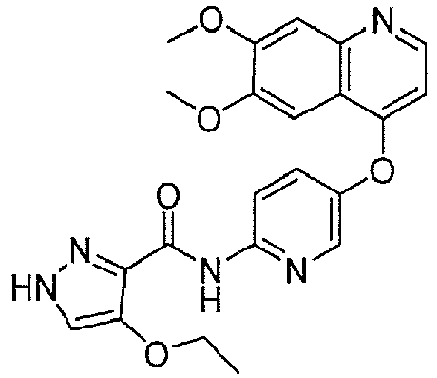
white powder; 1H-NMR (DMSO-d6, 400 MHz): δ 13.70 (0.4H, brs), 13.25 (0.6H, brs), 9.63 (0.6H, brs), 9.42 (0.4H, brs), 8.49 (1H, d, J = 5.2 Hz), 8.33-8.44 (2H, m), 7.84-7.91 (1H, m), 7.78 (0.6H, s), 7.64 (0.4H, s), 7.54 (1H, s), 7.42 (1H, s), 6.55 (1H, d, J = 5.2 Hz), 4.27 (0.8H, q, J = 6.8 Hz), 4.09 (1.2H, q, J = 6.8 Hz), 3.95 (3H, s), 3.94 (3H, s), 1.34-1.46 (3H, m); LCMS: 100%, MS (ESI): m/z 436.0 [M+H]+. It is a mixture of tautomer from H NMR. 23 
white powder; 1H-NMR (DMSO-d6, 400 MHz): δ 9.79 (1H, brs), 8.60 (1H, d, J = 4.8 Hz), 8.50 (1H, d, J = 5.6 Hz), 8.41 (1H, d, J = 2.8 Hz), 8.36 (1H, d, J = 9.2 Hz), 8.25 (1H, s), 7.94 (1H, d, J = 6.8 Hz), 7.88 (1H, dd, J = 8.8 Hz, 2.8 Hz), 7.54 (1H, s), 7.47 (1H, dd, J = 8.4 Hz, 5.2 Hz), 7.42 (1H, s), 6.56 (1H, d, J = 4.8 Hz), 4.18 (2H, q, J = 7.2 Hz), 3.96 (3H, s), 3.95 (3H, s), 2.50 (3H, s, overlapped with DMSO), 1.44 (3H, t, J = 7.2 Hz); LCMS: 97.8%, MS (ESI): m/z 527.0 [M+H]+. 24 
white powder; 1H-NMR (DMSO-d6, 400 MHz): δ 9.66 (1H, brs), 8.48 (1H, d, J = 5.2 Hz), 8.38 (1H, d, J = 2.8 Hz), 8.41 (1H, d, J = 8.8 Hz), 7.99 (1H, s), 7.85 (1H, dd, J = 8.8, 2.4 Hz), 7.52 (1H, s), 7.40 (1H, s), 7.29 (1H, d, J = 8.8 Hz), 6.71 (1H, s), 6.61 (1H, d, J = 8.8 Hz), 6.54 (1H, d, J = 5.2 Hz), 6.18 (1H, d, J = 8.0 Hz), 4.12 (2H, q, J = 6.8 Hz), 3.94 (3H, s), 3.95 (3H, s), 3.50-3.65 (1H, m), 1.39 (3H, t, J = 7.2 Hz), 1.14 (6H, d, J = 6.4 Hz); LCMS: 99.5%, MS (ESI): m/z 603.1[M+ H]+. 25 
white powder; 1H-NMR (DMSO-d6, 400 MHz): δ 10.04 (1H, brs), 8.50 (1H, d, J = 5.2 Hz), 8.42 (1H, d, J = 2.8 Hz), 8.26 (1H, d, J = 9.2 Hz), 8.07 (1H, s), 7.89 (1H, s), 7.84 (1H, dd, J = 9.2, 3.2 Hz), 7.70-7.75 (1H, m), 7.54 (1H, s), 7.42 (1H, s), 6.78 (1H, d, J = 1.6 Hz), 6.56 (1H, d, J = 5.2 Hz), 4.30 (2H, q, J = 6.8 Hz), 3.95 (3H, s), 3.94 (3H, s), 1.42 (3H, t, J = 6.8 Hz); LCMS: 99.4%, MS (ESI): m/z 502.1[M+ H]+. 26 
white powder; amorphous; 1H-NMR (DMSO-d6, 400 MHz): δ 10.07 (1H, brs), 8.50 (1H, d, J = 5.2 Hz), 8.46 (1H, s), 8.43 (1H, d, J = 2.8 Hz), 8.36 (1H, d, J = 8.8 Hz), 8.05-8.13 (2H, m), 7.88 (1H, dd, J = 9.2 Hz, 2.8 Hz), 7.52-7.57 (2H, m), 7.42 (1H, s), 6.57 (1H, d, J = 5.2 Hz), 4.25 (2H, q, J = 7.2 Hz), 3.96 (3H, s), 3.95 (3H, s), 1.42 (3H, t, J = 7.2 Hz); LCMS: 100%, MS (ESI): m/z 546.9 [M+H]+. 27 
white powder; amorphous; 1H-NMR (CDCl3, 400 MHz): δ 9.48 (1H, brs), 8.56 (1H, d, J = 8.8 Hz), 8.51 (1H, d, J = 5.2 Hz), 8.25 (1H, d, J = 2.8 Hz), 7.54-7.61 (2H, m), 7.44 (1H, s), 7.16 (1H, s), 6.46 (1H, d, J = 5.2 Hz), 4.18 (2H, q, J = 7.6 Hz), 4.11 (2H, q, J = 6.8 Hz), 4.07 (3H, s), 4.06 (3H, s), 1.50-1.56 (6H, m); LCMS: 100 %, MS (ESI): m/z 464.0 [M+H]+. 28 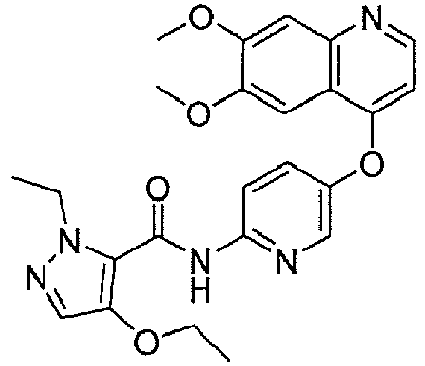
white powder; amorphous; 1H-NMR (CDCl3, 400 MHz): δ 9.76 (1H, brs), 8.51 (1H, d, J = 5.2 Hz), 8.44 (1H, d, J = 9.2 Hz), 8.26 (1H, d, J = 2.8 Hz), 7.54-7.60 (2H, m), 7.43 (1H, s), 7.31 (1H, s), 6.45 (1H, d, J = 5.2 Hz), 4.67 (2H, q, J = 7.2 Hz), 4.27 (2H, q, J = 6.8 Hz), 4.06 (3H, s), 4.05 (3H, s), 1.57 (3H, t, J = 6.8 Hz), 1.46 (3H, t, J = 7.2 Hz); LCMS: 100 %, MS (ESI): m/z 464.0 [M+H]+. 29 
white powder; amorphous; 1H-NMR (CDCl3, 400 MHz): δ 9.46 (1H, brs), 8.56 (1H, d, J = 8.8 Hz), 8.51 (1H, d, J = 5.2 Hz), 8.24 (1H, d, J = 2.8 Hz), 7.55-7.61 (2H, m), 7.43 (1H, s), 7.13 (1H, s), 6.46 (1H, d, J = 5.2 Hz), 4.11 (2H, q, J = 6.8 Hz), 4.07 (3H, s), 4.06 (3H, s), 3.93 (3H, s), 1.53 (3H, t, J = 6.8 Hz); LCMS: 100 %, MS (ESI): m/z 449.9 [M+H]+. 30 
white powder; 1H-NMR (CDCl3, 400 MHz): δ 9.70 (1H, brs), 8.51 (1H, d, J = 5.2 Hz), 8.43 (1H, d, J = 8.8 Hz), 8.27 (1H, d, J = 2.4 Hz), 7.54-7.61 (2H, m), 7.44 (1H, s), 7.30 (1H, s), 6.45 (1H, d, J = 5.2 Hz), 4.27 (2H, q, J = 6.8 Hz), 4.23 (3H, s), 4.07 (3H, s), 4.06 (3H, s), 1.57 (3H, t, J = 6.8 Hz); LCMS: 100 %, MS (ESI): m/z 450.0 [M+H]+. 31 
white powder; amorphous; 1H-NMR (DMSO-d6, 400 MHz): δ 9.69 (1H, brs), 8.50 (1H, d, J = 5.2 Hz), 8.40 (1H, d, J = 3.2 Hz), 8.35 (1H, d, J = 8.8 Hz), 8.03 (1H, s), 7.87 (1H, dd, J =9.2, 2.8 Hz), 7.54 (1H, s), 7.35-7.45 (2H, m), 6.85 (1H, d, J = 2.8 Hz), 6.77 (1H, dd, J = 9.2, 2.8 Hz), 6.57 (1H, d, J = 5.2 Hz), 4.14 (2H, q, J = 7.2 Hz), 3.90-4.00 (6H, m), 2.98 (6H, s), 1.40 (3H, t, J = 6.8 Hz); LCMS: 97.5%, MS (ESI): m/z 588.9[M+ H]+. 32 
white amorphous; 1H-NMR (DMSO-d6, 400 MHz): δ 11.09 (1H, brs), 9.64 (1H, brs), 8.51 (1H, d, J = 5.2 Hz), 8.41 (1H, d, J = 2.8 Hz), 8.38 (1H, d, J = 9.2 Hz), 8.20 (1H, s), 7.88 (1H, dd, J = 9.2, 2.8 Hz), 7.55 (1H, s),7.42 (1H, s), 7.24-7.27 (1H, m), 6.79-6.83 (1H, m), 6.57 (1H, d, J = 5.2 Hz), 6.46-6.50 (1H, m), 4.16 (2H, q, J = 6.8 Hz), 3.96 (3H, s), 3.95 (3H, s), 1.43 (3H, t, J = 6.8 Hz); LCMS: 92.4 %, MS (ESI): m/z 501.0 [M+H]+. 33 
white amorphous; 1H-NMR (DMSO-d6, 400 MHz): δ 9.75 (1H, brs), 8.50 (1H, d, J = 5.2 Hz), 8.42 (1H, d, J = 2.8 Hz), 8.36 (1H, d, J = 9.2 Hz), 8.33 (1H, s), 8.30 (1H, s), 7.88 (1H, dd, J = 9.2, 2.8 Hz), 7.82 (1H, t, J = 2.0 Hz), 7.54 (1H, s), 7.42 (1H, s), 7.03 (1H, d, J = 1.2 Hz), 6.56 (1H, d, J = 5.2 Hz), 4.17 (2H, q, J = 6.8 Hz), 3.96 (3H, s), 3.95 (3H, s), 1.44 (3H, t, J = 6.8 Hz); LCMS: 97.5 %, MS (ESI): m/z 502.0 [M+H]+. 34 
white powder; 1H-NMR (DMSO-d6, 400 MHz): δ 9.87 (1H, brs), 8.66 (1H, s), 8.59 (1H, d, J = 5.2 Hz), 8.50 (1H, d, J = 5.2 Hz), 8.42 (1H, d, J = 2.8 Hz), 8.30-8.40 (2H, m), 7.89 (1H, dd, J =8.8, 2.8 Hz), 7.63 (1H, d, J = 5.2 Hz), 7.55 (1H, s), 7.42 (1H, s), 6.56 (1H, d, J = 5.2 Hz), 4.19 (2H, q, J = 6.8 Hz), 3.96 (s, 3H), 3.95 (3H, s), 2.47 (3H, s), 1.43 (3H, t, J = 6.8 Hz); LCMS: 97.6%, MS (ESI): m/z 527.1[M+ H]+. 35 
white powder; 1H-NMR (DMSO-d6, 400 MHz): δ 9.59 (1H, brs), 8.48 (1H, d, J = 5.6 Hz), 8.37 (1H, d, J = 2.8 Hz), 8.33 (1H, d, J = 8.8 Hz), 7.84 (1H, dd, J = 9.2, 2.8 Hz), 7.75 (1H, s), 7.58 (1H, brs), 7.52 (1H, s), 7.40 (1H, s), 7.34 (1H, brs), 6.54 (1H, d, J = 5.2 Hz), 4.78 (2H, s), 4.09 (2H, q, J = 7.2 Hz), 3.94 (3H, s), 3.93 (3H, s), 1.38 (3H, t, J = 7.2 Hz); LCMS: 100%, MS (ESI): m/z 493.2[M+ H]+. 36 
white powder; 1H-NMR (DMSO-d6, 400 MHz): δ 10.18 (1H, brs), 9.45 (1H, s), 8.69 (1H, d, J = 2.4 Hz), 8.59-8.61 (2H, m), 8.51 (1H, d, J = 5.2 Hz), 8.44 (1H, d, J = 2.8 Hz), 8.37 (1H, d, J = 8.8 Hz), 7.89 (1H, dd, J = 8.8, 2.8 Hz), 7.55 (1H, s), 7.42 (1H, s), 6.58 (1H, d, J = 5.2 Hz), 4.24 (2H, q, J = 6.8 Hz), 3.96 (3H, s), 3.95 (3H, s), 1.43 (3H, t, J = 6.8 Hz); LCMS: 100% (the sample was dissolved in DMSO, diluted with CH3CN), MS (ESI): m/z 514.1 [M+H]+. 37 
white powder; 1H-NMR (DMSO-d6, 400 MHz): δ 9.57 (1H, brs), 8.50 (1H, d, J = 5.2 Hz), 8.39 (1H, d, J = 2.4 Hz), 8.34 (1H, d, J = 8.8 Hz), 7.86 (1H, dd, J = 8.8, 2.8 Hz), 7.52-7.56 (2H, m), 7.48 (1H, d, J = 1.2 Hz), 7.46 (1H, s), 7.41 (1H, s), 6.54 (1H, d, J = 5.2 Hz), 6.19 (1H, t, J = 2.0 Hz), 4.50-4.64 (4H, m), 3.92-4.02 (8H, m), 1.34 (3H, t, J = 6.8 Hz); LCMS: 98.3%, MS (ESI): m/z 530.1[M+ H]+. 38 
white powder; 1H-NMR (DMSO-d6, 400 MHz): δ 9.61 (1H, brs), 8.49 (1H, d, J = 5.2 Hz), 8.39 (1H, d, J = 2.8 Hz), 8.35 (1H, d, J = 9.2 Hz), 7.83-7.90 (2H, m), 7.54 (1H, s), 7.41 (1H, s), 6.55 (1H, d, J = 5.2 Hz), 4.45-4.56 (4H, m), 4.10 (2H, q, J = 6.8 Hz), 3.95 (3H, s), 3.94 (3H, s), 1.39 (3H, t, J = 6.8 Hz); LCMS: 100%, MS (ESI): m/z 548.0[M+ H]+. 39 
white powder; 1H-NMR (DMSO-d6, 400 MHz): δ 9.90 (1H, brs), 9.34 (1H, s), 9.14 (1H, s), 8.57 (1H, s), 8.51 (1H, d, J = 5.2 Hz), 8.43 (1H, d, J = 2.8 Hz), 8.37 (1H, d, J = 8.8 Hz), 7.90 (1H, dd, J = 8.8, 2.8 Hz), 7.55 (1H, s), 7.42 (1H, s), 6.57 (1H, d, J = 5.2 Hz), 4.19 (2H, q, J = 6.8 Hz), 3.96 (3H, s), 3.95 (3H, s), 1.45 (3H, t, J = 6.8 Hz); LCMS: 97.4%, MS (ESI): m/z 519.1[M+ H]+. 40 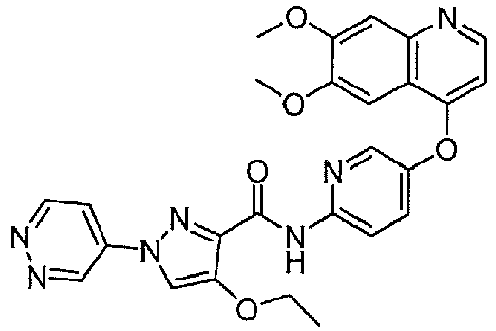
white powder; 1H-NMR (DMSO-d6, 400 MHz): δ 10.25 (1H, brs), 9.97 (1H, d, J = 2.0 Hz), 9.36 (1H, d, J = 6.0 Hz), 8.83 (1H, s), 8.51 (1H, d, J = 5.2 Hz), 8.45 (1H, d, J = 2.8 Hz), 8.36 (1H, d, J = 8.8 Hz), 8.21 (1H, dd, J = 5.6, 2.8 Hz), 7.90 (1H, dd, J = 8.8, 2.8 Hz), 7.55 (1H, s), 7.42 (1H, s), 6.58 (1H, d, J = 5.2 Hz), 4.20 (2H, q, J = 7.2 Hz), 3.96 (3H, s), 3.95 (3H, s), 1.45 (3H, t, J = 7.2 Hz); LCMS: 97.9%, MS (ESI): m/z 513.2[M+. H]+. 41 
white powder; 1H-NMR (DMSO-d6, 400 MHz): δ 9.92 (1H, brs), 9.20 (1H, s), 8.77 (1H, s), 8.50 (1H, d, J = 5.2 Hz), 8.43 (1H, d, J = 2.8 Hz), 8.23 (1H, d, J = 8.8 Hz), 8.01 (1H, s), 7.83 (1H, dd, J = 8.8, 2.8 Hz), 7.53 (1H, s), 7.42 (1H, s), 6.54 (1H, d, J = 5.2 Hz), 4.36 (2H, q, J = 6.8 Hz), 3.95 (3H, s), 3.94 (3H, s), 1.46 (3H, t, J = 6.8 Hz); LCMS: 90.3%, MS (ESI): m/z 530.1[M+ H]+. 42 
white powder; 1H-NMR (DMSO-d6, 400 MHz): δ 9.69 (1H, brs), 8.50 (1H, d, J = 5.2 Hz), 8.43 (1H, d, J = 2.4 Hz), 8.33 (1H, d, J = 9.2 Hz), 7.88 (1H, dd, J =9.2, 2.8 Hz), 7.53-7.61 (2H, m), 7.48-7.52 (1H, m), 7.42 (1H, s), 7.38 (1H, s), 6.55 (1H, d, J = 5.2 Hz), 6.15 (1H, m), 4.89 (2H, t, J = 5.6 Hz), 4.54 (2H, t, J = 5.6 Hz), 4.27 (2H, q, J = 6.8 Hz), 3.96 (3H, s), 3.95 (3H, s), 1.43 (3H, t, J = 6.8 Hz); LCMS: 100%, MS (ESI): m/z 530.1[M+ H]+. 43 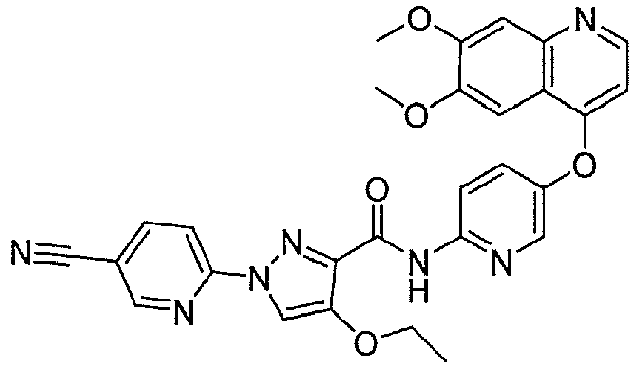
white powder; 1H-NMR (DMSO-d6, 400 MHz): δ 10.21 (1H, s), 9.00 (1H, s), 8.60 (1H, s), 8.49-8.55 (2H, m), 8.43 (1H, d, J = 2.4 Hz), 8.30-8.40 (2H, m), 7.89 (1H, dd, J = 8.8, 2.8 Hz), 7.53 (1H, s), 7.41 (1H, s), 6.56 (1H, d, J = 5.6 Hz), 4.22 (2H, q, J = 6.8 Hz), 3.94 (3H, s), 3.94 (3H, s), 1.41 (3H, t, J = 6.8 Hz); LCMS: 98.7%, MS (ESI): m/z 538.1 [M+ H]+. 44 
white powder; 1H-NMR (DMSO-d6, 400 MHz): δ 9.56 (1H, brs), 9.19 (1H, s), 8.73 (1H, d, J = 4.4 Hz), 8.51 (1H, d, J = 5.2 Hz), 8.42 (1H, d, J = 2.8 Hz), 8.36 (1H, d, J = 8.0 Hz), 8.32 (1H, d, J = 8.8 Hz), 7.88 (1H, dd, J = 9.2, 2.8 Hz), 7.59 (1H, dd, J = 8.0, 4.8 Hz), 7.55 (1H, s), 7.42 (1H, s), 6.57 (1H, d, J = 5.6 Hz), 4.72 (2H, q, J = 7.2), 3.96 (3H, s), 3.95 (3H, s), 1.47 (3H, t, J = 7.2 Hz); LCMS: 100%, MS (ESI): m/z 514.0[M+ H]+. 45 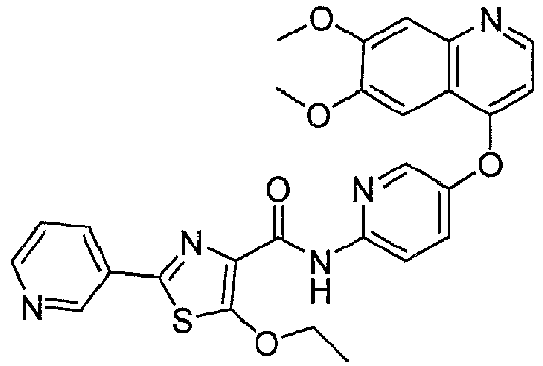
white powder; 1H-NMR (CDCl3, 400 MHz): δ 9.74 (1H, brs), 9.07 (1H, d, J = 1.6 Hz), 8.69 (1H, dd, J = 5.2, 1.6 Hz), 8.54-8.62 (2H, m), 8.30 (1H, d, J = 2.4 Hz), 8.25 (1H, td, J = 8.0, 2.0 Hz), 7.61 (1H, dd, J = 9.2, 3.2 Hz), 7.54-7.58 (2H, m), 7.40-7.45 (2H, m), 6.51 (1H, d, J = 5.6 Hz), 4.44 (2H, q, J = 7.2 Hz), 4.07 (6H, s), 1.65 (3H, t, J = 6.8 Hz); LCMS: 96.7 %, MS (ESI): m/z 530.0 [M+H]+. 46 
off-white solid; 1H-NMR (DMSO-d6, 400 MHz): δ 9.58 (1H, brs), 9.21 (1H, s), 9.14 (1H, s), 8.56 (1H, d, J = 4.0 Hz), 8.50 (1H, d, J = 5.2 Hz), 8.43 (1H, d, J = 2.8 Hz), 8.38 (1H, d, J = 9.6 Hz), 8.28 (1H, d, J = 7.2 Hz), 7.89 (1H, d, J = 8.8 Hz), 7.52-7.60 (2H, m), 7.43 (1H, s), 6.56 (1H, d, J = 5.2 Hz), 4.56 (2H, q, J = 7.2 Hz), 3.96 (6H, s), 1.51 (3H, t, J = 7.2 Hz); LCMS: 100 %, MS (ESI): m/z 513.1[M+ H]+. 47 
white power; 1H-NMR (DMSO-d6, 400 MHz): δ 10.35 (1H, brs), 9.22 (1H, d, J = 2.4 Hz), 8.85 (2H, s), 8.67 (1H, s), 8.60 (1H, dd, J = 4.8, 1.2 Hz), 8.53 (1H, d, J = 5.2 Hz), 8.34-8.42 (1H, m), 7.56-7.65 (1H, m), 7.57 (1H, s), 7.44 (1H, s), 6.71 (1H, d, J = 5.6 Hz), 4.18 (2H, q, J = 6.8 Hz), 3.97 (3H, s), 3.96 (3H, s), 1.42 (3H, t, J = 7.2 Hz); LCMS: 100.0%, MS (ESI): m/z 514.1[M+H] +. 48 
white powder; 1H-NMR (DMSO-d6, 400 MHz): δ 9.58 (1H, brs), 8.49 (1H, d, J = 5.2 Hz), 8.38 (1H, d, J = 2.8 Hz), 8.34 (1H, d, J = 9.2 Hz), 7.85 (1H, dd, J = 9.2, 3.2 Hz), 7.79 (1H, s), 7.54 (1H, s), 7.41 (1H, s), 6.55 (1H, d, J = 5.2 Hz), 5.00-5.10 (1H, m), 4.50-4.60 (1H, m), 4.30-4.45 (3H, m), 4.10 (2H, q, J = 7.2 Hz), 3.95 (1H, s), 3.94 (1H, s), 2.60-2.75 (1H, m), 2.30-2.45 (1H, m), 1.39 (3H, t, J = 6.8 Hz); LCMS: 100%, MS (ESI): m/z 506.1[M+ H]+. 49 
white powder; 1H-NMR (DMSO-d6, 400 MHz): δ 9.62 (1H, brs), 8.50 (1H, d, J = 5.2 Hz), 8.40 (1H, d, J = 2.8 Hz), 8.35 (1H, d, J = 9.2 Hz), 7.80-7.95 (2H, m), 7.53 (1H, s), 7.42 (1H, s), 6.54 (1H, d, J = 5.2 Hz), 4.25-4.40 (2H, m), 4.09 (2H, q, J = 6.8 Hz), 3.96 (1H, s), 3.95 (1H, s), 2.90-3.10 (2H, m), 2.39 (6H, s), 1.39 (3H, t, J = 6.8 Hz); LCMS: 97.9%, MS (ESI): m/z 507.0[M+ H]+. 50 
white; 1H-NMR (DMSO-d6, 400 MHz): δ 10.23 (1H, brs), 9.44 (1H, d, J = 2.4 Hz), 8.79 (1H, s), 8.63 (1H, dd, J = 8.8, 2.8 Hz), 8.51 (1H, d, J = 5.2 Hz), 8.45 (1H, d, J = 2.8 Hz), 8.37 (1H, d, J = 8.8 Hz), 8.28 (1H, d, J = 8.4 Hz), 7.90 (1H, dd, J = 8.8, 2.8 Hz), 7.55 (1H, s), 7.43 (1H, s), 6.58 (1H, d, J = 5.6 Hz), 4.20 (2H, q, J = 6.8 Hz), 3.96 (1H, s), 3.95 (1H, s), 1.45 (3H, t, J = 6.8 Hz); LCMS: 100 %, MS (ESI): m/z 538.0[M+ H]+. 51 
white powder; 1H-NMR (DMSO-d6, 400 MHz): δ 9.76 (1H, brs), 8.49 (1H, d, J = 5.2 Hz), 8.42 (1H, d, J = 2.8 Hz), 8.32 (1H, d, J = 9.2 Hz), 7.85 (1H, dd, J = 9.2, 2.8 Hz), 7.66 (1H, s), 7.54 (1H, s), 7.42 (1H, s), 6.55 (1H, d, J = 5.2 Hz), 4.95-5.05 (1H, m), 4.82-4.93 (1H, m), 4.70-4.80 (1H, m), 4.42-4.52 (1H, m), 4.31-4.40 (1H, m), 4.28 (2H, q, J = 7.2 Hz), 3.95 (1H, s), 3.94 (1H, s), 2.60-2.75 (1H, m), 2.35-2.48 (1H, m), 1.43 (3H, t, J = 6.8 Hz); LCMS: 100%, MS (ESI): m/z 506.1[M+ H]+. 52 
white powder; 1H-NMR (DMSO-d6, 400 MHz): δ 9.76 (1H, brs), 8.50 (1H, d, J = 5.2 Hz), 8.44 (1H, d, J = 2.8 Hz), 8.33 (1H, d, J = 9.2 Hz), 7.89 (1H, dd, J = 8.8, 2.8 Hz), 7.72 (1H, s), 7.53 (1H, s), 7.42 (1H, s), 6.54 (1H, d, J = 5.2 Hz), 4.60-4.75 (2H, m), 4.30 (2H, q, J = 7.2 Hz), 3.95 (1H, s), 3.94 (1H, s), 3.10-3.30 (2H, m), 2.55 (6H, s), 1.44 (3H, t, J = 7.2 Hz); LCMS: 100%, MS (ESI): m/z 507.0[M+ H]+. 53 
white powder; 1H-NMR (DMSO-d6, 400 MHz): δ 9.93 (1H, brs), 8.96 (1H, s), 8.50 (1H, d, J = 5.2 Hz), 8.45 (1H, d, J = 2.8 Hz), 8.21-8.30 (2H, m), 8.22 (1H, d, J = 8.8 Hz), 8.17 (1H, s), 7.85 (1H, dd, J = 8.8, 2.8 Hz), 7.53 (1H, s), 7.42 (1H, s), 6.54 (1H, d, J = 5.2 Hz), 4.40 (2H, q, J = 7.2 Hz), 3.96 (1H, s), 3.95 (1H, s), 1,47 (3H, t, J = 7.2 Hz); LCMS: 97.2%, MS (ESI): m/z 538.1[M+ H]+. 54 
white powder; 1H-NMR (DMSO-d6, 400 MHz): δ 10.41 (1H, brs), 9.62 (1H, d, J = 1.2 Hz), 9.18 (1H, d, J = 1.2 Hz), 8.63 (1H, s), 8.52 (1H, d, J = 5.6 Hz), 8.47 (1H, d, J = 2.8 Hz), 8.37 (1H, d, J = 8.8 Hz), 7.91 (1H, dd, J = 8.8, 2.8 Hz), 7.55 (1H, s), 7.43 (1H, s), 6.58 (1H, d, J = 5.2 Hz), 4.24 (2H, q, J = 6.8 Hz), 3.96 (3H, s), 3.95 (3H, s), 1.42 (3H, t, J = 6.8 Hz); LCMS: 100%, MS (ESI): m/z 539.0[M+ H]+. 55 
white solid; 1H-NMR (CDCl3, 400 MHz): δ 9.50 (1H, brs), 9.30 (2H, s), 8.50-8.60 (2H, m), 8.31 (1H, d, J = 2.8 Hz), 7.77 (1H, s), 7.64 (1H, dd, J = 8.8, 2.8 Hz), 7.56 (1H, s), 7.45 (1H, s), 6.48 (1H, d, J = 5.2 Hz), 4.27 (2H, q, J = 7.6 Hz), 4.08 (6H, s), 1.64 (3H, t, J = 6.8 Hz); LCMS: 97.3%, MS (ESI): m/z 539.2[M+ H]+. 56 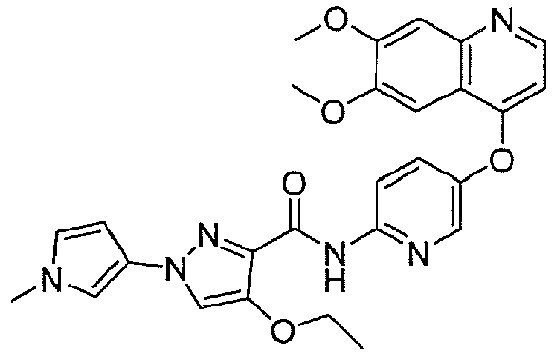
white powder; 1H-NMR (DMSO-d6, 400 MHz): δ 9.63 (1H, brs), 8.50 (1H, d, J = 5.2 Hz), 8.40 (1H, d, J = 3.2 Hz), 8.37 (1H, d, J = 8.8 Hz), 8.17 (1H, s), 7.88 (1H, dd, J = 8.8 Hz, 2.8 Hz), 7.54 (1H, s), 7.42 (1H, s), 7.24 (1H, t, J = 2.0 Hz), 6.78 (1H, t, J = 2.8 Hz), 6.55 (1H, d, J = 5.2 Hz), 6.41-6.44 (1H, m), 4.16 (2H, q, J = 6.8 Hz), 3.96 (3H, s), 3.95 (3H, s), 3.66 (3H, s), 1.42 (3H, t, J = 6.8 Hz); LCMS: 98.8%, MS (ESI): m/z 515.2[M+ H]+, 57 
amorphous; 1H-NMR (DMSO-d6, 400 MHz): δ 9.80 (1H, brs), 8.50 (1H, d, J = 5.2 Hz), 8.43 (1H, d, J = 3.2 Hz), 8.36 (1H, d, J = 8.8 Hz), 8.33 (1H, s), 7.88 (1H, dd, J = 8.8, 2.8 Hz), 7.72 (1H, d, J = 1.2 Hz), 7.54 (1H, s), 7.42 (1H, s), 6.69 (1H, dd, J = 3.2, 2.0 Hz), 6.64 (1H, d, J = 3.2 Hz), 6.56 (1H, d, J = 5.2 Hz), 4.20 (2H, q, J = 6.8 Hz), 3.96 (3H, s), 3.95 (3H, s), 1.43 (3H, t, J = 7.2 Hz); LCMS: 98%, MS (ESI): m/z 502.1[M+ H]+. 58 
amorphous; 1H-NMR (DMSO-d6, 400 MHz): δ 9.83 (1H, brs), 8.49 (1H, d, J = 5.2 Hz), 8.42 (1H, d, J = 2.8 Hz), 8.19 (1H, d, J = 9.2 Hz), 8.04 (1H, s), 7.80 (1H, dd, J = 9.2, 3.2 Hz), 7.67 (1H, d, J = 1.2 Hz), 7.52 (1H, s), 7.41 (1H, s), 6.62 (1H, dd, J = 3.2, 2.0 Hz), 6.57 (1H, d, J = 3.2 Hz), 6.54 (1H, d, J = 5.2 Hz), 4.36 (2H, q, J = 7.2 Hz), 3.95 (3H, s), 3.94 (3H, s), 1.45 (3H, t, J = 6.8 Hz); LCMS: 100%, MS (ESI): m/z 502.1[M+ H]+. 59 
pale yellow powder; 1H-NMR (DMSO-d6, 400 MHz): δ 9.96 (1H, brs), 8.45-8.56 (2H, m), 8.44 (1H, d, J = 3.2 Hz), 8.36 (1H, d, J = 9.2 Hz), 8.25 (1H, s), 7.90 (1H, dd, J = 9.2, 2.8 Hz), 7.55 (1H, s), 7.40-7.43 (2H, m), 6.57 (1H, d, J = 5.2 Hz), 4.23 (2H, q, J = 6.8 Hz), 3.96 (3H, s), 3.96 (3H, s) 1.43 (3H, d, J = 6.8 Hz); LCMS: 95.5%, MS (ESI): m/z 503.2[M+ H]+. 60 
white powder; 1H-NMR (DMSO-d6, 400 MHz): δ 10.73 (1H, brs), 9.45 (2H, s), 9.32 (1H, s), 8.67 (1H, s), 8.63 (1H, d, J = 4.0 Hz), 8.44 (1H, d, J = 8.4 Hz), 8.40 (1H, d, J = 7.6 Hz), 7.68 (1H, dd, J = 8.0, 4.8 Hz), 7.59 (1H, s), 7.47 (1H, s), 6.31 (1H, d, J = 8.0 Hz), 4.12 (2H, q, J = 6.8 Hz), 3.89 (3H, s), 3.79 (3H, s), 1.41 (3H, t, J = 6.8 Hz); LCMS: 100.0%, MS (ESI): m/z 514.1[M+ H]+. 61 
off-white powder; 1H-NMR (CDCl3, 400 MHz): δ 9.56 (1H, brs), 8.52-8.64 (4H, m), 8.28 (1H, d, J = 2.8 Hz), 7.62 (1H, dd, J = 8.8, 2.8 Hz), 7.57 (1H, s), 7.50 (1H, s), 7.46 (1H, s), 7.37 (1H, d, J = 5.2 Hz), 6.48 (1H, d, J = 5.2 Hz), 4.23 (2H, q, J = 7.2 Hz), 4.01-4.12 (6H, m), 2.74 (2H, t, J = 7.6 Hz), 2.49-2.60 (2H, m), 2.39 (6H, s), 1.38-1.46 (2H, m), 1.62 (3H, t, J = 7.2 Hz); LCMS: 99.4%, MS (ESI): m/z 598.3 [M+H] +. 62 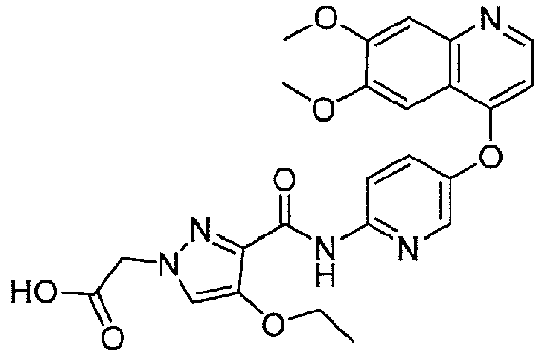
white powder; 1H-NMR (DMSO-d6, 400 MHz): δ 9.58 (1H, brs), 8.49 (1H, d, J = 4.8 Hz), 8.40 (1H, d, J = 1.6 Hz), 8.35 (1H, d, J = 9.6 Hz), 7.86 (1H, dd, J = 9.2, 2.0 Hz), 7.80 (1H, s), 7.54 (1H, s), 7.43 (1H, s), 6.56 (1H, d, J = 5.2 Hz), 5.01 (2H, s), 4.10 (2H, q, J = 6.8 Hz), 3.96 (3H, s), 3.95 (3H, s), 1.41 (3H, t, J = 6.8 Hz); LCMS: 100%, MS (ESI): m/z 494.2[M+ H]+. 63 
white powder; 1H-NMR (DMSO-d6, 400 MHz): δ 9.65 (1H, brs), 8.84 (1H, d, J = 6.8 Hz), 8.51 (1H, s), 8.42 (1H, d, J = 9.2 Hz), 8.00 (1H, dd, J = 8.8 Hz, 2.4 Hz), 7.83 (1H, s), 7.78 (1H, s), 7.57-7.67 (1H, m), 7.04 (1H, d, J = 6.4 Hz), 4.33 (2H, t, J = 6.8 Hz), 4.01-4.11 (8H, m), 2.88 (2H, t, J = 6.8 Hz), 1.39 (3H, t, J = 6.8 Hz); LCMS: 100%, MS (ESI): m/z 508.2[M+ H]+. 64 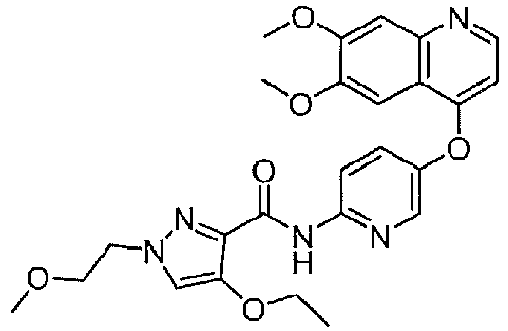
white powder (amorphous); 1H-NMR (DMSO-d6, 400 MHz): δ 9.57 (1H, brs), 8.52 (1H, d, J = 5.6 Hz), 8.39 (1H, d, J = 2.4 Hz), 8.35 (1H, d, J = 8.8 Hz), 7.87 (1H, dd, J = 8.8, 2.8 Hz), 7.80 (1H, s), 7.55 (1H, s), 7.42 (1H, s), 6.58 (1H, d, J = 5.2 Hz), 4.25 (1H, t, J = 5.6 Hz), 4.08 (2H, q, J = 6.8 Hz), 3.96 (3H, s), 3.95 (3H, s), 3.73 (1H, t, J = 5.6 Hz), 3.26 (3H, s), 1.39 (3H, t, J = 7.2 Hz); LCMS: 99.8%, MS (ESI): m/z 494.2[M+ H]+. 65 
off-white powder; 11H-NMR (CDCl3, 400 MHz): δ 9.58 (1H, brs), 8.56-8.65 (3H, m), 8.54 (1H, d, J = 5.2 Hz), 8.28 (1H, d, J = 2.8 Hz), 7.62 (1H, dd, J = 8.8, 2.8 Hz), 7.58 (1H, s), 7.43-7.48 (2H, m), 7.39 (1H, d, J = 5.2 Hz), 6.49 (1H, d, J = 5.2 Hz), 4.21 (2H, q, J = 7.2 Hz), 4.05-4.13 (6H, m), 2.89 (2H, t, J = 7.2 Hz), 2.52 (2H, t, J = 7.6 Hz), 2.23 (6H, s), 1.57-1.61 (3H, m, overlapped with H2O signal); LCMS: 97.1%, MS (ESI): m/z 584.1[M+H] +. 66 
white powder; 1H-NMR (DMSO-d6, 400 MHz): δ 9.57 (1H, brs), 8.49 (1H, d, J = 5.2 Hz), 8.39 (1H, d, J = 2.8 Hz), 8.34 (1H, d, J = 9.2 Hz), 7.86 (1H, dd, J = 9.2, 2.8 Hz), 7.70 (1H, s), 7.54 (1H, s), 7.41 (1H, s), 6.55 (1H, d, J = 5.2 Hz), 5.19 (2H, s), 4.10 (2H, q, J = 6.8 Hz), 3.95 (3H, s), 3.94 (3H, s), 2.16 (3H, s), 1.40 (3H, t, J = 6.8 Hz); LCMS: 100%, MS (ESI): m/z 492.2[M+ H]+. 67 
white powder; 1H-NMR (DMSO-d6, 400 MHz): δ 9.56 (1H, brs), 8.49 (1H, d, J = 5.2 Hz), 8.39 (1H, d, J = 2.8 Hz), 8.34 (1H, d, J = 8.8 Hz), 7.93 (1H, q, J = 4.0 Hz), 7.86 (1H, dd, J = 8.8, 2.8 Hz), 7.74 (1H, s), 7.54 (1H, s), 7.42 (1H, s), 6.55 (1H, d, J = 5.2 Hz), 4.33 (2H, t, J = 6.8 Hz), 4.07 (2H, q, J = 6.8 Hz), 3.95 (3H, s), 3.94 (3H, s), 2.68 (2H, t, J = 6.8 Hz), 2.57 (3H, d, J = 4.0 Hz), 1.38 (3H, t, J = 6.8 Hz); LCMS: 100%, MS (ESI): m/z 521.1[M+ H]+. 68 
white powder (amorphous); 1H-NMR (DMSO-d6, 400 MHz): δ 9.71 (1H, brs), 8.51 (1H, d, J = 5.2 Hz), 8.41 (1H, d, J = 2.8 Hz), 8.36 (1H, d, J = 8.8 Hz), 7.91 (1H, s), 7.88 (1H, dd, J = 8.8, 2.8 Hz), 7.55 (1H, s), 7.44-7.47 (1H, m), 7.43 (1H, s), 6.56 (1H, d, J = 5.2 Hz), 4.13 (2H, q, J = 7.2 Hz), 3.96 (3H, s), 3.95 (3H, s), 2.59 (3H, d, J = 4.4 Hz), 1.75 (6H, s), 1.40 (3H, t, J = 7.2 Hz); LCMS: 99.8%, MS (ESI): m/z 535.2[M+ H]+. 69 
off-white powder; 1H-NMR (DMSO-d6, 400 MHz): δ 10.25 (1H, brs), 10.14 (1H, brs), 9.55 (1H, brs), 8.87 (1H, d, J = 6.4 Hz), 8.55 (1H, d, J = 2.8 Hz), 8.42 (1H, d, J = 8.8 Hz), 8.03 (1H, dd, J = 9.2, 2.8 Hz), 7.99 (1H, s), 7.80 (1H, s), 7.79 (1H, s), 7.05 (1H, d, J = 6.8 Hz), 5.14-5.28 (1H, m), 4.00-4.17 (8H, m, overlap with H2O signal), 3.56-3.71 (2H, m), 3.31-3.44 (2H, m), 2.40-2.48 (1H, m), 2.20-2.30 (1H, m), 1.37 (3H, t, J = 7.2 Hz); LCMS: 96.5%, MS (ESI): m/z 505. 1 [M+H] +. 70 
white powder; 1H-NMR (DMSO-d6, 400 MHz): δ 9.59 (1H, brs), 8.49 (1H, d, J = 5.2 Hz), 8.39 (1H, d, J = 3.2 Hz), 8.35 (1H, d, J = 9.2 Hz), 7.86 (1H, dd, J = 9.2, 3.2 Hz), 7.79 (1H, s), 7.54 (1H, s), 7.42 (1H, s), 6.55 (1H, d, J = 4.8 Hz), 4.99 (1H, t, J = 5.2 Hz), 4.16 (2H, t, J = 5.2 Hz), 4.09 (2H, q, J = 6.8 Hz), 3.95 (3H, s), 3.94 (3H, s), 3.79 (2H, q, J = 5.2 Hz), 1.39 (3H, t, J = 6.8 Hz); LCMS: 100%, MS (ESI): m/z 480.2[M+ H]+. 71 
white powder; 1H-NMR (DMSO-d6, 400 MHz): δ 9.72-9.90 (2H, m), 9.38 (1H, brs), 8.84 (1H, d, J = 6.0 Hz), 8.56 (1H, s), 8.41 (1H, d, J = 9.2 Hz), 8.05 (1H, d, J = 8.4 Hz), 7.70-7.89 (3H, m), 7.01 (1H, d, J = 6.0 Hz), 5.96-6.10 (1H, m), 4.32 (2H, q, J = 6.8 Hz), 3.98-4.10 (6H, m), 3.60-3.70 (2H, m, overlapped with H2O signal), 3.21-3.38 (2H, m, overlapped with H2O signal), 2.27-2.45 (2H, m), 1.45 (3H, t, J = 6.8 Hz); LCMS: 98.4%, MS (ESI): m/z 505.2[M+H]+. 72 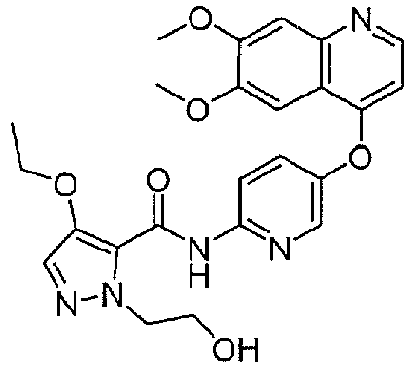
white powder; 1H-NMR (DMSO-d6, 400 MHz): δ 9.77 (1H, brs), 8.50 (1H, d, J = 5.2 Hz), 8.42 (1H, d, J = 2.8 Hz), 8.34 (1H, d, J = 9.2 Hz), 7.87 (1H, dd, J = 9.2, 2.8 Hz), 7.64 (1H, s), 7.54 (1H, s), 7.42 (1H, s), 6.56 (1H, d, J = 5.2 Hz), 4.86 (1H, m), 4.59 (2H, t, J = 6.4 Hz), 4.28 (2H, q, J = 6.8 Hz), 3.96 (3H, s), 3.95 (3H, s), 3.72 (2H, q, J = 6.0 Hz), 1.44 (3H, t, J = 6.8 Hz); LCMS: 100%, MS (ESI): m/z 480.1[M+ H]+. 73 
pale-yellow powder; 1H-NMR (CDCl3, 400 MHz): δ 9.54 (1H, s), 8.77 (1H, s), 8.64 (1H, d, J = 4.8 Hz), 8.59 (1H, d, J = 9.2 Hz), 8.53 (1H, d, J = 5.6 Hz), 8.27 (1H, d, J = 2.8 Hz), 7.88 (1H, s), 7.61 (1H, dd, J = 8.8, 2.8 Hz), 7.57 (1H, s), 7.46 (1H, s), 7.27 (1H, s), 6.48 (1H, d, J = 5.2 Hz), 4.20 (2H, q, J = 6.8 Hz), 4.08 (3H, s), 4.07 (3H, s), 3.44 (1H, s), 2.27 (6H, s), 1.50-1.60 (3H, m, overlapped with H2O peak); LCMS: 98.0%, MS (ESI): m/z 570.1[M+H] +. 74 
white powder; 1H-NMR (CDCl3, 400 MHz): δ 9.51 (1H, brs), 8.58 (1H, d, J = 9.2 Hz), 8.53 (1H, d, J = 5.2 Hz), 8.27 (1H, d, J = 2.8 Hz), 7.54-7.62 (2H, m), 7.46 (1H, s), 7.43 (1H, s), 6.48 (1H, d, J = 5.6 Hz), 4.90-4.99 (1H, m), 4.15 (2H, q, J = 7.2 Hz), 4.09 (3H, s), 4.08 (3H, s), 2.96-3.07 (2H, m), 2.75-2.83 (1H, m), 2.49-2.60 (1H, m), 2.40-2.47 (4H, m), 2.11-2.22 (1H, m), 1.56 (3H, t, J = 7.2 Hz); LCMS: 98.7%, MS (ESI): m/z 519.2[M+H]+. 75 
white powder; 1H-NMR (CDCl3, 400 MHz): δ 9.80 (1H, brs), 8.51 (1H, d, J = 5.2 Hz), 8.41 (1H, d, J = 8.8 Hz), 8.27 (1H, s), 7.56-7.59 (2H, m), 7.45 (1H, s), 7.38 (1H, s), 6.45 (1H, d, J = 5.2 Hz), 6.00-6.10 (1H, m), 4.27-4.29 (2H, m), 4.07 (6H, s), 2.88-3.02 (3H, m), 2.41-2.54 (6H, m), 1.57-1.62 (3H, m); LCMS: 100%, MS (ESI): m/z 519.1[M+H]+. 76 
white powder; 1H-NMR (DMSO-d6, 400 MHz): δ 9.60 (1H, brs), 8.49 (1H, d, J = 5.2 Hz), 8.39 (1H, d, J = 2.8 Hz), 8.34 (1H, d, J = 8.8 Hz), 7.84-7.90 (2H, m), 7.54 (1H, s), 7.42 (1H, s), 6.55 (1H, d, J = 4.8 Hz), 5.00-5.07 (1H, m), 4.11 (2H, q, J = 6.8 Hz), 3.96-4.05 (3H, m), 3.95 (3H, s), 3.94 (3H, s), 3.78-3.86 (1H, m), 2.35-2.45 (2H, m), 1.39 (3H, t, J = 6.8 Hz); LCMS: 100%, MS (ESI): m/z 506.2[M+ H]+. 77 
white powder; 1H-NMR (DMSO-d6, 400 MHz): δ 9.80 (1H, brs), 8.50 (1H, d, J = 5.2 Hz), 8.42 (1H, d, J = 2.8 Hz), 8.33 (1H, d, J = 8.8 Hz), 7.86 (1H, dd, J = 8.8, 2.8 Hz), 7.67 (1H, s), 7.53 (1H, s), 7.42 (1H, s), 6.55 (1H, d, J = 5.2 Hz), 5.85-5.95 (1H, m), 4.29 (2H, q, J = 6.8 Hz), 3.92-4.05 (8H, m), 3.81-3.88 (2H, m), 2.42-2.47 (1H, m), 2.30-2.36 (1H, m), 1.43 (3H, t, J = 7.2 Hz); LCMS: 98.6%, MS (ESI): m/z 506.2[M+ H]+. 78 
white powder; 1H-NMR (DMSO-d6, 400 MHz): δ 9.75 (1H, brs), 8.50 (1H, d, J = 5.6 Hz), 8.43 (1H, d, J = 2.8 Hz), 8.33 (1H, d, J = 8.8 Hz), 7.87 (1H, dd, J = 8.8, 2.8 Hz), 7.69 (1H, s), 7.54 (1H, s), 7.42 (1H, s), 6.62 (1H, t, J = 75.2 Hz), 6.55 (1H, d, J = 5.2 Hz), 4.79 (2H, t, J = 5.2 Hz), 4.30 (2H, q, J = 6.8 Hz), 4.22 (2H, t, J = 5.2 Hz), 3.95 (3H, s), 3.94 (3H, s), 1.44 (3H, t, J = 6.8 Hz); LCMS: 98.8%, MS (ESI): m/z 530.2[M+ H]+. 79 
white powder (amorphous); 1H-NMR (DMSO-d6, 400 MHz): δ 9.81 (1H, brs), 8.67 (1H, s), 8.56 (1H, d, J = 4.8 Hz), 8.50 (1H, d, J = 5.2 Hz), 8.41 (1H, d, J = 2.8 Hz), 8.36 (1H, d, J = 8.8 Hz), 8.26 (1H, s), 7.87 (1H, dd, J = 8.8, 2.4 Hz), 7.54 (1H, s), 7.51 (1H, d, J = 4.8 Hz), 7.42 (1H, s), 6.56 (1H, d, J = 5.2 Hz), 4.18 (2H, q, J = 6.8 Hz), 3.95 (3H, s), 3.94 (3H, s), 2.37 (3H, s), 1.44 (3H, t, J = 6.8 Hz); LCMS: 99%, MS (ESI): m/z 527.1[M+ H]+. 80 
white powder; 1H-NMR (CDCl3, 400 MHz): δ 9.50 (1H, brs), 8.50-8.60 (2H, m), 8.28 (1H, d, J = 2.8 Hz), 7.61 (1H, dd, J = 8.8, 2.8 Hz), 7.58 (1H, s), 7.46 (1H, s), 7.33 (1H, s), 7.28 (1H, s), 6.48 (1H, d, J = 5.2 Hz), 4.43 (2H, t, J = 6.4 Hz), 4.17 (2H, q, J = 6.8 Hz), 4.03-4.11 (6H, m), 3.04 (2H, t, J = 6.4 Hz), 1.58 (3H, t, J = 7.2 Hz); LCMS: 98.4%, MS (ESI): m/z 489.1[M+H]+. 81 
white powder; 1H-NMR (CDCl3, 400 MHz): δ 9.49 (1H, brs), 8.56 (1H, d, J = 9.2 Hz), 8.52 (1H, d, J = 5.6 Hz), 8.26 (1H, d, J = 2.8 Hz), 7.60 (1H, dd, J = 8.8, 2.8 Hz), 7.57 (1H, s), 7.52 (1H, s), 7.30 (1H, s), 7.27 (1H, s), 6.50 (1H, d, J = 5.6 Hz), 4.62-4.73 (1H, m), 4.14 (2H, q, J = 6.8 Hz), 4.02-4.10 (6H, m), 2.91-3.07 (2H, m), 1.74 (3H, d, J = 6.8 Hz), 1.55 (3H, t, J = 7.2 Hz); LCMS: 98.4%, MS (ESI): m/z 503.3[M+H]+. 82 
white powder; 1H-NMR (DMSO-d6, 400 MHz): δ 10.17 (1H, brs), 8.47 (1H, d, J = 4.8 Hz), 8.24 (1H, d, J = 2.8 Hz), 8.04 (1H, s), 7.87 (1H, dd, J =8.8, 2.4 Hz), 7.50-7.55 (2H, m), 7.44 (1H, d, J = 8.8 Hz), 7.47 (1H, s), 7.33 (1H, dd, J = 9.6, 2.4 Hz), 7.23 (1H, td, J = 8.4, 2.8 Hz), 6.36 (1H, d, J = 5.2 Hz), 4.06 (2H, q, J = 6.8 Hz), 3.95 (6H, s), 2.26 (3H, s), 1.37 (3H, t, J = 6.8 Hz); LCMS: 99.7%, MS (ESI): m/z 577.2[M+H]+. 83 
pale yellow powder; 1H-NMR (DMSO-d6, 400 MHz): δ 9.60 (1H, brs), 8.61 (1H, d, J = 2.0 Hz), 8.55 (1H, dd, J = 4.8, 2.0 Hz), 8.50 (1H, d, J = 5.2 Hz), 8.39 (1H, d, J = 3.2 Hz), 8.34 (1H, d, J = 9.2 Hz), 7.96 (1H, s), 7.86 (1H, dd, J = 8.8, 2.8 Hz), 7.75 (1H, dt, J = 8.0, 2.0 Hz), 7.54 (1H, s), 7.38-7.46 (2H, m), 6.55 (1H, d, J = 5.2 Hz), 5.42 (2H, s), 4.10 (2H, q, J = 6.8 Hz), 3.95 (6H, d, J = 3.6 Hz), 1.39 (3H, t, J = 6.8 Hz); LCMS: 99.0%, MS (ESI): m/z 527.3 [M+H]+. 84 
off white powder; 1H-NMR (DMSO-d6, 400 MHz): δ 9.76 (1H, brs), 8.45-8.52 (3H, m), 8.42 (1H, d, J = 2.8 Hz), 8.31 (1H, d, J = 9.2 Hz), 7.86 (1H, dd, J = 9.2, 3.2 Hz), 7.75 (1H, s), 7.55-7.61 (1H, m), 7.54 (1H, s), 7.42 (1H, s), 7.36 (1H, dd, J = 8.0, 4.8 Hz), 6.54 (1H, d, J = 5.6 Hz), 5.81 (2H, s), 4.31 (2H, q, J = 7.2 Hz), 3.95 (6H, d, J = 3.6 Hz), 1.44 (3H, t, J = 6.8 Hz); LCMS: 96.5%, MS (ESI): m/z 527.1 [M+H]+. 85 
white powder (amorphous); 1H-NMR (DMSO-d6, 400 MHz): δ 9.69 (1H, brs), 9.19 (1H, d, J = 2.4 Hz), 8.67 (1H, s), 8.59 (1H, dd, J = 4.8, 1.2 Hz), 8.52 (1H, d, J = 5.2 Hz), 8.33 (1H, d, J = 9.6 Hz), 8.20 (1H, t, J = 8.8 Hz), 7.62 (1H, dd, J = 8.4, 4.4 Hz), 7.49 (1H, s), 7.45 (1H, d, J = 11.2, 2.4 Hz), 7.42 (1H, s), 7.18 (1H, d, J = 8.8 Hz), 6.60 (1H, d, J = 5.2 Hz), 4.18 (2H, q, J = 6.8 Hz), 3.95 (3H, s), 3.94 (3H, s), 1.44 (3H, t, J = 6.8 Hz); LCMS: 97.5%, MS (ESI): m/z 530.1[M+H]+. 86 
white powder; 1H-NMR (DMSO-d6, 400 MHz): δ 9.60 (1H, brs), 8.49 (1H, d, J = 4.8 Hz), 8.25-8.45 (2H, m), 7.65-7.90 (2H, m), 7.54 (1H, s), 7.41 (1H, s), 6.68 (1H, t, J = 75.0 Hz), 6.54 (1H, d, J = 5.2 Hz), 4.30-4.40 (2H, m), 4.20-4.28 (2H, m), 4.09 (2H, q, J = 6.8 Hz), 3.95 (3H, s), 3.94 (3H, s), 1.39 (3H, t, J = 6.8 Hz); LCMS: 99.2%, MS (ESI): m/z 530.1[M+H]+. 87 
white powder (amorphous); 1H-NMR (DMSO-d6, 400 MHz): δ 9.76 (1H, brs), 8.50 (1H, d, J = 5.2 Hz), 8.41 (1H, d, J = 2.8 Hz), 8.36 (1H, d, J = 8.8 Hz), 8.17 (1H, s), 7.85 (1H, dd, J = 9.2, 2.8 Hz), 7.57 (1H, d, J = 2.0 Hz), 7.50-7.55 (2H, m), 7.48 (1H, dd, J = 9.2, 2.4 Hz), 7.42 (1H, s), 6.55 (1H, d, J = 5.2 Hz), 4.17 (2H, q, J = 6.8 Hz), 3.95 (3H, s), 3.94 (3H, s), 2.30 (3H, s), 2.36 (3H, s), 1.43 (3H, t, J = 7.2 Hz); LCMS: 97%, MS (ESI): m/z 560.1[M+ H]+. 88 
off-white solid; 1H-NMR (DMSO-d6, 400 MHz): δ 10.22 (1H, brs), 9.54 (2H, s), 8.79 (1H, s), 8.55 (1H, d, J = 5.6 Hz), 8.46 (1H, d, J = 2.8 Hz), 8.37 (1H, d, J = 9.2 Hz), 7.91 (1H, dd, J = 8.8, 2.4 Hz), 7.58 (1H, s), 7.43 (1H, s), 6.64 (1H, d, J = 5.2 Hz), 4.19 (2H, q, J = 7.2 Hz), 3.96 (3H, s), 3.95 (3H, s), 1.44 (3H, t, J = 7.2 Hz); LCMS: 100 %, MS (ESI): m/z 558.1[M+H]+. 89 
white powder; 1H-NMR (DMSO-d6, 400 MHz): δ 9.92 (1H, brs), 8.58 (1H, s), 8.50 (1H, d, J = 5.6 Hz), 8.42 (1H, d, J = 2.8 Hz), 8.37 (1H, d, J = 8.8 Hz), 7.97-8.02 (2H, m), 7.89 (1H, dd, J = 8.8, 2.8 Hz), 7.55 (1H, s), 7.35-7.45 (3H, m), 6.56 (1H, d, J = 5.2 Hz), 4.19 (2H, q, J = 6.8 Hz), 3.96 (3H, s), 3.95 (3H, s), 1.44 (3H, t, J = 6.8 Hz); LCMS: 100%, MS (ESI): m/z 530.2[M+ H]+. 90 
white powder; 1H-NMR (CDCl3, 400 MHz): δ 9.53 (1H, s), 8.51-8.57 (2H, m), 8.26 (1H, d, J = 2.8 Hz), 7.60 (1H, dd, J = 9.2, 3.2 Hz), 7.56 (1H, s), 7.44 (1H, s), 7.30 (1H, s), 7.27 (1H, s), 6.46 (1H, d, J = 5.6 Hz), 5.73 (1H, brs), 4.12 (2H, q, J = 6.8 Hz), 4.07 (3H, s), 4.06 (3H, s), 2.86 (2H, s), 2.62 (3H, d, J = 5.2 Hz), 1.74 (6H, s), 1.54 (3H, t, J = 6.8 Hz); LCMS: 98.0%, MS (ESI): m/z 549.1[M+H] +. 91 
white powder; 1H-NMR (DMSO-d6, 400 MHz): δ 9.68 (1H, brs), 8.45 (1H, d, J = 5.2 Hz), 8.03 (1H, s), 7.60 (1H, s), 7.49-7.56 (1H, m), 7.38-7.44 (2H, m), 7.30-7.40 (1H, m), 7.20-7.30 (1H, m), 7.10 (1H, dd, J = 8.8, 2.4 Hz), 6.94 (1H, d, J = 8.4 Hz), 6.39 (1H, d, J = 5.2 Hz), 4.66 (1H, d, J = 8.0 Hz), 4.07 (2H, q, J = 6.8 Hz), 3.96 (3H, s), 3.95 (3H, s), 3.53-3.65 (1H, m), 2.28 (3H, s), 1.39 (3H, t, J = 6,8 Hz), 1.12 (6H, d, J = 6.4 Hz); LCMS: 100%, MS (ESI): m/z 600.1[M+H]+. 92 
white powder; 1H-NMR (DMSO-d6, 400 MHz): δ 9.69 (1H, s), 8.50 (1H, d, J = 5.2 Hz), 8.40 (1H, d, J = 2.8 Hz), 8.35 (1H, d, J = 8.8 Hz), 7.95 (1H, s), 7.87 (1H, dd, J = 9.2, 3.2 Hz), 7.54 (1H, s), 7.42 (1H, s), 6.55 (1H, d, J = 5.2 Hz), 4.14 (2H, q, J = 7.2 Hz), 3.95 (3H, s), 3.94 (3H, s), 3.80 (3H, s), 1.99 (6H, s), 1.42 (3H, t, J = 7.2 Hz); LCMS: 98.9%, MS (ESI): m/z 570.1[M+ H]+. 93 
white powder; 1H-NMR (DMSO-d6, 400 MHz): δ 9.72 (1H, brs), 8.49 (1H, d, J = 5.2 Hz), 8.30-8.45 (3H, m), 8.18 (2H, s), 7.87 (1H, dd, J = 9.2, 2.8 Hz), 7.53 (1H, s), 7.41 (1H, s), 6.56 (1H, d, J = 4.8 Hz), 5.83 (2H, brs), 4.19 (2H, q, J = 7.2 Hz), 3.94 (3H, s), 3.93 (3H, s), 1.41 (3H, t, J = 7.2 Hz); LCMS: 97.6 %, MS (ESI): m/z 529.2[M+ H]+. 94 
flesh powder; 1H-NMR (DMSO-d6, 400 MHz): δ 9.56 (1H, brs), 8.50 (1H, d, J = 5.2 Hz), 8.43 (1H, dd, J = 4.8, 1.6 Hz), 8.38-8.41 (2H, m), 8.35 (1H, d, J = 9.2 Hz), 7.87 (1H, dd, J = 9.2, 3.2 Hz), 7.75 (1H, s), 7.61 (1H, dt, J = 8.0,2.0 Hz), 7.55 (1H, s), 7.42 (1H, s), 7.32 (1H, dd, J = 8.0, 4.8 Hz), 7.54 (1H, s), 6.55 (1H, d, J = 5.2 Hz), 4.41 (2H, t, J = 6.8 Hz), 4.04 (2H, q, J = 6.8 Hz), 3.96 (3H, s), 3.95 (3H, s), 3.19 (2H, t, J = 7.2 Hz), 1.36 (3H, t, J = 6.8 Hz); LCMS: 96.8%, MS (ESI): m/z 541.3 [M+ H]+. 95 
flesh powder; 1H-NMR (DMSO-d6, 400 MHz): δ 9.72 (1H, brs), 8.50 (1H, d, J = 5.2 Hz), 8.43 (1H, d, J = 2.8 Hz), 8.40 (1H, dd, J = 4.4, 1.2 Hz), 8.30-8.37 (2H, m), 7.88 (1H, dd, J = 8.8, 2.8 Hz), 7.62 (1H, s), 7.59 (1H, dt, J = 8.0, 1.6 Hz), 7.55 (1H, s), 7.42 (1H, s), 7.29 (1H, dd, J = 7.6, 4.8 Hz), 6.55 (1H, d, J = 5.6 Hz), 4.78 (2H, t, J = 7.6 Hz), 4.28 (2H, q, J = 6.8 Hz), 3.96 (3H, s), 3.95 (3H, s), 3.11 (2H, t, J = 6.8 Hz), 1.43 (3H, t, J = 6.8 Hz); LCMS: 96.1%, MS (ESI): m/z 541.2[M+ H]+. 96 
white powder; 1H-NMR (DMSO-d6, 400 MHz): δ 10.08 (1H, brs), 9.39 (2H, s), 8.72 (1H, s), 8.51 (1H, d, J = 5.2 Hz), 8.45 (1H, d, J = 3.2 Hz), 8.38 (1H, d, J = 9.2 Hz), 7.90 (1H, dd, J = 8.8, 2.8 Hz), 7.55 (1H, s), 7.43 (1H, s), 6.58 (1H, d, J = 4.8 Hz), 5.49 (1H, brs), 4.69 (2H, s), 4.21 (2H, q, J = 6.8 Hz), 3.97 (3H, s), 3.96 (3H, s), 1.46 (3H, t, J = 7.2 Hz); LCMS: 100 %, MS (ESI): m/z 544.2[M+ H]+. 97 
white powder; 1H-NMR (CDCl3, 400 MHz): δ 9.88 (1H, s), 8.88 (1H, d, J = 9.6 Hz), 8.64 (1H, d, J = 5.2 Hz), 7.39-7.46 (3H, m), 7.26-7.33 (2H, m), 6.94-7.03 (3H, m), 4.16 (2H, q, J = 6.8 Hz), 4.06 (3H, s), 4.00 (3H, s), 2.27 (3H, s), 1.55 (3H, t, J = 6.8 Hz); LCMS: 96.9%, MS (ESI): m/z 545.2[M+H] +. 98 
white powder; 1H-NMR (DMSO-d6, 400 MHz): δ 9.98 (1H, brs), 9.10 (1H, s), 8.61 (2H, s), 8.14 (1H, s), 7.50-7.60 (1H, m), 7.44 (2H, d, J = 7.6 Hz), 7.34 (1H, d, J = 9.2 Hz), 7.25 (1H, t, J = 7.6 Hz), 7.01 (1H, d, J = 5.2 Hz), 4.14 (2H, q, J = 6.8 Hz), 3.96 (3H, s), 3.91 (3H, s), 2.28 (3H, s), 1.41 (3H, t, J = 6.8 Hz); LCMS: 98.8%, MS (ESI): m/z 545.1[M+H]+. 99 
white powder; 1H-NMR (DMSO-d6, 400 MHz): δ 9.82 (1H, brs), 8.50 (1H, d, J = 5.2 Hz), 8.42 (1H, d, J = 2.8 Hz), 8.37 (1H, d, J = 8.8 Hz), 8.27 (1H, s), 7.85-7.92 (2H, m), 7.71-7.82 (2H, m), 7.54 (1H, s), 7.42 (1H, s), 6.56 (1H, d, J = 5.2 Hz), 4.18 (2H, q, J = 6.8 Hz), 3.96 (3H, s), 3.95 (3H, s), 2.44 (3H, s), 1.44 (3H, t, J = 6.8 Hz); LCMS: 98.4%, MS (ESI): m/z 594.1 [M+ H]+. 100 
white powder (amorphous); 1H-NMR (DMSO-d6, 400 MHz): δ 9.85 (1H, brs), 8.50 (1H, d, J = 5.2 Hz), 8.42 (1H, d, J = 2.8 Hz), 8.37 (1H, d, J = 9.2 Hz), 8.20 (1H, d, J = 2.4 Hz), 7.87 (1H, dd, J = 9.2, 2.8 Hz), 7.71 (1H, t, J = 8.4 Hz), 7.54 (1H, s), 7.42 (1H, s), 7.36 (1H, d, J = 12.8 Hz), 7.22 (1H, d, J = 8.0 Hz), 6.56 (1H, d, J = 4.8 Hz), 4.18 (2H, q, J = 6.8 Hz), 3.95 (3H, s), 3.94 (3H, s), 2.39 (3H, s), 1.42 (3H, t, J = 6.8 Hz); LCMS: 95.7%, MS (ESI): m/z 544,1[M+ H]+. 101 
white powders; 1H-NMR (DMSO-d6, 400 MHz): δ 9.68 (1H, brs), 8.50 (1H, d, J = 5.2 Hz), 8.41 (1H, d, J = 2.8 Hz), 8.35 (1H, d, J = 8.8 Hz), 8.20 (1H, s), 8.12 (1H, d, J = 2.0 Hz), 8.02 (1H, dd, J = 8.8, 2.0 Hz), 7.88 (1H, dd, J = 8.8, 2.8 Hz), 7.83 (1H, d, J = 8.8 Hz), 7.54 (1H, s), 7.42 (1H, s), 6.56 (1H, d, J = 5.2 Hz), 4.15 (2H, q, J = 6.8 Hz), 3.96 (3H, s), 3.95 (3H, s), 1.42 (3H, t, J = 6.8 Hz); LCMS: 98.0%, MS (ESI): m/z 614.1 [M+ H]+. 102 
white powder; 1H-NMR (DMSO-d6, 400 MHz): δ 9.75 (1H, brs), 8.48 (1H, d, J = 5.2 Hz), 8.41 (1H, d, J = 2.8 Hz), 8.12 (1H, d, J = 9.2 Hz), 8.01 (1H, s), 7.79 (1H, s), 7.75 (1H, dd, J = 9.2, 2.8 Hz), 7.60-7.68 (1H, m), 7.48-7.53 (2H, m), 7.41 (1H, s), 6.51 (1H, d, J = 5.2 Hz), 4.39 (2H, q, J = 6.8 Hz), 3.95 (3H, s), 3.94 (3H, s), 2.09 (3H, s), 1.49 (3H, t, J = 7.2 Hz); LCMS: 94.6%, MS (ESI): m/z 594.1 [M+ H]+. 103 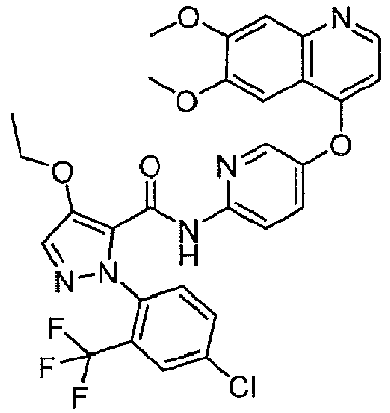
white powders; 1H-NMR (DMSO-d6, 400 MHz): δ 9.62 (1H, brs), 8.48 (1H, d, J = 5.2 Hz), 8.41 (1H, d, J = 2.4 Hz), 8.09 (1H, d, J = 9.2 Hz), 8.01 - 8.05 (2H, m), 7.92 (1H, d, J = 8.4 Hz), 7.75 (1H, dd, J = 8.8, 2.4 Hz), 7.64 (1H, d, J = 8.4 Hz), 7.51 (1H, s), 7.40 (1H, s), 6.52 (1H, d, J = 5.2 Hz), 4.40 (2H, q, J = 6.8 Hz), 3.96 (3H, s), 3.95 (3H, s), 1.48 (3H, t, J = 6.8 Hz); LCMS: 95.6%, MS (ESI): m/z 614.1[M+ H]+. 104 
white powder; 1H-NMR (DMSO-d6, 400 MHz): δ 9.67 (1H, brs), 8.50 (1H, d, J = 4.8 Hz), 8.41 (1H, d, J = 2.4 Hz), 8.35 (1H, d, J = 9.2 Hz), 8.18 (1H, s), 7.97 (1H, dd, J = 8.4, 2.0 Hz), 7.78-7.93 (3H, m), 7.54 (1H, s), 7.41 (1H, s), 6.56 (1H, d, J = 5.2 Hz), 4.15 (2H, q, J = 7.2 Hz), 3.95 (3H, s), 3.94 (3H, s), 1.42 (3H, t, J = 6.8 Hz); LCMS: 98.1 %, MS (ESI): m/z 598.1 [M + H]+. 105 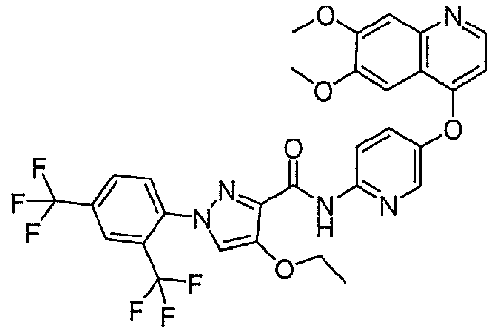
white powders; 1H-NMR (DMSO-d6, 400 MHz): δ 9.71 (1H, brs), 8.50 (1H, d, J = 5.2 Hz), 8.42 (1H, d, J = 2.8 Hz), 8.32-8.39 (3H, m), 8.29 (1H, s), 8.06 (1H, d, J = 9.2 Hz), 7.89 (1H, dd, J = 9.2, 3.2 Hz), 7.54 (1H, s), 7.42 (1H, s), 6.56 (1H, d, J = 5.6 Hz), 4.17 (2H, q, J = 6.8 Hz), 3.96 (3H, s), 3.95 (3H, s), 1.43 (3H, t, J = 6.8 Hz); LCMS: 96.7%, MS (ESI): m/z 648.1 [M+ H]+. 106 
white powder; 1H-NMR (DMSO-d6, 400 MHz): δ 9.93 (1H, brs), 8.51 (1H, d, J = 5.2 Hz), 8.42 (1H, d, J = 2.8 Hz), 8.37 (1H, d, J = 8.8 Hz), 8.25 (1H, d, J = 2.4 Hz), 7.98 (1H, t, J = 8.4 Hz), 7.88 (1H, dd, J = 9.2, 2.8 Hz), 7.81 (1H, dd, J = 11.2, 2.4 Hz), 7.55 (1H, s), 7.52 (1H, d, J = 8.8 Hz), 7.43 (1H, s), 6.58 (1H, d, J = 5.2 Hz), 4.18 (2H, q, J = 7.2 Hz), 3.96 (3H, s), 3.95 (3H, s), 1.42 (3H, t, J = 7.2 Hz); LCMS: 100%, MS (ESI): m/z 564.1 [M+ H]+. 107 
white powder (amorphous); 1H-NMR (DMSO-d6, 400 MHz): δ 9.89 (1H, brs), 8.50 (1H, d, J = 5.2 Hz), 8.42 (1H, d, J = 2.8 Hz), 8.37 (1H, d, J = 8.8 Hz), 8.23 (1H, d, J = 2.0 Hz), 7.91-8.01 (1H, m), 7.88 (1H, dd, J = 8.8, 2.8 Hz), 7.60-7.69 (1H, m), 7.54 (1H, s), 7.42 (1H, s), 7.29-7.39 (1H, m), 6.56 (1H, d, J = 5.2 Hz), 4.18 (2H, q, J = 7.2 Hz), 3.95 (3H, s), 3.94 (3H, s), 1.42 (3H, t, J = 6.8 Hz); LCMS: 98.5%, MS (ESI): m/z 548.1 [M+ H]+. 108 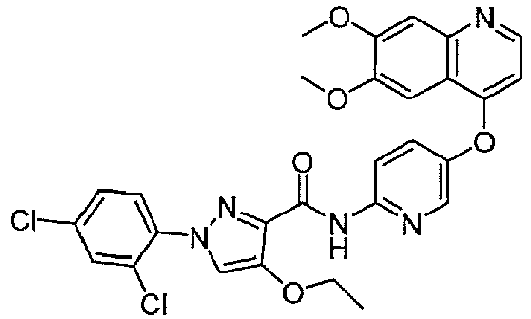
white powder (amorphous); 1H-NMR (DMSO-d6, 400 MHz): δ 9.82 (1H, brs), 8.51 (1H, d, J = 5.2 Hz), 8.42 (1H, d, J = 3.2 Hz), 8.36 (1H, d, J = 8.8 Hz), 8.24 (1H, s), 7.96 (1H, d, J = 2.0 Hz), 7.88 (1H, dd, J = 9.2, 2.8 Hz), 7.77 (1H, d, J = 8.8 Hz), 7.66 (1H, dd, J = 8.8, 2.0 Hz), 7.55 (1H, s), 7.42 (1H, s), 6.57 (1H, d, J = 5.2 Hz), 4.17 (2H, q, J = 6.8 Hz), 3.96 (3H, s), 3.95 (3H, s), 1.42 (3H, t, J = 6.8 Hz); LCMS: 97.5%, MS (ESI): m/z 580.1[M+ H]+. 109 
light yellow powder; 1H-NMR (DMSO-d6, 400 MHz): δ 9.37 (1H, brs), 8.52 (1H, d, J = 5.2 Hz), 8.25 (1H, d, J = 9.2 Hz), 8.13 (1H, s), 7.71 (1H, d, J = 2.4 Hz), 7.64 (1H, dd, J = 8.8, 2.4 Hz), 7.47-7.53 (2H, m), 7.41 (1H, s), 7.33 (1H, dd, J = 9.6, 2.8 Hz), 7.23 (1H, td, J = 8.8, 3.2 Hz), 6.61 (1H, d, J = 5.2 Hz), 4.14 (2H, q, J = 7.2 Hz), 3.94 (3H, s), 3.92 (3H, s), 2.26 (3H, s), 1.38 (3H, t, J = 6.8 Hz); LCMS: 99.0 %, MS (ESI): m/z 611.3[M+ H]+. 110 
white powders; 1H-NMR (DMSO-d6, 400 MHz): δ 9.63 (1H, brs), 8.50 (1H, d, J = 5.2 Hz), 8.43 (1H, d, J = 2.0 Hz), 8.23-8.31 (2H, m), 8.06-8.12 (2H, m), 7.89 (1H, d, J = 8.4 Hz), 7.76 (1H, dd, J = 8.8, 2.4 Hz), 7.53 (1H, s), 7.41 (1H, s), 6.55 (1H, d, J = 4.0 Hz), 4.42 (2H, q, J = 6.8 Hz), 3.95 (3H, s), 3.94 (3H, s), 1.49 (3H, t, J = 6.8 Hz); LCMS: 94.8%, MS (ESI): m/z 648.3[M+ H]+. 111 
off-white powder; 1H-NMR (DMSO-d6, 400 MHz): δ 9.72 (1H, brs), 8.51 (1H, d, J = 4.8 Hz), 8.41 (1H, d, J = 2.8 Hz), 8.36 (1H, d, J = 8.8 Hz), 8.15 (1H, s), 7.88 (1H, dd, J = 8.8, 2.8 Hz), 7.51-7.62 (2H, m), 7.46-7.50 (2H, m), 7.42 (1H, s), 6.56 (1H, d, J = 5.2 Hz), 4.17 (2H, q, J = 6.8 Hz), 3.96 (3H, s), 3.95 (3H, s), 2.62 (2H, q, J = 7.6 Hz), 1.43 (3H, t, J = 6.8 Hz), 1.07 (3H, t, J = 7.6 Hz); LCMS: 98.9%, MS (ESI): m/z 574.3 [M+ H]+. 112 
white powder; 1H-NMR (DMSO-d6, 400 MHz): δ 9.70 (1H, brs), 8.51 (1H, d, J = 5.2 Hz), 8.40 (1H, d, J = 3.2 Hz), 8.36 (1H, d, J = 8.8 Hz), 8.11 (1H, s), 7.87 (1H, dd, J = 8.8, 2.8 Hz), 7.54 (1H, s), 7.50 (1H, dd, J = 8.8, 5.2 Hz), 7.41 (1H, s), 7.34 (1H, dd, J = 9.6, 2.8 Hz), 7.24 (1H, td, J = 8.4, 2.8 Hz), 6.57 (1H, d, J = 5.2 Hz), 4.16 (2H, q, J = 6.8 Hz), 3.95 (3H, s), 3.94 (3H, s), 2.56 (2H, q, J = 7.2 Hz), 1.42 (3H, t, J = 6.8 Hz), 1.07 (3H, t, J = 7.6 Hz); LCMS: 97.7%, MS (ESI): m/z 558.2 [M+H]+. 113 
white powder; 1H-NMR (DMSO-d6, 400 MHz): δ 9.78 (1H, brs), 8.51 (1H, d, J = 5.6 Hz), 8.42 (1H, d, J = 2.8 Hz), 8.37 (1H, d, J = 9.2 Hz), 8.21 (1H, s), 7.87 (1H, dd, J = 8.8, 2.8 Hz), 7.64 (1H, d, J = 8.8 Hz), 7.55 (1H, s), 7.52 (1H, s), 7.35-7.46 (2H, m), 6.56 (1H, d, J = 5.2 Hz), 4.17 (2H, q, J = 7.2 Hz), 3.96 (3H, s), 3.95 (3H, s), 2.34 (3H, s), 1.44 (3H, t, J = 6.8 Hz); LCMS: 100%, MS (ESI): m/z 610.2[M+ H]+. 114 
white powder; 1H-NMR (DMSO-d6, 400 MHz): δ 10.02 (1H, brs), 8.50 (1H, d, J = 5.2 Hz), 8.43 (1H, d, J = 2.8 Hz), 8.37 (1H, d, J = 8.8 Hz), 8.32 (1H, d, J = 2.8 Hz), 8.24 (1H, t, J = 8.0 Hz), 8.07 (1H, d, J = 11.6 Hz), 7.89 (1H, dd, J = 9.2, 2.8 Hz), 7.81 (1H, d, J = 8.8 Hz), 7.54 (1H, s), 7.41 (1H, s), 6.56 (1H, d, J = 5.6 Hz), 4.20 (2H, q, J = 6.8 Hz), 3.95 (3H, s), 3.94 (3H, s), 1.43 (3H, t, J = 6.8 Hz); LCMS: 98.5 %, MS (ESI): m/z 598.1 [M+H]+. 115 
white powder (amorphous); 1H-NMR (DMSO-d6, 400 MHz): δ 9.83 (1H, brs), 8.51 (1H, d, J = 4.8 Hz), 8.42 (1H, d, J = 2.4 Hz), 8.37 (1H, d, J = 9.2 Hz), 8.28 (1H, s), 7.65-7.95 (3H, m), 7.62 (1H, d, J = 8.8 Hz), 7.55 (1H, s), 7.43 (1H, s), 6.57 (1H, d, J = 5.6 Hz), 4.17 (2H, q, J = 6.8 Hz), 3.96 (3H, s), 3.95 (3H, s), 1.44 (3H, t, J = 7.2 Hz); LCMS: 100%, MS (ESI): m/z 630.1 [M+ H]+. 116 
white powder; 1H-NMR (DMSO-d6, 400 MHz): δ 9.84 (1H, brs), 8.54 (1H, s), 8.50 (1H, d, J = 5.2 Hz), 8.42 (1H, d, J = 2.8 Hz), 8.38 (1H, d, J = 8.8 Hz), 7.88 (1H, dd, J = 9.2, 2.8 Hz), 7.85 (2H, d, J = 8.8 Hz), 7.55 (1H, s), 7.39-7.46 (3H, m), 6.56 (1H, d, J = 5.2 Hz), 4.21 (2H, q, J = 7.2 Hz), 3.96 (3H, s), 3.95 (3H, s), 2.91-3.05 (1H, m), 1.45 (3H, t, J = 6.8 Hz), 1.24 (6H, d, J = 6.8 Hz); LCMS: 99.5%, MS (ESI): m/z 554.4[M+ H]+. 117 
white powder; 1H-NMR (DMSO-d6, 400 MHz): δ 9.69 (1H, brs), 8.50 (1H, d, J = 5.2 Hz), 8.40 (1H, d, J = 3.2 Hz), 8.36 (1H, d, J = 8.8 Hz), 7.96 (1H, s), 7.87 (1H, dd, J = 8.8, 2.8 Hz), 7.54 (1H, s), 7.42 (1H, s), 7.06 (2H, s), 6.55 (1H, d, J = 5.2 Hz), 4.14 (2H, q, J = 7.2 Hz), 3.95 (3H, s), 3.94 (3H, s), 2.32 (3H, s), 1.99 (6H, s), 1.42 (3H, t, J = 6.8 Hz); LCMS: 100%, MS (ESI): m/z 554.3[M+ H]+. 118 
white powder; 1H-NMR (DMSO-d6, 400 MHz): δ 10.06 (1H, brs), 8.50 (1H, d, J = 5.2 Hz), 8.42 (1H, d, J = 2.8 Hz), 8.20 (1H, d, J = 9.2 Hz), 7.89 (1H, s), 7.81 (1H, dd, J = 9.2, 2.8 Hz), 7.54 (1H, s), 7.42 (1H, s), 7.31-7.41 (4H, m), 6.54 (1H, d, J = 5.2 Hz), 4.32 (2H, q, J = 6.8 Hz), 3.96 (3H, s), 3.95 (3H, s), 1.45 (3H, t, J = 7.2 Hz), 1.26 (6H, d, J = 7.2 Hz); LCMS: 93.4%, MS (ESI): m/z 554.3[M+ H]+. 119 
off-white amorphous; 1H-NMR (DMSO-d6, 400 MHz): δ 9.94 (1H, s), 8.49 (1H, d, J = 5.2 Hz), 8.20 (1H, d, J = 8.4 Hz), 8.07 (1H, s), 7.47-7.53 (2H, m), 7.40 (1H, s), 7.33 (1H, dd, J = 9.6, 2.8 Hz), 7.19-7.28 (3H, m), 6.50 (1H, d, J = 5.6 Hz), 5.63 (1H, brs), 4.59 (2H, s), 4.10 (2H, q, J = 6.8 Hz), 3.95 (3H, s), 3.94 (3H, s), 2.29 (3H, s), 1.40 (3H, t, J = 6.8 Hz); LCMS: 98.2%, MS (ESI): m/z 573 2[M+ H]+. 120 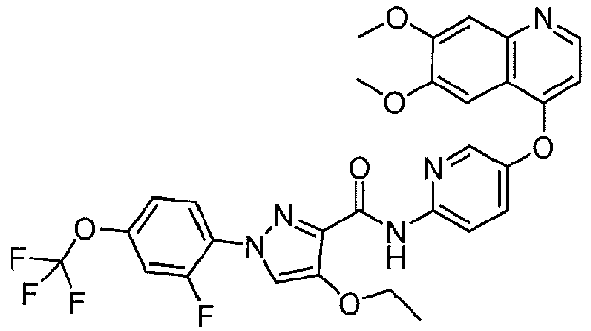
white powder; 1H-NMR (DMSO-d6, 400 MHz): δ 9.94 (1H, brs), 8.50 (1H, d, J = 5.2 Hz), 8.41 (1H, d, J = 2,8 Hz), 8.36 (1H, d, J = 8.8 Hz), 8.27 (1H, d, J = 2.4 Hz), 8.09 (1H, t, J = 8.8 Hz), 7.88 (1H, dd, J = 8.8, 2,8 Hz), 7.80 (1H, d, J = 11.6 Hz), 7.54 (1H, s), 7.48 (1H, d, J = 9.2 Hz), 7.42 (1H, s), 6.56 (1H, d, J = 5.2 Hz), 4.19 (2H, q, J = 6.8 Hz), 3.95 (3H, s), 3.94 (3H, s), 1.42 (3H, t, J = 6.8 Hz); LCMS: 99.7%, MS (ESI): m/z 614.1[M+ H]+. 121 
white powder; 1H-NMR (DMSO-d6, 400 MHz): δ 9.85 (1H, brs), 8.56 (1H, s), 8.53 (1H, d, J = 5.6 Hz), 8.44 (1H, d, J = 2.8 Hz), 8.39 (1H, d, J = 8.8 Hz), 7.91 (1H, dd, J = 8.8, 2.4 Hz), 7.86 (2H, d, J = 8.8 Hz), 7.52-7.61 (3H, m), 7.44 (1H, s), 6.60 (1H, d, J = 5.2 Hz), 4.22 (2H, q, J = 6.8 Hz), 3.97 (3H, s), 3.96 (3H, s), 1.45 (3H, t, J = 6.8 Hz), 1.34 (9H, s); LCMS: 100%, MS (ESI): m/z 568.3 [M+ H]+. 122 
off-white powder; 1H-NMR (CDCl3, 400 MHz): δ 9.36 (1H, brs), 8.69 (1H, d, J = 5.2 Hz), 7.51 (1H, s), 7.48 (1H, s), 7.41 (1H, s), 7.29-7.35 (2H, m), 7.24 (2H, d, J = 5.2 Hz), 6.97-7.08 (2H, m), 4.15 (2H, q, J = 7.2 Hz), 4.08 (3H, s), 4.05 (3H, s), 2.26 (3H, s), 1.53 (3H, t, J = 6.8 Hz); LCMS: 98.7%, MS (ESI): m/z 550.1 [M+H] +. 123 
white powder; 1H-NMR (DMSO-d6, 400 MHz): δ 10.07 (1H, brs), 8.50 (1H, d, J = 5.6 Hz), 8.42 (1H, d, J = 2.8 Hz), 8.20 (1H, d, J = 8.8 Hz), 7.89 (1H, s), 7.81 (1H, dd, J = 9.2, 3.2 Hz), 7.54 (1H, s), 7.49 (2H, d, J = 8.8 Hz), 7.42 (1H, s), 7.38 (2H, d, J = 8.8 Hz), 6.54 (1H, d, J = 5.6 Hz), 4.32 (2H, q, J = 6.8 Hz), 3.96 (3H, s), 3.95 (3H, s), 1.45 (3H, t, J = 6.8 Hz), 1.34 (9H, s); LCMS: 100%, MS (ESI): m/z 568.3[M+ H]+. 124 
white powder; 1H-NMR (DMSO-d6, 400 MHz): δ 9.89 (1H, brs), 8.58 (1H, s), 8.51 (1H, d, J = 5.6 Hz), 8.43 (1H, d, J = 2.8 Hz), 8.38 (1H, d, J = 8.8 Hz), 7.94-8.03 (1H, m), 7.83-7.93 (2H, m), 7.55 (1H, s), 7.42 (1H, s), 7.39 (1H, t, J = 9.2 Hz), 6.57 (1H, d, J = 5.2 Hz), 4.22 (2H, q, J = 6.8 Hz), 3.96 (3H, s), 3.95 (3H, s), 3.53 (2H, s), 2.21 (6H, s), 1.45 (3H, t, J = 6.8 Hz); LCMS: 100%, MS (ESI): m/z 587.2[M+ H]+. 125 
white powder; 1H-NMR (DMSO-d6, 400 MHz): δ 9.68 (1H, brs), 8.50 (1H, d, J = 5.2 Hz), 8.40 (1H, d, J = 2,8 Hz), 8.35 (1H, d, J = 8.8 Hz), 8.11 (1H, s), 7.87 (1H, dd, J = 8.8, 2.8 Hz), 7.54 (1H, s), 7.47 (1H, dd, J = 8.8, 5.2 Hz), 7.39-7.44 (2H, m), 7.23 (1H, td, J = 8.4, 2.8 Hz), 6.55 (1H, d, J = 5.6 Hz), 4.15 (2H, q, J = 6.8 Hz), 3.95 (3H, s), 3.94 (3H, s), 2.77-2.85 (1H, m), 1.42 (3H, t, J = 6.8 Hz), 1.16 (6H, d, J = 8.0 Hz); LCMS: 95.6 %, MS (ESI): m/z 572.2 [M+H]+. 126 
white powder; 1H-NMR (DMSO-d6, 400 MHz): δ 9.91 (1H, brs), 8.64 (1H, s), 8.51 (1H, d, J = 5.2 Hz), 8.44 (1H, d, J = 2.8 Hz), 8.38 (1H, d, J = 8.8 Hz), 8.06 (1H, d, J = 2.8 Hz), 7.89 (2H, dt, J = 8.8, 2.8 Hz), 7.63 (1H, d, J = 8.8 Hz), 7.56 (1H, s), 7.43 (1H, s), 6.57 (1H, d, J = 5.2 Hz), 4.23 (2H, q, J = 6.8 Hz), 3.97 (3H, s), 3.96 (3H, s), 3.57 (2H, s), 2.25 (6H, s), 1.46 (3H, t, J = 6.8 Hz); LCMS: 100%, MS (ESI): m/z 603.3 [M+ H]+. 127 
white powder; 1H-NMR (DMSO-d6, 400 MHz): δ 9.84 (1H, brs), 8.51 (1H, d, J = 5.2 Hz), 8.42 (1H, d, J = 2.8 Hz), 8.37 (1H, d, J = 8.8 Hz), 8.20 (1H, d, J = 2.4 Hz), 7.88 (1H, dd, J = 9.2, 2,8 Hz), 7.79 (1H, t, J = 8.4 Hz), 7.54 (1H, s), 7.38-7.45 (2H, m), 7.29 (1H, dd, J = 8.4, 2.0 Hz), 6.56 (1H, d, J = 5.2 Hz), 4.18 (2H, q, J = 6.8 Hz), 3.95 (3H, s), 3.94 (3H, s), 2.95-3.04 (1H, m), 1.42 (3H, t, J = 6.8 Hz), 1.25 (6H, d, J = 6.8 Hz); LCMS: 100 %, MS (ESI): m/z 572.4 [M+H]+. 128 
white powder; 1H-NMR (DMSO-d6, 400 MHz): δ 9.84 (1H, brs), 8.57 (1H, s), 8.49 (1H, d, J = 5.2 Hz), 8.41 (1H, d, J = 2.8 Hz), 8.36 (1H, d, J = 9.2 Hz), 8.04 (1H, dd, J = 6.0, 2.8 Hz), 7.88 (1H, dd, J = 9.2, 2,8 Hz), 7.80-7.87 (1H, m), 7.53 (1H, s), 7.41 (1H, s), 7.35 (1H, t, J = 9.2 Hz), 6.55 (1H, d, J = 5.2 Hz), 5.50 (1H, t, J = 5.6 Hz), 4.62 (2H, d, J = 5.2 Hz), 4.20 (2H, q, J= 7.2 Hz), 3.94 (3H, s), 3.93 (3H, s), 1.43 (3H, t, J = 6.8 Hz); LCMS: 98.8%, MS (ESI): m/z 560.4[M+ H]+. 129 
off-white powder; 1H-NMR (DMSO-d6, 400 MHz): δ 10.05 (1H, brs), 8.66 (1H, s), 8.49 (1H, d, J = 5.2 Hz), 8.41 (1H, d, J = 2.4 Hz), 8.35 (1H, d, J = 9.2 Hz), 8.01-8.07 (2H, m), 7.87 (1H, dd, J = 9.2, 3.2 Hz), 7.70 (1H, d, J = 8.0 Hz), 7.53 (1H, s), 7.41 (1H, s), 6.55 (1H, d, J = 5.2 Hz), 4.17 (2H, q, J = 6.8 Hz), 3.94 (3H, s), 3.94 (3H, s), 3.04 (3H, s), 2.83 (3H, s), 1.42 (3H, t, J = 6.8 Hz); LCMS: 100%, MS (ESI): m/z 617.3 [M+ H]+. 130 
white powder; 1H-NMR (DMSO-d6, 400 MHz): δ 10.14 (1H, brs), 8.50 (1H, d, J = 5.6 Hz), 8.42 (1H, d, J = 2.8 Hz), 8.18 (1H, d, J = 8.8 Hz), 7.93 (1H, s), 7.82 (1H, dd, J = 9.2, 3.2 Hz), 7.51-7.58 (3H, m), 7.36-7.44 (2H, m), 6.53 (1H, d, J = 5.2 Hz), 4.32 (2H, q, J = 6.8 Hz), 3.96 (3H, s), 3.95 (3H, s), 3.51 (2H, s), 2.20 (6H, s), 1.44 (3H, t, J = 6.8 Hz); LCMS: 94.5%, MS (ESI): m/z 603.2[M+ H]+. 131 
off-white powder; 1H-NMR (CDCl3, 400 MHz): δ 9.58 (1H, brs), 8.60 (1H, d, J = 9.2 Hz), 8.53 (1H, d, J = 5.2 Hz), 8.38 (1H, s), 8.28 (1H, d, J = 2.8 Hz), 7.88 (1H, d, J = 8.4 Hz), 7.62 (1H, dd, J = 8.8, 2.8 Hz), 7.58 (1H, s), 7.46 (1H, s), 7.26 (1H, d, J = 8.4 Hz), 6.49 (1H, d, J = 5.2 Hz), 4.21 (2H, q, J = 6.8 Hz), 4.04-4.11 (6H, m), 3.50 (2H, s), 2.66 (3H, s), 2.33 (6H, s), 1.60 (3H, t, J = 6.8 Hz); LCMS: 98.3%, MS (ESI): m/z 584.4[M+H] +. 132 
white powder; 1H-NMR (DMSO-d6, 400 MHz): δ 9.77 (1H, brs), 8.47-8.52 (2H, m), 8.41 (1H, d, J = 2.8 Hz), 8.36 (1H, d, J = 8.8 Hz), 8.10 (1H, s), 7.88 (1H, dd, J = 8.8, 2.8 Hz), 7.54 (1H, s), 7.42 (1H, s), 7.35 (1H, d, J = 5.2 Hz), 6.55 (1H, d, J = 5.6 Hz), 4.15 (2H, q, J = 6.8 Hz), 3.95 (3H, s), 3.94 (3H, s), 2.23 (3H, s), 2.09 (3H, s), 1.43 (3H, t, J = 6.8 Hz); LCMS: 100 %, MS (ESI): m/z 541.4 [M+H]+. 133 
white powder; 1H-NMR (DMSO-d6, 400 MHz): δ 9.68 (1H, brs), 8.88 (1H, d, J = 2.4 Hz), 8.85 (1H, d, J = 2.4 Hz), 8.55 (1H, s), 8.50 (1H, d, J = 5.2 Hz), 8.43 (1H, d, J = 2,8 Hz), 8.37 (1H, d, J = 8.8 Hz), 7.90 (1H, dd, J = 9.2, 2.8 Hz), 7.54 (1H, s), 7.42 (1H, s), 6.57 (1H, d, J = 4.4 Hz), 4.22 (2H, q, J = 6.8 Hz), 3.96 (3H, s), 3.95 (3H, s), 1.42 (3H, t, J = 6.8 Hz); LCMS: 100%, MS (ESI): m/z 572.3[M+ H]+. 134 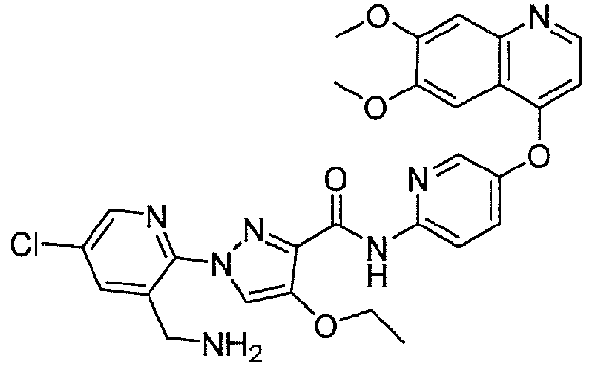
white powder; 1H-NMR (DMSO-d6, 400 MHz): δ 9.86 (1H, brs), 8.48-8.52 (2H, m), 8.43 (1H, d, J = 2,8 Hz), 8.41 (1H, s), 8.37 (1H, d, J = 8.8 Hz), 8.32 (1H, d, J = 2.0 Hz), 7.89 (1H, dd, J = 8.8, 2.8 Hz), 7.54 (1H, s), 7.42 (1H, s), 6.56 (1H, d, J = 5.2 Hz), 4.22 (2H, q, J = 6.8 Hz), 4.01 (2H, s), 3.96 (3H, s), 3.95 (3H, s), 1.43 (3H, t, J = 6.8 Hz); LCMS: 95.4%, MS (ESI): m/z 576.3 [M+ H]+. 135 
white powder; 1H-NMR (DMSO-d6, 400 MHz): δ 9.88 (1H, brs), 8.65 (1H, d, J = 2.0 Hz), 8.47-8.55 (2H, m), 8.46 (1H, s), 8.43 (1H, d, J = 2,8 Hz), 8.37 (1H, d, J = 8.8 Hz), 7.89 (1H, dd, J = 9.2, 2.8 Hz), 7.54 (1H, s), 7.42 (1H, s), 6.57 (1H, d, J = 5.2 Hz), 4.22 (2H, q, J = 6.8 Hz), 3.96 (3H, s), 3.95 (3H, s), 2.85 (3H, s), 1.44 (3H, t, J = 7.2 Hz); LCMS: 96.8%, MS (ESI): m/z 528.4[M+ H]+. 136 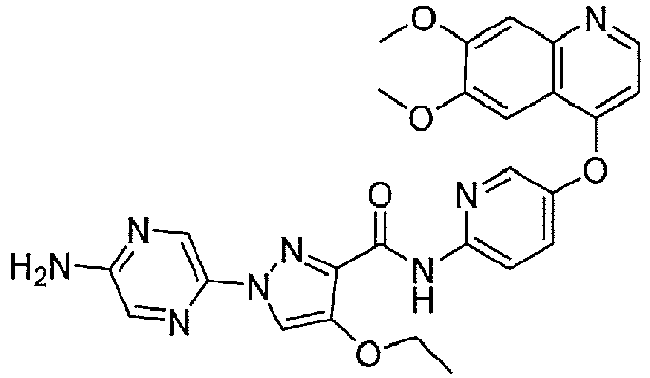
white powder; 1H-NMR (DMSO-d6, 400 MHz): δ 9.91 (1H, brs), 8.65 (1H, s), 8.50 (1H, d, J = 5.2 Hz), 8.42 (1H, d, J = 2.8 Hz), 8.37 (1H, d, J = 9.2 Hz), 8.34 (1H, s), 7.88 (1H, dd, J = 9.2, 2.8 Hz), 7.77 (1H, s), 7.55 (1H, s), 7.42 (1H, s), 6.74 (2H, brs), 6.56 (1H, d, J = 5.2 Hz), 4.20 (2H, q, J = 6.8 Hz), 3.96 (3H, s), 3.95 (3H, s), 1.42 (3H, t, J = 6.8 Hz); LCMS: 97.3%, MS (ESI): m/z 529.2[M+ H]+. 137 
off-white powder; 1H-NMR (DMSO-d6, 400 MHz): δ 9.69 (1H, brs), 8.50 (1H, d, J = 5.6 Hz), 8.40 (1H, d, J = 2.8 Hz), 8.36 (1H, d, J = 9.2 Hz), 8.02 (1H, s), 7.93 (1H, s), 7.87 (1H, dd, J = 9.2, 2.8 Hz), 7.54 (1H, s), 7.42 (1H, s), 6.56 (1H, d, J = 5.2 Hz), 6.40 (1H, s), 6.27 (2H, brs), 4.15 (2H, q, J = 6.8 Hz), 3.95 (3H, s), 3.94 (3H, s), 2.08 (3H, s), 1.42 (3H, t, J = 6.8 Hz); LCMS: 100%, MS (ESI): m/z 542.3[M + H]+. 138 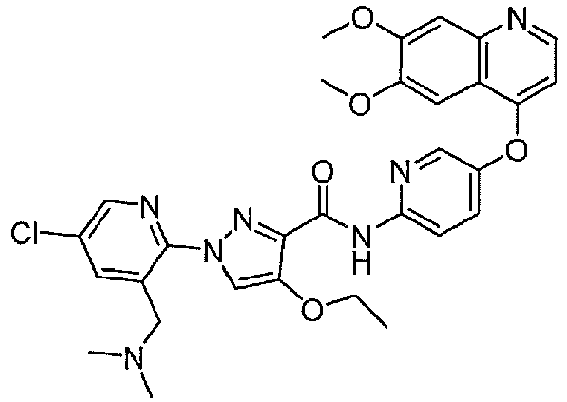
white powder; 1H-NMR (DMSO-d6, 400 MHz): δ 9.81 (1H, brs), 8.57 (1H, s), 8.50 (1H, d, J = 5.2 Hz), 8.34-8.47 (3H, m), 8.22 (1H, s), 7.89 (1H, dd, J = 8.8, 3.2 Hz), 7.54 (1H, s), 7.42 (1H, s), 6.56 (1H, d, J = 5.6 Hz), 4.17-4.30 (2H, m), 3.96 (3H, s), 3.95 (3H, s), 3.80 (2H, s), 2.16 (6H, s), 1.44 (3H, t, J = 6.8 Hz); LCMS: 95.8%, MS (ESI): m/z 604.5[M+ H]+. 139 
white powder; 1H-NMR (DMSO-d6, 400 MHz): δ 9.77 (1H, brs), 8.51 (1H, d, J = 5.2 Hz), 8.42 (1H, d, J = 3.2 Hz), 8.37 (1H, d, J = 9.2 Hz), 8.06 (1H, s), 7.89 (1H, dd, J = 9.2, 3.2 Hz), 7.55 (1H, s), 7.35-7.50 (3H, m), 6.75 (1H, s), 6.57 (1H, d, J = 5.2 Hz), 4.18 (2H, q, J = 7.2 Hz), 3.96 (3H, s), 3.95 (3H, s), 2.12 (3H, s), 1.42 (3H, t, J = 7.2 Hz); LCMS: 98.2%, MS (ESI): m/z 534.4[M+ H]+. 140 
white powder; 1H-NMR (DMSO-d6, 400 MHz): δ 9.87 (1H, brs), 8.80 (2H, s), 8.45 (1H, d, J = 5.6 Hz), 8.34 (1H, s), 7.84 (1H, s), 7.75 (1H, d, J = 9.2 Hz), 7.58 (1H, s), 7.40 (1H, s), 7.19 (1H, d, J = 8.8 Hz), 7.00 (1H, brs), 6.31 (1H, d, J = 5.6 Hz), 4.09 (2H, q, J = 7.2 Hz), 3.96 (3H, s), 3.95 (3H, s), 2.12 (3H, s), 1.39 (3H, t, J = 6.8 Hz); LCMS: 99.3%, MS (ESI): m/z 542.3 [M + H]+. 141 
pale white powder; 1H-NMR (DMSO-d6, 400 MHz): δ 10.15 (1H, brs), 8.79 (2H, s), 8.48 (1H, d, J = 5.2 Hz), 8.34 (1H, s), 8.03 (1H, dd, J = 13.6, 2.8 Hz), 7.71 (1H, d, J = 9.2 Hz), 8.53 (1H, s), 7.46 (1H, t, J = 8.8 Hz), 7.40 (1H, s), 7.02 (2H, brs), 6.47 (1H, d, J = 5.2 Hz), 4.06 (2H, q, J = 6.8 Hz), 3.94 (6H, s), 1.37 (3H, t, J = 6.8 Hz); LCMS: 100%, MS (ESI): m/z 546.3[M+ H]+. 142 
white powder; 1H-NMR (DMSO-d6, 400 MHz): δ 9.78 (1H, brs), 8.46-8.52 (2H, m), 8.42 (1H, d, J = 2.8 Hz), 8.36-8.40 (2H, m), 8.10 (1H, dd, J = 8.0, 2.0 Hz), 7.88 (1H, dd, J = 9.2, 2.8 Hz), 7.51-7.57 (2H, m), 7.42 (1H, s), 6.57 (1H, d, J = 5.2 Hz), 4.22 (2H, q, J = 6.8 Hz), 3.96 (3H, s), 3.95 (3H, s), 3.77 (2H, s), 2.14 (6H, s), 1.44 (3H, t, J = 6.8 Hz); LCMS: 100%, MS (ESI): m/z 570.4[M+ H]+. 143 
white powder; 1H-NMR (DMSO-d6, 400 MHz): δ 9.72 (1H, brs), 8.50 (1H, d, J = 5.2 Hz), 8.40 (1H, d, J = 2.8 Hz), 8.37 (1H, d, J = 9.2 Hz), 8.13 (1H, s), 7.87 (1H, dd, J = 9.2, 2.8 Hz), 7.63 (1H, s), 7.54 (1H, s), 7.42 (1H, s), 6.82 (2H, s), 6.56 (1H, d, J = 5.2 Hz), 4.17 (2H, q, J = 6.8 Hz), 3.95 (3H, s), 3.94 (3H, s), 2.35 (3H, s), 1.42 (3H, t, J = 6.8 Hz); LCMS: 100%, MS (ESI): m/z 543.4[M+ H]+. 144 
white powder; 1H-NMR (DMSO-d6, 400 MHz): δ 10.25 (1H, brs), 9.66 (2H, s), 8.80 (1H, s), 8.51 (1H, d, J = 5.2 Hz), 8.45 (1H, d, J = 3.2 Hz), 8.37 (1H, d, J = 8.8 Hz), 7.90 (1H, dd, J = 9.2, 3.2 Hz), 7.55 (1H, s), 7.42 (1H, s), 6.57 (1H, d, J =5.2 Hz), 4.20 (2H, q, J = 6.8 Hz), 3.95 (3H, s), 3.96 (3H, s), 1.46 (3H, t, J = 7.2 Hz); LCMS: 99.0%, MS (ESI): m/z 582.3 [M+H] +. 145 
pale yellow powder; 1H-NMR (DMSO-d6, 400 MHz): δ 9.82 (1H, brs), 9.35 (2H, s), 8.50 (1H, d, J = 5.2 Hz), 8.46 (1H, d, J = 2.8 Hz), 8.26 (1H, s), 8.22 (1H, d, J = 8.8 Hz), 7.85 (1H, dd, J = 9.2, 3.2 Hz), 7.54 (1H, s), 7.42 (1H, s), 6.54 (1H, d, J = 2,8 Hz), 4.45 (2H, q, J = 7.2 Hz), 3.96 (3H, s), 3.95 (3H, s), 1.50 (3H, t, J = 6.8 Hz); LCMS: 97.6%, MS (ESI): m/z 582.4 [M+H] +. 146 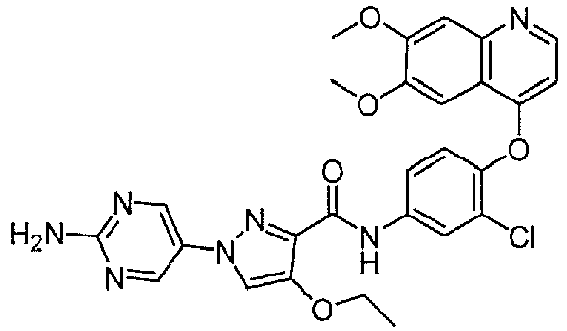
white powder.; 1H-NMR (DMSO-d6, 400 MHz): δ 10.14 (1H, brs), 8.81 (2H, s), 8.48 (1H, d, J = 4.8 Hz), 8.35 (1H, s), 8.23 (1H, d, J = 2.4 Hz), 7.88 (1H, dd, J = 9.2, 2.4 Hz), 7.54 (1H, s), 7.46 (1H, d, J = 8.8 Hz), 7.41 (1H, s), 7.02 (2H, brs), 6.38 (1H, d, J = 5.2 Hz), 4.07 (2H, q, J = 6.8 Hz), 3.95 (6H, s), 1.38 (3H, t, J = 6.8 Hz); LCMS: 98.6 %, MS (ESI): m/z 562.4 [M+H]+. 147 
white powder; 1H-NMR (DMSO-d6, 400 MHz): δ 9.83 (1H, brs), 9.29 (1H, s), 8.86 (1H, d, J = 4.8 Hz), 8.55-8.70 (2H, m), 8.48 (1H, d, J = 2.8 Hz), 8.40 (1H, d, J = 8.8 Hz), 8.13 (1H, d, J = 4.8 Hz) 7.90-8.00 (1H, m), 7.63 (1H, s), 7.48 (1H, s), 7.40 (1H, s), 6.74 (1H, d, J = 5.6 Hz), 4.20 (2H, q, J = 6.8 Hz), 3.99 (3H, s), 3.98 (3H, s), 1.46 (3H, t, J = 6.8 Hz); LCMS: 100%, MS (ESI): m/z 538.3[M + H]+. 148 
white powder; 1H-NMR (DMSO-d6, 400 MHz): δ 10.00 (1H, brs), 9.18 (2H, s), 8.57 (1H, s), 8.50 (1H, d, J = 5.2 Hz), 8.43 (1H, d, J = 2.8 Hz), 8.37 (1H, d, J = 8.8 Hz), 7.89 (1H, dd, J = 8.8, 2.8 Hz), 7.54 (1H, s), 7.42 (1H, s), 6.56 (1H, d, J = 5.2 Hz), 4.18 (2H, q, J = 7.2 Hz), 3.99 (3H, s), 3.95 (3H, s), 3.94 (3H, s), 1.44 (3H, t, J = 7.2 Hz); LCMS: 100%, MS (ESI): m/z 544.4 [M + H] +. 149 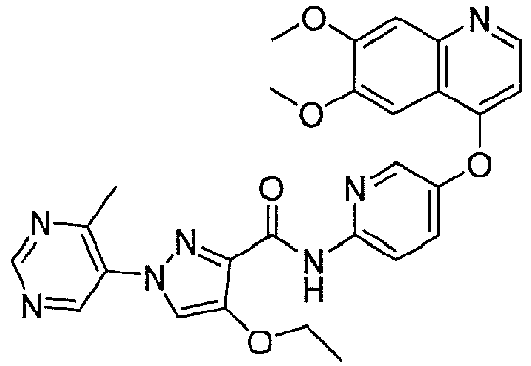
white powder; 1H-NMR (DMSO-d6, 400 MHz): δ 9.95 (1H, brs), 9.16 (1H, s), 8.97 (1H, s), 8.73 (1H, d, J= 6.0 Hz), 8.50 (1H, d, J = 2.8 Hz), 8.41 (1H, d, J = 8.8 Hz), 8.34 (1H, s), 7.97 (1H, dd, J = 8.8, 2.8 Hz), 7.70 (1H, s), 7.51 (1H, s), 6.88 (1H, d, J = 5.6 Hz), 4.18 (2H, q, J = 6.8 Hz), 4.02 (3H, s), 4.01 (3H, s), 2.60 (3H, s), 1.44 (3H, t, J = 7.2 Hz ); LCMS: 99.2%, MS (ESI): m/z 528.4 [M+H] +. 150 
white powder; 1H-NMR (DMSO-d6, 400 MHz): δ 9.74 (1H, brs), 8.50 (1H, d, J = 5.2 Hz), 8.41 (1H, d, J = 2.8 Hz), 8.36 (1H, d, J = 8.8 Hz), 8.27 (1H, s), 8.08 (1H, s), 7.87 (1H, dd, J = 9.2, 3.2 Hz), 7.54 (1H, s), 7.42 (1H, s), 7.05 (2H, brs), 6.56 (1H, d, J = 5.6 Hz), 4.15 (2H, q, J = 7.2 Hz), 3.95 (3H, s), 3.94 (3H, s), 2.20 (3H, s), 1.42 (3H, t, J = 7.2 Hz); LCMS: 100%, MS (ESI): m/z 543.4[M+ H]+. 151 
off-white powder; 1H-NMR (DMSO-d6, 400 MHz): δ 9.58 (1H, brs), 8.65 (1H, s), 8.56 (1H, d, J = 5.2 Hz), 8.52 (1H, d, J = 5.2 Hz), 8.18-8.27 (2H, m), 7.48-7.53 (2H, m), 7.40-7.46 (2H, m), 7.17 (1H, d, J = 8.8 Hz), 6.59 (1H, d, J = 5.2 Hz), 4.15 (2H, q, J = 6.8 Hz), 3.95 (3H, s), 3.93 (3H, s), 2.36 (3H, s), 1.42 (3H, t, J = 6.8 Hz); LCMS: 100%, MS (ESI): m/z 544.3 [M + H]+. 152 
off-white powder; 1H-NMR (CDCl3, 400 MHz): δ 9.52 (1H, brs), 9.40 (1H, d, J = 3.2 Hz), 8.75 (1H, t, J = 8.8 Hz), 8.58-8.51 (2H, m), 8.38 (1H, s), 8.27 (1H, s), 7.53 (1H, s), 7.47 (1H, s), 7.00-7.10 (2H, m), 6.56 (1H, d, J = 5.2 Hz), 4.25 (2H, q, J = 6.8 Hz), 4.06 (6H, s), 1.58-0-1.58 (3H, m, overlappted with H2O peak); LCMS: 100%, MS (ESI): m/z 531.2 [M+H]+. 153 
brown powder; 1H-NMR (DMSO-d6, 400 MHz): δ 9.59 (1H, brs), 8.74 (2H, s), 8.52 (1H, d, J = 5.2 Hz), 8.40 (1H, s), 8.21 (1H, t, J = 8.4 Hz), 7.49 (1H, s), 7.40-7.46 (2H, s), 7.15-7.20 (1H, m), 7.03 (2H, brs), 6.59 (1H, d, J = 5.2 Hz), 4.14 (2H, q, J = 6.8 Hz), 3.95 (3H, s), 3.93 (3H, s), 1.42 (3H, t, J = 6.8 Hz); LCMS: 95.7%, MS (ESI): m/z 546.2 [M+H]+. 154 
white powder; 1H-NMR (DMSO-d6, 400 MHz): δ 10.31 (1H, brs), 9.25 (1H, d, J = 2.4 Hz), 8.62 (1H, s), 8.55-8.60 (2H, m), 8.35-8.41 (2H, m), 8.06 (1H, dd, J = 10.0, 2.8 Hz), 7.61 (1H, dd, J = 8.4, 5.2 Hz), 7.52 (1H, s), 7.44 (1H, s), 6.70 (1H, d, J = 5.2 Hz), 4.12 (2H, q, J = 6.8 Hz), 3.96 (3H, s), 3.94 (3H, s), 1.39 (3H, t, J = 6.8 Hz); LCMS: 100%, MS (ESI): m/z 531.4 [M+H]+. 155 
white powder.; 1H-NMR (DMSO-d6, 400 MHz): δ 9.69 (1H, brs), 8.89 (1H, d, J = 2.8 Hz), 8.75 (1H, dd, J = 8.4, 2.8 Hz), 8.58 (1H, d, J = 5.6 Hz), 8.53 (1H, s), 6.46 (1H, d, J = 2.8 Hz), 8.39 (1H, d, J = 9.2 Hz), 7.93 (1H, dd, J = 9.6, 3.2 Hz), 7.60 (1H, s), 7.44 (1H, s), 6.69 (1H, d, J = 5.2 Hz), 4.21 (2H, q, J = 6.8 Hz), 3.98 (3H, s), 3.97 (3H, s), 1.42 (3H, t, J = 7.2 Hz); LCMS: 97.4%, MS (ESI): m/z 556.2[M + H]+. 156 
off-white powder; 1H-NMR (DMSO-d6, 400 MHz): δ 10.04 (1H, brs), 8.96 (1H, d, J = 2.4 Hz), 8.70 (1H, d, J = 4.8 Hz), 8.50 (1H, d, J = 5.2 Hz), 8.42 (1H, d, J = 2.8 Hz), 8.36 (1H, d, J = 9.2 Hz), 8.19 (1H, d, J = 8.4 Hz), 7.87 (1H, dd, J = 8.8, 2.8 Hz), 7.64 (1H, dd, J = 8.4, 5.2 Hz), 7.54 (1H, s), 7.42 (1H, s), 6.57 (1H, d, J = 5.2 Hz), 4.17 (2H, q, J = 6.8 Hz), 3.95 (3H, s), 3.94 (3H, s), 2.35 (3H, s), 1.35 (3H, t, J = 6.8 Hz); LCMS: 100%, MS (ESI): m/z 527.3 [M + H]+. 157 
white powder; 1H-NMR (CDCl3, 400 MHz): δ 9.57 (1H, brs), 9.27 (1H, s), 8.59 (1H, d, J = 9.2 Hz), 8.54 (1H, d, J = 5.2 Hz), 8.42 (1H, s), 8.29 (1H, d, J = 2.8 Hz), 8.27 (1H, s), 7.62 (1H, dd, J = 8.8, 2.4 Hz), 7.57 (1H, s), 7.48 (1H, s), 6.50 (1H, d, J = 5.2 Hz), 4.25 (2H, q, J = 6.8 Hz), 4.07 (6H, s), 2.61 (3H, s), 1.60 (3H, t, J = 7.2 Hz); LCMS: 99.3%, MS (ESI): m/z 528.3[M + H]+. 158 
white solid; 1H-NMR (CDCl3, 400 MHz): δ 9.70 (1H, brs), 9.56 (1H, s), 8.84 (1H, s), 8.57 (1H, d, J = 8.8 Hz), 8.53 (1H, d, J = 5.2 Hz), 8.30 (1H, d, J = 2.8 Hz), 8.23 (1H, s), 7.63 (1H, dd, J = 9.2, 2.8 Hz), 7.55 (1H, s), 7.46 (1H, s), 6.48 (1H, d, J = 5.2 Hz), 4.28 (2H, q, J = 6.8 Hz), 4.07 (6H, s), 1.63 (3H, t, J = 6.8 Hz); LCMS: 100 %, MS (ESI): m/z 539.2 [M + H]+. 159 
pale yellow powder; 1H-NMR (DMSO-d6, 400 MHz): δ 10.32 (1H, brs), 9.60 (1H, s), 9.10 (1 H, s), 8.62 (1H, s), 8.51 (1H, d, J = 5.2 Hz), 8.46 (1H, d, J = 2.8 Hz), 8.70 (1H, d, J = 8.8 Hz), 7.91 (1H, dd, J = 8.8, 2.8 Hz), 7.55 (1H, s), 7.42 (1H, s), 6.58 (1H, d, J = 5.6 Hz), 4.25 (2H, q, J = 7.2 Hz), 3.96 (3H, s), 3.95 (3H, s), 1.42 (3H, t, J = 7.2 Hz); LCMS: 98.4%, MS (ESI): m/z 582.2 [M + H] +. 160 
white powder; 1H-NMR (CDCl3, 400 MHz): δ 9.59 (1H, brs), 9.36 (1H, s), 8.60 (1H, d, J = 9.2 Hz), 8.53 (1H, d, J = 5.2 Hz), 8.30 (1H, d, J = 2.8 Hz), 8.21 - 8.26 (2H, m), 7.63 (1H, dd, J = 9.2, 2.8 Hz), 7.57 (1H, s), 7.49 (1H, s), 6.50 (1H, d, J = 5.2 Hz), 4.25 (2H, q, J = 6.8 Hz), 4.08 (6H, s), 2.64 (3H, s), 1.58 (3H, t, J = 6.8 Hz); LCMS: 98.4 %, MS (ESI): m/z 528.1 [M+H]+. 161 
pale-yellow powder; 1H-NMR (DMSO-d6, 400 MHz): δ 9.98 (1H, brs), 8.50 (1H, d, J = 5.2 Hz), 8.41 - 8.46 (2H, m), 8.35 (1H, d, J = 9.2 Hz), 7.89 (1H, dd, J = 9.2, 2.8 Hz), 7.54 (1H, s), 7.42 (1H, s), 6.57 (1H, d, J = 5.2 Hz), 4.22 (2H, q, J = 6.8 Hz), 3.96 (3H, s), 3.95 (3H, s), 2.71 (3H, s), 1.42 (3H, t, J = 6.8 Hz); LCMS: 100%, MS (ESI): m/z 518.1 [M+H]+. 162 
white powder; 1H-NMR (CDCl3, 400 MHz): δ 9.41 (1H, brs), 8.73 (1H, d, J = 2.4 Hz), 8.67 (1H, d, J = 2.0 Hz), 8.56 (1H, d, J = 9.2 Hz), 8.52 (1H, d, J = 5.2 Hz), 8.29 (1H, d, J = 2.8 Hz), 8.06 (1H, s), 7.60 (1H, dd, J = 9.2, 2.8 Hz), 7.56 (1H, s), 7.45 (1H, s), 6.48 (1H, d, J = 5.2 Hz), 4.21 (2H, q, J = 6.8 Hz), 4.07 (3H, s), 4.06 (3H, s), 1.58 (3H, t, J = 6.8 Hz); LCMS: 97.8%, MS (ESI): m/z 582.1 [M + H]+. 163 
white powder; 1H-NMR (CDCl3, 400 MHz): δ 9.50 (1H, brs), 9.49 (1H, s), 8.56 (1H, d, J = 2.4 Hz), 8.45-8.55 (2H, m), 8.39 (1H, s), 8.25 (1H, s), 8.16 (1H, s), 7.61 (1H, s), 7.49 (1H, s), 6.33 (1H, d, J = 5.2 Hz), 4.24 (2H, q, J = 6.8 Hz), 4.09 (3H, s), 4.07 (3H, s), 2.26 (3H, s), 1.60 (3H, t, J = 6.8 Hz); LCMS: 100%, MS (ESI): m/z 528.3[M + H]+. 164 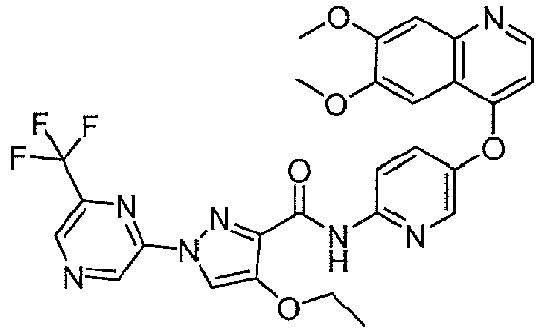
white powder; 1H-NMR (CDCl3, 400 MHz): δ 9.71 (1H, brs), 9.58 (1H, s), 8.89 (1 H, s), 8.58 (1H, d, J = 8.8 Hz), 8.53 (1H, d, J = 5.2 Hz), 8.30 (1H, d, J = 2.4 Hz), 8.26 (1H, s), 7.63 (1H, dd, J = 9.2, 2.8 Hz), 7.56 (1H, s), 7.46 (1H, s), 6.49 (1H, d, J = 5.2 Hz), 4.29 (2H, q, J = 7.2 Hz), 4.07 (6H, s), 1.62 (3H, t, J = 7.2 Hz); LCMS: 100%, MS (ESI): m/z 582.1 [M + H] +. 165 
white powder; 1H-NMR (CDCl3, 400 MHz): δ 9.54 (1H, brs), 8.56 (1H, d, J = 9.2 Hz), 8.52 (1H, d, J = 5.2 Hz), 8.25 (1H, d, J = 2.8 Hz), 8.02 (1H, s), 7.93 (1H, s), 7.57 (1H, dd, J = 8.8, 3.2 Hz), 7.56 (1H, s), 7.44 (1H, s), 6.48 (1H, d, J = 5.2 Hz), 4.17 (2H, q, J = 7.2 Hz), 4.06 (6H, s), 4.00 (3H, s), 1.55 (3H, t, J = 6.8 Hz); LCMS: 96.7%, MS (ESI): m/z 517.3 [M+H] +. 166 
pale-yellow powder; 1H-NMR (CDCl3, 400 MHz): δ 9.48 (1H, brs), 9.24 (1H, s), 8.69 (1H, s), 8.57 (1H, d, J = 9.2 Hz), 8.52 (1H, d, J = 5.6 Hz), 8.26 (1H, d, J = 2.8 Hz), 7.60 (1H, dd, J = 8.8, 2.8 Hz), 7.55 (1H, s), 7.44 (1H, s), 7.39 (1H, s), 6.47 (1H, d, J = 5.2 Hz), 4.20 (2H, q, J = 6.8 Hz), 4.07 (3H, s), 4.06 (3H, s), 3.17-3.27 (1H, m), 1.60 (3H, t, J = 6.8 Hz), 1.30 (6H, d, J = 6.8 Hz); LCMS: 97.3%, MS (ESI): m/z 556.4 [M + H]+. 167 
pale-yellow powder; 1H-NMR (DMSO-d6, 400 MHz): δ 9.87 (1H, brs), 9.10 (1H, s), 8.85 (1H, s), 8.50 (1H, d, J = 5.2 Hz), 8.42 (1H, d, J = 2.8 Hz), 8.36 (1H, d, J = 9.2 Hz), 8.32 (1H, s), 7.88 (1H, dd, J = 9.2, 2.8 Hz), 7.54 (1H, s), 7.42 (1H, s), 6.56 (1H, d, J = 5.2 Hz), 4.19 (2H, q, J = 6.8 Hz), 3.95 (3H, s), 3.94 (3H, s), 2.19-2.28 (1H, m), 1.44 (3H, t, J = 6.8 Hz), 1.14 -1.21 (4H, m); LCMS: 97.6%, MS (ESI): m/z 554.3 [M+H]+. 168 
white powder; 1H-NMR (DMSO-d6, 400 MHz): δ 9.78 (1H, brs), 8.65 (1H, brs), 8.49 (1H, d, J = 5.6 Hz), 8.41 (1H, d, J = 3.2 Hz), 8.36 (1H, d, J = 8.8 Hz), 8.33 (1H, s), 7.88 (1H, dd, J = 8.8, 2.8 Hz), 7.53 (1H, s), 7.41 (1H, s), 6.55 (1H, d, J = 5.2 Hz), 4.21 (2H, q, J = 6.8 Hz), 3.94 (3H, s), 3.93 (3H, s), 1.41 (3H, t, J = 6.8 Hz); LCMS: 92.3%, MS (ESI): m/z 503.4 [M + H]+. 169 
off-white solid; 1H-NMR (CDCl3, 400 MHz): δ 9.55 (1H, brs), 9.25 (1H, d, J = 1.2 Hz), 8.57 (1H, d, J = 8.8 Hz), 8.53 (1H, d, J = 5.2 Hz), 8.38 (1H, d, J = 1.6 Hz), 8.29 (1H, d, J = 2.8 Hz), 8.19 (1H, s), 7.62 (1H, dd, J = 9.2, 2.8 Hz), 7.56 (1H, s), 7.44 (1H, s), 6.48 (1H, d, J = 5.2 Hz), 4.25 (2H, q, J = 6.8 Hz), 4.07 (3H, s), 4.06 (3H, s), 1.60 (3H, t, J = 6.8 Hz); LCMS: 99.0%, MS (ESI): m/z 548.3 [M + H]+. 170 
white powder; 1H-NMR (CDCl3, 400 MHz): δ 9.49 (1H, brs), 8.95 (1H, s), 8.92 (1H, d, J = 5.2 Hz), 8.57 (1H, d, J = 9.2 Hz), 8.52 (1H, d, J = 5.2 Hz), 8.26 (1H, d, J = 2.8 Hz), 7.73 (1H, d, J = 4.8 Hz), 7.60 (1H, dd, J = 9.2, 2.8 Hz), 7.56 (1H, s), 7.49 (1H, s), 7.44 (1H, s), 6.47 (1H, d, J = 5.2 Hz), 4.19 (2H, q, J = 6.8 Hz), 4.07 (3H, s), 4.06 (3H, s), 1.58 (3H, t, J = 6.8 Hz); LCMS: 94.9%, MS (ESI): m/z 581.3 [M + H]+. 171 
white powder; 1H-NMR (CDCl3, 400 MHz): δ 9.57 (1H, brs), 9.08 (1H, s), 8.60 (1H, d, J = 8.8 Hz), 8.54 (1H, d, J = 5.2 Hz), 8.30 (1H, d, J = 2.4 Hz), 8.23 (1H, d, J = 8.0 Hz), 8.18 (1H, s), 7.63 (1H, dd, J = 9.2, 2.8 Hz), 7.58 (2H, s), 6.53 (1H, d, J = 5.6 Hz), 4.25 (2H, q, J = 6.8 Hz), 4.09 (3H, s), 4.08 (3H, s), 1.61 (3H, t, J = 6.8 Hz); LCMS: 92.8%, MS (ESI): m/z 532.3 [M+H]+. 172 
white powder; 1H-NMR (DMSO-d6, 400 MHz): δ 9.63 (1H, brs), 9.10 (1H, s), 8.79 (1H, d, J = 4.8 Hz), 8.53 (1H, s), 8.50 (1H, d, J = 5.2 Hz), 8.42 (1H, d, J = 3.2 Hz), 8.36 (1H, d, J = 8.8 Hz), 7.88 (1H, dd, J = 8.8, 2.8 Hz), 7.70 (1H, d, J = 4.8 Hz), 7.54 (1H, s), 7.42 (1H, s), 6.56 (1H, d, J = 4.8 Hz), 4.21 (2H, q, J = 6.8 Hz), 3.95 (3H, s), 3.94 (3H, s), 3.81 (3H, s), 1.45 (3H, t, J = 6.8 Hz); LCMS: 99.1%, MS (ESI): m/z 571.4[M+ H]+. 173 
white powder; 1H-NMR (DMSO-d6, 400 MHz): δ 9.88 (1H, s), 8.77 (1H, s), 8.54 (1H, d, J = 5.6 Hz), 8.50 (1H, d, J = 5.2 Hz), 8.41 (1H, d, J = 3.2 Hz), 8.36 (1H, d, J = 8.8 Hz), 8.17 (1H, s), 7.89 (1H, dd, J = 9.2, 2.8 Hz), 7.54 (1H, s), 7.42 (1H, s), 7.36 (1H, d, J = 6.0 Hz), 6.56 (1H, d, J = 5.2 Hz), 4.16 (2H, q , J = 7.2 Hz), 3.98 (3H, s), 3.95 (3H, s), 3.94 (3H, s), 1.42 (3H, t, J = 7.2 Hz ); LCMS: 100%, MS (ESI): m/z 543.4 [M + H] +. 174 
yellow powder; 1H-NMR (CDCl3, 400 MHz): δ 10.56 (1H, brs), 8.51 (1H, d, J = 5.2 Hz), 8.45 (1H, s), 8.40-8.45 (2H, m), 8.36 (1H, d, J = 9.2 Hz), 8.29 (1H, s), 7.87 (1H, dd, J = 8.8, 2.8 Hz), 7.66 (2H, brs), 7.55 (1H, s), 7.42 (1H, s), 6.57 (1H, d, J = 5.2 Hz), 4.13 (2H, q, J = 6.8 Hz), 3.96 (3H, s), 3.95 (3H, s), 1.41 (3H, t, J = 7.2 Hz); LCMS: 98.9%, MS (ESI): m/z 529.3 [M + H] +. 175 
white powder; 1H-NMR (DMSO-d6, 400 MHz): δ 10.00 (1H, brs), 9.06 (1H, s), 8.86 (1H, s), 8.50 (1H, d, J = 5.2 Hz), 8.43 (1H, d, J = 2.8 Hz), 8.36 (1H, d, J = 9.2 Hz), 8.26 (1H, s), 7.89 (1H, dd, J = 9.2, 3.2 Hz), 7.54 (1H, s), 7.42 (1H, s), 6.57 (1H, d, J = 5.2 Hz), 4.17 (2H, q , J = 7.2 Hz), 4.11 (3H, s), 3.95 (3H, s), 3.94 (3H, s), 1.42 (3H, t, J = 7.2 Hz); LCMS: 93.8%, MS (ESI): m/z 544.4 [M + H] +. 176 
white powder; 1H-NMR (DMSO-d6, 400 MHz): δ 9.66 (1H, brs), 8.82 (1H, s), 8.64 (1H, d, J = 5.2 Hz), 8.50 (1H, d, J = 5.2 Hz), 8.42 (1H, d, J = 2.4 Hz), 8.30-8.40 (2H, m), 7.88 (1H, dd, J = 9.2, 3.2 Hz), 7.58 (1H, d, J = 4.8 Hz), 7.54 (1H, s), 7.42 (1H, s), 6.57 (1H, d, J = 5.2 Hz), 4.16 (2H, q , J = 6.8 Hz), 3.99 (2H, s), 3.95 (3H, s), 3.94 (3H, s), 3.59 (3H, s) 1.42 (3H, t, J = 7.2 Hz ); LCMS: 98.7%, MS (ESI): m/z 585.4 [M + H] +. 177 
white powder; 1H-NMR (CDCl3, 400 MHz): δ 9.51 (1H, brs), 8.58 (1H, d, J = 9.2 Hz), 8.52 (1H, d, J = 5.2 Hz), 8.43-8.47 (2H, m), 8.28 (1H, d, J = 2.8 Hz), 8.00 (1H, s), 7.60 (1H, dd, J = 9.2, 2.8 Hz), 7.56 (1H, s), 7.45 (1H, s), 6.48 (1H, d, J = 5.6 Hz), 4.22 (2H, q, J = 7.2 Hz), 4.07 (3H, s), 4.06 (3H, s), 1.59 (3H, t, J = 6.8 Hz); LCMS: 98.9%, MS (ESI): m/z 548.2 [M + H]+. 178 
white powder; 1H-NMR (CDCl3, 400 MHz): δ 9.53 (1H, brs), 8.58 (1H, d, J = 8.8 Hz), 8.53 (1H, d, J = 5.2 Hz), 8.39 (1H, t, J = 2.8 Hz), 8.29 (1H, d, J = 2.8 Hz), 8.21 (1H, t, J = 2.0 Hz), 8.15 (1H, s), 7.61 (1H, dd, J = 9.2, 2.8 Hz), 7.57 (1H, s), 7.49 (1H, s), 6.50 (1H, d, J = 5.2 Hz), 4.23 (2H, q, J = 7.2 Hz), 4.07 (6H, s), 1.59 (3H, t, J = 7.2 Hz); LCMS: 98.9%, MS (ESI): m/z 532.2 [M + H]+. 179 
white powder; 1H-NMR (DMSO-d6, 400 MHz): δ 9.84 (1H, brs), 8.73 (1H, s), 8.68 (1H, d, J = 4.8 Hz), 8.50 (1H, d, J = 5.2 Hz), 8.42 (1H, d, J = 3.2 Hz), 8.36 (1H, d, J = 8.8 Hz), 8.31 (1H, s), 7.88 (1H, dd, J = 8.8, 2.8 Hz), 7.74 (1H, d, J = 4.8 Hz), 7.54 (1H, s), 7.42 (1H, s), 6.56 (1H, d, J = 5.2 Hz), 5.61 (1H, t, J = 5.6 Hz), 4.68 (2H, d, J = 5.6 Hz), 4.18 (2H, q, J = 6.8 Hz), 3.96 (3H, s), 3.95 (3H, s), 1.44 (3H, t, J = 6.8 Hz); LCMS: 100%, MS (ESI): m/z 543.1[M + H]+. 180 
pale-yellow powder; 1H-NMR (CDCl3, 400 MHz): δ 8.62-8.69 (2H, m), 8.59 (1H, d, J = 4.8 Hz), 8.15 (1H, s), 7.62 (1H, dd, J = 10.4, 2.8 Hz), 7.56 (1H, d, J = 2.4 Hz), 7.45 (1H, s), 7.44 (1H, s), 7.30 (1H, s), 6.55 (1H, d, J = 5.2 Hz), 4.01-4.12 (8H, m), 3.29-3.55 (4H, m), 1.85-1.95 (4H, m), 1.39 (3H, t, J = 6.8 Hz); LCMS: 95.2%, MS (ESI): m/z 583.1 [M + H]+. 181 
white powder; 1H-NMR (DMSO-d6, 400 MHz): δ 9.78 (1H, s), 8.66 (1H, s), 8.61 (1H, d, J = 5.2 Hz), 8.50 (1H, d, J = 5.2 Hz), 8.42 (1H, d, J = 2.4 Hz), 8.37 (1H, d, J = 8.8 Hz), 8.27 (1H, s), 7.89 (1H, dd, J = 8.8, 2.8 Hz), 7.56 (1H, d, J = 5.6 Hz), 7.54 (1H, s), 7.42 (1H, s), 6.56 (1H, d, J = 5.6 Hz), 4.81 (1H, t, J = 5.2 Hz), 4.17 (2H, q , J = 7.2 Hz), 3.953 (3H, s), 3.946 (3H, s), 3.50-3.60 (2H, m), 2.82 (2H, t, J = 6.4 Hz), 1.43 (3H, t, J = 7.2 Hz); LCMS: 100%, MS (ESI): m/z 557.3 [M + H] +. 182 
white powder; 1H-NMR (DMSO-d6, 400 MHz): δ 9.65 (1H, s), 9.06 (1H, s), 8.77 (1H, d, J = 4.8 Hz), 8.57 (1H, s), 8.53 (1H, d, J = 5.2 Hz), 8.44 (1H, d, J = 2.8 Hz), 8.36 (1H, d, J = 9.2 Hz), 7.90 (1H, dd, J = 9.2, 2.8 Hz), 7.64 (1H, d, J = 5.2 Hz), 7.56 (1H, s), 7.43 (1H, s), 6.61 (1H, d, J = 5.2 Hz), 4.22 (2H, q, J = 6.8 Hz), 3.963 (3H, s), 3.956 (3H, s), 2.34 (3H, s) 1.45 (3H, t, J = 6.8 Hz); LCMS: 100%, MS (ESI): m/z 555.1[M + H]+. 183 
white powder; 1H-NMR (DMSO-d6, 400 MHz): δ 9.88 (1H, brs), 8.91 (1H, s), 8.69 (1H, d, J = 5.2 Hz), 8.50 (1H, d, J = 5.2 Hz), 8.42 (1H, d, J = 2.8 Hz), 8.36 (1H, d, J = 9.2 Hz), 8.32 (1H, s), 7.85 -7.91 (2H, m), 7.54 (1H, s), 7.42 (1H, s), 6.56 (1H, d, J = 5.2 Hz), 4.18 (2H, q, J = 6.8 Hz), 3.95 (3H, s), 3.94 (3H, s), 1.43 (3H, t, J = 6.8 Hz); LCMS: 99.3%, MS (ESI): m/z 547.0 [M + H]+. 184 
white powder; 1H-NMR (DMSO-d6, 400 MHz): δ 9.68 (1H, s), 8.71 (1H, d, J = 5.2 Hz), 8.48-8.60 (2H, m), 8.41 (1H, d, J = 2.8 Hz), 8.36 (1H, d, J = 9.2 Hz), 8.19 (1H, s), 7.65-7.80 (2H, m), 7.54 (1H, s), 7.42 (1H, s), 6.55 (1H, d, J = 5.2 Hz), 5.47 (1H, s), 4.16 (2H, q, J = 6.8 Hz), 3.95 (3H, s), 3.94 (3H, s), 1.42 (3H, t, J = 6.8 Hz), 1.28 (6H, s); LCMS: 97.9%, MS (ESI): m/z 571.2[M + H]+. 185 
white powder; 1H-NMR (DMSO-d6, 400 MHz): δ 10.27 (1H, s), 9.24 (1H, d, J = 2.4 Hz), 8.85 (1H, s), 8.62 (1H, d, J = 4.0 Hz), 8.51 (1H, d, J = 5.2 Hz), 8.45 (1H, d, J = 2.8 Hz), 8.41 (1H, d, J = 8.8 Hz), 8.35 (1H, d, J = 8.8 Hz), 7.89 (1H, dd, J = 9.2, 2.8 Hz), 7.63 (1H, dd, J = 8.4, 4.8 Hz), 7.55 (1H, s), 7.42 (1H, s), 6.58 (1H, d, J = 5.2 Hz), 4.86 (2H, q, J = 4.8 Hz), 3.96 (3H, s), 3.95 (3H, s); LCMS: 100%, MS (ESI): m/z 567.2 [M + H]+. 186 
white powder; 1H-NMR (DMSO-d6, 400 MHz): δ 9.97 (1H, brs), 8.52 (1H, d, J = 5.2 Hz), 8.44 (1H, s), 8.42 (1H, d, J = 2.8 Hz), 8.33 (1H, d, J = 8.8 Hz), 7.93-7.98 (2H, m), 7.89 (1H, dd, J = 8.8, 2.8 Hz), 7.66 (1H, d, J = 8.8 Hz), 7.55 (1H, s), 7.43 (1H, s), 6.59 (1H, d, J = 5.2 Hz), 4.86 (2H, q, J = 8.8 Hz), 3.96 (3H, s), 3.95 (3H, s); LCMS: 98.6%, MS (ESI): m/z 684.1 [M + H]+. 187 
white solid; 1H-NMR (DMSO-d6, 400 MHz): δ 10.38 (1H, brs), 8.70-8.80 (2H, m), 8.49 (1H, d, J = 5.6 Hz), 8.31 (1H, s), 8.03 (1H, dd, J = 13.2, 2.4 Hz), 7.70 (1H, d, J = 9.2 Hz), 7.54 (1H, s), 7.47 (1H, t, J = 8.8 Hz), 7.41 (1H, s), 6.47 (1H, d, J = 5.2 Hz), 4.19 (2H, q, J = 7.2 Hz), 3.95 (6H, s), 1.39 (3H, t, J = 7.2 Hz); LCMS: 99.6%, MS (ESI): m/z 565.1[M + H]+. 188 
white powder; 1H-NMR (DMSO-d6, 400 MHz): δ 10.19 (1H, brs), 8.40-8.50 (2H, m), 8.00-8.10 (2H, m), 7.74 (1H, d, J = 9.2 Hz), 7.54 (1H, s), 7.40-7.50 (2H, m), 7.35 (1H, d, J = 4.8 Hz), 6.47 (1H, d, J = 5.2 Hz), 4.05 (2H, q, J = 7.2 Hz), 3.95 (6H, s), 2.25 (3H, s), 2.10 (3H, s), 1.38 (3H, t, J = 7.2 Hz); LCMS: 100%, MS (ESI): m/z 558.1[M + H]+. 189 
white solid; 1H-NMR (DMSO-d6, 400 MHz): δ 10.28 (1H, brs), 8.49 (1H, d, J = 5.2 Hz), 8.19 (1H, s), 8.04 (1H, dd, J = 10.8, 2.0 Hz), 7.93 (1H, d, J = 2.4 Hz), 7.88 (1H, d, J = 8.8 Hz), 7.72 (1H, d, J = 10.00 Hz), 7.63 (1H, dd, J = 8.8, 2.4 Hz), 7.54 (1H, s), 7.35-7.50 (2H, m), 6.47 (1H, d, J = 5.2 Hz), 4.06 (2H, q, J = 7.2 Hz), 3.95 (6H, s), 1.37 (3H, t, J = 7.2 Hz); LCMS: 98.4%, MS (ESI): m/z 647.1[M + H]+. 190 
white powder; 1H-NMR (DMSO-d6, 400 MHz): δ 9.65 (1H, brs), 8.74 (1H, d, J = 2.0 Hz), 8.70 (1H, d, J = 2.4 Hz), 8.53 (1H, d, J = 5.6 Hz), 8.39 (1H, s), 8.20-8.27 (1H, m), 7.50 (1H, s), 7.45 (1H, dd, J = 11.6, 2.4 Hz), 7.42 (1H, s), 7.19 (1H, d, J = 8.8 Hz), 6.61 (1H, d, J = 5.2 Hz), 4.18 (2H, q, J = 6.8 Hz), 3.95 (3H, s), 3.94 (3H, s), 1.43 (3H, t, J = 7.2 Hz); LCMS: 97.2%, MS (ESI): m/z 565.0 [M + H]+. 191 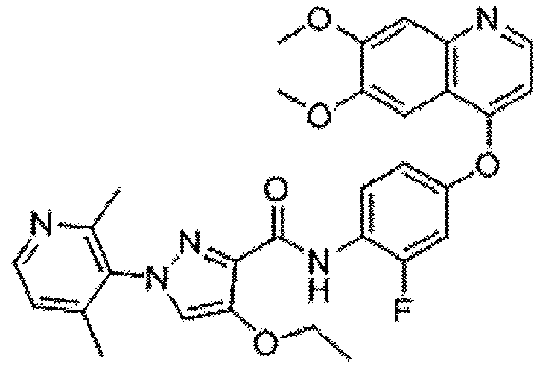
white powder; 1H-NMR (DMSO-d6, 400 MHz): δ 9.57 (1H, brs), 8.52 (1H, d, J = 5.2 Hz), 8.48 (1H, d, J = 4.8 Hz), 8.21 (1H, t, J = 8.8 Hz), 8.09 (1H, s), 7.49 (1H, s), 7.40-7.46 (2H, m), 7.35 (1H, d, J = 4.8 Hz), 7.16 (1H, d, J = 8.8 Hz), 6.59 (1H, d, J = 4.8 Hz), 4.13 (2H, q, J = 6.8 Hz), 3.95 (3H, s), 3.93 (3H, s), 2.23 (3H, s), 2.09 (3H, s), 1.42 (3H, t, J = 6.8 Hz); LCMS: 99.1%, MS (ESI): m/z 558.0 [M + H]+. 192 
white powder; 1H-NMR (DMSO-d6, 400 MHz): δ 9.61 (1H, brs), 8.54 (1H, d, J = 5.2 Hz), 8.17-8.27 (2H, m), 7.93 (1H, d, J = 2.0 Hz), 7.86 (1H, d, J = 8.8 Hz), 7.63 (1H, d, J = 9.2 Hz), 7.51 (1H, s), 7.41 -7.47 (2H, m), 7.18 (1H, dd, J = 8.4, 2.0 Hz), 6.63 (1H, d, J = 5.2 Hz), 4.14 (2H, q, J = 6.8 Hz), 3.95 (3H, s), 3.94 (3H, s), 1.42 (3H, t, J = 6.8 Hz); LCMS: 99.3%, MS (ESI): m/z 646.9 [M + H]+. 193 
white solid; 1H-NMR (DMSO-d6, 400 MHz): δ 10.33 (1H, brs), 8.92 (1H, s), 8.69 (1H, d, J = 5.6 Hz), 8.49 (1H, d, J = 5.6 Hz), 8.24 (1H, s), 8.04 (1H, dd, J = 13.2, 2.4 Hz), 7.88 (1H, d, J = 5.6 Hz), 7.72 (1H, d, J = 8.8 Hz), 7.54 (1H, s), 7.35-7.50 (2H, m), 6.48 (1H, d, J = 5.2 Hz), 4.09 (2H, q, J = 7.2 Hz), 3.96 (6H, s), 1.39 (3H, t, J = 7.2 Hz); LCMS: 99.1%, MS (ESI): m/z 564.1[M + H]+. 194 
white powder; 1H-NMR (DMSO-d6, 400 MHz): δ 9.65 (1H, brs), 8.88 (1H, s), 8.69 (1H, d, J = 5.2 Hz), 8.52 (1H, d, J = 5.2 Hz), 8.29 (1H, s), 8.19 (1H, t, J = 8.8 Hz), 7.88 (1H, d, J = 5.2 Hz), 7.49 (1H, s), 7.41-7.46 (2H, m), 7.17 (1H, d, J = 8.8 Hz), 6.59 (1H, d, J = 5.2 Hz), 4.14 (2H, q, J = 6.8 Hz), 3.95 (3H, s), 3.93 (3H, s), 1.42 (3H, t, J = 6.8 Hz); LCMS: 99.6%, MS (ESI): m/z 564.0 [M + H]+. 195 
white solid; 1H-NMR (DMSO-d6, 400 MHz): δ 10.16 (1H, s), 8.70 (1H, d, J = 5.6 Hz), 8.45-8.55 (2H, m), 8.11 (1H, s), 8.04 (1H, dd, J = 13.2, 2.0 Hz), 7.88 (1H, d, J = 5.6 Hz), 7.72 (1H, d, J = 9.6 Hz), 7.53 (1H, s), 7.35-7.50 (2H, m), 6.46 (1H, d, J = 5.2 Hz), 5.48 (1H, brs), 4.05 (2H, q, J = 7.2 Hz), 3.95 (6H, s), 1.37 (3H, t, J = 7.2 Hz), 1.27 (6H, s); LCMS: 99.5%, MS (ESI): m/z 588.2[M + H]+. 196 
white powder; 1H-NMR (DMSO-d6, 400 MHz): δ 9.53 (1H, brs), 9.01-9.07 (2H, m), 8.52 (1H, d, J = 5.2 Hz), 8.29 (1H, s), 8.24 (1H, t, J = 8.4 Hz), 8.06 (1H, d, J = 4.8 Hz), 7.49 (1H, s), 7.44 (1H, dd, J = 11.2, 2.4 Hz), 7.41 (1H, s), 7.18 (1H, d, J = 8.8 Hz), 6.59 (1H, d, J = 5.2 Hz), 4.14 (2H, q, J = 6.8 Hz), 3.95 (3H, s), 3.93 (3H, s), 1.42 (3H, t, J = 6.8 Hz); LCMS: 100%, MS (ESI): m/z 598.0 [M + H]+. 197 
white powder; 1H-NMR (DMSO-d6, 400 MHz): δ 9.50 (1H, brs), 8.71 (1H, d, J = 5.2 Hz), 8.51 (1H, d, J = 5.2 Hz), 8.47 (1H, s), 8.26 (1H, t, J = 8.8 Hz), 8.17 (1H, s), 7.88 (1H, d, J = 5.2 Hz), 7.49 (1H, s), 7.39-7.47 (2H, m), 7.17 (1H, d, J = 9.2 Hz), 6.58 (1H, d, J = 5.2 Hz), 5.49 (1H, s), 4.13 (2H, q, J = 6.8 Hz), 3.95 (3H, s), 3.93 (3H, s), 1.41 (3H, t, J = 6.8 Hz), 1.27 (6H, s); LCMS: 97.2%, MS (ESI): m/z 588.0 [M + H]+. 198 
white powder; 1H-NMR (DMSO-d6, 400 MHz): δ 10.25 (1H, brs), 9.07 (1H, s), 9.03 (1H, d, J = 5.6 Hz), 8.48 (1H, d, J = 5.2 Hz), 8.19 (1H, s), 8.00-8.15 (2H, m), 7.65-7.75 (1H, m), 7.54 (1H, s), 7.35-7.50 (2H, m), 6.47 (1H, d, J = 5.2 Hz), 4.06 (2H, q, J = 6.8 Hz), 3.95 (6H, s), 1.38 (3H, t, J = 6.8 Hz); LCMS: 100%, MS (ESI): m/z 598.1[M + H]+ 199 
pale yellow powder; 1H-NMR (DMSO-d6, 400 MHz): δ 10.03 (1H, brs), 9.22 (1H, d, J = 2.8 Hz), 8.71 (1H, d, J = 5.6 Hz), 8.68 (1H, s), 8.60 (1H, d, J = 4.0 Hz), 8.48 (1H, d, J = 2.8 Hz), 8.34-8.44 (2 H, m), 8.21 (1H, s), 7.95 (1H, dd, J = 8.8, 2.8 Hz), 7.70 (1H, s), 7.61 (1H, dd, J = 8.0, 4.4 Hz), 6.67 (1H, d, J = 5.2 Hz), 4.21 (2H, q, J = 6.8 Hz), 4.06 (3H, s), 1.45 (3H, t, J = 6.8 Hz); LCMS: 100%, MS (ESI): m/z 567.1 [M + H]+. 200 
white powder; 1H-NMR (CDCl3, 400 MHz): δ 9.49 (1H, brs), 8.60 (1H, d, J = 2,4 Hz), 8.57 (1H, d, J = 9.2 Hz), 8.52 (1H, d, J = 5.2 Hz), 8.37 (1H, d, J = 2.4 Hz), 8.27 (1H, d, J = 2.8 Hz), 8.14 (1H, s), 7.60 (1H, dd, J = 9.2, 2.8 Hz), 7.56 (1H, s), 7.44 (1H, s), 6.46 (1H, d, J = 5.2 Hz), 5.99 (1H, s), 4.28 (2H, q, J = 7.2 Hz), 4.07 (3H, s), 4.06 (3H, s), 1.67 (6H, s), 1.62 (3H, t, J = 7.2 Hz); LCMS: 100%, MS (ESI): m/z 572.0 [M + H]+. 201 
white powder; 1H-NMR (DMSO, 400 MHz): δ 9.84 (1H, brs), 8.71 (1H, d, J = 5.2 Hz), 8.46 (1H, d, J = 2.4 Hz), 8.37 (1H, d, J = 8.8 Hz), 8.28 (1H, s), 8.20 (1H, s), 7.80-8.05 (3H, m), 7.70 (1H, s), 7.63 (1H, d, J = 8.4 Hz), 6.66 (2H, d, J = 5.2 Hz), 4.17 (2H, q, J = 6.8 Hz), 4.05 (3H, s), 1.43 (3H, t, J = 7.2 Hz); LCMS: 97.74%, MS (ESI): m/z 683.9 [M+H] +. 202 
white powder; 1H-NMR (DMSO-d6, 400 MHz): δ 9.75 (1H, brs), 8.76 (1H, s), 8.68 (1H, d, J = 4.8 Hz), 8.50 (1H, d, J = 5.2 Hz), 8.41 (1H, d, J = 2.4 Hz), 8.36 (1H, d, J = 9.2 Hz), 8.11 (1H, s), 7.88 (1H, d, J = 9.2 Hz), 7.54 (1H, s), 7.51 (1H, d, J = 4.8 Hz), 7.42 (1H, s), 6.55 (1H, d, J = 5.2 Hz), 5.27 (1H, s), 5.05 (1H, s), 4.14 (2H, q, J = 6.8 Hz), 3.95 (3H, s), 3.94 (3H, s), 1.76 (3H, s), 1.41 (3H, t, J = 7.2 Hz); LCMS: 100%, MS (ESI): m/z 553.0 [M + H]+. 203 
white powder; 1H-NMR (DMSO-d6, 400 MHz): δ 9.83 (1H, s), 8.50 (1H, d, J = 5.2 Hz), 8.41 (1H, d, J = 2.8 Hz), 8.32 (1H, d, J = 9.2 Hz), 8.28 (1H, s), 7.88 (1H, dd, J = 8.8, 2.8 Hz), 7.45-7.65(2 H, m), 7.42 (1H, s), 7.36 (1H, dd, J = 9.2, 2.4 Hz), 7.20-7.30(1 H, m), 6.56 (1H, d, J = 5.2 Hz), 4.85 (2H, q, J = 8.8 Hz), 3.95 (3H, s), 3.94 (3H, s), 2.29 (3H, s); LCMS: 98.49%, MS (ESI): m/z 597.9 [M + H]+. 204 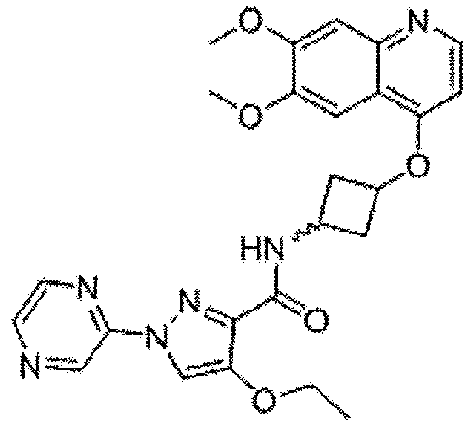
white powder; 1H-NMR (DMSO-d6, 400 MHz): δ 9.39 (1H, brs), 8.66 (1H, d, J = 2.8 Hz), 8.55-8.65 (2H, m), 8.51 (1H, d, J = 5.6 Hz), 8.43 (1H, s), 7.42 (1H, s), 7.32 (1H, s), 6.68 (1H, d, J = 5.2 Hz), 5.10-5.30 (1H, m), 4.50-4.70 (1H, m), 4.10 (2H, q, J = 7.2 Hz), 3.94 (3H, s), 3.92 (3H, s), 2.69-2.80 (2H, m), 2.60-2.68 (2H, m), 1.36 (3H, t, J = 7.2 Hz); LCMS: 98.6%, MS (ESI): m/z 491.0 [M + H]+. From H NMR, it contains ∼20% Cis QWAX0248-01A. 205 
white powder; 1H-NMR (DMSO-d6, 400 MHz): δ 9.69 (1H, brs), 8.69 (1H, d, J = 5.2 Hz), 8.50 (1H, d, J = 5.2 Hz), 8.46 (1H, s), 8.41 (1H, d, J = 2.4 Hz), 8.36 (1H, d, J = 9.2 Hz), 8.12 (1H, s), 7.88 (1H, dd, J = 9.2, 2.8 Hz), 7.84 (1H, d, J = 5.6 Hz), 7.54 (1H, s), 7.42 (1H, s), 6.55 (1H, d, J = 5.2 Hz), 5.32 (1H, s), 4.83 (1H, t, J = 6.0 Hz), 4.16 (2H, q, J = 6.8 Hz), 3.95 (3H, s), 3.94 (3H, s), 3.40-3.50 (2H, m), 1.43 (3H, t, J = 6.8 Hz), 1.16 (3H, s); LCMS: 95.7%, MS (ESI): m/z 609.0 [M + Na]+. 206 
white powder; 1H-NMR (DMSO-d6, 400 MHz): δ 10.01 (1H, brs), 9.22 (1H, d, J = 2.0 Hz), 8.68 (1H, s), 8.59 (1H, d, J = 3.6 Hz), 8.49 (1H, d, J = 5.2 Hz), 8.43 (1H, d, J = 2.8 Hz), 8.37 (2H, d, J = 8.8 Hz), 7.88 (1H, dd, J = 8.8, 2.4 Hz), 7.58-7.65 (1H, m), 7.54 (1H, s), 7.41 (1H, s), 6.55 (1H, d, J = 5.2 Hz), 4.59-4.71 (1H, m), 4.20 (2H, q, J = 6.8 Hz), 3.94 (3H, s), 1.61-1.85 (2H, m), 1.45 (3H, t, J = 7.2 Hz), 1.34 (3H, d, J = 6.0 Hz), 0.97 (3H, t, J = 7.2 Hz); LCMS: 100%, MS (ESI): m/z 577.0 [M + Na]+. 207 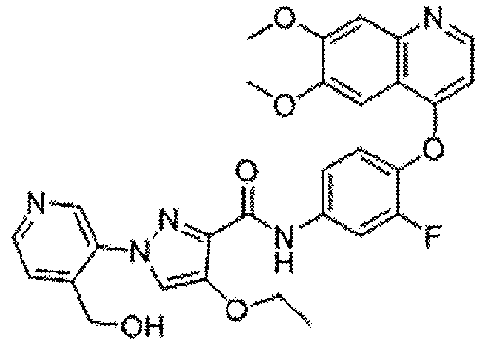
white powder; 1H-NMR (DMSO-d6, 400 MHz): δ 10.22 (1H, s), 8.73 (1H, brs), 8.68 (1H, d, J = 4.8 Hz), 8.48 (1H, d, J = 5.2 Hz), 8.23 (1H, s), 8.04 (1H, dd, J = 13.2, 1.6 Hz), 7.50-7.90 (2H, m), 7.54 (1H, s), 7.46 (1H, t, J = 9.2 Hz), 7.41 (1H, s), 6.48 (1H, d, J = 4.8 Hz), 5.60 (1H, t, J = 5.6 Hz), 4.68 (2H, d, J = 5.2 Hz), 4.08 (2H, q, J = 7.2 Hz), 3.95 (6H, s), 1.39 (3H, t, J = 7.2 Hz); LCMS: 99.2%, MS (ESI): m/z 581.9 [M + Na]+. 208 
ff-white powder; 1H-NMR (DMSO-d6, 400 MHz): δ 10.01 (1H, brs), 9.21 (1H, d, J = 2.0 Hz), 8.69 (1H, s), 8.59 (1H, d, J = 4.4 Hz), 8.49 (1H, d, J = 5.2 Hz), 8.43 (1H, d, J = 2.4 Hz), 8.37 (2H, d, J = 8.8 Hz), 7.89 (1H, dd, J = 8.8, 2.4 Hz), 7.58-7.64 (1H, m), 7.54 (1H, s), 7.41 (1H, s), 6.56 (1H, d, J = 5.2 Hz), 4.83-4.89 (1H, m), 4.20 (2H, q, J = 6.8 Hz), 3.94 (3H, s), 1.45 (3H, t, J = 7.2 Hz), 1.37 (6H, d, J = 5.6 Hz); LCMS: 100%, MS (ESI): m/z 563.1 [M + Na]+. 209 
white powder; 1H-NMR (DMSO-d6, 400 MHz): δ 9.60 (1H, brs), 8.71 (1H, s), 8.68 (1H, d, J = 4.8 Hz), 8.52 (1H, d, J = 5.2 Hz), 8.30 (1H, s), 8.20 (1H, t, J = 8.8 Hz), 7.74 (1H, d, J = 4.8 Hz), 7.49 (1H, s), 7.40-7.47 (2H, m), 7.18 (1H, d, J = 9.2 Hz), 6.59 (1H, d, J = 5.2 Hz), 5.60 (1H, t, J = 5.6 Hz), 4.67 (2H, d, J = 5.6 Hz), 4.15 (2H, q, J = 6.8 Hz), 3.95 (3H, s), 3.93 (3H, s), 1.42 (3H, t, J = 6.8 Hz); LCMS: 100%, MS (ESI): m/z 582.0 [M + Na]+. 210 
pale yellow powder; 1H-NMR (DMSO-d6, 400 MHz): δ 10.29 (1H, brs), 8.68 (1H, s), 8.60-8.65 (2H, m), 8.56 (1H, d, J = 4.8 Hz), 8.26 (1H, s), 7.83 (1H, d, J = 9.6 Hz), 7.51 (1H, d, J = 4.8 Hz), 7.45 (1H, s), 7.39 (1H, s), 7.04 (1H, d, J = 5.2 Hz), 4.15 (2H, q, J = 7.2 Hz), 3.96 (3H, s), 3.89 (3H, s), 2.37 (3H, s), 1.41 (3H, t, J = 6.8 Hz); LCMS: 100.0 %, MS (ESI): m/z 528.0[M+ H]+. 211 
white powder; 1H-NMR (DMSO-d6, 400 MHz): δ 9.38 (1H, s), 8.51 (1H, d, J = 5.2 Hz), 8.32 (1H, t, J = 8.8 Hz), 7.82 (1H, s), 7.49 (1H, s), 7.39-7.46 (2H, m), 7.16 (1H, d, J = 8.8 Hz), 6.57 (1H, d, J = 5.2 Hz), 4.14-4.22 (1H, m), 4.07 (2H, q, J = 6.8 Hz), 3.97-4.03 (1H, m), 3.95 (3H, s), 3.93 (3H, s), 2.90-3.00 (1H, m), 2.60-2.65 (1H, m), 2.23 (3H, s), 2.14-2.20 (1H, m), 1.70-1.82 (1H, m), 1.50-1.68 (3H, m), 1.38 (3H, t, J = 6.8 Hz); LCMS: 100.0%, MS (ESI): m/z 572.0 [M + Na]+. 212 
white powder; 1H-NMR (DMSO-d6, 400 MHz): δ 9.39 (1H, d, J = 2.4 Hz), 8.50 (1H, d, J = 5.2 Hz), 8.32 (1H, t, J = 9.2 Hz), 7.82 (1H, s), 7.49 (1H, s), 7.39-7.44 (2H, m), 7.16 (1H, d, J = 9.2), 6.58 (1H, d, J = 5.2 Hz), 4.84-4.93 (1H, m), 4.08 (2H, q, J = 7.2 Hz), 3.95 (3H, s), 3.93 (3H, s), 2.76-2.85 (3H, m), 2.31-2.47 (2H, m), 2.30 (3H, s), 2.06-2.15 (1H, m), 1.38 (3H, t, J = 6.8 Hz); LCMS: 95.0%, MS (ESI): m/z 536.2 [M + H]+. 213 
white powder; 1H-NMR (DMSO-d6, 400 MHz): δ 9.56 (1H, d, J = 2.4 Hz), 8.50 (1H, d, J = 5.6 Hz), 8.40 (1H, t, J = 8.8 Hz), 7.61 (1H, s), 7.43-7.51 (2H, m), 7.41 (1H, s), 7.19 (1H, d, J = 8.8 Hz), 6.57 (1H, d, J = 5.2 Hz), 4.64-4.71 (1H, m), 4.20-4.35 (3H, m), 3.95 (3H, s), 3.93 (3H, s), 2.88-2.99 (1H, m), 2.59-2.64 (1H, m), 2.24 (3H, s), 2.03-2.20 (1H, m), 1.55-1.68 (4H, m), 1.42 (3H, t, J = 6.8 Hz); LCMS: 99.0%, MS (ESI): m/z 550.0 [M + H]+. 214 
white powder; 1H-NMR (CDCl3, 400 MHz): δ 9.24 (1H, brs), 8.72 (1H, t, J = 8.8 Hz), 8.51 (1H, d, J = 4.8 Hz), 7.52 (1H, s), 7.43 (1H, s), 7.14 (1H, s), 6.94-7.07 (2H, m), 6.52 (1H, d, J = 5.2 Hz), 3.99-4.16 (10H, m), 2.52-2.76 (2H, m), 2.16-2.35 (4H, m), 1.95-2.07 (1H, m), 1.72-1.86 (2H, m), 1.56-1.64 (2H, m), 1.52 (3H, t, J = 6.8 Hz), 1.00-1.14 (1H, m); LCMS: 98.8%, MS (ESI): m/z 564.1 [M + H]+. 215 
white powder; 1H-NMR (DMSO-d6, 400 MHz): δ 9.39 (1H, d, J = 2.0 Hz), 8.60-8.65 (2H, m), 8.48 (1H, d, J = 5.2 Hz), 8.27 (1H, t, J = 8.8 Hz), 7.93 (1H, s), 7.46 (1H, s), 7.35-7.38 (2H, m), 7.13 (1H, d, J = 8.8 Hz), 6.55 (1H, d, J = 5.2 Hz), 5.54 (2H, s), 4.07 (2H, q, J = 6.8 Hz), 3.93 (3H, s), 3.91 (3H, s), 1.37 (3H, t, J = 6.8 Hz); LCMS: 100.0%, MS (ESI): m/z 545.0[M + H]+. 216 
white powder; 1H-NMR (CDCl3, 400 MHz): δ 9.51 (1H, brs), 8.47-8.63 (2H, m), 7.52 (1H, s), 7.43 (1H, s), 7.30 (1H, s), 6.95-7.09 (2H, m), 6.52 (1H, d, J = 4.8 Hz), 4.55-4.66 (1H, m), 4.38-4.50 (1H, m), 4.23 (2H, q, J = 6.8 Hz), 4.05 (6H, s), 2.57-2.82 (2H, m), 2.19-2.36 (4H, m), 1.87-2.00 (1H, m), 1.74-1.86 (3H, m), 1.58-1.65 (1H, m), 1.54 (3H, t, J = 6.8 Hz), 0.95-1.10 (1H, m); LCMS: 96.7%, MS (ESI): m/z 564.1 [M + H]+. 217 
white powder; 1H-NMR (DMSO-d6, 400 MHz): δ 9.47 (1H, s), 8.52-8.54 (2H, m), 8.47 (1H, d, J = 5.2 Hz), 8.29 (1H, t, J = 8.8 Hz), 7.72 (1H, s), 7.40-7.45 (2H, m), 7.38 (1H, s), 7.10 (1H, d, J = 7.6 Hz), 6.53 (1H, d, J = 6.0 Hz), 5.91 (2H, s), 4.27 (2H, q, J = 6.8 Hz), 3.92 (3H, s), 3.90 (3H, s), 1.43 (3H, t, J = 6.8 Hz); LCMS: 100.0%, MS (ESI): m/z 567.0[M + Na]+. 218 
white powder; 1H-NMR (DMSO-d6, 400 MHz): δ 9.37 (1H, brs), 8.51 (1H, d, J = 5.6 Hz), 8.33 (1H, t, J = 8.8 Hz), 7.79 (1H, s), 7.49 (1H, s), 7.39-7.46 (2H, m), 7.16 (1H, d, J = 8.0 Hz), 6.57 (1H, d, J = 5.2 Hz), 4.07 (2H, q, J = 6.8 Hz), 3.89-4.00 (8H, m), 2.92 (2H, d, J = 11.6 Hz), 2.37-2.46 (2H, m), 1.84-1.99 (1H, m), 1.33-1.48 (5H, m), 1.00-1.18 (2H, m); LCMS: 98.5%, MS (ESI): m/z 572.0 [M + Na]+. 219 
white powder; 1H-NMR (DMSO-d6, 400 MHz): δ 9.36 (1H, brs), 8.51 (1H, d, J = 5.2 Hz), 8.33 (1H, t, J = 9.2 Hz), 7.80 (1H, s), 7.49 (1H, s), 7.38-7.46 (2H, m), 7.16 (1H, d, J = 8.0 Hz), 6.57 (1H, d, J = 5.2 Hz), 4.07 (2H, q, J = 6.8 Hz), 3.99 (2H, d, J = 6.8 Hz), 3.95 (3H, s), 3.93 (3H, s), 2.74 (2H, d, J = 11.2 Hz), 2.13 (3H, s), 1.74-1.85 (3H, m), 1.42-1.50 (2H, m), 1.38 (3H, t, J = 6.8 Hz), 1.17-1.29 (2H, m); LCMS: 97.9%, MS (ESI): m/z 564.1 [M + H]+. 220 
white powder; 1H-NMR (DMSO-d6, 400 MHz): δ 9.52 (1H, brs), 8.51 (1H, d, J = 5.2 Hz), 8.43 (1H, t, J = 8.8 Hz), 7.61 (1H, s), 7.44-7.53 (2H, m), 7.41 (1H, s), 7.17 (1H, d, J = 10.0 Hz), 6.57 (1H, d, J = 5.2 Hz), 4.42 (2H, q, J = 7.2 Hz), 4.24 (2H, d, J = 7.2 Hz), 3.95 (3H, s), 3.93 (3H, s), 2.68-2.76 (2H, m), 2.12 (3H, s), 1.70-1.82 (2H, m), 1.34-1.48 (5H, m), 1.15-1.30 (2H, m). It should be noted that a proton is overlapped with solvent peak (δ 2.50); LCMS: 97.6%, MS (ESI): m/z 564.1 [M + H]+. 221 
white powder; 1H-NMR (DMSO-d6, 400 MHz): δ 8.60 (1H, s), 8.52 (1H, d, J = 4.8 Hz), 8.47 (1H, d, J = 5.2 Hz), 8.06 (1H, s), 8.03 (1H, d, J = 7.6 Hz), 7.47 (1H, d, J = 4.8 Hz), 7.33 (1H, s), 7.29 (1H, s), 6.73 (1H, d, J = 5.2 Hz), 4.84-4.95 (1H, m), 4.31-4.42 (1H, m), 4.02 (2H, q, J = 6.8 Hz), 3.90 (3H, s), 3.89 (3H, s), 2.77-2.86 (1H, m), 2.56-2.65 (2H, m), 2.16-2.36 (8H, m), 1.34 (3H, t, J = 6.8 Hz); LCMS: 100%, MS (ESI): m/z 566.1 [M + Na]+. 222 
white powder; 1H-NMR (DMSO-d6, 400 MHz): δ 9.37 (1H, brs), 8.51 (1H, d, J = 5.2 Hz), 8.33 (1H, t, J = 8.8 Hz), 7.89 (1H, s), 7.49 (1H, s), 7.39-7.46 (2H, m), 7.16 (1H, d, J = 7.6 Hz), 6.58 (1H, d, J = 5.2 Hz), 4.03-4.18 (3H, m), 3.95 (3H, s), 3.93 (3H, s), 2.83-2.91 (2H, m), 2.21 (3H, s), 1.90-2.11 (6H, m), 1.38 (3H, t, J = 6.8 Hz); LCMS: 97,5%, MS (ESI): m/z 572.1 [M + Na]+. 223 
white powder; 1H-NMR (DMSO-d6, 400 MHz): δ 9.55 (1H, brs), 8.51 (1H, d, J = 5.2 Hz), 8.42 (1H, t, J = 8.8 Hz), 7.63 (1H, s), 7.43-7.51 (2H, m), 7.41 (1H, s), 7.16 (1H, d, J = 9.6 Hz), 6.57 (1H, d, J = 5.2 Hz), 5.10-5.23 (1H, m), 4.24 (2H, q, J = 7.2 Hz), 3.95 (3H, s), 3.93 (3H, s), 2.83-2.93 (2H, m), 2.20 (3H, s), 1.95-2.05 (4H, m), 1.83-1.91 (2H, m), 1.43 (3H, t, J = 6.8 Hz); LCMS: 94.6%, MS (ESI): m/z 550.3 [M + H]+, m/z 572.1 [M + Na]+. 224 
white powder; 1H-NMR (DMSO-d6, 400 MHz): δ 9.39 (1H, brs), 8.51 (1H, d, J = 5.2 Hz), 8.27-8.39 (1H, m), 7.91 (1H, m), 7.49 (1H, s), 7.38-7.46 (2H, m), 7.17 (1H, d, J = 8.8 Hz), 6.58 (1H, d, J = 5.2 Hz), 4.47-4.59 (0.5H, m), 4.27-4.38 (0.5H, m), 4.03-4.20 (3H, m), 3.95 (3H, s), 3.93 (3H, s), 3.73-3.83 (0.5H, m), 3.48-3.60 (0.5H, m), 2.95-3.17 (1H, m), 2.77-2.89 (0.5H, m), 2.09-2.21 (1H, m), 2.05 (3H, s), 1.35-1.90 (5H, m), 0.77-0.89 (1H, m); LCMS: 100%, MS (ESI): m/z 578.1 [M + H]+, m/z 600.0 [M + Na]+. 225 
white powder; 1H-NMR (CDCl3, 400 MHz): δ 9.29 (1H, s), 8.69 (1H, t, J = 8.8 Hz), 8.50 (1H, d, J = 5.2 Hz), 7.52 (1H, s), 7.42 (1H, s), 7.30 (1H, s), 6.95-7.05 (2H, m), 6.52 (1H, d, J = 5.2 Hz), 4.73 (2H, brs), 4.20-4.30 (1H, m), 3.95-4.17 (9H, m), 3.60-3.70 (1H, m), 3.50-3.62 (1H, m), 3.25-3.35 (1H, m), 2.25-2.47 (1H, m), 2.15-2.25 (1H, m), 1.74-1.85 (1H, m), 1.65-1.72 (1H, m), 1.53 (3H, t, J = 6.8 Hz); LCMS: 100 %, MS (ESI): m/z 579.1 [M + H]+. 226 
white powder; 1H-NMR (DMSO-d6, 400 MHz): δ 9.36 (1H, brs), 8.49 (1H, d, J = 5.2 Hz), 8.40 (1H, d, J = 5.2 Hz), 8.23-8.34 (2H, m), 7.83 (1H, s), 7.47 (1H, s), 7.35-7.46 (2H, m), 7.25 (1H, d, J = 4.4 Hz), 7.14 (1H, d, J = 8.8 Hz), 6.55 (1H, d, J = 4.8 Hz), 5.41 (2H, s), 4.05 (2H, q, J = 6.8 Hz), 3.93 (3H, s), 3.91 (3H, s), 2.31 (3H, s), 1.36 (3H, t, J = 7.2 Hz); LCMS: 100.0%, MS (ESI): m/z 558.1[M+ H]+. 227 
white powder; 1H-NMR (DMSO-d6, 400 MHz): δ 9.47 (1H, brs), 8.67 (1H, d, J = 5.2 Hz), 8.50 (1H, d, J = 5.2 Hz), 8.44 (1H, s), 8.25 (1H, t, J = 9.2 Hz), 8.08 (1H, s), 7.83 (1H, d, J = 5.2 Hz), 7.38-7.51 (3H, m), 7.15 (1H, d, J = 8.4 Hz), 6.57 (1H, d, J = 5.2 Hz), 5.30 (1H, s), 4.79 (1H, t, J = 5.6 Hz), 4.11 (2H, q, J= 6.8 Hz), 3.93 (3H, s), 3.92 (3H, s), 3.36-3.47 (2H, m), 1.40 (3H, t, J = 7.2 Hz), 1.14 (3H, s); LCMS: 96.7%, MS (ESI): m/z 604.1[M + H]+. 228 
white powder; 1H-NMR (DMSO-d6, 400 MHz): δ 9.53 (1H, brs), 8.49 (1H, d, J = 5.2 Hz), 8.28-8.40 (2H, m), 7.89 (1H,s), 7.73 (1H,s), 7.41-7.51 (2H, m), 7.41 (1H, s), 7.22 (1H, d, J = 4.8 Hz), 7.15 (1H, d, J = 8.4 Hz), 6.56 (1H, d, J = 5.2 Hz), 5.82 (2H, s), 4.28 (2H, q, J = 7.2 Hz), 3.95 (3H, s), 3.93 (3H, s), 2.35 (3H, s), 1.44 (3H, t, J = 6.8 Hz); LCMS: 100.0%, MS (ESI): m/z 580.1[M+Na]+. 229 
pale yellow powder; 1H-NMR (DMSO-d6, 400 MHz): δ 9.50 (1H, d, J = 1.2 Hz), 8.81 (1H, d, J = 2.0 Hz), 8.59 (1H, d, J = 2.0 Hz), 8.50 (1H, d, J = 4.8 Hz), 8.25-8.35 (2H, m), 7.47 (1H, s), 7.43 (1H, dd, J = 11.6, 2.8 Hz), 7.40 (1H, s), 7.16 (1 H, d, J = 8.8 Hz), 6.57 (1H, d, J = 5.2 Hz), 5.31 (1H, s), 4.70 (1H, t, J = 6.0 Hz), 4.17 (2H, q, J = 6.8 Hz), 3.93 (3H, s), 3.92 (3H, s), 3.60-3.70 (1H, m), 3.50-3.60 (1H, m), 1.30-1.40 (6H, m); LCMS: 100%, MS (ESI): m/z 605.1 [M + H]+. 230 
white powder; 1H-NMR (DMSO-d6, 400 MHz): δ 9.59 (1H, brs), 8.74 (2H, s), 8.50 (1H, d, J = 5.6 Hz), 8.40 (1H, s), 8.21 (1H, t, J = 8.8 Hz), 7.48 (1H, s), 7.39-7.46 (2H, m), 7.17 (1H, d, J = 8.8 Hz), 7.04 (2 H, brs), 6.57 (1H, d, J = 5.2 Hz), 4.80-4.91 (1H, m), 4.14 (2H, q, J = 6.8 Hz), 3.92 (3H, s), 1.42 (3H, t, J = 6.8 Hz), 1.37 (6H, d, J = 6.0 Hz); LCMS: 100%, MS (ESI): m/z 574.1 [M + H]+. 231 
white powder; 1H-NMR (DMSO-d6, 400 MHz): δ 9.60 (1H, brs), 8.71 (1H, s), 8.68 (1H, d, J = 4.8 Hz), 8.50 (1H, d, J = 5.2 Hz), 8.29 (1H, s), 8.20 (1H, t, J = 8.8 Hz), 7.74 (1H, d, J = 5.2 Hz), 7.48 (1H, s), 7.39-7.46 (2H, m), 7.17 (1H, d, J = 8.4 Hz), 6.58 (1H, d, J = 5.2 Hz), 4.80-4.91 (1H, m), 4.67 (2H, s), 4.15 (2H, q, J = 6.4 Hz), 3.92 (3H, s), 1.42 (3H, t, J = 6.8 Hz), 1.37 (6H, d, J = 6.0 Hz); LCMS: 100%, MS (ESI): m/z 588.1 [M + H]+. 232 
white powder; 1H-NMR (DMSO-d6, 400 MHz): δ 9.51 (1H, brs), 8.48 (1H, d, J = 5.2 Hz), 8.23-8.33 (3H, m), 7.93 (1H, s), 7.42-7.49 (2H, m), 7.40 (1H, s), 7.10 (1H, d, J = 8.8 Hz), 7.02 (2H, brs), 6.54 (1H, d, J = 4.8 Hz), 4.80-4.91 (1H, m), 4.32 (2H, q, J = 6.8 Hz), 3.91 (3H, s), 1.46 (3H, t, J = 6.8 Hz), 1.36 (6H, d, J = 6.0 Hz); LCMS: 100%, MS (ESI): m/z 574.1 [M + H]+. 233 
white powder; 1H-NMR (DMSO-d6, 400 MHz): δ 9.86 (1H, brs), 8.74 (1H, s), 8.71 (1H, d, J = 5.6 Hz), 8.68 (1H, d, J = 4.8 Hz), 8.46 (1H, d, J = 2.4 Hz), 8.37 (1H, d, J = 8.8 Hz), 8.32 (1H, s), 8.20 (1H, s), 7.94 (1H, dd, J = 9.2, 2.8 Hz), 7.74 (1H, d, J = 4.8 Hz), 7.70 (1H, s), 6.66 (1H, d, J = 5.6 Hz), 5.60 (1H, t, J = 5.6 Hz), 4.68 (2H, d, J = 5.6 Hz), 4.18 (2H, q, J = 7.2 Hz), 4.05 (3H, s), 1.44 (3H, t, J = 6.8 Hz); LCMS: 100%, MS (ESI): m/z 597.5 [M + H]+. 234 
white powder; 1H-NMR (DMSO-d6, 400 MHz): δ 10.25 (1H, brs), 9.24 (1H, d, J = 2.0 Hz), 8.84 (1H, s), 8.62 (1H, d, J = 4.8 Hz), 8.49 (1H, d, J = 4.8 Hz), 8.44 (1H, d, J = 2.8 Hz), 8.40 (1H, d, J = 8.4 Hz), 8.35 (1H, d, J = 8.8 Hz), 7.88 (1H, dd, J = 9.2, 2.8 Hz), 7.63 (1H, dd, J = 8.4, 4.8 Hz), 7.54 (1H, s), 7.41 (1H, s), 6.56 (1H, d, J = 5.2 Hz), 4.86 (2H, q, J = 8.8 Hz), 4.59-4.70 (1H, m), 3.94 (3H, s), 1.61-1.85 (2H, m), 1.34 (3H, d, J = 6.0 Hz), 0.97 (3H, t, J = 7.2 Hz); LCMS: 100%, MS (ESI): m/z 609.6 [M + H]+. 235 
white powder; 1H-NMR (DMSO-d6, 400 MHz): δ 10.06 (1H, brs), 8.80 (2H, s), 8.56 (1H, s), 8.50 (1H, d, J = 5.6 Hz), 8.42 (1H, d, J = 2.8 Hz), 8.34 (1H, d, J = 8.8 Hz), 7.87 (1H, dd, J = 9.2, 2.8 Hz), 7.54 (1H, s), 7.41 (1H, s), 7.08 (2H, brs), 6.57 (1H, d, J = 4.8 Hz), 4.82 (2H, q, J = 8.4 Hz), 4.60-4.71 (1H, m), 3.94 (3H, s), 1.59-1.87 (2H, m), 1.34 (3H, d, J = 6.0 Hz), 0.97 (3H, t, J = 6.8 Hz); LCMS: 100%, MS (ESI): m/z 625.6 [M + H]+. 236 
white powder; 1H-NMR (DMSO-d6, 400 MHz): δ 10.47 (1H, brs), 9.40 (1H, s), 8.75-8.80 (2H, m), 8.51 (1H, d, J = 5.2 Hz), 8.46 (1H, d, J = 2.4 Hz), 8.35 (1H, d, J = 9.2 Hz), 7.89 (1H, dd, J = 8.8, 2.4 Hz), 7.55 (1H, s), 7.42 (1H, s), 6.58 (1H, d, J = 5.2 Hz), 4.95 (2H, q, J = 6.4 Hz), 3.96 (3H, s), 3.95 (3H, s); LCMS: 99.2%, MS (ESI): m/z 602.6 [M + H]+ 237 
white powder; 1H-NMR (DMSO-d6, 400 MHz): δ 10.06 (1H, s), 8.80 (2H, s), 8.56 (1H, s), 8.45-8.55 (1H, m), 8.43 (1H, s), 8.34 (1H, d, J = 8.8 Hz), 7.88 (1H, d, J = 6.8 Hz), 7.55 (1H, s), 7.42 (1H, s), 7.08 (1H, s), 6.58 (1H, d, J = 4.8 Hz), 4.80-4.85 (2H, m), 3.96 (3H, s), 3.95 (3H, s); LCMS: 96.5%, MS (ESI): m/z 583,5 [M + H]+ 238 
white powder; 1H-NMR (DMSO-d6, 400 MHz): δ 9.84 (1H, brs), 8.47 (1H, d, J = 5.2 Hz), 8.41 (1H, d, J = 2.4 Hz), 8.32 (2H, s), 8.19 (1H, d, J = 9.2 Hz), 8.03 (1H, s), 7.66-7.84 (1H, m), 7.51 (1H, s), 7.39 (1H, s), 7.06 (2H, brs), 6.53 (1H, d, J = 5.2 Hz), 5.06 (2H, q, J = 9.2 Hz), 4.60-4.67 (1H, m), 3.93 (3H, s), 1.63-1.80 (2H, m), 1.33 (3H, d, J = 6.0 Hz), 0.97 (3H, t, J = 7.6 Hz); LCMS: 100%, MS (ESI): m/z 625.6 [M + H]+. 239 
white solid; 1H NMR (400 MHz, DMSO-d6): δ 10.05 (1H, brs), 9.20 (1H, d, J = 2.8 Hz), 8.71 (1H, d, J = 5.2 Hz), 8.67 (2H, brs), 8.59 (1H, dd, J = 4.8, 1.6 Hz), 8.47 (1H, d, J = 2.8 Hz), 8.39 (1H, d, J = 8.8 Hz), 8.34-8.38 (1H, m), 8.20 (1H, d, J = 1.2 Hz), 7.95 (1H, dd, J = 9.2, 2.8 Hz), 7.70 (1H, s), 7.61 (1H, dd, J = 8.0, 4.4 Hz), 6.67 (1H, d, J = 5.2 Hz), 4.05 (3H, s), 4.00 (2H, d, J = 7.2 Hz), 1.32-1.44 (1H, m), 0.61-0.67 (2H, m), 0.40-0.45 (2H, m); LCMS: 100%, MS (ESI): m/z 615.1 [M + Na]+. 240 
white powder; 1H NMR (400 MHz, DMSO-d6) δ 9.91 (1H, s), 8.76 (2H, s), 8.50 (1H, d, J = 4.8 Hz), 8.40-8.42 (2H, m), 8.38 (1H, d, J = 9.2 Hz), 7.88 (1H, d, J = 7.6 Hz), 7.54 (1H, s), 7.42 (1H, s), 7.04 (2H, brs), 6.57 (1H, d, J = 4.8 Hz), 3.99-3.92 (8H, m), 1.34-1.37 (1H, m), 0.60-0.65 (2H, m), 0.38-0.42 (2H, m); LCMS: 98.5%, MS (ESI): m/z 555.1 [M + H]+. 241 
white powder; 1H-NMR (DMSO-d6, 400 MHz): δ 9.89 (1H, brs), 8.77 (2H, s), 8.70 (1H, d, J = 5.2 Hz), 8.46 (1H, d, J = 2.4 Hz), 8.42 (1H, s), 8.37 (1H, d, J = 8.8 Hz), 8.20 (1H, s), 7.94 (1H, dd, J = 9.2, 2.8 Hz), 7.69 (1H, s), 7.05 (2H, brs), 6.65 (1H, d, J = 5.2 Hz), 4.16 (2H, q, J = 7.2 Hz), 4.05 (3H, s), 1.43 (3H, t, J = 7.2 Hz); LCMS: 100%, MS (ESI): m/z 583.1 [M + H]+. 242 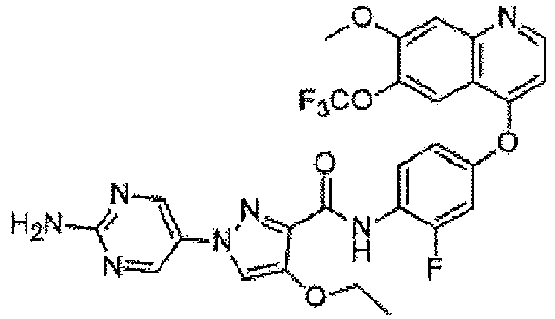
off-white powder; 1H-NMR (DMSO-d6, 400 MHz): δ 9.59 (1H, brs), 8.67-8.78 (3H, m), 8.40 (1H, s), 8.24 (1H, t, J = 8.4 Hz), 8.16 (1H, s), 7.69 (1H, s), 7.46-7.55 (1H, m), 7.24 (1H, d, J = 9.2 Hz), 7.03 (2H, brs), 6.67 (1H, d, J = 5.6 Hz), 4.15 (2H, q, J = 6.4 Hz), 4.05 (3H, s), 1.42 (3H, t, J = 6.8 Hz); LCMS: 100%, MS (ESI): m/z 600.0 [M + H]+. 243 
white solid; 1H-NMR (DMSO-d6, 400 MHz): δ 9.75 (1H, brs), 8.75 (2H, s), 8.55 (1H, s), 8.51 (1H, d, J = 4.8 Hz), 7.94 (1H, t, J = 8.8 Hz), 7.48 (1H, s), 7.37-7.43 (2H, m), 7.15 (1H, d, J = 9.2 Hz), 7.09 (2H, brs), 6.59 (1H, d, J = 5.2 Hz), 4.73-4.93 (3H, m), 3.92 (3H, s), 1.37 (6H, d, J = 6.0 Hz); LCMS: 100%, MS (ESI): m/z 628.1 [M + H]+. 244 
white solid; 1H NMR (400 MHz, DMSO-d6): δ 9.87 (1H, s), 8.50 (1H, d, J = 5.2 Hz), 8.41 (1H, d, J = 2.4 Hz), 8.37 (1H, d, J = 9.2 Hz), 8.26 (1H, s) 7.85-7.95 (3H, m), 7.63 (1H, d, J = 8.4 Hz), 7.54 (1H, s), 7.42 (1 H, s), 6.57 (1H, d, J = 4.8 Hz), 3.90-4.00 (8H, m), 1.30-1.35 (1H, m), 0.60-0.65 (2H, m), 0.40-0.45 (2H, m); LCMS: 100%, MS (ESI): m/z 656.1 [M + H]+. 245 
white powder; 1H NMR (400 MHz, DMSO-d6) δ 9.85 (1H, s), 8.49 (1H, d, J = 5.2 Hz), 8.41 (1H, d, J = 2.4 Hz), 8.32 (2H, s), 8.21 (1H, d, J = 8.8 Hz), 7.96 (1H, s), 7.80 (1H, dd, J = 8.8, 2.4 Hz), 7.53 (1H, s), 7.41 (1H, s), 7.03 (2H, brs), 6.54 (1H, d, J = 5.2 Hz), 4.40-4.45 (2H, m), 3.95 (3H, s), 3.94 (3H, s), 3.73-3.75 (2 H, m), 3.35 (3H, s); LCMS: 97.4%, MS (ESI): m/z 581.1 [M + Na]+. 246 
pale-yellow solid; 1H-NMR (DMSO-d6, 400 MHz): δ 9.73 (1H, brs), 8.67 (1H, s), 8.46-8.55 (2H, m), 7.98 (1H, t, J = 9.2 Hz), 7.77 (1H, s), 7.48 (1H, s), 7.38-7.45 (2H, m), 7.16 (1H, d, J = 8.8 Hz), 6.78 (2H, brs), 6.59 (1H, d, J = 5.2 Hz), 4.82-4.94 (3H, m), 3.92 (3H, s), 1.37 (6H, d, J = 6.4 Hz); LCMS: 100%, MS (ESI): m/z 628.1 [M + H]+. 247 
white powder; 1H-NMR (DMSO-d6, 400 MHz): δ 9.77 (1H, brs), 9.06 (1H, s), 9.02 (1H, d, J = 5.2 Hz), 8.50 (1H, d, J = 5.6 Hz), 8.41 (1H, d, J = 2.4 Hz), 8.36 (1H, d, J = 9.2 Hz), 8.30 (1H, s), 8.05 (1H, d, J = 5.2 Hz), 7.89 (1H, dd, J = 8.8, 2.4 Hz), 7.54 (1H, s), 7.42 (1H, s), 6.57 (1H, d, J = 5.2 Hz), 3.94-4.00 (8H, m), 1.30-1.40 (1H, m), 0.60-0.65 (2H, m), 0.40-0.43 (2H, m); LCMS: 100%, MS (ESI): m/z 629.0 [M + Na]+. 248 
white powder; 1H-NMR (DMSO-d6, 400 MHz): δ 10.07 (1H, br), 8.75 (1H, s), 8.54 (1H, s), 8.51 (1H, d, J = 4.8 Hz), 8.43 (1H, d, J = 2.4 Hz), 8.35 (1H, d, J = 9.2 Hz), 7.88 (1H, dd, J = 9.2, 2.4 Hz), 7.77 (1H, s), 7.55 (1H, s), 7.42 (1H, s), 6.78 (2H, br), 6.58 (1H, d, J = 5.2 Hz), 4.90 (2H, q, J = 8.8 Hz), 3.80-4.05 (6H, m); LCMS: 100%, MS (ESI): m/z 583.1.0 [M + H]+. 249 
white powder; 1H-NMR (DMSO-d6, 400 MHz): δ 9.96 (1H, brs), 8.65 (1H, s), 8.50 (1H, d, J = 5.2 Hz), 8.42 (1H, d, J = 2.4 Hz), 8.38 (1H, d, J = 9.2 Hz), 8.33 (1H, s), 7.89 (1H, dd, J = 8.8, 2.8 Hz), 7.76 (1H, s), 7.55 (1H, s), 7.42 (1H, s), 6.74 (2H, s), 6.57 (1H, d, J = 5.6 Hz), 4.01 (2H, d, J = 7.2 Hz), 3.85-3.98 (6H, m), 1.25-1.43 (1H, m), 0.55-0.73 (2H, m), 0.35-0.49 (2H, m); LCMS: 95.2%, MS (ESI): m/z 555.1 [M + H]+. 250 
off-white powder; 1H-NMR (DMSO-d6, 400 MHz): δ 9.61 (1H, s), 8.70-8.80 (2H, m), 8.68 (1H, d, J = 4.8 Hz), 8.30 (1H, s), 8.23 (1H, t, J = 8.8 Hz), 8.16 (1H, s), 7.74 (1H, d, J = 4.8 Hz), 7.69 (1H, s), 7.52 (1H, dd, J = 11.2, 2.4 Hz), 7.24 (1H, d, J = 8.4 Hz), 6.67 (1H, d, J = 4.8 Hz), 5.60 (1H, t, J = 5.2 Hz), 4.67 (2H, d, J = 5.2 Hz), 4.16 (2H, q, J = 7.2 Hz), 4.05 (3H, s), 1.43 (3H, t, J = 6.8 Hz); LCMS: 100%, MS (ESI): m/z 636.1 [M +Na]+. 251 
white powder; 1H NMR (400 MHz, DMSO-d6): δ 9.91 (1H, brs), 8.77 (2H, s), 8.51 (1H, s), 8.40-8.45 (1H, m), 8.39-8.43 (1H, m), 8.36 (1H, d, J = 8.8 Hz), 7.88 (1H, d, J = 6.8 Hz), 7.55 (1H, s), 7.42 (1H, s), 7.05 (2H, brs), 6.58 (1H, s), 4.20-4.25 (2H, m), 3.95 (6H, s), 3.70-3.75 (2H, m), 3.33 (3H, s); LCMS: 100%, MS (ESI): m/z 581.1 [M + Na]+. 252 
white powder; 1H-NMR (DMSO-d6, 400 MHz): δ 9.73 (1H, s), 8.67 (1H, s), 8.50-8.60 (2H, m), 7.99 (1H, t, J = 8.8 Hz), 7.77 (1H, s), 7.49 (1H, s), 7.35-7.48 (2H, m), 7.17 (1H, d, J = 8.8 Hz), 6.78 (2H, brs), 6.60 (1H, d, J = 5.2 Hz), 4.88 (2H, q, J = 8.8 Hz), 3.95 (3H, s), 3.94 (3H, s); LCMS: 100%, MS (ESI): m/z 622.1 [M + Na]+. 253 
pale-yellow powder; 1H-NMR (DMSO-d6, 400 MHz): δ 10.08 (1H, brs), 8.75 (1H, s), 8.54 (1H, s), 8.51 (1H, d, J = 5.2 Hz), 8.43 (1H, d, J = 2.4 Hz), 8.35 (1H, d, J = 9.2 Hz), 7.88 (1H, dd, J = 8.8, 2.4 Hz), 7.77 (1H, s), 7.55 (1H, s), 7.42 (1H, s), 6.79 (2H, brs), 6.58 (1H, d, J = 5.2 Hz), 4.85-4.94 (3H, m), 3.94 (3H, s), 1.38 (6H, d, J = 6.0 Hz); LCMS: 100%, MS (ESI): m/z 611.1 [M + H]+. 254 
white powder; 1H-NMR (DMSO-d6, 400 MHz): δ 10.39 (1H, brs), 8.86 (2H, s), 8.68 (1H, s), 8.57 (1H, d, J = 5.2 Hz), 8.46 (1H, d, J = 2.4 Hz), 8.33 (1H, d, J = 8.8, Hz), 7.91 (1H, dd, J = 8.8, 2.4 Hz), 7.59 (1H, s), 7.44 (1H, s), 7.18 (1H, t, J = 74.0, Hz), 7.11 (2H, brs), 6.65 (1H, d, J = 5.2 Hz), 3.97 (3H, s), 3.96 (3H, s); LCMS: 100%, MS (ESI): m/z 573.1 [M + Na]+. 255 
white solid; 1H NMR (400 MHz, DMSO-d6): δ 10.03 (1H, s), 9.20 (1H, s), 8.67 (1H, s), 8.58 (1H, d, J = 4.0 Hz), 8.50 (1H, d, J = 4.8 Hz), 8.43 (1H, s), 8.30-8.38 (2H, m), 7.89 (1H, d, J = 7.2 Hz), 7.55-7.65 (1H, m), 7.54 (1H, s), 7.41 (1H, s), 6.57 (1H, d, J = 4.4 Hz), 4.00 (2H, d, J = 7.2 Hz), 3.95 (6H, s), 1.35-1.40 (1H, m), 0.60-0.65 (2H, m), 0.40-0.45 (2H, m); LCMS: 100%, MS (ESI): m/z 539.1 [M + H]+. 256 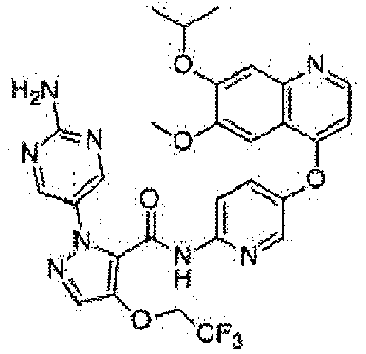
off-white powder; 1H-NMR. (DMSO-d6, 400 MHz): δ 9.83 (1H, brs), 8.47 (1H, d, J = 4.8 Hz), 8.38-8.43 (1H, m), 8.32 (2H, s), 8.19 (1H, d, J = 8.8 Hz), 8.02 (1H, s), 7.75-7.83 (1H, m), 7.51 (1H, s), 7.40 (1H, s), 7.06 (2H, brs), 6.53 (1H, d, J = 4.8 Hz), 5.06 (2H, q, J = 8.4 Hz), 4.80-4.91 (1H, m), 3.92 (3H, s), 1.37 (6H, d, J = 5.6 Hz); LCMS: 100%, MS (ESI): m/z 611.1 [M + H]+. 257 
off-white solid; 1H-NMR (DMSO-d6, 400 MHz): δ 10.10 (1H, brs), 8.80 (2H, s), 8.53-8.60 (2H, m), 8.45 (1H, d, J = 2.0 Hz), 8.36 (1H, d, J = 9.2 Hz), 7.90 (1H, dd, J = 9.6, 2.8 Hz), 7.59 (1H, s), 7.45 (1H, s), 7.09 (2H, brs), 6.66 (1H, d, J = 4.4 Hz), 4.76-4.92 (3H, m), 3.95 (3H, s), 1.39 (6H, d, J = 6.0 Hz); LCMS: 100%, MS (ESI): m/z 611.1 [M + H]+. 258 
white powder; 1H-NMR (DMSO-d6, 400 MHz): δ 9.80 (1H, brs), 8.51 (1H, d, J = 5.2 Hz), 8.41 (1H, d, J = 2.8 Hz), 8.37 (1H, d, J = 9.2 Hz), 8.13 (1H, s), 7.85-7.90 (1H, m), 7.54 (1H, s), 7.49-7.53 (1H, m), 7.42 (1H, s), 7.34 (1H, dd, J = 9.2, 2.4 Hz), 7.20-7.28 (1H, m), 6.57 (1H, d, J = 4.8 Hz), 3.85-4.05 (8H, m), 2.27 (3H, s), 1.30-1.40 (1H, m), 0.59-0.66 (2H, m), 0.37-0.44 (2H, m); LCMS: 100%, MS (ESI): m/z 570.1 [M + H]+. 259 
white powder; 1H-NMR (DMSO-d6, 400 MHz): δ 9.76 (1H, brs), 8.75 (2H, s), 8.55 (1H, s), 8.53 (1H, d, J = 5.2 Hz), 7.94 (1H, t, J = 8.8 Hz), 7.49 (1H, s), 7.35-7.45 (2H, m), 7.17 (1H, d, J = 9.2 Hz), 7.09 (2H, brs), 6.60 (1H, d, J = 5.2 Hz), 4.88 (2H, q, J = 8.8 Hz), 3.95 (3H, s), 3.93 (3H, s); LCMS: 100%, MS (ESI): m/z 622.1 [M + Na]+. 260 
white powder; 1H-NMR (DMSO-d6, 400 MHz): δ 9.90 (1H, brs), 8.76 (2H, s), 8.50 (1H, d, J = 5.2 Hz), 8.40-8.44 (2H, m), 8.37 (1H, d, J = 9.0 Hz), 7.88 (1H, dd, J = 8.8, 2.4 Hz), 7.54 (1H, s), 7.42 (1H, s), 7.05 (2H, brs), 6.56 (1H, d, J = 4.8 Hz), 4.43-4.54 (1H, m), 3.96 (3H, s), 3.95 (3H, s), 1.41 (6H, d, J = 6.0 Hz); LCMS: 100%, MS (ESI): m/z 565.1 [M + Na]+. 261 
white powder; 1H-NMR (DMSO-d6, 400 MHz): δ 10.03 (1H, brs), 9.11 (1H, s), 8.87 (1H, s), 8.50 (1H, d, J = 4.8 Hz), 8.40-8.50 (2H, m), 8.33 (1H, d, J = 8.8 Hz), 7.88 (1H, d, J = 8.8 Hz), 7.54 (1H, s), 7.41 (1H, s), 6.56 (1H, d, J = 4.8 Hz), 4.80-4.90 (2H, m), 3.95 (6H, s), 2.50-2.70 (1H, m), 1.15-1.25 (4H, m); LCMS: 100%, MS (ESI): m/z 608.1 [M + H]+. 262 
white powder; 1H-NMR (DMSO-d6, 400 MHz): δ 9.87 (1H, brs), 8.76 (2H, s), 8.50 (1H, d, J = 4.8 Hz), 8.43 (1H, s), 8.41 (1H, d, J = 2.8 Hz), 8.37 (1H, d, J = 8.8 Hz), 7.88 (1H, dd, J = 9.2, 2.8 Hz), 7.54 (1H, s), 7.42 (1H, s), 7.05 (2H, brs), 6.56 (1H, d, J = 5.6 Hz), 4.10 (2H, d, J = 6.4 Hz), 3.95 (3H, s), 3.94 (3H, s), 2.81-2.86 (1H, m), 2.08-2.15 (2H, m), 1.90-1.98 (4H, m); LCMS: 100%, MS (ESI): m/z 569.1 [M + H]+. 263 
off-white powder; 1H-NMR (DMSO-d6, 400 MHz): δ 9.85 (1H, brs), 8.51 (1H, d, J = 4.8 Hz), 8.41 (1H, d, J = 2.4 Hz), 8.37 (1H, d, J = 8.8 Hz), 8.20 (1H, s), 7.89 (1H, dd, J = 8.8, 2.8 Hz), 7.75-7.83 (2H, m), 7.54 (1H, s), 7.47 (1H, td, J = 8.8, 2.8 Hz), 7.42 (1H, s), 6.58 (1H, d, J = 5.2 Hz), 3.92-4.00 (8H, m), 1.29-1.40 (1H, m), 0.58-0.66 (2H, m), 0.37-0.45 (2H, m); LCMS: 100%, MS (ESI): m/z 612.0 [M + Na]+. 264 
off-white powder; 1H-NMR (DMSO-d6, 400 MHz): δ 9.86 (1H, brs), 8.50 (1H, d, J = 5.2 Hz), 8.41 (1H, d, J = 2.4 Hz), 8.38 (1H, d, J = 8.8 Hz), 8.10 (1H, s), 7.88 (1H, dd, J = 9.2, 2.8 Hz), 7.71 (1H, dd, J = 8.8, 6.4 Hz), 7.55 (1H, s), 7.42 (1H, s), 7.24 (1H, dd, J = 10.8, 6.4 Hz), 6.97 (1H, td, J = 8.4, 2.4 Hz), 6.57 (1H, d, J = 5.2 Hz), 3.93-3.99 (8H, m), 3.90 (3H, s), 1.27-1.40 (1H, m), 0.58-0.69 (2H, m), 0.37-0.45 (2H, m); LCMS: 100%, MS (ESI): m/z 608.1 [M + Na]+. 265 
white powder; 1H-NMR (DMSO-d6, 400 MHz): δ 9.92 (1H, brs), 8.77 (2H, s), 8.50 (1H, d, J = 5.2 Hz), 8.46 (1H, s), 8.41 (1H, d, J = 2.4 Hz), 8.36 (1H, d, J = 9.2 Hz), 7.87 (1H, dd, J = 8.8, 2.0 Hz), 7.54 (1H, s), 7.41 (1H, s), 7.06 (2H, brs), 6.56 (1H, d, J = 5.2 Hz), 4.25 (2H, d, J = 5.6 Hz), 3.95 (3H, s), 3.94 (3H, s), 3.75-3.60 (2H, m), 3.18-3.05 (1H, m); LCMS: 97%, MS (ESI): m/z 570.1 [M + H]+. 266 
off-white powder; 1H-NMR (DMSO-d6, 400 MHz): δ 9.85 (1H, brs), 8.51 (1H, d, J = 5.2 Hz), 8.41 (1H, d, J = 2.4 Hz), 8.37 (1H, d, J = 9.2 Hz), 8.23 (1H, s), 7.88 (1H, dd, J = 9.2, 2.8 Hz), 7.52-7.60 (2H, m), 7.42 (1H, s), 6.97-7.08 (2H, m), 6.56 (1H, d, J = 5.2 Hz), 3.98 (2H, d, J = 7.2 Hz), 3.96 (3H, s), 3.95 (3H, s), 3.57-3.68 (4H, m), 2.63-2.72 (4H, m), 1.30-1.39 (1H, m), 0.59-0.68 (2H, m), 0.38-0.47 (2H, m); LCMS: 100%, MS (ESI): m/z 663.1 [M + Na]+. 267 
white powder; 1H-NMR (DMSO-d6, 400 MHz): δ 9.94 (1H, brs), 8.51 (1H, d, J = 5.6 Hz), 8.42 (1H, d, J = 2.8 Hz), 8.38 (1H, d, J = 9.2 Hz), 8.23 (1H, d, J = 2.0 Hz), 7.92-8.00 (1H, m), 7.89 (1H, dd, J = 8.8, 2.4 Hz), 7.59-7.69 (1H, m), 7.55 (1H, s), 7.42 (1H, s), 7.33 (1H, t, J = 9.6 Hz), 6.58 (1H, d, J = 4.8 Hz), 3.91-4.04 (8H, m), 1.28-1.38 (1H, m), 0.57-0.69 (2H, m), 0.37-0.46 (2H, m); LCMS: 100%, MS (ESI): m/z 574.1 [M + H]+. 268 
off-white powder; 1H-NMR (DMSO-d6, 400 MHz): δ 10.08 (1H, brs), 8.51 (1H, d, J = 5.2 Hz), 8.39-8.45 (2H, m), 8.34 (1H, d, J = 8.8 Hz), 8.02-8.14 (1H, m), 7.88 (1H, dd, J = 8.8, 2.8 Hz), 7.62-7.74 (1H, m), 7.54 (1H, s), 7.42 (1H, s), 7.36 (1H, t, J = 8.0 Hz), 6.57 (1H, d, J = 4.8 Hz), 4.88 (2H, q, J = 8.8 Hz), 3.96 (3H, s), 3.95 (3H, s); LCMS: 100%, MS (ESI): m/z 624.0 [M + Na]+. 269 
white powder; 1H-NMR (DMSO-d6, 400 MHz): δ 9.90 (1H, brs), 8.78 (2H, s), 8.46-8.54 (2H, m), 8.41 (1H, d, J = 2.8 Hz), 8.35 (1H, d, J = 8.8 Hz), 7.87 (1H, d, J = 9.2 Hz), 7.54 (1H, s), 7.42 (1H, s), 7.06 (2H, brs), 6.56 (1H, d, J = 5.2 Hz), 4.75 (2H, t, J = 7.2 Hz), 4.48 (2H, t, J = 6.0 Hz), 4.34 (2H, d, J = 6.8 Hz), 3.96 (3H, s), 3.95 (3H, s), 3.44-3.58 (1H, m); LCMS: 100%, MS (ESI): m/z 571.1[M + H]+, 593.1 [M + Na]+. 270 
white powder; 1H-NMR (DMSO-d6, 400 MHz): δ 9.74 (1H, brs), 8.50 (1H, d, J = 5.2 Hz), 8.40 (1H, d, J = 2.8 Hz), 8.37 (1H, d, J = 8.8 Hz), 8.07 (1H, s), 7.88 (1H, dd, J = 9.2, 2.8 Hz), 7.54 (1H, s), 7.46 (1H, dd, J = 8.8, 6.0 Hz), 7.42 (1H, s), 7.38 (1H, dd, J = 10.4, 2.4 Hz), 7.22 (1H, td, J = 8.0, 2.4 Hz), 6.56 (1H, d, J = 5.2 Hz), 3.89-4.04 (8H, m), 2.80-2.94 (1H, m), 1.81-1.94 (2H, m), 1.69-1.79 (2H, m), 1.48-1.61 (4H, m), 1.27-1.39 (1H, m), 0.57-0.67 (2 H, m), 0.36-0.44 (2 H, m); LCMS: 100%, MS (ESI): m/z 624.1 [M + H]+. 271 
white powder; 1H-NMR (DMSO-d6, 400 MHz): δ 9.89 (1H, brs), 8.50 (1H, d, J = 5.2 Hz), 8.41 (1H, d, J = 2.8 Hz), 8.37 (1H, s), 8.32 (1H, d, J = 9.2 Hz), 7.76-7.92 (3H, m), 7.54 (1H, s), 7.49 (1H, td, J = 8.4,2.8 Hz), 7.42 (1H, s), 6.57 (1H, d, J = 4.8 Hz), 4.86 (2H, q, J = 8.4 Hz), 3.95 (3H, s), 3.94 (3H, s); LCMS: 100%, MS (ESI): m/z 618.0 [M + H]+. 272 
white powder; 1H NMR (DMSO-d6, 400 MHz): δ 9.85 (1H, s), 8.50 (1H, d, J = 5.2 Hz), 8.41 (1H, d, J = 2.8 Hz), 8.36 (1H, d, J = 9.2 Hz), 8.18 (1H, s), 7.85-7.94 (2H, m), 7.54 (1H, s), 7.39-7.44 (3H, m), 7.18 - 7.26 (2H, m), 7.11 (2H, d, J = 7.6 Hz), 6.97 (1H, dd, J = 9.6, 2.0 Hz), 6.56 (1H, d, J = 5.2 Hz), 3.87-3.99 (8H, m), 1.20-1.28 (1H, m), 0.54-0.60 (2H, m) 0.33-0.39 (2H, m); LCMS: 100%, MS (ESI): m/z 670.1 [M + Na]+. 273 
white powder; 1H-NMR (DMSO-d6, 400 MHz): δ 9.56 (1H, brs), 8.51 (1H, d, J = 5.2 Hz), 8.35-8.45 (2H, m), 7.89 (1H, d, J = 6.4 Hz), 7.69 (1H, dd, J = 8.4, 4.0 Hz), 7.51-7.60 (2H, m), 7.42 (1H, s), 7.35 (1H, t, J = 8.0 Hz), 6.58 (1H, d, J = 5.2 Hz), 6.53 (1H, s), 4.15-4.35 (2H, m), 3.95 (6H, s), 1.79 (3H, s), 1.32-1.43 (1H, m), 0.58-0.69 (2H, m), 0.40-0.51 (2H, m); LCMS: 100%, MS (ESI): m/z 620.0 [M + Na]+. 274 
white powder; 1H-NMR (DMSO-d6, 400 MHz): δ 9.66 (1H, brs), 8.50 (1H, d, J = 4.8 Hz), 8.32 - 8.44 (3H, m), 7.89 (1H, d, J = 8.8 Hz), 7.75-7.80 (1H, m), 7.52-7.63 (3H, m), 7.42 (1H, s), 6.57 (1H, d, J = 4.8 Hz), 3.83 - 4.09 (8H, m), 2.21 (3H, s), 1.31-1.39 (1H, m), 0.58-0.69 (2H, m), 0.36-0.49 (2H, m); LCMS: 100%, MS (ESI): m/z 620.1 [M + Na]+. 275 
white powder; 1H-NMR (DMSO-d6, 400 MHz): δ 9.64 (1H, s), 8.50 (1H, d, J = 5.2 Hz), 8.39 (1H, d, J = 2.4 Hz), 8.33 (1H, d, J = 8.8 Hz), 7.87 (1H, dd, J = 8.8, 2.4 Hz), 7.70-7.76 (1H, m), 7.52-7.59 (2H, m), 7.33 - 7.49 (6H, m), 7.13-7.19 (2H, m), 6.55 (1H, d, J = 5.6 Hz), 3.95 (3H, s), 3.94 (3H, s), 3.71 (2H, d, J = 7.2 Hz), 1.03-1.10 (1H, m), 0.47-0.53 (2H, m), 0.23-0.30 (2H, m); LCMS: 100%, MS (ESI): m/z 654.1 [M + Na]+. 276 
pink powder; 1H NMR (400 MHz, DMSO-d6): δ 10.17 (1H, brs), 8.49 (1H, d, J = 5.2 Hz), 8.10 (1H, s), 8.00 (1H, d, J = 13.2 Hz), 7.64-7.74 (1H, m), 7.50-7.56 (2H, m), 7.41-7.51 (1H, m), 7.41 (1H, s), 7.29-7.34 (1H, m), 7.18-7.23 (1H, m), 6.48 (1H, d, J = 5.2 Hz), 4.12 (2H, t, J = 5.6 Hz), 3.95 (6H, s), 2.67 (2H, t, J = 5.6 Hz), 2.20-2.29 (9H, m); LCMS: 100%, MS (ESI): m/z 626.0 [M + Na]+. 277 
light yellow solid; 1H-NMR (DMSO-d6, 400 MHz): δ 9.51 (1H, brs), 8.45-8.50 (2H, m), 7.98 (1H, d, J = 13.2 Hz), 7.51-7.58 (2H, m), 7.43-7,51 (2H, m), 7.41 (1H, s), 7.31 (1H, d, J = 9.2 Hz), 7.20 (1H, t, J = 8.4 Hz), 6.47 (1H, d, J = 4.8 Hz), 4.37 (2H, q, J = 6.8 Hz), 3.95 (6H, s), 2.28 (3H, s), 1.44 (3H, t, J = 6.8 Hz); LCMS: 100%, MS (ESI): m/z 561.0 [M + H]+. 278 
white powder; 1H NMR (400 MHz, DMSO-d6): δ 10.35 (1H, brs), 8.79 (1H, s), 8.52 (1H, d, J = 5.2 Hz), 8.44 (1H, d, J = 2.8 Hz), 8.30-8.40 (2H, m), 7.97-8.05 (1H, m), 7.88 (1H, dd, J = 8.8, 2.8 Hz), 7.66 (1H, t, J = 9.2 Hz), 7.55 (1H, s), 7.42 (1H, s), 6.58 (1H, d, J = 5.2 Hz), 4.83 (2H, q, J = 8.8 Hz), 3.96 (3H, s), 3.95 (3H, s); LCMS: 100%, MS (ESI): m/z 617.9 [M + H]+. 279 
white solid; 1H-NMR (DMSO-d6, 400 MHz): δ 8.50 (1H, d, J = 4.8 Hz), 8.39-8.48 (2H, m), 8.33 (1H, d, J = 8.8 Hz), 7.84-7.92 (2H, m), 7.77-7.83 (1H, m), 7.45-7.55 (2H, m), 7.41 (1H, s), 6.57 (1H, d, J = 4.8 Hz), 4.86 (2H, q, J = 8.4 Hz), 3.95 (6H, s); LCMS: 100%, MS (ESI): m/z 617.9 [M + H]+. 280 
white solid; 1H-NMR (DMSO-d6, 400 MHz): δ 10.23 (1H, brs), 8.86 (1H, s), 8.51 (1H, d, J = 5.2 Hz), 8.44 (1H, s), 8.26-8.38 (3H, m), 7.89 (1H, d, J = 9.2 Hz), 7.62 (1H, t, J = 9.6 Hz), 7.55 (1H, s), 7.42 (1H, s), 6.57 (1H, d, J = 4.8 Hz), 4.85 (2H, q, J = 8.0 Hz), 3.95 (6H, s), 2.67 (3H, s); LCMS: 100%, MS (ESI): m/z 626.0 [M + H]+.
Claims (12)
- A compound having TAM family and Met receptor tyrosine kinase-inhibiting activity and having the general formula I:
 X1 is, independently at each occurrence, selected from CH and N;X2 is, independently at each occurrence, selected from CH and N;Y1 is, independently at each occurrence, selected from CH2, CH(CH3)CH2, C(CH3)2, C(CH3)2CH2 and CH2CH2;n is, independently at each occurrence, selected from 0 and 1;R1 is, at each occurrence, independently selected from the group consisting of C1-C6 alkyl and C1-C3 haloalkyl;R2 is, at each occurrence, independently selected from the group consisting of C1-C6 alkyl and C1-C3 haloalkyl, any of which is optionally substituted;R3 is, at each occurrence, independently selected from the group consisting of hydrogen, halogen, e. g. Cl or F, C1-C3 alkyl, which is optionally substituted, and NHCH(CH3)CH3;R4 is, at each occurrence, independently selected from the group consisting of hydrogen, halogen, e. g. Cl or F, NHCH(CH3)2, -CH2OH, C1-C3 alkyl, which is optionally substituted, alkoxy, in particular C1-C3 alkoxy, e.g. methoxy, and -CF3;R5 is, at each occurrence, independently selected from the group consisting of C1-C6 alkyl, C1-C6 alkyl substituted with C1-C6 cycloalkyl, with heterocyclyl or with O-(C1-C6 alkyl); C1-C3 haloalkyl, e.g. CH2F, CHF2, CF3, CH2CF3, N,N-dimethylethane-amino, N,N-dimethylpropan-1-amino;R6 is, at each occurrence, independently selected from the group consisting of hydrogen and CH3;Z1 is, at each occurrence, independently selected from the group consisting of hydrogen, hydroxyl, C1-C6 alkyl, C(O)R7, C(O)NHR7, C(O)OR7, CN, C(O)R8, C(O)OR8, N(R7)2, OR8, OCH3, OCH2F, OCHF2, OCF3 and any structure of the following group A, any structure of which is optionally substituted;
 R7 is, at each occurrence, independently selected from the group consisting of hydrogen and C1-C6 alkyl, any of which is optionally substituted;R8 is, at each occurrence, independently selected from the group consisting of hydrogen, C1-C6 alkyl, C1-C3 haloalkyl, e.g. CH2F, CHF2, CF3, CH2CF3, and phenyl any of which is optionally substituted;R9 is, at each occurrence, independently selected from the group consisting of hydrogen, C1-C6 alkyl, C1-C6 cycloalkyl, C1-C6 alkyl substituted with C1-C6 cycloalkyl; C1-C6 alkenyl, heterocyclyl, C1-C3 haloalkyl, e.g. CH2F, CHF2, CF3, CH2CF3, C(O)OR7, CH2C(O)OR7, C(O)R7, -(CH2)mNR7R13, -(CH2)mOR7, OR8, alkoxy, in particular C1-C3 alkoxy, e.g. methoxy, haloalkoxy, e.g. OCF3, aryloxy, in particular phenoxy, C(CH3)2OH, C(CH3)(OH)CH2OH, N,N-dimethylethane-amino, F, Cl, NO2, NH2, CN, aryl, in particular benzyl or phenyl, benzyl hydroxyl and pyrrolidinyl, any of which is optionally substituted, m being an integer, independently at each occurrence, selected from 0, 1, 2, and 3;R10 is, at each occurrence, independently selected from the group consisting of hydrogen, hydroxyl, halogen, e.g. F, Cl, C1-C6 alkyl, C1-C3 haloalkyl, e.g. CH2F, CHF2, CF3, CH2CF3, C(O)R7, e. g. CH2F, CHF2, CF3, CH2NR7R13, CH2OH, C(O)NR7R13, NO2, and CN, any of which is optionally substituted;R11 is, at each occurrence, independently selected from the group consisting of hydrogen, hydroxyl, C1-C6 alkyl, C1-C3 haloalkyl, e. g. CH2F, CHF2, CF3, CH2CF3, C(O)OR7, C(CH3)2(CH2)mNR7R13, -(CH2)mNR7R13, CH2OH, alkoxy, in particular C1-C3 alkoxy, e.g. methoxy, haloalkoxy, e.g. OCF3, halogen, e.g. F, Cl, CN, NO2, NH2, NH2-(CH2)m aryl, - (CH2)m heteroaryl, -NH(C1-C6 alkyl), and OR8, any of which is optionally substituted; m being an integer, independently at each occurrence, selected from 0, 1 ,2 and 3;R12 is, at each occurrence, independently selected from the group consisting of hydrogen, halogen, in particular Cl or F, C1-C6 alkyl, C1-C6 alkyl substituted with C1-C6 cycloalkyl; C1-C6 cycloalkyl, heterocycloalkyl any of which is optionally substituted, -(CH2)mNR7R13, m being an integer independently at each occurrence selected from 0, 1, 2 and 3;R13 is, at each occurrence, independently selected from the group consisting of hydrogen and C1-C6 alkyl, COMe, CONH2, any of which is optionally substituted;Wherein, if n is 0, X1 is CH, X2 is CH, R1 is methyl, R2 is methyl, R3 is F, R4 is hydrogen, R5 is ethyl, R6 is hydrogen, Z1 is phenyl with substituents R9-R12 as depicted in group A, R9 is hydrogen, R10 is hydrogen and R12 is hydrogen,then R11 is not F;Wherein, if n is 0, X1 is CH, X2 is CH, R1 is methyl, R2 is methyl, R3 is F, R4 is hydrogen, R6 is hydrogen, Z1 is phenyl with substituents R9-R12 as depicted in group A, R9 is hydrogen, R10 is hydrogen, R11 is F and R12 is hydrogen,then R5 is not methyl, methylcyclopropyl, N,N-dimethylethane-amino, N,N-dimethylpropan-1-amino or iso-propyl;Wherein, if n is 0, X1 is CH, X2 is CH, R1 is methyl, R2 is methyl, R3 is F, R4 is hydrogen, R5 is ethyl, R6 is hydrogen, Z1 is phenyl with substituents R9-R12 as depicted in group A, R10 is hydrogen, R11 is F and R12 is hydrogen,then R9 is not methyl or Cl;Wherein, if n is 0, X1 is CH, X2 is CH, R1 is methyl, R2 is methyl, R3 is hydrogen, R4 is hydrogen, R5 is ethyl, R6 is hydrogen, Z1 is phenyl with substituents R9-R12 as depicted in group A, R9 is hydrogen, R10 is hydrogen and R12 is hydrogen,then R11 is not F;Wherein, if n is 0, X1 is CH, X2 is CH, R1 is methyl, R2 is methyl, R3 is hydrogen, R4 is hydrogen, R6 is hydrogen, Z1 is phenyl with substituents R9-R12 as depicted in group A, R9 is hydrogen, R10 is hydrogen R11 is F and R12 is hydrogen,then R5 is not iso-propyl or methylcyclopropyl;Wherein, if n is 0, X1 is CH, X2 is CH, R1 is methyl, R2 is methyl, R3 is hydrogen, R4 is hydrogen, R5 is ethyl, R6 is hydrogen, Z1 is phenyl with substituents R9-R12 as depicted in group A, R9 is methyl, R10 is hydrogen and R12 is hydrogen,then R11 is not F,Wherein, if n is 0, X1 is CH, X2 is CH, R1 is methyl, R2 is methyl, R3 is methyl, R4 is hydrogen, R5 is ethyl, R6 is hydrogen, Z1 is phenyl with substituents R9-R12 as depicted in group A, R9 is hydrogen, R10 is hydrogen and R12 is hydrogen,then R11 is not F;Wherein, if n is 0, X1 is CH, X2 is CH, R1 is methyl, R2 is methyl, R3 is methyl, R4 is hydrogen, R6 is hydrogen, Z1 is phenyl with substituents R9-R12 as depicted in group A, R9 is hydrogen, R10 is hydrogen R11 is F and R12 is hydrogen,then R5 is not iso-propyl or methylcyclopropyl;Wherein, if n is 0, X1 is CH, X2 is CH, R1 is methyl, R2 is methyl, R3 is methyl, R4 is hydrogen, R5 is ethyl, R6 is hydrogen, Z1 is phenyl with substituents R9-R12 as depicted in group A, R9 is methyl, R10 is hydrogen and R12 is hydrogen,then R11 is not F;Wherein, if n is 0, X1 is CH, X2 is CH, R1 is methyl, R2 is methyl, R3 is Cl, R4 is hydrogen, R5 is ethyl, R6 is hydrogen, Z1 is phenyl with substituents R9-R12 as depicted in group A, R9 is hydrogen, R10 is hydrogen and R12 is hydrogen,then R11 is not F;Wherein, if n is 0, X1 is CH, X2 is CH, R1 is methyl, R2 is methyl, R3 is Cl, R4 is hydrogen, R6 is hydrogen, Z1 is phenyl with substituents R9-R12 as depicted in group A, R9 is hydrogen, R10 is hydrogen, R11 is F and R12 is hydrogen,then R5 is not iso-propyl or methylcyclopropyl;Wherein, if n is 0, X1 is CH, X2 is CH, R1 is methyl, R2 is methyl, R3 is Cl, R4 is hydrogen, R5 is ethyl, R6 is hydrogen, Z1 is phenyl with substituents R9-R12 as depicted in group A, R9 is methyl, R10 is hydrogen and R12 is hydrogen,then R11 is not F;Wherein, if n is 0, X1 is CH, X2 is CH, R1 is methyl, R2 is methyl, R3 is F, R4 is hydrogen, R5 is ethyl, R6 is hydrogen, Z1 is phenyl with substituents R9-R12 as depicted in group A, R10 is hydrogen, R11 is F and R12 is hydrogen,then R9 is not N,N-dimethylethane-amino;Wherein, if n is 0, X1 is CH, X2 is N, R1 is methyl, R2 is methyl, R3 is hydrogen, R4 is hydrogen, R5 is ethyl, R6 is hydrogen, Z1 is phenyl with substituents R9-R12 as depicted in group A, R9 is hydrogen, R10 is hydrogen and R12 is hydrogen,then R11 is not F;Wherein, if n is 0, X1 is CH, X2 is N, R1 is methyl, R2 is methyl, R3 is hydrogen, R4 is hydrogen, R5 is ethyl, R6 is hydrogen, Z1 is phenyl with substituents R9-R12 as depicted in group A, R10 is hydrogen, R11 is F, and R12 is hydrogen,then R9 is not methyl, Cl, benzyloxy, or hydroxyl;Wherein, if n is 0, X1 is CH, X2 is N, R1 is methyl, R2 is methyl, R3 is hydrogen, R4 is hydrogen, R5 is ethyl, R6 is hydrogen, Z1 is phenyl with substituents R9-R12 as depicted in group A, R9 is methyl, R10 is hydrogen and R12 is hydrogen,then R11 is not methoxy;Wherein, if n is 0, X1 is CH, X2 is CH, R1 is methyl, R2 is methyl, R3 is F, R4 is hydrogen, R5 is ethyl, R6 is hydrogen, Z1 is phenyl with substituents R9-R12 as depicted in group A, R9 is hydrogen, R11 is hydrogen and R12 is hydrogen,then R10 is not NO2;Wherein, if n is 0, X1 is CH, X2 is CH, R1 is methyl, R2 is methyl, R3 is F, R4 is hydrogen, R5 is ethyl, R6 is hydrogen, Z1 is phenyl with substituents R9-R12 as depicted in group A, R9 is methyl, R10 is hydrogen and R12 is hydrogen,then R11 is not methoxy;Wherein, if n is 0, X1 is CH, X2 is N, R1 is methyl, R2 is methyl, R3 is hydrogen, R4 is hydrogen, R5 is ethyl, R6 is hydrogen, Z1 is phenyl with substituents R9-R12 as depicted in group A, R9 is hydrogen, R11 is hydrogen and R12 is hydrogen,then R10 is not NO2;Wherein, if n is 0, X1 is CH, X2 is CH, R1 is methyl, R2 is methyl, R3 is hydrogen, R5 is ethyl, R6 is hydrogen, Z1 is phenyl with substituents R9-R12 as depicted in group A, R9 is methyl, R10 is hydrogen, R11 is F and R12 is hydrogen,then R4 is not methoxy or methyl;Wherein, if n is 0, X1 is CH, X2 is CH, R1 is methyl, R2 is methyl, R3 is F, R4 is hydrogen, R5 is ethyl, R6 is hydrogen, Z1 is phenyl with substituents R9-R12 as depicted in group A, R9 is hydrogen, R10 is methoxy and R12 is hydrogen,then R11 is not F;Wherein, if n is 0, X1 is CH, X2 is N, R1 is methyl, R2 is methyl, R3 is hydrogen, R4 is hydrogen, R5 is ethyl, R6 is hydrogen, Z1 is phenyl with substituents R9-R12 as depicted in group A, R9 is hydrogen, R10 is methxoy and R12 is hydrogen,then R11 is not F;Wherein, if n is 0, X1 is CH, X2 is N, R1 is methyl, R2 is methyl, R3 is hydrogen, R4 is hydrogen, R5 is ethyl, R6 is hydrogen, Z1 is phenyl with substituents R9-R12 as depicted in group A, R9 is hydrogen, R10 is hydrogen and R12 is hydrogen,then R11 is not NO2 or NH2;.Wherein, if n is 0, X1 is CH, X2 is CH, R1 is methyl, R2 is methyl, R3 is F, R4 is hydrogen, R5 is ethyl, R6 is hydrogen, R9 is hydrogen, R10 is hydrogen, R11 is hydrogen and R12 is hydrogen,then Z1 is not 3-pyridine as depicted in group A;Wherein, if n is 0, X1 is CH, X2 is CH, R1 is methyl, R2 is methyl, R3 is F, R4 is hydrogen, R5 is ethyl, R6 is hydrogen and Z1 is pyrazole as depicted in group A,then R13 is not methyl;and pharmaceutically acceptable salts thereof.
 - The compound according to claim 1, wherein one of X1 and X2 is N and the other is not, preferably X2 is N and X1 is CH.
- The compound according to any of claims 1 and 2 having the general formula II:
 Y2 is, independently at each occurrence, selected from CH2 and CH2CH2;n is, independently at each occurrence, selected from 0 and 1;R1 is, at each occurrence, independently selected from the group consisting of C1-C6 alkyl and C1-C3 haloalkyl;R2 is, at each occurrence, independently selected from the group consisting of C1-C6 alkyl and C1-C3 haloalkyl, any of which is optionally substituted;R5 is, at each occurrence, independently selected from the group consisting of C1-C6 alkyl, C1-C6 alkyl substituted with C1-C6 cycloalkyl, with heterocyclyl or with O-(C1-C6 alkyl); C1-C3 haloalkyl, e.g. CH2F, CHF2, CF3, CH2CF3, N,N-dimethylethane-amino, N,N-dimethylpropan-1-amino;R6 is, at each occurrence, independently selected from the group consisting of hydrogen and CH3;Z2 is, at each occurrence, independently selected from the group consisting of hydrogen, hydroxyl, C1-C6 alkyl, C(O)R7, C(O)NHR7, CN, C(O)R8, N(R7)2, OR8 and any structure of the following group B, any structure of which is optionally substituted;
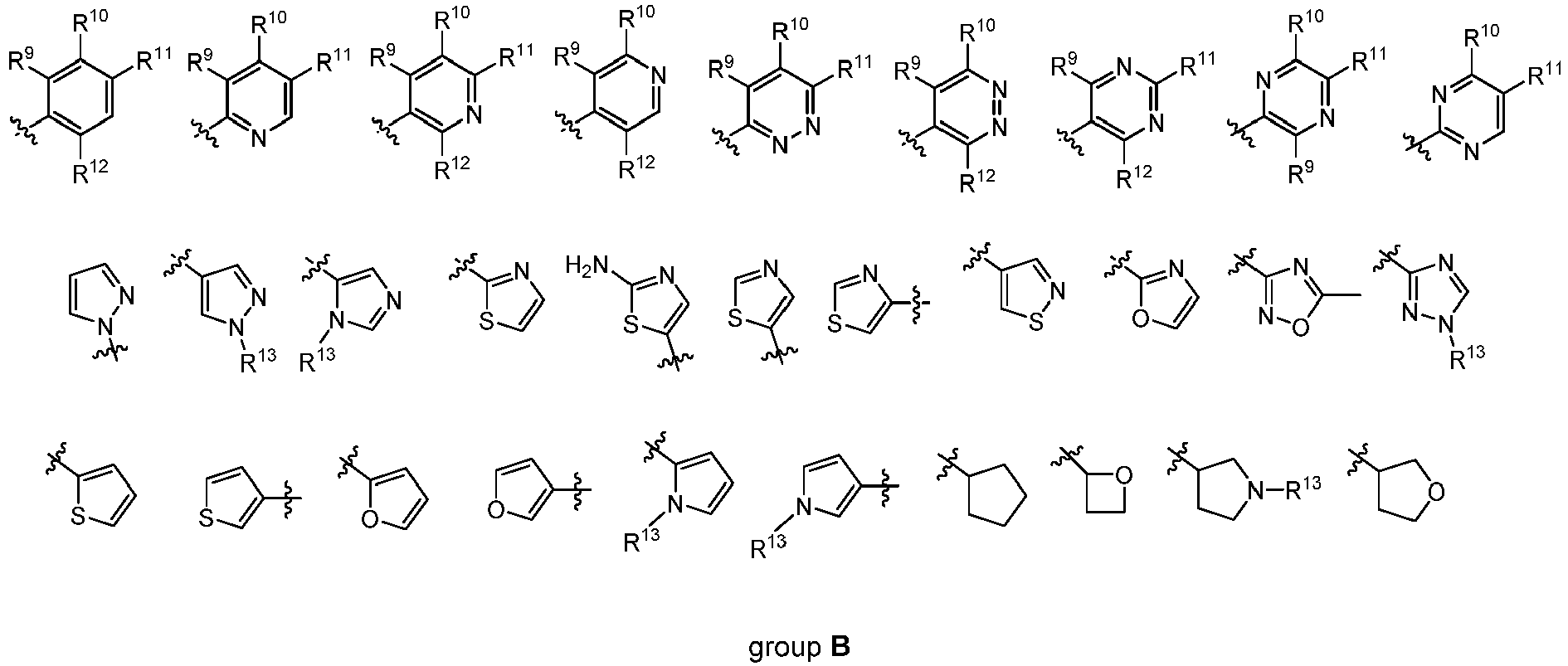 R7 is, at each occurrence, independently selected from the group consisting of hydrogen and C1-C6 alkyl, any of which is optionally substituted;R8 is, at each occurrence, independently selected from the group consisting of hydrogen, C1-C6 alkyl, C1-C3 haloalkyl, e.g. CH2F, CHF2, CF3, CH2CF3, and phenyl any of which is optionally substituted;R9 is, at each occurrence, independently selected from the group consisting of hydrogen, C1-C6 alkyl, C1-C6 cycloalkyl, C1-C6 alkyl substituted with C1-C6 cycloalkyl; C1-C6 alkenyl, heterocyclyl, C1-C3 haloalkyl, e.g. CH2F, CHF2, CF3, CH2CF3, C(O)OR7, CH2C(O)OR7, C(O)R7, -(CH2)mNR7R13, -(CH2)mOR7, OR8, alkoxy, in particular C1-C3 alkoxy, e.g. methoxy, haloalkoxy, e.g. OCF3, aryloxy, in particular phenoxy, C(CH3)2OH, C(CH3)(OH)CH2OH, N,N-dimethylethane-amino, F, Cl, N02, NH2, CN, aryl, in particular benzyl or phenyl, benzyl hydroxyl and pyrrolidinyl, any of which is optionally substituted, m being an integer, independently at each occurrence, selected from 0, 1, 2, and 3;R10 is, at each occurrence, independently selected from the group consisting of hydrogen, hydroxyl, halogen, e.g. F, Cl, C1-C6 alkyl, C1-C3 haloalkyl, e.g. CH2F, CHF2, CF3, CH2CF3, C(O)R7, CH2NR7R13, CH2OH, C(O)NR7R13, NO2 and CN, any of which is optionally substituted;R11 is, at each occurrence, independently selected from the group consisting of hydrogen, hydroxyl, C1-C6 alkyl, C1-C3 haloalkyl, e. g. CH2F, CHF2, CF3, CH2CF3, C(O)OR7, C(CH3)2(CH2)mNR7R13, -(CH2)mNR7R13, CH2OH, alkoxy, in particular C1-C3 alkoxy, e.g. methoxy, haloalkoxy, e.g. OCF3, halogen, e.g. F, Cl, CN, N02, NH2, NH2-(CH2)m aryl,-(CH2)m heteroaryl, -NH(C1-C6 alkyl), and OR8, any of which is optionally substituted; m being an integer, independently at each occurrence, selected from 0, 1 ,2 and 3;R12 is, at each occurrence, independently selected from the group consisting of hydrogen, halogen, in particular Cl or F, C1-C6 alkyl, C1-C6 alkyl substituted with C1-C6 cycloalkyl; C1-C6 cycloalkyl, heterocycloalkyl any of which is optionally substituted, -(CH2)mNR7R13, m being an integer independently at each occurrence selected from 0, 1, 2 and 3;R13 is, at each occurrence, independently selected from the group consisting of hydrogen and C1-C6 alkyl, COMe, CONH2, any of which is optionally substituted;R14 and R15 are, at each occurrence, independently selected from the group consisting of hydrogen, halogen, e.g. F, Cl, and methyl, which is optionally substituted;Wherein, if n is 0, R1 is methyl, R2 is methyl, R14 is hydrogen, R15 is hydrogen, R5 is ethyl, R6 is hydrogen, Z2 is phenyl with substituents R9-R12 as depicted in group B, R9 is hydrogen, R11 is hydrogen and R12 is hydrogen,then R10 is not NO2;Wherein, if n is 0, R1 is methyl, R2 is methyl, R14 is hydrogen, R15 is hydrogen, R5 is ethyl, R6 is hydrogen, Z2 is phenyl with substituents R9-R12 as depicted in group B, R9 is hydrogen, R10 is methoxy and R12 is hydrogen,then R11 is not F;Wherein, if n is 0, R1 is methyl, R2 is methyl, R14 is hydrogen, R15 is hydrogen, R5 is ethyl, R6 is hydrogen, Z2 is phenyl with substituents R9-R12 as depicted in group B, R9 is hydrogen, R10 is hydrogen and R12 is hydrogen,then R11 is not NO2 or NH2;and pharmaceutically acceptable salts thereof.
 - The compound according to claim 1 having the general formula III:
 Y2 is, independently at each occurrence, selected from CH2 and CH2CH2;n is, independently, at each occurrence, selected from 0 and 1;R1 is, at each occurrence, independently selected from the group consisting of C1-C6 alkyl and C1-C3 haloalkyl;R2 is, at each occurrence, independently selected from the group consisting of C1-C6 alkyl and C1-C3 haloalkyl, any of which is optionally substituted;R5 is, at each occurrence, independently selected from the group consisting of C1-C6 alkyl, C1-C6 alkyl substituted with C1-C6 cycloalkyl, with heterocyclyl or with O-(C1-C6 alkyl); C1-C3 haloalkyl, e.g. CH2F, CHF2, CF3, CH2CF3, N,N-dimethylethane-amino, N,N-dimethylpropan-1-amino;R6 is, at each occurrence, independently selected from the group consisting of hydrogen and CH3;Z3 is, at each occurrence, independently selected from any of the structures as depicted in the following group C, any structure of which is optionally substituted;
 R7 is, at each occurrence, independently selected from the group consisting of hydrogen and C1-C6 alkyl, any of which is optionally substituted;R8 is, at each occurrence, independently selected from the group consisting of hydrogen, C1-C6 alkyl, C1-C3 haloalkyl, e.g. CH2F, CHF2, CF3, CH2CF3, and phenyl any of which is optionally substituted;R9 is, at each occurrence, independently selected from the group consisting of hydrogen, C1-C6 alkyl, C1-C6 cycloalkyl, C1-C6 alkyl substituted with C1-C6 cycloalkyl; C1-C6 alkenyl, heterocyclyl, C1-C3 haloalkyl, e.g. CH2F, CHF2, CF3, CH2CF3, C(O)OR7, CH2C(O)OR7, C(O)R7, -(CH2)mNR7R13, -(CH2)mOR7, OR8, alkoxy, in particular C1-C3 alkoxy, e.g. methoxy, haloalkoxy, e.g. OCF3, aryloxy, in particular phenoxy, C(CH3)2OH, C(CH3)(OH)CH2OH, N,N-dimethylethane-amino, F, Cl, N02, NH2, CN, aryl, in particular benzyl or phenyl, benzyl hydroxyl and pyrrolidinyl, any of which is optionally substituted, m being an integer, independently at each occurrence, selected from 0, 1, 2, and 3;R11 is, at each occurrence, independently selected from the group consisting of hydrogen, hydroxyl, C1-C6 alkyl, C1-C3 haloalkyl, e. g. CH2F, CHF2, CF3, CH2CF3, C(O)OR7, C(CH3)2(CH2)mNR7R13, -(CH2)mNR7R13, CH2OH, alkoxy, in particular C1-C3 alkoxy, e.g. methoxy, haloalkoxy, e.g. OCF3, halogen, e.g. F, Cl, CN, NO2, NH2, NH2-(CH2)m aryl, - (CH2)m heteroaryl, -NH(C1-C6 alkyl), and OR8, any of which is optionally substituted; m being an integer, independently at each occurrence, selected from 0, 1 ,2 and 3;R12 is, at each occurrence, independently selected from the group consisting of hydrogen, halogen, in particular Cl or F, C1-C6 alkyl, C1-C6 alkyl substituted with C1-C6 cycloalkyl; C1-C6 cycloalkyl, heterocycloalkyl any of which is optionally substituted, -(CH2)mNR7R13, m being an integer independently at each occurrence selected from 0, 1, 2 and 3;R13 is, at each occurrence, independently selected from the group consisting of hydrogen and C1-C6 alkyl, COMe, CONH2, any of which is optionally substituted;R16 is, at each occurrence, independently selected from the group consisting of hydrogen, halogen, e.g. F, Cl, and methyl;R17 is, at each occurrence, independently selected from the group consisting of hydrogen, halogen, e.g. F, Cl, NHCH(CH3)2, CF3, -CH2OH, alkoxy, in particular C1-C3 alkoxy, e.g. methoxy, and methyl;Wherein, if n is 0, R1 is methyl, R2 is methyl, R16 is F, R17 is hydrogen, R5 is ethyl, R6 is hydrogen, Z3 is phenyl with substituents R9 and R11 as depicted in group C, and R9 is hydrogen,then R11 is not F;Wherein, if n is 0, R1 is methyl, R2 is methyl, R16 is F, R17 is hydrogen, R6 is hydrogen, Z3 is phenyl with substituents R9 and R11 as depicted in group C, R9 is hydrogen, and R11 is F,then R5 is not methyl, methylcyclopropyl, N,N-dimethylethane-amino, N,N-dimethylpropan-1-amino or i-propyl;Wherein, if n is 0, R1 is methyl, R2 is methyl, R16 is F, R17 is hydrogen, R5 is ethyl, R6 is hydrogen, Z3 is phenyl with substituents R9 and R11 as depicted in group C, and R11 is F,then R9 is not methyl or Cl;Wherein, if n is 0, R1 is methyl, R2 is methyl, R16 is hydrogen, R17 is hydrogen, R5 is ethyl, R6 is hydrogen, Z3 is phenyl with substituents R9 and R11 as depicted in group C and R9 is hydrogen,then R11 is not F;Wherein, if n is 0, R1 is methyl, R2 is methyl, R16 is hydrogen, R17 is hydrogen, R6 is hydrogen, Z3 is phenyl with substituents R9 and R11 as depicted in group C, R9 is hydrogen and R11 is F,then R5 is not iso-propyl or methylcyclopropyl;Wherein, if n is 0, R1 is methyl, R2 is methyl, R16 is hydrogen, R17 is hydrogen, R5 is ethyl, R6 is hydrogen, Z3 is phenyl with substituents R9 and R11 as depicted in group C, and R9 is methyl,then R11 is not F;Wherein, if n is 0, R1 is methyl, R2 is methyl, R16 is methyl, R17 is hydrogen, R5 is ethyl, R6 is hydrogen, Z3 is phenyl with substituents R9 and R11 as depicted in group C, and R9 is hydrogen,then R11 is not F;Wherein, if n is 0, R1 is methyl, R2 is methyl, R16 is methyl, R17 is hydrogen, R6 is hydrogen, Z3 is phenyl with substituents R9 and R11 as depicted in group C, R9 is hydrogen, and R11 is F,then R5 is not iso-propyl or methylcyclopropyl;Wherein, if n is 0, R1 is methyl, R2 is methyl, R16 is methyl, R17 is hydrogen, R5 is ethyl, R6 is hydrogen, Z3 is phenyl with substituents R9 and R11 as depicted in group C, and R9 is methyl,then R11 is not F;Wherein, if n is 0, R1 is methyl, R2 is methyl, R16 is Cl, R17 is hydrogen, R5 is ethyl, R6 is hydrogen, Z3 is phenyl with substituents R9 and R11 as depicted in group C, and R9 is hydrogen,then R11 is not F;Wherein, if n is 0, R1 is methyl, R2 is methyl, R16 is Cl, R17 is hydrogen, R6 is hydrogen, Z3 is phenyl with substituents R9 and R11 as depicted in group C, R9 is hydrogen, and R11 is F,then R5 is not iso-propyl or methylcyclopropyl;Wherein, if n is 0, R1 is methyl, R2 is methyl, R16 is Cl, R17 is hydrogen, R5 is ethyl, R6 is hydrogen, Z3 is phenyl with substituents R9 and R11 as depicted in group C, and R9 is methyl,then R11 is not F;Wherein, if n is 0, R1 is methyl, R2 is methyl, R16 is F, R17 is hydrogen, R5 is ethyl, R6 is hydrogen, Z3 is phenyl with substituents R9 and R11 as depicted in group C, and R11 is F,then R9 is not N,N-dimethylethane-amino;Wherein, if n is 0, R1 is methyl, R2 is methyl, R16 is F, R17 is hydrogen, R5 is ethyl, R6 is hydrogen, Z3 is phenyl with substituents R9 and R11 as depicted in group C, and R9 is methyl,then R11 is not methoxy;Wherein, if n is 0, R1 is methyl, R2 is methyl, R16 is hydrogen, R5 is ethyl, R6 is hydrogen, Z3 is phenyl with substituents R9 and R11 as depicted in group C, R9 is methyl, and R11 is F,then R17 is not methoxy or methyl;Wherein, if n is 0, R1 is methyl, R2 is methyl, R16 is F, R17 is hydrogen, R5 is ethyl, R6 is hydrogen, R9 is hydrogen, R11 is hydrogen and R12 is hydrogen, then Z3 is not 3-pyridine as depicted in group C;and pharmaceutically acceptable salts thereof.
 - The compound according to claim 1 having the general formula IV:
 Y2 is, independently at each occurrence, selected from CH2 and CH2CH2;n is, independently at each occurrence, selected from 0 and 1;R1 is, at each occurrence, independently selected from the group consisting of C1-C6 alkyl and C1-C3 haloalkyl;R2 is, at each occurrence, independently selected from the group consisting of C1-C6 alkyl and C1-C3 haloalkyl, any of which is optionally substituted;R5 is, at each occurrence, independently selected from the group consisting of C1-C6 alkyl, C1-C6 alkyl substituted with C1-C6 cycloalkyl, with heterocyclyl or with O-(C1-C6 alkyl); C1-C3 haloalkyl, e.g. CH2F, CHF2, CF3, CH2CF3, N,N-dimethylethane-amino, N,N-dimethylpropan-1-amino;R6 is, at each occurrence, independently selected from the group consisting of hydrogen and CH3;Z3 is, at each occurrence, independently selected from any of the structures as depicted in the following group C, any structure of which is optionally substituted;
 R7 is, at each occurrence, independently selected from the group consisting of hydrogen and C1-C6 alkyl, any of which is optionally substituted;R8 is, at each occurrence, independently selected from the group consisting of hydrogen, C1-C6 alkyl, C1-C3 haloalkyl, e.g. CH2F, CHF2, CF3, CH2CF3, and phenyl any of which is optionally substituted;R9 is, at each occurrence, independently selected from the group consisting of hydrogen, C1-C6 alkyl, C1-C6 cycloalkyl, C1-C6 alkyl substituted with C1-C6 cycloalkyl; C1-C6 alkenyl, heterocyclyl, C1-C3 haloalkyl, e.g. CH2F, CHF2, CF3, CH2CF3, C(O)OR7, CH2C(O)OR7, C(O)R7, -(CH2)mNR7R13, -(CH2)mOR7, OR8, alkoxy, in particular C1-C3 alkoxy, e.g. methoxy, haloalkoxy, e.g. OCF3, aryloxy, in particular phenoxy, C(CH3)2OH, C(CH3)(OH)CH2OH, N,N-dimethylethane-amino, F, Cl, NO2, NH2, CN, aryl, in particular benzyl or phenyl, benzyl hydroxyl and pyrrolidinyl, any of which is optionally substituted, m being an integer, independently at each occurrence, selected from 0, 1, 2, and 3;R11 is, at each occurrence, independently selected from the group consisting of hydrogen, hydroxyl, C1-C6 alkyl, C1-C3 haloalkyl, e. g. CH2F, CHF2, CF3, CH2CF3, C(O)OR7, C(CH3)2(CH2)mNR7R13, -(CH2)mNR7R13, CH2OH, alkoxy, in particular C1-C3 alkoxy, e.g. methoxy, haloalkoxy, e.g. OCF3, halogen, e.g. F, Cl, CN, N02, NH2, NH2-(CH2)m aryl, - (CH2)m heteroaryl, -NH(C1-C6 alkyl), and OR8, any of which is optionally substituted; m being an integer, independently at each occurrence, selected from 0, 1 ,2 and 3;R12 is, at each occurrence, independently selected from the group consisting of hydrogen, halogen, in particular Cl or F, C1-C6 alkyl, C1-C6 alkyl substituted with C1-C6 cycloalkyl; C1-C6 cycloalkyl, heterocycloalkyl any of which is optionally substituted, -(CH2)mNR7R13, m being an integer independently at each occurrence selected from 0, 1, 2 and 3;R13 is, at each occurrence, independently selected from the group consisting of hydrogen and C1-C6 alkyl, COMe, CONH2, any of which is optionally substituted;and pharmaceutically acceptable salts thereof.
 - A compound having TAM family and Met receptor tyrosine kinase-inhibiting activity and having the general formula V:
 X2 is, independently at each occurrence, selected from CF and N;Y2 is, independently at each occurrence, selected from CH2 and CH2CH2;n is, independently at each occurrence, selected from 0 and 1;R1 is, at each occurrence, independently selected from the group consisting of C1-C6 alkyl and C1-C3 haloalkyl;R2 is, at each occurrence, independently selected from the group consisting of C1-C6 alkyl and C1-C3 haloalkyl, any of which is optionally substituted;R5 is, at each occurrence, independently selected from the group consisting of C1-C6 alkyl, C1-C6 alkyl substituted with C1-C6 cycloalkyl, with heterocyclyl or with O-(C1-C6 alkyl); C1-C3 haloalkyl, e.g. CH2F, CHF2, CF3, CH2CF3, N,N-dimethylethane-amino, N,N-dimethylpropan-1-amino;Z4 is, at each occurrence, independently selected from the group consisting of hydrogen, hydroxyl, C1-C6 alkyl, in particular methyl, ethyl, -N(C1-C6 alkyl)2, in particular N(CH3)2, alkoxy, in particular C1-C3 alkoxy and haloalkoxy, e. g. OCH3, OCH2F, OCHF2, OCF3 and any structure of the following group D, any structure of which is optionally substituted;
 R18 is, at each occurrence, independently selected from the group consisting of hydrogen, C1-C6 alkyl, in particular methyl and ethyl;R19 is, at each occurrence, independently selected from the group consisting of hydrogen, C1-C6 alkyl, in particular methyl, and C1-C3 haloalkyl, e. g. CH2F, CHF2, CF3, CH2CF3;R20 is, at each occurrence, independently selected from the group consisting of hydrogen, C1-C6 alkyl, in particular methyl and CH2N(CH3)2;R21 is, at each occurrence, independently selected from the group consisting of hydrogen, halogen, e. g. Cl or F, C1-C6 alkyl, in particular methyl, CH(CH3)2, C(CH3)3, C1-C3 haloalkyl, e. g. CH2F, CHF2, CF3, CH2CF3, NR18R19, in particular NH2, and CN;and pharmaceutically acceptable salts thereof.
 - The compound according to claim 1-6 for use as a pharmaceutically active agent.
- The compound of claims 1-6 for use as an inhibitor of a TAM family receptor tyrosine kinase and/or a Met receptor tyrosine kinase.
- The compound according to any of claims 1-6 for use in the treatment of a disorder associated with, accompanied by, caused by and/or induced by TAM family receptor tyrosine kinase and/or Met receptor tyrosine kinase, preferably a hyperfunction of said TAM family receptor tyrosine kinase and/or of said Met receptor tyrosine kinase, wherein the TAM family receptor tyrosine kinase induced disorder is selected from infectious diseases and hyperproliferative disorders., wherein, preferably the hyperproliferative disorders are selected from the group comprising cancer, in particular immune-suppressive cancer and primary tumor metastases, or from refractory cancers, or from adenocarcinoma, choroidal melanoma, acute leukemia, acoustic neurinoma, ampullary carcinoma, anal carcinoma, astrocytoma, basal cell carcinoma, pancreatic cancer, desmoid tumor, bladder cancer, bronchial carcinoma, breast cancer, Burkitt's lymphoma, corpus cancer, CUP-syndrome, colorectal cancer, small intestine cancer, small intestinal tumors, ovarian cancer, endometrial carcinoma, ependymoma, epithelial cancer types, Ewing's tumors, gastrointestinal tumors, gastric cancer, gallbladder cancer, gall bladder carcinomas, uterine cancer, cervical cancer, cervix, glioblastomas, gynecologic tumors, ear tumors, nose tumors and throat tumors, hematologic neoplasias, hairy cell leukemia, urethral cancer, skin cancer, skin testis cancer, brain tumors, brain metastases, testicle cancer, hypophysis tumor, carcinoids, Kaposi's sarcoma, laryngeal cancer, germ cell tumor, bone cancer, colorectal carcinoma, head and neck tumors, colon carcinoma, craniopharyngiomas, oral cancer, cancer of the central nervous system, liver cancer, liver metastases, leukemia, eyelid tumor, lung cancer, lymph node cancer, lymphomas, stomach cancer, malignant melanoma, malignant neoplasia, malignant tumors of the gastrointestinal tract, breast carcinoma, rectal cancer, medulloblastomas, melanoma, meningiomas, Hodgkin's disease, mycosis fungoides, nasal cancer, neurinoma, neuroblastoma, kidney cancer, renal cell carcinomas, non-Hodgkin's lymphomas, oligodendroglioma, esophageal carcinoma, osteolytic carcinomas and osteoplastic carcinomas, osteosarcomas, ovarial carcinoma, pancreatic carcinoma, penile cancer, plasmocytoma, prostate cancer, pharyngeal cancer, rectal carcinoma, retinoblastoma, vaginal cancer, thyroid carcinoma, Schneeberger disease, esophageal cancer, spinalioms, T-cell lymphoma, thymoma, tube carcinoma, eye tumors, urethral cancer, urologic tumors, urothelial carcinoma, vulva cancer, wart appearance, soft tissue tumors, soft tissue sarcoma, Wilm's tumor, cervical carcinoma and tongue cancer.
- The compound for use according to any of claims 7-9, wherein said use is in combination with another anti-cancer agent, preferably an inhibitor of a growth factor receptor, more preferably an inhibitor of an epidermal growth factor receptor (EGFR) or of a vascular endothelial growth factor receptor (VEGFR), e. g. erlotinib, afatinib, cetuximab, panitumumab, lenvatinib, motesanib, regorafenib, and pazopanib.
- A pharmaceutical composition comprising at least one compound according to any of claims 1-6, together with at least one pharmaceutically acceptable carrier, excipient and/or diluent.
- The pharmaceutical composition according to claim 11, further comprising another anti-cancer agent, preferably an inhibitor of a growth factor receptor, more preferably an inhibitor of an epidermal growth factor receptor (EGFR) or of a vascular endothelial growth factor receptor (VEGFR), e. g. erlotinib, afatinib, cetuximab, panitumumab, lenvatinib, motesanib, regorafenib, and pazopanib.
Applications Claiming Priority (3)
| Application Number | Priority Date | Filing Date | Title |
|---|---|---|---|
| US201562147262P | 2015-04-14 | 2015-04-14 | |
| US201562147925P | 2015-04-15 | 2015-04-15 | |
| PCT/EP2016/058284 WO2016166250A1 (en) | 2015-04-14 | 2016-04-14 | Quinoline derivatives as tam rtk inhibitors |
Publications (2)
| Publication Number | Publication Date |
|---|---|
| EP3286177A1 EP3286177A1 (en) | 2018-02-28 |
| EP3286177B1 true EP3286177B1 (en) | 2020-05-06 |
Family
ID=55752298
Family Applications (1)
| Application Number | Title | Priority Date | Filing Date |
|---|---|---|---|
| EP16716247.8A Active EP3286177B1 (en) | 2015-04-14 | 2016-04-14 | Quinoline derivatives as tam rtk inhibitors |
Country Status (19)
| Country | Link |
|---|---|
| US (1) | US10934274B2 (en) |
| EP (1) | EP3286177B1 (en) |
| JP (2) | JP6654646B2 (en) |
| KR (1) | KR102499359B1 (en) |
| CN (1) | CN107667101B (en) |
| AU (1) | AU2016249860B2 (en) |
| BR (1) | BR112017021929B1 (en) |
| CA (1) | CA2980652C (en) |
| DK (1) | DK3286177T3 (en) |
| ES (1) | ES2807851T3 (en) |
| HU (1) | HUE049856T2 (en) |
| IL (1) | IL254898B (en) |
| MX (1) | MX385083B (en) |
| MY (1) | MY196078A (en) |
| PH (1) | PH12017501822B1 (en) |
| RU (1) | RU2750727C9 (en) |
| SG (1) | SG11201707638UA (en) |
| WO (1) | WO2016166250A1 (en) |
| ZA (1) | ZA201706380B (en) |
Families Citing this family (19)
| Publication number | Priority date | Publication date | Assignee | Title |
|---|---|---|---|---|
| WO2017151786A1 (en) | 2016-03-01 | 2017-09-08 | University Of Maryland, Baltimore | Wnt signaling pathway inhibitors for treatments of disease |
| CN110612295B (en) * | 2017-05-11 | 2023-07-14 | 组合化学工业株式会社 | Pyrazole-3-carboxylic acid amide derivative and pest control agent |
| CN109896997A (en) * | 2017-12-08 | 2019-06-18 | 中国药科大学 | The preparation method and its usage of N- anilid class c-Met kinase inhibitor |
| WO2019126731A1 (en) | 2017-12-22 | 2019-06-27 | Petra Pharma Corporation | Aminopyridine derivatives as phosphatidylinositol phosphate kinase inhibitors |
| WO2019184918A1 (en) * | 2018-03-27 | 2019-10-03 | 暨南大学 | 3-aminopyrazole compound and application thereof |
| US12162858B2 (en) * | 2018-05-30 | 2024-12-10 | Qurient Co., Ltd. | Quinoline derivatives as inhibitors of AXL/MER RTK and CSF1R |
| PT3842425T (en) * | 2018-08-24 | 2024-07-02 | Transthera Sciences Nanjing Inc | Novel quinoline derivative inhibitor |
| CN111053771A (en) * | 2018-10-16 | 2020-04-24 | 正大天晴药业集团股份有限公司 | Quinolines or pharmaceutically acceptable salts thereof for the treatment of esophageal squamous cell carcinoma |
| CA3129665A1 (en) | 2019-03-21 | 2020-09-24 | Onxeo | A dbait molecule in combination with kinase inhibitor for the treatment of cancer |
| TW202112767A (en) | 2019-06-17 | 2021-04-01 | 美商佩特拉製藥公司 | Aminopyridine derivatives as phosphatidylinositol phosphate kinase inhibitors |
| KR20220098759A (en) | 2019-11-08 | 2022-07-12 | 인쎄름 (엥스띠뛰 나씨오날 드 라 쌍떼 에 드 라 흐쉐르슈 메디깔) | A method of treating cancer that has acquired resistance to a kinase inhibitor |
| WO2021148581A1 (en) | 2020-01-22 | 2021-07-29 | Onxeo | Novel dbait molecule and its use |
| CN118103045A (en) | 2021-04-19 | 2024-05-28 | 上海药苑生物科技有限公司 | Alpha protein kinase 1 inhibitors for the treatment of Kawasaki disease |
| US20240400577A1 (en) * | 2021-07-08 | 2024-12-05 | Vibliome Therapeutics, Llc | Modulators of protein kinases |
| JP2025500917A (en) | 2021-12-16 | 2025-01-15 | キネート バイオファーマ インク. | Inhibitors of MET Kinase |
| WO2023183444A1 (en) * | 2022-03-24 | 2023-09-28 | Vibliome Therapeutics, Llc | Modulators of protein kinases |
| KR20250053959A (en) * | 2022-08-30 | 2025-04-22 | 트랜스테라 사이언시즈 (난징), 인크. | Crystalline form of quinoline derivative inhibitor and its preparation method and use |
| KR102921178B1 (en) * | 2023-11-16 | 2026-02-02 | (주)신테카바이오 | Heteroaryl derivative compounds, and uses thereof |
| CN117586194B (en) * | 2023-11-24 | 2026-06-12 | 苏州昊帆生物股份有限公司 | Preparation method of 4-amino-2,6-dimethoxypyrimidine |
Family Cites Families (5)
| Publication number | Priority date | Publication date | Assignee | Title |
|---|---|---|---|---|
| JO2787B1 (en) | 2005-04-27 | 2014-03-15 | امجين إنك, | Substituted Amid derivatives & methods of use |
| WO2008035209A2 (en) | 2006-05-30 | 2008-03-27 | Methylgene Inc. | Inhibitors of protein tyrosine kinase activity |
| EP2423208A1 (en) * | 2010-08-28 | 2012-02-29 | Lead Discovery Center GmbH | Pharmaceutically active compounds as Axl inhibitors |
| MX352844B (en) * | 2011-02-28 | 2017-12-11 | Calitor Sciences Llc | Substituted quinoline compounds and methods of use. |
| EA023521B1 (en) * | 2011-11-14 | 2016-06-30 | Сефалон, Инк. | URACIL DERIVATIVES AS AXL AND c-MET KINASE INHIBITORS |
-
2016
- 2016-04-14 KR KR1020177032859A patent/KR102499359B1/en active Active
- 2016-04-14 RU RU2017139515A patent/RU2750727C9/en active
- 2016-04-14 DK DK16716247.8T patent/DK3286177T3/en active
- 2016-04-14 SG SG11201707638UA patent/SG11201707638UA/en unknown
- 2016-04-14 HU HUE16716247A patent/HUE049856T2/en unknown
- 2016-04-14 CN CN201680022317.2A patent/CN107667101B/en active Active
- 2016-04-14 MX MX2017013144A patent/MX385083B/en unknown
- 2016-04-14 AU AU2016249860A patent/AU2016249860B2/en active Active
- 2016-04-14 WO PCT/EP2016/058284 patent/WO2016166250A1/en not_active Ceased
- 2016-04-14 CA CA2980652A patent/CA2980652C/en active Active
- 2016-04-14 ES ES16716247T patent/ES2807851T3/en active Active
- 2016-04-14 US US15/563,123 patent/US10934274B2/en active Active
- 2016-04-14 PH PH1/2017/501822A patent/PH12017501822B1/en unknown
- 2016-04-14 EP EP16716247.8A patent/EP3286177B1/en active Active
- 2016-04-14 JP JP2017553406A patent/JP6654646B2/en active Active
- 2016-04-14 BR BR112017021929-8A patent/BR112017021929B1/en active IP Right Grant
- 2016-04-14 MY MYPI2017703610A patent/MY196078A/en unknown
-
2017
- 2017-09-21 ZA ZA2017/06380A patent/ZA201706380B/en unknown
- 2017-10-03 IL IL254898A patent/IL254898B/en active IP Right Grant
-
2019
- 2019-10-25 JP JP2019194258A patent/JP2020012001A/en not_active Withdrawn
Non-Patent Citations (1)
| Title |
|---|
| None * |
Also Published As
Similar Documents
| Publication | Publication Date | Title |
|---|---|---|
| US10934274B2 (en) | Quinoline derivatives as TAM RTK inhibitors | |
| CN105722840B (en) | fused quinoline compound as PI3K, mTOR inhibitors | |
| JP2023168629A (en) | Quinoline derivatives as inhibitors of AXL/MER RTK and CSF1R | |
| CN114790207B (en) | Substituted pyridyl-substituted fused quinoline compounds as PI3K/MTOR inhibitors | |
| HK1243707B (en) | Quinoline derivatives as tam rtk inhibitors |
Legal Events
| Date | Code | Title | Description |
|---|---|---|---|
| STAA | Information on the status of an ep patent application or granted ep patent |
Free format text: STATUS: THE INTERNATIONAL PUBLICATION HAS BEEN MADE |
|
| PUAI | Public reference made under article 153(3) epc to a published international application that has entered the european phase |
Free format text: ORIGINAL CODE: 0009012 |
|
| STAA | Information on the status of an ep patent application or granted ep patent |
Free format text: STATUS: REQUEST FOR EXAMINATION WAS MADE |
|
| 17P | Request for examination filed |
Effective date: 20171113 |
|
| AK | Designated contracting states |
Kind code of ref document: A1 Designated state(s): AL AT BE BG CH CY CZ DE DK EE ES FI FR GB GR HR HU IE IS IT LI LT LU LV MC MK MT NL NO PL PT RO RS SE SI SK SM TR |
|
| AX | Request for extension of the european patent |
Extension state: BA ME |
|
| RIN1 | Information on inventor provided before grant (corrected) |
Inventor name: AHN, JIYE Inventor name: JEON, YEEJIN Inventor name: PARK, DONGSIK Inventor name: LEE, DOOHYUNG Inventor name: KIM, JEONGJUN Inventor name: SCHULTZ-FADEMRECHT, CARSTEN Inventor name: AHN, SEOHYUN Inventor name: YANG, YOUNG-IN Inventor name: KIM, JAESEUNG Inventor name: NAM, KIYEAN Inventor name: KIM, HANA Inventor name: LEE, SAEYEON Inventor name: JUNG, CHUNG-WON |
|
| RIN1 | Information on inventor provided before grant (corrected) |
Inventor name: KIM, JAESEUNG Inventor name: JEON, YEEJIN Inventor name: KIM, HANA Inventor name: YANG, YOUNG-IN Inventor name: JUNG, CHUN-WON Inventor name: NAM, KIYEAN Inventor name: AHN, JIYE Inventor name: AHN, SEOHYUN Inventor name: PARK, DONGSIK Inventor name: LEE, SAEYEON Inventor name: KIM, JEONGJUN Inventor name: LEE, DOOHYUNG Inventor name: SCHULTZ-FADEMRECHT, CARSTEN |
|
| RIN1 | Information on inventor provided before grant (corrected) |
Inventor name: KIM, HANA Inventor name: LEE, SAEYEON Inventor name: KIM, JAESEUNG Inventor name: YANG, YOUNG-IN Inventor name: JUNG, CHUN-WON Inventor name: SCHULTZ-FADEMRECHT, CARSTEN Inventor name: NAM, KIYEAN Inventor name: LEE, DOOHYUNG Inventor name: JEON, YEEJIN Inventor name: AHN, SEOHYUN Inventor name: AHN, JIYE Inventor name: KIM, JEONGJUN Inventor name: PARK, DONGSIK |
|
| DAV | Request for validation of the european patent (deleted) | ||
| DAX | Request for extension of the european patent (deleted) | ||
| REG | Reference to a national code |
Ref country code: HK Ref legal event code: DE Ref document number: 1243707 Country of ref document: HK |
|
| STAA | Information on the status of an ep patent application or granted ep patent |
Free format text: STATUS: EXAMINATION IS IN PROGRESS |
|
| 17Q | First examination report despatched |
Effective date: 20181005 |
|
| GRAP | Despatch of communication of intention to grant a patent |
Free format text: ORIGINAL CODE: EPIDOSNIGR1 |
|
| STAA | Information on the status of an ep patent application or granted ep patent |
Free format text: STATUS: GRANT OF PATENT IS INTENDED |
|
| INTG | Intention to grant announced |
Effective date: 20191125 |
|
| RIN1 | Information on inventor provided before grant (corrected) |
Inventor name: JUNG, CHUN-WON Inventor name: PARK, DONGSIK Inventor name: NAM, KIYEAN Inventor name: LEE, SAEYEON Inventor name: KIM, JEONGJUN Inventor name: KIM, HANA Inventor name: YANG, YEONG-IN Inventor name: SCHULTZ-FADEMRECHT, CARSTEN Inventor name: JEON, YEEJIN Inventor name: AHN, SEOHYUN Inventor name: LEE, DOOHYUNG Inventor name: KIM, JAESEUNG Inventor name: AHN, JIYE |
|
| GRAS | Grant fee paid |
Free format text: ORIGINAL CODE: EPIDOSNIGR3 |
|
| GRAA | (expected) grant |
Free format text: ORIGINAL CODE: 0009210 |
|
| STAA | Information on the status of an ep patent application or granted ep patent |
Free format text: STATUS: THE PATENT HAS BEEN GRANTED |
|
| AK | Designated contracting states |
Kind code of ref document: B1 Designated state(s): AL AT BE BG CH CY CZ DE DK EE ES FI FR GB GR HR HU IE IS IT LI LT LU LV MC MK MT NL NO PL PT RO RS SE SI SK SM TR |
|
| REG | Reference to a national code |
Ref country code: GB Ref legal event code: FG4D |
|
| REG | Reference to a national code |
Ref country code: CH Ref legal event code: EP Ref country code: AT Ref legal event code: REF Ref document number: 1266527 Country of ref document: AT Kind code of ref document: T Effective date: 20200515 |
|
| REG | Reference to a national code |
Ref country code: IE Ref legal event code: FG4D |
|
| REG | Reference to a national code |
Ref country code: DE Ref legal event code: R096 Ref document number: 602016035726 Country of ref document: DE |
|
| REG | Reference to a national code |
Ref country code: DK Ref legal event code: T3 Effective date: 20200603 |
|
| REG | Reference to a national code |
Ref country code: CH Ref legal event code: NV Representative=s name: E. BLUM AND CO. AG PATENT- UND MARKENANWAELTE , CH |
|
| REG | Reference to a national code |
Ref country code: NL Ref legal event code: FP |
|
| REG | Reference to a national code |
Ref country code: SE Ref legal event code: TRGR |
|
| REG | Reference to a national code |
Ref country code: LT Ref legal event code: MG4D |
|
| REG | Reference to a national code |
Ref country code: HU Ref legal event code: AG4A Ref document number: E049856 Country of ref document: HU |
|
| PG25 | Lapsed in a contracting state [announced via postgrant information from national office to epo] |
Ref country code: IS Free format text: LAPSE BECAUSE OF FAILURE TO SUBMIT A TRANSLATION OF THE DESCRIPTION OR TO PAY THE FEE WITHIN THE PRESCRIBED TIME-LIMIT Effective date: 20200906 Ref country code: NO Free format text: LAPSE BECAUSE OF FAILURE TO SUBMIT A TRANSLATION OF THE DESCRIPTION OR TO PAY THE FEE WITHIN THE PRESCRIBED TIME-LIMIT Effective date: 20200806 Ref country code: GR Free format text: LAPSE BECAUSE OF FAILURE TO SUBMIT A TRANSLATION OF THE DESCRIPTION OR TO PAY THE FEE WITHIN THE PRESCRIBED TIME-LIMIT Effective date: 20200807 Ref country code: LT Free format text: LAPSE BECAUSE OF FAILURE TO SUBMIT A TRANSLATION OF THE DESCRIPTION OR TO PAY THE FEE WITHIN THE PRESCRIBED TIME-LIMIT Effective date: 20200506 Ref country code: FI Free format text: LAPSE BECAUSE OF FAILURE TO SUBMIT A TRANSLATION OF THE DESCRIPTION OR TO PAY THE FEE WITHIN THE PRESCRIBED TIME-LIMIT Effective date: 20200506 Ref country code: PT Free format text: LAPSE BECAUSE OF FAILURE TO SUBMIT A TRANSLATION OF THE DESCRIPTION OR TO PAY THE FEE WITHIN THE PRESCRIBED TIME-LIMIT Effective date: 20200907 |
|
| PG25 | Lapsed in a contracting state [announced via postgrant information from national office to epo] |
Ref country code: HR Free format text: LAPSE BECAUSE OF FAILURE TO SUBMIT A TRANSLATION OF THE DESCRIPTION OR TO PAY THE FEE WITHIN THE PRESCRIBED TIME-LIMIT Effective date: 20200506 Ref country code: RS Free format text: LAPSE BECAUSE OF FAILURE TO SUBMIT A TRANSLATION OF THE DESCRIPTION OR TO PAY THE FEE WITHIN THE PRESCRIBED TIME-LIMIT Effective date: 20200506 Ref country code: LV Free format text: LAPSE BECAUSE OF FAILURE TO SUBMIT A TRANSLATION OF THE DESCRIPTION OR TO PAY THE FEE WITHIN THE PRESCRIBED TIME-LIMIT Effective date: 20200506 Ref country code: BG Free format text: LAPSE BECAUSE OF FAILURE TO SUBMIT A TRANSLATION OF THE DESCRIPTION OR TO PAY THE FEE WITHIN THE PRESCRIBED TIME-LIMIT Effective date: 20200806 |
|
| PG25 | Lapsed in a contracting state [announced via postgrant information from national office to epo] |
Ref country code: AL Free format text: LAPSE BECAUSE OF FAILURE TO SUBMIT A TRANSLATION OF THE DESCRIPTION OR TO PAY THE FEE WITHIN THE PRESCRIBED TIME-LIMIT Effective date: 20200506 |
|
| PG25 | Lapsed in a contracting state [announced via postgrant information from national office to epo] |
Ref country code: CZ Free format text: LAPSE BECAUSE OF FAILURE TO SUBMIT A TRANSLATION OF THE DESCRIPTION OR TO PAY THE FEE WITHIN THE PRESCRIBED TIME-LIMIT Effective date: 20200506 Ref country code: RO Free format text: LAPSE BECAUSE OF FAILURE TO SUBMIT A TRANSLATION OF THE DESCRIPTION OR TO PAY THE FEE WITHIN THE PRESCRIBED TIME-LIMIT Effective date: 20200506 Ref country code: SM Free format text: LAPSE BECAUSE OF FAILURE TO SUBMIT A TRANSLATION OF THE DESCRIPTION OR TO PAY THE FEE WITHIN THE PRESCRIBED TIME-LIMIT Effective date: 20200506 Ref country code: EE Free format text: LAPSE BECAUSE OF FAILURE TO SUBMIT A TRANSLATION OF THE DESCRIPTION OR TO PAY THE FEE WITHIN THE PRESCRIBED TIME-LIMIT Effective date: 20200506 |
|
| REG | Reference to a national code |
Ref country code: DE Ref legal event code: R097 Ref document number: 602016035726 Country of ref document: DE |
|
| REG | Reference to a national code |
Ref country code: AT Ref legal event code: UEP Ref document number: 1266527 Country of ref document: AT Kind code of ref document: T Effective date: 20200506 |
|
| REG | Reference to a national code |
Ref country code: ES Ref legal event code: FG2A Ref document number: 2807851 Country of ref document: ES Kind code of ref document: T3 Effective date: 20210224 |
|
| PG25 | Lapsed in a contracting state [announced via postgrant information from national office to epo] |
Ref country code: PL Free format text: LAPSE BECAUSE OF FAILURE TO SUBMIT A TRANSLATION OF THE DESCRIPTION OR TO PAY THE FEE WITHIN THE PRESCRIBED TIME-LIMIT Effective date: 20200506 Ref country code: SK Free format text: LAPSE BECAUSE OF FAILURE TO SUBMIT A TRANSLATION OF THE DESCRIPTION OR TO PAY THE FEE WITHIN THE PRESCRIBED TIME-LIMIT Effective date: 20200506 |
|
| PLBE | No opposition filed within time limit |
Free format text: ORIGINAL CODE: 0009261 |
|
| STAA | Information on the status of an ep patent application or granted ep patent |
Free format text: STATUS: NO OPPOSITION FILED WITHIN TIME LIMIT |
|
| 26N | No opposition filed |
Effective date: 20210209 |
|
| PG25 | Lapsed in a contracting state [announced via postgrant information from national office to epo] |
Ref country code: SI Free format text: LAPSE BECAUSE OF FAILURE TO SUBMIT A TRANSLATION OF THE DESCRIPTION OR TO PAY THE FEE WITHIN THE PRESCRIBED TIME-LIMIT Effective date: 20200506 |
|
| PG25 | Lapsed in a contracting state [announced via postgrant information from national office to epo] |
Ref country code: MC Free format text: LAPSE BECAUSE OF FAILURE TO SUBMIT A TRANSLATION OF THE DESCRIPTION OR TO PAY THE FEE WITHIN THE PRESCRIBED TIME-LIMIT Effective date: 20200506 |
|
| PG25 | Lapsed in a contracting state [announced via postgrant information from national office to epo] |
Ref country code: LU Free format text: LAPSE BECAUSE OF NON-PAYMENT OF DUE FEES Effective date: 20210414 |
|
| PG25 | Lapsed in a contracting state [announced via postgrant information from national office to epo] |
Ref country code: CY Free format text: LAPSE BECAUSE OF FAILURE TO SUBMIT A TRANSLATION OF THE DESCRIPTION OR TO PAY THE FEE WITHIN THE PRESCRIBED TIME-LIMIT Effective date: 20200506 |
|
| PG25 | Lapsed in a contracting state [announced via postgrant information from national office to epo] |
Ref country code: MK Free format text: LAPSE BECAUSE OF FAILURE TO SUBMIT A TRANSLATION OF THE DESCRIPTION OR TO PAY THE FEE WITHIN THE PRESCRIBED TIME-LIMIT Effective date: 20200506 |
|
| PG25 | Lapsed in a contracting state [announced via postgrant information from national office to epo] |
Ref country code: MT Free format text: LAPSE BECAUSE OF FAILURE TO SUBMIT A TRANSLATION OF THE DESCRIPTION OR TO PAY THE FEE WITHIN THE PRESCRIBED TIME-LIMIT Effective date: 20200506 |
|
| PGFP | Annual fee paid to national office [announced via postgrant information from national office to epo] |
Ref country code: GB Payment date: 20260304 Year of fee payment: 11 |
|
| PGFP | Annual fee paid to national office [announced via postgrant information from national office to epo] |
Ref country code: TR Payment date: 20260326 Year of fee payment: 11 |
|
| REG | Reference to a national code |
Ref country code: CH Ref legal event code: U11 Free format text: ST27 STATUS EVENT CODE: U-0-0-U10-U11 (AS PROVIDED BY THE NATIONAL OFFICE) Effective date: 20260501 |
|
| PGFP | Annual fee paid to national office [announced via postgrant information from national office to epo] |
Ref country code: NL Payment date: 20260423 Year of fee payment: 11 |
|
| PGFP | Annual fee paid to national office [announced via postgrant information from national office to epo] |
Ref country code: HU Payment date: 20260410 Year of fee payment: 11 |
|
| PGFP | Annual fee paid to national office [announced via postgrant information from national office to epo] |
Ref country code: ES Payment date: 20260507 Year of fee payment: 11 |
|
| PGFP | Annual fee paid to national office [announced via postgrant information from national office to epo] |
Ref country code: DK Payment date: 20260423 Year of fee payment: 11 |
|
| PGFP | Annual fee paid to national office [announced via postgrant information from national office to epo] |
Ref country code: IT Payment date: 20260422 Year of fee payment: 11 |
|
| PGFP | Annual fee paid to national office [announced via postgrant information from national office to epo] |
Ref country code: DE Payment date: 20260421 Year of fee payment: 11 |
|
| PGFP | Annual fee paid to national office [announced via postgrant information from national office to epo] |
Ref country code: AT Payment date: 20260416 Year of fee payment: 11 Ref country code: SE Payment date: 20260423 Year of fee payment: 11 |
|
| PGFP | Annual fee paid to national office [announced via postgrant information from national office to epo] |
Ref country code: CH Payment date: 20260501 Year of fee payment: 11 Ref country code: IE Payment date: 20260417 Year of fee payment: 11 Ref country code: BE Payment date: 20260420 Year of fee payment: 11 |
|
| PGFP | Annual fee paid to national office [announced via postgrant information from national office to epo] |
Ref country code: FR Payment date: 20260423 Year of fee payment: 11 |