EP3284738A1 - 5-aromatic alkynyl substituted benzamide compound and preparation method, pharmaceutical composition, and use thereof - Google Patents
5-aromatic alkynyl substituted benzamide compound and preparation method, pharmaceutical composition, and use thereof Download PDFInfo
- Publication number
- EP3284738A1 EP3284738A1 EP16779633.3A EP16779633A EP3284738A1 EP 3284738 A1 EP3284738 A1 EP 3284738A1 EP 16779633 A EP16779633 A EP 16779633A EP 3284738 A1 EP3284738 A1 EP 3284738A1
- Authority
- EP
- European Patent Office
- Prior art keywords
- ethynyl
- benzamide
- fluoro
- substituted
- pyridin
- Prior art date
- Legal status (The legal status is an assumption and is not a legal conclusion. Google has not performed a legal analysis and makes no representation as to the accuracy of the status listed.)
- Granted
Links
- JDEFEWODOUHTME-UHFFFAOYSA-N Cc1nc(C#Cc(cc2)cc(C(Nc(cc3)cnc3F)=O)c2F)c[s]1 Chemical compound Cc1nc(C#Cc(cc2)cc(C(Nc(cc3)cnc3F)=O)c2F)c[s]1 JDEFEWODOUHTME-UHFFFAOYSA-N 0.000 description 2
- PIADUNWKDCOHNN-UHFFFAOYSA-N CC(c1c(CC2)cccc1)N2C(c(cc(cc1)C#Cc2ncccc2)c1F)=O Chemical compound CC(c1c(CC2)cccc1)N2C(c(cc(cc1)C#Cc2ncccc2)c1F)=O PIADUNWKDCOHNN-UHFFFAOYSA-N 0.000 description 1
- SCJRHAQTXMXMIM-UHFFFAOYSA-N Cc1n[o]c(C)c1C#Cc(cc1)cc(C(Nc(cc2)ccc2F)=O)c1F Chemical compound Cc1n[o]c(C)c1C#Cc(cc1)cc(C(Nc(cc2)ccc2F)=O)c1F SCJRHAQTXMXMIM-UHFFFAOYSA-N 0.000 description 1
- OPTRWWYCXVGSHH-UHFFFAOYSA-N Cc1nc(C#Cc(cc2)cc(C(Nc(cc3)cnc3Cl)=O)c2F)c[s]1 Chemical compound Cc1nc(C#Cc(cc2)cc(C(Nc(cc3)cnc3Cl)=O)c2F)c[s]1 OPTRWWYCXVGSHH-UHFFFAOYSA-N 0.000 description 1
- WPHYEUUTDOXITO-UHFFFAOYSA-N Cc1nc(C#Cc(cc2C(Nc(cc3)ccc3F)=O)ccc2Cl)c[s]1 Chemical compound Cc1nc(C#Cc(cc2C(Nc(cc3)ccc3F)=O)ccc2Cl)c[s]1 WPHYEUUTDOXITO-UHFFFAOYSA-N 0.000 description 1
- PVBWQTQRCBKKCI-UHFFFAOYSA-N Cc1nc(C#Cc(cc2C(Nc(cc3)ccc3F)=O)ccc2F)c[s]1 Chemical compound Cc1nc(C#Cc(cc2C(Nc(cc3)ccc3F)=O)ccc2F)c[s]1 PVBWQTQRCBKKCI-UHFFFAOYSA-N 0.000 description 1
- BQJOINNWVFYPMI-UHFFFAOYSA-N Cc1nc(C#Cc(cc2C(Nc3ccc(C(F)(F)F)cc3)=O)ccc2F)c[s]1 Chemical compound Cc1nc(C#Cc(cc2C(Nc3ccc(C(F)(F)F)cc3)=O)ccc2F)c[s]1 BQJOINNWVFYPMI-UHFFFAOYSA-N 0.000 description 1
- OYQCJAMZVWKVRP-UHFFFAOYSA-N Cc1nc(C#Cc(cn2)cc(C(N(CC3)Cc4c3cccc4)=O)c2F)c[s]1 Chemical compound Cc1nc(C#Cc(cn2)cc(C(N(CC3)Cc4c3cccc4)=O)c2F)c[s]1 OYQCJAMZVWKVRP-UHFFFAOYSA-N 0.000 description 1
- GZNUSXUYGDXGKO-UHFFFAOYSA-N Cc1nc(C#Cc2ccc(C(F)(F)F)c(C(Nc(cc3)ccc3F)=O)c2)c[s]1 Chemical compound Cc1nc(C#Cc2ccc(C(F)(F)F)c(C(Nc(cc3)ccc3F)=O)c2)c[s]1 GZNUSXUYGDXGKO-UHFFFAOYSA-N 0.000 description 1
- AICKANPJTXOCGJ-UHFFFAOYSA-N Cc1nc(C#Cc2cccc(C(N(CC3)CC33CCOCC3)=O)c2)c[s]1 Chemical compound Cc1nc(C#Cc2cccc(C(N(CC3)CC33CCOCC3)=O)c2)c[s]1 AICKANPJTXOCGJ-UHFFFAOYSA-N 0.000 description 1
- FCZOCWZZOBYIHR-UHFFFAOYSA-N Cc1nc(C#Cc2cccc(C(Nc3cnccc3)=O)c2)c[s]1 Chemical compound Cc1nc(C#Cc2cccc(C(Nc3cnccc3)=O)c2)c[s]1 FCZOCWZZOBYIHR-UHFFFAOYSA-N 0.000 description 1
- XAFMWQACOXQPGX-UHFFFAOYSA-N O=C(c1cc(C#Cc2ncccc2)cnc1F)N(CC1)Cc2c1cccc2 Chemical compound O=C(c1cc(C#Cc2ncccc2)cnc1F)N(CC1)Cc2c1cccc2 XAFMWQACOXQPGX-UHFFFAOYSA-N 0.000 description 1
- JIHGRMXMAIOKNV-UHFFFAOYSA-N O=C(c1cc(C#Cc2ncccc2)cnc1F)Nc(cc1)ccc1F Chemical compound O=C(c1cc(C#Cc2ncccc2)cnc1F)Nc(cc1)ccc1F JIHGRMXMAIOKNV-UHFFFAOYSA-N 0.000 description 1
Images

Classifications
-
- C—CHEMISTRY; METALLURGY
- C07—ORGANIC CHEMISTRY
- C07D—HETEROCYCLIC COMPOUNDS
- C07D487/00—Heterocyclic compounds containing nitrogen atoms as the only ring hetero atoms in the condensed system, not provided for by groups C07D451/00 - C07D477/00
- C07D487/02—Heterocyclic compounds containing nitrogen atoms as the only ring hetero atoms in the condensed system, not provided for by groups C07D451/00 - C07D477/00 in which the condensed system contains two hetero rings
- C07D487/04—Ortho-condensed systems
-
- A—HUMAN NECESSITIES
- A61—MEDICAL OR VETERINARY SCIENCE; HYGIENE
- A61K—PREPARATIONS FOR MEDICAL, DENTAL OR TOILETRY PURPOSES
- A61K31/00—Medicinal preparations containing organic active ingredients
- A61K31/33—Heterocyclic compounds
- A61K31/395—Heterocyclic compounds having nitrogen as a ring hetero atom, e.g. guanethidine or rifamycins
- A61K31/40—Heterocyclic compounds having nitrogen as a ring hetero atom, e.g. guanethidine or rifamycins having five-membered rings with one nitrogen as the only ring hetero atom, e.g. sulpiride, succinimide, tolmetin, buflomedil
- A61K31/407—Heterocyclic compounds having nitrogen as a ring hetero atom, e.g. guanethidine or rifamycins having five-membered rings with one nitrogen as the only ring hetero atom, e.g. sulpiride, succinimide, tolmetin, buflomedil condensed with other heterocyclic ring systems, e.g. ketorolac, physostigmine
-
- A—HUMAN NECESSITIES
- A61—MEDICAL OR VETERINARY SCIENCE; HYGIENE
- A61K—PREPARATIONS FOR MEDICAL, DENTAL OR TOILETRY PURPOSES
- A61K31/00—Medicinal preparations containing organic active ingredients
- A61K31/33—Heterocyclic compounds
- A61K31/395—Heterocyclic compounds having nitrogen as a ring hetero atom, e.g. guanethidine or rifamycins
- A61K31/41—Heterocyclic compounds having nitrogen as a ring hetero atom, e.g. guanethidine or rifamycins having five-membered rings with two or more ring hetero atoms, at least one of which being nitrogen, e.g. tetrazole
- A61K31/415—1,2-Diazoles
- A61K31/416—1,2-Diazoles condensed with carbocyclic ring systems, e.g. indazole
-
- A—HUMAN NECESSITIES
- A61—MEDICAL OR VETERINARY SCIENCE; HYGIENE
- A61K—PREPARATIONS FOR MEDICAL, DENTAL OR TOILETRY PURPOSES
- A61K31/00—Medicinal preparations containing organic active ingredients
- A61K31/33—Heterocyclic compounds
- A61K31/395—Heterocyclic compounds having nitrogen as a ring hetero atom, e.g. guanethidine or rifamycins
- A61K31/41—Heterocyclic compounds having nitrogen as a ring hetero atom, e.g. guanethidine or rifamycins having five-membered rings with two or more ring hetero atoms, at least one of which being nitrogen, e.g. tetrazole
- A61K31/42—Oxazoles
-
- A—HUMAN NECESSITIES
- A61—MEDICAL OR VETERINARY SCIENCE; HYGIENE
- A61K—PREPARATIONS FOR MEDICAL, DENTAL OR TOILETRY PURPOSES
- A61K31/00—Medicinal preparations containing organic active ingredients
- A61K31/33—Heterocyclic compounds
- A61K31/395—Heterocyclic compounds having nitrogen as a ring hetero atom, e.g. guanethidine or rifamycins
- A61K31/41—Heterocyclic compounds having nitrogen as a ring hetero atom, e.g. guanethidine or rifamycins having five-membered rings with two or more ring hetero atoms, at least one of which being nitrogen, e.g. tetrazole
- A61K31/42—Oxazoles
- A61K31/421—1,3-Oxazoles, e.g. pemoline, trimethadione
-
- A—HUMAN NECESSITIES
- A61—MEDICAL OR VETERINARY SCIENCE; HYGIENE
- A61K—PREPARATIONS FOR MEDICAL, DENTAL OR TOILETRY PURPOSES
- A61K31/00—Medicinal preparations containing organic active ingredients
- A61K31/33—Heterocyclic compounds
- A61K31/395—Heterocyclic compounds having nitrogen as a ring hetero atom, e.g. guanethidine or rifamycins
- A61K31/435—Heterocyclic compounds having nitrogen as a ring hetero atom, e.g. guanethidine or rifamycins having six-membered rings with one nitrogen as the only ring hetero atom
- A61K31/44—Non condensed pyridines; Hydrogenated derivatives thereof
-
- A—HUMAN NECESSITIES
- A61—MEDICAL OR VETERINARY SCIENCE; HYGIENE
- A61K—PREPARATIONS FOR MEDICAL, DENTAL OR TOILETRY PURPOSES
- A61K31/00—Medicinal preparations containing organic active ingredients
- A61K31/33—Heterocyclic compounds
- A61K31/395—Heterocyclic compounds having nitrogen as a ring hetero atom, e.g. guanethidine or rifamycins
- A61K31/435—Heterocyclic compounds having nitrogen as a ring hetero atom, e.g. guanethidine or rifamycins having six-membered rings with one nitrogen as the only ring hetero atom
- A61K31/44—Non condensed pyridines; Hydrogenated derivatives thereof
- A61K31/4402—Non condensed pyridines; Hydrogenated derivatives thereof only substituted in position 2, e.g. pheniramine, bisacodyl
-
- A—HUMAN NECESSITIES
- A61—MEDICAL OR VETERINARY SCIENCE; HYGIENE
- A61K—PREPARATIONS FOR MEDICAL, DENTAL OR TOILETRY PURPOSES
- A61K31/00—Medicinal preparations containing organic active ingredients
- A61K31/33—Heterocyclic compounds
- A61K31/395—Heterocyclic compounds having nitrogen as a ring hetero atom, e.g. guanethidine or rifamycins
- A61K31/435—Heterocyclic compounds having nitrogen as a ring hetero atom, e.g. guanethidine or rifamycins having six-membered rings with one nitrogen as the only ring hetero atom
- A61K31/44—Non condensed pyridines; Hydrogenated derivatives thereof
- A61K31/4409—Non condensed pyridines; Hydrogenated derivatives thereof only substituted in position 4, e.g. isoniazid, iproniazid
-
- A—HUMAN NECESSITIES
- A61—MEDICAL OR VETERINARY SCIENCE; HYGIENE
- A61K—PREPARATIONS FOR MEDICAL, DENTAL OR TOILETRY PURPOSES
- A61K31/00—Medicinal preparations containing organic active ingredients
- A61K31/33—Heterocyclic compounds
- A61K31/395—Heterocyclic compounds having nitrogen as a ring hetero atom, e.g. guanethidine or rifamycins
- A61K31/435—Heterocyclic compounds having nitrogen as a ring hetero atom, e.g. guanethidine or rifamycins having six-membered rings with one nitrogen as the only ring hetero atom
- A61K31/44—Non condensed pyridines; Hydrogenated derivatives thereof
- A61K31/4427—Non condensed pyridines; Hydrogenated derivatives thereof containing further heterocyclic ring systems
- A61K31/4433—Non condensed pyridines; Hydrogenated derivatives thereof containing further heterocyclic ring systems containing a six-membered ring with oxygen as a ring hetero atom
-
- A—HUMAN NECESSITIES
- A61—MEDICAL OR VETERINARY SCIENCE; HYGIENE
- A61K—PREPARATIONS FOR MEDICAL, DENTAL OR TOILETRY PURPOSES
- A61K31/00—Medicinal preparations containing organic active ingredients
- A61K31/33—Heterocyclic compounds
- A61K31/395—Heterocyclic compounds having nitrogen as a ring hetero atom, e.g. guanethidine or rifamycins
- A61K31/435—Heterocyclic compounds having nitrogen as a ring hetero atom, e.g. guanethidine or rifamycins having six-membered rings with one nitrogen as the only ring hetero atom
- A61K31/44—Non condensed pyridines; Hydrogenated derivatives thereof
- A61K31/4427—Non condensed pyridines; Hydrogenated derivatives thereof containing further heterocyclic ring systems
- A61K31/4439—Non condensed pyridines; Hydrogenated derivatives thereof containing further heterocyclic ring systems containing a five-membered ring with nitrogen as a ring hetero atom, e.g. omeprazole
-
- A—HUMAN NECESSITIES
- A61—MEDICAL OR VETERINARY SCIENCE; HYGIENE
- A61K—PREPARATIONS FOR MEDICAL, DENTAL OR TOILETRY PURPOSES
- A61K31/00—Medicinal preparations containing organic active ingredients
- A61K31/33—Heterocyclic compounds
- A61K31/395—Heterocyclic compounds having nitrogen as a ring hetero atom, e.g. guanethidine or rifamycins
- A61K31/435—Heterocyclic compounds having nitrogen as a ring hetero atom, e.g. guanethidine or rifamycins having six-membered rings with one nitrogen as the only ring hetero atom
- A61K31/44—Non condensed pyridines; Hydrogenated derivatives thereof
- A61K31/4427—Non condensed pyridines; Hydrogenated derivatives thereof containing further heterocyclic ring systems
- A61K31/444—Non condensed pyridines; Hydrogenated derivatives thereof containing further heterocyclic ring systems containing a six-membered ring with nitrogen as a ring heteroatom, e.g. amrinone
-
- A—HUMAN NECESSITIES
- A61—MEDICAL OR VETERINARY SCIENCE; HYGIENE
- A61K—PREPARATIONS FOR MEDICAL, DENTAL OR TOILETRY PURPOSES
- A61K31/00—Medicinal preparations containing organic active ingredients
- A61K31/33—Heterocyclic compounds
- A61K31/395—Heterocyclic compounds having nitrogen as a ring hetero atom, e.g. guanethidine or rifamycins
- A61K31/435—Heterocyclic compounds having nitrogen as a ring hetero atom, e.g. guanethidine or rifamycins having six-membered rings with one nitrogen as the only ring hetero atom
- A61K31/47—Quinolines; Isoquinolines
- A61K31/472—Non-condensed isoquinolines, e.g. papaverine
- A61K31/4725—Non-condensed isoquinolines, e.g. papaverine containing further heterocyclic rings
-
- A—HUMAN NECESSITIES
- A61—MEDICAL OR VETERINARY SCIENCE; HYGIENE
- A61K—PREPARATIONS FOR MEDICAL, DENTAL OR TOILETRY PURPOSES
- A61K31/00—Medicinal preparations containing organic active ingredients
- A61K31/33—Heterocyclic compounds
- A61K31/395—Heterocyclic compounds having nitrogen as a ring hetero atom, e.g. guanethidine or rifamycins
- A61K31/495—Heterocyclic compounds having nitrogen as a ring hetero atom, e.g. guanethidine or rifamycins having six-membered rings with two or more nitrogen atoms as the only ring heteroatoms, e.g. piperazine or tetrazines
- A61K31/4985—Pyrazines or piperazines ortho- or peri-condensed with heterocyclic ring systems
-
- A—HUMAN NECESSITIES
- A61—MEDICAL OR VETERINARY SCIENCE; HYGIENE
- A61K—PREPARATIONS FOR MEDICAL, DENTAL OR TOILETRY PURPOSES
- A61K31/00—Medicinal preparations containing organic active ingredients
- A61K31/33—Heterocyclic compounds
- A61K31/395—Heterocyclic compounds having nitrogen as a ring hetero atom, e.g. guanethidine or rifamycins
- A61K31/495—Heterocyclic compounds having nitrogen as a ring hetero atom, e.g. guanethidine or rifamycins having six-membered rings with two or more nitrogen atoms as the only ring heteroatoms, e.g. piperazine or tetrazines
- A61K31/505—Pyrimidines; Hydrogenated pyrimidines, e.g. trimethoprim
-
- A—HUMAN NECESSITIES
- A61—MEDICAL OR VETERINARY SCIENCE; HYGIENE
- A61K—PREPARATIONS FOR MEDICAL, DENTAL OR TOILETRY PURPOSES
- A61K31/00—Medicinal preparations containing organic active ingredients
- A61K31/33—Heterocyclic compounds
- A61K31/395—Heterocyclic compounds having nitrogen as a ring hetero atom, e.g. guanethidine or rifamycins
- A61K31/495—Heterocyclic compounds having nitrogen as a ring hetero atom, e.g. guanethidine or rifamycins having six-membered rings with two or more nitrogen atoms as the only ring heteroatoms, e.g. piperazine or tetrazines
- A61K31/505—Pyrimidines; Hydrogenated pyrimidines, e.g. trimethoprim
- A61K31/506—Pyrimidines; Hydrogenated pyrimidines, e.g. trimethoprim not condensed and containing further heterocyclic rings
-
- A—HUMAN NECESSITIES
- A61—MEDICAL OR VETERINARY SCIENCE; HYGIENE
- A61P—SPECIFIC THERAPEUTIC ACTIVITY OF CHEMICAL COMPOUNDS OR MEDICINAL PREPARATIONS
- A61P1/00—Drugs for disorders of the alimentary tract or the digestive system
-
- A—HUMAN NECESSITIES
- A61—MEDICAL OR VETERINARY SCIENCE; HYGIENE
- A61P—SPECIFIC THERAPEUTIC ACTIVITY OF CHEMICAL COMPOUNDS OR MEDICINAL PREPARATIONS
- A61P1/00—Drugs for disorders of the alimentary tract or the digestive system
- A61P1/04—Drugs for disorders of the alimentary tract or the digestive system for ulcers, gastritis or reflux esophagitis, e.g. antacids, inhibitors of acid secretion, mucosal protectants
-
- A—HUMAN NECESSITIES
- A61—MEDICAL OR VETERINARY SCIENCE; HYGIENE
- A61P—SPECIFIC THERAPEUTIC ACTIVITY OF CHEMICAL COMPOUNDS OR MEDICINAL PREPARATIONS
- A61P25/00—Drugs for disorders of the nervous system
-
- A—HUMAN NECESSITIES
- A61—MEDICAL OR VETERINARY SCIENCE; HYGIENE
- A61P—SPECIFIC THERAPEUTIC ACTIVITY OF CHEMICAL COMPOUNDS OR MEDICINAL PREPARATIONS
- A61P25/00—Drugs for disorders of the nervous system
- A61P25/04—Centrally acting analgesics, e.g. opioids
-
- A—HUMAN NECESSITIES
- A61—MEDICAL OR VETERINARY SCIENCE; HYGIENE
- A61P—SPECIFIC THERAPEUTIC ACTIVITY OF CHEMICAL COMPOUNDS OR MEDICINAL PREPARATIONS
- A61P25/00—Drugs for disorders of the nervous system
- A61P25/14—Drugs for disorders of the nervous system for treating abnormal movements, e.g. chorea, dyskinesia
-
- A—HUMAN NECESSITIES
- A61—MEDICAL OR VETERINARY SCIENCE; HYGIENE
- A61P—SPECIFIC THERAPEUTIC ACTIVITY OF CHEMICAL COMPOUNDS OR MEDICINAL PREPARATIONS
- A61P25/00—Drugs for disorders of the nervous system
- A61P25/14—Drugs for disorders of the nervous system for treating abnormal movements, e.g. chorea, dyskinesia
- A61P25/16—Anti-Parkinson drugs
-
- A—HUMAN NECESSITIES
- A61—MEDICAL OR VETERINARY SCIENCE; HYGIENE
- A61P—SPECIFIC THERAPEUTIC ACTIVITY OF CHEMICAL COMPOUNDS OR MEDICINAL PREPARATIONS
- A61P25/00—Drugs for disorders of the nervous system
- A61P25/22—Anxiolytics
-
- A—HUMAN NECESSITIES
- A61—MEDICAL OR VETERINARY SCIENCE; HYGIENE
- A61P—SPECIFIC THERAPEUTIC ACTIVITY OF CHEMICAL COMPOUNDS OR MEDICINAL PREPARATIONS
- A61P25/00—Drugs for disorders of the nervous system
- A61P25/24—Antidepressants
-
- A—HUMAN NECESSITIES
- A61—MEDICAL OR VETERINARY SCIENCE; HYGIENE
- A61P—SPECIFIC THERAPEUTIC ACTIVITY OF CHEMICAL COMPOUNDS OR MEDICINAL PREPARATIONS
- A61P25/00—Drugs for disorders of the nervous system
- A61P25/28—Drugs for disorders of the nervous system for treating neurodegenerative disorders of the central nervous system, e.g. nootropic agents, cognition enhancers, drugs for treating Alzheimer's disease or other forms of dementia
-
- A—HUMAN NECESSITIES
- A61—MEDICAL OR VETERINARY SCIENCE; HYGIENE
- A61P—SPECIFIC THERAPEUTIC ACTIVITY OF CHEMICAL COMPOUNDS OR MEDICINAL PREPARATIONS
- A61P25/00—Drugs for disorders of the nervous system
- A61P25/30—Drugs for disorders of the nervous system for treating abuse or dependence
-
- A—HUMAN NECESSITIES
- A61—MEDICAL OR VETERINARY SCIENCE; HYGIENE
- A61P—SPECIFIC THERAPEUTIC ACTIVITY OF CHEMICAL COMPOUNDS OR MEDICINAL PREPARATIONS
- A61P43/00—Drugs for specific purposes, not provided for in groups A61P1/00-A61P41/00
-
- C—CHEMISTRY; METALLURGY
- C07—ORGANIC CHEMISTRY
- C07D—HETEROCYCLIC COMPOUNDS
- C07D213/00—Heterocyclic compounds containing six-membered rings, not condensed with other rings, with one nitrogen atom as the only ring hetero atom and three or more double bonds between ring members or between ring members and non-ring members
- C07D213/02—Heterocyclic compounds containing six-membered rings, not condensed with other rings, with one nitrogen atom as the only ring hetero atom and three or more double bonds between ring members or between ring members and non-ring members having three double bonds between ring members or between ring members and non-ring members
- C07D213/04—Heterocyclic compounds containing six-membered rings, not condensed with other rings, with one nitrogen atom as the only ring hetero atom and three or more double bonds between ring members or between ring members and non-ring members having three double bonds between ring members or between ring members and non-ring members having no bond between the ring nitrogen atom and a non-ring member or having only hydrogen or carbon atoms directly attached to the ring nitrogen atom
- C07D213/24—Heterocyclic compounds containing six-membered rings, not condensed with other rings, with one nitrogen atom as the only ring hetero atom and three or more double bonds between ring members or between ring members and non-ring members having three double bonds between ring members or between ring members and non-ring members having no bond between the ring nitrogen atom and a non-ring member or having only hydrogen or carbon atoms directly attached to the ring nitrogen atom with substituted hydrocarbon radicals attached to ring carbon atoms
- C07D213/54—Radicals substituted by carbon atoms having three bonds to hetero atoms with at the most one bond to halogen, e.g. ester or nitrile radicals
- C07D213/56—Amides
-
- C—CHEMISTRY; METALLURGY
- C07—ORGANIC CHEMISTRY
- C07D—HETEROCYCLIC COMPOUNDS
- C07D213/00—Heterocyclic compounds containing six-membered rings, not condensed with other rings, with one nitrogen atom as the only ring hetero atom and three or more double bonds between ring members or between ring members and non-ring members
- C07D213/02—Heterocyclic compounds containing six-membered rings, not condensed with other rings, with one nitrogen atom as the only ring hetero atom and three or more double bonds between ring members or between ring members and non-ring members having three double bonds between ring members or between ring members and non-ring members
- C07D213/04—Heterocyclic compounds containing six-membered rings, not condensed with other rings, with one nitrogen atom as the only ring hetero atom and three or more double bonds between ring members or between ring members and non-ring members having three double bonds between ring members or between ring members and non-ring members having no bond between the ring nitrogen atom and a non-ring member or having only hydrogen or carbon atoms directly attached to the ring nitrogen atom
- C07D213/60—Heterocyclic compounds containing six-membered rings, not condensed with other rings, with one nitrogen atom as the only ring hetero atom and three or more double bonds between ring members or between ring members and non-ring members having three double bonds between ring members or between ring members and non-ring members having no bond between the ring nitrogen atom and a non-ring member or having only hydrogen or carbon atoms directly attached to the ring nitrogen atom with hetero atoms or with carbon atoms having three bonds to hetero atoms with at the most one bond to halogen, e.g. ester or nitrile radicals, directly attached to ring carbon atoms
- C07D213/72—Nitrogen atoms
- C07D213/75—Amino or imino radicals, acylated by carboxylic or carbonic acids, or by sulfur or nitrogen analogues thereof, e.g. carbamates
-
- C—CHEMISTRY; METALLURGY
- C07—ORGANIC CHEMISTRY
- C07D—HETEROCYCLIC COMPOUNDS
- C07D213/00—Heterocyclic compounds containing six-membered rings, not condensed with other rings, with one nitrogen atom as the only ring hetero atom and three or more double bonds between ring members or between ring members and non-ring members
- C07D213/02—Heterocyclic compounds containing six-membered rings, not condensed with other rings, with one nitrogen atom as the only ring hetero atom and three or more double bonds between ring members or between ring members and non-ring members having three double bonds between ring members or between ring members and non-ring members
- C07D213/04—Heterocyclic compounds containing six-membered rings, not condensed with other rings, with one nitrogen atom as the only ring hetero atom and three or more double bonds between ring members or between ring members and non-ring members having three double bonds between ring members or between ring members and non-ring members having no bond between the ring nitrogen atom and a non-ring member or having only hydrogen or carbon atoms directly attached to the ring nitrogen atom
- C07D213/60—Heterocyclic compounds containing six-membered rings, not condensed with other rings, with one nitrogen atom as the only ring hetero atom and three or more double bonds between ring members or between ring members and non-ring members having three double bonds between ring members or between ring members and non-ring members having no bond between the ring nitrogen atom and a non-ring member or having only hydrogen or carbon atoms directly attached to the ring nitrogen atom with hetero atoms or with carbon atoms having three bonds to hetero atoms with at the most one bond to halogen, e.g. ester or nitrile radicals, directly attached to ring carbon atoms
- C07D213/78—Carbon atoms having three bonds to hetero atoms, with at the most one bond to halogen, e.g. ester or nitrile radicals
- C07D213/81—Amides; Imides
- C07D213/82—Amides; Imides in position 3
-
- C—CHEMISTRY; METALLURGY
- C07—ORGANIC CHEMISTRY
- C07D—HETEROCYCLIC COMPOUNDS
- C07D231/00—Heterocyclic compounds containing 1,2-diazole or hydrogenated 1,2-diazole rings
- C07D231/54—Heterocyclic compounds containing 1,2-diazole or hydrogenated 1,2-diazole rings condensed with carbocyclic rings or ring systems
- C07D231/56—Benzopyrazoles; Hydrogenated benzopyrazoles
-
- C—CHEMISTRY; METALLURGY
- C07—ORGANIC CHEMISTRY
- C07D—HETEROCYCLIC COMPOUNDS
- C07D239/00—Heterocyclic compounds containing 1,3-diazine or hydrogenated 1,3-diazine rings
- C07D239/02—Heterocyclic compounds containing 1,3-diazine or hydrogenated 1,3-diazine rings not condensed with other rings
- C07D239/24—Heterocyclic compounds containing 1,3-diazine or hydrogenated 1,3-diazine rings not condensed with other rings having three or more double bonds between ring members or between ring members and non-ring members
- C07D239/26—Heterocyclic compounds containing 1,3-diazine or hydrogenated 1,3-diazine rings not condensed with other rings having three or more double bonds between ring members or between ring members and non-ring members with only hydrogen atoms, hydrocarbon or substituted hydrocarbon radicals, directly attached to ring carbon atoms
-
- C—CHEMISTRY; METALLURGY
- C07—ORGANIC CHEMISTRY
- C07D—HETEROCYCLIC COMPOUNDS
- C07D261/00—Heterocyclic compounds containing 1,2-oxazole or hydrogenated 1,2-oxazole rings
- C07D261/02—Heterocyclic compounds containing 1,2-oxazole or hydrogenated 1,2-oxazole rings not condensed with other rings
- C07D261/06—Heterocyclic compounds containing 1,2-oxazole or hydrogenated 1,2-oxazole rings not condensed with other rings having two or more double bonds between ring members or between ring members and non-ring members
- C07D261/08—Heterocyclic compounds containing 1,2-oxazole or hydrogenated 1,2-oxazole rings not condensed with other rings having two or more double bonds between ring members or between ring members and non-ring members with only hydrogen atoms, hydrocarbon or substituted hydrocarbon radicals, directly attached to ring carbon atoms
-
- C—CHEMISTRY; METALLURGY
- C07—ORGANIC CHEMISTRY
- C07D—HETEROCYCLIC COMPOUNDS
- C07D263/00—Heterocyclic compounds containing 1,3-oxazole or hydrogenated 1,3-oxazole rings
- C07D263/02—Heterocyclic compounds containing 1,3-oxazole or hydrogenated 1,3-oxazole rings not condensed with other rings
- C07D263/30—Heterocyclic compounds containing 1,3-oxazole or hydrogenated 1,3-oxazole rings not condensed with other rings having two or three double bonds between ring members or between ring members and non-ring members
- C07D263/32—Heterocyclic compounds containing 1,3-oxazole or hydrogenated 1,3-oxazole rings not condensed with other rings having two or three double bonds between ring members or between ring members and non-ring members with only hydrogen atoms, hydrocarbon or substituted hydrocarbon radicals, directly attached to ring carbon atoms
-
- C—CHEMISTRY; METALLURGY
- C07—ORGANIC CHEMISTRY
- C07D—HETEROCYCLIC COMPOUNDS
- C07D277/00—Heterocyclic compounds containing 1,3-thiazole or hydrogenated 1,3-thiazole rings
- C07D277/02—Heterocyclic compounds containing 1,3-thiazole or hydrogenated 1,3-thiazole rings not condensed with other rings
- C07D277/20—Heterocyclic compounds containing 1,3-thiazole or hydrogenated 1,3-thiazole rings not condensed with other rings having two or three double bonds between ring members or between ring members and non-ring members
- C07D277/22—Heterocyclic compounds containing 1,3-thiazole or hydrogenated 1,3-thiazole rings not condensed with other rings having two or three double bonds between ring members or between ring members and non-ring members with only hydrogen atoms, hydrocarbon or substituted hydrocarbon radicals, directly attached to ring carbon atoms
- C07D277/30—Radicals substituted by carbon atoms having three bonds to hetero atoms with at the most one bond to halogen, e.g. ester or nitrile radicals
-
- C—CHEMISTRY; METALLURGY
- C07—ORGANIC CHEMISTRY
- C07D—HETEROCYCLIC COMPOUNDS
- C07D277/00—Heterocyclic compounds containing 1,3-thiazole or hydrogenated 1,3-thiazole rings
- C07D277/02—Heterocyclic compounds containing 1,3-thiazole or hydrogenated 1,3-thiazole rings not condensed with other rings
- C07D277/20—Heterocyclic compounds containing 1,3-thiazole or hydrogenated 1,3-thiazole rings not condensed with other rings having two or three double bonds between ring members or between ring members and non-ring members
- C07D277/32—Heterocyclic compounds containing 1,3-thiazole or hydrogenated 1,3-thiazole rings not condensed with other rings having two or three double bonds between ring members or between ring members and non-ring members with hetero atoms or with carbon atoms having three bonds to hetero atoms with at the most one bond to halogen, e.g. ester or nitrile radicals, directly attached to ring carbon atoms
-
- C—CHEMISTRY; METALLURGY
- C07—ORGANIC CHEMISTRY
- C07D—HETEROCYCLIC COMPOUNDS
- C07D401/00—Heterocyclic compounds containing two or more hetero rings, having nitrogen atoms as the only ring hetero atoms, at least one ring being a six-membered ring with only one nitrogen atom
- C07D401/02—Heterocyclic compounds containing two or more hetero rings, having nitrogen atoms as the only ring hetero atoms, at least one ring being a six-membered ring with only one nitrogen atom containing two hetero rings
- C07D401/06—Heterocyclic compounds containing two or more hetero rings, having nitrogen atoms as the only ring hetero atoms, at least one ring being a six-membered ring with only one nitrogen atom containing two hetero rings linked by a carbon chain containing only aliphatic carbon atoms
-
- C—CHEMISTRY; METALLURGY
- C07—ORGANIC CHEMISTRY
- C07D—HETEROCYCLIC COMPOUNDS
- C07D401/00—Heterocyclic compounds containing two or more hetero rings, having nitrogen atoms as the only ring hetero atoms, at least one ring being a six-membered ring with only one nitrogen atom
- C07D401/02—Heterocyclic compounds containing two or more hetero rings, having nitrogen atoms as the only ring hetero atoms, at least one ring being a six-membered ring with only one nitrogen atom containing two hetero rings
- C07D401/10—Heterocyclic compounds containing two or more hetero rings, having nitrogen atoms as the only ring hetero atoms, at least one ring being a six-membered ring with only one nitrogen atom containing two hetero rings linked by a carbon chain containing aromatic rings
-
- C—CHEMISTRY; METALLURGY
- C07—ORGANIC CHEMISTRY
- C07D—HETEROCYCLIC COMPOUNDS
- C07D401/00—Heterocyclic compounds containing two or more hetero rings, having nitrogen atoms as the only ring hetero atoms, at least one ring being a six-membered ring with only one nitrogen atom
- C07D401/02—Heterocyclic compounds containing two or more hetero rings, having nitrogen atoms as the only ring hetero atoms, at least one ring being a six-membered ring with only one nitrogen atom containing two hetero rings
- C07D401/12—Heterocyclic compounds containing two or more hetero rings, having nitrogen atoms as the only ring hetero atoms, at least one ring being a six-membered ring with only one nitrogen atom containing two hetero rings linked by a chain containing hetero atoms as chain links
-
- C—CHEMISTRY; METALLURGY
- C07—ORGANIC CHEMISTRY
- C07D—HETEROCYCLIC COMPOUNDS
- C07D401/00—Heterocyclic compounds containing two or more hetero rings, having nitrogen atoms as the only ring hetero atoms, at least one ring being a six-membered ring with only one nitrogen atom
- C07D401/14—Heterocyclic compounds containing two or more hetero rings, having nitrogen atoms as the only ring hetero atoms, at least one ring being a six-membered ring with only one nitrogen atom containing three or more hetero rings
-
- C—CHEMISTRY; METALLURGY
- C07—ORGANIC CHEMISTRY
- C07D—HETEROCYCLIC COMPOUNDS
- C07D413/00—Heterocyclic compounds containing two or more hetero rings, at least one ring having nitrogen and oxygen atoms as the only ring hetero atoms
- C07D413/02—Heterocyclic compounds containing two or more hetero rings, at least one ring having nitrogen and oxygen atoms as the only ring hetero atoms containing two hetero rings
- C07D413/10—Heterocyclic compounds containing two or more hetero rings, at least one ring having nitrogen and oxygen atoms as the only ring hetero atoms containing two hetero rings linked by a carbon chain containing aromatic rings
-
- C—CHEMISTRY; METALLURGY
- C07—ORGANIC CHEMISTRY
- C07D—HETEROCYCLIC COMPOUNDS
- C07D413/00—Heterocyclic compounds containing two or more hetero rings, at least one ring having nitrogen and oxygen atoms as the only ring hetero atoms
- C07D413/02—Heterocyclic compounds containing two or more hetero rings, at least one ring having nitrogen and oxygen atoms as the only ring hetero atoms containing two hetero rings
- C07D413/12—Heterocyclic compounds containing two or more hetero rings, at least one ring having nitrogen and oxygen atoms as the only ring hetero atoms containing two hetero rings linked by a chain containing hetero atoms as chain links
-
- C—CHEMISTRY; METALLURGY
- C07—ORGANIC CHEMISTRY
- C07D—HETEROCYCLIC COMPOUNDS
- C07D417/00—Heterocyclic compounds containing two or more hetero rings, at least one ring having nitrogen and sulfur atoms as the only ring hetero atoms, not provided for by group C07D415/00
- C07D417/02—Heterocyclic compounds containing two or more hetero rings, at least one ring having nitrogen and sulfur atoms as the only ring hetero atoms, not provided for by group C07D415/00 containing two hetero rings
- C07D417/06—Heterocyclic compounds containing two or more hetero rings, at least one ring having nitrogen and sulfur atoms as the only ring hetero atoms, not provided for by group C07D415/00 containing two hetero rings linked by a carbon chain containing only aliphatic carbon atoms
-
- C—CHEMISTRY; METALLURGY
- C07—ORGANIC CHEMISTRY
- C07D—HETEROCYCLIC COMPOUNDS
- C07D417/00—Heterocyclic compounds containing two or more hetero rings, at least one ring having nitrogen and sulfur atoms as the only ring hetero atoms, not provided for by group C07D415/00
- C07D417/02—Heterocyclic compounds containing two or more hetero rings, at least one ring having nitrogen and sulfur atoms as the only ring hetero atoms, not provided for by group C07D415/00 containing two hetero rings
- C07D417/10—Heterocyclic compounds containing two or more hetero rings, at least one ring having nitrogen and sulfur atoms as the only ring hetero atoms, not provided for by group C07D415/00 containing two hetero rings linked by a carbon chain containing aromatic rings
-
- C—CHEMISTRY; METALLURGY
- C07—ORGANIC CHEMISTRY
- C07D—HETEROCYCLIC COMPOUNDS
- C07D417/00—Heterocyclic compounds containing two or more hetero rings, at least one ring having nitrogen and sulfur atoms as the only ring hetero atoms, not provided for by group C07D415/00
- C07D417/02—Heterocyclic compounds containing two or more hetero rings, at least one ring having nitrogen and sulfur atoms as the only ring hetero atoms, not provided for by group C07D415/00 containing two hetero rings
- C07D417/12—Heterocyclic compounds containing two or more hetero rings, at least one ring having nitrogen and sulfur atoms as the only ring hetero atoms, not provided for by group C07D415/00 containing two hetero rings linked by a chain containing hetero atoms as chain links
-
- C—CHEMISTRY; METALLURGY
- C07—ORGANIC CHEMISTRY
- C07D—HETEROCYCLIC COMPOUNDS
- C07D417/00—Heterocyclic compounds containing two or more hetero rings, at least one ring having nitrogen and sulfur atoms as the only ring hetero atoms, not provided for by group C07D415/00
- C07D417/14—Heterocyclic compounds containing two or more hetero rings, at least one ring having nitrogen and sulfur atoms as the only ring hetero atoms, not provided for by group C07D415/00 containing three or more hetero rings
-
- C—CHEMISTRY; METALLURGY
- C07—ORGANIC CHEMISTRY
- C07D—HETEROCYCLIC COMPOUNDS
- C07D471/00—Heterocyclic compounds containing nitrogen atoms as the only ring hetero atoms in the condensed system, at least one ring being a six-membered ring with one nitrogen atom, not provided for by groups C07D451/00 - C07D463/00
- C07D471/12—Heterocyclic compounds containing nitrogen atoms as the only ring hetero atoms in the condensed system, at least one ring being a six-membered ring with one nitrogen atom, not provided for by groups C07D451/00 - C07D463/00 in which the condensed system contains three hetero rings
-
- C—CHEMISTRY; METALLURGY
- C07—ORGANIC CHEMISTRY
- C07D—HETEROCYCLIC COMPOUNDS
- C07D491/00—Heterocyclic compounds containing in the condensed ring system both one or more rings having oxygen atoms as the only ring hetero atoms and one or more rings having nitrogen atoms as the only ring hetero atoms, not provided for by groups C07D451/00 - C07D459/00, C07D463/00, C07D477/00 or C07D489/00
- C07D491/02—Heterocyclic compounds containing in the condensed ring system both one or more rings having oxygen atoms as the only ring hetero atoms and one or more rings having nitrogen atoms as the only ring hetero atoms, not provided for by groups C07D451/00 - C07D459/00, C07D463/00, C07D477/00 or C07D489/00 in which the condensed system contains two hetero rings
- C07D491/10—Spiro-condensed systems
Definitions
- the present invention relates to the field of pharmaceutical chemistry and pharmaceutical therapeutics, and particularly to a class of 5-aromatic alkynyl substituted benzamide compounds, a preparation method thereof, a pharmaceutical composition containing such compound, and use as a negative allosteric modulator of metabotropic glutamate receptor subtype 5 (MGluR5), in particular use in the preparation of a medicament for the treatment of central nervous system and psychiatric-related diseases such as fragile X chromosome syndrome, Parkinson's disease levodopa-induced dyskinesia (PD-LID), gastroesophageal reflux disease (GERD), autism, pain, anxiety, depression, drug addiction and the like.
- MGluR5 metabotropic glutamate receptor subtype 5
- Glutamate which is the most important excitatory neurotransmitter in the central nervous system of mammals plays an important role in maintaining the normal function of nervous system and also plays an important role in many pathophysiological processes such as pain, neurodegenerative lesions and epilepsy.
- the massive release and accumulation of glutamate in the nervous system is the pathology basis of a variety of nerve cell damage and neurodegenerative disease, i.e., the neurotoxic effect of glutamate, eventually leading to neuronal death.
- the excitotoxicity lead by glutamate activating its receptor and the oxidative toxicity lead by inhibiting of glutamate / cystine transporters on the cell membrane are the origins of many nervous system diseases such as cerebral ischemia, Parkinson's disease, epilepsy, thus making glutamate receptors become one of the therapeutic targets of these diseases.
- Glutamate receptors are mainly divided into ionotropic glutamate receptors (iGluRs) and metabotropic glutamate receptors (mGluRs).
- the ionotropic glutamate receptor antagonist has achieved some therapeutic effect in the animal model by directly blocking the postsynaptic effect of glutamate, but it also blocks normal excitatory transmission and produces serious side effects, such as psychiatric symptoms, dizziness, fatigue, etc., thus limiting the clinical application of such compounds; and metabotropic glutamate receptors inhibit the release of glutamate through the presynaptic mechanism, thus reducing the toxic and side effect of ionotropic glutamate receptor antagonist, and are expected to become a new target for the treatment of certain neurological diseases.
- mGluRs is one of the members of the C family of the G protein coupled receptors (GPCRs) superfamily. According to its protein sequence homology, receptor-coupled second messenger system signal transduction mechanism and specificity for different agonists, it can be divided into three categories.
- the first category mGluRI mainly is distributed in the postsynaptic region, the mGluR1 receptors are also distributed in the glial cells, and the mGluR5 receptors are distributed in the marginal cortex and basal ganglia, which are closely related to the morphology of dendritic spines and play an important role in synaptic transmission and plasticity.
- the second category mGluR II (mGluR2, mGluR3) mainly locates in the presynaptic region, wherein mGluR2 receptors locate in the cerebellum, cerebral cortex, thalamus synaptic axons, mGluR3 receptors are also widely distributed in the brain, including glia.
- the third category mGluRIII (mGluR4, mGluR6, mGluR7, mGluR8) is also distributed in the presynaptic region, mGluR 4/7/8 locates in the basal ganglia movement loop, and mGluR6 receptors are in the retinal neurons. There is about 70% homology in the same mGluR group, and only about 45% homology between the different groups.
- mGluR5 mainly locates in the neuronal postsynaptic excitatory terminal and glia, couples with G ⁇ /q protein, activates phospholipase C, and enhances intracellular Ca 2+ release. Studies have shown that mGluR5 is highly expressed in the central nervous system (CNS), mainly in the areas associated with the nervous system and mental illness such as cerebral cortex, hippocampus and basal ganglia, etc.. Thus, mGluR5 is one of the important targets for the treatment of central nervous system and psychiatric-related diseases.
- CNS central nervous system
- mGluR5 is one of the important targets for the treatment of central nervous system and psychiatric-related diseases.
- PAMs positive allosteric modulators
- NAMs negative allosteric modulators
- mGlu receptor allosteric modulators act on the allosteric sites of the GPCR transmembrane region, thus providing greater possibilities for overcoming defects in the selectivity and poor permeability of the mGlu receptor endogenous site competitive antagonists.
- mGluR5 negative allosteric modulator has caused great concern of the majority of scientific research workers and major pharmaceutical companies as a potential treatment drug for fragile X chromosome syndrome, such as Parkinson's disease levodopa-induced dyskinesia (PD-LID), gastroesophageal reflux disease (GERD), autism, pain, anxiety, depression, drug addiction and the like.
- PD-LID Parkinson's disease levodopa-induced dyskinesia
- GERD gastroesophageal reflux disease
- autism pain, anxiety, depression, drug addiction and the like.
- 2000 there have been more than 190 mGluR5 negative allosteric modulator patent applications, of which 66 patent applications are filed from 2009 to June 2013; so far at least 9 small molecules have entered the clinical trials, of which 4 compounds are currently undergoing II or III clinical trials such as Mavoglurant, Diproglurant, RG7090 and Fenobam.
- mGluR5 negative allosteric regulatory site is regarded as ideal drug target, while designing novel mGluR5 negative allosteric modulator for the treatment of the central nervous system and psychiatric system-related diseases on this basis has very important significance and good application prospects.
- the object of the present invention is to provide novel mGluR5 negative allosteric modulator, in particular mGluR5 negative allosteric modulators having improved selectivity.
- the first aspect of the present invention provides a 5-aromatic alkynyl-substituted benzamide compound having a structure represented by the following general formula I, and racemate, R-isomer, S-isomer, pharmaceutically acceptable salt, or mixture thereof:
- said R 2 and R 3 are each independently selected from the group consisting of hydrogen, substituted or unsubstituted phenyl, substituted or unsubstituted 3-7 membered heteroaryl, substituted or unsubstituted 5-7 membered aryl-methylene, 3-7 membered heterocyclyl-methylene, while each heterocyclyl independently contains 1 to 4 heteroatoms selected from oxygen, sulfur and nitrogen; R 2 and R 3 are not simultaneously hydrogen; or R 2 and R 3 together with the attached N atom form a group selected from the group consisting of substituted or unsubstituted hetero spirocyclic ring, substituted or unsubstituted fused heterocyclic ring; wherein the substituted means one or more hydrogen atoms of the group are substituted by substituents selected from the group consisting of halogen, C1-C6 alkyl, C1-C6 alkoxy, halogen-substituted C1-C6 alkoxy, cyano,
- the ring is selected from the group consisting of wherein R 4 , R 5 , R 6 , R 7 and R 8 each represents 1-4 substituents on the heteroring, and each substituent is independently selected from the group consisting of halogen, C1-C6 alkyl, halogen-substituted C1-C6 alkyl, C1-C6 alkoxy, cyano, nitro, amino, hydroxy.
- R 2 is selected from the group consisting of substituted or unsubstituted phenyl, substituted or unsubstituted pyridyl, substituted or unsubstituted pyrazinyl; wherein said substituted means the hydrogen atom(s) of the group is substituted by the substituent(s) selected from the group consisting of halogen, C1-C6 alkyl, halogen-substituted C1-C6 alkyl, C1-C6 alkoxy, cyano, nitro, amino, hydroxy; R 3 is H; or R 2 and R 3 together with the connected N atom form substituted or unsubstituted group selected from the group consisting of wherein R 9 , R 10 , R 11 , R 12 and R 13 each represent 1-4 substituents on any prosition of the ring, and each substituent is independently selected from the group consisting of halogen, C1-C6 alkyl, halogen-substituted C1-
- substituted or unsubstituted pyridyl substituted or unsubstituted thiazolyl, substituted or unsubstituted isoxazolyl, substituted or unsubstituted pyrimidinyl, or substituted or unsubstituted indazolyl; wherein the substitutent is selected from the group consisting of halogen, C1-C6 alkyl, halogen-substituted C1-C6 alkyl, C1-C6 alkoxy, cyano, nitro, amino, hydroxy.
- R 1 is selected from H, F, Cl, CH 3 , CN.
- R 2 is selected from the group consisting of substituted or unsubstituted phenyl, substituted or unsubstituted pyridyl, or substituted or unsubstituted following groups: wherein said substituted means the hydrogen atom(s) of the group is substituted by the substituent(s) selected from the group consisting of halogen, C1-C6 alkyl, C1-C6 alkoxy, cyano.
- the compound of formula I is a compound selected from the table A.
- a pharmaceutical composition comprises: (a) a therapeutically effective amount of 5-aromatic alkynyl substituted benzamide compound of formula I, or a pharmaceutically acceptable salt, racemate, R-isomer, S-isomer thereof, or the combination thereof; and (ii) a pharmaceutically acceptable carrier.
- the pharmaceutical composition is used in the treatment of diseases associated with the central nervous system and psychiatric system, preferably for the treatment of diseases selected from the group consisting of fragile X chromosome syndrome, Parkinson's disease levodopa-induced dyskinesia (PD-LID), gastroesophageal reflux disease (GERD), autism, pain, anxiety, depression, drug addiction, anxiety.
- diseases associated with the central nervous system and psychiatric system preferably for the treatment of diseases selected from the group consisting of fragile X chromosome syndrome, Parkinson's disease levodopa-induced dyskinesia (PD-LID), gastroesophageal reflux disease (GERD), autism, pain, anxiety, depression, drug addiction, anxiety.
- diseases associated with the central nervous system and psychiatric system preferably for the treatment of diseases selected from the group consisting of fragile X chromosome syndrome, Parkinson's disease levodopa-induced dyskinesia (PD-LID), gastroesophageal reflux disease (GER
- the pharmaceutical composition is an injection preparation.
- the pharmaceutical composition is oral dosage preparation.
- the third aspect of the present invention provides a mGluR5 negative allosteric modulator comprising a component selected from 5-aromatic alkynyl substituted benzamide compound of above general formula I, pharmaceutically acceptable salt thereof, racemate, R-isomer, S-isomer, or combination thereof.
- the mGluR5 negative allosteric modulator selectively inhibits mGluR5.
- the mGluR5 negative allosteric modulator has no inhibitory effect on mGluR1 (preferably, the ratio between the IC 50 value for mGluR5 to the IC 50 value for mGluR1 is ⁇ 1000, preferably ⁇ 2000; more preferably ⁇ 5000, most preferably ⁇ 10000).
- the disease is a disease associated with the central nervous system and psychiatric system, preferably for the treatment of disease selected from the group consisting of fragile X chromosome syndrome, Parkinson's disease levodopa-induced dyskinesia (PD-LID), gastroesophageal reflux disease (GERD), autism, pain, anxiety, depression, drug addiction, anxiety.
- PD-LID Parkinson's disease levodopa-induced dyskinesia
- GERD gastroesophageal reflux disease
- autism pain, anxiety, depression, drug addiction, anxiety.
- the modulator can inhibit mGluR5 with high selectivity without showing inhibitory effect on other homologous metabolites glutamate receptors, or showing weak inhibitory effect, thus can be used for the preparation of medicine for treatment of mGluR5-related diseases, such as the central nervous system and psychiatric system-related diseases.
- mGluR5-related diseases such as the central nervous system and psychiatric system-related diseases.
- the present invention is completed on this basis.
- the halogen is F, Cl, Br or I.
- C1-C6 alkyl refers to a straight or branched alkyl with 1 to 6 carbon atoms including, but not limited to methyl, ethyl, propyl, isopropyl, butyl, isobutyl, sec-butyl, tert-butyl, pentyl and hexyl, or the like.
- C1-C6 alkoxy refers to a straight or branched alkoxy having 1 to 6 carbon atoms including, but not limited to methoxy, ethoxy, propoxy, isopropoxy, butoxy, or the like.
- C2-C6 alkenyl refers to a straight or branched alkenyl containing one double bond having 2-6 carbon atoms including, but not limited to vinyl, propenyl, butenyl, isobutenyl, pentenyl and hexenyl.
- C2-C6 alkynyl refers to a straight or branched alkynyl containing one triple bond having from 2 to 6 carbon atoms, including, but not limited to ethynyl, propynyl, butynyl, isobutynyl, pentynyl, hexynyl and the like.
- C3-C10 cycloalkyl refers to a cyclic alkyl having 3 to 10 carbon atoms on the ring including, but not limited to cyclopropyl, cyclobutyl, cyclopentyl, cyclohexyl, cycloheptyl, cyclooctyl and cyclodecyl.
- C3-C8 cycloalkyl “C3-C7 cycloalkyl” and “C3-C6 cycloalkyl” have similar meanings.
- C6-C12 aryl refers to an aryl group having 6 to 12 carbon atoms which does not comprise heteroatoms on the ring, such as phenyl, naphthyl and the like.
- C6-C10 aryl has a similar meaning.
- 3-12 membered heterocyclyl refers to a saturated or unsaturated 3-12 membered ring group having 1 to 3 heteroatoms selected from oxygen, sulfur and nitrogen on the ring, such as dioxolanyl.
- 3-7 membered heterocyclyl has a similar meaning.
- 5-20 membered hetero spirocyclic ring refers to a saturated or unsaturated spiro ring having 1 to 4 heteroatoms selected from N, O or S.
- 4-20 membered fused heterocyclic ring refers to a saturated, unsaturated or aromatic fused ring having 1-4 heteroatoms selected from N, O or S.
- Fragile X syndrome also known as Martin-Bell syndrome
- FXS Fragile X syndrome
- the incidence is about 1/1250 in male and 1/2500 in female. It accounts for 2% -6% of non-specific mental retardation, and 40% of X-associated mental retardation.
- the clinical symptoms are various degrees of mental retardation, attention deficit, hyperactivity, anxiety with mood swings, obsessive-compulsive disorder, autism, and can also occur poor coordination of exercise and increased prevalence of epilepsy, as well as other non-neurological symptoms such as unusual face, large ears, excessive joint extension and postpubescent hyperorchidism.
- the virulence gene-FMR1 was successfully cloned by Verkerk, et al. (1991).
- fragile X chromosome syndrome For the fragile X chromosome syndrome, there are currently no approved drugs for the treatment of fragile X chromosome syndrome, while the existing treatment such as special education, behavioral therapy, social skills training and drug treatment can improve the prognosis of some affected individuals, and improve the secondary symptoms, but can not effectively solve the the core defects of fragile X chromosome syndrome.
- folic acid which can improve patient's behavior and exercise ability, language quality, but can not improve intelligence obviously, and has no effect for adult patients
- antidepressants mainly large doses of folic acid (which can improve patient's behavior and exercise ability, language quality, but can not improve intelligence obviously, and has no effect for adult patients)
- central nervous system stimulants methylphenidate, dextroamphetamine, etc., which is effective for improving the lack of attention and excessive activity, but of great side effects
- anti-manic drugs thioridazine, for the treatment of behavioral and emotional disorders.
- Fragile X syndrome is caused by the mutation of a single gene FMR1.
- the FMR1 gene mutation will hinder the expression of protein FMRP, thus leading to the brain FMRP deletion.
- FMRP protein can control or block the mGluR5 activated signaling pathway in brain cells.
- mGluR5 signal is overactivated, thus causing abnormalities in brain neurons relation and behavior and cognitive impairment associated with fragile X syndrome.
- the abnormalities of dendritic spine induced by fragile X syndrome may be due to the over-activation of mGluR-I pathway induced by FMRP deletion, which affects intracellular Ca2+ mobilization and protein synthesis.
- mGluR5 negative allosteric regulatory site is regarded as ideal drug target for fragile X chromosome, while designing novel mGluR5 negative allosteric modulator for the treatment of such diseases on this basis has very important significance and good application prospects.
- Gastroesophageal reflux disease refers to a disease that discomfort and/or complications are caused by reflux of gastric contents.
- GSD Gastroesophageal reflux disease
- Barrett's esophagus and esophageal adenocarcinoma it also causes chronic cough, chronic laryngitis, bronchial asthma, tooth erosion and other extraesophageal manifestations.
- Beijing and Shanghai epidemiological survey showed that the prevalence of GERD was as high as 5.77%, which seriously affected the patients' daily work and life quality. With the change of life style and diet, the incidence of GERD in our country is increasing year by year.
- PPI proton pump inhibitor
- Transient lower esophageal sphincter relaxation (TLESR) abnormality is one of the main pathogenesis of GERD.
- TLESR Transient lower esophageal sphincter relaxation
- Other studies have shown that mGluR5 negative allosteric modulators can reduce colorectal pain sensibility.
- visceral hyperalgesia plays a role in functional heartburn and PPI resistance GERD, indicating that it have a certain effect on GERD, especially PPI resistance GERD.
- mGluR5 negative allosteric modulator is promising as anti-reflux drug for the treatment of GERD, but the drugs in the clinical are limited in efficacy, and there are some adverse reactions. Therefore, safe, effective and highly selective mGluR5 negative allosteric modulators need to be developed.
- Parkinson's disease also known as tremor paralysis
- PD Parkinson's disease
- tremor paralysis is the second major central nervous system degenerative diseases after Alzheimer's disease, the main clinical symptoms are exercise retardation, resting tremor, muscle stiffness, gait and posture abnormalities.
- levodopa has resulted in a more satisfactory control of Parkinson's symptoms, but most patients experience levodopa-induced dyskinesia (LID) after long-term use (more than five years).
- LID are often expressed as dance-like movements, dystonia, athetosis, or simple repetitive involuntary movements, the severity often associated with the degree of degenerative lesions of dopaminergic neurons.
- mGluR5 is highly expressed on the projection neurons of the striatum, but not in the target organ of the autonomic nervous system, which overcomes the adverse effects of the traditional drugs acting directly on the dopamine system. Studies have also shown that mGluR5 negative allosteric modulators can reduce the probability of LID in PD rats; and clinical drugs have also showed that mGluR5 negative allosteric modulators have good safety, tolerance and anti-exercise disorder effectivity.
- the present invention provides a 5-aromatic alkynyl-substituted benzamide compound having a structure represented by the following general formula I, and racemate, R-isomer, S-isomer, pharmaceutically acceptable salt, or the mixture thereof: wherein:
- said R 2 and R 3 are each independently selected from the group consisting of hydrogen, substituted or unsubstituted phenyl, substituted or unsubstituted 3-7 membered heteroaryl, substituted or unsubstituted 5-7 membered aryl-methylene, 3-7 membered heterocyclyl-methylene, while each heterocyclyl independently contains 1 to 4 heteroatoms selected from oxygen, sulfur and nitrogen; R 2 and R 3 are not simultaneously hydrogen; or R2 and R3 together with the attached N atom form a group selected from the group consisting of substituted or unsubstituted hetero spirocyclic ring, substituted or unsubstituted fused heterocyclic ring; wherein the substituted means one or more hydrogen atoms of the group are substituted by substituents selected from the group consisting of halogen, C1-C6 alkyl, C1-C6 alkoxy, halogen-substituted C1-C6 alkoxy, cyano,
- ring is selected from the group consisting of wherein R 4 , R 5 , R 6 , R 7 and R 8 each represents 1-4 substituents on the heteroring, and each substituent is independently selected from the group consisting of halogen, C1-C6 alkyl, halogen-substituted C1-C6 alkyl, C1-C6 alkoxy, cyano, nitro, amino, hydroxy.
- R 2 is selected from the group consisting of substituted or unsubstituted phenyl, substituted or unsubstituted pyridyl, substituted or unsubstituted pyrazinyl; wherein said substituted means the hydrogen atom(s) of the group is substituted by the substituent(s) selected from the group consisting of halogen, C1-C6 alkyl, halogen-substituted C1-C6 alkyl, C1-C6 alkoxy, cyano, nitro, amino, hydroxy; R 3 is H; or R 2 and R 3 together with the connected N atom form substituted or unsubstituted group selected from the group consisting of wherein R 9 , R 10 , R 11 , R 12 and R 13 each represents 1-4 substituents on any prosition of the ring, and each substituent is independently selected from the group consisting of halogen, C1-C6 alkyl, halogen-substituted C1-
- substituted or unsubstituted pyridyl substituted or unsubstituted thiazolyl, substituted or unsubstituted isoxazolyl, substituted or unsubstituted pyrimidinyl, or substituted or unsubstituted indazolyl; wherein the substitutent is selected from the group consisting of halogen, C1-C6 alkyl, halogen-substituted C1-C6 alkyl, C1-C6 alkoxy, cyano, nitro, amino, hydroxy.
- R 1 is selected from H, F, Cl, CH 3 , CN.
- R 2 is selected from the group consisting of substituted or unsubstituted phenyl, substituted or unsubstituted pyridyl, or substituted or unsubstituted following groups: wherein said substituted means the hydrogen atom(s) of the group is substituted by the substituent(s) selected from the group consisting of halogen, C1-C6 alkyl, C1-C6 alkoxy, cyano.
- the compounds of general formula I of the present invention are preferably specific compounds as follows: Table A No. Name Structure ZD001 2-fluoro-5-(pyridin-2-ethynyl)-N-(4-fluor ophenyl)benzamide ZD002 (2-chloro-5-(pyridin-2-ethynyl)phenyl)(7-oxa-2-aza-spiro[3.5]nonan-2-yl)methanone ZD003 (2-chloro-5-(pyridin-2-ethynyl)phenyl)(8-oxa-2-aza-spiro[4.5]dec-2-yl)methanone ZD004 2-fluoro-N-(4-fluorophenyl)-5-((2-methylt hiazol-4-yl)ethynyl)benzamide ZD005 (3-((2-methylthiazol-4-yl)ethynyl)phenyl
- the present invention provides a pharmaceutically acceptable salt of the compound of formula I, in particular a conventional pharmaceutically acceptable salt formed by the reaction of the compound of formula I with an inorganic or organic acid.
- the conventional pharmaceutically acceptable salt may be prepared by reacting the compound of formula I with an inorganic acid including hydrochloric acid, hydrobromic acid, sulfuric acid, nitric acid, aminosulfonic acid, phosphoric acid and the like, or an organic acid including citric acid, tartaric acid, lactic acid, pyruvic acid, acetic acid, benzenesulfonic acid, p-toluenesulfonic acid, methanesulfonic acid, naphthalenesulfonic acid, ethanesulfonic acid, naphthalene disulfonic acid, maleic acid, malic acid, malonic acid, fumaric acid, succinic acid, propionic acid, oxalic acid, trifluoroacetic acid, stearic acid, pamoic
- Another aspect of the present invention provides a process for the preparation of the compound of formula I, which is carried out according to the following scheme (example):
- the other compounds may be prepared by similar methods by selecting different starting materials.
- the compounds of the present invention possess outstanding activity of mGluR5 negative allosteric regulation. Therefore, the compounds of the present invention, and various crystal forms, pharmaceutically acceptable inorganic or organic salts, hydrates or solvates thereof, and the pharmaceutical composition comprising the compound of the present invention as a main active ingredient can be used for treating, preventing and alleviating diseases related to mGluR5 negative allosteric regulation, such as central nervous system and psychiatric system related diseases, etc..
- the pharmaceutical composition of the invention comprises the compound of the present invention or the pharmaceutically acceptable salt thereof in a safe and effective dosage range and a pharmaceutically acceptable excipient or carrier.
- safe and effective dosage means that the amount of compound is sufficient to significantly ameliorate the condition without causing significant side effects.
- the pharmaceutical composition contains 1-3000 (active dose range 3-30 mg/kg) mg compound of the invention per dose, preferably, 10-2000 mg compound of the invention per dose.
- the "dose” is a capsule or tablet.
- “Pharmaceutically acceptable carrier” means one or more compatible solid or liquid fillers, or gelatinous materials which are suitable for human use and should be of sufficient purity and sufficiently low toxicity. "Compatibility” means that each component in the composition can be admixed with the compounds of the present invention and with each other without significantly reducing the efficacy of the compounds.
- Some examples of pharmaceutically acceptable carriers include cellulose and the derivatives thereof (such as sodium carboxymethyl cellulose, sodium ethyl cellulose, cellulose acetate, etc.), gelatin, talc, solid lubricants (such as stearic acid, magnesium stearate), calcium sulfate, vegetable oils (such as soybean oil, sesame oil, peanut oil, olive oil, etc.), polyols (such as propylene glycol, glycerol, mannitol, sorbitol, etc.), emulsifiers (such as Tween®), wetting agent (such as sodium dodecyl sulfate), coloring agents, flavoring agents, stabilizers, antioxidants, preservatives, pyrogen-free water, etc..
- cellulose and the derivatives thereof such as sodium carboxymethyl cellulose, sodium ethyl cellulose, cellulose acetate, etc.
- gelatin such as sodium carboxymethyl cellulose, sodium ethyl cellulose, cellulose
- administration mode for the compounds or pharmaceutical compositions of the present invention, and the representative administration mode includes (but is not limited to): oral, intratumoral, rectal, parenteral (intravenous, intramuscular or subcutaneous), and topical administration.
- Solid dosage forms for oral administration include capsules, tablets, pills, powders and granules.
- the active compounds are mixed with at least one conventional inert excipient (or carrier), such as sodium citrate or CaHPO 4 , or mixed with any of the following components: (a) fillers or compatibilizer, for example, starch, lactose, sucrose, glucose, mannitol and silicic acid; (b) binders, for example, hydroxymethyl cellulose, alginate, gelatin, polyvinylpyrrolidone, sucrose and arabic gum; (c) humectants, such as, glycerol; (d) disintegrating agents such as agar, calcium carbonate, potato starch or tapioca starch, alginic acid, certain composite silicates, and sodium carbonate; (e) dissolution-retarding agents, such as paraffin; (f) absorption accelerators, for example, quaternary ammonium compounds; (g) wetting agents, such as
- the solid dosage forms such as tablets, sugar pills, capsules, pills and granules can be prepared by using coating and shell materials, such as enteric coatings and any other materials known in the art. They can contain an opaque agent.
- the release of the active compounds or compounds in the compositions can be released in a delayed mode in a given portion of the digestive tract.
- the embedding components include polymers and waxes. If necessary, the active compounds and one or more above excipients can form microcapsules.
- the liquid dosage forms for oral administration include pharmaceutically acceptable emulsions, solutions, suspensions, syrups or tinctures.
- the liquid dosage form may contain any conventional inert diluent known in the art such as water or other solvents, solubilizers and emulsifiers, for example, ethanol, isopropanol, ethyl carbonate, ethyl acetate, propylene glycol, 1,3-butanediol, dimethyl formamide, as well as oil, in particular, cottonseed oil, peanut oil, corn germ oil, olive oil, castor oil and sesame oil, or the combination thereof.
- the composition may also contain additives such as wetting agents, emulsifiers and suspending agents, sweeteners, flavoring agents and perfumes.
- the suspension may contain suspending agent, for example, ethoxylated isooctadecanol, polyoxyethylene sorbitol and sorbitan ester, microcrystalline cellulose, aluminum methoxide and agar, or the combination thereof.
- suspending agent for example, ethoxylated isooctadecanol, polyoxyethylene sorbitol and sorbitan ester, microcrystalline cellulose, aluminum methoxide and agar, or the combination thereof.
- compositions for parenteral injection may comprise physiologically acceptable sterile aqueous or anhydrous solutions, dispersions, suspensions or emulsions, and sterile powders which can be re-dissolved into sterile injectable solutions or dispersions.
- Suitable aqueous and non-aqueous carriers, diluents, solvents or excipients include water, ethanol, polyols and any suitable mixtures thereof.
- the dosage forms for topical administration of compounds of the invention include ointments, powders, patches, aerosols, and inhalants.
- the active ingredient is mixed with physiologically acceptable carrier and any preservative, buffer, or propellant if necessary, under sterile conditions.
- the compound of the present invention can be administrated alone, or in combination with any other pharmaceutically acceptable compound.
- a safe and effective amount of compound of the present invention is applied to a mammal (such as human) in need of treatment, wherein the dose of administration is a pharmaceutically effective dose.
- the daily dose is usually 1- 2000 mg, preferably 6 -600mg.
- the particular dose should also depend on various factors, such as the route of administration, patient healthy status, which are well within the skills of an experienced physician.
- Example 15 The preparation of (3,4-dihydro-isoquinolin-2(1H)-yl)(2-fluoro-5-(pyridin-2-ylethynyl)phenyl)methanone (ZD046)
- Example 16 The preparation of (3,4-dihydro-isoquinolin-2(1H)-yl)(2-fluoro-5-((2-methylthiazol-4-yl)ethynyl)phenyl)met hanone (ZD047)
- Example 17 The preparation of (2-fluoro-5-(pyridin-2-ylethynyl)phenyl)(1-methyl-3,4-dihydro-isoquinolin-2(1H)-yl)met hanone (ZD048)
- Example 18 The preparation of (2-fluoro-5-((2-methyl-thiazol-4-yl)ethynyl)phenyl)(1-methyl-3,4-dihydro-isoquinolin-2( 1H)-yl)methanone (ZD049)
- Example 21 The preparation of (3,4-dihydro-isoquinolin -2(1H)-yl)(2-fluoro-5-((2-methyl-thiazol-4-yl)ethynyl)pyridin-3-yl)methanone (ZD052)
- Example 22 The preparation of 2-fluoro-N-(4-fluorophenyl)-5-((2-methylthiazol-4-yl)ethynyl)nicotinamide (ZD053)
- Example 25 The preparation of (3,4-dihydro-isoquinolin-2(1H)-yl)(2-fluoro-5-(pyridin-2-ylethynyl)pyridin-3-yl)methan one ( ZD056 )
- Example 26 The preparation of 2 - fluoro - 5 -(( 2 - methylthiazol - 4 - yl ) ethynyl )- N - benzoyl - aniline ( ZD057 )
- Example 31 The preparation of 4-((2-methylthiazol-4-yl)ethynyl)-2-(1,2,3,4-dihydroisoquinoline-2-carbonyl)benzonitrile (ZD062)
- Example 31 The preparation of (3,4-dihydro-isoquinolin-2 (1H)-yl)(5-((2-methyl-thiazol-4-yl) ethynyl)-2-(trifluoromethyl)phenyl)methanone (ZD063)
- Example 36 The preparation of N-(2,4-difluorophenyl)-2-fluoro-5-((2-methylthiazol-4-yl) ethynyl) benzamide (ZD067)
- Example 48 The preparation of 2-fluoro-N-(pyridin-3-yl)-5-((2-(trifluoromethyl)thiazol-4-yl) ethynyl) benzamide (ZD079)
- Example 50 The preparation of 2-fluoro-5-((6-fluoropyridin-2-yl)ethynyl)-N-(pyridin-3-yl)benzamide (ZD081)
- Example 51 The preparation of 5-((6-chloropyridin-2-yl)ethynyl)-2-fluoro-N-(pyridin-3-yl)benzamide (ZD082)
- Example 52 The preparation of 2-fluoro-N-(pyridin-3-yl)-5-((6-(trifluoromethyl)pyridn-2-yl) ethynyl) benzamide (ZD083)
- Example 54 The preparation of 2-fluoro-N-(pyridin-3-yl)-5-(pyrimidin-5-ylethynyl) benzamide (ZD085)
- Example 60 The preparation of (3,4-dihydro-isoquinolin-2(1H)-yl)(2-fluoro-5-((2-methyloxazol-4-yl)ethynyl)phenyl)met hanone (ZD091)
- Example 61 The preparation of (3,4-dihydro-isoquinolin-2(1H)-yl)(5-((3,5-dimethyl-isoxazol-4-yl)ethynyl)-2-fluorophen yl)methanone (ZD092)
- Example 65 The preparation of (3,4-dihydro-isoquinolin-2(1H)-yl)(3-((2-methylthiazol-4-yl)ethynyl)phenyl)methanone (ZD012)
- Example 68 The preparation of (3-(2-methylthiazol-4-yl)ethynyl) phenyl)(3-trifluoromethyl-5,6-dihydro-[1,2,4]triazolo[4,3-a]pyrazin-7(8H)-yl)methanone (ZD005)
- Example 70 The preparation of (3-((2-methylthiazol-4-yl)ethynyl)phenyl)(7-oxa-2-azaspiro[3.5]nonan-2-yl) methanone (ZD007)
- Example 73 The preparation of (1-methyl-3,4-dihydro-isoquinolin-2(1H)-yl)(3-((2-methylthiazol-4-yl)ethynyl)phenyl)me thanone (ZD011)
- mGluR5 GPCR receptor protein
- the fluorescent plate reader contains a sampling head for compound addition, thus enabling the change of the fluorescence value of the compound be read in real time. If the selected compound can activate mGluR5, the calcium flow reaction can be greatly increased; conversely, if the selected compound is able to antagonize mGluR5, the calcium flow reaction can be greatly reduced.
- mGluR5 IC 50 No. mGluR5 IC 50 ZD001 13.9 nM ZD048 71.32 nM ZD004 11 nM ZD049 37.99 nM ZD036 20.29 nM ZD009 40.6 nM ZD037 7.312 nM ZD012 14.4nM ZD039 382 nM ZD010 86.6nM ZD040 104.1 nM ZD011 32.56nM ZD041 108.5 nM ZD013 14.2nM ZD042 19.4 nM ZD014 14.8nM ZD043 5.601 nM ZD017 133nM ZD044 86.53 nM ZD019 134nM ZD045 53.53 nM CTEP 539nM ZD046 15.15 nM MPEP 4nM ZD047 6.647 nM
- Fragile X chromosome syndrome is common genetic disease by mutations during X chromosome formation in the human body, and is the most common genetic cause of autism and mental retardation.
- the main clinical manifestations include moderate and severe mental retardation, such as lacking of learning ability, cognitive disorder and epilepsy susceptibility.
- the pathogenic gene is Fmr1 gene, so far there is no effective intervention and treatment in clinical therapy.
- Fmr1 knockout mice Many behavioral manifestations of Fmr1 knockout mice are very similar to those of fragile X syndrome patients, most notably the increased spontaneous activity, decreased open field habit ability, increased susceptibility to the audiogenic seizures, and a slight lack of learning ability.
- Test reagent and preparation method before the experiment, 2.0 mg ZD043 was weighed in 2mL centrifuge tube, 10 uL DMSO was taken with a precise pipette to dissolve ZD043 powder, then 10 uL Tween80 was added, mixed and 980 uL of saline was added, well mixed to form a suspension liquid.
- Data processing calculate the mean and standard error of the epilepsy seizure latency and seizure level as well as the percentage of epilepsy death of each group.
- the epilepsy seizure latency (2 grade appearance was regarded as seizures, and the longest latency period was recorded as 300 seconds if no epilepsy was observed) and seizure level (Level 0: no epileptic response; Level 1: rapid running and continuous jump; Level 2: paroxysmal epilepsy; Level 3: tonic epilepsy; Level 4: death) were analyzed according to video record.
- single ZD043 (10 and 20 mg/kg) injection can effectively prolong the seizure latency of audiogenic epilepsy in Fmr1 knockout mice, inhibit seizure level and reduce epilepsy mortality (Veh 100%; ZD043-10mg/kg25%). That is to say compound ZD043 can effectively intervene the behavior phenotype of the audiogenic epilepsy in Fmr1 knockout mice.
- the rats were sacrificed by cervical dislocation, and the left and right hippocampus, anterior cortex and cortex were removed under ice bath, and frozen in -20°C refrigerator.
- a physiological saline solution was added (1: 10, weight: volume) and the mixture was sufficiently homogenized to form a homogenate.
- 100 uL homogenate was taken, and 300 uL dichloromethane: methanol (3: 2) solution was added, mixed uniformly through vortex oscillation and centrifugated at 14000 rpm for 10 min. The clear liquor was taken. The sample was dried with nitrogen and stored in the 4°C refrigerator.
- compound ZD043 After administration, the compound ZD043 was rapidly absorbed and crossed the blood-brain barrier to the brain tissue, and the drug concentration ratio in the brain and plasma can reach 1/2. Therefore, compound ZD043 has good brain targeting.
- Tail Suspension Test is a classic method which can quickly evaluate the efficacy of antidepressant drugs, excitement drugs, and sedative drugs.
- the principle is to use the status that the mouse give up struggle and enter the unique depression status after the tail was suspended and the attempt to escape was failed.
- the immobility time of the animals was recorded to reflect the state of depression, and antidepressants, excitatory drugs can significantly shorten the time.
- mice 20-24g male mice were selected and the site at 2cm part from the end of the tail was attached to a horizontal stick, so that the animal entered inverted state, and it's head was about 5cm from the table, and boards were hung on both sides to separate the animal's sight.
- the immobility time of the administration group and the control group within 6 min were compared.
- Model Head Thrust Test is first raised by Corne et al. in 1963, head twitches syndrome caused by 5-HT receptor excitement may be mediated through the 5-HT 2 receptor.
- the head twitches behavior induced by 5-HTP in mice is more sensitive to antidepressants with different action mechanisms, such as citalopram, fluvoxamine and other 5-HT retake inhibitors, desipramine, maprotiline, nomifensine and other NA retake inhibitors and imipramine acting on both 5-HT and NA system.
- mice 20-24 g male mice were selected. 3h before the test, 100 mg / kg pargyline was intraperitoneal injected and then intraperitoneal injected with test drugs or saline. 5-HTP (5 mg / kg, ip) was injected 30 min later. After 10min, the observation was started and the number of mice head twitches in 6min was recorded. The numbers of the head twitches of experimental group and the saline control group were compared.
- the compound ZD043 has reduced the "immobility time” during mouse forced swimming process at varying degrees at dose 5mg/kg, 10mg/kg and 20mg/kg, while the improvement effect increases with the dose increases.
Landscapes
- Chemical & Material Sciences (AREA)
- Organic Chemistry (AREA)
- Health & Medical Sciences (AREA)
- Life Sciences & Earth Sciences (AREA)
- Pharmacology & Pharmacy (AREA)
- Animal Behavior & Ethology (AREA)
- General Health & Medical Sciences (AREA)
- Public Health (AREA)
- Veterinary Medicine (AREA)
- Medicinal Chemistry (AREA)
- Engineering & Computer Science (AREA)
- Bioinformatics & Cheminformatics (AREA)
- Nuclear Medicine, Radiotherapy & Molecular Imaging (AREA)
- Chemical Kinetics & Catalysis (AREA)
- General Chemical & Material Sciences (AREA)
- Neurology (AREA)
- Neurosurgery (AREA)
- Biomedical Technology (AREA)
- Epidemiology (AREA)
- Psychiatry (AREA)
- Pain & Pain Management (AREA)
- Psychology (AREA)
- Addiction (AREA)
- Hospice & Palliative Care (AREA)
- Pharmaceuticals Containing Other Organic And Inorganic Compounds (AREA)
- Pyridine Compounds (AREA)
- Heterocyclic Carbon Compounds Containing A Hetero Ring Having Nitrogen And Oxygen As The Only Ring Hetero Atoms (AREA)
- Plural Heterocyclic Compounds (AREA)
- Thiazole And Isothizaole Compounds (AREA)
- Nitrogen Condensed Heterocyclic Rings (AREA)
Abstract
Description
- The present invention relates to the field of pharmaceutical chemistry and pharmaceutical therapeutics, and particularly to a class of 5-aromatic alkynyl substituted benzamide compounds, a preparation method thereof, a pharmaceutical composition containing such compound, and use as a negative allosteric modulator of metabotropic glutamate receptor subtype 5 (MGluR5), in particular use in the preparation of a medicament for the treatment of central nervous system and psychiatric-related diseases such as fragile X chromosome syndrome, Parkinson's disease levodopa-induced dyskinesia (PD-LID), gastroesophageal reflux disease (GERD), autism, pain, anxiety, depression, drug addiction and the like.
- Glutamate which is the most important excitatory neurotransmitter in the central nervous system of mammals plays an important role in maintaining the normal function of nervous system and also plays an important role in many pathophysiological processes such as pain, neurodegenerative lesions and epilepsy. At the same time, the massive release and accumulation of glutamate in the nervous system is the pathology basis of a variety of nerve cell damage and neurodegenerative disease, i.e., the neurotoxic effect of glutamate, eventually leading to neuronal death. The excitotoxicity lead by glutamate activating its receptor and the oxidative toxicity lead by inhibiting of glutamate / cystine transporters on the cell membrane are the origins of many nervous system diseases such as cerebral ischemia, Parkinson's disease, epilepsy, thus making glutamate receptors become one of the therapeutic targets of these diseases.
- Glutamate receptors (GluR) are mainly divided into ionotropic glutamate receptors (iGluRs) and metabotropic glutamate receptors (mGluRs). The ionotropic glutamate receptor antagonist has achieved some therapeutic effect in the animal model by directly blocking the postsynaptic effect of glutamate, but it also blocks normal excitatory transmission and produces serious side effects, such as psychiatric symptoms, dizziness, fatigue, etc., thus limiting the clinical application of such compounds; and metabotropic glutamate receptors inhibit the release of glutamate through the presynaptic mechanism, thus reducing the toxic and side effect of ionotropic glutamate receptor antagonist, and are expected to become a new target for the treatment of certain neurological diseases.
- mGluRs is one of the members of the C family of the G protein coupled receptors (GPCRs) superfamily. According to its protein sequence homology, receptor-coupled second messenger system signal transduction mechanism and specificity for different agonists, it can be divided into three categories. The first category mGluRI (mGluR1, mGluR5) mainly is distributed in the postsynaptic region, the mGluR1 receptors are also distributed in the glial cells, and the mGluR5 receptors are distributed in the marginal cortex and basal ganglia, which are closely related to the morphology of dendritic spines and play an important role in synaptic transmission and plasticity. The second category mGluR II (mGluR2, mGluR3) mainly locates in the presynaptic region, wherein mGluR2 receptors locate in the cerebellum, cerebral cortex, thalamus synaptic axons, mGluR3 receptors are also widely distributed in the brain, including glia. The third category mGluRIII (mGluR4, mGluR6, mGluR7, mGluR8) is also distributed in the presynaptic region, mGluR 4/7/8 locates in the basal ganglia movement loop, and mGluR6 receptors are in the retinal neurons. There is about 70% homology in the same mGluR group, and only about 45% homology between the different groups. mGluR5 mainly locates in the neuronal postsynaptic excitatory terminal and glia, couples with Gα/q protein, activates phospholipase C, and enhances intracellular Ca2+ release. Studies have shown that mGluR5 is highly expressed in the central nervous system (CNS), mainly in the areas associated with the nervous system and mental illness such as cerebral cortex, hippocampus and basal ganglia, etc.. Thus, mGluR5 is one of the important targets for the treatment of central nervous system and psychiatric-related diseases.
- Regarding to the design of medicine to the target, early studies mainly focused on the design of small molecule competitive antagonists for endogenous ligands, but because of the high conservation degree of the mGlu receptor binding sites, it is difficult to obtain a compound having good selectivity to receptor subtypes. In addition, many endogenous ligands are often glutamic acid derivatives, lacking suitable pharmacokinetic properties and CNS permeability makes these compounds difficult to use in clinical research. In recent years, allosteric modulators of mGlu receptors have attracted widespread attention. Compounds bind to non-endogenous ligand sites, do not directly activate or antagonize receptor function, but indirectly increase or decrease glutamate-induced activity, known as positive allosteric modulators (PAMs) and negative allosteric modulators (NAMs). mGlu receptor allosteric modulators act on the allosteric sites of the GPCR transmembrane region, thus providing greater possibilities for overcoming defects in the selectivity and poor permeability of the mGlu receptor endogenous site competitive antagonists.
- In recent years, mGluR5 negative allosteric modulator has caused great concern of the majority of scientific research workers and major pharmaceutical companies as a potential treatment drug for fragile X chromosome syndrome, such as Parkinson's disease levodopa-induced dyskinesia (PD-LID), gastroesophageal reflux disease (GERD), autism, pain, anxiety, depression, drug addiction and the like. Since 2000, there have been more than 190 mGluR5 negative allosteric modulator patent applications, of which 66 patent applications are filed from 2009 to June 2013; so far at least 9 small molecules have entered the clinical trials, of which 4 compounds are currently undergoing II or III clinical trials such as Mavoglurant, Diproglurant, RG7090 and Fenobam. Therefore, mGluR5 negative allosteric regulatory site is regarded as ideal drug target, while designing novel mGluR5 negative allosteric modulator for the treatment of the central nervous system and psychiatric system-related diseases on this basis has very important significance and good application prospects.
- In summary, there is an urgent need in the art for the development of novel mGluR5 negative allosteric modulator.
- The object of the present invention is to provide novel mGluR5 negative allosteric modulator, in particular mGluR5 negative allosteric modulators having improved selectivity.
- The first aspect of the present invention provides a 5-aromatic alkynyl-substituted benzamide compound having a structure represented by the following general formula I, and racemate, R-isomer, S-isomer, pharmaceutically acceptable salt, or mixture thereof:

- X is CH or N;
- R1 is selected from the following group: hydrogen, halogen, C1-C6 alkyl, halogen substituted C1-C6 alkyl, cyano;
- R2 and R3 are each independently selected from the group consisting of hydrogen, substituted or unsubstituted phenyl, substituted or unsubstituted 3-7 membered heteroaryl, substituted or unsubstituted 5-7 membered aryl-methylene, 3-7 membered heterocyclyl-methylene, each heterocyclyl independently contains 1 to 4 heteroatoms selected from oxygen, sulfur and nitrogen; and the R2 and R3 are not simultaneously hydrogen; or R2 and R3 together with the attached N atom form a group selected from the group consisting of substituted or unsubstituted 5-20 membered hetero spirocyclic ring, or substituted or unsubstituted 4-20 membered fused heterocyclic ring; wherein the substituted means one or more hydrogen atoms of the group are substituted by substituents selected from the group consisting of halogen, C1-C6 alkyl, halogen-substituted C1-C6 alkyl, C1-C6 alkoxy, C1-C6 alkoxycarbonyl, halogen-substituted C1-C6 alkoxy, C2-C6 alkenyl, C2-C6 alkynyl, C3-C8 cycloalkyl, cyano, nitro, amino, hydroxy, hydroxymethyl, carboxy, mercapto, sulfonyl, C6-C10 aryl, and 3-12 membered heterocyclyl; wherein the hetero spirocyclic ring, fused heterocyclic ring or heterocyclyl each independently contains 1 to 4 heteroatoms selected from oxygen, sulfur and nitrogen;
-

- and when R1 is H,

- the halogen is F, Cl, Br or I.
- In another preferred embodiment, said R2 and R3 are each independently selected from the group consisting of hydrogen, substituted or unsubstituted phenyl, substituted or unsubstituted 3-7 membered heteroaryl, substituted or unsubstituted 5-7 membered aryl-methylene, 3-7 membered heterocyclyl-methylene, while each heterocyclyl independently contains 1 to 4 heteroatoms selected from oxygen, sulfur and nitrogen; R2 and R3 are not simultaneously hydrogen;
or R2 and R3 together with the attached N atom form a group selected from the group consisting of substituted or unsubstituted hetero spirocyclic ring, substituted or unsubstituted fused heterocyclic ring; wherein the substituted means one or more hydrogen atoms of the group are substituted by substituents selected from the group consisting of halogen, C1-C6 alkyl, C1-C6 alkoxy, halogen-substituted C1-C6 alkoxy, cyano, nitro, amino, hydroxy , hydroxymethyl, carboxy, mercapto, sulfonyl, or trifluoromethyl. - In another preferred embodiment, the


- In another preferred embodiment, R2 is selected from the group consisting of substituted or unsubstituted phenyl, substituted or unsubstituted pyridyl, substituted or unsubstituted pyrazinyl; wherein said substituted means the hydrogen atom(s) of the group is substituted by the substituent(s) selected from the group consisting of halogen, C1-C6 alkyl, halogen-substituted C1-C6 alkyl, C1-C6 alkoxy, cyano, nitro, amino, hydroxy;
R3 is H;
or R2 and R3 together with the connected N atom form substituted or unsubstituted group selected from the group consisting of
- In another preferred embodiment,

- In another preferred embodiment, R1 is selected from H, F, Cl, CH3, CN.
- In another preferred embodiment, R2 is selected from the group consisting of substituted or unsubstituted phenyl, substituted or unsubstituted pyridyl, or substituted or unsubstituted following groups:

- In another preferred embodiment,

- In another preferred embodiment, the compound of formula I is a compound selected from the table A.
- In the second aspect of the present invention, a pharmaceutical composition is provided, the pharmaceutical composition comprises: (a) a therapeutically effective amount of 5-aromatic alkynyl substituted benzamide compound of formula I, or a pharmaceutically acceptable salt, racemate, R-isomer, S-isomer thereof, or the combination thereof; and (ii) a pharmaceutically acceptable carrier.
- In another preferred embodiment, the pharmaceutical composition is used in the treatment of diseases associated with the central nervous system and psychiatric system, preferably for the treatment of diseases selected from the group consisting of fragile X chromosome syndrome, Parkinson's disease levodopa-induced dyskinesia (PD-LID), gastroesophageal reflux disease (GERD), autism, pain, anxiety, depression, drug addiction, anxiety.
- In another preferred embodiment, the pharmaceutical composition is an injection preparation.
- In another preferred embodiment, the pharmaceutical composition is oral dosage preparation.
- The third aspect of the present invention provides a mGluR5 negative allosteric modulator comprising a component selected from 5-aromatic alkynyl substituted benzamide compound of above general formula I, pharmaceutically acceptable salt thereof, racemate, R-isomer, S-isomer, or combination thereof.
- In another preferred embodiment, the mGluR5 negative allosteric modulator selectively inhibits mGluR5.
- In another preferred embodiment, the mGluR5 negative allosteric modulator has no inhibitory effect on mGluR1 (preferably, the ratio between the IC50 value for mGluR5 to the IC50 value for mGluR1 is ≥ 1000, preferably ≥ 2000; more preferably ≥ 5000, most preferably ≥ 10000).
- In the fourth aspect of the present invention, use of the compound of formula I, or pharmaceutically acceptable salt, racemate, R-isomer, S-isomer thereof, or mixture thereof as described in the first aspect of the invention for preparing medicine for the treatment of disease associated with mGluR5 (metabotropic glutamate receptor subtype 5) is provided.
- In another preferred embodiment, the disease is a disease associated with the central nervous system and psychiatric system, preferably for the treatment of disease selected from the group consisting of fragile X chromosome syndrome, Parkinson's disease levodopa-induced dyskinesia (PD-LID), gastroesophageal reflux disease (GERD), autism, pain, anxiety, depression, drug addiction, anxiety.
- It should be understood that, in the present invention, each of the technical features specifically described above and below (such as those in the Examples) can be combined with each other, thereby constituting new or preferred technical solutions which need not be described one by one due to space limitation.
-
-
Figure 1 shows the result of mouse tail suspension test of Example 7. -
Figure 2 shows the result of mouse head-twitch test. - Through long-term and intensive study, the applicant has provided a mGluR5 negative allosteric modulator as shown in Formula I. The modulator can inhibit mGluR5 with high selectivity without showing inhibitory effect on other homologous metabolites glutamate receptors, or showing weak inhibitory effect, thus can be used for the preparation of medicine for treatment of mGluR5-related diseases, such as the central nervous system and psychiatric system-related diseases. The present invention is completed on this basis.
- As used herein, the halogen is F, Cl, Br or I.
- As used herein, the term "C1-C6 alkyl" refers to a straight or branched alkyl with 1 to 6 carbon atoms including, but not limited to methyl, ethyl, propyl, isopropyl, butyl, isobutyl, sec-butyl, tert-butyl, pentyl and hexyl, or the like.
- As used herein, the term "C1-C6 alkoxy" refers to a straight or branched alkoxy having 1 to 6 carbon atoms including, but not limited to methoxy, ethoxy, propoxy, isopropoxy, butoxy, or the like.
- As used herein, the term "C2-C6 alkenyl" refers to a straight or branched alkenyl containing one double bond having 2-6 carbon atoms including, but not limited to vinyl, propenyl, butenyl, isobutenyl, pentenyl and hexenyl.
- As used herein, the term "C2-C6 alkynyl" refers to a straight or branched alkynyl containing one triple bond having from 2 to 6 carbon atoms, including, but not limited to ethynyl, propynyl, butynyl, isobutynyl, pentynyl, hexynyl and the like.
- As used herein, the term "C3-C10 cycloalkyl" refers to a cyclic alkyl having 3 to 10 carbon atoms on the ring including, but not limited to cyclopropyl, cyclobutyl, cyclopentyl, cyclohexyl, cycloheptyl, cyclooctyl and cyclodecyl. The terms "C3-C8 cycloalkyl", "C3-C7 cycloalkyl" and "C3-C6 cycloalkyl" have similar meanings.
- As used herein, the term "C6-C12 aryl" refers to an aryl group having 6 to 12 carbon atoms which does not comprise heteroatoms on the ring, such as phenyl, naphthyl and the like. The term "C6-C10 aryl" has a similar meaning.
- As used herein, the term "3-12 membered heterocyclyl" refers to a saturated or unsaturated 3-12 membered ring group having 1 to 3 heteroatoms selected from oxygen, sulfur and nitrogen on the ring, such as dioxolanyl. The term "3-7 membered heterocyclyl" has a similar meaning.
- The term "5-20 membered hetero spirocyclic ring" refers to a saturated or unsaturated spiro ring having 1 to 4 heteroatoms selected from N, O or S.
- The term "4-20 membered fused heterocyclic ring" refers to a saturated, unsaturated or aromatic fused ring having 1-4 heteroatoms selected from N, O or S.
- In the present invention, unless otherwise specified, the terms used have the general meaning known by those skilled in the art.
- Fragile X syndrome (FXS), also known as Martin-Bell syndrome, is a common hereditary mental retardation disease. The incidence is about 1/1250 in male and 1/2500 in female. It accounts for 2% -6% of non-specific mental retardation, and 40% of X-associated mental retardation. The clinical symptoms are various degrees of mental retardation, attention deficit, hyperactivity, anxiety with mood swings, obsessive-compulsive disorder, autism, and can also occur poor coordination of exercise and increased prevalence of epilepsy, as well as other non-neurological symptoms such as unusual face, large ears, excessive joint extension and postpubescent hyperorchidism. The virulence gene-FMR1 was successfully cloned by Verkerk, et al. (1991). The abnormal amplification of (CGG)n trinucleotide repeat sequence at the 5' end of the gene and the abnormal methylation of adjacent site CpG island lead to the transcription and translation termination of FMR1 gene, resulting in the reduction or deletion of the encoded product FMRP, i.e. fragile X mental retardation protein. The emergence of FMR1 knockout mice in 1994 was a milestone in the study of fragile X syndrome. Bakker et al. inserted a neomycin fragment in the FMR1 gene region, thus preventing the gene to express FMRP to produce a mouse model of fragile X syndrome. Many behavioral manifestations of FMR1 knockout mice are very similar to those of fragile X syndrome patients, most notably including the increase in spontaneous activity, the decreased open field habit ability, the increase of susceptibility of the audiogenic seizures, and the slight lack of learning ability.
- For the fragile X chromosome syndrome, there are currently no approved drugs for the treatment of fragile X chromosome syndrome, while the existing treatment such as special education, behavioral therapy, social skills training and drug treatment can improve the prognosis of some affected individuals, and improve the secondary symptoms, but can not effectively solve the the core defects of fragile X chromosome syndrome. Currently, commonly used drugs are mainly large doses of folic acid (which can improve patient's behavior and exercise ability, language quality, but can not improve intelligence obviously, and has no effect for adult patients), antidepressants, central nervous system stimulants (methylphenidate, dextroamphetamine, etc., which is effective for improving the lack of attention and excessive activity, but of great side effects) and anti-manic drugs (thioridazine, for the treatment of behavioral and emotional disorders).
- Fragile X syndrome is caused by the mutation of a single gene FMR1. The FMR1 gene mutation will hinder the expression of protein FMRP, thus leading to the brain FMRP deletion. In normal circumstances, FMRP protein can control or block the mGluR5 activated signaling pathway in brain cells. When FMRP is absent, mGluR5 signal is overactivated, thus causing abnormalities in brain neurons relation and behavior and cognitive impairment associated with fragile X syndrome. The abnormalities of dendritic spine induced by fragile X syndrome may be due to the over-activation of mGluR-I pathway induced by FMRP deletion, which affects intracellular Ca2+ mobilization and protein synthesis. In the experiment, it was observed that when the FMR1 gene knockout mice cultured hippocampal neurons were given mGluRI inhibitor PHCCC, the content of microtubule-associated protein 1B (MAP1B) was significantly lower than that of untreated KO mice, thus confirming that the inhibitor could interfere with mGluR-I activation induced protein synthesis. It was also observed that the dendritic spine in the KO mouse inhibitory group was shorter than that in the untreated group, indicating that the inhibitor could partially reverse the dendritic spine morphological abnormality of the fragile X syndrome. This indicated that the mGluR-I inhibitor was able to partially replace the FMRP negative regulation function, thus affecting the function of these proteins. A number of studies have also shown that by specifically inhibiting mGluR5, the symptoms of FXS patients can be significantly improved, thus of good safety and less side effects. Therefore, mGluR5 negative allosteric regulatory site is regarded as ideal drug target for fragile X chromosome, while designing novel mGluR5 negative allosteric modulator for the treatment of such diseases on this basis has very important significance and good application prospects.
- Gastroesophageal reflux disease (GERD) refers to a disease that discomfort and/or complications are caused by reflux of gastric contents. In addition to erosive esophagitis, Barrett's esophagus and esophageal adenocarcinoma, it also causes chronic cough, chronic laryngitis, bronchial asthma, tooth erosion and other extraesophageal manifestations. Beijing and Shanghai epidemiological survey showed that the prevalence of GERD was as high as 5.77%, which seriously affected the patients' daily work and life quality. With the change of life style and diet, the incidence of GERD in our country is increasing year by year.
- At present, the main drug for clinical treatment of GERD is proton pump inhibitor (PPI), but there are PPI-resistant patients whose symptoms are not necessarily related to acid. Also, it often leads to recurrence of patients after drug discontinuance, and long-term use also leads to patients adverse reactions. And most of other drugs such as H2 receptor inhibitors, prokinetic agent, visceral pain regulators, antacids, etc. are only effective to mild patients, which limits its clinical application. The traditional treatment drugs can only relieve symptoms to a certain extent, and can not achieve the therapeutic effect for the pathogenesis.
- Transient lower esophageal sphincter relaxation (TLESR) abnormality is one of the main pathogenesis of GERD. Studies have shown that about 90% of reflux in GERD patients is associated with TLESR. Glutamate can convey the sensory information in the intestine to the central nervous system, including the vagal signal that triggers TLESR. Studies have shown that selective mGluR5 negative allosteric modulators can effectively inhibit TLESR, reduce the number of patients reflux, and extend the interval of reflux. Other studies have shown that mGluR5 negative allosteric modulators can reduce colorectal pain sensibility. And visceral hyperalgesia plays a role in functional heartburn and PPI resistance GERD, indicating that it have a certain effect on GERD, especially PPI resistance GERD.
- Although mGluR5 negative allosteric modulator is promising as anti-reflux drug for the treatment of GERD, but the drugs in the clinical are limited in efficacy, and there are some adverse reactions. Therefore, safe, effective and highly selective mGluR5 negative allosteric modulators need to be developed.
- Parkinson's disease (PD), also known as tremor paralysis, is the second major central nervous system degenerative diseases after Alzheimer's disease, the main clinical symptoms are exercise retardation, resting tremor, muscle stiffness, gait and posture abnormalities. The widespread use of levodopa has resulted in a more satisfactory control of Parkinson's symptoms, but most patients experience levodopa-induced dyskinesia (LID) after long-term use (more than five years). LID are often expressed as dance-like movements, dystonia, athetosis, or simple repetitive involuntary movements, the severity often associated with the degree of degenerative lesions of dopaminergic neurons.
- In PD, since the inhibitory effect of D2 receptor on the striatum-globus pallidus neurons is attenuated, and the glutamate conduction activity of the indirect pathway is significantly enhanced, therefore, reducing the activity of the indirect pathway is the main goal of PD treatment, which can be achieved by inhibition of glutamate neurotransmission. Blocking glutamate receptor activity by the drug can reduce the introduction of glutamatergic neurons, block intrastriatal gene abnormal expression caused by levodopa, and weaken the LID. mGluR5 is highly expressed on the projection neurons of the striatum, but not in the target organ of the autonomic nervous system, which overcomes the adverse effects of the traditional drugs acting directly on the dopamine system. Studies have also shown that mGluR5 negative allosteric modulators can reduce the probability of LID in PD rats; and clinical drugs have also showed that mGluR5 negative allosteric modulators have good safety, tolerance and anti-exercise disorder effectivity.
- The present invention provides a 5-aromatic alkynyl-substituted benzamide compound having a structure represented by the following general formula I, and racemate, R-isomer, S-isomer, pharmaceutically acceptable salt, or the mixture thereof:
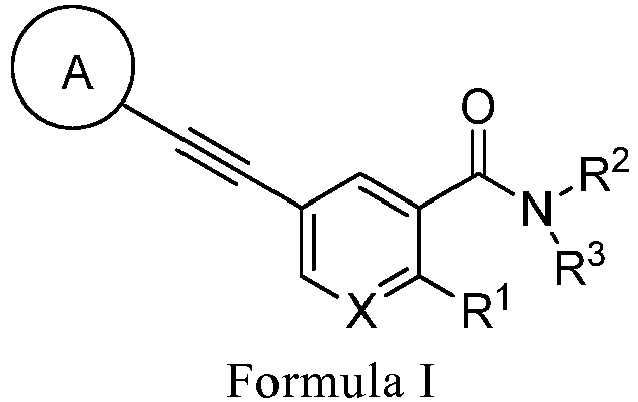
- X is CH or N;
- R1 is selected from the following group: hydrogen, halogen, C1-C6 alkyl, halogen substituted C1-C6 alkyl, cyano;
- R2 and R3 are each independently selected from the group consisting of hydrogen, substituted or unsubstituted phenyl, substituted or unsubstituted 3-7 membered heteroaryl, substituted or unsubstituted 5-7 membered aryl-methylene, 3-7 membered heterocyclyl-methylene, each heterocyclyl independently contains 1 to 4 heteroatoms selected from oxygen, sulfur and nitrogen; and R2 and R3 are not simultaneously hydrogen; or R2 and R3 together with the attached N atom form a group selected from the group consisting of substituted or unsubstituted 5-20 membered hetero spirocyclic ring, or substituted or unsubstituted 4-20 membered fused heterocyclic ring; wherein the substituted means one or more hydrogen atoms of the group are substituted by substituents selected from the group consisting of halogen, C1-C6 alkyl, halogen-substituted C1-C6 alkyl, C1-C6 alkoxy, C1-C6 alkoxycarbonyl, halogen-substituted C1-C6 alkoxy, C2-C6 alkenyl, C2-C6 alkynyl, C3-C8 cycloalkyl, cyano, nitro, amino, hydroxy, hydroxymethyl, carboxy, mercapto, sulfonyl, C6-C10 aryl, and 3-12 membered heterocyclyl; wherein the hetero spirocyclic ring, fused heterocyclic ring or heterocyclyl each independently contains 1 to 4 heteroatoms selected from oxygen, sulfur and nitrogen;

- and when R1 is H,

- the halogen is F, Cl, Br or I.
- In another preferred embodiment, said R2 and R3 are each independently selected from the group consisting of hydrogen, substituted or unsubstituted phenyl, substituted or unsubstituted 3-7 membered heteroaryl, substituted or unsubstituted 5-7 membered aryl-methylene, 3-7 membered heterocyclyl-methylene, while each heterocyclyl independently contains 1 to 4 heteroatoms selected from oxygen, sulfur and nitrogen; R2 and R3 are not simultaneously hydrogen;
or R2 and R3 together with the attached N atom form a group selected from the group consisting of substituted or unsubstituted hetero spirocyclic ring, substituted or unsubstituted fused heterocyclic ring; wherein the substituted means one or more hydrogen atoms of the group are substituted by substituents selected from the group consisting of halogen, C1-C6 alkyl, C1-C6 alkoxy, halogen-substituted C1-C6 alkoxy, cyano, nitro, amino, hydroxy , hydroxymethyl, carboxy, mercapto, sulfonyl, or trifluoromethyl. - In another preferred embodiment,


- In another preferred embodiment, R2 is selected from the group consisting of substituted or unsubstituted phenyl, substituted or unsubstituted pyridyl, substituted or unsubstituted pyrazinyl; wherein said substituted means the hydrogen atom(s) of the group is substituted by the substituent(s) selected from the group consisting of halogen, C1-C6 alkyl, halogen-substituted C1-C6 alkyl, C1-C6 alkoxy, cyano, nitro, amino, hydroxy;
R3 is H;
or R2 and R3 together with the connected N atom form substituted or unsubstituted group selected from the group consisting of
- In another preferred embodiment,

- In another preferred embodiment, R1 is selected from H, F, Cl, CH3, CN.
- In another preferred embodiment, R2 is selected from the group consisting of substituted or unsubstituted phenyl, substituted or unsubstituted pyridyl, or substituted or unsubstituted following groups:

- In another preferred embodiment,

- In a more preferred embodiment of the present invention, the compounds of general formula I of the present invention are preferably specific compounds as follows:
Table A No. Name Structure ZD001 2-fluoro-5-(pyridin-2-ethynyl)-N-(4-fluor ophenyl)benzamide 
ZD002 (2-chloro-5-(pyridin-2-ethynyl)phenyl)(7-oxa-2-aza-spiro[3.5]nonan-2-yl)methanone 
ZD003 (2-chloro-5-(pyridin-2-ethynyl)phenyl)(8-oxa-2-aza-spiro[4.5]dec-2-yl)methanone 
ZD004 2-fluoro-N-(4-fluorophenyl)-5-((2-methylt hiazol-4-yl)ethynyl)benzamide 
ZD005 (3-((2-methylthiazol-4-yl)ethynyl)phenyl) (3-trifluoromethyl-5,6-dihydro-[1,2,4]tria zolo[4,3-a]pyrazin-7(8H)-yl)methanone 
ZD006 5-((1H-indazol-5-yl)ethynyl)-2-fluoro-N-( 4-fluorophenyl)benzamide 
ZD007 (3-((2-methylthiazol-4-yl)phenyl)(7-oxa-2 -aza-spiro[3.5]nonan-2-yl)methanone 
ZD008 (3-((2-methylthiazol-4-yl)phenyl)(8-oxa-2 -aza-spiro[4.5]dec-2-yl)methanone 
ZD009 N-(4-fluorophenyl)-3-((2-methylthiazol-4-yl)ethynyl)benzamide 
ZD010 N-(4-cyanophenyl)-3-((2-methylthiazol-4-yl)ethynyl)benzamide 
ZD011 (1-methyl-3,4-dihydro-isoquinolin-2(1H)-yl-3-((2-methyl-thiazol-4-yl)ethynyl)phen yl)methanone 
ZD012 (3,4-dihydro-isoquinolin-2(1H)-yl)(3-((2-methyl-thiazol-4-yl)ethynyl)phenyl)metha none 
ZD013 3-((2-methylthiazol-4-ylethynyl)-N-(pyrid in-3-yl)benzamide 
ZD014 3-((2-methylthiazol-4-ylethynyl)-N-pheny lbenzamide 
ZD015 3-((2-methylthiazol-4-ylethynyl)-N-(4-(tri fluoromethyl)phenyl)benzamide 
ZD017 N-(3-fluorophenyl)-3-((2-methylthiazol-4-yl)ethynyl)benzamide 
ZD019 N-(3-cyanophenyl)-3-((2-methylthiazol-4-yl)ethynyl)benzamide 
ZD036 2-chloro-N-(4-fluorophenyl)-5-(pyridin-2-ethynyl)benzamide 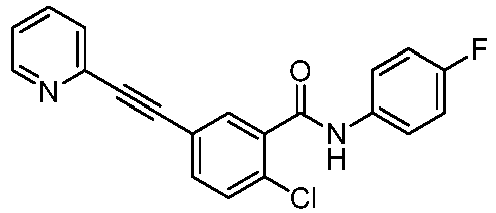
ZD037 2-chloro-N-(4-fluorophenyl)-5-((2-methyl thiazol-4-yl)ethynyl)benzamide 
ZD038 2-fluoro-N-(4-fluorophenyl)-5-(pyridin-3-ethynyl)benzamide 
ZD039 2-fluoro-N-(4-fluorophenyl)-5-(pyridin-4-ethynyl)benzamide 
ZD040 N-(4-fluorophenyl)-2-methyl-5-(pyridin-2 -ethynyl)benzamide 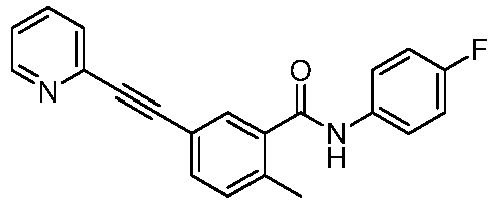
ZD041 N-(4-fluorophenyl)-2-methyl-5-((2-methyl thiazol-4-yl)ethynyl)benzamide 
ZD042 2-fluoro-5-(pyridin-2-ethynyl)-N-(pyridin -3-yl)benzamide 
ZD043 2-fluoro-5-((2-methylthiazol-4-ylethynyl)-N-(pyridin-3-yl)benzamide 
ZD044 N-(4-cyanophenyl)-2-fluoro-5-(pyridin-2-ethynyl)benzamide 
ZD045 N-(4-cyanophenyl)2-fluoro-5-((2-methylt hiazol-4-yl)ethynyl)benzamide 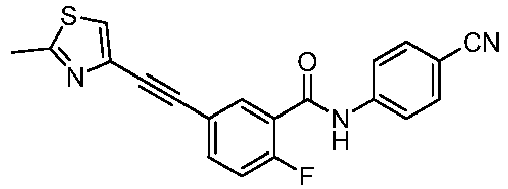
ZD046 (3,4-dihydro-isoquinolin-2(1H)-yl)(2-fluo ro-5-(pyridin-2-ylethynyl)phenyl)methano ne 
ZD047 (3,4-dihydro-isoquinolin-2(1H)-yl)(2-fluo ro-5-((2-methyl-thiazol-4-yl)ethynyl)phen yl)methanone 
ZD048 (2-fluoro-5-(pyridin-2-ylethynyl)phenyl)( 1-methyl-3,4-dihydro-isoquinolin-2(1H)-y l)methanone 
ZD049 (2-fluoro-5-((2-methyl-thiazol-4-yl)ethyn yl)phenyl)(1-methyl-3,4-dihydro-isoquino lin-2(1H)-yl)methanone 
ZD050 2-fluoro-5-((2-methylthiazol-4-ylethynyl)-N-(pyridin-3-yl)nicotinamide 
ZD051 2-fluoro-N-(4-fluorophenyl)-5-(pyridin-2-ylethynyl)nicotinamide 
ZD052 (3,4-dihydro-isoquinolin-2(1H)-yl)(2-fluo ro-5-((2-methyl-thiazol-4-yl)ethynyl)pyrid in-3-yl)methanone 
ZD053 2-fluoro-N-(4-fluorophenyl)-5-((2-methylt hiazol-4-yl)ethynyl)nicotinamide 
ZD054 2-chloro-N-(4-fluorophenyl)-5-((2-methyl thiazol-4-yl)ethynyl)nicotinamide 
ZD055 2-fluoro-5-(pyridin-2-ylethynyl)-N-(pyridi n-3-yl)nicotinamide 
ZD056 (3,4-dihydro-isoquinolin-2(1H)-yl)(2-fluo ro-5-(pyridin-2-ylethynyl)pyridin-3-yl)me thanone 
ZD057 2-fluoro-5-((2-methylthiazol-4-yl)ethynyl) -N-benzoylaniline 
ZD058 2-cyano-5-((2-methylthiazol-4-ylethynyl)-N-(pyridin-3-yl)benzamide 
ZD059 5-((2-methylthiazol-4-ylethynyl)-N-(pyrid in-3-yl)-2-(trifluoromethyl)benzamide 
ZD060 N-(4-fluorophenyl)-5-((2-methylthiazol-4-yl)ethynyl)-2-(trifluoromethyl)benzamide 
ZD061 2-cyano-N-(4-fluorophenyl)-5-((2-methylt hiazol-4-yl)ethynyl)benzamide 
ZD062 4-((2-methylthiazol-4-yl)ethynyl)-2-(1,2,3 ,4-dihydroisoquinolin-2-carbonyl)benzoni trile 
ZD063 (3,4-dihydro-isoquinolin-2(1H)-yl)(5-((2-methyl-thiazol-4-yl)ethynyl)-2-(trifluorom ethyl)phenyl)methanone 
ZD064 2-fluoro-N-(2-fluorophenyl)-5-((2-methylt hiazol-4-yl)ethynyl)benzamide 
ZD065 2-fluoro-N-(3-fluorophenyl)-5-((2-methylt hiazol-4-yl)ethynyl)benzamide 
ZD066 N-(3,4-difluorophenyl)-2-fluoro-5-((2-met hylthiazol-4-yl)ethynyl)benzamide 
ZD067 N-(2,4-difluorophenyl)-2-fluoro-5-((2-met hylthiazol-4-yl)ethynyl)benzamide 
ZD068 N-(4-chlorophenyl)-2-fluoro-5-((2-methyl thiazol-4-yl)ethynyl)benzamide 
ZD069 2-fluoro-5-((2-methylthiazol-4-ylethynyl)-N-(4-(trifluoromethyl)phenyl)benzamide 
ZD070 2-fluoro-N-(4-methoxyphenyl)-5-((2-meth ylthiazol-4-yl)ethynyl)benzamide 
ZD071 2-fluoro-5-((2-methylthiazol-4-ylethynyl)-N-(pyridin-2-yl)benzamide 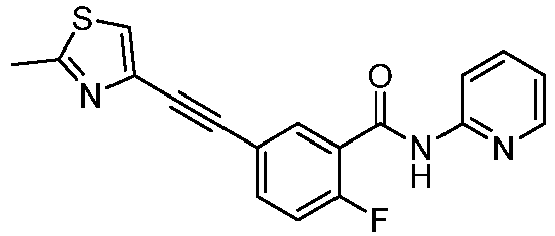
ZD072 2-fluoro-5-((2-methylthiazol-4-ylethynyl)-N-(pyridin-4-yl)benzamide 
ZD073 2-fluoro-N-(6-fluoropyridin-3-yl)-5-((2-m ethylthiazol-4-yl)ethynyl)benzamide 
ZD074 N-(6-chloropyridin-3-yl)-2-fluoro-5-((2-m ethylthiazol-4-yl)ethynyl)benzamide 
ZD075 2-fluoro-5-((2-methylthiazol-4-ylethynyl)-N-(p-methylphenyl)benzamide 
ZD076 2-fluoro-N-(pyridin-3-yl)-5-(thiazol-4-ylet hynyl)benzamide 
ZD077 2-fluoro-5-((2-fluorothiazol-4-yl)ethynyl)-N-(pyridin-3-yl)benzamide 
ZD078 5-((2-chlorothiazol-4-ylethynyl)-2-fluoro-N-(pyridin-3-yl)benzamide 
ZD079 2-fluoro-N-(pyridin-3-yl)-5-((2-(trifluoro methyl)thiazol-4-yl)ethynyl)benzamide 
ZD080 2-fluoro-5-((6-methylpyridin-2-yl)ethynyl )-N-(pyridin-3-yl)benzamide 
ZD081 2-fluoro-5-((6-fluoropyridin-2-yl)ethynyl) -N-(pyridin-3-yl)benzamide 
ZD082 5-((6-chloropyridin-2-yl)ethynyl)-2-fluoro -N-(pyridin-3-yl)benzamide 
ZD083 2-fluoro-N-(pyridin-3-yl)-5-((6-(trifluoro methyl)pyridin-2-yl)ethynyl)benzamide 
ZD084 5-((6-cyanopyridin-2-yl)ethynyl)-2-fluoro -N-(pyridin-3-yl)benzamide 
ZD085 2-fluoro-N-(pyridin-3-yl)-5-(pyrimidin-5-ylethynyl)benzamide 
ZD086 2-fluoro-5-((2-methylpyrimidin-5-yl)ethy nyl)-N-(pyridin-3-yl)benzamide 
ZD087 2-fluoro-N-(4-fluorophenyl)-5-((2-methyl pyrimidin-5-yl)ethynyl)benzamide 
ZD088 (3,4-dihydro-isoquinolin-2(1H)-yl)(2-fluo ro-5-((2-methylpyrimidin-5-yl)ethynyl)ph enylmethanone 
ZD089 2-fluoro-5-((2-methyloxazol-4-ylethynyl)-N-(pyridin-3-yl)benzamide 
ZD090 2-fluoro-N-(4-fluorophenyl)-5-((2-methyl oxazol-4-yl)ethynyl)benzamide 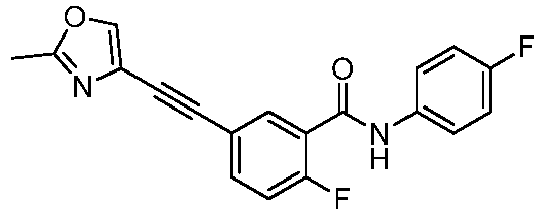
ZD091 (3,4-dihydro-isoquinolin-2(1H)-yl)(2-fluo ro-5-((2-methyloxazol-4-yl)ethynyl)pheny l)methanone 
ZD092 (3,4-dihydro-isoquinolin-2(1H)-yl)(5-((3, 5-dimethylisoxazol-4-yl)ethynyl)-2-fluoro phenyl)methanone 
ZD093 5-((3,5-dimethylisoxazol-4-ylethynyl)-2-fl uoro-N-(pyridin-3-yl)benzamide 
ZD094 5-((3,5-dimethylisoxazol-4-ylethynyl)-2-fl uoro-N-(4-fluorophenyl)benzamide 
- The present invention provides a pharmaceutically acceptable salt of the compound of formula I, in particular a conventional pharmaceutically acceptable salt formed by the reaction of the compound of formula I with an inorganic or organic acid. For example, the conventional pharmaceutically acceptable salt may be prepared by reacting the compound of formula I with an inorganic acid including hydrochloric acid, hydrobromic acid, sulfuric acid, nitric acid, aminosulfonic acid, phosphoric acid and the like, or an organic acid including citric acid, tartaric acid, lactic acid, pyruvic acid, acetic acid, benzenesulfonic acid, p-toluenesulfonic acid, methanesulfonic acid, naphthalenesulfonic acid, ethanesulfonic acid, naphthalene disulfonic acid, maleic acid, malic acid, malonic acid, fumaric acid, succinic acid, propionic acid, oxalic acid, trifluoroacetic acid, stearic acid, pamoic acid, hydroxymaleic acid, phenylacetic acid, benzoic acid, salicylic acid, glutamic acid, ascorbic acid, p-anilinesulfonic acid, 2-acetoxybenzoic acid, isethionic acid etc.; or may be sodium, potassium salt, calcium salt, aluminum salt or ammonium salt formed by the compound of formula I with an inorganic base; or may be methanamine salt, ethylamine salt or ethanolamine salt formed by the compound of formula I with an organic base.
- Another aspect of the present invention provides a process for the preparation of the compound of formula I, which is carried out according to the following scheme (example):

- Step a: Aluminum trichloride is dissolved in an organic solvent, and then bis(trimethylsilyl)acetylene and
compound 1 are added under ice bath and reacted to givecompound 2; the organic solvent is tetrahydrofuran, diethyl ether, dimethylformamide, glycol dimethyl ether, ethylene glycol diethyl ether, dioxane, ethanol, methanol, ethyl acetate, dichloromethane or mixture thereof; - Step b:
Compound 2 is dissolved in an organic solvent, and thioacetamide is added and stirred until the reaction is completed to give compound 3; the organic solvent is tetrahydrofuran, diethyl ether, dimethylformamide, glycol dimethyl ether, ethylene glycol diethyl ether, dioxane, ethanol, methanol, ethyl acetate, dichloromethane or mixture thereof; - Step c: Compound 3 is dissolved in an organic solvent and a strong base is added to complete reaction to obtain compound 4; the organic solvent is tetrahydrofuran, diethyl ether, dimethylformamide, glycol dimethyl ether, ethylene glycol diethyl ether, dioxane, ethanol, methanol, ethyl acetate, dichloromethane or mixture thereof; the strong base is NaOH, KOH, sodium ethoxide or sodium methoxide;
- Step d: Thionyl chloride is added to compound 5 and heated to reflux to give an intermediate 6; the heating temperature ranges from 60-80 °C;
- Step e: An amine is dissolved in an organic solvent and a certain amount of base is added. After the compound 6 is dissolved in an organic solvent, it is added dropwise to the amine solution under ice-bath to give an intermediate 7; the amine is selected from the group consisting of substituted or unsubstituted aniline, substituted or unsubstituted pyridinamine, tetrahydroisoquinoline, 2-methyltetrahydroisoquinoline, 7-oxa-2-azaspiro[3.5]nonane, 8-oxa-2-azaspiro[4.5]decane, 3-trifluoromethyl-5,6,7,8-tetrahydro-[1,2,4]triazolo[4,3-a]pyrazine hydrochloride; the organic solvent is tetrahydrofuran, diethyl ether, dimethylformamide, glycol dimethyl ether, ethylene glycol diethyl ether, dioxane, ethanol, methanol, ethyl acetate, dichloromethane or mixture thereof; the base is sodium acetate, NaOH, KOH, sodium ethoxide, sodium methoxide, sodium carbonate, potassium carbonate, triethylamine or diisopropylamine;
- Step f: The intermediate 7 is dissolved in an organic solvent, a certain amount of base and alkynyl substrate are added, and then copper iodide and bis-triphenylphosphine palladium dichloride are added and heated to reflux to obtain compound 8; the organic solvent is tetrahydrofuran, toluene, diethyl ether, dimethylformamide, glycol dimethyl ether, ethylene glycol diethyl ether, dioxane, ethanol, methanol, ethyl acetate, dichloromethane or mixture thereof; and the base is sodium acetate, NaOH, KOH, sodium ethoxide, sodium methoxide, sodium carbonate, potassium carbonate, triethylamine or diisopropylamine; and the heating temperature ranges from 80 to 120 °C.
- The other compounds may be prepared by similar methods by selecting different starting materials.
- The compounds of the present invention possess outstanding activity of mGluR5 negative allosteric regulation. Therefore, the compounds of the present invention, and various crystal forms, pharmaceutically acceptable inorganic or organic salts, hydrates or solvates thereof, and the pharmaceutical composition comprising the compound of the present invention as a main active ingredient can be used for treating, preventing and alleviating diseases related to mGluR5 negative allosteric regulation, such as central nervous system and psychiatric system related diseases, etc..
- The pharmaceutical composition of the invention comprises the compound of the present invention or the pharmaceutically acceptable salt thereof in a safe and effective dosage range and a pharmaceutically acceptable excipient or carrier. Wherein the "safe and effective dosage" means that the amount of compound is sufficient to significantly ameliorate the condition without causing significant side effects. Generally, the pharmaceutical composition contains 1-3000 (active dose range 3-30 mg/kg) mg compound of the invention per dose, preferably, 10-2000 mg compound of the invention per dose. Preferably, the "dose" is a capsule or tablet.
- "Pharmaceutically acceptable carrier" means one or more compatible solid or liquid fillers, or gelatinous materials which are suitable for human use and should be of sufficient purity and sufficiently low toxicity. "Compatibility" means that each component in the composition can be admixed with the compounds of the present invention and with each other without significantly reducing the efficacy of the compounds. Some examples of pharmaceutically acceptable carriers include cellulose and the derivatives thereof (such as sodium carboxymethyl cellulose, sodium ethyl cellulose, cellulose acetate, etc.), gelatin, talc, solid lubricants (such as stearic acid, magnesium stearate), calcium sulfate, vegetable oils (such as soybean oil, sesame oil, peanut oil, olive oil, etc.), polyols (such as propylene glycol, glycerol, mannitol, sorbitol, etc.), emulsifiers (such as Tween®), wetting agent (such as sodium dodecyl sulfate), coloring agents, flavoring agents, stabilizers, antioxidants, preservatives, pyrogen-free water, etc..
- There is no special limitation of administration mode for the compounds or pharmaceutical compositions of the present invention, and the representative administration mode includes (but is not limited to): oral, intratumoral, rectal, parenteral (intravenous, intramuscular or subcutaneous), and topical administration.
- Solid dosage forms for oral administration include capsules, tablets, pills, powders and granules. In these solid dosage forms, the active compounds are mixed with at least one conventional inert excipient (or carrier), such as sodium citrate or CaHPO4, or mixed with any of the following components: (a) fillers or compatibilizer, for example, starch, lactose, sucrose, glucose, mannitol and silicic acid; (b) binders, for example, hydroxymethyl cellulose, alginate, gelatin, polyvinylpyrrolidone, sucrose and arabic gum; (c) humectants, such as, glycerol; (d) disintegrating agents such as agar, calcium carbonate, potato starch or tapioca starch, alginic acid, certain composite silicates, and sodium carbonate; (e) dissolution-retarding agents, such as paraffin; (f) absorption accelerators, for example, quaternary ammonium compounds; (g) wetting agents, such as cetyl alcohol and glyceryl monostearate; (h) adsorbents, for example, kaolin; and (i) lubricants such as talc, calcium stearate, magnesium stearate, solid polyethylene glycol, sodium lauryl sulfate, or the mixture thereof. In capsules, tablets and pills, the dosage forms may also contain buffering agents.
- The solid dosage forms such as tablets, sugar pills, capsules, pills and granules can be prepared by using coating and shell materials, such as enteric coatings and any other materials known in the art. They can contain an opaque agent. The release of the active compounds or compounds in the compositions can be released in a delayed mode in a given portion of the digestive tract. Examples of the embedding components include polymers and waxes. If necessary, the active compounds and one or more above excipients can form microcapsules.
- The liquid dosage forms for oral administration include pharmaceutically acceptable emulsions, solutions, suspensions, syrups or tinctures. In addition to the active compound, the liquid dosage form may contain any conventional inert diluent known in the art such as water or other solvents, solubilizers and emulsifiers, for example, ethanol, isopropanol, ethyl carbonate, ethyl acetate, propylene glycol, 1,3-butanediol, dimethyl formamide, as well as oil, in particular, cottonseed oil, peanut oil, corn germ oil, olive oil, castor oil and sesame oil, or the combination thereof.
- Besides these inert diluents, the composition may also contain additives such as wetting agents, emulsifiers and suspending agents, sweeteners, flavoring agents and perfumes.
- In addition to the active compound, the suspension may contain suspending agent, for example, ethoxylated isooctadecanol, polyoxyethylene sorbitol and sorbitan ester, microcrystalline cellulose, aluminum methoxide and agar, or the combination thereof.
- The compositions for parenteral injection may comprise physiologically acceptable sterile aqueous or anhydrous solutions, dispersions, suspensions or emulsions, and sterile powders which can be re-dissolved into sterile injectable solutions or dispersions. Suitable aqueous and non-aqueous carriers, diluents, solvents or excipients include water, ethanol, polyols and any suitable mixtures thereof.
- The dosage forms for topical administration of compounds of the invention include ointments, powders, patches, aerosols, and inhalants. The active ingredient is mixed with physiologically acceptable carrier and any preservative, buffer, or propellant if necessary, under sterile conditions.
- The compound of the present invention can be administrated alone, or in combination with any other pharmaceutically acceptable compound.
- When the pharmaceutical composition is used, a safe and effective amount of compound of the present invention is applied to a mammal (such as human) in need of treatment, wherein the dose of administration is a pharmaceutically effective dose. For a person weighed 60 kg, the daily dose is usually 1- 2000 mg, preferably 6 -600mg. Of course, the particular dose should also depend on various factors, such as the route of administration, patient healthy status, which are well within the skills of an experienced physician.
- The present invention will be further illustrated below with reference to the specific examples. It should be understood that these examples are only to illustrate the invention but not to limit the scope of the invention. The experimental methods with no specific conditions described in the following examples are generally performed under the conventional conditions, or according to the manufacturer's instructions. Unless indicated otherwise, parts and percentage are calculated by weight. The starting materials used in the present invention are commercially available without being specifically described.
- 500 mg of 2-fluoro-5-iodobenzoic acid was added to a 50 ml eggplant flask, and then 3 ml of thionyl chloride was added, and heated at 77 °C for 2 hours. The reaction was monitored by thin layer chromatography (TLC). After the reaction was completed, the mixture was cooled to room temperature and dried by rotary evaporation to remove thionyl chloride to give 524 mg 2-fluoro-5-iodo-benzoyl chloride as colorless liquid.
- 200 mg of 4-fluoroaniline was dissolved in 5 ml of ethyl acetate, and 260 µl of triethylamine was added. Then 2-fluoro-5-iodo-benzoyl chloride in ethyl acetate was added dropwise under ice-cooling, and the reaction was completed after 1.5 hours. 10ml ethyl acetate was added to dilute, and 20 ml water was added to extract. The mixture was extracted with ethyl acetate for three times, washed once with saturated brine, dried over anhydrous sodium sulfate, and dried by rotary evaporation to obtain 620 mg 2-fluoro-N-(4-fluorophenyl)-5-iodobenzamide as light yellow solid.
- 625 mg 2-fluoro-N- (4-fluorophenyl) -5-iodobenzamide was dissolved in toluene, 1.5 eq 2-ethynylpyridine and 2.2 eq triethylamine were added followed by 0.2 eq cuprous iodide, 0.2 eq bis(triphenyl-phosphine)palladium dichloride. The mixture was heated and stirred at 100 °C for 6 hours under an inert atmosphere. The reaction liquid was dried by rotary evaporation and purified to give 460 mg ZD001 as tan solid, yield 79%. 1H NMR (400 MHz, CDCl3) δ 10.61 (s, 1H), 8.62 (d, J = 4.1 Hz, 1H), 7.95 - 7.80 (m, 3H), 7.78 - 7.71 (m, 2H), 7.68 (d, J = 7.8 Hz, 2H), 7.51 - 7.41 (m, 2H), 7.22 (t, J = 8.9 Hz, 2H). LRMS (EI) m/z 335(M+).
- 2-fluoro-5-iodobenzoic acid was replaced by 2-chloro-5-iodobenzoic acid, and 4-fluoroaniline was replaced by 7-oxa-2-azaspiro [3.5] nonane, while the remaining raw materials, reagents and the preparation method were the same as those in Example 1 to give the product ZD002, yield 80%. 1H NMR (400 MHz, CDCl3) δ 8.62 (m, J = 4.9, 1.8, 0.9 Hz, 1H), 7.70 (m, J = 7.7, 1.8 Hz, 1H), 7.56 - 7.55 (m, 1H), 7.54 - 7.50 (m, 2H), 7.40 (dd, J = 8.1, 0.7 Hz, 1H), 7.30 - 7.26 (m, 1H), 3.94 (s, 4H), 3.65 - 3.49 (m, 4H), 1.89 - 1.70 (m, 4H). LRMS (EI) m/z367(M+).
- 2-fluoro-5-iodobenzoic acid was replaced by 2-chloro-5-iodobenzoic acid, and 4-fluoroaniline was replaced by 8-oxa-2-azaspiro [4.5] decane, while the remaining raw materials, reagents and the preparation method were the same as those in Example 1 to give the product ZD003, yield 80%. 1H NMR (400 MHz, CDCl3) δ 8.63 (d, J = 4.1 Hz, 1H), 7.70 (t, J = 7.8 Hz, 1H), 7.57 - 7.49 (m, 3H), 7.43 - 7.38 (m, 1H), 7.28 (d, J = 7.5 Hz, 1H), 3.83 - 3.65 (m, 4H), 3.44 (dd, J = 104.9, 12.7 Hz, 2H), 1.87 (dt, J = 27.5, 7.2 Hz, 3H), 1.64 (t, J = 5.3 Hz, 2H), 1.60 - 1.48 (m, 3H).LRMS (EI) m/z 381(M+).
- 2-ethynylpyridine was replaced by 4-ethynyl-2-methylthiazole, while the remaining raw materials, reagents and the preparation method were the same as those in Example 1 to give the product ZD004, yield 80%. 1H NMR (400 MHz, CDCl3) δ 8.34 (dd, J = 7.5, 2.1 Hz, 1H), 7.68 (dd, J = 5.4, 3.1 Hz, 1H), 7.65 - 7.58 (m, 2H), 7.41 (s, 1H), 7.18 (dd, J = 11.7, 8.6 Hz, 1H), 7.08 (t, J = 8.6 Hz, 2H), 2.75 (s, 3H).LRMS (EI) m/z 355(M+).
- 2-fluoro-5-iodobenzoic acid was replaced by 2-chloro-5-iodobenzoic acid, while the remaining raw materials, reagents and the preparation method were the same as those in Example 1 to give the product ZD036, yield 80%. 1H NMR (400 MHz, CDCl3) δ 8.65 (s, 1H), 7.99 (s, 2H), 7.80 (s, 1H), 7.63 (d, J = 8.3 Hz, 4H), 7.45 (d, J = 8.1 Hz, 1H), 7.37 (s, 1H), 7.08 (t, J = 8.3 Hz, 2H).LRMS (EI) m/z 351(M+)
- 2-fluoro-5-iodobenzoic acid was replaced by 2-chloro-5-iodobenzoic acid, and 2-ethynylpyridine was replaced by 4-ethynyl-2-methylthiazole, while the remaining raw materials, reagents and the preparation method were the same as those in Example 1 to give the product ZD037, yield 80%. 1H NMR (400 MHz, DMSO) δ 10.63 (s, 1H), 7.96 (s, 1H), 7.79 (d, J = 1.7 Hz, 1H), 7.76 - 7.70 (m, 2H), 7.67 (dt, J = 15.5, 5.2 Hz, 2H), 7.21 (t, J = 8.9 Hz, 2H), 2.68 (s, 3H).LRMS (EI) m/z 371 (M+)
- 2-ethynylpyridine was replaced by 3-ethynylpyridine, while the remaining raw materials, reagents and the preparation method were the same as those in Example 1 to give the product ZD038, yield 80%. 1H NMR (400 MHz, CDCl3) δ 9.28 - 8.51 (s, 1H), 8.47 - 8.30 (m, 2H), 7.85 (d, J = 7.8 Hz, 1H), 7.73 - 7.55 (m, 3H), 7.53 - 7.32 (m, 1H), 7.21 (dd, J = 11.7, 8.6 Hz, 1H), 7.08 (t, J = 8.6 Hz, 2H).LRMS (EI) m/z 335(M+)
- 2-ethynylpyridine was replaced by 4-ethynylpyridine, while the remaining raw materials, reagents and the preparation method were the same as those in Example 1 to give the product ZD039, yield 80%. 1H NMR (400 MHz, CDCl3) δ 8.44 - 8.34 (m,3H), 7.93 - 7.79 (m, 1H), 7.70 (s, 1H), 7.63 (dd, J = 8.6, 4.6 Hz, 3H), 7.24 - 7.18 (m, 1H), 7.09 (t, J = 8.5 Hz,3H).LRMS (EI) m/z 335(M+)
- 2-fluoro-5-iodobenzoic acid was replaced by 2-methyl-5-iodobenzoic acid, while the remaining raw materials, reagents and the preparation method were the same as those in Example 1 to give the product ZD040, yield 80%. 1H NMR (400 MHz, CDCl3) δ 8.57 (d, J = 4.3 Hz, 1H), 8.23 (s, 1H), 7.73 - 7.57 (m, 4H), 7.49 (td, J = 6.7, 3.2 Hz, 2H), 7.25 - 7.20 (m, 2H), 7.02 (t, J = 8.6 Hz, 2H), 2.47 (s, 3H).LRMS (EI) m/z 331(M+)
- 2-fluoro-5-iodobenzoic acid was replaced by 2-methyl-5-iodobenzoic acid, and 2-ethynylpyridine was replaced by 4-ethynyl-2-methylthiazole, while the remaining raw materials, reagents and the preparation method were the same as those in Example 1 to give the product ZD041, yield 80%. 1H NMR (400 MHz, CDCl3) δ 7.79 (s, 1H), 7.66 (s, 1H), 7.60 (dd, J = 8.5, 4.7 Hz, 2H), 7.49 (s, 1H), 7.36 (s, 1H), 7.24 (d, J = 7.8 Hz, 1H), 7.05 (t, J = 8.5 Hz, 2H), 2.74 (s,3H), 2.50 (s, 3H).LRMS (EI) m/z 351(M+)
- 4-fluoroaniline was replaced by 3-aminopyridine, while the remaining raw materials, reagents and the preparation method were the same as those in Example 1 to give the product ZD042, yield 80%. 1H NMR (400 MHz, CDCl3) δ 8.72 (d, J = 13.1 Hz, 2H), 8.65 - 8.59 (m, 1H), 8.41 (d, J = 3.5 Hz, 1H), 8.31 (dd, J = 7.4, 2.2 Hz, 2H), 7.74 - 7.68 (m, 2H), 7.53 (dt, J = 7.8, 1.0 Hz, 1H), 7.35 (dd, J = 8.3, 4.7 Hz, 1H), 7.30 - 7.26 (m, 1H), 7.19 (dd, J = 11.5, 8.6 Hz, 1H).LRMS (EI) m/z 318(M+)
- 2-ethynylpyridine was replaced by 4-ethynyl-2-methylthiazole, 4-fluoroaniline was replaced by 3-aminopyridine, while the remaining raw materials, reagents and the preparation method were the same as those in Example 1 to give the product ZD043, yield 80%. 1H NMR (400 MHz, CDCl3) δ 8.74 (s, 1H), 8.67 (d, J = 13.8 Hz, 1H), 8.41 (s, 1H), 8.33 (d, J = 8.1 Hz, 1H), 8.27 (dd, J = 7.4, 2.2 Hz, 1H), 7.67 (ddd, J = 8.4, 4.9, 2.3 Hz, 1H), 7.40 (s, 1H), 7.36 (s, 1H), 7.17 (dd, J = 11.6, 8.6 Hz, 1H), 2.73 (s, 3H).LRMS (EI) m/z 338(M+)
- 4-fluoroaniline was replaced by 4-cyanoaniline, while the remaining raw materials, reagents and the preparation method were the same as those in Example 1 to give the product ZD044, yield 80%. 1H NMR (400 MHz, CDCl3) δ 8.70 (d, J = 14.4 Hz, 1H), 8.35 (d, J = 7.2 Hz, 1H), 7.82 (d, J = 8.7 Hz, 2H), 7.75 (s, 2H), 7.67 (d, J = 8.6 Hz, 2H), 7.62 - 7.50 (m, 1H), 7.39 - 7.27 (m, 1H), 7.21 (dd, J = 11.6, 8.5 Hz, 1H).LRMS (EI) m/z 342(M+)
- 2-ethynylpyridine was replaced by 4-ethynyl-2-methylthiazole, 4-fluoroaniline was replaced by 4-cyanoaniline, while the remaining raw materials, reagents and the preparation method were the same as those in Example 1 to give the product ZD045, yield 80%. 1H NMR (400 MHz, DMSO) δ 10.95 (s, 1H), 7.94 (s, 1H), 7.92 (s, 1H), 7.91 - 7.88 (m, 2H), 7.85 (s, 1H), 7.83 (s, 1H), 7.82 - 7.77 (m, 1H), 7.47 (s, 1H), 2.68 (s, 3H).LRMS (EI) m/z 362(M+)
- 4-fluoroaniline was replaced by 3,4-dihydroisoquinoline, while the remaining raw materials, reagents and the preparation method were the same as those in Example 1 to give the product ZD046, yield 80%. 1H NMR (400 MHz, CDCl3) δ 8.62 (s, 1H), 7.73 - 7.61 (m, 3H), 7.54 - 7.49 (m, 1H), 7.30 - 7.26 (m, 1H), 7.25 - 7.17 (m, 3H), 7.14 (dd, J = 11.5, 6.5 Hz, 2H), 4.72 (d, J = 170.6 Hz, 2H), 3.58 (t, J = 5.8 Hz, 2H), 2.93 (dt, J = 42.1, 5.6 Hz, 2H).LRMS (EI) m/z 357(M+)
- 2-ethynylpyridine was replaced by 4-ethynyl-2-methylthiazole, 4-fluoroaniline was replaced by 3,4-dihydroisoquinoline, while the remaining raw materials, reagents and the preparation method were the same as those in Example 1 to give the product ZD047, yield 80%. 1H NMR (400 MHz, CDCl3) δ 7.62 - 7.56 (m, 2H), 7.36 (d, J = 7.0 Hz, 1H), 7.25 - 7.16 (m, 3H), 7.12 (t, J = 9.0 Hz, 2H), 4.71 (d, J = 171.9 Hz, 2H), 3.57 (t, J = 5.8 Hz, 2H), 2.92 (d, J = 43.6 Hz, 2H), 2.73 (d, J = 3.6 Hz, 3H).LRMS (EI) m/z 377(M+)
- 4-fluoroaniline was replaced by 1-methyl-3,4-dihydroisoquinoline, while the remaining raw materials, reagents and the preparation method were the same as those in Example 1 to give the product ZD048, yield 80%. 1H NMR (400 MHz, CDCl3) δ 8.62 (d, J = 4.7 Hz, 1H), 7.74 - 7.59 (m, 3H), 7.51 (d, J = 7.8 Hz, 1H), 7.25 - 7.23 (m, 1H), 7.23 - 7.09 (m,5H), 5.81 (d, J = 6.7 Hz, 1H), 3.72 - 3.42 (m, 2H), 2.73 (d, J = 16.0 Hz, 2H), 1.60 (d, J = 6.8 Hz, 3H).LRMS (EI) m/z 371(M+)
- 2-ethynylpyridine was replaced by 4-ethynyl-2-methylthiazole, 4-fluoroaniline was replaced by 1-methyl-3,4-dihydroisoquinoline, while the remaining raw materials, reagents and the preparation method were the same as those in Example 1 to give the product ZD049, yield 80%. 1H NMR (400 MHz, CDCl3) δ 7.62 - 7.55 (m, 2H), 7.37 (s, 1H), 7.18 (ddd, J = 11.5, 9.2, 5.7 Hz, 3H), 7.11 (dd, J = 11.8, 5.7 Hz, 2H), 5.80 (d, J = 6.7 Hz, 1H), 3.54 (dd, J = 50.6, 6.1 Hz, 2H), 3.34 - 2.81 (m, 2H), 2.73 (s, 3H), 1.59 (d, J = 6.8 Hz, 3H).LRMS (EI) m/z 391(M+).
- 2-ethynylpyridine was replaced by 4-ethynyl-2-methylthiazole, 4-fluoroaniline was replaced by 3-aminopyridine, 2-fluoro-5-iodobenzoic acid was replaced by 2-fluoro-5-iodo-picolinic acid, while the remaining raw materials, reagents and the preparation method were the same as those in Example 1 to give the product ZD050, yield 80%. 1H NMR (400 MHz, CDCl3) δ7.699 (s,1H), 2.501 (s,3H), 8.869 (1H,d), 8.894 (d, 1H), 8.402 (ddd, 1H), 7.476 (ddd,1H), 7.316 (ddd, 1H,), 8.404 (ddd, 1H). LRMS (EI) m/z 339(M+).
- 2-fluoro-5-iodobenzoic was replaced by 2-fluoro-5-iodopicolinic acid, while the remaining raw materials, reagents and the preparation method were the same as those in Example 1 to give the product ZD051, yield 80%. 1H NMR (400 MHz, CDCl3) δ8.719 (1H, d), 8.813 (1H, d), 7.743 (1H, ddd), 7.743 (1H, ddd), 7.017 (1H, ddd), 7.017 (1H, ddd), 7.492 (1H, ddd), 8.729 (1H, ddd), 7.848 (1H, ddd), 7.221 (1H, ddd). LRMS (EI) m/z 336(M+).
- 2-ethynylpyridine was replaced by 4-ethynyl-2-methylthiazole, 4-fluoroaniline was replaced by 3,4-dihydroisoquinoline, 2-fluoro-5-iodobenzoic acid was replaced by 2-fluoro-5-iodo-picolinic acid, while the remaining raw materials, reagents and the preparation method were the same as those in Example 1 to give the product ZD052, yield 80%. 1H NMR (400 MHz, CDCl3) δ7.264 (1H), 2.455 (s,3H), 8.688 (1H, d), 8.758 (1H, d), 4.354 (1H, d), 4.467 (1H, d), 3.658 (1H, ddd), 3.359 (1H, ddd), 2.926 (1H, ddd), 3.020 (1H, ddd), 6.866 (1H, ddd), 7.240 (1H, ddd), 7.041 (1H, ddd), 7.168 (1H, ddd). LRMS (EI) m/z 378(M+).
- 2-ethynylpyridine was replaced by 4-ethynyl-2-methylthiazole, 2-fluoro-5-iodobenzoic acid was replaced by 2-fluoro-5-iodo-picolinic acid, while the remaining raw materials, reagents and the preparation method were the same as those in Example 1 to give the product ZD053, yield 80%. 1H NMR (400 MHz, CDCl3) δ7.265 (s, 1H), 2.454 (s,3H), 8.690 (1H, d), 8.766 (1H, d), 7.743 (1H, ddd), 7.743 (1H, ddd), 7.017 (1H, ddd), 7.017 (1H, ddd). LRMS (EI) m/z 356(M+).
- 2-ethynylpyridine was replaced by 4-ethynyl-2-methylthiazole, 2-fluoro-5-iodobenzoic acid was replaced by 2-chloro-5-iodo-picolinic acid, while the remaining raw materials, reagents and the preparation method were the same as those in Example 1 to give the product ZD054, yield 80%. 1H NMR (400 MHz, CDCl3) δ8.690 (1H, d), 8.703 (1H, d), 7.744 (1H, ddd), 7.744 (1H, ddd), 7.018 (1H, ddd), 7.018 (1H, ddd), 7.284 (s, 1H), 2.408 (s, 3H). LRMS (EI) m/z 373(M+).
- 2-fluoro-5-iodobenzoic acid was replaced by 2-fluoro-5-iodopicolinic acid, 4-fluoroaniline was replaced by 3-aminopyridine, while the remaining raw materials, reagents and the preparation method were the same as those in Example 1 to give the product ZD055, yield 80%. 1H NMR (400 MHz, CDCl3) δ8.719 (1H, d), 8.813 (1H, d), 8.402 (1H, ddd), 7.476 (1H, ddd), 7.315 (1H, ddd), 7.492 (1H, ddd), 8.404 (1H, ddd), 8.729 (1H, ddd), 7.848 (1H, ddd), 7.221 (1H, ddd). LRMS (EI) m/z 319(M+).
- 2-fluoro-5-iodobenzoic acid was replaced by 2-fluoro-5-iodopicolinic acid, 4-fluoroaniline was replaced by 3,4-dihydroisoquinoline, while the remaining raw materials, reagents and the preparation method were the same as those in Example 1 to give the product ZD056, yield 80%. 1H NMR (400 MHz, CDCl3) δ8.718 (1H, d), 8.807 (1H, d), 4.356 (1H, d), 4.468 (1H, d), 3.659 (1H, ddd), 3.359 (1H, ddd), 2.926 (1H, ddd), 3.020 (1H, ddd), 6.866 (1H, ddd), 7.492 (1H, ddd), 7.240 (1H, ddd), 7.041 (1H, ddd), 8.729 (1H, ddd), 7.848 (1H, ddd), 7.168 (1H, ddd), 7.221 (1H, ddd). LRMS (EI) m/z 358(M+).
- 2-ethynylpyridine was replaced by 4-ethynyl-2-methylthiazole, 4-fluoroaniline was replaced by aniline, while the remaining raw materials, reagents and the preparation method were the same as those in Example 1 to give the product ZD057, yield 80%. 1H NMR (400 MHz, CDCl3) δ7.264 (s, 1H), 2.406 (s, 3H), 8.503 (1H, dd), 7.857 (1H, dd), 7.401 (1H, dd), 7.481 (1H, dddd), 7.481 (1H, dddd), 7.272 (1H, dddd), 7.272 (1H, dddd), 7.069 (1H, tt). LRMS (EI) m/z 337(M+).
- 2-ethynylpyridine was replaced by 4-ethynyl-2-methylthiazole, 2-fluoro-5-iodobenzoic acid was replaced by 2-cyano-5-iodo-picolinic acid, 4-fluoroaniline was replaced by 3-aminopyridine, while the remaining raw materials, reagents and the preparation method were the same as those in Example 1 to give the product ZD058, yield 80%. 1H NMR (400 MHz, CDCl3) δ7.411 (s, 1H), 2.554 (s, 3H), 8.561 (1H, dd), 7.793 (1H, dd), 8.051 (1H, dd), 8.404 (1H, ddd), 7.455 (1H, ddd), 7.317 (1H, ddd), 8.405 (1H, ddd). LRMS (EI) m/z 345(M+).
- 2-ethynylpyridine was replaced by 4-ethynyl-2-methylthiazole, 2-fluoro-5-iodobenzoic acid was replaced by 2-trifluoromethyl-5-iodo-picolinic acid, 4-fluoroaniline was replaced by 3-aminopyridine, while the remaining raw materials, reagents and the preparation method were the same as those in Example 1 to give the product ZD059, yield 80%. 1H NMR (400 MHz, CDCl3) δ7.461 (s, 1H), 2.478 (s, 3H), 8.585 (1H, dd), 7.899 (1H, dd), 7.781 (1H, dd), 8.404 (1H, ddd), 7.455 (1H, ddd), 7.317 (1H, ddd,), 8.405 (1H, ddd). LRMS (EI) m/z 388(M+).
- 2-ethynylpyridine was replaced by 4-ethynyl-2-methylthiazole, 2-fluoro-5-iodobenzoic acid was replaced by 2-trifluoromethyl-5-iodo-picolinic acid, while the remaining raw materials, reagents and the preparation method were the same as those in Example 1 to give the product ZD060, yield 80%. 1H NMR (400 MHz, CDCl3) δ7.461 (s, 1H), 2.478 (s, 3H), 8.585 (1H, dd), 7.899 (1H, dd), 7.781 (1H, dd), 7.745 (1H, ddd), 7.746 (1H, ddd), 7.018 (1H, ddd), 7.018 (1H, ddd). LRMS (EI) m/z 405(M+).
- 2-ethynylpyridine was replaced by 4-ethynyl-2-methylthiazole, 2-cyano-5-iodobenzoic acid was replaced by 2-cyano-5-iodo-picolinic acid, while the remaining raw materials, reagents and the preparation method were the same as those in Example 1 to give the product ZD061, yield 80%. 1H NMR (400 MHz, CDCl3) δ7.379 (s, 1H), 8.556 (1H, dd), 7.794 (1H, dd), 8.044 (1H, dd), 7.745 (1H, ddd), 7.745 (1H, ddd), 7.018 (1H, ddd), 7.018 (1H, ddd). LRMS (EI) m/z 362(M+).
- 2-ethynylpyridine was replaced by 4-ethynyl-2-methylthiazole, 2-fluoro-5-iodobenzoic acid was replaced by 2-cyano-5-iodo-picolinic acid, 4-fluoroaniline was replaced by 3,4-dihydroisoquinoline, while the remaining raw materials, reagents and the preparation method were the same as those in Example 1 to give the product ZD062, yield 80%. 1H NMR (400 MHz, CDCl3) δ7.410 (s, 1H), 2.554 (s, 3H), 8.544 (1H, dd), 7.790 (1H, dd), 8.046 (1H, dd), 4.330 (1H, d), 4.474 (1H, d), 3.665 (1H, ddd), 3.375 (1H, ddd), 2.928 (1H, ddd), 3.023 (1H, ddd), 6.867 (1H, ddd), 7.240 (1H, ddd), 7.042 (1H, ddd), 7.168 (1H, ddd). LRMS (EI) m/z 384(M+).
- 2-ethynylpyridine was replaced by 4-ethynyl-2-methylthiazole, 2-fluoro-5-iodobenzoic acid was replaced by 2-trifluoromethyl-5-iodo-picolinic acid, 4-fluoroaniline was replaced by 3,4-dihydroisoquinoline, while the remaining raw materials, reagents and the preparation method were the same as those in Example 1 to give the product ZD063, yield 80%. 1H NMR (400 MHz, CDCl3) δ7.459 (s, 1H), 2.477 (s, 3H), 8.567 (1H, dd), 7.896 (1H, dd), 7.779 (1H, dd), 4.325 (1H, d), 4.467 (1H, d), 3.663 (1H, ddd), 3.374 (1H, ddd), 2.928 (1H, ddd), 3.023 (1H, ddd), 6.867 (1H, ddd), 7.240 (1H, ddd), 7.042 (1H, ddd), 7.168 (1H, ddd). LRMS (EI) m/z 427(M+).
- 2-ethynylpyridine was replaced by 4-ethynyl-2-methylthiazole, 4-fluoroaniline was replaced by 2-fluoroaniline, while the remaining raw materials, reagents and the preparation method were the same as those in Example 1 to give the product ZD064, yield 80%. 1H NMR (400 MHz, CDCl3) δ7.264 (s, 1H), 2.406 (s, 3H), 8.504 (1H, dd), 7.858 (1H, dd), 7.401 (1H, dd), 8.107 (1H, ddd), 7.025 (1H, ddd), 7.235 (1H, ddd), 7.035 (1H, ddd). LRMS (EI) m/z 355(M+).
- 2-ethynylpyridine was replaced by 4-ethynyl-2-methylthiazole, 4-fluoroaniline was replaced by 3-fluoroaniline, while the remaining raw materials, reagents and the preparation method were the same as those in Example 1 to give the product ZD065, yield 80%. 1H NMR (400 MHz, CDCl3) δ7.264 (s, 1H), 2.406 (s, 3H), 8.503 (1H, dd), 7.858 (1H, dd), 7.401 (1H, dd), 7.722 (1H, ddd), 7.533 (1H, ddd), 7.335 (1H, ddd), 7.013 (1H, ddd). LRMS (EI) m/z 355(M+).
- 2-ethynylpyridine was replaced by 4-ethynyl-2-methylthiazole, 4-fluoroaniline was replaced by 3,4-difluoroaniline, while the remaining raw materials, reagents and the preparation method were the same as those in Example 1 to give the product ZD066, yield 80%. 1H NMR (400 MHz, CDCl3) δ7.264 (s, 1H), 2.406 (s, 3H), 8.504 (1H, dd), 7.858 (1H, dd), 7.401 (1H, dd), 7.725 (1H, dd), 7.278 (1H, dd), 7.299 (1H, dd). LRMS (EI) m/z 373(M+).
- 2-ethynylpyridine was replaced by 4-ethynyl-2-methylthiazole, 4-fluoroaniline was replaced by 2,4-difluoroaniline, while the remaining raw materials, reagents and the preparation method were the same as those in Example 1 to give the product ZD067, yield 80%. 1H NMR (400 MHz, CDCl3) δ7.566 (s, 1H), 2.523 (s, 3H), 7.887 (1H, dd), 7.988 (1H, dd), 7.516 (1H, dd), 7.538 (1H, dd), 7.397 (1H, dd), 6.877 (1H, dd). LRMS (EI) m/z 373(M+).
- 2-ethynylpyridine was replaced by 4-ethynyl-2-methylthiazole, 4-fluoroaniline was replaced by 4-chloroaniline, while the remaining raw materials, reagents and the preparation method were the same as those in Example 1 to give the product ZD068, yield 80%. 1H NMR (400 MHz, CDCl3) δ7.417 (1H, ddd), 7.417 (1H, ddd), 7.750 (1H, ddd), 7.750 (1H, ddd), 8.503 (1H, dd), 7.392 (1H, dd), 7.903 (1H, dd), 7.264 (s, 1H), 2.406 (s, 3H). LRMS (EI) m/z 372(M+).
- 2-ethynylpyridine was replaced by 4-ethynyl-2-methylthiazole, 4-fluoroaniline was replaced by 4-trifluoromethylaniline, while the remaining raw materials, reagents and the preparation method were the same as those in Example 1 to give the product ZD069, yield 80%. 1H NMR (400 MHz, CDCl3) δ7.264 (s, 1H), 2.406 (s, 3H), 8.503 (1H, dd), 7.858 (1H, dd), 7.401 (1H, dd), 7.251 (1H, ddd), 7.251 (1H, ddd), 7.573 (1H, ddd), 7.573 (1H, ddd). LRMS (EI) m/z 405(M+).
- 2-ethynylpyridine was replaced by 4-ethynyl-2-methylthiazole, 4-fluoroaniline was replaced by 4-methoxyaniline, while the remaining raw materials, reagents and the preparation method were the same as those in Example 1 to give the product ZD070, yield 80%. 1H NMR (400 MHz, CDCl3) δ7.264 (s, 1H), 2.406 (s, 3H), 8.503 (1H, dd), 7.858 (1H, dd), 7.401 (1H, dd), 7.277 (1H, ddd), 7.277 (1H, ddd), 6.636 (1H, ddd), 6.636 (1H, ddd), 3.760 (s, 3H). LRMS (EI) m/z 367(M+).
- 2-ethynylpyridine was replaced by 4-ethynyl-2-methylthiazole, 4-fluoroaniline was replaced by 2-aminopyridine, while the remaining raw materials, reagents and the preparation method were the same as those in Example 1 to give the product ZD071, yield 80%. 1H NMR (400 MHz, CDCl3) δ7.265 (s, 1H), 2.406 (s, 3H), 8.507 (1H, dd), 7.859 (1H, dd), 7.402 (1H, dd), 7.661 (1H, ddd), 8.404 (1H, ddd), 7.755 (1H, ddd), 7.106 (1H, ddd). LRMS (EI) m/z 338(M+).
- 2-ethynylpyridine was replaced by 4-ethynyl-2-methylthiazole, 4-fluoroaniline was replaced by 4-aminopyridine, while the remaining raw materials, reagents and the preparation method were the same as those in Example 1 to give the product ZD072, yield 80%. 1H NMR (400 MHz, CDCl3) δ7.264 (s, 1H), 2.406 (s, 3H), 8.505 (1H, dd), 7.858 (1H, dd), 7.401 (1H, dd), 7.971 (1H, ddd), 7.971 (1H, ddd), 8.501 (1H, ddd), 8.500 (1H, ddd). LRMS (EI) m/z 338(M+).
- 2-ethynylpyridine was replaced by 4-ethynyl-2-methylthiazole, 4-fluoroaniline was replaced by 6-fluoro-3-aminopyridine, while the remaining raw materials, reagents and the preparation method were the same as those in Example 1 to give the product ZD073, yield 80%. 1H NMR (400 MHz, CDCl3) δ7.264 (s, 1H), 2.406 (s, 3H), 8.504 (1H, dd), 7.858 (1H, dd), 7.400 (1H, dd), 7.805 (1H, dd), 7.410 (1H, dd), 7.284 (1H, dd). LRMS (EI) m/z 356(M+).
- 2-ethynylpyridine was replaced by 4-ethynyl-2-methylthiazole, 4-fluoroaniline was replaced by 6-chloro-3-aminopyridine, while the remaining raw materials, reagents and the preparation method were the same as those in Example 1 to give the product ZD074, yield 80%. 1H NMR (400 MHz, CDCl3) δ7.303 (1H, dd), 7.929 (1H, dd), 7.423 (1H, dd), 8.504 (1H, dd), 7.391 (1H, dd), 7.902 (1H, dd), 7.264 (s, 1H), 2.406 (s, 3H). LRMS (EI) m/z 373(M+).
- 2-ethynylpyridine was replaced by 4-ethynyl-2-methylthiazole, 4-fluoroaniline was replaced by 6-methyl-3-aminopyridine, while the remaining raw materials, reagents and the preparation method were the same as those in Example 1 to give the product ZD075, yield 80%. 1H NMR (400 MHz, CDCl3) δ7.264 (s, 1H), 2.406 (s, 3H), 8.503 (1H, dd), 7.857 (1H, dd), 7.401 (1H, dd), 7.186 (1H, ddd), 7.187 (1H, ddd), 7.079 (1H, ddd), 7.079 (1H, ddd), 2.210 (s, 3H). LRMS (EI) m/z 351(M+).
- 2-ethynylpyridine was replaced by 4-ethynylthiazole, 4-fluoroaniline was replaced by 3-aminopyridine, while the remaining raw materials, reagents and the preparation method were the same as those in Example 1 to give the product ZD076, yield 80%. 1H NMR (400 MHz, CDCl3) δ8.388 (1H, d), 7.214 (1H, d), 8.514 (1H, dd), 7.858 (1H, dd), 7.411 (1H, dd), 8.402 (1H, ddd), 7.474 (1H, ddd), 7.315 (1H, ddd), 8.404 (1H, ddd). LRMS (EI) m/z 324(M+).
- 2-ethynylpyridine was replaced by 4-ethynyl-2-fluorothiazole, 4-fluoroaniline was replaced by 3-aminopyridine, while the remaining raw materials, reagents and the preparation method were the same as those in Example 1 to give the product ZD077, yield 80%. 1H NMR (400 MHz, CDCl3) δ7.139 (s, 1H), 8.503 (1H, dd), 7.858 (1H, dd), 7.401 (1H, dd), 8.402 (1H, ddd), 7.474 (1H, ddd), 7.315 (1H, ddd), 8.404 (1H, ddd). LRMS (EI) m/z 342(M+).
- 2-ethynylpyridine was replaced by 4-ethynyl-2-chlorothiazole, 4-fluoroaniline was replaced by 3-aminopyridine, while the remaining raw materials, reagents and the preparation method were the same as those in Example 1 to give the product ZD078, yield 80%. 1H NMR (400 MHz, CDCl3) δ7.174 (s, 1H), 8.505 (1H, dd), 7.858 (1H, dd), 7.403 (1H, dd), 8.402 (1H, ddd), 7.474 (1H, ddd), 7.315 (1H, ddd), 8.404 (1H, ddd). LRMS (EI) m/z 359(M+).
- 2-ethynylpyridine was replaced by 4-ethynyl-2-trifluoromethylthiazole, 4-fluoroaniline was replaced by 3-aminopyridine, while the remaining raw materials, reagents and the preparation method were the same as those in Example 1 to give the product ZD079, yield 80%. 1H NMR (400 MHz, CDCl3) δ7.236 (s, 1H), 8.515 (1H, dd), 7.858 (1H, dd), 7.412 (1H, dd), 8.402 (1H, ddd), 7.474 (1H, ddd), 7.315 (1H, ddd), 8.404 (1H, ddd). LRMS (EI) m/z 392(M+).
- 2-ethynylpyridine was replaced by 2-ethynyl-6-methylpyridine, 4-fluoroaniline was replaced by 3-aminopyridine, while the remaining raw materials, reagents and the preparation method were the same as those in Example 1 to give the product ZD080, yield 80%. 1H NMR (400 MHz, CDCl3) δ7.567 (1H, dd), 8.587 (1H, dd), 7.954 (1H, dd), 8.402 (1H, ddd), 7.474 (1H, ddd), 7.315 (1H, ddd), 8.404 (1H, ddd), 7.294 (1H, dd), 7.653 (1H, dd), 7.008 (1H, dd), 2.565 (s, 3H). LRMS (EI) m/z 332(M+).
- 2-ethynylpyridine was replaced by 2-ethynyl-6-fluoropyridine, 4-fluoroaniline was replaced by 3-aminopyridine, while the remaining raw materials, reagents and the preparation method were the same as those in Example 1 to give the product ZD081, yield 80%. 1H NMR (400 MHz, CDCl3) δ7.660 (1H, dd), 7.723 (1H, dd), 7.396 (1H, dd), 8.605 (1H, dd), 7.784 (1H, dd), 7.571 ( 1H, dd), 8.402 (1H, ddd), 7.474 (1H, ddd), 7.315 (1H, ddd), 8.404 (1H, ddd). LRMS (EI) m/z 336(M+).
- 2-ethynylpyridine was replaced by 2-ethynyl-6-chloropyridine, 4-fluoroaniline was replaced by 3-aminopyridine, while the remaining raw materials, reagents and the preparation method were the same as those in Example 1 to give the product ZD082, yield 80%. 1H NMR (400 MHz, CDCl3) δ7.455 (1H, dd), 7.718 (1H, dd), 7.426 (1H, dd), 8.604 (1H, dd), 7.780 (1H, dd), 7.572 (1H, dd), 8.402 (1H, ddd), 7.474 (1H, ddd), 7.315 (1H, ddd), 8.404 (1H, ddd). LRMS (EI) m/z 353(M+).
- 2-ethynylpyridine was replaced by 2-ethynyl-6-trifluoromethylpyridine, 4-fluoroaniline was replaced by 3-aminopyridine, while the remaining raw materials, reagents and the preparation method were the same as those in Example 1 to give the product ZD083, yield 80%. 1H NMR (400 MHz, CDCl3) δ7.572 (1H, dd), 8.615 (1H, dd), 7.961 (1H, dd), 8.402 (1H, ddd), 7.474 (1H, ddd), 7.315 (1H, ddd), 8.404 (1H, ddd), 7.331 (1H, dd), 7.916 (1H, dd), 7.346 (1H, dd). LRMS (EI) m/z 386(M+).
- 2-ethynylpyridine was replaced by 2-ethynyl-6-cyanopyridine, 4-fluoroaniline was replaced by 3-aminopyridine, while the remaining raw materials, reagents and the preparation method were the same as those in Example 1 to give the product ZD084, yield 80%. 1H NMR (400 MHz, CDCl3) δ7.575 (1H, dd), 8.647 (1H, dd), 7.783 (1H, dd), 8.402 (1H, ddd), 7.474 (1H, ddd,), 7.315 (1H, ddd), 8.404 (1H, ddd), 7.507 (1H, dd), 7.892 (1H, dd), 7.780 (1H, dd). LRMS (EI) m/z 343(M+).
- 2-ethynylpyridine was replaced by 5-ethynylpyrimidine, 4-fluoroaniline was replaced by 3-aminopyridine, while the remaining raw materials, reagents and the preparation method were the same as those in Example 1 to give the product ZD085, yield 80%. 1H NMR (400 MHz, CDCl3) δ7.645 (1H, dd), 8.552 (1H, dd), 7.859 (1H, dd), 8.402 (1H, ddd), 7.474 (1H, ddd), 7.315 (1H, ddd), 8.404 (1H, ddd), 9.058 ( 1H, dd), 8.767 (1H, dd), 8.849 (1H, dd). LRMS (EI) m/z 319(M+).
- 2-ethynylpyridine was replaced by 2-methyl-5-ethynylpyrimidine, 4-fluoroaniline was replaced by 3-aminopyridine, while the remaining raw materials, reagents and the preparation method were the same as those in Example 1 to give the product ZD086, yield 80%. 1H NMR (400 MHz, CDCl3) δ7.640 (1H, dd), 8.552 (1H, dd), 7.859 (1H, dd), 8.402 (1H, ddd), 7.474 (1H, ddd), 7.315 (1H, ddd), 8.404 (1H, ddd), 8.751 (1H, d), 8.726 (1H, d), 2.603 (s, 3H). LRMS (EI) m/z 333(M+).
- 2-ethynylpyridine was replaced by 2-methyl-5-ethynylpyrimidine, while the remaining raw materials, reagents and the preparation method were the same as those in Example 1 to give the product ZD087, yield 80%. 1H NMR (400 MHz, CDCl3) δ7.640 (1H, dd), 8.552 (1H, dd), 7.859 (1H, dd), 7.741 (1H, ddd), 7.741 (1H, ddd), 7.017 (1H, ddd), 7.018 (1H, ddd), 8.751 (1H, d), 8.726 (1H, d), 2.603 (s, 3H). LRMS (EI) m/z 350(M+).
- 2-ethynylpyridine was replaced by 2-methyl-5-ethynylpyrimidine, 4-fluoroaniline was replaced by 3,4-dihydroisoquinoline, while the remaining raw materials, reagents and the preparation method were the same as those in Example 1 to give the product ZD088, yield 80%. 1H NMR (400 MHz, CDCl3) δ7.614 (1H, dd), 8.513 (1H, dd), 7.856 (1H, dd), 4.270 (1H, d), 4.461 (1H, d), 3.652 (1H, ddd), 3.376 (1H, ddd), 2.927 (1H, ddd), 3.020 (1H, ddd), 6.867 (1H, ddd), 7.240 (1H, ddd), 7.042 (1H, ddd), 8.751 (1H, d), 8.727 (1H, d), 7.168 (1H, ddd), 2.603 (s, 3H). LRMS (EI) m/z 372(M+).
- 2-ethynylpyridine was replaced by 2-methyl-4-ethynyloxazole, 4-fluoroaniline was replaced by 3-aminopyridine, while the remaining raw materials, reagents and the preparation method were the same as those in Example 1 to give the product ZD086, yield 80%. 1H NMR (400 MHz, CDCl3) δ7.392 (1H, dd), 8.492 (1H, dd), 7.892 (1H, dd), 8.402 (1H, ddd), 7.474 (1H, ddd), 7.315 (1H, ddd), 8.404 (1H, ddd), 7.383 (s, 1H), 2.547 (s, 3H). LRMS (EI) m/z 322(M+).
- 2-ethynylpyridine was replaced by 2-methyl-4-ethynyloxazole, while the remaining raw materials, reagents and the preparation method were the same as those in Example 1 to give the product ZD090, yield 80%. 1H NMR (400 MHz, CDCl3) δ7.393 (1H, dd), 8.492 (1H, dd), 7.892 (1H, dd), 7.741 (1H, ddd), 7.741 (1H, ddd), 7.017 (1H, ddd), 7.018 (1H, ddd), 7.383 (s, 1H), 2.547 (s, 3H). LRMS (EI) m/z 339(M+).
- 2-ethynylpyridine was replaced by 2-methyl-4-ethynyloxazole, 4-fluoroaniline was replaced by 3,4-dihydroisoquinoline, while the remaining raw materials, reagents and the preparation method were the same as those in Example 1 to give the product ZD091, yield 80%. 1H NMR (400 MHz, CDCl3) δ7.390 (1H, dd), 8.481 (1H, dd), 7.847 (1H, dd), 4.269 (1H, d), 4.460 (1H, d), 3.651 (1H, ddd), 3.353 (1H, ddd,), 2.927 (1H, ddd), 3.034 ( 1H, ddd), 6.867 (1H, ddd), 7.240 (1H, ddd), 7.042 ( 1H, ddd), 7.382 (1H), 7.168 (1H, ddd), 2.547 (s,3H). LRMS (EI) m/z 361(M+).
- 2-ethynylpyridine was replaced by 3,5-dimethyl-4-ethynylisoxazole, 4-fluoroaniline was replaced by 3,4-dihydroisoquinoline, while the remaining raw materials, reagents and the preparation method were the same as those in Example 1 to give the product ZD092, yield 80%. 1H NMR (400 MHz, CDCl3) δ7.380 (1H, dd), 8.483 ( 1H, dd), 7.895 (1H, dd), 4.269 (1H, d), 4.460 (1H, d), 3.652 (1H, ddd), 3.375 (1H, ddd), 2.927 (1H, ddd), 3.020 (1H, ddd), 6.867 (1H, ddd), 7.240 (1H, ddd), 7.042 (1H, ddd), 7.168 (1H, ddd), 2.546 (s,3H), 2.234 (s,3H). LRMS (EI) m/z 375(M+).
- 2-ethynylpyridine was replaced by 3,5-dimethyl-4-ethynylisoxazole, 4-fluoroaniline was replaced by 3-aminopyridine, while the remaining raw materials, reagents and the preparation method were the same as those in Example 1 to give the product ZD093, yield 80%. 1H NMR (400 MHz, CDCl3) δ7.382 (1H, dd), 8.495 (1H, dd), 7.899 (1H, dd), 8.402 (1H, ddd), 7.474 (1H, ddd), 7.315 (1H, ddd), 8.404 (1H, ddd), 2.546 (s,3H), 2.234 (s,3H). LRMS (EI) m/z 336(M+).
- 2-ethynylpyridine was replaced by 3,5-dimethyl-4-ethynylisoxazole, while the remaining raw materials, reagents and the preparation method were the same as those in Example 1 to give the product ZD094, yield 80%. 1H NMR (400 MHz, CDCl3) δ7.383 (1H, dd), 8.494 (1H, dd), 7.899 (1H, dd, J=8.455), 7.741 (1H, ddd), 7.741 (1H, ddd), 7.017 (1H, ddd), 7.018 (1H, ddd), 2.546 (s,3H), 2.234 (s,3H). LRMS (EI) m/z 353(M+).
- 2-ethynylpyridine was replaced by 4-ethynyl-2-methylthiazole, 2-fluoro-5-iodobenzoic acid was replaced by 3-iodobenzoic acid, while the remaining raw materials, reagents and the preparation method were the same as those in Example 1 to give the product ZD009, yield 80%. 1H NMR (400 MHz, DMSO) δ 10.41 (s, 1H), 8.16 (s, 1H), 8.02 - 7.95 (m, 2H), 7.79 (m, J = 10.9, 8.1, 6.4 Hz, 3H), 7.61 (t, J = 7.8 Hz, 1H), 7.20 (dd, J = 12.3, 5.5 Hz, 2H), 2.69 (s, 3H). LRMS (EI) m/z 336(M+)
- 2-ethynylpyridine was replaced by 4-ethynyl-2-methylthiazole, 2-fluoro-5-iodobenzoic acid was replaced by 3-iodobenzoic acid, 4-fluoroaniline was replaced by 3,4-dihydroisoquinoline, while the remaining raw materials, reagents and the preparation method were the same as those in Example 1 to give the product ZD012, yield 80%. 1H NMR (400 MHz, CDCl3) δ 7.61 (m J = 4.0, 1.6 Hz, 2H), 7.42 (d, J = 6.8 Hz, 2H), 7.38 (d, J = 3.2 Hz, 1H), 7.24 - 7.12 (m, 4H), 4.74 (d, J = 123.5 Hz, 2H), 3.81 (d, J = 140.1 Hz, 2H), 2.93 (d, J = 36.6 Hz, 2H), 2.74 (s, 3H). LRMS (EI) m/z 358(M+)
- 2-ethynylpyridine was replaced by 4-ethynyl-2-methylthiazole, 2-fluoro-5-iodobenzoic acid was replaced by 3-iodobenzoic acid, 4-fluoroaniline was replaced by 3-aminopyridine, while the remaining raw materials, reagents and the preparation method were the same as those in Example 1 to give the product ZD013, yield 80%. 1H NMR (400 MHz, DMSO) δ 10.56 (s, 1H), 8.94 (s, 1H), 8.33 (d, J = 4.0 Hz, 1H), 8.21 (d, J = 11.1 Hz, 2H), 8.02 (d, J = 7.8 Hz, 1H), 7.97 (s, 1H), 7.79 (d, J = 7.7 Hz, 1H), 7.63 (t, J = 7.7 Hz, 1H), 7.41 (dd, J = 8.2, 4.7 Hz, 1H), 2.69 (s, 3H). LRMS (EI) m/z 319(M+)
- 2-ethynylpyridine was replaced by 4-ethynyl-2-methylthiazole, 2-fluoro-5-iodobenzoic acid was replaced by 3-iodobenzoic acid, 4-fluoroaniline was replaced by aniline, while the remaining raw materials, reagents and the preparation method were the same as those in Example 1 to give the product ZD014, yield 80%. 1H NMR (400 MHz, DMSO) δ 10.36 (s, 1H), 8.17 (s, 1H), 7.99 (dd, J = 5.3, 4.2 Hz, 1H), 7.97 (s, 1H), 7.78 (dd, J = 12.4, 4.4 Hz, 3H), 7.61 (t, J = 7.8 Hz, 1H), 7.36 (t, J = 7.9 Hz, 2H), 7.12 (t, J = 7.4 Hz, 1H), 2.72 - 2.65 (m, 3H). LRMS (EI) m/z 318(M+)
- 2-fluoro-5-iodobenzoic acid was replaced by 3-iodobenzoic acid, 4-fluoroaniline was replaced by 3-trifluoromethyl-5,6,7,8-tetrahydro-[1,2,4]triazolo[4,3-a]pyrazine, 2-ethynylpyridine was replaced by 4-ethynyl-2-methylthiazole, while the remaining raw materials, reagents and the preparation method were the same as those in Example 1 to give the product ZD005, yield 80%. 1H NMR (400 MHz, CDCl3) δ 7.68 (s, 1H), 7.65 (s, 1H), 7.47 (d, J = 5.6 Hz,2H), 7.41 (s, 1H), 5.06 (s, 2H), 4.26 (s, 2H), 4.12 (s,2H), 2.74 (s, 3H).LRMS (EI) m/z 418(M+).
- 2-ethynylpyridine was replaced by 5-ethynyl-1H-indazole, while the remaining raw materials, reagents and the preparation method were the same as those in Example 1 to give the product ZD006, yield 80%. 1H NMR (400 MHz, DMSO) δ 13.31 (s, 1H), 10.58 (s, 1H), 8.14 (s, 1H), 8.04 (s, 1H), 7.86 (dd, J = 6.7, 2.2 Hz, 1H), 7.79 - 7.72 (m, 3H), 7.60 (d, J = 8.6 Hz, 1H), 7.53 - 7.48 (m, 1H), 7.47 - 7.40 (m, 1H), 7.21 (dd, J = 12.2, 5.6 Hz, 2H).LRMS (EI) m/z 374(M+).
- 2-fluoro-5-iodobenzoic acid was replaced by 3-iodobenzoic acid, 4-fluoroaniline was replaced by 7-oxa-2-azaspiro[3.5]nonane, 2-ethynylpyridine was replaced by 4-ethynyl-2-methylthiazole, while the remaining raw materials, reagents and the preparation method were the same as those in Example 1 to give the product ZD007, yield 80%. 1H NMR (400 MHz, DMSO) δ 7.95 (s, 1H), 7.77 (s, 2H), 7.52 (t, J = 7.7 Hz, 2H), 4.08 (s, 4H), 3.79 (t, 4H), 2.68 (s, 3H), 1.71 (s, 4H).LRMS (EI) m/z 353(M+)
- 2-fluoro-5-iodobenzoic acid was replaced by 3-iodobenzoic acid, 4-fluoroaniline was replaced by 8-oxa-2-azaspiro[4.5]decane, 2-ethynylpyridine was replaced by 4-ethynyl-2-methylthiazole, while the remaining raw materials, reagents and the preparation method were the same as those in Example 1 to give the product ZD008, yield 80%. 1H NMR (400 MHz, CDCl3) δ 7.65 (s, 1H), 7.60 (t, J = 7.2 Hz, 1H), 7.51 - 7.46 (m, 1H), 7.39 (m, J = 7.2, 4.2 Hz, 2H), 3.80 - 3.61 (m, 4H), 3.60 - 3.45 (m, 4H), 2.73 (s, 3H), 1.69 - 1.43 (m, 6H). LRMS (EI) m/z 367(M+)
- 2-fluoro-5-iodobenzoic acid was replaced by 3-iodobenzoic acid, 4-fluoroaniline was replaced by 4-cyanoaniline, 2-ethynylpyridine was replaced by 4-ethynyl-2-methylthiazole, while the remaining raw materials, reagents and the preparation method were the same as those in Example 1 to give the product ZD010, yield 80%. 1H NMR (400 MHz, DMSO) δ 10.74 (s, 1H), 8.17 (s, 1H), 7.99 (t, J = 9.4 Hz,4H), 7.82 (dd, J = 15.8, 8.2 Hz, 3H), 7.61 (dd, J = 20.0, 12.4 Hz, 1H), 2.69 (s, 3H).LRMS (EI) m/z 344(M+)
- 2-fluoro-5-iodobenzoic acid was replaced with 3-iodobenzoic acid, 4-fluoroaniline was replaced by 1-methyl-3,4-dihydroisoquinoline, 2-ethynylpyridine was replaced by 4-ethynyl-2-methylthiazole, while the remaining raw materials, reagents and the preparation method were the same as those in Example 1 to give the product ZD011, yield 80%. 1H NMR (400 MHz, CDCl3) δ 7.64 - 7.53 (m, 2H), 7.39 (d, J = 7.5 Hz, 3H), 7.24 - 7.06 (m, 4H), 5.77 (d, J = 6.0 Hz, 1H), 4.81 (s, 1H), 3.75 (s, 1H), 3.53 - 2.90 (m, 2H), 2.74 (s, 3H), 1.70 - 1.53 (m, 3H).LRMS (EI) m/z373 (M+)
- 2-fluoro-5-iodobenzoic acid was replaced by 3-iodobenzoic acid, 4-fluoroaniline was replaced by 4-trifluoromethylaniline, 2-ethynylpyridine was replaced by 4-ethynyl-2-methylthiazole, while the remaining raw materials, reagents and the preparation method were the same as those in Example 1 to give the product ZD015, yield 80%. 1H NMR (400 MHz, DMSO) δ 10.68 (s, 1H), 8.18 (s, 1H), 8.02 (t, J = 6.3 Hz, 3H), 7.97 (s, 1H), 7.79 (d, J = 7.7 Hz, 1H), 7.74 (d, J = 8.6 Hz, 2H), 7.63 (t, J = 7.8 Hz, 1H), 2.69 (s, 3H).LRMS (EI) m/z387 (M+)
- 2-fluoro-5-iodobenzoic acid was replaced by 3-iodobenzoic acid, 4-fluoroaniline was replaced by 3-fluoroaniline, 2-ethynylpyridine was replaced by 4-ethynyl-2-methylthiazole, while the remaining raw materials, reagents and the preparation method were the same as those in Example 1 to give the product ZD017, yield 80%. 1H NMR (400 MHz, CDCl3) δ 8.05 (s, 1H), 7.87 (dd, J = 7.9, 1.3 Hz, 1H), 7.72 - 7.65 (m, 2H), 7.48 (t, J = 7.8 Hz, 1H), 7.41 (s, 1H), 7.32 - 7.30 (m, 1H), 6.85 (m, J = 9.5 Hz, 2H), 6.69 (s, 1H), 2.76 (s, 3H). LRMS (EI) m/z 337(M+)
- 2-fluoro-5-iodobenzoic acid was replaced by 3-iodobenzoic acid, 4-fluoroaniline was replaced by 3-cyanoaniline, 2-ethynylpyridine was replaced by 4-ethynyl-2-methylthiazole, while the remaining raw materials, reagents and the preparation method were the same as those in Example 1 to give the product ZD019, yield 80%. 1H NMR (400 MHz, DMSO) δ 10.66 (s, 1H), 8.26 (d, J = 1.1 Hz, 1H), 8.18 (d, J = 1.5 Hz, 1H), 8.06 (m, J = 6.0, 3.6, 2.2 Hz, 1H), 8.03 - 7.99 (m, 1H), 7.97 (s, 1H), 7.82 - 7.77 (m, 1H), 7.66 - 7.57 (m, 3H), 2.69 (s, 3H).LRMS (EI) m/z 344(M+)
-
Table 1. Parameters of the physicochemical properties of the compounds No. LogP CLogP tPSA ZD001 4.18 3.99516 41.46 ZD002 3.04 2.2036 41.9 ZD003 3.32 2.7626 41.9 ZD004 4.93 4.33516 41.46 ZD005 4.19 2.18697 60.63 ZD006 4.25 4.97516 53.49 ZD007 3.23 1.755 41.9 ZD008 3.51 2.314 41.9 ZD009 4.77 4.5316 41.46 ZD010 4.65 4.162 65.25 ZD011 5.22 5.08 32.67 ZD012 4.9 4.561 32.67 ZD013 3.28 3.462 53.82 ZD014 4.61 4.131 41.46 ZD015 5.54 5.4648 41.46 ZD017 4.77 4.5316 41.46 ZD019 4.65 4.162 65.25 ZD036 4.58 4.14516 41.46 ZD037 5.33 4.48516 41.46 ZD038 3.76 3.99516 41.46 ZD039 3.76 3.99516 41.46 ZD040 4.51 4.3506 41.46 ZD041 5.26 4.6906 41.46 ZD042 2.69 2.92556 53.82 ZD043 3.44 3.26556 53.82 ZD044 4.06 3.62556 65.25 ZD045 4.81 3.96556 65.25 ZD046 4.31 4.4396 32.67 ZD047 5.06 4.7796 32.67 ZD048 4.63 4.9586 32.67 ZD049 5.37 5.2986 32.67 ZD050 2.57 2.05432 66.18 ZD051 3.31 3.03768 53.82 ZD052 4.19 3.64034 45.03 ZD053 4.06 3.37768 53.82 ZD054 4.34 3.52768 53.82 ZD055 1.82 1.71432 66.18 ZD056 3.44 3.30034 45.03 ZD057 4.77 4.0656 41.46 ZD058 3.31 3.0588 77.61 ZD059 4.2 3.25848 53.82 ZD060 5.69 4.38996 41.46 ZD061 4.81 4.26516 65.25 ZD062 4.93 4.1695 56.46 ZD063 5.82 5.5763 32.67 ZD064 4.93 3.73516 41.46 ZD065 4.93 4.33516 41.46 ZD066 5.09 4.45246 41.46 ZD067 5.09 3.92246 41.46 ZD068 5.33 4.90516 41.46 ZD069 5.69 5.26836 41.46 ZD070 4.65 4.03934 50.69 ZD071 4.15 3.26556 53.82 ZD072 3.44 3.26556 53.82 ZD073 4.06 3.47806 53.82 ZD074 4.34 4.04806 53.82 ZD075 5.26 4.5646 41.46 ZD076 2.76 2.76656 53.82 ZD077 3.66 2.95897 53.82 ZD078 3.93 3.52897 53.82 ZD079 4.34 3.76528 53.82 ZD080 3.39 3.42456 53.82 ZD081 3.31 3.15256 53.82 ZD082 3.59 3.72256 53.82 ZD083 4.03 3.95556 53.82 ZD084 3.15 2.75356 77.61 ZD085 1.67 1.96856 66.18 ZD086 2.58 2.46756 66.18 ZD087 4.07 3.53716 53.82 ZD088 4.2 3.9816 45.03 ZD089 2.07 2.37056 63.05 ZD090 3.56 3.44016 50.69 ZD091 3.69 3.8846 41.9 ZD092 4.44 4.4536 41.9 ZD093 2.82 2.93956 63.05 ZD094 4.31 4.00916 50.69 MPEP 3.77 3.782 12.36 CTEP 5.7 5.70617 37.19 Note: The physical and chemical properties of the compounds (LogP, CLogP and tPSA values) are Chemdraw software predictions in the ChemOffice package. - The results show that the physical and chemical properties of these compounds (LogP, CLogP and tPSA, etc.) are comparable to those of the positive drugs, thus leading to good druggability.
-
- Experimental material: HEK293/mGluR5 cell line, Fluo-8 calcium ion fluorescent dye, positive control MPEP, CTEP
- Experimental instrument: FLIPR Tetra real-time fluorescence imaging analysis system
- Experimental method: HDB Fluo-8 calcium fluorescence detection method
- Experimental principle: HDB Fluo-8 calcium ion fluorescence detection method is a fast, simple and reliable fluorescence detection method of intracellular calcium concentration changes. The Fluo 8-AM fluorescent dye is an acetyl methyl ester derivative of Fluo 8 which can easily penetrate the cell membrane into the cell by culture. The fluorescent dye into the cell will be hydrolyzed by intracellular esterase, the resulting Fluo 8 cannot easily pass through the lipid bimolecular membrane as a polar molecule, and will retain in the cell, and combine with calcium (Ca2+) to produce fluoresces.
- Cells expressing GPCR receptor protein (mGluR5) were first calibrated with a calcium ion sensitive fluorescent probe and then stimulated with the compound. After stimulation, the activation of the receptor lead to the calcium ion mobilization, and the fluorescent probe captures the calcium ion to induce the fluorescence signal. The signal can be read by a fluorescent plate reader. The fluorescent plate reader contains a sampling head for compound addition, thus enabling the change of the fluorescence value of the compound be read in real time. If the selected compound can activate mGluR5, the calcium flow reaction can be greatly increased; conversely, if the selected compound is able to antagonize mGluR5, the calcium flow reaction can be greatly reduced. Experimental results:
Table 2. Inhibitory effects of compounds on mGluR5 No. mGluR5 IC50 No. mGluR5 IC50 ZD001 13.9 nM ZD048 71.32 nM ZD004 11 nM ZD049 37.99 nM ZD036 20.29 nM ZD009 40.6 nM ZD037 7.312 nM ZD012 14.4nM ZD039 382 nM ZD010 86.6nM ZD040 104.1 nM ZD011 32.56nM ZD041 108.5 nM ZD013 14.2nM ZD042 19.4 nM ZD014 14.8nM ZD043 5.601 nM ZD017 133nM ZD044 86.53 nM ZD019 134nM ZD045 53.53 nM CTEP 539nM ZD046 15.15 nM MPEP 4nM ZD047 6.647 nM - The structures of positive compounds are as follows:

- Experimental results: In the bioactivity evaluation, we use the tool molecule MPEP as positive control, of which the IC50 value is 4 nM. From the data already obtained in the above table, it can be seen that the IC50 values of some of the newly synthesized compound are comparable to that of the positive control compound, and the IC50 values to mGluR5 of several compounds are less than 10 nM, which show good inhibitory effect on mGluR5.
- Experimental material: HEK293/mGluR5 cell line, HEK293 / mGluR1 cell line, Fluo-8 calcium ion fluorescent dye, positive control JNJ16259685
- Compounds with better mGluR5 IC50 were used in selectivity test, the results are shown in Table 3:
Table 3. mGluR5/1 selectivity test results No. mGluR5 IC50 mGluR1 IC50 mGluR5/mGluR1 ZD001 13.9 nM >100µM >7194 ZD004 11 nM >100µM >9091 ZD012 14.4 nM >100µM >6944 ZD013 14.2 nM >100µM >7042 ZD014 14.8 nM >100µM >6757 ZD016 29.2 nM >100µM >3425 ZD036 20.29 nM >100µM >4929 ZD037 7.312 nM >100µM >13676 ZD042 19.4 nM >100µM >5155 ZD043 5.601 nM >100µM >17854 ZD046 15.15 nM >100µM >6601 ZD047 6.647 nM >100µM >15044 ZD049 37.99 nM >100µM >2632 JNJ16259685 - 91.23nM - - Conclusion: Most of these compounds have weak inhibitory effect on mGluR1 which is of high homology to mGluR5 (almost no inhibitory effect), indicating that these compounds have good selectivity and high specificity.
- Experimental principle: Fragile X chromosome syndrome is common genetic disease by mutations during X chromosome formation in the human body, and is the most common genetic cause of autism and mental retardation. The main clinical manifestations include moderate and severe mental retardation, such as lacking of learning ability, cognitive disorder and epilepsy susceptibility. Although it has been confirmed that the pathogenic gene is Fmr1 gene, so far there is no effective intervention and treatment in clinical therapy.
- Inserting a neomycin fragment in the Fmr1 gene region to prevent the gene to express FMRP can produce a mouse model of fragile X syndrome. Many behavioral manifestations of Fmr1 knockout mice are very similar to those of fragile X syndrome patients, most notably the increased spontaneous activity, decreased open field habit ability, increased susceptibility to the audiogenic seizures, and a slight lack of learning ability.
- In this study, we used audiogenic epilepsy induced animal model of Fmr1 knockout mice, and evaluated the efficacy of compound ZD043 with epilepsy seizure latency, seizure level and epileptic mortality as evaluation indexes.
-
- Species, strain: Fmr1 knockout mice, FVB.129P2-Pde6b + Tyrc-ch Fmr1tm1Cgr /J (strain number 004624)
- Age: 19-21 days
- Weight: about 7-10g
- Gender: female and male
- Number of animal: 24
- Feeding conditions: SPF class animal room of Institute of Biological Sciences, Chinese Academy of Sciences, temperature: 22-24 °C, humidity: 50-70%, light: 150-300 Lx, 12 hours alternating day and night (7: 00-19: 00 daytime).
- Test reagent and preparation method: before the experiment, 2.0 mg ZD043 was weighed in 2mL centrifuge tube, 10 uL DMSO was taken with a precise pipette to dissolve ZD043 powder, then 10 uL Tween80 was added, mixed and 980 uL of saline was added, well mixed to form a suspension liquid.
- Solvent control: 0.9% NaCl solution containing 1% DMSO, 1% Tween 80
- The main experimental equipment: cylindrical transparent organic glass bucket (diameter 10cm, 25cm high)
- Video surveillance system: Shanghai Panorama Digital Technology Co., Ltd., Model: IPC-5201-BNS
- High-decibel siren loudspeaker (≥120 dB): AIDEXIN company, model: ES626
- Decibel Tester: Tektronix Electronic Instrument Holdings Limited, Model: TM824
- Methods: The mice were weighed on the day of the experiment. The mice were injected intraperitoneally into 19 to 22 days Fmr1 knockout mice respectively according to the
experimental design group 30 minutes before the convulsive test. The mice to be tested were transferred to a sonic seizure test laboratory, placed in a transparent organic glass bucket, and a high-decibel siren loudspeaker was fixed on the top of organic glass bucket. Before delivering the stimulate sound, the mouse was allowed to explore freely for 1 minute, then turn on the loudspeaker, video recorded for the whole process by surveillance system, sound stimulated (≥120 dB) for 3 minutes, or stop after the animal was died, and the experiment was ended. - Test method: After the end of the experiment, the epilepsy seizure latency (2 grade appearance was regarded as seizures, and the longest latency period was recorded as 300 seconds if no epilepsy was observed) and seizure level (Level 0: no epileptic response; Level 1: rapid running and continuous jump; Level 2: paroxysmal epilepsy; Level 3: tonic epilepsy; Level 4: death) were analyzed according to video record.
- Data processing: calculate the mean and standard error of the epilepsy seizure latency and seizure level as well as the percentage of epilepsy death of each group.
- The shorter the latency of epilepsy, the higher the incidence level, indicating that the more likely to induce epilepsy, while prolonged latency after drug intervention and a decrease in epilepsy level indicate that the compound can inhibit the occurrence of epilepsy or reduce the degree of epilepsy.
- After the end of the experiment, the epilepsy seizure latency (2 grade appearance was regarded as seizures, and the longest latency period was recorded as 300 seconds if no epilepsy was observed) and seizure level (Level 0: no epileptic response; Level 1: rapid running and continuous jump; Level 2: paroxysmal epilepsy; Level 3: tonic epilepsy; Level 4: death) were analyzed according to video record.
-
Table 4. Experimental results of ZD043 interfering audiogenic epilepsy in Fmr1 knockout mice ID Drug (mg/kg) Latency (s) Seizure level Mortality (%) 1 Veh 37.8 4 100 2 10 133.9 1.4 25 3 20 123.1 1.5 12.5 4 30 180 0 0 Note: Veh: 1% DMSO, 1% Tween 80, 0.9% NaCl; Age: P20; seizure level (level 0: no epileptic response; level 1: fast running and continuous jump; level 2: paroxysmal epilepsy; level 3: tonic epilepsy; level 4: death) - Conclusion: Compared with the control solvent group, single ZD043 (10 and 20 mg/kg) injection can effectively prolong the seizure latency of audiogenic epilepsy in Fmr1 knockout mice, inhibit seizure level and reduce epilepsy mortality (Veh 100%; ZD043-10mg/kg25%). That is to say compound ZD043 can effectively intervene the behavior phenotype of the audiogenic epilepsy in Fmr1 knockout mice.
- Six healthy rats weighing 150-200 g were randomly divided into 3 groups (n = 3). The rats were given 10 mL/kg ZD043 by gavage and intravenous injection. The dose of gavage was 20 mg/kg, and the dose of intravenous administration was 10 mg/kg. The drug was formulated in DMSO/Tween 80/saline (5: 5: 90, v/v/v). The rats were fasted for 12 h before testing, and drinked water ad libitum. 2h after administration, all rats ate together.
- Sampling time point and sample preparation:
- Gavage administration: 0, 0.25, 0.5, 1.0, 2.0, 4.0, 6.0, 8.0 and 24h after administration;
- Intravenous administration: 0, 5 min, 0.25, 0.5, 1.0, 2.0, 4.0, 6.0, 8.0 and 24h after administration;
- 0.3 mL of blood was collected at the above time points from the rat eye vein venous plexus, placed in heparinized test tube and centrifugated at 11000 rpm for 5 min. Plasma was separated and the sample was frozed in -20°C refrigerator.
-
Table 3. Pharmacokinetic parameters of rats after gavage and intravenous administration of ZD043 method of administration dosage mg/kg Tmax h Cmax ng/mL AUC0-t ng/mL*h AUC0-∞ ng/mL*h MRT h t1/2 h F % gavage 20 0.25 7124.8 10491.2 10491.2 1.06 1.30 31.6 vein 10 0.083 75448.5 66417.0 66417.0 0.62 0.43 / - After the rats were given 20 mg/kg ZD043 by gavage, plasma concentration peak time Tmax was 0.25 h, maximal concentration Cmax was 7124.8 ng/ml; area under the curve AUC0-t was 10491.2 ng · h/ml; and terminal elimination half-life t1/2 is 1.302 h. After the rats were administered 10 mg/kg ZD043 by intravenous injection, AUC0-t was 66417.0 ng · h/ml; after normalized the dose, the absolute bioavailability of was 31.6% after the rats was given with 20 mg/kg ZD043 by gavage.
- From the above experimental results, it can be seen that in the rat pharmacokinetic experiments, the compound ZD043 showed a good absolute bioavailability, up to 31.6%.
- Six healthy rats weighing 150-200 g were randomly divided into 3 groups (n = 3). The rats were given 10 mL/kg by gavage and intravenous injection, and the dose of gavage was 20 mg/kg, and the dose of intravenous administration was 10 mg/kg. The drug was formulated in DMSO/Tween 80/saline (5: 5: 90, v/v/v). The rats were fasted for 12 h before testing, and drinked water ad libitum. 2h after administration, all rats ate together.
- 24h after administration, the rats were sacrificed by cervical dislocation, and the left and right hippocampus, anterior cortex and cortex were removed under ice bath, and frozen in -20°C refrigerator.
- A physiological saline solution was added (1: 10, weight: volume) and the mixture was sufficiently homogenized to form a homogenate. 100 uL homogenate was taken, and 300 uL dichloromethane: methanol (3: 2) solution was added, mixed uniformly through vortex oscillation and centrifugated at 14000 rpm for 10 min. The clear liquor was taken. The sample was dried with nitrogen and stored in the 4°C refrigerator.
-
Table 8. The concentration of the drug in the brain tissue of rats after gavage and intravenous administration of ZD043 Sampling time h Plasma ng / ml Cerebrospinal fluid ng / ml brain ng/g Csf/P B/P 0.25 1240 25.5 589 1/48.6 1/2 1 1130 21.3 559 1/53 1/2 3 358 7.99 164 1/45 1/2.2 - After administration, the compound ZD043 was rapidly absorbed and crossed the blood-brain barrier to the brain tissue, and the drug concentration ratio in the brain and plasma can reach 1/2. Therefore, compound ZD043 has good brain targeting.
- Experimental principle: Tail Suspension Test (TST) is a classic method which can quickly evaluate the efficacy of antidepressant drugs, excitement drugs, and sedative drugs. The principle is to use the status that the mouse give up struggle and enter the unique depression status after the tail was suspended and the attempt to escape was failed. During the experimental process, the immobility time of the animals was recorded to reflect the state of depression, and antidepressants, excitatory drugs can significantly shorten the time.
- Experimental method: 20-24g male mice were selected and the site at 2cm part from the end of the tail was attached to a horizontal stick, so that the animal entered inverted state, and it's head was about 5cm from the table, and boards were hung on both sides to separate the animal's sight. The immobility time of the administration group and the control group within 6 min were compared.
- Experimental results: The results were shown in
Figure 1 . - Experimental conclusion: positive control fluoxetine can significantly improve the "immobility time" in the mouse tail suspension test. The compound ZD043 significantly reduced the "immobility time" in the mouse tail suspension test at 20 mg/kg dose.
- Experimental principle: Model Head Thrust Test (HTT) is first raised by Corne et al. in 1963, head twitches syndrome caused by 5-HT receptor excitement may be mediated through the 5-HT2 receptor. The head twitches behavior induced by 5-HTP in mice is more sensitive to antidepressants with different action mechanisms, such as citalopram, fluvoxamine and other 5-HT retake inhibitors, desipramine, maprotiline, nomifensine and other NA retake inhibitors and imipramine acting on both 5-HT and NA system.
- Experimental method: 20-24 g male mice were selected. 3h before the test, 100 mg / kg pargyline was intraperitoneal injected and then intraperitoneal injected with test drugs or saline. 5-HTP (5 mg / kg, ip) was injected 30 min later. After 10min, the observation was started and the number of mice head twitches in 6min was recorded. The numbers of the head twitches of experimental group and the saline control group were compared.
- The experimental results were shown in
Figure 2 . - Experimental conclusion: positive control fluoxetine can significantly improve the "number of head twitches" in the mouse head twitches test. The compound ZD043 was able to increase the "number of head twitches" in the mouse head twitches experiment at 20 mg/kg, which has shown good in vivo pharmacodynamics.
- Experimental principle: The principle of Mouse Forced Swimming Test (FST) is to allow the mouse to swim in a limited space from which it can not escape, thus inducing animal to non-movement state which reflects the animal's desperate behavior.
- Experiment name: mouse swimming depression test
- Experiment objectives: to observe the effect of the test compound on the depressive status of mice
- Experimental animals: ICR mice, 20-28 g, both male and female
- Experimental equipment: organic glass bucket: cylindrical, 25 cm high, 15 cm inner diameter
- Sample treatment: The test compounds were ground with 1% CMC (sodium carboxymethyl cellulose) aqueous solution to prepare a homogeneous solution. In vivo dose was 5 mg/kg, 10 mg/kg and 20 mg/kg, the compound was oral administered at 0.1 ml/10 g volume/body weight. Positive control drugs (amitriptyline and fluoxetine) were dissolved with 0.9% saline, in vivo dose was 10 mg/kg, administered by intraperitoneal injection at 0.1ml/10g volume/body weight. (Note: the mice were fasted for 8 h and drinked water ad libitum before the compound was given.)
- Experimental Methods: mice were grouped randomly. On the first day the mice with comparable performances were selected after 15 minutes swimming depression modeling. On the second day of the test, the mice were orally administered the compound. After1 hour (0.5 hours after intraperitoneal injection), the mice were then put in water to record the immobility time in the later 4 min of 6 min. The compound was tested whether it can significantly shorten the immobility time of forced swimming mice, thus reflecting whether the test compound has antidepressant effects.
- Results: (* P <0.05; ** P <0.01, *** P <0.005 vs control.)
- The results showed that the positive control amitriptyline can significantly improve the "immobility time" during the forced swimming of mice. The compound ZD043 has reduced the "immobility time" during mouse forced swimming process at varying degrees at dose 5mg/kg, 10mg/kg and 20mg/kg, while the improvement effect increases with the dose increases.
- All literatures mentioned in the present application are incorporated herein by reference, as though each one is individually incorporated by reference. Additionally, it should be understood that after reading the above teachings, those skilled in the art can make various changes and modifications to the present invention. These equivalents also fall within the scope defined by the appended claims.
| Group | Dose | Number of animal | immobility time (%) |
| mg/kg | Mean±SEM | ||
| Control | / | 10 | 100.00±22.38 |
| | 10 | 10 | 15.34±5.96** |
| | 10 | 10 | 84.79±12.73 |
| ZD043 | 5 | 10 | 74.97±18.79 |
| 10 | 10 | 66.01±21.08 | |
| 20 | 10 | 46.50±13.03 |
Claims (10)
- A 5-aromatic alkynyl-substituted benzamide compound having a structure represented by the following general formula I, and racemate, R-isomer, S-isomer, pharmaceutically acceptable salt, or mixture thereof:
 X is CH or N;R1 is selected from the following group: hydrogen, halogen, C1-C6 alkyl, halogen substituted C1-C6 alkyl, cyano;R2 and R3 are each independently select from the group consisting of hydrogen, substituted or unsubstituted phenyl, substituted or unsubstituted 3-7 membered heteroaryl, substituted or unsubstituted 5-7 membered aryl-methylene, 3-7 membered heterocyclyl-methylene, while each heterocyclyl independently contains 1 to 4 heteroatoms selected from oxygen, sulfur and nitrogen; and R2 and R3 are not simultaneously hydrogen; or R2 and R3 together with the attached N atom form a group selected from the group consisting of substituted or unsubstituted 5-20 membered hetero spirocyclic ring, or substituted or unsubstituted 4-20 membered fused heterocyclic ring; wherein the substituted means one or more hydrogen atoms of the group are substituted by substituents selected from the group consisting of halogen, C1-C6 alkyl, halogen-substituted C1-C6 alkyl, C1-C6 alkoxy, C1-C6 alkoxycarbonyl, halogen-substituted C1-C6 alkoxy, C2-C6 alkenyl, C2-C6 alkynyl, C3-C8 cycloalkyl, cyano, nitro, amino, hydroxy, hydroxymethyl, carboxy, mercapto, sulfonyl, C6-C10 aryl, and 3-12 membered heterocyclyl; wherein the hetero spirocyclic ring, fused heterocyclic ring or heterocyclyl each independently contains 1 to 4 heteroatoms selected from oxygen, sulfur and nitrogen;
 and when R1 is H,
 the halogen is F, Cl, Br or I.
 - The compound of claim 1, wherein R2 and R3 are each independently selected from the group consisting of hydrogen, substituted or unsubstituted phenyl, substituted or unsubstituted 3-7 membered heteroaryl, substituted or unsubstituted 5-7 membered aryl-methylene, 3-7 membered heterocyclyl-methylene, while each heterocyclyl independently contains 1 to 4 heteroatoms selected from oxygen, sulfur and nitrogen; R2 and R3 are not simultaneously hydrogen;
or R2 and R3 together with the attached N atom form a group selected from the group consisting of substituted or unsubstituted hetero spirocyclic ring, substituted or unsubstituted fused heterocyclic ring; wherein the substituted means one or more hydrogen atoms of the group are substituted by substituents selected from the group consisting of halogen, C1-C6 alkyl, C1-C6 alkoxy, halogen-substituted C1-C6 alkoxy, cyano, nitro, amino, hydroxy, hydroxymethyl, carboxy, mercapto, sulfonyl, or trifluoromethyl. - The compound of claim 1, wherein the


- The compound of claim 1, wherein the R2 is selected from the group consisting of substituted or unsubstituted phenyl, substituted or unsubstituted pyridyl, substituted or unsubstituted pyrazinyl; wherein said substituted means the hydrogen atom(s) of the group is substituted by the substituent(s) selected from the group consisting of halogen, C1-C6 alkyl, halogen-substituted C1-C6 alkyl, C1-C6 alkoxy, cyano, nitro, amino, hydroxy;
R3 is H;
or R2 and R3 together with the connected N atom form substituted or unsubstituted groups selected from the group consisting of
- The compound of claim 1, wherein the

- The compound of claim 1, wherein the compound is selected from the following group:
No. Name Structure ZD001 2-fluoro-5-(pyridin-2-ethynyl)-N-(4-fluor ophenyl)benzamide 
ZD002 (2-chloro-5-(pyridin-2-ethynyl)phenyl)(7-oxa-2-aza-spiro[3.5]nonan-2-yl)methanone 
ZD003 (2-chloro-5-(pyridin-2-ethynyl)phenyl)(8-oxa-2-aza-spiro[4.5]dec-2-yl)methanone 
ZD004 2-fluoro-N-(4-fluorophenyl)-5-((2-methylt hiazol-4-yl)ethynyl)benzamide 
ZD005 (3-(2-methylthiazol-4-yl)ethynyl)phenyl)( 3-trifluoromethyl-5,6-dihydro-[1,2,4]triaz olo[4,3-a]pyrazin-7(8H)-yl)methanone 
ZD006 5-((1H-indazol-5-yl)ethynyl)-2-fluoro-N-( 4-fluorophenyl)benzamide 
ZD007 (3-((2-methylthiazol-4-yl)phenyl)(7-oxa-2 -aza-spiro[3.5]nonan-2-yl)methanone 
ZD008 (3-((2-methylthiazol-4-yl)phenyl)(8-oxa-2 -aza-spiro[4.5]dec-2-yl)methanone 
ZD009 N-(4-fluorophenyl)-3-((2-methylthiazol-4-yl)ethynyl)benzamide 
ZD010 N-(4-cyanophenyl)-3-((2-methylthiazol-4-yl)ethynyl)benzamide 
ZD011 (1-methyl-3,4-dihydro-isoquinolin-2(1H)-yl-3-((2-methyl-thiazol-4-yl)ethynyl)phen yl)methanone 
ZD012 (3,4-dihydro-isoquinolin-2(1H)-yl)(3-((2-methyl-thiazol-4-yl)ethynyl)phenyl)methanone 
ZD013 3-((2-methylthiazol-4-ylethynyl)-N-(pyridin-3-yl)benzamide 
ZD014 3-((2-methylthiazol-4-ylethynyl)-N-phenylbenzamide 
ZD015 3-((2-methylthiazol-4-ylethynyl)-N-(4-(tri fluoromethyl)phenyl)benzamide 
ZD017 N-(3-fluorophenyl)-3-((2-methylthiazol-4-yl)ethynyl)benzamide 
ZD019 N-(3-cyanophenyl)-3-((2-methylthiazol-4-yl)ethynyl)benzamide 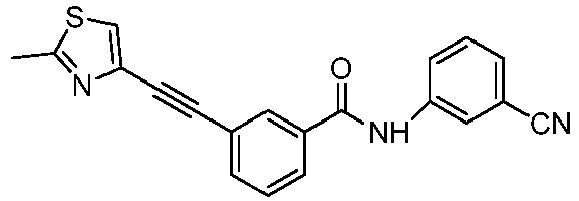
ZD036 2-chloro-N-(4-fluorophenyl)-5-(pyridin-2-ethynyl)benzamide 
ZD037 2-chloro-N-(4-fluorophenyl)-5-((2-methyl thiazol-4-yl)ethynyl)benzamide 
ZD038 2-fluoro-N-(4-fluorophenyl)-5-(pyridin-3-ethynyl)benzamide 
ZD039 2-fluoro-N-(4-fluorophenyl)-5-(pyridin-4-ethynyl)benzamide 
ZD040 N-(4-fluorophenyl)-2-methyl-5-(pyridin-2-ethynyl)benzamide 
ZD041 N-(4-fluorophenyl)-2-methyl-5-((2-methyl thiazol-4-yl)ethynyl)benzamide 
ZD042 2-fluoro-5-(pyridin-2-ethynyl)-N-(pyridin -3-yl)benzamide 
ZD043 2-fluoro-5-((2-methylthiazol-4-ylethynyl)-N-(pyridin-3-yl)benzamide 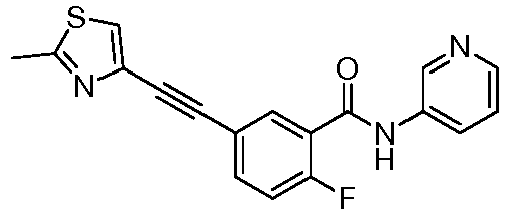
ZD044 N-(4-cyanophenyl)-2-fluoro-5-(pyridin-2-ethynyl)benzamide 
ZD045 N-(4-cyanophenyl)2-fluoro-5-((2-methylthiazol-4-yl)ethynyl)benzamide 
ZD046 (3,4-dihydro-isoquinolin-2(1H)-yl)(2-fluo ro-5-(pyridin-2-ylethynyl)phenyl)methanone 
ZD047 (3,4-dihydro-isoquinolin-2(1H)-yl)(2-fluo ro-5-((2-methyl-thiazol-4-yl)ethynyl)phenyl)methanone 
ZD048 (2-fluoro-5-(pyridin-2-ylethynyl)phenyl)( 1-methyl-3,4-dihydro-isoquinolin-2(1H)-yl)methanone 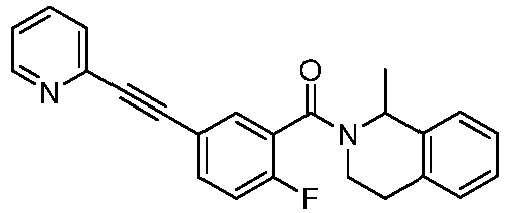
ZD049 (2-fluoro-5-((2-methyl-thiazol-4-yl)ethyn yl)phenyl)(1-methyl-3,4-dihydro-isoquinolin-2(1H)-yl)methanone 
ZD050 2-fluoro-5-((2-methylthiazol-4-ylethynyl)-N-(pyridin-3-yl)nicotinamide 
ZD051 2-fluoro-N-(4-fluorophenyl)-5-(pyridin-2-ylethynyl)nicotinamide 
ZD052 (3,4-dihydro-isoquinolin-2(1H)-yl)(2-fluoro-5-((2-methyl-thiazol-4-yl)ethynyl)pyridin-3-yl)methanone 
ZD053 2-fluoro-N-(4-fluorophenyl)-5-((2-methylthiazol-4-yl)ethynyl)nicotinamide 
ZD054 2-chloro-N-(4-fluorophenyl)-5-((2-methylthiazol-4-yl)ethynyl)nicotinamide 
ZD055 2-fluoro-5-(pyridin-2-ylethynyl)-N-(pyridin-3-yl)nicotinamide 
ZD056 (3,4-dihydro-isoquinolin-2(1H)-yl)(2-fluo ro-5-(pyridin-2-ylethynyl)pyridin-3-yl)methanone 
ZD057 2-fluoro-5-((2-methylthiazol-4-yl)ethynyl) -N-benzoylaniline 
ZD058 2-cyano-5-((2-methylthiazol-4-ylethynyl)-N-(pyridin-3-yl)benzamide 
ZD059 5-((2-methylthiazol-4-ylethynyl)-N-(pyrid in-3-yl)-2-(trifluoromethyl)benzamide 
ZD060 N-(4-fluorophenyl)-5-((2-methylthiazol-4-yl)ethynyl)-2-(trifluoromethyl)benzamide 
ZD061 2-cyano-N-(4-fluorophenyl)-5-((2-methylt hiazol-4-yl)ethynyl)benzamide 
ZD062 4-((2-methylthiazol-4-yl)ethynyl)-2-(1,2,3 ,4-dihydroisoquinolin-2-carbonyl)benzoni trile 
ZD063 (3,4-dihydro-isoquinolin-2(1H)-yl)(5-((2-methyl-thiazol-4-yl)ethynyl)-2-(trifluorom ethyl)phenyl)methanone 
ZD064 2-fluoro-N-(2-fluorophenyl)-5-((2-methylt hiazol-4-yl)ethynyl)benzamide 
ZD065 2-fluoro-N-(3-fluorophenyl)-5-((2-methylt hiazol-4-yl)ethynyl)benzamide 
ZD066 N-(3,4-difluorophenyl)-2-fluoro-5-((2-met hylthiazol-4-yl)ethynyl)benzamide 
ZD067 N-(2,4-difluorophenyl)-2-fluoro-5-((2-met hylthiazol-4-yl)ethynyl)benzamide 
ZD068 N-(4-chlorophenyl)-2-fluoro-5-((2-methyl thiazol-4-yl)ethynyl)benzamide 
ZD069 2-fluoro-5-((2-methylthiazol-4-ylethynyl)-N-(4-(trifluoromethyl)phenyl)benzamide 
ZD070 2-fluoro-N-(4-methoxyphenyl)-5-((2-meth ylthiazol-4-yl)ethynyl)benzamide 
ZD071 2-fluoro-5-((2-methylthiazol-4-ylethynyl)-N-(pyridin-2-yl)benzamide 
ZD072 2-fluoro-5-((2-methylthiazol-4-ylethynyl)-N-(pyridin-4-yl)benzamide 
ZD073 2-fluoro-N-(6-fluoropyridin-3-yl)-5-((2-m ethylthiazol-4-yl)ethynyl)benzamide 
ZD074 N-(6-chloropyridin-3-yl)-2-fluoro-5-((2-m ethylthiazol-4-yl)ethynyl)benzamide 
ZD075 2-fluoro-5-((2-methylthiazol-4-ylethynyl)-N-(p-methylphenyl)benzamide 
ZD076 2-fluoro-N-(pyridin-3-yl)-5-(thiazol-4-ylet hynyl)benzamide 
ZD077 2-fluoro-5-((2-fluorothiazol-4-yl)ethynyl)-N-(pyridin-3-yl)benzamide 
ZD078 5-((2-chlorothiazol-4-ylethynyl)-2-fluoro-N-(pyridin-3-yl)benzamide 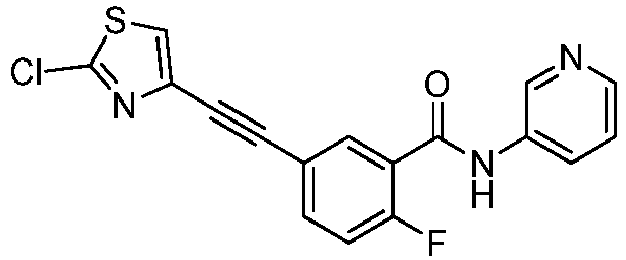
ZD079 2-fluoro-N-(pyridin-3-yl)-5-((2-(trifluoro methyl)thiazol-4-yl)ethynyl)benzamide 
ZD080 2-fluoro-5-((6-methylpyridin-2-yl)ethynyl )-N-(pyridin-3-yl)benzamide 
ZD081 2-fluoro-5-((6-fluoropyridin-2-yl)ethynyl) -N-(pyridin-3-yl)benzamide 
ZD082 5-((6-chloropyridin-2-yl)ethynyl)-2-fluoro -N-(pyridin-3 -yl)benzamide 
ZD083 2-fluoro-N-(pyridin-3-yl)-5-((6-(trifluoro methyl)pyridin-2-yl)ethynyl)benzamide 
ZD084 5-((6-cyanopyridin-2-yl)ethynyl)-2-fluoro -N-(pyridin-3-yl)benzamide 
ZD085 2-fluoro-N-(pyridin-3-yl)-5-(pyrimidin-5-ylethynyl)benzamide 
ZD086 2-fluoro-5-((2-methylpyrimidin-5-yl)ethy nyl)-N-(pyridin-3-yl)benzamide 
ZD087 2-fluoro-N-(4-fluorophenyl)-5-((2-methyl pyrimidin-5-yl)ethynyl)benzamide 
ZD088 (3,4-dihydro-isoquinolin-2(1H)-yl)(2-fluo ro-5-((2-methylpyrimidin-5-yl)ethynyl)phenylmethanone 
ZD089 2-fluoro-5-((2-methyloxazol-4-ylethynyl)-N-(pyridin-3-yl)benzamide 
ZD090 2-fluoro-N-(4-fluorophenyl)-5-((2-methyl oxazol-4-yl)ethynyl)benzamide 
ZD091 (3,4-dihydro-isoquinolin-2(1H)-yl)(2-fluo ro-5-((2-methyloxazol-4-yl)ethynyl)phenyl)methanone 
ZD092 (3,4-dihydro-isoquinolin-2(1H)-yl)(5-((3, 5-dimethylisoxazol-4-yl)ethynyl)-2-fluorophenyl)methanone 
ZD093 5-((3,5-dimethylisoxazol-4-ylethynyl)-2-fluoro-N-(pyridin-3-yl)benzamide 
ZD094 5-((3,5-dimethylisoxazol-4-ylethynyl)-2-fluoro-N-(4-fluorophenyl)benzamide 
- A pharmaceutical composition comprising: (a) a therapeutically effective amount of 5-aromatic alkynyl substituted benzamide compound of formula I, or pharmaceutically acceptable salt, racemate, R-isomer, S-isomer thereof, or the combination thereof; and (ii) a pharmaceutically acceptable carrier.
- A mGluR5 negative allosteric modulator comprising a component selected from the 5-aromatic alkynyl-substituted benzamide compound of above general formula I, pharmaceutically acceptable salt thereof, racemate, R-isomer, S-isomer, or combination thereof.
- The negative allosteric modulator of claim 8, wherein the mGluR5 negative allosteric modulator selectively inhibits mGluR5.
- Use of the compound of formula I in claim 1, or pharmaceutically acceptable salt, racemate, R-isomer, S-isomer thereof, or mixture thereof of claim 1 for preparing medicine for the treatment of disease associated with mGluR5 (metabotropic glutamate receptor subtype 5).
Applications Claiming Priority (2)
| Application Number | Priority Date | Filing Date | Title |
|---|---|---|---|
| CN201510179677.0A CN106146391A (en) | 2015-04-15 | 2015-04-15 | Substituted benzamide compound of 5-fragrance alkynyl and preparation method thereof, pharmaceutical composition and purposes |
| PCT/CN2016/079496 WO2016165658A1 (en) | 2015-04-15 | 2016-04-15 | 5-aromatic alkynyl substituted benzamide compound and preparation method, pharmaceutical composition, and use thereof |
Publications (3)
| Publication Number | Publication Date |
|---|---|
| EP3284738A1 true EP3284738A1 (en) | 2018-02-21 |
| EP3284738A4 EP3284738A4 (en) | 2018-09-12 |
| EP3284738B1 EP3284738B1 (en) | 2020-11-25 |
Family
ID=57125840
Family Applications (1)
| Application Number | Title | Priority Date | Filing Date |
|---|---|---|---|
| EP16779633.3A Active EP3284738B1 (en) | 2015-04-15 | 2016-04-15 | 5-aromatic alkynyl substituted benzamide compound and preparation method, pharmaceutical composition, and use thereof |
Country Status (11)
| Country | Link |
|---|---|
| US (1) | US10618900B2 (en) |
| EP (1) | EP3284738B1 (en) |
| JP (1) | JP6795517B2 (en) |
| KR (1) | KR102117453B1 (en) |
| CN (2) | CN106146391A (en) |
| AU (1) | AU2016248388B2 (en) |
| CA (1) | CA2988861C (en) |
| EA (1) | EA039234B1 (en) |
| ES (1) | ES2864800T3 (en) |
| RU (1) | RU2695371C2 (en) |
| WO (1) | WO2016165658A1 (en) |
Cited By (8)
| Publication number | Priority date | Publication date | Assignee | Title |
|---|---|---|---|---|
| WO2020260871A1 (en) * | 2019-06-24 | 2020-12-30 | Benevolentai Bio Limited | New compounds and methods |
| EP3941908A4 (en) * | 2019-03-22 | 2023-05-17 | Yumanity Therapeutics, Inc. | CONNECTIONS AND USES THEREOF |
| US11873298B2 (en) | 2017-10-24 | 2024-01-16 | Janssen Pharmaceutica Nv | Compounds and uses thereof |
| US11970486B2 (en) | 2016-10-24 | 2024-04-30 | Janssen Pharmaceutica Nv | Compounds and uses thereof |
| US12098146B2 (en) | 2019-01-24 | 2024-09-24 | Janssen Pharmaceutica Nv | Compounds and uses thereof |
| US12180221B2 (en) | 2018-03-23 | 2024-12-31 | Janssen Pharmaceutica Nv | Compounds and uses thereof |
| US12268687B2 (en) | 2019-11-13 | 2025-04-08 | Janssen Pharmaceutica Nv | Compounds and uses thereof |
| US12433880B2 (en) | 2017-01-06 | 2025-10-07 | Janssen Pharmaceutica Nv | Methods for the treatment of neurological disorders |
Families Citing this family (8)
| Publication number | Priority date | Publication date | Assignee | Title |
|---|---|---|---|---|
| CN108456163A (en) * | 2017-02-20 | 2018-08-28 | 中国科学院上海药物研究所 | Compound and its preparation method and application containing adjacent amino heteroaryl cycloalkynyl radical |
| PH12020500600B1 (en) * | 2018-01-26 | 2023-12-06 | Recordati Ind Chimica E Farmaceutica S P A | Triazole, imidazole and pyrrole condensed piperazine derivatives and their use as modulators of mglu5 receptors |
| US12293809B2 (en) | 2019-08-23 | 2025-05-06 | Insilico Medicine Ip Limited | Workflow for generating compounds with biological activity against a specific biological target |
| WO2021038419A1 (en) * | 2019-08-23 | 2021-03-04 | Insilico Medicine Ip Limited | Kinase inhibitors and methods of synthesis and treatment |
| CN116234552B (en) * | 2020-07-29 | 2025-02-25 | (株)倍宝尊 | Dual modulators of mGluR5 and 5-HT2A receptors and their uses |
| CN113861203B (en) * | 2021-11-09 | 2023-08-08 | 安徽大学 | 4-aromatic alkynyl substituted 7H-pyrrolo [2,3-d ] pyrimidine amide compound and preparation method and application thereof |
| WO2023122212A2 (en) * | 2021-12-21 | 2023-06-29 | Southern Research Institute | Substituted phenyl ethynyl pyridine carboxamides as potent inhibitors of sars virus |
| WO2023169453A1 (en) * | 2022-03-11 | 2023-09-14 | 中国科学院上海药物研究所 | Heteroaromatic ring-containing alkynyl compound, and preparation method therefor and use thereof |
Family Cites Families (21)
| Publication number | Priority date | Publication date | Assignee | Title |
|---|---|---|---|---|
| AU5347496A (en) * | 1995-04-21 | 1996-11-07 | Daiichi Pharmaceutical Co., Ltd. | Ethynylthiazole derivative |
| JPH10195063A (en) * | 1996-10-21 | 1998-07-28 | Dai Ichi Seiyaku Co Ltd | Ethynylthiazole derivative |
| TW544448B (en) | 1997-07-11 | 2003-08-01 | Novartis Ag | Pyridine derivatives |
| WO2001016121A1 (en) * | 1999-08-31 | 2001-03-08 | Merck & Co., Inc. | Heterocyclic compounds and methods of use thereof |
| HN2001000008A (en) * | 2000-01-21 | 2003-12-11 | Inc Agouron Pharmaceuticals | AMIDA COMPOSITE AND PHARMACEUTICAL COMPOSITIONS TO INHIBIT PROTEINKINASES, AND THE INSTRUCTIONS FOR USE |
| US20040110802A1 (en) | 2002-08-23 | 2004-06-10 | Atli Thorarensen | Antibacterial benzoic acid derivatives |
| WO2005094882A1 (en) | 2004-03-03 | 2005-10-13 | Millennium Pharmaceuticals, Inc. | Modified antibodies to prostate-specific membrane antigen and uses thereof |
| ES2332184T3 (en) * | 2004-03-22 | 2010-01-28 | ELI LILLY & COMPANY | DERIVATIVES OF PIRIDILO AND ITS USE AS ANTAGONIST OF THE MGLU5 RECEPTOR |
| DE102004044884A1 (en) * | 2004-09-14 | 2006-05-24 | Grünenthal GmbH | Substituted bicyclic imidazo-3-yl-amine compounds |
| US7776869B2 (en) * | 2004-10-18 | 2010-08-17 | Amgen Inc. | Heteroaryl-substituted alkyne compounds and method of use |
| CA2651857A1 (en) * | 2006-05-31 | 2007-12-06 | F. Hoffmann-La Roche Ag | Aryl-4-ethynyl-isoxazole derivatives |
| US8853392B2 (en) * | 2007-06-03 | 2014-10-07 | Vanderbilt University | Benzamide mGluR5 positive allosteric modulators and methods of making and using same |
| NZ581817A (en) * | 2007-06-03 | 2012-05-25 | Univ Vanderbilt | Benzamide mglur5 positive allosteric modulators and methods of making and using same |
| US20090325964A1 (en) * | 2008-05-23 | 2009-12-31 | Wyeth | Piperazine Metabotropic Glutamate Receptor 5 (MGLUR5) Negative Allosteric Modulators For Anxiety/Depression |
| WO2010124047A1 (en) * | 2009-04-23 | 2010-10-28 | Wyeth Llc | Bisaryl alkynylamides as negative allosteric modulators of metabotropic glutamate receptor 5 (mglur5) |
| MX2012013560A (en) | 2010-05-24 | 2013-03-05 | Univ Vanderbilt | Substituted-6-methylnicotinamides as mglur5 positive allosteric modulators. |
| WO2012139027A1 (en) | 2011-04-07 | 2012-10-11 | Ariad Pharmaceuticals, Inc. | Methods and compositions for treating neurodegenerative diseases |
| CA2832465A1 (en) * | 2011-04-07 | 2013-07-04 | Ariad Pharmaceuticals, Inc. | Methods and compositions for treating parkinson's disease |
| RU2477723C2 (en) * | 2011-06-16 | 2013-03-20 | Общество С Ограниченной Ответственностью "Фьюжн Фарма" | Protein kinase inhibitor (versions), use thereof for treating oncological diseases and based pharmaceutical composition |
| WO2013049255A1 (en) * | 2011-09-26 | 2013-04-04 | Vanderbilt University | Substitued 5-(prop-1-yn-1-yl)picolinamide analogs as allosteric modulators of mglur5 receptors |
| WO2013162727A1 (en) * | 2012-04-25 | 2013-10-31 | Ariad Pharmaceuticals, Inc. | Methods and compositions for raf kinase mediated diseases |
-
2015
- 2015-04-15 CN CN201510179677.0A patent/CN106146391A/en active Pending
-
2016
- 2016-04-15 EP EP16779633.3A patent/EP3284738B1/en active Active
- 2016-04-15 KR KR1020177033091A patent/KR102117453B1/en active Active
- 2016-04-15 RU RU2017139564A patent/RU2695371C2/en active
- 2016-04-15 WO PCT/CN2016/079496 patent/WO2016165658A1/en not_active Ceased
- 2016-04-15 JP JP2017554023A patent/JP6795517B2/en active Active
- 2016-04-15 CN CN201680021804.7A patent/CN107531633B/en active Active
- 2016-04-15 US US15/566,418 patent/US10618900B2/en active Active
- 2016-04-15 CA CA2988861A patent/CA2988861C/en active Active
- 2016-04-15 AU AU2016248388A patent/AU2016248388B2/en active Active
- 2016-04-15 ES ES16779633T patent/ES2864800T3/en active Active
- 2016-04-15 EA EA201700504A patent/EA039234B1/en unknown
Cited By (10)
| Publication number | Priority date | Publication date | Assignee | Title |
|---|---|---|---|---|
| US11970486B2 (en) | 2016-10-24 | 2024-04-30 | Janssen Pharmaceutica Nv | Compounds and uses thereof |
| US12433880B2 (en) | 2017-01-06 | 2025-10-07 | Janssen Pharmaceutica Nv | Methods for the treatment of neurological disorders |
| US11873298B2 (en) | 2017-10-24 | 2024-01-16 | Janssen Pharmaceutica Nv | Compounds and uses thereof |
| US12275723B2 (en) | 2017-10-24 | 2025-04-15 | Janssen Pharmaceutica Nv | Compounds and uses thereof |
| US12180221B2 (en) | 2018-03-23 | 2024-12-31 | Janssen Pharmaceutica Nv | Compounds and uses thereof |
| US12098146B2 (en) | 2019-01-24 | 2024-09-24 | Janssen Pharmaceutica Nv | Compounds and uses thereof |
| EP3941908A4 (en) * | 2019-03-22 | 2023-05-17 | Yumanity Therapeutics, Inc. | CONNECTIONS AND USES THEREOF |
| WO2020260871A1 (en) * | 2019-06-24 | 2020-12-30 | Benevolentai Bio Limited | New compounds and methods |
| CN114340734A (en) * | 2019-06-24 | 2022-04-12 | 博善人工智能生物科技有限公司 | New compounds and methods |
| US12268687B2 (en) | 2019-11-13 | 2025-04-08 | Janssen Pharmaceutica Nv | Compounds and uses thereof |
Also Published As
| Publication number | Publication date |
|---|---|
| CN107531633B (en) | 2020-11-06 |
| US10618900B2 (en) | 2020-04-14 |
| KR20170137197A (en) | 2017-12-12 |
| EA039234B1 (en) | 2021-12-21 |
| KR102117453B1 (en) | 2020-06-01 |
| CA2988861A1 (en) | 2016-10-20 |
| WO2016165658A1 (en) | 2016-10-20 |
| RU2695371C2 (en) | 2019-07-23 |
| CA2988861C (en) | 2021-09-28 |
| CN106146391A (en) | 2016-11-23 |
| EP3284738B1 (en) | 2020-11-25 |
| RU2017139564A3 (en) | 2019-05-15 |
| EP3284738A4 (en) | 2018-09-12 |
| JP6795517B2 (en) | 2020-12-02 |
| AU2016248388B2 (en) | 2019-06-06 |
| US20180194767A1 (en) | 2018-07-12 |
| JP2018514524A (en) | 2018-06-07 |
| RU2017139564A (en) | 2019-05-15 |
| AU2016248388A1 (en) | 2017-12-07 |
| CN107531633A (en) | 2018-01-02 |
| ES2864800T3 (en) | 2021-10-14 |
| EA201700504A1 (en) | 2018-10-31 |
Similar Documents
| Publication | Publication Date | Title |
|---|---|---|
| EP3284738B1 (en) | 5-aromatic alkynyl substituted benzamide compound and preparation method, pharmaceutical composition, and use thereof | |
| JP6266568B2 (en) | Pyrazole derivative modulators of calcium release-dependent calcium channels and methods of treating non-small cell lung cancer | |
| US20250376473A1 (en) | Prmts inhibitor and use thereof | |
| EP3459948B1 (en) | Fluorine-containing triazolopyridine, and manufacturing method, pharmaceutical composition, and application thereof | |
| JPWO2008105442A1 (en) | Sulfonamide derivatives | |
| JP2011526295A (en) | 5- and 6-membered heterocyclic compounds | |
| EP3612527B1 (en) | Heterocyclic compounds useful as modulators of acetylcholine receptors | |
| CN104995182A (en) | Substituted quinoxaline derivatives and their use as positive allosteric modulators of mglur4 | |
| TW201643143A (en) | Compound for inhibiting neuronal cell death induced by oxidative stress | |
| KR20130122531A (en) | Substituted 6-methylnicotinamides as mglur5 positive allosteric modulators | |
| EA037876B1 (en) | Substituted amino six-membered nitric heterocyclic ring compound, preparation and use thereof | |
| US9018231B2 (en) | Sulfone compounds as 5-HT6 receptor ligands | |
| HK1243066B (en) | 5-aromatic alkynyl substituted benzamide compound and preparation method, pharmaceutical composition, and use thereof | |
| HK1243066A1 (en) | 5-aromatic alkynyl substituted benzamide compound and preparation method, pharmaceutical composition, and use thereof | |
| CN121752269A (en) | Small molecule inhibitors of ribosomal biosynthesis factor NVL2 |
Legal Events
| Date | Code | Title | Description |
|---|---|---|---|
| STAA | Information on the status of an ep patent application or granted ep patent |
Free format text: STATUS: THE INTERNATIONAL PUBLICATION HAS BEEN MADE |
|
| PUAI | Public reference made under article 153(3) epc to a published international application that has entered the european phase |
Free format text: ORIGINAL CODE: 0009012 |
|
| STAA | Information on the status of an ep patent application or granted ep patent |
Free format text: STATUS: REQUEST FOR EXAMINATION WAS MADE |
|
| 17P | Request for examination filed |
Effective date: 20171114 |
|
| AK | Designated contracting states |
Kind code of ref document: A1 Designated state(s): AL AT BE BG CH CY CZ DE DK EE ES FI FR GB GR HR HU IE IS IT LI LT LU LV MC MK MT NL NO PL PT RO RS SE SI SK SM TR |
|
| AX | Request for extension of the european patent |
Extension state: BA ME |
|
| DAV | Request for validation of the european patent (deleted) | ||
| DAX | Request for extension of the european patent (deleted) | ||
| A4 | Supplementary search report drawn up and despatched |
Effective date: 20180814 |
|
| RIC1 | Information provided on ipc code assigned before grant |
Ipc: C07D 417/06 20060101ALI20180807BHEP Ipc: C07D 213/56 20060101AFI20180807BHEP Ipc: C07D 213/75 20060101ALI20180807BHEP Ipc: C07D 239/26 20060101ALI20180807BHEP Ipc: C07D 417/10 20060101ALI20180807BHEP Ipc: C07D 401/12 20060101ALI20180807BHEP Ipc: C07D 213/82 20060101ALI20180807BHEP Ipc: C07D 277/30 20060101ALI20180807BHEP Ipc: C07D 401/10 20060101ALI20180807BHEP Ipc: C07D 417/14 20060101ALI20180807BHEP Ipc: C07D 417/12 20060101ALI20180807BHEP Ipc: C07D 277/32 20060101ALI20180807BHEP |
|
| STAA | Information on the status of an ep patent application or granted ep patent |
Free format text: STATUS: EXAMINATION IS IN PROGRESS |
|
| 17Q | First examination report despatched |
Effective date: 20190701 |
|
| GRAP | Despatch of communication of intention to grant a patent |
Free format text: ORIGINAL CODE: EPIDOSNIGR1 |
|
| STAA | Information on the status of an ep patent application or granted ep patent |
Free format text: STATUS: GRANT OF PATENT IS INTENDED |
|
| INTG | Intention to grant announced |
Effective date: 20200604 |
|
| GRAS | Grant fee paid |
Free format text: ORIGINAL CODE: EPIDOSNIGR3 |
|
| GRAA | (expected) grant |
Free format text: ORIGINAL CODE: 0009210 |
|
| STAA | Information on the status of an ep patent application or granted ep patent |
Free format text: STATUS: THE PATENT HAS BEEN GRANTED |
|
| AK | Designated contracting states |
Kind code of ref document: B1 Designated state(s): AL AT BE BG CH CY CZ DE DK EE ES FI FR GB GR HR HU IE IS IT LI LT LU LV MC MK MT NL NO PL PT RO RS SE SI SK SM TR |
|
| REG | Reference to a national code |
Ref country code: GB Ref legal event code: FG4D |
|
| REG | Reference to a national code |
Ref country code: CH Ref legal event code: EP |
|
| REG | Reference to a national code |
Ref country code: AT Ref legal event code: REF Ref document number: 1338133 Country of ref document: AT Kind code of ref document: T Effective date: 20201215 |
|
| REG | Reference to a national code |
Ref country code: DE Ref legal event code: R096 Ref document number: 602016048634 Country of ref document: DE |
|
| REG | Reference to a national code |
Ref country code: IE Ref legal event code: FG4D |
|
| REG | Reference to a national code |
Ref country code: FI Ref legal event code: FGE |
|
| REG | Reference to a national code |
Ref country code: CH Ref legal event code: NV Representative=s name: SCHMAUDER AND PARTNER AG PATENT- UND MARKENANW, CH |
|
| REG | Reference to a national code |
Ref country code: AT Ref legal event code: MK05 Ref document number: 1338133 Country of ref document: AT Kind code of ref document: T Effective date: 20201125 |
|
| REG | Reference to a national code |
Ref country code: NL Ref legal event code: MP Effective date: 20201125 |
|
| PG25 | Lapsed in a contracting state [announced via postgrant information from national office to epo] |
Ref country code: GR Free format text: LAPSE BECAUSE OF FAILURE TO SUBMIT A TRANSLATION OF THE DESCRIPTION OR TO PAY THE FEE WITHIN THE PRESCRIBED TIME-LIMIT Effective date: 20210226 Ref country code: NO Free format text: LAPSE BECAUSE OF FAILURE TO SUBMIT A TRANSLATION OF THE DESCRIPTION OR TO PAY THE FEE WITHIN THE PRESCRIBED TIME-LIMIT Effective date: 20210225 Ref country code: RS Free format text: LAPSE BECAUSE OF FAILURE TO SUBMIT A TRANSLATION OF THE DESCRIPTION OR TO PAY THE FEE WITHIN THE PRESCRIBED TIME-LIMIT Effective date: 20201125 Ref country code: PT Free format text: LAPSE BECAUSE OF FAILURE TO SUBMIT A TRANSLATION OF THE DESCRIPTION OR TO PAY THE FEE WITHIN THE PRESCRIBED TIME-LIMIT Effective date: 20210325 |
|
| PG25 | Lapsed in a contracting state [announced via postgrant information from national office to epo] |
Ref country code: SE Free format text: LAPSE BECAUSE OF FAILURE TO SUBMIT A TRANSLATION OF THE DESCRIPTION OR TO PAY THE FEE WITHIN THE PRESCRIBED TIME-LIMIT Effective date: 20201125 Ref country code: AT Free format text: LAPSE BECAUSE OF FAILURE TO SUBMIT A TRANSLATION OF THE DESCRIPTION OR TO PAY THE FEE WITHIN THE PRESCRIBED TIME-LIMIT Effective date: 20201125 Ref country code: BG Free format text: LAPSE BECAUSE OF FAILURE TO SUBMIT A TRANSLATION OF THE DESCRIPTION OR TO PAY THE FEE WITHIN THE PRESCRIBED TIME-LIMIT Effective date: 20210225 Ref country code: IS Free format text: LAPSE BECAUSE OF FAILURE TO SUBMIT A TRANSLATION OF THE DESCRIPTION OR TO PAY THE FEE WITHIN THE PRESCRIBED TIME-LIMIT Effective date: 20210325 Ref country code: PL Free format text: LAPSE BECAUSE OF FAILURE TO SUBMIT A TRANSLATION OF THE DESCRIPTION OR TO PAY THE FEE WITHIN THE PRESCRIBED TIME-LIMIT Effective date: 20201125 Ref country code: LV Free format text: LAPSE BECAUSE OF FAILURE TO SUBMIT A TRANSLATION OF THE DESCRIPTION OR TO PAY THE FEE WITHIN THE PRESCRIBED TIME-LIMIT Effective date: 20201125 |
|
| REG | Reference to a national code |
Ref country code: LT Ref legal event code: MG9D |
|
| PG25 | Lapsed in a contracting state [announced via postgrant information from national office to epo] |
Ref country code: HR Free format text: LAPSE BECAUSE OF FAILURE TO SUBMIT A TRANSLATION OF THE DESCRIPTION OR TO PAY THE FEE WITHIN THE PRESCRIBED TIME-LIMIT Effective date: 20201125 |
|
| PG25 | Lapsed in a contracting state [announced via postgrant information from national office to epo] |
Ref country code: LT Free format text: LAPSE BECAUSE OF FAILURE TO SUBMIT A TRANSLATION OF THE DESCRIPTION OR TO PAY THE FEE WITHIN THE PRESCRIBED TIME-LIMIT Effective date: 20201125 Ref country code: SM Free format text: LAPSE BECAUSE OF FAILURE TO SUBMIT A TRANSLATION OF THE DESCRIPTION OR TO PAY THE FEE WITHIN THE PRESCRIBED TIME-LIMIT Effective date: 20201125 Ref country code: EE Free format text: LAPSE BECAUSE OF FAILURE TO SUBMIT A TRANSLATION OF THE DESCRIPTION OR TO PAY THE FEE WITHIN THE PRESCRIBED TIME-LIMIT Effective date: 20201125 Ref country code: CZ Free format text: LAPSE BECAUSE OF FAILURE TO SUBMIT A TRANSLATION OF THE DESCRIPTION OR TO PAY THE FEE WITHIN THE PRESCRIBED TIME-LIMIT Effective date: 20201125 Ref country code: RO Free format text: LAPSE BECAUSE OF FAILURE TO SUBMIT A TRANSLATION OF THE DESCRIPTION OR TO PAY THE FEE WITHIN THE PRESCRIBED TIME-LIMIT Effective date: 20201125 Ref country code: SK Free format text: LAPSE BECAUSE OF FAILURE TO SUBMIT A TRANSLATION OF THE DESCRIPTION OR TO PAY THE FEE WITHIN THE PRESCRIBED TIME-LIMIT Effective date: 20201125 |
|
| REG | Reference to a national code |
Ref country code: DE Ref legal event code: R097 Ref document number: 602016048634 Country of ref document: DE |
|
| PG25 | Lapsed in a contracting state [announced via postgrant information from national office to epo] |
Ref country code: DK Free format text: LAPSE BECAUSE OF FAILURE TO SUBMIT A TRANSLATION OF THE DESCRIPTION OR TO PAY THE FEE WITHIN THE PRESCRIBED TIME-LIMIT Effective date: 20201125 |
|
| PLBE | No opposition filed within time limit |
Free format text: ORIGINAL CODE: 0009261 |
|
| STAA | Information on the status of an ep patent application or granted ep patent |
Free format text: STATUS: NO OPPOSITION FILED WITHIN TIME LIMIT |
|
| REG | Reference to a national code |
Ref country code: ES Ref legal event code: FG2A Ref document number: 2864800 Country of ref document: ES Kind code of ref document: T3 Effective date: 20211014 |
|
| PG25 | Lapsed in a contracting state [announced via postgrant information from national office to epo] |
Ref country code: AL Free format text: LAPSE BECAUSE OF FAILURE TO SUBMIT A TRANSLATION OF THE DESCRIPTION OR TO PAY THE FEE WITHIN THE PRESCRIBED TIME-LIMIT Effective date: 20201125 Ref country code: NL Free format text: LAPSE BECAUSE OF FAILURE TO SUBMIT A TRANSLATION OF THE DESCRIPTION OR TO PAY THE FEE WITHIN THE PRESCRIBED TIME-LIMIT Effective date: 20201125 |
|
| 26N | No opposition filed |
Effective date: 20210826 |
|
| PG25 | Lapsed in a contracting state [announced via postgrant information from national office to epo] |
Ref country code: MC Free format text: LAPSE BECAUSE OF FAILURE TO SUBMIT A TRANSLATION OF THE DESCRIPTION OR TO PAY THE FEE WITHIN THE PRESCRIBED TIME-LIMIT Effective date: 20201125 Ref country code: SI Free format text: LAPSE BECAUSE OF FAILURE TO SUBMIT A TRANSLATION OF THE DESCRIPTION OR TO PAY THE FEE WITHIN THE PRESCRIBED TIME-LIMIT Effective date: 20201125 |
|
| PG25 | Lapsed in a contracting state [announced via postgrant information from national office to epo] |
Ref country code: LU Free format text: LAPSE BECAUSE OF NON-PAYMENT OF DUE FEES Effective date: 20210415 |
|
| PG25 | Lapsed in a contracting state [announced via postgrant information from national office to epo] |
Ref country code: IE Free format text: LAPSE BECAUSE OF NON-PAYMENT OF DUE FEES Effective date: 20210415 |
|
| PG25 | Lapsed in a contracting state [announced via postgrant information from national office to epo] |
Ref country code: IS Free format text: LAPSE BECAUSE OF FAILURE TO SUBMIT A TRANSLATION OF THE DESCRIPTION OR TO PAY THE FEE WITHIN THE PRESCRIBED TIME-LIMIT Effective date: 20210325 |
|
| PG25 | Lapsed in a contracting state [announced via postgrant information from national office to epo] |
Ref country code: HU Free format text: LAPSE BECAUSE OF FAILURE TO SUBMIT A TRANSLATION OF THE DESCRIPTION OR TO PAY THE FEE WITHIN THE PRESCRIBED TIME-LIMIT; INVALID AB INITIO Effective date: 20160415 |
|
| P01 | Opt-out of the competence of the unified patent court (upc) registered |
Effective date: 20230517 |
|
| PG25 | Lapsed in a contracting state [announced via postgrant information from national office to epo] |
Ref country code: CY Free format text: LAPSE BECAUSE OF FAILURE TO SUBMIT A TRANSLATION OF THE DESCRIPTION OR TO PAY THE FEE WITHIN THE PRESCRIBED TIME-LIMIT Effective date: 20201125 |
|
| PG25 | Lapsed in a contracting state [announced via postgrant information from national office to epo] |
Ref country code: MK Free format text: LAPSE BECAUSE OF FAILURE TO SUBMIT A TRANSLATION OF THE DESCRIPTION OR TO PAY THE FEE WITHIN THE PRESCRIBED TIME-LIMIT Effective date: 20201125 |
|
| PG25 | Lapsed in a contracting state [announced via postgrant information from national office to epo] |
Ref country code: TR Free format text: LAPSE BECAUSE OF FAILURE TO SUBMIT A TRANSLATION OF THE DESCRIPTION OR TO PAY THE FEE WITHIN THE PRESCRIBED TIME-LIMIT Effective date: 20201125 |
|
| PG25 | Lapsed in a contracting state [announced via postgrant information from national office to epo] |
Ref country code: MT Free format text: LAPSE BECAUSE OF FAILURE TO SUBMIT A TRANSLATION OF THE DESCRIPTION OR TO PAY THE FEE WITHIN THE PRESCRIBED TIME-LIMIT Effective date: 20201125 |
|
| PGFP | Annual fee paid to national office [announced via postgrant information from national office to epo] |
Ref country code: FI Payment date: 20250424 Year of fee payment: 10 |
|
| PGFP | Annual fee paid to national office [announced via postgrant information from national office to epo] |
Ref country code: DE Payment date: 20250422 Year of fee payment: 10 |
|
| PGFP | Annual fee paid to national office [announced via postgrant information from national office to epo] |
Ref country code: GB Payment date: 20250423 Year of fee payment: 10 Ref country code: ES Payment date: 20250530 Year of fee payment: 10 |
|
| PGFP | Annual fee paid to national office [announced via postgrant information from national office to epo] |
Ref country code: IT Payment date: 20250424 Year of fee payment: 10 Ref country code: BE Payment date: 20250418 Year of fee payment: 10 |
|
| PGFP | Annual fee paid to national office [announced via postgrant information from national office to epo] |
Ref country code: FR Payment date: 20250425 Year of fee payment: 10 |
|
| PGFP | Annual fee paid to national office [announced via postgrant information from national office to epo] |
Ref country code: CH Payment date: 20250501 Year of fee payment: 10 |
|
| REG | Reference to a national code |
Ref country code: CH Ref legal event code: U11 Free format text: ST27 STATUS EVENT CODE: U-0-0-U10-U11 (AS PROVIDED BY THE NATIONAL OFFICE) Effective date: 20260501 |