EP3282812A1 - Heating element for a volatile liquid emanation device - Google Patents
Heating element for a volatile liquid emanation device Download PDFInfo
- Publication number
- EP3282812A1 EP3282812A1 EP16183452.8A EP16183452A EP3282812A1 EP 3282812 A1 EP3282812 A1 EP 3282812A1 EP 16183452 A EP16183452 A EP 16183452A EP 3282812 A1 EP3282812 A1 EP 3282812A1
- Authority
- EP
- European Patent Office
- Prior art keywords
- heater
- heating element
- conductive terminals
- resistive heater
- oil
- Prior art date
- Legal status (The legal status is an assumption and is not a legal conclusion. Google has not performed a legal analysis and makes no representation as to the accuracy of the status listed.)
- Withdrawn
Links
- 238000010438 heat treatment Methods 0.000 title claims abstract description 50
- 239000007788 liquid Substances 0.000 title claims abstract description 9
- 239000000463 material Substances 0.000 claims description 62
- 239000012212 insulator Substances 0.000 claims description 3
- 239000000203 mixture Substances 0.000 description 26
- 239000003921 oil Substances 0.000 description 23
- 235000019198 oils Nutrition 0.000 description 23
- -1 polybutylene terephthalate Polymers 0.000 description 21
- 239000003205 fragrance Substances 0.000 description 19
- 239000002917 insecticide Substances 0.000 description 7
- 239000004033 plastic Substances 0.000 description 7
- 239000002904 solvent Substances 0.000 description 7
- 238000000576 coating method Methods 0.000 description 6
- 229920003023 plastic Polymers 0.000 description 6
- 239000011248 coating agent Substances 0.000 description 5
- GLZPCOQZEFWAFX-UHFFFAOYSA-N Geraniol Chemical compound CC(C)=CCCC(C)=CCO GLZPCOQZEFWAFX-UHFFFAOYSA-N 0.000 description 4
- 238000010276 construction Methods 0.000 description 4
- 239000002184 metal Substances 0.000 description 4
- 229910052751 metal Inorganic materials 0.000 description 4
- VAMXMNNIEUEQDV-UHFFFAOYSA-N methyl anthranilate Chemical compound COC(=O)C1=CC=CC=C1N VAMXMNNIEUEQDV-UHFFFAOYSA-N 0.000 description 4
- CSCPPACGZOOCGX-UHFFFAOYSA-N Acetone Chemical compound CC(C)=O CSCPPACGZOOCGX-UHFFFAOYSA-N 0.000 description 3
- LFQSCWFLJHTTHZ-UHFFFAOYSA-N Ethanol Chemical compound CCO LFQSCWFLJHTTHZ-UHFFFAOYSA-N 0.000 description 3
- XEKOWRVHYACXOJ-UHFFFAOYSA-N Ethyl acetate Chemical compound CCOC(C)=O XEKOWRVHYACXOJ-UHFFFAOYSA-N 0.000 description 3
- 150000001299 aldehydes Chemical class 0.000 description 3
- 238000004891 communication Methods 0.000 description 3
- NYPJDWWKZLNGGM-UHFFFAOYSA-N fenvalerate Aalpha Natural products C=1C=C(Cl)C=CC=1C(C(C)C)C(=O)OC(C#N)C(C=1)=CC=CC=1OC1=CC=CC=C1 NYPJDWWKZLNGGM-UHFFFAOYSA-N 0.000 description 3
- 239000002991 molded plastic Substances 0.000 description 3
- 230000008447 perception Effects 0.000 description 3
- 239000000126 substance Substances 0.000 description 3
- 238000005382 thermal cycling Methods 0.000 description 3
- OOCCDEMITAIZTP-QPJJXVBHSA-N (E)-cinnamyl alcohol Chemical compound OC\C=C\C1=CC=CC=C1 OOCCDEMITAIZTP-QPJJXVBHSA-N 0.000 description 2
- GNKZMNRKLCTJAY-UHFFFAOYSA-N 4'-Methylacetophenone Chemical compound CC(=O)C1=CC=C(C)C=C1 GNKZMNRKLCTJAY-UHFFFAOYSA-N 0.000 description 2
- KWOLFJPFCHCOCG-UHFFFAOYSA-N Acetophenone Chemical compound CC(=O)C1=CC=CC=C1 KWOLFJPFCHCOCG-UHFFFAOYSA-N 0.000 description 2
- ZTQSAGDEMFDKMZ-UHFFFAOYSA-N Butyraldehyde Chemical compound CCCC=O ZTQSAGDEMFDKMZ-UHFFFAOYSA-N 0.000 description 2
- 235000002566 Capsicum Nutrition 0.000 description 2
- DZNVIZQPWLDQHI-UHFFFAOYSA-N Citronellyl formate Chemical compound O=COCCC(C)CCC=C(C)C DZNVIZQPWLDQHI-UHFFFAOYSA-N 0.000 description 2
- 206010011906 Death Diseases 0.000 description 2
- 241000402754 Erythranthe moschata Species 0.000 description 2
- FHUODBDRWMIBQP-UHFFFAOYSA-N Ethyl p-anisate Chemical compound CCOC(=O)C1=CC=C(OC)C=C1 FHUODBDRWMIBQP-UHFFFAOYSA-N 0.000 description 2
- XINCECQTMHSORG-UHFFFAOYSA-N Isoamyl isovalerate Chemical compound CC(C)CCOC(=O)CC(C)C XINCECQTMHSORG-UHFFFAOYSA-N 0.000 description 2
- KFZMGEQAYNKOFK-UHFFFAOYSA-N Isopropanol Chemical compound CC(C)O KFZMGEQAYNKOFK-UHFFFAOYSA-N 0.000 description 2
- PXHVJJICTQNCMI-UHFFFAOYSA-N Nickel Chemical compound [Ni] PXHVJJICTQNCMI-UHFFFAOYSA-N 0.000 description 2
- ZYEMGPIYFIJGTP-UHFFFAOYSA-N O-methyleugenol Chemical compound COC1=CC=C(CC=C)C=C1OC ZYEMGPIYFIJGTP-UHFFFAOYSA-N 0.000 description 2
- 239000004743 Polypropylene Substances 0.000 description 2
- 244000028419 Styrax benzoin Species 0.000 description 2
- 235000000126 Styrax benzoin Nutrition 0.000 description 2
- ATJFFYVFTNAWJD-UHFFFAOYSA-N Tin Chemical compound [Sn] ATJFFYVFTNAWJD-UHFFFAOYSA-N 0.000 description 2
- 229940022663 acetate Drugs 0.000 description 2
- IGODOXYLBBXFDW-UHFFFAOYSA-N alpha-Terpinyl acetate Chemical compound CC(=O)OC(C)(C)C1CCC(C)=CC1 IGODOXYLBBXFDW-UHFFFAOYSA-N 0.000 description 2
- 229910002113 barium titanate Inorganic materials 0.000 description 2
- HUMNYLRZRPPJDN-UHFFFAOYSA-N benzaldehyde Chemical compound O=CC1=CC=CC=C1 HUMNYLRZRPPJDN-UHFFFAOYSA-N 0.000 description 2
- ISAOCJYIOMOJEB-UHFFFAOYSA-N benzoin Chemical compound C=1C=CC=CC=1C(O)C(=O)C1=CC=CC=C1 ISAOCJYIOMOJEB-UHFFFAOYSA-N 0.000 description 2
- QUKGYYKBILRGFE-UHFFFAOYSA-N benzyl acetate Chemical compound CC(=O)OCC1=CC=CC=C1 QUKGYYKBILRGFE-UHFFFAOYSA-N 0.000 description 2
- SESFRYSPDFLNCH-UHFFFAOYSA-N benzyl benzoate Chemical compound C=1C=CC=CC=1C(=O)OCC1=CC=CC=C1 SESFRYSPDFLNCH-UHFFFAOYSA-N 0.000 description 2
- 230000004397 blinking Effects 0.000 description 2
- XUPYJHCZDLZNFP-UHFFFAOYSA-N butyl butanoate Chemical compound CCCCOC(=O)CCC XUPYJHCZDLZNFP-UHFFFAOYSA-N 0.000 description 2
- 239000000969 carrier Substances 0.000 description 2
- ULDHMXUKGWMISQ-UHFFFAOYSA-N carvone Chemical compound CC(=C)C1CC=C(C)C(=O)C1 ULDHMXUKGWMISQ-UHFFFAOYSA-N 0.000 description 2
- HQKQRXZEXPXXIG-VJOHVRBBSA-N chembl2333940 Chemical compound C1[C@]23[C@H](C)CC[C@H]3C(C)(C)[C@H]1[C@@](OC(C)=O)(C)CC2 HQKQRXZEXPXXIG-VJOHVRBBSA-N 0.000 description 2
- NEHNMFOYXAPHSD-UHFFFAOYSA-N citronellal Chemical compound O=CCC(C)CCC=C(C)C NEHNMFOYXAPHSD-UHFFFAOYSA-N 0.000 description 2
- QMVPMAAFGQKVCJ-UHFFFAOYSA-N citronellol Chemical compound OCCC(C)CCC=C(C)C QMVPMAAFGQKVCJ-UHFFFAOYSA-N 0.000 description 2
- JOZKFWLRHCDGJA-UHFFFAOYSA-N citronellol acetate Chemical compound CC(=O)OCCC(C)CCC=C(C)C JOZKFWLRHCDGJA-UHFFFAOYSA-N 0.000 description 2
- 150000001875 compounds Chemical class 0.000 description 2
- 238000001816 cooling Methods 0.000 description 2
- WTWBUQJHJGUZCY-UHFFFAOYSA-N cuminaldehyde Chemical compound CC(C)C1=CC=C(C=O)C=C1 WTWBUQJHJGUZCY-UHFFFAOYSA-N 0.000 description 2
- 230000001351 cycling effect Effects 0.000 description 2
- KSMVZQYAVGTKIV-UHFFFAOYSA-N decanal Chemical compound CCCCCCCCCC=O KSMVZQYAVGTKIV-UHFFFAOYSA-N 0.000 description 2
- 238000013461 design Methods 0.000 description 2
- 238000011161 development Methods 0.000 description 2
- LQZZUXJYWNFBMV-UHFFFAOYSA-N dodecan-1-ol Chemical compound CCCCCCCCCCCCO LQZZUXJYWNFBMV-UHFFFAOYSA-N 0.000 description 2
- 150000002148 esters Chemical class 0.000 description 2
- 235000019441 ethanol Nutrition 0.000 description 2
- MTZQAGJQAFMTAQ-UHFFFAOYSA-N ethyl benzoate Chemical compound CCOC(=O)C1=CC=CC=C1 MTZQAGJQAFMTAQ-UHFFFAOYSA-N 0.000 description 2
- SHZIWNPUGXLXDT-UHFFFAOYSA-N ethyl hexanoate Chemical compound CCCCCC(=O)OCC SHZIWNPUGXLXDT-UHFFFAOYSA-N 0.000 description 2
- MMKRHZKQPFCLLS-UHFFFAOYSA-N ethyl myristate Chemical compound CCCCCCCCCCCCCC(=O)OCC MMKRHZKQPFCLLS-UHFFFAOYSA-N 0.000 description 2
- CBOQJANXLMLOSS-UHFFFAOYSA-N ethyl vanillin Chemical group CCOC1=CC(C=O)=CC=C1O CBOQJANXLMLOSS-UHFFFAOYSA-N 0.000 description 2
- 239000010642 eucalyptus oil Substances 0.000 description 2
- 229940044949 eucalyptus oil Drugs 0.000 description 2
- 238000001704 evaporation Methods 0.000 description 2
- 230000008020 evaporation Effects 0.000 description 2
- 239000011521 glass Substances 0.000 description 2
- FXHGMKSSBGDXIY-UHFFFAOYSA-N heptanal Chemical compound CCCCCCC=O FXHGMKSSBGDXIY-UHFFFAOYSA-N 0.000 description 2
- JARKCYVAAOWBJS-UHFFFAOYSA-N hexanal Chemical compound CCCCCC=O JARKCYVAAOWBJS-UHFFFAOYSA-N 0.000 description 2
- 229930195733 hydrocarbon Natural products 0.000 description 2
- 150000002430 hydrocarbons Chemical class 0.000 description 2
- 238000002347 injection Methods 0.000 description 2
- 239000007924 injection Substances 0.000 description 2
- MLFHJEHSLIIPHL-UHFFFAOYSA-N isoamyl acetate Chemical compound CC(C)CCOC(C)=O MLFHJEHSLIIPHL-UHFFFAOYSA-N 0.000 description 2
- 150000002576 ketones Chemical class 0.000 description 2
- XMGQYMWWDOXHJM-UHFFFAOYSA-N limonene Chemical compound CC(=C)C1CCC(C)=CC1 XMGQYMWWDOXHJM-UHFFFAOYSA-N 0.000 description 2
- CDOSHBSSFJOMGT-UHFFFAOYSA-N linalool Chemical compound CC(C)=CCCC(C)(O)C=C CDOSHBSSFJOMGT-UHFFFAOYSA-N 0.000 description 2
- UWKAYLJWKGQEPM-LBPRGKRZSA-N linalyl acetate Chemical compound CC(C)=CCC[C@](C)(C=C)OC(C)=O UWKAYLJWKGQEPM-LBPRGKRZSA-N 0.000 description 2
- 239000011344 liquid material Substances 0.000 description 2
- 238000005259 measurement Methods 0.000 description 2
- 229940102398 methyl anthranilate Drugs 0.000 description 2
- KVWWIYGFBYDJQC-UHFFFAOYSA-N methyl dihydrojasmonate Chemical compound CCCCCC1C(CC(=O)OC)CCC1=O KVWWIYGFBYDJQC-UHFFFAOYSA-N 0.000 description 2
- TZIHFWKZFHZASV-UHFFFAOYSA-N methyl formate Chemical compound COC=O TZIHFWKZFHZASV-UHFFFAOYSA-N 0.000 description 2
- UQDUPQYQJKYHQI-UHFFFAOYSA-N methyl laurate Chemical compound CCCCCCCCCCCC(=O)OC UQDUPQYQJKYHQI-UHFFFAOYSA-N 0.000 description 2
- OSWPMRLSEDHDFF-UHFFFAOYSA-N methyl salicylate Chemical compound COC(=O)C1=CC=CC=C1O OSWPMRLSEDHDFF-UHFFFAOYSA-N 0.000 description 2
- ZAZKJZBWRNNLDS-UHFFFAOYSA-N methyl tetradecanoate Chemical compound CCCCCCCCCCCCCC(=O)OC ZAZKJZBWRNNLDS-UHFFFAOYSA-N 0.000 description 2
- 239000003595 mist Substances 0.000 description 2
- YLYBTZIQSIBWLI-UHFFFAOYSA-N octyl acetate Chemical compound CCCCCCCCOC(C)=O YLYBTZIQSIBWLI-UHFFFAOYSA-N 0.000 description 2
- ZRSNZINYAWTAHE-UHFFFAOYSA-N p-methoxybenzaldehyde Chemical compound COC1=CC=C(C=O)C=C1 ZRSNZINYAWTAHE-UHFFFAOYSA-N 0.000 description 2
- TZMFJUDUGYTVRY-UHFFFAOYSA-N pentane-2,3-dione Chemical group CCC(=O)C(C)=O TZMFJUDUGYTVRY-UHFFFAOYSA-N 0.000 description 2
- 239000002304 perfume Substances 0.000 description 2
- 229920001707 polybutylene terephthalate Polymers 0.000 description 2
- 229920000139 polyethylene terephthalate Polymers 0.000 description 2
- 239000005020 polyethylene terephthalate Substances 0.000 description 2
- 229920001155 polypropylene Polymers 0.000 description 2
- 239000010666 rose oil Substances 0.000 description 2
- 235000019719 rose oil Nutrition 0.000 description 2
- 229910000679 solder Inorganic materials 0.000 description 2
- 238000005476 soldering Methods 0.000 description 2
- 239000007787 solid Substances 0.000 description 2
- 239000000725 suspension Substances 0.000 description 2
- 229910052718 tin Inorganic materials 0.000 description 2
- 239000011135 tin Substances 0.000 description 2
- RUVINXPYWBROJD-ONEGZZNKSA-N trans-anethole Chemical compound COC1=CC=C(\C=C\C)C=C1 RUVINXPYWBROJD-ONEGZZNKSA-N 0.000 description 2
- 238000012546 transfer Methods 0.000 description 2
- 230000008016 vaporization Effects 0.000 description 2
- 235000015112 vegetable and seed oil Nutrition 0.000 description 2
- NOOLISFMXDJSKH-UTLUCORTSA-N (+)-Neomenthol Chemical compound CC(C)[C@@H]1CC[C@@H](C)C[C@@H]1O NOOLISFMXDJSKH-UTLUCORTSA-N 0.000 description 1
- DTGKSKDOIYIVQL-WEDXCCLWSA-N (+)-borneol Chemical compound C1C[C@@]2(C)[C@@H](O)C[C@@H]1C2(C)C DTGKSKDOIYIVQL-WEDXCCLWSA-N 0.000 description 1
- NFLGAXVYCFJBMK-RKDXNWHRSA-N (+)-isomenthone Natural products CC(C)[C@H]1CC[C@@H](C)CC1=O NFLGAXVYCFJBMK-RKDXNWHRSA-N 0.000 description 1
- ZCVAOQKBXKSDMS-AQYZNVCMSA-N (+)-trans-allethrin Chemical compound CC1(C)[C@H](C=C(C)C)[C@H]1C(=O)OC1C(C)=C(CC=C)C(=O)C1 ZCVAOQKBXKSDMS-AQYZNVCMSA-N 0.000 description 1
- REPVLJRCJUVQFA-UHFFFAOYSA-N (-)-isopinocampheol Natural products C1C(O)C(C)C2C(C)(C)C1C2 REPVLJRCJUVQFA-UHFFFAOYSA-N 0.000 description 1
- CXBMCYHAMVGWJQ-CABCVRRESA-N (1,3-dioxo-4,5,6,7-tetrahydroisoindol-2-yl)methyl (1r,3r)-2,2-dimethyl-3-(2-methylprop-1-enyl)cyclopropane-1-carboxylate Chemical compound CC1(C)[C@H](C=C(C)C)[C@H]1C(=O)OCN1C(=O)C(CCCC2)=C2C1=O CXBMCYHAMVGWJQ-CABCVRRESA-N 0.000 description 1
- KAATUXNTWXVJKI-NSHGMRRFSA-N (1R)-cis-(alphaS)-cypermethrin Chemical compound CC1(C)[C@@H](C=C(Cl)Cl)[C@H]1C(=O)O[C@H](C#N)C1=CC=CC(OC=2C=CC=CC=2)=C1 KAATUXNTWXVJKI-NSHGMRRFSA-N 0.000 description 1
- FJDPATXIBIBRIM-QFMSAKRMSA-N (1R)-trans-cyphenothrin Chemical compound CC1(C)[C@H](C=C(C)C)[C@H]1C(=O)OC(C#N)C1=CC=CC(OC=2C=CC=CC=2)=C1 FJDPATXIBIBRIM-QFMSAKRMSA-N 0.000 description 1
- SDOFMBGMRVAJNF-KVTDHHQDSA-N (2r,3r,4r,5r)-6-aminohexane-1,2,3,4,5-pentol Chemical compound NC[C@@H](O)[C@@H](O)[C@H](O)[C@H](O)CO SDOFMBGMRVAJNF-KVTDHHQDSA-N 0.000 description 1
- 239000001490 (3R)-3,7-dimethylocta-1,6-dien-3-ol Substances 0.000 description 1
- 239000001724 (4,8-dimethyl-2-propan-2-ylidene-3,3a,4,5,6,8a-hexahydro-1H-azulen-6-yl) acetate Substances 0.000 description 1
- WEFHSZAZNMEWKJ-KEDVMYETSA-N (6Z,8E)-undeca-6,8,10-trien-2-one (6E,8E)-undeca-6,8,10-trien-2-one (6Z,8E)-undeca-6,8,10-trien-3-one (6E,8E)-undeca-6,8,10-trien-3-one (6Z,8E)-undeca-6,8,10-trien-4-one (6E,8E)-undeca-6,8,10-trien-4-one Chemical compound CCCC(=O)C\C=C\C=C\C=C.CCCC(=O)C\C=C/C=C/C=C.CCC(=O)CC\C=C\C=C\C=C.CCC(=O)CC\C=C/C=C/C=C.CC(=O)CCC\C=C\C=C\C=C.CC(=O)CCC\C=C/C=C/C=C WEFHSZAZNMEWKJ-KEDVMYETSA-N 0.000 description 1
- KJPRLNWUNMBNBZ-QPJJXVBHSA-N (E)-cinnamaldehyde Chemical compound O=C\C=C\C1=CC=CC=C1 KJPRLNWUNMBNBZ-QPJJXVBHSA-N 0.000 description 1
- NQBWNECTZUOWID-UHFFFAOYSA-N (E)-cinnamyl (E)-cinnamate Natural products C=1C=CC=CC=1C=CC(=O)OCC=CC1=CC=CC=C1 NQBWNECTZUOWID-UHFFFAOYSA-N 0.000 description 1
- QMVPMAAFGQKVCJ-SNVBAGLBSA-N (R)-(+)-citronellol Natural products OCC[C@H](C)CCC=C(C)C QMVPMAAFGQKVCJ-SNVBAGLBSA-N 0.000 description 1
- DSSYKIVIOFKYAU-XCBNKYQSSA-N (R)-camphor Chemical compound C1C[C@@]2(C)C(=O)C[C@@H]1C2(C)C DSSYKIVIOFKYAU-XCBNKYQSSA-N 0.000 description 1
- CDOSHBSSFJOMGT-JTQLQIEISA-N (R)-linalool Natural products CC(C)=CCC[C@@](C)(O)C=C CDOSHBSSFJOMGT-JTQLQIEISA-N 0.000 description 1
- ZFHGXWPMULPQSE-SZGBIDFHSA-N (Z)-(1S)-cis-tefluthrin Chemical compound FC1=C(F)C(C)=C(F)C(F)=C1COC(=O)[C@@H]1C(C)(C)[C@@H]1\C=C(/Cl)C(F)(F)F ZFHGXWPMULPQSE-SZGBIDFHSA-N 0.000 description 1
- UFLHIIWVXFIJGU-ARJAWSKDSA-N (Z)-hex-3-en-1-ol Chemical compound CC\C=C/CCO UFLHIIWVXFIJGU-ARJAWSKDSA-N 0.000 description 1
- JLIDRDJNLAWIKT-UHFFFAOYSA-N 1,2-dimethyl-3h-benzo[e]indole Chemical compound C1=CC=CC2=C(C(=C(C)N3)C)C3=CC=C21 JLIDRDJNLAWIKT-UHFFFAOYSA-N 0.000 description 1
- VPKMGDRERYMTJX-CMDGGOBGSA-N 1-(2,6,6-Trimethyl-2-cyclohexen-1-yl)-1-penten-3-one Chemical compound CCC(=O)\C=C\C1C(C)=CCCC1(C)C VPKMGDRERYMTJX-CMDGGOBGSA-N 0.000 description 1
- HNAGHMKIPMKKBB-UHFFFAOYSA-N 1-benzylpyrrolidine-3-carboxamide Chemical compound C1C(C(=O)N)CCN1CC1=CC=CC=C1 HNAGHMKIPMKKBB-UHFFFAOYSA-N 0.000 description 1
- SSOZBCCITNPUMJ-UHFFFAOYSA-N 1-methoxycyclohexan-1-ol Chemical compound COC1(O)CCCCC1 SSOZBCCITNPUMJ-UHFFFAOYSA-N 0.000 description 1
- HFZLSTDPRQSZCQ-UHFFFAOYSA-N 1-pyrrolidin-3-ylpyrrolidine Chemical compound C1CCCN1C1CNCC1 HFZLSTDPRQSZCQ-UHFFFAOYSA-N 0.000 description 1
- FMTFEIJHMMQUJI-NJAFHUGGSA-N 102130-98-3 Natural products CC=CCC1=C(C)[C@H](CC1=O)OC(=O)[C@@H]1[C@@H](C=C(C)C)C1(C)C FMTFEIJHMMQUJI-NJAFHUGGSA-N 0.000 description 1
- RNFJDJUURJAICM-UHFFFAOYSA-N 2,2,4,4,6,6-hexaphenoxy-1,3,5-triaza-2$l^{5},4$l^{5},6$l^{5}-triphosphacyclohexa-1,3,5-triene Chemical compound N=1P(OC=2C=CC=CC=2)(OC=2C=CC=CC=2)=NP(OC=2C=CC=CC=2)(OC=2C=CC=CC=2)=NP=1(OC=1C=CC=CC=1)OC1=CC=CC=C1 RNFJDJUURJAICM-UHFFFAOYSA-N 0.000 description 1
- FACFHHMQICTXFZ-UHFFFAOYSA-N 2-(2-phenylimidazo[1,2-a]pyridin-3-yl)ethanamine Chemical compound N1=C2C=CC=CN2C(CCN)=C1C1=CC=CC=C1 FACFHHMQICTXFZ-UHFFFAOYSA-N 0.000 description 1
- VVUMWAHNKOLVSN-UHFFFAOYSA-N 2-(4-ethoxyanilino)-n-propylpropanamide Chemical compound CCCNC(=O)C(C)NC1=CC=C(OCC)C=C1 VVUMWAHNKOLVSN-UHFFFAOYSA-N 0.000 description 1
- GXXXUZIRGXYDFP-UHFFFAOYSA-M 2-(4-methylphenyl)acetate Chemical compound CC1=CC=C(CC([O-])=O)C=C1 GXXXUZIRGXYDFP-UHFFFAOYSA-M 0.000 description 1
- AWNOGHRWORTNEI-UHFFFAOYSA-N 2-(6,6-dimethyl-4-bicyclo[3.1.1]hept-3-enyl)ethyl acetate Chemical compound CC(=O)OCCC1=CCC2C(C)(C)C1C2 AWNOGHRWORTNEI-UHFFFAOYSA-N 0.000 description 1
- RJASFPFZACBKBE-UHFFFAOYSA-N 2-Methylpropyl phenylacetate Chemical compound CC(C)COC(=O)CC1=CC=CC=C1 RJASFPFZACBKBE-UHFFFAOYSA-N 0.000 description 1
- QDLAABKFYZVHOW-UHFFFAOYSA-N 2-bromo-3-iodonaphthalene Chemical compound C1=CC=C2C=C(I)C(Br)=CC2=C1 QDLAABKFYZVHOW-UHFFFAOYSA-N 0.000 description 1
- QGLVWTFUWVTDEQ-UHFFFAOYSA-N 2-chloro-3-methoxyphenol Chemical compound COC1=CC=CC(O)=C1Cl QGLVWTFUWVTDEQ-UHFFFAOYSA-N 0.000 description 1
- DVCHJFSLGUNEQZ-UHFFFAOYSA-M 2-ethenyl-2,6-dimethylhept-5-enoate Chemical compound CC(C)=CCCC(C)(C=C)C([O-])=O DVCHJFSLGUNEQZ-UHFFFAOYSA-M 0.000 description 1
- NFAVNWJJYQAGNB-UHFFFAOYSA-N 2-methylundecanal Chemical compound CCCCCCCCCC(C)C=O NFAVNWJJYQAGNB-UHFFFAOYSA-N 0.000 description 1
- PANBRUWVURLWGY-UHFFFAOYSA-N 2-undecenal Chemical compound CCCCCCCCC=CC=O PANBRUWVURLWGY-UHFFFAOYSA-N 0.000 description 1
- BRRVXFOKWJKTGG-UHFFFAOYSA-N 3,3,5-trimethylcyclohexanol Chemical compound CC1CC(O)CC(C)(C)C1 BRRVXFOKWJKTGG-UHFFFAOYSA-N 0.000 description 1
- GOLORTLGFDVFDW-UHFFFAOYSA-N 3-(1h-benzimidazol-2-yl)-7-(diethylamino)chromen-2-one Chemical compound C1=CC=C2NC(C3=CC4=CC=C(C=C4OC3=O)N(CC)CC)=NC2=C1 GOLORTLGFDVFDW-UHFFFAOYSA-N 0.000 description 1
- ZWYZHNNHSZXTTG-UHFFFAOYSA-N 3-pentyloxolan-2-one Chemical compound CCCCCC1CCOC1=O ZWYZHNNHSZXTTG-UHFFFAOYSA-N 0.000 description 1
- 239000001636 3-phenylprop-2-enyl 3-phenylprop-2-enoate Substances 0.000 description 1
- MSHFRERJPWKJFX-UHFFFAOYSA-N 4-Methoxybenzyl alcohol Chemical compound COC1=CC=C(CO)C=C1 MSHFRERJPWKJFX-UHFFFAOYSA-N 0.000 description 1
- MBZRJSQZCBXRGK-UHFFFAOYSA-N 4-tert-Butylcyclohexyl acetate Chemical compound CC(=O)OC1CCC(C(C)(C)C)CC1 MBZRJSQZCBXRGK-UHFFFAOYSA-N 0.000 description 1
- 241000218642 Abies Species 0.000 description 1
- QTBSBXVTEAMEQO-UHFFFAOYSA-M Acetate Chemical compound CC([O-])=O QTBSBXVTEAMEQO-UHFFFAOYSA-M 0.000 description 1
- 235000011468 Albizia julibrissin Nutrition 0.000 description 1
- 235000019489 Almond oil Nutrition 0.000 description 1
- 239000005877 Alpha-Cypermethrin Substances 0.000 description 1
- 229920001824 Barex® Polymers 0.000 description 1
- 239000005874 Bifenthrin Substances 0.000 description 1
- 241000717739 Boswellia sacra Species 0.000 description 1
- DKPFZGUDAPQIHT-UHFFFAOYSA-N Butyl acetate Natural products CCCCOC(C)=O DKPFZGUDAPQIHT-UHFFFAOYSA-N 0.000 description 1
- YPQSPODHFDGVAC-UHFFFAOYSA-N Butyl heptanoate Chemical compound CCCCCCC(=O)OCCCC YPQSPODHFDGVAC-UHFFFAOYSA-N 0.000 description 1
- 240000007436 Cananga odorata Species 0.000 description 1
- 235000008499 Canella winterana Nutrition 0.000 description 1
- 244000080208 Canella winterana Species 0.000 description 1
- 240000008574 Capsicum frutescens Species 0.000 description 1
- OKTJSMMVPCPJKN-UHFFFAOYSA-N Carbon Chemical compound [C] OKTJSMMVPCPJKN-UHFFFAOYSA-N 0.000 description 1
- 235000005747 Carum carvi Nutrition 0.000 description 1
- 240000000467 Carum carvi Species 0.000 description 1
- 244000302413 Carum copticum Species 0.000 description 1
- 235000007034 Carum copticum Nutrition 0.000 description 1
- 239000005973 Carvone Substances 0.000 description 1
- 241001090476 Castoreum Species 0.000 description 1
- 241000218645 Cedrus Species 0.000 description 1
- 229920003043 Cellulose fiber Polymers 0.000 description 1
- 244000037364 Cinnamomum aromaticum Species 0.000 description 1
- 235000014489 Cinnamomum aromaticum Nutrition 0.000 description 1
- 241000723346 Cinnamomum camphora Species 0.000 description 1
- NQBWNECTZUOWID-MZXMXVKLSA-N Cinnamyl cinnamate Chemical compound C=1C=CC=CC=1/C=C/C(=O)OC\C=C\C1=CC=CC=C1 NQBWNECTZUOWID-MZXMXVKLSA-N 0.000 description 1
- 235000005241 Cistus ladanifer Nutrition 0.000 description 1
- 240000008772 Cistus ladanifer Species 0.000 description 1
- WTEVQBCEXWBHNA-UHFFFAOYSA-N Citral Natural products CC(C)=CCCC(C)=CC=O WTEVQBCEXWBHNA-UHFFFAOYSA-N 0.000 description 1
- JOZKFWLRHCDGJA-LLVKDONJSA-N Citronellyl acetate Natural products CC(=O)OCC[C@H](C)CCC=C(C)C JOZKFWLRHCDGJA-LLVKDONJSA-N 0.000 description 1
- 244000183685 Citrus aurantium Species 0.000 description 1
- 235000007716 Citrus aurantium Nutrition 0.000 description 1
- 235000006965 Commiphora myrrha Nutrition 0.000 description 1
- RYGMFSIKBFXOCR-UHFFFAOYSA-N Copper Chemical compound [Cu] RYGMFSIKBFXOCR-UHFFFAOYSA-N 0.000 description 1
- 235000007129 Cuminum cyminum Nutrition 0.000 description 1
- 244000304337 Cuminum cyminum Species 0.000 description 1
- 244000166675 Cymbopogon nardus Species 0.000 description 1
- 235000018791 Cymbopogon nardus Nutrition 0.000 description 1
- 239000005946 Cypermethrin Substances 0.000 description 1
- NOOLISFMXDJSKH-UHFFFAOYSA-N DL-menthol Natural products CC(C)C1CCC(C)CC1O NOOLISFMXDJSKH-UHFFFAOYSA-N 0.000 description 1
- 239000005892 Deltamethrin Substances 0.000 description 1
- QSJXEFYPDANLFS-UHFFFAOYSA-N Diacetyl Chemical group CC(=O)C(C)=O QSJXEFYPDANLFS-UHFFFAOYSA-N 0.000 description 1
- 241000522215 Dipteryx odorata Species 0.000 description 1
- 240000002943 Elettaria cardamomum Species 0.000 description 1
- 239000004593 Epoxy Substances 0.000 description 1
- 239000005895 Esfenvalerate Substances 0.000 description 1
- KBEBGUQPQBELIU-CMDGGOBGSA-N Ethyl cinnamate Chemical compound CCOC(=O)\C=C\C1=CC=CC=C1 KBEBGUQPQBELIU-CMDGGOBGSA-N 0.000 description 1
- XXRCUYVCPSWGCC-UHFFFAOYSA-N Ethyl pyruvate Chemical compound CCOC(=O)C(C)=O XXRCUYVCPSWGCC-UHFFFAOYSA-N 0.000 description 1
- XRHCAGNSDHCHFJ-UHFFFAOYSA-N Ethylene brassylate Chemical compound O=C1CCCCCCCCCCCC(=O)OCCO1 XRHCAGNSDHCHFJ-UHFFFAOYSA-N 0.000 description 1
- 239000005896 Etofenprox Substances 0.000 description 1
- WEEGYLXZBRQIMU-UHFFFAOYSA-N Eucalyptol Chemical compound C1CC2CCC1(C)OC2(C)C WEEGYLXZBRQIMU-UHFFFAOYSA-N 0.000 description 1
- 239000001293 FEMA 3089 Substances 0.000 description 1
- 241000116713 Ferula gummosa Species 0.000 description 1
- 240000006927 Foeniculum vulgare Species 0.000 description 1
- 235000004204 Foeniculum vulgare Nutrition 0.000 description 1
- 239000004863 Frankincense Substances 0.000 description 1
- 235000018958 Gardenia augusta Nutrition 0.000 description 1
- 239000005792 Geraniol Substances 0.000 description 1
- GLZPCOQZEFWAFX-YFHOEESVSA-N Geraniol Natural products CC(C)=CCC\C(C)=C/CO GLZPCOQZEFWAFX-YFHOEESVSA-N 0.000 description 1
- 241001481828 Glyptocephalus cynoglossus Species 0.000 description 1
- 241000282375 Herpestidae Species 0.000 description 1
- 241001632576 Hyacinthus Species 0.000 description 1
- 101150004367 Il4i1 gene Proteins 0.000 description 1
- 235000015164 Iris germanica var. florentina Nutrition 0.000 description 1
- 240000004101 Iris pallida Species 0.000 description 1
- 235000015265 Iris pallida Nutrition 0.000 description 1
- PMGCQNGBLMMXEW-UHFFFAOYSA-N Isoamyl salicylate Chemical compound CC(C)CCOC(=O)C1=CC=CC=C1O PMGCQNGBLMMXEW-UHFFFAOYSA-N 0.000 description 1
- BJIOGJUNALELMI-ONEGZZNKSA-N Isoeugenol Natural products COC1=CC(\C=C\C)=CC=C1O BJIOGJUNALELMI-ONEGZZNKSA-N 0.000 description 1
- WVRPFQGZHKZCEB-UHFFFAOYSA-N Isopropyl 2-methylpropanoate Chemical compound CC(C)OC(=O)C(C)C WVRPFQGZHKZCEB-UHFFFAOYSA-N 0.000 description 1
- RMOUBSOVHSONPZ-UHFFFAOYSA-N Isopropyl formate Chemical compound CC(C)OC=O RMOUBSOVHSONPZ-UHFFFAOYSA-N 0.000 description 1
- AMIMRNSIRUDHCM-UHFFFAOYSA-N Isopropylaldehyde Chemical compound CC(C)C=O AMIMRNSIRUDHCM-UHFFFAOYSA-N 0.000 description 1
- 239000004869 Labdanum Substances 0.000 description 1
- 235000019501 Lemon oil Nutrition 0.000 description 1
- 241000212322 Levisticum officinale Species 0.000 description 1
- JBVVONYMRFACPQ-UHFFFAOYSA-N Linalylformate Natural products CC(=C)CCCC(C)(OC=O)C=C JBVVONYMRFACPQ-UHFFFAOYSA-N 0.000 description 1
- 235000015511 Liquidambar orientalis Nutrition 0.000 description 1
- 235000006679 Mentha X verticillata Nutrition 0.000 description 1
- 235000002899 Mentha suaveolens Nutrition 0.000 description 1
- 235000001636 Mentha x rotundifolia Nutrition 0.000 description 1
- NFLGAXVYCFJBMK-UHFFFAOYSA-N Menthone Chemical compound CC(C)C1CCC(C)CC1=O NFLGAXVYCFJBMK-UHFFFAOYSA-N 0.000 description 1
- 241001465754 Metazoa Species 0.000 description 1
- FRLZQXRXIKQFNS-UHFFFAOYSA-N Methyl 2-octynoate Chemical compound CCCCCC#CC(=O)OC FRLZQXRXIKQFNS-UHFFFAOYSA-N 0.000 description 1
- 239000006001 Methyl nonyl ketone Substances 0.000 description 1
- 240000005852 Mimosa quadrivalvis Species 0.000 description 1
- 235000009421 Myristica fragrans Nutrition 0.000 description 1
- 235000014150 Myroxylon pereirae Nutrition 0.000 description 1
- 244000302151 Myroxylon pereirae Species 0.000 description 1
- 235000007265 Myrrhis odorata Nutrition 0.000 description 1
- 240000009023 Myrrhis odorata Species 0.000 description 1
- 241000234479 Narcissus Species 0.000 description 1
- GLZPCOQZEFWAFX-JXMROGBWSA-N Nerol Natural products CC(C)=CCC\C(C)=C\CO GLZPCOQZEFWAFX-JXMROGBWSA-N 0.000 description 1
- 235000019502 Orange oil Nutrition 0.000 description 1
- 235000011203 Origanum Nutrition 0.000 description 1
- 241001529744 Origanum Species 0.000 description 1
- 239000006002 Pepper Substances 0.000 description 1
- 235000010627 Phaseolus vulgaris Nutrition 0.000 description 1
- 244000046052 Phaseolus vulgaris Species 0.000 description 1
- 235000008331 Pinus X rigitaeda Nutrition 0.000 description 1
- 235000011613 Pinus brutia Nutrition 0.000 description 1
- 241000018646 Pinus brutia Species 0.000 description 1
- 235000016761 Piper aduncum Nutrition 0.000 description 1
- 240000003889 Piper guineense Species 0.000 description 1
- 235000017804 Piper guineense Nutrition 0.000 description 1
- 235000008184 Piper nigrum Nutrition 0.000 description 1
- 235000016067 Polianthes tuberosa Nutrition 0.000 description 1
- 244000014047 Polianthes tuberosa Species 0.000 description 1
- 239000004698 Polyethylene Substances 0.000 description 1
- 239000004793 Polystyrene Substances 0.000 description 1
- XBDQKXXYIPTUBI-UHFFFAOYSA-M Propionate Chemical compound CCC([O-])=O XBDQKXXYIPTUBI-UHFFFAOYSA-M 0.000 description 1
- 241000220317 Rosa Species 0.000 description 1
- 244000007853 Sarothamnus scoparius Species 0.000 description 1
- 239000004870 Styrax Substances 0.000 description 1
- 235000008411 Sumatra benzointree Nutrition 0.000 description 1
- 239000005939 Tefluthrin Substances 0.000 description 1
- 235000007423 Tolu balsam tree Nutrition 0.000 description 1
- 244000007731 Tolu balsam tree Species 0.000 description 1
- AXMVYSVVTMKQSL-UHFFFAOYSA-N UNPD142122 Natural products OC1=CC=C(C=CC=O)C=C1O AXMVYSVVTMKQSL-UHFFFAOYSA-N 0.000 description 1
- KMPQYAYAQWNLME-UHFFFAOYSA-N Undecanal Natural products CCCCCCCCCCC=O KMPQYAYAQWNLME-UHFFFAOYSA-N 0.000 description 1
- 235000009499 Vanilla fragrans Nutrition 0.000 description 1
- 244000263375 Vanilla tahitensis Species 0.000 description 1
- 235000012036 Vanilla tahitensis Nutrition 0.000 description 1
- UAVFEMBKDRODDE-UHFFFAOYSA-N Vetiveryl acetate Chemical compound CC1CC(OC(C)=O)C=C(C)C2CC(=C(C)C)CC12 UAVFEMBKDRODDE-UHFFFAOYSA-N 0.000 description 1
- KGEKLUUHTZCSIP-UMNHJUIQSA-N [(1s,3r,4r)-4,7,7-trimethyl-3-bicyclo[2.2.1]heptanyl] acetate Chemical compound C1C[C@@]2(C)[C@H](OC(=O)C)C[C@H]1C2(C)C KGEKLUUHTZCSIP-UMNHJUIQSA-N 0.000 description 1
- KVIZNNVXXNFLMU-AIIUZBJTSA-N [2,3,5,6-tetrafluoro-4-(methoxymethyl)phenyl]methyl (1r,3r)-2,2-dimethyl-3-[(e)-prop-1-enyl]cyclopropane-1-carboxylate Chemical compound FC1=C(F)C(COC)=C(F)C(F)=C1COC(=O)[C@H]1C(C)(C)[C@@H]1\C=C\C KVIZNNVXXNFLMU-AIIUZBJTSA-N 0.000 description 1
- YXWCBRDRVXHABN-JCMHNJIXSA-N [cyano-(4-fluoro-3-phenoxyphenyl)methyl] 3-[(z)-2-chloro-2-(4-chlorophenyl)ethenyl]-2,2-dimethylcyclopropane-1-carboxylate Chemical compound C=1C=C(F)C(OC=2C=CC=CC=2)=CC=1C(C#N)OC(=O)C1C(C)(C)C1\C=C(/Cl)C1=CC=C(Cl)C=C1 YXWCBRDRVXHABN-JCMHNJIXSA-N 0.000 description 1
- KXKVLQRXCPHEJC-UHFFFAOYSA-N acetic acid trimethyl ester Natural products COC(C)=O KXKVLQRXCPHEJC-UHFFFAOYSA-N 0.000 description 1
- 239000004480 active ingredient Substances 0.000 description 1
- 239000011149 active material Substances 0.000 description 1
- 150000001298 alcohols Chemical class 0.000 description 1
- 229940024113 allethrin Drugs 0.000 description 1
- 239000001068 allium cepa oil Substances 0.000 description 1
- ZOJBYZNEUISWFT-UHFFFAOYSA-N allyl isothiocyanate Chemical compound C=CCN=C=S ZOJBYZNEUISWFT-UHFFFAOYSA-N 0.000 description 1
- OOCCDEMITAIZTP-UHFFFAOYSA-N allylic benzylic alcohol Natural products OCC=CC1=CC=CC=C1 OOCCDEMITAIZTP-UHFFFAOYSA-N 0.000 description 1
- 239000008168 almond oil Substances 0.000 description 1
- WUOACPNHFRMFPN-UHFFFAOYSA-N alpha-terpineol Chemical compound CC1=CCC(C(C)(C)O)CC1 WUOACPNHFRMFPN-UHFFFAOYSA-N 0.000 description 1
- 239000004411 aluminium Substances 0.000 description 1
- 229910052782 aluminium Inorganic materials 0.000 description 1
- XAGFODPZIPBFFR-UHFFFAOYSA-N aluminium Chemical compound [Al] XAGFODPZIPBFFR-UHFFFAOYSA-N 0.000 description 1
- 229940011037 anethole Drugs 0.000 description 1
- UIERETOOQGIECD-ARJAWSKDSA-N angelic acid group Chemical group C(\C(\C)=C/C)(=O)O UIERETOOQGIECD-ARJAWSKDSA-N 0.000 description 1
- 239000010617 anise oil Substances 0.000 description 1
- 239000001387 apium graveolens Substances 0.000 description 1
- 239000001276 artemisia dracunculus l. absolute Substances 0.000 description 1
- 230000000712 assembly Effects 0.000 description 1
- 238000000429 assembly Methods 0.000 description 1
- JRPBQTZRNDNNOP-UHFFFAOYSA-N barium titanate Chemical compound [Ba+2].[Ba+2].[O-][Ti]([O-])([O-])[O-] JRPBQTZRNDNNOP-UHFFFAOYSA-N 0.000 description 1
- 239000010619 basil oil Substances 0.000 description 1
- 229940018006 basil oil Drugs 0.000 description 1
- 239000010620 bay oil Substances 0.000 description 1
- 230000008901 benefit Effects 0.000 description 1
- DULCUDSUACXJJC-UHFFFAOYSA-N benzeneacetic acid ethyl ester Natural products CCOC(=O)CC1=CC=CC=C1 DULCUDSUACXJJC-UHFFFAOYSA-N 0.000 description 1
- 229960002130 benzoin Drugs 0.000 description 1
- 229940007550 benzyl acetate Drugs 0.000 description 1
- 229960002903 benzyl benzoate Drugs 0.000 description 1
- JGQFVRIQXUFPAH-UHFFFAOYSA-N beta-citronellol Natural products OCCC(C)CCCC(C)=C JGQFVRIQXUFPAH-UHFFFAOYSA-N 0.000 description 1
- WHGYBXFWUBPSRW-FOUAGVGXSA-N beta-cyclodextrin Chemical compound OC[C@H]([C@H]([C@@H]([C@H]1O)O)O[C@H]2O[C@@H]([C@@H](O[C@H]3O[C@H](CO)[C@H]([C@@H]([C@H]3O)O)O[C@H]3O[C@H](CO)[C@H]([C@@H]([C@H]3O)O)O[C@H]3O[C@H](CO)[C@H]([C@@H]([C@H]3O)O)O[C@H]3O[C@H](CO)[C@H]([C@@H]([C@H]3O)O)O3)[C@H](O)[C@H]2O)CO)O[C@@H]1O[C@H]1[C@H](O)[C@@H](O)[C@@H]3O[C@@H]1CO WHGYBXFWUBPSRW-FOUAGVGXSA-N 0.000 description 1
- OMFRMAHOUUJSGP-IRHGGOMRSA-N bifenthrin Chemical compound C1=CC=C(C=2C=CC=CC=2)C(C)=C1COC(=O)[C@@H]1[C@H](\C=C(/Cl)C(F)(F)F)C1(C)C OMFRMAHOUUJSGP-IRHGGOMRSA-N 0.000 description 1
- 239000010623 birch oil Substances 0.000 description 1
- CKDOCTFBFTVPSN-UHFFFAOYSA-N borneol Natural products C1CC2(C)C(C)CC1C2(C)C CKDOCTFBFTVPSN-UHFFFAOYSA-N 0.000 description 1
- 229940116229 borneol Drugs 0.000 description 1
- OBNCKNCVKJNDBV-UHFFFAOYSA-N butanoic acid ethyl ester Natural products CCCC(=O)OCC OBNCKNCVKJNDBV-UHFFFAOYSA-N 0.000 description 1
- 239000010684 cajeput oil Substances 0.000 description 1
- 229960000846 camphor Drugs 0.000 description 1
- 229930008380 camphor Natural products 0.000 description 1
- 239000010624 camphor oil Substances 0.000 description 1
- 229960000411 camphor oil Drugs 0.000 description 1
- 239000001772 cananga odorata hook. f. and thomas. oil Substances 0.000 description 1
- 239000001390 capsicum minimum Substances 0.000 description 1
- 235000005300 cardamomo Nutrition 0.000 description 1
- 239000010627 cedar oil Substances 0.000 description 1
- 239000000919 ceramic Substances 0.000 description 1
- 230000008859 change Effects 0.000 description 1
- 125000003636 chemical group Chemical group 0.000 description 1
- 229960005233 cineole Drugs 0.000 description 1
- RFFOTVCVTJUTAD-UHFFFAOYSA-N cineole Natural products C1CC2(C)CCC1(C(C)C)O2 RFFOTVCVTJUTAD-UHFFFAOYSA-N 0.000 description 1
- KBEBGUQPQBELIU-UHFFFAOYSA-N cinnamic acid ethyl ester Natural products CCOC(=O)C=CC1=CC=CC=C1 KBEBGUQPQBELIU-UHFFFAOYSA-N 0.000 description 1
- CCRCUPLGCSFEDV-UHFFFAOYSA-N cinnamic acid methyl ester Natural products COC(=O)C=CC1=CC=CC=C1 CCRCUPLGCSFEDV-UHFFFAOYSA-N 0.000 description 1
- KJPRLNWUNMBNBZ-UHFFFAOYSA-N cinnamic aldehyde Natural products O=CC=CC1=CC=CC=C1 KJPRLNWUNMBNBZ-UHFFFAOYSA-N 0.000 description 1
- 229940117916 cinnamic aldehyde Drugs 0.000 description 1
- 229940017545 cinnamon bark Drugs 0.000 description 1
- WJSDHUCWMSHDCR-VMPITWQZSA-N cinnamyl acetate Natural products CC(=O)OC\C=C\C1=CC=CC=C1 WJSDHUCWMSHDCR-VMPITWQZSA-N 0.000 description 1
- BJIOGJUNALELMI-ARJAWSKDSA-N cis-isoeugenol Chemical compound COC1=CC(\C=C/C)=CC=C1O BJIOGJUNALELMI-ARJAWSKDSA-N 0.000 description 1
- 229940043350 citral Drugs 0.000 description 1
- 239000010632 citronella oil Substances 0.000 description 1
- 229930003633 citronellal Natural products 0.000 description 1
- 235000000983 citronellal Nutrition 0.000 description 1
- 235000000484 citronellol Nutrition 0.000 description 1
- 239000001279 citrus aurantifolia swingle expressed oil Substances 0.000 description 1
- 239000001111 citrus aurantium l. leaf oil Substances 0.000 description 1
- 239000001926 citrus aurantium l. subsp. bergamia wright et arn. oil Substances 0.000 description 1
- 239000001071 citrus reticulata blanco var. mandarin Substances 0.000 description 1
- 239000010633 clary sage oil Substances 0.000 description 1
- 239000010634 clove oil Substances 0.000 description 1
- 235000020057 cognac Nutrition 0.000 description 1
- 239000003086 colorant Substances 0.000 description 1
- 239000002131 composite material Substances 0.000 description 1
- 239000004567 concrete Substances 0.000 description 1
- 235000009508 confectionery Nutrition 0.000 description 1
- 239000010949 copper Substances 0.000 description 1
- 229910052802 copper Inorganic materials 0.000 description 1
- 239000010636 coriander oil Substances 0.000 description 1
- 229940019836 cyclamen aldehyde Drugs 0.000 description 1
- 229960001591 cyfluthrin Drugs 0.000 description 1
- QQODLKZGRKWIFG-QSFXBCCZSA-N cyfluthrin Chemical compound CC1(C)[C@@H](C=C(Cl)Cl)[C@H]1C(=O)O[C@@H](C#N)C1=CC=C(F)C(OC=2C=CC=CC=2)=C1 QQODLKZGRKWIFG-QSFXBCCZSA-N 0.000 description 1
- 239000001941 cymbopogon citratus dc and cymbopogon flexuosus oil Substances 0.000 description 1
- 229960005424 cypermethrin Drugs 0.000 description 1
- KAATUXNTWXVJKI-UHFFFAOYSA-N cypermethrin Chemical compound CC1(C)C(C=C(Cl)Cl)C1C(=O)OC(C#N)C1=CC=CC(OC=2C=CC=CC=2)=C1 KAATUXNTWXVJKI-UHFFFAOYSA-N 0.000 description 1
- 239000001224 daucus carota l. seed absolute Substances 0.000 description 1
- 229960002483 decamethrin Drugs 0.000 description 1
- 230000003247 decreasing effect Effects 0.000 description 1
- 230000007547 defect Effects 0.000 description 1
- SQIFACVGCPWBQZ-UHFFFAOYSA-N delta-terpineol Natural products CC(C)(O)C1CCC(=C)CC1 SQIFACVGCPWBQZ-UHFFFAOYSA-N 0.000 description 1
- OWZREIFADZCYQD-NSHGMRRFSA-N deltamethrin Chemical compound CC1(C)[C@@H](C=C(Br)Br)[C@H]1C(=O)O[C@H](C#N)C1=CC=CC(OC=2C=CC=CC=2)=C1 OWZREIFADZCYQD-NSHGMRRFSA-N 0.000 description 1
- 230000001419 dependent effect Effects 0.000 description 1
- KTLIMPGQZDZPSB-UHFFFAOYSA-M diethylphosphinate Chemical compound CCP([O-])(=O)CC KTLIMPGQZDZPSB-UHFFFAOYSA-M 0.000 description 1
- 239000010621 dill oil Substances 0.000 description 1
- VLEZVYXNVAHDOI-UHFFFAOYSA-N dinaphthalen-2-ylmethanone Chemical compound C1=CC=CC2=CC(C(C=3C=C4C=CC=CC4=CC=3)=O)=CC=C21 VLEZVYXNVAHDOI-UHFFFAOYSA-N 0.000 description 1
- NKZSPGSOXYXWQA-UHFFFAOYSA-N dioxido(oxo)titanium;lead(2+) Chemical class [Pb+2].[O-][Ti]([O-])=O NKZSPGSOXYXWQA-UHFFFAOYSA-N 0.000 description 1
- USIUVYZYUHIAEV-UHFFFAOYSA-N diphenyl ether Chemical compound C=1C=CC=CC=1OC1=CC=CC=C1 USIUVYZYUHIAEV-UHFFFAOYSA-N 0.000 description 1
- DTGKSKDOIYIVQL-UHFFFAOYSA-N dl-isoborneol Natural products C1CC2(C)C(O)CC1C2(C)C DTGKSKDOIYIVQL-UHFFFAOYSA-N 0.000 description 1
- 230000009977 dual effect Effects 0.000 description 1
- 230000000694 effects Effects 0.000 description 1
- 239000012777 electrically insulating material Substances 0.000 description 1
- 239000003995 emulsifying agent Substances 0.000 description 1
- NYPJDWWKZLNGGM-RPWUZVMVSA-N esfenvalerate Chemical compound C=1C([C@@H](C#N)OC(=O)[C@@H](C(C)C)C=2C=CC(Cl)=CC=2)=CC=CC=1OC1=CC=CC=C1 NYPJDWWKZLNGGM-RPWUZVMVSA-N 0.000 description 1
- 125000001495 ethyl group Chemical group [H]C([H])([H])C([H])([H])* 0.000 description 1
- 229940117360 ethyl pyruvate Drugs 0.000 description 1
- 229940073505 ethyl vanillin Drugs 0.000 description 1
- 229940093468 ethylene brassylate Drugs 0.000 description 1
- LYCAIKOWRPUZTN-UHFFFAOYSA-N ethylene glycol Natural products OCCO LYCAIKOWRPUZTN-UHFFFAOYSA-N 0.000 description 1
- YREQHYQNNWYQCJ-UHFFFAOYSA-N etofenprox Chemical compound C1=CC(OCC)=CC=C1C(C)(C)COCC1=CC=CC(OC=2C=CC=CC=2)=C1 YREQHYQNNWYQCJ-UHFFFAOYSA-N 0.000 description 1
- 229950005085 etofenprox Drugs 0.000 description 1
- XQUXKZZNEFRCAW-UHFFFAOYSA-N fenpropathrin Chemical compound CC1(C)C(C)(C)C1C(=O)OC(C#N)C1=CC=CC(OC=2C=CC=CC=2)=C1 XQUXKZZNEFRCAW-UHFFFAOYSA-N 0.000 description 1
- 239000011094 fiberboard Substances 0.000 description 1
- 239000000945 filler Substances 0.000 description 1
- 239000003063 flame retardant Substances 0.000 description 1
- 239000000796 flavoring agent Substances 0.000 description 1
- 235000019634 flavors Nutrition 0.000 description 1
- GBIHOLCMZGAKNG-CGAIIQECSA-N flucythrinate Chemical compound O=C([C@@H](C(C)C)C=1C=CC(OC(F)F)=CC=1)OC(C#N)C(C=1)=CC=CC=1OC1=CC=CC=C1 GBIHOLCMZGAKNG-CGAIIQECSA-N 0.000 description 1
- 230000006870 function Effects 0.000 description 1
- 239000004864 galbanum Substances 0.000 description 1
- 239000010647 garlic oil Substances 0.000 description 1
- WTEVQBCEXWBHNA-JXMROGBWSA-N geranial Chemical compound CC(C)=CCC\C(C)=C\C=O WTEVQBCEXWBHNA-JXMROGBWSA-N 0.000 description 1
- HIGQPQRQIQDZMP-UHFFFAOYSA-N geranil acetate Natural products CC(C)=CCCC(C)=CCOC(C)=O HIGQPQRQIQDZMP-UHFFFAOYSA-N 0.000 description 1
- 229940113087 geraniol Drugs 0.000 description 1
- FQMZVFJYMPNUCT-UHFFFAOYSA-N geraniol formate Natural products CC(C)=CCCC(C)=CCOC=O FQMZVFJYMPNUCT-UHFFFAOYSA-N 0.000 description 1
- 239000010648 geranium oil Substances 0.000 description 1
- 235000019717 geranium oil Nutrition 0.000 description 1
- HIGQPQRQIQDZMP-DHZHZOJOSA-N geranyl acetate Chemical compound CC(C)=CCC\C(C)=C\COC(C)=O HIGQPQRQIQDZMP-DHZHZOJOSA-N 0.000 description 1
- 239000010649 ginger oil Substances 0.000 description 1
- 239000003365 glass fiber Substances 0.000 description 1
- 150000002334 glycols Chemical class 0.000 description 1
- 239000010651 grapefruit oil Substances 0.000 description 1
- 239000010439 graphite Substances 0.000 description 1
- 229910002804 graphite Inorganic materials 0.000 description 1
- 230000005484 gravity Effects 0.000 description 1
- 235000019382 gum benzoic Nutrition 0.000 description 1
- CATSNJVOTSVZJV-UHFFFAOYSA-N heptan-2-one Chemical compound CCCCCC(C)=O CATSNJVOTSVZJV-UHFFFAOYSA-N 0.000 description 1
- UFLHIIWVXFIJGU-UHFFFAOYSA-N hex-3-en-1-ol Natural products CCC=CCCO UFLHIIWVXFIJGU-UHFFFAOYSA-N 0.000 description 1
- MWVFCEVNXHTDNF-UHFFFAOYSA-N hexane-2,3-dione Chemical group CCCC(=O)C(C)=O MWVFCEVNXHTDNF-UHFFFAOYSA-N 0.000 description 1
- FUZZWVXGSFPDMH-UHFFFAOYSA-M hexanoate Chemical compound CCCCCC([O-])=O FUZZWVXGSFPDMH-UHFFFAOYSA-M 0.000 description 1
- 239000001637 hibiscus abelmoschus l. seed absolute Substances 0.000 description 1
- WGCNASOHLSPBMP-UHFFFAOYSA-N hydroxyacetaldehyde Natural products OCC=O WGCNASOHLSPBMP-UHFFFAOYSA-N 0.000 description 1
- WPFVBOQKRVRMJB-UHFFFAOYSA-N hydroxycitronellal Chemical compound O=CCC(C)CCCC(C)(C)O WPFVBOQKRVRMJB-UHFFFAOYSA-N 0.000 description 1
- VPRAQYXPZIFIOH-UHFFFAOYSA-N imiprothrin Chemical compound CC1(C)C(C=C(C)C)C1C(=O)OCN1C(=O)N(CC#C)CC1=O VPRAQYXPZIFIOH-UHFFFAOYSA-N 0.000 description 1
- 239000000077 insect repellent Substances 0.000 description 1
- 230000000749 insecticidal effect Effects 0.000 description 1
- 229930002839 ionone Natural products 0.000 description 1
- 150000002499 ionone derivatives Chemical class 0.000 description 1
- 229940117955 isoamyl acetate Drugs 0.000 description 1
- 238000002955 isolation Methods 0.000 description 1
- 229940024423 isopropyl isobutyrate Drugs 0.000 description 1
- 239000001851 juniperus communis l. berry oil Substances 0.000 description 1
- 150000002596 lactones Chemical class 0.000 description 1
- 229910052746 lanthanum Inorganic materials 0.000 description 1
- 239000001748 laurus nobilis l. leaf oil Substances 0.000 description 1
- 239000000171 lavandula angustifolia l. flower oil Substances 0.000 description 1
- 239000010501 lemon oil Substances 0.000 description 1
- 239000001645 levisticum officinale Substances 0.000 description 1
- 235000001510 limonene Nutrition 0.000 description 1
- 229940087305 limonene Drugs 0.000 description 1
- 229930007744 linalool Natural products 0.000 description 1
- UWKAYLJWKGQEPM-UHFFFAOYSA-N linalool acetate Natural products CC(C)=CCCC(C)(C=C)OC(C)=O UWKAYLJWKGQEPM-UHFFFAOYSA-N 0.000 description 1
- 239000001115 mace Substances 0.000 description 1
- 239000001525 mentha piperita l. herb oil Substances 0.000 description 1
- 239000001683 mentha spicata herb oil Substances 0.000 description 1
- 229940041616 menthol Drugs 0.000 description 1
- 229930007503 menthone Natural products 0.000 description 1
- 125000001434 methanylylidene group Chemical group [H]C#[*] 0.000 description 1
- HAFFKTJSQPQAPC-UHFFFAOYSA-N methyl 3-phenyloxirane-2-carboxylate Chemical compound COC(=O)C1OC1C1=CC=CC=C1 HAFFKTJSQPQAPC-UHFFFAOYSA-N 0.000 description 1
- 125000002496 methyl group Chemical group [H]C([H])([H])* 0.000 description 1
- 229960001047 methyl salicylate Drugs 0.000 description 1
- CCRCUPLGCSFEDV-BQYQJAHWSA-N methyl trans-cinnamate Chemical compound COC(=O)\C=C\C1=CC=CC=C1 CCRCUPLGCSFEDV-BQYQJAHWSA-N 0.000 description 1
- 229940116837 methyleugenol Drugs 0.000 description 1
- PRHTXAOWJQTLBO-UHFFFAOYSA-N methyleugenol Natural products COC1=CC=C(C(C)=C)C=C1OC PRHTXAOWJQTLBO-UHFFFAOYSA-N 0.000 description 1
- 229940067137 musk ketone Drugs 0.000 description 1
- XMWRWTSZNLOZFN-UHFFFAOYSA-N musk xylene Chemical compound CC1=C(N(=O)=O)C(C)=C(N(=O)=O)C(C(C)(C)C)=C1N(=O)=O XMWRWTSZNLOZFN-UHFFFAOYSA-N 0.000 description 1
- 239000008164 mustard oil Substances 0.000 description 1
- 239000001627 myristica fragrans houtt. fruit oil Substances 0.000 description 1
- 239000001673 myroxylon balsanum l. absolute Substances 0.000 description 1
- 239000001157 myroxylon pereirae klotzsch resin Substances 0.000 description 1
- VKULUTKCTSMXPO-UHFFFAOYSA-N neryl isovalerate Natural products CC(C)CC(=O)OCC(=CCCC=C(C)C)C VKULUTKCTSMXPO-UHFFFAOYSA-N 0.000 description 1
- 229910052759 nickel Inorganic materials 0.000 description 1
- 229910052758 niobium Inorganic materials 0.000 description 1
- GYHFUZHODSMOHU-UHFFFAOYSA-N nonanal Chemical compound CCCCCCCCC=O GYHFUZHODSMOHU-UHFFFAOYSA-N 0.000 description 1
- 239000000615 nonconductor Substances 0.000 description 1
- WWZKQHOCKIZLMA-UHFFFAOYSA-M octanoate Chemical compound CCCCCCCC([O-])=O WWZKQHOCKIZLMA-UHFFFAOYSA-M 0.000 description 1
- 239000010502 orange oil Substances 0.000 description 1
- QNGNSVIICDLXHT-UHFFFAOYSA-N para-ethylbenzaldehyde Natural products CCC1=CC=C(C=O)C=C1 QNGNSVIICDLXHT-UHFFFAOYSA-N 0.000 description 1
- RUVINXPYWBROJD-UHFFFAOYSA-N para-methoxyphenyl Natural products COC1=CC=C(C=CC)C=C1 RUVINXPYWBROJD-UHFFFAOYSA-N 0.000 description 1
- 235000019477 peppermint oil Nutrition 0.000 description 1
- 229960000490 permethrin Drugs 0.000 description 1
- RLLPVAHGXHCWKJ-UHFFFAOYSA-N permethrin Chemical compound CC1(C)C(C=C(Cl)Cl)C1C(=O)OCC1=CC=CC(OC=2C=CC=CC=2)=C1 RLLPVAHGXHCWKJ-UHFFFAOYSA-N 0.000 description 1
- 239000000575 pesticide Substances 0.000 description 1
- 150000002989 phenols Chemical class 0.000 description 1
- SBNFWQZLDJGRLK-UHFFFAOYSA-N phenothrin Chemical compound CC1(C)C(C=C(C)C)C1C(=O)OCC1=CC=CC(OC=2C=CC=CC=2)=C1 SBNFWQZLDJGRLK-UHFFFAOYSA-N 0.000 description 1
- 229960003536 phenothrin Drugs 0.000 description 1
- WVDDGKGOMKODPV-ZQBYOMGUSA-N phenyl(114C)methanol Chemical compound O[14CH2]C1=CC=CC=C1 WVDDGKGOMKODPV-ZQBYOMGUSA-N 0.000 description 1
- 229940067107 phenylethyl alcohol Drugs 0.000 description 1
- 239000001161 piper cubeba l. fruit oil Substances 0.000 description 1
- SATCULPHIDQDRE-UHFFFAOYSA-N piperonal Chemical compound O=CC1=CC=C2OCOC2=C1 SATCULPHIDQDRE-UHFFFAOYSA-N 0.000 description 1
- 229920001748 polybutylene Polymers 0.000 description 1
- 239000004417 polycarbonate Substances 0.000 description 1
- 229920000515 polycarbonate Polymers 0.000 description 1
- 229920000728 polyester Polymers 0.000 description 1
- 229920000573 polyethylene Polymers 0.000 description 1
- 229920001296 polysiloxane Polymers 0.000 description 1
- 229920002223 polystyrene Polymers 0.000 description 1
- 239000004800 polyvinyl chloride Substances 0.000 description 1
- 229920000915 polyvinyl chloride Polymers 0.000 description 1
- SMKRKQBMYOFFMU-UHFFFAOYSA-N prallethrin Chemical compound CC1(C)C(C=C(C)C)C1C(=O)OC1C(C)=C(CC#C)C(=O)C1 SMKRKQBMYOFFMU-UHFFFAOYSA-N 0.000 description 1
- 239000003755 preservative agent Substances 0.000 description 1
- 239000002728 pyrethroid Substances 0.000 description 1
- 238000004064 recycling Methods 0.000 description 1
- 239000005871 repellent Substances 0.000 description 1
- 230000002940 repellent Effects 0.000 description 1
- 229940108410 resmethrin Drugs 0.000 description 1
- VEMKTZHHVJILDY-FIWHBWSRSA-N resmethrin Chemical compound CC1(C)[C@H](C=C(C)C)C1C(=O)OCC1=COC(CC=2C=CC=CC=2)=C1 VEMKTZHHVJILDY-FIWHBWSRSA-N 0.000 description 1
- 230000004044 response Effects 0.000 description 1
- 239000010668 rosemary oil Substances 0.000 description 1
- 229940058206 rosemary oil Drugs 0.000 description 1
- 239000010670 sage oil Substances 0.000 description 1
- 239000010671 sandalwood oil Substances 0.000 description 1
- 229920006395 saturated elastomer Polymers 0.000 description 1
- 238000007789 sealing Methods 0.000 description 1
- 230000011664 signaling Effects 0.000 description 1
- HPYNBECUCCGGPA-UHFFFAOYSA-N silafluofen Chemical compound C1=CC(OCC)=CC=C1[Si](C)(C)CCCC1=CC=C(F)C(OC=2C=CC=CC=2)=C1 HPYNBECUCCGGPA-UHFFFAOYSA-N 0.000 description 1
- 239000011343 solid material Substances 0.000 description 1
- 125000006850 spacer group Chemical group 0.000 description 1
- 235000019721 spearmint oil Nutrition 0.000 description 1
- 239000003381 stabilizer Substances 0.000 description 1
- 239000012209 synthetic fiber Substances 0.000 description 1
- 229920002994 synthetic fiber Polymers 0.000 description 1
- 229910052715 tantalum Inorganic materials 0.000 description 1
- 229940116411 terpineol Drugs 0.000 description 1
- 229960005199 tetramethrin Drugs 0.000 description 1
- 229920001169 thermoplastic Polymers 0.000 description 1
- 239000012815 thermoplastic material Substances 0.000 description 1
- 239000004416 thermosoftening plastic Substances 0.000 description 1
- 239000010678 thyme oil Substances 0.000 description 1
- 229940088660 tolu balsam Drugs 0.000 description 1
- YWSCPYYRJXKUDB-KAKFPZCNSA-N tralomethrin Chemical compound CC1(C)[C@@H](C(Br)C(Br)(Br)Br)[C@H]1C(=O)O[C@H](C#N)C1=CC=CC(OC=2C=CC=CC=2)=C1 YWSCPYYRJXKUDB-KAKFPZCNSA-N 0.000 description 1
- BJIOGJUNALELMI-UHFFFAOYSA-N trans-isoeugenol Natural products COC1=CC(C=CC)=CC=C1O BJIOGJUNALELMI-UHFFFAOYSA-N 0.000 description 1
- DDVNRFNDOPPVQJ-HQJQHLMTSA-N transfluthrin Chemical compound CC1(C)[C@H](C=C(Cl)Cl)[C@H]1C(=O)OCC1=C(F)C(F)=CC(F)=C1F DDVNRFNDOPPVQJ-HQJQHLMTSA-N 0.000 description 1
- 230000007704 transition Effects 0.000 description 1
- KYWIYKKSMDLRDC-UHFFFAOYSA-N undecan-2-one Chemical compound CCCCCCCCCC(C)=O KYWIYKKSMDLRDC-UHFFFAOYSA-N 0.000 description 1
- 239000008158 vegetable oil Substances 0.000 description 1
- 239000003981 vehicle Substances 0.000 description 1
- 239000010679 vetiver oil Substances 0.000 description 1
- 239000000341 volatile oil Substances 0.000 description 1
- 239000012855 volatile organic compound Substances 0.000 description 1
- XLYOFNOQVPJJNP-UHFFFAOYSA-N water Substances O XLYOFNOQVPJJNP-UHFFFAOYSA-N 0.000 description 1
- 239000000080 wetting agent Substances 0.000 description 1
- ZFNVDHOSLNRHNN-UHFFFAOYSA-N xi-3-(4-Isopropylphenyl)-2-methylpropanal Chemical compound O=CC(C)CC1=CC=C(C(C)C)C=C1 ZFNVDHOSLNRHNN-UHFFFAOYSA-N 0.000 description 1
- 229910052727 yttrium Inorganic materials 0.000 description 1
Images

Classifications
-
- H—ELECTRICITY
- H05—ELECTRIC TECHNIQUES NOT OTHERWISE PROVIDED FOR
- H05B—ELECTRIC HEATING; ELECTRIC LIGHT SOURCES NOT OTHERWISE PROVIDED FOR; CIRCUIT ARRANGEMENTS FOR ELECTRIC LIGHT SOURCES, IN GENERAL
- H05B3/00—Ohmic-resistance heating
- H05B3/02—Details
- H05B3/06—Heater elements structurally combined with coupling elements or holders
-
- H—ELECTRICITY
- H05—ELECTRIC TECHNIQUES NOT OTHERWISE PROVIDED FOR
- H05B—ELECTRIC HEATING; ELECTRIC LIGHT SOURCES NOT OTHERWISE PROVIDED FOR; CIRCUIT ARRANGEMENTS FOR ELECTRIC LIGHT SOURCES, IN GENERAL
- H05B3/00—Ohmic-resistance heating
- H05B3/0014—Devices wherein the heating current flows through particular resistances
-
- H—ELECTRICITY
- H05—ELECTRIC TECHNIQUES NOT OTHERWISE PROVIDED FOR
- H05B—ELECTRIC HEATING; ELECTRIC LIGHT SOURCES NOT OTHERWISE PROVIDED FOR; CIRCUIT ARRANGEMENTS FOR ELECTRIC LIGHT SOURCES, IN GENERAL
- H05B3/00—Ohmic-resistance heating
- H05B3/40—Heating elements having the shape of rods or tubes
-
- H—ELECTRICITY
- H05—ELECTRIC TECHNIQUES NOT OTHERWISE PROVIDED FOR
- H05B—ELECTRIC HEATING; ELECTRIC LIGHT SOURCES NOT OTHERWISE PROVIDED FOR; CIRCUIT ARRANGEMENTS FOR ELECTRIC LIGHT SOURCES, IN GENERAL
- H05B3/00—Ohmic-resistance heating
- H05B3/40—Heating elements having the shape of rods or tubes
- H05B3/42—Heating elements having the shape of rods or tubes non-flexible
-
- H—ELECTRICITY
- H05—ELECTRIC TECHNIQUES NOT OTHERWISE PROVIDED FOR
- H05B—ELECTRIC HEATING; ELECTRIC LIGHT SOURCES NOT OTHERWISE PROVIDED FOR; CIRCUIT ARRANGEMENTS FOR ELECTRIC LIGHT SOURCES, IN GENERAL
- H05B2203/00—Aspects relating to Ohmic resistive heating covered by group H05B3/00
- H05B2203/012—Heaters using non- flexible resistive rods or tubes not provided for in H05B3/42
-
- H—ELECTRICITY
- H05—ELECTRIC TECHNIQUES NOT OTHERWISE PROVIDED FOR
- H05B—ELECTRIC HEATING; ELECTRIC LIGHT SOURCES NOT OTHERWISE PROVIDED FOR; CIRCUIT ARRANGEMENTS FOR ELECTRIC LIGHT SOURCES, IN GENERAL
- H05B2203/00—Aspects relating to Ohmic resistive heating covered by group H05B3/00
- H05B2203/021—Heaters specially adapted for heating liquids
-
- H—ELECTRICITY
- H05—ELECTRIC TECHNIQUES NOT OTHERWISE PROVIDED FOR
- H05B—ELECTRIC HEATING; ELECTRIC LIGHT SOURCES NOT OTHERWISE PROVIDED FOR; CIRCUIT ARRANGEMENTS FOR ELECTRIC LIGHT SOURCES, IN GENERAL
- H05B2203/00—Aspects relating to Ohmic resistive heating covered by group H05B3/00
- H05B2203/022—Heaters specially adapted for heating gaseous material
Definitions
- the present invention concerns a heating element for a volatile liquid emanation device.
- Such devices can emit many different kinds of materials, for instance insect repellents or perfumes.
- a common heating element used in such devices comprises a resistive heater with a positive temperature coefficient PTC.
- An example of a typical heater used in such devices is described in EP0290159 A2 .
- the PTC strongly increases its resistance with increasing temperature after a certain nominal value, thus self-regulating when connected to a power source.
- the PTCs are connected to the mains directly or via purely resistive elements such as a fuse.
- a switch may be provided as well.
- Typical heating elements with PTC used for volatile emanation devices have a relatively high thermal resistance. Most of them require some metallic components to distribute the heat, and the supporting electrically insulating structure further increases the thermal resistance. Thus, it is difficult to change the temperature. That is also one of the reasons that PTCs are not used for precise temperature control.
- the present invention aims to solve this problem with a heating element according to claim 1, and a device according to claim 15.
- the dependent claims concern further advancements of the invention.
- the present invention provides an improved heating element.
- a device for emanating materials in the environment with improved temperature control can be made with an inventive heating element.
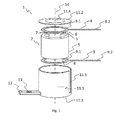
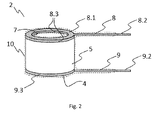
- the invention concerns a heating element suitable for a volatile liquid emanation device, comprising a ring shaped resistive heater, and at least two conductive terminals.
- the ring shaped heater comprises an upper side and a lower side, both sides connected to each other by an outer lateral surface; the heater further comprises an axial through hole for receiving a wick, the axial through hole extending from the upper side to the lower side defining an inner surface.
- the at least two conductive terminals are for providing electrical contact to the resistive heater, the two conductive terminals extend from the heater, preferably as wire leads.
- the ring shaped resistive heater and the two conductive terminals form an integral component.
- the complete, electrically insulating layer has a thickness above 15 ⁇ m and below 1000 ⁇ m, preferably below 500 ⁇ m.
- the electrically insulating layer is preferably a coated layer. With coating, a very thin and defect free layer can be achieved thus enabling high electrical isolation while still having low impact on the thermal cycling time.
- the resistive heater is free of other electrically insulating layers, especially on its inner surface, enabling short heat and cooling thermal cycling time.
- the heating element further comprises a supporting element able to hold the heater inside the supporting element, preferably for mechanically fixating the heater on an external part.
- Integral means that they are a single piece, the conductive terminals are attached, preferentially mechanically, to the resistive heater.
- the complete heating element except for the part of the conductive terminals that are to be connected to external electrical source, is covered by the electrically insulating layer.
- the suitable coating can be used has good adherence, is preferably electrical insulating, and can sustain thermal cycling. Exemplary materials are epoxy for cycling up to 150 °C, and silicone-based, the last two can be used for cycling up to 200 °C or higher depending on exact chemistry and/or filler. Such coatings are commercially available.
- the heating element according to the invention comprises a supporting element.
- the supporting element is preferably attached to the heater by attaching to, and further preferably enclosing, at least partially at least one of: the outer lateral surface, the lower side, and the upper side, of the resistive heater and leaving the axial through hole for the wick uncovered.
- the inner surface of the resistive heater which is the surface at the axial through hole, is left uncovered, preferably completely free of supporting element.
- the supporting element is preferably made of a thermoplastic material that is electrical insulator, preferably polymeric of the polyester type, such as polybutylene terephthalate.
- the thermoplastic is preferably reinforced, such as with 10 to 35% glass fibre, thus increasing its heat resistance.
- the supporting element is treated with a flame retardant, e.g. with aluminium diethyl phosphinate.
- At least a first part of the supporting element is mechanically engageable with at least one of the upper or lower sides of the resistive heater, in such a manner, that when engaged, the supporting element and the resistive heater have a pre-determined position.
- the part of the supporting element can be cup shaped, and dimensioned so that the heater fits inside the cup shaped supporting element.
- the second part of the supporting element is configured to fit to the first part, preferably on the other side of the heater.
- the heater can be enclosed by the supporting element, between the first and the second part, while leaving the axial through hole for the wick uncovered, and further leaving the inner surface of the axial through hole area uncovered.
- the support element for a cylindrical heater has a cylindrical shape with an inner diameter slightly larger than the heater, having spacers functioning to keep the heater in place within the support element.
- the lower and upper side of the resistive heater is covered by the support element, while leaving an opening for the passage of wick and flow of air, this opening being aligned, preferably coaxial, with the axial through hole in the resistive heater.
- the support element is configured such that the at least two conductive terminals can extend from the resistive heater to the outer side of the support element, preferably by providing respective openings, such as a slot.
- the support element comprises at least 1, preferably at least 2 attachment surfaces, each preferably as a radial extension; the extension being suitable to be secured to a housing via a fastening means such as, for example, a screw, a bolt, an elastic clip.
- the resistive heater also simply called heater, have the same meaning.
- the heating element is not the resistive heater; however, the heating element comprises the resistive heater.
- the ring shaped resistive heater is preferably made of sintered material.
- the resistive heater according to the invention is preferably a PTC heater.
- Preferred materials are barium titanate based composites; these are preferred over lead titanate composites.
- Preferred is doped BaTi03, it can be doped, for instance with oxides of elements selected of the chemical group 3 or 5 (La, Y, Nb, Ta) or Sb.
- the PTC heater has a Curie temperature from 40 °C to 180 °C, preferably from 80° C to 150 °C.
- the Curie temperature also known as transition temperature, is the temperature in that the PTC's resistance changes from decreasing to exponential rise with the increase of temperature.
- the ring of the resistive heater has a closed perimeter, thus being gap free.
- the two conductive terminals are arranged in such a position at the heater that when an electrical potential bias (voltage) is applied at the terminals, the respective current flows essentially through the complete ring. This current is in the operation mode as heater.
- the two conductive terminals are placed on the upper and lower sides of the resistive heater, each of the conductive terminals having an annular conducting element providing electrical contact around the perimeter of the upper and lower sides.
- the electrical current induced by application of electrical potential bias, flows from one conductive terminal from one side (upper or lower) through the heater to the other side (lower or upper respectively).
- the annular conducting element of each of the terminals has preferentially a closed perimeter.
- the conductive terminals are connected within the ring segment, and are angular spaced from each other at a smaller angle ( ⁇ 20°, preferably ⁇ 15°) by an insulator (can be air) so that the current flows through the larger ring section when electrical potential bias is applied to the terminals.
- the insulator can be air, but is preferably a solid electrically insulating material. The solid material allows the resistive heater to have a closed perimeter.
- the conductive terminals are configured to accept electrical connectors.
- the at least two conductive terminals of the resistive heater extends outside of the electrically insulating layer as lead wires, these are preferably solderable.
- the solder may comprise tin.
- the lead wires comprise, on the surface, a solderable material selected from: copper, nickel, tin, or mixtures thereof.
- the length of each wire is between 14 mm and 60 mm, preferably between 16 mm and 50 mm.
- the core temperature of the resistive material of the resistive heater is similar to the surface temperature.
- the resistive material is smaller and the heat is typically transported by metal parts, thus requiring higher core temperatures to achieve similar surface temperatures, or temperatures at a desired wick.
- typical PTC heaters are electrically connected to its power source via clamps, clips, or conductive paste. They are unappropriated for soldering because the solder breaks down over time due to the many heating and cooling cycles.
- the heating element according to the present invention provides lower temperatures at the conductive terminals. It was found that the temperature at the extremity of the terminals, that is away from the resistive heater, is sufficiently low that the terminals can be soldered and reliably kept soldered to the resistive heater, while the heater itself can achieve sufficient temperatures to evaporate conventional volatile materials from a wick at conventional rates.
- a further advantage is that the resistive heater does not require metal parts for heat conduction, thus facilitating recycling due to the lower amount of metal, which can be essentially limited to the conductive terminals.
- the two conductive terminals are radially aligned, one closer to the upper side, the other closer to the lower side, the arrangement with the resistive heater and the two conductive terminals being symmetrical, meaning that the arrangement could be turned so that the upper side takes the place of the lower side, essentially without changes in mechanical and electrical characteristics.
- This symmetry facilitates soldering and fitting of the element inside a housing, due to less alignment requirements.
- the alignment of the conductive terminals enables the heater to be soldered to a vertical circuit board.
- the verticality is given in relation to the orientation of the wick, which is usually vertical (the reservoir with the liquid is at the bottom end of the wick).
- the axial through hole in the heater is cylindrical with a diameter (d) and a height (h). It is preferable that the hole has a height / diameter ration of: 0,65 > h/d ⁇ 2, further preferably 1 ⁇ h/d ⁇ 2. This ratio gives better emission rate. Without wanted to being bound by theory, it is believed that it has to do with enhanced convection.
- the circuit can be calibrated, especially in a quick manner, to operate in precise temperature ranges.
- the device comprises a heating element as described in the present invention and a circuit board comprising the circuit for controlling the heating element.
- the two conductive terminals of the heating element are soldered to the circuit board.
- An angle alpha which is the angle between the axis of the heater's hole and a plane that is coplanar with the circuit board, has an absolute value of ⁇ 35°, preferably the angle is smaller than 2° so that the circuit board and the axis are essentially parallel to each other.
- the circuit board's plane and the axis of the heater's hole are preferably parallel to each other.
- Such an inventive device provides improved temperature control possibilities, due to its faster thermal response.
- the conductive terminals' extension are preferably coplanar and soldered to the circuit board.
- a volatile liquid emanation device is a device configured to emanate materials in the environment, by heat evaporation. It preferably comprises a supply for materials; a heater according to the invention as emitter, for emitting the materials from the supply to surrounding environment, by application of power from a power supply.
- the emanation device preferably further comprises a housing.
- the housing defines the overall shape of the device, with walls defining an interior.
- the housing may be comprised of any suitable housing material such as metal, plastic, glass or fiberboard, or combinations thereof, with blowmolded or injection-molded plastic being most preferred and practical housing materials of construction.
- the overall housing may be comprised of housing portions that are separately molded and later assembled to define the overall shape to the device, and which can provide for structural complexity inside and outside of the overall shell of the device. For example, housing portions may be screwed together, or fit together with plastic protrusions and holes, or sonically welded together to form the overall housing.
- the shape of the housing may be cylindrical, or more box or block-like in shape, or may be some other practical and appealing overall shape, and may include various interior shelves, recesses and mounting surfaces for various interior components, along with contours, colors and exterior ornamentation for aesthetic reasons.
- the housing is essentially a container with walls that define an interior space in which various components of the present device (printed circuit board, etc.) may be placed and held.
- the configuration of the housing, and the placement of the components therein may lead to various degrees of user accessibility for each of the particular components.
- the most preferred materials of construction for the housing of the present invention are polyethylene, polypropylene, polybutylene, polybutylene terephthalate, polystyrene, polycarbonate, polyvinyl chloride, and polyethylene terephthalate, or mixtures thereof, wherein the preferred plastic materials are blow-molded, injection blowmolded, injection molded, and/or thermoformed to create the various shapes of the housing portions.
- the housing may be created to appear opaque or transparent (in part or in whole) and may be constructed of any color (e.g., white or beige or some decorative color). Construction from injection-molded plastic allows for transparent/clear, transparent/colored, or opaque/colored plastic parts, further allowing wide variation of functionality and aesthetic appeal.
- the invention also concerns a circuit board, also called main circuit board, for a device as described in the present invention; the board is preferably a printed circuit board (PCB).
- the board comprises, on it, an electronic circuit having functionally connected to it, at east:
- the main circuit board comprises a controlling unit (MCU), a memory circuit which can optionally an integrated circuit into the MCU chip, and an electronic communication interface.
- the electronic interface comprises at least one antenna, preferably directly on the cupper layer of the PCB.
- the electronic communication interface is preferably of the wireless type, being configured to transmit in a certain protocol, e.g. Wifi, BIE, Zigbee, Thread, IEEE 802.11 a/b/g/n, IEEE 802.15.4 MAC/PHY, IEEE Standard 802.15.4-2003, any Bluethooth 2,4Ghz ISM band.
- a part of the electronic communication interface can be integrated in the same circuit as the MCU.
- the heater is powered by the mains, after a half of full wave rectifier, and is driven by a switching element such as a MOSFET, preferably in switching mode.
- the device preferably comprises a panel, which further comprises a sign able to transmit information to a user.
- the panel further preferably comprises at least one button.
- the light source may be a one or more LED's (light emitting diodes).
- LED's light emitting diodes
- preferred LED's include bicolor LED's, or dual 2-color LED assemblies, SMD LED's, micro LED's, 3-10 mm LED's, rectangular LED's, single color LED's, infrared LED's, right-angle LED's, blinking LED's, and the like.
- a preferred example is an RGB LED.
- the preferred LED may be chosen on the basis of: the particular events or status that requires signaling to the user, (for example, "ON", and/or "end-of-life" of the material).
- the electronics including printed circuit board (PCB) design, cost, compatibility of the LED with other electronic components, current/voltage requirements etc); and, the physical layout of the PCB, its size constraints, location and orientation within the housing of the device, (for example, orientation of the PCB may dictate the choice between a right-angle LED and a standard LED).
- a suitable LED such as a bicolor LED or an assembly of LED's
- the light source may provide one color when the device is vaporizing volatile material (e.g., green, to signal that the device is running rather than off) and a second color to signal when the device is depleted of material (e.g., a red color, or a blinking color).
- Environment corresponds to any defined space, whether open or enclosed by one or more surfaces, walls, ceilings, floors, or other solid or fictitious boundaries, which receives the evaporated material.
- environment may correspond to a residential room (bedroom, bathroom, kitchen, etc.), commercial space (factory floor, office cubicles, etc.), automotive enclosure (car, truck, recreational vehicle), airline compartment, or any other space in which it is desirable to deliver a vapor.
- the material is able to be delivered to the surrounding environment, so that its final form in the air is preferably: vapor, mist, gas, particulate suspension, or a mixture of any of these.
- the material can be evaporated.
- the material has a composition.
- the material has an insecticide composition.
- the material has an air care composition.
- the term material for the purpose of this invention refers to the material able to be dispensed, it will become clear when it is to be distinguished from the material of other components of the invention
- evaporated material means the material delivered into the surrounding environment, so that its form in the environment is preferably: vapor, mist, gas, particulate suspension, or a mixture of any of these.
- the material in the reservoir for being delivered into the environment may be present from about 1 gram to about 50 grams.
- the composition may contain anywhere from trace actives to 100% actives and may contain any number and amount of solvents and/or carriers, volatile or otherwise.
- the device of the present invention may comprise a volatile material further consisting of only a single volatile chemical such as citronella.
- the volatile material may comprise only eucalyptus oil.
- the material may comprise anywhere from one or a few to up to many active materials dissolved or compounded with solvents and carriers that may or may not be volatile.
- volatile mixtures comprising mixtures of actives and solvents together
- all of the components are volatile such that the reservoir will eventually empty of all visible contents after a predetermined use-up period referred to as the "end-of-life".
- Most preferred is to place from about 5 mL to about 45 mL of a liquid or gelled volatizable material within reservoir.
- An insecticide composition according to the present invention may be a pesticide, an insecticide repellent, an insecticide killer, or combinations thereof.
- Insecticide compositions for use in the present invention are those of the type described in U.S. Pat. No. 4,663,315 to Hasegawa, et al. , incorporated herein by reference. Hasegawa describes many useful volatile insecticidal compositions that will work well within the reservoir of the present invention.
- the preferred active ingredients of the compostion are pyrethroid compounds.
- Non limiting examples of suitable actives are: Allethrin, Bifenthrin, Cyfluthrin (dichlorovinyl derivative of pyrethrin), Cypermethrin (including the resolved isomer alpha-cypermethrin, dichlorovinyl derivative of pyrethrin), Cyphenothrin, Deltamethrin (dibromovinyl derivative of pyrethrin), Esfenvalerate, Etofenprox, Fenpropathrin, dichlorovinyl derivative of pyrethrin, Prallethrin,Resmethrin, Silafluofen, Sumithrin, tau-Fiuvalinate, Tefluthrin, Tetramethrin, Tralomethrin, Transfluthrin, Fenvalerate, Flucythrinate, Flumethrin, Imiprothrin, IambdaCyhalothrin, Metofluthrin, Permethr
- fragrance components of the volatizable material for the present invention may comprise one of more volatile organic compounds available from any of the now known, or hereafter established, perfumery suppliers, such as international Flavors and Fragrances (IFF) of New Jersey, Givaudan of New Jersey, Firmenich of New Jersey, etc.
- IFF international Flavors and Fragrances
- fragrance materials are volatile essential oils.
- the fragrances may be synthetically derived substances (aldehydes, ketones, esters, etc.), naturally derived oils, or mixtures thereof.
- Naturally derived fragrance substances include, but are not limited to, musk, civet, ambergis, castoreum and like animal perfumes; abies oil, ajowan oil, almond oil, ambrette seed absolute, angelic root oil, anise oil, basil oil, bay oil, benzoin resinoid, bergamot oil, birch oil, bois de rose oil, broom abs., cajeput oil, cananga oil, capsicum oil, caraway oil, cardamon oil, carrot seed oil, cassia oil, cedar leaf, cedarwood oil, celery seed oil, cinnamon bark oil, citronella oil, clary sage oil, clove oil, cognac oil, coriander oil, cubeb oil, cumin oil, camphor oil, dill oil, estragon oil, eucalyptus oil, fennel sweet oil, galbanum res., garlic oil, geranium oil, ginger oil, grapefruit oil, hop oil, hyacinth abs.
- Synthetic fragrance materials include but are not limited to pinene, limonene and like hydrocarbons; 3,3,5-trimethylcyclohexanol, linalool, geraniol, nerol, citronellol, menthol, borneol, bomeyl methoxy cyclohexanol, benzyl alcohol, anise alcohol, cinnamyl alcohol, (3-phenyl ethyl alcohol, cis-3-hexenol, terpineol and like alcohols; anethole, musk xylol, isoeugenol, methyl eugenol and like phenols; a-amylcinnamic aldehyde, anisaldehyde, n-butyl aldehyde, cumin aldehyde, cyclamen aldehyde, decanal, isobutyl aldehyde, hexyl alde
- Suitable fragrance mixtures may produce a number of overall fragrance type perceptions including but not limited to, fruity, musk, floral, herbaceous (including mint), and woody, or perceptions that are in-between (fruity-floral for example).
- these fragrance mixtures are compounded by mixing a variety of these active fragrance materials along with various solvents to adjust cost, evaporation rates, hedonics and intensity of perception.
- solvents such as ethanol, isopropanol, hydrocarbons, acetone, glycols, glycol ethers, water, and combinations thereof, and using solvent up to as much as 90% of the volatile fragrance composition.
- a preferred fragrance composition for use as the volatizable composition in the present invention is comprised of a mixture of many fragrance actives and volatile solvents, sometimes along with smaller amounts of emulsifiers, stabilizers, wetting agents and preservatives. More often than not, the compositions of the fragrance mixtures purchasable from the various fragrance supply houses remain proprietary.
- the average emission rate Er_m over a period of use of at least 1 h is preferably given by 3nL/s ⁇ Er_m ⁇ 20 nL/s.
- the reservoir is preferably a refill bottle comprises a plastic material that is compatible with the material to be emitted into the environment. It is understood that the reservoir comprises the material, unless specifically stated, such as empty reservoir.
- a cartridge or other equivalent container is also to be understood as refill bottle according to the invention.
- refill bottle may be formed of polypropylene, barex and/or PET. However, in certain applications, it may be desirable for bottle to be formed of other bottle materials such as glass or the like.
- bottle is suitably sized for use in connection with household use.
- bottle is preferably configured for receipt of between 25 to about 75 milliliters of liquid material.
- the weight and moment of the device of the present invention, inclusive of the reservoir bottle is preferably such that the center of gravity is appropriately positioned and the weight is less than that which would otherwise cause the device to be unstable in the electrical outlet.
- the device for emanating product has a supply means for supplying material to the emitter (heater).
- the supply means preferably comprises a mechanical attachment means (fitment) to which a reservoir, such as a refill bottle, can be attached.
- a reservoir such as a refill bottle
- An example for the fitment is a suitable molded plastic collar that snaps over the opening of the refill bottle to adapt the reservoir opening to a smaller hole that accepts and seals around the wick.
- the fitment also provides a better sealing platform for a screw cap. Such a screw cap can then be used to seal the bottle and wick together (a so-called "witch hat” shaped cap that covers the exposed end of the wick and seals down around the neck fitment and the screw threads of the bottle).
- the device comprises a transport means for allowing the transport of material from the supply means to the emitter.
- the transport means may extend into reservoir.
- the transport means is a wick that extends to the bottom of the reservoir, when in operational position, to ensure complete emptying.
- Suitable wick materials include cellulose fiber bundles, porous sintered plastic, wood, ceramics, graphite, and synthetic fiber bundles, and combinations of these materials, but as mentioned, the porous sintered plastic wicks are highly preferred.
- FIGs 1 and 2 show a heating element (1), comprising a ring shaped resistive heater (2).
- Fig.1 is the exploded view, in Figure 2 the assembled resistive heater is shown, without the supporting element.
- the coated electrically insulating layer (10) is represented by the dashed line (10), this representation is exaggerated so that the thin coating can be shown. It preferably covers the complete heater (2) with connected terminals (8, 9), preferably leaving only the extremities (8.2, 9.2) of the terminals (8, 9) exposed.
- the heater (2) comprises an upper side (3) and a lower side (4), both sides connected (3, 4) to each other by an outer lateral surface (5).
- the heater (2) further comprising an axial through hole (6) for receiving a wick, the axial through hole (6) extending from the upper side (3) to the lower side (4) defining an inner surface (7).
- the heating element (1) further comprises at least two conductive terminals (8, 9), providing electrical contact to the resistive heater (2), in the present figure, with the ring shaped contacting elements (8.1, 9.1) that are attached to the upper and lower surfaces (3, 4). An example of the attachment is shown in Fig.2 , there the ring shaped contacting elements (8.1, 9.1) are mechanically secured to the heater by a suitable clamp (8.3). Other suitable means can be used.
- the two conductive terminals (8, 9) extend from the heater (2) preferably as wire leads (8.2, 9.2).
- the resistive heater (2) and the two conductive terminals (8, 9) form an integral component.
- the resistive heater (2) is preferably covered with an electrically insulating layer (10) of average thickness above 15 ⁇ m but below 1000 ⁇ m, preferably below 500 ⁇ m; and the insulating layer (10) is preferably a coated layer. It is preferred that the electrically insulating layer (10) gives further mechanical stability to the integral element.
- the heating element (1) further comprises a supporting element (11.1, 11.2) able to hold the heater (2) inside it (11.1, 11.2).
- the supporting element is comprised by two parts, namely the first part (11.1) and the second (11.2). In the present embodiment of Fig1 . and Fig.
- the wires (8, and 9) are coplanar, and when assembled, fit inside the slot (11.5) of the supporting means (11.1, 11.2).
- the second part (11.2) of the supporting element (11.1, 11.2) is configured to fit to the first part (11.1), preferably on the other side of the heater (2).
- the heater (2) can be enclosed by the supporting element (11.1, 11.2), between the first (11.1) and the second part (11.2), while leaving the axial through hole (6) for the wick uncovered, and further leaving the inner surface of the axial through hole (7) uncovered.
- Figure 1 shows a further development of the invention, wherein the support (11.1, 11.2) comprises an attachment surface (12), as a radial extension of the support (11.1, 11.2), the extension (12) being suitable to be secured to a housing (16) via a fastening means (13) such as, for example, a screw (13).
- a fastening means (13) such as, for example, a screw (13).
- FIG 3 shows a device for emanating materials in the environment.
- the device shows the heating element (1) as shown in the figures 1 and 2 , in the assembled state.
- the device comprises a circuit board (16), which in turn comprises the circuit for controlling the heating element, e.g. switching elements such as transistors.
- the two conductive terminals (8, 9) of the heating element (1) are soldered to the circuit board (16) at respective positions (15.1, 15.2).
- the heater (2) is mechanically connected to the housing (16) by extension (12) and fastening means (17).
- FIG 3 further shows, in schematically manner, the reservoir (21) containing the liquid material (21) to be emanated and a wick (19).
- the wick (19) and the reservoir (21) are also connectable to the housing (16) such that the wick (19) is aligned to the heater's hole (6) and the axis (14).
- the circuit board (15) is also mechanically fixed to the housing, for example by a fixation means (18).
- the angle alpha which is the angle between the axis (14) of the heater's hole (6) and a plane that is coplanar with the circuit board (15), has an absolute value of ⁇ 35°, preferably the angle is smaller than 2° so that the circuit board (15) and the axis (14) are essentially parallel to each other.
- Fig.3 shows plane 15.3 (in cross section view) that is parallel to axis (14).
- an alternative circuit board (15') which has an associated coplanar plane (15.3') that has an angle alpha with absolute value of approximately 20° with axis (14).
- the shortest angle is used for measuring alpha.
Landscapes
- Catching Or Destruction (AREA)
Abstract
The present invention describes a heating element (1) suitable for a volatile liquid emanation device, comprising a ring shaped resistive heater (2) comprising an upper side (3) and a lower side (4), both sides connected (3,4) to each other by an outer lateral surface (5); the heater (2) further comprising an axial through hole (6) for receiving a wick, the hole (6) extending from the upper side (3) to the lower side (4) defining an inner surface (7); at least two conductive terminals (8, 9), providing electrical contact to the resistive heater (2), wherein; wherein the two conductive terminals (8, 9) extend from the heater (2). The resistive heater (2) and the two conductive terminals (8, 9) form an integral component. The resistive heater (2) is covered with an electrically insulating layer (10), and the heating element (1) further comprises a supporting element (11.1, 11.2) able to hold the heater (2) inside it (11.1, 11.2).
Description
- The present invention concerns a heating element for a volatile liquid emanation device.
- Devices for emanating materials are known, for example out of
EP362397A1 - Such devices can emit many different kinds of materials, for instance insect repellents or perfumes.
- A common heating element used in such devices comprises a resistive heater with a positive temperature coefficient PTC. An example of a typical heater used in such devices is described in
EP0290159 A2 . The PTC strongly increases its resistance with increasing temperature after a certain nominal value, thus self-regulating when connected to a power source. Typically, the PTCs are connected to the mains directly or via purely resistive elements such as a fuse. A switch may be provided as well. - Typical heating elements with PTC used for volatile emanation devices have a relatively high thermal resistance. Most of them require some metallic components to distribute the heat, and the supporting electrically insulating structure further increases the thermal resistance. Thus, it is difficult to change the temperature. That is also one of the reasons that PTCs are not used for precise temperature control.
- The present invention aims to solve this problem with a heating element according to
claim 1, and a device according toclaim 15. The dependent claims concern further advancements of the invention. The present invention provides an improved heating element. Further, a device for emanating materials in the environment with improved temperature control can be made with an inventive heating element. - The invention concerns a heating element suitable for a volatile liquid emanation device, comprising a ring shaped resistive heater, and at least two conductive terminals. The ring shaped heater comprises an upper side and a lower side, both sides connected to each other by an outer lateral surface; the heater further comprises an axial through hole for receiving a wick, the axial through hole extending from the upper side to the lower side defining an inner surface. The at least two conductive terminals, are for providing electrical contact to the resistive heater, the two conductive terminals extend from the heater, preferably as wire leads. The ring shaped resistive heater and the two conductive terminals form an integral component. In a further development, most of, preferably the complete, electrically insulating layer has a thickness above 15 µm and below 1000 µm, preferably below 500 µm. The electrically insulating layer is preferably a coated layer. With coating, a very thin and defect free layer can be achieved thus enabling high electrical isolation while still having low impact on the thermal cycling time. Preferably, the resistive heater is free of other electrically insulating layers, especially on its inner surface, enabling short heat and cooling thermal cycling time. The heating element further comprises a supporting element able to hold the heater inside the supporting element, preferably for mechanically fixating the heater on an external part.
- Integral means that they are a single piece, the conductive terminals are attached, preferentially mechanically, to the resistive heater. Preferably, the complete heating element, except for the part of the conductive terminals that are to be connected to external electrical source, is covered by the electrically insulating layer. The suitable coating can be used has good adherence, is preferably electrical insulating, and can sustain thermal cycling. Exemplary materials are epoxy for cycling up to 150 °C, and silicone-based, the last two can be used for cycling up to 200 °C or higher depending on exact chemistry and/or filler. Such coatings are commercially available.
- The heating element according to the invention comprises a supporting element. The supporting element is preferably attached to the heater by attaching to, and further preferably enclosing, at least partially at least one of: the outer lateral surface, the lower side, and the upper side, of the resistive heater and leaving the axial through hole for the wick uncovered. It is preferred that the inner surface of the resistive heater, which is the surface at the axial through hole, is left uncovered, preferably completely free of supporting element. Thus, the sequence of layers from the heating element, starting from the resistive heater across the center, when empty of wick, is resistive material / coating / air gap (through hole) / coating/resistive material. This highly simplified construction gives the most efficient thermal transfer while maintaining an air gap towards a wick.
- The supporting element is preferably made of a thermoplastic material that is electrical insulator, preferably polymeric of the polyester type, such as polybutylene terephthalate. The thermoplastic is preferably reinforced, such as with 10 to 35% glass fibre, thus increasing its heat resistance. Preferably, the supporting element is treated with a flame retardant, e.g. with aluminium diethyl phosphinate.
- In one preferred embodiment, at least a first part of the supporting element is mechanically engageable with at least one of the upper or lower sides of the resistive heater, in such a manner, that when engaged, the supporting element and the resistive heater have a pre-determined position. For instance, when the heater is a cylinder, the part of the supporting element can be cup shaped, and dimensioned so that the heater fits inside the cup shaped supporting element.
- Additionally, the second part of the supporting element is configured to fit to the first part, preferably on the other side of the heater. In this case, the heater can be enclosed by the supporting element, between the first and the second part, while leaving the axial through hole for the wick uncovered, and further leaving the inner surface of the axial through hole area uncovered.
- In a preferred embodiment, the support element for a cylindrical heater has a cylindrical shape with an inner diameter slightly larger than the heater, having spacers functioning to keep the heater in place within the support element. The lower and upper side of the resistive heater is covered by the support element, while leaving an opening for the passage of wick and flow of air, this opening being aligned, preferably coaxial, with the axial through hole in the resistive heater.
- The support element is configured such that the at least two conductive terminals can extend from the resistive heater to the outer side of the support element, preferably by providing respective openings, such as a slot.
- It is preferred that the support element comprises at least 1, preferably at least 2 attachment surfaces, each preferably as a radial extension; the extension being suitable to be secured to a housing via a fastening means such as, for example, a screw, a bolt, an elastic clip.
- Within the meaning of the present invention, the resistive heater also simply called heater, have the same meaning. The heating element is not the resistive heater; however, the heating element comprises the resistive heater.
- The ring shaped resistive heater is preferably made of sintered material. The resistive heater according to the invention is preferably a PTC heater. Preferred materials are barium titanate based composites; these are preferred over lead titanate composites. Preferred is doped BaTi03, it can be doped, for instance with oxides of elements selected of the
chemical group 3 or 5 (La, Y, Nb, Ta) or Sb. It is preferred that the PTC heater has a Curie temperature from 40 °C to 180 °C, preferably from 80° C to 150 °C. The Curie temperature, also known as transition temperature, is the temperature in that the PTC's resistance changes from decreasing to exponential rise with the increase of temperature. - It is highly preferred that the ring of the resistive heater has a closed perimeter, thus being gap free.
- It is highly preferred that the two conductive terminals are arranged in such a position at the heater that when an electrical potential bias (voltage) is applied at the terminals, the respective current flows essentially through the complete ring. This current is in the operation mode as heater.
- In a preferred mode of the invention, the two conductive terminals are placed on the upper and lower sides of the resistive heater, each of the conductive terminals having an annular conducting element providing electrical contact around the perimeter of the upper and lower sides. Thus, the electrical current, induced by application of electrical potential bias, flows from one conductive terminal from one side (upper or lower) through the heater to the other side (lower or upper respectively). The annular conducting element of each of the terminals has preferentially a closed perimeter.
- In a slightly less preferred, mode of the invention, the conductive terminals are connected within the ring segment, and are angular spaced from each other at a smaller angle (<20°, preferably <15°) by an insulator (can be air) so that the current flows through the larger ring section when electrical potential bias is applied to the terminals. The insulator can be air, but is preferably a solid electrically insulating material. The solid material allows the resistive heater to have a closed perimeter.
- In one optional mode of the invention, the conductive terminals are configured to accept electrical connectors. However, it is preferred that the at least two conductive terminals of the resistive heater extends outside of the electrically insulating layer as lead wires, these are preferably solderable. The solder may comprise tin. Preferably, the lead wires comprise, on the surface, a solderable material selected from: copper, nickel, tin, or mixtures thereof. The length of each wire is between 14 mm and 60 mm, preferably between 16 mm and 50 mm. With the present invention, the core temperature of the resistive material of the resistive heater is similar to the surface temperature. On conventional heaters, on the other hand, the resistive material is smaller and the heat is typically transported by metal parts, thus requiring higher core temperatures to achieve similar surface temperatures, or temperatures at a desired wick. Thus, typical PTC heaters are electrically connected to its power source via clamps, clips, or conductive paste. They are unappropriated for soldering because the solder breaks down over time due to the many heating and cooling cycles. The heating element according to the present invention provides lower temperatures at the conductive terminals. It was found that the temperature at the extremity of the terminals, that is away from the resistive heater, is sufficiently low that the terminals can be soldered and reliably kept soldered to the resistive heater, while the heater itself can achieve sufficient temperatures to evaporate conventional volatile materials from a wick at conventional rates. A further advantage is that the resistive heater does not require metal parts for heat conduction, thus facilitating recycling due to the lower amount of metal, which can be essentially limited to the conductive terminals.
- In a preferred embodiment, the two conductive terminals are radially aligned, one closer to the upper side, the other closer to the lower side, the arrangement with the resistive heater and the two conductive terminals being symmetrical, meaning that the arrangement could be turned so that the upper side takes the place of the lower side, essentially without changes in mechanical and electrical characteristics. This symmetry facilitates soldering and fitting of the element inside a housing, due to less alignment requirements. The alignment of the conductive terminals enables the heater to be soldered to a vertical circuit board. The verticality is given in relation to the orientation of the wick, which is usually vertical (the reservoir with the liquid is at the bottom end of the wick).
- Preferably, the axial through hole in the heater is cylindrical with a diameter (d) and a height (h). It is preferable that the hole has a height / diameter ration of: 0,65 > h/d < 2, further preferably 1 < h/d < 2. This ratio gives better emission rate. Without wanted to being bound by theory, it is believed that it has to do with enhanced convection.
- Due to the low thermal resistance of the heater, the circuit can be calibrated, especially in a quick manner, to operate in precise temperature ranges.
- Another aim of the invention is to provide an improved volatile emanation device. The device comprises a heating element as described in the present invention and a circuit board comprising the circuit for controlling the heating element. The two conductive terminals of the heating element are soldered to the circuit board. An angle alpha which is the angle between the axis of the heater's hole and a plane that is coplanar with the circuit board, has an absolute value of < 35°, preferably the angle is smaller than 2° so that the circuit board and the axis are essentially parallel to each other. The circuit board's plane and the axis of the heater's hole are preferably parallel to each other. Such an inventive device provides improved temperature control possibilities, due to its faster thermal response. The conductive terminals' extension are preferably coplanar and soldered to the circuit board.
- A volatile liquid emanation device according to the invention is a device configured to emanate materials in the environment, by heat evaporation. It preferably comprises a supply for materials; a heater according to the invention as emitter, for emitting the materials from the supply to surrounding environment, by application of power from a power supply. The emanation device preferably further comprises a housing.
- The housing defines the overall shape of the device, with walls defining an interior. The housing may be comprised of any suitable housing material such as metal, plastic, glass or fiberboard, or combinations thereof, with blowmolded or injection-molded plastic being most preferred and practical housing materials of construction. It is important to note that the overall housing may be comprised of housing portions that are separately molded and later assembled to define the overall shape to the device, and which can provide for structural complexity inside and outside of the overall shell of the device. For example, housing portions may be screwed together, or fit together with plastic protrusions and holes, or sonically welded together to form the overall housing.
- The shape of the housing may be cylindrical, or more box or block-like in shape, or may be some other practical and appealing overall shape, and may include various interior shelves, recesses and mounting surfaces for various interior components, along with contours, colors and exterior ornamentation for aesthetic reasons. Overall, the housing is essentially a container with walls that define an interior space in which various components of the present device (printed circuit board, etc.) may be placed and held. As mentioned, the configuration of the housing, and the placement of the components therein, may lead to various degrees of user accessibility for each of the particular components. The most preferred materials of construction for the housing of the present invention are polyethylene, polypropylene, polybutylene, polybutylene terephthalate, polystyrene, polycarbonate, polyvinyl chloride, and polyethylene terephthalate, or mixtures thereof, wherein the preferred plastic materials are blow-molded, injection blowmolded, injection molded, and/or thermoformed to create the various shapes of the housing portions. The housing may be created to appear opaque or transparent (in part or in whole) and may be constructed of any color (e.g., white or beige or some decorative color). Construction from injection-molded plastic allows for transparent/clear, transparent/colored, or opaque/colored plastic parts, further allowing wide variation of functionality and aesthetic appeal.
- The invention also concerns a circuit board, also called main circuit board, for a device as described in the present invention; the board is preferably a printed circuit board (PCB). The board comprises, on it, an electronic circuit having functionally connected to it, at east:
- a connector for the emitter of materials;
- the operation mode adjusting means;
- the means for setting the transfer function.
- Preferably, the main circuit board comprises a controlling unit (MCU), a memory circuit which can optionally an integrated circuit into the MCU chip, and an electronic communication interface. The electronic interface comprises at least one antenna, preferably directly on the cupper layer of the PCB. The electronic communication interface is preferably of the wireless type, being configured to transmit in a certain protocol, e.g. Wifi, BIE, Zigbee, Thread, IEEE 802.11 a/b/g/n, IEEE 802.15.4 MAC/PHY, IEEE Standard 802.15.4-2003, any
Bluethooth 2,4Ghz ISM band. A part of the electronic communication interface can be integrated in the same circuit as the MCU. - In one preferred mode of the invention, the heater is powered by the mains, after a half of full wave rectifier, and is driven by a switching element such as a MOSFET, preferably in switching mode.
- The device preferably comprises a panel, which further comprises a sign able to transmit information to a user. The panel further preferably comprises at least one button.
- For example, the light source may be a one or more LED's (light emitting diodes). Non-limiting examples of preferred LED's include bicolor LED's, or dual 2-color LED assemblies, SMD LED's, micro LED's, 3-10 mm LED's, rectangular LED's, single color LED's, infrared LED's, right-angle LED's, blinking LED's, and the like. A preferred example is an RGB LED. The preferred LED may be chosen on the basis of: the particular events or status that requires signaling to the user, (for example, "ON", and/or "end-of-life" of the material). The electronics, (including printed circuit board (PCB) design, cost, compatibility of the LED with other electronic components, current/voltage requirements etc); and, the physical layout of the PCB, its size constraints, location and orientation within the housing of the device, (for example, orientation of the PCB may dictate the choice between a right-angle LED and a standard LED). Most preferred is to incorporate a suitable LED (such as a bicolor LED or an assembly of LED's) as the light source that may provide one color when the device is vaporizing volatile material (e.g., green, to signal that the device is running rather than off) and a second color to signal when the device is depleted of material (e.g., a red color, or a blinking color).
- Environment corresponds to any defined space, whether open or enclosed by one or more surfaces, walls, ceilings, floors, or other solid or fictitious boundaries, which receives the evaporated material. For example, environment may correspond to a residential room (bedroom, bathroom, kitchen, etc.), commercial space (factory floor, office cubicles, etc.), automotive enclosure (car, truck, recreational vehicle), airline compartment, or any other space in which it is desirable to deliver a vapor.
- For all necessary measurements it is considered that the measurements are done under constant room conditions (T=22°C, ambient pressure=1atm, Relative humidity = 50%). For heating, it is considered that the room is sufficiently large so that the heating of a PTC, small relative to the room, does not substantially influence the room's temperature. A sufficient volume in the environment, i.e. sufficiently large room, is considered as 28 cubic meter.
- The material is able to be delivered to the surrounding environment, so that its final form in the air is preferably: vapor, mist, gas, particulate suspension, or a mixture of any of these. Preferably, the material can be evaporated. The material has a composition. In one preferable embodiment of the invention, the material has an insecticide composition. In another preferred embodiment of the invention, the material has an air care composition. The term material for the purpose of this invention, refers to the material able to be dispensed, it will become clear when it is to be distinguished from the material of other components of the invention
- In the present invention, evaporated material means the material delivered into the surrounding environment, so that its form in the environment is preferably: vapor, mist, gas, particulate suspension, or a mixture of any of these.
- The material in the reservoir for being delivered into the environment may be present from about 1 gram to about 50 grams. Depending on whether the composition is a fragrance or an insecticide or other air treatment mixture, the composition may contain anywhere from trace actives to 100% actives and may contain any number and amount of solvents and/or carriers, volatile or otherwise. For example, the device of the present invention may comprise a volatile material further consisting of only a single volatile chemical such as citronella. In another embodiment of the invention the volatile material may comprise only eucalyptus oil. The material may comprise anywhere from one or a few to up to many active materials dissolved or compounded with solvents and carriers that may or may not be volatile. Most preferred is to utilize volatile mixtures (comprising mixtures of actives and solvents together) wherein all of the components are volatile such that the reservoir will eventually empty of all visible contents after a predetermined use-up period referred to as the "end-of-life". Most preferred is to place from about 5 mL to about 45 mL of a liquid or gelled volatizable material within reservoir.
- An insecticide composition according to the present invention may be a pesticide, an insecticide repellent, an insecticide killer, or combinations thereof. Insecticide compositions for use in the present invention are those of the type described in
U.S. Pat. No. 4,663,315 to Hasegawa, et al. , incorporated herein by reference. Hasegawa describes many useful volatile insecticidal compositions that will work well within the reservoir of the present invention. The preferred active ingredients of the compostion are pyrethroid compounds. Non limiting examples of suitable actives are: Allethrin, Bifenthrin, Cyfluthrin (dichlorovinyl derivative of pyrethrin), Cypermethrin (including the resolved isomer alpha-cypermethrin, dichlorovinyl derivative of pyrethrin), Cyphenothrin, Deltamethrin (dibromovinyl derivative of pyrethrin), Esfenvalerate, Etofenprox, Fenpropathrin, dichlorovinyl derivative of pyrethrin, Prallethrin,Resmethrin, Silafluofen, Sumithrin, tau-Fiuvalinate, Tefluthrin, Tetramethrin, Tralomethrin, Transfluthrin, Fenvalerate, Flucythrinate, Flumethrin, Imiprothrin, IambdaCyhalothrin, Metofluthrin, Permethrin. The composition may comprise one or more different active compounds. - For use as a fragrance-dispersing device, fragrance components of the volatizable material for the present invention may comprise one of more volatile organic compounds available from any of the now known, or hereafter established, perfumery suppliers, such as international Flavors and Fragrances (IFF) of New Jersey, Givaudan of New Jersey, Firmenich of New Jersey, etc. Many types of fragrances can be used in the present invention. Preferably the fragrance materials are volatile essential oils. The fragrances, however, may be synthetically derived substances (aldehydes, ketones, esters, etc.), naturally derived oils, or mixtures thereof. Naturally derived fragrance substances include, but are not limited to, musk, civet, ambergis, castoreum and like animal perfumes; abies oil, ajowan oil, almond oil, ambrette seed absolute, angelic root oil, anise oil, basil oil, bay oil, benzoin resinoid, bergamot oil, birch oil, bois de rose oil, broom abs., cajeput oil, cananga oil, capsicum oil, caraway oil, cardamon oil, carrot seed oil, cassia oil, cedar leaf, cedarwood oil, celery seed oil, cinnamon bark oil, citronella oil, clary sage oil, clove oil, cognac oil, coriander oil, cubeb oil, cumin oil, camphor oil, dill oil, estragon oil, eucalyptus oil, fennel sweet oil, galbanum res., garlic oil, geranium oil, ginger oil, grapefruit oil, hop oil, hyacinth abs., jasmin abs., juniper berry oil, labdanum res., lavander oil, laurel leaf oil, lavender oil, lemon oil, lemongrass oil, lime oil, lovage oil, mace oil, mandarin oil, mimosa abs., myrrh abs., mustard oil, narcissus abs., neroli bigarade oil, nutmeg oil, oakmoss abs., olibanum res., onion oil, opoponax res., orange oil, orange flower oil, origanum, orris concrete, pepper oil, peppermint oil, peru balsam, petitgrain oil, pine needle oil, rose abs., rose oil, rosemary oil, sandalwood oil, sage oil, spearmint oil, styrax oil, thyme oil, tolu balsam, tonka beans abs., tuberose abs., turpentine oil, vanilla beans abs., vetiver oil, violet leaf abs., ylang ylang oil and like vegetable oils, etc. Synthetic fragrance materials include but are not limited to pinene, limonene and like hydrocarbons; 3,3,5-trimethylcyclohexanol, linalool, geraniol, nerol, citronellol, menthol, borneol, bomeyl methoxy cyclohexanol, benzyl alcohol, anise alcohol, cinnamyl alcohol, (3-phenyl ethyl alcohol, cis-3-hexenol, terpineol and like alcohols; anethole, musk xylol, isoeugenol, methyl eugenol and like phenols; a-amylcinnamic aldehyde, anisaldehyde, n-butyl aldehyde, cumin aldehyde, cyclamen aldehyde, decanal, isobutyl aldehyde, hexyl aldehyde, heptyl aldehyde, n-nonyl aldehyde, nonadienol, citral, citronellal, hydroxycitronellal, benzaldehyde, methyl nonyl acetaldehyde, cinnamic aldehyde, dodecanol, a-hyxylcinnamic aldehyde, undecenal, heliotropin, vanillin, ethyl vanillin and like aldehydes; methyl amyl ketone, methyl (3-naphthyl ketone, methyl nonyl ketone, musk ketone, diacetyl, acetyl propionyl, acetyl butyryl, carvone, menthone, camphor, acetophenone, p-methyl acetophenone, ionone, methyl ionone and like ketones; amyl butyrolactone, diphenyl oxide, methyl phenyl glycidate, gamma.-nonyl lactone, coumarin, cineole, ethyl methyl phenyl glicydate and like lactones or oxides; methyl formate, isopropyl formate, linalyl formate, ethyl acetate, octyl acetate, methyl acetate, benzyl acetate, cinnamyl acetate, butyl propionate, isoamyl acetate, isopropyl isobutyrate, geranyl isovalerate, allyl capronate, butyl heptylate, octyl caprylate octyl, methyl heptynecarboxylate, methine octynecarboxylate, isoacyl caprylate, methyl laurate, ethyl myri state, methyl myri state, ethyl benzoate, benzyl benzoate, methylcarbinylphenyl acetate, isobutyl phenylacetate, methyl cinnamate, cinnamyl cinnamate, methyl salicylate, ethyl anisate, methyl anthranilate, ethyl pyruvate, ethyl a-butyl butylate, benzyl propionate, butyl acetate, butyl butyrate, p-tert-butylcyclohexyl acetate, cedryl acetate, citronellyl acetate, citronellyl formate, p-cresyl acetate, ethyl butyrate, ethyl caproate, ethyl cinnamate, ethyl phenylacetate, ethylene brassylate, geranyl acetate, geranyl formate, isoamyl salicylate, isoamyl isovalerate, isobomyl acetate, linalyl acetate, methyl anthranilate, methyl dihydrojasmonate, nopyl acetate, (3-phenylethyl acetate, trichloromethylphenyl carbonyl acetate, terpinyl acetate, vetiveryl acetate and like esters, and the like. Suitable fragrance mixtures may produce a number of overall fragrance type perceptions including but not limited to, fruity, musk, floral, herbaceous (including mint), and woody, or perceptions that are in-between (fruity-floral for example). Typically, these fragrance mixtures are compounded by mixing a variety of these active fragrance materials along with various solvents to adjust cost, evaporation rates, hedonics and intensity of perception. Well known in the fragrance industry is to dilute essential fragrance oil blends (natural and/or synthetic) with solvents such as ethanol, isopropanol, hydrocarbons, acetone, glycols, glycol ethers, water, and combinations thereof, and using solvent up to as much as 90% of the volatile fragrance composition. Thus, a preferred fragrance composition for use as the volatizable composition in the present invention is comprised of a mixture of many fragrance actives and volatile solvents, sometimes along with smaller amounts of emulsifiers, stabilizers, wetting agents and preservatives. More often than not, the compositions of the fragrance mixtures purchasable from the various fragrance supply houses remain proprietary.
- The average emission rate Er_m over a period of use of at least 1 h, is preferably given by 3nL/s < Er_m ≤ 20 nL/s.
- In the present invention, the reservoir is preferably a refill bottle comprises a plastic material that is compatible with the material to be emitted into the environment. It is understood that the reservoir comprises the material, unless specifically stated, such as empty reservoir. A cartridge or other equivalent container is also to be understood as refill bottle according to the invention. For example, refill bottle may be formed of polypropylene, barex and/or PET. However, in certain applications, it may be desirable for bottle to be formed of other bottle materials such as glass or the like. Preferably, bottle is suitably sized for use in connection with household use. In accordance with various aspects of the invention, bottle is preferably configured for receipt of between 25 to about 75 milliliters of liquid material. The weight and moment of the device of the present invention, inclusive of the reservoir bottle is preferably such that the center of gravity is appropriately positioned and the weight is less than that which would otherwise cause the device to be unstable in the electrical outlet.
- The device for emanating product has a supply means for supplying material to the emitter (heater). The supply means preferably comprises a mechanical attachment means (fitment) to which a reservoir, such as a refill bottle, can be attached. An example for the fitment is a suitable molded plastic collar that snaps over the opening of the refill bottle to adapt the reservoir opening to a smaller hole that accepts and seals around the wick. The fitment also provides a better sealing platform for a screw cap. Such a screw cap can then be used to seal the bottle and wick together (a so-called "witch hat" shaped cap that covers the exposed end of the wick and seals down around the neck fitment and the screw threads of the bottle). Such configurations for the reservoir, fitment, porous wick and screw cap assembly are well described in
U.S. Patent Application Publications 2006/0022064 to Triplett, et al . and 2005/0191481 to He, et al., along withPCT Application Publication WO/2002030220 to He, et al , all incorporated herein in their entireties. In order to effect emanating of the material from the emitter of the present device, the wick is positioned in close proximity to the inventive heater. In this way, when the resistive heater is energized, the emitted heat will warm the saturated porous wick, vaporizing the material. To achieve the alignment of the reservoir such that its wick is placed into close proximity to the heater, a guidance device as that claimed inU.S. Pat. No. 6,104,867 to Stathakis, et al. may be readily employed within the design of the housing of the present invention. - Preferably, the device comprises a transport means for allowing the transport of material from the supply means to the emitter. The transport means may extend into reservoir. In a preferred embodiment, the transport means is a wick that extends to the bottom of the reservoir, when in operational position, to ensure complete emptying. Suitable wick materials include cellulose fiber bundles, porous sintered plastic, wood, ceramics, graphite, and synthetic fiber bundles, and combinations of these materials, but as mentioned, the porous sintered plastic wicks are highly preferred.
- Details of the inventions are shown in the Figures. Summary of the figures:
-
Fig.1 is a schematic view of a heating element according to the invention in exploded view. -
Fig. 2 is a schematic view of a resistive heater as used in the invention. -
Fig. 3 is a schematic view of a device according to the invention. - All figures are schematic representations; some elements may be exaggerated to better explain the invention. Particularly in
Fig. 3 some elements (e.g. 16, 17) are shown in 2D while others are shown in perspective. -
Figures 1 and2 show a heating element (1), comprising a ring shaped resistive heater (2).Fig.1 is the exploded view, inFigure 2 the assembled resistive heater is shown, without the supporting element. InFigure 2 the coated electrically insulating layer (10) is represented by the dashed line (10), this representation is exaggerated so that the thin coating can be shown. It preferably covers the complete heater (2) with connected terminals (8, 9), preferably leaving only the extremities (8.2, 9.2) of the terminals (8, 9) exposed. Now, focusing onFig.1 , the heater (2) comprises an upper side (3) and a lower side (4), both sides connected (3, 4) to each other by an outer lateral surface (5). The heater (2) further comprising an axial through hole (6) for receiving a wick, the axial through hole (6) extending from the upper side (3) to the lower side (4) defining an inner surface (7). The heating element (1) further comprises at least two conductive terminals (8, 9), providing electrical contact to the resistive heater (2), in the present figure, with the ring shaped contacting elements (8.1, 9.1) that are attached to the upper and lower surfaces (3, 4). An example of the attachment is shown inFig.2 , there the ring shaped contacting elements (8.1, 9.1) are mechanically secured to the heater by a suitable clamp (8.3). Other suitable means can be used. The two conductive terminals (8, 9) extend from the heater (2) preferably as wire leads (8.2, 9.2). The resistive heater (2) and the two conductive terminals (8, 9) form an integral component. The resistive heater (2) is preferably covered with an electrically insulating layer (10) of average thickness above 15 µm but below 1000 µm, preferably below 500 µm; and the insulating layer (10) is preferably a coated layer. It is preferred that the electrically insulating layer (10) gives further mechanical stability to the integral element. As shown inFig.1 , the heating element (1) further comprises a supporting element (11.1, 11.2) able to hold the heater (2) inside it (11.1, 11.2). As an example, the supporting element is comprised by two parts, namely the first part (11.1) and the second (11.2). In the present embodiment ofFig1 . andFig. 2 , the wires (8, and 9) are coplanar, and when assembled, fit inside the slot (11.5) of the supporting means (11.1, 11.2). The second part (11.2) of the supporting element (11.1, 11.2) is configured to fit to the first part (11.1), preferably on the other side of the heater (2). In this case, the heater (2) can be enclosed by the supporting element (11.1, 11.2), between the first (11.1) and the second part (11.2), while leaving the axial through hole (6) for the wick uncovered, and further leaving the inner surface of the axial through hole (7) uncovered. -
Figure 1 shows a further development of the invention, wherein the support (11.1, 11.2) comprises an attachment surface (12), as a radial extension of the support (11.1, 11.2), the extension (12) being suitable to be secured to a housing (16) via a fastening means (13) such as, for example, a screw (13). -
Figure 3 , shows a device for emanating materials in the environment. In this schematic representation of the invention, the device shows the heating element (1) as shown in thefigures 1 and2 , in the assembled state. The device comprises a circuit board (16), which in turn comprises the circuit for controlling the heating element, e.g. switching elements such as transistors. The two conductive terminals (8, 9) of the heating element (1) are soldered to the circuit board (16) at respective positions (15.1, 15.2). The heater (2) is mechanically connected to the housing (16) by extension (12) and fastening means (17). While the supporting means (11.1, 11.2) could be integrally formed with the housing (16) it is preferred that these are separate parts, because they can be produced separately with materials that have different requirements, for instance, the supporting element (11.1, 11.2) must have a higher resistance to temperature.Figure 3 further shows, in schematically manner, the reservoir (21) containing the liquid material (21) to be emanated and a wick (19). The wick (19) and the reservoir (21) are also connectable to the housing (16) such that the wick (19) is aligned to the heater's hole (6) and the axis (14). The circuit board (15) is also mechanically fixed to the housing, for example by a fixation means (18). - Preferably the angle alpha which is the angle between the axis (14) of the heater's hole (6) and a plane that is coplanar with the circuit board (15), has an absolute value of < 35°, preferably the angle is smaller than 2° so that the circuit board (15) and the axis (14) are essentially parallel to each other.
Fig.3 shows plane 15.3 (in cross section view) that is parallel to axis (14). In a variation, it is shown an alternative circuit board (15') which has an associated coplanar plane (15.3') that has an angle alpha with absolute value of approximately 20° with axis (14). Obviously, the shortest angle is used for measuring alpha.
Claims (16)
- Heating element (1) suitable for a volatile liquid emanation device, comprising a- ring shaped resistive heater (2) comprising an upper side (3) and a lower side (4), both sides connected (3,4) to each other by an outer lateral surface (5); the heater (2) further comprising an axial through hole (6) for receiving a wick, the hole (6) extending from the upper side (3) to the lower side (4) defining an inner surface (7);- at least two conductive terminals (8, 9), providing electrical contact to the resistive heater (2), wherein;- the two conductive terminals (8, 9) extend from the heater (2);characterized in that
the resistive heater (2) and the two conductive terminals (8, 9) form an integral component;
the resistive heater (2) is covered with an electrically insulating layer (10); and
the heating element (1) further comprises a supporting element (11.1, 11.2) able to hold the heater (2) inside it (11.1, 11.2). - Heating element (1) according to claim 1, wherein the supporting element (11.1, 11.2) is attached to the heater (2) by enclosing at least partially at least one of the outer lateral surface (5), the lower side (4), and the upper side (3) of the resistive heater and leaving the axial through hole (6) for the wick uncovered, and further leaving the inner surface (7) of the axial through hole (6) uncovered, the inner surface (6) preferably being essentially free of supporting element (11., 11.2) except for optional small catches and/or place holders.
- Heating element (1) according to claim 1, wherein the heater (2) has a closed perimeter.
- Heating element (1) according to claim 1 or 2, wherein the two conductive terminals (8, 9) are configured and arranged in such a position at the heater that when an electrical potential bias is applied at the terminals (8, 9), the respective current flows essentially through the complete ring.
- Heating element (1) according to claim 4, wherein, the conductive terminals (8, 9) are attached to the resistive heater (2) at the upper side (3) and lower side (4), respectively, such that when a electrical potential bias is applied at the terminals, the respective current flows from one of the sides (3, 4) to the other (4,3).
- Heating element (1) according to claim 5, wherein the conductive terminals part (8.1, 9.1) contacting the resistive heater (2) are arc shaped, preferably closed arc shaped forming a ring.
- Heating element (1) according to claim 4, wherein, the conductive terminals (8,9) are connected within the ring segment, and are angular spaced from each other at a smaller angle (<20°, preferably <15°) by an insulator so that the current flows through the larger ring section when electrical potential bias is applied to the terminals.
- Heating element (1) according to any of the previous claims, wherein the support (11.1, 11.2) comprises at least 1, preferably at least 2, attachment surfaces (12), each preferably as a radial extension, the extension (12) being suitable to be secured to a housing via a fastening means such as, for example, a screw, a bolt, an elastic clip.
- Heating element (1) according to any of the previous claims, wherein the two conductive terminals (8, 9) extend from the heater (2) in a direction parallel to heater's radius.
- Heating element (1) according to claim 9, wherein the two conductive terminals (8, 9) extend radially from the heater (2).
- Heating element (1) according to any of the claims 8 or 9, wherein the two conductive terminals (8, 9) are coplanar.
- Heating element (1) according to any of the previous claims, wherein the conductive terminals (8, 9), especially their outer extremities (8.2, 9.1) are suitable to be soldered.
- Heating element (1) according to any of the previous claims, wherein most of, preferably the complete, electrically insulating layer (10) has a thickness above 15 µm and below 1000 µm, preferably below 500 µm.
- Heating element (1) according to any of the previous claims, wherein the electrically insulating layer (10) is a coated layer.
- Device for emanating materials in the environment, comprising:- a heating element according to any of the previous claims, the heating element comprising∘ ring shaped resistive heater comprising an upper side and a lower side, both sides connected to each other by an outer lateral surface; the heater further comprising an axial through hole for receiving a wick, the hole extending from the upper side to the lower side defining an inner surface;∘ at least two conductive terminals, providing electrical contact to the resistive heater, wherein;∘ the two conductive terminals extend from the heater;whereinthe ring shaped resistive heater and the two conductive terminals form an integral component; andthe resistive heater is covered with an electrically insulating layer;the heating element further comprises a supporting element for mechanically fixating the heater on an external part; and- a circuit board comprising the circuit for controlling the heating element,
characterized in that
the two conductive terminals of the heating element are soldered to the circuit board. - Device according to claim 13, wherein the angle alpha which is the angle between the axis (14) of the heater's hole (6) and a plane that is coplanar with the circuit board (15), has an absolute value of < 35°, preferably the angle is smaller than 2° so that the circuit board (15) and the axis (14) are essentially parallel to each other.
Priority Applications (2)
| Application Number | Priority Date | Filing Date | Title |
|---|---|---|---|
| EP16183452.8A EP3282812A1 (en) | 2016-08-09 | 2016-08-09 | Heating element for a volatile liquid emanation device |
| PCT/EP2017/069439 WO2018029043A1 (en) | 2016-08-09 | 2017-08-01 | Heating element for a volatile liquid emanation device |
Applications Claiming Priority (1)
| Application Number | Priority Date | Filing Date | Title |
|---|---|---|---|
| EP16183452.8A EP3282812A1 (en) | 2016-08-09 | 2016-08-09 | Heating element for a volatile liquid emanation device |
Publications (1)
| Publication Number | Publication Date |
|---|---|
| EP3282812A1 true EP3282812A1 (en) | 2018-02-14 |
Family
ID=56693981
Family Applications (1)
| Application Number | Title | Priority Date | Filing Date |
|---|---|---|---|
| EP16183452.8A Withdrawn EP3282812A1 (en) | 2016-08-09 | 2016-08-09 | Heating element for a volatile liquid emanation device |
Country Status (2)
| Country | Link |
|---|---|
| EP (1) | EP3282812A1 (en) |
| WO (1) | WO2018029043A1 (en) |
Families Citing this family (2)
| Publication number | Priority date | Publication date | Assignee | Title |
|---|---|---|---|---|
| US10616954B2 (en) | 2014-04-17 | 2020-04-07 | S. C. Johnson & Son, Inc. | Electrical barrier for wax warmer |
| US9655168B2 (en) | 2014-04-17 | 2017-05-16 | S.C. Johnson & Son, Inc. | Electrical barrier for wax warmer |
Citations (7)
| Publication number | Priority date | Publication date | Assignee | Title |
|---|---|---|---|---|
| US4663315A (en) | 1984-01-31 | 1987-05-05 | Earth Chemical Company, Limited | Device and method for vaporizing thermally vaporizable composition |
| EP0290159A2 (en) | 1987-04-21 | 1988-11-09 | TDK Corporation | PTC heating device |
| EP0362397A1 (en) | 1988-02-10 | 1990-04-11 | Earth Chemical Co., Ltd. | Heater-fumigator |
| US6104867A (en) | 1999-06-16 | 2000-08-15 | The Dial Corporation | Method and apparatus for liquid vaporization |
| WO2002030220A1 (en) | 2000-10-09 | 2002-04-18 | The Dial Corporation | Porous wick for liquid vaporizers |
| US20060022064A1 (en) | 2004-07-28 | 2006-02-02 | Carl Triplett | Vapor dispersing device and method |
| US20140037273A1 (en) * | 2012-08-06 | 2014-02-06 | Thomas Jaworski | Volatile material dispenser and method of emitting a volatile material |
Family Cites Families (1)
| Publication number | Priority date | Publication date | Assignee | Title |
|---|---|---|---|---|
| US5698029A (en) * | 1995-06-06 | 1997-12-16 | Kabushiki Kaisha Kobe Sekio Sho | Vertical furnace for the growth of single crystals |
-
2016
- 2016-08-09 EP EP16183452.8A patent/EP3282812A1/en not_active Withdrawn
-
2017
- 2017-08-01 WO PCT/EP2017/069439 patent/WO2018029043A1/en not_active Ceased
Patent Citations (8)
| Publication number | Priority date | Publication date | Assignee | Title |
|---|---|---|---|---|
| US4663315A (en) | 1984-01-31 | 1987-05-05 | Earth Chemical Company, Limited | Device and method for vaporizing thermally vaporizable composition |
| EP0290159A2 (en) | 1987-04-21 | 1988-11-09 | TDK Corporation | PTC heating device |
| EP0362397A1 (en) | 1988-02-10 | 1990-04-11 | Earth Chemical Co., Ltd. | Heater-fumigator |
| US6104867A (en) | 1999-06-16 | 2000-08-15 | The Dial Corporation | Method and apparatus for liquid vaporization |
| WO2002030220A1 (en) | 2000-10-09 | 2002-04-18 | The Dial Corporation | Porous wick for liquid vaporizers |
| US20050191481A1 (en) | 2000-10-09 | 2005-09-01 | He Mengtao P. | Porous wick for liquid vaporizers |
| US20060022064A1 (en) | 2004-07-28 | 2006-02-02 | Carl Triplett | Vapor dispersing device and method |
| US20140037273A1 (en) * | 2012-08-06 | 2014-02-06 | Thomas Jaworski | Volatile material dispenser and method of emitting a volatile material |
Also Published As
| Publication number | Publication date |
|---|---|
| WO2018029043A1 (en) | 2018-02-15 |
Similar Documents
| Publication | Publication Date | Title |
|---|---|---|
| US7793861B2 (en) | Piston actuated vapor-dispersing device | |
| US7793860B2 (en) | Piston actuated vapor-dispersing device | |
| JP4866852B2 (en) | Method and apparatus for low cost vapor distribution device | |
| US7503675B2 (en) | Combination light device with insect control ingredient emission | |
| US8301019B2 (en) | Fragrance emanation system | |
| EP1196203B2 (en) | Fragrance emitting device | |
| US5976503A (en) | Disposable plug-in air freshener with heat activated cartridge | |
| US20080149665A1 (en) | Vapor-dispersing device with pressure-responsive valve | |
| US20030005620A1 (en) | Wick based liquid emanation system | |
| CN101432028A (en) | Volatile substance dispenser | |
| CN101389360B (en) | Air treatment device with heated volatile dispenser | |
| CN101410010A (en) | Air treatment devices with used-up indicators | |
| JP2003525598A (en) | Chip containing activator and integrated heating element | |
| CN106455534A (en) | Volatile substance dispenser with nebulizer and nebulizer assembly | |
| JP2006524517A (en) | Volatile liquid dispensing equipment | |
| EP3282812A1 (en) | Heating element for a volatile liquid emanation device | |
| US11478565B2 (en) | Device for emanating materials | |
| JP6862098B2 (en) | Liquid fuming transpiration agent and how to use it | |
| JP2001157708A (en) | Aroma deodorant composition | |
| JP6609416B2 (en) | Volatilizer |
Legal Events
| Date | Code | Title | Description |
|---|---|---|---|
| PUAI | Public reference made under article 153(3) epc to a published international application that has entered the european phase |
Free format text: ORIGINAL CODE: 0009012 |
|
| AK | Designated contracting states |
Kind code of ref document: A1 Designated state(s): AL AT BE BG CH CY CZ DE DK EE ES FI FR GB GR HR HU IE IS IT LI LT LU LV MC MK MT NL NO PL PT RO RS SE SI SK SM TR |
|
| AX | Request for extension of the european patent |
Extension state: BA ME |
|
| STAA | Information on the status of an ep patent application or granted ep patent |
Free format text: STATUS: THE APPLICATION IS DEEMED TO BE WITHDRAWN |
|
| 18D | Application deemed to be withdrawn |
Effective date: 20180815 |