EP3281142B1 - Apparatus with test execution environment - Google Patents
Apparatus with test execution environment Download PDFInfo
- Publication number
- EP3281142B1 EP3281142B1 EP15721194.7A EP15721194A EP3281142B1 EP 3281142 B1 EP3281142 B1 EP 3281142B1 EP 15721194 A EP15721194 A EP 15721194A EP 3281142 B1 EP3281142 B1 EP 3281142B1
- Authority
- EP
- European Patent Office
- Prior art keywords
- application
- resources
- mock
- genuine
- zone
- Prior art date
- Legal status (The legal status is an assumption and is not a legal conclusion. Google has not performed a legal analysis and makes no representation as to the accuracy of the status listed.)
- Active
Links
Images


Classifications
-
- G—PHYSICS
- G06—COMPUTING OR CALCULATING; COUNTING
- G06F—ELECTRIC DIGITAL DATA PROCESSING
- G06F11/00—Error detection; Error correction; Monitoring
- G06F11/36—Prevention of errors by analysis, debugging or testing of software
- G06F11/3698—Environments for analysis, debugging or testing of software
-
- G—PHYSICS
- G06—COMPUTING OR CALCULATING; COUNTING
- G06F—ELECTRIC DIGITAL DATA PROCESSING
- G06F11/00—Error detection; Error correction; Monitoring
- G06F11/36—Prevention of errors by analysis, debugging or testing of software
- G06F11/3668—Testing of software
- G06F11/3672—Test management
- G06F11/3688—Test management for test execution, e.g. scheduling of test suites
-
- G—PHYSICS
- G06—COMPUTING OR CALCULATING; COUNTING
- G06F—ELECTRIC DIGITAL DATA PROCESSING
- G06F21/00—Security arrangements for protecting computers, components thereof, programs or data against unauthorised activity
- G06F21/50—Monitoring users, programs or devices to maintain the integrity of platforms, e.g. of processors, firmware or operating systems
- G06F21/52—Monitoring users, programs or devices to maintain the integrity of platforms, e.g. of processors, firmware or operating systems during program execution, e.g. stack integrity ; Preventing unwanted data erasure; Buffer overflow
- G06F21/53—Monitoring users, programs or devices to maintain the integrity of platforms, e.g. of processors, firmware or operating systems during program execution, e.g. stack integrity ; Preventing unwanted data erasure; Buffer overflow by executing in a restricted environment, e.g. sandbox or secure virtual machine
-
- G—PHYSICS
- G06—COMPUTING OR CALCULATING; COUNTING
- G06F—ELECTRIC DIGITAL DATA PROCESSING
- G06F21/00—Security arrangements for protecting computers, components thereof, programs or data against unauthorised activity
- G06F21/50—Monitoring users, programs or devices to maintain the integrity of platforms, e.g. of processors, firmware or operating systems
- G06F21/55—Detecting local intrusion or implementing counter-measures
- G06F21/56—Computer malware detection or handling, e.g. anti-virus arrangements
- G06F21/566—Dynamic detection, i.e. detection performed at run-time, e.g. emulation, suspicious activities
-
- G—PHYSICS
- G06—COMPUTING OR CALCULATING; COUNTING
- G06F—ELECTRIC DIGITAL DATA PROCESSING
- G06F2221/00—Indexing scheme relating to security arrangements for protecting computers, components thereof, programs or data against unauthorised activity
- G06F2221/03—Indexing scheme relating to G06F21/50, monitoring users, programs or devices to maintain the integrity of platforms
- G06F2221/033—Test or assess software
-
- G—PHYSICS
- G06—COMPUTING OR CALCULATING; COUNTING
- G06F—ELECTRIC DIGITAL DATA PROCESSING
- G06F2221/00—Indexing scheme relating to security arrangements for protecting computers, components thereof, programs or data against unauthorised activity
- G06F2221/21—Indexing scheme relating to G06F21/00 and subgroups addressing additional information or applications relating to security arrangements for protecting computers, components thereof, programs or data against unauthorised activity
- G06F2221/2101—Auditing as a secondary aspect
Definitions
- the present disclosure relates generally to execution environment access rights on computing devices and more specifically, to an apparatus that allows a new application to be installed thereon in an execution environment.
- US 2002/0188649 A1 discloses a mechanism for safely executing an untrusted program, wherein the untrusted program is initially executed in a limited environment comprising mock resources.
- an apparatus for executing an application the apparatus being configured to provide a standard zone and to provide a test zone, the standard zone comprising a standard execution environment providing access to genuine resources of the apparatus, the test zone comprising a test execution environment providing access to mock resources, a mock resource (e.g. each of the mock resources) modeling a genuine resource of the apparatus, wherein the application has access to the genuine resources when the application is executed in the standard zone, and wherein the application has access to the mock resources when the application is executed in the test zone and wherein the application does not have access (or is forbidden access) to the genuine resources when the application is executed in the test zone.
- the standard zone comprising a standard execution environment providing access to genuine resources of the apparatus
- the test zone comprising a test execution environment providing access to mock resources, a mock resource (e.g. each of the mock resources) modeling a genuine resource of the apparatus, wherein the application has access to the genuine resources when the application is executed in the standard zone, and wherein the application has access to the mock resources when the application is executed in the test
- test zone that gives the application access to mock resources instead of genuine resources it becomes possible to test which resources the application attempts to access without the application getting access to genuine information. Furthermore, a user can test the application without causing any risk.
- each of the mock resources imitates a genuine resource of the apparatus.
- the mock resources appear to be genuine resources.
- the user can test all functions of the application.
- the apparatus is a mobile communication device.
- the apparatus is configured to download the application from an application server.
- the apparatus is configured to store the application in an executable (by an operation system of the apparatus) version.
- the application may be in a complied from.
- the applications can be directly executed by the operating system without further compiling.
- the application can be downloaded by the apparatus from above mentioned application server in an executable (e.g. already compiled) version.
- the test zone is an isolated execution environment that allows testing of access to resources by the application in the test zone.
- the application can be isolated from the system services when it is in the test zone. This ensures that the application will not access information that is not supposed to have access to.
- the apparatus is configured to monitor which mock resources are accessed by the application in the test zone.
- an overview is created of the information collecting activities of the application.
- the apparatus has a display screen and is configured to visualize which of the mock resources the application in the test zone has accessed.
- the apparatus is configured to allow a user to move the application from the test zone to the standard zone and provide the application access to genuine resources in the standard zone.
- the above moving of the application should be understood as stopping to execute the application in the test zone and starting to execute in the application in the standard zone.
- a mechanism is provided to select in which zone the application is installed and/or executed.
- the apparatus is configured to present to a user which mock resources have been accessed by the application in the test zone.
- the user is clearly informed about the activities of an application in the test zone.
- the apparatus is configured to automatically present to a user which mock resources have been accessed by the application in the test zone when an application is moved from the test zone to the standard zone.
- the user is automatically reminded about any possible risks associated with the move of an application from the test zone to the standard zone.
- the apparatus being configured to provide a user with a choice which genuine resources corresponding to accessed mock resources the application will be allowed to access by the application when the application is executed in the standard zone.
- the possibility is provided to selectively allow an application access to different types of genuine private information.
- the apparatus is configured to request the user to decide whether an application should be installed in the test zone or in the standard zone.
- a mechanism is provided to avoid that an application is automatically installed in the standard zone, and a mechanism is provided to remind the user of making a choice between standard zone and the test zone for installing a new application.
- the mock resources comprise a mock user data backend, and wherein the genuine resources preferably comprise a genuine user data backend.
- the mock resources creates a possibility testing an application as to its activities in accessing user data, without the application having access to genuine user data.
- the mock user data backend contains correctly formatted but phony (fake) user data, and wherein the genuine user data backend preferably contains correctly formatted and genuine user data.
- correctly formatted data in the test zone it will render it more difficult to create an application that can detect that it is placed in a test environment and thereby act differently than when placed in a standard environment. In other words, applications can't figure out if they are currently executed in the standard zone or the test zone.
- test zone isolates the application from the operating system of the apparatus and from other applications on the apparatus.
- a mechanism for preventing a newly installed application in the test zone from accessing real data and other applications on the apparatus is provided.
- the apparatus is configured to isolate the test zone.
- an application in the test zone is prevented from accessing resources outside the test zone.
- the apparatus is configured to launch application bundles.
- test zone is rendered secure by means of a certification system.
- the apparatus is configured load and verify an application certificate associated with an application before execution of the application, the apparatus preferably being configured to prevent execution of the application if the certificate cannot be verified.
- the apparatus is configured load and verify an application manifest associated with an application.
- the apparatus further comprising a display screen and a graphical User Interface.
- the genuine resources may comprise contacts, text messages, Email(s), Photos, Media, Files, Camera data, Microphone recordings, Bluetooth Connection information, Device ID, Location, Call information and/or Calendar information.
- the genuine resources are divided into a plurality of types of personal information.
- the types of information may comprise contacts, text messages, Email(s), Photos, Media, Files, Camera data, Microphone recordings, Bluetooth Connection information, Device ID, Location, Call information and/or Calendar information.
- a method for testing an application on an apparatus such as a computing device for executing an application or node that models a computing device for executing an application
- the method comprising executing an application in a test zone that does not allow access to genuine resources on the apparatus, and allowing the application access to mock resources in the test zone, a mock resource,(e.g. each of the mock resources) modeling a genuine resource of the apparatus.
- the method further comprises preventing an application executed in the test zone from accessing genuine resources on the apparatus.
- the method further comprises monitoring which mock resources are accessed by the application when executed in the test zone.
- the method further comprises presenting to a user a list of mock resources that have been accessed by the application when executed in the test zone.
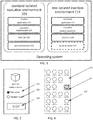
- Fig. 1 shows two layered stacks in an operating system of an apparatus 1 and illustrates the difference between the two stacks. Shown on the left is a standard execution environment 101 where trusted applications 102 are executed. Shown on the right is a test execution environment 111, where untrusted applications 112 are executed for testing which resources and/or applications in the test execution environment 111 the application 112 attempts to access or actually accesses.
- both of the stacks 101, 111 look similar and preferably indistinguishable. Both stacks 101, 111 are in their own isolated environment, have similar execution environments 103,113 and interfaces 104,114.
- the isolation from the operating system is in an example embodiment implemented by process isolation using Linux namespaces. Inside the standard zone 101, process isolation (by the operating system) is sufficient, i.e. the test zone 112 isolation implementation would be a container (using namespaces).
- the difference between stacks is that in the test zone 111 the application accesses mock data in the form of a mock backend 115 that contain phony or dummy data instead of the genuine backends that contain genuine user data 105.
- the mock backend 115 contains a data backend with phony or dummy data and hardware interfaces that only have a dummy or stub implementation to protect user data and other application data in order to provide security to the system.
- Each of the mock resources models a genuine resource of the apparatus 1, i.e. from an application point of view the mock resources and the genuine resources are indistinguishable.
- a non-exhaustive list of backend mock data includes the following data types: Contacts, SMS and MMS, Email, Photos/Media/Files, Camera, Microphone, Bluetooth Connection information, Device ID, Location, Call information and/or Calendar.
- the mock data imitates or models a genuine resource with correct formatting for the type of personal data concerned, but the content of the correctly formatted personal data is false, i.e. fabricated or phony.
- An application 112 is in an example embodiment downloaded on the apparatus 1 from an application server in an executable, for example, (pre)compiled version, i.e. so that the application 112 can be executed by the operating system of the apparatus 1 without further compiling.
- Fig. 2 is a screenshot illustrating the process when a user installs a new application 112 to the device 1.
- a zone management system prompts the user to choose in which of the zones 101,111 the application 112 shall be installed. The choices are in this example embodiment between a Standard zone 101 and a Test zone 111. The user chooses the relevant zone for the installation and confirms the installation by pressing the Install button 209.
- the number of zones in the operating system is depended on the use and functionality of the device 1 and can be anything from two and upwards.
- Fig. 3 illustrates an embodiment of a backend accessing process in the computing device 1.
- the process is exactly the same for trusted applications 102 in the standard zone 101 and for the untrusted applications 112 in the test zone 111.
- the difference between the two processes is that the untrusted application 112 in the test zone 111 accesses mock backends 115 that contain dummy user data, whilst the trusted application 102 uses or has access to genuine backends 105 that contain genuine user data.
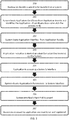
- Fig. 3 describes the process when an untrusted application 112 accesses mock backends 115 in the test zone 111.
- the application (bundle) 112 is asked in step 200 to be launched in system's test execution environment 111.
- the execution environment is to be understood as a system such as e.g. a computing device hardware or another node that models the computing device hardware by other means for example with software.
- the system loads the application's certificate in step 201.
- the application's certificate is in the context of this disclosure considered to be any information that can validate the author of the application, i.e. the exact data that should be in the application bundle. If certificate signing matches the application bundle's data, the system accepts that the package is intact. If package data does not match to the certificate the system knows that package has been changed and thus considers the package to be corrupted and it is not run on the system. After verifying that the package is intact the system loads the Application Manifest in step 202.
- the manifest contains the Permissions that application 112 needs to access.
- system starts running the application in the test execution environment 111, step 03. While running, the application 112 will access the interfaces, step 204. For this, the system will check has the application rights to access the interface's backend, step 205. For testing an untrusted application 112 in the test zone 111 all permissions are enabled thus enabling the untrusted application 112 to use all of the mock backends 115 freely. Because the interface can be successfully accessed by the application 112, a mock backend 115 will be accessed by the untrusted application 112, step 206. The system monitors the resources that are accessed by the untrusted application 112 and registers these activities in a log, step 207.
- the test zone 111 provides users with a safe environment where they can try out a new (untrusted) application 112.
- the Container formed by the test zone 111 ensures that no (genuine) system resources are used without authorization of the user.
- the application 112 is displayed on application grid 210 in the same way as all the other applications 211 with addition of a graphical indication 212 about the applications placement in a Test Zone (container) 111.
- Fig. 5 shows a screenshot 213 of an application 112 running in the test zone 111 with example functionalities, Function 1, Function and Function 3.
- these functionalities are merely illustrative and do not represent functionalities of a concrete application 112.
- the functionalities will vary and depend on the application 112 concerned, and are not necessarily displayed as virtual buttons on a display screen.
- a border 214 is provided around the application 112 to indicate to a user that the application 112 is running in the test Zone 111.
- the Application 112 is given access to dummy or phony resource (from a mock backend) such as user name, address, phone number, location (a fixed coordinates) etc.
- the application 112 can be used in the test zone to see how it functions. Once a user decides that he/she would like the full functionality, the application 112 can be moved to the standard zone 101 e.g. using a graphical user interface. In this process there is automatically displayed a listing or log of which resources have been accessed in the mock backend by the concerned application 112 when executed in the test zone.
- Fig. 7 shows the log dialogue 217 that is displayed when a user moves (or wants to move) an application from the test zone 111 to the standard zone 101. The user will be asked to grant the needed access rights when the application is migrated from Test Zone 111 to Standard zone 112. All the resource needed by the application 112 are be shown in a graphical listing 217 for the user for reference and selection of the resources that the user decides to allow the application 112 to access when executed in the standard zone 101.
- the software developer can define the services used by the application 112 with simple development tools enabled by the methods discussed in this disclosure. And those and only those are then available in the container in which the application is installed. For example a banking application has no need to access the user contact data, so this resource is not made available for the application. This ensures that the application cannot be used to exploit any resources which are outside of the scope of that container.
- Fig. 8 shows an apparatus 1 that is capable of running an application.
- the apparatus 1 can be computing device hardware or a node that models a computing device hardware by other means for example with software.
- the apparatus 1 is a mobile phone. However, it is understood that the apparatus could just a well be any other device that can run an application, such as e.g. a tablet computer, a laptop computer or a desktop computer.
- the apparatus 1 has a housing 2, a display 3, and several buttons 4,5.
- the apparatus 1 is in an embodiment adapted for communication via a cellular network, such as e.g. the 4G network, but could just as well be adapted for use with a different wireless network, or a TCP/IP-based network to cover a possible VoIP-network (e.g. via WLAN, WIMAX or similar).
- a cellular network such as e.g. the 4G network
- a TCP/IP-based network to cover a possible VoIP-network (e.g. via WLAN, WIMAX or similar).
- the apparatus 1 is provided with a display screen 3 that may be realized using a Liquid Crystal Display or Active Matric Organic Light Emitting Diodes.
- the display screen 3 may be combined with a touch panel to form a single module.
- the apparatus 1 is in an embodiment provided with several keys 4,5 for user input. Instead or in addition to a touch screen the apparatus 1 may be provided with or be connected to a keypad or keyboard.
- a battery pack in the apparatus 1 supplies electrical power for the electronic components of the apparatus 1.
- a terminal for charging the battery pack is also provided.
- the apparatus is powered by the mains and is not provided with a battery.
- Fig. 9 illustrates in block diagram form the general architecture of the apparatus 1.
- a processor 18 controls the communication with the cellular network via a transmitter/receiver circuit 19 and an antenna 20.
- a microphone 6 transforms sound into analogue signals, the analogue signals formed thereby are A/D converted in an A/D converter (not shown) before the speech is encoded in a digital signal processing unit 14 (DSP).
- DSP digital signal processing unit 14
- the encoded speech signal is transferred to the processor 18, which e.g. supports the 4G terminal software.
- a bus 7 forms the interface to the processor 18 and the peripheral units of the apparatus, including e.g.
- the digital signal-processing unit 14 decodes the signal, which is transferred from the processor 18 to the speaker 5 via a D/A converter (not shown).
- An advantage of embodiments of the invention is the possibility to have a system that can be used in a safe manner without compromising user privacy, device integrity and confidentiality of device and user data. From a user perspective the mechanism is easy and does not require extensive system configuration skills.
- a computer program may be stored/distributed on a suitable medium, such as an optical storage medium or a solid-state medium supplied together with or as part of other hardware, but may also be distributed in other forms, such as via the Internet or other wired or wireless telecommunication systems.
- a suitable medium such as an optical storage medium or a solid-state medium supplied together with or as part of other hardware, but may also be distributed in other forms, such as via the Internet or other wired or wireless telecommunication systems.
Landscapes
- Engineering & Computer Science (AREA)
- Theoretical Computer Science (AREA)
- Computer Security & Cryptography (AREA)
- Computer Hardware Design (AREA)
- General Engineering & Computer Science (AREA)
- Software Systems (AREA)
- General Physics & Mathematics (AREA)
- Physics & Mathematics (AREA)
- Quality & Reliability (AREA)
- Health & Medical Sciences (AREA)
- General Health & Medical Sciences (AREA)
- Virology (AREA)
- Stored Programmes (AREA)
Description
- The present disclosure relates generally to execution environment access rights on computing devices and more specifically, to an apparatus that allows a new application to be installed thereon in an execution environment.
- As the mobile operating system (such as Android) device base is growing there will be growing number of malicious application and spyware. Furthermore, applications in general are collecting vast amount of user data and users have very little means to affect or control this development. In everyday life, consumers are paying more attention to their privacy while sharing using their personal devices and services through mobile devices. Local legislation cannot provide enough ways to control and to protect in a way that is needed in global environment. An end user has to have additional means for privacy protection in accordance with his/her decisions and needs.
- Service providers are using "privacy disclaimers" as their "get out of jail free cards" to gain authority to use personal information like location, contacts, age, gender, and other services used, etc. on. In practice, an end user has no choice but to accept the conditions and the associated loss of privacy.
- Consequently, with the presently available technology a newly installed app (application) can freely roam the personal information that is stored on an apparatus without the owner (user) of the apparatus knowing what is going on.
- Thus, there is a need for an apparatus that overcomes or at least reduces the above problem.
-
US 2002/0188649 A1 discloses a mechanism for safely executing an untrusted program, wherein the untrusted program is initially executed in a limited environment comprising mock resources. - Schreuders et al.: "The state of the art of application restrictions and sandboxes: A survey of application-oriented access controls and their shortfalls", in: Computers & Security, vol. 32, pages 219 - 241, provides a literature review of the field and sandboxes and discusses the motivations for application restrictions and sandboxes.
- It is an object of the invention to provide an apparatus that that overcomes or at least reduces the above problem.
- The foregoing and other objects are achieved by the features of the independent claims. Further implementation forms are apparent from the dependent claims, the description and the figures.
- According to a first aspect there is provided an apparatus for executing an application, the apparatus being configured to provide a standard zone and to provide a test zone, the standard zone comprising a standard execution environment providing access to genuine resources of the apparatus, the test zone comprising a test execution environment providing access to mock resources, a mock resource (e.g. each of the mock resources) modeling a genuine resource of the apparatus, wherein the application has access to the genuine resources when the application is executed in the standard zone, and wherein the application has access to the mock resources when the application is executed in the test zone and wherein the application does not have access (or is forbidden access) to the genuine resources when the application is executed in the test zone.
- By providing a test zone that gives the application access to mock resources instead of genuine resources it becomes possible to test which resources the application attempts to access without the application getting access to genuine information. Furthermore, a user can test the application without causing any risk.
- According to a further implementation of the first aspect each of the mock resources imitates a genuine resource of the apparatus. Thus, from the perspective of the application, the mock resources appear to be genuine resources. Hence, the user can test all functions of the application.
- According to a further implementation of the first aspect the apparatus is a mobile communication device.
- According to a further implementation of the first aspect the apparatus is configured to download the application from an application server.
- According to a further implementation of the first aspect the apparatus is configured to store the application in an executable (by an operation system of the apparatus) version. As an example, the application may be in a complied from. Thus, the applications can be directly executed by the operating system without further compiling. As an example, the application can be downloaded by the apparatus from above mentioned application server in an executable (e.g. already compiled) version.
- According to a further implementation of the first aspect the test zone is an isolated execution environment that allows testing of access to resources by the application in the test zone. Thus, the application can be isolated from the system services when it is in the test zone. This ensures that the application will not access information that is not supposed to have access to.
- According to a further implementation of the first aspect the apparatus is configured to monitor which mock resources are accessed by the application in the test zone. Thus, an overview is created of the information collecting activities of the application.
- According to a further implementation of the first aspect the apparatus has a display screen and is configured to visualize which of the mock resources the application in the test zone has accessed.
- According to a further implementation of the first aspect the apparatus is configured to allow a user to move the application from the test zone to the standard zone and provide the application access to genuine resources in the standard zone. The above moving of the application should be understood as stopping to execute the application in the test zone and starting to execute in the application in the standard zone. Thus, a mechanism is provided to select in which zone the application is installed and/or executed. Thus, easy and intuitive user experience without a need to perform extensive system configuration is provided.
- According to a further implementation of the first aspect the apparatus is configured to present to a user which mock resources have been accessed by the application in the test zone. Thus, the user is clearly informed about the activities of an application in the test zone.
- According to a further implementation of the first aspect the apparatus is configured to automatically present to a user which mock resources have been accessed by the application in the test zone when an application is moved from the test zone to the standard zone. Thus, the user is automatically reminded about any possible risks associated with the move of an application from the test zone to the standard zone.
- According to a further implementation of the first aspect the apparatus being configured to provide a user with a choice which genuine resources corresponding to accessed mock resources the application will be allowed to access by the application when the application is executed in the standard zone. Thus, the possibility is provided to selectively allow an application access to different types of genuine private information.
- According to a further implementation of the first aspect the apparatus is configured to request the user to decide whether an application should be installed in the test zone or in the standard zone. Thus, a mechanism is provided to avoid that an application is automatically installed in the standard zone, and a mechanism is provided to remind the user of making a choice between standard zone and the test zone for installing a new application.
- According to a further implementation of the first aspect the mock resources comprise a mock user data backend, and wherein the genuine resources preferably comprise a genuine user data backend. Providing mock resources creates a possibility testing an application as to its activities in accessing user data, without the application having access to genuine user data.
- According to a further implementation of the first aspect the mock user data backend contains correctly formatted but phony (fake) user data, and wherein the genuine user data backend preferably contains correctly formatted and genuine user data. By providing correctly formatted data in the test zone, it will render it more difficult to create an application that can detect that it is placed in a test environment and thereby act differently than when placed in a standard environment. In other words, applications can't figure out if they are currently executed in the standard zone or the test zone.
- According to a further implementation of the first aspect the test zone isolates the application from the operating system of the apparatus and from other applications on the apparatus. Thus, there is provided a mechanism for preventing a newly installed application in the test zone from accessing real data and other applications on the apparatus.
- According to a further implementation of the first aspect the apparatus is configured to isolate the test zone. Thus, an application in the test zone is prevented from accessing resources outside the test zone.
- According to a further implementation of the first aspect the apparatus is configured to launch application bundles.
- According to a further implementation of the first aspect the test zone is rendered secure by means of a certification system.
- According to a further implementation of the first aspect the apparatus is configured load and verify an application certificate associated with an application before execution of the application, the apparatus preferably being configured to prevent execution of the application if the certificate cannot be verified.
- According to a further implementation of the first aspect the apparatus is configured load and verify an application manifest associated with an application.
- According to a further implementation of the first aspect the apparatus further comprising a display screen and a graphical User Interface.
- According to a further implementation of the first aspect the genuine resources may comprise contacts, text messages, Email(s), Photos, Media, Files, Camera data, Microphone recordings, Bluetooth Connection information, Device ID, Location, Call information and/or Calendar information.
- According to further implementation of the first aspect the genuine resources are divided into a plurality of types of personal information.
- According to further implementation of the first aspect the types of information may comprise contacts, text messages, Email(s), Photos, Media, Files, Camera data, Microphone recordings, Bluetooth Connection information, Device ID, Location, Call information and/or Calendar information.
- The object above is also achieved in accordance with a second aspect.
- According to the second aspect there is provided a method for testing an application on an apparatus, such as a computing device for executing an application or node that models a computing device for executing an application, the method comprising executing an application in a test zone that does not allow access to genuine resources on the apparatus, and allowing the application access to mock resources in the test zone, a mock resource,(e.g. each of the mock resources) modeling a genuine resource of the apparatus.
- According to a further implementation of the second aspect the method further comprises preventing an application executed in the test zone from accessing genuine resources on the apparatus.
- According to a further implementation of the second aspect the method further comprises monitoring which mock resources are accessed by the application when executed in the test zone.
- According to a further implementation of the second aspect the method further comprises presenting to a user a list of mock resources that have been accessed by the application when executed in the test zone.
- These and other aspects will be apparent from the example embodiment(s) described below.
- In the following detailed portion of the present disclosure, the invention will be explained in more detail with reference to the example embodiments shown in the drawings, in which:
-
Fig. 1 is a diagram representing two execution zones according to an example embodiment in an operating system; -
Fig. 2 is a screenshot illustrating a process during installation of an application; -
Fig. 3 is a flowchart illustrating a method according to an example embodiment illustrating a process of installing and running an application in a zone; -
Fig. 4 is a screenshot showing a plurality of applications installed on an apparatus including one application that is installed in a test zone; -
Fig. 5 is a screenshot of an application running in the test zone; -
Fig. 6 is a screenshot showing a dialogue for moving application from the test zone to a standard zone; -
Fig. 7 is a screenshot showing an activity log, and -
Fig. 8 is a front view of an apparatus in accordance with an example embodiment, and -
Fig. 9 is a block diagram illustrating the general architecture of the apparatus ofFig. 8 . -
Fig. 1 shows two layered stacks in an operating system of anapparatus 1 and illustrates the difference between the two stacks. Shown on the left is astandard execution environment 101 where trustedapplications 102 are executed. Shown on the right is atest execution environment 111, where untrusted applications 112 are executed for testing which resources and/or applications in thetest execution environment 111 the application 112 attempts to access or actually accesses. - From an application aspect both of the
stacks stacks - The isolation from the operating system (real system services) is in an example embodiment implemented by process isolation using Linux namespaces. Inside the
standard zone 101, process isolation (by the operating system) is sufficient, i.e. the test zone 112 isolation implementation would be a container (using namespaces). - The difference between stacks is that in the
test zone 111 the application accesses mock data in the form of amock backend 115 that contain phony or dummy data instead of the genuine backends that containgenuine user data 105. Themock backend 115 contains a data backend with phony or dummy data and hardware interfaces that only have a dummy or stub implementation to protect user data and other application data in order to provide security to the system. Each of the mock resources models a genuine resource of theapparatus 1, i.e. from an application point of view the mock resources and the genuine resources are indistinguishable. - A non-exhaustive list of backend mock data includes the following data types: Contacts, SMS and MMS, Email, Photos/Media/Files, Camera, Microphone, Bluetooth Connection information, Device ID, Location, Call information and/or Calendar.
- The mock data imitates or models a genuine resource with correct formatting for the type of personal data concerned, but the content of the correctly formatted personal data is false, i.e. fabricated or phony.
- An application 112 is in an example embodiment downloaded on the
apparatus 1 from an application server in an executable, for example, (pre)compiled version, i.e. so that the application 112 can be executed by the operating system of theapparatus 1 without further compiling. -
Fig. 2 is a screenshot illustrating the process when a user installs a new application 112 to thedevice 1. A zone management system prompts the user to choose in which of the zones 101,111 the application 112 shall be installed. The choices are in this example embodiment between aStandard zone 101 and aTest zone 111. The user chooses the relevant zone for the installation and confirms the installation by pressing the Installbutton 209. The number of zones in the operating system is depended on the use and functionality of thedevice 1 and can be anything from two and upwards. -
Fig. 3 illustrates an embodiment of a backend accessing process in thecomputing device 1. The process is exactly the same for trustedapplications 102 in thestandard zone 101 and for the untrusted applications 112 in thetest zone 111. The difference between the two processes is that the untrusted application 112 in thetest zone 111 accessesmock backends 115 that contain dummy user data, whilst the trustedapplication 102 uses or has access togenuine backends 105 that contain genuine user data. -
Fig. 3 describes the process when an untrusted application 112 accessesmock backends 115 in thetest zone 111. First, the application (bundle) 112 is asked instep 200 to be launched in system'stest execution environment 111. The execution environment is to be understood as a system such as e.g. a computing device hardware or another node that models the computing device hardware by other means for example with software. Next the system loads the application's certificate instep 201. The application's certificate is in the context of this disclosure considered to be any information that can validate the author of the application, i.e. the exact data that should be in the application bundle. If certificate signing matches the application bundle's data, the system accepts that the package is intact. If package data does not match to the certificate the system knows that package has been changed and thus considers the package to be corrupted and it is not run on the system. After verifying that the package is intact the system loads the Application Manifest instep 202. - The manifest contains the Permissions that application 112 needs to access. Now, system starts running the application in the
test execution environment 111, step 03. While running, the application 112 will access the interfaces,step 204. For this, the system will check has the application rights to access the interface's backend,step 205. For testing an untrusted application 112 in thetest zone 111 all permissions are enabled thus enabling the untrusted application 112 to use all of themock backends 115 freely. Because the interface can be successfully accessed by the application 112, amock backend 115 will be accessed by the untrusted application 112,step 206. The system monitors the resources that are accessed by the untrusted application 112 and registers these activities in a log,step 207. - The
test zone 111 provides users with a safe environment where they can try out a new (untrusted) application 112. The Container formed by thetest zone 111 ensures that no (genuine) system resources are used without authorization of the user. As shown in the screenshot ofFig. 4 , the application 112 is displayed onapplication grid 210 in the same way as all the other applications 211 with addition of agraphical indication 212 about the applications placement in a Test Zone (container) 111. -
Fig. 5 shows ascreenshot 213 of an application 112 running in thetest zone 111 with example functionalities,Function 1, Function andFunction 3. However, it will be understood that these functionalities are merely illustrative and do not represent functionalities of a concrete application 112. The functionalities will vary and depend on the application 112 concerned, and are not necessarily displayed as virtual buttons on a display screen. - As shown in the screenshot of
Fig. 5 , aborder 214 is provided around the application 112 to indicate to a user that the application 112 is running in thetest Zone 111. The Application 112 is given access to dummy or phony resource (from a mock backend) such as user name, address, phone number, location (a fixed coordinates) etc. - The application 112 can be used in the test zone to see how it functions. Once a user decides that he/she would like the full functionality, the application 112 can be moved to the
standard zone 101 e.g. using a graphical user interface. In this process there is automatically displayed a listing or log of which resources have been accessed in the mock backend by the concerned application 112 when executed in the test zone. -
Fig. 7 shows thelog dialogue 217 that is displayed when a user moves (or wants to move) an application from thetest zone 111 to thestandard zone 101. The user will be asked to grant the needed access rights when the application is migrated fromTest Zone 111 to Standard zone 112. All the resource needed by the application 112 are be shown in agraphical listing 217 for the user for reference and selection of the resources that the user decides to allow the application 112 to access when executed in thestandard zone 101. - The software developer can define the services used by the application 112 with simple development tools enabled by the methods discussed in this disclosure. And those and only those are then available in the container in which the application is installed. For example a banking application has no need to access the user contact data, so this resource is not made available for the application. This ensures that the application cannot be used to exploit any resources which are outside of the scope of that container.
-
Fig. 8 shows anapparatus 1 that is capable of running an application. Theapparatus 1 can be computing device hardware or a node that models a computing device hardware by other means for example with software. - In this example embodiment the
apparatus 1 is a mobile phone. However, it is understood that the apparatus could just a well be any other device that can run an application, such as e.g. a tablet computer, a laptop computer or a desktop computer. Theapparatus 1 has ahousing 2, adisplay 3, andseveral buttons apparatus 1 is in an embodiment adapted for communication via a cellular network, such as e.g. the 4G network, but could just as well be adapted for use with a different wireless network, or a TCP/IP-based network to cover a possible VoIP-network (e.g. via WLAN, WIMAX or similar). - The
apparatus 1 is provided with adisplay screen 3 that may be realized using a Liquid Crystal Display or Active Matric Organic Light Emitting Diodes. Thedisplay screen 3 may be combined with a touch panel to form a single module. Theapparatus 1 is in an embodiment provided withseveral keys apparatus 1 may be provided with or be connected to a keypad or keyboard. - A battery pack in the
apparatus 1 supplies electrical power for the electronic components of theapparatus 1. A terminal for charging the battery pack is also provided. In another embodiment the apparatus is powered by the mains and is not provided with a battery. -
Fig. 9 illustrates in block diagram form the general architecture of theapparatus 1. Aprocessor 18 controls the communication with the cellular network via a transmitter/receiver circuit 19 and anantenna 20. Amicrophone 6 transforms sound into analogue signals, the analogue signals formed thereby are A/D converted in an A/D converter (not shown) before the speech is encoded in a digital signal processing unit 14 (DSP). The encoded speech signal is transferred to theprocessor 18, which e.g. supports the 4G terminal software. A bus 7 forms the interface to theprocessor 18 and the peripheral units of the apparatus, including e.g. aRAM memory 17a and aFlash ROM memory 17b, aSIM card 16, thedisplay 3, aBluetooth controller 25, communication port 36 andtouch panel controller 29,external RAM 27 andkeys 4,5 (as well as data, power supply, etc.). The digital signal-processingunit 14 decodes the signal, which is transferred from theprocessor 18 to thespeaker 5 via a D/A converter (not shown). - An advantage of embodiments of the invention is the possibility to have a system that can be used in a safe manner without compromising user privacy, device integrity and confidentiality of device and user data. From a user perspective the mechanism is easy and does not require extensive system configuration skills.
- It is another advantage of embodiments of the invention that an isolation mechanism for a user to use and test an untrusted or new application is provided.
- It is yet another advantage of embodiments of the invention that an isolation mechanism for user to use and test an untrusted or new application without compromising user data privacy, device integrity and data confidentiality is provided.
- It is yet another advantage of embodiments of the invention that provides a mock data backend for use in a test zone is provided so that real or genuine user data will not be exposed to untrusted applications. Untrusted applications only gain access to so called default (phony or fake) values (i.e. default names in a phony address book, default locations, etc).
- It is yet another advantage of embodiments of the invention that a mechanism is provided to transfer an application between a test zone and a standard zone.
- The invention has been described in conjunction with various embodiments herein. However, other variations to the disclosed embodiments can be understood and effected by those skilled in the art in practicing the claimed invention, from a study of the drawings, the disclosure, and the appended claims. In the claims, the word "comprising" does not exclude other elements or steps, and the indefinite article "a" or "an" does not exclude a plurality. A single processor or other unit may fulfill the functions of several items recited in the claims. The mere fact that certain measures are recited in mutually different dependent claims does not indicate that a combination of these measured cannot be used to advantage. A computer program may be stored/distributed on a suitable medium, such as an optical storage medium or a solid-state medium supplied together with or as part of other hardware, but may also be distributed in other forms, such as via the Internet or other wired or wireless telecommunication systems.
- The reference signs used in the claims shall not be construed as limiting the scope.
Claims (14)
- An apparatus (1) for executing an application (112), the apparatus (1) being configured to provide a standard zone (101) and to provide a test zone (111),said standard zone (101) comprising a standard execution environment providing access to genuine resources of the apparatus (1),said test zone (111) comprising a test execution environment providing access to mock resources, a mock resource modeling a genuine resource of the apparatus (1),wherein the application (112) has access to said genuine resources when the application (112) is executed in said standard zone (101), andwherein the application (112) has access to said mock resources when the application (112) is executed in said test zone (111) and wherein the application (112) does not have access to said genuine resources when the application (112) is executed in said test zone (111);wherein the apparatus is further configured to provide a user with a choice which genuine resources corresponding to accessed mock resources the application (112) will be allowed to be access by the application when the application is executed in the standard zone (101)..
- The apparatus (1) according to claim 1, wherein each of the mock resources imitates a genuine resource of the apparatus.
- The apparatus (1) according to claim 1 or 2, wherein the apparatus is a mobile communication device.
- The apparatus according to any one of claims 1 to 3, wherein the apparatus (1) is configured to download the application (112) from an application server.
- The apparatus according to any of claims 1 to 4, wherein the apparatus (1) is configured to store the application (112) in an executable version.
- The apparatus according to any one of claims 1 to 5, wherein the test zone (111) is an isolated execution environment that allows testing of access to resources by the application (112) when executed in the test zone (111).
- The apparatus (1) according to claim 6, wherein the apparatus is configured to monitor which mock resources are accessed by the application (112) when executed in the test zone (111).
- The apparatus (1) according to any one of claims 1 to 7, wherein the apparatus is configured to allow a user to move the application (112) from the test zone (111) to the standard zone (101) and provide the application (112) access to genuine resources when executed in the standard zone (101).
- The apparatus (1) according to any one of claims 1 to 8, wherein the apparatus is configured to automatically present to a user which mock resources have been accessed by the application (112) in the test zone (111) when an application is moved from the test zone (111) to the standard zone (101).
- The apparatus (1) according to any one of claims 1 to 9, the apparatus being configured to request the user to decide whether an application (112) should be installed in the test zone (111) or in the standard zone (101).
- The apparatus (1) according to any one of claims 1 to 10, wherein the mock resources comprise a mock user data backend (115), and wherein the genuine resources preferably comprise a genuine user data backend (105).
- The apparatus (1) according to claim 11, wherein the mock user data backend (115) contains correctly formatted but phony user data, and wherein the genuine user data backend (105) contains correctly formatted and genuine user data.
- The apparatus (1) according to any one of claims 1 to 12, wherein the test zone (111) isolates the application (112) from the operating system of the apparatus and from other applications (102,112) on the apparatus (1).
- A method for testing an application on an apparatus (1) for executing an application, the method comprising:executing an application (112) in a test zone (111) that does not allow access to genuine resources on the apparatus (1),allowing the application (112) access to mock resources in said test zone (111), a mock resource modeling a genuine resource of the apparatus (1); andproviding a user with a choice which genuine resources corresponding to accessed mock resources the application (112) will be allowed to be access by the application when the application is executed in a standard zone (101).
Applications Claiming Priority (1)
| Application Number | Priority Date | Filing Date | Title |
|---|---|---|---|
| PCT/EP2015/059604 WO2016173677A1 (en) | 2015-04-30 | 2015-04-30 | Apparatus with test execution environment |
Publications (2)
| Publication Number | Publication Date |
|---|---|
| EP3281142A1 EP3281142A1 (en) | 2018-02-14 |
| EP3281142B1 true EP3281142B1 (en) | 2019-08-28 |
Family
ID=53059087
Family Applications (1)
| Application Number | Title | Priority Date | Filing Date |
|---|---|---|---|
| EP15721194.7A Active EP3281142B1 (en) | 2015-04-30 | 2015-04-30 | Apparatus with test execution environment |
Country Status (4)
| Country | Link |
|---|---|
| US (1) | US10635571B2 (en) |
| EP (1) | EP3281142B1 (en) |
| CN (1) | CN107567627B (en) |
| WO (1) | WO2016173677A1 (en) |
Families Citing this family (1)
| Publication number | Priority date | Publication date | Assignee | Title |
|---|---|---|---|---|
| CN109784055B (en) * | 2018-12-29 | 2021-01-08 | 上海高重信息科技有限公司 | Method and system for rapidly detecting and preventing malicious software |
Family Cites Families (8)
| Publication number | Priority date | Publication date | Assignee | Title |
|---|---|---|---|---|
| JPH11118884A (en) * | 1997-10-10 | 1999-04-30 | Advantest Corp | Testing system and method for controlling the same |
| US20020188649A1 (en) * | 2001-06-12 | 2002-12-12 | Ron Karim | Mechanism for safely executing an untrusted program |
| EP1630679B1 (en) * | 2003-05-15 | 2018-04-04 | Vodafone Group PLC | Linkage operation method, mobile communication terminal device, mail transmission/reception method, and communication system |
| US8615737B2 (en) * | 2010-12-23 | 2013-12-24 | Red Hat, Inc. | Systems and methods for building software packages in secure development environments |
| US8806639B2 (en) * | 2011-09-30 | 2014-08-12 | Avaya Inc. | Contextual virtual machines for application quarantine and assessment method and system |
| US8984331B2 (en) * | 2012-09-06 | 2015-03-17 | Triumfant, Inc. | Systems and methods for automated memory and thread execution anomaly detection in a computer network |
| US10114973B2 (en) * | 2014-05-22 | 2018-10-30 | Google Llc | Protecting user privacy from intrusive mobile applications |
| US9846775B2 (en) * | 2015-03-05 | 2017-12-19 | Minerva Labs Ltd. | Systems and methods for malware evasion management |
-
2015
- 2015-04-30 EP EP15721194.7A patent/EP3281142B1/en active Active
- 2015-04-30 WO PCT/EP2015/059604 patent/WO2016173677A1/en not_active Ceased
- 2015-04-30 US US15/570,641 patent/US10635571B2/en active Active
- 2015-04-30 CN CN201580079609.5A patent/CN107567627B/en active Active
Non-Patent Citations (1)
| Title |
|---|
| None * |
Also Published As
| Publication number | Publication date |
|---|---|
| EP3281142A1 (en) | 2018-02-14 |
| CN107567627A (en) | 2018-01-09 |
| WO2016173677A1 (en) | 2016-11-03 |
| CN107567627B (en) | 2020-06-26 |
| US20180285243A1 (en) | 2018-10-04 |
| US10635571B2 (en) | 2020-04-28 |
Similar Documents
| Publication | Publication Date | Title |
|---|---|---|
| Almomani et al. | A comprehensive analysis of the android permissions system | |
| US11704413B2 (en) | Assessing latent security risks in Kubernetes cluster | |
| Do et al. | Is the data on your wearable device secure? An Android Wear smartwatch case study | |
| Wei et al. | Permission evolution in the android ecosystem | |
| US9069952B1 (en) | Method for enabling hardware assisted operating system region for safe execution of untrusted code using trusted transitional memory | |
| US9230085B1 (en) | Network based temporary trust extension to a remote or mobile device enabled via specialized cloud services | |
| EP2626803B1 (en) | Information processing device and method for preventing unauthorized application cooperation | |
| US9208339B1 (en) | Verifying Applications in Virtual Environments Using a Trusted Security Zone | |
| US9183412B2 (en) | Systems and methods for provisioning and using multiple trusted security zones on an electronic device | |
| TWI420338B (en) | Secure browser base application | |
| CN107251036B (en) | License control method and electronic device thereof | |
| Do et al. | Enhancing user privacy on android mobile devices via permissions removal | |
| CN104462997B (en) | Method, device and system for protecting work data in mobile terminal | |
| JP6858256B2 (en) | Payment application separation methods and devices, as well as terminals | |
| US10176333B2 (en) | Token-based scheme for granting permissions | |
| US20180268163A1 (en) | Context module based personal data protection | |
| CN107077565A (en) | The collocation method and equipment of a kind of safe configured information | |
| CN105843653A (en) | TA (trusted application) configuration method and device | |
| WO2015109668A1 (en) | Application program management method, device, terminal, and computer storage medium | |
| KR20180001878A (en) | Method for detecting the tampering of application code and electronic device supporting the same | |
| US11882123B2 (en) | Kernel level application data protection | |
| EP3021250B1 (en) | Electronic device and method for suggesting response manual in occurrence of denial | |
| US11741175B2 (en) | Performance metrics collection and promulgation from within a mobile application | |
| Jeter et al. | Identifying and quantifying the android device users' security risk exposure | |
| Tiwari et al. | Malware detection in android application by rigorous analysis of decompiled source code |
Legal Events
| Date | Code | Title | Description |
|---|---|---|---|
| STAA | Information on the status of an ep patent application or granted ep patent |
Free format text: STATUS: THE INTERNATIONAL PUBLICATION HAS BEEN MADE |
|
| PUAI | Public reference made under article 153(3) epc to a published international application that has entered the european phase |
Free format text: ORIGINAL CODE: 0009012 |
|
| STAA | Information on the status of an ep patent application or granted ep patent |
Free format text: STATUS: REQUEST FOR EXAMINATION WAS MADE |
|
| 17P | Request for examination filed |
Effective date: 20171110 |
|
| AK | Designated contracting states |
Kind code of ref document: A1 Designated state(s): AL AT BE BG CH CY CZ DE DK EE ES FI FR GB GR HR HU IE IS IT LI LT LU LV MC MK MT NL NO PL PT RO RS SE SI SK SM TR |
|
| AX | Request for extension of the european patent |
Extension state: BA ME |
|
| DAV | Request for validation of the european patent (deleted) | ||
| DAX | Request for extension of the european patent (deleted) | ||
| GRAP | Despatch of communication of intention to grant a patent |
Free format text: ORIGINAL CODE: EPIDOSNIGR1 |
|
| STAA | Information on the status of an ep patent application or granted ep patent |
Free format text: STATUS: GRANT OF PATENT IS INTENDED |
|
| RIC1 | Information provided on ipc code assigned before grant |
Ipc: G06F 11/36 20060101ALI20190222BHEP Ipc: G06F 21/56 20130101ALI20190222BHEP Ipc: G06F 21/53 20130101AFI20190222BHEP |
|
| INTG | Intention to grant announced |
Effective date: 20190326 |
|
| GRAS | Grant fee paid |
Free format text: ORIGINAL CODE: EPIDOSNIGR3 |
|
| GRAA | (expected) grant |
Free format text: ORIGINAL CODE: 0009210 |
|
| STAA | Information on the status of an ep patent application or granted ep patent |
Free format text: STATUS: THE PATENT HAS BEEN GRANTED |
|
| AK | Designated contracting states |
Kind code of ref document: B1 Designated state(s): AL AT BE BG CH CY CZ DE DK EE ES FI FR GB GR HR HU IE IS IT LI LT LU LV MC MK MT NL NO PL PT RO RS SE SI SK SM TR |
|
| REG | Reference to a national code |
Ref country code: GB Ref legal event code: FG4D |
|
| REG | Reference to a national code |
Ref country code: CH Ref legal event code: EP |
|
| REG | Reference to a national code |
Ref country code: AT Ref legal event code: REF Ref document number: 1173284 Country of ref document: AT Kind code of ref document: T Effective date: 20190915 |
|
| REG | Reference to a national code |
Ref country code: IE Ref legal event code: FG4D |
|
| REG | Reference to a national code |
Ref country code: DE Ref legal event code: R096 Ref document number: 602015036672 Country of ref document: DE |
|
| REG | Reference to a national code |
Ref country code: NL Ref legal event code: FP |
|
| REG | Reference to a national code |
Ref country code: LT Ref legal event code: MG4D |
|
| PG25 | Lapsed in a contracting state [announced via postgrant information from national office to epo] |
Ref country code: NO Free format text: LAPSE BECAUSE OF FAILURE TO SUBMIT A TRANSLATION OF THE DESCRIPTION OR TO PAY THE FEE WITHIN THE PRESCRIBED TIME-LIMIT Effective date: 20191128 Ref country code: SE Free format text: LAPSE BECAUSE OF FAILURE TO SUBMIT A TRANSLATION OF THE DESCRIPTION OR TO PAY THE FEE WITHIN THE PRESCRIBED TIME-LIMIT Effective date: 20190828 Ref country code: BG Free format text: LAPSE BECAUSE OF FAILURE TO SUBMIT A TRANSLATION OF THE DESCRIPTION OR TO PAY THE FEE WITHIN THE PRESCRIBED TIME-LIMIT Effective date: 20191128 Ref country code: PT Free format text: LAPSE BECAUSE OF FAILURE TO SUBMIT A TRANSLATION OF THE DESCRIPTION OR TO PAY THE FEE WITHIN THE PRESCRIBED TIME-LIMIT Effective date: 20191230 Ref country code: FI Free format text: LAPSE BECAUSE OF FAILURE TO SUBMIT A TRANSLATION OF THE DESCRIPTION OR TO PAY THE FEE WITHIN THE PRESCRIBED TIME-LIMIT Effective date: 20190828 Ref country code: HR Free format text: LAPSE BECAUSE OF FAILURE TO SUBMIT A TRANSLATION OF THE DESCRIPTION OR TO PAY THE FEE WITHIN THE PRESCRIBED TIME-LIMIT Effective date: 20190828 Ref country code: LT Free format text: LAPSE BECAUSE OF FAILURE TO SUBMIT A TRANSLATION OF THE DESCRIPTION OR TO PAY THE FEE WITHIN THE PRESCRIBED TIME-LIMIT Effective date: 20190828 |
|
| PG25 | Lapsed in a contracting state [announced via postgrant information from national office to epo] |
Ref country code: GR Free format text: LAPSE BECAUSE OF FAILURE TO SUBMIT A TRANSLATION OF THE DESCRIPTION OR TO PAY THE FEE WITHIN THE PRESCRIBED TIME-LIMIT Effective date: 20191129 Ref country code: ES Free format text: LAPSE BECAUSE OF FAILURE TO SUBMIT A TRANSLATION OF THE DESCRIPTION OR TO PAY THE FEE WITHIN THE PRESCRIBED TIME-LIMIT Effective date: 20190828 Ref country code: RS Free format text: LAPSE BECAUSE OF FAILURE TO SUBMIT A TRANSLATION OF THE DESCRIPTION OR TO PAY THE FEE WITHIN THE PRESCRIBED TIME-LIMIT Effective date: 20190828 Ref country code: LV Free format text: LAPSE BECAUSE OF FAILURE TO SUBMIT A TRANSLATION OF THE DESCRIPTION OR TO PAY THE FEE WITHIN THE PRESCRIBED TIME-LIMIT Effective date: 20190828 Ref country code: AL Free format text: LAPSE BECAUSE OF FAILURE TO SUBMIT A TRANSLATION OF THE DESCRIPTION OR TO PAY THE FEE WITHIN THE PRESCRIBED TIME-LIMIT Effective date: 20190828 Ref country code: IS Free format text: LAPSE BECAUSE OF FAILURE TO SUBMIT A TRANSLATION OF THE DESCRIPTION OR TO PAY THE FEE WITHIN THE PRESCRIBED TIME-LIMIT Effective date: 20191228 |
|
| REG | Reference to a national code |
Ref country code: AT Ref legal event code: MK05 Ref document number: 1173284 Country of ref document: AT Kind code of ref document: T Effective date: 20190828 |
|
| PG25 | Lapsed in a contracting state [announced via postgrant information from national office to epo] |
Ref country code: TR Free format text: LAPSE BECAUSE OF FAILURE TO SUBMIT A TRANSLATION OF THE DESCRIPTION OR TO PAY THE FEE WITHIN THE PRESCRIBED TIME-LIMIT Effective date: 20190828 |
|
| PG25 | Lapsed in a contracting state [announced via postgrant information from national office to epo] |
Ref country code: EE Free format text: LAPSE BECAUSE OF FAILURE TO SUBMIT A TRANSLATION OF THE DESCRIPTION OR TO PAY THE FEE WITHIN THE PRESCRIBED TIME-LIMIT Effective date: 20190828 Ref country code: PL Free format text: LAPSE BECAUSE OF FAILURE TO SUBMIT A TRANSLATION OF THE DESCRIPTION OR TO PAY THE FEE WITHIN THE PRESCRIBED TIME-LIMIT Effective date: 20190828 Ref country code: DK Free format text: LAPSE BECAUSE OF FAILURE TO SUBMIT A TRANSLATION OF THE DESCRIPTION OR TO PAY THE FEE WITHIN THE PRESCRIBED TIME-LIMIT Effective date: 20190828 Ref country code: IT Free format text: LAPSE BECAUSE OF FAILURE TO SUBMIT A TRANSLATION OF THE DESCRIPTION OR TO PAY THE FEE WITHIN THE PRESCRIBED TIME-LIMIT Effective date: 20190828 Ref country code: RO Free format text: LAPSE BECAUSE OF FAILURE TO SUBMIT A TRANSLATION OF THE DESCRIPTION OR TO PAY THE FEE WITHIN THE PRESCRIBED TIME-LIMIT Effective date: 20190828 Ref country code: AT Free format text: LAPSE BECAUSE OF FAILURE TO SUBMIT A TRANSLATION OF THE DESCRIPTION OR TO PAY THE FEE WITHIN THE PRESCRIBED TIME-LIMIT Effective date: 20190828 |
|
| PG25 | Lapsed in a contracting state [announced via postgrant information from national office to epo] |
Ref country code: CZ Free format text: LAPSE BECAUSE OF FAILURE TO SUBMIT A TRANSLATION OF THE DESCRIPTION OR TO PAY THE FEE WITHIN THE PRESCRIBED TIME-LIMIT Effective date: 20190828 Ref country code: SM Free format text: LAPSE BECAUSE OF FAILURE TO SUBMIT A TRANSLATION OF THE DESCRIPTION OR TO PAY THE FEE WITHIN THE PRESCRIBED TIME-LIMIT Effective date: 20190828 Ref country code: IS Free format text: LAPSE BECAUSE OF FAILURE TO SUBMIT A TRANSLATION OF THE DESCRIPTION OR TO PAY THE FEE WITHIN THE PRESCRIBED TIME-LIMIT Effective date: 20200224 Ref country code: SK Free format text: LAPSE BECAUSE OF FAILURE TO SUBMIT A TRANSLATION OF THE DESCRIPTION OR TO PAY THE FEE WITHIN THE PRESCRIBED TIME-LIMIT Effective date: 20190828 |
|
| REG | Reference to a national code |
Ref country code: DE Ref legal event code: R097 Ref document number: 602015036672 Country of ref document: DE |
|
| PLBE | No opposition filed within time limit |
Free format text: ORIGINAL CODE: 0009261 |
|
| STAA | Information on the status of an ep patent application or granted ep patent |
Free format text: STATUS: NO OPPOSITION FILED WITHIN TIME LIMIT |
|
| PG2D | Information on lapse in contracting state deleted |
Ref country code: IS |
|
| 26N | No opposition filed |
Effective date: 20200603 |
|
| PG25 | Lapsed in a contracting state [announced via postgrant information from national office to epo] |
Ref country code: SI Free format text: LAPSE BECAUSE OF FAILURE TO SUBMIT A TRANSLATION OF THE DESCRIPTION OR TO PAY THE FEE WITHIN THE PRESCRIBED TIME-LIMIT Effective date: 20190828 |
|
| PG25 | Lapsed in a contracting state [announced via postgrant information from national office to epo] |
Ref country code: MC Free format text: LAPSE BECAUSE OF FAILURE TO SUBMIT A TRANSLATION OF THE DESCRIPTION OR TO PAY THE FEE WITHIN THE PRESCRIBED TIME-LIMIT Effective date: 20190828 |
|
| REG | Reference to a national code |
Ref country code: CH Ref legal event code: PL |
|
| PG25 | Lapsed in a contracting state [announced via postgrant information from national office to epo] |
Ref country code: CH Free format text: LAPSE BECAUSE OF NON-PAYMENT OF DUE FEES Effective date: 20200430 Ref country code: LI Free format text: LAPSE BECAUSE OF NON-PAYMENT OF DUE FEES Effective date: 20200430 Ref country code: LU Free format text: LAPSE BECAUSE OF NON-PAYMENT OF DUE FEES Effective date: 20200430 |
|
| REG | Reference to a national code |
Ref country code: BE Ref legal event code: MM Effective date: 20200430 |
|
| PG25 | Lapsed in a contracting state [announced via postgrant information from national office to epo] |
Ref country code: BE Free format text: LAPSE BECAUSE OF NON-PAYMENT OF DUE FEES Effective date: 20200430 |
|
| PG25 | Lapsed in a contracting state [announced via postgrant information from national office to epo] |
Ref country code: IE Free format text: LAPSE BECAUSE OF NON-PAYMENT OF DUE FEES Effective date: 20200430 |
|
| PG25 | Lapsed in a contracting state [announced via postgrant information from national office to epo] |
Ref country code: MT Free format text: LAPSE BECAUSE OF FAILURE TO SUBMIT A TRANSLATION OF THE DESCRIPTION OR TO PAY THE FEE WITHIN THE PRESCRIBED TIME-LIMIT Effective date: 20190828 Ref country code: CY Free format text: LAPSE BECAUSE OF FAILURE TO SUBMIT A TRANSLATION OF THE DESCRIPTION OR TO PAY THE FEE WITHIN THE PRESCRIBED TIME-LIMIT Effective date: 20190828 |
|
| PG25 | Lapsed in a contracting state [announced via postgrant information from national office to epo] |
Ref country code: MK Free format text: LAPSE BECAUSE OF FAILURE TO SUBMIT A TRANSLATION OF THE DESCRIPTION OR TO PAY THE FEE WITHIN THE PRESCRIBED TIME-LIMIT Effective date: 20190828 |
|
| PGFP | Annual fee paid to national office [announced via postgrant information from national office to epo] |
Ref country code: NL Payment date: 20250314 Year of fee payment: 11 |
|
| PGFP | Annual fee paid to national office [announced via postgrant information from national office to epo] |
Ref country code: FR Payment date: 20250310 Year of fee payment: 11 |
|
| PGFP | Annual fee paid to national office [announced via postgrant information from national office to epo] |
Ref country code: DE Payment date: 20250305 Year of fee payment: 11 |
|
| PGFP | Annual fee paid to national office [announced via postgrant information from national office to epo] |
Ref country code: GB Payment date: 20260312 Year of fee payment: 12 |