EP3280508B1 - Method for chromatography - Google Patents
Method for chromatography Download PDFInfo
- Publication number
- EP3280508B1 EP3280508B1 EP16713486.5A EP16713486A EP3280508B1 EP 3280508 B1 EP3280508 B1 EP 3280508B1 EP 16713486 A EP16713486 A EP 16713486A EP 3280508 B1 EP3280508 B1 EP 3280508B1
- Authority
- EP
- European Patent Office
- Prior art keywords
- core
- plasma
- lid
- ligands
- fix
- Prior art date
- Legal status (The legal status is an assumption and is not a legal conclusion. Google has not performed a legal analysis and makes no representation as to the accuracy of the status listed.)
- Active
Links
Images

Classifications
-
- C—CHEMISTRY; METALLURGY
- C07—ORGANIC CHEMISTRY
- C07K—PEPTIDES
- C07K14/00—Peptides having more than 20 amino acids; Gastrins; Somatostatins; Melanotropins; Derivatives thereof
- C07K14/435—Peptides having more than 20 amino acids; Gastrins; Somatostatins; Melanotropins; Derivatives thereof from animals; from humans
- C07K14/745—Blood coagulation or fibrinolysis factors
-
- C—CHEMISTRY; METALLURGY
- C07—ORGANIC CHEMISTRY
- C07K—PEPTIDES
- C07K1/00—General methods for the preparation of peptides, i.e. processes for the organic chemical preparation of peptides or proteins of any length
- C07K1/14—Extraction; Separation; Purification
- C07K1/16—Extraction; Separation; Purification by chromatography
- C07K1/18—Ion-exchange chromatography
-
- A—HUMAN NECESSITIES
- A61—MEDICAL OR VETERINARY SCIENCE; HYGIENE
- A61K—PREPARATIONS FOR MEDICAL, DENTAL OR TOILETRY PURPOSES
- A61K35/00—Medicinal preparations containing materials or reaction products thereof with undetermined constitution
- A61K35/12—Materials from mammals; Compositions comprising non-specified tissues or cells; Compositions comprising non-embryonic stem cells; Genetically modified cells
- A61K35/14—Blood; Artificial blood
- A61K35/16—Blood plasma; Blood serum
-
- A—HUMAN NECESSITIES
- A61—MEDICAL OR VETERINARY SCIENCE; HYGIENE
- A61K—PREPARATIONS FOR MEDICAL, DENTAL OR TOILETRY PURPOSES
- A61K38/00—Medicinal preparations containing peptides
- A61K38/16—Peptides having more than 20 amino acids; Gastrins; Somatostatins; Melanotropins; Derivatives thereof
- A61K38/17—Peptides having more than 20 amino acids; Gastrins; Somatostatins; Melanotropins; Derivatives thereof from animals; from humans
- A61K38/1703—Peptides having more than 20 amino acids; Gastrins; Somatostatins; Melanotropins; Derivatives thereof from animals; from humans from vertebrates
- A61K38/1709—Peptides having more than 20 amino acids; Gastrins; Somatostatins; Melanotropins; Derivatives thereof from animals; from humans from vertebrates from mammals
- A61K38/1725—Complement proteins, e.g. anaphylatoxin, C3a or C5a
-
- A—HUMAN NECESSITIES
- A61—MEDICAL OR VETERINARY SCIENCE; HYGIENE
- A61K—PREPARATIONS FOR MEDICAL, DENTAL OR TOILETRY PURPOSES
- A61K38/00—Medicinal preparations containing peptides
- A61K38/16—Peptides having more than 20 amino acids; Gastrins; Somatostatins; Melanotropins; Derivatives thereof
- A61K38/17—Peptides having more than 20 amino acids; Gastrins; Somatostatins; Melanotropins; Derivatives thereof from animals; from humans
- A61K38/36—Blood coagulation or fibrinolysis factors
-
- A—HUMAN NECESSITIES
- A61—MEDICAL OR VETERINARY SCIENCE; HYGIENE
- A61K—PREPARATIONS FOR MEDICAL, DENTAL OR TOILETRY PURPOSES
- A61K38/00—Medicinal preparations containing peptides
- A61K38/16—Peptides having more than 20 amino acids; Gastrins; Somatostatins; Melanotropins; Derivatives thereof
- A61K38/17—Peptides having more than 20 amino acids; Gastrins; Somatostatins; Melanotropins; Derivatives thereof from animals; from humans
- A61K38/36—Blood coagulation or fibrinolysis factors
- A61K38/37—Factors VIII
-
- A—HUMAN NECESSITIES
- A61—MEDICAL OR VETERINARY SCIENCE; HYGIENE
- A61K—PREPARATIONS FOR MEDICAL, DENTAL OR TOILETRY PURPOSES
- A61K38/00—Medicinal preparations containing peptides
- A61K38/16—Peptides having more than 20 amino acids; Gastrins; Somatostatins; Melanotropins; Derivatives thereof
- A61K38/17—Peptides having more than 20 amino acids; Gastrins; Somatostatins; Melanotropins; Derivatives thereof from animals; from humans
- A61K38/38—Albumins
- A61K38/385—Serum albumin
-
- A—HUMAN NECESSITIES
- A61—MEDICAL OR VETERINARY SCIENCE; HYGIENE
- A61K—PREPARATIONS FOR MEDICAL, DENTAL OR TOILETRY PURPOSES
- A61K38/00—Medicinal preparations containing peptides
- A61K38/16—Peptides having more than 20 amino acids; Gastrins; Somatostatins; Melanotropins; Derivatives thereof
- A61K38/43—Enzymes; Proenzymes; Derivatives thereof
- A61K38/46—Hydrolases (3)
- A61K38/48—Hydrolases (3) acting on peptide bonds (3.4)
- A61K38/482—Serine endopeptidases (3.4.21)
- A61K38/4846—Factor VII (3.4.21.21); Factor IX (3.4.21.22); Factor Xa (3.4.21.6); Factor XI (3.4.21.27); Factor XII (3.4.21.38)
-
- A—HUMAN NECESSITIES
- A61—MEDICAL OR VETERINARY SCIENCE; HYGIENE
- A61P—SPECIFIC THERAPEUTIC ACTIVITY OF CHEMICAL COMPOUNDS OR MEDICINAL PREPARATIONS
- A61P7/00—Drugs for disorders of the blood or the extracellular fluid
-
- A—HUMAN NECESSITIES
- A61—MEDICAL OR VETERINARY SCIENCE; HYGIENE
- A61P—SPECIFIC THERAPEUTIC ACTIVITY OF CHEMICAL COMPOUNDS OR MEDICINAL PREPARATIONS
- A61P7/00—Drugs for disorders of the blood or the extracellular fluid
- A61P7/04—Antihaemorrhagics; Procoagulants; Haemostatic agents; Antifibrinolytic agents
-
- B—PERFORMING OPERATIONS; TRANSPORTING
- B01—PHYSICAL OR CHEMICAL PROCESSES OR APPARATUS IN GENERAL
- B01D—SEPARATION
- B01D15/00—Separating processes involving the treatment of liquids with solid sorbents; Apparatus therefor
- B01D15/08—Selective adsorption, e.g. chromatography
- B01D15/26—Selective adsorption, e.g. chromatography characterised by the separation mechanism
- B01D15/34—Size-selective separation, e.g. size-exclusion chromatography; Gel filtration; Permeation
-
- B—PERFORMING OPERATIONS; TRANSPORTING
- B01—PHYSICAL OR CHEMICAL PROCESSES OR APPARATUS IN GENERAL
- B01D—SEPARATION
- B01D15/00—Separating processes involving the treatment of liquids with solid sorbents; Apparatus therefor
- B01D15/08—Selective adsorption, e.g. chromatography
- B01D15/26—Selective adsorption, e.g. chromatography characterised by the separation mechanism
- B01D15/36—Selective adsorption, e.g. chromatography characterised by the separation mechanism involving ionic interaction, e.g. ion-exchange, ion-pair, ion-suppression or ion-exclusion
- B01D15/361—Ion-exchange
- B01D15/363—Anion-exchange
-
- B—PERFORMING OPERATIONS; TRANSPORTING
- B01—PHYSICAL OR CHEMICAL PROCESSES OR APPARATUS IN GENERAL
- B01D—SEPARATION
- B01D15/00—Separating processes involving the treatment of liquids with solid sorbents; Apparatus therefor
- B01D15/08—Selective adsorption, e.g. chromatography
- B01D15/26—Selective adsorption, e.g. chromatography characterised by the separation mechanism
- B01D15/38—Selective adsorption, e.g. chromatography characterised by the separation mechanism involving specific interaction not covered by one or more of groups B01D15/265 and B01D15/30 - B01D15/36, e.g. affinity, ligand exchange or chiral chromatography
- B01D15/3847—Multimodal interactions
-
- B—PERFORMING OPERATIONS; TRANSPORTING
- B01—PHYSICAL OR CHEMICAL PROCESSES OR APPARATUS IN GENERAL
- B01J—CHEMICAL OR PHYSICAL PROCESSES, e.g. CATALYSIS OR COLLOID CHEMISTRY; THEIR RELEVANT APPARATUS
- B01J41/00—Anion exchange; Use of material as anion exchangers; Treatment of material for improving the anion exchange properties
- B01J41/20—Anion exchangers for chromatographic processes
-
- C—CHEMISTRY; METALLURGY
- C07—ORGANIC CHEMISTRY
- C07K—PEPTIDES
- C07K14/00—Peptides having more than 20 amino acids; Gastrins; Somatostatins; Melanotropins; Derivatives thereof
- C07K14/435—Peptides having more than 20 amino acids; Gastrins; Somatostatins; Melanotropins; Derivatives thereof from animals; from humans
- C07K14/46—Peptides having more than 20 amino acids; Gastrins; Somatostatins; Melanotropins; Derivatives thereof from animals; from humans from vertebrates
- C07K14/47—Peptides having more than 20 amino acids; Gastrins; Somatostatins; Melanotropins; Derivatives thereof from animals; from humans from vertebrates from mammals
- C07K14/4701—Peptides having more than 20 amino acids; Gastrins; Somatostatins; Melanotropins; Derivatives thereof from animals; from humans from vertebrates from mammals not used
- C07K14/472—Complement proteins, e.g. anaphylatoxin, C3a, C5a
-
- C—CHEMISTRY; METALLURGY
- C07—ORGANIC CHEMISTRY
- C07K—PEPTIDES
- C07K14/00—Peptides having more than 20 amino acids; Gastrins; Somatostatins; Melanotropins; Derivatives thereof
- C07K14/435—Peptides having more than 20 amino acids; Gastrins; Somatostatins; Melanotropins; Derivatives thereof from animals; from humans
- C07K14/745—Blood coagulation or fibrinolysis factors
- C07K14/755—Factors VIII, e.g. factor VIII C (AHF), factor VIII Ag (VWF)
-
- C—CHEMISTRY; METALLURGY
- C07—ORGANIC CHEMISTRY
- C07K—PEPTIDES
- C07K14/00—Peptides having more than 20 amino acids; Gastrins; Somatostatins; Melanotropins; Derivatives thereof
- C07K14/435—Peptides having more than 20 amino acids; Gastrins; Somatostatins; Melanotropins; Derivatives thereof from animals; from humans
- C07K14/76—Albumins
- C07K14/765—Serum albumin, e.g. HSA
-
- C—CHEMISTRY; METALLURGY
- C07—ORGANIC CHEMISTRY
- C07K—PEPTIDES
- C07K16/00—Immunoglobulins [IG], e.g. monoclonal or polyclonal antibodies
-
- C—CHEMISTRY; METALLURGY
- C12—BIOCHEMISTRY; BEER; SPIRITS; WINE; VINEGAR; MICROBIOLOGY; ENZYMOLOGY; MUTATION OR GENETIC ENGINEERING
- C12N—MICROORGANISMS OR ENZYMES; COMPOSITIONS THEREOF; PROPAGATING, PRESERVING, OR MAINTAINING MICROORGANISMS; MUTATION OR GENETIC ENGINEERING; CULTURE MEDIA
- C12N9/00—Enzymes; Proenzymes; Compositions thereof; Processes for preparing, activating, inhibiting, separating or purifying enzymes
- C12N9/14—Hydrolases (3)
- C12N9/48—Hydrolases (3) acting on peptide bonds (3.4)
- C12N9/50—Proteinases, e.g. Endopeptidases (3.4.21-3.4.25)
- C12N9/64—Proteinases, e.g. Endopeptidases (3.4.21-3.4.25) derived from animal tissue
- C12N9/6421—Proteinases, e.g. Endopeptidases (3.4.21-3.4.25) derived from animal tissue from mammals
- C12N9/6424—Serine endopeptidases (3.4.21)
-
- C—CHEMISTRY; METALLURGY
- C12—BIOCHEMISTRY; BEER; SPIRITS; WINE; VINEGAR; MICROBIOLOGY; ENZYMOLOGY; MUTATION OR GENETIC ENGINEERING
- C12N—MICROORGANISMS OR ENZYMES; COMPOSITIONS THEREOF; PROPAGATING, PRESERVING, OR MAINTAINING MICROORGANISMS; MUTATION OR GENETIC ENGINEERING; CULTURE MEDIA
- C12N9/00—Enzymes; Proenzymes; Compositions thereof; Processes for preparing, activating, inhibiting, separating or purifying enzymes
- C12N9/14—Hydrolases (3)
- C12N9/48—Hydrolases (3) acting on peptide bonds (3.4)
- C12N9/50—Proteinases, e.g. Endopeptidases (3.4.21-3.4.25)
- C12N9/64—Proteinases, e.g. Endopeptidases (3.4.21-3.4.25) derived from animal tissue
- C12N9/6421—Proteinases, e.g. Endopeptidases (3.4.21-3.4.25) derived from animal tissue from mammals
- C12N9/6424—Serine endopeptidases (3.4.21)
- C12N9/644—Coagulation factor IXa (3.4.21.22)
-
- C—CHEMISTRY; METALLURGY
- C12—BIOCHEMISTRY; BEER; SPIRITS; WINE; VINEGAR; MICROBIOLOGY; ENZYMOLOGY; MUTATION OR GENETIC ENGINEERING
- C12Y—ENZYMES
- C12Y304/00—Hydrolases acting on peptide bonds, i.e. peptidases (3.4)
- C12Y304/21—Serine endopeptidases (3.4.21)
- C12Y304/21022—Coagulation factor IXa (3.4.21.22)
-
- A—HUMAN NECESSITIES
- A61—MEDICAL OR VETERINARY SCIENCE; HYGIENE
- A61K—PREPARATIONS FOR MEDICAL, DENTAL OR TOILETRY PURPOSES
- A61K38/00—Medicinal preparations containing peptides
Definitions
- the present invention relates to the field of chromatography. More closely, the invention relates to a chromatographic method for purification of plasmaproteins, such as Factor VIII, von Willebrand factor and Factor IX.
- the chromatographic method is performed on a matrix comprising an inner porous core and outer porous lid surrounding said core.
- Blood contains different types of cells and molecules which are necessary for vital body functions, and is therefore collected for therapeutic purposes, eg for blood transfusions. However, it is possible to separate and prepare different fractions from blood, such as red blood cells or cell-free plasma, which enables a more directed therapeutic treatment of medical conditions.
- proteins in plasma can also be further isolated and used for specific therapeutic treatments, eg albumin is used to restore blood volume, immunoglobulins are used for immune deficiencies, and coagulation factors are used for blood coagulation disorders.
- Plasma contains proteins of different function, different size, different amount, etc, so there are different methods for purification of the different plasma proteins.
- the purification processes are often designed to obtain several target proteins from one single starting pool of plasma.
- the processes typically involve precipitation or chromatography steps or a combination thereof. Chromatography is often used to increase the purity of the target protein and reduce the risk for detrimental side effects.
- Many plasma proteins exhibit very potent activities, and if present as contaminants, they can cause adverse reactions even at very low levels, when administered to patients.
- cryodepleted plasma or cryosupernatant The remaining liquid after removal of the cryprecipitate is often referred to as cryodepleted plasma or cryosupernatant, and this can be used as a source of eg albumin, immunoglobulin G (IgG), coagulation Factor IX (FIX).
- IgG immunoglobulin G
- FIX coagulation Factor IX
- EP0408029B1 relates to a method for fractionating plasma protein characterized in that a plasma protein-containing material is treated by the following steps.
- US 4,721,572 relates to a non-carbohydrate sulfated matrix and the use thereof to isolate and purify blood clotting factors and other blood proteins by a procedure involving the adsorption of at least one of such factors and proteins onto the non-carbohydrate sulfated matrix followed by elution of such factors and proteins onto the non-carbohydrate sulfated matrix followed by elution of such factors and proteins from the matrix.
- the present invention provides chromatographic materials and methods for purification of plasma proteins, especially for human plasma applications.
- the chromatographic materials are capable of separations based on different principles, eg size and bind/elute.
- the method of the invention is especially suitable for purification of plasma samples which contain both large proteins (eg FVIII/vWF) and smaller proteins (HSA, IgG, FIX) of therapeutic interest.
- the present invention provides a chromatographic method for purification of therapeutic proteins from plasma, comprising the following steps: loading plasma on a chromatography column packed with a resin comprising porous shell beads having an inner porous core and an outer porous shell, wherein the inner core is provided with anion exchange ligands and the shell is inactive (ie not provided with any ligands) and wherein the porosity of the lid and core does not allow entering of molecules larger than 500kD, ,; adsorbing Factor IX (FIX) on the anion exchange ligands in the core; collecting separated plasma proteins in the flow through; and eluting FIX from the ligands in the core. Adjustments of running and elution buffer in a chromatographic method are within the knowledge of the skilled person in the field and examples thereof are described in the experimental section below.
- the anion exchange ligands may be any anion exchange ligands but are preferably selected from diethylaminoethyl (DEAE), quaternary aminoethyl (QAE) or quaternary ammonium (Q), most preferably he anion exchange ligands are Q-ligands.
- DEAE diethylaminoethyl
- Q quaternary aminoethyl
- Q quaternary ammonium
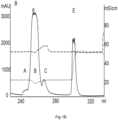
- plasma proteins besides FIX are collected in the flow through separated from each other by the sieving effect of the core and shell and comprise Factor VIII (FVIII) and von Willebrand factor (vWF), IgG, human serum albumin (HSA) and Complement C3. See the chromatogram in Fig 1B below, describing peaks A, B and C.
- the loading of plasma is repeated 1-20 times, preferably 5-10 times, followed by running buffer to obtain a corresponding number of flow throughs (FT's), before the FIX is eluted from the ligands in the core.
- FT's flow throughs
- Each loading is followed by running buffer of about one column volume and a corresponding number of FT's as number of loadings are obtained. This is described more closely in Figs 1A- 1B below.
- the total shell bead (i.e. shell plus core) thickness is 40-100 ⁇ m in diameter, and the lid thickness is preferably 2-10 ⁇ m.
- the ligand concentration in the core is preferably 50-200 ⁇ mole/ml.
- the shell is provided with affinity ligands, hydrophobic interaction ligands, IMAC ligands, cation exchange ligands or multimodal ligands (or any ligands that reply on another separation principle than anion exchange ligands); and other plasma protein than FIX , such as FVIII/vWF , IgG, HSA, C3, are adsorbed on the ligands in the shell in the same step as FIX is adsorbed on the ligands in the core; and wherein plasma proteins are sequentially eluted from the ligands in the shell (FVIII/ vWF and/or IgG, HSA, C3, depending on chosen type of ligand) and ligands in the core (FIX).
- the ligands in the shell are ligands having immunoglobulin affinity, such as Protein A or G or variants thereof known in the art.
- the porous material used in the method of the invention is preferably a sieving material, such as a gel filtration material commonly used for chromatography.
- the porous material in the inner core may have the same or different porosity as the porous material in the lid.
- the porous material is derived from a synthetic polymer material, such as styrene or styrene derivatives, divinylbenzene, acrylamides, acrylate esters, methacrylate esters, vinyl esters and vinylamides, or from a natural polymer material, such as carbohydrate material selected from agarose, agar, cellulose, dextran, chitosan, konjac, carrageenan, gellan and alginate.
- the preferred porous material is agarose.
- the shell and core may be made of agarose of the same porosity but they may also be made of different porosity.
- albumin is used to restore blood volume
- immunoglobulins are used for immune deficiencies
- coagulation factors are used for blood coagulation disorders.
- the plasma proteins especially FIX, may be used for therapy without further purification from contaminants, but with necessary adjustments for biocompatibility etc.
- Volumes of matrix refer to settled bed volume and weights of matrix given in gram refer to suction dry weight.
- For large scale reaction stirring is referring to a suspended, motor-driven stirrer since the use of magnet bar stirrer is prompt to damage the beads.
- Conventional methods were used for the analysis of the functionality and the determination of the degree of allylation, or the degree of ligand content on the beads.
- the support particles used were highly crosslinked agarose beads, prepared according to the methods described in US Pat. 6,602,990 .
- the beads had a volume-weighted average diameter (D50,v) of 88 micrometers and a pore size distribution such that 69 % of the pore volume was available to dextran molecules of Mw 110 kDa. This can also be expressed such that Kd for dextran 110 kDa on the beads was 0.69, when measured according to the methods described in " Handbook of Process Chromatography, A Guide to Optimization, Scale-Up and validation” (1997) Academic Press, San Diego. Gail Sofer & Lars Hagel eds.ISBN 0-12-654266-X, p. 368 .
- the allyl content 276 ⁇ mol/mL, was measured by titration.
- the sample was human plasma. Frozen human plasma was thawed and filtered through cotton, and applied to the column.
- the column was equilibrated with running buffer prior to the first sample application. 0.23 CV of plasma was applied to the column, followed by 1.8 CV of running buffer. This procedure, application of 0.23 CV of plasma followed by 1.8 CV of running buffer, was repeated 5 times, resulting in a total of 6 plasma sample applications. After the final 1.8 CV of running buffer, the column was eluted with 1.5 CV of high salt elution buffer. The column was then subjected to CIP by applying 1.5 CV of 0.5 M NaOH. Finally, the column was re-equilibrated by 4 CV of running buffer.
- the prototype 99 was packed in a Tricorn 10/300 column.
- the bed height was 28.6 cm (CV 22.5 mL) and the flow rate was 50 cm/h, to enable size-dependent group separation.
- the run consisted of 6 plasma sample applications (6x0.23 CV) resulting in 6 group separations, and one final high salt elution from the Q ligand in the core.
- the fractions from the 6 group separations were pooled so that one pooled fraction A with very large molecules, one pooled fraction B with smaller proteins, and one pooled fraction C with slightly retained smaller proteins, were obtained.
- the high salt elution resulted in one eluted fraction E. All fractions were analysed for FVIII, vWF and FIX.
- the chromatogram is shown in Fig 1A and a partial enlargement is shown in Fig 1B .
- fraction A pool was 37% and 40%, respectively.
- Fraction B and C pools had FVIII and vWF activities below level of quantification.
- the eluted fraction E contained 22% of the FVIII activity, and 13% of the vWF activity. This indicated that most of the large FVIII/vWF complexes do not enter the beads, and pass in the flow through, separated from the smaller molecules such as albumin and IgG in fraction B, which enter the beads but do not bind to the Q ligand in the core under these conditions. SDS PAGE and LC-MS showed that albumin and IgG were the main proteins in fraction B.
- Fraction C the major components in Fraction C were C3 and albumin.
- FVIII/vWF complexes enter the pores and bind to the Q ligand, this could depend on the varying size of the FVIII/vWF complexes and the low flow rate.
- Fraction E consisted of molecules eluted with high salt, and it was the only fraction with FIX activity, 91% yield. This shows that the smaller FIX molecules enter the chromatography beads and bind to the Q ligand in the core.
Landscapes
- Health & Medical Sciences (AREA)
- Chemical & Material Sciences (AREA)
- Life Sciences & Earth Sciences (AREA)
- Organic Chemistry (AREA)
- Engineering & Computer Science (AREA)
- General Health & Medical Sciences (AREA)
- Medicinal Chemistry (AREA)
- Zoology (AREA)
- Bioinformatics & Cheminformatics (AREA)
- Genetics & Genomics (AREA)
- Proteomics, Peptides & Aminoacids (AREA)
- Biochemistry (AREA)
- Gastroenterology & Hepatology (AREA)
- Molecular Biology (AREA)
- Hematology (AREA)
- Pharmacology & Pharmacy (AREA)
- Animal Behavior & Ethology (AREA)
- Veterinary Medicine (AREA)
- Public Health (AREA)
- Biomedical Technology (AREA)
- Chemical Kinetics & Catalysis (AREA)
- Immunology (AREA)
- Analytical Chemistry (AREA)
- Wood Science & Technology (AREA)
- Epidemiology (AREA)
- Biophysics (AREA)
- Biotechnology (AREA)
- Toxicology (AREA)
- General Engineering & Computer Science (AREA)
- Cell Biology (AREA)
- Microbiology (AREA)
- Developmental Biology & Embryology (AREA)
- Virology (AREA)
- Nuclear Medicine, Radiotherapy & Molecular Imaging (AREA)
- General Chemical & Material Sciences (AREA)
- Diabetes (AREA)
- Marine Sciences & Fisheries (AREA)
- Treatment Of Liquids With Adsorbents In General (AREA)
- Solid-Sorbent Or Filter-Aiding Compositions (AREA)
- Peptides Or Proteins (AREA)
Description
- The present invention relates to the field of chromatography. More closely, the invention relates to a chromatographic method for purification of plasmaproteins, such as Factor VIII, von Willebrand factor and Factor IX. The chromatographic method is performed on a matrix comprising an inner porous core and outer porous lid surrounding said core.
- Blood contains different types of cells and molecules which are necessary for vital body functions, and is therefore collected for therapeutic purposes, eg for blood transfusions. However, it is possible to separate and prepare different fractions from blood, such as red blood cells or cell-free plasma, which enables a more directed therapeutic treatment of medical conditions. Several proteins in plasma can also be further isolated and used for specific therapeutic treatments, eg albumin is used to restore blood volume, immunoglobulins are used for immune deficiencies, and coagulation factors are used for blood coagulation disorders.
- Plasma contains proteins of different function, different size, different amount, etc, so there are different methods for purification of the different plasma proteins. The purification processes are often designed to obtain several target proteins from one single starting pool of plasma. The processes typically involve precipitation or chromatography steps or a combination thereof. Chromatography is often used to increase the purity of the target protein and reduce the risk for detrimental side effects. Many plasma proteins exhibit very potent activities, and if present as contaminants, they can cause adverse reactions even at very low levels, when administered to patients.
- Collected human plasma is stored frozen, and the initial step in a plasma protein purification process is thawing and pooling of plasma. When thawing at low temperatures, typically 1-6 degrees C, some plasma proteins precipitate and can be collected by eg centrifugation. The collected precipitate is called cryoprecipitate, and can be used as a source of eg coagulation Factor VIII (FVIII) and von Willebrand Factor (vWF). Most of the FVIII in plasma is present as a complex with the large vWF multimers, and the two proteins are therefore often co-purified. The remaining liquid after removal of the cryprecipitate is often referred to as cryodepleted plasma or cryosupernatant, and this can be used as a source of eg albumin, immunoglobulin G (IgG), coagulation Factor IX (FIX).
-
EP0408029B1 relates to a method for fractionating plasma protein characterized in that a plasma protein-containing material is treated by the following steps. - (i) Freeze-thaw treatment
- (ii) Treatment at 5 to 10% ethanol concentration
- (iii) Treatment with an anion exchanger
- (iv) Affinity chromatography with immobilized lysine
- (v) Affinity chromatography with immobilized heparin
- (vi) Treatment at 18 to 30% ethanol concentration
- (vii) Treatment at 35 to 45% ethanol concentration
-
US 4,721,572 relates to a non-carbohydrate sulfated matrix and the use thereof to isolate and purify blood clotting factors and other blood proteins by a procedure involving the adsorption of at least one of such factors and proteins onto the non-carbohydrate sulfated matrix followed by elution of such factors and proteins onto the non-carbohydrate sulfated matrix followed by elution of such factors and proteins from the matrix. - The purification of many plasma proteins can be challenging. This can depend on the presence of small amounts of contaminants with undesired but potent activity, or that the proteins sometimes lose their activity or gain unwanted activity. For example, the FVIII easily loses activity, and the known methods used for purification are not satisfactory in many respects. Thus, there is a need of improved methods which can be operated at conditions where the proteins retain their activity, in order to obtain plasma products in good yields.
- The present invention provides chromatographic materials and methods for purification of plasma proteins, especially for human plasma applications. The chromatographic materials are capable of separations based on different principles, eg size and bind/elute. The method of the invention is especially suitable for purification of plasma samples which contain both large proteins (eg FVIII/vWF) and smaller proteins (HSA, IgG, FIX) of therapeutic interest.
- Thus, the present invention provides a chromatographic method for purification of therapeutic proteins from plasma, comprising the following steps: loading plasma on a chromatography column packed with a resin comprising porous shell beads having an inner porous core and an outer porous shell, wherein the inner core is provided with anion exchange ligands and the shell is inactive (ie not provided with any ligands) and wherein the porosity of the lid and core does not allow entering of molecules larger than 500kD, ,; adsorbing Factor IX (FIX) on the anion exchange ligands in the core; collecting separated plasma proteins in the flow through; and eluting FIX from the ligands in the core. Adjustments of running and elution buffer in a chromatographic method are within the knowledge of the skilled person in the field and examples thereof are described in the experimental section below.
- The anion exchange ligands may be any anion exchange ligands but are preferably selected from diethylaminoethyl (DEAE), quaternary aminoethyl (QAE) or quaternary ammonium (Q), most preferably he anion exchange ligands are Q-ligands.
- In a preferred embodiment other plasma proteins besides FIX are collected in the flow through separated from each other by the sieving effect of the core and shell and comprise Factor VIII (FVIII) and von Willebrand factor (vWF), IgG, human serum albumin (HSA) and Complement C3. See the chromatogram in
Fig 1B below, describing peaks A, B and C. - In an alternative embodiment the loading of plasma is repeated 1-20 times, preferably 5-10 times, followed by running buffer to obtain a corresponding number of flow throughs (FT's), before the FIX is eluted from the ligands in the core. Each loading is followed by running buffer of about one column volume and a corresponding number of FT's as number of loadings are obtained. This is described more closely in
Figs 1A- 1B below. - In the alternative embodiment specific fractions of respective FT are pooled to obtain FVIII/vWF, IgG/HSA and C3 respectively. Thus, on one and the same chromatography column separated plasma fractions are obtained for FVIII/vWF, IgG/HSA, C3 and FIX.
- Preferably the total shell bead (i.e. shell plus core) thickness is 40-100 µm in diameter, and the lid thickness is preferably 2-10 µm. The ligand concentration in the core is preferably 50-200 µmole/ml.
- In a further embodiment the shell is provided with affinity ligands, hydrophobic interaction ligands, IMAC ligands, cation exchange ligands or multimodal ligands (or any ligands that reply on another separation principle than anion exchange ligands); and other plasma protein than FIX , such as FVIII/vWF , IgG, HSA, C3, are adsorbed on the ligands in the shell in the same step as FIX is adsorbed on the ligands in the core; and wherein plasma proteins are sequentially eluted from the ligands in the shell (FVIII/ vWF and/or IgG, HSA, C3, depending on chosen type of ligand) and ligands in the core (FIX)..
- Preferably the ligands in the shell are ligands having immunoglobulin affinity, such as Protein A or G or variants thereof known in the art.
- The porous material used in the method of the invention is preferably a sieving material, such as a gel filtration material commonly used for chromatography. The porous material in the inner core may have the same or different porosity as the porous material in the lid. The porous material is derived from a synthetic polymer material, such as styrene or styrene derivatives, divinylbenzene, acrylamides, acrylate esters, methacrylate esters, vinyl esters and vinylamides, or from a natural polymer material, such as carbohydrate material selected from agarose, agar, cellulose, dextran, chitosan, konjac, carrageenan, gellan and alginate. The preferred porous material is agarose.
- The shell and core may be made of agarose of the same porosity but they may also be made of different porosity.
- In therapeutic uses, for example, albumin is used to restore blood volume, immunoglobulins are used for immune deficiencies, and coagulation factors are used for blood coagulation disorders.
- It is contemplated that the plasma proteins, especially FIX, may be used for therapy without further purification from contaminants, but with necessary adjustments for biocompatibility etc.
-
-
Fig 1A : Chromatogram of plasma applied to prototype 99 column. Numbers 1-6= flow through (FT) peaks from the 6 sample applications; E=elution peak; CIP=cleaning-in-place.
Absorbance 280 nm - solid line; conductivity - dotted line; pH - dashed line. -
Figure 1B : Partial enlargement of chromatogram of plasma applied to prototype 99 column according toFig 1A , showing final (6th) sample application and elution. 6=flow through peaks from the 6th sample application; A=large molecules, eg FVIII/vWF; B=smaller molecules, eg albumin, IgG; C=partially retained material; E=eluted molecules, eg FIX.
Absorbance 280 nm - solid line; conductivity - dotted line; pH - dashed line. - The invention will now be described more closely in connection with some non- limiting examples and the accompanying figures.
- Volumes of matrix refer to settled bed volume and weights of matrix given in gram refer to suction dry weight. For large scale reaction stirring is referring to a suspended, motor-driven stirrer since the use of magnet bar stirrer is prompt to damage the beads. Conventional methods were used for the analysis of the functionality and the determination of the degree of allylation, or the degree of ligand content on the beads.
- The support particles used were highly crosslinked agarose beads, prepared according to the methods described in
US Pat. 6,602,990 . The beads had a volume-weighted average diameter (D50,v) of 88 micrometers and a pore size distribution such that 69 % of the pore volume was available to dextran molecules of Mw 110 kDa. This can also be expressed such that Kd for dextran 110 kDa on the beads was 0.69, when measured according to the methods described in "Handbook of Process Chromatography, A Guide to Optimization, Scale-Up and validation" (1997) Academic Press, San Diego. Gail Sofer & Lars Hagel eds.ISBN 0-12-654266-X, p. 368. - 250 mL (g) of of support particles were washed 6x gel volumes (GV) with distilled water, and then 3xGV with 50% NaOH. The gelwas then sucked dry and transferred to a 2 L round bottom flask. 485 mL of 50% NaOH was added, mechanical propeller stirring was applied and the flask was immersed into a water bath at 50°C. After 30
minutes 80 mL of allyl glycidyl ether (AGE) was added. The reaction progressed for 18.5 h. The gel was washed 1xGV with distilled water, 3xGV with ethanol and then 8xGV with distilled water. - The allyl content, 276 µmol/mL, was measured by titration.
- 171.8 g of allylated gel slurry (prototype 76) was transferred to a glass filter (por. 2) and sucked dry. The dry gel is transferred to a 1000 mL round bottom flask fitted with a mechanical stirrer. 571 g of distilled water is added and the suspension is stirred at 300 rpm. 83.7 g of the 1.6 % bromine solution is added during 1.5 min. After the addition the suspension is still white. The reaction proceeded for 15 min at rt. The round bottom flask was immersed in a bath and when the temperature had reached 50°C, 52 g of 50% NaOH was added. The reaction was let to stand for 17 hours. The reaction is transferred to a glass filter (por. 2 ) and washed with distilled water 10 x 1 GV. The remaining allyl content, 216 µmol/mL, was measured by titration. This corresponds to a theoretical shell thickness of 3.5 µm.
- 41.5 mL (g) of partial allylated base matrix from above was transferred drained to a 250 mL round bottom flask fitted with a mechanical stirrer. 10.37 g of distilled water and 1.66 g of sodium acetate was added. After stirring for a couple of minutes, 0.66 mL bromine is added with a pipette and the reaction is stirred at 300 rpm for additionally 20 min. Excess bromine is consumed by adding 4.15 mL of 40 % sodium formate solution. The reaction is colourless. After 15 min, 8.30 mL of trimethyl ammonium chloride (TMAC) is added and the pH is adjusted to 11-11.5 by adding 50 % NaOH. The reaction is stirred at 250 rpm at 30 °C for 18 h. The reaction is neutralized by adding 60 % acetic acid to pH 5-7 before transferring to a glass filter (por. 3). The gel was washed with distilled water 10x1 GV, followed by 20 % EtOH 2 x 1 GV. Titration of the ion exchange groups gave a Q ligand density of 125 µmol/ml.
Table 1 shows the lid thickness, ligand type and concentration in Prototype 99. Table 1 Resin Lid thickness (µm) Lid ligand (type, conc.) Core ligand (type, conc.) Prototype 99 3.5 No ligand Q, 125 µmol/ml - The sample was human plasma. Frozen human plasma was thawed and filtered through cotton, and applied to the column.
-
- Column: Tricorn 10/300 with prototype 99, bed height 28.6 cm, column volume (CV) 22.5 mL.
- Chromatography: Sample volume 6x5.2 mL (6x0.23 CV). Flow rate 50 cm/h (0.65mL/min).
- Running buffer: 20 mM Na-citrate, 0.15 M NaCl, 2.6 mM CaCl2, pH 7.0.
- Elution buffer: 20 mM Na-citrate, 0.5 M NaCl, 2.6 mM CaCl2, pH 7.0.
- Cleaning-in-place (CIP): 0.5 M NaOH.
- The column was equilibrated with running buffer prior to the first sample application. 0.23 CV of plasma was applied to the column, followed by 1.8 CV of running buffer. This procedure, application of 0.23 CV of plasma followed by 1.8 CV of running buffer, was repeated 5 times, resulting in a total of 6 plasma sample applications. After the final 1.8 CV of running buffer, the column was eluted with 1.5 CV of high salt elution buffer. The column was then subjected to CIP by applying 1.5 CV of 0.5 M NaOH. Finally, the column was re-equilibrated by 4 CV of running buffer.
- Selected fractions were analyzed for FVIII activity (Chromogenix Coamatic Factor VIII kit), vWF (Technozym vWF:Ag ELISA kit), FIX (ROX Factor IX kit), and by SDS PAGE, and liquid chromatography-mass spectrometry (LC-MS).
- The prototype 99 was packed in a Tricorn 10/300 column. The bed height was 28.6 cm (CV 22.5 mL) and the flow rate was 50 cm/h, to enable size-dependent group separation. The run consisted of 6 plasma sample applications (6x0.23 CV) resulting in 6 group separations, and one final high salt elution from the Q ligand in the core. The fractions from the 6 group separations were pooled so that one pooled fraction A with very large molecules, one pooled fraction B with smaller proteins, and one pooled fraction C with slightly retained smaller proteins, were obtained. The high salt elution resulted in one eluted fraction E. All fractions were analysed for FVIII, vWF and FIX. The chromatogram is shown in
Fig 1A and a partial enlargement is shown inFig 1B . - See Table 2 below for analytical results and yield calculations. The yields of FVIII and vWF in the fraction A pool was 37% and 40%, respectively. Fraction B and C pools had FVIII and vWF activities below level of quantification. The eluted fraction E contained 22% of the FVIII activity, and 13% of the vWF activity. This indicated that most of the large FVIII/vWF complexes do not enter the beads, and pass in the flow through, separated from the smaller molecules such as albumin and IgG in fraction B, which enter the beads but do not bind to the Q ligand in the core under these conditions. SDS PAGE and LC-MS showed that albumin and IgG were the main proteins in fraction B. LS-MC indicated that the major components in Fraction C were C3 and albumin. However, some FVIII/vWF complexes enter the pores and bind to the Q ligand, this could depend on the varying size of the FVIII/vWF complexes and the low flow rate. Fraction E consisted of molecules eluted with high salt, and it was the only fraction with FIX activity, 91% yield. This shows that the smaller FIX molecules enter the chromatography beads and bind to the Q ligand in the core. This demonstrates that by using a chromatography media with an inactive lid and ligand-containing core, it is possible to separate large (FVIII/vWF) and small (FIX) plasma proteins which both bind to the core ligand, as the large proteins are collected in the flow through, and the smaller molecules can be collected by elution.
Table 2: Plasma on prototype 99. FVIII, vWF and FIX activity. For fractions, see Fig 1 A and B. X=not measured. LOQ=level of quantification (FVIII: 8 mU/mL, vWF: 0.10 U/mL, FIX: 30 mU/mL). Sample Vol (mL) FVIII (mU/m L) FVIII (mU) FVII I (%) vWF (U/mL) vWF (U) vWF (%) FIX (mU/mL ) FIX (mU) FIX (%) Plasma 31.0 875 27125 100 1.00 31.0 100 1360 42160 10 0 Fraction A 35.7 280 9996 37 0.35 12.5 40 <LOQ Fraction B 66.6 <LOQ <LOQ <LOQ Fraction C 47.3 <LOQ <LOQ <LOQ Fraction E 8.2 743 6093 22 0.49 4.0 13 4673 38319 91
Claims (11)
- A chromatographic method for purification of therapeutic proteins from plasma, comprising the following steps: loading plasma on a chromatography column packed with a resin comprising porous lid beads having an inner porous core and an outer porous lid, wherein the inner core is provided with anion exchange ligands, and wherein the porosity of the lid and core does not allow entering of molecules larger than 500kD; adsorbing Factor IX (FIX) on the anion exchange ligands in the core; collecting separated plasma proteins in the flow through; and eluting FIX from the ligands in the core.
- Method according to claim 1, wherein the anion exchange ligands are selected from diethylaminoethyl (DEAE), quaternary aminoethyl (QAE) or quaternary ammonium (Q).
- Method according to claim 2, wherein the anion exchange ligands are Q-ligands.
- Method according to claim 1, 2 or 3, wherein other plasma proteins besides FIX are collected in the flow through separated from each other by the sieving effect of the core and shell and comprise Factor VIII (FVIII) and von Willebrand factor (vWF), IgG, human serum albumin (HSA) and Complement C3 (C3).
- Method according to one or more of the above claims, wherein the loading of plasma is repeated 1-20 times, preferably 5-10 times, followed by running buffer to obtain a corresponding number of flow throughs (FT's), before the FIX is eluted from the ligands in the core.
- Method according to claim 5, wherein specific fractions of respective FT are pooled to obtain FVIII/vWF, IgG/HSA and C3 respectively.
- Method according to one or more of the above claims, wherein the total lid bead thickness is 40-100 µm in diameter, and the lid thickness is 2-10 µm.
- Method according to one or more of the above claims, wherein the ligand concentration in the core is 50-200 µmοl/ml.
- Method according to one or more of the above claims, wherein the lid and core are made of agarose of the same porosity.
- Method according to one or more of the above claims 1-8, wherein the porosity of the lid is larger than of the core.
- Method according to one or more of the above claims 1-8, wherein the porosity of the lid is smaller than of the core.
Applications Claiming Priority (2)
| Application Number | Priority Date | Filing Date | Title |
|---|---|---|---|
| GBGB1506117.9A GB201506117D0 (en) | 2015-04-10 | 2015-04-10 | Method for chromatography |
| PCT/EP2016/057356 WO2016162310A1 (en) | 2015-04-10 | 2016-04-04 | Method for chromatography |
Publications (2)
| Publication Number | Publication Date |
|---|---|
| EP3280508A1 EP3280508A1 (en) | 2018-02-14 |
| EP3280508B1 true EP3280508B1 (en) | 2023-03-22 |
Family
ID=53333602
Family Applications (1)
| Application Number | Title | Priority Date | Filing Date |
|---|---|---|---|
| EP16713486.5A Active EP3280508B1 (en) | 2015-04-10 | 2016-04-04 | Method for chromatography |
Country Status (7)
| Country | Link |
|---|---|
| US (2) | US11542300B2 (en) |
| EP (1) | EP3280508B1 (en) |
| JP (1) | JP6797416B2 (en) |
| CN (1) | CN107466298B (en) |
| ES (1) | ES2942326T3 (en) |
| GB (1) | GB201506117D0 (en) |
| WO (1) | WO2016162310A1 (en) |
Families Citing this family (5)
| Publication number | Priority date | Publication date | Assignee | Title |
|---|---|---|---|---|
| GB201506117D0 (en) * | 2015-04-10 | 2015-05-27 | Ge Healthcare Bio Sciences Ab | Method for chromatography |
| CA3079956C (en) * | 2017-10-27 | 2023-06-27 | Green Cross Holdings Corporation | Method for preparing composition containing factor 8 capable of controlling content of von willebrand factor (vwf) and von willebrand factor |
| CN111818980B (en) * | 2018-03-08 | 2022-10-11 | 生物辐射实验室股份有限公司 | Anion exchange-hydrophobic mixed mode chromatography resins |
| GB201906595D0 (en) * | 2019-05-10 | 2019-06-26 | Ge Healthcare Bioprocess R&D Ab | Method for purification of plasma proteins |
| US11896969B2 (en) | 2019-09-05 | 2024-02-13 | Bio-Rad Laboratories, Inc. | Anionic exchange-hydrophobic mixed mode chromatography resins |
Family Cites Families (21)
| Publication number | Priority date | Publication date | Assignee | Title |
|---|---|---|---|---|
| US4721572A (en) | 1985-07-12 | 1988-01-26 | Miles Laboratories, Inc. | Purfication of blood clotting factors and other blood proteins on non-carbohydrate sulfated matrices |
| EP0317376B2 (en) * | 1987-10-23 | 1996-04-03 | Centre Regional De Transfusion Sanguine De Lille | Preparation of a concentrate of high-purity human factor IX and of other plasma proteins |
| US5138034A (en) * | 1989-07-12 | 1992-08-11 | The Green Cross Corporation | Method of fractionating plasma proteins |
| IT1256622B (en) | 1992-12-04 | 1995-12-12 | Sclavo Spa | PROCESS FOR THE EXTRACTION OF THE FACTOR VIII-FACTOR VON WILLEBRAND (FVIII: C-FVW) FROM TOTAL HUMAN PLASMA. |
| SE0202551D0 (en) | 2002-08-27 | 2002-08-27 | Amersham Biosciences Ab | Chromatographic two-layer particles |
| FR2887883B1 (en) | 2005-06-29 | 2007-08-31 | Lab Francais Du Fractionnement | PROCESS FOR SEPARATING FIBRINOGEN PROTEINS, FACTOR XIII AND BIOLOGICAL GLUE OF SOLUBILIZED PLASMA FRONTION AND PREPARATION OF LYOPHILIZED CONCENTRATES OF SAID PROTEINS |
| ITLU20070007A1 (en) | 2007-05-07 | 2008-11-08 | Kedrion Spa | CHROMATOGRAPHIC PROCESS FOR OBTAINING A FVIII / VWF COMPLEX WITH DIFFERENT RELATIONSHIPS BETWEEN THE TWO PROTEINS TO BE USED IN THE HEMOPHILIA A THERAPY AND IN VON WILLEBRAND'S DISEASE. |
| WO2009007451A1 (en) | 2007-07-11 | 2009-01-15 | Novo Nordisk A/S | Purification of factor viii using a mixed-mode or multimodal resin |
| FR2920429B1 (en) * | 2007-08-30 | 2012-10-05 | Lfb Biotechnologies | PROCESS FOR PURIFYING FACTOR VIII AND VON WILLEBRAND FACTOR |
| AU2009238686B2 (en) | 2008-04-22 | 2014-08-28 | Cytiva Bioprocess R&D Ab | Chromatography medium |
| PL2300497T3 (en) * | 2008-06-24 | 2013-02-28 | Octapharma Ag | A process of purifying coagulation factor viii |
| US20110155668A1 (en) * | 2008-07-08 | 2011-06-30 | Ge Healthcare Bio-Sciences Ab | Separation medium for chromatography of various biomolecules |
| FR2942233B1 (en) | 2009-02-19 | 2015-03-13 | Lfb Biotechnologies | MEANS FOR PURIFYING BLOOD PLASMA PROTEIN, AND METHODS FOR ITS IMPLEMENTATION |
| EP2536499A4 (en) * | 2010-02-19 | 2013-08-14 | Ge Healthcare Bio Sciences Ab | METHOD FOR MANUFACTURING CHROMATOGRAPHY MEDIUM |
| EP2691767B1 (en) * | 2011-03-31 | 2016-03-23 | GE Healthcare Bio-Sciences AB | Method for sample preparation |
| CN102584983B (en) * | 2012-02-01 | 2014-11-05 | 中国科学院过程工程研究所 | Method for separating and purifying blood coagulation factor VIII |
| US20140154233A1 (en) | 2012-12-05 | 2014-06-05 | Csl Limited | Method of purifying therapeutic proteins |
| BR112015029051A2 (en) | 2013-05-20 | 2017-07-25 | Shantha Biotechnics Private Ltd | processes for purifying a polysaccharide protein conjugate and for manufacturing a vaccine |
| US10626164B2 (en) * | 2014-07-25 | 2020-04-21 | Csl Limited | Purification of VWF |
| GB201506113D0 (en) * | 2015-04-10 | 2015-05-27 | Ge Healthcare Bio Sciences Ab | Method for chromatography |
| GB201506117D0 (en) * | 2015-04-10 | 2015-05-27 | Ge Healthcare Bio Sciences Ab | Method for chromatography |
-
2015
- 2015-04-10 GB GBGB1506117.9A patent/GB201506117D0/en not_active Ceased
-
2016
- 2016-04-04 CN CN201680020792.6A patent/CN107466298B/en active Active
- 2016-04-04 EP EP16713486.5A patent/EP3280508B1/en active Active
- 2016-04-04 JP JP2017550147A patent/JP6797416B2/en active Active
- 2016-04-04 WO PCT/EP2016/057356 patent/WO2016162310A1/en not_active Ceased
- 2016-04-04 US US15/564,232 patent/US11542300B2/en active Active
- 2016-04-04 ES ES16713486T patent/ES2942326T3/en active Active
-
2022
- 2022-11-29 US US18/059,929 patent/US11807666B2/en active Active
Also Published As
| Publication number | Publication date |
|---|---|
| US20180127460A1 (en) | 2018-05-10 |
| CN107466298A (en) | 2017-12-12 |
| JP6797416B2 (en) | 2020-12-09 |
| US11542300B2 (en) | 2023-01-03 |
| JP2018512416A (en) | 2018-05-17 |
| CN107466298B (en) | 2022-03-11 |
| US20230091082A1 (en) | 2023-03-23 |
| US11807666B2 (en) | 2023-11-07 |
| WO2016162310A1 (en) | 2016-10-13 |
| EP3280508A1 (en) | 2018-02-14 |
| ES2942326T3 (en) | 2023-05-31 |
| GB201506117D0 (en) | 2015-05-27 |
Similar Documents
| Publication | Publication Date | Title |
|---|---|---|
| US11807666B2 (en) | Chromatographic methods for purification of proteins from plasma | |
| JP4776615B2 (en) | Antibody purification | |
| US5714583A (en) | Factor IX purification methods | |
| EP1729867B1 (en) | A method for chromatographic purification | |
| US9155980B2 (en) | Separation medium for chromatography of various biomolecules | |
| JP2011511288A (en) | Method for manufacturing separation medium | |
| US11352388B2 (en) | Method for chromatography | |
| WO2006011839A1 (en) | Chromatography method | |
| EP0524681A1 (en) | Process for the purification of serum albumin | |
| US6150504A (en) | Process for the purification of serum albumin | |
| US8088833B2 (en) | Method for purifying an IgG monomer | |
| EP1759196B1 (en) | Separation matrix and method of purification | |
| RU2643365C2 (en) | Method for purifying darbepoetin alpha | |
| US20080299671A1 (en) | Hydrophobic Interaction Chromatography | |
| JPS6034916A (en) | High purity purification of ix factor and other vitamin k dependent proteins | |
| Kennedy et al. | The use of HPLC in biotechnology | |
| JPH06134206A (en) | How to separate biological material | |
| CN115362164A (en) | High-purity purification technology of Gc protein | |
| JPH03251544A (en) | Separating agent for optical isomer | |
| Domínguez Aldás et al. | Evaluación de las resinas cromatográficas Cellufine MAX Q-hv y Capto Q para la purificación del r-HBsAg |
Legal Events
| Date | Code | Title | Description |
|---|---|---|---|
| STAA | Information on the status of an ep patent application or granted ep patent |
Free format text: STATUS: THE INTERNATIONAL PUBLICATION HAS BEEN MADE |
|
| PUAI | Public reference made under article 153(3) epc to a published international application that has entered the european phase |
Free format text: ORIGINAL CODE: 0009012 |
|
| STAA | Information on the status of an ep patent application or granted ep patent |
Free format text: STATUS: REQUEST FOR EXAMINATION WAS MADE |
|
| 17P | Request for examination filed |
Effective date: 20170919 |
|
| AK | Designated contracting states |
Kind code of ref document: A1 Designated state(s): AL AT BE BG CH CY CZ DE DK EE ES FI FR GB GR HR HU IE IS IT LI LT LU LV MC MK MT NL NO PL PT RO RS SE SI SK SM TR |
|
| AX | Request for extension of the european patent |
Extension state: BA ME |
|
| DAV | Request for validation of the european patent (deleted) | ||
| DAX | Request for extension of the european patent (deleted) | ||
| RAP1 | Party data changed (applicant data changed or rights of an application transferred) |
Owner name: CYTIVA BIOPROCESS R&D AB |
|
| STAA | Information on the status of an ep patent application or granted ep patent |
Free format text: STATUS: EXAMINATION IS IN PROGRESS |
|
| 17Q | First examination report despatched |
Effective date: 20201007 |
|
| GRAP | Despatch of communication of intention to grant a patent |
Free format text: ORIGINAL CODE: EPIDOSNIGR1 |
|
| STAA | Information on the status of an ep patent application or granted ep patent |
Free format text: STATUS: GRANT OF PATENT IS INTENDED |
|
| RIC1 | Information provided on ipc code assigned before grant |
Ipc: C12N 9/64 20060101ALI20220610BHEP Ipc: B01J 41/20 20060101ALI20220610BHEP Ipc: B01D 15/38 20060101ALI20220610BHEP Ipc: B01D 15/34 20060101ALI20220610BHEP Ipc: A61P 7/04 20060101ALI20220610BHEP Ipc: A61P 7/00 20060101ALI20220610BHEP Ipc: A61K 38/48 20060101ALI20220610BHEP Ipc: A61K 35/16 20150101ALI20220610BHEP Ipc: A61K 38/36 20060101ALI20220610BHEP Ipc: B01D 15/36 20060101AFI20220610BHEP |
|
| INTG | Intention to grant announced |
Effective date: 20220630 |
|
| GRAJ | Information related to disapproval of communication of intention to grant by the applicant or resumption of examination proceedings by the epo deleted |
Free format text: ORIGINAL CODE: EPIDOSDIGR1 |
|
| STAA | Information on the status of an ep patent application or granted ep patent |
Free format text: STATUS: EXAMINATION IS IN PROGRESS |
|
| GRAP | Despatch of communication of intention to grant a patent |
Free format text: ORIGINAL CODE: EPIDOSNIGR1 |
|
| STAA | Information on the status of an ep patent application or granted ep patent |
Free format text: STATUS: GRANT OF PATENT IS INTENDED |
|
| INTC | Intention to grant announced (deleted) | ||
| INTG | Intention to grant announced |
Effective date: 20221116 |
|
| GRAS | Grant fee paid |
Free format text: ORIGINAL CODE: EPIDOSNIGR3 |
|
| GRAA | (expected) grant |
Free format text: ORIGINAL CODE: 0009210 |
|
| STAA | Information on the status of an ep patent application or granted ep patent |
Free format text: STATUS: THE PATENT HAS BEEN GRANTED |
|
| AK | Designated contracting states |
Kind code of ref document: B1 Designated state(s): AL AT BE BG CH CY CZ DE DK EE ES FI FR GB GR HR HU IE IS IT LI LT LU LV MC MK MT NL NO PL PT RO RS SE SI SK SM TR |
|
| REG | Reference to a national code |
Ref country code: GB Ref legal event code: FG4D |
|
| REG | Reference to a national code |
Ref country code: CH Ref legal event code: EP |
|
| REG | Reference to a national code |
Ref country code: IE Ref legal event code: FG4D |
|
| REG | Reference to a national code |
Ref country code: DE Ref legal event code: R096 Ref document number: 602016078420 Country of ref document: DE |
|
| REG | Reference to a national code |
Ref country code: AT Ref legal event code: REF Ref document number: 1554944 Country of ref document: AT Kind code of ref document: T Effective date: 20230415 |
|
| REG | Reference to a national code |
Ref country code: ES Ref legal event code: FG2A Ref document number: 2942326 Country of ref document: ES Kind code of ref document: T3 Effective date: 20230531 |
|
| P01 | Opt-out of the competence of the unified patent court (upc) registered |
Effective date: 20230526 |
|
| REG | Reference to a national code |
Ref country code: LT Ref legal event code: MG9D |
|
| REG | Reference to a national code |
Ref country code: NL Ref legal event code: MP Effective date: 20230322 |
|
| PG25 | Lapsed in a contracting state [announced via postgrant information from national office to epo] |
Ref country code: RS Free format text: LAPSE BECAUSE OF FAILURE TO SUBMIT A TRANSLATION OF THE DESCRIPTION OR TO PAY THE FEE WITHIN THE PRESCRIBED TIME-LIMIT Effective date: 20230322 Ref country code: NO Free format text: LAPSE BECAUSE OF FAILURE TO SUBMIT A TRANSLATION OF THE DESCRIPTION OR TO PAY THE FEE WITHIN THE PRESCRIBED TIME-LIMIT Effective date: 20230622 Ref country code: LV Free format text: LAPSE BECAUSE OF FAILURE TO SUBMIT A TRANSLATION OF THE DESCRIPTION OR TO PAY THE FEE WITHIN THE PRESCRIBED TIME-LIMIT Effective date: 20230322 Ref country code: LT Free format text: LAPSE BECAUSE OF FAILURE TO SUBMIT A TRANSLATION OF THE DESCRIPTION OR TO PAY THE FEE WITHIN THE PRESCRIBED TIME-LIMIT Effective date: 20230322 Ref country code: HR Free format text: LAPSE BECAUSE OF FAILURE TO SUBMIT A TRANSLATION OF THE DESCRIPTION OR TO PAY THE FEE WITHIN THE PRESCRIBED TIME-LIMIT Effective date: 20230322 |
|
| REG | Reference to a national code |
Ref country code: AT Ref legal event code: MK05 Ref document number: 1554944 Country of ref document: AT Kind code of ref document: T Effective date: 20230322 |
|
| PG25 | Lapsed in a contracting state [announced via postgrant information from national office to epo] |
Ref country code: SE Free format text: LAPSE BECAUSE OF FAILURE TO SUBMIT A TRANSLATION OF THE DESCRIPTION OR TO PAY THE FEE WITHIN THE PRESCRIBED TIME-LIMIT Effective date: 20230322 Ref country code: NL Free format text: LAPSE BECAUSE OF FAILURE TO SUBMIT A TRANSLATION OF THE DESCRIPTION OR TO PAY THE FEE WITHIN THE PRESCRIBED TIME-LIMIT Effective date: 20230322 Ref country code: GR Free format text: LAPSE BECAUSE OF FAILURE TO SUBMIT A TRANSLATION OF THE DESCRIPTION OR TO PAY THE FEE WITHIN THE PRESCRIBED TIME-LIMIT Effective date: 20230623 Ref country code: FI Free format text: LAPSE BECAUSE OF FAILURE TO SUBMIT A TRANSLATION OF THE DESCRIPTION OR TO PAY THE FEE WITHIN THE PRESCRIBED TIME-LIMIT Effective date: 20230322 |
|
| PG25 | Lapsed in a contracting state [announced via postgrant information from national office to epo] |
Ref country code: SM Free format text: LAPSE BECAUSE OF FAILURE TO SUBMIT A TRANSLATION OF THE DESCRIPTION OR TO PAY THE FEE WITHIN THE PRESCRIBED TIME-LIMIT Effective date: 20230322 Ref country code: RO Free format text: LAPSE BECAUSE OF FAILURE TO SUBMIT A TRANSLATION OF THE DESCRIPTION OR TO PAY THE FEE WITHIN THE PRESCRIBED TIME-LIMIT Effective date: 20230322 Ref country code: PT Free format text: LAPSE BECAUSE OF FAILURE TO SUBMIT A TRANSLATION OF THE DESCRIPTION OR TO PAY THE FEE WITHIN THE PRESCRIBED TIME-LIMIT Effective date: 20230724 Ref country code: EE Free format text: LAPSE BECAUSE OF FAILURE TO SUBMIT A TRANSLATION OF THE DESCRIPTION OR TO PAY THE FEE WITHIN THE PRESCRIBED TIME-LIMIT Effective date: 20230322 Ref country code: AT Free format text: LAPSE BECAUSE OF FAILURE TO SUBMIT A TRANSLATION OF THE DESCRIPTION OR TO PAY THE FEE WITHIN THE PRESCRIBED TIME-LIMIT Effective date: 20230322 |
|
| PG25 | Lapsed in a contracting state [announced via postgrant information from national office to epo] |
Ref country code: SK Free format text: LAPSE BECAUSE OF FAILURE TO SUBMIT A TRANSLATION OF THE DESCRIPTION OR TO PAY THE FEE WITHIN THE PRESCRIBED TIME-LIMIT Effective date: 20230322 Ref country code: PL Free format text: LAPSE BECAUSE OF FAILURE TO SUBMIT A TRANSLATION OF THE DESCRIPTION OR TO PAY THE FEE WITHIN THE PRESCRIBED TIME-LIMIT Effective date: 20230322 Ref country code: IS Free format text: LAPSE BECAUSE OF FAILURE TO SUBMIT A TRANSLATION OF THE DESCRIPTION OR TO PAY THE FEE WITHIN THE PRESCRIBED TIME-LIMIT Effective date: 20230722 |
|
| REG | Reference to a national code |
Ref country code: CH Ref legal event code: PL |
|
| PG25 | Lapsed in a contracting state [announced via postgrant information from national office to epo] |
Ref country code: LU Free format text: LAPSE BECAUSE OF NON-PAYMENT OF DUE FEES Effective date: 20230404 |
|
| REG | Reference to a national code |
Ref country code: DE Ref legal event code: R097 Ref document number: 602016078420 Country of ref document: DE |
|
| REG | Reference to a national code |
Ref country code: BE Ref legal event code: MM Effective date: 20230430 |
|
| PG25 | Lapsed in a contracting state [announced via postgrant information from national office to epo] |
Ref country code: MC Free format text: LAPSE BECAUSE OF FAILURE TO SUBMIT A TRANSLATION OF THE DESCRIPTION OR TO PAY THE FEE WITHIN THE PRESCRIBED TIME-LIMIT Effective date: 20230322 |
|
| PLBE | No opposition filed within time limit |
Free format text: ORIGINAL CODE: 0009261 |
|
| STAA | Information on the status of an ep patent application or granted ep patent |
Free format text: STATUS: NO OPPOSITION FILED WITHIN TIME LIMIT |
|
| PG25 | Lapsed in a contracting state [announced via postgrant information from national office to epo] |
Ref country code: SI Free format text: LAPSE BECAUSE OF FAILURE TO SUBMIT A TRANSLATION OF THE DESCRIPTION OR TO PAY THE FEE WITHIN THE PRESCRIBED TIME-LIMIT Effective date: 20230322 Ref country code: MC Free format text: LAPSE BECAUSE OF FAILURE TO SUBMIT A TRANSLATION OF THE DESCRIPTION OR TO PAY THE FEE WITHIN THE PRESCRIBED TIME-LIMIT Effective date: 20230322 Ref country code: LI Free format text: LAPSE BECAUSE OF NON-PAYMENT OF DUE FEES Effective date: 20230430 Ref country code: DK Free format text: LAPSE BECAUSE OF FAILURE TO SUBMIT A TRANSLATION OF THE DESCRIPTION OR TO PAY THE FEE WITHIN THE PRESCRIBED TIME-LIMIT Effective date: 20230322 Ref country code: CZ Free format text: LAPSE BECAUSE OF FAILURE TO SUBMIT A TRANSLATION OF THE DESCRIPTION OR TO PAY THE FEE WITHIN THE PRESCRIBED TIME-LIMIT Effective date: 20230322 Ref country code: CH Free format text: LAPSE BECAUSE OF NON-PAYMENT OF DUE FEES Effective date: 20230430 |
|
| REG | Reference to a national code |
Ref country code: IE Ref legal event code: MM4A |
|
| 26N | No opposition filed |
Effective date: 20240102 |
|
| PG25 | Lapsed in a contracting state [announced via postgrant information from national office to epo] |
Ref country code: BE Free format text: LAPSE BECAUSE OF NON-PAYMENT OF DUE FEES Effective date: 20230430 |
|
| PG25 | Lapsed in a contracting state [announced via postgrant information from national office to epo] |
Ref country code: IE Free format text: LAPSE BECAUSE OF NON-PAYMENT OF DUE FEES Effective date: 20230404 |
|
| PG25 | Lapsed in a contracting state [announced via postgrant information from national office to epo] |
Ref country code: IE Free format text: LAPSE BECAUSE OF NON-PAYMENT OF DUE FEES Effective date: 20230404 |
|
| PG25 | Lapsed in a contracting state [announced via postgrant information from national office to epo] |
Ref country code: BG Free format text: LAPSE BECAUSE OF FAILURE TO SUBMIT A TRANSLATION OF THE DESCRIPTION OR TO PAY THE FEE WITHIN THE PRESCRIBED TIME-LIMIT Effective date: 20230322 |
|
| PG25 | Lapsed in a contracting state [announced via postgrant information from national office to epo] |
Ref country code: BG Free format text: LAPSE BECAUSE OF FAILURE TO SUBMIT A TRANSLATION OF THE DESCRIPTION OR TO PAY THE FEE WITHIN THE PRESCRIBED TIME-LIMIT Effective date: 20230322 |
|
| PGFP | Annual fee paid to national office [announced via postgrant information from national office to epo] |
Ref country code: DE Payment date: 20250428 Year of fee payment: 10 |
|
| PGFP | Annual fee paid to national office [announced via postgrant information from national office to epo] |
Ref country code: ES Payment date: 20250513 Year of fee payment: 10 |
|
| PGFP | Annual fee paid to national office [announced via postgrant information from national office to epo] |
Ref country code: IT Payment date: 20250422 Year of fee payment: 10 |
|
| PGFP | Annual fee paid to national office [announced via postgrant information from national office to epo] |
Ref country code: FR Payment date: 20250424 Year of fee payment: 10 |
|
| PG25 | Lapsed in a contracting state [announced via postgrant information from national office to epo] |
Ref country code: CY Free format text: LAPSE BECAUSE OF FAILURE TO SUBMIT A TRANSLATION OF THE DESCRIPTION OR TO PAY THE FEE WITHIN THE PRESCRIBED TIME-LIMIT; INVALID AB INITIO Effective date: 20160404 |
|
| PG25 | Lapsed in a contracting state [announced via postgrant information from national office to epo] |
Ref country code: HU Free format text: LAPSE BECAUSE OF FAILURE TO SUBMIT A TRANSLATION OF THE DESCRIPTION OR TO PAY THE FEE WITHIN THE PRESCRIBED TIME-LIMIT; INVALID AB INITIO Effective date: 20160404 |
|
| PG25 | Lapsed in a contracting state [announced via postgrant information from national office to epo] |
Ref country code: TR Free format text: LAPSE BECAUSE OF FAILURE TO SUBMIT A TRANSLATION OF THE DESCRIPTION OR TO PAY THE FEE WITHIN THE PRESCRIBED TIME-LIMIT Effective date: 20230322 |
|
| PGFP | Annual fee paid to national office [announced via postgrant information from national office to epo] |
Ref country code: GB Payment date: 20260223 Year of fee payment: 11 |