EP3280216A1 - Systems and methods for establishing and using multimedia broadcast multicast services transport bearers - Google Patents
Systems and methods for establishing and using multimedia broadcast multicast services transport bearers Download PDFInfo
- Publication number
- EP3280216A1 EP3280216A1 EP17001235.5A EP17001235A EP3280216A1 EP 3280216 A1 EP3280216 A1 EP 3280216A1 EP 17001235 A EP17001235 A EP 17001235A EP 3280216 A1 EP3280216 A1 EP 3280216A1
- Authority
- EP
- European Patent Office
- Prior art keywords
- clients
- mbms
- transport bearer
- mbms transport
- client
- Prior art date
- Legal status (The legal status is an assumption and is not a legal conclusion. Google has not performed a legal analysis and makes no representation as to the accuracy of the status listed.)
- Granted
Links
Images



Classifications
-
- H—ELECTRICITY
- H04—ELECTRIC COMMUNICATION TECHNIQUE
- H04L—TRANSMISSION OF DIGITAL INFORMATION, e.g. TELEGRAPHIC COMMUNICATION
- H04L12/00—Data switching networks
- H04L12/02—Details
- H04L12/16—Arrangements for providing special services to substations
- H04L12/18—Arrangements for providing special services to substations for broadcast or conference, e.g. multicast
- H04L12/1881—Arrangements for providing special services to substations for broadcast or conference, e.g. multicast with schedule organisation, e.g. priority, sequence management
-
- H—ELECTRICITY
- H04—ELECTRIC COMMUNICATION TECHNIQUE
- H04L—TRANSMISSION OF DIGITAL INFORMATION, e.g. TELEGRAPHIC COMMUNICATION
- H04L12/00—Data switching networks
- H04L12/02—Details
- H04L12/16—Arrangements for providing special services to substations
- H04L12/18—Arrangements for providing special services to substations for broadcast or conference, e.g. multicast
- H04L12/1845—Arrangements for providing special services to substations for broadcast or conference, e.g. multicast broadcast or multicast in a specific location, e.g. geocast
-
- H—ELECTRICITY
- H04—ELECTRIC COMMUNICATION TECHNIQUE
- H04L—TRANSMISSION OF DIGITAL INFORMATION, e.g. TELEGRAPHIC COMMUNICATION
- H04L12/00—Data switching networks
- H04L12/02—Details
- H04L12/16—Arrangements for providing special services to substations
- H04L12/18—Arrangements for providing special services to substations for broadcast or conference, e.g. multicast
- H04L12/185—Arrangements for providing special services to substations for broadcast or conference, e.g. multicast with management of multicast group membership
-
- H—ELECTRICITY
- H04—ELECTRIC COMMUNICATION TECHNIQUE
- H04W—WIRELESS COMMUNICATION NETWORKS
- H04W4/00—Services specially adapted for wireless communication networks; Facilities therefor
- H04W4/06—Selective distribution of broadcast services, e.g. multimedia broadcast multicast service [MBMS]; Services to user groups; One-way selective calling services
- H04W4/10—Push-to-Talk [PTT] or Push-On-Call services
-
- H—ELECTRICITY
- H04—ELECTRIC COMMUNICATION TECHNIQUE
- H04W—WIRELESS COMMUNICATION NETWORKS
- H04W72/00—Local resource management
- H04W72/30—Resource management for broadcast services
-
- H—ELECTRICITY
- H04—ELECTRIC COMMUNICATION TECHNIQUE
- H04W—WIRELESS COMMUNICATION NETWORKS
- H04W72/00—Local resource management
- H04W72/50—Allocation or scheduling criteria for wireless resources
- H04W72/51—Allocation or scheduling criteria for wireless resources based on terminal or device properties
-
- H—ELECTRICITY
- H04—ELECTRIC COMMUNICATION TECHNIQUE
- H04W—WIRELESS COMMUNICATION NETWORKS
- H04W76/00—Connection management
- H04W76/40—Connection management for selective distribution or broadcast
-
- H—ELECTRICITY
- H04—ELECTRIC COMMUNICATION TECHNIQUE
- H04W—WIRELESS COMMUNICATION NETWORKS
- H04W76/00—Connection management
- H04W76/40—Connection management for selective distribution or broadcast
- H04W76/45—Connection management for selective distribution or broadcast for Push-to-Talk [PTT] or Push-to-Talk over cellular [PoC] services
-
- H—ELECTRICITY
- H04—ELECTRIC COMMUNICATION TECHNIQUE
- H04W—WIRELESS COMMUNICATION NETWORKS
- H04W76/00—Connection management
- H04W76/50—Connection management for emergency connections
Definitions
- the present disclosure relates to communication systems. More particularly, the present disclosure relates to systems and methods for dynamically assigning and modifying Multimedia Broadcast Multicast Services ("MBMS") transport bearers, MBMS bearer service areas, and/or MBMS bearer footprints.
- MBMS Multimedia Broadcast Multicast Services
- MBMS are point-to-multipoint interface specifications for wireless technologies such as 3 rd Generation Partnership Project Long-Term Evolution (“3GPP LTE”), Wideband Code Division Multiple Access (“WCDMA”), Universal Mobile Telecommunication System (“WMTS”), Enhanced Voice-Data Optimized (“EVDO”)/High Rate Packet Data (“HRPD”), and Digital Video Broadcast (“DVB”).
- 3GPP LTE 3 rd Generation Partnership Project Long-Term Evolution
- WCDMA Wideband Code Division Multiple Access
- WMTS Universal Mobile Telecommunication System
- EVDO Enhanced Voice-Data Optimized
- HRPD High Rate Packet Data
- DVD Digital Video Broadcast
- MBMS is an add-on to cellular network technologies (e.g., GSM/EDGE and UMTS).
- MBMS supports both broadcast and multicast transmission modes.
- the MBMS broadcast mode is used to deliver Internet Protocol (“IP”) packets to terminals in a certain area.
- IP Internet Protocol
- Each MBMS transport bearer can be a Point-to-Multipoint (“PtM”) bearer that can be simultaneously received by multiple terminals.
- PtM Point-to-Multipoint
- MBMS Service Areas can be defined as a collection of cells. Different services (e.g., streaming services and download services) can be delivered in each MSA. Hence public safety services benefit from MBMS utilization. For example, MBMS could be used for emergency alerts in certain areas (e.g., in the case of a hurricane).
- the new functionalities which MBMS provides to operators and service providers are grouped in a new functional node called the Broadcast/Multicast Service Center ("BMSC").
- the BMSC (1) provides a functional interface between content delivery services and the MBMS service offered by a cellular network, and (2) controls the set-up and release of MBMS transport bearers and the scheduling of MBMS transmissions.
- the present disclosure concerns systems and methods for using MBMS transport bearers in a network.
- the methods comprise: performing first operations by a computing device (e.g., a mission critical push-to-talk server) to setup an MBMS transport bearer over which media (e.g., voice data) is able to be communicated to a plurality of clients via multicast transmissions (e.g., when the computing device determines that a threshold number of clients are located in a given geographic area); and performing second operations by the computing device to inform the plurality of clients of the MBMS transport bearer's establishment.
- a computing device e.g., a mission critical push-to-talk server
- media e.g., voice data
- the second operations include: building a list of clients to receive information indicating that the MBMS transport bearer has been setup; determining an immediate need of each client of the plurality of clients based on weighted attributes; assembling a prioritization list of clients based on the determined immediate needs of each client; and/or delivering unicast messages to the clients in accordance with an order specified by the prioritization list.
- the weighted attributes comprise the proximity of a client to an MBMS transport bearer service area, a group affiliation status of a client, and/or a group state.
- the computing device may also perform third operations to modify the MBMS transport bearer or MBMS transport bearer's service area.
- the computing device performs a second iteration of the second operations to inform the plurality of clients of the MBMS transport bearer's modification or MBMS transport bearer's service area modification.
- first ones of the unicast messages are delivered to first clients of the plurality of clients using a first amount of bandwidth during a first period of time and second ones of the unicast messages are delivered to second clients of the plurality of clients using a second amount of bandwidth during a second period of time following the first period of time.
- the second amount of bandwidth may be less than the first amount of bandwidth.
- the second period of time may be longer or shorter than the first period of time.
- the present solution is not limited to scenarios in which first and second set of client are notified. There can be any number of batches of unicast messages, not just two batches as described here.
- the present document generally concerns systems and methods for using MBMS transport bearers in a network.
- the methods comprise: performing first operations by a computing device to setup an MBMS transport bearer over which media (e.g., voice) is able to be communicated to a plurality of clients via multicast transmissions; and performing second operations by the computing device to inform the plurality of clients of the MBMS transport bearer's establishment.
- media e.g., voice
- the second operations include, but are not limited to: building a list of clients to receive information indicating that the MBMS transport bearer has been setup; determining an immediate need of each client of the plurality of clients based on weighted attributes (e.g., priority group affiliating, and/or group status); assembling a prioritization list of clients based on the determined immediate needs of each client; and delivering unicast messages to the clients in accordance with an order specified by the prioritization list.
- weighted attributes e.g., priority group affiliating, and/or group status
- System 100 is generally configured to provide Mission Critical Push-To-Talk (“MCPTT”) services, Mission Critical ("MC”) video services and/or MC data services to end users or clients.
- MCPTT Mission Critical Push-To-Talk
- MC Mission Critical
- system 100 comprises an application server 102 and a BMSC 104 for facilitating multicast and unicast communications with the end users or clients.
- the present solution is described herein in relation to MCPTT services.
- the application server 102 is also referred to herein as an MCPTT server since it performs at least MCPTT services.
- the present solution is not limited in this regard.
- the application server 102 can additionally or alternatively comprise a server configured to perform mission critical video services and/or mission critical data services.
- the application server 102 can be additionally or alternatively be called an MCvideo server (i.e., an application server configured to provide at least MC video services) and/or an MCdata server (i.e., an application server configured to provide at least MC data services).
- MCPTT server 102 implements an MCPTT application function that connects into a core cellular network 106 (e.g., a Long Term Evolution ("LTE") system).
- the MCPTT server 102 is similar to a content provider that connects to the BMSC 104.
- the MCPTT server 102 communicates with the BMSC 104 to control the set-up and release of MBMS transport bearers and the scheduling of MBMS transmissions for Push-To-Talk ("PTT”) purposes (e.g., to broadcast group calls to end users or clients that are in the same general area).
- PTT Push-To-Talk
- Techniques for setting up and releasing MBMS transport bearers are well known in the art. Any known or to be known technique for setting up and releasing MBMS transport bearers can be used herein without limitation.
- MBMS transmissions are sent from the BMSC 104 to the end user nodes via the core cellular network 106 and a radio access network 108 using multicast messages 144 (which may include voice communications of a PTT talkgroup).
- the MBMS transport bearers are dynamically setup and modified by MCPTT server 102 based on pre-defined criteria. For example, in some scenarios, an MBMS transport bearer is established when the MCPTT server 102 determines that a certain number of end user devices (e.g., User Equipment ("UE") 110-136 ) are located in a given geographical area, and therefore multicast messaging should be employed for various purposes (e.g., the minimization of traffic congestion, the minimization of hardware resource intensity, and an increase in the resource efficiency) as opposed to unicast messaging.
- UE User Equipment
- the present invention is not limited to the particulars of this example. Any known or to be known criteria can be used herein without limitation. For example, any criteria can be used that provides a means for determining whether multicast messaging should be employed as opposed to unicast messaging.
- the UE 110-136 needs to be provided knowledge of the MBMS transport bearer's establishment/modification before the same can be used for the broadcast of PTT voice communications (e.g., talkgroup voice communications) in an MBMS bearer service area 140 (or additional service area 142 ).
- PTT voice communications e.g., talkgroup voice communications
- Such knowledge is provided from the MCPTT server 102 to the UE 110-136 via unicast messages 138 that are sent through the core cellular network 106 and the radio access network 108.
- the BMSC 104 is not used for the communication of the unicast messages 138.
- the MCPTT server 102 sends unicast messages to all of the UE 110-136 that might be interested in the MBMS transport bearer's establishment or modification. Depending on the number of affected UEs, this may result in a provisioning storm (i.e., temporary congestion). Accordingly, various solutions have been derived to overcome the provisioning storm problem of conventional MBMS based systems.
- One conventional solution involves setting up static MBMS transport bearers during system deployment (i.e., before system is even up and running). For example, a first static MBMS transport bearer is setup for a particular city and a second static MBMS transport bearer is setup for a half of a county. All of the UEs are provided knowledge of the first and second static MBMS transport bearers prior to being deployed in the system. Despite the advantages of this conventional solution, it suffers from certain drawbacks. In this system, the multicast areas cannot be setup intelligently to be efficient as evident from the following Examples 1-3.
- a first static MBMS transport bearer is setup to cover city A.
- a second static MBMS transport bearer is setup to cover city B. All of the UEs are provided knowledge of the first and second static MBMS transport bearers prior to being deployed in the system.
- a massive incident occurs on the boundary of city A and city B.
- multicast traffic must be sent on the first and second static MBMS transport bearers in order to obtain the overlap to cover the entire footprint of the incident area. In this case, there is an undesirable level of hardware resource intensity and resource inefficiency.
- a static MBMS transport bearer is setup to cover city B.
- No MBMS transport bearer is setup to cover city C. All of the UEs are provided knowledge of the static MBMS transport bearer setup for city B prior to being deployed in the system.
- end users in the city B footprint are able to be serviced via multicast messaging using the static MBMS transport bearer.
- the end users in the city C footprint are serviced using unicast messaging. In this case, there is an undesirable level of hardware resource intensity and resource inefficiency, as well as the possibility of traffic congestion in the city C footprint.
- Another conventional solution involves announcing MBMS transport bearer creation and updates to all clients at the same time via unicast messaging.
- the drawback of this solution is that a provisioning storm occurs which increases traffic congestion.
- the present solution provides a technique to overcome the drawbacks of the conventional solutions for providing knowledge to UEs of MBMS transport bearer establishment and/or modifications.
- the present solution involves sending the unicast messages 138 to the UEs 110-136 in an intelligent manner so as to prevent provisioning storms.
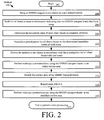
- FIG. 2 provides a flow diagram of an exemplary method 200 implementing the present solution.
- step 204 in which an MCPTT server (e.g., MCPTT server 102 of FIG. 1 ) performs operations to setup an MBMS transport bearer for handling talkgroup voice communications (e.g., a group patrol talkgroup voice communications) based on a pre-defined criteria.
- the MBMS transport bearer is dynamically setup by the MCPTT server when a threshold number of UEs (e.g., UEs 110-136 of FIG. 1 ) are located in a relatively small geographic area.
- the criteria for setting up an MBMS transport bearer can include any criteria indicating that multicast communications are preferred over unicast communications. Techniques for setting up MBMS transport bearers are known in the art. Any known or to be known technique for setting up MBMS transport bearers can be used herein without limitation.
- steps 206-212 are performed to inform members of the talkgroup that the MBMS transport bearer has been established. These steps involve: building a list of clients who are to receive information indicating that the MBMS transport bearer has been setup (e.g., 1000 users who can potentially take part in the talkgroup communications); determining the immediate needs of each client based on weighted attributes or criteria; assembling a prioritized list of clients based on the determined immediate needs of each client; and delivering the updates to the clients via unicast messages (e.g., unicast messages 138 of FIG. 1 ) in accordance with the prioritized list (bandwidth and time).
- the weighting attributes or criteria used in step 208 is described below in detail.
- the unicast messages (e.g., unicast messages 138 of FIG. 1 ) are first transmitted to UEs associated with those clients having a first priority classification using a relatively large amount of bandwidth during a first period of time. Unicast messages are then sent to UEs associated with those clients having a second priority classification using a smaller amount of bandwidth during a second period of time longer than the first period of time. Finally, unicast messages are sent to UEs associated with those clients having a third priority classification using an even smaller amount of bandwidth during a third period of time longer than the first and second periods of time.
- the present invention is not limited to the particulars of this example.
- step 214 is performed where multicast communications are performed using the MBMS transport bearer in an initial service area (e.g., MBMS bearer service area 140 of FIG. 1 ).
- the service area of the MBMS transport bearer is modified, as shown by step 216.
- steps 206-212 are repeated to inform members of the talkgroup that the service area of the MBMS transport bearer has been modified, as shown by step 218.
- step 220 is performed where multicast communications (e.g., including multicast messages 144 of FIG. 1 ) are performed using the MBMS transport bearer in the initial service area (e.g., MBMS bearer service area 140 of FIG. 1 ) and the modified service area (e.g., MBMS bearer service area 142 of FIG. 1 ).
- step 222 is performed where method 200 ends or other processing is performed.
- the weighting criteria used in step 208 includes, but is not limited to, proximity, group affiliation status and/or group state.
- One or more of the listed weighting criteria can be used in step 208 to determine the immediate need of each client. Also, any combination of the listed weighting criteria can be used in step 208.
- the clients are prioritized based on impact of updated bearer footprint.
- a client may be: (A) immediately impacted by an updated bearer footprint; (B) may roam into an expanded service area of an MBMS transport bearer; (C) may roam into an updated bearer footprint; (D) will not likely be impacted soon by an updated bearer footprint; and (E) will likely never be impacted by an updated bearer footprint.
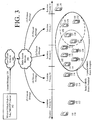
- the schematic illustration provided in FIG. 3 is useful for understanding the proximity weighting criteria.
- the MCPTT server 102 updates the MBMS bearer footprint by expanding the initial service area 140 to include new service area 142.
- all UE 110-136 knows about the initial service area 140 of an MBMS transport bearer.
- the MCPTT server 102 decides that it wants to add the new service area 142, and now the MCPTT server 102 has to send an update to the UE 110-136 for the new service area 142.
- the MCPTT server 102 uses a proximity weighting criteria to determine the order in which UE 110-136 should receive the unicast message indicating the updated MBMS bearer footprint.
- UE 128-134 are assigned location priority I because these devices can be actively serviced right now by the updated MBMS bearer footprint.
- the UE 118-126 are assigned a location priority II because they (a) are already aware of the initial service area 140, (b) are already receiving multicast voice using the MBMS transport bearer, (c) are able to continue to use the MBMS transport bearer despite the MBMS bearer footprint update, and (d) might roam into the new service area 142.
- UE 136 is assigned location priority III because they are closer to the new service area 142 than UE 110-116, and therefore might roam into the new service area 142 that they did not know existed prior to UE 110-116.
- UE 114 , 116 are assigned location priority IV because if they can roam into the updated MBMS bearer footprint they will enter into the initial MBMS bearer footprint for which they already have knowledge.
- UE 110, 112 are assigned location priority V because they are likely to be the last UE to roam into the new service area 142 (since they are the furthest away therefrom).
- the MCPTT server 102 can communicate unicast messages to the UE in accordance with their location priorities and/or other weighting criteria (as discussed herein). If the location priorities are the only weighting criteria considered by the MCPTT server 102, then the unicast message is first sent to UE 128-134 followed by UE 118-126, and so on.
- the clients are prioritized based on (a) users' affiliation to groups in use by the MBMS transport bearer and/or (b) users' affiliation to groups which may qualify for MBMS transmission in the short term.
- Affiliation means the state of being affiliated or connected with a group for receiving communications sent to/from members thereof via an MBMS transport bearer.
- N users e.g., 1000 users
- These users also have a plurality of other talkgroups (e.g., a fire talkgroup) that they can use for voice communications.
- MBMS transport bearer updates In some scenarios, only those users that are affiliated with a particular talkgroup are informed about MBMS transport bearer updates. In other scenarios, the MCPTT server 102 would like to tell all users (who are able to use the group patrol talkgroup for voice communications) about the MBMS transport bearer setup or modification. Such MBMS transport bearer updates to non-affiliated users are desirable because if the non-affiliated users are in the MBMS bearer footprint and later decide that they are interested in voice communications of the group patrol talkgroup then the UEs do not have to perform the affiliation/update signaling at that time to obtain MBMS transport bearer information from the MCPTT server 102.
- the MCPTT server 102 first informs affiliated users about MBMS transport bearer updates, and then informs the non-affiliated users which may qualify for MBMS transmission in the short term thereof. These non-affiliated users can be selected or prioritized in accordance with the above described proximity weighting criteria.
- the clients are prioritized based on group priorities. For example, if the CIA and FBI are coming into a service area, then users associated with these organizations are given higher priority than those users who are not associated with these organizations. As such, the CIA/FBI-associated users are informed about MBMS transport bearer updates prior to non-CIA/FBI-associated users. Clients may alternatively or additionally be prioritized based on group states. For example, if a group enters into an emergency state, then communications for this group preempt communications of other groups (such as the CIA/FBI). The present invention is not limited to the particulars of these examples.
- FIG. 4 there is provided a schematic illustration that is useful for understanding the group affiliation and group state weighing criteria.
- UE 122, 130, 134, 136 are assigned to the resulting priority I queue based on the proximity weighting criteria, the group affiliation weighting criteria, and/or the group state weighting criteria because these four UEs are part of a talkgroup that are in an emergency state, for example.
- unicast messages are first sent from the MCPTT server 102 to UE 122, 130 , 134 , 136.
- the present invention is not limited by the particulars of this example.
- FIG. 5 is a block diagram of an exemplary architecture for an MCPTT server 500.
- MCPTT server 102 of FIG. 1 is the same as or substantially similar to MCPTT server 500. As such, the discussion of MCPTT server 500 is sufficient for understanding MCPTT server 102.
- the MCPTT server 500 may include more or less components than those shown in FIG. 5 . However, the components shown are sufficient to disclose an illustrative embodiment implementing the present invention.
- the hardware architecture of FIG. 5 represents one embodiment of a representative MCPTT server configured to facilitate the dynamic assignment and modification of MBMS transport bearers. As such, the MCPTT server 500 of FIG. 5 implements at least a portion of a method described herein for sending the unicast messages to the UEs in an intelligent manner so as to prevent provisioning storms.
- the hardware includes, but is not limited to, one or more electronic circuits.
- the electronic circuits can include, but are not limited to, passive components (e.g., resistors and capacitors) and/or active components (e.g., amplifiers and/or microprocessors).
- the passive and/or active components can be adapted to, arranged to and/or programmed to perform one or more of the methodologies, procedures, or functions described herein.
- the MCPTT server 500 comprises a user interface 502, a Central Processing Unit (“CPU") 506, a system bus 510, a memory 512 connected to and accessible by other portions of MCPTT server 500 through system bus 510, and hardware entities 514 connected to system bus 510.
- the user interface can include input devices (e.g., a keypad 550 ) and output devices (e.g., speaker 552, a display 554, and/or light emitting diodes 556 ), which facilitate user-software interactions for controlling operations of the MCPTT server 500. Also, algorithms and weighting criteria may be presented to the user of the MCPTT server 500 via the display 554.
- the user may specify and/or change these algorithms and weighting criteria using the input devices (e.g., a keypad 550 ).
- the algorithms and weighting criteria are used by the MCPTT server 500 to determine the immediate needs of each client based on weighted attributes (as discussed above in relation to step 208 of FIG. 2 ).
- Hardware entities 514 perform actions involving access to and use of memory 512, which can be a Random Access Memory (“RAM”), a disk driver and/or a Compact Disc Read Only Memory (“CD-ROM”).
- Hardware entities 514 can include a disk drive unit 516 comprising a computer-readable storage medium 518 on which is stored one or more sets of instructions 520 (e.g., software code) configured to implement one or more of the methodologies, procedures, or functions described herein.
- the instructions 520 can also reside, completely or at least partially, within the memory 512 and/or within the CPU 506 during execution thereof by the MCPTT server 500.
- the memory 512 and the CPU 506 also can constitute machine-readable media.
- machine-readable media refers to a single medium or multiple media (e.g., a centralized or distributed database, and/or associated caches and servers) that store the one or more sets of instructions 520.
- machine-readable media also refers to any medium that is capable of storing, encoding or carrying a set of instructions 520 for execution by the MCPTT server 500 and that cause the MCPTT server 500 to perform any one or more of the methodologies of the present disclosure.
- the hardware entities 514 include an electronic circuit (e.g., a processor) programmed for facilitating (a) the setting up of MBMS transport bearers, (b) the modification of MBMS transport bearers, MBMS bearer service areas and/or MBMS bearer footprints, and/or (c) the generation and transmission of unicast messages to UEs for purposes of informing them about MBMS transport bearer updates (including service area and footprint modifications).
- an electronic circuit e.g., a processor programmed for facilitating (a) the setting up of MBMS transport bearers, (b) the modification of MBMS transport bearers, MBMS bearer service areas and/or MBMS bearer footprints, and/or (c) the generation and transmission of unicast messages to UEs for purposes of informing them about MBMS transport bearer updates (including service area and footprint modifications).
- the electronic circuit can access and run software applications 524 installed on the MCPTT server 500.
- the software application 524 is generally operative to facilitate: the setting up of MBMS transport bearers; the modification of MBMS transport bearers, MBMS bearer service areas and/or MBMS bearer footprints; and/or the generation and transmission of unicast messages to UEs for purposes of informing them about MBMS transport bearer updates (including service area and footprint modifications).
- Other functions of the software application 524 should be apparent from the above discussion.
- the present invention provides a novel technique for the provision of new and updated MBMS bearer announcements to clients based on their current and anticipated needs for the information. This is a proactive approach compared to the reactive solutions available today.
- the present solution differentiates from conventional MCPTT solutions by: providing the carrier a more reliable and robust ability to dynamically assign or modify MBMS bearer service areas; and allowing a carrier to better utilize LTE resources by allocating MBMS transport bearers as they are required (as opposed to allocating MBMS transport bearers on a semi-permanent basis in order to avoid a potential provisioning storm).
- the present invention can be realized in one computer system. Alternatively, the present invention can be realized in several interconnected computer systems. Any kind of computer system or other apparatus adapted for carrying out the methods described herein is suited.
- a typical combination of hardware and software can be a general-purpose computer system.
- the general-purpose computer system can have a computer program that can control the computer system such that it carries out the methods described herein.
Landscapes
- Engineering & Computer Science (AREA)
- Computer Networks & Wireless Communication (AREA)
- Signal Processing (AREA)
- Multimedia (AREA)
- Mobile Radio Communication Systems (AREA)
Abstract
Description
- The present disclosure relates to communication systems. More particularly, the present disclosure relates to systems and methods for dynamically assigning and modifying Multimedia Broadcast Multicast Services ("MBMS") transport bearers, MBMS bearer service areas, and/or MBMS bearer footprints.
- MBMS are point-to-multipoint interface specifications for wireless technologies such as 3rd Generation Partnership Project Long-Term Evolution ("3GPP LTE"), Wideband Code Division Multiple Access ("WCDMA"), Universal Mobile Telecommunication System ("WMTS"), Enhanced Voice-Data Optimized ("EVDO")/High Rate Packet Data ("HRPD"), and Digital Video Broadcast ("DVB"). MBMS is an add-on to cellular network technologies (e.g., GSM/EDGE and UMTS). MBMS supports both broadcast and multicast transmission modes. The MBMS broadcast mode is used to deliver Internet Protocol ("IP") packets to terminals in a certain area. This is achieved via MBMS transport bearers which are setup for all cells in which the service should be available and continuously transmit as long as the service is running. Each MBMS transport bearer can be a Point-to-Multipoint ("PtM") bearer that can be simultaneously received by multiple terminals.
- In MBMS, MBMS Service Areas ("MSAs") can be defined as a collection of cells. Different services (e.g., streaming services and download services) can be delivered in each MSA. Hence public safety services benefit from MBMS utilization. For example, MBMS could be used for emergency alerts in certain areas (e.g., in the case of a hurricane).
- The new functionalities which MBMS provides to operators and service providers are grouped in a new functional node called the Broadcast/Multicast Service Center ("BMSC"). The BMSC (1) provides a functional interface between content delivery services and the MBMS service offered by a cellular network, and (2) controls the set-up and release of MBMS transport bearers and the scheduling of MBMS transmissions.
- The present disclosure concerns systems and methods for using MBMS transport bearers in a network. The methods comprise: performing first operations by a computing device (e.g., a mission critical push-to-talk server) to setup an MBMS transport bearer over which media (e.g., voice data) is able to be communicated to a plurality of clients via multicast transmissions (e.g., when the computing device determines that a threshold number of clients are located in a given geographic area); and performing second operations by the computing device to inform the plurality of clients of the MBMS transport bearer's establishment.
- The second operations include: building a list of clients to receive information indicating that the MBMS transport bearer has been setup; determining an immediate need of each client of the plurality of clients based on weighted attributes; assembling a prioritization list of clients based on the determined immediate needs of each client; and/or delivering unicast messages to the clients in accordance with an order specified by the prioritization list. In some scenarios, the weighted attributes comprise the proximity of a client to an MBMS transport bearer service area, a group affiliation status of a client, and/or a group state.
- The computing device may also perform third operations to modify the MBMS transport bearer or MBMS transport bearer's service area. In this case, the computing device performs a second iteration of the second operations to inform the plurality of clients of the MBMS transport bearer's modification or MBMS transport bearer's service area modification.
- In some scenarios, first ones of the unicast messages are delivered to first clients of the plurality of clients using a first amount of bandwidth during a first period of time and second ones of the unicast messages are delivered to second clients of the plurality of clients using a second amount of bandwidth during a second period of time following the first period of time. The second amount of bandwidth may be less than the first amount of bandwidth. Additionally or alternatively, the second period of time may be longer or shorter than the first period of time. Notably, the present solution is not limited to scenarios in which first and second set of client are notified. There can be any number of batches of unicast messages, not just two batches as described here.
- Embodiments will be described with reference to the following drawing figures, in which like numerals represent like items throughout the figures, and in which:
-
FIG. 1 is a schematic illustration of an exemplary system that is useful for understanding the present invention. -
FIG. 2 is a flow diagram of an exemplary method implementing the present solution. -
FIGS. 3-4 provide schematic illustrations that are useful in understanding weighting criteria for determining immediate needs of clients. -
FIG. 5 is a block diagram of an exemplary architecture for a mission critical push-to-talk server. - The invention is described with reference to the attached figures. The figures are not drawn to scale and they are provided merely to illustrate the present solution. Several aspects of the present solution are described below with reference to example applications for illustration. It should be understood that numerous specific details, relationships, and methods are set forth to provide a full understanding of the present solution. However, the present solution can be practiced without one or more of the specific details or with other methods. In other instances, well-known structures or operation are not shown in detail to avoid obscuring the present solution. The present solution is not limited by the illustrated ordering of acts or events, as some acts may occur in different orders and/or concurrently with other acts or events. Furthermore, not all illustrated acts or events are required to implement a methodology in accordance with the present solution.
- Reference throughout this specification to features, advantages, or similar language does not imply that all of the features and advantages that may be realized with the present solution should be or are in any single embodiment of the present solution. Rather, language referring to the features and advantages is understood to mean that a specific feature, advantage, or characteristic described in connection with an embodiment is included in at least one embodiment of the present solution. Thus, discussions of the features and advantages, and similar language, throughout the specification may, but do not necessarily, refer to the same embodiment.
- The present document generally concerns systems and methods for using MBMS transport bearers in a network. The methods comprise: performing first operations by a computing device to setup an MBMS transport bearer over which media (e.g., voice) is able to be communicated to a plurality of clients via multicast transmissions; and performing second operations by the computing device to inform the plurality of clients of the MBMS transport bearer's establishment. The second operations include, but are not limited to: building a list of clients to receive information indicating that the MBMS transport bearer has been setup; determining an immediate need of each client of the plurality of clients based on weighted attributes (e.g., priority group affiliating, and/or group status); assembling a prioritization list of clients based on the determined immediate needs of each client; and delivering unicast messages to the clients in accordance with an order specified by the prioritization list.
- Referring now to
FIG. 1 , there is provided a schematic illustration of anexemplary system 100.System 100 is generally configured to provide Mission Critical Push-To-Talk ("MCPTT") services, Mission Critical ("MC") video services and/or MC data services to end users or clients. In this regard,system 100 comprises anapplication server 102 and aBMSC 104 for facilitating multicast and unicast communications with the end users or clients. - The present solution is described herein in relation to MCPTT services. As such, the
application server 102 is also referred to herein as an MCPTT server since it performs at least MCPTT services. The present solution is not limited in this regard. Theapplication server 102 can additionally or alternatively comprise a server configured to perform mission critical video services and/or mission critical data services. In these cases, theapplication server 102 can be additionally or alternatively be called an MCvideo server (i.e., an application server configured to provide at least MC video services) and/or an MCdata server (i.e., an application server configured to provide at least MC data services). - MCPTT
server 102 implements an MCPTT application function that connects into a core cellular network 106 (e.g., a Long Term Evolution ("LTE") system). The MCPTTserver 102 is similar to a content provider that connects to theBMSC 104. The MCPTTserver 102 communicates with theBMSC 104 to control the set-up and release of MBMS transport bearers and the scheduling of MBMS transmissions for Push-To-Talk ("PTT") purposes (e.g., to broadcast group calls to end users or clients that are in the same general area). Techniques for setting up and releasing MBMS transport bearers are well known in the art. Any known or to be known technique for setting up and releasing MBMS transport bearers can be used herein without limitation. PTT is well known in the art, and therefore will not be described in detail herein. Once an MBMS transport bearer has been setup, MBMS transmissions are sent from theBMSC 104 to the end user nodes via the corecellular network 106 and aradio access network 108 using multicast messages 144 (which may include voice communications of a PTT talkgroup). - In all cases, the MBMS transport bearers are dynamically setup and modified by MCPTT
server 102 based on pre-defined criteria. For example, in some scenarios, an MBMS transport bearer is established when theMCPTT server 102 determines that a certain number of end user devices (e.g., User Equipment ("UE") 110-136) are located in a given geographical area, and therefore multicast messaging should be employed for various purposes (e.g., the minimization of traffic congestion, the minimization of hardware resource intensity, and an increase in the resource efficiency) as opposed to unicast messaging. The present invention is not limited to the particulars of this example. Any known or to be known criteria can be used herein without limitation. For example, any criteria can be used that provides a means for determining whether multicast messaging should be employed as opposed to unicast messaging. - Once an MBMS transport bearer is setup or modified, the UE 110-136 needs to be provided knowledge of the MBMS transport bearer's establishment/modification before the same can be used for the broadcast of PTT voice communications (e.g., talkgroup voice communications) in an MBMS bearer service area 140 (or additional service area 142). Such knowledge is provided from the
MCPTT server 102 to the UE 110-136 viaunicast messages 138 that are sent through the corecellular network 106 and theradio access network 108. Notably, theBMSC 104 is not used for the communication of theunicast messages 138. - In conventional systems, the
MCPTT server 102 sends unicast messages to all of the UE 110-136 that might be interested in the MBMS transport bearer's establishment or modification. Depending on the number of affected UEs, this may result in a provisioning storm (i.e., temporary congestion). Accordingly, various solutions have been derived to overcome the provisioning storm problem of conventional MBMS based systems. - One conventional solution involves setting up static MBMS transport bearers during system deployment (i.e., before system is even up and running). For example, a first static MBMS transport bearer is setup for a particular city and a second static MBMS transport bearer is setup for a half of a county. All of the UEs are provided knowledge of the first and second static MBMS transport bearers prior to being deployed in the system. Despite the advantages of this conventional solution, it suffers from certain drawbacks. In this system, the multicast areas cannot be setup intelligently to be efficient as evident from the following Examples 1-3.
- In the conventional system, a first static MBMS transport bearer is setup to cover city A. A second static MBMS transport bearer is setup to cover city B. All of the UEs are provided knowledge of the first and second static MBMS transport bearers prior to being deployed in the system. During operation, a massive incident occurs on the boundary of city A and city B. As such, multicast traffic must be sent on the first and second static MBMS transport bearers in order to obtain the overlap to cover the entire footprint of the incident area. In this case, there is an undesirable level of hardware resource intensity and resource inefficiency.
- In the conventional system, a static MBMS transport bearer is setup to cover city B. No MBMS transport bearer is setup to cover city C. All of the UEs are provided knowledge of the static MBMS transport bearer setup for city B prior to being deployed in the system. In this case, end users in the city B footprint are able to be serviced via multicast messaging using the static MBMS transport bearer. However, the end users in the city C footprint are serviced using unicast messaging. In this case, there is an undesirable level of hardware resource intensity and resource inefficiency, as well as the possibility of traffic congestion in the city C footprint.
- In the conventional system, a plane crashes in a geographic area where no MBMS transport bearers have been setup. As such, only unicast messaging can be employed in this scenario. One can appreciate that if there are a relatively large number of end user devices then traffic congestion can occur.
- Another conventional solution involves announcing MBMS transport bearer creation and updates to all clients at the same time via unicast messaging. The drawback of this solution is that a provisioning storm occurs which increases traffic congestion.
- Yet another conventional solution involves using LTE network congestion detection and management functionality for offered traffic. However, the consequence of relying on this functionality is that some of the unicast messages can be dropped when the offered load to the LTE network is too great. The drawback is that when multicast is trying to be implemented to alleviate congestion issues occur which prevent such implementation.
- In view of the forgoing, the present solution provides a technique to overcome the drawbacks of the conventional solutions for providing knowledge to UEs of MBMS transport bearer establishment and/or modifications. The present solution involves sending the
unicast messages 138 to the UEs 110-136 in an intelligent manner so as to prevent provisioning storms.FIG. 2 provides a flow diagram of anexemplary method 200 implementing the present solution. - Referring now to
FIG. 2 ,method 200 begins withstep 202 and continues withstep 204 in which an MCPTT server (e.g.,MCPTT server 102 ofFIG. 1 ) performs operations to setup an MBMS transport bearer for handling talkgroup voice communications (e.g., a group patrol talkgroup voice communications) based on a pre-defined criteria. For example, the MBMS transport bearer is dynamically setup by the MCPTT server when a threshold number of UEs (e.g., UEs 110-136 ofFIG. 1 ) are located in a relatively small geographic area. The present invention is not limited to the particulars of this example. The criteria for setting up an MBMS transport bearer can include any criteria indicating that multicast communications are preferred over unicast communications. Techniques for setting up MBMS transport bearers are known in the art. Any known or to be known technique for setting up MBMS transport bearers can be used herein without limitation. - After completing
step 204, steps 206-212 are performed to inform members of the talkgroup that the MBMS transport bearer has been established. These steps involve: building a list of clients who are to receive information indicating that the MBMS transport bearer has been setup (e.g., 1000 users who can potentially take part in the talkgroup communications); determining the immediate needs of each client based on weighted attributes or criteria; assembling a prioritized list of clients based on the determined immediate needs of each client; and delivering the updates to the clients via unicast messages (e.g.,unicast messages 138 ofFIG. 1 ) in accordance with the prioritized list (bandwidth and time). The weighting attributes or criteria used instep 208 is described below in detail. - In some cases, the unicast messages (e.g.,
unicast messages 138 ofFIG. 1 ) are first transmitted to UEs associated with those clients having a first priority classification using a relatively large amount of bandwidth during a first period of time. Unicast messages are then sent to UEs associated with those clients having a second priority classification using a smaller amount of bandwidth during a second period of time longer than the first period of time. Finally, unicast messages are sent to UEs associated with those clients having a third priority classification using an even smaller amount of bandwidth during a third period of time longer than the first and second periods of time. The present invention is not limited to the particulars of this example. - Upon completing
step 212,step 214 is performed where multicast communications are performed using the MBMS transport bearer in an initial service area (e.g., MBMSbearer service area 140 ofFIG. 1 ). At some later time, the service area of the MBMS transport bearer is modified, as shown bystep 216. In this case, steps 206-212 are repeated to inform members of the talkgroup that the service area of the MBMS transport bearer has been modified, as shown bystep 218. Upon completingstep 218,step 220 is performed where multicast communications (e.g., including multicast messages 144 ofFIG. 1 ) are performed using the MBMS transport bearer in the initial service area (e.g., MBMSbearer service area 140 ofFIG. 1 ) and the modified service area (e.g., MBMSbearer service area 142 ofFIG. 1 ). Subsequently,step 222 is performed wheremethod 200 ends or other processing is performed. - In some scenarios, the weighting criteria used in
step 208 includes, but is not limited to, proximity, group affiliation status and/or group state. One or more of the listed weighting criteria can be used instep 208 to determine the immediate need of each client. Also, any combination of the listed weighting criteria can be used instep 208. - With regard to the proximity weighting criteria, the clients are prioritized based on impact of updated bearer footprint. For example, a client may be: (A) immediately impacted by an updated bearer footprint; (B) may roam into an expanded service area of an MBMS transport bearer; (C) may roam into an updated bearer footprint; (D) will not likely be impacted soon by an updated bearer footprint; and (E) will likely never be impacted by an updated bearer footprint. The schematic illustration provided in
FIG. 3 is useful for understanding the proximity weighting criteria. - As shown in
FIG. 3 , theMCPTT server 102 updates the MBMS bearer footprint by expanding theinitial service area 140 to includenew service area 142. At time zero, all UE 110-136 knows about theinitial service area 140 of an MBMS transport bearer. TheMCPTT server 102 decides that it wants to add thenew service area 142, and now theMCPTT server 102 has to send an update to the UE 110-136 for thenew service area 142. TheMCPTT server 102 uses a proximity weighting criteria to determine the order in which UE 110-136 should receive the unicast message indicating the updated MBMS bearer footprint. - Based on a result of the proximity weighting criteria, UE 128-134 are assigned location priority I because these devices can be actively serviced right now by the updated MBMS bearer footprint. The UE 118-126 are assigned a location priority II because they (a) are already aware of the
initial service area 140, (b) are already receiving multicast voice using the MBMS transport bearer, (c) are able to continue to use the MBMS transport bearer despite the MBMS bearer footprint update, and (d) might roam into thenew service area 142.UE 136 is assigned location priority III because they are closer to thenew service area 142 than UE 110-116, and therefore might roam into thenew service area 142 that they did not know existed prior to UE 110-116.UE UE - After determining the location priorities of the UE, the
MCPTT server 102 can communicate unicast messages to the UE in accordance with their location priorities and/or other weighting criteria (as discussed herein). If the location priorities are the only weighting criteria considered by theMCPTT server 102, then the unicast message is first sent to UE 128-134 followed by UE 118-126, and so on. - With regard to the group affiliation status weighting criteria, the clients are prioritized based on (a) users' affiliation to groups in use by the MBMS transport bearer and/or (b) users' affiliation to groups which may qualify for MBMS transmission in the short term. Affiliation, as used herein, means the state of being affiliated or connected with a group for receiving communications sent to/from members thereof via an MBMS transport bearer. For example, there are N users (e.g., 1000 users) who are allowed to participate and use the group patrol talkgroup for voice communications. These users also have a plurality of other talkgroups (e.g., a fire talkgroup) that they can use for voice communications. Only the users that have told the
MCPTT server 102 that they are currently interested in voice communication for the group patrol talkgroup are affiliated with the group patrol talkgroup. These users are not affiliated with the other talkgroups since they have not told theMCPTT server 102 that they are currently interested in voice communication for these other talkgroups. The present invention is not limited to the particulars of this example. - In some scenarios, only those users that are affiliated with a particular talkgroup are informed about MBMS transport bearer updates. In other scenarios, the
MCPTT server 102 would like to tell all users (who are able to use the group patrol talkgroup for voice communications) about the MBMS transport bearer setup or modification. Such MBMS transport bearer updates to non-affiliated users are desirable because if the non-affiliated users are in the MBMS bearer footprint and later decide that they are interested in voice communications of the group patrol talkgroup then the UEs do not have to perform the affiliation/update signaling at that time to obtain MBMS transport bearer information from theMCPTT server 102. Therefore during operation, theMCPTT server 102 first informs affiliated users about MBMS transport bearer updates, and then informs the non-affiliated users which may qualify for MBMS transmission in the short term thereof. These non-affiliated users can be selected or prioritized in accordance with the above described proximity weighting criteria. - With regard to the group state weighting criteria, the clients are prioritized based on group priorities. For example, if the CIA and FBI are coming into a service area, then users associated with these organizations are given higher priority than those users who are not associated with these organizations. As such, the CIA/FBI-associated users are informed about MBMS transport bearer updates prior to non-CIA/FBI-associated users. Clients may alternatively or additionally be prioritized based on group states. For example, if a group enters into an emergency state, then communications for this group preempt communications of other groups (such as the CIA/FBI). The present invention is not limited to the particulars of these examples.
- Referring now to
FIG. 4 , there is provided a schematic illustration that is useful for understanding the group affiliation and group state weighing criteria. As shown inFIG. 4 ,UE MCPTT server 102 toUE -
FIG. 5 is a block diagram of an exemplary architecture for anMCPTT server 500.MCPTT server 102 ofFIG. 1 is the same as or substantially similar toMCPTT server 500. As such, the discussion ofMCPTT server 500 is sufficient for understandingMCPTT server 102. - Notably, the
MCPTT server 500 may include more or less components than those shown inFIG. 5 . However, the components shown are sufficient to disclose an illustrative embodiment implementing the present invention. The hardware architecture ofFIG. 5 represents one embodiment of a representative MCPTT server configured to facilitate the dynamic assignment and modification of MBMS transport bearers. As such, theMCPTT server 500 ofFIG. 5 implements at least a portion of a method described herein for sending the unicast messages to the UEs in an intelligent manner so as to prevent provisioning storms. - Some or all the components of the
MCPTT server 500 can be implemented as hardware, software and/or a combination of hardware and software. The hardware includes, but is not limited to, one or more electronic circuits. The electronic circuits can include, but are not limited to, passive components (e.g., resistors and capacitors) and/or active components (e.g., amplifiers and/or microprocessors). The passive and/or active components can be adapted to, arranged to and/or programmed to perform one or more of the methodologies, procedures, or functions described herein. - As shown in
FIG. 5 , theMCPTT server 500 comprises a user interface 502, a Central Processing Unit ("CPU") 506, a system bus 510, amemory 512 connected to and accessible by other portions ofMCPTT server 500 through system bus 510, andhardware entities 514 connected to system bus 510. The user interface can include input devices (e.g., a keypad 550) and output devices (e.g.,speaker 552, adisplay 554, and/or light emitting diodes 556), which facilitate user-software interactions for controlling operations of theMCPTT server 500. Also, algorithms and weighting criteria may be presented to the user of theMCPTT server 500 via thedisplay 554. The user may specify and/or change these algorithms and weighting criteria using the input devices (e.g., a keypad 550). The algorithms and weighting criteria are used by theMCPTT server 500 to determine the immediate needs of each client based on weighted attributes (as discussed above in relation to step 208 ofFIG. 2 ). - At least some of the
hardware entities 514 perform actions involving access to and use ofmemory 512, which can be a Random Access Memory ("RAM"), a disk driver and/or a Compact Disc Read Only Memory ("CD-ROM").Hardware entities 514 can include adisk drive unit 516 comprising a computer-readable storage medium 518 on which is stored one or more sets of instructions 520 (e.g., software code) configured to implement one or more of the methodologies, procedures, or functions described herein. Theinstructions 520 can also reside, completely or at least partially, within thememory 512 and/or within theCPU 506 during execution thereof by theMCPTT server 500. Thememory 512 and theCPU 506 also can constitute machine-readable media. The term "machine-readable media", as used here, refers to a single medium or multiple media (e.g., a centralized or distributed database, and/or associated caches and servers) that store the one or more sets ofinstructions 520. The term "machine-readable media", as used here, also refers to any medium that is capable of storing, encoding or carrying a set ofinstructions 520 for execution by theMCPTT server 500 and that cause theMCPTT server 500 to perform any one or more of the methodologies of the present disclosure. - In some scenarios, the
hardware entities 514 include an electronic circuit (e.g., a processor) programmed for facilitating (a) the setting up of MBMS transport bearers, (b) the modification of MBMS transport bearers, MBMS bearer service areas and/or MBMS bearer footprints, and/or (c) the generation and transmission of unicast messages to UEs for purposes of informing them about MBMS transport bearer updates (including service area and footprint modifications). In this regard, it should be understood that the electronic circuit can access andrun software applications 524 installed on theMCPTT server 500. Thesoftware application 524 is generally operative to facilitate: the setting up of MBMS transport bearers; the modification of MBMS transport bearers, MBMS bearer service areas and/or MBMS bearer footprints; and/or the generation and transmission of unicast messages to UEs for purposes of informing them about MBMS transport bearer updates (including service area and footprint modifications). Other functions of thesoftware application 524 should be apparent from the above discussion. - In view of the forgoing, the present invention provides a novel technique for the provision of new and updated MBMS bearer announcements to clients based on their current and anticipated needs for the information. This is a proactive approach compared to the reactive solutions available today. The present solution differentiates from conventional MCPTT solutions by: providing the carrier a more reliable and robust ability to dynamically assign or modify MBMS bearer service areas; and allowing a carrier to better utilize LTE resources by allocating MBMS transport bearers as they are required (as opposed to allocating MBMS transport bearers on a semi-permanent basis in order to avoid a potential provisioning storm).
- The present invention can be realized in one computer system. Alternatively, the present invention can be realized in several interconnected computer systems. Any kind of computer system or other apparatus adapted for carrying out the methods described herein is suited. A typical combination of hardware and software can be a general-purpose computer system. The general-purpose computer system can have a computer program that can control the computer system such that it carries out the methods described herein.
- The terminology used herein is for the purpose of describing particular embodiments only and is not intended to be limiting of the invention. As used herein, the singular forms "a", "an" and "the" are intended to include the plural forms as well, unless the context clearly indicates otherwise. Furthermore, to the extent that the terms "including", "includes", "having", "has", "with", or variants thereof are used in either the detailed description and/or the claims, such terms are intended to be inclusive in a manner similar to the term "comprising."
- All of the apparatus, methods, and algorithms disclosed and claimed herein can be made and executed without undue experimentation in light of the present disclosure. While the invention has been described in terms of preferred embodiments, it will be apparent to those having ordinary skill in the art that variations may be applied to the apparatus, methods and sequence of steps of the method without departing from the concept, spirit and scope of the invention. More specifically, it will be apparent that certain components may be added to, combined with, or substituted for the components described herein while the same or similar results would be achieved. All such similar substitutes and modifications apparent to those having ordinary skill in the art are deemed to be within the spirit, scope and concept of the invention as defined.
- The features and functions disclosed above, as well as alternatives, may be combined into many other different systems or applications. Various presently unforeseen or unanticipated alternatives, modifications, variations or improvements may be made by those skilled in the art, each of which is also intended to be encompassed by the disclosed embodiments.
Claims (10)
- A system, comprising:a computing deviceperforming first operations to setup an MBMS transport bearer over which media is able to be communicated to a plurality of clients via multicast transmissions, andperforming second operations to inform the plurality of clients of the MBMS transport bearer's establishment, the second operations comprisingdetermining an immediate need of each client of the plurality of clients based on weighted attributes,assembling a prioritization list of clients based on the determined immediate needs of each client, anddelivering unicast messages to the clients in accordance with an order specified by the prioritization list.
- The system according to claim 1, wherein the computing device is a Mission Critical Push-To-Talk ("MCPTT") server, a Mission Critical ("MC") video server or an MC data server.
- The system according to claim 1, wherein the weighted attributes comprise at least one of a proximity of a client to an MBMS transport bearer service area, a group affiliation status of a client, and a group state.
- The system according to claim 1, wherein the weighted attributes comprise a combination of at least two of a proximity of a client to an MBMS transport bearer service area, a group affiliation status of a client, and a group state.
- The system according to claim 1, wherein a list of clients to receive information indicating that the MBMS transport bearer has been setup is built prior to when the immediate need of each client is determined.
- The system according to claim 1, wherein the computing device further:performs third operations to modify the MBMS transport bearer or MBMS transport bearer's service area; andperforms a second iteration of the second operations to inform the plurality of clients of the MBMS transport bearer's modification or MBMS transport bearer's service area modification.
- The system according to claim 6, wherein a list of clients to receive information indicating that the MBMS transport bearer's modification or MBMS transport bearer's service area modification is built prior to when the immediate need of each client is determined during the second iteration of the second operations.
- The system according to claim 1, wherein first ones of the unicast messages are delivered to first clients of the plurality of clients using a first amount of bandwidth during a first period of time and second ones of the unicast messages are delivered to second clients of the plurality of clients using a second amount of bandwidth during a second period of time following the first period of time, the second amount of bandwidth less than the first amount of bandwidth.
- The system according to claim 8, wherein the second period of time is longer than the first period of time.
- The system according to claim 1, wherein the MBMS transport bearer is dynamically setup when the computing device determines that a threshold number of clients are located in a given geographic area.
Applications Claiming Priority (1)
| Application Number | Priority Date | Filing Date | Title |
|---|---|---|---|
| US15/226,266 US10110391B2 (en) | 2016-08-02 | 2016-08-02 | Systems and methods for establishing and using multimedia broadcast multicast services transport bearers |
Publications (2)
| Publication Number | Publication Date |
|---|---|
| EP3280216A1 true EP3280216A1 (en) | 2018-02-07 |
| EP3280216B1 EP3280216B1 (en) | 2021-06-09 |
Family
ID=59387862
Family Applications (1)
| Application Number | Title | Priority Date | Filing Date |
|---|---|---|---|
| EP17001235.5A Active EP3280216B1 (en) | 2016-08-02 | 2017-07-19 | System for establishing and using multimedia broadcast multicast services transport bearers |
Country Status (3)
| Country | Link |
|---|---|
| US (1) | US10110391B2 (en) |
| EP (1) | EP3280216B1 (en) |
| AU (1) | AU2017204160B2 (en) |
Cited By (2)
| Publication number | Priority date | Publication date | Assignee | Title |
|---|---|---|---|---|
| CN109756851A (en) * | 2018-12-24 | 2019-05-14 | 北京交通大学 | A kind of authority control method based on MCVideo group system |
| CN114125956A (en) * | 2020-08-31 | 2022-03-01 | 上海朗帛通信技术有限公司 | Method and equipment used for wireless communication |
Families Citing this family (9)
| Publication number | Priority date | Publication date | Assignee | Title |
|---|---|---|---|---|
| US10505995B2 (en) * | 2016-06-25 | 2019-12-10 | Ofinno, Llc | Wireless device media control session |
| SG11201903412TA (en) | 2016-10-31 | 2019-05-30 | Ericsson Telefon Ab L M | Protection of mission-critical push-to-talk multimedia broadcast and multicast service subchannel control messages |
| JP2019009638A (en) * | 2017-06-26 | 2019-01-17 | ルネサスエレクトロニクス株式会社 | Wireless communication apparatus, system and method |
| CN110876118B (en) * | 2018-08-31 | 2022-08-19 | 中兴通讯股份有限公司 | Method and device for processing group service and configuring group service area |
| US10645541B2 (en) * | 2018-09-26 | 2020-05-05 | Motorola Solutions, Inc. | Method and system to extend connection time of a talkgroup conversation based on historical talkgroup statistics |
| WO2020085535A1 (en) * | 2018-10-25 | 2020-04-30 | Samsung Electronics Co., Ltd. | Mcptt system and method thereof for managing mcptt broadcast call in off-network system |
| CN110177344B (en) * | 2019-04-15 | 2021-12-24 | 海能达通信股份有限公司 | Group attachment method, client and server |
| US11083042B2 (en) | 2019-12-30 | 2021-08-03 | Motorola Solutions, Inc. | Multiple mode push-to-X group calls on long term evolution networks |
| EP4378181A1 (en) * | 2021-07-29 | 2024-06-05 | Nokia Technologies Oy | Apparatus, method, and computer program |
Citations (3)
| Publication number | Priority date | Publication date | Assignee | Title |
|---|---|---|---|---|
| US20100197265A1 (en) * | 2009-02-05 | 2010-08-05 | Motorola, Inc. | Connecting to a multimedia broadcast/multicast service channel |
| WO2013101834A1 (en) * | 2011-12-28 | 2013-07-04 | Qualcomm Incorporated | Client-assisted target multicast area detection |
| WO2015068983A1 (en) * | 2013-11-05 | 2015-05-14 | Lg Electronics Inc. | Method for determining priorities of services and wireless equipment thereof |
Family Cites Families (7)
| Publication number | Priority date | Publication date | Assignee | Title |
|---|---|---|---|---|
| WO2007089383A2 (en) * | 2006-01-31 | 2007-08-09 | Interdigital Technology Corporation | Methods and system for initiating mbms multicast bearer services using an ip multimedia subsystem ims |
| US9374289B2 (en) | 2012-02-28 | 2016-06-21 | Verizon Patent And Licensing Inc. | Dynamically provisioning subscribers to manage network traffic |
| US9042223B2 (en) * | 2012-12-21 | 2015-05-26 | Motorola Solutions, Inc. | Method and apparatus for multimedia broadcast multicast service |
| US8867425B2 (en) * | 2012-12-21 | 2014-10-21 | Motorola Solutions, Inc. | Method and apparatus multimedia broadcast/multicast service coverage boost |
| US20140307610A1 (en) | 2013-04-12 | 2014-10-16 | Alcatel-Lucent Usa Inc. | Multimedia broadcast multicast services over distributed antenna system |
| US9674674B2 (en) * | 2013-10-23 | 2017-06-06 | Qualcomm Incorporated | Unicast and broadcast reception policy and enforcement |
| US9474047B2 (en) * | 2013-11-13 | 2016-10-18 | Motorola Solutions, Inc. | Apparatus and method for dynamically selecting unicast or broadcast resources for a push-to-talk call |
-
2016
- 2016-08-02 US US15/226,266 patent/US10110391B2/en active Active
-
2017
- 2017-06-20 AU AU2017204160A patent/AU2017204160B2/en active Active
- 2017-07-19 EP EP17001235.5A patent/EP3280216B1/en active Active
Patent Citations (3)
| Publication number | Priority date | Publication date | Assignee | Title |
|---|---|---|---|---|
| US20100197265A1 (en) * | 2009-02-05 | 2010-08-05 | Motorola, Inc. | Connecting to a multimedia broadcast/multicast service channel |
| WO2013101834A1 (en) * | 2011-12-28 | 2013-07-04 | Qualcomm Incorporated | Client-assisted target multicast area detection |
| WO2015068983A1 (en) * | 2013-11-05 | 2015-05-14 | Lg Electronics Inc. | Method for determining priorities of services and wireless equipment thereof |
Cited By (3)
| Publication number | Priority date | Publication date | Assignee | Title |
|---|---|---|---|---|
| CN109756851A (en) * | 2018-12-24 | 2019-05-14 | 北京交通大学 | A kind of authority control method based on MCVideo group system |
| CN114125956A (en) * | 2020-08-31 | 2022-03-01 | 上海朗帛通信技术有限公司 | Method and equipment used for wireless communication |
| CN114125956B (en) * | 2020-08-31 | 2025-03-18 | 上海朗帛通信技术有限公司 | A method and device for wireless communication |
Also Published As
| Publication number | Publication date |
|---|---|
| AU2017204160B2 (en) | 2019-03-14 |
| AU2017204160A1 (en) | 2018-02-22 |
| EP3280216B1 (en) | 2021-06-09 |
| US10110391B2 (en) | 2018-10-23 |
| US20180041353A1 (en) | 2018-02-08 |
Similar Documents
| Publication | Publication Date | Title |
|---|---|---|
| AU2017204160B2 (en) | Systems and methods for establishing and using multimedia broadcast multicast services transport bearers | |
| US8874112B2 (en) | Service dependent inactivity timer | |
| KR101368357B1 (en) | Qos-aware paging in a wireless communication system | |
| KR101532825B1 (en) | SELECTIVELY PROVISIONING CALL SETUP QUALITY OF SERVICE (QoS) RESOURCE RESERVATIONS DURING A COMMUNICATION SESSION WITHIN A WIRELESS COMMUNICATIONS SYSTEM | |
| US20120263036A1 (en) | Mechanism for wireless access networks to throttle traffic during congestion | |
| WO2021027835A1 (en) | Message transmission method and communication device | |
| US10039154B2 (en) | Node and method for establishing an inactivity timer in a wireless network | |
| US12267771B2 (en) | Apparatus, method, and computer program | |
| EP2211568A2 (en) | Method of obtaining service information to receive broadcasting service in user equipment, and service information announcement methods performable in service center and server | |
| JP2007503738A (en) | Multimedia broadcast multicast service method and apparatus for UMTS network | |
| CN115299012A (en) | QoS-based alternative charging handling | |
| US20180279207A1 (en) | Uplink data transmission control method, user terminal, and network server | |
| EP2713554A1 (en) | Method, user equipment and base station for controlling uplink application layer service | |
| US20250301509A1 (en) | Managing Satellite Network Demand for Emergency Services | |
| US12101851B2 (en) | Methods, network function nodes and computer readable media for contents communication management | |
| US9451586B1 (en) | Providing a voice message page in a wireless communication system | |
| EP4154500A1 (en) | Ip address allocation in a wireless communication network | |
| US20230020573A1 (en) | Transmission tunnel changing method, access network device, and core network device | |
| EP3888324B1 (en) | Method and apparatus for communicating resource establishment details over embms | |
| WO2025148470A1 (en) | User-plane location method and communication apparatus | |
| CN118509808A (en) | Communication method and communication device | |
| CN119485613A (en) | A clock status notification method and communication device | |
| WO2023125211A1 (en) | Communication method and apparatus | |
| WO2005122605A1 (en) | Cell update message indicating whether user data or control data is transmitted uplink, and respective procedures for handling these two types of data | |
| CN116419310A (en) | Slice access control method and device and network equipment |
Legal Events
| Date | Code | Title | Description |
|---|---|---|---|
| PUAI | Public reference made under article 153(3) epc to a published international application that has entered the european phase |
Free format text: ORIGINAL CODE: 0009012 |
|
| STAA | Information on the status of an ep patent application or granted ep patent |
Free format text: STATUS: REQUEST FOR EXAMINATION WAS MADE |
|
| 17P | Request for examination filed |
Effective date: 20170719 |
|
| AK | Designated contracting states |
Kind code of ref document: A1 Designated state(s): AL AT BE BG CH CY CZ DE DK EE ES FI FR GB GR HR HU IE IS IT LI LT LU LV MC MK MT NL NO PL PT RO RS SE SI SK SM TR |
|
| AX | Request for extension of the european patent |
Extension state: BA ME |
|
| STAA | Information on the status of an ep patent application or granted ep patent |
Free format text: STATUS: EXAMINATION IS IN PROGRESS |
|
| 17Q | First examination report despatched |
Effective date: 20190121 |
|
| REG | Reference to a national code |
Ref country code: DE Ref legal event code: R079 Ref document number: 602017039899 Country of ref document: DE Free format text: PREVIOUS MAIN CLASS: H04W0076000000 Ipc: H04W0004100000 |
|
| RIC1 | Information provided on ipc code assigned before grant |
Ipc: H04W 4/10 20090101AFI20201123BHEP Ipc: H04W 76/40 20180101ALI20201123BHEP Ipc: H04W 72/00 20090101ALN20201123BHEP Ipc: H04W 76/45 20180101ALN20201123BHEP |
|
| RIC1 | Information provided on ipc code assigned before grant |
Ipc: H04W 72/00 20090101ALN20201216BHEP Ipc: H04W 76/40 20180101ALI20201216BHEP Ipc: H04W 76/45 20180101ALN20201216BHEP Ipc: H04W 4/10 20090101AFI20201216BHEP |
|
| GRAP | Despatch of communication of intention to grant a patent |
Free format text: ORIGINAL CODE: EPIDOSNIGR1 |
|
| STAA | Information on the status of an ep patent application or granted ep patent |
Free format text: STATUS: GRANT OF PATENT IS INTENDED |
|
| INTG | Intention to grant announced |
Effective date: 20210128 |
|
| GRAS | Grant fee paid |
Free format text: ORIGINAL CODE: EPIDOSNIGR3 |
|
| GRAA | (expected) grant |
Free format text: ORIGINAL CODE: 0009210 |
|
| STAA | Information on the status of an ep patent application or granted ep patent |
Free format text: STATUS: THE PATENT HAS BEEN GRANTED |
|
| AK | Designated contracting states |
Kind code of ref document: B1 Designated state(s): AL AT BE BG CH CY CZ DE DK EE ES FI FR GB GR HR HU IE IS IT LI LT LU LV MC MK MT NL NO PL PT RO RS SE SI SK SM TR |
|
| REG | Reference to a national code |
Ref country code: GB Ref legal event code: FG4D |
|
| REG | Reference to a national code |
Ref country code: CH Ref legal event code: EP Ref country code: AT Ref legal event code: REF Ref document number: 1401457 Country of ref document: AT Kind code of ref document: T Effective date: 20210615 |
|
| REG | Reference to a national code |
Ref country code: DE Ref legal event code: R096 Ref document number: 602017039899 Country of ref document: DE |
|
| REG | Reference to a national code |
Ref country code: IE Ref legal event code: FG4D |
|
| REG | Reference to a national code |
Ref country code: LT Ref legal event code: MG9D |
|
| PG25 | Lapsed in a contracting state [announced via postgrant information from national office to epo] |
Ref country code: FI Free format text: LAPSE BECAUSE OF FAILURE TO SUBMIT A TRANSLATION OF THE DESCRIPTION OR TO PAY THE FEE WITHIN THE PRESCRIBED TIME-LIMIT Effective date: 20210609 Ref country code: LT Free format text: LAPSE BECAUSE OF FAILURE TO SUBMIT A TRANSLATION OF THE DESCRIPTION OR TO PAY THE FEE WITHIN THE PRESCRIBED TIME-LIMIT Effective date: 20210609 Ref country code: BG Free format text: LAPSE BECAUSE OF FAILURE TO SUBMIT A TRANSLATION OF THE DESCRIPTION OR TO PAY THE FEE WITHIN THE PRESCRIBED TIME-LIMIT Effective date: 20210909 Ref country code: HR Free format text: LAPSE BECAUSE OF FAILURE TO SUBMIT A TRANSLATION OF THE DESCRIPTION OR TO PAY THE FEE WITHIN THE PRESCRIBED TIME-LIMIT Effective date: 20210609 |
|
| REG | Reference to a national code |
Ref country code: AT Ref legal event code: MK05 Ref document number: 1401457 Country of ref document: AT Kind code of ref document: T Effective date: 20210609 |
|
| REG | Reference to a national code |
Ref country code: NL Ref legal event code: MP Effective date: 20210609 |
|
| PG25 | Lapsed in a contracting state [announced via postgrant information from national office to epo] |
Ref country code: NO Free format text: LAPSE BECAUSE OF FAILURE TO SUBMIT A TRANSLATION OF THE DESCRIPTION OR TO PAY THE FEE WITHIN THE PRESCRIBED TIME-LIMIT Effective date: 20210909 Ref country code: RS Free format text: LAPSE BECAUSE OF FAILURE TO SUBMIT A TRANSLATION OF THE DESCRIPTION OR TO PAY THE FEE WITHIN THE PRESCRIBED TIME-LIMIT Effective date: 20210609 Ref country code: SE Free format text: LAPSE BECAUSE OF FAILURE TO SUBMIT A TRANSLATION OF THE DESCRIPTION OR TO PAY THE FEE WITHIN THE PRESCRIBED TIME-LIMIT Effective date: 20210609 Ref country code: GR Free format text: LAPSE BECAUSE OF FAILURE TO SUBMIT A TRANSLATION OF THE DESCRIPTION OR TO PAY THE FEE WITHIN THE PRESCRIBED TIME-LIMIT Effective date: 20210910 Ref country code: LV Free format text: LAPSE BECAUSE OF FAILURE TO SUBMIT A TRANSLATION OF THE DESCRIPTION OR TO PAY THE FEE WITHIN THE PRESCRIBED TIME-LIMIT Effective date: 20210609 |
|
| PG25 | Lapsed in a contracting state [announced via postgrant information from national office to epo] |
Ref country code: NL Free format text: LAPSE BECAUSE OF FAILURE TO SUBMIT A TRANSLATION OF THE DESCRIPTION OR TO PAY THE FEE WITHIN THE PRESCRIBED TIME-LIMIT Effective date: 20210609 Ref country code: PT Free format text: LAPSE BECAUSE OF FAILURE TO SUBMIT A TRANSLATION OF THE DESCRIPTION OR TO PAY THE FEE WITHIN THE PRESCRIBED TIME-LIMIT Effective date: 20211011 Ref country code: RO Free format text: LAPSE BECAUSE OF FAILURE TO SUBMIT A TRANSLATION OF THE DESCRIPTION OR TO PAY THE FEE WITHIN THE PRESCRIBED TIME-LIMIT Effective date: 20210609 Ref country code: ES Free format text: LAPSE BECAUSE OF FAILURE TO SUBMIT A TRANSLATION OF THE DESCRIPTION OR TO PAY THE FEE WITHIN THE PRESCRIBED TIME-LIMIT Effective date: 20210609 Ref country code: EE Free format text: LAPSE BECAUSE OF FAILURE TO SUBMIT A TRANSLATION OF THE DESCRIPTION OR TO PAY THE FEE WITHIN THE PRESCRIBED TIME-LIMIT Effective date: 20210609 Ref country code: CZ Free format text: LAPSE BECAUSE OF FAILURE TO SUBMIT A TRANSLATION OF THE DESCRIPTION OR TO PAY THE FEE WITHIN THE PRESCRIBED TIME-LIMIT Effective date: 20210609 Ref country code: AT Free format text: LAPSE BECAUSE OF FAILURE TO SUBMIT A TRANSLATION OF THE DESCRIPTION OR TO PAY THE FEE WITHIN THE PRESCRIBED TIME-LIMIT Effective date: 20210609 Ref country code: SK Free format text: LAPSE BECAUSE OF FAILURE TO SUBMIT A TRANSLATION OF THE DESCRIPTION OR TO PAY THE FEE WITHIN THE PRESCRIBED TIME-LIMIT Effective date: 20210609 Ref country code: SM Free format text: LAPSE BECAUSE OF FAILURE TO SUBMIT A TRANSLATION OF THE DESCRIPTION OR TO PAY THE FEE WITHIN THE PRESCRIBED TIME-LIMIT Effective date: 20210609 |
|
| PG25 | Lapsed in a contracting state [announced via postgrant information from national office to epo] |
Ref country code: PL Free format text: LAPSE BECAUSE OF FAILURE TO SUBMIT A TRANSLATION OF THE DESCRIPTION OR TO PAY THE FEE WITHIN THE PRESCRIBED TIME-LIMIT Effective date: 20210609 |
|
| REG | Reference to a national code |
Ref country code: CH Ref legal event code: PL |
|
| REG | Reference to a national code |
Ref country code: DE Ref legal event code: R097 Ref document number: 602017039899 Country of ref document: DE |
|
| PG25 | Lapsed in a contracting state [announced via postgrant information from national office to epo] |
Ref country code: MC Free format text: LAPSE BECAUSE OF FAILURE TO SUBMIT A TRANSLATION OF THE DESCRIPTION OR TO PAY THE FEE WITHIN THE PRESCRIBED TIME-LIMIT Effective date: 20210609 |
|
| REG | Reference to a national code |
Ref country code: BE Ref legal event code: MM Effective date: 20210731 |
|
| PLBE | No opposition filed within time limit |
Free format text: ORIGINAL CODE: 0009261 |
|
| STAA | Information on the status of an ep patent application or granted ep patent |
Free format text: STATUS: NO OPPOSITION FILED WITHIN TIME LIMIT |
|
| PG25 | Lapsed in a contracting state [announced via postgrant information from national office to epo] |
Ref country code: LI Free format text: LAPSE BECAUSE OF NON-PAYMENT OF DUE FEES Effective date: 20210731 Ref country code: DK Free format text: LAPSE BECAUSE OF FAILURE TO SUBMIT A TRANSLATION OF THE DESCRIPTION OR TO PAY THE FEE WITHIN THE PRESCRIBED TIME-LIMIT Effective date: 20210609 Ref country code: CH Free format text: LAPSE BECAUSE OF NON-PAYMENT OF DUE FEES Effective date: 20210731 |
|
| 26N | No opposition filed |
Effective date: 20220310 |
|
| PG25 | Lapsed in a contracting state [announced via postgrant information from national office to epo] |
Ref country code: LU Free format text: LAPSE BECAUSE OF NON-PAYMENT OF DUE FEES Effective date: 20210719 Ref country code: AL Free format text: LAPSE BECAUSE OF FAILURE TO SUBMIT A TRANSLATION OF THE DESCRIPTION OR TO PAY THE FEE WITHIN THE PRESCRIBED TIME-LIMIT Effective date: 20210609 |
|
| PG25 | Lapsed in a contracting state [announced via postgrant information from national office to epo] |
Ref country code: IT Free format text: LAPSE BECAUSE OF FAILURE TO SUBMIT A TRANSLATION OF THE DESCRIPTION OR TO PAY THE FEE WITHIN THE PRESCRIBED TIME-LIMIT Effective date: 20210609 Ref country code: IE Free format text: LAPSE BECAUSE OF NON-PAYMENT OF DUE FEES Effective date: 20210719 Ref country code: BE Free format text: LAPSE BECAUSE OF NON-PAYMENT OF DUE FEES Effective date: 20210731 |
|
| REG | Reference to a national code |
Ref country code: DE Ref legal event code: R081 Ref document number: 602017039899 Country of ref document: DE Owner name: L3HARRIS TECHNOLOGIES, INC. (N.D.GES.D.STAATES, US Free format text: FORMER OWNER: HARRIS CORPORATION, MELBOURNE, FL, US |
|
| PG25 | Lapsed in a contracting state [announced via postgrant information from national office to epo] |
Ref country code: HU Free format text: LAPSE BECAUSE OF FAILURE TO SUBMIT A TRANSLATION OF THE DESCRIPTION OR TO PAY THE FEE WITHIN THE PRESCRIBED TIME-LIMIT; INVALID AB INITIO Effective date: 20170719 |
|
| PG25 | Lapsed in a contracting state [announced via postgrant information from national office to epo] |
Ref country code: CY Free format text: LAPSE BECAUSE OF FAILURE TO SUBMIT A TRANSLATION OF THE DESCRIPTION OR TO PAY THE FEE WITHIN THE PRESCRIBED TIME-LIMIT Effective date: 20210609 |
|
| P01 | Opt-out of the competence of the unified patent court (upc) registered |
Effective date: 20230530 |
|
| PG25 | Lapsed in a contracting state [announced via postgrant information from national office to epo] |
Ref country code: MK Free format text: LAPSE BECAUSE OF FAILURE TO SUBMIT A TRANSLATION OF THE DESCRIPTION OR TO PAY THE FEE WITHIN THE PRESCRIBED TIME-LIMIT Effective date: 20210609 |
|
| PG25 | Lapsed in a contracting state [announced via postgrant information from national office to epo] |
Ref country code: MT Free format text: LAPSE BECAUSE OF FAILURE TO SUBMIT A TRANSLATION OF THE DESCRIPTION OR TO PAY THE FEE WITHIN THE PRESCRIBED TIME-LIMIT Effective date: 20210609 |
|
| PGFP | Annual fee paid to national office [announced via postgrant information from national office to epo] |
Ref country code: DE Payment date: 20250729 Year of fee payment: 9 |
|
| PGFP | Annual fee paid to national office [announced via postgrant information from national office to epo] |
Ref country code: GB Payment date: 20250728 Year of fee payment: 9 |
|
| PGFP | Annual fee paid to national office [announced via postgrant information from national office to epo] |
Ref country code: FR Payment date: 20250725 Year of fee payment: 9 |
|
| PG25 | Lapsed in a contracting state [announced via postgrant information from national office to epo] |
Ref country code: TR Free format text: LAPSE BECAUSE OF FAILURE TO SUBMIT A TRANSLATION OF THE DESCRIPTION OR TO PAY THE FEE WITHIN THE PRESCRIBED TIME-LIMIT Effective date: 20210609 |