EP3280213A1 - Internet of things device random access method and system based on massive mimo technology - Google Patents
Internet of things device random access method and system based on massive mimo technology Download PDFInfo
- Publication number
- EP3280213A1 EP3280213A1 EP16207087.4A EP16207087A EP3280213A1 EP 3280213 A1 EP3280213 A1 EP 3280213A1 EP 16207087 A EP16207087 A EP 16207087A EP 3280213 A1 EP3280213 A1 EP 3280213A1
- Authority
- EP
- European Patent Office
- Prior art keywords
- random access
- base station
- beams
- users
- response information
- Prior art date
- Legal status (The legal status is an assumption and is not a legal conclusion. Google has not performed a legal analysis and makes no representation as to the accuracy of the status listed.)
- Granted
Links
Images


Classifications
-
- H—ELECTRICITY
- H04—ELECTRIC COMMUNICATION TECHNIQUE
- H04W—WIRELESS COMMUNICATION NETWORKS
- H04W74/00—Wireless channel access
- H04W74/08—Non-scheduled access, e.g. ALOHA
- H04W74/0833—Random access procedures, e.g. with 4-step access
- H04W74/0841—Random access procedures, e.g. with 4-step access with collision treatment
- H04W74/085—Random access procedures, e.g. with 4-step access with collision treatment collision avoidance
-
- H—ELECTRICITY
- H04—ELECTRIC COMMUNICATION TECHNIQUE
- H04B—TRANSMISSION
- H04B7/00—Radio transmission systems, i.e. using radiation field
- H04B7/02—Diversity systems; Multi-antenna system, i.e. transmission or reception using multiple antennas
- H04B7/04—Diversity systems; Multi-antenna system, i.e. transmission or reception using multiple antennas using two or more spaced independent antennas
- H04B7/0413—MIMO systems
- H04B7/0426—Power distribution
- H04B7/043—Power distribution using best eigenmode, e.g. beam forming or beam steering
-
- H—ELECTRICITY
- H04—ELECTRIC COMMUNICATION TECHNIQUE
- H04B—TRANSMISSION
- H04B7/00—Radio transmission systems, i.e. using radiation field
- H04B7/02—Diversity systems; Multi-antenna system, i.e. transmission or reception using multiple antennas
- H04B7/04—Diversity systems; Multi-antenna system, i.e. transmission or reception using multiple antennas using two or more spaced independent antennas
- H04B7/0413—MIMO systems
- H04B7/0452—Multi-user MIMO systems
-
- H—ELECTRICITY
- H04—ELECTRIC COMMUNICATION TECHNIQUE
- H04B—TRANSMISSION
- H04B7/00—Radio transmission systems, i.e. using radiation field
- H04B7/02—Diversity systems; Multi-antenna system, i.e. transmission or reception using multiple antennas
- H04B7/04—Diversity systems; Multi-antenna system, i.e. transmission or reception using multiple antennas using two or more spaced independent antennas
- H04B7/06—Diversity systems; Multi-antenna system, i.e. transmission or reception using multiple antennas using two or more spaced independent antennas at the transmitting station
- H04B7/0602—Diversity systems; Multi-antenna system, i.e. transmission or reception using multiple antennas using two or more spaced independent antennas at the transmitting station using antenna switching
- H04B7/0608—Antenna selection according to transmission parameters
- H04B7/061—Antenna selection according to transmission parameters using feedback from receiving side
-
- H—ELECTRICITY
- H04—ELECTRIC COMMUNICATION TECHNIQUE
- H04B—TRANSMISSION
- H04B7/00—Radio transmission systems, i.e. using radiation field
- H04B7/02—Diversity systems; Multi-antenna system, i.e. transmission or reception using multiple antennas
- H04B7/04—Diversity systems; Multi-antenna system, i.e. transmission or reception using multiple antennas using two or more spaced independent antennas
- H04B7/06—Diversity systems; Multi-antenna system, i.e. transmission or reception using multiple antennas using two or more spaced independent antennas at the transmitting station
- H04B7/0686—Hybrid systems, i.e. switching and simultaneous transmission
- H04B7/0695—Hybrid systems, i.e. switching and simultaneous transmission using beam selection
- H04B7/06952—Selecting one or more beams from a plurality of beams, e.g. beam training, management or sweeping
-
- H—ELECTRICITY
- H04—ELECTRIC COMMUNICATION TECHNIQUE
- H04W—WIRELESS COMMUNICATION NETWORKS
- H04W4/00—Services specially adapted for wireless communication networks; Facilities therefor
- H04W4/70—Services for machine-to-machine communication [M2M] or machine type communication [MTC]
-
- H—ELECTRICITY
- H04—ELECTRIC COMMUNICATION TECHNIQUE
- H04W—WIRELESS COMMUNICATION NETWORKS
- H04W72/00—Local resource management
- H04W72/04—Wireless resource allocation
- H04W72/044—Wireless resource allocation based on the type of the allocated resource
- H04W72/046—Wireless resource allocation based on the type of the allocated resource the resource being in the space domain, e.g. beams
-
- H—ELECTRICITY
- H04—ELECTRIC COMMUNICATION TECHNIQUE
- H04W—WIRELESS COMMUNICATION NETWORKS
- H04W74/00—Wireless channel access
- H04W74/08—Non-scheduled access, e.g. ALOHA
- H04W74/0833—Random access procedures, e.g. with 4-step access
-
- H—ELECTRICITY
- H04—ELECTRIC COMMUNICATION TECHNIQUE
- H04W—WIRELESS COMMUNICATION NETWORKS
- H04W76/00—Connection management
- H04W76/10—Connection setup
Definitions
- the present invention relates to a random access method, particularly to an Internet of things (IoT) device random access method based on a massive MIMO (multiple-input-multiple-output) technology, and also to a cellular IoT communication system using the random access method, which belong to the field of wireless communication technologies.
- IoT Internet of things
- An IoT device refer to a communication terminal device "capable of monitoring surrounding environments, reporting its own state, accepting a command or task, and even taking an action according to the accepted information". It is widely expected that the IoT device will rapidly become the most widely used communication terminal devices, and in 2018, it will be about equal to the sum total of the number of smart phones, smart TVs, tablet computers, wearable devices and personal computers.
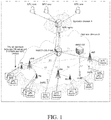
- FIG. 1 shows a communication scenario between a Machine Type Communication (MTC) device and an MTC server.
- MTC Machine Type Communication
- MTC server is provided by an operator, and provides the MTC users with an application interface (API) accessing the MTC server.
- API application interface
- the MTC server and LTE network infrastructure may be located in the same domain.
- a 5G communication system i.e., cellular IoT communication system
- terminal devices including, but not limited to, UE devices, IoT devices, etc.
- RACH random access channel
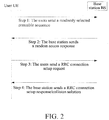
- Step 1 Preamble sequence sending
- the UE devices randomly select a preamble sequence from a predefined set.
- the preamble sequence is a robust entity, to enable a base station (BS) to obtain synchronization.
- the preamble sequence does not include specified reserved information or data, and thus can be used as a pilot sequence. Since multiple users select a pilot sequence without coordination, thus, if two or more users select the same pilot sequence, a conflict may occur. However, in this stage, the base station only detects whether a specified preamble sequence is used.
- Step 2 Random access response
- the base station sends a random access response corresponding to respective activated preamble sequences, and conveys physical layer parameters (e.g., time advance (TA)) and allocates resources to the UE devices activating the preamble sequences.
- physical layer parameters e.g., time advance (TA)
- Step 3 Connection setup request information
- the UE devices receiving responses to preamble sequences sent to them will send RRC (radio resource control) connection request information, to acquire resources for subsequent data sending. If more than one UE device activates the same preamble sequence, all the UE devices using the same resources will send their RRC connection requests, and the conflict will be detected by the base station.
- RRC radio resource control
- the base station If the base station successfully receives and detects connection setup request information sent by the UE devices in step 3, the base station sends connection setup response information to the UE devices. If the UE devices receive the connection setup response information, the random access process is accomplished.
- step 1 If, in step 1, two or more UE devices select the same preamble sequence (i.e., collision occurs), the users will send connection setup request information through the same uplink resource block in step 3. In this case, the base station cannot demodulate information, and the random access process fails due to collision. The users will restart the random access process from step 1.
- the step is referred to as conflict solution, and further includes one or more steps aimed to solve conflicts.
- conflict solution is a complicated step (it is possible to access a network often by performing the random access process multiple times), leading to great time delay.
- power consumption of the terminal devices may also increase sharply, causing the life cycle of the IoT device to be shortened greatly. Such a defect is fatal for low-power-consumption IoT environments.
- a primary technical problem to be solved in the present invention is to provide an IoT device random access method based on a massive MIMO technology.
- Another technical problem to be solved in the present invention is to provide a cellular IoT communication system using the random access method.
- the base station forms random access response information in the beams, beam-forms the random access response information by using eigen-spaces of the beams, and sends the random access response information to the users.
- the base station sends indices of the beams and the random access response information in the beams together to the users.
- the base station performs a spreading operation on the random access response information by using pseudo random sequences, and then sends the random access response information to the users.
- one-to-one correspondence exists between the pseudo random sequences and the beams.
- the base station adds the random access response information in the beams, and sends the random access response information to the users.
- the users send random access request information to the base station, the random access request information including indices of the beams and signal intensity in the beams.
- the base station determines one or more beams, and sends RRC connection setup information on the determined one or more beams.
- a user and a base station implement random access of IoT devices by using the IoT device random access method are provided.
- the present invention makes full use of narrow beam characteristics of a massive MIMO technology, to enable users in different beams to use the same preamble sequence for random access (theoretically, if the base station has N beams, the number of users of random access can be increased N times than that in the existing method), which thus greatly reduces collision probability of the random access, greatly increases the number of users of random access, and effectively solves congestion and collision problems during random access of a great number of users in the cellular IoT communication system.
- a massive MIMO technology due to having characteristics of high data transmission rate, high spectrum effectiveness, high energy efficiency and so on, has become a key technology employed by a 5G communication system, and also becomes one of key technologies solving a great number of user connections in a cellular IoT communication system.
- the cellular IoT communication system for implementing the IoT device random access method provided in the present invention includes at least one base station based on a massive MIMO technology and multiple users (i.e. mobile terminals).
- the base station has M b beams (U 1 ,U 2 , ⁇ ,U M b ), and the users use omnidirectional antennas.
- M b beams U 1 ,U 2 , ⁇ ,U M b
- the users use omnidirectional antennas.
- the present invention proposes a multi-beam precoding and spreading IoT device random access method, which mainly includes the following four steps. Detailed and specific description is provided below in combination with FIG. 3 .
- Step 1 Users randomly select a preamble sequence p i for random access.
- the preamble sequence has excellent self-correlation characteristics, enabling the base station to obtain uplink synchronization.
- the base station Since multiple users select preamble sequence without coordination, two or more users may select the same preamble sequence. However, in this stage, the base station only detects whether a certain preamble sequence is used.
- Step 2 The base station sends random access response information in beams with higher signal intensity.
- the base station performs a spreading operation PN m ⁇ U m S m on each signal S m in the beams U m by a pseudo random sequence PN m , such that the users can identify which beam the random access response information S m comes from.
- random access response information S m is formed in the beam; and if it is less than the threshold, the preamble sequence in the next beam is detected.
- the base station forms random access response information S m in each beam m of the M beams, and beam-forms the random access response information S m by a eigen-space U m of the beam, to obtain U m S m . Therefore, only users in the beam U m can receive beam-formed random access response information U m S m , and users in other beams cannot receive the beam-formed random access response information.
- An option for the format of the beam-formed random access response information U m S m is as shown in FIG. 4 .
- the users can judge, according to the received random access response information, from which beam the random access response information comes.
- the basic format of the random access response information shown in FIG. 4 may significantly increase resource overhead.
- the base station performs a spreading operation PN m ⁇ U m S m on the beam-formed random access response information U m S m in the beam m using a pseudo random sequence PN m (one-to-one correspondence between each beam and the pseudo random sequence is predefined in the base station as well as the users, and thus the base station need not notify the users about a sequence number of the pseudo random sequences).
- the random access response information will be transmitted in different beams through a beam-forming technology, and only users in that beam can receive the random access response information.
- the random access response information in a particular beam is first spread and then sent out, and thus the users can determine from which beam the random access response information comes.
- Step 3 Firstly, the users determine in which beams the base station sends a random access response according to the received random access response information. According to index of the pseudo random sequence in the received random access response information, the users can know that the base station sends the random access response information in M beams.
- the users perform a dispreading operation respectively on the received random access response information in the M beams.
- the users receive the random access response information in J beams, and the received signal intensity in each beam is r j .
- the users select J beams with relatively stronger (top J) received signal intensity, and forms random access request information.
- the newly-added "indices of the beams and signal intensity in the beams (beam sequence number j, r j )" on the basis of the existing massive MIMO technology is used to judge in which beams the users are located and corresponding signal intensities in the beams. In this way, the base station could determine optimal beams of the users and can solve the conflict problem.
- the users in different beams can use the same preamble sequence for random access. This greatly reduces collision probability of the random access, reduces time delay in the random access, and greatly increases the number of users for random access, particularly suitable for random access of a greater number of users in the cellular IoT communication system.
- Step 4 The base station, according to the received random access request information, determines in which beam each user sends the random access request information. Moreover, the base station acquired the optimal beam of each user according to signal intensity on each beam for each user in the random access request information. Finally, the base station sends RRC connection setup information to the users within the optimal beam of the users. Details are provided hereafter.
- the base station determines in which beam each user sends the random access request information. Moreover, the base station acquired the optimal beam of each user according to signal intensity on each beam for each user in the random access request information. How the base station selects the optimal beam of each user and how the conflict problem is solved are described below with an example. As shown in FIG. 6 , suppose that the base station has three beams and two users select the same preamble sequence for random access. A random access request from UE1 reaches the base station through Beam 1 and Beam 2, and a random access request from UE2 reaches the base station through Beam 2 and Beam 3.
- r 1,1 is the signal intensity of the Beam 1 from UE 1
- r 1,2 is the signal intensity of the Beam 2 from UE1
- r 2,2 is the signal intensity of the Beam 2 from UE2
- r 2,3 is the signal intensity of the Beam 3 from UE2.
- the base station cannot successfully detect the signal of UE1 or UE2 in Beam 2.
- the base station finds that the signals from UE1 reach the base station through Beam 1 and Beam 2 and acquires the signal intensities in the two beams ( r 1,1 and r 1,2 ).
- the base station finds that the signals from UE1 reach the base station through Beam 2 and Beam 3 and acquired the signal intensities in the two beams ( r 2,2 and r 2,3 ).
- the base station can determine that Beam 1 is the optimal beam of UE1, and Beam 2 is the optimal beam of UE2.
- the base station not only selects the optimal beams of the users, but also solves the conflict problem in Beam 2.
- the base station sends RRC connection setup information to the users in the optimal beams of the users.
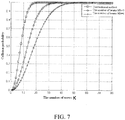
- FIG. 7 shows the collision probabilities in the case of different user numbers K and different beam numbers M b .
- the collision probability of the method of the present invention is calculated by using the formula (2), only the situation where each user only selects one beam is took into account. In fact, for the same preamble sequence, collision may not occur as long as two users use the preamble sequence in different beams and in at least two beams. Therefore, the collision probability of random access of the IoT device calculated by using the formula (2) is a conservative value, and the real collision probability will be much lower than it.
- the present invention utilizes narrow beam characteristics of a massive MIMO technology, to enable users in different beams to use the same preamble sequence for random access (theoretically, if the base station has N beams, the number of users for random access can be increased N times than that in the existing method).
- the present invention greatly reduces collision probability of the random access, greatly increases the number of users for random access, and effectively solves congestion and collision problems during random access of a great number of users in the cellular IoT communication system.
Landscapes
- Engineering & Computer Science (AREA)
- Computer Networks & Wireless Communication (AREA)
- Signal Processing (AREA)
- Power Engineering (AREA)
- Mobile Radio Communication Systems (AREA)
- Quality & Reliability (AREA)
- Physics & Mathematics (AREA)
- Electromagnetism (AREA)
Abstract
Description
- The present invention relates to a random access method, particularly to an Internet of things (IoT) device random access method based on a massive MIMO (multiple-input-multiple-output) technology, and also to a cellular IoT communication system using the random access method, which belong to the field of wireless communication technologies.
- An IoT device refer to a communication terminal device "capable of monitoring surrounding environments, reporting its own state, accepting a command or task, and even taking an action according to the accepted information". It is widely expected that the IoT device will rapidly become the most widely used communication terminal devices, and in 2018, it will be about equal to the sum total of the number of smart phones, smart TVs, tablet computers, wearable devices and personal computers.
- Currently, the 3GPP standardization organization proposes applying a 5G network technology to the IoT, and implementing interconnection of all the IoT devices via a 5G network.
FIG. 1 shows a communication scenario between a Machine Type Communication (MTC) device and an MTC server. MTC users may operate a greater number of MTC devices through an MTC server. The MTC server is provided by an operator, and provides the MTC users with an application interface (API) accessing the MTC server. The MTC server and LTE network infrastructure may be located in the same domain. By connecting to a base station employing an LTE-A standard, the MTC users can control the MTC devices through the MTC server. - It can be expected that, in a 5G communication system (i.e., cellular IoT communication system) accommodating multiple IoT devices, a greater number of terminal devices (including, but not limited to, UE devices, IoT devices, etc.) will need to access a network wirelessly. Studies of the 3GPP standardization organization show that, when there are a great number of MTC devices, the MTC device and the UE devices will suffer from continuous collision on a random access channel (RACH). Specific description is provided as follows:
- As shown in
FIG. 2 , in a physical random access channel (PRACH) of an LTE system, a random access process mainly includes the following four steps: - The UE devices randomly select a preamble sequence from a predefined set. The preamble sequence is a robust entity, to enable a base station (BS) to obtain synchronization. The preamble sequence does not include specified reserved information or data, and thus can be used as a pilot sequence. Since multiple users select a pilot sequence without coordination, thus, if two or more users select the same pilot sequence, a conflict may occur. However, in this stage, the base station only detects whether a specified preamble sequence is used.
- The base station sends a random access response corresponding to respective activated preamble sequences, and conveys physical layer parameters (e.g., time advance (TA)) and allocates resources to the UE devices activating the preamble sequences.
- The UE devices receiving responses to preamble sequences sent to them will send RRC (radio resource control) connection request information, to acquire resources for subsequent data sending. If more than one UE device activates the same preamble sequence, all the UE devices using the same resources will send their RRC connection requests, and the conflict will be detected by the base station.
- If the base station successfully receives and detects connection setup request information sent by the UE devices in
step 3, the base station sends connection setup response information to the UE devices. If the UE devices receive the connection setup response information, the random access process is accomplished. - If, in
step 1, two or more UE devices select the same preamble sequence (i.e., collision occurs), the users will send connection setup request information through the same uplink resource block instep 3. In this case, the base station cannot demodulate information, and the random access process fails due to collision. The users will restart the random access process fromstep 1. The step is referred to as conflict solution, and further includes one or more steps aimed to solve conflicts. Conflict solution is a complicated step (it is possible to access a network often by performing the random access process multiple times), leading to great time delay. Moreover, power consumption of the terminal devices may also increase sharply, causing the life cycle of the IoT device to be shortened greatly. Such a defect is fatal for low-power-consumption IoT environments. - With respect to the shortcomings of the prior art, a primary technical problem to be solved in the present invention is to provide an IoT device random access method based on a massive MIMO technology.
- Another technical problem to be solved in the present invention is to provide a cellular IoT communication system using the random access method.
- To achieve the foregoing invention objectives, the present invention adopts the following technical solutions:
- According to a first aspect of embodiments of the present invention, an IoT device random access method based on a massive MIMO technology is provided, used in a cellular IoT communication system including multiple users and at least one base station, the base station providing multiple beams; the method including:
- the multiple users accessing the base station by using the same preamble sequence, the users accessing the base station in different beams respectively.
- Preferably, the base station forms random access response information in the beams, beam-forms the random access response information by using eigen-spaces of the beams, and sends the random access response information to the users.
- Preferably, the base station sends indices of the beams and the random access response information in the beams together to the users.
- Preferably, the base station performs a spreading operation on the random access response information by using pseudo random sequences, and then sends the random access response information to the users.
- Preferably, one-to-one correspondence exists between the pseudo random sequences and the beams.
- Preferably, the base station adds the random access response information in the beams, and sends the random access response information to the users.
- Preferably, the users send random access request information to the base station, the random access request information including indices of the beams and signal intensity in the beams.
- Preferably, the base station, according to the signal intensity in the beams, determines one or more beams, and sends RRC connection setup information on the determined one or more beams.
- According to a second aspect of the embodiments of the present invention, a user and a base station implement random access of IoT devices by using the IoT device random access method are provided.
- Compared with the prior art, the present invention makes full use of narrow beam characteristics of a massive MIMO technology, to enable users in different beams to use the same preamble sequence for random access (theoretically, if the base station has N beams, the number of users of random access can be increased N times than that in the existing method), which thus greatly reduces collision probability of the random access, greatly increases the number of users of random access, and effectively solves congestion and collision problems during random access of a great number of users in the cellular IoT communication system.
-
-
FIG. 1 is a schematic diagram of a communication scenario between an MTC device and an MTC server; -
FIG. 2 is a flowchart of a random access process in a physical random access channel protocol of an LTE system; -
FIG. 3 is a flowchart of an IoT device random access method based on a massive MIMO technology according to the present invention; -
FIG. 4 is a first schematic format diagram of random access response information in the present invention; -
FIG. 5 is a second schematic format diagram of random access response information in the present invention; -
FIG. 6 is a schematic diagram of optimal beam selection in the case of two users and three beams in the present invention; and -
FIG. 7 is a schematic diagram of collision probability in the case of different user numbers K and different beam numbers Mb in the present invention. - The technical contents of the present invention are further described below in detail with reference to the accompanying drawings and specific embodiments.
- At first, it should be noted that various kinds of sequence numbers used hereinafter, for example, Mb, M, N, J, K and the like, are all positive integers. To make the writing of the specification concise, they are not described one by one hereinafter.
- A massive MIMO technology, due to having characteristics of high data transmission rate, high spectrum effectiveness, high energy efficiency and so on, has become a key technology employed by a 5G communication system, and also becomes one of key technologies solving a great number of user connections in a cellular IoT communication system.
- On the basis of the existing massive MIMO technology, the cellular IoT communication system for implementing the IoT device random access method provided in the present invention includes at least one base station based on a massive MIMO technology and multiple users (i.e. mobile terminals). The base station has Mb beams (U1,U2,···,U M
b ), and the users use omnidirectional antennas. Suppose that, in the random access process, there are N preamble sequences
- On the basis of the cellular IoT communication system, with respect to random access demands of a greater number of users, the present invention proposes a multi-beam precoding and spreading IoT device random access method, which mainly includes the following four steps. Detailed and specific description is provided below in combination with
FIG. 3 . - The users randomly select a preamble sequence pi from a predefined preamble sequence set


- Since multiple users select preamble sequence without coordination, two or more users may select the same preamble sequence. However, in this stage, the base station only detects whether a certain preamble sequence is used.
- Step 2: The base station sends random access response information in beams with higher signal intensity.
- The base station detects the preamble sequence pi in the beams and determines M beams with relatively stronger receiving signals, and forms random access response information Sm in each beam Um, m=0, 1, 2...M (only users in beams Um can receive the random access response information Sm ). The base station performs a spreading operation PN m·U mSm on each signal Sm in the beams Um by a pseudo random sequence PN m, such that the users can identify which beam the random access response information Sm comes from. In this way, the base station forms final random access response information {(index of preamble sequence pi, indixes of M beams),

- Firstly, the base station detects a preamble sequence pi in Mb beams (U1,U2,···,U M
b ). Then, the base station judges whether the received signal intensity of the preamble sequence pi received in the beams U1,U2,···,U Mb reaches a threshold γth. - If the received signal intensity of the preamble sequence pi is greater than the threshold, random access response information Sm is formed in the beam; and if it is less than the threshold, the preamble sequence in the next beam is detected.
- Herein, suppose that the received signal intensity of the preamble sequence in M beams of the Mb beams exceeds the threshold. The base station forms random access response information Sm in each beam m of the M beams, and beam-forms the random access response information Sm by a eigen-space Um of the beam, to obtain Um Sm . Therefore, only users in the beam Um can receive beam-formed random access response information Um Sm , and users in other beams cannot receive the beam-formed random access response information.
- An option for the format of the beam-formed random access response information Um Sm is as shown in
FIG. 4 . The users can judge, according to the received random access response information, from which beam the random access response information comes. However, the basic format of the random access response information shown inFIG. 4 may significantly increase resource overhead. - In order to reduce the resource overhead, another option is provided in the present invention: to enable the users (UE, IoT devices, etc.) to identify from which beam the random access response information Sm comes, the base station performs a spreading operation PN m·Um Sm on the beam-formed random access response information Um Sm in the beam m using a pseudo random sequence PNm (one-to-one correspondence between each beam and the pseudo random sequence is predefined in the base station as well as the users, and thus the base station need not notify the users about a sequence number of the pseudo random sequences). Then, the base station adds up the random access response information after spreading operation in the M beams and then obtains

FIG. 5 . - With the format shown in
FIG. 5 , the random access response information will be transmitted in different beams through a beam-forming technology, and only users in that beam can receive the random access response information. On the other hand, the random access response information in a particular beam is first spread and then sent out, and thus the users can determine from which beam the random access response information comes. - It is thus clear that a predetermined correspondence is established between the sequence numbers of the pseudo random sequence and the sequence numbers of the beams, and the base station and the users all know the correspondence. In this way, if the users receive the random access response information from one pseudo random sequence, they can know from which beam the pseudo random sequence comes. Thus, the use of the solution can greatly reduce the resource overhead.
- Step 3: Firstly, the users determine in which beams the base station sends a random access response according to the received random access response information. According to index of the pseudo random sequence in the received random access response information, the users can know that the base station sends the random access response information in M beams.
- Then, the users perform a dispreading operation respectively on the received random access response information in the M beams. Suppose that the users receive the random access response information in J beams, and the received signal intensity in each beam is rj.
- Afterwards, the users select J beams with relatively stronger (top J) received signal intensity, and forms random access request information. The random access request information includes {the index of the preamble sequence pt , IDs of the UEs, [indices of the beams and signal intensity in the beams (beam sequence number j, rj): j=1,...,J]}. The newly-added "indices of the beams and signal intensity in the beams (beam sequence number j, rj)" on the basis of the existing massive MIMO technology is used to judge in which beams the users are located and corresponding signal intensities in the beams. In this way, the base station could determine optimal beams of the users and can solve the conflict problem.
- Finally, the users send the random access request information.
- It should be noted that, with the information format and the corresponding information generation and sending manner in
step 2 andstep 3, the users in different beams can use the same preamble sequence for random access. This greatly reduces collision probability of the random access, reduces time delay in the random access, and greatly increases the number of users for random access, particularly suitable for random access of a greater number of users in the cellular IoT communication system. - Step 4: The base station, according to the received random access request information, determines in which beam each user sends the random access request information. Moreover, the base station acquired the optimal beam of each user according to signal intensity on each beam for each user in the random access request information. Finally, the base station sends RRC connection setup information to the users within the optimal beam of the users. Details are provided hereafter.
- Firstly, the base station, according to the received random access request information, determines in which beam each user sends the random access request information. Moreover, the base station acquired the optimal beam of each user according to signal intensity on each beam for each user in the random access request information. How the base station selects the optimal beam of each user and how the conflict problem is solved are described below with an example. As shown in
FIG. 6 , suppose that the base station has three beams and two users select the same preamble sequence for random access. A random access request from UE1 reaches the base station throughBeam 1 andBeam 2, and a random access request from UE2 reaches the base station throughBeam 2 andBeam 3. In addition, suppose that signal intensities meet requirements: r 1,1 > r 1,2, r 2,2 > r 2,3, and the signal intensity r 1,2 substantially equal to r 2,2, wherein r 1,1 is the signal intensity of theBeam 1 fromUE 1, r 1,2 is the signal intensity of theBeam 2 from UE1, r 2,2 is the signal intensity of theBeam 2 from UE2, r 2,3 is the signal intensity of theBeam 3 from UE2. - As UE1 and UE2 have almost the same signal intensity in
Beam 2, the base station cannot successfully detect the signal of UE1 or UE2 inBeam 2. However, the base station, through the signal from UE1 detected inBeam 1, finds that the signals from UE1 reach the base station throughBeam 1 andBeam 2 and acquires the signal intensities in the two beams (r 1,1 and r 1,2). Likewise, the base station, through the signal from UE2 detected inBeam 3, finds that the signals from UE1 reach the base station throughBeam 2 andBeam 3 and acquired the signal intensities in the two beams (r 2,2 and r 2,3). Finally, the base station can determine thatBeam 1 is the optimal beam of UE1, andBeam 2 is the optimal beam of UE2. Thus, the base station not only selects the optimal beams of the users, but also solves the conflict problem inBeam 2. - Then, the base station sends RRC connection setup information to the users in the optimal beams of the users.
- The above describes the IoT device random access method based on a massive MIMO technology provided in the present invention in detail. In the following, the advantages of the present invention over the existing random access method are described by comparing collision probability. Suppose that the number of preamble sequences is N = 40, the number of beams of the base station is Mb (Mb = 1 corresponds to the conventional solution), and there are K users for random access). In this case, the probability that no conflict occurs may be expressed as:

- Therefore, the collision probability may be expressed as:

-
FIG. 7 shows the collision probabilities in the case of different user numbers K and different beam numbers Mb . InFIG. 7 , Mb = 1 corresponds to the conventional solution. It can be seen fromFIG. 7 that the collision probability of the random access in the present invention is evidently lower than the collision probability of the existing random access method. - Actually, when the collision probability of the method of the present invention is calculated by using the formula (2), only the situation where each user only selects one beam is took into account. In fact, for the same preamble sequence, collision may not occur as long as two users use the preamble sequence in different beams and in at least two beams. Therefore, the collision probability of random access of the IoT device calculated by using the formula (2) is a conservative value, and the real collision probability will be much lower than it.
- It can be seen from
FIG. 7 that the present invention utilizes narrow beam characteristics of a massive MIMO technology, to enable users in different beams to use the same preamble sequence for random access (theoretically, if the base station has N beams, the number of users for random access can be increased N times than that in the existing method). Thus, the present invention greatly reduces collision probability of the random access, greatly increases the number of users for random access, and effectively solves congestion and collision problems during random access of a great number of users in the cellular IoT communication system. - The above describes the IoT device random access method based on a massive MIMO technology and the system thereof provided in the present invention in detail. Any obvious variation made by those of ordinary skill in the art without departing from the essence and the spirit of the present invention will infringe upon the patent right of the present invention, and may bear the corresponding legal responsibility.
Claims (15)
- An IoT device random access method based on a massive MIMO technology, used in a cellular IoT communication system comprising multiple users and at least one base station, the base station providing multiple beams; comprising:the multiples users accessing the base station by using the same preamble sequence, the users accessing the base station in different beams respectively.
- The IoT device random access method according to claim 1, wherein
the base station forms random access response information in the beams, beam-forms the random access response information by using an eigen-space of the beams, and sends the random access response information to the users. - The IoT device random access method according to claim 2, wherein
the base station sends indices of the beams and the random access response information in the beams to the users. - The IoT device random access method according to claim 2, wherein
the base station performs a spreading operation on the random access response information by using pseudo random sequences, and then sends to the users. - The IoT device random access method according to claim 4, wherein one-to-one correspondence exists between the pseudo random sequences and the beams.
- The IoT device random access method according to claim 2, wherein
the base station adds up the random access response information in the beams, and sends to the users. - The IoT device random access method according to claim 5, wherein
the users send random access request information to the base station, the random access request information comprising indices of the beams and signal intensities in the beams. - The IoT device random access method according to claim 7, wherein
the base station, according to the signal intensities in the beams, determines one or more beams greater than a preset threshold, and sends RRC connection setup information on the one or more beams determined. - The IoT device random access method according to claim 4, wherein
the base station performs a spreading operation on each random access response information in the beams, such that the users can identify which beam the random access response information comes from. - The IoT device random access method according to claim 9, wherein
the base station adds up the random access response information in the beams, and sends to the users. - A user for applying in a cellular IoT communication system, the system comprising multiple users and at least one base station, the base station provides multiple beams, wherein
at least two of the users access the base station by using the same preamble sequence, respectively in at least two of the multiple beams. - The user for applying in a cellular IoT communication system according to claim 11, wherein
the users send random access request information comprising indices of the beams and signal intensities in the beams. - A base station for applying in a cellular IoT communication system, the system comprising multiple users and at least one base station, the base station provides multiple beams, wherein
the base station forms random access response information in the beams, beam-forms the random access response information by using an eigen-space of the beams. - The base station for applying in a cellular IoT communication system according to claim 13, wherein
the base station performs a spreading operation on the random access response information by using pseudo random sequences. - The base station for applying in a cellular IoT communication system according to claim 14, wherein
the base station adds up the random access response information after the spreading operation.
Applications Claiming Priority (1)
| Application Number | Priority Date | Filing Date | Title |
|---|---|---|---|
| CN201610624544.4A CN106255037B (en) | 2016-08-01 | 2016-08-01 | Random access method and system for Internet of things equipment based on large-scale MIMO technology |
Publications (2)
| Publication Number | Publication Date |
|---|---|
| EP3280213A1 true EP3280213A1 (en) | 2018-02-07 |
| EP3280213B1 EP3280213B1 (en) | 2021-07-07 |
Family
ID=57605795
Family Applications (1)
| Application Number | Title | Priority Date | Filing Date |
|---|---|---|---|
| EP16207087.4A Active EP3280213B1 (en) | 2016-08-01 | 2016-12-28 | Internet of things device random access method and system based on massive mimo technology |
Country Status (3)
| Country | Link |
|---|---|
| US (1) | US10225869B2 (en) |
| EP (1) | EP3280213B1 (en) |
| CN (1) | CN106255037B (en) |
Families Citing this family (11)
| Publication number | Priority date | Publication date | Assignee | Title |
|---|---|---|---|---|
| TWI643508B (en) * | 2016-12-22 | 2018-12-01 | Kung-Wei Chang | Smart routing system for IoT smart devices |
| CN108282894B (en) * | 2017-01-06 | 2020-07-07 | 中国移动通信有限公司研究院 | A method, base station and terminal for cell access |
| CN108401265B (en) * | 2017-02-08 | 2021-08-17 | 知鑫知识产权服务(上海)有限公司 | Random access control method for machine-to-machine communication |
| CN111542093B (en) * | 2017-06-16 | 2021-08-03 | 华为技术有限公司 | Communication method and device |
| WO2019041151A1 (en) * | 2017-08-30 | 2019-03-07 | 北京小米移动软件有限公司 | Methods and devices for reporting and determining optimal beam, user equipment, and base station |
| CN107820321B (en) * | 2017-10-31 | 2020-01-10 | 北京邮电大学 | Large-scale user intelligent access method in narrow-band Internet of things based on cellular network |
| CN109831795B (en) * | 2017-11-23 | 2022-04-12 | 华为技术有限公司 | Method and device for sending random access leader sequence |
| EP3986077B1 (en) * | 2019-06-11 | 2025-09-17 | Beijing Xiaomi Mobile Software Co., Ltd. | Random access method and apparatus, and user equipment and computer readable storage medium |
| CN113225111A (en) * | 2020-01-21 | 2021-08-06 | 上海华为技术有限公司 | Beam forming method and related equipment |
| CN113194546B (en) * | 2021-04-04 | 2023-12-15 | 山西昊翔能源集团有限公司 | Operation big data transmission method and system of power grid node equipment |
| CN116801417B (en) * | 2023-06-19 | 2026-06-02 | 中通服咨询设计研究院有限公司 | Methods for Unlicensed Random Access of Mixed Users in Cellular Massive MIMO |
Citations (3)
| Publication number | Priority date | Publication date | Assignee | Title |
|---|---|---|---|---|
| US20040082356A1 (en) * | 2002-10-25 | 2004-04-29 | Walton J. Rodney | MIMO WLAN system |
| US20140120926A1 (en) * | 2012-10-29 | 2014-05-01 | Electronics And Telecommunications Research Institute | Method of operating base station and terminal in cellular telecommunication system for operating multiple beams |
| US20160157267A1 (en) * | 2014-03-25 | 2016-06-02 | Telefonaktiebolaget L M Ericsson (Publ) | System and Method for Beam-Based Physical Random-Access |
Family Cites Families (10)
| Publication number | Priority date | Publication date | Assignee | Title |
|---|---|---|---|---|
| JP3880554B2 (en) * | 2003-07-18 | 2007-02-14 | 松下電器産業株式会社 | Space division multiple access wireless medium access controller |
| KR100938102B1 (en) * | 2006-08-18 | 2010-01-21 | 삼성전자주식회사 | Method and apparatus for rach signal transmission/reception |
| CN101409577B (en) * | 2007-10-10 | 2012-03-21 | 北京信威通信技术股份有限公司 | Intelligent antenna wireless system based on code-spreading OFDMA (CS-OFDMA) |
| EP2534885A1 (en) * | 2010-02-12 | 2012-12-19 | InterDigital Patent Holdings, Inc. | Access control and congestion control in machine-to-machine communication |
| US9203489B2 (en) * | 2010-05-05 | 2015-12-01 | Google Technology Holdings LLC | Method and precoder information feedback in multi-antenna wireless communication systems |
| CN102202412B (en) * | 2010-06-03 | 2014-03-12 | 开曼群岛威睿电通股份有限公司 | Mobile communication device and transmission method of machine type communication data |
| US9585083B2 (en) * | 2011-06-17 | 2017-02-28 | Samsung Electronics Co., Ltd. | Apparatus and method for supporting network entry in a millimeter-wave mobile broadband communication system |
| EP2974457B1 (en) * | 2013-03-15 | 2018-01-31 | Qualcomm Incorporated | Improved random access procedure with beamforming in lte |
| WO2015093821A1 (en) * | 2013-12-16 | 2015-06-25 | Samsung Electronics Co., Ltd. | Method and system for enhanced cell acquisition in communication system |
| KR101805584B1 (en) * | 2014-09-05 | 2017-12-07 | 주식회사 케이티 | Apparatus and method for receiving random access preambles with 4X4 MIMO antenna system |
-
2016
- 2016-08-01 CN CN201610624544.4A patent/CN106255037B/en not_active Expired - Fee Related
- 2016-12-22 US US15/387,684 patent/US10225869B2/en not_active Expired - Fee Related
- 2016-12-28 EP EP16207087.4A patent/EP3280213B1/en active Active
Patent Citations (3)
| Publication number | Priority date | Publication date | Assignee | Title |
|---|---|---|---|---|
| US20040082356A1 (en) * | 2002-10-25 | 2004-04-29 | Walton J. Rodney | MIMO WLAN system |
| US20140120926A1 (en) * | 2012-10-29 | 2014-05-01 | Electronics And Telecommunications Research Institute | Method of operating base station and terminal in cellular telecommunication system for operating multiple beams |
| US20160157267A1 (en) * | 2014-03-25 | 2016-06-02 | Telefonaktiebolaget L M Ericsson (Publ) | System and Method for Beam-Based Physical Random-Access |
Also Published As
| Publication number | Publication date |
|---|---|
| US20180035460A1 (en) | 2018-02-01 |
| CN106255037B (en) | 2020-04-24 |
| US10225869B2 (en) | 2019-03-05 |
| CN106255037A (en) | 2016-12-21 |
| EP3280213B1 (en) | 2021-07-07 |
Similar Documents
| Publication | Publication Date | Title |
|---|---|---|
| EP3280213B1 (en) | Internet of things device random access method and system based on massive mimo technology | |
| US11903038B2 (en) | Method for random access, user equipment and base station | |
| US12445188B2 (en) | Processing method and apparatus for recovering beam | |
| EP3616330B1 (en) | Method for Response to Beam Failure Recovery Request | |
| US11089631B2 (en) | Apparatus and method for performing a random access | |
| CN106452700B (en) | Method and equipment for data transmission | |
| US9253711B2 (en) | Conditional parallel execution of access stratum (AS) and non-access stratum (NAS) signaling | |
| KR102341215B1 (en) | Scheme for random access in mobile communication system using beam forming | |
| EP3322239B1 (en) | Transmission method and device for physical downlink control channel | |
| EP3654724A1 (en) | Random access method, device and system | |
| US12401459B2 (en) | Method and apparatus for intra-UE prioritization considering UL grant received in random access response | |
| US20170265223A1 (en) | Access method and apparatus for user equipment | |
| US10798563B2 (en) | User terminal, radio base station and radio communication method | |
| EP2934054B1 (en) | Method of performing device-to-device communication between two user equipment and related wireless communication system | |
| EP2830381B1 (en) | Method for configuring timing resource in device to device communication | |
| US20210136804A1 (en) | Method and device for transmitting signal | |
| US10694542B2 (en) | Classification of user equipment using extended set of random access preambles | |
| Ouaissa et al. | Performance analysis of random access mechanisms for machine type communications in LTE networks | |
| WO2017115126A1 (en) | Method and apparatus for performing uplink random access in a base station | |
| EP2959738B1 (en) | Sector individual control of access to a cell of a mobile network | |
| RU2753373C1 (en) | Method and apparatus for information feedback and computer data storage medium | |
| CN105764142A (en) | Information processing method, terminal and base station | |
| CN119790634A (en) | Enhanced random access in cellular communication networks | |
| CN107306413A (en) | Method, user equipment and base station to realize message transmitting | |
| US20240267954A1 (en) | Communication method and device implementing a network communication procedure with early channel state information acquisition |
Legal Events
| Date | Code | Title | Description |
|---|---|---|---|
| PUAI | Public reference made under article 153(3) epc to a published international application that has entered the european phase |
Free format text: ORIGINAL CODE: 0009012 |
|
| STAA | Information on the status of an ep patent application or granted ep patent |
Free format text: STATUS: THE APPLICATION HAS BEEN PUBLISHED |
|
| AK | Designated contracting states |
Kind code of ref document: A1 Designated state(s): AL AT BE BG CH CY CZ DE DK EE ES FI FR GB GR HR HU IE IS IT LI LT LU LV MC MK MT NL NO PL PT RO RS SE SI SK SM TR |
|
| AX | Request for extension of the european patent |
Extension state: BA ME |
|
| STAA | Information on the status of an ep patent application or granted ep patent |
Free format text: STATUS: REQUEST FOR EXAMINATION WAS MADE |
|
| 17P | Request for examination filed |
Effective date: 20180806 |
|
| RAP1 | Party data changed (applicant data changed or rights of an application transferred) |
Owner name: SHANGHAI RESEARCH CENTER FOR WIRELESS COMMUNICATIO |
|
| RBV | Designated contracting states (corrected) |
Designated state(s): AL AT BE BG CH CY CZ DE DK EE ES FI FR GB GR HR HU IE IS IT LI LT LU LV MC MK MT NL NO PL PT RO RS SE SI SK SM TR |
|
| STAA | Information on the status of an ep patent application or granted ep patent |
Free format text: STATUS: EXAMINATION IS IN PROGRESS |
|
| 17Q | First examination report despatched |
Effective date: 20190709 |
|
| GRAP | Despatch of communication of intention to grant a patent |
Free format text: ORIGINAL CODE: EPIDOSNIGR1 |
|
| STAA | Information on the status of an ep patent application or granted ep patent |
Free format text: STATUS: GRANT OF PATENT IS INTENDED |
|
| INTG | Intention to grant announced |
Effective date: 20200724 |
|
| RIN1 | Information on inventor provided before grant (corrected) |
Inventor name: WANG, JIANG Inventor name: YI, HUIYUE Inventor name: XU, JING Inventor name: YANG, YANG |
|
| GRAS | Grant fee paid |
Free format text: ORIGINAL CODE: EPIDOSNIGR3 |
|
| GRAA | (expected) grant |
Free format text: ORIGINAL CODE: 0009210 |
|
| STAA | Information on the status of an ep patent application or granted ep patent |
Free format text: STATUS: THE PATENT HAS BEEN GRANTED |
|
| AK | Designated contracting states |
Kind code of ref document: B1 Designated state(s): AL AT BE BG CH CY CZ DE DK EE ES FI FR GB GR HR HU IE IS IT LI LT LU LV MC MK MT NL NO PL PT RO RS SE SI SK SM TR |
|
| REG | Reference to a national code |
Ref country code: GB Ref legal event code: FG4D |
|
| REG | Reference to a national code |
Ref country code: AT Ref legal event code: REF Ref document number: 1409872 Country of ref document: AT Kind code of ref document: T Effective date: 20210715 |
|
| REG | Reference to a national code |
Ref country code: DE Ref legal event code: R096 Ref document number: 602016060259 Country of ref document: DE |
|
| REG | Reference to a national code |
Ref country code: IE Ref legal event code: FG4D |
|
| REG | Reference to a national code |
Ref country code: LT Ref legal event code: MG9D |
|
| REG | Reference to a national code |
Ref country code: NL Ref legal event code: MP Effective date: 20210707 |
|
| REG | Reference to a national code |
Ref country code: AT Ref legal event code: MK05 Ref document number: 1409872 Country of ref document: AT Kind code of ref document: T Effective date: 20210707 |
|
| PG25 | Lapsed in a contracting state [announced via postgrant information from national office to epo] |
Ref country code: SE Free format text: LAPSE BECAUSE OF FAILURE TO SUBMIT A TRANSLATION OF THE DESCRIPTION OR TO PAY THE FEE WITHIN THE PRESCRIBED TIME-LIMIT Effective date: 20210707 Ref country code: RS Free format text: LAPSE BECAUSE OF FAILURE TO SUBMIT A TRANSLATION OF THE DESCRIPTION OR TO PAY THE FEE WITHIN THE PRESCRIBED TIME-LIMIT Effective date: 20210707 Ref country code: HR Free format text: LAPSE BECAUSE OF FAILURE TO SUBMIT A TRANSLATION OF THE DESCRIPTION OR TO PAY THE FEE WITHIN THE PRESCRIBED TIME-LIMIT Effective date: 20210707 Ref country code: ES Free format text: LAPSE BECAUSE OF FAILURE TO SUBMIT A TRANSLATION OF THE DESCRIPTION OR TO PAY THE FEE WITHIN THE PRESCRIBED TIME-LIMIT Effective date: 20210707 Ref country code: FI Free format text: LAPSE BECAUSE OF FAILURE TO SUBMIT A TRANSLATION OF THE DESCRIPTION OR TO PAY THE FEE WITHIN THE PRESCRIBED TIME-LIMIT Effective date: 20210707 Ref country code: NO Free format text: LAPSE BECAUSE OF FAILURE TO SUBMIT A TRANSLATION OF THE DESCRIPTION OR TO PAY THE FEE WITHIN THE PRESCRIBED TIME-LIMIT Effective date: 20211007 Ref country code: PT Free format text: LAPSE BECAUSE OF FAILURE TO SUBMIT A TRANSLATION OF THE DESCRIPTION OR TO PAY THE FEE WITHIN THE PRESCRIBED TIME-LIMIT Effective date: 20211108 Ref country code: NL Free format text: LAPSE BECAUSE OF FAILURE TO SUBMIT A TRANSLATION OF THE DESCRIPTION OR TO PAY THE FEE WITHIN THE PRESCRIBED TIME-LIMIT Effective date: 20210707 Ref country code: LT Free format text: LAPSE BECAUSE OF FAILURE TO SUBMIT A TRANSLATION OF THE DESCRIPTION OR TO PAY THE FEE WITHIN THE PRESCRIBED TIME-LIMIT Effective date: 20210707 Ref country code: AT Free format text: LAPSE BECAUSE OF FAILURE TO SUBMIT A TRANSLATION OF THE DESCRIPTION OR TO PAY THE FEE WITHIN THE PRESCRIBED TIME-LIMIT Effective date: 20210707 Ref country code: BG Free format text: LAPSE BECAUSE OF FAILURE TO SUBMIT A TRANSLATION OF THE DESCRIPTION OR TO PAY THE FEE WITHIN THE PRESCRIBED TIME-LIMIT Effective date: 20211007 |
|
| PG25 | Lapsed in a contracting state [announced via postgrant information from national office to epo] |
Ref country code: PL Free format text: LAPSE BECAUSE OF FAILURE TO SUBMIT A TRANSLATION OF THE DESCRIPTION OR TO PAY THE FEE WITHIN THE PRESCRIBED TIME-LIMIT Effective date: 20210707 Ref country code: LV Free format text: LAPSE BECAUSE OF FAILURE TO SUBMIT A TRANSLATION OF THE DESCRIPTION OR TO PAY THE FEE WITHIN THE PRESCRIBED TIME-LIMIT Effective date: 20210707 Ref country code: GR Free format text: LAPSE BECAUSE OF FAILURE TO SUBMIT A TRANSLATION OF THE DESCRIPTION OR TO PAY THE FEE WITHIN THE PRESCRIBED TIME-LIMIT Effective date: 20211008 |
|
| REG | Reference to a national code |
Ref country code: DE Ref legal event code: R097 Ref document number: 602016060259 Country of ref document: DE |
|
| PG25 | Lapsed in a contracting state [announced via postgrant information from national office to epo] |
Ref country code: DK Free format text: LAPSE BECAUSE OF FAILURE TO SUBMIT A TRANSLATION OF THE DESCRIPTION OR TO PAY THE FEE WITHIN THE PRESCRIBED TIME-LIMIT Effective date: 20210707 |
|
| PLBE | No opposition filed within time limit |
Free format text: ORIGINAL CODE: 0009261 |
|
| STAA | Information on the status of an ep patent application or granted ep patent |
Free format text: STATUS: NO OPPOSITION FILED WITHIN TIME LIMIT |
|
| PG25 | Lapsed in a contracting state [announced via postgrant information from national office to epo] |
Ref country code: SM Free format text: LAPSE BECAUSE OF FAILURE TO SUBMIT A TRANSLATION OF THE DESCRIPTION OR TO PAY THE FEE WITHIN THE PRESCRIBED TIME-LIMIT Effective date: 20210707 Ref country code: SK Free format text: LAPSE BECAUSE OF FAILURE TO SUBMIT A TRANSLATION OF THE DESCRIPTION OR TO PAY THE FEE WITHIN THE PRESCRIBED TIME-LIMIT Effective date: 20210707 Ref country code: RO Free format text: LAPSE BECAUSE OF FAILURE TO SUBMIT A TRANSLATION OF THE DESCRIPTION OR TO PAY THE FEE WITHIN THE PRESCRIBED TIME-LIMIT Effective date: 20210707 Ref country code: EE Free format text: LAPSE BECAUSE OF FAILURE TO SUBMIT A TRANSLATION OF THE DESCRIPTION OR TO PAY THE FEE WITHIN THE PRESCRIBED TIME-LIMIT Effective date: 20210707 Ref country code: CZ Free format text: LAPSE BECAUSE OF FAILURE TO SUBMIT A TRANSLATION OF THE DESCRIPTION OR TO PAY THE FEE WITHIN THE PRESCRIBED TIME-LIMIT Effective date: 20210707 Ref country code: AL Free format text: LAPSE BECAUSE OF FAILURE TO SUBMIT A TRANSLATION OF THE DESCRIPTION OR TO PAY THE FEE WITHIN THE PRESCRIBED TIME-LIMIT Effective date: 20210707 |
|
| 26N | No opposition filed |
Effective date: 20220408 |
|
| REG | Reference to a national code |
Ref country code: DE Ref legal event code: R119 Ref document number: 602016060259 Country of ref document: DE |
|
| PG25 | Lapsed in a contracting state [announced via postgrant information from national office to epo] |
Ref country code: MC Free format text: LAPSE BECAUSE OF FAILURE TO SUBMIT A TRANSLATION OF THE DESCRIPTION OR TO PAY THE FEE WITHIN THE PRESCRIBED TIME-LIMIT Effective date: 20210707 Ref country code: IT Free format text: LAPSE BECAUSE OF FAILURE TO SUBMIT A TRANSLATION OF THE DESCRIPTION OR TO PAY THE FEE WITHIN THE PRESCRIBED TIME-LIMIT Effective date: 20210707 |
|
| REG | Reference to a national code |
Ref country code: CH Ref legal event code: PL |
|
| GBPC | Gb: european patent ceased through non-payment of renewal fee |
Effective date: 20211228 |
|
| REG | Reference to a national code |
Ref country code: BE Ref legal event code: MM Effective date: 20211231 |
|
| PG25 | Lapsed in a contracting state [announced via postgrant information from national office to epo] |
Ref country code: LU Free format text: LAPSE BECAUSE OF NON-PAYMENT OF DUE FEES Effective date: 20211228 Ref country code: IE Free format text: LAPSE BECAUSE OF NON-PAYMENT OF DUE FEES Effective date: 20211228 Ref country code: GB Free format text: LAPSE BECAUSE OF NON-PAYMENT OF DUE FEES Effective date: 20211228 Ref country code: DE Free format text: LAPSE BECAUSE OF NON-PAYMENT OF DUE FEES Effective date: 20220701 |
|
| PG25 | Lapsed in a contracting state [announced via postgrant information from national office to epo] |
Ref country code: FR Free format text: LAPSE BECAUSE OF NON-PAYMENT OF DUE FEES Effective date: 20211231 Ref country code: BE Free format text: LAPSE BECAUSE OF NON-PAYMENT OF DUE FEES Effective date: 20211231 |
|
| PG25 | Lapsed in a contracting state [announced via postgrant information from national office to epo] |
Ref country code: LI Free format text: LAPSE BECAUSE OF NON-PAYMENT OF DUE FEES Effective date: 20211231 Ref country code: CH Free format text: LAPSE BECAUSE OF NON-PAYMENT OF DUE FEES Effective date: 20211231 |
|
| PG25 | Lapsed in a contracting state [announced via postgrant information from national office to epo] |
Ref country code: HU Free format text: LAPSE BECAUSE OF FAILURE TO SUBMIT A TRANSLATION OF THE DESCRIPTION OR TO PAY THE FEE WITHIN THE PRESCRIBED TIME-LIMIT; INVALID AB INITIO Effective date: 20161228 |
|
| PG25 | Lapsed in a contracting state [announced via postgrant information from national office to epo] |
Ref country code: CY Free format text: LAPSE BECAUSE OF FAILURE TO SUBMIT A TRANSLATION OF THE DESCRIPTION OR TO PAY THE FEE WITHIN THE PRESCRIBED TIME-LIMIT Effective date: 20210707 |
|
| PG25 | Lapsed in a contracting state [announced via postgrant information from national office to epo] |
Ref country code: MK Free format text: LAPSE BECAUSE OF FAILURE TO SUBMIT A TRANSLATION OF THE DESCRIPTION OR TO PAY THE FEE WITHIN THE PRESCRIBED TIME-LIMIT Effective date: 20210707 |
|
| PG25 | Lapsed in a contracting state [announced via postgrant information from national office to epo] |
Ref country code: MT Free format text: LAPSE BECAUSE OF FAILURE TO SUBMIT A TRANSLATION OF THE DESCRIPTION OR TO PAY THE FEE WITHIN THE PRESCRIBED TIME-LIMIT Effective date: 20210707 |
|
| PG25 | Lapsed in a contracting state [announced via postgrant information from national office to epo] |
Ref country code: TR Free format text: LAPSE BECAUSE OF FAILURE TO SUBMIT A TRANSLATION OF THE DESCRIPTION OR TO PAY THE FEE WITHIN THE PRESCRIBED TIME-LIMIT Effective date: 20210707 |