EP3279922B1 - Accelerator mass spectrometry device for simultaneously measuring isotopes - Google Patents
Accelerator mass spectrometry device for simultaneously measuring isotopes Download PDFInfo
- Publication number
- EP3279922B1 EP3279922B1 EP15886928.9A EP15886928A EP3279922B1 EP 3279922 B1 EP3279922 B1 EP 3279922B1 EP 15886928 A EP15886928 A EP 15886928A EP 3279922 B1 EP3279922 B1 EP 3279922B1
- Authority
- EP
- European Patent Office
- Prior art keywords
- ions
- isotopes
- connected downstream
- isotopic
- mass spectrometry
- Prior art date
- Legal status (The legal status is an assumption and is not a legal conclusion. Google has not performed a legal analysis and makes no representation as to the accuracy of the status listed.)
- Active
Links
Images

Classifications
-
- H—ELECTRICITY
- H01—ELECTRIC ELEMENTS
- H01J—ELECTRIC DISCHARGE TUBES OR DISCHARGE LAMPS
- H01J49/00—Particle spectrometers or separator tubes
- H01J49/004—Combinations of spectrometers, tandem spectrometers, e.g. MS/MS, MSn
- H01J49/0086—Accelerator mass spectrometers
-
- H—ELECTRICITY
- H01—ELECTRIC ELEMENTS
- H01J—ELECTRIC DISCHARGE TUBES OR DISCHARGE LAMPS
- H01J49/00—Particle spectrometers or separator tubes
- H01J49/004—Combinations of spectrometers, tandem spectrometers, e.g. MS/MS, MSn
-
- H—ELECTRICITY
- H01—ELECTRIC ELEMENTS
- H01J—ELECTRIC DISCHARGE TUBES OR DISCHARGE LAMPS
- H01J49/00—Particle spectrometers or separator tubes
- H01J49/02—Details
- H01J49/10—Ion sources; Ion guns
-
- H—ELECTRICITY
- H01—ELECTRIC ELEMENTS
- H01J—ELECTRIC DISCHARGE TUBES OR DISCHARGE LAMPS
- H01J49/00—Particle spectrometers or separator tubes
- H01J49/26—Mass spectrometers or separator tubes
- H01J49/28—Static spectrometers
- H01J49/30—Static spectrometers using magnetic analysers, e.g. Dempster spectrometer
-
- H—ELECTRICITY
- H01—ELECTRIC ELEMENTS
- H01J—ELECTRIC DISCHARGE TUBES OR DISCHARGE LAMPS
- H01J49/00—Particle spectrometers or separator tubes
- H01J49/44—Energy spectrometers, e.g. alpha-, beta-spectrometers
- H01J49/46—Static spectrometers
- H01J49/48—Static spectrometers using electrostatic analysers, e.g. cylindrical sector, Wien filter
Definitions
- the present invention relates to isotope measurement techniques and, more particularly, to an accelerator mass spectrometry device for simultaneously measuring isotopes.
- Accelerator Mass Spectrometry is a high-energy isotope mass spectrometer based on accelerator technology and ion detector technology and is mainly used for the measurement of isotope abundance ratio.
- an accelerator the current AMS accelerates and measures isotopes sequentially and alternately thereby analyzing the isotopes.
- AMS is capable of excluding molecular ion background and isobaric ion background, which has greatly improved the analytical sensitivity and, as a result, the isotope abundance sensitivity can reach up to 1 ⁇ 10 -15 .
- the prior-art mass spectrometer (MS) only has an isotope abundance sensitivity of 1 ⁇ 10 -8 due to the interference from molecular ion background and isobaric ion background.
- the AMS is advantageous in that it has a high sensitivity and requires a less amount of samples, it is more complex in structure than the ordinary MS. Further, as isotopes are injected and measured alternately, the AMS cannot measure the isotopes simultaneously. These have contributed to undesirable measurement accuracy of the AMS, generally around 1%-3%.
- AMS The abundance sensitivity is as high as 10 -15 ; the amount of samples required is 0.1 mg less. Isotopes are injected and measured alternately; the accuracy is not high enough, around 1%-3%. MS More isotopes are received and the accuracy is 0.1%-0.5% higher. The abundance sensitivity is not high enough (10 -8 ).
- the accelerator system consists of an ion injector, an accelerator and a high-energy ion analyzer.
- One of the main components in the injector is an injection magnet which is intended to select one isotope and injects it into the accelerator for acceleration.
- the mass parameter of the injector must be alternately changed so as to inject and accelerate the isotopes alternately thereby measuring the isotopes alternately.
- the AMS Due to alternate measurement of isotopes, two major problems occur with the AMS. First, the measurement accuracy is not high enough, generally about 1%-3%; second, the instrument system of the AMS is more complicated and, as compared with conventional MS, an injection magnet, an alternate injection power supply and a control system in addition to an accelerator are included.
- EP2375437A1 discloses a mass spectrometry system based on the general principle of accelerator mass spectrometry (AMS).
- An ion source generates a beam of ions having a negative charge state.
- a first mass analyzer transmits only ions having a predetermined mass.
- the ions are passed through a stripper target comprising helium and/or hydrogen as a stripping gas to change the charge state of said ions from negative to positive charge and to dissociate molecular ions by collisions.
- a second mass analyzer transmits ions in charge state 1+ having the predetermined mass, which are detected by a detector.
- CN1916622A discloses a mass spectrum unit of accelerator consists of ion source, beam buncher, RFQ accelerator, electronic stripper, high energy analyzing system and detector. It is featured as connecting said unit and system in sequence; accelerating 14 C, 12 C and 13 C ion separately to be at certain energy for carrying out electronic stripping by RFQ accelerator in order to eliminate disturbance of molecular ion.
- US5120956A discloses an acceleration apparatus which reduced backgrounds of accelerator mass spectrometry measurements of 14 C and other radionuclides. Backgrounds of AMS measurements are reduced by eliminating unwanted charged particles which undergo charge change during the acceleration process. This reduction is accomplished by a configuration of inclined electric fields throughout the acceleration region.
- the present invention provides an accelerator mass spectrometry device for simultaneously measuring isotopes in order to improve the measuring accuracy of mass spectrometry device and simplify its structure, thereby eliminating the drawbacks of the prior art.
- An accelerator mass spectrometry device for simultaneously measuring isotopes comprising a sputtering negative ion source for generating a plurality of negative stable and unstable isotopic ions, an accelerating tube connected downstream to the sputtering negative ion source for simultaneously accelerating said plurality of isotopic ions; a first electrostatic analyzer connected downstream to the accelerating tube for conducting energy analysis of said plurality of isotopic ions; a magnetic analyzer connected downstream to the first electrostatic analyzer for separating said plurality of isotopic ions; a stable isotope receiver connected downstream to the magnetic analyzer for measuring said negative stable isotopic ions; an electron stripper connected downstream to the magnetic analyzer for converting said negative unstable isotopic ions to positive ions and disintegrating all the molecular ions; a speed selector connected downstream to the electron stripper for excluding the disintegrated molecular fragments and scattered ions; a second electrostatic analyzer connected downstream
- the stable isotope receiver may be a Faraday cup.
- the measurement signal of the stable isotope receiver may be delayed by a delay line and then transmitted to the nuclear electronics and data acquisition unit such that it arrives simultaneously with the measurement signal of the detector.
- the accelerator mass spectrometry device for simultaneously measuring isotopes may further comprise an automatic control system for controlling the operation of each system, isotope measurement, data acquisition and operation, sample replacement as well as vacuum environment.
- the advantageous effects of the present invention are as follows:
- a plurality of isotopic negative ions originating from an ion source are directly admitted into the accelerating tube without passing through the conventional electric and magnetic analyzers so that a plurality of isotopic negative ions are accelerated simultaneously.
- the plurality of accelerated isotopic negative ions is separated by the isotope mass resolution system.
- Stable isotopic negative ions are measured by the stable isotope receiver and unstable isotope negative ions are converted to positive ions and then measured by the detector.
- the isotope signals measured separately are time-matched and then transmitted to the nuclear electronics and data acquisition unit for data operations.
- the present invention is advantageous in that it is simple in structure and can be convenient to operate and maintain, which make it easy to popularize it in the market and promote its application. Moreover, it is featured with greater measurement accuracy than the conventional AMS, which contributes to more accurate measurement results.
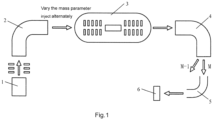
- Fig. 1 is a schematic diagram of a conventional AMS. As shown in Fig.1 , two isotopes respectively having a mass number of M and M-1 are separated from a sputtering negative ion source 1. AMS is unable to measure the two isotopes simultaneously at rear end of a high-energy magnetic analyzer or electrostatic analyzer; instead, an electrostatic and magnetic analyzer 2 can only select one of the isotopes to be accelerated by a tandem accelerator 3. The accelerated isotope passes through a high-energy magnetic analyzer 4 and a high-energy electrostatic analyzer 5 and arrives at a detector 6. By varying the mass parameter of the injector alternately so as to inject and accelerate the isotopes alternately, the isotopes can be measured alternately.
- ST-AMS The accelerator mass spectrometry device of the present invention that has the function of measuring isotopes at the same time is referred to as ST-AMS.
- ST-AMS mainly serves to solve two technical problems, one of which is accelerating isotopes simultaneously and the other is measuring the isotopes simultaneously.
- Fig. 2 is a simplified schematic diagram of the ST-AMS according to the present invention.
- negative ions originating from the sputtering negative ion source 1 are directly admitted into an accelerating tube 7 (comprising a pre-accelerating tube and a main accelerating tube) and, therefore, the individual isotopic negative ions contained in the negative ions, for example, in the case of carbon isotopes, respectively 12 C, 13 C and 14 C negative ions, are all admitted into the accelerator tube to be accelerated.
- the negative ions pass through the accelerator, their masses are resolved directly using an electric and magnetic analyzer 8.
- 12 C, 13 C and 14 C negative ions among carbon isotopes are separated.
- 12 C and 13 C are stable isotopes and can form negative ion beams capable of being measured directly, 12 C and 13 C negative ions are hence capable of being measured simultaneously using a stable isotope receiver 9 (such as a Faraday cup).
- stable isotope receiver 9 such as a Faraday cup
- unstable isotopes for example, 14 C negative ions, are extremely low in abundance ( 14 C/ 12 C in the range of 10 -12 to 10 -16 ) so that they cannot form a measurable beam with a maximum of 300 counts per second.
- a heavy-particle detector is used to record the number of atoms of 14 C ions and the stable isotope receiver 9 cannot be used.
- other isotopic molecular ions such as 13 CH, 12 CH 2 and 7 Li 2 negative ions
- all the molecular ions are disintegrated through an electron stripper 10 by means of a stripper technique in the AMS analysis method and the disintegrated molecular fragments and scattered ions are excluded through a speed selector 11 and an electrostatic analyzer 12, simply allowing 14 C + ions to enter a heavy ion detector 13 and to be recorded.
- the speed selector 11 is mainly used to exclude the disintegrated molecular fragments and scattered ions and the electrostatic analyzer 12 is mainly used to exclude neutral particles of zero charge state. Since the point of time when 14 C + ion arrives at the detector is later than the point of time when 12 C and 13 C ion beam streams arrive at the stable isotope receiver 9, the present invention employs a dedicated delay line to delay the signals of the stable isotope receiver such that the signals arrive at the receiver simultaneously with the signals of the detector. In this way, 14 C + ions, 12 C and 13 C negative ions can be measured simultaneously thereby enabling more isotopes to be received simultaneously.
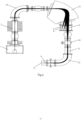
- Fig. 3 is a specific structure of the ST-AMS of the present invention, which comprises five parts, respectively:
- the sputtering negative ion source 1 is connected to the accelerating tube 7 for simultaneously accelerating a plurality of isotopic ions.
- the accelerating tube 7 consists of a pre-accelerating section and a main accelerating section and a lens is disposed in the middle thereof, and the output end of the accelerating tube 7 is connected with an isotopic mass resolution system.
- the first electrostatic analyzer 14 of the isotope mass resolution system conducts energy analysis of a plurality of isotopic ions.
- the magnetic analyzer 15 separates a plurality of isotopic ions.
- the stable isotope receiver 9 of the charge conversion analysis and multi-receiving measurement system measures stable isotopic negative ions (such as 12 C beam stream a, 13 C beam stream b); the electron stripper 10 converts unstable isotope negative ion (such as 14 C) into a positive ion and disintegrates all molecular ions.
- the detector 13 of the ion detection system measures isotopic positive ions (such as 14 C beam stream c) converted by the electron stripper 10.
- the nuclear electronics and data acquisition unit acquires the data measured by the stable isotope receiver 9 and the detector 13 which, after time matching, offers the contents of multiple isotopes measured simultaneously and abundance ratio thereof.
- the measurement signals of the stable isotope receiver 9 (a Faraday cup) are delayed by a delay line before transmitted to the nuclear electronics and data acquisition unit such that these signals arrive at the receiver simultaneously with the measurement signals of the detector 13.
- the present invention is also applicable to simultaneous measurement of nuclides such as 3 H, 10 Be, 26 Al and their isotopes in a way similar to that described in the above embodiment and those of ordinary skill in the art may tailor the design to the specific situations.
Landscapes
- Chemical & Material Sciences (AREA)
- Analytical Chemistry (AREA)
- Physics & Mathematics (AREA)
- Engineering & Computer Science (AREA)
- Plasma & Fusion (AREA)
- Other Investigation Or Analysis Of Materials By Electrical Means (AREA)
- Electron Tubes For Measurement (AREA)
- Analysing Materials By The Use Of Radiation (AREA)
Description
- The present invention relates to isotope measurement techniques and, more particularly, to an accelerator mass spectrometry device for simultaneously measuring isotopes.
- Accelerator Mass Spectrometry (AMS) is a high-energy isotope mass spectrometer based on accelerator technology and ion detector technology and is mainly used for the measurement of isotope abundance ratio. By virtue of an accelerator, the current AMS accelerates and measures isotopes sequentially and alternately thereby analyzing the isotopes. Thanks to the use of an accelerator and a detector, AMS is capable of excluding molecular ion background and isobaric ion background, which has greatly improved the analytical sensitivity and, as a result, the isotope abundance sensitivity can reach up to 1×10-15. In contrast, the prior-art mass spectrometer (MS) only has an isotope abundance sensitivity of 1×10⁻⁸ due to the interference from molecular ion background and isobaric ion background.
- Although the AMS is advantageous in that it has a high sensitivity and requires a less amount of samples, it is more complex in structure than the ordinary MS. Further, as isotopes are injected and measured alternately, the AMS cannot measure the isotopes simultaneously. These have contributed to undesirable measurement accuracy of the AMS, generally around 1%-3%.
- The advantages and disadvantages of AMS and MS are shown in the table below:
Advantages Disadvantages AMS The abundance sensitivity is as high as 10-15; the amount of samples required is 0.1 mg less. Isotopes are injected and measured alternately; the accuracy is not high enough, around 1%-3%. MS More isotopes are received and the accuracy is 0.1%-0.5% higher. The abundance sensitivity is not high enough (10-8). - The main reason why AMS cannot be used for measuring isotopes simultaneously lies in that, since the application of accelerator from the 1940s, it has been the practice that the accelerator can only accelerate a nuclide ion at a time. The accelerator system consists of an ion injector, an accelerator and a high-energy ion analyzer. One of the main components in the injector is an injection magnet which is intended to select one isotope and injects it into the accelerator for acceleration. To allow more than two isotopes to be measured, the mass parameter of the injector must be alternately changed so as to inject and accelerate the isotopes alternately thereby measuring the isotopes alternately.
- Due to alternate measurement of isotopes, two major problems occur with the AMS. First, the measurement accuracy is not high enough, generally about 1%-3%; second, the instrument system of the AMS is more complicated and, as compared with conventional MS, an injection magnet, an alternate injection power supply and a control system in addition to an accelerator are included.
-
EP2375437A1 discloses a mass spectrometry system based on the general principle of accelerator mass spectrometry (AMS). An ion source generates a beam of ions having a negative charge state. A first mass analyzer transmits only ions having a predetermined mass. The ions are passed through a stripper target comprising helium and/or hydrogen as a stripping gas to change the charge state of said ions from negative to positive charge and to dissociate molecular ions by collisions. A second mass analyzer transmits ions incharge state 1+ having the predetermined mass, which are detected by a detector. -
CN1916622A discloses a mass spectrum unit of accelerator consists of ion source, beam buncher, RFQ accelerator, electronic stripper, high energy analyzing system and detector. It is featured as connecting said unit and system in sequence; accelerating 14C, 12 C and 13C ion separately to be at certain energy for carrying out electronic stripping by RFQ accelerator in order to eliminate disturbance of molecular ion. -
US5120956A discloses an acceleration apparatus which reduced backgrounds of accelerator mass spectrometry measurements of 14C and other radionuclides. Backgrounds of AMS measurements are reduced by eliminating unwanted charged particles which undergo charge change during the acceleration process. This reduction is accomplished by a configuration of inclined electric fields throughout the acceleration region. - The present invention provides an accelerator mass spectrometry device for simultaneously measuring isotopes in order to improve the measuring accuracy of mass spectrometry device and simplify its structure, thereby eliminating the drawbacks of the prior art.
- To achieve the objective described above, the present invention employs the technical solutions below:
An accelerator mass spectrometry device for simultaneously measuring isotopes, comprising a sputtering negative ion source for generating a plurality of negative stable and unstable isotopic ions, an accelerating tube connected downstream to the sputtering negative ion source for simultaneously accelerating said plurality of isotopic ions; a first electrostatic analyzer connected downstream to the accelerating tube for conducting energy analysis of said plurality of isotopic ions; a magnetic analyzer connected downstream to the first electrostatic analyzer for separating said plurality of isotopic ions; a stable isotope receiver connected downstream to the magnetic analyzer for measuring said negative stable isotopic ions; an electron stripper connected downstream to the magnetic analyzer for converting said negative unstable isotopic ions to positive ions and disintegrating all the molecular ions; a speed selector connected downstream to the electron stripper for excluding the disintegrated molecular fragments and scattered ions; a second electrostatic analyzer connected downstream to the speed selector for excluding neutral particles of zero charge state; a detector connected downstream to the second electrostatic analyzer for measuring said positive ions originating from said conversion by the electron stripper; and a nuclear electronics and data acquisition unit configured to obtain data from the stable isotope receiver and the detector respectively which, after time matching, offers the contents of said plurality of isotopic ions measured simultaneously and an abundance ratio thereof., - The stable isotope receiver may be a Faraday cup.
- The measurement signal of the stable isotope receiver may be delayed by a delay line and then transmitted to the nuclear electronics and data acquisition unit such that it arrives simultaneously with the measurement signal of the detector.
- The accelerator mass spectrometry device for simultaneously measuring isotopes may further comprise an automatic control system for controlling the operation of each system, isotope measurement, data acquisition and operation, sample replacement as well as vacuum environment.
- The advantageous effects of the present invention are as follows:
By virtue of the accelerator mass spectrometry device for simultaneously measuring isotopes according to the present invention, a plurality of isotopic negative ions originating from an ion source are directly admitted into the accelerating tube without passing through the conventional electric and magnetic analyzers so that a plurality of isotopic negative ions are accelerated simultaneously. The plurality of accelerated isotopic negative ions is separated by the isotope mass resolution system. Stable isotopic negative ions are measured by the stable isotope receiver and unstable isotope negative ions are converted to positive ions and then measured by the detector. The isotope signals measured separately are time-matched and then transmitted to the nuclear electronics and data acquisition unit for data operations. The present invention is advantageous in that it is simple in structure and can be convenient to operate and maintain, which make it easy to popularize it in the market and promote its application. Moreover, it is featured with greater measurement accuracy than the conventional AMS, which contributes to more accurate measurement results. -
-
Fig.1 is a schematic diagram of a conventional AMS which is not part of the present invention and is provided for illustrative purposes only; -
Fig.2 is a simplified schematic diagram of a ST-AMS according to the present invention; and -
Fig.3 is a structural schematic diagram of a ST-AMS in accordance with an embodiment of the present invention that measures carbon isotopes simultaneously. - Below is a detailed description of the present invention in connection with the accompanying drawings and the preferred embodiments.
-
Fig. 1 is a schematic diagram of a conventional AMS. As shown inFig.1 , two isotopes respectively having a mass number of M and M-1 are separated from a sputteringnegative ion source 1. AMS is unable to measure the two isotopes simultaneously at rear end of a high-energy magnetic analyzer or electrostatic analyzer; instead, an electrostatic andmagnetic analyzer 2 can only select one of the isotopes to be accelerated by atandem accelerator 3. The accelerated isotope passes through a high-energymagnetic analyzer 4 and a high-energyelectrostatic analyzer 5 and arrives at adetector 6. By varying the mass parameter of the injector alternately so as to inject and accelerate the isotopes alternately, the isotopes can be measured alternately. - The accelerator mass spectrometry device of the present invention that has the function of measuring isotopes at the same time is referred to as ST-AMS. ST-AMS mainly serves to solve two technical problems, one of which is accelerating isotopes simultaneously and the other is measuring the isotopes simultaneously.
-
Fig. 2 is a simplified schematic diagram of the ST-AMS according to the present invention. As shown inFig.2 , negative ions originating from the sputteringnegative ion source 1 are directly admitted into an accelerating tube 7 (comprising a pre-accelerating tube and a main accelerating tube) and, therefore, the individual isotopic negative ions contained in the negative ions, for example, in the case of carbon isotopes, respectively 12C, 13C and 14C negative ions, are all admitted into the accelerator tube to be accelerated. After the negative ions pass through the accelerator, their masses are resolved directly using an electric andmagnetic analyzer 8. For example, when carbon isotopes are analyzed using this analyzer, 12C, 13C and 14C negative ions among carbon isotopes are separated. 12C and 13C are stable isotopes and can form negative ion beams capable of being measured directly, 12C and 13C negative ions are hence capable of being measured simultaneously using a stable isotope receiver 9 (such as a Faraday cup). In contrast, unstable isotopes, for example, 14C negative ions, are extremely low in abundance (14C/12C in the range of 10-12 to 10-16) so that they cannot form a measurable beam with a maximum of 300 counts per second. Thus, on one hand, a heavy-particle detector is used to record the number of atoms of 14C ions and thestable isotope receiver 9 cannot be used. On the other hand, as other isotopic molecular ions, such as 13CH, 12CH2 and 7Li2 negative ions, are present in 14C negative ions, all the molecular ions are disintegrated through anelectron stripper 10 by means of a stripper technique in the AMS analysis method and the disintegrated molecular fragments and scattered ions are excluded through aspeed selector 11 and anelectrostatic analyzer 12, simply allowing 14C+ ions to enter aheavy ion detector 13 and to be recorded. Thespeed selector 11 is mainly used to exclude the disintegrated molecular fragments and scattered ions and theelectrostatic analyzer 12 is mainly used to exclude neutral particles of zero charge state. Since the point of time when 14C+ ion arrives at the detector is later than the point of time when 12C and 13C ion beam streams arrive at thestable isotope receiver 9, the present invention employs a dedicated delay line to delay the signals of the stable isotope receiver such that the signals arrive at the receiver simultaneously with the signals of the detector. In this way, 14C+ ions, 12C and 13C negative ions can be measured simultaneously thereby enabling more isotopes to be received simultaneously. - Below is a description of an embodiment of the present invention with reference to a specific structure of the ST-AMS by taking the analysis on 12C, 13C and 14C for example.
-
Fig. 3 is a specific structure of the ST-AMS of the present invention, which comprises five parts, respectively: - Negative ion generation and acceleration system, comprising a sputtering
negative ion source 1 and an acceleratingtube 7; - Isotope mass resolution system, comprising a first
electrostatic analyzer 14 and amagnetic analyzer 15; - Charge conversion analysis and multi-receiving measurement system, comprising an
electron stripper 10, aspeed selector 11, a secondelectrostatic analyzer 12 and astable isotope receiver 9; - Ion detection system, comprising a
detector 13 and a nuclear electronics and data acquisition system; and - Automatic control system, serving for the control of the above systems, real-time measurement of isotopes, data acquisition and operation, sample replacement as well as automatic control of the vacuum environment.
- The sputtering
negative ion source 1 is connected to the acceleratingtube 7 for simultaneously accelerating a plurality of isotopic ions. The acceleratingtube 7 consists of a pre-accelerating section and a main accelerating section and a lens is disposed in the middle thereof, and the output end of the acceleratingtube 7 is connected with an isotopic mass resolution system. The firstelectrostatic analyzer 14 of the isotope mass resolution system conducts energy analysis of a plurality of isotopic ions. Themagnetic analyzer 15 separates a plurality of isotopic ions. Thestable isotope receiver 9 of the charge conversion analysis and multi-receiving measurement system measures stable isotopic negative ions (such as 12C beam stream a, 13C beam stream b); theelectron stripper 10 converts unstable isotope negative ion (such as 14C) into a positive ion and disintegrates all molecular ions. Thedetector 13 of the ion detection system measures isotopic positive ions (such as 14C beam stream c) converted by theelectron stripper 10. The nuclear electronics and data acquisition unit acquires the data measured by thestable isotope receiver 9 and thedetector 13 which, after time matching, offers the contents of multiple isotopes measured simultaneously and abundance ratio thereof. In the present invention, the measurement signals of the stable isotope receiver 9 (a Faraday cup) are delayed by a delay line before transmitted to the nuclear electronics and data acquisition unit such that these signals arrive at the receiver simultaneously with the measurement signals of thedetector 13. - Below is a description of the measurement steps of the ST-AMS by taking the measurement of carbon isotopes 12C, 13C and 14C contained in atmospheric particulates for example.
- Step 1: prepare the sample of atmospheric particulates into graphite;
- Step 2: press the prepared graphite sample into a sample target cone which is placed in a Cs ion source;
- Step 3: bombard the target material with a Cs ion beam to extract C- which is then admitted into the pre-accelerating tube and the main accelerating tube to accelerate the ion to the predetermined energy;
- Step 4: C- is then admitted into the first electrostatic analyzer for energy selection, and 14C, 12C and 13C are then separated by the magnetic analyzer;
- Step 5: 12C and 13C are measured by the Faraday cup. 14C is converted to positive ions through the gas stripper while molecules are disintegrated; the resulting 14C is then subject to magnetic field and electric field analysis by a speed selector and a second electrostatic analyzer and the count of 14C ions is ultimately obtained by the detector system.
- Step 6: after time matching, 14C, 12C and 13C as well as the abundance ratio thereof are obtained by the data acquisition system;
- Step 7: by comparing the above results with the measurement results obtained from the standard sample, the accurate content of 14C can be obtained.
- In addition to being useful for the measurement of carbon 12C, 13C and 14C isotopes, the present invention is also applicable to simultaneous measurement of nuclides such as 3H, 10Be, 26Al and their isotopes in a way similar to that described in the above embodiment and those of ordinary skill in the art may tailor the design to the specific situations.
- The above disclosure is related to the detailed technical contents and inventive features thereof. People skilled in this field may proceed with a variety of modifications and replacements based on the disclosures and suggestions of the invention as described within the scope of the invention as defined by the appended claims.
- Nevertheless, although such modifications and replacements are not fully disclosed in the above descriptions, they have substantially been covered in the following claims as appended.
Claims (4)
- An accelerator mass spectrometry device for simultaneously measuring isotopes, comprising:a sputtering negative ion source (1) for generating a plurality of negative stable and unstable isotopic ions;an accelerating tube (7) connected downstream to the sputtering negative ion source (1) for simultaneously accelerating said plurality of isotopic ions;a first electrostatic analyzer (14) connected downstream to the accelerating tube (7) for conducting energy analysis of said plurality of isotopic ions;a magnetic analyzer (15) connected downstream to the first electrostatic analyzer (14) for separating said plurality of isotopic ions;a stable isotope receiver (9) connected downstream to the magnetic analyzer (15) for measuring said negative stable isotopic ions;an electron stripper (10) connected downstream to the magnetic analyzer (15) for converting said negative unstable isotopic ions to positive ions and disintegrating all the molecular ions;a speed selector (11) connected downstream to the electron stripper (10) for excluding the disintegrated molecular fragments and scattered ions;a second electrostatic analyzer (12) connected downstream to the speed selector (11) for excluding neutral particles of zero charge state;a detector (13) connected downstream to the second electrostatic analyzer (12) for measuring said positive ions originating from said conversion by the electron stripper (10); anda nuclear electronics and data acquisition unit configured to obtain data from the stable isotope receiver (9) and the detector (13) respectively which, after time matching, offers the contents of said plurality of isotopic ions measured simultaneously and an abundance ratio thereof.
- The accelerator mass spectrometry device for simultaneously measuring isotopes as claimed in claim 1, wherein the stable isotope receiver (9) is a Faraday cup.
- The accelerator mass spectrometry device for simultaneously measuring isotopes as claimed in claim 1, wherein the measurement signal of the stable isotope receiver (9) is delayed by a delay line and then transmitted to the nuclear electronics and data acquisition unit such that it arrives simultaneously with the measurement signal of the detector (13).
- The accelerator mass spectrometry device for simultaneously measuring isotopes of any one of the claims 1-3, wherein it further comprises an automatic control system for controlling the operation of each system, isotope measurement, data acquisition and operation, sample replacement as well as vacuum environment.
Applications Claiming Priority (1)
| Application Number | Priority Date | Filing Date | Title |
|---|---|---|---|
| PCT/CN2015/075644 WO2016154958A1 (en) | 2015-04-01 | 2015-04-01 | Accelerator mass spectrometry device for simultaneously measuring isotopes |
Publications (3)
| Publication Number | Publication Date |
|---|---|
| EP3279922A1 EP3279922A1 (en) | 2018-02-07 |
| EP3279922A4 EP3279922A4 (en) | 2018-10-31 |
| EP3279922B1 true EP3279922B1 (en) | 2024-10-16 |
Family
ID=57003798
Family Applications (1)
| Application Number | Title | Priority Date | Filing Date |
|---|---|---|---|
| EP15886928.9A Active EP3279922B1 (en) | 2015-04-01 | 2015-04-01 | Accelerator mass spectrometry device for simultaneously measuring isotopes |
Country Status (4)
| Country | Link |
|---|---|
| US (1) | US10395910B2 (en) |
| EP (1) | EP3279922B1 (en) |
| JP (1) | JP6546690B2 (en) |
| WO (1) | WO2016154958A1 (en) |
Families Citing this family (5)
| Publication number | Priority date | Publication date | Assignee | Title |
|---|---|---|---|---|
| EP3767291A4 (en) * | 2018-03-12 | 2021-12-22 | Shan Jiang | MEASURING METHOD AND SYSTEM FOR ACCELERATOR MASS SPECTROMETRY |
| EP3582248B1 (en) * | 2018-06-14 | 2021-01-06 | High Voltage Engineering Europa B.V. | Accelerator mass spectrometry system and associated method |
| CN108987242A (en) * | 2018-07-17 | 2018-12-11 | 姜山 | A kind of isotope mass spectrometer |
| CN109580761B (en) * | 2018-11-27 | 2020-05-05 | 中国科学院广州地球化学研究所 | Apparatus and method for absolute micro-area in situ analysis of hafnium isotope and uranium-lead age |
| CN115825213A (en) * | 2022-09-28 | 2023-03-21 | 中国原子能科学研究院 | A rapid measurement method, storage medium and system for gas emissions from nuclear facilities |
Family Cites Families (16)
| Publication number | Priority date | Publication date | Assignee | Title |
|---|---|---|---|---|
| US5118936A (en) * | 1991-05-06 | 1992-06-02 | High Voltage Engineeering Europa B.V. | Accuracy of AMS isotopic ratio measurements |
| US5120956A (en) * | 1991-05-06 | 1992-06-09 | High Voltage Engineering Europa B.V. | Acceleration apparatus which reduced backgrounds of accelerator mass spectrometry measurements of 14 C and other radionuclides |
| US5189302A (en) * | 1991-10-28 | 1993-02-23 | The United States Of America As Represented By The United States Department Of Energy | Small system for tritium accelerator mass spectrometry |
| US5569915A (en) | 1995-04-14 | 1996-10-29 | Purser; Kenneth H. | Sensitive mass spectroscopy using molecular fragmentation |
| US5644130A (en) * | 1996-03-20 | 1997-07-01 | National Electrostatics Corp. | Multi-gas cathode ion surge |
| US6455844B1 (en) * | 1999-09-15 | 2002-09-24 | Lockheed Martin Energy Research | Single-atom detection of isotopes |
| US6815666B2 (en) * | 2002-09-06 | 2004-11-09 | National Electrostatics Corp. | Single stage accelerator mass spectrometer |
| CN100561221C (en) * | 2005-08-19 | 2009-11-18 | 北京大学 | A kind of accelerator mass spectrometry device and accelerator mass spectrometry 14The C measuring method |
| US7979228B2 (en) * | 2007-07-20 | 2011-07-12 | The Regents Of The University Of Michigan | High resolution time measurement in a FPGA |
| EP2375437A1 (en) * | 2010-04-12 | 2011-10-12 | ETH Zurich | Mass spectrometry system with molecular dissociation and associated method |
| CN102062755B (en) * | 2010-10-18 | 2012-10-24 | 南京大学 | Method for determining boron isotopic composition with static double-receiving method by positive thermal ionization mass spectrometry |
| WO2013067366A2 (en) * | 2011-11-02 | 2013-05-10 | Leco Corporation | Ion mobility spectrometer |
| US10186410B2 (en) * | 2012-10-10 | 2019-01-22 | California Institute Of Technology | Mass spectrometer, system comprising the same, and methods for determining isotopic anatomy of compounds |
| CN103094051B (en) * | 2013-01-16 | 2014-12-24 | 中国科学院大连化学物理研究所 | Synclastic dual-channel time-of-flight mass spectrometer |
| JP6086587B2 (en) * | 2013-02-04 | 2017-03-01 | 国立研究開発法人日本原子力研究開発機構 | Interfering nuclide fractionation method and apparatus by accelerator mass spectrometry |
| GB2520086B (en) * | 2013-11-11 | 2020-02-19 | Thermo Fisher Scient Bremen Gmbh | Method of measuring isotope ratio |
-
2015
- 2015-04-01 WO PCT/CN2015/075644 patent/WO2016154958A1/en not_active Ceased
- 2015-04-01 JP JP2018502298A patent/JP6546690B2/en active Active
- 2015-04-01 US US15/562,892 patent/US10395910B2/en active Active
- 2015-04-01 EP EP15886928.9A patent/EP3279922B1/en active Active
Non-Patent Citations (1)
| Title |
|---|
| SYNAL HANS-ARNO ET AL: "MICADAS: A new compact radiocarbon AMS system", NUCLEAR INSTRUMENTS & METHODS IN PHYSICS RESEARCH. SECTION B: BEAM INTERACTIONS WITH MATERIALS AND ATOMS, vol. 259, no. 1, 25 January 2007 (2007-01-25), pages 7 - 13, XP029244880, ISSN: 0168-583X, DOI: 10.1016/J.NIMB.2007.01.138 * |
Also Published As
| Publication number | Publication date |
|---|---|
| US20180082828A1 (en) | 2018-03-22 |
| WO2016154958A1 (en) | 2016-10-06 |
| EP3279922A4 (en) | 2018-10-31 |
| US10395910B2 (en) | 2019-08-27 |
| JP2018511925A (en) | 2018-04-26 |
| EP3279922A1 (en) | 2018-02-07 |
| JP6546690B2 (en) | 2019-07-17 |
Similar Documents
| Publication | Publication Date | Title |
|---|---|---|
| CN105301088B (en) | A kind of accelerator mass spectrometry measuring function simultaneously with isotope | |
| Wilcken et al. | Accelerator mass spectrometry on SIRIUS: New 6 MV spectrometer at ANSTO | |
| US10395910B2 (en) | Accelerator mass spectrometry device for simultaneously measuring isotopes | |
| EP3598475A1 (en) | Isotope mass spectrometer | |
| CN113156032B (en) | Mass spectrum system and method for simultaneously measuring isotope abundance and impurity content | |
| Kubik et al. | Accelerator mass spectrometry with completely stripped 36Cl ions at the Munich postaccelerator | |
| Parkhomchuk et al. | Accelerator mass spectrometer of the center for collective use of the Siberian Branch of the Russian Academy of Sciences | |
| McNichol et al. | Converting AMS data to radiocarbon values: considerations and conventions | |
| US20210104391A1 (en) | Inorganic mass spectrometer | |
| CN108387633A (en) | T and He-3 accelerator mass spectrometry high-sensitivity measurement devices | |
| US11410843B1 (en) | Mass spectrometry system and measuring method thereof | |
| Wallace et al. | The New Zealand accelerator mass spectrometry facility | |
| Suter et al. | Precision measurements of rare radioisotopes with a tandem Van-de-Graaff accelerator | |
| CN208109749U (en) | T and He-3 accelerator mass spectrometry high-sensitivity measurement device | |
| Xiang-Gao et al. | Primary result of 236U measurement with accelerator mass spectrometry at CIAE | |
| La Rana et al. | Search for dynamical effects in the fission decay in the 240 MeV 32S+ 100Mo reaction | |
| Gottdang et al. | The novel HVEE multi-element AMS system | |
| Shan et al. | Large projects at the accelerator mass spectrometry facility at the China Institute of Atomic Energy during the last 12 years | |
| Vockenhuber et al. | Accelerator mass spectrometry of the heaviest long-lived radionuclides with a 3-MV tandem accelerator | |
| Gottdang et al. | Accelerator mass spectrometry at high voltage engineering Europa (HVEE) | |
| De Jesús et al. | 236U identification in the new AMS beamline at the TANDAR accelerator | |
| Bonomi | Light hypernuclei in FINUDA | |
| Farwell et al. | Radiometric dating with the University of Washington tandem Van de Graaff accelerator | |
| Purser et al. | THE IONEX CARBON-14 DATING SYSTEM | |
| Wang et al. | Improvement on AMS Measurement of 236U at CIAE |
Legal Events
| Date | Code | Title | Description |
|---|---|---|---|
| STAA | Information on the status of an ep patent application or granted ep patent |
Free format text: STATUS: THE INTERNATIONAL PUBLICATION HAS BEEN MADE |
|
| PUAI | Public reference made under article 153(3) epc to a published international application that has entered the european phase |
Free format text: ORIGINAL CODE: 0009012 |
|
| STAA | Information on the status of an ep patent application or granted ep patent |
Free format text: STATUS: REQUEST FOR EXAMINATION WAS MADE |
|
| 17P | Request for examination filed |
Effective date: 20171013 |
|
| AK | Designated contracting states |
Kind code of ref document: A1 Designated state(s): AL AT BE BG CH CY CZ DE DK EE ES FI FR GB GR HR HU IE IS IT LI LT LU LV MC MK MT NL NO PL PT RO RS SE SI SK SM TR |
|
| AX | Request for extension of the european patent |
Extension state: BA ME |
|
| DAV | Request for validation of the european patent (deleted) | ||
| DAX | Request for extension of the european patent (deleted) | ||
| A4 | Supplementary search report drawn up and despatched |
Effective date: 20181002 |
|
| RIC1 | Information provided on ipc code assigned before grant |
Ipc: H01J 49/00 20060101AFI20180925BHEP |
|
| STAA | Information on the status of an ep patent application or granted ep patent |
Free format text: STATUS: EXAMINATION IS IN PROGRESS |
|
| 17Q | First examination report despatched |
Effective date: 20210419 |
|
| GRAP | Despatch of communication of intention to grant a patent |
Free format text: ORIGINAL CODE: EPIDOSNIGR1 |
|
| STAA | Information on the status of an ep patent application or granted ep patent |
Free format text: STATUS: GRANT OF PATENT IS INTENDED |
|
| INTG | Intention to grant announced |
Effective date: 20240527 |
|
| GRAS | Grant fee paid |
Free format text: ORIGINAL CODE: EPIDOSNIGR3 |
|
| GRAA | (expected) grant |
Free format text: ORIGINAL CODE: 0009210 |
|
| STAA | Information on the status of an ep patent application or granted ep patent |
Free format text: STATUS: THE PATENT HAS BEEN GRANTED |
|
| AK | Designated contracting states |
Kind code of ref document: B1 Designated state(s): AL AT BE BG CH CY CZ DE DK EE ES FI FR GB GR HR HU IE IS IT LI LT LU LV MC MK MT NL NO PL PT RO RS SE SI SK SM TR |
|
| REG | Reference to a national code |
Ref country code: GB Ref legal event code: FG4D |
|
| REG | Reference to a national code |
Ref country code: CH Ref legal event code: EP Ref country code: DE Ref legal event code: R096 Ref document number: 602015090176 Country of ref document: DE |
|
| REG | Reference to a national code |
Ref country code: IE Ref legal event code: FG4D |
|
| REG | Reference to a national code |
Ref country code: LT Ref legal event code: MG9D |
|
| REG | Reference to a national code |
Ref country code: NL Ref legal event code: MP Effective date: 20241016 |
|
| REG | Reference to a national code |
Ref country code: AT Ref legal event code: MK05 Ref document number: 1733658 Country of ref document: AT Kind code of ref document: T Effective date: 20241016 |
|
| PG25 | Lapsed in a contracting state [announced via postgrant information from national office to epo] |
Ref country code: NL Free format text: LAPSE BECAUSE OF FAILURE TO SUBMIT A TRANSLATION OF THE DESCRIPTION OR TO PAY THE FEE WITHIN THE PRESCRIBED TIME-LIMIT Effective date: 20241016 |
|
| PG25 | Lapsed in a contracting state [announced via postgrant information from national office to epo] |
Ref country code: NL Free format text: LAPSE BECAUSE OF FAILURE TO SUBMIT A TRANSLATION OF THE DESCRIPTION OR TO PAY THE FEE WITHIN THE PRESCRIBED TIME-LIMIT Effective date: 20241016 |
|
| PG25 | Lapsed in a contracting state [announced via postgrant information from national office to epo] |
Ref country code: HR Free format text: LAPSE BECAUSE OF FAILURE TO SUBMIT A TRANSLATION OF THE DESCRIPTION OR TO PAY THE FEE WITHIN THE PRESCRIBED TIME-LIMIT Effective date: 20241016 Ref country code: PT Free format text: LAPSE BECAUSE OF FAILURE TO SUBMIT A TRANSLATION OF THE DESCRIPTION OR TO PAY THE FEE WITHIN THE PRESCRIBED TIME-LIMIT Effective date: 20250217 Ref country code: IS Free format text: LAPSE BECAUSE OF FAILURE TO SUBMIT A TRANSLATION OF THE DESCRIPTION OR TO PAY THE FEE WITHIN THE PRESCRIBED TIME-LIMIT Effective date: 20250216 |
|
| PG25 | Lapsed in a contracting state [announced via postgrant information from national office to epo] |
Ref country code: FI Free format text: LAPSE BECAUSE OF FAILURE TO SUBMIT A TRANSLATION OF THE DESCRIPTION OR TO PAY THE FEE WITHIN THE PRESCRIBED TIME-LIMIT Effective date: 20241016 |
|
| PG25 | Lapsed in a contracting state [announced via postgrant information from national office to epo] |
Ref country code: BG Free format text: LAPSE BECAUSE OF FAILURE TO SUBMIT A TRANSLATION OF THE DESCRIPTION OR TO PAY THE FEE WITHIN THE PRESCRIBED TIME-LIMIT Effective date: 20241016 |
|
| PG25 | Lapsed in a contracting state [announced via postgrant information from national office to epo] |
Ref country code: ES Free format text: LAPSE BECAUSE OF FAILURE TO SUBMIT A TRANSLATION OF THE DESCRIPTION OR TO PAY THE FEE WITHIN THE PRESCRIBED TIME-LIMIT Effective date: 20241016 |
|
| PG25 | Lapsed in a contracting state [announced via postgrant information from national office to epo] |
Ref country code: NO Free format text: LAPSE BECAUSE OF FAILURE TO SUBMIT A TRANSLATION OF THE DESCRIPTION OR TO PAY THE FEE WITHIN THE PRESCRIBED TIME-LIMIT Effective date: 20250116 |
|
| PG25 | Lapsed in a contracting state [announced via postgrant information from national office to epo] |
Ref country code: LV Free format text: LAPSE BECAUSE OF FAILURE TO SUBMIT A TRANSLATION OF THE DESCRIPTION OR TO PAY THE FEE WITHIN THE PRESCRIBED TIME-LIMIT Effective date: 20241016 Ref country code: AT Free format text: LAPSE BECAUSE OF FAILURE TO SUBMIT A TRANSLATION OF THE DESCRIPTION OR TO PAY THE FEE WITHIN THE PRESCRIBED TIME-LIMIT Effective date: 20241016 Ref country code: GR Free format text: LAPSE BECAUSE OF FAILURE TO SUBMIT A TRANSLATION OF THE DESCRIPTION OR TO PAY THE FEE WITHIN THE PRESCRIBED TIME-LIMIT Effective date: 20250117 |
|
| PG25 | Lapsed in a contracting state [announced via postgrant information from national office to epo] |
Ref country code: PL Free format text: LAPSE BECAUSE OF FAILURE TO SUBMIT A TRANSLATION OF THE DESCRIPTION OR TO PAY THE FEE WITHIN THE PRESCRIBED TIME-LIMIT Effective date: 20241016 |
|
| PGFP | Annual fee paid to national office [announced via postgrant information from national office to epo] |
Ref country code: FR Payment date: 20250305 Year of fee payment: 11 |
|
| PG25 | Lapsed in a contracting state [announced via postgrant information from national office to epo] |
Ref country code: RS Free format text: LAPSE BECAUSE OF FAILURE TO SUBMIT A TRANSLATION OF THE DESCRIPTION OR TO PAY THE FEE WITHIN THE PRESCRIBED TIME-LIMIT Effective date: 20250116 |
|
| PG25 | Lapsed in a contracting state [announced via postgrant information from national office to epo] |
Ref country code: SM Free format text: LAPSE BECAUSE OF FAILURE TO SUBMIT A TRANSLATION OF THE DESCRIPTION OR TO PAY THE FEE WITHIN THE PRESCRIBED TIME-LIMIT Effective date: 20241016 |
|
| PGFP | Annual fee paid to national office [announced via postgrant information from national office to epo] |
Ref country code: DE Payment date: 20250417 Year of fee payment: 11 |
|
| PG25 | Lapsed in a contracting state [announced via postgrant information from national office to epo] |
Ref country code: DK Free format text: LAPSE BECAUSE OF FAILURE TO SUBMIT A TRANSLATION OF THE DESCRIPTION OR TO PAY THE FEE WITHIN THE PRESCRIBED TIME-LIMIT Effective date: 20241016 |
|
| REG | Reference to a national code |
Ref country code: DE Ref legal event code: R097 Ref document number: 602015090176 Country of ref document: DE |
|
| PG25 | Lapsed in a contracting state [announced via postgrant information from national office to epo] |
Ref country code: EE Free format text: LAPSE BECAUSE OF FAILURE TO SUBMIT A TRANSLATION OF THE DESCRIPTION OR TO PAY THE FEE WITHIN THE PRESCRIBED TIME-LIMIT Effective date: 20241016 |
|
| PG25 | Lapsed in a contracting state [announced via postgrant information from national office to epo] |
Ref country code: RO Free format text: LAPSE BECAUSE OF FAILURE TO SUBMIT A TRANSLATION OF THE DESCRIPTION OR TO PAY THE FEE WITHIN THE PRESCRIBED TIME-LIMIT Effective date: 20241016 |
|
| PG25 | Lapsed in a contracting state [announced via postgrant information from national office to epo] |
Ref country code: SK Free format text: LAPSE BECAUSE OF FAILURE TO SUBMIT A TRANSLATION OF THE DESCRIPTION OR TO PAY THE FEE WITHIN THE PRESCRIBED TIME-LIMIT Effective date: 20241016 |
|
| PG25 | Lapsed in a contracting state [announced via postgrant information from national office to epo] |
Ref country code: CZ Free format text: LAPSE BECAUSE OF FAILURE TO SUBMIT A TRANSLATION OF THE DESCRIPTION OR TO PAY THE FEE WITHIN THE PRESCRIBED TIME-LIMIT Effective date: 20241016 |
|
| PG25 | Lapsed in a contracting state [announced via postgrant information from national office to epo] |
Ref country code: IT Free format text: LAPSE BECAUSE OF FAILURE TO SUBMIT A TRANSLATION OF THE DESCRIPTION OR TO PAY THE FEE WITHIN THE PRESCRIBED TIME-LIMIT Effective date: 20241016 |
|
| PLBE | No opposition filed within time limit |
Free format text: ORIGINAL CODE: 0009261 |
|
| STAA | Information on the status of an ep patent application or granted ep patent |
Free format text: STATUS: NO OPPOSITION FILED WITHIN TIME LIMIT |
|
| PG25 | Lapsed in a contracting state [announced via postgrant information from national office to epo] |
Ref country code: SE Free format text: LAPSE BECAUSE OF FAILURE TO SUBMIT A TRANSLATION OF THE DESCRIPTION OR TO PAY THE FEE WITHIN THE PRESCRIBED TIME-LIMIT Effective date: 20241016 |
|
| 26N | No opposition filed |
Effective date: 20250717 |
|
| REG | Reference to a national code |
Ref country code: CH Ref legal event code: H13 Free format text: ST27 STATUS EVENT CODE: U-0-0-H10-H13 (AS PROVIDED BY THE NATIONAL OFFICE) Effective date: 20251125 |
|
| PG25 | Lapsed in a contracting state [announced via postgrant information from national office to epo] |
Ref country code: LU Free format text: LAPSE BECAUSE OF NON-PAYMENT OF DUE FEES Effective date: 20250401 |
|
| PG25 | Lapsed in a contracting state [announced via postgrant information from national office to epo] |
Ref country code: MC Free format text: LAPSE BECAUSE OF FAILURE TO SUBMIT A TRANSLATION OF THE DESCRIPTION OR TO PAY THE FEE WITHIN THE PRESCRIBED TIME-LIMIT Effective date: 20241016 |
|
| GBPC | Gb: european patent ceased through non-payment of renewal fee |
Effective date: 20250401 |
|
| REG | Reference to a national code |
Ref country code: BE Ref legal event code: MM Effective date: 20250430 |
|
| PG25 | Lapsed in a contracting state [announced via postgrant information from national office to epo] |
Ref country code: GB Free format text: LAPSE BECAUSE OF NON-PAYMENT OF DUE FEES Effective date: 20250401 |
|
| PG25 | Lapsed in a contracting state [announced via postgrant information from national office to epo] |
Ref country code: BE Free format text: LAPSE BECAUSE OF NON-PAYMENT OF DUE FEES Effective date: 20250430 |
|
| PG25 | Lapsed in a contracting state [announced via postgrant information from national office to epo] |
Ref country code: CH Free format text: LAPSE BECAUSE OF NON-PAYMENT OF DUE FEES Effective date: 20250430 |
|
| PG25 | Lapsed in a contracting state [announced via postgrant information from national office to epo] |
Ref country code: IE Free format text: LAPSE BECAUSE OF NON-PAYMENT OF DUE FEES Effective date: 20250401 |