EP3277693B1 - (meth)acrylate-functionalized extended isosorbide - Google Patents
(meth)acrylate-functionalized extended isosorbide Download PDFInfo
- Publication number
- EP3277693B1 EP3277693B1 EP16773623.0A EP16773623A EP3277693B1 EP 3277693 B1 EP3277693 B1 EP 3277693B1 EP 16773623 A EP16773623 A EP 16773623A EP 3277693 B1 EP3277693 B1 EP 3277693B1
- Authority
- EP
- European Patent Office
- Prior art keywords
- acrylate
- meth
- diisocyanate
- methacrylate
- isocyanatoethyl
- Prior art date
- Legal status (The legal status is an assumption and is not a legal conclusion. Google has not performed a legal analysis and makes no representation as to the accuracy of the status listed.)
- Active
Links
Images


Classifications
-
- C—CHEMISTRY; METALLURGY
- C08—ORGANIC MACROMOLECULAR COMPOUNDS; THEIR PREPARATION OR CHEMICAL WORKING-UP; COMPOSITIONS BASED THEREON
- C08G—MACROMOLECULAR COMPOUNDS OBTAINED OTHERWISE THAN BY REACTIONS ONLY INVOLVING UNSATURATED CARBON-TO-CARBON BONDS
- C08G18/00—Polymeric products of isocyanates or isothiocyanates
- C08G18/06—Polymeric products of isocyanates or isothiocyanates with compounds having active hydrogen
- C08G18/28—Polymeric products of isocyanates or isothiocyanates with compounds having active hydrogen characterised by the compounds used containing active hydrogen
- C08G18/30—Low-molecular-weight compounds
- C08G18/32—Polyhydroxy compounds; Polyamines; Hydroxyamines
- C08G18/3203—Polyhydroxy compounds
- C08G18/3218—Polyhydroxy compounds containing cyclic groups having at least one oxygen atom in the ring
-
- C—CHEMISTRY; METALLURGY
- C07—ORGANIC CHEMISTRY
- C07D—HETEROCYCLIC COMPOUNDS
- C07D493/00—Heterocyclic compounds containing oxygen atoms as the only ring hetero atoms in the condensed system
- C07D493/02—Heterocyclic compounds containing oxygen atoms as the only ring hetero atoms in the condensed system in which the condensed system contains two hetero rings
- C07D493/04—Ortho-condensed systems
-
- C—CHEMISTRY; METALLURGY
- C08—ORGANIC MACROMOLECULAR COMPOUNDS; THEIR PREPARATION OR CHEMICAL WORKING-UP; COMPOSITIONS BASED THEREON
- C08F—MACROMOLECULAR COMPOUNDS OBTAINED BY REACTIONS ONLY INVOLVING CARBON-TO-CARBON UNSATURATED BONDS
- C08F222/00—Copolymers of compounds having one or more unsaturated aliphatic radicals, each having only one carbon-to-carbon double bond, and at least one being terminated by a carboxyl radical and containing at least one other carboxyl radical in the molecule; Salts, anhydrides, esters, amides, imides, or nitriles thereof
- C08F222/10—Esters
-
- C—CHEMISTRY; METALLURGY
- C08—ORGANIC MACROMOLECULAR COMPOUNDS; THEIR PREPARATION OR CHEMICAL WORKING-UP; COMPOSITIONS BASED THEREON
- C08F—MACROMOLECULAR COMPOUNDS OBTAINED BY REACTIONS ONLY INVOLVING CARBON-TO-CARBON UNSATURATED BONDS
- C08F299/00—Macromolecular compounds obtained by interreacting polymers involving only carbon-to-carbon unsaturated bond reactions, in the absence of non-macromolecular monomers
- C08F299/02—Macromolecular compounds obtained by interreacting polymers involving only carbon-to-carbon unsaturated bond reactions, in the absence of non-macromolecular monomers from unsaturated polycondensates
- C08F299/06—Macromolecular compounds obtained by interreacting polymers involving only carbon-to-carbon unsaturated bond reactions, in the absence of non-macromolecular monomers from unsaturated polycondensates from polyurethanes
- C08F299/065—Macromolecular compounds obtained by interreacting polymers involving only carbon-to-carbon unsaturated bond reactions, in the absence of non-macromolecular monomers from unsaturated polycondensates from polyurethanes from polyurethanes with side or terminal unsaturations
-
- C—CHEMISTRY; METALLURGY
- C08—ORGANIC MACROMOLECULAR COMPOUNDS; THEIR PREPARATION OR CHEMICAL WORKING-UP; COMPOSITIONS BASED THEREON
- C08G—MACROMOLECULAR COMPOUNDS OBTAINED OTHERWISE THAN BY REACTIONS ONLY INVOLVING UNSATURATED CARBON-TO-CARBON BONDS
- C08G18/00—Polymeric products of isocyanates or isothiocyanates
- C08G18/04—Polymeric products of isocyanates or isothiocyanates with vinyl compounds
-
- C—CHEMISTRY; METALLURGY
- C08—ORGANIC MACROMOLECULAR COMPOUNDS; THEIR PREPARATION OR CHEMICAL WORKING-UP; COMPOSITIONS BASED THEREON
- C08G—MACROMOLECULAR COMPOUNDS OBTAINED OTHERWISE THAN BY REACTIONS ONLY INVOLVING UNSATURATED CARBON-TO-CARBON BONDS
- C08G18/00—Polymeric products of isocyanates or isothiocyanates
- C08G18/06—Polymeric products of isocyanates or isothiocyanates with compounds having active hydrogen
- C08G18/28—Polymeric products of isocyanates or isothiocyanates with compounds having active hydrogen characterised by the compounds used containing active hydrogen
- C08G18/40—High-molecular-weight compounds
- C08G18/62—Polymers of compounds having carbon-to-carbon double bonds
- C08G18/6216—Polymers of alpha-beta ethylenically unsaturated carboxylic acids or of derivatives thereof
- C08G18/622—Polymers of esters of alpha-beta ethylenically unsaturated carboxylic acids
- C08G18/6225—Polymers of esters of acrylic or methacrylic acid
-
- C—CHEMISTRY; METALLURGY
- C08—ORGANIC MACROMOLECULAR COMPOUNDS; THEIR PREPARATION OR CHEMICAL WORKING-UP; COMPOSITIONS BASED THEREON
- C08G—MACROMOLECULAR COMPOUNDS OBTAINED OTHERWISE THAN BY REACTIONS ONLY INVOLVING UNSATURATED CARBON-TO-CARBON BONDS
- C08G18/00—Polymeric products of isocyanates or isothiocyanates
- C08G18/06—Polymeric products of isocyanates or isothiocyanates with compounds having active hydrogen
- C08G18/28—Polymeric products of isocyanates or isothiocyanates with compounds having active hydrogen characterised by the compounds used containing active hydrogen
- C08G18/67—Unsaturated compounds having active hydrogen
- C08G18/671—Unsaturated compounds having only one group containing active hydrogen
- C08G18/672—Esters of acrylic or alkyl acrylic acid having only one group containing active hydrogen
-
- C—CHEMISTRY; METALLURGY
- C08—ORGANIC MACROMOLECULAR COMPOUNDS; THEIR PREPARATION OR CHEMICAL WORKING-UP; COMPOSITIONS BASED THEREON
- C08G—MACROMOLECULAR COMPOUNDS OBTAINED OTHERWISE THAN BY REACTIONS ONLY INVOLVING UNSATURATED CARBON-TO-CARBON BONDS
- C08G18/00—Polymeric products of isocyanates or isothiocyanates
- C08G18/06—Polymeric products of isocyanates or isothiocyanates with compounds having active hydrogen
- C08G18/70—Polymeric products of isocyanates or isothiocyanates with compounds having active hydrogen characterised by the isocyanates or isothiocyanates used
- C08G18/72—Polyisocyanates or polyisothiocyanates
- C08G18/74—Polyisocyanates or polyisothiocyanates cyclic
- C08G18/75—Polyisocyanates or polyisothiocyanates cyclic cycloaliphatic
- C08G18/751—Polyisocyanates or polyisothiocyanates cyclic cycloaliphatic containing only one cycloaliphatic ring
- C08G18/752—Polyisocyanates or polyisothiocyanates cyclic cycloaliphatic containing only one cycloaliphatic ring containing at least one isocyanate or isothiocyanate group linked to the cycloaliphatic ring by means of an aliphatic group
- C08G18/753—Polyisocyanates or polyisothiocyanates cyclic cycloaliphatic containing only one cycloaliphatic ring containing at least one isocyanate or isothiocyanate group linked to the cycloaliphatic ring by means of an aliphatic group containing one isocyanate or isothiocyanate group linked to the cycloaliphatic ring by means of an aliphatic group having a primary carbon atom next to the isocyanate or isothiocyanate group
- C08G18/755—Polyisocyanates or polyisothiocyanates cyclic cycloaliphatic containing only one cycloaliphatic ring containing at least one isocyanate or isothiocyanate group linked to the cycloaliphatic ring by means of an aliphatic group containing one isocyanate or isothiocyanate group linked to the cycloaliphatic ring by means of an aliphatic group having a primary carbon atom next to the isocyanate or isothiocyanate group and at least one isocyanate or isothiocyanate group linked to a secondary carbon atom of the cycloaliphatic ring, e.g. isophorone diisocyanate
-
- C—CHEMISTRY; METALLURGY
- C08—ORGANIC MACROMOLECULAR COMPOUNDS; THEIR PREPARATION OR CHEMICAL WORKING-UP; COMPOSITIONS BASED THEREON
- C08G—MACROMOLECULAR COMPOUNDS OBTAINED OTHERWISE THAN BY REACTIONS ONLY INVOLVING UNSATURATED CARBON-TO-CARBON BONDS
- C08G18/00—Polymeric products of isocyanates or isothiocyanates
- C08G18/06—Polymeric products of isocyanates or isothiocyanates with compounds having active hydrogen
- C08G18/70—Polymeric products of isocyanates or isothiocyanates with compounds having active hydrogen characterised by the isocyanates or isothiocyanates used
- C08G18/72—Polyisocyanates or polyisothiocyanates
- C08G18/80—Masked polyisocyanates
- C08G18/8003—Masked polyisocyanates masked with compounds having at least two groups containing active hydrogen
- C08G18/8006—Masked polyisocyanates masked with compounds having at least two groups containing active hydrogen with compounds of C08G18/32
- C08G18/8009—Masked polyisocyanates masked with compounds having at least two groups containing active hydrogen with compounds of C08G18/32 with compounds of C08G18/3203
- C08G18/8012—Masked polyisocyanates masked with compounds having at least two groups containing active hydrogen with compounds of C08G18/32 with compounds of C08G18/3203 with diols
- C08G18/8016—Masked aliphatic or cycloaliphatic polyisocyanates
-
- C—CHEMISTRY; METALLURGY
- C08—ORGANIC MACROMOLECULAR COMPOUNDS; THEIR PREPARATION OR CHEMICAL WORKING-UP; COMPOSITIONS BASED THEREON
- C08G—MACROMOLECULAR COMPOUNDS OBTAINED OTHERWISE THAN BY REACTIONS ONLY INVOLVING UNSATURATED CARBON-TO-CARBON BONDS
- C08G18/00—Polymeric products of isocyanates or isothiocyanates
- C08G18/06—Polymeric products of isocyanates or isothiocyanates with compounds having active hydrogen
- C08G18/70—Polymeric products of isocyanates or isothiocyanates with compounds having active hydrogen characterised by the isocyanates or isothiocyanates used
- C08G18/81—Unsaturated isocyanates or isothiocyanates
- C08G18/8108—Unsaturated isocyanates or isothiocyanates having only one isocyanate or isothiocyanate group
- C08G18/8116—Unsaturated isocyanates or isothiocyanates having only one isocyanate or isothiocyanate group esters of acrylic or alkylacrylic acid having only one isocyanate or isothiocyanate group
-
- C—CHEMISTRY; METALLURGY
- C08—ORGANIC MACROMOLECULAR COMPOUNDS; THEIR PREPARATION OR CHEMICAL WORKING-UP; COMPOSITIONS BASED THEREON
- C08G—MACROMOLECULAR COMPOUNDS OBTAINED OTHERWISE THAN BY REACTIONS ONLY INVOLVING UNSATURATED CARBON-TO-CARBON BONDS
- C08G81/00—Macromolecular compounds obtained by interreacting polymers in the absence of monomers, e.g. block polymers
- C08G81/02—Macromolecular compounds obtained by interreacting polymers in the absence of monomers, e.g. block polymers at least one of the polymers being obtained by reactions involving only carbon-to-carbon unsaturated bonds
- C08G81/024—Block or graft polymers containing sequences of polymers of C08C or C08F and of polymers of C08G
-
- C—CHEMISTRY; METALLURGY
- C08—ORGANIC MACROMOLECULAR COMPOUNDS; THEIR PREPARATION OR CHEMICAL WORKING-UP; COMPOSITIONS BASED THEREON
- C08L—COMPOSITIONS OF MACROMOLECULAR COMPOUNDS
- C08L35/00—Compositions of homopolymers or copolymers of compounds having one or more unsaturated aliphatic radicals, each having only one carbon-to-carbon double bond, and at least one being terminated by a carboxyl radical, and containing at least one other carboxyl radical in the molecule, or of salts, anhydrides, esters, amides, imides or nitriles thereof; Compositions of derivatives of such polymers
- C08L35/02—Homopolymers or copolymers of esters
-
- C—CHEMISTRY; METALLURGY
- C09—DYES; PAINTS; POLISHES; NATURAL RESINS; ADHESIVES; COMPOSITIONS NOT OTHERWISE PROVIDED FOR; APPLICATIONS OF MATERIALS NOT OTHERWISE PROVIDED FOR
- C09D—COATING COMPOSITIONS, e.g. PAINTS, VARNISHES OR LACQUERS; FILLING PASTES; CHEMICAL PAINT OR INK REMOVERS; INKS; CORRECTING FLUIDS; WOODSTAINS; PASTES OR SOLIDS FOR COLOURING OR PRINTING; USE OF MATERIALS THEREFOR
- C09D175/00—Coating compositions based on polyureas or polyurethanes; Coating compositions based on derivatives of such polymers
- C09D175/04—Polyurethanes
- C09D175/14—Polyurethanes having carbon-to-carbon unsaturated bonds
- C09D175/16—Polyurethanes having carbon-to-carbon unsaturated bonds having terminal carbon-to-carbon unsaturated bonds
-
- C—CHEMISTRY; METALLURGY
- C09—DYES; PAINTS; POLISHES; NATURAL RESINS; ADHESIVES; COMPOSITIONS NOT OTHERWISE PROVIDED FOR; APPLICATIONS OF MATERIALS NOT OTHERWISE PROVIDED FOR
- C09J—ADHESIVES; NON-MECHANICAL ASPECTS OF ADHESIVE PROCESSES IN GENERAL; ADHESIVE PROCESSES NOT PROVIDED FOR ELSEWHERE; USE OF MATERIALS AS ADHESIVES
- C09J175/00—Adhesives based on polyureas or polyurethanes; Adhesives based on derivatives of such polymers
- C09J175/04—Polyurethanes
- C09J175/14—Polyurethanes having carbon-to-carbon unsaturated bonds
- C09J175/16—Polyurethanes having carbon-to-carbon unsaturated bonds having terminal carbon-to-carbon unsaturated bonds
-
- C—CHEMISTRY; METALLURGY
- C08—ORGANIC MACROMOLECULAR COMPOUNDS; THEIR PREPARATION OR CHEMICAL WORKING-UP; COMPOSITIONS BASED THEREON
- C08F—MACROMOLECULAR COMPOUNDS OBTAINED BY REACTIONS ONLY INVOLVING CARBON-TO-CARBON UNSATURATED BONDS
- C08F220/00—Copolymers of compounds having one or more unsaturated aliphatic radicals, each having only one carbon-to-carbon double bond, and only one being terminated by only one carboxyl radical or a salt, anhydride ester, amide, imide or nitrile thereof
- C08F220/02—Monocarboxylic acids having less than ten carbon atoms; Derivatives thereof
- C08F220/10—Esters
- C08F220/34—Esters containing nitrogen, e.g. N,N-dimethylaminoethyl (meth)acrylate
- C08F220/343—Esters containing nitrogen, e.g. N,N-dimethylaminoethyl (meth)acrylate in the form of urethane links
-
- C—CHEMISTRY; METALLURGY
- C08—ORGANIC MACROMOLECULAR COMPOUNDS; THEIR PREPARATION OR CHEMICAL WORKING-UP; COMPOSITIONS BASED THEREON
- C08F—MACROMOLECULAR COMPOUNDS OBTAINED BY REACTIONS ONLY INVOLVING CARBON-TO-CARBON UNSATURATED BONDS
- C08F222/00—Copolymers of compounds having one or more unsaturated aliphatic radicals, each having only one carbon-to-carbon double bond, and at least one being terminated by a carboxyl radical and containing at least one other carboxyl radical in the molecule; Salts, anhydrides, esters, amides, imides, or nitriles thereof
- C08F222/10—Esters
- C08F222/1006—Esters of polyhydric alcohols or polyhydric phenols
- C08F222/102—Esters of polyhydric alcohols or polyhydric phenols of dialcohols, e.g. ethylene glycol di(meth)acrylate or 1,4-butanediol dimethacrylate
-
- C—CHEMISTRY; METALLURGY
- C08—ORGANIC MACROMOLECULAR COMPOUNDS; THEIR PREPARATION OR CHEMICAL WORKING-UP; COMPOSITIONS BASED THEREON
- C08G—MACROMOLECULAR COMPOUNDS OBTAINED OTHERWISE THAN BY REACTIONS ONLY INVOLVING UNSATURATED CARBON-TO-CARBON BONDS
- C08G2190/00—Compositions for sealing or packing joints
Definitions
- the invention relates generally to (meth)acrylate-functionalized extended isosorbide, compositions made therefrom and methods to make curable compositions therewith.
- U.S. Patent 6,891,053 discloses a method of making oleochemical oil-based polyols by mixing an epoxidized oleochemical, such as a vegetable or animal fat, and an alcohol using an activated or acid leached-clay to form the oleo-chemical oil-based polyol.
- the result is specific plant oils which have hydroxyl functionalization useful for further reaction, such as the reaction with an amine compound to form a polyurethane.
- modified plant oils having hydroxyl functionality have become available as renewable sources for starting materials in synthetic schemes.
- soy-based_polyols sold under the brand Agrol by Biobased Technologies, Springdale, Arkansas are disclosed as being useful sources of renewable polyols which may be used for making polyurethanes.
- the present invention relates to a curable composition
- a curable composition comprising:
- the present invention uses the renewable material, isosorbide, to produce (meth)acrylate funtionalized compounds and compositions made therefrom.
- This invention provides additives, such as reactive fillers, made from extended isosorbide units which can provide comparable or better properties than traditional fillers made from non-renewable materials.
- Isosorbide is a non-toxic diol produced from biobased feedstocks. It is a heterocyclic compound that is derived from glucose. Isosorbide and its two isomers, namely isoidide and isomannide, are 1,4:3,6-dianhydrohexitols. It is a white solid that is prepared from the double dehydration of sorbitol. Isosorbide is biodegradable and thermally stable.
- the present invention includes the use of such bio-based polyols, for either direct reaction with an appropriate (meth)acrylate-containing compound to form curable polyurethanes, or via an extended method, which includes first reacting the bio-based polyol with a diisocyanate and then further reacting the resultant product with a hydroxyl-containing (meth)acrylate, to yield a (meth)acrylated polyurethane.
- additional modifications of the bio-based polyol may be made such that NCO groups may be incorporated into the bio-based polyol.
- Isosorbide has the structure:
- the present invention provides functionalized, and desirably multi-functionalized compounds useful in a variety of applications, including as sealants, adhesives and coatings, as well as being used as building blocks for polymers.
- Diisocyantes useful in the present invention include, without limitation, isophorone diisocyanate (IPDI), IPDI isocyanaurate, polymeric IPDI, naphthalene 1,5-diisocyanate (NDI), methylene bis-cyclohexylisocyanate, methylene diphenyl diisocyanate (MDI), polymeric MDI, toluene diisocyanate (TDI), isocyanaurate of TDI, TDI-trimethylolpropane adduct, polymeric TDI, hexamethylene diisocyanate (HDI), HDI isocyanaurate, HDI biurate, polymeric HDI, xylylene diisocyanate, hydrogenated xylylene diisocyanate, tetramethyl xylylene diisocyanate, p -phenylene diisocyanate, 3,3'-dimethyldiphenyl-4,4'-diisocyanate (
- TMDI norbornane diisocyanate
- DBDI 4,4'-dibenzyl diisocyanate
- Combinations of diisocyantes may also be used.
- Monoisocyantes may also be used in the present invention.
- the useful (meth)acrylate-containing hydroxyl compounds useful for reaction with the NCO functionalized bio-based polyols include, without limitation, 2-hydroxyethyl methacrylate, 2-hydroxyethyl acrylate, 3-hydroxypropyl methacrylate, 3-hydroxypropyl acrylate, 2-hydroxypropyl acrylate, 4-hydroxybutyl acrylate, 3-hydroxybutyl acrylate, 2-hydroxybutyl acrylate, 3-(acryloyloxy)-2-hydroxypropyl methacrylate, 2-isocyanatoethyl methacrylate, 2-isocyanatoethyl acrylate, and poly(propylene glycol) (meth)acrylate.
- the useful (meth)acrylate-containing isocyanates useful for reaction with the bio-based polyols include, without limitation, 2-isocyanatoethyl acrylate, 2-isocyanatoethyl methacrylate, 3-isocyanatopropyl (meth)acrylate, 2-isocyanatopropyl (meth)acrylate, 4-isocyanatobutyl (meth)acrylate, 3-isocyanatobutyl (meth)acrylate, and 2-isocyanatobutyl (meth) acrylate.
- bio-based polyol when the bio-based polyol also includes other reactive groups such a NCO groups, resultant polyurethanes formed therefrom may have these groups available for further reactions.
- inventive polyurethanes formed from the bio-based polyols used in the present invention allow for a variety of polyurethane end products having such functionalities as (meth)acrylate functionality, which in turn allows for free radical mechanisms to be employed in the final curable compositions made therefrom.
- curable compositions may be made from the polyurethanes of the invention.
- adhesive compositions, sealants and coatings are among the useful products which may be formed from the inventive renewable compositions.
- the compounds of the present invention may also be used as building blocks to make a variety of polymers.
- compositions made using the isosorbide-based compounds of the present invention may be incorporated into curable compositions having cure mechanisms.
- Accelerators may also be advantageously included.
- Such accelerators include a variety of secondary and tertiary organic amines as well as sulfimides (e.g., benzoic sulfimide) which are also known in the art. These may be used at a concentration range of 0.1 to 5, desirably 1 to 2, percent by weight of the total composition.
- the curable functionalized polyurethane polymers may be formed using more than one method. Desirably the polyurethane polymers have (meth)acrylate functionality, but other functionalities are contemplated and may be achieved.
- the isosorbide component is directly reacted with a (meth)acrylate component containing a free NCO group to directly form curable (meth)acrylate-functionalized polyurethane polymers.
- the equivalents ratio of OH:NCO in the reactants is 0.1 to 3.0. More desirably the equivalents ratio of OH:NCO in the reactants is 0.4 to 2.0, and even more desirably 0.8 to 1.0 equivalents of OH:NCO.
- the reaction is run in reactor with or without a suitable solvent.
- polar solvents such as toluene, tetrahydrofuran (THF), ethyl acetate, xylenes, and the like may be employed.
- the reaction is generally run at temperatures of 25°C to 100°C, preferably 40 °C to 80 °C, and more preferably 60°C to 75 °C.
- Metal-based catalysts such as dibutyltin dilaurate among others as further described herein, may be used in amounts of 0.01% to 5 wt%, preferably 0.5% to 2 wt%, and more preferably 0.1% to 1.0 wt%, based on the weight of the total reaction mixture.
- the reaction is carried out for as long as required to substantially fully react the isocyanate and hydroxyl groups. Reaction times may range from 2 to 24 hours, preferably 3 to 12 hours, and more preferably 4 to 8 hours.
- an isosorbide component is reacted with a diisocyanate to form a polyurethane intermediate.
- the stoichiometry of the reactants is controlled such that the polyurethane intermediate contains unreacted pendent NCO groups, intended to be used for further reaction. That is, pendent NCO groups remain on the polyurethane intermediate for further reaction with, for example, a hydroxyl containing (meth)acrylate component.
- the amount of residual NCO may be 5 to 90 wt%, to preferably 25 to 70 wt%, and more preferably 30 to 60%.
- the equivalents ratio of OH to NCO in the starting reactants diisocyanate components is about desirably 0.1 to 10.0, more desirably 0.2 to 3.0, and even more desirably 0.5 to 2.0 equivalents of OH to NCO.
- the reaction is run in a reactor with or without a suitable solvent. When solvents are employed, polar solvents such as toluene, THF, ethyl acetate, xylenes, and the like may be employed.
- the reaction is generally run at temperatures of 25°C to 100°C, desirably 40°C to 80°C, and more desirably 60°C to 75°C.
- Metal-based catalysts such as dibutyltin dilaurate, may be used in amounts of 0.01% to 5 %, desirably 0.5% to 2 %, and more desirably 0. 1% to 1.0 %, based on the weight of the total reaction mixture.
- the reaction is carried out for as long as required to substantially fully react the hydroxyl groups with NCO groups.
- the reaction times may vary from 2 to 24 hours, desirably 3 to 12 hours, and more desirably 4 to 8 hours. Due to the excess NCO groups present in the reaction, the formed intermediate polyurethane will contain pendent NCO groups which are available for reaction with additional components.
- One particularly desirable further reaction includes the reaction of the intermediate polyurethane with an hydroxyl-containing (meth)acrylate component (e.g. 2-hydroxyethyl (meth)acrylate (HEMA)), to yield curable (meth)acrylate-functionalized polyurethane polymers.
- an hydroxyl-containing (meth)acrylate component e.g. 2-hydroxyethyl (meth)acrylate (HEMA)
- HEMA 2-hydroxyethyl (meth)acrylate
- the equivalents ratio of NCO:OH in the reaction of the intermediate polyurethane with the hydroxyl-containing (meth)acrylate component is 1:0.01 to 1:1.2.
- This reaction yields a curable (meth)acrylate-functionalized polyurethane polymer useful for a variety of applications as previously mentioned.
- reaction of the intermediate polyurethane with the hydroxyl-containing (meth)acrylate component is carried out for as long as required to fully react the isocyanate and hydroxyl groups.
- reaction time may range from 2 to 12 hours, preferably 3 to 12 hours, and more preferably 4 to 8 hours.
- the amount of renewable content present in the intermediate and final polymers made in accordance with the present invention may range from 30% to 70% by weight, more desirably 45% to 60% by weight.
- isosorbide urethane compounds may be prepared in more than one method.
- reaction scheme is as follows:
- reaction scheme is as follows:
- Isophorone diisocyanate (325.10 g, 1.4624 moles) and 200 mL of dry acetone are added to a 2-L jacketed polymerization reactor equipped with a thermocouple, stirrer, condenser, and nitrogen inlet/outlet. The contents were heated to a temperature of 65°C. Isosorbide (102.49 g, 0.731 moles) was then added and allowed to dissolve. Once dissolved dibutyltin dilaurate (0.29 g, 0.00046 moles) was then added and the temperature raised to 75°C and the distilled acetone collected. The contents were allowed to react for +3 hours. A titration was then performed to determine the residual isocyanate content.
- the isosorbide diurethane methacrylate synthesized in Example 1 above was used as a reactive filler in a model anaerobic adhesive formulation.
- Inventive Compositions A-E incorporate the reactive filler at various percentages and the resultant compositions were used as a threadlocker on various surfaces and tested. The test results are shown in Figures 1-4 .
- the isosorbide diurethane methacrylate was evaluated. Samples A, B, C, D and E were prepared with approximate renewable carbon content of 48.4%, 47.4%, 46.4%, 45.4% and 44.4% respectively.
- Solvent Green 3 0.02 0.02 0.02 0.02 0.02 0.02 0.02 Solvent Yellow 16 0.013 0.013 0.013 0.013 0.013 0.013 C.I. Solvent Yellow 14 0.001 0.001 0.001 0.001 Fluorescent Agent 0.769 0.769 0.769 0.769 0.769 Cumene Hydroperoxide 1.442 1.442 1.442 1.442 1.442 Total 100 100 100 100 100 100 100 100 100 100
Landscapes
- Chemical & Material Sciences (AREA)
- Organic Chemistry (AREA)
- Health & Medical Sciences (AREA)
- Chemical Kinetics & Catalysis (AREA)
- Medicinal Chemistry (AREA)
- Polymers & Plastics (AREA)
- Life Sciences & Earth Sciences (AREA)
- Engineering & Computer Science (AREA)
- Materials Engineering (AREA)
- Wood Science & Technology (AREA)
- Macromonomer-Based Addition Polymer (AREA)
- Polyurethanes Or Polyureas (AREA)
- Addition Polymer Or Copolymer, Post-Treatments, Or Chemical Modifications (AREA)
Description
- The invention relates generally to (meth)acrylate-functionalized extended isosorbide, compositions made therefrom and methods to make curable compositions therewith.
- There is a current emphasis on renewable sources for materials, particularly as a means of replacing petroleum-based products. A number of companies have focused on modifying plant oils to include functional groups which are useful for further reactions and producing polymer materials. For example,
U.S. Patent 6,891,053 discloses a method of making oleochemical oil-based polyols by mixing an epoxidized oleochemical, such as a vegetable or animal fat, and an alcohol using an activated or acid leached-clay to form the oleo-chemical oil-based polyol.U.S. Patent Nos. 8,757,294 and8,575,378 disclose other methods of making modified plant-based polyols by using a plant oil which includes at least one C=C group and reacting that group with a nucleophilic functional group and an active hydrogen group. The result is specific plant oils which have hydroxyl functionalization useful for further reaction, such as the reaction with an amine compound to form a polyurethane. - Recently, some modified plant oils having hydroxyl functionality have become available as renewable sources for starting materials in synthetic schemes. For example, several soy-based_polyols sold under the brand Agrol by Biobased Technologies, Springdale, Arkansas, are disclosed as being useful sources of renewable polyols which may be used for making polyurethanes.
- There is need for a process which uses renewable materials such as plant oils to form polyurethane polymers which contain (meth)acrylate, alkoxy, and other functionality. There is also a need for reactive fillers which can be made from renewable materials and incorporated into useful compositions for applications such as adhesives, sealants and coatings.
- The present invention relates to a curable composition comprising:
- i) a (meth)acrylate functionalized isosorbide corresponding to the structure:
MA-U-A-U-MA
wherein A comprises an isosorbide unit, U comprises a urethane linkage and MA comprises a member selected from the group consisting of a (meth)acrylate-containing group, an acrylate- containing group and combinations thereof; and, - ii) an anaerobic cure system.
-
-
Figure 1 shows a bar graph of the breakaway torque strengths of compositions of the invention at various room temperature cure times on black/oxide/mild steel nuts and bolts. -
Figure 2 shows a bar graph of the breakaway torque strengths of compositions of the invention at various room temperature cure times on zinc phosphate nuts and bolts. -
Figure 3 shows a bar graph of the breakaway torque strengths of compositions of the invention at various room temperature cure times on stainless steel nuts and bolts. -
Figure 4 shows a bar graph comparing the breakaway torque strengths of compositions of on zinc phosphate (5N-m) pre-torqued nuts and bolts at elevated temperatures - The present invention uses the renewable material, isosorbide, to produce (meth)acrylate funtionalized compounds and compositions made therefrom. This invention provides additives, such as reactive fillers, made from extended isosorbide units which can provide comparable or better properties than traditional fillers made from non-renewable materials.
- Isosorbide is a non-toxic diol produced from biobased feedstocks. It is a heterocyclic compound that is derived from glucose. Isosorbide and its two isomers, namely isoidide and isomannide, are 1,4:3,6-dianhydrohexitols. It is a white solid that is prepared from the double dehydration of sorbitol. Isosorbide is biodegradable and thermally stable.
- The present invention includes the use of such bio-based polyols, for either direct reaction with an appropriate (meth)acrylate-containing compound to form curable polyurethanes, or via an extended method, which includes first reacting the bio-based polyol with a diisocyanate and then further reacting the resultant product with a hydroxyl-containing (meth)acrylate, to yield a (meth)acrylated polyurethane. Moreover, additional modifications of the bio-based polyol may be made such that NCO groups may be incorporated into the bio-based polyol.
- Isosorbide has the structure:

- The present invention provides functionalized, and desirably multi-functionalized compounds useful in a variety of applications, including as sealants, adhesives and coatings, as well as being used as building blocks for polymers.
- The reaction of isosorbide with a compound having methacrylate and isocyanato functionalization to yield the following reaction:

- Diisocyantes useful in the present invention include, without limitation, isophorone diisocyanate (IPDI), IPDI isocyanaurate, polymeric IPDI,
naphthalene 1,5-diisocyanate (NDI), methylene bis-cyclohexylisocyanate, methylene diphenyl diisocyanate (MDI), polymeric MDI, toluene diisocyanate (TDI), isocyanaurate of TDI, TDI-trimethylolpropane adduct, polymeric TDI, hexamethylene diisocyanate (HDI), HDI isocyanaurate, HDI biurate, polymeric HDI, xylylene diisocyanate, hydrogenated xylylene diisocyanate, tetramethyl xylylene diisocyanate, p-phenylene diisocyanate, 3,3'-dimethyldiphenyl-4,4'-diisocyanate (DDDI), 2,2,4-trimethylhexamethylene diisocyanate - (TMDI), norbornane diisocyanate (NDI), and 4,4'-dibenzyl diisocyanate (DBDI). Combinations of diisocyantes may also be used. Monoisocyantes may also be used in the present invention.
- Among the useful (meth)acrylate-containing hydroxyl compounds useful for reaction with the NCO functionalized bio-based polyols include, without limitation, 2-hydroxyethyl methacrylate, 2-hydroxyethyl acrylate, 3-hydroxypropyl methacrylate, 3-hydroxypropyl acrylate, 2-hydroxypropyl acrylate, 4-hydroxybutyl acrylate, 3-hydroxybutyl acrylate, 2-hydroxybutyl acrylate, 3-(acryloyloxy)-2-hydroxypropyl methacrylate, 2-isocyanatoethyl methacrylate, 2-isocyanatoethyl acrylate, and poly(propylene glycol) (meth)acrylate.
- Among the useful (meth)acrylate-containing isocyanates useful for reaction with the bio-based polyols include, without limitation, 2-isocyanatoethyl acrylate, 2-isocyanatoethyl methacrylate, 3-isocyanatopropyl (meth)acrylate, 2-isocyanatopropyl (meth)acrylate, 4-isocyanatobutyl (meth)acrylate, 3-isocyanatobutyl (meth)acrylate, and 2-isocyanatobutyl (meth) acrylate.
- As mentioned herein, when the bio-based polyol also includes other reactive groups such a NCO groups, resultant polyurethanes formed therefrom may have these groups available for further reactions. Thus, the inventive polyurethanes formed from the bio-based polyols used in the present invention allow for a variety of polyurethane end products having such functionalities as (meth)acrylate functionality, which in turn allows for free radical mechanisms to be employed in the final curable compositions made therefrom.
- A variety of curable compositions may be made from the polyurethanes of the invention. For example, adhesive compositions, sealants and coatings are among the useful products which may be formed from the inventive renewable compositions. As previously mentioned, the compounds of the present invention may also be used as building blocks to make a variety of polymers.
- The compositions made using the isosorbide-based compounds of the present invention may be incorporated into curable compositions having cure mechanisms.
- Accelerators may also be advantageously included. Such accelerators include a variety of secondary and tertiary organic amines as well as sulfimides (e.g., benzoic sulfimide) which are also known in the art. These may be used at a concentration range of 0.1 to 5, desirably 1 to 2, percent by weight of the total composition.
- Other agents such as thickeners, plasticizers, etc., are also known in the art and may advantageously be incorporated where functionally desirable, provided only that they do not interfere with the functioning of the additive for its intended purpose.
- The curable functionalized polyurethane polymers may be formed using more than one method. Desirably the polyurethane polymers have (meth)acrylate functionality, but other functionalities are contemplated and may be achieved.
- In a first method ("Direct Method"), the isosorbide component is directly reacted with a (meth)acrylate component containing a free NCO group to directly form curable (meth)acrylate-functionalized polyurethane polymers.
- Desirably the equivalents ratio of OH:NCO in the reactants is 0.1 to 3.0. More desirably the equivalents ratio of OH:NCO in the reactants is 0.4 to 2.0, and even more desirably 0.8 to 1.0 equivalents of OH:NCO.
- The reaction is run in reactor with or without a suitable solvent. When solvents are employed, polar solvents such as toluene, tetrahydrofuran (THF), ethyl acetate, xylenes, and the like may be employed. The reaction is generally run at temperatures of 25°C to 100°C, preferably 40 °C to 80 °C, and more preferably 60°C to 75 °C. Metal-based catalysts, such as dibutyltin dilaurate among others as further described herein, may be used in amounts of 0.01% to 5 wt%, preferably 0.5% to 2 wt%, and more preferably 0.1% to 1.0 wt%, based on the weight of the total reaction mixture. Desirably, the reaction is carried out for as long as required to substantially fully react the isocyanate and hydroxyl groups. Reaction times may range from 2 to 24 hours, preferably 3 to 12 hours, and more preferably 4 to 8 hours.
- In a second method ("Extended Method") an isosorbide component is reacted with a diisocyanate to form a polyurethane intermediate. The stoichiometry of the reactants is controlled such that the polyurethane intermediate contains unreacted pendent NCO groups, intended to be used for further reaction. That is, pendent NCO groups remain on the polyurethane intermediate for further reaction with, for example, a hydroxyl containing (meth)acrylate component. The amount of residual NCO may be 5 to 90 wt%, to preferably 25 to 70 wt%, and more preferably 30 to 60%.
- The equivalents ratio of OH to NCO in the starting reactants diisocyanate components is about desirably 0.1 to 10.0, more desirably 0.2 to 3.0, and even more desirably 0.5 to 2.0 equivalents of OH to NCO. The reaction is run in a reactor with or without a suitable solvent. When solvents are employed, polar solvents such as toluene, THF, ethyl acetate, xylenes, and the like may be employed. The reaction is generally run at temperatures of 25°C to 100°C, desirably 40°C to 80°C, and more desirably 60°C to 75°C. Metal-based catalysts, such as dibutyltin dilaurate, may be used in amounts of 0.01% to 5 %, desirably 0.5% to 2 %, and more desirably 0. 1% to 1.0 %, based on the weight of the total reaction mixture. The reaction is carried out for as long as required to substantially fully react the hydroxyl groups with NCO groups. The reaction times may vary from 2 to 24 hours, desirably 3 to 12 hours, and more desirably 4 to 8 hours. Due to the excess NCO groups present in the reaction, the formed intermediate polyurethane will contain pendent NCO groups which are available for reaction with additional components. One particularly desirable further reaction includes the reaction of the intermediate polyurethane with an hydroxyl-containing (meth)acrylate component (e.g. 2-hydroxyethyl (meth)acrylate (HEMA)), to yield curable (meth)acrylate-functionalized polyurethane polymers. Desirably the equivalents ratio of NCO:OH in the reaction of the intermediate polyurethane with the hydroxyl-containing (meth)acrylate component is 1:0.01 to 1:1.2. This reaction yields a curable (meth)acrylate-functionalized polyurethane polymer useful for a variety of applications as previously mentioned. The reaction of the intermediate polyurethane with the hydroxyl-containing (meth)acrylate component is carried out for as long as required to fully react the isocyanate and hydroxyl groups. Typically, the reaction time may range from 2 to 12 hours, preferably 3 to 12 hours, and more preferably 4 to 8 hours.
- The amount of renewable content present in the intermediate and final polymers made in accordance with the present invention may range from 30% to 70% by weight, more desirably 45% to 60% by weight.
- As previously stated, isosorbide urethane compounds may be prepared in more than one method.
- In a first method, the reaction scheme is as follows:

- To the reaction vessel was added 25.00 grams (52.33%) of methacryloloxyethyl isocyanate (MOI). To this was added dibutyltin dilaurate (DBTDL) in the amount of 0.19 grams (0.40%) and the vessel was heated to 75°C. To this mixture was added isosorbide in the amount of 22.55 grams (47.27%) and the reaction was allowed to run for about 4 hours, which was a sufficient amount of time to react all the NCO groups. Confirmation that all the NCO groups were consumed was performed using FT-IR which showed the absence of a peak at 2200cm-1.
- In a second method, the reaction scheme is as follows:
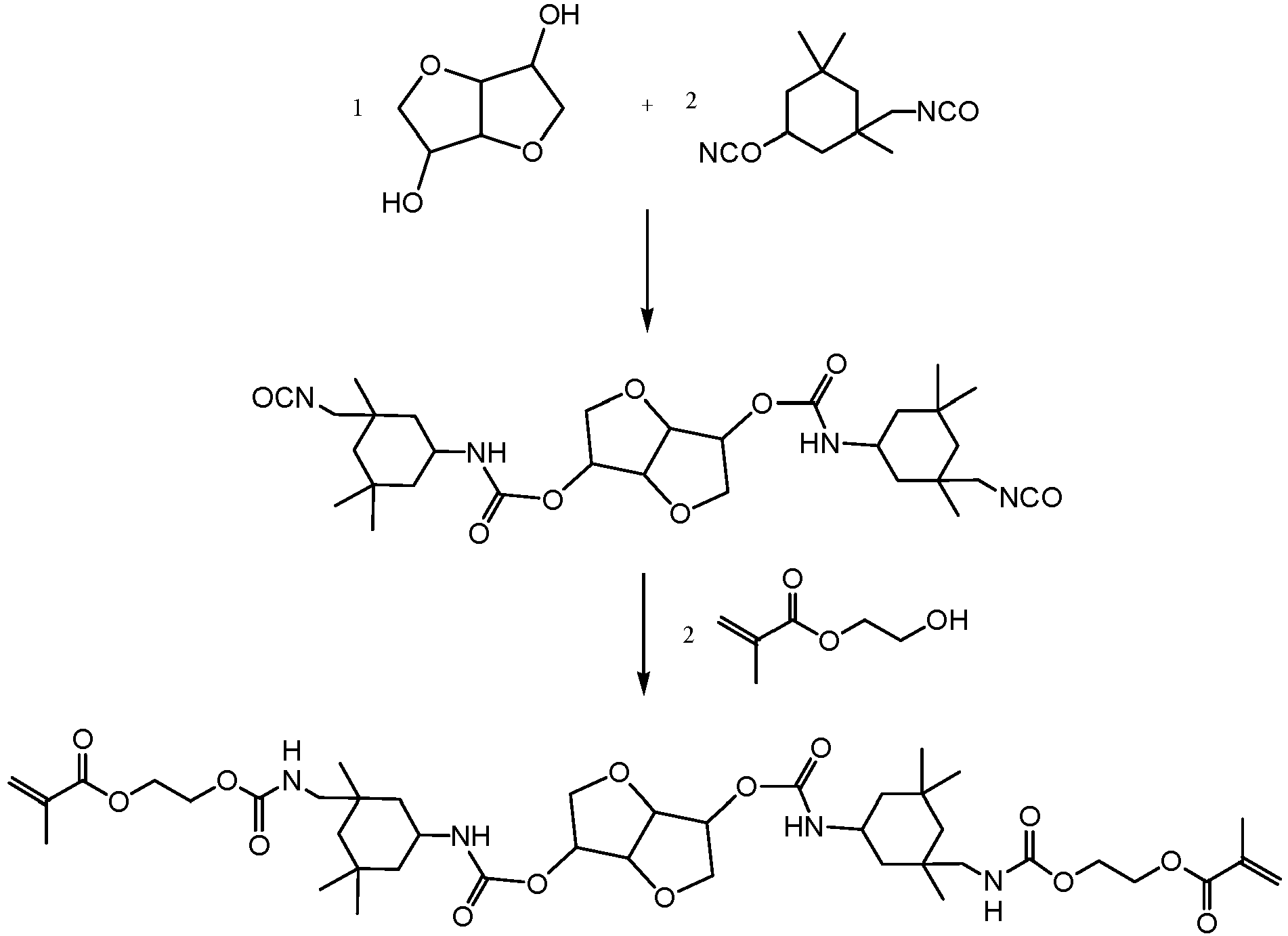
- Isophorone diisocyanate (325.10 g, 1.4624 moles) and 200 mL of dry acetone are added to a 2-L jacketed polymerization reactor equipped with a thermocouple, stirrer, condenser, and nitrogen inlet/outlet. The contents were heated to a temperature of 65°C. Isosorbide (102.49 g, 0.731 moles) was then added and allowed to dissolve. Once dissolved dibutyltin dilaurate (0.29 g, 0.00046 moles) was then added and the temperature raised to 75°C and the distilled acetone collected. The contents were allowed to react for +3 hours. A titration was then performed to determine the residual isocyanate content. Hydroxyethylmethacrylate (190.32 g, 1.462 moles, 1:1 residual NCO:OH equivalents) was then added and allowed to mix for +3 hours at 60 °C. The methacrylated polyurethane was dropped (592.3 g, 95.8% yield) to yield a clear, colorless, and viscous resin.
- The isosorbide diurethane methacrylate synthesized in Example 1 above was used as a reactive filler in a model anaerobic adhesive formulation. Inventive Compositions A-E incorporate the reactive filler at various percentages and the resultant compositions were used as a threadlocker on various surfaces and tested. The test results are shown in
Figures 1-4 . The isosorbide diurethane methacrylate was evaluated. Samples A, B, C, D and E were prepared with approximate renewable carbon content of 48.4%, 47.4%, 46.4%, 45.4% and 44.4% respectively.TABLE I Component Sample (Wt%) A B C D E (Meth)acrylate Component 90.131 85.131 80.131 75.131 70.131 Isosorbide Diurethane Methacrylate 5 10 15 20 25 Free radical Stabilizer 0.385 0.385 0.385 0.385 0.385 Metal Chelate Stabilizer 0.215 0.215 0.215 0.215 0.215 Sachharin 0.913 0.913 0.913 0.913 0.913 1-Acetyl-2-phenylhydrazine 0.173 0.173 0.173 0.173 0.173 Maleic acid 0.288 0.288 0.288 0.288 0.288 Metal Chelate Stabilizer1 0.65 0.65 0.65 0.65 0.65 C.I. Solvent Green 30.02 0.02 0.02 0.02 0.02 Solvent Yellow 16 0.013 0.013 0.013 0.013 0.013 C.I. Solvent Yellow 14 0.001 0.001 0.001 0.001 0.001 Fluorescent Agent 0.769 0.769 0.769 0.769 0.769 Cumene Hydroperoxide 1.442 1.442 1.442 1.442 1.442 Total 100 100 100 100 100 - It is evident from the Figures that the introduction of isosorbide diurethane methacrylate as a reactive filler at loadings of 5% (A), 10% (B), 15% (C) 20% (D) and 25% (E) provides breakaway torque performances which are comparable to commercially available high performance threadlockers such as Loctite 270, on a variety of different surfaces and for different cure times at room temperature (
Figs. 1-3 ) as well as at high temperatures (Fig. 4 ).
Claims (5)
- A curable composition comprising:i) a (meth)acrylate functionalized isosorbide corresponding to the structure:
MA-U-A-U-MA
wherein A comprises an isosorbide unit, U comprises a urethane linkage and MA comprises a member selected from the group consisting of a (meth)acrylate-containing group, an acrylate-containing group and combinations thereof; and,ii) an anaerobic cure system. - The curable composition of claim 1, wherein the (meth)acrylate-containing group of the (meth)acrylate functionalized isosorbide comprises a reactant residue selected from the group consisting of 2-hydroxyethyl methacrylate, 2-hydroxyethyl acrylate, 3-hydroxypropyl methacrylate, 3-hydroxypropyl acrylate, 2-hydroxypropyl acrylate, 4-hydroxybutyl acrylate, 3-hydroxybutyl acrylate, 2-hydroxybutyl acrylate, 3-(acryloyloxy)-2-hydroxypropyl methacrylate, 2-isocyanatoethyl methacrylate, 2-isocyanatoethyl acrylate, poly(propylene glycol) (meth)acrylate, 2-isocyanatoethyl acrylate, 2-isocyanatoethyl methacrylate, 3-isocyanatopropyl (meth)acrylate, 2-isocyanatopropyl (meth)acrylate, 4-isocyanatobutyl (meth)acrylate, 3-isocyanatobutyl (meth)acrylate, and 2-isocyanatobutyl (meth)acrylate.
- The curable composition of claim 1, wherein the urethane linkage of the (meth)acrylate functionalized isosorbide represented by U is comprised of a isocyanate reactant residue selected from the group consisting of isophorone diisocyanate (IPDI), IPDI isocyanaurate, polymeric IPDI, naphthalene 1,5-diisocyanate (NDI), methylene bis-cyclohexylisocyanate, methylene diphenyl diisocyanate (MDI), polymeric MDI, toluene diisocyanate (TDI), isocyanaurate of TDI, TDI- trimethylolpropane adduct, polymeric TDI, hexamethylene diisocyanate (HDI), HDI isocyanaurate, HDI biurate, polymeric HDI, xylylene diisocyanate, hydrogenated xylylene diisocyanate, tetramethyl xylylene diisocyanate, p-phenylene diisocyanate, 3,3'-dimethyldiphenyl-4,4'-diisocyanate (DDDI), 2,2,4-trimethylhexamethylene diisocyanate (TMDI), norbornane diisocyanate (NDI) and 4,4'-dibenzyl diisocyanate (DBDI).
- The curable composition of claim 1, further comprising a (meth)acrylate component.
- The curable composition of claim 4, wherein the (meth)acrylate component is selected from the group consisting of 2-hydroxyethyl methacrylate, 2-hydroxyethyl acrylate, 3-hydroxypropyl methacrylate, 3-hydroxypropyl acrylate, 2-hydroxypropyl acrylate, 4-hydroxybutyl acrylate, 3-hydroxybutyl acrylate, 2-hydroxybutyl acrylate, 3-(acryloyloxy)-2-hydroxypropyl methacrylate, 2-isocyanatoethyl methacrylate, 2-isocyanatoethyl acrylate, poly(propylene glycol) (meth)acrylate, 2-isocyanatoethyl acrylate, 2-isocyanatoethyl methacrylate, 3-isocyanatopropyl (meth)acrylate, 2-isocyanatopropyl (meth)acrylate, 4-isocyanatobutyl (meth)acrylate, 3-isocyanatobutyl (meth)acrylate, and 2-isocyanatobutyl (meth)acrylate.
Applications Claiming Priority (2)
| Application Number | Priority Date | Filing Date | Title |
|---|---|---|---|
| US201562142613P | 2015-04-03 | 2015-04-03 | |
| PCT/US2016/017332 WO2016160135A1 (en) | 2015-04-03 | 2016-02-10 | (meth)acrylate-functionalized extended isosorbide |
Publications (3)
| Publication Number | Publication Date |
|---|---|
| EP3277693A1 EP3277693A1 (en) | 2018-02-07 |
| EP3277693A4 EP3277693A4 (en) | 2018-09-05 |
| EP3277693B1 true EP3277693B1 (en) | 2020-10-14 |
Family
ID=57007411
Family Applications (1)
| Application Number | Title | Priority Date | Filing Date |
|---|---|---|---|
| EP16773623.0A Active EP3277693B1 (en) | 2015-04-03 | 2016-02-10 | (meth)acrylate-functionalized extended isosorbide |
Country Status (3)
| Country | Link |
|---|---|
| US (1) | US12428518B2 (en) |
| EP (1) | EP3277693B1 (en) |
| WO (1) | WO2016160135A1 (en) |
Families Citing this family (8)
| Publication number | Priority date | Publication date | Assignee | Title |
|---|---|---|---|---|
| CN109843963B (en) * | 2016-10-14 | 2022-05-13 | 旭化成株式会社 | Isocyanate composition, method for producing isocyanate polymer, and isocyanate polymer |
| KR102100452B1 (en) * | 2018-10-08 | 2020-04-14 | 한국생산기술연구원 | Polyurethane acrylate for dlp-sla type 3d printing and method of preparing the same |
| KR102169999B1 (en) * | 2018-11-06 | 2020-10-27 | 주식회사 제일화성 | Manufacturing method of acrylic crosslinker for super absorbent resin and acrylic crosslinker for super absorbent resin by using the same and biodegradable super absorbent resin having therefrom |
| KR102105493B1 (en) | 2018-12-27 | 2020-04-28 | 애경화학 주식회사 | Isosorbide urethane acrylate photo curable resin for 3D print with good heat resisting and printing properties and the photo curable resin composition comprising the same |
| US20230416447A1 (en) * | 2020-11-13 | 2023-12-28 | University Of Birmingham | Tough, reprocessable elastomers and methods of making and using same |
| KR102690395B1 (en) * | 2021-12-31 | 2024-07-31 | 주식회사 제일화성 | Photocurable composition with excellent tensile strength and method for manufacturing the same |
| EP4671291A1 (en) * | 2024-06-26 | 2025-12-31 | Henkel AG & Co. KGaA | ADHESIVE COMPOSITION AND CORRESPONDING CURED PRODUCT |
| CN120737269A (en) * | 2025-06-24 | 2025-10-03 | 广州昊毅新材料科技股份有限公司 | Bio-based flame-retardant UV (ultraviolet) photo-curing resin and preparation method thereof |
Family Cites Families (18)
| Publication number | Priority date | Publication date | Assignee | Title |
|---|---|---|---|---|
| US3425988A (en) * | 1965-01-27 | 1969-02-04 | Loctite Corp | Polyurethane polyacrylate sealant compositions |
| JPS6153391B2 (en) * | 1980-12-12 | 1986-11-17 | Dow Chemical Co | |
| US4451627A (en) * | 1982-09-07 | 1984-05-29 | The Dow Chemical Company | Addition polymerizable urethane-based anaerobic adhesives made from tin (II) organoesters |
| JPH10237420A (en) * | 1997-02-20 | 1998-09-08 | Three Bond Co Ltd | Anaerobically curable sealant composition |
| US6891053B2 (en) | 2001-10-02 | 2005-05-10 | Noveon Ip Holdings Corp. | Method of making oleochemical oil-based polyols |
| JP4587865B2 (en) * | 2004-04-22 | 2010-11-24 | 昭和電工株式会社 | Photosensitive resin composition, cured product thereof, and method for producing printed wiring board using them |
| JP4995190B2 (en) | 2005-04-29 | 2012-08-08 | チバ ホールディング インコーポレーテッド | Production of polymer in a conical reactor |
| US7674925B2 (en) | 2006-09-21 | 2010-03-09 | Athletic Polymer Systems, Inc. | Polyols from plant oils and methods of conversion |
| WO2008085286A1 (en) * | 2006-12-19 | 2008-07-17 | Henkel Corporation | (meth)acrylate compositions containing dispersions of core shell rubbers in (meth)acrylates |
| EP2148893A4 (en) * | 2007-05-22 | 2011-12-21 | Henkel Corp | Anaerobically curable compositions |
| US8757294B2 (en) | 2007-08-15 | 2014-06-24 | Schlumberger Technology Corporation | System and method for controlling a drilling system for drilling a borehole in an earth formation |
| JP5566701B2 (en) * | 2010-01-12 | 2014-08-06 | 住友化学株式会社 | Retardation film |
| EP2644589A1 (en) * | 2012-03-30 | 2013-10-02 | Cytec Surface Specialties, S.A. | Radiation Curable (Meth)acrylated Compounds |
| DE102012219476A1 (en) * | 2012-10-24 | 2014-04-24 | Hilti Aktiengesellschaft | Vinyl ester urethane resin-based resin composition and use thereof |
| DE102012219477A1 (en) * | 2012-10-24 | 2014-04-24 | Hilti Aktiengesellschaft | Process for the preparation of vinyl ester urethane resins based on dianhydrohexitol compounds and their use |
| US9580441B2 (en) * | 2013-01-16 | 2017-02-28 | Dentsply International Inc. | Dental compositions based on polymerizable resins containing isosorbide |
| EP2990428A4 (en) * | 2013-04-26 | 2017-01-11 | Daicel-Allnex Ltd. | Urethane (meth)acrylate and active energy ray-curable resin composition |
| CN107614638B (en) | 2015-04-03 | 2020-12-29 | 汉高知识产权控股有限责任公司 | Anaerobic curable composition |
-
2016
- 2016-02-10 WO PCT/US2016/017332 patent/WO2016160135A1/en not_active Ceased
- 2016-02-10 EP EP16773623.0A patent/EP3277693B1/en active Active
-
2017
- 2017-10-03 US US15/723,583 patent/US12428518B2/en active Active
Non-Patent Citations (1)
| Title |
|---|
| None * |
Also Published As
| Publication number | Publication date |
|---|---|
| WO2016160135A1 (en) | 2016-10-06 |
| US20180022848A1 (en) | 2018-01-25 |
| EP3277693A4 (en) | 2018-09-05 |
| EP3277693A1 (en) | 2018-02-07 |
| US12428518B2 (en) | 2025-09-30 |
Similar Documents
| Publication | Publication Date | Title |
|---|---|---|
| US12428518B2 (en) | (Meth)acrylate-functionalized extended isosorbide | |
| EP1807462B1 (en) | Prepolymers made from hydroxymethyl-containing polyester polyols derived from fatty acids | |
| US20110015292A1 (en) | Prepolymers made from natural oil based polyols | |
| EP3250619B1 (en) | Functionalized polyurethanes prepared from renewable materials | |
| WO2005097861A1 (en) | Method for producing polyurethane prepolymers | |
| CN116888230B (en) | Coating composition for metal with improved oil resistance and adhesion, method for preparing the same, and metal article coated therewith | |
| EP4169965B1 (en) | Hydrophilic acryl-modified polyurethane and method for preparing the same, and waterborne coating composition prepared therefrom and method for preparing the same | |
| CN104479103A (en) | Polyurethane curing agent having high functionality, preparation method and use thereof | |
| WO2020079160A1 (en) | Anhydrously curing polyisocyanate-based adhesives | |
| KR102431630B1 (en) | Acryl-modified polyurethane composition and method for preparing the same, and waterborne adhesive composition prepared therefrom and method for preparing the same | |
| EP3362492B1 (en) | Reactive resins made from renewable sources | |
| KR102434783B1 (en) | Acryl-modified polyurethane composition and method for preparing the same, and waterborne coating composition prepared therefrom and method for preparing the same | |
| US11401367B2 (en) | Functionalized accelerating resins derived from renewable materials | |
| KR20240173218A (en) | Adhesive coating composition for electrical steel sheet with improved adhesion and oil resistance |
Legal Events
| Date | Code | Title | Description |
|---|---|---|---|
| STAA | Information on the status of an ep patent application or granted ep patent |
Free format text: STATUS: THE INTERNATIONAL PUBLICATION HAS BEEN MADE |
|
| PUAI | Public reference made under article 153(3) epc to a published international application that has entered the european phase |
Free format text: ORIGINAL CODE: 0009012 |
|
| STAA | Information on the status of an ep patent application or granted ep patent |
Free format text: STATUS: REQUEST FOR EXAMINATION WAS MADE |
|
| 17P | Request for examination filed |
Effective date: 20170825 |
|
| AK | Designated contracting states |
Kind code of ref document: A1 Designated state(s): AL AT BE BG CH CY CZ DE DK EE ES FI FR GB GR HR HU IE IS IT LI LT LU LV MC MK MT NL NO PL PT RO RS SE SI SK SM TR |
|
| AX | Request for extension of the european patent |
Extension state: BA ME |
|
| DAV | Request for validation of the european patent (deleted) | ||
| DAX | Request for extension of the european patent (deleted) | ||
| A4 | Supplementary search report drawn up and despatched |
Effective date: 20180807 |
|
| RIC1 | Information provided on ipc code assigned before grant |
Ipc: C08G 18/62 20060101ALI20180801BHEP Ipc: C08G 18/10 20060101ALI20180801BHEP Ipc: C09J 175/16 20060101ALI20180801BHEP Ipc: C08G 18/30 20060101ALI20180801BHEP Ipc: C09D 175/16 20060101ALI20180801BHEP Ipc: C07D 493/02 20060101ALI20180801BHEP Ipc: C08F 220/06 20060101ALI20180801BHEP Ipc: C07D 493/04 20060101AFI20180801BHEP |
|
| STAA | Information on the status of an ep patent application or granted ep patent |
Free format text: STATUS: EXAMINATION IS IN PROGRESS |
|
| 17Q | First examination report despatched |
Effective date: 20191107 |
|
| GRAP | Despatch of communication of intention to grant a patent |
Free format text: ORIGINAL CODE: EPIDOSNIGR1 |
|
| STAA | Information on the status of an ep patent application or granted ep patent |
Free format text: STATUS: GRANT OF PATENT IS INTENDED |
|
| INTG | Intention to grant announced |
Effective date: 20200508 |
|
| GRAS | Grant fee paid |
Free format text: ORIGINAL CODE: EPIDOSNIGR3 |
|
| GRAA | (expected) grant |
Free format text: ORIGINAL CODE: 0009210 |
|
| STAA | Information on the status of an ep patent application or granted ep patent |
Free format text: STATUS: THE PATENT HAS BEEN GRANTED |
|
| AK | Designated contracting states |
Kind code of ref document: B1 Designated state(s): AL AT BE BG CH CY CZ DE DK EE ES FI FR GB GR HR HU IE IS IT LI LT LU LV MC MK MT NL NO PL PT RO RS SE SI SK SM TR |
|
| REG | Reference to a national code |
Ref country code: GB Ref legal event code: FG4D |
|
| REG | Reference to a national code |
Ref country code: AT Ref legal event code: REF Ref document number: 1323453 Country of ref document: AT Kind code of ref document: T Effective date: 20201015 Ref country code: CH Ref legal event code: EP |
|
| REG | Reference to a national code |
Ref country code: DE Ref legal event code: R096 Ref document number: 602016045893 Country of ref document: DE |
|
| REG | Reference to a national code |
Ref country code: IE Ref legal event code: FG4D |
|
| REG | Reference to a national code |
Ref country code: AT Ref legal event code: MK05 Ref document number: 1323453 Country of ref document: AT Kind code of ref document: T Effective date: 20201014 |
|
| REG | Reference to a national code |
Ref country code: NL Ref legal event code: MP Effective date: 20201014 |
|
| PG25 | Lapsed in a contracting state [announced via postgrant information from national office to epo] |
Ref country code: GR Free format text: LAPSE BECAUSE OF FAILURE TO SUBMIT A TRANSLATION OF THE DESCRIPTION OR TO PAY THE FEE WITHIN THE PRESCRIBED TIME-LIMIT Effective date: 20210115 Ref country code: FI Free format text: LAPSE BECAUSE OF FAILURE TO SUBMIT A TRANSLATION OF THE DESCRIPTION OR TO PAY THE FEE WITHIN THE PRESCRIBED TIME-LIMIT Effective date: 20201014 Ref country code: RS Free format text: LAPSE BECAUSE OF FAILURE TO SUBMIT A TRANSLATION OF THE DESCRIPTION OR TO PAY THE FEE WITHIN THE PRESCRIBED TIME-LIMIT Effective date: 20201014 Ref country code: PT Free format text: LAPSE BECAUSE OF FAILURE TO SUBMIT A TRANSLATION OF THE DESCRIPTION OR TO PAY THE FEE WITHIN THE PRESCRIBED TIME-LIMIT Effective date: 20210215 Ref country code: NO Free format text: LAPSE BECAUSE OF FAILURE TO SUBMIT A TRANSLATION OF THE DESCRIPTION OR TO PAY THE FEE WITHIN THE PRESCRIBED TIME-LIMIT Effective date: 20210114 Ref country code: NL Free format text: LAPSE BECAUSE OF FAILURE TO SUBMIT A TRANSLATION OF THE DESCRIPTION OR TO PAY THE FEE WITHIN THE PRESCRIBED TIME-LIMIT Effective date: 20201014 |
|
| REG | Reference to a national code |
Ref country code: LT Ref legal event code: MG4D |
|
| PG25 | Lapsed in a contracting state [announced via postgrant information from national office to epo] |
Ref country code: SE Free format text: LAPSE BECAUSE OF FAILURE TO SUBMIT A TRANSLATION OF THE DESCRIPTION OR TO PAY THE FEE WITHIN THE PRESCRIBED TIME-LIMIT Effective date: 20201014 Ref country code: ES Free format text: LAPSE BECAUSE OF FAILURE TO SUBMIT A TRANSLATION OF THE DESCRIPTION OR TO PAY THE FEE WITHIN THE PRESCRIBED TIME-LIMIT Effective date: 20201014 Ref country code: AT Free format text: LAPSE BECAUSE OF FAILURE TO SUBMIT A TRANSLATION OF THE DESCRIPTION OR TO PAY THE FEE WITHIN THE PRESCRIBED TIME-LIMIT Effective date: 20201014 Ref country code: BG Free format text: LAPSE BECAUSE OF FAILURE TO SUBMIT A TRANSLATION OF THE DESCRIPTION OR TO PAY THE FEE WITHIN THE PRESCRIBED TIME-LIMIT Effective date: 20210114 Ref country code: IS Free format text: LAPSE BECAUSE OF FAILURE TO SUBMIT A TRANSLATION OF THE DESCRIPTION OR TO PAY THE FEE WITHIN THE PRESCRIBED TIME-LIMIT Effective date: 20210214 Ref country code: PL Free format text: LAPSE BECAUSE OF FAILURE TO SUBMIT A TRANSLATION OF THE DESCRIPTION OR TO PAY THE FEE WITHIN THE PRESCRIBED TIME-LIMIT Effective date: 20201014 Ref country code: LV Free format text: LAPSE BECAUSE OF FAILURE TO SUBMIT A TRANSLATION OF THE DESCRIPTION OR TO PAY THE FEE WITHIN THE PRESCRIBED TIME-LIMIT Effective date: 20201014 |
|
| PG25 | Lapsed in a contracting state [announced via postgrant information from national office to epo] |
Ref country code: HR Free format text: LAPSE BECAUSE OF FAILURE TO SUBMIT A TRANSLATION OF THE DESCRIPTION OR TO PAY THE FEE WITHIN THE PRESCRIBED TIME-LIMIT Effective date: 20201014 |
|
| REG | Reference to a national code |
Ref country code: DE Ref legal event code: R097 Ref document number: 602016045893 Country of ref document: DE |
|
| PG25 | Lapsed in a contracting state [announced via postgrant information from national office to epo] |
Ref country code: EE Free format text: LAPSE BECAUSE OF FAILURE TO SUBMIT A TRANSLATION OF THE DESCRIPTION OR TO PAY THE FEE WITHIN THE PRESCRIBED TIME-LIMIT Effective date: 20201014 Ref country code: CZ Free format text: LAPSE BECAUSE OF FAILURE TO SUBMIT A TRANSLATION OF THE DESCRIPTION OR TO PAY THE FEE WITHIN THE PRESCRIBED TIME-LIMIT Effective date: 20201014 Ref country code: LT Free format text: LAPSE BECAUSE OF FAILURE TO SUBMIT A TRANSLATION OF THE DESCRIPTION OR TO PAY THE FEE WITHIN THE PRESCRIBED TIME-LIMIT Effective date: 20201014 Ref country code: SM Free format text: LAPSE BECAUSE OF FAILURE TO SUBMIT A TRANSLATION OF THE DESCRIPTION OR TO PAY THE FEE WITHIN THE PRESCRIBED TIME-LIMIT Effective date: 20201014 Ref country code: SK Free format text: LAPSE BECAUSE OF FAILURE TO SUBMIT A TRANSLATION OF THE DESCRIPTION OR TO PAY THE FEE WITHIN THE PRESCRIBED TIME-LIMIT Effective date: 20201014 Ref country code: RO Free format text: LAPSE BECAUSE OF FAILURE TO SUBMIT A TRANSLATION OF THE DESCRIPTION OR TO PAY THE FEE WITHIN THE PRESCRIBED TIME-LIMIT Effective date: 20201014 |
|
| PLBE | No opposition filed within time limit |
Free format text: ORIGINAL CODE: 0009261 |
|
| STAA | Information on the status of an ep patent application or granted ep patent |
Free format text: STATUS: NO OPPOSITION FILED WITHIN TIME LIMIT |
|
| PG25 | Lapsed in a contracting state [announced via postgrant information from national office to epo] |
Ref country code: DK Free format text: LAPSE BECAUSE OF FAILURE TO SUBMIT A TRANSLATION OF THE DESCRIPTION OR TO PAY THE FEE WITHIN THE PRESCRIBED TIME-LIMIT Effective date: 20201014 |
|
| 26N | No opposition filed |
Effective date: 20210715 |
|
| PG25 | Lapsed in a contracting state [announced via postgrant information from national office to epo] |
Ref country code: MC Free format text: LAPSE BECAUSE OF FAILURE TO SUBMIT A TRANSLATION OF THE DESCRIPTION OR TO PAY THE FEE WITHIN THE PRESCRIBED TIME-LIMIT Effective date: 20201014 |
|
| REG | Reference to a national code |
Ref country code: BE Ref legal event code: MM Effective date: 20210228 |
|
| PG25 | Lapsed in a contracting state [announced via postgrant information from national office to epo] |
Ref country code: LU Free format text: LAPSE BECAUSE OF NON-PAYMENT OF DUE FEES Effective date: 20210210 Ref country code: LI Free format text: LAPSE BECAUSE OF NON-PAYMENT OF DUE FEES Effective date: 20210228 Ref country code: IT Free format text: LAPSE BECAUSE OF FAILURE TO SUBMIT A TRANSLATION OF THE DESCRIPTION OR TO PAY THE FEE WITHIN THE PRESCRIBED TIME-LIMIT Effective date: 20201014 Ref country code: AL Free format text: LAPSE BECAUSE OF FAILURE TO SUBMIT A TRANSLATION OF THE DESCRIPTION OR TO PAY THE FEE WITHIN THE PRESCRIBED TIME-LIMIT Effective date: 20201014 Ref country code: CH Free format text: LAPSE BECAUSE OF NON-PAYMENT OF DUE FEES Effective date: 20210228 |
|
| PG25 | Lapsed in a contracting state [announced via postgrant information from national office to epo] |
Ref country code: SI Free format text: LAPSE BECAUSE OF FAILURE TO SUBMIT A TRANSLATION OF THE DESCRIPTION OR TO PAY THE FEE WITHIN THE PRESCRIBED TIME-LIMIT Effective date: 20201014 |
|
| PG25 | Lapsed in a contracting state [announced via postgrant information from national office to epo] |
Ref country code: IE Free format text: LAPSE BECAUSE OF NON-PAYMENT OF DUE FEES Effective date: 20210210 |
|
| PG25 | Lapsed in a contracting state [announced via postgrant information from national office to epo] |
Ref country code: IS Free format text: LAPSE BECAUSE OF FAILURE TO SUBMIT A TRANSLATION OF THE DESCRIPTION OR TO PAY THE FEE WITHIN THE PRESCRIBED TIME-LIMIT Effective date: 20210214 |
|
| PG25 | Lapsed in a contracting state [announced via postgrant information from national office to epo] |
Ref country code: BE Free format text: LAPSE BECAUSE OF NON-PAYMENT OF DUE FEES Effective date: 20210228 |
|
| REG | Reference to a national code |
Ref country code: DE Ref legal event code: R081 Ref document number: 602016045893 Country of ref document: DE Owner name: HENKEL AG & CO. KGAA, DE Free format text: FORMER OWNER: HENKEL IP & HOLDING GMBH, 40589 DUESSELDORF, DE |
|
| REG | Reference to a national code |
Ref country code: GB Ref legal event code: 732E Free format text: REGISTERED BETWEEN 20220811 AND 20220817 |
|
| PG25 | Lapsed in a contracting state [announced via postgrant information from national office to epo] |
Ref country code: CY Free format text: LAPSE BECAUSE OF FAILURE TO SUBMIT A TRANSLATION OF THE DESCRIPTION OR TO PAY THE FEE WITHIN THE PRESCRIBED TIME-LIMIT Effective date: 20201014 |
|
| PG25 | Lapsed in a contracting state [announced via postgrant information from national office to epo] |
Ref country code: HU Free format text: LAPSE BECAUSE OF FAILURE TO SUBMIT A TRANSLATION OF THE DESCRIPTION OR TO PAY THE FEE WITHIN THE PRESCRIBED TIME-LIMIT; INVALID AB INITIO Effective date: 20160210 |
|
| P01 | Opt-out of the competence of the unified patent court (upc) registered |
Effective date: 20230705 |
|
| PG25 | Lapsed in a contracting state [announced via postgrant information from national office to epo] |
Ref country code: MK Free format text: LAPSE BECAUSE OF FAILURE TO SUBMIT A TRANSLATION OF THE DESCRIPTION OR TO PAY THE FEE WITHIN THE PRESCRIBED TIME-LIMIT Effective date: 20201014 |
|
| PG25 | Lapsed in a contracting state [announced via postgrant information from national office to epo] |
Ref country code: TR Free format text: LAPSE BECAUSE OF FAILURE TO SUBMIT A TRANSLATION OF THE DESCRIPTION OR TO PAY THE FEE WITHIN THE PRESCRIBED TIME-LIMIT Effective date: 20201014 |
|
| PG25 | Lapsed in a contracting state [announced via postgrant information from national office to epo] |
Ref country code: MT Free format text: LAPSE BECAUSE OF FAILURE TO SUBMIT A TRANSLATION OF THE DESCRIPTION OR TO PAY THE FEE WITHIN THE PRESCRIBED TIME-LIMIT Effective date: 20201014 |
|
| PGFP | Annual fee paid to national office [announced via postgrant information from national office to epo] |
Ref country code: GB Payment date: 20260219 Year of fee payment: 11 |
|
| PGFP | Annual fee paid to national office [announced via postgrant information from national office to epo] |
Ref country code: DE Payment date: 20260218 Year of fee payment: 11 |
|
| PGFP | Annual fee paid to national office [announced via postgrant information from national office to epo] |
Ref country code: FR Payment date: 20260218 Year of fee payment: 11 |