EP3277678B1 - Compositions and methods of targeting mutant k-ras - Google Patents
Compositions and methods of targeting mutant k-ras Download PDFInfo
- Publication number
- EP3277678B1 EP3277678B1 EP16774366.5A EP16774366A EP3277678B1 EP 3277678 B1 EP3277678 B1 EP 3277678B1 EP 16774366 A EP16774366 A EP 16774366A EP 3277678 B1 EP3277678 B1 EP 3277678B1
- Authority
- EP
- European Patent Office
- Prior art keywords
- mmol
- thiazol
- carboxamide
- oxo
- tetrahydroquinolin
- Prior art date
- Legal status (The legal status is an assumption and is not a legal conclusion. Google has not performed a legal analysis and makes no representation as to the accuracy of the status listed.)
- Active
Links
- 0 CC(C1)=CC(C)=C1C(NC(*1)=SC(*)=C1c1ccc(*C(CC2)=O)c2c1)=O Chemical compound CC(C1)=CC(C)=C1C(NC(*1)=SC(*)=C1c1ccc(*C(CC2)=O)c2c1)=O 0.000 description 2
- LBQOAJXZNGHYJA-UHFFFAOYSA-N CC(C)(C)OC(NCc1nc(C)c(C(Nc2nc(-c(cc3)cc(CC4)c3NC4=O)c[s]2)=O)[s]1)=O Chemical compound CC(C)(C)OC(NCc1nc(C)c(C(Nc2nc(-c(cc3)cc(CC4)c3NC4=O)c[s]2)=O)[s]1)=O LBQOAJXZNGHYJA-UHFFFAOYSA-N 0.000 description 1
- YPQYBYZTEOKSQD-UHFFFAOYSA-N CCc1c(C(Nc2nc(-c(cc3CC4)ccc3NC4=O)c[s]2)=O)[s]cn1 Chemical compound CCc1c(C(Nc2nc(-c(cc3CC4)ccc3NC4=O)c[s]2)=O)[s]cn1 YPQYBYZTEOKSQD-UHFFFAOYSA-N 0.000 description 1
- WBTJBKPQPYALNS-UHFFFAOYSA-N Cc1c(C(Nc2nc(-c(cc3)cc(CC4)c3OC4=O)c[s]2)=O)[s]c(C)n1 Chemical compound Cc1c(C(Nc2nc(-c(cc3)cc(CC4)c3OC4=O)c[s]2)=O)[s]c(C)n1 WBTJBKPQPYALNS-UHFFFAOYSA-N 0.000 description 1
- LICVRJZVIWEFJL-UHFFFAOYSA-N Cc1c(C(Nc2nc(-c(cc3)cc(N4)c3NC4=O)c[s]2)=O)[s]c(C)n1 Chemical compound Cc1c(C(Nc2nc(-c(cc3)cc(N4)c3NC4=O)c[s]2)=O)[s]c(C)n1 LICVRJZVIWEFJL-UHFFFAOYSA-N 0.000 description 1
- OJTYPYPPYRILNY-UHFFFAOYSA-N Cc1c(C(Nc2nc(-c(cc3CC4)ccc3NC4=O)c[s]2)=O)[s]c(COC)n1 Chemical compound Cc1c(C(Nc2nc(-c(cc3CC4)ccc3NC4=O)c[s]2)=O)[s]c(COC)n1 OJTYPYPPYRILNY-UHFFFAOYSA-N 0.000 description 1
- RZINAUWKAKEFKU-UHFFFAOYSA-N Cc1c(C(Nc2nc(-c(cc3CC4)ccc3NC4=O)c[s]2)=O)[s]c(Cc2ncccc2)n1 Chemical compound Cc1c(C(Nc2nc(-c(cc3CC4)ccc3NC4=O)c[s]2)=O)[s]c(Cc2ncccc2)n1 RZINAUWKAKEFKU-UHFFFAOYSA-N 0.000 description 1
- HOSYFEOKQNXFQE-UHFFFAOYSA-N Cc1c(C)[s]c(C(Nc2nc(-c(cc3CC4)ccc3NC4=O)c[s]2)=O)n1 Chemical compound Cc1c(C)[s]c(C(Nc2nc(-c(cc3CC4)ccc3NC4=O)c[s]2)=O)n1 HOSYFEOKQNXFQE-UHFFFAOYSA-N 0.000 description 1
- XOKPGBYRRSQEEM-UHFFFAOYSA-N O=C(c1ncccn1)Nc1nc(-c(cc2)cc(CC3)c2NC3=O)c[s]1 Chemical compound O=C(c1ncccn1)Nc1nc(-c(cc2)cc(CC3)c2NC3=O)c[s]1 XOKPGBYRRSQEEM-UHFFFAOYSA-N 0.000 description 1
- NSWBPHXMAGSXPV-UHFFFAOYSA-N O=C1N(Cc2ccccc2)c2ccccc2CC1 Chemical compound O=C1N(Cc2ccccc2)c2ccccc2CC1 NSWBPHXMAGSXPV-UHFFFAOYSA-N 0.000 description 1
Images


Classifications
-
- C—CHEMISTRY; METALLURGY
- C07—ORGANIC CHEMISTRY
- C07D—HETEROCYCLIC COMPOUNDS
- C07D417/00—Heterocyclic compounds containing two or more hetero rings, at least one ring having nitrogen and sulfur atoms as the only ring hetero atoms, not provided for by group C07D415/00
- C07D417/14—Heterocyclic compounds containing two or more hetero rings, at least one ring having nitrogen and sulfur atoms as the only ring hetero atoms, not provided for by group C07D415/00 containing three or more hetero rings
-
- C—CHEMISTRY; METALLURGY
- C07—ORGANIC CHEMISTRY
- C07D—HETEROCYCLIC COMPOUNDS
- C07D417/00—Heterocyclic compounds containing two or more hetero rings, at least one ring having nitrogen and sulfur atoms as the only ring hetero atoms, not provided for by group C07D415/00
- C07D417/02—Heterocyclic compounds containing two or more hetero rings, at least one ring having nitrogen and sulfur atoms as the only ring hetero atoms, not provided for by group C07D415/00 containing two hetero rings
- C07D417/04—Heterocyclic compounds containing two or more hetero rings, at least one ring having nitrogen and sulfur atoms as the only ring hetero atoms, not provided for by group C07D415/00 containing two hetero rings directly linked by a ring-member-to-ring-member bond
-
- A—HUMAN NECESSITIES
- A61—MEDICAL OR VETERINARY SCIENCE; HYGIENE
- A61K—PREPARATIONS FOR MEDICAL, DENTAL OR TOILETRY PURPOSES
- A61K31/00—Medicinal preparations containing organic active ingredients
- A61K31/33—Heterocyclic compounds
- A61K31/395—Heterocyclic compounds having nitrogen as a ring hetero atom, e.g. guanethidine or rifamycins
- A61K31/41—Heterocyclic compounds having nitrogen as a ring hetero atom, e.g. guanethidine or rifamycins having five-membered rings with two or more ring hetero atoms, at least one of which being nitrogen, e.g. tetrazole
- A61K31/425—Thiazoles
- A61K31/427—Thiazoles not condensed and containing further heterocyclic rings
-
- A—HUMAN NECESSITIES
- A61—MEDICAL OR VETERINARY SCIENCE; HYGIENE
- A61K—PREPARATIONS FOR MEDICAL, DENTAL OR TOILETRY PURPOSES
- A61K31/00—Medicinal preparations containing organic active ingredients
- A61K31/33—Heterocyclic compounds
- A61K31/395—Heterocyclic compounds having nitrogen as a ring hetero atom, e.g. guanethidine or rifamycins
- A61K31/435—Heterocyclic compounds having nitrogen as a ring hetero atom, e.g. guanethidine or rifamycins having six-membered rings with one nitrogen as the only ring hetero atom
- A61K31/47—Quinolines; Isoquinolines
- A61K31/472—Non-condensed isoquinolines, e.g. papaverine
- A61K31/4725—Non-condensed isoquinolines, e.g. papaverine containing further heterocyclic rings
-
- A—HUMAN NECESSITIES
- A61—MEDICAL OR VETERINARY SCIENCE; HYGIENE
- A61P—SPECIFIC THERAPEUTIC ACTIVITY OF CHEMICAL COMPOUNDS OR MEDICINAL PREPARATIONS
- A61P35/00—Antineoplastic agents
-
- C—CHEMISTRY; METALLURGY
- C07—ORGANIC CHEMISTRY
- C07D—HETEROCYCLIC COMPOUNDS
- C07D277/00—Heterocyclic compounds containing 1,3-thiazole or hydrogenated 1,3-thiazole rings
- C07D277/02—Heterocyclic compounds containing 1,3-thiazole or hydrogenated 1,3-thiazole rings not condensed with other rings
- C07D277/20—Heterocyclic compounds containing 1,3-thiazole or hydrogenated 1,3-thiazole rings not condensed with other rings having two or three double bonds between ring members or between ring members and non-ring members
- C07D277/32—Heterocyclic compounds containing 1,3-thiazole or hydrogenated 1,3-thiazole rings not condensed with other rings having two or three double bonds between ring members or between ring members and non-ring members with hetero atoms or with carbon atoms having three bonds to hetero atoms with at the most one bond to halogen, e.g. ester or nitrile radicals, directly attached to ring carbon atoms
- C07D277/38—Nitrogen atoms
- C07D277/44—Acylated amino or imino radicals
- C07D277/46—Acylated amino or imino radicals by carboxylic acids, or sulfur or nitrogen analogues thereof
-
- C—CHEMISTRY; METALLURGY
- C07—ORGANIC CHEMISTRY
- C07D—HETEROCYCLIC COMPOUNDS
- C07D417/00—Heterocyclic compounds containing two or more hetero rings, at least one ring having nitrogen and sulfur atoms as the only ring hetero atoms, not provided for by group C07D415/00
- C07D417/02—Heterocyclic compounds containing two or more hetero rings, at least one ring having nitrogen and sulfur atoms as the only ring hetero atoms, not provided for by group C07D415/00 containing two hetero rings
- C07D417/12—Heterocyclic compounds containing two or more hetero rings, at least one ring having nitrogen and sulfur atoms as the only ring hetero atoms, not provided for by group C07D415/00 containing two hetero rings linked by a chain containing hetero atoms as chain links
-
- C—CHEMISTRY; METALLURGY
- C07—ORGANIC CHEMISTRY
- C07D—HETEROCYCLIC COMPOUNDS
- C07D471/00—Heterocyclic compounds containing nitrogen atoms as the only ring hetero atoms in the condensed system, at least one ring being a six-membered ring with one nitrogen atom, not provided for by groups C07D451/00 - C07D463/00
- C07D471/02—Heterocyclic compounds containing nitrogen atoms as the only ring hetero atoms in the condensed system, at least one ring being a six-membered ring with one nitrogen atom, not provided for by groups C07D451/00 - C07D463/00 in which the condensed system contains two hetero rings
- C07D471/04—Ortho-condensed systems
-
- C—CHEMISTRY; METALLURGY
- C07—ORGANIC CHEMISTRY
- C07D—HETEROCYCLIC COMPOUNDS
- C07D471/00—Heterocyclic compounds containing nitrogen atoms as the only ring hetero atoms in the condensed system, at least one ring being a six-membered ring with one nitrogen atom, not provided for by groups C07D451/00 - C07D463/00
- C07D471/02—Heterocyclic compounds containing nitrogen atoms as the only ring hetero atoms in the condensed system, at least one ring being a six-membered ring with one nitrogen atom, not provided for by groups C07D451/00 - C07D463/00 in which the condensed system contains two hetero rings
- C07D471/06—Peri-condensed systems
-
- C—CHEMISTRY; METALLURGY
- C07—ORGANIC CHEMISTRY
- C07F—ACYCLIC, CARBOCYCLIC OR HETEROCYCLIC COMPOUNDS CONTAINING ELEMENTS OTHER THAN CARBON, HYDROGEN, HALOGEN, OXYGEN, NITROGEN, SULFUR, SELENIUM OR TELLURIUM
- C07F9/00—Compounds containing elements of Groups 5 or 15 of the Periodic Table
- C07F9/02—Phosphorus compounds
- C07F9/547—Heterocyclic compounds, e.g. containing phosphorus as a ring hetero atom
- C07F9/6558—Heterocyclic compounds, e.g. containing phosphorus as a ring hetero atom containing at least two different or differently substituted hetero rings neither condensed among themselves nor condensed with a common carbocyclic ring or ring system
- C07F9/65583—Heterocyclic compounds, e.g. containing phosphorus as a ring hetero atom containing at least two different or differently substituted hetero rings neither condensed among themselves nor condensed with a common carbocyclic ring or ring system each of the hetero rings containing nitrogen as ring hetero atom
Definitions
- the field of the invention is pharmaceutical compounds, compositions, and methods, and uses thereof in treatment of diseases associated with mutant KRAS proteins.
- K-Ras (or Ki-Ras or Kirsten-Ras) is a 21 kD member of the Ras family of GTPase proteins and a necessary component in cell signaling. Activated K-Ras typically activates downstream kinases necessary for the propagation of growth factor and other receptors signals (e.g ., c-Raf and PI3-kinase). Unfortunately, genetic alterations in the gene encoding K-Ras are associated with development of neoplasias, and the mechanism of activation is relatively well understood.
- Cancer-associated mutant K-Ras is constitutively active, with prolonged stabilization of its GTP-bound (active) state, and is thus able to constitutively activate downstream effectors such as Raf kinase and phosphoinositide-3 kinase (PI3K). Both of these kinases play important roles in proliferation/survival/anti-apoptotic signaling pathways.
- These mutations have been implicated in insensitivity to EGFR-targeted anti-cancer therapies as mutations in K-Ras predispose cancer cells to be significantly less responsive to EGFR targeting therapies ( e.g ., Panitumumab, Cetuximab, etc.).
- Ras GTPase activating protein Interaction with the Ras GTPase activating protein (RasGAP) is vital to the timely inactivation of K-Ras, resulting in more efficient hydrolysis of GTP to GDP.
- the conformational changes in K-Ras structure due to the GTP hydrolysis result in the elimination of K-Ras' affinity for effector proteins, thereby inactivating downstream proliferation and anti-death pathways.
- Cancer-associated mutations in K-Ras have been shown to interact poorly with RasGAP, therefore remaining in the "on" or constitutively active position.
- Gly12 glycine-12
- Gly13 Gly13
- Gln61 glutamine-61
- Gly12 the predominant site of mutagenesis (88%).
- Gly12C is often associated with a reduced response to cisplatin and an increased sensitivity to taxol and pemetrexed
- G12D mutant typically results in resistance to taxol treatment and sensitivity to sorafenib.
- the G12V mutant shows a strong sensitivity to cisplatin when compared with the wild type variant and is slightly more resistant to pemetrexed.
- Such diversity in treatment response is compounding difficulties in finding adequate treatment with drugs that are specific to K-Ras, and also highlight that specific mutant forms of K-Ras may require specific drugs for inhibition of the K-Ras activity.
- WO2013/155223A1 discloses small molecule inhibitors for G12C mutant forms. While promising, issues with restricted use and potential toxicity may limit compounds presented in the '223 reference. To circumvent mutant specific forms, allosteric inhibitors were proposed ( PLOS One October 2011, Volume 6, Issue 10, e25711 ). However, that report did not distinguish among different mutant forms.
- mutant K-Ras plays in various neoplastic disease states, it would be advantageous to be able to identify compounds that bind specifically to the mutant K-Ras protein forms associated with cancer diseases states and/or specific mutant forms, and most preferably to a specific mutant type with little or no binding to the wild type.
- the inventive subject matter is directed to compounds, compositions, and methods for inhibiting mutant K-Ras, and especially inhibiting G12V and/or G12D mutant K-Ras.
- the compounds presented herein inhibit G12V and/or G12D mutant K-Ras with high selectivity over other mutant forms and high specificity over wild type K-Ras.
- R 1 and R 2 are independently H, alkyl, heteroaryl, cycloalkyl, or heterocycloalkyl.
- R 1 may be alkyl or cycloalkyl
- R 2 may be alkyl.
- X is S
- R 3 is H or C 1 -C 4 alkyl.
- the optionally substituted heterocyclic 5-, 6-, or 7-membered ring contains a nitrogen atom, and that the ring further contains an oxo substituent. Therefore, the phenyl group carrying R 4 and R 5 may form together with the heterocyclic 5-, 6-, or 7-membered ring a two- or three-ringed structure, including and
- contemplated compounds may have a structure according to Formula II wherein X is O or S, wherein R 1 and R 2 are independently H, alkyl, cycloalkyl, heterocycloalkyl, alkenyl, alkynyl, aryl, heteroaryl, alkaryl, haloalkyl, alkoxy, alkylthio, halogen, -OH, -NHC(O)alkyl, or -NHC(O)aryl; wherein R 3 is H or C 1 -C 4 alkyl; and wherein R 7 is H, alkyl, cycloalkyl, heterocycloalkyl, alkenyl, alkynyl, aryl, heteroaryl, alkaryl or alkheteroaryl.
- contemplated compounds include those in which R 1 is alkyl or cycloalkyl, and in which R 2 is alkyl.
- especially preferred compounds will have a structure of Formula III or Formula IV where R 3 is H, methyl, or halogen.
- a pharmaceutical composition comprising a pharmaceutically acceptable carrier and one or more compounds as presented above.
- the compound(s) is/are present at a concentration effective to inhibit K-ras in a mammal when administered to the mammal at a dosage effective to inhibit K-ras in the mammal.
- the K-ras is a mutant K-ras.
- especially contemplated composition include those in which the compound preferentially inhibits mutant K-ras G12D relative to mutant K-ras G12V and mutant K-ras G12C.
- K-ras signaling is mediated by a mutant K-ras.
- the mutant K-ras is K-ras G12D, and the compound preferentially inhibits mutant K-ras G12D relative to mutant K-ras G12V and mutant K-ras G12C.
- the compounds in such medicament may have a structure according to Formula II, Formula III, or Formula IV.
- Such methods will typically include a step of contacting ( in vitro or in vivo) the mutant K-ras with contemplated compounds at a concentration effective to inhibit the mutant K-ras (e.g ., where the mutant K-ras is K-ras G12D).
- a concentration effective to inhibit the mutant K-ras e.g ., where the mutant K-ras is K-ras G12D.
- especially preferred compounds preferentially inhibit mutant K-ras G12D relative to mutant K-ras G12V and mutant K-ras G12C.
- Suitable concentrations will be effective to reduce downstream signaling with respect to at least one of MEK signaling and ERK signaling.
- a method of treating a neoplastic disease e.g., colon cancer, pancreatic cancer, and non-small cell lung cancer
- methods comprise a step of administering to the mammal contemplated compounds under a protocol effective to inhibit K-ras in the mammal.
- suitable compound will have a structure according to Formula II, Formula III, or Formula IV, and /or it is contemplated that the step of administering will comprise oral administration or injection.
- Such compounds were found to have a scaffold as schematically illustrated in Formula A where X and Q are independently and typically a five-membered heteroaromatic ring (and most typically an optionally substituted thiazole or oxazole), A comprises an aryl, heteroaryl, or heterocyclic moiety (most typically a substituted phenyl or tetrahydroquinoline), and M is one or more substituents such as an alkyl, a cyclocalkyl, an alkenyl, or halogen.
- Formula A where X and Q are independently and typically a five-membered heteroaromatic ring (and most typically an optionally substituted thiazole or oxazole), A comprises an aryl, heteroaryl, or heterocyclic moiety (most typically a substituted phenyl or tetrahydroquinoline), and M is one or more substituents such as an alkyl, a cyclocalkyl, an alkenyl, or halogen.
- substituted refers to a replacement of an atom or chemical group (e.g ., H, NH 2 , or OH) with a functional group
- particularly contemplated functional groups include nucleophilic groups (e.g ., -NH 2 , -OH, SH, -NC, etc.), electrophilic groups (e.g ., C(O)OR, C(X)OH, etc.), polar groups (e.g ., -OH), non-polar groups ( e.g ., aryl, alkyl, alkenyl, alkynyl, etc.), ionic groups ( e.g ., NH 3 + ), and halogens ( e.g ., -F, -Cl), and all chemically reasonable combinations thereof.
- nucleophilic groups e.g ., -NH 2 , -OH, SH, -NC, etc.
- electrophilic groups e.g ., C(O)OR, C(X
- the term "functional group” as used herein may refer to a nucleophilic group (e.g., -NH2, -OH, SH, -NC, -CN etc.), an electrophilic group (e.g., C(O)OR, C(X)OH, C(Halogen)OR, etc.), a polar group (e.g., -OH), a non-polar group (e.g., aryl, alkyl, alkenyl, alkynyl, etc.), an ionic group (e.g., NH3+), and a halogen.
- a nucleophilic group e.g., -NH2, -OH, SH, -NC, -CN etc.
- an electrophilic group e.g., C(O)OR, C(X)OH, C(Halogen)OR, etc.
- a polar group e.g., -OH
- a non-polar group e.g., aryl
- heterocyclic ring system for Q and X are preferably five-membered heteroaryl systems that may or may not be substituted with one or more substituents. Therefore, and among other suitable heteroaryl systems, especially preferred X and Q group include a thiazole ring, an oxazole ring, am imidazole ring, a trizole ring, a furan ring, and a thophene ring.
- Q is an oxazole or thiazole
- Q one or two hydrogen atoms in Q in the oxazole or thiazole are substituted by a C 1 -C 4 alkyl moiety, which may be cyclic.
- substituents include methyl, ethyl, trifluoromethyl, propyl, and cyclopropyl for each of the substituents as depicted in the exemplary list of Q moieties having one or two M substituents (here identified as R 4 and R 5 , which may preferably be an alkyl, a cyclocalkyl, an alkenyl, a hydroxy, a trifluoromethyl, or a halogen).
- R 4 and R 5 which may preferably be an alkyl, a cyclocalkyl, an alkenyl, a hydroxy, a trifluoromethyl, or a halogen.
- X group may vary considerably. However, especially preferred X groups are optionally substituted thiazoles, particularly where the thiazole is substituted with a relatively small substituent (e.g., methyl, hydroxyl, halogen, etc.)
- a relatively small substituent e.g., methyl, hydroxyl, halogen, etc.
- the A group will preferably include an aryl, heteroaryl, or heterocyclic moiety that includes an aromatic portion.
- the A group will therefore comprise a phenyl ring that may be fused with one or more other aromatic, saturated, or unsaturated ring systems, which may or may not include a heteroatom.
- the substituent is preferably an amine group that may be coupled to an acyl moiety.
- the A group is a fused ring system
- at least one of the rings will preferably comprise a phenyl group while the other ring is preferably heterocyclic ring.
- suitable A groups include those listed below.
- Coupled to is intended to include both direct coupling (in which two elements that are coupled to each other contact each other) and indirect coupling (in which at least one additional element is located between the two elements). Therefore, the terms “coupled to” and “coupled with” are used synonymously.
- contemplated compounds may have a structure according to Formula II in which X is O or S, and in which R 1 and R 2 are independently H, alkyl, cycloalkyl, heterocycloalkyl, alkenyl, alkynyl, aryl, heteroaryl, alkaryl, haloalkyl, alkoxy, alkylthio, halogen, -OH, -NHC(O)alkyl, or -NHC(O)aryl.
- R 3 in such compounds is H or C 1 -C 4 alkyl (which may be cyclic), and/or that R 7 is H, alkyl, cycloalkyl, heterocycloalkyl, alkenyl, alkynyl, aryl, heteroaryl, alkaryl or alkheteroaryl.
- contemplated compounds include those in which R 1 is alkyl or cycloalkyl (and especially cyclopropyl), and in which R 2 is alkyl (and especially methyl), particularly where X is S, and where R 3 is H.
- especially preferred compounds will have a structure of Formula III or Formula IV where R 3 is H, methyl, or halogen.
- Certain compounds contemplated herein may comprise one or more asymmetric centers, and therefore exist in different enantiomeric forms. It should be recognized that all enantiomeric forms of contemplated compounds are specifically contemplated herein. Similarly, where contemplated compounds exhibit optical activity and/or have stereoisomers, all isomeric forms are contemplated herein. Furthermore, where double bonds distinguish a Z-form from an E-form (or cis- from trans-), both isomers are contemplated.
- the compounds according to the inventive subject matter may also be isotopically-labeled.
- suitable isotopes 2 H, 3 H, 13 C, 14 C, 15 N, 18 O, 17 O, 18 F, or 36 Cl may be useful in drug and/or substrate tissue distribution assays.
- substitution with nonradioactive isotopes e.g ., 2 H or 13 C
- Contemplated compounds may be prepared as pharmaceutically acceptable salt(s), which especially include salts of acidic or basic groups which may be present in the contemplated compounds.
- contemplated compounds that are basic in nature may form a wide variety of salts with various inorganic and organic acids.
- Suitable acids will provide pharmacologically acceptable anions, including chloride, bromide, iodide, nitrate, sulfate, bisulfate, phosphate, acid phosphate, isonicotinate, acetate, lactate, salicylate, citrate, acid citrate, tartrate, pantothenate, bitartrate, ascorbate, succinate, maleate, gentisinate, fumarate, gluconate, glucaronate, saccharate, formate, benzoate, glutamate, methanesulfonate, ethanesulfonate, benzenesulfonate, p-toluenesulfonate, and pamoate [1,1'-methylene-bis-(2-hydroxy-3-naphthoate)] anions.
- compounds that are acidic in nature may form base salts with various pharmacologically acceptable cations, and especially suitable cations include alkali metal or alkaline earth metal
- prodrugs may also be prepared as prodrugs, and all known manners and types of prodrugs are considered suitable for use herein, so long as such prodrug will increase the concentration of the drug (or metabolite of the prodrug) at a target organ or target cell.
- prodrugs particularly include those in which contemplated compounds forms an ester, amide, or disulfide bond with another cleavable moiety.
- Such moieties may assist in organ or cell-specific delivery of the drug.
- a carboxyl group can be derivatized to form an amide or alkyl ester, which may include an ether, amine-, and/or carboxylic acid group.
- Free hydroxy groups may be derivatized using hemisuccinates, phosphate esters, dimethylaminoacetates, and phosphoryloxymethyloxycarbonyls, as outlined in D. Fleisher, R. Bong, B. H. Stewart, Advanced Drug Delivery 40 Reviews (1996) 19, 115 .
- Carbamate prodrugs of hydroxy and amino groups are also included, as are carbonate prodrugs and sulfate esters of hydroxy groups.
- contemplated compounds may be metabolized in a cell or extracellular compartment, and that such metabolites may exhibit the same or different pharmacological effect.
- contemplated compounds may be phosphorylated and thus be more active than the parent compound.
- reduction or glycosylation may affect bioavailability of contemplated compounds. Consequently, contemplated compounds will not only include those as described above, but also include metabolites thereof.
- contemplated compounds and compositions may be used for all conditions and/or disorders that are associated with a dysregulation and/or dysfunction of K-ras, and especially with a mutant form of K-ras (particularly G12D and/or G12V).
- contemplated conditions and disorders include various cancers, and especially pancreatic cancer, colon cancer, and non-small cell lung cancer.
- the present inventive subject matter is directed to various compounds that modulate (e.g., inhibit or reduce) K-ras dependent signaling in a cell, and/or that directly or indirectly affect (mutant) K-ras, GTP binding, and effector protein interaction to so interfere with signal transduction.
- exemplary compounds will therefore not only include the compounds as discussed above, but also various derivatives that impart one or another advantageous property.
- contemplated compounds may be formulated for treatment of various diseases associated with dysregulation and/or dysfunction of K-ras or mutant K-ras. Therefore, and among other contemplated uses, the inventors especially contemplate that pharmaceutical compositions comprising contemplated compounds may be effective for the treatment or prevention of K-ras signaling dependent cancers, and especially colon cancer, pancreactic cancer, and non-small cell lung cancer, wherein contemplated pharmaceutical compositions comprise a therapeutically effective amount of contemplated compounds (or pharmaceutically acceptable salt, hydrate, or prodrug thereof), and a pharmaceutically acceptable carrier.
- contemplated compounds are suitable for use to inhibit K-ras signaling, and/or for the manufacture of a medicament to treat a neoplastic disease that is associated with a mutation in K-ras, especially where the K-ras has a G12D or G12V mutation. Therefore, the inventors also contemplate a method of inhibiting mutant KRAS, comprising a step of contacting the mutant KRAS with a method of inhibiting K-ras or mutant K-ras using contemplated compounds at a concentration effective to inhibit the (mutant) K-ras.
- the term “inhibit” or “inhibition” in conjunction with K-ras activity means a reduction in activation of downstream signaling components (e.g., MEK, Erk, etc.) as compared to activity of the same (mutant) K-ras without exposure to the inhibitory compound under otherwise identical conditions.
- downstream signaling components e.g., MEK, Erk, etc.
- contemplated compounds are included in a composition that is formulated with one or more non-toxic and pharmaceutically acceptable carriers.
- Preferred pharmaceutical compositions are formulated for oral administration in solid or liquid form, or for parenteral injection.
- the pharmaceutical compositions according to the inventive subject matter may be administered to humans and other animals using various routes, including oral, rectal, parenteral, intraperitoneal, vaginal, or topical administration.
- suitable pharmaceutical compositions for injection preferably comprise pharmaceutically acceptable sterile aqueous or nonaqueous solutions, dispersions, emulsions, or suspensions, as well as sterile powders for reconstitution into sterile injectable solutions or dispersions prior to use.
- suitable aqueous and nonaqueous carriers, diluents, solvents, or vehicles include water, ethanol, polyols (e.g., glycerol, propylene glycol, polyethylene glycol, etc.), and suitable mixtures thereof, oils, and injectable organic esters (e.g., ethyl oleate).
- Contemplated compositions may also contain various inactive ingredients, including preservatives, wetting agents, emulsifying agents, and/or dispersing agents. Sterility may be ensured by inclusion of antibacterial and/or antifungal agents (e.g., paraben, phenol sorbic acid, chlorobutanol, etc.). Where appropriate, osmotically active agents may be included (e.g., sugars, sodium chloride, etc.).
- antibacterial and/or antifungal agents e.g., paraben, phenol sorbic acid, chlorobutanol, etc.
- osmotically active agents may be included (e.g., sugars, sodium chloride, etc.).
- contemplated compositions may be formulated into solid dosage forms for oral administration, and may therefore be capsules, tablets, pills, powders, and granules.
- contemplated compound are mixed with at least one of a pharmaceutically acceptable excipient or carrier (e.g., sodium citrate or dicalcium phosphate), a filler or extender (e.g., starch, lactose, sucrose, glucose, mannitol, or silicic acid), a binder (e.g ., carboxymethylcellulose, alginates, gelatin, polyvinylpyrrolidone, sucrose, etc.), a humectant ( e.g ., glycerol), a disintegrating agent (e.g ., agar-agar, calcium carbonate, potato or tapioca starch, alginic acid, certain silicates, or sodium carbonate), a solution retarding agent ( e .
- a pharmaceutically acceptable excipient or carrier e.g., sodium
- an absorption accelerator e.g ., quaternary ammonium compound
- a wetting agents e.g ., cetyl alcohol and glycerol monostearate
- absorbents e.g ., kaolin, or bentonite clay
- a lubricant e.g ., talc, calcium stearate, magnesium stearate, solid polyethylene glycols, sodium lauryl sulfate.
- Solid compositions of a similar type may also be employed as fillers in soft and hard-filled gelatin capsules using such excipients as lactose or milk sugar as well as high molecular weight polyethylene glycols and the like.
- the solid dosage forms of tablets, dragees, capsules, pills, and granules can be prepared with coatings and shells such as enteric coatings and other coatings well known in the pharmaceutical formulating art.
- Contemplated compositions may further be formulated to release the active ingredient(s) only, or preferentially, in a certain part of the intestinal tract, optionally, in a delayed manner. Examples of embedding compositions which can be used include polymeric substances and waxes.
- Contemplated compounds may also be in micro-encapsulated form, if appropriate, with one or more of the above-mentioned excipients.
- Liquid dosage forms for oral administration include pharmaceutically acceptable emulsions, solutions, suspensions, syrups and elixirs.
- liquid dosage forms may contain inert diluents commonly used in the art (e.g ., water, or other solvent, solubilizing agents), emulsifiers (e.g ., ethyl alcohol, isopropyl alcohol, ethyl carbonate, ethyl acetate, benzyl alcohol, benzyl benzoate, propylene glycol, 1,3-butylene glycol, dimethyl formamide), oils (and in particular, cottonseed, groundnut, corn, germ, olive, castor, and sesame oils), glycerol, tetrahydrofurfuryl alcohol, polyethylene glycols and fatty acid esters of sorbitan, and mixtures thereof.
- the oral compositions may also include adjuvants such as wetting agents,
- compositions for rectal or vaginal administration are preferably suppositories which can be prepared by mixing the compounds of this invention with suitable non-irritating excipients or carriers such as cocoa butter, polyethylene glycol or a suppository wax which are solid at room temperature but liquid at body temperature and therefore melt in the rectum or vaginal cavity and release the active compound.
- suitable non-irritating excipients or carriers such as cocoa butter, polyethylene glycol or a suppository wax which are solid at room temperature but liquid at body temperature and therefore melt in the rectum or vaginal cavity and release the active compound.
- Compounds according to the inventive subject matter can also be administered in form of liposomes, which may be unilamellar, oligolamellar, or polylamellar. Contemplated compositions in liposome form may further contain stabilizers, preservatives, excipients, etc.
- Preferred lipids for liposome formation include phospholipids and the phosphatidyl cholines (lecithins), both natural and synthetic. Methods to form liposomes are known in the art. See, for example, Prescott, Ed., Methods in Cell Biology, Volume XIV, Academic Press, New York, N.Y. (1976), p. 33 et seq.
- contemplated compounds in pharmaceutical compositions may be varied so as to obtain an amount of contemplated compound(s) that is effective to achieve the desired therapeutic response for a particular patient, composition, and mode of administration.
- the selected dosage level will depend upon various factors, including the activity of the particular compound, the route of administration, the severity of the condition being treated, and the condition and prior medical history of the patient being treated.
- single dosage units for administration will typically be between 0.1mg and 1mg, between 1 mg and 50 mg, between 50 mg and 250 mg, between 250 mg-1,000 mg, between 1,000 mg and 5,000 or even higher when administered orally to a mammalian patient.
- the effective daily dose may be divided into multiple doses for purposes of administration, e.g. , two to four separate doses per day.
- the numerical parameters should be construed in light of the number of reported significant digits and by applying ordinary rounding techniques. Notwithstanding that the numerical ranges and parameters setting forth the broad scope of some embodiments of the invention are approximations, the numerical values set forth in the specific examples are reported as precisely as practicable. The numerical values presented in some embodiments of the invention may contain certain errors necessarily resulting from the standard deviation found in their respective testing measurements.
- contemplated pharmaceutical compositions may also include additional pharmaceutically active compounds, and especially contemplated additional pharmaceutically active compounds include anti-metabolic and/or antineoplastic agents and/or immunologically active agents, which may act upon cell division, apoptosis, T-cell recognition, NK-cell activity, memory cell formation, checkpoint inhibition, and/or immune stimulation.
- additional pharmaceutically active compounds may be included in the same pharmaceutical composition, or may be administered separately, and a person of ordinary skill in the art will readily determine schedule and route of suitable co-administration of the additional pharmaceutically active compounds.
- 6-(Chloroacetyl)-3,4-dihydroquinolin-2(1 H )-one (1.00 g, 4.47 mmol) and thiourea (0.36 g, 4.69 mmol) were suspended in anhydrous ethanol (10 ml) in a sealed tube under argon atmosphere.
- the sealed tube was microwaved at 120°C for 30 min.
- the mixture was diluted with tetrahydrofuran (200 mL) and neutralized with IN aq. NaOH solution and then extracted with ethyl acetate (2 x 200 mL).
- the combined organic layers were dried over anhydrous Na 2 SO 4 and concentrated in vacuo.
- 5-chloroacetyloxindole (2.00 g, 9.54 mmol) and thiourea (0.76 g, 10.02 mmol) were suspended in anhydrous ethanol (15 ml) in a sealed tube under argon atmosphere.
- the sealed tube was microwaved at 120°C for 35 min.
- the mixture diluted with tetrahydrofuran (200 mL) and neutralized with IN aq. NaOH solution and then extracted with ethyl acetate (2 x 200 mL).
- the combined organic layers were dried over anhydrous Na 2 SO 4 and concentrated in vacuo.
- 6-(2-chloroacetyl)chroman-2-one (1.30 g, 5.79 mmol) and thiourea (0.46 g, 6.08 mmol) was suspended in anhydrous ethanol (12 ml) in a sealed tube under argon atmosphere.
- the sealed tube was microwaved at 120°C for 35 min.
- the mixture was diluted with tetrahydrofuran (200 mL) and neutralized with IN aq. NaOH solution and then extracted with ethyl acetate (2 x 200 mL).
- the combined organic layers were dried over anhydrous Na 2 SO 4 and concentrated in vacuo.
- the sealed tube was microwaved at 120°C for 30 min.
- the mixture was diluted with tetrahydrofuran (50 mL) and neutralized with IN aq. NaOH solution and then extracted with ethyl acetate (4 x 50 mL).
- the combined organic layers were dried over anhydrous Na 2 SO 4 and concentrated in vacuo.
- 6-(2-chloroacetyl)chroman-2-one (0.283 g, 1.26 mmol) and thiourea (0.101 g, 1.32 mmol) was dissolved in anhydrous acetonitrile (10 ml) in a sealed tube under argon atmosphere.
- the sealed tube was microwaved at 80°C for 30 min.
- the reaction was quenched with trimethylamine (1 mL), extracted with ethyl acetate (2 x 200 mL) and washed with sat. NaHCO 3 (2 x 50 mL).
- the combined organic layers were dried over anhydrous Na 2 SO 4 and concentrated in vacuo.
- 6-(2-Chloroacetyl)-1-methyl-1,2,3,4-tetrahydroquinolin-2-one (0.50 g, 2.10 mmol) and thiourea (0.17 g, 2.21 mmol) suspended in anhydrous ethanol (4 ml) in a sealed tube under argon atmosphere.
- the sealed tube was microwaved at 120°C for 35 min.
- the mixture was diluted with tetrahydrofuran (100 mL), neutralized with triethylamine (2 mL), and extracted with ethyl acetate (2 x 200 mL) followed by washing with saturated sodium bicarbonate (2 x 100 mL).
- the combined organic layers were dried over anhydrous Na 2 SO 4 and concentrated in vacuo.
- 6-(2-chloroacetyl)-3,4-dihydroquinazolin-2(1 H )-one (0.50 g, 2.23 mmol), thiourea (0.178 g, 2.34 mmol) and triethylamine (0.46 mL, 3.34 mmol) suspended in anhydrous ethanol (12 ml) under argon atmosphere.
- the sealed tube was microwaved at 120°C for 35 min. The brown precipitate was collected by filtration and washed with cold ethanol.
- 6-(2-chloropropanoyl)-3,4-dihydroquinolin-2(1 H )-one (1.00 g, 4.21 mmol), thiourea (0.35 g, 4.63 mmol) and triethylamine (0.88 mL, 6.31 mmol) suspended in anhydrous ethanol (12 ml) in a sealed tube under argon atmosphere.
- the sealed tube was microwaved at 120°C for 45 min.
- the brown precipitate was collected by filtration and washed with cold ethanol.
- 6-(2-chlorobutanoyl)-3,4-dihydroquinolin-2(1 H )-one (0.80 g, 3.18 mmol), thiourea (0.25 g, 3.34 mmol) and triethylamine (0.66 mL, 4.77 mmol) suspended in anhydrous ethanol (12 ml) in a sealed tube under argon atmosphere.
- the sealed tube was microwaved at 120°C for 45 min.
- the brown precipitate was collected by filtration and washed with cold ethanol.
- 6-(Chloroacetyl)-3,4-dihydroquinolin-2(1 H )-one (0.300 g, 1.34 mmol) and urea (1.61 g, 26.82 mmol) dissolve in anhydrous acetonitrile (30 ml) in a flask under argon atmosphere. The mixture refluxed for 15 days. After cooling, the precipitate was filtered away and the filtrate was extracted with 8:2 dichloromethane/isopropanol (3 x 20 mL) over sat. NaHCO 3 (2 x 50 mL). The combined organic layers were dried over anhydrous Na 2 SO 4 and concentrated in vacuo.
- 6-(Chloroacetyl)-3,4-dihydroquinolin-2(1 H )-one (0.500 g, 2.24 mmol) and N- acetylguanidine (0.678 g, 6.71 mmol) suspended in anhydrous acetonitrile (15 ml) in a sealed tube under argon atmosphere.
- the sealed tube was microwaved at 100°C for 120 min.
- 6-(2,2-dichloroacetyl)-3,4-dihydroquinolin-2(1H)-one (1.00 g, 3.87 mmol) and thiourea (0.310 g, 4.07 mmol) suspended in anhydrous acetonitrile (12 ml) in a sealed under argon atmosphere. The sealed tube was heated at 45°C for 4 days. The yellow precipitate was collected by filtration and washed with cold ethanol. The solid was dried in vacuo to give 6-(2-amino-5-chlorothiazol-4-yl)-3,4-dihydroquinolin-2(1H)-one hydrochloride (0.90 g, 74%) as a yellow solid.
- reaction mixture was quenced with water and extracted with ethyl acetate (3 x 20 mL). The combined organic layers were washed once with sat. NaHCO 3 , dried over anhydrous Na 2 SO 4 and concentrated in vacuo. The residue was purified by flash chromatography over silica gel using 95:5 dichloromethane/methanol to give 2-cyclopropyl-4-methyl- N -(4-(2-oxo-1,2,3,4-tetrahydroquinolin-6-yl)thiazol-2-yl)thiazole-5-carboxamide (0.078 g, 46%) as an orange solid.
- reaction mixture was quenched with sat. ammonium chloride (25 mL) and extracted with ethyl acetate (2 x 25 mL). The combined organics were washed once with sat. sodium bicarbonate (50 mL) and dried over anhydrous sodium sulfate.
- reaction mixture was quenced with water and extracted with ethyl acetate (3 x 20 mL). The combined organic layers were washed once with sat. NaHCO 3 , dried over anhydrous Na 2 SO 4 and concentrated in vacuo. The residue was purified by flash chromatography over silica gel using 95:5 dichloromethane/methanol to give 4-methyl- N -(4-(2-oxo-1,2,3,4-tetrahydroquinolin-6-yl)thiazol-2-yl)-2-(pyridin-2-ylmethyl)thiazole-5-carboxamide (0.096 g, 51%) as an orangy-brown solid.
- the sealed tube was heated to 50°C for 5 days.
- the reaction mixture was quenced with sat. NaHCO 3 and extracted with 8:2 dichloromethane/isopropanol mixture (3 x 20 mL).
- the combined organic layers were washed once with sat. NaHCO 3 , dried over anhydrous Na 2 SO 4 and concentrated in vacuo.
- tert-Butyl ((4-methyl-5-((4-(2-oxo-1,2,3,4-tetrahydroquinolin-6-yl)thiazol-2-yl)carbamoyl)thiazol-2-yl)methyl)carbamate (0.100 g, 0.200 mmol) was suspended 6 mL of 4M hydrogen chloride solution in dioxane in sealed flask. The mixture was stirred for 6 hours at room temperature. The reaction mixture was concentrated in vacuo. The HCl salt was dissolved in minimum amount of methanol and quenched with sat. sodium bicarbonate. The mixture was extracted with 8:2 dichloromethane/isopropanol (6 x 10 mL).
- 293H cells were seeded in 6-wells at 0.6x10⁶ cells per well and transfected next day with 5 ⁇ g of Ras wild-type, or G12C, G12D or G12V mutant DNA plasmid vector using transfection reagent Lipofectamine 3000. Next day cells were treated with 3.125-50 ⁇ M of Ras compounds for 1 hour. Wild-type transfected cells were subsequently treated with 100 ng/ml EGF for 2 minutes. Cells were washed once in ice-cold PBS, lysed in complete lysis buffer on ice, and processed by G-LISA according to Cytoskeleton protocol.
- Viability assays were performed on exemplary compounds and Table 2 below lists exemplary results for selected compounds tested on wild type (Ishikawa) and various K-ras mutants (Panc1-G12D; Panc10.05-G12D; HCT116-G13D). Results are expressed in ⁇ M and corresponding structures are shown in Figures4A-4D .
- Cells are counted and seeded at 1000 cells/36ul medium/well into 384-well microplates. Cells are returned to 37°C CO2 incubator for 18hr. Drug is made as 200X in DMSO and diluted into medium to 10X. To each well is added 4ul 10X drug, and plates are returned to the incubator. Final assay DMSO concentration is 0.5%. After 72hr, 8ul CellTiterBlue (Promega) is added to each well. After 3hr, fluorescence (Ex550/Em590) is determined on the Victor Plate Reader (Perkin Elmer). Assay range is determined by DMSO control (100% viability) and 100uM tamoxifen (0% viability). GI50 values are calculated using Graphpad Prism.
- Cells are seeded in complete medium into black sided, clear-bottom 384-well microplates at 3000 cells/27ul/well. Plates are returned to 37°C CO2 incubator for 18hr. Drug is made as 200X in DMSO and diluted into medium to 10X. To each well is added 4ul 10X test article or controls, and plates are returned to the incubator. Final assay DMSO concentration is 0.5%. After one hour, cells are fixed in formaldehyde, rinsed & permeabilized with triton X-100, and blocked with BSA/Goat serum blocking solution. Primary phospho-Akt and phospho-ERK antibodies are added and plates are incubated overnight at 4°C.
- Plates are rinsed with Tween-20 wash buffer and secondary antibody (Goat anti-rabbit, Thermofisher) is added. After 2 hours, plates are rinsed in Tween-20 wash buffer, and then PBS. Plates are imaged on the Celigo (Nexcelom) and cellular fluorescence is quantitated. Full inhibition of phospho-Akt is achieved with 1uM BEZ235 (Sellekchem), while full inhibition of phospho-ERK is achieved with 1uM MEK Inhibitor II Calbiochem). EC50 values are calculated using Graphpad Prism.
- the running buffer in all surface plasmon resonance experiments was 10mM HEPES pH 7.4, 150mM NaCl, 0.1% (v/v) Tween-20, 1mM MgCl2, 8% DMSO.
- Experiments were carried out on the SensiQ Pioneer optical biosensor. The flow rate was set at 50 ⁇ L/min and the temperature was 25°C.
- kRAS protein was immobilized to the Nickel-NTA charged surface of the SensiQ HisCap chip (sensiqtech.com) giving a yield of 4000RU. Small molecules were prepared in 100% DMSO and further diluted to 8% DMSO in running buffer.
- the small molecules were injected using the Taylor diffusion gradient injection mode (OneStep®, see e.g ., Evaluation of Taylor dispersion injections: Determining kinetic/affinity interaction constants and diffusion coefficients in label-free biosensing, John G. Quinn, Analytical Biochemistry (2011 )). Buffer blanks were injected for double referencing purposes. Data processing and model fitting were performed using Qdat.
- cancer cell lines BxPC-3 K-Ras wild-type
- Panc10.05 K-Ras G12D mutant
- Capan-2 K-Ras G12V
- N/A is result not available Compound G-LISA (wild type) G-LISA (G12D) G-LISA (G12V) A0837/4562 0.5 7-13 38 4639 n/a >25 n/a 4662 n/a >25 n/a 4663 7 >25 32 4664 n/a >25 n/a 4665 n/a >25 n/a 4666 n/a >25 n/a 4683 n/a 11.89 n/a 4684 n/a >25 n/a 4685 n/a >25 n/a 4686 n/a 11 n/a 4687 n/a 19 n/a 4734 n/a >25 n/a 4735 n/a >25 n/a 4747 n/a >25 n/a 4748 n/a 21 n/a 4749 n/a 36 n/a 4800 n/a >25 n/a 4801 25.7 8.2 10.7 4802 n/a
- Figures 5-73 depict further exemplary compounds according to the inventive subject matter, which can be prepared according to the general synthetic pathways as discussed above.
Landscapes
- Chemical & Material Sciences (AREA)
- Organic Chemistry (AREA)
- Health & Medical Sciences (AREA)
- General Health & Medical Sciences (AREA)
- Life Sciences & Earth Sciences (AREA)
- Medicinal Chemistry (AREA)
- Veterinary Medicine (AREA)
- Pharmacology & Pharmacy (AREA)
- Public Health (AREA)
- Animal Behavior & Ethology (AREA)
- Epidemiology (AREA)
- Chemical Kinetics & Catalysis (AREA)
- General Chemical & Material Sciences (AREA)
- Nuclear Medicine, Radiotherapy & Molecular Imaging (AREA)
- Biochemistry (AREA)
- Molecular Biology (AREA)
- Pharmaceuticals Containing Other Organic And Inorganic Compounds (AREA)
- Thiazole And Isothizaole Compounds (AREA)
- Plural Heterocyclic Compounds (AREA)
- Nitrogen Condensed Heterocyclic Rings (AREA)
Description
- This application claims the benefit of priority to U.S. provisional application having serial number
62/142974 - The field of the invention is pharmaceutical compounds, compositions, and methods, and uses thereof in treatment of diseases associated with mutant KRAS proteins.
- The background description includes information that may be useful in understanding the present invention. It is not an admission that any of the information provided herein is prior art or relevant to the presently claimed invention, or that any publication specifically or implicitly referenced is prior art.
- All publications and applications referred to herein are incorporated by reference to the same extent as if each individual publication or patent application were specifically and individually indicated to be incorporated by reference. Where a definition or use of a term in an incorporated reference is inconsistent or contrary to the definition of that term provided herein, the definition of that term provided herein applies and the definition of that term in the reference does not apply.
- K-Ras (or Ki-Ras or Kirsten-Ras) is a 21 kD member of the Ras family of GTPase proteins and a necessary component in cell signaling. Activated K-Ras typically activates downstream kinases necessary for the propagation of growth factor and other receptors signals (e.g., c-Raf and PI3-kinase). Unfortunately, genetic alterations in the gene encoding K-Ras are associated with development of neoplasias, and the mechanism of activation is relatively well understood.
- Cancer-associated mutant K-Ras is constitutively active, with prolonged stabilization of its GTP-bound (active) state, and is thus able to constitutively activate downstream effectors such as Raf kinase and phosphoinositide-3 kinase (PI3K). Both of these kinases play important roles in proliferation/survival/anti-apoptotic signaling pathways. These mutations have been implicated in insensitivity to EGFR-targeted anti-cancer therapies as mutations in K-Ras predispose cancer cells to be significantly less responsive to EGFR targeting therapies (e.g., Panitumumab, Cetuximab, etc.). Interaction with the Ras GTPase activating protein (RasGAP) is vital to the timely inactivation of K-Ras, resulting in more efficient hydrolysis of GTP to GDP. The conformational changes in K-Ras structure due to the GTP hydrolysis result in the elimination of K-Ras' affinity for effector proteins, thereby inactivating downstream proliferation and anti-death pathways. Cancer-associated mutations in K-Ras have been shown to interact poorly with RasGAP, therefore remaining in the "on" or constitutively active position.
- Approximately 33% of all human tumors express mutant Ras, and these mutations often stabilize Ras in GTP-bound (active) state. Mutations found in K-Ras associate strongly with pancreatic cancer (90%), biliary tract cancer (33%), colorectal cancer (32%), and lung cancer (20%), among others. Approximately 20-25% of all human tumors harbor an activating mutation in gene encoding K-Ras.
- Examples of cancer-associated mutations are found at glycine-12 (Gly12), Gly13, and glutamine-61 (Gln61), with Gly12 being the predominant site of mutagenesis (88%). Most notably, while the most common Gly12 mutations are defects in the same position, different mutations have their own different characteristics. For example, expression of G12C is often associated with a reduced response to cisplatin and an increased sensitivity to taxol and pemetrexed, whereas the expression of G12D mutant typically results in resistance to taxol treatment and sensitivity to sorafenib. The G12V mutant shows a strong sensitivity to cisplatin when compared with the wild type variant and is slightly more resistant to pemetrexed. Such diversity in treatment response is compounding difficulties in finding adequate treatment with drugs that are specific to K-Ras, and also highlight that specific mutant forms of K-Ras may require specific drugs for inhibition of the K-Ras activity.
- More recently, specific drugs have been proposed to target a particular mutant form of K-Ras. For example,
WO2013/155223A1 discloses small molecule inhibitors for G12C mutant forms. While promising, issues with restricted use and potential toxicity may limit compounds presented in the '223 reference. To circumvent mutant specific forms, allosteric inhibitors were proposed (PLOS One October 2011, ). However, that report did not distinguish among different mutant forms. - In view of the important role mutant K-Ras plays in various neoplastic disease states, it would be advantageous to be able to identify compounds that bind specifically to the mutant K-Ras protein forms associated with cancer diseases states and/or specific mutant forms, and most preferably to a specific mutant type with little or no binding to the wild type.
- Thus, even though various forms of inhibitors for K-ras are known in the art, there remains a need for compositions and methods that preferentially or even selectively target mutant K-Ras, and especially a single mutant form.
- The inventive subject matter is directed to compounds, compositions, and methods for inhibiting mutant K-Ras, and especially inhibiting G12V and/or G12D mutant K-Ras. Most preferably, the compounds presented herein inhibit G12V and/or G12D mutant K-Ras with high selectivity over other mutant forms and high specificity over wild type K-Ras.
- The invention is defined in the appended claims. The following passages refer to illustrative embodiments.
- In one aspect there is disclosed a compound having a structure according to Formula I

- In further preferred aspects, R1 and R2 are independently H, alkyl, heteroaryl, cycloalkyl, or heterocycloalkyl. For example, R1 may be alkyl or cycloalkyl, and R2 may be alkyl. Most preferably, but not necessarily, X is S, and/or R3 is H or C1-C4 alkyl. Additionally, it is generally preferred that the optionally substituted heterocyclic 5-, 6-, or 7-membered ring contains a nitrogen atom, and that the ring further contains an oxo substituent. Therefore, the phenyl group carrying R4 and R5 may form together with the heterocyclic 5-, 6-, or 7-membered ring a two- or three-ringed structure, including


- Therefore, and viewed from another perspective, contemplated compounds may have a structure according to Formula II

- For example, especially preferred compounds will have a structure of Formula III or Formula IV where R3 is H, methyl, or halogen.

- In another aspect there is disclosed a pharmaceutical composition comprising a pharmaceutically acceptable carrier and one or more compounds as presented above. Most preferably, the compound(s) is/are present at a concentration effective to inhibit K-ras in a mammal when administered to the mammal at a dosage effective to inhibit K-ras in the mammal. Moreover, it is generally preferred that the K-ras is a mutant K-ras. For example, especially contemplated composition include those in which the compound preferentially inhibits mutant K-ras G12D relative to mutant K-ras G12V and mutant K-ras G12C.
- Consequently, there is disclosed the use of a compound as presented above to inhibit K-ras signaling, and in most preferred uses, the compound has a structure according to Formula II, Formula III, or Formula IV. Thus, it is also contemplated that K-ras signaling is mediated by a mutant K-ras. For example, the mutant K-ras is K-ras G12D, and the compound preferentially inhibits mutant K-ras G12D relative to mutant K-ras G12V and mutant K-ras G12C.
- Viewed from another perspective, there is disclosed the use of a compound as presented herein in the manufacture of a medicament to treat a neoplastic disease, and especially where the neoplastic disease is associated with a mutant K-ras (e.g., K-ras G12D). For example, the compounds in such medicament may have a structure according to Formula II, Formula III, or Formula IV.
- Alternatively, there is disclosed a method of inhibiting mutant K-ras. Such methods will typically include a step of contacting (in vitro or in vivo) the mutant K-ras with contemplated compounds at a concentration effective to inhibit the mutant K-ras (e.g., where the mutant K-ras is K-ras G12D). For example, especially preferred compounds preferentially inhibit mutant K-ras G12D relative to mutant K-ras G12V and mutant K-ras G12C. Suitable concentrations will be effective to reduce downstream signaling with respect to at least one of MEK signaling and ERK signaling.
- In yet a further aspect there is disclosed a method of treating a neoplastic disease (e.g., colon cancer, pancreatic cancer, and non-small cell lung cancer) in a mammal in need thereof, wherein such methods comprise a step of administering to the mammal contemplated compounds under a protocol effective to inhibit K-ras in the mammal. For example, suitable compound will have a structure according to Formula II, Formula III, or Formula IV, and /or it is contemplated that the step of administering will comprise oral administration or injection.
- Various objects, features, aspects and advantages of the subject matter will become more apparent from the following detailed description of preferred embodiments, along with the accompanying drawing figures in which like numerals represent like components.
-
-
Figure 1 depicts graphs illustrating Ras inhibition of various mutant forms in recombinant cells using G-LISA assay. -
Figure 2 depicts graphs illustrating Ras inhibition in various cancer cells using G-LISA assay. -
Figure 3 shows autoradiographs for inhibition of downstream signaling as evidenced by phospohorylation of MEK and Erk in wild type and K-ras mutant (G12D) cells. -
Figures 4A-4D show selected compounds used in testing for K-Ras inhibition. -
Figures 5-73 depict additional exemplary compounds according to the disclosed subject matter. - The inventors have now discovered that certain compounds can be prepared that will preferentially or even selectively inhibit mutant K-ras. Such compounds were found to have a scaffold as schematically illustrated in Formula A

- The term "substituted" as used herein refers to a replacement of an atom or chemical group (e.g., H, NH2, or OH) with a functional group, and particularly contemplated functional groups include nucleophilic groups (e.g., -NH2, -OH, SH, -NC, etc.), electrophilic groups (e.g., C(O)OR, C(X)OH, etc.), polar groups (e.g., -OH), non-polar groups (e.g., aryl, alkyl, alkenyl, alkynyl, etc.), ionic groups (e.g., NH3 +), and halogens (e.g., -F, -Cl), and all chemically reasonable combinations thereof. Thus, the term "functional group" as used herein may refer to a nucleophilic group (e.g., -NH2, -OH, SH, -NC, -CN etc.), an electrophilic group (e.g., C(O)OR, C(X)OH, C(Halogen)OR, etc.), a polar group (e.g., -OH), a non-polar group (e.g., aryl, alkyl, alkenyl, alkynyl, etc.), an ionic group (e.g., NH3+), and a halogen.
- While not limiting to the inventive subject matter, the inventors discovered that the heterocyclic ring system for Q and X are preferably five-membered heteroaryl systems that may or may not be substituted with one or more substituents. Therefore, and among other suitable heteroaryl systems, especially preferred X and Q group include a thiazole ring, an oxazole ring, am imidazole ring, a trizole ring, a furan ring, and a thophene ring. In still further preferred aspects, and particularly where Q is an oxazole or thiazole, it is preferred that Q one or two hydrogen atoms in Q in the oxazole or thiazole are substituted by a C1-C4 alkyl moiety, which may be cyclic. Thus, especially preferred substituents include methyl, ethyl, trifluoromethyl, propyl, and cyclopropyl for each of the substituents as depicted in the exemplary list of Q moieties having one or two M substituents (here identified as R4 and R5, which may preferably be an alkyl, a cyclocalkyl, an alkenyl, a hydroxy, a trifluoromethyl, or a halogen).


- Similarly, it should be appreciated that the X group may vary considerably. However, especially preferred X groups are optionally substituted thiazoles, particularly where the thiazole is substituted with a relatively small substituent (e.g., methyl, hydroxyl, halogen, etc.)
- With respect to the A group, it is contemplated that such group will preferably include an aryl, heteroaryl, or heterocyclic moiety that includes an aromatic portion. Most typically, the A group will therefore comprise a phenyl ring that may be fused with one or more other aromatic, saturated, or unsaturated ring systems, which may or may not include a heteroatom. For example, where A is a substituted phenyl ring, the substituent is preferably an amine group that may be coupled to an acyl moiety. On the other hand, where the A group is a fused ring system, at least one of the rings will preferably comprise a phenyl group while the other ring is preferably heterocyclic ring. For example, suitable A groups include those listed below.


- As used herein, and unless the context dictates otherwise, the term "coupled to" is intended to include both direct coupling (in which two elements that are coupled to each other contact each other) and indirect coupling (in which at least one additional element is located between the two elements). Therefore, the terms "coupled to" and "coupled with" are used synonymously.
- Therefore, and where the X group is a thiazole and where the Q group is an oxazole or a thiazole, contemplated compounds may have a structure according to Formula II

- For example, especially preferred compounds will have a structure of Formula III or Formula IV where R3 is H, methyl, or halogen.

- Certain compounds contemplated herein may comprise one or more asymmetric centers, and therefore exist in different enantiomeric forms. It should be recognized that all enantiomeric forms of contemplated compounds are specifically contemplated herein. Similarly, where contemplated compounds exhibit optical activity and/or have stereoisomers, all isomeric forms are contemplated herein. Furthermore, where double bonds distinguish a Z-form from an E-form (or cis- from trans-), both isomers are contemplated.
- Still further, it should be recognized that the compounds according to the inventive subject matter may also be isotopically-labeled. Examples of suitable isotopes 2H, 3H, 13C, 14C, 15N, 18O, 17O, 18F, or 36Cl. Certain isotopically-labeled compounds of the inventive subject matter, for example those into which 14C or 3H is incorporated, may be useful in drug and/or substrate tissue distribution assays. On the other hand, substitution with nonradioactive isotopes (e.g., 2H or 13C) can afford certain therapeutic advantages resulting from greater metabolic stability, for example increased in vivo half-life or reduced dosage requirements and, hence, may be preferred in some circumstances.
- Contemplated compounds may be prepared as pharmaceutically acceptable salt(s), which especially include salts of acidic or basic groups which may be present in the contemplated compounds. For example, contemplated compounds that are basic in nature may form a wide variety of salts with various inorganic and organic acids. Suitable acids will provide pharmacologically acceptable anions, including chloride, bromide, iodide, nitrate, sulfate, bisulfate, phosphate, acid phosphate, isonicotinate, acetate, lactate, salicylate, citrate, acid citrate, tartrate, pantothenate, bitartrate, ascorbate, succinate, maleate, gentisinate, fumarate, gluconate, glucaronate, saccharate, formate, benzoate, glutamate, methanesulfonate, ethanesulfonate, benzenesulfonate, p-toluenesulfonate, and pamoate [1,1'-methylene-bis-(2-hydroxy-3-naphthoate)] anions. Similarly, compounds that are acidic in nature may form base salts with various pharmacologically acceptable cations, and especially suitable cations include alkali metal or alkaline earth metal ions (e.g., sodium and potassium cations).
- It is still further especially contemplated that compounds according to the disclosure may also be prepared as prodrugs, and all known manners and types of prodrugs are considered suitable for use herein, so long as such prodrug will increase the concentration of the drug (or metabolite of the prodrug) at a target organ or target cell. For example, where the compounds have a free amino, amido, hydroxy, thio, or carboxylic group, it is contemplated that such groups can be employed to covalently and releasably bind a moiety that converts the drug into a prodrug. Therefore, prodrugs particularly include those in which contemplated compounds forms an ester, amide, or disulfide bond with another cleavable moiety. Such moieties may assist in organ or cell-specific delivery of the drug. For instance, a carboxyl group can be derivatized to form an amide or alkyl ester, which may include an ether, amine-, and/or carboxylic acid group. Free hydroxy groups may be derivatized using hemisuccinates, phosphate esters, dimethylaminoacetates, and phosphoryloxymethyloxycarbonyls, as outlined in D. Fleisher, R. Bong, B. H. Stewart, Advanced Drug Delivery 40 Reviews (1996) 19, 115. Carbamate prodrugs of hydroxy and amino groups are also included, as are carbonate prodrugs and sulfate esters of hydroxy groups. Derivatization of hydroxy groups as (acyloxy)methyl and (acyloxy)ethylethers, wherein the acyl group may be an alkyl ester (optionally substituted), or where the acyl group is an amino acid ester are also contemplated (Prodrugs of this type are described in R. P. Robinson et al., J. Medicinal Chemistry (1996) 39:p.10).
- Still further, it should also be recognized that contemplated compounds may be metabolized in a cell or extracellular compartment, and that such metabolites may exhibit the same or different pharmacological effect. For example, contemplated compounds may be phosphorylated and thus be more active than the parent compound. On the other hand, reduction or glycosylation may affect bioavailability of contemplated compounds. Consequently, contemplated compounds will not only include those as described above, but also include metabolites thereof.
- Viewed from another perspective, it should be thus be appreciated that contemplated compounds and compositions may be used for all conditions and/or disorders that are associated with a dysregulation and/or dysfunction of K-ras, and especially with a mutant form of K-ras (particularly G12D and/or G12V). For example, contemplated conditions and disorders include various cancers, and especially pancreatic cancer, colon cancer, and non-small cell lung cancer.
- Viewed from yet another perspective, the present inventive subject matter is directed to various compounds that modulate (e.g., inhibit or reduce) K-ras dependent signaling in a cell, and/or that directly or indirectly affect (mutant) K-ras, GTP binding, and effector protein interaction to so interfere with signal transduction. Exemplary compounds will therefore not only include the compounds as discussed above, but also various derivatives that impart one or another advantageous property.
- Based on the inventors' discovery of biological activity of contemplated compounds, it is generally contemplated that the compounds according to the inventive subject matter may be formulated for treatment of various diseases associated with dysregulation and/or dysfunction of K-ras or mutant K-ras. Therefore, and among other contemplated uses, the inventors especially contemplate that pharmaceutical compositions comprising contemplated compounds may be effective for the treatment or prevention of K-ras signaling dependent cancers, and especially colon cancer, pancreactic cancer, and non-small cell lung cancer, wherein contemplated pharmaceutical compositions comprise a therapeutically effective amount of contemplated compounds (or pharmaceutically acceptable salt, hydrate, or prodrug thereof), and a pharmaceutically acceptable carrier. Therefore, it should be recognized that contemplated compounds are suitable for use to inhibit K-ras signaling, and/or for the manufacture of a medicament to treat a neoplastic disease that is associated with a mutation in K-ras, especially where the K-ras has a G12D or G12V mutation. Therefore, the inventors also contemplate a method of inhibiting mutant KRAS, comprising a step of contacting the mutant KRAS with a method of inhibiting K-ras or mutant K-ras using contemplated compounds at a concentration effective to inhibit the (mutant) K-ras. As used herein, the term "inhibit" or "inhibition" in conjunction with K-ras activity means a reduction in activation of downstream signaling components (e.g., MEK, Erk, etc.) as compared to activity of the same (mutant) K-ras without exposure to the inhibitory compound under otherwise identical conditions.
- It is therefore particularly preferred that contemplated compounds are included in a composition that is formulated with one or more non-toxic and pharmaceutically acceptable carriers. Preferred pharmaceutical compositions are formulated for oral administration in solid or liquid form, or for parenteral injection. Thus, it should be recognized that the pharmaceutical compositions according to the inventive subject matter may be administered to humans and other animals using various routes, including oral, rectal, parenteral, intraperitoneal, vaginal, or topical administration.
- For example, suitable pharmaceutical compositions for injection preferably comprise pharmaceutically acceptable sterile aqueous or nonaqueous solutions, dispersions, emulsions, or suspensions, as well as sterile powders for reconstitution into sterile injectable solutions or dispersions prior to use. Examples of suitable aqueous and nonaqueous carriers, diluents, solvents, or vehicles include water, ethanol, polyols (e.g., glycerol, propylene glycol, polyethylene glycol, etc.), and suitable mixtures thereof, oils, and injectable organic esters (e.g., ethyl oleate). Contemplated compositions may also contain various inactive ingredients, including preservatives, wetting agents, emulsifying agents, and/or dispersing agents. Sterility may be ensured by inclusion of antibacterial and/or antifungal agents (e.g., paraben, phenol sorbic acid, chlorobutanol, etc.). Where appropriate, osmotically active agents may be included (e.g., sugars, sodium chloride, etc.).
- Alternatively, contemplated compositions may be formulated into solid dosage forms for oral administration, and may therefore be capsules, tablets, pills, powders, and granules. In preferred solid dosage forms, contemplated compound are mixed with at least one of a pharmaceutically acceptable excipient or carrier (e.g., sodium citrate or dicalcium phosphate), a filler or extender (e.g., starch, lactose, sucrose, glucose, mannitol, or silicic acid), a binder (e.g., carboxymethylcellulose, alginates, gelatin, polyvinylpyrrolidone, sucrose, etc.), a humectant (e.g., glycerol), a disintegrating agent (e.g., agar-agar, calcium carbonate, potato or tapioca starch, alginic acid, certain silicates, or sodium carbonate), a solution retarding agent (e.g., paraffin), an absorption accelerator (e.g., quaternary ammonium compound), a wetting agents (e.g., cetyl alcohol and glycerol monostearate), and absorbents (e.g., kaolin, or bentonite clay), and a lubricant (e.g., talc, calcium stearate, magnesium stearate, solid polyethylene glycols, sodium lauryl sulfate).
- Solid compositions of a similar type may also be employed as fillers in soft and hard-filled gelatin capsules using such excipients as lactose or milk sugar as well as high molecular weight polyethylene glycols and the like. The solid dosage forms of tablets, dragees, capsules, pills, and granules can be prepared with coatings and shells such as enteric coatings and other coatings well known in the pharmaceutical formulating art. Contemplated compositions may further be formulated to release the active ingredient(s) only, or preferentially, in a certain part of the intestinal tract, optionally, in a delayed manner. Examples of embedding compositions which can be used include polymeric substances and waxes. Contemplated compounds may also be in micro-encapsulated form, if appropriate, with one or more of the above-mentioned excipients.
- Liquid dosage forms for oral administration include pharmaceutically acceptable emulsions, solutions, suspensions, syrups and elixirs. In addition to the active compounds, liquid dosage forms may contain inert diluents commonly used in the art (e.g., water, or other solvent, solubilizing agents), emulsifiers (e.g., ethyl alcohol, isopropyl alcohol, ethyl carbonate, ethyl acetate, benzyl alcohol, benzyl benzoate, propylene glycol, 1,3-butylene glycol, dimethyl formamide), oils (and in particular, cottonseed, groundnut, corn, germ, olive, castor, and sesame oils), glycerol, tetrahydrofurfuryl alcohol, polyethylene glycols and fatty acid esters of sorbitan, and mixtures thereof. Besides inert diluents, the oral compositions may also include adjuvants such as wetting agents, emulsifying and suspending agents, sweetening, flavoring, and perfuming agents.
- Compositions for rectal or vaginal administration are preferably suppositories which can be prepared by mixing the compounds of this invention with suitable non-irritating excipients or carriers such as cocoa butter, polyethylene glycol or a suppository wax which are solid at room temperature but liquid at body temperature and therefore melt in the rectum or vaginal cavity and release the active compound. Compounds according to the inventive subject matter can also be administered in form of liposomes, which may be unilamellar, oligolamellar, or polylamellar. Contemplated compositions in liposome form may further contain stabilizers, preservatives, excipients, etc. Preferred lipids for liposome formation include phospholipids and the phosphatidyl cholines (lecithins), both natural and synthetic. Methods to form liposomes are known in the art. See, for example, Prescott, Ed., Methods in Cell Biology, Volume XIV, Academic Press, New York, N.Y. (1976), p. 33 et seq.
- Actual dosage levels of contemplated compounds in pharmaceutical compositions according to the inventive subject matter may be varied so as to obtain an amount of contemplated compound(s) that is effective to achieve the desired therapeutic response for a particular patient, composition, and mode of administration. Thus, the selected dosage level will depend upon various factors, including the activity of the particular compound, the route of administration, the severity of the condition being treated, and the condition and prior medical history of the patient being treated. However, it is within the skill of the art to start doses of the compound at levels lower than required to achieve the desired therapeutic effect and to gradually increase the dosage until the desired effect is achieved. Generally, dosage levels of about 0.01 mg/kg to about 0.1 mg/kg, or about 0.1 mg/kg to about 1 mg/kg, or about 1 mg/kg to about 10 mg/kg, or about 10 mg/kg to about 50 mg/kg of body weight per day. Thus, single dosage units for administration will typically be between 0.1mg and 1mg, between 1 mg and 50 mg, between 50 mg and 250 mg, between 250 mg-1,000 mg, between 1,000 mg and 5,000 or even higher when administered orally to a mammalian patient. If desired, it should be appreciated that the effective daily dose may be divided into multiple doses for purposes of administration, e.g., two to four separate doses per day.
- Unless the context dictates the contrary, all ranges set forth herein should be interpreted as being inclusive of their endpoints, and open-ended ranges should be interpreted to include commercially practical values. Similarly, all lists of values should be considered as inclusive of intermediate values unless the context indicates the contrary. In some embodiments, the numbers expressing quantities of ingredients, properties such as concentration, reaction conditions, and so forth, used to describe and claim certain embodiments of the invention are to be understood as being modified in some instances by the term "about." Accordingly, in some embodiments, the numerical parameters set forth in the written description and attached claims are approximations that can vary depending upon the desired properties sought to be obtained by a particular embodiment. In some embodiments, the numerical parameters should be construed in light of the number of reported significant digits and by applying ordinary rounding techniques. Notwithstanding that the numerical ranges and parameters setting forth the broad scope of some embodiments of the invention are approximations, the numerical values set forth in the specific examples are reported as precisely as practicable. The numerical values presented in some embodiments of the invention may contain certain errors necessarily resulting from the standard deviation found in their respective testing measurements.
- It should still further be appreciated that contemplated pharmaceutical compositions may also include additional pharmaceutically active compounds, and especially contemplated additional pharmaceutically active compounds include anti-metabolic and/or antineoplastic agents and/or immunologically active agents, which may act upon cell division, apoptosis, T-cell recognition, NK-cell activity, memory cell formation, checkpoint inhibition, and/or immune stimulation. Of course, it should be recognized that additional pharmaceutically active compounds may be included in the same pharmaceutical composition, or may be administered separately, and a person of ordinary skill in the art will readily determine schedule and route of suitable co-administration of the additional pharmaceutically active compounds.
- The following examples are intended to provide a non-limiting general protocol for the preparation of various intermediates that can be subsequently used to prepare compounds according to the inventive subject matter. Based on the below exemplary protocols, the person of ordinary skill in the art will be readily able to produce similar compounds starting with similar educts. Likewise, the examples provided for biological activities exemplarily set out systems and methods for ascertaining inhibitory activity and preference/selectivity.
-

- To a 500 mL round-bottomed flask equipped with condenser and argon inlet were added aluminum chloride (7.93 g, 59.45 mmol), carbon disulfide (40 mL), and chloroacetyl chloride (2.30 g, 20.38 mmol) under ice-bath. The mixture was stirred for 15 mins. To the stirring mixture was added 3,4-dihydro-2(H)-quinolinone (2.50 g, 16.99 mmol) in portions over 5 mins. The mixture was stirred for 10 minutes prior to reflux for 2.5 hours. The reaction mixture was cooled and the solvent was decanted off. Then ice and cold water (50 mL) was slowly added while stirred thoroughly. The beige precipitate filtered, washed with water (3 x 50 mL) followed by tetrahydrofuran (2 x 100 mL) and hexanes (1 x 200 mL). The solid was dried under vacuum to give 6-(2-chloroacetyl)-3,4-dihydroquinolin-2(1H)-one (3.44 g, 90%) as a beige solid. 1H NMR (400 MHz, DMSO-d): δ 10.47 (bs, 1H), 7.83 (s, 1H), 7.80 (dd, 1H, J = 8.8, 1.6 Hz), 6.94 (d, 1H, J = 8.0 Hz), 5.08 (s, 2H), 2.95 (m, 2H), 2.49 (partial masked under d-DMSO, m, 2H). MS (ESI): Calcd. for C11H10ClNO2: 223, found 224 (M+1)+
-

- 6-(Chloroacetyl)-3,4-dihydroquinolin-2(1H)-one (1.00 g, 4.47 mmol) and thiourea (0.36 g, 4.69 mmol) were suspended in anhydrous ethanol (10 ml) in a sealed tube under argon atmosphere. The sealed tube was microwaved at 120°C for 30 min. The mixture was diluted with tetrahydrofuran (200 mL) and neutralized with IN aq. NaOH solution and then extracted with ethyl acetate (2 x 200 mL). The combined organic layers were dried over anhydrous Na2SO4 and concentrated in vacuo. The residue was purified by precipitating in dichloromethane and filtration to give 6-(2-aminothiazol-4-yl)-3,4-dihydroquinolin-2(1H)-one (0.920 g, 73%) as a light brown solid. 1H NMR (400 MHz, DMSO-d): δ 10.27 (s, 1H), 8.71 (br s, 2H), 7.61 (s, 1H), 7.55 (dd, 1H, J = 8.8, 2.0 Hz), 7.05 (s, 1H), 6.91 (d, 1H, J = 8.4 Hz), 2.91 (t, 2H, J = 7.6 Hz), 2.48 (partial masked under d-DMSO, m, 2H). MS (ESI): Calcd. for C12H11N3OS: 245, found 246 (M+1)+
-

- 5-chloroacetyloxindole (2.00 g, 9.54 mmol) and thiourea (0.76 g, 10.02 mmol) were suspended in anhydrous ethanol (15 ml) in a sealed tube under argon atmosphere. The sealed tube was microwaved at 120°C for 35 min. The mixture diluted with tetrahydrofuran (200 mL) and neutralized with IN aq. NaOH solution and then extracted with ethyl acetate (2 x 200 mL). The combined organic layers were dried over anhydrous Na2SO4 and concentrated in vacuo. The residue was purified by precipitating in dichloromethane and filtration to give 5-(2-aminothiazol-4-yl)indolin-2-one (2.36 g, 92%) as a light brown solid. 1H NMR (400 MHz, DMSO-d): δ 10.64 (s, 1H), 8.95 (bs, 1H), 7.62 (s, 1H), 7.60 (dd, 1H, J = 8.4, 1.2 Hz), 7.06 (s, 1H), 6.89 (d, 1H, J = 8.4 Hz). MS (ESI): Calcd. for C11H10ClN3OS: 267, found 268 (M+1)+
-

- Preparation: To a 500 mL round-bottomed flask equipped with condenser and argon inlet were added aluminum chloride (6.30 g, 47.25 mmol), carbon disulfide (35 mL), and chloroacetyl chloride (1.83 g, 16.20 mmol) under ice-bath. The mixture was stirred for 15 mins. The mixture was added 3,4-dihydrocoumarin (2.00 g, 13.50 mmol) in portions over 5 mins. The reaction was stirred for 10 minutes prior to reflux for 2.5 hours. The reaction mixture was cooled and the solvent was decanted off. Then ice and cold water (50 mL) was slowly added while stirred thoroughly. The tan precipitate was collected by filtration and washing thoroughly with water. The crude precipitate was suspended and sonicated in diethyl ether (10 mL) and the resulted fine solid was again collected by filtration and dried under vacuum to give 6-(2-chloroacetyl)chroman-2-one (1.60 g, 53%) as a beige solid. 1H NMR (400 MHz, DMSO-d): δ 7.96 (d, 1H, J = 2.0 Hz), 7.90 (dd, 1H, J = 16.0, 8.8 Hz), 7.21 (d, 1H, J = 8.0 Hz), 5.16 (s, 2H), 3.08 (t, 2H, J = 7.2 Hz), 2.84 (t, 2H, J = 7.2 Hz). MS (ESI): Calcd. for C11H9ClO3: 224, found 371 (Unstable).
-

- To a 500 mL round-bottomed flask equipped with condenser and argon inlet were added aluminum chloride (6.96 g, 52.19 mmol), carbon disulfide (35 mL), and chloroacetyl chloride (2.02 g, 17.89 mmol) under ice-bath. The mixture was stirred for 15 mins. To the stirring mixture was added 2-hydroxylbenzimidazole (2.00 g, 14.91 mmol) in portions over 5 mins. The reaction mixture was stirred for 10 minutes prior to reflux for 2.5 hours. The reaction mixture was cooled and the solvent was decanted off. Then ice and cold water (50 mL) was slowly added while stirred thoroughly. The tan precipitate was collected by filtration and washed thoroughly with water. The precipitate was sonicated in diethyl ether (10 mL) and the resulted fine solid was again collected by filtration. The solid was dried under vacuum to give 5-(2-chloroacetyl)-1,3-dihydro-2H-benzo[d]imidazol-2-one (2.92 g, 93%) as a beige solid. 1H NMR (400 MHz, DMSO-d): δ 11.12 (s, 1H), 10.96 (s, 1H), 7.67 (dd, 1H, J = 8.8, 2.0 Hz), 7.49 (d, 1H, J = 2.0 Hz), 7.03 (d, 1H, J = 8.4 Hz), 5.13 (s, 2H). MS (ESI): Calcd. for C9gH7ClN2O2: 210, found 390 (Unstable).
-

- 5-(2-chloroacetyl)-1H-benzo[d]imidazol-2(3H)-one (2.00 g, 9.50 mmol) and thiourea (0.76 g, 9.97 mmol) was suspended in anhydrous ethanol (15 ml) in a sealed tube under argon atmosphere. The sealed tube was microwaved at 120°C for 40 min. The mixture was diluted with tetrahydrofuran (200 mL) and neutralized with IN aq. NaOH solution and then extracted with ethyl acetate (2 x 200 mL). The combined organic layers were dried over anhydrous Na2SO4 and concentrated in vacuo. The residue was purified by precipitating in dichloromethane and filtration to give 5-(2-aminothiazol-4-yl)-1,3-dihydro-2H-benzo[d]imidazol-2-one (1.81 g, 22%) as a tan solid. 1H NMR (400 MHz, DMSO-d): δ 10.67 (s, 1H), 10.64 (s, 1H), 7.40 (dd, 1H, J = 8.4, 1.6 Hz), 7.37 (s, 1H), 7.01 (bs, 2H), 6.88 (d, 1H, d, J = 8.0 Hz), 6.80 (s, 1H). MS (ESI): Calcd. for C11H9N3OS: 231, found 232 (M+1)+
-

- 6-(2-chloroacetyl)chroman-2-one (1.30 g, 5.79 mmol) and thiourea (0.46 g, 6.08 mmol) was suspended in anhydrous ethanol (12 ml) in a sealed tube under argon atmosphere. The sealed tube was microwaved at 120°C for 35 min. The mixture was diluted with tetrahydrofuran (200 mL) and neutralized with IN aq. NaOH solution and then extracted with ethyl acetate (2 x 200 mL). The combined organic layers were dried over anhydrous Na2SO4 and concentrated in vacuo. The residue was purified by precipitating in dichloromethane and filtration to give ethyl 3-(5-(2-aminothiazol-4-yl)-2-hydroxyphenyl)propanoate (1.50 g, 89%) as a beige solid. 1H NMR (400 MHz, DMSO-d): δ 9.50 (s, 1H), 7.51 (d, 1H, J = 2.0 Hz), 7.44 (dd, 1H, J = 8.2, 2.0 Hz), 6.96 (bs, 2H), 6.74 (d, 1H, J = 8.0 Hz), 6.70 (s, 1H), 4.03 (q, 2H, J = 7.2 Hz), 2.78 (t, 2H, J = 7.8 Hz), 2.55 (t, 2H, J = 7.8 Hz), 1.51 (t, 3H, J = 7.0 Hz). MS (ESI): Calcd. for C14H16N2O3S: 292, found 293 (M+1)+
-

- N-[4-(2-Chloroacetyl)phenyl]benzamide (0.241 g, 0.882 mmol) and thiourea (0.071 g, 0.926 mmol) suspended in anhydrous ethanol (5 ml) in a sealed tube under argon atmosphere. The sealed tube was microwaved at 120°C for 30 min. The mixture was diluted with tetrahydrofuran (50 mL) and neutralized with IN aq. NaOH solution and then extracted with ethyl acetate (4 x 50 mL). The combined organic layers were dried over anhydrous Na2SO4 and concentrated in vacuo. The residue was purified by precipitating in dichloromethane and filtration to give N-(4-(2-aminothiazol-4-yl)phenyl)benzamide (0.08 g, 33%) as a brown solid. 1H NMR (400 MHz, DMSO-d): δ 10.28 (s, 1H), 7.95 (m, 2H), 7.78 (s, 4H), 7.60-7.50 (m, 3H), 7.02 (s, 2H), 6.93 (s, 1H). MS (ESI): Calcd. for C16H13N3OS: 295, found 296 (M+1)+
-

- 6-(2-chloroacetyl)chroman-2-one (0.283 g, 1.26 mmol) and thiourea (0.101 g, 1.32 mmol) was dissolved in anhydrous acetonitrile (10 ml) in a sealed tube under argon atmosphere. The sealed tube was microwaved at 80°C for 30 min. The reaction was quenched with trimethylamine (1 mL), extracted with ethyl acetate (2 x 200 mL) and washed with sat. NaHCO3 (2 x 50 mL). The combined organic layers were dried over anhydrous Na2SO4 and concentrated in vacuo. The residue was purified by precipitating in dichloromethane and filtration to give 6-(2-aminothiazol-4-yl)chroman-2-one (0.26 g, 84%) as a tan solid. 1H NMR (400 MHz, DMSO-d): δ 7.10 (d, 1H, J = 2.0 Hz), 7.67 (dd, 1H, J = 8.4, 2.0 Hz), 7.04 (m, 2H), 6.96 (s, 1H), 3.01 (t, 2H, J = 7.6 Hz), 2.80 (t, 2H, J = 7.6 Hz). MS (ESI): Calcd. for C12H10N2O2S: 246, found 247 (M+1)+
-
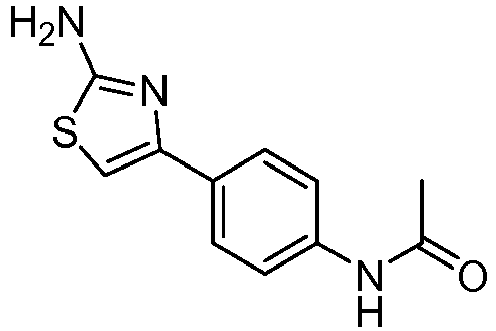
- 4-Chloroacetylacetanilide (1.00 g, 4.72 mmol) and thiourea (0.378 g, 4.96 mmol) suspended in anhydrous ethanol (8 ml) in a sealed tube under argon atmosphere. The sealed tube was microwaved at 120°C for 30 min. The sealed tube was microwaved at 120°C for 40 min. The mixture was diluted with tetrahydrofuran (200 mL) and neutralized with IN aq. NaOH solution and then extracted with ethyl acetate (2 x 200 mL). The combined organic layers were dried over anhydrous Na2SO4 and concentrated in vacuo. The residue was purified by precipitating in dichloromethane and filtration to give N-(4-(2-aminothiazol-4-yl)phenyl)acetamide (1.05 g, 95%) as a yellow solid. 1H NMR (400 MHz, DMSO-d): δ 9.95 (s, 1H), 7.70 (d, 2H, J = 8.4 Hz), 7.56 (d, 2H, J = 8.4 Hz), 7.00 (s, 2H), 6.86 (s, 1H), 2.04 (s, 3H). MS (ESI): Calcd. for C11H11N3OS: 233, found 234 (M+1)+
-

- 6-(2-Chloroacetyl)-1-methyl-1,2,3,4-tetrahydroquinolin-2-one (0.50 g, 2.10 mmol) and thiourea (0.17 g, 2.21 mmol) suspended in anhydrous ethanol (4 ml) in a sealed tube under argon atmosphere. The sealed tube was microwaved at 120°C for 35 min. The mixture was diluted with tetrahydrofuran (100 mL), neutralized with triethylamine (2 mL), and extracted with ethyl acetate (2 x 200 mL) followed by washing with saturated sodium bicarbonate (2 x 100 mL). The combined organic layers were dried over anhydrous Na2SO4 and concentrated in vacuo. The residue was purified by precipitating in dichloromethane and filtration to give 6-(2-aminothiazol-4-yl)-1-methyl-3,4-dihydroquinolin-2(1H)-one (0.50 g, 92%) as a vanilla solid. 1H NMR (400 MHz, DMSO-d): δ 7.67 (dd, 1H, J = 8.4, 2.0 Hz), 7.64 (d, 1H, J = 1.6 Hz), 7.06 (d, 1H, J = 8.4 Hz), 7.02 (s, 2H), 6.91 (s, 1H), 3.26 (s, 3H), 2.88 (t, 2H, J = 6.4 Hz), 2.55 (t, 2H, J = 6.8 Hz). MS (ESI): Calcd. for C13H13N3OS: 259, found 260 (M+1)+
-

- To a 500 mL round-bottomed flask equipped with condenser and argon inlet were added aluminum chloride (5.79 g, 43.42 mmol), carbon disulfide (40 mL), and chloroacetyl chloride (1.68 g, 14.89 mmol) under ice-bath. The mixture was stirred for 15 mins. To the stirring mixture was added 4,5-dihydro-1H-benzo[b]azepine-2(3H)-one (2.00 g, 12.41 mmol) in portions over 5 mins. The mixture was stirred for 10 minutes prior to reflux for 2.5 hours. The reaction mixture was cooled and the solvent was decanted off. Then ice and cold water (50 mL) was slowly added while stirred thoroughly. The tan precipitate was collected by filtration and washed thoroughly with water. The precipitate was sonicated in diethyl ether (10 mL) and the resulted fine solid was again collected by filtration. The solid was dried under vacuum to give 7-(2-chloroacetyl)-1,3,4,5-tetrahydro-2H-benzo[b]azepin-2-one (2.68 g, 91%) as a beige solid. 1H NMR (400 MHz, DMSO-d): δ 9.90 (s, 1H), 7.90 (d, 1H, J = 2.0 Hz), 7.85 (dd, 1H, J = 8.0, 2.0 Hz), 7.07 (d, 1H, J = 8.4 Hz), 2.76 (t, 2H, J = 7.2 Hz), 2.20 (m, 2H), 2.16 (m, 2H). MS (ESI): Calcd. for C12H12ClNO2: 237, found 238 (M+1)+
-

- 7-(2-chloroacetyl)-4,5-dihydro-1H-benzo[b]azepin-2(3H)-one (1.50 g, 6.31 mmol) and thiourea (0.504 g, 6.63 mmol) suspended in anhydrous ethanol (12 ml) in a sealed tube under argon atmosphere. The sealed tube was microwaved at 120°C for 40 min. The mixture was diluted with tetrahydrofuran (200 mL), neutralized with triethylamine (5 mL), and extracted with ethyl acetate (2 x 200 mL) followed by washing with saturated sodium bicarbonate (2 x 200 mL). The combined organic layers were dried over anhydrous Na2SO4 and concentrated in vacuo. The residue was purified by precipitating in dichloromethane and filtration to give 7-(2-aminothiazol-4-yl)-1,3,4,5-tetrahydro-2H-benzo[b]azepin-2-one (1.25 g, 76%) as a tan solid. 1H NMR (400 MHz, DMSO-d): δ 9.52 (s, 1H), 7.67 (d, 1H, J = 2.0 Hz), 7.63 (dd, 1H, J= 8.4, 2.0 Hz), 7.02 (s, 2H), 6.93 (m, 2H), 2.70 (t, 2H, J = 7.2 Hz), 2.13 (m, 4H). MS (ESI): Calcd. for C13H13N3OS: 259, found 260 (M+1)+
-

- To a 500 mL round-bottomed flask equipped with condenser and argon inlet were added aluminum chloride (5.33 g, 39.95 mmol), carbon disulfide (40 mL), and chloroacetyl chloride (1.55 g, 13.70 mmol) under ice-bath. The mixture was stirred for 15 mins. To the stirring mixture was added 1-acetyl-1,2,3,4-tetrahydroquinoline (2.00 g, 11.41 mmol) in portions over 5 mins. The mixture was stirred for 10 minutes prior to reflux for 2.5 hours. The reaction mixture was cooled and the solvent was decanted off. Then ice and cold water (50 mL) was slowly added while stirred thoroughly. The tan precipitate was collected by filtration and washed thoroughly with water. The precipitate was sonicated in diethyl ether (10 mL) and the resulted fine solid was again collected by filtration. The solid was dried under vacuum to give 1-(1-acetyl-1,2,3,4-tetrahydroquinolin-6-yl)-2-chloroethan-1-one (1.79 g, 62%) as a beige solid. 1H NMR (400 MHz, DMSO-d): δ 7.76 (m, 3H), 5.14 (s, 2H), 3.72 (t, 2H, J = 6.4 Hz), 2.78 (t, 2H, J = 6.8 Hz), 2.23 (s, 3H), 1.89 (p, 2H, J = 6.8 Hz). MS (ESI): Calcd. for C13H14ClNO2: 251, found 252 (M+1)+
-

- 1-(1-acetyl-1,2,3,4-tetrahydroquinolin-6-yl)-2-chloroethanone (1.00 g, 3.97 mmol) and thiourea (0.318 g, 4.17 mmol) suspended in anhydrous ethanol (10 ml) in a sealed tube under argon atmosphere. The sealed tube was microwaved at 120°C for 35 min. The mixture was diluted with tetrahydrofuran (200 mL) and neutralized with triethylamine (3 mL) and then extracted with ethyl acetate (2 x 200 mL) followed by washing with saturated sodium bicarbonate (2 x 200 mL). The combined organic layers were dried over anhydrous Na2SO4 and concentrated in vacuo. The residue was purified by precipitating in 1:3 dichloromethane/diethyl ether and filtration to give 1-(6-(2-aminothiazol-4-yl)-3,4-dihydroquinolin-1(2H)-yl)ethan-1-one (0.47 g, 43%) as a tan solid. 1H NMR (400 MHz, DMSO-d): δ 7.58 (m, 2H), 7.95 (bs, 1H, 7.02 (s, 2H), 6.93 (s, 1H), 3.68 (t, 2H, J = 6.4 Hz), 2.72 (t, 2H, J = 6.8 Hz), 2.17 (s, 3H), 1.87 (p, 2H, J = 6.8 Hz). MS (ESI): Calcd. for C14H15N3OS: 273, found 274 (M+1)+
-

- To a 500 mL round-bottomed flask equipped with condenser and argon inlet were added aluminum chloride (3.15 g, 23.62 mmol), carbon disulfide (25 mL), and chloroacetyl chloride (0.92 g, 8.10 mmol) under ice-bath. The mixture was stirred for 15 mins. To the stirring mixture was added 3,4-dihydro-2(H)-quinazolinone (1.00 g, 6.75 mmol) in portions over 5 mins. The mixture was stirred for 10 minutes prior to reflux for 2.5 hours. The reaction mixture was cooled and the solvent was decanted off. Then ice and cold water (25 mL) was slowly added while stirred thoroughly. The beige precipitate filtered, washed with water (3 x 50 mL) followed by tetrahydrofuran (2 x 100 mL) and hexanes (1 x 200 mL). The solid was dried under vacuum to give 6-(2-chloroacetyl)-3,4-dihydroquinazolin-2(1H)-one (1.42 g, 94%) as a beige solid. 1H NMR (400 MHz, DMSO-d): δ 9.50 (s, 1H), 7.78 (dd, 1H, J = 8.8, 1.6 Hz), 7.76 (s, 1H), 7.04 (s, 1H), 6.85 (d, 1H, J = 8.0 Hz), 5.04 (s, 2H), 4.38 (s, 2H). MS (ESI): Calcd. for C10H9ClN2O2: 224, found 225 (M+1)+
-

- To a 500 mL round-bottomed flask equipped with condenser and argon inlet were added aluminum chloride (1.35 g, 10.10 mmol), carbon disulfide (15 mL), and chloroacetyl chloride (0.39 g, 3.46 mmol) under ice-bath. The mixture was stirred for 15 mins. To the stirring mixture was added 1,2,5,6-tetrahydro-4H-pyrrolo[3,2,1-ij]quinolin-4-one (0.50 g, 3.46 mmol) in portions over 5 mins. The mixture was stirred for 10 minutes prior to reflux for 2.5 hours. The reaction mixture was cooled and the solvent was decanted off. Then ice and cold water (10 mL) was slowly added while stirred thoroughly. The beige precipitate filtered, washed with water (3 x 50 mL) followed by tetrahydrofuran (2 x 100 mL) and hexanes (1 x 200 mL). The solid was dried under vacuum to give 8-(2-chloroacetyl)-1,2,5,6-tetrahydro-4H-pyrrolo[3,2,1-ij]quinolin-4-one (0.71 g, 98%) as a beige solid. 1H NMR (400 MHz, DMSO-d): δ 7.74 (s, 2H), 5.07 (s, 2H), 3.99 (t, 2H, J = 8.8 Hz), 3.20 (t, 2H, J = 8.8 Hz), 2.98 (t, 2H, J = 7.6 Hz), 2.60 (t, 2H, J = 7.6 Hz). MS (ESI): Calcd. for C13H12ClNO2: 249, found 250 (M+1)+
-

- 6-(2-chloroacetyl)-3,4-dihydroquinazolin-2(1H)-one (0.50 g, 2.23 mmol), thiourea (0.178 g, 2.34 mmol) and triethylamine (0.46 mL, 3.34 mmol) suspended in anhydrous ethanol (12 ml) under argon atmosphere. The sealed tube was microwaved at 120°C for 35 min. The brown precipitate was collected by filtration and washed with cold ethanol. The residue was purified by precipitating in diethyl ether and filtration to give 6-(2-aminothiazol-4-yl)-3,4-dihydroquinazolin-2(1H)-one (0.529 g, 96%) as a light brown solid. 1H NMR (400 MHz, DMSO-d): δ 9.06 (s, 1H), 7.53 (d, 1H, J = 8.4 Hz), 7.50 (s, 1H), 6.97 (s, 2H), 6.81 (s, 1H), 6.77 (s, 1H), 6.73 (d, 1H, J = 8.4 Hz), 4.33 (s, 2H). MS (ESI): Calcd. for C11H10N4OS: 246, found 247 (M+1)+
-

- 8-(2-chloroacetyl)-5,6-dihydro-1H-pyrrolo[3,2,1-ij]quinolin-4(2H)-one (0.30 g, 1.20 mmol), thiourea (0.10 g, 1.26 mmol) and triethylamine (0.25 mL, 1.80 mmol) suspended in anhydrous ethanol (12 ml) in a sealed tube under argon atmosphere. The sealed tube was microwaved at 120°C for 35 min. The brown precipitate was collected by filtration and washed with cold ethanol. The residue was purified by precipitating in diethyl ether and filtration to give 8-(2-aminothiazol-4-yl)-1,2,5,6-tetrahydro-4H-pyrrolo[3,2,1-ij]quinolin-4-one (0.296 g, 91%) as a brown solid. 1H NMR (400 MHz, DMSO-d): δ 7.51 (d, 1H, J= 8.4 Hz), 6.96 (s, 2H), 6.82 (s, 1H), 3.95 (t, 2H, J = 8.8 Hz), 3.14 (t, 2H, J = 8.8 Hz), 2.92 (t, 2H, J = 7.6 Hz), 2.55 (t, 2H, J = 7.6 Hz). MS (ESI): Calcd. for C14H13N3OS: 271, found 272 (M+1)+
-

- To a 500 mL round-bottomed flask equipped with condenser and argon inlet were added aluminum chloride (7.10 g, 53.24 mmol), carbon disulfide (60 mL), and chloroacetyl chloride (2.06 g, 18.25 mmol) under ice-bath. The mixture was stirred for 15 mins. To the stirring mixture was added benzanilide (3.00 g, 15.21 mmol) in portions over 5 mins. The mixture was stirred for 10 minutes prior to reflux for 2.5 hours. The reaction mixture was cooled and the solvent was decanted off. Then ice and cold water (100 mL) was slowly added while stirred thoroughly. The beige precipitate filtered and washed with water (3 x 100 mL). The residue was purified by precipitating in diethyl ether and filtration to N-(4-(2-chloroacetyl)phenyl)benzamide (3.75 g, 90%) as a grey solid. 1H NMR (400 MHz, DMSO-d): δ 10.60 (s, 1H), 7.99 (m, 6H), 7.62 (m, 1H), 7.56 (m, 2H), 5.15 (s, 2H). MS (ESI): Calcd. for C15H12ClNO2: 273, found 274 (M+1)+
-

- To a 500 mL round-bottomed flask equipped with condenser and argon inlet were added aluminum chloride (3.17 g, 23.78 mmol), carbon disulfide (20 mL), and 2-chlorobutyryl chloride (85% tech., 1.53 g, 10.87 mmol) under ice-bath. The mixture was stirred for 15 mins. To the stirring mixture was added 3,4-dihydro-2(H)-quinolinone (1.00 g, 6.79 mmol) in one portion. The mixture was stirred for 10 minutes prior to reflux for 2.5 hours. The reaction mixture was cooled and the solvent was decanted off. Then ice and cold water (30 mL) was slowly added while stirred thoroughly. The beige precipitate filtered, washed with water (3 x 50 mL). The residue was purified by precipitating in diethyl ether and filtration to 6-(2-chlorobutanoyl)-3,4-dihydroquinolin-2(1H)-one (0.81 g, 48%) as a beige solid. 1H NMR (400 MHz, DMSO-d): δ 10.30 (s, 1H), 7.47 (s, 1H), 7.44 (dd, 1H, J = 8.8, 1.6 Hz), 6.95 (d, 1H, J = 8.0 Hz), 2.97 (t, 1H, J = 7.2 Hz), 2.91 (t, 2H, J = 7.6 Hz), 2.49 (partial masked under d-DMSO, m, 3H), 2.45 (t, 2H, J = 7.2 Hz). MS (ESI): Calcd. for C13H14ClNO2: 251, found 252 (M+1)+
-

- To a 500 mL round-bottomed flask equipped with condenser and argon inlet were added aluminum chloride (3.17 g, 23.78 mmol), carbon disulfide (20 mL), and 2-chloropropionyl chloride (1.04 g, 8.15 mmol) under ice-bath. The mixture was stirred for 15 mins. To the stirring mixture was added 3,4-dihydro-2(H)-quinolinone (1.00 g, 6.79 mmol) in one portion. The mixture was stirred for 10 minutes prior to reflux for 2.5 hours. The reaction mixture was cooled and the solvent was decanted off. Then ice and cold water (30 mL) was slowly added while stirred thoroughly. The beige precipitate filtered, washed with water (3 x 50 mL). The residue was purified by precipitating in diethyl ether and filtration to 6-(2-chloropropanoyl)-3,4-dihydroquinolin-2(1H)-one (1.47 g, 91%) as a beige solid. 1H NMR (400 MHz, DMSO-d): δ 10.48 (s, 1H), 7.89-7.84 (m, 2H), 6.96 (d, 1H, J = 8.4 Hz), 5.70 (q, 1H, J = 6.8 Hz), 2.96 (t, 2H, J = 7.6 Hz), 2.50 (partial masked under d-DMSO, m, 2H), 1.59 (2, 3H, J = 6.8 Hz). MS (ESI): Calcd. for C12H12ClNO2: 237, found 238 (M+1)+
-

- 6-(2-chloropropanoyl)-3,4-dihydroquinolin-2(1H)-one (1.00 g, 4.21 mmol), thiourea (0.35 g, 4.63 mmol) and triethylamine (0.88 mL, 6.31 mmol) suspended in anhydrous ethanol (12 ml) in a sealed tube under argon atmosphere. The sealed tube was microwaved at 120°C for 45 min. The brown precipitate was collected by filtration and washed with cold ethanol. The residue was purified by precipitating in diethyl ether and filtration to 6-(2-amino-5-methylthiazol-4-yl)-3,4-dihydroquinolin-2(1H)-one (0.92 g, 84%) as a yellow solid. 1H NMR (400 MHz, DMSO-d): δ 10.11 (s, 1H), 7.37 (s, 1H), 7.32 (dd, 1H, J = 8.4, 2.0 Hz), 6.84 (d, 1H, J = 8.0 Hz), 6.70 (s, 2H), 2.89 (t, 2H, J = 7.2 Hz), 2.46 (t, 2H, J = 7.6 Hz), 2.30 (s, 3H). MS (ESI): Calcd. for C13H13N3OS: 259, found 260 (M+1)+
-

- 6-(2-chlorobutanoyl)-3,4-dihydroquinolin-2(1H)-one (0.80 g, 3.18 mmol), thiourea (0.25 g, 3.34 mmol) and triethylamine (0.66 mL, 4.77 mmol) suspended in anhydrous ethanol (12 ml) in a sealed tube under argon atmosphere. The sealed tube was microwaved at 120°C for 45 min. The brown precipitate was collected by filtration and washed with cold ethanol. The residue was dried loaded onto silica and purified by flash chromatography over silica gel with CH2Cl2:MeOH (95:5) to give 6-(2-amino-5-ethylthiazol-4-yl)-3,4-dihydroquinolin-2(1H)-one (0.27 g, 29%) as a light brown solid. 1H NMR (400 MHz, DMSO-d): δ 10.11 (s, 1H), 7.30 (s, 1H), 7.26 (dd, 1H, J = 8.4, 2.0 Hz), 6.84 (d, 1H, J = 8.0 Hz), 6.72 (s, 2H), 2.89 (m, 2H), 2.71 (q, 2H, J = 8.0 Hz), 2.46 (t, 2H, J = 8.4 Hz), 1.16 (t, 3H, J = 7.6 Hz). MS (ESI): Calcd. for C14H15N3OS: 273, found 274 (M+1)+
-

- 6-(Chloroacetyl)-3,4-dihydroquinolin-2(1H)-one (0.300 g, 1.34 mmol) and urea (1.61 g, 26.82 mmol) dissolve in anhydrous acetonitrile (30 ml) in a flask under argon atmosphere. The mixture refluxed for 15 days. After cooling, the precipitate was filtered away and the filtrate was extracted with 8:2 dichloromethane/isopropanol (3 x 20 mL) over sat. NaHCO3 (2 x 50 mL). The combined organic layers were dried over anhydrous Na2SO4 and concentrated in vacuo. The residue was purified by flash chromatography over silica gel using 95:5 dichloromethane/methanol to give 6-(2-aminooxazol-4-yl)-3,4-dihydroquinolin-2(1H)-one (0.058 g, 19%) as a peach solid. 1H NMR (400 MHz, DMSO-d): δ 10.10 (s, 1H), 7.74 (s, 1H), 7.43(s, 1H), 7.39 (dd, 1H, J = 8.0, 1.6 Hz), 6.82 (d, 1H, J = 8.4 Hz), 6.65 (s, 2H), 2.87 (t, 2H, J = 7.6 Hz), 2.45 (partial masked under d-DMSO, t, 2H, J = 7.2 Hz). MS (ESI): Calcd. for C12H11N3O2: 229, found 230 (M+1)+
-

- 6-(Chloroacetyl)-3,4-dihydroquinolin-2(1H)-one (0.500 g, 2.24 mmol) and N-acetylguanidine (0.678 g, 6.71 mmol) suspended in anhydrous acetonitrile (15 ml) in a sealed tube under argon atmosphere. The sealed tube was microwaved at 100°C for 120 min. The precipitate was filtered out and the filtrate residue was purified by flash chromatography over silica gel using 95:5 dichloromethane/methanol to give 6-(1-acetyl-2-amino-1H-imidazol-4-yl)-3,4-dihydroquinolin-2(1H)-one (0.044 g, 7%) as a yellow solid. 1H NMR (400 MHz, DMSO-d): δ 11.52 (s, 1H), 11.19 (s, 1H), 10.04 (s, 1H), 8.71 (br s, 2H), 7.51 (s, 1H), 7.46 (dd, 1H, J = 8.4, 1.6 Hz), 7.12(d, 1H, J = 1.6 Hz), 6.79 (d, 1H, J = 8.0 Hz), 2.87 (m, 2H), 2.45 (m, 2H), 2.06 (s, 3H). MS (ESI): Calcd. for C14H14N4O2: 270, found 271 (M+1)+
-
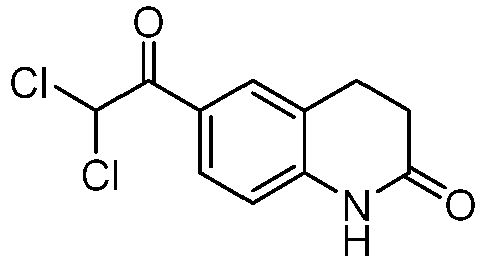
- To a 500 mL round-bottomed flask equipped with condenser and argon inlet were added aluminum chloride (19.02 g, 142.69 mmol), carbon disulfide (100 mL), and dichloroacetyl chloride (7.21 g, 48.92 mmol) under ice-bath. The mixture was stirred for 15 mins. To the stirring mixture was added 3,4-dihydro-2(H)-quinolinone (6.00 g, 40.77 mmol) in one portion. The mixture was stirred for 15 minutes prior to reflux for 3 hours. The reaction mixture was cooled and the solvent was decanted off. Then ice and cold water (250 mL) was slowly added while stirred thoroughly. The beige precipitate filtered and washed with water (3 x 100 mL). The residue was purified by precipitating in diethyl ether and filtration to give 6-(2,2-dichloroacetyl)-3,4-dihydroquinolin-2(1H)-one (9.54 g, 91%) as a light brown solid. 1H NMR (400 MHz, DMSO-d): δ 10.56 (bs, 1H), 7.93 (bs, 1H), 7.90 (dd, 1H, J = 8.4, 1.6 Hz), 7.82 (s, 1H), 6.98 (d, 1H, J = 8.4 Hz), 2.97 (m, 2H), 2.53 (partial masked under d-DMSO, m, 2H). MS (ESI): Calcd. for C11H9Cl2NO2: 258, found 258 (M)+
-

- 6-(2,2-dichloroacetyl)-3,4-dihydroquinolin-2(1H)-one (1.00 g, 3.87 mmol) and thiourea (0.310 g, 4.07 mmol) suspended in anhydrous acetonitrile (12 ml) in a sealed under argon atmosphere. The sealed tube was heated at 45°C for 4 days. The yellow precipitate was collected by filtration and washed with cold ethanol. The solid was dried in vacuo to give 6-(2-amino-5-chlorothiazol-4-yl)-3,4-dihydroquinolin-2(1H)-one hydrochloride (0.90 g, 74%) as a yellow solid. 1H NMR (400 MHz, DMSO-d): δ 10.22 (s, 1H), 7.61 (s, 1H), 6.89 (d, 1H, J = 8.4 Hz), 6.30 (bs, 2H), 2.91 (m, 2H), 2.47 (partial masked under d-DMSO, m, 2H). MS (ESI): Calcd. for C12H11Cl2N3OS: 316, found 280 (M+1 - HCl)+
-

- Step 1: Preparation of furan-2-yl-acetyl chloride: Oxalyl chloride (10.5 mL, 124.22 mmol), was added dropwise to a solution of furan-2-yl-acetic acid (0.500 g, 1.77 mmol) in dichloromethane (40 mL) at 0°C, followed by the addition of DMF (1 drop) and the mixture was stirred overnight (15 hrs). The reaction mixture was concentrated in vacuo and the residue was used without further purification.
- Step 2: 6-(2-aminothiazol-4-yl)-3,4-dihydroquinolin-2(1H)-one was dissolved in 1:1 acetonitrile/pyridine mixture (10 mL/10 mL) and excess triethylamine (4 mL) was added. The mixture was cool under ice-bath and a solution of furan-2-yl-acetyl chloride in acetonitrile (5 mL) was slowly added. The mixture was then stirred at room temperature overnight (15 hrs). The reaction was quenched with water (20 mL) and concentrated to minimum. The crude was extracted with 8:2 dichloromethane/isopropanol (2 x 400 mL) mixtures, washed with sat. NH4Cl (2 x 400 mL), and dried over anhydrous Na2SO4. The concentrated residue was then purified by flash chromatography over silica with CH2Cl2/MeOH (95:5). The solid was then sonicated in minimum amount of dichloromethane and the precipitated solid was collected by filtration to give 2-(furan-2-yl)-N-(4-(2-oxo-1,2,3,4-tetrahydroquinolin-6-yl)thiazol-2-yl)acetamide (0.423 g, 68%) as a beige solid. 1H NMR (400 MHz, DMSO-d): δ 12.46 (bs, 1H), 10.18 (s, 1H), 7.70 (s, 1H), 7.66 (dd, 1H, J = 8.8, 1.6 Hz), 7.58 (bs, 1H), 7.46 (bs, 1H), 6.88 (d, 1H, J = 8.8 Hz), 6.41 (m, 1H), 6.31 (m, 1H), 3.88 (s, 2H), 2.92 (m, 2H), 2.48 (partial masked under d-DMSO, m, 2H). MS (ESI): Calcd. for C18H15N3O3S: 353, found 354 (M+1)+
-

- To a suspension of 6-(2-aminothiazol-4-yl)-3,4-dihydroquinolin-2(1H)-one (0.050 g, 0.203 mmol) and 2,4-dimethylthiazole-5-carboxylic acid (0.035 g, 0.224 mmol), and pyridine (0.06 mL, 0.713 mmol) in acetonitrile (2 mL) in a sealed tube was added propylphosphonic anhydride solution (50 wt% in ethyl acetate, 0.29 mL, 0.489 mmol). The sealed tube was heated to 48.5°C for 4 days and the precipitation formed. After cooling, the solid was collected by filtration and washed with cold dichloromethane to give 2,4-dimethyl-N-(4-(2-oxo-1,2,3,4-tetrahydroquinolin-6-yl)thiazol-2-yl)thiazole-5-carboxamide (0.045 g, 58%) as a beige solid. 1H NMR (400 MHz, DMSO-d): δ 12.58 (bs, 1H), 10.18 (s, 1H), 7.74 (s, 1H), 7.69 (dd, 1H, J = 8.4, 1.6 Hz), 7.45 (bs, 1H), 6.88 (d, 1H, J = 8.4 Hz), 2.93 (m, 2H), 2.66 (s, 3H), 2.61 (s, 3H), 2.48 (partial masked under d-DMSO, m, 2H). MS (ESI): Calcd. for C18H16N4O2S2: 384, found 385 (M+1)+
-

- To a suspension of 5-(2-aminothiazol-4-yl)indolin-2-one (0.050 g, 0.203 mmol) and 2,4-dimethylthiazole-5-carboxylic acid (0.035 g, 0.224 mmol), and pyridine (0.06 mL, 0.713 mmol) in acetonitrile (2 mL) in a sealed tube was added propylphosphonic anhydride solution (50 wt% in ethyl acetate, 0.29 mL, 0.489 mmol). The sealed tube was heated to 48.5°C for 4 days and the precipitation formed. After cooling, the solid was collected by filtration and washed with cold dichloromethane to give 2,4-dimethyl-N-(4-(2-oxoindolin-5-yl)thiazol-2-yl)thiazole-5-carboxamide (0.045 g, 58%) as a beige solid. 1H NMR (400 MHz, DMSO-d): δ 12.53 (bs 1H), 10.48 (s, 1H), 7.77 (m, 2H), 7.48 (s, 1H), 6.86 (d, 1H, J= 8.8 Hz), 3.54 (s, 2H), 2.67 (s, 3H), 2.61 (s, 3H). MS (ESI): Calcd. for C17H14N4O2S2: 370, found 371 (M+1)+
-

- To a suspension of 5-(2-aminothiazol-4-yl)-1H-benzo[d]imidazol-2(3H)-one (0.200 g, 0.861 mmol) and 2,4-dimethylthiazole-5-carboxylic acid (0.149 g, 0.947 mmol), and pyridine (0.31 mL, 3.872 mmol) in acetonitrile (4 mL) in a sealed tube was added propylphosphonic anhydride solution (50 wt% in ethyl acetate, 1.790 mL, 3.012 mmol). The sealed tube was heated to 48.5°C for 4 days. After cooling, the mixture was quenched with water (50 mL) and extracted with 8:2 dichloromethane/isopropanol (2 x 50 mL) followed by washing once with sat. NaHCO3 (200 mL). The combined organic layers were dried over anhydrous Na2SO4 and concentrated in vacuo. The residue was purified by precipitating in dichloromethane and filtration to give 2,4-dimethyl-N-(4-(2-oxo-2,3-dihydro-1H-benzo[d]imidazol-5-yl)thiazol-2-yl)thiazole-5-carboxamide (0.035 g, 11%) as a beige solid. 1H NMR (400 MHz, DMSO-d): δ 12.55 (bs, 1H), 10.76 (s, 1H), 10.70 (s, 1H), 7.51 (m, 3H), 6.96 (d, 1H, J = 8.4 Hz), 2.67 (s, 3H), 2.61 (s, 3H). MS (ESI): Calcd. for C16H13N5O2S2: 371, found 372 (M+1)+
-

- To a suspension of N-(4-(2-aminothiazol-4-yl)phenyl)benzamide (0.041g, 0.138 mmol) and 2,4-dimethylthiazole-5-carboxylic acid (0.024 g, 0.152 mmol), and pyridine (0.01 mL, 0.623 mmol) in acetonitrile (1.5 mL) in a sealed tube was added propylphosphonic anhydride solution (50 wt% in ethyl acetate, 0.29 mL, 0.485 mmol). The sealed tube was heated to 48.5°C for 4 days. After cooling, the mixture was quenched with water (10 mL) and extracted with 8:2 dichloromethane/isopropanol (2 x 25 mL) followed by washing once with sat. NaHCO3 (100 mL). The combined organic layers were dried over anhydrous Na2SO4 and concentrated in vacuo. The residue was purified by precipitating in dichloromethane and filtration to give N-(4-(4-benzamidophenyl)thiazol-2-yl)-2,4-dimethylthiazole-5-carboxamide (0.029 g, 48%) as a beige solid. 1H NMR (400 MHz, DMSO-d): δ 10.34 (s, 1H), 7.96 (d, 2H, J = 7.2 Hz), 7.89 (m, 4H), 7.57 (m, 4H), 2.67 (s, 3H), 2.62 (s, 3H). MS (ESI): Calcd. for C22H18N4O2S2: 434, found 435 (M+1)+
-

- To a suspension of 6-(2-aminothiazol-4-yl)chroman-2-one (0.100 g, 0.406 mmol) and 2,4-dimethylthiazole-5-carboxylic acid (0.070 g, 0.447 mmol), and pyridine (0.15 mL, 1.831 mmol) in acetonitrile (4 mL) in a sealed tube was added propylphosphonic anhydride solution (50 wt% in ethyl acetate, 0.95 mL, 1.421 mmol). The sealed tube was heated to 48.5°C for 5 days. After cooling, the mixture was quenched with water (50 mL) and extracted with 8:2 dichloromethane/isopropanol (2 x 50 mL) followed by washing once with sat. NaHCO3 (100 mL). The combined organic layers were dried over anhydrous Na2SO4 and concentrated in vacuo. The residue was purified by precipitating in 1:3 dichloromethane/diethyl ether mixture and filtration to give 2,4-dimethyl-N-(4-(2-oxochroman-6-yl)thiazol-2-yl)thiazole-5-carboxamide (0.106 g, 67%) as a beige solid. 1H NMR (400 MHz, DMSO-d): δ 12.59 (bs, 1H), 7.86 (d, 1H, J = 1.6 Hz), 7.82 (dd, 1H, J = 8.4, 1.6 Hz), 7.64 (s, 1H), 7.12 (d, 1H, J = 8.4 Hz), 3.05 (t, 2H, J = 7.2 Hz), 2.83 (t, 2H, J = 7.2 Hz), 2.68 (s, 3H), 2.61 (s, 3H). MS (ESI): Calcd. for C18H15N3O3S2: 385, found 386 (M+1)+
-

- To a suspension of N-(4-(2-aminothiazol-4-yl)phenyl)acetamide (0.200 g, 0.857 mmol) and 2,4-dimethylthiazole-5-carboxylic acid (0.184 g, 0.943 mmol), and pyridine (0.31 mL, 3.862 mmol) in acetonitrile (8 mL) in a sealed tube was added propylphosphonic anhydride solution (50 wt% in ethyl acetate, 1.79 mL, 3.001 mmol). The sealed tube was heated to 48.5°C for 5 days. After cooling, the mixture was quenched with water (100 mL) and extracted with 8:2 dichloromethane/isopropanol (2 x 100 mL) followed by washing once with sat. NaHCO3 (200 mL). The combined organic layers were dried over anhydrous Na2SO4 and concentrated in vacuo. The residue was purified by precipitating in dichloromethane and filtration to give N-(4-(4-acetamidophenyl)thiazol-2-yl)-2,4-dimethylthiazole-5-carboxamide (0.141 g, 44%) as a beige solid. 1H NMR (400 MHz, DMSO-d): δ 10.02 (s, 1H), 7.84 (d, 2H, J = 8.4 Hz), 7.64 (d, 2H, J = 8.4 Hz), 7.54 (s, 1H), 2.67 (s, 3H), 2.61 (s, 3H), 2.06 (s, 3H). MS (ESI): Calcd. for C17H16N4O2S2: 372, found 373 (M+1)+
-
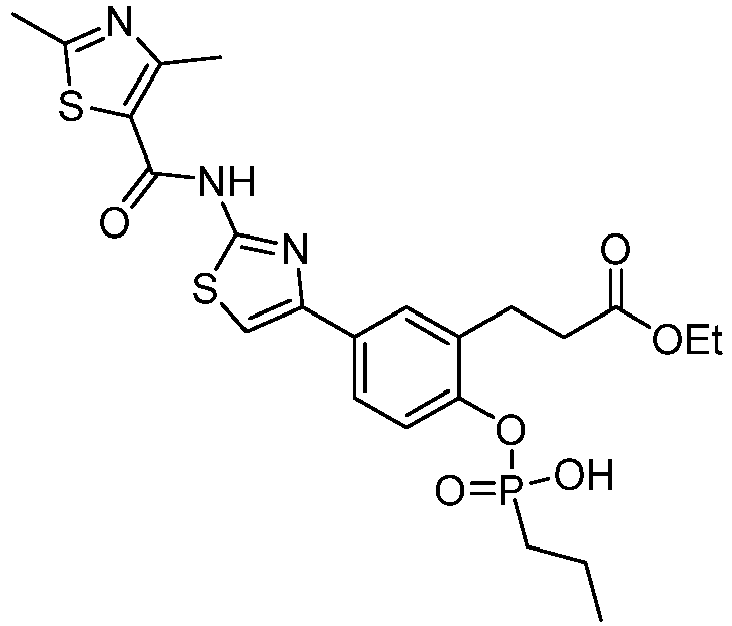
- To a suspension of ethyl 3-(5-(2-aminothiazol-4-yl)-2-hydroxyphenyl)propanoate (0.100 g, 0.342 mmol) and 2,4-dimethylthiazole-5-carboxylic acid (0.059 g, 0.376 mmol), and pyridine (0.12 mL, 1.541 mmol) in acetonitrile (4 mL) in a sealed tube was added propylphosphonic anhydride solution (50 wt% in ethyl acetate, 0.71 mL, 1.201 mmol). The sealed tube was heated to 48.5°C for 5 days. After cooling, the mixture was quenched with water (50 mL) and extracted with 8:2 dichloromethane/isopropanol (2 x 50 mL) followed by washing once with sat. NaHCO3 (100 mL). The combined organic layers were dried over anhydrous Na2SO4 and concentrated in vacuo. The residue was purified by precipitating in 1:3 dichloromethane/diethyl ether mixture and filtration to give ethyl 3-(5-(2-(2,4-dimethylthiazole-5-carboxamido)thiazol-4-yl)-2-((hydroxy(propyl)phosphoryl)oxy)phenyl)propanoate (0.028 g, 15%) as an orange solid after dried under high vacuum. 1H NMR (400 MHz, DMSO-d): δ 7.82-7.10 (m, 6H), 4.05 (q, 2H, J = 7.2 Hz), 2.89 (m, 2H), 2.67 (s, 3H), 2.61 (s, 3H), 1.75-1.30 (m, 6H), 1.16 (t, 3H, J = 7.2 Hz), 0.96 (t, 3H, J = 7.2 Hz). MS (ESI): Calcd. for C23H28N3O6PS2: 537, found 538 (M+1)+
-

- To a suspension of 6-(2-aminothiazol-4-yl)-3,4-dihydroquinolin-2(1H)-one (0.100 g, 0.408 mmol) and 2-cyclopropyl-1,3-thiazole carboxylic acid (0.076 g, 0.448 mmol), and pyridine (0.15 mL, 1.832 mmol) in acetonitrile (4 mL) in a sealed tube was added propylphosphonic anhydride solution (50 wt% in ethyl acetate, 0.85 mL, 1.432 mmol). The sealed tube was heated to 48.5°C for 4 days and the precipitation formed. After cooling, the the precipitated solid was collected by filtration and washed with cold dichloromethane to give 2-cyclopropyl-N-(4-(2-oxo-1,2,3,4-tetrahydroquinolin-6-yl)thiazol-2-yI)thiazole-5-carboxamide (0.111 g, 69%) as a beige solid. 1H NMR (400 MHz, DMSO-d): δ 12.9 (bs, 1H), 10.19 (s, 1H), 8.65 (s, 1H), 7.75 (s, 1H), 7.70 (dd, 1H, J = 8.0, 1.6 Hz), 7.51 (s, 1H), 6.89 (1H, d, J = 8.4 Hz), 2.93 (t, 2H, J = 6.8 Hz), 2.49 (partial masked under d-DMSO, m, 2H), 2.07 (s, 1H), 1.19 (m, 2H), 1.08 (m, 2H). MS (ESI): Calcd. for C19H16N4O2S2: 396, found 397 (M+1)+
-

- To a suspension of 6-(2-aminothiazol-4-yl)-3,4-dihydroquinolin-2(1H)-one (0.100 g, 0.408 mmol) and 2-phenylthiazole-5-carboxylic acid (0.092 g, 0.448 mmol), and pyridine (0.15 mL, 1.832 mmol) in acetonitrile (4 mL) in a sealed tube was added propylphosphonic anhydride solution (50 wt% in ethyl acetate, 0.85 mL, 1.432 mmol). The sealed tube was heated to 48.5°C for 4 days and the precipitation formed. After cooling, the precipitated solid was collected by filtration and washed with cold dichloromethane to give N-(4-(2-oxo-1,2,3,4-tetrahydroquinolin-6-yl)thiazol-2-yl)-2-phenylthiazole-5-carboxamide (0.156 g, 88%) as a beige solid. 1H NMR (400 MHz, DMSO-d): δ 13.10 (bs, 1H), 10.20 (s, 1H), 8.93 (s, 1H), 8.05 (m, 2H), 7.77 (s, 1H), 7.72 (dd, 1H, J = 8.0, 1.6 Hz), 7.57 (m, 4H), 6.90 (d, 1H, J = 8.4 Hz), 2.94 (t, 2H, J = 6.8 Hz), 2.50 (masked under d-DMSO, m, 2H). MS (ESI): Calcd. for C22H16N4O2S2: 432, found 433 (M+1)+
-

- To a suspension of 6-(2-aminothiazol-4-yl)-3,4-dihydroquinolin-2(1H)-one (0.100 g, 0.408 mmol) and 2-cyano-1,3-thiazole-5-carboxylic acid (0.069 g, 0.448 mmol), and pyridine (0.15 mL, 1.832 mmol) in acetonitrile (4 mL) in a sealed tube was added propylphosphonic anhydride solution (50 wt% in ethyl acetate, 0.85 mL, 1.432 mmol). The sealed tube was heated to 48.5°C for 4 days and the precipitation formed. After cooling, the precipitated solid was collected by filtration and washed with cold dichloromethane to give 2-cyano-N-(4-(2-oxo-1,2,3,4-tetrahydroquinolin-6-yl)thiazol-2-yl)thiazole-5-carboxamide (0.073 g, 47%) as a yellow solid. 1H NMR (400 MHz, DMSO-d): δ 13.43 (bs, 1H), 10.21 (s, 1H), 9.03 (s, 1H), 7.75 (s, 1H), 7.71 (dd, 1H, J = 8.0, 1.6 Hz), 7.59 (s, 1H), 6.91 (d, 1H, J = 8.4 Hz), 2.94 (t, 2H, J = 6.8 Hz), 2.50 (masked under d-DMSO, m, 2H). MS (ESI): Calcd. for C17H11N5O2S2: 381, found 382 (M+1)+
-

- To a suspension of 1-(6-(2-aminothiazol-4-yl)-3,4-dihydroquinolin-1(2H)-yl)ethanone (0.100 g, 0.366 mmol) and 2,4-dimethylthiazole-5-carboxylic acid (0.063 g, 0.402 mmol), and pyridine (0.13 mL, 1.65 mmol) in acetonitrile (4 mL) in a sealed tube was added propylphosphonic anhydride solution (50 wt% in ethyl acetate, 0.76 mL, 1.281 mmol). The sealed tube was heated to 48.5°C for 4 days and the the precipitation formed. After cooling, the solid was collected by filtration and washed with cold dichloromethane to give N-(4-(1-acetyl-1,2,3,4-tetrahydroquinolin-6-yl)thiazol-2-yl)-2,4-dimethylthiazole-5-carboxamide (0.043 g, 29%) as a beige solid. 1H NMR (400 MHz, DMSO-d): δ 12.58 (bs, 1H), 7.75 (s, 1H), 7.70 (dd, 1H, J = 8.0, 1.6 Hz), 7.61 (bs, 2H), 3.70 (t, 2H, J = 6.4 Hz), 2.77 (t, 2H, J = 6.4 Hz), 2.68 (s, 3H), 2.61 (s, 3H), 2.20 (s, 3H0, 1.90 (p, 2H, J = 6.4 Hz). MS (ESI): Calcd. for C20H20N4O2S2: 412, found 413 (M+1)+
-

- To a suspension of 6-(2-aminothiazol-4-yl)-1-methyl-3,4-dihydroquinolin-2(1H)-one (0.100 g, 0.386 mmol) and 2,4-dimethyl-1,3-thiazole carboxylic acid (0.067 g, 0.424 mmol), and pyridine (0.14 mL, 1.742 mmol) in acetonitrile (4 mL) in a sealed tube was added propylphosphonic anhydride solution (50 wt% in ethyl acetate, 0.80 mL, 1.352 mmol). The sealed tube was heated to 48.5°C for 4 days. After cooling, the mixture was quenched with water (100 mL) and extracted with 8:2 dichloromethane/isopropanol (2 x 100 mL) followed by washing once with sat. NaHCO3 (200 mL). The combined organic layers were dried over anhydrous Na2SO4 and concentrated in vacuo. The residue was purified by precipitating in 1:3 dichloromethane/diethyl ether mixture and filtration to give 2,4-dimethyl-N-(4-(1-methyl-2-oxo-1,2,3,4-tetrahydroquinolin-6-yl)thiazol-2-yl)thiazole-5-carboxamide (0.059 g, 39%) as a beige solid. 1H NMR (400 MHz, DMSO-d): δ 12.57 (bs, 1H), 7.82 (dd, 1H, J = 8.0, 1.6 Hz), 7.79 (s, 1H), 7.56 (s, 1H), 7.15 (d, 1H, J = 8.4 Hz), 3.28 (s, 3H), 2.92 (t, 2H, J = 6.4 Hz), 2.67 (s, 3H), 2.62 (s, 3H), 2.58 (t, 2H, J = 6.4 Hz). MS (ESI): Calcd. for C19H18N4O2S2: 398, found 399 (M+1)+
-
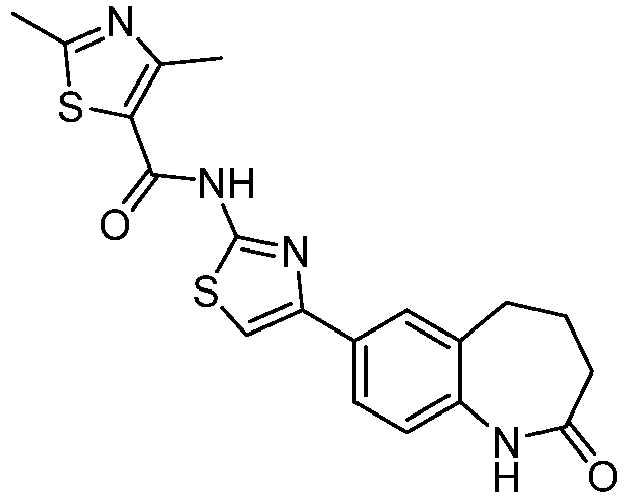
- To a suspension of 7-(2-aminothiazol-4-yl)-4,5-dihydro-1H-benzo[b]azepin-2(3H)-one (0.100 g, 0.386 mmol) and 2,4-dimethyl-1,3-thiazole carboxylic acid (0.067 g, 0.424 mmol), and pyridine (0.14 mL, 1.742 mmol) in acetonitrile (4 mL) in a sealed tube was added propylphosphonic anhydride solution (50 wt% in ethyl acetate, 0.80 mL, 1.352 mmol). The sealed tube was heated to 48.5°C for 4 days. After cooling, the mixture was quenched with water (100 mL) and extracted with 8:2 dichloromethane/isopropanol (2 x 100 mL) followed by washing once with sat. NaHCO3 (200 mL). The combined organic layers were dried over anhydrous Na2SO4 and concentrated in vacuo. The residue was purified by precipitating in 1:3 dichloromethane/diethyl ether mixture and filtration to give 2,4-dimethyl-N-(4-(2-oxo-2,3,4,5-tetrahydro-1H-benzo[b]azepin-7-yl)thiazol-2-yl)thiazole-5-carboxamide (0.060 g, 39%) as a beige solid. 1H NMR (400 MHz, DMSO-d): δ 12.59 (bs, 1H), 9.59 (s, 1H), 7.82 (s, 1H), 7.76 (dd, 1H, J = 8.0, 1.6 Hz), 7.59 (s, 1H), 7.01 (d, 1H, J = 8.4 Hz), 2.73 (t, 2H, J = 6.4 Hz), 2.67 (s, 3H), 2.61 (s, 3H), 2.16 (m, 4H). MS (ESI): Calcd. for C19H18N4O2S2: 398, found 399 (M+1)+
-

- To a suspension of 6-(2-aminothiazol-4-yl)-3,4-dihydroquinolin-2(1H)-one (0.100 g, 0.408 mmol) and 5-thiazole carboxylic acid (0.058 g, 0.448 mmol), and pyridine (0.15mL, 1.832 mmol) in acetonitrile (4 mL) in a sealed tube was added propylphosphonic anhydride solution (50 wt% in ethyl acetate, 0.85 mL, 1.431 mmol). The sealed tube was heated to 48.5°C for 4 days and the precipitation formed. After cooling, the solid was collected by filtration and washed with cold dichloromethane to give N-(4-(2-oxo-1,2,3,4-tetrahydroquinolin-6-yl)thiazol-2-yl)thiazole-5-carboxamide (0.132 g, 91%) as a beige solid. 1H NMR (400 MHz, DMSO-d): δ 13.01 (bs, 1H), 10.19 (s, 1H), 9.38 (s, 1H), 8.93 (s, 1H), 7.75 (s, 1H), 7.71 (dd, 1H, J = 8.4, 1.6 Hz), 7.54 (s, 1H), 6.89 (d, 1H, J = 8.4 Hz), 2.93 (m, 2H), 2.48 (partial masked under d-DMSO, m, 2H). MS (ESI): Calcd. for C16H12N4O2S2: 356, found 357 (M+1)+
-
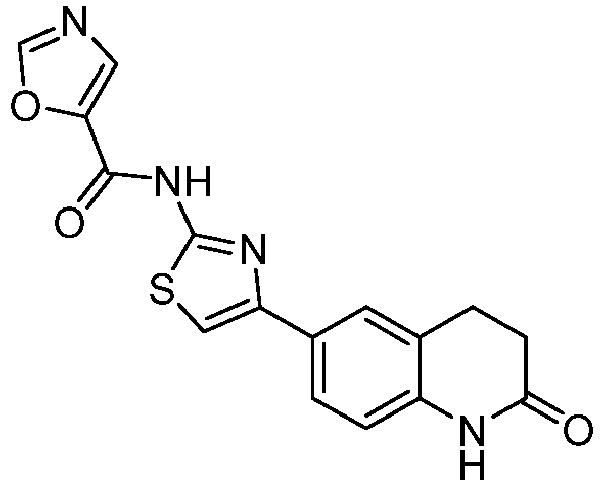
- To a suspension of 6-(2-aminothiazol-4-yl)-3,4-dihydroquinolin-2(1H)-one (0.100 g, 0.408 mmol) and oxazole-5-carboxylic acid (0.051g, 0.448 mmol), and pyridine (0.15mL, 1.832 mmol) in acetonitrile (4 mL) in a sealed tube was added propylphosphonic anhydride solution (50 wt% in ethyl acetate, 0.85 mL, 1.431 mmol). The sealed tube was heated to 48.5°C for 4 days and the precipitation formed. After cooling, the solid was collected by filtration and washed with cold dichloromethane to give N-(4-(2-oxo-1,2,3,4-tetrahydroquinolin-6-yl)thiazol-2-yl)oxazole-5-carboxamide (0.121 g, 87%) as a beige solid. 1H NMR (400 MHz, DMSO-d): δ 13.03 (bs, 1H), 10.18 (s, 1H), 8.72 (s, 1H), 8.29 (s, 1H), 7.75 (s, 1H), 7.71 (dd, 1H, J = 8.4, 1.6 Hz), 7.56 (s, 1H), 6.90 (d, 1H, J = 8.4 Hz), 2.93 (m, 2H), 2.48 (partial masked under d-DMSO, m, 2H). MS (ESI): Calcd. for C16H12N4O3S: 340, found 341 (M+1)+
-

- To a suspension of 6-(2-aminothiazol-4-yl)-3,4-dihydroquinolin-2(1H)-one (0.100 g, 0.408 mmol) and 1H-imidazole-4-carboxylic acid (0.050g, 0.448 mmol), and pyridine (0.15mL, 1.832 mmol) in acetonitrile (4 mL) in a sealed tube was added propylphosphonic anhydride solution (50 wt% in ethyl acetate, 0.85 mL, 1.431 mmol). The sealed tube was heated to 48.5°C for 4 days and the precipitation formed. After cooling, the mixture was quenched with water (10 mL) and extracted with 8:2 dichloromethane/isopropanol (2 x 25 mL) followed by washing once with sat. NaHCO3 (100 mL). The combined organic layers were dried over anhydrous Na2SO4 and concentrated in vacuo. The residue was purified by precipitating in dichloromethane and filtration to give N-(4-(2-oxo-1,2,3,4-tetrahydroquinolin-6-yl)thiazol-2-yl)-1H-imidazole-5-carboxamide (0.013 g, 10%) as a tan solid. 1H NMR (400 MHz, DMSO-d): δ 12.73 (bs, 1H), 11.38 (bs, 1H), 10.14 (s, 1H), 8.04 (s, 1H), 7.85 (s, 1H), 7.72 (s, 1H), 7.67 (dd, 1H, J = 8.4, 1.6 Hz), 7.44 (s, 1H), 6.85 (d, 1H, J = 8.4 Hz), 2.90 (m, 2H), 2.45 (partial masked under d-DMSO, m, 2H). MS (ESI): Calcd. for C16H13N5O2S: 339, found 340 (M+1)+
-

- To a suspension of 6-(2-aminothiazol-4-yl)-3,4-dihydroquinolin-2(1H)-one (0.100 g, 0.408 mmol) and 1,2,4-triazole-3-carboxylic acid (0.051g, 0.448 mmol), and pyridine (0.15mL, 1.832 mmol) in acetonitrile (4 mL) in a sealed tube was added propylphosphonic anhydride solution (50 wt% in ethyl acetate, 0.85 mL, 1.431 mmol). The sealed tube was heated to 48.5°C for 4 days and the precipitation formed. After cooling, the solid was collected by filtration and washed with cold dichloromethane to give N-(4-(2-oxo-1,2,3,4-tetrahydroquinolin-6-yl)thiazol-2-yl)-4H-1,2,4-triazole-3-carboxamide (0.099 g, 71%) as a green solid. 1H NMR (400 MHz, DMSO-d): δ 12.35 (bs, 1H), 10.17 (s, 1H), 8.74 (s, 1H), 7.76 (s, 1H), 7.71 (dd, 1H, J = 8.4, 1.6 Hz), 7.56 (s, 1H), 6.89 (d, 1H, J = 8.4 Hz), 2.93 (m, 2H), 2.48 (partial masked under d-DMSO, m, 2H). MS (ESI): Calcd. for C15H12N6O2S: 340, found 341 (M+1)+
-

- Step 1: Preparation of 1H-tetrazole acid chloride: Thionyl chloride (0.74 mL, 10.191 mmol), was added dropwise to a solution of 1H-tetrazole-5-carboxylic acid (0.069 g, 0.612 mmol) in tetrahydrofuran (2 mL) at 0°C, followed by the addition of DMF (1 drop) and the mixture was stirred overnight (15 hrs). The reaction mixture was concentrated in vacuo and the residue was used without further purification.
- Step 2: A solution 6-(2-aminothiazol-4-yl)-3,4-dihydroquinolin-2(1H)-one in pyridine (2 mL) was quickly added to acid chloride under ice-bath. The mixture was vigorously stirred for 10 min and then stirred at room temperature overnight (15 hrs). The reaction was quenched with water (20 mL) and concentrated to minimum. The crude mixture was extracted with 8:2 dichloromethane/isopropanol (3 x 20 mL) mixtures, washed with sat. NaHCO3(2 x 20 mL), and dried over anhydrous Na2SO4. The concentrated residue was purified by precipitation in minimum amount of dichloromethane and filtration to give N-(4-(2-oxo-1,2,3,4-tetrahydroquinolin-6-yl)thiazol-2-yl)-1H-tetrazole-5-carboxamide (0.065 g, 47%) as a greenish-grey solid. 1H NMR (400 MHz, DMSO-d): δ 10.21 (s, 1H), 8.11 (bs, 1H), 7.61 (s, 1H), 7.55 (dd, 1H, J = 8.4, 1.6 Hz), 6.97 (s, 1H), 7.56 (s, 1H), 6.88 (d, 1H, J= 8.4 Hz), 2.90 (m, 2H), 2.47 (partial masked under d-DMSO, m, 2H). MS (ESI): Calcd. for C14H11N7O2S: 341, found 398 (unstabled, M+56)+
-

- To a suspension of 6-(2-aminothiazol-4-yl)-3,4-dihydroquinolin-2(1H)-one (0.100 g, 0.408 mmol) and 4-cyclopropyl-1,3-thiazole-5-carboxylic acid (0.079 g, 0.469 mmol), and pyridine (0.15mL, 1.832 mmol) in acetonitrile (4 mL) in a sealed tube was added propylphosphonic anhydride solution (50 wt% in ethyl acetate, 0.85 mL, 1.431 mmol). The sealed tube was heated to 48.5°C for 7 days. After cooling, the mixture was quenched with water (10 mL) and extracted with 8:2 dichloromethane/isopropanol (2 x 25 mL) followed by washing once with sat. NaHCO3 (100 mL). The combined organic layers were dried over anhydrous Na2SO4 and concentrated in vacuo. The crude mixture was purified by precipitation in minium amount of 1:1 dichloromethane/diethyl ether mixture. The obtained solid was collected by filtration and washed with cold dichloromethane to give 4-cyclopropyl-N-(4-(2-oxo-1,2,3,4-tetrahydroquinolin-6-yl)thiazol-2-yl)thiazole-5-carboxamide (0.129 g, 80%) as a green crystalline solid. 1H NMR (400 MHz, DMSO-d): δ 12.76 (bs, 1H), 10.20 (s, 1H), 9.07 (s, 1H), 7.74 (s, 1H), 7.70 (dd, 1H, J = 8.4, 1.6 Hz), 7.51 (bs, 1H), 6.89 (d, 1H, J = 8.4 Hz), 2.93 (m, 2H), 2.49 (partial masked under d-DMSO, m, 2H). MS (ESI): Calcd. for C19H16N4O2S2: 396, found 397 (M+1)+
-

- To a suspension of 6-(2-aminothiazol-4-yl)-3,4-dihydroquinolin-2(1H)-one (0.100 g, 0.408 mmol) and 4-(trifluoromethyl)-1,3-thiazole-5-carboxylic acid (0.088 g, 0.448 mmol), and pyridine (0.15mL, 1.832 mmol) in acetonitrile (4 mL) in a sealed tube was added propylphosphonic anhydride solution (50 wt% in ethyl acetate, 0.85 mL, 1.431 mmol). The sealed tube was heated to 48.5°C for 7 days. After cooling, the mixture was quenched with water (10 mL) and extracted with 8:2 dichloromethane/isopropanol (2 x 25 mL) followed by washing once with sat. NaHCO3 (100 mL). The combined organic layers were dried over anhydrous Na2SO4 and concentrated in vacuo. The crude mixture was purified by precipitation in minium amount of dichloromethane. The obtained solid was collected by filtration and washed with cold dichloromethane to give N-(4-(2-oxo-1,2,3,4-tetrahydroquinolin-6-yl)thiazol-2-yl)-4-(trifluoromethyl)thiazole-5-carboxamide (0.155 g, 90%) as a beige solid. 1H NMR (400 MHz, DMSO-d): δ 13.35 (bs, 1H), 10.20 (s, 1H), 9.36 (s, 1H), 7.73 (s, 1H), 7.68 (dd, 1H, J = 8.4, 1.6 Hz), 7.59 (bs, 1H), 6.89 (d, 1H, J = 8.4 Hz), 2.93 (m, 2H), 2.49 (partial masked under d-DMSO, m, 2H). MS (ESI): Calcd. for C17H11F3N4O2S2: 424, found 425 (M+1)+
-

- To a suspension of 6-(2-aminothiazol-4-yl)-3,4-dihydroquinolin-2(1H)-one (0.075 g, 0.306 mmol) and 4-ethyl-1,3-thiazole-5-carboxylic acid (0.055 g, 0.351 mmol), and pyridine (0.11mL, 1.381 mmol) in acetonitrile (4 mL) in a sealed tube was added propylphosphonic anhydride solution (50 wt% in ethyl acetate, 0.64 mL, 1.072 mmol). The sealed tube was heated to 50°C for 7 days. After cooling, the mixture was quenched with water (10 mL) and extracted with 8:2 dichloromethane/isopropanol (2 x 25 mL) followed by washing once with sat. NaHCO3 (100 mL). The combined organic layers were dried over anhydrous Na2SO4 and concentrated in vacuo. The crude mixture was purified by precipitation in minium amount of dichloromethane. The obtained solid was collected by filtration and washed with cold dichloromethane to give 4-ethyl-N-(4-(2-oxo-1,2,3,4-tetrahydroquinolin-6-yl)thiazol-2-yl)thiazole-5-carboxamide (0.090 g, 76%) as an off-white solid. 1H NMR (400 MHz, DMSO-d): δ 12.74 (bs, 1H), 10.19 (s, 1H), 9.18 (s, 1H), 7.74 (s, 1H), 7.71 (dd, 1H, J = 8.4, 1.6 Hz), 7.52 (bs, 1H), 6.89 (d, 1H, J = 8.4 Hz), 3.08 (q, 2H, J = 7.2 Hz), 2.93 (t, 2H, J = 7.2 Hz), 2.49 (partial masked under d-DMSO, m, 2H), 1.25 (t, 3H, J = 7.2 Hz). MS (ESI): Calcd. for C18H16N4O2S2: 384, found 385 (M+1)+
-

- To a suspension of 6-(2-aminothiazol-4-yl)-3,4-dihydroquinazolin-2(1H)-one (0.100 g, 0.406 mmol) and 2,4-dimethylhiazole-5-carboxylic acid (0.073 g, 0.467 mmol), and pyridine (0.15mL, 1.832 mmol) in acetonitrile (4 mL) in a sealed tube was added propylphosphonic anhydride solution (50 wt% in ethyl acetate, 0.85 mL, 1421 mmol). The sealed tube was heated to 50°C for 5 days. After cooling, the mixture was quenched with water (10 mL) and extracted with 8:2 dichloromethane/isopropanol (2 x 25 mL) followed by washing once with sat. NaHCO3 (100 mL). The combined organic layers were dried over anhydrous Na2SO4 and concentrated in vacuo. The crude mixture was purified by precipitation in minium amount of dichloromethane. The obtained solid was collected by filtration and washed with cold dichloromethane to give 2,4-dimethyl-N-(4-(2-oxo-1,2,3,4-tetrahydroquinazolin-6-yl)thiazol-2-yl)thiazole-5-carboxamide (0.129 g, 82%) as a brown solid. 1H NMR (400 MHz, DMSO-d): δ 9.15 (s, 1H), 7.66 (dd, 1H, J = 8.4, 1.6 Hz), 7.64 (s, 1H), 7.44 (s, 1H), 6.86 (bs, 1H), 6.81 (d, 1H, J = 8.4 Hz), 4.37 (s, 2H), 2.67 (s, 3H), 2.61 (s, 3H). MS (ESI): Calcd. for C17H15N5O2S2: 385, found 386 (M+1)+
-

- To a suspension of 8-(2-aminothiazol-4-yl)-5,6-dihydro-1H-pyrrolo[3,2,1-ij]quinolin-4(2H)-one (0.075 g, 0.276 mmol) and 2,4-dimethylhiazole-5-carboxylic acid (0.050 g, 0.318 mmol), and pyridine (0.10 mL, 1.121 mmol) in acetonitrile (4 mL) in a sealed tube was added propylphosphonic anhydride solution (50 wt% in ethyl acetate, 0.58 mL, 1.241 mmol). The sealed tube was heated to 50°C for 5 days. After cooling, the mixture was quenched with water (10 mL) and extracted with 8:2 dichloromethane/isopropanol (2 x 25 mL) followed by washing once with sat. NaHCO3 (100 mL). The combined organic layers were dried over anhydrous Na2SO4 and concentrated in vacuo. The obtained solid was collected by filtration and washed with cold dichloromethane to give 2,4-dimethyl-N-(4-(4-oxo-1,2,5,6-tetrahydro-4H-pyrrolo[3,2,1-ij]quinolin-8-yl)thiazol-2-yl)thiazole-5-carboxamide (0.089 g, 79%) as a yellow solid. 1H NMR (400 MHz, DMSO-d): δ 12.50 (bs, 1H), 7.64 (dd, 1H, J = 8.4, 1.6 Hz), 7.49 (s, 1H), 3.97 (t, 2H, J = 8.8 Hz), 3.18 (t, 2H, J = 8.8 Hz), 2.97 (t, 2H, J = 7.6 Hz), 2.67 (s, 3H), 2.61 (s, 3H), 2.58 (t, 2H, J = 7.6 Hz). MS (ESI): Calcd. for C20H18N4O2S2: 410, found 411 (M+1)+
-

- To a suspension of 6-(2-aminothiazol-4-yl)-3,4-dihydroquinolin-2(1H)-one (0.100 g, 0.408 mmol) and 4-phenylthiazole-5-carboxylic acid (0.092 g, 0.448 mmol), and pyridine (0.15mL, 1.832 mmol) in acetonitrile (4 mL) in a sealed tube was added propylphosphonic anhydride solution (50 wt% in ethyl acetate, 0.85 mL, 1.432 mmol). The sealed tube was heated to 50°C for 6 days. After cooling, the mixture was quenched with water (3 mL) and the precitate was collected by filtration washing with cold 1:1 acetonitrile/water mixture. The residue was purified by precipitating in dichloromethane and filtration to give N-(4-(2-oxo-1,2,3,4-tetrahydroquinolin-6-yl)thiazol-2-yl)-4-phenylthiazole-5-carboxamide (0.151 g, 86%) as a yellow solid. 1H NMR (400 MHz, DMSO-d): δ 12.82 (bs, 1H), 10.18 (s, 1H), 9.31(s, 1H), 7.69 (m, 3H), 7.64 (dd, 1H, J = 8.4, 2.0 Hz), 7.54 (s, 1H), 7.48-7.38 (m, 3H), 6.87 (d, 1H, J = 8.4 Hz), 2.91 (t, 2H, J = 7.2 Hz), 2.47 (partial masked under d-DMSO, t, 2H, J = 7.2 Hz). MS (ESI): Calcd. for C22H16N4O2S2: 432, found 433 (M+1)+
-

- To a suspension of 6-(2-aminothiazol-4-yl)-3,4-dihydroquinolin-2(1H)-one (0.100 g, 0.408 mmol) and dimethyl-1,3-oxazole-5-carboxylic acid (0.063 g, 0.448 mmol), and pyridine (0.15mL, 1.832 mmol) in acetonitrile (4 mL) in a sealed tube was added propylphosphonic anhydride solution (50 wt% in ethyl acetate, 0.85 mL, 1.432 mmol). The sealed tube was heated to 50°C for 6 days. After cooling, the mixture was quenched with water (3 mL) and the precitate was collected by filtration washing with cold 1:1 acetonitrile/water mixture. The residue was purified by precipitating in dichloromethane and filtration to give 2,4-dimethyl-N-(4-(2-oxo-1,2,3,4-tetrahydroquinolin-6-yl)thiazol-2-yl)oxazole-5-carboxamide (0.12 g, 83%) as a beige solid. 1H NMR (400 MHz, DMSO-d): δ 12.38 (bs, 1H), 10.19 (s, 1H), 7.75 (s, 1H), 7.70 (dd, 1H, J = 8.4, 2.0 Hz), 7.52 (s, 1H), 6.89 (d, 1H, J = 8.4 Hz), 2.93 (t, 2H, J = 7.2 Hz), 2.48 (partial masked under d-DMSO, m, 5H), 2.40 (s, 3H). MS (ESI): Calcd. for C18H16N4O3S: 368, found 369 (M+1)+
-

- To a suspension of 6-(2-aminothiazol-4-yl)-3,4-dihydroquinolin-2(1H)-one (0.100 g, 0.408 mmol) and 2,5-dimethyl-1H-imidazole-4-carboxylic acid (0.063 g, 0.448 mmol), and pyridine (0.15mL, 1.832 mmol) in acetonitrile (4 mL) in a sealed tube was added propylphosphonic anhydride solution (50 wt% in ethyl acetate, 0.85 mL, 1.432 mmol). The sealed tube was heated to 50°C for 12 days. After cooling, the mixture was quenched with water (3 mL) and extracted with 8:2 dichloromethane/isopropanol (3 x 50 mL) followed by washing with sat. NaHCO3 (2 x 50 mL). The crude solid was dried loaded onto silica and purified by flash chromatography using 95:5 dichloromethane/methanol to give 2,4-dimethyl-N-(4-(2-oxo-1,2,3,4-tetrahydroquinolin-6-yl)thiazol-2-yl)-1H-imidazole-5-carboxamide (0.07 g, 47%) as a peach solid. 1H NMR (400 MHz, DMSO-d): δ 12.34 (bs, 1H), 10.58 (bs, 1H), 10.16 (s, 1H), 7.74 (s, 1H), 7.69 (dd, 1H, J = 8.4, 2.0 Hz), 7.45 (s, 1H), 6.88 (d, 1H, J = 8.4 Hz), 2.93 (t, 2H, J = 7.2 Hz), 2.49 (partial masked under d-DMSO, m, 5H), 2.31 (s, 3H). MS (ESI): Calcd. for C18H17N5O2S: 367, found 368 (M+1)+
-
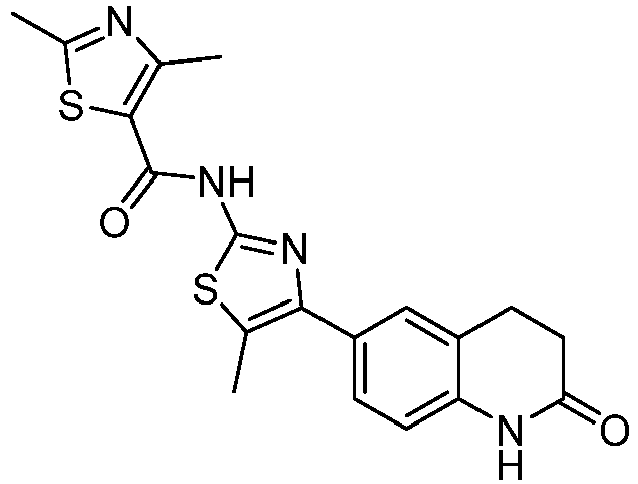
- To a suspension of 6-(2-amino-5-methylthiazol-4-yl)-3,4-dihydroquinolin-2(1H)-one (0.100 g, 0.386 mmol) and 2,4-dimethylthiazole-5-carboxylic acid (0.067 g, 0.424 mmol), and pyridine (0.14 mL, 1.742 mmol) in acetonitrile (4 mL) in a sealed tube was added propylphosphonic anhydride solution (50 wt% in ethyl acetate, 0.80 mL, 1.352 mmol). The sealed tube was heated to 50°C for 6 days. After cooling, the mixture was quenched with water (3 mL) and the precitate was collected by filtration washing with cold 1:1 acetonitrile/water mixture. The residue was purified by precipitating in dichloromethane and filtration to give 2,4-dimethyl-N-(5-methyl-4-(2-oxo-1,2,3,4-tetrahydroquinolin-6-yl)thiazol-2-yl)thiazole-5-carboxamide (0.12 g, 78%) as an off-white solid. 1H NMR (400 MHz, DMSO-d): δ 12.38 (bs, 1H), 10.19 (s, 1H), 7.46 (s, 1H), 7.41 (dd, 1H, J = 8.4, 2.0 Hz), 6.92 (d, 1H, J = 8.4 Hz), 2.93 (t, 2H, J = 7.2 Hz), 2.65 (s, 3H), 2.61 (s, 3H), 2.49 (partial masked under d-DMSO, m, 2H), 2.43 (s, 3H). MS (ESI): Calcd. for C19H18N4O2S2: 398, found 399 (M+1)+
-

- To a suspension of 6-(2-amino-5-ethylthiazol-4-yl)-3,4-dihydroquinolin-2(1H)-one (0.100 g, 0.367 mmol) and 2,4-dimethylthiazole-5-carboxylic acid (0.063 g, 0.402 mmol), and pyridine (0.13 mL, 1.652 mmol) in acetonitrile (4 mL) in a sealed tube was added propylphosphonic anhydride solution (50 wt% in ethyl acetate, 0.76 mL, 1.282 mmol). The sealed tube was heated to 50°C for 6 days. After cooling, the mixture was quenched with water (3 mL) and the precitate was collected by filtration washing with cold 1:1 acetonitrile/water mixture. The residue was purified by precipitating in dichloromethane and filtration to give N-(5-ethyl-4-(2-oxo-1,2,3,4-tetrahydroquinolin-6-yl)thiazol-2-yl)-2,4-dimethylthiazole-5-carboxamide (0.11 g, 73%) as a beige solid. 1H NMR (400 MHz, DMSO-d): δ 12.22 (bs, 1H), 10.20 (s, 1H), 7.40 (s, 1H), 7.35 (dd, 1H, J = 8.4, 2.0 Hz), 6.92 (d, 1H, J = 8.4 Hz), 2.93 (t, 2H, J = 7.2 Hz), 2.86 (q, 2H, J = 7.6 Hz), 2.65 (s, 3H), 2.61 (s, 3H), 2.49 (partial masked under d-DMSO, m, 2H), 1.25 (t, 3H, J = 7.6 Hz). MS (ESI): Calcd. for C20H20N4O2S2: 412, found 413 (M+1)+
-

- To a solution of 6-(2-aminothiazol-4-yl)-3,4-dihydroquinolin-2(1H)-one (0.200 g, 0.815 mmol) and benzaldehyde (0.091 g, 0.856 mmol) in dry tetrahydrofuran (20 mL) with glacial acetic acid (1 mL) in a flamed dried flask. The mixture was stirred for 4 hours prior to addition of excess sodium borohydride (0.070 mg, 1.71 mmol). The mixture was then stirred and monitored by LCMS for completion. Then it was quenced with water and extracted with ethyl acetate (3 x 20 mL). The combined organic layers were washed once with sat. NaHCO3, dried over anhydrous Na2SO4 and concentrated in vacuo. The residue was purified by flash chromatography over silica gel using 95:5 dichloromethane/methanol to give 6-(2-(benzylamino)thiazol-4-yl)-3,4-dihydroquinolin-2(1H)-one (0.099 g, 36%) as a light yellow solid. 1H NMR (400 MHz, DMSO-d): δ 10.10 (s, 1H), 8.12 (t, 1H, J = 5.6 Hz), 7.62 (s, 1H), 7.58 (dd, 1H, J = 8.4, 1.6 Hz), 7.42-7.30 (m, 4H), 7.25 (t, 1H, J = 6.8 Hz), 6.88 (s, 1H), 6.82 (d, 1H, J = 8.0 Hz), 4.49 (d, 2H, J = 5.6 Hz), 2.89 (t, 2H, J = 7.8 Hz), 2.45 (t, 2H, J = 7.2 Hz). MS (ESI): Calcd. for C19H17N3OS: 335, found 336 (M+1)+
-

- To a suspension of 6-(2-aminothiazol-4-yl)-3,4-dihydroquinolin-2(1H)-one (0.100 g, 0.408 mmol) and benzoic acid (0.055 g, 0.448 mmol), and pyridine (0.15 mL, 1.832 mmol) in acetonitrile (4 mL) in a sealed tube was added propylphosphonic anhydride solution (50 wt% in ethyl acetate, 0.85 mL, 1.432 mmol). The sealed tube was heated to 50°C for 4 days and the precipitation formed. After cooling, the precipitate was collected by filtration and washed with cold 1:1 acetonitrile/water to give N-(4-(2-oxo-1,2,3,4-tetrahydroquinolin-6-yl)thiazol-2-yl)benzamide (0.116 g, 82%) as a beige solid. 1H NMR (400 MHz, DMSO-d): δ 12.73 (s, 1H), 10.19 (s, 1H), 8.12 (d, 2H, J = 6.8 Hz), 7.77 (s, 1H), 7.72 (dd, 1H, J = 8.4, 1.6 Hz), 7.65 (t, 1H, J = 7.2 Hz), 7.55 (m, 3H), 6.90 (d, 1H, J = 8.4 Hz), 2.94 (m, 2H), 2.49 (partial masked under d-DMSO, m, 2H). MS (ESI): Calcd. for C19H15N3O2S: 349, found 350 (M+1)+
-

- To a suspension of 6-(2-aminothiazol-4-yl)-3,4-dihydroquinolin-2(1H)-one (0.100 g, 0.408 mmol) and pyrimidine-2-carboxylic acid (0.056 g, 0.448 mmol), and pyridine (0.15 mL, 1.832 mmol) in acetonitrile (4 mL) was added propylphosphonic anhydride solution (50 wt% in ethyl acetate, 0.85 mL, 1.432 mmol). The sealed tube was heated to 50°C for 4 days and precipitation formed. After cooling, the precipitate was collected by filtration and washed with cold 1:1 acetonitrile/water to give N-(4-(2-oxo-1,2,3,4-tetrahydroquinolin-6-yl)thiazol-2-yl)pyrimidine-2-carboxamide (0.132 g, 93%) as a greenish-brown solid. 1H NMR (400 MHz, DMSO-d): δ 12.39 (s, 1H), 10.19 (s, 1H), 9.06 (d, 2H, J = 5.6 Hz), 7.78 (m, 2H), 7.72 (dd, 1H, J = 8.8, 2.0 Hz), 7.61 9s, 1H), 6.90 (d, 1H, J = 8.4 Hz), 2.93 (m, 2H), 2.49 (partial masked under d-DMSO, m, 2H). MS (ESI): Calcd. for C17H13N5O2S: 351, found 352 (M+1)+
-

- To a suspension of 6-(2-aminothiazol-4-yl)-3,4-dihydroquinolin-2(1H)-one (0.100 g, 0.408 mmol) and 4-methylthiazole-5-carboxylic acid (0.064 g, 0.448 mmol), and pyridine (0.15 mL, 1.832 mmol) in acetonitrile (4 mL) in a sealed tube was added propylphosphonic anhydride solution (50 wt% in ethyl acetate, 0.85 mL, 1.432 mmol). The sealed tube was heated to 50°C for 4 days and the precipitation formed. After cooling, the precipitate was collected by filtration and washed with cold 1:1 acetonitrile/water to give 4-methyl-N-(4-(2-oxo-1,2,3,4-tetrahydroquinolin-6-yl)thiazol-2-yl)thiazole-5-carboxamide (0.134 g, 89%) as a biege solid. 1H NMR (400 MHz, DMSO-d): δ 12.71 (bs, 1H), 10.19 (s, 1H), 9.18 (s, 1H), 7.74 (s, 1H), 7.70 (dd, 1H, J = 8.0, 1.6 Hz), 7.52 (bs, 1H), 6.89 (d, 1H, J = 8.4 Hz), 2.93 (m, 2H), 2.68 (s, 3H), 2.49 (partial masked under d-DMSO, m, 2H). MS (ESI): Calcd. for C17H14N4O2S2: 370, found 371 (M+1)+
-

- To a suspension of 6-(2-aminothiazol-4-yl)-3,4-dihydroquinolin-2(1H)-one (0.100 g, 0.408 mmol) and 4,5-dimethylthiazole-2-carboxylic (0.071 g, 0.448 mmol), and pyridine (0.15 mL, 1.832 mmol) in acetonitrile (4 mL) in a sealed was added propylphosphonic anhydride solution (50 wt% in ethyl acetate, 0.85 mL, 1.432 mmol). The sealed tube was heated to 50°C for 4 days and the precipitation formed. After cooling, the precipitate was collected by filtration and washed with cold 1:1 acetonitrile/water to give 4,5-dimethyl-N-(4-(2-oxo-1,2,3,4-tetrahydroquinolin-6-yl)thiazol-2-yl)thiazole-2-carboxamide (0.062 g, 40%) as a biege solid. 4,5-dimethyl-N-(4-(2-oxo-1,2,3,4-tetrahydroquinolin-6-yl)thiazol-2-yl)thiazole-2-carboxamide existed as a tautomers in HPLC and 1H NMR (400 MHz, DMSO-d): δ 12.39 (bs, 0.5 H), 10.95 (bs, 0.5 H), 10.18 (s, 1H), 7.78-7.65 (m, 2H), 7.57 (s, 0.5 H), 7.47 (s, 0.5 H), 6.89 (d, 1H, J = 8.4 Hz), 2.93 (m, 2H), 2.49 (partial masked under d-DMSO, m, 2H). MS (ESI): Calcd. for C18H16N4O2S2: 384, found 385 (M+1)+
-
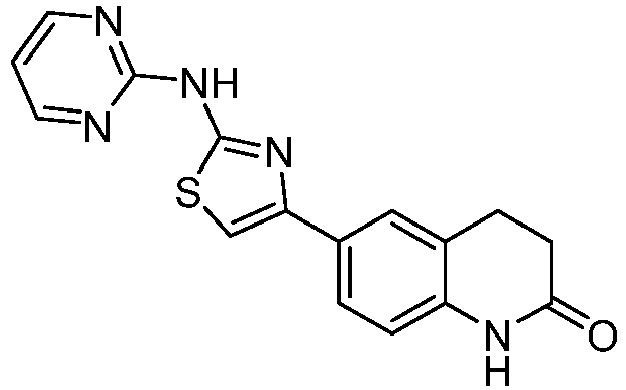
- To a suspension of 6-(2-aminothiazol-4-yl)-3,4-dihydroquinolin-2(1H)-one (0.100 g, 0.408 mmol), 2-chloropyrimidine (0.047 g, 0.408 mmol), 4,5-bis(diphenylphosphino)-9,9-dimethyl-xanthene (0.045 g, 0.077 mmol), and potasium carbonate (0.197g, 1.432 mmol) in anhydrous dioxane (4 mL) bubbling with argon in a sealed tube was added palladium(II) acetate (0.017 g, 0.073 mmol). The solution mixture was under continuous argon bubbling for additional 10 min. The sealed tube was then heated at 80°C overnight (15 h). After cooling, the precipitate was collected by filtration and washed with cold tetrahydrofuran followed by water to give 6-(2-(pyrimidin-2-ylamino)thiazol-4-yl)-3,4-dihydroquinolin-2(1H)-one (0.126 g, 95%) as a brown solid. 1H NMR (400 MHz, DMSO-d): δ DMSO-d): δ 11.61 (bs, 1H), 10.15 (s, 1H), 8.57 (d, 2H, J = 4.8 Hz), 7.72 (s, 1H), 7.68 (dd, 1H, J = 8.4, 1.6 Hz), 7.27 (s, 1H), 6.9 (t, 1H, J = 4.8 Hz), 6.87 (d, 1H, J = 8.4 Hz), 2.92 (m, 2H), 2.49 (partial masked under d-DMSO, m, 2H). MS (ESI): Calcd. for C16H13N5OS: 323, found 324 (M)+
-

- To a suspension of 6-(2-aminooxazol-4-yl)-3,4-dihydroquinolin-2(1H)-one (0.040 g, 0.175 mmol) and 2,4-dimethylthiazole-5-carboxylic acid (0.030 g, 0.192 mmol), and pyridine (0.06 mL, 0.785 mmol) in acetonitrile (2 mL) in a sealed tube was added propylphosphonic anhydride solution (50 wt% in ethyl acetate, 0.36 mL, 0.612 mmol). The sealed tube was heated to 50°C for 5 days and the precipitation formed. After cooling, the mixture was quenched with water (10 mL) and extracted with 8:2 dichloromethane/isopropanol (2 x 25 mL) followed by washing once with sat. NaHCO3 (100 mL). The combined organic layers were dried over anhydrous Na2SO4 and concentrated in vacuo. The residue was purified by pre-TLC with 95:5 dichloromethane/methanol mixture to give 2,4-dimethyl-N-(4-(2-oxo-1,2,3,4-tetrahydroquinolin-6-yl)oxazol-2-yl)thiazole-5-carboxamide (0.056 g, 87%) as a light brown solid. 1H NMR (400 MHz, DMSO-d): δ 10.15 (s, 1H), 8.26 (s, 1H), 7.52 (s, 1H), 7.48 (dd, 1H, J = 8.0, 1.6 Hz), 6.98 (s, 1H), 6.85 (d, 1H, J = 8.0 Hz), 2.88 (m, 2H), 2.62 (s, 3H), 2.53 (s, 3H), 2.44 (partial masked under d-DMSO, m, 2H). MS (ESI): Calcd. for C18H16N4O3S: 368, found 369 (M+1)+
-

- To a solution of 6-(2-aminothiazol-4-yl)-3,4-dihydroquinolin-2(1H)-one (0.100 g, 0.408 mmol) and 2,4-dimethylthiazole-5-carboxyaldehyde (0.063 g, 0.448 mmol) in dry dichloromethane (8 mL) with glacial acetic acid (1 mL) in a flamed dried flask. The mixture was stirred for 20 hours prior to addition of excess sodium borohydride (0.070 mg, 1.71 mmol). The reaction mixture was stirred and monitored by LCMS for completion. When completed, the mixture was quenced with water and extracted with ethyl acetate (3 x 20 mL). The combined organic layers were washed once with sat. NaHCO3, dried over anhydrous Na2SO4 and concentrated in vacuo. The residue was purified by flash chromatography over silica gel using 95:5 dichloromethane/methanol to give 6-(2-(((2,4-dimethylthiazol-5-yl)methyl)amino)thiazol-4-yl)-3,4-dihydroquinolin-2(1H)-one (0.029 g, 19%) as a yellow solid. 1H NMR (400 MHz, DMSO-d): δ 10.12 (s, 1H), 8.08 (t, 1H, J = 5.6 Hz), 7.65 (s, 1H), 7.61 (dd, 1H, J = 8.0, 1.6 Hz), 6.92 (s, 1H), 6.84 (d, 1H, J = 8.0 Hz), 4.55 (d, 2H, J = 5.6 Hz), 2.90 (t, 2H, J = 7.8 Hz), 2.52 (s, 3H), 2.45 (partial masked under d-DMSO, m, 2H), 2.35 (s, 3H). MS (ESI): Calcd. for C18H18N4OS2: 370, found 371 (M+1)+
-

- To a suspension of 6-(2-aminothiazol-4-yl)-3,4-dihydroquinolin-2(1H)-one (0.100 g, 0.408 mmol) and o-toluic acid (0.061 g, 0.448 mmol), and pyridine (0.15 mL, 1.832 mmol) in acetonitrile (4 mL) in a sealed tube was added propylphosphonic anhydride solution (50 wt% in ethyl acetate, 0.85 mL, 1.432 mmol). The sealed tube was heated to 50°C for 14 days and the precipitation formed. After cooling, the precipitate was collected by filtration and washed with cold 1:1 acetonitrile/water to give 2-methyl-N-(4-(2-oxo-1,2,3,4-tetrahydroquinolin-6-yl)thiazol-2-yl)benzamide (0.099 g, 67%) as a beige solid. 1H NMR (400 MHz, DMSO-d): δ 12.61 (s, 1H), 10.18 (s, 1H), 7.74 (bs, 1H), 7.69 (dd, 1H, J= 8.4, 2.0 Hz), 7.57 (dd, 1H, J = 7.6, 1.6 Hz), 7.53 (s, 1H), 7.43 (ddd, 1H, J = 7.6, 7.6, 1.6 Hz), 7.31 9m, 2H), 6.89 (d, 1H, J = 8.0 Hz), 2.93 (m, 2H), 2.49 (partial masked under d-DMSO, m, 5H), 2.42 (s, 3H). MS (ESI): Calcd. for C20H17N3O2S: 363, found 364 (M+1)+
-

- To a suspension of 6-(2-aminothiazol-4-yl)-3,4-dihydroquinolin-2(1H)-one (0.100 g, 0.408 mmol) and 2,5-dimethylbenzoic acid (0.067 g, 0.448 mmol), and pyridine (0.15 mL, 1.832 mmol) in acetonitrile (4 mL) in a sealed tube was added propylphosphonic anhydride solution (50 wt% in ethyl acetate, 0.85 mL, 1.432 mmol). The sealed tube was heated to 50°C for 14 days and the precipitation formed. After cooling, the precipitate was collected by filtration and washed with cold 1:1 acetonitrile/water to give 2,5-dimethyl-N-(4-(2-oxo-1,2,3,4-tetrahydroquinolin-6-yl)thiazol-2-yl)benzamide (0.096 g, 62%) as a beige solid. 1H NMR (400 MHz, DMSO-d): δ 12.53 (s, 1H), 10.18 (s, 1H), 7.74 (bs, 1H), 7.69 (dd, 1H, J = 8.4, 2.0 Hz), 7.52 (s, 1H), 7.42 (bs, 1H), 7.25-7.18 (m, 2H), 6.89 (d, 1H, J = 8.0 Hz), 2.93 (m, 2H), 2.49 (partial masked under d-DMSO, m, 2H), 2.37 (s, 3H), 2.32 (s, 3H). MS (ESI): Calcd. for C21H19N3O2S: 377, found 378 (M+1)+
-

- To a suspension of 6-(2-aminothiazol-4-yl)-3,4-dihydroquinolin-2(1H)-one (0.100 g, 0.408 mmol) and 2-(methoxylmethyl)-4-methyl-1,3-thiazole-5-carboxylic acid (0.084 g, 0.448 mmol), and pyridine (0.15 mL, 1.832 mmol) in acetonitrile (4 mL) in a sealed tube was added propylphosphonic anhydride solution (50 wt% in ethyl acetate, 0.85 mL, 1.432 mmol). The sealed tube was heated to 50°C for 7 days and the precipitation formed. After cooling, the precipitate was collected by filtration and washed with cold 1:1 acetonitrile/water to give 2-(methoxymethyl)-4-methyl-N-(4-(2-oxo-1,2,3,4-tetrahydroquinolin-6-yl)thiazol-2-yl)thiazole-5-carboxamide (0.98 g, 58%) as a light brown solid. 1H NMR (400 MHz, DMSO-d): δ 12.65 (bs, 1H), 10.19 (s, 1H), 9.18 (s, 1H), 7.74 (s, 1H), 7.69 (dd, 1H, J = 8.0, 1.6 Hz), 7.52 (bs, 1H), 6.89 (d, 1H, J = 8.4 Hz), 4.72 (s, 2H), 3.45 (s, 3H), 2.93 (m, 2H), 2.64 (s, 3H), 2.49 (partial masked under d-DMSO, m, 2H). MS (ESI): Calcd. for C19H18N4O3S2: 414, found 415 (M+1)+
-

- To a suspension of 6-(2-aminothiazol-4-yl)-3,4-dihydroquinolin-2(1H)-one (0.100 g, 0.408 mmol) and 2-(cyclopropyl)-4-methyl-1,3-thiazole-5-carboxylic acid (0.082 g, 0.448 mmol), and pyridine (0.15 mL, 1.832 mmol) in acetonitrile (4 mL) in a sealed tube was added propylphosphonic anhydride solution (50 wt% in ethyl acetate, 0.85 mL, 1.432 mmol). The sealed tube was heated to 50°C for 7 days. The reaction mixture was quenced with water and extracted with ethyl acetate (3 x 20 mL). The combined organic layers were washed once with sat. NaHCO3, dried over anhydrous Na2SO4 and concentrated in vacuo. The residue was purified by flash chromatography over silica gel using 95:5 dichloromethane/methanol to give 2-cyclopropyl-4-methyl-N-(4-(2-oxo-1,2,3,4-tetrahydroquinolin-6-yl)thiazol-2-yl)thiazole-5-carboxamide (0.078 g, 46%) as an orange solid. 1H NMR (400 MHz, DMSO-d): δ 12.50 (bs, 1H), 10.19 (s, 1H), 7.74 (s, 1H), 7.69 (dd, 1H, J = 8.4, 1.6 Hz), 7.50 (bs, 1H), 6.89 (d, 1H, J = 8.4 Hz), 2.93 (m, 2H), 2.58 (s, 3H), 2.49 (partial masked under d-DMSO, m, 2H), 2.44 (m, 1H), 1.18 (m, 2H), 1.03 (m, 2H). MS (ESI): Calcd. for C20H18N4O2S2: 410, found 411 (M+1)+
-

- To a suspension of 6-(2-aminothiazol-4-yl)-3,4-dihydroquinolin-2(1H)-one (0.100 g, 0.408 mmol) and 4-methyl-2-phenyl-1,3-thiazole-5-carboxylic acid (0.098 g, 0.448 mmol), and pyridine (0.15 mL, 1.832 mmol) in acetonitrile (4 mL) in a sealed tube was added propylphosphonic anhydride solution (50 wt% in ethyl acetate, 0.85 mL, 1.432 mmol). The sealed tube was heated to 48.5°C for 4 days and the precipitation formed. After cooling, the the precipitate was collected by filtration and washed with with cold 1:1 acetonitrile/water to give 4-methyl-N-(4-(2-oxo-1,2,3,4-tetrahydroquinolin-6-yl)thiazol-2-yl)-2-phenylthiazole-5-carboxamide (0.151 g, 83%) as a beige solid. 1H NMR (400 MHz, DMSO-d): δ 12.74 (bs, 1H), 10.20 (s, 1H), 7.98 (m, 2H), 7.75 (bs, 1H), 7.70 (dd, 1H, J = 8.0, 1.6 Hz), 7.59-7.48 (m, 4H), 6.90 (d, 1H, J = 8.4 Hz), 2.94 (m, 2H), 2.73 (s, 3H), 2.50 (masked under d-DMSO, m, 2H). MS (ESI): Calcd. for C23H18N4O2S2: 446, found 447 (M+1)+
-

-

- To a solution of 2,4-dimethyl-N-(4-(2-oxo-1,2,3,4-tetrahydroquinolin-6-yl)thiazol-2-yl)thiazole-5-carboxamide (0.100 g, 0.260 mmol) and benzylbromide (0.058 g, 0.338 mmol) in anhydrous dimethylformamide (4 mL) in a flamed dried flask under argon atmosphere at 0°C was added added sodium hydride (60% in mineral oil, 0.015 g, 0.364 mmol) was added in one portion. The reaction was stirred for 15 min at 0°C prior warm to room temperature. The mixture was stirred overnight. After consumption of starting material, the reaction mixture was quenched with sat. ammonium chloride (25 mL) and extracted with ethyl acetate (2 x 25 mL). The combined organics were washed once with sat. sodium bicarbonate (50 mL) and dried over anhydrous sodium sulfate. The concentrated residue was purified by flash chromatography over silica gel using 95:5 dichloromethane/methanol to give products N-(4-(1-benzyl-2-oxo-1,2,3,4-tetrahydroquinolin-6-yl)thiazol-2-yl)-2,4-dimethylthiazole-5-carboxamide (0.021 g, 17%) and N-benzyl-N-(4-(1-benzyl-2-oxo-1,2,3,4-tetrahydroquinolin-6-yl)thiazol-2-yl)-2,4-dimethylthiazole-5-carboxamide (0.027 g, 19%) both as yellow solids.
- 43: 1H NMR (400 MHz, DMSO-d) of N-(4-(1-benzyl-2-oxo-1,2,3,4-tetrahydroquinolin-6-yl)thiazol-2-yl)-2,4-dimethylthiazole-5-carboxamide: δ 12.59 (bs, 1H), 7.79 (d, 1H, J= 2.0 Hz), 7.65 (dd, 1H, J= 8.4, 2.0 Hz), 7.53 (bs, 1H), 7.31 (m, 2H), 7.23 (m, 2H), 7.21 (m, 1H), 6.97 (d, 1H, J = 8.4 Hz), 5.18 (s, 2H), 3.01 (m, 2H), 2.75 (m, 2H), 2.66 (s, 3H), 2.60 (s, 3H). MS (ESI): Calcd. for C25H22N4O2S2: 474, found 475 (M+1)+
- 44: 1H NMR (400 MHz, DMSO-d) of N-benzyl-N-(4-(1-benzyl-2-oxo-1,2,3,4-tetrahydroquinolin-6-yl)thiazol-2-yl)-2,4-dimethylthiazole-5-carboxamide: δ 7.32 (m, 2H), 7.25-7.17 (m, 7 H), 7.14 (dd, 1H, J = 8.4, 2.0 Hz), 7.02 (s, 1H), 6.87 (m, 2H), 5.35 (s, 2H), 5.18 (s, 2H), 2.90 (m, 2H), 2.72 (m, 2H), 2.59 (s, 3H), 2.56 (s, 3H). MS (ESI): Calcd. for C32H28N4O2S2: 564, found 565 (M+1)+
-

- To a suspension of 6-(2-aminothiazol-4-yl)-3,4-dihydroquinolin-2(1H)-one (0.100 g, 0.408 mmol) and 2-ethyl-4-methyl-1,3-thiazole-5-carboxylic acid (0.077 g, 0.448 mmol), and pyridine (0.15 mL, 1.832 mmol) in acetonitrile (4 mL) in a sealed tube was added propylphosphonic anhydride solution (50 wt% in ethyl acetate, 0.85 mL, 1.432 mmol). The sealed tube was heated to 50°C for 5 days and the precipitation formed. After cooling, the precipitate was collected by filtration and washed with cold 1:1 acetonitrile/water to give 2-ethyl-4-methyl-N-(4-(2-oxo-1,2,3,4-tetrahydroquinolin-6-yl)thiazol-2-yl)thiazole-5-carboxamide (0.094 g, 58%) as a beige solid. 1H NMR (400 MHz, DMSO-d): δ 12.56 (bs, 1H), 10.19 (s, 1H), 7.74 (s, 1H), 7.69 (dd, 1H, J = 8.4, 1.6 Hz), 7.51 (bs, 1H), 6.89 (d, 1H, J = 8.4 Hz), 2.99 (q, 2H, J = 7.6 Hz), 2.93 (m, 2H), 2.62 (s, 3H), 2.49 (partial masked under d-DMSO, m, 2H), 1.32 (t, 3H, J = 7.6 Hz). MS (ESI): Calcd. for C19H18N4O2S2: 398, found 399 (M+1)+
-

- To a suspension of 6-(2-aminothiazol-4-yl)-3,4-dihydroquinolin-2(1H)-one (0.100 g, 0.408 mmol) and 4-methyl-2-(oxolan-3-yl)-1,3-thiazole-5-carboxylic acid (0.096 g, 0.448 mmol), and pyridine (0.15 mL, 1.832 mmol) in acetonitrile (4 mL) in a sealed tube was added propylphosphonic anhydride solution (50 wt% in ethyl acetate, 0.85 mL, 1.432 mmol). The sealed tube was heated to 50°C for 5 days and the precipitation formed. After cooling, the precipitate was collected by filtration and washed with cold 1:1 acetonitrile/water to give 4-methyl-N-(4-(2-oxo-1,2,3,4-tetrahydroquinolin-6-yl)thiazol-2-yl)-2-(tetrahydrofuran-3-yl)thiazole-5-carboxamide (0.114 g, 63%) as a light brown solid. 1H NMR (400 MHz, DMSO-d): δ 12.60 (bs, 1H), 10.19 (s, 1H), 7.74 (s, 1H), 7.69 (dd, 1H, J = 8.4, 1.6 Hz), 7.51 (bs, 1H), 6.89 (d, 1H, J = 8.4 Hz), 4.06 (dd, 1H, J = 8.0, 7.2 Hz), 3.92 (m, 1H), 3.86 (m, 1H), 3.81 (m, 1H), 2.93 (m, 2H), 2.63 (s, 3H), 2.49 (partial masked under d-DMSO, m, 2H), 2.40 (m, 1H), 2.12 (m, 1H). MS (ESI): Calcd. for C21H20N4O2S2: 440, found 441 (M+1)+
-

- To a suspension of 6-(2-aminothiazol-4-yl)-3,4-dihydroquinolin-2(1H)-one (0.100 g, 0.408 mmol) and 4-methyl-2-(pyridin-2-ylmethy)-1,3-thiazole-5-carboxylic acid (0.105 g, 0.448 mmol), and pyridine (0.15 mL, 1.832 mmol) in acetonitrile (4 mL) in a sealed tube was added propylphosphonic anhydride solution (50 wt% in ethyl acetate, 0.85 mL, 1.432 mmol). The sealed tube was heated to 50°C for 5 days. The reaction mixture was quenced with water and extracted with ethyl acetate (3 x 20 mL). The combined organic layers were washed once with sat. NaHCO3, dried over anhydrous Na2SO4 and concentrated in vacuo. The residue was purified by flash chromatography over silica gel using 95:5 dichloromethane/methanol to give 4-methyl-N-(4-(2-oxo-1,2,3,4-tetrahydroquinolin-6-yl)thiazol-2-yl)-2-(pyridin-2-ylmethyl)thiazole-5-carboxamide (0.096 g, 51%) as an orangy-brown solid. 1H NMR (400 MHz, DMSO-d): δ 12.57 (bs, 1H), 10.19 (s, 1H), 8.57 (dd, 1H, J = 4.8, 0.8 Hz), 7.81 (ddd, 1H, J = 8.0, 8.0, 2.0 Hz), 7.73 (s, 1H), 7.68 (dd, 1H, J = 8.4, 1.6 Hz), 7.50 (bs, 1H), 7.47 (d, 1H, J = 8.0 Hz), 7.33 (ddd, 1H, J = 7.6, 4.8, 1.6 Hz), 6.88 (d, 1H, J = 8.4 Hz), 4.50 (s, 2H), 2.92 (m, 2H), 2.61 (s, 3H), 2.48 (partial masked under d-DMSO, m, 2H). MS (ESI): Calcd. for C23H19N5O2S2: 461, found 462 (M+1)+
-
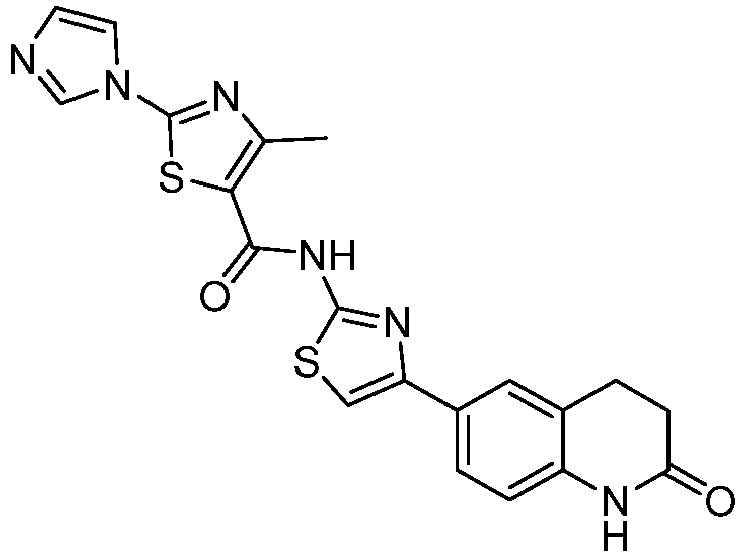
- To a suspension of 6-(2-aminothiazol-4-yl)-3,4-dihydroquinolin-2(1H)-one (0.100 g, 0.408 mmol) and 2-(1H-imidazol-1-yl)-4-methythiazole-5-carboxylic acid (0.938 g, 0.448 mmol), and pyridine (0.15 mL, 1.832 mmol) in acetonitrile (4 mL) in a sealed tube was added propylphosphonic anhydride solution (50 wt% in ethyl acetate, 0.85 mL, 1.432 mmol). The sealed tube was heated to 50°C for 5 days and the precipitation formed. After cooling, the precipitate was collected by filtration and washed with cold 1:1 acetonitrile/water to give 2-(1H-imidazol-1-yl)-4-methyl-N-(4-(2-oxo-1,2,3,4-tetrahydroquinolin-6-yl)thiazol-2-yl)thiazole-5-carboxamide (0.140 g, 79%) as a yellowish-brown solid. 1H NMR (400 MHz, DMSO-d): δ 12.81 (bs, 1H), 10.21 (s, 1H), 8.48 (s, 1H), 7.87 (s, 1H), 7.74 (s, 1H), 7.68 (dd, 1H, J = 8.4, 1.6 Hz), 7.48 (bs, 1H), 7.21 (s, 1H), 6.90 (d, 1H, J = 8.4 Hz), 2.93 (m, 2H), 2.49 (partial masked under d-DMSO, m, 2H). MS (ESI): Calcd. for C20H16N6O2S2: 436, found 437 (M+1)+
-

- To a suspension of 6-(2-aminothiazol-4-yl)-3,4-dihydroquinolin-2(1H)-one (0.100 g, 0.408 mmol) and 4-methyl-2-morpholinothiazole-5-carboxylic acid (0.102 g, 0.448 mmol), and pyridine (0.15 mL, 1.832 mmol) in acetonitrile (4 mL) in a sealed tube was added propylphosphonic anhydride solution (50 wt% in ethyl acetate, 0.85 mL, 1.432 mmol). The sealed tube was heated to 50°C for 5 days. The reaction mixture was quenced with sat. NaHCO3 and extracted with ethyl acetate (3 x 20 mL). The combined organic layers were washed once with sat. NaHCO3, dried over anhydrous Na2SO4 and concentrated in vacuo. The residue was purified by flash chromatography over silica gel using 95:5 dichloromethane/methanol to give 4-methyl-2-morpholino-N-(4-(2-oxo-1,2,3,4-tetrahydroquinolin-6-yl)thiazol-2-yl)thiazole-5-carboxamide (0.046 g, 25%) as a yellow solid. 1H NMR (400 MHz, DMSO-d): δ 12.03 (bs, 1H), 10.18 (s, 1H), 7.73 (s, 1H), 7.68 (dd, 1H, J = 8.4, 1.6 Hz), 7.45 (bs, 1H), 6.88 (d, 1H, J = 8.4 Hz), 3.72 (m, 4H), 2.47 (m, 4H), 2.48 (partial masked under d-DMSO, m, 2H). MS (ESI): Calcd. for C21H21N5O3S2: 455, found 456 (M+1)+
-

- To a suspension of 6-(2-aminothiazol-4-yl)-3,4-dihydroquinolin-2(1H)-one (0.100 g, 0.408 mmol) and 2-(2-methoxyethoxyl)-4-methylthiazole-5-carboxylic acid (0.97 g, 0.448 mmol), and pyridine (0.15 mL, 1.832 mmol) in acetonitrile (4 mL) in a sealed tube was added propylphosphonic anhydride solution (50 wt% in ethyl acetate, 0.85 mL, 1.432 mmol). The sealed tube was heated to 50°C for 5 days. The reaction mixture was quenced with sat. NaHCO3 and extracted with 8:2 dichloromethane/isopropanol mixture (3 x 20 mL). The combined organic layers were washed once with sat. NaHCO3, dried over anhydrous Na2SO4 and concentrated in vacuo. The residue was purified by flash chromatography over silica gel using 95:5 dichloromethane/methanol to give 2-(2-methoxyethoxy)-4-methyl-N-(4-(2-oxo-1,2,3,4-tetrahydroquinolin-6-yl)thiazol-2-yl)thiazole-5-carboxamide (0.102 g, 57%) as a white solid. 1H NMR (400 MHz, DMSO-d): δ 12.41 (bs, 1H), 10.19 (s, 1H), 7.73 (s, 1H), 7.68 (dd, 1H, J = 8.4, 1.6 Hz), 7.48 (bs, 1H), 6.88 (d, 1H, J = 8.4 Hz), 4.54 (m, 2H), 3.69 (m, 2H), 3.31 (s, 3H), 2.93 (m, 2H), 2.55 (s, 3H), 2.48 (partial masked under d-DMSO, m, 2H). MS (ESI): Calcd. for C20H20N4O4S2: 444, found 445 (M+1)+
-

- To a suspension of 6-(2-aminothiazol-4-yl)-3,4-dihydroquinolin-2(1H)-one (0.200 g, 0.816 mmol) and 4-methyl-2-({[(tert-butoxyl)carbonyl]amino}-methyl)-1,3-thiazole-5-carboxylic acid (0.233 g, 0.856 mmol), and pyridine (0.30 mL, 3.670 mmol) in acetonitrile (8 mL) in a sealed tube was added propylphosphonic anhydride solution (50 wt% in ethyl acetate, 1.70 mL, 2.851 mmol). The sealed tube was heated to 50°C for 5 days. The reaction mixture was quenced with sat. NaHCO3 and extracted with 8:2 dichloromethane/isopropanol mixture (3 x 20 mL). The combined organic layers were washed once with sat. NaHCO3, dried over anhydrous Na2SO4 and concentrated in vacuo. The residue was purified by flash chromatography over silica gel using 95:5 dichloromethane/methanol to give tert-butyl ((4-methyl-5-((4-(2-oxo-1,2,3,4-tetrahydroquinolin-6-yl)thiazol-2-yl)carbamoyl)thiazol-2-yl)methyl)carbamate (0.291 g, 72%) as a yellow solid. 1H NMR (400 MHz, DMSO-d): δ 12.61 (bs, 1H), 10.19 (s, 1H), 7.85 (m, 1H), 7.74 (s, 1H), 7.69 (dd, 1H, J = 8.0, 1.6 Hz), 7.51 (bs, 1H), 6.89 (d, 1H, J = 8.0 Hz), 4.38 (d, 2H, J = 6.0 Hz), 2.93 (m, 2H), 2.62 (s, 3H), 2.49 (partial masked under d-DMSO, m, 2H), 1.43 (s, 9H). MS (ESI): Calcd. for C23H25N5O4S2: 499, found 500 (M+1)+
-

- To a suspension of 6-(2-amino-5-chlorothiazol-4-yl)-3,4-dihydroquinolin-2(1H)-one hydrochloride (0.200 g, 0.633 mmol) and 2,4-dimethyl-1,3-thiazole-5-carboxylic acid (0.109 g, 0.696 mmol), and pyridine (0.28 mL, 3.481 mmol) in acetonitrile (8 mL) in a sealed tube was added propylphosphonic anhydride solution (50 wt% in ethyl acetate, 1.32 mL, 2.211 mmol). The sealed tube was heated to 50°C for 5 days and the precipitation formed. After cooling, the precipitate was collected by filtration and washed with cold 1:1 acetonitrile/water to give N-(5-chloro-4-(2-oxo-1,2,3,4-tetrahydroquinolin-6-yl)thiazol-2-yl)-2,4-dimethylthiazole-5-carboxamide (0.098 g, 33%) as a reddish pink solid. 1H NMR (400 MHz, DMSO-d): δ 12.86 (bs, 1H), 10.26 (s, 1H), 7.72 (s, 1H), 7.69 (dd, 1H, J = 8.4, 1.6 Hz), 6.94 (d, 1H, J = 8.4 Hz), 2.94 (m, 2H), 2.68 (s, 3H), 2.61 (s, 3H), 2.49 (partial masked under d-DMSO, m, 2H). MS (ESI): Calcd. for C18H15ClN4O2S2: 418, found 419 (M+1)+
-

- To a suspension of 6-(2-amino-thiazol-4-yl)-3,4-dihydroquinolin-2(1H)-one hydrochloride (0.100 g, 0.408 mmol) and 2-cyclopropyl-4-methyl-1,3-oxazole-5-carboxylic acid (0.072 g, 0.428 mmol), and pyridine (0.15 mL, 1.831mmol) in acetonitrile (4 mL) in a sealed was added propylphosphonic anhydride solution (50 wt% in ethyl acetate, 0.85 mL, 1.431 mmol). The sealed tube was heated to 50°C for 5 days and the precipitation formed. After cooling, the precipitate was collected by filtration and washed with cold 1:1 acetonitrile/water to give 2-cyclopropyl-4-methyl-N-(4-(2-oxo-1,2,3,4-tetrahydroquinolin-6-yl)thiazol-2-yl)oxazole-5-carboxamide (0.143 g, 89%) as a beige solid. 1H NMR (400 MHz, DMSO-d): δ 12.52 (bs, 1H), 10.19 (s, 1H), 7.75 (s, 1H), 7.71 (dd, 1H, J= 8.4, 1.6 Hz), 7.52 (s, 1H), 6.89 (d, 1H, J = 8.4 Hz), 2.93 (m, 2H), 2.49 (partial masked under d-DMSO, m, 2H), 2.39 (s, 3H), 2.14 (m, 1H), 1.25 (m, 2H), 1.12 (m, 2H). MS (ESI): Calcd. for C20H18N4O3S: 394, found 395 (M+1)+
-

- To a suspension of 6-(2-amino-thiazol-4-yl)-3,4-dihydroquinolin-2(1H)-one hydrochloride (0.100 g, 0.408 mmol) and 4-methyl-2-(propan-2-yl)-1,3-thiazole-5-carboxylic acid (0.083 g, 0.448 mmol), and pyridine (0.15 mL, 1.831mmol) in acetonitrile (4 mL) in a sealed tube was added propylphosphonic anhydride solution (50 wt% in ethyl acetate, 0.85 mL, 1.431 mmol). The sealed tube was heated to 50°C for 5 days and the precipitation formed. After cooling, the precipitate was collected by filtration and washed with cold 1:1 acetonitrile/water to give 2-isopropyl-4-methyl-N-(4-(2-oxo-1,2,3,4-tetrahydroquinolin-6-yl)thiazol-2-yl)thiazole-5-carboxamide (0.104 g, 62%) as a beige solid. 1H NMR (400 MHz, DMSO-d): δ 12.56 (bs, 1H), 10.19 (s, 1H), 7.74 (s, 1H), 7.69 (dd, 1H, J = 8.4, 1.6 Hz), 7.51 (s, 1H), 6.89 (d, 1H, J = 8.4 Hz), 3.29 (m, 1H), 2.93 (m, 2H), 2.62 (s, 3H), 2.49 (partial masked under d-DMSO, m, 2H), 1.36 (s, 3H), 1.34 (s, 3H). MS (ESI): Calcd. for C20H20N4O2S2: 412, found 413 (M+1)+
-

- To a suspension of 6-(2-amino-thiazol-4-yl)-3,4-dihydroquinolin-2(1H)-one hydrochloride (0.100 g, 0.408 mmol) and 2-cyclopentyl-4-methyl-1,3-thiazole-5-carboxylic acid (0.095 g, 0.448 mmol), and pyridine (0.15 mL, 1.831mmol) in acetonitrile (4 mL) in a sealed tube was added propylphosphonic anhydride solution (50 wt% in ethyl acetate, 0.85 mL, 1.431 mmol). The sealed tube was heated to 50°C for 5 days and the precipitation formed. After cooling, the precipitate was collected by filtration and washed with cold 1:1 acetonitrile/water to give 2-cyclopentyl-4-methyl-N-(4-(2-oxo-1,2,3,4-tetrahydroquinolin-6-yl)thiazol-2-yl)thiazole-5-carboxamide (0.143g, 80%) as a beige solid. 1H NMR (400 MHz, DMSO-d): δ 12.53 (bs, 1H), 10.19 (s, 1H), 7.74 (s, 1H), 7.69 (dd, 1H, J = 8.4, 1.6 Hz), 7.50 (bs, 1H), 6.89 (d, 1H, J = 8.4 Hz), 3.44 (m, 1H), 2.93 (m, 2H), 2.62 (s, 3H), 2.49 (partial masked under d-DMSO, m, 2H), 2.12 (m, 2H), 1.77 (m, 4H), 1.67 (m, 2H). MS (ESI): Calcd. for C22H22N4O2S2: 438, found 439 (M+1)+
-

- To a suspension of 6-(2-amino-thiazol-4-yl)-3,4-dihydroquinolin-2(1H)-one hydrochloride (0.100 g, 0.408 mmol) and 2-cyclohexyl-4-methyl-1,3-thiazole-5-carboxylic acid (0.101 g, 0.448 mmol), and pyridine (0.15 mL, 1.831mmol) in acetonitrile (4 mL) the sealed tube was added propylphosphonic anhydride solution (50 wt% in ethyl acetate, 0.85 mL, 1.431 mmol). The sealed tube was heated to 50°C for 5 days and the precipitation formed. After cooling, the precipitate was collected by filtration and washed with cold 1:1 acetonitrile/water to give 2-cyclohexyl-4-methyl-N-(4-(2-oxo-1,2,3,4-tetrahydroquinolin-6-yl)thiazol-2-yl)thiazole-5-carboxamide (0.149 g, 81%) as a beige solid. 1H NMR (400 MHz, DMSO-d): δ 12.54 (bs, 1H), 10.19 (s, 1H), 7.74 (s, 1H), 7.69 (dd, 1H, J = 8.4, 1.6 Hz), 7.51 (bs, 1H), 6.89 (d, 1H, J = 8.4 Hz), 2.99 (m, 1H), 2.93 (m, 2H), 2.62 (s, 3H), 2.49 (partial masked under d-DMSO, m, 2H), 2.06 (m, 2H), 1.78 (m, 4H), 1.55-1.31 (m, 4H), 1.27 (m, 1H). MS (ESI): Calcd. for C23H24N4O2S2: 452, found 453 (M+1)+
-

- tert-Butyl ((4-methyl-5-((4-(2-oxo-1,2,3,4-tetrahydroquinolin-6-yl)thiazol-2-yl)carbamoyl)thiazol-2-yl)methyl)carbamate (0.100 g, 0.200 mmol) was suspended 6 mL of 4M hydrogen chloride solution in dioxane in sealed flask. The mixture was stirred for 6 hours at room temperature. The reaction mixture was concentrated in vacuo. The HCl salt was dissolved in minimum amount of methanol and quenched with sat. sodium bicarbonate. The mixture was extracted with 8:2 dichloromethane/isopropanol (6 x 10 mL). The combined organic layers were washed once with sat. NaHCO3, dried over anhydrous Na2SO4 and concentrated in vacuo. to give 2-(aminomethyl)-4-methyl-N-(4-(2-oxo-1,2,3,4-tetrahydroquinolin-6-yl)thiazol-2-yl)thiazole-5-carboxamide (0.060 g, 75%) as an orange solid. 1H NMR (400 MHz, DMSO-d): δ acylic NH (not observed), 10.18 (s, 1H), 7.85 (m, 1H), 7.74 (s, 1H), 7.69 (dd, 1H, J = 8.0, 1.6 Hz), 7.45 (s, 1H), 6.89 (d, 1H, J = 8.0 Hz), 4.03 (s, 2H), 2.93 (m, 2H), 2.62 (s, 3H), 2.49 (partial masked under d-DMSO, m, 2H), 1.23 (bs, 2H). MS (ESI): Calcd. for C18H17N5O2S2: 399, found 400 (M+1)+
- Activity of exemplary compounds according to the inventive subject matter was tested for wild type, K-ras G12D, and K-ras G12V following standard G-LISA protocol as further described below, and the IC50 (µM) results are shown in Table 1 while compound formulae are depicted in
Figures4A-4D .Table 1 Compound IC50 (µM) Wild-type IC50 (µM) G12D IC50 (µM) G12V 4556 > 25 µM 4562 0.5 µM 10 µM 38 µM 4639 > 25 µM 4662 > 25 µM 4663 7 µM 15 µM 32 µM 4664 > 25 µM 4665 > 25 µM 4666 > 25 µM 4683 12 µM 4684 > 25 µM 4685 > 25 µM 4686 11 µM 4687 19 µM 4734 > 25 µM 4735 > 25 µM 4747 > 25 µM 4748 21 µM 4749 > 25 µM 4800 > 25 µM 4801 > 25 µM 8.2 µM 10.7 µM 4802 > 25 µM 17 µM 4803 > 25 µM 4805 > 25 µM 4824 > 25 µM 4825 > 25 µM 4826 > 25 µM 4827 > 25 µM > 25 µM 4828 > 25 µM 4829 > 25 µM 4855 > 25 µM 4856 > 25 µM 4874 16 µM 4875 17 µM 4877 16 µM 6 µM 9 µM 4878 19 µM > 25 µM 4888 11.3 µM 6 µM 14.5 µM 4891 11.5 µM 5 µM 9.3 µM 4892 6.5 µM - 293H cells were seeded in 6-wells at 0.6x10⁶ cells per well and transfected next day with 5 µg of Ras wild-type, or G12C, G12D or G12V mutant DNA plasmid vector using transfection reagent Lipofectamine 3000. Next day cells were treated with 3.125-50 µM of Ras compounds for 1 hour. Wild-type transfected cells were subsequently treated with 100 ng/ml EGF for 2 minutes. Cells were washed once in ice-cold PBS, lysed in complete lysis buffer on ice, and processed by G-LISA according to Cytoskeleton protocol.
- Viability assays were performed on exemplary compounds and Table 2 below lists exemplary results for selected compounds tested on wild type (Ishikawa) and various K-ras mutants (Panc1-G12D; Panc10.05-G12D; HCT116-G13D). Results are expressed in µM and corresponding structures are shown in
Figures4A-4D .Table 2 Compound 72 hr Cell Viability Panc 1 (G12D) 72 hr Cell Viability Panc 10.05 (G12D) 72 hr Cell Viability Ishikawa (K-Ras wild-type) 72 hr Cell Viability HCT116 (G13D) 4562 6 µM 2 µM 4801 10 µM 2 µM 4827 16 µM 4 µM 4855 ≥ 25 µM ≥ 25 µM 4856 ≥ 25 µM ≥ 25 µM 4874 12 µM 3 µM 4875 9 µM 2 µM 4876 13 µM 3 µM 4877 5 µM 1.2 µM 4878 7 µM 5 µM 4888 9 µM 4 µM 5 µM 7 µM 4889 ≥ 25 µM ≥ 25 µM 14 µM 21 µM 4891 11 µM 4 µM 12 µM 13 µM 4892 17 µM 6 µM 14 µM 14 µM 4893 ≥ 25 µM ≥ 25 µM ≥ 25 µM ≥ 25 µM 4894 ≥ 25 µM ≥ 25 µM ≥ 25 µM ≥ 25 µM 4895 ≥ 25 µM ≥ 25 µM ≥ 25 µM ≥ 25 µM 4896 ≥ 25 µM ≥ 25 µM 19 µM 22 µM - Cells are counted and seeded at 1000 cells/36ul medium/well into 384-well microplates. Cells are returned to 37°C CO2 incubator for 18hr. Drug is made as 200X in DMSO and diluted into medium to 10X. To each well is added 4ul 10X drug, and plates are returned to the incubator. Final assay DMSO concentration is 0.5%. After 72hr, 8ul CellTiterBlue (Promega) is added to each well. After 3hr, fluorescence (Ex550/Em590) is determined on the Victor Plate Reader (Perkin Elmer). Assay range is determined by DMSO control (100% viability) and 100uM tamoxifen (0% viability). GI50 values are calculated using Graphpad Prism.
- In-cell phosphorylation assays for Erk and Akt were performed on various of the compounds and exemplary results are shown in Table 3 below using Panel and Panc 10.05 cell lines for G12D K-ras mutants. Results are expressed in µM and corresponding structures are shown in
Figures 4A-4D .Table 3 Compound In-Cell Western Erk phosporylation Panc 1 (G12D) In-Cell Western Akt phosporylation Panc 1 (G12D) In-Cell Western Erk phosporylation Panc 10.05 (G12D) In-Cell Western Akt phosporylation Panc 10.05 (G12D) 4562 5 µM 8 µM 4 µM 22 µM 4801 5 µM 13 µM 7 µM 25 µM 4827 9 µM 22 µM 17 µM > 25 µM 4855 > 25 µM > 25 µM > 25 µM > 25 µM 4856 7 µM > 25 µM 19 µM > 25 µM 4874 > 25 µM 25 µM 14 µM > 25 µM 4875 24 µM 33 µM > 25 µM > 25 µM 4876 9 µM 20 µM 17 µM > 25 µM 4877 3 µM 7 µM 3 µM 17 µM 4878 19 µM 26 µM 13 µM > 25 µM 4888 4 µM 5 µM 2 µM 3 µM 4889 > 25 µM > 25 µM > 25 µM > 25 µM 4891 2 µM 7 µM 2 µM 3 µM 4892 5 µM 12 µm 2 µM 6 µM 4893 > 25 µM > 25 µM > 25 µM > 25 µM 4894 > 25 µM > 25 µM > 25 µM > 25 µM 4895 > 25 µM > 25 µM > 25 µM > 25 µM 4896 8 µM 14 µM 8 µM 12 µM - Cells are seeded in complete medium into black sided, clear-bottom 384-well microplates at 3000 cells/27ul/well. Plates are returned to 37°C CO2 incubator for 18hr. Drug is made as 200X in DMSO and diluted into medium to 10X. To each well is added 4ul 10X test article or controls, and plates are returned to the incubator. Final assay DMSO concentration is 0.5%. After one hour, cells are fixed in formaldehyde, rinsed & permeabilized with triton X-100, and blocked with BSA/Goat serum blocking solution. Primary phospho-Akt and phospho-ERK antibodies are added and plates are incubated overnight at 4°C. Plates are rinsed with Tween-20 wash buffer and secondary antibody (Goat anti-rabbit, Thermofisher) is added. After 2 hours, plates are rinsed in Tween-20 wash buffer, and then PBS. Plates are imaged on the Celigo (Nexcelom) and cellular fluorescence is quantitated. Full inhibition of phospho-Akt is achieved with 1uM BEZ235 (Sellekchem), while full inhibition of phospho-ERK is achieved with 1uM MEK Inhibitor II Calbiochem). EC50 values are calculated using Graphpad Prism.
- Selected compounds were also tested for selective binding to wild type and mutant forms of K-ras in the active and non-active state using surface plasmon resonance, and exemplary results are shown in Table 4.
Table 4 Compound SPR Assay Wild-type (GDP) SPR Assay Wild-type (GTP) SPR Assay G12D (GDP) SPR Assay G12D (GTP) SPR Assay G12V (GTP) 4556 Kd=43±1 µM No binding/fit Kd=151±4 µM No binding/fit Kd=19.3±7 µM Rmax=44.6±2 Rmax=63±1 Rmax=1100±3 Res(SD)=4% Res(SD)=2% Res(SD)=2.2% 4562 No binding/fit No binding/fit Kd=111±2 µM No binding/fit Kd=10 mM Rmax=66.0±0.9 Rmax=300000 Res(SD)=2.1 % 4639 Kd=6.4 ±0.1 µM Rmax=14.6±0.1 Res(SD)=10.9 % 4663 No binding/fit 4664 Kd=4.8±.04 µM Kd=36.8±0.7 µM Rmax=8.73 Rmax=143±1 Res(SD)=9.1 % Res(SD)=7% 4686 Kd=11.4±0.1 µM Rmax=94.2±0.2 Res(SD)=6% 4687 Kd=6.6±0.1 µM Rmax=72.6±0.1 Res(SD)=8.8% 4729 Kd=5.8±0.1 µM Rmax=73.3±0.1 Res(SD)=10.8% 4734 Kd=9.07±.1 µM Rmax=79.0±0.1 Res(SD)=6% 4735 Kd=43±1 µM Rmax=203±3 Res(SD)=6.8% 4747 Kd=10.05±.1 µM Rmax=85.3±0.1 Res(SD)=5% 4749 Kd=6.08±.1 µM Rmax=75.9±0.1 Res(SD)=10% 4800 Kd=27.2±1 µM Kd=15.2±.2 µM Rmax=389±1 Rmax=57.1±0.2 Res(SD)=10% Res(SD)=12% 4801 Kd=11.1±.09 µM Rmax=73.3±0.1 Res(SD)=6.8% 4805 Kd=570±20 µM Kd=12.1±.1 µM Rmax=219±5 Rmax=100.3±0.2 Res(SD)=0.6% Res(SD)=7.5% 4827 Kd=7±6 mM Kd=14.3±.1 µM Rmax=2±2e3 Rmax=79.2±0.1 Res(SD)=3.7% Res(SD)=6.3% - The running buffer in all surface plasmon resonance experiments was 10mM HEPES pH 7.4, 150mM NaCl, 0.1% (v/v) Tween-20, 1mM MgCl2, 8% DMSO. Experiments were carried out on the SensiQ Pioneer optical biosensor. The flow rate was set at 50µL/min and the temperature was 25°C. kRAS protein was immobilized to the Nickel-NTA charged surface of the SensiQ HisCap chip (sensiqtech.com) giving a yield of 4000RU. Small molecules were prepared in 100% DMSO and further diluted to 8% DMSO in running buffer. The small molecules were injected using the Taylor diffusion gradient injection mode (OneStep®, see e.g., Evaluation of Taylor dispersion injections: Determining kinetic/affinity interaction constants and diffusion coefficients in label-free biosensing, John G. Quinn, Analytical Biochemistry (2011)). Buffer blanks were injected for double referencing purposes. Data processing and model fitting were performed using Qdat.
- In-cell selectivity of the compounds presented herein against a specific K-ras mutant form can also be tested as shown in the following exemplary experiment. 293H cells were seeded in 6-wells and transfected next day with 5 µg of Ras wild-type, or G12C, G12D or G12V mutant DNA plasmid vector. Next day cells were treated with 3.125-50 µM of Ras compounds for 1 hour. Wild-type transfected cells were subsequently treated with 100 ng/ml EGF for 2 minutes. Cells were washed once in ice-cold PBS, lysed in complete lysis buffer on ice, and processed by G-LISA according to Cytoskeleton protocol.
Figure 1 depicts exemplary results. As is readily apparent, the tested compound A0837 (identical with 4562 ofFigures 4A-4D ) had pronounced selectivity towards the G12D mutant form and exhibited also a lower IC50 as compared to the wild type. - To verify the results in specific cancer cell lines, cancer cell lines BxPC-3 (K-Ras wild-type), Panc10.05 (K-Ras G12D mutant), and Capan-2 (K-Ras G12V) were treated with 3.1 to 25 µM of Ras compound A0837 for 1 hour before stimulation with 100 ng/ml EGF for 2 minutes. Cells were washed once in ice-cold PBS, lysed in complete lysis buffer on ice, and processed by G-LISA according to Cytoskeleton protocol. As can be clearly seen in
Figure 2 , the tested compound had clear selectivity towards K-ras mutant G12D, which is consistent with the other results presented above. - The effect of contemplated compounds on cell signaling was tested in wild type and K-ras G12D mutant cells as follows: Cancer cell lines BxPC-3 (K-Ras wild-type), and Panc10.05 (K-Ras G12D mutant) were serum-starved O/N before treatment with 3.1 to 25 µM of Ras compound A0837 for 1 hour before stimulation with 100 ng/ml EGF for 5 minutes. Cells were washed once in ice-cold PBS, lysed in complete lysis buffer on ice, and processed by SDS-PAGE under reducing conditions for the detection of pMEK and pErk. Membranes were stripped and re-probed for total MEK/Erk.
Figure 3 shows the results of such experiment, establishing that the tested compound inhibited signaling downstream of Ras in the mutant cell line but not in the K-Ras wild type cell line. - In still further experiments, the inventors tested selected compounds in a G-LISA assay to compare IC50 values for wild-type and various mutant K-Ras (G12D, G12V) using the following general protocol: 293H cells were seeded in 6-wells at 0.6x10⁶ cells per well and transfected next day with 5 µg of Ras wild-type, or G12C, G12D or G12V mutant DNA plasmid vector using transfection reagent Lipofectamine 3000. Next day cells were treated with 3.125-50 µM of Ras compounds for 1 hour. Wild-type transfected cells were subsequently treated with 100 ng/ml EGF for 2 minutes. Cells were washed once in ice-cold PBS, lysed in complete lysis buffer on ice, and processed by G-LISA according to Cytoskeleton protocol.
Table 5 provides typical results in µM for the selected compounds tested, and the corresponding structures are shown in Figures 4A-4D. As can be seen, certain of the tested compounds had preferential/selective inhibition favoring G12D over wild-type and/or other mutant forms. N/A is result not available Compound G-LISA (wild type) G-LISA (G12D) G-LISA (G12V) A0837/4562 0.5 7-13 38 4639 n/a >25 n/a 4662 n/a >25 n/a 4663 7 >25 32 4664 n/a >25 n/a 4665 n/a >25 n/a 4666 n/a >25 n/a 4683 n/a 11.89 n/a 4684 n/a >25 n/a 4685 n/a >25 n/a 4686 n/a 11 n/a 4687 n/a 19 n/a 4734 n/a >25 n/a 4735 n/a >25 n/a 4747 n/a >25 n/a 4748 n/a 21 n/a 4749 n/a 36 n/a 4800 n/a >25 n/a 4801 25.7 8.2 10.7 4802 n/a 27 17 4803 n/a 71 n/a 4805 7 187 n/a 4824 n/a >25 n/a 4825 n/a >25 n/a 4826 n/a >25 n/a 2827 >25 36.6 n/a 4828 n/a >25 n/a 4829 n/a >25 n/a 4874 n/a 16 n/a 4875 n/a 17 n/a 4877 16 6 9 4878 n/a 19 >25 4888 11.3 6 14.5 -
Figures 5-73 depict further exemplary compounds according to the inventive subject matter, which can be prepared according to the general synthetic pathways as discussed above. - As used in the description herein and throughout the claims that follow, the meaning of "a," "an," and "the" includes plural reference unless the context clearly dictates otherwise. Also, as used in the description herein, the meaning of "in" includes "in" and "on" unless the context clearly dictates otherwise.
- The recitation of ranges of values herein is merely intended to serve as a shorthand method of referring individually to each separate value falling within the range. Unless otherwise indicated herein, each individual value is incorporated into the specification as if it were individually recited herein. All methods described herein can be performed in any suitable order unless otherwise indicated herein or otherwise clearly contradicted by context. The use of any and all examples, or exemplary language (e.g. "such as") provided with respect to certain embodiments herein is intended merely to better illuminate the invention and does not pose a limitation on the scope of the invention otherwise claimed. No language in the specification should be construed as indicating any non-claimed element essential to the practice of the invention.
- Groupings of alternative elements or embodiments of the invention disclosed herein are not to be construed as limitations. Each group member can be referred to and claimed individually or in any combination with other members of the group or other elements found herein. One or more members of a group can be included in, or deleted from, a group for reasons of convenience and/or patentability. When any such inclusion or deletion occurs, the specification is herein deemed to contain the group as modified thus fulfilling the written description of all Markush groups used in the appended claims.
- It should be apparent to those skilled in the art that many more modifications besides those already described are possible without departing from the inventive concepts herein. The inventive subject matter, therefore, is not to be restricted except in the scope of the appended claims. Moreover, in interpreting both the specification and the claims, all terms should be interpreted in the broadest possible manner consistent with the context. In particular, the terms "comprises" and "comprising" should be interpreted as referring to elements, components, or steps in a non-exclusive manner, indicating that the referenced elements, components, or steps may be present, or utilized, or combined with other elements, components, or steps that are not expressly referenced. Where the specification claims refers to at least one of something selected from the group consisting of A, B, C .... and N, the text should be interpreted as requiring only one element from the group, not A plus N, or B plus N, etc.
Claims (10)
- A compound or salt selected from the group consisting of:2,4-dimethyl-N-(4-(2-oxo-2,3-dihydro-1H-benzo[d]imidazol-5-yl)thiazol-2-yl)thiazole-5-carboxamide, or a pharmaceutically acceptable salt thereof;N-(4-(4-benzamidophenyl)thiazol-2-yl)-2,4-dimethylthiazole-5-carboxamide, or a pharmaceutically acceptable salt thereof;2,4-dimethyl-N-(4-(2-oxochroman-6-yl)thiazol-2-yl)thiazole-5-carboxamide, or a pharmaceutically acceptable salt thereof;N-(4-(4-acetamidophenyl)thiazol-2-yl)-2,4-dimethylthiazole-5-carboxamide, or a pharmaceutically acceptable salt thereof;2-cyclopropyl-N-(4-(2-oxo-1,2,3,4-tetrahydroquinolin-6-yl)thiazol-2-yl)thiazole-5-carboxamide, or a pharmaceutically acceptable salt thereof;N-(4-(2-oxo-1,2,3,4-tetrahydroquinolin-6-yl)thiazol-2-yl)-2-phenylthiazole-5-carboxamide, or a pharmaceutically acceptable salt thereof;2-cyano-N-(4-(2-oxo-1,2,3,4-tetrahydroquinolin-6-yl)thiazol-2-yl)thiazole-5-carboxamide, or a pharmaceutically acceptable salt thereof;N-(4-(1-acetyl-1,2,3,4-tetrahydroquinolin -6-yl)thiazol-2-yl)-2,4-dimethylthiazole-5-carboxamide, or a pharmaceutically acceptable salt thereof;2,4-dimethyl-N-(4-(1-methyl-2-oxo-1,2,3,4-tetrahydroquinolin -6-yl)thiazol-2-yl)thiazole-5-carboxamide, or a pharmaceutically acceptable salt thereof;4-cyclopropyl-N-(4-(2-oxo-1,2,3,4-tetrahydroquinolin-6-yl)thiazol-2-yl)thiazole-5-carboxamide, or a pharmaceutically acceptable salt thereof;N-(4-(2-oxo-1,2,3,4-tetrahydroquinolin-6-yl)thiazol-2-yl)-4-(trifluoromethyl)thiazole-5-carboxamide, or a pharmaceutically acceptable salt thereof;4-ethyl-N-(4-(2-oxo-1,2,3,4-tetrahydroquinolin-6-yl)thiazol-2-yl)thiazole-5-carboxamide, or a pharmaceutically acceptable salt thereof;2,4-dimethyl-N-(4-(2-oxo-1,2,3,4-tetrahydroquinazolin-6-yl)thiazol-2-yl)thiazole-5-carboxamide, or a pharmaceutically acceptable salt thereof;N-(4-(2-oxo-1,2,3,4-tetrahydroquinolin-6-yl)thiazol-2-yl)-4-phenylthiazole-5-carboxamide, or a pharmaceutically acceptable salt thereof;2,4-dimethyl-N-(5-methyl-4-(2-oxo-1,2,3,4-tetrahydroquinolin -6-yl)thiazol-2-yl)thiazole-5-carboxamide, or a pharmaceutically acceptable salt thereof;N-(5-ethyl-4-(2-oxo-1,2,3,4-tetrahydroquinolin-6-yl)thiazol-2-yl)-2,4-dimethylthiazole-5-carboxamide, or a pharmaceutically acceptable salt thereof;4-methyl-N-(4-(2-oxo-1,2,3,4-tetrahydroquinolin-6-yl)thiazol-2-yl)thiazole-5-carboxamide, or a pharmaceutically acceptable salt thereof;2-(methoxymethyl)-4-methyl-N-(4-(2-oxo-1,2,3,4-tetrahydroquinolin-6-yl)thiazol-2-yl)thiazole-5-carboxamide, or a pharmaceutically acceptable salt thereof;2-cyclopropyl-4-methyl-N-(4-(2-oxo-1,2,3,4-tetrahydroquinolin-6-yl)thiazol-2-yl)thiazole-5-carboxamide, or a pharmaceutically acceptable salt thereof;4-methyl-N-(4-(2-oxo- 1,2,3,4-tetrahydroquinolin-6-yl)thiazol-2-yl)-2-phenylthiazole-5-carboxamide, or a pharmaceutically acceptable salt thereof;N-(4-(1-benzyl-2-oxo-1,2,3,4-tetrahydroquinolin-6-yl)thiazol-2-yl)-2,4-dimethylthiazole-5-carboxamide, or a pharmaceutically acceptable salt thereof;4-methyl-N-(4-(2-oxo-1,2,3,4-tetrahydroquinolin-6-yl)thiazol-2-yl)-2-(tetrahydrofuran-3-yl)thiazole-5-carboxamide, or a pharmaceutically acceptable salt thereof;4-methyl-N-(4-(2-oxo-1,2,3,4-tetrahydroquinolin-6-yl)thiazol-2-yl)-2-(pyridin-2-ylmethyl)thiazole-5-carboxamide, or a pharmaceutically acceptable salt thereof;2-(1H-imidazol-1-yl)-4-methyl-N-(4-(2-oxo-1,2,3,4-tetrahydroquinolin-6-yl)thiazol-2-yl)thiazole-5-carboxamide, or a pharmaceutically acceptable salt thereof;4-methyl-2-morpholino-N-(4-(2-oxo-1,2,3,4-tetrahydroquinolin-6-yl)thiazol-2-yl)thiazole-5-carboxamide, or a pharmaceutically acceptable salt thereof; and2-(2-methoxyethoxy)-4-methyl-N-(4-(2-oxo-1,2,3,4-tetrahydroquinolin-6-yl)thiazol-2-yl)thiazole-5-carboxamide, or a pharmaceutically acceptable salt thereof.
- The compound or salt of claim 1, wherein the compound is 2-cyclopropyl-4-methyl-N-(4-(2-oxo-1,2,3,4-tetrahydroquinolin-6-yl)thiazol-2-yl)thiazole-5-carboxamide, or a pharmaceutically acceptable salt thereof.
- The compound or salt of Claim 1, wherein the compound is 4-methyl-N-(4-(2-oxo-1,2,3,4-tetrahydroquinolin-6-yl)thiazol-2-yl)-2-phenylthiazole-5-carboxamide, or a pharmaceutically acceptable salt thereof.
- The compound or salt of Claim 1, wherein the compound is N-(4-(1-benzyl-2-oxo-1,2,3,4-tetrahydroquinolin-6-yl)thiazol-2-yl)-2,4-dimethylthiazole-5-carboxamide, or a pharmaceutically acceptable salt thereof.
- The compound or salt of Claim 1, wherein the compound is 4-methyl-N-(4-(2-oxo-1,2,3,4-tetrahydroquinolin-6-yl)thiazol-2-yl)-2-(tetrahydrofuran-3-yl)thiazole-5-carboxamide, or a pharmaceutically acceptable salt thereof.
- A pharmaceutical composition comprising a pharmaceutically acceptable carrier and the compound or salt of any one of the previous claims.
- The compound or salt of any one of claims 1-5 for use in medicine.
- The compound or salt of any one of claims 1-5 for use in treating a neoplastic disease in a mammal in need thereof.
- The compound or salt for use according to claim 8, wherein the neoplastic disease is selected from the group consisting of colon cancer, pancreatic cancer, and non-small cell lung cancer.
- An in vitro method of inhibiting mutant KRAS, preferably KRAS G12D, comprising a step of contacting the mutant KRAS with a compound of any one of claims 1-5 at a concentration effective to inhibit the mutant KRAS.
Applications Claiming Priority (2)
| Application Number | Priority Date | Filing Date | Title |
|---|---|---|---|
| US201562142974P | 2015-04-03 | 2015-04-03 | |
| PCT/US2016/025697 WO2016161361A1 (en) | 2015-04-03 | 2016-04-01 | Compositions and methods of targeting mutant k-ras |
Publications (3)
| Publication Number | Publication Date |
|---|---|
| EP3277678A1 EP3277678A1 (en) | 2018-02-07 |
| EP3277678A4 EP3277678A4 (en) | 2018-08-15 |
| EP3277678B1 true EP3277678B1 (en) | 2020-03-18 |
Family
ID=57004653
Family Applications (1)
| Application Number | Title | Priority Date | Filing Date |
|---|---|---|---|
| EP16774366.5A Active EP3277678B1 (en) | 2015-04-03 | 2016-04-01 | Compositions and methods of targeting mutant k-ras |
Country Status (9)
| Country | Link |
|---|---|
| US (1) | US10487078B2 (en) |
| EP (1) | EP3277678B1 (en) |
| JP (1) | JP2018511614A (en) |
| KR (1) | KR20170132332A (en) |
| CN (1) | CN107835812A (en) |
| AU (1) | AU2016244017B2 (en) |
| CA (1) | CA2981677A1 (en) |
| IL (1) | IL254811A0 (en) |
| WO (1) | WO2016161361A1 (en) |
Families Citing this family (60)
| Publication number | Priority date | Publication date | Assignee | Title |
|---|---|---|---|---|
| MA42061A (en) | 2015-05-06 | 2021-03-31 | Leidos Biomedical Res Inc | K-RAS MODULATORS |
| JP7114076B2 (en) | 2015-12-22 | 2022-08-08 | シャイ・セラピューティクス・エルエルシー | Compounds for the treatment of cancer and inflammatory diseases |
| CA3023487A1 (en) | 2016-05-10 | 2017-11-16 | National University Corporation Tokyo Medical And Dental University | Expression inhibitor of inflammation promoting factor, screening method for active ingredient thereof, expression cassette useful for said method, diagnostic agent and diagnosis method |
| US10344026B2 (en) * | 2017-01-18 | 2019-07-09 | Nantbio, Inc. | Compositions and methods of targeting mutant K-ras |
| US11358959B2 (en) | 2017-01-26 | 2022-06-14 | Araxes Pharma Llc | Benzothiophene and benzothiazole compounds and methods of use thereof |
| EP3573966A1 (en) * | 2017-01-26 | 2019-12-04 | Araxes Pharma LLC | Fused n-heterocyclic compounds and methods of use thereof |
| JP2020512981A (en) | 2017-03-31 | 2020-04-30 | カーザ グローバル,リミティド ライアビリティ カンパニー | Compositions and methods containing substituted 2-aminoimidazoles |
| WO2018195439A2 (en) * | 2017-04-20 | 2018-10-25 | The Regents Of The University Of California | K-ras modulators |
| ES2905676T3 (en) * | 2017-05-22 | 2022-04-11 | Amgen Inc | KRAS G12C inhibitors and methods for their use |
| CN110831933A (en) | 2017-05-25 | 2020-02-21 | 亚瑞克西斯制药公司 | Quinazoline derivatives as modulators of mutated KRAS, HRAS or NRAS |
| CA3066939A1 (en) | 2017-06-21 | 2018-12-27 | SHY Therapeutics LLC | Compounds that interact with the ras superfamily for the treatment of cancers, inflammatory diseases, rasopathies, and fibrotic disease |
| KR102715821B1 (en) * | 2017-11-09 | 2024-10-10 | 고쿠리츠 다이가쿠호우징 도쿄이카시카다이가쿠 | Cancer promoter expression inhibitor, screening method for effective ingredient thereof, expression cassette useful for the method, diagnostic agent, and diagnostic method |
| WO2019246286A1 (en) | 2018-06-19 | 2019-12-26 | Neon Therapeutics, Inc. | Neoantigens and uses thereof |
| BR112021001709A2 (en) | 2018-08-01 | 2021-05-04 | Araxes Pharma Llc | heterocyclic spiro compounds and methods of using them for the treatment of cancer |
| US11945803B2 (en) | 2018-08-07 | 2024-04-02 | Tosk, Inc. | Modulators of RAS GTPase |
| EP3898609A1 (en) | 2018-12-19 | 2021-10-27 | Shy Therapeutics LLC | Compounds that interact with the ras superfamily for the treatment of cancers, inflammatory diseases, rasopathies, and fibrotic disease |
| US11390626B2 (en) | 2019-01-29 | 2022-07-19 | Tosk, Inc. | Pyrazolopyrimidine modulators of RAS GTPase |
| KR102222693B1 (en) * | 2019-04-04 | 2021-03-04 | 금정제약 주식회사 | Novel uses of H-REV107 derived peptide |
| US12528796B2 (en) | 2019-04-15 | 2026-01-20 | Tosk, Inc. | Modulators of RAS GTPase |
| CA3179692A1 (en) * | 2020-04-16 | 2021-10-21 | Incyte Corporation | Fused tricyclic kras inhibitors |
| WO2021231526A1 (en) | 2020-05-13 | 2021-11-18 | Incyte Corporation | Fused pyrimidine compounds as kras inhibitors |
| CN114075139B (en) * | 2020-08-14 | 2025-09-26 | 广东东阳光药业股份有限公司 | Five-membered heteroaromatic ring compounds and their applications in medicine |
| KR102488353B1 (en) * | 2020-10-08 | 2023-01-12 | 부산대학교 산학협력단 | Peptides targeting mutant KRAS and uses thereof |
| US12180220B2 (en) | 2020-10-14 | 2024-12-31 | Tosk, Inc. | Heteroaryl modulators of RAS GTPase |
| AU2021391453A1 (en) * | 2020-12-04 | 2023-07-13 | Eubulus Biotherapeutics Inc. | Heteroaryl-acetylenes, pharmaceutical compositions thereof, and their therapeutic applications |
| CN116171155B (en) * | 2020-12-08 | 2024-09-17 | 上海和誉生物医药科技有限公司 | Pyrido[2,3-d]pyrimidin-2(1H)-one derivatives and preparation methods and applications thereof |
| WO2022204112A1 (en) | 2021-03-22 | 2022-09-29 | Incyte Corporation | Imidazole and triazole kras inhibitors |
| CN115124524A (en) * | 2021-03-26 | 2022-09-30 | 浙江海正药业股份有限公司 | Tricyclic derivative and preparation method and application thereof |
| CN113200939A (en) * | 2021-03-31 | 2021-08-03 | 广东石油化工学院 | Bis (1, 3-thiazole) amine and preparation method thereof |
| AU2022306671A1 (en) | 2021-07-07 | 2024-01-25 | Incyte Corporation | Tricyclic compounds as inhibitors of kras |
| JP2024529347A (en) | 2021-07-14 | 2024-08-06 | インサイト・コーポレイション | Tricyclic Compounds as Inhibitors of KRAS |
| KR20230016158A (en) * | 2021-07-22 | 2023-02-01 | 국립암센터 | KRAS mutation specific inhibitor and composition for preventing or treating cancer comprising the same |
| JP2024534187A (en) | 2021-08-31 | 2024-09-18 | インサイト・コーポレイション | Naphthyridine Compounds as Inhibitors of KRAS - Patent application |
| WO2023049697A1 (en) | 2021-09-21 | 2023-03-30 | Incyte Corporation | Hetero-tricyclic compounds as inhibitors of kras |
| EP4408536A1 (en) | 2021-10-01 | 2024-08-07 | Incyte Corporation | Pyrazoloquinoline kras inhibitors |
| KR20240101561A (en) | 2021-10-14 | 2024-07-02 | 인사이트 코포레이션 | Quinoline compounds as inhibitors of KRAS |
| JP2025528836A (en) | 2022-08-17 | 2025-09-02 | ツリーライン バイオサイエンシズ インコーポレイテッド | Pyridopyrimidine KRas inhibitors |
| TW202504599A (en) | 2023-06-30 | 2025-02-01 | 美商必治妥美雅史谷比公司 | Kras inhibitors |
| US20250049810A1 (en) | 2023-08-07 | 2025-02-13 | Revolution Medicines, Inc. | Methods of treating a ras protein-related disease or disorder |
| AU2024344161A1 (en) | 2023-09-21 | 2026-03-26 | Treeline Biosciences, Inc. | Spirocyclic dihydropyranopyridine kras inhibitors |
| WO2025080593A1 (en) | 2023-10-09 | 2025-04-17 | Incyte Corporation | Combination therapy using a kras g12d inhibitor and pd-1 inhibitor or pd-l1 inhibitor |
| AU2024358992A1 (en) | 2023-10-09 | 2026-04-23 | Incyte Corporation | Combination comprising a kras g12d inhibitor and an egfr inhibitor for use in the treatment of cancer |
| IL327306A (en) | 2023-10-12 | 2026-05-01 | Revolution Medicines Inc | Macrocyclic ras inhibitors |
| WO2025171296A1 (en) | 2024-02-09 | 2025-08-14 | Revolution Medicines, Inc. | Ras inhibitors |
| WO2025240847A1 (en) | 2024-05-17 | 2025-11-20 | Revolution Medicines, Inc. | Ras inhibitors |
| WO2025245127A1 (en) | 2024-05-21 | 2025-11-27 | Treeline Biosciences, Inc. | Spirocyclic dihydropyranopyrimidine kras inhibitors |
| WO2025255438A1 (en) | 2024-06-07 | 2025-12-11 | Revolution Medicines, Inc. | Methods of treating a ras protein-related disease or disorder |
| WO2025265060A1 (en) | 2024-06-21 | 2025-12-26 | Revolution Medicines, Inc. | Therapeutic compositions and methods for managing treatment-related effects |
| WO2026006747A1 (en) | 2024-06-28 | 2026-01-02 | Revolution Medicines, Inc. | Ras inhibitors |
| WO2026015825A1 (en) | 2024-07-12 | 2026-01-15 | Revolution Medicines, Inc. | Use of ras inhibitor for treating pancreatic cancer |
| WO2026015790A1 (en) | 2024-07-12 | 2026-01-15 | Revolution Medicines, Inc. | Methods of treating a ras related disease or disorder |
| WO2026015796A1 (en) | 2024-07-12 | 2026-01-15 | Revolution Medicines, Inc. | Methods of treating a ras related disease or disorder |
| WO2026015801A1 (en) | 2024-07-12 | 2026-01-15 | Revolution Medicines, Inc. | Methods of treating a ras related disease or disorder |
| WO2026050446A1 (en) | 2024-08-29 | 2026-03-05 | Revolution Medicines, Inc. | Ras inhibitors |
| WO2026072904A2 (en) | 2024-09-26 | 2026-04-02 | Revolution Medicines, Inc. | Compositions and methods for treating lung cancer |
| WO2026090116A2 (en) | 2024-10-21 | 2026-04-30 | Revolution Medicines, Inc. | Ras inhibitors |
| US20260108528A1 (en) | 2024-10-22 | 2026-04-23 | Revolution Medicines, Inc. | Methods of treating a ras protein-related disease or disorder |
| WO2026090245A1 (en) | 2024-10-22 | 2026-04-30 | Revolution Medicines, Inc. | Use of ras inhibitors for treating cancer |
| WO2026090323A1 (en) | 2024-10-23 | 2026-04-30 | Incyte Corporation | Combination therapy using a kras g12d inhibitor, and a nucleoside analog, and/or a microtubule inhibitor and its use in the treatment of cancer |
| WO2026090333A1 (en) | 2024-10-23 | 2026-04-30 | Incyte Corporation | Combination using a kras g12d inhibitor and chemotherapy combinations as well as their use in the treatment of cancer |
Family Cites Families (9)
| Publication number | Priority date | Publication date | Assignee | Title |
|---|---|---|---|---|
| US1090021A (en) * | 1912-10-26 | 1914-03-10 | Charles M Burton | Rotary engine. |
| US1288357A (en) * | 1915-06-28 | 1918-12-17 | American Automatic Soda Fountain Company | Soda-water-dispensing apparatus. |
| EP2107054A1 (en) | 2008-04-01 | 2009-10-07 | Università Degli Studi Di Milano - Bicocca | Antiproliferative compounds and therapeutic uses thereof |
| CA2831966C (en) | 2011-05-23 | 2016-07-19 | Merck Patent Gmbh | Thiazole derivatives |
| TWI640519B (en) * | 2011-11-29 | 2018-11-11 | 泰緯生命科技股份有限公司 | Modulators of hec1 activity and methods therefor |
| US20130297426A1 (en) | 2012-04-10 | 2013-11-07 | Bazaarvoice, Inc. | Insertion of user-generated content (ugc) into advertisements based on contributor attributes |
| WO2014063167A1 (en) | 2012-10-19 | 2014-04-24 | The Broad Institute, Inc. | Thiazole-based inhibitors of scavenger receptor bi |
| CN103784450B (en) | 2012-10-31 | 2016-01-13 | 复旦大学 | Small molecular compound for inhibiting Src non-receptor tyrosine kinase and its pharmaceutical use |
| US10344026B2 (en) | 2017-01-18 | 2019-07-09 | Nantbio, Inc. | Compositions and methods of targeting mutant K-ras |
-
2016
- 2016-04-01 CA CA2981677A patent/CA2981677A1/en not_active Abandoned
- 2016-04-01 AU AU2016244017A patent/AU2016244017B2/en not_active Expired - Fee Related
- 2016-04-01 CN CN201680032351.8A patent/CN107835812A/en active Pending
- 2016-04-01 EP EP16774366.5A patent/EP3277678B1/en active Active
- 2016-04-01 US US15/563,813 patent/US10487078B2/en active Active
- 2016-04-01 WO PCT/US2016/025697 patent/WO2016161361A1/en not_active Ceased
- 2016-04-01 JP JP2017552081A patent/JP2018511614A/en not_active Ceased
- 2016-04-01 KR KR1020177031904A patent/KR20170132332A/en not_active Withdrawn
-
2017
- 2017-10-01 IL IL254811A patent/IL254811A0/en unknown
Non-Patent Citations (1)
| Title |
|---|
| None * |
Also Published As
| Publication number | Publication date |
|---|---|
| CN107835812A (en) | 2018-03-23 |
| AU2016244017B2 (en) | 2020-07-23 |
| IL254811A0 (en) | 2017-12-31 |
| EP3277678A4 (en) | 2018-08-15 |
| US10487078B2 (en) | 2019-11-26 |
| WO2016161361A1 (en) | 2016-10-06 |
| AU2016244017A1 (en) | 2017-10-26 |
| US20180086752A1 (en) | 2018-03-29 |
| WO2016161361A4 (en) | 2016-12-22 |
| KR20170132332A (en) | 2017-12-01 |
| CA2981677A1 (en) | 2016-10-06 |
| EP3277678A1 (en) | 2018-02-07 |
| JP2018511614A (en) | 2018-04-26 |
Similar Documents
| Publication | Publication Date | Title |
|---|---|---|
| US10487078B2 (en) | Compositions and methods of targeting mutant K-RAS | |
| US10344026B2 (en) | Compositions and methods of targeting mutant K-ras | |
| US8440679B2 (en) | Bicyclic compounds and their uses as dual c-SRC / JAK inhibitors | |
| US9617275B2 (en) | Heteroaromatic compounds and their use as dopamine D1 ligands | |
| CA2926328C (en) | Substituted quinazolinyl and quinolinyl derivatives and pharmaceutical compositions thereof useful as inhibitors of kras g12c | |
| US7928133B2 (en) | Compounds and compositions as hedgehog signaling pathway modulators | |
| AU2013356241A1 (en) | Treatment of cancer with heterocyclic inhibitors of glutaminase | |
| WO2014001464A1 (en) | Bifluorodioxalane-amino-benzimidazole kinase inhibitors for the treatment of cancer, autoimmuneinflammation and cns disorders | |
| JP2013500255A5 (en) | ||
| TW201623264A (en) | Sulfonamide compounds as voltage gated sodium channel modulators | |
| US20240174634A1 (en) | Aldehyde Dehydrogenase Inhibitors and Their Therapeutic Use | |
| AU2018244449B2 (en) | Agents for differentiating stem cells and treating cancer | |
| AU2020256301A1 (en) | Fused bicyclic compounds for the treatment of disease | |
| US20070249599A1 (en) | Novel Chemical Compounds | |
| WO2017083756A1 (en) | Heterocyclic compounds for the treatment of disease | |
| Ryad et al. | Design and synthesis of novel 2-(2-(4-bromophenyl) quinolin-4-yl)-1, 3, 4-oxadiazole derivatives as anticancer and antimicrobial candidates: in vitro and in silico studies | |
| EP4072670B1 (en) | Quinazoline derivatives as lpa receptor 2 inhibitors | |
| JPWO1998042680A1 (en) | Novel anilide compound and medicine containing the same | |
| WO2023146511A1 (en) | Compounds and methods of use thereof | |
| JPWO1998058905A1 (en) | Novel amidrazone derivatives with antifungal activity |
Legal Events
| Date | Code | Title | Description |
|---|---|---|---|
| STAA | Information on the status of an ep patent application or granted ep patent |
Free format text: STATUS: THE INTERNATIONAL PUBLICATION HAS BEEN MADE |
|
| PUAI | Public reference made under article 153(3) epc to a published international application that has entered the european phase |
Free format text: ORIGINAL CODE: 0009012 |
|
| STAA | Information on the status of an ep patent application or granted ep patent |
Free format text: STATUS: REQUEST FOR EXAMINATION WAS MADE |
|
| 17P | Request for examination filed |
Effective date: 20171026 |
|
| AK | Designated contracting states |
Kind code of ref document: A1 Designated state(s): AL AT BE BG CH CY CZ DE DK EE ES FI FR GB GR HR HU IE IS IT LI LT LU LV MC MK MT NL NO PL PT RO RS SE SI SK SM TR |
|
| AX | Request for extension of the european patent |
Extension state: BA ME |
|
| RIN1 | Information on inventor provided before grant (corrected) |
Inventor name: BUZKO, SASHA Inventor name: SOON-SHIONG, PATRICK Inventor name: RABIZADEH, SHAHROOZ Inventor name: KAYVAN, NIAZI Inventor name: GOLOVATO, JUSTIN Inventor name: TAO, CHUNLIN Inventor name: HO, DAVID Inventor name: MCFARLANE, HEATHER Inventor name: JUNCKER-JENSEN, ANNA Inventor name: WEINGARTEN, PAUL |
|
| RIN1 | Information on inventor provided before grant (corrected) |
Inventor name: KAYVAN, NIAZI Inventor name: RABIZADEH, SHAHROOZ Inventor name: WEINGARTEN, PAUL Inventor name: TAO, CHUNLIN Inventor name: JUNCKER-JENSEN, ANNA Inventor name: SOON-SHIONG, PATRICK Inventor name: BUZKO, SASHA Inventor name: GOLOVATO, JUSTIN Inventor name: MCFARLANE, HEATHER Inventor name: HO, DAVID |
|
| RAP1 | Party data changed (applicant data changed or rights of an application transferred) |
Owner name: NANTBIO, INC. Owner name: NANTOMICS, LLC Owner name: NANT HOLDINGS IP, LLC |
|
| DAV | Request for validation of the european patent (deleted) | ||
| DAX | Request for extension of the european patent (deleted) | ||
| A4 | Supplementary search report drawn up and despatched |
Effective date: 20180712 |
|
| RIC1 | Information provided on ipc code assigned before grant |
Ipc: A61P 35/00 20060101ALI20180706BHEP Ipc: C07D 417/14 20060101ALI20180706BHEP Ipc: C07D 417/12 20060101AFI20180706BHEP Ipc: A61K 31/427 20060101ALI20180706BHEP Ipc: A61K 31/4725 20060101ALI20180706BHEP |
|
| RIN1 | Information on inventor provided before grant (corrected) |
Inventor name: KAYVAN, NIAZI Inventor name: JUNCKER-JENSEN, ANNA Inventor name: MCFARLANE, HEATHER Inventor name: RABIZADEH, SHAHROOZ Inventor name: BUZKO, OLEKSANDR V. Inventor name: HO, DAVID Inventor name: WEINGARTEN, PAUL Inventor name: SOON-SHIONG, PATRICK Inventor name: TAO, CHUNLIN Inventor name: GOLOVATO, JUSTIN |
|
| GRAP | Despatch of communication of intention to grant a patent |
Free format text: ORIGINAL CODE: EPIDOSNIGR1 |
|
| STAA | Information on the status of an ep patent application or granted ep patent |
Free format text: STATUS: GRANT OF PATENT IS INTENDED |
|
| INTG | Intention to grant announced |
Effective date: 20191009 |
|
| GRAS | Grant fee paid |
Free format text: ORIGINAL CODE: EPIDOSNIGR3 |
|
| GRAA | (expected) grant |
Free format text: ORIGINAL CODE: 0009210 |
|
| STAA | Information on the status of an ep patent application or granted ep patent |
Free format text: STATUS: THE PATENT HAS BEEN GRANTED |
|
| AK | Designated contracting states |
Kind code of ref document: B1 Designated state(s): AL AT BE BG CH CY CZ DE DK EE ES FI FR GB GR HR HU IE IS IT LI LT LU LV MC MK MT NL NO PL PT RO RS SE SI SK SM TR |
|
| REG | Reference to a national code |
Ref country code: GB Ref legal event code: FG4D |
|
| REG | Reference to a national code |
Ref country code: DE Ref legal event code: R096 Ref document number: 602016032113 Country of ref document: DE |
|
| REG | Reference to a national code |
Ref country code: AT Ref legal event code: REF Ref document number: 1245783 Country of ref document: AT Kind code of ref document: T Effective date: 20200415 Ref country code: IE Ref legal event code: FG4D |
|
| PG25 | Lapsed in a contracting state [announced via postgrant information from national office to epo] |
Ref country code: RS Free format text: LAPSE BECAUSE OF FAILURE TO SUBMIT A TRANSLATION OF THE DESCRIPTION OR TO PAY THE FEE WITHIN THE PRESCRIBED TIME-LIMIT Effective date: 20200318 Ref country code: NO Free format text: LAPSE BECAUSE OF FAILURE TO SUBMIT A TRANSLATION OF THE DESCRIPTION OR TO PAY THE FEE WITHIN THE PRESCRIBED TIME-LIMIT Effective date: 20200618 Ref country code: FI Free format text: LAPSE BECAUSE OF FAILURE TO SUBMIT A TRANSLATION OF THE DESCRIPTION OR TO PAY THE FEE WITHIN THE PRESCRIBED TIME-LIMIT Effective date: 20200318 |
|
| REG | Reference to a national code |
Ref country code: CH Ref legal event code: NV Representative=s name: ISLER AND PEDRAZZINI AG, CH |
|
| REG | Reference to a national code |
Ref country code: NL Ref legal event code: MP Effective date: 20200318 |
|
| PG25 | Lapsed in a contracting state [announced via postgrant information from national office to epo] |
Ref country code: GR Free format text: LAPSE BECAUSE OF FAILURE TO SUBMIT A TRANSLATION OF THE DESCRIPTION OR TO PAY THE FEE WITHIN THE PRESCRIBED TIME-LIMIT Effective date: 20200619 Ref country code: LV Free format text: LAPSE BECAUSE OF FAILURE TO SUBMIT A TRANSLATION OF THE DESCRIPTION OR TO PAY THE FEE WITHIN THE PRESCRIBED TIME-LIMIT Effective date: 20200318 Ref country code: SE Free format text: LAPSE BECAUSE OF FAILURE TO SUBMIT A TRANSLATION OF THE DESCRIPTION OR TO PAY THE FEE WITHIN THE PRESCRIBED TIME-LIMIT Effective date: 20200318 Ref country code: HR Free format text: LAPSE BECAUSE OF FAILURE TO SUBMIT A TRANSLATION OF THE DESCRIPTION OR TO PAY THE FEE WITHIN THE PRESCRIBED TIME-LIMIT Effective date: 20200318 Ref country code: BG Free format text: LAPSE BECAUSE OF FAILURE TO SUBMIT A TRANSLATION OF THE DESCRIPTION OR TO PAY THE FEE WITHIN THE PRESCRIBED TIME-LIMIT Effective date: 20200618 |
|
| REG | Reference to a national code |
Ref country code: LT Ref legal event code: MG4D |
|
| PG25 | Lapsed in a contracting state [announced via postgrant information from national office to epo] |
Ref country code: NL Free format text: LAPSE BECAUSE OF FAILURE TO SUBMIT A TRANSLATION OF THE DESCRIPTION OR TO PAY THE FEE WITHIN THE PRESCRIBED TIME-LIMIT Effective date: 20200318 |
|
| PG25 | Lapsed in a contracting state [announced via postgrant information from national office to epo] |
Ref country code: LT Free format text: LAPSE BECAUSE OF FAILURE TO SUBMIT A TRANSLATION OF THE DESCRIPTION OR TO PAY THE FEE WITHIN THE PRESCRIBED TIME-LIMIT Effective date: 20200318 Ref country code: EE Free format text: LAPSE BECAUSE OF FAILURE TO SUBMIT A TRANSLATION OF THE DESCRIPTION OR TO PAY THE FEE WITHIN THE PRESCRIBED TIME-LIMIT Effective date: 20200318 Ref country code: SM Free format text: LAPSE BECAUSE OF FAILURE TO SUBMIT A TRANSLATION OF THE DESCRIPTION OR TO PAY THE FEE WITHIN THE PRESCRIBED TIME-LIMIT Effective date: 20200318 Ref country code: PT Free format text: LAPSE BECAUSE OF FAILURE TO SUBMIT A TRANSLATION OF THE DESCRIPTION OR TO PAY THE FEE WITHIN THE PRESCRIBED TIME-LIMIT Effective date: 20200812 Ref country code: RO Free format text: LAPSE BECAUSE OF FAILURE TO SUBMIT A TRANSLATION OF THE DESCRIPTION OR TO PAY THE FEE WITHIN THE PRESCRIBED TIME-LIMIT Effective date: 20200318 Ref country code: IS Free format text: LAPSE BECAUSE OF FAILURE TO SUBMIT A TRANSLATION OF THE DESCRIPTION OR TO PAY THE FEE WITHIN THE PRESCRIBED TIME-LIMIT Effective date: 20200718 Ref country code: CZ Free format text: LAPSE BECAUSE OF FAILURE TO SUBMIT A TRANSLATION OF THE DESCRIPTION OR TO PAY THE FEE WITHIN THE PRESCRIBED TIME-LIMIT Effective date: 20200318 Ref country code: SK Free format text: LAPSE BECAUSE OF FAILURE TO SUBMIT A TRANSLATION OF THE DESCRIPTION OR TO PAY THE FEE WITHIN THE PRESCRIBED TIME-LIMIT Effective date: 20200318 |
|
| REG | Reference to a national code |
Ref country code: AT Ref legal event code: MK05 Ref document number: 1245783 Country of ref document: AT Kind code of ref document: T Effective date: 20200318 |
|
| REG | Reference to a national code |
Ref country code: DE Ref legal event code: R097 Ref document number: 602016032113 Country of ref document: DE |
|
| PG25 | Lapsed in a contracting state [announced via postgrant information from national office to epo] |
Ref country code: MC Free format text: LAPSE BECAUSE OF FAILURE TO SUBMIT A TRANSLATION OF THE DESCRIPTION OR TO PAY THE FEE WITHIN THE PRESCRIBED TIME-LIMIT Effective date: 20200318 |
|
| PLBE | No opposition filed within time limit |
Free format text: ORIGINAL CODE: 0009261 |
|
| STAA | Information on the status of an ep patent application or granted ep patent |
Free format text: STATUS: NO OPPOSITION FILED WITHIN TIME LIMIT |
|
| PG25 | Lapsed in a contracting state [announced via postgrant information from national office to epo] |
Ref country code: IT Free format text: LAPSE BECAUSE OF FAILURE TO SUBMIT A TRANSLATION OF THE DESCRIPTION OR TO PAY THE FEE WITHIN THE PRESCRIBED TIME-LIMIT Effective date: 20200318 Ref country code: LU Free format text: LAPSE BECAUSE OF NON-PAYMENT OF DUE FEES Effective date: 20200401 Ref country code: AT Free format text: LAPSE BECAUSE OF FAILURE TO SUBMIT A TRANSLATION OF THE DESCRIPTION OR TO PAY THE FEE WITHIN THE PRESCRIBED TIME-LIMIT Effective date: 20200318 Ref country code: ES Free format text: LAPSE BECAUSE OF FAILURE TO SUBMIT A TRANSLATION OF THE DESCRIPTION OR TO PAY THE FEE WITHIN THE PRESCRIBED TIME-LIMIT Effective date: 20200318 Ref country code: DK Free format text: LAPSE BECAUSE OF FAILURE TO SUBMIT A TRANSLATION OF THE DESCRIPTION OR TO PAY THE FEE WITHIN THE PRESCRIBED TIME-LIMIT Effective date: 20200318 |
|
| REG | Reference to a national code |
Ref country code: BE Ref legal event code: MM Effective date: 20200430 |
|
| 26N | No opposition filed |
Effective date: 20201221 |
|
| PG25 | Lapsed in a contracting state [announced via postgrant information from national office to epo] |
Ref country code: BE Free format text: LAPSE BECAUSE OF NON-PAYMENT OF DUE FEES Effective date: 20200430 Ref country code: PL Free format text: LAPSE BECAUSE OF FAILURE TO SUBMIT A TRANSLATION OF THE DESCRIPTION OR TO PAY THE FEE WITHIN THE PRESCRIBED TIME-LIMIT Effective date: 20200318 |
|
| PG25 | Lapsed in a contracting state [announced via postgrant information from national office to epo] |
Ref country code: IE Free format text: LAPSE BECAUSE OF NON-PAYMENT OF DUE FEES Effective date: 20200401 |
|
| PG25 | Lapsed in a contracting state [announced via postgrant information from national office to epo] |
Ref country code: SI Free format text: LAPSE BECAUSE OF FAILURE TO SUBMIT A TRANSLATION OF THE DESCRIPTION OR TO PAY THE FEE WITHIN THE PRESCRIBED TIME-LIMIT Effective date: 20200318 |
|
| PG25 | Lapsed in a contracting state [announced via postgrant information from national office to epo] |
Ref country code: TR Free format text: LAPSE BECAUSE OF FAILURE TO SUBMIT A TRANSLATION OF THE DESCRIPTION OR TO PAY THE FEE WITHIN THE PRESCRIBED TIME-LIMIT Effective date: 20200318 Ref country code: MT Free format text: LAPSE BECAUSE OF FAILURE TO SUBMIT A TRANSLATION OF THE DESCRIPTION OR TO PAY THE FEE WITHIN THE PRESCRIBED TIME-LIMIT Effective date: 20200318 Ref country code: CY Free format text: LAPSE BECAUSE OF FAILURE TO SUBMIT A TRANSLATION OF THE DESCRIPTION OR TO PAY THE FEE WITHIN THE PRESCRIBED TIME-LIMIT Effective date: 20200318 |
|
| PG25 | Lapsed in a contracting state [announced via postgrant information from national office to epo] |
Ref country code: MK Free format text: LAPSE BECAUSE OF FAILURE TO SUBMIT A TRANSLATION OF THE DESCRIPTION OR TO PAY THE FEE WITHIN THE PRESCRIBED TIME-LIMIT Effective date: 20200318 Ref country code: AL Free format text: LAPSE BECAUSE OF FAILURE TO SUBMIT A TRANSLATION OF THE DESCRIPTION OR TO PAY THE FEE WITHIN THE PRESCRIBED TIME-LIMIT Effective date: 20200318 |
|
| P01 | Opt-out of the competence of the unified patent court (upc) registered |
Effective date: 20230529 |
|
| PGFP | Annual fee paid to national office [announced via postgrant information from national office to epo] |
Ref country code: DE Payment date: 20250422 Year of fee payment: 10 |
|
| PGFP | Annual fee paid to national office [announced via postgrant information from national office to epo] |
Ref country code: GB Payment date: 20250423 Year of fee payment: 10 |
|
| PGFP | Annual fee paid to national office [announced via postgrant information from national office to epo] |
Ref country code: FR Payment date: 20250425 Year of fee payment: 10 |
|
| PGFP | Annual fee paid to national office [announced via postgrant information from national office to epo] |
Ref country code: CH Payment date: 20250403 Year of fee payment: 10 |
|
| REG | Reference to a national code |
Ref country code: CH Ref legal event code: U11 Free format text: ST27 STATUS EVENT CODE: U-0-0-U10-U11 (AS PROVIDED BY THE NATIONAL OFFICE) Effective date: 20260501 |