EP3276880A1 - Efficient ecdsa signature and verification - Google Patents
Efficient ecdsa signature and verification Download PDFInfo
- Publication number
- EP3276880A1 EP3276880A1 EP16305978.5A EP16305978A EP3276880A1 EP 3276880 A1 EP3276880 A1 EP 3276880A1 EP 16305978 A EP16305978 A EP 16305978A EP 3276880 A1 EP3276880 A1 EP 3276880A1
- Authority
- EP
- European Patent Office
- Prior art keywords
- signature
- value
- dimensional
- montgomery
- component
- Prior art date
- Legal status (The legal status is an assumption and is not a legal conclusion. Google has not performed a legal analysis and makes no representation as to the accuracy of the status listed.)
- Withdrawn
Links
Images


Classifications
-
- H—ELECTRICITY
- H04—ELECTRIC COMMUNICATION TECHNIQUE
- H04L—TRANSMISSION OF DIGITAL INFORMATION, e.g. TELEGRAPHIC COMMUNICATION
- H04L9/00—Cryptographic mechanisms or cryptographic arrangements for secret or secure communications; Network security protocols
- H04L9/32—Cryptographic mechanisms or cryptographic arrangements for secret or secure communications; Network security protocols including means for verifying the identity or authority of a user of the system or for message authentication, e.g. authorization, entity authentication, data integrity or data verification, non-repudiation, key authentication or verification of credentials
- H04L9/3247—Cryptographic mechanisms or cryptographic arrangements for secret or secure communications; Network security protocols including means for verifying the identity or authority of a user of the system or for message authentication, e.g. authorization, entity authentication, data integrity or data verification, non-repudiation, key authentication or verification of credentials involving digital signatures
- H04L9/3252—Cryptographic mechanisms or cryptographic arrangements for secret or secure communications; Network security protocols including means for verifying the identity or authority of a user of the system or for message authentication, e.g. authorization, entity authentication, data integrity or data verification, non-repudiation, key authentication or verification of credentials involving digital signatures using DSA or related signature schemes, e.g. elliptic based signatures, ElGamal or Schnorr schemes
-
- G—PHYSICS
- G06—COMPUTING OR CALCULATING; COUNTING
- G06F—ELECTRIC DIGITAL DATA PROCESSING
- G06F7/00—Methods or arrangements for processing data by operating upon the order or content of the data handled
- G06F7/60—Methods or arrangements for performing computations using a digital non-denominational number representation, i.e. number representation without radix; Computing devices using combinations of denominational and non-denominational quantity representations, e.g. using difunction pulse trains, STEELE computers, phase computers
- G06F7/72—Methods or arrangements for performing computations using a digital non-denominational number representation, i.e. number representation without radix; Computing devices using combinations of denominational and non-denominational quantity representations, e.g. using difunction pulse trains, STEELE computers, phase computers using residue arithmetic
- G06F7/728—Methods or arrangements for performing computations using a digital non-denominational number representation, i.e. number representation without radix; Computing devices using combinations of denominational and non-denominational quantity representations, e.g. using difunction pulse trains, STEELE computers, phase computers using residue arithmetic using Montgomery reduction
-
- H—ELECTRICITY
- H04—ELECTRIC COMMUNICATION TECHNIQUE
- H04L—TRANSMISSION OF DIGITAL INFORMATION, e.g. TELEGRAPHIC COMMUNICATION
- H04L2209/00—Additional information or applications relating to cryptographic mechanisms or cryptographic arrangements for secret or secure communication H04L9/00
- H04L2209/12—Details relating to cryptographic hardware or logic circuitry
Definitions
- the present invention relates to an Elliptic Curve Digital Signature Algorithm (ECDSA) signature and verification algorithm in Elliptic Curve Cryptography (ECC) over prime field.
- ECDSA Elliptic Curve Digital Signature Algorithm
- ECC Elliptic Curve Cryptography
- ECDSA is an algorithm of numerical signature using a public and private key.
- the public key is accessible to everybody, and everybody can check the integrity of the message and the authenticity of the entity that has been sent.
- This algorithm uses the concepts of Elliptic Curve Cryptography.
- ECC Elliptic Curve Cryptography.
- the field is defined by a prime integer n, in the case of ECC over prime field.
- the elliptic curve is thus defined by the constants a and b used in its defining equation.
- Each couple of coordinates (x,y) is an element of the underlying field, as each point of the curve is defined by a pair of field elements.
- ECDSA works with a private key scalar d, and the clear text message m.
- the output is a bi-dimensional signature (r,s) , wherein the component r and s of the signature are integers.
- n is a prime number
- G is the Generator point of the Elliptic Curve.
- a digital signature is a bi-dimensional value which allows the recipient of a message to verify the message's authenticity using the authenticator's public key.
- the signature of the message is composed of the couple of integers (r,s) .
- the purpose of the verification process is to verify the message's authenticity using the authenticator's public key.
- the message digest signed by the authenticator is computed. This digest, along with the public key Q(x,y) and the digital signature components rand s, leads to the result.
- the Montgomery Multiplication is widely used to speed-up the modular arithmetic calculation in both the signature and verification processes as presented above. More specifically, it is used for the calculation of the inverse k -1 and s -1 , respectively.
- the Montgomery Constant is denoted by R 2 mod n, where R is coprime with n . This constant is needed to change from normal form to Montgomery form. Indeed, for any value x , the "Montgomery form of x " is given by x ⁇ R mod n or simply x ⁇ R.
- the present invention proposes an improved method that avoids the calculation of R 2 and thus simplify the calculations carried out in the ECDSA signature and verification processes.
- ECDSA Elliptic Curve Digital Signature Algorithm
- a second aspect of the invention relates to a computer program product comprising one or more stored sequences of instructions that are accessible to a processor and which, when executed by the processor, cause the processor to carry out the steps of the method of the above first aspect.
- a third aspect of the invention relates to a cryptographic system comprising:
- a fourth aspect of the invention relates to a cryptographic method comprising an Elliptic Curve Digital Signature Algorithm (ECDSA), verification scheme, wherein the verification scheme comprises:
- EDSA Elliptic Curve Digital Signature Algorithm
- a fifth aspect of the invention relates to a computer program product comprising one or more stored sequences of instructions that are accessible to a processor and which, when executed by the processor, cause the processor to carry out the steps of the method according to the above fourth aspect.
- a sixth aspect of the invention relates to a cryptographic system comprising:
- the proposed method uses the inverse Montgomery form to generate the ECDSA signature, and proceed with ECDSA verification without calculating the constant R 2 .
- the approach essentially consists in modifying the algorithm embedded in smart card, for instance, in order to take advantage of the Montgomery multiplication properties so as to render the pre-computation of the constant R 2 useless.
- Embodiments of the invention are expected to significantly reduce the delay of calculation methods for the signature and verification processes, since the heavy calculation of R 2 is not needed anymore.
- order of the Generator Point (also called Curve Order n , which is a prime number) is used as a modulus in a significant part of the calculation.
- the Montgomery Multiplication is a widely used method allowing to speed-up arithmetic operations such as the inversion of a given variable. Indeed, modular inversion using Montgomery Multiplication is faster than the standard, i.e. scalar inversion.
- a method of calculating the signature of a clear text message e according to standard algorithm using the Montgomery comprises the following steps.
- the bi-dimensional value (x 1 ,y 1 ) is obtained through the calculation of k ⁇ G, where G is the bi-dimensional generator point of the elliptic curve.
- calculation of r is performed by equating r with x 1 mod N.
- the constant R 2 is calculated in order to be able to switch from normal representation to Montgomery representation.
- (x 1 ,y 1 ) The calculation of the elements (x 1 ,y 1 ) is executed at 24. More precisely, (x 1 ,y 1 ) equals to u 1 G+u 2 Q .
- the signature is validated if and only if the first component value x 1 modulus N of the bi-dimensional value (x 1 ,y 1 ) equals r.
- Embodiments of the present invention allow proceeding without the need for the calculation of R 2 by using nice properties of Montgomery form and the Montgomery multiplication along with the little Fermat theorem.
- FIG. 3 there is shown therein a low chart illustrating steps of the signature process according to embodiments of the first aspect of the present invention.
- step 30 which, compared to the process as shown in Figure 1 , replaces step 16, along with previous step 15 of modular inversion of k using the Montgomery multiplication and, above all, along with the heavy step 14 of pre-calculation of the constant R 2 .
- the proposed method is based on the following observations.
- n-1 is an integer multiple of n, meaning that a n-1 ⁇ 1 mod n. This further implies that a ⁇ a n-2 ⁇ 1 mod n. This also means that a n-2 is actually the inverse of a modulus n .
- n is prime, one can opt to raising any value to the exponent n-2 whenever one needs to calculate its inverse modulus n .
- step 30 of calculating s comprises the following steps 301 to 304.
- A (e+r ⁇ d) ⁇ R -1 .
- M(r,d) r ⁇ d ⁇ R -1
- M(e,1) e ⁇ R -1 .
- (e+r ⁇ d) ⁇ R -1 is obtained by the addition of the Montgomery multiplication of r and d modulus n on one hand to the Montgomery multiplication of e and unity modulus n on the other hand.
- B (k ⁇ R -1 ) n-2 ⁇ R mod n as the exponentiation of the Montgomery form of k ⁇ R -1 to the power n-2 modulus n .
- B is equivalent to k -1 ⁇ R 2 , as a result of Fermat's little theorem and thus, at 303, B is considered as being k -1 ⁇ R 2 .
- 303 is a virtual step which is illustrative for the purpose of clarity of the present disclosure only, in the sense that is does not comprise any additional calculations.
- s is eventually obtained by calculating the Montgomery multiplication between the value B , namely k -1 ⁇ R 2 , which has been obtained at 304, and the first value A which has been obtained at 301, namely (e+r ⁇ d) ⁇ R -1 mod n.
- Step 37 is equivalent to step 17 of Figure 1 . This result is thus achieved without the constant R 2 having been computed as such, contrary to what is done in the prior art.
- This process aims at verifying the signature (r,s) associated to an encrypted message m. This process can be carried out at a recipient level, where the message m is received and is checked for validity.
- the Montgomery form s -1 ⁇ R of s -1 modulus n is calculated. This can be achieved, according to embodiments of the fourth aspect of the present invention, by carrying out the following step 401, 402 and 403.
- the goal of this step is to obtain the Montgomery form of s -1 without the drawback of having to pre-compute the Montgomery constant R 2 as in the prior art.
- s can be written as s ⁇ R -1 ⁇ R. Further, by performing the same inversion method on s itself (similar to the computation of k -1 in the above described ECDSA Signature process), a first value D corresponding to the Montgomery form of sxR -1 raised at the power n-2 modulus n is obtained at 401.
- 402 is a virtual step which is illustrative for the purpose of clarity of the present disclosure only, in the sense that is does not comprise any additional calculations.
- s -1 ⁇ R is obtained at 403 by computing the Montgomery multiplication M(s -1 ⁇ R 2 , 1 ) of s -1 ⁇ R 2 with unity.
- Such cryptosystems can be adapted to run computer program products according to the second and to the fifth aspects of the invention, respectively.
- Each of these computer programs comprise one or more stored sequences of instructions that are accessible to a processor and which, when executed by the processor, cause the processor to carry out the corresponding cryptographic method.
- the computer unit 30 comprises at least one processor 31, at least one memory 32 to store data used during the execution of the calculations by the processor 31, and at least one rewritable non-volatile memory 33 used to store e.g. specific parameters or running commands to properly execute the method.
- Memory 32 can be a Random Access Memory (RAM) of any suitable type, for instance a SRAM, a DRAM or SDRAM.
- Memory 33 can be a Read Only Memory (ROM), of any suitable type for instance an EPROM or a Flash memory.
- RAM Random Access Memory
- ROM Read Only Memory
- the cryptosystem further comprises an interface 34 (I/F).
- the interface unit 34 is adapted for receiving a message m and for outputting a bi-dimensional signature (r,s) associated to said message m.
- the interface unit 34 is adapted for receiving a bi-dimensional signature (r,s) associated to a message m.
Landscapes
- Engineering & Computer Science (AREA)
- Physics & Mathematics (AREA)
- General Physics & Mathematics (AREA)
- Pure & Applied Mathematics (AREA)
- Computational Mathematics (AREA)
- Mathematical Analysis (AREA)
- Mathematical Optimization (AREA)
- Computer Security & Cryptography (AREA)
- Theoretical Computer Science (AREA)
- Signal Processing (AREA)
- Computer Networks & Wireless Communication (AREA)
- Computing Systems (AREA)
- Mathematical Physics (AREA)
- General Engineering & Computer Science (AREA)
- Storage Device Security (AREA)
Abstract
The verification and signature processes of the cryptosystem Elliptic Curve digital Signature Algorithm (ECDSA) require an efficient implementation of modular multiplication. Montgomery modular multiplication consists in replacing division by an arbitrary number with division by a fixed number. Montgomery multiplication requires costly pre-computation of a constant R2 to change the representation of the operands from scalar representation to Montgomery representation. Embodiments propose a faster method for performing ECDSA verification and signature processes using the Montgomery multiplication, which avoids the costly pre-calculation of the Montgomery constant R2, by making use of the Montgomery multiplication properties and little Fermat theorem.
Description
- The present invention relates to an Elliptic Curve Digital Signature Algorithm (ECDSA) signature and verification algorithm in Elliptic Curve Cryptography (ECC) over prime field.
- The approaches described in this section could be pursued, but are not necessarily approaches that have been previously conceived or pursued. Therefore, unless otherwise indicated herein, the approaches described in this section are not prior art to the claims in this application and are not admitted to be prior art by inclusion in this section.
- ECDSA is an algorithm of numerical signature using a public and private key. The public key is accessible to everybody, and everybody can check the integrity of the message and the authenticity of the entity that has been sent.
- This algorithm uses the concepts of Elliptic Curve Cryptography. To use ECC, the emitting and receiving parties must agree on all the elements defining the elliptic curve, that is, the domain parameters of the scheme. The field is defined by a prime integer n, in the case of ECC over prime field. The curve is defined by a series of points having coordinates x and y which satisfy the equation y2=x3 +ax+b. The elliptic curve is thus defined by the constants a and b used in its defining equation. Each couple of coordinates (x,y) is an element of the underlying field, as each point of the curve is defined by a pair of field elements.
- ECDSA works with a private key scalar d, and the clear text message m. The output is a bi-dimensional signature (r,s), wherein the component r and s of the signature are integers. There is further defined n as the Curve Order, which is a prime number, and G as the Generator point of the Elliptic Curve.
- Considering that Alice wants to sign a message m using the ECDSA algorithm to Bob, Alice shall use a pair of keys (d,Q), where d is the private key and Q is the public key. The public Q is obtained according to the following process:
- an integer k is chosen within the range between 1 and n-1;
- there is calculated Q - kP where Q is the public key and P is a point of the elliptic curve E(K) of prime order n, where K is a finite corps; and,
- the private key d is given by s-logP(Q) mod n.
- In the above, and throughout the following specification, the vocable « mod n » stands for « modulus n ». The logarithm guarantees the difficulty to find the private key d knowing the public key Q.
- Let us first present the ECDSA signature process.
- A digital signature is a bi-dimensional value which allows the recipient of a message to verify the message's authenticity using the authenticator's public key.
- To digitally sign a message m, the following steps are performed:
- 1. Select a random integer k, such that 1 ≤ k ≤ n-1
- 2. Compute k×G = (x1,y1) and r = x1 mod n.
If r = 0 then go back tostep 1. - 3. Then compute k-1 mod n.
- 4. Further, compute e=SHA-1(m) where SHA is a hash function that converts the variable length message to a fixed-length message digest. A secure hash function does have the following distinctive properties:
- Irreversibility: it is computationally infeasible to determine the message from its digest
- Collision resistance: it is impractical to find more than one message that produces a given digest
- High avalanche effect: any change in the message produces a significant change in the digest
- 5. Finally, compute s = k-1(e+d×r) mod n.
If s = 0 then go back tostep 1. - The signature of the message is composed of the couple of integers (r,s).
- Let us now turn to the ECDSA verification process.
- The purpose of the verification process is to verify the message's authenticity using the authenticator's public key. Using the same secure hash algorithm as in the signature process, the message digest signed by the authenticator is computed. This digest, along with the public key Q(x,y) and the digital signature components rand s, leads to the result.
- More precisely, the following steps are performed:
- 1. First verify that r and s are integers within the interval [1;n-1]
- 2. If so, then compute e = SHA-1(m)
- 3. Compute w= s-1mod n
- 4. Compute u1 = e×w mod n and u2 = r×w mod n
- 5. Then compute X = u1G + u2Q
- 6. Further compute v=x1 mod n where X = (x1,y1)
- 7. Finally, accept the signature as valid if, and only if v = r.
- The Montgomery Multiplication is widely used to speed-up the modular arithmetic calculation in both the signature and verification processes as presented above. More specifically, it is used for the calculation of the inverse k-1 and s-1 , respectively. The Montgomery Multiplication between any values x and y is defined as M(x,y) = x×y×R-1 mod n, or simply x×y×R-1 . The Montgomery Constant is denoted by R2 mod n, where R is coprime with n. This constant is needed to change from normal form to Montgomery form. Indeed, for any value x, the "Montgomery form of x" is given by x×R mod n or simply x×R.
- Thus, the methods known in the current state of the art need to precompute R 2 to be able to get the Montgomery form. However, precomputing the constant R2 is a costly operation in terms of calculation power and memory space needed.
- The present invention proposes an improved method that avoids the calculation of R 2 and thus simplify the calculations carried out in the ECDSA signature and verification processes.
- To that end, there is proposed to use exponentiation based on Montgomery multiplications, which can be noted ME for the purpose of the following explanation. For any integer "a" converted in the Montgomery form a.R mod n and for an exponent "e", the exponentiation ME to the power e would result in ME (a.R mod n,e) = aexR mod n. One important observation is that the result of the exponentiation is already the Montgomery form of ae.
- In embodiments of the signature scheme according to the invention, there is used the same exponentiation based on Montgomery multiplications ME applied as ME(k,n-2), where "k" can be further written as "kxR-1xR" and thus the above "a" is just equal to "kxR-1". It can then be deduced ME(k,n-2)=(k×R-1)n-2xR mod n = k-1xR2 mod n since n is prime. The one with ordinary skills in the art will appreciate that no conversion to Montgomery is needed and no multiplication by R is needed. The improvement is thus achieved by simply injecting "k" in the exponentiation based on Montgomery multiplications (ME).
- Further, the same method is applied in embodiments of the verification scheme according to the invention, where "k" is replaced by "s".
- Indeed, according to a fist aspect, there is proposed a cryptographic method comprising an Elliptic Curve Digital Signature Algorithm (ECDSA) signature scheme comprising:
- generating a bi-dimensional signature (r,s) having a first signature component r and a second signature component s, said bi-dimensional signature (r,s) being associated to a message m,
- generating a random number k;
- obtaining a bi-dimensional value (x1,y1) having a first component x1 and a second component y1 , and corresponding to kxG, where G is a bi-dimensional generator point of the elliptic curve;
- setting r to x1 modulus n, where n is a prime number corresponding to the elliptic curve order;
- generating s as k-1 ×(e+r×d), where k-1 is the inverse of k, where d is a private key scalar number and where e equals H(m) with H being a hash function, said generating comprising :
- calculating a first value (e+r×d)×R-1 by the addition of the Montgomery multiplication of r and d modulus n, to the Montgomery multiplication of e and unity modulus n ;
- calculating a second value (k×R-1)n-2 ×R as the exponentiation of the Montgomery form of k×R-1 to the power n-2 modulus n, and thus obtaining k-1×R2 as said second value because this second value is mathematically equivalent to k-1×R2 as a result of Fermat's little Theorem,
- obtaining s by calculating the Montgomery multiplication between the second value k-1×R2 and the first value (e+r×d)×R-1 mod n.
- A second aspect of the invention relates to a computer program product comprising one or more stored sequences of instructions that are accessible to a processor and which, when executed by the processor, cause the processor to carry out the steps of the method of the above first aspect.
- A third aspect of the invention relates to a cryptographic system comprising:
- an interface unit for receiving a message m and for outputting a bi-dimensional signature (r,s) associated to said message m; and,
- a computer unit adapted to generate the bi-dimensional signature (r,s) using an Elliptic Curve Digital Signature Algorithm (ECDSA) signature scheme according to the above first aspect.
- A fourth aspect of the invention relates to a cryptographic method comprising an Elliptic Curve Digital Signature Algorithm (ECDSA), verification scheme, wherein the verification scheme comprises:
- receiving a bi-dimensional signature (r,s) having a first signature component r and a second signature component s, said bi-dimensional signature (r,s) being associated to a message m;
- generating the Montgomery form of s-1 , where s-1 is the inverse of s, said generating comprising:
- calculating a first value (s×R-1)n-2×R as the exponentiation of the Montgomery form of s×R-1 to the power n-2, where n is a prime number corresponding to the elliptic curve order and R is a given number coprime with n, with R2 mod n being the Montgomery Constant, and thus obtaining s-1×R2 as said first value because said first value is mathematically equivalent to s-1×R2 thanks to Fermat's little Theorem,
- calculating the Montgomery Multiplication of the reduced first value s-1×R2 with the unity, to obtain a second value s-1×R mod n,
- calculating a third value u1 as the Montgomery multiplication between the second value s-1×R and e modulus N, where e equals H(m) with H being a hash function; and
- calculating a fourth value u2 as the Montgomery multiplication between the second value s-1×R and the first signature component r modulus N, and
- calculating a bi-dimensional value (x1,y1) having a first component x1 and a second component y1, and corresponding to the addition of u1 ×G and u2×Q, where G is a bi-dimensional generator point of the elliptic curve and Q is a public key point which equals d×G, with d being a private key scalar number; and,
- determining that the signature is valid if the first component value x1 modulus N of the bi-dimensional value (x1,y1) equals r.
- A fifth aspect of the invention relates to a computer program product comprising one or more stored sequences of instructions that are accessible to a processor and which, when executed by the processor, cause the processor to carry out the steps of the method according to the above fourth aspect.
- Finally, a sixth aspect of the invention relates to a cryptographic system comprising:
- an interface unit for receiving a bi-dimensional signature (r,s) associated to a message m; and,
- a computer unit (30) adapted to determine whether the signature (r,s) is valid using an Elliptic Curve Digital Signature Algorithm (ECDSA) signature scheme according to the fourth aspect.
- As will become more apparent from the description of preferred embodiments which will be provided below, the proposed method uses the inverse Montgomery form to generate the ECDSA signature, and proceed with ECDSA verification without calculating the constant R2 . The approach essentially consists in modifying the algorithm embedded in smart card, for instance, in order to take advantage of the Montgomery multiplication properties so as to render the pre-computation of the constant R2 useless.
- Embodiments of the invention are expected to significantly reduce the delay of calculation methods for the signature and verification processes, since the heavy calculation of R2 is not needed anymore.
- Embodiments of the present invention are illustrated by way of example, and not by way of limitation, in the figures of the accompanying drawings, in which like reference numerals refer to same or similar elements, and in which:
-
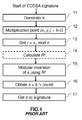
Figure 1 is a flow chart illustrating steps of a signature process according to the prior art; -
Figure 2 is a flow chart illustrating steps of a verification process according to the prior art; -
Figure 3 is a flow chart illustrating steps of a signature process according to embodiments of the first aspect of the present invention; -
Figure 4 is a flow chart illustrating steps of a verification process according to embodiments of the fourth aspect of the present invention; and, -
Figure 5 is a block diagram of an embodiment of cryptographic systems according to the third aspect and the sixth aspect of the invention, which are adapted to run computer program products according to the second aspect and to the fifth aspect of the invention, respectively. - To get the signature and its verification using ECDSA in ECC over prime field, order of the Generator Point (also called Curve Order n, which is a prime number) is used as a modulus in a significant part of the calculation. The Montgomery Multiplication is a widely used method allowing to speed-up arithmetic operations such as the inversion of a given variable. Indeed, modular inversion using Montgomery Multiplication is faster than the standard, i.e. scalar inversion.
- The problem with Montgomery Multiplication is the need to precompute a constant R2 mod n, commonly denoted by R2. This constant is needed for computing the conversion of the operand from normal form to Montgomery form, and vice versa.
- With reference to the flow chart of
Figure 1 , a method of calculating the signature of a clear text message e according to standard algorithm using the Montgomery comprises the following steps. - At 11, a random integer k is generated.
- At 12, the bi-dimensional value (x1,y1) is obtained through the calculation of k×G, where G is the bi-dimensional generator point of the elliptic curve.
- At 13, calculation of r is performed by equating r with x1 mod N.
- At 14, the constant R2 is calculated in order to be able to switch from normal representation to Montgomery representation.
- At 15, the modular inversion of k is generated.
- At 16, the component s of the signature is calculated by s = k-1(e+rd).
- Finally, at 17, the elements rand s of the signature are made available to, e.g. the application program which shall use them.
- With reference to the flow chart of
Figure 2 the basic steps of a method of ECDSA verification according to the prior art comprises the following steps. - At 21, first, the calculation of R2 is performed.
- Then, at 22, the modular inversion of s is calculated.
- At 23, there is performed the calculation of u1 which equals s-1 ×e, and of u2 which is equal to s-1×r.
- The calculation of the elements (x1,y1) is executed at 24. More precisely, (x1,y1) equals to u1G+u2Q.
- Finally, at 25, the signature is validated if and only if the first component value x1 modulus N of the bi-dimensional value (x1,y1) equals r.
- Now, the pre-computation of R2 at
step 11 of the ECDSA signature generation scheme and atstep 21 of the ECDSA verification scheme is a costly operation. - Embodiments of the present invention allow proceeding without the need for the calculation of R2 by using nice properties of Montgomery form and the Montgomery multiplication along with the little Fermat theorem.
- By thus avoiding the calculation of R2, embodiments lead to faster ECDSA signature and verification schemes.
- Referring to
Figure 3 , there is shown therein a low chart illustrating steps of the signature process according to embodiments of the first aspect of the present invention. -
First steps steps Figure 1 and described in details above. Namely, at 31 a random number k is generated, at 32 the bi-dimensional element (x1,y1) is obtained by setting (x1,y1)= k×G, and at 33 the first signature component r of the signature (r,s) is obtained by the following equating : r= x1 mod n.Steps 31 to 33 will not be described again in more details here. - The process then goes on with
step 30 which, compared to the process as shown inFigure 1 , replacesstep 16, along withprevious step 15 of modular inversion of k using the Montgomery multiplication and, above all, along with theheavy step 14 of pre-calculation of the constant R2. - At 30, indeed, step 30 with
sub-steps 301 to 305 are performed to obtain s=k-1×(e+r×d) instead ofsteps Figure 1 . - The proposed method is based on the following observations.
- First, the second signature component s can be written as the Montgomery form of s×R-1, since s = s×R-1×R.
- Second, considering the Montgomery Multiplication and Exponentiation by Squaring method, it can be observed that the exponentiation of « Montgomery form of s×R-1 » to the power n-2 equals to « Montgomery form of (s×R-1)n-2 ».
- Finally, Fermat's little theorem states that if n is a prime number, then for any integer a, we have an-2 =a-1 .
- If a is not divisible by n, Fermat's little theorem is equivalent to the statement that an-1 is an integer multiple of n, meaning that an-1 ≡ 1 mod n. This further implies that a×an-2 ≡ 1 mod n. This also means that an-2 is actually the inverse of a modulus n.
- Hence, provided that n is prime, one can opt to raising any value to the exponent n-2 whenever one needs to calculate its inverse modulus n.
- Here, and since n is prime, the little Fermat theorem provides that (s×R-1)n-2×R equals to (s×R-1)-1×R.
- Hence, s-1 ×R2 is obtained because the above product can be reduced to s-1 ×R2 by calculating (s×R-1)-1×R=s-1×R×R=s-1×R2. Stated otherwise, (s×R-1)N-2×R is equivalent to s-1×R2.
- In addition, M(s-1×R2,1) = s-1×R. Hence, the Montgomery form of s-1 mod n can be obtained by calculating the Montgomery multiplication between s-1×R2 and unity, namely the Montgomery multiplication of s-1×R2 with 1.
- In view of the above observations, step 30 of calculating s comprises the following
steps 301 to 304. - At 301, the computation of a first value A is performed with A = (e+r×d)×R-1. This can be achieved, according to embodiments, by adding M(r,d) = r×d×R-1 and M(e,1) = e×R-1. Stated otherwise, (e+r×d)×R-1 is obtained by the addition of the Montgomery multiplication of r and d modulus n on one hand to the Montgomery multiplication of e and unity modulus n on the other hand.
- At 302, there is calculated a second value B, with B = (k×R-1)n-2×R mod n as the exponentiation of the Montgomery form of k×R-1 to the power n-2 modulus n. B is equivalent to k-1×R2, as a result of Fermat's little theorem and thus, at 303, B is considered as being k-1×R2. The one with ordinary skills in the art will appreciate that, so to speak, 303 is a virtual step which is illustrative for the purpose of clarity of the present disclosure only, in the sense that is does not comprise any additional calculations.
- At304, s is eventually obtained by calculating the Montgomery multiplication between the value B, namely k-1×R2, which has been obtained at 304, and the first value A which has been obtained at 301, namely (e+r×d)×R-1 mod n.
- Finally, the Signature process ends at 37 with the output of the bi-dimensional signature (r,s) associated to the encrypted message m.
Step 37 is equivalent to step 17 ofFigure 1 . This result is thus achieved without the constant R2 having been computed as such, contrary to what is done in the prior art. - There will now be described steps of a Verification process according to embodiments of the present invention, with reference to
Figure 4 . This process aims at verifying the signature (r,s) associated to an encrypted message m. This process can be carried out at a recipient level, where the message m is received and is checked for validity. - At 40, the Montgomery form s-1×R of s-1 modulus n is calculated. This can be achieved, according to embodiments of the fourth aspect of the present invention, by carrying out the following
step - The goal of this step is to obtain the Montgomery form of s-1 without the drawback of having to pre-compute the Montgomery constant R2 as in the prior art.
- Similar with ECDSA Signature as described in much details above with reference to step 30 of
Figure 3 , s can be written as s×R-1×R. Further, by performing the same inversion method on s itself (similar to the computation of k-1 in the above described ECDSA Signature process), a first value D corresponding to the Montgomery form of sxR-1 raised at the power n-2 modulus n is obtained at 401. - Then, at 402, the first value D (sxR-1)n-2xR is considered in the form D= s-1×R2 thanks to Fermat's little theorem. , 402 is a virtual step which is illustrative for the purpose of clarity of the present disclosure only, in the sense that is does not comprise any additional calculations.
- Hence, s-1×R is obtained at 403 by computing the Montgomery multiplication M(s-1×R2 ,1) of s-1×R2 with unity.
- Once s-1×R is thus obtained, ECDSA Verification can proceed as usual.
- Indeed,
further step 43 is similar to step 13 ofFigure 1 , and consists in calculating u1 = s-1×e mod n and u2 = s-1×R mod n. Namely: - u1 is obtained by computing the Montgomery multiplication between s-1×R and e, that is to say M(s-1×R,e) = s-1×e; and,
- u2 is obtained by computing the Montgomery multiplication of s-1×R with r, i.e., M(s-1R,r) = s-1×r.
- At 44, the bi-dimensional value (x1,y1) is calculated as: (x1,y1)= u1×G + u2×Q. The one with ordinary shills in the art will appreciate that this step is equivalent to step 14 of
Figure 1 . - At the
test 45, if x1 mod n equals to r, then it is determined that signature is valid. Otherwise, the bi-dimensional value (r,s) is held to be an invalid signature. Again, it will be noted that this final determination step is equivalent to step 15 ofFigure 1 . - With reference to the block diagram of
Figure 5 , there will now be described embodiments of the cryptosystems according to the third and sixth aspects of the invention. Such cryptosystems can be adapted to run computer program products according to the second and to the fifth aspects of the invention, respectively. - Each of these computer programs comprise one or more stored sequences of instructions that are accessible to a processor and which, when executed by the processor, cause the processor to carry out the corresponding cryptographic method.
- In the shown embodiments, the
computer unit 30 comprises at least oneprocessor 31, at least onememory 32 to store data used during the execution of the calculations by theprocessor 31, and at least one rewritablenon-volatile memory 33 used to store e.g. specific parameters or running commands to properly execute the method. -
Memory 32 can be a Random Access Memory (RAM) of any suitable type, for instance a SRAM, a DRAM or SDRAM.Memory 33 can be a Read Only Memory (ROM), of any suitable type for instance an EPROM or a Flash memory. - The cryptosystem further comprises an interface 34 (I/F).
- For the implementation of the ECDSA signature scheme, the
interface unit 34 is adapted for receiving a message m and for outputting a bi-dimensional signature (r,s) associated to said message m. - For the implementation of the ECDSA verification scheme, the
interface unit 34 is adapted for receiving a bi-dimensional signature (r,s) associated to a message m. - In view of the foregoing, it will be apparent to the one with ordinary skills in the art that ECDSA signature and verification schemes can be performed without the usage of R2. Stated otherwise, smart use of the properties of the Montgomery Multiplication in view of the little Fermat theorem allows an optimized way to obtain an ECDSA signature of a message and to check validity of such an ECDSA signature.
- In addition, a person skilled in the art will appreciate that various parameters disclosed in the description may be modified and that various embodiments disclosed and/or claimed may be combined without departing from the scope of the invention.
Claims (6)
- A cryptographic method comprising an Elliptic Curve Digital Signature Algorithm, ECDSA, signature scheme comprising:- generating a bi-dimensional signature (r,s) having a first signature component r and a second signature component s, said bi-dimensional signature (r,s) being associated to a message m,wherein generating the bi-dimensional signature (r,s) comprises:- generating (31) a random number k ;- obtaining (32) a bi-dimensional value (x1,y1) having a first component x1 and a second component y1 , and corresponding to k×G, where G is a bi-dimensional generator point of the elliptic curve;- setting (33) r to x1 modulus n, where n is a prime number corresponding to the elliptic curve order;- generating (30) s as k-1×(e+r×d), where k-1 is the inverse of k, where d is a private key scalar number and where e equals H(m) with H being a hash function, said generating comprising :- calculating (301) a first value (e+r×d)×R-1 by the addition of the Montgomery multiplication of r and d modulus n, to the Montgomery multiplication of e and unity modulus n ;- calculating (302) a second value (k×R-1)n-2×R mod n as the exponentiation of the Montgomery form of k×R-1 to the power n-2 modulus n and thus obtaining k-1×R2 as said second value,- obtaining (305) s by calculating the Montgomery multiplication between the second value k-1×R2 and the first value (e+r×d)×R-1 mod n.
- A computer program product comprising one or more stored sequences of instructions that are accessible to a processor and which, when executed by the processor, cause the processor to carry out the steps of the method of claim 1.
- A cryptographic system comprising- an interface unit (34) for receiving a message m and for outputting a bi-dimensional signature (r,s) associated to said message m; and,- a computer unit (30) adapted to generate the bi-dimensional signature (r,s) using an Elliptic Curve Digital Signature Algorithm, ECDSA, signature scheme according to Claim 1.
- A cryptographic method comprising an Elliptic Curve Digital Signature Algorithm, ECDSA, verification scheme,
wherein the verification scheme comprises:- receiving a bi-dimensional signature (r,s) having a first signature component r and a second signature component s, said bi-dimensional signature (r,s) being associated to a message m;- generating (40) the Montgomery form of s-1 , where s-1 is the inverse of s, said generating comprising:- calculating (401) a first value (s×R-1)n-2×R as the exponentiation of the Montgomery form of s×R-1 to the power n-2, where n is a prime number corresponding to the elliptic curve order and R is a given number coprime with n, with R2 mod n being the Montgomery Constant, and thus obtaining s-1×R2 as said first value;- calculating (403) the Montgomery Multiplication of the first value s-1×R2 with the unity, to obtain a second value s-1×R mod n,- calculating (43) a third value u1 as the Montgomery multiplication between the second value s-1×R and e modulus N, where e equals H(m) with H being a hash function; and- calculating (43) a fourth value u2 as the Montgomery multiplication between the second value s-1×R and the first signature component r modulus N, and- calculating (44) a bi-dimensional value (x1,y1) having a first component x1 and a second component y1, and corresponding to the addition of u1×G and u2×Q, where G is a bi-dimensional generator point of the elliptic curve and Q is a public key point which equals d×G, with d being a private key scalar number; and,- determining (45) that the signature is valid if the first component value x1 modulus N of the bi-dimensional value (x1,y1) equals r. - A computer program product comprising one or more stored sequences of instructions that are accessible to a processor and which, when executed by the processor, cause the processor to carry out the steps of the method of claim 4.
- A cryptographic system comprising:- an interface unit (34) for receiving a bi-dimensional signature (r,s) associated to a clear text message m; and,- a computer unit (30) adapted to determine whether the signature (r,s) is valid using an Elliptic Curve Digital Signature Algorithm, ECDSA, signature scheme according to Claim 4.
Priority Applications (2)
| Application Number | Priority Date | Filing Date | Title |
|---|---|---|---|
| EP16305978.5A EP3276880A1 (en) | 2016-07-28 | 2016-07-28 | Efficient ecdsa signature and verification |
| PCT/EP2017/068683 WO2018019788A1 (en) | 2016-07-28 | 2017-07-24 | Efficient ecdsa signature and verification |
Applications Claiming Priority (1)
| Application Number | Priority Date | Filing Date | Title |
|---|---|---|---|
| EP16305978.5A EP3276880A1 (en) | 2016-07-28 | 2016-07-28 | Efficient ecdsa signature and verification |
Publications (1)
| Publication Number | Publication Date |
|---|---|
| EP3276880A1 true EP3276880A1 (en) | 2018-01-31 |
Family
ID=56943448
Family Applications (1)
| Application Number | Title | Priority Date | Filing Date |
|---|---|---|---|
| EP16305978.5A Withdrawn EP3276880A1 (en) | 2016-07-28 | 2016-07-28 | Efficient ecdsa signature and verification |
Country Status (2)
| Country | Link |
|---|---|
| EP (1) | EP3276880A1 (en) |
| WO (1) | WO2018019788A1 (en) |
Cited By (2)
| Publication number | Priority date | Publication date | Assignee | Title |
|---|---|---|---|---|
| WO2019191040A1 (en) | 2018-03-28 | 2019-10-03 | Cryptography Research, Inc. | Using cryptographic blinding for efficient use of montgomery multiplication |
| CN115865361A (en) * | 2022-11-22 | 2023-03-28 | 郑州信大捷安信息技术股份有限公司 | A method and system for two-party cooperative signature based on ECDSA algorithm |
Families Citing this family (6)
| Publication number | Priority date | Publication date | Assignee | Title |
|---|---|---|---|---|
| KR102788534B1 (en) * | 2018-10-24 | 2025-03-31 | 삼성전자주식회사 | A random number generator, an encryption device including the same and a operating method thereof |
| GB2584154A (en) * | 2019-05-24 | 2020-11-25 | Nchain Holdings Ltd | Knowledge proof |
| CN111614469B (en) * | 2020-05-27 | 2022-08-16 | 深圳壹账通智能科技有限公司 | Digital signature generation method, device and storage medium |
| CN113032844B (en) * | 2021-03-31 | 2022-02-11 | 郑州信大捷安信息技术股份有限公司 | Signature method, signature verification method and signature verification device for elliptic curve |
| CN113628094B (en) * | 2021-07-29 | 2024-03-26 | 西安电子科技大学 | High-throughput SM2 digital signature computing system and method based on GPU |
| US20240012615A1 (en) | 2022-07-07 | 2024-01-11 | International Business Machines Corporation | Fast modular multiplication of large integers |
Citations (2)
| Publication number | Priority date | Publication date | Assignee | Title |
|---|---|---|---|---|
| US6088453A (en) * | 1997-01-27 | 2000-07-11 | Kabushiki Kaisha Toshiba | Scheme for computing Montgomery division and Montgomery inverse realizing fast implementation |
| EP2015171A1 (en) * | 2007-06-29 | 2009-01-14 | Gemplus | Cryptographic method comprising secure modular exponentiation against hidden-channel attacks without the knowledge of the public exponent, cryptoprocessor for implementing the method and associated chip card |
-
2016
- 2016-07-28 EP EP16305978.5A patent/EP3276880A1/en not_active Withdrawn
-
2017
- 2017-07-24 WO PCT/EP2017/068683 patent/WO2018019788A1/en not_active Ceased
Patent Citations (2)
| Publication number | Priority date | Publication date | Assignee | Title |
|---|---|---|---|---|
| US6088453A (en) * | 1997-01-27 | 2000-07-11 | Kabushiki Kaisha Toshiba | Scheme for computing Montgomery division and Montgomery inverse realizing fast implementation |
| EP2015171A1 (en) * | 2007-06-29 | 2009-01-14 | Gemplus | Cryptographic method comprising secure modular exponentiation against hidden-channel attacks without the knowledge of the public exponent, cryptoprocessor for implementing the method and associated chip card |
Non-Patent Citations (2)
| Title |
|---|
| BOSCHER ARNAUD ET AL: "Optimal Use of Montgomery Multiplication on Smart Cards", 19 April 2006, NETWORK AND PARALLEL COMPUTING; [LECTURE NOTES IN COMPUTER SCIENCE; LECT.NOTES COMPUTER], SPRINGER INTERNATIONAL PUBLISHING, CHAM, PAGE(S) 252 - 262, ISBN: 978-3-642-27653-8, ISSN: 0302-9743, XP047305476 * |
| DAVID NACCACHE ET AL: "Montgomery-suitable cryptosystems", 19 July 1993, ALGEBRAIC CODING. FIRST FRENCH-ISRAELI WORKSHOP, SPRINGER, DE, PAGE(S) 75 - 81, ISBN: 978-3-540-57843-7, XP047000934 * |
Cited By (7)
| Publication number | Priority date | Publication date | Assignee | Title |
|---|---|---|---|---|
| WO2019191040A1 (en) | 2018-03-28 | 2019-10-03 | Cryptography Research, Inc. | Using cryptographic blinding for efficient use of montgomery multiplication |
| CN111712816A (en) * | 2018-03-28 | 2020-09-25 | 密码研究公司 | Using cryptographic blinding for efficient use of Montgomery multiplication |
| EP3776305A4 (en) * | 2018-03-28 | 2022-01-12 | Cryptography Research, Inc. | EFFECTIVE USE OF MONTGOMERY MULTIPLICATION USING A CIPHER MASK |
| US11522669B2 (en) | 2018-03-28 | 2022-12-06 | Cryptography Research, Inc. | Using cryptographic blinding for efficient use of Montgomery multiplication |
| US11863657B2 (en) | 2018-03-28 | 2024-01-02 | Cryptography Research, Inc. | Using cryptographic blinding for efficient use of montgomery multiplication |
| CN111712816B (en) * | 2018-03-28 | 2024-05-03 | 密码研究公司 | Using cryptographic masking for efficient use of Montgomery multiplications |
| CN115865361A (en) * | 2022-11-22 | 2023-03-28 | 郑州信大捷安信息技术股份有限公司 | A method and system for two-party cooperative signature based on ECDSA algorithm |
Also Published As
| Publication number | Publication date |
|---|---|
| WO2018019788A1 (en) | 2018-02-01 |
Similar Documents
| Publication | Publication Date | Title |
|---|---|---|
| WO2018019788A1 (en) | Efficient ecdsa signature and verification | |
| JP5329676B2 (en) | Accelerating key agreement protocols | |
| US7215780B2 (en) | Method and apparatus for elliptic curve scalar multiplication | |
| US9401805B2 (en) | Encrypting device, encrypting method, and recording medium | |
| EP3452897B1 (en) | Countermeasure to safe-error fault injection attacks on cryptographic exponentiation algorithms | |
| EP2503730A1 (en) | Binding data to an ECDSA signature component | |
| JP2011510579A (en) | Countermeasure method and device for asymmetric cryptosystem using signature diagram | |
| JP5360836B2 (en) | Pairing calculation device, pairing calculation method, and pairing calculation program | |
| EP2334006B1 (en) | Side-channel resistant modular exponentiation | |
| RU2533693C2 (en) | Encoding points on elliptic curve | |
| EP0952697A2 (en) | Elliptic curve encryption method and system | |
| Granger et al. | On the discrete logarithm problem on algebraic tori | |
| CN103339665B (en) | Methods for multi-digit division or modulo transformation | |
| Asbullah et al. | Analysis on the Rabin-p cryptosystem | |
| US20040148325A1 (en) | Information processing means | |
| CN101268654B (en) | Methods for reliably encrypting or decrypting messages | |
| KR101929984B1 (en) | Modular multiplicator and modular multiplication method thereof | |
| KR101548174B1 (en) | Method for calculating negative inverse of modulus | |
| JP2000321979A (en) | Polynomial arithmetic unit, elliptic curve order calculator, elliptic curve generator, and elliptic curve cryptosystem | |
| US8290151B2 (en) | Device and method for determining an inverse of a value related to a modulus | |
| EP4730104A1 (en) | Verification of an ecdsa signature | |
| EP4412151A1 (en) | Cryptographic method for demonstrating a vector is binary | |
| RU2409903C2 (en) | Method of creating and authenticating electronic digital signature certifying electronic document | |
| Karunankitha et al. | An Efficient And High Performance Architecture Design And Implementation Approach Of Cryptographic Algorithm Computation For Authentication In Modern Wireless Communication Applications | |
| Schinianakis et al. | RNS-based public-key cryptography (RSA and ECC) |
Legal Events
| Date | Code | Title | Description |
|---|---|---|---|
| PUAI | Public reference made under article 153(3) epc to a published international application that has entered the european phase |
Free format text: ORIGINAL CODE: 0009012 |
|
| STAA | Information on the status of an ep patent application or granted ep patent |
Free format text: STATUS: THE APPLICATION HAS BEEN PUBLISHED |
|
| AK | Designated contracting states |
Kind code of ref document: A1 Designated state(s): AL AT BE BG CH CY CZ DE DK EE ES FI FR GB GR HR HU IE IS IT LI LT LU LV MC MK MT NL NO PL PT RO RS SE SI SK SM TR |
|
| AX | Request for extension of the european patent |
Extension state: BA ME |
|
| STAA | Information on the status of an ep patent application or granted ep patent |
Free format text: STATUS: THE APPLICATION IS DEEMED TO BE WITHDRAWN |
|
| 18D | Application deemed to be withdrawn |
Effective date: 20180801 |