EP3275426B1 - Cosmetic compositions of uv filters - Google Patents
Cosmetic compositions of uv filters Download PDFInfo
- Publication number
- EP3275426B1 EP3275426B1 EP17182585.4A EP17182585A EP3275426B1 EP 3275426 B1 EP3275426 B1 EP 3275426B1 EP 17182585 A EP17182585 A EP 17182585A EP 3275426 B1 EP3275426 B1 EP 3275426B1
- Authority
- EP
- European Patent Office
- Prior art keywords
- ethylhexyl
- formula
- bis
- group
- triazine
- Prior art date
- Legal status (The legal status is an assumption and is not a legal conclusion. Google has not performed a legal analysis and makes no representation as to the accuracy of the status listed.)
- Active
Links
- 0 CC1(C=CC(N(C(C)=O)c(cc2)ccc2[N+]([O-])=O)=CC=C1)C(**)=O Chemical compound CC1(C=CC(N(C(C)=O)c(cc2)ccc2[N+]([O-])=O)=CC=C1)C(**)=O 0.000 description 3
Classifications
-
- A—HUMAN NECESSITIES
- A61—MEDICAL OR VETERINARY SCIENCE; HYGIENE
- A61K—PREPARATIONS FOR MEDICAL, DENTAL OR TOILETRY PURPOSES
- A61K8/00—Cosmetics or similar toiletry preparations
- A61K8/18—Cosmetics or similar toiletry preparations characterised by the composition
- A61K8/30—Cosmetics or similar toiletry preparations characterised by the composition containing organic compounds
- A61K8/49—Cosmetics or similar toiletry preparations characterised by the composition containing organic compounds containing heterocyclic compounds
- A61K8/494—Cosmetics or similar toiletry preparations characterised by the composition containing organic compounds containing heterocyclic compounds with more than one nitrogen as the only hetero atom
- A61K8/4966—Triazines or their condensed derivatives
-
- A—HUMAN NECESSITIES
- A61—MEDICAL OR VETERINARY SCIENCE; HYGIENE
- A61K—PREPARATIONS FOR MEDICAL, DENTAL OR TOILETRY PURPOSES
- A61K8/00—Cosmetics or similar toiletry preparations
- A61K8/02—Cosmetics or similar toiletry preparations characterised by special physical form
- A61K8/04—Dispersions; Emulsions
- A61K8/06—Emulsions
-
- A—HUMAN NECESSITIES
- A61—MEDICAL OR VETERINARY SCIENCE; HYGIENE
- A61K—PREPARATIONS FOR MEDICAL, DENTAL OR TOILETRY PURPOSES
- A61K8/00—Cosmetics or similar toiletry preparations
- A61K8/18—Cosmetics or similar toiletry preparations characterised by the composition
- A61K8/30—Cosmetics or similar toiletry preparations characterised by the composition containing organic compounds
- A61K8/33—Cosmetics or similar toiletry preparations characterised by the composition containing organic compounds containing oxygen
- A61K8/35—Ketones, e.g. benzophenone
-
- A—HUMAN NECESSITIES
- A61—MEDICAL OR VETERINARY SCIENCE; HYGIENE
- A61K—PREPARATIONS FOR MEDICAL, DENTAL OR TOILETRY PURPOSES
- A61K8/00—Cosmetics or similar toiletry preparations
- A61K8/18—Cosmetics or similar toiletry preparations characterised by the composition
- A61K8/30—Cosmetics or similar toiletry preparations characterised by the composition containing organic compounds
- A61K8/33—Cosmetics or similar toiletry preparations characterised by the composition containing organic compounds containing oxygen
- A61K8/37—Esters of carboxylic acids
-
- A—HUMAN NECESSITIES
- A61—MEDICAL OR VETERINARY SCIENCE; HYGIENE
- A61K—PREPARATIONS FOR MEDICAL, DENTAL OR TOILETRY PURPOSES
- A61K8/00—Cosmetics or similar toiletry preparations
- A61K8/18—Cosmetics or similar toiletry preparations characterised by the composition
- A61K8/30—Cosmetics or similar toiletry preparations characterised by the composition containing organic compounds
- A61K8/40—Cosmetics or similar toiletry preparations characterised by the composition containing organic compounds containing nitrogen
-
- A—HUMAN NECESSITIES
- A61—MEDICAL OR VETERINARY SCIENCE; HYGIENE
- A61Q—SPECIFIC USE OF COSMETICS OR SIMILAR TOILETRY PREPARATIONS
- A61Q17/00—Barrier preparations; Preparations brought into direct contact with the skin for affording protection against external influences, e.g. sunlight, X-rays or other harmful rays, corrosive materials, bacteria or insect stings
- A61Q17/04—Topical preparations for affording protection against sunlight or other radiation; Topical sun tanning preparations
Definitions
- the present invention relates to new cosmetic compositions designed to protect the skin and hair against UV radiation.
- Ultraviolet solar radiation has a damaging effect on skin tissue, and causes the degradation of polymers.
- sunscreens which absorb the UV part of solar radiation, harmful effects and aging of the skin and polymer materials can be prevented, or at least slowed.
- a drawback shared by all these compounds is their low ability to absorb radiation, which means that relatively large quantities are required to obtain the optimum photoprotective effect.
- the concentrations of UV-absorber solutions are characterised by the parameter E 1 1 (or E11), which corresponds to the specific extinction value measured at the maximum absorption wavelength of a solution containing 1% of the product in question, measured with an optical path of 1 cm.
- DE 3206398 discloses s-triazine derivatives obtained by reacting trichlorotriazine with p-amino-benzoic acid esters, which absorb intensely in the UV-B region.
- solubility of said compounds in the solvents generally used to formulate sun creams is very low, which makes their practical use problematic and very difficult, especially when the percentage of photoprotector in the composition must be increased to prepare formulations with a high sun protection factor.
- IT 1255729 discloses s-triazine derivatives obtained by reacting trichlorotriazine with p-amino-benzoic acid esters or amides with high specific extinction in the UV-B zone and improved solubility in solvents.
- EP 832642 discloses s-triazine derivatives obtained by reacting trichlorotriazine with p-aminophenyl-benzoxazole derivatives with high specific extinction in the UV-A zone and improved solubility in solvents.
- EP 821938 A1 discloses cosmetic compositions for the protection of human skin from sun radiation, comprising a combination of at least one s-triazine derivative and at least one derivative of cinnamic acid. such as p-methoxycinnamic acid or an ester or a salt thereof.
- Sun protection factor is a measurement of the photoprotective power of a sunscreen or a cosmetic formulation containing one or more sunscreens.
- the sun protection factor is the ratio between the MED (Minimal Erythema Dose) determined on protected skin and the MED determined on unprotected skin. It is directly correlated with specific extinction, and therefore also with the amount of photoprotector present in the cosmetic preparation.
- UV protection which a single sunscreen can contribute generally falls into a wavelength band which is too narrow in relation to the UV spectrum of natural light to which the skin and hair are normally exposed.
- a combination of a plurality of sunscreens able to provide broad protection against both UVA and UVB is used.
- Combinations of a plurality of sunscreens in cosmetic formulas are also necessary to impart other essential or desirable properties, such as:
- the present invention relates to cosmetic compositions for topical use designed to protect the skin and/or hair against UV radiation, comprising:
- Cosmetic products or preparations usually contain compounds (a) and (b) in quantities of up to 20% by weight of the formulation, together with carriers or diluents normally used in this field, with or without the conventional auxiliary additives.
- Component (a) of the compositions of the invention preferably consists of one or more compounds of formula (I) wherein the carboxylate -CO-O- or amide -CO-NH- (or also -CO-X-, -CO-Y-, -CO-Z-) groups on the phenyl rings occupy the para or 4 position relative to the -NH- group, and the R, R 1 , R 2 , R 3 and R 4 groups are straight or branched C 1 -C 12 alkyl groups.
- component (a) of the compositions of the invention is selected from the compounds of formula (V), (VI) and (VII)
- the compounds constituting component a) of the invention in addition to high absorption in both the UV-B and the UV-A region, also have other advantageous characteristics, such as heat stability and lack of toxicity, due to their very high molecular weight.
- the numerical UV-A/UV-B ratio of these compounds defined as the ratio of the intensity of the radiation absorbed between 320 nm and 400 nm (UVA fraction) to that absorbed between 290 nm and 320 nm (UVB fraction), is greater than 0.20, preferably greater than 0.30, whereas in the analogous triazine compounds with a 4-aminobenzoate or 4-aminobenzamide substituent different from the substituents described in Formula (IV), it is below about 0.14.
- the UV-A light absorption component increases accordingly. The fact that it possesses a significant UV-A component and therefore a broader UV spectrum is undoubtedly an advantage for a substance intended for use as a sunscreen.
- the compounds of formulas (I)-(VII) can be prepared by reacting a nitrobenzoyl chloride or bromide with compounds of formula (VIII) to generate the nitro intermediate of formula (IX) which, by subsequent reduction or hydrogenation, affords an amino intermediate (X).
- the compounds of formula (I) must therefore necessarily be prepared by reacting 1 mole of cyanuryl chloride or bromide with at least 1 mole of intermediate (X), and optionally, where appropriate, with the remaining moles of amino compounds of formula (VIII) and/or (XI), wherein the amines of formula (XI) are: wherein R 1 and R 2 maintain the meaning described above.
- intermediate (X) and optionally the amines of formula (VIII) and/or (XI) are reacted with cyanuryl chloride or bromide can follow any intermediate sequence and stoichiometry.
- Cyanuryl chloride and bromide have three reactive halogen atoms able to react selectively with ammonia, primary amines and secondary amines at very different temperatures, thus making it possible to replace each halogen atom with the desired amine with quantitative yields.
- neutralising bases are used in many cases, optionally in an aqueous medium, such as sodium hydroxide, sodium carbonate, sodium bicarbonate, calcium hydroxide, calcium carbonate, and tertiary amines such as triethylamine or pyridine.
- an aqueous medium such as sodium hydroxide, sodium carbonate, sodium bicarbonate, calcium hydroxide, calcium carbonate, and tertiary amines such as triethylamine or pyridine.
- solvents wherein the compounds of the invention can be prepared need not be able to dissolve the compounds. However, it is essential that they do not interact chemically with the compounds under the reaction conditions. In this respect they must be inert.
- solvents which can be used are saturated linear and branched hydrocarbons such as hexane, cyclohexane, methylcyclohexane, heptane, octane, isooctane, decane, petrols and dearomatised white spirits, aromatic hydrocarbons such as benzene, toluene, xylenes, ethylbenzene and petrols and white spirits, also containing aromatic hydrocarbons, ketones such as acetone, methyl ethyl ketone, methyl isobutyl ketone and diiso butyl ketone, ethers such as tetrahydrofuran and dioxane, esters such as ethyl acetate and butyl
- the operating temperatures are from 0°C to 200°C, preferably from 40 to 150°C.
- the pressures can range from 0 to 50 bars, preferably from 0 to 5 bars.
- Component (b) of the compositions of the invention is selected from one or more UVA and UVB sunscreens such as those listed in Annex VII to the European Cosmetics Directive (76/768/EEC) and Annex VI to European Regulation (EC) No. 1223/2009 , as amended, in Household and Personal Care Monographic Special Issue Skin Care - "The encyclopedia of allowed sunfilters in the world" by Giulio Pirotta, Consultant, via Solferino 4, 21040 Uboldo (VA) Italy and in ELECTRONIC CODE OF FEDERAL REGULATIONS (FDA) PART 352-SUNSCREEN DRUG PRODUCTS FOR OVER-THE-COUNTER HUMAN USE; Subpart B-Active Ingredients.
- UVA and UVB sunscreens such as those listed in Annex VII to the European Cosmetics Directive (76/768/EEC) and Annex VI to European Regulation (EC) No. 1223/2009 , as amended, in Household and Personal Care Monographic Special Issue Skin Care -
- the physical form of some sunscreens which are poorly soluble or insoluble in cosmetic formulations can be a nano form or a form finely subdivided and stably dispersed in the formulation.
- auxiliaries normally used in cosmetics and useful as additives are emulsifiers, such as ethoxylated fatty alcohols, fatty acid esters with sorbitan or lanolin derivatives, thickeners or rheology modifiers, such as carboxymethylcellulose or crosslinked polyacrylic acids, preservatives and perfumes.
- emulsifiers such as ethoxylated fatty alcohols, fatty acid esters with sorbitan or lanolin derivatives, thickeners or rheology modifiers, such as carboxymethylcellulose or crosslinked polyacrylic acids, preservatives and perfumes.
- auxiliaries are stabilisers such as magnesium or aluminium salts of fatty acids, complexing agents such as EDTA, and antioxidants such as BHT, BHA or alpha-tocopherol.
- the cosmetic oils used as auxiliaries are, for example, isopropyl esters of fatty acids, in particular isopropyl stearate, isopropyl palmitate, isopropyl isostearate, isopropyl myristate, isopropyl laurate, liquid paraffin, vaseline, isoparaffins and mineral oil.
- ingredients of the cosmetic compositions of the invention can be cosmetic agents such as panthenol, bisabolol, alpha-tocopherol, alpha-tocopherol acetate, Aloe vera, seaweed extracts and hyaluronic acid.
- bases for UV cosmetic compositions in the form of oil comprise vegetable oils such as groundnut oil, olive oil, sesame oil, cottonseed oil, coconut oil, grapeseed oil, castor oil, or mineral oils, such as liquid petrolatum or, in particular, liquid paraffin, synthetic esters of fatty acids and glycerides.
- bases for ointments are petrolatum, lanolin, eucerin and polyethylene glycols.
- bases for creams are creams with a high fat content, glycerol, creams based on polysaccharides and modified cellulose such as Tylose and, for creams based on fats and waxes, cetyl alcohol, lanolin cream, cocoa butter, beeswax, stearic acid, stearyl alcohol, glycerol monostearate, natural oils and minerals and fats.
- bases for emulsions are mixtures of stearyl glycol, a vegetable and/or mineral oil such as almond oil, liquid paraffin and petrolatum, water or mixtures of ethyl alcohol, water, lanolin, tragacanth or mixtures of ethyl alcohol, stearin, water, tragacanth and glycerol or mixtures of stearic acid, liquid paraffin, propyl or isopropyl alcohol and water.
- a vegetable and/or mineral oil such as almond oil, liquid paraffin and petrolatum, water or mixtures of ethyl alcohol, water, lanolin, tragacanth or mixtures of ethyl alcohol, stearin, water, tragacanth and glycerol or mixtures of stearic acid, liquid paraffin, propyl or isopropyl alcohol and water.
- compositions containing the sunscreens determines the final physical form of the cosmetic compositions containing the sunscreens.
- the compositions can be in the form of a solution, oil, cream, ointment, lotion, gel or powder.
- Phase B1 was heated to 70°-75°C under stirring, and B2 was then added.
- A1 was heated separately to 70°-75°C, adding phase A2 and homogenising with a turboemulsifier. Maintaining the temperature at 70°-75°C, B1+B2 was poured into A1, and homogenised with a turboemulsifier.
- the formulation was cooled to 40°C, and phase D was then added, again under stirring.
- Table 2 Formula Mean SPF UVA:UVB ratio Critical wavelength 1 3.50 0.58 314.0 2 3.21 0.33 311.0 3 3.15 0.35 313.0
- the UVA:UVB ratio is the ratio between the intensity of the radiation absorbed between 320 nm and 400 nm (UVA fraction) and that absorbed between 290 nm and 320 nm (UVB fraction).
- the UVA fraction of the compounds of formulas (V), (VI) and (VII) of the invention is at least twice as high as those of the triazine analogues already known, such as diethylhexyl butamido triazone and ethylhexyl triazone, for which said ratio is between 0.12 and 0.14.
Landscapes
- Health & Medical Sciences (AREA)
- Life Sciences & Earth Sciences (AREA)
- Veterinary Medicine (AREA)
- Animal Behavior & Ethology (AREA)
- General Health & Medical Sciences (AREA)
- Public Health (AREA)
- Birds (AREA)
- Epidemiology (AREA)
- Emergency Medicine (AREA)
- Dermatology (AREA)
- Chemical & Material Sciences (AREA)
- Dispersion Chemistry (AREA)
- Cosmetics (AREA)
Description
- The present invention relates to new cosmetic compositions designed to protect the skin and hair against UV radiation.
- Ultraviolet solar radiation has a damaging effect on skin tissue, and causes the degradation of polymers. By using particular compounds called sunscreens, which absorb the UV part of solar radiation, harmful effects and aging of the skin and polymer materials can be prevented, or at least slowed.
- Numerous substances have been studied and tested as protective agents, and a great deal of patent literature now exists relating to compounds belonging to various chemical classes that absorb in the ultraviolet region, particularly radiation between 290 and 320 nm, called UV-B, and between 320 nm and 400 nm, called UV-A.
- Relatively few of these compounds have proved suitable for practical application.
- A drawback shared by all these compounds is their low ability to absorb radiation, which means that relatively large quantities are required to obtain the optimum photoprotective effect.
- An excellent UV-B or UV-A absorber should have the following characteristics:
- 1) High specific extinction E1 1 allowing the use of low doses, resulting in cost savings and minimal toxicological risk
- 2) Light stability
- 3) Heat stability
- 4) Oxidation stability
- 5) Stability to different pHs
- 6) Good solubility in the basic substances commonly used for dermatological formulations
- 7) Negligible toxicity
- 8) Colour and odour compatible with the intended applications
- 9) High molecular weight, which reduces the probability of absorption by the skin and increases toxicological safety
- 10) Compatibility with the various substances generally used in dermatological formulations.
- The concentrations of UV-absorber solutions are characterised by the parameter E1 1 (or E11), which corresponds to the specific extinction value measured at the maximum absorption wavelength of a solution containing 1% of the product in question, measured with an optical path of 1 cm.
- Numerous derivatives of symmetrical triazine are already known, which can be used in a wide variety of technical applications and sectors due to their properties of absorbing UV rays, in particular UVA and UVB rays. Examples of said triazines are disclosed in
DE 3206398 ,US 4 617 390 ,US 4 724 137 ,US 5 233 040 ,US 5 252 323 ,US 5 332 568 ,IT 1255729 US 5 346 691 ,US 5 393 517 ,EP 832642 US 5 744 127 ,US 5 759 525 ,US 5 801 244 ,US 6 018 044 ,US 6 193 960 ,US 2002085981 ,EP 821938 A1 US 2005143577 . - In particular,
DE 3206398 discloses s-triazine derivatives obtained by reacting trichlorotriazine with p-amino-benzoic acid esters, which absorb intensely in the UV-B region. Unfortunately, the solubility of said compounds in the solvents generally used to formulate sun creams is very low, which makes their practical use problematic and very difficult, especially when the percentage of photoprotector in the composition must be increased to prepare formulations with a high sun protection factor. -
IT 1255729 -
EP 832642 -
EP 821938 A1 - Sun protection factor (SPF) is a measurement of the photoprotective power of a sunscreen or a cosmetic formulation containing one or more sunscreens. The sun protection factor is the ratio between the MED (Minimal Erythema Dose) determined on protected skin and the MED determined on unprotected skin. It is directly correlated with specific extinction, and therefore also with the amount of photoprotector present in the cosmetic preparation.
- However, the UV protection which a single sunscreen can contribute generally falls into a wavelength band which is too narrow in relation to the UV spectrum of natural light to which the skin and hair are normally exposed. For this main reason a combination of a plurality of sunscreens able to provide broad protection against both UVA and UVB is used. Combinations of a plurality of sunscreens in cosmetic formulas are also necessary to impart other essential or desirable properties, such as:
- 1) high absorption in a broad UV spectrum
- 2) photo- and heat-stability
- 3) compatibility with the skin (not harmful or dangerous)
- 4) good adherence and skin feel
- 5) water resistance
- 6) good compatibility with other cosmetic substances.
- The present invention relates to cosmetic compositions for topical use designed to protect the skin and/or hair against UV radiation, comprising:
- a) at least one UV filter of formula (I),

- X is an -O- or -NH- group
- R is a straight, cyclic or branched C1-C18 alkyl group and groups A and B can be, independently of one another:

or a group of formula (III)
- wherein Y, independently of the value of X, is an -O- or -NH- group
- R3 is a straight, cyclic or branched C1-C18 alkyl group which is the same or different from R;

- wherein Z, independently of the value of X or Y, is an -O- or -NH- group
- R4 is a straight, cyclic or branched C1-C18 alkyl group which is the same or different from R and R3;
- b) at least one other UV filter selected from 2-ethylhexyl p-methoxycinnamate, 2-hydroxy-4-methoxybenzophenone, 2-hydroxy-4-methoxybenzophenone-5-sulphonic acid, ethylhexyl salicylate, ethylhexyl dimethyl PABA, drometrizole trisiloxane, 3-(4'-methylbenzylidene)-d,1-camphor, diethylhexyl butamido triazone, ethylhexyl triazone, 4-(tert-butyl)-4'-methoxy-dibenzoylmethane, 2-cyano-3,3-diphenylacrylic acid 2-ethylhexyl ester, bis-ethylhexyloxyphenol-methoxyphenyl-triazine, methylene-bis-benzotriazolyl-tetramethylbutylphenol, benzoic acid 2-(4-diethylamino-2-hydroxybenzoyl)-hexyl ester, 2,4-bis-[4-[5-(1,1-dimethyl-propyl)benzoxazol-2-yl]phenylimino]-6-[(2-ethylhexyl)-imino]-1,3,5-triazine, tris-biphenyltriazine, titanium dioxide and zinc oxide;
- c) optionally other components such as solvents, diluents, auxiliaries and carriers normally used in the cosmetic field.
- Cosmetic products or preparations usually contain compounds (a) and (b) in quantities of up to 20% by weight of the formulation, together with carriers or diluents normally used in this field, with or without the conventional auxiliary additives.
- Component (a) of the compositions of the invention preferably consists of one or more compounds of formula (I) wherein the carboxylate -CO-O- or amide -CO-NH- (or also -CO-X-, -CO-Y-, -CO-Z-) groups on the phenyl rings occupy the para or 4 position relative to the -NH- group, and the R, R1, R2, R3 and R4 groups are straight or branched C1-C12 alkyl groups.
- Even more preferably, component (a) of the compositions of the invention is selected from the compounds of formula (V), (VI) and (VII)

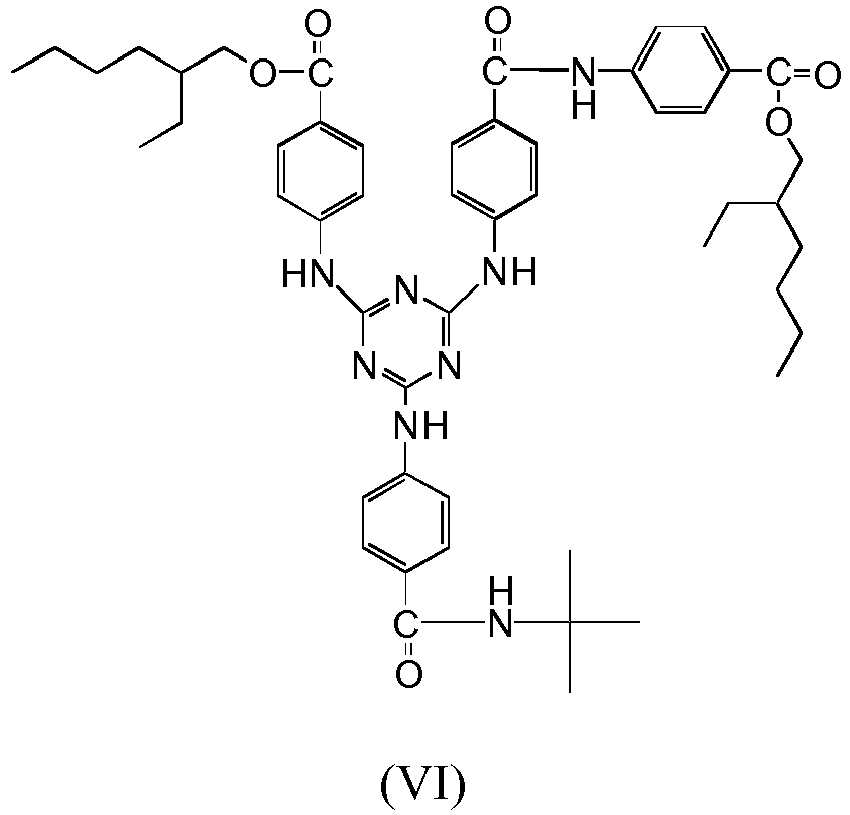

- The compounds constituting component a) of the invention, in addition to high absorption in both the UV-B and the UV-A region, also have other advantageous characteristics, such as heat stability and lack of toxicity, due to their very high molecular weight.
- Typically, the numerical UV-A/UV-B ratio of these compounds, defined as the ratio of the intensity of the radiation absorbed between 320 nm and 400 nm (UVA fraction) to that absorbed between 290 nm and 320 nm (UVB fraction), is greater than 0.20, preferably greater than 0.30, whereas in the analogous triazine compounds with a 4-aminobenzoate or 4-aminobenzamide substituent different from the substituents described in Formula (IV), it is below about 0.14. Moreover, we have found that by increasing the number of substituents of formula (IV) in the compounds of formula (I), the UV-A light absorption component increases accordingly. The fact that it possesses a significant UV-A component and therefore a broader UV spectrum is undoubtedly an advantage for a substance intended for use as a sunscreen.
- The compounds of formulas (I)-(VII) can be prepared by reacting a nitrobenzoyl chloride or bromide with compounds of formula (VIII)


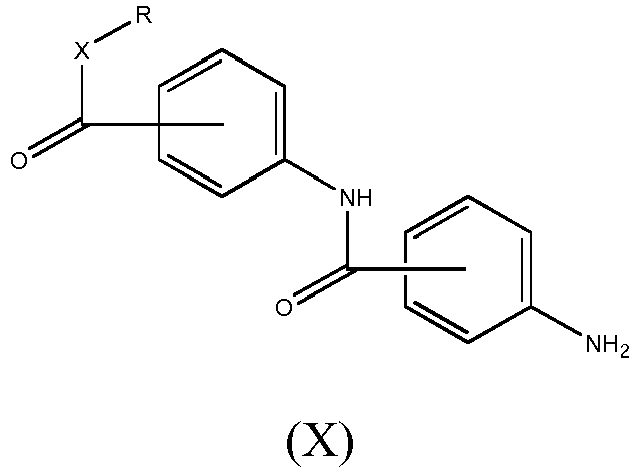
- Intermediate (X) is then reacted with cyanuryl chloride or bromide according to the most suitable stoichiometries and sequences based on well-known synthesis techniques.
- The compounds of formula (I) must therefore necessarily be prepared by reacting 1 mole of cyanuryl chloride or bromide with at least 1 mole of intermediate (X), and optionally, where appropriate, with the remaining moles of amino compounds of formula (VIII) and/or (XI), wherein the amines of formula (XI) are:

- The order in which intermediate (X) and optionally the amines of formula (VIII) and/or (XI) are reacted with cyanuryl chloride or bromide can follow any intermediate sequence and stoichiometry.
- Cyanuryl chloride and bromide have three reactive halogen atoms able to react selectively with ammonia, primary amines and secondary amines at very different temperatures, thus making it possible to replace each halogen atom with the desired amine with quantitative yields.
- The subsequent synthesis for the preparation of triazine compounds from amino intermediates such as aminobenzoates and aminobenzamides is well known, and described, for example, in
DE 3206398 ,US 4 617 390 ,US 4 724 137 ,US 5 233 040 ,US 5 252 323 ,US 5 332 568 ,IT 1255729 US 5 346 691 ,US 5 393 517 ,EP 832642 US 5 744 127 ,US 5 759 525 ,US 5 801 244 ,US 6 018 044 ,US 6 193 960 ,US 2002085981 andUS 2005143577 . - As the reaction produces acidity, neutralising bases are used in many cases, optionally in an aqueous medium, such as sodium hydroxide, sodium carbonate, sodium bicarbonate, calcium hydroxide, calcium carbonate, and tertiary amines such as triethylamine or pyridine.
- The solvents wherein the compounds of the invention can be prepared need not be able to dissolve the compounds. However, it is essential that they do not interact chemically with the compounds under the reaction conditions. In this respect they must be inert. Examples of solvents which can be used are saturated linear and branched hydrocarbons such as hexane, cyclohexane, methylcyclohexane, heptane, octane, isooctane, decane, petrols and dearomatised white spirits, aromatic hydrocarbons such as benzene, toluene, xylenes, ethylbenzene and petrols and white spirits, also containing aromatic hydrocarbons, ketones such as acetone, methyl ethyl ketone, methyl isobutyl ketone and diiso butyl ketone, ethers such as tetrahydrofuran and dioxane, esters such as ethyl acetate and butyl acetate, and nitriles such as acetonitrile and benzonitrile.
- The operating temperatures are from 0°C to 200°C, preferably from 40 to 150°C. The pressures can range from 0 to 50 bars, preferably from 0 to 5 bars.
- Component (b) of the compositions of the invention is selected from one or more UVA and UVB sunscreens such as those listed in Annex VII to the European Cosmetics Directive (76/768/EEC) and Annex VI to European Regulation (EC) No.
1223/2009 - Examples of auxiliaries normally used in cosmetics and useful as additives are emulsifiers, such as ethoxylated fatty alcohols, fatty acid esters with sorbitan or lanolin derivatives, thickeners or rheology modifiers, such as carboxymethylcellulose or crosslinked polyacrylic acids, preservatives and perfumes.
- Other auxiliaries are stabilisers such as magnesium or aluminium salts of fatty acids, complexing agents such as EDTA, and antioxidants such as BHT, BHA or alpha-tocopherol.
- The cosmetic oils used as auxiliaries are, for example, isopropyl esters of fatty acids, in particular isopropyl stearate, isopropyl palmitate, isopropyl isostearate, isopropyl myristate, isopropyl laurate, liquid paraffin, vaseline, isoparaffins and mineral oil.
- Other ingredients of the cosmetic compositions of the invention can be cosmetic agents such as panthenol, bisabolol, alpha-tocopherol, alpha-tocopherol acetate, Aloe vera, seaweed extracts and hyaluronic acid.
- Examples of bases for UV cosmetic compositions in the form of oil comprise vegetable oils such as groundnut oil, olive oil, sesame oil, cottonseed oil, coconut oil, grapeseed oil, castor oil, or mineral oils, such as liquid petrolatum or, in particular, liquid paraffin, synthetic esters of fatty acids and glycerides. Examples of bases for ointments are petrolatum, lanolin, eucerin and polyethylene glycols.
- Examples of bases for creams are creams with a high fat content, glycerol, creams based on polysaccharides and modified cellulose such as Tylose and, for creams based on fats and waxes, cetyl alcohol, lanolin cream, cocoa butter, beeswax, stearic acid, stearyl alcohol, glycerol monostearate, natural oils and minerals and fats.
- Examples of bases for emulsions are mixtures of stearyl glycol, a vegetable and/or mineral oil such as almond oil, liquid paraffin and petrolatum, water or mixtures of ethyl alcohol, water, lanolin, tragacanth or mixtures of ethyl alcohol, stearin, water, tragacanth and glycerol or mixtures of stearic acid, liquid paraffin, propyl or isopropyl alcohol and water.
- The nature of the carrier, auxiliaries or diluents determines the final physical form of the cosmetic compositions containing the sunscreens. The compositions can be in the form of a solution, oil, cream, ointment, lotion, gel or powder.
- Preparations and ingredients of these types can be found, for example, in "Sunscreens: Development: Evaluation, and Regulatory Aspects." Nicholas J. Lowe, 2nd Edition; Manuale del Cosmetologo, Giovanni D'Agostinis, Elio Mignini, 2014; "Seifen, Ole, Fette, Wachse", (1955), p. 147 and European Cosmetic Ingredients Inventory (CosIng).
- Also disclosed are said compounds for use as sunscreens for the skin and hair, due to their ability to perform a surprising skin protection action against the harmful component of solar radiation.
- The invention will now be illustrated by the following examples. All quantities are given in grams.
- Compounds (V), (VI) and (VII) were tested for their ability to perform a photoprotective action. Said compounds were added to standard cosmetic formulas (formulas shown in Table 1) to evaluate the SPF value (sun protection factor) with a Labsphere UV-2000S instrument, in the UV-visible region from 290 to 400 nm. For the experimental measurement of the SPF, the cosmetic formula was applied to a Transpore medium (3M Inc.) at a concentration of 2.0 mg/cm2. 3 tapes were prepared for each formula, 12 readings per tape being conducted; readings with a covariance >10% above the average were rejected. The SPF data are set out in Table 2.
Table 1 Phase Ingredient INCI name Formula 1 Formula 2 Formula 2 A1 Water water 72.5 72.5 72.5 A1 Propylene Glycol propylene glycol 1 1 1 A2 Satiaxane CX91 xanthan gum 0.6 0.6 0.6 A2 Ultrez 10 Carbomer 0.15 0.15 0.15 A2 Disodium EDTA disodium EDTA 0.08 0.08 0.08 B1 Lanette 16 cetyl alcohol 1 1 1 B1 Tego alkanol S21P steareth-21 2.5 2.5 2.5 B1 Tego alkanol S2P steareth-2 3 3 3 B1 Cetiol CC dicaprylyl carbonate 6.5 6.5 6.5 B1 Tegosoft DC decyl cocoate 6.5 6.5 6.5 B2 Compound of formula (V) 1 B2 Compound of formula (VI) 1 B2 Compound of formula (VII) 1 C TEA TEA 0.225 0.225 0.225 D Dow Corning 245 cyclomethicone 2 2 2 D Microcare PMS phenoxyethanol and paraben 1 1 1 - Preparation: Phase B1 was heated to 70°-75°C under stirring, and B2 was then added. A1 was heated separately to 70°-75°C, adding phase A2 and homogenising with a turboemulsifier. Maintaining the temperature at 70°-75°C, B1+B2 was poured into A1, and homogenised with a turboemulsifier. After adding C, the formulation was cooled to 40°C, and phase D was then added, again under stirring.
Table 2 Formula Mean SPF UVA:UVB ratio Critical wavelength 1 3.50 0.58 314.0 2 3.21 0.33 311.0 3 3.15 0.35 313.0 - The UVA:UVB ratio is the ratio between the intensity of the radiation absorbed between 320 nm and 400 nm (UVA fraction) and that absorbed between 290 nm and 320 nm (UVB fraction). The UVA fraction of the compounds of formulas (V), (VI) and (VII) of the invention is at least twice as high as those of the triazine analogues already known, such as diethylhexyl butamido triazone and ethylhexyl triazone, for which said ratio is between 0.12 and 0.14.
-
Sun oil INCI DECLARATION % Ethanol Up to 100 Cetearyl Octanoate 10.0 C12-15 Alkyl Benzoate 15.0 Cyclomethicone 35.0 Tocopheryl Acetate 0.8 Tocopherol (and) Lecithin (and) Ascorbyl Palmitate (and) Citric Acid 0.05 Compound (VI) 4.0 Octocrylene 6.0 ButylMethoxydibenzoylmethane 3.6 Ethylhexyl Methoxycinnamate 0.5 Bis-Ethylhexyloxyphenol Methoxyphenyl Triazine 1.5 SPF in vitro 32.0 SPF in vitro with ethylhexyl triazone instead of the compound of formula (VI) 25.2 -
Sun cream INCI DECLARATION % PEG-7 Hydrogenated castor oil 6 Isopropyl palmitate 5 Mineral oil 10 Caprylic/Capric Triglyceride 3 Magnesium Stearate 0.6 Compound (V) 1 Diethylhexyl butamido triazone 1 Octocrylene 3 Tocopheryl Acetate 0.5 PEG-45/dodecyl Glycol Copolymer 2 Aqua up to 100 Glycerin 0.3 Magnesium Stearate 0.3 Methylparaben 0.2 Propylparaben 0.2 SPF in vitro 9.2 SPF in vitro with diethylhexyl butamido triazone instead of the compound of formula (V) 4.0 -
Sun milk INCI DECLARATION % PEG-7 Hydrogenated castor oil 6 Hydrogenated Castor oil 0.5 Mineral oil 5 EthylhexylMethoxycinnamate 10 Isoamyl p-Methoxycinnamate 5 Compound (VII) 2 ButylMethoxydibenzoylmethane 2 Titanium dioxide 6 Tocopheryl Acetate 0.5 Peg-45/dodecyl glycol copolymer 2 Dimethicone 1 4-Methylbenzilidene camphor 3 Aqua Up to 100 Propyl glycol 5 Disodium EDTA 0.5 Phenoxyethanol 0.5 SPF in vitro 31.5 SPF in vitro with ethylhexyl triazone instead of the compound of formula (VII) 24.0 -
Sun milk INCI DECLARATION % PEG-7 Hydrogenated castor oil 6 Hydrogenated Castor oil 0.5 Mineral oil 5 EthylhexylMethoxycinnamate 10 Isoamyl p-Methoxycinnamate 5 Compound (VII) 1 Ethylhexyl Triazone 1 ButylMethoxydibenzoylmethane 2 Titanium dioxide 6 Tocopheryl Acetate 0.5 Peg-45/dodecyl glycol copolymer 2 Dimethicone 1 4-Methylbenzilidene camphor 3 Aqua Up to 100 Propyl glycol 5 Disodium EDTA 0.5 Phenoxyethanol 0.5 SPF in vitro 28.3 SPF in vitro with ethylhexyl triazone instead of the compound of formula (VII) 24.0 -
Spray-on sun lotion INCI DECLARATION % Aqua up to 100 Glycerin 3 Acrylates/Vinyl Isodecanoate Crosspolymer 0.2 PEG-100 Distearate & Glyceryl Stearate 2 Cetearyl Alcohol 0.5 C12-15 Alkyl Benzoate 18 Compound (VI) 3.5 Bis-Ethylhexyloxyphenol Methoxyphenyl Triazine 1.5 ButylMethoxydibenzoylmethane 1 TEA at pH 6.3 Cyclomethicone 3 Phenoxyethanol 0.5 SPF in vitro 19.0 SPF in vitro with ethylhexyl triazone instead of the compound of formula (VI) 13.8
Claims (8)
- Cosmetic compositions for topical use for the protection of the skin and/or hair from UV radiation, comprising:a) at least one UV filter of formula (I),
 X is an -O- or -NH- groupR is a straight, cyclic or branched C1-C18 alkyl group and groups A and B can be, independently of one another:
a group of formula (II)
or a group of formula (III) wherein Y, independently of the value of X, is an -O- or -NH- groupR3 is a straight, cyclic or branched C1-C18 alkyl group which is the same or different from R;or a group of formula (IV)
 b) at least one other UV filter selected from p-methoxycinnamic acid 2-ethylhexyl ester, 2-hydroxy-4-methoxybenzophenone, 2-hydroxy-4-methoxybenzophenone-5 - sulphonic acid, ethylhexyl salicylate, ethylhexyl dimethyl PABA, drometrizole trisiloxane, 3-(4'-methylbenzylidene)-d,1-camphor, diethylhexyl butamido triazone, ethylhexyl triazone, 4-(tert-butyl)-4'-methoxy-dibenzoylmethane, 2-cyano-3,3-diphenylacrylic acid 2-ethylhexyl ester, bis-ethylhexyloxyphenol-methoxyphenyl-triazine, methylene-bis-benzotriazolyl-tetramethylbutylphenol, benzoic acid 2-(4-diethylamino-2-hydroxybenzoyl)-hexyl ester, 2,4-bis-[4-[5-(1,1-dimethyl-propyl)benzoxazol-2-yl]phenylimino]-6-[(2-ethylhexyl)imino]-1,3,5-triazine, tris-biphenyltriazine, titanium dioxide and zinc oxide;c) optionally other components such as solvents, diluents, auxiliaries and carriers normally used in the cosmetic field.
 - Compositions according to claim 1 wherein component (a) consists of one or more compounds of formula (I) wherein the carboxylate -CO-O- or amide -CO-NH- groups or the -CO-X-, -CO-Y-, -CO-Z- groups on the phenyl rings are in the para (i.e. 4) position relative to the -NH- group, and the R, R1, R2, R3 and R4 groups are straight or branched C1-C12 alkyl groups.
- Compositions according to claim 1 or 2 wherein component (a) is selected from the compounds of formula (V), (VI), (VII)


- Compositions according to one or more of claims 1 to 3 wherein component a) has a UVA/UVB ratio greater than 0.20, preferably greater than 0.30.
- Compositions according to one or more of claims 1 to 4 wherein component (b) is 4-(tert-butyl)-4'-methoxy-dibenzoylmethane, 2-cyano-3,3-diphenylacrylic acid 2-ethylhexyl ester, diethylhexyl butamido triazone, ethylhexyl triazone, bis-ethylhexyloxyphenol-methoxyphenyl-triazine, methylene-bis-benzotriazolyl-tetramethylbutylphenol, or benzoic acid 2-(4-diethylamino-2-hydroxybenzoyl)-hexyl ester.
- Compositions of claims 1 to 4 for use as sunscreens for the protection of the skin and hair.
- A combination of:(a) at least one UV filter of formula (I) as defined in claim 1;(b) at least one other UV filter selected from 2-ethylhexyl p-methoxycinnamate, 2-hydroxy-4-methoxybenzophenone, 2-hydroxy-4-methoxybenzophenone-5-sulphonic acid, ethylhexyl salicylate, ethylhexyl dimethyl PABA, drometrizole trisiloxane, 3-(4'-methylbenzylidene)-d,1-camphor, diethylhexyl butamido triazone, ethylhexyl triazone, 4-(tert-butyl)-4'-methoxy-dibenzoylmethane, 2-cyano-3,3-diphenylacrylic acid 2-ethylhexyl ester, bis-ethylhexyloxyphenol-methoxyphenyl-triazine, methylene-bis-benzotriazolyl-tetramethylbutylphenol, benzoic acid 2-(4-diethylamino-2-hydroxybenzoyl)-hexyl ester, 2,4-bis-[4-[5-(1,1-dimethyl-propyl)benzoxazol-2-yl]phenylimino]-6-[(2-ethylhexyl)-imino]-1,3,5-triazine, tris-biphenyltriazine, titanium dioxide and zinc oxide;and wherein the concentration of components (a) and (b) is up to 20% by weight of said combination, for use in a method for protecting the skin or hair or both from solar UV radiation, wherein the method comprises the administration of the combination to the skin or hair or both.
- A combination for use according to claim 7 of:(a) at least one UV filter of formula (I) as defined in claim 1;(b) at least one other UV filter selected from 4-(tert-butyl)-4'-methoxydibenzoylmethane, 2-cyano-3,3-diphenylacrylic acid 2-ethylhexyl ester, diethylhexyl butamido triazone, ethylhexyl triazone, bis-ethylhexyloxyphenol-methoxyphenyl-triazine, methylene-bis-benzotriazolyl-tetramethylbutylphenol, and benzoic acid 2-(4-diethylamino-2-hydroxybenzoyl)-hexyl ester;and in which the concentration of the components (a) and (b) is up to 20% by weight of the above-said combination.
Applications Claiming Priority (1)
| Application Number | Priority Date | Filing Date | Title |
|---|---|---|---|
| IT102016000080304A IT201600080304A1 (en) | 2016-07-29 | 2016-07-29 | COSMETIC COMPOSITIONS OF UV FILTERS |
Publications (2)
| Publication Number | Publication Date |
|---|---|
| EP3275426A1 EP3275426A1 (en) | 2018-01-31 |
| EP3275426B1 true EP3275426B1 (en) | 2019-09-04 |
Family
ID=58159232
Family Applications (1)
| Application Number | Title | Priority Date | Filing Date |
|---|---|---|---|
| EP17182585.4A Active EP3275426B1 (en) | 2016-07-29 | 2017-07-21 | Cosmetic compositions of uv filters |
Country Status (4)
| Country | Link |
|---|---|
| US (1) | US10610476B2 (en) |
| EP (1) | EP3275426B1 (en) |
| ES (1) | ES2750848T3 (en) |
| IT (1) | IT201600080304A1 (en) |
Families Citing this family (3)
| Publication number | Priority date | Publication date | Assignee | Title |
|---|---|---|---|---|
| WO2022093971A1 (en) | 2020-10-28 | 2022-05-05 | Chemocentryx, Inc. | Methods of treating hidradenitis suppurativa |
| EP4680975A2 (en) | 2023-03-16 | 2026-01-21 | Amgen Inc. | Biomarkers for diagnosing hidradenitis suppurativa |
| CN117297983B (en) * | 2023-11-14 | 2025-02-21 | 广东丸美生物技术股份有限公司 | Organic sunscreen gel and preparation method thereof and cosmetics |
Family Cites Families (15)
| Publication number | Priority date | Publication date | Assignee | Title |
|---|---|---|---|---|
| US2415554A (en) * | 1947-02-11 | Oh nh-cc | ||
| DE3206398A1 (en) | 1982-02-23 | 1983-09-01 | Basf Ag, 6700 Ludwigshafen | S-TRIAZINE DERIVATIVES AND THEIR USE AS LIGHT PROTECTION AGENTS |
| FR2674851B1 (en) | 1991-04-04 | 1995-02-10 | Oreal | S-TRIAZINIC DERIVATIVES CARRYING BENZYLIDENE CAMPHOR SUBSTITUENTS, FILTERING COSMETIC COMPOSITIONS AND THEIR USE FOR PROTECTING THE SKIN AND HAIR FROM ULTRAVIOLET RADIATION. |
| IT1247973B (en) | 1991-06-04 | 1995-01-05 | Sigma Prod Chim | 1,3,5-TRIAZINE DERIVATIVES, THEIR PREPARATION AND USE AS SOLAR FILTERS |
| IT1255729B (en) | 1992-05-19 | 1995-11-15 | Giuseppe Raspanti | s-triazine derivatives as photostabilising agents |
| US5332568A (en) | 1993-05-20 | 1994-07-26 | 3V Inc. | S-triazine derivatives having light-protecting action |
| IT1283295B1 (en) | 1996-03-22 | 1998-04-16 | 3V Sigma Spa | SOLAR FILTERS |
| EP1293504A3 (en) * | 1996-07-08 | 2003-11-05 | Ciba SC Holding AG | Triazine derivatives as UV-filter in cosmetic compositions |
| EP0821938B1 (en) * | 1996-07-31 | 2003-05-21 | 3V SIGMA S.p.A | Sun screening preparations comprising triazine derivatives |
| IT1284525B1 (en) | 1996-09-13 | 1998-05-21 | 3V Sigma Spa | DERIVATIVES OF BENZOSSAZOLE USED AS STABILIZERS AGAINST UV RADIATION |
| US5759525A (en) | 1996-12-26 | 1998-06-02 | 3V Inc. | Concentrated solutions of a 1,3,5-triazine derivative sunscreen and their use for the preparation of cosmetic compositions |
| US6018044A (en) | 1998-01-02 | 2000-01-25 | Roche Vitamins Inc. | Light screening compositions |
| IT1317825B1 (en) | 2000-02-11 | 2003-07-15 | 3V Sigma Spa | BENZOSSAZOLE DERIVATIVES, THEIR USE IN COSMETIC COMPOSITIONS AND IN THE STABILIZATION OF SYNTHETIC POLYMERS. |
| DE10208840A1 (en) | 2002-03-01 | 2003-09-18 | Basf Ag | Process for the preparation of a tautomeric form of 2,4,6-trianilino-p- (carbo-2'-ethylhexyl-1'-oxy) -1,3,5-triazine |
| IT201600080301A1 (en) * | 2016-07-29 | 2018-01-29 | 3V Sigma Spa | NEW TRIAZINE COMPOUNDS AS PHOTOSTABILIZING AGENTS |
-
2016
- 2016-07-29 IT IT102016000080304A patent/IT201600080304A1/en unknown
-
2017
- 2017-07-21 ES ES17182585T patent/ES2750848T3/en active Active
- 2017-07-21 EP EP17182585.4A patent/EP3275426B1/en active Active
- 2017-07-25 US US15/658,444 patent/US10610476B2/en active Active
Non-Patent Citations (1)
| Title |
|---|
| None * |
Also Published As
| Publication number | Publication date |
|---|---|
| ES2750848T3 (en) | 2020-03-27 |
| US10610476B2 (en) | 2020-04-07 |
| EP3275426A1 (en) | 2018-01-31 |
| IT201600080304A1 (en) | 2018-01-29 |
| US20180028425A1 (en) | 2018-02-01 |
Similar Documents
| Publication | Publication Date | Title |
|---|---|---|
| KR101737662B1 (en) | 2-phenyl-1,2,3-benzotriazoles for uv radiation absorbance | |
| EP3275872B1 (en) | New triazine compounds as photostabilising agents | |
| EP2945604B1 (en) | Cosmetic or dermatological composition comprising a merocyanine and an oily phase comprising at least one specific amide compound | |
| EP2956114B1 (en) | Cosmetic or dermatological composition comprising a merocyanine, an oily phase and a c1-c4 monoalkanol | |
| EP2945606B1 (en) | Cosmetic or dermatological water-in-oil emulsion comprising a merocyanine and at least one emulsifying polymer of the polyoxyalkylenated glycol fatty acid ester type | |
| EP3275426B1 (en) | Cosmetic compositions of uv filters | |
| US10918583B2 (en) | Cosmetic or dermatological composition comprising a merocyanine, an organic UVB-screening agent and an additional organic UVA-screening agent | |
| EP2945601A2 (en) | Cosmetic or dermatological composition comprising a merocyanine and a lipophilic benzotriazole uv-screening agent and/or a bis-resorcinyl triazine compound | |
| EP3407862B1 (en) | Cosmetic or dermatological composition comprising a merocyanine and an oily phase comprising at least one polyalkylene glycol. | |
| EP2945603B1 (en) | Cosmetic or dermatological composition comprising a merocyanine and a uva-screening agent of the amino-substituted 2-hydroxybenzophenone type and/or a hydrophilic organic uva-screening agent | |
| EP3709966B1 (en) | Compositions comprising at least one acrylic polymer and at least one insoluble organic screening agent | |
| WO2010127987A2 (en) | Sunscreens | |
| WO2017129673A1 (en) | Cosmetic or dermatological composition comprising a merocyanine and an oily phase comprising at least one di- or tricarboxylic acid ester | |
| JP3955922B2 (en) | Composition containing a triazine derivative dissolved in a eutectic mixture of n-butylphthalimide / isopropylphthalimide; | |
| EP2945609B1 (en) | Anhydrous cosmetic or dermatological composition comprising a merocyanine and an oily phase | |
| EP3407860B1 (en) | Cosmetic or dermatological composition comprising a merocyanine and an oily phase comprising at least one isosorbide ether | |
| JP4364140B2 (en) | S-triazine derivatives having at least two silanic para-aminobenzalmalonate groups; compositions for photoprotective cosmetics containing these derivatives; use of the s-triazine derivatives | |
| CN105705131B (en) | Cosmetic or dermatological composition comprising merocyanine and UV-screening agent | |
| EP3407865B1 (en) | Cosmetic or dermatological composition comprising a merocyanine and an oily phase comprising at least one n-substituted amide | |
| JP2004182733A (en) | Photoprotective cosmetic composition containing 3- (2-azacycloalkylidene) -1,3-dihydroindol-2-one derivative and use thereof |
Legal Events
| Date | Code | Title | Description |
|---|---|---|---|
| PUAI | Public reference made under article 153(3) epc to a published international application that has entered the european phase |
Free format text: ORIGINAL CODE: 0009012 |
|
| STAA | Information on the status of an ep patent application or granted ep patent |
Free format text: STATUS: THE APPLICATION HAS BEEN PUBLISHED |
|
| AK | Designated contracting states |
Kind code of ref document: A1 Designated state(s): AL AT BE BG CH CY CZ DE DK EE ES FI FR GB GR HR HU IE IS IT LI LT LU LV MC MK MT NL NO PL PT RO RS SE SI SK SM TR |
|
| AX | Request for extension of the european patent |
Extension state: BA ME |
|
| STAA | Information on the status of an ep patent application or granted ep patent |
Free format text: STATUS: REQUEST FOR EXAMINATION WAS MADE |
|
| 17P | Request for examination filed |
Effective date: 20180712 |
|
| RBV | Designated contracting states (corrected) |
Designated state(s): AL AT BE BG CH CY CZ DE DK EE ES FI FR GB GR HR HU IE IS IT LI LT LU LV MC MK MT NL NO PL PT RO RS SE SI SK SM TR |
|
| GRAP | Despatch of communication of intention to grant a patent |
Free format text: ORIGINAL CODE: EPIDOSNIGR1 |
|
| STAA | Information on the status of an ep patent application or granted ep patent |
Free format text: STATUS: GRANT OF PATENT IS INTENDED |
|
| INTG | Intention to grant announced |
Effective date: 20190325 |
|
| GRAS | Grant fee paid |
Free format text: ORIGINAL CODE: EPIDOSNIGR3 |
|
| GRAA | (expected) grant |
Free format text: ORIGINAL CODE: 0009210 |
|
| STAA | Information on the status of an ep patent application or granted ep patent |
Free format text: STATUS: THE PATENT HAS BEEN GRANTED |
|
| AK | Designated contracting states |
Kind code of ref document: B1 Designated state(s): AL AT BE BG CH CY CZ DE DK EE ES FI FR GB GR HR HU IE IS IT LI LT LU LV MC MK MT NL NO PL PT RO RS SE SI SK SM TR |
|
| REG | Reference to a national code |
Ref country code: GB Ref legal event code: FG4D |
|
| REG | Reference to a national code |
Ref country code: CH Ref legal event code: EP |
|
| REG | Reference to a national code |
Ref country code: AT Ref legal event code: REF Ref document number: 1174329 Country of ref document: AT Kind code of ref document: T Effective date: 20190915 |
|
| REG | Reference to a national code |
Ref country code: DE Ref legal event code: R096 Ref document number: 602017006693 Country of ref document: DE |
|
| REG | Reference to a national code |
Ref country code: IE Ref legal event code: FG4D |
|
| REG | Reference to a national code |
Ref country code: NL Ref legal event code: MP Effective date: 20190904 |
|
| REG | Reference to a national code |
Ref country code: LT Ref legal event code: MG4D |
|
| PG25 | Lapsed in a contracting state [announced via postgrant information from national office to epo] |
Ref country code: HR Free format text: LAPSE BECAUSE OF FAILURE TO SUBMIT A TRANSLATION OF THE DESCRIPTION OR TO PAY THE FEE WITHIN THE PRESCRIBED TIME-LIMIT Effective date: 20190904 Ref country code: LT Free format text: LAPSE BECAUSE OF FAILURE TO SUBMIT A TRANSLATION OF THE DESCRIPTION OR TO PAY THE FEE WITHIN THE PRESCRIBED TIME-LIMIT Effective date: 20190904 Ref country code: SE Free format text: LAPSE BECAUSE OF FAILURE TO SUBMIT A TRANSLATION OF THE DESCRIPTION OR TO PAY THE FEE WITHIN THE PRESCRIBED TIME-LIMIT Effective date: 20190904 Ref country code: BG Free format text: LAPSE BECAUSE OF FAILURE TO SUBMIT A TRANSLATION OF THE DESCRIPTION OR TO PAY THE FEE WITHIN THE PRESCRIBED TIME-LIMIT Effective date: 20191204 Ref country code: FI Free format text: LAPSE BECAUSE OF FAILURE TO SUBMIT A TRANSLATION OF THE DESCRIPTION OR TO PAY THE FEE WITHIN THE PRESCRIBED TIME-LIMIT Effective date: 20190904 Ref country code: NO Free format text: LAPSE BECAUSE OF FAILURE TO SUBMIT A TRANSLATION OF THE DESCRIPTION OR TO PAY THE FEE WITHIN THE PRESCRIBED TIME-LIMIT Effective date: 20191204 |
|
| PG25 | Lapsed in a contracting state [announced via postgrant information from national office to epo] |
Ref country code: LV Free format text: LAPSE BECAUSE OF FAILURE TO SUBMIT A TRANSLATION OF THE DESCRIPTION OR TO PAY THE FEE WITHIN THE PRESCRIBED TIME-LIMIT Effective date: 20190904 Ref country code: AL Free format text: LAPSE BECAUSE OF FAILURE TO SUBMIT A TRANSLATION OF THE DESCRIPTION OR TO PAY THE FEE WITHIN THE PRESCRIBED TIME-LIMIT Effective date: 20190904 Ref country code: GR Free format text: LAPSE BECAUSE OF FAILURE TO SUBMIT A TRANSLATION OF THE DESCRIPTION OR TO PAY THE FEE WITHIN THE PRESCRIBED TIME-LIMIT Effective date: 20191205 Ref country code: RS Free format text: LAPSE BECAUSE OF FAILURE TO SUBMIT A TRANSLATION OF THE DESCRIPTION OR TO PAY THE FEE WITHIN THE PRESCRIBED TIME-LIMIT Effective date: 20190904 |
|
| REG | Reference to a national code |
Ref country code: AT Ref legal event code: MK05 Ref document number: 1174329 Country of ref document: AT Kind code of ref document: T Effective date: 20190904 |
|
| REG | Reference to a national code |
Ref country code: ES Ref legal event code: FG2A Ref document number: 2750848 Country of ref document: ES Kind code of ref document: T3 Effective date: 20200327 |
|
| PG25 | Lapsed in a contracting state [announced via postgrant information from national office to epo] |
Ref country code: EE Free format text: LAPSE BECAUSE OF FAILURE TO SUBMIT A TRANSLATION OF THE DESCRIPTION OR TO PAY THE FEE WITHIN THE PRESCRIBED TIME-LIMIT Effective date: 20190904 Ref country code: NL Free format text: LAPSE BECAUSE OF FAILURE TO SUBMIT A TRANSLATION OF THE DESCRIPTION OR TO PAY THE FEE WITHIN THE PRESCRIBED TIME-LIMIT Effective date: 20190904 Ref country code: RO Free format text: LAPSE BECAUSE OF FAILURE TO SUBMIT A TRANSLATION OF THE DESCRIPTION OR TO PAY THE FEE WITHIN THE PRESCRIBED TIME-LIMIT Effective date: 20190904 Ref country code: AT Free format text: LAPSE BECAUSE OF FAILURE TO SUBMIT A TRANSLATION OF THE DESCRIPTION OR TO PAY THE FEE WITHIN THE PRESCRIBED TIME-LIMIT Effective date: 20190904 Ref country code: PT Free format text: LAPSE BECAUSE OF FAILURE TO SUBMIT A TRANSLATION OF THE DESCRIPTION OR TO PAY THE FEE WITHIN THE PRESCRIBED TIME-LIMIT Effective date: 20200106 Ref country code: PL Free format text: LAPSE BECAUSE OF FAILURE TO SUBMIT A TRANSLATION OF THE DESCRIPTION OR TO PAY THE FEE WITHIN THE PRESCRIBED TIME-LIMIT Effective date: 20190904 |
|
| PG25 | Lapsed in a contracting state [announced via postgrant information from national office to epo] |
Ref country code: CZ Free format text: LAPSE BECAUSE OF FAILURE TO SUBMIT A TRANSLATION OF THE DESCRIPTION OR TO PAY THE FEE WITHIN THE PRESCRIBED TIME-LIMIT Effective date: 20190904 Ref country code: SK Free format text: LAPSE BECAUSE OF FAILURE TO SUBMIT A TRANSLATION OF THE DESCRIPTION OR TO PAY THE FEE WITHIN THE PRESCRIBED TIME-LIMIT Effective date: 20190904 Ref country code: IS Free format text: LAPSE BECAUSE OF FAILURE TO SUBMIT A TRANSLATION OF THE DESCRIPTION OR TO PAY THE FEE WITHIN THE PRESCRIBED TIME-LIMIT Effective date: 20200224 Ref country code: SM Free format text: LAPSE BECAUSE OF FAILURE TO SUBMIT A TRANSLATION OF THE DESCRIPTION OR TO PAY THE FEE WITHIN THE PRESCRIBED TIME-LIMIT Effective date: 20190904 |
|
| REG | Reference to a national code |
Ref country code: DE Ref legal event code: R097 Ref document number: 602017006693 Country of ref document: DE |
|
| PLBE | No opposition filed within time limit |
Free format text: ORIGINAL CODE: 0009261 |
|
| STAA | Information on the status of an ep patent application or granted ep patent |
Free format text: STATUS: NO OPPOSITION FILED WITHIN TIME LIMIT |
|
| PG2D | Information on lapse in contracting state deleted |
Ref country code: IS |
|
| PG25 | Lapsed in a contracting state [announced via postgrant information from national office to epo] |
Ref country code: DK Free format text: LAPSE BECAUSE OF FAILURE TO SUBMIT A TRANSLATION OF THE DESCRIPTION OR TO PAY THE FEE WITHIN THE PRESCRIBED TIME-LIMIT Effective date: 20190904 Ref country code: IS Free format text: LAPSE BECAUSE OF FAILURE TO SUBMIT A TRANSLATION OF THE DESCRIPTION OR TO PAY THE FEE WITHIN THE PRESCRIBED TIME-LIMIT Effective date: 20200105 |
|
| 26N | No opposition filed |
Effective date: 20200605 |
|
| PG25 | Lapsed in a contracting state [announced via postgrant information from national office to epo] |
Ref country code: SI Free format text: LAPSE BECAUSE OF FAILURE TO SUBMIT A TRANSLATION OF THE DESCRIPTION OR TO PAY THE FEE WITHIN THE PRESCRIBED TIME-LIMIT Effective date: 20190904 |
|
| PG25 | Lapsed in a contracting state [announced via postgrant information from national office to epo] |
Ref country code: MC Free format text: LAPSE BECAUSE OF FAILURE TO SUBMIT A TRANSLATION OF THE DESCRIPTION OR TO PAY THE FEE WITHIN THE PRESCRIBED TIME-LIMIT Effective date: 20190904 |
|
| REG | Reference to a national code |
Ref country code: CH Ref legal event code: PL |
|
| REG | Reference to a national code |
Ref country code: BE Ref legal event code: MM Effective date: 20200731 |
|
| PG25 | Lapsed in a contracting state [announced via postgrant information from national office to epo] |
Ref country code: LU Free format text: LAPSE BECAUSE OF NON-PAYMENT OF DUE FEES Effective date: 20200721 Ref country code: LI Free format text: LAPSE BECAUSE OF NON-PAYMENT OF DUE FEES Effective date: 20200731 Ref country code: CH Free format text: LAPSE BECAUSE OF NON-PAYMENT OF DUE FEES Effective date: 20200731 |
|
| PG25 | Lapsed in a contracting state [announced via postgrant information from national office to epo] |
Ref country code: BE Free format text: LAPSE BECAUSE OF NON-PAYMENT OF DUE FEES Effective date: 20200731 |
|
| PG25 | Lapsed in a contracting state [announced via postgrant information from national office to epo] |
Ref country code: IE Free format text: LAPSE BECAUSE OF NON-PAYMENT OF DUE FEES Effective date: 20200721 |
|
| PG25 | Lapsed in a contracting state [announced via postgrant information from national office to epo] |
Ref country code: TR Free format text: LAPSE BECAUSE OF FAILURE TO SUBMIT A TRANSLATION OF THE DESCRIPTION OR TO PAY THE FEE WITHIN THE PRESCRIBED TIME-LIMIT Effective date: 20190904 Ref country code: MT Free format text: LAPSE BECAUSE OF FAILURE TO SUBMIT A TRANSLATION OF THE DESCRIPTION OR TO PAY THE FEE WITHIN THE PRESCRIBED TIME-LIMIT Effective date: 20190904 Ref country code: CY Free format text: LAPSE BECAUSE OF FAILURE TO SUBMIT A TRANSLATION OF THE DESCRIPTION OR TO PAY THE FEE WITHIN THE PRESCRIBED TIME-LIMIT Effective date: 20190904 |
|
| PG25 | Lapsed in a contracting state [announced via postgrant information from national office to epo] |
Ref country code: MK Free format text: LAPSE BECAUSE OF FAILURE TO SUBMIT A TRANSLATION OF THE DESCRIPTION OR TO PAY THE FEE WITHIN THE PRESCRIBED TIME-LIMIT Effective date: 20190904 |
|
| P01 | Opt-out of the competence of the unified patent court (upc) registered |
Effective date: 20230509 |
|
| PGFP | Annual fee paid to national office [announced via postgrant information from national office to epo] |
Ref country code: DE Payment date: 20240729 Year of fee payment: 8 |
|
| PGFP | Annual fee paid to national office [announced via postgrant information from national office to epo] |
Ref country code: GB Payment date: 20240723 Year of fee payment: 8 |
|
| PGFP | Annual fee paid to national office [announced via postgrant information from national office to epo] |
Ref country code: FR Payment date: 20240716 Year of fee payment: 8 |
|
| PGFP | Annual fee paid to national office [announced via postgrant information from national office to epo] |
Ref country code: ES Payment date: 20240802 Year of fee payment: 8 |
|
| PGFP | Annual fee paid to national office [announced via postgrant information from national office to epo] |
Ref country code: IT Payment date: 20240701 Year of fee payment: 8 |
|
| P04 | Withdrawal of opt-out of the competence of the unified patent court (upc) registered |
Free format text: CASE NUMBER: APP_18089/2025 Effective date: 20250414 |