EP3274069B1 - Method of purifying a biological composition and article therefor - Google Patents
Method of purifying a biological composition and article therefor Download PDFInfo
- Publication number
- EP3274069B1 EP3274069B1 EP16717497.8A EP16717497A EP3274069B1 EP 3274069 B1 EP3274069 B1 EP 3274069B1 EP 16717497 A EP16717497 A EP 16717497A EP 3274069 B1 EP3274069 B1 EP 3274069B1
- Authority
- EP
- European Patent Office
- Prior art keywords
- monomer unit
- fibers
- staple fibers
- carbon atoms
- biological composition
- Prior art date
- Legal status (The legal status is an assumption and is not a legal conclusion. Google has not performed a legal analysis and makes no representation as to the accuracy of the status listed.)
- Active
Links
- GHELJWBGTIKZQW-UHFFFAOYSA-N CC(C)N(CCC1)C1=O Chemical compound CC(C)N(CCC1)C1=O GHELJWBGTIKZQW-UHFFFAOYSA-N 0.000 description 1
Images

Classifications
-
- C—CHEMISTRY; METALLURGY
- C12—BIOCHEMISTRY; BEER; SPIRITS; WINE; VINEGAR; MICROBIOLOGY; ENZYMOLOGY; MUTATION OR GENETIC ENGINEERING
- C12N—MICROORGANISMS OR ENZYMES; COMPOSITIONS THEREOF; PROPAGATING, PRESERVING, OR MAINTAINING MICROORGANISMS; MUTATION OR GENETIC ENGINEERING; CULTURE MEDIA
- C12N15/00—Mutation or genetic engineering; DNA or RNA concerning genetic engineering, vectors, e.g. plasmids, or their isolation, preparation or purification; Use of hosts therefor
- C12N15/09—Recombinant DNA-technology
- C12N15/10—Processes for the isolation, preparation or purification of DNA or RNA
- C12N15/1003—Extracting or separating nucleic acids from biological samples, e.g. pure separation or isolation methods; Conditions, buffers or apparatuses therefor
- C12N15/1006—Extracting or separating nucleic acids from biological samples, e.g. pure separation or isolation methods; Conditions, buffers or apparatuses therefor by means of a solid support carrier, e.g. particles, polymers
- C12N15/101—Extracting or separating nucleic acids from biological samples, e.g. pure separation or isolation methods; Conditions, buffers or apparatuses therefor by means of a solid support carrier, e.g. particles, polymers by chromatography, e.g. electrophoresis, ion-exchange, reverse phase
-
- C—CHEMISTRY; METALLURGY
- C12—BIOCHEMISTRY; BEER; SPIRITS; WINE; VINEGAR; MICROBIOLOGY; ENZYMOLOGY; MUTATION OR GENETIC ENGINEERING
- C12N—MICROORGANISMS OR ENZYMES; COMPOSITIONS THEREOF; PROPAGATING, PRESERVING, OR MAINTAINING MICROORGANISMS; MUTATION OR GENETIC ENGINEERING; CULTURE MEDIA
- C12N5/00—Undifferentiated human, animal or plant cells, e.g. cell lines; Tissues; Cultivation or maintenance thereof; Culture media therefor
-
- C—CHEMISTRY; METALLURGY
- C08—ORGANIC MACROMOLECULAR COMPOUNDS; THEIR PREPARATION OR CHEMICAL WORKING-UP; COMPOSITIONS BASED THEREON
- C08F—MACROMOLECULAR COMPOUNDS OBTAINED BY REACTIONS ONLY INVOLVING CARBON-TO-CARBON UNSATURATED BONDS
- C08F255/00—Macromolecular compounds obtained by polymerising monomers on to polymers of hydrocarbons as defined in group C08F10/00
- C08F255/02—Macromolecular compounds obtained by polymerising monomers on to polymers of hydrocarbons as defined in group C08F10/00 on to polymers of olefins having two or three carbon atoms
-
- C—CHEMISTRY; METALLURGY
- C08—ORGANIC MACROMOLECULAR COMPOUNDS; THEIR PREPARATION OR CHEMICAL WORKING-UP; COMPOSITIONS BASED THEREON
- C08F—MACROMOLECULAR COMPOUNDS OBTAINED BY REACTIONS ONLY INVOLVING CARBON-TO-CARBON UNSATURATED BONDS
- C08F220/00—Copolymers of compounds having one or more unsaturated aliphatic radicals, each having only one carbon-to-carbon double bond, and only one being terminated by only one carboxyl radical or a salt, anhydride ester, amide, imide or nitrile thereof
-
- C—CHEMISTRY; METALLURGY
- C12—BIOCHEMISTRY; BEER; SPIRITS; WINE; VINEGAR; MICROBIOLOGY; ENZYMOLOGY; MUTATION OR GENETIC ENGINEERING
- C12N—MICROORGANISMS OR ENZYMES; COMPOSITIONS THEREOF; PROPAGATING, PRESERVING, OR MAINTAINING MICROORGANISMS; MUTATION OR GENETIC ENGINEERING; CULTURE MEDIA
- C12N15/00—Mutation or genetic engineering; DNA or RNA concerning genetic engineering, vectors, e.g. plasmids, or their isolation, preparation or purification; Use of hosts therefor
-
- C—CHEMISTRY; METALLURGY
- C12—BIOCHEMISTRY; BEER; SPIRITS; WINE; VINEGAR; MICROBIOLOGY; ENZYMOLOGY; MUTATION OR GENETIC ENGINEERING
- C12N—MICROORGANISMS OR ENZYMES; COMPOSITIONS THEREOF; PROPAGATING, PRESERVING, OR MAINTAINING MICROORGANISMS; MUTATION OR GENETIC ENGINEERING; CULTURE MEDIA
- C12N15/00—Mutation or genetic engineering; DNA or RNA concerning genetic engineering, vectors, e.g. plasmids, or their isolation, preparation or purification; Use of hosts therefor
- C12N15/09—Recombinant DNA-technology
- C12N15/10—Processes for the isolation, preparation or purification of DNA or RNA
- C12N15/1003—Extracting or separating nucleic acids from biological samples, e.g. pure separation or isolation methods; Conditions, buffers or apparatuses therefor
- C12N15/1017—Extracting or separating nucleic acids from biological samples, e.g. pure separation or isolation methods; Conditions, buffers or apparatuses therefor by filtration, e.g. using filters, frits, membranes
-
- C—CHEMISTRY; METALLURGY
- C12—BIOCHEMISTRY; BEER; SPIRITS; WINE; VINEGAR; MICROBIOLOGY; ENZYMOLOGY; MUTATION OR GENETIC ENGINEERING
- C12Q—MEASURING OR TESTING PROCESSES INVOLVING ENZYMES, NUCLEIC ACIDS OR MICROORGANISMS; COMPOSITIONS OR TEST PAPERS THEREFOR; PROCESSES OF PREPARING SUCH COMPOSITIONS; CONDITION-RESPONSIVE CONTROL IN MICROBIOLOGICAL OR ENZYMOLOGICAL PROCESSES
- C12Q1/00—Measuring or testing processes involving enzymes, nucleic acids or microorganisms; Compositions therefor; Processes of preparing such compositions
- C12Q1/68—Measuring or testing processes involving enzymes, nucleic acids or microorganisms; Compositions therefor; Processes of preparing such compositions involving nucleic acids
- C12Q1/6806—Preparing nucleic acids for analysis, e.g. for polymerase chain reaction [PCR] assay
-
- D—TEXTILES; PAPER
- D06—TREATMENT OF TEXTILES OR THE LIKE; LAUNDERING; FLEXIBLE MATERIALS NOT OTHERWISE PROVIDED FOR
- D06M—TREATMENT, NOT PROVIDED FOR ELSEWHERE IN CLASS D06, OF FIBRES, THREADS, YARNS, FABRICS, FEATHERS OR FIBROUS GOODS MADE FROM SUCH MATERIALS
- D06M14/00—Graft polymerisation of monomers containing carbon-to-carbon unsaturated bonds on to fibres, threads, yarns, fabrics, or fibrous goods made from such materials
- D06M14/18—Graft polymerisation of monomers containing carbon-to-carbon unsaturated bonds on to fibres, threads, yarns, fabrics, or fibrous goods made from such materials using wave energy or particle radiation
- D06M14/26—Graft polymerisation of monomers containing carbon-to-carbon unsaturated bonds on to fibres, threads, yarns, fabrics, or fibrous goods made from such materials using wave energy or particle radiation on to materials of synthetic origin
- D06M14/28—Graft polymerisation of monomers containing carbon-to-carbon unsaturated bonds on to fibres, threads, yarns, fabrics, or fibrous goods made from such materials using wave energy or particle radiation on to materials of synthetic origin of macromolecular compounds obtained by reactions only involving carbon-to-carbon unsaturated bonds
-
- D—TEXTILES; PAPER
- D06—TREATMENT OF TEXTILES OR THE LIKE; LAUNDERING; FLEXIBLE MATERIALS NOT OTHERWISE PROVIDED FOR
- D06M—TREATMENT, NOT PROVIDED FOR ELSEWHERE IN CLASS D06, OF FIBRES, THREADS, YARNS, FABRICS, FEATHERS OR FIBROUS GOODS MADE FROM SUCH MATERIALS
- D06M15/00—Treating fibres, threads, yarns, fabrics, or fibrous goods made from such materials, with macromolecular compounds; Such treatment combined with mechanical treatment
- D06M15/19—Treating fibres, threads, yarns, fabrics, or fibrous goods made from such materials, with macromolecular compounds; Such treatment combined with mechanical treatment with synthetic macromolecular compounds
- D06M15/21—Macromolecular compounds obtained by reactions only involving carbon-to-carbon unsaturated bonds
- D06M15/263—Macromolecular compounds obtained by reactions only involving carbon-to-carbon unsaturated bonds of unsaturated carboxylic acids; Salts or esters thereof
-
- D—TEXTILES; PAPER
- D06—TREATMENT OF TEXTILES OR THE LIKE; LAUNDERING; FLEXIBLE MATERIALS NOT OTHERWISE PROVIDED FOR
- D06M—TREATMENT, NOT PROVIDED FOR ELSEWHERE IN CLASS D06, OF FIBRES, THREADS, YARNS, FABRICS, FEATHERS OR FIBROUS GOODS MADE FROM SUCH MATERIALS
- D06M15/00—Treating fibres, threads, yarns, fabrics, or fibrous goods made from such materials, with macromolecular compounds; Such treatment combined with mechanical treatment
- D06M15/19—Treating fibres, threads, yarns, fabrics, or fibrous goods made from such materials, with macromolecular compounds; Such treatment combined with mechanical treatment with synthetic macromolecular compounds
- D06M15/21—Macromolecular compounds obtained by reactions only involving carbon-to-carbon unsaturated bonds
- D06M15/263—Macromolecular compounds obtained by reactions only involving carbon-to-carbon unsaturated bonds of unsaturated carboxylic acids; Salts or esters thereof
- D06M15/267—Macromolecular compounds obtained by reactions only involving carbon-to-carbon unsaturated bonds of unsaturated carboxylic acids; Salts or esters thereof of unsaturated carboxylic esters having amino or quaternary ammonium groups
-
- D—TEXTILES; PAPER
- D06—TREATMENT OF TEXTILES OR THE LIKE; LAUNDERING; FLEXIBLE MATERIALS NOT OTHERWISE PROVIDED FOR
- D06M—TREATMENT, NOT PROVIDED FOR ELSEWHERE IN CLASS D06, OF FIBRES, THREADS, YARNS, FABRICS, FEATHERS OR FIBROUS GOODS MADE FROM SUCH MATERIALS
- D06M15/00—Treating fibres, threads, yarns, fabrics, or fibrous goods made from such materials, with macromolecular compounds; Such treatment combined with mechanical treatment
- D06M15/19—Treating fibres, threads, yarns, fabrics, or fibrous goods made from such materials, with macromolecular compounds; Such treatment combined with mechanical treatment with synthetic macromolecular compounds
- D06M15/21—Macromolecular compounds obtained by reactions only involving carbon-to-carbon unsaturated bonds
- D06M15/263—Macromolecular compounds obtained by reactions only involving carbon-to-carbon unsaturated bonds of unsaturated carboxylic acids; Salts or esters thereof
- D06M15/273—Macromolecular compounds obtained by reactions only involving carbon-to-carbon unsaturated bonds of unsaturated carboxylic acids; Salts or esters thereof of unsaturated carboxylic esters having epoxy groups
-
- D—TEXTILES; PAPER
- D06—TREATMENT OF TEXTILES OR THE LIKE; LAUNDERING; FLEXIBLE MATERIALS NOT OTHERWISE PROVIDED FOR
- D06M—TREATMENT, NOT PROVIDED FOR ELSEWHERE IN CLASS D06, OF FIBRES, THREADS, YARNS, FABRICS, FEATHERS OR FIBROUS GOODS MADE FROM SUCH MATERIALS
- D06M15/00—Treating fibres, threads, yarns, fabrics, or fibrous goods made from such materials, with macromolecular compounds; Such treatment combined with mechanical treatment
- D06M15/19—Treating fibres, threads, yarns, fabrics, or fibrous goods made from such materials, with macromolecular compounds; Such treatment combined with mechanical treatment with synthetic macromolecular compounds
- D06M15/21—Macromolecular compounds obtained by reactions only involving carbon-to-carbon unsaturated bonds
- D06M15/356—Macromolecular compounds obtained by reactions only involving carbon-to-carbon unsaturated bonds of other unsaturated compounds containing nitrogen, sulfur, silicon or phosphorus atoms
- D06M15/3562—Macromolecular compounds obtained by reactions only involving carbon-to-carbon unsaturated bonds of other unsaturated compounds containing nitrogen, sulfur, silicon or phosphorus atoms containing nitrogen
-
- G—PHYSICS
- G01—MEASURING; TESTING
- G01N—INVESTIGATING OR ANALYSING MATERIALS BY DETERMINING THEIR CHEMICAL OR PHYSICAL PROPERTIES
- G01N1/00—Sampling; Preparing specimens for investigation
- G01N1/28—Preparing specimens for investigation including physical details of (bio-)chemical methods covered elsewhere, e.g. G01N33/50, C12Q
- G01N1/40—Concentrating samples
- G01N1/4077—Concentrating samples by other techniques involving separation of suspended solids
-
- G—PHYSICS
- G01—MEASURING; TESTING
- G01N—INVESTIGATING OR ANALYSING MATERIALS BY DETERMINING THEIR CHEMICAL OR PHYSICAL PROPERTIES
- G01N30/00—Investigating or analysing materials by separation into components using adsorption, absorption or similar phenomena or using ion-exchange, e.g. chromatography or field flow fractionation
-
- G—PHYSICS
- G01—MEASURING; TESTING
- G01N—INVESTIGATING OR ANALYSING MATERIALS BY DETERMINING THEIR CHEMICAL OR PHYSICAL PROPERTIES
- G01N1/00—Sampling; Preparing specimens for investigation
- G01N1/28—Preparing specimens for investigation including physical details of (bio-)chemical methods covered elsewhere, e.g. G01N33/50, C12Q
- G01N1/40—Concentrating samples
- G01N1/4077—Concentrating samples by other techniques involving separation of suspended solids
- G01N2001/4088—Concentrating samples by other techniques involving separation of suspended solids filtration
Definitions
- the present disclosure broadly describes methods and articles for purifying biological compositions using functionalized loose staple fibers.
- Detection, quantification, isolation, and purification of target biomaterials such as viruses and biomacromolecules (e.g., including constituents or products of living cells, for example, proteins, carbohydrates, lipids, and nucleic acids) have long been objectives of investigators. Detection and quantification are important diagnostically, for example, as indicators of various physiological conditions such as diseases. Isolation and purification of biomacromolecules are important for therapeutic and in biomedical research.
- Biomacromolecules such as, for example, enzymes which are a special class of proteins capable of catalyzing chemical reactions are also useful industrially; enzymes have been isolated, purified, and then utilized for the production of sweeteners, antibiotics, and a variety of organic compounds such as ethanol, acetic acid, lysine, aspartic acid, and biologically useful products such as antibodies and steroids.
- Chromatographic separation and purification operations can be performed on biological product mixtures based on the interchange of a solute between a moving phase, which can be a gas or liquid, and a stationary phase. Separation of various solutes of the solution mixture is accomplished because of varying binding interactions of each solute with the stationary phase; stronger binding interactions generally result in longer retention times when subjected to the dissociation or displacement effects of a mobile phase compared to solutes which interact less strongly and, in this fashion, separation and purification can be effected.
- Column chromatography has been used to purify biological compositions; however, this technology is generally plagued by low throughput rates, channeling in the column packing, and/or high cost.
- Polymeric resins are known for the separation and purification of various target compounds.
- polymeric resins are used to purify or separate a target compound based on the presence of an ionic group, based on the size of the target compound, based on a hydrophobic interaction, based on an affinity interaction, or based on the formation of a covalent bond.
- ligand-functionalized substrates having such a polymeric coating on a substrate have been developed to aid in purification of biological compositions; for example, as disclosed in U.S. Pat. Nos. 8,377,672 B2 (Rasmussen et al. ) and 8,435,776 B2 (Rasmussen et al. ).
- US 4,551,307 A discloses an analytical element comprising a light-transmissive and liquid-impermeable support and at least one developing layer of a fibrous structure containing at least one kind of interactive composition reactive with a component in a liquid sample, characterized in that the fiber constituting the developing layer of a fibrous structure and the interactive composition are bonded to each other by a compound having a reactive group.
- US 2001/018513 A1 discloses a method for extracting nucleic acids from a biological material such as blood comprises contacting the mixture with a material at a pH such that the material is positively charged and will bind negatively charged nucleic acids and then eluting the nucleic acids at a pH when the said materials possess a neutral or negative charge to release the nucleic acids.
- US 2010/155323 A1 discloses a grafted nonwoven substrate is disclosed having average fiber sizes of 0.7 to 15 microns, and a void volume of 50 to 95%, and a polymer comprising cationic aminoalkyl(meth)acryloyl monomer units grafted to the surface of the nonwoven substrate.
- the article may be used as a filter element to purify or separate target materials, such as oligonucleotides or monoclonal antibodies (MAb), from a fluid mixture.
- target materials such as oligonucleotides or monoclonal antibodies (MAb)
- DiRisio et al. disclose the physical immobilization behavior of horseradish peroxidase on cellulosic fiber surfaces which was characterized using adsorption and inactivation isotherms.
- the present inventors have discovered a simple, faster method of purification by using loose ligand-functionalized staple fibers instead of a ligand-functionalized fabric.
- the present disclosure provides a method of purifying a biological composition, the method comprising:
- the present disclosure provides an article for purifying a biological composition.
- the article comprises a specimen collection vessel having a mixing volume disposed therein; and loose cationic ligand-functionalized staple fibers disposed within the mixing volume, wherein the loose cationic ligand-functionalized staple fibers have a modified surface layer comprising a grafted acrylic polymer comprising 10 to 100 percent by weight of at least one cationically-ionizable monomer unit and wherein at least a portion of the loose cationic ligand-functionalized staple fibers are fibrillated.
- methods of purifying a biological composition using loose cationic ligand-functionalized staple fibers are capable of dramatically reducing the purification time for removing/isolating components of biological compositions as compared to prior methods involving similarly functionalized substrates.
- acrylic polymer refers to a polymer containing at least 10 percent by weight (preferably at least 20, at least 30, at least 40, at least 50, at least 60, at least 70 or even at least 80 percent by weight) of monomer units independently represented by the formula wherein
- biological composition refers to any composition containing a macromolecule of biological origin.
- the composition need not be exclusively of biological origin. Examples include antibodies, cells, carbohydrates, RNA, DNA, and viruses.
- cationic ligand-functionalized means having a functional group attached (e.g., indirectly or directly covalently bonded) thereto, wherein the functional group is either permanently cationic as in the case of a quaternary ammonium group, for example, or the group is sufficiently basic that it is substantially protonated in water having a pH of 5.0-8.0.
- suitable such basic groups include groups with a pK a in water of their protonated cationic form of at least 9, preferably at least 10, and more preferably at least 12.5.
- cationically ionizable means capable of forming an organic cation in water by dissociation (e.g., in the case of an onium salt) and/or protonation by the water (e.g., as in the case of an amine or guanidine).
- ionizable means capable of spontaneously binding a proton to form a cationic species in water (e.g., at standard temperature and pressure).
- (meth)acryl means "acryl and/or methacryl”.
- methyl (meth)acrylate means methyl acrylate and/or methyl methacrylate.
- nonionizable means substantially incapable (including incapable) of spontaneously acting as a Br ⁇ nsted acid or base, or dissociating into ionic species, in water (e.g., at standard temperature and pressure).
- purify means to increase the purity of, but not necessarily to isolate in pure form, unless otherwise specified.
- the present disclosure concerns a method of purifying a biological composition that utilizes loose cationic ligand-functionalized staple fibers disposed in intimate contact with a biological composition within a mixing volume of a vessel.
- Methods and articles according to the present disclosure are suitable for use, especially in high ionic strength media, for removing and/or isolating near neutral or negatively-charged biological materials such as host cell proteins, DNA, RNA, viruses, and other microorganisms from the biological composition.
- negatively-charged components of biological compositions can be removed by simple separation techniques such as, for example, collection of the fibers on a porous scrim or other substrate.
- the loose cationic ligand-functionalized staple fibers are first of all staple fibers; that is, they are not continuous fibers.
- the loose cationic ligand-functionalized staple fibers have a length of 0.1 mm to 2 cm, preferably 0.3 mm to 5 mm, and more preferably 0.5 mm to 3 mm; however, other lengths may also be used.
- the loose cationic ligand-functionalized staple fibers are fibrillated.
- loose fiber as applied to staple fiber means that the fiber is not formed into a paper, fabric, or twisted filament bundle (e.g., thread, yarn, or rope).
- the fibers may, however, be clumped together, although this is typically less preferred.
- the loose cationic ligand-functionalized staple fibers can be prepared by grafting the acrylic polymer to the fiber according to known methods.
- the acrylic polymer can be made by polymerization of at least one acrylic monomer, optionally with at least one free-radically polymerizable monomer that is not an acrylic monomer.
- Free-radically polymerizable multifunctional monomers e.g., having two or more free-radically polymerizable groups
- the multifunctional monomers may be monomers having at least two free-radically polymerizable groups, or these may have a single free-radically polymerizable group and another polymerizable group (e.g., an epoxy group) that can reacted in a subsequent step after polymerization.
- free-radically polymerizable acrylic monomers include hexyl(meth)acrylate, 2-ethylhexyl (meth)acrylate, isononyl (meth)acrylate, isobornyl (meth)acrylate, phenoxyethyl (meth)acrylate, 2-hydroxyethyl (meth)acrylate, dodecyl (meth)acrylate, methyl (meth)acrylate, ethyl (meth)acrylate, n-propyl (meth)acrylate, n-butyl (meth)acrylate, n-octyl (meth)acrylate, tetrahydrofurfuryl (meth)acrylate, isobutyl (meth)acrylate, cyclohexyl (meth)acrylate, octadecyl (meth)acrylate, (meth)acrylamide, dimethyl(meth)acrylamide, 2-hydroxyethyl(meth)acrylamide, and
- Acidic monomers such as acrylic acid, methacrylic acid, and (meth)acrylamidopropylsulfonic acid may also be used, but these may tend to interfere with performance of the loose cationic ligand-functionalized staple fibers and/or cause clumping of the fibers, and should typically be used judiciously, if at all, although this is not a requirement.
- Those monomers that are more hydrophilic or water soluble may be preferred in some embodiments due to their compatibility or solubility characteristics with the cationically-ionizable group containing acrylic monomer.
- free-radically polymerizable monomers that are not acrylic monomers include alkenes, including halogenated alkenes, such as ethylene, propylene, isobutylene, hexene, isooctene, styrene, fluoroethylene, hexafluoropropylene, tetrafluoroethylene, vinylidene difluoride, chlorofluoroethylene, chlorotrifluoroethylene, and dichloroethylene. Allylic monomers may also be used.
- alkenes including halogenated alkenes, such as ethylene, propylene, isobutylene, hexene, isooctene, styrene, fluoroethylene, hexafluoropropylene, tetrafluoroethylene, vinylidene difluoride, chlorofluoroethylene, chlorotrifluoroethylene, and dichloroethylene. Allylic monomers may also be used.
- allyl ethers e.g., allyl ethyl ether and allyl butyl ether
- N-allylamides e.g., N-allylacetamide and N-allylformamide
- allyl esters e.g., allyl acetate, allyl benzoate, and allyl propanoate.
- useful free-radically polymerizable non-acrylic monomers may contain a cationically-ionizable group. In such cases, no acrylic monomer having a cationically-ionizable group is needed to form the grafted acrylic polymer.
- Exemplary such free-radically polymerizable non-acrylic monomers include those represented by the formula wherein R 1 is H or an alkyl group having from 1 to 4 carbon atoms (e.g., methyl, ethyl, propyl, isopropyl, butyl), and Z - is a non-interfering anion (e.g., an anion that will not cause agglomeration of the cationic ligand-functionalized staple fibers or that tightly binds to the quaternary nitrogen atom, or that is oxidative toward the biological composition), preferably having a charge of -1, -2, or -3, more preferably -1.
- Preferred non-interfering anions include chloride and bromide.
- Examples of free-radically polymerizable multifunctional monomers include glycidyl (meth) acrylate, methylenebis(meth)acrylamide, bis(meth)acryloylpiperazine, 1,3-butylene glycol di(meth)acrylate, 1,4-butanediol di(meth)acrylate, 1,6-hexanediol di(meth)acrylate, ethylene glycol di(meth)acrylate, alkoxylated aliphatic di(meth)acrylate, alkoxylated cyclohexanedimethanol di(meth)acrylate, alkoxylated hexanediol di(meth)acrylate, alkoxylated neopentyl glycol di(meth)acrylate, caprolactone modified neopentyl glycol hydroxypivalate di(meth)acrylate, caprolactone modified neopentyl glycol hydroxypivalate di(meth)acrylate
- the amount of multifunctional monomer is typically less than 5 percent by weight of the free-radically polymerizable monomers used to make the grafted acrylic polymer, preferably less than 2 percent by weight, and more preferably less than 1 percent by weight; however, this is not a requirement.
- Suitable fibers include fibers comprising synthetic polymers such as polyolefins (e.g., polyethylene, polypropylene, styrene-butadiene copolymers, polystyrene, and polyisobutylene, and combinations thereof); fluorinated polymers (e.g., homopolymers and copolymers of vinylidene difluoride, vinyl fluoride, tetrafluoroethylene, chlorotrifluoroethylene, combinations thereof, and copolymers of the foregoing with polyethylene and/or polypropylene); chlorinated polymers (e.g., polyvinylidene dichloride, polychloroprene, and polyvinyl chloride); polyesters (e.g., polycaprolactone and polyethylene terephthalate); polyamides (e.g., nylon-6,6 and nylon 6); vinyl acetate homopolymers and copolymers (e.g., with ethylene), and hydrolyzed derivatives thereof (
- One preferred synthetic fiber is fibrillated high-density polyethylene (HDPE); for example, fibrillated HDPE fibers available from MiniFibers, Inc., Johnson City, Tennessee, as SHORT STUFF FIBRILLATED HDPE (e.g., in grades ESS2F, ESS5F, ESS50F, E380F, E505F, E780F, E990F).
- HDPE high-density polyethylene
- Useful natural fibers include rayon, cellulose, cotton, linen, chitosan, and starch.
- the fiber is surface-modified by grafting an acrylic polymer comprising 10 to 100 percent by weight of a cationically-ionizable monomer unit to its surface.
- Techniques for grafting acrylic polymers may involve subjecting the fibers to ionizing radiation (e.g., gamma radiation or electron beam radiation) and then contacting them with free-radically polymerizable monomers including acrylic monomers, wherein the entire process is carried out in an oxygen-free environment. Details of how to carry out such processes are described in numerous patents. Examples include U.S. Pat. Nos. 8, 377,672 (Rasmussen et al. ), 8,652,582 (Bothof et al.
- Grafting of acrylic monomers may involve UV irradiation in the presence of a Type II photoinitiator, such as described in WO 2013/184366A1 (Bothof, et al. )
- Loose cationic ligand-functionalized staple fibers have a modified surface layer comprising a grafted acrylic polymer.
- the grafted acrylic polymer comprises 10 to 100 percent by weight of a cationically-ionizable monomer unit.
- the grafted acrylic polymer may contain at least 10 percent by weight, at least 20 percent by weight, at least 30 percent by weight, at least 40 percent by weight, or at least 50 percent by weight up to 60 percent by weight, 70 percent by weight, 80 percent by weight, 90 percent by weight, 95 percent by weight, or even 100 percent by weight of the cationically-ionizable monomer unit.
- Any cationically-ionizable monomer unit may be used.
- Preferred examples include divalent monomer units represented by any of the formulas (A) to (C), below:
- Preferred examples also include divalent monomer units represented by formulas (D) or (E), below: wherein
- Monomeric units (A) and (B) may be conveniently generated by polymerization of corresponding monomers, or by reaction of a pendant reactive group such as an azlactone group of a precursor polymer (e.g., a polymer made from monomers including an alkenylazlactone), for example, with a primary or secondary aminoalkyl-functional guanidine or agmatine compound.
- a pendant reactive group such as an azlactone group of a precursor polymer (e.g., a polymer made from monomers including an alkenylazlactone)
- a primary or secondary aminoalkyl-functional guanidine or agmatine compound e.g., a primary or secondary aminoalkyl-functional guanidine or agmatine compound.
- Monomers and methods suitable for generating the monomeric units (A) and (B) are described, for example, in U.S. Pat. Nos. 8,377,672 (Rasmussen et al.
- Examples of suitable monomers for generating monomeric unit (C) include salts (e.g., chloride or bromide salts) of N-(3-trimethylammoniopropyl)acrylamide; 2-trimethylammonioethyl methacrylate; 2-trimethylammonioethyl acrylate; N-(3-trimethylammoniopropyl)methacrylamide; N-(6-trimethylammoniohexyl)acrylamide; and N-(3-trimethylammoniopropyl)acrylamide.
- Monomers and methods suitable for generating the monomeric unit (C) can be found, for example, in U.S. Pat. No. 6,007,803 (Mandeville, III et al. ) and in PCT International Pat. Appl. No. US2014/057388, filed Sept. 25, 2014 .
- Cationic monomeric unit (C) is preferably paired with a non-interfering anion Z - as defined previously.
- Cationically-ionizable monomer units may be generated for example as a result of free-radical polymerization (e.g., homopolymerization or copolymerization) of a corresponding monomer having a cationically-ionizable group, or by polymerization (e.g., homopolymerization or copolymerization) of a precursor monomer that is functionalized with a cationically-ionizable group in a subsequent reaction.
- free-radical polymerization e.g., homopolymerization or copolymerization
- polymerization e.g., homopolymerization or copolymerization
- the grafted acrylic polymer may further comprise 0.1 to 90 percent by weight of at least one nonionizable hydrophilic monomer unit, or it may contain none at all.
- the grafted acrylic polymer may contain at least 1 percent by weight, at least 5 percent by weight, at least 10 percent by weight, at least 15 percent by weight, or at least 25 percent by weight up to 30 percent by weight, 40 percent by weight, 50 percent by weight, 75 percent by weight, or 90 percent by weight of the at least one nonionizable hydrophilic monomer unit.
- Such monomeric units can be readily introduced by including N-vinylpyrrolidone, N-vinylvalerolactam, and/or N-vinylcaprolactam in the monomers that are polymerized to prepare the grafted acrylic polymer.
- the nonionizable hydrophilic monomer unit comprises a divalent residue of a polyether (meth)acrylate as shown below, wherein R 1 and R 3 are as previously defined and w is an integer ⁇ 2.
- Such monomeric units can be readily introduced by including polyether (meth)acrylates in the monomers that are polymerized to prepare the grafted acrylic polymer.
- Methods of making such monomers are well-known in the art and many are commercially available. Examples include 2-(2-ethoxyethoxy)ethyl acrylate, methoxypolyethylene glycol (350) monoacrylate, methoxypolyethylene glycol (350) monomethacrylate, methoxypolyethylene glycol (550) monoacrylate, and methoxypolyethylene glycol (550) monomethacrylate, all available from Sartomer Co., Exton, Pennsy lvania.
- the biological composition may be pretreated with a water-soluble polymeric flocculant that flocculates a portion of the components of the biological composition prior to (or simultaneously with) combining it with the loose cationic ligand-functionalized staple fibers.
- suitable flocculants include cationic ligand-functionalized synthetic polymers, for example, as disclosed in U. S. Pat. Nos. 8,377,672 (Rasmussen et al. ) and 8,435,776 (Rasmussen et al. ).
- Suitable vessels comprise at least one mixing volume (e.g., a chamber).
- Exemplary vessels include specimen collection tubes and bags (preferably sealed specimen collection tubes and bags), mixing vessels with drains, flasks, beakers, barrels, bags, troughs, tubular flow reactors, static mixers, and vats.
- the vessel is closed and/or sealed (e.g., with rubber septum/stopper or cap).
- Suitable vessels may be disposable or reusable, for example.
- Stirring devices e.g., paddles, agitators, propellers, or stir bars
- Static mixers are commercially available from various suppliers such, for example, Koflo Corp., Cary, Illinois, and Charles Ross and Son Co., Hauppauge, New York .
- the vessel is fitted with a drain, operable by opening and closing a valve (e.g., a stopcock). This may be particularly useful with larger vessels that cannot be manipulated easily by hand.
- exemplary article 100 purifying a biological composition comprises vessel 110 having mixing volume 115 disposed therein.
- Loose cationic ligand-functionalized staple fibers 120 are disposed within mixing volume 115.
- Optional cover 130 e.g., a rubber septum, plastic press-fit top, or screw top
- synthetic polymeric flocculent particles 180 may also be present.
- a biological composition (not shown) is disposed in the mixing volume, the fibers 120 and the biological composition are agitated while in intimate contact.
- Optional valve 150 may be opened allowing the purified biological composition to drain through porous substrate 140 and flow through optional outlet port 160.
- FIG. 2 One exemplary embodiment for carrying out a method according to the present disclosure is shown in FIG. 2 .
- loose cationic ligand-functionalized staple fibers 120 are suspended in a fluid 225 (e.g., saline or water), optionally containing dissolved synthetic polymer flocculent, are combined with biological composition 210 and passed through static mixer 220.
- Particulate and fiber materials are removed by porous filter 230 and purified biological composition 240 passes through porous filter 230 to be collected.
- the loose cationic ligand-functionalized staple fibers may be disposed within the mixing chamber before, after, or simultaneously with, disposing the biological composition within the mixing chamber of the vessel.
- the biological composition and the loose cationic ligand-functionalized staple fibers are agitated while they are in intimate contact with each other within the mixing chamber to provide modified fibers (i.e., having some material(s) from the biological composition bound thereto) and a purified biological composition.
- Suitable mixing methods include shaking by hand, laboratory agitators, mechanical and/or magnetic stirrers, and passing through a static mixer, for example. Agitation may be performed for any length of time sufficient to effectively bind biological compounds to the fibers.
- the agitation is preferably less than 60 seconds, less than 45 seconds, or even less than 30 seconds. In other embodiments, the agitation may be as long as 20 minutes or more, for example.
- Separation of the purified biological composition from the modified fibers may be accomplished by any suitable method including, for example, centrifugation, decanting, filtration, and sieving.
- the contents of the mixing chamber, after agitating them are transported through a porous substrate (e.g., a porous scrim, porous membrane, porous nonwoven fabric, or mesh), whereby the fibers do not pass through the porous substrate and form a porous mat of fibers disposed upstream from the substrate, and which may serve to mechanically remove particulate debris remaining in the purified biological composition.
- a porous substrate e.g., a porous scrim, porous membrane, porous nonwoven fabric, or mesh
- Polypropylene, polyethylene, metal, and glass may be used as materials for the porous substrate, for example.
- the porous substrate has openings/pores of from about 0.5 mm to about 0.5 cm in order to achieve efficient collection of the modified fibers without excessively impeding fluid flow through the porous substrate, although other opening/pore sizes may also be used.
- the biological species being removed from the fluid is the object of the purification.
- a recombinant protein or enzyme may be prepared in cell culture, the loose cationic ligand-functionalized staple fibers can be added to flocculate the protein or enzyme, and the precipitate can be separated as the first step in the purification process for the protein or enzyme.
- the loose cationic ligand-functionalized staple fibers may be used to capture microorganisms from a fluid as the first step in a process of concentrating, enumerating, and/or identifying the microorganisms.
- the biological species being removed from the fluid is a contaminant that must be removed prior to additional processing steps for the fluid.
- the loose cationic ligand-functionalized staple fibers can be used to bind and facilitate the removal of cells and cell debris from a biological composition such as, for example, a cell culture or fermentation broth. It can be used to precipitate either desired or contaminating proteins or nucleic acids from solution.
- the loose cationic ligand-functionalized staple fibers are useful under conditions of high salt concentration or high ionic strength.
- the present disclosure provides a method of purifying a biological composition, the method comprising:
- the present disclosure provides a method according to the first embodiment, wherein the loose cationic ligand-functionalized staple fibers are disposed within the mixing volume before the biological composition is disposed within the mixing volume.
- the present disclosure provides a method according to the first or second embodiment, wherein step b) is accomplished at least in part using a static mixer.
- the present disclosure provides a method according to any one of the first to third embodiments, wherein the biological composition contains a synthetic polymer flocculant.
- the present disclosure provides a method according to the fifth embodiment, wherein the grafted acrylic polymer further comprises a multifunctional monomer unit.
- the present disclosure provides a method according to any one of the first to sixth embodiments, wherein the grafted acrylic polymer further comprises 0.1 to 90 percent by weight of at least one nonionizable hydrophilic monomer unit.
- the present disclosure provides a method according to the seventh embodiment, wherein the nonionizable hydrophilic monomer unit comprises an N-vinyllactam having from 4 to 6 carbon atoms.
- the present disclosure provides a method according to any one of the first to eighth embodiments, wherein the cationically-ionizable monomer unit is a divalent monomer unit represented by the formula: wherein:
- the present disclosure provides a method according to any one of the first to eighth embodiments, wherein the cationically-ionizable monomer unit comprises a divalent monomer unit represented by the formula: wherein:
- the present disclosure provides a method according to the first to tenth embodiments, wherein the vessel comprises an optionally sealed specimen collection bag or tube.
- step c) includes depositing at least a portion of the modified fibers and any loose cationic ligand-functionalized staple fibers on a porous substrate.
- the present disclosure provides an article for purifying a biological composition, the article comprising:
- the present disclosure provides an article according to the thirteenth embodiment, wherein the grafted acrylic polymer comprises a multifunctional monomer unit.
- the present disclosure provides an article according to the thirteenth or fourteenth embodiment, wherein the grafted acrylic polymer further comprises 0.1 to 90 percent by weight of at least one nonionizable hydrophilic monomer unit.
- the present disclosure provides an article according to the fifteenth embodiment, wherein the nonionizable hydrophilic monomer unit comprises an N-vinyllactam having from 4 to 6 carbon atoms.
- the present disclosure provides an article according to any one of the thirteenth to sixteenth embodiments, wherein the cationically-ionizable acrylic monomer unit is represented by the formula: wherein:
- the present disclosure provides an article according to any one of the thirteenth to sixteenth embodiments, wherein the cationically-ionizable monomer unit comprises a divalent monomer unit represented by the formula: wherein:
- the present disclosure provides an article according to any one of the thirteenth to eighteenth embodiments, wherein at least a portion of the loose cationic ligand-functionalized staple fibers are fibrillated.
- the present disclosure provides an article according to any one of the thirteenth to nineteenth embodiments, wherein the biological composition contains a synthetic polymer flocculant.
- PE polyethylene
- SHORT STUFF E380F -.7 mm in length and 0.015 mm diameter, obtained from Minifibers Inc., Johnson City, Tennessee
- the fibers were sealed in a plastic bag and removed from the glove box.
- the fibers were irradiated by passing under a BROADBEAM EP e-beam apparatus from PCT Engineered Systems, Davenport, Iowa, at 10 Mrad and 300 kV.
- the bag was then flipped over and again passed through the e-beam at 10 Mrad and 300 kV.
- the bag was then returned to the nitrogen purged glove box.
- the irradiated fibers were transferred to a glass jar and coated with 223 g of a monomer-containing coating solution containing 11.1 wt.% of NVP, 6.7 wt.% of IEM-Ag, 5 wt.% of GMA, and 77.2 wt.% of deionized water.
- the fibers and monomers were allowed to react overnight in the nitrogen purged glove box.
- the reacted fibers were washed three times with 14 mM sodium chloride water, allowing the salt water to drain through a screen mesh while retaining the fibers. The fibers were then transferred to a large aluminum pan and allowed to dry. The dried fibers were weighed to determine the final graft yield. The washed fibers weighed 41.9 g, indicating that 31.9 g of grafted polymer had been added to the 10 g of fibers.
- Example 1 The procedure of Example 1 was used to produce functionalized fibers, except that the PE fiber was SHORT STUFF E780F, 1.3-2 mm length, 0.025 mm diameter, and the amounts of individual components were varied as reported in Table 2. The fibers were used for Examples 2 and 3. TABLE 2 EXAMPLE COATING SOLUTION, g FIBER, g LIGAND WT. % OF LIGAND WT. % OF NVP WT. % OF GMA WT.
- CHO Chinese hamster ovary (CHO) culture (available as CHO-S from Life Technologies, Grand Island, New York) was grown in CD CHO media (available from Life Technologies) with appropriate supplements, at 37°C in a humidified atmosphere of 5% CO 2 , by volume, in air. Fifteen milliliters of the culture was added to 15 mL conical tubes containing 320 mg of the IEM-agmatine functionalized fibers of Example 1, and then mixed by hand for 10 sec or 10 minutes on a rotator. After mixing, samples were immediately vacuum filtered at a max pressure of 18-20 in.
- 25 mm glass vacuum filter holder 25 mm glass vacuum filter holder
- sample filtration time was determined from starting a stopwatch when turning on the vacuum pump and stopping the pump when the solution ran through and a dry fiber mat remained.
- Contact time was determined for each sample and refers to the total amount of time the fibers were in contact with a biological solution. It was estimated as the time from when the biological solution was added to the fibers, mixed, poured into the filtration funnel, and filtered through the base substrate. The filtrate was collected for further analysis (turbidity, DNA concentration, host cell protein concentration).
- Turbidity of the filtrate was determined my measuring the filtrate using a Hach 2100AN Turbidimeter (Hach Co., Loveland, Colorado). A 1-mL aliquot of sample filtrate was centrifuged at 14000 rpm for 5 min to remove non-soluble material. Total protein, DNA and CHO host cell protein (CHOP) concentrations were determined from the centrifugate using a Coomassie Plus protein assay (available from Life Technologies), a QUANT IT PICOGREEN DSDNA assay kit (Life Technologies), and a CHO HCP ELISA kit (Cygnus Technologies, Southport, North Carolina), respectively, by following the manufacturer's protocol.
- Examples 7-10 and comparative examples D-G were carried out similarly to Examples 5-6 and Comparative examples A-C above, with the following modifications: i) a new CHO culture was used; ii) fibers and biological solution were mixed in a 50 mL conical tube instead of 15 mL tubes; and iii) mixing time was changed to match the contact time between the free fiber sample and the prepacked fiber media.
Landscapes
- Chemical & Material Sciences (AREA)
- Engineering & Computer Science (AREA)
- Health & Medical Sciences (AREA)
- Life Sciences & Earth Sciences (AREA)
- Organic Chemistry (AREA)
- Genetics & Genomics (AREA)
- Chemical Kinetics & Catalysis (AREA)
- Biomedical Technology (AREA)
- Wood Science & Technology (AREA)
- Zoology (AREA)
- Biotechnology (AREA)
- Bioinformatics & Cheminformatics (AREA)
- General Engineering & Computer Science (AREA)
- Textile Engineering (AREA)
- Analytical Chemistry (AREA)
- Biochemistry (AREA)
- General Health & Medical Sciences (AREA)
- Physics & Mathematics (AREA)
- Microbiology (AREA)
- Molecular Biology (AREA)
- Biophysics (AREA)
- Plant Pathology (AREA)
- Immunology (AREA)
- Crystallography & Structural Chemistry (AREA)
- Polymers & Plastics (AREA)
- Medicinal Chemistry (AREA)
- Proteomics, Peptides & Aminoacids (AREA)
- General Physics & Mathematics (AREA)
- Pathology (AREA)
- Toxicology (AREA)
- Cell Biology (AREA)
- Addition Polymer Or Copolymer, Post-Treatments, Or Chemical Modifications (AREA)
- Solid-Sorbent Or Filter-Aiding Compositions (AREA)
- Apparatus Associated With Microorganisms And Enzymes (AREA)
- Peptides Or Proteins (AREA)
- Graft Or Block Polymers (AREA)
Description
- The present disclosure broadly describes methods and articles for purifying biological compositions using functionalized loose staple fibers.
- Detection, quantification, isolation, and purification of target biomaterials such as viruses and biomacromolecules (e.g., including constituents or products of living cells, for example, proteins, carbohydrates, lipids, and nucleic acids) have long been objectives of investigators. Detection and quantification are important diagnostically, for example, as indicators of various physiological conditions such as diseases. Isolation and purification of biomacromolecules are important for therapeutic and in biomedical research. Biomacromolecules such as, for example, enzymes which are a special class of proteins capable of catalyzing chemical reactions are also useful industrially; enzymes have been isolated, purified, and then utilized for the production of sweeteners, antibiotics, and a variety of organic compounds such as ethanol, acetic acid, lysine, aspartic acid, and biologically useful products such as antibodies and steroids.
- In their native state (i.e., in vivo), structures and corresponding biological activities of these biomacromolecules are maintained generally within fairly narrow ranges of pH and ionic strength. Consequently, any separation and purification operation must take such factors into account in order for the resultant, processed biomacromolecules to have potency.
- Chromatographic separation and purification operations can be performed on biological product mixtures based on the interchange of a solute between a moving phase, which can be a gas or liquid, and a stationary phase. Separation of various solutes of the solution mixture is accomplished because of varying binding interactions of each solute with the stationary phase; stronger binding interactions generally result in longer retention times when subjected to the dissociation or displacement effects of a mobile phase compared to solutes which interact less strongly and, in this fashion, separation and purification can be effected. Column chromatography has been used to purify biological compositions; however, this technology is generally plagued by low throughput rates, channeling in the column packing, and/or high cost.
- Polymeric resins are known for the separation and purification of various target compounds. For example, polymeric resins are used to purify or separate a target compound based on the presence of an ionic group, based on the size of the target compound, based on a hydrophobic interaction, based on an affinity interaction, or based on the formation of a covalent bond. Recently, ligand-functionalized substrates having such a polymeric coating on a substrate have been developed to aid in purification of biological compositions; for example, as disclosed in
U.S. Pat. Nos. 8,377,672 B2 (Rasmussen et al. ) and8,435,776 B2 (Rasmussen et al. ). -
US 4,551,307 A discloses an analytical element comprising a light-transmissive and liquid-impermeable support and at least one developing layer of a fibrous structure containing at least one kind of interactive composition reactive with a component in a liquid sample, characterized in that the fiber constituting the developing layer of a fibrous structure and the interactive composition are bonded to each other by a compound having a reactive group. -
US 2001/018513 A1 discloses a method for extracting nucleic acids from a biological material such as blood comprises contacting the mixture with a material at a pH such that the material is positively charged and will bind negatively charged nucleic acids and then eluting the nucleic acids at a pH when the said materials possess a neutral or negative charge to release the nucleic acids. -
US 2010/155323 A1 discloses a grafted nonwoven substrate is disclosed having average fiber sizes of 0.7 to 15 microns, and a void volume of 50 to 95%, and a polymer comprising cationic aminoalkyl(meth)acryloyl monomer units grafted to the surface of the nonwoven substrate. The article may be used as a filter element to purify or separate target materials, such as oligonucleotides or monoclonal antibodies (MAb), from a fluid mixture. - DiRisio et al. (Journal of Colloid and Interface Science 338 (2008) 410-419) disclose the physical immobilization behavior of horseradish peroxidase on cellulosic fiber surfaces which was characterized using adsorption and inactivation isotherms.
- Won et al. (Journal of Hazardous Materials (263 (2011) 191-197) disclose polysulfone-based fibers as a high performance acid-tolerant adsorbent for the recovery of platinum group metals.
- While the two Rasmussen et al. patents described above may use ligand-functionalized fabrics for purification of a biological composition via a filtration process, the process can be slowed due to build up and clogging of pores in the fabric with cell debris, etc.
- Advantageously, the present inventors have discovered a simple, faster method of purification by using loose ligand-functionalized staple fibers instead of a ligand-functionalized fabric.
- In one aspect, the present disclosure provides a method of purifying a biological composition, the method comprising:
- a) disposing loose cationic ligand-functionalized staple fibers and a biological composition within a mixing volume of a vessel, wherein the loose cationic ligand-functionalized staple fibers have a modified surface layer comprising a grafted acrylic polymer comprising 10 to 100 percent by weight of a cationically-ionizable monomer unit and wherein at least a portion of the loose cationic ligand-functionalized staple fibers are fibrillated;
- b) agitating the biological composition and the loose cationic ligand-functionalized staple fibers while they are in intimate contact with each other within the mixing volume to provide modified fibers and a purified biological composition; and
- c) separating at least a portion of the purified biological composition from the modified fibers and any loose cationic ligand-functionalized staple fibers with which it is in contact.
- In another aspect, the present disclosure provides an article for purifying a biological composition.
- The article comprises a specimen collection vessel having a mixing volume disposed therein; and loose cationic ligand-functionalized staple fibers disposed within the mixing volume, wherein the loose cationic ligand-functionalized staple fibers have a modified surface layer comprising a grafted acrylic polymer comprising 10 to 100 percent by weight of at least one cationically-ionizable monomer unit and wherein at least a portion of the loose cationic ligand-functionalized staple fibers are fibrillated.
- Advantageously and unexpectedly, methods of purifying a biological composition using loose cationic ligand-functionalized staple fibers according to the present disclosure, and articles that exploit the method, are capable of dramatically reducing the purification time for removing/isolating components of biological compositions as compared to prior methods involving similarly functionalized substrates.
- The following definitions apply throughout the specification and claims.
- The term "acrylic polymer" refers to a polymer containing at least 10 percent by weight (preferably at least 20, at least 30, at least 40, at least 50, at least 60, at least 70 or even at least 80 percent by weight) of monomer units independently represented by the formula

- R represents H or an alkyl group having from 1 to 4 carbon atoms, preferably one carbon atom; and
- X represents the residue of an alcohol or an amine.
- The term "biological composition" refers to any composition containing a macromolecule of biological origin. The composition need not be exclusively of biological origin. Examples include antibodies, cells, carbohydrates, RNA, DNA, and viruses.
- The term "cationic ligand-functionalized" means having a functional group attached (e.g., indirectly or directly covalently bonded) thereto, wherein the functional group is either permanently cationic as in the case of a quaternary ammonium group, for example, or the group is sufficiently basic that it is substantially protonated in water having a pH of 5.0-8.0. For example, suitable such basic groups include groups with a pKa in water of their protonated cationic form of at least 9, preferably at least 10, and more preferably at least 12.5.
- The term "cationically ionizable" means capable of forming an organic cation in water by dissociation (e.g., in the case of an onium salt) and/or protonation by the water (e.g., as in the case of an amine or guanidine).
- The term "ionizable" means capable of spontaneously binding a proton to form a cationic species in water (e.g., at standard temperature and pressure).
- The term "(meth)acryl" means "acryl and/or methacryl". Hence, methyl (meth)acrylate means methyl acrylate and/or methyl methacrylate.
- The term "nonionizable" means substantially incapable (including incapable) of spontaneously acting as a Br⌀nsted acid or base, or dissociating into ionic species, in water (e.g., at standard temperature and pressure).
- The term "purify" means to increase the purity of, but not necessarily to isolate in pure form, unless otherwise specified.
- Features and advantages of the present disclosure will be further understood upon consideration of the detailed description as well as the appended claims.
-
-
FIG. 1 is a schematic cross-sectional side view of anexemplary article 100 according to the present disclosure. -
FIG. 2 is a schematic process flow diagram of an exemplary embodiment of a method according to the present disclosure. - It should be understood that numerous other modifications and embodiments can be devised by those skilled in the art, which fall within the scope of the claimed invention. The figure may not be drawn to scale.
- The present disclosure concerns a method of purifying a biological composition that utilizes loose cationic ligand-functionalized staple fibers disposed in intimate contact with a biological composition within a mixing volume of a vessel. Methods and articles according to the present disclosure are suitable for use, especially in high ionic strength media, for removing and/or isolating near neutral or negatively-charged biological materials such as host cell proteins, DNA, RNA, viruses, and other microorganisms from the biological composition. Once bound to the cationic ligand-functionalized staple fibers, negatively-charged components of biological compositions can be removed by simple separation techniques such as, for example, collection of the fibers on a porous scrim or other substrate.
- The loose cationic ligand-functionalized staple fibers are first of all staple fibers; that is, they are not continuous fibers. Preferably, the loose cationic ligand-functionalized staple fibers have a length of 0.1 mm to 2 cm, preferably 0.3 mm to 5 mm, and more preferably 0.5 mm to 3 mm; however, other lengths may also be used. The loose cationic ligand-functionalized staple fibers are fibrillated.
- As used herein, the term "loose" as applied to staple fiber means that the fiber is not formed into a paper, fabric, or twisted filament bundle (e.g., thread, yarn, or rope). The fibers may, however, be clumped together, although this is typically less preferred.
- The loose cationic ligand-functionalized staple fibers can be prepared by grafting the acrylic polymer to the fiber according to known methods. The acrylic polymer can be made by polymerization of at least one acrylic monomer, optionally with at least one free-radically polymerizable monomer that is not an acrylic monomer. Free-radically polymerizable multifunctional monomers (e.g., having two or more free-radically polymerizable groups) may be included as well. The multifunctional monomers may be monomers having at least two free-radically polymerizable groups, or these may have a single free-radically polymerizable group and another polymerizable group (e.g., an epoxy group) that can reacted in a subsequent step after polymerization.
- Examples of free-radically polymerizable acrylic monomers include hexyl(meth)acrylate, 2-ethylhexyl (meth)acrylate, isononyl (meth)acrylate, isobornyl (meth)acrylate, phenoxyethyl (meth)acrylate, 2-hydroxyethyl (meth)acrylate, dodecyl (meth)acrylate, methyl (meth)acrylate, ethyl (meth)acrylate, n-propyl (meth)acrylate, n-butyl (meth)acrylate, n-octyl (meth)acrylate, tetrahydrofurfuryl (meth)acrylate, isobutyl (meth)acrylate, cyclohexyl (meth)acrylate, octadecyl (meth)acrylate, (meth)acrylamide, dimethyl(meth)acrylamide, 2-hydroxyethyl(meth)acrylamide, and N-vinyl compounds such as, for example, N-vinylformamide, N-vinylpyrrolidone, and N-vinylcaprolactam. Acidic monomers such as acrylic acid, methacrylic acid, and (meth)acrylamidopropylsulfonic acid may also be used, but these may tend to interfere with performance of the loose cationic ligand-functionalized staple fibers and/or cause clumping of the fibers, and should typically be used judiciously, if at all, although this is not a requirement. Those monomers that are more hydrophilic or water soluble may be preferred in some embodiments due to their compatibility or solubility characteristics with the cationically-ionizable group containing acrylic monomer.
- Examples of free-radically polymerizable monomers that are not acrylic monomers include alkenes, including halogenated alkenes, such as ethylene, propylene, isobutylene, hexene, isooctene, styrene, fluoroethylene, hexafluoropropylene, tetrafluoroethylene, vinylidene difluoride, chlorofluoroethylene, chlorotrifluoroethylene, and dichloroethylene. Allylic monomers may also be used. Examples include allyl ethers (e.g., allyl ethyl ether and allyl butyl ether), N-allylamides (e.g., N-allylacetamide and N-allylformamide), and allyl esters (e.g., allyl acetate, allyl benzoate, and allyl propanoate).
- In one embodiment, useful free-radically polymerizable non-acrylic monomers may contain a cationically-ionizable group. In such cases, no acrylic monomer having a cationically-ionizable group is needed to form the grafted acrylic polymer.
- Exemplary such free-radically polymerizable non-acrylic monomers include those represented by the formula

- Examples of free-radically polymerizable multifunctional monomers include glycidyl (meth) acrylate, methylenebis(meth)acrylamide, bis(meth)acryloylpiperazine, 1,3-butylene glycol di(meth)acrylate, 1,4-butanediol di(meth)acrylate, 1,6-hexanediol di(meth)acrylate, ethylene glycol di(meth)acrylate, alkoxylated aliphatic di(meth)acrylate, alkoxylated cyclohexanedimethanol di(meth)acrylate, alkoxylated hexanediol di(meth)acrylate, alkoxylated neopentyl glycol di(meth)acrylate, caprolactone modified neopentyl glycol hydroxypivalate di(meth)acrylate, caprolactone modified neopentyl glycol hydroxypivalate di(meth)acrylate, cyclohexanedimethanol di(meth)acrylate, diethylene glycol di(meth)acrylate, dipropylene glycol di(meth)acrylate, ethoxylated (10) bisphenol A di(meth)acrylate, ethoxylated (3) bisphenol A di(meth)acrylate, ethoxylated (30) bisphenol A di(meth)acrylate, ethoxylated (4) bisphenol A di(meth)acrylate, hydroxypivalaldehyde modified trimethylolpropane di(meth)acrylate, neopentyl glycol di(meth)acrylate, polyethylene glycol (200) di(meth)acrylate, polyethylene glycol (400) di(meth)acrylate, polyethylene glycol (600) di(meth)acrylate, propoxylated neopentyl glycol di(meth)acrylate, tetraethylene glycol di(meth)acrylate, tricyclodecanedimethanol di(meth)acrylate, triethylene glycol di(meth)acrylate, tripropylene glycol di(meth)acrylate; tri(meth)(meth)acrylates such as glycerol tri(meth)acrylate, trimethylolpropane tri(meth)acrylate, ethoxylated tri(meth)acrylates (e.g., ethoxylated (3) trimethylolpropane tri(meth)acrylate, ethoxylated (6) trimethylolpropane tri(meth)acrylate, ethoxylated (9) trimethylolpropane tri(meth)acrylate, ethoxylated (20) trimethylolpropane tri(meth)acrylate), pentaerythritol tri(meth)acrylate, propoxylated tri(meth)acrylates (e.g., propoxylated (3) glyceryl tri(meth)acrylate, propoxylated (5.5) glyceryl tri(meth)acrylate, propoxylated (3) trimethylolpropane tri(meth)acrylate, propoxylated (6) trimethylolpropane tri(meth)acrylate), trimethylolpropane tri(meth)acrylate, tris(2-hydroxyethyl)isocyanurate tri(meth)acrylate; and higher functionality (meth)acryl containing compounds such as ditrimethylolpropane tetra(meth)acrylate, dipentaerythritol penta(meth)acrylate, ethoxylated (4) pentaerythritol tetra(meth)acrylate, pentaerythritol tetra(meth)acrylate, caprolactone modified dipentaerythritol hexa(meth)acrylate, and combinations thereof. Again, for compatibility or solubility reason, the hydrophilic or water soluble multifunctional monomers are preferred.
- If included, the amount of multifunctional monomer is typically less than 5 percent by weight of the free-radically polymerizable monomers used to make the grafted acrylic polymer, preferably less than 2 percent by weight, and more preferably less than 1 percent by weight; however, this is not a requirement.
- Suitable fibers include fibers comprising synthetic polymers such as polyolefins (e.g., polyethylene, polypropylene, styrene-butadiene copolymers, polystyrene, and polyisobutylene, and combinations thereof); fluorinated polymers (e.g., homopolymers and copolymers of vinylidene difluoride, vinyl fluoride, tetrafluoroethylene, chlorotrifluoroethylene, combinations thereof, and copolymers of the foregoing with polyethylene and/or polypropylene); chlorinated polymers (e.g., polyvinylidene dichloride, polychloroprene, and polyvinyl chloride); polyesters (e.g., polycaprolactone and polyethylene terephthalate); polyamides (e.g., nylon-6,6 and nylon 6); vinyl acetate homopolymers and copolymers (e.g., with ethylene), and hydrolyzed derivatives thereof (e.g., poly(vinyl alcohol)); polyether sulfones; and polyimides. One preferred synthetic fiber is fibrillated high-density polyethylene (HDPE); for example, fibrillated HDPE fibers available from MiniFibers, Inc., Johnson City, Tennessee, as SHORT STUFF FIBRILLATED HDPE (e.g., in grades ESS2F, ESS5F, ESS50F, E380F, E505F, E780F, E990F). Useful natural fibers include rayon, cellulose, cotton, linen, chitosan, and starch.
- The fiber is surface-modified by grafting an acrylic polymer comprising 10 to 100 percent by weight of a cationically-ionizable monomer unit to its surface. Techniques for grafting acrylic polymers may involve subjecting the fibers to ionizing radiation (e.g., gamma radiation or electron beam radiation) and then contacting them with free-radically polymerizable monomers including acrylic monomers, wherein the entire process is carried out in an oxygen-free environment. Details of how to carry out such processes are described in numerous patents. Examples include
U.S. Pat. Nos. 8, 377,672 (Rasmussen et al. ),8,652,582 (Bothof et al. ),8,551,894 (Seshadri et al. ),8,328,023 (Weiss et al. ), and8,329,034 (Waller, Jr. et al. ). Grafting of acrylic monomers may involve UV irradiation in the presence of a Type II photoinitiator, such as described inWO 2013/184366A1 (Bothof, et al. ) - Loose cationic ligand-functionalized staple fibers have a modified surface layer comprising a grafted acrylic polymer. The grafted acrylic polymer comprises 10 to 100 percent by weight of a cationically-ionizable monomer unit. For example, the grafted acrylic polymer may contain at least 10 percent by weight, at least 20 percent by weight, at least 30 percent by weight, at least 40 percent by weight, or at least 50 percent by weight up to 60 percent by weight, 70 percent by weight, 80 percent by weight, 90 percent by weight, 95 percent by weight, or even 100 percent by weight of the cationically-ionizable monomer unit. Any cationically-ionizable monomer unit may be used. Preferred examples include divalent monomer units represented by any of the formulas (A) to (C), below:

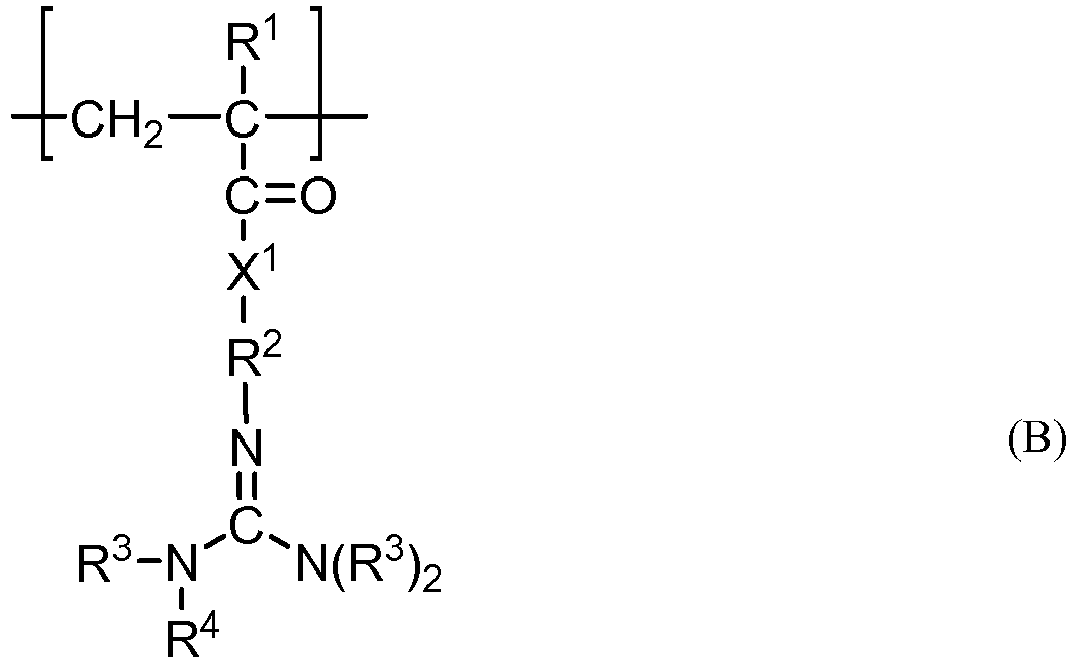
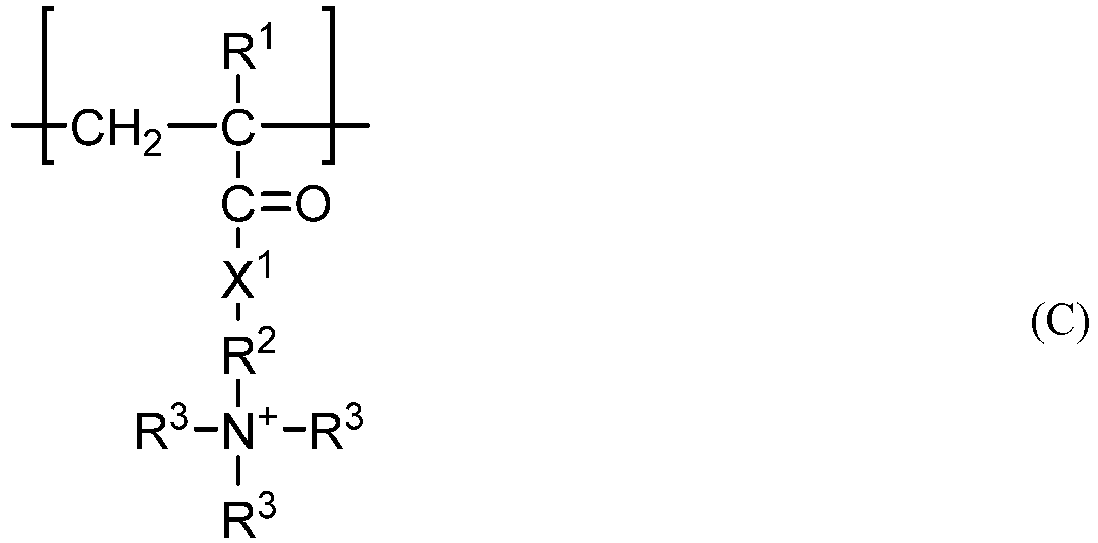
- R1 represents H or an alkyl group having from 1 to 4 carbon atoms (e.g., methyl, ethyl, propyl, butyl, isopropyl). Preferably, R1 is H or methyl.
- R2 represents a divalent alkylene group optionally substituted by a catenary carbonyloxy, carbonylamino, oxycarbonylamino, or ureylene divalent linking group. Preferably, R2 has from 2 to 12 carbon atoms, more preferably 2 to 6 carbon atoms, and more preferably 2 to 4 carbon atoms.
- Each R3 independently represents H or an alkyl group having from 1 to 4 carbon atoms (e.g., methyl, ethyl, propyl, butyl, isopropyl). Preferably, R3 is H, methyl, or ethyl.
- R4 represents H, an alkyl group having from 1 to 4 carbon atoms (e.g., methyl, ethyl, propyl, butyl, isopropyl), or -N(R3)2 wherein R3 is as defined above. Preferably, R4 is H, methyl, or ethyl.
- X1 represents -O- or -NR3- wherein R3 is as defined above.
- Preferred examples also include divalent monomer units represented by formulas (D) or (E), below:


- R5 is H, C1-C12 alkyl, or C5-C12 (hetero)aryl;
- R6 is a covalent bond, C2-C12 alkylene, C5-C12 (hetero)arylene,


- each R7 is independently H, -OH, C1-C12 alkyl, or C5-C12 (hetero)aryl, preferably H or C1-C4 alkyl;
- R8 is H, C1-C12 alkyl, C5-C12 (hetero)aryl, or -N(R7)2, preferably H or C1-C4 alkyl
- R9 is C2-C12 alkylene or C5-C12 (hetero)arylene;
- X2 is -O- or -NR7-;
- R10 is C2-C12 alkylene; and
- R11 is H or methyl.
- Further details concerning divalent monomer units and methods for their preparation can be found in
U.S. Pat. No. 8,377,672 (Rasmussen ). - Monomeric units (A) and (B) may be conveniently generated by polymerization of corresponding monomers, or by reaction of a pendant reactive group such as an azlactone group of a precursor polymer (e.g., a polymer made from monomers including an alkenylazlactone), for example, with a primary or secondary aminoalkyl-functional guanidine or agmatine compound. Monomers and methods suitable for generating the monomeric units (A) and (B) are described, for example, in
U.S. Pat. Nos. 8,377,672 (Rasmussen et al. ),8,652,582 (Bothof et al. ), andWO 2014/204763A1 (Rasmussen, et al. ). - Examples of suitable monomers for generating monomeric unit (C) include salts (e.g., chloride or bromide salts) of N-(3-trimethylammoniopropyl)acrylamide; 2-trimethylammonioethyl methacrylate; 2-trimethylammonioethyl acrylate; N-(3-trimethylammoniopropyl)methacrylamide; N-(6-trimethylammoniohexyl)acrylamide; and N-(3-trimethylammoniopropyl)acrylamide. Monomers and methods suitable for generating the monomeric unit (C) can be found, for example, in
U.S. Pat. No. 6,007,803 (Mandeville, III et al. ) and inPCT International Pat. Appl. No. US2014/057388, filed Sept. 25, 2014 . Cationic monomeric unit (C) is preferably paired with a non-interfering anion Z- as defined previously. - Cationically-ionizable monomer units may be generated for example as a result of free-radical polymerization (e.g., homopolymerization or copolymerization) of a corresponding monomer having a cationically-ionizable group, or by polymerization (e.g., homopolymerization or copolymerization) of a precursor monomer that is functionalized with a cationically-ionizable group in a subsequent reaction.
- The grafted acrylic polymer may further comprise 0.1 to 90 percent by weight of at least one nonionizable hydrophilic monomer unit, or it may contain none at all. For example, the grafted acrylic polymer may contain at least 1 percent by weight, at least 5 percent by weight, at least 10 percent by weight, at least 15 percent by weight, or at least 25 percent by weight up to 30 percent by weight, 40 percent by weight, 50 percent by weight, 75 percent by weight, or 90 percent by weight of the at least one nonionizable hydrophilic monomer unit. In some embodiments, the nonionizable hydrophilic monomer unit comprises a divalent residue of an N-vinyllactam having from 5 to 7 carbon atoms as shown below, wherein n = 1, 2, or 3.

- Such monomeric units can be readily introduced by including N-vinylpyrrolidone, N-vinylvalerolactam, and/or N-vinylcaprolactam in the monomers that are polymerized to prepare the grafted acrylic polymer.
- In some embodiments, the nonionizable hydrophilic monomer unit comprises a divalent residue of a polyether (meth)acrylate as shown below, wherein R1 and R3 are as previously defined and w is an integer ≥ 2.

- Such monomeric units can be readily introduced by including polyether (meth)acrylates in the monomers that are polymerized to prepare the grafted acrylic polymer. Methods of making such monomers are well-known in the art and many are commercially available. Examples include 2-(2-ethoxyethoxy)ethyl acrylate, methoxypolyethylene glycol (350) monoacrylate, methoxypolyethylene glycol (350) monomethacrylate, methoxypolyethylene glycol (550) monoacrylate, and methoxypolyethylene glycol (550) monomethacrylate, all available from Sartomer Co., Exton, Pennsy lvania.
- Optionally, the biological composition may be pretreated with a water-soluble polymeric flocculant that flocculates a portion of the components of the biological composition prior to (or simultaneously with) combining it with the loose cationic ligand-functionalized staple fibers. Examples of suitable flocculants include cationic ligand-functionalized synthetic polymers, for example, as disclosed in
U. S. Pat. Nos. 8,377,672 (Rasmussen et al. ) and8,435,776 (Rasmussen et al. ). - Suitable vessels comprise at least one mixing volume (e.g., a chamber). Exemplary vessels include specimen collection tubes and bags (preferably sealed specimen collection tubes and bags), mixing vessels with drains, flasks, beakers, barrels, bags, troughs, tubular flow reactors, static mixers, and vats. In some embodiments, the vessel is closed and/or sealed (e.g., with rubber septum/stopper or cap). Suitable vessels may be disposable or reusable, for example. Stirring devices (e.g., paddles, agitators, propellers, or stir bars) may be used in conjunction with the mixing vessels to facilitate agitation.
- Static mixers (e.g., as shown schematically in
FIG. 2 ) are commercially available from various suppliers such, for example, Koflo Corp., Cary, Illinois, and Charles Ross and Son Co., Hauppauge, New York. In some embodiments, the vessel is fitted with a drain, operable by opening and closing a valve (e.g., a stopcock). This may be particularly useful with larger vessels that cannot be manipulated easily by hand. - Referring now to
FIG. 1 ,exemplary article 100 purifying a biological composition comprisesvessel 110 havingmixing volume 115 disposed therein. Loose cationic ligand-functionalizedstaple fibers 120 according to the present disclosure are disposed within mixingvolume 115. Optional cover 130 (e.g., a rubber septum, plastic press-fit top, or screw top), together withvessel 100, encloses mixingvolume 115. Optionally, synthetic polymericflocculent particles 180 may also be present. - In use, a biological composition (not shown) is disposed in the mixing volume, the
fibers 120 and the biological composition are agitated while in intimate contact.Optional valve 150 may be opened allowing the purified biological composition to drain throughporous substrate 140 and flow throughoptional outlet port 160. - One exemplary embodiment for carrying out a method according to the present disclosure is shown in
FIG. 2 . Referring now toFIG. 2 , loose cationic ligand-functionalizedstaple fibers 120 are suspended in a fluid 225 (e.g., saline or water), optionally containing dissolved synthetic polymer flocculent, are combined withbiological composition 210 and passed throughstatic mixer 220. Particulate and fiber materials are removed byporous filter 230 and purifiedbiological composition 240 passes throughporous filter 230 to be collected. - The loose cationic ligand-functionalized staple fibers may be disposed within the mixing chamber before, after, or simultaneously with, disposing the biological composition within the mixing chamber of the vessel.
- Once combined in the mixing vessel, the biological composition and the loose cationic ligand-functionalized staple fibers are agitated while they are in intimate contact with each other within the mixing chamber to provide modified fibers (i.e., having some material(s) from the biological composition bound thereto) and a purified biological composition. Suitable mixing methods include shaking by hand, laboratory agitators, mechanical and/or magnetic stirrers, and passing through a static mixer, for example. Agitation may be performed for any length of time sufficient to effectively bind biological compounds to the fibers. In some embodiments, the agitation is preferably less than 60 seconds, less than 45 seconds, or even less than 30 seconds. In other embodiments, the agitation may be as long as 20 minutes or more, for example.
- Separation of the purified biological composition from the modified fibers may be accomplished by any suitable method including, for example, centrifugation, decanting, filtration, and sieving. In one particularly preferred embodiment, the contents of the mixing chamber, after agitating them, are transported through a porous substrate (e.g., a porous scrim, porous membrane, porous nonwoven fabric, or mesh), whereby the fibers do not pass through the porous substrate and form a porous mat of fibers disposed upstream from the substrate, and which may serve to mechanically remove particulate debris remaining in the purified biological composition. Polypropylene, polyethylene, metal, and glass may be used as materials for the porous substrate, for example.
- Typically the porous substrate has openings/pores of from about 0.5 mm to about 0.5 cm in order to achieve efficient collection of the modified fibers without excessively impeding fluid flow through the porous substrate, although other opening/pore sizes may also be used.
- In some embodiments, the biological species being removed from the fluid is the object of the purification. For example, a recombinant protein or enzyme may be prepared in cell culture, the loose cationic ligand-functionalized staple fibers can be added to flocculate the protein or enzyme, and the precipitate can be separated as the first step in the purification process for the protein or enzyme. In another example, the loose cationic ligand-functionalized staple fibers may be used to capture microorganisms from a fluid as the first step in a process of concentrating, enumerating, and/or identifying the microorganisms.
- In other embodiments, the biological species being removed from the fluid is a contaminant that must be removed prior to additional processing steps for the fluid.
- Accordingly, the loose cationic ligand-functionalized staple fibers can be used to bind and facilitate the removal of cells and cell debris from a biological composition such as, for example, a cell culture or fermentation broth. It can be used to precipitate either desired or contaminating proteins or nucleic acids from solution. Significantly, the loose cationic ligand-functionalized staple fibers are useful under conditions of high salt concentration or high ionic strength.
- In a first embodiment, the present disclosure provides a method of purifying a biological composition, the method comprising:
- a) disposing loose cationic ligand-functionalized staple fibers and a biological composition within a mixing volume of a vessel, wherein the loose cationic ligand-functionalized staple fibers have a modified surface layer comprising a grafted acrylic polymer comprising 10 to 100 percent by weight of a cationically-ionizable monomer unit and wherein at least a portion of the loose cationic ligand-functionalized staple fibers are fibrillated;
- b) agitating the biological composition and the loose cationic ligand-functionalized staple fibers while they are in intimate contact with each other within the mixing volume to provide modified fibers and a purified biological composition; and
- c) separating at least a portion of the purified biological composition from the modified fibers and any loose cationic ligand-functionalized staple fibers with which it is in contact.
- In a second embodiment, the present disclosure provides a method according to the first embodiment, wherein the loose cationic ligand-functionalized staple fibers are disposed within the mixing volume before the biological composition is disposed within the mixing volume.
- In a third embodiment, the present disclosure provides a method according to the first or second embodiment, wherein step b) is accomplished at least in part using a static mixer.
- In a fifth embodiment, the present disclosure provides a method according to any one of the first to third embodiments, wherein the biological composition contains a synthetic polymer flocculant.
- In a sixth embodiment, the present disclosure provides a method according to the fifth embodiment, wherein the grafted acrylic polymer further comprises a multifunctional monomer unit.
- In a seventh embodiment, the present disclosure provides a method according to any one of the first to sixth embodiments, wherein the grafted acrylic polymer further comprises 0.1 to 90 percent by weight of at least one nonionizable hydrophilic monomer unit.
- In an eighth embodiment, the present disclosure provides a method according to the seventh embodiment, wherein the nonionizable hydrophilic monomer unit comprises an N-vinyllactam having from 4 to 6 carbon atoms.
- In a ninth embodiment, the present disclosure provides a method according to any one of the first to eighth embodiments, wherein the cationically-ionizable monomer unit is a divalent monomer unit represented by the formula:

- R1 is H or an alkyl group having from 1 to 4 carbon atoms;
- R2 is a divalent alkylene group optionally substituted by a catenary carbonyloxy, carbonylamino, oxycarbonylamino, or ureylene divalent linking group;
- each R3 independently is H or an alkyl group having from 1 to 4 carbon atoms;
- R4 is H or an alkyl group having from 1 to 4 carbon atoms or -N(R3)2; and
- X1 is -O- or -NR3-.
- In a tenth embodiment, the present disclosure provides a method according to any one of the first to eighth embodiments, wherein the cationically-ionizable monomer unit comprises a divalent monomer unit represented by the formula:

- R1 is H or an alkyl group having from 1 to 4 carbon atoms;
- R2 is a divalent alkylene group optionally substituted by a catenary carbonyloxy, carbonylamino, oxycarbonylamino, or ureylene divalent linking group; and
- each R3 independently is H or an alkyl group having from 1 to 4 carbon atoms; R4 is H or an alkyl group having from 1 to 4 carbon atoms or -N(R3)2; and
- X1 is -O- or -NR3-.
- In an eleventh embodiment, the present disclosure provides a method according to the first to tenth embodiments, wherein the vessel comprises an optionally sealed specimen collection bag or tube.
- In a twelfth embodiment, the present disclosure provides a method according to the any one of the first to eleventh embodiments, wherein step c) includes depositing at least a portion of the modified fibers and any loose cationic ligand-functionalized staple fibers on a porous substrate.
- In a thirteenth embodiment, the present disclosure provides an article for purifying a biological composition, the article comprising:
- a vessel having a mixing volume disposed therein; and
- loose cationic ligand-functionalized staple fibers disposed within the mixing volume, wherein the loose cationic ligand-functionalized staple fibers have a modified surface layer comprising a grafted acrylic polymer comprising 10 to 100 percent by weight of at least one cationically-ionizable acrylic monomer unit and wherein at least a portion of the loose cationic ligand-functionalized staple fibers are fibrillated.
- In a fourteenth embodiment, the present disclosure provides an article according to the thirteenth embodiment, wherein the grafted acrylic polymer comprises a multifunctional monomer unit.
- In a fifteenth embodiment, the present disclosure provides an article according to the thirteenth or fourteenth embodiment, wherein the grafted acrylic polymer further comprises 0.1 to 90 percent by weight of at least one nonionizable hydrophilic monomer unit.
- In a sixteenth embodiment, the present disclosure provides an article according to the fifteenth embodiment, wherein the nonionizable hydrophilic monomer unit comprises an N-vinyllactam having from 4 to 6 carbon atoms.
- In a seventeenth embodiment, the present disclosure provides an article according to any one of the thirteenth to sixteenth embodiments, wherein the cationically-ionizable acrylic monomer unit is represented by the formula:

- R1 is H or an alkyl group having from 1 to 4 carbon atoms;
- R2 is a divalent alkylene group optionally substituted by a catenary carbonyloxy, carbonylamino, oxycarbonylamino, or ureylene divalent linking group;
- each R3 is independently H or an alkyl group having from 1 to 4 carbon atoms;
- R4 is H or an alkyl group having from 1 to 4 carbon atoms or -N(R3)2; and
- X1 is -O- or -NR3-.
- In an eighteenth embodiment, the present disclosure provides an article according to any one of the thirteenth to sixteenth embodiments, wherein the cationically-ionizable monomer unit comprises a divalent monomer unit represented by the formula:

- R1 is H or an alkyl group having from 1 to 4 carbon atoms;
- R2 is a divalent alkylene group optionally substituted by a catenary carbonyloxy, carbonylamino, oxycarbonylamino, or ureylene divalent linking group; and
- each R3 independently is H or an alkyl group having from 1 to 4 carbon atoms.
- In a nineteenth embodiment, the present disclosure provides an article according to any one of the thirteenth to eighteenth embodiments, wherein at least a portion of the loose cationic ligand-functionalized staple fibers are fibrillated.
- In a twentieth embodiment, the present disclosure provides an article according to any one of the thirteenth to nineteenth embodiments, wherein the biological composition contains a synthetic polymer flocculant.
- Objects and advantages of this disclosure are further illustrated by the following non-limiting examples, but the particular materials and amounts thereof recited in these examples, as well as other conditions and details, should not be construed to unduly limit this disclosure.
- Unless otherwise noted, all parts, percentages (%), ratios, etc. in the Examples and the rest of the specification are by weight. Materials used in the examples are available from standard chemical vendors (e.g., such as Sigma-Aldrich Co., Saint Louis, Missouri) and/or prepared according to known methods, unless otherwise indicated. Materials abbreviations used in the Examples are listed in Table 1, below.
TABLE 1 ABBREVIATION DESCRIPTION NVP N -vinylpyrrolidone IEM-Ag 4-(2-(methacryloyloxy)ethylammocarbonylamino) butyl guanidinium sodium sulfate prepared according to the procedure of Example 99, paragraph [0151] of US 2012/0252091 A1 (Rasmussen et al. )GMA glycidyl methacrylate MAPTAC 3-methacrylamidopropyltrimethylammonium chloride - Ten grams of polyethylene (PE) fibers (SHORT STUFF E380F, -.7 mm in length and 0.015 mm diameter, obtained from Minifibers Inc., Johnson City, Tennessee) were purged with nitrogen in an oxygen depleted (< 50 ppm oxygen) glove box. The fibers were sealed in a plastic bag and removed from the glove box. The fibers were irradiated by passing under a BROADBEAM EP e-beam apparatus from PCT Engineered Systems, Davenport, Iowa, at 10 Mrad and 300 kV. The bag was then flipped over and again passed through the e-beam at 10 Mrad and 300 kV. The bag was then returned to the nitrogen purged glove box.
- The irradiated fibers were transferred to a glass jar and coated with 223 g of a monomer-containing coating solution containing 11.1 wt.% of NVP, 6.7 wt.% of IEM-Ag, 5 wt.% of GMA, and 77.2 wt.% of deionized water. The fibers and monomers were allowed to react overnight in the nitrogen purged glove box.
- The reacted fibers were washed three times with 14 mM sodium chloride water, allowing the salt water to drain through a screen mesh while retaining the fibers. The fibers were then transferred to a large aluminum pan and allowed to dry. The dried fibers were weighed to determine the final graft yield. The washed fibers weighed 41.9 g, indicating that 31.9 g of grafted polymer had been added to the 10 g of fibers.
- The procedure of Example 1 was used to produce functionalized fibers, except that the PE fiber was SHORT STUFF E780F, 1.3-2 mm length, 0.025 mm diameter, and the amounts of individual components were varied as reported in Table 2. The fibers were used for Examples 2 and 3.
TABLE 2 EXAMPLE COATING SOLUTION, g FIBER, g LIGAND WT. % OF LIGAND WT. % OF NVP WT. % OF GMA WT. % OF WATER GRAFT ADD-ON, g polymer/ g fiber PE1 223 10 g of 380F IEM-Ag 6.7 11.1 5 77.2 3.19 PE2 116.5 5 g of 780F IEM-Ag 6.7 11.1 5 77.2 4.12 PE3 116.5 5 g of 780F MAPTAC 6.7 11.1 5 77.3 3.33 - Chinese hamster ovary (CHO) culture (available as CHO-S from Life Technologies, Grand Island, New York) was grown in CD CHO media (available from Life Technologies) with appropriate supplements, at 37°C in a humidified atmosphere of 5% CO2, by volume, in air. Fifteen milliliters of the culture was added to 15 mL conical tubes containing 320 mg of the IEM-agmatine functionalized fibers of Example 1, and then mixed by hand for 10 sec or 10 minutes on a rotator. After mixing, samples were immediately vacuum filtered at a max pressure of 18-20 in. Hg (61-68 kPa) (Model 2522B-01 vacuum pump, Welch-Ilmvac, Niles, Illinois) through a polypropylene blown microfiber nonwoven filter (basis weight = 107 g/m2, 5.9 percent solidity, and 37.8 micrometers effective fiber diameter) using a 25 mm glass vacuum filter holder (Millipore). As a comparison, the same amount of fibers were prepacked by mixing with 10 mL of phosphate-buffered saline, pH 7.4 (available from Life Technologies) and vacuum filtered onto the base substrate. After packing the fiber mat, CHO culture (15 ml) was added and vacuum filtered. For all samples, sample filtration time was determined from starting a stopwatch when turning on the vacuum pump and stopping the pump when the solution ran through and a dry fiber mat remained. Contact time was determined for each sample and refers to the total amount of time the fibers were in contact with a biological solution. It was estimated as the time from when the biological solution was added to the fibers, mixed, poured into the filtration funnel, and filtered through the base substrate. The filtrate was collected for further analysis (turbidity, DNA concentration, host cell protein concentration).
- Turbidity of the filtrate was determined my measuring the filtrate using a Hach 2100AN Turbidimeter (Hach Co., Loveland, Colorado). A 1-mL aliquot of sample filtrate was centrifuged at 14000 rpm for 5 min to remove non-soluble material. Total protein, DNA and CHO host cell protein (CHOP) concentrations were determined from the centrifugate using a Coomassie Plus protein assay (available from Life Technologies), a QUANT IT PICOGREEN DSDNA assay kit (Life Technologies), and a CHO HCP ELISA kit (Cygnus Technologies, Southport, North Carolina), respectively, by following the manufacturer's protocol. Samples were performed in triplicate, except for the starting culture (n = 1), to show a representative starting baseline, and the results are reported in Table 3, below, wherein "NA" means "not applicable".
TABLE 3 EXAMPLE SAMPLE FIBER MASS, mg FILTER TIME, sec EST. CONTACT TIME, sec TURBIDITY, NTU [DNA], nanogram/m L [Protein], microgram/m L [CHOP], microgram/ mL Comp. Ex. A Starting culture NA NA NA 148.4 893 127.3 25.4 Comp. Ex. B Filtered culture (no fiber) 0 2.7 NA 143.1 2142 204.9 27.8 Comp. Ex. C Prepacked: PE1 fibers 317 20.1 20.1 13.9 315 95.1 13.5 5 Fibers - 10 sec mix: PE1 fibers 322 2.8 12.8 47.5 321 139.6 20.5 6 Fibers - 10 min mix: PE1 fibers 327 2.6 602.6 27.5 23 99.8 15.0 - Examples 7-10 and comparative examples D-G were carried out similarly to Examples 5-6 and Comparative examples A-C above, with the following modifications: i) a new CHO culture was used; ii) fibers and biological solution were mixed in a 50 mL conical tube instead of 15 mL tubes; and iii) mixing time was changed to match the contact time between the free fiber sample and the prepacked fiber media.
- Samples were performed in triplicate, except for the starting culture (n = 1) to show a representative starting baseline, and the results are reported in Table 4, below.
TABLE 4 EXAMPLE SAMPLE FIBER MASS, mg FILTER TIME, sec EST. CONTACT TIME, sec TURBIDITY, NTU [DNA], nanogram/m L [Protein], microgram/m L Comp. Ex. D Starting culture NA NA NA 174.2 168.4 786.2 Comp. Ex. E Filtered culture (no fiber) 0 2.2 0.0 171.8 165.7 784.6 Comp. Ex. F Prepacked: PE2 fibers 256 3.2 5.2 40.2 94.4 682.7 7 Fibers - 1 sec mix: PE2 fibers 251 2.3 5.3 25.4 85.3 701.0 8 Fibers - 10 min mix: PE2 fibers 245 1.8 602.8 12.4 2.3 539.7 Comp. Ex. G Prepacked: PE3 fibers 211 4.0 6.0 12.2 65.5 705.4 9 Fibers - 1 sec mix: PE3 fibers 223 2.9 5.9 36.4 52.2 739.0 10 Fibers - 10 min mix: PE3 fibers 219 2.1 603.1 18.6 2.0 669.8 - The preceding description, given in order to enable one of ordinary skill in the art to practice the claimed disclosure, is not to be construed as limiting the scope of the invention, which is defined by the claims.
Claims (15)
- A method of purifying a biological composition, the method comprising:a) disposing loose cationic ligand-functionalized staple fibers and a biological composition within a mixing volume of a vessel, wherein the loose cationic ligand-functionalized staple fibers have a modified surface layer comprising a grafted acrylic polymer comprising 10 to 100 percent by weight of a cationically-ionizable monomer unit, and wherein at least a portion of the loose cationic ligand-functionalized staple fibers are fibrillated;b) agitating the biological composition and the loose cationic ligand-functionalized staple fibers while they are in intimate contact with each other within the mixing volume to provide modified fibers and a purified biological composition; andc) separating at least a portion of the purified biological composition from the modified fibers and any loose cationic ligand-functionalized staple fibers with which it is in contact.
- The method of claim 1, wherein the loose cationic ligand-functionalized staple fibers are disposed within the mixing volume before the biological composition is disposed within the mixing volume.
- The method of claim 1 or 2, wherein step b) is accomplished at least in part using a static mixer.
- The method of any one of claims 1 to 3, wherein the biological composition contains a synthetic polymer flocculant.
- The method of any one of claims 1 to 4, wherein the grafted acrylic polymer further comprises a multifunctional monomer unit.
- The method of any one of claims 1 to 5, wherein the grafted acrylic polymer further comprises 0.1 to 90 percent by weight of at least one nonionizable hydrophilic monomer unit.
- The method of any one of claims 1 to 6, wherein the cationically-ionizable monomer unit is a divalent monomer unit represented by the formula:
 R1 is H or an alkyl group having from 1 to 4 carbon atoms;R2 is a divalent alkylene group optionally substituted by a catenary carbonyloxy, carbonylamino, oxycarbonylamino, or ureylene divalent linking group;each R3 independently is H or an alkyl group having from 1 to 4 carbon atoms;R4 is H or an alkyl group having from 1 to 4 carbon atoms or -N(R3)2; andX1 is -O- or -NR3-.
 - The method of any one of claims 1 to 6, wherein the cationically-ionizable monomer unit comprises a divalent monomer unit represented by the formula:
 R1 is H or an alkyl group having from 1 to 4 carbon atoms;R2 is a divalent alkylene group optionally substituted by a catenary carbonyloxy, carbonylamino, oxycarbonylamino, or ureylene divalent linking group; andeach R3 independently is H or an alkyl group having from 1 to 4 carbon atoms.
 - The method of any one of claims 1 to 8, wherein the vessel comprises a sealed specimen bag.
- The method of any one of claims 1 to 9, wherein step c) includes depositing at least a portion of the modified fibers and any loose cationic ligand-functionalized staple fibers on a porous substrate.
- An article for purifying a biological composition, the article comprising:a vessel having a mixing volume disposed therein; andloose cationic ligand-functionalized staple fibers disposed within the mixing volume, wherein the loose cationic ligand-functionalized staple fibers have a modified surface layer comprising a grafted acrylic polymer comprising 10 to 100 percent by weight of at least one cationically-ionizable acrylic monomer unit, and wherein at least a portion of the loose cationic ligand-functionalized staple fibers are fibrillated.
- The article of claim 11, wherein the grafted acrylic polymer further comprises 0.1 to 90 percent by weight of at least one nonionizable hydrophilic monomer unit.
- The article of claim 11 or 12, wherein the cationically-ionizable acrylic monomer unit is represented by the formula:
 R1 is H or an alkyl group having from 1 to 4 carbon atoms;R2 is a divalent alkylene group optionally substituted by a catenary carbonyloxy, carbonylamino, oxycarbonylamino, or ureylene divalent linking group;each R3 is independently H or an alkyl group having from 1 to 4 carbon atoms;R4 is H or an alkyl group having from 1 to 4 carbon atoms or -N(R3)2; andX1 is -O- or -NR3-.
 - The article of any one of claims 11 to 13, wherein the cationically-ionizable monomer unit comprises a divalent monomer unit represented by the formula:
 R1 is H or an alkyl group having from 1 to 4 carbon atoms;R2 is a divalent alkylene group optionally substituted by a catenary carbonyloxy, carbonylamino, oxycarbonylamino, or ureylene divalent linking group; andeach R3 independently is H or an alkyl group having from 1 to 4 carbon atoms.
 - The article of any one of claims 11 to 14, wherein the biological composition contains a synthetic polymer flocculant.
Applications Claiming Priority (2)
| Application Number | Priority Date | Filing Date | Title |
|---|---|---|---|
| US201562137365P | 2015-03-24 | 2015-03-24 | |
| PCT/US2016/022842 WO2016153915A1 (en) | 2015-03-24 | 2016-03-17 | Method of purifying a biological composition and article therefor |
Publications (2)
| Publication Number | Publication Date |
|---|---|
| EP3274069A1 EP3274069A1 (en) | 2018-01-31 |
| EP3274069B1 true EP3274069B1 (en) | 2020-08-19 |
Family
ID=55795168
Family Applications (1)
| Application Number | Title | Priority Date | Filing Date |
|---|---|---|---|
| EP16717497.8A Active EP3274069B1 (en) | 2015-03-24 | 2016-03-17 | Method of purifying a biological composition and article therefor |
Country Status (5)
| Country | Link |
|---|---|
| US (1) | US10562997B2 (en) |
| EP (1) | EP3274069B1 (en) |
| JP (1) | JP6709799B2 (en) |
| CN (1) | CN107406824B (en) |
| WO (1) | WO2016153915A1 (en) |
Cited By (1)
| Publication number | Priority date | Publication date | Assignee | Title |
|---|---|---|---|---|
| US12630582B2 (en) | 2020-11-24 | 2026-05-19 | Life Technologies Corporation | Method for biomaterial purification and kits thereof |
Families Citing this family (4)
| Publication number | Priority date | Publication date | Assignee | Title |
|---|---|---|---|---|
| CN114793436A (en) * | 2019-11-27 | 2022-07-26 | 3M创新有限公司 | Method for purifying biological material and kit thereof |
| CN116615434A (en) * | 2020-12-04 | 2023-08-18 | 3M创新有限公司 | Filtration unit and method for purification of biological material |
| CN117177805A (en) * | 2021-04-30 | 2023-12-05 | 3M创新有限公司 | Virus filtration media, articles and methods |
| EP4573366A1 (en) * | 2022-08-15 | 2025-06-25 | Solventum Intellectual Properties Company | Functionalized porous substrates and their use for detecting analytes |
Family Cites Families (34)
| Publication number | Priority date | Publication date | Assignee | Title |
|---|---|---|---|---|
| US4340057A (en) | 1980-12-24 | 1982-07-20 | S. C. Johnson & Son, Inc. | Radiation induced graft polymerization |
| JPS57196153A (en) * | 1981-05-28 | 1982-12-02 | Konishiroku Photo Ind Co Ltd | Analysis element |
| US4618533A (en) | 1984-11-30 | 1986-10-21 | Millipore Corporation | Porous membrane having hydrophilic surface and process |
| JPH0829234B2 (en) | 1987-07-27 | 1996-03-27 | 旭化成工業株式会社 | Hydrophilic microporous membrane |
| US5202025A (en) | 1989-04-12 | 1993-04-13 | Terumo Kabushiki Kaisha | Porous membrane and method for preparing the same |
| US5061751A (en) | 1989-06-02 | 1991-10-29 | Exxon Chemical Patents Inc. | Vinylpyrrolidone grafted polyolefins in polymer blends and composites |
| US5344701A (en) | 1992-06-09 | 1994-09-06 | Minnesota Mining And Manufacturing Company | Porous supports having azlactone-functional surfaces |
| US5350805A (en) | 1993-06-10 | 1994-09-27 | Koch Membrane Systems, Inc. | Epoxide-direct grafted halogenated vinyl polymers |
| US5531900A (en) | 1994-07-07 | 1996-07-02 | University Of Arizona | Modification of polyvinylidene fluoride membrane and method of filtering |
| JP3485234B2 (en) | 1997-04-04 | 2004-01-13 | 株式会社荏原製作所 | Anion exchanger, method for producing the same, and chemical filter |
| US6007803A (en) | 1997-09-19 | 1999-12-28 | Geltex Pharmaceuticals, Inc. | Ionic polymers as toxin binding agents |
| US6914137B2 (en) | 1997-12-06 | 2005-07-05 | Dna Research Innovations Limited | Isolation of nucleic acids |
| WO2000009797A1 (en) | 1998-08-12 | 2000-02-24 | Ebara Corporation | Base material for radiation graft polymerization and raw material for filter |
| US6861001B2 (en) | 1999-12-02 | 2005-03-01 | The General Hospital Corporation | Methods for removal, purification, and concentration of viruses, and methods of therapy based thereupon |
| KR100445560B1 (en) * | 2001-10-31 | 2004-08-21 | (주)바이오넥스 | Method of manufacturing kit for isolating nucleic acids or biological materials, kit manufactured by the method, and apparatus using the kit |
| US7533417B2 (en) | 2003-11-10 | 2009-05-12 | Eastman Kodak Company | Method for obtaining photo property release |
| US20090098359A1 (en) | 2007-10-11 | 2009-04-16 | Waller Jr Clinton P | Hydrophilic porous substrates |
| US20100261801A1 (en) | 2007-12-27 | 2010-10-14 | 3M Innovative Properties Company | Method for making a functionalized membrane |
| CN102083897B (en) * | 2008-05-30 | 2013-06-12 | 3M创新有限公司 | Method of making ligand functionalized substrates |
| US8586338B2 (en) | 2008-05-30 | 2013-11-19 | 3M Innovative Properties Company | Ligand functionalized substrates |
| CN102203173B (en) | 2008-09-19 | 2014-04-02 | 3M创新有限公司 | Ligand-grafted functionalized substrates |
| CN102317523B (en) * | 2008-12-23 | 2014-08-06 | 3M创新有限公司 | Functionalized nonwoven article |
| US20100210160A1 (en) | 2009-02-18 | 2010-08-19 | 3M Innovative Properties Company | Hydrophilic porous substrates |
| EP2446077B1 (en) | 2009-06-23 | 2016-05-18 | 3M Innovative Properties Company | Functionalized nonwoven article |
| US8377672B2 (en) * | 2010-02-18 | 2013-02-19 | 3M Innovative Properties Company | Ligand functionalized polymers |
| BR112012021943B1 (en) | 2010-03-03 | 2021-09-28 | 3M Innovative Properties Company | METHOD OF SEPARATION OF A TARGET BIOLOGICAL SPECIES FROM A FLUID |
| US20140057388A1 (en) | 2010-07-27 | 2014-02-27 | Amtech Systems, Inc. | Systems and Methods for Depositing and Charging Solar Cell Layers |
| WO2012092242A2 (en) | 2010-12-29 | 2012-07-05 | 3M Innovative Properties Company | Microbial detection article having a water-absorbent filter assembly |
| US9272246B2 (en) | 2011-03-28 | 2016-03-01 | 3M Innovative Properties Company | Ligand functional substrates |
| JP5756328B2 (en) * | 2011-04-19 | 2015-07-29 | 旭化成メディカル株式会社 | Method for introducing graft chain, porous adsorption membrane, and protein purification method |
| EP2647709B1 (en) * | 2012-04-05 | 2016-02-24 | F. Hoffmann-La Roche AG | Amine compounds for the selective preparation of biological samples |
| WO2013184366A1 (en) | 2012-06-05 | 2013-12-12 | 3M Innovative Properties Company | Graft copolymer functionalized article |
| US20140170667A1 (en) * | 2012-12-19 | 2014-06-19 | Nanomr, Inc. | Methods for amplifying nucleic acid from a target |
| JP6467409B2 (en) | 2013-06-17 | 2019-02-13 | スリーエム イノベイティブ プロパティズ カンパニー | Process for preparing guanidino functional monomers |
-
2016
- 2016-03-17 EP EP16717497.8A patent/EP3274069B1/en active Active
- 2016-03-17 US US15/549,268 patent/US10562997B2/en active Active
- 2016-03-17 CN CN201680017205.8A patent/CN107406824B/en active Active
- 2016-03-17 JP JP2017549241A patent/JP6709799B2/en active Active
- 2016-03-17 WO PCT/US2016/022842 patent/WO2016153915A1/en not_active Ceased
Non-Patent Citations (1)
| Title |
|---|
| None * |
Cited By (1)
| Publication number | Priority date | Publication date | Assignee | Title |
|---|---|---|---|---|
| US12630582B2 (en) | 2020-11-24 | 2026-05-19 | Life Technologies Corporation | Method for biomaterial purification and kits thereof |
Also Published As
| Publication number | Publication date |
|---|---|
| JP6709799B2 (en) | 2020-06-17 |
| JP2018513848A (en) | 2018-05-31 |
| EP3274069A1 (en) | 2018-01-31 |
| WO2016153915A1 (en) | 2016-09-29 |
| US10562997B2 (en) | 2020-02-18 |
| CN107406824B (en) | 2021-02-05 |
| CN107406824A (en) | 2017-11-28 |
| US20180066095A1 (en) | 2018-03-08 |
Similar Documents
| Publication | Publication Date | Title |
|---|---|---|
| US9522365B2 (en) | Cross-linked cellulose membranes | |
| EP3070472B1 (en) | Flocculant composition comprising ligand functionalized polymers | |
| KR101902225B1 (en) | Improved depth filters for disposable biotechnological processes | |
| EP2653218A1 (en) | Temperature-responsive adsorbent having strong cation exchange group, and method for producing same | |
| EP2987801B1 (en) | Method for the removal of aggregates from a solution containing an antibody protein | |
| US10562997B2 (en) | Method of purifying a biological composition and article therefor | |
| CN105658313B (en) | Cellulose sulfate hydrate film, its preparation method and the film as viral purification adsorbed film purposes | |
| WO2010071080A1 (en) | Mixed-mode adsorbent material | |
| US5486293A (en) | Removal of small exogenous molecules from biological fluids | |
| CN101827648A (en) | Protein adsorbent and method for producing the same | |
| KR20170075769A (en) | Mixed bed ion exchange adsorber | |
| JP2016506955A (en) | Disposable direct capture device | |
| CN102844110B (en) | Substrate for ligand immobilization and manufacturing method thereof | |
| JP2015518043A (en) | Mixed multifunctional metal affinity surface reduces aggregate content in protein formulations | |
| JP4942015B2 (en) | Ligand immobilization substrate and cell selective adsorbent | |
| JP5631869B2 (en) | Graft polymerization initiated by Ce (IV) on a polymer containing no hydroxyl group | |
| EP4038184A1 (en) | Purification process based on magnetic beads | |
| JP2025509735A (en) | Methods and compositions for purifying small extracellular vesicles | |
| CN117751186A (en) | Methods for reducing endotoxin levels for nucleic acid purification | |
| JP2017025177A (en) | Composition, manufacturing method of composition, preparation method of carbohydrate chain sample and analytic method of carbohydrate chain | |
| CN118871580A (en) | Method for reducing endotoxin levels in nucleic acid purification | |
| JP2014019694A (en) | Separation agent for separating antibody monomer, and antibody monomer-separating method | |
| JP2004339383A (en) | Functional pipette tip and tube |
Legal Events
| Date | Code | Title | Description |
|---|---|---|---|
| STAA | Information on the status of an ep patent application or granted ep patent |
Free format text: STATUS: THE INTERNATIONAL PUBLICATION HAS BEEN MADE |
|
| PUAI | Public reference made under article 153(3) epc to a published international application that has entered the european phase |
Free format text: ORIGINAL CODE: 0009012 |
|
| STAA | Information on the status of an ep patent application or granted ep patent |
Free format text: STATUS: REQUEST FOR EXAMINATION WAS MADE |
|
| 17P | Request for examination filed |
Effective date: 20170907 |
|
| AK | Designated contracting states |
Kind code of ref document: A1 Designated state(s): AL AT BE BG CH CY CZ DE DK EE ES FI FR GB GR HR HU IE IS IT LI LT LU LV MC MK MT NL NO PL PT RO RS SE SI SK SM TR |
|
| AX | Request for extension of the european patent |
Extension state: BA ME |
|
| DAV | Request for validation of the european patent (deleted) | ||
| DAX | Request for extension of the european patent (deleted) | ||
| STAA | Information on the status of an ep patent application or granted ep patent |
Free format text: STATUS: EXAMINATION IS IN PROGRESS |
|
| 17Q | First examination report despatched |
Effective date: 20190301 |
|
| GRAP | Despatch of communication of intention to grant a patent |
Free format text: ORIGINAL CODE: EPIDOSNIGR1 |
|
| STAA | Information on the status of an ep patent application or granted ep patent |
Free format text: STATUS: GRANT OF PATENT IS INTENDED |
|
| INTG | Intention to grant announced |
Effective date: 20200312 |
|
| GRAS | Grant fee paid |
Free format text: ORIGINAL CODE: EPIDOSNIGR3 |
|
| GRAA | (expected) grant |
Free format text: ORIGINAL CODE: 0009210 |
|
| STAA | Information on the status of an ep patent application or granted ep patent |
Free format text: STATUS: THE PATENT HAS BEEN GRANTED |
|
| AK | Designated contracting states |
Kind code of ref document: B1 Designated state(s): AL AT BE BG CH CY CZ DE DK EE ES FI FR GB GR HR HU IE IS IT LI LT LU LV MC MK MT NL NO PL PT RO RS SE SI SK SM TR |
|
| REG | Reference to a national code |
Ref country code: CH Ref legal event code: EP |
|
| REG | Reference to a national code |
Ref country code: DE Ref legal event code: R096 Ref document number: 602016042233 Country of ref document: DE |
|
| REG | Reference to a national code |
Ref country code: AT Ref legal event code: REF Ref document number: 1303302 Country of ref document: AT Kind code of ref document: T Effective date: 20200915 |
|
| REG | Reference to a national code |
Ref country code: IE Ref legal event code: FG4D |
|
| REG | Reference to a national code |
Ref country code: LT Ref legal event code: MG4D |
|
| REG | Reference to a national code |
Ref country code: NL Ref legal event code: MP Effective date: 20200819 |
|
| PG25 | Lapsed in a contracting state [announced via postgrant information from national office to epo] |
Ref country code: NO Free format text: LAPSE BECAUSE OF FAILURE TO SUBMIT A TRANSLATION OF THE DESCRIPTION OR TO PAY THE FEE WITHIN THE PRESCRIBED TIME-LIMIT Effective date: 20201119 Ref country code: BG Free format text: LAPSE BECAUSE OF FAILURE TO SUBMIT A TRANSLATION OF THE DESCRIPTION OR TO PAY THE FEE WITHIN THE PRESCRIBED TIME-LIMIT Effective date: 20201119 Ref country code: FI Free format text: LAPSE BECAUSE OF FAILURE TO SUBMIT A TRANSLATION OF THE DESCRIPTION OR TO PAY THE FEE WITHIN THE PRESCRIBED TIME-LIMIT Effective date: 20200819 Ref country code: GR Free format text: LAPSE BECAUSE OF FAILURE TO SUBMIT A TRANSLATION OF THE DESCRIPTION OR TO PAY THE FEE WITHIN THE PRESCRIBED TIME-LIMIT Effective date: 20201120 Ref country code: PT Free format text: LAPSE BECAUSE OF FAILURE TO SUBMIT A TRANSLATION OF THE DESCRIPTION OR TO PAY THE FEE WITHIN THE PRESCRIBED TIME-LIMIT Effective date: 20201221 Ref country code: LT Free format text: LAPSE BECAUSE OF FAILURE TO SUBMIT A TRANSLATION OF THE DESCRIPTION OR TO PAY THE FEE WITHIN THE PRESCRIBED TIME-LIMIT Effective date: 20200819 Ref country code: HR Free format text: LAPSE BECAUSE OF FAILURE TO SUBMIT A TRANSLATION OF THE DESCRIPTION OR TO PAY THE FEE WITHIN THE PRESCRIBED TIME-LIMIT Effective date: 20200819 Ref country code: SE Free format text: LAPSE BECAUSE OF FAILURE TO SUBMIT A TRANSLATION OF THE DESCRIPTION OR TO PAY THE FEE WITHIN THE PRESCRIBED TIME-LIMIT Effective date: 20200819 |
|
| REG | Reference to a national code |
Ref country code: AT Ref legal event code: MK05 Ref document number: 1303302 Country of ref document: AT Kind code of ref document: T Effective date: 20200819 |
|
| PG25 | Lapsed in a contracting state [announced via postgrant information from national office to epo] |
Ref country code: LV Free format text: LAPSE BECAUSE OF FAILURE TO SUBMIT A TRANSLATION OF THE DESCRIPTION OR TO PAY THE FEE WITHIN THE PRESCRIBED TIME-LIMIT Effective date: 20200819 Ref country code: RS Free format text: LAPSE BECAUSE OF FAILURE TO SUBMIT A TRANSLATION OF THE DESCRIPTION OR TO PAY THE FEE WITHIN THE PRESCRIBED TIME-LIMIT Effective date: 20200819 Ref country code: PL Free format text: LAPSE BECAUSE OF FAILURE TO SUBMIT A TRANSLATION OF THE DESCRIPTION OR TO PAY THE FEE WITHIN THE PRESCRIBED TIME-LIMIT Effective date: 20200819 Ref country code: NL Free format text: LAPSE BECAUSE OF FAILURE TO SUBMIT A TRANSLATION OF THE DESCRIPTION OR TO PAY THE FEE WITHIN THE PRESCRIBED TIME-LIMIT Effective date: 20200819 Ref country code: IS Free format text: LAPSE BECAUSE OF FAILURE TO SUBMIT A TRANSLATION OF THE DESCRIPTION OR TO PAY THE FEE WITHIN THE PRESCRIBED TIME-LIMIT Effective date: 20201219 |
|
| PG25 | Lapsed in a contracting state [announced via postgrant information from national office to epo] |
Ref country code: RO Free format text: LAPSE BECAUSE OF FAILURE TO SUBMIT A TRANSLATION OF THE DESCRIPTION OR TO PAY THE FEE WITHIN THE PRESCRIBED TIME-LIMIT Effective date: 20200819 Ref country code: SM Free format text: LAPSE BECAUSE OF FAILURE TO SUBMIT A TRANSLATION OF THE DESCRIPTION OR TO PAY THE FEE WITHIN THE PRESCRIBED TIME-LIMIT Effective date: 20200819 Ref country code: CZ Free format text: LAPSE BECAUSE OF FAILURE TO SUBMIT A TRANSLATION OF THE DESCRIPTION OR TO PAY THE FEE WITHIN THE PRESCRIBED TIME-LIMIT Effective date: 20200819 Ref country code: DK Free format text: LAPSE BECAUSE OF FAILURE TO SUBMIT A TRANSLATION OF THE DESCRIPTION OR TO PAY THE FEE WITHIN THE PRESCRIBED TIME-LIMIT Effective date: 20200819 Ref country code: EE Free format text: LAPSE BECAUSE OF FAILURE TO SUBMIT A TRANSLATION OF THE DESCRIPTION OR TO PAY THE FEE WITHIN THE PRESCRIBED TIME-LIMIT Effective date: 20200819 |
|
| REG | Reference to a national code |
Ref country code: DE Ref legal event code: R097 Ref document number: 602016042233 Country of ref document: DE |
|
| PG25 | Lapsed in a contracting state [announced via postgrant information from national office to epo] |
Ref country code: AT Free format text: LAPSE BECAUSE OF FAILURE TO SUBMIT A TRANSLATION OF THE DESCRIPTION OR TO PAY THE FEE WITHIN THE PRESCRIBED TIME-LIMIT Effective date: 20200819 Ref country code: AL Free format text: LAPSE BECAUSE OF FAILURE TO SUBMIT A TRANSLATION OF THE DESCRIPTION OR TO PAY THE FEE WITHIN THE PRESCRIBED TIME-LIMIT Effective date: 20200819 Ref country code: ES Free format text: LAPSE BECAUSE OF FAILURE TO SUBMIT A TRANSLATION OF THE DESCRIPTION OR TO PAY THE FEE WITHIN THE PRESCRIBED TIME-LIMIT Effective date: 20200819 |
|
| PLBE | No opposition filed within time limit |
Free format text: ORIGINAL CODE: 0009261 |
|
| STAA | Information on the status of an ep patent application or granted ep patent |
Free format text: STATUS: NO OPPOSITION FILED WITHIN TIME LIMIT |
|
| PG25 | Lapsed in a contracting state [announced via postgrant information from national office to epo] |
Ref country code: SK Free format text: LAPSE BECAUSE OF FAILURE TO SUBMIT A TRANSLATION OF THE DESCRIPTION OR TO PAY THE FEE WITHIN THE PRESCRIBED TIME-LIMIT Effective date: 20200819 |
|
| 26N | No opposition filed |
Effective date: 20210520 |
|
| PG25 | Lapsed in a contracting state [announced via postgrant information from national office to epo] |
Ref country code: IT Free format text: LAPSE BECAUSE OF FAILURE TO SUBMIT A TRANSLATION OF THE DESCRIPTION OR TO PAY THE FEE WITHIN THE PRESCRIBED TIME-LIMIT Effective date: 20200819 |
|
| PG25 | Lapsed in a contracting state [announced via postgrant information from national office to epo] |
Ref country code: SI Free format text: LAPSE BECAUSE OF FAILURE TO SUBMIT A TRANSLATION OF THE DESCRIPTION OR TO PAY THE FEE WITHIN THE PRESCRIBED TIME-LIMIT Effective date: 20200819 |
|
| PG25 | Lapsed in a contracting state [announced via postgrant information from national office to epo] |
Ref country code: MC Free format text: LAPSE BECAUSE OF FAILURE TO SUBMIT A TRANSLATION OF THE DESCRIPTION OR TO PAY THE FEE WITHIN THE PRESCRIBED TIME-LIMIT Effective date: 20200819 |
|
| REG | Reference to a national code |
Ref country code: CH Ref legal event code: PL |
|
| REG | Reference to a national code |
Ref country code: BE Ref legal event code: MM Effective date: 20210331 |
|
| PG25 | Lapsed in a contracting state [announced via postgrant information from national office to epo] |
Ref country code: FR Free format text: LAPSE BECAUSE OF NON-PAYMENT OF DUE FEES Effective date: 20210331 Ref country code: IE Free format text: LAPSE BECAUSE OF NON-PAYMENT OF DUE FEES Effective date: 20210317 Ref country code: CH Free format text: LAPSE BECAUSE OF NON-PAYMENT OF DUE FEES Effective date: 20210331 Ref country code: LI Free format text: LAPSE BECAUSE OF NON-PAYMENT OF DUE FEES Effective date: 20210331 Ref country code: LU Free format text: LAPSE BECAUSE OF NON-PAYMENT OF DUE FEES Effective date: 20210317 |
|
| PG25 | Lapsed in a contracting state [announced via postgrant information from national office to epo] |
Ref country code: BE Free format text: LAPSE BECAUSE OF NON-PAYMENT OF DUE FEES Effective date: 20210331 |
|
| PG25 | Lapsed in a contracting state [announced via postgrant information from national office to epo] |
Ref country code: CY Free format text: LAPSE BECAUSE OF FAILURE TO SUBMIT A TRANSLATION OF THE DESCRIPTION OR TO PAY THE FEE WITHIN THE PRESCRIBED TIME-LIMIT Effective date: 20200819 |
|
| P01 | Opt-out of the competence of the unified patent court (upc) registered |
Effective date: 20230530 |
|
| PG25 | Lapsed in a contracting state [announced via postgrant information from national office to epo] |
Ref country code: HU Free format text: LAPSE BECAUSE OF FAILURE TO SUBMIT A TRANSLATION OF THE DESCRIPTION OR TO PAY THE FEE WITHIN THE PRESCRIBED TIME-LIMIT; INVALID AB INITIO Effective date: 20160317 |
|
| REG | Reference to a national code |
Ref country code: GB Ref legal event code: 732E Free format text: REGISTERED BETWEEN 20240208 AND 20240214 |
|
| REG | Reference to a national code |
Ref country code: DE Ref legal event code: R081 Ref document number: 602016042233 Country of ref document: DE Owner name: SOLVENTUM INTELLECTUAL PROPERTIES CO. (N.D.GES, US Free format text: FORMER OWNER: 3M INNOVATIVE PROPERTIES COMPANY, SAINT PAUL, MINN., US |
|
| PG25 | Lapsed in a contracting state [announced via postgrant information from national office to epo] |
Ref country code: MK Free format text: LAPSE BECAUSE OF FAILURE TO SUBMIT A TRANSLATION OF THE DESCRIPTION OR TO PAY THE FEE WITHIN THE PRESCRIBED TIME-LIMIT Effective date: 20200819 |
|
| PG25 | Lapsed in a contracting state [announced via postgrant information from national office to epo] |
Ref country code: MT Free format text: LAPSE BECAUSE OF FAILURE TO SUBMIT A TRANSLATION OF THE DESCRIPTION OR TO PAY THE FEE WITHIN THE PRESCRIBED TIME-LIMIT Effective date: 20200819 |
|
| PG25 | Lapsed in a contracting state [announced via postgrant information from national office to epo] |
Ref country code: TR Free format text: LAPSE BECAUSE OF FAILURE TO SUBMIT A TRANSLATION OF THE DESCRIPTION OR TO PAY THE FEE WITHIN THE PRESCRIBED TIME-LIMIT Effective date: 20200819 |
|
| PGFP | Annual fee paid to national office [announced via postgrant information from national office to epo] |
Ref country code: GB Payment date: 20260226 Year of fee payment: 11 |
|
| PGFP | Annual fee paid to national office [announced via postgrant information from national office to epo] |
Ref country code: DE Payment date: 20260217 Year of fee payment: 11 |