EP3273707A1 - Method and system for displaying location specific content by a head mounted display device - Google Patents
Method and system for displaying location specific content by a head mounted display device Download PDFInfo
- Publication number
- EP3273707A1 EP3273707A1 EP16180442.2A EP16180442A EP3273707A1 EP 3273707 A1 EP3273707 A1 EP 3273707A1 EP 16180442 A EP16180442 A EP 16180442A EP 3273707 A1 EP3273707 A1 EP 3273707A1
- Authority
- EP
- European Patent Office
- Prior art keywords
- head mounted
- mounted display
- display device
- specific content
- location specific
- Prior art date
- Legal status (The legal status is an assumption and is not a legal conclusion. Google has not performed a legal analysis and makes no representation as to the accuracy of the status listed.)
- Granted
Links
Images
Classifications
-
- H—ELECTRICITY
- H04—ELECTRIC COMMUNICATION TECHNIQUE
- H04W—WIRELESS COMMUNICATION NETWORKS
- H04W4/00—Services specially adapted for wireless communication networks; Facilities therefor
- H04W4/06—Selective distribution of broadcast services, e.g. multimedia broadcast multicast service [MBMS]; Services to user groups; One-way selective calling services
-
- G—PHYSICS
- G06—COMPUTING OR CALCULATING; COUNTING
- G06T—IMAGE DATA PROCESSING OR GENERATION, IN GENERAL
- G06T11/00—Two-dimensional [2D] image generation
- G06T11/60—Creating or editing images; Combining images with text
-
- H—ELECTRICITY
- H04—ELECTRIC COMMUNICATION TECHNIQUE
- H04W—WIRELESS COMMUNICATION NETWORKS
- H04W4/00—Services specially adapted for wireless communication networks; Facilities therefor
- H04W4/02—Services making use of location information
- H04W4/021—Services related to particular areas, e.g. point of interest [POI] services, venue services or geofences
-
- H—ELECTRICITY
- H04—ELECTRIC COMMUNICATION TECHNIQUE
- H04W—WIRELESS COMMUNICATION NETWORKS
- H04W4/00—Services specially adapted for wireless communication networks; Facilities therefor
- H04W4/02—Services making use of location information
- H04W4/029—Location-based management or tracking services
-
- G—PHYSICS
- G02—OPTICS
- G02B—OPTICAL ELEMENTS, SYSTEMS OR APPARATUS
- G02B27/00—Optical systems or apparatus not provided for by any of the groups G02B1/00 - G02B26/00, G02B30/00
- G02B27/01—Head-up displays
- G02B27/017—Head mounted
Definitions
- the present invention relates to a method for displaying location specific content by a head mounted display device.
- the present invention relates to a system for displaying location specific content by a head mounted display device.
- HMDs head mounted displays
- An object of the present invention is to allow for a more realistic integration of location specific content in the real world view of the head mounted display device.
- the object of the present invention is achieved by a method for displaying location specific content by a head mounted display device, comprising:
- location specific content is related to a predetermined spatial position, e.g. a position of a building or a landmark.
- the location specific content is received by a head mounted display device.
- the distance between the head mounted display device and the predetermined spatial position is determined so as to allow for scaling and rendering the location specific content. Thereby an improved degree of immersion may be provided when displaying the location specific content in the head mounted display.
- the location specific content is displayed using the head mounted display device depending on the determined distance.
- the invention provides an improved method of providing location specific content to a mobile user by way of augmented reality technology.
- a head mounted display device is considered as a display device that is configured to be worn on the head of a user, e.g. in form of eyeglasses or as part of a helmet.
- the head mounted display device may be an optical head mounted display device which comprises a semi-transparent display screen on which the location specific content is projected onto. Those head mounted display devices are often referred to as of the optical see-through type.
- the head mounted display device may display a real world view provided by a video camera which is overlaid by the location specific content. Combining of the real world view and the location specific content may be done electronically.
- Such head mounted display devices are typically referred to as of the video see-through type.
- the head mounted display device may be virtual retinal display device which projects a display on the retina of the eye of the user.
- the location specific content is related to the predetermined spatial position.
- the predetermined spatial position is a position of a shop the location specific content may include information related to the shop, e.g. opening hours of the shop or special offers for products sold in the shop.
- the predetermined spatial position is a position of a landmark the location specific content may include tourist information concerning the landmark or opening hours of the landmark.
- the predetermined spatial position is a position of a parking ground or parking deck the location specific content may include a price table or a display of free parking positions.
- the location specific content may be interactive content.
- An example of such an interactive content is a user interface of a software application which provides functionality relating to the predetermined spatial position.
- the interactive content may be in the form of a user interface for processing payment transactions, in particular cashless payments.
- the interactive content may provide a payment service for a shop, a landmark or a parking ground.
- the location specific content may additionally be time specific. In other words, location specific content may change over time or may only be available for a predetermined period.
- location specific content is transmitted, the location specific content being related to a predetermined spatial position and a predetermined period. The content may only be sent during the predetermined period.
- a viewing surface in particular a facade of a building, is located at the predetermined spatial position and, in the fourth step, the location specific content is displayed as an overlay to the viewing surface.
- the location specific content is displayed as a transparent or semi-transparent overlay to the viewing surface, so that characteristics of the real world viewing surface are at least partly visible to the user of the head mounted display.
- the overlay may be opaque.
- the method further comprises:
- Hardware resources for receiving the transmitted location specific content may be arranged in the mobile user device. Those hardware resources may be configured as long distance wireless communication resources, e.g. as a cellphone or a satellite phone.
- the head mounted display device may include hardware resources for short distance wireless communication, e.g. a Bluetooth receiver, a ZigBee receiver or a Wi-Fi receiver.
- the distance between the head mounted display device and the predetermined spatial position is determined using a measurement device of the head mounted display device, in particular an optical measurement device; and/or in the third step, the distance between the head mounted display device and the predetermined spatial position is determined using distance information received by a mobile user device, in particular a cellphone, from a base station of a mobile communication network.
- the measurement device may be an optical measurement device, e.g. a laser rangefinder.
- the determined distance may be transmitted from the head mounted display device to the mobile user device for further processing. Alternatively or additionally, the distance is determined using a separate mobile user device, e.g. a cellphone.
- the mobile user device is typically in close proximity to the head mounted display device, it is typically carried by the user of the head mounted display device, the distance between the head mounted display device and the predetermined spatial position can be approximated by the distance between the mobile user device and the predetermined spatial position.
- the mobile communication network may determine the position of the mobile user device.
- the position of the mobile user device may be continuously tracked by the mobile communication network.
- the position of the mobile user device may be transmitted from base stations of the mobile communication network to the mobile user device continuously.
- the position of the mobile user device can be determined using a satellite navigation system, e.g. GPS.
- the position of the mobile user device may be determined by a sensor of the mobile user device, e.g. a video camera or an infrared sensor. Based on the position of the mobile user device, which approximately equals the position of the head mounted display device, the distance between the head mounted display device and the predetermined spatial position can be calculated and transmitted to the mobile user device.
- location specific content is transmitted via a cell broadcast from a base station of a mobile communication network to a plurality of mobile user devices, in particular cellphones.
- location specific content is transmitted as a broadcast message.
- the broadcast message may reach a huge number of users at once, thereby reducing the required transmission bandwidth.
- the present invention it is thereby advantageously possible to transmit the local specific content to a plurality of mobile user devices of a mobile communication network, in particular a GSM or UMTS network.
- a further benefit of distributing the content via a cell broadcast is that transmission of the content is not affected by high network load.
- location specific content can be provided to the user even during high network load situations.
- the information to be broadcasted may be common information, e.g. opening hours of a shopping mall.
- the spatial position of the head mounted display is determined; and wherein, in the fourth step, the location specific content is displayed using the head mounted display device additionally depending on the determined spatial position of the head mounted display device.
- the location specific content is only displayed if the determined distance is below a given maximum distance value and the predetermined spatial position, e.g. where the shop is located at, is visible from the spatial position of the head mounted display device.
- the eye movement and/or a viewing angle of a user of the head mounted display device is determined; and wherein, in the fourth step, the location specific content is displayed using the head mounted display device additionally depending on the determined eye movement and/or a determined viewing angle.
- the location specific content may be displayed using the head mounted display device with a correct perspective.
- the eye movement can be determined by an eye tracking device of the head mounted display device.
- the viewing angle can be determined by an inertial navigation system (INS) attached to the head mounted display device.
- INS inertial navigation system
- location specific content to be displayed is rendered using a mobile user device, in particular a cellphone, the mobile user device being separate from the head mounted display device.
- processing of the location specific content to be displayed e.g. scaling and rendering of the content, is done using a processor of the mobile user device.
- rendered location specific content is transmitted to the head mounted display device.
- location specific content to be displayed is rendered using a processor of a mobile communication network.
- the present invention it is thereby advantageously possible to transfer computationally intensive tasks to a powerful processing resource external to the head mounted display or a mobile user device connected with the head mounted display. Consequently, latency may be reduced in order to provide seamless experience to the user of the head mounted display device.
- the mobile user device is identified by the mobile communication network, in particular a server of the mobile communication network.
- personal location specific content is transmitted from the mobile communication network, in particular from the server of the mobile communication network, to the mobile user device.
- the mobile communication network may keep a continuous connection to the mobile user device.
- personal location specific content may be transmitted to the mobile user device via the mobile communications network.
- the personal location specific content may then be scaled and/or rendered by the mobile user device and forwarded to the head mounted display device for displaying it as an overlay to the real world view.
- the personal content may be transmitted to the head mounted display via a dedicated network resource, e,g, a dedicated channel.
- the dedicated network resource my comprise personalization intelligence in the backend, e.g. a virtual private assistant.
- the location specific content is displayed in a transparent or semi-transparent display of the head mounted display device; or the location specific content is displayed in a non-transparent display of a head mounted display device.
- display of the location specific content is controlled by a wearable device, in particular a ring, a wristband or a watch.
- the present invention it is thereby advantageously possible to interpret gestures of the user of the head mounted display device in order to control the display of location specific content.
- the wearable device it is possible to navigate through the content displayed in the head mounted display device, e.g. by scrolling the content and/or selecting pieces of content.
- the present invention also relates to a system for displaying location specific content by a head mounted display device, comprising:
- the present invention relates to a program comprising a computer readable program code which, when executed on a head mounted display device or on a mobile user device or on a base station, or in part on the head mounted display device and in part on the mobile user device and in part on the base station, causes the head mounted display device and/or the mobile user device and/or the base station to perform a method according to the present invention.
- the present invention relates to a computer program product for using a head mounted display device with a base station
- the computer program product comprising a computer program stored on a storage medium
- the computer program comprising program code which, when executed on a head mounted display device or on a mobile user device or on a base station, or in part on the head mounted display device and in part on the mobile user device and in part on the base station, causes the head mounted display device and/or the mobile user device and/or the base station to perform a method according to the present invention.
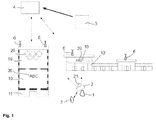
- Figure 1 schematically illustrates a system according to the present invention.
- FIG. 1 a system for displaying location specific content related to a predetermined spatial location by a head mounted display device according to an embodiment of the present invention is illustrated.
- the system according to the exemplary embodiment uses a mobile communication network for transmitting location specific content to the head mounted display device 2.
- a mobile communication network for transmitting location specific content to the head mounted display device 2.
- the skilled person may contemplate alternative communication technologies, e.g. a satellite communication network.
- the system comprises a plurality of transmitters 6 in the form of base stations of the mobile communication network. Those transmitters 6 are configured to transmit location specific content provided by a server 4, 5 of the mobile communication network to a mobile user device 3, e.g. a cellphone.
- the mobile user device 3 is carried by a user 1 and is connected to a head mounted display device 2 worn by the same user 1 by a wireless connection, e.g. by a Bluetooth connection, a Wi-Fi- connection or a ZigBee connection.
- the head mounted display device 2 comprises a display which is either of the transparent or semi-transparent type (optical see-through) or of the non-transparent type (video see-through).
- the head mounted display device further comprises a distance measurement device 21 which is configured to determine a distance between the head mounted display device 2 and a predetermined spatial position, e.g. a fascade of a building 11, 12.
- the distance measurement device 21 is configured as an optical distance measurement device, e.g. a laser rangefinder. Alternatively or additionally, the distance is determined using the mobile user device 3, e.g. a cellphone.
- the mobile communication network determines the distance between the mobile user device 3 and the predetermined spatial position and transmits the distance to the mobile user device, in particular via a dedicated communication channel.
- the head mounted display device 2 is displaying the location specific content depending on the determined distance between the head mounted display device 2 and the predetermined spatial position.
- the location specific content is related to a predetermined spatial position.
- a first predetermined spatial position is a position of a viewing surface 10 configured as a fascade of a mixed business building 11 that includes several shops and/or offices.
- a second predetermined spatial position is a position of a viewing surface 10 configured as a fascade of a mall 12 comprising a plurality of shops.
- the method and system according to the invention allow providing an realistic overlay of the location specific content 20 to the fascade of the building 11 and/or the mall 12. Using the inventive method and system, the location specific content 20 can be displayed in correct perspective.
- location specific content is transmitted by a server 4, 5 of the mobile communication network via a base station 6 to the mobile user device 3.
- the location specific content is received by the mobile user device 3.
- the location specific content is transmitted from the mobile user device 3 to the head mounted display device 2.
- Communication between the mobile user device 3 and the head mounted display device 2 may be enabled by a short-distance wireless connection, e.g. a Bluetooth connection, a Wi-Fi- connection or a ZigBee connection.
- the location specific content is received by the head mounted display device 2.
- the distance between the head mounted display device 2 and the predetermined spatial position is determined using the measurement device 21 of the head mounted display device 2 and/or the distance between the head mounted display device 2 and the predetermined spatial position is determined using distance information received by the mobile user device 3 from a base station 6 of the mobile communication network. Further, in the third step, the eye movement and a viewing angle of a user of the head mounted display device 2 is determined.
- the eye movement is determined by an eye tracking device of the head mounted display device 2.
- the viewing angle can be determined by an inertial navigation system (INS) of the head mounted display device 2.
- INS inertial navigation system
- the determined distance, the determined eye movement and the determined viewing angle are provided to the mobile user device 3 for processing of the location specific content received.
- a processor of the mobile user device 3 renders the location specific content in order to provide a display of the content 20 in correct perspective. Using the processor of the mobile user device 3 the content can be processed in real time
- the rendered content is transmitted from the mobile user device 3 to the head mounted display device 2 and, in the fourth step, the location specific content 20 is displayed using the head mounted display device 2 depending on the determined distance, the determined eye movement and the determined viewing angle.
- the displayed location specific content 20 is in the form of an advertisement that is embedded in the real world view on viewing surface 10 of a building 11, 12.
- the location specific content may be transmitted via a cell broadcast from a base station 6 of a mobile communication network to a plurality of mobile user devices 3 in form of a broadcast message.
- the broadcast message may reach a huge number of mobile user devices 3 at once, thereby reducing the required transmission bandwidth in the mobile communication network.
- the location specific content may be transmitted via individual messages directed to a single mobile user device 3.
- the mobile user device 3 is identified by the mobile communication network, in particular a server 4, 5 of the mobile communication network.
- a user of both the mobile user device 3 and the head mounted display device 2 may be identified.
- the head mounted display device 2 is in the vicinity of the predetermined spatial location transmission of location specific content, e.g. a stream of virtual reality data, may be triggered to be sent from a server 4, 5 of the mobile communication network via a base station 6 to the mobile user device 3.
- the mobile communication network comprises at least one network provider server 4 hosted by the provider of the mobile communication network and at least one third party server 5 hosted by a third party.
- the network provider server 4 continuously tracks the spatial position of the mobile user device 3. If the network provider server 4 detects that the mobile user device 3 is located in the vicinity of a first predetermined spatial position, the network provider server 4 authenticates on behalf of the user to the third party server 5 which hosts content related to the first predetermined spatial position. Thereby, the third party server 5 is triggered to transmit location specific content related to the first predetermined position via the mobile communication network to the mobile user device 3 and, to the head mounted display 2, respectively.
- the displayed content 20 may be passive content which is to be displayed for the purpose of providing information to the user of the head mounted display device 2.
- interactive content 20 may be displayed using the head mounted display device.
- the interactive content 20 may be in the form of a user interface for processing payment transactions, in particular cashless payments.
- the head mounted display device 2 may display an interface that allows authorizing such a payment.
- a two factor authentication can be used, wherein a keypad is displayed using the head outned display device 2.
- the user enters a predetermined PIN via a gesture tracking device of the head mounted display device. In case the PIN is entered correctly, a scan of the iris of the user of the head mounted display device is triggered. Thereby, the user may authorize payments and/or transaction in interaction with the head mounted display device 2 and/or the mobile user device 3.
Landscapes
- Engineering & Computer Science (AREA)
- Computer Networks & Wireless Communication (AREA)
- Signal Processing (AREA)
- Physics & Mathematics (AREA)
- General Physics & Mathematics (AREA)
- Theoretical Computer Science (AREA)
- Multimedia (AREA)
- User Interface Of Digital Computer (AREA)
Abstract
-- in a first step, transmitting location specific content, the location specific content being related to a predetermined spatial position,
-- in a second step, subsequent to the first step, receiving the location specific content by a head mounted display device,
-- in a third step, determining a distance between the head mounted display device and the predetermined spatial position,
-- in a fourth step, subsequent to the third step, displaying the location specific content using the head mounted display device depending on the determined distance between the head mounted display device and the predetermined spatial position.
Description
- The present invention relates to a method for displaying location specific content by a head mounted display device.
- Furthermore, the present invention relates to a system for displaying location specific content by a head mounted display device.
- There is a growing need for technologies that provide information to users in order to assist them in everyday life or in professional applications. In augmented reality systems a real scene can be perceived that is enriched by virtual elements. For example, the real scene may be enriched by a text panel or a pictogram. In such systems often head mounted displays (HMDs) are employed for displaying virtual information content. However, aligning those virtual elements with the real world is challenging. Thus, there is a need for technologies to improve embedding virtual elements in the real world view.
- An object of the present invention is to allow for a more realistic integration of location specific content in the real world view of the head mounted display device.
- The object of the present invention is achieved by a method for displaying location specific content by a head mounted display device, comprising:
- -- in a first step, transmitting location specific content, the location specific content being related to a predetermined spatial position,
- -- in a second step, subsequent to the first step, receiving the location specific content by a head mounted display device,
- -- in a third step, determining a distance between the head mounted display device and the predetermined spatial position,
- -- in a fourth step, subsequent to the third step, displaying the location specific content using the head mounted display device depending on the determined distance between the head mounted display device and the predetermined spatial position.
- According to the present invention location specific content is related to a predetermined spatial position, e.g. a position of a building or a landmark. The location specific content is received by a head mounted display device. The distance between the head mounted display device and the predetermined spatial position is determined so as to allow for scaling and rendering the location specific content. Thereby an improved degree of immersion may be provided when displaying the location specific content in the head mounted display. Subsequent to determining the distance between the head mounted display device and the predetermined spatial position the location specific content is displayed using the head mounted display device depending on the determined distance. Thus, the invention provides an improved method of providing location specific content to a mobile user by way of augmented reality technology.
- Within the context of the presented invention, a head mounted display device is considered as a display device that is configured to be worn on the head of a user, e.g. in form of eyeglasses or as part of a helmet. The head mounted display device may be an optical head mounted display device which comprises a semi-transparent display screen on which the location specific content is projected onto. Those head mounted display devices are often referred to as of the optical see-through type. Alternatively, the head mounted display device may display a real world view provided by a video camera which is overlaid by the location specific content. Combining of the real world view and the location specific content may be done electronically. Such head mounted display devices are typically referred to as of the video see-through type. Further alternatively, the head mounted display device may be virtual retinal display device which projects a display on the retina of the eye of the user.
- The location specific content is related to the predetermined spatial position. In case the predetermined spatial position is a position of a shop the location specific content may include information related to the shop, e.g. opening hours of the shop or special offers for products sold in the shop. If the predetermined spatial position is a position of a landmark the location specific content may include tourist information concerning the landmark or opening hours of the landmark. In case the predetermined spatial position is a position of a parking ground or parking deck the location specific content may include a price table or a display of free parking positions.
- The location specific content may be interactive content. An example of such an interactive content is a user interface of a software application which provides functionality relating to the predetermined spatial position. The interactive content may be in the form of a user interface for processing payment transactions, in particular cashless payments. E.g. the interactive content may provide a payment service for a shop, a landmark or a parking ground.
- The location specific content may additionally be time specific. In other words, location specific content may change over time or may only be available for a predetermined period. Preferably, in the first step, location specific content is transmitted, the location specific content being related to a predetermined spatial position and a predetermined period. The content may only be sent during the predetermined period.
- According to a preferred embodiment of the present invention, a viewing surface, in particular a facade of a building, is located at the predetermined spatial position and, in the fourth step, the location specific content is displayed as an overlay to the viewing surface.
- According to the present invention, it is thereby advantageously possible to provide location specific content to a user wearing the head mounted display device, wherein the content is visible at a viewing surface that is situated at the predetermined position in the real world. Advantageously, the location specific content is displayed as a transparent or semi-transparent overlay to the viewing surface, so that characteristics of the real world viewing surface are at least partly visible to the user of the head mounted display. Alternatively, the overlay may be opaque. Preferably, it is determined if the viewing surface is visible from the position of the head mounted display device. In other words a missing line of sight between the head mounted display device and the viewing surface may be detected. Display of the location specific content may be adapted accordingly. E.g. the location specific content may be displayed using dotted lines.
- According to a preferred embodiment of the present invention, the method further comprises:
- -- in a first intermediate step, subsequent to the first step and prior to the second step, receiving the location specific content by a mobile user device, in particular a cellphone,
- -- in a second intermediate step, subsequent to the first intermediate step and prior to the second step, transmitting the location specific content from the mobile user device to the head mounted display device, the head mounted display device being separate from the mobile user device.
- According to the present invention, it is thereby advantageously possible to reduce complexity of the head mounted display device. Hardware resources for receiving the transmitted location specific content may be arranged in the mobile user device. Those hardware resources may be configured as long distance wireless communication resources, e.g. as a cellphone or a satellite phone. The head mounted display device may include hardware resources for short distance wireless communication, e.g. a Bluetooth receiver, a ZigBee receiver or a Wi-Fi receiver.
- According to a preferred embodiment of the present invention, in the third step, the distance between the head mounted display device and the predetermined spatial position is determined using a measurement device of the head mounted display device, in particular an optical measurement device; and/or in the third step, the distance between the head mounted display device and the predetermined spatial position is determined using distance information received by a mobile user device, in particular a cellphone, from a base station of a mobile communication network.
- According to the present invention, it is thereby advantageously possible to reliably determine the distance between the head mounted display and the predetermined spatial position, in particular a viewing surface located at the predetermined spatial position. The measurement device may be an optical measurement device, e.g. a laser rangefinder. The determined distance may be transmitted from the head mounted display device to the mobile user device for further processing. Alternatively or additionally, the distance is determined using a separate mobile user device, e.g. a cellphone. As the mobile user device is typically in close proximity to the head mounted display device, it is typically carried by the user of the head mounted display device, the distance between the head mounted display device and the predetermined spatial position can be approximated by the distance between the mobile user device and the predetermined spatial position. The mobile communication network may determine the position of the mobile user device. The position of the mobile user device may be continuously tracked by the mobile communication network. The position of the mobile user device may be transmitted from base stations of the mobile communication network to the mobile user device continuously. Alternatively, the position of the mobile user device can be determined using a satellite navigation system, e.g. GPS. According to another alternative, the position of the mobile user device may be determined by a sensor of the mobile user device, e.g. a video camera or an infrared sensor. Based on the position of the mobile user device, which approximately equals the position of the head mounted display device, the distance between the head mounted display device and the predetermined spatial position can be calculated and transmitted to the mobile user device.
- According to a preferred embodiment of the present invention, in the first step, location specific content is transmitted via a cell broadcast from a base station of a mobile communication network to a plurality of mobile user devices, in particular cellphones. Thus, location specific content is transmitted as a broadcast message. The broadcast message may reach a huge number of users at once, thereby reducing the required transmission bandwidth.
- According to the present invention, it is thereby advantageously possible to transmit the local specific content to a plurality of mobile user devices of a mobile communication network, in particular a GSM or UMTS network. A further benefit of distributing the content via a cell broadcast is that transmission of the content is not affected by high network load. Thus, location specific content can be provided to the user even during high network load situations. The information to be broadcasted may be common information, e.g. opening hours of a shopping mall.
- According to a preferred embodiment of the present invention, in the third step, the spatial position of the head mounted display is determined; and wherein, in the fourth step, the location specific content is displayed using the head mounted display device additionally depending on the determined spatial position of the head mounted display device.
- According to the present invention, it is thereby advantageously possible to selectively display the location specific content depending on the spatial position of the head mounted display device. Preferably, the location specific content is only displayed if the determined distance is below a given maximum distance value and the predetermined spatial position, e.g. where the shop is located at, is visible from the spatial position of the head mounted display device.
- According to a preferred embodiment of the present invention, in the third step, the eye movement and/or a viewing angle of a user of the head mounted display device is determined; and wherein, in the fourth step, the location specific content is displayed using the head mounted display device additionally depending on the determined eye movement and/or a determined viewing angle.
- According to the present invention, it is thereby advantageously possible to improve perspective view of the content. Using determined eye movement and/or a determined viewing angle the location specific content may be displayed using the head mounted display device with a correct perspective. The eye movement can be determined by an eye tracking device of the head mounted display device. The viewing angle can be determined by an inertial navigation system (INS) attached to the head mounted display device.
- According to a preferred embodiment of the present invention, in a third intermediate step, subsequent to the third step and prior to the fourth step, location specific content to be displayed is rendered using a mobile user device, in particular a cellphone, the mobile user device being separate from the head mounted display device.
- According to the present invention, it is thereby advantageously possible to reduce computing resources of the head mounted display device. Processing of the location specific content to be displayed, e.g. scaling and rendering of the content, is done using a processor of the mobile user device. Then, rendered location specific content is transmitted to the head mounted display device.
- According to an alternative preferred embodiment of the present invention, in a third intermediate step, subsequent to the third step and prior to the fourth step, location specific content to be displayed is rendered using a processor of a mobile communication network.
- According to the present invention, it is thereby advantageously possible to transfer computationally intensive tasks to a powerful processing resource external to the head mounted display or a mobile user device connected with the head mounted display. Consequently, latency may be reduced in order to provide seamless experience to the user of the head mounted display device.
- According to a preferred embodiment of the present invention, the mobile user device is identified by the mobile communication network, in particular a server of the mobile communication network. Alternatively or additionally to broadcasted location specific content, personal location specific content is transmitted from the mobile communication network, in particular from the server of the mobile communication network, to the mobile user device. The mobile communication network may keep a continuous connection to the mobile user device. In case the mobile user device is detected to be in the proximity of the predetermined spatial position, personal location specific content may be transmitted to the mobile user device via the mobile communications network. The personal location specific content may then be scaled and/or rendered by the mobile user device and forwarded to the head mounted display device for displaying it as an overlay to the real world view.
- According to the present invention, it is thereby advantageously possible to provide personalized content to the user of the head mounted display device. The personal content may be transmitted to the head mounted display via a dedicated network resource, e,g, a dedicated channel. The dedicated network resource my comprise personalization intelligence in the backend, e.g. a virtual private assistant.
- According to a preferred embodiment of the present invention, in the fourth step, the location specific content is displayed in a transparent or semi-transparent display of the head mounted display device; or the location specific content is displayed in a non-transparent display of a head mounted display device.
- According to a preferred embodiment of the present invention, display of the location specific content is controlled by a wearable device, in particular a ring, a wristband or a watch.
- According to the present invention, it is thereby advantageously possible to interpret gestures of the user of the head mounted display device in order to control the display of location specific content. By way of the wearable device it is possible to navigate through the content displayed in the head mounted display device, e.g. by scrolling the content and/or selecting pieces of content.
- The present invention also relates to a system for displaying location specific content by a head mounted display device, comprising:
- -- a transmitter for transmitting location specific content, the location specific content being related to a predetermined spatial position,
- -- a head mounted display device for receiving the location specific content,
- -- a distance measurement device for determining a distance between the head mounted display device and the predetermined spatial position, and
- -- a display head mounted display device for displaying the location specific content depending on the determined distance between the head mounted display device and the predetermined spatial position.
- With the system according to the invention the same advantages can be achieved as described above in relation to the method according to the invention.
- Furthermore, the present invention relates to a program comprising a computer readable program code which, when executed on a head mounted display device or on a mobile user device or on a base station, or in part on the head mounted display device and in part on the mobile user device and in part on the base station, causes the head mounted display device and/or the mobile user device and/or the base station to perform a method according to the present invention.
- Furthermore, the present invention relates to a computer program product for using a head mounted display device with a base station, the computer program product comprising a computer program stored on a storage medium, the computer program comprising program code which, when executed on a head mounted display device or on a mobile user device or on a base station, or in part on the head mounted display device and in part on the mobile user device and in part on the base station, causes the head mounted display device and/or the mobile user device and/or the base station to perform a method according to the present invention.
- These and other characteristics, features and advantages of the present invention will become apparent from the following detailed description, taken in conjunction with the accompanying drawings, which illustrate, by way of example, the principles of the invention. The description is given for the sake of example only, without limiting the scope of the invention. The reference figures quoted below refer to the attached drawings.
-
Figure 1 schematically illustrates a system according to the present invention. - The present invention will be described with respect to an particular embodiment and with reference to a drawing but the invention is not limited thereto but only by the claims. The drawing described is only schematic and is non-limiting. In the drawing, the size of some of the elements may be exaggerated and not drawn on scale for illustrative purposes.
- Where an indefinite or definite article is used when referring to a singular noun, e.g. "a", "an", "the", this includes a plural of that noun unless something else is specifically stated.
- Furthermore, the terms first, second, third and the like in the description and in the claims are used for distinguishing between similar elements and not necessarily for describing a sequential or chronological order. It is to be understood that the terms so used are interchangeable under appropriate circumstances and that the embodiments of the invention described herein are capable of operation in other sequences than described or illustrated herein.
- In
Figure 1 , a system for displaying location specific content related to a predetermined spatial location by a head mounted display device according to an embodiment of the present invention is illustrated. The system according to the exemplary embodiment uses a mobile communication network for transmitting location specific content to the head mounteddisplay device 2. However, the skilled person may contemplate alternative communication technologies, e.g. a satellite communication network. - The system comprises a plurality of transmitters 6 in the form of base stations of the mobile communication network. Those transmitters 6 are configured to transmit location specific content provided by a server 4, 5 of the mobile communication network to a
mobile user device 3, e.g. a cellphone. Themobile user device 3 is carried by auser 1 and is connected to a head mounteddisplay device 2 worn by thesame user 1 by a wireless connection, e.g. by a Bluetooth connection, a Wi-Fi- connection or a ZigBee connection. - The head mounted
display device 2 comprises a display which is either of the transparent or semi-transparent type (optical see-through) or of the non-transparent type (video see-through). The head mounted display device further comprises adistance measurement device 21 which is configured to determine a distance between the head mounteddisplay device 2 and a predetermined spatial position, e.g. a fascade of abuilding distance measurement device 21 is configured as an optical distance measurement device, e.g. a laser rangefinder. Alternatively or additionally, the distance is determined using themobile user device 3, e.g. a cellphone. The mobile communication network determines the distance between themobile user device 3 and the predetermined spatial position and transmits the distance to the mobile user device, in particular via a dedicated communication channel. As will be described in detail in the following the head mounteddisplay device 2 is displaying the location specific content depending on the determined distance between the head mounteddisplay device 2 and the predetermined spatial position. - The location specific content is related to a predetermined spatial position. In the exemplary embodiment a first predetermined spatial position is a position of a
viewing surface 10 configured as a fascade of amixed business building 11 that includes several shops and/or offices. A second predetermined spatial position is a position of aviewing surface 10 configured as a fascade of amall 12 comprising a plurality of shops. The method and system according to the invention allow providing an realistic overlay of the locationspecific content 20 to the fascade of thebuilding 11 and/or themall 12. Using the inventive method and system, the locationspecific content 20 can be displayed in correct perspective. - In a first step, location specific content is transmitted by a server 4, 5 of the mobile communication network via a base station 6 to the
mobile user device 3. In a first intermediate step, subsequent to the first step and prior to the second step, the location specific content is received by themobile user device 3. In a second intermediate step, subsequent to the first intermediate step and prior to the second step, the location specific content is transmitted from themobile user device 3 to the head mounteddisplay device 2. Communication between themobile user device 3 and the head mounteddisplay device 2 may be enabled by a short-distance wireless connection, e.g. a Bluetooth connection, a Wi-Fi- connection or a ZigBee connection. - In a second step, subsequent to the first step, the location specific content is received by the head mounted
display device 2. - In a third step, the distance between the head mounted
display device 2 and the predetermined spatial position is determined using themeasurement device 21 of the head mounteddisplay device 2 and/or the distance between the head mounteddisplay device 2 and the predetermined spatial position is determined using distance information received by themobile user device 3 from a base station 6 of the mobile communication network. Further, in the third step, the eye movement and a viewing angle of a user of the head mounteddisplay device 2 is determined. The eye movement is determined by an eye tracking device of the head mounteddisplay device 2. The viewing angle can be determined by an inertial navigation system (INS) of the head mounteddisplay device 2. - The determined distance, the determined eye movement and the determined viewing angle are provided to the
mobile user device 3 for processing of the location specific content received. A processor of themobile user device 3 renders the location specific content in order to provide a display of thecontent 20 in correct perspective. Using the processor of themobile user device 3 the content can be processed in real time The rendered content is transmitted from themobile user device 3 to the head mounteddisplay device 2 and, in the fourth step, the locationspecific content 20 is displayed using the head mounteddisplay device 2 depending on the determined distance, the determined eye movement and the determined viewing angle. In the exemplary embodiment depicted inFig. 1 the displayed locationspecific content 20 is in the form of an advertisement that is embedded in the real world view onviewing surface 10 of abuilding - The location specific content may be transmitted via a cell broadcast from a base station 6 of a mobile communication network to a plurality of
mobile user devices 3 in form of a broadcast message. The broadcast message may reach a huge number ofmobile user devices 3 at once, thereby reducing the required transmission bandwidth in the mobile communication network. - Alternatively, the location specific content may be transmitted via individual messages directed to a single
mobile user device 3. First of all, themobile user device 3 is identified by the mobile communication network, in particular a server 4, 5 of the mobile communication network. Thus, a user of both themobile user device 3 and the head mounteddisplay device 2 may be identified. In the event that the head mounteddisplay device 2 is in the vicinity of the predetermined spatial location transmission of location specific content, e.g. a stream of virtual reality data, may be triggered to be sent from a server 4, 5 of the mobile communication network via a base station 6 to themobile user device 3. - The mobile communication network comprises at least one network provider server 4 hosted by the provider of the mobile communication network and at least one third party server 5 hosted by a third party. According to an alternate embodiment of the invention, the network provider server 4 continuously tracks the spatial position of the
mobile user device 3. If the network provider server 4 detects that themobile user device 3 is located in the vicinity of a first predetermined spatial position, the network provider server 4 authenticates on behalf of the user to the third party server 5 which hosts content related to the first predetermined spatial position. Thereby, the third party server 5 is triggered to transmit location specific content related to the first predetermined position via the mobile communication network to themobile user device 3 and, to the head mounteddisplay 2, respectively. - The displayed
content 20 may be passive content which is to be displayed for the purpose of providing information to the user of the head mounteddisplay device 2. Alternatively,interactive content 20 may be displayed using the head mounted display device. Theinteractive content 20 may be in the form of a user interface for processing payment transactions, in particular cashless payments. The head mounteddisplay device 2 may display an interface that allows authorizing such a payment. A two factor authentication can be used, wherein a keypad is displayed using the headoutned display device 2. The user enters a predetermined PIN via a gesture tracking device of the head mounted display device. In case the PIN is entered correctly, a scan of the iris of the user of the head mounted display device is triggered. Thereby, the user may authorize payments and/or transaction in interaction with the head mounteddisplay device 2 and/or themobile user device 3.
Claims (14)
- Method for displaying location specific content (20) by a head mounted display device (2), comprising:-- in a first step, transmitting location specific content, the location specific content being related to a predetermined spatial position,-- in a second step, subsequent to the first step, receiving the location specific content by a head mounted display device (2),-- in a third step, determining a distance between the head mounted display device (2) and the predetermined spatial position,-- in a fourth step, subsequent to the third step, displaying the location specific content (20) using the head mounted display device (2) depending on the determined distance between the head mounted display device (2) and the predetermined spatial position.
- Method according to claim 1, wherein a viewing surface (10), in particular a facade of a building, is located at the predetermined spatial position and, in the fourth step, the location specific content (20) is displayed as an overlay to the viewing surface.
- Method to any of the preceding claims, further comprising:-- in a first intermediate step, subsequent to the first step and prior to the second step, receiving the location specific content (20) by a mobile user device (3), in particular a cellphone,-- in a second intermediate step, subsequent to the first intermediate step and prior to the second step, transmitting the location specific content from the mobile user device (3) to the head mounted display device (2), the head mounted display device (2) being separate from the mobile user device (3).
- Method according to any of the preceding claims, wherein, in the third step, the distance between the head mounted display device (2) and the predetermined spatial position is determined using a measurement device of the head mounted display device (2), in particular an optical measurement device; and/or
wherein, in the third step, the distance between the head mounted display device (2) and the predetermined spatial position is determined using distance information received by a mobile user device (3), in particular a cellphone, from a base station (6) of a mobile communication network. - Method according to any of the preceding claims, wherein, in the first step, location specific content is transmitted via a cell broadcast from a base station (6) of a mobile communication network to a plurality of mobile user devices (3), in particular a cellphones.
- Method according to any of the preceding claims, wherein, in the third step, the spatial position of the head mounted display (2) is determined; and wherein, in the fourth step, the location specific content (20) is displayed using the head mounted display device (2) additionally depending on the determined spatial position of the head mounted display device (2).
- Method according to any of the preceding claims, wherein, in the third step, the eye movement and/or a viewing angle of a user of the head mounted display device (2) is determined; and wherein, in the fourth step, the location specific content is displayed using the head mounted display device (2) additionally depending on the determined eye movement and/or a determined viewing angle.
- Method according to any of the preceding claims, wherein, in a third intermediate step, subsequent to the third step and prior to the fourth step, location specific content to be displayed is rendered using a mobile user device (3), in particular a cellphone, the mobile user device being separate from the head mounted display device (2).
- Method according to any of the preceding claims, wherein the mobile user device is identified by the mobile communication network, in particular a server of the mobile communication network.
- Method according to any of the preceding claims, wherein, in the fourth step, the location specific content (20) is displayed in a transparent or semi-transparent display of the head mounted display device (2); or the location specific content (20) is displayed in a non-transparent display of a head mounted display device (2).
- Method according to any of the preceding claims, wherein, display of the location specific content is controlled by a wearable device, in particular a ring, a wristband or a watch.
- System for displaying location specific content by a head mounted display device, comprising:-- a transmitter for transmitting location specific content, the location specific content being related to a predetermined spatial position,-- a head mounted display device (2) for receiving the location specific content,-- a distance measurement device for determining a distance between the head mounted display device (2) and the predetermined spatial position, and-- a display head mounted display device (2) for displaying the location specific content depending on the determined distance between the head mounted display device (2) and the predetermined spatial position.
- Program comprising a computer readable program code which, when executed on a head mounted display device or on a mobile user device or on a base station, or in part on the head mounted display device and in part on the mobile user device and in part on the base station, causes the head mounted display device and/or the mobile user device and/or the base station to perform a method according to any of claims 1 to 11.
- Computer program product for using a head mounted display device with a base station, the computer program product comprising a computer program stored on a storage medium, the computer program comprising program code which, when executed on a head mounted display device or on a mobile user device or on a base station, or in part on the head mounted display device and in part on the mobile user device and in part on the base station, causes the head mounted display device and/or the mobile user device and/or the base station to perform a method according to any of claims 1 to 11.
Priority Applications (2)
| Application Number | Priority Date | Filing Date | Title |
|---|---|---|---|
| EP16180442.2A EP3273707B1 (en) | 2016-07-20 | 2016-07-20 | Method and system for displaying location specific content by a head mounted display device |
| US15/652,253 US20180025522A1 (en) | 2016-07-20 | 2017-07-18 | Displaying location-specific content via a head-mounted display device |
Applications Claiming Priority (1)
| Application Number | Priority Date | Filing Date | Title |
|---|---|---|---|
| EP16180442.2A EP3273707B1 (en) | 2016-07-20 | 2016-07-20 | Method and system for displaying location specific content by a head mounted display device |
Publications (2)
| Publication Number | Publication Date |
|---|---|
| EP3273707A1 true EP3273707A1 (en) | 2018-01-24 |
| EP3273707B1 EP3273707B1 (en) | 2019-10-16 |
Family
ID=56557504
Family Applications (1)
| Application Number | Title | Priority Date | Filing Date |
|---|---|---|---|
| EP16180442.2A Active EP3273707B1 (en) | 2016-07-20 | 2016-07-20 | Method and system for displaying location specific content by a head mounted display device |
Country Status (2)
| Country | Link |
|---|---|
| US (1) | US20180025522A1 (en) |
| EP (1) | EP3273707B1 (en) |
Citations (2)
| Publication number | Priority date | Publication date | Assignee | Title |
|---|---|---|---|---|
| US20120127284A1 (en) * | 2010-11-18 | 2012-05-24 | Avi Bar-Zeev | Head-mounted display device which provides surround video |
| US20140368532A1 (en) * | 2013-06-18 | 2014-12-18 | Brian E. Keane | Virtual object orientation and visualization |
Family Cites Families (4)
| Publication number | Priority date | Publication date | Assignee | Title |
|---|---|---|---|---|
| US20030014212A1 (en) * | 2001-07-12 | 2003-01-16 | Ralston Stuart E. | Augmented vision system using wireless communications |
| US8390299B2 (en) * | 2009-11-24 | 2013-03-05 | Fluke Corporation | Earth ground tester with remote control |
| US20130088413A1 (en) * | 2011-10-05 | 2013-04-11 | Google Inc. | Method to Autofocus on Near-Eye Display |
| JP6174646B2 (en) * | 2015-09-24 | 2017-08-02 | 株式会社コロプラ | Computer program for 3-axis operation of objects in virtual space |
-
2016
- 2016-07-20 EP EP16180442.2A patent/EP3273707B1/en active Active
-
2017
- 2017-07-18 US US15/652,253 patent/US20180025522A1/en not_active Abandoned
Patent Citations (2)
| Publication number | Priority date | Publication date | Assignee | Title |
|---|---|---|---|---|
| US20120127284A1 (en) * | 2010-11-18 | 2012-05-24 | Avi Bar-Zeev | Head-mounted display device which provides surround video |
| US20140368532A1 (en) * | 2013-06-18 | 2014-12-18 | Brian E. Keane | Virtual object orientation and visualization |
Also Published As
| Publication number | Publication date |
|---|---|
| US20180025522A1 (en) | 2018-01-25 |
| EP3273707B1 (en) | 2019-10-16 |
Similar Documents
| Publication | Publication Date | Title |
|---|---|---|
| CN110851095B (en) | Multi-screen interaction in virtual and augmented reality | |
| US8179604B1 (en) | Wearable marker for passive interaction | |
| KR101430614B1 (en) | Display device using wearable eyeglasses and method for operating the same | |
| WO2019142560A1 (en) | Information processing device for guiding gaze | |
| KR102182162B1 (en) | Head mounted display and method for controlling the same | |
| US9933853B2 (en) | Display control device, display control program, and display control method | |
| US20200264433A1 (en) | Augmented reality display device and interaction method using the augmented reality display device | |
| JPWO2015145544A1 (en) | Display control apparatus, control method, program, and storage medium | |
| WO2013028586A1 (en) | Location based skins for mixed reality displays | |
| CN107534784A (en) | Server, user terminal device and control method thereof | |
| US11450020B2 (en) | Information processing apparatus, method for processing information, and computer program | |
| KR20160015972A (en) | The Apparatus and Method for Wearable Device | |
| KR100836481B1 (en) | System and method for advertising location and activity information of user's avatar object on 3D virtual map to real world | |
| US20200029028A1 (en) | Video call providing device, method, system, and non-transitory computer readable medium storing a computer program | |
| KR20240157724A (en) | Sharing received objects with co-located users | |
| KR101687309B1 (en) | Method and apparatus for providing information terminal with hmd | |
| CN120569697A (en) | AR glasses as IOT devices for enhanced screen experience | |
| US11132051B2 (en) | Systems and methods to provide an interactive environment in response to touch-based inputs | |
| JP2018200699A (en) | Display control device, control method, program, and storage medium | |
| EP3273707B1 (en) | Method and system for displaying location specific content by a head mounted display device | |
| KR102420166B1 (en) | Method and system for customzing network transmssion prameter | |
| US20250342663A1 (en) | Information processing device, information processing method, and program | |
| US12088781B2 (en) | Hyper-connected and synchronized AR glasses | |
| KR102262019B1 (en) | Method and system for extended reality communication soliciting network speed | |
| JP6828235B2 (en) | Head-mounted display device, how to share the display of the head-mounted display device, computer program |
Legal Events
| Date | Code | Title | Description |
|---|---|---|---|
| PUAI | Public reference made under article 153(3) epc to a published international application that has entered the european phase |
Free format text: ORIGINAL CODE: 0009012 |
|
| STAA | Information on the status of an ep patent application or granted ep patent |
Free format text: STATUS: THE APPLICATION HAS BEEN PUBLISHED |
|
| AK | Designated contracting states |
Kind code of ref document: A1 Designated state(s): AL AT BE BG CH CY CZ DE DK EE ES FI FR GB GR HR HU IE IS IT LI LT LU LV MC MK MT NL NO PL PT RO RS SE SI SK SM TR |
|
| AX | Request for extension of the european patent |
Extension state: BA ME |
|
| STAA | Information on the status of an ep patent application or granted ep patent |
Free format text: STATUS: REQUEST FOR EXAMINATION WAS MADE |
|
| 17P | Request for examination filed |
Effective date: 20180724 |
|
| RBV | Designated contracting states (corrected) |
Designated state(s): AL AT BE BG CH CY CZ DE DK EE ES FI FR GB GR HR HU IE IS IT LI LT LU LV MC MK MT NL NO PL PT RO RS SE SI SK SM TR |
|
| RIC1 | Information provided on ipc code assigned before grant |
Ipc: H04W 4/04 20181130AFI20161109BHEP |
|
| RIC1 | Information provided on ipc code assigned before grant |
Ipc: H04W 4/04 20090101AFI20161109BHEP |
|
| REG | Reference to a national code |
Ref country code: DE Ref legal event code: R079 Ref document number: 602016022461 Country of ref document: DE Free format text: PREVIOUS MAIN CLASS: H04W0004040000 Ipc: H04W0004060000 |
|
| GRAP | Despatch of communication of intention to grant a patent |
Free format text: ORIGINAL CODE: EPIDOSNIGR1 |
|
| STAA | Information on the status of an ep patent application or granted ep patent |
Free format text: STATUS: GRANT OF PATENT IS INTENDED |
|
| RIC1 | Information provided on ipc code assigned before grant |
Ipc: H04W 4/06 20090101AFI20190424BHEP |
|
| INTG | Intention to grant announced |
Effective date: 20190520 |
|
| GRAS | Grant fee paid |
Free format text: ORIGINAL CODE: EPIDOSNIGR3 |
|
| GRAA | (expected) grant |
Free format text: ORIGINAL CODE: 0009210 |
|
| STAA | Information on the status of an ep patent application or granted ep patent |
Free format text: STATUS: THE PATENT HAS BEEN GRANTED |
|
| AK | Designated contracting states |
Kind code of ref document: B1 Designated state(s): AL AT BE BG CH CY CZ DE DK EE ES FI FR GB GR HR HU IE IS IT LI LT LU LV MC MK MT NL NO PL PT RO RS SE SI SK SM TR |
|
| REG | Reference to a national code |
Ref country code: GB Ref legal event code: FG4D |
|
| REG | Reference to a national code |
Ref country code: CH Ref legal event code: EP |
|
| REG | Reference to a national code |
Ref country code: IE Ref legal event code: FG4D |
|
| REG | Reference to a national code |
Ref country code: DE Ref legal event code: R096 Ref document number: 602016022461 Country of ref document: DE |
|
| REG | Reference to a national code |
Ref country code: AT Ref legal event code: REF Ref document number: 1192508 Country of ref document: AT Kind code of ref document: T Effective date: 20191115 |
|
| REG | Reference to a national code |
Ref country code: NL Ref legal event code: MP Effective date: 20191016 |
|
| REG | Reference to a national code |
Ref country code: LT Ref legal event code: MG4D |
|
| REG | Reference to a national code |
Ref country code: AT Ref legal event code: MK05 Ref document number: 1192508 Country of ref document: AT Kind code of ref document: T Effective date: 20191016 |
|
| PG25 | Lapsed in a contracting state [announced via postgrant information from national office to epo] |
Ref country code: SE Free format text: LAPSE BECAUSE OF FAILURE TO SUBMIT A TRANSLATION OF THE DESCRIPTION OR TO PAY THE FEE WITHIN THE PRESCRIBED TIME-LIMIT Effective date: 20191016 Ref country code: LV Free format text: LAPSE BECAUSE OF FAILURE TO SUBMIT A TRANSLATION OF THE DESCRIPTION OR TO PAY THE FEE WITHIN THE PRESCRIBED TIME-LIMIT Effective date: 20191016 Ref country code: PL Free format text: LAPSE BECAUSE OF FAILURE TO SUBMIT A TRANSLATION OF THE DESCRIPTION OR TO PAY THE FEE WITHIN THE PRESCRIBED TIME-LIMIT Effective date: 20191016 Ref country code: AT Free format text: LAPSE BECAUSE OF FAILURE TO SUBMIT A TRANSLATION OF THE DESCRIPTION OR TO PAY THE FEE WITHIN THE PRESCRIBED TIME-LIMIT Effective date: 20191016 Ref country code: NO Free format text: LAPSE BECAUSE OF FAILURE TO SUBMIT A TRANSLATION OF THE DESCRIPTION OR TO PAY THE FEE WITHIN THE PRESCRIBED TIME-LIMIT Effective date: 20200116 Ref country code: FI Free format text: LAPSE BECAUSE OF FAILURE TO SUBMIT A TRANSLATION OF THE DESCRIPTION OR TO PAY THE FEE WITHIN THE PRESCRIBED TIME-LIMIT Effective date: 20191016 Ref country code: BG Free format text: LAPSE BECAUSE OF FAILURE TO SUBMIT A TRANSLATION OF THE DESCRIPTION OR TO PAY THE FEE WITHIN THE PRESCRIBED TIME-LIMIT Effective date: 20200116 Ref country code: PT Free format text: LAPSE BECAUSE OF FAILURE TO SUBMIT A TRANSLATION OF THE DESCRIPTION OR TO PAY THE FEE WITHIN THE PRESCRIBED TIME-LIMIT Effective date: 20200217 Ref country code: GR Free format text: LAPSE BECAUSE OF FAILURE TO SUBMIT A TRANSLATION OF THE DESCRIPTION OR TO PAY THE FEE WITHIN THE PRESCRIBED TIME-LIMIT Effective date: 20200117 Ref country code: LT Free format text: LAPSE BECAUSE OF FAILURE TO SUBMIT A TRANSLATION OF THE DESCRIPTION OR TO PAY THE FEE WITHIN THE PRESCRIBED TIME-LIMIT Effective date: 20191016 Ref country code: NL Free format text: LAPSE BECAUSE OF FAILURE TO SUBMIT A TRANSLATION OF THE DESCRIPTION OR TO PAY THE FEE WITHIN THE PRESCRIBED TIME-LIMIT Effective date: 20191016 |
|
| PG25 | Lapsed in a contracting state [announced via postgrant information from national office to epo] |
Ref country code: HR Free format text: LAPSE BECAUSE OF FAILURE TO SUBMIT A TRANSLATION OF THE DESCRIPTION OR TO PAY THE FEE WITHIN THE PRESCRIBED TIME-LIMIT Effective date: 20191016 Ref country code: IS Free format text: LAPSE BECAUSE OF FAILURE TO SUBMIT A TRANSLATION OF THE DESCRIPTION OR TO PAY THE FEE WITHIN THE PRESCRIBED TIME-LIMIT Effective date: 20200224 Ref country code: RS Free format text: LAPSE BECAUSE OF FAILURE TO SUBMIT A TRANSLATION OF THE DESCRIPTION OR TO PAY THE FEE WITHIN THE PRESCRIBED TIME-LIMIT Effective date: 20191016 |
|
| PG25 | Lapsed in a contracting state [announced via postgrant information from national office to epo] |
Ref country code: AL Free format text: LAPSE BECAUSE OF FAILURE TO SUBMIT A TRANSLATION OF THE DESCRIPTION OR TO PAY THE FEE WITHIN THE PRESCRIBED TIME-LIMIT Effective date: 20191016 |
|
| REG | Reference to a national code |
Ref country code: DE Ref legal event code: R097 Ref document number: 602016022461 Country of ref document: DE |
|
| PG2D | Information on lapse in contracting state deleted |
Ref country code: IS |
|
| PG25 | Lapsed in a contracting state [announced via postgrant information from national office to epo] |
Ref country code: CZ Free format text: LAPSE BECAUSE OF FAILURE TO SUBMIT A TRANSLATION OF THE DESCRIPTION OR TO PAY THE FEE WITHIN THE PRESCRIBED TIME-LIMIT Effective date: 20191016 Ref country code: ES Free format text: LAPSE BECAUSE OF FAILURE TO SUBMIT A TRANSLATION OF THE DESCRIPTION OR TO PAY THE FEE WITHIN THE PRESCRIBED TIME-LIMIT Effective date: 20191016 Ref country code: RO Free format text: LAPSE BECAUSE OF FAILURE TO SUBMIT A TRANSLATION OF THE DESCRIPTION OR TO PAY THE FEE WITHIN THE PRESCRIBED TIME-LIMIT Effective date: 20191016 Ref country code: EE Free format text: LAPSE BECAUSE OF FAILURE TO SUBMIT A TRANSLATION OF THE DESCRIPTION OR TO PAY THE FEE WITHIN THE PRESCRIBED TIME-LIMIT Effective date: 20191016 Ref country code: DK Free format text: LAPSE BECAUSE OF FAILURE TO SUBMIT A TRANSLATION OF THE DESCRIPTION OR TO PAY THE FEE WITHIN THE PRESCRIBED TIME-LIMIT Effective date: 20191016 Ref country code: IS Free format text: LAPSE BECAUSE OF FAILURE TO SUBMIT A TRANSLATION OF THE DESCRIPTION OR TO PAY THE FEE WITHIN THE PRESCRIBED TIME-LIMIT Effective date: 20200216 |
|
| PLBE | No opposition filed within time limit |
Free format text: ORIGINAL CODE: 0009261 |
|
| STAA | Information on the status of an ep patent application or granted ep patent |
Free format text: STATUS: NO OPPOSITION FILED WITHIN TIME LIMIT |
|
| PG25 | Lapsed in a contracting state [announced via postgrant information from national office to epo] |
Ref country code: IT Free format text: LAPSE BECAUSE OF FAILURE TO SUBMIT A TRANSLATION OF THE DESCRIPTION OR TO PAY THE FEE WITHIN THE PRESCRIBED TIME-LIMIT Effective date: 20191016 Ref country code: SM Free format text: LAPSE BECAUSE OF FAILURE TO SUBMIT A TRANSLATION OF THE DESCRIPTION OR TO PAY THE FEE WITHIN THE PRESCRIBED TIME-LIMIT Effective date: 20191016 Ref country code: SK Free format text: LAPSE BECAUSE OF FAILURE TO SUBMIT A TRANSLATION OF THE DESCRIPTION OR TO PAY THE FEE WITHIN THE PRESCRIBED TIME-LIMIT Effective date: 20191016 |
|
| 26N | No opposition filed |
Effective date: 20200717 |
|
| PG25 | Lapsed in a contracting state [announced via postgrant information from national office to epo] |
Ref country code: SI Free format text: LAPSE BECAUSE OF FAILURE TO SUBMIT A TRANSLATION OF THE DESCRIPTION OR TO PAY THE FEE WITHIN THE PRESCRIBED TIME-LIMIT Effective date: 20191016 |
|
| PG25 | Lapsed in a contracting state [announced via postgrant information from national office to epo] |
Ref country code: MC Free format text: LAPSE BECAUSE OF FAILURE TO SUBMIT A TRANSLATION OF THE DESCRIPTION OR TO PAY THE FEE WITHIN THE PRESCRIBED TIME-LIMIT Effective date: 20191016 |
|
| REG | Reference to a national code |
Ref country code: CH Ref legal event code: PL |
|
| GBPC | Gb: european patent ceased through non-payment of renewal fee |
Effective date: 20200720 |
|
| REG | Reference to a national code |
Ref country code: BE Ref legal event code: MM Effective date: 20200731 |
|
| PG25 | Lapsed in a contracting state [announced via postgrant information from national office to epo] |
Ref country code: GB Free format text: LAPSE BECAUSE OF NON-PAYMENT OF DUE FEES Effective date: 20200720 Ref country code: FR Free format text: LAPSE BECAUSE OF NON-PAYMENT OF DUE FEES Effective date: 20200731 Ref country code: LI Free format text: LAPSE BECAUSE OF NON-PAYMENT OF DUE FEES Effective date: 20200731 Ref country code: LU Free format text: LAPSE BECAUSE OF NON-PAYMENT OF DUE FEES Effective date: 20200720 Ref country code: CH Free format text: LAPSE BECAUSE OF NON-PAYMENT OF DUE FEES Effective date: 20200731 |
|
| PG25 | Lapsed in a contracting state [announced via postgrant information from national office to epo] |
Ref country code: BE Free format text: LAPSE BECAUSE OF NON-PAYMENT OF DUE FEES Effective date: 20200731 |
|
| PG25 | Lapsed in a contracting state [announced via postgrant information from national office to epo] |
Ref country code: IE Free format text: LAPSE BECAUSE OF NON-PAYMENT OF DUE FEES Effective date: 20200720 |
|
| PG25 | Lapsed in a contracting state [announced via postgrant information from national office to epo] |
Ref country code: TR Free format text: LAPSE BECAUSE OF FAILURE TO SUBMIT A TRANSLATION OF THE DESCRIPTION OR TO PAY THE FEE WITHIN THE PRESCRIBED TIME-LIMIT Effective date: 20191016 Ref country code: MT Free format text: LAPSE BECAUSE OF FAILURE TO SUBMIT A TRANSLATION OF THE DESCRIPTION OR TO PAY THE FEE WITHIN THE PRESCRIBED TIME-LIMIT Effective date: 20191016 Ref country code: CY Free format text: LAPSE BECAUSE OF FAILURE TO SUBMIT A TRANSLATION OF THE DESCRIPTION OR TO PAY THE FEE WITHIN THE PRESCRIBED TIME-LIMIT Effective date: 20191016 |
|
| PG25 | Lapsed in a contracting state [announced via postgrant information from national office to epo] |
Ref country code: MK Free format text: LAPSE BECAUSE OF FAILURE TO SUBMIT A TRANSLATION OF THE DESCRIPTION OR TO PAY THE FEE WITHIN THE PRESCRIBED TIME-LIMIT Effective date: 20191016 |
|
| PGFP | Annual fee paid to national office [announced via postgrant information from national office to epo] |
Ref country code: DE Payment date: 20250722 Year of fee payment: 10 |