EP3273567B1 - Storage battery management device, method, and program - Google Patents
Storage battery management device, method, and program Download PDFInfo
- Publication number
- EP3273567B1 EP3273567B1 EP15885403.4A EP15885403A EP3273567B1 EP 3273567 B1 EP3273567 B1 EP 3273567B1 EP 15885403 A EP15885403 A EP 15885403A EP 3273567 B1 EP3273567 B1 EP 3273567B1
- Authority
- EP
- European Patent Office
- Prior art keywords
- battery
- storage battery
- power
- board
- diagnosis
- Prior art date
- Legal status (The legal status is an assumption and is not a legal conclusion. Google has not performed a legal analysis and makes no representation as to the accuracy of the status listed.)
- Active
Links
Images


Classifications
-
- H—ELECTRICITY
- H02—GENERATION; CONVERSION OR DISTRIBUTION OF ELECTRIC POWER
- H02J—ELECTRIC POWER NETWORKS; CIRCUIT ARRANGEMENTS OR SYSTEMS FOR SUPPLYING OR DISTRIBUTING ELECTRIC POWER; SYSTEMS FOR STORING ELECTRIC ENERGY
- H02J3/00—Circuit arrangements for AC mains or AC distribution networks
- H02J3/28—Arrangements for balancing of the load in networks by storage of energy
- H02J3/32—Arrangements for balancing of the load in networks by storage of energy using batteries or super capacitors with converting means
-
- H—ELECTRICITY
- H01—ELECTRIC ELEMENTS
- H01M—PROCESSES OR MEANS, e.g. BATTERIES, FOR THE DIRECT CONVERSION OF CHEMICAL ENERGY INTO ELECTRICAL ENERGY
- H01M10/00—Secondary cells; Manufacture thereof
- H01M10/42—Methods or arrangements for servicing or maintenance of secondary cells or secondary half-cells
- H01M10/4207—Methods or arrangements for servicing or maintenance of secondary cells or secondary half-cells for several batteries or cells simultaneously or sequentially
-
- H—ELECTRICITY
- H01—ELECTRIC ELEMENTS
- H01M—PROCESSES OR MEANS, e.g. BATTERIES, FOR THE DIRECT CONVERSION OF CHEMICAL ENERGY INTO ELECTRICAL ENERGY
- H01M10/00—Secondary cells; Manufacture thereof
- H01M10/42—Methods or arrangements for servicing or maintenance of secondary cells or secondary half-cells
- H01M10/44—Methods for charging or discharging
- H01M10/441—Methods for charging or discharging for several batteries or cells simultaneously or sequentially
-
- H—ELECTRICITY
- H02—GENERATION; CONVERSION OR DISTRIBUTION OF ELECTRIC POWER
- H02J—ELECTRIC POWER NETWORKS; CIRCUIT ARRANGEMENTS OR SYSTEMS FOR SUPPLYING OR DISTRIBUTING ELECTRIC POWER; SYSTEMS FOR STORING ELECTRIC ENERGY
- H02J7/00—Circuit arrangements for charging or discharging batteries or for supplying loads from batteries
-
- H—ELECTRICITY
- H02—GENERATION; CONVERSION OR DISTRIBUTION OF ELECTRIC POWER
- H02J—ELECTRIC POWER NETWORKS; CIRCUIT ARRANGEMENTS OR SYSTEMS FOR SUPPLYING OR DISTRIBUTING ELECTRIC POWER; SYSTEMS FOR STORING ELECTRIC ENERGY
- H02J7/00—Circuit arrangements for charging or discharging batteries or for supplying loads from batteries
- H02J7/50—Circuit arrangements for charging or discharging batteries or for supplying loads from batteries acting upon multiple batteries simultaneously or sequentially
- H02J7/52—Circuit arrangements for charging or discharging batteries or for supplying loads from batteries acting upon multiple batteries simultaneously or sequentially for charge balancing, e.g. equalisation of charge between batteries
-
- H—ELECTRICITY
- H01—ELECTRIC ELEMENTS
- H01M—PROCESSES OR MEANS, e.g. BATTERIES, FOR THE DIRECT CONVERSION OF CHEMICAL ENERGY INTO ELECTRICAL ENERGY
- H01M10/00—Secondary cells; Manufacture thereof
- H01M10/42—Methods or arrangements for servicing or maintenance of secondary cells or secondary half-cells
- H01M10/425—Structural combination with electronic components, e.g. electronic circuits integrated to the outside of the casing
- H01M10/4257—Smart batteries, e.g. electronic circuits inside the housing of the cells or batteries
-
- Y—GENERAL TAGGING OF NEW TECHNOLOGICAL DEVELOPMENTS; GENERAL TAGGING OF CROSS-SECTIONAL TECHNOLOGIES SPANNING OVER SEVERAL SECTIONS OF THE IPC; TECHNICAL SUBJECTS COVERED BY FORMER USPC CROSS-REFERENCE ART COLLECTIONS [XRACs] AND DIGESTS
- Y02—TECHNOLOGIES OR APPLICATIONS FOR MITIGATION OR ADAPTATION AGAINST CLIMATE CHANGE
- Y02E—REDUCTION OF GREENHOUSE GAS [GHG] EMISSIONS, RELATED TO ENERGY GENERATION, TRANSMISSION OR DISTRIBUTION
- Y02E60/00—Enabling technologies; Technologies with a potential or indirect contribution to GHG emissions mitigation
- Y02E60/10—Energy storage using batteries
Definitions
- Embodiments described herein relate generally to a storage battery management device, a method, and a computer program product.
- Such a storage battery system including a plurality of storage battery devices is used to suppress a fluctuation in the generated power, suppress a fluctuation in an interconnection flow, or shift a peak by distributing charge/discharge command values for the entire storage battery system to elements such as individual storage battery devices and performing a charge/discharge control for overall storage battery devices included in this storage battery system.
- a battery board including a storage battery unit also includes a control device (BMU), a main circuit switch (contactor), an electric fuse, a current sensor (CT), a voltage measurement circuit between battery boards, and the like in addition to storage battery cells.
- BMU control device
- CT current sensor
- a storage battery management device is configured to manage a storage battery system including a plurality of battery boards and a plurality of power adjustment devices corresponding to the battery boards.
- the storage battery management device is configured to compensate charging power and discharging power of a battery board used in a diagnosis for the battery board, inside the storage battery system by transmitting and receiving the charging power or the discharging power between the plurality of power adjustment devices of the storage battery system, when performing the diagnosis while causing the storage battery system to remain operated.
- a storage battery management device is configured to manage storage battery systems each including a plurality of battery boards and a power adjustment device corresponding to the battery boards.
- the storage battery management device is configured to compensate charging power and discharging power of a battery board used in a diagnosis for the battery board, inside the storage battery systems by transmitting and receiving the charging power or the discharging power between power adjustment devices of the storage battery systems, when performing the diagnosis while causing the storage battery systems to remain operated.
- FIG. 1 is a schematic diagram illustrating a natural energy power generation system including a plurality of storage battery systems.
- the natural energy power generation system 100 serving as a power generation system includes a natural energy power generation unit 1 capable of outputting grid power using natural energy (renewable energy) such as solar power, water power, wind power, biomass energy, and geothermal power, an electric power meter 2 configured to measure the power generated by the natural energy power generation unit 1, a plurality of storage battery systems 3-1 to 3-n charged with surplus power of the natural energy power generation unit 1 on the basis of the measurement result of the electric power meter 2 and configured to discharge deficient power to output it overlappingly with the power generated by the natural energy power generation unit 1, a transformer 4 configured to transform the voltage of the power output from the natural energy power generation unit 1 (including a case where the power output from the storage battery systems 3-1 to 3-n is overlapped), a storage battery controller 5 configured to locally control the storage battery systems 3-1 to 3-n, and an higher order control device 6 configured to perform a remote control of the storage battery controller 5.
- natural energy newable energy
- an electric power meter 2 configured to measure the power generated by the natural energy power generation unit
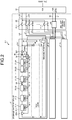
- FIG. 2 is a schematic block diagram illustrating a storage battery system according to an embodiment.
- the storage battery system 3-1 generally includes a storage battery device 11 configured to store power and a power conditioning system (PCS) 12 configured to convert the DC power supplied from the storage battery device 11 into AC power having a desired electric power quality and supply it to a load.
- PCS power conditioning system
- the storage battery device 11 generally includes a plurality of battery boards 21-1 to 21-N (where "N” denotes any natural number) and a battery terminal board 22 connected to the battery boards 21-1 to 21-N.
- Each of the battery boards 21-1 to 21-N includes a plurality of battery units 23-1 to 23-M connected in parallel with each other (where "M” denotes any natural number), a gateway unit 24, and a DC power unit 25 configured to supply the DC power for operation to a battery management unit (BMU) and a cell monitoring unit (CMU) described below.
- M battery management unit
- CMU cell monitoring unit
- the battery units 23-1 to 23-M are connected to output power lines (bus lines) LHO and LLO through a high-voltage-side power supply line LH and a low-voltage-side power supply line LL, respectively, to supply power to the power conditioning system 12 serving as a main circuit.
- Battery units 23-1 to 23-M have the same configuration. Therefore, the battery unit 23-1 will be described representatively.
- the battery unit 23-1 generally includes a plurality of (twenty four in FIG. 1 ) cell modules 31-1 to 31-24, a plurality of cell monitoring units (CMUs) 32-1 to 32-24 provided in the cell modules 31-1 to 31-24, a service disconnection 33 provided between the cell module 31-12 and the cell module 31-13, a current sensor 34, a positive-side contactor 35P, and a negative-side contactor 35N.
- the plurality of cell modules 31-1 to 31-24, the service disconnection 33, the current sensor 34, the positive-side contactor 35P, an electric fuse 38, and the negative-side contactor 35N are connected in series with each other.
- the cell modules 31-1 to 31-24 are connected to a plurality of battery cells in series and in parallel to constitute a battery pack.
- a plurality of cell modules 31-1 to 31-24 connected in series constitute a group of battery packs.
- the battery unit 23-1 includes a BMU 36, and the communication line of each of CMUs 32-1 to 32-24 and the output line of the current sensor 34 are connected to the BMU 36.
- a battery management unit (BMU) 36 controls the entire battery unit 23-1 under the control of the gateway unit 24 to control open/close states of the positive-side contactor 35P and the negative-side contactor 35N on the basis of a result of communication with each of CMUs 32-1 to 32-24 (measurement results of the voltage and the temperature) and a detection result of the current sensor 34.
- the battery terminal board 22 includes a plurality of board breakers 41-1 to 41-N provided in association with the battery boards 21-1 to 21-N and a master unit 42 which is a microcomputer for controlling the entire storage battery device 11.
- the master unit 42 is connected to a control power line 51 used to supply power to the power conditioning system 12 through an uninterruptible power system (UPS) 12A of the power conditioning system 12 and a control communication line 52 used to exchange control data via the Ethernet (registered trademark) network.
- UPS uninterruptible power system
- the cell modules 31-1 to 31-24, the CMUs 32-1 to 32-24, and the BMU 36 will be described in more details.
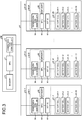
- FIG. 3 is an explanatory diagram illustrating specific configurations of the cell module, the CMU, and the BMU.
- Each of the cell modules 31-1 to 31-24 includes a plurality of (ten in FIG. 2 ) battery cells 61-1 to 61-10 connected in series.
- Each of the CMUs 32-1 to 32-24 includes a voltage/temperature measurement IC (Analog Front End IC: AFE-IC) 62 for measuring voltages and temperatures of predetermined portions of the battery cells of the corresponding one of the cell modules 31-1 to 31-24, an MPU 63 configured to totally control the corresponding one of the CMUs 32-1 to 32-24, a communication controller 64 complying with the controller area network (CAN) standard for allowing the CAN communication with the BMU 36, and a memory 65 that stores the voltage data and the temperature data corresponding to the voltage of each cell.
- a voltage/temperature measurement IC Analog Front End IC: AFE-IC
- AFE-IC Analog Front End IC
- MPU 63 configured to totally control the corresponding one of the CMUs 32-1 to 32-24
- a communication controller 64 complying with the controller area network (CAN) standard for allowing the CAN communication with the BMU 36
- a memory 65 that stores the voltage data and the temperature data corresponding to the voltage of each cell
- a combination of the corresponding cell modules 31-1 to 31-24 and the corresponding CMUs 32-1 to 32-24 will be referred to as battery modules 37-1 to 37-24.
- a combination of the cell module 31-1 and the corresponding CMU 32-1 will be referred to as a battery module 37-1.
- the BMU 36 includes an MPU 71 that totally controls the BMU 36, a communication controller 72 complying with the CAN standard for the CAN communication with the CMUs 32-1 to 32-24, and a memory 73 that stores the voltage data and the temperature data transmitted from the CMUs 32-1 to 32-24.
- the storage battery controller 5 illustrated in FIG. 1 detects generated power of the natural energy power generation unit 1 and suppresses a fluctuation in the output of the generated power using the storage battery device 11 in order to reduce influence on the electric power grid from this generated power.
- a fluctuation suppression amount for the storage battery device 11 is calculated using the corresponding storage battery controller 5 or the higher order control device 6 and is issued to the power conditioning system (PCS) 12 corresponding to the storage battery device 11 as a charge/discharge command.
- PCS power conditioning system
- the battery boards 21-1 to 21-N is configured to be capable of being shut off from the PCS 12, that is, from an electric grid using breakers 41-1 to 41-N.
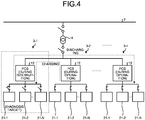
- FIG. 4 is an explanatory diagram illustrating operations according to the embodiment.
- a method of diagnosing a failure in the BMU (control device) of the battery board 21-1 under the control of the PCS 12 belonging to the storage battery system 3-1 in the natural energy power generation system 100 will be described by assuming that the storage battery device of this example is in 24-hour continuous operation.
- a current is controlled from the PCS 12 of the battery board 21-1 of the diagnosis target in the state where the storage battery device is connected to the electric grid.
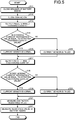
- FIG. 5 is a flowchart illustrating a failure diagnosis process according to the embodiment.
- FIG. 6 is a conceptual diagram illustrating the failure diagnosis process according to the embodiment.
- the storage battery controller 5 serving as a storage battery management device closes the breaker of the battery board corresponding to the BMU that is the diagnosis target (Step S11).
- a board breaker 41-1 of the battery board 21-1 that is under the control of the PCS 12 of higher order of the battery board 21-1 corresponding to the BMU 36 of the storage battery system 3-1 is closed. Subsequently, under the control of the storage battery controller 5, the BMU 36 closes the positive-side contactor 35P and the negative-side contactor 35N corresponding to the positive terminal (+) and the negative terminal (-), respectively, of the cell module 31-1 (Step S12).
- the PCS 12 of the storage battery system 3-1 corresponding to the battery board 21-1 notifies the BMU 36 of the battery board 21-1 of a charging current amount, and control to cause the charging current corresponding to the notified charging current amount, to flow to the battery board 21-1 from other storage battery systems 3-2 to 3-n as illustrated in FIG. 4 is performed (Step S13).
- the BMU 36 compares the charging current amount notified from the PCS 12 of the storage battery system 3-1 (charging current notification value) and the current amount detected by the current sensor 34 (detected charging current value) to determine whether or not they can be considered to be equal to each other as illustrated in FIG. 6 (Step S14).
- Step S14 If it can be considered that the charging current notification value is equal to the detected charging current value as a result of the comparison of Step S14 (Step S14; Yes), it is determined that the current sensor 34 is normal (Step S15).
- Step S14 if it is not considered that the charging current notification value is equal to the detected charging current value as a result of the determination of Step S14, that is, if there is a gap between them (Step S14; No), it is determined that the current sensor 34 is failed, and this situation is memorized (Step S16).
- the PCS 12 of the storage battery system 3-1 corresponding to the battery board 21-1 notifies the BMU 36 of the battery board 21-1 of a discharging current amount, and control to cause a discharging current corresponding to the notified charging current amount, to flow from the battery board 21-1 to other storage battery systems 3-2 to 3-n is performed (Step S17).
- the BMU 36 compares the discharging current amount notified from the PCS 12 of the storage battery system 3-1 (discharging current notification value) and the current amount detected by the current sensor 34 (detected discharging current value) and determines whether or not they can be considered to be equal to each other (Step S18).
- Step S18 If it is considered that the discharging current notification value and the detected discharging current value are equal to each other as a result of the comparison of Step S18 (Step S18; Yes), it is determined that the current sensor 34 is normal (Step S19).
- Step S18 if it is not considered that the discharging current notification value and the detected discharging current value are equal to each other as a result of the determination of Step S18, that is, if there is a gap between them (Step S18; No), it is determined that the current sensor 34 is failed (Step S20).
- Step S21 the resistance values of the positive-side contactor 35P and the negative-side contactor 35N are measured on the basis of a current value detected by the current sensor 34 and a voltage value detected by the voltage meter.
- the BMU 36 measures the resistance value of the entire circuit of the battery board 21-1 by measuring the charging current or discharging current and the voltage of the battery board while the positive-side contactor 35P and the negative-side contactor 35N are closed (Step S22).
- the output power of other PCSs connected in parallel is controlled (in the aforementioned case, the PCSs 12 of the storage battery systems 3-2 to 3-n).
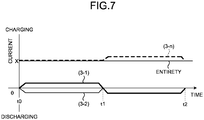
- FIG. 7 is an explanatory diagram illustrating power compensation performed by each PCS during a diagnosis for any one of the PCSs.
- the power compensation that causes the power charged by the PCS 12 of the storage battery system 3-1 to correspond to the power discharged by the PCS 12 of the storage battery system 3-2 is performed in order to suppress a fluctuation of the charging current X required for the overall storage battery systems 3-1 to 3-n from the electric grid, and keep the charging current X.
- the power compensation that causes the power discharged by the PCS 12 of the storage battery system 3-1 to be received by the PCS 12 of the storage battery system 3-n as the charging power is performed in order to suppress a fluctuation of the charging current X required for the overall storage battery systems 3-1 to 3-n from the electric grid, and keep the charging current X.
- the storage battery management device (storage battery controller) has a typical computer-based hardware configuration including a control device such as a CPU, a memory device such as a read-only memory (ROM) and a random access memory (RAM), an external storage device such as a hard disk drive (HDD) or a compact disc (CD) drive device, a display device as necessary, and an input device such as a keyboard or a mouse.
- a control device such as a CPU
- ROM read-only memory
- RAM random access memory
- an external storage device such as a hard disk drive (HDD) or a compact disc (CD) drive device
- HDD hard disk drive
- CD compact disc
- a program executed by the storage battery management device is recorded on a computer readable recording medium such as a CD-ROM, a flexible disk (FD), a compact disc recordable (CD-R), and a digital versatile disk (DVD) in an installable format or an executable format.
- a computer readable recording medium such as a CD-ROM, a flexible disk (FD), a compact disc recordable (CD-R), and a digital versatile disk (DVD) in an installable format or an executable format.
- the program executed by the storage battery management device according to this embodiment may be stored in a computer connected to a network such as the Internet and may be downloaded via the network.
- the program executed by the storage battery management device according to this embodiment may be provided or distributed via a network such as the Internet.
- the program of the storage battery management device may be embedded in a ROM or the like in advance to be provided.
Landscapes
- Engineering & Computer Science (AREA)
- Power Engineering (AREA)
- Manufacturing & Machinery (AREA)
- Chemical & Material Sciences (AREA)
- Chemical Kinetics & Catalysis (AREA)
- Electrochemistry (AREA)
- General Chemical & Material Sciences (AREA)
- Charge And Discharge Circuits For Batteries Or The Like (AREA)
- Supply And Distribution Of Alternating Current (AREA)
- Secondary Cells (AREA)
- Remote Monitoring And Control Of Power-Distribution Networks (AREA)
Description
- Embodiments described herein relate generally to a storage battery management device, a method, and a computer program product.
- In recent years, it is expected to use a large-scale storage battery system using secondary batteries to suppress a fluctuation in power generated from natural energy such as solar power or wind power, suppress a fluctuation in an interconnection flow caused by power demands, or shift a peak. In order to provide such a large-scale storage battery system, a plurality of storage battery devices capable of individually controlling charge/discharge power or the like are combined.
- Such a storage battery system including a plurality of storage battery devices is used to suppress a fluctuation in the generated power, suppress a fluctuation in an interconnection flow, or shift a peak by distributing charge/discharge command values for the entire storage battery system to elements such as individual storage battery devices and performing a charge/discharge control for overall storage battery devices included in this storage battery system.
- Background art is found in
WO2014118932A1 ,JP2008199763A JP2014171335A WO2014118932A1 does not disclose performing diagnosis for battery boards or diagnosing them while a storage battery system is in operation. - In the aforementioned storage battery system of the related art, a battery board including a storage battery unit also includes a control device (BMU), a main circuit switch (contactor), an electric fuse, a current sensor (CT), a voltage measurement circuit between battery boards, and the like in addition to storage battery cells.
- In order to inspect a resistance value or detection accuracy of each part to perform a diagnosis for the contactor, the electric fuse, the battery cell, the current sensor, and the like described above on the battery board, it is necessary to remove the battery board or a PCS from the system and individually inspect the battery board or the PCS, which may disadvantageously affect the electric grid.
- A storage battery management device according to an embodiment is configured to manage a storage battery system including a plurality of battery boards and a plurality of power adjustment devices corresponding to the battery boards. The storage battery management device is configured to compensate charging power and discharging power of a battery board used in a diagnosis for the battery board, inside the storage battery system by transmitting and receiving the charging power or the discharging power between the plurality of power adjustment devices of the storage battery system, when performing the diagnosis while causing the storage battery system to remain operated.
-
-
FIG. 1 is a schematic diagram illustrating a natural energy power generation system including a plurality of storage battery systems. -
FIG. 2 is a block diagram illustrating a schematic configuration of a storage battery system according to an embodiment. -
FIG. 3 is an explanatory diagram illustrating specific configurations of a cell module, a CMU, and a BMU. -
FIG. 4 is an explanatory diagram illustrating operations according to an embodiment. -
FIG. 5 is a flowchart illustrating a failure diagnosis process according to an embodiment. -
FIG. 6 is a conceptual diagram illustrating a failure diagnosis process according to an embodiment. -
FIG. 7 is an explanatory diagram illustrating power compensation performed by each PCS during a diagnosis of any one of the PCSs. - According to an embodiment, a storage battery management device is configured to manage storage battery systems each including a plurality of battery boards and a power adjustment device corresponding to the battery boards. The storage battery management device is configured to compensate charging power and discharging power of a battery board used in a diagnosis for the battery board, inside the storage battery systems by transmitting and receiving the charging power or the discharging power between power adjustment devices of the storage battery systems, when performing the diagnosis while causing the storage battery systems to remain operated.
-
FIG. 1 is a schematic diagram illustrating a natural energy power generation system including a plurality of storage battery systems. - The natural energy
power generation system 100 serving as a power generation system includes a natural energy power generation unit 1 capable of outputting grid power using natural energy (renewable energy) such as solar power, water power, wind power, biomass energy, and geothermal power, anelectric power meter 2 configured to measure the power generated by the natural energy power generation unit 1, a plurality of storage battery systems 3-1 to 3-n charged with surplus power of the natural energy power generation unit 1 on the basis of the measurement result of theelectric power meter 2 and configured to discharge deficient power to output it overlappingly with the power generated by the natural energy power generation unit 1, atransformer 4 configured to transform the voltage of the power output from the natural energy power generation unit 1 (including a case where the power output from the storage battery systems 3-1 to 3-n is overlapped), astorage battery controller 5 configured to locally control the storage battery systems 3-1 to 3-n, and an higherorder control device 6 configured to perform a remote control of thestorage battery controller 5. -
FIG. 2 is a schematic block diagram illustrating a storage battery system according to an embodiment. - Since the storage battery systems 3-1 to 3-n have the same configuration, the storage battery system 3-1 will be described representatively in the following description.
- The storage battery system 3-1 generally includes a
storage battery device 11 configured to store power and a power conditioning system (PCS) 12 configured to convert the DC power supplied from thestorage battery device 11 into AC power having a desired electric power quality and supply it to a load. - The
storage battery device 11 generally includes a plurality of battery boards 21-1 to 21-N (where "N" denotes any natural number) and abattery terminal board 22 connected to the battery boards 21-1 to 21-N. - Each of the battery boards 21-1 to 21-N includes a plurality of battery units 23-1 to 23-M connected in parallel with each other (where "M" denotes any natural number), a
gateway unit 24, and aDC power unit 25 configured to supply the DC power for operation to a battery management unit (BMU) and a cell monitoring unit (CMU) described below. - Here, a configuration of the battery unit will be described.
- The battery units 23-1 to 23-M are connected to output power lines (bus lines) LHO and LLO through a high-voltage-side power supply line LH and a low-voltage-side power supply line LL, respectively, to supply power to the
power conditioning system 12 serving as a main circuit. - Battery units 23-1 to 23-M have the same configuration. Therefore, the battery unit 23-1 will be described representatively.
- The battery unit 23-1 generally includes a plurality of (twenty four in
FIG. 1 ) cell modules 31-1 to 31-24, a plurality of cell monitoring units (CMUs) 32-1 to 32-24 provided in the cell modules 31-1 to 31-24, aservice disconnection 33 provided between the cell module 31-12 and the cell module 31-13, acurrent sensor 34, a positive-side contactor 35P, and a negative-side contactor 35N. The plurality of cell modules 31-1 to 31-24, theservice disconnection 33, thecurrent sensor 34, the positive-side contactor 35P, anelectric fuse 38, and the negative-side contactor 35N are connected in series with each other. - Here, the cell modules 31-1 to 31-24 are connected to a plurality of battery cells in series and in parallel to constitute a battery pack. In addition, a plurality of cell modules 31-1 to 31-24 connected in series constitute a group of battery packs.
- In addition, the battery unit 23-1 includes a
BMU 36, and the communication line of each of CMUs 32-1 to 32-24 and the output line of thecurrent sensor 34 are connected to theBMU 36. - A battery management unit (BMU) 36 controls the entire battery unit 23-1 under the control of the
gateway unit 24 to control open/close states of the positive-side contactor 35P and the negative-side contactor 35N on the basis of a result of communication with each of CMUs 32-1 to 32-24 (measurement results of the voltage and the temperature) and a detection result of thecurrent sensor 34. - Next, a configuration of the battery terminal board will be described.
- The
battery terminal board 22 includes a plurality of board breakers 41-1 to 41-N provided in association with the battery boards 21-1 to 21-N and a master unit 42 which is a microcomputer for controlling the entirestorage battery device 11. - Between the master unit 42 and the
power conditioning system 12, the master unit 42 is connected to acontrol power line 51 used to supply power to thepower conditioning system 12 through an uninterruptible power system (UPS) 12A of thepower conditioning system 12 and acontrol communication line 52 used to exchange control data via the Ethernet (registered trademark) network. - Here, the cell modules 31-1 to 31-24, the CMUs 32-1 to 32-24, and the
BMU 36 will be described in more details. -
FIG. 3 is an explanatory diagram illustrating specific configurations of the cell module, the CMU, and the BMU. - Each of the cell modules 31-1 to 31-24 includes a plurality of (ten in
FIG. 2 ) battery cells 61-1 to 61-10 connected in series. - Each of the CMUs 32-1 to 32-24 includes a voltage/temperature measurement IC (Analog Front End IC: AFE-IC) 62 for measuring voltages and temperatures of predetermined portions of the battery cells of the corresponding one of the cell modules 31-1 to 31-24, an
MPU 63 configured to totally control the corresponding one of the CMUs 32-1 to 32-24, acommunication controller 64 complying with the controller area network (CAN) standard for allowing the CAN communication with theBMU 36, and amemory 65 that stores the voltage data and the temperature data corresponding to the voltage of each cell. - In the following description, a combination of the corresponding cell modules 31-1 to 31-24 and the corresponding CMUs 32-1 to 32-24 will be referred to as battery modules 37-1 to 37-24. For example, a combination of the cell module 31-1 and the corresponding CMU 32-1 will be referred to as a battery module 37-1.
- The BMU 36 includes an MPU 71 that totally controls the
BMU 36, a communication controller 72 complying with the CAN standard for the CAN communication with the CMUs 32-1 to 32-24, and a memory 73 that stores the voltage data and the temperature data transmitted from the CMUs 32-1 to 32-24. - The
storage battery controller 5 illustrated inFIG. 1 detects generated power of the natural energy power generation unit 1 and suppresses a fluctuation in the output of the generated power using thestorage battery device 11 in order to reduce influence on the electric power grid from this generated power. Here, a fluctuation suppression amount for thestorage battery device 11 is calculated using the correspondingstorage battery controller 5 or the higherorder control device 6 and is issued to the power conditioning system (PCS) 12 corresponding to thestorage battery device 11 as a charge/discharge command. - Next, operations according to the embodiment will be described.
- As illustrated in
FIG. 2 , the battery boards 21-1 to 21-N is configured to be capable of being shut off from the PCS 12, that is, from an electric grid using breakers 41-1 to 41-N. -
FIG. 4 is an explanatory diagram illustrating operations according to the embodiment. - In the following description, a case where a test is performed for the battery board 21-1 will be described by way of example.
- A method of diagnosing a failure in the BMU (control device) of the battery board 21-1 under the control of the
PCS 12 belonging to the storage battery system 3-1 in the natural energypower generation system 100 will be described by assuming that the storage battery device of this example is in 24-hour continuous operation. - According to this embodiment, in order to perform a failure diagnosis for the
BMU 36 of the battery board 21-1, a current is controlled from thePCS 12 of the battery board 21-1 of the diagnosis target in the state where the storage battery device is connected to the electric grid. -
FIG. 5 is a flowchart illustrating a failure diagnosis process according to the embodiment. -
FIG. 6 is a conceptual diagram illustrating the failure diagnosis process according to the embodiment. - First, the
storage battery controller 5 serving as a storage battery management device closes the breaker of the battery board corresponding to the BMU that is the diagnosis target (Step S11). - Specifically, a board breaker 41-1 of the battery board 21-1 that is under the control of the
PCS 12 of higher order of the battery board 21-1 corresponding to theBMU 36 of the storage battery system 3-1 is closed. Subsequently, under the control of thestorage battery controller 5, theBMU 36 closes the positive-side contactor 35P and the negative-side contactor 35N corresponding to the positive terminal (+) and the negative terminal (-), respectively, of the cell module 31-1 (Step S12). - Subsequently, under the control of the
storage battery controller 5, thePCS 12 of the storage battery system 3-1 corresponding to the battery board 21-1 notifies theBMU 36 of the battery board 21-1 of a charging current amount, and control to cause the charging current corresponding to the notified charging current amount, to flow to the battery board 21-1 from other storage battery systems 3-2 to 3-n as illustrated inFIG. 4 is performed (Step S13). - As a result, the
BMU 36 compares the charging current amount notified from thePCS 12 of the storage battery system 3-1 (charging current notification value) and the current amount detected by the current sensor 34 (detected charging current value) to determine whether or not they can be considered to be equal to each other as illustrated inFIG. 6 (Step S14). - If it can be considered that the charging current notification value is equal to the detected charging current value as a result of the comparison of Step S14 (Step S14; Yes), it is determined that the
current sensor 34 is normal (Step S15). - Meanwhile, if it is not considered that the charging current notification value is equal to the detected charging current value as a result of the determination of Step S14, that is, if there is a gap between them (Step S14; No), it is determined that the
current sensor 34 is failed, and this situation is memorized (Step S16). - Subsequently, under the control of the
storage battery controller 5, thePCS 12 of the storage battery system 3-1 corresponding to the battery board 21-1 notifies theBMU 36 of the battery board 21-1 of a discharging current amount, and control to cause a discharging current corresponding to the notified charging current amount, to flow from the battery board 21-1 to other storage battery systems 3-2 to 3-n is performed (Step S17). - As a result, the
BMU 36 compares the discharging current amount notified from thePCS 12 of the storage battery system 3-1 (discharging current notification value) and the current amount detected by the current sensor 34 (detected discharging current value) and determines whether or not they can be considered to be equal to each other (Step S18). - If it is considered that the discharging current notification value and the detected discharging current value are equal to each other as a result of the comparison of Step S18 (Step S18; Yes), it is determined that the
current sensor 34 is normal (Step S19). - Meanwhile, if it is not considered that the discharging current notification value and the detected discharging current value are equal to each other as a result of the determination of Step S18, that is, if there is a gap between them (Step S18; No), it is determined that the
current sensor 34 is failed (Step S20). - Subsequently, while one of the positive-
side contactor 35P and the negative-side contactor 35N is closed (turned on), and the other one is opened (turned off), the resistance values of the positive-side contactor 35P and the negative-side contactor 35N are measured on the basis of a current value detected by thecurrent sensor 34 and a voltage value detected by the voltage meter (Step S21). - In addition, it is possible to recognize a melting state or a deterioration state of the positive-
side contactor 35P and the negative-side contactor 35N depending on the measured resistance value.
Then, theBMU 36 measures the resistance value of the entire circuit of the battery board 21-1 by measuring the charging current or discharging current and the voltage of the battery board while the positive-side contactor 35P and the negative-side contactor 35N are closed (Step S22). - As a result, it is possible to diagnose deterioration of the cell modules (battery cells 61-1 to 61-10) or the
electric fuse 38.
However, in the aforementioned case, if a charging current or a discharging current is applied to the battery board 21-1 during the operation of the storage battery system 3-1 as described in Steps S13 and S17, the input/output power required for the storage battery device from the electric grid may be influenced. - In this regard, according to this embodiment, in order to suppress influence on the input/output power required for the storage battery device from the electric grid, the output power of other PCSs connected in parallel is controlled (in the aforementioned case, the
PCSs 12 of the storage battery systems 3-2 to 3-n). -
FIG. 7 is an explanatory diagram illustrating power compensation performed by each PCS during a diagnosis for any one of the PCSs. - During the timings t0 to t1 at which the
PCS 12 of the storage battery system 3-1 discharges a small current, as indicated by the dotted-line arrow directed from the storage battery system 3-2 to the storage battery system 3-1 inFIG. 4 and as illustrated inFIG. 7 , the power compensation that causes the power charged by thePCS 12 of the storage battery system 3-1 to correspond to the power discharged by thePCS 12 of the storage battery system 3-2 is performed in order to suppress a fluctuation of the charging current X required for the overall storage battery systems 3-1 to 3-n from the electric grid, and keep the charging current X. - During the timings t1 to t2 at which the
PCS 12 of the storage battery system 3-1 charges a small current, as indicated by the dotted-line arrow directed from the storage battery system 3-1 to the storage battery system 3-n inFIG. 4 and as illustrated inFIG. 7 , the power compensation that causes the power discharged by thePCS 12 of the storage battery system 3-1 to be received by thePCS 12 of the storage battery system 3-n as the charging power is performed in order to suppress a fluctuation of the charging current X required for the overall storage battery systems 3-1 to 3-n from the electric grid, and keep the charging current X. - As described above, by operating the
PCSs 12 such that the charging power and the discharging power are compensated between thePCSs 12, it is possible to achieve control such that a failure diagnosis is performed using aPCS 12 of any storage battery system such as thePCS 12 of the storage battery system 3-n in the aforementioned example during the operation of the storage battery device without influencing on the electric grid. - According to this embodiment, it is possible to perform a diagnosis for a battery board control device without influencing on the electric grid.
- The storage battery management device (storage battery controller) according to this embodiment has a typical computer-based hardware configuration including a control device such as a CPU, a memory device such as a read-only memory (ROM) and a random access memory (RAM), an external storage device such as a hard disk drive (HDD) or a compact disc (CD) drive device, a display device as necessary, and an input device such as a keyboard or a mouse.
- A program executed by the storage battery management device according to this embodiment is recorded on a computer readable recording medium such as a CD-ROM, a flexible disk (FD), a compact disc recordable (CD-R), and a digital versatile disk (DVD) in an installable format or an executable format.
- The program executed by the storage battery management device according to this embodiment may be stored in a computer connected to a network such as the Internet and may be downloaded via the network. In addition, the program executed by the storage battery management device according to this embodiment may be provided or distributed via a network such as the Internet.
- Furthermore, the program of the storage battery management device according to this embodiment may be embedded in a ROM or the like in advance to be provided.
- While several embodiments of the invention have been described hereinbefore, such embodiments are just for illustrative purposes, and are not intended to limit the scope of the invention. These novel embodiments may be embodied in various other forms, and various omissions, substitutions, and changes may be within the scope of the invention as defined by the appended claims. Such embodiments and their modifications are construed as encompassing the scope or subject matter of the invention as attached in the claims and their equivalents.
Claims (6)
- A storage battery management device (5) configured to manage storage battery systems (3-1, 3-2, ..., 3-m) each including a plurality of battery boards (21-1, 21-2, ..., 21-n) and a power adjustment device (12) corresponding to the battery boards, wherein
the storage battery management device (5) is configured to compensate charging power and discharging power of a battery board used in a diagnosis for the battery board, inside the storage battery systems (3-1, 3-2, ..., 3-m) by transmitting and receiving the charging power or the discharging power between the power adjustment devices (12) of the storage battery systems (3-1, 3-2, ..., 3-m), when performing the diagnosis while causing the storage battery systems (3-1, 3-2, ..., 3-m) to remain operated. - The storage battery management device (5) according to claim 1, wherein, when the power adjustment devices (12) are controlled to perform the diagnosis for the battery board, the charging power or the discharging power is transmitted and received between a pair of power adjustment devices including a power adjustment device corresponding to the battery board that is a diagnosis target.
- The storage battery management device (5) according to claim 1 or 2, wherein the battery board includes:a battery unit including a plurality of battery cells;a positive-side contactor provided at a positive terminal of the battery unit; anda negative-side contactor provided at a negative terminal of the battery unit, andthe diagnosis is performed by measuring resistance values of the positive-side contactor and the negative-side contactor while one of the positive-side contactor and the negative-side contactor is opened and the other is closed.
- The storage battery management device (5) according to any one of claims 1 to 3, wherein the battery board includes a plurality of battery cells (61-1 to 61-10) and a battery management unit (BMU) configured to perform a charge/discharge control for the battery cells, and
the battery management unit (BMU) compares a current notification value from the power adjustment device with a detected current value actually detected by a current sensor, and determines that the current sensor is failed if there is a gap between the current notification value and the detected current value. - A method executed by a storage battery management device configured to manage storage battery systems (3-1, 3-2, ..., 3-m) each including a plurality of battery boards (21-1, 21-2, ..., 21-n) and a power adjustment device corresponding to the battery boards (21-1, 21-2, ..., 21-n), the method comprising:performing a diagnosis for a battery board while causing the storage battery systems (3-1, 3-2, ..., 3-m) to remain operated; andcompensating charging power and discharging power of the battery board used in the diagnosis for the battery board, inside the storage battery systems (3-1, 3-2, ..., 3-m) by transmitting and receiving the charging power or the discharging power between the power adjustment devices in the storage battery system (3-1, 3-2, ..., 3-m).
- A program for controlling a storage battery management device (5) configured to manage storage battery systems (3-1, 3-2, ..., 3-m) each including a plurality of battery boards (21-1, 21-2, ..., 21-n)and a power adjustment device (12) corresponding to the battery boards (21-1, 21-2, ..., 21-n) using a computer, the program causing the computer to function as
a means for performing a diagnosis for a battery board while causing the storage battery systems (3-1, 3-2, ..., 3-m) to remain operated, and
a means for compensating charging power and discharging power of the battery board used in the diagnosis for the battery board, inside the storage battery systems (3-1, 3-2, ..., 3-m) by transmitting and receiving the charging power or the discharging power between the power adjustment devices (12) inside the storage battery systems (3-1, 3-2, ..., 3-m).
Applications Claiming Priority (1)
| Application Number | Priority Date | Filing Date | Title |
|---|---|---|---|
| PCT/JP2015/057766 WO2016147307A1 (en) | 2015-03-16 | 2015-03-16 | Storage battery management device, method, and program |
Publications (3)
| Publication Number | Publication Date |
|---|---|
| EP3273567A1 EP3273567A1 (en) | 2018-01-24 |
| EP3273567A4 EP3273567A4 (en) | 2018-02-14 |
| EP3273567B1 true EP3273567B1 (en) | 2019-04-24 |
Family
ID=56920393
Family Applications (1)
| Application Number | Title | Priority Date | Filing Date |
|---|---|---|---|
| EP15885403.4A Active EP3273567B1 (en) | 2015-03-16 | 2015-03-16 | Storage battery management device, method, and program |
Country Status (4)
| Country | Link |
|---|---|
| US (1) | US20180069270A1 (en) |
| EP (1) | EP3273567B1 (en) |
| JP (1) | JP6419941B2 (en) |
| WO (1) | WO2016147307A1 (en) |
Cited By (1)
| Publication number | Priority date | Publication date | Assignee | Title |
|---|---|---|---|---|
| FR3131876A1 (en) | 2022-01-19 | 2023-07-21 | Wattalps | Method for controlling an electric battery |
Families Citing this family (5)
| Publication number | Priority date | Publication date | Assignee | Title |
|---|---|---|---|---|
| US10236988B1 (en) * | 2016-07-14 | 2019-03-19 | LED Lighting IQ LLC | Multi spectrum internet access appliance |
| CN110015115B (en) * | 2017-10-20 | 2022-05-27 | 蔚来(安徽)控股有限公司 | Method and device for determining battery charging strategy of battery replacement station |
| CN113285507B (en) * | 2021-05-24 | 2024-04-12 | 阳光电源股份有限公司 | Battery cluster parallel connection method and related device |
| CN115833192A (en) * | 2021-09-16 | 2023-03-21 | 台达电子企业管理(上海)有限公司 | Energy storage system |
| JP2024097201A (en) * | 2023-01-05 | 2024-07-18 | 株式会社東芝 | Diagnostic method, diagnostic device, and diagnostic program for power storage system, and power storage system |
Family Cites Families (12)
| Publication number | Priority date | Publication date | Assignee | Title |
|---|---|---|---|---|
| JP4019815B2 (en) * | 2002-06-26 | 2007-12-12 | 日産自動車株式会社 | Abnormality diagnosis apparatus and method for assembled battery |
| JP2005295694A (en) * | 2004-03-31 | 2005-10-20 | Osaka Gas Co Ltd | Discharge energy collector of storage battery |
| JP2008199763A (en) * | 2007-02-13 | 2008-08-28 | Seiko Electric Co Ltd | Charge/discharge device and battery regeneration device |
| JP5469813B2 (en) * | 2008-01-29 | 2014-04-16 | 株式会社日立製作所 | Battery system for vehicles |
| JP5486780B2 (en) * | 2008-07-01 | 2014-05-07 | 株式会社日立製作所 | Battery system |
| JP2010200574A (en) * | 2009-02-27 | 2010-09-09 | Panasonic Corp | Self-diagnosis circuit and power supply |
| JP5589976B2 (en) * | 2011-07-04 | 2014-09-17 | 三菱自動車工業株式会社 | Vehicle charging unit structure |
| JP5839472B2 (en) * | 2012-02-06 | 2016-01-06 | 住友重機械工業株式会社 | Charge / discharge inspection device for secondary battery and controller thereof |
| JP2013206643A (en) * | 2012-03-28 | 2013-10-07 | Hitachi Ltd | Relay fusion detector of battery system, and battery system using the same |
| JP6099990B2 (en) * | 2013-01-21 | 2017-03-22 | 三菱重工業株式会社 | Power storage system and control method thereof |
| WO2014118932A1 (en) * | 2013-01-31 | 2014-08-07 | 株式会社日立製作所 | Electricity-storage system and electricity-storage method |
| JP6157880B2 (en) * | 2013-03-04 | 2017-07-05 | 株式会社東芝 | Secondary battery system having a plurality of batteries and charge / discharge power distribution method |
-
2015
- 2015-03-16 US US15/557,180 patent/US20180069270A1/en not_active Abandoned
- 2015-03-16 EP EP15885403.4A patent/EP3273567B1/en active Active
- 2015-03-16 WO PCT/JP2015/057766 patent/WO2016147307A1/en not_active Ceased
- 2015-03-16 JP JP2017505914A patent/JP6419941B2/en active Active
Non-Patent Citations (1)
| Title |
|---|
| None * |
Cited By (2)
| Publication number | Priority date | Publication date | Assignee | Title |
|---|---|---|---|---|
| FR3131876A1 (en) | 2022-01-19 | 2023-07-21 | Wattalps | Method for controlling an electric battery |
| WO2023139068A1 (en) | 2022-01-19 | 2023-07-27 | Wattalps | Method for controlling an electric battery |
Also Published As
| Publication number | Publication date |
|---|---|
| JP6419941B2 (en) | 2018-11-07 |
| EP3273567A4 (en) | 2018-02-14 |
| WO2016147307A1 (en) | 2016-09-22 |
| JPWO2016147307A1 (en) | 2018-02-01 |
| EP3273567A1 (en) | 2018-01-24 |
| US20180069270A1 (en) | 2018-03-08 |
Similar Documents
| Publication | Publication Date | Title |
|---|---|---|
| KR101732854B1 (en) | Storage battery device and storage battery system | |
| EP3273567B1 (en) | Storage battery management device, method, and program | |
| EP3093947B1 (en) | Storage battery management apparatus, method, and program | |
| JP6571268B2 (en) | Battery monitoring apparatus and method | |
| KR101763502B1 (en) | Storage battery management device, method, and computer program | |
| EP3514557B1 (en) | Electric storage capacity estimation device, method and program | |
| US20180278064A1 (en) | Storage battery management device, method, and computer program product | |
| JP7404049B2 (en) | Storage battery control device, method and program | |
| WO2017154170A1 (en) | Storage cell device and method | |
| US20130234517A1 (en) | Power accumulation system and method for controlling storage module | |
| WO2016147326A1 (en) | Storage-battery management device, method, and program | |
| WO2021111673A1 (en) | Storage battery device, method, and program | |
| WO2016147322A1 (en) | Storage cell management device, method, and program | |
| JP6585705B2 (en) | Charge / discharge system | |
| JPWO2017042973A1 (en) | Storage battery system, method and program | |
| WO2017158727A1 (en) | Battery-capacity estimating device and program |
Legal Events
| Date | Code | Title | Description |
|---|---|---|---|
| STAA | Information on the status of an ep patent application or granted ep patent |
Free format text: STATUS: THE INTERNATIONAL PUBLICATION HAS BEEN MADE |
|
| PUAI | Public reference made under article 153(3) epc to a published international application that has entered the european phase |
Free format text: ORIGINAL CODE: 0009012 |
|
| STAA | Information on the status of an ep patent application or granted ep patent |
Free format text: STATUS: REQUEST FOR EXAMINATION WAS MADE |
|
| 17P | Request for examination filed |
Effective date: 20170908 |
|
| AK | Designated contracting states |
Kind code of ref document: A1 Designated state(s): AL AT BE BG CH CY CZ DE DK EE ES FI FR GB GR HR HU IE IS IT LI LT LU LV MC MK MT NL NO PL PT RO RS SE SI SK SM TR |
|
| AX | Request for extension of the european patent |
Extension state: BA ME |
|
| A4 | Supplementary search report drawn up and despatched |
Effective date: 20180116 |
|
| RIC1 | Information provided on ipc code assigned before grant |
Ipc: H02J 3/32 20060101ALI20180110BHEP Ipc: H02J 7/00 20060101AFI20180110BHEP |
|
| DAV | Request for validation of the european patent (deleted) | ||
| DAX | Request for extension of the european patent (deleted) | ||
| REG | Reference to a national code |
Ref country code: DE Ref legal event code: R079 Ref document number: 602015029116 Country of ref document: DE Free format text: PREVIOUS MAIN CLASS: H02J0007000000 Ipc: H02J0003320000 |
|
| GRAP | Despatch of communication of intention to grant a patent |
Free format text: ORIGINAL CODE: EPIDOSNIGR1 |
|
| STAA | Information on the status of an ep patent application or granted ep patent |
Free format text: STATUS: GRANT OF PATENT IS INTENDED |
|
| RIC1 | Information provided on ipc code assigned before grant |
Ipc: H01M 10/44 20060101ALI20180905BHEP Ipc: H01M 10/42 20060101ALI20180905BHEP Ipc: H02J 3/32 20060101AFI20180905BHEP Ipc: H02J 7/00 20060101ALI20180905BHEP |
|
| INTG | Intention to grant announced |
Effective date: 20180927 |
|
| GRAS | Grant fee paid |
Free format text: ORIGINAL CODE: EPIDOSNIGR3 |
|
| GRAA | (expected) grant |
Free format text: ORIGINAL CODE: 0009210 |
|
| STAA | Information on the status of an ep patent application or granted ep patent |
Free format text: STATUS: THE PATENT HAS BEEN GRANTED |
|
| AK | Designated contracting states |
Kind code of ref document: B1 Designated state(s): AL AT BE BG CH CY CZ DE DK EE ES FI FR GB GR HR HU IE IS IT LI LT LU LV MC MK MT NL NO PL PT RO RS SE SI SK SM TR |
|
| REG | Reference to a national code |
Ref country code: GB Ref legal event code: FG4D |
|
| REG | Reference to a national code |
Ref country code: CH Ref legal event code: EP |
|
| REG | Reference to a national code |
Ref country code: AT Ref legal event code: REF Ref document number: 1125278 Country of ref document: AT Kind code of ref document: T Effective date: 20190515 Ref country code: IE Ref legal event code: FG4D |
|
| REG | Reference to a national code |
Ref country code: DE Ref legal event code: R096 Ref document number: 602015029116 Country of ref document: DE |
|
| REG | Reference to a national code |
Ref country code: NL Ref legal event code: MP Effective date: 20190424 |
|
| REG | Reference to a national code |
Ref country code: LT Ref legal event code: MG4D |
|
| PG25 | Lapsed in a contracting state [announced via postgrant information from national office to epo] |
Ref country code: NL Free format text: LAPSE BECAUSE OF FAILURE TO SUBMIT A TRANSLATION OF THE DESCRIPTION OR TO PAY THE FEE WITHIN THE PRESCRIBED TIME-LIMIT Effective date: 20190424 |
|
| PG25 | Lapsed in a contracting state [announced via postgrant information from national office to epo] |
Ref country code: NO Free format text: LAPSE BECAUSE OF FAILURE TO SUBMIT A TRANSLATION OF THE DESCRIPTION OR TO PAY THE FEE WITHIN THE PRESCRIBED TIME-LIMIT Effective date: 20190724 Ref country code: FI Free format text: LAPSE BECAUSE OF FAILURE TO SUBMIT A TRANSLATION OF THE DESCRIPTION OR TO PAY THE FEE WITHIN THE PRESCRIBED TIME-LIMIT Effective date: 20190424 Ref country code: HR Free format text: LAPSE BECAUSE OF FAILURE TO SUBMIT A TRANSLATION OF THE DESCRIPTION OR TO PAY THE FEE WITHIN THE PRESCRIBED TIME-LIMIT Effective date: 20190424 Ref country code: SE Free format text: LAPSE BECAUSE OF FAILURE TO SUBMIT A TRANSLATION OF THE DESCRIPTION OR TO PAY THE FEE WITHIN THE PRESCRIBED TIME-LIMIT Effective date: 20190424 Ref country code: PT Free format text: LAPSE BECAUSE OF FAILURE TO SUBMIT A TRANSLATION OF THE DESCRIPTION OR TO PAY THE FEE WITHIN THE PRESCRIBED TIME-LIMIT Effective date: 20190824 Ref country code: ES Free format text: LAPSE BECAUSE OF FAILURE TO SUBMIT A TRANSLATION OF THE DESCRIPTION OR TO PAY THE FEE WITHIN THE PRESCRIBED TIME-LIMIT Effective date: 20190424 Ref country code: AL Free format text: LAPSE BECAUSE OF FAILURE TO SUBMIT A TRANSLATION OF THE DESCRIPTION OR TO PAY THE FEE WITHIN THE PRESCRIBED TIME-LIMIT Effective date: 20190424 Ref country code: LT Free format text: LAPSE BECAUSE OF FAILURE TO SUBMIT A TRANSLATION OF THE DESCRIPTION OR TO PAY THE FEE WITHIN THE PRESCRIBED TIME-LIMIT Effective date: 20190424 |
|
| PG25 | Lapsed in a contracting state [announced via postgrant information from national office to epo] |
Ref country code: BG Free format text: LAPSE BECAUSE OF FAILURE TO SUBMIT A TRANSLATION OF THE DESCRIPTION OR TO PAY THE FEE WITHIN THE PRESCRIBED TIME-LIMIT Effective date: 20190724 Ref country code: PL Free format text: LAPSE BECAUSE OF FAILURE TO SUBMIT A TRANSLATION OF THE DESCRIPTION OR TO PAY THE FEE WITHIN THE PRESCRIBED TIME-LIMIT Effective date: 20190424 Ref country code: RS Free format text: LAPSE BECAUSE OF FAILURE TO SUBMIT A TRANSLATION OF THE DESCRIPTION OR TO PAY THE FEE WITHIN THE PRESCRIBED TIME-LIMIT Effective date: 20190424 Ref country code: LV Free format text: LAPSE BECAUSE OF FAILURE TO SUBMIT A TRANSLATION OF THE DESCRIPTION OR TO PAY THE FEE WITHIN THE PRESCRIBED TIME-LIMIT Effective date: 20190424 Ref country code: GR Free format text: LAPSE BECAUSE OF FAILURE TO SUBMIT A TRANSLATION OF THE DESCRIPTION OR TO PAY THE FEE WITHIN THE PRESCRIBED TIME-LIMIT Effective date: 20190725 |
|
| REG | Reference to a national code |
Ref country code: AT Ref legal event code: MK05 Ref document number: 1125278 Country of ref document: AT Kind code of ref document: T Effective date: 20190424 |
|
| PG25 | Lapsed in a contracting state [announced via postgrant information from national office to epo] |
Ref country code: IS Free format text: LAPSE BECAUSE OF FAILURE TO SUBMIT A TRANSLATION OF THE DESCRIPTION OR TO PAY THE FEE WITHIN THE PRESCRIBED TIME-LIMIT Effective date: 20190824 |
|
| REG | Reference to a national code |
Ref country code: DE Ref legal event code: R097 Ref document number: 602015029116 Country of ref document: DE |
|
| PG25 | Lapsed in a contracting state [announced via postgrant information from national office to epo] |
Ref country code: SK Free format text: LAPSE BECAUSE OF FAILURE TO SUBMIT A TRANSLATION OF THE DESCRIPTION OR TO PAY THE FEE WITHIN THE PRESCRIBED TIME-LIMIT Effective date: 20190424 Ref country code: CZ Free format text: LAPSE BECAUSE OF FAILURE TO SUBMIT A TRANSLATION OF THE DESCRIPTION OR TO PAY THE FEE WITHIN THE PRESCRIBED TIME-LIMIT Effective date: 20190424 Ref country code: RO Free format text: LAPSE BECAUSE OF FAILURE TO SUBMIT A TRANSLATION OF THE DESCRIPTION OR TO PAY THE FEE WITHIN THE PRESCRIBED TIME-LIMIT Effective date: 20190424 Ref country code: EE Free format text: LAPSE BECAUSE OF FAILURE TO SUBMIT A TRANSLATION OF THE DESCRIPTION OR TO PAY THE FEE WITHIN THE PRESCRIBED TIME-LIMIT Effective date: 20190424 Ref country code: DK Free format text: LAPSE BECAUSE OF FAILURE TO SUBMIT A TRANSLATION OF THE DESCRIPTION OR TO PAY THE FEE WITHIN THE PRESCRIBED TIME-LIMIT Effective date: 20190424 Ref country code: AT Free format text: LAPSE BECAUSE OF FAILURE TO SUBMIT A TRANSLATION OF THE DESCRIPTION OR TO PAY THE FEE WITHIN THE PRESCRIBED TIME-LIMIT Effective date: 20190424 |
|
| PG25 | Lapsed in a contracting state [announced via postgrant information from national office to epo] |
Ref country code: SM Free format text: LAPSE BECAUSE OF FAILURE TO SUBMIT A TRANSLATION OF THE DESCRIPTION OR TO PAY THE FEE WITHIN THE PRESCRIBED TIME-LIMIT Effective date: 20190424 |
|
| PLBE | No opposition filed within time limit |
Free format text: ORIGINAL CODE: 0009261 |
|
| STAA | Information on the status of an ep patent application or granted ep patent |
Free format text: STATUS: NO OPPOSITION FILED WITHIN TIME LIMIT |
|
| PG25 | Lapsed in a contracting state [announced via postgrant information from national office to epo] |
Ref country code: TR Free format text: LAPSE BECAUSE OF FAILURE TO SUBMIT A TRANSLATION OF THE DESCRIPTION OR TO PAY THE FEE WITHIN THE PRESCRIBED TIME-LIMIT Effective date: 20190424 |
|
| 26N | No opposition filed |
Effective date: 20200127 |
|
| PG25 | Lapsed in a contracting state [announced via postgrant information from national office to epo] |
Ref country code: SI Free format text: LAPSE BECAUSE OF FAILURE TO SUBMIT A TRANSLATION OF THE DESCRIPTION OR TO PAY THE FEE WITHIN THE PRESCRIBED TIME-LIMIT Effective date: 20190424 |
|
| PG25 | Lapsed in a contracting state [announced via postgrant information from national office to epo] |
Ref country code: MC Free format text: LAPSE BECAUSE OF FAILURE TO SUBMIT A TRANSLATION OF THE DESCRIPTION OR TO PAY THE FEE WITHIN THE PRESCRIBED TIME-LIMIT Effective date: 20190424 |
|
| REG | Reference to a national code |
Ref country code: CH Ref legal event code: PL |
|
| REG | Reference to a national code |
Ref country code: BE Ref legal event code: MM Effective date: 20200331 |
|
| PG25 | Lapsed in a contracting state [announced via postgrant information from national office to epo] |
Ref country code: LU Free format text: LAPSE BECAUSE OF NON-PAYMENT OF DUE FEES Effective date: 20200316 |
|
| PG25 | Lapsed in a contracting state [announced via postgrant information from national office to epo] |
Ref country code: LI Free format text: LAPSE BECAUSE OF NON-PAYMENT OF DUE FEES Effective date: 20200331 Ref country code: CH Free format text: LAPSE BECAUSE OF NON-PAYMENT OF DUE FEES Effective date: 20200331 Ref country code: IE Free format text: LAPSE BECAUSE OF NON-PAYMENT OF DUE FEES Effective date: 20200316 |
|
| PG25 | Lapsed in a contracting state [announced via postgrant information from national office to epo] |
Ref country code: BE Free format text: LAPSE BECAUSE OF NON-PAYMENT OF DUE FEES Effective date: 20200331 |
|
| GBPC | Gb: european patent ceased through non-payment of renewal fee |
Effective date: 20200316 |
|
| PG25 | Lapsed in a contracting state [announced via postgrant information from national office to epo] |
Ref country code: GB Free format text: LAPSE BECAUSE OF NON-PAYMENT OF DUE FEES Effective date: 20200316 |
|
| PG25 | Lapsed in a contracting state [announced via postgrant information from national office to epo] |
Ref country code: MT Free format text: LAPSE BECAUSE OF FAILURE TO SUBMIT A TRANSLATION OF THE DESCRIPTION OR TO PAY THE FEE WITHIN THE PRESCRIBED TIME-LIMIT Effective date: 20190424 Ref country code: CY Free format text: LAPSE BECAUSE OF FAILURE TO SUBMIT A TRANSLATION OF THE DESCRIPTION OR TO PAY THE FEE WITHIN THE PRESCRIBED TIME-LIMIT Effective date: 20190424 |
|
| PG25 | Lapsed in a contracting state [announced via postgrant information from national office to epo] |
Ref country code: MK Free format text: LAPSE BECAUSE OF FAILURE TO SUBMIT A TRANSLATION OF THE DESCRIPTION OR TO PAY THE FEE WITHIN THE PRESCRIBED TIME-LIMIT Effective date: 20190424 |
|
| PGFP | Annual fee paid to national office [announced via postgrant information from national office to epo] |
Ref country code: FR Payment date: 20230110 Year of fee payment: 9 |
|
| PGFP | Annual fee paid to national office [announced via postgrant information from national office to epo] |
Ref country code: IT Payment date: 20230213 Year of fee payment: 9 Ref country code: DE Payment date: 20230117 Year of fee payment: 9 |
|
| REG | Reference to a national code |
Ref country code: DE Ref legal event code: R119 Ref document number: 602015029116 Country of ref document: DE |
|
| PG25 | Lapsed in a contracting state [announced via postgrant information from national office to epo] |
Ref country code: DE Free format text: LAPSE BECAUSE OF NON-PAYMENT OF DUE FEES Effective date: 20241001 |
|
| PG25 | Lapsed in a contracting state [announced via postgrant information from national office to epo] |
Ref country code: FR Free format text: LAPSE BECAUSE OF NON-PAYMENT OF DUE FEES Effective date: 20240331 |
|
| PG25 | Lapsed in a contracting state [announced via postgrant information from national office to epo] |
Ref country code: FR Free format text: LAPSE BECAUSE OF NON-PAYMENT OF DUE FEES Effective date: 20240331 Ref country code: DE Free format text: LAPSE BECAUSE OF NON-PAYMENT OF DUE FEES Effective date: 20241001 |
|
| PG25 | Lapsed in a contracting state [announced via postgrant information from national office to epo] |
Ref country code: IT Free format text: LAPSE BECAUSE OF NON-PAYMENT OF DUE FEES Effective date: 20240316 |