EP3273426A1 - Routing aircraft ground movements at an airport - Google Patents
Routing aircraft ground movements at an airport Download PDFInfo
- Publication number
- EP3273426A1 EP3273426A1 EP17179365.6A EP17179365A EP3273426A1 EP 3273426 A1 EP3273426 A1 EP 3273426A1 EP 17179365 A EP17179365 A EP 17179365A EP 3273426 A1 EP3273426 A1 EP 3273426A1
- Authority
- EP
- European Patent Office
- Prior art keywords
- aircraft ground
- airport
- computing device
- current aircraft
- current
- Prior art date
- Legal status (The legal status is an assumption and is not a legal conclusion. Google has not performed a legal analysis and makes no representation as to the accuracy of the status listed.)
- Granted
Links
Images


Classifications
-
- G—PHYSICS
- G08—SIGNALLING
- G08G—TRAFFIC CONTROL SYSTEMS
- G08G5/00—Traffic control systems for aircraft
- G08G5/50—Navigation or guidance aids
- G08G5/51—Navigation or guidance aids for control when on the ground, e.g. taxiing or rolling
-
- G—PHYSICS
- G08—SIGNALLING
- G08G—TRAFFIC CONTROL SYSTEMS
- G08G5/00—Traffic control systems for aircraft
- G08G5/20—Arrangements for acquiring, generating, sharing or displaying traffic information
- G08G5/22—Arrangements for acquiring, generating, sharing or displaying traffic information located on the ground
-
- G—PHYSICS
- G08—SIGNALLING
- G08G—TRAFFIC CONTROL SYSTEMS
- G08G5/00—Traffic control systems for aircraft
- G08G5/20—Arrangements for acquiring, generating, sharing or displaying traffic information
- G08G5/26—Transmission of traffic-related information between aircraft and ground stations
-
- G—PHYSICS
- G08—SIGNALLING
- G08G—TRAFFIC CONTROL SYSTEMS
- G08G5/00—Traffic control systems for aircraft
- G08G5/30—Flight plan management
- G08G5/34—Flight plan management for flight plan modification
-
- G—PHYSICS
- G08—SIGNALLING
- G08G—TRAFFIC CONTROL SYSTEMS
- G08G5/00—Traffic control systems for aircraft
- G08G5/50—Navigation or guidance aids
- G08G5/56—Navigation or guidance aids for two or more aircraft
-
- G—PHYSICS
- G08—SIGNALLING
- G08G—TRAFFIC CONTROL SYSTEMS
- G08G5/00—Traffic control systems for aircraft
- G08G5/70—Arrangements for monitoring traffic-related situations or conditions
- G08G5/72—Arrangements for monitoring traffic-related situations or conditions for monitoring traffic
- G08G5/727—Arrangements for monitoring traffic-related situations or conditions for monitoring traffic from a ground station
-
- G—PHYSICS
- G08—SIGNALLING
- G08G—TRAFFIC CONTROL SYSTEMS
- G08G5/00—Traffic control systems for aircraft
- G08G5/80—Anti-collision systems
Definitions
- the present disclosure relates to devices, methods, and systems for routing aircraft ground movements at an airport.
- ground movement routes may be determined and/or provided by, for example, an advanced surface movement guidance and control system (ASMGCS).
- ASMGCS advanced surface movement guidance and control system
- the routes determined and/or provided by the ASMGCS may be static routes that do consider or take into account the dynamic nature of aircraft ground movements (e.g., traffic) at the airport. As such, during operation it is left up to the air traffic controller to manually evaluate the current aircraft ground movements at the airport, and manually adjust the routes if he or she believes the routes could be made shorter (e.g., quicker) and/or safer.
- one or more embodiments include a memory, a processor configured to execute executable instructions stored in the memory to receive information associated with current aircraft ground movements at an airport and determine a possible adjustment to a current aircraft ground movement route at the airport based, at least in part, on the information associated with the current aircraft ground movements, and a user interface configured to provide the possible adjustment to the current aircraft ground movement route to a user of the device.
- Embodiments of the present disclosure can determine and/or provide aircraft ground movement routes that consider and/or take into account the dynamic nature of aircraft ground movements (e.g., traffic) at the airport.
- an advanced surface movement guidance and control system in accordance with the present disclosure can evaluate the current aircraft ground movements at the airport, and determine and/or provide an adjusted route based on (e.g., in response to) the current movements.
- previous ASMGCS approaches may only be able to determine and/or provide static routes that do consider or take into account current aircraft ground movements during operation.
- embodiments of the present disclosure can increase the efficiency of air traffic controllers, which can increase the safety of airport ground operations.
- an air traffic controller may experience less "head down time" while using an ASMGCS in accordance with the present disclosure than while using a previous ASMGCS.
- a or "a number of” something can refer to one or more such things.
- a number of routes can refer to one or more routes.
- FIG. 1 illustrates a computing device 100 for routing aircraft ground movements at an airport in accordance with one or more embodiments of the present disclosure.
- Computing device 100 can be, for example, a laptop computer, desktop computer, or mobile device (e.g., smart phone, tablet, PDA, etc.), among other types of computing devices.
- embodiments of the present disclosure are not limited to a particular type of computing device.
- computing device 100 can be a computing device of an advanced surface movement guidance and control system (ASMGCS) of the airport.
- ASMGCS advanced surface movement guidance and control system
- computing device 100 can include a memory 104 and a processor 102.
- Memory 104 can be any type of storage medium that can be accessed by processor 102 to perform various examples of the present disclosure.
- memory 104 can be a non-transitory computer readable medium having computer readable instructions (e.g., computer program instructions) stored thereon that are executable by processor 102 to route aircraft ground movements at an airport in accordance with the present disclosure. That is, processor 102 can execute the executable instructions stored in memory 104 to route aircraft ground movements at an airport in accordance with the present disclosure.
- Memory 104 can be volatile or nonvolatile memory. Memory 104 can also be removable (e.g., portable) memory, or non-removable (e.g., internal) memory.
- memory 104 can be random access memory (RAM) (e.g., dynamic random access memory (DRAM) and/or phase change random access memory (PCRAM)), read-only memory (ROM) (e.g., electrically erasable programmable read-only memory (EEPROM) and/or compact-disk read-only memory (CD-ROM)), flash memory, a laser disk, a digital versatile disk (DVD) or other optical disk storage, and/or a magnetic medium such as magnetic cassettes, tapes, or disks, among other types of memory.
- RAM random access memory
- DRAM dynamic random access memory
- PCRAM phase change random access memory
- ROM read-only memory
- EEPROM electrically erasable programmable read-only memory
- CD-ROM compact-disk read-only memory
- flash memory a laser disk,
- memory 104 is illustrated as being located in computing device 100, embodiments of the present disclosure are not so limited.
- memory 104 can also be located internal to another computing resource (e.g., enabling computer readable instructions to be downloaded over the Internet or another wired or wireless connection).
- computing device 100 can include a user interface 106.
- a user e.g., operator of computing device 100, such as, for instance, an air traffic controller of the airport, can interact with computing device 100 via user interface 106.
- user interface 106 can provide (e.g., display and/or present) information to the user of computing device 100, such as, for instance, a possible adjustment to a current aircraft ground movement route, as will be further described herein.
- user interface 106 can receive information from (e.g., input by) the user of computing device 100, such as, for instance, an acceptance of a possible adjustment to a current aircraft ground movement route, as will be further described herein.
- user interface 106 can be a graphical user interface (GUI) that can include a display (e.g., a screen) that can provide and/or receive information to and/or from the user of computing device 100.
- GUI graphical user interface
- the display can be, for instance, a touch-screen (e.g., the GUI can include touch-screen capabilities).
- user interface 106 can include a keyboard and/or mouse the user can use to input information into computing device 100.
- Embodiments of the present disclosure are not limited to a particular type(s) of user interface.
- computing device 100 can receive information associated with current (e.g., present) aircraft ground movements (e.g., traffic) at the airport.
- the information can include, for example, observations and/or measurements of the current aircraft ground movements, such as changes (e.g., an increase or decrease) in congestion in the current aircraft ground movements, the current number of landings taking place on the runway(s) of the airport, the current occupancy status of the exit and/or entrance branch(s) of the runway(s) (e.g., whether the branch is free or occupied), and/or differences in the traffic at different parts of the runway(s), among other types of information and/or observations.
- Computing device 100 can receive the information from, for example, an air traffic controller of the airport (e.g., via user interface 106), and/or from other components of the ASMGCS.
- Computing device 100 can propose an adjustment to a current (e.g., present) aircraft ground movement route at the airport based, at least in part, on the information associated with the current aircraft ground movements. For example, computing device 100 can determine a possible adjustment to the current aircraft ground movement route based, at least in part, on the information associated with the current aircraft ground movements, and provide the possible adjustment to the current aircraft ground movement route to the user of the computing device (e.g., the air traffic controller) via user interface 106. For instance, user interface 106 can display a map of the airport runway that includes (e.g., highlights) the proposed route adjustment.
- a current e.g., present
- computing device 100 can determine a possible adjustment to the current aircraft ground movement route based, at least in part, on the information associated with the current aircraft ground movements, and provide the possible adjustment to the current aircraft ground movement route to the user of the computing device (e.g., the air traffic controller) via user interface 106.
- user interface 106 can display a map of the airport runway that includes (e
- the current aircraft ground movement route can be, for example, a current route of an aircraft from a gate of the airport to a runway and/or runway holding point of the airport, or a current route of an aircraft from a runway of the airport to a gate and/or gate bay of the airport.
- Computing device 100 can determine the possible adjustment to the current aircraft ground movement route using a set of aircraft ground movement routing rules. For example, computing device 100 can determine the possible adjustment to the route by applying the set of routing rules to the information associated with the current aircraft ground movements received by computing device 100. For instance, the information associated with the current aircraft ground movements may be input into and trigger one or more of the rules. The rule(s) that get triggered may depend on the information that is input (e.g., different rules may be triggered under different aircraft ground movement conditions and/or situations).
- the set of aircraft ground movement routing rules can enumerate (e.g., capture and/or reflect) actions that an air traffic controller would take under different aircraft ground movement conditions and/or situations. For instance, the set of rules can enumerate the exceptions from normal ground operation conditions under which the air traffic controller would operate.
- the set of rules can correspond to different (e.g., favored) aircraft ground movement routes and/or route adjustments that an air traffic controller would select and/or make under different aircraft ground movement conditions and/or situations.
- the air traffic controller may direct an aircraft from a particular gate or bay to a different taxiway if its originally assigned taxiway is experiencing high traffic.
- the air traffic controller may adjust a route to go across a particular runway if the number of landings occurring on that runway are decreasing.
- the air traffic controller may direct an aircraft to a particular runway exit or entrance branch if that branch has no traffic.
- an the air traffic controller may reroute the pushback direction of an aircraft pushing back from a gate in a bay if its current pushback direction would be blocked by other aircraft pushbacks in the bay.
- the set of aircraft ground movement routing rules can be determined (e.g., built and/or learned) based on interactions (e.g., interviews) with the air traffic controller and/or based on previous (e.g., recorded and/or historical) data. For example, the set of rules can be determined based, at least in part, on information associated with previous aircraft ground movements at the airport and previous aircraft ground movement routes at the airport (e.g., which routes were previously used under different aircraft ground movement conditions and/or situations). Further, the set of rules can be determined based, at least in part, on information received from the user (e.g., the air traffic controller) of computing device 100 via user interface 106. In some embodiments, the set of rules can be stored in memory 104 of computing device 100.
- the set of aircraft ground movement routing rules can correspond to (e.g., be embedded as) a set of states of a hidden Markov model, and computing device 100 can use the hidden Markov model to determine the possible adjustment to the current aircraft ground movement route using the hidden Markov model.
- the information associated with the current aircraft ground movements can be input into the hidden Markov model, and computing device 100 can then use the hidden Markov model to determine the possible adjustment to the route.
- Each respective state of the set of states of the hidden Markov model can correspond to a different aircraft ground movement route at the airport, and the possible adjustment to the current aircraft ground movement route can include an adjustment of the current aircraft ground movement route to one of the different routes in the set of states of the hidden Markov model.
- computing device 100 can determine (e.g., calculate), using the hidden Markov model, levels of belief in each respective state of the set of states (e.g., in each of the different routes in the set), and the possible adjustment to the current aircraft ground movement route can include an adjustment (e.g., switch) to one of the different aircraft ground movement routes in the set of states if the level of belief in the state of the set corresponding to that respective route meets or exceeds a particular threshold.
- the threshold can correspond to a particular (e.g., high enough) probability that the route will work (e.g., will be quicker than the current route and/or will be safe).
- the information associated with the current aircraft ground movements that is input into the hidden Markov model may trigger the model to change the levels of belief in each respective state in the set of states of the model (e.g., in each of the different routes of the set).
- the level of belief in one of the state in the set of states e.g., in one of the routes in the set
- an adjustment of the current aircraft ground movement route to the route of that state may be proposed.
- the set of states may include routes that cross a particular runway and routes that avoid crossing that particular runway.
- the hidden Markov model may calculate a level of belief (e.g., probability) that the number of landings taking place on that runway are decreasing and the routes that cross that runway may be used based on that information.
- computing device 100 may propose adjusting current aircraft ground movement routes to the routes that cross that runway.
- the set of states may include routes that include different directions (e.g., left and right) from which currently landing aircraft can exit the runway.
- the hidden Markov model can calculate a level of belief (e.g., probability) that a currently landing aircraft can exit the runway in a particular direction based on that information.
- computing device 100 may propose adjusting current aircraft ground movement routes for currently landing aircraft to exit the runway in that direction.
- the hidden Markov model can include (e.g., be composed of) state transition probabilities and observation probabilities that it can use to determine the possible adjustment to the current aircraft ground movement route.
- the state transition probabilities can define how often each of the different aircraft ground movement routes in the set of states is being used as the current aircraft ground movement route at the airport.
- the observation probabilities can define the probability that each of the different aircraft ground movement routes in the set of states is being used as the current aircraft ground movement route at the airport based on the received information associated with the current aircraft ground movements at the airport.
- An example of a hidden Markov model will be further described herein (e.g., in connection with Figure 2 ).
- computing device 100 can determine when a change in the state of the current aircraft ground movements at the airport has occurred based, at least in part, on the received information associated with the current aircraft ground movements at the airport, and propose an adjustment to the current aircraft ground movement route upon determining such a change has occurred. Further, computing device 100 can include in the proposed adjustment the probability that the proposed adjustment will work. For instance, the proposed adjustment may include the probability that the proposed adjustment will make the current aircraft ground movement quicker and/or the probability that the proposed adjustment will be safe.
- computing device 100 After computing device 100 proposes the adjustment to the current aircraft ground movement route at the airport, the user (e.g., air traffic controller) of computing device 100 may decide whether to accept the proposed adjustment. If the user decides to accept the proposed adjustment, the user can enter the acceptance via user interface 106. For instance, the user can make an entry or selection via user interface 106 that indicates the user's acceptance of the proposed adjustment.
- the user e.g., air traffic controller
- computing device 100 can make the proposed adjustment to the current aircraft ground movement route. That is, computing device 100 can adjust the current aircraft ground movement route according to the proposed adjustment upon receiving the acceptance of the proposed adjustment.
- the ASMGCS of the airport can be updated to reflect the acceptance of the proposed adjustment, and user interface 106 can provide confirmation to the user that the proposed adjustment has been accepted. For example, user interface 106 can update the display of the map of the airport runway to include the adjusted route.
- Figure 2 illustrates an example structure of a hidden Markov model 210 in accordance with one or more embodiments of the present disclosure.
- the hidden Markov model 210 can be used to determine possible adjustments to the current aircraft ground movement route in accordance with the present disclosure.
- hidden Markov model 210 can include a set of states 214-1, 214-2, 214-3.
- Each respective state 214-1, 214-2, 214-3 can correspond to a different (e.g., preferred) aircraft ground movement route for different aircraft ground movement conditions and/or situations.
- three states are shown in the example illustrated in Figure 2 , embodiments of the present disclosure are not limited to a particular number of states.
- the set of states e.g., each of the different routes of the set
- information associated with the current aircraft ground movements can be input into hidden Markov model 210 in the form of observations 212.
- This information can include, for example, observations and/or measurements of the current aircraft ground movements, as previously described herein (e.g., in connection with Figure 1 ).
- hidden Markov model 210 can include observation probabilities in the form of observation probability matrices 216-1, 216-2, 216-3.
- Each respective observation probability matrix 216-1, 216-2, 216-3 can define the probability that each of the different aircraft ground movement routes in the set of states 214-1, 214-2, 214-3 is being used as the current aircraft ground movement route at the airport based on observations 212.
- observation probability matrix 216-1 can define the probability that the aircraft ground movement route of state 214-1 is being used as the current aircraft ground movement route at the airport based on observations 212
- observation probability matrix 216-2 can define the probability that the aircraft ground movement route of state 214-2 is being used as the current aircraft ground movement route at the airport based on observations 212, etc.
- hidden Markov model 210 can also include state transition probabilities in the form of state transition probability matrices 218-1, 218-2, 218-3.
- Each respective state transition probability matrix 218-1, 218-2, 218-3 can define how often each of the different aircraft ground movement routes in the set of states 214-1, 214-2, 214-3 is being used as the current aircraft ground movement route at the airport.
- state transition probability matrix 218-1 can define how often the aircraft ground movement route of state 214-1 is being used as the current aircraft ground movement route at the airport
- state transition probability matrix 218-1 can define how often the aircraft ground movement route of state 214-1 is being used as the current aircraft ground movement route at the airport, etc.
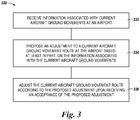
- Figure 3 illustrates a method 330 for routing aircraft ground movements at an airport in accordance with one or more embodiments of the present disclosure.
- Method 330 can be performed by, for example, computing device 100 previously described in connection with Figure 1 .
- method 330 includes receiving information associated with current aircraft ground movements at an airport.
- This information can include, for example, observations and/or measurements of current aircraft ground movements, as previously described herein (e.g., in connection with Figure 1 ).
- method 330 includes proposing an adjustment to a current aircraft ground movement route based, at least in part, on the information associated with the current aircraft ground movements.
- Proposing the adjustment can include, for example, determining a possible adjustment to the current aircraft ground movement route based, at least in part, on the information associated with the current aircraft ground movements, and providing the possible adjustment to a user of the computing device (e.g., an air traffic controller), as previously described herein (e.g., in connection with Figure 1 ).
- the adjustment can be determined using a hidden Markov model, as previously described herein.
- method 330 includes adjusting the current ground movement route according to the proposed adjustment upon receiving an acceptance of the proposed adjustment.
- the acceptance of the proposed adjustment may be received, for example, from the user of the computing device, as previously described herein (e.g., in connection with Figure 1 ).
Landscapes
- Engineering & Computer Science (AREA)
- Aviation & Aerospace Engineering (AREA)
- Physics & Mathematics (AREA)
- General Physics & Mathematics (AREA)
- Traffic Control Systems (AREA)
- Radar, Positioning & Navigation (AREA)
- Remote Sensing (AREA)
Abstract
Description
- The present disclosure relates to devices, methods, and systems for routing aircraft ground movements at an airport.
- An important part of ground operations at an airport is routing aircraft from one part of the airport to another, such as, for instance, routing the aircraft from the gate to the runway and vice versa. These ground movement routes may be determined and/or provided by, for example, an advanced surface movement guidance and control system (ASMGCS).
- In previous approaches, however, the routes determined and/or provided by the ASMGCS may be static routes that do consider or take into account the dynamic nature of aircraft ground movements (e.g., traffic) at the airport. As such, during operation it is left up to the air traffic controller to manually evaluate the current aircraft ground movements at the airport, and manually adjust the routes if he or she believes the routes could be made shorter (e.g., quicker) and/or safer.
- This manual evaluation and adjustment, however, can have a negative impact on the efficiency of the air traffic controller by, for example, increasing the "head down time" for the controller. This can interfere with and/or decrease the safety of the ground operations at the airport.
-
-
Figure 1 illustrates a computing device for routing aircraft ground movements at an airport in accordance with one or more embodiments of the present disclosure. -
Figure 2 illustrates an example structure of a hidden Markov model in accordance with one or more embodiments of the present disclosure. -
Figure 3 illustrates a method for routing aircraft ground movements at an airport in accordance with one or more embodiments of the present disclosure. - Devices, methods, and systems for routing aircraft ground movements at an airport are described herein. For example, one or more embodiments include a memory, a processor configured to execute executable instructions stored in the memory to receive information associated with current aircraft ground movements at an airport and determine a possible adjustment to a current aircraft ground movement route at the airport based, at least in part, on the information associated with the current aircraft ground movements, and a user interface configured to provide the possible adjustment to the current aircraft ground movement route to a user of the device.
- Embodiments of the present disclosure can determine and/or provide aircraft ground movement routes that consider and/or take into account the dynamic nature of aircraft ground movements (e.g., traffic) at the airport. For instance, an advanced surface movement guidance and control system (ASMGCS) in accordance with the present disclosure can evaluate the current aircraft ground movements at the airport, and determine and/or provide an adjusted route based on (e.g., in response to) the current movements. In contrast, previous ASMGCS approaches may only be able to determine and/or provide static routes that do consider or take into account current aircraft ground movements during operation.
- As such, embodiments of the present disclosure can increase the efficiency of air traffic controllers, which can increase the safety of airport ground operations. For example, an air traffic controller may experience less "head down time" while using an ASMGCS in accordance with the present disclosure than while using a previous ASMGCS.
- In the following detailed description, reference is made to the accompanying drawings that form a part hereof. The drawings show by way of illustration how one or more embodiments of the disclosure may be practiced.
- These embodiments are described in sufficient detail to enable those of ordinary skill in the art to practice one or more embodiments of this disclosure. It is to be understood that other embodiments may be utilized and that mechanical, electrical, and/or process changes may be made without departing from the scope of the present disclosure.
- As will be appreciated, elements shown in the various embodiments herein can be added, exchanged, combined, and/or eliminated so as to provide a number of additional embodiments of the present disclosure. The proportion and the relative scale of the elements provided in the figures are intended to illustrate the embodiments of the present disclosure, and should not be taken in a limiting sense.
- The figures herein follow a numbering convention in which the first digit or digits correspond to the drawing figure number and the remaining digits identify an element or component in the drawing. Similar elements or components between different figures may be identified by the use of similar digits.
- As used herein, "a" or "a number of" something can refer to one or more such things. For example, "a number of routes" can refer to one or more routes.
-
Figure 1 illustrates acomputing device 100 for routing aircraft ground movements at an airport in accordance with one or more embodiments of the present disclosure.Computing device 100 can be, for example, a laptop computer, desktop computer, or mobile device (e.g., smart phone, tablet, PDA, etc.), among other types of computing devices. However, embodiments of the present disclosure are not limited to a particular type of computing device. In some embodiments,computing device 100 can be a computing device of an advanced surface movement guidance and control system (ASMGCS) of the airport. - As shown in
Figure 1 ,computing device 100 can include amemory 104 and aprocessor 102.Memory 104 can be any type of storage medium that can be accessed byprocessor 102 to perform various examples of the present disclosure. For example,memory 104 can be a non-transitory computer readable medium having computer readable instructions (e.g., computer program instructions) stored thereon that are executable byprocessor 102 to route aircraft ground movements at an airport in accordance with the present disclosure. That is,processor 102 can execute the executable instructions stored inmemory 104 to route aircraft ground movements at an airport in accordance with the present disclosure. -
Memory 104 can be volatile or nonvolatile memory.Memory 104 can also be removable (e.g., portable) memory, or non-removable (e.g., internal) memory. For example,memory 104 can be random access memory (RAM) (e.g., dynamic random access memory (DRAM) and/or phase change random access memory (PCRAM)), read-only memory (ROM) (e.g., electrically erasable programmable read-only memory (EEPROM) and/or compact-disk read-only memory (CD-ROM)), flash memory, a laser disk, a digital versatile disk (DVD) or other optical disk storage, and/or a magnetic medium such as magnetic cassettes, tapes, or disks, among other types of memory. - Further, although
memory 104 is illustrated as being located incomputing device 100, embodiments of the present disclosure are not so limited. For example,memory 104 can also be located internal to another computing resource (e.g., enabling computer readable instructions to be downloaded over the Internet or another wired or wireless connection). - As shown in
Figure 1 ,computing device 100 can include auser interface 106. A user (e.g., operator) ofcomputing device 100, such as, for instance, an air traffic controller of the airport, can interact withcomputing device 100 viauser interface 106. For example,user interface 106 can provide (e.g., display and/or present) information to the user ofcomputing device 100, such as, for instance, a possible adjustment to a current aircraft ground movement route, as will be further described herein. Further,user interface 106 can receive information from (e.g., input by) the user ofcomputing device 100, such as, for instance, an acceptance of a possible adjustment to a current aircraft ground movement route, as will be further described herein. - In some embodiments,
user interface 106 can be a graphical user interface (GUI) that can include a display (e.g., a screen) that can provide and/or receive information to and/or from the user ofcomputing device 100. The display can be, for instance, a touch-screen (e.g., the GUI can include touch-screen capabilities). As an additional example,user interface 106 can include a keyboard and/or mouse the user can use to input information intocomputing device 100. Embodiments of the present disclosure, however, are not limited to a particular type(s) of user interface. - As an example, in some embodiments,
computing device 100 can receive information associated with current (e.g., present) aircraft ground movements (e.g., traffic) at the airport. The information can include, for example, observations and/or measurements of the current aircraft ground movements, such as changes (e.g., an increase or decrease) in congestion in the current aircraft ground movements, the current number of landings taking place on the runway(s) of the airport, the current occupancy status of the exit and/or entrance branch(s) of the runway(s) (e.g., whether the branch is free or occupied), and/or differences in the traffic at different parts of the runway(s), among other types of information and/or observations.Computing device 100 can receive the information from, for example, an air traffic controller of the airport (e.g., via user interface 106), and/or from other components of the ASMGCS. -
Computing device 100 can propose an adjustment to a current (e.g., present) aircraft ground movement route at the airport based, at least in part, on the information associated with the current aircraft ground movements. For example,computing device 100 can determine a possible adjustment to the current aircraft ground movement route based, at least in part, on the information associated with the current aircraft ground movements, and provide the possible adjustment to the current aircraft ground movement route to the user of the computing device (e.g., the air traffic controller) viauser interface 106. For instance,user interface 106 can display a map of the airport runway that includes (e.g., highlights) the proposed route adjustment. - The current aircraft ground movement route can be, for example, a current route of an aircraft from a gate of the airport to a runway and/or runway holding point of the airport, or a current route of an aircraft from a runway of the airport to a gate and/or gate bay of the airport.
-
Computing device 100 can determine the possible adjustment to the current aircraft ground movement route using a set of aircraft ground movement routing rules. For example,computing device 100 can determine the possible adjustment to the route by applying the set of routing rules to the information associated with the current aircraft ground movements received bycomputing device 100. For instance, the information associated with the current aircraft ground movements may be input into and trigger one or more of the rules. The rule(s) that get triggered may depend on the information that is input (e.g., different rules may be triggered under different aircraft ground movement conditions and/or situations). - The set of aircraft ground movement routing rules can enumerate (e.g., capture and/or reflect) actions that an air traffic controller would take under different aircraft ground movement conditions and/or situations. For instance, the set of rules can enumerate the exceptions from normal ground operation conditions under which the air traffic controller would operate.
- For example, the set of rules can correspond to different (e.g., favored) aircraft ground movement routes and/or route adjustments that an air traffic controller would select and/or make under different aircraft ground movement conditions and/or situations. As an example, the air traffic controller may direct an aircraft from a particular gate or bay to a different taxiway if its originally assigned taxiway is experiencing high traffic. As an additional example, the air traffic controller may adjust a route to go across a particular runway if the number of landings occurring on that runway are decreasing. As an additional example, the air traffic controller may direct an aircraft to a particular runway exit or entrance branch if that branch has no traffic. As an additional example, an the air traffic controller may reroute the pushback direction of an aircraft pushing back from a gate in a bay if its current pushback direction would be blocked by other aircraft pushbacks in the bay.
- The set of aircraft ground movement routing rules can be determined (e.g., built and/or learned) based on interactions (e.g., interviews) with the air traffic controller and/or based on previous (e.g., recorded and/or historical) data. For example, the set of rules can be determined based, at least in part, on information associated with previous aircraft ground movements at the airport and previous aircraft ground movement routes at the airport (e.g., which routes were previously used under different aircraft ground movement conditions and/or situations). Further, the set of rules can be determined based, at least in part, on information received from the user (e.g., the air traffic controller) of
computing device 100 viauser interface 106. In some embodiments, the set of rules can be stored inmemory 104 ofcomputing device 100. - In some embodiments, the set of aircraft ground movement routing rules can correspond to (e.g., be embedded as) a set of states of a hidden Markov model, and
computing device 100 can use the hidden Markov model to determine the possible adjustment to the current aircraft ground movement route using the hidden Markov model. For example, the information associated with the current aircraft ground movements can be input into the hidden Markov model, andcomputing device 100 can then use the hidden Markov model to determine the possible adjustment to the route. - Each respective state of the set of states of the hidden Markov model can correspond to a different aircraft ground movement route at the airport, and the possible adjustment to the current aircraft ground movement route can include an adjustment of the current aircraft ground movement route to one of the different routes in the set of states of the hidden Markov model. For instance,
computing device 100 can determine (e.g., calculate), using the hidden Markov model, levels of belief in each respective state of the set of states (e.g., in each of the different routes in the set), and the possible adjustment to the current aircraft ground movement route can include an adjustment (e.g., switch) to one of the different aircraft ground movement routes in the set of states if the level of belief in the state of the set corresponding to that respective route meets or exceeds a particular threshold. The threshold can correspond to a particular (e.g., high enough) probability that the route will work (e.g., will be quicker than the current route and/or will be safe). - For instance, the information associated with the current aircraft ground movements that is input into the hidden Markov model may trigger the model to change the levels of belief in each respective state in the set of states of the model (e.g., in each of the different routes of the set). Once the level of belief in one of the state in the set of states (e.g., in one of the routes in the set) reaches the particular threshold, an adjustment of the current aircraft ground movement route to the route of that state may be proposed.
- As an example, the set of states may include routes that cross a particular runway and routes that avoid crossing that particular runway. Upon receiving information about (e.g., observations of) the number of landings currently taking place on that runway, the hidden Markov model may calculate a level of belief (e.g., probability) that the number of landings taking place on that runway are decreasing and the routes that cross that runway may be used based on that information. Upon that level of belief meeting or exceeding a particular threshold,
computing device 100 may propose adjusting current aircraft ground movement routes to the routes that cross that runway. - As an additional example, the set of states may include routes that include different directions (e.g., left and right) from which currently landing aircraft can exit the runway. Upon receiving information about (e.g., observations of) the occupancy status of the exit branches of the runway (e.g., whether the branches are fee or occupied), the hidden Markov model can calculate a level of belief (e.g., probability) that a currently landing aircraft can exit the runway in a particular direction based on that information. Upon that level of belief meeting or exceeding a particular threshold,
computing device 100 may propose adjusting current aircraft ground movement routes for currently landing aircraft to exit the runway in that direction. - The hidden Markov model can include (e.g., be composed of) state transition probabilities and observation probabilities that it can use to determine the possible adjustment to the current aircraft ground movement route. The state transition probabilities can define how often each of the different aircraft ground movement routes in the set of states is being used as the current aircraft ground movement route at the airport. The observation probabilities can define the probability that each of the different aircraft ground movement routes in the set of states is being used as the current aircraft ground movement route at the airport based on the received information associated with the current aircraft ground movements at the airport. An example of a hidden Markov model will be further described herein (e.g., in connection with
Figure 2 ). - As such,
computing device 100 can determine when a change in the state of the current aircraft ground movements at the airport has occurred based, at least in part, on the received information associated with the current aircraft ground movements at the airport, and propose an adjustment to the current aircraft ground movement route upon determining such a change has occurred. Further,computing device 100 can include in the proposed adjustment the probability that the proposed adjustment will work. For instance, the proposed adjustment may include the probability that the proposed adjustment will make the current aircraft ground movement quicker and/or the probability that the proposed adjustment will be safe. - After computing
device 100 proposes the adjustment to the current aircraft ground movement route at the airport, the user (e.g., air traffic controller) ofcomputing device 100 may decide whether to accept the proposed adjustment. If the user decides to accept the proposed adjustment, the user can enter the acceptance viauser interface 106. For instance, the user can make an entry or selection viauser interface 106 that indicates the user's acceptance of the proposed adjustment. - Upon receiving the acceptance of the proposed route adjustment,
computing device 100 can make the proposed adjustment to the current aircraft ground movement route. That is,computing device 100 can adjust the current aircraft ground movement route according to the proposed adjustment upon receiving the acceptance of the proposed adjustment. The ASMGCS of the airport can be updated to reflect the acceptance of the proposed adjustment, anduser interface 106 can provide confirmation to the user that the proposed adjustment has been accepted. For example,user interface 106 can update the display of the map of the airport runway to include the adjusted route. -
Figure 2 illustrates an example structure of ahidden Markov model 210 in accordance with one or more embodiments of the present disclosure. Thehidden Markov model 210 can be used to determine possible adjustments to the current aircraft ground movement route in accordance with the present disclosure. - As shown in
Figure 2 , hiddenMarkov model 210 can include a set of states 214-1, 214-2, 214-3. Each respective state 214-1, 214-2, 214-3 can correspond to a different (e.g., preferred) aircraft ground movement route for different aircraft ground movement conditions and/or situations. Although three states are shown in the example illustrated inFigure 2 , embodiments of the present disclosure are not limited to a particular number of states. The set of states (e.g., each of the different routes of the set) can correspond to a set of aircraft ground movement routing rules, as previously described herein (e.g., in connection withFigure 1 ). - As shown in
Figure 2 , information associated with the current aircraft ground movements can be input into hiddenMarkov model 210 in the form ofobservations 212. This information can include, for example, observations and/or measurements of the current aircraft ground movements, as previously described herein (e.g., in connection withFigure 1 ). - As shown in
Figure 2 , hiddenMarkov model 210 can include observation probabilities in the form of observation probability matrices 216-1, 216-2, 216-3. Each respective observation probability matrix 216-1, 216-2, 216-3 can define the probability that each of the different aircraft ground movement routes in the set of states 214-1, 214-2, 214-3 is being used as the current aircraft ground movement route at the airport based onobservations 212. For instance, observation probability matrix 216-1 can define the probability that the aircraft ground movement route of state 214-1 is being used as the current aircraft ground movement route at the airport based onobservations 212, observation probability matrix 216-2 can define the probability that the aircraft ground movement route of state 214-2 is being used as the current aircraft ground movement route at the airport based onobservations 212, etc. - As shown in
Figure 2 , hiddenMarkov model 210 can also include state transition probabilities in the form of state transition probability matrices 218-1, 218-2, 218-3. Each respective state transition probability matrix 218-1, 218-2, 218-3 can define how often each of the different aircraft ground movement routes in the set of states 214-1, 214-2, 214-3 is being used as the current aircraft ground movement route at the airport. For instance, state transition probability matrix 218-1 can define how often the aircraft ground movement route of state 214-1 is being used as the current aircraft ground movement route at the airport, state transition probability matrix 218-1 can define how often the aircraft ground movement route of state 214-1 is being used as the current aircraft ground movement route at the airport, etc. -
Figure 3 illustrates amethod 330 for routing aircraft ground movements at an airport in accordance with one or more embodiments of the present disclosure.Method 330 can be performed by, for example,computing device 100 previously described in connection withFigure 1 . - At
block 332,method 330 includes receiving information associated with current aircraft ground movements at an airport. This information can include, for example, observations and/or measurements of current aircraft ground movements, as previously described herein (e.g., in connection withFigure 1 ). - At
block 334,method 330 includes proposing an adjustment to a current aircraft ground movement route based, at least in part, on the information associated with the current aircraft ground movements. Proposing the adjustment can include, for example, determining a possible adjustment to the current aircraft ground movement route based, at least in part, on the information associated with the current aircraft ground movements, and providing the possible adjustment to a user of the computing device (e.g., an air traffic controller), as previously described herein (e.g., in connection withFigure 1 ). In some embodiments, the adjustment can be determined using a hidden Markov model, as previously described herein. - At
block 336,method 330 includes adjusting the current ground movement route according to the proposed adjustment upon receiving an acceptance of the proposed adjustment. The acceptance of the proposed adjustment may be received, for example, from the user of the computing device, as previously described herein (e.g., in connection withFigure 1 ). - Although specific embodiments have been illustrated and described herein, those of ordinary skill in the art will appreciate that any arrangement calculated to achieve the same techniques can be substituted for the specific embodiments shown. This disclosure is intended to cover any and all adaptations or variations of various embodiments of the disclosure.
- It is to be understood that the above description has been made in an illustrative fashion, and not a restrictive one. Combination of the above embodiments, and other embodiments not specifically described herein will be apparent to those of skill in the art upon reviewing the above description.
- The scope of the various embodiments of the disclosure includes any other applications in which the above structures and methods are used. Therefore, the scope of various embodiments of the disclosure should be determined with reference to the appended claims, along with the full range of equivalents to which such claims are entitled.
- In the foregoing Detailed Description, various features are grouped together in example embodiments illustrated in the figures for the purpose of streamlining the disclosure. This method of disclosure is not to be interpreted as reflecting an intention that the embodiments of the disclosure require more features than are expressly recited in each claim.
- Rather, as the following claims reflect, inventive subject matter lies in less than all features of a single disclosed embodiment. Thus, the following claims are hereby incorporated into the Detailed Description, with each claim standing on its own as a separate embodiment
Claims (15)
- A computing device (100) for routing aircraft ground movements at an airport, comprising:a memory (104);a processor (102) configured to execute executable instructions stored in the memory (104) to:receive information associated with current aircraft ground movements at an airport; anddetermine a possible adjustment to a current aircraft ground movement route at the airport based, at least in part, on the information associated with the current aircraft ground movements; anda user interface configured to provide the possible adjustment to the current aircraft ground movement route to a user of the computing device (100).
- The computing device (100) of claim 1, wherein the processor (102) is configured to execute the instructions to determine the adjustment to the current aircraft ground movement route using a hidden Markov model (210).
- The computing device (100) of claim 1, wherein:the user interface is configured to receive an acceptance of the adjustment to the current aircraft ground movement route from the user; andthe processor (102) is configured to execute the instructions to make the adjustment to the current aircraft ground movement route upon the user interface receiving the acceptance of the adjustment.
- The computing device (100) of claim 1, wherein the processor (102) is configured to execute the instructions to determine the possible adjustment to the current aircraft ground movement route by applying a set of aircraft ground movement routing rules to the information associated with the current aircraft ground movements.
- The computing device (100) of claim 4, wherein the computing device (100) is configured to execute the instructions to determine the set of aircraft ground movement routing rules based, at least in part, on:information associated with previous aircraft ground movements at the airport; andprevious aircraft ground movement routes at the airport.
- The computing device (100) of claim 4, wherein the computing device (100) is configured to execute the instructions to determine the set of aircraft ground movement routing rules based, at least in part, on information received from the user of the computing device (100).
- The computing device (100) of claim 4, wherein the set of aircraft ground movement routing rules corresponds to a set of states (214-1, 214-2, 214-3) of a hidden Markov model (210).
- The computing device (100) of claim 1, wherein the computing device (100) is a computing device of an advanced surface movement guidance and control system of the airport.
- A method for routing aircraft ground movements at an airport, comprising:receiving, by a computing device (100), information associated with current aircraft ground movements at an airport;determining, by the computing device (100), a possible adjustment to a current aircraft ground movement route at the airport based, at least in part, on the information associated with the current aircraft ground movements; andproviding, by the computing device (100), the possible adjustment to the current aircraft ground movement route to a user of the computing device (100).
- The method of claim 9, wherein the current aircraft ground movement route includes:a route of an aircraft from a gate of the airport to a runway of the airport; ora route of an aircraft from a runway of the airport to a gate of the airport.
- The method of claim 9, wherein the method includes:determining, by the computing device (100), when a change in a state of the current aircraft ground movements at the airport occurs based, at least in part, on the information associated with the current aircraft ground movements; andproviding, by the computing device (100), the possible adjustment to the current aircraft ground movement route upon determining a change in the state of the current aircraft ground movements at the airport has occurred.
- The method of claim 9, wherein the possible adjustment to the current aircraft ground movement route includes a probability that the possible adjustment will make the current aircraft ground movement route quicker.
- The method of claim 9, wherein providing the possible adjustment to the current aircraft ground movement route includes displaying, by the computing device (100), the possible adjustment to the current aircraft ground movement route.
- The method of claim 9, wherein the information associated with the current aircraft ground movements includes a change in congestion in the current aircraft ground movements at the airport.
- The method of claim 9, wherein the information associated with the current aircraft ground movements includes a current number of landings on a runway of the airport.
Applications Claiming Priority (1)
| Application Number | Priority Date | Filing Date | Title |
|---|---|---|---|
| US15/212,491 US20180018887A1 (en) | 2016-07-18 | 2016-07-18 | Routing aircraft ground movements at an airport |
Publications (2)
| Publication Number | Publication Date |
|---|---|
| EP3273426A1 true EP3273426A1 (en) | 2018-01-24 |
| EP3273426B1 EP3273426B1 (en) | 2023-11-15 |
Family
ID=59350631
Family Applications (1)
| Application Number | Title | Priority Date | Filing Date |
|---|---|---|---|
| EP17179365.6A Active EP3273426B1 (en) | 2016-07-18 | 2017-07-03 | Routing aircraft ground movements at an airport |
Country Status (3)
| Country | Link |
|---|---|
| US (2) | US20180018887A1 (en) |
| EP (1) | EP3273426B1 (en) |
| CN (1) | CN107633706B (en) |
Families Citing this family (26)
| Publication number | Priority date | Publication date | Assignee | Title |
|---|---|---|---|---|
| US11145211B2 (en) | 2017-04-25 | 2021-10-12 | Joby Elevate, Inc. | Efficient VTOL resource management in an aviation transport network |
| US11136105B2 (en) | 2017-08-02 | 2021-10-05 | Joby Elevate, Inc. | VTOL aircraft for network system |
| US11074540B2 (en) | 2017-10-10 | 2021-07-27 | Uber Technologies, Inc. | Network system including drones |
| US10913528B1 (en) | 2017-11-03 | 2021-02-09 | Uber Technologies, Inc. | Safe vertical take-off and landing aircraft payload distribution and adjustment |
| US10689110B2 (en) * | 2018-02-12 | 2020-06-23 | Wipro Limited | Method and system for performing inspection and maintenance tasks of three-dimensional structures using drones |
| EP3785217B1 (en) | 2018-04-24 | 2026-02-11 | Joby Aero, Inc. | Determining vtol departure time in an aviation transport network for efficient resource management |
| US11238745B2 (en) | 2018-05-07 | 2022-02-01 | Joby Aero, Inc. | Dynamic aircraft routing |
| US10593215B2 (en) | 2018-05-07 | 2020-03-17 | Uber Technologies, Inc. | Dynamic aircraft routing |
| WO2019217432A1 (en) | 2018-05-07 | 2019-11-14 | Uber Technologies, Inc. | System and method for landing and storing vertical take-off and landing aircraft |
| US10837786B2 (en) | 2019-03-18 | 2020-11-17 | Uber Technologies, Inc. | Multi-modal transportation service planning and fulfillment |
| US11230384B2 (en) | 2019-04-23 | 2022-01-25 | Joby Aero, Inc. | Vehicle cabin thermal management system and method |
| JP7221423B6 (en) | 2019-06-10 | 2023-05-16 | ジョビー エアロ,インコーポレイテッド | Time-varying loudness prediction system |
| US12339661B2 (en) | 2019-11-06 | 2025-06-24 | Joby Aero, Inc. | Aerial ride quality improvement system using feedback |
| US12211392B2 (en) | 2019-12-31 | 2025-01-28 | Joby Aero, Inc. | Systems and methods for providing aircraft sensory cues |
| US12012229B2 (en) | 2020-03-06 | 2024-06-18 | Joby Aero, Inc. | System and method for robotic charging aircraft |
| WO2021195382A1 (en) | 2020-03-25 | 2021-09-30 | Joby Elevate, Inc. | Systems and methods for generating flight plans used by a ride sharing network |
| US12157580B2 (en) | 2020-04-29 | 2024-12-03 | Joby Aero, Inc. | Systems and methods for transferring aircraft |
| US12400160B2 (en) | 2020-05-07 | 2025-08-26 | Joby Aero, Inc. | Systems and methods for simulating aircraft systems |
| US12254777B2 (en) | 2020-05-28 | 2025-03-18 | Joby Aero, Inc. | Cloud service integration with onboard vehicle system |
| US11893521B2 (en) | 2020-09-01 | 2024-02-06 | Joby Aero, Inc. | Systems and methods for facilitating aerial vehicle services |
| US12560440B2 (en) | 2020-10-12 | 2026-02-24 | Joby Aero, Inc. | Systems and methods for mitigating third party contingencies |
| US12387607B2 (en) | 2020-12-10 | 2025-08-12 | Joby Aero, Inc. | Unmanned aircraft control using ground control station |
| US12372978B2 (en) | 2021-07-02 | 2025-07-29 | Joby Aero, Inc. | Vehicle autonomy architecture |
| US12597357B2 (en) | 2021-09-03 | 2026-04-07 | Joby Aero, Inc. | Automatic aircraft taxiing |
| US12462697B2 (en) | 2023-01-17 | 2025-11-04 | Joby Aero, Inc. | Traffic pattern control of UAVS and automated downwind extensions |
| US12459666B2 (en) | 2023-03-07 | 2025-11-04 | Joby Aero, Inc. | Sidestripe identification, estimation and characterization for arbitrary runways |
Citations (7)
| Publication number | Priority date | Publication date | Assignee | Title |
|---|---|---|---|---|
| US6144915A (en) * | 1997-03-26 | 2000-11-07 | Director-General, Ship Research Institute, Ministry Of Trans | Aerodrome control support system |
| EP2289754A1 (en) * | 2009-08-31 | 2011-03-02 | Toyota Motor Europe NV/SA | Vehicle or traffic control method and system |
| US20110133888A1 (en) * | 2009-08-17 | 2011-06-09 | Timothy Dirk Stevens | Contextually aware monitoring of assets |
| US20140097984A1 (en) * | 2011-09-21 | 2014-04-10 | Lockheed Martin Corporation | System and method for monitoring integrity of a global navigation satellite system |
| EP2975596A2 (en) * | 2014-07-14 | 2016-01-20 | The Boeing Company | Systems and methods of airport traffic control |
| US20160163208A1 (en) * | 2014-12-04 | 2016-06-09 | General Electric Company | System and method for collision avoidance |
| EP3043331A2 (en) * | 2015-01-06 | 2016-07-13 | Honeywell International Inc. | Airport surface monitoring system with wireless network interface to aircraft surface navigation system |
Family Cites Families (18)
| Publication number | Priority date | Publication date | Assignee | Title |
|---|---|---|---|---|
| WO2002095709A2 (en) * | 2001-05-18 | 2002-11-28 | Technology Planning Incorporated | Surface traffic movement system and method |
| US20030160708A1 (en) * | 2002-02-27 | 2003-08-28 | Knoop Alan Richard | Airport ground control system |
| US7859433B2 (en) * | 2005-10-31 | 2010-12-28 | Passur Aerospace, Inc. | System and method for providing airport financial reports |
| US7908082B2 (en) * | 2007-05-04 | 2011-03-15 | The Boeing Company | Methods and systems for displaying airport moving map information |
| US8386167B2 (en) * | 2008-11-14 | 2013-02-26 | The Boeing Company | Display of taxi route control point information |
| US20100185426A1 (en) * | 2009-01-16 | 2010-07-22 | Rajesh Ganesan | Predicting Aircraft Taxi-Out Times |
| US8401775B2 (en) * | 2009-01-30 | 2013-03-19 | The Boeing Company | Systems and method for managing airport ground traffic |
| EP2284563A1 (en) * | 2009-08-13 | 2011-02-16 | Deutsche Telekom AG | Method for detecting air plane flight events, mobile communication device, and computational unit therefor |
| US8566016B2 (en) * | 2010-05-13 | 2013-10-22 | Saab Sensis Corporation | Surface hold advisor using critical sections |
| US9013330B2 (en) * | 2011-09-01 | 2015-04-21 | Honeywell International Inc. | Electric taxi system guidance |
| US8731811B2 (en) * | 2011-10-20 | 2014-05-20 | Honeywell International Inc. | Methods and systems for displaying a taxi clearance |
| US8620493B2 (en) * | 2012-05-03 | 2013-12-31 | Honeywell International Inc. | Electric taxi auto-guidance and control system |
| WO2014115139A1 (en) * | 2013-01-23 | 2014-07-31 | Iatas (Automatic Air Traffic Control) Ltd | System and methods for automated airport air traffic control services |
| US20140249736A1 (en) * | 2013-03-04 | 2014-09-04 | Honeywell International Inc. | Autonomous aircraft guiding mobile unit |
| US9437114B2 (en) * | 2013-03-15 | 2016-09-06 | Us Airways, Inc. | Departure sequencing systems and methods |
| US9318025B2 (en) * | 2013-12-17 | 2016-04-19 | Honeywell International Inc. | Ground obstacle collision alert deactivation |
| FR3020172B1 (en) * | 2014-04-22 | 2016-05-06 | Sagem Defense Securite | METHOD FOR GUIDING AN AIRCRAFT |
| CN105551312A (en) * | 2016-01-29 | 2016-05-04 | 蒋维安 | Airport scene traffic auxiliary assistance system and method |
-
2016
- 2016-07-18 US US15/212,491 patent/US20180018887A1/en not_active Abandoned
-
2017
- 2017-07-03 EP EP17179365.6A patent/EP3273426B1/en active Active
- 2017-07-18 CN CN201710585222.8A patent/CN107633706B/en active Active
-
2023
- 2023-11-30 US US18/524,328 patent/US20240212515A1/en active Pending
Patent Citations (7)
| Publication number | Priority date | Publication date | Assignee | Title |
|---|---|---|---|---|
| US6144915A (en) * | 1997-03-26 | 2000-11-07 | Director-General, Ship Research Institute, Ministry Of Trans | Aerodrome control support system |
| US20110133888A1 (en) * | 2009-08-17 | 2011-06-09 | Timothy Dirk Stevens | Contextually aware monitoring of assets |
| EP2289754A1 (en) * | 2009-08-31 | 2011-03-02 | Toyota Motor Europe NV/SA | Vehicle or traffic control method and system |
| US20140097984A1 (en) * | 2011-09-21 | 2014-04-10 | Lockheed Martin Corporation | System and method for monitoring integrity of a global navigation satellite system |
| EP2975596A2 (en) * | 2014-07-14 | 2016-01-20 | The Boeing Company | Systems and methods of airport traffic control |
| US20160163208A1 (en) * | 2014-12-04 | 2016-06-09 | General Electric Company | System and method for collision avoidance |
| EP3043331A2 (en) * | 2015-01-06 | 2016-07-13 | Honeywell International Inc. | Airport surface monitoring system with wireless network interface to aircraft surface navigation system |
Also Published As
| Publication number | Publication date |
|---|---|
| US20180018887A1 (en) | 2018-01-18 |
| EP3273426B1 (en) | 2023-11-15 |
| CN107633706B (en) | 2021-11-09 |
| CN107633706A (en) | 2018-01-26 |
| US20240212515A1 (en) | 2024-06-27 |
Similar Documents
| Publication | Publication Date | Title |
|---|---|---|
| US20240212515A1 (en) | Routing aircraft ground movements at an airport | |
| US9177138B2 (en) | Change convergence risk planning and avoidance | |
| US9721316B2 (en) | Change convergence risk mapping | |
| US10097527B2 (en) | Authentication management | |
| US11112257B2 (en) | Navigation with sun glare information | |
| CN111680362A (en) | A kind of automatic driving simulation scene acquisition method, device, equipment and storage medium | |
| EP4036794A1 (en) | Crowd overdensity prediction method and device | |
| US10699587B2 (en) | Aircraft taxiway routing | |
| KR20190143831A (en) | Training and/or assistance platform for air management via air traffic management electronic system, associated method | |
| CN113420682A (en) | Target detection method and device in vehicle-road cooperation and road side equipment | |
| CN113591569A (en) | Obstacle detection method, obstacle detection device, electronic apparatus, and storage medium | |
| EP4141843A1 (en) | Aircraft taxi route generation | |
| CN111341041A (en) | A payment method determination method, device, system and equipment | |
| CN113129596A (en) | Travel data processing method, travel data processing device, travel data processing apparatus, storage medium, and program product | |
| CN115953414A (en) | Semantic Segmentation Based Low Obstacle Detection Method and Autonomous Vehicle | |
| CN115476883A (en) | Automatic driving decision method, model training method, related device and electronic equipment | |
| KR20220060426A (en) | Apparatus and method for predicting unsafe approach | |
| US20240166243A1 (en) | Automatic driving-based riding method, apparatus and device, and storage medium | |
| CN117649766A (en) | Traffic status detection methods, devices, equipment and media for blocked road sections | |
| US20250252857A1 (en) | Adjusting aircraft ground movement routes | |
| KR101829672B1 (en) | Intrusion detection apparatus for autonomous driving vehicle and operating method thereof | |
| US20170177755A1 (en) | System and method for dynamically adjusting an emergency coordination simulation system | |
| CN115534937A (en) | Trajectory-based detour label determination method, device and self-driving vehicle | |
| CN113733086A (en) | A travel method, device, equipment and storage medium for a robot | |
| JP7192994B2 (en) | Information presentation device, information presentation system, information presentation method, and information presentation program |
Legal Events
| Date | Code | Title | Description |
|---|---|---|---|
| PUAI | Public reference made under article 153(3) epc to a published international application that has entered the european phase |
Free format text: ORIGINAL CODE: 0009012 |
|
| STAA | Information on the status of an ep patent application or granted ep patent |
Free format text: STATUS: REQUEST FOR EXAMINATION WAS MADE |
|
| 17P | Request for examination filed |
Effective date: 20170703 |
|
| AK | Designated contracting states |
Kind code of ref document: A1 Designated state(s): AL AT BE BG CH CY CZ DE DK EE ES FI FR GB GR HR HU IE IS IT LI LT LU LV MC MK MT NL NO PL PT RO RS SE SI SK SM TR |
|
| AX | Request for extension of the european patent |
Extension state: BA ME |
|
| STAA | Information on the status of an ep patent application or granted ep patent |
Free format text: STATUS: EXAMINATION IS IN PROGRESS |
|
| 17Q | First examination report despatched |
Effective date: 20210304 |
|
| P01 | Opt-out of the competence of the unified patent court (upc) registered |
Effective date: 20230523 |
|
| GRAP | Despatch of communication of intention to grant a patent |
Free format text: ORIGINAL CODE: EPIDOSNIGR1 |
|
| STAA | Information on the status of an ep patent application or granted ep patent |
Free format text: STATUS: GRANT OF PATENT IS INTENDED |
|
| INTG | Intention to grant announced |
Effective date: 20230705 |
|
| GRAS | Grant fee paid |
Free format text: ORIGINAL CODE: EPIDOSNIGR3 |
|
| GRAA | (expected) grant |
Free format text: ORIGINAL CODE: 0009210 |
|
| STAA | Information on the status of an ep patent application or granted ep patent |
Free format text: STATUS: THE PATENT HAS BEEN GRANTED |
|
| AK | Designated contracting states |
Kind code of ref document: B1 Designated state(s): AL AT BE BG CH CY CZ DE DK EE ES FI FR GB GR HR HU IE IS IT LI LT LU LV MC MK MT NL NO PL PT RO RS SE SI SK SM TR |
|
| REG | Reference to a national code |
Ref country code: CH Ref legal event code: EP Ref country code: GB Ref legal event code: FG4D |
|
| REG | Reference to a national code |
Ref country code: DE Ref legal event code: R096 Ref document number: 602017076467 Country of ref document: DE |
|
| REG | Reference to a national code |
Ref country code: IE Ref legal event code: FG4D |
|
| REG | Reference to a national code |
Ref country code: LT Ref legal event code: MG9D |
|
| REG | Reference to a national code |
Ref country code: NL Ref legal event code: MP Effective date: 20231115 |
|
| PG25 | Lapsed in a contracting state [announced via postgrant information from national office to epo] |
Ref country code: GR Free format text: LAPSE BECAUSE OF FAILURE TO SUBMIT A TRANSLATION OF THE DESCRIPTION OR TO PAY THE FEE WITHIN THE PRESCRIBED TIME-LIMIT Effective date: 20240216 |
|
| PG25 | Lapsed in a contracting state [announced via postgrant information from national office to epo] |
Ref country code: IS Free format text: LAPSE BECAUSE OF FAILURE TO SUBMIT A TRANSLATION OF THE DESCRIPTION OR TO PAY THE FEE WITHIN THE PRESCRIBED TIME-LIMIT Effective date: 20240315 |
|
| PG25 | Lapsed in a contracting state [announced via postgrant information from national office to epo] |
Ref country code: LT Free format text: LAPSE BECAUSE OF FAILURE TO SUBMIT A TRANSLATION OF THE DESCRIPTION OR TO PAY THE FEE WITHIN THE PRESCRIBED TIME-LIMIT Effective date: 20231115 |
|
| REG | Reference to a national code |
Ref country code: AT Ref legal event code: MK05 Ref document number: 1632520 Country of ref document: AT Kind code of ref document: T Effective date: 20231115 |
|
| PG25 | Lapsed in a contracting state [announced via postgrant information from national office to epo] |
Ref country code: NL Free format text: LAPSE BECAUSE OF FAILURE TO SUBMIT A TRANSLATION OF THE DESCRIPTION OR TO PAY THE FEE WITHIN THE PRESCRIBED TIME-LIMIT Effective date: 20231115 |
|
| PG25 | Lapsed in a contracting state [announced via postgrant information from national office to epo] |
Ref country code: AT Free format text: LAPSE BECAUSE OF FAILURE TO SUBMIT A TRANSLATION OF THE DESCRIPTION OR TO PAY THE FEE WITHIN THE PRESCRIBED TIME-LIMIT Effective date: 20231115 |
|
| PG25 | Lapsed in a contracting state [announced via postgrant information from national office to epo] |
Ref country code: ES Free format text: LAPSE BECAUSE OF FAILURE TO SUBMIT A TRANSLATION OF THE DESCRIPTION OR TO PAY THE FEE WITHIN THE PRESCRIBED TIME-LIMIT Effective date: 20231115 |
|
| PG25 | Lapsed in a contracting state [announced via postgrant information from national office to epo] |
Ref country code: NL Free format text: LAPSE BECAUSE OF FAILURE TO SUBMIT A TRANSLATION OF THE DESCRIPTION OR TO PAY THE FEE WITHIN THE PRESCRIBED TIME-LIMIT Effective date: 20231115 Ref country code: LT Free format text: LAPSE BECAUSE OF FAILURE TO SUBMIT A TRANSLATION OF THE DESCRIPTION OR TO PAY THE FEE WITHIN THE PRESCRIBED TIME-LIMIT Effective date: 20231115 Ref country code: IS Free format text: LAPSE BECAUSE OF FAILURE TO SUBMIT A TRANSLATION OF THE DESCRIPTION OR TO PAY THE FEE WITHIN THE PRESCRIBED TIME-LIMIT Effective date: 20240315 Ref country code: GR Free format text: LAPSE BECAUSE OF FAILURE TO SUBMIT A TRANSLATION OF THE DESCRIPTION OR TO PAY THE FEE WITHIN THE PRESCRIBED TIME-LIMIT Effective date: 20240216 Ref country code: ES Free format text: LAPSE BECAUSE OF FAILURE TO SUBMIT A TRANSLATION OF THE DESCRIPTION OR TO PAY THE FEE WITHIN THE PRESCRIBED TIME-LIMIT Effective date: 20231115 Ref country code: BG Free format text: LAPSE BECAUSE OF FAILURE TO SUBMIT A TRANSLATION OF THE DESCRIPTION OR TO PAY THE FEE WITHIN THE PRESCRIBED TIME-LIMIT Effective date: 20240215 Ref country code: AT Free format text: LAPSE BECAUSE OF FAILURE TO SUBMIT A TRANSLATION OF THE DESCRIPTION OR TO PAY THE FEE WITHIN THE PRESCRIBED TIME-LIMIT Effective date: 20231115 Ref country code: PT Free format text: LAPSE BECAUSE OF FAILURE TO SUBMIT A TRANSLATION OF THE DESCRIPTION OR TO PAY THE FEE WITHIN THE PRESCRIBED TIME-LIMIT Effective date: 20240315 |
|
| PG25 | Lapsed in a contracting state [announced via postgrant information from national office to epo] |
Ref country code: SE Free format text: LAPSE BECAUSE OF FAILURE TO SUBMIT A TRANSLATION OF THE DESCRIPTION OR TO PAY THE FEE WITHIN THE PRESCRIBED TIME-LIMIT Effective date: 20231115 Ref country code: RS Free format text: LAPSE BECAUSE OF FAILURE TO SUBMIT A TRANSLATION OF THE DESCRIPTION OR TO PAY THE FEE WITHIN THE PRESCRIBED TIME-LIMIT Effective date: 20231115 Ref country code: PL Free format text: LAPSE BECAUSE OF FAILURE TO SUBMIT A TRANSLATION OF THE DESCRIPTION OR TO PAY THE FEE WITHIN THE PRESCRIBED TIME-LIMIT Effective date: 20231115 Ref country code: NO Free format text: LAPSE BECAUSE OF FAILURE TO SUBMIT A TRANSLATION OF THE DESCRIPTION OR TO PAY THE FEE WITHIN THE PRESCRIBED TIME-LIMIT Effective date: 20240215 Ref country code: LV Free format text: LAPSE BECAUSE OF FAILURE TO SUBMIT A TRANSLATION OF THE DESCRIPTION OR TO PAY THE FEE WITHIN THE PRESCRIBED TIME-LIMIT Effective date: 20231115 Ref country code: HR Free format text: LAPSE BECAUSE OF FAILURE TO SUBMIT A TRANSLATION OF THE DESCRIPTION OR TO PAY THE FEE WITHIN THE PRESCRIBED TIME-LIMIT Effective date: 20231115 |
|
| PG25 | Lapsed in a contracting state [announced via postgrant information from national office to epo] |
Ref country code: DK Free format text: LAPSE BECAUSE OF FAILURE TO SUBMIT A TRANSLATION OF THE DESCRIPTION OR TO PAY THE FEE WITHIN THE PRESCRIBED TIME-LIMIT Effective date: 20231115 |
|
| PG25 | Lapsed in a contracting state [announced via postgrant information from national office to epo] |
Ref country code: CZ Free format text: LAPSE BECAUSE OF FAILURE TO SUBMIT A TRANSLATION OF THE DESCRIPTION OR TO PAY THE FEE WITHIN THE PRESCRIBED TIME-LIMIT Effective date: 20231115 |
|
| PG25 | Lapsed in a contracting state [announced via postgrant information from national office to epo] |
Ref country code: SK Free format text: LAPSE BECAUSE OF FAILURE TO SUBMIT A TRANSLATION OF THE DESCRIPTION OR TO PAY THE FEE WITHIN THE PRESCRIBED TIME-LIMIT Effective date: 20231115 |
|
| PG25 | Lapsed in a contracting state [announced via postgrant information from national office to epo] |
Ref country code: SM Free format text: LAPSE BECAUSE OF FAILURE TO SUBMIT A TRANSLATION OF THE DESCRIPTION OR TO PAY THE FEE WITHIN THE PRESCRIBED TIME-LIMIT Effective date: 20231115 Ref country code: SK Free format text: LAPSE BECAUSE OF FAILURE TO SUBMIT A TRANSLATION OF THE DESCRIPTION OR TO PAY THE FEE WITHIN THE PRESCRIBED TIME-LIMIT Effective date: 20231115 Ref country code: RO Free format text: LAPSE BECAUSE OF FAILURE TO SUBMIT A TRANSLATION OF THE DESCRIPTION OR TO PAY THE FEE WITHIN THE PRESCRIBED TIME-LIMIT Effective date: 20231115 Ref country code: IT Free format text: LAPSE BECAUSE OF FAILURE TO SUBMIT A TRANSLATION OF THE DESCRIPTION OR TO PAY THE FEE WITHIN THE PRESCRIBED TIME-LIMIT Effective date: 20231115 Ref country code: EE Free format text: LAPSE BECAUSE OF FAILURE TO SUBMIT A TRANSLATION OF THE DESCRIPTION OR TO PAY THE FEE WITHIN THE PRESCRIBED TIME-LIMIT Effective date: 20231115 Ref country code: DK Free format text: LAPSE BECAUSE OF FAILURE TO SUBMIT A TRANSLATION OF THE DESCRIPTION OR TO PAY THE FEE WITHIN THE PRESCRIBED TIME-LIMIT Effective date: 20231115 Ref country code: CZ Free format text: LAPSE BECAUSE OF FAILURE TO SUBMIT A TRANSLATION OF THE DESCRIPTION OR TO PAY THE FEE WITHIN THE PRESCRIBED TIME-LIMIT Effective date: 20231115 |
|
| REG | Reference to a national code |
Ref country code: DE Ref legal event code: R097 Ref document number: 602017076467 Country of ref document: DE |
|
| PLBE | No opposition filed within time limit |
Free format text: ORIGINAL CODE: 0009261 |
|
| STAA | Information on the status of an ep patent application or granted ep patent |
Free format text: STATUS: NO OPPOSITION FILED WITHIN TIME LIMIT |
|
| PGFP | Annual fee paid to national office [announced via postgrant information from national office to epo] |
Ref country code: FR Payment date: 20240725 Year of fee payment: 8 |
|
| 26N | No opposition filed |
Effective date: 20240819 |
|
| PG25 | Lapsed in a contracting state [announced via postgrant information from national office to epo] |
Ref country code: SI Free format text: LAPSE BECAUSE OF FAILURE TO SUBMIT A TRANSLATION OF THE DESCRIPTION OR TO PAY THE FEE WITHIN THE PRESCRIBED TIME-LIMIT Effective date: 20231115 |
|
| PG25 | Lapsed in a contracting state [announced via postgrant information from national office to epo] |
Ref country code: SI Free format text: LAPSE BECAUSE OF FAILURE TO SUBMIT A TRANSLATION OF THE DESCRIPTION OR TO PAY THE FEE WITHIN THE PRESCRIBED TIME-LIMIT Effective date: 20231115 |
|
| REG | Reference to a national code |
Ref country code: DE Ref legal event code: R079 Ref document number: 602017076467 Country of ref document: DE Free format text: PREVIOUS MAIN CLASS: G08G0005060000 Ipc: G08G0005510000 |
|
| PG25 | Lapsed in a contracting state [announced via postgrant information from national office to epo] |
Ref country code: MC Free format text: LAPSE BECAUSE OF FAILURE TO SUBMIT A TRANSLATION OF THE DESCRIPTION OR TO PAY THE FEE WITHIN THE PRESCRIBED TIME-LIMIT Effective date: 20231115 |
|
| REG | Reference to a national code |
Ref country code: CH Ref legal event code: PL |
|
| PG25 | Lapsed in a contracting state [announced via postgrant information from national office to epo] |
Ref country code: LU Free format text: LAPSE BECAUSE OF NON-PAYMENT OF DUE FEES Effective date: 20240703 |
|
| PG25 | Lapsed in a contracting state [announced via postgrant information from national office to epo] |
Ref country code: LU Free format text: LAPSE BECAUSE OF NON-PAYMENT OF DUE FEES Effective date: 20240703 |
|
| PG25 | Lapsed in a contracting state [announced via postgrant information from national office to epo] |
Ref country code: CH Free format text: LAPSE BECAUSE OF NON-PAYMENT OF DUE FEES Effective date: 20240731 Ref country code: BE Free format text: LAPSE BECAUSE OF NON-PAYMENT OF DUE FEES Effective date: 20240731 |
|
| REG | Reference to a national code |
Ref country code: BE Ref legal event code: MM Effective date: 20240731 |
|
| PG25 | Lapsed in a contracting state [announced via postgrant information from national office to epo] |
Ref country code: IE Free format text: LAPSE BECAUSE OF NON-PAYMENT OF DUE FEES Effective date: 20240703 |
|
| PG25 | Lapsed in a contracting state [announced via postgrant information from national office to epo] |
Ref country code: FI Free format text: LAPSE BECAUSE OF FAILURE TO SUBMIT A TRANSLATION OF THE DESCRIPTION OR TO PAY THE FEE WITHIN THE PRESCRIBED TIME-LIMIT Effective date: 20231115 |
|
| PGFP | Annual fee paid to national office [announced via postgrant information from national office to epo] |
Ref country code: DE Payment date: 20250728 Year of fee payment: 9 |
|
| PGFP | Annual fee paid to national office [announced via postgrant information from national office to epo] |
Ref country code: GB Payment date: 20250722 Year of fee payment: 9 |
|
| PG25 | Lapsed in a contracting state [announced via postgrant information from national office to epo] |
Ref country code: CY Free format text: LAPSE BECAUSE OF FAILURE TO SUBMIT A TRANSLATION OF THE DESCRIPTION OR TO PAY THE FEE WITHIN THE PRESCRIBED TIME-LIMIT; INVALID AB INITIO Effective date: 20170703 |
|
| PG25 | Lapsed in a contracting state [announced via postgrant information from national office to epo] |
Ref country code: HU Free format text: LAPSE BECAUSE OF FAILURE TO SUBMIT A TRANSLATION OF THE DESCRIPTION OR TO PAY THE FEE WITHIN THE PRESCRIBED TIME-LIMIT; INVALID AB INITIO Effective date: 20170703 |
|
| PG25 | Lapsed in a contracting state [announced via postgrant information from national office to epo] |
Ref country code: FR Free format text: LAPSE BECAUSE OF NON-PAYMENT OF DUE FEES Effective date: 20250731 |